Author Contributions
Conceptualization, M.A., S.B., T.C., C.K.R., C.T., T.N.B. and D.T.B.; Methodology, M.A., S.B., T.C., C.K.R., C.T., T.N.B. and D.T.B.; Software, M.A., S.B., T.C., C.K.R., C.T., T.N.B. and D.T.B.; Validation, M.A., S.B., T.C., C.K.R., C.T., T.N.B. and D.T.B.; Formal Analysis, M.A., S.B., T.C., C.K.R., C.T., T.N.B. and D.T.B.; Investigation, M.A., S.B., T.C., C.K.R., C.T., T.N.B. and D.T.B.; Resources, T.N.B. and D.T.B.; Data Curation, M.A., S.B., T.C., C.K.R., C.T., T.N.B. and D.T.B.; Writing—Original Draft Preparation, M.A., S.B., T.C., C.K.R. and C.T.; Writing—Review & Editing, M.A., S.B., T.C., C.K.R., C.T., T.N.B. and D.T.B.; Visualization, M.A., S.B., T.C., C.K.R., C.T., T.N.B. and D.T.B.; Supervision, T.N.B. and D.T.B.; Project Administration, M.A., S.B., T.C., C.K.R., C.T., T.N.B. and D.T.B.; Funding Acquisition, D.T.B. All authors have read and agreed to the published version of the manuscript.
Figure 1.
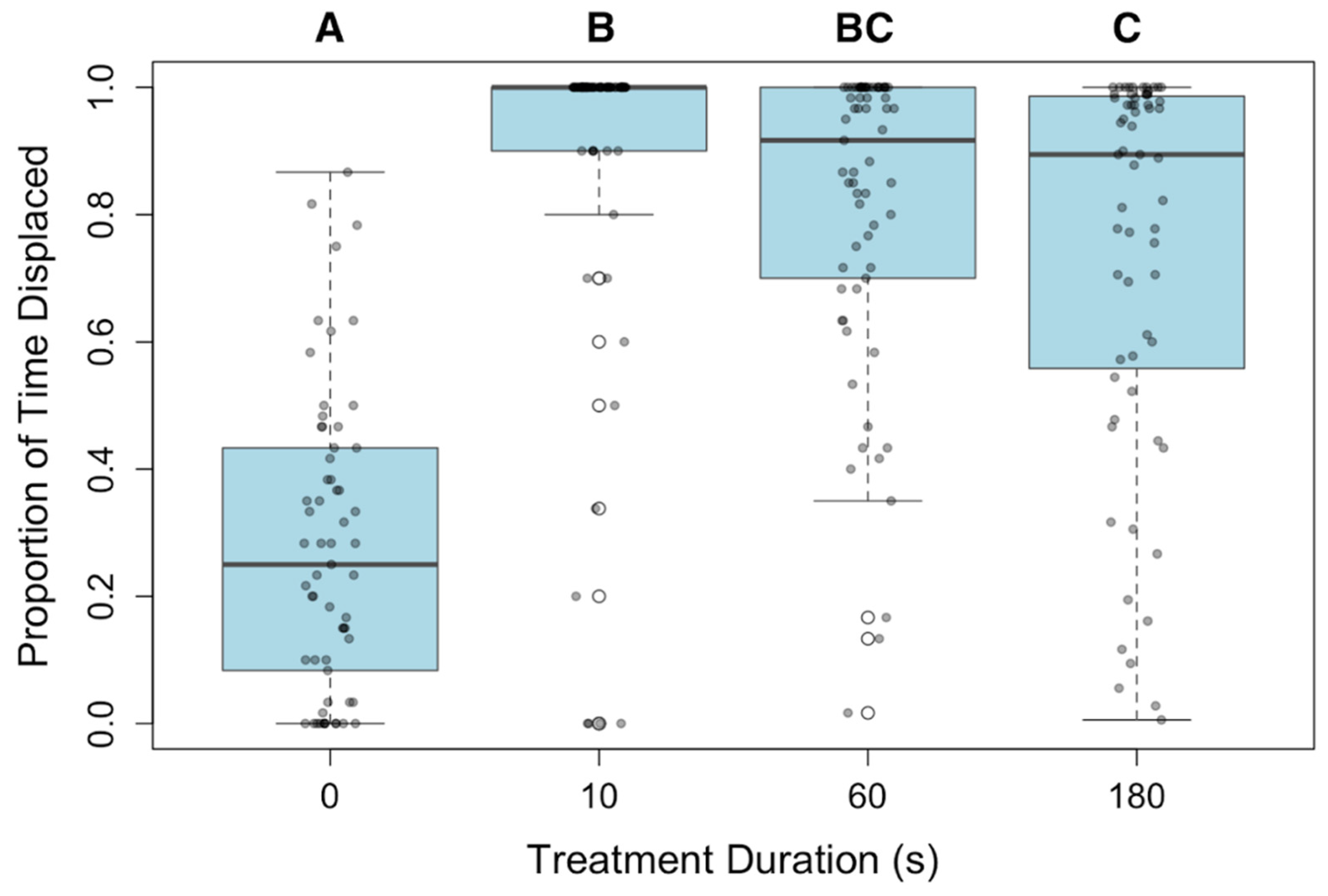
Marginal means (±95% confidence intervals) of the proportion of time displaced from territory across treatments for dusky damselfish. Different letters indicate significantly different responses, as determined by Bonferroni contrasts.
Figure 1.
Marginal means (±95% confidence intervals) of the proportion of time displaced from territory across treatments for dusky damselfish. Different letters indicate significantly different responses, as determined by Bonferroni contrasts.
Figure 2.
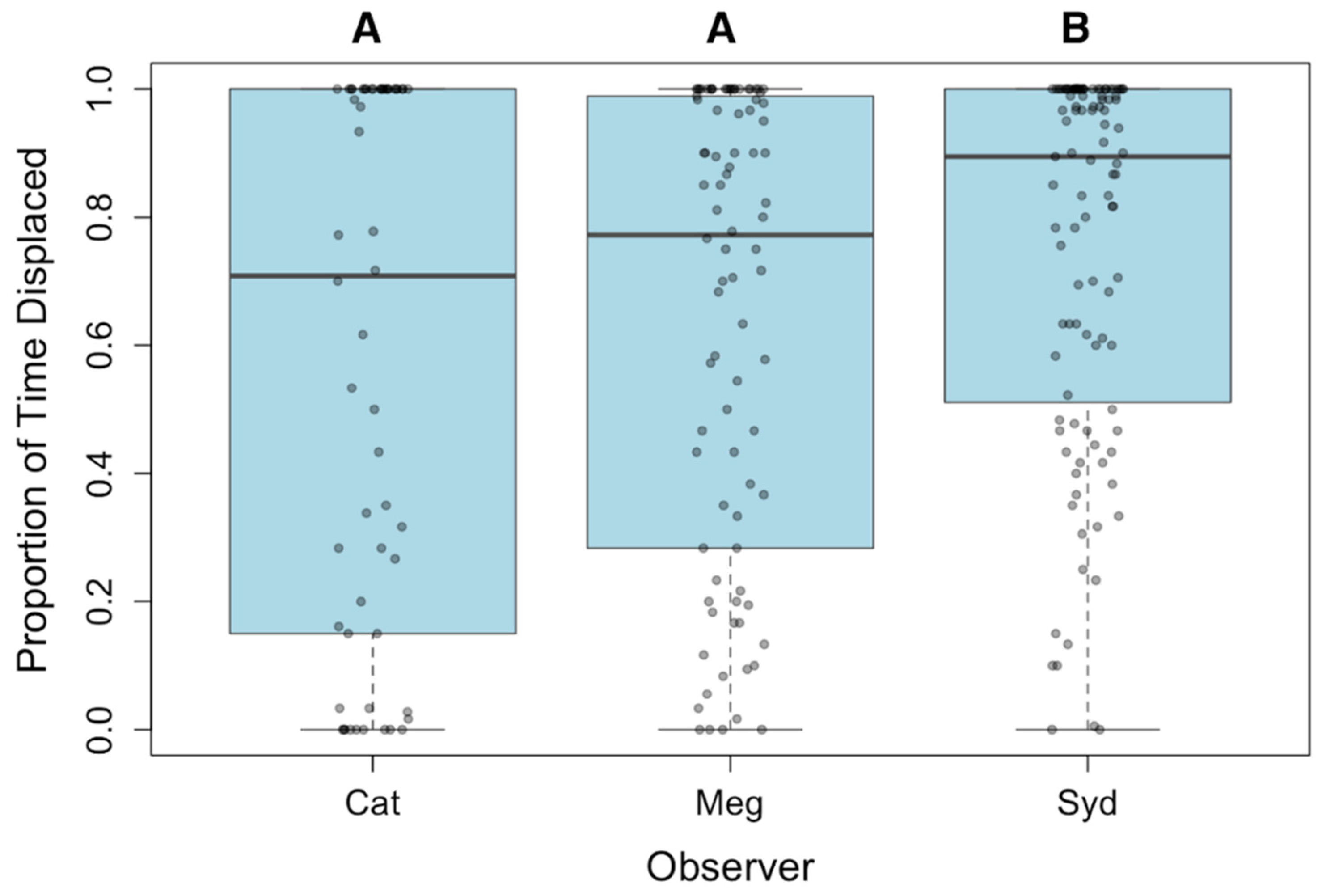
Marginal means (±95% confidence intervals) of time displaced across observers for dusky damselfish. Names of observers include Sydni, Megan, and Catherine. Different letters indicate significant differences in the main effect of treatment time, evaluated by a Bonferroni contrast.
Figure 2.
Marginal means (±95% confidence intervals) of time displaced across observers for dusky damselfish. Names of observers include Sydni, Megan, and Catherine. Different letters indicate significant differences in the main effect of treatment time, evaluated by a Bonferroni contrast.
Figure 3.
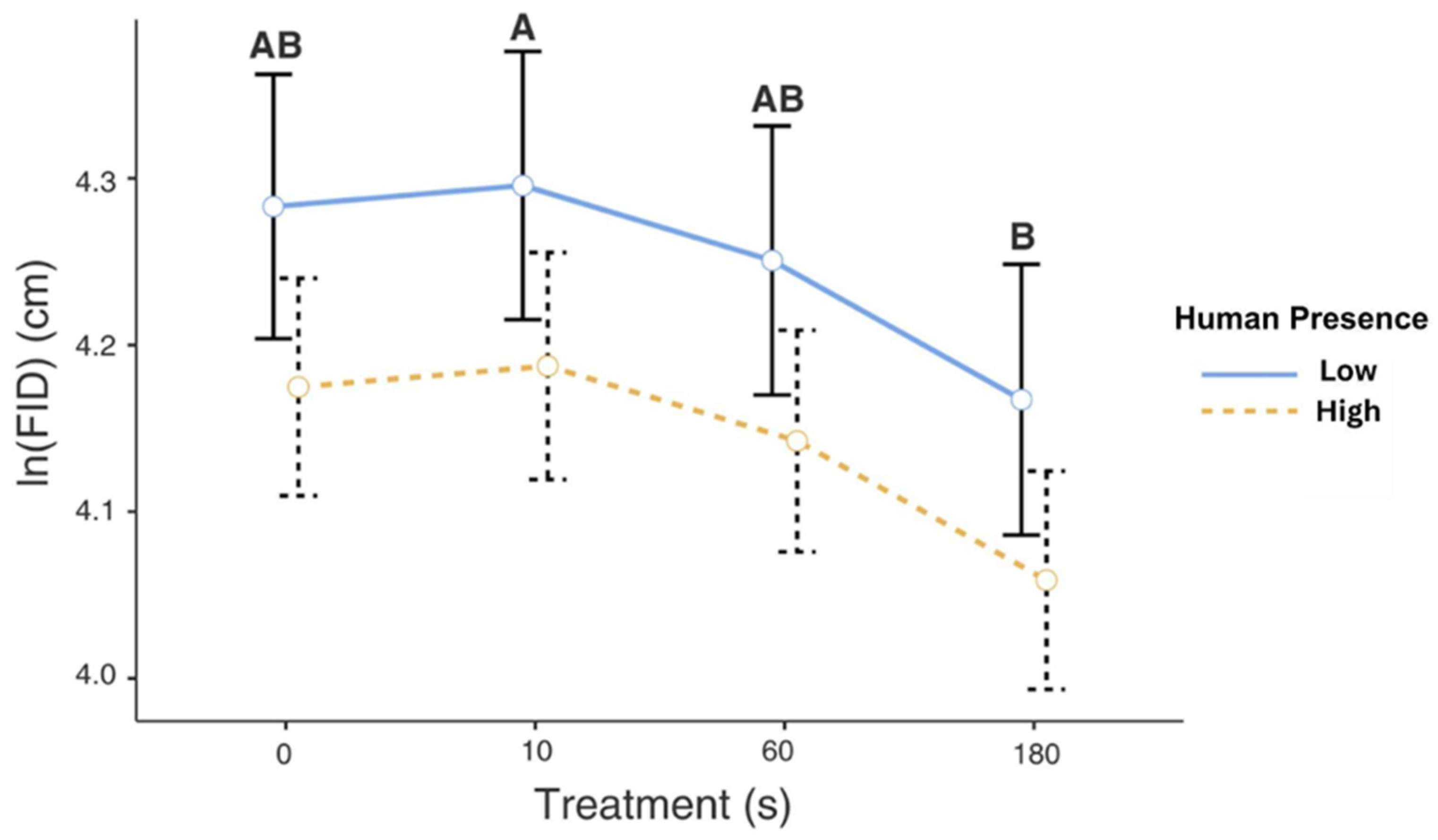
Marginal means (±95% confidence intervals) of ln(flight initiation distance (FID)) in cm across treatments for dusky damselfish in sites with and without human presence. Different letters indicate significantly different responses, as determined by Tukey contrasts. Solid blue illustrates sites with few people; dashed yellow illustrates sites with more people. There was no significant interaction between treatment and location (see text).
Figure 3.
Marginal means (±95% confidence intervals) of ln(flight initiation distance (FID)) in cm across treatments for dusky damselfish in sites with and without human presence. Different letters indicate significantly different responses, as determined by Tukey contrasts. Solid blue illustrates sites with few people; dashed yellow illustrates sites with more people. There was no significant interaction between treatment and location (see text).
Figure 4.
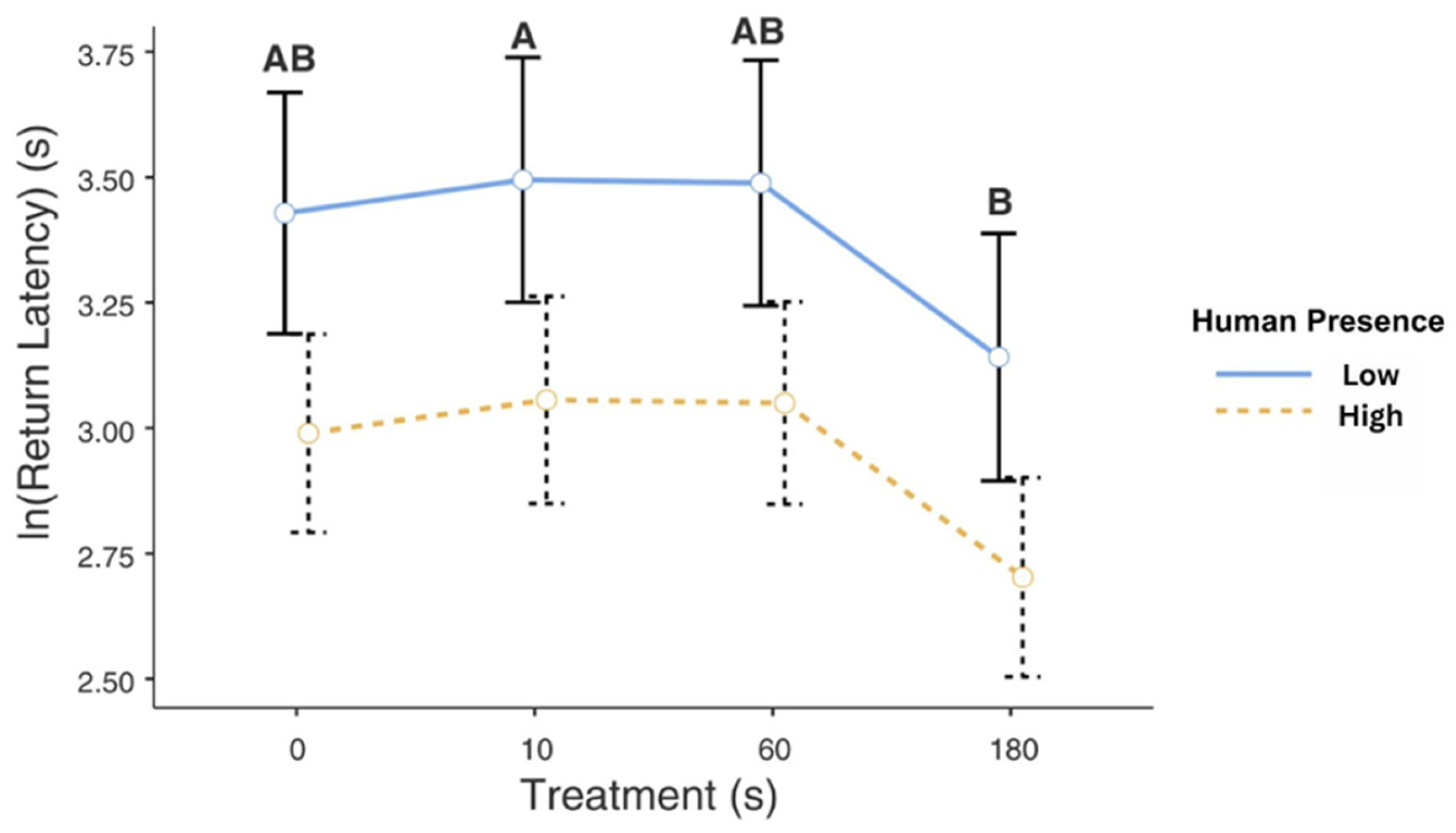
Marginal means (±95% confidence intervals) of proportion of post-flush latency to return time across treatments for dusky damselfish in sites with and without human presence. Different letters indicate significant differences in the main effect of treatment time, evaluated by Tukey contrasts. Solid blue illustrates sites with few people; dashed yellow illustrates sites with more people. There was no significant interaction between treatment and location (see text).
Figure 4.
Marginal means (±95% confidence intervals) of proportion of post-flush latency to return time across treatments for dusky damselfish in sites with and without human presence. Different letters indicate significant differences in the main effect of treatment time, evaluated by Tukey contrasts. Solid blue illustrates sites with few people; dashed yellow illustrates sites with more people. There was no significant interaction between treatment and location (see text).
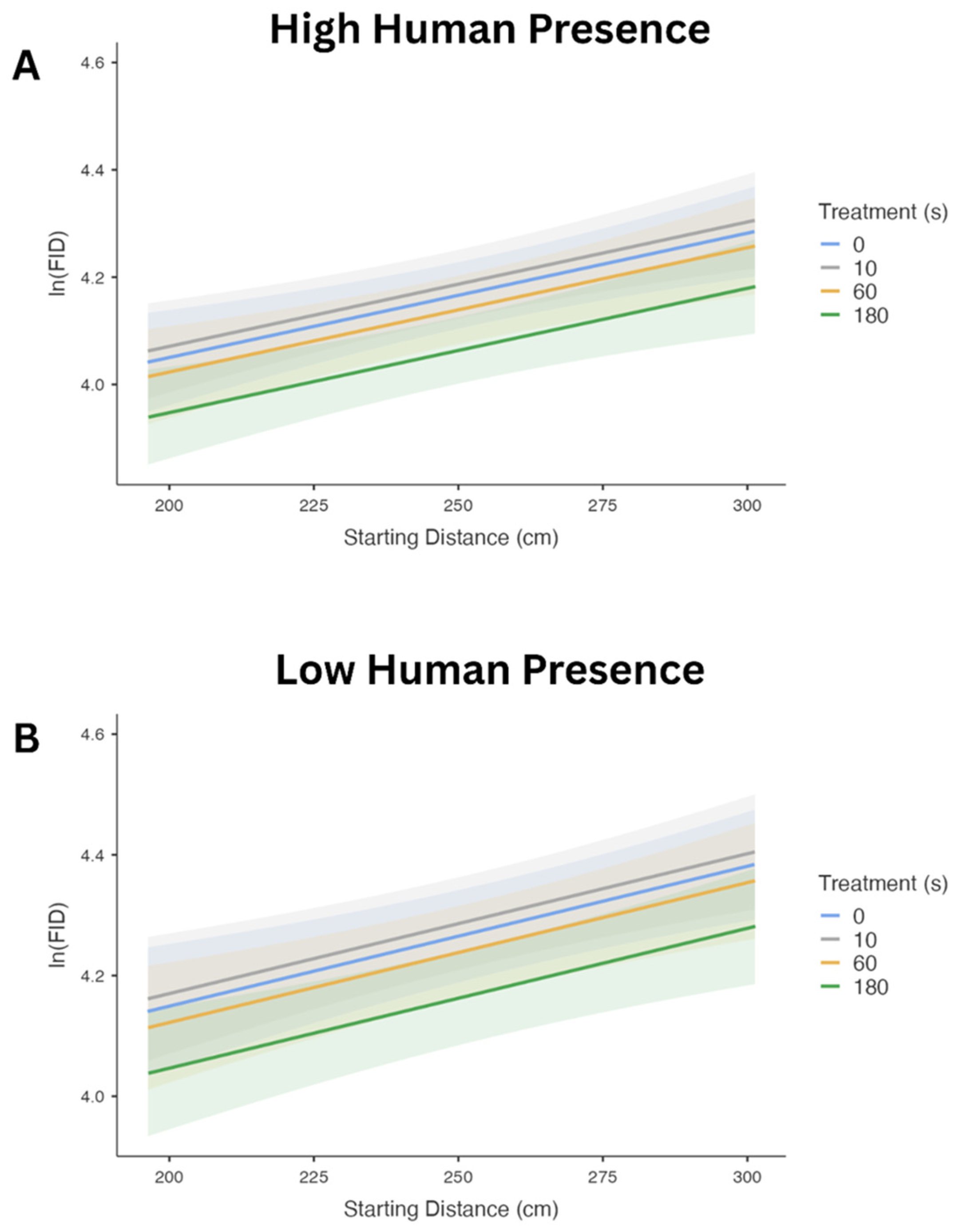
Figure 5.
High (A) vs. Low Human Presence (B) Sites: Interaction plot of marginal mean ln(flight initiation distance (FID)) cm (±95% confidence intervals) and starting distance comparing the relationships of the three different treatment sizes. Each colored line represents a different treatment. Colored bars surrounding the trendlines are 95% confidence intervals.
Figure 5.
High (A) vs. Low Human Presence (B) Sites: Interaction plot of marginal mean ln(flight initiation distance (FID)) cm (±95% confidence intervals) and starting distance comparing the relationships of the three different treatment sizes. Each colored line represents a different treatment. Colored bars surrounding the trendlines are 95% confidence intervals.
Table 1.
Selected study sites (Ta’ahiamanu Public Beach, Commercial jet ski launch site, Temae Public Beach) with their coordinates, protection status (protected or unprotected), and level of overall human presence (high or low) based on field observations.
Table 1.
Selected study sites (Ta’ahiamanu Public Beach, Commercial jet ski launch site, Temae Public Beach) with their coordinates, protection status (protected or unprotected), and level of overall human presence (high or low) based on field observations.
| Site | Coordinates | MPA Status | Human Presence |
|---|
| Ta’ahiamanu Public Beach | 17°29′ S 149°51′ W | Unprotected | High |
| Commercial jet ski launch site | 17°48′ S 149°78′ W | Unprotected | Low |
| Temae Public Beach | 17°50′ S 149°76′ W | Protected | High |
Table 2.
Snorkeling float treatments applied to damselfish, including description of the treatment duration (0 s, 10 s, 60 s, 180 s) and what type of interaction with an ecotourist the treatment serves to represent.
Table 2.
Snorkeling float treatments applied to damselfish, including description of the treatment duration (0 s, 10 s, 60 s, 180 s) and what type of interaction with an ecotourist the treatment serves to represent.
| Treatment | Description | Ecotourism Simulation |
|---|
| No float | No snorkeler present above fish | No ecotourist exposure |
| 10 s float | Snorkeler observes fish for 10 s | Brief passerby or momentary interest |
| 60 s float | Snorkeler observes for 60 s | Moderate observation or brief engagement before moving on |
| 180 s float | Snorkeler observes for 180 s | Extended observation from either highly engaged snorkeler or photographer |
Table 3.
Behavioral response variables (Proportion of Time Displaced, Flight Initiation Distance (FID), Post-flush Latency to Return) collected throughout each trial with the definition used in this study.
Table 3.
Behavioral response variables (Proportion of Time Displaced, Flight Initiation Distance (FID), Post-flush Latency to Return) collected throughout each trial with the definition used in this study.
| Behavioral Response Variable | Definition |
|---|
| Proportion of Time Displaced | The proportion of the treatment time that the subject spent hidden (50% of its body hidden) or away from its initial position in its core territory. |
| Flight Initiation Distance (FID) | Distance at which the fish flees from an approaching pole. |
| Post-flush Latency to Return | Time for the fish to return to its original location after fleeing from a flush exposure. |
Table 4.
Benthic habitat components used for determining the total hard substrate percent, and the definition of their characteristics. Components include sand, rubble, hard substratum, live coral, and macroalgae.
Table 4.
Benthic habitat components used for determining the total hard substrate percent, and the definition of their characteristics. Components include sand, rubble, hard substratum, live coral, and macroalgae.
| Benthic Component | Sand | Rubble | Hard Substratum | Live Coral | Macroalgae |
|---|
| Definition | Particles of sand. | Fragments of rock or coral that were greater in size than particles of sand [47]. | Intact dead coral structure that did not have macroalgal coverage [48]. | Living coral structure. | Whole, attached algae anchored by a holdfast [49] and larger than turf [46]. |
Table 5.
Adjusted R2 values for each of the two models made for each behavioral measure (proportion of time displaced, flight initiation distance, and post-flush latency to return). One model contains human presence (High or Low) as a covariate, and the other contains MPA Status (Y or N).
Table 5.
Adjusted R2 values for each of the two models made for each behavioral measure (proportion of time displaced, flight initiation distance, and post-flush latency to return). One model contains human presence (High or Low) as a covariate, and the other contains MPA Status (Y or N).
| Behavioral Measure | Human Presence Model Adj. R2 | MPA Model Adj. R2 |
|---|
| Proportion of Time Displaced | 0.523 | 0.489 |
| Flight initiation distance (FID) | 0.192 | 0.188 |
| Post-flush Latency-to-Return | 0.103 | 0.061 |
Table 6.
Omnibus results from a permutation-based linear model examining human presence as a factor explaining variation in the proportion of time dusky damselfish were displaced from their territories during snorkeler exposure treatments. The model also includes treatment duration, observer identity, depth, fish size, number of conspecifics, percentage of hard substrate, and depth (model p < 0.001, adj. R2 = 0.523) (η2p = partial eta squared).
Table 6.
Omnibus results from a permutation-based linear model examining human presence as a factor explaining variation in the proportion of time dusky damselfish were displaced from their territories during snorkeler exposure treatments. The model also includes treatment duration, observer identity, depth, fish size, number of conspecifics, percentage of hard substrate, and depth (model p < 0.001, adj. R2 = 0.523) (η2p = partial eta squared).
| | p | η2p |
|---|
| Treatment (s) | <0.001 | 0.480 |
| Observer | <0.001 | 0.045 |
| Depth (cm) | 0.098 | 0.002 |
| Size (cm) | 0.529 | 0.002 |
| Number of Cons. | <0.001 | 0.016 |
| Hard Sub. % | <0.001 | 0.010 |
| Human Presence | <0.001 | 0.129 |
Table 7.
Parameter estimates from a permutation-based linear model that includes human presence (reference “Low”) as a variable to explain variation in the proportion of time fish were displaced from their territories during snorkeler exposure treatments. The model also includes treatment duration (reference 0 s control), observer identity (reference Catherine), depth, fish size, number of conspecifics, and percentage of hard substrate (model p < 0.001, adj. R2 = 0.523).
Table 7.
Parameter estimates from a permutation-based linear model that includes human presence (reference “Low”) as a variable to explain variation in the proportion of time fish were displaced from their territories during snorkeler exposure treatments. The model also includes treatment duration (reference 0 s control), observer identity (reference Catherine), depth, fish size, number of conspecifics, and percentage of hard substrate (model p < 0.001, adj. R2 = 0.523).
| Coefficients | Estimate | SE | p |
|---|
| Intercept | 0.706 | 0.018 | <0.001 |
| Treatment 10 s | −0.397 | 0.027 | <0.001 |
| Treatment 60 s | 0.194 | 0.027 | <0.001 |
| Treatment 180 s | 0.132 | 0.027 | <0.001 |
| Observer Meg | −0.064 | 0.026 | <0.001 |
| Observer Syd | −0.018 | 0.024 | 0.007 |
| Depth (cm) | 0.0001 | 0.001 | 0.804 |
| Size (cm) | 0.005 | 0.007 | 0.529 |
| Number of Cons. | −0.025 | 0.013 | <0.001 |
| Hard Sub. % | 0.001 | 0.001 | <0.001 |
| Human Presence | 0.110 | 0.018 | <0.001 |
Table 8.
Omnibus results from a general linear model containing human presence as a variable examining factors explaining the variation in flight initiation distance (FID) of damselfish. The model also includes treatment duration, starting distance, fish size, depth, number of conspecifics, and the percentage of hard substrate (model p < 0.001, adj. R2 = 0.192) (η2p = partial eta squared).
Table 8.
Omnibus results from a general linear model containing human presence as a variable examining factors explaining the variation in flight initiation distance (FID) of damselfish. The model also includes treatment duration, starting distance, fish size, depth, number of conspecifics, and the percentage of hard substrate (model p < 0.001, adj. R2 = 0.192) (η2p = partial eta squared).
| | p | η2p |
|---|
| Treatment (s) | 0.024 | 0.040 |
| Starting Distance (cm) | <0.001 | 0.060 |
| Size (cm) | <0.001 | 0.058 |
| Depth (cm) | 0.138 | 0.009 |
| Number Cons | 0.837 | 0.000 |
| Hard Sub. % | 0.349 | 0.004 |
| Human Presence | 0.021 | 0.033 |
Table 9.
Parameter estimates result from a general linear model that includes human presence (reference “Low”) as a variable to explain variation in flight initiation distance (FID). The model also includes treatment duration (reference 0 s control), percentage of hard substrate, fish size, number of conspecifics, depth, starting distance, and people or not (reference “N”) (model p < 0.001, adj. R2 = 0.192).
Table 9.
Parameter estimates result from a general linear model that includes human presence (reference “Low”) as a variable to explain variation in flight initiation distance (FID). The model also includes treatment duration (reference 0 s control), percentage of hard substrate, fish size, number of conspecifics, depth, starting distance, and people or not (reference “N”) (model p < 0.001, adj. R2 = 0.192).
| Coefficients | Estimate | SE | p |
|---|
| Intercept | 4.191 | 0.017 | <0.001 |
| Treatment 10 s | 0.021 | 0.043 | 0.626 |
| Treatment 60 s | −0.027 | 0.043 | 0.530 |
| Treatment 180 s | −0.102 | 0.042 | 0.016 |
| Hard Sub. % | −0.001 | 0.001 | 0.349 |
| Size (cm) | 0.025 | 0.006 | <0.001 |
| Number of Conspecifics | 0.003 | 0.012 | 0.837 |
| Depth (cm) | −0.001 | 0.001 | 0.138 |
| Starting Distance (cm) | 0.002 | 0.001 | <0.001 |
| Human Presence | −0.099 | 0.035 | 0.006 |
Table 10.
Omnibus results from the general linear model containing human presence as a variable examining factors explaining the variation in post-flush latency to return time. The model also includes the treatment duration, fish size, depth, number of conspecifics, and percentage of hard substrate (model p < 0.001, adj. R2 = 0.103) (η2p = partial eta squared).
Table 10.
Omnibus results from the general linear model containing human presence as a variable examining factors explaining the variation in post-flush latency to return time. The model also includes the treatment duration, fish size, depth, number of conspecifics, and percentage of hard substrate (model p < 0.001, adj. R2 = 0.103) (η2p = partial eta squared).
| | p | η2p |
|---|
| Treatment (s) | 0.029 | 0.038 |
| Size (cm) | 0.305 | 0.005 |
| Depth (cm) | 0.732 | 0.001 |
| Number Cons. | 0.005 | 0.034 |
| Hard Sub. % | 0.597 | 0.001 |
| Human Presence | <0.001 | 0.064 |
Table 11.
Parameter estimates from the general linear model containing human presence (reference “Low”) as a variable to explain the variation in post-flush latency to return time. The model also includes treatment duration (reference 0 s), fish size, percentage of hard substrate, depth, and number of conspecifics (model p < 0.001, adj. R2 = 0.103).
Table 11.
Parameter estimates from the general linear model containing human presence (reference “Low”) as a variable to explain the variation in post-flush latency to return time. The model also includes treatment duration (reference 0 s), fish size, percentage of hard substrate, depth, and number of conspecifics (model p < 0.001, adj. R2 = 0.103).
| Coefficients | Estimate | SE | p |
|---|
| Intercept | 3.169 | 0.052 | <0.001 |
| Treatment 10 s | 0.069 | 0.135 | 0.607 |
| Treatment 60 s | 0.061 | 0.134 | 0.651 |
| Treatment 180 s | −0.286 | 0.133 | 0.033 |
| Size (cm) | 0.020 | 0.020 | 0.305 |
| Hard Substrate % | −0.001 | 0.003 | 0.597 |
| Depth (cm) | 0.001 | 0.002 | 0.732 |
| Number of Cons | −0.120 | 0.042 | 0.005 |
| Human Presence | −0.438 | 0.110 | <0.001 |



 ,
,