
Seasonal Patterns of Inga spp. (Fabaceae) Hostplant Use by Butterflies (Lepidoptera: Pieridae) in Costa Rican Montane Forests


Abstract
1. Introduction
- (1)
- Why is one species more common throughout the year, while the others are only around at certain times?
- (2)
- Is the seasonality of sympatric pierid butterflies related to whether they require new leaves for oviposition? And is this related to rainfall patterns?
2. Materials and Methods
3. Results
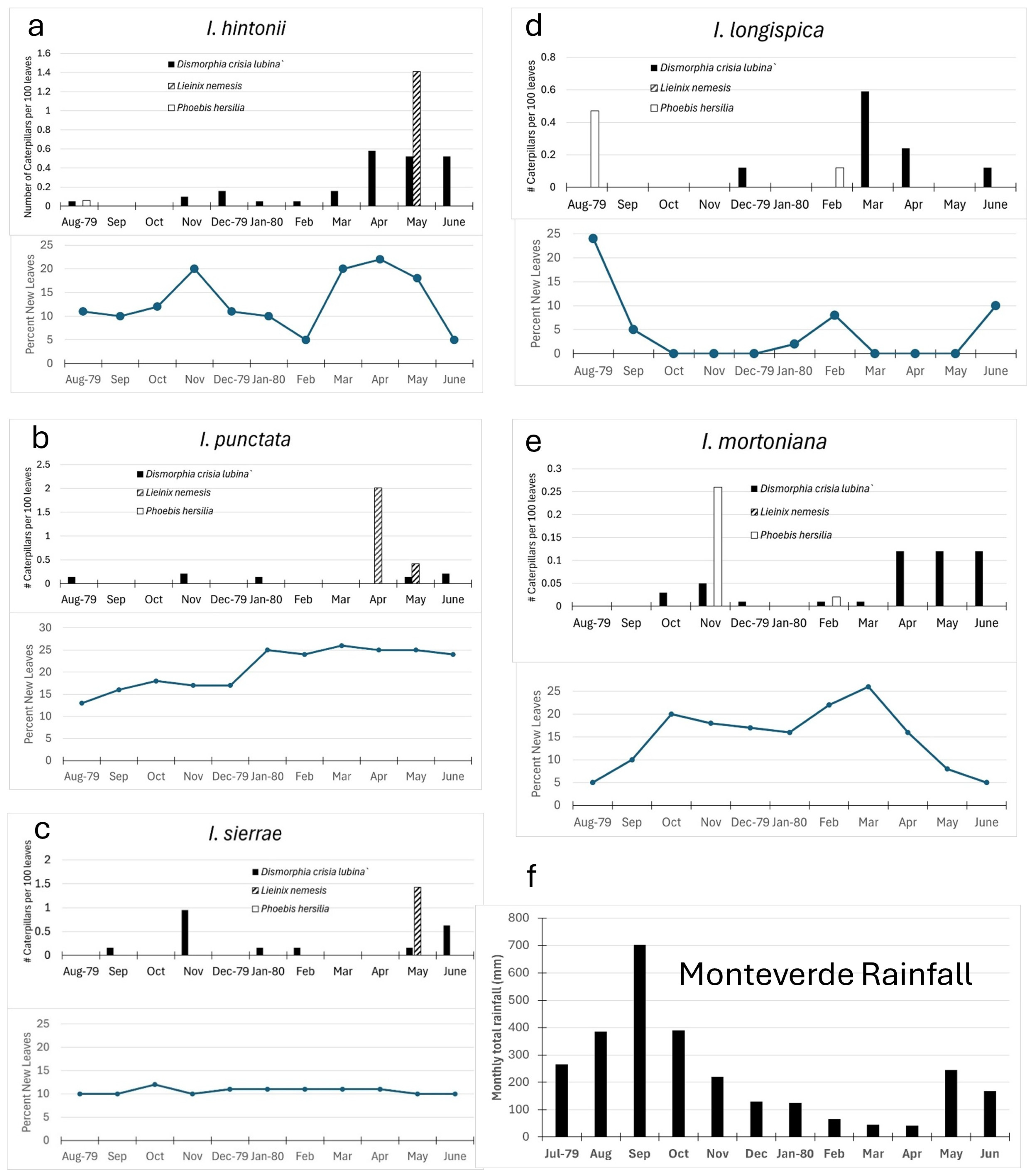
3.1. Seasonality of Leaf Production
3.2. Seasonality of Caterpillars on Study Trees
3.3. Caterpillar Feeding Preferences
4. Discussion
5. Conclusions
Funding
Institutional Review Board Statement
Data Availability Statement
Acknowledgments
Conflicts of Interest
References
- Glassberg, J. Butterflies Through Binoculars—The East; Oxford University Press: New York, NY, USA, 1999. [Google Scholar]
- Braby, M.F.; Trueman, J.W.H. Evolution of Larval Host Plant Associations and Adaptive Radiation in Pierid Butterflies. J. Evol. Biol. 2006, 19, 1677–1690. [Google Scholar] [CrossRef]
- Braby, M.F.; Vila, R.; Pierce, N.E. Molecular Phylogeny and Systematics of the Pieridae (Lepidoptera: Papilionoidea): Higher Classification and Biogeography. Zool. J. Linn. Soc. 2006, 147, 239–275. [Google Scholar] [CrossRef]
- Beccaloni, G.W.; Viloria, A.L.; Hall, S.K.; Robinson, G.S. Catalog of the Hostplants of the Neotropical Butterflies; Monografias Tercer Milenio; Sociedad Entomológica Aragonesa (SEA): Zaragoza, Spain, 2008; Volume 8, ISBN 978-84-935872-2-2. [Google Scholar]
- Koptur, S. Experimental Evidence for Defense of Inga (Mimosoideae) Saplings by Ants. Ecology 1984, 65, 1787–1793. [Google Scholar] [CrossRef]
- Coley, P.D.; Lokvam, J.; Rudolph, K.; Bromberg, K.; Sackett, T.E.; Wright, L.; Brenes-Arguedas, T.; Dvorett, D.; Ring, S.; Clark, A.; et al. Divergent Defensive Strategies of Young Leaves in Two Species of Inga. Ecology 2005, 86, 2633–2643. [Google Scholar] [CrossRef]
- Kursar, T.A.; Dexter, K.G.; Lokvam, J.; Pennington, R.T.; Richardson, J.E.; Weber, M.G.; Murakami, E.T.; Drake, C.; McGregor, R.; Coley, P.D. The Evolution of Antiherbivore Defenses and Their Contribution to Species Coexistence in the Tropical Tree Genus Inga. Proc. Natl. Acad. Sci. USA 2009, 106, 18073–18078. [Google Scholar] [CrossRef]
- Koptur, S. Alternative Defenses Against Herbivores in Inga (Fabaceae, Mimosoideae) over an Elevational Gradient. Ecology 1985, 66, 1639–1650. [Google Scholar] [CrossRef]
- Heil, M. Extrafloral Nectar at the Plant-Insect Interface: A Spotlight on Chemical Ecology, Phenotypic Plasticity, and Food Webs. Annu. Rev. Entomol. 2015, 60, 213–232. [Google Scholar] [CrossRef]
- Wackers, F.L. Suitability of (Extra)Floral Nectar, Pollen, and Honeydew as Insect Foods. In Plant-Provided Food for Carnivorous Insects: A Protective Mutualism and Its Applications; Wackers, F.L., van Rijn, P.C.J., Bruin, J., Eds.; Cambridge University Press: Cambridge, UK, 2005; pp. 17–74. ISBN 13-978-0-521-81941-1. [Google Scholar]
- Haber, W.A. Plants and Vegetation. In Monteverde: Ecology and Conservation of a Tropical Cloud Forest; Nadkarni, N.M., Wheelwright, N.T., Eds.; Oxford University Press: New York, NY, USA, 2000; pp. 39–94. [Google Scholar]
- Clark, K.L.; Lawton, R.O.; Butler, P.R. The Physical Environment. In Monteverde: Ecology and Conservation of a Tropical Cloud Forest; Nadkarni, N.M., Wheelwright, N.T., Eds.; Oxford University Press: New York, NY, USA; Oxford, UK, 2000; pp. 15–38. ISBN 0-19-513310-2. [Google Scholar]
- Koptur, S. Flowering Phenology and Floral Biology of Inga (Fabaceae: Mimosoideae). Syst. Bot. 1983, 8, 354–368. [Google Scholar] [CrossRef]
- Salcido, D.M.; Forister, M.L.; Garcia Lopez, H.; Dyer, L.A. Loss of Dominant Caterpillar Genera in a Protected Tropical Forest. Sci. Rep. 2020, 10, 422. [Google Scholar] [CrossRef]
- Pinkert, S.; Farwig, N.; Kawahara, A.Y.; Jetz, W. Global Hotspots of Butterfly Diversity Are Threatened in a Warming World. Nat. Ecol. Evol. 2025, 9, 789–800. [Google Scholar] [CrossRef]
- Bladon, A.J.; Bladon, E.K.; Smith, R.K.; Sutherland, W.J. Butterfly and Moth Conservation: Global Evidence for the Effects of Interventions for Butterflies and Moths; Conservation Evidence Series Synopsis; University of Cambridge: Cambridge, UK, 2023. [Google Scholar]
- Thomas, J.A.; Simcox, D.J.; Hovestadt, T. Evidence Based Conservation of Butterflies. J. Insect Conserv. 2011, 15, 241–258. [Google Scholar] [CrossRef]
- Edwards, C.B.; Zipkin, E.F.; Henry, E.H.; Haddad, N.M.; Forister, M.L.; Burls, K.J.; Campbell, S.P.; Crone, E.E.; Diffendorfer, J.; Douglas, M.R.; et al. Rapid Butterfly Declines across the United States during the 21st Century. Science 2025, 387, 1090–1094. [Google Scholar] [CrossRef]
- DeVries, P.J. Hostplant Records and Natural History Notes on Costa Rican Butterflies (Papilionidae, Pieridae, and Nymphalidae). J. Res. Lepid. 1986, 24, 290–333. [Google Scholar] [CrossRef]
- Koptur, S.; Primoli Salas, A.; Paulino-Neto, H.F.; Whitfield, J. Pierid Butterflies, Legume Hostplants, and Parasitoids in Urban Areas of Southern Florida. Insects 2024, 15, 123. [Google Scholar] [CrossRef]
- Mtui, D.T.; Ogutu, J.O.; Okick, R.E.; Newmark, W.D. Elevational Distribution of Montane Afrotropical Butterflies Is Influenced by Seasonality and Habitat Structure. PLoS ONE 2022, 17, e0270769. [Google Scholar] [CrossRef]
- Delabye, S.; Maicher, V.; Sáfián, S.; Doležal, J.; Altman, J.; Janeček, S.; Kobe, I.N.; Murkwe, M.; Šebek, P.; Tropek, R. Butterfly and Moth Communities Differ in Their Response to Habitat Structure in Rainforests of Mount Cameroon. Biotropica 2021, 53, 567–580. [Google Scholar] [CrossRef]
- Grøtan, V.; Lande, R.; Engen, S.; Sæther, B.; DeVries, P.J. Seasonal Cycles of Species Diversity and Similarity in a Tropical Butterfly Community. J. Anim. Ecol. 2012, 81, 714–723. [Google Scholar] [CrossRef]
- Muniz, D.G.; Freitas, A.V.L.; Oliveira, P.S. Phenological Relationships of Eunica bechina (Lepidoptera: Nymphalidae) and Its Host Plant, Caryocar brasiliense (Caryocaraceae), in a Neotropical Savanna. Stud. Neotrop. Fauna Environ. 2012, 47, 111–118. [Google Scholar] [CrossRef]
- Vargas, H.A.; Benítez, H.A. Egg Phenology of a Host-Specialist Butterfly in the Western Slopes of the Northern Chilean Andes. Neotrop. Entomol. 2013, 42, 595–599. [Google Scholar] [CrossRef]
- Canfield, M.R.; Pierce, N.E. Facultative Mimicry? The Evolutionary Significance of Seasonal Forms in Several Indo-Australian Butterflies in the Family Pieridae. Trop. Lepid. Res. 2010, 20, 1–7. [Google Scholar]
- Pozo, C.; Luis-Martinez, A.; Llorente-Bousquets, J.; Salas-Suarez, N.; Maya-Martinez, A.; Vargas-Fernandez, I.; Warren, A.D. Seasonality and Phenology of the Butterflies (Lepidoptera: Papilionoidea and Hesperioidea) of Mexico’s Calakmul Region. Fla. Entomol. 2008, 91, 407–422. [Google Scholar] [CrossRef]
- Carvalho, A.P.S.; Owens, H.L.; St. Laurent, R.A.; Earl, C.; Dexter, K.M.; Messcher, R.L.; Willmott, K.R.; Aduse-Poku, K.; Collins, S.C.; Homziak, N.T.; et al. Comprehensive phylogeny of Pieridae butterflies reveals strong correlation between diversification and temperature. iScience 2024, 27, 109336. [Google Scholar] [CrossRef]
- Cosmo, L.G.; Nascimento, A.R.; Cogni, R.; Freitas, A.V.L. Temporal Distribution in a Tri-Trophic System Associated with Piper amalago L. in a Tropical Seasonal Forest. Arthropod-Plant Interact. 2019, 13, 647–652. [Google Scholar] [CrossRef]




| (a) Dismorphia crisia lubina | ||||
| Inga Species | Young Leaves Preferred | Old Leaves Preferred | No Preference | Sign Test Difference (2-Tailed) |
| I. hintonii | 14 | 15 | 2 | NS, p = 0.5 |
| I. longispica | 2 | 7 | 1 | NS, p = 0.09 |
| I. mortoniana | 7 | 2 | 2 | NS, p = 0.09 |
| I. punctata | 12 | 14 | 3 | NS, p = 0.42 |
| I. sierrae | 7 | 3 | 2 | NS, p = 0.17 |
| (b) Lieinix nemesis | ||||
| Inga Species | Young Leaves Preferred | Old Leaves Preferred | No Preference | Sign Test Difference (2-Tailed) |
| I. hintonii | 9 | 1 | 0 | p = 0.011 |
| I. punctata | 10 | 0 | 0 | p = 0.001 |
| I. sierrae | 10 | 0 | 0 | p = 0.001 |
| (c) Phoebis hersilia | ||||
| Inga Species | Young Leaves Preferred | Old Leaves Preferred | No Preference | Sign Test Difference (2-Tailed) |
| I. longispica | 10 | 0 | 0 | p = 0.001 |
| I. mortoniana | 10 | 0 | 0 | p = 0.001 |
Disclaimer/Publisher’s Note: The statements, opinions and data contained in all publications are solely those of the individual author(s) and contributor(s) and not of MDPI and/or the editor(s). MDPI and/or the editor(s) disclaim responsibility for any injury to people or property resulting from any ideas, methods, instructions or products referred to in the content. |
© 2026 by the author. Licensee MDPI, Basel, Switzerland. This article is an open access article distributed under the terms and conditions of the Creative Commons Attribution (CC BY) license.
Share and Cite
Koptur, S. Seasonal Patterns of Inga spp. (Fabaceae) Hostplant Use by Butterflies (Lepidoptera: Pieridae) in Costa Rican Montane Forests. Diversity 2026, 18, 261. https://doi.org/10.3390/d18050261
Koptur S. Seasonal Patterns of Inga spp. (Fabaceae) Hostplant Use by Butterflies (Lepidoptera: Pieridae) in Costa Rican Montane Forests. Diversity. 2026; 18(5):261. https://doi.org/10.3390/d18050261
Chicago/Turabian StyleKoptur, Suzanne. 2026. "Seasonal Patterns of Inga spp. (Fabaceae) Hostplant Use by Butterflies (Lepidoptera: Pieridae) in Costa Rican Montane Forests" Diversity 18, no. 5: 261. https://doi.org/10.3390/d18050261
APA StyleKoptur, S. (2026). Seasonal Patterns of Inga spp. (Fabaceae) Hostplant Use by Butterflies (Lepidoptera: Pieridae) in Costa Rican Montane Forests. Diversity, 18(5), 261. https://doi.org/10.3390/d18050261