Review

Interstitial Terrestrialization in Arthropoda

Florida State Collection of Arthropods, Division of Plant Industry, Florida Department of Agriculture and Consumer Services, Gainesville, FL 32608, USA
Diversity 2026, 18(5), 250; https://doi.org/10.3390/d18050250
Submission received: 23 March 2026 / Revised: 13 April 2026 / Accepted: 20 April 2026 / Published: 23 April 2026
(This article belongs to the Section Phylogeny and Evolution)

Abstract

It has long been hypothesized that some arthropod lineages transitioned to land by following an interstitial pathway through the spaces between sand grains. In recent years, various molecular phylogenetic analyses suggest a greater number of terrestrialization events within Arthropoda than previously hypothesized. The relative importance of an interstitial route to land is likely to have been underestimated because of biases in the fossil record and the choice of techniques used for collecting extant arthropods from sands and other types of mineral regolith (sediment with low organic content). A number of early-branching taxa are microarthropods that are common in mineral regolith, providing phyloecological evidence for an interstitial pathway onto land. Following interstitial terrestrialization, hexapods and early-branching arachnids may have remained minute and soft-bodied within mineral regolith until the Early Devonian, when organically rich soils developed on much of the land surface, resulting in increased food resources but also increased rates of predation. This led to defensive modifications and increases in surface abundance and body size, which would have all elevated the probability of fossilization.

1. Introduction

Arthropoda represent a megadiverse lineage comprising an estimated seven million species [1]. Given that the vast majority of these species live on land, the diversification of this phylum is inextricably linked to multiple terrestrialization events, and yet the circumstances of these events remain poorly understood. Molecular phylogenetic analyses have failed to recover the monophyly of Atelocerata (Myriapoda + Hexapoda) and Arachnida [2,3,4,5,6,7,8,9], forcing the reconsideration of the frequency and timing of terrestrialization [8,10,11,12,13]. While certain lineages, such as various crustaceans, transitioned to land via the retention and modification of gills [14,15,16,17,18,19,20], others likely followed an interstitial pathway. The concept of interstitial terrestrialization is already well established [21,22,23], and the implications of molecular analyses on the important role of this pathway have already been briefly addressed with respect to hexapods and arachnids [10,12,13]. A more detailed update is herein given that addresses factors that have potentially obscured the important role of interstices as the most plausible pathway to land for a number of arthropod lineages.
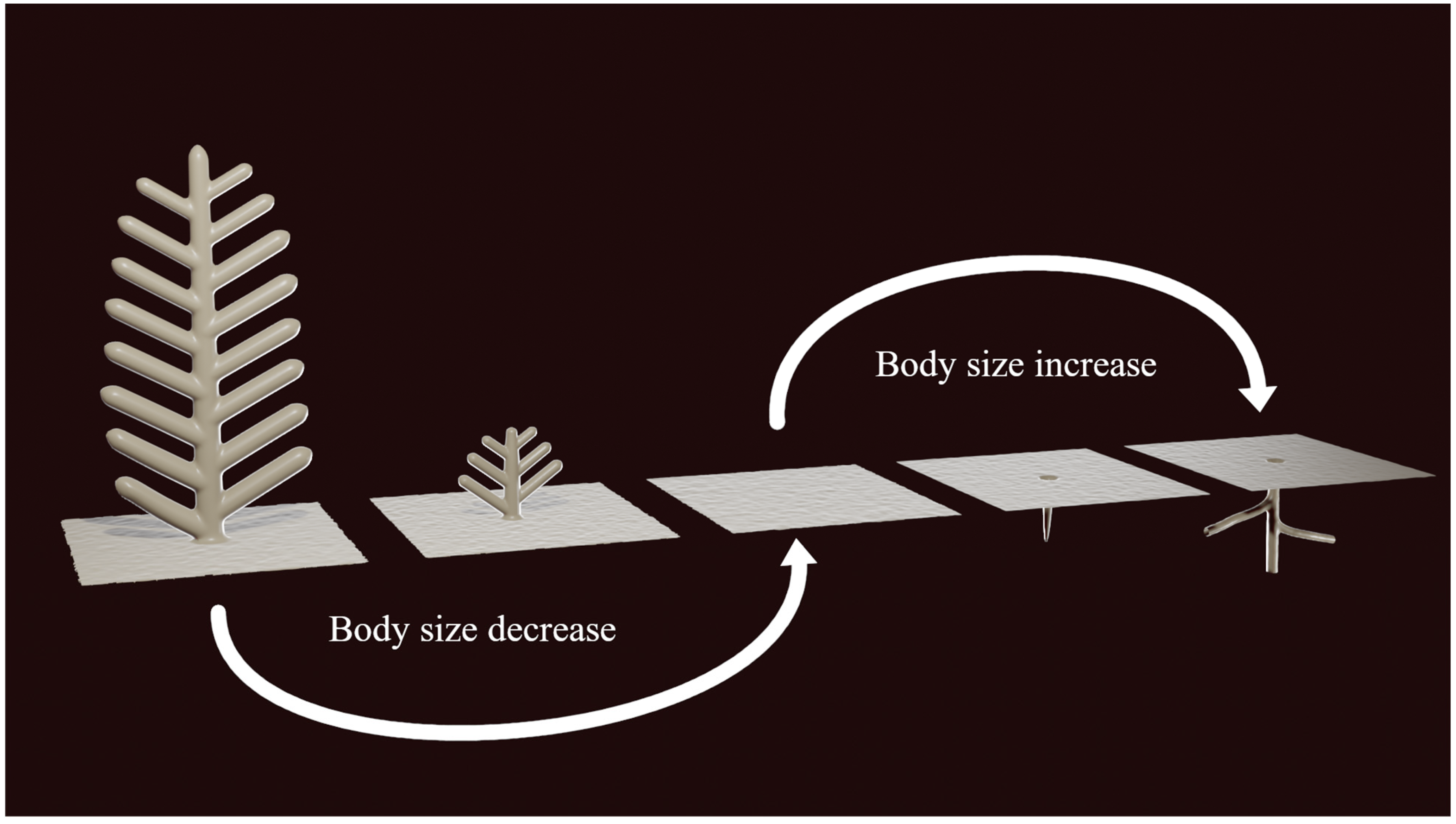
The minute body size of interstitial microarthropods enables terrestrialization without complex respiratory modifications, such as the evolution of gills to lungs. Tracheae, which are absent in many terrestrial microarthropods (including Palpigradi [24] and groups within Protura [25], Collembola [26] and Acariformes [27,28]), are a later adaptation for body enlargement rather than terrestrialization [13] (Figure 1). In microarthropods without tracheae or gills, oxygen is exchanged in the air as it is in the water, via diffusion through the integument [29]. Due to their minute body size, microarthropods small enough to respire through their integument are susceptible to dehydration during terrestrialization. The porosity of sediment produces capillary action that draws water above the water table into a damp capillary fringe [22]. Within this fringe, air-filled interstices are sufficiently wet or humid to reduce the likelihood of desiccation. The interstitial pathway is therefore a gradual and physiologically simple pathway onto land.
Soil has been proposed as the substrate through which many invertebrate groups underwent interstitial terrestrialization [21,23]. But true soil is an organically rich layer that is comparatively thin, often less than 30 cm deep. Consequently, it is susceptible to erosion from the limited contact area shared with water bodies, such as lakes, rivers and oceans. Mineral regolith (including deep subsoils, dune sands, etc.) is a much deeper and more abundant medium through which arthropods could have terrestrialized. This is perhaps implicit in discussions of soil as a transitional substrate to land but needs to be made explicit, especially because the most likely type of regolith for interstitial terrestrialization is beach sand [22], which is rarely regarded as soil. Indeed, sand (0.06–2.00 mm particles) is the only realistic candidate. Gravel (>2.00 mm particles) is too coarse grained to hold much moisture owing to the reduced role of capillarity [22], whereas silt, clay and loam are too fine grained (<0.06 mm particles) to accommodate large enough interstices for microarthropods to fit within [32].
Burrowing through fine sediment is also a very unlikely pathway onto land for microarthropods. In sediment below the water table, the bulk water around sedimentary particles reduces the effectiveness of adhesive forces (e.g., capillary forces or adsorptive surface forces such as hydrogen bonding) in sticking particles together, and so burrowing is possible for microarthropods such as some harpacticoid copepods [33]. But on land there is a film of water around sedimentary particles (even in dry environments) [34], causing them to stick together via adhesive forces such as capillary attraction or hydrogen bonding. This makes burrowing through fine, dry sediment impossible for microarthropods. For this reason, their mode of movement through silts, clays and loams on land is via cracks and crevices.
Coastal beach sand has been hypothesized as the most likely interstitial medium for the terrestrialization of Atelocerata [22]. But because this group has since been shown to be diphyletic [2,3,4,5], the two main lineages, Myriapoda and Hexapoda, are now considered to have undergone terrestrialization independently [10,11,35], and it has long been hypothesized that one or more lineages of arachnids may have undertaken an interstitial pathway onto land [29,36,37]. However, in recent years a single terrestrialization event has been commonly posited for all Arachnida [35,38,39,40], which has made interstitial terrestrialization seem unlikely because this single event was readily explained via the modification of book gills to book lungs [16]. But interstitial terrestrialization is much more likely based on the recovery of Xiphosura (horseshoe crabs) within Arachnida [6,7,8,12,13]. In a total evidence analysis, the repositioning of Xiphosura pulls the rest of Merostomata (Eurypterida, Chasmataspidida and Synziphosurina) into a nested position within Arachnida [8], so that all taxa with book gills are also nested within Arachnida rather than representing early-branching chelicerates. Merostomata seem unlikely to represent a secondary invasion of the ocean, as this would require that the book lungs of Arachnopulmonata (scorpions, spiders, etc.) evolved on land instead of tracheae. Based on the convergent evolution of tracheae across various arthropod lineages, book lungs are easier to explain as terrestrialized modifications of book gills [16,41] than a de novo respiratory mechanism on land. It is therefore likely that arachnids underwent multiple terrestrialization events [7,8,31,42], in which case interstitial terrestrialization remains a potentially important mechanism for one or more of them [12,13].
Interpretations of the terrestrialization of Hexapoda, Chelicerata and Myriapoda are complicated by two major biases that have obscured the relative importance of the interstitial pathway. The first is that the collection of the most deeply rooted lineages of microarthropods are heavily based on Berlese/Tullgren funnel extractions, which have strong selection preferences towards mesophilic and hydrophilic arthropods, whereas xerophilic (or xerotolerant) arthropods are mostly, if not entirely, missed. This bias is rarely considered, leading to wrong assumptions about the ecological distribution of key phylogenetic taxa, especially in the case of Hexapoda. The second bias pertains to the fossil record, which greatly favors macroarthropods with defensive modifications.

2. Extant Taxa and Phyloecology

If sand interstices provided a pathway to terrestrialization in early-branching hexapods and arachnids, then an explanation is needed for why aquatic sands lack any interstitial hexapods and arachnids that never underwent terrestrialization. This problem is especially pertinent to Arachnida. Following a period of radiation, leading to multiple terrestrializations [13], it seems likely that all aquatic interstitial arachnids went extinct (extant lineages appear to represent secondary colonizations from land). Perhaps the most likely explanation is that these early-branching interstitial arthropods were wiped out by ocean anoxia during the end-Permian mass extinction. Although various aquatic organismal lineages avoided extinction via oxic refugia [43,44], some degree of hypoxia was likely unavoidable. Under normal conditions, oxygen is much lower in benthic sediment, including sand [45,46], than in open water. For this reason, benthic fauna often migrate upwards towards the surface when oxygen levels are depleted [47,48]. It is possible that hypoxia in end-Permian oxic refugia forced many interstitial arachnids and hexapods up onto the sea floor for long periods, where they would have been much more vulnerable to predation. Any that remained in the sediment would probably have died from asphyxiation.
Following terrestrialization via sand, microarthropods could have quickly spread into the cracks and crevices in silts, clays and loams. Perhaps for this reason, various early-branching taxa still dominate these mineral regolith habitats, including sands. The potentially important evidence this provides for interstitial terrestrialization has largely gone unnoticed, possibly because until somewhat recently, terrestrialization was commonly thought to have happened only once in Atelocerata (Myriapoda + Hexapoda) [49,50] and also in Arachnida [35,38,39,40]. Terrestrialization in Arachnida is more frequently hypothesized as having proceeded via large-bodied chelicerates rather than via an interstitial pathway [38,40]. Consequently, the commonness and abundance of Endeostigmata (sensu Walter et al. [51])—a paraphyletic group at the base of Acariformes—in mineral regolith (Figure 2), including sand [52,53,54,55], has not been widely viewed as evidence of interstitial terrestrialization (but see [36,37]).
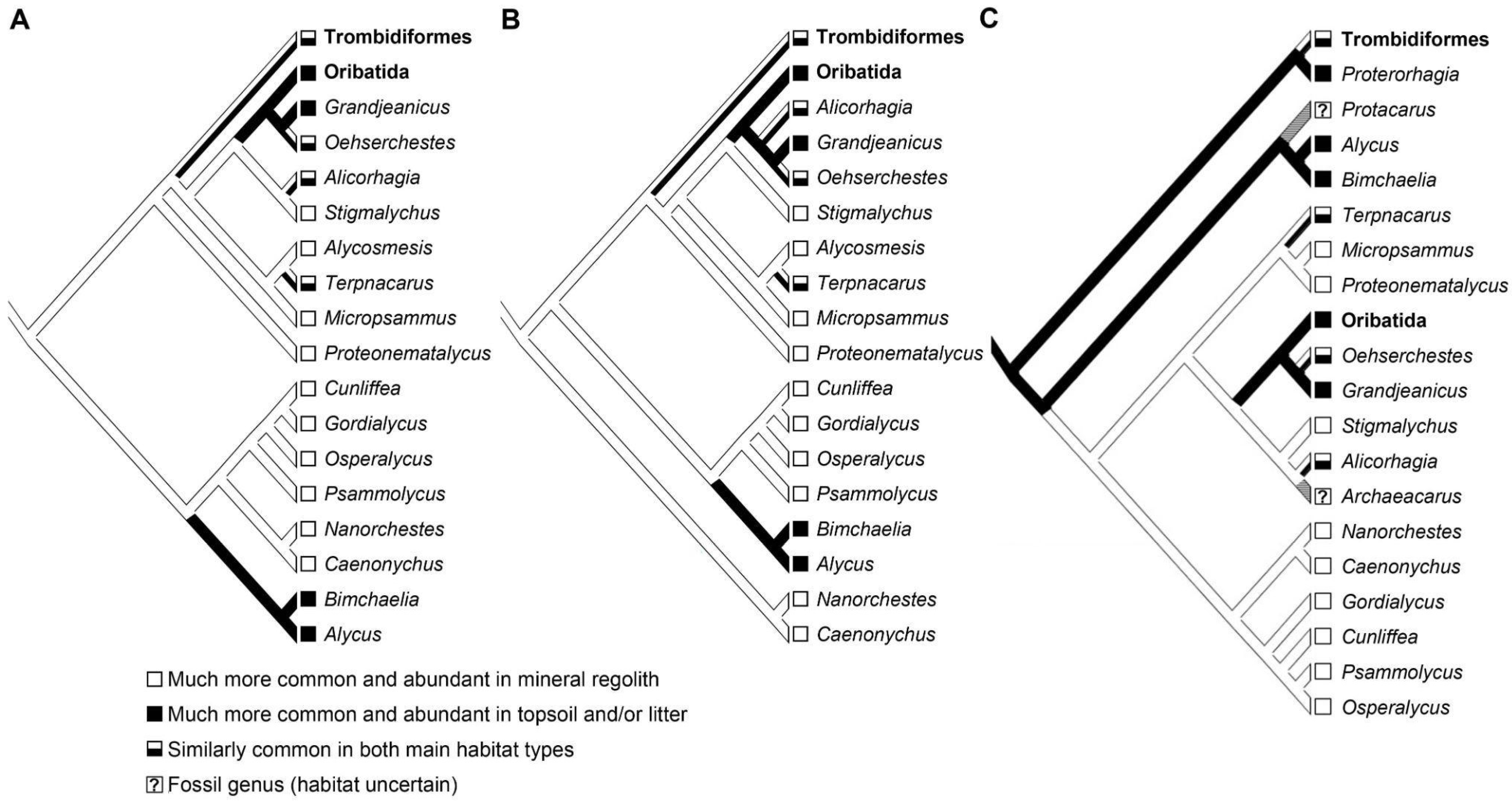
In a number of recent phylogenomic analyses, Acariformes are commonly recovered as sister to the rest of Arachnida, and therefore are very deeply rooted within Chelicerata [8,9]. Accordingly, the relative dominance of Endeostigmata in mineral regolith takes on a new significance. This group is less frequently encountered in topsoil and leaf litter compared to later branching lineages in Acariformes. Such an uneven ecological distribution is consistent with the interstitial terrestrialization of acariform mites as independent from all other arachnids. The results of recent molecular phylogenetic analyses indicate mineral regolith is the ancestral habitat of all Acariformes [56] (Figure 2A,B), whereas an analysis of morphological data instead indicates that topsoil and litter is the ancestral habitat [57] (Figure 2C). This incongruence will not be resolved without taxonomically comprehensive phylogenomic analyses that also include Proterorhagia, an extremely rare taxon that is recovered in a very early-branching position in morphological phylogenetic analyses [57,64].
It has also long been suggested that Palpigradi undertook an interstitial pathway onto land, based on their minute body size, absence of tracheae and inhabitation of beach sand [29,36,65,66]. Although Palpigradi are more often associated with caves, the efficient flotation techniques used to collect microarthropods from sands have not been used nearly enough (see below) to establish if early-branching lineages are not also relatively common in sands [13]. This should be investigated via extensive ecological sampling in combination with taxonomically comprehensive phylogenomic analyses.
The relatively recent relocation of Hexapoda to Pancrustacea [2,3,4,5] requires a detailed review of the ecology of early-branching hexapods. The case for an interstitial pathway has already been made for Hexapoda [10] and, before that, all Atelocerata (Myriapoda + Hexapoda) [22,49,67]. Collembola, Diplura and Protura represent the most deeply rooted lineages of hexapods, although their exact positions remain unclear [68,69,70]. Diplura are comparatively common in mineral regolith, including deep subsoils [71]. Within Collembola, Poduromorpha are extremely common, if not dominant, in sands [72], but a recent phylogenomic analysis supports the placement of Entomobryomorpha, which are much more closely associated with surface habitats [73], as the most deeply rooted collembolan lineage [74].
Protura may be particularly important for the determination of the ancestral habitat of Hexapoda, as a recent phylogenomic analysis recovered this taxon as sister to the rest of Hexapoda [70] (also see [75] and the response in [76]). Proturans are widely thought to be restricted to humid and organically rich habitats [77,78,79,80], such as topsoil and leaf litter, rather than mineral regolith. However, Protura have been greatly understudied, and the experts of this taxon have relied upon Berlese funnels to extract these microarthropods [81,82,83]. Characterizations of ecology, especially tolerance to low humidity, based on Berlese or Tullgren funnel collecting, are clearly problematic because these techniques involve the use of a humidity gradient. These funnel techniques fail to capture a high proportion of species from mineral regolith [53,84]. The mineral horizons select for xerotolerance because they have low humic content and are therefore susceptible to drying out. Attempts to collect a particular taxon from a range of depths along a soil profile using funnel extraction techniques are likely to result in that taxon appearing to be restricted to the topsoil because this is the depth of the mesophilic and hydrophilic species, which follow moisture gradients into the collecting jar. Xerotolerant species from lower in the profile are potentially present but uncaptured because they remain in the dry part of the funnel. Compared to flotation, funnel extraction was shown to be very inefficient at collecting Protura from soil as early as 1956, although this was attributed to the microarthropods being trapped in a baked soil matrix [85].
Unfortunately, studies of deep soil microarthropods are comparatively few and they also generally rely on funnel extractions rather than flotation techniques, which tend to capture a much higher proportion of all taxa [84]. Nonetheless, a number of studies using funnel extractions show that proturans are not restricted to organically rich and humid surface environments but are instead more abundant in the underlying subsoils [86,87,88,89]. This difference in relative abundance would almost certainly have been even greater if flotation techniques were instead used. In light of these studies, which are spread out over decades, the persistence of the idea that proturans are largely restricted to organically rich habitats is hard to explain.
There are no ecological studies dedicated to the Protura of sands. Based on what little is known, this taxon appears to be relatively common in beaches and dunes [53,90,91]. Using heptane flotation [92], Protura were recovered from five of nine samples of bare sand (5 L of sand per sample) from the Indiana foredunes on the coast of Lake Michigan (pers obs). High numbers of Protura were also recovered from sand dunes using a modified Berlese technique (Macfadyen-canister type apparatus) in which temperature was elevated every 12 h [91]. Therefore, proturans are clearly not restricted to humid and organically rich habitats.
Two of the four classes of Myriapoda, Pauropoda and Symphyla, are abundant in mineral regolith [86,87,88,89], which may indicate that myriapods also underwent interstitial terrestrialization. Pauropoda and Symphyla form a sister group to a clade comprising Chilopoda and Diplopoda [93]. This certainly accommodates the possibility of interstitial terrestrialization. Furthermore, Pencillata, an early-branching lineage of Diplopoda, are also minute-bodied inhabitants of soil and litter [94]. However, the case for an interstitial pathway is not as strong for myriapods as for hexapods and early-branching arachnids because a putative myriapod stem-group (Euthycarcinoidea) was too large in body size (at least in regard to known fossils) to fit within sand interstices, and also because Ordovician fossil tracks attributed to Myriapoda suggest at least some early members of this lineage were relatively large-bodied [95]. Symphyla also appear to be noticeably less common in sands than Pauropoda or Protura (pers obs), which leaves open the possibility that myriapods entered sand from the land surface rather than from an aquatic body. Nonetheless, based on the absence of gills or lungs in Myriapoda, an interstitial pathway seems plausible, and it may be that some myriapods very quickly increased in body size following interstitial terrestrialization.
Mineral regolith contains a very small proportion of all arthropod taxa, but as evident from above, the most deeply rooted taxa of Hexapoda (Protura) and Acariformes (Endeostigmata) are commoner in this habitat than litter and topsoil. On the other hand, derived groups of Hexapoda (Insecta) and Acariformes (Oribatida, Parasitengona, Eleutherengona, etc.) are much more common and diverse in litter and topsoil than in mineral regolith. This general phylogenetic pattern may also pertain at lower taxonomic levels, so that the inhabitation of leaf litter and topsoil is derived within lineages such as Protura. To test this hypothesis, phylogenies of Protura and Acariformes need to be better resolved, taxonomically, using phylogenomic analyses. Furthermore, detailed, extensive and systematic surveys should be undertaken comparing microarthropods in mineral regolith with topsoil and litter. There is a lack of accurate quantitative information that is unbiased by collection methods. Flotation techniques are rarely used for extracting microarthropods from organically rich soils and litters because they often also extract a large amount of plant-based material, making quantitative determinations of microarthropods very slow and cumbersome. Nonetheless, these techniques may be important for accurately characterizing the habitat distributions of various microarthropods. This will allow phyloecological studies to determine with greater confidence if lineages such as Protura originated in mineral regolith or, alternatively, in topsoil and litter.
It has been assumed that the extant arthropods of beaches and dunes represent re-invasions of this habitat from other terrestrial habitats rather than from aquatic habitats [22], and this is obviously correct for many lineages. Habitat preference is highly homoplastic within the long periods of time that early-branching lineages would have had to remain in mineral regolith. Therefore, despite the general clustering of mineral regolith inhabitants in early-branching positions, it may be impossible to robustly resolve the most ancestral terrestrial habitat in most terrestrialized lineages. And although early-branching hexapods (Protura, Collembola and Diplura) and some early-branching arachnids (Acariformes, Parasitiformes and Palpigradi) are microarthropods, there remains the possibility that these lineages miniaturized following terrestrialization. However, this would have been a convoluted pathway likely involving the retention and modification of gills, which would then have been lost following the evolution of tracheae. Based on the association of these taxa with some form of interstitial habitat, e.g., sand, soil or litter, it seems more likely that they took an interstitial pathway onto land. Sand interstices represent an obvious first step from an aquatic body towards the interstices of soil and litter. By comparison, it seems unlikely that microarthropods could have terrestrialized via a surface route, such as rocky shores, as they would have been susceptible to being moved around via currents and wave action. Sand, which makes up a large proportion of the world’s coastlines [96,97], buffers microarthropods against wave action while also providing a gradual pathway to terrestrialization: on the surface, microarthropods will quickly desiccate because they are completely exposed, but in the interstices of sand, a steadily increasing amount of moisture is lost to evaporation during low tide with increasing distance up the intertidal zone.
Caves have also been put forward as a transitional environment in the terrestrialization of various lineages of arthropods, including hexapods [98]. A single cave can have parts that are both aquatic and terrestrial. But sand is a more likely pathway to terrestrialization in microarthropods because it is filled with interstices that allow it to take on a damp intermediate state. Moreover, one of the principal ways that caves are thought to have facilitated terrestrialization during the Cambrian–Ordovician, via protection from UV radiation [98], is no less pertinent to mineral regolith.

3. The Fossil Record

Meiobenthic metazoan lineages are nearly absent from the fossil record [99]. Sand is an especially unlikely environment for fossilization because it is a high energy and coarse-grained environment, largely precluding fossilization of microarthropods. The earliest chelicerates may have predominantly or perhaps even exclusively inhabited the interstices of benthic sands, which could explain the absence of early-branching taxa from Cambrian deposits [13]. There is an obvious bias towards larger-bodied arthropods that evolved armored modifications such as a carapace. Therefore, Merostomata, which have been recovered as nested within Arachnida in total evidence analyses [8], are among the earliest known chelicerates in the fossil record [100,101,102].
The recent discovery of Megachelicerax reveals that not all Cambrian chelicerates were minute-bodied and living within sand interstices [102,103]. Although this chelicerate has been hypothesized as having a transitional morphology between Chelicerata and putative stem-group taxa [102], the presence of a pair of chelicerae and five pairs of (pseudo)biramous appendages strongly suggests a close affiliation with Offacolus, which has been recovered within Merostomata in a total evidence analysis [8]. The characters that have been used to suggest an affiliation with Habeliida (e.g., vaulted axial region and well developed tergopleurae) are readily reconciled with convergence rather than providing compelling evidence for a transitional morphology. In the morphological phylogenetic analysis placing Megachelicerax [102], the recovery of Xiphosura, the only extant lineage within Merostomata, as early-branching and outside Arachnida squarely contradicts the vast majority of phylogenomic analyses as well as total evidence analyses [6,8,9,104]. Instead of revealing the morphology of the earliest chelicerates, Megachelicerax may help explain why the basal nodes of Chelicerata have been recalcitrant in molecular phylogenomic analyses by showing that Merostomata, which occupies a more derived position, originated as early as the Cambrian. This new 500-million-year record for Merostomata pushes the origin of that taxon more than 20 million years earlier than the previous 478-million-year estimate, attributed to Setapedites [101]. Accordingly, Chelicerata appear to have radiated into all their main lineages, including Merostomata, during the Cambrian rather than over the course of multiple periods. The earliest known fossils of Megacheira, a plausible stem-group [13], are somewhat older, at approximately 520 million years [105].
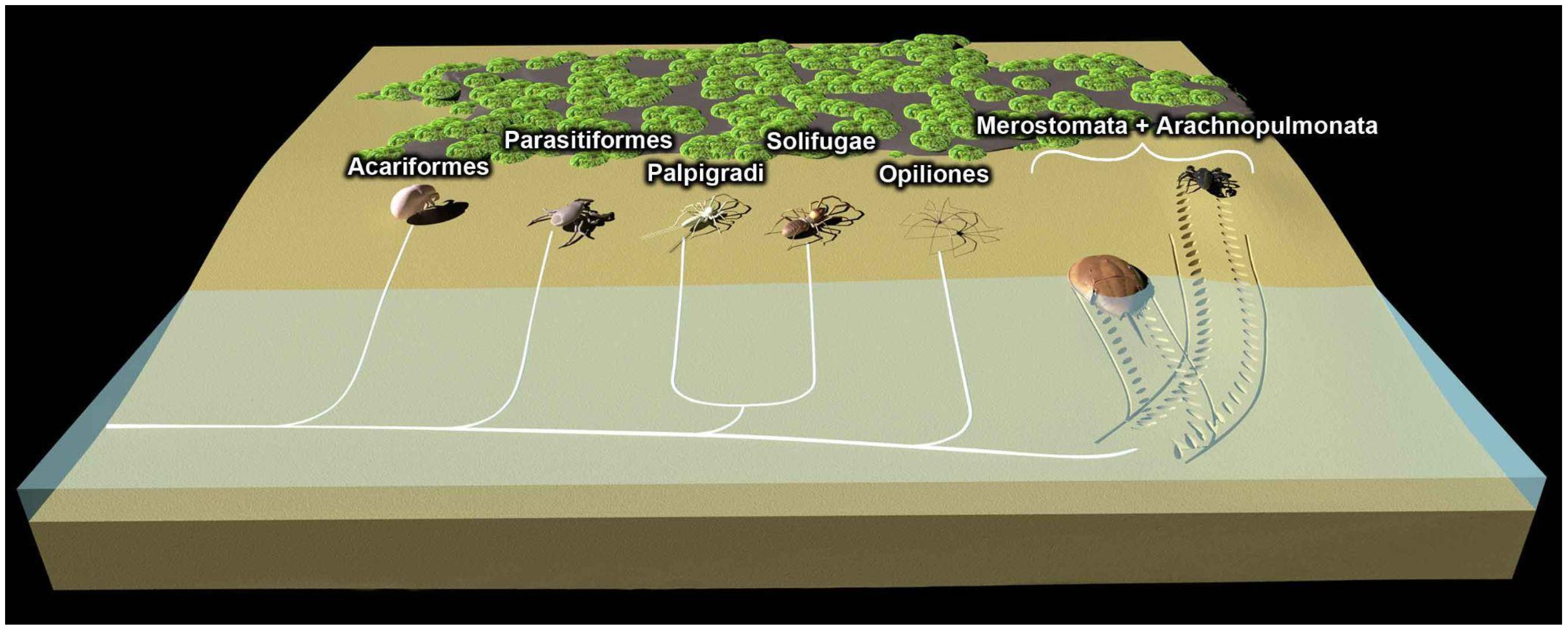
Merostomata possesses book gills (modified to book lungs on land in Arachnopulmonata [16,41]), which are probably an adaptation for body enlargement [13]. On the other hand, Apulmonata (Acariformes, Opiliones, Palpigradi, Parasitiformes, Solifugae and possibly Ricinulei), which has been recovered as a paraphyletic group at the base of Arachnida [8,9], lack book lungs and probably never had book gills. Instead of enlarging in the leadup to terrestrialization, apulmonate arachnids may have retained a meiobenthic lifestyle, in which case they almost certainly took an interstitial pathway onto land [12] (Figure 3). This is compatible with the relatively minute body size of three apulmonate lineages, namely Acariformes, Parasitiformes (excluding Ixodida) and Palpigradi [12,106]. Accordingly, apulmonataes are not recovered in the fossil record until relatively late because their early representatives were minute and living in the interstices of mineral regolith and soil [12].
The fossil record is therefore a biased representation of early arthropod evolution in the ocean and on land. Molecular- and morphology-based dating places the terrestrialization of apulmonates and hexapods during the Cambrian–Ordovician [11,57,107,108], which appears broadly consistent with the recovery of Cambrian fossils of Branchiopoda [109] (somewhat closely related to Hexapoda) and Merostomata [102] (nested within Arachnida). But the earliest fossils of apulmonates and hexapods date to the Devonian [110,111,112,113], which is considerably later. The low number of arthropod fossils from pre-Devonian terrestrial deposits has been attributed to the relative scarcity of these deposits [11,114]. However, that explanation is not sufficient to explain the late appearance of Apulmonata because fossils of Scorpiones and Trigonotarbida, both relatively derived lineages within Arachnida [8] (Figure 3), have been recovered from Silurian deposits [115,116,117]. An additional explanation is provided by interstitial terrestrialization, which requires the possession of a minute body. Accordingly, the small body size of early apulmonates and hexapods may have greatly diminished their probability of fossilization for a long initial period on land. This hypothesis has already been put forward to explain the absence of pre-Devonian fossils of apulmonates [12], and it is expanded upon herein.
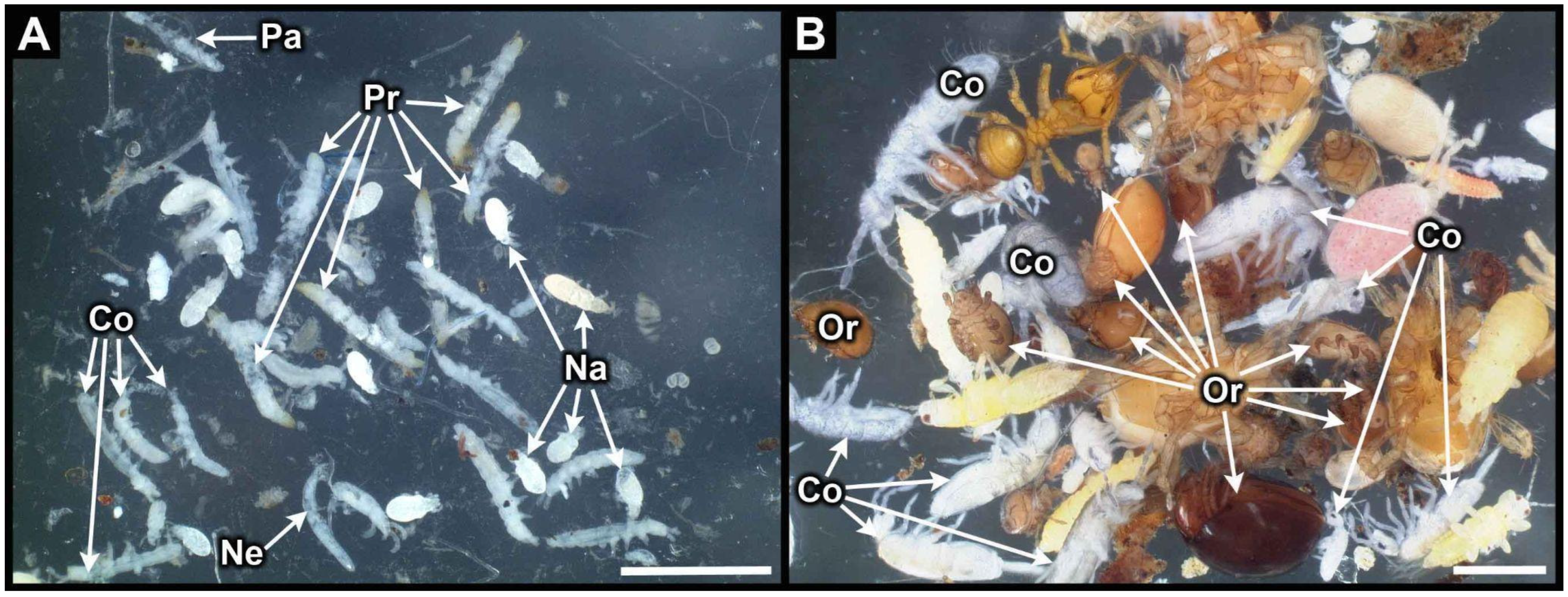
Following interstitial terrestrialization, hexapods and apulmonates would have initially inhabited mineral regolith, specifically sand but later also silts, loams and clays. Because of its very low organic content, mineral regolith has a low concentration of food resources. Consequently, defensive modifications such as sclerotized integument are too metabolically costly to develop and are probably unnecessary because of the low numbers of predators that a biotically impoverished environment can support. Therefore, the integument of most microarthropods in mineral regolith contains little, if any, sclerotin (Figure 4A). This is an additional possible reason for the absence of pre-Devonian fossils of Hexapoda and Apulmonata.
Algal-bacterial mats have been attributed a central role in terrestrialization, as it has been argued that they could have provided food for large-bodied arthropods while also contributing to the formation of protosoils [118]. But these mats need not have been relevant to the terrestrialization of microarthropods, including hexapods and apulmonates. Based on the relative abundance of microarthropods in organically impoverished regolith [53,54], interstitial terrestrialization does not require high concentrations of organic matter. The earliest terrestrial microarthropods may have survived mainly by feeding on fungi, which are common and diverse in desert regoliths, including in sands [119,120,121]. Fungi are one of the main food sources of a number of early-branching terrestrial arthropods, including Collembola, Protura, and early-branching mite taxa, namely Opilioacarida [122] and various Endeostigmata [123,124,125].
The early invasion of terrestrial mineral regolith may even have contributed to the present-day dominance of hexapods and acariform mites (two megadiverse clades [1,37]) on land. Both lineages could have spread out into the dry continental interiors during the Cambrian–Silurian, only appearing in the fossil record once conditions more strongly promoted defensive modifications and greater abundances on the surface.
The Early Devonian corresponds with the development of organically rich soils (including Histosols) on much of the land surface following the increasing depth and profusion of rooting systems in vascular plants [126,127,128]. For microarthropods that moved into these soils, this resulted in greater amounts of food but also more predators, so that the main adversity probably shifted from starvation to predation. In many lineages, this led to the evolution of defensive modifications, including highly sclerotized integument (Figure 4B). Deeper and denser rooting systems also led to greater amounts of above-ground plant biomass, leading to the formation of rudimentary litters (layers of plant detritus) and thus higher concentrations of microarthropods on the land surface. This would have elevated the likelihood of these microarthropods entering a taphonomically favorable environment. For these reasons, the probability of microarthropods becoming fossilized is likely to have increased very greatly from the Devonian onwards. The greater abundance of food resources, including many more microarthropods as prey items, may have also facilitated a dramatic increase in body size in Opiliones and Solifugae following a shift from mineral regolith to the surface. Thus, these early-branching lineages of arachnids do not appear in the fossil record until after the Silurian [129,130].
Defense may have been an important factor in the fossilization of the earliest known hexapod and springtail (Collembola), Rhyniella praecursor Hirst and Maulik. This species had a furcula for leaping [112], which may help explain how it entered the thermal springs that led to the formation of the Rhynie Chert, an Early Devonian deposit. On the other hand, some litter-inhabiting microarthropods, including species that do not leap, are known to be passively transported by air currents [131,132]. Therefore, wind transport likely constitutes an additional mechanism that facilitated the entry of microarthropods into the thermal springs.
All known Early Devonian fossils of Acariformes and Hexapoda are from the Rhynie Chert. The acariform fossils from this deposit appear to exclusively belong to a single species of Endeostigmata, Protacarus crani Hirst [57]. It is possible, therefore, that in this early period Protacarus crani and perhaps other endeostigmatids dominated the mite fauna of soil and litter-like environments. The Rhynie Chert is associated with a Histosol [133], which is consistent with the proliferation of Protacarus crani in association with organically rich soils.
Endeostigmata, including Protacarus crani, have soft and weakly sclerotized integument (Figure 4A). Mites within this paraphyletic group are not recorded from any Paleozoic deposits after the Devonian [134], and this is probably because this group was largely supplanted in organically rich soils by Oribatida, a lineage that is derived from Endeostigmata (Figure 2). Oribatids, which date from the Late Devonian [135,136], are the only mites to be recovered from any Carboniferous deposits [134]. This lineage has evolved a range of defensive adaptations for surviving predators in organically rich environments [137,138,139], and some of these defenses—including greater sclerotization (Figure 4B), long and coarse erectile setae, and a ptychoid body—are already apparent among the earliest known oribatid fossils [135,136].
Mineral regolith may have provided Endeostigmata, which have remained dominant in this habitat [53,54] (Figure 2), with a comparative refuge from predators. A number of endeostigmatid taxa appear to have no defensive adaptations, which is consistent with their specialized inhabitation of mineral regolith. For example, the very soft integumented and elongate-bodied (thus readily outflanked) Nematalycidae (Figure 4A) and Proteonematalycidae exclusively inhabit deep subsoils and sands [52,55]. This predatory refuge scenario may also pertain to Hexapoda. Protura are more abundant in mineral regolith than topsoil or litter [86,87,88,89] (Figure 4), whereas their possible sister group, the rest of Hexapoda, dominates topsoil, litter and other surface habitats, perhaps largely because of the evolution of various defensive adaptations, including leaping (Collembola), elytra (Coleoptera) and possibly also flight (Insecta).

Funding

This research received no external funding.

Data Availability Statement

No new data were created or analyzed in this study. Data sharing is not applicable to this article.

Acknowledgments

John Ray Fisher (Mississippi State University) is thanked for discussion and comments in the early stages of the development of this paper. Erin Powell, Felipe Soto-Adames, Matt Moore and Paul Skelley (Florida Department of Agriculture and Consumer Services, FL, USA) provided comments and suggestions via internal review. The Florida Department of Agriculture and Consumer Services–Division of Plant Industry is thanked for its support on this contribution.

Conflicts of Interest

The author declares no conflict of interest.

References

  1. Stork, N.E. How Many Species of Insects and Other Terrestrial Arthropods Are There on Earth? Annu. Rev. Entomol. 2018, 63, 31–45. [Google Scholar] [CrossRef]
  2. Friedrich, M.; Tautz, D. Ribosomal DNA Phylogeny of the Major Extant Arthropod Classes and the Evolution of Myriapods. Nature 1995, 376, 165–167. [Google Scholar] [CrossRef]
  3. Shultz, J.W.; Regier, J.C. Phylogenetic Analysis of Arthropods Using Two Nuclear Protein-Encoding Genes Supports a Crustacean + Hexapod Clade. Proc. Biol. Sci. 2000, 267, 1011–1019. [Google Scholar] [CrossRef] [PubMed]
  4. Carapelli, A.; Liò, P.; Nardi, F.; van der Wath, E.; Frati, F. Phylogenetic Analysis of Mitochondrial Protein Coding Genes Confirms the Reciprocal Paraphyly of Hexapoda and Crustacea. BMC Evol. Biol. 2007, 7, S8. [Google Scholar] [CrossRef] [PubMed]
  5. von Reumont, B.M.; Jenner, R.A.; Wills, M.A.; Dell’ampio, E.; Pass, G.; Ebersberger, I.; Meyer, B.; Koenemann, S.; Iliffe, T.M.; Stamatakis, A.; et al. Pancrustacean Phylogeny in the Light of New Phylogenomic Data: Support for Remipedia as the Possible Sister Group of Hexapoda. Mol. Biol. Evol. 2012, 29, 1031–1045. [Google Scholar] [CrossRef] [PubMed]
  6. Ballesteros, J.A.; Sharma, P.P. A Critical Appraisal of the Placement of Xiphosura (Chelicerata) with Account of Known Sources of Phylogenetic Error. Syst. Biol. 2019, 68, 896–917. [Google Scholar] [CrossRef]
  7. Sharma, P.P.; Ballesteros, J.A.; Santibáñez-López, C.E. What Is an “arachnid”? Consensus, Consilience, and Confirmation Bias in the Phylogenetics of Chelicerata. Diversity 2021, 13, 568. [Google Scholar] [CrossRef]
  8. Ballesteros, J.A.; Santibáñez-López, C.E.; Baker, C.M.; Benavides, L.R.; Cunha, T.J.; Gainett, G.; Ontano, A.Z.; Setton, E.V.W.; Arango, C.P.; Gavish-Regev, E.; et al. Comprehensive Species Sampling and Sophisticated Algorithmic Approaches Refute the Monophyly of Arachnida. Mol. Biol. Evol. 2022, 39, msac021. [Google Scholar] [CrossRef]
  9. Ontano, A.Z.; Steiner, H.G.; Sharma, P.P. How Many Long Branch Orders Occur in Chelicerata? Opposing Effects of Palpigradi and Opilioacariformes on Phylogenetic Stability. Mol. Phylogenet. Evol. 2022, 168, 107378. [Google Scholar] [CrossRef]
  10. Dunlop, J.A.; Scholtz, G.; Selden, P.A. Water-to-Land Transitions. In Arthropod Biology and Evolution; Springer: Berlin/Heidelberg, Germany, 2013; pp. 417–439. [Google Scholar]
  11. Tihelka, E.; Howard, R.J.; Cai, C.; Lozano-Fernandez, J. Was There a Cambrian Explosion on Land? The Case of Arthropod Terrestrialization. Biology 2022, 11, 1516. [Google Scholar] [CrossRef]
  12. Garwood, R.J.; Dunlop, J.A. Consensus and Conflict in Studies of Chelicerate Fossils and Phylogeny. Arachnol. Mitt. 2023, 66, 2–16. [Google Scholar] [CrossRef]
  13. Bolton, S.J.; Sharma, P.P. Reconciling Morphology with Phylogenomics in Chelicerata (Arthropoda). Zool. J. Linn. Soc. 2026, 206, zlag017. [Google Scholar] [CrossRef]
  14. Farrelly, C.A.; Greenaway, P. Morphology and Ultrastructure of the Gills of Terrestrial Crabs (Crustacea, Gecarcinidae and Grapsidae): Adaptations for Air-Breathing. Zoomorphology 1992, 112, 39–49. [Google Scholar] [CrossRef]
  15. Swain, R.; Richardson, A.M.M. An Examination of Gill Area Relationships in an Ecological Series of Talitrid Amphipods from Tasmania (Amphipoda: Talitridae). J. Nat. Hist. 1993, 27, 285–297. [Google Scholar] [CrossRef]
  16. Dunlop, J.A. The Origins of Tetrapulmonate Book Lungs and Their Significance for Chelicerate Phylogeny. In Proceedings of the 17th European Colloquium of Arachnology, Edinburgh, UK, 14–18 July 1997; British Arachnological Society: Burnham Beeches, UK, 1997; pp. 9–16. [Google Scholar]
  17. Boxshall, G.A.; Jaume, D. Exopodites, Epipodites and Gills in Crustaceans. Arthropod Syst. Phylogeny 2009, 67, 229–254. [Google Scholar] [CrossRef]
  18. Hornung, E. Evolutionary Adaptation of Oniscidean Isopods to Terrestrial Life: Structure, Physiology and Behavior. Terr. Arthropod Rev. 2011, 4, 95–130. [Google Scholar] [CrossRef]
  19. Harrison, J.F. Handling and Use of Oxygen by Pancrustaceans: Conserved Patterns and the Evolution of Respiratory Structures. Integr. Comp. Biol. 2015, 55, 802–815. [Google Scholar] [CrossRef]
  20. Lamsdell, J.C.; McCoy, V.E.; Perron-Feller, O.A.; Hopkins, M.J. Air Breathing in an Exceptionally Preserved 340-Million-Year-Old Sea Scorpion. Curr. Biol. 2020, 30, 4316–4321.e2. [Google Scholar] [CrossRef]
  21. Ghilarov, M.S. The importance of the soil in the origin and evolution of insects. In Proceedings of the Tenth International Congress of Entomology, Montreal, UK, 17–25 August 1956; Mortimer Publishers: Montreal, UK; pp. 443–451.
  22. Little, C. The Terrestrial Invasion: An Ecophysiological Approach to the Origins of Land Animals; Cambridge University Press: Cambridge, UK, 1990. [Google Scholar]
  23. van Straalen, N.M. Evolutionary Terrestrialization Scenarios for Soil Invertebrates. Pedobiologia 2021, 87–88, 150753. [Google Scholar] [CrossRef]
  24. Levi, H.W. Adapations of Respiratory Systems of Spiders. Evolution 1967, 21, 571–583. [Google Scholar] [CrossRef]
  25. Carapelli, A.; Bu, Y.; Chen, W.-J.; Nardi, F.; Leo, C.; Frati, F.; Luan, Y.-X. Going Deeper into High and Low Phylogenetic Relationships of Protura. Genes 2019, 10, 292. [Google Scholar] [CrossRef]
  26. Nickerl, J.; Helbig, R.; Schulz, H.-J.; Werner, C.; Neinhuis, C. Diversity and Potential Correlations to the Function of Collembola Cuticle Structures. Zoomorphology 2013, 132, 183–195. [Google Scholar] [CrossRef]
  27. Dunlop, J.A.; Alberti, G. The Affinities of Mites and Ticks: A Review. J. Zool. Syst. Evol. Res. 2008, 46, 1–18. [Google Scholar] [CrossRef]
  28. Bolton, S.J.; Klompen, H.; Bauchan, G.R.; Ochoa, R. A New Genus and Species of Nematalycidae (Acari: Endeostigmata). J. Nat. Hist. 2014, 48, 1359–1373. [Google Scholar] [CrossRef]
  29. Savory, T. On the Arachnid Order Palpigradi. J. Arachnol. 1974, 2, 43–45. [Google Scholar]
  30. Grillo, M.; Casanova, J.; Averof, M. Development: A Deep Breath for Endocrine Organ Evolution. Curr. Biol. 2014, 24, R38–R40. [Google Scholar] [CrossRef] [PubMed][Green Version]
  31. Sharma, P.P. Chelicerates and the Conquest of Land: A View of Arachnid Origins through an Evo-Devo Spyglass. Integr. Comp. Biol. 2017, 57, 510–522. [Google Scholar] [CrossRef]
  32. Boxshall, G.A.; Kihara, T.C.; Huys, R. Collecting and Processing Non-Planktonic Copepods. J. Crustac. Biol. 2016, 36, 576–583. [Google Scholar] [CrossRef][Green Version]
  33. Azovsky, A.I.; Chertoprud, E.S.; Garlitska, L.A. Environmental Stability and Long-Term Variability of Harpacticoid Copepod Assemblages. Mar. Biol. 2022, 169, 67. [Google Scholar] [CrossRef]
  34. Tuller, M.; Or, D. Water Films and Scaling of Soil Characteristic Curves at Low Water Contents. Water Resour. Res. 2005, 41. [Google Scholar] [CrossRef]
  35. Lozano-Fernandez, J.; Carton, R.; Tanner, A.R.; Puttick, M.N.; Blaxter, M.; Vinther, J.; Olesen, J.; Giribet, G.; Edgecombe, G.D.; Pisani, D. A Molecular Palaeobiological Exploration of Arthropod Terrestrialization. Philos. Trans. R. Soc. Lond. B Biol. Sci. 2016, 371, 20150133. [Google Scholar] [CrossRef]
  36. van der Hammen, L. A New Classiification of Chelicerata. Zool. Meded. 1977, 51, 307–319. [Google Scholar]
  37. Walter, D.E.; Proctor, H.C. Mites: Ecology, Evolution and Behavior; CABI Publishing: Wallingford, UK, 1999. [Google Scholar]
  38. Lozano-Fernandez, J.; Tanner, A.R.; Giacomelli, M.; Carton, R.; Vinther, J.; Edgecombe, G.D.; Pisani, D. Increasing Species Sampling in Chelicerate Genomic-Scale Datasets Provides Support for Monophyly of Acari and Arachnida. Nat. Commun. 2019, 10, 2295. [Google Scholar] [CrossRef]
  39. Lozano-Fernandez, J.; Tanner, A.R.; Puttick, M.N.; Vinther, J.; Edgecombe, G.D.; Pisani, D. A Cambrian–Ordovician Terrestrialization of Arachnids. Front. Genet. 2020, 11, 182. [Google Scholar] [CrossRef] [PubMed]
  40. Howard, R.J.; Puttick, M.N.; Edgecombe, G.D.; Lozano-Fernandez, J. Arachnid Monophyly: Morphological, Palaeontological and Molecular Support for a Single Terrestrialization within Chelicerata. Arthropod Struct. Dev. 2020, 59, 100997. [Google Scholar] [CrossRef]
  41. Di, Z.; Edgecombe, G.D.; Sharma, P.P. Homeosis in a Scorpion Supports a Telopodal Origin of Pectines and Components of the Book Lungs. BMC Evol. Biol. 2018, 18, 73. [Google Scholar] [CrossRef]
  42. Sharma, P.P.; Kaluziak, S.T.; Pérez-Porro, A.R.; González, V.L.; Hormiga, G.; Wheeler, W.C.; Giribet, G. Phylogenomic Interrogation of Arachnida Reveals Systemic Conflicts in Phylogenetic Signal. Mol. Biol. Evol. 2014, 31, 2963–2984. [Google Scholar] [CrossRef] [PubMed]
  43. Proemse, B.C.; Grasby, S.E.; Wieser, M.E.; Mayer, B.; Beauchamp, B. Molybdenum Isotopic Evidence for Oxic Marine Conditions during the Latest Permian Extinction. Geology 2013, 41, 967–970. [Google Scholar] [CrossRef]
  44. Dal Corso, J.; Song, H.; Callegaro, S.; Chu, D.; Sun, Y.; Hilton, J.; Grasby, S.E.; Joachimski, M.M.; Wignall, P.B. Environmental Crises at the Permian–Triassic Mass Extinction. Nat. Rev. Earth Environ. 2022, 3, 197–214. [Google Scholar] [CrossRef]
  45. Brotas, V.; Amorim-Ferreira, A.; Vale, C.; Catarino, F. Oxygen Profiles in Intertidal Sediments of Ria Formosa (S. Portugal). Hydrobiologia 1990, 207, 123–130. [Google Scholar] [CrossRef]
  46. Glud, R.N. Oxygen Dynamics of Marine Sediments. Mar. Biol. Res. 2008, 4, 243–289. [Google Scholar] [CrossRef]
  47. Bernhard, J.M.; Alve, E. Vertical Migratory Response of Benthic Foraminifera to Controlled Oxygen Concentrations in an Experimental Mesocosm. Mar. Ecol. Prog. Ser. 1995, 116, 137–151. [Google Scholar] [CrossRef]
  48. Grego, M.; Riedel, B.; Stachowitsch, M.; De Troch, M. Meiofauna Winners and Losers of Coastal Hypoxia: Case Study Harpacticoid Copepods. Biogeosciences 2014, 11, 281–292. [Google Scholar] [CrossRef]
  49. Raven, J.A. Comparative Physiology of Plant and Arthropod Land Adaptation. Philos. Trans. R. Soc. Lond. 1985, 309, 273–288. [Google Scholar] [CrossRef]
  50. Selden, P.A.; Edwards, D. Colonisation of the Land. In Evolution and the Fossil Record; Allen, K., Briggs, D.E.G., Eds.; Belhaven Press: London, UK, 1989; pp. 122–152. [Google Scholar]
  51. Walter, D.E.; Bolton, S.; Uusitalo, M.; Zhang, Z.-Q. Suborder Endeostigmata Reuter, 1909. In Animal biodiversity: An Outline of Higher-Level Classification and Survey of Taxonomic Richness; Zhang, Z.-Q., Ed.; Magnolia Press: Auckland, New Zealand, 2011; Volume 3148, pp. 139–140. [Google Scholar]
  52. Kethley, J. Proteonematalycidae (Acari: Acariformes), a New Mite Family from Fore-Dune Sand of Lake Michigan. Int. J. Acarol. 1989, 15, 209–217. [Google Scholar] [CrossRef]
  53. André, H.M.; Noti, M.-I.; Lebrun, P. The Soil Fauna: The Other Last Biotic Frontier. Biodivers. Conserv. 1994, 3, 45–56. [Google Scholar] [CrossRef]
  54. Russell, D.J.; Alberti, G. Actinedid Mite Community Diversity in a Succession Gradient in Continental Sand-Dune Habitats of Central Europe. In Proceedings of the Trends in Acarology; Springer: Dordrecht, The Netherlands, 2010; pp. 135–142. [Google Scholar]
  55. Bolton, S.J.; Bauchan, G.R.; Ochoa, R.; Pooley, C.; Klompen, H. The Role of the Integument with Respect to Different Modes of Locomotion in the Nematalycidae (Endeostigmata). Exp. Appl. Acarol. 2015, 65, 149–161. [Google Scholar] [CrossRef]
  56. Pepato, A.R.; Costa, S.G.D.S.; Harvey, M.S.; Klimov, P.B. One-Way Ticket to the Blue: A Large-Scale, Dated Phylogeny Revealed Asymmetric Land-to-Water Transitions in Acariform Mites (Acari: Acariformes). Mol. Phylogenet. Evol. 2022, 177, 107626. [Google Scholar] [CrossRef]
  57. Klimov, P.B.; Kolesnikov, V.B.; Vorontsov, D.D.; Ball, A.D.; Bolton, S.J.; Mellish, C.; Edgecombe, G.D.; Pepato, A.R.; Chetverikov, P.E.; He, Q.; et al. The Evolutionary History and Timeline of Mites in Ancient Soils. Sci. Rep. 2025, 15, 13555. [Google Scholar] [CrossRef] [PubMed]
  58. Santos, P.F.; Whitford, W.G. Seasonal and Spatial Variation in the Soil Microarthropod Fauna of the White Sands National Monument. Southwest. Nat. 1983, 28, 417–421. [Google Scholar] [CrossRef]
  59. Walter, D.E. Endemism and Cryptogenesis in “segmented” Mites: A Review of Australian Alicorhagiidae, Terpnacaridae, Oehserchestidae and Grandjeanicidae (Acari: Sarcoptiformes). Aust. J. Entomol. 2001, 40, 207–218. [Google Scholar] [CrossRef]
  60. Uusitalo, M. Revision of the Family Alycidae (Acariformes, Acari), with Special Reference to European Species. Ph.D. Thesis, University of Helsinki, Helsinki, Finland, 2010. [Google Scholar]
  61. Russell, D.J.; Hohberg, K.; Elmer, M. Primary Colonisation of Newly Formed Soils by Actinedid Mites. Soil Org. 2010, 82, 237. [Google Scholar]
  62. Bolton, S.J.; Chetverikov, P.E.; Ochoa, R.; Klimov, P.B. Where Eriophyoidea (Acariformes) Belong in the Tree of Life. Insects 2023, 14, 527. [Google Scholar] [CrossRef]
  63. Maddison, W.P.; Maddison, D.R. Mesquite: A Modular System for Evolutionary Analysis, Version 3.81; Available online: https://www.researchgate.net/publication/235789864_MESQUITE_a_modular_system_for_evolutionary_analysis (accessed on 19 April 2026).
  64. Bolton, S.J.; Chetverikov, P.E.; Klompen, H. Morphological Support for a Clade Comprising Two Vermiform Mite Lineages: Eriophyoidea (Acariformes) and Nematalycidae (Acariformes). Syst. Appl. Acarol. 2017, 22, 1096–1131. [Google Scholar] [CrossRef]
  65. Condé, B. Présence de Palpigrades Dans Le Milieu Interstitiel Littoral. C. R. Acad. Sci. 1965, 261, 1898–1900. [Google Scholar]
  66. Monniot, F. Un Palpigrade Interstitiel: Leptokoenenia Scurra n. sp. Rev. Ecol. Biol. Sol. 1966, 3, 41–64. [Google Scholar]
  67. Little, C. Colonisation of Land: Origins and Adaptations of Terrestrial Animals; Cambridge University Press: Cambridge, UK, 1983. [Google Scholar]
  68. Misof, B.; Liu, S.; Meusemann, K.; Peters, R.S.; Donath, A.; Mayer, C.; Frandsen, P.B.; Ware, J.; Flouri, T.; Beutel, R.G.; et al. Phylogenomics Resolves the Timing and Pattern of Insect Evolution. Science 2014, 346, 763–767. [Google Scholar] [CrossRef]
  69. Lozano-Fernandez, J.; Giacomelli, M.; Fleming, J.F.; Chen, A.; Vinther, J.; Thomsen, P.F.; Glenner, H.; Palero, F.; Legg, D.A.; Iliffe, T.M.; et al. Pancrustacean Evolution Illuminated by Taxon-Rich Genomic-Scale Data Sets with an Expanded Remipede Sampling. Genome Biol. Evol. 2019, 11, 2055–2070. [Google Scholar] [CrossRef]
  70. Du, S.; Tihelka, E.; Yu, D.; Chen, W.-J.; Bu, Y.; Cai, C.; Engel, M.S.; Luan, Y.-X.; Zhang, F. Revisiting the Four Hexapoda Classes: Protura as the Sister Group to All Other Hexapods. Proc. Natl. Acad. Sci. USA 2024, 121, e2408775121. [Google Scholar] [CrossRef]
  71. Sendra, A.; Jiménez-Valverde, A.; Selfa, J.; Reboleira, A.S.P. Diversity, Ecology, Distribution and Biogeography of Diplura. Insect Conserv. Divers. 2021, 14, 415–425. [Google Scholar] [CrossRef]
  72. Thibaud, J.-M.; Christian, E. Biodiversity of Interstitial Collembola (Insecta) in Sand Sediments. Eur. J. Soil Biol. 1997, 33, 123–127. [Google Scholar]
  73. Yu, D.; Ding, Y.; Tihelka, E.; Cai, C.; Hu, F.; Liu, M.; Zhang, F. Phylogenomics of Elongate-Bodied Springtails Reveals Independent Transitions from Aboveground to Belowground Habitats in Deep Time. Syst. Biol. 2022, 71, 1023–1031. [Google Scholar] [CrossRef] [PubMed]
  74. Yu, D.; Du, S.; Wei, X.; Zhu, J.; Ding, Y.; Hu, F.; Liu, M.; Zhang, F. Whole-Genome-Based Phylogenetic Analyses Provide New Insights into the Evolution of Springtails (Hexapoda: Collembola). Mol. Phylogenet. Evol. 2024, 200, 108169. [Google Scholar] [CrossRef]
  75. Machida, R.; Fukui, M.; Tomizuka, S.; Ikeda, Y.; Sekiya, K.; Masumoto, M. Embryology Cannot Establish the “Protura-Sister”. Proc. Natl. Acad. Sci. USA 2025, 122, e2423813122. [Google Scholar] [CrossRef]
  76. Du, S.; Tihelka, E.; Yu, D.; Chen, W.-J.; Bu, Y.; Cai, C.; Engel, M.S.; Luan, Y.-X.; Zhang, F. Reply to Machida et Al.: Although Embryology Cannot Establish the “Protura-Sister”, Phylogenomics Can. Proc. Natl. Acad. Sci. USA 2025, 122, e2425775122. [Google Scholar] [CrossRef] [PubMed]
  77. Nosek, J. Niches of Protura in Biogeocenoses. Pedobiologia 1975, 15, 290–298. [Google Scholar] [CrossRef]
  78. Galli, L.; Capurro, M.; Molyneux, T.; Torti, C.; Zinni, M. Ecology of Italian Protura. Pedobiologia 2019, 73, 20–28. [Google Scholar] [CrossRef]
  79. Galli, L.; Capurro, M.; Colasanto, E.; Molyneux, T.; Murray, A.; Torti, C.; Zinni, M. A Synopsis of the Ecology of Protura (Arthropoda: Hexapoda). Rev. Suisse Zool. 2020, 126, 155–164. [Google Scholar]
  80. Shrubovych, J.; Smykla, J.; Bernard, E.C. Protura in Arctic Regions, with Description of Mastodonentomon N. Gen. (Acerentomidae, Nipponentominae) and a Key to Known Arctic Taxa. Insects 2020, 11, 173. [Google Scholar] [CrossRef]
  81. Tuxen, S.L. Ecology and Zoogeography of the Brazilian Protura (insecta). Stud. Neotrop. Fauna Environ. 1977, 12, 225–247. [Google Scholar] [CrossRef]
  82. Markus, K. Protura—Chapter 212. In Encyclopedia of Insects, 2nd ed.; Vincent, H., Resh, R.T.C., Eds.; Academic Press: Cambridge, MA, USA, 2009; pp. 855–858. [Google Scholar]
  83. Galli, L.; Janžekovič, F.; Kozel, P.; Novak, T. Protura (Arthropoda: Hexapoda) in Slovenian Caves. Int. J. Speleol. 2021, 50, 65–74. [Google Scholar] [CrossRef]
  84. André, H.M.; Ducarme, X.; Lebrun, P. Soil Biodiversity: Myth, Reality or Conning? Oikos 2002, 96, 3–24. [Google Scholar] [CrossRef]
  85. Raw, F. The Abundance and Distribution of Protura in Grassland. J. Anim. Ecol. 1956, 25, 15–21. [Google Scholar] [CrossRef]
  86. Price, D.W. Abundance and Vertical Distribution of Microarthropods in the Surface Layers of a California Pine Forest Soil. Hilgardia 1973, 42, 121–147. [Google Scholar] [CrossRef]
  87. Price, D.W.; Benham, G.S. Vertical Distribution of Soil-Inhabiting Microarthropods in an Agricultural Habitat in California. Environ. Entomol. 1977, 6, 575–580. [Google Scholar] [CrossRef]
  88. Potapov, A.M.; Goncharov, A.A.; Semenina, E.E.; Korotkevich, A.Y.; Tsurikov, S.M.; Rozanova, O.L.; Anichkin, A.E.; Zuev, A.G.; Samoylova, E.S.; Semenyuk, I.I.; et al. Arthropods in the Subsoil: Abundance and Vertical Distribution as Related to Soil Organic Matter, Microbial Biomass and Plant Roots. Eur. J. Soil. Biol. 2017, 82, 88–97. [Google Scholar] [CrossRef]
  89. Moradi, J.; John, K.; Vicentini, F.; Veselá, H.; Vicena, J.; Ardestani, M.M.; Frouz, J. Vertical Distribution of Soil Fauna and Microbial Community under Two Contrasting Post Mining Chronosequences: Sites Reclaimed by Alder Plantation and Unreclaimed Regrowth. Glob. Ecol. Conserv. 2020, 23, e01165. [Google Scholar] [CrossRef]
  90. Enckell, P.H. Oxygen Availability and Microdistribution of Interstitial Mesofauna in Swedish Fresh-Water Sandy Beaches. Oikos 1968, 19, 271. [Google Scholar] [CrossRef]
  91. Koehler, H.; Munderloh, E.; Hofmann, S. Soil Microarthropods (Acari, Collembola) from Beach and Dune: Characteristics and Ecosystem Context. J. Coast. Conserv. 1995, 1, 77–86. [Google Scholar] [CrossRef]
  92. Kethley, J. A Procedure for Extraction of Microarthropods from Bulk Soil Samples with Emphasis on Inactive Stages. Agric. Ecosyst. Environ. 1991, 34, 193–200. [Google Scholar] [CrossRef]
  93. Benavides, L.R.; Edgecombe, G.D.; Giribet, G. Re-Evaluating and Dating Myriapod Diversification with Phylotranscriptomics under a Regime of Dense Taxon Sampling. Mol. Phylogenet. Evol. 2023, 178, 107621. [Google Scholar] [CrossRef]
  94. Boyce, C.K.; Nelsen, M.P. Terrestrialization: Toward a Shared Framework for Ecosystem Evolution. Paleobiology 2025, 51, 174–194. [Google Scholar] [CrossRef]
  95. Edgecombe, G.D.; Strullu-Derrien, C.; Góral, T.; Hetherington, A.J.; Thompson, C.; Koch, M. Aquatic Stem Group Myriapods Close a Gap between Molecular Divergence Dates and the Terrestrial Fossil Record. Proc. Natl. Acad. Sci. USA 2020, 117, 8966–8972. [Google Scholar] [CrossRef]
  96. Luijendijk, A.; Hagenaars, G.; Ranasinghe, R.; Baart, F.; Donchyts, G.; Aarninkhof, S. The State of the World’s Beaches. Sci. Rep. 2018, 8, 6641. [Google Scholar] [CrossRef]
  97. Vousdoukas, M.I.; Ranasinghe, R.; Mentaschi, L.; Plomaritis, T.A.; Athanasiou, P.; Luijendijk, A.; Feyen, L. Sandy Coastlines under Threat of Erosion. Nat. Clim. Chang. 2020, 10, 260–263. [Google Scholar] [CrossRef]
  98. Frumkin, A.; Chipman, A.D. A Subsurface Stepping Stone Hypothesis for the Conquest of Land by Arthropods. Diversity 2024, 16, 6. [Google Scholar] [CrossRef]
  99. Harvey, T.H.P.; Butterfield, N.J. Exceptionally Preserved Cambrian Loriciferans and the Early Animal Invasion of the Meiobenthos. Nat. Ecol. Evol. 2017, 1, 0022. [Google Scholar] [CrossRef]
  100. Lamsdell, J.C.; Briggs, D.E.G.; Liu, H.P.; Witzke, B.J.; McKay, R.M. The Oldest Described Eurypterid: A Giant Middle Ordovician (Darriwilian) Megalograptid from the Winneshiek Lagerstätte of Iowa. BMC Evol. Biol. 2015, 15, 169. [Google Scholar] [CrossRef]
  101. Lustri, L.; Gueriau, P.; Daley, A.C. Lower Ordovician Synziphosurine Reveals Early Euchelicerate Diversity and Evolution. Nat. Commun. 2024, 15, 3808. [Google Scholar] [CrossRef]
  102. Lerosey-Aubril, R.; Ortega-Hernández, J.A. A Chelicera-Bearing Arthropod Reveals the Cambrian Origin of Chelicerates. Nature 2026, 652, 931–937. [Google Scholar] [CrossRef]
  103. Lamsdell, J.C. Pincer Movement: Fossil Pushes Origins of Chelicerate Arthropods back to the Cambrian Period. Nature 2026, 652, 867–868. [Google Scholar] [CrossRef]
  104. Ballesteros, J.A.; Santibáñez López, C.E.; Kováč, Ľ.; Gavish-Regev, E.; Sharma, P.P. Ordered Phylogenomic Subsampling Enables Diagnosis of Systematic Errors in the Placement of the Enigmatic Arachnid Order Palpigradi. Proc. R. Soc. B Biol. Sci. 2019, 286, 20192426. [Google Scholar] [CrossRef]
  105. Chen, J.; Waloszek, D.; Maas, A. A New “great-appendage” Arthropod from the Lower Cambrian of China and Homology of Chelicerate Chelicerae and Raptorial Antero-ventral Appendages. Lethaia 2004, 37, 3–20. [Google Scholar] [CrossRef]
  106. Dunlop, J.A. Miniaturisation in Chelicerata. Arthropod Struct. Dev. 2019, 48, 20–34. [Google Scholar] [CrossRef]
  107. Schwentner, M.; Combosch, D.J.; Pakes Nelson, J.; Giribet, G. A Phylogenomic Solution to the Origin of Insects by Resolving Crustacean-Hexapod Relationships. Curr. Biol. 2017, 27, 1818–1824.e5. [Google Scholar] [CrossRef] [PubMed]
  108. Bernot, J.P.; Owen, C.L.; Wolfe, J.M.; Meland, K.; Olesen, J.; Crandall, K.A. Major Revisions in Pancrustacean Phylogeny and Evidence of Sensitivity to Taxon Sampling. Mol. Biol. Evol. 2023, 40, msad175. [Google Scholar] [CrossRef] [PubMed]
  109. Harvey, T.H.P.; Vélez, M.I.; Butterfield, N.J. Exceptionally Preserved Crustaceans from Western Canada Reveal a Cryptic Cambrian Radiation. Proc. Natl. Acad. Sci. USA 2012, 109, 1589–1594. [Google Scholar] [CrossRef] [PubMed]
  110. Hirst, S. XLVI.—On Some Arachnid Remains from the Old Red Sandstone (Rhynie Chert Bed, Aberdeenshire). Ann. Mag. Nat. Hist. 1923, 12, 455–474. [Google Scholar] [CrossRef]
  111. Dubinin, V.B. Class Acaromorpha: Mites or Gnathosomic Chelicerate Arthropods. In Fundamentals of Paleontology; Rodendorf, B.B., Ed.; Academy of Science: Moscow, Russia, 1962; pp. 447–473. [Google Scholar]
  112. Whalley, P.; Jarzembowski, E.A. A New Assessment of Rhyniella, the Earliest Known Insect, from the Devonian of Rhynie, Scotland. Nature 1981, 291, 317. [Google Scholar] [CrossRef]
  113. Dunlop, J.A.; Garwood, R.J. Terrestrial Invertebrates in the Rhynie Chert Ecosystem. Philos. Trans. R. Soc. Lond. B Biol. Sci. 2018, 373, 20160493. [Google Scholar] [CrossRef]
  114. Kenrick, P.; Wellman, C.H.; Schneider, H.; Edgecombe, G.D. A Timeline for Terrestrialization: Consequences for the Carbon Cycle in the Palaeozoic. Philos. Trans. R. Soc. B Biol. Sci. 2012, 367, 519–536. [Google Scholar] [CrossRef]
  115. Jeram, A.J.; Selden, P.A.; Edwards, D. Land Animals in the Silurian: Arachnids and Myriapods from Shropshire, England. Science 1990, 250, 658–661. [Google Scholar] [CrossRef]
  116. Dunlop, J.A. Geological History and Phylogeny of Chelicerata. Arthropod Struct. Dev. 2010, 39, 124–142. [Google Scholar] [CrossRef]
  117. Wendruff, A.J.; Babcock, L.E.; Wirkner, C.S.; Kluessendorf, J.; Mikulic, D.G. A Silurian Ancestral Scorpion with Fossilised Internal Anatomy Illustrating a Pathway to Arachnid Terrestrialisation. Sci. Rep. 2020, 10, 14. [Google Scholar] [CrossRef]
  118. Ponomarenko, A.G. The Role of Arthropods in the Development of Continental Biota. Paleontol. J. 2009, 43, 852–857. [Google Scholar] [CrossRef]
  119. Vishnevetsky, S.; Steinberger, Y. Bacterial and Fungal Dynamics and Their Contribution to Microbial Biomass in Desert Soil. J. Arid Environ. 1997, 37, 83–90. [Google Scholar] [CrossRef]
  120. Murgia, M.; Fiamma, M.; Barac, A.; Deligios, M.; Mazzarello, V.; Paglietti, B.; Cappuccinelli, P.; Al-Qahtani, A.; Squartini, A.; Rubino, S.; et al. Biodiversity of Fungi in Hot Desert Sands. Microbiologyopen 2019, 8, e00595. [Google Scholar] [CrossRef] [PubMed]
  121. Ameen, F.; Stephenson, S.L.; Al Nadhari, S.; Yassin, M.A. A Review of Fungi Associated with Arabian Desert Soils. Nova Hedwig. 2021, 112, 173–195. [Google Scholar] [CrossRef]
  122. Walter, D.E.; Proctor, H.C. Feeding Behaviour and Phylogeny: Observations on Early Derivative Acari. Exp. Appl. Acarol. 1998, 22, 39–50. [Google Scholar] [CrossRef]
  123. Walter, D.E. Predation and Mycophagy by Endeostigmatid Mites (Acariformes: Prostigmata). Exp. Appl. Acarol. 1988, 4, 159–166. [Google Scholar] [CrossRef]
  124. Bolton, S.J.; Bauchan, G.R.; Ochoa, R.; Klompen, H. A Novel Fluid-Feeding Mechanism for Microbivory in the Acariformes (Arachnida: Acari). Arthropod Struct. Dev. 2015, 44, 313–325. [Google Scholar] [CrossRef]
  125. Bolton, S.J.; Bauchan, G.R.; Chetverikov, P.E.; Ochoa, R.; Klompen, H. A Rudimentary Sheath for the Smallest of “biting” Chelicerae: The Mouthparts of Cunliffea (Nematalycidae) and a New Hypothesis on the Origin of the Stylet Sheath of Eriophyoidea (Acariformes). Int. J. Acarol. 2018, 44, 374–381. [Google Scholar] [CrossRef]
  126. Genise, J.F.; Bedatou, E.; Bellosi, E.S.; Sarzetti, L.C.; Sánchez, M.V.; Krause, J.M. The Phanerozoic Four Revolutions and Evolution of Paleosol Ichnofacies. In Topics in Geobiology; Springer: Dordrecht, The Netherlands, 2016; pp. 301–370. [Google Scholar]
  127. Schaefer, I.; Caruso, T. Oribatid Mites Show That Soil Food Web Complexity and Close Aboveground-Belowground Linkages Emerged in the Early Paleozoic. Commun. Biol. 2019, 2, 387. [Google Scholar] [CrossRef]
  128. Mitchell, R.L.; Strullu-Derrien, C.; Sykes, D.; Pressel, S.; Duckett, J.G.; Kenrick, P. Cryptogamic Ground Covers as Analogues for Early Terrestrial Biospheres: Initiation and Evolution of Biologically Mediated Proto-Soils. Geobiology 2021, 19, 292–306. [Google Scholar] [CrossRef]
  129. Dunlop, J.A.; Anderson, L.I.; Kerp, H.; Hass, H. A Harvestman (Arachnida: Opiliones) from the Early Devonian Rhynie Cherts, Aberdeenshire, Scotland. Trans. R. Soc. Edinb. Earth Sci. 2003, 94, 341–354. [Google Scholar] [CrossRef]
  130. Dunlop, J.A.; Rössler, R. An Enigmatic, Solifuge-like Fossil Arachnid from the Lower Carboniferous of Kamienna Göra (Intra-Sudetic Basin), Poland. Palaontol. Z. 2003, 77, 389–400. [Google Scholar] [CrossRef]
  131. Flø, D.; Hågvar, S. Aerial Dispersal of Invertebrates and Mosses close to a Receding Alpine Glacier in Southern Norway. Arct. Antarct. Alp. Res. 2013, 45, 481–490. [Google Scholar] [CrossRef]
  132. Santos, A.C.; Leite, T.R.M.; Cunha, M.S.S.; Gondim, M.G.C., Jr.; Lofego, A.C.; Ferla, N.J.; Bizarro, G.L.; Oliveira, A.R. A Rotatory Funnel-Shaped Collector for Trapping Airborne Mites in a Glycerin-Based Adhesive Surface. Exp. Appl. Acarol. 2022, 86, 189–200. [Google Scholar] [CrossRef] [PubMed]
  133. Retallack, G.J.; Krinsley, D.H.; Fischer, R.; Razink, J.J.; Langworthy, K.A. Archean Coastal-Plain Paleosols and Life on Land. Gondwana Res. 2016, 40, 1–20. [Google Scholar] [CrossRef]
  134. Dunlop, J.A.; Penney, D.; Jekel, D. A Summary List of Fossil Spiders and Their Relatives. In World Spider Catalog; Version 20.5; Natural History Museum: Bern, Switzerland, 2020; Available online: http://wsc.nmbe.ch (accessed on 11 August 2024).
  135. Norton, R.A.; Bonamo, P.M.; Grierson, J.D.; Shear, W.A. Oribatid Mite Fossils from a Terrestrial Devonian Deposit near Gilboa, New York. J. Paleontol. 1988, 62, 259–269. [Google Scholar] [CrossRef]
  136. Subias, L.S.; Arillo, A. Oribatid Mite Fossils from the Upper Devonian of South Mountain, New York and the Lower Carboniferous of County Antrim. Est. Mus. Cienc. Nat. Álava 2002, 17, 93–106. [Google Scholar]
  137. Sanders, F.H.; Norton, R.A. Anatomy and Function of the Ptychoid Defensive Mechanism in the Mite Euphthiracarus Cooki (Acari: Oribatida). J. Morphol. 2004, 259, 119–154. [Google Scholar] [CrossRef]
  138. Pachl, P.; Domes, K.; Schulz, G.; Norton, R.A.; Scheu, S.; Schaefer, I.; Maraun, M. Convergent Evolution of Defense Mechanisms in Oribatid Mites (Acari, Oribatida) Shows No “Ghosts of Predation Past”. Mol. Phylogenet. Evol. 2012, 65, 412–420. [Google Scholar] [CrossRef] [PubMed]
  139. Brückner, A.; Raspotnig, G.; Wehner, K.; Meusinger, R.; Norton, R.A.; Heethoff, M. Storage and Release of Hydrogen Cyanide in a Chelicerate (Oribatula Tibialis). Proc. Natl. Acad. Sci. USA 2017, 114, 3469–3472. [Google Scholar] [CrossRef] [PubMed]
Figure 1. Loss of gills (left) and evolution of tracheae (right). Gills represent integumental evaginations (left two panels) whereas tracheae represent integumental invaginations (right two panels) [19]. The loss of gills during body size reduction likely facilitated interstitial terrestrialization. In minute-bodied arthropods, respiratory exchange often proceeds the same way on land as in water, via regular integument (central panel) rather than vaginations. Therefore, in some taxa, tracheae likely represent an adaptation for re-enlargement of the body on land. Many tracheae may be homologous with gills (or book lungs) [30,31], so that points of evagination possibly flattened before invaginating.
Diversity 18 00250 g001
Figure 2. Phylogenetic trace (parsimony-based reconstruction) for regolith habitat in Acariformes. Three alternative trees from recent phylogenetic analyses. (A) Bayesian/maximum likelihood topology, based on molecular analysis (rRNA: 18S and 28S; codon positions 1 and 2: COI, HSP70 and SRP54) [56]. (B) Maximum likelihood topology, based on molecular analysis (rRNA: 18S and 28S; amino acids) [56]. (C) Bayesian topology, based on morphology [57]. Two of the three trees (A,B) suggest mineral regolith is the ancestral habitat of all Acariformes. With the exception of Oribatida and Trombidiformes, all taxa fall within Endeostigmata (sensu Walter et al. [51]): Alycidae (Alycus and Bimichaelia); Nanorchestidae (Nanorchestes and Caenonychus); Nematalycidae (Cunliffea, Gordialycus, Osperalycus and Psammolycus); Proteonematalycidae (Proteonematalycus); Sarcoptiformes (Alicorhagia, Alycosmesis, Archaeacarus, Grandjeanicus, Micropsammus, Oehserchestes, Stigmalychus and Terpnacarus). Allocation of taxa to habitats accords with literature [52,53,54,55,58,59,60,61]. Eriophyoidea, which are affiliated with Nematalycidae [62], are excluded from both phylogenies because they represent a relatively derived clade that exclusively lives on plants. Ancestral state reconstruction undertaken in Mesquite [63] (v. 3.8.1).
Diversity 18 00250 g002
Figure 3. Hypothesized scenario for the multiple terrestrializations within Arachnida (reproduction from [13] with permission from Oxford University Press). A simplified tree, consistent with the main phylogeny (matrix 3) in Ballesteros et al. [8]. White ducting represents the hypothesized meiobenthic and interstitial pathway of Apulmonata, whereas the starting point of the locomotory tracks represents a switch to an epibenthic lifestyle in larger-bodied arachnids. Merostomata = Xiphosura, Eurypterida, Chasmataspidida and Synziphosurina; Arachnopulmonata = Pseudoscorpiones, Scorpiones, Tetrapulmonata and possibly also Trigonotarbida.
Diversity 18 00250 g003
Figure 4. Microarthropods. (A) flotation extraction from the top 10 cm of the bare part of a sand dune (Indiana, USA); (B) Berlese funnel extraction of a litter sample (Florida, USA). The integument of microarthropods in sands and other mineral regoliths contains little, if any, sclerotin. In contrast, many microarthropods in organically rich soils and litters, such as Oribatida, have integument that is highly sclerotized. Microarthropods mentioned in the main text are labeled for some specimens: Co = Collembola (springtail); Na = Nanorchestidae (Endeostigmata); Ne = Nematalycidae (Endeostigmata); Or = Oribatida; Pa = Pauropoda; Pr = Protura. Scale bars = 0.5 mm.
Diversity 18 00250 g004
Disclaimer/Publisher’s Note: The statements, opinions and data contained in all publications are solely those of the individual author(s) and contributor(s) and not of MDPI and/or the editor(s). MDPI and/or the editor(s) disclaim responsibility for any injury to people or property resulting from any ideas, methods, instructions or products referred to in the content.