Article

Functional Diversity of Reef Fishes Varies Across Oceanic, Coastal-Influenced, and Coastal Reefs in the Mexican Eastern Tropical Pacific


by
Ignacio Cáceres
1,2,
Marco Ortiz
3,4,
Ubaldo Jarquín-Martínez
1,
Amílcar Leví Cupul-Magaña
5,
Andrés López-Pérez
6,
Fernando Berrios
7,
Carlos González-Salas
8,
Esmeralda Citlali Ibarra-García
1,2 and
Fabián A. Rodríguez-Zaragoza
1,*
1
Laboratorio de Ecología, Conservación y Taxonomía (LEMITAX), Departamento de Ecología Aplicada, Centro Universitario de Ciencias Biológicas y Agropecuarias (CUCBA), Universidad de Guadalajara, Zapopan 45110, Mexico
2
Departamento de Biología Celular y Molecular, Centro Universitario de Ciencias Biológicas y Agropecuarias (CUCBA), Universidad de Guadalajara, Zapopan 45110, Mexico
3
Instituto de Ciencias Naturales Alexander von Humboldt, Facultad de Ciencias del Mar y Recursos Biológicos, Universidad de Antofagasta, Antofagasta 1270309, Chile
4
Instituto Antofagasta, Universidad de Antofagasta, Antofagasta 02800, Chile
5
Laboratorio de Ecología Marina, Centro de Investigaciones Costeras, Centro Universitario de la Costa, Universidad de Guadalajara, Puerto Vallarta 48280, Mexico
6
Laboratorio de Arrecifes y Biodiversidad (ARBIOLAB), Departamento de Hidrobiología, Universidad Autónoma Metropolitana—Unidad Iztapalapa, Ciudad de México 09340, Mexico
7
Centro de Investigación de Estudios Avanzados del Maule—CIEAM, Vicerrectoría de Investigación y Postgrado, Universidad Católica del Maule, Talca 3460000, Chile
8
Departamento de Biología Marina, Universidad Autónoma de Yucatán, Mérida 97100, Mexico
*
Author to whom correspondence should be addressed.
Diversity 2026, 18(4), 219; https://doi.org/10.3390/d18040219
Submission received: 6 March 2026 / Revised: 6 April 2026 / Accepted: 6 April 2026 / Published: 9 April 2026
(This article belongs to the Special Issue Eco-Physiology of Shallow Benthic Communities)

Abstract

The Eastern Tropical Pacific (ETP) comprises several coral ecosystems, which are distributed across a variety of coastal zones and oceanic islands. In these ecosystems, reef fish play key roles in their functioning. In ETP, there is a paucity of studies that have evaluated fish functional diversity (FD) and compared oceanic and coastal systems from a predominantly trophic perspective. A comparative analysis was conducted on fish FD in seven coral ecosystems, encompassing three distinct environmental contexts: (1) Oceanic, (2) Coastal-influenced, and (3) Coastal. The hypothesis that FD varies spatially along this oceanic–coastal gradient is predicated on the premise that such variation is attributable to differences in disturbance regimes and environmental conditions. Our results show that not all functional α-diversity indices exhibited significant variation among zones. However, analysis of functional dominance, divergence, dispersion, and β-diversity analyses revealed clear spatial variation in functional structure, partially supporting expectations related to disturbance regimes across the oceanic–coastal gradient. These patterns may be indicative of increasing disturbance intensity, in conjunction with other interacting processes such as variability in larval supply, recruitment dynamics, and environmental conditions, including fishing pressure, sedimentation, nutrient inputs, and coastal upwelling. The findings of this study demonstrate the efficacy of functional diversity metrics in assessing reef fish responses to both natural and anthropogenic disturbances. In addition, the present study offers actionable insights with regard to the formulation of conservation and management strategies in the Mexican Eastern Tropical Pacific.

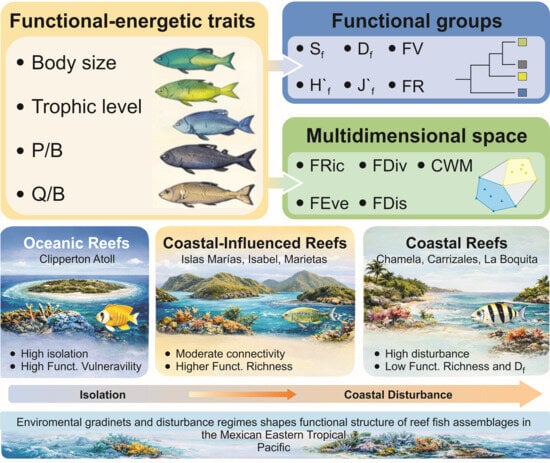
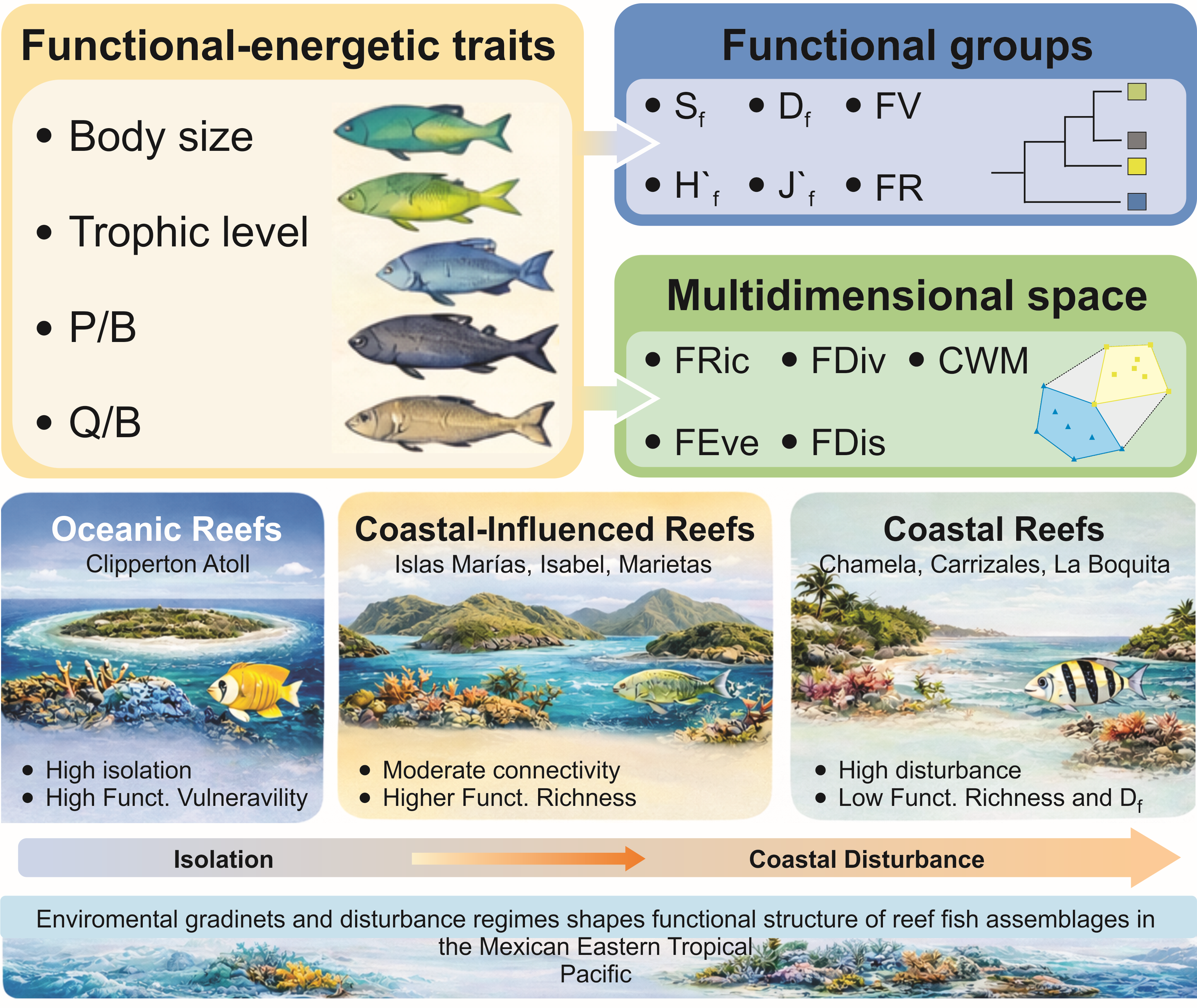
Graphical Abstract

1. Introduction

The shaping of functional diversity by environmental gradients, geographic isolation, and the permeability of biogeographic barriers has been demonstrated [1]. These factors regulate fundamental ecological processes, including dispersal, colonization, speciation, and extinction [2]. The Eastern Tropical Pacific (ETP), extending from the Gulf of California (Mexico) to northern Peru, is characterized by a multitude of oceanic islands and archipelagos. The separation of these bodies of water is primarily due to the presence of significant geographic and oceanographic barriers, including the Isthmus of Panama, the Eastern Pacific Barrier, and the California and Humboldt currents [3,4]. Conventional wisdom has long posited that these barriers function as isolating agents for marine communities [5,6]. However, accumulating evidence suggests that many of these barriers are permeable to a range of taxonomic groups, including hermatypic corals, crustaceans, mollusks, echinoderms, and fishes [7,8,9,10,11,12]. The connectivity of reef fish populations is typically stronger among coastal systems than between coastal and oceanic reefs. It is evident that this pattern plays a significant role in the physical and biological isolation of offshore islands and archipelagos [13,14]. In addition, disparities in connectivity and environmental conditions have the potential to engender spatial variation in community structure. This, in turn, may serve to heighten susceptibility to various forms of disturbance, including, but not limited to, habitat degradation, overfishing, and biological invasions. Nonetheless, it has been demonstrated that isolated geographical areas frequently exhibit high levels of endemism and productivity [15,16,17]. It is imperative to comprehend the manner in which these historical, biogeographic, and environmental gradients interact to structure biodiversity, as this has become a central challenge in the region. Recent regional-scale analyses in the ETP have demonstrated that reef fish species richness and functional diversity are jointly shaped by historical, biogeographic, energetic, and anthropogenic drivers, including sea surface temperature, shelf area, human population gravity, as well as processes such as larval supply, recruitment dynamics, and physicochemical variability (e.g., salinity). These factors often covary along coastal–oceanic gradients and interact with disturbance to shape community structure [18].
Reef fishes fulfill diverse functional roles that are critical to ecosystem functioning and stability [19,20]. In the ETP, the presence of diverse trophic groups is a critical component of ecosystem dynamics. For instance, corallivorous fishes regulate coral growth, and the fragmentation they induce may also facilitate asexual propagation and enhance live coral cover [21]. It has been demonstrated that large fish, particularly those that feed on benthic and pelagic organisms, have the capacity to exert top-down control over organisms of varying sizes and trophic levels. This influence results in alterations to the structure of reef trophic networks [22]. Functional and energetic traits, including body size, production-to-biomass ratio (P/B), consumption-to-biomass ratio (Q/B), and trophic level (TL), provide critical insights into ecosystem functioning and condition [23]. The P/B ratio is a measure of the turnover rate of biomass and provides an approximation of population productivity expressed in biomass units. In contrast, the Q/B ratio represents the amount of food consumed relative to biomass. Together with dietary information, this ratio allocates food consumption across the food web, thereby informing biomass flows (in terms of energy or mass) and trophic relationships [24]. Trophic energy flow is a fundamental aspect of ecosystem growth and development, reflecting the degree of system organization and activity, as conceptualized in network-based approaches [25]. Shifts in these properties may be indicative of anthropogenic pressures. At the species or functional group level, the relationship between trophic level and body size offers further indicators of fishing impacts on marine assemblages, as illustrated by the “fishing down the food web” phenomenon [26].
The classification of species into groups that share similar traits facilitates the evaluation of functional diversity and allows the characterization of ecological roles present within communities [27]. In addition, the quantification of functional traits weighted by species biomass facilitates the calculation of indices that describe the distribution and relative contribution of species in a multidimensional functional space [28]. These approaches have been extensively employed to analyze ecological processes such as food-web structure, primary productivity, and ecosystem resistance [29,30,31]. Even though combinations of life-history traits do not directly represent ecological functions, variations in functional composition among communities serve as valuable proxies for environmental filtering and spatiotemporal dynamics [32].
Disturbances, both natural and anthropogenic, have the potential to affect functional diversity (FD). This is because species traits determine the persistence of organisms under changing environmental conditions [23,33,34]. The Mexican Eastern Tropical Pacific, in the northern portion of the ETP, is characterized by high habitat diversity, including coral and rocky reefs, mangroves, and sandy beaches. In addition, it has a high degree of environmental variability, with a notable frequency of tropical storms and hurricanes [35]. Furthermore, the region experiences coastal upwelling and the convergence of currents and water masses [36]. ENSO events and heatwaves also exert a significant influence on the region [37,38]. These disturbances operate across multiple spatial and temporal scales and may contribute to high functional diversity within the ETP [1].
At a broad spatial scale, the ETP exhibits low functional redundancy and high vulnerability, reflecting lower species richness compared with other tropical regions [1]. In contrast, at local scale within the Mexican Eastern Tropical Pacific, reef systems exhibit high temporal turnover in species composition while maintaining stable functional structure. This phenomenon suggests redundancy among species that fulfill analogous functional roles [39,40,41]. The presence of these contrasting patterns underscores the scale-dependent nature of functional redundancy within the region.
Research conducted on oceanic islands within ETP has demonstrated that functional diversity is frequently associated with species endemism and geographic isolation. Furthermore, it has been observed that functional diversity may increase with greater distance from the continent [42,43]. Conversely, coastal reefs and archipelagos influenced by coastal processes tend to experience comparable environmental conditions and disturbances, including upwelling, river runoff, fishing pressure, and tourism. These factors potentially promote functional similarity among assemblages.
Based on these patterns, we hypothesize that reef fish functional diversity in the Mexican Eastern Tropical Pacific varies spatially among oceanic islands, coastal-influenced reefs, and coastal systems along a gradient of environmental conditions and disturbance regimes. Specifically, it is hypothesized that higher functional redundancy will be observed in coastal-influenced reefs due to intermediate disturbance levels. In contrast, higher functional vulnerability is expected in oceanic reefs due to isolation and lower connectivity. To test this, seven coral reef ecosystems were evaluated. These ecosystems included Oceanic, Coastal-influenced, and Coastal environments in the Mexican Eastern Tropical Pacific. Patterns of functional α- and β-diversity were quantified. This was done to assess differences in functional structure, redundancy, and vulnerability among reef fish assemblages [1,28,44,45,46,47].

2. Materials and Methods

2.1. Sampling Area

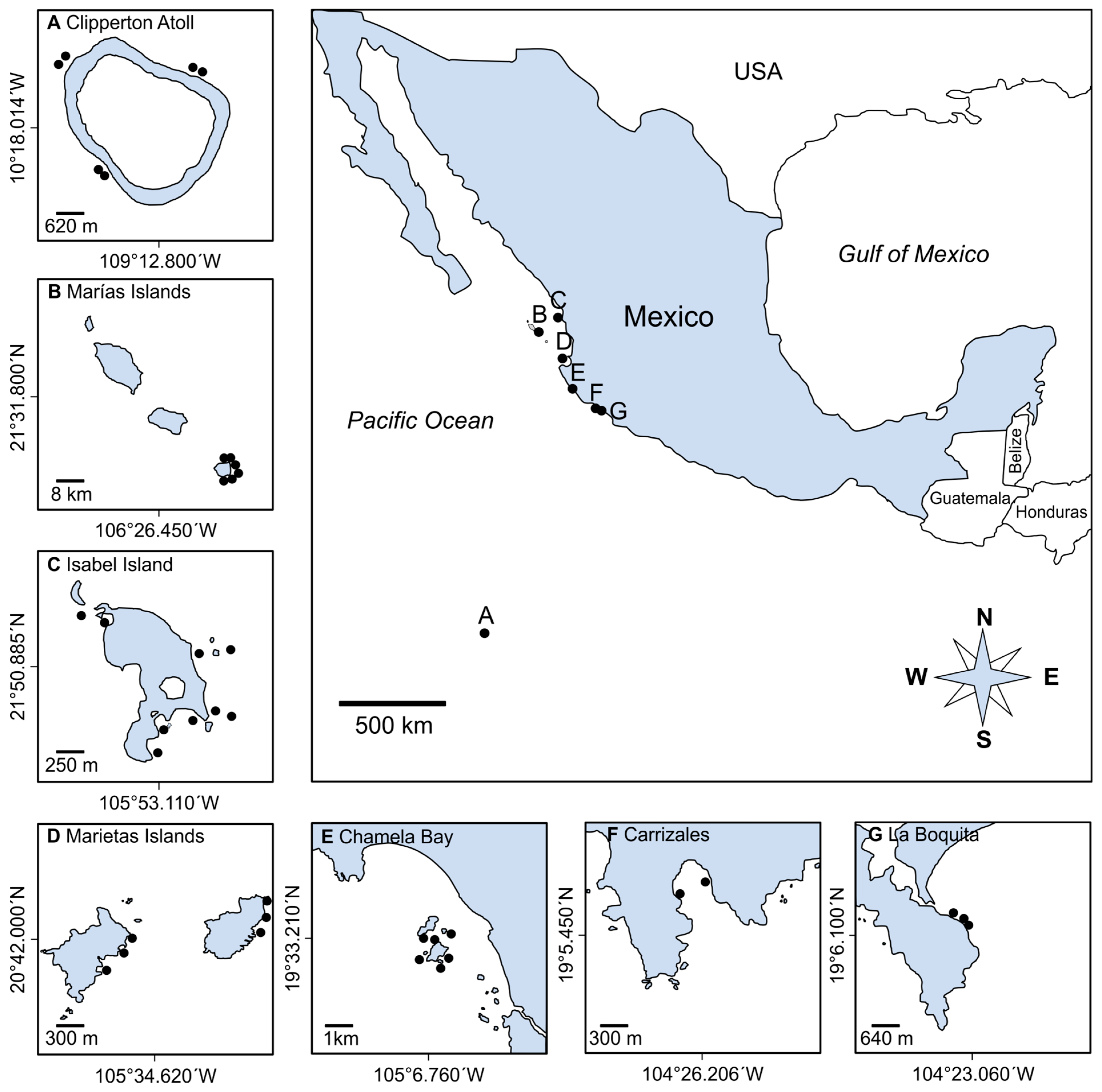
We surveyed coral reef ecosystems in the northern Eastern Tropical Pacific and classified them into three categories according to distance from the mainland and exposure to coastal processes and disturbances, including upwelling, river plumes, and anthropogenic activities (Figure 1). Coastal sites are typically subject to elevated fishing pressure and terrestrial inputs, whereas oceanic systems such as Clipperton Atoll, due to their more isolated nature, may still be influenced by offshore fisheries. (1) Oceanic Zone. The Clipperton Atoll (CLI) is the sole atoll reef in the Eastern Tropical Pacific, located approximately 1300 km from the Mexican mainland (Figure 1A). The site is distinguished by extensive live coral cover [48] and a high degree of species endemism [15,49,50]. (2) Coastal-Influenced Zone. This category includes the Marías Islands (IMR), Isabel Island (ISA), and the Marietas Islands (MAR). The Marías Archipelago, situated approximately 112 km offshore at the mouth of the Gulf of California (Figure 1B), is influenced by regional upwelling processes associated with Bahía de Banderas [51]. Sampling in the Marías Islands was conducted on the southeastern side of the archipelago (i.e., María Cleofas Island) due to access restrictions associated with the presence of a high-security federal prison on María Madre Island, as well as its isolation and operational costs. Consequently, biological monitoring across the different islands of the archipelago has been limited. Because of that, we focus on the María Cleofas Island’s sampling sites, which was one of the least explored islands and had a potentially higher conservation value. However, it is important to note that these sampling sites feature coral ecosystem habitats that are representative of the archipelago. Isabel Island is located 28 km from the coast (Figure 1C), while the Marietas Islands are situated about 8 km offshore (Figure 1D), and both are subject to seasonal coastal upwelling from February to April [52]. During periods of substantial rainfall, these systems may experience increased sedimentation and nutrient inputs from river discharge, particularly from the Ameca River. Despite their protected status, these areas experience varying degrees of anthropogenic disturbance, including tourism and fishing. (3) The Coastal Zone encompasses Chamela Bay (CHA), Carrizales (CAR), and La Boquita (BOQ). Chamela Bay, which is part of the Islas de la Bahía de Chamela Sanctuary on the southern coast of Jalisco (Figure 1E), features reef habitats situated near the shore that may be influenced by river runoff and sedimentation [53]. Carrizales is a small, semi-protected cove in Bahía de Ceniceros near Manzanillo, Colima (Figure 1F), characterized by relatively high coral cover and limited fishing and tourism pressure. La Boquita, situated in Bahía Santiago (Figure 1G), is subject to substantial anthropogenic influence, encompassing activities such as fishing, tourism, and nutrient inputs from the Juluapán lagoon and urban wastewater. These activities contribute to sedimentation and eutrophication [53].

2.2. Sampling Design and Data Collection

Fieldwork was conducted across the designated study areas between 2005 and 2015 (Supplementary Material S1, Table S1). Although this region is influenced by seasonal upwelling and interannual variability (e.g., ENSO), previous studies in the Eastern Tropical Pacific indicate that reef fish functional structure remains relatively stable over time despite temporal variation in species composition [40]. Consequently, the analysis concentrated on spatial patterns in functional diversity. Temporal variation was considered secondary to spatial comparisons among sites. A total of 166 underwater visual censuses were conducted using belt transects (4 × 25 m; 100 m2). Within each transect, the fish species composition, abundance, and body size were recorded. Body size was estimated in situ and classified into 13 intervals: four 5 cm categories (0–5, 5–10, 10–15, 15–20 cm), followed by 10 cm increments up to >60 cm. The abundance and biomass were expressed per unit area (m2). The species biomass (g m−2) was estimated using established length–weight relationships (Supplementary Material S1). The assessment of the sampling effort representativeness at each site was conducted through the implementation of sample-based rarefactions and nonparametric estimators (Chao2, Jackknife 1, and Jackknife 2). The species accumulation curves were constructed using 10,000 permutations in PRIMER v6.1.11 + PERMANOVA v1.01 [54].

2.3. Functional α-Diversity Analysis

In the field of multispecies trophic modeling, functional–energetic traits have emerged as a prevalent approach for elucidating the functional roles of reef-associated fishes [23]. We analyzed four functional–energetic traits: (1) body size (Wmax/Lmax3; [55]), (2) trophic level (TL), (3) production-to-biomass ratio (P/B, year−1), and (4) consumption-to-biomass ratio (Q/B, year−1). Trait information was obtained from FishBase v11/2025 [56]. Trophic level (TL) and Q/B values were retrieved from the “Life History Tools” section, where they are derived from empirical models and literature-based estimates. The P/B ratio was estimated using total mortality (Z), as outlined by Allen [57], under the assumption that P/B ≈ Z in equilibrium conditions. In instances where species-specific data were not available, trait values were assigned based on closely related species (e.g., congeners) or existing literature. These cases constituted a negligible proportion of the dataset. These traits are directly linked to energy flow and ecosystem functioning, representing the key dimensions of reef ecosystem structure. While additional traits (e.g., reproductive strategies or mobility) may offer complementary ecological insights, they were not included due to limited data availability and because they are less directly related to the trophic and energetic processes that were the focus of this study. These traits were selected because they capture the key aspects of energy flow and trophic structure in reef fish assemblages.
Functional groups were defined using cluster analysis based on these traits. For this purpose, we constructed a Euclidean distance matrix from standardized (Z-values) trait values. The identification of functional groups was achieved through the implementation of complete linkage clustering and SIMPROF analysis (10,000 permutations, α = 0.05), employing the PRIMER v6.1.11 + PERMANOVA v1.01 [54]. This analysis yielded 15 distinct functional groups, which collectively represent the diverse combinations of body size, trophic level, and energetic traits. These groups represent distinct functional roles within assemblages. The resulting functional groups and trait values for all species are detailed in Supplementary Material S2 (Table S2).
We assessed functional α-diversity at each site using four indices: number of functional groups (Sf), functional Shannon diversity (H′f), functional Pielou evenness (J′f), and functional Simpson dominance (Df). The calculation of these indices was based on the relative abundance or biomass of the previously defined functional groups, rather than species identities. Consequently, they reflect the distribution and dominance of functional roles within fish assemblages. Additionally, multidimensional functional indices were calculated, including functional richness (FRic), functional evenness (FEve), functional divergence (FDiv), functional dispersion (FDis), and community-weighted means (CWM). These indices describe functional composition based on trait values weighted by species biomass [28,46]. FRic, FEve, FDiv, FDis, and CWM were estimated using the “mFD” function [58] and the “dbFD” function from the R package FD [59]. A two-way fully nested permutational analysis of variance based on Euclidean distance matrices was employed to compare all indices among zones (Oceanic, Coastal-influenced, and Coastal; fixed factor) and among sites nested within zones (fixed factor). The statistical significance was determined by means of 10,000 permutations under a reduced model with Type III sums of squares. The analyses were performed in PRIMER v6.1.11 + PERMANOVA v1.01 [60].
Functional vulnerability (FV) is defined as the percentage of functional groups in which only a single species is present. In other words, it refers to the percentage of functional roles performed by only one species within the assemblage. Functional redundancy (FR) is defined as the average number of species per functional group. These concepts were calculated following Mouillot et al. [1]. The complete database of functional diversity indices estimated per transect is accessible in the Supplementary Material S2 (Table S3).

2.4. Functional β-Diversity Analysis

We compare the functional group composition and biomass among Zones and Sites nested within Zones using a two-way fully nested permutational multivariate analysis of variance (PERMANOVA). This analysis was conducted in accordance with the experimental design outlined for the functional α-diversity analyses. A Bray–Curtis similarity matrix was constructed using functional group biomass data, which were transformed to the fourth root to reduce the influence of dominant groups. When the number of permutations was less than 100, Monte-Carlo resampling was used to estimate statistical significance [60].
The contribution of functional groups to average dissimilarity among zones was assessed using similarity percentage analysis (SIMPER), applying a cumulative contribution cutoff of 90%. The identification of functional groups that exhibited the most significant disparities was conducted through the implementation of both quantitative and qualitative criteria [23]. These criteria encompassed the incidence of dissimilarities, the mean contribution, and the biomass disparities among the Zones. The present study sought to explore the relationships between functional group composition and functional diversity metrics. For this purpose, principal coordinates analysis (PCoA) was employed as a methodological framework. The functional α-diversity indices (Sf, H′f, J′f, Df, FRic, FEve, FDiv, and FDis) were projected as vectors based on Spearman correlations. PCoA and SIMPER analyses were performed using the same data pretreatment and resemblance matrix as in the PERMANOVA. All multivariate analyses were performed using PRIMER v6.1.11 + PERMANOVA v1.01 [60].
Total functional β-diversity was estimated using Sørensen dissimilarity (βfsor) and partitioned into turnover (βfsim) and nestedness (βfnes) components following the methods of Baselga [45] and Villéger et al. [47]. The objective of the present analysis was to assess whether the variation in functional β-diversity among sites was mainly driven by turnover, with nestedness playing a secondary role. This finding indicates that environmental heterogeneity may promote the replacement of functional groups rather than the simple loss of functions.

3. Results

The sampling effort achieved an average representativeness of 64.6–95.0% of the expected species richness across sites (Supplementary Material S3, Figure S1). We recorded 132 fish species across all sites. Species richness was highest at the Marietas Islands (66 species) and Isabel Island (65 species), and lowest at Carrizales (29 species). Intermediate richness values were documented at La Boquita (58 species), Marías Islands (59 species), Chamela Bay (46 species), and Clipperton Atoll (43 species) (Supplementary Material S3, Figure S1).
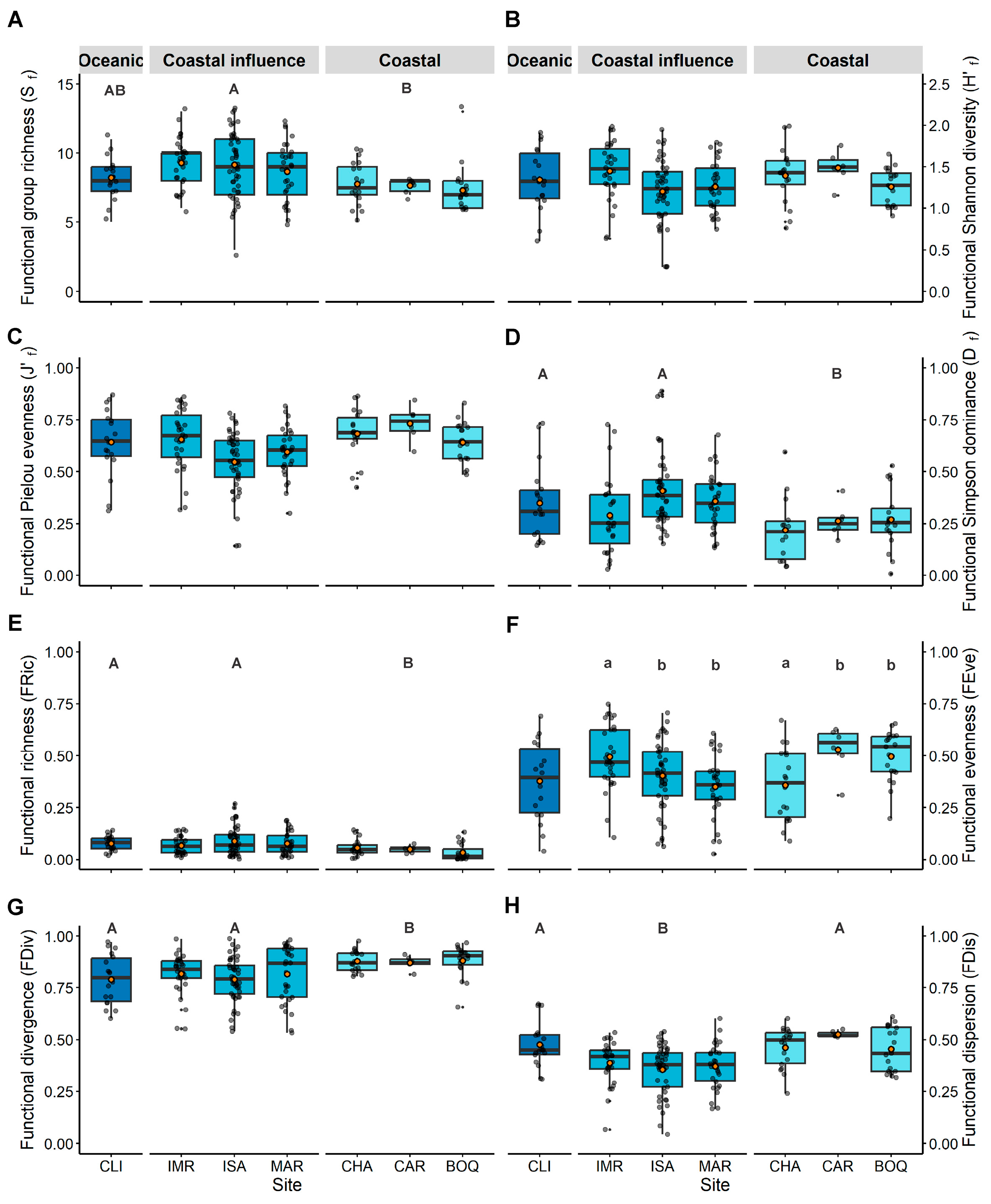
We identified 15 functional groups across the study area. Permutational ANOVA showed that Zone explained most variation in functional α-diversity metrics, except for functional evenness (FEve), where site-level differences were greater. The H′f, J′f, and FEve exhibited no significant differences among the Oceanic, Coastal-influenced, and Coastal zones (Figure 2B,C,F; Supplementary Material S3, Table S4). At the site level, FEve was observed to be greater at the Marías Islands than at the Marietas and Isabel Islands. In the context of coastal sites, Chamela Bay exhibited lower FEve values in comparison to Carrizales and La Boquita (Figure 2F; Supplementary Material S3, Tables S4 and S5). The functional group richness (Sf) was highest at Coastal-influenced sites, lowest at Coastal sites, and intermediate at the Oceanic site (Figure 2A; Supplementary Material S3, Tables S4 and S6). The Df, FRic, and FDiv were generally higher in Oceanic and Coastal-influenced sites compared with Coastal sites (Figure 2D,E,G; Supplementary Material S3, Tables S4–S6). In contrast, the FDis exhibited higher values in Oceanic and Coastal sites compared to Coastal-influenced sites (Figure 2H; Supplementary Material S3, Tables S4 and S6).
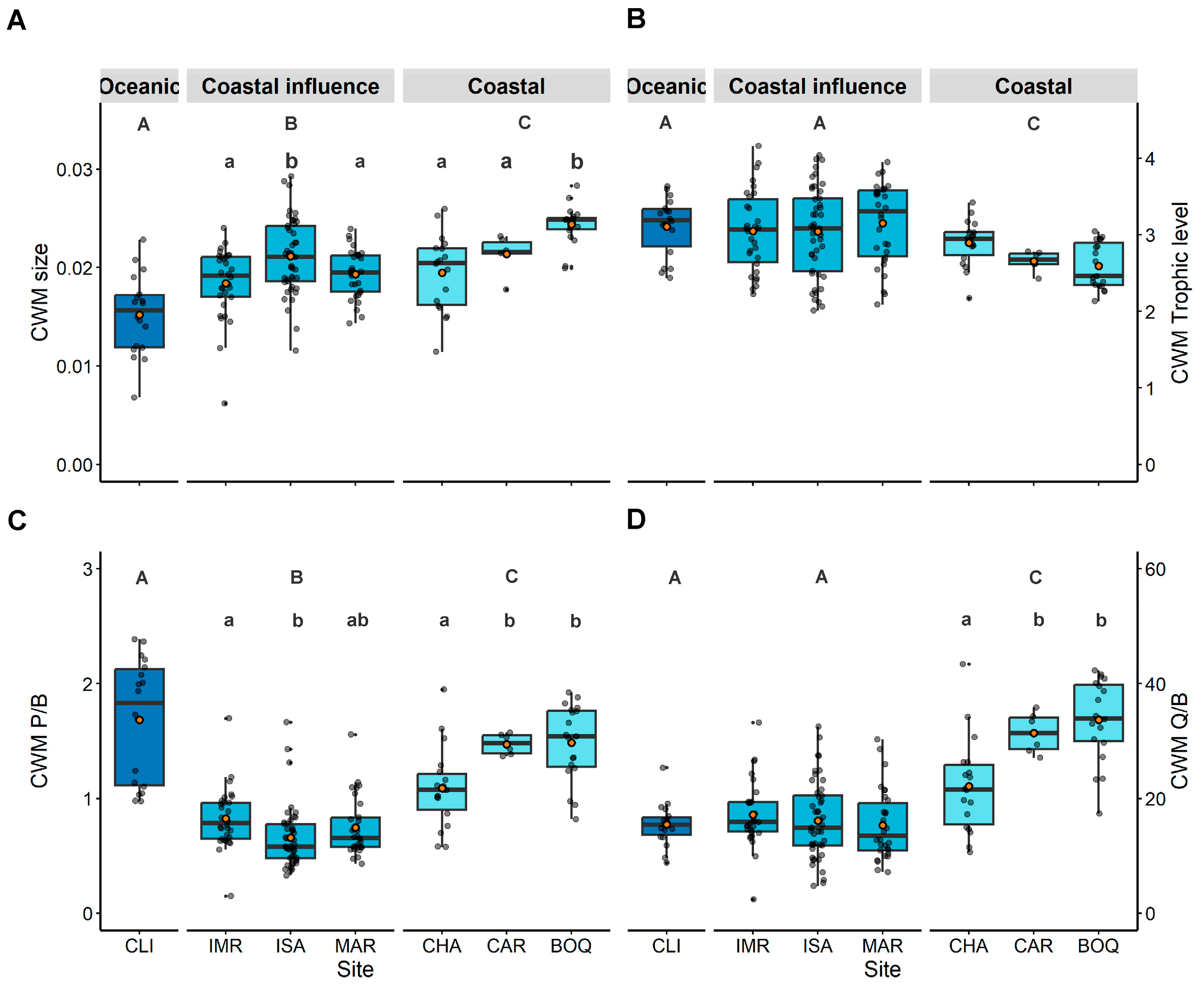
Permutational ANOVAs of community-weighted means (CWM) revealed that the majority of functional–energetic traits exhibited significant variation among Zones and among Sites nested within Zones. Both factors accounted for a substantial proportion of the total variation (33.7–66.5%), with the exception of trophic level (TL) (Figure 3A–D; Supplementary Material S3, Table S7). Community-weighted mean body size increased along the oceanic–coastal gradient, with the smallest values at Clipperton Atoll and the largest at Isabel Island and La Boquita (Figure 3A; Supplementary Material S3, Tables S8 and S9). This contrasted with the expectation of larger body sizes in oceanic systems. The results of the study indicated that the trophic level was lower at coastal sites and higher at the Oceanic site. In addition, the Coastal-influenced sites did not differ significantly from the other zones (Figure 3B; Supplementary Material S3, Table S8). The production-to-biomass ratio (P/B) exhibited its greatest value at the Oceanic site, followed by the Coastal sites, and its least value at Coastal-influenced sites. In the Coastal-influenced zone, the Marías Islands exhibited the highest P/B values, while Isabel Island showed the lowest. Among coastal sites, Carrizales and La Boquita exhibited higher P/B values compared to Chamela Bay (Figure 3C; Supplementary Material S3, Tables S8 and S9). The consumption-to-biomass ratio (Q/B) exhibited a marked increase at Coastal sites, while Oceanic and Coastal-influenced sites demonstrated comparable values. Differences among sites were detected only within the Coastal zone. In this particular zone, Chamela Bay exhibited the most minimal Q/B values (Figure 3D; Supplementary Material S3, Table S9).
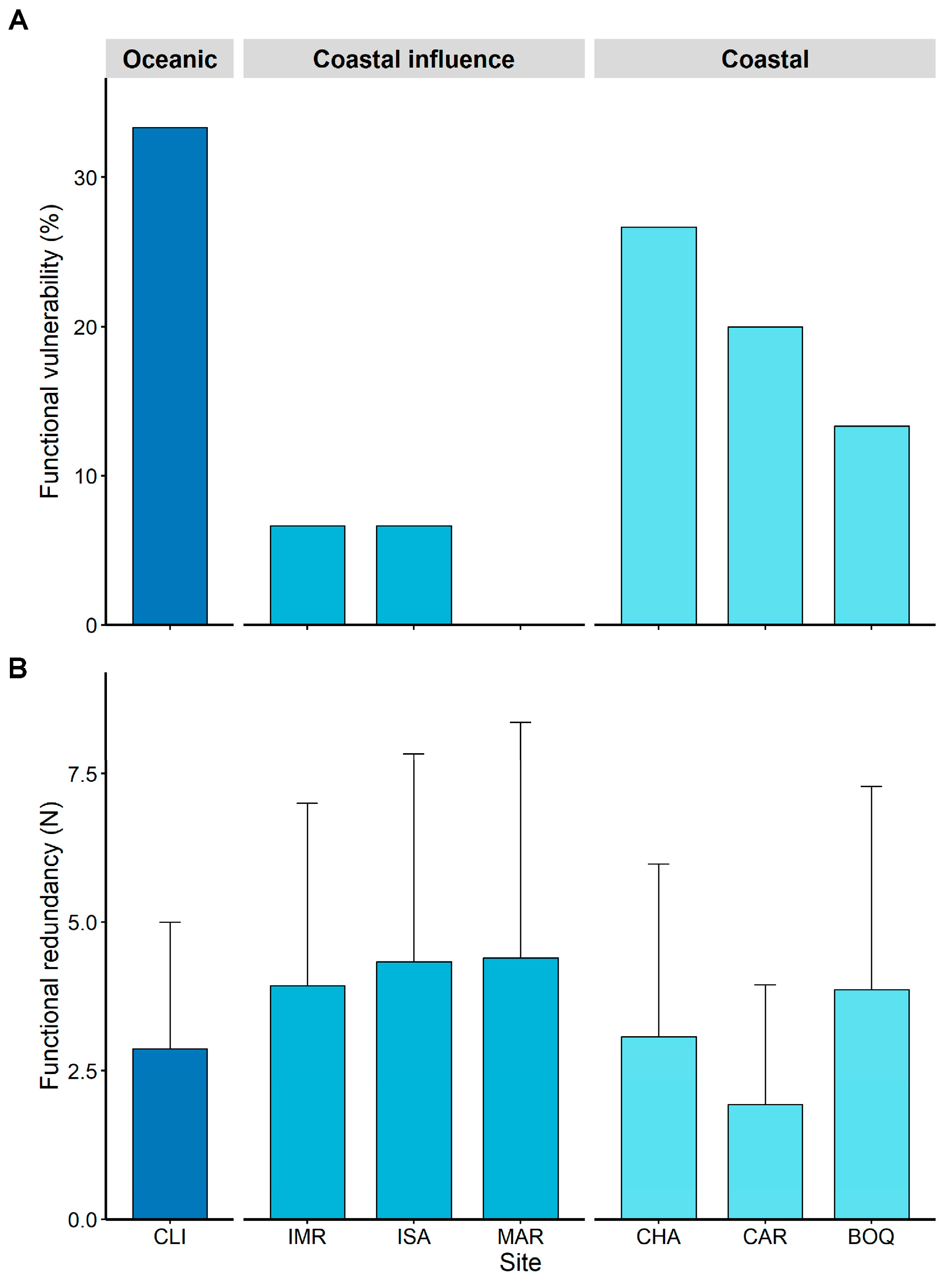
Functional vulnerability (FV) was greatest at Clipperton Atoll (33.3%), where five functional groups were represented by only one species: Zanclus cornutus, Acanthurus xanthopterus, Acanthurus nigricans, Kyphosus vaigiensis, and Stethojulis bandanensis. This indicates that the loss of a single species could eliminate an entire functional role in Oceanic zone, where the loss of a single species has the potential to disrupt an entire ecosystem function. Intermediate FV values were observed at the Coastal sites Chamela Bay (26.7%), Carrizales (20%), and La Boquita (13.3%), while Coastal-influenced sites showed the lowest values (0–6.7%) (Figure 4A). The functional redundancy (FR) varied across sites, with an observed range of two to four species per functional group. A statistical analysis revealed that this variation did not differ significantly among Zones or among Sites nested within Zones (Figure 4B; Supplementary Material S3, Table S10).
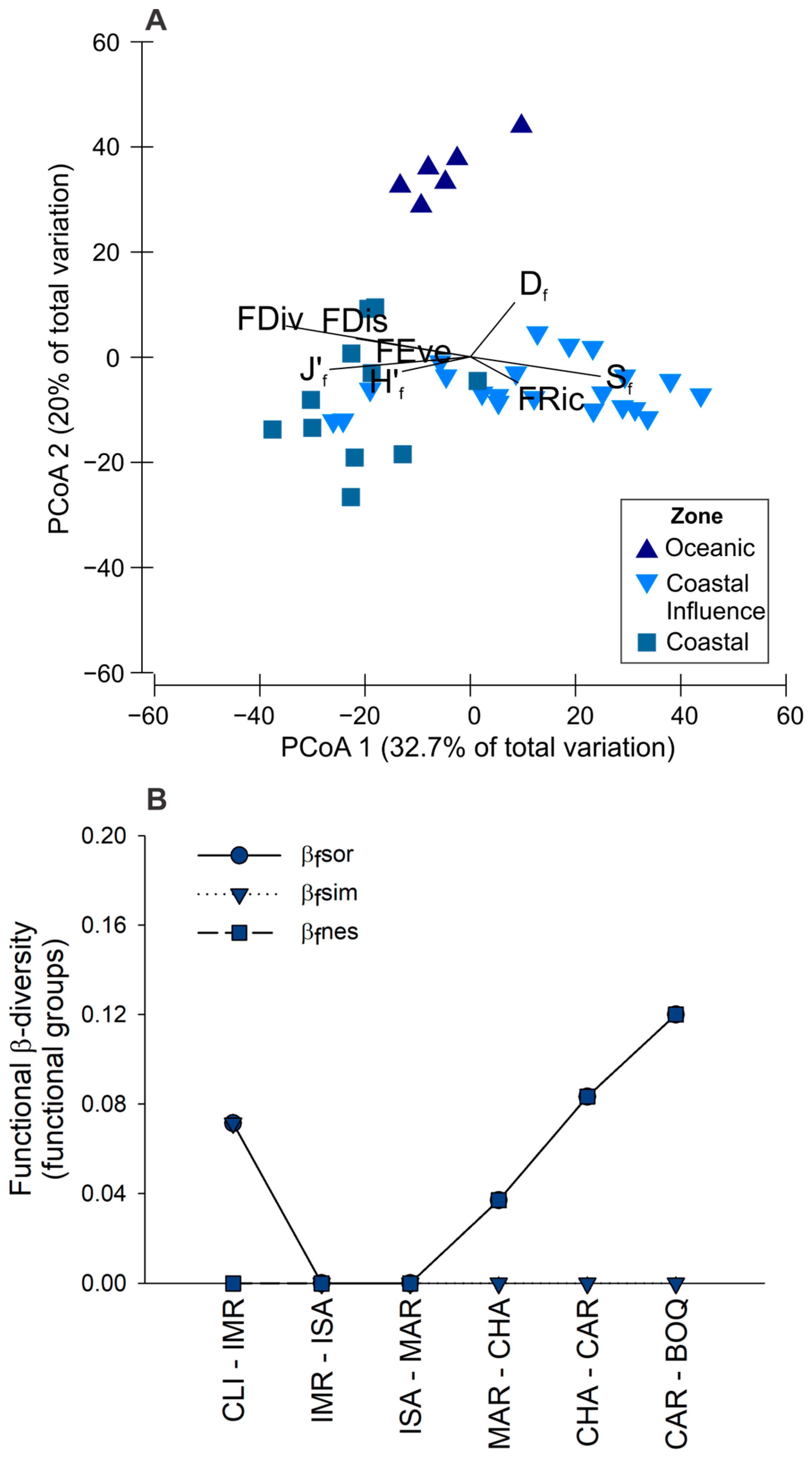
The PERMANOVA revealed that both Zone and Site (nested within Zone) contributed significantly to the variation in functional group composition and biomass, explaining 35.5% and 26% of the total variation, respectively (Supplementary Material S3, Table S10). Pairwise comparisons revealed significant variations among Zones and among Coastal-influenced sites, with the Marías Islands exhibiting distinct values compared to the Isabel and Marietas Islands (Supplementary Material S3, Table S11). The SIMPER analysis indicated that small benthic carnivores (functional group m) contributed most to the average dissimilarity among Zones, with higher biomass recorded at the Oceanic site. Subsequent to this observation, further analysis revealed that functional groups c (medium herbivores with low consumption) and n (medium carnivores with high trophic level and consumption), exhibited increased biomass in coastal regions (Table 1). Additional functional groups, which exhibit diminished contributions, are further delineated in Table 1. The PCoA revealed differences in functional group structure among Zones, with the Oceanic site showing the greatest separation, while Coastal and Coastal-influenced sites were more similar (Figure 5). The first two axes accounted for 52.7% of the total variation. The overlay of functional α-diversity metrics indicated clear associations with ordination axes. H′f, J′f, FEve, FDis, and FDiv were positively correlated with the region of the ordination space where Coastal reef sites are distributed, suggesting higher values of these indices in these systems. Conversely, a positive correlation was observed between Sf and FRic with the region of the ordination associated with Coastal-influenced sites. The functional Simpson dominance (Df) exhibited a low correlation, thereby contributing to variation along both axes and overlapping with Oceanic and Coastal-influenced sites (Figure 5A).
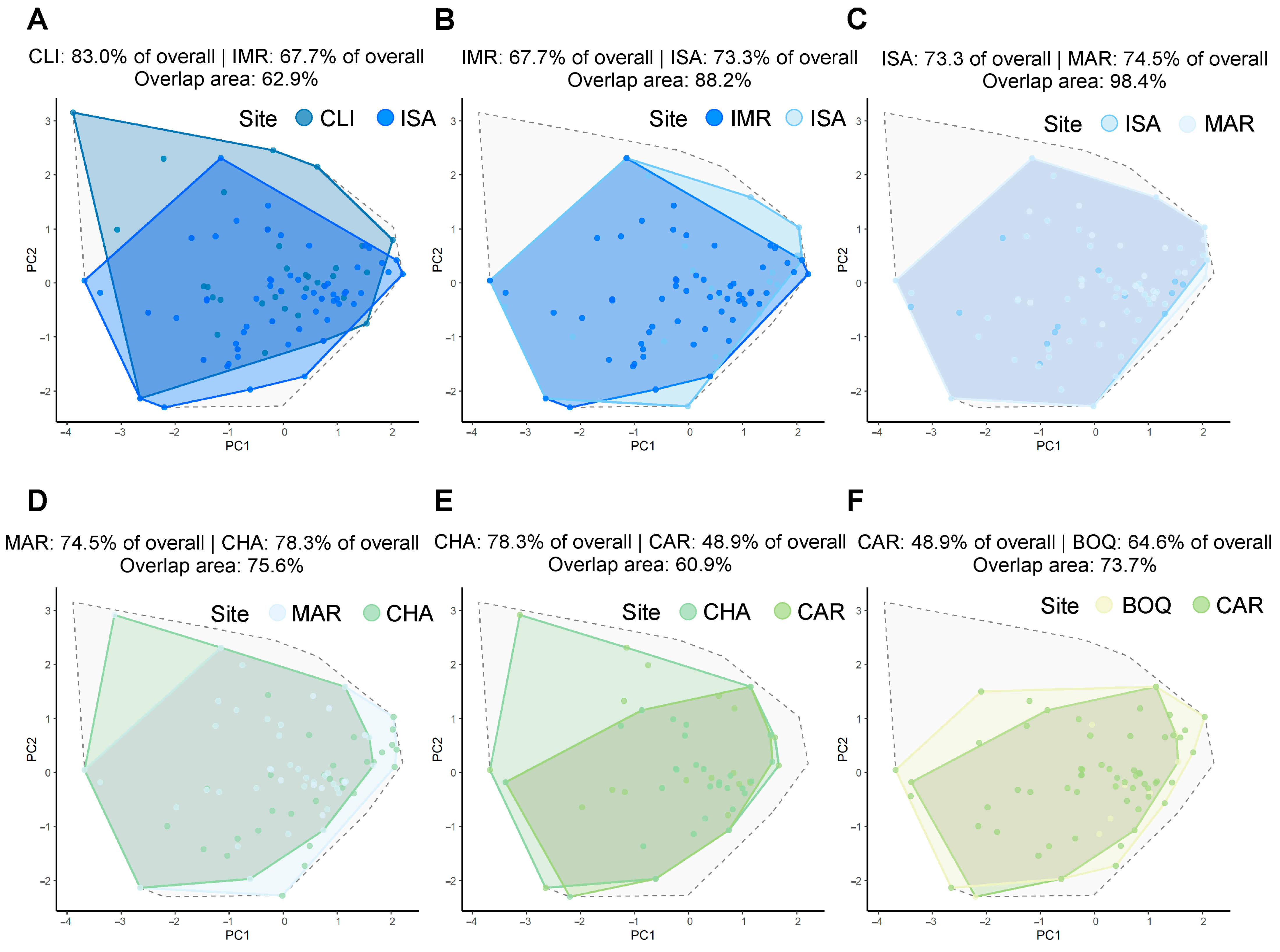
Additive partitioning of functional β-diversity based on functional groups indicated generally low dissimilarity among sites (βfsor = 0–0.12). The highest dissimilarities were observed at transitions between environmental conditions, particularly between the Oceanic and Coastal-influenced zones and among Coastal sites. In this analysis, the nestedness component (βfnes) contributed more than turnover in transitions involving coastal sites, especially between coastal-influenced and coastal reefs (Figure 5B), suggesting a partial homogenization of functional structure among coastal systems. When β-diversity was estimated using convex hull volume (species-level functional space), dissimilarity values were higher (βfsor = 0.02–0.42), but the spatial pattern remained consistent (Figure 6). This is visually supported by the degree of overlap and separation among convex hulls, which illustrate differences in functional space occupation among sites. The turnover component (βfsim) was more important in comparisons involving Oceanic and Coastal-influenced sites, whereas nestedness predominated in comparisons among Coastal sites and in transitions between Coastal-influenced and Coastal reefs (Figure 6).

4. Discussion

The findings of this study demonstrate that reef fish functional diversity in the Mexican Eastern Tropical Pacific exhibits spatial variation among Oceanic, Coastal-influenced, and Coastal environments. However, it should be noted that not all functional α-diversity indices exhibited a uniform response to these environmental differences. The Mexican Eastern Tropical Pacific is distinguished by a broad spectrum of environmental conditions and disturbances, encompassing habitat heterogeneity, oceanographic processes, and anthropogenic activities [61]. These factors are projected to influence the patterns of functional diversity. The indices H′f, J′f, and FEve exhibited minimal variability across Zones. This phenomenon may be associated with the observed low species richness in specific oceanic and coastal regions, which can generate comparable functional diversity values [62]. These outcomes are consistent with previous research in the region that reported no significant differences in functional diversity between coastal reefs and sites influenced by coastal processes [41].
Recent regional analyses across the ETP demonstrated that functional richness is largely reflective of species richness, with no observed deviations from the predictions of the null model. This finding suggests that, at broad spatial scales, functional space occupancy is primarily constrained by taxonomic diversity [18]. Similarly, a comparative analysis of Mexican Pacific biogeographic provinces revealed that, despite significant disparities in species richness, assemblages occupied over 70% of the total regional functional volume. This finding suggests a substantial conservation of ecological roles across environmental gradients [63]. However, the findings of this study suggest that FRic, FDiv, and Df exhibit variation across different environmental conditions. This observation indicates that, at more refined spatial scales, environmental filtering and disturbance regimes can influence the distribution of functional traits beyond the constrains imposed by simple taxonomic classifications. The relatively high contribution of site-level variation suggests that local environmental heterogeneity plays an important role in shaping functional diversity patterns. However, this pattern may also be influenced by the unbalanced design of the study, particularly the representation of the oceanic condition by a single site.
A synthesis of the findings indicates that the results are only partially consistent with the initial expectations. In accordance with predictions, Coastal-influenced reefs exhibited reduced functional vulnerability and comparatively elevated redundancy, consistent with intermediate disturbance conditions that may facilitate the coexistence of multiple functional strategies. Conversely, oceanic reefs exhibited elevated functional vulnerability, a phenomenon that is presumably attributable to factors such as isolation and diminished connectivity. Nevertheless, certain patterns, such as the lower-than-expected body size in oceanic systems, underscore the impact of supplementary processes, including selective fishing pressure and shifts in trophic structure.
In Oceanic reefs, fish biomass was concentrated in functional groups characterized by higher trophic levels and smaller body sizes. Interestingly, this contrasts with the expectation of larger-bodied individuals in oceanic reefs, which are often associated with a higher abundance of large predators. In contrast, Coastal-influenced and Coastal reefs were dominated by larger-bodied species occupying lower trophic levels, particularly herbivores. This phenomenon can be attributed, at least in part, to the increased presence of large-bodied herbivores in coastal environments, as well as the potential impact of fishing pressure on large predatory species, even in relatively isolated systems. In the present study, the hypothesis interpretation is supported by the observed reduction in body size and lower representation of higher trophic levels in oceanic reefs. These variations are presumably indicative of disparities in disturbance regimes and fishing pressure across diverse environmental contexts. Herbivorous fish have been observed to demonstrate a rapid response to disturbances, such as storms and hurricanes, due to their high mobility and recolonization capacity [64]. Conversely, isolated oceanic reefs may demonstrate higher vulnerability due to their limited connectivity and reduced recolonization potential [13,16]. This has led to a reconfiguration of the functional structure [26,65], which carries significant ramifications for fisheries management in the Mexican Eastern Tropical Pacific. At an intermediate spatial scale within the Mexican Eastern Tropical Pacific, previous studies have demonstrated that functional diversity exhibits high variability among localities but relatively low regional functional turnover, with nestedness predominating [66]. The findings, when considered collectively, suggest that regional functional space may be broadly constrained by species richness. However, local environmental conditions and anthropogenic pressures modulate trait dominance at finer scales. This scale-dependent pattern is consistent with the contrasting levels of functional redundancy reported at regional and local scales in the Eastern Tropical Pacific, thereby reinforcing the importance of spatial scale when interpreting functional diversity patterns.
Comparable scale-dependent patterns have been documented within the Gulf of California, where distinct subregions are dominated by species with contrasting ecological trait combinations despite similar overall diversity levels [67]. Likewise, evidence from the Eastern Tropical Pacific indicates that functional diversity increases with species richness but tends to saturate at elevated diversity levels [68].
At the species level, spatial variation in reef fish assemblages in the Eastern Tropical Pacific is closely linked to habitat heterogeneity [69,70]. In contrast, at the functional level, large-scale processes such as oceanographic variability and ENSO events may play an important role in shaping assemblage structure. These processes have the capacity to influence recruitment, mortality, migration, and consumption rates, as well as physiological and biochemical traits that determine species performance and energy use [71,72,73]. In this context, the isolation of Clipperton Atoll—coupled with its relatively low habitat heterogeneity, potential exposure to high-seas fishing affecting large and mobile predatory species, and frequent exposure to storms, hurricanes, and ENSO-related disturbances [48]—may contribute to the elevated functional vulnerability observed in this study. Conversely, Coastal and Coastal-influenced sites, which are also subject to disturbances such as upwelling, fishing pressure, sedimentation, and eutrophication [61], exhibit a higher degree of interconnectedness, suggesting the potential for enhanced functional buffering. These patterns are consistent with the results of the functional β-diversity analyses, which identified nestedness as a major component in comparisons involving Coastal sites. This finding suggests that there is partial functional homogenization under similar environmental conditions and disturbance regimes. The persistence of spatial patterns when β-diversity was estimated using convex hull volume further indicates that these nestedness patterns are not solely driven by species richness differences but rather reflect shifts in functional space occupancy. Documented comparable regional contrasts in the relationship between coral cover and fish functional diversity have been reported between the Mexican Eastern Tropical Pacific and the Tropical Western Atlantic [74]. Recent findings from the Mexican Central Pacific demonstrate a counterintuitive relationship between structural simplicity in coral habitats and elevated levels of functional β-diversity, despite diminished local functional richness [70]. This underscores the notion that the configuration of habitats can, in a given context, impose limitations on the local functional space available while concurrently fostering the diversification of sites. This observation serves to underscore the significance of incorporating spatial context when elucidating patterns in functional diversity.
Despite the limited replication of oceanic reefs in this study, the Oceanic category is represented by Clipperton Atoll, which is regarded as one of the most isolated coral reef systems in the Eastern Tropical Pacific and is considered an ecologically distinct oceanic reference within the region. The integration of site-level comparisons and functional β-diversity analyses enable the discernment of distinct functional structures to be identified among Oceanic, Coastal-influenced, and Coastal reef systems. A salient finding of this study is the revelation of an unexpected pattern, which indicates that oceanic reefs are not dominated by larger-bodied species. Rather, these reefs exhibit reduced body size and lower representation of higher trophic levels. This finding provides novel insight into the functional organization of reef fish assemblages in the Mexican Eastern Tropical Pacific. The intermediate functional patterns observed at reefs influenced by the coast further support the hypothesis that reef fish functional diversity in the Mexican Eastern Tropical Pacific varies along gradients of isolation and environmental disturbance. These spatial patterns likely reflect increasing disturbance intensity along the oceanic–coastal gradient, driven by fishing pressure, sedimentation, nutrient enrichment, and coastal upwelling. Such disturbances have been shown to have a disproportionate effect on coastal reefs, leading to a reduction in functional richness and an increase in functional divergence. The observed patterns are consistent with the findings of regional-scale evidence, which indicates that sea surface temperature and biogeographic context structure reef fish biodiversity across the Eastern Tropical Pacific [18]. This evidence served to reinforce the role of large-scale environmental gradients interacting with local disturbance regimes. Understanding the influence of these drivers on functional diversity is essential for improving the management and conservation of reef ecosystems in the region. The findings underscore the necessity for enhanced management strategies that promote the conservation of ecological integrity and resilience in reef fish assemblages, particularly in view of the diminished functional diversity and augmented vulnerability evident in select coastal locations. Likewise, the elevated functional vulnerability exhibited by oceanic systems, as exemplified by the Clipperton Atoll, indicates that these reefs may possess heightened sensitivity to species loss. This observation underscores the necessity for the implementation of targeted conservation initiatives. In general, effective management ought to take into account spatial variations in functional structure and prioritize the conservation of functionally significant species and trophic groups, particularly within the context of fishing pressure. The present study indicates that the functional structure of the Eastern Tropical Pacific is not solely a reflection of species richness. Rather, it is the outcome of scale-dependent assembly processes in which dispersal limitation, environmental filtering, and anthropogenic pressures interact to shape ecological roles within communities.

Supplementary Materials

The following supporting information can be downloaded at: https://www.mdpi.com/article/10.3390/d18040219/s1. Table S1: Fish census numbers and sample dates for each study site; Table S2: Functional traits of each functional group (FG) and species. Lmax corresponds to the maximum fish size reported (cm); Wmax the maximum fish wet weight reported (g); Size = Wmax/Lmax3 (Johnstone 1912 [55]); TL trophic level; P/B production/biomass rate (year−1) and; Q/B consumption/biomass rate (year−1). Lmax, Wmax, TL, and Q/B were obtained from Froese and Pauly (2025) [56]. Fish census numbers and sample dates for each study site; Table S3: Functional indices at the transect level by zone and site. CLI: Clipperton Atoll of the Oceanic zone (O); IMR: Islas Marías, ISA: Isla Isabel, and MAR: Islas Marietas of the Coastal Influence zone (CI); and CHA: Chamela Bay, CAR: Carrizales, and BOQ: La Boquita of the Coastal zone (C); Figure S1: Sample-based rarefaction curves at each study site. SObs correspond to the field-recorded species. Expected species richness was estimated using nonparametric estimators: Chao 2, Jackknife 1, and Jackknife 2; Table S4: Two-way fully nested permutational ANOVA outputs. Bold values highlight significant differences between factors (p ≤ 0.05). C.V.% corresponds to the component of variation represented as a percentage; Table S5: Site (Zone) pairwise comparisons of two-way fully nested permutational ANOVAs. Bold values highlight significant differences between factors (p ≤ 0.05); Table S6: Zone pairwise comparisons of two-way fully nested permutational ANOVAs. Bold values indicate significant differences by factor level (p ≤ 0.05); Table S7: Two-way fully nested permutational ANOVA outputs of Community Weighted Mean (CWM). Bold values highlight significant differences between factors (p ≤ 0.05). C.V.% corresponds to the component of variation represented as a percentage; Table S8: Zone pairwise comparisons of two-way fully nested permutational ANOVAs of Community Weighted Mean (CWM). Bold values highlight significant differences between factors (p ≤ 0.05); Table S9: Site (Zone) pairwise comparisons of two-way fully nested permutational ANOVAs of Community Weighted Mean (CWM). Bold values highlight significant differences between factors (p ≤ 0.05); Table S10: Results of two-way fully nested permutational ANOVA of functional redundancy (FR) and PERMANOVA of functional groups composition and abundance. Bold values highlight significant differences between factors (p ≤ 0.05). C.V.% corresponds to the component of the variation; Table S11: Zones and sites nested by zone pairwise comparisons of two-way fully nested PERMANOVA ANOVAs of functional group composition and abundance. Bold values highlight significant differences between factors (p ≤ 0.05).

Author Contributions

Conceptualization and methodology, I.C., F.A.R.-Z. and M.O.; formal analysis and investigation, I.C., F.A.R.-Z. and U.J.-M.; resources, F.A.R.-Z., A.L.C.-M. and C.G.-S.; data curation, I.C., F.A.R.-Z., A.L.C.-M. and C.G.-S.; writing—original draft preparation, I.C., F.A.R.-Z. and M.O.; writing—review and editing, I.C., F.A.R.-Z., M.O., U.J.-M., A.L.C.-M., A.L.-P., F.B., C.G.-S. and E.C.I.-G.; project administration and funding acquisition, F.A.R.-Z., A.L.C.-M. and C.G.-S. All authors have read and agreed to the published version of the manuscript.

Funding

I.C. was funded by a doctoral fellowship (584808) from the Consejo Nacional de Ciencia y Tecnología (CONACYT). This study was supported by the following scientific research projects: (1) Project 257987 funded by CB2015 from CONACYT to F.A.R.-Z.; (2) Programa Integral de Fortalecimiento Institucional, Universidad de Guadalajara (P/PIFI-2010-14MSU0010Z-10) to A.L.C.M.; (3) C.G.-S was supported by the grants obtained by M. Adjeroud from World Wildlife Fund, France.

Institutional Review Board Statement

Not applicable.

Data Availability Statement

The original contributions presented in this study are included in the article/Supplementary Materials. Further inquiries can be directed to the corresponding author.

Acknowledgments

This work was performed with all the necessary permits for conducting field studies; the work was conducted by the academic bodies “Ecología y Biodiversidad (UDG-CA-888)” and “Ecología Marina (UDG-CA-1211)” of Universidad de Guadalajara, “Ecosistemas Costeros (UAM-I-CA-7)” of Universidad Autónoma Metropolitana, and “Recursos Marinos Tropicales (UADY-CA-95)”. Clipperton Atoll data were obtained by the survey conducted during the French Expedition Clipperton, organized by Jean-Louis Etienne with the R/V Rara Avis, in collaboration with the École Pratique des Hautes Études, University of Perpignan, France. Finally, we would like to thank the three anonymous reviewers and the editors, as their contributions, corrections, and comments helped to improve the quality of this study.

Conflicts of Interest

The authors declare no conflicts of interest.

References

  1. Mouillot, D.; Villéger, S.; Parravicini, V.; Kulbicki, M.; Arias-Gonzáles, J.E.; Bender, M.; Chabanetg, P.; Floeterf, S.R.; Friedlander, A.; Vigliola, L.; et al. Functional over-redundancy and high functional vulnerability in global fish faunas on tropical reefs. Proc. Natl. Acad. Sci. USA 2014, 111, 13757–13762. [Google Scholar] [CrossRef]
  2. Pinheiro, H.T.; Bernardi, G.; Simon, T.; Joyeux, J.C.; Macieira, R.M.; Gasparini, J.L.; Rocha, C.; Rocha, L.A. Island biogeography of marine organisms. Nature 2017, 549, 82. [Google Scholar] [CrossRef] [PubMed]
  3. Spaldin, M.D.; Fox, H.E.; Allen, G.R.; Davison, N.; Ferdaña, Z.A.; Finlayson, M.; Halpern, B.S.; Jorge, M.A.; Lombana, A.; Lourie, S.A.; et al. Marine Ecoregions of the World: A Bioregionalization of Coastal and Shelf Areas. BioSience 2007, 57, 573–583. [Google Scholar] [CrossRef]
  4. Pantoja, D.A.; Marinone, S.G.; Pares-Sierra, A.; Gomez-Valdivia, F. Numerical modeling of seasonal and mesoscale hydrography and circulation in the Mexican Central Pacific. Cienc. Mar. 2012, 38, 363–379. [Google Scholar] [CrossRef]
  5. Ekman, S. Zoogeography of the Sea; Sidgwick and Jackson: London, UK, 1953. [Google Scholar]
  6. Briggs, J.C. Marine Zoogeography; McGraw-Hill: New York, NY, USA, 1974. [Google Scholar] [CrossRef]
  7. Scheltema, R.S. Initial evidence for the transport of teleplanic larvae of benthic invertebrates across the east Pacific barrier. Biol. Bull. 1988, 174, 145–152. [Google Scholar] [CrossRef]
  8. Garth, J.S. Taxonomy, distribution, and ecology of Galápagos Brachyura. In Galápagos Marine Invertebrates: Taxonomy, Biogeography, and Evolution in Darwin’s Islands; James, M.J., Ed.; Plenum Press: New York, NY, USA, 1991; pp. 123–145. [Google Scholar] [CrossRef]
  9. Glynn, P.W.; Ault, J.S. A biogeographic analysis and review of the far eastern Pacific coral reef region. Coral Reefs 2000, 19, 1–23. [Google Scholar] [CrossRef]
  10. Lessios, H.A.; Kessing, B.D.; Robertson, D.R. Massive gene flow across the world’s most potent marine biogeographic barrier. Proc. Biol. Sci. 1998, 265, 583–588. [Google Scholar] [CrossRef]
  11. Lessios, H.A.; Robertson, D.R. Crossing the impassable: Genetic connections in 20 reef fishes across the eastern Pacific barrier. Proc. Biol. Sci. 2006, 273, 2201–2208. [Google Scholar] [CrossRef]
  12. Wood, S.; Baums, I.B.; Paris, C.B.; Ridgwell, A.; Kessler, W.S.; Hendy, E.J. El Niño and coral larval dispersal across the eastern Pacific marine barrier. Nat. Commun. 2016, 7, 12571. [Google Scholar] [CrossRef]
  13. Hastings, P.A. Biogeography of the tropical eastern Pacific: Distribution and phylogeny of chaenopsid fishes. Zool. J. Linn. Soc. 2000, 128, 319–335. [Google Scholar] [CrossRef][Green Version]
  14. Hachich, N.F.; Bonsall, M.B.; Arraut, E.M.; Barneche, D.R.; Lewinsohn, T.M.; Floeter, S.R. Island biogeography: Patterns of marine shallow-water organisms in the Atlantic Ocean. J. Biogeogr. 2015, 42, 1871–1882. [Google Scholar] [CrossRef]
  15. Allen, G.R. Conservation hotspots of biodiversity and endemism for Indo-Pacific coral reef fishes. Aquat. Conserv. Mar. Freshw. Ecosyst. 2007, 18, 541–556. [Google Scholar] [CrossRef]
  16. Triantis, K.A.; Borges, P.A.; Ladle, R.J.; Hortal, J.; Cardoso, P.; Gaspar, C.; Dinis, F.; Mendonça, E.; Silveira, L.M.A.; Gabriel, R.; et al. Extinction debt on oceanic islands. Ecography 2010, 33, 285–294. [Google Scholar] [CrossRef]
  17. Gove, J.M.; McManus, M.A.; Neuheimer, A.B.; Polovina, J.J.; Drazen, J.C.; Smith, C.R.; Merrifield, M.A.; Friedlander, A.M.; Ehses, J.S.; Young, C.W.; et al. Near-island biological hotspots in barren ocean basins. Nat. Commun. 2016, 7, 10581. [Google Scholar] [CrossRef]
  18. Dubuc, A.; Quimbayo, J.P.; Alvarado, J.J.; Araya-Arce, T.; Arriaga, A.; Ayala-Bocos, A.; Casas-Maldonado, J.J.; Chasqui, L.; Cortés, J.; Cupul-Magaña, A.; et al. Patterns of reef fish taxonomic and functional diversity in the Eastern Tropical Pacific. Ecography 2023, 2023, e06536. [Google Scholar] [CrossRef]
  19. Bellwood, D.R.; Hughes, T.P.; Folke, C.; Nyström, M. Confronting the coral reef crisis. Nature 2004, 429, 827–833. [Google Scholar] [CrossRef] [PubMed]
  20. Paddack, M.J.; Cowen, R.K.; Sponaugle, S. Grazing pressure of herbivorous coral reef fishes on low coral-cover reefs. Coral Reefs 2006, 25, 461–472. [Google Scholar] [CrossRef]
  21. Palacios, M.M.; Muñoz, C.G.; Zapata, F.A. Fish corallivory on a pocilloporid reef and experimental coral responses to predation. Coral Reefs 2014, 33, 625–636. [Google Scholar] [CrossRef]
  22. Hermosillo-Núñez, B.B.; Ortiz, M.; Rodríguez-Zaragoza, F.A.; Cupul-Magaña, A.L. Trophic network properties of coral ecosystems in three marine protected areas along the Mexican Pacific Coast: Assessment of systemic structure and health. Ecol. Complex. 2018, 36, 73–85. [Google Scholar] [CrossRef]
  23. Cáceres, I.; Ibarra-García1, E.C.; Ortiz, M.; Ayón-Parente, M.; Rodríguez-Zaragoza, F.A. Effect of fisheries and benthic habitat on the ecological and functional diversity of fish at the Cayos Cochinos coral reefs (Honduras). Mar. Biodivers. 2020, 50, 9. [Google Scholar] [CrossRef]
  24. Christensen, V.; Walters, C.J. Ecopath with Ecosim: Methods, capabilities and limitations. Ecol. Model. 2004, 172, 109–139. [Google Scholar] [CrossRef]
  25. Ulanowicz, R. Growth and Development: Ecosystems Phenomenology; Springer: New York, NY, USA, 1986. [Google Scholar] [CrossRef]
  26. Pauly, D.; Christensen, V.; Dalsgaard, J.; Froese, R.; Torres, F., Jr. Fishing down marine food webs. Science 1998, 279, 860–863. [Google Scholar] [CrossRef]
  27. Petchey, O.L.; Gaston, K.J. Functional diversity (FD), species richness and community composition. Ecol. Lett. 2002, 5, 402–411. [Google Scholar] [CrossRef]
  28. Villéger, S. New multidimensional functional diversity indices for a multifaceted framework in functional ecology. Ecology 2008, 89, 2290–2301. [Google Scholar] [CrossRef] [PubMed]
  29. Hulot, F.; Lacroix, G.; Lescher-Moutoué, F.; Loreau, M. Functional diversity governs ecosystem response to nutrient enrichment. Nature 2000, 405, 340–344. [Google Scholar] [CrossRef] [PubMed]
  30. Hooper, D.U.; Chapin, F.S.; Ewel, J.J.; Hector, A.; Inchausti, P.; Lavorel, S.; Schmid, B. Effects of biodiversity on ecosystem functioning: A consensus of current knowledge. Ecol. Monogr. 2005, 75, 3–35. [Google Scholar] [CrossRef]
  31. Mouillot, D.; Graham, N.A.; Villéger, S.; Mason, N.W.; Bellwood, D.R. A functional approach reveals community responses to disturbances. Trends Ecol. Evol. 2013, 28, 167–177. [Google Scholar] [CrossRef]
  32. Münkemüller, T.; Meynard, F.; Gravel, C.N.; Lavergne, D.; Mouillot, S.; Mouquet, D.; Thuiller, W. From diversity indices to community assembly processes. Ecography 2012, 35, 468–480. [Google Scholar] [CrossRef]
  33. Lavorel, S.; Garnier, E. Predicting changes in community composition and ecosystem functioning from plant traits: Revisiting the Holy Grail. Funct. Ecol. 2002, 16, 545–556. [Google Scholar] [CrossRef]
  34. Gibert, J.P.; Dell, A.I.; DeLong, J.P.; Pawar, S. Scaling-up trait variation from individuals to ecosystems. In Advances in Ecological Research; Pawar, S., Woodward, G., Dell, A.I., Eds.; Elsevier: Amsterdam, The Netherlands, 2015; Volume 52, pp. 1–17. [Google Scholar] [CrossRef]
  35. Elms, J.D.; Neumann, C.J. Tropical Cyclones of the North Atlantic Ocean, 1871–1992; National Oceanic and Atmospheric Administration, National Weather Service, National Environmental Satellite, Data, and Information Service: Washington, DC, USA, 1993; Volume 6, pp. 1871–1992. [Google Scholar]
  36. Wyrtki, K. Oceanography of the eastern equatorial Pacific Ocean. Oceanogr. Mar. Biol. 1966, 4, 33–68. [Google Scholar]
  37. Brainard, R.E.; Oliver, T.; McPhaden, M.J.; Cohen, A.; Venegas, R.; Heenan, A.; Vargas-Ángel, B.; Rotjan, R.; Mangubhai, S.; Flint, E.; et al. Ecological Impacts of the 2015/16 El Niño in the Central Equatorial Pacific. Bull. Amer. Meteor. Soc. 2018, 99, 22–25. [Google Scholar] [CrossRef]
  38. Köhn, E.E.; Vogt, M.; Münnich, M.; Gruber, N. On the vertical structure and propagation of marine heatwaves in the Eastern Pacific. J. Geophys. Res. Ocean. 2024, 129, e2023JC020063. [Google Scholar] [CrossRef]
  39. Lawton, J.H. What do species do in ecosystems? Oikos 1994, 71, 367–374. [Google Scholar] [CrossRef]
  40. Alvarez-Filip, L.; Reyes-Bonilla, H. Comparison of community structure and functional diversity of fishes at Cabo Pulmo coral reef, western Mexico between 1987 and 2003. In Proceedings of the 10th International Coral Reef Symposium, Okinawa, Japan, 28 June–2 July 2006; Volume 2, pp. 16–225. [Google Scholar]
  41. Aguilar-Medrano, R.; Calderon-Aguilera, L.E. Redundancy and diversity of functional reef fish groups of the Mexican Eastern Pacific. Mar. Ecol. 2015, 37, 119–133. [Google Scholar] [CrossRef]
  42. Bender, M.G.; Leprieur, F.; Mouillot, D.; Kulbicki, M.; Parravicini, V.; Pie, M.R.; Barneche, D.R.; Oliveira-Santos, L.G.R.; Floeter, S.R. Isolation drives taxonomic and functional nestedness in tropical reef fish faunas. Ecography 2017, 40, 425–435. [Google Scholar] [CrossRef]
  43. Quimbayo, J.P.; Mendes, T.C.; Kulbicki, M.; Floeter, S.R.; Zapata, F.A. Unusual reef fish biomass and functional richness at Malpelo, a remote island in the Tropical Eastern Pacific. Environ. Biol. Fishes 2017, 100, 149–162. [Google Scholar] [CrossRef]
  44. Petchey, O.L.; Gaston, K.J. Functional diversity: Back to basics and looking forward. Ecol. Lett. 2006, 9, 741–758. [Google Scholar] [CrossRef]
  45. Baselga, A. Partitioning the turnover and nestedness components of beta diversity. Glob. Ecol. Biogeogr. 2010, 19, 134–143. [Google Scholar] [CrossRef]
  46. Laliberté, E.; Legendre, P. A distance–based framework for measuring functional diversity from multiple traits. Ecology 2010, 91, 299–305. [Google Scholar] [CrossRef]
  47. Villéger, S.; Grenouillet, G.; Brosse, S. Decomposing functional β-diversity reveals that low functional β-diversity is driven by low functional turnover in European fish assemblages. Glob. Ecol. Biogeogr. 2013, 22, 671–681. [Google Scholar] [CrossRef]
  48. Glynn, P.W.; Veron, E.N.; Wellington, G.M. Clipperton Atoll (eastern Pacific): Oceanography, geomorphology, reef-building coral ecology and biogeography. Coral Reefs 1996, 15, 71–99. [Google Scholar] [CrossRef]
  49. Robertson, D.R.; Allen, G.R. Zoogeography of the shorefish fauna of Clipperton Atoll. Coral Reefs 1996, 15, 121–131. [Google Scholar] [CrossRef]
  50. Fourriére, M.; Reyes-Bonilla, H.; Rodríguez-Zaragoza, F.A.; Crane, N. Fishes of Clipperton Atoll, Eastern Pacific: Checklist, endemism, and analysis of completeness of the inventory. Pac. Sci. 2014, 68, 375–395. [Google Scholar] [CrossRef]
  51. Pérez-Vivar, T.L.; Reyes-Bonilla, H.; Padilla, C. Stony corals (Scleractinia) from the Marías Islands, Mexican Pacific. Cienc. Mar. 2006, 32, 259–270. [Google Scholar] [CrossRef]
  52. Lavín, M.F.; Fiedler, P.C.; Amador, J.A.; Balance, L.T.; Färber-Lorda, J.; Mestas-Nuñez, A.M. A review of eastern tropical Pacific oceanography: Summary. Prog. Oceanogr. 2006, 69, 391–398. [Google Scholar] [CrossRef]
  53. Hernández-Zulueta, J.; Rodríguez-Zaragoza, F.A.; Araya, R.; Vargas-Ponce, O.; Rodríguez-Troncoso, A.P.; Cupul-Magaña, A.L.; Díaz-Pérez, L.; Ríos-Jara, E.; Ortiz, M. Multi-scale analysis of hermatypic coral assemblages at Mexican Central Pacific. Sci. Mar. 2017, 81, 91–102. [Google Scholar] [CrossRef]
  54. Clarke, K.R.; Gorley, R.N. PRIMER v6: User Manual/Tutorial; PRIMER E: Plymouth, UK, 2006; 129p. [Google Scholar]
  55. Johnstone, J. Report on measurements of plaice made during the year 1911. Proc. Trans. Liverp. Biol. Soc. 1912, 26, 85–102. [Google Scholar]
  56. Froese, R.; Pauly, D. FishBase. 2025. Available online: http://www.fishbase.org (accessed on 28 February 2026).
  57. Allen, K.R. Relation between production and biomass. J. Fish. Res. Board Can. 1971, 28, 1537–1581. [Google Scholar] [CrossRef]
  58. Magneville, C.; Loiseau, N.; Albouy, C.; Casajus, N.; Claverie, T.; Escalas, A.; Leprieur, F.; Maire, E.; Mouillot, D.; Villéger, S. mFD: An R package to compute and illustrate the multiple facets of functional diversity. Ecography 2021, 2022, 87–98. [Google Scholar] [CrossRef]
  59. Laliberté, E.; Legendre, P.; Shipley, B. FD: Measuring Functional Diversity from Multiple Traits, and Other Tools for Functional Ecology. 2014, R Package Version 1.0–12. Available online: https://cran.r-project.org/web/packages/FD/FD.pdf (accessed on 17 January 2026).
  60. Anderson, M.J.; Gorely, R.N.; Clarke, K.R. PERMANOVA+ Primer: Guide to Software and Statistical Methods; PRIMER-E Ltd.: Plymouth, UK, 2008; 214p. [Google Scholar]
  61. Reyes-Bonilla, H. Coral reefs of the Pacific coast of Mexico. In Latin American Coral Reefs; Cortés, J., Ed.; Elsevier: Amsterdam, The Netherlands, 2003. [Google Scholar] [CrossRef]
  62. Micheli, F.; Halpern, B.S. Low functional redundancy in coastal marine assemblages. Ecol. Lett. 2005, 8, 391–400. [Google Scholar] [CrossRef]
  63. Torres-García, R.; Ramírez-Ortiz, G.; León-Siller, E.D.; Beas-Luna, R.; Lorda, J.; Malpica-Cruz, L.; Velasco-Lozano, M. Taxonomic and functional richness of fish in temperate and tropical reefs of the Mexican Pacific. Cienc. Mar. 2025, 50, e3512. [Google Scholar] [CrossRef]
  64. Letourneur, Y.; Harmelin-Vivien, M.; Galzin, R. Impact of hurricane Firinga on fish community structure on fringing reefs of Reunion Island, SW Indian Ocean. Environ. Biol. Fishes 1993, 37, 109–120. [Google Scholar] [CrossRef]
  65. Martins, G.M.; Arenas, F.; Neto, A.I.; Jenkins, S.R. Effects of fishing and regional species pool on the functional diversity of fish communities. PLoS ONE 2012, 7, e44297. [Google Scholar] [CrossRef] [PubMed]
  66. Jarquín-Martínez, U.; López-Pérez, A.; Cupul-Magaña, A.L.; Valencia-Méndez, O.; Rodríguez-Troncoso, A.P.; Ríos-Jara, E.; Ortiz, M.; Moreno-Ortega, C.E.; Rodríguez-Zaragoza, F.A. Functional diversity of fish assemblages across a latitudinal gradient in coral ecosystems of the Mexican Tropical Pacific. Environ. Biol. Fishes 2024, 107, 415–430. [Google Scholar] [CrossRef]
  67. Olivier, D.; Loiseau, N.; Petatán-Ramírez, D.; Millán, O.T.; Suárez-Castillo, A.N.; Torre, J.; Munguia-Vega, A.; Reyes-Bonilla, H. Functional-biogeography of the reef fishes of the islands of the Gulf of California: Integrating functional divergence into marine conservation. Glob. Ecol. Conserv. 2018, 16, e00506. [Google Scholar] [CrossRef]
  68. Ramírez-Ortiz, G.; Calderon-Aguilera, L.E.; Reyes-Bonilla, H.; Ayala-Bocos, A.; Hernández, L.; Fernández-Rivera-Melo, F.; López-Pérez, A.; Dominici-Arosamena, A. Functional diversity of fish and invertebrates in coral and rocky reefs of the Eastern Tropical Pacific. Mar. Ecol. 2017, 38, e12447. [Google Scholar] [CrossRef]
  69. Ricart, A.M.; Rodríguez-Zaragoza, F.A.; González-Salas, C.; Ortiz, M.; Cupul-Magaña, A.L.; Adjeroud, M. Coral reef fish assemblages at Clipperton Atoll (Eastern Tropical Pacific) and their relationship with coral cover. Sci. Mar. 2016, 80, 479–486. [Google Scholar] [CrossRef]
  70. Jarquín-Martínez, U.; Galván-Villa, C.M.; Peña-Joya, K.E.; López-Pérez, A.; Godínez-Domínguez, E.; Rodríguez-Zaragoza, F.A. Fish functional diversity and its relationship to coral reef development in the Mexican tropical Pacific. Discov. Ecol. 2025, 1, 8. [Google Scholar] [CrossRef]
  71. Mora, C.; Ospina, A. Tolerance to high temperatures and potential impact of sea warming on reef fishes of Gorgona Island (tropical eastern Pacific). Mar. Biol. 2001, 139, 765–769. [Google Scholar] [CrossRef]
  72. Mora, C.; Robertson, D.R. Causes of latitudinal gradients in species richness: A test with fishes of the Tropical Eastern Pacific. Ecology 2005, 86, 1771–1782. [Google Scholar] [CrossRef]
  73. Wootton, R.J. Fish Ecology; Blackie and Son Ltd.: London, UK, 1992. [Google Scholar]
  74. Olán-González, M.; Reyes-Bonilla, H.; Álvarez-Filip, L.; Pérez-España, H.; Olivier, D. Fish diversity divergence between tropical eastern Pacific and tropical western Atlantic coral reefs. Environ. Biol. Fishes 2020, 103, 1323–1341. [Google Scholar] [CrossRef]
Figure 1. Study area and reef sites in the Eastern Tropical Pacific (ETP). Bold dots with letters in the main figure represent the site locations: (A) Clipperton Atoll (CLI), (B) Marías Islands (IMR), (C) Isabel Island, (D) Marietas Islands (MAR), (E) Chamela Bay (CHA), (F) Carrizales (CAR), and (G) La Boquita (BOQ). The bold dots in figures (AG) correspond to the sampling points.
Diversity 18 00219 g001
Figure 2. Box plots showing variation in functional diversity indices: (A) functional group richness (Sf), (B) functional Shannon diversity (H′f), (C) functional Pielou evenness (J′f), (D) functional Simpson dominance (Df), (E) functional richness (FRic), (F) functional evenness (FEve), (G) functional divergence (FDiv) and (H) functional dispersion (FDis) between sites nested by zone: Clipperton Atoll (CLI) of the Oceanic zone; Marías Islands (IMR), Isabel Island (ISA), and Marietas Islands (MAR) of the Coastal-influence zone; and Chamela Bay (CHA), Carrizales (CAR), and La Boquita (BOQ) of the Coastal zone. The solid line represents the median, orange circles indicate the mean, and dots represent outliers. Different uppercase letters indicate significant differences among zones, whereas lowercase letters indicate significant differences among sites within zones based on PERMANOVA pairwise comparisons (p ≤ 0.05).
Diversity 18 00219 g002
Figure 3. Box plots showing variation in functional-energetic traits based on the community-weighted means (CWM) analysis. (A) body size, (B) trophic level (TL), (C) the production-to-biomass ratio (P/B), and (D) the consumption-to-biomass ratio (Q/B) between sites nested by zone: Clipperton Atoll (CLI) in the Oceanic zone; Marías Islands (IMR), Isabel Island (ISA), and Marietas Islands (MAR) in the Coastal-influence zone; and Chamela Bay (CHA), Carrizales (CAR), and La Boquita (BOQ) in the Coastal zone. The solid line represents the median, orange circles indicate the mean, and the dots represent outliers. Different uppercase letters represent significant differences among Zones, whereas lowercase letters indicate significant differences among Sites within Zones, based on the PERMANOVA pairwise comparison results (p ≤ 0.05).
Diversity 18 00219 g003
Figure 4. (A) Functional vulnerability (FV; percentage of functional groups represented by a single species) and (B) functional redundancy (FR, average number of species per functional group) by site. Sites and Zones: Clipperton Atoll (CLI) in the Oceanic zone; Marías Islands (IMR), Isabel Island (ISA), and Marietas Islands (MAR) in the Coastal-influence zone; and Chamela Bay (CHA), Carrizales (CAR), and La Boquita (BOQ) in the Coastal zone. Error bars represent standard deviation (SD).
Diversity 18 00219 g004
Figure 5. (A) Principal coordinates analysis (PCoA) ordination based on functional group composition and biomass at the Site level, nested by Zones. Oceanic sites are represented by dark blue triangles, Coastal-influenced sites by light blue triangles, and Coastal sites by blue squares. Functional α-diversity indices—functional group richness [Sf], functional Shannon diversity [H′f], functional Pielou evenness [J′f], functional Simpson dominance [Df], functional richness [FRic], functional evenness [FEve], functional divergence [FDiv], and functional dispersion [FDis]—are shown as vectors based on Spearman’s correlations. (B) Additive partitioning of functional group β-diversity by Site, based on pairwise comparisons along the ocean-coastal gradient. Total functional β-diversity was represented by Sørensen dissimilarity (βfsor), partitioned into functional turnover (Simpson dissimilarity, βfsim) and functional nestedness (βfnes). All indices are presented on a common y-axis to facilitate comparison among Sites and Zones; overlapping points indicate similar values. Sites and Zones: Clipperton Atoll (CLI) of the Oceanic zone; Marías Islands (IMR), Isabel Island (ISA), and Marietas Islands (MAR) of the Coastal-influence zone; and Chamela Bay (CHA), Carrizales (CAR), and La Boquita (BOQ) of the Coastal zone.
Diversity 18 00219 g005
Figure 6. Additive partitioning of functional β-diversity, providing a visual comparison of functional space overlap and differentiation of functional structure between sites, based on the volume of the convex hull occupied by fish assemblages. (A) CLI vs. ISA; (B) IMR vs. ISA; (C) ISA vs. MAR; (D) MAR vs. CHA; (E) CHA vs. CAR; (F) CAR vs. BOQ. The volume occupied by each assemblage represents the total functional β-diversity (expressed as a percentage), while the shaded overlapping area represents functional nestedness among assemblages. Differently colored polygons correspond to assemblages at each site, and the polygon outlined with a dotted line represents the overall functional space occupied by all species. Points represent individual fish species within each assemblage. Sites and Zones: Clipperton Atoll (CLI) of the Oceanic zone; Marías Islands (IMR), Isabel Island (ISA), and Marietas Islands (MAR) of the Coastal-influence zone; and Chamela Bay (CHA), Carrizales (CAR), and La Boquita (BOQ) of the Coastal zone.
Diversity 18 00219 g006
Table 1. SIMPER results. Ql1 (Incidence of dissimilarities) represents the number of incidences in the dissimilarities among the study sites, Qn1 (Average contribution, %) is the average contribution to dissimilarity, and Qn2 (Biomass difference) is the value of differences in biomass among sites. Functional groups (letters) denote distinct functional roles defined by multivariate combinations of body size, trophic level, production-to-biomass ratio (P/B), and consumption-to-biomass ratio (Q/B). Detailed descriptions of each group are provided in Supplementary Material S2 (Table S2). The groups contributing most to the differences between the study zones (Oceanic, Coastal-influenced, and Coastal) are highlighted in bold.
Functional
Group
Incidence of Dissimilarities
(Ql1)
Average Contribution Percentage
(Qn1)
Biomass Difference
(Qn2)
m220.38.71
c313.38.66
n212.68.54
a211.37.56
f213.15.62
d37.24.84
l36.34.04
h19.03.91
g18.33.65
o24.11.81
i24.71.66
e13.90.65
Disclaimer/Publisher’s Note: The statements, opinions and data contained in all publications are solely those of the individual author(s) and contributor(s) and not of MDPI and/or the editor(s). MDPI and/or the editor(s) disclaim responsibility for any injury to people or property resulting from any ideas, methods, instructions or products referred to in the content.