


Abstract
In this work, we carried out a double C–H thiocyanation of 7-methoxy-1H-indole to afford the novel 7-methoxy-3,4-dithiocyanato-1H-indole in good yield. The structure of the target product was confirmed by 1H and 13C NMR spectroscopy, FT-IR spectroscopy, and HRMS.
1. Introduction
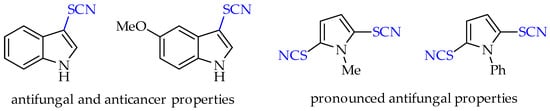
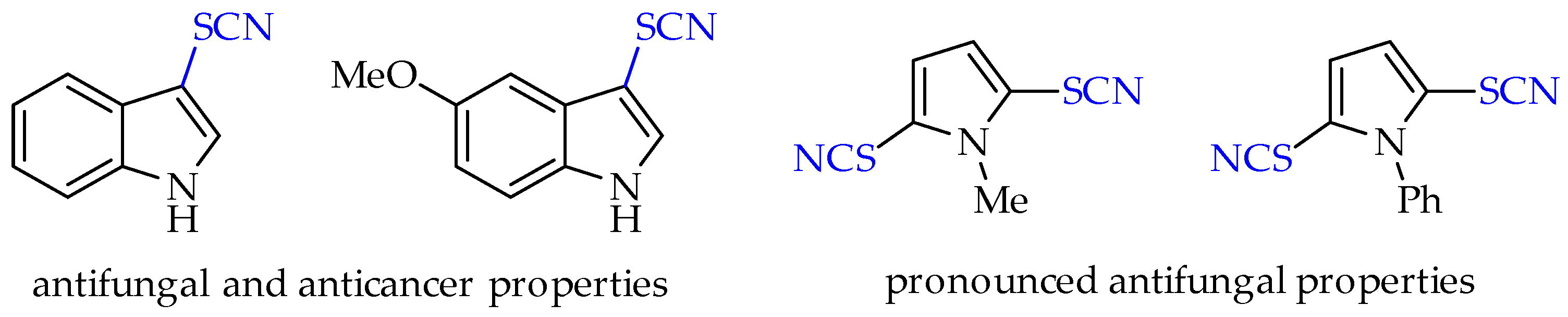
Thiocyanated indoles are promising structures exhibiting antifungal [1] and antitumor [2] properties (Figure 1). However, their synthesis typically relies on an excess of non-recyclable chemical oxidants [3] or presynthesized electrophilic N-thiocyanato derivatives [4], whereas electrochemical approaches are less studied [5]. Although the electrosynthesis of mono-thiocyanated indoles has been previously demonstrated, their electrochemical dithiocyanation has not yet been investigated. Addressing this gap is the aim of the present work, especially given that related bis-thiocyanates have pronounced antifungal properties [1].
Figure 1.
Bioactivity of mono-thiocyanated indoles and bis-thiocyanated pyrroles.
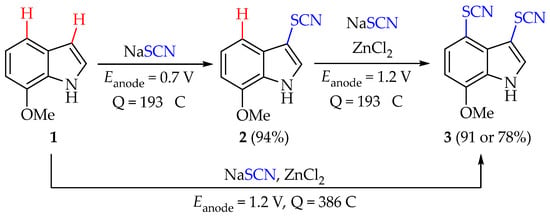
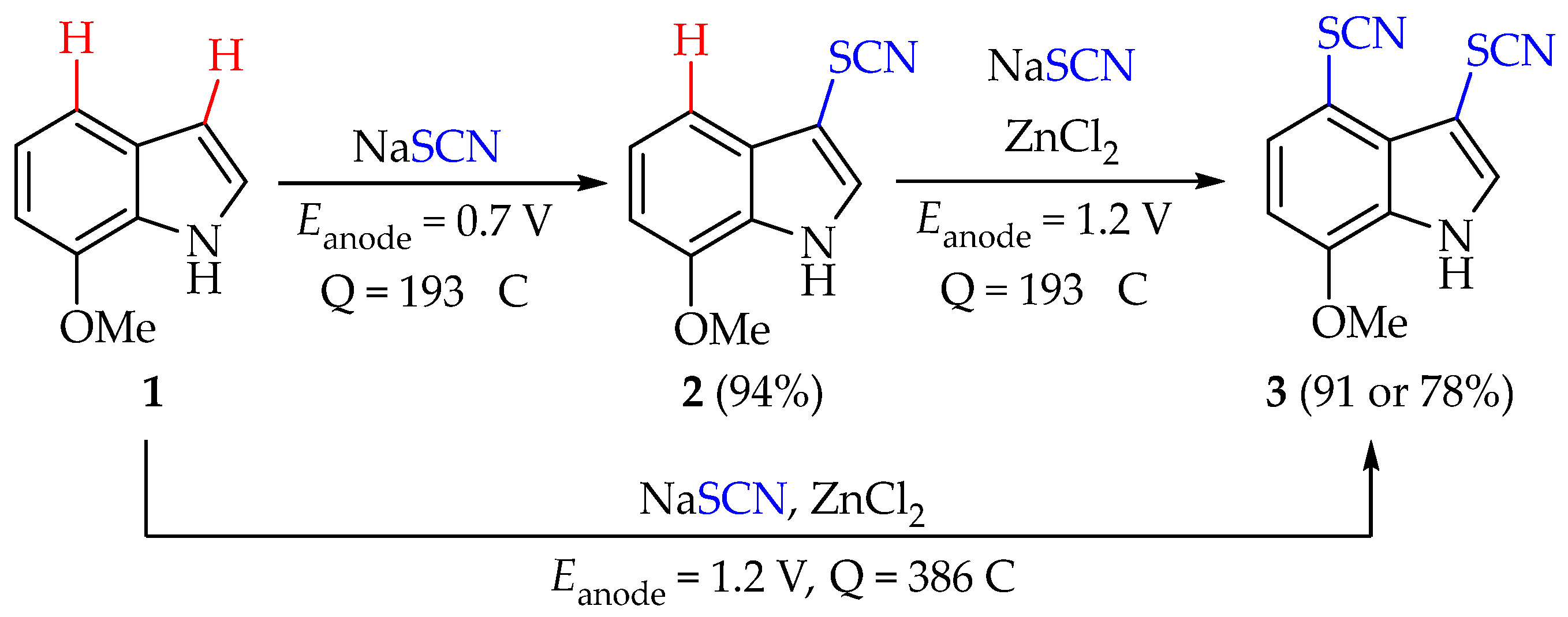
In this note, we describe how 7-methoxy-1H-indole, which possesses two reactive centers, undergoes electrooxidative dithiocyanation to afford the previously undescribed 7-methoxy-3,4-dithiocyanato-1H-indole (Scheme 1).
Scheme 1.
Electrochemical synthesis of 7-methoxy-3,4-dithiocyanato-1H-indole (Pt electrodes, divided cell, 0.1 M NaClO4 in MeCN as supporting electrolyte, 20–25 °C).
2. Results and Discussion
We investigated two versions of the process: a two-stage method and a one-pot method based on described procedures [6]. For the former, we first carried out the mono-thiocyanation of 7-methoxy-1H-indole (1) at a potential of 0.7 V (vs. SCE). Complete conversion required the theoretical amount of electricity (Q = Qt = 193 C). The isolated and purified intermediate product was identified by NMR, FT-IR, and HRMS data as 7-methoxy-3-thiocyanato-1H-indole (2), with a yield of 94%. Although this compound is mentioned in a patent [7], analytical data for it are not provided.
However, an attempt to further thiocyanate compound 2 using only NaSCN was unsuccessful. In contrast, performing the process in the presence of both NaSCN and ZnCl2 at a potential of 1.2 V afforded 7-methoxy-3,4-dithiocyanato-1H-indole (3) with a yield of 91% (Q = Qt = 193 C). Ultimately, the yield of the target product 3 across both stages was 86%.
A one-pot version, involving the thiocyanation of indole 1 in the presence of both NaSCN and ZnCl2 at 1.2 V, directly afforded the target product 3 in 78% yield (Q = Qt = 386 C). Although the yield was lower, this method proved to be much more convenient to carry out.
The structure of the target product 3 was confirmed by NMR and FT-IR spectroscopy, consistent with data for related compounds [1,8] and reference data [9]. In the 1H NMR spectrum, the NH fragment appeared as a one-proton broad singlet at δ 12.74 ppm, while the methoxy group appeared as a three-proton singlet at δ 3.99 ppm. Additionally, three doublets at δ 8.11 (J = 3.0 Hz), 7.52 (J = 8.2 Hz), and 6.94 (J = 8.2 Hz) ppm are attributable to the H-2, H-6, and H-5 protons, respectively. The 13C NMR spectrum displayed intense resonances for the methoxy group at δ 56.1 ppm and CH fragments at δ 104.7, 130.7, and 136.1 ppm. The thiocyanate carbons resonated at δ 112.5 and 113.0 ppm (cf. p. 129 in [9]), whereas the C-3 and C-4 carbons appeared at δ 90.6 and 103.3 ppm. Further downfield, signals for C-3a and C-7a (δ 127.3 and 127.5 ppm) and C-7 (δ 149.3 ppm) were observed. The FT-IR spectrum confirms the presence of SCN groups, as evidenced by a characteristic sharp band at 2159 cm−1 (cf. pp. 340–341 in [9]).
3. Materials and Methods
3.1. General Information
Electrolysis was carried out on a P-30JM potentiostat (Elins, Chernogolovka, Russia) using a temperature-controlled divided glass cell (V = 70 mL). The setup featured Pt plate electrodes (Sanode = 16.5 cm2; Scathode = 3.5 cm2), a saturated calomel electrode (SCE) (Elins, Chernogolovka, Russia) as the reference, and a 3-layer tracing-paper diaphragm (Innovation and Technology Department of the N. D. Zelinsky Institute of Organic Chemistry, Russian Academy of Sciences, Moscow, Russia).
NMR spectra were recorded on a Bruker Avance 300 spectrometer (Bruker BioSpin GmbH, Karlsruhe, Germany) (300.1 MHz for 1H and 75.5 MHz for 13C). Chemical shifts (δ) are reported in ppm relative to the residual solvent signals (DMSO-d6: δH = 2.50, δC = 39.5) [10]. Splitting patterns are designated s (singlet), d (doublet), and t (triplet); coupling constants (J) are given in Hz. FT-IR spectra were recorded on a Bruker Vertex 70 spectrometer (Bruker Corporation, Billerica, MA, USA) using KBr pellets. HRMS were obtained on a Bruker micrOTOF II instrument (Bruker Daltonics, Bremen, Germany). The melting points were measured on a Gallenkamp MFB-595 apparatus (Weiss-Gallenkamp, London, UK) and are uncorrected.
All commercial reagents were used as received without further purification. Acetonitrile (MeCN), petroleum ether (PE, b.p. 40−60 °C), ethyl acetate (EtOAc), dichloromethane (CH2Cl2), 7-methoxy-1H-indole (1), sodium thiocyanate (NaSCN), zinc chloride (ZnCl2), anhydrous sodium sulfate (Na2SO4) were purchased from Thermo Fisher Scientific, Waltham, MA, USA (Acros Organics, Geel, Belgium) in high purity (≥98%). Silica gel (SiO2, 40–63 μm, 60 Å) was used for flash chromatography.
3.2. Two-Stage Synthesis of 7-Methoxy-3,4-dithiocyanato-1H-indole
Stage 1. The anolyte consisted of 0.1 M solution of NaClO4 in MeCN (60 mL) with dissolved NaSCN (4 mmol, 0.32 g) and compound 1 (1 mmol, 0.15 g). The catholyte was a 0.2 M solution of NaClO4 in MeCN (10 mL). Electrolysis was performed at 20–25 °C at Eanode = 0.70 V (vs. SCE) with vigorous magnetic stirring, Q = Qt = 193 C [6]. After electrolysis, the anolyte was concentrated in vacuo, diluted with water (25 mL), and extracted with CH2Cl2 (4 × 25 mL). Combined organic extracts were dried with Na2SO4, filtered, and concentrated in vacuo. The resulting crude product was purified via column chromatography on SiO2 (PE–EtOAc gradient from 10:1 to 1:1) to afford pure 7-methoxy-3-thiocyanato-1H-indole (2): 0.19 g, 0.94 mmol (yield 94%). The structure of this intermediate product was confirmed by 1H and 13C NMR spectroscopy, FT-IR spectroscopy and HRMS.
7-Methoxy-3-thiocyanato-1H-indole (2): yellow solid, m.p. 140–142 °C (94% yield). 1H NMR (300.1 MHz, DMSO-d6) δ 12.19 (br. s, 1H), 7.87 (d, J = 3.0 Hz, 1H), 7.23 (d, J = 7.8 Hz, 1H), 7.17 (t, J = 7.8 Hz, 1H), 6.81 (d, J = 7.8 Hz, 1H), 3.93 (s, 3H) ppm. 13C NMR (75.5 MHz, DMSO-d6) δ 146.7, 132.6, 129.1, 126.5, 122.0, 112.3, 110.2, 103.3, 89.9, 55.4 ppm. FT-IR (KBr, cm−1) 3287, 3108, 3012, 2963, 2936, 2912, 2836, 2632, 2514, 2160, 2110, 1888, 1792, 1693, 1624, 1578, 1501, 1447, 1419, 1369, 1315, 1258, 1216, 1176, 1132, 1096, 1054, 1015, 850, 778, 731, 702, 674, 620, 577, 547, 491. HRMS (ESI-TOF) m/z calc. for C10H8N2OSNa [M + Na]+ 227.0250, found 227.0241.
Stage 2. The anolyte consisted of 0.1 M NaClO4 in MeCN (60 mL) with dissolved NaSCN (4 mmol, 0.32 g), ZnCl2 (1 mmol, 0.14 g), and compound 2 (1 mmol, 0.20 g). The catholyte was a 0.2 M solution of NaClO4 in MeCN (10 mL). Electrolysis was performed at 20–25 °C at Eanode = 1.20 V with vigorous magnetic stirring, Q = Qt = 193 C [6]. After electrolysis, the anolyte was treated as described above to afford pure 7-methoxy-3,4-dithiocyanato-1H-indole (3): 0.24 g, 0.91 mmol (yield 91%). The structure was confirmed by 1H and 13C NMR spectroscopy, FT-IR spectroscopy and HRMS.
7-methoxy-3,4-dithiocyanato-1H-indole (3): pink solid, m.p. 209–211 °C (78–91% yield). 1H NMR (300.1 MHz, DMSO-d6) δ 12.74 (br. s, 1H), 8.11 (d, J = 3.0 Hz, 1H), 7.52 (d, J = 8.2 Hz, 1H), 6.94 (d, J = 8.2 Hz, 1H), 3.99 (s, 3H) ppm. 13C NMR (75.5 MHz, DMSO-d6) δ 149.3, 136.1, 130.7, 127.5, 127.3, 113.0, 112.5, 104.7, 103.3, 90.6, 56.1 ppm. FT-IR (KBr, cm−1) 3286, 3132, 978, 2944, 2840, 2220, 2159, 1837, 1620, 1566, 1496, 1447, 1420, 1387, 1362, 1283, 1305, 1241, 1219, 1186, 1154, 1100, 1120, 1013, 929, 849, 801, 762, 780, 716, 673, 629, 611, 583, 566, 486, 466. HRMS (ESI-TOF) m/z calc. for C11H7N3OS2Na [M + Na]+ 283.9923, found 283.9922.
3.3. One-Pot Synthesis of 7-Methoxy-3,4-dithiocyanato-1H-indole
The anolyte consisted of 0.1 M NaClO4 in MeCN (60 mL) with dissolved NaSCN (6 mmol, 0.49 g) compound 1 (1 mmol, 0.15 g), and ZnCl2 (1.5 mmol, 0.21 g). The catholyte was a 0.2 M solution of NaClO4 in MeCN (10 mL). Electrolysis was performed at 20–25 °C at Eanode = 1.20 V with vigorous magnetic stirring. Q = Qt = 386 C [6]. After electrolysis, the anolyte was treated as described above to afford pure 7-methoxy-3,4-dithiocyanato-1H-indole (3): 0.20 g, 0.78 mmol (yield 78%).
4. Conclusions
We report the first synthesis of the previously undescribed 7-methoxy-3,4-dithiocyanato-1H-indole via a two-stage and one-pot double C–H thiocyanation of 7-methoxy-1H-indole with yield 78–86% using available starting materials and eco-friendly electric current. The structure of the product was confirmed by NMR and IR spectroscopy, as well as HRMS. The proposed method opens a potential route for the efficient dithiocyanation of (hetero)arenes that possess suitable reactive centers.
Supplementary Materials
The following supporting information can be downloaded online. Figure S1: 1H NMR spectrum of 7-methoxy-3-thiocyanato-1H-indole. Figure S2: 13C NMR spectrum of 7-methoxy-3-thiocyanato-1H-indole. Figure S3: FT-IR spectrum of 7-methoxy-3-thiocyanato-1H-indole. Figure S4: HRMS of 7-methoxy-3-thiocyanato-1H-indole; Figure S5: 1H NMR spectrum of 7-methoxy-3,4-dithiocyanato-1H-indole. Figure S6: 13C NMR spectrum of 7-methoxy-3,4-dithiocyanato-1H-indole. Figure S7: FT-IR spectrum of 7-methoxy-3,4-dithiocyanato-1H-indole. Figure S8: HRMS of 7-methoxy-3,4-dithiocyanato-1H-indole.
Author Contributions
Conceptualization, V.A.K.; writing—original draft, V.M.K.; writing—review & editing, V.A.K. and N.V.G.; investigation, V.M.K.; supervision, V.A.K. All authors have read and agreed to the published version of the manuscript.
Funding
This research was funded by The Russian Science Foundation (grant no. 25-23-00447, https://rscf.ru/project/25-23-00447/ (accessed on 30 October 2026)).
Data Availability Statement
The original contributions presented in this study are included in the article/Supplementary Material. Further inquiries can be directed to the corresponding author.
Acknowledgments
The authors thank Alexandra É. Dichkovskaya for her assistance with the syntheses and Elena D. Streltsova for identifying the products.
Conflicts of Interest
The authors declare no conflicts of interest.
References
- Kokorekin, V.A.; Terent’ev, A.O.; Ramenskaya, G.V.; Grammatikova, N.É.; Rodionova, G.M.; Ilovaiskii, A.I. Synthesis and Antifungal Activity of Arylthiocyanates. Pharm. Chem. J. 2013, 47, 422–425. [Google Scholar] [CrossRef] [Scilit]
- Fortes, M.P.; da Silva, P.B.N.; da Silva, T.G.; Kaufman, T.S.; Militão, G.C.G.; Silveira, C.C. Synthesis and preliminary evaluation of 3-thiocyanato-1H-indoles as potential anticancer agents. Eur. J. Med. Chem. 2016, 118, 21–26. [Google Scholar] [CrossRef] [Scilit] [PubMed]
- Rezayati, S.; Ramazani, A. A review on electrophilic thiocyanation of aromatic and heteroaromatic compounds. Tetrahedron 2020, 76, 131382. [Google Scholar] [CrossRef] [Scilit]
- Chen, H.; Shi, X.; Liu, X.; Zhao, L. Recent progress of direct thiocyanation reactions. Org. Biomol. Chem. 2022, 20, 6508–6527. [Google Scholar] [CrossRef] [Scilit] [PubMed]
- Karmaker, P.G.; Alam, M.A.; Huo, F. Recent advances in photochemical and electrochemically induced thiocyanation: A greener approach for SCN-containing compound formation. RSC Adv. 2022, 12, 6214–6233. [Google Scholar] [CrossRef] [Scilit] [PubMed]
- Moiseeva, N.V.; Sokolov, A.E.; Andreev, I.A.; Ratmanova, N.K.; Trushkov, I.V.; Kokorekin, V.A. Electrooxidative Thiocyanation of Hydroxy- and Alkoxybenzenes. Eur. J. Org. Chem. 2024, 27, e202400937. [Google Scholar] [CrossRef] [Scilit]
- Lu, Z.; Yang, X.; Yang, Q.; Yang, W.; Miao, J.; Jiang, X. Method for Efficiently Constructing Thiocyano Substituted Aromatic Organic Intermediate. Chinese Patent 121085824A, 12 September 2025. Available online: https://worldwide.espacenet.com/patent/search/family/097886729/publication/CN121085824A?q=CN121085824A (accessed on 30 October 2026).
- Lucas, S.C.C.; Ahmed, A.; Ashraf, S.N.; Argyrou, A.; Bauer, M.R.; De Donatis, G.M.; Demanze, S.; Eisele, F.; Fusani, L.; Hock, A.; et al. Optimization of Potent Ligands for the E3 Ligase DCAF15 and Evaluation of Their Use in Heterobifunctional Degraders. J. Med. Chem. 2024, 67, 5538–5566. [Google Scholar] [CrossRef] [Scilit] [PubMed]
- Pretsch, E.; Bühlmann, P.; Badertscher, M. Structure Determination of Organic Compounds; Springer: Berlin/Heidelberg, Germany, 2020; p. 478. [Google Scholar] [CrossRef] [Scilit]
- Fulmer, G.R.; Miller, A.J.M.; Sherden, N.H.; Gottlieb, H.E.; Nudelman, A.; Stoltz, B.M.; Bercaw, J.E.; Goldberg, K.I. NMR Chemical Shifts of Trace Impurities: Common Laboratory Solvents, Organics, and Gases in Deuterated Solvents Relevant to the Organometallic Chemist. Organometallics 2010, 29, 2176–2179. [Google Scholar] [CrossRef] [Scilit]
Disclaimer/Publisher’s Note: The statements, opinions and data contained in all publications are solely those of the individual author(s) and contributor(s) and not of MDPI and/or the editor(s). MDPI and/or the editor(s) disclaim responsibility for any injury to people or property resulting from any ideas, methods, instructions or products referred to in the content. |
© 2026 by the authors. Licensee MDPI, Basel, Switzerland. This article is an open access article distributed under the terms and conditions of the Creative Commons Attribution (CC BY) license.