


Abstract
A two-stage synthesis of the novel compound 1-(1-methyl-5-thiocyanato-1H-pyrrol-2-yl)-3-nitro-1H-1,2,4-triazole utilizing electrochemistry as an environmentally benign tool is reported. The structure of the target molecule was confirmed by 1H and 13C NMR spectroscopy and HRMS. The compound exhibits antibacterial and antifungal activity comparable to chloramphenicol, ciprofloxacin, and fluconazole.
1. Introduction
Compounds bearing both an azole moiety and a thiocyanate group remain underexplored, despite reports indicating their antimicrobial properties are linked to these structural components [1]. This is particularly relevant in the context of rising resistance to existing drugs [2]. Electrochemical synthesis is ideally suited for preparing such compounds as it eliminates overstoichiometric oxidants and allows precise process control by regulating the anode potential [1,3]. Herein, we report the first use of an electrosynthesis to access previously undescribed 1-(1-methyl-5-thiocyanato-1H-pyrrol-2-yl)-3-nitro-1H-1,2,4-triazole, followed by screening against standard bacteria and fungi.
2. Results and Discussion
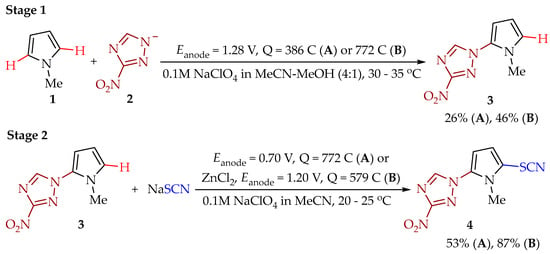
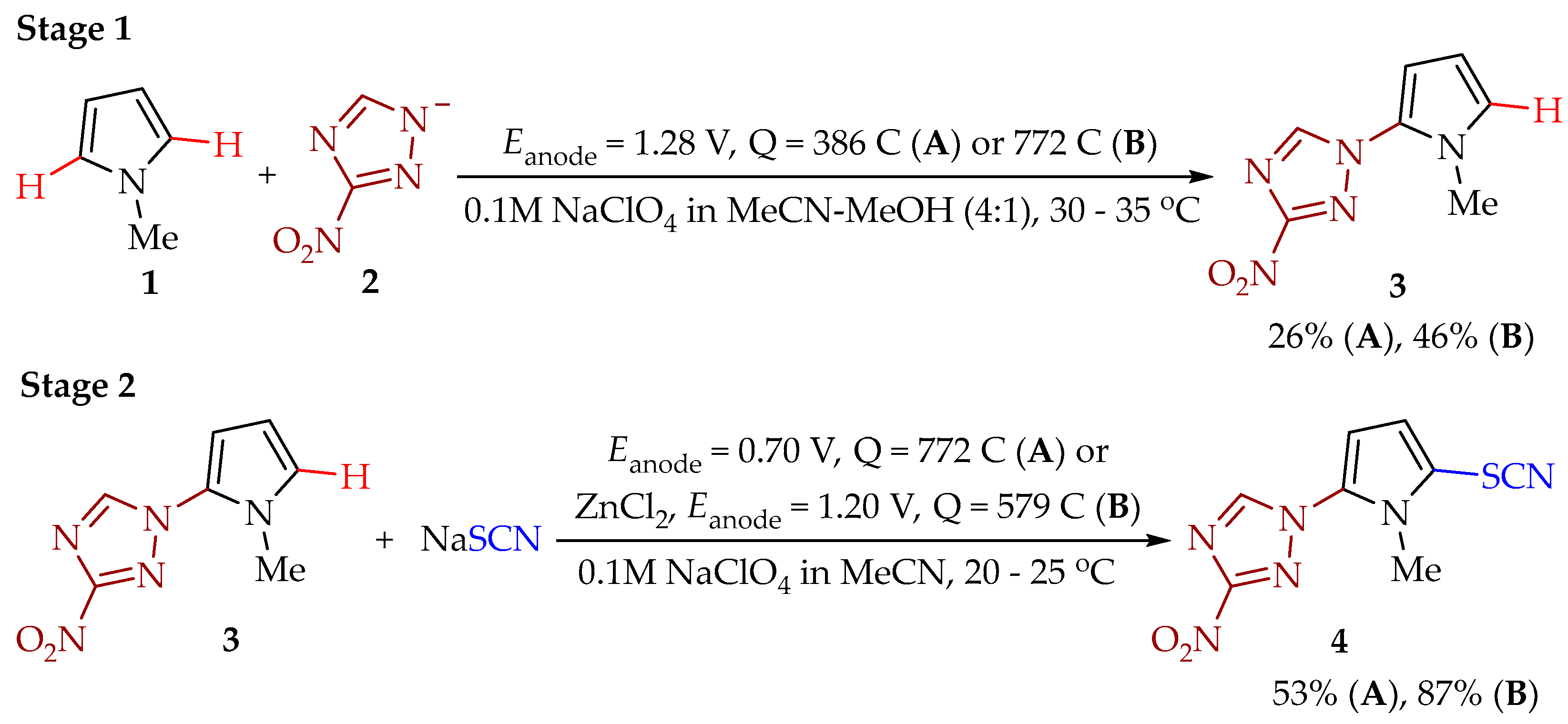
A two-stage C–H functionalization of N-methylpyrrole (1) with 3-nitro-1H-1,2,4- triazole (2) as the coupling partner was achieved using NaSCN as the thiocyanating agent (Scheme 1). The electrolyses proceeded in potentiostatic mode in the anodic compartment of a divided cell equipped with Pt electrodes and 0.1 M NaClO4 as the supporting electrolyte, following optimized protocols adapted from procedures in the literature [1,4].
Scheme 1.
Electrosynthesis of 1-(1-methyl-5-thiocyanato-1H-pyrrol-2-yl)-3-nitro-1H-1,2,4-triazole.
Stage 1 involved the in situ preparation of the 3-nitroazolate nucleophile (2) from the corresponding azole and t-BuOK (a safer alternative to the previously reported preparation using metal Na [4]) followed by addition of pyrrole 1. The process was performed at an anodic potential (Eanode) of 1.28 V (vs. SCE) at a slightly elevated temperature (30–35 °C) in a MeCN–MeOH (4:1) mixture; MeOH was required to solubilize the potassium azolate. The yield of the product 3 depended on the amount of electricity passed (Q): 26% at Q = Qt (386 C), which aligns with the literature data [4], and 46% at Q = 2Qt (772 C). Higher Q provided no further improvement.
In Stage 2, thiocyanation of isolated compound 3 was performed using NaSCN at 0.70 V (A) without ZnCl2 and at 1.20 V (B) with ZnCl2 as a catalyst [1]. This provided azolyl thiocyanate 4 in 53% yield (Q = 2Qt = 772 C) under method A, whereas method B increased the yield to 87% while simultaneously reducing the electricity consumption (Q = 1.5Qt = 579 C).
The structure of product 4 was confirmed by 1H and 13C NMR spectroscopy, consistent with data for structurally related compounds [1,4]. The 1H NMR spectrum exhibited a one-proton singlet at δ 9.28 and a three-proton singlet at 3.64 ppm, corresponding to the triazole CH and N-methyl groups, respectively, alongside two doublets (3J = 3.6 Hz) at δ 6.91 and 6.71 ppm attributable to the pyrrole H-4 and H-3 protons. The 13C NMR spectrum displayed characteristic downfield signals for the triazole ring carbons at δ 163.0 (C–NO2) and 149.4 (CH). Intense resonances were observed at δ 118.8 and 107.8 ppm (N-methylpyrrole C-4/C-3), whereas the methyl carbon appeared further upfield at δ 31.6 ppm. Lower-intensity signals at δ 128.1, 110.7, and 110.1 ppm were assigned to C-5, C-2, and the thiocyanate carbon (SCN), respectively.
A bioassay of compound 4 was evaluated against reference Gram-positive/Gram- negative bacteria (S. aureus, E. coli) and pathogenic fungi (C. albicans, A. niger) using standard protocols [5,6,7]. Activity was determined based on the minimum inhibitory concentration (MIC), defined as the lowest compound concentration (µg·mL−1) that completely inhibited visible microbial growth. It achieved low MICs against S. aureus (3.9 µg·mL−1; matching chloramphenicol), E. coli (3.9 µg·mL−1; comparable to ciprofloxacin), and C. albicans (7.8 µg·mL−1; on par with fluconazole). While effective, its potency against A. niger (31.2 µg·mL−1) was significantly surpassed by amphotericin B (0.96 µg·mL−1).
3. Materials and Methods
3.1. General Information
Electrolyses were carried out on a P-30JM potentiostat (Elins, Chernogolovka, Russia) using a temperature-controlled divided glass cell (V = 70 mL). The setup featured Pt plate electrodes (Sanode = 16.5 cm2; Scathode = 3.5 cm2), a saturated calomel electrode (SCE) (Elins, Chernogolovka, Russia) as the reference, and a 3-layer tracing-paper diaphragm (Innovation and Technology Department of the N.D. Zelinsky Institute of Organic Chemistry, Russian Academy of Sciences, Moscow, Russia).
NMR spectra were recorded on Bruker Avance 300 (Bruker BioSpin GmbH, Karlsruhe, Germany) (300.1 MHz for 1H) and Bruker Avance 600 (Bruker Biospin GmbH, Rheinstetten, Germany) (150.9 MHz for 13C) spectrometers. Chemical shifts (δ) are reported in ppm relative to the residual solvent signals (DMSO-d6: δH = 2.50, δC = 39.5) [8]. Splitting patterns are designated s (singlet) and d (doublet); coupling constants (J) are given in Hz. HRMS measurements were acquired on a Bruker micrOTOF II instrument (Bruker Daltonics, Bremen, Germany) via ESI+ over an m/z range of 50–3000. The melting point was determined on a Gallenkamp MFB-595 apparatus (Weiss-Gallenkamp, London, UK) and is uncorrected.
Unless otherwise noted, all commercial reagents were used as received without further purification. Acetonitrile (MeCN), methanol (MeOH), toluene, petroleum ether (PE, b.p. 40−60 °C), ethyl acetate (EtOAc), dichloromethane (CH2Cl2), N-methylpyrrole (1), potassium tert-butoxide (t-BuOK), sodium thiocyanate (NaSCN), zinc chloride (ZnCl2), anhydrous sodium sulfate (Na2SO4) were purchased from Thermo Fisher Scientific, Waltham, MA, USA (Acros Organics, Belgium) in high purity (≥98%). Silica gel (SiO2, 40–63 μm, 60 Å) was used for flash chromatography. 3-Nitro-1H-1,2,4-triazole (2) was synthesized according to a reported procedure [9]. Distilled water was employed where required.
The bioassays were performed according to standard guidelines [5,6,7].
3.2. Synthesis of 1-(1-Methyl-5-thiocyanato-1H-pyrrol-2-yl)-3-nitro-1H-1,2,4-triazole
Stage 1. The anolyte consisted of compound 2 (4 mmol, 0.46 g), t-BuOK (4 mmol, 0.45 g), and pyrrole 1 (2 mmol, 0.16 g) dissolved in 60 mL of 0.1 M NaClO4 in MeCN–MeOH (4:1). The catholyte was 10 mL of 0.5 M NaClO4 in MeCN–MeOH (4:1). Electrolysis was conducted at 30–35 °C in potentiostatic mode (Eanode = 1.28 V vs. SCE) with vigorous magnetic stirring; periodic interruptions were made to reactivate the electrodes by calcination. The amount of electricity passed (Q) was either 386 C (theoretical, Qt [4]) or 772 C (2Qt). After electrolysis, the anolyte was concentrated in vacuo, diluted with water (25 mL), and extracted with toluene (4 × 25 mL). Combined organic layers were dried with Na2SO4, filtered, and evaporated. The residue was purified via flash chromatography on SiO2 (PE–EtOAc gradient from 10:1 to 1:1) followed by reprecipitation from a toluene–petroleum ether mixture to afford compound 3: 0.10 g, 0.52 mmol (yield 26%); or 0.18 g, 0.92 mmol (yield 46%). The structure was confirmed by 1H and 13C NMR spectroscopy as well as HRMS using known characteristics [4].
1-(1-Methyl-5-thiocyanato-1H-pyrrol-2-yl)-3-nitro-1H-1,2,4-triazole (3): yellowish powder, m.p. 106–108 °C (lit. 105–107 °C [4]). 1H NMR (500.1 MHz, CDCl3) δ 8.33 (s, 1H), 6.73 (dd, 3J = 3.0 Hz, 4J = 2.0 Hz, 1H), 6.36 (dd, 3J = 4.0 Hz, 4J = 2.0 Hz, 1H), 6.18 (dd, 3J = 3.5 Hz, 4J = 3.0 Hz, 1H), 3.59 (s, 3H) ppm. 13C NMR (125.8 MHz, CDCl3) δ 163.5, 146.9, 123.7, 123.2, 107.7, 106.6, 33.9 ppm. HRMS (ESI) m/z calc. for C7H7N5O2 [M]+ 193.0720, found 193.0721.
Stage 2. The anolyte consisted of compound 3 (2 mmol, 0.39 g) and NaSCN (8 mmol, 0.65 g) dissolved in 60 mL of 0.1 M NaClO4 in MeCN; ZnCl2 (2 mmol, 0.27 g) was added only in method B. The catholyte contained 10 mL of 0.5 M NaClO4 in MeCN. Electrolysis was conducted at 20–25 °C at Eanode = 0.70 V (A) or 1.20 V (B) with vigorous magnetic stirring. Q was 772 C (2Qt [1]) for A and 579 C (1.5Qt [1]) for B. After electrolysis, the anolyte was worked up as described above. This afforded analytically pure 1-(1-methyl-5-thiocyanato-1H-pyrrol-2-yl)-3-nitro-1H-1,2,4-triazole (4): 0.27 g, 1.06 mmol (A, yield 53%); or 0.43 g, 1.74 mmol (B, yield 87%). The structure was confirmed by 1H and 13C NMR spectroscopy as well as HRMS.
1-(1-Methyl-5-thiocyanato-1H-pyrrol-2-yl)-3-nitro-1H-1,2,4-triazole (4): yellow-brownish solid, m.p. 138–140 °C (53–87% yield). 1H NMR (300.1 MHz, DMSO-d6) δ 9.28 (s, 1H), 6.91 (d, 3J = 3.6 Hz, 1H), 6.71 (d, 3J = 3.6 Hz, 1H), 3.64 (s, 3H) ppm. 13C NMR (150.9 MHz, DMSO-d6) δ 163.0, 149.4, 128.1, 118.8, 110.7, 110.1, 107.8, 31.6 ppm. HRMS (ESI) m/z calc. for C8H6N6O2SNa [M + Na]+ 273.0165, found 273.0172.
4. Conclusions
For the first time we report the synthesis of previously unknown 1-(1-methyl-5-thiocyanato-1H-pyrrol-2-yl)-3-nitro-1H-1,2,4-triazole via a double C–H functionalization of N-methyl pyrrole utilizing environmentally promising electric current and available materials. The cross-coupling with 3-nitrotriazole (stage 1) proceeded in 46% yield, followed by thiocyanation at the C-5 position (stage 2) in 87% yield using NaSCN/ZnCl2. The overall isolated yield for the two-stage sequence was doubled to 40% compared to the previously reported [1] synthesis of related compounds. The structure was fully confirmed by NMR and HRMS. Notably, the final product exhibited potent in vitro antibacterial and antifungal activity comparable to standards (chloramphenicol, ciprofloxacin, fluconazole). This work provides a practical electrosynthetic route to bifunctionalized heterocycles as promising antibiotic/antiseptic leads.
Supplementary Materials
The following supporting information can be downloaded online. Figure S1: 1H NMR spectrum of 1-(1-methyl-1H-pyrrol-2-yl)-3-nitro-1H-1,2,4-triazole. Figure S2: 13C NMR spectrum of 1-(1-methyl-1H-pyrrol-2-yl)-3-nitro-1H-1,2,4-triazole. Figure S3: HRMS of 1-(1-methyl-1H-pyrrol-2-yl)-3-nitro-1H-1,2,4-triazole. Figure S4: 1H NMR spectrum of 1-(1-methyl-5-thiocyanato-1H-pyrrol-2-yl)-3-nitro-1H-1,2,4-triazole. Figure S5: 13C NMR spectrum of 1-(1-methyl-5-thiocyanato-1H-pyrrol-2-yl)-3-nitro-1H-1,2,4-triazole. Figure S6: HRMS of 1-(1-methyl-5-thiocyanato-1H-pyrrol-2-yl)-3-nitro-1H-1,2,4-triazole.
Author Contributions
Conceptualization, V.A.K.; Writing—original draft, V.M.K.; Writing—review & editing, V.A.K. and N.V.G.; Investigation, V.M.K., S.R.U. and A.M.S.; Supervision, V.A.K. All authors have read and agreed to the published version of the manuscript.
Funding
This research was funded by The Russian Science Foundation (grant no. 25-23-00447, https://rscf.ru/project/25-23-00447/ (accessed on 26 October 2026)).
Data Availability Statement
The spectroscopic data presented in this study are available as Supplementary Materials.
Conflicts of Interest
The authors declare no conflicts of interest.
References
- Lyalin, B.V.; Sigacheva, V.L.; Kudinova, A.S.; Neverov, S.V.; Kokorekin, V.A.; Petrosyan, V.A. Electrooxidation Is a Promising Approach to Functionalization of Pyrazole-Type Compounds. Molecules 2021, 26, 4749. [Google Scholar] [CrossRef] [Scilit] [PubMed]
- Belay, W.Y.; Getachew, M.; Tegegne, B.A.; Teffera, Z.H.; Dagne, A.; Zeleke, T.K.; Wondm, S.A.; Abebe, R.B.; Gedif, A.A.; Fenta, A.; et al. Antimicrobial resistance with a focus on antibacterial, antifungal, antimalarial, and antiviral drugs resistance, its threat, global priority pathogens, prevention, and control strategies: A review. Ther. Adv. Infect. Dis. 2025, 12, 20499361251340144. [Google Scholar] [CrossRef] [Scilit] [PubMed]
- Pollok, D.; Waldvogel, S.R. Electro-organic synthesis—A 21st century technique. Chem. Sci. 2020, 11, 12386–12400. [Google Scholar] [CrossRef] [Scilit] [PubMed]
- Sigacheva, V.L.; Kokorekin, V.A.; Strelenko, Y.A.; Neverov, S.V.; Petrosyan, V.A. Electrochemical azolation of N-substituted pyrroles: A new case in SNH(An) reactions. Mendeleev Commun. 2012, 22, 270–272. [Google Scholar] [CrossRef] [Scilit]
- Semina, N.A.; Sidorenko, S.V.; Rezvan, S.P.; Grudinina, S.L.; Strachunsky, L.S.; Stetciuk, O.U.; Kozlov, R.S.; Eidel’shtein, M.V.; Ved’mina, E.A.; Stolyarova, L.G.; et al. Guidelines Susceptibility Testing of Microorganismes to Antibacterial Agents (in russian). Clin. Microbiol. Antimicrob. Chemother. 2004, 6, 306–359. Available online: https://cmac-journal.ru/en/publication/2004/4/cmac-2004-t06-n4-p306/ (accessed on 26 October 2026). (In Russian)
- CLSI M07; Methods for Dilution Antimicrobial Susceptibility Tests for Bacteria that Grow Aerobically, 12th ed. Clinical and Laboratory Standards Institute: Wayne, PA, USA, 2024. Available online: https://clsi.org/shop/standards/m07/ (accessed on 26 October 2026).
- CLSI M27; Reference Method for Broth Dilution Antifungal Susceptibility Testing of Yeasts, 4th ed. Clinical and Laboratory Standards Institute: Wayne, PA, USA, 2017. Available online: https://clsi.org/shop/standards/m27/ (accessed on 26 October 2026).
- Fulmer, G.R.; Miller, A.J.M.; Sherden, N.H.; Gottlieb, H.E.; Nudelman, A.; Stoltz, B.M.; Bercaw, J.E.; Goldberg, K.I. NMR Chemical Shifts of Trace Impurities: Common Laboratory Solvents, Organics, and Gases in Deuterated Solvents Relevant to the Organometallic Chemist. Organometallics 2010, 29, 2176–2179. [Google Scholar] [CrossRef] [Scilit]
- Jones, S.S.; Rayner, B.; Reese, C.B.; Ubasawa, A.; Ubasawa, M. Synthesis of the 3′-terminal decaribonucleoside nonaphosphate of yeast alanine transfer ribonucleic acid. Tetrahedron 1980, 36, 3075–3085. [Google Scholar] [CrossRef] [Scilit]
Disclaimer/Publisher’s Note: The statements, opinions and data contained in all publications are solely those of the individual author(s) and contributor(s) and not of MDPI and/or the editor(s). MDPI and/or the editor(s) disclaim responsibility for any injury to people or property resulting from any ideas, methods, instructions or products referred to in the content. |
© 2026 by the authors. Licensee MDPI, Basel, Switzerland. This article is an open access article distributed under the terms and conditions of the Creative Commons Attribution (CC BY) license.