


Abstract
A novel cyclic chalcone analogue, (E)-6-((4-(3,4-dichlorophenyl)-1-oxo-3,4-dihydronaphthalen-2(1H)-ylidene)methyl)-3-methylbenzo[d]oxazol-2(3H)-one (3), was synthesized by acid-catalyzed condensation of 4-(3,4-dichlorophenyl)-1-tetralone (1) with 3-methyl-2-oxo-2,3-dihydrobenzo[d]oxazole-6-carbaldehyde (2) using the SOCl2/EtOH catalytic system. The structure of the newly synthesized compound was confirmed by 1H and 13C NMR spectroscopy, FT-IR and high-resolution mass spectrometry (HRMS). Compound 3 incorporates a sertraline-related 4-(3,4-dichlorophenyl)tetralin framework and a benzoxazolinone scaffold within a single molecular structure.
1. Introduction
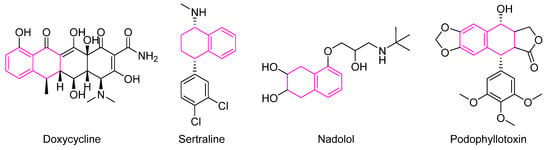
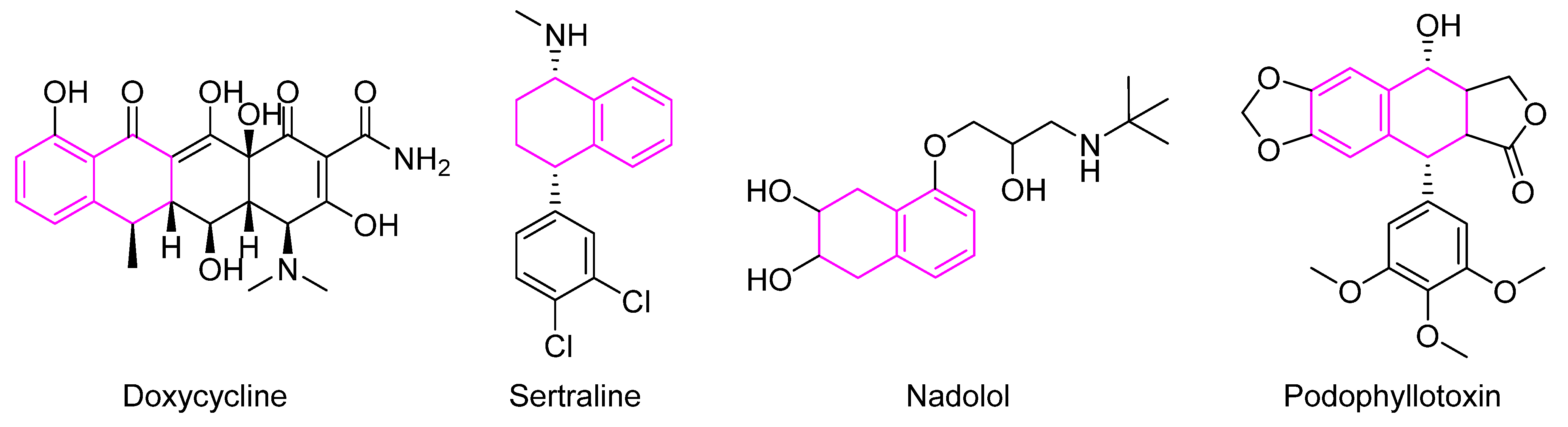
Tetralin or 1,2,3,4-tetrahydronaphthalene, is a privileged structural motif in medicinal chemistry, being present in a wide range of pharmacologically active molecules of both natural and synthetic origin. Examples include tetracycline antibiotics (e.g., doxycycline, minocycline) and anthracycline antibiotics (e.g., doxorubicin, idarubicin), sex hormones such as estrogens, and the anticancer agents podophyllotoxin and etoposide [1]. Synthetic drugs incorporating the tetralin scaffold have also found widespread therapeutic application; notable examples include sertraline (an SSRI antidepressant), tetryzoline (an α-adrenergic agonist), and nadolol (a β-adrenoceptor antagonist) [2] (Figure 1).
Figure 1.
Drugs containing a tetralin scaffold.
1-Tetralone (3,4-dihydronaphthalen-1(2H)-one) can be viewed as a carbonyl derivative of tetralin; although it lacks direct pharmacological activity, various substituted tetralones have been synthesized and tested for biological activity [3], including potential anti-tumor activity [4,5,6,7], monoamine oxidase (MAO) inhibition [8,9], and acetylcholinesterase (AChE) inhibition [10].
Continuing our research program on the design and synthesis of chalcones with potential biological activity, we report herein the synthesis of a novel 2-benzylidene-1-tetralone, namely (E)-6-((4-(3,4-dichlorophenyl)-1-oxo-3,4-dihydronaphthalen-2(1H)-ylidene)methyl)-3-methylbenzo[d]oxazol-2(3H)-one (3). The selection of 4-(3,4-dichlorophenyl)-1-tetralone (1) was motivated by its role as a synthetic intermediate in the preparation of sertraline, a clinically used antidepressant. This ketone was therefore chosen as a starting material for the synthesis of a novel cyclic chalcone analogue combining the sertraline-related tetralin framework with a biologically relevant benzoxazolone moiety [11].
2. Results and Discussion
The most commonly used, classic, and practically universal method for the synthesis of α,β-unsaturated ketones is the Claisen-Schmidt condensation. This is a type of crossed aldol condensation that occurs between an aromatic aldehyde and an alkyl aryl ketone in the presence of basic or acidic catalysts [10,12,13].
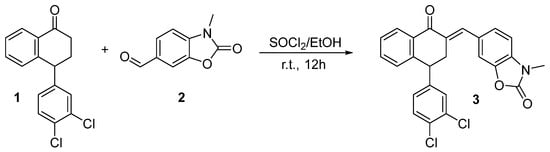
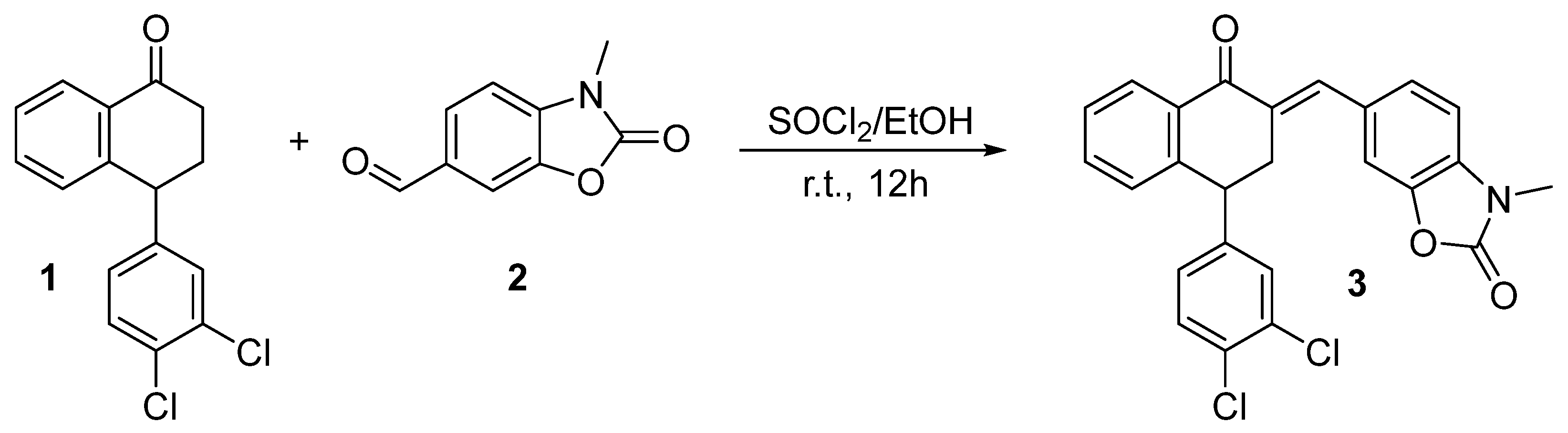
The synthesis of target compound 3 was accomplished using the pathway illustrated in Scheme 1. Experimental data showed that the Claisen-Schmidt condensation of 4-(3,4-dichlorophenyl)-1-tetralone (1) with 3-methyl-2-oxo-2,3-dihydrobenzo[d]oxazole-6-carbaldehyde (2), catalyzed by 10% potassium hydroxide, yielded a dark reaction mixture containing only traces of the product (3) after 24 h of stirring at room temperature. However, heating the mixture to reflux resulted in hydrolysis of the oxazolone ring in 2.
Scheme 1.
Synthesis of (E)-6-((4-(3,4-dichlorophenyl)-1-oxo-3,4-dihydronaphthalen-2(1H)-ylidene)methyl)-3-methylbenzo[d]oxazol-2(3H)-one (3).
To overcome these limitations, the reaction conditions were investigated under acidic catalysis conditions. For this purpose, a protocol previously established in our laboratory was employed [14], wherein hydrogen chloride was generated in situ from thionyl chloride and ethanol. The reaction was performed at ambient temperature and monitored by thin-layer chromatography (TLC). After 4 h, the target solid compound 3 was isolated and purified by recrystallization from toluene, affording the target solid compound 3 as light-yellow crystals in 76% yield.
The structure of compound 3 was confirmed by FT-IR, 1H and 13C NMR spectroscopy and high-resolution mass spectrometry (HRMS) (Supplementary Materials Figures S1–S4). In the 1H NMR spectrum, the characteristic singlet observed at δ 7.88 ppm was assigned to the exocyclic methine proton (CH=) of the cyclic chalcone system. The configuration of compound 3 was assigned as E in accordance with the literature data for structurally related 2-arylidene-1-tetralone derivatives [15,16]. The aromatic protons resonated in the δ 6.91–8.22 ppm region. In the aliphatic region, the proton of the CH group of the dihydronaphthalenone ring appeared at δ 4.28–4.30 ppm, while the two diastereotopic methylene protons gave separate resonances at δ 3.28–3.32 ppm and within the δ 3.36–3.43 ppm region. The latter signal overlapped with the resonance of the N-methyl group of the benzoxazolinone moiety.
The 13C NMR spectrum further supported the proposed structure. The carbonyl carbon of the α,β-unsaturated tetralone system resonated at δ 187.02 ppm, whereas the carbonyl carbon of the benzoxazolinone moiety appeared at δ 154.55 ppm. The aromatic and olefinic carbon resonances were observed in the δ 108.05–143.69 ppm region. The signals at δ 43.94 and 35.14 ppm were attributed to the aliphatic carbons of the dihydronaphthalenone moiety, while the signal at δ 28.28 ppm corresponded to the N-methyl carbon. The HRMS data were also consistent with the proposed molecular composition of compound 3.
3. Materials and Methods
3.1. General
All chemicals were purchased from Acros Organics (Geel, Belgium) and used without further purification unless otherwise stated. The synthesis of 3-methyl-2-oxo-2,3-dihydrobenzo[d]oxazole-6-carbaldehyde (2) [17] and 4-(3,4-dichlorophenyl)-1-tetralone (1) [18] was carried out using previously described methods. The progress of the reactions and the purity of the synthesized compound were monitored by thin-layer chromatography (TLC) on silica gel plates (Kieselgel 60 F254, Merck, Darmstadt, Germany) using toluene/chloroform/methanol (3.5:1.5:0.5, v/v) as the eluent.
Melting points were determined on a Boetius hot-stage microscope (Carl Zeiss Jena, Germany). Infrared spectra (FT-IR) were acquired on a Shimadzu FTIR 8400S Fourier transform infrared spectrophotometer (Duisburg, Germany) in nujol. NMR spectra were recorded in CDCl3 on a Bruker Avance III HD 500 spectrometer (Billerica, MA, USA) operating at 500 MHz for 1H and 125.8 MHz for 13C. Chemical shifts are reported in parts per million (δ) relative to the solvent peak, and coupling constants (J) are given in hertz (Hz). High-resolution mass spectra (HRMS) were obtained using an Orbitrap Exploris 120 Mass Spectrometer, Thermo Fisher Scientific (Waltham, MA, USA).
3.2. Synthesis
(E)-6-((4-(3,4-Dichlorophenyl)-1-oxo-3,4-dihydronaphthalen-2(1H)-ylidene)methyl)-3-methylbenzo[d]oxazol-2(3H)-one (3)
4-(3,4-Dichlorophenyl)-1-tetralone (1) (0.58 g, 2 mmol) was dissolved in hot absolute ethanol (6 mL), and 3-methyl-2-oxo-2,3-dihydrobenzo[d]oxazole-6-carbaldehyde (2) (0.35 g, 2 mmol) was added. The reaction mixture was allowed to cool to room temperature, and thionyl chloride (0.6 mL) was added dropwise to the resulting suspension, upon which a clear solution was formed. The reaction mixture was stirred at room temperature for 12 h and monitored by TLC. After completion of the reaction, a small amount of water was added, and the resulting precipitate was collected by filtration, washed with water and a small amount of ice-cold methanol, and dried. The crude product was obtained in 89% yield (0.80 g). Recrystallization from toluene afforded compound 3 as light-yellow crystals in 76% yield (0.68 g).
Light-yellow crystals; m.p. 186–188 °C (PhCH3). IR (nujol): 1500, 1591, 1660, 1783 cm−1. 1H NMR (500 MHz, CDCl3): δ 3.28–3.32 (m, 1H, CH2), 3.36–3.43 (m, 4H, CH2 and NCH3), 4.28–4.30 (m, 1H, CH), 6.91 (dd, 1H, Ar-H, J = 8.3 Hz, J = 2.1 Hz), 6.95 (d, 1H, Ar-H, J = 8.5 Hz), 7.01 (d, 1H, Ar-H, J = 7.6 Hz), 7.14–7.15 (m, 2H, Ar-H), 7.18 (d, 1H, Ar-H, J = 2.1 Hz), 7.33 (d, 1H, Ar-H, J = 8.3 Hz), 7.43–7.46 (m, 1H, Ar-H), 7.49–7.52 (m, 1H, Ar-H), 7.88 (s, 1H, =CH), 8.22 (dd, 1H, Ar-H, J = 7.77 Hz, J = 1.4 Hz). 13C NMR (125.8 MHz, CDCl3): δ 187.02, 154.55, 143.69, 143.19, 142.62, 137.64, 133.85, 133.26, 132.78, 132.53, 132.19, 131.11, 130.64, 130.19, 130.12, 128.58, 128.50, 127.98, 127.59, 126.44, 110.67, 108.05, 43.94, 35.14, 28.28. HRMS (ESI): Found 450.0657 Calcd. for C25H17Cl2NO3: 450.0658 [M + H]+.
Supplementary Materials
FT-IR, 1H- and 13C-NMR, HRMS for compound 3; Figure S1: FT-IR spectrum of compound 3; Figure S2: 1H-NMR spectrum of compound 3; Figure S3: 13C-NMR spectrum of compound 3; Figure S4: HRMS of compound 3.
Author Contributions
Conceptualization, O.I.P. and Y.B.I.; methodology, Y.B.I. and O.I.P.; writing—original draft preparation, Y.B.I. and O.I.P.; writing—review and editing, Y.B.I. and O.I.P. All authors have read and agreed to the published version of the manuscript.
Funding
Financing provided by the University of Forestry, Sofia, Bulgaria, Project NIS-B 1395/08.05.2025, Synthesis of new hybrid molecules and study of their biological potential.
Data Availability Statement
Data are contained within the article and Supplementary Materials.
Acknowledgments
The authors are grateful for the financing provided by the University of Forestry, Sofia, Bulgaria, Project NIS-B 1395/08.05.2025, Synthesis of new hybrid molecules and study of their biological potential.
Conflicts of Interest
The authors declare no conflicts of interest.
References
- Botta, B.; Monache, G.D.; Misiti, D.; Vitali, A.; Zappia, G. Aryltetralin Lignans: Chemistry, Pharmacology, and Biotransformations. Curr. Med. Chem. 2001, 8, 1363–1381. [Google Scholar] [CrossRef] [Scilit]
- Shah, B.M.; Kachhadiya, R.N. Shaping the future of medicine through diverse therapeutic applications of tetralin derivatives. Med. Chem. Res. 2025, 34, 86–113. [Google Scholar] [CrossRef] [Scilit]
- Sheng, K.; Song, Y.; Lei, F.; Zhao, W.; Fan, L.; Wu, L.; Liu, Y.; Wu, S.; Zhang, Y. Research progress in pharmacological activities and structure-activity relationships of tetralone scaffolds as pharmacophore and fluorescent skeleton. Eur. J. Med. Chem. 2022, 227, 113964. [Google Scholar] [CrossRef] [Scilit]
- Yee, S.W.; Simons, C. Synthesis and CYP24 inhibitory activity of 2-substituted-3,4-dihydro-2H-naphthalen-1-one (tetralone) derivatives. Bioorg. Med. Chem. Lett. 2004, 14, 5651–5654. [Google Scholar] [CrossRef] [Scilit]
- Aboraia, A.S.; Makowski, B.; Bahja, A.; Prosser, D.; Brancale, A.; Jones, G.; Simons, C. Synthesis and CYP24A1 inhibitory activity of (E)-2-(2-substituted benzylidene)- and 2-(2-substituted benzyl)-6-methoxytetralones. Eur. J. Med. Chem. 2010, 45, 4427–4434. [Google Scholar] [CrossRef] [Scilit]
- Zhu, X.P.; Lin, G.S.; Duan, W.G.; Li, Q.M.; Li, F.Y.; Lu, S.Z. Synthesis and antiproliferative evaluation of novel longifolene-derived tetralone derivatives bearing 1,2,4-triazole moiety. Molecules 2020, 25, 986. [Google Scholar] [CrossRef] [Scilit]
- Wang, Y.; Hedblom, A.; Koerner, S.K.; Li, M.; Sun, L. Novel synthetic chalcones induce apoptosis in the A549 non-small cell lung cancer cells harboring a KRAS mutation. Bioorg. Med. Chem. Lett. 2016, 26, 5703–5706. [Google Scholar] [CrossRef] [Scilit]
- Amakali, K.T.; Legoabe, L.J.; Petzer, A.; Petzer, J.P. Synthesis and evaluation of 2-benzylidene-1-tetralone derivatives for monoamine oxidase inhibitory activity. Cent. Nerv. Syst. Agents Med. Chem. 2018, 18, 136–149. [Google Scholar] [CrossRef] [Scilit]
- Cloete, S.J.; N’Da, C.I.; Legoabe, L.J.; Petzer, A.; Petzer, J.P. The evaluation of 1-tetralone and 4-chromanone derivatives as inhibitors of monoamine oxidase. Mol. Divers. 2021, 25, 491–507. [Google Scholar] [CrossRef] [Scilit]
- Leng, J.; Qin, H.L.; Zhu, K.; Jantan, I.; Hussain, M.A.; Sher, M.; Amjad, M.W.; Naeem-Ul-Hassan, M.; Ahmad, W.; Bukhari, S.N.A. Evaluation of multifunctional synthetic tetralone derivatives for treatment of Alzheimer’s disease. Chem. Biol. Drug Des. 2016, 88, 889–898. [Google Scholar] [CrossRef] [Scilit]
- Prasher, P.; Mall, T.; Sharma, M. Synthesis and biological profile of benzoxazolone derivatives. Arch. Pharm. 2023, 356, e2300245. [Google Scholar] [CrossRef] [Scilit]
- Moreira, J.; Loureiro, J.B.; Correia, D.; Palmeira, A.; Pinto, M.M.; Saraiva, L.; Cidade, H. Structure–Activity Relationship Studies of Chalcones and Diarylpentanoids with Antitumor Activity: Potency and Selectivity Optimization. Pharmaceuticals 2023, 16, 1354. [Google Scholar] [CrossRef] [Scilit]
- Pourshojaei, Y.; Gouranourimi, A.; Hekmat, S.; Asadipour, A.; Rahmani-Nezhad, S.; Moradi, A.; Nadri, H.; Moghadam, F.H.; Emami, S.; Alireza Foroumadi, A.; et al. Design, synthesis and anticholinesterase activity of novel benzylidenechroman-4-ones bearing cyclic amine side chain. Eur. J. Med. Chem. 2015, 97, 181–189. [Google Scholar] [CrossRef] [Scilit]
- Petrov, O.; Ivanova, Y.; Gerova, M. SOCl2/EtOH: Catalytic system for synthesis of chalcones. Catal. Commun. 2008, 9, 315–316. [Google Scholar] [CrossRef] [Scilit]
- Shih, H.; Deng, L.; Carrera, C.J.; Adachi, S.; Cottam, H.B.; Carson, D.A. Rational design, synthesis and structure–activity relationships of antitumor (E)-2-benzylidene-1-tetralones and (E)-2-benzylidene-1-indanones. Bioorg. Med. Chem. Lett. 2000, 10, 487–490. [Google Scholar] [CrossRef] [Scilit]
- Bayer, H.; Batzl, C.; Hartmann, R.W.; Mannschreck, A. New aromatase inhibitors. Synthesis and biological activity of pyridyl-substituted tetralone derivatives. J. Med. Chem. 1991, 34, 2685–2691. [Google Scholar] [CrossRef] [Scilit]
- Petrov, O.I.; Kalcheva, V.B.; Antonova, A.T. C-Formylation of Some 2(3H)-Benzazolones and 2H-1,4-Benzoxazin-3(4H)-one. Collect. Czech. Chem. Commun. 1997, 62, 494–497. [Google Scholar] [CrossRef] [Scilit]
- Lee, S.H.; Kim, I.S.; Li, Q.R.; Dong, G.R.; Jeong, L.S.; Jung, Y.H. Stereoselective Amination of Chiral Benzylic Ethers Using Chlorosulfonyl Isocyanate: Total Synthesis of (+)-Sertraline. J. Org. Chem. 2011, 76, 10011–10019. [Google Scholar] [CrossRef] [Scilit]
Disclaimer/Publisher’s Note: The statements, opinions and data contained in all publications are solely those of the individual author(s) and contributor(s) and not of MDPI and/or the editor(s). MDPI and/or the editor(s) disclaim responsibility for any injury to people or property resulting from any ideas, methods, instructions or products referred to in the content. |
© 2026 by the authors. Licensee MDPI, Basel, Switzerland. This article is an open access article distributed under the terms and conditions of the Creative Commons Attribution (CC BY) license.