Short Note

(R)-10-((((2-(3,4-Dihydroxyphenyl)-2-hydroxyethyl)(methyl)carbamoyl)oxy)methyl)-1,3,5,5,7,9-hexamethyl-5H-dipyrrolo[1,2-c:2′,1′-f][1,3,2]diazaborinin-4-ium-5-uide


by
Mikhail A. Panfilov
1,2,
Alexey Yu. Vorob’ev
2 and
Alexander E. Moskalensky
1,*
1
Research Center for Translational Medicine, Sirius University of Science and Technology, 354340 Sirius, Russia
2
Novosibirsk Institute of Organic Chemistry SB RAS, 630090 Novosibirsk, Russia
*
Author to whom correspondence should be addressed.
Molbank 2026, 2026(3), M2173; https://doi.org/10.3390/M2173
Submission received: 30 March 2026 / Revised: 27 April 2026 / Accepted: 29 April 2026 / Published: 7 May 2026

Abstract

The BODIPY core has emerged as a versatile scaffold for the design of photoremovable protecting groups (PPGs). Herein, we report the synthesis of a novel BODIPY–epinephrine conjugate linked via a carbamate moiety, enabling light-triggered release of the active compound (epinephrine, also known as adrenaline). The structure of the obtained product was confirmed by 1H and M 13C NMR spectroscopy as well as high-resolution mass spectrometry (HRMS). The described conjugate represents a potential tool for the photoactivated modulation of biologically relevant processes.

1. Introduction

Photoremovable protecting groups (PPGs) are widely used tools for the controlled release of biologically active molecules with high spatial and temporal precision [1]. Among the various classes of photocages, BODIPY-based systems have attracted significant attention due to their favorable photophysical properties, including strong absorption in the visible region, high molar extinction coefficients, and tunable photochemical behavior [2,3,4]. These features make BODIPY derivatives particularly suitable for applications in chemical biology, where mild irradiation conditions and compatibility with biological samples are essential.
Epinephrine (adrenaline) is an important signaling molecule involved in platelet activation and other physiological processes. The development of photoactivatable epinephrine derivatives provides a useful approach for studying adrenergic signaling with precise control over the timing and location of stimulation [5,6,7,8]. In our previous studies, caged epinephrine systems based on different photocages were explored as tools for light-controlled modulation of biological responses [9].
However, the photochemical behavior of such conjugates strongly depends on the structure of the BODIPY core. In particular, previously reported BF2-containing BODIPY–epinephrine conjugates predominantly underwent photodecomposition leading to the formation of adrenochrome, with limited release of intact epinephrine [10]. This limitation reduces their applicability in biological experiments where the delivery of the native molecule is required.
To address this issue, modification of the BODIPY scaffold was undertaken by replacing the boron-bound fluorine atoms with methyl groups. Such structural changes are known to influence the electronic properties and photochemical pathways of BODIPY-based systems [11,12,13].
In the present work, we report the synthesis and spectroscopic characterization of a new BODIPY–epinephrine conjugate featuring a carbamate linker and a modified BODIPY core. The obtained compound expands the library of BODIPY-based photocages and may serve as a useful tool for photoactivated manipulation of biological systems.

2. Results and Discussion

The synthesis of the compound was done as follows (Scheme 1). Compound S1, which was prepared as previously described in [10], was reacted with freshly prepared MeMgI to obtain compound S2. Subsequently, S2 was reacted with 4-nitrophenyl chloroformate in the presence of DIPEA and pyridine in DCM, thereby producing the corresponding BODIPY-carbamate S3. Finally, S3 was reacted with (−)-epinephrine in DMA in the presence of HOBt and 4 Å molecular sieves to obtain the target compound BODIPY-Epi.
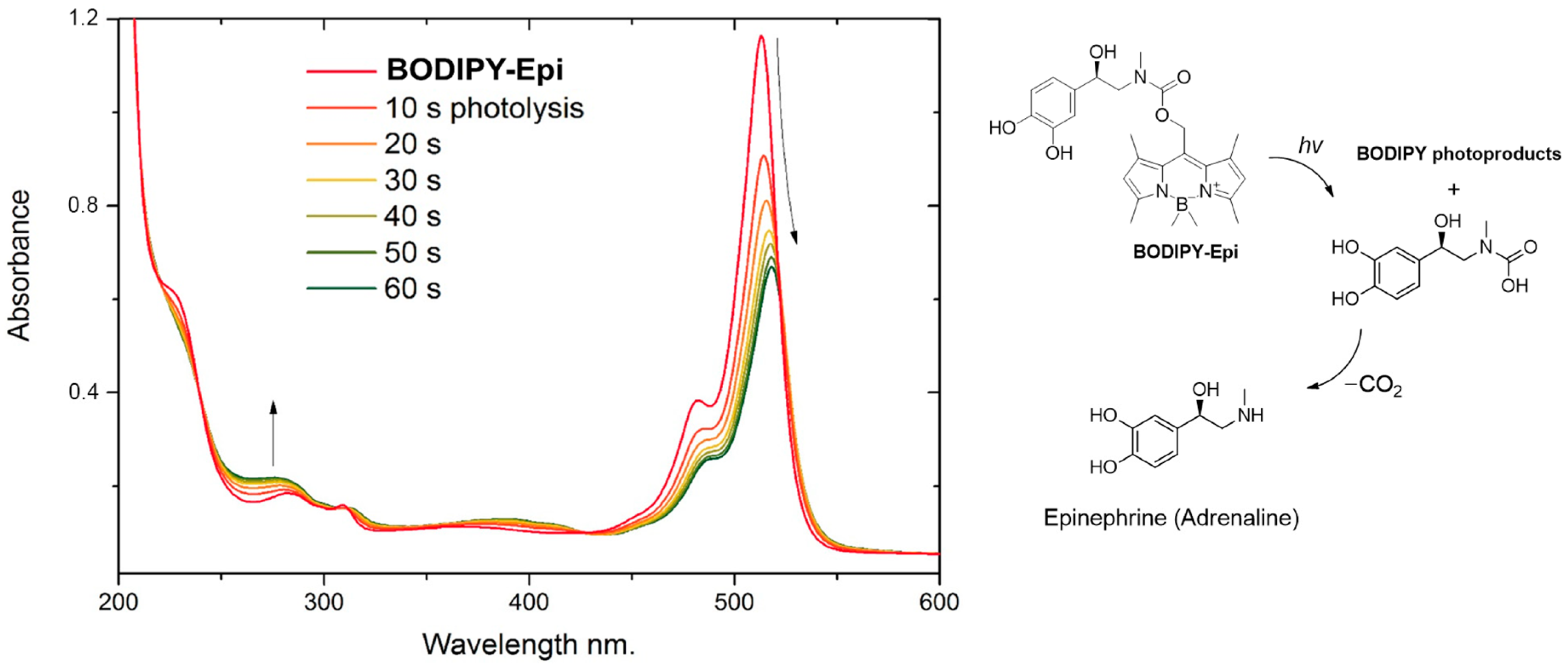
Substitution of fluorine atoms by methyl groups in the BODIPY core is known to improve the photophysical and photochemical properties of the photocage. In the present system, this modification markedly increased both the photolysis rate and the yield of released epinephrine. As shown in Figure 1, efficient photorelease occurs within seconds upon illumination with conventional green LEDs. Formation of epinephrine was additionally confirmed using NMR spectroscopy.

3. Materials and Methods

Instrumentation. 1H NMR spectra for intermediate compounds were recorded at 300 MHz in CDCl3 on a Bruker AVANCE 300 spectrometer (Bruker Corporation, Billerica, MA, USA). For the final compound, 1H NMR (400 MHz) and 13C NMR (126 MHz) spectra were recorded in CDCl3 on a Bruker AVANCE III 400 spectrometer (Bruker Corporation, Billerica, MA, USA). High-resolution mass spectra (HRMS) were obtained using an electrospray ionization (ESI) source on a Bruker maXis II 4G ETD instrument (Bruker Corporation, Billerica, MA, USA).
Synthesis. All chemicals were purchased from commercial source (Sigma-Aldrich Pty Ltd, an affiliate of Merck KGaA, Darmstadt, Germany) and used without additional purification unless otherwise noted. Compound S1 was synthesized as described previously [10].
  • (1,3,5,5,7,9-hexamethyl-5H-4λ4,5λ4-dipyrrolo[1,2-c:2′,1′-f][1,3,2]diazaborinin-10-yl)methanol (S2)
Freshly prepared MeMgI·Et2O solution (0.4 M, 20 mL, 8 mmol, 25.6 equiv) was added dropwise to a cooled solution of S1 (0.1 g, 0.3 mmol, 1 equiv) in DCM (20 mL). The reaction mixture was allowed to warm to room temperature and stirred until complete consumption of the starting material (TLC, eluent: DCM). The reaction was quenched with saturated NH4Cl, and the aqueous phase was extracted with DCM (3 × 20 mL). The combined organic layers were dried over Na2SO4, and the solvent was removed in vacuo. The residue was purified by silica gel column chromatography (eluent: DCM) to afford an orange solid. Yield: 43.5 mg (52%). 1H and 19F NMR data were in good agreement with the literature [11].
1H NMR (300 MHz, Chloroform-d) δ 0.18 (s, 6H), 2.46 (s, 6H), 2.53 (s, 6H), 4.96 (d, J = 5.6 Hz, 2H), 6.08 (s, 2H) (Supplementary Figure S1).
  • (1,3,5,5,7,9-hexamethyl-5H-4λ4,5λ4-dipyrrolo[1,2-c:2′,1′-f][1,3,2]diazaborinin-10-yl)methyl(4-nitrophenyl) carbonate (S3)
To a cooled solution of S2 (40 mg, 0.15 mmol, 1 equiv) and DIPEA (0.08 mL, 0.6 mmol, 4 equiv) in DCM (10 mL), a suspension of 4-nitrophenyl chloroformate (91 mg, 0.45 mmol, 3 equiv) and pyridine (0.036 mL, 0.45 mmol, 3 equiv) in DCM (5 mL) was added. The reaction mixture was stirred for 30 min at low temperature and then for 4 h at room temperature in the dark. Silica gel was added directly to the reaction mixture, and the solvent was removed in vacuo. The product S3 was obtained by silica gel column chromatography (eluent: DCM) as a red solid. Yield: 52 mg (80%). 1H NMR data were in good agreement with the literature [14].
1H NMR (300 MHz, Chloroform-d) δ 0.20 (s, 6H), 2.46 (s, 6H), 2.48 (s, 6H), 5.61 (s, 2H), 6.12 (d, J = 1.1 Hz, 2H), 7.41 (d, J = 9.2 Hz, 2H), 8.29 (d, J = 9.3 Hz, 2H) (Supplementary Figure S2).
  • (1,3,5,5,7,9-hexamethyl-5H-4λ4,5λ4-dipyrrolo[1,2-c:2′,1′-f][1,3,2]diazaborinin-10-yl)methyl-(R)-(2-(3,4-dihydroxyphenyl)-2-hydroxyethyl)(methyl)carbamate (BODIPY-Epi)
A suspension of (−)-epinephrine (11.3 mg, 0.0617 mmol, 1.5 equiv) in DMA (2 mL) was added to a stirred mixture of HOBt (~15% water content, 6.5 mg, 0.041 mmol, 1 equiv), 4 Å molecular sieves (50 mg), and S3 (18 mg, 0.041 mmol, 1 equiv) in DMA (3 mL). The reaction mixture was stirred for 2 h at room temperature in the dark until complete consumption of the starting material (TLC). After completion, the molecular sieves were filtered off and washed with EtOAc (10 mL). The combined organic solutions were transferred to a separatory funnel. The organic layer was washed successively with 5% NaHCO3 solution, water, and brine. The organic phase was dried over Na2SO4, and the solvent was removed in vacuo. The residue was purified by silica gel column chromatography (eluent: CHCl3/CH3CN = 9:1) to afford the target compound as an orange solid. Yield: 6.2 mg (31%).
1H and 13C NMR spectra show two sets of signals, which can be attributed to E/Z isomerism of the carbamate group.
1H NMR (400 MHz, Chloroform-d) δ 0.19 (s, 6H, B-(CH3)2), 2.36 (s, 6H, BODIPY(1,7-positions)-2× CH3), 2.46 (s, 6H, BODIPY(3,5-positions)-2× CH3), 2.96 (s, 3H, N-CH3), 3.37–3.52 (m, 1H, CH2), 3.52–3.69 (m, 1H, CH2), 4.80–4.90 (m, 1H, CH-OH), 5.32 (s, 2H, BODIPY-CH2-O), 6.07 (s, 2H, 2× CH–BODIPY), 6.60–6.97 (m, 3H, CH epinephrine) (Supplementary Figure S3).
13C NMR (126 MHz, Chloroform-d) δ 15.6, 16.5, 29.6, 36.0, 57.1, 59.8, 72.7, 112.9, 115.1, 118.1, 122.5, 131.3, 133.3, 133.9, 137.2, 144.0, 153.0, 157.5 (Supplementary Figure S4).
HRMS (ESI, Acetonitrile): 480.2668 (M + 1) (C26H34BN3O5) (Supplementary Figure S5).

Supplementary Materials

The following supporting information is available online. Figure S1: 1H NMR spectrum of S2; Figure S2: 1H NMR spectrum of S3; Figure S3: 1H NMR spectrum of BODIPY-Epi; Figure S4: 13C NMR spectrum of BODIPY-Epi; Figure S5: HRMS spectrum of BODIPY-Epi.

Author Contributions

Conceptualization, A.Y.V.; investigation, M.A.P.; resources, A.Y.V.; writing—original draft preparation, A.E.M. and M.A.P.; writing—review and editing, A.Y.V. All authors have read and agreed to the published version of the manuscript.

Funding

The study was supported by the Russian Science Foundation (grant #23-75-10049).

Data Availability Statement

The original contributions presented in this study are included in the article/Supplementary Materials. Further inquiries can be directed to the corresponding author.

Conflicts of Interest

The authors declare no conflicts of interest.

References

  1. Ellis-Davies, G.C.R. Caged compounds: Photorelease technology for control of cellular chemistry and physiology. Nat. Methods 2007, 4, 619–628. [Google Scholar] [CrossRef] [PubMed]
  2. Boens, N.; Leen, V.; Dehaen, W. Fluorescent indicators based on BODIPY. Chem. Soc. Rev. 2012, 41, 1130–1172. [Google Scholar] [CrossRef] [PubMed]
  3. Goswami, P.P.; Syed, A.; Beck, C.L.; Albright, T.R.; Mahoney, K.M.; Unash, R.; Smith, E.A.; Winter, A.H. BODIPY-Derived Photoremovable Protecting Groups Unmasked with Green Light. J. Am. Chem. Soc. 2015, 137, 3783–3786. [Google Scholar] [CrossRef] [PubMed]
  4. Rubinstein, N.; Liu, P.; Miller, E.W.; Weinstain, R. meso-Methylhydroxy BODIPY: A scaffold for photo-labile protecting groups. Chem. Commun. 2015, 51, 6369–6372. [Google Scholar] [CrossRef] [PubMed]
  5. Muralidharan, S.; Nerbonne, J.M. Photolabile “caged” adrenergic receptor agonists and related model compounds. J. Photochem. Photobiol. B Biol. 1995, 27, 123–137. [Google Scholar] [CrossRef] [PubMed]
  6. Bosma, R.; Dijon, N.C.; Zheng, Y.; Schihada, H.; Hauwert, N.J.; Shi, S.; Arimont, M.; Riemens, R.; Custers, H.; van de Stolpe, A.; et al. Optical control of the β2-adrenergic receptor with opto-prop-2: A cis-active azobenzene analog of propranolol. iScience 2022, 25, 104882. [Google Scholar] [CrossRef] [PubMed]
  7. Sink, A.; Gerwe, H.; Hübner, H.; Boivin-Jahns, V.; Fender, J.; Lorenz, K.; Gmeiner, P.; Decker, M. “Photo-Adrenalines”: Photoswitchable β2-Adrenergic Receptor Agonists as Molecular Probes for the Study of Spatiotemporal Adrenergic Signaling. Chem.–Eur. J. 2024, 30, e202303506. [Google Scholar] [CrossRef] [PubMed]
  8. Fernandes, M.J.G.; Costa, S.P.G.; Gonçalves, M.S.T. Synthesis and light triggered release of catecholamines from pyrenylmethyl carbamate cages. New J. Chem. 2013, 37, 2369–2376. [Google Scholar] [CrossRef]
  9. Panfilov, M.A.; Starodubtseva, E.S.; Karogodina, T.Y.; Vorob’ev, A.Y.; Moskalensky, A.E. Reducing the Formation of Toxic Byproducts During the Photochemical Release of Epinephrine. J. Xenobiot. 2025, 15, 8. [Google Scholar] [CrossRef] [PubMed]
  10. Polyakov, N.; Panfilov, M.; Komarovskikh, A.; Osik, N.; Moskalensky, A.; Vorob’ev, A.; Selyutina, O. Photoinduced Formation of BODIPY Radical Cation in Meso-Methyl-BODIPY Photocage: Direct Evidence with Chemically Induced Dynamic Nuclear Polarization Technique. ChemPlusChem 2026, 91, e202500506. [Google Scholar] [CrossRef] [PubMed]
  11. Slanina, T.; Shrestha, P.; Palao, E.; Kand, D.; Peterson, J.A.; Dutton, A.S.; Rubinstein, N.; Weinstain, R.; Winter, A.H.; Klán, P. In Search of the Perfect Photocage: Structure–Reactivity Relationships in meso-Methyl BODIPY Photoremovable Protecting Groups. J. Am. Chem. Soc. 2017, 139, 15168–15175. [Google Scholar] [CrossRef] [PubMed]
  12. Sitkowska, K.; Feringa, B.L.; Szymański, W. Green-Light-Sensitive BODIPY Photoprotecting Groups for Amines. J. Org. Chem. 2018, 83, 1819–1827. [Google Scholar] [CrossRef] [PubMed]
  13. Sitkowska, K.; Hoes, M.F.; Lerch, M.M.; Lameijer, L.N.; van der Meer, P.; Szymański, W.; Feringa, B.L. Red-light-sensitive BODIPY photoprotecting groups for amines and their biological application in controlling heart rhythm. Chem. Commun. 2020, 56, 5480–5483. [Google Scholar] [CrossRef] [PubMed]
  14. Hua, Y.; Strauss, M.; Fisher, S.; Mauser, M.F.X.; Manchet, P.; Smacchia, M.; Geyer, P.; Shayeghi, A.; Pfeffer, M.; Eggenweiler, T.H.; et al. Giving the Green Light to Photochemical Uncaging of Large Biomolecules in High Vacuum. JACS Au 2023, 3, 2790–2799. [Google Scholar] [CrossRef] [PubMed]
Scheme 1. Synthesis of BODIPY-Epi.
Molbank 2026 m2173 sch001
Figure 1. Photolysis of BODIPY-Epi under green light (500 nm LED). Solvent used: 80%MeCN + 20% MeOH. Initial concentration of BODIPY-Epi: 12.5 µM. Hypothetical photolysis scheme is shown on the right.
Molbank 2026 m2173 g001
Disclaimer/Publisher’s Note: The statements, opinions and data contained in all publications are solely those of the individual author(s) and contributor(s) and not of MDPI and/or the editor(s). MDPI and/or the editor(s) disclaim responsibility for any injury to people or property resulting from any ideas, methods, instructions or products referred to in the content.