Communication

Synthesis of 2-(2-Methoxyphenyl)-4-methyl-6-nitroquinoline and 2-(2-Methoxyphenyl)-4-methylquinolin-6-amine


Faculty of Chemistry and Pharmacy, Sofia University St. Kliment Ohridski, 1 James Bourchier Boulevard, 1164 Sofia, Bulgaria
*
Author to whom correspondence should be addressed.
Molbank 2026, 2026(3), M2168; https://doi.org/10.3390/M2168
Submission received: 20 March 2026 / Revised: 24 April 2026 / Accepted: 28 April 2026 / Published: 30 April 2026
(This article belongs to the Section Organic Synthesis and Biosynthesis)

Abstract

A new compound, 2-(2-methoxyphenyl)-4-methyl-6-nitroquinoline, was obtained via Suzuki reaction. An unexpected side product, 2-(2-methoxyphenyl)-4-methylquinolin-6-amine, was isolated. The structures of the novel compounds were confirmed by 1H, 13C and 2D-NMR. Their optical properties were also studied.

Graphical Abstract

1. Introduction

In recent decades heterocyclic compounds bearing 2-phenylquinoline moiety attract attention due to their various applications. This system is used in coordination chemistry as a ligand in copper [1], platinum [2] and especially iridium complexes, which are usually fluorescent and demonstrate neuroimaging potential [3], enzyme inhibition activity [4], intracellular nitric oxide sensing ability [5], long-lifetime, deep-red emission with high color purity [6], luminescent biosensor potential [7], and anticancer activity [8]. The 2-phenylquinoline moiety is found also in fluorescent N,O-bidentate difluoroboron complexes [9] and in covalent organic frameworks (COFs) [10]. The bioactivity of the molecules bearing 2-phenylquinoline backbone is also of great importance: they possess antifungal [11] and anti-inflammatory properties [12], anticoronavirus [13] and anticancer activity [14,15], as well as gastroprotective properties [16].
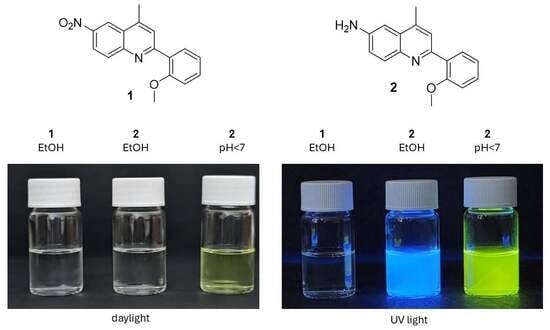
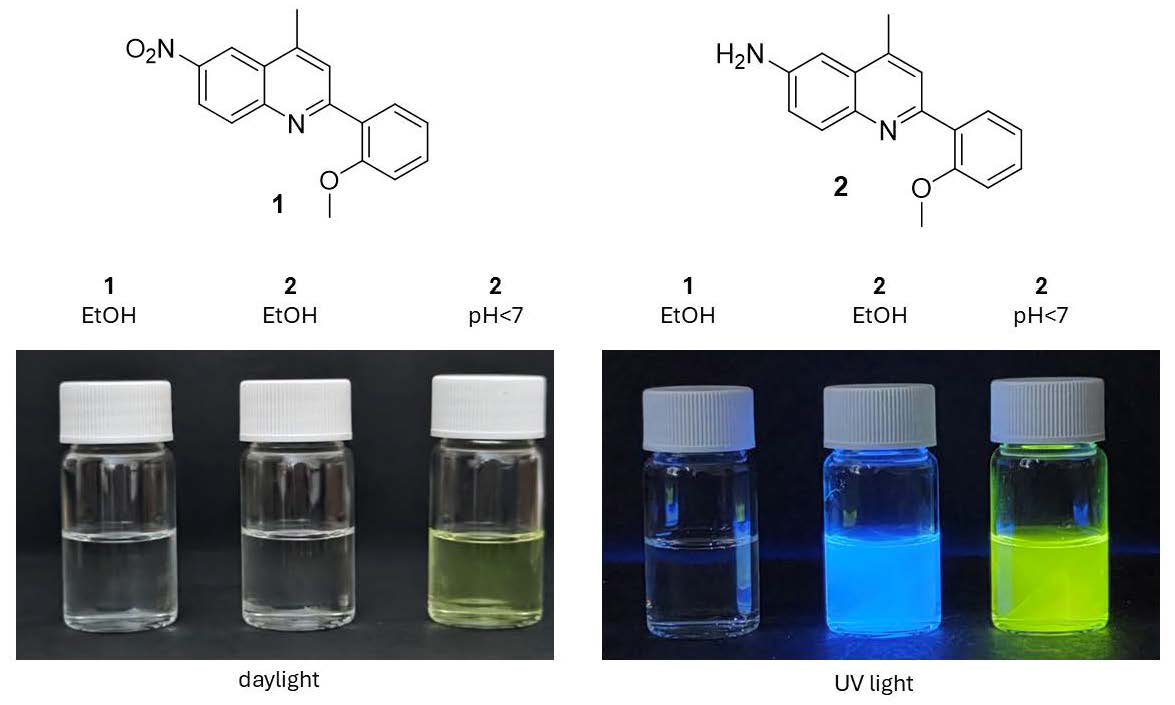
Herein, we present the synthetic protocol for obtaining 2-(2-methoxyphenyl)-4-methyl-6-nitroquinoline 1, a new compound and the first reported 2-phenylquinoline derivative, substituted with a NO2-group in the sixth position of the quinoline system and with a CH3O-group in the second position of the phenyl substituent. It should be noted that the methyl substituent in the fourth position could be synthetically useful—4-methylquinolines can serve as a starting material for monomethine cyanine dyes after N-alkylation of the quinoline nitrogen atom [17,18]. During the synthesis of the title compound, the formation of an interesting side product was observed, which was recognized as 2-(2-methoxyphenyl)-4-methylquinolin-6-amine 2. It demonstrates fluorescence, which is sensitive to the acidity of the solution. The optical properties of both compounds were studied.

2. Results and Discussion

2.1. Synthesis of 2-(2-Methoxyphenyl)-4-methyl-6-nitroquinoline 1

The synthesis of the title compound, 2-(2-methoxyphenyl)-4-methyl-6-nitroquinoline 1, included several steps and started with the preparation of 2-chloro-4-methyl-6-nitroquinoline 5 (Scheme 1). Firstly, 4-methylquinolin-2-one 3 [19] was nitrated and later the resulting 4-methyl-6-nitroquinolin-2-one 4 was treated with POCl3 [19] in order to obtain 2-chloro-4-methyl-6-nitroquinoline 5.
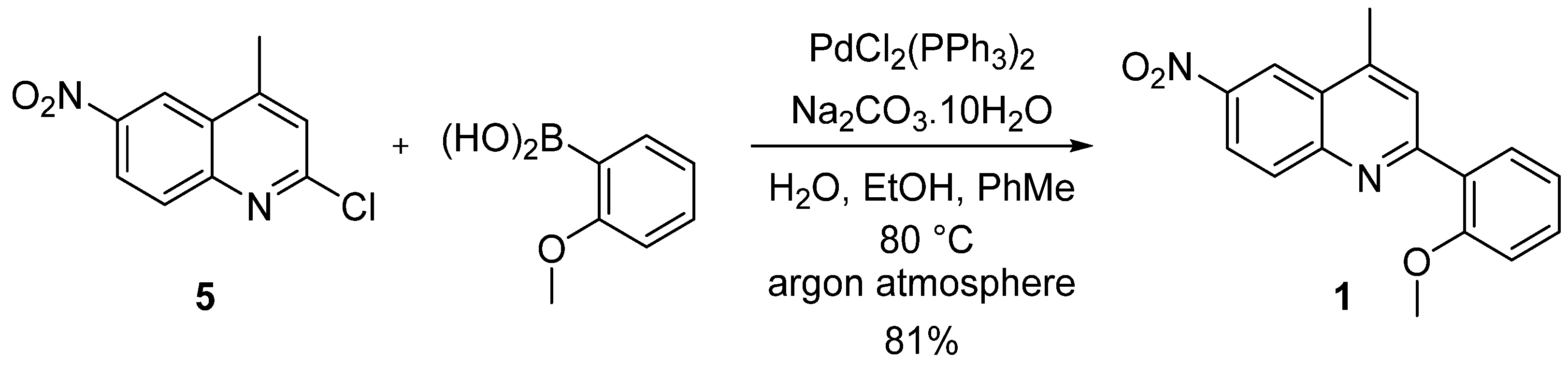
The purified 2-chloro-4-methyl-6-nitroquinoline 5 was reacted with (2-methoxyphenyl) boronic acid in the presence of excess amount of sodium carbonate and 3 mol % of PdCl2(PPh3)2 following standard Suzuki reaction protocol (Scheme 2).
The target compound 1 was obtained, purified and isolated in high yield in the form of pale-yellow needles.
During TLC monitoring of the reaction progress, the formation of a small quantity (18.5 mg or 7%) of a side product was observed. This compound demonstrates intense yellow fluorescence. Surprisingly, during the reaction work-up, not yellow, but blue fluorescence was observed in solution.
It was assumed that the observed fluorescence could be a result of the presence of small amounts of 2-(2-methoxyphenyl)-4-methylquinolin-6-amine 2, a consequence of the NO2-group reduction in compound 1.
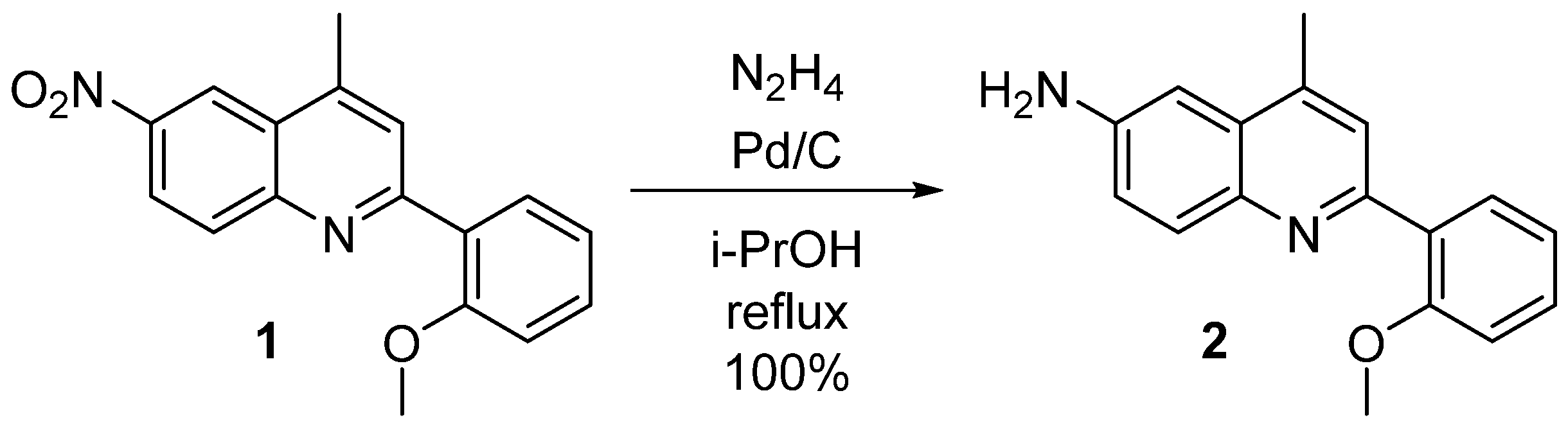
To confirm this assumption, 2-(2-methoxyphenyl)-4-methyl-6-nitroquinoline 1 was reacted with hydrazine in the presence of palladium on carbon (Scheme 3). Both products—from the reduction and the side product of the Suzuki coupling reaction—were compared by their chromatographic properties and NMR-spectra. That unequivocally proved the above-mentioned assumption.
We can suppose three plausible mechanisms describing the formation of the amino compound 2. First, the palladium catalyst can react with ethanol in the presence of a base, leading to the formation of acetaldehyde and a palladium hydride complex. This complex can react with a second ethanol molecule, releasing more acetaldehyde and even hydrogen. Similar dehydrogenation of alcohols to aldehydes in the presence of palladium complex and phosphorus ligand at 100 °C is previously reported [20]. The Pd-H-complex is a strong reductor and can transform the NO2- into NH2-group. On the other hand, the released hydrogen can be adsorbed by the fine palladium particles, which are a result of PdCl2(PPh3)2 decomposition, and thus the activated hydrogen can reduce the nitro compound 1 to the side product 2.
According to our second theory, ethanol is dehydrogenated by the palladium particles, produced by decomposition of PdCl2(PPh3)2. The produced hydrogen and the palladium particles act as a catalytic system for NO2-group reduction. The dehydrogenation of alcohols on a palladium surface [21] or on palladium nanoparticles in the presence of a base [22] is possible at elevated temperatures.
The third possible explanation of the observation of a side product is the direct reduction [23] of the NO2-group by PPh3 in the presence of boronic acid and transition metal complex. Probably, this P(III) compound dissociates from the palladium atom in the catalyst and is oxidized by the NO2-group to triphenylphosphine oxide.

2.2. NMR Studies

The purity and the structure of compounds 1, 2 and 5 were confirmed by NMR-spectroscopy. Every signal, observed in their 1H- and 13C-spectra, was assigned to a specific atom, using DEPT-135, COSY, HSQC and HMBC techniques. See Supplementary Materials for copies of the NMR spectra.
In the 1H-NMR spectrum of 1, two intense singlets were observed, which correspond to the methyl and methoxy group in the quinoline and in the phenyl fragment, respectively. The CH3O-signal was downshifted in comparison with the CH3-signal because of the electronegativity of the oxygen atom. If compared, the spectra of 2-chloro-4-methyl-6-nitroquinoline 5 and 2-(2-methoxyphenyl)-4-methyl-6-nitroquinoline 1 show that only the signal of the proton in position 3 in the quinoline system is influenced by the introduction of the 2-CH3OPh substituent—it was downshifted from 7.34 ppm to 7.83 ppm. The 13C-NMR spectrum of 1 shows the same phenomenon that occurs for the carbon atom in position 2.
In the 1H-NMR spectrum of 2-(2-methoxyphenyl)-4-methylquinolin-6-amine 2, a broad singlet was observed due to the presence of an NH2-group in position 6. In a result of the lack of the electron-withdrawing NO2-group, the signals of the protons in the third, and especially in the fifth and in the seventh positions of the quinoline system were shifted to upper field.
The reduction of the NO2-group affected most strongly the detected signal of the carbon atom in position 5: its signal was shifted from 120.8 ppm in the spectrum of nitro compound 1 to 104.06 ppm in the spectrum of amine 2. In the same way, but not that significantly, the chemical shifts for carbon atoms in positions 2, 4 and 8a were affected.

2.3. Optical Studies

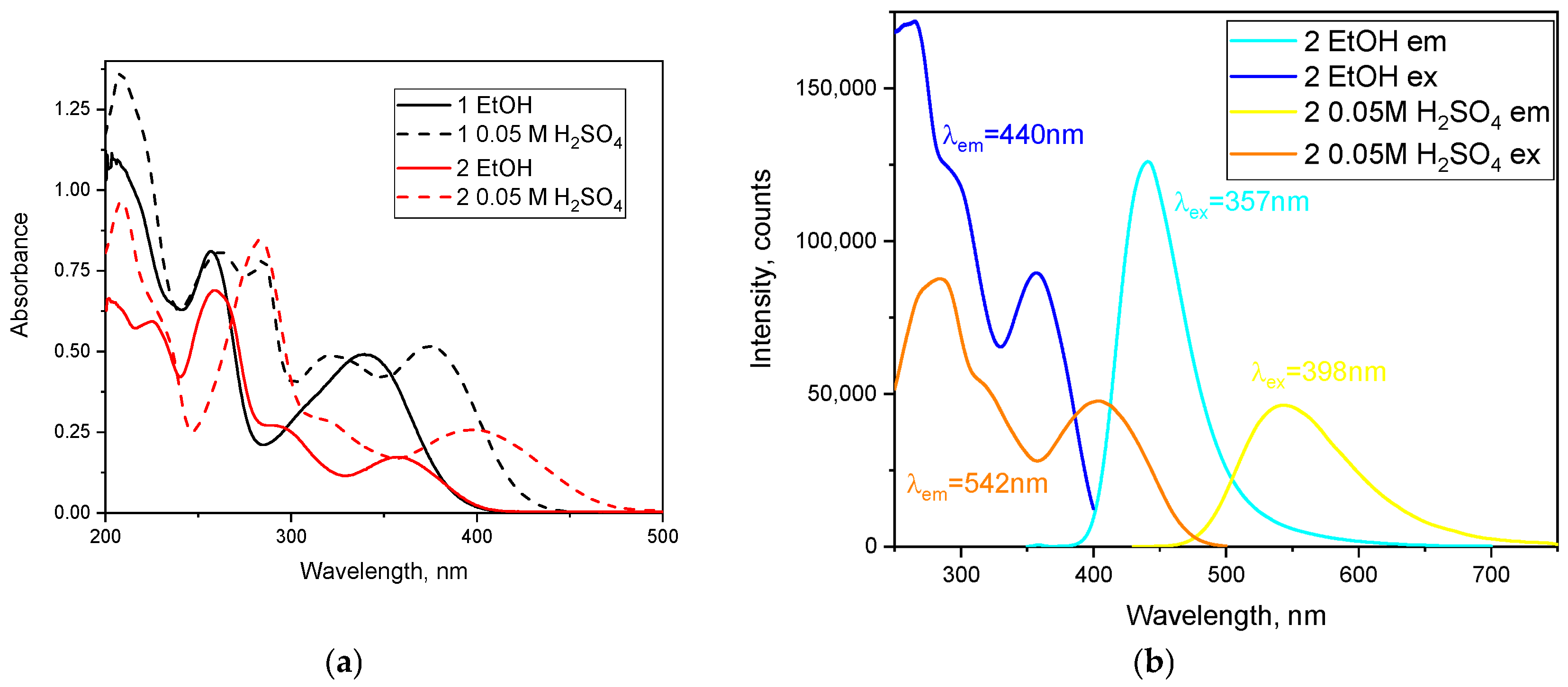
The UV-VIS spectra of the two synthesized compounds, recorded in EtOH and 0.05 M H2SO4 media, are shown in Figure 1. In the UV spectrum of compound 1 in EtOH, absorption maxima are observed at 205, 257 and 338 nm, which could be attributed to the characteristic π-π* electronic transitions of benzene and quinoline chromophores. In acidic media (0.05 M H2SO4), a bathochromic shift is observed due to the protonation of the quinoline nitrogen atom, as four maxima at 262, 284, 321 and 374 nm are visible. Such a shift is expected and is observed in other quinoline derivatives [24,25]. Upon protonation, a positive charge occurs, which modifies the electronic structure, resulting in lowering the energy gap between the molecular orbitals involved in the transition. In addition, the protonation increases the polarity of the molecule, leading to stabilization of the excited state to a greater extent compared to the ground state.
The reduction of the nitro group to an amino group results in a bathochromic shift in the UV-VIS spectrum compared to compound 1, with absorption maxima at 213, 259, 357 nm and a shoulder at 322 nm (Figure 1). Upon protonation, similarly to compound 1, a further shift to longer wavelengths is observed, giving rise to absorption bands at 210, 283 and 398 nm.
The molar absorptivities in EtOH of 1 are—24,265 M−1.cm−1 at 257 nm and 14,690 M−1.cm−1 at 338 nm, respectively (Table 1 and Figure S22). For compound 2, the absorptivities in the same solvent are 20,241 M−1.cm−1 at 259 nm and 5168 M−1.cm−1 at the longest wavelength maximum, 357 nm.
The fluorescence spectrum of compound 2 in EtOH shows an emission maximum at 440 nm, corresponding to blue fluorescence (Figure 1). In 0.05 M H2SO4, a significant bathochromic shift of approximately 100 nm to 542 nm is observed and the compound exhibits yellow fluorescence. Also, the emission intensity and efficiency are reduced in acidic conditions. The excitation spectra suggest a few possible channels corresponding well to the absorption maxima of the samples. The quantum yields for compound 2 are 72.9% and 34.3% for EtOH and 0.05 M H2SO4 solutions, respectively. The concentration of compound 2 for the luminescence measurements is 5 · 10−5 M.

3. Materials and Methods

UV-Vis spectra were carried out on a Shimadzu UV-1800 spectrophotometer (Kyoto, Japan). The luminescence spectra, excitation spectra and quantum yields were measured on Perkin Elmer FL8500 (Shelton, CT, USA). For the emission and excitation spectra, a single cell holder was used, and for the QY measurements—an integrating sphere coated with Spectralon® (North Sutton, NH, USA) [26]. Excitation and emissions slits were set to 5 nm, and the scan speed was 240 nm/min for all measurements. The emission spectra and QY were measured with excitation wavelength equal to the longest wavelength absorption maxima of each sample—357 nm and 398 nm for ethanolic solution and H2SO4 solution, respectively. De Mello’s method was used to measure and calculate the quantum yields [27].
The IR spectra were recorded with a Shimadzu FTIR-8400S spectrophotometer (Kyoto, Japan). 1H and 13C NMR spectra were recorded on a Bruker Avance III 500 spectrometer (Rheinstetten, Germany) (at 500 MHz for 1H and 126 MHz for 13C, respectively). Chemical shifts are given in ppm. In the 13C-NMR spectra, “4C” denotes carbon atoms that are quaternary and not bonded to a hydrogen atom. The NMR spectra of compounds 1, 2 and 5 can be found in the Supplementary Materials. Reactions were monitored by TLC on silica gel 60 F254. Melting points were determined on an SRS MPA120 EZ-Melt apparatus (Sunnyvale, CA, USA) and are used without correction.
2-Methoxyphenylboronic acid was purchased from Fluorochem (Cork, Ireland). All solvents (ethanol, toluene, dichloromethane, hexanes, isopropanol, ethyl acetate and chloroform) and inorganics (PdCl2(PPh3)2, Na2CO3.10H2O, Na2SO4, N2H4 and palladium on carbon) were purchased from local suppliers and were used without further purification.

3.1. Synthesis of 2-(2-Methoxyphenyl)-4-methyl-6-nitroquinoline 1

In a Schenk tube, equipped with a stirring bar, 2-chloro-4-methyl-6-nitroquinoline (0.223 g, 1 mmol), (2-methoxyphenyl)boronic acid (0.182 g, 1.2 mmol), Na2CO3.10H2O (1.145 g, 4 mmol), PdCl2(PPh3)2 (0.023 g, 0.03 mmol), water (2 mL), ethanol (1 mL) and toluene (2 mL) were placed. The vessel was purged with argon and heated at 80 °C while stirring for 36 h. After cooling to room temperature, the mixture was extracted with dichloromethane. The combined organic layers were dried with Na2SO4 and the solvent was evaporated under reduced pressure. The crude product was purified by flash column chromatography on silica (dichloromethane:hexanes = 2:1). Yield: 0.238 g (81%) of yellow needles, mp 194.5–195.5 °C, Rf (silica) = 0.21 (hexanes-dichloromethane, 1:2)
1H NMR (500 MHz, CDCl3) δ 8.88 (d, J = 2.5 Hz, 1H, H5), 8.36 (dd, J = 9.2, 2.5 Hz, 1H, H7), 8.16 (d, J = 9.2 Hz, 1H, H8), 7.83 (s, 1H, H3), 7.79 (dd, J = 7.6, 1.7 Hz, 1H, H6′), 7.38 (td, J = 8.5, 1.7 Hz, 1H, H4′), 7.06 (td, J = 7.4, 0.5 Hz, 1H, H5′), 6.98 (d, J = 8.3 Hz, 1H, H3′), 3.82 (s, 3H, CH3O), 2.74 (d, J = 0.5 Hz, 3H, CH3). 13C NMR (126 MHz, CDCl3) δ 160.44 (C2), 157.36 (C2′), 150.54 (4C8a), 145.26 (C4), 144.96 (C6-NO2), 131.78 (C8), 131.54 (C6′), 131.21 (C4′), 128.71 (C1′), 126.17 (4C4a), 125.70 (C3), 122.44 (C7), 121.37 (C5′), 120.80 (C5), 111.52 (C3′), 55.70 (CH3O), 18.97 (CH3).
Molbank 2026 m2168 i001
Anal. calcd. %, C, 69.38; H, 4.79; N, 9.52; O, 16.31, found % 69.43; H, 4.71; N, 9.99; O, 16.21.

3.2. Synthesis of 2-(2-Methoxyphenyl)-4-methylquinolin-6-amine 2

2-(2-Methoxyphenyl)-4-methyl-6-nitroquinoline (0.380 g, 1.3 mmol), 0.038 g Pd/C (10% Pd), 25 mL isopropanol and 1 mL 80% aqueous N2H4 were placed in a round-bottom flask, equipped with a stirring bar and a reflux condenser. The dark reaction mixture was stirred under reflux for 2 h, and after cooling to room temperature, the mixture was filtered through celite. The volatiles were removed under reduced pressure, and the crude product was purified by column chromatography on silica (chloroform:ethylacetate). A quantitative yield of brown-red oil was obtained, Rf (silica) = 0.20 (chloroform-ethyl acetate, 3:1). The side product 2 was obtained as a dark oil in 7% yield (18.5 mg).
1H NMR (500 MHz, CDCl3) δ 8.01 (d, J = 8.9 Hz, 1H, H8), 7.83 (dd, J = 7.5, 1.7 Hz, 1H, H6′), 7.60 (s, 1H, H3), 7.39 (td, J = 8.3, 1.7 Hz, 1H, H4′), 7.12 (td, J = 7.4, 0.5 Hz, 1H, H5′), 7.04 (dd, J = 8.9, 2.5 Hz, 1H, H7), 7.00 (d, J = 8.2 Hz, 1H, H3′), 6.95 (d, J = 2.4 Hz, 1H, H5), 4.02 (broad s, 2H, NH2), 3.81 (s, 3H, CH3O), 2.53 (s, 3H, CH3). 13C NMR (126 MHz, CDCl3) δ 157.14 (C2′), 153.03 (C2), 144.77 (C6-NH2), 142.92 (C8a), 140.82 (C4), 131.32 (C6′), 131.06 (C8), 130.23 (C1′), 129.78 (C4′), 128.55 (C4a), 124.09 (C3), 121.15 (C5′), 121.01 (C7), 111.49 (C3′), 104.06 (C5), 55.68 (CH3O), 18.97 (CH3).
Molbank 2026 m2168 i002
Anal. calcd. %, C, 77.25; H, 6.10; N, 10.60; O, 6.05, found % 77.17; H, 6.16; N, 10.58; O, 6.15.

3.3. Synthesis of 2-Chloro-4-methyl-6-nitroquinoline 5

Compound 5 was prepared according to a previously reported procedure [19].
1H NMR (500 MHz, CDCl3) δ 8.86 (d, J = 2.5 Hz, 1H, H5), 8.43 (dd, J = 9.2, 2.5 Hz, 1H, H7), 8.07 (d, J = 9.2 Hz, 1H, H8), 7.34 (d, J = 0.6 Hz, 1H, H3), 2.73 (d, J = 0.9 Hz, 3H, CH3). 13C NMR (126 MHz, CDCl3) δ 154.44 (C2-Cl), 149.97 (4C8a), 149.66 (C4-CH3), 145.51 (C6-NO2), 130.91 (C8), 126.22 (4C4a), 124.48 (C3), 123.87 (C7), 120.84 (C5), 18.70 (CH3).
Molbank 2026 m2168 i003

4. Conclusions

A new 2-phenylquinoline, substituted with nitro, methyl and methoxy groups, was obtained. The respective amino compound was isolated as a side product and also obtained by using directed synthesis. The structures and the purity of these two new compounds were confirmed by 1D- and 2D-NMR-spectroscopy and elemental analysis. The new 2-(2-methoxyphenyl)-4-methylquinolin-6-amine demonstrates blue fluorescence in neutral media and yellow fluorescence in acidic solution.

Supplementary Materials

Figures S1–S21: 1H, 13C, DEPT-135, HSQC, HMBC-NMR spectra of compounds 1 and 2, and 1H, 13C and DEPT-135 spectra of compound 5. Figure S22: Calibration curves of compounds 1 and 2. Figure S23: IR spectra of compounds 1 and 2.

Author Contributions

Conceptualization, R.L.; methodology, R.L., I.Z.K., D.S. and M.I.; validation, I.Z.K., M.I., D.S. and R.L.; investigation, I.Z.K., M.I., D.S. and R.L.; data curation, R.L. and I.Z.K.; writing—original draft preparation, R.L. and I.Z.K.; writing—review and editing, I.Z.K., D.S. and M.I.; visualization, R.L., D.S. and I.Z.K.; supervision, R.L.; project administration, R.L.; funding acquisition, R.L. All authors have read and agreed to the published version of the manuscript.

Funding

This research was funded by Sofia University research fund, grand 80-10-6 from 27 March 2026.

Data Availability Statement

Additional research data can be obtained from the corresponding author.

Acknowledgments

Research equipment of Project BG16RFPR002-1.014-0006 “National Centre of Excellence Mechatronics and Clean Technologies”, co-funded by the European Union, under “Research Innovation and Digitization for Smart Transformation” program 2021–2027 was used for experimental work. The authors would like to thank Sofia University grand 80-10-61 from 6 April 2026 for the technical support.

Conflicts of Interest

The authors declare no conflicts of interest.

References

  1. A He, H.; Zhang, J.; Wu, X.; Zhao, F.; Huang, Y.; Wang, M.; Feng, C.; Mao, D.; Huang, X.; Hu, Y. Hypso- or Bathochromic Phosphorescent Mechanochromic Mononuclear Cu(I) Complexes with a Bis(2-Diphenylphosphinophenyl)Ether Auxiliary Ligand. Dalton Trans. 2023, 52, 13358–13366. [Google Scholar] [CrossRef] [PubMed]
  2. Yu, J.; He, K.; Li, Y.; Tan, H.; Zhu, M.; Wang, Y.; Liu, Y.; Zhu, W.; Wu, H. A Novel Near-Infrared-Emitting Cyclometalated Platinum (II) Complex with Donor–Acceptor–Acceptor Chromophores. Dye. Pigment. 2014, 107, 146–152. [Google Scholar] [CrossRef]
  3. De Soricellis, G.; Fagnani, F.; Colombo, A.; Dragonetti, C.; Roberto, D.; Marinotto, D.; Hartnell, D.H.; Hackett, M.J.; Massi, M.; Carboni, B.; et al. An Attractive Family of Cyclometalated Ir(III) Dyes Functionalized with Tryptophan for Potential Neuroimaging Applications. Dye. Pigment. 2023, 210, 111012. [Google Scholar] [CrossRef]
  4. Wu, C.; Wu, K.-J.; Liu, J.-B.; Zhou, X.-M.; Leung, C.-H.; Ma, D.-L. A Dual-Functional Molecular Strategy for in Situ Suppressing and Visualizing of Neuraminidase in Aqueous Solution Using Iridium(III) Complexes. Chem. Commun. 2019, 55, 6353–6356. [Google Scholar] [CrossRef]
  5. Law, W.H.; Leung, K.; Lee, L.C.; Poon, C.; Liu, H.; Lo, K.K. Cyclometalated Iridium(III) Bipyridyl–Phenylenediamine Complexes with Multicolor Phosphorescence: Synthesis, Electrochemistry, Photophysics, and Intracellular Nitric Oxide Sensing. ChemMedChem 2014, 9, 1316–1329. [Google Scholar] [CrossRef]
  6. Silva, R.C.; Canisares, F.S.M.; Saraiva, L.F.; Pires, A.M.; Lima, S.A.M. Featuring Long-Lifetime Deep-Red Emitting IridiumIII Complexes with High Colour Purity: Insights into the Excited State Dynamics from Spectroscopic and Theoretical Perspectives. Dalton Trans. 2024, 53, 5466–5477. [Google Scholar] [CrossRef]
  7. Zang, M.; Su, H.; Lu, L.; Li, F. A Split G-Quadruplex-Specific Dinuclear Ir(III) Complex for Label-Free Luminescent Detection of Transcription Factor. Talanta 2019, 202, 259–266. [Google Scholar] [CrossRef]
  8. Wang, L.; Kong, L.; Zhang, D.-Q.; Ye, L.; Nao, S.; Chan, D.S.-H.; Li, X.; Peng, Y.; Yang, L.; Wong, C.-Y.; et al. Inhibiting Glycolysis and Disrupting the Mitochondrial HK2–VDAC1 Protein–Protein Interaction Using a Bifunctional Lonidamine-Conjugated Metal Probe for Combating Triple-Negative Breast Cancer. J. Am. Chem. Soc. 2025, 147, 14824–14836. [Google Scholar] [CrossRef]
  9. Mitsudo, K.; Maekawa, N.; Magata, R.; Sato, E.; Nakamura, T.; Wakamiya, A.; Suga, S. Synthesis of N,O-Bidentate Difluoroboron Complexes via Iodide-Promoted Demethylative Borylation. Org. Lett. 2025, 27, 10636–10641. [Google Scholar] [CrossRef]
  10. Pang, H.; Huang, D.; Zhu, Y.; Zhao, X.; Xiang, Y. One-Pot Cascade Construction of Nonsubstituted Quinoline-Bridged Covalent Organic Frameworks. Chem. Sci. 2023, 14, 1543–1550. [Google Scholar] [CrossRef]
  11. Nahide, P.D.; Alba-Betancourt, C.; Chávez-Rivera, R.; Romo-Rodríguez, P.; Solís-Hernández, M.; Segura-Quezada, L.A.; Torres-Carbajal, K.R.; Gámez-Montaño, R.; Deveze-Álvarez, M.A.; Ramírez-Morales, M.A.; et al. Novel 2-Aryl-4-Aryloxyquinoline-Based Fungistatics for Mucor Circinelloides. Biological Evaluation of Activity, QSAR and Docking Study. Bioorganic Med. Chem. Lett. 2022, 63, 128649. [Google Scholar] [CrossRef] [PubMed]
  12. Mischiatti, K.L.; Pimentel, I.C.; Donatti, L.; de Filho, J.D.S.; Porsani, M.V.; de Oliveira, B.H.; Weffort-Santos, A.M. Structure Modifications of 2-Phenylquinoline by Aspergillus Genera Produce Novel Derivatives with Potent Leishmanicidal and Anti-Inflammatory Properties. J. Mol. Struct. 2022, 1268, 133665. [Google Scholar] [CrossRef]
  13. Nizi, M.G.; Persoons, L.; Corona, A.; Felicetti, T.; Cernicchi, G.; Massari, S.; Manfroni, G.; Vangeel, L.; Barreca, M.L.; Esposito, F.; et al. Discovery of 2-Phenylquinolines with Broad-Spectrum Anti-Coronavirus Activity. ACS Med. Chem. Lett. 2022, 13, 855–864. [Google Scholar] [CrossRef] [PubMed]
  14. Hui, Q.; Zhang, L.; Feng, J.; Zhang, L. Discovery of 2-Phenylquinoline-4-Carboxylic Acid Derivatives as Novel Histone Deacetylase Inhibitors. Front. Chem. 2022, 10, 937225. [Google Scholar] [CrossRef]
  15. Zhu, L.; Luo, K.; Li, K.; Jin, Y.; Lin, J. Design, Synthesis and Biological Evaluation of 2-Phenylquinoline-4-Carboxamide Derivatives as a New Class of Tubulin Polymerization Inhibitors. Bioorganic Med. Chem. 2017, 25, 5939–5951. [Google Scholar] [CrossRef]
  16. Breviglieri, E.; Mota da Silva, L.; Boeing, T.; Somensi, L.B.; Cury, B.J.; Gimenez, A.; Cechinel Filho, V.; de Andrade, S.F. Gastroprotective and Anti-Secretory Mechanisms of 2-Phenylquinoline, an Alkaloid Isolated from Galipea Longiflora. Phytomedicine 2017, 25, 61–70. [Google Scholar] [CrossRef]
  17. Kurutos, A.; Balabanov, I.; Kamounah, F.S.; Nikolova-Ganeva, K.; Borisova, D.; Gadjev, N.; Deligeorgiev, T.; Tchorbanov, A. Bright Green-Emitting Ds-DNA Labeling Employed by Dicationic Monomethine Cyanine Dyes: Apoptosis Assay and Fluorescent Bio-Imaging. Dye. Pigment. 2018, 157, 267–277. [Google Scholar] [CrossRef]
  18. Vus, K.; Tarabara, U.; Balklava, Z.; Nerukh, D.; Stich, M.; Laguta, A.; Vodolazkaya, N.; Mchedlov-Petrossyan, N.O.; Farafonov, V.; Kriklya, N.; et al. Association of Novel Monomethine Cyanine Dyes with Bacteriophage MS2: A Fluorescence Study. J. Mol. Liq. 2020, 302, 112569. [Google Scholar] [CrossRef]
  19. Jiang, F.; Guo, A.; Xu, J.; Wang, H.-J.; Mo, X.; You, Q.-D.; Xu, X.-L. Identification and Optimization of Novel 6-Acylamino-2-Aminoquinolines as Potent Hsp90 C-Terminal Inhibitors. Eur. J. Med. Chem. 2017, 141, 1–14. [Google Scholar] [CrossRef]
  20. Mori, T.; Ishii, C.; Kimura, M. Pd-Catalyzed Dehydrogenative Oxidation of Alcohols to Functionalized Molecules. Org. Process Res. Dev. 2019, 23, 1709–1717. [Google Scholar] [CrossRef]
  21. Lin, W.-H.; Chang, H.-F. A Study of Ethanol Dehydrogenation Reaction in a Palladium Membrane Reactor. Catal. Today 2004, 97, 181–188. [Google Scholar] [CrossRef]
  22. Bordoloi, K.; Kalita, G.D.; Das, P. Acceptorless Dehydrogenation of Alcohols to Carboxylic Acids by Palladium Nanoparticles Supported on NiO: Delving into Metal–Support Cooperation in Catalysis. Dalton Trans. 2022, 51, 9922–9934. [Google Scholar] [CrossRef]
  23. Behmagham, F.; Abdullah, M.N.; Azimi, S.B.; Ubaid, M.; Ali, A.T.A.; Adhab, A.H.; Sami, M.H.; Soleimani-Amiri, S.; Vessally, E. Reductive Coupling of Nitro Compounds with Boronic Acid Derivatives: An Overview. RSC Adv. 2023, 13, 33390–33402. [Google Scholar] [CrossRef]
  24. Yucknovsky, A.; Shlosberg, Y.; Adir, N.; Amdursky, N. Photocurrent Generation and Polarity Switching in Electrochemical Cells through Light-induced Excited State Proton Transfer of Photoacids and Photobases. Angew. Chem. Int. Ed. 2023, 62, e202301541. [Google Scholar] [CrossRef]
  25. Tervola, E.; Truong, K.-N.; Ward, J.S.; Priimagi, A.; Rissanen, K. Fluorescence enhancement of quinolines by protonation. RSC Adv. 2020, 10, 29385–29393. [Google Scholar] [CrossRef] [PubMed]
  26. Suzuki, K.; Kobayashi, A.; Kaneko, S.; Takehira, K.; Yoshihara, T.; Ishida, H.; Shiina, Y.; Oishi, S.; Tobita, S. Reevaluation of Absolute Luminescence Quantum Yields of Standard Solutions Using a Spectrometer with an Integrating Sphere and a Back-Thinned CCD Detector. Phys. Chem. Chem. Phys. 2009, 11, 9850–9860. [Google Scholar] [CrossRef] [PubMed]
  27. de Mello, J.C.; Wittmann, H.F.; Friend, R.H. An Improved Experimental Determination of External Photoluminescence Quantum Efficiency. Adv. Mater. 1997, 9, 230–232. [Google Scholar] [CrossRef]
Scheme 1. Synthesis of 2-chloro-4-methyl-6-nitroquinoline 5.
Molbank 2026 m2168 sch001
Scheme 2. Synthesis of 2-(2-methoxyphenyl)-4-methyl-6-nitroquinoline 1.
Molbank 2026 m2168 sch002
Scheme 3. Synthesis of 2-(2-methoxyphenyl)-4-methylquinolin-6-amine 2.
Molbank 2026 m2168 sch003
Figure 1. (a) UV-VIS of 2-(2-methoxyphenyl)-4-methyl-6-nitroquinoline 1 (3.2 × 10⁻⁵ M) and 2-(2-methoxyphenyl)-4-methylquinolin-6-amine 2 (3.4 × 10⁻⁵ M); and (b) luminescence and excitation spectra of 2 in EtOH and 0.05 M H2SO4. The excitation and emission wavelengths are shown on the spectra.
Molbank 2026 m2168 g001
Table 1. Summary of the photophysical data of compounds 1 and 2.
Solventλabs, nm 1
Compounds 1/2
λem, nm 2
Compound 2
Stokes Shift, cm−1
Compound 2
Quantum Yield
Compound 2
EtOH338/357440528472.9%
0.05 M H2SO4374/398542667534.3%
1 The longest wavelength maximum. 2 Excitation at the longest wavelength maximum in the UV-VIS spectrum in the corresponding solvent.
Disclaimer/Publisher’s Note: The statements, opinions and data contained in all publications are solely those of the individual author(s) and contributor(s) and not of MDPI and/or the editor(s). MDPI and/or the editor(s) disclaim responsibility for any injury to people or property resulting from any ideas, methods, instructions or products referred to in the content.