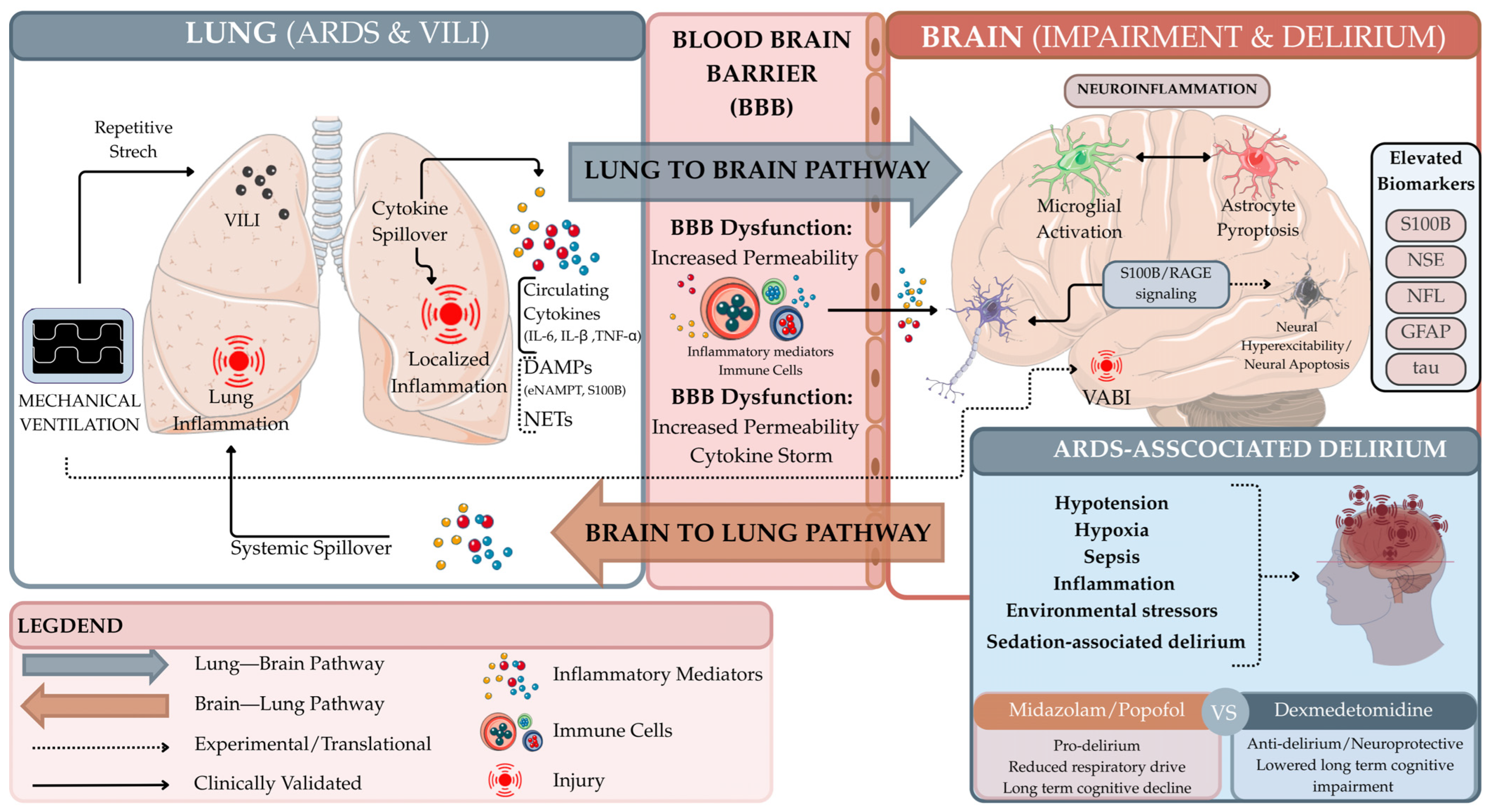
Sedation as an Immunomodulator of Inflammatory Responses in the Lung–Brain Axis of ARDS

 ,
,
Abstract
1. Introduction
2. Methods and Search Strategy
3. ARDS as a Systemic Inflammatory Syndrome
4. Pathophysiology of ARDS-Associated Neuroinflammation
4.1. The Current Literature Knowledge
4.2. Mechanistic Plausibility
4.3. Translational Biomarkers
4.4. Implications of Mechanical Ventilation
5. ARDS-Associated Delirium
5.1. Pro-Delirium and Anti-Delirium Mechanisms
5.2. Sedation-Associated Versus Disease-Associated Delirium
5.3. Deep Compared to Light Sedation in Different ARDS Stages
6. Pharmacologic Modulation of the Lung–Brain Axis
6.1. Dexmedetomidine
6.1.1. Preclinical Mechanistic Evidence: Animal/In Vitro Models
6.1.2. Translational Biomarker Evidence: Human/Clinical Biological Signals
6.1.3. Randomized Clinical Evidence
6.2. Propofol
6.2.1. Preclinical Mechanistic Evidence
6.2.2. Translational Biomarker Evidence
6.2.3. Observational and Randomized Clinical Evidence
6.3. Benzodiazepines
6.3.1. Preclinical Mechanistic Evidence
6.3.2. Translational Biomarker Evidence
6.3.3. Observational Clinical Evidence
6.4. Ketamine
6.4.1. Preclinical Mechanistic Evidence
6.4.2. Translational Biomarker Evidence
6.4.3. Clinical Observational and Randomized Evidence
6.5. Thiopental
7. Discussion
8. Research Agenda
9. Summary
10. Conclusions
Author Contributions
Funding
Institutional Review Board Statement
Informed Consent Statement
Data Availability Statement
Acknowledgments
Conflicts of Interest
Abbreviations
| Akt | Protein Kinase B |
| AP-1 | Activator Protein 1 |
| ARDS | Acute Respiratory Distress Syndrome |
| BBB | Blood–Brain Barrier |
| CRP | C-Reactive Protein |
| ERK | Extracellular Signal-Regulated Kinase |
| GABA | Gamma-Aminobutyric Acid |
| HIF-1α | Hypoxia-Inducible Factor 1-alpha |
| HMGB1 | High Mobility Group Box 1 |
| ICU | Intensive Care Unit |
| IL | Interleukin |
| IRF | Interferon Regulatory Factor |
| MAPK | Mitogen-Activated Protein Kinase |
| MIP | Macrophage Inflammatory Protein |
| MMP | Matrix Metalloproteinase |
| mTOR | Mammalian Target of Rapamycin |
| NETs | Neutrophil Extracellular Traps |
| NF-κB | Nuclear Factor kappa B |
| NFL | Neurofilament Light Chain |
| NLRP3 | NOD-Like Receptor Protein 3 Inflammasome |
| NMDA | N-Methyl-D-Aspartate |
| NO | Nitric Oxide |
| NSE | Neuron-Specific Enolase |
| PI3K | Phosphoinositide 3-Kinase |
| RAGE | Receptor for Advanced Glycation End-Products |
| ROS | Reactive Oxygen Species |
| S100B | S100 Calcium-Binding Protein B |
| STAT | Signal Transducer and Activator of Transcription |
| TLR4 | Toll-Like Receptor 4 |
| TNF-α | Tumor Necrosis Factor alpha |
| VABI | Ventilator-Associated Brain Injury |
| VILI | Ventilator-Induced Lung Injury |
References
- Shaver, C.M.; Bastarache, J.A. Clinical and Biological Heterogeneity in ARDS: Direct versus Indirect Lung Injury. Clin. Chest Med. 2014, 35, 639–653. [Google Scholar] [CrossRef]
- ARDS Definition Task Force; Ranieri, V.M.; Rubenfeld, G.D.; Thompson, B.T.; Ferguson, N.D.; Caldwell, E.; Fan, E.; Camporota, L.; Slutsky, A.S. Acute Respiratory Distress Syndrome: The Berlin Definition. JAMA 2012, 307, 2526–2533. [Google Scholar] [CrossRef]
- Blanch, L.; Quintel, M. Lung–Brain Cross Talk in the Critically Ill. Intensive Care Med. 2017, 43, 557–559. [Google Scholar] [CrossRef]
- van den Boogaard, M.; Kox, M.; Quinn, K.L.; van Achterberg, T.; van der Hoeven, J.G.; Schoonhoven, L.; Pickkers, P. Biomarkers Associated with Delirium in Critically Ill Patients and Their Relation with Long-Term Subjective Cognitive Dysfunction; Indications for Different Pathways Governing Delirium in Inflamed and Noninflamed Patients. Crit. Care 2011, 15, R297. [Google Scholar] [CrossRef]
- Grasselli, G.; Calfee, C.S.; Camporota, L.; Poole, D.; Amato, M.B.P.; Antonelli, M.; Arabi, Y.M.; Baroncelli, F.; Beitler, J.R.; Bellani, G.; et al. ESICM Guidelines on Acute Respiratory Distress Syndrome: Definition, Phenotyping and Respiratory Support Strategies. Intensive Care Med. 2023, 49, 727–759. [Google Scholar] [CrossRef] [PubMed]
- Junior, A.P.N.; Veiga, V.C.; Serafim, R.B. Optimal Sedation During Severe Acute Respiratory Distress Syndrome. Crit. Care Clin. 2025, 41, 791–801. [Google Scholar] [CrossRef] [PubMed]
- Ervin, J.N.; Rentes, V.C.; Dibble, E.R.; Sjoding, M.W.; Iwashyna, T.J.; Hough, C.L.; Ng Gong, M.; Sales, A.E. Evidence-Based Practices for Acute Respiratory Failure and Acute Respiratory Distress Syndrome: A Systematic Review of Reviews. Chest 2020, 158, 2381–2393. [Google Scholar] [CrossRef]
- Hager, D.N.; Dinglas, V.D.; Subhas, S.; Rowden, A.M.; Neufeld, K.J.; Bienvenu, O.J.; Touradji, P.; Colantuoni, E.; Reddy, D.R.S.; Brower, R.G.; et al. Reducing Deep Sedation and Delirium in Acute Lung Injury Patients: A Quality Improvement Project. Crit. Care Med. 2013, 41, 1435. [Google Scholar] [CrossRef] [PubMed]
- Sanders, R.D.; Hussell, T.; Maze, M. Sedation & Immunomodulation. Anesthesiol. Clin. 2011, 29, 687–706. [Google Scholar] [CrossRef]
- Umholtz, M.; Nader, N.D. Anesthetic Immunomodulation of the Neuroinflammation in Postoperative Cognitive Dysfunction. Immunol. Investig. 2017, 46, 805–815. [Google Scholar] [CrossRef]
- Schifilliti, D.; Grasso, G.; Conti, A.; Fodale, V. Anaesthetic-Related Neuroprotection: Intravenous or Inhalational Agents? CNS Drugs 2010, 24, 893–907. [Google Scholar] [CrossRef]
- Feng, S.N.; Laws, L.H.; Diaz-Cruz, C.; Cinotti, R.; Schultz, M.J.; Asehnoune, K.; Stevens, R.D.; Robba, C.; Cho, S.-M.; the ENIO collaborators. Sedation Practices in Mechanically Ventilated Neurocritical Care Patients from 19 Countries: An International Cohort Study. Neurocrit. Care 2025, 43, 232–242. [Google Scholar] [CrossRef]
- Zuo, Z. Are Volatile Anesthetics Neuroprotective or Neurotoxic? Med. Gas Res. 2012, 2, 10. [Google Scholar] [CrossRef] [PubMed]
- Stollings, L.M.; Jia, L.; Tang, P.; Dou, H.; Lu, B.; Xu, Y. Immune Modulation by Volatile Anesthetics. Anesthesiology 2016, 125, 399–411. [Google Scholar] [CrossRef]
- Yassen, K.A.; Jabaudon, M.; Alsultan, H.A.; Almousa, H.; Shahwar, D.I.; Alhejji, F.Y.; Aljaziri, Z.Y. Inhaled Sedation with Volatile Anesthetics for Mechanically Ventilated Patients in Intensive Care Units: A Narrative Review. J. Clin. Med. 2023, 12, 1069. [Google Scholar] [CrossRef]
- Wieruszewski, E.D.; ElSaban, M.; Wieruszewski, P.M.; Smischney, N.J. Inhaled Volatile Anesthetics in the Intensive Care Unit. World J. Crit. Care Med. 2024, 13, 90746. [Google Scholar] [CrossRef]
- O’Gara, B.; Talmor, D. Lung Protective Properties of the Volatile Anesthetics. Intensive Care Med. 2016, 42, 1487–1489. [Google Scholar] [CrossRef] [PubMed]
- Yuki, K.; Eckenhoff, R.G. Mechanisms of the Immunological Effects of Volatile Anesthetics: A Review. Anesth. Analg. 2016, 123, 326. [Google Scholar] [CrossRef]
- Zhang, J.; Tan, H.; Jiang, W.; Zuo, Z. The Choice of General Anesthetics May Not Affect Neuroinflammation and Impairment of Learning and Memory After Surgery in Elderly Rats. J. Neuroimmune Pharmacol. 2015, 10, 179–189. [Google Scholar] [CrossRef] [PubMed]
- Koutsogiannaki, S.; Shimaoka, M.; Yuki, K. The Use of Volatile Anesthetics as Sedatives for Acute Respiratory Distress Syndrome. Transl. Perioper. Pain Med. 2019, 6, 27–38. [Google Scholar] [CrossRef]
- Kim, S.-H.; Li, M.; Pyeon, T.-H.; So, K.-Y.; Kwak, S.-H. The Volatile Anesthetic Sevoflurane Attenuates Ventilator-Induced Lung Injury through Inhibition of ERK1/2 and Akt Signal Transduction. Korean J. Anesthesiol. 2015, 68, 62–69. [Google Scholar] [CrossRef][Green Version]
- Blum, F.E.; Zuo, Z. Volatile Anesthetics-Induced Neuroinflammatory and Anti-Inflammatory Responses. Med. Gas. Res. 2013, 3, 16. [Google Scholar] [CrossRef] [PubMed]
- Grasselli, G.; Giani, M.; Scaravilli, V.; Fumagalli, B.; Mariani, C.; Redaelli, S.; Lucchini, A.; Zanella, A.; Patroniti, N.; Pesenti, A.; et al. Volatile Sedation for Acute Respiratory Distress Syndrome Patients on Venovenous Extracorporeal Membrane Oxygenation and Ultraprotective Ventilation. Crit. Care Explor. 2021, 3, e0310. [Google Scholar] [CrossRef] [PubMed]
- Chanques, G.; Constantin, J.-M.; Devlin, J.W.; Ely, E.W.; Fraser, G.L.; Gélinas, C.; Girard, T.D.; Guérin, C.; Jabaudon, M.; Jaber, S.; et al. Analgesia and Sedation in Patients with ARDS. Intensive Care Med. 2020, 46, 2342–2356. [Google Scholar] [CrossRef]
- Hu, A.-M.; Shan, Z.-M.; Zhang, Z.-J.; Li, H.-P. Comparative Efficacy of Fentanyl and Morphine in Patients with or At Risk for Acute Respiratory Distress Syndrome: A Propensity Score-Matched Cohort Study. Drugs RD 2021, 21, 149–155. [Google Scholar] [CrossRef] [PubMed]
- Franchi, S.; Moschetti, G.; Amodeo, G.; Sacerdote, P. Do All Opioid Drugs Share the Same Immunomodulatory Properties? A Review from Animal and Human Studies. Front. Immunol. 2019, 10, 2914. [Google Scholar] [CrossRef]
- Abdel Shaheed, C.; Beardsley, J.; Day, R.O.; McLachlan, A.J. Immunomodulatory Effects of Pharmaceutical Opioids and Antipyretic Analgesics: Mechanisms and Relevance to Infection. Br. J. Clin. Pharmacol. 2022, 88, 3114–3131. [Google Scholar] [CrossRef]
- Hua, S. Neuroimmune Interaction in the Regulation of Peripheral Opioid-Mediated Analgesia in Inflammation. Front. Immunol. 2016, 7, 293. [Google Scholar] [CrossRef]
- Liang, X.; Liu, R.; Chen, C.; Ji, F.; Li, T. Opioid System Modulates the Immune Function: A Review. Transl. Perioper. Pain Med. 2016, 1, 5–13. [Google Scholar]
- Jiao, Y.; Li, F.; Chen, M.; He, Z.; Huang, Z.; Yu, W.; Xie, K. Pre-Treatment with Morphine Prevents Lipopolysaccharide-Induced Acute Respiratory Distress Syndrome in Rats via Activation of Opioid Receptors. Exp. Cell Res. 2022, 418, 113224. [Google Scholar] [CrossRef]
- Xu, Y.; Chen, R.; Zhi, F.; Sheng, S.; Khiati, L.; Yang, Y.; Peng, Y.; Xia, Y. δ-Opioid Receptor, Microglia and Neuroinflammation. Aging Dis. 2023, 14, 778–793. [Google Scholar] [CrossRef]
- Nishina, K.; Akamatsu, H.; Mikawa, K.; Shiga, M.; Maekawa, N.; Obara, H.; Niwa, Y. The Inhibitory Effects of Thiopental, Midazolam, and Ketamine on Human Neutrophil Functions. Anesth. Analg. 1998, 86, 159–165. [Google Scholar] [CrossRef]
- Colucci, D.; Puig, N.; Hernandez, P. The Influence of Anaesthetics Drugs on Immune Response: From Inflammation to Immunosuppression. OA Anaesth. 2013, 1, 21. [Google Scholar] [CrossRef]
- Cruz, F.F.; Rocco, P.R.M.; Pelosi, P. Anti-Inflammatory Properties of Anesthetic Agents. Crit. Care 2017, 21, 67. [Google Scholar] [CrossRef]
- Xie, R.; Tan, D.; Liu, B.; Xiao, G.; Gong, F.; Zhang, Q.; Qi, L.; Zheng, S.; Yuan, Y.; Yang, Z.; et al. Acute Respiratory Distress Syndrome (ARDS): From Mechanistic Insights to Therapeutic Strategies. MedComm 2025, 6, e70074. [Google Scholar] [CrossRef] [PubMed]
- Gouda, M.M.; Shaikh, S.B.; Bhandary, Y.P. Inflammatory and Fibrinolytic System in Acute Respiratory Distress Syndrome. Lung 2018, 196, 609–616. [Google Scholar] [CrossRef]
- Bos, L.D.J.; Ware, L.B. Acute Respiratory Distress Syndrome: Causes, Pathophysiology, and Phenotypes. Lancet 2022, 400, 1145–1156. [Google Scholar] [CrossRef]
- Zheng, Z.; Qiao, X.; Yin, J.; Kong, J.; Han, W.; Qin, J.; Meng, F.; Tian, G.; Feng, X. Advancements in Omics Technologies: Molecular Mechanisms of Acute Lung Injury and Acute Respiratory Distress Syndrome (Review). Int. J. Mol. Med. 2025, 55, 38. [Google Scholar] [CrossRef] [PubMed]
- Schmidt, E.P.; Yang, Y.; Janssen, W.J.; Gandjeva, A.; Perez, M.J.; Barthel, L.; Zemans, R.L.; Bowman, J.C.; Koyanagi, D.E.; Yunt, Z.X.; et al. The Pulmonary Endothelial Glycocalyx Regulates Neutrophil Adhesion and Lung Injury during Experimental Sepsis. Nat. Med. 2012, 18, 1217–1223. [Google Scholar] [CrossRef] [PubMed]
- Millar, F.R.; Summers, C.; Griffiths, M.J.; Toshner, M.R.; Proudfoot, A.G. The Pulmonary Endothelium in Acute Respiratory Distress Syndrome: Insights and Therapeutic Opportunities. Thorax 2016, 71, 462–473. [Google Scholar] [CrossRef]
- Johnson, N.H.; Casanova, N.G.; Patarroyo-White, S.; Canizales, J.; Camp, S.M.; Barcena, J.P.; De Rivero Vaccari, J.P.; Joseph, B.; Garcia, J.G.N. Lung-Brain Axis-Generated Inflammatory Biomarkers in Traumatic Brain Injury and Acute Respiratory Distress Syndrome: Role of Mechanical Ventilation/Stress. Adv. Biomark. Sci. Technol. 2025, 7, 238–247. [Google Scholar] [CrossRef]
- Bajinka, O.; Simbilyabo, L.; Tan, Y.; Jabang, J.; Saleem, S.A. Lung-Brain Axis. Crit. Rev. Microbiol. 2022, 48, 257–269. [Google Scholar] [CrossRef]
- Ziaka, M.; Exadaktylos, A. ARDS Associated Acute Brain Injury: From the Lung to the Brain. Eur. J. Med. Res. 2022, 27, 150. [Google Scholar] [CrossRef]
- Sasannejad, C.; Ely, E.W.; Lahiri, S. Long-Term Cognitive Impairment after Acute Respiratory Distress Syndrome: A Review of Clinical Impact and Pathophysiological Mechanisms. Crit. Care 2019, 23, 352. [Google Scholar] [CrossRef]
- Huang, M.; Gedansky, A.; Hassett, C.E.; Price, C.; Fan, T.H.; Stephens, R.S.; Nyquist, P.; Uchino, K.; Cho, S.-M. Pathophysiology of Brain Injury and Neurological Outcome in Acute Respiratory Distress Syndrome: A Scoping Review of Preclinical to Clinical Studies. Neurocrit. Care 2021, 35, 518–527. [Google Scholar] [CrossRef]
- Seder, D.B. Implications of Structural Brain Injury in ARDS. Neurocrit. Care 2024, 40, 40–41. [Google Scholar] [CrossRef]
- Ziaka, M.; Exadaktylos, A. Brain–Lung Interactions and Mechanical Ventilation in Patients with Isolated Brain Injury. Crit. Care 2021, 25, 358. [Google Scholar] [CrossRef]
- Bassi, T.; Taran, S.; Girard, T.D.; Robba, C.; Goligher, E.C. Ventilator-Associated Brain Injury: A New Priority for Research in Mechanical Ventilation. Am. J. Respir. Crit. Care Med. 2024, 209, 1186–1188. [Google Scholar] [CrossRef] [PubMed]
- Bassi, T.G.; Rohrs, E.C.; Reynolds, S.C. Systematic Review of Cognitive Impairment and Brain Insult after Mechanical Ventilation. Crit. Care 2021, 25, 99. [Google Scholar] [CrossRef] [PubMed]
- Mascia, L.; D’Albo, R.; Cavalli, I.; Giaccari, L.; Della Giovampaola, M.; Donati, B. Organ Crosstalk: Brain-Lung Interaction. Front. Med. 2025, 12, 1655813. [Google Scholar] [CrossRef] [PubMed]
- Mascia, L. Acute Lung Injury in Patients with Severe Brain Injury: A Double Hit Model. Neurocrit. Care 2009, 11, 417–426. [Google Scholar] [CrossRef]
- Ziaka, M.; Exadaktylos, A. Pathophysiology of Acute Lung Injury in Patients with Acute Brain Injury: The Triple-Hit Hypothesis. Crit. Care 2024, 28, 71. [Google Scholar] [CrossRef]
- Azzoni, R.; Marsland, B.J. The Lung-Brain Axis: A New Frontier in Host-Microbe Interactions. Immunity 2022, 55, 589–591. [Google Scholar] [CrossRef]
- Wang, L.; Wang, F.; Wang, X.; Chen, X.; Li, C.; Shan, K.; Zhou, H.; Wu, G.; Xu, Z.; Kong, X.; et al. The Lung-Brain Axis: Elucidating the Mechanisms of Pulmonary-Driven Neurological Disorders. J. Neuroinflamm. 2026, 23, 115. [Google Scholar] [CrossRef]
- Ferring, M.; Vincent, J.L. Is Outcome from ARDS Related to the Severity of Respiratory Failure? Eur. Respir. J. 1997, 10, 1297–1300. [Google Scholar] [CrossRef]
- Huang, S.; Zhou, Y.; Ji, H.; Zhang, T.; Liu, S.; Ma, L.; Deng, D.; Ding, Y.; Han, L.; Shu, S.; et al. Decoding Mechanisms and Protein Markers in Lung-Brain Axis. Respir. Res. 2025, 26, 190. [Google Scholar] [CrossRef]
- Najjar, S.; Najjar, A.; Chong, D.J.; Pramanik, B.K.; Kirsch, C.; Kuzniecky, R.I.; Pacia, S.V.; Azhar, S. Central Nervous System Complications Associated with SARS-CoV-2 Infection: Integrative Concepts of Pathophysiology and Case Reports. J. Neuroinflamm. 2020, 17, 231. [Google Scholar] [CrossRef]
- Wang, B.; Sun, C.; Zhang, R.; Gu, A.; Zhao, M.; Zhou, X.; Gu, C. MiR-106a-5p in Extracellular Vesicles Derived from Alveolar Epithelial Cells Mediates Cognitive Dysfunction Induced by Chronic Intermittent Hypoxia in Mice through MAPK Signaling Pathway. J. Neuroinflamm. 2025, 22, 291. [Google Scholar] [CrossRef]
- Wu, F.; Tang, H.; Jia, H.; Li, C.; Song, Y.; Hu, J.; Cao, H.; Zhang, B.; Zhang, X.; Jiang, H.; et al. Brain Endothelial PTPRO Drives LPS-Induced Metabolic Reprogramming and Neuroinflammation in Sepsis-Associated Encephalopathy. J. Neuroinflamm. 2026, 23, 154. [Google Scholar] [CrossRef]
- He, J.; Han, X.; Tan, Y.; Yao, Z.; Dong, Y.; Feng, C. Aberrant Brain Functional Network in COPD Patients with Cognitive Impairment: Clinical Manifestations, Mechanisms and Therapeutic Strategies. J. Neuroinflamm. 2025, 23, 30. [Google Scholar] [CrossRef]
- Song, S.; Fan, M.; Feng, R.; Zhao, H. Airborne Particulate Matter and the Lung-Brain Axis: Unraveling the Neuroinflammatory Cascade from Alveolar Irritation to Microglial Activation. J. Neuroinflamm. 2026, 23, 142. [Google Scholar] [CrossRef]
- Yu, X.; Xiao, H.; Bao, S.; Dong, Y.; Dong, Z.; Zhao, J.; Wang, G.; Meng, X.; Wang, F. Cigarette Smoke-Induced Lung-Brain Barrier Dysfunction Drives Neurocognitive Impairment via Inflammatory Spill-Over. J. Neuroinflamm. 2025, 23, 10. [Google Scholar] [CrossRef]
- Firdous, S.M.; Marick, S.; Pattanayak, A.; Polley, K.; Roy, S.L. Unknotting the Crosstalk between COPD and Neuroinflammation. J. Neuroinflamm. 2026, 23, 114. [Google Scholar] [CrossRef]
- Rodríguez-González, R.; Ramos-Nuez, Á.; Martín-Barrasa, J.L.; López-Aguilar, J.; Baluja, A.; Álvarez, J.; Rocco, P.R.; Pelosi, P.; Villar, J. Endotoxin-Induced Lung Alveolar Cell Injury Causes Brain Cell Damage. Exp. Biol. Med. 2015, 240, 135–142. [Google Scholar] [CrossRef]
- Dong, M.; Zou, Y.; Ye, Z.; Zou, W.; Zhang, L.; Ai, Y.; Peng, Q. Neuro-Immune Regulation of Sepsis-Associated Delirium via the PBN-CeA-Spleen Axis. J. Neuroinflamm. 2025, 22, 222. [Google Scholar] [CrossRef]
- Raabe, A.; Kopetsch, O.; Woszcyk, A.; Seifert, V. Serum S100B as a Biochemical Marker of Neurological Complications in Intensive Care Patients. Crit. Care 2002, 6, P56. [Google Scholar] [CrossRef]
- Korfias, S.; Dimopoulou, I.; Anthi, A.; Psachoulia, C.; Kiriou, L.; Roussos, C.; Sakas, D. High Serum Protein S100B Levels in Brain-Dead Patients. Crit. Care 2002, 6, P54. [Google Scholar] [CrossRef]
- Raveendran, V.V.; AlQattan, S.; AlMutairy, E. A Review on Clinical Implications of S100 Proteins in Lung Diseases. Front. Med. 2025, 12, 1618772. [Google Scholar] [CrossRef]
- Sattar, Z.; Lora, A.; Jundi, B.; Railwah, C.; Geraghty, P. The S100 Protein Family as Players and Therapeutic Targets in Pulmonary Diseases. Pulm. Med. 2021, 2021, 5488591. [Google Scholar] [CrossRef]
- Piazza, O.; Leggiero, E.; De Benedictis, G.; Pastore, L.; Salvatore, F.; Tufano, R.; De Robertis, E. S100B Induces the Release of Pro-Inflammatory Cytokines in Alveolar Type I-like Cells. Int. J. Immunopathol. Pharmacol. 2013, 26, 383–391. [Google Scholar] [CrossRef]
- Zou, Z.; Liu, Y.; Lu, Y.; Deng, W.; Huang, Q.; Li, L.; Zhang, Y.; Gu, Z.; Zeng, Z. Crosstalk between Astrocytes and Neutrophils via S100B/RAGE/NETs Exacerbates Secondary Injury Following Traumatic Brain Injury. Brain. Behav. Immun. 2026, 131, 106153. [Google Scholar] [CrossRef]
- Chen, T.; Hu, J.; Liao, Y.; Xie, S.; Zhang, L. The Brain Washing System in Sepsis-Associated Encephalopathy. J. Neuroinflamm. 2025, 22, 277. [Google Scholar] [CrossRef]
- Wei, H.; Jin, Z.; Zhu, C.; You, P.; Sui, J.; Huang, L.; Liu, N.; Zhu, W.; Xu, Q. Spatial Multiomics Dissects the SARS-CoV-2-Induced Disruption of Cell Adhesion and Immune Dynamics in the Human Hippocampus. J. Neuroinflamm. 2026, 23, 106. [Google Scholar] [CrossRef]
- Giordano, G.; Pugliese, F.; Bilotta, F. Neuroinflammation, Neuronal Damage or Cognitive Impairment Associated with Mechanical Ventilation: A Systematic Review of Evidence from Animal Studies. J. Crit. Care 2021, 62, 246–255. [Google Scholar] [CrossRef]
- Kamuf, J.; Garcia-Bardon, A.; Ziebart, A.; Thomas, R.; Folkert, K.; Frauenknecht, K.; Thal, S.C.; Hartmann, E.K. Lung Injury Does Not Aggravate Mechanical Ventilation-Induced Early Cerebral Inflammation or Apoptosis in an Animal Model. PLoS ONE 2018, 13, e0202131. [Google Scholar] [CrossRef]
- González-López, A.; López-Alonso, I.; Aguirre, A.; Amado-Rodríguez, L.; Batalla-Solís, E.; Astudillo, A.; Tomás-Zapico, C.; Fueyo, A.; dos Santos, C.C.; Talbot, K.; et al. Mechanical Ventilation Triggers Hippocampal Apoptosis by Vagal and Dopaminergic Pathways. Am. J. Respir. Crit. Care Med. 2013, 188, 693–702. [Google Scholar] [CrossRef]
- González-López, A.; López-Alonso, I.; Pickerodt, P.A.; von Haefen, C.; Amado-Rodríguez, L.; Reimann, H.; Niendorf, T.; Kuebler, W.; Albaiceta, G.M.; Francis, R.C.E.; et al. Lung Purinoceptor Activation Triggers Ventilator-Induced Brain Injury. Crit. Care Med. 2019, 47, e911–e918. [Google Scholar] [CrossRef]
- Mascia, L.; Fanelli, V.; Mistretta, A.; Filippini, M.; Zanin, M.; Berardino, M.; Mazzeo, A.T.; Caricato, A.; Antonelli, M.; Della Corte, F.; et al. Lung-Protective Mechanical Ventilation in Patients with Severe Acute Brain Injury: A Multicenter Randomized Clinical Trial (PROLABI). Am. J. Respir. Crit. Care Med. 2024, 210, 1123–1131. [Google Scholar] [CrossRef]
- Pelosi, P.; Rocco, P.R. The Lung and the Brain: A Dangerous Cross-Talk. Crit. Care 2011, 15, 168. [Google Scholar] [CrossRef]
- Witzenrath, M.; Kuebler, W.M. The Lung–Brain Axis in Ventilator-Induced Brain Injury: Enter IL-6. Am. J. Respir. Cell Mol. Biol. 2021, 65, 339–340. [Google Scholar] [CrossRef]
- Quilez, M.E.; Fuster, G.; Villar, J.; Flores, C.; Martí-Sistac, O.; Blanch, L.; López-Aguilar, J. Injurious Mechanical Ventilation Affects Neuronal Activation in Ventilated Rats. Crit. Care 2011, 15, R124, Erratum in Crit. Care 2015, 19, 379. https://doi.org/10.1186/s13054-015-1076-5. [Google Scholar] [CrossRef]
- Chen, C.; Zhang, Z.; Chen, T.; Peng, M.; Xu, X.; Wang, Y. Prolonged Mechanical Ventilation–Induced Neuroinflammation Affects Postoperative Memory Dysfunction in Surgical Mice. Crit. Care 2015, 19, 159. [Google Scholar] [CrossRef]
- Lahiri, S.; Regis, G.C.; Koronyo, Y.; Fuchs, D.-T.; Sheyn, J.; Kim, E.H.; Mastali, M.; Van Eyk, J.E.; Rajput, P.S.; Lyden, P.D.; et al. Acute Neuropathological Consequences of Short-Term Mechanical Ventilation in Wild-Type and Alzheimer’s Disease Mice. Crit. Care 2019, 23, 63. [Google Scholar] [CrossRef]
- Qadir, N.; Sahetya, S.; Munshi, L.; Summers, C.; Abrams, D.; Beitler, J.; Bellani, G.; Brower, R.G.; Burry, L.; Chen, J.-T.; et al. An Update on Management of Adult Patients with Acute Respiratory Distress Syndrome: An Official American Thoracic Society Clinical Practice Guideline. Am. J. Respir. Crit. Care Med. 2024, 209, 24–36. [Google Scholar] [CrossRef]
- Kim, J.A.; Wahlster, S.; LaBuzetta, J.N.; Nobleza, C.O.S.; Johnson, N.J.; Rubinos, C.; Malaiyandi, D.; O’Phelan, K.H.; Mainali, S.; Sarwal, A.; et al. Focused Management of Patients with Severe Acute Brain Injury and ARDS. CHEST 2022, 161, 140–151. [Google Scholar] [CrossRef]
- Bellani, G.; Laffey, J.G.; Pham, T.; Fan, E.; Brochard, L.; Esteban, A.; Gattinoni, L.; van Haren, F.; Larsson, A.; McAuley, D.F.; et al. Epidemiology, Patterns of Care, and Mortality for Patients with Acute Respiratory Distress Syndrome in Intensive Care Units in 50 Countries. JAMA 2016, 315, 788–800, Correction in JAMA 2016, 316, 350. https://doi.org/10.1001/jama.2016.6956. [Google Scholar] [CrossRef]
- Hsieh, S.J.; Soto, G.J.; Hope, A.A.; Ponea, A.; Gong, M.N. The Association between Acute Respiratory Distress Syndrome, Delirium, and In-Hospital Mortality in Intensive Care Unit Patients. Am. J. Respir. Crit. Care Med. 2015, 191, 71–78. [Google Scholar] [CrossRef]
- Deffland, M.; Spies, C.; Weiss, B.; Keller, N.; Jenny, M.; Kruppa, J.; Balzer, F. Effects of Pain, Sedation and Delirium Monitoring on Clinical and Economic Outcome: A Retrospective Study. PLoS ONE 2020, 15, e0234801. [Google Scholar] [CrossRef]
- Pandharipande, P.; Cotton, B.A.; Shintani, A.; Thompson, J.; Pun, B.T.; Morris, J.A.J.; Dittus, R.; Ely, E.W. Prevalence and Risk Factors for Development of Delirium in Surgical and Trauma Intensive Care Unit Patients. J. Trauma Acute Care Surg. 2008, 65, 34. [Google Scholar] [CrossRef]
- O’Gara, B.P.; Gao, L.; Marcantonio, E.R.; Subramaniam, B. Sleep, Pain, and Cognition: Modifiable Targets for Optimal Perioperative Brain Health. Anesthesiology 2021, 135, 1132. [Google Scholar] [CrossRef]
- Wilson, J.E.; Mart, M.F.; Cunningham, C.; Shehabi, Y.; Girard, T.D.; MacLullich, A.M.J.; Slooter, A.J.C.; Ely, E.W. Delirium. Nat. Rev. Dis. Primer 2020, 6, 90. [Google Scholar] [CrossRef] [PubMed]
- Brummel, N.E.; Hughes, C.G.; McNeil, J.B.; Pandharipande, P.P.; Thompson, J.L.; Orun, O.M.; Raman, R.; Ware, L.B.; Bernard, G.R.; Harrison, F.E.; et al. Systemic Inflammation and Delirium during Critical Illness. Intensive Care Med. 2024, 50, 687–696. [Google Scholar] [CrossRef]
- Wang, S.; Greene, R.; Song, Y.; Chan, C.; Lindroth, H.; Khan, S.; Rios, G.; Sanders, R.D.; Khan, B. Postoperative Delirium and Its Relationship with Biomarkers for Dementia: A Meta-Analysis. Int. Psychogeriatr. 2022, 34, 377–390. [Google Scholar] [CrossRef] [PubMed]
- Liang, Q.; Tan, X.; Huang, Z.; Chen, S.; Li, Y.; Fu, Z. Meta-Analysis for the Associations of Serum C-Reactive Protein with Delirium Risk. Front. Neurol. 2026, 17, 1728476. [Google Scholar] [CrossRef] [PubMed]
- Girard, T.D.; Thompson, J.L.; Pandharipande, P.P.; Brummel, N.E.; Jackson, J.C.; Patel, M.B.; Hughes, C.G.; Chandrasekhar, R.; Pun, B.T.; Boehm, L.M.; et al. Clinical Phenotypes of Delirium during Critical Illness and Severity of Subsequent Long-Term Cognitive Impairment: A Prospective Cohort Study. Lancet Respir. Med. 2018, 6, 213–222. [Google Scholar] [CrossRef]
- Aragón, R.E.; Proaño, A.; Mongilardi, N.; de Ferrari, A.; Herrera, P.; Roldan, R.; Paz, E.; Jaymez, A.A.; Chirinos, E.; Portugal, J.; et al. Sedation Practices and Clinical Outcomes in Mechanically Ventilated Patients in a Prospective Multicenter Cohort. Crit. Care 2019, 23, 130. [Google Scholar] [CrossRef]
- Gitti, N.; Renzi, S.; Marchesi, M.; Bertoni, M.; Lobo, F.A.; Rasulo, F.A.; Goffi, A.; Pozzi, M.; Piva, S. Seeking the Light in Intensive Care Unit Sedation: The Optimal Sedation Strategy for Critically Ill Patients. Front. Med. 2022, 9, 901343. [Google Scholar] [CrossRef]
- Shehabi, Y.; Chan, L.; Kadiman, S.; Alias, A.; Ismail, W.N.; Tan, M.A.T.I.; Khoo, T.M.; Ali, S.B.; Saman, M.A.; Shaltut, A.; et al. Sedation Depth and Long-Term Mortality in Mechanically Ventilated Critically Ill Adults: A Prospective Longitudinal Multicentre Cohort Study. Intensive Care Med. 2013, 39, 910–918. [Google Scholar] [CrossRef]
- Huang, C.; Ng, O.T.-W.; Chu, J.M.-T.; Irwin, M.G.; Hu, X.; Zhu, S.; Chang, R.C.-C.; Wong, G.T.-C. Differential Effects of Propofol and Dexmedetomidine on Neuroinflammation Induced by Systemic Endotoxin Lipopolysaccharides in Adult Mice. Neurosci. Lett. 2019, 707, 134309. [Google Scholar] [CrossRef]
- Chen, R.; Dou, X.-K.; Dai, M.-S.; Sun, Y.; Sun, S.-J.; Wu, Y. The Role of Dexmedetomidine in Immune Tissue and Inflammatory Diseases: A Narrative Review. Eur. Rev. Med. Pharmacol. Sci. 2022, 26, 8030–8038. [Google Scholar] [CrossRef]
- Li, Y.; Yu, Z.-X.; Ji, M.-S.; Yan, J.; Cai, Y.; Liu, J.; Yang, H.-F.; Jin, Z.-C. A Pilot Study of the Use of Dexmedetomidine for the Control of Delirium by Reducing the Serum Concentrations of Brain-Derived Neurotrophic Factor, Neuron-Specific Enolase, and S100B in Polytrauma Patients. J. Intensive Care Med. 2019, 34, 674–681. [Google Scholar] [CrossRef]
- Long, L.; Ren, S.; Gong, Y.; Zhao, H.; He, C.; Shen, L.; Zhao, H.; Ma, P. Different Depths of Sedation versus Risk of Delirium in Adult Mechanically Ventilated Patients: A Systematic Review and Meta-Analysis. PLoS ONE 2020, 15, e0236014. [Google Scholar] [CrossRef] [PubMed]
- Spencer, H.F.; Berman, R.Y.; Boese, M.; Zhang, M.; Kim, S.Y.; Radford, K.D.; Choi, K.H. Effects of an Intravenous Ketamine Infusion on Inflammatory Cytokine Levels in Male and Female Sprague–Dawley Rats. J. Neuroinflamm. 2022, 19, 75. [Google Scholar] [CrossRef] [PubMed]
- Hughes, C.G.; Girard, T.D.; Pandharipande, P.P. Daily Sedation Interruption versus Targeted Light Sedation Strategies in ICU Patients. Crit. Care Med. 2013, 41, S39–S45. [Google Scholar] [CrossRef] [PubMed]
- Huespe, I.; Giunta, D.; Acosta, K.; Avila, D.; Prado, E.; Sanghavi, D.; Bisso, I.C.; Giannasi, S.; Carini, F.C. Comparing Bispectral Index Monitoring vs Clinical Assessment for Deep Sedation in the ICU. CHEST 2024, 166, 733–742. [Google Scholar] [CrossRef] [PubMed]
- Huespe, I.; Giannasi, S.; Acosta, K.; Pawlowski, T.; Hoque, M.; Nagourney, J.; Giunta, D.; Avila, D.; Prado, E.; Carboni Bisso, I.; et al. 19: Reduction of Delirium and Sedative Drug Doses by Bis-Guided Deep Sedation in the ICU: Clinical Trial. Crit. Care Med. 2024, 52, S10. [Google Scholar] [CrossRef]
- Guan, S.; Sun, L.; Wang, X.; Huang, X.; Luo, T. Propofol Inhibits Neuroinflammation and Metabolic Reprogramming in Microglia in Vitro and in Vivo. Front. Pharmacol. 2023, 14, 1161810. [Google Scholar] [CrossRef]
- Lu, S.; Song, H.; Lin, Y.; Song, B.; Lin, S. A Randomized Controlled Trial Investigating the Impact of Early Goal-Directed Sedation Dominated by Dexmedetomidine on Cerebral Oxygen Metabolism and Inflammatory Mediators in Patients with Severe Brain Injury. Neurol. Sci. 2024, 46, 1741–1750. [Google Scholar] [CrossRef]
- Battaglini, D.; Rocco, P.R.M. Challenges in Transitioning from Controlled to Assisted Ventilation in Acute Respiratory Distress Syndrome (ARDS) Management. J. Clin. Med. 2024, 13, 7333. [Google Scholar] [CrossRef] [PubMed]
- Heil, L.B.B.; Braga, C.L.; Magalhães, R.F.; Antunes, M.A.; Cruz, F.F.; Samary, C.S.; Battaglini, D.; Robba, C.; Pelosi, P.; Silva, P.L.; et al. Dexmedetomidine Compared to Low-Dose Ketamine Better Protected Not Only the Brain but Also the Lungs in Acute Ischemic Stroke. Int. Immunopharmacol. 2023, 124, 111004. [Google Scholar] [CrossRef]
- Sousa, G.C.; Fernandes, M.V.; Cruz, F.F.; Antunes, M.A.; da Silva, C.M.; Takyia, C.; Battaglini, D.; Samary, C.S.; Robba, C.; Pelosi, P.; et al. Comparative Effects of Dexmedetomidine and Propofol on Brain and Lung Damage in Experimental Acute Ischemic Stroke. Sci. Rep. 2021, 11, 23133. [Google Scholar] [CrossRef]
- Mei, B.; Li, J.; Zuo, Z. Dexmedetomidine Attenuates Sepsis-Associated Inflammation and Encephalopathy via Central α2A Adrenoceptor. Brain Behav. Immun. 2021, 91, 296–314. [Google Scholar] [CrossRef]
- Bassi, T.G.; Rohrs, E.C.; Fernandez, K.C.; Ornowska, M.; Nicholas, M.; Gani, M.; Evans, D.; Reynolds, S.C. Brain Injury after 50 h of Lung-Protective Mechanical Ventilation in a Preclinical Model. Sci. Rep. 2021, 11, 5105. [Google Scholar] [CrossRef] [PubMed]
- Latronico, N.; Eikermann, M.; Ely, E.W.; Needham, D.M. Improving Management of ARDS: Uniting Acute Management and Long-Term Recovery. Crit. Care 2024, 28, 58. [Google Scholar] [CrossRef]
- Simioli, F.; Annunziata, A.; Coppola, A.; Imitazione, P.; Mirizzi, A.I.; Marotta, A.; D’Angelo, R.; Fiorentino, G. The Role of Dexmedetomidine in ARDS: An Approach to Non-Intensive Care Sedation. Front. Med. 2023, 10, 1224242. [Google Scholar] [CrossRef]
- Meng, L.; Li, L.; Lu, S.; Li, K.; Su, Z.; Wang, Y.; Fan, X.; Li, X.; Zhao, G. The Protective Effect of Dexmedetomidine on LPS-Induced Acute Lung Injury through the HMGB1-Mediated TLR4/NF-κB and PI3K/Akt/mTOR Pathways. Mol. Immunol. 2018, 94, 7–17. [Google Scholar] [CrossRef] [PubMed]
- Yuki, K. The Immunomodulatory Mechanism of Dexmedetomidine. Int. Immunopharmacol. 2021, 97, 107709. [Google Scholar] [CrossRef]
- Flanders, C.A.; Rocke, A.S.; Edwardson, S.A.; Baillie, J.K.; Walsh, T.S. The Effect of Dexmedetomidine and Clonidine on the Inflammatory Response in Critical Illness: A Systematic Review of Animal and Human Studies. Crit. Care 2019, 23, 402. [Google Scholar] [CrossRef] [PubMed]
- Cho, I.; Koo, B.-N.; Kim, S.Y.; Park, S.; Kim, E.J.; Kam, E.H.; Kim, J. Neuroprotective Effect of Dexmedetomidine against Postoperative Cognitive Decline via NLRP3 Inflammasome Signaling Pathway. Int. J. Mol. Sci. 2022, 23, 8806. [Google Scholar] [CrossRef]
- Wang, K.; Wu, M.; Xu, J.; Wu, C.; Zhang, B.; Wang, G.; Ma, D. Effects of Dexmedetomidine on Perioperative Stress, Inflammation, and Immune Function: Systematic Review and Meta-Analysis. Br. J. Anaesth. 2019, 123, 777–794. [Google Scholar] [CrossRef]
- Chen, R.; Sun, Y.; Lv, J.; Dou, X.; Dai, M.; Sun, S.; Lin, Y. Effects of Dexmedetomidine on Immune Cells: A Narrative Review. Front. Pharmacol. 2022, 13, 829951. [Google Scholar] [CrossRef] [PubMed]
- Huang, C.; Yang, R.; Xie, X.; Dai, H.; Pan, L. Effects of Dexmedetomidine on Early Postoperative Cognitive Function and Postoperative Inflammatory Response: A Systematic Review and Network Meta-Analysis. Front. Neurol. 2024, 15, 1422049. [Google Scholar] [CrossRef]
- Li, B.; Li, Y.; Tian, S.; Wang, H.; Wu, H.; Zhang, A.; Gao, C. Anti-Inflammatory Effects of Perioperative Dexmedetomidine Administered as an Adjunct to General Anesthesia: A Meta-Analysis. Sci. Rep. 2015, 5, 12342. [Google Scholar] [CrossRef] [PubMed]
- Liu, Y.; Liu, C.; Zhou, Q.; Lu, H.; Pan, P. Comparison of Remimazolam Besylate and Dexmedetomidine on Stress Response and Immune Balance in Patients with Acute Respiratory Distress Syndrome. Ir. J. Med. Sci. (1971–) 2025, 194, 1797–1803. [Google Scholar] [CrossRef] [PubMed]
- Chen, Q.; Qin, Z.; Sun, Y.; Liu, X.; Pac Soo, A.; Chang, E.; Sun, Q.; Yi, B.; Wang, D.-X.; Zhao, H.; et al. Dexmedetomidine Activates Akt, STAT6 and IRF4 Modulating Cytoprotection and Macrophage Anti-Inflammatory Phenotype Against Acute Lung Injury in Vivo and in Vitro. J. Inflamm. Res. 2022, 15, 2707–2720. [Google Scholar] [CrossRef]
- Zhang, J.; Jia, Z.; Zhang, Y.; Tao, Z. Dexmedetomidine Administration Is Associated with Reduced Mortality in Patients with Sepsis-Induced Acute Respiratory Distress Syndrome: A Retrospective Study. BMC Anesthesiol. 2025, 25, 118. [Google Scholar] [CrossRef]
- Zhang, Z.; Xie, K.; Luo, R.; Zhang, D.; He, Z.; Li, K.; Lin, S.; Xu, F. Dexmedetomidine Alleviates Acute Lung Injury by Promoting Tregs Differentiation via Activation of AMPK/SIRT1 Pathway. Inflammopharmacology 2023, 31, 423–438. [Google Scholar] [CrossRef]
- Tian, M.; Wang, W.; Wang, K.; Jin, P.; Lenahan, C.; Wang, Y.; Tan, J.; Wen, H.; Deng, S.; Zhao, F.; et al. Dexmedetomidine Alleviates Cognitive Impairment by Reducing Blood-Brain Barrier Interruption and Neuroinflammation via Regulating Th1/Th2/Th17 Polarization in an Experimental Sepsis Model of Mice. Int. Immunopharmacol. 2021, 101, 108332. [Google Scholar] [CrossRef]
- Jiang, Y.; Xia, M.; Xu, J.; Huang, Q.; Dai, Z.; Zhang, X. Dexmedetomidine Alleviates Pulmonary Edema through the Epithelial Sodium Channel (ENaC) via the PI3K/Akt/Nedd4-2 Pathway in LPS-Induced Acute Lung Injury. Immunol. Res. 2021, 69, 162–175. [Google Scholar] [CrossRef]
- Shi, J.; Yu, T.; Song, K.; Du, S.; He, S.; Hu, X.; Li, X.; Li, H.; Dong, S.; Zhang, Y.; et al. Dexmedetomidine Ameliorates Endotoxin-Induced Acute Lung Injury in Vivo and in Vitro by Preserving Mitochondrial Dynamic Equilibrium through the HIF-1a/HO-1 Signaling Pathway. Redox Biol. 2021, 41, 101954. [Google Scholar] [CrossRef]
- Xie, X.; Shen, Z.; Hu, C.; Zhang, K.; Guo, M.; Wang, F.; Qin, K. Dexmedetomidine Ameliorates Postoperative Cognitive Dysfunction in Aged Mice. Neurochem. Res. 2021, 46, 2415–2426. [Google Scholar] [CrossRef]
- Bao, Y.; Zhu, Y.; He, G.; Ni, H.; Liu, C.; Ma, L.; Zhang, L.; Shi, D. Dexmedetomidine Attenuates Neuroinflammation in LPS-Stimulated BV2 Microglia Cells Through Upregulation of miR-340. Drug Des. Dev. Ther. 2019, 13, 3465–3475. [Google Scholar] [CrossRef]
- He, G.; Ni, H.; Wang, K.; Gao, H.; Li, Y.; Gu, J.; Ni, X.; Wang, Z.; Bao, Y. Dexmedetomidine Attenuates the Neuroinflammation and Cognitive Dysfunction in Aged Mice by Targeting the SNHG14/miR-340/NF-κB Axis. Biomed. Rep. 2023, 19, 100. [Google Scholar] [CrossRef]
- Luo, S.; Li, L.; Guo, L.; Wang, L.; Wang, Y.; Chen, N.; Wang, E. Dexmedetomidine Exerts an Anti-Inflammatory Effect via A2 Adrenoceptors to Alleviate Cognitive Dysfunction in 5xFAD Mice. Front. Aging Neurosci. 2022, 14, 978768. [Google Scholar] [CrossRef]
- Pandharipande, P.P.; Sanders, R.D.; Girard, T.D.; McGrane, S.; Thompson, J.L.; Shintani, A.K.; Herr, D.L.; Maze, M.; Ely, E.W. the MENDS investigators. Effect of Dexmedetomidine versus Lorazepam on Outcome in Patients with Sepsis: An a Priori-Designed Analysis of the MENDS Randomized Controlled Trial. Crit. Care 2010, 14, R38. [Google Scholar] [CrossRef] [PubMed]
- Xu, W.; Zheng, Y.; Suo, Z.; Fei, K.; Wang, Y.; Liu, C.; Li, S.; Zhang, M.; Zhang, Y.; Zheng, Z.; et al. Effect of Dexmedetomidine on Postoperative Systemic Inflammation and Recovery in Patients Undergoing Digest Tract Cancer Surgery: A Meta-Analysis of Randomized Controlled Trials. Front. Oncol. 2022, 12, 970557. [Google Scholar] [CrossRef]
- Ohta, Y.; Miyamoto, K.; Kawazoe, Y.; Yamamura, H.; Morimoto, T. Effect of Dexmedetomidine on Inflammation in Patients with Sepsis Requiring Mechanical Ventilation: A Sub-Analysis of a Multicenter Randomized Clinical Trial. Crit. Care 2020, 24, 493. [Google Scholar] [CrossRef]
- Yang, J.; Zhao, Y.-H.; Yin, K.-W.; Zhang, X.; Liu, J. Dexmedetomidine Inhibits Inflammatory Response and Oxidative Stress through Regulating miR-205-5p by Targeting HMGB1 in Cerebral Ischemic/Reperfusion. Immunopharmacol. Immunotoxicol. 2021, 43, 478–486, Correction in Immunopharmacol. Immunotoxicol. 2022, 44, 795. https://doi.org/10.1080/08923973.2022.2120671. [Google Scholar] [CrossRef] [PubMed]
- Qiu, Z.; Lu, P.; Wang, K.; Zhao, X.; Li, Q.; Wen, J.; Zhang, H.; Li, R.; Wei, H.; Lv, Y.; et al. Dexmedetomidine Inhibits Neuroinflammation by Altering Microglial M1/M2 Polarization Through MAPK/ERK Pathway. Neurochem. Res. 2020, 45, 345–353. [Google Scholar] [CrossRef]
- Zhang, L.; Xiao, F.; Zhang, J.; Wang, X.; Ying, J.; Wei, G.; Chen, S.; Huang, X.; Yu, W.; Liu, X.; et al. Dexmedetomidine Mitigated NLRP3-Mediated Neuroinflammation via the Ubiquitin-Autophagy Pathway to Improve Perioperative Neurocognitive Disorder in Mice. Front. Pharmacol. 2021, 12, 646265. [Google Scholar] [CrossRef] [PubMed]
- Wu, W.; He, Y.; Lin, D.; Zhang, G.; Zhang, X.; Zhang, N.; Xie, T.; Wei, H. Dexmedetomidine Mitigates Lipopolysaccharide-Induced Acute Lung Injury by Modulating Heat Shock Protein A12B to Inhibit the Toll-like Receptor 4/Nuclear Factor-Kappa B Signaling Pathway. Chem.-Biol. Interact. 2024, 398, 111112. [Google Scholar] [CrossRef]
- Gao, J.; Sun, Z.; Xiao, Z.; Du, Q.; Niu, X.; Wang, G.; Chang, Y.-W.; Sun, Y.; Sun, W.; Lin, A.; et al. Dexmedetomidine Modulates Neuroinflammation and Improves Outcome via Alpha2-Adrenergic Receptor Signaling after Rat Spinal Cord Injury. Br. J. Anaesth. 2019, 123, 827–838. [Google Scholar] [CrossRef]
- Hughes, C.G.; Mailloux, P.T.; Devlin, J.W.; Swan, J.T.; Sanders, R.D.; Anzueto, A.; Jackson, J.C.; Hoskins, A.S.; Pun, B.T.; Orun, O.M.; et al. Dexmedetomidine or Propofol for Sedation in Mechanically Ventilated Adults with Sepsis. N. Engl. J. Med. 2021, 384, 1424–1436. [Google Scholar] [CrossRef]
- Zhao, Y.; Shi, Y.; Li, K.; Ma, B.; Lin, S.; Xing, Y.; Xu, F. Dexmedetomidine Regulates Macrophage Phenotype Remodeling Through AMPK/SIRT1 to Alleviate Inflammatory Mediators and Lung Injury. J. Biochem. Mol. Toxicol. 2025, 39, e70108. [Google Scholar] [CrossRef]
- Peng, B.; Huang, X.; Xue, Q.; Tang, J.; Wan, F.; Peng, Y.; Jiang, G.; Zhou, B. Dexmedetomidine Reduces the Inflammation Level and Morality in Adult Sepsis: A Systemic Review and Meta-Analysis Based on Randomized Controlled Trials. Front. Med. 2025, 12, 1695924. [Google Scholar] [CrossRef]
- Sun, Y.-B.; Zhao, H.; Mu, D.-L.; Zhang, W.; Cui, J.; Wu, L.; Alam, A.; Wang, D.-X.; Ma, D. Dexmedetomidine Inhibits Astrocyte Pyroptosis and Subsequently Protects the Brain in in Vitro and in Vivo Models of Sepsis. Cell Death Dis. 2019, 10, 167. [Google Scholar] [CrossRef]
- Li, R.; Lai, I.K.; Pan, J.Z.; Zhang, P.; Maze, M. Dexmedetomidine Exerts an Anti-Inflammatory Effect via A2 Adrenoceptors to Prevent Lipopolysaccharide-Induced Cognitive Decline in Mice. Anesthesiology 2020, 133, 393–407. [Google Scholar] [CrossRef]
- Iten, M.; Bachmann, K.; Jakob, S.M.; Grandgirard, D.; Leib, S.L.; Cioccari, L. Adjunctive Sedation with Dexmedetomidine for the Prevention of Severe Inflammation and Septic Encephalopathy: A Pilot Randomized Controlled Study. Crit. Care Med. 2025, 53, e1377–e1388. [Google Scholar] [CrossRef]
- Oliveira, T.B.; Braga, C.L.; Battaglini, D.; Pelosi, P.; Rocco, P.R.M.; Silva, P.L.; Cruz, F.F. Comparison between Sevoflurane and Propofol on Immunomodulation in an in Vitro Model of Sepsis. Front. Med. 2023, 10, 1225179. [Google Scholar] [CrossRef]
- Inada, T.; Yamanouchi, Y.; Jomura, S.; Sakamoto, S.; Takahashi, M.; Kambara, T.; Shingu, K. Effect of Propofol and Isoflurane Anaesthesia on the Immune Response to Surgery. Anaesthesia 2004, 59, 954–959. [Google Scholar] [CrossRef]
- Markovic-Bozic, J.; Karpe, B.; Potocnik, I.; Jerin, A.; Vranic, A.; Novak-Jankovic, V. Effect of Propofol and Sevoflurane on the Inflammatory Response of Patients Undergoing Craniotomy. BMC Anesthesiol. 2016, 16, 18. [Google Scholar] [CrossRef]
- Kochiyama, T.; Li, X.; Nakayama, H.; Kage, M.; Yamane, Y.; Takamori, K.; Iwabuchi, K.; Inada, E. Effect of Propofol on the Production of Inflammatory Cytokines by Human Polarized Macrophages. Mediat. Inflamm. 2019, 2019, 1919538. [Google Scholar] [CrossRef]
- Wakabayashi, S.; Yamaguchi, K.; Kumakura, S.; Murakami, T.; Someya, A.; Kajiyama, Y.; Nagaoka, I.; Inada, E. Effects of Anesthesia with Sevoflurane and Propofol on the Cytokine/Chemokine Production at the Airway Epithelium during Esophagectomy. Int. J. Mol. Med. 2014, 34, 137–144. [Google Scholar] [CrossRef]
- Yi, S.; Tao, X.; Wang, Y.; Cao, Q.; Zhou, Z.; Wang, S. Effects of Propofol on Macrophage Activation and Function in Diseases. Front. Pharmacol. 2022, 13, 964771. [Google Scholar] [CrossRef]
- Yu, P.; Bo, L. Effects of Sevoflurane and Propofol During Mechanical Ventilation: A Meta-Analysis of Randomized Controlled Trials. J. PeriAnesth. Nurs. 2025, 40, 1333–1345.e4. [Google Scholar] [CrossRef]
- O’Bryan, L.J.; Atkins, K.J.; Lipszyc, A.; Scott, D.A.; Silbert, B.S.; Evered, L.A. Inflammatory Biomarker Levels After Propofol or Sevoflurane Anesthesia: A Meta-Analysis. Anesth. Analg. 2022, 134, 69. [Google Scholar] [CrossRef]
- Abdolmohammadi, P.; Bietar, B.; Zhou, J.; Lehmann, C. Mechanisms of Action of Propofol in Modulating Microglial Activation in Ischemic Stroke. Molecules 2025, 30, 2795. [Google Scholar] [CrossRef]
- Saxena, S.; Marino, L.; Hammer, B.; Bilotta, F.; Berger-Estilita, J. Peripheral Cytokine Modulation by Anesthetic Agents: A Systematic Review of Neuroprotective and Anti-Inflammatory Effects in Randomised Clinical Trials. Biomarkers 2025, 1–18. [Google Scholar] [CrossRef]
- Ruan, H.; Li, W.; Wang, J.; Chen, G.; Xia, B.; Wang, Z.; Zhang, M. Propofol Alleviates Ventilator-Induced Lung Injury through Regulating the Nrf2/NLRP3 Signaling Pathway. Exp. Mol. Pathol. 2020, 114, 104427. [Google Scholar] [CrossRef]
- Xiao, X.; Hou, Y.; Yu, W.; Qi, S. Propofol Ameliorates Microglia Activation by Targeting MicroRNA-221/222-IRF2 Axis. J. Immunol. Res. 2021, 2021, 3101146. [Google Scholar] [CrossRef]
- Zhou, Y.; Yang, Y.; Yi, L.; Pan, M.; Tang, W.; Duan, H. Propofol and Dexmedetomidine Ameliorate Endotoxemia-Associated Encephalopathy via Inhibiting Ferroptosis. Drug Des. Dev. Ther. 2024, 18, 1349–1368. [Google Scholar] [CrossRef]
- Yu, H.; Wang, X.; Kang, F.; Chen, Z.; Meng, Y.; Dai, M. Propofol Attenuates Inflammatory Damage on Neurons Following Cerebral Infarction by Inhibiting Excessive Activation of Microglia. Int. J. Mol. Med. 2019, 43, 452–460. [Google Scholar] [CrossRef]
- Zheng, X.; Huang, H.; Liu, J.; Li, M.; Liu, M.; Luo, T. Propofol Attenuates Inflammatory Response in LPS-Activated Microglia by Regulating the miR-155/SOCS1 Pathway. Inflammation 2017, 41, 11–19. [Google Scholar] [CrossRef]
- Zhou, Y.; Yang, Y.; Yi, L.; Pan, M.; Tang, W.; Duan, H. Propofol Mitigates Sepsis-Induced Brain Injury by Inhibiting Ferroptosis Via Activation of the Nrf2/HO-1axis. Neurochem. Res. 2024, 49, 2131–2147. [Google Scholar] [CrossRef]
- Cheng, L.; Chen, Z.; Wang, L.; Lan, Y.; Zheng, L.; Wu, F. Propofol Partially Attenuates Complete Freund’s Adjuvant-Induced Neuroinflammation through Inhibition of the ERK1/2/NF-κB Pathway. J. Cell. Biochem. 2019, 120, 9400–9408. [Google Scholar] [CrossRef]
- Zhang, H.; Tu, X.; Chen, Q.; Shi, S. Propofol Reduces Inflammatory Brain Injury after Subarachnoid Hemorrhage: Involvement of PI3K/Akt Pathway. J. Stroke Cerebrovasc. Dis. 2019, 28, 104375. [Google Scholar] [CrossRef]
- Hou, Y.; Xiao, X.; Yu, W.; Qi, S. Propofol Suppresses Microglia Inflammation by Targeting TGM2/NF-κB Signaling. J. Immunol. Res. 2021, 2021, 4754454. [Google Scholar] [CrossRef]
- Ulbrich, F.; Eisert, L.; Buerkle, H.; Goebel, U.; Schallner, N. Propofol, but Not Ketamine or Midazolam, Exerts Neuroprotection after Ischaemic Injury by Inhibition of Toll-like Receptor 4 and Nuclear Factor Kappa-Light-Chain-Enhancer of Activated B-Cell Signalling: A Combined in Vitro and Animal Study. Eur. J. Anaesthesiol. 2016, 33, 670. [Google Scholar] [CrossRef]
- Marik, P.E. Propofol: An Immunomodulating Agent. Pharmacother. J. Hum. Pharmacol. Drug Ther. 2005, 25, 28S–33S. [Google Scholar] [CrossRef]
- Ferrando, C.; Aguilar, G.; Piqueras, L.; Soro, M.; Moreno, J.; Belda, F.J. Sevoflurane, but Not Propofol, Reduces the Lung Inflammatory Response and Improves Oxygenation in an Acute Respiratory Distress Syndrome Model. Eur. J. Anaesthesiol. 2013, 30, 455–463. [Google Scholar] [CrossRef]
- Ding, X.; Sun, X.; Shen, X.; Lu, Y.; Wang, J.; Sun, Z.; Miao, C.; Chen, J. Propofol Attenuates TNF-α-Induced MMP-9 Expression in Human Cerebral Microvascular Endothelial Cells by Inhibiting Ca2+/CAMK II/ERK/NF-κB Signaling Pathway. Acta Pharmacol. Sin. 2019, 40, 1303–1313. [Google Scholar] [CrossRef]
- Liu, J.; Ai, P.; Sun, Y.; Yang, X.; Li, C.; Liu, Y.; Xia, X.; Zheng, J.C. Propofol Inhibits Microglial Activation via miR-106b/Pi3k/Akt Axis. Front. Cell. Neurosci. 2021, 15, 768364. [Google Scholar] [CrossRef]
- Cui, C.; Zhang, D.; Sun, K.; Li, H.; Xu, L.; Lin, G.; Guo, Y.; Hu, J.; Chen, J.; Nong, L.; et al. Propofol Maintains Th17/Treg Cell Balance and Reduces Inflammation in Rats with Traumatic Brain Injury via the miR-145-3p/NFATc2/NF-κB Axis. Int. J. Mol. Med. 2021, 48, 135. [Google Scholar] [CrossRef] [PubMed]
- Nyssen, P.; Franck, T.; Serteyn, D.; Mouithys-Mickalad, A.; Hoebeke, M. Propofol Metabolites and Derivatives Inhibit the Oxidant Activities of Neutrophils and Myeloperoxidase. Free Radic. Biol. Med. 2022, 191, 164–175. [Google Scholar] [CrossRef] [PubMed]
- Berger, M.; Ponnusamy, V.; Greene, N.; Cooter, M.; Nadler, J.W.; Friedman, A.; McDonagh, D.L.; Laskowitz, D.T.; Newman, M.F.; Shaw, L.M.; et al. The Effect of Propofol vs. Isoflurane Anesthesia on Postoperative Changes in Cerebrospinal Fluid Cytokine Levels: Results from a Randomized Trial. Front. Immunol. 2017, 8, 1528. [Google Scholar] [CrossRef] [PubMed]
- Helmy, S.A.K.; Al-Attiyah, R.J. The Immunomodulatory Effects of Prolonged Intravenous Infusion of Propofol versus Midazolam in Critically Ill Surgical Patients. Anaesthesia 2001, 56, 4–8. [Google Scholar] [CrossRef]
- Zaal, I.J.; Devlin, J.W.; Hazelbag, M.; Klein Klouwenberg, P.M.C.; van der Kooi, A.W.; Ong, D.S.Y.; Cremer, O.L.; Groenwold, R.H.; Slooter, A.J.C. Benzodiazepine-Associated Delirium in Critically Ill Adults. Intensive Care Med. 2015, 41, 2130–2137. [Google Scholar] [CrossRef]
- Falcón, C.R.; Hurst, N.F.; Vivinetto, A.L.; López, P.H.H.; Zurita, A.; Gatti, G.; Cervi, L.; Monferran, C.G.; Roth, G.A. Diazepam Impairs Innate and Adaptive Immune Responses and Ameliorates Experimental Autoimmune Encephalomyelitis. Front. Immunol. 2021, 12, 682612. [Google Scholar] [CrossRef]
- Fernández Hurst, N.; Zanetti, S.R.; Báez, N.S.; Bibolini, M.J.; Bouzat, C.; Roth, G.A. Diazepam Treatment Reduces Inflammatory Cells and Mediators in the Central Nervous System of Rats with Experimental Autoimmune Encephalomyelitis. J. Neuroimmunol. 2017, 313, 145–151. [Google Scholar] [CrossRef]
- Nie, X.; Lou, L.; Xu, H.; Xiong, W.; Wang, Z. Effect of Combined Sedation Using Multiple Drugs on Inflammatory Cytokines in Patients with Acute Respiratory Distress Syndrome. Braz. J. Pharm. Sci. 2023, 59, e21461. [Google Scholar] [CrossRef]
- Memiş, D.; Hekimoğlu, S.; Vatan, İ.; Yandım, T.; Yüksel, M.; Süt, N. Effects of Midazolam and Dexmedetomidine on Inflammatory Responses and Gastric Intramucosal pH to Sepsis, in Critically Ill Patients. Br. J. Anaesth. 2007, 98, 550–552. [Google Scholar] [CrossRef] [PubMed]
- Ramirez, K.; Niraula, A.; Sheridan, J.F. GABAergic Modulation with Classical Benzodiazepines Prevent Stress-Induced Neuro-Immune Dysregulation and Behavioral Alterations. Brain Behav. Immun. 2016, 51, 154–168. [Google Scholar] [CrossRef] [PubMed]
- Smeets, T.J.L.; Valkenburg, A.J.; van der Jagt, M.; Koch, B.C.P.; Endeman, H.; Gommers, D.A.M.P.J.; Sassen, S.D.T.; Hunfeld, N.G.M. Hyperinflammation Reduces Midazolam Metabolism in Critically Ill Adults with COVID-19. Clin. Pharmacokinet. 2022, 61, 973–983, Correction in Clin. Pharmacokinet. 2024, 63, 1065. https://doi.org/10.1007/s40262-024-01389-w. [Google Scholar] [CrossRef]
- Saglam-Metiner, P.; Yanasik, S.; Odabasi, Y.C.; Modamio, J.; Negwer, M.; Biray-Avci, C.; Guler, A.; Erturk, A.; Yildirim, E.; Yesil-Celiktas, O. ICU Patient-on-a-Chip Emulating Orchestration of Mast Cells and Cerebral Organoids in Neuroinflammation. Commun. Biol. 2024, 7, 1627. [Google Scholar] [CrossRef]
- Smith, M.A.; Hibino, M.; Falcione, B.A.; Eichinger, K.M.; Patel, R.; Empey, K.M. Immunosuppressive Aspects of Analgesics and Sedatives Used in Mechanically Ventilated Patients. Ann. Pharmacother. 2013, 48, 77–85. [Google Scholar] [CrossRef]
- Wilms, H.; Claasen, J.; Röhl, C.; Sievers, J.; Deuschl, G.; Lucius, R. Involvement of Benzodiazepine Receptors in Neuroinflammatory and Neurodegenerative Diseases: Evidence from Activated Microglial Cells in Vitro. Neurobiol. Dis. 2003, 14, 417–424. [Google Scholar] [CrossRef] [PubMed]
- Pandharipande, P.; Shintani, A.; Peterson, J.; Pun, B.T.; Wilkinson, G.R.; Dittus, R.S.; Bernard, G.R.; Ely, E.W. Lorazepam Is an Independent Risk Factor for Transitioning to Delirium in Intensive Care Unit Patients. Anesthesiology 2006, 104, 21. [Google Scholar] [CrossRef]
- Bonsack, F.; Sukumari-Ramesh, S. TSPO: An Evolutionarily Conserved Protein with Elusive Functions. Int. J. Mol. Sci. 2018, 19, 1694. [Google Scholar] [CrossRef]
- Zhou, Z.; Yang, Y.; Wei, Y.; Xie, Y. Remimazolam Attenuates LPS-Derived Cognitive Dysfunction via Subdiaphragmatic Vagus Nerve Target α7nAChR-Mediated Nrf2/HO-1 Signal Pathway. Neurochem. Res. 2024, 49, 1306–1321. [Google Scholar] [CrossRef]
- Zhou, L.; Shi, H.; Xiao, M.; Liu, W.; Wang, L.; Zhou, S.; Chen, S.; Wang, Y.; Liu, C. Remimazolam Attenuates Lipopolysaccharide-Induced Neuroinflammation and Cognitive Dysfunction. Behav. Brain Res. 2025, 476, 115268. [Google Scholar] [CrossRef]
- Shi, M.; Chen, J.; Liu, T.; Dai, W.; Zhou, Z.; Chen, L.; Xie, Y. Protective Effects of Remimazolam on Cerebral Ischemia/Reperfusion Injury in Rats by Inhibiting of NLRP3 Inflammasome-Dependent Pyroptosis. Drug Des. Dev. Ther. 2022, 16, 413–423. [Google Scholar] [CrossRef]
- Gao, X.; Zhang, R.; Wang, Z.; Chen, Q.; Lei, Z.; Yang, Y.; Tian, J. Preliminary Study on the Protective Effect of Remazolam against Sepsis-Induced Acute Respiratory Distress Syndrome (ARDS). PeerJ 2024, 12, e17205. [Google Scholar] [CrossRef]
- Horiguchi, Y.; Ohta, N.; Yamamoto, S.; Koide, M.; Fujino, Y. Midazolam Suppresses the Lipopolysaccharide-Stimulated Immune Responses of Human Macrophages via Translocator Protein Signaling. Int. Immunopharmacol. 2019, 66, 373–382. [Google Scholar] [CrossRef]
- Tanabe, K.; Kozawa, O.; Iida, H. Midazolam Suppresses Interleukin-1β-Induced Interleukin-6 Release from Rat Glial Cells. J. Neuroinflamm. 2011, 8, 68. [Google Scholar] [CrossRef] [PubMed]
- Kim, S.N.; Son, S.C.; Lee, S.M.; Kim, C.S.; Yoo, D.G.; Lee, S.K.; Hur, G.M.; Park, J.B.; Jeon, B.H. Midazolam Inhibits Proinflammatory Mediators in the Lipopolysaccharide-Activated Macrophage. Anesthesiology 2006, 105, 105–110. [Google Scholar] [CrossRef] [PubMed]
- Rump, K.; Holtkamp, C.; Bergmann, L.; Nowak, H.; Unterberg, M.; Orlowski, J.; Thon, P.; Bazzi, Z.; Bazzi, M.; Adamzik, M.; et al. Midazolam Impacts Acetyl—And Butyrylcholinesterase Genes: An Epigenetic Explanation for Postoperative Delirium? PLoS ONE 2022, 17, e0271119. [Google Scholar] [CrossRef]
- Zheng, J.; Zhang, W.; Kang, P.; Zheng, X.; He, K.; Bai, H.; Yu, X. Midazolam Ameliorates Impairment of the Blood–Brain Barrier (BBB) Against LPS. Neurotox. Res. 2022, 40, 751–762. [Google Scholar] [CrossRef] [PubMed]
- Amador, P.; Herrera, A.; Garner, O.; Morgan, C. 949: Effects of Adjunct Ketamine Sedation in Critically Ill Patients with COVID-19 ARDS. Crit. Care Med. 2022, 51, 467. [Google Scholar] [CrossRef]
- Zhornitsky, S.; Tourjman, V.; Pelletier, J.; Assaf, R.; Li, C.-S.R.; Potvin, S. Acute Effects of Ketamine and Esketamine on Cognition in Healthy Subjects: A Meta-Analysis. Prog. Neuropsychopharmacol. Biol. Psychiatry 2022, 118, 110575. [Google Scholar] [CrossRef]
- Zhan, Y.; Zhou, Y.; Zheng, W.; Liu, W.; Wang, C.; Lan, X.; Deng, X.; Xu, Y.; Zhang, B.; Ning, Y. Alterations of Multiple Peripheral Inflammatory Cytokine Levels after Repeated Ketamine Infusions in Major Depressive Disorder. Transl. Psychiatry 2020, 10, 246. [Google Scholar] [CrossRef]
- Nikkheslat, N.; Kotoula, V.; Mazibuko, N.; Mondelli, V.; Mehta, M.; Pariante, C.M. Anti-Inflammatory Effect of Ketamine: A Double-Blind Placebo-Controlled Randomised Study. Psychoneuroendocrinology 2021, 131, 105505. [Google Scholar] [CrossRef]
- Meshkat, S.; Ho, R.C.; Cao, B.; Teopiz, K.M.; Rosenblat, J.D.; Rhee, T.G.; Di Vincenzo, J.D.; Ceban, F.; Jawad, M.Y.; McIntyre, R.S. Biomarkers of Ketamine’s Antidepressant Effect: An Umbrella Review. J. Affect. Disord. 2023, 323, 598–606. [Google Scholar] [CrossRef]
- Strous, J.F.M.; Weeland, C.J.; van der Draai, F.A.; Daams, J.G.; Denys, D.; Lok, A.; Schoevers, R.A.; Figee, M. Brain Changes Associated with Long-Term Ketamine Abuse, A Systematic Review. Front. Neuroanat. 2022, 16, 795231. [Google Scholar] [CrossRef] [PubMed]
- Dale, O.; Somogyi, A.A.; Li, Y.; Sullivan, T.; Shavit, Y. Does Intraoperative Ketamine Attenuate Inflammatory Reactivity Following Surgery? A Systematic Review and Meta-Analysis. Anesth. Analg. 2012, 115, 934. [Google Scholar] [CrossRef] [PubMed]
- Shibakawa, Y.S.; Sasaki, Y.; Goshima, Y.; Echigo, N.; Kamiya, Y.; Kurahashi, K.; Yamada, Y.; Andoh, T. Effects of Ketamine and Propofol on Inflammatory Responses of Primary Glial Cell Cultures Stimulated with Lipopolysaccharide. Br. J. Anaesth. 2005, 95, 803–810. [Google Scholar] [CrossRef]
- Ding, M.; Pei, P.; Liu, W.; Cao, Y.; Weng, Y.; Yu, W. Esketamine Regulates Mitophagy through ULK1/FUNDC1 Signaling Pathway to Improve LPS-Induced Acute Respiratory Distress Syndrome. Curr. Pharm. Des. 2025, 31, 2774–2782. [Google Scholar] [CrossRef] [PubMed]
- Yuhas, Y.; Ashkenazi, S.; Berent, E.; Weizman, A. Immunomodulatory Activity of Ketamine in Human Astroglial A172 Cells: Possible Relevance to Its Rapid Antidepressant Activity. J. Neuroimmunol. 2015, 282, 33–38. [Google Scholar] [CrossRef]
- Zhang, N.; Yao, L.; Wang, P.; Liu, Z. Immunoregulation and Antidepressant Effect of Ketamine. Transl. Neurosci. 2021, 12, 218–236. [Google Scholar] [CrossRef]
- Chang, Y.; Lee, J.-J.; Hsieh, C.-Y.; Hsiao, G.; Chou, D.-S.; Sheu, J.-R. Inhibitory Effects of Ketamine on Lipopolysaccharide-Induced Microglial Activation. Mediat. Inflamm. 2009, 2009, 705379. [Google Scholar] [CrossRef]
- Elhefny, R.; Elsonbaty, M.; Mansour, M.; Nassib, S. Is This the Time to Introduce Ketamine in Acute Respiratory Distress Syndrome? A Pilot Study. Egypt. J. Cardiothorac. Anesth. 2015, 9, 23. [Google Scholar] [CrossRef]
- Jóźwiak-Bębenista, M.; Sokołowska, P.; Wiktorowska-Owczarek, A.; Kowalczyk, E.; Sienkiewicz, M. Ketamine—A New Antidepressant Drug with Anti-Inflammatory Properties. J. Pharmacol. Exp. Ther. 2024, 388, 134–144. [Google Scholar] [CrossRef]
- Ho, M.-F.; Zhang, C.; Zhang, L.; Li, H.; Weinshilboum, R.M. Ketamine and Active Ketamine Metabolites Regulate STAT3 and the Type I Interferon Pathway in Human Microglia: Molecular Mechanisms Linked to the Antidepressant Effects of Ketamine. Front. Pharmacol. 2019, 10, 1302. [Google Scholar] [CrossRef] [PubMed]
- Xu, D.; Sun, X.; Zhang, Y.; Chao, L. Ketamine Alleviates HMGB1-Induced Acute Lung Injury through TLR4 Signaling Pathway. Adv. Clin. Exp. Med. 2020, 29, 813–817. [Google Scholar] [CrossRef] [PubMed]
- de Lima e Souza, P.F.; Neto, M.M.C.; Paz, M.C.; Ponte, R.V. Ketamine in Cardiac Surgery: A Systematic Review and Meta-Analysis of Effects on Inflammatory Markers and Clinical Outcomes. J. Cardiothorac. Vasc. Anesth. 2026, 40, 690–698. [Google Scholar] [CrossRef] [PubMed]
- Lyu, D.; Wang, F.; Zhang, M.; Yang, W.; Huang, H.; Huang, Q.; Wu, C.; Qian, N.; Wang, M.; Zhang, H.; et al. Ketamine Induces Rapid Antidepressant Effects via the Autophagy-NLRP3 Inflammasome Pathway. Psychopharmacology 2022, 239, 3201–3212. [Google Scholar] [CrossRef]
- Quevedo, J.; Comim, C.M.; Gavioli, E.C. Ketamine Induces Rapid Onset of Antidepressant Action: Neurophysiological Biomarkers as Predictors of Effect. Biomark. Med. 2009, 3, 5–8. [Google Scholar] [CrossRef]
- Kawasaki, T.; Ogata, M.; Kawasaki, C.; Ogata, J.; Inoue, Y.; Shigematsu, A. Ketamine Suppresses Proinflammatory Cytokine Production in Human Whole Blood In Vitro. Anesth. Analg. 1999, 89, 665. [Google Scholar] [CrossRef]
- Kopra, E.; Mondelli, V.; Pariante, C.; Nikkheslat, N. Ketamine’s Effect on Inflammation and Kynurenine Pathway in Depression: A Systematic Review. J. Psychopharmacol. 2021, 35, 934–945. [Google Scholar] [CrossRef]
- Quintanilla, B.; Zarate, C.A.; Pillai, A. Ketamine’s Mechanism of Action with an Emphasis on Neuroimmune Regulation: Can the Complement System Complement Ketamine’s Antidepressant Effects? Mol. Psychiatry 2024, 29, 2849–2858. [Google Scholar] [CrossRef]
- Silva, G.N.; Brandão, V.G.A.; Blum, K.; Lewandrowski, K.-U.; Fiorelli, R.K.A. Ketamine’s Role in Neuroinflammation and Neuroprotection Across Neurological and Psychiatric Disorders: A Narrative Review. Pharmaceuticals 2025, 18, 1298. [Google Scholar] [CrossRef]
- Cho, J.S.; Kim, N.Y.; Shim, J.-K.; Jun, J.H.; Lee, S.; Kwak, Y.-L. The Immunomodulatory Effect of Ketamine in Colorectal Cancer Surgery: A Randomized-Controlled Trial. Can. J. Anesth. Can. Anesth. 2021, 68, 683–692. [Google Scholar] [CrossRef] [PubMed]
- Nikkheslat, N. Targeting Inflammation in Depression: Ketamine as an Anti-Inflammatory Antidepressant in Psychiatric Emergency. Brain Behav. Immun. Health 2021, 18, 100383. [Google Scholar] [CrossRef] [PubMed]
- Zhang, J.; Ma, Q.; Li, W.; Li, X.; Chen, X. S-Ketamine Attenuates Inflammatory Effect and Modulates the Immune Response in Patients Undergoing Modified Radical Mastectomy: A Prospective Randomized Controlled Trial. Front. Pharmacol. 2023, 14, 1128924. [Google Scholar] [CrossRef]
- Ince, R.; Ozgodek, H.B.; Kahramanlar, A.A.; Yucel, N.; Sarıgül, C.; Suleyman, H. Relationship Between the Duration of Intravenous Ketamine Anesthesia and Postoperative Oxidative Stress and Inflammatory Response in Rats. Int. J. Mol. Sci. 2025, 26, 9465. [Google Scholar] [CrossRef]
- Wang, T.; Huang, X.; Sun, S.; Wang, Y.; Han, L.; Zhang, T.; Zhang, T.; Chen, X. Recent Advances in the Mechanisms of Postoperative Neurocognitive Dysfunction: A Narrative Review. Biomedicines 2025, 13, 115. [Google Scholar] [CrossRef]
- Chen, M.-H.; Li, C.-T.; Lin, W.-C.; Hong, C.-J.; Tu, P.-C.; Bai, Y.-M.; Cheng, C.-M.; Su, T.-P. Rapid Inflammation Modulation and Antidepressant Efficacy of a Low-Dose Ketamine Infusion in Treatment-Resistant Depression: A Randomized, Double-Blind Control Study. Psychiatry Res. 2018, 269, 207–211. [Google Scholar] [CrossRef]
- Zhang, J.; Ma, L.; Wan, X.; Shan, J.; Qu, Y.; Hashimoto, K. (R)-Ketamine Attenuates LPS-Induced Endotoxin-Derived Delirium through Inhibition of Neuroinflammation. Psychopharmacology 2021, 238, 2743–2753. [Google Scholar] [CrossRef]
- Nowak, W.; Grendas, L.N.; Sanmarco, L.M.; Estecho, I.G.; Arena, Á.R.; Eberhardt, N.; Rodante, D.E.; Aoki, M.P.; Daray, F.M.; Carrera Silva, E.A.; et al. Pro-Inflammatory Monocyte Profile in Patients with Major Depressive Disorder and Suicide Behaviour and How Ketamine Induces Anti-Inflammatory M2 Macrophages by NMDAR and mTOR. eBioMedicine 2019, 50, 290–305, Erratum in eBioMedicine 2021, 66, 103295. https://doi.org/10.1016/j.ebiom.2021.103295. [Google Scholar] [CrossRef]
- Wellington, N.J.; Boųcas, A.P.; Lagopoulos, J.; Quigley, B.L.; Kuballa, A.V. Molecular Pathways of Ketamine: A Systematic Review of Immediate and Sustained Effects on PTSD. Psychopharmacology 2025, 242, 1197–1243. [Google Scholar] [CrossRef]
- Zhao, J.; Zhang, R.; Wang, W.; Jiang, S.; Liang, H.; Guo, C.; Qi, J.; Zeng, H.; Song, H. Low-Dose Ketamine Inhibits Neuronal Apoptosis and Neuroinflammation in PC12 Cells via α7nAChR Mediated TLR4/MAPK/NF-κB Signaling Pathway. Int. Immunopharmacol. 2023, 117, 109880. [Google Scholar] [CrossRef]
- Chang, H.-C.; Lin, K.-H.; Tai, Y.-T.; Chen, J.-T.; Chen, R.-M. Lipoteichoic Acid-Induced TNF-A and IL-6 Gene Expressions and Oxidative Stress Production in Macrophages Are Suppressed by Ketamine Through Downregulating Toll-Like Receptor 2-Mediated Activation of ERK1/2 and NFκB. Shock 2010, 33, 485. [Google Scholar] [CrossRef]
- You, S.; Li, Z. The Impact of Ketamine on Cognitive Outcomes in Geriatric Anesthesia: A Comprehensive Review. Front. Psychiatry 2025, 16, 1594730. [Google Scholar] [CrossRef]
- Bleibel, L.; Sokołowska, P.; Henrykowska, G.; Owczarek, J.; Wiktorowska-Owczarek, A. Unveiling the Anti-Inflammatory Effects of Antidepressants: A Systematic Review of Human Studies over the Last Decade. Pharmaceuticals 2025, 18, 867. [Google Scholar] [CrossRef]
- Loop, T.; Liu, Z.; Humar, M.; Hoetzel, A.; Benzing, A.; Pahl, H.L.; Geiger, K.K.; Pannen, B.H.J. Thiopental Inhibits the Activation of Nuclear Factor κB. Anesthesiology 2002, 96, 1202. [Google Scholar] [CrossRef]
- Ichiyama, T.; Nishikawa, M.; Lipton, J.M.; Matsubara, T.; Takashi, H.; Furukawa, S. Thiopental Inhibits NF-κB Activation in Human Glioma Cells and Experimental Brain Inflammation. Brain Res. 2001, 911, 56–61. [Google Scholar] [CrossRef]
- Musick, S.; Alberico, A. Neurologic Assessment of the Neurocritical Care Patient. Front. Neurol. 2021, 12, 588989. [Google Scholar] [CrossRef]
- Kılıccıoğlu, Y.; Yıldız, İ.; Yoldaş, H.; Karagöz, İ.; Tekce, B.K.; Çetinkaya, A.; Bilgi, M.; Demirhan, A.; Kükner, A. Comparison of Cerebral Effects of Thiopental and Propofol Infusion in Traumatic Brain Injured Rats. Northwest. Med. J. 2022, 2, 65–74. [Google Scholar] [CrossRef]
- Sudhakar, S.K. Are GABAergic Drugs Beneficial in Providing Neuroprotection after Traumatic Brain Injuries? A Comprehensive Literature Review of Preclinical Studies. Front. Neurol. 2023, 14, 1109406. [Google Scholar] [CrossRef]
- Chen, W.; He, Z.; Jiang, M. Anti-Inflammatory, Antioxidant and Neuroprotection Effect of Thiopental Sodium on Isoflurane-Induced Cognitive Dysfunction in Rats. Int. J. Pharmacol. 2021, 17, 611–620. [Google Scholar] [CrossRef]
- Endesfelder, S.; Makki, H.; von Haefen, C.; Spies, C.D.; Bührer, C.; Sifringer, M. Neuroprotective Effects of Dexmedetomidine against Hyperoxia-Induced Injury in the Developing Rat Brain. PLoS ONE 2017, 12, e0171498. [Google Scholar] [CrossRef]
- Wang, J.; Sun, J.; Lu, Y.; Yang, Q.; Zhao, P.; Hang, C.-H.; Li, W. Delirium as a Mediating Factor in the Survival Benefits of Dexmedetomidine in Acute Brain Injury Management. Sci. Rep. 2025, 15, 30937. [Google Scholar] [CrossRef]
- Merhavy, Z.I.; Raeburn, T.; Torres-Ayala, G.M.; McCulloch, M.A.; Varkey, T.C. Sedation and Analgesia Strategies in the Neuro Intensive Care Unit. World J. Crit. Care Med. 2025, 14, 111787. [Google Scholar] [CrossRef]
- Grotberg, J.C.; Reynolds, D.; Kraft, B.D. Management of Severe Acute Respiratory Distress Syndrome: A Primer. Crit. Care 2023, 27, 289. [Google Scholar] [CrossRef]
- Salarian, S.; Sistanizad, M.; Gharehbeglou, M.; Poorali, K.; Bagheri, B. S100B Levels Following Administration of Thiopental and Fentanyl Midazolam Combination in Patients Undergoing Mechanical Ventilation: A Comparative Study. Iran. J. Pharm. Res. 2025, 24, e157513. [Google Scholar] [CrossRef]
- Salarian, S.; Sistanizad, M.; Mirtajani, S.; Miri, M.M.; Kouchek, M. Evaluation of the Neuroprotective Effect of Thiopental and Its Effect on Serum NSE Level in Neurocritical Care Patients. J. Cell. Mol. Anesth. 2023, 8, e150199. [Google Scholar] [CrossRef]
- Sneyd, J.R.; Gambus, P.L.; Rigby-Jones, A.E. Current Status of Perioperative Hypnotics, Role of Benzodiazepines, and the Case for Remimazolam: A Narrative Review. Br. J. Anaesth. 2021, 127, 41–55. [Google Scholar] [CrossRef]
- Li, M.; An, C.; Wang, X.; Ren, M.; Liu, S.; Chen, R.; Guo, Y.; Wang, J.; Fei, Y.; Ma, D. Dexmedetomidine Ameliorates Cognitive and Affective Deficits by Modulating Neuroinflammation and Neurogenesis in an Alzheimer’s Disease Mouse Model. Front. Aging Neurosci. 2025, 17, 1724739. [Google Scholar] [CrossRef]
- Balzer, F.; Weiß, B.; Kumpf, O.; Treskatsch, S.; Spies, C.; Wernecke, K.-D.; Krannich, A.; Kastrup, M. Early Deep Sedation Is Associated with Decreased In-Hospital and Two-Year Follow-up Survival. Crit. Care 2015, 19, 197. [Google Scholar] [CrossRef]
- Skrobik, Y.; Ahern, S.; Leblanc, M.; Marquis, F.; Awissi, D.K.; Kavanagh, B.P. Protocolized Intensive Care Unit Management of Analgesia, Sedation, and Delirium Improves Analgesia and Subsyndromal Delirium Rates. Anesth. Analg. 2010, 111, 451. [Google Scholar] [CrossRef]


| Sedative | Model & Evidence Level | Molecular Mechanisms | Rank | Effects on the Lung–Brain Axis | Clinical Outcomes | Ref. |
|---|---|---|---|---|---|---|
| Dexmedetomidine (DEX) | Mostly preclinical/Meta-analyses. Robust experimental data & translational biomarkers. | α2-adrenoceptor activation; HMGB1/RAGE/NF-kB & NLRP3 inhibition; AMPK/SIRT1 activation. | Direct ARDS evidence (precl.)/ICU extrapolation (clinical) | Attenuates lung edema & microglial neuroinflammation; promotes M2 polarization; preserves BBB integrity. | Reduced S100B/NSE; lower delirium/POCD incidence; mortality benefits inconsistent. | [100,115,116,117,118,119,120,121,122,123,124,125,126,127,128,129,130,131,132,133,134,135,136,137,138,139,140,141,142,143,144,145,146,147] |
| Propofol | Mostly preclinical/observational. Strong experimental support; mixed translational signals. | PI3K/Akt/mTOR/HIF- α downregulation; Nrf2/HO-1 activation; MMP-9 inhibition; miRNA regulation. | Direct ARDS evidence (precl.)/general ICU extrapolation (clinical) | Inhibits microglial ferroptosis & metabolic reprogramming; maintains Th17/Treg balance; scavenges ROS. | Reduced cerebral metabolic rate; mixed S100B signals; generally favorable but not superior cognitive effects. | [99,107,111,148,149,150,151,152,153,154,155,156,157,158,159,160,161,162,163,164,165,166,167,168,169,170,171,172,173,174,175,176] |
| Benzodiazepines (BZDs) | Preclinical/translational biomarkers. Strong mechanistic links but clinically overshadowed by adverse effects. | TSPO/PBR engagement; inhibition of NF-kB/p38 MAPK; NLRP3 suppression; RhoA/ROCK2 inhibition. | General ICU/ARDS extrapolation | Suppression of TNF-α /IL-6 burst; reduction of HMGB1 in lungs; preservation of ZO-1 in BBB; attenuation of astrocyte/microglia pyroptosis. | Paradoxical: shows systemic cytokine reduction in ARDS; however, associated with increased delirium and prolonged ventilation. | [177,178,179,180,181,182,183,184,185,186,187,188,189,190,191,192,193,194,195,196,197] |
| Ketamine | Preclinical/pilot clinical. Extensive animal data in ALI and neuroinflammation; limited but growing human biomarker data. | NMDA receptor antagonism; suppression of TLR4/MAPK/ERK1/2; Akt/mTOR-mediated M2 polarization; Nrf2-driven antioxidant response. | Direct ARDS evidence (preclinical)/pilot clinical signals | Attenuates HMGB1/RAGE-mediated lung injury; reduces systemic NF- kB activity; limits excitotoxicity and microglial activation; promotes autophagy. | Dose-dependent: subanesthetic doses show reduced IL-6/CRP and improved ventilatory parameters; high/chronic doses risk neurotoxicity and structural brain changes. | [103,110,198,199,200,201,202,203,204,205,206,207,208,209,210,211,212,213,214,215,216,217,218,219,220,221,222,223,224,225,226,227,228,229,230,231,232,233] |
| Thiopental | Primarily in vitro. Strong systemic immune suppression signals in vitro; clinical use is largely restricted. | Selective NF-κB inhibition; potent scavenging of ROS (superoxide, NO, hydroxyl radicals). | In vitro mechanistic/rescue therapy | Potent systemic immunosuppression (reduced IL-2, IL-6, IFN-γ); lowers ICP and cerebral metabolism; theoretical antioxidant organ protection. | Rescue use only: effective for refractory intracranial hypertension and ventilator asynchrony; high risk of hypotension, pneumonia, and sepsis. | [32,234,235,236,237,238,239] |
Disclaimer/Publisher’s Note: The statements, opinions and data contained in all publications are solely those of the individual author(s) and contributor(s) and not of MDPI and/or the editor(s). MDPI and/or the editor(s) disclaim responsibility for any injury to people or property resulting from any ideas, methods, instructions or products referred to in the content. |
© 2026 by the authors. Licensee MDPI, Basel, Switzerland. This article is an open access article distributed under the terms and conditions of the Creative Commons Attribution (CC BY) license.
Share and Cite
Gălbenușe, C.-G.; Stănculescu, A.D.; Drăgoescu, N.A. Sedation as an Immunomodulator of Inflammatory Responses in the Lung–Brain Axis of ARDS. Int. J. Mol. Sci. 2026, 27, 4700. https://doi.org/10.3390/ijms27114700
Gălbenușe C-G, Stănculescu AD, Drăgoescu NA. Sedation as an Immunomodulator of Inflammatory Responses in the Lung–Brain Axis of ARDS. International Journal of Molecular Sciences. 2026; 27(11):4700. https://doi.org/10.3390/ijms27114700
Chicago/Turabian StyleGălbenușe, Cassian-Gabriel, Andreea Doriana Stănculescu, and Nicoleta Alice Drăgoescu. 2026. "Sedation as an Immunomodulator of Inflammatory Responses in the Lung–Brain Axis of ARDS" International Journal of Molecular Sciences 27, no. 11: 4700. https://doi.org/10.3390/ijms27114700
APA StyleGălbenușe, C.-G., Stănculescu, A. D., & Drăgoescu, N. A. (2026). Sedation as an Immunomodulator of Inflammatory Responses in the Lung–Brain Axis of ARDS. International Journal of Molecular Sciences, 27(11), 4700. https://doi.org/10.3390/ijms27114700