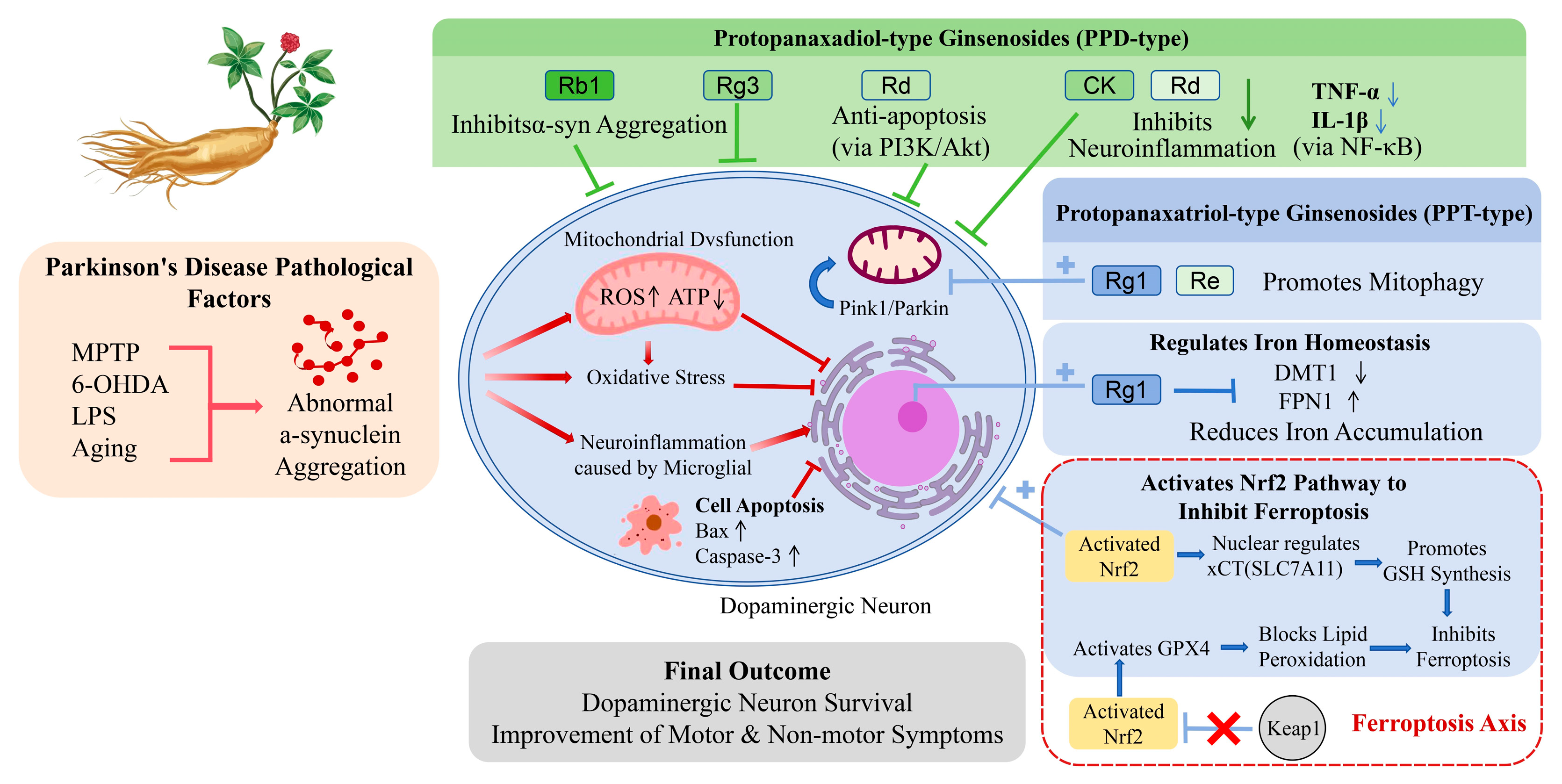
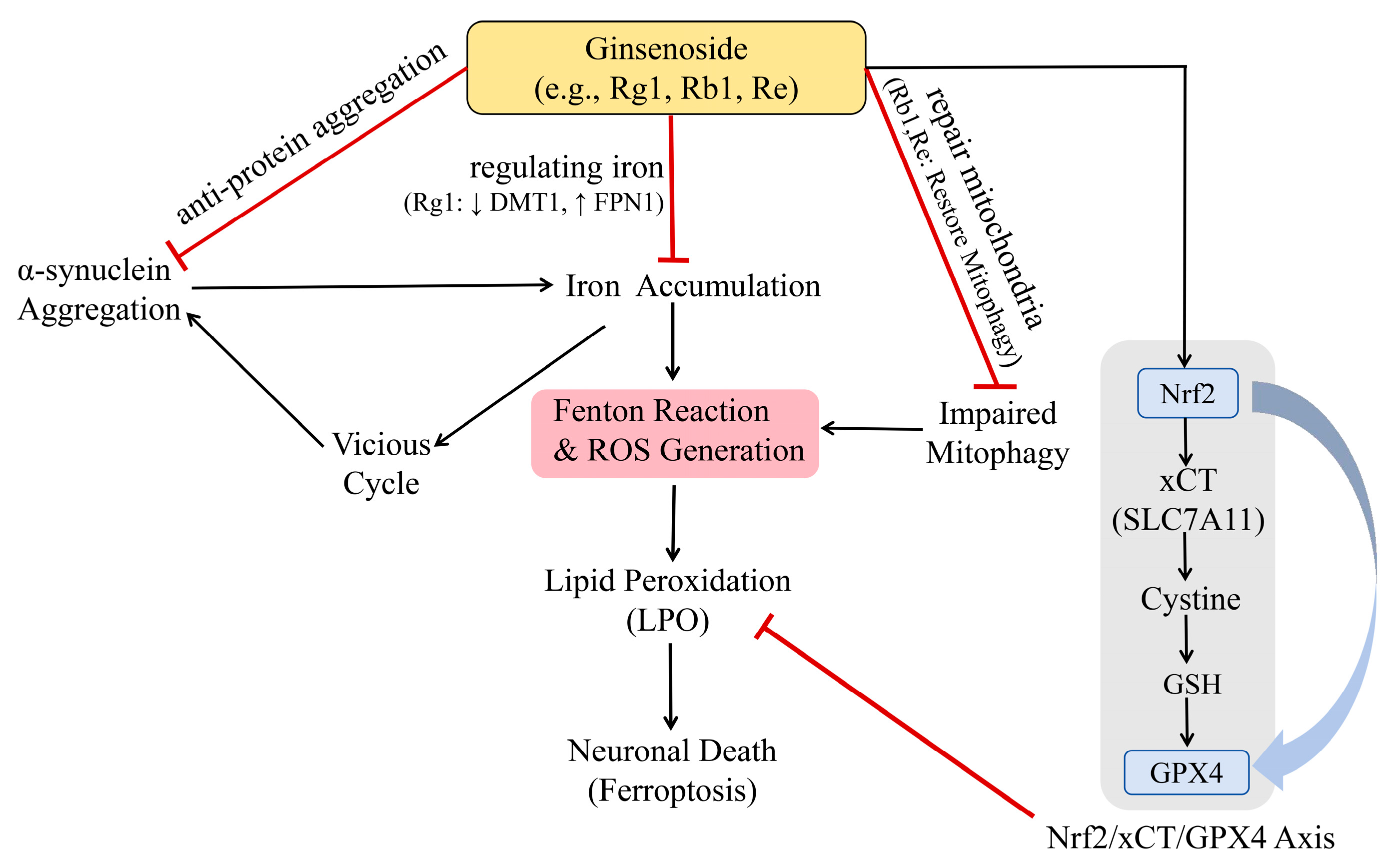
Research Progress on the Mechanism of Ginsenosides in the Treatment of Parkinson’s Disease

Abstract
1. Introduction
2. Pathogenic Mechanisms of Parkinson’s Disease
2.1. Misfolding and Aggregation of α-Synuclein
2.2. Oxidative Stress and Dysregulation of Metal Ion Metabolism
2.3. Mitophagy
2.4. Neuroinflammation and Immune Response
2.5. Lipid Metabolism Regulation
2.6. Gut Microbiota
3. Multi-Target Neuroprotective Mechanisms of Different Types of Ginsenosides in PD
3.1. Protopanaxadiol Type Ginsenosides
3.1.1. Ginsenoside Rb1
3.1.2. Ginsenoside Rg3
3.1.3. Ginsenoside CK and Ginsenoside Rd
3.2. Protopanaxatriol Type Ginsenosides
3.2.1. Ginsenoside Rg1
3.2.2. Ginsenoside Re
3.3. Comparative Efficacy and Evidence Strength of PPD- and PPT-Type Ginsenosides
4. Ferroptosis as a Central Therapeutic Target and the Integrated Multi-Target Network of Ginsenosides
4.1. Disrupting the “Iron-Oxidative Stress” Vicious Cycle
4.2. Inhibition of Lipid Peroxidation and Core Ferroptosis Pathways
4.2.1. Activation of the Nrf2/xCT/GPX4 Signaling Axis
4.2.2. Advantages and Prospects of Multi-Target Combination Intervention
5. Clinical Translation, Safety, and Therapeutic Challenges
5.1. Pharmacokinetics and BBB Penetration
5.2. Clinical Trials and Toxicity
5.3. Drug Interactions with Levodopa
6. Conclusions and Future Directions: Combination and Multi-Target Therapies
Author Contributions
Funding
Data Availability Statement
Conflicts of Interest
References
- Dai, Y.J.; Zhang, A.B.; Li, C.D.; Wang, E.F. Preliminary study on neuroprotective effect of Ginsenoside Rb1 on MPTP-induced Parkinson’s disease model mice. J. Baotou Med. Coll. 2023, 39, 15–19+97. [Google Scholar]
- Liu, D.D.; Yue, Y.; Liu, H. Serum vitamin D levels and findings of a study of movement Parkinson’s patients symptoms. J. Med. Forum 2025, 46, 2510–2515. [Google Scholar]
- Xiao, B.; Zhou, Z.; Chao, B.; Tan, E.K. Pathogenesis of Parkinson’s Disease. Neurol. Clin. 2025, 43, 185–207. [Google Scholar] [CrossRef]
- Ding, X.S.; Gao, L.; Han, Z.; Eleuteri, S.; Shi, W.; Shen, Y.; Song, Z.Y.; Su, M.; Yang, Q.; Qu, Y.; et al. Ferroptosis in Parkinson’s disease: Molecular mechanisms and therapeutic potential. Ageing Res. Rev. 2023, 91, 102077. [Google Scholar] [CrossRef]
- Hirayama, M.; Ohno, K. Parkinson’s Disease and Gut Microbiota. Ann. Nutr. Metab. 2021, 77, 28–35. [Google Scholar] [CrossRef] [PubMed]
- Hely, M.A.; Morris, J.G.; Reid, W.G.; Trafficante, R. Sydney Multicenter Study of Parkinson’s disease: Non-L-dopa-responsive problems dominate at 15 years. Mov. Disord. 2005, 20, 190–199. [Google Scholar] [CrossRef]
- Qin, B.W.; Miao, Y.D. Research Progress in the Treatment of Parkinson’s Disease with Traditional Chinese Medicine. J. Nurs. Pract. Res. 2012, 9, 123–125. [Google Scholar]
- Zhang, X.R.; Zhang, J.; Zheng, C.L.; Hou, Y.Y.; Liu, Z.M.; Jia, N.; Cao, Y. Research Progress on the Mechanisms of Ligusticum chuanxiong and its Compound Prescriptions in the Treatment of Parkinson’s Disease. J. Liaoning Univ. Tradit. Chin. Med. 2025. Available online: https://link.cnki.net/urlid/21.1543.R.20251119.1751.022 (accessed on 12 May 2026).
- Cheng, J.J.; Xue, C.M.; Ouyang, J.F.; Wang, Z.G. Exploring the Etiology, Pathogenesis, and Treatment of Parkinson’s Disease Based on the Theory of “Consolidating the Foundation and Cultivating the Source”. Acta Chin. Med. 2025, 40, 1455–1459. [Google Scholar]
- Pan, H.Z. Progress in treatment of motor complications of Parkinson’s disease with traditional Chinese and western medicine. Chin. Compend. Typ. Cases 2025, 19, 686–689. [Google Scholar]
- Wen, X.X. Treating 68 cases of tremble of Qixue Kuixu type with the Renshen Yangrong decoction. Clin. J. Chin. Med. 2013, 5, 67+69. [Google Scholar]
- Dong, Y.Y. Treatment of 28 Cases of Parkinson’s Disease with Integrated Traditional Chinese and Western Medicine. Zhejiang J. Tradit. Chin. Med. 2018, 53, 525. [Google Scholar]
- Wang, F.M.; Zhou, L.Q.; Liu, J.H.; Liu, N.H. Research progress of ginsenosides in the treatment of Alzheimer’s disease. J. Gannan Med. Univ. 2025, 45, 25–29. [Google Scholar]
- Zhao, W.X. Protective Effect of Ginsenosides on Parkinson’s Disease In Vitro and Its Mechanism. Master’s Thesis, Changchun University of Chinese Medicine, Changchun, China, 2020. [Google Scholar]
- Zhou, F. Advances in the molecular mechanisms of α-synuclein oligomer-mediated neuron-glial cell interactions in Parkinson’s disease neurodegeneration. J. Neurol. Neurorehabilit. 2025, 22, 12–20. [Google Scholar]
- Yang, J.J. Mechanism of Nicotine Regulation of Cholesterol Metabolism Disorder in 6-OHDA-Induced Parkinson’s Disease Models via α-nAChR; Zhengzhou Tobacco Research Institute of CNTC: Zhengzhou, China, 2025. [Google Scholar]
- Xu, Z.P.; Huo, S.D. Research Progress on the Mechanism of Cistanche Glycosides in the Prevention and Treatment of Parkinson’s Disease. J. Integr. Traditiomal Chin. West. Med. Chronic Dis. 2025, 2, 86–91. [Google Scholar]
- Sian-Hulsmann, J.; Riederer, P. The Nigral Coup in Parkinson’s Disease by α-Synuclein and Its Associated Rebels. Cells 2021, 10, 598. [Google Scholar] [CrossRef] [PubMed]
- Henderson, M.X.; Trojanowski, J.Q.; Lee, V.M. α-Synuclein pathology in Parkinson’s disease and related α-synucleinopathies. Neurosci. Lett. 2019, 709, 134316. [Google Scholar] [CrossRef]
- Zhang, H.Y.; Shao, Y. Research Progress on the Multidimensional Pathogenesis of Parkinson’s Disease. J. Pract. Tradit. Chin. Intern. Med. 2026, 40, 120–124. [Google Scholar]
- Liu, L.L.; Zhang, R.J.; Li, L.L.; Chai, X.X.; Bao, B. Role and mechanism of NRF2 signaling pathway in Parkinson’s disease. Hebei Med. J. 2025, 47, 2065–2069+2075. [Google Scholar]
- Guo, J.D.; Zhao, X.; Li, Y.; Li, G.R.; Liu, X.L. Damage to dopaminergic neurons by oxidative stress in Parkinson’s disease (Review). Int. J. Mol. Med. 2018, 41, 1817–1825. [Google Scholar] [CrossRef] [PubMed]
- Afzal, S.; Abdul Manap, A.S.; Attiq, A.; Albokhadaim, I.; Kandeel, M.; Alhojaily, S.M. From imbalance to impairment: The central role of reactive oxygen species in oxidative stress-induced disorders and therapeutic exploration. Front. Pharmacol. 2023, 14, 1269581. [Google Scholar] [CrossRef] [PubMed]
- Pfeifer, G.P. DNA Damage and Parkinson’s Disease. Int. J. Mol. Sci. 2024, 25, 4187. [Google Scholar] [CrossRef]
- Zhang, N.; Dou, D.Q. Advances in the Molecular Pathogenesis of Parkinson’s Disease. Acta Neuropharmacol. 2013, 3, 35–42. [Google Scholar]
- Cui, Z.; Zhao, X.; Amevor, F.K.; Du, X.; Wang, Y.; Li, D.; Shu, G.; Tian, Y.; Zhao, X. Therapeutic application of quercetin in aging-related diseases: SIRT1 as a potential mechanism. Front. Immunol. 2022, 13, 943321. [Google Scholar] [CrossRef]
- Ma, L.; Azad, M.G.; Dharmasivam, M.; Richardson, V.; Quinn, R.J.; Feng, Y.; Pountney, D.L.; Tonissen, K.F.; Mellick, G.D.; Yanatori, I.; et al. Parkinson’s disease: Alterations in iron and redox biology as a key to unlock therapeutic strategies. Redox Biol. 2021, 41, 101896. [Google Scholar] [CrossRef]
- Wise, R.M.; Wagener, A.; Fietzek, U.M.; Klopstock, T.; Mosharov, E.V.; Zucca, F.A.; Sulzer, D.; Zecca, L.; Burbulla, L.F. Interactions of dopamine, iron, and alpha-synuclein linked to dopaminergic neuron vulnerability in Parkinson’s disease and Neurodegeneration with Brain Iron Accumulation disorders. Neurobiol. Dis. 2022, 175, 105920. [Google Scholar] [CrossRef]
- An, Y.; Li, S.; Huang, X.; Chen, X.; Shan, H.; Zhang, M. The Role of Copper Homeostasis in Brain Disease. Int. J. Mol. Sci. 2022, 23, 13850. [Google Scholar] [CrossRef]
- Moskal, N.; Riccio, V.; Bashkurov, M.; Taddese, R.; Datti, A.; Lewis, P.N.; Angus McQuibban, G. ROCK inhibitors upregulate the neuroprotective Parkin-mediated mitophagy pathway. Nat. Commun. 2020, 11, 88. [Google Scholar] [CrossRef]
- Liang, J.Q.; LÜ, Z.W.; He, J.C. Research progress on the regulation of mitochondrial dysfunction by traditional Chinese medicine in the intervention of Parkinson’s disease. Chin. J. Clin. Pharmacol. 2025, 41, 2526–2533. [Google Scholar]
- Yu, L.; Nan, S.H.; Shi, Z.J.; He, Q.Q.; Li, Z.J.; Cui, Y.L. Mechanisms underlying mitophagy, ferroptosis, cuproptosis, and disulfidptosis in Parkinson’s disease. Chin. J. Tissue Eng. Res. 2026, 30, 4446–4456. [Google Scholar]
- Li, M.Z.; Chen, J.F.; Chen, M.X.; Li, H.Y.; Zhang, Z.Y.; Gao, D.; Zeng, W.C.; Zhao, L.J.; Zhu, M.L. Effects of electroacupuncture on cognitive impairment and mitophagy mediated by KIF5A/Miro1 pathway in Parkinson’s disease mice. Chin. Acupunct. Moxibustion 2025, 45, 1111–1119. [Google Scholar]
- Bottigliengo, D.; Foco, L.; Seibler, P.; Klein, C.; König, I.R.; Del Greco, M.F. A Mendelian randomization study investigating the causal role of inflammation on Parkinson’s disease. Brain 2022, 145, 3444–3453. [Google Scholar] [CrossRef]
- Muñoz-Delgado, L.; Labrador-Espinosa, M.Á.; Macías-García, D.; Jesús, S.; Benítez Zamora, B.; Fernández-Rodríguez, P.; Adarmes-Gómez, A.D.; Reina Castillo, M.I.; Castro-Labrador, S.; Silva-Rodríguez, J.; et al. Peripheral Inflammation Is Associated with Dopaminergic Degeneration in Parkinson’s Disease. Mov. Disord. 2023, 38, 755–763. [Google Scholar]
- Tansey, M.G.; Wallings, R.L.; Houser, M.C.; Herrick, M.K.; Keating, C.E.; Joers, V. Inflammation and immune dysfunction in Parkinson disease. Nat. Rev. Immunol. 2022, 22, 657–673. [Google Scholar] [CrossRef]
- Geng, Y.; Wang, R.Y.; Zhu, Z.; Shen, Y.; Zhang, K.Z. Invasive Vagus Nerve Stimulation Activates Microglia α7nAChR to Reduce Striatal Neuroinflammation in Mouse Model of Parkinson’s Disease and Its Mechanism. Rehabil. Med. 2025, 35, 275–283. [Google Scholar]
- Machaalani, R.; Chen, H. Brain derived neurotrophic factor (BDNF), its tyrosine kinase receptor B (TrkB) and nicotine. Neurotoxicology 2018, 65, 186–195. [Google Scholar] [CrossRef]
- Girard, V.; Jollivet, F.; Knittelfelder, O.; Celle, M.; Arsac, J.N.; Chatelain, G.; Van den Brink, D.M.; Baron, T.; Shevchenko, A.; Kühnlein, R.P.; et al. Abnormal accumulation of lipid droplets in neurons induces the conversion of alpha-Synuclein to proteolytic resistant forms in a Drosophila model of Parkinson’s disease. PLoS Genet. 2021, 17, e1009921. [Google Scholar] [CrossRef] [PubMed]
- Zhang, K.; Zhu, S.; Li, J.; Jiang, T.; Feng, L.; Pei, J.; Wang, G.; Ouyang, L.; Liu, B. Targeting autophagy using small-molecule compounds to improve potential therapy of Parkinson’s disease. Acta Pharm. Sin. B 2021, 11, 3015–3034. [Google Scholar] [CrossRef] [PubMed]
- Wang, Z.L.; Yuan, L.; Li, W.; Li, J.Y. Ferroptosis in Parkinson’s disease: Glia-neuron crosstalk. Trends Mol. Med. 2022, 28, 258–269. [Google Scholar] [CrossRef]
- Lu, M.X. Manganese Overexposure Induces Parkinson-like Symptoms and Its Association with Lipid Metabolic Disturbance in the Midbrain of Mouse. Ph.D. Thesis, Guangxi University, Nanning, China, 2023. [Google Scholar]
- Minato, T.; Maeda, T.; Fujisawa, Y.; Tsuji, H.; Nomoto, K.; Ohno, K.; Hirayama, M. Progression of Parkinson’s disease is associated with gut dysbiosis: Two-year follow-up study. PLoS ONE 2017, 12, e0187307. [Google Scholar] [CrossRef]
- Wallen, Z.D.; Appah, M.; Dean, M.N.; Sesler, C.L.; Factor, S.A.; Molho, E.; Zabetian, C.P.; Standaert, D.G.; Payami, H. Characterizing dysbiosis of gut microbiome in PD: Evidence for overabundance of opportunistic pathogens. npj Park. Dis. 2020, 6, 11. [Google Scholar] [CrossRef]
- Rob, M.; Yousef, M.; Lakshmanan, A.P.; Mahboob, A.; Terranegra, A.; Chaari, A. Microbial signatures and therapeutic strategies in neurodegenerative diseases. Biomed. Pharmacother. 2025, 184, 117905. [Google Scholar] [CrossRef]
- Zhao, Z.; Ning, J.; Bao, X.Q.; Shang, M.; Ma, J.; Li, G.; Zhang, D. Fecal microbiota transplantation protects rotenone-induced Parkinson’s disease mice via suppressing inflammation mediated by the lipopolysaccharide-TLR4 signaling pathway through the microbiota-gut-brain axis. Microbiome 2021, 9, 226. [Google Scholar] [CrossRef]
- Wang, Q.; Wei, L.; Chen, G.; Chen, Q. Ginsenoside Rg1 in Parkinson’s disease: From basic research to clinical applications. Front. Pharmacol. 2025, 16, 1490480. [Google Scholar] [CrossRef] [PubMed]
- González-Burgos, E.; Fernandez-Moriano, C.; Gómez-Serranillos, M.P. Potential neuroprotective activity of Ginseng in Parkinson’s disease: A review. J. Neuroimmune Pharmacol. 2015, 10, 14–29. [Google Scholar] [CrossRef]
- Hwang, Y.P.; Jeong, H.G. Ginsenoside Rb1 protects against 6-hydroxydopamine-induced oxidative stress by increasing heme oxygenase-1 expression through an estrogen receptor-related PI3K/Akt/Nrf2-dependent pathway in human dopaminergic cells. Toxicol. Appl. Pharmacol. 2010, 242, 18–28. [Google Scholar] [CrossRef] [PubMed]
- Qiao, J.; Zhao, Y.; Liu, Y.; Zhang, S.; Zhao, W.; Liu, S.; Liu, M. Neuroprotective effect of Ginsenoside Re against neurotoxin-induced Parkinson’s disease models via induction of Nrf2. Mol. Med. Rep. 2022, 25, 215. [Google Scholar] [CrossRef] [PubMed]
- Zhang, H.; Chen, X.; Wang, X.; Liu, Y.; Sands, C.D.; Tang, M. Ginsenoside Rb1 attenuates lipopolysaccharide-induced neural damage in the brain of mice via regulating the dysfunction of microglia and astrocytes. J. Integr. Neurosci. 2021, 20, 813–823. [Google Scholar] [CrossRef]
- Heng, Y.; Zhang, Q.S.; Mu, Z.; Hu, J.F.; Yuan, Y.H.; Chen, N.H. Ginsenoside Rg1 attenuates motor impairment and neuroinflammation in the MPTP-probenecid-induced parkinsonism mouse model by targeting α-synuclein abnormalities in the substantia nigra. Toxicol. Lett. 2016, 243, 7–21. [Google Scholar] [CrossRef]
- Chen, X.C.; Chen, Y.; Zhu, Y.G.; Fang, F.; Chen, L.M. Protective effect of ginsenoside Rg1 against MPTP-induced apoptosis in mouse substantia nigra neurons. Acta Pharmacol. Sin. 2002, 23, 829–834. [Google Scholar]
- Wang, J.; Xu, H.M.; Yang, H.D.; Du, X.X.; Jiang, H.; Xie, J.X. Rg1 reduces nigral iron levels of MPTP-treated C57BL6 mice by regulating certain iron transport proteins. Neurochem. Int. 2009, 54, 43–48. [Google Scholar] [CrossRef] [PubMed]
- Ardah, M.T.; Paleologou, K.E.; Lv, G.; Menon, S.A.; Abul Khair, S.B.; Lu, J.H.; Safieh-Garabedian, B.; Al-Hayani, A.A.; Eliezer, D.; Li, M.; et al. Ginsenoside Rb1 inhibits fibrillation and toxicity of alpha-synuclein and disaggregates preformed fibrils. Neurobiol. Dis. 2015, 74, 89–101. [Google Scholar] [CrossRef]
- Li, D.W. Experimental Study of the Neuroprotective Effect of Ginsenoside Rb1 on Dopaminergic Neurons by Inhibiting Microglial Inflammation. Ph.D. Thesis, Shandong University, Jinan, China, 2021. [Google Scholar]
- Jiang, M.C.; Sun, L.X.; Li, D.W.; Sun, X.C. Ginsenoside Rb1 antagonizes LPS-induced nigrostriatal dopamine neuron damage via RIP1/RIP3/MLKL-mediated necroptosis pathway. Mod. J. Integr. Tradit. Chin. West. Med. 2024, 33, 2191–2200. [Google Scholar]
- Zhu, H.B.; Dai, Y.J.; Zhao, J.; Huo, D.S. The mechanism of ginsenoside Rb1 in the treatment of Parkinson’s disease based on network pharmacology. J. Baotou Med. Coll. 2024, 40, 7–13. [Google Scholar]
- Zhou, T.; Zu, G.; Zhang, X.; Wang, X.; Li, S.; Gong, X.; Liang, Z.; Zhao, J. Neuroprotective effects of ginsenoside Rg1 through the Wnt/β-catenin signaling pathway in both in vivo and in vitro models of Parkinson’s disease. Neuropharmacology 2016, 101, 480–489, Erratum in Neuropharmacology 2025, 265, 110260. [Google Scholar] [CrossRef]
- Yang, Q.; Wang, C. The Mechanism of Action of Ginsenoside Rg3 for the Relief from Oxidative Stress Injury in the Nervous System of Mice with Parkinson′s Disease. West. J. Tradit. Chin. Med. 2024, 37, 25–29. [Google Scholar]
- Han, Y.J. Protective Effect of Ginsenoside Rg3 on the Neurological Function in Rotenone-Induced Parkinson’s Disease Mice. Master’s Thesis, Yantai University, Yantai, China, 2021. [Google Scholar]
- Liu, J.Q.; Zhao, M.; Zhang, Z.; Cui, L.Y.; Zhou, X.; Zhang, W.; Chu, S.F.; Zhang, D.Y.; Chen, N.H. Rg1 improves LPS-induced Parkinsonian symptoms in mice via inhibition of NF-κB signaling and modulation of M1/M2 polarization. Acta Pharmacol. Sin. 2020, 41, 523–534. [Google Scholar] [CrossRef] [PubMed]
- Wang, Y.S.; Li, H.; Zhang, Y.X.; Wei, S.P.; Zhang, Z.F.; Tian, Q.Y. Influence of Ginsenoside Rg1 on p-c-Jun and COX-2 expression in substantia nigra of the MPTP mouse model of subacute Parkinson’s disease. Chin. J. Neuroanat. 2009, 25, 432–436. [Google Scholar]
- Fu, W.; Zhuang, W.; Zhou, S.; Wang, X. Plant-derived neuroprotective agents in Parkinson’s disease. Am. J. Transl. Res. 2015, 7, 1189–1202. [Google Scholar]
- Xu, H.; Jiang, H.; Wang, J.; Xie, J. Rg1 protects the MPP+-treated MES23.5 cells via attenuating DMT1 up-regulation and cellular iron uptake. Neuropharmacology 2010, 58, 488–494. [Google Scholar] [CrossRef] [PubMed]
- Xu, H.M. The Role of Over-Expressed DMT1 in Iron Accumulation in MES23.5 Cells and the Mechanism of the Protective Effect of Ginsenoside Rg1. Ph.D. Thesis, Qingdao University, Qinhuangdao, China, 2008. [Google Scholar]
- Yang, H.D.; Lin, B.L. The role of ginsenoside Rg1 in antagonism of MPTP-induced iron accumulation in substantia nigra of mice. J. Shanxi Med. Univ. 2011, 42, 10–14. [Google Scholar]
- Zhao, W.X.; Xu, Y.; Liu, D.G.; Meng, X.; Zhu, J.G.; Yao, R.; Yao, J.C.; Zhang, G.M. Protective mechanism of ginsenoside Re on rotenone-induced SH-SY5Y cell model of Parkinson’s disease. Chin. Tradit. Herbal. Drugs 2023, 54, 3548–3558. [Google Scholar]
- Chalorak, P.; Sanguanphun, T.; Limboonreung, T.; Meemon, K. Neurorescue Effects of Frondoside A and Ginsenoside Rg3 in C. elegans Model of Parkinson’s Disease. Molecules 2021, 26, 4843. [Google Scholar] [CrossRef]
- Yang, X.; Zhao, Y.; Liang, L.; Qu, Y.; Yu, C.; Zhang, J.; Lian, W.; Zhao, Y. Protective effect of ginsenoside CK against MPTP-induced Parkinson’ s disease mouse model by suppressing oxidative stress and inflammation, and modulating the gut microbiota. Microb. Pathog. 2025, 202, 107409. [Google Scholar] [CrossRef] [PubMed]
- Liu, Y.; Zhang, R.Y.; Zhao, J.; Dong, Z.; Feng, D.Y.; Wu, R.; Shi, M.; Zhao, G. Ginsenoside Rd Protects SH-SY5Y Cells against 1-Methyl-4-phenylpyridinium Induced Injury. Int. J. Mol. Sci. 2015, 16, 14395–14408. [Google Scholar] [CrossRef]
- Zhang, X.; Wang, Y.; Ma, C.; Yan, Y.; Yang, Y.; Wang, X.; Rausch, W.D. Ginsenoside Rd and ginsenoside Re offer neuroprotection in a novel model of Parkinson’s disease. Am. J. Neurodegener. Dis. 2016, 5, 52–61. [Google Scholar]
- Zhou, T.T.; Zu, G.; Wang, X.; Zhang, X.G.; Li, S.; Liang, Z.H.; Zhao, J. Immunomodulatory and neuroprotective effects of ginsenoside Rg1 in the MPTP(1-methyl-4-phenyl-1,2,3,6-tetrahydropyridine)—induced mouse model of Parkinson’s disease. Int. Immunopharmacol. 2015, 29, 334–343. [Google Scholar] [CrossRef]
- Li, Y.H. Exploring the Role and Mechanism of Rg1 in Ameliorating MPTP-Induced Parkinson’s Disease-like Changes Based on Endoplasmic Reticulum Homeostasis. Master’s Thesis, Qingdao University, Qingdao, China, 2024. [Google Scholar]
- Gao, Q.G.; Chen, W.F.; Xie, J.X.; Wong, M.S. Ginsenoside Rg1 protects against 6-OHDA-induced neurotoxicity in neuroblastoma SK-N-SH cells via IGF-I receptor and estrogen receptor pathways. J. Neurochem. 2009, 109, 1338–1347. [Google Scholar] [CrossRef]
- Li, D. Neuroprotective and Therapeutic Effects of Ginsenoside Rg1 on Parkinson’s Disease Rats and Its Mechanism. Master’s Thesis, North China University of Science and Technology, Tangshan, China, 2020. [Google Scholar]
- Qiao, J.H. Study on the Improvement Mechanism of Ginsenosides on Aging and Parkinson’s Disease. Ph.D. Thesis, Changchun University of Chinese Medicine, Changchun, China, 2024. [Google Scholar]
- Zhao, G.J. Study on Improvement and Metabolomics of Ginsenoside Re in Mouse Model of Parkinson’s. Master’s Thesis, Changchun University of Chinese Medicine, Changchun, China, 2024. [Google Scholar]
- Xu, Y.; Meng, X.; Zhao, W.X.; Liu, D.G.; Zhu, J.G.; Yao, R.; Yao, J.C.; Zhang, G.M. Neuroprotective effect of ginsenoside Re on drosophila model of Parkinson′s disease. China J. Chin. Mater. Medica 2023, 48, 1927–1935. [Google Scholar]
- Li, X.F.; Lui, C.N.; Jiang, Z.H.; Ken, Y.K. Neuroprotective effects of ginsenosides Rh1 and Rg2 on neuronal cells. Chin. Med. 2011, 6, 19. [Google Scholar] [CrossRef]
- González-Burgos, E.; Fernández-Moriano, C.; Lozan, R.; Iglesias, I.; Gómez-Serranillos, M.P. Ginsenosides Rd and Re co-treatments improve rotenone-induced oxidative stress and mitochondrial impairment in SH-SY5Y neuroblastoma cells. Food Chem. Toxicol. 2017, 109, 38–47. [Google Scholar] [CrossRef]
- Liu, Y.L.; Zhang, C.C.; Gao, Y.; Wuri, G.M.L.; Wang, Y.K.; Tu, Y. Explore the mechanism of ginsenoside Re on ferroptosis in myocardial fibrosis of heart failure rats based on Nrf2/xCT/GPX4 pathway. China Med. Herald. 2025, 22, 19–25. [Google Scholar]
- Hu, K.C.; Gao, Y.; He, J.Q.; Chu, S.F.; Zhang, Z.; Chen, N.H. Ginsenoside Rg1 inhibits neuronal ferroptosis caused by ischemic stroke through activating of Nrf2/xCT/GPX4 axis. Chin. Pharmacol. Bull. 2023, 39, 1905–1913. [Google Scholar]
- Shen, J.; Zhao, Z.; Shang, W.; Liu, C.; Zhang, B.; Zhao, L.; Cai, H. Ginsenoside Rg1 nanoparticle penetrating the blood-brain barrier to improve the cerebral function of diabetic rats complicated with cerebral infarction. Int. J. Nanomed. 2017, 12, 6477–6486. [Google Scholar] [CrossRef]
- Kim, K.H.; Lee, D.; Lee, H.L.; Kim, C.E.; Jung, K.; Kang, K.S. Beneficial effects of Panax ginseng for the treatment and prevention of neurodegenerative diseases: Past findings and future directions. J. Ginseng Res. 2018, 42, 239–247. [Google Scholar] [CrossRef]
- Xu, N.; Xing, S.; Li, J.; Pang, B.; Liu, M.; Fan, M.; Zhao, Y. Water extract of ginseng alleviates parkinsonism in MPTP-induced Parkinson’s disease mice. PLoS ONE 2024, 19, e0296424. [Google Scholar] [CrossRef]
- Park, J.D. Metabolism and drug interactions of Korean ginseng based on the pharmacokinetic properties of ginsenosides: Current status and future perspectives. J. Ginseng Res. 2024, 48, 253–265. [Google Scholar] [CrossRef]



| Ginsenoside | Mechanism (Shared Pathways) | Model | Key Findings | Evidence Level | References |
|---|---|---|---|---|---|
| Rb1 | Anti-protein aggregation | Recombinant α-syn protein | Inhibits α-synuclein fibrillation/aggregation and disaggregates preformed fibrils. | In vitro | [55] |
| Rb1 | Anti-neuroinflammation (NF-κB pathway) | LPS-induced rats; BV2 cells | Suppresses glial inflammatory response by inhibiting pro-inflammatory mediators via NF-κB. | In vivo & In vitro | [56] |
| Rb1 | Antioxidant stress (PI3K/Akt-Nrf2) | 6-OHDA-induced SH-SY5Y cells | Induces HO-1 through the Gβ1/PI3K/Akt-Nrf2 signaling pathway to protect cells. | In vitro | [49] |
| Rg3 | Antioxidant stress (Nrf2/HO-1) | MPTP-induced mice; Rotenone-induced mice | Activates Nrf2/HO-1/NQO1 pathway; increases GCLC/GCLM; significantly reduces ROS in the substantia nigra. | In vivo | [60,61] |
| Rg1 | Anti-neuroinflammation (NF-κB & COX-2) | MPTP/LPS-induced mice | Inhibits microglial activation, reduces TNF-α, IL-1β, IL-6; inhibits NF-κB nuclear translocation and p-c-Jun/COX-2. | In vivo | [62,63,64] |
| Rg1 | Iron metabolism & Ferroptosis (DMT1/FPN1) | MPTP-induced mice; MPP+-induced MES23.5 cells | Downregulates iron importer DMT1 and upregulates exporter FPN1; alleviates iron-dependent oxidative stress. | In vivo & In vitro | [54,65,66,67] |
| Re | Mitophagy & Antioxidant (Parkin/Pink-1, Nrf2) | Rotenone-induced Drosophila/SH-SY5Y cells | Activates Parkin/Pink-1 to clear damaged mitochondria; activates Nrf2 to attenuate oxidative stress. | In vivo & In vitro | [50,68] |
Disclaimer/Publisher’s Note: The statements, opinions and data contained in all publications are solely those of the individual author(s) and contributor(s) and not of MDPI and/or the editor(s). MDPI and/or the editor(s) disclaim responsibility for any injury to people or property resulting from any ideas, methods, instructions or products referred to in the content. |
© 2026 by the authors. Licensee MDPI, Basel, Switzerland. This article is an open access article distributed under the terms and conditions of the Creative Commons Attribution (CC BY) license.
Share and Cite
Wang, S.; Chen, Z.; Tang, H.; Gong, J.; Xu, K.; Wang, K. Research Progress on the Mechanism of Ginsenosides in the Treatment of Parkinson’s Disease. Int. J. Mol. Sci. 2026, 27, 4544. https://doi.org/10.3390/ijms27104544
Wang S, Chen Z, Tang H, Gong J, Xu K, Wang K. Research Progress on the Mechanism of Ginsenosides in the Treatment of Parkinson’s Disease. International Journal of Molecular Sciences. 2026; 27(10):4544. https://doi.org/10.3390/ijms27104544
Chicago/Turabian StyleWang, Shanshan, Zhi Chen, Haipeng Tang, Jiyu Gong, Kejin Xu, and Kangyu Wang. 2026. "Research Progress on the Mechanism of Ginsenosides in the Treatment of Parkinson’s Disease" International Journal of Molecular Sciences 27, no. 10: 4544. https://doi.org/10.3390/ijms27104544
APA StyleWang, S., Chen, Z., Tang, H., Gong, J., Xu, K., & Wang, K. (2026). Research Progress on the Mechanism of Ginsenosides in the Treatment of Parkinson’s Disease. International Journal of Molecular Sciences, 27(10), 4544. https://doi.org/10.3390/ijms27104544