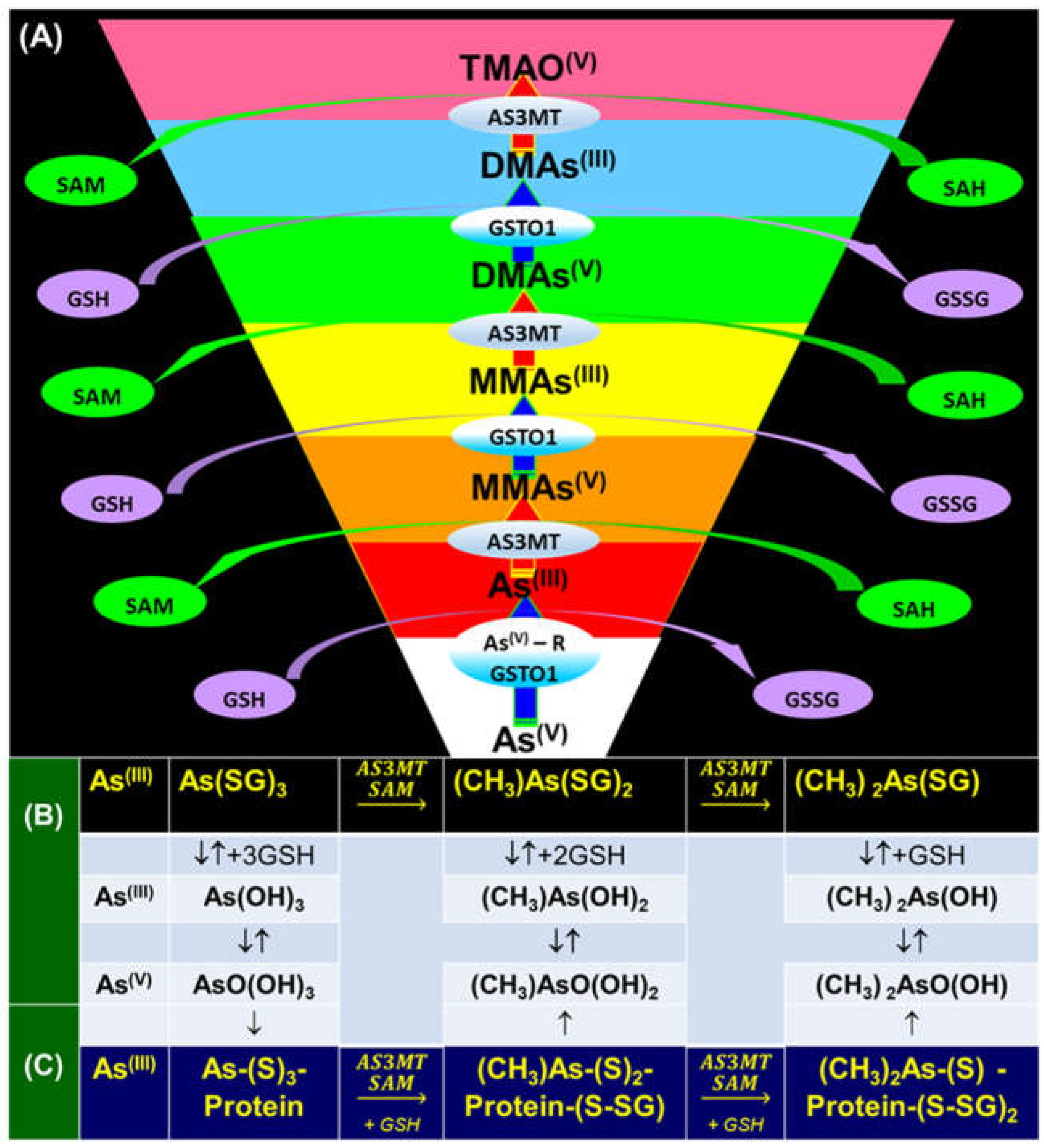
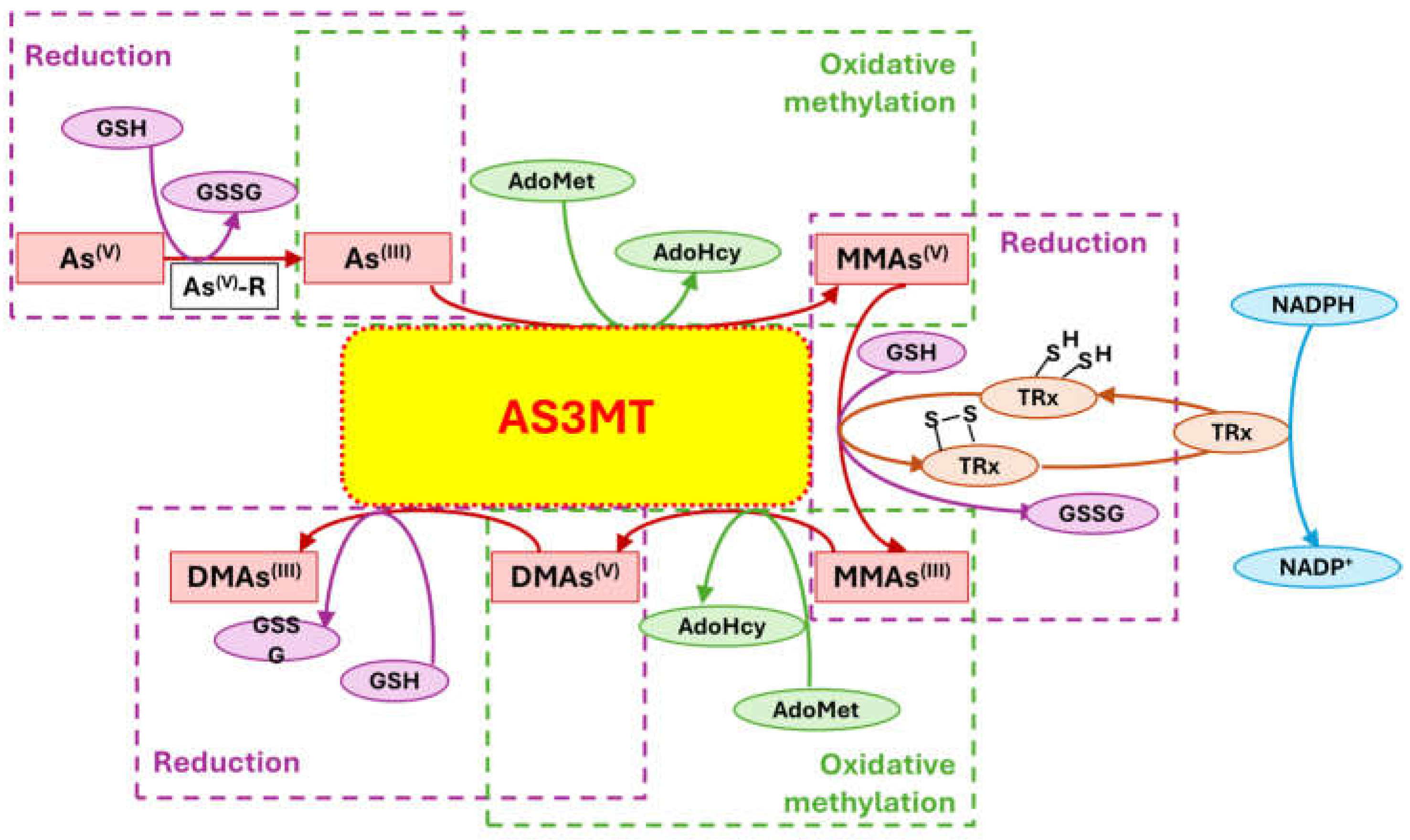
Arsenome, Arsenobolome, and Arsenobiolome


Abstract
1. Introduction
2. The Biological Significance of Arsenic Species
2.1. Arsenome: Speciation of Arsenic Compounds
2.2. Arsenobolome: Primary Metabolites of Ingested Arsenic-Containing Compounds
2.3. Arsenobiolome: Arsenic Species with Specific Beneficial or Harmful Activity
2.3.1. General Toxicological Effects of Arsenic Species
Signal Transduction
Chronic Effects (Chronic Exposure) of Arsenic Species to Humans
Genotoxicity and Oxidative DNA Damage
2.4. Beneficial Effects of Inorganic Arsenic
3. Diagnosis and Possible Treatment
3.1. Diagnosis
- The arsenic level in the blood measures the dose ingested but does not provide evidence of chronic intoxication.
- The arsenic level in urine is a reliable marker of internal dose, and correlates well with chronic effects from iAs in drinking water, although it requires detailed speciation analysis.
- Arsenic level in hair and nails reflects long-term exposure.
- The As content in urine correlates with urinary and blood porphyrin levels.
- Genotoxic effects, including increased DNA damage, sister chromatid exchange, micronuclei, or chromosomal aberrations, support the DNA OD of peripheral blood polymorphonuclear leukocytes and
- MN assays are the techniques of choice for assessing the adverse health effects of low levels of iAs as essential biomarkers.
3.2. Possible Treatment
4. Conclusions and Looking Forward
Author Contributions
Funding
Institutional Review Board Statement
Informed Consent Statement
Data Availability Statement
Conflicts of Interest
Appendix A

| Chemical Species | Abbreviation | Chemical Formula |
|---|---|---|
| Monomethyldithioarsonic acid | MMDTA(V) | CH3AsS(SH)(OH) |
| Arsine | − | AsH3 |
| Trimethylarsine oxide | TMAO(V) | (CH3)3AsO |
| Arsenic triglutathione | ATG(III) | As(SG)3 |
| Monomethylarsino-diglutathione | MMADG(III) | CH3As(SG)2 |
| Dimethylarsino-glutathione | DMAG(III) | (CH3)2As(SG) |
| Dimethylarsenic radical | − | (CH3)2As• |
| Dimethylarsenic peroxyl radical | − | (CH3)2AsOO• |
| Reduced glutathione | GSH |  |
| Oxidised glutathione | GSSG |  |
| S-adenosylmethionine | SAM | 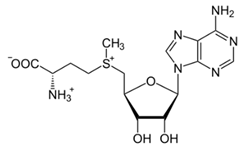 |
| S-adenosyl-L-homocysteine | SAH | 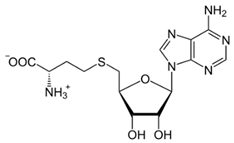 |
| Lipoic acid |  |
References
- Emsley, J. The Elements, 3rd ed.; Clarendon Press: Oxford, UK, 1998. [Google Scholar]
- Feng, Z.; Xia, Y.; Tian, D.; Wu, K.; Schmitt, M.; Kwok, R.K.; Mumford, J.L. DNA Damage in Buccal Epithelial Cells from Individuals Chronically Exposed to Arsenic via Drinking Water in Inner Mongolia, China. Anticancer Res. 2001, 21, 51–58. [Google Scholar] [PubMed]
- Tian, D.; Ma, H.; Feng, Z.; Xia, Y.; Le, X.C.; Ni, Z.; Allen, J.; Collins, B.; Schreinemachers, D.; Mumford, J.L. Analyses If Micronuclei in Exfoliated Epithelial Cells from Individuals Chronically Exposed to Arsenic via Drinking Water in Inner Mongolia, China. J. Toxicol. Environ. Health A 2011, 64, 473–484. [Google Scholar] [CrossRef]
- Aller, A.J.; Deban, L. Total and Extractable Contents of Trace Metals in Agricultural Soils of the Valderas Area, Spain. Sci. Total Environ. 1989, 79, 253–270. [Google Scholar] [CrossRef]
- Aller, A.J. Behaviour of Trace Elements in Soils. Part 1. Metals. Agric. Equip. Int. 1995, 47, 12–18. [Google Scholar]
- Aller, A.J. Behaviour of Trace Elements in Soils. Part 2. Non-Metals. Agric. Equip. Int. 1995, 47, 36–38. [Google Scholar]
- Pereira, F.J.; López, R.; Suárez, D.; Aller, A.J. pH-Dependent Structural Changes of Arsenic Oxoacids in Solution and Solid Phase: Raman Spectrometry and Computational Studies. Microchem. J. 2022, 175, 107109. [Google Scholar] [CrossRef]
- Reimer, K.J.; Koch, I.; Cullen, W.R. Organoarsenicals. Distribution and Transformation in the Environment. Met. Ions Life Sci. 2010, 7, 165–229. [Google Scholar] [CrossRef]
- Cullen, W.R. Chemical Mechanism of Arsenic Biomethylation. Chem. Res. Toxicol. 2014, 27, 457–461. [Google Scholar] [CrossRef]
- Dopp, E.; Kligerman, A.D.; Diaz-Bone, R.A. Organoarsenicals. Uptake, Metabolism, and Toxicity. Met. Ions Life Sci. 2010, 7, 231–265. [Google Scholar] [CrossRef] [PubMed]
- Francesconi, K.; Edmonds, J.; Stick, R. Arsenic Compounds from the Kidney of the Giant Clam Tridacna Maxima: Isolation and Identification of an Arsenic-Containing Nucleoside. J. Chem. Soc. Perkin Trans. 1 1992, 1, 1349–1357. [Google Scholar] [CrossRef]
- Rumpler, A.; Edmonds, J.S.; Katsu, M.; Jensen, K.B.; Goessler, W.; Raber, G.; Gunnlaugsdottir, H.; Francesconi, K.A.; Rumpler, A.; Edmonds, J.S.; et al. Arsenic-Containing Long-Chain Fatty Acids in Cod-Liver Oil: A Result of Biosynthetic Infidelity? Angew. Chem. 2008, 120, 2705–2707. [Google Scholar] [CrossRef]
- Mancini, I.; Guella, G.; Frostin, M.; Hnawia, E.; Laurent, D.; Debitus, C.; Pietra, F. On the First Polyarsenic Organic Compound from Nature: Arsenicin A from the New Caledonian Marine Sponge Echinochalina bargibanti. Chem. Eur. J. 2006, 12, 8989–8994. [Google Scholar] [CrossRef]
- Sciuto, A.M.; Kodavanti, U.P. The Respiratory Toxicity of Chemical Warfare Agents. In Handbook of Toxicology of Chemical Warfare Agents; Gupta, R.C., Ed.; Academic Press: Cambridge, MA, USA, 2015; pp. 489–518. [Google Scholar]
- Smedley, P.L.; Kinniburgh, D.G. A Review of the Source, Behaviour and Distribution of Arsenic in Natural Waters. Appl. Geochem. 2002, 17, 517–568. [Google Scholar] [CrossRef]
- Oremland, R.; Saltikov, C.; Wolfe-Simon, F.; Stolz, J. Arsenic in the Evolution of Earth and Extraterrestrial Ecosystems. Geomicrobiol. J. 2009, 26, 522–536. [Google Scholar] [CrossRef]
- Duker, A.A.; Carranza, E.J.M.; Hale, M. Arsenic Geochemistry and Health. Environ. Int. 2005, 31, 631–641. [Google Scholar] [CrossRef] [PubMed]
- Rodríguez, R.; Ramos, J.A.; Armienta, A. Groundwater Arsenic Variations: The Role of Local Geology and Rainfall. Appl. Geochem. 2004, 19, 245–250. [Google Scholar] [CrossRef]
- McGeehan, S.L.; Naylor, D.V. Sorption and Redox Transformation of Arsenite and Arsenate in Two Flooded Soils. Soil Sci. Soc. Am. J. 1994, 58, 337–342. [Google Scholar] [CrossRef]
- Reynolds, J.G.; Naylor, D.V.; Fendorf, S.E. Arsenic Sorption in Phosphate-Amended Soils during Flooding and Subsequent Aeration. Soil Sci. Soc. Am. J. 1999, 63, 1149–1156. [Google Scholar] [CrossRef]
- Qiao, J.-T.; Li, X.-M.; Li, F.-B. Roles of Different Active Metal-Reducing Bacteria in Arsenic Release from Arsenic-Contaminated Paddy Soil Amended with Biochar. J. Hazard. Mater. 2018, 344, 958–967. [Google Scholar] [CrossRef]
- Cummings, D.E.; Caccavo, F.; Fendorf, S.; Rosenzweig, R.F. Arsenic Mobilization by the Dissimilatory Fe(III)-Reducing Bacterium Shewanella Alga BrY. Environ. Sci. Technol. 1999, 33, 723–729. [Google Scholar] [CrossRef]
- Ahmann, D.; Krumholz, L.R.; Hemond, H.F.; Lovley, D.R.; Morel, F.M.M. Microbial Mobilization of Arsenic from Sediments of the Aberjona Watershed. Environ. Sci. Technol. 1997, 31, 2923–2930. [Google Scholar] [CrossRef]
- Savage, K.S.; Bird, D.K.; Ashley, R.P. Legacy of the California Gold Rush: Environmental Geochemistry of Arsenic in the Southern Mother Lode Gold District. Int. Geol. Rev. 2000, 42, 385–415. [Google Scholar] [CrossRef]
- Michel, P.; Chiffoleau, J.; Averty, B.; Auger, D.; Chatier, E. High Resolution Profiles for Arsenic in the Seine Estuary. Seasonal Variations and Net Fluxes to the English Channel. Cont. Shelf Res. 1999, 19, 2041–2061. [Google Scholar] [CrossRef]
- Siegel, F.R. Environmental Geochemistry of Potentially Toxic Metals; Springer: Berlin/Heidelberg, Germany, 2002. [Google Scholar]
- McLaren, S.; Kim, N. Evidence for a Seasonal Fluctuation of Arsenic in New Zealand’s Longest River and the Effect of Treatment on Concentrations in Drinking Water. Environ. Pollut. 1995, 90, 67–73. [Google Scholar] [CrossRef]
- Azcue, J.M.; Nriagu, J.O. Impact of Abandoned Mine Tailings on the Arsenic Concentrations in Moira Lake, Ontario. J. Geochem. Explor. 1995, 52, 81–89. [Google Scholar] [CrossRef]
- Gao, S.; Burau, R.G. Environmental Factors Affecting Rates of Arsine Evolution from and Mineralization of Arsenicals in Soil. J. Environ. Qual. 1997, 26, 753–763. [Google Scholar] [CrossRef]
- Aller, A.J. Uncommon Micronutrients in Plants. Agric. Equip. Int. 1996, 48, 108–115. [Google Scholar]
- Akter, K.F.; Owens, G.; Davey, D.E.; Naidu, R. Arsenic Speciation and Toxicity in Biological Systems. Rev. Environ. Contam. Toxicol. 2006, 184, 97–149. [Google Scholar] [CrossRef]
- Nevens, F.; Fevery, J.; van Steenbergen, W.; Sciot, R.; Desmet, V.; de Groost, J. Arsenic and Non-Cirrhotic Portal Hypertension: A Report of Eight Cases. J. Hepatol. 1990, 1, 80–85. [Google Scholar] [CrossRef] [PubMed]
- Nordstrom, D.K. Worldwide Occurrences of Arsenic in Ground Water. Science 2002, 296, 2143–2145. [Google Scholar] [CrossRef]
- WHO. Guidelines for Drinking-Water Quality, 3rd ed.; WHO: Geneva, Japan, 2004; Volume 1. [Google Scholar]
- Aller, A.J.; Bernal, J.L.; del Nozal, M.J.; Deban, L. Effects of Selected Trace Elements on Plant Growth. J. Sci. Food Agric. 1990, 51, 447–479. [Google Scholar] [CrossRef]
- Green, K.; Broome, L.; Heinze, D.; Johnston, S. Long Distance Transport of Arsenic by Migrating Bogon Moth from Agricultural Lowlands to Mountain Ecosystem. Victorian Nat. 2001, 118, 112–116. [Google Scholar]
- Viana, J.L.M.; Steffler, D.A.; Hernández, A.H.; dos Santos Costa, J.; Pellegrinetti, T.A.; de Jesus, E.C.R.; Cancian, M.; Fiore, M.F.; Rezende-Filho, A.T.; Sussulini, A.; et al. Bioaccumulation and Speciation of Arsenic in Plankton from Tropical Soda Lakes along a Salinity Gradient. Sci. Total Environ. 2023, 895, 165189. [Google Scholar] [CrossRef]
- Mandal, B.K.; Ogra, Y.; Suzuki, K.T. Identification of Dimethylarsinous and Monomethylarsonous Acids in Human Urine of the Arsenic-Affected Areas in West Bengal, India. Chem. Res. Toxicol. 2001, 14, 371–378. [Google Scholar] [CrossRef] [PubMed]
- Alexander, J.; Benford, D.; Boobis, A.; Ceccatelli, S.; Cravedi, J.-P.; di Domenico, A.; Doerge, D.; Dogliotti, E.; Edler, L.; Farmer, P.; et al. Scientific Opinion on Arsenic in Food. Wiley Online Libr. 2009, 7, 12. [Google Scholar] [CrossRef]
- Cullen, W.R.; Reimer, K.J. Arsenic Speciation in the Environment. Chem. Rev. 2002, 89, 713–764. [Google Scholar] [CrossRef]
- Azizur Rahman, M.; Hasegawa, H.; Mahfuzur Rahman, M.; Mazid Miah, M.A.; Tasmin, A. Arsenic Accumulation in Rice (Oryza sativa L.): Human Exposure through Food Chain. Ecotoxicol. Environ. Saf. 2008, 69, 317–324. [Google Scholar] [CrossRef]
- Ashmore, E.; Molyneux, S.; Watson, S.; Miles, G.; Pearson, A. Inorganic Arsenic in Rice and Rice Products in New Zealand and Australia. Food Addit. Contam. 2019, 12, 275–279. [Google Scholar] [CrossRef]
- Hileman, B. Arsenic in Chicken Production. Chem. Eng. News Arch. 2007, 85, 34–35. [Google Scholar] [CrossRef]
- Zong, X.; Wang, X.; Yu, M.; Wang, J.; Li, C.; Wang, B.; Wang, Y. A Reduction-Secretion System Contributes to Roxarsone (V) Degradation and Efflux in Brevundimonas sp. M20. BMC Microbiol. 2025, 25, 23. [Google Scholar] [CrossRef]
- Zheng, Y.; Wu, J.; Ng, J.C.; Wang, G.; Lian, W. The Absorption and Excretion of Fluoride and Arsenic in Humans. Toxicol. Lett. 2002, 133, 77–82. [Google Scholar] [CrossRef] [PubMed]
- Rossman, T. Arsenic. In Environmental and Occupational Medicine; Rom, W.N., Markowitz, S.B., Eds.; Wolters Kluwer: Philadelphia, PA, USA, 2007; pp. 1006–1017. [Google Scholar]
- Farmer, J.G.; Johnson, L.R. Assessment of Occupational Exposure to Inorganic Arsenic Based on Urinary Concentrations and Speciation of Arsenic. Br. J. Ind. Med. 1990, 47, 342–348. [Google Scholar] [CrossRef]
- Kitchin, K.T. Recent Advances in Arsenic Carcinogenesis: Modes of Action, Animal Model Systems, and Methylated Arsenic Metabolites. Toxicol. Appl. Pharmacol. 2001, 172, 249–261. [Google Scholar] [CrossRef]
- Freeman, G.; Johnson, J.D.; Killinger, J.M.; Liao, S.C.; Davis, A.O.; Ruby, M.V.; Chaney, R.L.; Lovre, S.C.; Bergstrom, P.D. Bioavailability of Arsenic in Soil Impacted by Smelter Activities Following Oral Administration in Rabbits. Fundam. Appl. Toxicol. 1993, 21, 83–88. [Google Scholar] [CrossRef]
- Rodríguez, V.M.; Dufour, L.; Carrizales, L.; Díaz-Barriga, F.; Jiménez-Capdevillel, M.E. Effects of Oral Exposure to Mining Waste on in Vivo Dopamine Release from Rat Striatum. Environ. Health Perspect. 1998, 106, 487–491. [Google Scholar] [CrossRef]
- Karagas, M.R.; Gossai, A.; Pierce, B.; Ahsan, H. Drinking Water Arsenic Contamination, Skin Lesions, and Malignancies: A Systematic Review of the Global Evidence. Curr. Environ. Health Rep. 2015, 2, 52–68. [Google Scholar] [CrossRef] [PubMed]
- Kuivenhoven, M.; Mason, K. Arsenic Toxicity; StatPearls Publishing LLC: St. Petersburg, FL, USA, 2023. [Google Scholar]
- Haraguchi, H. Metallomics as Integrated Biometal Science. J. Anal. At. Spectrom. 2004, 19, 5–14. [Google Scholar] [CrossRef]
- Arruda, M.A.Z.; Azevedo, R.A. Metallomics and Chemical Speciation: Towards a Better Understanding of Metal-Induced Stress in Plants. Ann. Appl. Biol. 2009, 155, 301–307. [Google Scholar] [CrossRef]
- López, R.; Pereira, F.J.; Aller, A.J. An Appraisal at a Glance of Metallome and Disease Biomarkers. Eur. J. Med. Chem. 2025, 297, 117931. [Google Scholar] [CrossRef]
- Liu, Z.; Shen, J.; Carbrey, J.M.; Mukhopadhyay, R.; Agre, P.; Rosen, B.P. Arsenite Transport by Mammalian Aquaglyceroporins AQP7 and AQP9. Proc. Natl. Acad. Sci. USA 2002, 99, 6053–6058. [Google Scholar] [CrossRef]
- Huang, R.; Lee, T. Cellular Uptake of Trivalent Arsenite and Pentavalent Arsenate in KB Cells Cultured in Phosphate-Free Medium. Toxicol. Appl. Pharmacol. 1996, 136, 243–249. [Google Scholar] [CrossRef]
- Stýblo, M.; Drobná, Z.; Jaspers, I.; Lin, S.; Thomas, D.J. The Role of Biomethylation in Toxicity and Carcinogenicity of Arsenic: A Research Update. Environ. Health Perspect. 2002, 110, 767–771. [Google Scholar] [CrossRef]
- Gilbert-Diamond, D.; Li, Z.; Perry, A.E.; Spencer, S.K.; Jay Gandolfi, A.; Karagas, M.R. A Population-Based Case-Control Study of Urinary Arsenic Species and Squamous Cell Carcinoma in New Hampshire, USA. Environ. Health Perspect. 2013, 121, 1154–1160, Erratum in Environ. Health Perspect. 2013, 121, 1159. [Google Scholar] [CrossRef] [PubMed]
- Francesconi, K.A.; Tanggaard, R.; McKenzie, C.J.; Goessler, W. Arsenic Metabolites in Human Urine after Ingestion of an Arsenosugar. Clin. Chem. 2002, 48, 92–101. [Google Scholar] [CrossRef] [PubMed]
- Hughes, M.F.; Devesa, V.; Adair, B.M.; Conklin, S.D.; Creed, J.T.; Styblo, M.; Kenyon, E.M.; Thomas, D.J. Tissue Dosimetry, Metabolism and Excretion of Pentavalent and Trivalent Dimethylated Arsenic in Mice after Oral Administration. Toxicol. Appl. Pharmacol. 2008, 227, 26–35. [Google Scholar] [CrossRef] [PubMed]
- Vahter, M.; Concha, G. Role of Metabolism in Arsenic Toxicity. Pharmacol. Toxicol. 2001, 89, 1–5. [Google Scholar] [CrossRef]
- Vahter, M. Mechanisms of Arsenic Biotransformation. Toxicology 2002, 181–182, 211–217. [Google Scholar] [CrossRef]
- Aposhian, H.V.; Arroyo, A.; Cebrian, M.E.; del Razo, L.M.; Hurlbut, K.M.; Dart, R.C.; Gonzalez-Ramirez, D.; Kreppel, H.; Speisky, H.; Smith, A.; et al. DMPS-Arsenic Challenge Test. 1: Increased Urinary Excretion of Monomethylarsonic Acid in Humans given Dimercaptopropane Sulfonate. J. Pharm. Exp. Ther. 1997, 282, 192–200. [Google Scholar] [CrossRef]
- Aposhian, H.V.; Zheng, B.; Aposhian, M.M.; Le, X.C.; Cebrian, M.E.; Cullen, W.; Zakharyan, R.A.; Ma, M.; Dart, R.C.; Cheng, Z.; et al. DMPS-Arsenic Challenge Test. II. Modulation of Arsenic Species, Including Monomethylarsonous Acid (MMA(III)), Excreted in Human Urine. Toxicol. Appl. Pharmacol. 2000, 165, 74–83. [Google Scholar] [CrossRef]
- Le, X.C.; Lu, X.; Ma, M.; Cullen, W.R.; Aposhian, H.V.; Zheng, B. Speciation of Key Arsenic Metabolic Intermediates in Human. Anal. Chem. 2000, 72, 5172–5177. [Google Scholar] [CrossRef]
- Le, X.C.; Ma, M.; Lu, X.; Cullen, W.R.; Aposhian, H.V.; Zheng, B. Determination of Monomethylarsonous Acid, a Key Arsenic Methylation Intermediate, in Human Urine. Environ. Health Perspect. 2000, 108, 1015–1018. [Google Scholar] [CrossRef]
- Sampayo-Reyes, A.; Zakharyan, R.A.; Healy, S.M.; Aposhian, H.V. Monomethylarsonic Acid Reductase and Monomethylarsonous Acid in Hamster Tissue. Chem. Res. Toxicol. 2000, 13, 1181–1186. [Google Scholar] [CrossRef] [PubMed]
- Hansen, H.R.; Raab, A.; Jaspars, M.; Milne, B.F.; Feldmann, J. Sulfur-Containing Arsenical Mistaken for Dimethylarsinous Acid [DMA(III)] and Identified as a Natural Metabolite in Urine: Major Implications for Studies on Arsenic Metabolism and Toxicity. Chem. Res. Toxicol. 2004, 17, 1086–1091. [Google Scholar] [CrossRef]
- Hansen, H.R.; Pickford, R.; Thomas-Oates, J.; Jaspars, M.; Feldmann, J. 2-Dimethylarsinothioyl Acetic Acid Identified in a Biological Sample: The First Occurrence of a Mammalian Arsinothioyl Metabolite. Angew. Chem. 2004, 116, 341–344. [Google Scholar] [CrossRef]
- Yoshida, K.; Kuroda, K.; Inoue, Y.; Chen, H.; Date, Y.; Wanibuchi, H.; Fukushima, S.; Endo, G. Metabolism of Dimethylarsinic Acid in Rats: Production of Unidentified Metabolites In Vivo. Appl. Organomet. Chem. 2001, 15, 539–547. [Google Scholar] [CrossRef]
- Yoshida, K.; Kuroda, K.; Zhou, X.; Inoue, Y.; Date, Y.; Wanibuchi, H.; Fukushima, S.; Endo, G. Urinary Sulfur-Containing Metabolite Produced by Intestinal Bacteria Following Oral Administration of Dimethylarsinic Acid to Rats. Chem. Res. Toxicol. 2003, 16, 1124–1129. [Google Scholar] [CrossRef]
- Kuroda, K.; Yoshida, K.; Yasukawa, A.; Wanibuchi, H.; Fukushima, S.; Endo, G. Enteric Bacteria May Play a Role in Mammalian Arsenic Metabolism. Appl. Organomet. Chem. 2001, 15, 548–552. [Google Scholar] [CrossRef]
- Suzuki, K.T.; Mandal, B.K.; Katagiri, A.; Sakuma, Y.; Kawakami, A.; Ogra, Y.; Yamaguchi, K.; Sei, Y.; Yamanaka, K.; Anzai, K.; et al. Dimethylthioarsenicals as Arsenic Metabolites and Their Chemical Preparations. Chem. Res. Toxicol. 2004, 17, 914–921. [Google Scholar] [CrossRef]
- Naranmandura, H.; Carew, M.W.; Xu, S.; Lee, J.; Leslie, E.M.; Weinfeld, M.; Le, X.C. Comparative Toxicity of Arsenic Metabolites in Human Bladder Cancer EJ-1 Cells. Chem. Res. Toxicol. 2011, 24, 1586–1596. [Google Scholar] [CrossRef]
- Cohen, S.M.; Arnold, L.L.; Uzvolgyi, E.; Cano, M.; St. John, M.; Yamamoto, S.; Lu, X.; Le, X.C. Possible Role of Dimethylarsinous Acid in Dimethylarsinic Acid-Induced Urothelial Toxicity and Regeneration in the Rat. Chem. Res. Toxicol. 2002, 15, 1150–1157. [Google Scholar] [CrossRef]
- Adair, B.M.; Moore, T.; Conklin, S.D.; Creed, J.T.; Wolf, D.C.; Thomas, D.J. Tissue Distribution and Urinary Excretion of Dimethylated Arsenic and Its Metabolites in Dimethylarsinic Acid- or Arsenate-Treated Rats. Toxicol. Appl. Pharmacol. 2007, 222, 235–242. [Google Scholar] [CrossRef]
- Drobna, Z.; Naranmandura, H.; Kubachka, K.M.; Edwards, B.C.; Herbin-Davis, K.; Styblo, M.; Le, X.C.; Creed, J.T.; Maeda, N.; Hughes, M.F.; et al. Disruption of the Arsenic (+3 Oxidation State) Methyltransferase Gene in the Mouse Alters the Phenotype for Methylation of Arsenic and Affects Distribution and Retention of Orally Administered Arsenate. Chem. Res. Toxicol. 2009, 22, 1713–1720. [Google Scholar] [CrossRef] [PubMed]
- Naranmandura, H.; Rehman, K.; Le, X.C.; Thomas, D.J. Formation of Methylated Oxyarsenicals and Thioarsenicals in Wild-Type and Arsenic (+3 Oxidation State) Methyltransferase Knockout Mice Exposed to Arsenate. Anal. Bioanal. Chem. 2013, 405, 1885–1891. [Google Scholar] [CrossRef]
- Schrenk, D.; Bignami, M.; Bodin, L.; Chipman, J.; del Mazo, J.; Grasl-Krupp, B.; Hogstrand, C.; Hoogenboom, L.; Leblanc, J.; Nebbia, C.; et al. Risk Assessment of Small Organoarsenic Species in Food. EFSA J. 2024, 22, e8844. [Google Scholar] [CrossRef]
- Kumagai, Y.; Sumi, D. Arsenic: Signal Transduction, Transcription Factor, and Biotransformation Involved in Cellular Response and Toxicity. Annu. Rev. Pharmacol. Toxicol. 2007, 47, 243–262. [Google Scholar] [CrossRef] [PubMed]
- Janasik, B.; Reszka, E.; Stanislawska, M.; Jablonska, E.; Kuras, R.; Wieczorek, E.; Malachowska, B.; Fendler, W.; Wasowicz, W. Effect of Arsenic Exposure on NRF2-KEAP1 Pathway and Epigenetic Modification. Biol. Trace Elem. Res. 2018, 185, 11–19. [Google Scholar] [CrossRef]
- Itoh, K.; Wakabayashi, N.; Katoh, Y.; Ishii, T.; Igarashi, K.; Douglas Engel, J.; Yamamoto, M. Keap1 Represses Nuclear Activation of Antioxidant Responsive Elements by Nrf2 through Binding to the Amino-Terminal Neh2 Domain. Genes. Dev. 1999, 13, 76–86. [Google Scholar] [CrossRef] [PubMed]
- Wang, X.-J.; Sun, Z.; Chen, W.; Li, Y.; Villeneuve, N.F.; Zhang, D.D. Activation of Nrf2 by Arsenite and Monomethylarsonous Acid Is Independent of Keap1-C151: Enhanced Keap1–Cul3 Interaction. Toxicol. Appl. Pharmacol. 2008, 230, 383–389. [Google Scholar] [CrossRef]
- Pi, J.; Qu, W.; Reece, J.M.; Kumagai, Y.; Waalkes, M.P. Transcription Factor Nrf2 Activation by Inorganic Arsenic in Cultured Keratinocytes: Involvement of Hydrogen Peroxide. Exp. Cell Res. 2003, 290, 234–245. [Google Scholar] [CrossRef]
- Ueki, K.; Kondo, T.; Tseng, Y.H.; Kahn, C.R. Central Role of Suppressors of Cytokine Signaling Proteins in Hepatic Steatosis, Insulin Resistance, and the Metabolic Syndrome in the Mouse. Proc. Natl. Acad. Sci. USA 2004, 101, 10422–10427, Correction in Proc. Natl. Acad. Sci. USA 2005, 102, 13710. [Google Scholar] [CrossRef]
- Vigo, J.B.; Ellzey, J.T. Effects of Arsenic Toxicity at the Cellular Level: A Review. Tex. J. Micros. 2006, 37, 45–49. [Google Scholar]
- Shiobara, Y.; Ogra, Y.; Suzuki, K.T. Animal Species Difference in the Uptake of Dimethylarsinous Acid (DMAIII) by Red Blood Cells. Chem. Res. Toxicol. 2001, 14, 1446–1452. [Google Scholar] [CrossRef] [PubMed]
- Rodríguez, V.M.; del Razo, L.M.; Limón-Pacheco, J.H.; Giordano, M.; Sánchez-Peña, L.C.; Uribe-Querol, E.; Gutiérrez-Ospina, G.; Gonsebatt, M.E. Glutathione Reductase Inhibition and Methylated Arsenic Distribution in Cd1 Mice Brain and Liver. Toxicol. Sci. 2005, 84, 157–166. [Google Scholar] [CrossRef]
- Muller, D.; Lièvremont, D.; Simeonova, D.D.; Hubert, J.C.; Lett, M.C. Arsenite Oxidase Aox Genes from a Metal-Resistant β-Proteobacterium. J. Bacteriol. 2003, 185, 135–141. [Google Scholar] [CrossRef] [PubMed]
- Winski, S.L.; Carter, D.E. Interactions of Rat Red Blood Cell Sulfhydryls with Arsenate and Arsenite. J. Toxicol. Environ. Health 1995, 46, 379–397. [Google Scholar] [CrossRef]
- Gregus, Z.; Németi, B. Purine Nucleoside Phosphorylase as a Cytosolic Arsenate Reductase. Toxicol. Sci. 2002, 70, 13–19. [Google Scholar] [CrossRef][Green Version]
- Radabaugh, T.R.; Sampayo-Reyes, A.; Zakharyan, R.A.; Aposhian, H.V. Arsenate Reductase II. Purine Nucleoside Phosphorylase in the Presence of Dihydrolipoic Acid Is a Route for Reduction of Arsenate to Arsenite in Mammalian Systems. Chem. Res. Toxicol. 2002, 15, 692–698. [Google Scholar] [CrossRef] [PubMed]
- Németi, B.; Csanaky, I.; Gregus, Z. Arsenate Reduction in Human Erythrocytes and Rats—Testing the Role of Purine Nucleoside Phosphorylase. Toxicol. Sci. 2003, 74, 22–31. [Google Scholar] [CrossRef]
- Sakurai, T. Biomethylation of Arsenic Is Essentially Detoxicating Event. J. Health Sci. 2003, 49, 171–178. [Google Scholar] [CrossRef][Green Version]
- Hughes, M.F. Biomarkers of Exposure: A Case Study with Inorganic Arsenic. Environ. Health Perspect. 2006, 114, 1790–1796. [Google Scholar] [CrossRef]
- Torbøl Pedersen, J.; de Loma, J.; Levi, M.; Palmgren, M.; Broberg, K. Predicted AS3MT Proteins Methylate Arsenic and Support Two Major Phylogenetic AS3MT Groups. Chem. Res. Toxicol. 2020, 33, 3041–3047. [Google Scholar] [CrossRef]
- Zhao, C.Q.; Young, M.R.; Diwan, B.A.; Coogan, T.P.; Waalkes, M.P. Association of Arsenic-Induced Malignant Transformation with DNA Hypomethylation and Aberrant Gene Expression. Proc. Natl. Acad. Sci. USA 1997, 94, 10907–10912. [Google Scholar] [CrossRef] [PubMed]
- Thompson, D.J. A Chemical Hypothesis for Arsenic Methylation in Mammals. Chem. Biol. Interact. 1993, 88, 89–114. [Google Scholar] [CrossRef]
- Friesen, S.A.; Elder, J.B.; Bushnell, E.A.C. Density Functional Theory Investigation of As(III) S-Adenosylmethionine Methyltransferase. ACS Omega 2020, 5, 21000–21006. [Google Scholar] [CrossRef]
- Gebel, T.W. Arsenic Methylation Is a Process of Detoxification through Accelerated Excretion. Int. J. Hyg. Environ. Health 2002, 205, 505–508. [Google Scholar] [CrossRef]
- Styblo, M.; Thomas, D.J. Selenium Modifies the Metabolism and Toxicity of Arsenic in Primary Rat Hepatocytes. Toxicol. Appl. Pharmacol. 2001, 172, 52–61. [Google Scholar] [CrossRef]
- Kenyon, E.M.; Fea, M.; Styblo, M.; Evans, M.V. Application of Modelling Techniques to the Planning of in Vitro Arsenic Kinetic Studies. ATLA Altern. Lab. Anim. 2001, 29, 15–33. [Google Scholar] [CrossRef]
- Hirano, S. Biotransformation of Arsenic and Toxicological Implication of Arsenic Metabolites. Arch. Toxicol. 2020, 94, 2587–2601. [Google Scholar] [CrossRef] [PubMed]
- Petrick, J.S.; Ayala-Fierro, F.; Cullen, W.R.; Carter, D.E.; Vasken Aposhian, H. Monomethylarsonous Acid (MMA(III)) Is More Toxic than Arsenite in Chang Human Hepatocytes. Toxicol. Appl. Pharmacol. 2000, 163, 203–207. [Google Scholar] [CrossRef]
- Gardner, R.M.; Nermell, B.; Kippler, M.; Grandér, M.; Li, L.; Ekström, E.C.; Rahman, A.; Lönnerdal, B.; Hoque, A.M.W.; Vahter, M. Arsenic Methylation Efficiency Increases during the First Trimester of Pregnancy Independent of Folate Status. Reprod. Toxicol. 2011, 31, 210–218. [Google Scholar] [CrossRef] [PubMed]
- Yamanaka, K.; Mizoi, M.; Kato, K.; Hasegawa, A.; Nakano, M.; Okada, S. Oral Administration of Dimethylarsinic Acid, a Main Metabolite of Inorganic Arsenic, in Mice Promotes Skin Tumorigenesis Initiated by Dimethylbenz (a) Anthracene With. Biol. Pharm. Bull. 2001, 24, 510–514. [Google Scholar] [CrossRef] [PubMed][Green Version]
- Hunt, K.M.; Srivastava, R.K.; Elmets, C.A.; Athar, M. The Mechanistic Basis of Arsenicosis: Pathogenesis of Skin Cancer. Cancer Lett. 2014, 354, 211–219. [Google Scholar] [CrossRef] [PubMed]
- Thomas, D.J.; Li, J.; Waters, S.B.; Xing, W.; Adair, B.M.; Drobna, Z.; Devesa, V.; Styblo, M. Arsenic (+3 Oxidation State) Methyltransferase and the Methylation of Arsenicals. Exp. Biol. Med. 2007, 232, 3–13. [Google Scholar]
- Rehman, K.; Naranmandura, H. Arsenic Metabolism and Thioarsenicals. Metallomics 2012, 4, 881–892. [Google Scholar] [CrossRef]
- Naranmandura, H.; Suzuki, N.; Suzuki, K.T. Trivalent Arsenicals Are Bound to Proteins during Reductive Methylation. Chem. Res. Toxicol. 2006, 19, 1010–1018. [Google Scholar] [CrossRef]
- Ajees, A.A.; Marapakala, K.; Packianathan, C.; Sankaran, B.; Rosen, B.P. Structure of an As(III) S-Adenosylmethionine Methyltransferase: Insights into the Mechanism of Arsenic Biotransformation. Biochemistry 2012, 51, 5476–5485. [Google Scholar] [CrossRef]
- Rossman, T.G. Mechanism of Arsenic Carcinogenesis: An Integrated Approach. Mutat. Res.-Fundam. Mol. Mech. Mutagen. 2003, 533, 37–65. [Google Scholar] [CrossRef]
- Elschenbroich, C. Organometallics, 3rd ed.; Wiley-VCH Verlag GmbH & Co.: Weinheim, Germany, 2006; ISBN 978-3-527-29390-2. [Google Scholar]
- Aposhian, H.V. Enzymatic Methylation of Arsenic Species and Other New Approaches to Arsenic Toxicity. Annu. Rev. Pharmacol. Toxicol. 1997, 37, 397–419. [Google Scholar] [CrossRef]
- Healy, S.; Casarez, E.; Ayala-Fierro, F.; Aposhian, H. Enzymatic Methylation of Arsenic Compounds: V. Arsenite Methyltransferase Activity in Tissues of Mice. Toxicol. Appl. Pharmacol. 1998, 148, 65–70. [Google Scholar] [CrossRef]
- Hayakawa, T.; Kobayashi, Y.; Cui, X.; Hirano, S. A New Metabolic Pathway of Arsenite: Arsenic-Glutathione Complexes Are Substrates for Human Arsenic Methyltransferase Cyt19. Arch. Toxicol. 2005, 79, 183–191. [Google Scholar] [CrossRef]
- Zakharyan, R.A.; Sampayo-Reyes, A.; Healy, S.M.; Tsaprailis, G.; Board, P.G.; Liebler, D.C.; Aposhian, H.V. Human Monomethylarsonic Acid (MMAv) Reductase Is a Member of the Glutathione-S-Transferase Superfamily. Chem. Res. Toxicol. 2001, 14, 1051–1057. [Google Scholar] [CrossRef] [PubMed]
- Thomas, D.J.; Styblo, M.; Lin, S. The Cellular Metabolism and Systemic Toxicity of Arsenic. Toxicol. Appl. Pharmacol. 2001, 176, 127–144. [Google Scholar] [CrossRef]
- Lin, S.; Shi, Q.; Brent Nix, F.; Styblo, M.; Beck, M.A.; Herbin-Davis, K.M.; Hall, L.L.; Simeonsson, J.B.; Thomas, D.J. A Novel S-Adenosyl-L-Methionine:Arsenic(III) Methyltransferase from Rat Liver Cytosol. J. Biol. Chem. 2002, 277, 10795–10803. [Google Scholar] [CrossRef]
- Yamanaka, K.; Hayashi, H.; Kato, K.; Hasegawa, A. Involvement of Preferential Formation of Apurinic/Apyrimidinic Sites in Dimethylarsenic-Induced DNA Strand Breaks and DNA-Protein Crosslinks in Cultured Alveolar. Biochem. Biophys. Res. Commun. 1995, 207, 244–249. [Google Scholar] [CrossRef]
- Rossman, T.G.; Uddin, A.N.; Burns, F.J.; Bosland, M.C. Arsenite Cocarcinogenesis: An Animal Model Derived from Genetic Toxicology Studies. Environ. Health Perspect. 2002, 110, 749–752. [Google Scholar] [CrossRef]
- Trader, D.J.; Carlson, E.E. Chemoselective Hydroxyl Group Transformation: An Elusive Target. Mol. Biosyst. 2012, 8, 2484–2493. [Google Scholar] [CrossRef]
- Shen, S.; Li, X.F.; Cullen, W.R.; Weinfeld, M.; Le, X.C. Arsenic Binding to Proteins. Chem. Rev. 2013, 113, 7769–7792. [Google Scholar] [CrossRef]
- Percy, A.J.; Gailer, J. Methylated Trivalent Arsenic-Glutathione Complexes Are More Stable than Their Arsenite Analog. Bioinorg. Chem. Appl. 2008, 2008, 539082. [Google Scholar] [CrossRef]
- Kala, S.V.; Neely, M.W.; Kala, G.; Prater, C.I.; Atwood, D.W.; Rice, J.S.; Lieberman, M.W. The MRP2/CMOAT Transporter and Arsenic-Glutathione Complex Formation Are Required for Biliary Excretion of Arsenic. J. Biol. Chem. 2000, 275, 33404–33408. [Google Scholar] [CrossRef] [PubMed]
- Suzuki, K.T.; Tomita, T.; Ogra, Y.; Ohmichi, M. Glutathione-Conjugated Arsenics in the Potential Hepato-Enteric Circulation in Rats. Chem. Res. Toxicol. 2001, 14, 1604–1611. [Google Scholar] [CrossRef] [PubMed]
- Wang, Q.Q.; Thomas, D.J.; Naranmandura, H. Importance of Being Thiomethylated: Formation, Fate, and Effects of Methylated Thioarsenicals. Chem. Res. Toxicol. 2015, 28, 281–289. [Google Scholar] [CrossRef]
- de Loma, J.; Tirado, N.; Ascui, F.; Levi, M.; Vahter, M.; Broberg, K.; Gardon, J. Elevated Arsenic Exposure and Efficient Arsenic Metabolism in Indigenous Women around Lake Poopó Bolivia. Sci. Total Environ. 2019, 657, 179–186. [Google Scholar] [CrossRef] [PubMed]
- Yoshida, K.; Inoue, Y.; Kuroda, K.; Chen, H.; Wanibuchi, H.; Shoji, F.; Endo, G. Urinary Excretion of Arsenic Metabolites after Long-Term Oral Administration of Various Arsenic Compounds to Rats. J. Toxicol. Environ. Health A 1998, 54, 179–192. [Google Scholar] [CrossRef]
- Zakharyan, R.; Wildfang, E.; Aposhian, H.V. Enzymatic Methylation of Arsenic Compounds: III. The Marmoset and Tamarin, but Not the Rhesus, Monkeys Are Deficient in Methyltransferases That Methylate Inorganic. Toxicol. Appl. Pharmacol. 1996, 140, 77–84. [Google Scholar] [CrossRef] [PubMed]
- Vahter, M. Methylation of Inorganic Arsenic in Different Mammalian Species and Population Groups. Sci. Prog. 1999, 82 Pt 1, 69–88. [Google Scholar] [CrossRef] [PubMed]
- Gao, S.; Lin, P.I.; Mostofa, G.; Quamruzzaman, Q.; Rahman, M.; Rahman, M.L.; Su, L.; Hsueh, Y.M.; Weisskopf, M.; Coull, B.; et al. Determinants of Arsenic Methylation Efficiency and Urinary Arsenic Level in Pregnant Women in Bangladesh. Environ. Health 2019, 18, 94. [Google Scholar] [CrossRef]
- Tseng, C.H. A Review on Environmental Factors Regulating Arsenic Methylation in Humans. Toxicol. Appl. Pharmacol. 2009, 235, 338–350. [Google Scholar] [CrossRef]
- Zhang, Q.; Li, Y.; Liu, J.; Wang, D.; Zheng, Q.; Sun, G. Differences of Urinary Arsenic Metabolites and Methylation Capacity between Individuals with and without Skin Lesions in Inner Mongolia, Northern China. Int. J. Environ. Res. Public Health 2014, 11, 7319–7332. [Google Scholar] [CrossRef]
- Luo, L.; Li, Y.; Gao, Y.; Zhao, L.; Feng, H.; Wei, W.; Qiu, C.; He, Q.; Zhang, Y.; Fu, S.; et al. Association between Arsenic Metabolism Gene Polymorphisms and Arsenic-Induced Skin Lesions in Individuals Exposed to High-Dose Inorganic Arsenic in Northwest China. Sci. Rep. 2018, 8, 413. [Google Scholar] [CrossRef]
- Meza, M.M.; Yu, L.; Rodriguez, Y.Y.; Guild, M.; Thompson, D.; Gandolfi, A.J.; Klimecki, W.T. Developmentally Restricted Genetic Determinants of Human Arsenic Metabolism: Association between Urinary Methylated Arsenic and CYT19 Polymorphisms in Children. Environ. Health Perspect. 2005, 113, 775–781. [Google Scholar] [CrossRef]
- González-Martínez, F.; Sánchez-Rodas, D.; Varela, N.M.; Sandoval, C.A.; Quiñones, L.A.; Johnson-Restrepo, B. As3MT and GST Polymorphisms Influencing Arsenic Metabolism in Human Exposure to Drinking Groundwater. Int. J. Mol. Sci. 2020, 21, 4832. [Google Scholar] [CrossRef] [PubMed]
- Kuo, C.C.; Howard, B.V.; Umans, J.G.; Gribble, M.O.; Best, L.G.; Francesconi, K.A.; Goessler, W.; Lee, E.; Guallar, E.; Navas-Acien, A. Arsenic Exposure, Arsenic Metabolism, and Incident Diabetes in the Strong Heart Study. Diabetes Care 2015, 38, 620–627. [Google Scholar] [CrossRef] [PubMed]
- Jeanguenin, L.; Lara-Núñez, A.; Pribat, A.; Hamner Mageroy, M.; Gregory, J.F., III; Rice, K.C.; Crécy-Lagard, V.; Hanson, A.D. Moonlighting Glutamate Formiminotransferases Can Functionally Replace 5-Formyltetrahydrofolate Cycloligase. J. Biol. Chem. 2010, 285, 41557–41566. [Google Scholar] [CrossRef]
- Pierce, B.L.; Tong, L.; Dean, S.; Argos, M.; Jasmine, F.; Rakibuz-Zaman, M.; Sarwar, G.; Islam, T.; Shahriar, H.; Islam, T.; et al. A Missense Variant in FTCD Is Associated with Arsenic Metabolism and Toxicity Phenotypes in Bangladesh. PLoS Genet. 2019, 15, e1007984, Erratum in PLoS Genet. 2019, 15, e1008172. [Google Scholar] [CrossRef]
- Steinmaus, C.; Moore, L.E.; Shipp, M.; Kalman, D.; Rey, O.A.; Biggs, M.L.; Hopenhayn, C.; Bates, M.N.; Zheng, S.; Wiencke, J.K.; et al. Genetic Polymorphisms in MTHFR 677 and 1298, GSTM1 and T1, and Metabolism of Arsenic. J. Toxicol. Environ. Health-A Curr. Issues 2007, 70, 159–170. [Google Scholar] [CrossRef]
- Hoffmann, T.; Warmbold, B.; Smits, S.H.J.; Tschapek, B.; Ronzheimer, S.; Bashir, A.; Chen, C.; Rolbetzki, A.; Pittelkow, M.; Jebbar, M.; et al. Arsenobetaine: An Ecophysiologically Important Organoarsenical Confers Cytoprotection against Osmotic Stress and Growth Temperature Extremes. Environ. Microbiol. 2018, 20, 305–323. [Google Scholar] [CrossRef]
- Ritchie, A.W.; Edmonds, J.S.; Goessler, W.; Jenkins, R.O. An Origin for Arsenobetaine Involving Bacterial Formation of an Arsenic-Carbon Bond. FEMS Microbiol. Lett. 2004, 235, 95–99. [Google Scholar] [CrossRef]
- Jenkins, R.O.; Ritchie, A.W.; Edmonds, J.S.; Goessler, W.; Molenat, N.; Kuehnelt, D.; Harrington, C.F.; Sutton, P.G. Bacterial Degradation of Arsenobetaine via Dimethylarsinoylacetate. Arch. Microbiol. 2003, 180, 142–150. [Google Scholar] [CrossRef]
- IARC: International Agency for Research on Cancer. A Review of Human Carcinogens. Part C: Arsenic, Metals, Fibres, and Dusts. IARC Monographs on the Evaluation of Carcinogenic Risks to Humans. v. 100C; IARC: Lyon, France, 2012. [Google Scholar]
- Nayak, A.S.; Lage, C.R.; Kim, C.H. Effects of Low Concentrations of Arsenic on the Innate Immune System of the Zebrafish (Danio Rerio). Toxicol. Sci. 2007, 98, 118–124. [Google Scholar] [CrossRef]
- Kozul, C.D.; Ely, K.H.; Enelow, R.I.; Hamilton, J.W. Low-Dose Arsenic Compromises the Immune Response to Influenza A Infection in Vivo. Environ. Health Perspect. 2009, 117, 1441–1447. [Google Scholar] [CrossRef] [PubMed]
- Wu, H.; Kalia, V.; Niedzwiecki, M.M.; Kioumourtzoglou, M.A.; Pierce, B.; Ilievski, V.; Goldsmith, J.; Jones, D.P.; Navas-Acien, A.; Walker, D.I.; et al. Metabolomic Changes Associated with Chronic Arsenic Exposure in a Bangladeshi Population. Chemosphere 2023, 320, 137998. [Google Scholar] [CrossRef] [PubMed]
- Hong, Y.S.; Song, K.H.; Chung, J.Y. Health Effects of Chronic Arsenic Exposure. J. Prev. Med. Public Health 2014, 47, 245. [Google Scholar] [CrossRef] [PubMed]
- Cervantes, C.; Ji, G.; Ramírez, J.; Silver, S. Resistance to Arsenic Compounds in Microorganisms. FEMS Microbiol. Rev. 1994, 15, 355–367. [Google Scholar] [CrossRef]
- Leonard, A. Arsenic. In Metals and Their Compounds in the Environment; Merian, E., Clarkson, T., Eds.; VCH: Weinheim, Germany, 1991; pp. 751–772. [Google Scholar]
- Moore, M.M.; Harrington-Brock, K.; Doerr, C.L. Relative Genotoxic Potency of Arsenic and Its Methylated Metabolites. Mutat. Res. Rev. Mutat. Res. 1997, 386, 279–290. [Google Scholar] [CrossRef]
- Styblo, M.; del Razo, L.M.; Vega, L.; Germolec, D.R.; Lecluyse, E.L.; Hamilton, G.A.; Reed, W.; Wang, C.; Cullen, W.R.; Thomas, D.J. Comparative Toxicity of Trivalent and Pentavalent Inorganic and Methylated Arsenicals in Rat and Human Cells. Arch. Toxicol. 2000, 74, 289–299. [Google Scholar] [CrossRef]
- Brown, J.L.; Kitchin, K.T.; George, M. Dimethylarsinic Acid Treatment Alters Six Different Rat Biochemical Parameters: Relevance to Arsenic Carcinogenesis. Teratog. Carcinog. Mutagen. 1997, 17, 71–84. [Google Scholar] [CrossRef]
- No, A.F.; Winski, S.L.; Barber, D.S.; Rael, L.T.; Carter, D.E. Sequence of Toxic Events in Arsine-Induced Hemolysis In Vitro: Implications for the Mechanism of Toxicity in Human Erythrocytes. Toxicol. Sci. 1997, 38, 123–128. [Google Scholar] [CrossRef][Green Version]
- Rainey, N.E.; Armand, A.-S.; Petit, P.X. Sodium Arsenite and Arsenic Trioxide Differently Affect the Oxidative Stress of Lymphoblastoid Cells: An Intricate Crosstalk between Mitochondria, Autophagy and Cell Death. PLoS ONE 2024, 19, e0302701. [Google Scholar] [CrossRef]
- Yeh, J.; Cheng, L.; Liang, Y.-C.; Ou, B. Modulation of the Arsenic Effects on Cytotoxicity, Viability, and Cell Cycle in Porcine Endothelial Cells by Selenium. Endothelium 2003, 10, 127–139. [Google Scholar] [CrossRef]
- Jiang, X.; Chen, C.; Zhao, W.; Zhang, Z. Sodium Arsenite and Arsenic Trioxide Differently Affect the Oxidative Stress, Genotoxicity and Apoptosis in A549 Cells: An Implication for the Paradoxical Mechanism. Environ. Toxicol. Pharmacol. 2013, 36, 891–902. [Google Scholar] [CrossRef]
- Mähler, J.; Persson, I.; Herbert, R.B. Hydration of Arsenic Oxyacid Species. Dalton Trans. 2013, 42, 1364–1377. [Google Scholar] [CrossRef]
- Gailer, J.; Ruprecht, L.; Reitmeir, P.; Benker, B.; Schramel, P. Mobilization of Exogenous and Endogenous Selenium to Bile after the Intravenous Administration of Environmentally Relevant Doses of Arsenite to Rabbits. Appl. Organomet. Chem. 2004, 18, 670–675. [Google Scholar] [CrossRef]
- del Razo, L.M.; Styblo, M.; Cullen, W.R.; Thomas, D.J. Determination of Trivalent Methylated Arsenicals in Biological Matrices. Toxicol. Appl. Pharmacol. 2001, 174, 282–293. [Google Scholar] [CrossRef] [PubMed]
- Aposhian, H.V.; Zakharyan, R.A.; Avram, M.D.; Sampayo-Reyes, A.; Wollenberg, M.L. A Review of the Enzymology of Arsenic Metabolism and a New Potential Role of Hydrogen Peroxide in the Detoxication of the Trivalent Arsenic Species. Toxicol. Appl. Pharmacol. 2004, 198, 327–335. [Google Scholar] [CrossRef] [PubMed]
- Ahmad, S.; Kitchin, K.T.; Cullen, W.R. Arsenic Species That Cause Release of Iron from Ferritin and Generation of Activated Oxygen. Arch. Biochem. Biophys. 2000, 382, 195–202. [Google Scholar] [CrossRef]
- Chen, Y.-C.; Lin-Shiau, S.-Y.; Lin, J.-K. Involvement of Reactive Oxygen Species and Caspase 3 Activation in Arsenite-Induced Apoptosis. J. Cell Physiol. 1998, 177, 324–333. [Google Scholar] [CrossRef]
- Nies, D.H. Microbial Heavy-Metal Resistance. Appl. Microbiol. Biotechnol. 1999, 51, 730–750. [Google Scholar] [CrossRef] [PubMed]
- Gebel, T. Confounding Variables in the Environmental Toxicology of Arsenic. Toxicology 2000, 144, 155–162. [Google Scholar] [CrossRef]
- Graeme, K.A.; Pollack, C.V. Heavy Metal Toxicity, Part I: Arsenic and Mercury. J. Emerg. Med. 1998, 16, 45–56. [Google Scholar] [CrossRef]
- Abernathy, C.O.; Liu, Y.P.; Longfellow, D.; Aposhian, H.V.; Beck, B.; Fowler, B.; Goyer, R.; Menzer, R.; Rossman, T.; Thompson, C.; et al. Meeting on Arsenic: Health Effects, Mechanisms of Actions, and Research Issues. In Proceedings of the Environmental Health Perspectives, Baltimore, MD, USA, 22–24 September 1997; Public Health Services, US Dept of Health and Human Services: Washington, DC, USA, 1999; Volume 107, pp. 593–597. [Google Scholar]
- Liao, Y.T.; Chen, C.J.; Li, W.F.; Hsu, L.I.; Tsai, L.Y.; Huang, Y.L.; Sun, C.W.; Chen, W.J.; Wang, S.L. Elevated Lactate Dehydrogenase Activity and Increased Cardiovascular Mortality in the Arsenic-Endemic Areas of Southwestern Taiwan. Toxicol. Appl. Pharmacol. 2012, 262, 232–237. [Google Scholar] [CrossRef]
- Brockmöller, J.; Cascorbi, I.; Henning, S.; Meisel, C.; Roots, I. Molecular Genetics of Cancer Susceptibility. Pharmacology 2000, 61, 212–227. [Google Scholar] [CrossRef]
- Wei, Q.; Matanoski, G.M.; Farmer, E.R.; Hedayati, M.A.; Grossman, L. DNA Repair and Susceptibility to Basal Cell Carcinoma: A Case-Control Study. Am. J. Epidemiol. 1994, 140, 598–607. [Google Scholar] [CrossRef]
- NRC (National Research Council). Arsenic in Drinking Water; National Academies Press: Washington, DC, USA, 1999. [Google Scholar]
- Lee, M.Y.; Bae, O.N.; Chung, S.M.; Kang, K.T.; Lee, J.Y.; Chung, J.H. Enhancement of Platelet Aggregation and Thrombus Formation by Arsenic in Drinking Water: A Contributing Factor to Cardiovascular Disease. Toxicol. Appl. Pharmacol. 2002, 179, 83–88. [Google Scholar] [CrossRef] [PubMed]
- Wāng, Y.; Ma, L.; Wang, C.; Gao, T.; Han, Y.; Xu, D.X. Cardiovascular Adverse Effects and Mechanistic Insights of Arsenic Exposure: A Review. Environ. Chem. Lett. 2024, 22, 1437–1472. [Google Scholar] [CrossRef]
- Balakumar, P.; Kaur, J. Arsenic Exposure and Cardiovascular Disorders: An Overview. Cardiovasc. Toxicol. 2009, 9, 169–176. [Google Scholar] [CrossRef] [PubMed]
- Petrick, J.S.; Jagadish, B.; Mash, E.A.; Aposhian, H.V. Monomethylarsonous Acid (MMAIII) and Arsenite: LD50 in Hamsters and in Vitro Inhibition of Pyruvate Dehydrogenase. Chem. Res. Toxicol. 2001, 14, 651–656. [Google Scholar] [CrossRef] [PubMed]
- Mass, M.J.; Tennant, A.; Roop, B.C.; Cullen, W.R.; Styblo, M.; Thomas, D.J.; Kligerman, A.D. Methylated Trivalent Arsenic Species Are Genotoxic. Chem. Res. Toxicol. 2001, 14, 355–361. [Google Scholar] [CrossRef]
- Styblo, M.; Serves, S.V.; Cullen, W.R.; Thomas, D.J. Comparative Inhibition of Yeast Glutathione Reductase by Arsenicals and Arsenothiols. Chem. Res. Toxicol. 1997, 10, 27–33. [Google Scholar] [CrossRef]
- Chouchane, S.; Snow, E.T. In Vitro Effect of Arsenical Compounds on Glutathione-Related Enzymes. Chem. Res. Toxicol. 2001, 14, 517–522. [Google Scholar] [CrossRef]
- Lin, S.; Cullen, W.R.; Thomas, D.J. Methylarsenicals and Arsinothiols Are Potent Inhibitors of Mouse Liver Thioredoxin Reductase. Chem. Res. Toxicol. 1999, 12, 924–930. [Google Scholar] [CrossRef]
- Lin, S.; Maria, L.; Razo, D.; Styblo, M.; Wang, C.; Cullen, W.R.; Thomas, D.J. Arsenicals Inhibit Thioredoxin Reductase in Cultured Rat Hepatocytes. Chem. Res. Toxicol. 2001, 14, 30–311. [Google Scholar] [CrossRef]
- Hughes, M.F. Arsenic Toxicity and Potential Mechanisms of Action. Toxicol. Lett. 2002, 133, 1–16. [Google Scholar] [CrossRef]
- Chung, J.S.; Kalman, D.A.; Moore, L.E.; Kosnett, M.J.; Arroyo, A.P.; Beeris, M.; Guha Mazumder, D.N.; Hernandez, A.L.; Smith, A.H. Family Correlations of Arsenic Methylation Patterns in Children and Parents Exposed to High Concentrations of Arsenic in Drinking Water. Environ. Health Perspect. 2002, 110, 729–733. [Google Scholar] [CrossRef]
- Naranmandura, H.; Ibata, K.; Suzuki, K.T. Toxicity of Dimethylmonothioarsinic Acid toward Human Epidermoid Carcinoma A431 Cells. Chem. Res. Toxicol. 2007, 20, 1120–1125. [Google Scholar] [CrossRef]
- Ochi, T.; Kita, K.; Suzuki, T.; Rumpler, A.; Goessler, W.; Francesconi, K.A. Cytotoxic, Genotoxic and Cell-Cycle Disruptive Effects of Thio-Dimethylarsinate in Cultured Human Cells and the Role of Glutathione. Toxicol. Appl. Pharmacol. 2008, 228, 59–67. [Google Scholar] [CrossRef]
- Naranmandura, H.; Ogra, Y.; Iwata, K.; Lee, J.; Suzuki, K.T.; Weinfeld, M.; Le, X.C. Evidence for Toxicity Differences between Inorganic Arsenite and Thioarsenicals in Human Bladder Cancer Cells. Toxicol. Appl. Pharmacol. 2009, 238, 133–140. [Google Scholar] [CrossRef] [PubMed]
- Leffers, L.; Unterberg, M.; Bartel, M.; Hoppe, C.; Pieper, I.; Stertmann, J.; Ebert, F.; Humpf, H.U.; Schwerdtle, T. In Vitro Toxicological Characterisation of the S-Containing Arsenic Metabolites Thio-Dimethylarsinic Acid and Dimethylarsinic Glutathione. Toxicology 2013, 305, 109–119. [Google Scholar] [CrossRef]
- Gailer, J.; George, G.N.; Pickering, I.J.; Buttigieg, G.A.; Bonner Denton, M.; Glass, R.S. Synthesis, X-Ray Absorption Spectroscopy and Purification of the Seleno-Bis (S-Glutathionyl) Arsinium Anion from Selenide, Arsenite and Glutathione. J. Organometal Chem. 2002, 650, 108–113. [Google Scholar] [CrossRef]
- Gailer, J.; George, G.N.; Pickering, I.J.; Prince, R.C.; Younis, H.S.; Winzerling, J.J. Biliary Excretion of [(GS)2AsSe]− after Intravenous Injection of Rabbits with Arsenite and Selenate. Chem. Res. Toxicol. 2002, 15, 1466–1471. [Google Scholar] [CrossRef] [PubMed]
- Ganther, H.E.; Baumann, C.A. Selenium Metabolism: I. Effects of Diet, Arsenic and Cadmium. J. Nutr. 1962, 77, 210–216. [Google Scholar] [CrossRef]
- Miyazaki, K.; Ushijima, K.; Kadono, T.; Inaoka, T.; Watanabe, C.; Ohtsuka, R. Negative Correlation between Urinary Selenium and Arsenic Levels of the Residents Living in an Arsenic-Contaminated Area in Bangladesh. J. Health Sci. 2003, 49, 239–242. [Google Scholar] [CrossRef][Green Version]
- Ponomarenko, O.; La Porte, P.F.; Singh, S.P.; Langan, G.; Fleming, D.E.B.; Spallholz, J.E.; Alauddin, M.; Ahsan, H.; Ahmed, S.; Gailer, J.; et al. Selenium-Mediated Arsenic Excretion in Mammals: A Synchrotron-Based Study of Whole-Body Distribution and Tissue-Specific Chemistry. Metallomics 2017, 9, 1585–1595. [Google Scholar] [CrossRef]
- Chowdhury, U. Selenium (Se) as Well as Mercury (Hg) May Influence the Methylation and Toxicity of Inorganic Arsenic, but Further Research Is Needed with Combination of Inorg-Arsenic, Se, and Hg. J. Toxicol. Environ. Sci. 2021, 1, 1–8. [Google Scholar] [CrossRef]
- Gailer, J.; George, G.N.; Pickering, I.J.; Prince, R.C.; Ringwald, S.C.; Pemberton, J.E.; Glass, R.S.; Younis, H.S.; DeYoung, D.W.; Aposhian, H.V. A Metabolic Link between Arsenite and Selenite: The Seleno-Bis(S-Glutathionyl) Arsinium Ion. J. Am. Chem. Soc. 2000, 122, 4637–4639. [Google Scholar] [CrossRef]
- Selvaraj, V.; Yeager-Armstead, M.; Murray, E. Protective and Antioxidant Role of Selenium on Arsenic Trioxide–Induced Oxidative Stress and Genotoxicity in the Fish Hepatoma Cell Line PLHC-1. Environ. Toxicol. Chem. 2012, 31, 2861–2869. [Google Scholar] [CrossRef] [PubMed]
- Argos, M.; Rathouz, P.J.; Pierce, B.L.; Kalra, T.; Parvez, F.; Slavkovich, V.; Ahmed, A.; Chen, Y.; Ahsan, H. Dietary B Vitamin Intakes and Urinary Total Arsenic Concentration in the Health Effects of Arsenic Longitudinal Study (HEALS) Cohort, Bangladesh. Eur. J. Nutr. 2010, 49, 473–481. [Google Scholar] [CrossRef] [PubMed]
- Silver, S.; Ji, G.; Bröer, S.; Dey, S.; Dou, D.; Rosen, B.P. Orphan Enzyme or Patriarch of a New Tribe: The Arsenic Resistance ATPase of Bacterial Plasmids. Mol. Microbiol. 1993, 8, 637–642. [Google Scholar] [CrossRef] [PubMed]
- Laverman, A.M.; Blum, J.S.; Schaefer, J.K.; Phillips, E.J.P.; Lovley, D.R.; Oremland, R.S. Growth of Strain SES-3 with Arsenate and Other Diverse Electron Acceptors. Appl. Environ. Microbiol. 1995, 61, 3556–3561. [Google Scholar] [CrossRef]
- Ahmann, D.; Roberts, A.L.; Krumholz, L.R.; Morel, F.M.M. Microbe Grows by Reducing Arsenic. Nature 1994, 371, 750. [Google Scholar] [CrossRef]
- Silver, S.; Phung, L.T. Bacterial Heavy Metal Resistance: New Surprises. Annu. Rev. Microbiol. 1996, 50, 753–789. [Google Scholar] [CrossRef]
- Feo, J.C.; Ordoñez, E.; Letek, M.; Castro, M.A.; Muñoz, M.I.; Gil, J.A.; Mateos, L.M.; Aller, A.J. Retention of Inorganic Arsenic by Coryneform Mutant Strains. Water Res. 2007, 41, 531–542. [Google Scholar] [CrossRef] [PubMed]
- Nies, D.H.; Silver, S. Ion Efflux Systems Involved in Bacterial Metal Resistances. J. Ind. Microbiol. 1995, 14, 186–199. [Google Scholar] [CrossRef]
- Rensing, C.; Ghosh, M.; Rosen, B.P. Families of Soft-Metal-Ion-Transporting ATPases. J. Bacteriol. 1999, 181, 5891–5897. [Google Scholar] [CrossRef] [PubMed]
- Tokar, E.J.; Kojima, C.; Waalkes, M.P. Methylarsonous Acid Causes Oxidative DNA Damage in Cells Independent of the Ability to Biomethylate Inorganic Arsenic. Arch. Toxicol. 2014, 88, 249–261. [Google Scholar] [CrossRef]
- Salazar, A.M.; Ostrosky-Wegman, P.; Menéndez, D.; Miranda, E.; García-Carrancá, A.; Rojas, E. Induction of P53 Protein Expression by Sodium Arsenite. Mutat. Res.-Fundam. Mol. Mech. Mutagen. 1997, 381, 259–265. [Google Scholar] [CrossRef]
- Brambila, E.M.; Achanzar, W.E.; Qu, W.; Webber, M.M.; Waalkes, M.P. Chronic Arsenic-Exposed Human Prostate Epithelial Cells Exhibit Stable Arsenic Tolerance: Mechanistic Implications of Altered Cellular Glutathione and Glutathione S-Transferase. Toxicol. Appl. Pharmacol. 2002, 183, 99–107. [Google Scholar] [CrossRef]
- Schuliga, M.; Chouchane, S.; Snow, E.T. Upregulation of Glutathione-Related Genes and Enzyme Activities in Cultured Human Cells by Sublethal Concentrations of Inorganic Arsenic. Toxicol. Sci. 2002, 70, 183–192. [Google Scholar] [CrossRef][Green Version]
- Schoolmeester, W.L.; White, D.R. Arsenic Poisoning. South. Med. J. 1980, 73, 198–208. [Google Scholar] [CrossRef]
- Ratnaike, R.N. Acute and Chronic Arsenic Toxicity. Postgrad. Med. J. 2003, 79, 391–396. [Google Scholar] [CrossRef]
- del Razo, L.M.; Quintanilla-Vega, B.; Brambila-Colombres, E.; Calderón-Aranda, E.S.; Manno, M.; Albores, A. Stress Proteins Induced by Arsenic. Toxicol. Appl. Pharmacol. 2001, 177, 132–148. [Google Scholar] [CrossRef] [PubMed]
- Vahidnia, A.; van der Voet, G.B.; de Wolff, F.A. Arsenic Neurotoxicity—A Review. Hum. Exp. Toxicol. 2007, 26, 823–832. [Google Scholar] [CrossRef]
- Mochizuki, H. Arsenic Neurotoxicity in Humans. Int. J. Mol. Sci. 2019, 20, 3418. [Google Scholar] [CrossRef]
- Simeonova, P.; Luster, M. Mechanisms of Arsenic Carcinogenicity: Genetic or Epigenetic Mechanisms? J. Environ. Pathol. Toxicol. Oncol. 2000, 19, 281–286. [Google Scholar] [PubMed]
- Hu, Y.; Jin, X.; Snow, E. Effect of Arsenic on Transcription Factor AP-1 and NF-ΚB DNA Binding Activity and Related Gene Expression. Toxicol. Lett. 2002, 133, 33–45. [Google Scholar] [CrossRef]
- Zhou, Q.; Xi, S. A Review on Arsenic Carcinogenesis: Epidemiology, Metabolism, Genotoxicity and Epigenetic Changes. Regul. Toxicol. Pharmacol. 2018, 99, 78–88. [Google Scholar] [CrossRef]
- Colwell, M.L.; Flack, N.; Rezabek, A.; Faulk, C. Intergenerational Arsenic Exposure on the Mouse Epigenome and Metabolic Physiology. Environ. Mol. Mutagen. 2023, 64, 72–87. [Google Scholar] [CrossRef] [PubMed]
- Nava-Rivera, L.E.; Betancourt-Martínez, N.D.; Lozoya-Martínez, R.; Carranza-Rosales, P.; Guzmán-Delgado, N.E.; Carranza-Torres, I.E.; Delgado-Aguirre, H.; Zambrano-Ortíz, J.O.; Morán-Martínez, J. Transgenerational Effects in DNA Methylation, Genotoxicity and Reproductive Phenotype by Chronic Arsenic Exposure. Sci. Rep. 2021, 11, 8276, Correction in Sci. Rep. 2022, 12, 4804. [Google Scholar] [CrossRef] [PubMed]
- Navasumrit, P.; Chaisatra, K.; Promvijit, J.; Parnlob, V.; Waraprasit, S.; Chompoobut, C.; Binh, T.T.; Hai, D.N.; Bao, N.D.; Hai, N.K.; et al. Exposure to Arsenic in Utero Is Associated with Various Types of DNA Damage and Micronuclei in Newborns: A Birth Cohort Study. Environ. Health 2019, 18, 51, Correction in Environ. Health 2019, 18, 68. [Google Scholar] [CrossRef]
- Chou, W.C.; Chung, Y.T.; Chen, H.Y.; Wang, C.J.; Ying, T.H.; Chuang, C.Y.; Tseng, Y.C.; Wang, S.L. Maternal Arsenic Exposure and DNA Damage Biomarkers, and the Associations with Birth Outcomes in a General Population from Taiwan. PLoS ONE 2014, 9, e86398. [Google Scholar] [CrossRef]
- Medda, N.; De, S.K.; Maiti, S. Different Mechanisms of Arsenic Related Signaling in Cellular Proliferation, Apoptosis and Neo-Plastic Transformation. Ecotoxicol. Environ. Saf. 2021, 208, 111752. [Google Scholar] [CrossRef]
- Bernstam, L.; Nriagu, J. Molecular Aspects of Arsenic Stress. J. Toxicol. Environ. Health B Crit. Rev. 2000, 3, 293–322. [Google Scholar] [CrossRef]
- Flora, S.J.S. Arsenic-Induced Oxidative Stress and Its Reversibility. Free Radic. Biol. Med. 2011, 51, 257–281. [Google Scholar] [CrossRef]
- Kota, B.P.; Huang, T.H.W.; Roufogalis, B.D. An Overview on Biological Mechanisms of PPARs. Pharmacol. Res. 2005, 51, 85–94. [Google Scholar] [CrossRef] [PubMed]
- Luquet, S.; Gaudel, C.; Holst, D.; Lopez-Soriano, J.; Jehl-Pietri, C.; Fredenrich, A.; Grimaldi, P.A. Roles of PPAR Delta in Lipid Absorption and Metabolism: A New Target for the Treatment of Type 2 Diabetes. Biochim. Biophys. Acta-Mol. Basis Dis. 2005, 1740, 313–317. [Google Scholar] [CrossRef]
- Moraes, L.A.; Piqueras, L.; Bishop-Bailey, D. Peroxisome Proliferator-Activated Receptors and Inflammation. Pharmacol. Ther. 2006, 110, 371–385. [Google Scholar] [CrossRef]
- Sumi, D.; Shinkai, Y.; Kumagai, Y. Signal Transduction Pathways and Transcription Factors Triggered by Arsenic Trioxide in Leukemia Cells. Toxicol. Appl. Pharmacol. 2010, 244, 385–392. [Google Scholar] [CrossRef]
- Walton, F.S.; Harmon, A.W.; Paul, D.S.; Drobná, Z.; Patel, Y.M.; Styblo, M. Inhibition of Insulin-Dependent Glucose Uptake by Trivalent Arsenicals: Possible Mechanism of Arsenic-Induced Diabetes. Toxicol. Appl. Pharmacol. 2004, 198, 424–433. [Google Scholar] [CrossRef]
- Black, P.H. The Inflammatory Response Is an Integral Part of the Stress Response: Implications for Atherosclerosis, Insulin Resistance, Type II Diabetes and Metabolic Syndrome X. Brain Behav. Immun. 2003, 17, 350–364. [Google Scholar] [CrossRef]
- Carey, A.L.; Lamont, B.; Andrikopoulos, S.; Koukoulas, I.; Proietto, J.; Febbraio, M.A. Interleukin-6 Gene Expression Is Increased in Insulin-Resistant Rat Skeletal Muscle Following Insulin Stimulation. Biochem. Biophys. Res. Commun. 2003, 302, 837–840. [Google Scholar] [CrossRef]
- Dandona, P.; Aljada, A.; Bandyopadhyay, A. Inflammation: The Link between Insulin Resistance, Obesity and Diabetes. Trends Immunol. 2004, 25, 4–7. [Google Scholar] [CrossRef] [PubMed]
- Fischer, C.P.; Perstrup, L.B.; Berntsen, A.; Eskildsen, P.; Pedersen, B.K. Elevated Plasma Interleukin-18 Is a Marker of Insulin-Resistance in Type 2 Diabetic and Non-Diabetic Humans. Clin. Immunol. 2005, 117, 152–160. [Google Scholar] [CrossRef]
- Robinan Gentry, P.; Covington, T.R.; Mann, S.; Shipp, A.M.; Yager, J.W.; Clewell, H.J. Physiologically Based Pharmacokinetic Modeling of Arsenic in the Mouse. J. Toxicol. Environ. Health A 2004, 67, 43–71. [Google Scholar] [CrossRef] [PubMed]
- Hara, K.; Okada, T.; Tobe, K.; Yasuda, K.; Mori, Y.; Kadowaki, H.; Hagura, R.; Akanuma, Y.; Kimura, S.; Ito, C.; et al. The Pro12Ala Polymorphism in PPAR Γ2 May Confer Resistance to Type 2 Diabetes. Biochem. Biophys. Res. Commun. 2000, 271, 212–216. [Google Scholar] [CrossRef] [PubMed]
- Birben, E.; Sahiner, U.M.; Sackesen, C.; Erzurum, S.; Kalayci, O. Oxidative Stress and Antioxidant Defense. World Allergy Organ. J. 2012, 5, 9–19. [Google Scholar] [CrossRef]
- Waalkes, M.P.; Liu, J.; Ward, J.M.; Diwan, B.A. Mechanisms Underlying Arsenic Carcinogenesis: Hypersensitivity of Mice Exposed to Inorganic Arsenic during Gestation. Toxicology 2004, 198, 31–38. [Google Scholar] [CrossRef]
- Mustacich, D.; Powis, G. Thioredoxin Reductase. Biochem. J. 2000, 346, 1–8. [Google Scholar] [CrossRef]
- Matthews, J.R.; Wakasugil, N.; Virelizierl, J.-L.; Yodoi2, J.; Hay, R.T. Thiordoxin Regulates the DNA Binding Activity of NF-ΧB by Reduction of a Disulphid Bond Involving Cysteine 62. Nucleic Acids Res. 1992, 20, 3821–3830. [Google Scholar] [CrossRef]
- Arrigo, A.P. Gene Expression and the Thiol Redox State. Free Radic. Biol. Med. 1999, 27, 936–944. [Google Scholar] [CrossRef]
- Powis, G.; Mustacich, D.; Coon, A. The Role of the Redox Protein Thioredoxin in Cell Growth and Cancer. Free Radic. Biol. Med. 2000, 29, 312–322. [Google Scholar] [CrossRef]
- Shimizu, M.; Hochadel, J.F.; Fulmer, B.A.; Waalkes, M.P. Effect of Glutathione Depletion and Metallothionein Gene Expression on Arsenic-Induced Cytotoxicity and c-Myc Expression In Vitro. Toxicol. Sci. 1998, 45, 204–211. [Google Scholar] [CrossRef]
- Rao, G.; Zhong, G.; Hu, T.; Wu, S.; Tan, J.; Zhang, X.; Huang, R.; Tang, Z.; Hu, L. Arsenic Trioxide Triggers Mitochondrial Dysfunction, Oxidative Stress, and Apoptosis via Nrf 2/Caspase 3 Signaling Pathway in Heart of Ducks. Biol. Trace Elem. Res. 2023, 201, 1407–1417, Correction in Biol. Trace Elem. Res. 2023, 201, 2097–2099. [Google Scholar] [CrossRef]
- Lee, C.; Yu, H. Role of Mitochondria, ROS, and DNA Damage in Arsenic Induced Carcinogenesis. Front. Biosci. (Schol. Ed.) 2016, 8, 312–320. [Google Scholar] [PubMed]
- Wang, Q.; Zhu, K.; Zhang, A. SIRT1-Mediated Tunnelling Nanotubes May Be a Potential Intervention Target for Arsenic-Induced Hepatocyte Senescence and Liver Damage. Sci. Total Environ. 2024, 947, 174502. [Google Scholar] [CrossRef] [PubMed]
- Zhang, H.; Chen, Q.; Han, H.; Guo, C.; Jiang, X.; Xia, Y.; Zhang, Y.; Zhou, L.; Zhang, J.; Tian, X.; et al. SUMOylation Modification of FTO Facilitates Oxidative Damage Response of Arsenic by IGF2BP3 in an M6A-Dependent Manner. J. Hazard. Mater. 2024, 472, 134440. [Google Scholar] [CrossRef]
- Gupta, M.K.; Gulick, J.; Liu, R.; Wang, X.; Molkentin, J.D.; Robbins, J. Sumo E2 Enzyme UBC9 Is Required for Efficient Protein Quality Control in Cardiomyocytes. Circ. Res. 2014, 115, 721–729. [Google Scholar] [CrossRef]
- Lynn, S.; Gurr, J.R.; Lai, H.T.; Jan, K.Y. NADH Oxidase Activation Is Involved in Arsenite-Induced Oxidative DNA Damage in Human Vascular Smooth Muscle Cells. Circ. Res. 2000, 86, 514–519. [Google Scholar] [CrossRef] [PubMed]
- Pagano, P.J. Vascular Gp91(Phox): Beyond the Endothelium. Circ. Res. 2000, 87, 1–3. [Google Scholar] [CrossRef]
- Smith, K.R.; Klei, L.R.; Barchowsky, A. Arsenite Stimulates Plasma Membrane NADPH Oxidase in Vascular Endothelial Cells. Am. J. Physiol. Lung Cell Mol. Physiol. 2001, 280, L442–L449. [Google Scholar] [CrossRef]
- Leonard, S.S.; Harris, G.K.; Shi, X. Metal-Induced Oxidative Stress and Signal Transduction. Free Radic. Biol. Med. 2004, 37, 1921–1942. [Google Scholar] [CrossRef]
- Fagerberg, L.; Hallstrom, B.M.; Oksvold, P.; Kampf, C.; Djureinovic, D.; Odeberg, J.; Habuka, M.; Tahmasebpoor, S.; Danielsson, A.; Edlund, K.; et al. Analysis of the Human Tissue-Specific Expression by Genome-Wide Integration of Transcriptomics and Antibody-Based Proteomics. Mol. Cell Proteom. 2014, 13, 397–406. [Google Scholar] [CrossRef]
- Uhlén, M.; Fagerberg, L.; Hallström, B.M.; Lindskog, C.; Oksvold, P.; Mardinoglu, A.; Sivertsson, Å.; Kampf, C.; Sjöstedt, E.; Asplund, A.; et al. Tissue-Based Map of the Human Proteome. Science 2015, 347, 1260419. [Google Scholar] [CrossRef]
- Cooper, K.L.; Volk, L.B.; Dominguez, D.R.; Duran, A.D.; Ke Jian Liu, K.J.; Hudson, L.G. Contribution of NADPH Oxidase to the Retention of UVR-Induced DNA Damage by Arsenic. Toxicol. Appl. Pharmacol. 2022, 434, 115799. [Google Scholar] [CrossRef]
- Cooper, K.L.; King, B.S.; Sandoval, M.M.; Liu, K.J.; Hudson, L.G. Reduction of Arsenite-Enhanced Ultraviolet Radiation-Induced DNA Damage by Supplemental Zinc. Toxicol. Appl. Pharmacol. 2013, 269, 81–88. [Google Scholar] [CrossRef] [PubMed]
- Yamanaka, K.; Kato, K.; Mizoi, M.; An, Y.; Takabayashi, F.; Nakano, M.; Hoshino, M.; Okada, S. The Role of Active Arsenic Species Produced by Metabolic Reduction of Dimethylarsinic Acid in Genotoxicity and Tumorigenesis. Toxicol. Appl. Pharmacol. 2004, 198, 385–393. [Google Scholar] [CrossRef] [PubMed]
- Murphy, M.P.; Holmgren, A.; Larsson, N.G.; Halliwell, B.; Chang, C.J.; Kalyanaraman, B.; Rhee, S.G.; Thornalley, P.J.; Partridge, L.; Gems, D.; et al. Unraveling the Biological Roles of Reactive Oxygen Species. Cell Metab. 2011, 13, 361–366. [Google Scholar] [CrossRef]
- Murphy, M.P.; Bayir, H.; Belousov, V.; Chang, C.J.; Davies, K.J.A.; Davies, M.J.; Dick, T.P.; Finkel, T.; Forman, H.J.; Janssen-Heininger, Y.; et al. Guidelines for Measuring Reactive Oxygen Species and Oxidative Damage in Cells and In Vivo. Nat. Metab. 2022, 4, 651–662. [Google Scholar] [CrossRef]
- Zhou, J.; Wang, W.; Wei, Q.; Feng, T.; Tan, L.; Yang, V. Effects of Arsenic Trioxide on Voltage-Dependent Potassium Channels and on Cell Proliferation of Human Multiple Myeloma Cells. Chin. Med. J. 2007, 120, 1266–1269. [Google Scholar] [CrossRef]
- Konduri, G.G.; Bakhutashvili, I.; Eis, A.; Gauthier, K.M. Impaired Voltage Gated Potassium Channel Responses in a Fetal Lamb Model of Persistent Pulmonary Hypertension of the Newborn. Pediatr. Res. 2009, 66, 289–294. [Google Scholar] [CrossRef]
- Drolet, B.; Simard, C.; Roden, D.M. Unusual Effects of a QT-Prolonging Drug, Arsenic Trioxide, on Cardiac Potassium Currents. Circulation 2004, 109, 26–29. [Google Scholar] [CrossRef] [PubMed]
- Lu, T.H.; Tseng, T.J.; Su, C.C.; Tang, F.C.; Yen, C.C.; Liu, Y.Y.; Yang, C.Y.; Wu, C.C.; Chen, K.L.; Hung, D.Z.; et al. Arsenic Induces Reactive Oxygen Species-Caused Neuronal Cell Apoptosis through JNK/ERK-Mediated Mitochondria-Dependent and GRP 78/CHOP-Regulated Pathways. Toxicol. Lett. 2014, 224, 130–140. [Google Scholar] [CrossRef]
- Sun, M.; Cheng, H.; Yu, T.; Tan, J.; Li, M.; Chen, Q.; Gu, Y.; Jiang, C.; Li, S.; He, Y.; et al. Involvement of a AS3MT/c-Fos/P53 Signaling Axis in Arsenic-Induced Tumor in Human Lung Cells. Environ. Toxicol. 2023, 38, 615–627. [Google Scholar] [CrossRef]
- Islam, R.; Zhao, L.; Zhang, X.; Liu, L.Z. MiR-218-5p/EGFR Signaling in Arsenic-Induced Carcinogenesis. Cancers 2023, 15, 1204. [Google Scholar] [CrossRef] [PubMed]
- Yang, F.; Zhang, A. Involvement of METTL3 in Arsenite-Induced Skin Lesions by Targeting the SOCS3/STAT3/Krt Signaling Pathway. Environ. Poll. 2023, 316, 120634. [Google Scholar] [CrossRef] [PubMed]
- Gresser, M. ADP-Arsenate. Formation by Submitochondrial Particles under Phosphorylating Conditions. J. Biol. Chem. 1981, 256, 5981–5983. [Google Scholar] [CrossRef] [PubMed]
- Liu, J.; Liu, Y.; Goyer, R.A.; Achanzar, W.; Waalkes, M.P. Metallothionein-I/II Null Mice Are More Sensitive than Wild-Type Mice to the Hepatotoxic and Nephrotoxic Effects of Chronic Oral or Injected Inorganic Arsenicals. Toxicol. Sci. 2000, 55, 460–467. [Google Scholar] [CrossRef]
- Romach, E.H.; Zhao, C.Q.; del Razo, L.M.; Cebrián, M.E.; Waalkes, M.P. Studies on the Mechanisms of Arsenic-Induced Self Tolerance Developed in Liver Epithelial Cells through Continuous Low-Level Arsenite Exposure. Toxicol. Sci. 2000, 54, 500–508. [Google Scholar] [CrossRef]
- Lee, T.; Ho, I. Modulation of Cellular Antioxidant Defense Activities by Sodium Arsenite in Human Fibroblasts. Arch. Toxicol. 1995, 6, 498–504. [Google Scholar] [CrossRef]
- Yih, L.H.; Peck, K.; Lee, T.C. Changes in Gene Expression Profiles of Human Fibroblasts in Response to Sodium Arsenite Treatment. Carcinogenesis 2002, 23, 867–876. [Google Scholar] [CrossRef]
- Parrish, A.R.; Zheng, X.H.; Turney, K.D.; Younis, H.S.; Gandolfi, A.J. Enhanced Transcription Factor DNA Binding and Gene Expression Induced by Arsenite or Arsenate in Renal Slices. Toxicol. Sci. 1999, 50, 98–105. [Google Scholar] [CrossRef]
- Aoki, Y.; Lipsky, M.M.; Fowler, B.A. Alteration in Protein Synthesis in Primary Cultures of Rat Kidney Proximal Tubule Epithelial Cells by Exposure to Gallium, Indium, and Arsenite. Toxicol. Appl. Pharmacol. 1990, 106, 462–468. [Google Scholar] [CrossRef]
- Naujokas, M.F.; Anderson, B.; Ahsan, H.; Vasken Aposhian, H.; Graziano, J.H.; Thompson, C.; Suk, W.A. The Broad Scope of Health Effects from Chronic Arsenic Exposure: Update on a Worldwide Public Health Problem. Environ. Health Perspect. 2013, 121, 295–302. [Google Scholar] [CrossRef] [PubMed]
- Lewis, D.R.; Southwick, J.W.; Ouellet-Hellstrom, R.; Rench, J.; Calderon, R.L. Drinking Water Arsenic in Utah: A Cohort Mortality Study. Environ. Health Perspect. 1999, 107, 359–365. [Google Scholar] [CrossRef] [PubMed]
- Ferreccio, C.; González, C.; Milosavjlevic, V.; Marshall, G.; Sancha, A.M.; Smith, A.H. Lung Cancer and Arsenic Concentrations in Drinking Water in Chile. Epidemiology 2000, 11, 673–679. [Google Scholar] [CrossRef] [PubMed]
- Ferreccio, C.; Sancha, A.M. Arsenic Exposure and Its Impact on Health in Chile. J. Health Popul. Nutr. 2006, 24, 164–175. [Google Scholar]
- Dutta, K.; Prasad, P.; Sinha, D. Chronic Low Level Arsenic Exposure Evokes Inflammatory Responses and DNA Damage. Int. J. Hyg. Environ. Health 2015, 218, 564–574. [Google Scholar] [CrossRef]
- Tseng, C.H.; Chong, C.K.; Tseng, C.P.; Hsueh, Y.M.; Chiou, H.Y.; Tseng, C.C.; Chen, C.J. Long-Term Arsenic Exposure and Ischemic Heart Disease in Arseniasis-Hyperendemic Villages in Taiwan. Toxicol. Lett. 2003, 137, 15–21. [Google Scholar] [CrossRef]
- Chiou, H.Y.; Huang, W.I.; Su, C.L.; Chang, S.F.; Hsu, Y.H.; Chen, C.J. Dose-Response Relationship between Prevalence of Cerebrovascular Disease and Ingested Inorganic Arsenic. Stroke 1997, 28, 1717–1723. [Google Scholar] [CrossRef]
- Hendryx, M. Mortality from Heart, Respiratory, and Kidney Disease in Coal Mining Areas of Appalachia. Int. Arch. Occup. Environ. Health 2009, 82, 243–249. [Google Scholar] [CrossRef]
- Navas-Acien, A.; Silbergeld, E.K.; Pastor-Barriuso, R.; Guallar, E. Arsenic Exposure and Prevalence of Type 2 Diabetes in US Adults. JAMA 2008, 300, 814–822. [Google Scholar] [CrossRef]
- Kile, M.; Christiani, D. Environmental Arsenic Exposure and Diabetes. JAMA 2008, 300, 845–846. [Google Scholar] [CrossRef]
- Hsueh, Y.M.; Wu, W.L.; Huang, Y.L.; Chiou, H.Y.; Tseng, C.H.; Chen, C.J. Low Serum Carotene Level and Increased Risk of Ischemic Heart Disease Related to Long-Term Arsenic Exposure. Atherosclerosis 1998, 141, 249–257. [Google Scholar] [CrossRef]
- Gebel, T.W. Genotoxicity of Arsenical Compounds. Int. J. Hyg. Environ. Health 2001, 203, 249–262. [Google Scholar] [CrossRef] [PubMed]
- Hood, K.M.; Sweeney, E.; Ilie, G.; Keltie, E.; Kim, J.S. Toenail Arsenic Species and Metallome Profiles Associated with Breast, Cervical, Prostate, and Skin Cancer Prevalence in the Atlantic Partnership for Tomorrow’s Health Cohort. Front. Public Health 2023, 11, 1148283. [Google Scholar] [CrossRef] [PubMed]
- ATSDR (Agency for Toxic Substances and Disease Registry). ATSDR Case Studies in Environmental Medicine: Arsenic Toxicity; ATSDR: Atlanta, GA, USA, 2009.
- ATSDR (Agency for Toxic Substances and Disease Registry). Toxicological Profile for Arsenic: Health Effects; ATSDR: Atlanta, GA, USA, 2007.
- Chou, C.; Harper, C. Toxicological Profile for Arsenic; U.S. Department of Health and Human Services, Public Health Service, Agency for Toxic Substances and Disease Registry: Atlanta, GA, USA, 2007. [Google Scholar]
- Germolec, D.R.; Yoshida, T.; Gaido, K.; Wilmer, J.L.; Simeonova, P.P.; Kayama, F.; Burleson, F.; Dong, W.; Lange, R.W.; Luster, M.I. Arsenic Induces Overexpression of Growth Factors in Human Keratinocytes. Toxicol. Appl. Pharmacol. 1996, 141, 308–318. [Google Scholar] [CrossRef] [PubMed]
- Pi, J.; Yamauchi, H.; Kumagai, Y.; Sun, G.; Yoshida, T.; Aikawa, H.; Hopenhayn-Rich, C.; Shimojo, N. Evidence for Induction of Oxidative Stress Caused by Chronic Exposure of Chinese Residents to Arsenic Contained in Drinking Water. Environ. Health Perspect. 2002, 110, 331–336. [Google Scholar] [CrossRef] [PubMed]
- Robles-Osorio, M.L.; Sabath-Silva, E.; Sabath, E. Arsenic-Mediated Nephrotoxicity. Ren. Fail. 2015, 37, 542–547. [Google Scholar] [CrossRef]
- Hsueh, Y.M.; Chiou, H.Y.; Huang, Y.L.; Wu, W.L.; Huang, C.C.; Yang, M.H.; Lue, L.C.; Chen, G.S.; Chen, C.J. Serum Beta-Carotene Level, Arsenic Methylation Capability, and Incidence of Skin Cancer. Cancer Epidemiol. Biomark. Prev. 1997, 6, 589–596. [Google Scholar]
- Chowdhury, T.R.; Mandal, B.K.; Samanta, G.; Basu, G.K.; Chowdhury, P.P.; Chanda, C.R.; Karan, N.K.; Lodh, D.; Dhar, R.K.; Das, D.; et al. Arsenic in Groundwater in Six Districts of West Bengal, India: The Biggest Arsenic Calamity in the World: The Status Report up to August, 1995. Arsenic 1997, 93–111. [Google Scholar] [CrossRef]
- Mazumder, D.N.G.; Haque, R.; Ghosh, N.; De, B.K.; Santra, A.; Chakrabortic, D.; Smith, A.H. Arsenic in Drinking Water and the Prevalence of Respiratory Effects in West Bengal, India. Int. J. Epidemiol. 2000, 29, 1047–1052. [Google Scholar] [CrossRef]
- Engel, R.; Hopenhayn-Rich, C.; Receveur, O.; Smith, A. Vascular Effects of Chronic Arsenic Exposure: A Review. Epidemiol. Rev. 1994, 16, 184–209. [Google Scholar] [CrossRef]
- Rajiv, S.V.; George, M.; Nandakumar, G.; Rajiv, S.V.; George, M.; Nandakumar, G. Dermatological Manifestations of Arsenic Exposure. J. Sex. Transm. Dis. 2022, 5, 14–21. [Google Scholar] [CrossRef]
- Rahman, M.; Vahter, M.; Sohel, N.; Yunus, M.; Wahed, M.A.; Streatfield, P.K.; Ekström, E.C.; Persson, L.Å. Arsenic Exposure and Age- and Sex-Specific Risk for Skin Lesions: A Population-Based Case-Referent Study in Bangladesh. Environ. Health Perspect. 2006, 114, 1847–1852. [Google Scholar] [CrossRef]
- Jones, H.; Visoottiviseth, P.; Bux, M.K.; Földényi, R.; Kováts, N.; Borbély, G.; Galbács, Z. Case Reports: Arsenic Pollution in Thailand, Bangladesh, and Hungary. Rev. Environ. Contam. Toxicol. 2009, 197, 163–187. [Google Scholar] [CrossRef]
- Zeisel, S.H. Choline, Other Methyl-Donors and Epigenetics. Nutrients 2017, 9, 445. [Google Scholar] [CrossRef]
- Sanyal, T.; Das, A.; Bhattacharjee, S.; Gump, B.B.; Bendinskas, K.; Bhattacharjee, P. Targeting the ‘DNA Methylation Mark’: Analysis of Early Epigenetic-Alterations in Children Chronically Exposed to Arsenic. Sci. Total Environ. 2024, 912, 169049. [Google Scholar] [CrossRef]
- Goering, P.L.; Vasken Aposhian, H.; Mass, M.J.; Cebrián, M.; Beck, B.D.; Waalkes, M.P. The Enigma of Arsenic Carcinogenesis: Role of Metabolism. Toxicol. Sci. 1999, 49, 5–14. [Google Scholar] [CrossRef] [PubMed]
- Zhong, C.X.; Mass, M.J. Both Hypomethylation and Hypermethylation of DNA Associated with Arsenite Exposure in Cultures of Human Cells Identified by Methylation-Sensitive Arbitrarily-Primed PCR. Toxicol. Lett. 2001, 122, 223–234. [Google Scholar] [CrossRef] [PubMed]
- Tice, R.R.; Yager, J.W.; Andrews, P.; Crecelius, E. Effect of Hepatic Methyl Donor Status on Urinary Excretion and DNA Damage in B6C3F1 Mice Treated with Sodium Arsenite. Mutat. Res.-Rev. Mutat. Res. 1997, 386, 315–334. [Google Scholar] [CrossRef]
- Sciandrello, G.; Caradonna, F.; Mauro, M.; Barbata, G. Arsenic-Induced DNA Hypomethylation Affects Chromosomal Instability in Mammalian Cells. Carcinogenesis 2004, 25, 413–417. [Google Scholar] [CrossRef][Green Version]
- Stößer, S.; Lumpp, T.; Fischer, F.; Gunesch, S.; Schumacher, P.; Hartwig, A. Effect of Long-Term Low-Dose Arsenic Exposure on DNA Methylation and Gene Expression in Human Liver Cells. Int. J. Mol. Sci. 2023, 24, 15238. [Google Scholar] [CrossRef] [PubMed]
- Liao, K.H.; Gustafson, D.L.; Fox, M.H.; Chubb, L.S.; Reardon, K.F.; Yang, R.S.H. A Biologically Based Model of Growth and Senescence of Syrian Hamster Embryo (SHE) Cells after Exposure to Arsenic. Environ. Health Perspect. 2001, 109, 1207–1213. [Google Scholar] [CrossRef]
- Majumdar, S.; Chanda, S.; Ganguli, B.; Mazumder, D.N.G.; Lahiri, S.; Dasgupta, U.B. Arsenic Exposure Induces Genomic Hypermethylation. Environ. Toxicol. 2010, 25, 315–318. [Google Scholar] [CrossRef]
- Chanda, S.; Dasgupta, U.B.; GuhaMazumder, D.; Gupta, M.; Chaudhuri, U.; Lahiri, S.; Das, S.; Ghosh, N.; Chatterjee, D. DNA Hypermethylation of Promoter of Gene P53 and P16 in Arsenic-Exposed People with and without Malignancy. Toxicol. Sci. 2006, 89, 431–437. [Google Scholar] [CrossRef]
- Smeester, L.; Rager, J.E.; Bailey, K.A.; Guan, X.; Smith, N.; García-Vargas, G.; del Razo, L.M.; Drobná, Z.; Kelkar, H.; Stýblo, M.; et al. Epigenetic Changes in Individuals with Arsenicosis. Chem. Res. Toxicol. 2011, 24, 165–167. [Google Scholar] [CrossRef]
- Mass, M.; Wang, L. Arsenic Alters Cytosine Methylation Patterns of the Promoter of the Tumor Suppressor Gene P53 in Human Lung Cells: A Model for a Mechanism of Carcinogenesis. Mutat. Res.-Rev. Mutat. Res. 1997, 386, 263–277. [Google Scholar] [CrossRef]
- Reichard, J.F.; Puga, A. Effects of Arsenic Exposure on DNA Methylation and Epigenetic Gene Regulation. Epigenomics 2010, 2, 87–104. [Google Scholar] [CrossRef]
- Budanov, A.V. The Role of Tumor Suppressor P53 in the Antioxidant Defense and Metabolism. Subcell. Biochem. 2014, 85, 337–358. [Google Scholar] [CrossRef] [PubMed]
- Li, T.; Liu, X.; Jiang, L.; Manfredi, J.; Zha, S.; Gu, W. Loss of P53-Mediated Cell-Cycle Arrest, Senescence and Apoptosis Promotes Genomic Instability and Premature Aging. Oncotarget 2016, 7, 11838–11849. [Google Scholar] [CrossRef]
- Salazar, A.M.; Miller, H.L.; McNeely, S.C.; Sordo, M.; Ostrosky-Wegman, P.; States, J.C. Suppression of P53 and P21CIP1/WAF1 Reduces Arsenite-Induced Aneuploidy. Chem. Res. Toxicol. 2010, 23, 357–364. [Google Scholar] [CrossRef] [PubMed]
- Stein, R.A.; Lee Dav, D. Epigenetics: A Fascinating Field with Profound Research, Clinical, & Public Health Implications. Am. Biol. Teach. 2012, 74, 213–223. [Google Scholar] [CrossRef]
- Margolis, S. Epigenetics as a Cure for Cancer. Sci. J. Lander Coll. Arts Sci. 2015, 9, 115–118. [Google Scholar]
- Cohen, S.; Ellwein, L. Genetic Errors, Cell Proliferation, and Carcinogenesis. Cancer Res. 1991, 51, 6493–6505. [Google Scholar]
- Vernhet, L.; Allain, N.; Bardiau, C.; Anger, J.P.; Fardel, O. Differential Sensitivities of MRP1-Overexpressing Lung Tumor Cells to Cytotoxic Metals. Toxicology 1999, 142, 127–134. [Google Scholar] [CrossRef]
- Leslie, E.M.; Haimeur, A.; Waalkes, M.P. Arsenic Transport by the Human Multidrug Resistance Protein 1 (MRP1/ABCC1). J. Biol. Chem. 2004, 279, 32700–32708. [Google Scholar] [CrossRef]
- Leslie, E.M. Arsenic–Glutathione Conjugate Transport by the Human Multidrug Resistance Proteins (MRPs/ABCCs). J. Inorg. Biochem. 2012, 108, 141–149. [Google Scholar] [CrossRef] [PubMed]
- Salerno, M.; Petroutsa, M.; Garnier-Suillerot, A. The MRP1-Mediated Effluxes of Arsenic and Antimony Do Not Require Arsenic-Glutathione and Antimony-Glutathione Complex Formation. J. Bioenerg. Biomembr. 2002, 34, 135–145. [Google Scholar] [CrossRef] [PubMed]
- Burns, F.J.; Uddin, A.N.; Wu, F.; Nádas, A.; Rossman, T.G. Arsenic-Induced Enhancement of Ultraviolet Radiation Carcinogenesis in Mouse Skin: A Dose-Response Study. Environ. Health Perspect. 2004, 112, 599–603. [Google Scholar] [CrossRef]
- Rossman, T.G.; Uddin, A.N.; Burns, F.J. Evidence That Arsenite Acts as a Cocarcinogen in Skin Cancer. Toxicol. Appl. Pharmacol. 2004, 198, 394–404. [Google Scholar] [CrossRef] [PubMed]
- Schwartz, M.A.; Assoian, R.K. Integrins and Cell Proliferation. J. Cell Sci. 2001, 114, 2553–2560. [Google Scholar] [CrossRef]
- Dangleben, N.L.; Skibola, C.F.; Smith, M.T. Arsenic Immunotoxicity: A Review. Environ. Health 2013, 12, 73. [Google Scholar] [CrossRef]
- Rosales-Castillo, J.A.; Acosta-Saavedra, L.C.; Torres, R.; Ochoa-Fierro, J.; Borja-Aburto, V.H.; López-Carrillo, L.; García-Vargas, G.G.; Gurrola, G.B.; Cebrián, M.E.; Calderón-Aranda, E.S. Arsenic Exposure and Human Papillomavirus Response in Non-Melanoma Skin Cancer Mexican Patients: A Pilot Study. Int. Arch. Occup. Environ. Health 2004, 77, 418–423. [Google Scholar] [CrossRef]
- Gerdsen, R.; Stockfleth, E.; Uerlich, M.; Fartasch, M.; Steen, K.H.; Bieber, T. Papular Palmoplantar Hyperkeratosis Following Chronic Medical Exposure to Arsenic: Human Papillomavirus as a Co-Factor in the Pathogenesis of Arsenical Keratosis? Acta Derm. Venereol. 2000, 80, 292–293. [Google Scholar] [CrossRef][Green Version]
- Harrison, M.T.; McCoy, K.L. Immunosuppression by Arsenic: A Comparison of Cathepsin L Inhibition and Apoptosis. Int. Immunopharmacol. 2001, 1, 647–656. [Google Scholar] [CrossRef]
- Miller, L.J.; Marx, J. Apoptosis. Science 1998, 281, 1301. [Google Scholar] [CrossRef]
- Martínez-Castillo, M.; García-Montalvo, E.A.; Arellano-Mendoza, M.G.; Sánchez-Peña, L.d.C.; Soria Jasso, L.E.; Izquierdo-Vega, J.A.; Valenzuela, O.L.; Hernández-Zavala, A. Arsenic Exposure and Non-Carcinogenic Health Effects. Hum. Exp. Toxicol. 2021, 40, S826–S850. [Google Scholar] [CrossRef]
- Sathe, S.S.; Gascone, P.; Lo, W.; Pinto, R.; Reichman, L.B. Severe Anemia Is an Important Negative Predictor for Survival with Disseminated Mycobacterium Avium-Intracellulare in Acquired Immunodeficiency Syndrome. Am. Rev. Respir. Dis. 1990, 142, 1306–1312. [Google Scholar] [CrossRef] [PubMed]
- Bogner, J.R.; Gathof, B.; Heinrich, B.; Matuschke, A.; Bäcker, U.; Goebel, F.-D. Erythrocyte Antibodies in AIDS Are Associated with Mycobacteriosis and Hypergammaglobulinemia. Klin. Wochenschr. 1990, 68, 1050–1053. [Google Scholar] [CrossRef] [PubMed]
- Gascón, P.; Sathe, S.; Rameshwar, P. Impaired Erythropoiesis in the Acquired Immunodeficiency Syndrome with Disseminated Mycobacterium Avium Complex. Am. J. Med. 1993, 94, 41–48. [Google Scholar] [CrossRef] [PubMed]
- Erb, T.J.; Kiefer, P.; Hattendorf, B.; Günther, D.; Vorholt, J.A. GFAJ-1 Is an Arsenate-Resistant, Phosphate-Dependent Organism. Science 2012, 337, 467–470. [Google Scholar] [CrossRef]
- Reaves, M.; Sinha, S.; Rabinowitz, J.; Kruglyak, L.; Redfield, R.J. Absence of Detectable Arsenate in DNA from Arsenate-Grown GFAJ-1 Cells. Science 2012, 337, 470–473. [Google Scholar] [CrossRef]
- Banerjee, M.; Banerjee, N.; Bhattacharjee, P.; Mondal, D.; Lythgoe, P.R.; Martínez, M.; Pan, J.; Polya, D.A.; Giri, A.K. High Arsenic in Rice Is Associated with Elevated Genotoxic Effects in Humans. Sci. Rep. 2013, 3, 2195. [Google Scholar] [CrossRef] [PubMed]
- Cohen, S.M.; Chowdhury, A.; Arnold, L.L. Inorganic Arsenic: A Non-Genotoxic Carcinogen. J. Environ. Sci. 2016, 49, 28–37. [Google Scholar] [CrossRef] [PubMed]
- Pierce, B.L.; Kibriya, M.G.; Tong, L.; Jasmine, F.; Argos, M.; Roy, S.; Paul-Brutus, R.; Rahaman, R.; Rakibuz-Zaman, M.; Parvez, F.; et al. Genome-Wide Association Study Identifies Chromosome 10q24.32 Variants Associated with Arsenic Metabolism and Toxicity Phenotypes in Bangladesh. PLoS Genet. 2012, 8, e1002522. [Google Scholar] [CrossRef]
- Li, J.H.; Rossman, T.G. Comutagenesis of Sodium Arsenite with Ultraviolet Radiation in Chinese Hamster V79 Cells. Biol. Met. 1991, 4, 197–200. [Google Scholar] [CrossRef]
- Yager, J.W.; Erdei, E.; Myers, O.; Siegel, M.; Berwick, M. Arsenic and Ultraviolet Radiation Exposure: Melanoma in a New Mexico Non-Hispanic White Population. Environ. Geochem. Health 2016, 38, 897–910. [Google Scholar] [CrossRef]
- Hartwig, A.; Schwerdtle, T. Interactions by Carcinogenic Metal Compounds with DNA Repair Processes: Toxicological Implications. Toxicol. Lett. 2002, 127, 47–54. [Google Scholar] [CrossRef]
- Mure, K.; Rossman, T.G. Reduction of Spontaneous Mutagenesis in Mismatch Repair-Deficient and Proficient Cells by Dietary Antioxidants. Mutat. Res.-Fund. Mol. Mech. Mutagen. 2001, 480–481, 85–95. [Google Scholar] [CrossRef]
- Meng, Z.; Hsie, A.W. Polymerase Chain Reaction-Based Deletion Analysis of Spontaneous and Arsenite-Enhanced Gpt Mutants in CHO-AS52 Cells. Mutat. Res.-Fund. Mol. Mech. Mutagen. 1996, 356, 255–259. [Google Scholar] [CrossRef] [PubMed]
- Wang, T.S.; Huang, H. Active Oxygen Species Are Involved in the Induction of Micronuclei by Arsenite in XRS-5 Cells. Mutagenesis 1994, 9, 253–257. [Google Scholar] [CrossRef]
- Wu, M.M.; Chiou, H.Y.; Wang, T.W.; Hsueh, Y.M.; Wang, I.H.; Chen, C.J.; Lee, T.C. Association of Blood Arsenic Levels with Increased Reactive Oxidants and Decreased Antioxidant Capacity in a Human Population of Northeastern Taiwan. Environ. Health Perspect. 2001, 109, 1011–1017. [Google Scholar] [CrossRef]
- Jomova, K.; Jenisova, Z.; Feszterova, M.; Baros, S.; Liska, J.; Hudecova, D.; Rhodes, C.J.; Valko, M. Arsenic: Toxicity, Oxidative Stress and Human Disease. J. Appl. Toxicol. 2011, 31, 95–107. [Google Scholar] [CrossRef] [PubMed]
- Nesnow, S.; Roop, B.; Lambert, G.; Kadiiska, M.; Mason, R.; Cullen, W.; Mass, M. DNA Damage Induced by Methylated Trivalent Arsenicals Is Mediated by Reactive Oxygen Species. Chem. Res. Toxicol. 2002, 15, 1627–1634. [Google Scholar] [CrossRef] [PubMed]
- Kessel, M.; Liu, S.; Xu, A.; Santella, R.; Radicals, T.H. Arsenic Induces Oxidative DNA Damage in Mammalian Cells. Mol. Cell Biochem. 2002, 234–235, 301–308. [Google Scholar] [CrossRef] [PubMed]
- Martínez, V.D.; Vucic, E.A.; Adonis, M.; Gil, L.; Lam, W.L. Arsenic Biotransformation as a Cancer Promoting Factor by Inducing DNA Damage and Disruption of Repair Mechanisms. Res. Mol. Biol. Intern. 2011, 2011, 718974. [Google Scholar] [CrossRef]
- Kitchin, K.; Wallace, K. Evidence against the Nuclear in Situ Binding of Arsenicals–Oxidative Stress Theory of Arsenic Carcinogenesis. Toxicol. Appl. Pharmacol. 2008, 232, 252–257. [Google Scholar] [CrossRef]
- Liu, S.X.; Athar, M.; Lippai, I.; Waldren, C.; Hei, T.K. Induction of Oxyradicals by Arsenic: Implication for Mechanism of Genotoxicity. Proc. Natl. Acad. Sci. USA 2001, 98, 1643–1648. [Google Scholar] [CrossRef]
- Bau, D.T.; Wang, T.S.; Chung, C.H.; Wang, A.S.S.; Jan, K.Y. Oxidative DNA Adducts and DNA-Protein Cross-Links Are the Major DNA Lesions Induced by Arsenite. Environ. Health Perspect. 2002, 110, 753–756. [Google Scholar] [CrossRef]
- Lai, Y.; Zhao, W.; Chen, C.; Wu, M.; Zhang, Z. Role of DNA Polymerase Beta in the Genotoxicity of Arsenic. Environ. Mol. Mutagen. 2011, 52, 460–468. [Google Scholar] [CrossRef]
- Ebert, F.; Weiss, A.; Bültemeyer, M.; Hamann, I.; Hartwig, A.; Schwerdtle, T. Arsenicals Affect Base Excision Repair by Several Mechanisms. Mutat. Res. 2011, 715, 32–41. [Google Scholar] [CrossRef]
- Sykora, P.; Snow, E.T. Modulation of DNA Polymerase Beta-Dependent Base Excision Repair in Cultured Human Cells after Low Dose Exposure to Arsenite. Toxicol. Appl. Pharmacol. 2008, 228, 385–394. [Google Scholar] [CrossRef]
- Schwerdtle, T.; Walter, I.; Mackiw, I.; Hartwig, A. Induction of Oxidative DNA Damage by Arsenite and Its Trivalent and Pentavalent Methylated Metabolites in Cultured Human Cells and Isolated DNA. Carcinogenesis 2003, 24, 967–974. [Google Scholar] [CrossRef]
- Curnow, A.; Salter, L.; Morley, N.; Gould, D. A Preliminary Investigation of the Effects of Arsenate on Irradiation-Induced DNA Damage in Cultured Human Lung Fibroblasts. J. Toxicol. Environ. Health A 2001, 63, 605–616. [Google Scholar] [CrossRef]
- Hartwig, A.; Gröblinghoff, U.D.; Beyersmann, D.; Natarajan, A.T.; Filon, R.; Mullenders, L.H.F. Interaction of Arsenic(III) with Nucleotide Excision Repair in UV-Irradiated Human Fibroblasts. Carcinogenesis 1997, 18, 399–405. [Google Scholar] [CrossRef] [PubMed]
- Grollman, A.; Moriya, M. Mutagenesis by 8-Oxoguanine: An Enemy Within. Trends Genet. 1993, 9, 246–249. [Google Scholar] [CrossRef]
- Bach, J.; Peremartí, J.; Annangi, B.; Marcos, R.; Hernández, A. Oxidative DNA Damage Enhances the Carcinogenic Potential of in Vitro Chronic Arsenic Exposures. Arch. Toxicol. 2016, 90, 1893–1905. [Google Scholar] [CrossRef] [PubMed]
- Qu, W.; Waalkes, M.P. Metallothionein Blocks Oxidative DNA Damage Induced by Acute Inorganic Arsenic Exposure. Toxicol. Appl. Pharmacol. 2015, 282, 267–274. [Google Scholar] [CrossRef] [PubMed]
- Arslan-Acaroz, D.; Zemheri, F.; Demirel, H.H.; Kucukkurt, I.; Ince, S.; Eryavuz, A. In Vivo Assessment of Polydatin, a Natural Polyphenol Compound, on Arsenic-Induced Free Radical Overproduction, Gene Expression, and Genotoxicity. Environ. Sci. Poll. Res. 2018, 25, 2614–2622. [Google Scholar] [CrossRef]
- Mäki-Paakkanen, J.; Kurttio, P.; Paldy, A.; Pekkanen, J. Association Between the Clastogenic Effect in Peripheral Lymphocytes and Human Exposure to Arsenic Through Drinking Water. Environ. Mol. Mutagen. 1998, 32, 301–313. [Google Scholar] [CrossRef]
- Warner, M.L.; Moore, L.E.; Smith, M.T.; Kalman, D.A.; Fanning, E.; Smith, A.H. Increased Micronuclei in Exfoliated Bladder Cells of Individuals Who Chronically Ingest Arsenic-Contaminated Water in Nevada. Cancer Epidemiol. Biomark. Prev. 1994, 3, 583–590. [Google Scholar]
- Gonsebatt, M.E.; Vega, L.; Salazar, A.M.; Montero, R.; Guzmán, P.; Blas, J.; del Razo, L.M.; García-Vargas, G.; Albores, A.; Cebrian, M.E.; et al. Cytogenetic Effects in Human Exposure to Arsenic. Mutat. Res.-Rev. Mutat. Res. 1997, 386, 219–228. [Google Scholar] [CrossRef]
- Vega, L.; Gonsebatt, M.; Ostrosky-Wegman, P. Aneugenic Effect of Sodium Arsenite on Human Lymphocytes In Vitro: An Individual Susceptibility Effect Detected. Mutat. Res. 1995, 334, 365–373. [Google Scholar] [CrossRef]
- Gurr, J.; Lin, Y.; Ho, I.; Jan, K.; Lee, T. Induction of Chromatid Breaks and Tetraploidy in Chinese Hamster Ovary Cells by Treatment with Sodium Arsenite during the G2 Phase. Mutat. Res. 1993, 319, 135–142. [Google Scholar] [CrossRef] [PubMed]
- Liou, S.H.; Chen, Y.H.; Loh, C.H.; Yang, T.; Wu, T.N.; Chen, C.J.; Hsieh, L.L. The Association between Frequencies of Mitomycin C-Induced Sister Chromatid Exchange and Cancer Risk in Arseniasis. Toxicol. Lett. 2002, 129, 237–243. [Google Scholar] [CrossRef] [PubMed]
- Xie, H.; Huang, S.P.; Martin, S.; Wise, J.P. Arsenic Is Cytotoxic and Genotoxic to Primary Human Lung Cells. Mutat. Res.-Genet. Toxicol. Environ. Mutagen. 2014, 760, 33–41. [Google Scholar] [CrossRef]
- Hei, T.K.; Liu, S.U.X.; Waldren, C. Mutagenicity of Arsenic in Mammalian Cells: Role of Reactive Oxygen Species. Proc. Natl. Acad. Sci. USA 1998, 95, 8103–8107. [Google Scholar] [CrossRef] [PubMed]
- Fan, S.R.; Ho, I.C.; Lai-Fun Yeoh, F.; Lin, C.J.; Lee, T.C. Squalene Inhibits Sodium Arsenite-Induced Sister Chromatid Exchanges and Micronuclei in Chinese Hamster Ovary-K1 Cells. Mutat. Res.-Genet. Toxicol. 1996, 368, 165–169. [Google Scholar] [CrossRef]
- Yih, L.-H.; Ho, I.-C.; Lee, T.-C. Sodium Arsenite Disturbs Mitosis and Induces Chromosome Loss in Human Fibroblasts. Cancer Res. 1997, 57, 5051–5059. [Google Scholar]
- Wang, X.; Liu, Y.; Wang, J.; Nie, Y.; Chen, S.; Hei, T.; Deng, Z.; Wu, L.; Zhao, G.; Xu, A. Amplification of Arsenic Genotoxicity by TiO2 Nanoparticles in Mammalian Cells: New Insights from Physicochemical Interactions and Mitochondria. Nanotoxicology 2017, 11, 978–995. [Google Scholar] [CrossRef]
- Bustaffa, E.; Stoccoro, A.; Bianchi, F.; Migliore, L. Genotoxic and Epigenetic Mechanisms in Arsenic Carcinogenicity. Arch. Toxicol. 2014, 88, 1043–1067. [Google Scholar] [CrossRef]
- Yamanaka, K.; Hayashi, H.; Tachikawa, M.; Kato, K.; Hasegawa, A.; Oku, N.; Okada, S. Metabolic Methylation Is a Possible Genotoxicity-Enhancing Process of Inorganic Arsenics. Mutat. Res.-Genet. Toxicol. Environ. Mutagen. 1997, 394, 95–101. [Google Scholar] [CrossRef]
- Soto-Reyes, E.; del Razo, M.L.; Valverde, M.; Rojas, E. Role of the Alkali Labile Sites, Reactive Oxygen Species and Antioxidants in DNA Damage Induced by Methylated Trivalent Metabolites of Inorganic Arsenic. Biometals 2005, 18, 493–506. [Google Scholar] [CrossRef]
- Kato, K.; Hayashi, H.; Hasegawa, A.; Yamanaka, K.; Okada, S. DNA Damage Induced in Cultured Human Alveolar (L-132) Cells by Exposure to Dimethylarsinic Acid. Environ. Health Perspect. 1994, 102, 285–288. [Google Scholar] [CrossRef]
- Paul, N.P.; Galván, A.E.; Yoshinaga-Sakurai, K.; Rosen, B.P.; Yoshinaga, M. Arsenic in Medicine: Past, Present and Future. BioMetals 2022, 36, 283–301. [Google Scholar] [CrossRef]
- Bentley, R.; Chasteen, T.G. Microbial Methylation of Metalloids: Arsenic, Antimony, and Bismuth. Microbiol. Mol. Biol. Rev. 2002, 66, 250–271. [Google Scholar] [CrossRef] [PubMed]
- Gibaud, S.; Jaouen, G. Arsenic-Based Drugs: From Fowler’s Solution to Modern Anticancer Chemotherapy. Top. Organomet. Chem. 2010, 32, 1–20. [Google Scholar] [CrossRef]
- Rust, D.M.; Soignet, S.L. Risk/Benefit Profile of Arsenic Trioxide; Risk/Benefit Profile of Arsenic Trioxide. Oncologist 2000, 6, 29–32. [Google Scholar] [CrossRef] [PubMed]
- Shen, Z.X.; Chen, G.Q.; Ni, J.H.; Li, X.S.; Xiong, S.M.; Qiu, Q.Y.; Zhu, J.; Tang, W.; Sun, G.L.; Yang, K.Q.; et al. Use of Arsenic Trioxide (As2O3) in the Treatment of Acute Promyelocytic Leukemia (AFL): II. Clinical Efficacy and Pharmacokinetics in Relapsed Patients. Blood 1997, 89, 3354–3360. [Google Scholar] [CrossRef]
- Kaufmann, S.H.E. Paul Ehrlich: Founder of Chemotherapy. Nat. Rev. Drug Discov. 2008, 7, 373. [Google Scholar] [CrossRef]
- Novick, S.C.; Warrell, J. Arsenicals in Hematologic Cancers. Semin. Oncol. 2000, 27, 495–501. [Google Scholar]
- Wang, Z.G.; Rivi, R.; Delva, L.; König, A.; Scheinberg, D.A.; Gambacorti-Passerini, C.; Gabrilove, J.L.; Warrell, R.P.; Pandolfi, P.P. Arsenic Trioxide and Melarsoprol Induce Programmed Cell Death in Myeloid Leukemia Cell Lines and Function in a PML and PML-RARα Independent Manner. Blood 1998, 92, 1497–1504. [Google Scholar] [CrossRef] [PubMed]
- Park, W.H.; Seol, J.G.; Kim, E.S.; Hyun, J.M.; Jung, C.W.; Lee, C.C.; Kim, B.K.; Lee, Y.Y. Arsenic Trioxide-Mediated Growth Inhibition in MC/CAR Myeloma Cells via Cell Cycle Arrest in Association with Induction of Cyclin-Dependent Kinase Inhibitor, P21, and Apoptosis. Cancer Res. 2000, 60, 3065–3071. [Google Scholar]
- Lunghi, P.; Costanzo, A.; Levrero, M.; Bonati, A. Treatment with Arsenic Trioxide (ATO) and MEK1 Inhibitor Activates the P73-P53AIP1 Apoptotic Pathway in Leukemia Cells. Blood 2004, 104, 519–525. [Google Scholar] [CrossRef] [PubMed]
- Kumar, S.; Yedjou, C.G.; Tchounwou, P.B. Arsenic Trioxide Induces Oxidative Stress, DNA Damage, and Mitochondrial Pathway of Apoptosis in Human Leukemia (HL-60) Cells. J. Exp. Clin. Cancer Res. 2014, 33, 42. [Google Scholar] [CrossRef] [PubMed]
- Soignet, S.; Fleischauer, A.; Polyak, T.; Heller, G.; Warrell, R.P. All-Trans Retinoic Acid Significantly Increases 5-Year Survival in Patients with Acute Promyelocytic Leukemia: Long-Term Follow-up of the New York Study. Cancer Chemother. Pharmacol. 1997, 40, S25–S29. [Google Scholar] [CrossRef] [PubMed]
- Soignet, S.L.; Maslak, P.; Wang, Z.-G.; Jhanwar, S.; Calleja, E.; Dardashti, L.J.; Corso, D.; DeBlasio, A.; Gabrilove, J.; Scheinberg, D.A.; et al. Complete Remission after Treatment of Acute Promyelocytic Leukemia with Arsenic Trioxide. N. Engl. J. Med. 1998, 339, 1341–1348. [Google Scholar] [CrossRef]
- Zhang, P. Arsenic Trioxide Treated 72 Cases of Acute Promyelocytic Leukemia. Chin. J. Hematol. 1996, 17, 58–61. [Google Scholar]
- Kinjo, K.; Kizaki, M.; Muto, A.; Fukuchi, Y.; Umezawa, A.; Yamato, K.; Nishihara, T.; Hata, J.; Ito, M.; Ueyama, Y.; et al. Arsenic trioxide (As2O3)-induced apoptosis and differentiation in retinoic acid-resistant acute promyelocytic leukemia model in hGM-CSF-producing transgenic SCID mice. Leukemia 2000, 14, 431–438. [Google Scholar] [CrossRef] [PubMed][Green Version]
- Zhu, J.; Koken, M.H.M.; Quignon, F.; Chelbi-Alix, M.K.; Degos, L.; Wang, Z.Y.; Chen, Z.; de Thé, H. Arsenic-Induced PML Targeting onto Nuclear Bodies: Implications for the Treatment of Acute Promyelocytic Leukemia. Proc. Natl. Acad. Sci. USA 1997, 94, 3978–3983. [Google Scholar] [CrossRef]
- Zhang, X.H.; Feng, R.; Lv, M.; Jiang, Q.; Zhu, H.H.; Qing, Y.Z.; Bao, J.L.; Huang, X.J.; Zheng, X.L. Arsenic Trioxide Induces Apoptosis in B-Cell Chronic Lymphocytic Leukemic Cells through down-Regulation of Survivin via the P53-Dependent Signaling Pathway. Leuk. Res. 2013, 37, 1719–1725. [Google Scholar] [CrossRef][Green Version]
- Holman, J.; Kirkhart, B.; Maxon, M.S.; Oliva, C.; Earhart, R. Safety Experience with Trisenox® (Arsenic Trioxide) Injection. Blood 2004, 104, 4521. [Google Scholar] [CrossRef]
- Zhang, T.D.; Chen, G.Q.; Wang, Z.G.; Wang, Z.Y.; Chen, S.J.; Chen, Z. Arsenic Trioxide, a Therapeutic Agent for APL. Oncogene 2001, 20, 7146–7153. [Google Scholar] [CrossRef]
- Calviño, E.; Estañ, M.C.; Simón, G.P.; Sancho, P.; Boyano-Adánez, M.D.C.; de Blas, E.; Bréard, J.; Aller, P. Increased Apoptotic Efficacy of Lonidamine plus Arsenic Trioxide Combination in Human Leukemia Cells. Reactive Oxygen Species Generation and Defensive Protein Kinase (MEK/ERK, Akt/MTOR) Modulation. Biochem. Pharmacol. 2011, 82, 1619–1629. [Google Scholar] [CrossRef] [PubMed]
- Alimoghaddam, K. A Review of Arsenic Trioxide and Acute Promyelocytic Leukemia. Int. J. Hematol. Oncol. Stem Cell Res. 2014, 8, 44–54. [Google Scholar]
- Lengfelder, E.; Hofmann, W.K.; Nowak, D. Impact of Arsenic Trioxide in the Treatment of Acute Promyelocytic Leukemia. Leukemia 2012, 26, 433–442. [Google Scholar] [CrossRef] [PubMed]
- Ohno, R.; Asou, N.; Ohnishi, K. Treatment of Acute Promyelocytic Leukemia: Strategy toward Further Increase of Cure Rate. Leukemia 2003, 17, 1454–1463. [Google Scholar] [CrossRef]
- Wang, Q.Q.; Hua, H.Y.; Naranmandura, H.; Zhu, H.H. Balance between the Toxicity and Anticancer Activity of Arsenic Trioxide in Treatment of Acute Promyelocytic Leukemia. Toxicol. Appl. Pharmacol. 2020, 409, 115299. [Google Scholar] [CrossRef]
- Chen, H.; Ahn, R.; van den Bossche, J.; Thompson, D.H.; O’Halloran, T.V. Folate-Mediated Intracellular Drug Delivery Increases the Anticancer Efficacy of Nanoparticulate Formulation of Arsenic Trioxide. Mol. Cancer Ther. 2009, 8, 1955–1963. [Google Scholar] [CrossRef]
- Yang, S.; Raza, F.; Li, K.; Qiu, Y.; Su, J.; Qiu, M. Maximizing Arsenic Trioxide’s Anticancer Potential: Targeted Nanocarriers for Solid Tumor Therapy. Colloids Surf. B Biointerfaces 2024, 241, 114014. [Google Scholar] [CrossRef] [PubMed]
- Tian, W.; Wang, Z.; Tang, N.N.; Li, J.T.; Liu, Y.; Chu, W.F.; Yang, B.F. Ascorbic Acid Sensitizes Colorectal Carcinoma to the Cytotoxicity of Arsenic Trioxide via Promoting Reactive Oxygen Species-Dependent Apoptosis and Pyroptosis. Front. Pharmacol. 2020, 11, 123. [Google Scholar] [CrossRef]
- Acharyya, N.; Deb, B.; Chattopadhyay, S.; Maiti, S. Arsenic-Induced Antioxidant Depletion, Oxidative DNA Breakage, and Tissue Damages Are Prevented by the Combined Action of Folate and Vitamin B 12. Biol. Trace Elem. Res. 2015, 168, 122–132. [Google Scholar] [CrossRef]
- Chen, G.Q.; Shi, X.G.; Tang, W.; Xiong, S.M.; Zhu, J.; Cai, X.; Man, Z.G.; Ni, J.H.; Shi, G.Y.; Jia, P.M.; et al. Use of Arsenic Trioxide (As2O3) in the Treatment of Acute Promyelocytic Leukemia (APL): I. As2O3 Exerts Dose-Dependent Dual Effects on APL Cells. Blood 1997, 89, 3345–3353. [Google Scholar] [CrossRef]
- Hu, J.; Dong, Y.; Ding, L.; Dong, Y.; Wu, Z.; Wang, W.; Shen, M.; Duan, Y. Local Delivery of Arsenic Trioxide Nanoparticles for Hepatocellular Carcinoma Treatment. Signal Transduct. Target. Ther. 2019, 4, 28. [Google Scholar] [CrossRef]
- Uthus, E.O. Evidence for Arsenic Essentiality. Environ. Geochem. Health 1992, 14, 55–58. [Google Scholar] [CrossRef] [PubMed]
- Serrazina, D.C.; Lopes De Andrade, V.; Cota, M.; Mateus, M.L.; Aschner, M.; dos Santos, A.P.M. Biomarkers of Exposure and Effect in a Working Population Exposed to Lead, Manganese and Arsenic. J. Toxicol. Environ. Health A 2018, 81, 983–997. [Google Scholar] [CrossRef] [PubMed]
- Das, N.K.; Sengupta, S.R. Arsenicosis: Diagnosis and Treatment. Indian J. Dermatol. Venereol. Leprol. 2008, 74, 571–581. [Google Scholar] [CrossRef]
- Chin, W.S.; Hung, W.L.; Say, Y.H.; Chien, L.C.; Chen, Y.C.; Lo, Y.P.; Liao, K.W. The Influence of Exposure to Inorganic Arsenic and Other Arsenic Species on Early Renal Impairment among Young Adults in Taiwan. Environ. Poll. 2024, 363, 125090. [Google Scholar] [CrossRef]
- Zhang, Y.; Zhou, M.; Wang, D.; Liang, R.; Liu, W.; Wang, B.; Chen, W. Arsenic Exposure and Oxidative Damage to Lipid, DNA, and Protein among General Chinese Adults: A Repeated-Measures Cross-Sectional and Longitudinal Study. J. Environ. Sci. 2025, 147, 382–391. [Google Scholar] [CrossRef] [PubMed]
- Hall, M.; Chen, Y.; Ahsan, H.; Slavkovich, V.; van Geen, A.; Parvez, F.; Graziano, J. Blood Arsenic as a Biomarker of Arsenic Exposure: Results from a Prospective Study. Toxicology 2006, 225, 225–233. [Google Scholar] [CrossRef]
- Chen, C.J.; Hsu, L.I.; Wang, C.H.; Shih, W.L.; Hsu, Y.H.; Tseng, M.P.; Lin, Y.C.; Chou, W.L.; Chen, C.Y.; Lee, C.Y.; et al. Biomarkers of Exposure, Effect, and Susceptibility of Arsenic-Induced Health Hazards in Taiwan. Toxicol. Appl. Pharmacol. 2005, 206, 198–206. [Google Scholar] [CrossRef]
- Moreno-Ocio, I.; Aquilino, M.; Llorente, L.; Martínez-Madrid, M.; Rodríguez, P.; Méndez-Fernández, L.; Planelló, R. Toxicogenomics of the Freshwater Oligochaete, Tubifex tubifex (Annelida, Clitellata), in Acute Water-Only Exposure to Arsenic. Int. J. Mol. Sci. 2024, 25, 3382. [Google Scholar] [CrossRef]
- Navas-Acien, A.; Guallar, E. Measuring Arsenic Exposure, Metabolism, and Biological Effects: The Role of Urine Proteomics. Toxicol. Sci. 2008, 106, 1–4. [Google Scholar] [CrossRef]
- Tan, L.B.; Chen, K.T.; Tyan, Y.C.; Liao, P.C.; Guo, H.R. Proteomic Analysis for Human Urinary Proteins Associated with Arsenic Intoxication. Proteom. Clin. Appl. 2008, 2, 1087–1098. [Google Scholar] [CrossRef]
- Hegedus, C.M.; Skibola, C.F.; Warner, M.; Skibola, D.R.; Alexander, D.; Lim, S.; Dangleben, N.I.; Zhang, L.; Clark, M.; Pfeiffer, R.M.; et al. Decreased Urinary Beta-Defensin-1 Expression as a Biomarker of Response to Arsenic. Toxicol. Sci. 2008, 106, 74–82. [Google Scholar] [CrossRef]
- Marchiset-Ferlay, N.; Savanovitch, C.; Sauvant-Rochat, M.P. What Is the Best Biomarker to Assess Arsenic Exposure via Drinking Water? Environ. Int. 2012, 39, 150–171. [Google Scholar] [CrossRef]
- Pei, Q.; Ma, N.; Zhang, J.; Xu, W.; Li, Y.; Ma, Z.; Li, Y.; Tian, F.; Zhang, W.; Mu, J.; et al. Oxidative DNA Damage of Peripheral Blood Polymorphonuclear Leukocytes, Selectively Induced by Chronic Arsenic Exposure, Is Associated with Extent of Arsenic-Related Skin Lesions. Toxicol. Appl. Pharmacol. 2013, 266, 143–149. [Google Scholar] [CrossRef]
- Xiao, L.; Zhou, Y.; Ma, J.; Sun, W.; Cao, L.; Wang, B.; Zhu, C.; Yang, S.; Wang, D.; Yuan, J.; et al. Oxidative DNA Damage Mediates the Association between Urinary Metals and Prevalence of Type 2 Diabetes Mellitus in Chinese Adults. Sci. Total Environ. 2018, 627, 1327–1333. [Google Scholar] [CrossRef]
- Shokoohi, R.; Khazaei, M.; Karami, M.; Seid-mohammadi, A.; Khazaei, S.; Torkshavand, Z. Application of Fingernail Samples as a Biomarker for Human Exposure to Arsenic-Contaminated Drinking Waters. Sci. Rep. 2022, 12, 4733. [Google Scholar] [CrossRef]
- Nicolis, I.; Curis, E.; Deschamps, P.; Benazeth, S. Arsenite Medicinal Use, Metabolism, Pharmacokinetics and Monitoring in Human Hair. Biochimie 2009, 91, 1260–1267. [Google Scholar] [CrossRef] [PubMed]
- Aller, A.J. Analytical Improvements in the Vibrational Spectroscopy for the Study of Biological Systems. In Advances in Plant Physiology; Hemantaranjan, A., Ed.; Scientific Publishers: Jodhpur, India, 1998; Volume 1, pp. 441–477. [Google Scholar]
- López, R.; Pereira, F.J.; Suárez, D.; Aller, A.J. Speciation of Organoarsenicals in Aqueous Solutions by Raman Spectrometry and Quantum Chemical Calculations. Microchem. J. 2022, 175, 107186. [Google Scholar] [CrossRef]
- Tian, X.; Chen, L.; Li, Y.; Yang, C.; Nie, Y.; Zhou, C.; Wang, Y. Design and Synthesis of a Molecule with Aggregation-Induced Emission Effects and Its Application in the Detection of Arsenite in Groundwater. J. Mater. Chem. C Mater. 2017, 5, 3669–3672. [Google Scholar] [CrossRef]
- Chauhan, K.; Singh, P.; Kumari, B.; Singhal, R.K. Synthesis of New Benzothiazole Schiff Base as Selective and Sensitive Colorimetric Sensor for Arsenic On-Site Detection at Ppb Level. Anal. Methods 2017, 9, 1779–1785. [Google Scholar] [CrossRef]
- Pereira, F.J.; Vázquez, M.D.; Debán, L.; Aller, A.J. Inorganic Arsenic Speciation by Differential Pulse Anodic Stripping Voltammetry Using Thoria Nanoparticles-Carbon Paste Electrodes. Talanta 2016, 152, 211–218. [Google Scholar] [CrossRef]
- Pereira, F.J.; Vázquez, M.D.; Debán, L.; Aller, A.J. Determination of Arsenic by ICP-MS after Retention on Thoria Nanoparticles. Anal. Methods 2015, 7, 598–606. [Google Scholar] [CrossRef]
- Lohar, S.; Pal, S.; Sen, B.; Mukherjee, M.; Banerjee, S.; Chattopadhyay, P. Selective and Sensitive Turn-on Chemosensor for Arsenite Ion at the Ppb Level in Aqueous Media Applicable in Cell Staining. Anal. Chem. 2014, 86, 11357–11361. [Google Scholar] [CrossRef] [PubMed]
- Ezeh, V.C.; Harrop, T.C. Synthesis and Properties of Arsenic(III)-Reactive Coumarin-Appended Benzothiazolines: A New Approach for Inorganic Arsenic Detection. Inorg. Chem. 2013, 52, 2323–2334. [Google Scholar] [CrossRef]
- Baglan, M.; Atılgan, S. Selective and Sensitive Turn-on Fluorescent Sensing of Arsenite Based on Cysteine Fused Tetraphenylethene with AIE Characteristics in Aqueous Media. Chem. Comm. 2013, 49, 5325–5327. [Google Scholar] [CrossRef]
- Ordóñez, E.; Villadangos, A.F.; Fiuza, M.; Pereira, F.J.; Gil, J.A.; Mateos, L.M.; Aller, A.J. Modelling of Arsenate Retention from Aqueous Solutions by Living Coryneform Double-Mutant Bacteria. Environ. Chem. 2012, 9, 121–129. [Google Scholar] [CrossRef]
- Villadangos, A.F.; Ordóñez, E.; Muñoz, M.I.; Pastrana, I.M.; Fiuza, M.; Gil, J.A.; Mateos, L.M.; Aller, A.J. Retention of Arsenate Using Genetically Modified Coryneform Bacteria and Determination of Arsenic in Solid Samples by ICP-MS. Talanta 2010, 80, 1421–1427. [Google Scholar] [CrossRef] [PubMed]
- Aller, A.J.; Castro, M.A. Live Bacterial Cells as Analytical Tools for Speciation Analysis: Hypothetical or Practical? Trends Anal. Chem. 2006, 25, 887–898. [Google Scholar] [CrossRef]
- Maher, W.A.; Ellwood, M.J.; Krikowa, F.; Raber, G.; Foster, S. Measurement of Arsenic Species in Environmental, Biological Fluids and Food Samples by HPLC-ICPMS and HPLC-HG-AFS. J. Anal. At. Spectrom. 2015, 30, 2129–2183. [Google Scholar] [CrossRef]
- Sinha, D.; Prasad, P. Health Effects Inflicted by Chronic Low-Level Arsenic Contamination in Groundwater: A Global Public Health Challenge. J. Appl. Toxicol. 2020, 40, 87–131. [Google Scholar] [CrossRef]
- Nan, K.; He, M.; Chen, B.; Hu, B. Histidine Tag Modified Magnetic Beads for Analysis of Arsenic Binding Proteins. Anal. Chim. Acta 2024, 1304, 342554. [Google Scholar] [CrossRef]
- Wang, X.; Nie, Y.; Si, B.; Wang, T.; Hei, T.K.; Du, H.; Zhao, G.; Chen, S.; Xu, A.; Liu, Y. Silver Nanoparticles Protect against Arsenic Induced Genotoxicity via Attenuating Arsenic Bioaccumulation and Elevating Antioxidation in Mammalian Cells. J. Hazard. Mater. 2021, 413, 125287. [Google Scholar] [CrossRef] [PubMed]
- Orihuela, R.; Kojima, C.; Tokar, E.J.; Person, R.J.; Xu, Y.; Qu, W.; Waalkes, M.P. Oxidative DNA Damage after Acute Exposure to Arsenite and Monomethylarsonous Acid in Biomethylation-Deficient Human Cells. Toxicol. Mech. Methods 2013, 23, 389–395. [Google Scholar] [CrossRef]
- Alam, T.; Naseem, S.; Shahabuddin, F.; Abidi, S.; Parwez, I.; Khan, F. Oral Administration of Nigella Sativa Oil Attenuates Arsenic-Induced Redox Imbalance, DNA Damage, Metabolic Distress, and Histopathological Alterations in Rat Intestine. J. Trace Elem. Med. Biol. 2023, 79, 127238. [Google Scholar] [CrossRef] [PubMed]
- Wang, C.; Wang, B.; Wei, Y.; Li, S.; Ren, J.; Dai, Y.; Liu, G. Effect of Gentianella acuta (Michx.) Hulten against the Arsenic-Induced Development Hindrance of Mouse Oocytes. BioMetals 2024, 37, 1411–1430. [Google Scholar] [CrossRef]
- Kumar, M.; Lalit, M.; Thakur, R. Natural Antioxidants Against Arsenic-Induced Genotoxicity. Biol. Trace Elem. Res. 2015, 170, 84–93. [Google Scholar] [CrossRef]
- Hu, Y.; Li, J.; Lou, B.; Wu, R.; Wang, G.; Lu, C.; Wang, H.; Pi, J.; Xu, Y. The Role of Reactive Oxygen Species in Arsenic Toxicity. Biomolecules 2020, 10, 240. [Google Scholar] [CrossRef] [PubMed]
- Najafi, N.; Rezaee, R.; Hayes, A.W.; Karimi, G. A Review of Mechanisms Underlying the Protective Effects of Natural Compounds against Arsenic-Induced Neurotoxicity. BioMetals 2023, 36, 799–813, Erratum in BioMetals 2023, 36, 815. [Google Scholar] [CrossRef]
- Abdollahzade, N.; Babri, S.; Majidinia, M. Attenuation of Chronic Arsenic Neurotoxicity via Melatonin in Male Offspring of Maternal Rats Exposed to Arsenic during Conception: Involvement of Oxidative DNA Damage and Inflammatory Signaling Cascades. Life Sci. 2021, 266, 118876. [Google Scholar] [CrossRef]
- Sankar, P.; Telang, A.G.; Ramya, K.; Vijayakaran, K.; Kesavan, M.; Sarkar, S.N. Protective Action of Curcumin and Nano-Curcumin against Arsenic-Induced Genotoxicity in Rats in Vivo. Mol. Biol. Rep. 2014, 41, 7413–7422. [Google Scholar] [CrossRef]
- Gan, R.; Liu, H.; Wu, S.; Huang, R.; Tang, Z.; Zhang, N.; Hu, L. Curcumin Alleviates Arsenic Trioxide–Induced Inflammation and Pyroptosis via the NF-ΚB/NLRP3 Signaling Pathway in the Hypothalamus of Ducks. Biol. Trace Elem. Res. 2022, 201, 2503–2511. [Google Scholar] [CrossRef]
- Choi, T.S.; Tezcan, F.A. Overcoming Universal Restrictions on Metal Selectivity by Protein Design. Nature 2022, 603, 522–527. [Google Scholar] [CrossRef] [PubMed]
- Kosnett, M.J. The Role of Chelation in the Treatment of Arsenic and Mercury Poisoning. J. Med. Toxicol. 2013, 4, 347–357. [Google Scholar] [CrossRef]
- Chillè, D.; Cassone, G.; Giacobello, F.; Giuffrè, O.; Nardo, V.M.; Ponterio, R.C.; Saija, F.; Sponer, J.; Trusso, S.; Foti, C. Removal of As(III) from Biological Fluids: Mono- versus Dithiolic Ligands. Chem. Res. Toxicol. 2020, 33, 967–974. [Google Scholar] [CrossRef]
- Crisponi, G.; Nurchi, V. Chelation Therapy in the Treatment of Metal Intoxication. In Chelation Therapy in the Treatment of Metal Intoxication; Aaseth, J., Crisponi, G., Andersen, O., Eds.; Academic Press: London, UK, 2016; pp. 35–61. ISBN 9780128030721. [Google Scholar]
- Szekeres, L.I.; Gyurcsik, B.; Kiss, T.; Kele, Z.; Jancsó, A. Interaction of Arsenous Acid with the Dithiol-Type Chelator British Anti-Lewisite (BAL): Structure and Stability of Species Formed in an Unexpectedly Complex System. Inorg. Chem. 2018, 57, 7191–7200. [Google Scholar] [CrossRef]
- Andersen, O.; Aaseth, J. A Review of Pitfalls and Progress in Chelation Treatment of Metal Poisonings. J. Trace Elem. Med. Biol. 2016, 38, 74–80. [Google Scholar] [CrossRef]
- Cavanillas, S.; Chekmeneva, E.; Ariño, C.; Díaz-Cruz, J.M.; Esteban, M. Electroanalytical and Isothermal Calorimetric Study of As(III) Complexation by the Metal Poisoning Remediators, 2,3-Dimercapto-1-Propanesulfonate and Meso-2,3-Dimercaptosuccinic Acid. Anal. Chim. Acta 2012, 746, 47–52. [Google Scholar] [CrossRef] [PubMed]
- Chillè, D.; Aiello, D.; Grasso, G.I.; Giuffrè, O.; Napoli, A.; Sgarlata, C.; Foti, C. Complexation of As(III) by Phosphonate Ligands in Aqueous Fluids: Thermodynamic Behavior, Chemical Binding Forms and Sequestering Abilities. J. Environ. Sci. 2020, 94, 100–110. [Google Scholar] [CrossRef]
- Elenkova, N.G.; Tsoneva, R.A. Polarographic Investigation Of The Systems Arsenic(III)-Tartaric Acid And Arsenic(III)-1,2-Diamino-Cyclohexane-N,N,N’’,N’-Tetraacetic Acid (DCTA). J. Coord. Chem. 1980, 10, 19–27. [Google Scholar] [CrossRef]
- Bjørklund, G.; Oliinyk, P.; Lysiuk, R.; Rahaman, M.S.; Antonyak, H.; Lozynska, I.; Lenchyk, L.; Peana, M. Arsenic Intoxication: General Aspects and Chelating Agents. Arch. Toxicol. 2020, 94, 1879–1897. [Google Scholar] [CrossRef]
- Domingo, J.; Bosque, M.A.; Llobet, J.M.; Corbella, J. Amelioration by BAL (2,3-Dimercapto-1-Propanol) and DMPS (Sodium 2,3-Dimercapto-1-Propanesulfonic Acid) of Arsenite Developmental Toxicity in Mice. Ecotoxicol. Environ. Saf. 1992, 23, 274–281. [Google Scholar] [CrossRef]
- de la Torre, A.; Belles, M.; Llobet, J.M.; Mayayo, E.; Domingo, J.L. Comparison of the Effectiveness of 2,3-Dimercaptopropanol (BAL) Andmeso-2,3-Dimercaptosuccinic Acid (DMSA) as Protective Agents against Mercuric Chloride-Induced Nephrotoxicity in Rats. Biol. Trace Elem. Res. 1998, 63, 1–10. [Google Scholar] [CrossRef]
- Flora, S.J.S.; Bhadauria, S.; Pachauri, V.; Yadav, A. Monoisoamyl 2, 3-Dimercaptosuccinic Acid (MiADMSA) Demonstrates Higher Efficacy by Oral Route in Reversing Arsenic Toxicity: A Pharmacokinetic Approach. Basic Clin. Pharmacol. Toxicol. 2012, 110, 449–459. [Google Scholar] [CrossRef]
- Kreppel, H.; Reichl, F.; Kleine, A.; Szinicz, L.; Singh, P.; Jones, M. Antidotal Efficacy of Newly Synthesized Dimercaptosuccinic Acid (DMSA) Monoesters in Experimental Arsenic Poisoning in Mice. Fund. Appl. Toxicol. 1995, 26, 239–245. [Google Scholar] [CrossRef]
- Neilson, J.W.; Artiola, J.F.; Maier, R.M. Characterization of Lead Removal from Contaminated Soils by Nontoxic Soil-Washing Agents. J. Environ. Qual. 2003, 32, 899–908. [Google Scholar] [CrossRef]
- Pachauri, V.; Flora, S. Combined Efficacy of Gallic Acid and MiADMSA with Limited Beneficial Effects Over MiADMSA Against Arsenic-Induced Oxidative Stress in Mouse. Biochem. Insights 2015, 8, 1–10. [Google Scholar] [CrossRef] [PubMed][Green Version]
- Arikan, B.; Yildiztugay, E.; Ozfidan-Konakci, C. Protective Role of Quercetin and Kaempferol against Oxidative Damage and Photosynthesis Inhibition in Wheat Chloroplasts under Arsenic Stress. Physiol. Plant. 2023, 175, e13964. [Google Scholar] [CrossRef] [PubMed]
- El-Ghiaty, M.A.; El-Kadi, A.O.S. The Duality of Arsenic Metabolism: Impact on Human Health. Annu. Rev. Pharmacol. Toxicol. 2023, 63, 341–358. [Google Scholar] [CrossRef] [PubMed]
- Bozack, A.K.; Saxena, R.; Gamble, M.V. Nutritional Influences on One-Carbon Metabolism: Effects on Arsenic Methylation and Toxicity. Annu. Rev. Nutr. 2018, 38, 401–429. [Google Scholar] [CrossRef]
- Abuawad, A.; Bozack, A.K.; Saxena, R.; Gamble, M.V. Nutrition, One-Carbon Metabolism and Arsenic Methylation. Toxicol. 2021, 457, 152803. [Google Scholar] [CrossRef] [PubMed]
- Sijko, M.; Kozłowska, L. Influence of Dietary Compounds on Arsenic Metabolism and Toxicity. Part II—Human Studies. Toxics 2021, 9, 259. [Google Scholar] [CrossRef] [PubMed]


Arsenite (iAs(III)) | Arsenate (iAs(V)) |
Monomethylarsonous acid (MMA(III))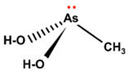 | Monomethylarsonic acid (MMA(V))  |
Dimethylarsinous acid (DMA(III)) | Dimethylarsinic acid (DMA(V)) |
Dimethylarsine | Trimethylarsine sulphide |
Trimethylarsine | Dimethylthioarsenic acid (DMMTA(V)) |
Methylarsine | Monomethylmonothioarsinic acid (MMMTA(V)) |
Dimethylthioarsinous acid (DMMTA(III)) Dimethylmonothioarsinic acid | Dimethyldithioarsinic acid (DMDTA(V))  |
Dimethylarsine chloride | Trimethylarsonium acetate (AsBe) (Arsenobetaine) |
Methylarsine dichloride | 2-Hydroxyethyl (trimethyl) arsonim (Arsenocholine) (AsCho) |
2,4,6-Triosa-1,3,5,7-tetraarsaadamantane (Arsenicin A) | Paris green (Copper acetoarsenite) |
Salvarsan | p-arsanilic acid |
Neosalvarsan | o-arsanilic acid |
Melarsoprol | Roxarsone |
Melarsen oxide | 4-ureidophenyl arsenic acid |
Triphenylarsine | Nitarsone |
Phenyldichloroarsine | Penaphenyl arsorane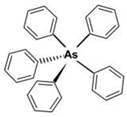 |
Arsabenzene | Arsole |
10,10′-oxybis-10H-phenoxarsine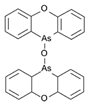 | Arsenic-containing ribose derivatives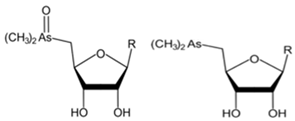 |
Melatonin | Vitamin C (ascorbic acid) |
Lonidamine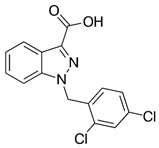 | Arjunolic acid |
Polydatin | Tannins (galic acid) |
Vitamin A (retinoids, such as retinol and derivatives (retinol, retinoic acid, and carotenoids provitamin A (carotene)) | Quercetin |
Curcumin (ceto form) (Tetrahydrocurcumin)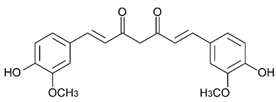 | Kaempferol |
Curcumin (enol form) | Kaempferol 3 O-a-L (600 methyl rhamnopyranoside) |
Diallyl trisulphide (DATS): (di(prop-2-en-1-yl)trisulfane) | Resveratrol |
Lutein | |
Zeaxanthin | |
β-carotene | |
Cryptoxantins | |
| (−)-epicatechin (EC)) (2R,3R) ((2R,3S)-2-(3,4-Dihydroxyphenyl)-3,4-dihydro-2H-chromene-3,5,7-triol)  | (−)-epigallocatechin (EGC) ((2R,3R)-3′,4′,5,5′,7-Pentahydroxy flavan-3-yl 3,4,5-trihydroxybenzoate) 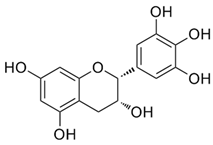 |
| (−)-epicatechin-3-gallate (ECG) ((2R,3R)-3′,4′,5,7-Tetrahydroxyflavan-3-yl 3,4,5-trihydroxybenzoate) 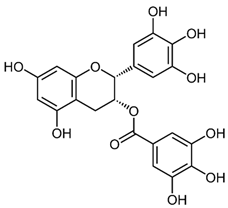 | (−)-epigallocatechin-3-gallate (EGCG) ((2R,3R)-3′,4′,5,5′,7-Pentahydroxy flavan-3-yl 3,4,5-trihydroxybenzoate)  |
Saponins (a subclass of terpenoids) are phenolic antioxidant compounds | Tannins (others)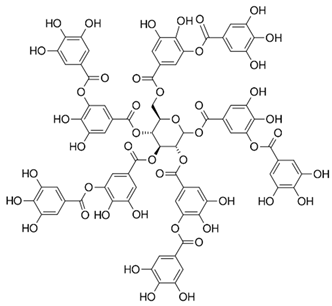 |
BAL | Taurine |
DMSA | ALA |
MiADMSA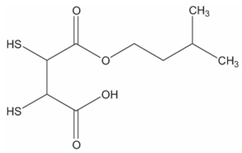 | NAC |
TA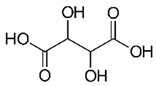 | DMPS |
NTAP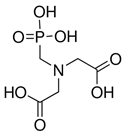 | NTA2P |
NTA3P | EDDS |
| Ligand | Complex | K’ (Log β) | References |
|---|---|---|---|
| BAL | AsBAL | 6.95 | [452] |
| AsBAL2 | 11.56 | ||
| As2BAL3 | 22.73 | ||
| DMSA | AsL | 9.8 | [450] |
| AsLH2 | 25.87 | [454] | |
| DMPS | AsL | 10.68 | [454] |
| TA | [As(OH)2T]− | 6.62 | [456] |
| DCTA | [As(OH)2HL]2− | 20.67 | [456] |
| NTAP | (L4−) | 20.91 | [455] |
| NTA2P | (L5−) | 24.78 | [455] |
| NTA3P | (L6−) | 32.52 | [455] |
Disclaimer/Publisher’s Note: The statements, opinions and data contained in all publications are solely those of the individual author(s) and contributor(s) and not of MDPI and/or the editor(s). MDPI and/or the editor(s) disclaim responsibility for any injury to people or property resulting from any ideas, methods, instructions or products referred to in the content. |
© 2025 by the authors. Licensee MDPI, Basel, Switzerland. This article is an open access article distributed under the terms and conditions of the Creative Commons Attribution (CC BY) license (https://creativecommons.org/licenses/by/4.0/).
Share and Cite
Pereira, F.J.; López, R.; Aller, A.J. Arsenome, Arsenobolome, and Arsenobiolome. Int. J. Mol. Sci. 2025, 26, 10761. https://doi.org/10.3390/ijms262110761
Pereira FJ, López R, Aller AJ. Arsenome, Arsenobolome, and Arsenobiolome. International Journal of Molecular Sciences. 2025; 26(21):10761. https://doi.org/10.3390/ijms262110761
Chicago/Turabian StylePereira, Fernando J., Roberto López, and A. Javier Aller. 2025. "Arsenome, Arsenobolome, and Arsenobiolome" International Journal of Molecular Sciences 26, no. 21: 10761. https://doi.org/10.3390/ijms262110761
APA StylePereira, F. J., López, R., & Aller, A. J. (2025). Arsenome, Arsenobolome, and Arsenobiolome. International Journal of Molecular Sciences, 26(21), 10761. https://doi.org/10.3390/ijms262110761