Valorization of Date Palm (Phoenix dactylifera L.) Fruits and By-Products as High-Value Sustainable Products: A Comprehensive Review on Bioactive Composition, Health Benefits, and Industrial Applications


Abstract
1. Introduction


2. Methodological Approach and Literature Search Strategy
3. Health Benefits Components of Date Palm
3.1. Nutritional Components

3.2. Phytochemicals Content

| Substance | Common Function and Health Benefits | Reference |
|---|---|---|
| Carbohydrates | [65,66,67,68] | |
| (Polysaccharides and fibers) |
| |
| ||
| ||
| ||
| ||
| ||
| ||
| ||
| Minerals | [18,54,69,70] | |
| Potassium |
| |
| Selenium |
| |
| Iron |
| |
| Zinc |
| |
| Bioactive compounds | [8,18,71] | |
| Phytosterols |
| |
| ||
| Neuroprotective potential (reduce progression of Alzheimer’s disease and prevention of Parkinson’s disease) | [69,72,73,74] | |
| Ferulic acid |
| |
| Chlorogenic acid |
| |
| Myricetin |
| |
| Protocatechuic acid |
| |
| Caffeic acid |
| |
| Gallic acid |
| |
| EGCG |
| |
| Luteolin |
| |
| Cardio-protective effect (prevention of hypertension, atherosclerosis, myocarditis, and myocardial infarction) | [69,70,75,76] | |
| Quercetin, rutin, and luteolin |
| |
| Gallic, ferulic, and hydroxybenzoic acids |
| |
| Reduce osteoporosis | [69,77] | |
| Caffeic acid |
| |
| Coumarin |
| |
| EGCG |
| |
| Phenolic acids and flavonoids |
| [54,78,79,80,81,82] |
| ||
| ||
| Proanthocyanidins |
| |
| Other compounds |
| |
| ||
| ||
| ||
| ||
| ||
|
| Group of Compounds | Name of Compounds | Content | |||
|---|---|---|---|---|---|
| Fruit | Reference | Seed | Reference | ||
| Phenolic acids (mg/100 g) | Gallic acid Ferulic acid p-coumaric Caffeic acid Syringic acid Chlorogenic acid Vanillic acid Protocatechiuc acid Caffeoylshikimic acid Sinapic acid | 1.61–16.07 0.26–4.71 0.09–3.27 0.03–1.37 0.55–5.49 0.04–0.30 0.23–2.13 2.27–84.51 - 0.05–1.53 | [36,56,83,84,85] | 0.24–57.5 2.38–6.93 0.14–11.14 0.11–31.53 0.13–8.43 3.10–8.20 2.95–4.07 0.003–44.81 4.5–28.3 - | [40,50,56,86] |
| Flavonoids (mg/100 g) | Catechin Isoquercetin Rutin Quercetin Quercetrin Luteolin Epicatechin Apigenin Proanthocyanidin Anthocyanin Isorhamnetin Kaempferol Naringenin | 0.02–2.98 0.10–3.03 0.17–2.50 0.34–5.81 0.04–1.27 0.02–0.71 0.06–0.66 0.07–1.56 - 0.24–1.52 0.26–9.22 0.04–5.37 0.76–1.19 | [36,56,83,84,85] | 0.29–171.6 - 0.09–0.12 22.37–107.03 3.29–13.65 - 7–18.8 0.5–41.54 55.8–80.23 0.24–126 41.91 18.65 - | [40,50,56,86] |
| Carotenoids (µg/100 g) | Luteins β-Carotene Neoxanthin Zeaxanthin | 45.7–129 3–6.5 184–381 33 | [87] | 160 314 - 1.08 | [63,88] |
| Phytosterols (mg/100 g) | β-Sitosterol Avenasterol Campesterol | - - | 228.6–231.5 51.41–53.65 39.25–41.42 | [64] | |
| Tocopherols (mg/100 g) | α-Tocopherol β-Tocopherol δ-tocopherol γ-Tocopherol | - - | 26–54.39 3.20–8.93 4.54–11.31 18.60–51.33 | [50,62,64] | |
4. Biofunctionalities of Date and Its Products
4.1. Orthodox Medicine and Traditional Therapeutic Application
4.2. Nutraceutical Potential and Health-Promoting Properties
5. Development of Value-Added Foods from Date Fruits and Their By-Products
- (a)
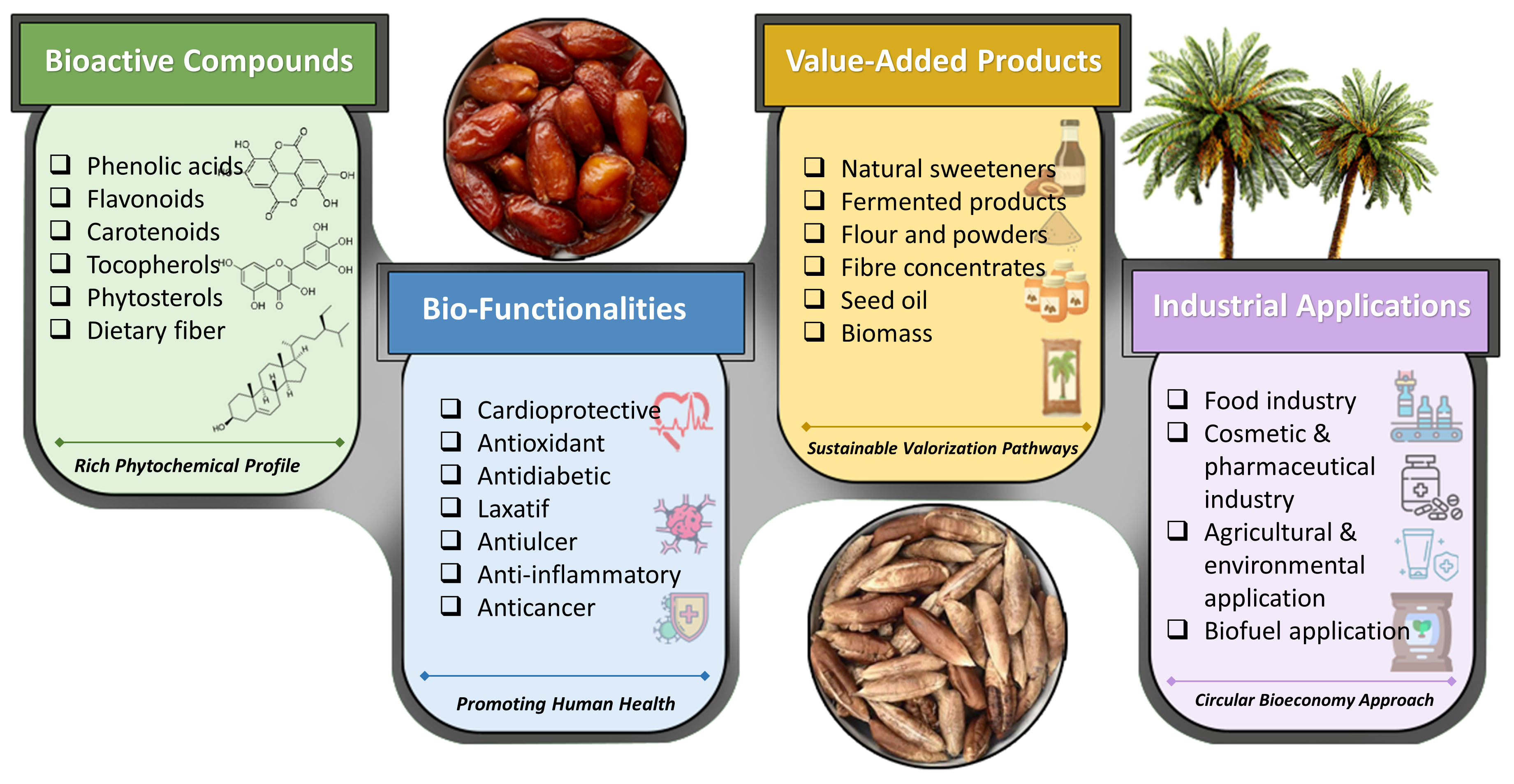
- Natural sweeteners: the high intake of refined sugars has been linked to adverse health effects, which has increased interest in natural sweeteners. Date fruit is a promising alternative, providing natural sweetness as well as minerals and phytochemicals that can improve the nutritional value of food [146].
- Date syrup is widely used in baking, beverages and fermentation products. It is often produced from overripe dates. Its production involves multiple processing steps, and using enzymes to assist the extraction process improves yield and quality [146,147]. Studies show that using whole dates improves the nutritional and sensory properties [148], while extraction methods affect the yield and composition, and evaporation mainly influences the color [149].
- High fructose date sugar (liquid): is a concentrated sugar solution (70–80% total solids), typically produced by extracting date juice and concentrating it under vacuum. It is widely used in jams, beverages, baked goods, and confectionery [123].
- Date juice and concentrates are often produced from low-value dates through grinding, heating, pressing, and clarification steps [1,151]. Advanced processing methods, such as thin-film evaporation, can improve quality. The increasing popularity of date-based drinks highlights their strong market potential [150,151].
- Date jam and jelly: date jam is made from ripe date pulp, which is mixed with water, sugar and pectin. The pH is adjusted to between 3.0 and 3.5 and the mixture is concentrated to between 60 and 70 °Brix. Date jelly is made in a similar way, using pulp or juice and sugar. It is concentrated to around 65 °Brix and preservatives are added if necessary [150].
- Date paste is a semi-solid product used in baking and confectionery, as well as in powders, syrups and candies. It is made by macerating or steaming pitted dates, to which antioxidants and acidulants are added to enhance shelf life, color and texture stability [150].
- (b)
- Fermented products: fermentation is a promising approach for converting dates and their by-products into higher-value commodities, given their high carbohydrate content [35]. Enzyme-assisted and fermentation processes have been investigated for transforming date waste into biofuels, biopolymers and industrial enzymes [152]. Date substrates have been investigated for use in producing:
- Vinegar and Alcohol: the production of alcohol and vinegar from dates involves fermentation processes. Ethanol is produced by fermenting sugars (typically using Saccharomyces spp.), and date seeds have been investigated as a lignocellulosic source of bioethanol via cellulose extraction, enzymatic hydrolysis and fermentation [153,154]. Date vinegar is produced through a process of sequential alcoholic and acetic fermentation, resulting in products that contain higher levels of phenolic and carotenoid compounds, and exhibit stronger antioxidant activity than certain commercial vinegars [150,155,156].
- Organic acids: date syrups and processing waste can be used to produce organic acids. Fungal fermentation of date syrup can be used to produce citric acid, while enzymatic saccharification followed by bacterial fermentation can be used to produce lactic acid from date waste [152,157]. Studies show that lactic acid can be produced from date press cake using Lactobacillus casei [158], and that the production of citric acid can be enhanced using date pit hydrolysate supplemented with pit ash [159].
- Microbial biomass/starter cultures (probiotics/yeast production): using date juice and syrup provides an eco-friendly, sustainable carbon source for producing baker’s yeast. Saccharomyces cerevisiae is an effective yeast for producing baking yeast from these substrates [152].
- (c)
- Flours and powders: dried dates can be processed into gluten-free flours and powders for use in baking. Production methods include pitting, cutting, dehydrating, milling and sieving, or spray drying with carriers such as maltodextrin and gum Arabic, which enhance stability and flow [25]. The resulting powder can be used as a natural sweetener and a formulation aid [160].
- (d)
- Date fiber concentrates: the skin and pulp of dates are rich in dietary fiber and can be used in supplements and functional foods. Fiber concentrates offer nutritional and technological benefits such as water/oil absorption and thickening. Processing methods, including hot-water extraction and enzymatic treatment, can increase the content of soluble fiber, antioxidants and functional oligosaccharides. This supports the development of prebiotic ingredients [44,161].
- (e)
- Biomass utilization: date processing by-products can be valorized through microbial fermentation to produce biomass and synthesize compounds such as oxytetracycline and gamma-aminobutyric acid. Common microorganisms used for this process include lactobacilli, Streptococcus thermophilus, Streptomyces rimosus, Corynebacterium glutamicum and yeasts [152].
- (f)
- Date seeds as food ingredients and seed oils: date seeds can be used as flour in bakery products, roasted as a caffeine-free coffee substitute or processed into seed-based beverages. Date seed powder is commercially available and promoted as being nutrient-dense. Date seed oil is rich in oleic–lauric lipids and shows high oxidative stability. This suggests its suitability for use in cooking oils, margarines and mayonnaises [51,150,162]. Additionally, date seeds can be processed into fiber and protein concentrates for food applications. The resulting fiber concentrates are rich in dietary fiber (~50–70%), cellulose, and hemicellulose. They can be used to create fiber-enriched foods and provide functional properties such as emulsification [163,164]. Ultrasound-assisted processing has been explored to enhance the solubility and technological performance of seed protein concentrates [165].
6. Potential Industrial Application of Date Fruits and Their By-Products
6.1. Food Industry
- Bakery products
- Dairy products
- Meat products
- Beverages
- Confectionery products
- Food Packaging
6.2. Cosmetic and Pharmaceutical Industry
6.3. Agricultural and Environmental Application
6.4. Biofuel Application
7. Limitations and Challenges
8. Conclusions
Supplementary Materials
Author Contributions
Funding
Institutional Review Board Statement
Informed Consent Statement
Data Availability Statement
Acknowledgments
Conflicts of Interest
References
- Muñoz-Tebar, N.; Viuda-Martos, M.; Lorenzo, J.M.; Fernandez-Lopez, J.; Perez-Alvarez, J.A. Strategies for the Valorization of Date Fruit and Its Co-Products: A New Ingredient in the Development of Value-Added Foods. Foods 2023, 12, 1456. [Google Scholar] [CrossRef] [PubMed]
- Djaoudene, O.; Bachir-bey, M.; Guillermo, C.; Francisco, L. Phenolic Compounds Recovery from Date Seed and Assessment Pf Their Antioxidant and Enzyme Inhibitory Properties. Ann. Univ. Dunarea Jos Galati Fascicle VI—Food Technol. 2023, 47, 190–206. [Google Scholar] [CrossRef]
- Idowu, A.T.; Igiehon, O.O.; Adekoya, A.E.; Idowu, S. Dates Palm Fruits: A Review of Their Nutritional Components, Bioactivities and Functional Food Applications. AIMS Agric. Food 2020, 5, 734–755. [Google Scholar] [CrossRef]
- Mahomoodally, M.F.; Khadaroo, S.K.; Hosenally, M.; Zengin, G.; Rebezov, M.; Ali Shariati, M.; Khalid, A.; Abdalla, A.N.; Algarni, A.S.; Simal-Gandara, J. Nutritional, Medicinal and Functional Properties of Different Parts of the Date Palm and Its Fruit (Phoenix dactylifera L.)—A Systematic Review. Crit. Rev. Food Sci. Nutr. 2024, 64, 7748–7803. [Google Scholar] [CrossRef] [PubMed]
- Hussain, M.I.; Farooq, M.; Syed, Q.A. Nutritional and Biological Characteristics of the Date Palm Fruit (Phoenix dactylifera L.)—A Review. Food Biosci. 2020, 34, 100509. [Google Scholar] [CrossRef]
- Barakat, H.; Alfheeaid, H.A. Date Palm Fruit (Phoenix dactylifera) and Its Promising Potential in Developing Functional Energy Bars: Review of Chemical, Nutritional, Functional, and Sensory Attributes. Nutrients 2023, 15, 2134. [Google Scholar] [CrossRef]
- Alu’datt, M.H.; Rababah, T.; Tranchant, C.C.; Al-u’datt, D.; Gammoh, S.; Alrosan, M.; Bani-Melhem, K.; Aldughpassi, A.; Alkandari, D.; AbuJalban, D. Date Palm (Phoenix dactylifera) Bioactive Constituents and Their Applications as Natural Multifunctional Ingredients in Health-Promoting Foods and Nutraceuticals: A Comprehensive Review. Compr. Rev. Food Sci. Food Saf. 2025, 24, e70084. [Google Scholar] [CrossRef]
- Subhash, A.J.; Bamigbade, G.B.; Ayyash, M. Current Insights into Date By-Product Valorization for Sustainable Food Industries and Technology. Sustain. Food Technol. 2024, 2, 331–361. [Google Scholar] [CrossRef]
- Djaoudene, O.; Louaileche, H. Optimization of a Green Ultrasound-Assisted Extraction of Phenolics and in Vitro Antioxidant Potential of Date Fruit (Phoenix dactylifera L.). Ann. Univ. Dunarea Jos Galati Fascicle VI Food Technol. 2018, 42, 109–122. [Google Scholar]
- FAOSTAT. Food and Agriculture Organization of the United Nations. Available online: https://www.fao.org/faostat/en/#rankings/countries_by_commodity (accessed on 18 June 2025).
- Insights, F.B. Dates Market Size. Available online: https://www.fortunebusinessinsights.com/dates-market-106034 (accessed on 5 May 2025).
- Al-Karmadi, A.; Okoh, A.I. An Overview of Date (Phoenix dactylifera) Fruits as an Important Global Food Resource. Foods 2024, 13, 1024. [Google Scholar] [CrossRef]
- de la Cruz-Lovera, C.; Manzano-Agugliaro, F.; Salmerón-Manzano, E.; de la Cruz-Fernández, J.L.; Perea-Moreno, A.J. Date Seeds (Phoenix dactylifera L.) Valorization for Boilers in the Mediterranean Climate. Sustainability 2019, 11, 711. [Google Scholar] [CrossRef]
- Ghnimi, S.; Umer, S.; Karim, A.; Kamal-Eldin, A. Date Fruit (Phoenix dactylifera L.): An Underutilized Food Seeking Industrial Valorization. NFS J. 2017, 6, 1–10. [Google Scholar] [CrossRef]
- Bentrad, N.; Hamida-Ferhat, A. Date Palm Fruit (Phoenix dactylifera): Nutritional Values and Potential Benefits on Health. In The Mediterranean Diet: An Evidence-Based Approach; Elsevier: Amsterdam, The Netherlands, 2020; pp. 239–255. [Google Scholar]
- Jaouhari, Y.; Disca, V.; Ferreira-Santos, P.; Alvaredo-López-Vizcaíno, A.; Travaglia, F.; Bordiga, M.; Locatelli, M. Valorization of Date Fruit (Phoenix dactylifera L.) as a Potential Functional Food and Ingredient: Characterization of Fiber, Oligosaccharides, and Antioxidant Polyphenols. Molecules 2024, 29, 4606. [Google Scholar] [CrossRef]
- Khalid, S.; Khalid, N.; Khan, R.S.; Ahmed, H.; Ahmad, A. A Review on Chemistry and Pharmacology of Ajwa Date Fruit and Pit. Trends Food Sci. Technol. 2017, 63, 60–69. [Google Scholar] [CrossRef]
- Maqsood, S.; Adiamo, O.; Ahmad, M.; Mudgil, P. Bioactive Compounds from Date Fruit and Seed as Potential Nutraceutical and Functional Food Ingredients. Food Chem. 2020, 308, 125522. [Google Scholar] [CrossRef]
- Alasalvar, C.; Chang, S.K.; Kris-Etherton, P.M.; Sullivan, V.K.; Petersen, K.S.; Guasch-Ferré, M.; Jenkins, D.J.A. Dried Fruits: Bioactives, Effects on Gut Microbiota, and Possible Health Benefits—An Update. Nutrients 2023, 15, 1611. [Google Scholar] [CrossRef]
- Ibrahim, A.S.; Sukor, R.; Anwar, F.; Murugesu, S.; Selamat, J.; Raseetha, S. Nutritional, Nutraceutical Attributes, Microbiological and Chemical Safety of Different Varieties of Dates—A Review. Futur. Foods 2024, 10, 100421. [Google Scholar] [CrossRef]
- Ali, Z.; Rafique, H.; Tahir, R.A.; Saeed, T.; Rasheed, M.A.; Khan, I. Clinical and Computational Exploration of Red Date Fruit Vinegar: Synergistic Effects on Cardiovascular and Type 2 Diabetes Pathways. Front. Nutr. 2025, 12, 1557733. [Google Scholar] [CrossRef] [PubMed]
- Awan, K.A.; Yaqoob, S.; Ul-Haq, I.; Naveed, H.; Imtiaz, A.; Shaukat, A.; Sultan, W.; Qian, J.-Y.; Alum, E.U.; Shen, Q. Therapeutic Power of Date Fruit (Phoenix dactylifera L.): A Nutrient-R Ich Superfood for Holistic Health and Disease Prevention. Food Sci. Nutr. 2025, 13, e70896. [Google Scholar] [CrossRef]
- Abubakar, M.G.; Agbon, A.N.; Musa, S.A.; Hamman, W.O.; Oladele, S.B. Flavonoids of Phoenix dactylifera L. Ameliorates Mercury-Toxicity on the Kidney of Wistar Rats. A Biochemical, Morphological and Molecular Approach. Pharmacol. Res.—Mod. Chin. Med. 2024, 10, 100392. [Google Scholar] [CrossRef]
- El-Gendy, Z.A.; Abdelazeem, S.; Abdel Jaleel, G.A.; Ali, M.E.; Mohamed, A.; Salah, A.; Raslan, M.A. Anti-Inflammatory and Anti-Rheumatic Effects of Phoenix dactylifera L. (Date Palm) Seed by Controlling Cytokines and Inhibiting JAK1/STAT3 Pathway on CFA-Induced Arthritis Rat and Its Phytochemical Profiling. J. Ethnopharmacol. 2024, 329, 118138. [Google Scholar] [CrossRef]
- Hasan, F.; Nazir, A.; Sobti, B.; Tariq, H.; Karim, R.; Al-Marzouqi, A.H.; Kamal-Eldin, A. Dehydration of Date Fruit (Pheonix dactylifera L.) for the Production of Natural Sweet Powder. NFS J. 2022, 27, 13–20. [Google Scholar] [CrossRef]
- Alam, M.Z.; Al-Hamimi, S.; Ayyash, M.; Rosa, C.T.; Yahia, E.M.; Haris, S.; Al-Marzouqi, A.H.; Kamal-Eldin, A. Contributing Factors to Quality of Date (Phoenix dactylifera L.) Fruit. Sci. Hortic. 2023, 321, 112256. [Google Scholar] [CrossRef]
- Airouyuwa, J.O.; Souka, U.; Maqsood, S. Utilization of Accelerated Solvent Extraction and Deep Eutectic Solvents as Synergistic Green Extraction Technique for the Recovery of Bioactive Compounds from Date Palm (Phoenix dactylifera L.) Seeds. J. Mol. Liq. 2025, 425, 127185. [Google Scholar] [CrossRef]
- Roobab, U.; Muhammad, R.; Sreedhara, S.; Maqsood, S. Ultrasonics Sonochemistry Comparative Evaluation of Ultrasound-Assisted Extraction with Other Green Extraction Methods for Sustainable Recycling and Processing of Date Palm Bioresources and by-Products: A Review of Recent Research. Ultrason. Sonochem. 2025, 114, 107252. [Google Scholar] [CrossRef] [PubMed]
- Sridhar, K.; Akram, A.; Banat, F. Green Extraction Technologies for Valorization of Date Seed Waste to Achieve Sustainable Development Goals: Biofunctional and Innovative Food Applications. Food Res. Int. 2024, 198, 115392. [Google Scholar] [CrossRef] [PubMed]
- Kagueyam, S.S.; Filho, J.R.d.S.; Castoldi, R.; Corrêa, R.C.G.; Junior, C.A.C.; Yamaguchi, N.U.; Bracht, A.; Peralta, R.M. Green Extraction of Bioactive Compounds from Plant-Based Agri-Food Residues: Advances Toward Sustainable Valorization. Plants 2025, 14, 3597. [Google Scholar] [CrossRef]
- Palos-Hernández, A.; González-Paramás, A.M.; Santos-Buelga, C. Latest Advances in Green Extraction of Polyphenols from Plants, Foods and Food By-Products. Molecules 2025, 30, 55. [Google Scholar] [CrossRef]
- Ligarda-samanez, C.A.; Huamán-carrión, M.L.; Calsina-ponce, W.C.; De la Cruz, G.; Huamaní, D.F.C.; Cabel-moscoso, D.J.; Garcia-espinoza, A.J.; Sucari-león, R.; Aroquipa-durán, Y.; Muñoz-saenz, J.C.; et al. Technological Innovations and Circular Economy in the Valorization of Agri-Food By-Products: Advances, Challenges and Perspectives. Foods 2025, 14, 1950. [Google Scholar] [CrossRef]
- Benamara, S.; Djouab, A.; Boukhiar, A.; Iguergaziz, N.; Benamara, D. Fruit Du Dattier (Phoenix dactylifera L.): Fruit Ordinaire Ou Aliment-Santé ?—Synthèse Bibliographique. Phytothérapie 2017, 16, S184–S190. [Google Scholar] [CrossRef]
- Al-Alawi, R.; Al-Mashiqri, J.H.; Al-Nadabi, J.S.M.; Al-Shihi, B.I.; Baqi, Y. Date Palm Tree (Phoenix dactylifera L.): Natural Products and Therapeutic Options. Front. Plant Sci. 2017, 8, 845. [Google Scholar] [CrossRef]
- Cantadori, E.; Brugnoli, M.; Centola, M.; Uffredi, E.; Colonello, A.; Gullo, M. Date Fruits as Raw Material for Vinegar and Non-Alcoholic Fermented Beverages. Foods 2022, 11, 1972. [Google Scholar] [CrossRef] [PubMed]
- Hamad, I.; Abdelgawad, H.; Al Jaouni, S.; Zinta, G.; Asard, H.; Hassan, S.; Hegab, M.; Hagagy, N.; Selim, S. Metabolic Analysis of Various Date Palm Fruit (Phoenix dactylifera L.) Cultivars from Saudi Arabia to Assess Their Nutritional Quality. Molecules 2015, 20, 13620–13641. [Google Scholar] [CrossRef] [PubMed]
- Assirey, E.A.R. Nutritional Composition of Fruit of 10 Date Palm (Phoenix dactylifera L.) Cultivars Grown in Saudi Arabia. J. Taibah Univ. Sci. 2015, 9, 75–79. [Google Scholar] [CrossRef]
- Djaoudene, O.; Bachir Bey, M.; Louaileche, H. Physicochemical Characteristics and Nutritional Compositions of Some Date (Phoenix dactylifera L.) Fruit Cultivars. Acta Univ. Cibiniensis. Ser. E Food Technol. 2019, 23, 129–138. [Google Scholar] [CrossRef]
- Alkhoori, M.A.; Kong, A.S.Y.; Aljaafari, M.N.; Abushelaibi, A.; Erin Lim, S.H.; Cheng, W.H.; Chong, C.M.; Lai, K.S. Biochemical Composition and Biological Activities of Date Palm (Phoenix dactylifera L.) Seeds: A Review. Biomolecules 2022, 12, 1626. [Google Scholar] [CrossRef]
- Djaoudene, O.; López, V.; Cásedas, G.; Les, F.; Schisano, C.; Bachir Bey, M.; Tenore, G.C. Phoenix dactylifera L. Seeds: A by-Product as a Source of Bioactive Compounds with Antioxidant and Enzyme Inhibitory Properties. Food Funct. 2019, 10, 4953–4965. [Google Scholar] [CrossRef]
- Gnanamangai, B.M.; Saranya, S.; Ponmurugan, P.; Kavitha, S.; Pitchaimuthu, S.; Divya, P. Analysis of Antioxidants and Nutritional Assessment of Date Palm Fruits. In Sustainable Agriculture Reviews 34: Date Palm for Food, Medicine and the Environment; Springer: Cham, Switzerland, 2019; pp. 19–40. [Google Scholar]
- Gökşen, G.; Durkan, Ö.; Sayar, S.; Ekiz, H.İ. Potential of Date Seeds as a Functional Food Components. J. Food Meas. Charact. 2018, 12, 1904–1909. [Google Scholar] [CrossRef]
- Salomón-Torres, R.; Ortiz-Uribe, N.; Valdez-Salas, B.; Rosas-González, N.; García-González, C.; Chávez, D.; Córdova-Guerrero, I.; Díaz-Rubio, L.; Del Pilar Haro-Vázquez, M.; Mijangos-Montiel, J.L.; et al. Nutritional Assessment, Phytochemical Composition and Antioxidant Analysis of the Pulp and Seed of Medjool Date Grown in Mexico. PeerJ 2019, 7, e6821. [Google Scholar] [CrossRef]
- Mrabet, A.; Rodríguez-Gutiérrez, G.; Rubio-Senent, F.; Hamza, H.; Rodríguez-Arcos, R.; Guillén-Bejarano, R.; Sindic, M.; Jiménez-Araujo, A. Enzymatic Conversion of Date Fruit Fiber Concentrates into a New Product Enriched in Antioxidant Soluble Fiber. LWT—Food Sci. Technol. 2017, 75, 727–734. [Google Scholar] [CrossRef]
- Ayad, A.A.; Williams, L.L.; Gad El-Rab, D.A.; Ayivi, R.; Colleran, H.L.; Aljaloud, S.; Ibrahim, S.A. A Review of the Chemical Composition, Nutritional and Health Benefits of Dates for Their Potential Use in Energy Nutrition Bars for Athletes. Cogent Food Agric. 2020, 6, 1809309. [Google Scholar] [CrossRef]
- Ali, H.S.M.; Alhaj, O.A.; Al-Khalifa, A.S.; Brückner, H. Determination and Stereochemistry of Proteinogenic and Non-Proteinogenic Amino Acids in Saudi Arabian Date Fruits. Amino Acids 2014, 46, 2241–2257. [Google Scholar] [CrossRef]
- Di Cagno, R.; Filannino, P.; Cavoski, I.; Lanera, A.; Mamdouh, B.M.; Gobbetti, M. Bioprocessing Technology to Exploit Organic Palm Date (Phoenix dactylifera L. Cultivar Siwi) Fruit as a Functional Dietary Supplement. J. Funct. Foods 2017, 31, 9–19. [Google Scholar] [CrossRef]
- Siddeeg, A.; Zeng, X.A.; Ammar, A.F.; Han, Z. Sugar Profile, Volatile Compounds, Composition and Antioxidant Activity of Sukkari Date Palm Fruit. J. Food Sci. Technol. 2019, 56, 754–762. [Google Scholar] [CrossRef]
- Farag, M.A.; Otify, A.; Baky, M.H. Phoenix dactylifera L. Date Fruit By-Products Outgoing and Potential Novel Trends of Phytochemical, Nutritive and Medicinal Merits. Food Rev. Int. 2023, 39, 488–510. [Google Scholar] [CrossRef]
- Al Juhaimi, F.; Özcan, M.M.; Adiamo, O.Q.; Alsawmahi, O.N.; Ghafoor, K.; Babiker, E.E. Effect of Date Varieties on Physico-Chemical Properties, Fatty Acid Composition, Tocopherol Contents, and Phenolic Compounds of Some Date Seed and Oils. J. Food Process. Preserv. 2018, 42, e13584. [Google Scholar] [CrossRef]
- Mrabet, A.; Jiménez-Araujo, A.; Guillén-Bejarano, R.; Rodríguez-Arcos, R.; Sindic, M. Date Seeds: A Promising Source of Oil with Functional Properties. Foods 2020, 9, 787. [Google Scholar] [CrossRef] [PubMed]
- Amadou, I. Date Fruits: Nutritional Composition of Dates (Balanites Aegyptiaca Delile and Phoenix dactylifera L.). In Nutritional Composition of Fruit Cultivars; Elsevier Inc.: Amsterdam, The Netherlands, 2015; pp. 215–233. ISBN 9780124081178. [Google Scholar]
- Nehdi, I.A.; Sbihi, H.M.; Tan, C.P.; Rashid, U.; Al-Resayes, S.I. Chemical Composition of Date Palm (Phoenix dactylifera L.) Seed Oil from Six Saudi Arabian Cultivars. J. Food Sci. 2018, 83, 624–630. [Google Scholar] [CrossRef]
- Al-Mssallem, M.Q. The Role of Date Palm Fruit in Improving Human Health. J. Clin. Diagn. Res. 2020, 14, OE01–OE06. [Google Scholar] [CrossRef]
- Allaith, A. Antioxidants in Date Fruits and the Extent of the Variability of the Total Phenolic Content: Review and Analysis. In Antioxidants; IntechOpen: London, UK, 2019; pp. 1–25. [Google Scholar]
- Djaoudene, O.; Mansinhos, I.; Gonçalves, S.; Jara-Palacios, M.J.; Bachir bey, M.; Romano, A. Phenolic Profile, Antioxidant Activity and Enzyme Inhibitory Capacities of Fruit and Seed Extracts from Different Algerian Cultivars of Date (Phoenix dactylifera L.) Were Affected by in Vitro Simulated Gastrointestinal Digestion. S. Afr. J. Bot. 2021, 137, 133–148. [Google Scholar] [CrossRef]
- Hussain, M.I.; Semreen, M.H.; Shanableh, A.; Khattak, M.N.K.; Saadoun, I.; Ahmady, I.M.; Mousa, M.; Darwish, N.; Radeef, W.; Soliman, S.S.M. Phenolic Composition and Antimicrobial Activity of Different Emirati Date (Phoenix dactylifera L.) Pits: A Comparative Study. Plants 2019, 8, 497. [Google Scholar] [CrossRef]
- Djaoudene, O.; Bachir-Bey, M.; Schisano, C.; Djebari, S.; Tenore, G.C.; Romano, A. A Sustainable Extraction Approach of Phytochemicals from Date (Phoenix dactylifera L.) Fruit Cultivars Using Ultrasound-Assisted Deep Eutectic Solvent: A Comprehensive Study on Bioactivity and Phenolic Variability. Antioxidants 2024, 13, 181. [Google Scholar] [CrossRef] [PubMed]
- Alqahtani, N.K. Valorization of the Potential Use of Date Press Cake (Date Syrup by-Product) in Food and Non-Food Applications: A Review. Front. Sustain. Food Syst. 2023, 7, 1340727. [Google Scholar] [CrossRef]
- Manai, S.; Boulila, A.; Silva, A.S.; Barbosa-Pereira, L.; Sendón, R.; Khwaldia, K. Recovering Functional and Bioactive Compounds from Date Palm By-Products and Their Application as Multi-Functional Ingredients in Food. Sustain. Chem. Pharm. 2024, 38, 101475. [Google Scholar] [CrossRef]
- Ghafoor, K.; Sarker, M.Z.I.; Al-Juhaimi, F.Y.; Babiker, E.E.; Alkaltham, M.S.; Almubarak, A.K. Extraction and Evaluation of Bioactive Compounds from Date (Phoenix dactylifera) Seed Using Supercritical and Subcritical CO2 Techniques. Foods 2022, 11, 1806. [Google Scholar] [CrossRef]
- Harkat, H.; Bousba, R.; Benincasa, C.; Atrouz, K.; Gültekin-özgüven, M.; Altuntaş, Ü.; Demircan, E.; Zahran, H.A.; Özçelik, B. Assessment of Biochemical Composition and Antioxidant Properties of Algerian Date Palm (Phoenix dactylifera L.) Seed Oil. Plants 2022, 11, 381. [Google Scholar] [CrossRef]
- Babiker, E.E.; Atasoy, G.; Özcan, M.M.; Juhaimi, F.A.; Ghafoor, K.; Ahmed, I.A.M.; Almusallam, I.A. Bioactive Compounds, Minerals, Fatty Acids, Color, and Sensory Profile of Roasted Date (Phoenix dactylifera L.) Seed. J. Food Process. Preserv. 2020, 44, e14495. [Google Scholar] [CrossRef]
- Samia, Z.; Mehdi, T.; Saadia, B.; Abdeljalil, Z.; Lahboub, B. Comparison of Physicochemical Characteristics, Phytochemical Composition, and Antioxidant Capacity of Two Oils Extracted from Jihel Date Kernel (Phoenix dactylifera L.) Varieties Cultivated in Zagora. Lett. Appl. NanoBioSci. 2025, 14, 95. [Google Scholar]
- Noorbakhsh, H.; Rabbani Khorasgani, M. Functional and Chemical Properties of Phoenix dactylifera l. Polysaccharides and the Effect of Date Flesh and Seed Intervention on Some Blood Biomarkers: A Contrastive Analysis. Food Chem. X 2023, 19, 100834. [Google Scholar] [CrossRef]
- Noorbakhsh, H.; Khorasgani, M.R. Date (Phoenix dactylifera L.) Polysaccharides: A Review on Chemical Structure and Nutritional Properties. J. Food Meas. Charact. 2022, 16, 3240–3250. [Google Scholar] [CrossRef]
- Dhahri, M.; Sioud, S.; Alsuhaymi, S.; Almulhim, F.; Haneef, A.; Saoudi, A.; Jaremko, M.; Emwas, A.H.M. Extraction, Characterization, and Antioxidant Activity of Polysaccharides from Ajwa Seed and Flesh. Separations 2023, 10, 103. [Google Scholar] [CrossRef]
- Bamigbade, G.B.; Subhash, A.J.; Tarique, M.; al-Ramadi, B.; Abu-Jdayil, B.; Kamal-Eldin, A.; Nyström, L.; Ayyash, M. Date Pomace Polysaccharide: Ultrasonic-Assisted Deep Eutectic Solvent Extraction, Physicochemical Properties, Biological Activities, Gut Microbiota Modulation, and Rheological Properties. Chem. Biol. Technol. Agric. 2024, 11, 79. [Google Scholar] [CrossRef]
- Albishi, T.S. Date Palm: A Potential Nutraceutical and Phytomedicine in Most Frequent Aging Associated Diseases. J. Umm Al-Qura Univ. Appl. Sci. 2024, 11, 792–812. [Google Scholar] [CrossRef]
- Al-Dashti, Y.A.; Holt, R.R.; Keen, C.L.; Hackman, R.M. Date Palm Fruit (Phoenix dactylifera): Effects on Vascular Health and Future Research Directions. Int. J. Mol. Sci. 2021, 22, 4665. [Google Scholar] [CrossRef]
- Ouamnina, A.; Alahyane, A.; Elateri, I.; Abderrazik, M. Pharmacological Insights, Traditional Applications, and Determinants of Phytochemical Composition in Date Palm Fruit (Phoenix dactylifera L.): A Comprehensive Review. J. Food Compos. Anal. 2024, 136, 106784. [Google Scholar] [CrossRef]
- Subash, S.; Essa, M.M.; Braidy, N.; Awlad-Thani, K.; Vaishnav, R.; Al-Adawi, S.; Al-Asmi, A.; Guillemin, G.J. Diet Rich in Date Palm Fruits Improves Memory, Learning and Reduces Beta Amyloid in Transgenic Mouse Model of Alzheimer’s Disease. J. Ayurveda Integr. Med. 2015, 6, 111–120. [Google Scholar] [CrossRef]
- Asdaq, S.M.B.; Almutiri, A.A.; Alenzi, A.; Shaikh, M.; Shaik, M.A.; Alshehri, S.; Rabbani, S.I. Unveiling the Neuroprotective Potential of Date Palm (Phoenix dactylifera): A Systematic Review. Pharmaceuticals 2024, 17, 1221. [Google Scholar] [CrossRef] [PubMed]
- Edobor, H.D.; Musa, S.A.; Umana, U.E.; Oderinde, G.P.; Agbon, A.N. Neuroprotective Effect of Phoenix dactylifera (Date Palm) on Paraquat Triggered Cortico-Nigral Neurotoxicity. J. Neurobehav. Sci. 2021, 8, 199–208. [Google Scholar] [CrossRef]
- Alhaider, I.A.; Mohamed, M.E.; Ahmed, K.K.M.; Kumar, A.H.S. Date Palm (Phoenix dactylifera) Fruits as a Potential Cardioprotective Agent: The Role of Circulating Progenitor Cells. Front. Pharmacol. 2017, 8, 592. [Google Scholar] [CrossRef]
- Fernández-López, J.; Viuda-Martos, M.; Sayas-Barberá, E.; Navarro-Rodríguez de Vera, C.; Pérez-álvarez, J.Á. Biological, Nutritive, Functional and Healthy Potential of Date Palm Fruit (Phoenix dactylifera L.): Current Research and Future Prospects. Agronomy 2022, 12, 876. [Google Scholar] [CrossRef]
- Balakrishnan, S.; Ponnusamy, P.; Sathibabu Uddandrao, V.V.; Saravanan, G. Ameliorative Potential of Saudi Arabian Date Fruit (Phoenix dactylifera L.) Varieties against Freund’s Complete Adjuvant Induced Arthritis in Rats. Adv. Tradit. Med. 2020, 20, 291–301. [Google Scholar] [CrossRef]
- Ahmad Mohd Zain, M.R.; Abdul Kari, Z.; Dawood, M.A.O.; Nik Ahmad Ariff, N.S.; Salmuna, Z.N.; Ismail, N.; Ibrahim, A.H.; Thevan Krishnan, K.; Che Mat, N.F.; Edinur, H.A.; et al. Bioactivity and Pharmacological Potential of Date Palm (Phoenix dactylifera L.) Against Pandemic COVID-19: A Comprehensive Review. Appl. Biochem. Biotechnol. 2022, 194, 4587–4624. [Google Scholar] [CrossRef]
- Sagi-Dain, L.; Sagi, S. The Effect of Late Pregnancy Date Fruit Consumption on Delivery Progress—A Meta-Analysis. Explore 2021, 17, 569–573. [Google Scholar] [CrossRef]
- Nasiri, M.; Gheibi, Z.; Miri, A.; Rahmani, J.; Asadi, M.; Sadeghi, O.; Maleki, V.; Khodadost, M. Effects of Consuming Date Fruits (Phoenix dactylifera Linn) on Gestation, Labor, and Delivery: An Updated Systematic Review and Meta-Analysis of Clinical Trials. Complement. Ther. Med. 2019, 45, 71–84. [Google Scholar] [CrossRef] [PubMed]
- Chaari, A.; Abdellatif, B.; Nabi, F.; Khan, R.H. Date Palm (Phoenix dactylifera L.) Fruit’s Polyphenols as Potential Inhibitors for Human Amylin Fibril Formation and Toxicity in Type 2 Diabetes. Int. J. Biol. Macromol. 2020, 164, 1794–1808. [Google Scholar] [CrossRef] [PubMed]
- Kharal, S.; Siddique, F.; Arshad, M.; Iftikhar, K.; Akhtar, M.T.; Qadir, R.; Sameeh, M.Y.; Mustaqeem, M.; Zhuang, J.; Xia, L. Assessment of Phytochemicals, Antioxidant Properties, and in Vivo Antidiarrheal Activity of Date Palm (Phoenix dactylifera L.). Int. J. Food Prop. 2023, 26, 2243–2255. [Google Scholar] [CrossRef]
- Mrabet, A.; Jiménez-Araujo, A.; Fernández-Bolaños, J.; Rubio-Senent, F.; Lama-Muñoz, A.; Sindic, M.; Rodríguez-Gutiérrez, G. Antioxidant Phenolic Extracts Obtained from Secondary Tunisian Date Varieties (Phoenix dactylifera L.) by Hydrothermal Treatments. Food Chem. 2016, 196, 917–924. [Google Scholar] [CrossRef] [PubMed]
- Alahyane, A.; Harrak, H.; Ayour, J.; Elateri, I.; Ait-Oubahou, A.; Benichou, M. Bioactive Compounds and Antioxidant Activity of Seventeen Moroccan Date Varieties and Clones (Phoenix dactylifera L.). S. Afr. J. Bot. 2019, 121, 402–409. [Google Scholar] [CrossRef]
- Al Juhaimi, F.; Özcan, M.M.; Uslu, N.; Ghafoor, K.; Babiker, E.E.; Mohamed Ahmed, I.A. Bioactive Properties, Fatty Acid Compositions, and Phenolic Compounds of Some Date Palm (Phoenix dactylifera L.) Cultivars. J. Food Process. Preserv. 2020, 44, e14432. [Google Scholar] [CrossRef]
- Ahmed, A.; Arshad, M.U.; Saeed, F.; Ahmed, R.S.; Chatha, S.A.S. Nutritional Probing and HPLC Profiling of Roasted Date Pit Powder. Pak. J. Nutr. 2016, 15, 229–237. [Google Scholar] [CrossRef]
- Bettaieb, I.; Kilani, A.; Ben Othman, K.; Benabderrahim, M.A.; Elfalleh, W. Phenolic Profile, Sugar Composition, and Antioxidant Capacities of Some Common Date Palm (Phoenix dactylifera L.) Cultivars as a Potential Nutraceutical and Functional Food Ingredients. J. Food Qual. 2023, 2023, 2474900. [Google Scholar] [CrossRef]
- Habib, H.M.; Kamal, H.; Ibrahim, W.H.; Dhaheri, A.S.A. Carotenoids, Fat Soluble Vitamins and Fatty Acid Profiles of 18 Varieties of Date Seed Oil. Ind. Crops Prod. 2013, 42, 567–572. [Google Scholar] [CrossRef]
- Qadir, A.; Shakeel, F.; Ali, A.; Faiyazuddin, M. Phytotherapeutic Potential and Pharmaceutical Impact of Phoenix dactylifera (Date Palm): Current Research and Future Prospects. J. Food Sci. Technol. 2020, 57, 1191–1204. [Google Scholar] [CrossRef]
- Echegaray, N.; Pateiro, M.; Gullón, B.; Amarowicz, R.; Misihairabgwi, J.M.; Lorenzo, J.M. Phoenix dactylifera Products in Human Health—A Review. Trends Food Sci. Technol. 2020, 105, 238–250. [Google Scholar] [CrossRef]
- Vayalil, P.K. Date Fruits (Phoenix dactylifera Linn): An Emerging Medicinal Food. Crit. Rev. Food Sci. Nutr. 2012, 52, 249–271. [Google Scholar] [CrossRef]
- Benchelah, A.C.; Maka, M. Les Dattes: Intérêt En Nutrition. Phytotherapie 2008, 6, 117–121. [Google Scholar] [CrossRef]
- Baliga, M.S.; Baliga, B.R.V.; Kandathil, S.M.; Bhat, H.P.; Vayalil, P.K. A Review of the Chemistry and Pharmacology of the Date Fruits (Phoenix dactylifera L.). Food Res. Int. 2011, 44, 1812–1822. [Google Scholar] [CrossRef]
- Taleb, H.; Maddocks, S.E.; Morris, R.K.; Kanekanian, A.D. Chemical Characterisation and the Anti-Inflammatory, Anti-Angiogenic and Antibacterial Properties of Date Fruit (Phoenix dactylifera L.). J. Ethnopharmacol. 2016, 194, 457–468. [Google Scholar] [CrossRef] [PubMed]
- Gruca, M.; Blach-Overgaard, A.; Balslev, H. African Palm Ethno-Medicine. J. Ethnopharmacol. 2015, 165, 227–237. [Google Scholar] [CrossRef] [PubMed]
- Ibrahim, S.A.; Ayad, A.A.; Williams, L.L.; Ayivi, R.D.; Gyawali, R.; Krastanov, A.; Aljaloud, S.O. Date Fruit: A Review of the Chemical and Nutritional Compounds, Functional Effects and Food Application in Nutrition Bars for Athletes. Int. J. Food Sci. Technol. 2021, 56, 1503–1513. [Google Scholar] [CrossRef]
- Bagherzadeh karimi, A.; Elmi, A.; Zargaran, A.; Mirghafourvand, M.; Fazljou, S.M.B.; Araj-Khodaei, M.; Baghervand Navid, R. Clinical Effects of Date Palm (Phoenix dactylifera L.): A Systematic Review on Clinical Trials. Complement. Ther. Med. 2020, 51, 102429. [Google Scholar] [CrossRef]
- Al-Okbi, S.Y. Date Palm as Source of Nutraceuticals for Health Promotion: A Review. Curr. Nutr. Rep. 2022, 11, 574–591. [Google Scholar] [CrossRef] [PubMed]
- Kim, G.H.; Kim, J.E.; Rhie, S.J.; Yoon, S. The Role of Oxidative Stress in Neurodegenerative Diseases. Exp. Neurobiol. 2015, 24, 325–340. [Google Scholar] [CrossRef] [PubMed]
- Munekata, P.E.S.; Rocchetti, G.; Pateiro, M.; Lucini, L.; Domínguez, R.; Lorenzo, J.M. Addition of Plant Extracts to Meat and Meat Products to Extend Shelf-Life and Health-Promoting Attributes: An Overview. Curr. Opin. Food Sci. 2020, 31, 81–87. [Google Scholar] [CrossRef]
- Al-Yahya, M.; Raish, M.; AlSaid, M.S.; Ahmad, A.; Mothana, R.A.; Al-Sohaibani, M.; Al-Dosari, M.S.; Parvez, M.K.; Rafatullah, S. ‘Ajwa’ Dates (Phoenix dactylifera L.) Extract Ameliorates Isoproterenol-Induced Cardiomyopathy through Downregulation of Oxidative, Inflammatory and Apoptotic Molecules in Rodent Model. Phytomedicine 2016, 23, 1240–1248. [Google Scholar] [CrossRef]
- Khan, T.J.; Kuerban, A.; Razvi, S.S.; Mehanna, M.G.; Khan, K.A.; Almulaiky, Y.Q.; Faidallah, H.M. In Vivo Evaluation of Hypolipidemic and Antioxidative Effect of ‘Ajwa’ (Phoenix dactylifera L.) Date Seed-Extract in High-Fat Diet-Induced Hyperlipidemic Rat Model. Biomed. Pharmacother. 2018, 107, 675–680. [Google Scholar] [CrossRef]
- Abdelaziz, D.H.A.; Ali, S.A.; Mostafa, M.M.A. Phoenix dactylifera Seeds Ameliorate Early Diabetic Complications in Streptozotocin-Induced Diabetic Rats. Pharm. Biol. 2015, 53, 792–799. [Google Scholar] [CrossRef]
- Karimi, E.; Dehghan, P.; Azizi-Soleiman, F.; Mohamadizadeh, M. Date Seed (Phoenix dactylifera) Supplementation Modulates Oxidative DNA Damage, Lipid Peroxidation, and Cardiometabolic Risk Factors in Type 2 Diabetes: A Triple-Blinded Randomized Placebo-Controlled Trial. J. Funct. Foods 2024, 117, 106226. [Google Scholar] [CrossRef]
- Younas, A.; Naqvi, S.A.; Khan, M.R.; Shabbir, M.A.; Jatoi, M.A.; Anwar, F.; Inam-Ur-Raheem, M.; Saari, N.; Aadil, R.M. Functional Food and Nutra-Pharmaceutical Perspectives of Date (Phoenix dactylifera L.) Fruit. J. Food Biochem. 2020, 44, e13332. [Google Scholar] [CrossRef]
- Ouamnina, A.; Alahyane, A.; Elateri, I.; Ouhammou, M.; Abderrazik, M. In Vitro and Molecular Docking Studies of Antiglycation Potential of Phenolic Compounds in Date Palm (Phoenix dactylifera L.) Fruit: Exploring Local Varieties in the Food Industry. Horticulturae 2024, 10, 657. [Google Scholar] [CrossRef]
- Alghamdi, M.A.; Hussein, A.M.; AL-Eitan, L.N.; Elnashar, E.; Elgendy, A.; Abdalla, A.M.; Ahmed, S.; Khalil, W.A. Possible Mechanisms for the Renoprotective Effects of Date Palm Fruits and Seeds Extracts against Renal Ischemia/Reperfusion Injury in Rats. Biomed. Pharmacother. 2020, 130, 110540. [Google Scholar] [CrossRef]
- Samad, M.A.; Hashim, S.H.; Simarani, K.; Yaacob, J.S. Antibacterial Properties and Effects of Fruit Chilling and Extract Storage on Antioxidant Activity, Total Phenolic and Anthocyanin Content of Four Date Palm (Phoenix dactylifera) Cultivars. Molecules 2016, 21, 419. [Google Scholar] [CrossRef]
- Selim, S.; Abdel-Mawgoud, M.; Al-Sharary, T.; Almuhayawi, M.S.; Alruhaili, M.H.; Al Jaouni, S.K.; Warrad, M.; Mohamed, H.S.; Akhtar, N.; Abdelgawad, H. Pits of Date Palm: Bioactive Composition, Antibacterial Activity and Antimutagenicity Potentials. Agronomy 2022, 12, 54. [Google Scholar] [CrossRef]
- Swaidan, A.; Azakir, B.; Neugart, S.; Kattour, N.; Sokhn, E.S.; Osaili, T.M.; Darra, N. El Evaluation of the Phenolic Composition and Biological Activities of Six Aqueous Date (Phoenix dactylifera L.) Seed Extracts Originating from Different Countries: A Comparative Analysis. Foods 2024, 13, 126. [Google Scholar] [CrossRef]
- Essa, M.M.; Subash, S.; Akbar, M.; Al-Adawi, S.; Guillemin, G.J. Long-Term Dietary Supplementation of Pomegranates, Figs and Dates Alleviate Neuroinflammation in a Transgenic Mouse Model of Alzheimer’s Disease. PLoS ONE 2015, 10, e0120964. [Google Scholar] [CrossRef]
- Pujari, R.R.; Vyawahare, N.S.; Thakurdesai, P.A. Neuroprotective and Antioxidant Role of Phoenix dactylifera in Permanent Bilateral Common Carotid Occlusion in Rats. J. Acute Dis. 2014, 3, 104–114. [Google Scholar] [CrossRef]
- Sheikh, B.Y.; Zihad, S.M.N.K.; Sifat, N.; Uddin, S.J.; Shilpi, J.A.; Hamdi, O.A.A.; Hossain, H.; Rouf, R.; Jahan, I.A. Comparative Study of Neuropharmacological, Analgesic Properties and Phenolic Profile of Ajwah, Safawy and Sukkari Cultivars of Date Palm (Phoenix dactylifera). Orient. Pharm. Exp. Med. 2016, 16, 175–183. [Google Scholar] [CrossRef] [PubMed]
- Hilary, S.; Kizhakkayil, J.; Souka, U.; Al-Meqbaali, F.; Ibrahim, W.; Platat, C. In-Vitro Investigation of Polyphenol-Rich Date (Phoenix dactylifera L.) Seed Extract Bioactivity. Front. Nutr. 2021, 8, 667514. [Google Scholar] [CrossRef]
- Khan, M.A.; Singh, R.; Siddiqui, S.; Ahmad, I.; Ahmad, R.; Upadhyay, S.; Barkat, M.A.; Ali, A.M.A.; Zia, Q.; Srivastava, A.; et al. Anticancer Potential of Phoenix dactylifera L. Seed Extract in Human Cancer Cells and pro-Apoptotic Effects Mediated through Caspase-3 Dependent Pathway in Human Breast Cancer MDA-MB-231 Cells: An In Vitro and In Silico Investigation. BMC Complement. Med. Ther. 2022, 22, 68. [Google Scholar] [CrossRef] [PubMed]
- Zein, N.; Elewa, Y.H.A.; Alruwaili, M.K.; Dewaard, M.; Alorabi, M.; Albogami, S.M.; Batiha, G.E.S.; Zahran, M.H. Barhi Date (Phoenix dactylifera) Extract Ameliorates Hepatocellular Carcinoma in Male Rats. Biomed. Pharmacother. 2022, 156, 113976. [Google Scholar] [CrossRef]
- Godugu, K.; El-far, A.H.; Jaouni, S.A.; Mousa, S.A. Bioactive Compounds Improve the Safety of Doxorubicin without Compromising Its Anticancer E Ffi Cacy in Breast Cancer. Molecules 2020, 25, 2597. [Google Scholar]
- Al Jaouni, S.K.; Hussein, A.; Alghamdi, N.; Qari, M.; El Hossary, D.; Almuhayawi, M.S.; Olwi, D.; Al-Raddadi, R.; Harakeh, S.; Mousa, S.A. Effects of Phoenix dactylifera Ajwa on Infection, Hospitalization, and Survival Among Pediatric Cancer Patients in a University Hospital: A Nonrandomized Controlled Trial. Integr. Cancer Ther. 2019, 18, 1–9. [Google Scholar] [CrossRef]
- Saryono; Warsinah; Isworo, A.; Sarmoko. Anti-Inflammatory Activity of Date Palm Seed by Downregulating Interleukin-1β, TGF-β, Cyclooxygenase-1 and -2: A Study Among Middle Age Women. Saudi Pharm. J. 2020, 28, 1014–1018. [Google Scholar] [CrossRef]
- Bouhlali, E.d.T.; Hmidani, A.; Bourkhis, B.; Khouya, T.; Ramchoun, M.; Filali-Zegzouti, Y.; Alem, C. Phenolic Profile and Anti-Inflammatory Activity of Four Moroccan Date (Phoenix dactylifera L.) Seed Varieties. Heliyon 2020, 6, e03436. [Google Scholar] [CrossRef]
- Meenakshi, S.; Misra, A. Effect of Dates on Blood Glucose and Other Metabolic Variables: A Narrative Review. Diabetes Metab. Syndr. Clin. Res. Rev. 2023, 17, 102705. [Google Scholar] [CrossRef]
- El Abed, H.; Chakroun, M.; Fendri, I.; Makni, M.; Bouaziz, M.; Drira, N.; Mejdoub, H.; Khemakhem, B. Extraction Optimization and in Vitro and in Vivo Anti-Postprandial Hyperglycemia Effects of Inhibitor from Phoenix dactylifera L. Parthenocarpic Fruit. Biomed. Pharmacother. 2017, 88, 835–843. [Google Scholar] [CrossRef]
- AlFaris, N.A.; AlTamimi, J.Z.; AlMousa, L.A.; AlGhamidi, F.A.; Albaridi, N.A. Date-Derived Industries: A Review of Common Products, Manufacturing Methods, and Leading Countries. Emir. J. Food Agric. 2022, 34, 86–97. [Google Scholar] [CrossRef]
- Shakoor, H.; Abdelfattah, F.; Albadi, K.; Adib, M.; Kizhakkayil, J.; Platat, C. Inhibition of Digestive Enzyme and Stimulation of Human Liver Cells (HepG2) Glucose Uptake by Date Seeds Extract. Evid.-Based Complement. Altern. Med. 2020, 2020, 4290702. [Google Scholar] [CrossRef]
- Ali, Z.; Ma, H.; Wali, A.; Ayim, I.; Sharif, M.N. Daily Date Vinegar Consumption Improves Hyperlipidemia, β-Carotenoid and Inflammatory Biomarkers in Mildly Hypercholesterolemic Adults. J. Herb. Med. 2019, 17, 100265. [Google Scholar] [CrossRef]
- Ali, Z.; Ma, H.; Ayim, I.; Wali, A. Efficacy of New Beverage Made of Dates Vinegar and Garlic Juice in Improving Serum Lipid Profile Parameters and Inflammatory Biomarkers of Mildly Hyperlipidemic Adults: A Double-Blinded, Randomized, Placebo-Controlled Study. J. Food Biochem. 2018, 42, e12545. [Google Scholar] [CrossRef]
- Ali, Z.; Ma, H.; Wali, A.; Ayim, I.; Rashid, M.T.; Younas, S. A Double-Blinded, Randomized, Placebo-Controlled Study Evaluating the Impact of Dates Vinegar Consumption on Blood Biochemical and Hematological Parameters in Patients with Type 2 Diabetes. Trop. J. Pharm. Res. 2018, 17, 2463–2469. [Google Scholar] [CrossRef]
- Alqarni, M.M.M.; Osman, M.A.; Al-Tamimi, D.S.; Gassem, M.A.; Al-Khalifa, A.S.; Al-Juhaimi, F.; Mohamed Ahmed, I.A. Antioxidant and Antihyperlipidemic Effects of Ajwa Date (Phoenix dactylifera L.) Extracts in Rats Fed a Cholesterol-Rich Diet. J. Food Biochem. 2019, 43, e12933. [Google Scholar] [CrossRef]
- Abdelaziz, D.H.A.; Ali, S.A. The Protective Effect of Phoenix dactylifera L. Seeds Against CCl4-Induced Hepatotoxicity in Rats. J. Ethnopharmacol. 2014, 155, 736–743. [Google Scholar] [CrossRef]
- Alqahtani, N.K.; Mohamed, H.A.; Moawad, M.E.; Younis, N.S.; Mohamed, M.E. The Hepatoprotective Effect of Two Date Palm Fruit Cultivars’ Extracts: Green Optimization of the Extraction Process. Foods 2023, 12, 1229. [Google Scholar] [CrossRef] [PubMed]
- Al-Sheddi, E.S.; Farshori, N.N.; Al-Oqail, M.M.; Alblwi, F.; Ahmad, J.; Al-Khedhairy, A.A.; Siddiqui, M.A. Hepatoprotective Effect of Date Fruit Extract Against Ethanol-Induced Apoptosis in Human Hepatoma (HepG2) Cells. Tissue Cell 2024, 90, 102519. [Google Scholar] [CrossRef]
- Khattak, M.N.K.; Shanableh, A.; Hussain, M.I.; Khan, A.A.; Abdulwahab, M.; Radeef, W.; Samreen, M.H. Anticancer Activities of Selected Emirati Date (Phoenix dactylifera L.) Varieties Pits in Human Triple Negative Breast Cancer MDA-MB-231 Cells. Saudi J. Biol. Sci. 2020, 27, 3390–3396. [Google Scholar] [CrossRef] [PubMed]
- Habib, H.M.; El-Fakharany, E.M.; Souka, U.D.; Elsebaee, F.M.; El-Ziney, M.G.; Ibrahim, W.H. Polyphenol-Rich Date Palm Fruit Seed (Phoenix dactylifera L.) Extract Inhibits Labile Iron, Enzyme, and Cancer Cell Activities, and DNA and Protein Damage. Nutrients 2022, 14, 3536. [Google Scholar] [CrossRef] [PubMed]
- Kehili, H.E.; Zerizer, S.; Beladjila, K.A.; Kabouche, Z. Anti-Inflammatory Effect of Algerian Date Fruit (Phoenix dactylifera). Food Agric. Immunol. 2016, 27, 820–829. [Google Scholar] [CrossRef]
- Taleb, H.; Morris, R.K.; Withycombe, C.E.; Maddocks, S.E.; Kanekanian, A.D. Date Syrup-Derived Polyphenols Attenuate Angiogenic Responses and Exhibits Anti-Inflammatory Activity Mediated by Vascular Endothelial Growth Factor and Cyclooxygenase-2 Expression in Endothelial Cells. Nutr. Res. 2016, 36, 636–647. [Google Scholar] [CrossRef]
- Al Alawi, R.A.; Hoheisel, J.D.; Alhamdani, M.S.S.; Baqi, Y. Phoenix dactylifera L. (Date Palm) Fruit Extracts and Fractions Exhibit Anti-Proliferative Activity Against Human Pancreatic Cancer Cell Lines. Heliyon 2025, 11, e42274. [Google Scholar] [CrossRef]
- Abou-Zeid, S.M.; El-Bialy, B.E.; El-Borai, N.B.; AbuBakr, H.O.; Elhadary, A.M.A. Radioprotective Effect of Date Syrup on Radiation- Induced Damage in Rats. Sci. Rep. 2018, 8, 7423. [Google Scholar] [CrossRef] [PubMed]
- Razali, N.; Mohd Nahwari, S.H.; Sulaiman, S.; Hassan, J. Date Fruit Consumption at Term: Effect on Length of Gestation, Labour and Delivery. J. Obstet. Gynaecol. 2017, 37, 595–600. [Google Scholar] [CrossRef]
- Ahmed, I.E.; Mirghani, H.O.; Mesaik, M.A.; Ibrahim, Y.M.; Amin, T.Q. Effects of Date Fruit Consumption on Labour and Vaginal Delivery in Tabuk, KSA. J. Taibah Univ. Med. Sci. 2018, 13, 557–563. [Google Scholar] [CrossRef]
- Alalwan, T.A.; Perna, S.; Mandeel, Q.A.; Abdulhadi, A.; Alsayyad, A.S.; D’antona, G.; Negro, M.; Riva, A.; Petrangolini, G.; Allegrini, P.; et al. Effects of Daily Low-Dose Date Consumption on Glycemic Control, Lipid Profile, and Quality of Life in Adults with Pre- and Type 2 Diabetes: A Randomized Controlled Trial. Nutrients 2020, 12, 217. [Google Scholar] [CrossRef]
- Sari, A.; Pamungkasari, E.P.; Dewi, Y.L.R. The Addition of Dates Palm (Phoenix dactylifera) on Iron Supplementation (Fe) Increases the Hemoglobin Level of Adolescent Girls with Anemia. Bali Med. J. 2018, 7, 356–360. [Google Scholar] [CrossRef]
- Indrayani; Rahmadi, A.; Rakhim, D.A. Can Date Fruits and 7 Dates Replace Iron Tablets in Increasing Hemoglobin Levels? Pak. J. Med. Health Sci. 2018, 12, 1750–1759. [Google Scholar] [CrossRef]
- Ali, S.; Alam, G.; Samrichard. Ajwa Date Fruit (Phoenix dactylifera L.) in Increasing Hemoglobin (Hb) Level to Teenage Girl. Enferm. Clin. 2020, 30, 77–79. [Google Scholar] [CrossRef]
- Eid, N.; Osmanova, H.; Natchez, C.; Walton, G.; Costabile, A.; Gibson, G.; Rowland, I.; Spencer, J.P.E. Impact of Palm Date Consumption on Microbiota Growth and Large Intestinal Health: A Randomised, Controlled, Cross-over, Human Intervention Study. Br. J. Nutr. 2015, 114, 1226–1236. [Google Scholar] [CrossRef]
- Moslemi, E.; Dehghan, P.; Khani, M. The Effect of Date Seed (Phoenix dactylifera) Supplementation on Inflammation, Oxidative Stress Biomarkers, and Performance in Active People: A Blinded Randomized Controlled Trial Protocol. Contemp. Clin. Trials Commun. 2022, 28, 100951. [Google Scholar] [CrossRef]
- Sayas-Barberá, E.; Paredes, C.; Salgado-Ramos, M.; Pallarés, N.; Ferrer, E.; Navarro-Rodríguez de Vera, C.; Pérez-Álvarez, J.Á. Approaches to Enhance Sugar Content in Foods: Is the Date Palm Fruit a Natural Alternative to Sweeteners? Foods 2024, 13, 129. [Google Scholar] [CrossRef]
- Castro-Muñoz, R.; Correa-Delgado, M.; Córdova-Almeida, R.; Lara-Nava, D.; Chávez-Muñoz, M.; Velásquez-Chávez, V.F.; Hernández-Torres, C.E.; Gontarek-Castro, E.; Ahmad, M.Z. Natural Sweeteners: Sources, Extraction and Current Uses in Foods and Food Industries. Food Chem. 2022, 370, 130991. [Google Scholar] [CrossRef]
- Gourchala, F.; Mihoub, F.; Lakhdar-Toumi, S.; Taïbi, K. From Waste to a Sustainable Ingredient: Date (Phoenix dactylifera L.) Pits Incorporation Enhances the Physicochemical and Sensory Properties of Algerian Date Syrups. Food Biosci. 2022, 48, 101734. [Google Scholar] [CrossRef]
- Julai, K.; Sridonpai, P.; Ngampeerapong, C.; Tongdonpo, K.; Suttisansanee, U.; Kriengsinyos, W.; On-Nom, N.; Tangsuphoom, N. Effects of Extraction and Evaporation Methods on Physico-Chemical, Functional, and Nutritional Properties of Syrups from Barhi Dates (Phoenix dactylifera L.). Foods 2023, 12, 1268. [Google Scholar] [CrossRef]
- Salomón-Torres, R.; Valdez-Salas, B.; Norzagaray-Plasencia, S. Date Palm: Source of Foods, Sweets and Beverages. In The Date Palm Genome, Vol. 2 Omics and Molecular Breeding; Springer International Publishing: Cham, Switzerland, 2021; pp. 3–26. [Google Scholar]
- Shanta, F.H.; Rahut, B.K.; Islam, M.J.; Azad, M.O.K.; Sohel, M.A.T.; Rajib, M.R.R.; Shams-Ud-Din, M.; Adnan, M. Development of Value Added Drinks from Date Palm Juice (Phoenix Sylvestris). Heliyon 2021, 7, e08322. [Google Scholar] [CrossRef]
- Musa, K.H.; Elnour, A.A.M. Advances and Future Perspectives in Biotechnological and Bioconversional of Dates Byproducts. J. Agric. Food Res. 2024, 16, 101145. [Google Scholar] [CrossRef]
- Bouaziz, F.; Abdeddayem, A.B.; Koubaa, M.; Barba, F.J.; Jeddou, K.B.; Kacem, I.; Ghorbel, R.E.; Chaabouni, S.E. Bioethanol Production from Date Seed Cellulosic Fraction Using Saccharomyces Cerevisiae. Separations 2020, 7, 67. [Google Scholar] [CrossRef]
- Wudali, S.N.; Banadka, A.; Nagella, P.; Al-Khayri, J.M. Bioactive Phytochemicals from Date Palm (Phoenix dactylifera L.) Seed Oil Processing By-Products. In Bioactive Phytochemicals from Vegetable Oil and Oilseed Processing By-Products; Springer: Cham, Switzerland, 2023; pp. 455–481. [Google Scholar]
- Khorshidian, N.; Yousefi, M.; Khosravi-Darani, K. Valorization of Date Waste Using Microbial Fermentations. Biomass Convers. Biorefinery 2022, 14, 26597–26610. [Google Scholar] [CrossRef]
- Hamden, Z.; El-Ghoul, Y.; Alminderej, F.M.; Saleh, S.M.; Majdoub, H. High-Quality Bioethanol and Vinegar Production from Saudi Arabia Dates: Characterization and Evaluation of Their Value and Antioxidant Efficiency. Antioxidants 2022, 11, 1155. [Google Scholar] [CrossRef]
- Oladzad, S.; Fallah, N.; Mahboubi, A.; Afsham, N.; Taherzadeh, M.J. Date Fruit Processing Waste and Approaches to Its Valorization: A Review. Bioresour. Technol. 2021, 340, 125625. [Google Scholar] [CrossRef]
- Haris, S.; Kamal-Eldin, A.; Ayyash, M.M.; Van der Bruggen, B.; Mohamed, M.M.; Al-Marzouqi, A.H. Production of Lactic Acid from Date Fruit Pomace Using Lactobacillus Casei and the Enzyme Cellic CTec2. Environ. Technol. Innov. 2023, 31, 103151. [Google Scholar] [CrossRef]
- Shi, L.E.; Zheng, W.; Aleid, S.M.; Tang, Z.X. Date Pits: Chemical Composition, Nutritional and Medicinal Values, Utilization. Crop Sci. 2014, 54, 1322–1330. [Google Scholar]
- Manickavasagan, A.; Thangavel, K.; Dev, S.R.S.; Delfiya, D.S.A.; Nambi, E.; Orsat, V.; Raghavan, G.S.V. Physicochemical Characteristics of Date Powder Produced in a Pilot-Scale Spray Dryer. Dry. Technol. 2015, 33, 1114–1123. [Google Scholar] [CrossRef]
- Fikry, M.; Al-Awaadah, A.; Rahman, R. Production and Characterization of Palm Date Powder Rich in Dietary Fiber. J. Food Meas. Charact. 2021, 15, 2285–2296. [Google Scholar] [CrossRef]
- Tafti, G.; Dahdivan, S.; Ardakani, Y. Physicochemical Properties and Applications of Date Seed and Its Oil. Int. Food Res. J. 2017, 24, 1399–1406. [Google Scholar]
- Mrabet, A.; Hammadi, H.; Rodríguez-Gutiérrez, G.; Jiménez-Araujo, A.; Sindic, M. Date Palm Fruits as a Potential Source of Functional Dietary Fiber: A Review. Food Sci. Technol. Res. 2019, 25, 1–10. [Google Scholar] [CrossRef]
- Bouaziz, F.; Abdeddayem, A.B.; Koubaa, M.; Ghorbel, R.E.; Chaabouni, S.E. Date Seeds as a Natural Source of Dietary Fibers to Improve Texture and Sensory Properties of Wheat Bread. Foods 2020, 9, 737. [Google Scholar] [CrossRef]
- Kelany, M.; Yemiş, O. Improving the Functional Performance of Date Seed Protein Concentrate by High-Intensity Ultrasonic Treatment. Molecules 2023, 28, 209. [Google Scholar] [CrossRef]
- Shi, L.; de Souza, T.S.P.; Ahmadi, F.; Imran, A.; Dunshea, F.R.; Barrow, C.; Suleria, H.A.R. Valorization of Date Fruit (Phoenix dactylifera L.) Processing Waste and By-Products: A Review. Appl. Sci. 2023, 13, 12315. [Google Scholar] [CrossRef]
- Al-Khalili, M.; Al-Habsi, N.; Rahman, M.S. Applications of Date Pits in Foods to Enhance Their Functionality and Quality: A Review. Front. Sustain. Food Syst. 2023, 6, 1101043. [Google Scholar] [CrossRef]
- Nwanekezi, E.; Ekwe, C.; Agbugba, R. Effect of Substitution of Sucrose with Date Palm (Phoenix dactylifera) Fruit on Quality of Bread. J. Food Process. Technol. 2015, 6, 9. [Google Scholar] [CrossRef]
- Platat, C.; Habib, H.M.; Hashim, I.B.; Kamal, H.; AlMaqbali, F.; Souka, U.; Ibrahim, W.H. Production of Functional Pita Bread Using Date Seed Powder. J. Food Sci. Technol. 2015, 52, 6375–6384. [Google Scholar] [CrossRef]
- Sheir, M.A. Innovative Use of Date (Phoenix dactylifera L.) Press Cake in the Food Industry. Foods Raw Mater. 2022, 10, 2–9. [Google Scholar] [CrossRef]
- Lajnef, I.; Khemiri, S.; Ben Yahmed, N.; Chouaibi, M.; Smaali, I. Straightforward Extraction of Date Palm Syrup from Phoenix dactylifera L. Byproducts: Application as Sucrose Substitute in Sponge Cake Formulation. J. Food Meas. Charact. 2021, 15, 3942–3952. [Google Scholar] [CrossRef]
- Djaoud, K.; Boulekbache-Makhlouf, L.; Yahia, M.; Mansouri, H.; Mansouri, N.; Madani, K.; Romero, A. Dairy Dessert Processing: Effect of Sugar Substitution by Date Syrup and Powder on Its Quality Characteristics. J. Food Process. Preserv. 2020, 44, e14414. [Google Scholar] [CrossRef]
- Alqahtani, N.K.; Alnemr, T.M.; Alqattan, A.M.; Aleid, S.M.; Habib, H.M. Physicochemical and Sensory Properties and Shelf Life of Block-Type Processed Cheeses Fortified with Date Seeds (Phoenix dactylifera L.) as a Functional Food. Foods 2023, 12, 679. [Google Scholar] [CrossRef] [PubMed]
- Al-Sahlany, S.T.G.; Khassaf, W.H.; Niamah, A.K.; Abd Al-Manhel, A.J. Date Juice Addition to Bio-Yogurt: The Effects on Physicochemical and Microbiological Properties During Storage, as Well as Blood Parameters In Vivo. J. Saudi Soc. Agric. Sci. 2023, 22, 71–77. [Google Scholar] [CrossRef]
- Shahein, M.R.; Atwaa, E.S.H.; Elkot, W.F.; Hijazy, H.H.A.; Kassab, R.B.; Alblihed, M.A.; Elmahallawy, E.K. The Impact of Date Syrup on the Physicochemical, Microbiological, and Sensory Properties, and Antioxidant Activity of Bio-Fermented Camel Milk. Fermentation 2022, 8, 192. [Google Scholar] [CrossRef]
- Younis, M.; Ahmed, K.A.; Ahmed, I.A.M.; Yehia, H.M.; Abdelkarim, D.O.; Alhamdan, A.; Elfeky, A. Optimization and Storage Stability of Milk–Date Beverages Fortified with Sukkari Date Powder. Processes 2024, 12, 1739. [Google Scholar] [CrossRef]
- Muñoz-Tebar, N.; Muñoz-Bas, C.; Viuda-Martos, M.; Sayas-Barberá, E.; Pérez-Alvarez, J.A.; Fernández-López, J. Fortification of Goat Milk Yogurts with Date Palm (Phoenix dactylifera L.) Coproducts: Impact on Their Quality During Cold Storage. Food Chem. 2024, 454, 139800. [Google Scholar] [CrossRef]
- Ursachi, C.Ș.; Perța-Crișan, S.; Munteanu, F.D. Strategies to Improve Meat Products’ Quality. Foods 2020, 9, 1883. [Google Scholar] [CrossRef]
- Rasul, S.; Tarique, M.; Obaid Hamdan Alkaabi, A.; Kamal-Eldin, A.; Chiang, J.H.; Yuliarti, O. Evaluating the Effects of Insoluble Date Fruit (Phoenix dactylifera L.) Fibers on Meat Analogue Patties Composed of Pea and Wheat Protein Isolates. Food Res. Int. 2024, 197, 115158. [Google Scholar] [CrossRef] [PubMed]
- Sayas-Barberá, E.; Martín-Sánchez, A.M.; Cherif, S.; Ben-Abda, J.; Pérez-Álvarez, J.Á. Effect of Date (Phoenix dactylifera L.) Pits on the Shelf Life of Beef Burgers. Foods 2020, 9, 102. [Google Scholar] [CrossRef]
- Bouaziz, M.A.; Bchir, B.; Ben Salah, T.; Mokni, A.; Ben Hlima, H.; Smaoui, S.; Attia, H.; Besbes, S. Use of Endemic Date Palm (Phoenix dactylifera L.) Seeds as an Insoluble Dietary Fiber: Effect on Turkey Meat Quality. J. Food Qual. 2020, 2020, 8889272. [Google Scholar] [CrossRef]
- Alqahtani, N.K.; Alnemr, T.M.; Ahmed, A.R.; Ali, S. Effect of Inclusion of Date Press Cake on Texture, Color, Sensory, Microstructure, and Functional Properties of Date Jam. Processes 2022, 10, 2442. [Google Scholar] [CrossRef]
- Kiesler, R.; Franke, H.; Lachenmeier, D.W. A Comprehensive Review of the Nutritional Composition and Toxicological Profile of Date Seed Coffee (Phoenix dactylifera). Appl. Sci. 2024, 14, 2346. [Google Scholar] [CrossRef]
- Ghnimi, S.; Almansoori, R. Quality Evaluation of Coffee-Like Beverage from Date Seeds (Phoenix dactylifera, L.). J. Food Process. Technol. 2015, 6, 12. [Google Scholar] [CrossRef]
- Souda, B.; Rami, R.; Jalloul, B.; Mohamed, D. Roasted Date Palm Seeds (Phoenix dactylifera) as an Alternative Coffee: Chemical Composition and Bioactive Properties. Biomass Convers. Biorefinery 2022, 12, 3771–3781. [Google Scholar] [CrossRef]
- Fikry, M.; Yusof, Y.A.; Al-Awaadh, A.M.; Rahman, R.A.; Chin, N.L.; Mousa, E.; Chang, L.S. Effect of the Roasting Conditions on the Physicochemical, Quality and Sensory Attributes of Coffee-like Powder and Brew from Defatted Palm Date Seeds. Foods 2019, 8, 61. [Google Scholar] [CrossRef]
- Bettaieb, I.; Benabderrahim, M.A.; Guillén-Bejarano, R.; Rodríguez-Arcos, R.; Jiménez-Araujo, A.; Bouaine, M.; Ghorbal, A.; Elfalleh, W. The Effect of Freeze-Drying Process and Arabica Coffee Enrichment on Bioactive Content, Aroma Volatile, and Sensory Characteristics of Date Seed Coffee. Food Biosci. 2024, 57, 103473. [Google Scholar] [CrossRef]
- Alfheeaid, H.A.; Barakat, H.; Althwab, S.A.; Musa, K.H.; Malkova, D. Nutritional and Physicochemical Characteristics of Innovative High Energy and Protein Fruit- and Date-Based Bars. Foods 2023, 12, 2777. [Google Scholar] [CrossRef] [PubMed]
- Abushal, S.A.; Elhendy, H.A.; Abd El Maged, E.M.; Darwish, A.M.G. Impact of Ground Ajwa (Phoenix dactylifera L.) Seeds Fortification on Physical and Nutritional Properties of Functional Cookies and Chocolate Sauce. Cereal Chem. 2021, 98, 958–967. [Google Scholar] [CrossRef]
- Kumar, H.; Kimta, N.; Guleria, S.; Cimler, R.; Sethi, N.; Dhanjal, D.S.; Singh, R.; Duggal, S.; Verma, R.; Prerna, P.; et al. Valorization of Non-Edible Fruit Seeds into Valuable Products: A Sustainable Approach Towards Circular Bioeconomy. Sci. Total Environ. 2024, 922, 171142. [Google Scholar] [CrossRef]
- Alqahtani, N.; Alnemr, T.; Ali, S. Development of Low-Cost Biodegradable Films from Corn Starch and Date Palm Pits (Phoenix dactylifera). Food Biosci. 2021, 42, 101199. [Google Scholar] [CrossRef]
- Lawal, K.G.; Riaz, A.; Mostafa, H.; Stathopoulos, C.; Manikas, I.; Maqsood, S. Development of Carboxymethylcellulose Based Active and Edible Food Packaging Films Using Date Seed Components as Reinforcing Agent: Physical, Biological, and Mechanical Properties. Food Biophys. 2023, 18, 497–509. [Google Scholar] [CrossRef]
- Ahmed, A.; Ali, S.W.; Imran, A.; Afzaal, M.; Arshad, M.S.; Nadeem, M.; Mubeen, Z.; Ikram, A. Formulation of Date Pit Oil-Based Edible Wax Coating for Extending the Storage Stability of Guava Fruit. J. Food Process. Preserv. 2020, 44, e14336. [Google Scholar] [CrossRef]
- Rangaraj, V.M.; Rambabu, K.; Banat, F.; Mittal, V. Effect of Date Fruit Waste Extract as an Antioxidant Additive on the Properties of Active Gelatin Films. Food Chem. 2021, 355, 129631. [Google Scholar] [CrossRef]
- Zidan, N.S.; Aziz albalawi, M.; Alalawy, A.I.; Al-Duais, M.A.; Alzahrani, S.; Kasem, M. Modification of Edible Chitosan/Polyethylene Glycol Films Fortified with Date Palm Fruit Waste Extract as Promising Antimicrobial Food Packaging Materials for Fresh Strawberry Conservation. Eur. Polym. J. 2023, 194, 112171. [Google Scholar] [CrossRef]
- Thakwani, Y.; Karwa, A.; BG, P.K.; Purkait, M.K.; Changmai, M. A Composite Starch-Date Seeds Extract Based Biodegradable Film for Food Packaging Application. Food Biosci. 2023, 54, 102818. [Google Scholar] [CrossRef]
- Rangaraj, V.M.; Devaraju, S.; Rambabu, K.; Banat, F.; Mittal, V. Silver-Sepiolite (Ag-Sep) Hybrid Reinforced Active Gelatin/Date Waste Extract (DSWE) Blend Composite Films for Food Packaging Application. Food Chem. 2022, 369, 130983. [Google Scholar] [CrossRef]
- Mrabet, A.; Rodríguez-Gutiérrez, G.; Rodríguez-Arcos, R.; Guillén-Bejarano, R.; Ferchichi, A.; Sindic, M.; Jiménez-Araujo, A. Quality Characteristics and Antioxidant Properties of Muffins Enriched with Date Fruit (Phoenix dactylifera L.) Fiber Concentrates. J. Food Qual. 2016, 39, 237–244. [Google Scholar] [CrossRef]
- Ambigaipalan, P.; Shahidi, F. Date Seed Flour and Hydrolysates Affect Physicochemical Properties of Muffin. Food Biosci. 2015, 12, 54–60. [Google Scholar] [CrossRef]
- Agu, H.O.; Onuoha, G.O.; Elijah, O.E.; Jideani, V.A. Consumer Acceptability of Acha and Malted Bambara Groundnut (BGN) Biscuits Sweetened with Date Palm. Heliyon 2020, 6, e05522. [Google Scholar] [CrossRef]
- Turki, M.; Barbosa-Pereira, L.; Bertolino, M.; Essaidi, I.; Ghirardello, D.; Torri, L.; Bouzouita, N.; Zeppa, G. Physico-Chemical Characterization of Tunisian Canary Palm (Phoenix canariensis Hort. Ex Chabaud) Dates and Evaluation of Their Addition in Biscuits. Foods 2020, 9, 695. [Google Scholar] [CrossRef]
- Aljutaily, T.; Elbeltagy, A.; Ali, A.A.; Gadallah, M.G.E.; Khalil, N.A. Anti-Obesity Effects of Formulated Biscuits Supplemented with Date’s Fiber; Agro-Waste Products Used as a Potent Functional Food. Nutrients 2022, 14, 5315. [Google Scholar] [CrossRef]
- Elkatry, H.O.; Almubarak, S.E.H.; Mohamed, H.I.; Ramadan, K.M.A.; Ahmed, A.R. The Potential of Using Bisr Date Powder as a Novel Ingredient in Biscuits Made of Wheat Flour Only or Mixed with Barley. Foods 2024, 13, 1940. [Google Scholar] [CrossRef]
- Ranasinghe, M.; Stathopoulos, C.; Sundarakani, B.; Maqsood, S. Changes in the Rheological, Textural, Microstructural and in Vitro Antioxidant Properties of Biscuit Dough by Incorporation of the Extract and Fiber-Rich Residue Obtained through Green Extraction of Defatted Date Seeds. Food Struct. 2024, 42, 100395. [Google Scholar] [CrossRef]
- Ranasinghe, M.; Stathopoulos, C.; Sundarakani, B.; Maqsood, S. Valorizing Date Seeds through Ultrasonication to Enhance Quality Attributes of Dough and Biscuit, Part-1: Effects on Dough Rheology and Physical Properties of Biscuits. Ultrason. Sonochem. 2024, 109, 107015. [Google Scholar] [CrossRef] [PubMed]
- Ranasinghe, M.; Alghaithi, M.; Stathopoulos, C.; Sundarakani, B.; Maqsood, S. Valorizing Date Seeds Through Ultrasonication to Enhance Quality Attributes of Dough and Biscuit: Part-2 Study on Bioactive Properties, Sensory Acceptance, In Vitro Gastrointestinal Digestion and Shelf Life of Biscuits. Ultrason. Sonochem. 2025, 112, 107160. [Google Scholar] [CrossRef]
- Khalil, N.; Elbeltagy, A.E.; Aljutaily, T.; Ali, A.; Gadallah, M. Organoleptic, Antioxidant Activity and Microbial Aspects of Functional Biscuit Formulated with Date Fruit Fibers Grown in Qassim Region. Food Sci. Technol. 2023, 43, e95222. [Google Scholar] [CrossRef]
- Saeed, S.M.G.; Urooj, S.; Ali, S.A.; Ali, R.; Mobin, L.; Ahmed, R.; Sayeed, S.A. Impact of the Incorporation of Date Pit Flour an Underutilized Biowaste in Dough and Its Functional Role as a Fat Replacer in Biscuits. J. Food Process. Preserv. 2021, 45, e15218. [Google Scholar] [CrossRef]
- Najjar, Z.; Kizhakkayil, J.; Shakoor, H.; Platat, C.; Stathopoulos, C.; Ranasinghe, M. Antioxidant Potential of Cookies Formulated with Date Seed Powder. Foods 2022, 11, 448. [Google Scholar] [CrossRef] [PubMed]
- Peter Ikechukwu, A.; Okafor, D.C.; Kabuo, N.O.; Ibeabuchi, J.C.; Odimegwu, E.N.; Alagbaoso, S.O.; Njideka, N.E.; Mbah, R.N. Production and Evaluation of Cookies from Whole Wheat and Date Palm Fruit Pulp as Sugar Substitute. Int. J. Adv. Eng. Technol. Manag. Appl. Sci. 2017, 4, 1–31. [Google Scholar]
- Tahir, H.; Aamir, M.; Ahmed, A.; Afzaal, M.; Saeed, F.; Asghar, A.; Aziz, M.; Shahid, M.; Ateeq, H.; Islam, F.; et al. Nutritional and Functional Characterization of Date Pulp-Fortified Cookies. Cogent Food Agric. 2023, 9, 2272486. [Google Scholar] [CrossRef]
- Woodbury, T.J.; Lust, A.L.; Mauer, L.J. The Effects of Commercially Available Sweeteners (Sucrose and Sucrose Replacers) on Wheat Starch Gelatinization and Pasting, and Cookie Baking. J. Food Sci. 2021, 86, 687–698. [Google Scholar] [CrossRef]
- Alqahtani, N.K.; Alnemr, T.M.; Almadhi, F.H.; Aboufarrag, H.T. Development and Evaluation of Calorie-Reduced Functional Cookies Enriched with Date Press Cake. J. Food Process. Preserv. 2024, 2024, 3648845. [Google Scholar] [CrossRef]
- Mrabet, A.; Hamdi, A.; Rodríguez-Arcos, R.; Guillén-Bejarano, R.; Jiménez-Araujo, A. Date Seed By-Products as Source of Bioactive Ingredient for Healthy Cookies. Food Biosci. 2024, 61, 104543. [Google Scholar] [CrossRef]
- Shokrollahi, F.; Taghizadeh, M. Date Seed as a New Source of Dietary Fiber: Physicochemical and Baking Properties. Int. Food Res. J. 2016, 23, 2419–2425. [Google Scholar]
- Bchir, B.; Rabetafika, H.N.; Paquot, M.; Blecker, C. Effect of Pear, Apple and Date Fibres from Cooked Fruit By-Products on Dough Performance and Bread Quality. Food Bioprocess Technol. 2014, 7, 1114–1127. [Google Scholar] [CrossRef]
- Habibi Najafi, M.B.; Pourfarzad, A.; Zahedi, H.; Ahmadian-Kouchaksaraie, Z.; Haddad Khodaparast, M.H. Development of Sourdough Fermented Date Seed for Improving the Quality and Shelf Life of Flat Bread: Study with Univariate and Multivariate Analyses. J. Food Sci. Technol. 2016, 53, 209–220. [Google Scholar] [CrossRef] [PubMed]
- Almoumen, A.; Mohamed, H.; Sobti, B.; Ayyash, M.; Kamleh, R.; Al-Marzouqi, A.H.; Kamal-Eldin, A. Quality of Bread Rolls Fortified with Date Fruit Pomace: Structure, Proximate Composition, Staling, and Sensory Evaluation. NFS J. 2025, 38, 100214. [Google Scholar] [CrossRef]
- Bchir, B.; Karoui, R.; Danthine, S.; Blecker, C.; Besbes, S.; Attia, H. Date, Apple, and Pear By-Products as Functional Ingredients in Pasta: Cooking Quality Attributes and Physicochemical, Rheological, and Sensorial Properties. Foods 2022, 11, 1393. [Google Scholar] [CrossRef] [PubMed]
- Aljobair, M.O. Characteristics of Cereal Flakes Manufactured Using Date Syrup in Place of Sugar. Nutr. Food Sci. 2018, 48, 899–910. [Google Scholar] [CrossRef]
- Bchir, B.; Jean-François, T.; Rabetafika, H.N.; Blecker, C. Effect of Pear Apple and Date Fibres Incorporation on the Physico-Chemical, Sensory, Nutritional Characteristics and the Acceptability of Cereal Bars. Food Sci. Technol. Int. 2018, 24, 198–208. [Google Scholar] [CrossRef]
- Ibrahim, S.A.; Fidan, H.; Aljaloud, S.O.; Stankov, S.; Ivanov, G. Application of Date (Phoenix dactylifera L.) Fruit in the Composition of a Novel Snack Bar. Foods 2021, 10, 918. [Google Scholar] [CrossRef]
- Jabeen, S.; Javed, F.; Hettiarachchy, N.S.; Sahar, A.; Sameen, A.; Khan, M.R.; Siddeeg, A.; Riaz, A.; Aadil, R.M. Development of Energy-Rich Protein Bars and In Vitro Determination of Angiotensin I-Converting Enzyme Inhibitory Antihypertensive Activities. Food Sci. Nutr. 2022, 10, 1239–1247. [Google Scholar] [CrossRef]
- Nadeem, M.; Rehman, S.U.; Mahmood Qureshi, T.; Nadeem Riaz, M.; Mehmood, A.; Wang, C. Development, Characterization, and Flavor Profile of Nutrient Dense Date Bars. J. Food Process. Preserv. 2018, 42, e13622. [Google Scholar] [CrossRef]
- Mrabet, A.; Rodríguez-Gutiérrez, G.; Guillén-Bejarano, R.; Rodríguez-Arcos, R.; Ferchichi, A.; Sindic, M.; Jiménez-Araujo, A. Valorization of Tunisian Secondary Date Varieties (Phoenix dactylifera L.) by Hydrothermal Treatments: New Fiber Concentrates with Antioxidant Properties. LWT—Food Sci. Technol. 2015, 60, 518–524. [Google Scholar] [CrossRef]
- Almaghlouth, B.J.; Alqahtani, N.K.; Alnabbat, K.I.; Mohamed, H.A.; Alnemr, T.M.; Habib, H.M. Valorization of Second-Grade Date Fruit Byproducts and Nonstandard Sweet Potato Tubers to Produce Novel Biofortified Functional Jam. Foods 2023, 12, 1906. [Google Scholar] [CrossRef]
- Bouaziz, M.A.; Abbes, F.; Mokni, A.; Blecker, C.; Attia, H.; Besbes, S. The Addition Effect of Tunisian Date Seed Fibers on the Quality of Chocolate Spreads. J. Texture Stud. 2017, 48, 143–150. [Google Scholar] [CrossRef]
- Ali, M.I.K.; Elkhouly, A.W.; Hashem, S.M. Nutritional and Quality Characteristics of Chocolate Spread Fortified with Date Paste as a Sucrose Substitution. Discov. Food 2026, 6, 77. [Google Scholar] [CrossRef]
- Ibrahim, S.F.; Ezzati, N.S.; Dalek, M.; Firdaus, Q.A.; Raffie, M.; Ain, M.R.F. Quantification of Physicochemical and Microstructure Properties of Dark Chocolate Incorporated with Palm Sugar and Dates as Alternative Sweetener. Mater. Today Proc. 2020, 31, 366–371. [Google Scholar] [CrossRef]
- Oluwasina, O.O.; Demehin, B.F.; Awolu, O.O.; Igbe, F.O. Optimization of Starch-Based Candy Supplemented with Date Palm (Phoenix dactylifera) and Tamarind (Tamarindus indica L.). Arab. J. Chem. 2020, 13, 8039–8050. [Google Scholar] [CrossRef]
- Alqahtani, N.K.; Alnemr, T.M.; Alsalem, A.K.; Alotaibi, M.M.; Mohammed, M. Experimental Investigation and Modeling for the Influence of Adding Date Press Cake on Drinkable Yogurt Quality. Foods 2023, 12, 1219. [Google Scholar] [CrossRef]
- Amerinasab, A.; Labbafi, M.; Mousavi, M.; Khodaiyan, F. Development of a Novel Yoghurt Based on Date Liquid Sugar: Physicochemical and Sensory Characterization. J. Food Sci. Technol. 2015, 52, 6583–6590. [Google Scholar] [CrossRef]
- Jrad, Z.; Oussaief, O.; El-Hatmi, H.; Bouaziz, M.A. Fortification of Goat Yogurt with Roasted Date Seeds (Phoenix dactylifera L.) Powder: Impact on Nutritional, Technological, Phenolic Profile, Antioxidant and Sensory Properties. J. Food Meas. Charact. 2022, 16, 4675–4686. [Google Scholar] [CrossRef]
- Jridi, M.; Souissi, N.; Salem, M.B.; Ayadi, M.A.; Nasri, M.; Azabou, S. Tunisian Date (Phoenix dactylifera L.) By-Products: Characterization and Potential Effects on Sensory, Textural and Antioxidant Properties of Dairy Desserts. Food Chem. 2015, 188, 8–15. [Google Scholar] [CrossRef]
- Kazemalilou, S.; Alizadeh, A. Optimization of Sugar Replacement with Date Syrup in Prebiotic Chocolate Milk Using Response Surface Methodology. Korean J. Food Sci. Anim. Resour. 2017, 37, 449–455. [Google Scholar] [CrossRef]
- Abdollahzadeh, S.M.; Zahedani, M.R.; Rahmdel, S.; Hemmati, F.; Mazloomi, S.M. Development of Lactobacillus Acidophilus-Fermented Milk Fortified with Date Extract. LWT—Food Sci. Technol. 2018, 98, 577–582. [Google Scholar] [CrossRef]
- Tawfek, M.A.; Baker, E.A.; El-Sayed, H.A. Study Properties of Fermented Camels’ and Goats’ Milk Beverages Fortified with Date Palm (Phoenix dactylifera L.). Food Nutr. Sci. 2021, 12, 418–428. [Google Scholar] [CrossRef]
- Alhamdan, A.M.; Al Juhaimi, F.Y.; Hassan, B.H.; Ehmed, K.A.; Mohamed Ahmed, I.A. Physicochemical, Microbiological, and Sensorial Quality Attributes of a Fermented Milk Drink (Laban) Fortified with Date Syrup (Dibs) during Cold Storage. Foods 2021, 10, 3157. [Google Scholar] [CrossRef]
- Aljutaily, T.; Barakat, H.; Moustafa, M.M.A.; Rehan, M. Incorporation of Sukkari Date in Probiotic-Enriched Fermented Camel Milk Improves the Nutritional, Physicochemical, and Organoleptical Characteristics. Fermentation 2022, 8, 5. [Google Scholar] [CrossRef]
- Darwish, A.; Tawfek, M.; Baker, E. Texture, Sensory Attributes and Antioxidant Activity of Spreadable Processed Cheese with Adding Date Seed Powder. J. Food Dairy Sci. 2020, 11, 377–383. [Google Scholar] [CrossRef]
- Lucas-González, R.; Muñoz-Bas, C.; Muñoz-Tebar, N.; Pérez-Álvarez, J.A.; Viuda-Martos, M.; Fernández-López, J. Date Palm (Phoenix dactylifera) and Enriched Fresh Goat Cheese: (Poly)Phenol Profile and Stability After INFOGEST 2.0 In Vitro Digestion Method. LWT—Food Sci. Technol. 2026, 240, 119019. [Google Scholar] [CrossRef]
- Martín-Sánchez, A.M.; Ciro-Gómez, G.; Vilella-Esplá, J.; Pérez-álvarez, J.Á.; Sayas-Barberá, E. Physicochemical and Sensory Characteristics of Spreadable Liver Pâtés with Annatto Extract (Bixa orellana L.) and Date Palm Co-Products (Phoenix dactylifera L.). Foods 2017, 6, 94. [Google Scholar] [CrossRef]
- Martín-Sánchez, A.M.; Ciro-Gómez, G.L.; Zapata-Montoya, J.E.; Vilella-Esplá, J.; Pérez-Álvarez, J.A.; Sayas-Barberá, E. Effect of Date Palm Coproducts and Annatto Extract on Lipid Oxidation and Microbial Quality in a Pork Liver Pâté. J. Food Sci. 2014, 79, M2301–M2307. [Google Scholar] [CrossRef] [PubMed]
- Martín-Sánchez, A.M.; Ciro-Gómez, G.; Sayas, E.; Vilella-Esplá, J.; Ben-Abda, J.; Pérez-Álvarez, J.Á. Date Palm By-Products as a New Ingredient for the Meat Industry: Application to Pork Liver Pâté. Meat Sci. 2013, 93, 880–887. [Google Scholar] [CrossRef] [PubMed]
- Maqsood, S.; Manheem, K.; Abushelaibi, A.; Kadim, I.T. Retardation of Quality Changes in Camel Meat Sausages by Phenolic Compounds and Phenolic Extracts. Anim. Sci. J. 2016, 87, 1433–1442. [Google Scholar] [CrossRef]
- Martín-Sánchez, A.M.; Ciro-Gómez, G.; Vilella-Esplá, J.; Ben-Abda, J.; Pérez-Álvarez, J.Á.; Sayas-Barberá, E. Influence of Fresh Date Palm Co-Products on the Ripening of a Paprika Added Dry-Cured Sausage Model System. Meat Sci. 2014, 97, 130–136. [Google Scholar] [CrossRef]
- Essa, R.Y.; Elsebaie, E.M. New Fat Replacement Agent Comprised of Gelatin and Soluble Dietary Fibers Derived from Date Seed Powder in Beef Burger Preparation. LWT—Food Sci. Technol. 2022, 156, 113051. [Google Scholar] [CrossRef]
- Alqahtan, N.K.; Makki, H.M.M.; Mohamed, H.A.M.; Alnemr, T.M.M.; Al-Senaien, W.A.; Al-Ali, S.A.M.; Ahmed, A.R. The Potential of Using Bisr Date Powder as a Novel Ingredient in Beef Burgers: The Effect on Chemical Composition, Cooking Properties, Microbial Analysis, and Organoleptic Properties. Sustainability 2022, 14, 14143. [Google Scholar] [CrossRef]
- Elhadef, K.; Chaari, M.; Akermi, S.; Nirmal, N.P.; Mousavi Khaneghah, A.; Abdelkafi, S.; Michaud, P.; Ali, D.S.; Mellouli, L.; Smaoui, S. Production of Functional Raw Chicken Meat by Incorporation of Date Palm Seed Extract: An Assessment of Microbiological, Chemical and Sensory Properties. J. Food Meas. Charact. 2023, 17, 5117–5133. [Google Scholar] [CrossRef]
- Radfar, R.; Hosseini, H.; Farhoodi, M.; Ghasemi, I.; Średnicka-Tober, D.; Shamloo, E.; Mousavi Khaneghah, A. Optimization of Antibacterial and Mechanical Properties of an Active LDPE/Starch/Nanoclay Nanocomposite Film Incorporated with Date Palm Seed Extract Using D-Optimal Mixture Design Approach. Int. J. Biol. Macromol. 2020, 158, 790–799. [Google Scholar] [CrossRef]
- Aloui, H.; El Ouazari, K.; Khwaldia, K. Functional Property Optimization of Sodium Caseinate-Based Films Incorporating Functional Compounds from Date Seed Co-Products Using Response Surface Methodology. RSC Adv. 2022, 12, 15822–15833. [Google Scholar] [CrossRef]
- Ejiogu, I.K.; Ibeneme, U.; Ishidi, E.Y.; Tenebe, O.G.; Ayo, M.D. Biodegradable Hybrid Polymer Composite Reinforced with Coconut Shell and Sweet Date Seed (Phoenix dactylifera) Powder: A Physico-Mechanical Study; Part A. Multiscale Multidiscip. Model. Exp. Des. 2020, 3, 41–51. [Google Scholar] [CrossRef]
- Amokrane-Aidat, R.; Brahmi, F.; Chennit, B.; Smaoui, S.; Elhadef, K.; Chaari, M.; Madani, K.; Boulekbache-Makhlouf, L. Sustainable Gelatin-Kappa Carrageenan Active Packaging with Mekwiya Date Seeds to Enhance Goat Meat Quality and Shelf Life. Int. J. Biol. Macromol. 2024, 279, 135285. [Google Scholar] [CrossRef] [PubMed]
- Khwaldia, K.; M’Rabet, Y.; Boulila, A. Active Food Packaging Films from Alginate and Date Palm Pit Extract: Physicochemical Properties, Antioxidant Capacity, and Stability. Food Sci. Nutr. 2023, 11, 555–568. [Google Scholar] [CrossRef] [PubMed]
- Zidan, N.; Albalawi, M.A.; Alalawy, A.I.; Al-Duais, M.A.; Alzahrani, S.; Kasem, M.; Tayel, A.A.; Nagib, R.M. Active and Smart Antimicrobial Food Packaging Film Composed of Date Palm Kernels Extract Loaded Carboxymethyl Chitosan and Carboxymethyl Starch Composite for Prohibiting Foodborne Pathogens During Fruits Preservation. Eur. Polym. J. 2023, 197, 112353. [Google Scholar] [CrossRef]
- Alharbi, K.L.; Raman, J.; Shin, H.J. Date Fruit and Seed in Nutricosmetics. Cosmetics 2021, 8, 59. [Google Scholar] [CrossRef]
- Alkatheri, A.H.; Alkatheeri, M.S.; Cheng, W.H.; Thomas, W.; Lai, K.S.; Lim, S.H.E. Innovations in Extractable Compounds from Date Seeds: Farms to Future. AIMS Agric. Food 2024, 9, 256–281. [Google Scholar] [CrossRef]
- Meer, S.; Akhtar, N.; Mahmood, T.; Igielska-Kalwat, J. Efficacy of Phoenix dactylifera L. (Date Palm) Creams on Healthy Skin. Cosmetics 2017, 4, 13. [Google Scholar] [CrossRef]
- Lecheb, F.; Benamara, S. Feasibility Study of a Cosmetic Cream Added with Aqueous Extract and Oil from Date (Phoenix dactylifera L.) Fruit Seed Using Experimental Design. J. Cosmet. Sci. 2015, 66, 359–370. [Google Scholar]
- Rambabu, K.; Edathil, A.A.; Nirmala, G.S.; Hasan, S.W.; Yousef, A.F.; Show, P.L.; Banat, F. Date-Fruit Syrup Waste Extract as a Natural Additive for Soap Production with Enhanced Antioxidant and Antibacterial Activity. Environ. Technol. Innov. 2020, 20, 101153. [Google Scholar] [CrossRef]
- Al-Zahrani, K.S.; Faqeeh, A.A.; Abdulghani, Z.R.; Thomas, S.P. A Review on the Physicochemical Properties and Utilization of Date Seeds in Value-Added Engineering Products. Polym. Bull. 2022, 79, 10433–10490. [Google Scholar] [CrossRef]
- Burezq, H.; Davidson, M.K. Biochar from Date Palm (Phoenix dactylifera L.) Residues—A Critical Review. Arab. J. Geosci. 2023, 16, 101. [Google Scholar] [CrossRef]
- Hai, A.; Bharath, G.; Babu, K.R.; Taher, H.; Naushad, M.; Banat, F. Date Seeds Biomass-Derived Activated Carbon for Efficient Removal of NaCl from Saline Solution. Process Saf. Environ. Prot. 2019, 129, 103–111. [Google Scholar] [CrossRef]
- Alsulaili, A.D.; Refaie, A.A.; Garcia, H.A. Adsorption Capacity of Activated Carbon Derived from Date Seeds: Characterization, Optimization, Kinetic and Equilibrium Studies. Chemosphere 2023, 313, 137554. [Google Scholar] [CrossRef]
- Kari, Z.A.; Goh, K.W.; Edinur, H.A.; Mat, K.; Khalid, H.N.M.; Rusli, N.D.; Sukri, S.A.M.; Harun, H.C.; Wei, L.S.; Hanafiah, M.H.B.M.A.; et al. Palm Date Meal as a Non-Traditional Ingredient for Feeding Aquatic Animals: A Review. Aquac. Rep. 2022, 25, 101233. [Google Scholar] [CrossRef]
- Elnajjar, E.; Hasan, S.; Hilal Alnaqbi, A.; Omari, S.A.A.; Al-Zuhair, S. Optimizing the Extraction of Oils from Date Seeds for Biodiesel Production. Int. J. Environ. Res. 2018, 12, 101–108. [Google Scholar] [CrossRef]
- Kamil, M.; Ramadan, K.; Olabi, A.G.; Ghenai, C.; Inayat, A.; H. Rajab, M. Desert Palm Date Seeds as a Biodiesel Feedstock: Extraction, Characterization, and Engine Testing. Energy 2019, 12, 3147. [Google Scholar] [CrossRef]
- Demirbas, A. Utilization of Date Biomass Waste and Date Seed as Bio-Fuels Source. Energy Sources Part A Recover. Util. Environ. Eff. 2017, 39, 754–760. [Google Scholar] [CrossRef]
- Farooq, M.; Ramli, A.; Naeem, A.; Mahmood, T.; Ahmad, S.; Humayun, M.; Islam, M.G.U. Biodiesel Production from Date Seed Oil (Phoenix dactylifera L.) via Egg Shell Derived Heterogeneous Catalyst. Chem. Eng. Res. Des. 2018, 132, 644–651. [Google Scholar] [CrossRef]
- Rambabu, K.; Bharath, G.; Sivarajasekar, N.; Velu, S.; Sudha, P.N.; Wongsakulphasatch, S.; Banat, F. Sustainable Production of Bio-Jet Fuel and Green Gasoline from Date Palm Seed Oil via Hydroprocessing over Tantalum Phosphate. Fuel 2023, 331, 125688. [Google Scholar] [CrossRef]
- Taghizadeh-Alisaraei, A.; Motevali, A.; Ghobadian, B. Ethanol Production from Date Wastes: Adapted Technologies, Challenges, and Global Potential. Renew. Energy 2019, 143, 1094–1110. [Google Scholar] [CrossRef]
- Ahmad, A.; Naqvi, S.A.; Jaskani, M.J.; Waseem, M.; Ali, E.; Khan, I.A.; Faisal Manzoor, M.; Siddeeg, A.; Aadil, R.M. Efficient Utilization of Date Palm Waste for the Bioethanol Production through Saccharomyces Cerevisiae Strain. Food Sci. Nutr. 2021, 9, 2066–2074. [Google Scholar] [CrossRef]
- Ben Yahmed, N.; Carrere, H.; Chaira, N.; Smaali, I. Processing of Undervalued Dates Biomass from Common Cultivar (Phoenix dactylifera L.) for Sequential Production of Soluble Sugars Syrup and Biogas. Euro-Mediterr. J. Environ. Integr. 2023, 8, 153–160. [Google Scholar] [CrossRef]
- Rambabu, K.; Show, P.L.; Bharath, G.; Banat, F.; Naushad, M.; Chang, J.S. Enhanced Biohydrogen Production from Date Seeds by Clostridium Thermocellum ATCC 27405. Int. J. Hydrogen Energy 2020, 45, 22271–22280. [Google Scholar] [CrossRef]
- Ben Yahmed, N.; Dauptain, K.; Lajnef, I.; Carrere, H.; Trably, E.; Smaali, I. New Sustainable Bioconversion Concept of Date By-Products (Phoenix dactylifera L.) to Biohydrogen, Biogas and Date-Syrup. Int. J. Hydrogen Energy 2021, 46, 297–305. [Google Scholar] [CrossRef]
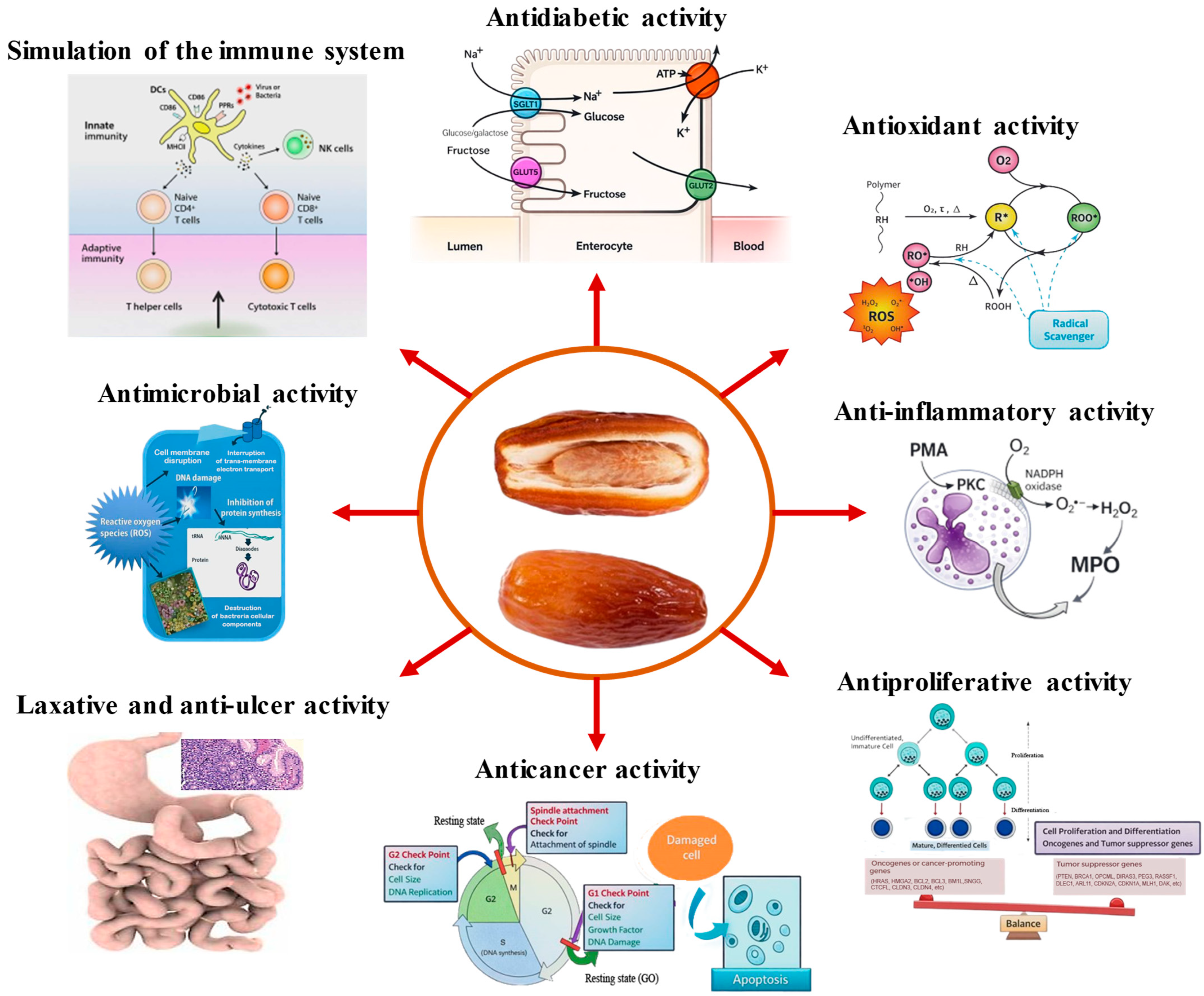

Disclaimer/Publisher’s Note: The statements, opinions and data contained in all publications are solely those of the individual author(s) and contributor(s) and not of MDPI and/or the editor(s). MDPI and/or the editor(s) disclaim responsibility for any injury to people or property resulting from any ideas, methods, instructions or products referred to in the content. |
© 2026 by the authors. Licensee MDPI, Basel, Switzerland. This article is an open access article distributed under the terms and conditions of the Creative Commons Attribution (CC BY) license.
Share and Cite
Djaoudene, O.; Rodríguez-Solana, R.; Romano, A. Valorization of Date Palm (Phoenix dactylifera L.) Fruits and By-Products as High-Value Sustainable Products: A Comprehensive Review on Bioactive Composition, Health Benefits, and Industrial Applications. Molecules 2026, 31, 1194. https://doi.org/10.3390/molecules31071194
Djaoudene O, Rodríguez-Solana R, Romano A. Valorization of Date Palm (Phoenix dactylifera L.) Fruits and By-Products as High-Value Sustainable Products: A Comprehensive Review on Bioactive Composition, Health Benefits, and Industrial Applications. Molecules. 2026; 31(7):1194. https://doi.org/10.3390/molecules31071194
Chicago/Turabian StyleDjaoudene, Ouarda, Raquel Rodríguez-Solana, and Anabela Romano. 2026. "Valorization of Date Palm (Phoenix dactylifera L.) Fruits and By-Products as High-Value Sustainable Products: A Comprehensive Review on Bioactive Composition, Health Benefits, and Industrial Applications" Molecules 31, no. 7: 1194. https://doi.org/10.3390/molecules31071194
APA StyleDjaoudene, O., Rodríguez-Solana, R., & Romano, A. (2026). Valorization of Date Palm (Phoenix dactylifera L.) Fruits and By-Products as High-Value Sustainable Products: A Comprehensive Review on Bioactive Composition, Health Benefits, and Industrial Applications. Molecules, 31(7), 1194. https://doi.org/10.3390/molecules31071194