Article

Sub-Minimum Inhibitory Concentrations of Amoxicillin Modulate Biofilm Formation and the Expression of Biofilm-Associated Genes in Enterococcus faecalis


by
Desiye T. Tegegne
1,2,*,
Sylwia Banaszkiewicz
3,
Jacek Bania
3 and
Błażej Poźniak
1
1
Department of Pharmacology and Toxicology, Faculty of Veterinary Medicine, Wrocław University of Environmental and Life Sciences, ul. Norwida 31, 50-375 Wroclaw, Poland
2
Animal Biotechnology Research Program, National Agricultural Biotechnology Research Center, Ethiopian Institute of Agricultural Research, Holeta P.O. Box 249, Ethiopia
3
Department of Food Hygiene and Consumer Health Protection, Faculty of Veterinary Medicine, Wrocław University of Environmental and Life Sciences, ul. Norwida 31, 50-375 Wroclaw, Poland
*
Author to whom correspondence should be addressed.
Molecules 2026, 31(12), 1986; https://doi.org/10.3390/molecules31121986
Submission received: 14 May 2026 / Revised: 4 June 2026 / Accepted: 4 June 2026 / Published: 6 June 2026

Abstract

Background: Enterococcus faecalis is one of the most frequent causes of catheter-associated urinary tract infections, largely due to its ability to form biofilms on indwelling urinary catheter surfaces, which enhance bacterial persistence and antimicrobial tolerance. Sub-minimum inhibitory concentrations (sub-MICs) of antimicrobials frequently occur in clinical settings, and growing evidence suggests that such suboptimal exposures can induce bacterial biofilm formation. We hypothesized that exposure to sub-MICs of amoxicillin, ciprofloxacin, and nitrofurantoin, antimicrobials commonly employed in the treatment of urinary tract infections, would enhance the biofilm-forming capacity of E. faecalis strains. Objective: To investigate the effects of sub-MICs of amoxicillin, ciprofloxacin, and nitrofurantoin on biofilm formation and biofilm-associated gene expression. The study focused on key biofilm-related genes, including those encoding aggregation substance protein (asa1), collagen adhesin (ace), E. faecalis surface protein (esp), gelatinase (gelE), cytolysin activator A (cylA), endocarditis antigen A (efaA), and the endocarditis- and biofilm-associated pili subunit A (ebpA) in E. faecalis. Methods: Two strains, E. faecalis ATCC 29212 and strain 54, were exposed to 1/8× and 1/4× MIC of amoxicillin, ciprofloxacin, and nitrofurantoin in either artificial urine medium (AUM) or tryptone soya broth (TSB). Bacterial growth kinetics were monitored by optical density measurements, while biofilm formation was quantified using a microtiter plate biofilm assay. The expression of biofilm-associated genes was analyzed using quantitative reverse transcription PCR (RT-qPCR) at 24 and 48 h following exposure to sub-MICs of amoxicillin under flow conditions mimicking the urinary tract milieu. Results: Exposure to sub-MICs of the three antimicrobials did not significantly affect bacterial growth in either strain or culture medium. Sub-MICs of amoxicillin significantly enhanced biofilm formation, with the most pronounced effect observed at 1/4× MIC in both AUM and TSB. In contrast, ciprofloxacin and nitrofurantoin exerted inhibitory effects on biofilm formation across both media. Gene expression analysis demonstrated time- and strain-dependent responses to amoxicillin exposure. E. faecalis ATCC 29212 exhibited a moderate, coordinated upregulation of adhesion- and biofilm-associated genes, particularly at 48 h. By comparison, E. faecalis strain 54 showed a stronger and more dynamic transcriptional response, characterized by early and sustained induction of key biofilm-related genes, including esp and gelE, as well as a pronounced late upregulation of ebpA. Conclusions: These findings emphasize the importance of maintaining therapeutically effective antimicrobial concentrations, as sub-inhibitory amoxicillin exposure may promote biofilm-associated persistence and potentially compromise treatment efficacy.

1. Introduction

Catheter-associated urinary tract infections (CAUTIs) represent one of the most prevalent healthcare-associated infections, accounting for up to 40% of all such infections [1,2]. The use of indwelling urinary catheters provides a surface that promotes microbial adhesion and colonization, thereby facilitating the development of persistent infections [3]. Among the uropathogens implicated in CAUTIs, Enterococcus faecalis has emerged as a clinically significant opportunistic pathogen, owing to its ability to adhere to urinary catheter surfaces and exhibit intrinsic and acquired resistance to multiple antimicrobial agents [4,5,6].
Enterococcus faecalis harbors a diverse array of virulence determinants that promote its persistence in hospital environments, facilitate transmission, and contribute to disease pathogenesis [7,8,9]. These determinants include surface adhesins that enhance attachment to host tissues and medical devices, as well as factors that support biofilm formation, enabling the organism to resist antimicrobial treatments and evade host immune responses. Additionally, the production of cytolysins and other secreted enzymes contributes to tissue damage and modulation of host immune responses, further enhancing its pathogenic potential [10,11,12]. The organism’s intrinsic and acquired resistance to multiple antimicrobials also plays a critical role in its ability to survive in clinical settings, complicating treatment strategies and promoting its emergence as a significant nosocomial pathogen [13,14,15,16]. Key biofilm genes encode microbial surface components recognizing adhesive matrix molecules (MSCRAMMs) and related factors, including aggregation substance protein (asa1), collagen adhesin of E. faecalis (ace), E. faecalis surface protein (esp), gelatinase (gelE), cytolysin activator A (cylA), endocarditis antigen A (efaA), and endocarditis- and biofilm-associated pili subunit A (ebpA) [7,9,17]. The expression of these biofilm-associated genes is highly dynamic and can be modulated by environmental conditions, including both the concentration and duration of antimicrobial exposure [7]. Consequently, these factors facilitate bacterial adhesion to host tissues and abiotic surfaces and play a central role in the formation of bacterial biofilms, which are structured communities of bacteria embedded within a self-produced matrix of extracellular polymeric substances (EPSs) that adhere to biotic or abiotic surfaces [9,18]. According to estimates from the NIH and CDC, up to 80% of all microbial infections and more than 60% of nosocomial infections are associated with biofilm formation [19,20,21].
Amoxicillin, ciprofloxacin, and nitrofurantoin are among the most commonly prescribed antimicrobials for the treatment of urinary tract infections [22,23]. Several studies have reported that, during antimicrobial therapy, bacteria are frequently exposed to sub-minimum inhibitory concentrations (sub-MICs) of antimicrobials due to factors such as suboptimal dosing, pharmacokinetic variability, and limited penetration into tissues or established biofilm matrices [24]. More importantly, host tissues and indwelling medical devices are exposed to a broad range of antimicrobial concentrations during the course of therapy [25]. Rather than being merely subtherapeutic and ineffective, sub-MIC levels can function as signaling cues that modulate key bacterial processes, including gene transcription, quorum sensing, and biofilm formation [26,27,28]. Such exposures act as environmental stimuli that influence bacterial physiology, shaping stress responses, biofilm development, and virulence-associated gene expression, and thereby potentially altering infection outcomes. Accordingly, a comprehensive understanding of these effects is essential for optimizing therapeutic strategies and minimizing the risk of biofilm-associated infections.
Although suboptimal antimicrobial therapy is known to elicit adaptive bacterial responses that influence physiology and pathogenicity, the effects of sub-MICs of antimicrobials on E. faecalis biofilm development and associated gene expression under clinically relevant flow conditions remain largely unexplored. Moreover, the majority of prior studies have utilized conventional laboratory media that do not reflect the urinary tract environment and have largely been performed under static culture conditions that do not capture the dynamic conditions of the urinary tract milieu. Importantly, our preliminary study of bacterial growth dynamics demonstrated that E. faecalis rapidly reached the stationary phase under static culture conditions, likely due to the swift depletion of available nutrients; this, in turn, may influence biofilm formation. Such conditions may not reflect in vivo bacterial physiology, thereby limiting the preclinical relevance of the findings for translational applications. To overcome this limitation and more accurately mimic the dynamic environment of the urinary tract, we employed a flow-based culture system using artificial urine medium. Therefore, the primary objective of this study was to evaluate the effects of sub-MICs of three commonly prescribed antimicrobials for the treatment of urinary tract infections, namely amoxicillin, ciprofloxacin, and nitrofurantoin, on bacterial growth, biofilm formation, and the expression of biofilm-associated genes in two model strains of E. faecalis.

2. Results

2.1. Effect of Sub-MICs of Antimicrobials on Bacterial Growth Dynamics

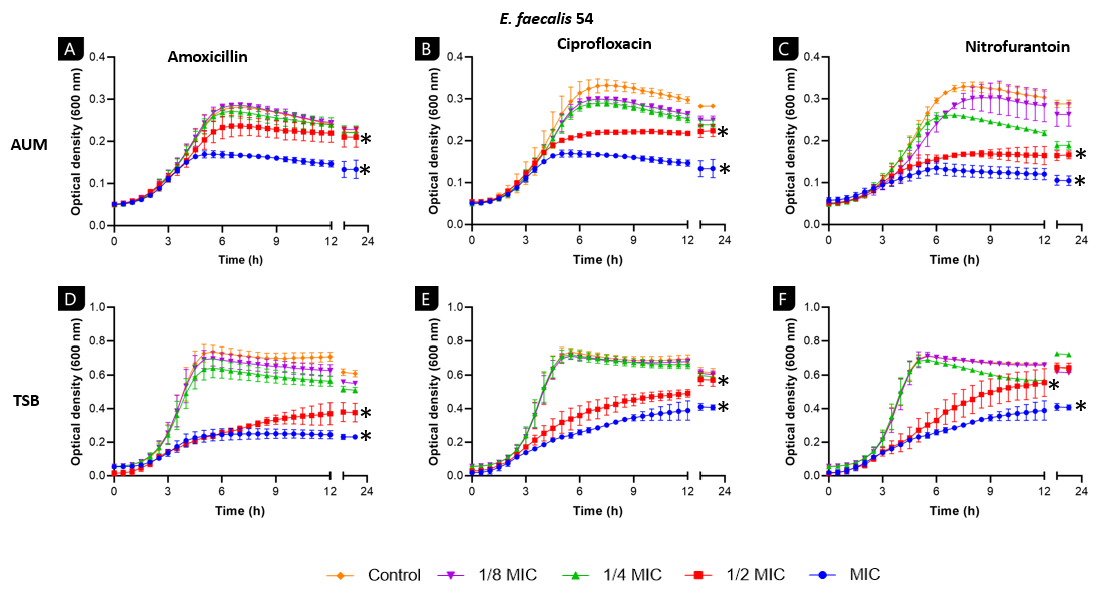
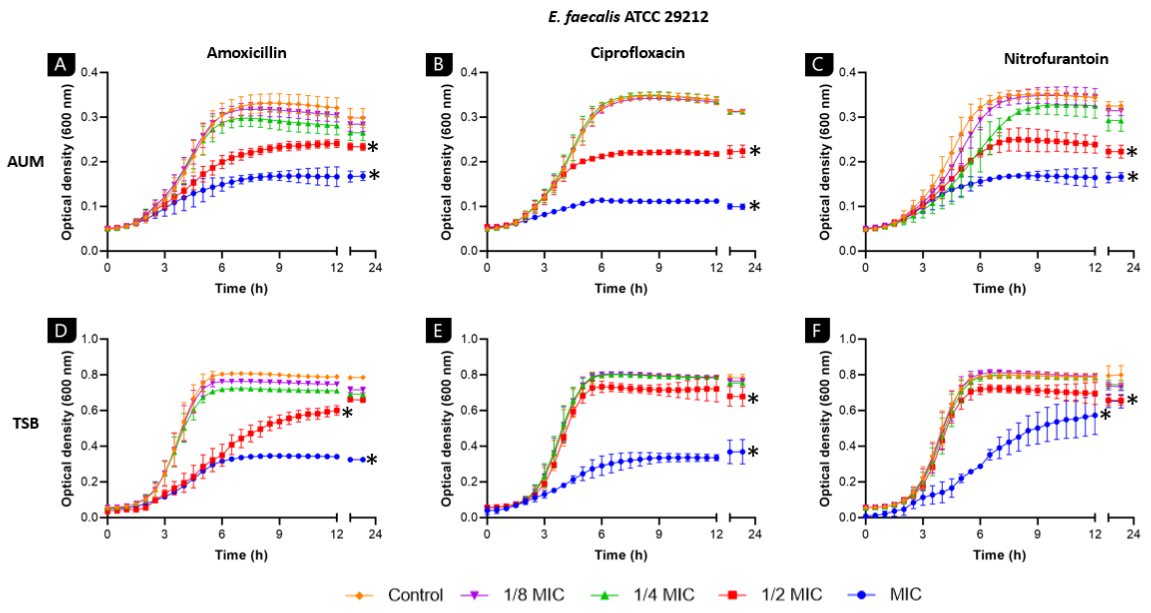
The effects of sub-MICs of amoxicillin, ciprofloxacin, and nitrofurantoin on bacterial growth were evaluated for E. faecalis ATCC 29212 (Figure 1A–F) and strain 54 (Figure 2A–F) in AUM and TSB. In both media, bacterial growth following exposure to sub-MIC concentrations (1/8× and 1/4× MIC) was comparable to that of the untreated control cultures, with no significant differences detected (p > 0.05). Conversely, treatment at MIC and 1/2× MIC resulted in significant inhibition of bacterial growth relative to the untreated controls (p < 0.05). These findings indicate that the tested sub-MICs (1/8× and 1/4× MIC) did not exert a significant inhibitory effect on the growth of E. faecalis strains during biofilm formation. Therefore, sub-MIC concentrations of 1/8× and 1/4× MIC were selected for subsequent experiments.

2.2. Effects of Sub-MICs of Antimicrobials on Biofilm Formation in E. faecalis

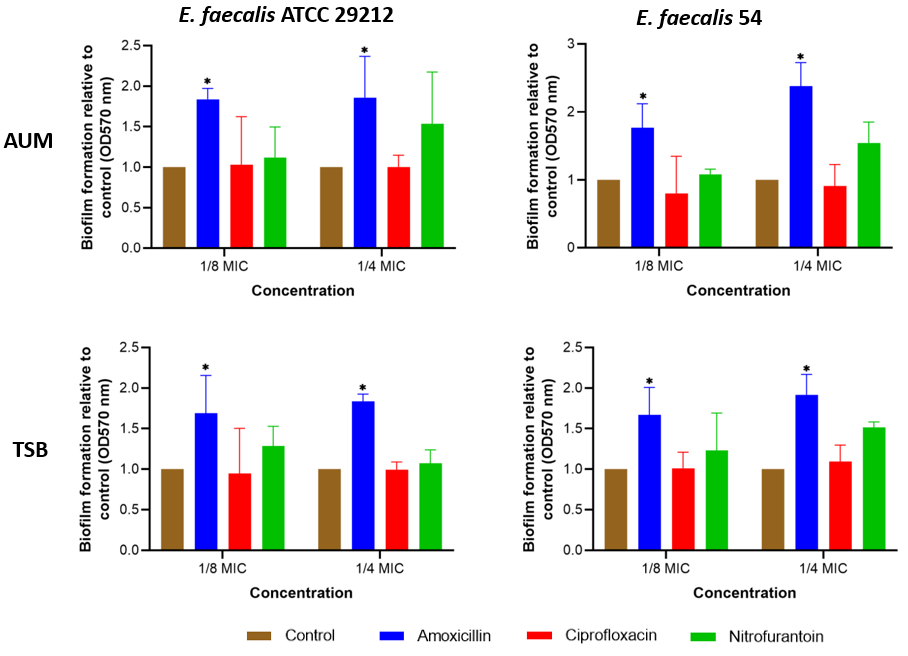
Biofilm production was quantified at 1/8× and 1/4× MIC and compared with untreated controls (Figure 3). Sub-MICs of amoxicillin, ciprofloxacin, and nitrofurantoin were evaluated for their effects on biofilm formation in E. faecalis ATCC 29212 and E. faecalis 54, with increased OD570 values indicating enhanced biofilm formation. The hypothesis was confirmed for amoxicillin but not for ciprofloxacin or nitrofurantoin, as only sub-MIC amoxicillin exposure resulted in a significant increase in biofilm formation by E. faecalis. Sub-MIC exposure to amoxicillin significantly increased biofilm formation in both strains across all tested conditions. In E. faecalis ATCC 29212, amoxicillin treatment in both AUM and TSB resulted in elevated biofilm production at 1/8× and 1/4× MIC, with a greater effect observed at 1/4× MIC (approximately 1.8–2.0-fold relative to the control). A similar trend was observed for E. faecalis 54, in which biofilm formation increased under all conditions, reaching approximately 1.7-fold relative to the control at 1/8× MIC and 2.3-fold relative to the control at 1/4× MIC in AUM, with comparable increases in TSB. In contrast, sub-MICs of ciprofloxacin and nitrofurantoin exhibited inhibitory effects on biofilm formation across both the E. faecalis strain and growth medium. Overall, these results demonstrate that sub-MIC levels of amoxicillin enhance biofilm formation in E. faecalis ATCC 29212 and 54, whereas ciprofloxacin and nitrofurantoin do not induce biofilm production.

2.3. Expression of Genes Associated with Sub-MICs of Amoxicillin Exposure

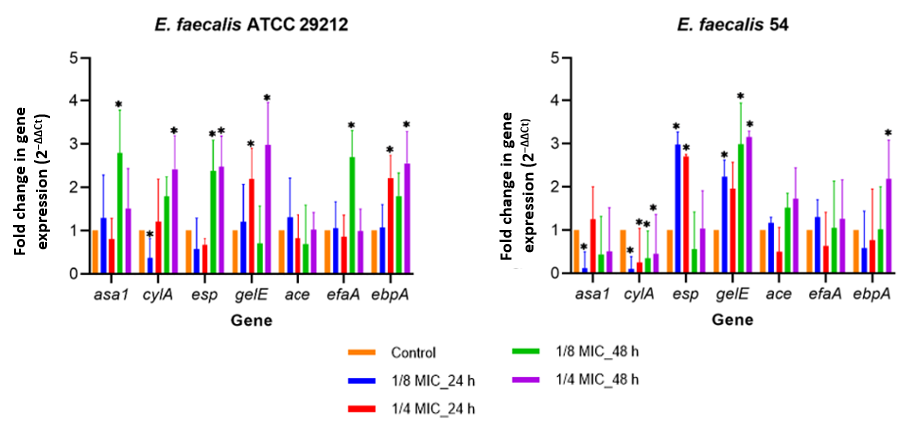
Sub-MIC effects of amoxicillin on six biofilm-related genes in E. faecalis are shown in Figure 4. Exposure of E. faecalis to sub-MIC of amoxicillin led to a time- and strain-dependent modulation of biofilm- and virulence-associated gene expression. In both E. faecalis ATCC 29212 and strain 54, most genes showed stronger transcriptional responses after 48 h compared with 24 h, with the highest induction generally observed at 1/4× MIC. In E. faecalis ATCC 29212, adhesion and virulence genes, including asa1, esp, efaA, and ebpA, were significantly upregulated at 48 h, while gelE showed the most pronounced induction, and cylA increased moderately under prolonged exposure. In E. faecalis strain 54, the response was more variable, with early strong induction of esp and gelE at 24 h, followed by sustained or enhanced expression of gelE and ebpA at 48 h, whereas efaA and asa1 showed only moderate late upregulation, and cylA remained weakly expressed. Overall, amoxicillin sub-MIC exposure promoted differential activation of biofilm-associated pathways depending on strain background and exposure duration.

3. Discussion

Enterococcus faecalis represents a major cause of healthcare-associated infections due to its ability to establish robust biofilms on medical devices and host tissues, creating a protective matrix that shields the bacteria from host defenses and antimicrobials, thus driving clinical persistence [29,30,31]. This complex, multifactorial process is mediated by virulence determinants, including surface adhesins, aggregation substances, and extracellular matrix components, that govern initial attachment, intercellular interaction, and biofilm maturation [32,33,34]. Given that biofilms are implicated in 60% to 80% of all microbial infections, elucidating their underlying regulatory mechanisms is critical to mitigating antimicrobial resistance and preventing therapeutic failure [35,36,37,38,39]. Importantly, sub-MICs of antimicrobials, often caused by underdosing, prolonged dosing intervals, or poor tissue penetration, can act as stressors that alter bacterial physiology and paradoxically induce biofilm formation depending on the drug, dose, and strain [40,41,42,43]. However, the impact of sub-MICs on E. faecalis biofilms under dynamic flow conditions in AUM remains poorly characterized. To bridge this gap in understanding biofilm-associated pathogenicity, this study evaluated the effects of sub-MIC amoxicillin, ciprofloxacin, and nitrofurantoin on E. faecalis biofilm formation using microtiter plate assays and analyzed corresponding alterations in gene expression via quantitative RT-PCR.
We demonstrate that exposure of E. faecalis ATCC 29212 and strain 54 to sub-MICs (1/8× MIC and 1/4× MIC) of tested antibiotics does not significantly affect bacterial growth in either AUM or TSB. Growth kinetics remained comparable to those of untreated controls across all time points, with no statistically significant differences observed. These findings confirm that the tested sub-MIC levels do not exert a measurable inhibitory effect on planktonic proliferation, consistent with the definition of sub-MICs as those insufficient to suppress bacterial growth [44]. Importantly, the absence of growth inhibition under these conditions supports the validity of subsequent analyses of biofilm formation, as any observed effects can be attributed to regulatory or phenotypic modulation rather than reduced cell viability. Treatment with 1/2× MIC and 1× MIC of amoxicillin and ciprofloxacin consistently and significantly inhibited bacterial growth relative to untreated controls. In contrast, both E. faecalis strains exposed to 1× MIC nitrofurantoin occasionally achieved final growth curves comparable to those of the control, particularly in TSB. This kinetic behavior can be explained by the definition of the MIC, which represents the threshold for inhibition of visible growth at a defined endpoint rather than complete bacterial eradication. Accordingly, following an initial drug-induced lag phase, a surviving subpopulation may have initiated cellular repair processes and subsequently resumed proliferation. This metabolic recovery is likely further facilitated by the nutrient-rich composition of TSB, which supports rapid bacterial reactivation during prolonged incubation. Additionally, nitrofurantoin is known to be light-sensitive, and exposure to light during incubation may further reduce its effective antimicrobial activity, potentially contributing to the observed regrowth dynamics.
This study shows that sub-MICs of antimicrobials, including amoxicillin, ciprofloxacin, and nitrofurantoin, differentially influence biofilm formation in E. faecalis ATCC 29212 and strain 54 across two growth media. The most notable result was the ability of different subinhibitory concentrations of amoxicillin to induce biofilm production in both tested E. faecalis strains in AUM and TSB, with 1/4× MIC consistently yielding greater biomass than 1/8× MIC and untreated controls. The pronounced biofilm induction observed following amoxicillin exposure is consistent with previous studies showing that β-lactam antibiotics, at sub-inhibitory levels, can trigger stress responses in Gram-positive bacteria such as E. faecalis that promote biofilm formation [39]. These responses include alterations in cell wall synthesis, increased autolysis, and the release of extracellular DNA, all of which contribute to biofilm structure and stability [26,45]. Furthermore, exposure to sub-MIC levels of β-lactams, such as amoxicillin, has been shown to upregulate genes involved in adhesion and biofilm maturation, ultimately enhancing bacterial persistence [27,28].
In contrast, ciprofloxacin and nitrofurantoin consistently exhibited inhibitory effects on biofilm formation under all tested conditions. These effects may be attributed to their distinct mechanisms of action. Ciprofloxacin targets DNA gyrase and topoisomerase IV, thereby interfering with DNA replication and related cellular processes that are essential for biofilm development, even at sub-inhibitory concentrations [46]. This moderate inhibitory effect is consistent with previous findings indicating that fluoroquinolones can reduce E. faecalis biofilm formation by disrupting DNA replication required for stable biofilm establishment. Importantly, nitrofurantoin, which exerts its antibacterial activity through the generation of reactive intermediates that damage multiple cellular targets, is similarly less likely to induce regulatory pathways associated with biofilm formation (37). Comparable observations have been reported in other studies, where fluoroquinolones and nitrofuran derivatives demonstrated limited biofilm-inducing potential relative to β-lactam antibiotics [26,28]. Collectively, these findings indicate the critical influence of antimicrobial class on biofilm modulation and suggest that sublethal exposure to β-lactam antibiotics, such as amoxicillin, may inadvertently enhance E. faecalis persistence in clinical settings. This has important therapeutic implications, particularly in environments where bacteria are frequently exposed to fluctuating or sub-inhibitory antimicrobial concentrations.
The present study reveals distinct temporal patterns of virulence-associated gene expression in E. faecalis ATCC 29212 and strain 54, indicating divergent adaptive and pathogenic strategies. Overall, gene expression changes were minimal at early time points but became increasingly pronounced over time, suggesting a progressive response associated with biofilm development and maturation. This pattern is consistent with previous reports showing that sub-MIC amoxicillin exposure induces cell wall stress responses in E. faecalis, thereby enhancing the expression of genes involved in adhesion, aggregation, and extracellular matrix production.
In E. faecalis ATCC 29212, the moderate and coordinated upregulation of virulence genes reflects the stable expression profile typical of E. faecalis strains. Adhesion-related genes such as asa1 and esp were expressed at moderate levels, supporting initial attachment without inducing a strong virulence response [47,48]. The gradual increase in gelE and efaA expression at later stages is consistent with their roles in biofilm maturation and host interaction, while upregulation of ebpA at both times at higher concentrations supports its established role in pili formation and biofilm development during prolonged growth phases [49,50,51]. Upregulation of cylA indicates increased expression of the cytolysin operon, suggesting enhanced cytolysin production and a corresponding rise in bacterial virulence and cytotoxic potential [52]. In contrast, the relatively stable expression of ace in E. faecalis ATCC 29212 is also in agreement with studies suggesting that collagen-binding proteins may be constitutively expressed to maintain readiness for host interaction rather than being strongly inducible [53].
In contrast, E. faecalis strain 54 exhibited a markedly stronger and more dynamic transcriptional response, particularly in esp and gelE, which were highly upregulated at intermediate time points. Downregulation of cylA may indicate suppression of cytolysin-mediated virulence and a regulatory shift favoring biofilm-associated survival under stress conditions, consistent with the observed inverse relationship between cytolysin expression and robust biofilm formation [54,55]. This pattern is consistent with previous studies on clinical isolates, where enhanced expression of these genes has been linked to increased virulence, biofilm formation, and cytolysin production [31,56]. The elevated esp expression, in particular, has been widely associated with hospital-acquired strains and their ability to form persistent biofilms on medical devices. Interestingly, in strain 54, this adaptational esp upregulation appeared faster than in the ATCC 29212 strain. The early downregulation of asa1 at lower amoxicillin concentrations in E. faecalis strain 54 suggests a regulated adhesion mechanism that may be influenced by environmental cues. Aggregation substance, encoded by the asa1 gene, is a surface-associated protein that plays a critical role in biofilm formation and adherence to host tissues, both of which are key determinants of pathogenicity [57]. Similar expression patterns have been reported in clinical isolates, where aggregation substance is induced under specific conditions to promote cell-to-cell contact and plasmid transfer [58]. Furthermore, the significant increases in ebpA at later stages reinforce the transition of E. faecalis strain 54 into a highly adherent and biofilm-competent phenotype, supporting observations from previous research that pili-associated genes are critical for long-term colonization and infection persistence [41]. Overall, the differences observed between the two strains support the notion that E. faecalis strain 54 exhibits more robust and dynamic virulence gene expression compared to E. faecalis ATCC 29212. The latter strain appears to rely on a steady and regulated expression strategy, which may favor persistence under controlled conditions. In contrast, E. faecalis strain 54 demonstrates rapid activation of multiple virulence pathways, consistent with previous findings that associate clinical isolates with increased pathogenicity and adaptability [31]. It should be noted that the gelE upregulation in both strains may be associated with the presence of gelatin in the culture medium. Although gelatin is commonly added to media applied in biofilm studies and in cases where better reproduction of urinary viscosity is needed (flow models), it may possibly channel the bacterial adaptational response in a direction that does not fully reflect the situation seen in the urinary tract.
Although the current model seems to be much more clinically relevant as compared to the standard microtiter plate model, it is still only an in vitro model, which may not fully replicate the complex in vivo environment encountered during infection, including host immune interactions, tissue-specific factors, and pharmacokinetic antimicrobial fluctuations. Furthermore, the use of glass as a substrate may not fully reflect the adaptive response that would develop if bacteria had direct contact with tissues or specific polymer surfaces of indwelling devices. Additionally, only two E. faecalis strains were examined, which limits the generalizability of the findings across the broader genetic and phenotypic diversity of clinical isolates. The study also focused on a selected set of biofilm-associated genes and therefore may not capture the full scope of global transcriptional changes induced by sub-MIC antimicrobial exposure. Finally, protein-level validation of gene expression changes and direct mechanistic assessments of regulatory pathways were not performed, which could further strengthen the interpretation of the observed phenotypic effects.

4. Materials and Methods

4.1. Bacterial Strains, Culture Media, and Antimicrobials

Two E. faecalis model strains were used in this study: E. faecalis ATCC 29212, originally isolated from urinary tract infection and widely used in urinary tract infection research, was obtained from Microbiologics (St. Cloud, MN, USA), and E. faecalis strain 54, obtained from the Department of Food Hygiene and Consumer Health Protection, Wrocław University of Environmental and Life Sciences, Poland (clinical strain originally provided by Prof. A. Toledo-Arana, Instituto de Agrobiotecnología y Recursos Naturales, Universidad Pública de Navarra, Pamplona, Spain). The biofilm-forming potential of the E. faecalis strain 54 has been well characterized in previous studies [47,59]. Both strains are sensitive to amoxicillin, ciprofloxacin, and nitrofurantoin, which are the most common antibiotics used to treat urinary tract infections.
Tryptone soya broth (TSB) and cation-adjusted Mueller–Hinton broth (CAMHB) purchased from Oxoid (ThermoFisher Scientific, Basingstoke, UK) were used for routine bacterial cultivation and antimicrobial susceptibility testing, respectively. Artificial urine medium (AUM) [60], with its composition detailed in Supplementary Tables S1–S3, was employed as a physiologically relevant medium to simulate the urinary tract environment. To facilitate clinically relevant biofilm development, AUM was supplemented with 0.1% (w/v) glucose [61], a concentration that may be encountered in diabetic patients, a population particularly prone to urinary tract infections [62,63]. To eliminate the effect of glucose addition in the comparison between AUM and TSB, the latter medium was also supplemented with 0.1% (w/v) glucose. The most commonly prescribed antimicrobials for urinary tract infections, amoxicillin, ciprofloxacin, and nitrofurantoin, were included in this study and obtained from Sigma-Aldrich (Merck, Darmstadt, Germany). Antimicrobial stock solutions were prepared, diluted in accordance with Clinical and Laboratory Standards Institute (CLSI) guidelines [64], aliquoted, and stored at −20 °C. Preliminary susceptibility testing confirmed that both E. faecalis strains were susceptible to all three antimicrobials tested (Supplementary Table S4). Sub-MIC values used to assess the effects of antimicrobials on bacterial growth dynamics and biofilm formation were selected based on the MICs of the respective antimicrobials in their corresponding media.

4.2. Effect of Sub-MICs of Antimicrobials on Bacterial Growth Kinetics

This assay was performed to evaluate the potential growth-inhibitory effects of sub-MICs of amoxicillin, ciprofloxacin, and nitrofurantoin and to ensure that these sub-MIC levels did not influence biofilm formation by reducing bacterial growth in both AUM and TSB media. Briefly, overnight cultures of the two E. faecalis strains were diluted in fresh medium to an optical density at 600 nm (OD600) of 0.01 (approximately 1 × 10⁶ CFU/mL). Subsequently, 100 μL aliquots were dispensed into 96-well microtiter plates (Sarstedt, Nümbrecht, Germany). Each well was supplemented with 100 μL of antimicrobial solution at twice the desired final concentration, resulting in final concentrations of 0 (control; fresh medium only), 1/8× MIC, 1/4× MIC, 1/2× MIC, or 1× MIC in a total volume of 200 μL per well. Bacterial growth kinetics were assessed by measuring OD600 at 30 min intervals using a Tecan Spark microplate reader (Tecan, Männedorf, Switzerland). Positive controls consisted of untreated bacterial cultures, while negative controls contained only growth medium to account for background absorbance [65].

4.3. Effect of Sub-MICs of Antimicrobials on Biofilm Formation Under Static Conditions

The effect of sub-MICs of amoxicillin, ciprofloxacin, and nitrofurantoin on E. faecalis biofilm formation was evaluated at 1/8× and 1/4× MIC and compared with an untreated control in both media, using a previously described method with minor modifications [66]. Briefly, overnight cultures were diluted to an OD600 of 0.01 in fresh AUM or TSB. Subsequently, 100 μL of the bacterial suspension was dispensed into 96-well microtiter plates (Nunc™, Thermo Fisher Scientific, Roskilde, Denmark), followed by the addition of 100 μL of antimicrobial solutions prepared at twice the desired final concentration, yielding final concentrations of 0 (control; fresh medium only), 1/8× MIC, or 1/4× MIC in a total volume of 200 μL per well. Positive controls consisted of untreated bacterial cultures, while negative controls contained only growth medium to account for non-specific staining [67,68]. Plates were incubated at 37 °C for 24 h under static conditions.
After incubation, planktonic cells were carefully removed, and wells were gently washed with normal saline and air-dried. The biofilms were stained with 0.1% (v/v) crystal violet (Merck, Darmstadt, Germany) and incubated at room temperature for 15 min, and excess stain was removed by three gentle washes with sterile normal saline. After the biofilms had dried, the crystal violet was solubilized by adding 200 μL of 33% (v/v) acetic acid (Merck, Darmstadt, Germany), and the extent of biofilm biomass was quantified by measuring absorbance at 570 nm using a Tecan Spark microplate reader. Following OD570 measurements, relative biofilm formation was calculated as the ratio of sub-MIC antimicrobial-exposed samples to the untreated growth control, enabling quantification of inhibitory (<1), no effect (=1), or enhancing (>1) effects of antimicrobials compared with untreated bacteria.

4.4. Effect of Sub-MICs of Amoxicillin on Biofilm-Associated Gene Expression

4.4.1. Biofilm Culture in a Drip-Flow Biofilm Reactor

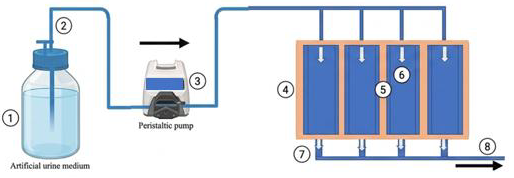
Biofilms were cultivated using a drip-flow biofilm reactor (BioSurface Technologies Corp., Bozeman, MT, USA) according to the method described by Goeres et al., with minor modifications [69], as shown in Figure 5. Briefly, overnight cultures of E. faecalis strains were diluted to an OD600 of 0.01 in TSB, and 12.5 mL of the inoculum was introduced into each reactor channel containing sterile glass slides. The reactor was incubated under static conditions at 37 °C for 12 h to allow initial bacterial adhesion. Following the adhesion phase, the reactor was inclined at 10° and connected to a reservoir containing AUM, supplemented either with or without sub-MICs of amoxicillin. Amoxicillin was selected for gene expression analysis at 24 h and 48 h under sub-inhibitory conditions based on its observed ability to enhance biofilm formation at sub-MICs in static microtiter plate biofilm assays. AUM was employed in gene expression experiments to better mimic physiologically relevant conditions for studying E. faecalis in a uropathogenic context, whereas previous studies have largely relied on standard culture media, such as TSB. Continuous medium flow was initiated at a rate of 0.4 mL/min per channel [70] and maintained at 37 °C for up to 48 h. For time-point analyses, biofilms were harvested at 24 and 48 h. At each time point, microscope glass slides were aseptically removed from the reactor and gently rinsed with sterile normal saline to remove non-adherent cells. Biofilms were then scraped into saline and homogenized prior to downstream analyses.

4.4.2. RNA Isolation

The harvested bacterial pellets were resuspended in a 100 µL buffer composed of Tris-HCl (pH 7.4; Sigma-Aldrich, Darmstadt, Germany), lysozyme (10 mg/mL; Sigma-Aldrich, Darmstadt, Germany), proteinase K (20 mg/mL; Thermo Fisher Scientific), and 10% SDS (Sigma-Aldrich, Darmstadt, Germany), followed by incubation at 37 °C for 30 min. Subsequently, 1 mL of TRI Reagent (Sigma-Aldrich, Darmstadt, Germany) was added and mixed well, and the samples were stored at −80 °C overnight. The samples were then thawed at room temperature, after which 200 µL of pure chloroform (Sigma-Aldrich, Warsaw, Poland) was added. Mechanical disruption of bacterial suspension with 425–600 µm glass beads (Sigma-Aldrich, Poland) was performed using a TissueLyser LT (Qiagen, Hilden, Germany) for three cycles of 2 min agitation, each followed by a 1 min incubation on ice. The samples were then incubated at room temperature for 5 min to allow phase separation. Following centrifugation at 12,000× g for 15 min at 4 °C, the upper aqueous phase (500 µL) was carefully transferred to a new microcentrifuge tube, and an equal volume of pure isopropanol (Chempur, Piekary Śląskie, Poland) was added. The mixture was incubated at −20 °C for 20 min and subsequently centrifuged at 12,000× g for 10 min at 4 °C. The supernatant was discarded, and the pellet was washed with 1 mL of 70% ethanol (Chempur, Poland). After incubation at −20 °C for 20 min, samples were centrifuged at 7600× g for 5 min at 4 °C. The washing and centrifugation steps were repeated twice. The resulting pellet was air-dried at room temperature for 7 min and resuspended in 50 µL of RNase-free water (Invitrogen, Waltham, MA, USA).

4.4.3. Reverse Transcription and Quantitative Real-Time PCR

Complementary DNA (cDNA) was synthesized using the iScript™ cDNA Synthesis Kit (Bio-Rad, Hercules, CA, USA) according to the manufacturer’s instructions and subsequently stored at −20 °C until further analysis. Transcriptional levels of biofilm-associated genes were quantified by qRT-PCR following previously described protocols [71,72]. Briefly, each 20 μL reaction consisted of 12.5 μL of 2× SsoFast™ EvaGreen® Supermix (Bio-Rad, USA), 1 μL of cDNA template, and 0.5 μL each of forward and reverse primers (20 µM), with nuclease-free water added to reach the final volume. Amplifications were performed using a QuantStudio™ 5 Real-Time PCR System (Applied Biosystems, Waltham, MA, USA). The target genes, corresponding primer sequences, and expected amplicon sizes are listed in Table 1. Thermal cycling conditions consisted of an initial denaturation step at 98 °C for 2 min, followed by 40 cycles of denaturation at 98 °C for 15 s and annealing/extension at 60 °C for 30 s. A melting curve analysis was performed to confirm the specificity of the amplification. All reactions were performed in technical duplicates across three independent biological replicates. To rule out the presence of genomic DNA in the RNA preparations, control reactions were performed in which reverse transcriptase was omitted. Amplification efficiency for each target gene was determined using standard curves generated from serial five-fold dilutions of genomic DNA. All primer pairs exhibited efficiencies greater than 98%, as calculated from the slope of the standard curves according to the following equation: E(%) = (10−(1/slope) − 1) × 100 [73].
The mRNA expression levels were quantified relative to the endogenous reference gene 16S rRNA [74]. Relative gene expression was calculated using the 2−ΔΔCt method [75], where values >1 indicate upregulation and values <1 indicate downregulation [66,76].

4.5. Statistical Analysis

Statistical analyses were performed using GraphPad Prism (version 9.0.0; Boston, MA, USA). Data normality was assessed using the Shapiro-Wilk test, and all data were found to be normally distributed. Following this evaluation, all subsequent statistical analyses were conducted. All experiments were conducted in triplicate on three independent days using separate cultures, and results are presented as mean ± standard deviation (SD). Differences between treated and untreated groups for each antimicrobial concentration, with respect to biofilm formation and gene expression, were assessed using a paired-sample t-test. Additionally, one-way ANOVA followed by Dunnett’s multiple-comparison test was applied to compare gene expression levels across treatment concentrations with the control group. A p-value < 0.05 was considered statistically significant.

5. Conclusions

Our study demonstrates that sub-MIC exposure to amoxicillin consistently and significantly enhanced biofilm formation in E. faecalis ATCC 29212 and E. faecalis 54, accompanied by the strongest and most widespread upregulation of adhesion-, biofilm-, and virulence-associated genes, particularly at later time points. In contrast, ciprofloxacin and nitrofurantoin did not promote biofilm development and generally exhibited inhibitory effects. Notably, strain-dependent differences in gene expression responses further highlighted the greater adaptive and virulence potential of E. faecalis 54 compared with E. faecalis ATCC 29212. Overall, these findings demonstrate that sublethal exposure to amoxicillin can stimulate biofilm formation and virulence gene expression in the studied E. faecalis strains, highlighting the importance of maintaining effective antimicrobial concentrations during therapy and its potential role in bacterial persistence.

Supplementary Materials

The following supporting information can be downloaded at: https://www.mdpi.com/article/10.3390/molecules31121986/s1, Table S1: Composition of AUM; Table S2: Components of 5× concentrated Calcium chloride/urea stock solution; Table S3: Final working concentration of artificial urine; Table S4: Minimum inhibitory concentrations of amoxicillin, ciprofloxacin, and nitrofurantoin against two E. faecalis strains in two different media.

Author Contributions

D.T.T.: conceptualization, writing—original draft, writing—review and editing, investigation, data analysis, methodology, visualization, funding acquisition, and project administration; S.B.: methodology, review and editing; J.B.: resources, review and editing; B.P.: conceptualization, methodology, writing—review and editing, resources, and supervision. All authors have read and agreed to the published version of the manuscript.

Funding

This work was supported by the Wrocław University of Environmental and Life Sciences (Poland) as part of research project No. N070/0011/24. The article is part of a PhD dissertation titled ‘The development of an in vitro pharmacokinetic–pharmacodynamic model of catheter-associated urinary tract infections related to bacterial biofilm’, prepared during study at the Doctoral School, Wrocław University of Environmental and Life Sciences. The APC is financed by the Wrocław University of Environmental and Life Sciences.

Institutional Review Board Statement

Not applicable.

Informed Consent Statement

Not applicable.

Data Availability Statement

The original contributions presented in this study are included in the article/Supplementary Material. Further inquiries can be directed to the corresponding authors.

Conflicts of Interest

The authors declare no conflicts of interest. The funders had no role in study design; data collection, analysis, and interpretation; the writing of the manuscript; or the decision to submit the manuscript.

References

  1. Nicolle, L.E. Catheter associated urinary tract infections. Antimicrob. Resist. Infect. Control 2014, 3, 23. [Google Scholar] [CrossRef] [PubMed]
  2. Cox, L.; Drerup, J.; Prickett, M. Urinary Tract Infection (UTI) Prevention in Patients with Chronic Indwelling Catheters. Curr. Bladder Dysfunct. Rep. 2024, 19, 317–323. [Google Scholar] [CrossRef]
  3. So, B.; Kim, J.; Jo, J.K.; So, H. Recent developments in preventing catheter-related infections based on biofilms: A comprehensive review. Biomicrofluidics 2024, 18, 051506. [Google Scholar] [CrossRef] [PubMed]
  4. Arias, C.A.; Murray, B.E. The rise of the Enterococcus: Beyond vancomycin resistance. Nat. Rev. Microbiol. 2012, 10, 266–278. [Google Scholar] [CrossRef]
  5. Hollenbeck, B.L.; Rice, L.B. Intrinsic and acquired resistance mechanisms in enterococcus. Virulence 2012, 3, 421–569. [Google Scholar] [CrossRef]
  6. Hidron, A.I.; Edwards, J.R.; Patel, J.; Horan, T.C.; Sievert, D.M.; Pollock, D.A.; Fridkin, S.K. Antimicrobial-resistant pathogens associated with healthcare-associated infections: Annual summary of data reported to the National Healthcare Safety Network at the Centers for Disease Control and Prevention, 2006–2007. Infect. Control Hosp. Epidemiol. 2008, 29, 996–1011. [Google Scholar] [CrossRef]
  7. Tibúrcio, A.A.C.M.; Paiva, A.D.; Pedrosa, A.L.; Rodrigues, W.F.; da Silva, R.B.; Oliveira, A.G. Effect of sub-inhibitory concentrations of antibiotics on biofilm formation and expression of virulence genes in penicillin-resistant, ampicillin-susceptible Enterococcus faecalis. Heliyon 2022, 8, e11154. [Google Scholar] [CrossRef]
  8. Goh, H.S.; Yong, M.A.; Chong, K.K.L.; Kline, K.A. Model systems for the study of Enterococcal colonization and infection. Virulence 2017, 8, 1525–1562. [Google Scholar] [CrossRef]
  9. Dunny, G.M.; Hancock, L.E.; Shankar, N. Enterococcal Biofilm Structure and Role in Colonization and Disease; Massachusetts Eye and Ear Infirmary: Boston, MA, USA, 2014. Available online: https://www.ncbi.nlm.nih.gov/books/NBK190433 (accessed on 26 April 2026). [PubMed]
  10. Tamrat, E.; Asmare, Z.; Geteneh, A.; Sisay, A.; Getachew, E.; Kassanew, B.; Dessale, M.; Gashaw, Y.; Jemal, A.; Gashaw, M. The global prevalence of biofilm-forming Enterococcus faecalis in clinical isolates: A systematic review and meta-analysis. BMC Infect. Dis. 2025, 25, 981. [Google Scholar] [CrossRef] [PubMed]
  11. Colaco, A.S. Extreme resistance of Enterococcus faecalis and its role in endodontic treatment failure. Prog. Med. Sci. 2018, 2, 9–13. [Google Scholar] [CrossRef]
  12. Sava, I.G.; Heikens, E.; Huebner, J. Pathogenesis and immunity in enterococcal infections. Clin. Microbiol. Infect. 2010, 16, 533–540. [Google Scholar] [CrossRef] [PubMed]
  13. Pugazhendhi, A.S.; Wei, F.; Hughes, M.; Coathup, M. Bacterial adhesion, virulence, and biofilm formation. In Musculoskeletal Infection; Springer: Berlin/Heidelberg, Germany, 2022; pp. 19–64. [Google Scholar] [CrossRef]
  14. Sadanandan, B.; Yogendraiah, K.M. Enterococcus faecalis biofilm: A clinical and environmental hazard. Med. Sci. Forum 2025, 35, 5. [Google Scholar] [CrossRef]
  15. Flemming, H.-C.; van Hullebusch, E.D.; Neu, T.R.; Nielsen, P.H.; Seviour, T.; Stoodley, P.; Wingender, J.; Wuertz, S. The biofilm matrix: Multitasking in a shared space. Nat. Rev. Microbiol. 2023, 21, 70–86. [Google Scholar] [CrossRef]
  16. Ramos, S.; Silva, V.; Dapkevicius, M.d.L.E.; Igrejas, G.; Poeta, P. Enterococci, from harmless bacteria to a pathogen. Microorganisms 2020, 8, 1118. [Google Scholar] [CrossRef]
  17. Garsin, D.A.; Frank, K.L.; Silanpää, J.; Ausubel, F.M.; Hartke, A.; Shankar, N.; Murray, B.E. Pathogenesis and models of enterococcal infection. In Enterococci: From Commensals to Leading Causes of Drug-Resistant Infection [Internet]; Massachusetts Eye and Ear Infirmary: Boston, MA, USA, 2014. Available online: https://www.ncbi.nlm.nih.gov/sites/books/NBK190426/ (accessed on 3 February 2026).
  18. Sillanpaa, J.; Nallapareddy, S.R.; Houston, J.; Ganesh, V.K.; Bourgogne, A.; Singh, K.V.; Murray, B.E.; Hook, M. A family of fibrinogen-binding MSCRAMMs from Enterococcus faecalis. Microbiology 2009, 155, 2390–2400. [Google Scholar] [CrossRef]
  19. Khatoon, Z.; McTiernan, C.D.; Suuronen, E.J.; Mah, T.-F.; Alarcon, E.I. Bacterial biofilm formation on implantable devices and approaches to its treatment and prevention. Heliyon 2018, 4, e01067. [Google Scholar] [CrossRef]
  20. Rumbaugh, K.P.; Sauer, K. Biofilm dispersion. Nat. Rev. Microbiol. 2020, 18, 571–586. [Google Scholar] [CrossRef]
  21. Amankwah, S.; Abdella, K.; Kassa, T. Bacterial biofilm destruction: A focused review on the recent use of phage-based strategies with other antibiofilm agents. Nanotechnol. Sci. Appl. 2021, 14, 161–177. [Google Scholar] [CrossRef]
  22. Gupta, K.; Hooton, T.M.; Naber, K.G.; Wullt, B.; Colgan, R.; Miller, L.G.; Moran, G.J.; Nicolle, L.E.; Raz, R.; Schaeffer, A.J. International clinical practice guidelines for the treatment of acute uncomplicated cystitis and pyelonephritis in women: A 2010 update by the Infectious Diseases Society of America and the European Society for Microbiology and Infectious Diseases. Clin. Infect. Dis. 2011, 52, e103–e120. [Google Scholar] [CrossRef] [PubMed]
  23. Kaur, R.; Singh, V.K.S.H.; Sehgal, A. Evaluation of efficacy and tolerability of nitrofurantoin versus ciprofloxacin in patients of urinary tract infection: A comparative study. Int. J. Basic Clin. Pharmacol. 2017, 6, 2690. [Google Scholar] [CrossRef][Green Version]
  24. Odenholt, I.; Gustafsson, I.; Löwdin, E.; Cars, O. Suboptimal antibiotic dosage as a risk factor for selection of penicillin-resistant Streptococcus pneumoniae: In vitro kinetic model. Antimicrob. Agents Chemother. 2003, 47, 518–523. [Google Scholar] [CrossRef]
  25. Kubicek-Sutherland, J.Z.; Heithoff, D.M.; Ersoy, S.C.; Shimp, W.R.; House, J.K.; Marth, J.D.; Smith, J.W.; Mahan, M.J. Host-dependent induction of transient antibiotic resistance: A prelude to treatment failure. EBioMedicine 2015, 2, 1169–1178. [Google Scholar] [CrossRef]
  26. Kaplan, J.B. Antibiotic-induced biofilm formation. Int. J. Artif. Organs 2011, 34, 737–751. [Google Scholar] [CrossRef]
  27. Hoffman, L.R.; D’Argenio, D.A.; MacCoss, M.J.; Zhang, Z.; Jones, R.A.; Miller, S.I. Aminoglycoside antibiotics induce bacterial biofilm formation. Nature 2005, 436, 1171–1175. [Google Scholar] [CrossRef]
  28. Andersson, D.I.; Hughes, D. Microbiological effects of sublethal levels of antibiotics. Nat. Rev. Microbiol. 2014, 12, 465–478. [Google Scholar] [CrossRef] [PubMed]
  29. Suleman, L.; Archer, D.; Cochrane, C.A.; Percival, S.L. Healthcare-associated infections and biofilms. In Biofilms in Infection Prevention and Control; Elsevier: Amsterdam, The Netherlands, 2014; pp. 165–184. [Google Scholar] [CrossRef]
  30. Tegegne, D.T.; Abbott, I.J.; Poźniak, B. Catheter-Associated Urinary Tract Infections: Understanding the Interplay Between Bacterial Biofilm and Antimicrobial Resistance. Int. J. Mol. Sci. 2025, 26, 9193. [Google Scholar] [CrossRef] [PubMed]
  31. Mohamed, J.A.; Huang, D.B. Biofilm formation by enterococci. J. Med. Microbiol. 2007, 56, 1581–1588. [Google Scholar] [CrossRef]
  32. Vestby, L.K.; Grønseth, T.; Simm, R.; Nesse, L.L. Bacterial biofilm and its role in the pathogenesis of disease. Antibiotics 2020, 9, 59. [Google Scholar] [CrossRef] [PubMed]
  33. Srivastava, S.; Bhargava, A. Biofilms and human health. Biotechnol. Lett. 2016, 38, 1–22. [Google Scholar] [CrossRef]
  34. Wang, D.; Wang, L.; Liu, Q.; Zhao, Y. Virulence factors in biofilm formation and therapeutic strategies for Staphylococcus aureus: A review. Anim. Zoonoses 2025, 1, 188–202. [Google Scholar] [CrossRef]
  35. Flemming, H.-C.; Wingender, J. The biofilm matrix. Nat. Rev. Microbiol. 2010, 8, 623–633. [Google Scholar] [CrossRef]
  36. Hall-Stoodley, L.; Costerton, J.W.; Stoodley, P. Bacterial biofilms: From the natural environment to infectious diseases. Nat. Rev. Microbiol. 2004, 2, 95–108. [Google Scholar] [CrossRef]
  37. Yang, S.; Li, X.; Cang, W.; Mu, D.; Ji, S.; An, Y.; Wu, R.; Wu, J. Biofilm tolerance, resistance and infections increasing threat of public health. Microb. Cell 2023, 10, 233. [Google Scholar] [CrossRef] [PubMed]
  38. Prestinaci, F.; Pezzotti, P.; Pantosti, A. Antimicrobial resistance: A global multifaceted phenomenon. Pathog. Glob. Health 2015, 109, 309–318. [Google Scholar] [CrossRef]
  39. Bernardi, S.; Anderson, A.; Macchiarelli, G.; Hellwig, E.; Cieplik, F.; Vach, K.; Al-Ahmad, A. Subinhibitory antibiotic concentrations enhance biofilm formation of clinical Enterococcus faecalis isolates. Antibiotics 2021, 10, 874. [Google Scholar] [CrossRef]
  40. Aka, S.T.; Haji, S.H. Sub-MIC of antibiotics induced biofilm formation of Pseudomonas aeruginosa in the presence of chlorhexidine. Braz. J. Microbiol. 2015, 46, 149–154. [Google Scholar] [CrossRef]
  41. Tsai, S.-H.; Lai, H.-C.; Hu, S.-T. Subinhibitory doses of aminoglycoside antibiotics induce changes in the phenotype of Mycobacterium abscessus. Antimicrob. Agents Chemother. 2015, 59, 6161–6169. [Google Scholar] [CrossRef]
  42. Hathroubi, S.; Mekni, M.A.; Domenico, P.; Nguyen, D.; Jacques, M. Biofilms: Microbial shelters against antibiotics. Microb. Drug Resist. 2017, 23, 147–156. [Google Scholar] [CrossRef] [PubMed]
  43. Craig, W.A. Pharmacokinetic/pharmacodynamic parameters: Rationale for antibacterial dosing of mice and men. Clin. Infect. Dis. 1998, 26, 1–10. [Google Scholar] [CrossRef] [PubMed]
  44. Davies, J.; Spiegelman, G.B.; Yim, G. The world of subinhibitory antibiotic concentrations. Curr. Opin. Microbiol. 2006, 9, 445–453. [Google Scholar] [CrossRef]
  45. Ranieri, M.R.; Whitchurch, C.B.; Burrows, L.L. Mechanisms of biofilm stimulation by subinhibitory concentrations of antimicrobials. Curr. Opin. Microbiol. 2018, 45, 164–169. [Google Scholar] [CrossRef] [PubMed]
  46. Drlica, K.; Zhao, X. DNA gyrase, topoisomerase IV, and the 4-quinolones. Microbiol. Mol. Biol. Rev. 1997, 61, 377–392. [Google Scholar] [CrossRef]
  47. Toledo-Arana, A.; Valle, J.; Solano, C.; Arrizubieta, M.a.J.s.; Cucarella, C.; Lamata, M.; Amorena, B.; Leiva, J.; Penadés, J.R.; Lasa, I.i. The enterococcal surface protein, Esp, is involved in Enterococcus faecalis biofilm formation. Appl. Environ. Microbiol. 2001, 67, 4538–4545. [Google Scholar] [CrossRef]
  48. Jett, B.D.; Huycke, M.M.; Gilmore, M.S. Virulence of enterococci. Clin. Microbiol. Rev. 1994, 7, 462–478. [Google Scholar] [CrossRef]
  49. Singh, K.V.; Nallapareddy, S.R.; Sillanpää, J.; Murray, B.E. Importance of the collagen adhesin ace in pathogenesis and protection against Enterococcus faecalis experimental endocarditis. PLoS Pathog. 2010, 6, e1000716. [Google Scholar] [CrossRef]
  50. Montealegre, M.C.; La Rosa, S.L.; Roh, J.H.; Harvey, B.R.; Murray, B.E. The Enterococcus faecalis EbpA pilus protein: Attenuation of expression, biofilm formation, and adherence to fibrinogen start with the rare initiation codon ATT. mBio 2015, 6, 10–1128. [Google Scholar] [CrossRef]
  51. Nallapareddy, S.R.; Singh, K.V.; Sillanpää, J.; Garsin, D.A.; Höök, M.; Erlandsen, S.L.; Murray, B.E. Endocarditis and biofilm-associated pili of Enterococcus faecalis. J. Clin. Investig. 2006, 116, 2799–2807. [Google Scholar] [CrossRef]
  52. Coburn, P.S.; Gilmore, M.S. The Enterococcus faecalis cytolysin: A novel toxin active against eukaryotic and prokaryotic cells. Cell. Microbiol. 2003, 5, 661–669. [Google Scholar] [CrossRef] [PubMed]
  53. Rich, R.L.; Kreikemeyer, B.; Owens, R.T.; LaBrenz, S.; Narayana, S.V.; Weinstock, G.M.; Murray, B.E.; Höök, M. Ace is a collagen-binding MSCRAMM from Enterococcus faecalis. J. Biol. Chem. 1999, 274, 26939–26945. [Google Scholar] [CrossRef] [PubMed]
  54. Coburn, P.S.; Pillar, C.M.; Jett, B.D.; Haas, W.; Gilmore, M.S. Enterococcus faecalis senses target cells and in response expresses cytolysin. Science 2004, 306, 2270–2272. [Google Scholar] [CrossRef]
  55. Haas, W.; Shepard, B.D.; Gilmore, M.S. Two-component regulator of Enterococcus faecalis cytolysin responds to quorum-sensing autoinduction. Nature 2002, 415, 84–87. [Google Scholar] [CrossRef]
  56. Shankar, N.; Lockatell, C.V.; Baghdayan, A.S.; Drachenberg, C.; Gilmore, M.S.; Johnson, D.E. Role of Enterococcus faecalis surface protein Esp in the pathogenesis of ascending urinary tract infection. Infect. Immun. 2001, 69, 4366–4372. [Google Scholar] [CrossRef] [PubMed]
  57. Vankerckhoven, V.; Van Autgaerden, T.; Vael, C.; Lammens, C.; Chapelle, S.; Rossi, R.; Jabes, D.; Goossens, H. Development of a multiplex PCR for the detection of asa1, gelE, cylA, esp, and hyl genes in enterococci and survey for virulence determinants among European hospital isolates of Enterococcus faecium. J. Clin. Microbiol. 2004, 42, 4473–4479. [Google Scholar] [CrossRef]
  58. Clewell, D.B.; Weaver, K.E.; Dunny, G.M.; Coque, T.M.; Francia, M.V.; Hayes, F. Extrachromosomal and mobile elements in enterococci: Transmission, maintenance, and epidemiology. In Enterococci: From Commensals to Leading Causes of Drug-Resistant Infection [Internet]; Massachusetts Eye and Ear Infirmary: Boston, MA, USA, 2014. Available online: https://www.ncbi.nlm.nih.gov/books/NBK190430/ (accessed on 7 March 2026).
  59. Valle, J.; Da Re, S.; Henry, N.; Fontaine, T.; Balestrino, D.; Latour-Lambert, P.; Ghigo, J.-M. Broad-spectrum biofilm inhibition by a secreted bacterial polysaccharide. Proc. Natl. Acad. Sci. USA 2006, 103, 12558–12563. [Google Scholar] [CrossRef]
  60. Nzakizwanayo, J.; Pelling, H.; Milo, S.; Jones, B.V. An in vitro bladder model for studying catheter-associated urinary tract infection and associated analysis of biofilms. In Proteus mirabilis: Methods and Protocols; Springer: Berlin/Heidelberg, Germany, 2019; pp. 139–158. [Google Scholar] [CrossRef]
  61. Oleksy-Wawrzyniak, M.; Junka, A.; Brożyna, M.; Paweł, M.; Kwiek, B.; Nowak, M.; Mączyńska, B.; Bartoszewicz, M. The in vitro ability of Klebsiella pneumoniae to form biofilm and the potential of various compounds to eradicate it from urinary catheters. Pathogens 2021, 11, 42. [Google Scholar] [CrossRef]
  62. Geerlings, S.E. Urinary tract infections in patients with diabetes mellitus: Epidemiology, pathogenesis and treatment. Int. J. Antimicrob. Agents 2008, 31, 54–57. [Google Scholar] [CrossRef] [PubMed]
  63. Geerlings, S.E.; Brouwer, E.C.; Gaastra, W.; Verhoef, J.; Hoepelman, A.I. Effect of glucose and pH on uropathogenic and non-uropathogenic Escherichia coli: Studies with urine from diabetic and non-diabetic individuals. J. Med. Microbiol. 1999, 48, 535–539. [Google Scholar] [CrossRef]
  64. Humphries, R.M.; Ambler, J.; Mitchell, S.L.; Castanheira, M.; Dingle, T.; Hindler, J.A.; Koeth, L.; Sei, K. CLSI methods development and standardization working group best practices for evaluation of antimicrobial susceptibility tests. J. Clin. Microbiol. 2018, 56, 10–1128. [Google Scholar] [CrossRef]
  65. Campbell, J. High-throughput assessment of bacterial growth inhibition by optical density measurements. Curr. Protoc. Chem. Biol. 2010, 2, 195–208. [Google Scholar] [CrossRef]
  66. Mirzaei, R.; Yousefimashouf, R.; Arabestani, M.R.; Sedighi, I.; Alikhani, M.Y. The issue beyond resistance: Methicillin-resistant Staphylococcus epidermidis biofilm formation is induced by subinhibitory concentrations of cloxacillin, cefazolin, and clindamycin. PLoS ONE 2022, 17, e0277287. [Google Scholar] [CrossRef] [PubMed]
  67. Stepanović, S.; Vuković, D.; Dakić, I.; Savić, B.; Švabić-Vlahović, M. A modified microtiter-plate test for quantification of staphylococcal biofilm formation. J. Microbiol. Methods 2000, 40, 175–179. [Google Scholar] [CrossRef]
  68. O’Toole, G.A. Microtiter dish biofilm formation assay. J. Vis. Exp. JoVE 2011, 47, 2437. [Google Scholar] [CrossRef]
  69. Goeres, D.M.; Hamilton, M.A.; Beck, N.A.; Buckingham-Meyer, K.; Hilyard, J.D.; Loetterle, L.R.; Lorenz, L.A.; Walker, D.K.; Stewart, P.S. A method for growing a biofilm under low shear at the air–liquid interface using the drip flow biofilm reactor. Nat. Protoc. 2009, 4, 783–788. [Google Scholar] [CrossRef] [PubMed]
  70. Jordan, R.P.; Malic, S.; Waters, M.G.J.; Stickler, D.J.; Williams, D.W. Development of an antimicrobial urinary catheter to inhibit urinary catheter encrustation. Microbiol. Discov. 2015, 3, 1. [Google Scholar] [CrossRef][Green Version]
  71. Parga, A.; Manoil, D.; Brundin, M.; Otero, A.; Belibasakis, G.N. Gram-negative quorum sensing signalling enhances biofilm formation and virulence traits in gram-positive pathogen Enterococcus faecalis. J. Oral Microbiol. 2023, 15, 2208901. [Google Scholar] [CrossRef]
  72. Zheng, J.-x.; Bai, B.; Lin, Z.-w.; Pu, Z.-y.; Yao, W.-m.; Chen, Z.; Li, D.-y.; Deng, X.-b.; Deng, Q.-w.; Yu, Z.-j. Characterization of biofilm formation by Enterococcus faecalis isolates derived from urinary tract infections in China. J. Med. Microbiol. 2018, 67, 60–67. [Google Scholar] [CrossRef] [PubMed]
  73. Bustin, S.A.; Beaulieu, J.-F.; Huggett, J.; Jaggi, R.; Kibenge, F.S.; Olsvik, P.A.; Penning, L.C.; Toegel, S. MIQE precis: Practical implementation of minimum standard guidelines for fluorescence-based quantitative real-time PCR experiments. BMC Mol. Biol. 2010, 11, 74. [Google Scholar] [CrossRef]
  74. Wang, X.; Wang, S.; Yuan, L.; Liang, Z.; Zhang, X.; Lin, D.; Hu, X. Influence of adhesion force on croRS gene expression and antibiotic resistance of Enterococcus faecalis. J. Biomed. Mater. Res. Part A 2024, 112, 44–52. [Google Scholar] [CrossRef]
  75. Livak, K.J.; Schmittgen, T.D. Analysis of relative gene expression data using real-time quantitative PCR and the 2− ΔΔCT method. Methods 2001, 25, 402–408. [Google Scholar] [CrossRef]
  76. Maues, J.H.d.S.; Ribeiro, H.F.; Pinto, G.R.; Lopes, L.d.O.; Lamarao, L.M.; Pessoa, C.M.F.; Moreira-Nunes, C.d.F.A.; Carvalho, R.M.d.; Assumpcao, P.P.; Rey, J.A. Gastric Cancer Cell Lines Have Different MYC-Regulated Expression Patterns but Share a Common Core of Altered Genes. Can. J. Gastroenterol. Hepatol. 2018, 2018, 5804376. [Google Scholar] [CrossRef]
Figure 1. Growth curves of E. faecalis ATCC 29212 measured as OD600 over time under different antimicrobial treatments and media. Panels (AC) show growth in AUM medium, and panels (DF) show growth in TSB medium. The antimicrobials tested include amoxicillin (A,D), ciprofloxacin (B,E), and nitrofurantoin (C,F). Bacterial cultures were exposed to concentrations corresponding to 1×, 1/2×, 1/4×, and 1/8× the MIC, alongside untreated controls. Statistical significance was determined using a paired-sample t-test, including biological (n = 3) and technical (n = 3) replicates for each experiment. Asterisks denote statistically significant differences compared with the untreated control condition (p < 0.05).
Molecules 31 01986 g001
Figure 2. Growth curves of E. faecalis 54 measured as OD600 over time under different antimicrobial treatments and media. Panels (AC) show growth in AUM medium, and panels (DF) show growth in TSB medium. The antimicrobials tested include amoxicillin (A,D), ciprofloxacin (B,E), and nitrofurantoin (C,F). Bacterial cultures were exposed to concentrations corresponding to 1×, 1/2×, 1/4×, and 1/8× the MIC, alongside untreated controls. Statistical significance was determined using a paired-sample t-test, including biological (n = 3) and technical (n = 3) replicates for each experiment. Asterisks denote statistically significant differences compared with the untreated control condition (p < 0.05).
Molecules 31 01986 g002
Figure 3. Effect of sub-MICs of amoxicillin, ciprofloxacin, and nitrofurantoin on biofilm formation by E. faecalis. Biofilm biomass of E. faecalis ATCC 29212 (left panels) and E. faecalis 54 (right panels) was assessed after cultivation in AUM (top panels) and TSB (bottom panels) exposed at 1/8× and 1/4× MIC of each antibiotic. Biofilm formation is expressed relative to the untreated control (set to 1.0), measured via crystal violet staining as OD570. Bars represent mean values with error bars indicating SD. Statistical significance was determined using a paired-sample t-test, including biological (n = 3) and technical (n = 3) replicates for each experiment. Asterisks denote statistically significant differences compared with the untreated control condition (p < 0.05).
Molecules 31 01986 g003
Figure 4. Relative expression levels of virulence and biofilm-associated genes in E. faecalis strains under sub-inhibitory amoxicillin pressure. Fold changes in the expression of asa1, cylA, esp, gelE, ace, efaA, and ebpA were evaluated in E. faecalis ATCC 29212 (left) and E. faecalis 54 (right) following exposure to 1/8 MIC and 1/4 MIC of amoxicillin for 24 h and 48 h. Gene expression levels were calculated using the 2−ΔΔCt method and normalized against the untreated control group (set to 1.0) using 16S rRNA as the internal housekeeping gene. Statistical significance was determined using one-way ANOVA, including biological (n = 3) and technical (n = 3) replicates for each experiment. Bars represent the mean fold change ± SD. Asterisks denote statistically significant differences compared with the control condition (p < 0.05).
Molecules 31 01986 g004
Figure 5. Schematic representation of the experimental biofilm flow system. The experimental perfusion system is configured as a continuous-flow setup utilizing an AUM reservoir (1), consisting of a glass bottle from which medium is drawn via an AUM inlet tube (2). A programmable peristaltic pump (3) controls the volumetric flow rate of the medium as it is driven into the drip-flow biofilm reactor (4). This reactor has four parallel channels (5) designed for biofilm growth testing on placed glass slides. Internal flow indicators (6), represented by white arrows, demonstrate the uniform downward flow of the medium within each individual chamber. After passing over the test substrates, the spent medium enters a lower collection manifold assembly (7) that pools the effluent from all four chambers before it is ultimately directed through the final effluent line/outlet tube (8) to waste. The system is maintained at a slight inclination (~10°) to ensure consistent flow and incubated at 37 °C.
Molecules 31 01986 g005
Table 1. qRT-PCR primer sets designed for the determination of transcript levels of biofilm-associated genes.
GeneEncoded ProductPrimers Sequence (5′→3′)Amplicon Size (bp)References
16S rRNA16S ribosomal RNA16SF: GTGAGGTAACGGCTCACCAAG
16SR: TGTCTCAGTCCCAGTGTGGC
76This study
asa1Aggregation substance proteinasaF: AAACACCCGCTACACCAGAA
asaR: GGCGTAGCATCTGTTGGGAT
70This study
gelEGelatinasegelF: GCTCCGATTCCAGCAGAGTT
gelR: AGTGATGCTCGTGATGCGAT
101This study
aceCollagen-binding adhesin E. faecalisaceF: CGGATCGACAAGGAAGTGGT
aceR: CCTTGTTGCTCAAACTCGGC
109[71]
cylACytolysin activator AcylF: CCACTAGGCAAAGCTGCTGA
cylR: AGCTGCGCTTACTTCTGGAG
58[71]
ebpAEndocarditis and biofilm-associated pili subunit AebpF: CGTTTCAGCCATTAGCCACG
ebpR: CTTCACGCCAGGTGCTTTTC
74[71]
efaAE. faecalis antigen AefaF: CCGTTACCAGAAGACATTGCG
efaR: TAAACCAGCCATTTCCGCCT
91[71]
espEnterococcal surface proteinespF: GCATCAGTATTAGTTGGT
espR: TTCCTTGTAACACATCAC
196[72]
Disclaimer/Publisher’s Note: The statements, opinions and data contained in all publications are solely those of the individual author(s) and contributor(s) and not of MDPI and/or the editor(s). MDPI and/or the editor(s) disclaim responsibility for any injury to people or property resulting from any ideas, methods, instructions or products referred to in the content.