Article

Establishment of Nucleic Acid Amplification Technology for the Detection of Mycoplasma in Biological Products


1
National Institute for Food and Drug Control, No. 31 Huatuo St., Daxing District, Beijing 100050, China
2
Yeasen Biotechnology (Shanghai) Co., Ltd., Building 1, Lane 166, Tianxiong Road, International Medical Park, Pudong New Area, Shanghai 201318, China
3
College of Science, Xi’an Jiaotong-Liverpool University, Room 111, Ren’ai Road, Dushu Lake Science and Education Innovation District, Suzhou Industrial Park, Suzhou 215123, China
*
Authors to whom correspondence should be addressed.
These authors contributed equally to this work.
Molecules 2026, 31(11), 1794; https://doi.org/10.3390/molecules31111794 (registering DOI)
Submission received: 5 April 2026 / Revised: 14 May 2026 / Accepted: 15 May 2026 / Published: 23 May 2026

Abstract

Currently, the most commonly used methods for detecting Mycoplasma are the culture method and the indicator cell culture method. However, both approaches exhibit low sensitivity and are incapable of detecting low-concentration contamination. In addition, the detection period may extend up to 28 days, which is unsuitable for rapid screening and may delay timely contamination control measures. To address these limitations, a Mycoplasma detection method based on nucleic acid amplification technology (NAT) was developed following a comparative analysis of gene sequences from various Mycoplasma species. The method was validated with respect to its detection performance and its applicability to biological product samples. DNA was extracted from Mycoplasma-contaminated samples using a magnetic bead-based nucleic acid extraction method. Universal primers were designed based on the highly conserved 16S rRNA gene sequence of Mycoplasma, and amplification was performed using multiplex quantitative PCR (qPCR) with fluorescent probes. The limit of detection (LOD) was established based on statistics of 24 replicates. Method specificity and robustness were evaluated according to the guidelines set by the International Council for Harmonisation of Technical Requirements for Pharmaceuticals for Human Use (ICH Q2), while sample applicability was assessed in accordance with the European Pharmacopoeia (EP) <2.6.7>. The NAT-based Mycoplasma detection method enabled rapid, qualitative identification of Mycoplasma contamination. The validated LOD was 10 CFU/mL, and the method met predefined requirements for sensitivity, specificity, and robustness. To assess applicability, real biological product samples, including monoclonal antibodies, antibody fusion proteins, bispecific antibodies, and trispecific antibodies, were spiked with 10 CFU/mL of standard Mycoplasma strains. All spiked samples tested positive. These findings confirm that the NAT-based Mycoplasma detection method is suitable for process control and product release testing in the production of biological products.

1. Introduction

In recent years, driven by growing market demand and rising industry standards, the biological products industry has experienced rapid development. Concurrently, the production, quality control, and safety of biological products have become focal points of regulation and supervision by governments worldwide. During the manufacturing process of biological products, such as therapeutic monoclonal antibodies, recombinant proteins, and cell therapy products, Mycoplasma can readily enter the cell culture system through raw materials (e.g., serum, cell banks), production equipment, personnel, or environmental exposure. Mycoplasma is a common contaminant in biological products and is difficult to eliminate. Its presence may reduce the potency and stability of products, and once contamination is detected, entire production batches may need to be discarded. Currently, several methods are available for Mycoplasma detection, including culture-based methods, indicator cell culture methods (e.g., DNA staining techniques), nucleic acid amplification techniques (NAT), enzyme-linked immunosorbent assays (ELISA), and biochemical assays [1]. Among these, the culture method and the indicator cell culture method are widely accepted by pharmacopeias in many countries for detecting Mycoplasma contamination in biological products. However, due to their low sensitivity, these methods are inadequate for detecting low-level contamination. Additionally, their long detection times, which can extend up to 28 days, do not meet the requirements for rapid screening and may delay contamination management [2]. Furthermore, because cell therapy products often require fresh infusion or immediate freezing, the lengthy turnaround of culture-based methods is incompatible with the time-sensitive nature of these therapies. As a result, there is an urgent need for rapid Mycoplasma detection methods that support timely product release, particularly in the field of cell and gene therapy [3].
In addition to the traditional culture method and indicator cell methods [4], the United States Pharmacopeia (USP) <63>, European Pharmacopoeia (EP) <2.6.7>, and Japanese Pharmacopoeia (JP) now recommend nucleic acid amplification technology (NAT) as an alternative for Mycoplasma detection [5,6,7]. When sufficiently validated and shown to be comparable to traditional methods in sensitivity, NAT can replace the culture method for both in-process control and release testing.
Polymerase chain reaction (PCR) is a widely used and well-established nucleic acid amplification technique which is applicable to rapid Mycoplasma detection. The design strategy for mycoplasma PCR primers and probes has evolved from an initial emphasis on broad applicability to a current focus on high coverage, specificity, and sensitivity. This shift has been driven by evolving detection requirements and continuous advancements in pharmaceutical quality control. Early primer designs targeted highly conserved regions of the 16S rRNA. The incorporation of degenerate primers helped accommodate interspecies variations, enabling broad coverage across the Mollicutes. However, these approaches often yielded long amplification products along with poor sensitivity and high non-specific background noise [8]. With progress in bioinformatics, researchers optimized primer coverage and specificity by targeting Mycoplasma-specific conserved regions and improved detection specificity through fluorescence-based methods and probe chemistry. Still, achieving a balance between broad species coverage and high sensitivity remained challenging [9]. Research efforts subsequently branched into two main directions. One direction aligns with pharmacopeial standards by designing strain-specific primers and probes. This focused strategy enables excellent specificity and sensitivity due to significant sequence divergence among Mycoplasma species [10]. The other direction utilizes multiplex detection with three or more primer-probe sets to broaden species coverage while maintaining specificity, though often at the cost of reduced sensitivity [11]. This study presents a three primer-probe set that achieves coverage of 183 species within Mollicutes while maintaining high specificity. Validation using pharmacopoeial strains confirmed single-copy detection sensitivity, supporting its use as a precise and efficient tool for quality control and regulatory applications (Table 1).
Moreover, the European and Japanese Pharmacopoeias provide detailed and largely consistent guidelines for validating Mycoplasma nucleic acid amplification testing (NAT). In this study, a NAT-based method was established for process control and rapid release testing of Mycoplasma contamination in biological products. The method was evaluated for limit of detection (LOD), specificity, and robustness, and its applicability was confirmed in various real biological product samples, in alignment with relevant national and international regulatory requirements (Table 2).

2. Results

2.1. Species Coverage Analysis of the Mycoplasma NAT Method (Fluorescence Probe qPCR Method)

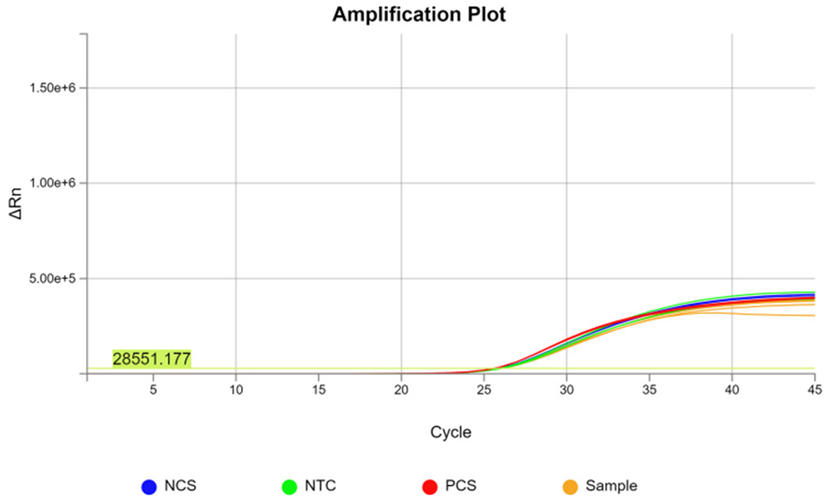
To evaluate the species coverage of the Mycoplasma NAT method using fluorescence probe-based qPCR, the primer sequences provided by the manufacturer were compared against genomic sequences from public databases. In this method, the primer and probe sequences are aligned with the 16S rRNA genome database. A Mollicutes species is considered specifically detectable if there is no more than one base mismatch at the 3 ‘end of the primer and no more than one mismatch in the probe sequence. Based on sequence alignment results, this method can detect at least 183 species of Mollicutes, including 120 species of Mycoplasma, 9 species of Ureaplasma, 33 species of Spiroplasma, and 7 species of Acholeplasma (typical graphics see Figure 1).

2.2. Limit of Detection (LOD)

According to the instructions provided with the standard strains, the Mycoplasma standard dry powder was reconstituted using 1× PBS buffer. Nucleic acids were extracted from the resulting Mycoplasma suspension following the procedures described in Section 4.3. “Sample Nucleic Acid Extraction” and Section 4.4. “qPCR Detection”. The experiment was conducted over three consecutive days, with eight independent nucleic acid extractions performed each day. Each extraction was followed by one qPCR assay, resulting in a total of 24 test data points. NCS and NTC samples were included in each experiment. All NCS and NTC results were within acceptable limits, and all 24 Mycoplasma test results were positive. This met the criterion that at least 23 out of 24 replicates must yield a positive result to confirm the method’s LOD performance (Table 3).

2.3. Specificity

2.3.1. Sample Matrix Interference

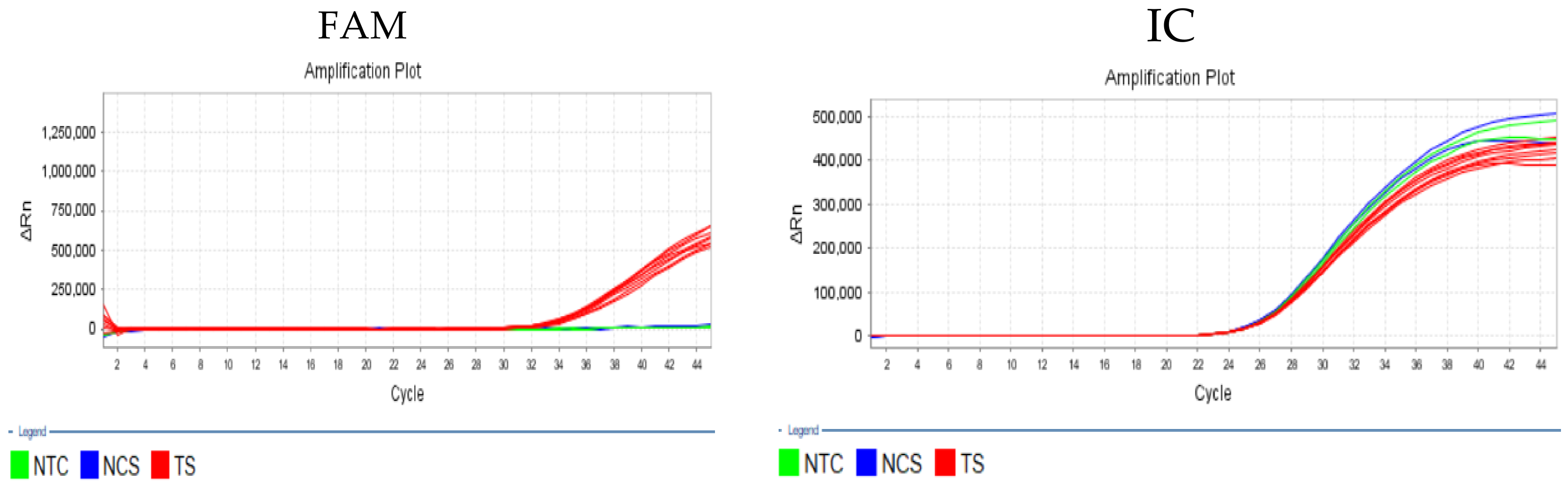
Following the procedures in Section 4.3. “Sample Nucleic acid Extraction” and Section 4.4. “qPCR Detection,” nine commonly used sample matrices were tested: Dulbecco’s MEM, Ham’s F-10 Medium, M-199 Medium, Ham’s F-12K (Kaighn’s), RMIP-1640 Medium, McCoy’s 5A Medium, Ham’s F-12K supplemented with 1.0 mM/L Glutamine, L-15 Leibovitz Medium with 2.05 mM L-Glutamine, DMEM- low glucose (standard type), and the DNA diluent included in the kit. Both unspiked and spiked samples (10 CFU/mL Spiroplasma citri) were tested, along with PCS, NCS, and NTC samples in each experimental run. The PCS, NCS, and NTC results were all within acceptable ranges. The detection results of the unspiked matrices and diluents were negative, showing no cross-reactivity. All spiked samples yielded positive results, confirming that the method was not affected by matrix interference (Table 4).

2.3.2. Cross-Reactivity

To evaluate specificity, 14 non-Mollicutes microbial strains were tested. These included Clostridium perfringens, Clostridium acetobutylicum, Lactobacillus acidophilus, Streptococcus mutans, Streptococcus pneumoniae, Staphylococcus epidermidis, Acinetobacter baumannii, Enterobacter aerogenes, Micrococcus luteus, Pseudomonas aeruginosa, Candida albicans, Salmonella enterica subspecies, Bacillus subtilis, and Bacillus cereus. Six engineered cell lines (HEK293, 293T, Vero, CHO, E. coli, and Sf9) were also included. All samples were tested using the same procedures outlined in Section 4.3 and Section 4.4. The PCS, NCS, and NTC samples were detected simultaneously in each experiment. The results indicated that the PCS, NCS, and NTC all performed within the acceptable range. All test samples showed negative results, indicating no cross-reactivity with the assay (Table 5).

2.4. Tolerance

2.4.1. Freeze–Thaw Stability

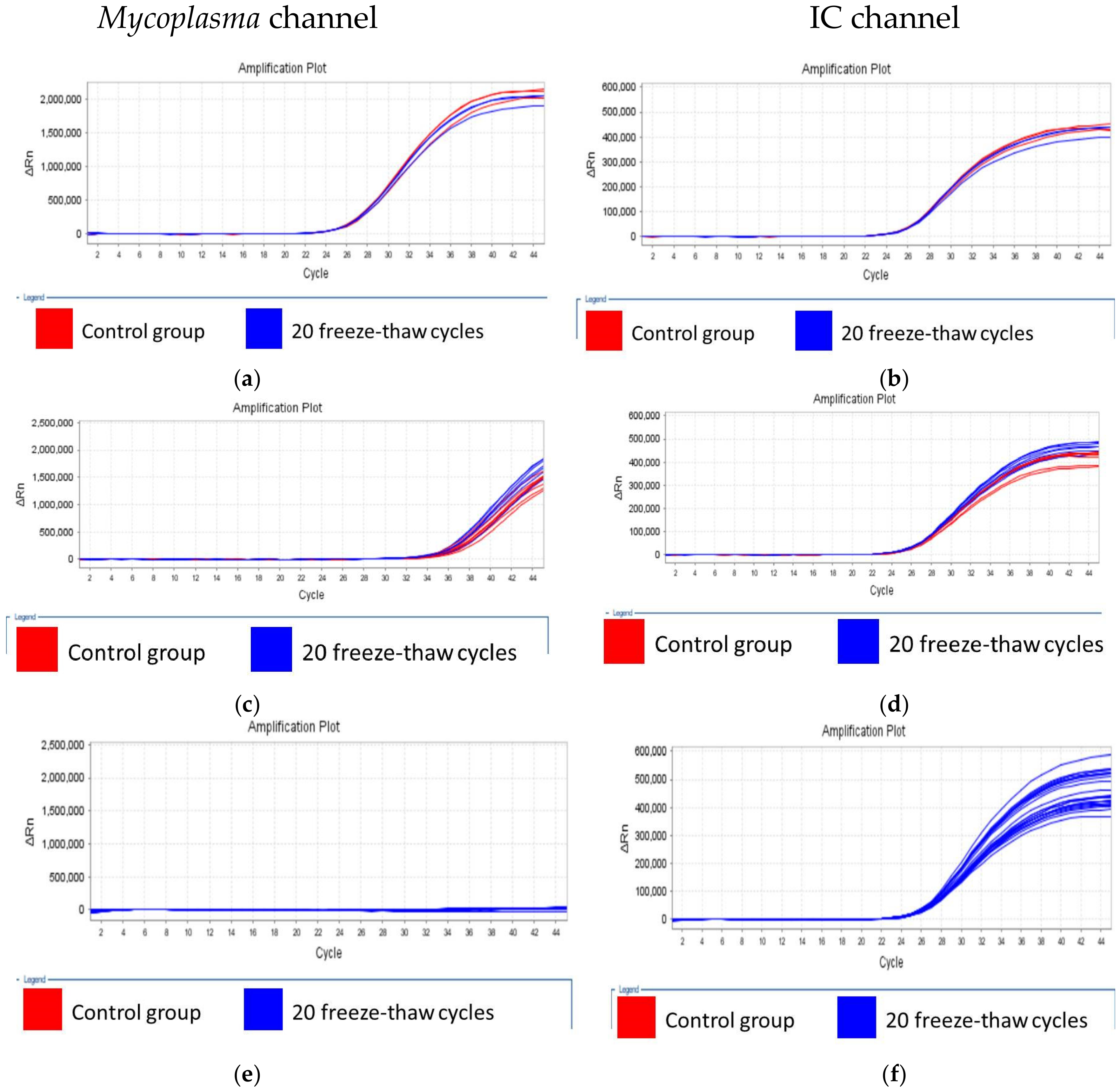
All reagents used in the Mycoplasma NAT (fluorescence probe qPCR method) were subjected to freeze–thaw stability testing at −25 °C to −15 °C. For the positive control samples (PCSs) at a concentration of 1000 copies/μL, triplicate reactions were performed. At a concentration of 1 copy/μL, eight replicates were tested. A 24-well replicate test was conducted for the non-template control (NTC). After 0 and 20 freeze–thaw cycles, the NTC results remained within acceptable limits. The Ct values and fluorescence intensities of the positive templates at both concentrations showed no significant variation, indicating that the reagents maintained stability and performance after 20 freeze–thaw cycles (Table 6 and Figure 2).

2.4.2. Thermal Accelerated Stability

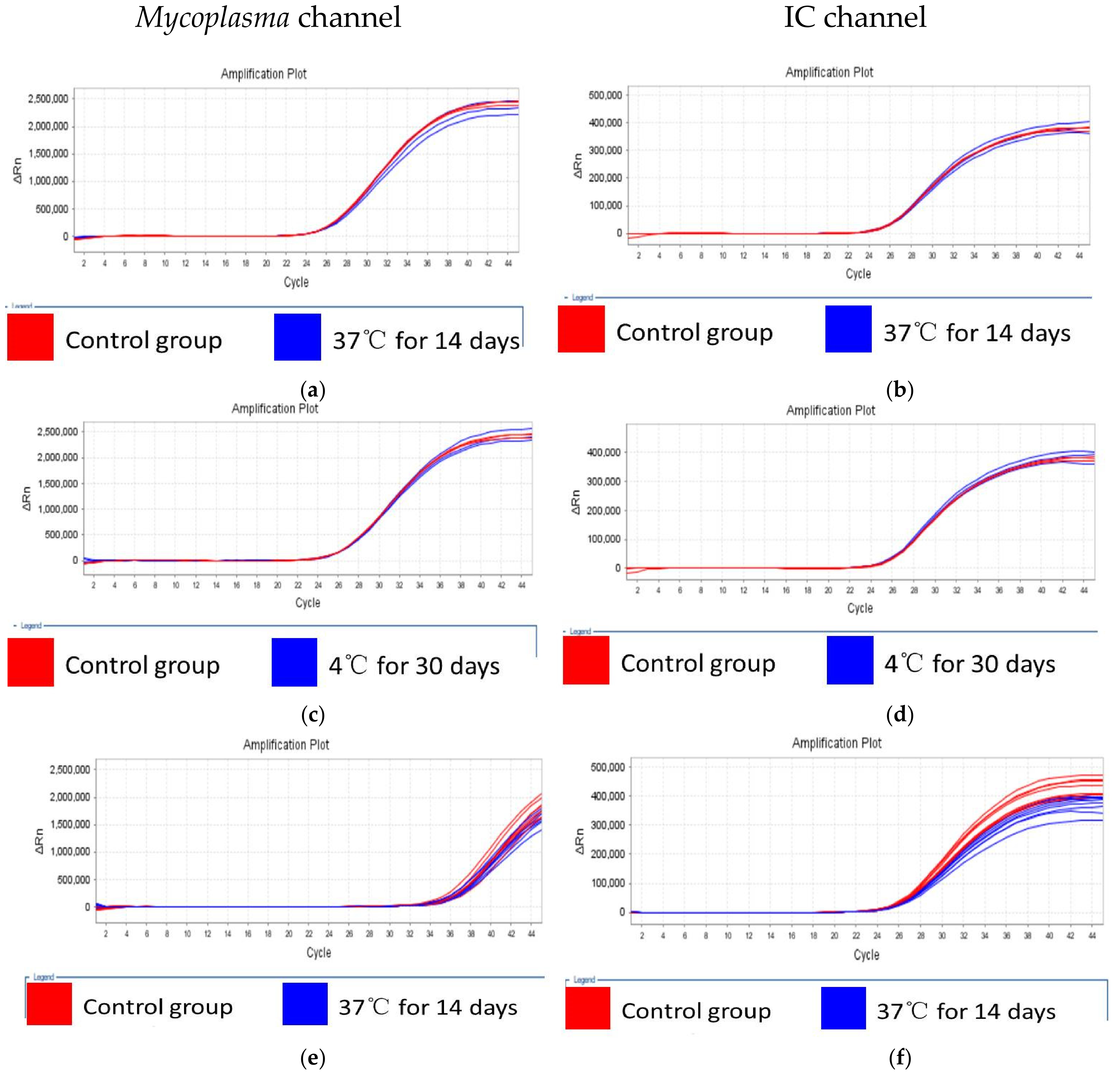
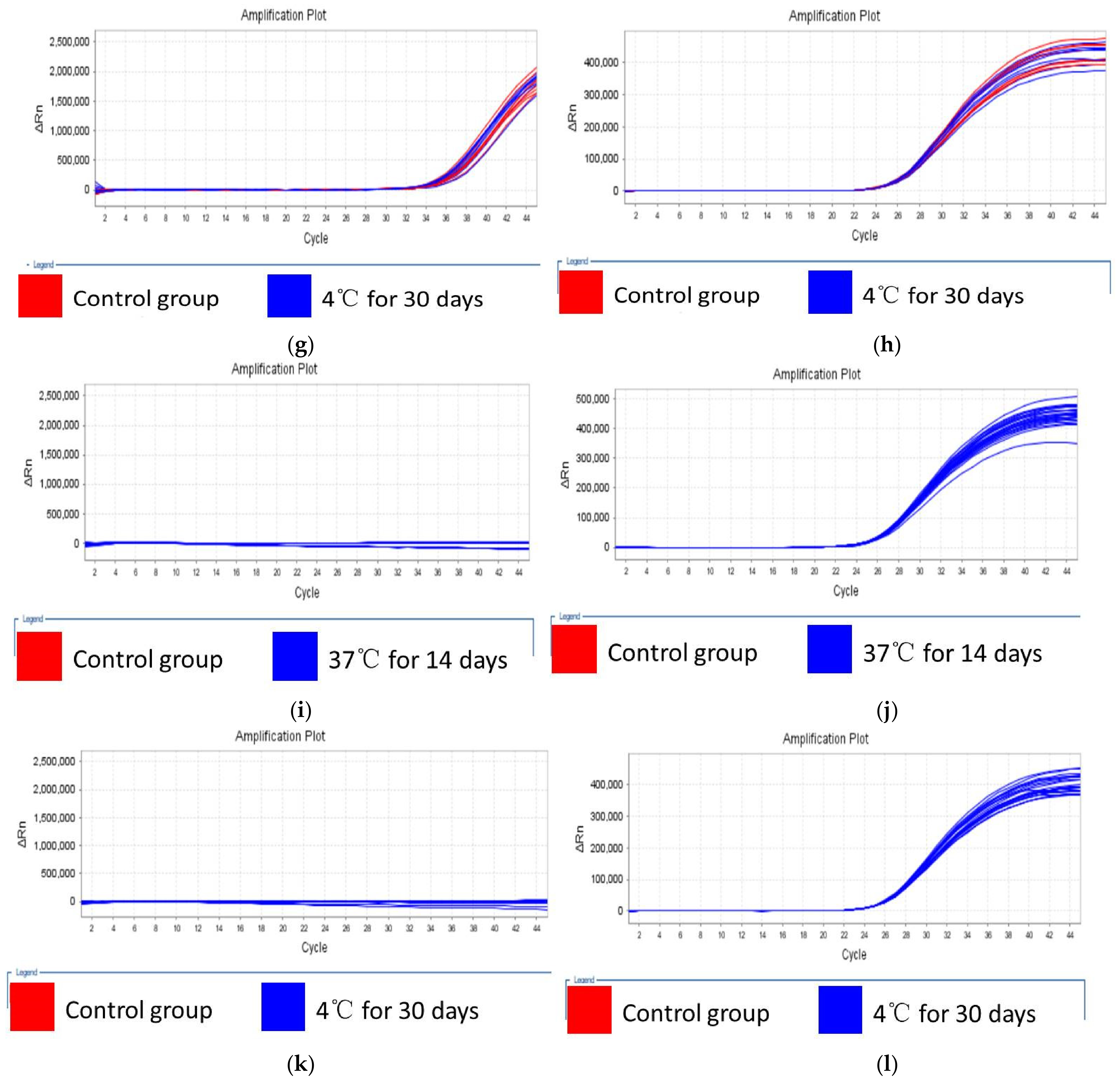
All reagents were subjected to accelerated thermal stability testing by incubation at 37 °C for 14 days and at 4 °C for 30 days. PCSs at 1000 copies/μL were tested in triplicate, while 1 copy/μL samples were tested in eight replicates. NTCs were tested in 24 replicates. The results demonstrated that NTCs remained valid under both temperature conditions. Ct values and fluorescence peaks of the positive templates at both concentrations showed no significant changes, indicating that the reagents retained stability after thermal stress and were not adversely affected (Table 7 and Figure 3).

2.4.3. Instrument Compatibility

The compatibility of the Mycoplasma NAT detection reagents was verified across four different real-time PCR instruments: Thermo Scientific ABI 7500, Thermo Scientific ABI QuantStudio 5, Shanghai Hongshi SLAN-96S, and Roche LightCycler® 480. PCSs at 1000 copies/μL were tested in triplicate, 1 copy/μL samples in eight replicates, and NTCs in 24 replicates. The results confirmed that all NTCs were valid across all instruments. Ct values and fluorescence peaks of the positive samples were consistent across platforms, demonstrating that the reagents are compatible with different qPCR instruments and that test performance is unaffected (Table 8).

2.5. Validation of Sample Applicability

Application of the NAT Method for Mycoplasma Detection

Mycoplasma testing is essential during the development and manufacturing of biological products to ensure the absence of microbial contamination. When using the nucleic acid amplification technique (NAT) for Mycoplasma detection, rigorous validation is required to confirm that the method is suitable as a supplemental or alternative approach to pharmacopeial methods for Mycoplasma release testing. In this study, four biological products (monoclonal antibodies (Table 9), antibody fusion proteins (Table 10), bispecific antibodies (Table 11), and trispecific antibodies (Table 12) were individually spiked with 10 CFU/mL of Acholeplasma laidlawii and 10 CFU/mL of Mycoplasma salivarium to assess method applicability. Experimental procedures followed the protocols described in Section 4.3. (Sample Nucleic Acid Extraction) and Section 4.4. (qPCR Detection). In parallel, PCS, NCS, and NTC samples were included as quality controls in each experiment. The results showed that all PCS, NCS, and NTCs met acceptance criteria. Furthermore, all spiked biological product samples tested positive for Mycoplasma, confirming the method’s applicability for a wide range of biological matrices.

3. Discussion

Cell culture is a critical component in the production of many biological products, during which Mycoplasma infection can compromise product safety and efficacy [12]. Therefore, Mycoplasma detection at every stage of production is essential. According to regulatory guidelines, the cell substrates used in biological product manufacturing must be free of exogenous contaminants, including Mycoplasma. Comprehensive monitoring for Mycoplasma contamination should be implemented throughout the development process, including raw materials, cell banks, virus seed stocks, unprocessed harvest materials, and final products.
Currently, the Chinese Pharmacopoeia and international regulatory authorities recognize traditional methods for Mycoplasma detection, including the culture method and the indicator cell method. However, the culture method is time-consuming, and the indicator cell method has limited sensitivity. These limitations restrict their suitability for rapid release testing of final live-cell products. As a result, NATs have emerged as viable alternatives [13]. When the NAT method achieves a detection sensitivity of 10 CFU/mL, it can serve as a replacement for the culture method; at 100 CFU/mL, it may replace the indicator cell method. The European Pharmacopoeia (EP), Japanese Pharmacopoeia (JP), and United States Pharmacopeia (USP) have all adopted NAT as a recognized Mycoplasma detection method. Establishing a suitable Mycoplasma detection strategy involves several considerations. If release detection testing is to be conducted on product-related samples, it is necessary to use either pharmacopeia-specified methods or a fully validated NAT method with performance equivalent to traditional methods [14]. Early validation of the detection method is strongly recommended.
However, given the prolonged turnaround time and limited sensitivity of pharmacopoeial methods, it is advisable to implement internal rapid screening techniques, such as PCR or qPCR, to support conditional product release. For the formal adoption of a NAT-based release method, comprehensive validation of the NAT method is essential. In cases where the testing sample material is not intended for product release, such as early-stage research samples or non-final cell banks, rapid methods like loop-mediated isothermal amplification (LAMP) may be used for expedited Mycoplasma screening.
To establish a suitable Mycoplasma detection method, it is essential to determine whether the test results are intended for reference or for product release, and whether the method complies with regulatory and pharmacopoeial requirements. It is also necessary to evaluate whether method validation has been performed to confirm its sensitivity, specificity, and tolerance [15,16], and whether the method demonstrates comparability to pharmacopoeial procedures.
In addition, known Mycoplasma strains should be used as reference substances during detection. By comparing samples against these reference strains, the presence or absence of Mycoplasma contamination can be accurately assessed. Standard Mycoplasma strains play a vital role in the biopharmaceutical and biological testing industries, and their significance is expected to grow alongside the advancement of biological product development. ChP, EP, JP, and USP all recommend the use of Mycoplasma hyorhinis, Mycoplasma orale, and Mycoplasma pneumoniae as standard strains for LOD validation of NAT methods.
In this study, inactivated Mycoplasma strains from the National Collection of Type Cultures (NCTC), UK, were used as standards to assess the sensitivity of the NAT method. The 10 CFU standard Mycoplasma dry powder was resuspended in 1 × PBS buffer, followed by nucleic acid extraction and qPCR detection. For each Mycoplasma strain, eight replicate extractions and detections were performed per session. The experiment was conducted across three sessions, resulting in a total of 24 detection data points. The LOD was defined as the condition in which at least 23 out of 24 replicates yielded positive PCR results, meeting the acceptance criteria of EP 2.6.7: LOD ≤ 10 CFU/mL. This validated method demonstrated high sensitivity, speed, and convenience for detecting the tested Mycoplasma species.
In the methodological validation, this study followed the guidelines outlined in ICH Q2 to validate the Mycoplasma NAT method. Specificity testing involved evaluating potential cross-reactivity between the sample matrix and non-Mycoplasma bacterial species. Nine commonly used sample matrices in the research and production of biological products were tested, including Dulbecco’s MEM, Ham’s F-10 Medium, M-199 Medium, Ham’s F-12K (Kaighn’s), RMIP-1640 Medium, McCoy’s 5A, Ham’s F-12K (Kaighn’s) with 1.0 mM/L Glutamine, L-15 LEIBOVITZ Medium with 2.05 mM L-Glutamine, DMEM-low glucose (standard type). When spiked with Spiroplasma citri, all matrices yielded positive results. All non-spiked control samples were negative, and no cross-contamination was observed during nucleic acid extraction or qPCR detection. These results met the acceptance criteria of EP2.6.7: all spiked samples produced positive detection results, while all non-spiked samples were negative. Regarding cross-reactivity, it is critical to detect a broad range of Mycoplasma species to minimize false negatives. Since the detection capability of the NAT method depends on primer and probe design as well as method parameters, potential cross-detection of non-Mycoplasma species must also be ruled out. This study therefore included a panel of 14 phylogenetically related non-Mollicutes strains, including Clostridium perfringens, Clostridium acetobutylicum, Lactobacillus acidophilus, Streptococcus mutans, Streptococcus pneumoniae, and other common bacilli, cocci, and fungal organisms such as Staphylococcus epidermidis, Acinetobacter baumannii, Enterobacter aeruginosa, Micrococcus luteus, Pseudomonas aeruginosa, Candida albicans, Salmonella enterica subspecies, Bacillus subtilis, and Bacillus cereus. All tested samples yielded negative results, indicating no cross-reactivity. These results confirm that the complex sample matrix did not interfere with detection and that the method maintained high specificity and reliability in complex systems.
This study also investigated the applicability of the Mycoplasma NAT detection method for real biological product samples. The results demonstrated that positive detection was achieved for monoclonal antibodies, antibody fusion proteins, bispecific antibodies, and trispecific antibodies after spiking with Mycoplasma-positive standard strains. The validation of sample applicability reflects the method’s detection capability in actual sample matrices, supporting its feasibility for routine testing and enhancing the comprehensiveness of the overall method validation.
This study successfully established a 16S rRNA primer-based nucleic acid testing (NAT) method and completed preliminary methodological validation, sensitivity assessment, and partial specificity evaluation. Nevertheless, several limitations remain to be addressed in future work.
First, cross-reactivity tests were not further expanded to include phylogenetically closely related non-target species and common laboratory contaminant strains that may interfere with 16S rRNA primers. Specificity was only evaluated using a limited panel of strains; therefore, potential false-positive risks in complex biological matrices cannot be fully excluded, and the broad-spectrum specificity of the method requires further validation.
Second, methodological validation was performed only under standard laboratory conditions and with routine sample matrices. Systematic evaluation involving more complex practical substrates, different storage conditions, and potential interfering factors was not conducted. The applicability and stability of the assay in large-scale routine testing still need to be verified by enlarging sample sizes and application scenarios.
In addition, this study did not investigate the repeatability and robustness across different experimental batches, operators, and instrument platforms. The anti-interference capability and inter-laboratory compatibility of the method remain to be further evaluated.
In view of the above limitations, future work will supplement cross-reactivity verification of closely related species and contaminant strains, expand the scale of practical sample validation, and improve the robustness evaluation under various experimental conditions. Further optimization of the NAT system will be performed to enhance its practical applicability and reliability.
Experimental data showed that the Mycoplasma NAT method satisfied the performance criteria defined in the EP2.6.7-2 NAT validation guidelines. The established method exhibited high sensitivity for detecting Mycoplasma contamination and required only a small volume of sample, reducing the overall testing time to approximately 3 h. In addition, this method overcomes limitations associated with traditional pharmacopoeial methods, such as the difficulty in culturing and detecting certain Mycoplasma species. As a result, an increasing number of pharmaceutical companies are adopting rapid NAT-based detection methods. NAT methods are also gaining popularity in sterile testing and quality control of residual substances. These trends indicate the growing potential for widespread application of NAT technologies in biopharmaceutical manufacturing.

4. Materials and Methods

4.1. Materials and Reagents

Mycoplasma standard strain:
10CFU™ Sensitivity Standard Mycoplasma arginini (Minerva Biolabs (Berlin, German), catalog number: 102-1003).
10CFU™ Sensitivity Standard Mycoplasma orale (Minerva Biolabs, catalog number: 102-2003).
10CFU™ Sensitivity Standard Mycoplasma gallisepticum (Minerva Biolabs, catalog number: 102-3003).
10CFU™ Sensitivity Standard Mycoplasma pneumoniae (Minerva Biolabs, catalog number: 102-4003).
10CFU™ Sensitivity Standard Mycoplasma synoviae (Minerva Biolabs, catalog number: 102-5003).
10CFU™ Sensitivity Standard Mycoplasma fermentans (Minerva Biolabs, catalog number: 102-6003).
10CFU™ Sensitivity Standard Mycoplasma hyorhinis (Minerva Biolabs, catalog number: 102-7003).
10CFU™ Sensitivity Standard Acholeplasma laidlawii (Minerva Biolabs, catalog number: 102-8003).
10CFU™ Sensitivity Standard Spiroplasma citri (Minerva Biolabs catalog number: 102-9003).
10CFU™ Sensitivity Standard Mycoplasma salivarium (Minerva Biolabs, catalog number: 102-1103).
Sample matrices:
Dulbecco’s MEM (Gibco (Thermo Fisher Scientific, Waltham, MA, USA), catalog number: 11965092), Ham’s F-10 Medium (Hyclone (Cytiva, Logan, UT, USA), catalog number: SH30025.01), M-199 Medium (Hyclone, catalog number: SH30253.01), Ham’s F-12K (Kaighn’s) (Gibco, catalog number: 11765054), RPMI-1640 Medium (Gibco, catalog number: 11875093), McCoy’s 5A (Gibco, catalog number: 16600082), Ham’s F-12K (Kaighn’s) + 1.0 mM/L Glutamine (Hyclone, catalog number: SH30026.01), L-15 LEIBOVITZ Medium + 2.05 mM L-Glutamine (Hyclone, catalog number: SH30525.01), DMEM-Low Sugar (Standard type) (Hyclone, catalog number: SH30021.01).
Non-Mollicutes strains:
All the strains were procured from Wanjia Standard Materials Co., Ltd. (Xinyang, China). Staphylococcus epidermidis (catalog number: BWCC10473), Acinetobacter baumannii (catalog number: BWCC10611), Lactobacillus acidophilus (catalog number: BWCC10659), Enteroaerogen (catalog number: BWCC10548), Micrococcus luteus (catalog number: BWCC10820), Streptococcus mutans (catalog number: BWCC10533), Pseudomonas aeruginosa (catalog number: BWCC10731), Streptococcus pneumoniae (catalog number: BWCC10549), Candida albicans (catalog number: BWCC10334), Salmonella enterica subspecies (catalog number: BWCC11086), Bacillus subtilis (catalog number: BWCC10964), Bacillus cereus (catalog number: BWCC11116), Clostridium perfringens (catalog number: BWCC10343), Clostridium acetobutylicum (catalog number: BWCC10192).
Engineering cells/Bacteria and Reagents:
Engineering cells and bacterial DNA:
SF9 DNA (ATCC (Rockefeller, MD, USA), catalog number: CRL-1711); HEK293 DNA, Vero DNA, CHO DNA, E. coli DNA, 293T DNA; along with the primers and probes used for Mycoplasma detection by the NAT method (fluorescence probe qPCR) were all self-prepared in the laboratory.
Reagents:
Nucleic acid extraction reagent (Yeasen Biotech (Shanghai, China), catalog number: 18700ES70). Monoclonal antibodies, antibody fusion proteins, bispecific antibodies, and trispecific antibodies were provided by Qilu Pharmaceutical Co., Ltd. (Jinan, China).
Primers and probes:
An alignment of the Mycoplasma 16S rRNA sequence was performed to locate regions with specific ends and a conserved central segment. Multiple pairs of forward and reverse primers, as well as corresponding probes, were designed for these regions. Then mix them as the ratio of 1:1:1:1:1:1:1:1:1 (F1:R1:P1:F2:R2:P2:F3:R3:P3, μg/μL).
Forward primer 1 (F1): AAACTTAAAGGAATTGACGGG
Reverse primer 1 (R1): GTTAACCTCCGCTATATCTCTATAGC
Probe 1 (P1): CGCACAAGCGGTGGAGCATGT
Forward primer 2 (F2): TCCTACGGGAGGCAGCAGTA
Reverse primer 2 (R2): CGCGACTGCTGGCACAT
Probe 2 (P2): CATTGTGAAAAATTCC
Forward primer 3 (F3): ACGATGAGAACTAAGTGTTGGCC
Reverse primer 3 (R3): TTCCTTTGAGTTTCATACTTGCGTA
Probe P3 (P3): CTCCGCCTGAGTAGTA

4.2. Instruments

Fluorescence quantitative PCR instruments: ABI 7500 (Applied Biosystems (Thermo Fisher Scientific, Carlsbad, CA, USA), ATCC), QuantStudio 5 (Applied Biosystems, ATCC), CFX96 Optic Module (Bio-Rad (Hercules, CA, USA)), SLAN-96S (Shanghai Hongshi Medical Technology Co., Ltd. (Shanghai, China)), LightCycler® 480 (Roche (Basel, Switzerland)).

4.3. Nucleic Acid Extraction from Samples

4.3.1. Reconstitution of Mycoplasma Strains

According to the instructions provided with Minerva Biolabs’ 10CFU™ Sensitivity Standard, each Mycoplasma strain was equilibrated to room temperature. After brief centrifugation, the pellet was resuspended in 1 mL of 1× PBS buffer and incubated at room temperature for 5 min. The suspension was then vortexed for 10 s and centrifuged for 5 s to collect the bacterial cells. A final concentration of 10 CFU/mL was achieved, and the required volume was used for subsequent experiments.

4.3.2. Sample Pretreatment

Ethanol (anhydrous), 1× PBS buffer, and ultrapure water were prepared, and samples were equilibrated to room temperature before processing. The incubation environment was preheated to 60 °C. For initial use, the specified volume of anhydrous ethanol (as indicated on the label) was added to Washing Solutions A* and B*, followed by thorough mixing and proper labeling. Bottles were sealed tightly after each use to prevent ethanol evaporation. Next, 100 μL of the reconstituted Mycoplasma suspension (10 CFU/mL) was transferred to a 1.5 mL centrifuge tube. Then, 100 μL of lysis buffer and 10 μL of proteinase K were added. The mixture was vortexed for 10 s and incubated at 60 °C for 20 min. After incubation, 400 μL of binding solution, 9 μL of glycogen, and 6 μL of potassium Poly A salt were added and vortexed. Subsequently, 20 μL of magnetic beads were added, followed by vortexing and incubation for 10 min with intermittent vortexing for 10 s every 3 min. Magnetic beads should be thoroughly vortexed before use to ensure resuspension. After every 4–5 sample additions, the suspension should be remixed to prevent bead aggregation. After brief centrifugation, the tube was placed on a magnetic stand for 1–2 min until the beads were fully captured. The supernatant was carefully discarded. Then, 500 μL of Washing solution A was added, vortexed to disperse beads, centrifuged, and placed on the magnetic stand for 1–2 min before supernatant removal. 500 μL of Washing solution B was added, and the same process was repeated. To remove residual wash buffer, the tube was centrifuged for 10 s, placed on the magnetic stand, and residual liquid was aspirated using a 10 μL pipette. The tube cap was opened and left at room temperature for 3 min to fully evaporate ethanol. Absence of reflection or presence of bead surface cracking indicated complete evaporation. Finally, 50–100 μL of preheated elution buffer (65 °C) was added. The sample was vortexed, centrifuged briefly, and incubated at 65 °C for 5 min with one intermediate mix. After a final centrifugation, the tube was placed on the magnetic stand for 2 min. After the magnetic beads were completely adsorbed, the eluted DNA was transferred to a new tube for downstream PCR or stored at 2–8 °C for up to 1 week. For long-term storage, samples were kept below −18 °C.

4.4. Design of Primer-Probe Sets, Species Screening and Sequence Alignment Verification

4.4.1. Design Strategy of Primers and Probes

Sequence specificity analysis and target sequence matching verification of the primers and probes in this study were performed using the online NCBI Primer-BLAST tool (Primer3 (version 2.5.0)). According to the research objectives and practical detection requirements, key design parameters were optimized to ensure sequence matching specificity, while accommodating natural base variations among different bacterial species.
A customized RefSeq whole-genome sequence database containing 183 species from four representative genera of Mollicutes was constructed. Redundant and low-quality sequences were pre-filtered to guarantee the authority, pertinence and accuracy of reference sequences for alignment.
To balance amplification specificity and broad-spectrum coverage capacity, standardized mismatch tolerance criteria were established. The number of mismatches within the last 5 bases at the primer 3′-end was limited to ≤1 to avoid amplification failure caused by mismatches in the critical binding region. The overall mismatch number of the probe was restricted to ≤1, which could adapt to natural base differences among various species and effectively eliminate non-specific binding interference. After multiple rounds of sequence alignment and simulation verification, this parameter system was well optimized to tolerate inherent base variations among the 183 target species and ensure specific binding of each primer-probe set to the target conserved gene sequence.
Three primer-probe sets were designed to target different specific functional regions of conserved genes in Mollicutes. Each set consisted of a forward primer, a reverse primer and a specific fluorescent probe. Primers bound to the upstream and downstream conserved regions of the target gene to initiate amplification, while the probe hybridized to the middle specific region of the gene to realize specific identification and detection of amplified products. A dual recognition strategy of primer anchoring in conserved regions plus probe recognition of specific segments was adopted, and the three sets formed a complementary coverage system. Even if minor base mismatches existed in the binding region of a single set for individual species, effective identification could still be achieved by the remaining primer-probe sets.
Primer length was controlled within 18–22 bp with a Tm value ranging from 58 °C to 62 °C, which was completely consistent with the actually synthesized primers and subsequent qPCR experimental conditions. Other analytical parameters, including primer dimer prediction, product size range and annealing temperature, adopted the default settings of the tool, strictly simulating routine laboratory qPCR reaction conditions. This ensured high consistency between online alignment predictions and actual amplification performance, improving the reliability and experimental repeatability of primer and probe design.

4.4.2. Definition and Basis of Target Species Screening

The target species range of this study strictly followed the Chinese Pharmacopoeia and relevant industrial guidelines, focusing on clinically and regulatory-concerned microorganisms of the class Mollicutes. It covered four major genera, including Mycoplasma, Ureaplasma, Spiroplasma and Acholeplasma, with a total of 183 species. The detection coverage was highly consistent with the specifications of the Pharmacopoeia and industrial regulatory requirements, ensuring standardization and theoretical completeness of the species coverage of the detection system.

4.4.3. Process and Results of Sequence Alignment Verification

Following the establishment of the three primer-probe sets, independent sequence alignment verification was performed one by one on the 183 target species based on the self-built genome database, mismatch tolerance criteria and optimized parameters. Independent alignment was conducted for the forward primer, reverse primer and probe of each set, resulting in a total of 1098 independent alignment analyses. This realized full coverage verification across all target species and primer-probe sets, ensuring systematicness and rigor of the evaluation process.
A unified coverage criterion was defined: each of the 183 target species could be effectively recognized by at least one primer-probe set under the preset mismatch tolerance threshold. The alignment results confirmed that all 183 Mollicutes species could be specifically identified by no less than one primer-probe set without species omission or matching failure. The complete alignment reports, sequence matching screenshots, base mismatch statistics and operation process records have been supplemented as supporting materials, enabling full traceability and rechecking of the verification process.
In summary, this study established a rigorous and comprehensive evaluation system for primer-probe design, involving reference database construction, parameter optimization, mismatch tolerance rule formulation, dual recognition mode design, standardized target species screening and full-coverage sequence alignment verification. The developed system enables stable and broad-spectrum specific detection of 183 Mollicutes species. All original alignment data and verification documents have been fully archived for reference.

4.5. qPCR Detection

4.5.1. Preparation of qPCR Reaction System

To prepare the qPCR reaction system, the number of required reaction wells was calculated based on the number of test samples, which included the positive control (PCS), non-template control (NTC), negative sample control (NCS), and the actual test samples (TS). The formula used for determining the total number of reaction wells was: M = (1 × PCS + 1 × NTC + 1 × NCS + N × TS) × 2. This accounted for duplicates of each reaction. The corresponding volume of qPCR Mix was then calculated accordingly, as shown in Table 13.
The qPCR Mix was thoroughly vortexed, followed by low-speed centrifugation to collect any liquid adhering to the cap. Subsequently, 20 μL of the prepared qPCR Mix was dispensed into each well of the reaction plate, and the appropriate sample templates were added to each well in the order shown in Table 14.

4.5.2. qPCR Program Parameter Settings

The qPCR program parameters were set according to standard conditions. The instrument type used was the ABI 7500 configured for a 96 Well plate. The experiment type selected was “Standard Curve” for quantification purposes, using Taqman® reagents as the detection chemistry (Thermo Fisher Scientific, Foster City, CA, USA). The program run time was approximately 2 h under standard cycling conditions. In the “Plate Setup” interface, under the “Define Targets and Samples” section, Target 1, corresponding to the Mycoplasma 16S rRNA gene, was assigned to the FAM channel, with FAM as the reporter dye and either MGB or no quencher selected. Target 2, corresponding to the internal control (IC) gene, was assigned to the CY5 channel with CY5 as the reporter dye and no quencher selected. In the “Assign Targets and Samples” section of the “Plate Setup”, “None” was selected for the ROX dye column. The full amplification program parameters are provided in Table 15.

5. Conclusions

This study successfully developed and thoroughly validated a Mycoplasma NAT detection method based on multiplex fluorescence quantitative PCR. The method demonstrated a limit of detection (LOD) of 10 CFU/mL, exhibited strong specificity, and showed no cross-reactivity with various matrices or non-Mycoplasma microorganisms. The reagents displayed excellent stability and tolerance, with consistent performance across multiple qPCR platforms. Furthermore, the method demonstrated effective detection in spiked real-world biological product samples. The validation results confirmed that this NAT-based method complies with relevant technical guidelines and offers a fast, sensitive, and reliable alternative for process monitoring and lot-release detection of biological products.

Author Contributions

Methodology, Y.G., S.H., D.P., X.L. and Y.P.; Software, S.H., D.P. and Y.P.; Validation, Y.G., H.B., S.H., Y.D. and X.S.; Formal analysis, H.B.; Investigation, Y.G., X.Q., J.Z., S.H., Y.D. and X.L.; Resources, J.Z., D.P., X.S. and C.L.; Data curation, X.Q., H.B., Y.D., X.L. and Y.P.; Writing—original draft, Y.G., X.Q. and J.Z.; Writing—review & editing, X.S. and C.L.; Project administration, C.L. All authors have read and agreed to the published version of the manuscript.

Funding

This research received no external funding.

Institutional Review Board Statement

Not applicable.

Informed Consent Statement

Not applicable.

Data Availability Statement

The original contributions presented in this study are included in the article. Further inquiries can be directed to the corresponding author.

Conflicts of Interest

Jing Zhang, X.S. are employed by Yeasen Biotechnology (Shanghai) Co., Ltd. The other authors declare no conflicts of interest. Yeasen Biotechnology (Shanghai) Co., Ltd. had no role in the design of the study; in the collection, analyses, or interpretation of data; in the writing of the manuscript; or in the decision to publish the results.

References

  1. Young, L.; Sung, J.; Stacey, G.; Masters, J.R. Detection of Mycoplasma in cell cultures. Nat. Protoc. 2010, 5, 929–934. [Google Scholar] [CrossRef] [PubMed]
  2. Chen, N.H.; Sa, Y.L. Overview of detection methods for Mycoplasma in cell preparation. Lab. Med. 2022, 37, 684–687. [Google Scholar]
  3. Dreolini, L.; Cullen, M.; Yung, E.; Laird, L.; Webb, J.R.; Nelson, B.H.; Hay, K.A.; Balasundaram, M.; Kekre, N.; Holt, R.A. A Rapid and Sensitive Nucleic Acid Amplification Technique for Mycoplasma Screening of Cell Therapy Products. Mol. Ther. Methods Clin. Dev. 2020, 17, 393–399. [Google Scholar] [CrossRef] [PubMed]
  4. Science and Technology Press. Mycoplasma Testing Method <3301>. In Pharmacopoeia of the People’s Republic of China; Science and Technology Press: Beijing, China, 2020; pp. 542–543. [Google Scholar]
  5. The United States Pharmacopeial Convention. United States Pharmacopeia, 40th ed.; The United States Pharmacopeial Convention: Rockville, MD, USA, 2017. [Google Scholar]
  6. Mycoplasmas. In European Pharmacopoeia, 10th ed.; European Directorate for the Quality of Medicines & HealthCare: Strasbourg, France, 2020; pp. 194–199.
  7. Mycoplasma Testing for Cell Substrates used for the Production of Biotechnological/Biological Products <G3-14-170>. In The Japanese Pharmacopoeia, 18th ed.; Ministry of Health, Labour and Welfare: Tokyo, Japan, 2021; pp. 2678–2682.
  8. Jean, A.; Tardy, F.; Allatif, O.; Grosjean, I.; Blanquier, B.; Gerlier, D. Assessing mycoplasma contamination of cell cultures by qPCR using a set of universal primer pairs targeting a 1.5 kb fragment of 16S rRNA genes. PLoS ONE 2017, 12, e0172358. [Google Scholar] [CrossRef] [PubMed]
  9. Siegl, D.; Kruchem, M.; Jansky, S.; Eichler, E.; Thies, D.; Hartwig, U.; Schuppan, D.; Bockamp, E. A PCR protocol to establish standards for routine mycoplasma testing that by design detects over ninety percent of all known mycoplasma species. iScience 2023, 26, 106724. [Google Scholar] [CrossRef] [PubMed]
  10. Ma, X.; Cai, Q.; Xiao, F.; Shu, C.; Yuan, Y.; Chen, J.; Chang, Y.; Wang, Y.; Wu, S.; Zhou, J.; et al. Establishment of real-time quantitative PCR detection method for mycoplasma. Int. J. Biol. 2025, 48, 39–45. [Google Scholar]
  11. Liu, F.Y.; Yang, L.S.; Du, Y.F.; Zhang, J.; Yang, C.; Li, H. A Rapid qPCR Detection Kit for 15 Types of Mycoplasma, Along with Its Usage and Applications. CN 115976238 B, 30 January 2024. [Google Scholar]
  12. Fratz-Berilla, E.J.; Angart, P.; Graham, R.J.; Powers, D.N.; Mohammad, A.; Kohnhorst, C.; Faison, T.; Velugula-Yellela, S.R.; Trunfio, N.; Agarabi, C. Impacts on product quality attributes of monoclonal antibodies produced in CHO cell bioreactor cultures during intentional mycoplasma contamination events. Biotechnol. Bioeng. 2020, 117, 2802–2815. [Google Scholar] [CrossRef] [PubMed]
  13. Volokhov, D.V.; Graham, L.J.; Brorson, K.A.; Chizhikov, V.E. Mycoplasma testing of cell substrates and biologics: Review of alternative non-microbiological techniques. Mol. Cell. Probes 2011, 25, 69–77. [Google Scholar] [CrossRef] [PubMed]
  14. Zhao, X.; Feng, J.P.; Meng, S.F. Considerations on Mycoplasma Detection by Nucleic Acid Detection Method and the Methodological Validation. Chin. Pharm. Aff. 2018, 32, 1020–1027. [Google Scholar]
  15. Science and Technology Press. Guidelines for validating analytical methods <9101>. In Pharmacopoeia of the People’s Republic of China; Science and Technology Press: Beijing, China, 2020; p. 682. [Google Scholar]
  16. Science and Technology Press. Guidelines for Validation of Alternative Methods for Microbial Testing of Drugs <9201>. In Pharmacopoeia of the People’s Republic of China; Science and Technology Press: Beijing, China, 2020; p. 684. [Google Scholar]
Figure 1. Detection results of Mycoplasma orale at 10 CFU/mL.
Molecules 31 01794 g001
Figure 2. Results of freeze–thaw stability testing. The amplification curves of Mycoplasma 16s rRNA gene (left column) and internal reference gene (right column) from samples subjected to 20 freeze–thaw cycles and non-freeze–thaw controls were analyzed. The samples tested were as follows: 1000 copies/μ L positive control (PCS) (a,b), 1 copy/μ L PCS (c,d), and template free control (e,f).
Molecules 31 01794 g002
Figure 3. Thermal acceleration stability test results. The amplification curves of Mycoplasma 16s rRNA gene (left column) and internal reference gene (right column) of samples subjected to heat accelerated treatment at 37 °C for 14 days or 4 °C for 30 days, as well as untreated control samples, were as follows: 1000 copies/μ L positive control (PCS) (ad), 1 copy/μ L PCS (eh), and template free control (il).
Molecules 31 01794 g003aMolecules 31 01794 g003b
Table 1. Comparison Table of Key Parameters for Mycoplasma NAT Detection Methods.
Detection MethodAmplicon
Length (bp)
Number of Primer/Probe SetsNumber of Covered
Species (Mollicutes)
Limit of Detection (LOD)Matrix
Applicability Range
Literature/Source Citation
This Study (Three
Primer-Probe
System)
100–200 bp3 sets183 speciesSingle copyPharmaceutical production-related matrices (e.g., cell
cultures, bulk biopharmaceuticals), pharmacopoeial reference strains
This Study
Early 16S rRNA-Targeted Method (Degenerate Primers)Long (usually >300 bp)1–2 sets (degenerate primers)Broad coverage of Mollicutes (specific number not specified)Low (mostly 102–103 copies)Basic microbial samples (e.g., cultured bacterial broth)[8]
Pharmacopoeial Standard Species-Specific MethodShort (usually 80–150 bp)1 set per target speciesSigle or a few specific species (e.g., Mycoplasma pneumoniae, Mycoplasma fermentans)High
(1–10 copies)
Pharmaceutical matrices, clinical samples (partially applicable)[10]
Multiplex Detection Method (Triple or More Sets)Medium (100–200 bp)≥3 setsRelatively broad coverage (usually 50–120 species)Medium
(10–102 copies)
Multiple types of microbial samples, pharmaceutical matrices[11]
Bioinformatics-Optimized Primer Method100–180 bp1–2 setsModerately broad coverage (30–80 species)Approx. 10 copiesLaboratory-purified samples, partial pharmaceutical matrices[9]
Notes: 1. The “amplicon length” of this study can be supplemented with actual experimental data, and the range in the table is the recommended optimal length for fluorescent PCR; 2. The LOD of each method is based on typical values reported in the literature, and specific values may vary slightly depending on the detection instrument and reagent batch; 3. The matrix applicability range is summarized based on the method design objectives and verification scenarios, and can be further refined according to research needs.
Table 2. Current Requirements for Mycoplasma Detection and Method Verification in Chinese and Foreign Regulations.
S/NInstitution/StandardEuropean Pharmacopoeia <2.6.7>Japanese Pharmacopoeia <G3-14-170>United States Pharmacopoeia <63>Chinese Pharmacopoeia 2020 <3301>WHO
Validation ParametersSpecificity, LOD, ToleranceSpecificity, LOD, ToleranceSensitivityUndefined(Semi) Quantitative and Qualitative Experiments for Detecting Sensitivity
1Mycoplasma strains to be verifiedAcholeplasma laidlawiiAcholeplasma laidlawiiAcholeplasma laidlawii\Acholeplasma laidlawii
2Mycoplasma fermentansMycoplasma fermentansMycoplasma fermentans\Mycoplasma fermentans
3Mycoplasma hyorhinisMycoplasma hyorhinisMycoplasma hyorhinisMycoplasma hyorhinis ***\
4Mycoplasma oraleMycoplasma oraleMycoplasma oraleMycoplasma oraleMycoplasma orale
5Mycoplasma pneumoniaeMycoplasma pneumoniaeMycoplasma pneumoniaeMycoplasma pneumoniaeMycoplasma pneumoniae
6Mycoplasma gallisepticum\Mycoplasma gallisepticum\\
7Mycoplasma synoviae *Mycoplasma synoviaeMycoplasma synoviae\\
8Mycoplasma argininiMycoplasma arginini\\\
9Spiroplasma **Spiroplasma\\\
10\Mycoplasma salivarium\\\
* If avian cells or materials are used or come into contact during the production process, LOD validation for Mycoplasma synoviae should be conducted. ** If insect or plant materials are used or come into contact during the production process, LOD validation for Spiroplasma should be conducted. *** If the proportion of Mycoplasma hyorhinis in contaminated samples is unusually high, it may draw the attention of the China National Institutes for Food and Drug Control.
Table 3. LOD Results.
No.Name of MycoplasmaConcentration of BacteriumDetection StatusDetection Rate
Experiment 1Experiment 2Experiment 3Total
1Mycoplasma arginini10 CFU/mL8/88/88/824/24100%
2Mycoplasma orale10 CFU/mL8/88/88/824/24100%
3Mycoplasma gallisepticum10 CFU/mL8/88/88/824/24100%
4Mycoplasma pneumoniae10 CFU/mL8/88/88/824/24100%
5Mycoplasma synoviae10 CFU/mL8/88/88/824/24100%
6Mycoplasma fermentans10 CFU/mL8/88/88/824/24100%
7Mycoplasma hyorhinis10 CFU/mL8/88/88/824/24100%
8Acholeplasma laidlawii10 CFU/mL8/88/88/824/24100%
9Spiroplasma citri10 CFU/mL8/88/88/824/24100%
10Mycoplasma salivarium10 CFU/mL8/88/88/824/24100%
Table 4. Results of sample matrix interference.
Sample TypeMean Ct of Target (FAM) ChannelMean Ct of Internal Reference (CY5) ChannelResult Judgment
9 common sample matrices +
DNA diluent
Dulbecco’s MEMNA, No obvious peak26.84Negative
Ham’s F-10 culture mediumNA, No obvious peak26.78Negative
M-199 MediumNA, No obvious peak26.76Negative
Ham’s F-12K (Kaighn’s)NA, No obvious peak26.86Negative
RPMI-1640 MediumNA, No obvious peak26.74Negative
McCoy’s 5ANA, No obvious peak26.78Negative
Ham’s F-12K (Kaighn’s) +
1.0 mM/L Glutamine
NA, No obvious peak26.76Negative
L-15 LEIBOVITZ MEDTA +
2.05 mM L-Glutamine
NA, No obvious peak26.73Negative
DMEM-low glucose (standard type)NA, No obvious peak26.81Negative
DNA diluentNA, No obvious peak26.88Negative
(9 common sample matrices +
DNA diluent) spiked
Dulbecco’s MEM + 10 CFU/mL Spiroplasma citri30.2326.41Positive
Ham’s F-10 culture medium + 10 CFU/mL Spiroplasma citri30.2726.45Positive
M-199 Medium + 10 CFU/mL Spiroplasma citri30.2026.49Positive
Ham’s F-12K (Kaighn’s) + 10 CFU/mL Spiroplasma citri30.4126.57Positive
RPMI-1640 Medium + 10 CFU/mL Spiroplasma citri30.4126.50Positive
McCoy’s 5A + 10 CFU/mL Spiroplasma citri30.3426.62Positive
Ham’s F-12K (Kaighn’s) +
1.0 mM/L Glutamine + 10 CFU/mL Spiroplasma citri
30.3326.60Positive
L-15 LEIBOVITZ MEDTA +
2.05 mM L-Glutamine + 10 CFU/mL Spiroplasma citri
30.4826.57Positive
DMEM-low glucose (standard type) + 10 CFU/mL Spiroplasma citri30.5926.58Positive
DNA diluent + 10 CFU/mL Spiroplasma citri30.6026.69Positive
Positive controlPCS24.6826.38Positive
Negative controlNCSNA, No obvious peak26.66Negative
NTCNA, No obvious peak26.59Negative
Table 5. Detection results of cross-reactivity.
Sample TypeMean Ct of Target (FAM) ChannelMean Ct of Internal Reference (CY5) ChannelResult Judgment
FungiStaphylococcus epidermidis 10 ng/testNA, No obvious peak26.63Negative
Clostridium perfringens 0.1 ng/testCt > 4027.06Negative
Clostridium acetobutylicum 0.1 ng/testNA, No obvious peak27.08Negative
Baumannii 10 ng/testNA, No obvious peak26.56Negative
Lactobacillus acidophilus 10 ng/testNA, No obvious peak26.77Negative
Enteroaerogen 10 ng/testNA, No obvious peak26.79Negative
Micrococcus luteus 10 ng/testNA, No obvious peak26.37Negative
Streptococcus mutans 10 ng/testNA, No obvious peak26.55Negative
Pseudomonas aeruginosa 10 ng/testNA, No obvious peak27.07Negative
Streptococcus pneumoniae 10 ng/testNA, No obvious peak26.82Negative
Candida albicans 10 ng/testNA, No obvious peak26.78Negative
Salmonella enterica subspecies enteritis 10 ng/testNA, No obvious peak26.73Negative
Bacillus subtilis 10 ng/testNA, No obvious peak26.52Negative
Bacillus cereus 10 ng/testNA, No obvious peak26.68Negative
Engineering cellHEK293 DNA 30 ng/testNA, No obvious peak26.91Negative
Vero DNA 30 ng/testNA, No obvious peak26.83Negative
CHO DNA 30 ng/testNA, No obvious peak26.90Negative
E. coli DNA 30 ng/testNA, No obvious peak26.73Negative
293T DNA 30 ng/testNA, No obvious peak26.90Negative
Sf9 DNA 30 ng/testNA, No obvious peak26.83Negative
Positive controlPCS24.8226.66Positive
Negative controlNCSNA, No obvious peak26.81Negative
NTCNA, No obvious peak26.85Negative
Table 6. Detection results of freeze–thaw stability.
Freeze–Thaw Cycles0 Cycle20 Cycles
Sample typeMean Ct of target (FAM) channelMean Ct of internal reference (CY5) channelMean Ct of target (FAM) channelMean Ct of internal reference (CY5) channel
1000 copies/μL PCS24.5126.4524.4926.55
1 copies/μL PCS33.7926.7334.2426.93
NTCNA, No obvious peak26.67NA, No obvious peak26.86
Table 7. Detection results of thermal acceleration stability.
Thermal Acceleration TreatmentControl37 °C for 14 Days4 °C for 30 Days
Sample typeMean Ct of target (FAM) channelMean Ct of internal reference (CY5) channelMean Ct of target (FAM) channelMean Ct of internal reference (CY5) channelMean Ct of target (FAM) channelMean Ct of internal reference (CY5) channel
1000 copies/μL PCS23.9826.4124.3026.4724.2826.36
1 copies/μL PCS33.7426.5433.9726.9033.6426.56
NTCNA, No obvious peak26.54NA, No obvious peak26.56NA, No obvious peak26.76
Table 8. Detection results of instrument applicability.
Instrument ModelThermo Scientific, ABI 7500Thermo Scientific, Q5Hongshi, SLAN-96SRoche, LightCycler® 480
Sample typeMean Ct of target (FAM) channelMean Ct of internal reference (CY5) channelMean Ct of target (FAM) channelMean Ct of internal reference (CY5) channelMean Ct of target (FAM) channelMean Ct of internal reference (CY5) channelMean Ct of target (FAM) channelMean Ct of internal reference (CY5) channel
1000 copies/μL PCS24.6026.6826.1725.5726.8921.6326.8326.34
1 copies/μL PCS34.2026.8235.6625.6236.5521.7336.2626.37
NTCNA, No obvious peak26.94NA, No obvious peak25.62NA, No obvious peak21.80NA, No obvious peak26.40
Table 9. Applicability detection results of monoclonal antibody samples.
Detection Value of SamplesCt Value of the Signal PathwayResults
FAMCY5
monoclonal antibody + + Acholeplasma laidlawii 10 CFU/mL31.77126.091Positive
31.51525.95
monoclonal antibody + + Mycoplasma salivarium 10 CFU/mL31.24525.979Positive
30.77626.112
PCS23.82925.641Positive
23.78225.595
NCS/25.842Negative
/25.926
NTC/26.073Negative
/25.94
FAMIC
 Molecules 31 01794 i001  Molecules 31 01794 i002 
Table 10. Applicability detection results of fusion protein samples.
Detection Value of SamplesCt Value of the Signal PathwayResults
FAMCY5
Fusion protein + Acholeplasma laidlawii 10 CFU/mL31.58426.01Positive
31.97926.044
Fusion protein + Mycoplasma salivarium 10 CFU/mL30.75926.131Positive
30.84925.987
PCS23.82925.641Positive
23.78225.595
NCS/25.842Negative
/25.926
NTC/26.073Negative
/25.94
FAMIC
 Molecules 31 01794 i003  Molecules 31 01794 i004 
Table 11. The applicability detection results of the bispecific antibody samples.
Detection Value of SamplesCt Value of the Signal PathwayResults
FAMCY5
bispecific antibody + Acholeplasma laidlawii 10 CFU/mL32.03726.053Positive
31.6126.171
bispecific antibody + Mycoplasma salivarium 10 CFU/mL30.72726.033Positive
30.88526.177
PCS23.82925.641Positive
23.78225.595
NCS/25.842Negative
/25.926
NTC/26.073Negative
/25.94
FAMIC
 Molecules 31 01794 i005  Molecules 31 01794 i006 
Table 12. Applicability detection results of trispecific antibody samples.
Ct Value of the Signal PathwayResults
FAMCY5
trispecific antibody + Acholeplasma laidlawii 10 CFU/mL31.83226.115Positive
31.82926.064
trispecific antibody + Mycoplasma salivarium 10 CFU/mL30.94826.268Positive
30.74626.064
PCS23.82925.641Positive
23.78225.595
NCS/25.842Negative
/25.926
NTC/26.073Negative
/25.94
FAMIC
 Molecules 31 01794 i007  Molecules 31 01794 i008 
Table 13. Preparation of the qPCR reaction system.
ComponentVolume (Single Well)Volume (M Well)
2× MyqPCR Reaction Buffer15 μL(M + 2) × 15 μL
MyPrimer & Probe MIX4 μL(M + 2) × 4 μL
Internal control (IC)1 μL(M + 2) × 1 μL
Total20 μL(M + 2) × 20 μL
Table 14. Sample loading example.
SampleTotal Reaction Solution in Each Tube or Well is 30 μL
TS20 μL qPCR Mix + 10 μL purified solution of the test sample
NTC20 μL qPCR Mix +10 μL DNA diluent
NCS20 μL qPCR Mix + 10 μL NCS purified solution
PCS20 μL qPCR Mix + 10 μL positive control
Table 15. Standard amplification program settings.
No.Reaction StageTemperature TimeCycles
1Predegeneration95 °C5 min1
2Degeneration95 °C15 s45
3Annealing/extension (fluorescence signal collection)62 °C30 s
Disclaimer/Publisher’s Note: The statements, opinions and data contained in all publications are solely those of the individual author(s) and contributor(s) and not of MDPI and/or the editor(s). MDPI and/or the editor(s) disclaim responsibility for any injury to people or property resulting from any ideas, methods, instructions or products referred to in the content.