Chemical Composition and Synergistic Antimicrobial Activity of Hypericum perforatum and Achillea millefolium Essential Oils Against Wound-Associated Microorganisms
 ,
,  ,
,  ,
,  , , and
Abstract
1. Introduction
2. Results
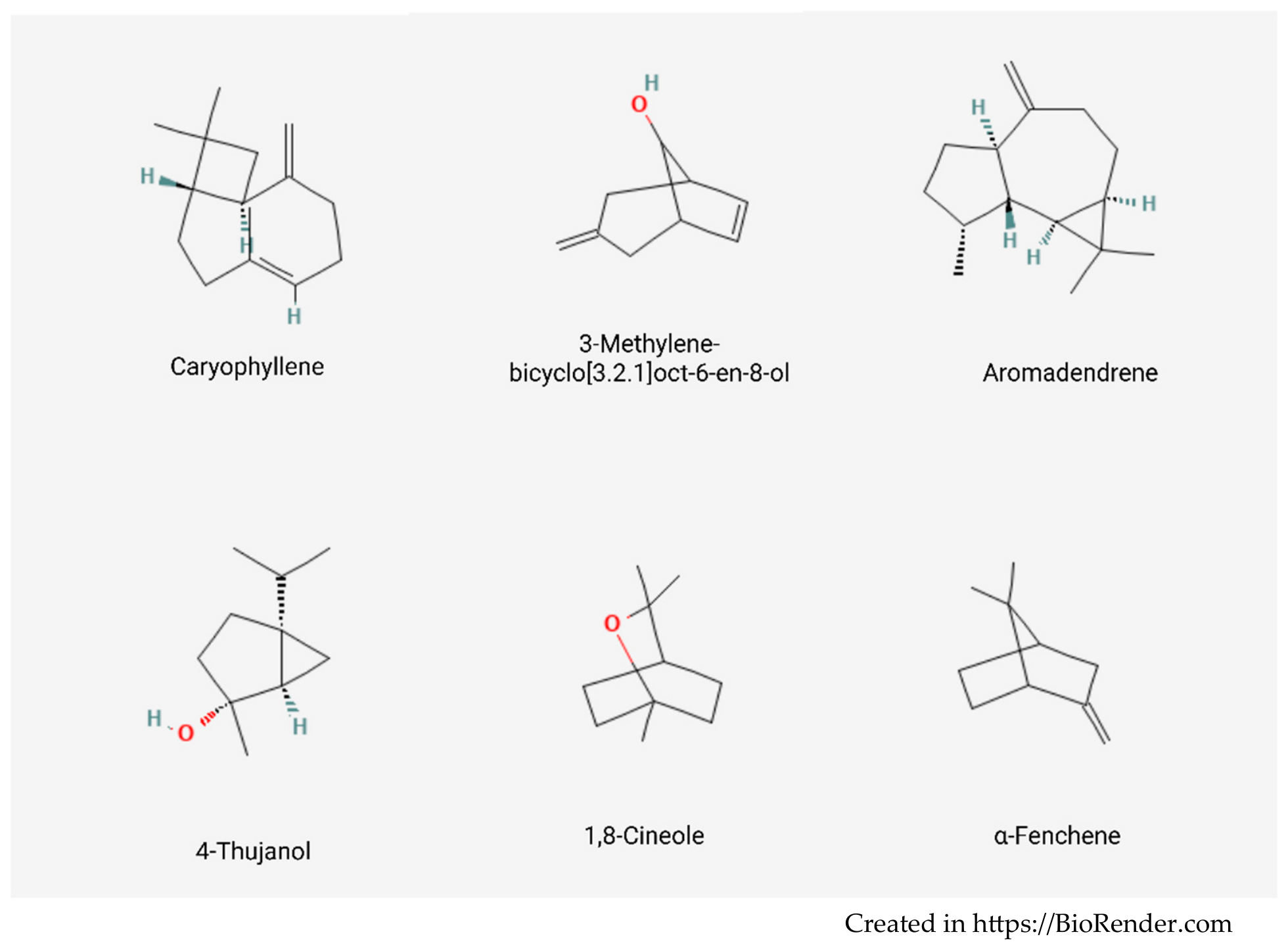
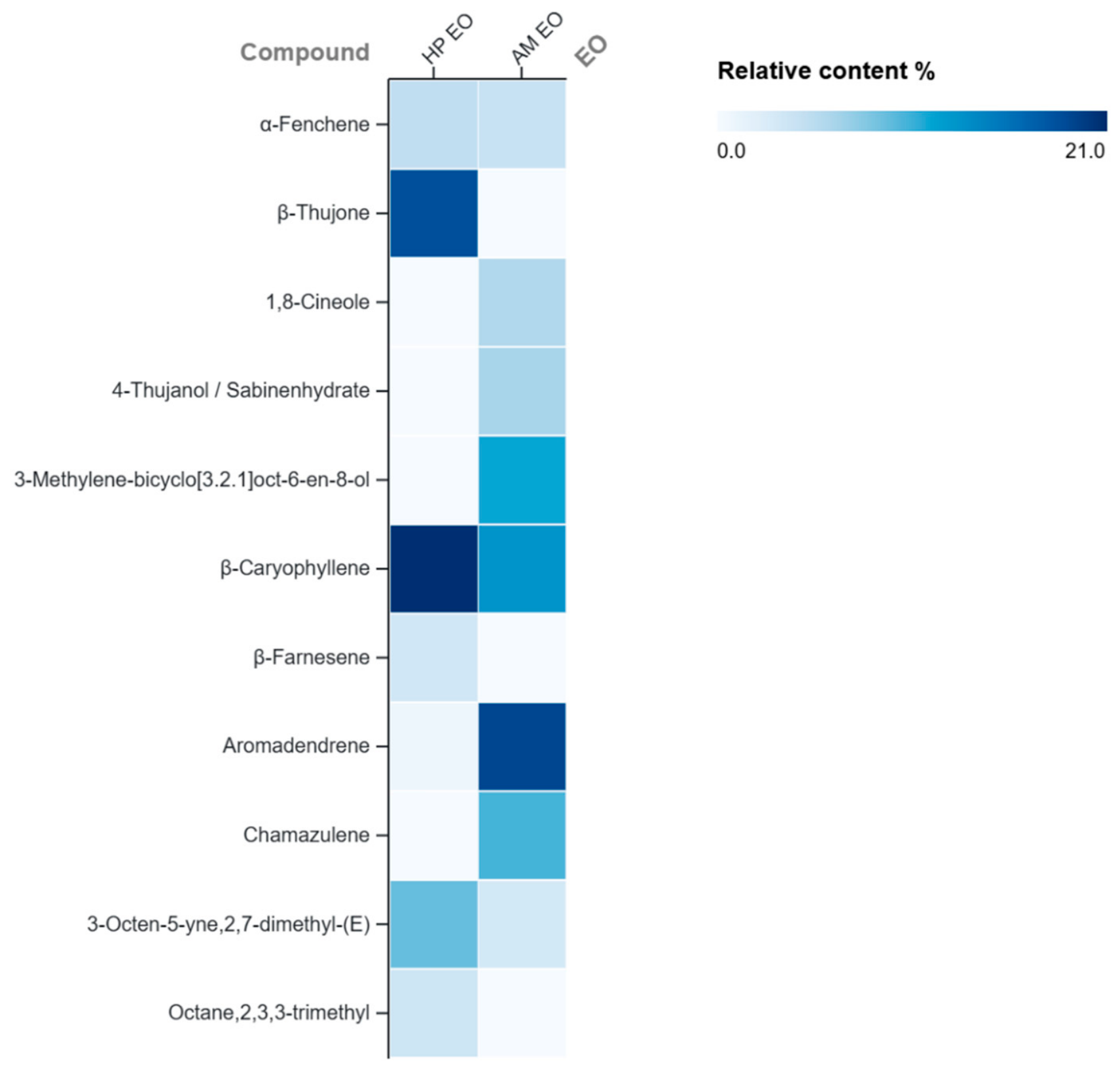
2.1. GC-MS Chemical Profiling
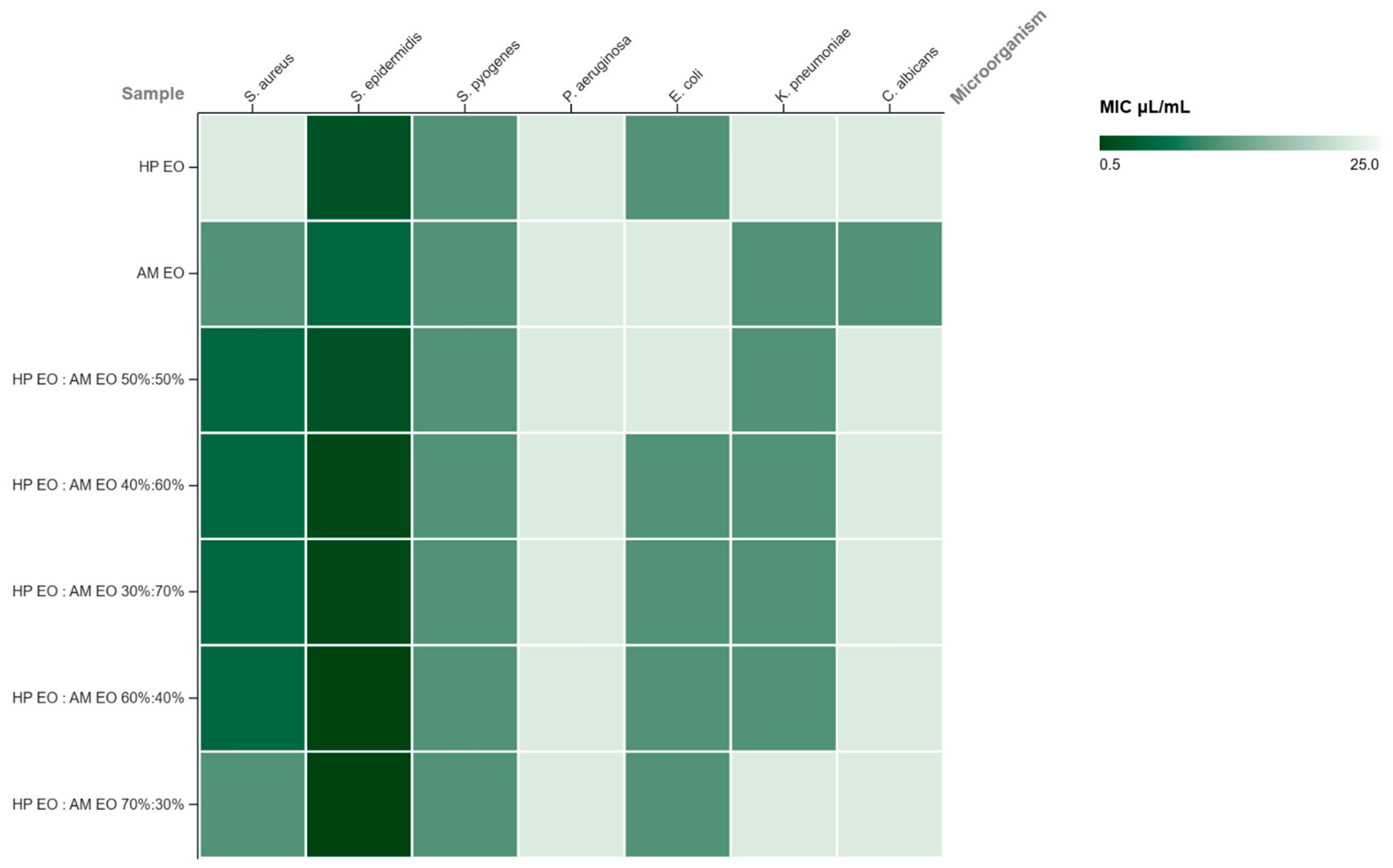
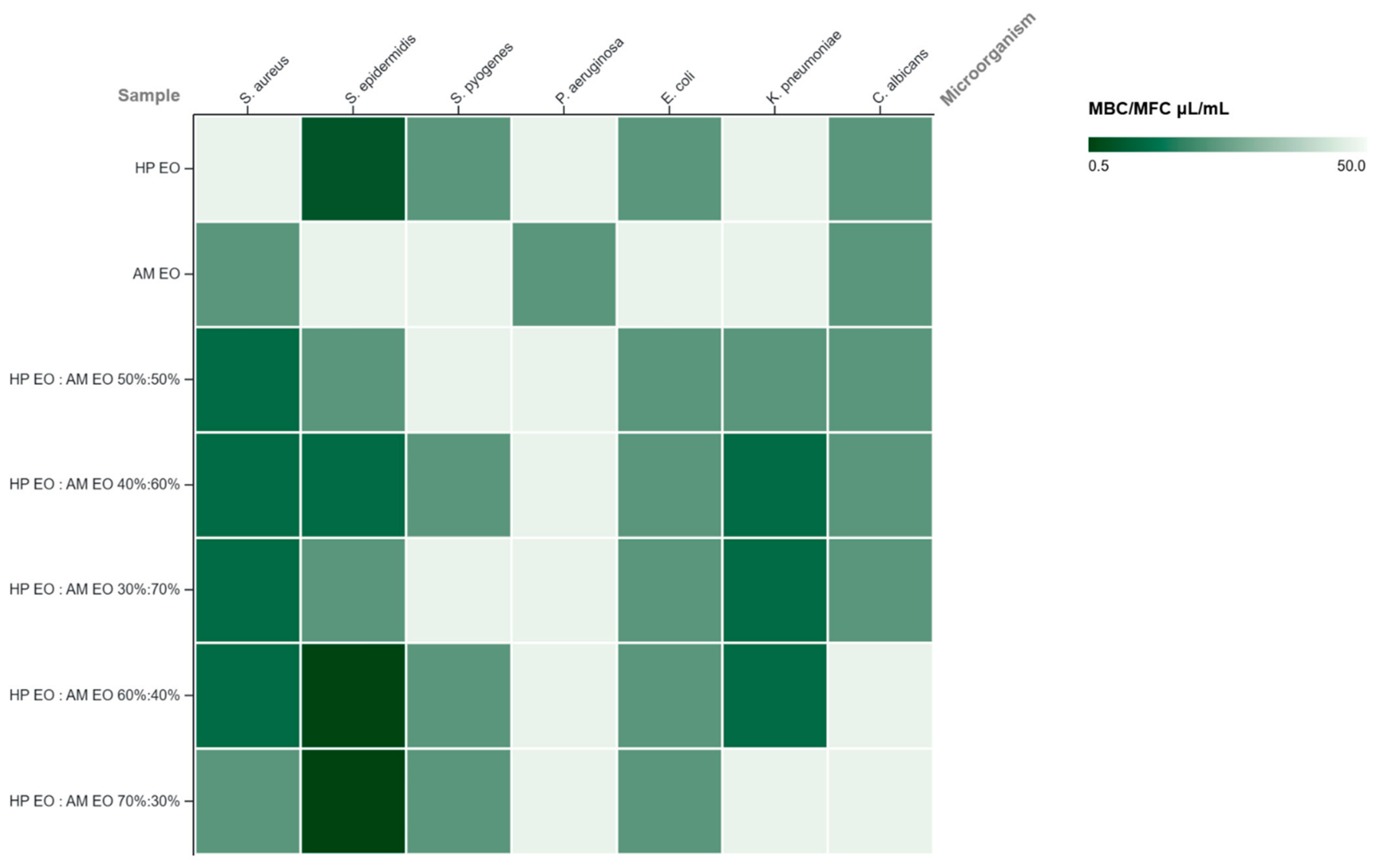
2.2. Antimicrobial Activity of EOs
3. Discussion
3.1. GC-MS Chemical Profiling
3.2. Antimicrobial Activity
4. Materials and Methods
4.1. Reagents, Media, and Instrumentation
4.2. Collection of Plant Samples
4.3. EOs Samples
4.4. GC–MS Chemical Profiling
4.5. Antimicrobial Activity
4.5.1. Preparation of Microbial Strains
4.5.2. Determination of the Minimum Inhibitory Concentration (MIC)
4.5.3. Determination of the Minimum Bactericidal Concentration (MBC) and Minimum Fungicidal Concentration (MFC)
5. Conclusions
Supplementary Materials
Author Contributions
Funding
Institutional Review Board Statement
Informed Consent Statement
Data Availability Statement
Conflicts of Interest
Abbreviations
| Eos | Essential oils |
| HP | Hypericum perforatum |
| AM | Achillea millefolium |
References
- Demirhan, I.; Korkmaz, A.; Oner, E.; Gumuscu, N.; Erbil, Y.; Babaarslan, O.; Kurutas, E.B. Synthesis, characterization, and antibacterial effect of St. John’s wort oil loaded chitosan hydrogel. Int. J. Biol. Macromol. 2024, 260, 129444. [Google Scholar] [CrossRef]
- Ghasemi, M.R.; Ranjbar, A.; Tamri, P.; Pourmoslemi, S.; Nourian, A.; Dastan, D. In vitro Antibacterial Activity and Wound Healing Effects of Achillea millefolium Essential Oil in Rat. J. Pharmacopunct. 2023, 26, 167–174. [Google Scholar] [CrossRef]
- Dalili, A.; Ebrahimnia Milani, S.; Kamali, N.; Mohammadi, S.; Pakbaz, M.; Jamalnia, S.; Sadeghi, M. Beneficial effects of Achillea millefolium on skin injuries; a literature review. J. Essent. Oil Res. 2022, 34, 479–489. [Google Scholar] [CrossRef]
- Nechita, M.A.; Pralea, I.E.; Țigu, A.B.; Iuga, C.A.; Pop, C.R.; Gál, E.; Vârban, R.; Nechita, V.I.; Oniga, O.; Toiu, A.; et al. Agastache Species (Lamiaceae) as a Valuable Source of Volatile Compounds: GC–MS Profiling and Investigation of In Vitro Antibacterial and Cytotoxic Activities. Int. J. Mol. Sci. 2024, 25, 5366. [Google Scholar] [CrossRef]
- Farhadi, N.; Babaei, K.; Farsaraei, S.; Moghaddam, M.; Ghasemi Pirbalouti, A. Changes in essential oil compositions, total phenol, flavonoids and antioxidant capacity of Achillea millefolium at different growth stages. Ind. Crops Prod. 2020, 152, 112570. [Google Scholar] [CrossRef]
- Grafakou, M.E.; Barda, C.; Karikas, G.A.; Skaltsa, H. Hypericum Essential Oils—Composition and Bioactivities: An Update (2012–2022). Molecules 2022, 27, 5246. [Google Scholar] [CrossRef]
- Canpolat, Ş.; Yürümez Canpolat, E.; İşlek, C. The Biological Activities of Hypericum perforatum L. ISPEC J. Agric. Sci. 2024, 8, 1001–1012. [Google Scholar] [CrossRef]
- Akkaya, O.B.; Çelik, İ.S.; Ertaş, E.; Çömlekcioğlu, N.; Aygan, A. Determination of Antimicrobial, Anticarcinogenic Activity of Bioactive Components of Hypericum perforatum L. Plant. Int. J. Chem. Technol. 2024, 8, 73–82. [Google Scholar] [CrossRef]
- Sotirova, Y.; Ivanova, N.; Ermenlieva, N.; Vilhelmova-Ilieva, N.; Simeonova, L.; Metodiev, M.; Gugleva, V.; Andonova, V. Antimicrobial and Antiherpetic Properties of Nanoencapsulated Hypericum perforatum Extract. Pharmaceuticals 2025, 18, 366. [Google Scholar] [CrossRef] [PubMed]
- Shabani, A.; Karapandzova, M.; Cvetkovikj Karanfilova, I.; Stefkov, G.; Kulevanova, S. GC-MS analysis of the essential oil, aroma components and n-hexane extract of St. John Wort (Hypericum perforatum L., Hypericaceae). Maced. Pharm. Bull. 2018, 64, 63–77. [Google Scholar] [CrossRef]
- Tumbarski, Y.; Ivanov, I.; Todorova, M.; Gerasimova, A.; Dincheva, I.; Makedonski, L.; Nikolova, K. Chemical Composition and Biological Activities of St John’s Wort (Hypericum perforatum L.) Essential Oil from Bulgaria. Appl. Sci. 2024, 14, 11754. [Google Scholar] [CrossRef]
- Doǧan, H.; Fidan, H.; Baş, H.; Stankov, S.; Stoyanova, A.; Ercisli, S.; Assouguem, A.; Ullah, R.; Bari, A. Determination of essential oil and chemical composition of St. John’s Wort. Open Chem. 2024, 22, 20240001. [Google Scholar] [CrossRef]
- Konarska, A.; Weryszko-Chmielewska, E.; Materska, M.; Sulborska-Różycka, A.; Dmitruk, M.; Chilczuk, B. Phenolic Compounds in Flowers and Herb of Achillea millefolium L.: Histochemical and Phytochemical Studies. Molecules 2025, 30, 2084. [Google Scholar] [CrossRef] [PubMed]
- Jangjoo, M.; Joshaghani, A.; Tahernejadgatabi, F. The role of Achillea millefolium in traditional medicine: A review of its use in different cultures. J. Multidiscip. Care 2023, 12, 152–156. [Google Scholar] [CrossRef]
- Öztürk, G.; Kırcı, D.; Demirci, B. Evaluation of volatile components of Achillea millefolium L. essential oil. Eur. J. Life Sci. 2023, 2, 125–130. [Google Scholar] [CrossRef]
- Ahmadi-Dastgerdi, A.; Ezzatpanah, H.; Asgary, S.; Dokhani, S.; Rahimi, E. Phytochemical, Antioxidant and Antimicrobial Activity of the Essential Oil from Flowers and Leaves of Achillea millefolium subsp. millefolium. J. Essent. Oil-Bear. Plants 2017, 20, 395–409. [Google Scholar] [CrossRef]
- Sodéré, P.; Somda, M.K.; Zongo, L.; Mihin, H.B.; Mogmenga, I.; Akakpo, A.Y.; Dicko, M.H. Synergy and Mechanism of the Action of the Combination of Essential Oils and Antibiotics Against Antibiotic-Resistant Food Borne Disease Bacteria in Burkina Faso. Infect. Drug Resist. 2025, 18, 2743–2763. [Google Scholar] [CrossRef]
- Eruygur, N.; Ayaz, F.; Bosdancı, G.; Kırci, D.; Doğru, T. Evaluation of the wound healing effects of Achillea L. genus. In Research in Medicinal and Aromatic Plants; Özyazıcı, G., Ed.; Iksad Publishing House: Ankara, Turkey, 2020; pp. 229–248. [Google Scholar]
- Gabbanini, S.; Neba, J.N.; Matera, R.; Valgimigli, L. Photochemical and Oxidative Degradation of Chamazulene Contained in Artemisia, Matricaria and Achillea Essential Oils and Setup of Protection Strategies. Molecules 2024, 29, 2604. [Google Scholar] [CrossRef]
- Dudek, K.; Pietryja, M.J.; Kurkiewicz, S.; Kurkiewicz, M.; Błońska-Fajfrowska, B.; Wilczyński, S.; Dzierżęga-Lęcznar, A. Influence of the Drying Method on the Volatile Component Profile of Hypericum perforatum Herb: A HS-SPME-GC/MS Study. Processes 2022, 10, 2593. [Google Scholar] [CrossRef]
- Semerdjieva, I.; Zheljazkov, V.D.; Dincheva, I.; Piperkova, N.; Maneva, V.; Cantrell, C.L.; Astatkie, T.; Stoyanova, A.; Ivanova, T. Essential Oil Composition of Seven Bulgarian Hypericum Species and Its Potential as a Biopesticide. Plants 2023, 12, 923. [Google Scholar] [CrossRef]
- Kakouri, E.; Daferera, D.; Nalbanti, A.; Trigas, P.; Tarantilis, P.A. Volatile Constituents of Four Hypericum Species Native to Greece. Compounds 2025, 5, 3. [Google Scholar] [CrossRef]
- Francomano, F.; Caruso, A.; Barbarossa, A.; Fazio, A.; La Torre, C.; Ceramella, J.; Mallamaci, R.; Saturnino, C.; Iacopetta, D.; Sinicropi, M.S. β-Caryophyllene: A Sesquiterpene with Countless Biological Properties. Appl. Sci. 2019, 9, 5420. [Google Scholar] [CrossRef]
- Farhadi, N.; Moghaddam, M.; Farsaraei, S.; Babaei, K.; Pirbalouti, A.G. Phytochemical profiling and antioxidant capacity of Achillea Santolina at different phenological stages. Sci. Rep. 2025, 15, 25885. [Google Scholar] [CrossRef]
- Zámboriné Németh, É.; Thi Nguyen, H. Thujone, a widely debated volatile compound: What do we know about it? Phytochem. Rev. 2020, 19, 405–423. [Google Scholar] [CrossRef]
- Mohammed, H.A.; Sulaiman, G.M.; Al-Saffar, A.Z.; Mohsin, M.H.; Khan, R.A.; Hadi, N.A.; Ismael, S.B.; Elshibani, F.; Ismail, A.; Abomughaid, M.M. Aromatic Volatile Compounds of Essential Oils: Distribution, Chemical Perspective, Biological Activity, and Clinical Applications. Food Sci. Nutr. 2025, 13, e70825. [Google Scholar] [CrossRef] [PubMed]
- Kurt, A.A.; Ibrahim, B.; Çınar, H.; Atsü, A.N.; Bursalıoğlu, E.O.; Bayır, İ.; Özmen, Ö.; Aslan, İ. Nanoemulsion Hydrogel Delivery System of Hypericum perforatum L.: In Silico Design, In Vitro Antimicrobial–Toxicological Profiling, and In Vivo Wound-Healing Evaluation. Gels 2025, 11, 431. [Google Scholar] [CrossRef] [PubMed]
- Otto, M. Staphylococcus epidermidis–the ‘accidental’ pathogen. Nat. Rev. Microbiol. 2009, 7, 555–567. [Google Scholar] [CrossRef]
- Vârban, D.; Zăhan, M.; Crișan, I.; Pop, C.R.; Gál, E.; Ștefan, R.; Rotar, A.M.; Muscă, A.S.; Meseșan, Ș.D.; Horga, V.; et al. Unraveling the Potential of Organic Oregano and Tarragon Essential Oils: Profiling Composition, FT-IR and Bioactivities. Plants 2023, 12, 4017. [Google Scholar] [CrossRef]
- Bordean, M.-E.; Ungur, R.A.; Toc, D.A.; Borda, I.M.; Marțiș, G.S.; Pop, C.R.; Filip, M.; Vlassa, M.; Nasui, B.A.; Pop, A.; et al. Antibacterial and Phytochemical Screening of Artemisia Species. Antioxidants 2023, 12, 596. [Google Scholar] [CrossRef]
- Pinto, L.; Bonifacio, M.A.; Giglio Ede Cometa, S.; Logrieco, A.F.; Baruzzi, F. Unravelling the antifungal effect of red thyme oil (Thymus vulgaris L.) compounds in vapor phase. Molecules 2020, 25, 4761. [Google Scholar] [CrossRef] [PubMed]
- CLSI. Method for Antifungal Disk Diffusion Susceptibility Teasting of Yeasts. In CLSI Guideline M44, 3rd ed.; Wayne, P.A., Ed.; Clinical and Laboratory Standards Institute: Wayne, PA, USA, 2018. [Google Scholar]
- Ștefănescu, B.E.; Socaci, S.A.; Fărcaș, A.C.; Nemeș, S.A.; Teleky, B.E.; Martău, G.A.; Călinoiu, L.F.; Mitrea, L.; Ranga, F.; Grigoroaea, D.; et al. Characterization of the Chemical Composition and Biological Activities of Bog Bilberry (Vaccinium uliginosum L.) Leaf Extracts Obtained via Various Extraction Techniques. Foods 2024, 13, 258. [Google Scholar] [CrossRef]
- Abu-Hussien, S.H.; Nasry, A.R.; Samy, Z.; El-Sayed, S.M.; Bakry, A.; Ebeed, N.; Elhariry, H.; ElNoby, T. Synergistic antimicrobial activity of essential oils mixture of Moringa oleifera, Cinnamomum verum and Nigella sativa against Staphylococcus aureus using L-optimal mixture design. AMB Express 2025, 15, 15. [Google Scholar] [CrossRef]
- Thongjuy, O.; Boonmasawai, S.; Sungpradit, S.; Charoonrut, P.; Homyog, K.; Sresuwadjarey, P.; Jooypan, T.; Photcharatinnakorn, P.; Nutakom, S.; Leesombun, A. Innovative essential oil formulations for in vitro inhibition of Biofilm-Forming Extended-Spectrum β-Lactamase–Producing Escherichia coli isolated from canine infectious diarrhea. Vet. Res. Commun. 2026, 50, 76. [Google Scholar] [CrossRef]



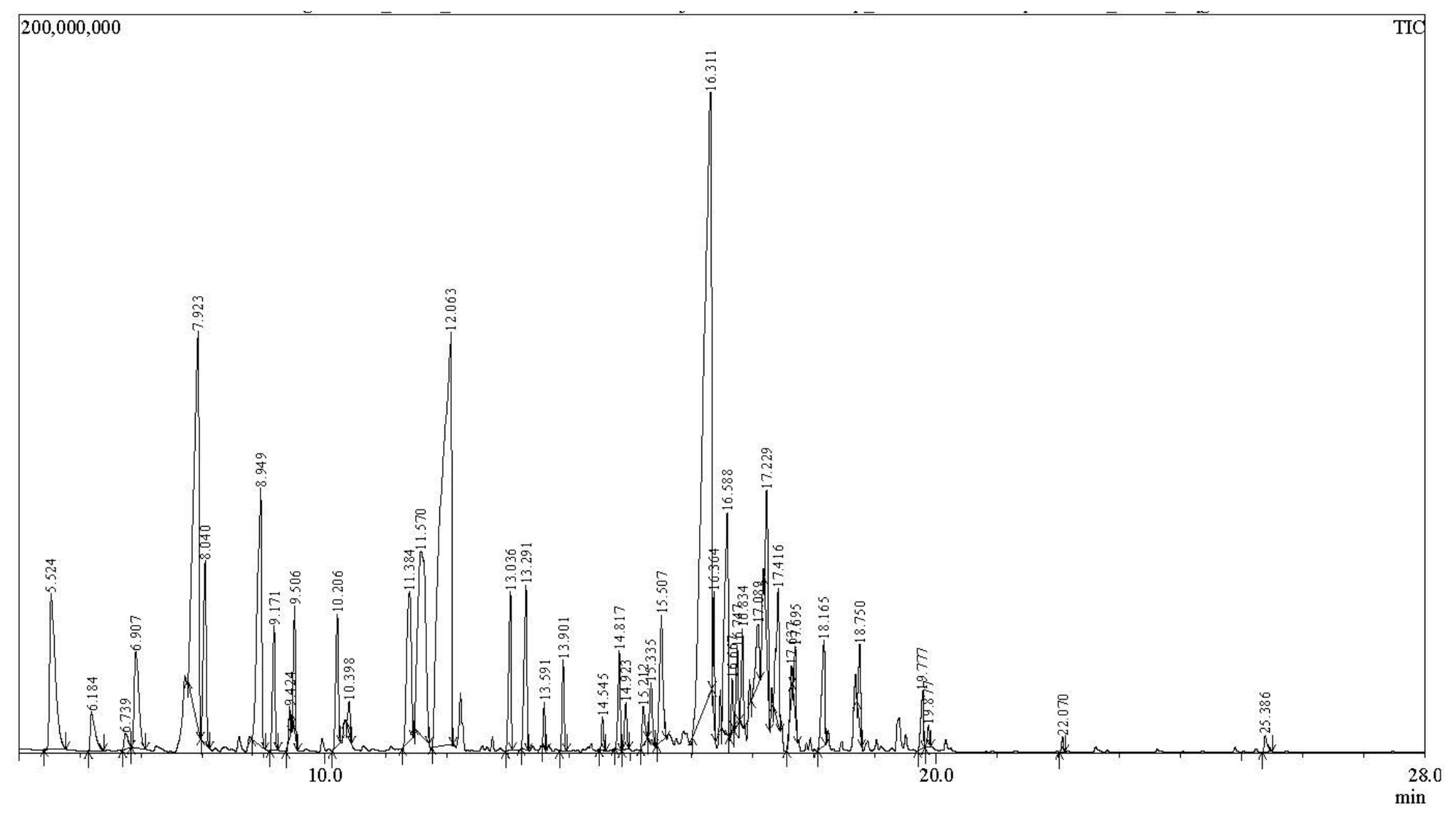
| No. | Compound | Chemical Class | Retention Time (min) | Relative Content (%) |
|---|---|---|---|---|
| 1 | Octane, 2,3,3-trimethyl- | C5 | 5.524 | 3.80 |
| 2 | Nonane | C5 | 6.184 | 0.81 |
| 3 | α-Thujene | C1 | 6.739 | 0.28 |
| 4 | α-Pinene | C1 | 6.907 | 1.95 |
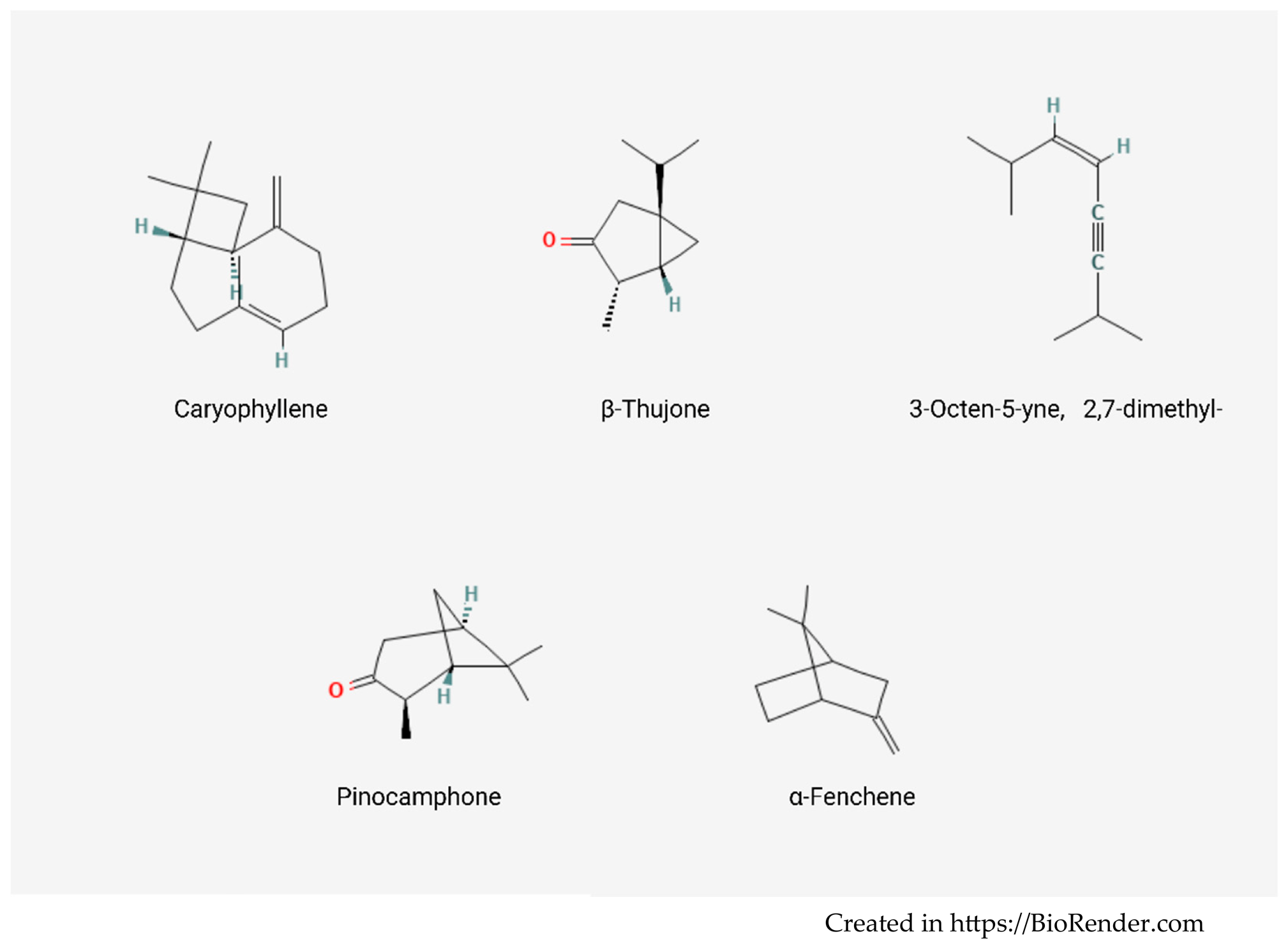
| 6 | 3-Octen-5-yne, 2,7-dimethyl- | C5 | 7.923 | 9.03 |
| 7 | β-Myrcene | C1 | 8.040 | 2.22 |
| 8 | α-Fenchene | C1 | 8.949 | 4.87 |
| 9 | cis-β-Ocimene | C1 | 9.171 | 1.35 |
| 10 | γ-Terpinene | C1 | 9.424 | 0.25 |
| 11 | 2-Methyldecane | C5 | 9.506 | 1.00 |
| 13 | Undecane | C5 | 10.206 | 1.48 |
| 14 | Linalool | C3 | 10.398 | 0.27 |
| 15 | Cyclohexene derivative | C3 | 11.384 | 3.02 |
| 16 | Pinocamphone | C3 | 11.570 | 6.36 |
| 17 | β-Thujone | C3 | 12.063 | 18.47 |
| 19 | Linalyl anthranilate | C4 | 13.036 | 1.76 |
| 20 | 2-Methyldodecane | C5 | 13.291 | 1.92 |
| 21 | Neryl acetate | C4 | 13.591 | 0.31 |
| 22 | 2,6,11-Trimethyldodecane | C5 | 13.901 | 0.80 |
| 23 | γ-Elemene | C2 | 14.545 | 0.29 |
| 24 | α-Cubebene | C2 | 14.817 | 0.92 |
| 25 | Longipinene | C2 | 14.923 | 0.47 |
| 26 | Ylangene | C2 | 15.212 | 0.47 |
| 27 | Copaene | C2 | 15.335 | 0.69 |
| 28 | α-Bourbonene | C2 | 15.507 | 1.90 |
| 29 | Caryophyllene | C2 | 16.311 | 20.74 |
| 30 | Germacrene D | C2 | 16.364 | 0.69 |
| 32 | β-Farnesene | C2 | 16.588 | 3.49 |
| 33 | α-Himachalene | C2 | 16.667 | 0.39 |
| 34 | α-Caryophyllene | C2 | 16.747 | 0.73 |
| 35 | Aromadendrene | C2 | 16.834 | 0.87 |
| 37 | Unidentified compound | C6 | 17.089 | 0.97 |
| 38 | α-Amorphene | C2 | 17.229 | 1.54 |
| 39 | γ-Elemene | C2 | 17.416 | 1.79 |
| 40 | Unidentified compound | C6 | 17.637 | 0.30 |
| 41 | δ-Amorphene | C2 | 17.695 | 0.47 |
| 42 | Hedycaryol | C3 | 18.165 | 1.48 |
| 44 | Caryophyllene oxide | C3 | 18.750 | 0.68 |
| 45 | β-Eudesmol | C3 | 19.777 | 0.64 |
| 46 | 1-Tetradecanol | C5 | 19.877 | 0.20 |
| 47 | Phytone | C5 | 22.070 | 0.12 |
| 48 | Phytol | C5 | 25.386 | 0.22 |
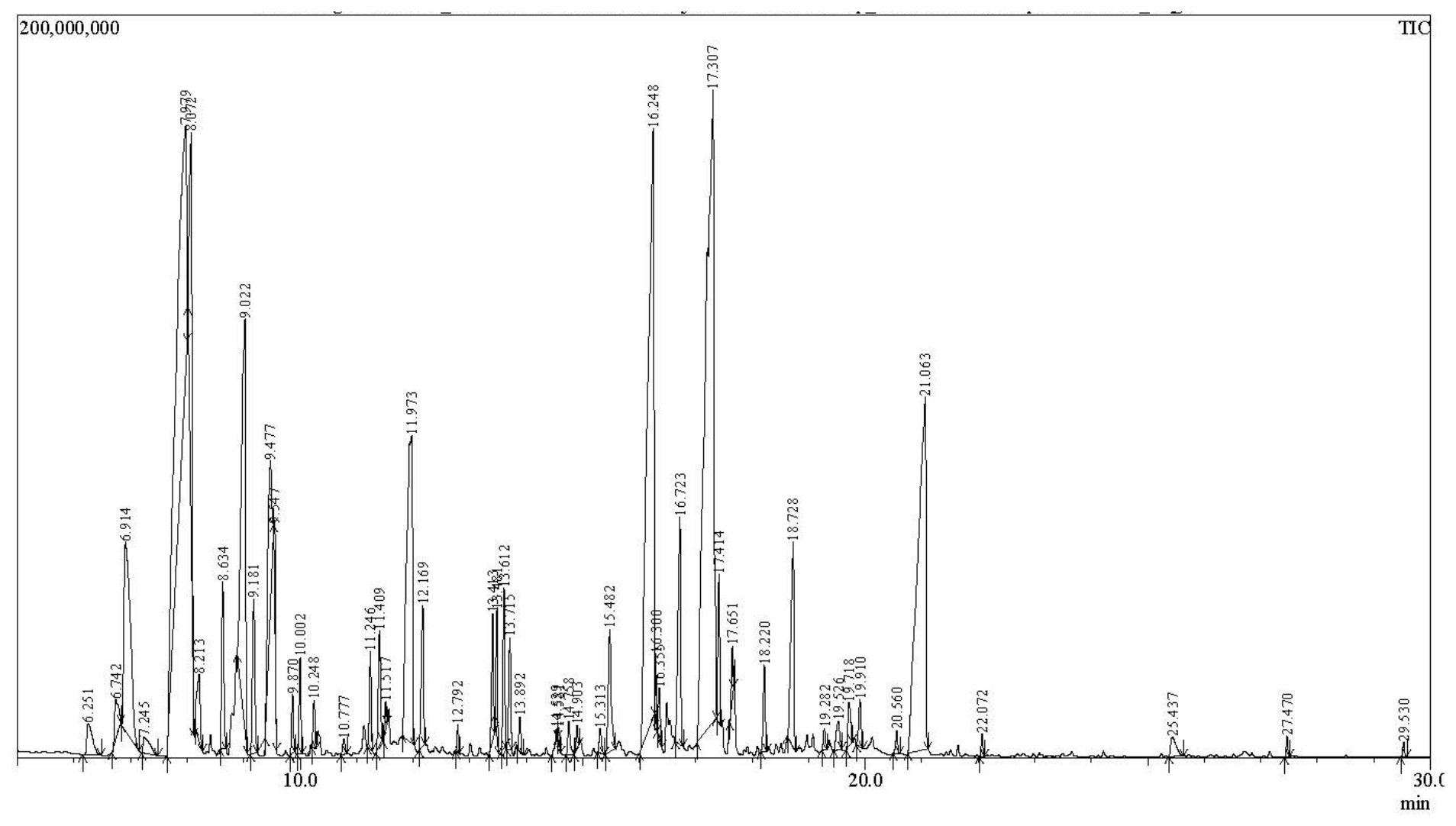
| No. | Compound | Chemical Class | Retention Time (min) | Relative Content (%) |
|---|---|---|---|---|
| 1 | Santolina triene | C1 | 6.251 | 0.63 |
| 2 | α-Thujene | C1 | 6.742 | 0.55 |
| 3 | α-Fenchene | C1 | 6.914 | 4.28 |
| 4 | Camphene | C1 | 7.245 | 0.38 |
| 5 | 3-Methylene-bicyclo[3.2.1]oct-6-en-8-ol | C3 | 7.979 | 11.41 |
| 6 | 3-Octen-5-yne,2,7-dimethyl-,(E) | C6 | 8.072 | 3.19 |
| 7 | Yomogi alcohol | C3 | 8.213 | 0.76 |
| 8 | α-Terpinolene | C1 | 8.634 | 1.35 |
| 9 | 1,8-Cineole | C3 | 9.022 | 5.83 |
| 10 | cis-β-Ocimene | C1 | 9.181 | 1.26 |
| 11 | 2-Carene | C1 | 9.477 | 2.38 |
| 12 | Dicyclopropyl carbinol | C6 | 9.547 | 0.27 |
| 13 | 3,3,6-Trimethyl-1,5-heptadien-4-ol | C3 | 9.870 | 0.35 |
| 14 | α-Terpinolene | C1 | 10.002 | 0.60 |
| 15 | Linalool | C3 | 10.248 | 0.31 |
| 16 | p-Menth-2-en-1-ol | C3 | 10.777 | 0.14 |
| 17 | Camphor | C3 | 11.246 | 0.66 |
| 18 | Chrysanthemol | C3 | 11.409 | 0.99 |
| 19 | Pinocarvone | C3 | 11.517 | 0.17 |
| 20 | 4-Thujanol/Sabinene hydrate | C3 | 11.973 | 6.27 |
| 21 | α-Terpineol | C3 | 12.169 | 1.10 |
| 22 | 1-Imidazol-1-yl-3-methylbut-2-en-1-one | C6 | 12.792 | 0.15 |
| 23 | 4-Thujen-2-yl acetate | C4 | 13.413 | 0.90 |
| 24 | (-)-trans-Myrtanyl acetate | C4 | 13.481 | 0.65 |
| 25 | Geranyl acetate | C4 | 13.612 | 1.11 |
| 26 | Bornyl acetate | C4 | 13.715 | 0.80 |
| 27 | Pinocarvyl acetate | C4 | 13.892 | 0.19 |
| 28 | γ-Elemene | C2 | 14.539 | 0.07 |
| 29 | δ-Elemene | C2 | 14.581 | 0.06 |
| 30 | α-Terpinyl acetate | C4 | 14.758 | 0.28 |
| 31 | Neryl acetate | C4 | 14.903 | 0.16 |
| 32 | α-Cubebene | C2 | 15.313 | 0.21 |
| 33 | β-Bourbonene | C2 | 15.482 | 1.28 |
| 34 | Caryophyllene | C2 | 16.248 | 12.97 |
| 35 | Germacrene D | C2 | 16.300 | 0.23 |
| 36 | β-Sesquiphellandrene | C2 | 16.355 | 0.33 |
| 37 | cis-α-Bisabolene | C2 | 16.723 | 2.21 |
| 38 | Aromadendrene | C2 | 17.307 | 19.12 |
| 39 | γ-Elemene | C2 | 17.414 | 0.96 |
| 40 | D-Amorphene | C2 | 17.651 | 0.29 |
| 41 | β-Nerolidol | C5 | 18.220 | 0.63 |
| 42 | Caryophyllene oxide | C5 | 18.728 | 2.20 |
| 43 | Epiglobulol | C5 | 19.282 | 0.15 |
| 44 | δ-Cadinol | C5 | 19.526 | 0.36 |
| 45 | α-Cadinol | C5 | 19.718 | 0.43 |
| 46 | Spathulenol | C5 | 19.910 | 0.37 |
| 47 | Tetradecanal | C6 | 20.560 | 0.17 |
| 48 | Chamazulene | C2 | 21.063 | 10.13 |
| 49 | Phytone | C6 | 22.072 | 0.14 |
| 50 | Phytol | C6 | 25.437 | 0.39 |
| 51 | Eicosane | C6 | 27.470 | 0.12 |
| 52 | Heneicosane | C6 | 29.530 | 0.09 |
| Gram-Positive Bacteria | Gram-Negative Bacteria | Yeast | |||||
|---|---|---|---|---|---|---|---|
| Staphylococcus aureus | Staphylococcus epidermidis | Streptococcus pyogenes | Pseudomonas aeruginosa | Escherichia coli | Klebsiella pneumoniae | Candida albicans | |
| μL/mL | μL/mL | μL/mL | μL/mL | μL/mL | μL/mL | μL/mL | |
| (HP) EO | 22.68 ± 0.00 | 2.45 ± 0.00 | 10.80 ± 0.00 | 22.68 ± 0.00 | 10.80 ± 0.00 | 22.68 ± 0.00 | 22.68 ± 0.00 |
| (AM) EO | 10.80 ± 0.00 | 5.14 ± 0.00 | 10.80 ± 0.00 | 22.68 ± 0.00 | 22.68 ± 0.00 | 10.80 ± 0.00 | 10.80 ± 0.00 |
| HP EO:AM EO 50%:50% | 5.14 ± 0.00 | 2.45 ± 0.00 | 10.80 ± 0.00 | 22.68 ± 0.00 | 22.68 ± 0.00 | 10.80 ± 0.00 | 22.68 ± 0.00 |
| HP EO:AM EO 40%:60% | 5.14 ± 0.00 | 1.17 ± 0.00 | 10.80 ± 0.00 | 22.68 ± 0.00 | 10.80 ± 0.00 | 10.80 ± 0.00 | 22.68 ± 0.00 |
| HP EO:AM EO 30%:70% | 5.14 ± 0.00 | 1.17 ± 0.00 | 10.80 ± 0.00 | 22.68 ± 0.00 | 10.80 ± 0.00 | 10.80 ± 0.00 | 22.68 ± 0.00 |
| HP EO:AM EO 60%:40% | 5.14 ± 0.00 | 0.56 ± 0.00 | 10.80 ± 0.00 | 22.68 ± 0.00 | 10.80 ± 0.00 | 10.80 ± 0.00 | 22.68 ± 0.00 |
| HP EO:AM EO 70%:30% | 10.80 ± 0.00 | 0.56 ± 0.00 | 10.80 ± 0.00 | 22.68 ± 0.00 | 10.80 ± 0.00 | 22.68 ± 0.00 | 22.68 ± 0.00 |
| Gentamicina (0.4 mg/mL)/Ketoconazol (1 mg/mL) | 0.27 ± 0.00 | 2.45 ± 0.00 | 0.13 ± 0.00 | 0.27 ± 0.00 | 0.56 ± 0.00 | 0.27 ± 0.00 | 0.27 ± 0.00 |
| Gram-Positive Bacteria | Gram-Negative Bacteria | Yeast | |||||
|---|---|---|---|---|---|---|---|
| Staphylococcus aureus | Staphylococcus epidermidis | Streptococcus pyogenes | Pseudomonas aeruginosa | Escherichia coli | Klebsiella pneumoniae | Candida albicans | |
| μL/mL | μL/mL | μL/mL | μL/mL | μL/mL | μL/mL | μL/mL | |
| (HP) EO | 47.62 ± 0.00 | 5.14 ± 0.00 | 22.68 ± 0.00 | 47.62 ± 0.00 | 22.68 ± 0.00 | 47.62 ± 0.00 | 22.68 ± 0.00 |
| (AM) EO | 22.68 ± 0.00 | 47.62 ± 0.00 | 47.62 ± 0.00 | 22.68 ± 0.00 | 47.62 ± 0.00 | 47.62 ± 0.00 | 22.68 ± 0.00 |
| HP EO:AM EO 50%:50% | 10.80 ± 0.00 | 22.68 ± 0.00 | 47.62 ± 0.00 | 47.62 ± 0.00 | 22.68 ± 0.00 | 22.68 ± 0.00 | 22.68 ± 0.00 |
| HP EO:AM EO 40%:60% | 10.80 ± 0.00 | 10.80 ± 0.00 | 22.68 ± 0.00 | 47.62 ± 0.00 | 22.68 ± 0.00 | 10.80 ± 0.00 | 22.68 ± 0.00 |
| HP EO:AM EO 30%:70% | 10.80 ± 0.00 | 22.68 ± 0.00 | 47.62 ± 0.00 | 47.62 ± 0.00 | 22.68 ± 0.00 | 10.80 ± 0.00 | 22.68 ± 0.00 |
| HP EO:AM EO 60%:40% | 10.80 ± 0.00 | 1.17 ± 0.00 | 22.68 ± 0.00 | 47.62 ± 0.00 | 22.68 ± 0.00 | 10.80 ± 0.00 | 47.62 ± 0.00 |
| HP EO:AM EO 70%:30% | 22.68 ± 0.00 | 0.56 ± 0.00 | 22.68 ± 0.00 | 47.62 ± 0.00 | 22.68 ± 0.00 | 47.62 ± 0.00 | 47.62 ± 0.00 |
| Gentamicina (0.4 mg/mL)/Ketoconazol (1 mg/mL) | 0.27 ± 0.00 | 2.45 ± 0.00 | 0.13 ± 0.00 | 0.27 ± 0.00 | 0.56 ± 0.00 | 0.27 ± 0.00 | 0.27 ± 0.00 |
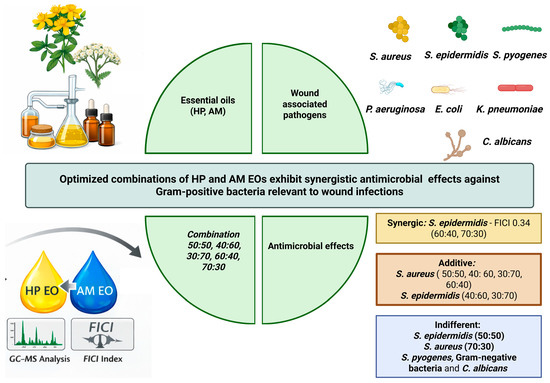
| Combination (HP EO:AM EO) | S. aureus | S. epidermidis | S. pyogenes | P. aeruginosa | E. coli | K. pneumoniae | C. albicans |
|---|---|---|---|---|---|---|---|
| 50%:50% | 0.70 (Add) | 1.48 (Ind) | 2.00 (Ind) | 2.00 (Ind) | 3.10 (Ind) | 1.48 (Ind) | 3.10 (Ind) |
| 40%:60% | 0.70 (Add) | 0.71 (Add) | 2.00 (Ind) | 2.00 (Ind) | 1.48 (Ind) | 1.48 (Ind) | 3.10 (Ind) |
| 30%:70% | 0.70 (Add) | 0.71 (Add) | 2.00 (Ind) | 2.00 (Ind) | 1.48 (Ind) | 1.48 (Ind) | 3.10 (Ind) |
| 60%:40% | 0.70 (Add) | 0.34 (Syn) | 2.00 (Ind) | 2.00 (Ind) | 1.48 (Ind) | 1.48 (Ind) | 3.10 (Ind) |
| 70%:30% | 1.48 (Ind) | 0.34 (Syn) | 2.00 (Ind) | 2.00 (Ind) | 1.48 (Ind) | 3.10 (Ind) | 3.10 (Ind) |
Disclaimer/Publisher’s Note: The statements, opinions and data contained in all publications are solely those of the individual author(s) and contributor(s) and not of MDPI and/or the editor(s). MDPI and/or the editor(s) disclaim responsibility for any injury to people or property resulting from any ideas, methods, instructions or products referred to in the content. |
© 2026 by the authors. Licensee MDPI, Basel, Switzerland. This article is an open access article distributed under the terms and conditions of the Creative Commons Attribution (CC BY) license.
Share and Cite
Bordea, D.; Nistor, A.L.; Salanţă, L.C.; Coldea, T.E.; Rotar, A.M.; Grigor, O.M.; Vârban, R.; Gal, E.; Pop, C.R. Chemical Composition and Synergistic Antimicrobial Activity of Hypericum perforatum and Achillea millefolium Essential Oils Against Wound-Associated Microorganisms. Molecules 2026, 31, 1594. https://doi.org/10.3390/molecules31101594
Bordea D, Nistor AL, Salanţă LC, Coldea TE, Rotar AM, Grigor OM, Vârban R, Gal E, Pop CR. Chemical Composition and Synergistic Antimicrobial Activity of Hypericum perforatum and Achillea millefolium Essential Oils Against Wound-Associated Microorganisms. Molecules. 2026; 31(10):1594. https://doi.org/10.3390/molecules31101594
Chicago/Turabian StyleBordea, Daniela, Alina L. Nistor, Liana Claudia Salanţă, Teodora E. Coldea, Ancuța M. Rotar, Oana M. Grigor, Rodica Vârban, Emese Gal, and Carmen R. Pop. 2026. "Chemical Composition and Synergistic Antimicrobial Activity of Hypericum perforatum and Achillea millefolium Essential Oils Against Wound-Associated Microorganisms" Molecules 31, no. 10: 1594. https://doi.org/10.3390/molecules31101594
APA StyleBordea, D., Nistor, A. L., Salanţă, L. C., Coldea, T. E., Rotar, A. M., Grigor, O. M., Vârban, R., Gal, E., & Pop, C. R. (2026). Chemical Composition and Synergistic Antimicrobial Activity of Hypericum perforatum and Achillea millefolium Essential Oils Against Wound-Associated Microorganisms. Molecules, 31(10), 1594. https://doi.org/10.3390/molecules31101594