Article

Comparative Analysis of the Ginsenosides in Panax vietnamensis and Three Panax Species

1
State Key Laboratory for Quality Ensurance and Sustainable Use of Dao-Di Herbs, Institute of Medicinal Plant Development, Chinese Academy of Medical Sciences and Peking Union Medical College, Beijing 100193, China
2
College of Pharmacy, Heilongjiang University of Chinese Medicine, Harbin 150040, China
3
Yunnan Key Laboratory of Southern Medicine Utilization, Yunnan Branch, Institute of Medicinal Plant Development, Chinese Academy of Medical Sciences and Peking Union Medical College, Jinghong 666100, China
*
Authors to whom correspondence should be addressed.
Molecules 2026, 31(10), 1570; https://doi.org/10.3390/molecules31101570
Submission received: 2 April 2026 / Revised: 23 April 2026 / Accepted: 6 May 2026 / Published: 8 May 2026
(This article belongs to the Special Issue Advances in Food Analytical Methods)

Abstract

Panax vietnamensis Ha et Grushv. (Vietnamese ginseng) is a plant of the Panax genus, Araliaceae family. It is a rare medicinal plant found in China and Vietnam, known for its structurally diverse ginsenosides, and holds significant value in the pharmaceutical and health food sectors. As market demand and its value continue to rise, the P. vietnamensis industry has developed rapidly. However, since Vietnamese ginseng is difficult to distinguish from other Panax materials based on appearance, especially Panax notoginseng, there is a lack of relevant standards for quality control. In this study, UPLC-Q/TOF-MS technology was employed for the qualitative identification and comparative analysis of ginsenosides in different parts of P. vietnamensis and three other Panax species. Additionally, an UFLC-MS/MS method was established to determine the content of 21 ginsenosides in P. vietnamensis. Based on the UPLC-Q/TOF-MS analysis, 55 ginsenosides were preliminarily identified, including 30 protopanaxadiol-type, 21 protopanaxatriol-type, 3 ocotillol-type, and 1 oleanane-type ginsenosides. Further comparative analysis revealed variations in the ginsenosides of P. vietnamensis and three Panax species, identifying 41 components present in all species, while 14 saponins were detected only in some species. Compared to three Panax species, the main roots of P. vietnamensis contained characteristic components such as majonoside R2, majonoside R1, and vinaginsenoside R2. Quantitative analysis of 21 ginsenosides in different Panax species indicated that P. vietnamensis and P. notoginseng contained higher levels of ginsenoside Rg1, Rd, Rb1, and notoginsenoside R1. For instance, the average content of ginsenoside Rg1 in P. vietnamensis was 25.57 mg/g. Quantitative analysis of ginsenosides in different parts of P. vietnamensis revealed that the taproots and fibrous roots had a diverse array of ginsenosides with higher concentrations, while the stems and leaves contained fewer ginsenosides with lower levels. Significantly, certain components such as notoginsenoside Re and ginsenoside Rd, Re, and Rb2 were present at higher concentrations in the leaves. Based on the qualitative and quantitative analysis results of ginsenosides from different parts of P. vietnamensis, it was concluded that the main roots, fibrous roots, and leaves all have potential for development and utilization.

1. Introduction

The genus Panax L., belonging to the family Araliaceae under the order Apiales (Umbellales), is distributed across approximately 35 countries worldwide [1]. As important traditional medicinal herbs, plants of this genus are often used as adjunctive therapies for the prevention of diabetes, depression, cardiovascular diseases, and Alzheimer’s disease [2,3]. Panax species are significant as both medicinal and edible plants worldwide, holding substantial value in the health food and pharmaceutical industries. Representative species such as Panax ginseng, Panax quinquefolius, P. notoginseng, and Panax japonicus with their dried roots and rhizomes have been included in the Chinese Pharmacopoeia as early as 2015 [4,5].
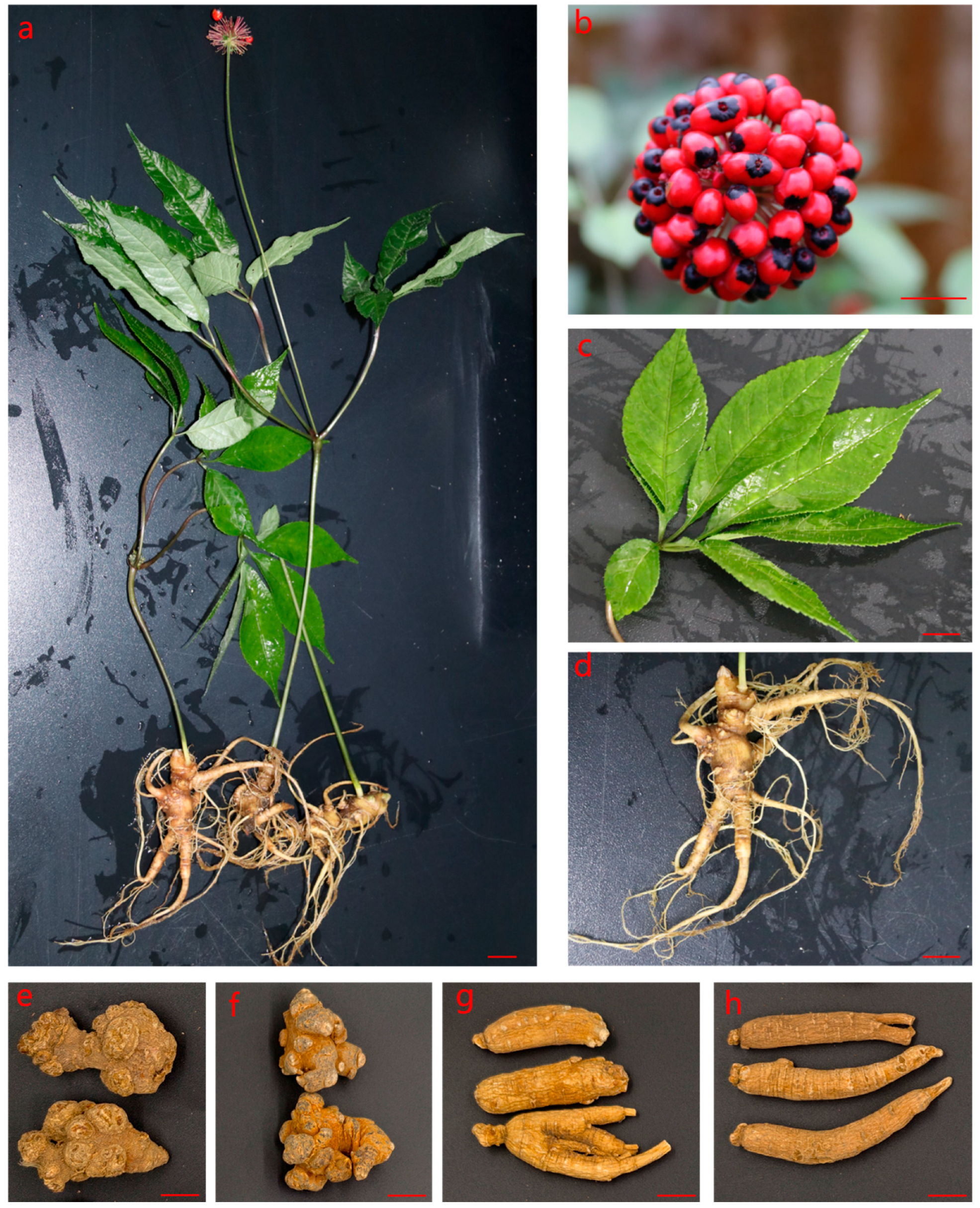
Panax vietnamensis Ha et Grushv., also known as Ngoc Linh ginseng or Jinping ginseng, is a perennial herbaceous plant belonging to the genus Panax of the Araliaceae family [6]. It was first discovered on Ngoc Linh Mountain in Kon Tum Province, Vietnam, in 1973. Subsequent studies have confirmed its natural distribution in the southern part of Yunnan Province, China [7]. In Vietnam, the distribution of P. vietnamensis is extremely restricted, mainly concentrated around Ngoc Linh Mountain and Hoang Lien Mountain in the central high-altitude areas, at an elevation ranging from 1700 to 2000 m [8]. The plants mostly grow in clusters, with a height ranging from 20 to 110 cm. The taproot is obconical or shortly fusiform, fleshy, and often branched. The rhizome grows in a twisted, nodular bamboo-like form underground, while the aerial stem is erect and solitary. There are three to six palmate compound leaves whorled at the top of the stem, and the leaflets are serrated. The flowers are bisexual or dioecious, arranged in a solitary terminal umbel, or two to several umbels clustered at the apex of the scape, with pale green corollas. The fruit is a drupe-like berry, oblate-reniform, red when mature, and usually marked with black spots at the apex. Each fruit contains multiple seeds, which are oval, triangular-ovate, or oblate in shape [1,8,9]. The morphological characteristics of P. vietnamensis are shown in Figure 1. In China, the distribution range of P. vietnamensis highly overlaps with the cultivation areas of P. notoginseng. Moreover, it bears a strong morphological resemblance to Panax species such as P. ginseng and P. quinquefolius, making its medicinal materials highly susceptible to adulteration and confusion.
As an important medicinal resource in the genus Panax, it is mainly harvested for its roots and rhizomes. It has long been regarded in folk medicine as a potent tonic herb, commonly used for postpartum recovery, as well as physical conditioning and vitality enhancement in the elderly and those debilitated by severe illness. In contrast, its aerial parts, including leaves and stems, are mostly utilized as an ingredient in herbal cooling teas [10]. Recorded in the Vietnamese Pharmacopoeia, this medicinal material is considered to have the effects of “greatly replenishing vital energy (Qi) and benefiting the lungs,” and is indicated for conditions such as “severe debility, lung deficiency with cough and dyspnea, and sore throat” [10,11]. Furthermore, in traditional Vietnamese folk medical practice, it is widely used for the adjuvant treatment of neurological and cardiovascular diseases, and is considered to possess anti-tumor, anti-aging, and stress-relieving properties [7]. Modern pharmacological studies have demonstrated that the ginsenosides from P. vietnamensis exert dynamic therapeutic effects, including anti-tumor, anti-inflammatory, hepatoprotective, renoprotective, neuroprotective, anxiolytic, anti-stress, and analgesic activities [1,12].
Studies have shown that a range of chemical components, including ginsenosides, volatile oils, and fatty acids, have been identified in different tissues of P. vietnamensis [13,14]. Among these, ginsenosides are considered the primary active constituents. Based on their skeletal structures, ginsenosides can be classified into two major categories: dammarane-type and oleanane-type (OA). The dammarane-type ginsenosides are further subdivided into three subtypes—protopanaxadiol (PPD), protopanaxatriol (PPT), and ocotillol (OT)—based on differences in the parent nucleus structure and substituent groups [15,16]. Like P. ginseng, P. notoginseng, and P. quinquefolius, P. vietnamensis contains PPD- and PPT-type ginsenosides, including ginsenosides Rb1, Rb2, Rc, Rd, Re, Rg1, and Rh1, notoginsenosides R1 and R2, and quinquenoside R1 [1,7,17,18]. The core competitiveness of P. vietnamensis lies in its unique OT-type ginsenosides, with an active substance content of up to 5.6%, accounting for over 50% of the total ginsenosides, thereby forming the basis of its distinctive pharmacological value [15,19]. Compared with other plants of the genus Panax, P. vietnamensis exhibits significant advantages in terms of total saponin and OT-type saponin content [19]. Current research on the chemical constituents of P. vietnamensis has primarily focused on its roots and rhizomes. According to the latest literature, more than 60 ginsenosides have been isolated and identified from P. vietnamensis to date [1,7].
Currently, systematic research on the component analysis and quality control of P. vietnamensis remains markedly insufficient. With advancements in analytical technology, ultra-high-performance liquid chromatography coupled with quadrupole time-of-flight mass spectrometry (UPLC-Q/TOF-MS) has become the mainstream technique for the identification and analysis of ginsenosides in Panax species [20,21,22,23,24]. This method combines the rapid separation capability of UPLC with the high resolution and sensitivity of quadrupole TOF-MS, making it suitable for the high-throughput identification of multiple ginsenosides in complex matrices. Therefore, this study aims to employ UPLC-Q/TOF-MS technology for the rapid analysis and identification of ginsenosides in P. vietnamensis, thereby providing an effective scientific basis for the identification, development, and utilization of P. vietnamensis as a medicinal resource. Furthermore, multi-component content analysis is an important reference for accurately reflecting and evaluating the quality of P. vietnamensis. While high-performance liquid chromatography equipped with a UV-VIS detector (HPLC-UV) has previously been used to detect various components such as ginsenoside Rd and ginsenoside Rc [25,26], LC-MS offers higher sensitivity than HPLC-UV, enabling the simultaneous and accurate quantification of multiple ginsenosides with weak ultraviolet absorption, thereby comprehensively reflecting the quality of the medicinal material. Currently, LC-MS has become the primary technique for the quantitative determination of ginsenosides [27,28,29]. In this study, using ginsenosides for which the reference standards are available as the assay indicators, we optimized the quantitative analysis conditions and ultimately established a UFLC-MS/MS method for the simultaneous determination of 21 ginsenosides. The established method was then used to comprehensively evaluate the differences in ginsenoside content between P. vietnamensis and three other Panax species, providing a scientific foundation for the development, utilization, and quality evaluation of P. vietnamensis as a medicinal resource.

2. Results and Discussion

2.1. Identification of Ginsenosides Using UPLC-Q/TOF-MS

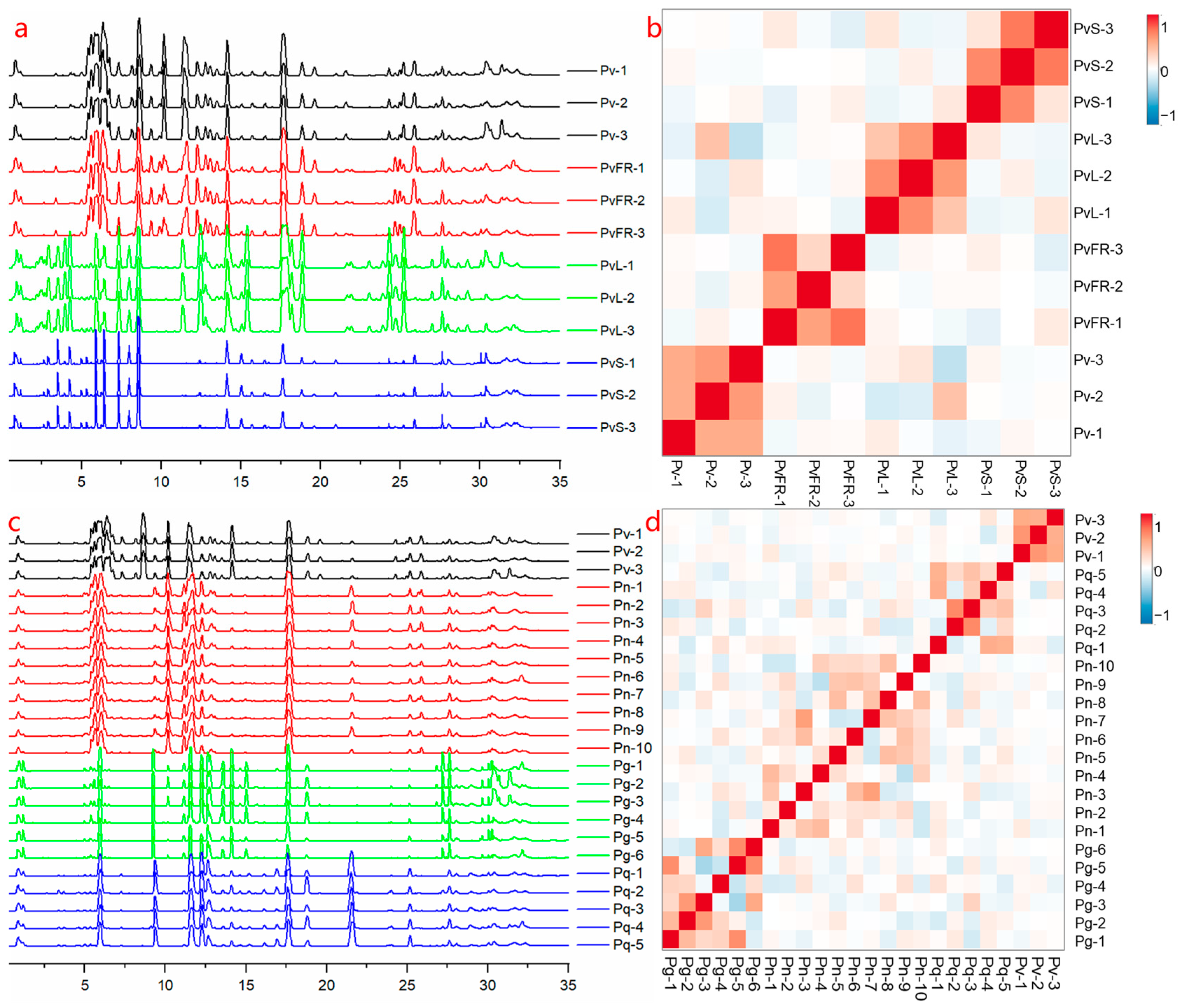
According to the references, this experiment employed UPLC-Q/TOF-MS in negative-ion mode for sample analysis [20,21,22,23,24], and raw data were processed using Progenesis QI V2.0 software. Subsequently, online software Metaboanalyst 6.0 (https://www.metaboanalyst.ca/; accessed on 24 March 2026) was used for sample correlation analysis. The total ion current (TIC) chromatograms and correlation analysis results for the four Panax species and different parts of P. vietnamensis are shown in Figure 2. From the TIC chromatograms and correlation analysis plots, it can be observed that there are significant differences in the chemical composition among different parts (taproot, fibrous root, stem, and leaf) of P. vietnamensis, as well as among the taproots of the four Panax species. These inter-group differences likely reflect intrinsic distinctions in the chemical profiles of the samples, warranting further systematic component analysis of samples from different sources.
In this study, the literature on mass spectrometry analysis of ginsenosides in Panax plants was systematically integrated to perform qualitative identification of the components. In negative-ion mode, ginsenosides typically exhibit [M−H] and [M+HCOO] ion peaks, corresponding to deprotonated molecular ions and formate adduct ions, respectively. This phenomenon arises from the addition of a certain concentration of formic acid to the mobile phase, which facilitates the formation of adduct ions between formate and the target compounds. Using [M−H] as precursor ions, their fragment information was elucidated via MS/MS analysis. Combined with data from the literature and the MS/MS fragment information on reference standards, the chromatographic peaks separated by UPLC were analyzed and identified one by one, and their structural formulas and molecular formulas were deduced. The detailed analysis results are presented in Table 1. Ultimately, a total of 55 ginsenosides were tentatively identified, including 30 PPD-type, 21 PPT-type, 3 OT-type, and 1 OA-type saponin.
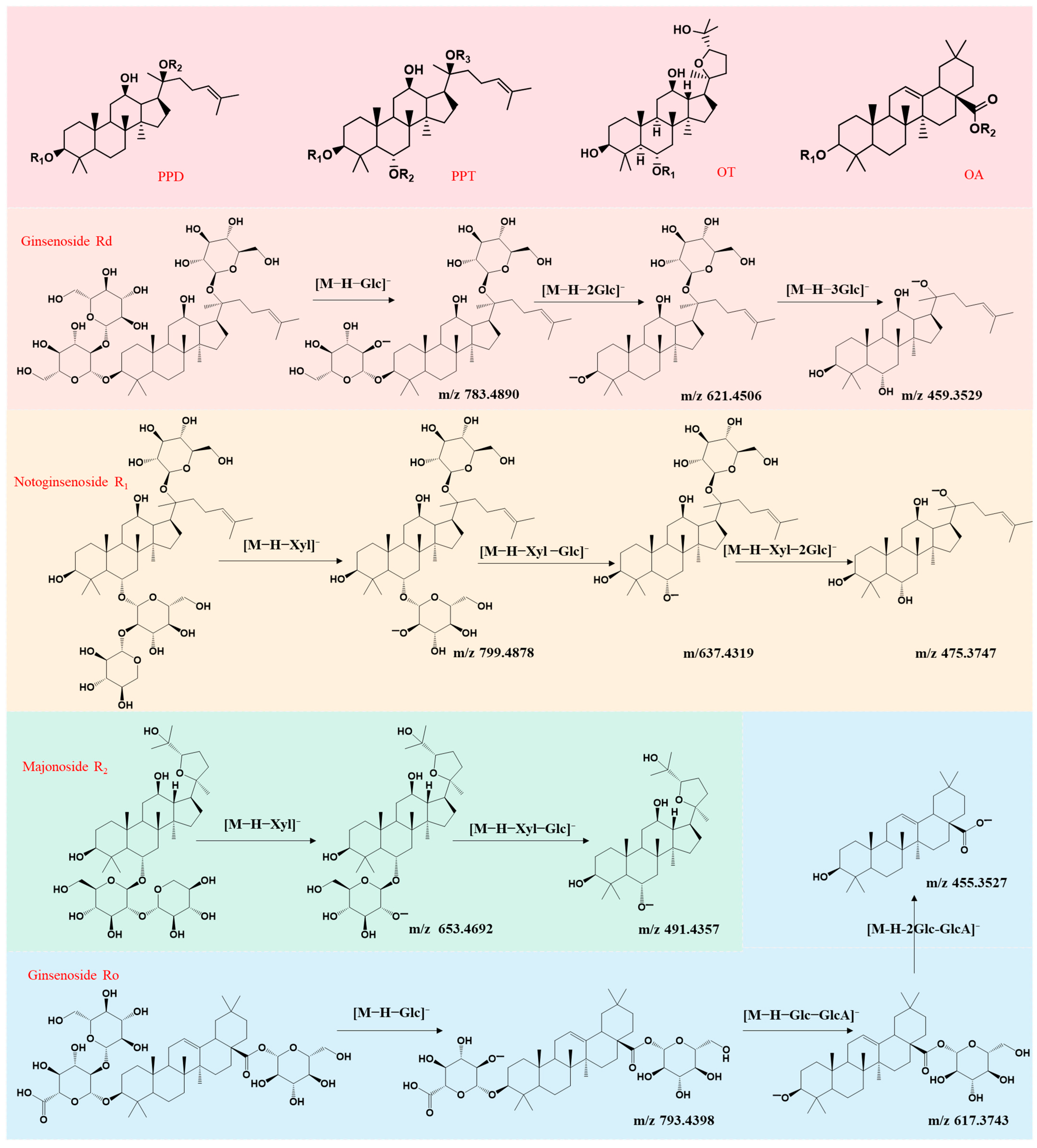
In MS/MS spectra, these compounds readily undergo glycosidic bond cleavage, with common deglycosylated fragment ions such as [M+HCOO-162] or [M−H−162] (loss of one glycosyl group at m/z 162), and [M+HCOO-324] or [M−H-324] (loss of two glycosyl groups at m/z 324). The characteristic fragment ions for PPD-, PPT-, OT-, and OA-type ginsenosides are m/z 459, 475, 491, and 455, respectively. The structures of these four saponin types are shown in Figure 3. By analyzing these fragment ions and their accurate masses, the structural types of ginsenosides can be deduced, while the mass losses further facilitate the identification of the glycosyl types. A schematic diagram of the fragmentation pathways for representative ginsenosides is presented in Figure 3.
The detailed analysis and identification process for PPD-type ginsenosides was as follows: compound 41 had a retention time of 17.57 min. In the MS spectrum, its quasi-molecular ion peak [M−H] at m/z 945.5476 was observed, along with an adduct ion peak [M+HCOO] at m/z 991.5468. MS/MS analysis revealed characteristic fragment ions: m/z 783.4890 corresponding to [M−H−Glc]; another fragment ion at m/z 621.4506 corresponding to [M−H−2Glc]; and m/z 459.3529 corresponding to the aglycone. This compound exhibited the typical fragmentation behavior of PPD-type ginsenosides. By comparing with data from the literature, the retention times of reference standards, and high-resolution mass spectrometry information, compound 41 was identified as ginsenoside Rd [30]. Compound 42 had a retention time of 18.81 min. The MS spectrum showed a quasi-molecular ion peak [M−H] at m/z 987.5548 and an adduct ion peak [M+HCOO] at m/z 1033.5546. In the MS/MS spectrum, characteristic fragment ions included m/z 945.4710 as [M−H−Acetyl], m/z 783.4519 as [M−H−Acetyl−Glc], m/z 621.4506 as [M−H−Acetyl−2Glc], and m/z 459.3529 as the aglycone. Based on reports from the literature, compound 42 was identified as pseudoginsenoside Rc1 [32]. Using the same approach, a total of 30 PPD-type ginsenosides were identified, including ginsenoside Rb1, ginsenoside Rc, ginsenoside Rb3, ginsenoside F2, quinquenoside R1, and vinaginsenoside R8. During the collision-induced dissociation of PPD-type ginsenosides, in addition to the characteristic fragment ions produced by the loss of sugar chains, a specific signal peak at m/z 459 corresponding to the aglycone was also observed. This peak serves as a hallmark fragmentation product of the PPD-type ginsenosides.
The detailed analysis and identification process for PPT-type ginsenosides was as follows: compound 5, with a retention time of 5.59 min in the TIC chromatogram, showed two key signals in the MS spectrum: a quasi-molecular ion peak [M−H] at m/z 931.5308 and an adduct ion peak [M+HCOO] at m/z 977.5345. MS/MS fragmentation yielded three characteristic fragment ions: 799.4878 ([M−H−Xyl]), 637.4319 ([M−H−Xyl−Glc]), and 475.3747 ([M−H-Xyl−2Glc]), with the ion at m/z 475.3747 identified as the aglycone. Based on the relevant literature, the retention times of reference standards, and mass spectrometry data, compound 5 was identified as notoginsenoside R1 [30]. Compound 22, with a retention time of 10.16 min, exhibited a quasi-molecular ion peak [M−H] at m/z 769.4743 and an adduct ion peak [M+HCOO] at m/z 815.4790 in the MS spectrum. In the MS/MS spectrum, the characteristic fragment ion at m/z 637.4318 corresponded to [M−H−Ara], and the ion at m/z 475.4190 corresponded to [M−H−Ara−Glc]. According to the data available in the literature, the mass spectral characteristics of compound 22 were highly consistent with those of the ginsenoside F5 [30]. Using the same approach, a total of 21 PPT-type ginsenosides were identified, including ginsenoside Re, Rg1, Rg2, Rh1, and pseudoginsenoside F11. Mass spectrometry analysis indicated that, in addition to fragment signals from the loss of sugar chains, PPT-type ginsenosides also exhibited a characteristic ion peak at m/z 475 in the MS/MS spectra, which was identified as the characteristic aglycone fragment of PPT-type ginsenosides.
The detailed analysis and identification process for OT-type ginsenosides was as follows: compound 9, with a retention time of 6.38 min in the TIC chromatogram, produced a quasi-molecular ion peak [M−H] at m/z 785.4654 and an adduct ion peak [M+HCOO] at m/z 831.4688 in the MS spectrum. In the MS/MS spectrum, the characteristic fragment ion at m/z 653.4692 corresponded to [M−H−Xyl], and the fragment ion at m/z 491.4357 corresponded to [M−H−Xyl−Glc], which was the aglycone. Based on reports from the literature, compound 9 was identified as majonoside R2 [31]. Using the same method, a total of two OT-type ginsenosides were identified, namely majonoside R1 and pseudoginsenoside Rt4. In the MS/MS spectra, besides the fragment ions resulting from sugar chain cleavage, these ginsenosides also exhibited a characteristic fragment ion at m/z 491 specific to OT-type ginsenosides, corresponding to their aglycone structure.
Furthermore, the OA-type ginsenoside Ro was identified. In the MS spectrum, this compound exhibited a quasi-molecular ion peak [M−H] at m/z 955.4940 and an adduct ion peak [M+HCOO] at m/z 1001.4919. MS/MS analysis revealed characteristic fragment ions: m/z 793.4398 corresponding to [M−H−Glc], m/z 617.3743 corresponding to [M−H−Glc−GlcA], and m/z 455.3527 derived from [M−H−2Glc−GlcA], representing its aglycone.
Due to the limited availability of reference standards and data from the literature, the structures of 10 isomers among the 55 tentatively identified compounds require further confirmation. In addition, some compounds with undetermined structures remain in the samples, which need to be identified through subsequent isolation, purification, and structural elucidation. Furthermore, statistical analysis of the detection of the 55 ginsenosides in the samples of four Panax species and different parts of P. vietnamensis revealed that 41 components were detected in all samples, while 14 components were detected only in some sample groups. The detailed results are shown in Supplementary Table S1. These components may serve as potential quality markers for medicinal materials from Panax species in future studies and can be developed for quality control.

2.2. Development and Validation of a UFLC-QTRAP-MS/MS Method for 21 Ginsenosides

2.2.1. Optimization of UFLC-QTRAP-MS/MS Condition

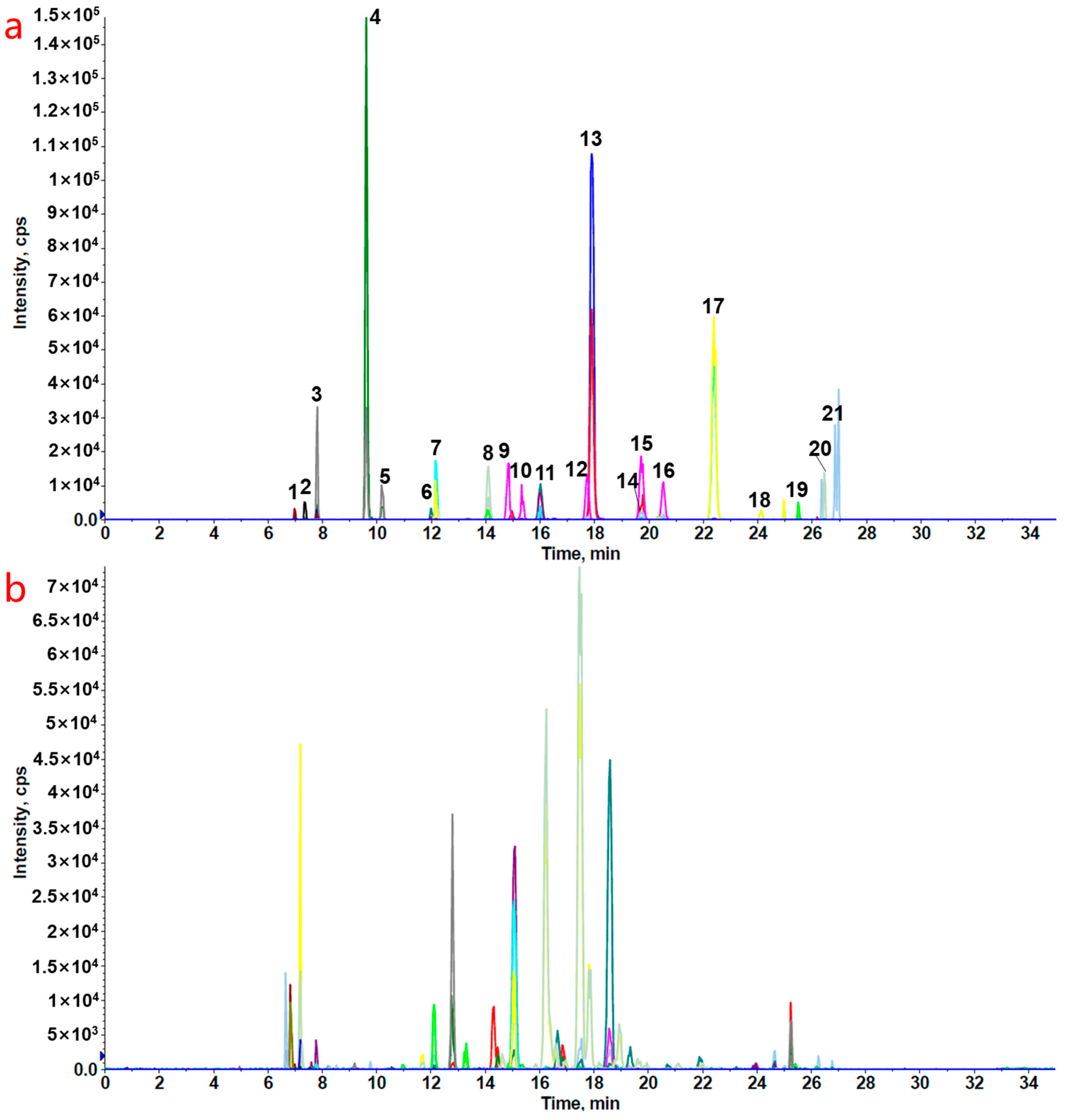
To obtain the optimal mass spectrometric conditions for the quantitative analysis of ginsenosides, systematic optimization of the analytical parameters was performed. A standard solution at 100 ng/mL was prepared using a mixed solvent of acetonitrile and water (1:1, v/v) and directly infused into the mass spectrometer at a constant flow rate of 10 μL/min via a syringe pump. During mass spectrometric analysis, full-scan mode was first applied to acquire positive- and negative-ion signals separately. The optimal ionization mode was selected based on response intensity and the signal-to-noise ratio. Subsequently, the quasi-molecular ions of the target compounds were designated as precursor ions. Characteristic product ions were screened via MS2 scanning, and parameters such as the collision energy were systematically optimized. Finally, quantitative ion transitions with high sensitivity and superior specificity, together with the corresponding mass spectral conditions, were established. The characteristic product ion exhibiting the highest signal intensity was chosen for the quantitative transition. The optimized ion transitions and relevant parameters are listed in Supplementary Table S2. As a core parameter in liquid chromatography, the composition of the mobile phase directly affects the ionization efficiency and chromatographic separation of analytes. In this study, the optimal mobile phase composition and other chromatographic conditions were determined with reference to the published literature [28]. Under the optimized mass spectrometric and chromatographic conditions, the extracted ion chromatogram of the target analyte is shown in Supplementary Figure S1, and the typical multiple reaction monitoring (MRM) chromatograms of the target analytes are presented in Figure 4.

2.2.2. Method Validation

Experimental data indicated (Supplementary Table S3) that all 21 ginsenosides exhibited excellent linear correlations within the set concentration range, with correlation coefficients (r) greater than 0.999. The limits of detection (LOD) and limits of quantification (LOQ) were below 0.5 μg/mL and 1 μg/mL, respectively. The intra-day precision presented relative standard deviation (RSD) values ranging from 3.06% to 5.28%, and the inter-day precision RSD values ranged from 2.33% to 5.43%. The recoveries of the 21 target components were between 79.22% and 112.77%, with RSDs of 2.02–8.22%. After the sample solution was stored at room temperature and determined every 12 h within 48 h, the RSD values of the peak areas for all analytes were less than 2.48%, demonstrating satisfactory sample stability. The RSD of the repeatability test was lower than 5.43%. These results fully verified that the established method possesses high sensitivity, favorable stability, and reliable repeatability, and is suitable for the simultaneous quantitative determination of the 21 ginsenosides in Panax samples.

2.2.3. Sample Analysis

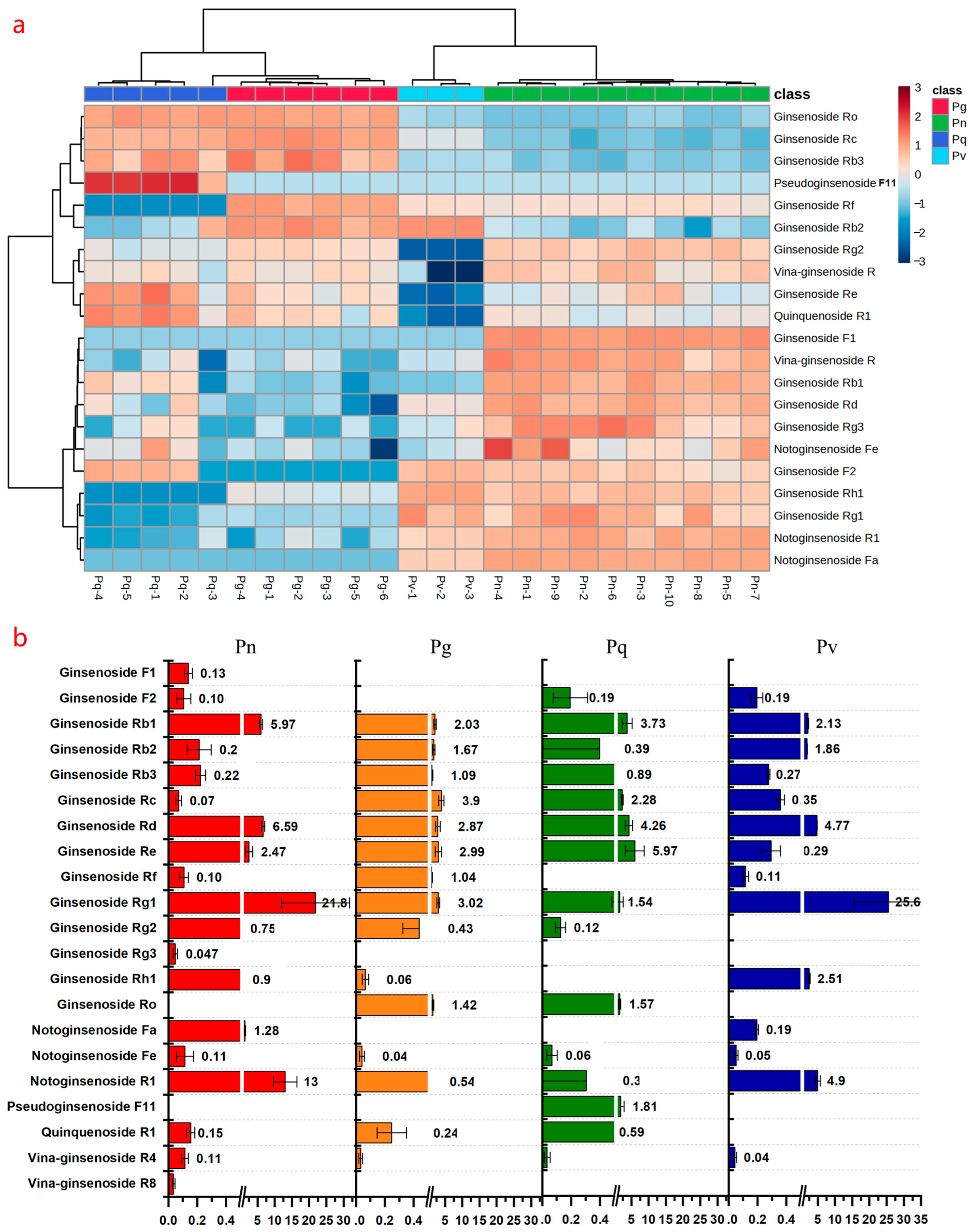
A method was established for the determination of 21 ginsenosides in different parts of P. vietnamensis and in multiple batches of P. ginseng, P. notoginseng, and P. quinquefolius samples. The target analytes were identified by retention time and characteristic ion pairs, and quantitative analysis was performed using the external standard method. The sample determination results are shown in Supplementary Table S4. Subsequently, the online software Metaboanalyst 6.0 was used for heatmaps and ANOVA analysis. The experimental results indicated that the contents of the 21 ginsenosides varied significantly among samples from different sources. The cluster heatmap of ginsenosides from four Panax species (P. vietnamensis, P. ginseng, P. quinquefolius, and P. notoginseng) is shown in Figure 5. The saponin contents of P. vietnamensis and P. notoginseng showed high similarity, clustering into one major group, while P. ginseng and P. quinquefolius exhibited high similarity, clustering into another major group. In P. vietnamensis and P. notoginseng, the contents of ginsenoside Rg1, Rd, and notoginsenoside R1 were higher. ANOVA analysis further indicates significant content differences in saponins among different species. For example, the average content of ginsenoside Rg1 in P. vietnamensis was 25.57 mg/g, compared to 3.02 mg/g in P. ginseng, 1.54 mg/g in P. quinquefolius, and 21.83 mg/g in P. notoginseng. On the other hand, P. ginseng and P. quinquefolius showed high similarity; as well as ginsenoside Rd and Rb1, the main components included ginsenoside Rc, Ro, and Re.
In addition, we compared the quantitative results of saponin components in four Panax species with those reported in the relevant literature. The results showed that the most abundant saponin components in P. notoginseng were ginsenoside Rg1, notoginsenoside R1, and ginsenoside Rb1, which is generally consistent with the previous literature [35,36]. However, the literature reported that the content of ginsenoside Rb1 could reach 20 mg/g, whereas the measured values in this study were relatively lower. The saponin contents in P. ginseng were consistent with reports, with the major components being ginsenoside Rg1, Rb1, Rc, and Re [37,38]. For P. quinquefolius, the components with relatively high contents included ginsenoside Rb1 and Re [39].
The determination results of different parts of P. vietnamensis showed that the content and variety of ginsenosides quantitatively detected in the taproots and fibrous roots were greater (Supplementary Figure S2). For example, the content of ginsenoside Rg1 in the taproots and fibrous roots was 25.57 and 14.81 mg/g, respectively, while it was 3.16 mg/g in the leaves and not detected in the stems. Notably, the content of ginsenoside Rd in the leaves reached as high as 8.62 mg/g, which was higher than that in the taproots (4.77 mg/g), fibrous roots (5.41 mg/g), and stems (1.34 mg/g). Moreover, the contents of notoginsenoside Fe, ginsenoside F2, ginsenoside Rb2, and ginsenoside Re in the leaves of P. vietnamensis were all higher than those in other parts. ANOVA analysis further indicates significant content differences in saponins among different parts of P. vietnamensis.
Based on ginsenosides’ quantitative results in different parts of P. vietnamensis, from the perspective of resource development, in addition to the taproots, the fibrous roots and leaves also possess value for development and utilization. For the quality evaluation of P. vietnamensis as a medicinal material, the ginsenosides with relatively high contents, such as ginsenoside Rg1, ginsenoside Rd, notoginsenoside R1, ginsenoside Rb1, and ginsenoside Rh1, can all serve as evaluation indicators. However, the established method for determining the 21 ginsenosides in this study did not include the characteristic marker components of P. vietnamensis, namely majonoside R1, majonoside R2, and vinaginsenoside R2. Therefore, the content determination method should be further improved in the future when the reference standards become available.

3. Materials and Methods

3.1. Plant Materials, Chemicals, and Reagents

Three batches of three-year-old P. vietnamensis samples were collected from the experimental plantation in Jinping County, Yunnan Province. They were identified by Professor Ma Xiaojun from the Institute of Medicinal Plants, Chinese Academy of Medical Sciences as Panax vietnamensis Ha et Grushv., a plant of the Panax species in the Araliaceae family. Actual specimens of P. vietnamensis plants and their different parts are shown in Figure 1. After bringing the plant materials to the laboratory, the soil was rinsed off the roots, then the plant tissues were separated into taproots, fibrous roots, leaves, and stems, and they were dried at 60 °C in a constant temperature drying oven until reaching a constant weight. The dried samples were then crushed, homogenized, and stored in Ziplock bags at 4 °C until analysis. In addition, 6 batches of ginseng samples (the roots and rhizomes of P. ginseng), 5 batches of American ginseng samples (the roots and rhizomes of P. quinquefolius), and 10 batches of Sanqi samples (the roots and rhizomes of P. notoginseng) were collected from Hehuachi TCM market (Chengdu, China), Anguo TCM market (Anguo, China), and Bozhou TCM market (Bozhou, China). All sample information of the plant materials can be found in Supplementary Table S5.
Twenty-eight reference standards, including for ginsenoside Re, Rg1, Rg2, Rh1, Rb1, Ro, Rc, Rb3, Rd, F1, and F2, etc., were purchased from Chengdu Must Biotechnology Co., Ltd. (Chengdu, China). Detailed information on reference standards can be found in Supplementary Table S6. HPLC-grade formic acid, acetonitrile, and methanol came from Fisher Scientific. Other reagents and chemicals were sourced from Sinopharm Chemical Reagent Beijing Co., Ltd. (Beijing, China). Ultrapure water for HPLC-MS/MS analysis was prepared using a Milli-Q system.

3.2. Instruments

For qualitative analysis, we employed an Acquity UPLC H-Class system, paired with a Xevo G2-S QTof™ mass spectrometer, both from Waters in Milford, MA, USA. For quantitative assessments, a Shimadzu ultra-fast liquid chromatography (UFLC) system, linked to an Applied Biosystem Sciex 5500 QTRAP® mass spectrometer (Framingham, MA 01701, USA), was used to ensure accurate measurements. Sample and mobile phase preparations were meticulously carried out using a range of pieces of equipment, including a KQ-400DE ultrasonic cleaner from Kunshan Ultrasonic Instrument Co., Ltd. (Kunshan, China), a GZX-9070MBE electric blast drying oven supplied by Shanghai Boxun Industrial Co., Ltd. (Shanghai, China), a Milli-Q purification system from Millipore, and an electric blast drying oven from Shanghai Boxun Industrial Co., Ltd. (Shanghai, China). Electronic analytical balances from Sartorius Scientific Instruments were also utilized for precise weighing.

3.3. Standard and Sample Solution Preparation

First, 28 ginsenoside stock solutions were made separately, each with a 0.1 mg/mL concentration in methanol. Next, these standard stock solutions were diluted with a methanol–water mixture (70:30, v/v) to form mixed standard working solutions. All solutions were stored at 4 °C in a fridge for later use. After that, six different concentrations (20, 10, 5, 2, 1, and 0.5 µg/mL) were analyzed, and calibration curves were created by plotting the peak area versus the analyte concentration.
In the chemical composition analysis, meticulous procedures were employed. First, 1.0 g of homogenized plant materials was precisely weighed. These samples then underwent ultrasonic extraction at a frequency of 40 kHz, utilizing 20 mL of a methanol–water mixture (70:30, v/v) for a duration of 60 min. Following extraction, 1.0 mL of the upper layer of the solution was carefully filtered through a 0.22 µm syringe nylon filter. The filtered solution was then transferred to an injection bottle for subsequent analysis using a UPLC-Q/TOF-MS system. For the quantitative analysis of ginsenosides in Panax species plant materials, similar steps were taken. Homogenized samples (1.0 g) were accurately weighed and subjected to ultrasonic extraction at 40 kHz with 20 mL of the same methanol–water mixture for 60 min. After extraction, the solution was allowed to stand and cool, with the original solvent weight restored by adding more extract solvent. Subsequently, 1.0 mL of the extract was diluted to 5 mL, mixed thoroughly for 30 s, and filtered. All processed samples were stored in a refrigerator at 4 °C until analysis.

3.4. Ginsenoside Analysis Using UPLC-Q/TOF-MS/MS

To accurately identify saponins in plant materials from the Panax species, a sophisticated analytical approach was employed. The Acquity UPLC H-Class system, in tandem with a Xevo G2-S QTof™ mass spectrometer from Waters in Milford, MA, USA, was used for this precise task. The chromatographic separation was carried out on an ACQUITY UPLC™ HSS T3 column (100 mm × 2.1 mm, 1.8 μm) and kept at a constant temperature of 35 °C. A flow rate of 0.3 mL/min was maintained, and samples were injected in a volume of 1.0 μL. The mobile phase comprised water containing 0.1% formic acid (A) and acetonitrile (B), employing a gradient elution: 90–70% (A) from 0 to 5 min; 70–67% (A) from 5 to 10 min; 67–64% (A) from 10 to 22 min; 64–15% (A) from 22 to 28 min; 15–5% (A) from 28 to 29 min; maintaining at 5% A from 29 to 34 min; 5–90% (A) from 34 to 34.5 min; and then equilibration at 90% (A) to 40 min.
Negative mode electrospray ionization mass spectrometry was employed. The mass spectrometer was precisely configured: a capillary voltage of 2.5 kV, sampling and extraction cones at 40 V and 4.0 V, respectively, a source temperature of 100 °C, and a desolvation temperature of 250 °C. For MS acquisition, a collision energy of 6 eV was used, and 45 eV for MSE acquisition. The cone gas flow rate was kept at 50 L/h. TOF-MS scanning spanned m/z 100–1500 Da, with data collected via MassLynx V4.1 software.

3.5. Quantitative Analysis of 21 Ginsenosides Using UFLC-QTRAP-MS/MS

3.5.1. UFLC-QTRAP-MS/MS Conditions

To conduct a precise quantitative analysis, we employed a sophisticated instrumental setup. A Shimadzu ultra-fast liquid chromatography (UFLC) system was paired with an Applied Biosystem Sciex 5500 QTRAP® mass spectrometer via an ESI interface. This combination ensured high-resolution separation and the sensitive detection of analytes. Chromatographic separation was carried out on an ACQUITY UPLC™ HSS T3 column, which provided an excellent peak shape and retention time reproducibility. The mobile phase consisted of water with 0.1% formic acid (A) and acetonitrile (B), with the following gradient elution: 90–70% (A) from 0 to 5 min; 70–67% (A) from 5 to 10 min; 67–64% (A) from 10 to 22 min; 64–15% (A) from 22 to 28 min; 15–5% (A) from 28 to 29 min; maintaining at 5% A from 29 to 31 min; 5–90% (A) from 31 to 31.5 min; and then equilibration at 90% (A) to 35 min. The column was operated at a flow rate of 0.3 mL/min, and the injection volume was 5.0 μL.
For mass spectrometry analysis, we utilized an electrospray ionization (ESI) source operating in negative mode. Precise settings were applied: curtain gas at 35 psi, nebulizer gas at 50 psi, and auxiliary gas also at 50 psi. The ion spray voltage was adjusted to −4500 V, while the source temperature was kept at 550 °C to ensure optimal ionization conditions. We employed multiple reaction monitoring (MRM) for accurate quantitation, with each MRM transition having a dwell time of 50 ms. Specific potentials were set for declustering (−160 V), entrance (−10 V), and collision cell exit (−15 V). The UFLC-QTRAP-MS/MS system was controlled, and data were acquired and processed using Applied Biosystems Analyst software, version 1.6.

3.5.2. Validation Protocol

In strict adherence to the International Conference on Harmonization (ICH) guidelines for analytical method validation, a comprehensive assessment was conducted of the analytical method [40]. This evaluation encompassed several key parameters: linearity, sensitivity, precision (both intra-day and inter-day), stability, repeatability, and accuracy. Calibration curves were constructed by plotting the analyte concentration (X) against the peak area (Y), analyzing at least six concentration levels in triplicate. The limits of detection (LOD) and quantification (LOQ) were determined using signal-to-noise ratios of about 3 and 10, respectively. Precision was gauged through repeated analyses of standard samples, both within a single day and across three consecutive days. Accuracy was verified by adding target analytes to previously analyzed samples, while stability was monitored by analyzing sample solutions at room temperature every 12 h over a two-day period. Finally, repeatability was ensured by preparing and analyzing six independent sample solutions.

4. Conclusions

This study established an analytical method for ginsenosides in P. vietnamensis and three other Panax species based on UPLC-Q/TOF-MS. A total of 55 ginsenosides were tentatively identified, including 30 PPD-type, 21 PPT-type, 3 OT-type, and 1 OA-type saponins. Furthermore, from a metabolomics perspective, the changes in the chemical components of P. vietnamensis and three Panax species were analyzed. The results showed that 41 components were detected in all samples, while 14 ginsenosides were detected only in some groups. The taproots of P. vietnamensis contained characteristic components such as majonoside R2, majonoside R1, and vinaginsenoside R2, which can serve as key indicator components for the identification of P. vietnamensis in the future.
In addition, the content determination results showed that ginsenosides in P. vietnamensis and P. notoginseng had high similarity, with higher contents of ginsenoside Rg1, ginsenoside Rd, notoginsenoside R1, and ginsenoside Rb1 in P. vietnamensis and P. notoginseng. For different parts of P. vietnamensis samples, the taproots and fibrous roots were rich in various ginsenosides in high contents, while the contents of notoginsenoside Re, ginsenoside Rd, ginsenoside Re, and ginsenoside Rb2 in the leaves were higher than those in the taproots. Based on the quantitative analysis results of different parts of P. vietnamensis, from the perspective of resource development, in addition to the taproots, the fibrous roots and leaves also possessed value for development and utilization. For a quality evaluation of P. vietnamensis as a medicinal material, the ginsenosides with relatively high contents, such as ginsenoside Rg1, ginsenoside Rd, notoginsenoside R1, ginsenoside Rb1, and ginsenoside Rh1, can all serve as evaluation indicators. Combined with the results of this study, comprehensive research on sustainable resource utilization should be strengthened in the future to achieve the efficient utilization of the whole P. vietnamensis plant, address the issue of resource endangerment, and ensure the healthy development of the industry.

Supplementary Materials

The following supporting information can be downloaded at: https://www.mdpi.com/article/10.3390/molecules31101570/s1. Figure S1: The extracted ion chromatogram of the target analytes in mixed standard solution; Figure S2: Heatmap analysis of the content determination results of saponin components in different parts of P. vietnamensis.; Table S1: Fourteen saponin components detected only in some sample groups; Table S2: Optimization of mass spectrometry parameters for target analytes; Table S3: Method validation results including the linearity, limit of detection (LOD), limit of quantification (LOQ), precision, recovery, repeatability, and stability; Table S4: Quantitative determination results of 21 saponin components in different Panax samples; Table S5: The sample information of plant materials of Panax species; Table S6: Detailed information on reference standards of saponins.

Author Contributions

X.M. and Z.L. initiated the project, helped to conceive the study, revised the manuscript, and participated in the design and coordination. J.S. conceived the study, participated in the experiments and data analysis, and drafted the manuscript. K.X., Q.C., Z.J., Y.D., M.Z., L.Z. and C.W. participated in the experiments and data analysis. All authors have read and agreed to the published version of the manuscript.

Funding

This work was supported by the Selection Special Programme of Yunnan Province High-level Technological Talents and Innovative Teams (202405AS350020); Guangxi Key R&D Program (No. GuiKeAB25069119); Beijing Natural Science Foundation (No. 7252244); and Yuelushan Laboratory Breeding Program (No. YLS2025-ZY04058).

Data Availability Statement

The original contributions presented in this study are included in the article/supplementary material. Further inquiries can be directed to the corresponding authors.

Conflicts of Interest

The authors declare no conflicts of interest.

References

  1. Ngau, T.H.; Dieu, C.P.K.; Hue, C.P.K.; Huynh, D.T.N.; Do, B.H.; Huynh, L.D. Ethnopharmacology, genetic diversity, phytochemistry and pharmacological effects of Panax vietnamensis Ha et Grushv.: A review. J. Environ. Pathol. Toxicol. Oncol. 2025, 44, 73–92. [Google Scholar] [CrossRef]
  2. Park, S.; Nam, J.; Ahn, C.; Kim, Y. Anti-diabetic properties of different fractions of Korean red ginseng. J. Ethnopharmacol. 2019, 236, 220–230. [Google Scholar] [CrossRef]
  3. Razgonova, M.; Veselov, V.; Zakharenko, A.; Golokhvast, K.; Nosyrev, A.; Cravotto, G.; Tsatsakis, A.; Spandidos, D. Panax ginseng components and the pathogenesis of Alzheimer’s disease (Review). Mol. Med. Rep. 2019, 19, 2975–2998. [Google Scholar] [CrossRef]
  4. Cho, C.W.; Kim, Y.C.; Rhee, Y.K.; Lee, Y.C.; Kim, K.T.; Hong, H.D. Chemical composition characteristics of Korean straight ginseng products. J. Ethn. Foods 2014, 1, 24–28. [Google Scholar] [CrossRef]
  5. Chinese Pharmacopeia Commission. Pharmacopoeia of People’s Republic of China; Chemical Medical Science Press: Beijing, China, 2015. [Google Scholar]
  6. Dung, H.T.; Grushvitsky, I.V. Panax vietnamensis, a new Panax species. Bot. Zhurnal 1985, 4, 518. [Google Scholar]
  7. Li, X.B.; Jiang, W.W.; Zhang, G.H.; Deng, Z.Y.; Wang, S.; Tian, X.Z.; Guo, Q.S.; Yang, S.C. Research and utilization of precious Chinese medicine resources of Panax vietnamensis. Chin. Tradit. Herb. Drugs 2022, 53, 4568–4580. [Google Scholar]
  8. Vu, D.D.; Shah, S.N.M.; Pham, M.P.; Bui, V.T.; Nguyen, M.T.; Nguyen, T.P.T. De novo assembly and Transcriptome characterization of an endemic species of Vietnam, Panax vietnamensis Ha et Grushv., including the development of EST-SSR markers for population genetics. BMC Plant Biol. 2020, 20, 358. [Google Scholar] [CrossRef]
  9. Nguyen, T.H.; Phuong, T.T. Vietnamese ginseng (Panax vietnamensis Ha and Grushv.): Phylogenetic, phytochemical, and pharmacological profiles. Pharmacogn. Rev. 2019, 13, 5962. [Google Scholar] [CrossRef]
  10. Nguyen, M.D.; Nguyen, T.N.; Kasai, R.; Ito, A.; Yamasaki, K.; Tanaka, O. Saponins from Vietnamese ginseng, Panax vietnamensis Ha et Grushv. Collected in central Vietnam. I. Chem. Pharm. Bull. 1993, 41, 2010–2014. [Google Scholar] [CrossRef]
  11. Tran, Q.L.; Adnyana, I.K.; Tezuka, Y.; Nagaoka, T.; Kadota, S. Triterpene saponins from Vietnamese ginseng (Panax vietnamensis) and their hepatocytoprotective activity. J. Nat. Prod. 2001, 64, 456–461. [Google Scholar] [CrossRef]
  12. Li, X.B.; Mo, N.; Li, Z.Z. Ginsenosides: Potential therapeutic source for fibrosis-associated human diseases. J. Ginseng Res. 2020, 44, 386–398. [Google Scholar] [CrossRef]
  13. Vu-Huynh, K.L.; Nguyen, H.T.; Van Le, T.H.; Ma, C.T.; Lee, G.J.; Kwon, S.W.; Park, J.H.; Nguyen, M.D. Accumulation of saponins in underground parts of Panax vietnamensis at different ages analyzed by HPLC-UV/ELSD. Molecules 2020, 25, 3086. [Google Scholar] [CrossRef]
  14. Chirikova, N.K.; Olennikov, D.N.; Grigor’Ev, R.O.; Klyushin, A.G.; Nosov, A.M. Acylquinic acids, flavonoids, and maltol O-glucoside from Panax vietnamensis. Chem. Nat. Compd. 2019, 55, 1161–1163. [Google Scholar] [CrossRef]
  15. Peng, S.; Li, X.; Jiang, W.; Wang, Y.; Xiang, G.; Li, M.; Wang, Y.; Yang, Z.; Li, Y.; Liu, X.; et al. Identification of two key UDP-glycosyltransferases responsible for the ocotillol-type ginsenoside majonside-R2 biosynthesis in Panax vietnamensis var. fuscidiscus. Planta 2023, 257, 119. [Google Scholar] [CrossRef]
  16. Tang, Q.Y.; Chen, G.; Song, W.L.; Fan, W.; Wei, K.H.; He, S.M.; Zhang, G.H.; Tang, J.R.; Li, Y.; Lin, Y.; et al. Transcriptome analysis of Panax zingiberensis identifies genes encoding oleanolic acid glucuronosyltransferase involved in the biosynthesis of oleanane-type ginsenosides. Planta 2019, 249, 393–406. [Google Scholar] [CrossRef]
  17. Christensen, L. Ginsenosides: Chemistry, biosynthesis, analysis and potential health effects (Chapter 1). Adv. Food Nutr. Res. 2008, 55, 1–99. [Google Scholar]
  18. Yang, W.Z.; Hu, Y.; Wu, W.Y.; Ye, M.; Guo, D.A. Saponins in the genus Panax L. (Araliaceae): A systematic review of their chemical diversity. Phytochemistry 2014, 106, 7–24. [Google Scholar] [CrossRef]
  19. Yamasaki, K. Bioactive saponins in vietnamese ginseng, Panax vietnamensis. Pharm. Biol. 2000, 38, 16–24. [Google Scholar] [CrossRef]
  20. Li, L.L.; Wang, Y.; Xiu, Y.; Liu, S.Y. Chemical differentiation and quantitative analysis of different types of Panax genus stem-leaf based on a UPLC-Q-Exactive Orbitrap/MS combined with multivariate statistical analysis approach. J. Anal. Methods Chem. 2018, 2018, 9598672. [Google Scholar] [CrossRef]
  21. Wang, Q.; Feng, Y.F.; Rui, W.; Zhong, Y.M.; Guo, J. Rapid Analysis of Saponins in Panax notoginseng by UPLC/Q-TOF MS. Nat. Prod. Res. Dev. 2014, 26, 1233–1239. [Google Scholar]
  22. Hu, C.X.; Kong, H.W.; Zhu, C.; Wei, H.; Hankemeier, T.; Greef, J.V.D.; Wang, M.; Xu, G.W. An ultra performance liquid chromatography-time-of-flight-massspectrometric method for fast analysis of ginsenosidesin Panax ginseng root. Chin. J. Chromatogr. 2011, 29, 488–494. [Google Scholar] [CrossRef]
  23. Li, L.; Tan, L.Y.; Wang, C.X.; Li, K.; Li, P.Y.; Liu, J.P.; Liu, Y.H. Identification of chemical constituents of American Ginseng fruit pedicels by Ultra-performance Liquid Chromatography Quadrupole Time-of-Flight Mass Spectrometry. Chin. J. Appl. Chem. 2021, 38, 256–270. [Google Scholar]
  24. Zhang, B.; Sun, X.L.; Guo, Y.L.; Wang, Y.; Liu, S.Y. Chemical constituents of ginseng radix et rhizoma with different growth years and different origins based on LC-MS. Chin. J. Exp. Tradit. Med. Formulae 2020, 26, 206–212. [Google Scholar]
  25. Liu, Z.; Ruan, C.C.; Liu, T.Z.; Wang, L.J.; Zheng, Y.N.; Sun, G.Z. Simultaneous determination of 14 kinds of ginsenosides in similar wild ginseng, fresh ginseng, white ginseng, and red ginseng by HPLC. Chin. Tradit. Herb. Drugs 2012, 43, 2431–2434. [Google Scholar]
  26. Yang, L.; Xu, X.Z.; Chen, J.B.; Wu, Y.P.; Chen, J.T.; Xin, Y.F. Simultaneous determination eight ginsenosides in Shenmai Injection of by UHPLC. Chin. Tradit. Pat. Med. 2019, 41, 27–30. [Google Scholar]
  27. Sun, D.Y.; Zhao, W.F.; Li, G.H.; Pan, G.Z.; Zhang, J.L. Simultaneous determination of ginsenosides and paeoniflorin in Shenshao capsules by LC-MS/MS. Chin. J. Pharm. Anal. 2018, 38, 5. [Google Scholar]
  28. Zhao, L.C.; Wang, Y.F.; Liu, J.Y. Simultaneous determination of 28 ginsenosides in Panax ginseng by UPLC-MS/MS. Lishizhen Med. Mater. Medica Res. 2019, 30, 2099–2102. [Google Scholar]
  29. Zhao, Y.; Xie, H.L.; Wang, D.X.; Zhang, W.J.; Yan, X.J. Quantitative analysis of 8 major ginsenosides in Panax quinquefolium by UPLC-MS/MS. Nat. Prod. Res. Dev. 2017, 29, 1529–1534. [Google Scholar]
  30. Shi, J.J.; Cai, Z.C.; Chen, S.Y.; Zou, L.S.; Liu, X.H.; Tang, R.M.; Ma, J.M.; Wang, C.C.; Tan, M.X. Qualitative and quantitative analysis of saponins in the flower bud of Panax ginseng (Ginseng Flos) by UFLC-Triple TOF-MS/MS and UFLC-QTRAP-MS/MS. Phytochem. Anal. 2020, 31, 287–296. [Google Scholar]
  31. Nguyen, H.T.; Phan, L.K.; Huynh, K.L.V.; Duong, T.H.; Le, H.T.; Hai-Yen, N.T.; Yen, N.T.H.; Long, N.P.; Nguyen, M.D. Untargeted metabolomics approach for the differentiation between Panax vietnamensis var. vietnamensis and Panax vietnamensis var. fuscidiscus. Metabolites 2023, 13, 763. [Google Scholar] [CrossRef]
  32. Liu, F.; Ma, N.; He, C.W.; Hu, Y.J.; Li, P.; Chen, M.W.; Su, H.X.; Wan, J.B. Qualitative and quantitative analysis of the saponins in Panax notoginseng leaves using ultra performance liquid chromatography coupled with time-of-flight tandem mass spectrometry and high performance liquid chromatography coupled with UV detector. J. Ginseng Res. 2018, 42, 149–157. [Google Scholar]
  33. Chen, Y.; Zhao, Z.; Chen, H.; Yi, T.; Qin, M.; Liang, Z. Chemical differentiation and quality evaluation of commercial Asian and American Ginsengs based on a UHPLC-QTOF/MS/MS metabolomics approach. Phytochem. Anal. 2015, 26, 145–160. [Google Scholar]
  34. Park, H.W.; In, G.; Kim, J.H.; Cho, B.G.; Han, G.H.; Chang, I.M. Metabolomic approach for discrimination of processed ginseng genus (Panax ginseng and Panax quinquefolius) using UPLC-QTOF MS. J. Ginseng Res. 2014, 38, 59–65. [Google Scholar] [CrossRef]
  35. Wan, J.B.; Li, P.; Li, S.P.; Wang, Y.T.; Dong, T.T.-X.; Tsim, K.W.-K. Simultaneous determination of 11 saponins in Panax notoginseng using HPLC-ELSD and pressurized liquid extraction. J. Sep. Sci. 2006, 29, 2190–2196. [Google Scholar] [CrossRef]
  36. Yao, H.; Shi, P.Y.; Shao, Q.; Fan, X.H. Chemical fingerprinting and quantitative analysis of a Panax notoginseng preparation using HPLC-UV and HPLC-MS. Chin. Med. 2011, 6, 9. [Google Scholar] [CrossRef]
  37. Wang, H.P.; Zhang, Y.B.; Yang, X.W.; Zhao, D.Q.; Wang, Y.P. Rapid characterization of ginsenosides in the roots and rhizomes of Panax ginseng by UPLC-DAD-QTOF-MS/MS and simultaneous determination of 19 ginsenosides by HPLC-ESI-MS. J. Ginseng Res. 2016, 40, 382–394. [Google Scholar] [CrossRef]
  38. Ye, J.; Gao, Y.; Tian, S.; Su, J.; Zhang, W. A novel and effective mode-switching triple quadrupole mass spectrometric approach for simultaneous quantification of fifteen ginsenosides in Panax ginseng. Phytomedicine 2018, 44, 164–172. [Google Scholar] [CrossRef]
  39. Liang, J.; Chen, L.; Guo, Y.H.; Zhang, M.; Gao, Y. Simultaneous Determination and Analysis of Major Ginsenosides in Wild American Ginseng Grown in Tennessee. Chem. Biodivers. 2019, 16, e1900203. [Google Scholar] [CrossRef]
  40. International Conference on Harmonization (ICH). Q2 (R1): Text on Validation of Analytical Procedures; SANCO. In Guidance Document on analytical Quality Control and Validation Procedures for Pesticide Residues Analysis in Food and Feed; ICH: Geneva, Switzerland, 2005. [Google Scholar]
Figure 1. Morphology of P. vietnamensis and images of four Panax medicinal materials. The plant morphology of P. vietnamensis plants (a), P. vietnamensis fruits (b), P. vietnamensis leaves (c), underground part of P. vietnamensis (d), P. vietnamensis taproots (e), P. notoginseng taproots (f), Panax ginseng taproots (g), and P. quinquefolius taproots (h). The scale bar is 1 cm.
Molecules 31 01570 g001
Figure 2. Comparative TIC chromatograms and correlation heatmaps. TIC chromatograms of different parts of P. vietnamensis (a); the correlation heatmap of different parts of P. vietnamensis (b); TIC chromatograms of the roots and rhizomes of four Panax species (c); and the correlation heatmap of the roots and rhizomes of four Panax species (d). Pv, P. vietnamensis taproots; PvFR, P. vietnamensis fibrous roots; PvL, P. vietnamensis leaves; PvS, P. vietnamensis stems; Pn, P. notoginseng taproots; Pg, P. ginseng taproots; and Pq, P. quinquefolius taproots.
Molecules 31 01570 g002
Figure 3. Schematic diagrams of the skeletal structure of four types of ginsenosides and fragmentation pathways of representative components. PPD, protopanaxadiol-type; PPT, protopanaxatriol-type; PPT, protopanaxatriol-type; PPT, protopanaxatriol-type; Glc, glucose; Xyl, xylose; and GlcA, glucuronic acid.
Molecules 31 01570 g003
Figure 4. MRM chromatograms of mixed standard solution (a) and P. vietnamensis (b) in negative-ion mode. Peak 1: notoginsenoside R1; 2: ginsenoside Re; 3: ginsenoside Rg1; 4: vinaginsenoside R8; 5: vinaginsenoside R4; 6: pseudoginsenoside F11; 7: ginsenoside Rf; 8: notoginsenoside Fa; 9: ginsenoside Rg2; 10: ginsenoside Rh1; 11: ginsenoside Rb1; 12: ginsenoside Rc; 13: ginsenoside Ro; 14: ginsenoside Rb2; 15: ginsenoside F1; 16: ginsenoside Rb3; 17: quinquenoside R1; 18: ginsenoside Rd; 19: notoginsenoside Fe; 20: ginsenoside F2; and 21: ginsenoside Rg3.
Molecules 31 01570 g004
Figure 5. Heatmap analysis of the content determination results of ginsenosides in P. vietnamensis and three Panax species. The cluster heatmap (a), the bar chart of contents (b). Pv, P. vietnamensis taproots; Pn, P. notoginseng taproots; Pg, P. ginseng taproots; and Pq, P. quinquefolius taproots.
Molecules 31 01570 g005
Table 1. Ginsenosides identified using UPLC-Q-TOF-MS.
No.CompoundSkeletal StructureFormulaRt/minAdductsExpected (m/z)Measured
(m/z)
Mass Error/ppmFragment Ion (m/z)Reference
1Floralginsenoside APPTC42H72O164.5[M+HCOO]877.4797877.48050.92831.4778 [M−H]; 651.4104 [M−H-Glc][30]
26′-Acetyl-ginsenoside F1PPTC38H64O104.99[M+HCOO]725.4476725.44780.28679.4439 [M−H][30]
320-O-Glucoginsenoside RfPPTC48H82O195.13[M+HCOO]1007.54271007.54583.10961.5408 [M−H]; 799.4835 [M−H-Glc][30]
420-O-Glucoginsenoside Rf isomerPPTC48H82O195.4[M+HCOO]1007.54271007.54583.10961.5408 [M−H]; 799.4835 [M−H-Glc][30]
5 *Notoginsenoside R1PPTC47H80O185.59[M+HCOO]977.5321977.53452.43931.5308 [M−H]; 799.4878 [M−H-Xyl][30]
6Majonoside R1OTC42H72O155.79[M+HCOO]861.4848861.48611.54815.4835 [M−H]; 653.4290 [M−H-(Glc-H2O) ][30]
7 *Ginsenoside RePPTC48H82O185.79[M+HCOO]991.5478991.5468−0.98945.5476 [M−H][30]
8 *Ginsenoside Rg1PPTC42H72O145.98[M+HCOO]845.4899845.49131.70799.4872 [M−H]; 637.4328 [M−H-Glc]; 475.3786 [M−H-2Glc][30]
9Majonoside R2OTC41H70O146.38[M+HCOO]831.4742831.4688−6.51785.4654 [M−H]; 653.4692 [M−H-Xyl][31]
10Pseudoginsenoside Rs1PPTC51H84O216.47[M+HCOO]1033.55831033.56324.71987.5548 [M−H][32]
11Ginsenoside M7cdPPTC36H62O106.51[M+HCOO]699.4320699.4297−3.22653.3382 [M−H][30]
12Ginsenoside IIIPPDC48H80O196.67[M+HCOO]1005.52701005.52770.67959.5258 [M−H][30]
13 *Vinaginsenoside R8PPDC48H82O197.3[M+HCOO]1007.54271007.54583.10961.5408 [M−H]; 799.4835 [M−H-Glc][30]
14Malonyl-ginsenoside Re1PPTC51H84O217.3[M+HCOO]1033.55831033.5546−3.61987.5548 [M−H][32]
15 *Vinaginsenoside R4PPTC48H82O197.76[M+HCOO]1007.54271007.54583.10961.5408 [M−H]; 799.4835 [M−H-Glc][30]
16Ginsenoside Rs3PPDC44H74O148.12[M+HCOO]871.5055871.5039−1.85825.5031 [M−H]; 783.4895 [M−H-Ac][30]
17Vinaginsenoside R2PPTC44H74O148.58[M+HCOO]871.5055871.5039−1.85825.5031 [M−H]; 783.4895 [M−H-Ac][31]
18 *Pseudoginsenoside F11PPTC42H72O149.25[M+HCOO]845.4899845.49131.70799.4872 [M−H]; 637.4328 [M−H-Glc]; 475.3786 [M−H-2Glc][30]
19Ginsenoside RfPPTC42H72O149.25[M+HCOO]845.4899845.49131.70799.4872 [M−H]; 637.4328 [M−H-Glc]; 475.3786 [M−H-2Glc][32]
20Pseudoginsenoside Rt4OTC36H62O109.7[M+HCOO]699.4320699.4311−1.22653.434 [M−H][31]
21Ginsenoside Ra0PPDC60H102O289.93[M+HCOO]1315.65341315.65722.881269.6510 [M−H],[32]
22Ginsenoside F5PPDC41H70O1310.16[M+HCOO]815.4793815.479−0.36769.4743 [M−H]; 637.4318 [M−H-Ara]; 475.4197 [M−H-Ara-Glc][30]
23 *Ginsenoside Rg2PPTC42H72O1311.15[M+HCOO]829.4949829.49530.43783.4906 [M−H]; 637.4308 [M−H-Rha]; 475.3780 [M−H-Rha-Glc][30]
24 *Ginsenoside Rh1PPTC36H62O911.32[M+HCOO]683.4370683.43720.25637.4366 [M−H]; 475.3776 [M−H-Glc][30]
25 *Ginsenoside Rb1PPDC54H92O2311.58[M+HCOO]1153.60061153.60413.041107.5978 [M−H]; 945.5436 [M−H-Glc]; 783.4911 [M−H-2Glc]; 621.4368 [M−H-3Glc][30]
26 *20R-Ginsenoside Rg2PPTC42H72O1311.58[M+HCOO]829.4949829.49530.43783.4906 [M−H]; 637.4308 [M−H-Rha]; 475.3780 [M−H-Rha-Glc][30]
27 *20R-Ginsenoside Rh1PPTC36H62O912.24[M+HCOO]683.4370683.43720.25637.4366 [M−H]; 475.3776 [M−H-Glc][30]
28 *Ginsenoside RoOAC48H76O1912.63[M+HCOO]1001.49571001.4919−3.82955.4940 [M−H]; 793.4398 [M−H-Glc][30]
29 *Ginsenoside RcPPDC53H90O2212.73[M+HCOO]1123.59001123.59221.941077.5859 [M−H]; 945.5434 [M−H-Araf]; 783.4905 [M−H-Araf-Glc][30]
30 *Quinquenoside R1PPDC56H94O2412.84[M+HCOO]1195.61121195.61432.631149.6049 [M−H]; 987.6059 [M−H-Glc][31]
31Quinquenoside R1 isomerPPDC56H94O2413.06[M+HCOO]1195.61121195.61432.631149.6049 [M−H]; 987.6059 [M−H-Glc][31]
32Dimalonyl-ginsenoside RdPPDC54H86O2413.59[M+HCOO]1163.54861163.5452−2.881117.5467 [M−H]; 955.5905 [M−H-Glc][33]
33 *Ginsenoside Rb2PPDC53H90O2214.11[M+HCOO]1123.59001123.59221.941077.5859 [M−H]; 945.5456 [M−H-Arap]; 783.4923 [M−H-Arap-Glc][30]
34Quinquenoside R1 isomerPPDC56H94O2414.11[M+HCOO]1195.61121195.61432.631149.6049 [M−H]; 987.6059 [M−H-Glc][31]
35 *Ginsenoside Rb3PPDC53H90O2214.61[M+HCOO]1123.59001123.59221.941077.5856 [M−H]; 945.5433 [M−H-Xyl]; 783.4879 [M−H-Xyl-Glc];[30]
36 *Ginsenoside F1PPTC36H62O914.97[M+HCOO]683.4370683.43720.25637.4366 [M−H]; 475.3776 [M−H-Glc][30]
37Dimalonyl-ginsenoside Rd isomerPPDC54H86O2415.03[M+HCOO]1163.54861163.5452−2.881117.5467 [M−H][33]
38Dimalonyl-ginsenoside Rd isomerPPDC54H86O2415.7[M+HCOO]1163.54861163.5452−2.881117.5467 [M−H][33]
39Quinquenoside R1 isomerPPDC56H94O2416.12[M+HCOO]1195.61121195.61432.631149.6049 [M−H]; 987.6059 [M−H-Glc][31]
40Dimalonyl-ginsenoside Rd isomerPPDC54H86O2416.52[M+HCOO]1163.54861163.5452−2.881117.5467 [M−H][33]
41 *Ginsenoside RdPPDC48H82O1817.57[M+HCOO]991.5478991.5468−0.98945.5476 [M−H]; 783.4890 [M−H-Glc]; 621.4506 [M−H-Glc-Glc][30]
42Pseudoginsenoside Rc1PPDC51H84O2118.81[M+HCOO]1033.55831033.5546−3.61987.5548 [M−H][32]
43Pseudoginsenoside Rc1 isomerPPDC51H84O2119.61[M+HCOO]1033.55831033.5546−3.61987.5548 [M−H][32]
44Pseudoginsenoside Rc1 isomerPPDC51H84O2120.18[M+HCOO]1033.55831033.5546−3.61987.5548 [M−H][32]
45Gypenoside XVIIPPDC48H82O1821.56[M+HCOO]991.5478991.5468−0.98945.5476 [M−H]; 783.4890 [M−H-Glc][30]
46Pseudoginsenoside Rc1 isomerPPDC51H84O2121.92[M+HCOO]1033.55831033.5546−3.61987.5548 [M−H][32]
47 *Notoginsenoside FePPDC47H80O1723.86[M+HCOO]961.5372961.536−1.25915.5360 [M−H][30]
48Quinquenoside IIIPPDC50H84O1924.03[M+HCOO]1033.55831033.55870.36987.5533 [M−H][32]
49Vinaginsenoside R18PPDC47H80O1724.28[M+HCOO]961.5372961.535−2.28915.5329 [M−H]-; 783.4910[M−H-Xyl]-; 621.4327[M−H-Xyl-Glc]-[30]
50Ginsenoside Rk3PPTC36H60O824.66[M+HCOO]665.4265665.42710.95619.4237 [M−H][30]
51 *Ginsenoside F2PPDC42H72O1325.18[M+HCOO]829.4949829.49530.43783.4906 [M−H][30]
52 *Ginsenoside Rg3PPDC42H72O1325.68[M+HCOO]829.4949829.49530.43783.4906 [M−H]; 621.4308 [M−H-Glc][30]
5320R-Ginsenoside Rg3PPDC42H72O1325.68[M+HCOO]829.4949829.49530.43783.4906 [M−H]; 621.4308 [M−H-Glc][30]
54Ginsenoside Rk1PPDC42H70O1227.31[M+HCOO]811.4844811.4831−1.58765.4786 [M−H][30]
55Ginsenoside Rk2PPDC36H60O727.45[M+HCOO]649.4316649.43342.85603.4353 [M−H][34]
* Indicates that the component has been confirmed by comparison with reference standards.
Disclaimer/Publisher’s Note: The statements, opinions and data contained in all publications are solely those of the individual author(s) and contributor(s) and not of MDPI and/or the editor(s). MDPI and/or the editor(s) disclaim responsibility for any injury to people or property resulting from any ideas, methods, instructions or products referred to in the content.