1. Introduction
Water is a fundamental component of the global ecosystem, essential for human life, economic stability, and the maintenance of biodiversity. However, the quality of surface and groundwater is increasingly compromised by anthropogenic activities. Among these, sudden and high-intensity events such as industrial and urban fires represent a significant, yet often under-evaluated, source of chemical contamination. The chemical complexity of firefighting runoff is not merely a sum of the initial materials but a result of dynamic thermolysis, pyrolysis, and de novo synthesis occurring under extreme thermal conditions.
During combustion, in addition to heat and smoke with ash and soot (particulate matter), a wide array of toxic substances is released into the air, soil, and water, including polycyclic aromatic hydrocarbons (PAHs), volatile and semi-volatile organic compounds (VOCs, SVOCs), heavy metals, dioxins and furans (PCDD/Fs), and toxic gases such as carbon monoxide, hydrogen cyanide, and sulfur dioxide [
1,
2,
3,
4,
5,
6,
7]. What is more, during the fire, compounds included in the extinguishing agents add to the total chemical load of compounds, forming a heterogeneous mixture exhibiting various physicochemical properties. Specifically, the use of Aqueous Film-Forming Foams (AFFFs) introduces fluorinated surfactants that significantly alter the surface tension of the runoff, facilitating the transport of hydrophobic pollutants.
The environmental impact of these incidents is inextricably linked to human and animal health through the “One Health” paradigm, which recognizes that the human health is closely attributed to the health of animals and our co-shared environment. Recent research indicates that the chemical contamination of aquatic ecosystems resulting from firefighting activities may pose a severe threat [
8,
9,
10,
11]. Many substances released during such incidents are highly toxic to aquatic life, exhibiting both acute and chronic toxicity while persisting in the environment [
12]. Many substances released during such occurrences, particularly PAHs and PFAS (per- and polyfluoroalkyl substances), are classified by the International Agency for Research on Cancer (IARC) as Group 1 carcinogens, contributing to a 14% increased risk of cancer-related mortality among firefighters. The molecular stability of PFAS, commonly referred to as “forever chemicals,” ensures their exceptional persistence in the environment. Improper management of firefighting wastewater can lead to long-term degradation, with release of contaminants like dioxins and heavy metals persisting for over 15 years [
8], eventually entering the human food chain through bioaccumulation and biomagnification in agricultural crops and groundwater.
This highlights a critical research gap, as systematic studies on the ecotoxicity of runoff from real-world industrial and warehouse fires remain scarce. Most available data are derived from small-scale laboratory models or forest fires [
3,
13,
14,
15], failing to represent the complex chemical mixtures generated at real-life disaster sites. For instance, emissions from uncontrolled tire fires have been estimated to exhibit mutagenic activity levels up to 13,000 times higher than those from coal combustion, posing an acute risk to nearby communities through respiratory distress and potential neurological damage [
16,
17,
18]. Furthermore, the kinetics of pollutant mobilization strongly depend on the pH of the firewater, which can range from highly acidic to strongly alkaline, depending on the stored materials and extinguishing agents used.
Assessing the actual ecological and human risk requires more than chemical analysis alone. Relying solely on chemical detection may overestimate hazards, as the bioavailability of chemicals, such as metals under alkaline conditions, significantly influences their actual toxic effects [
12]. For example, the speciation of chromium (Cr) between its trivalent and hexavalent forms determines both its mobility in the water column and its carcinogenic potential. Bioindicators support the actual hazard assessment by reflecting the biological responses to bioavailable contaminants. They serve as vital tools for quantifying environmental impact of chemicals, providing a direct measure of biological stress [
19,
20]. Biotests determine the concentration levels at which organisms can survive and function [
21]. In addition to standard test batteries like Daphtoxkit F (crustaceans), Rotoxkit F (rotifers), and Spirodela toxkit (macrophytes) [
3,
22], more specialized tools such as the Ostracodtoxkit F (direct sediment contact) and the Toxi-ChromoTest (enzyme inhibition) provide high-resolution data on metabolic and chronic effects of compounds.
The aim of this study was to address the lack of empirical evidence regarding the environmental and health-related impacts of real-life fires. The aim of this study was to conduct a comprehensive ecotoxicological assessment of firefighting runoff collected from 10 real fire incidents, representing a broad spectrum of fuels and industrial categories, including a tire landfill, municipal waste collection points, commercial retail stores, large storage warehouses, automotive workshops, and facilities containing polyurethane (PUR) foam. In addition to the ecotoxicological tests battery, advanced screening analyzes using GC-MS/MS technique were performed to identify the specific groups of chemical compounds present in the firefighting runoff. This enabled a detailed molecular characterization of pollutants profiling, bridging the gap between chemical composition and biological impact. By combining a battery of biotests spanning multiple trophic levels with chemical fingerprinting, this study provides the first systematic cross-sectional analysis of how different real-world fire scenarios threaten the aquatic environment.
2. Results
2.1. Bioluminescence Inhibition Measurement in Aliivibrio fischeri (Microtox® Assay)
The Microtox
® 81.9% Basic Test protocol revealed pronounced differences in toxicity towards luminescent bacteria among the tested samples, as summarized in
Table 1. The inhibition of luminescence in
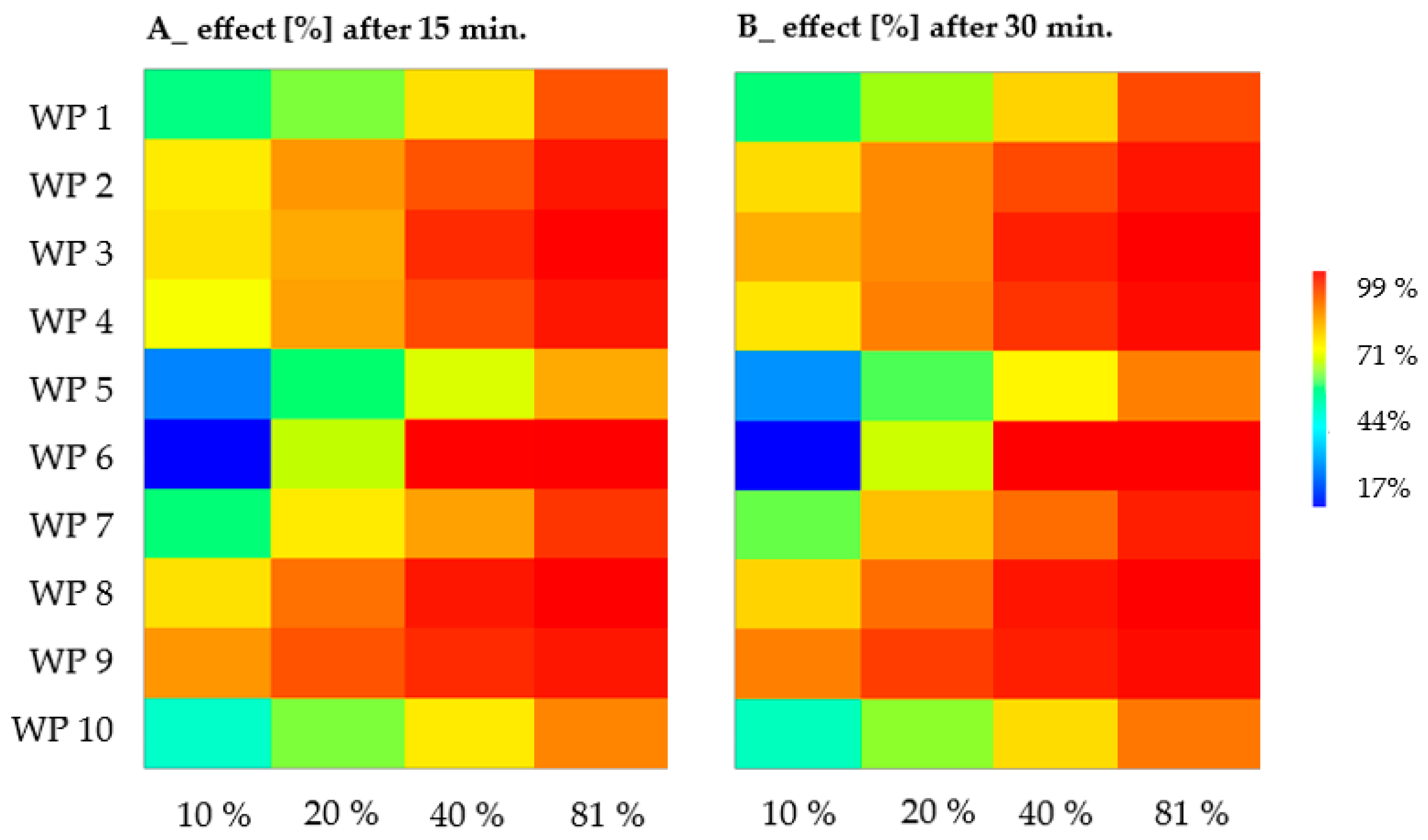
Aliivibrio fischeri increased proportionally with both exposure time and sample concentration (
Figure 1), indicating potent acute toxic effects in several instances. Toxicity classes were assigned according to the methodology of Persoone et al. [
23], utilizing the most sensitive endpoint—the EC
50 value after 15 and 30 min of exposure.
For highly toxic samples (WP2, WP3, WP6, WP9, and WP10), the initial concentration range resulted in near-total inhibition of bacterial luminescence, precluding reliable EC50 determination under standard assay conditions. To address this, these samples were pre-diluted prior to testing (two-fold for WP2 and WP6; five-fold for WP10; and nine-fold for WP9). This approach allowed for the determination of measurable EC50 values, which were subsequently recalculated to the original sample concentrations. In contrast, the remaining samples exhibited measurable toxicity within the standard range, enabling a direct and precise quantitative comparison.
Based on the toxicity units (TUs) derived from EC50 values, the effluents were classified into various categories ranging from slightly to extremely toxic. In most cases, toxicity levels increased with prolonged exposure.
2.2. Bacterial Enzyme De Novo Synthesis Inhibition (Toxi-ChromoTest™)
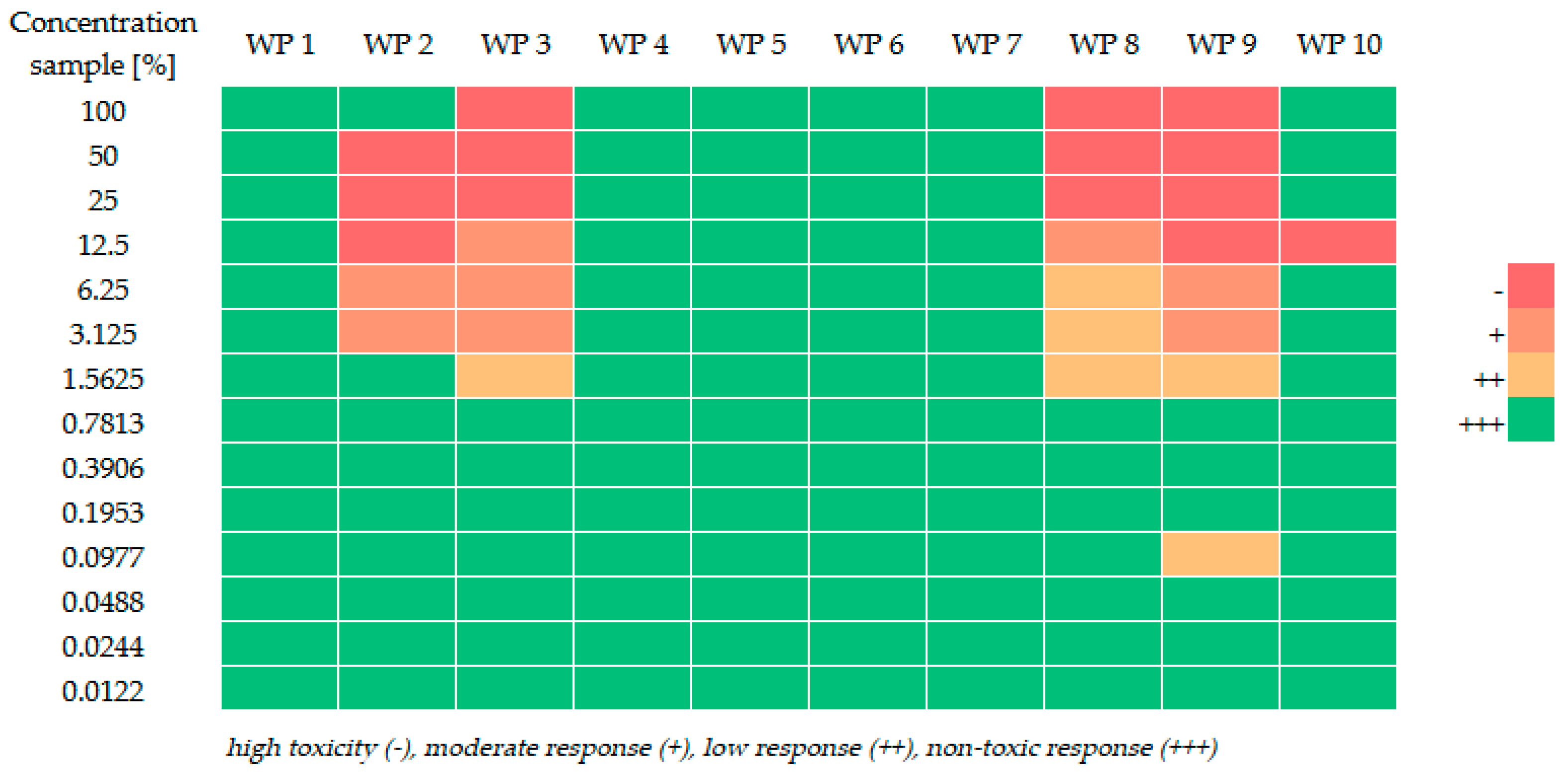
Distinct variations in color intensity were observed both between different fire scenarios and across the dilution series (see
Figure 2). Samples WP3, WP8, and WP9 exhibited the most potent toxic effects at high concentrations, characterized by a total absence of chromogenic reaction (no color development). As these samples were progressively diluted, a gradual increase in blue color intensity was noted, signaling a transition toward non-toxic levels. However, the dose–response relationships were not strictly monotonic in all cases. Certain samples displayed non-linear patterns, where moderate or low responses occurred at intermediate dilutions, while non-toxic results were recorded at both higher and lower concentration levels.
At the maximum tested concentration (100%), samples WP3, WP8, and WP9 showed no visible enzyme activity. Conversely, samples WP1, WP4, WP5, WP6, WP7, and WP10 exhibited non-toxic responses across a broad concentration range, including the undiluted state. With increasing dilution, all samples eventually reached a color intensity comparable to the negative control. The specific concentration thresholds required to reach a non-toxic state varied significantly.
2.3. Phytotoxicity Assessment Using Sinapis alba L.
The results, summarized in
Table 2, revealed a highly heterogeneous phytotoxic response, reflecting the diverse chemical compositions of the 10 fire scenarios.
The analysis of seed germination provided a preliminary threshold for phytotoxicity. A critical finding was the complete suppression of germination (100% inhibition) in three specific samples (WP3, WP8, and WP9). In contrast, most other samples exhibited germination rates comparable to the control, with the notable exception of sample WP2, where germination was nearly abolished (only two seeds germinated).
Root growth inhibition, measured for both mean and longest root length, proved to be a significantly more sensitive endpoint than germination by capturing a broader spectrum of physiological stress across the tested samples. The magnitude of this inhibition ranged from complete stunting to notable growth stimulation, with samples WP2, WP3, WP8, and WP9 being categorized into the highest toxicity class (Class IV) according to Persoone et al. [
23].
Interestingly, samples WP5 and WP6 demonstrated negative inhibition values reaching as low as 12.25%, signaling a stimulatory effect on root development; this biphasic response, or hormesis, may be attributed to the presence of diluted nitrogenous compounds or other nutrients in the runoff that act as fertilizers rather than toxins at lower concentration levels.
2.4. Toxicity to Aquatic Invertebrates—Ostracodtoxkit F™
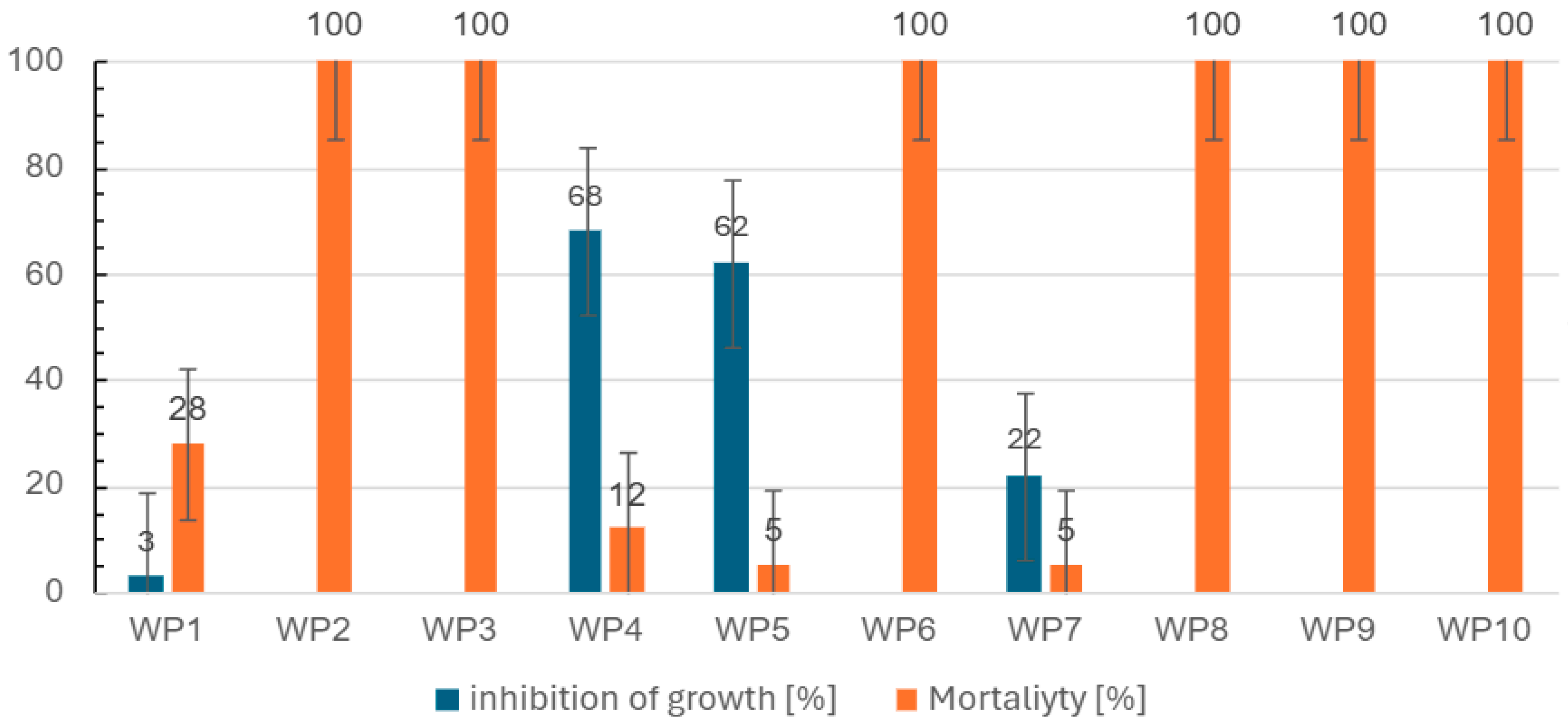
The Ostracodtoxkit F™ bioassay revealed a profound toxic impact of several firefighting runoff samples on aquatic invertebrates (see
Figure 3). Both mortality and growth inhibition of the ostracods varied significantly across the ten scenarios, reflecting a broad spectrum of toxic potency. In accordance with the methodology of Persoone et al. [
23], toxicity classes were assigned based on the most sensitive endpoint recorded for each sample.
The total mortality (100%) of the test organisms observed in most of the samples, specifically in WP2, WP3, WP6, WP8, WP9, and WP10, demonstrated severe acute toxicity. Conversely, other samples exhibited partial mortality accompanied by measurable growth inhibition, indicating significant sublethal toxic effects. For the samples where organisms survived, growth inhibition proved to be a highly sensitive parameter for assessing the physiological stress caused by the chemical constituents of the runoff.
Based on the most sensitive endpoints, the investigated samples were categorized into Persoone’s toxicity classes, ranging from slightly toxic (Class II for WP1 and WP7) to highly or extremely toxic (Class IV for WP2, WP3, WP4, WP5, WP6, WP8, WP9, and WP10).
2.5. Chemical Screening and Functional Group Profiling by GC-MS/MS
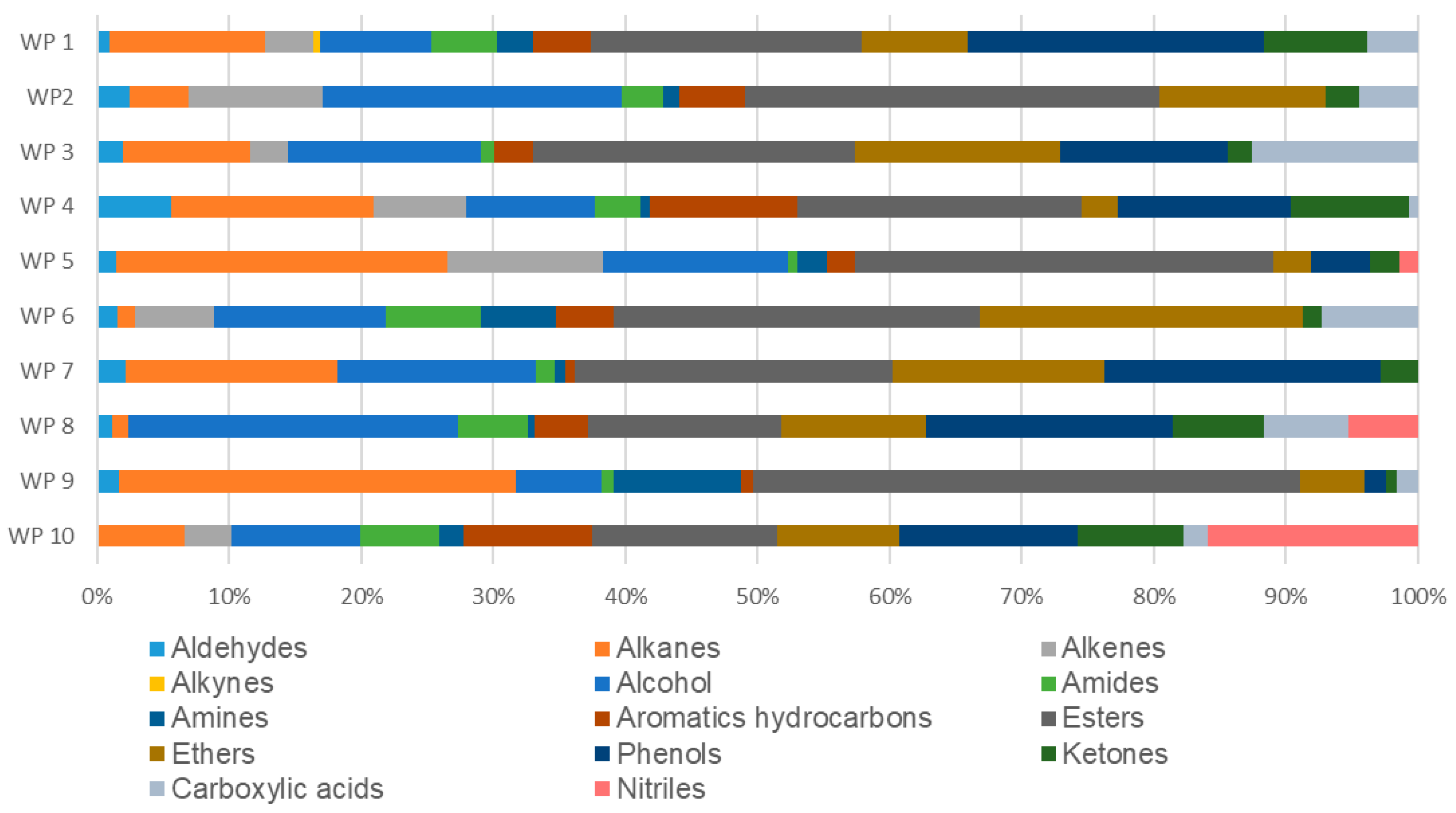
The qualitative screening performed via GC-MS/MS allowed for the identification and categorization of organic constituents in the firefighting runoff into major functional organic groups (
Figure 4). The chemical landscape of the samples was dominated by esters, alcohols, and phenols, although their relative abundance varied significantly across the ten fire scenarios (WP1–WP10), explaining the heterogeneous ecotoxicological responses observed in the bioassays. They originate from pyrolysis and incomplete combustion of common materials such as plastics, wood, textiles and synthetic polymers. These compounds arise specifically from thermal breakdown of polymers (e.g., polyesters releasing esters, cellulose yielding alcohols) and lignin in wood producing phenols, with firefighting water extracting the resulting volatile and semi-volatile products from ash, smoke, and residual matter. Their predominance directly reflects the high reactivity of the fire process, where intense oxidation and pyrolysis under oxygen-limited conditions—coupled with temperatures exceeding 500 °C—favor secondary product synthesis over complete combustion to CO
2 and H
2O, establishing these compounds as biomarkers of incomplete combustion [
24,
25].
Esters were the most prevalent group in several scenarios, reaching a maximum of 41% in WP9, 32% in WP5, and 31% in WP2. The high concentration of esters, often associated with plasticizers and synthetic materials, likely contributed to the overall chemical load and potential sublethal effects. Alcohols also represented a substantial fraction, particularly in WP2 (22%) and WP8 (25%), where they may have enhanced the solubility and bioavailability of other more toxic hydrophobic compounds.
Phenols and aromatic compounds, known for their high toxicity and persistence, were notably abundant in specific samples. Samples WP1, WP7 and WP8 exhibited high phenol contents (22%, 21% and 19%, respectively), which correlates with their classified toxicity. Furthermore, aromatic compounds showed a peak in WP4 (11%), WP9 (10%) and WP10 (9.76%), scenarios likely involving the combustion of complex polymers and industrial chemicals. Interestingly, nitrile compounds were uniquely prominent in WP10 (16%) and WP8 (5.2%), serving as chemical markers for the nitrogen-containing materials or specific extinguishing agents used in those incidents.
Alkanes and alkenes, representing products of incomplete combustion and fuel residues, were found in high proportions in WP9 (30% alkanes) and WP5 (25% alkanes). While these compounds often exhibit lower acute toxicity than aromatics, their presence in such high relative abundance significantly influences the physicochemical properties of the runoff, such as its lipophilicity. The diverse presence of nitrogen-containing groups, including amides (up to 7.2% in WP6) and amines (up to 9.7% in WP9), further complicates the toxicological profile of the effluents, potentially leading to the synergistic effects observed in the Microtox® and Toxi-ChromoTest™ assays.
3. Discussion
The intersection of fire events and the subsequent release of highly contaminated fire-extinguishing water represent one of the most complex vectors for acute and chronic environmental pollution. The analytical results derived from GC-MS/MS in this study provide a critical foundation for understanding the chemical etiology of firewater runoff toxicity. Profiling these effluents revealed an extremely dense matrix of organic contaminants, including polycyclic aromatic hydrocarbons (PAHs, such as anthracene, phenanthrene, fluoranthene and pyrene), unburned fuel hydrocarbons (BTEX), chlorinated dioxins, phenols (e.g., benzenol, cresol and eugenol) and highly reactive intermediate combustion products, which is consistent with the foundational work of Noiton, D., Fowles, J., & Davies, H. [
12]. When these chemical signatures are rigorously mapped against the multi-trophic ecotoxicological responses observed in the studied battery of bioassays, it becomes unequivocally evident that traditional, single-species monotonic risk assessments underestimate the ecological peril posed by firewater runoff.
One of the most persistent scientific challenges in evaluating the ecotoxicity of such runoff is the profound deviation between the predicted toxicity of individual chemical constituents and the observed reality of the complex environmental mixture. This phenomenon, frequently termed the “toxic cocktail” effect, results in synergistic and supra-additive toxicity, where the combined biological impact of the effluents significantly exceeds the simple arithmetic summation of the individual components’ toxicities [
26]. Our results demonstrate this clearly in samples such as WP2 and WP8, which contained substantial quantities of alcohols (22.3% and 25%, respectively). As Sato and Nakajima [
27] established, high concentrations of completely miscible alcohols such as ethanol or isopropyl alcohol significantly reduce the overall polarity and dielectric constant of the bulk aqueous phase. This shift in the physicochemical properties of the matrix likely acted as an anti-hydrophobic co-solvent, facilitating the mobilization and increasing the bioavailability of highly toxic, hydrophobic xenobiotics that would otherwise remain sequestered in the particulate phase.
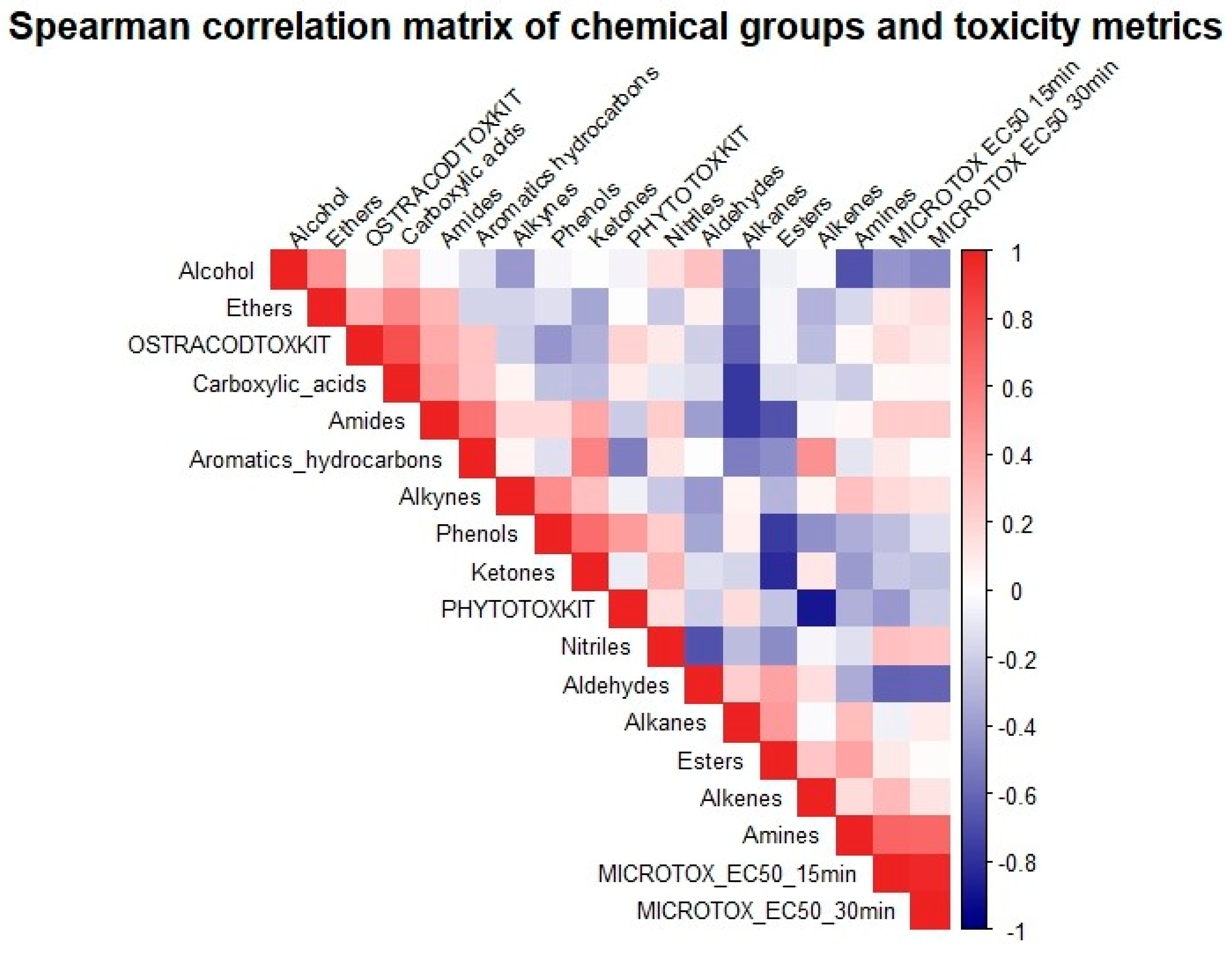
To bridge the gap between chemical fingerprinting and biological outcomes, a unified Spearman’s rank correlation matrix was performed (
Figure 5). While multivariate techniques were considered, Spearman’s rank correlation was selected as a more robust and conservative approach for this dataset, given the sample size (
n = 10) and the non-normal distribution of some variables. The analysis included 14 chemical groups (aldehydes, alkanes, alkenes, alkynes, alcohols, amides, amines, aromatic hydrocarbons, esters, ethers, phenols, ketones, carboxylic acids, and nitriles) and four toxicity endpoints: EC
50 after 15 min, EC
50 after 30 min, inhibition of mean root length, and ostracod mortality. The missing value denoted as “n.v.d.” was treated as no valid data and excluded pairwise from calculations. Two-sided significance was evaluated at
p < 0.05. Because lower EC
50 values indicate higher toxicity, negative correlations with EC
50 correspond to increasing acute toxicity, whereas positive correlations with root inhibition or mortality correspond to increasing toxicity. It should be noted, however, that while Spearman’s rank correlation identifies monotonic relationships between individual chemical groups and biological endpoints, it may not account for complex toxicological interactions or synergistic effects between different chemical constituents present in the samples.
The correlation matrix revealed only a limited number of statistically significant associations, which was expected given the small sample size (n = 10; n = 9 for EC50 after 30 min due to one missing value). Amines showed the strongest significant positive association with Microtox EC50 at both exposure times (rs = 0.71, p = 0.022 at 15 min; rs = 0.71, p = 0.034 at 30 min), indicating that samples richer in amines tended to display higher EC50 values and, therefore, lower acute bacterial toxicity. By contrast, alkenes were significantly negatively correlated with root inhibition (rs = −0.68, p = 0.032), which quantitatively supports a stimulatory or hormetic trend rather than phytotoxic inhibition.
Several non-significant but notable tendencies were also observed. Aldehydes were negatively related to both EC50 endpoints (rs = −0.62 for 15 min; rs = −0.61 for 30 min), suggesting a possible contribution to acute toxicity toward Aliivibrio fischeri. Alcohols showed moderate negative correlations with EC50 (rs = −0.42 to −0.46), while aromatic hydrocarbons were moderately negatively associated with root elongation (rs = −0.53). In the Ostracoda assay, alkanes exhibited a moderate inverse relationship with mortality (rs = −0.61; p = 0.061), whereas amides and nitriles showed moderate positive trends (both rs = 0.39), although these did not reach the adopted significance threshold.
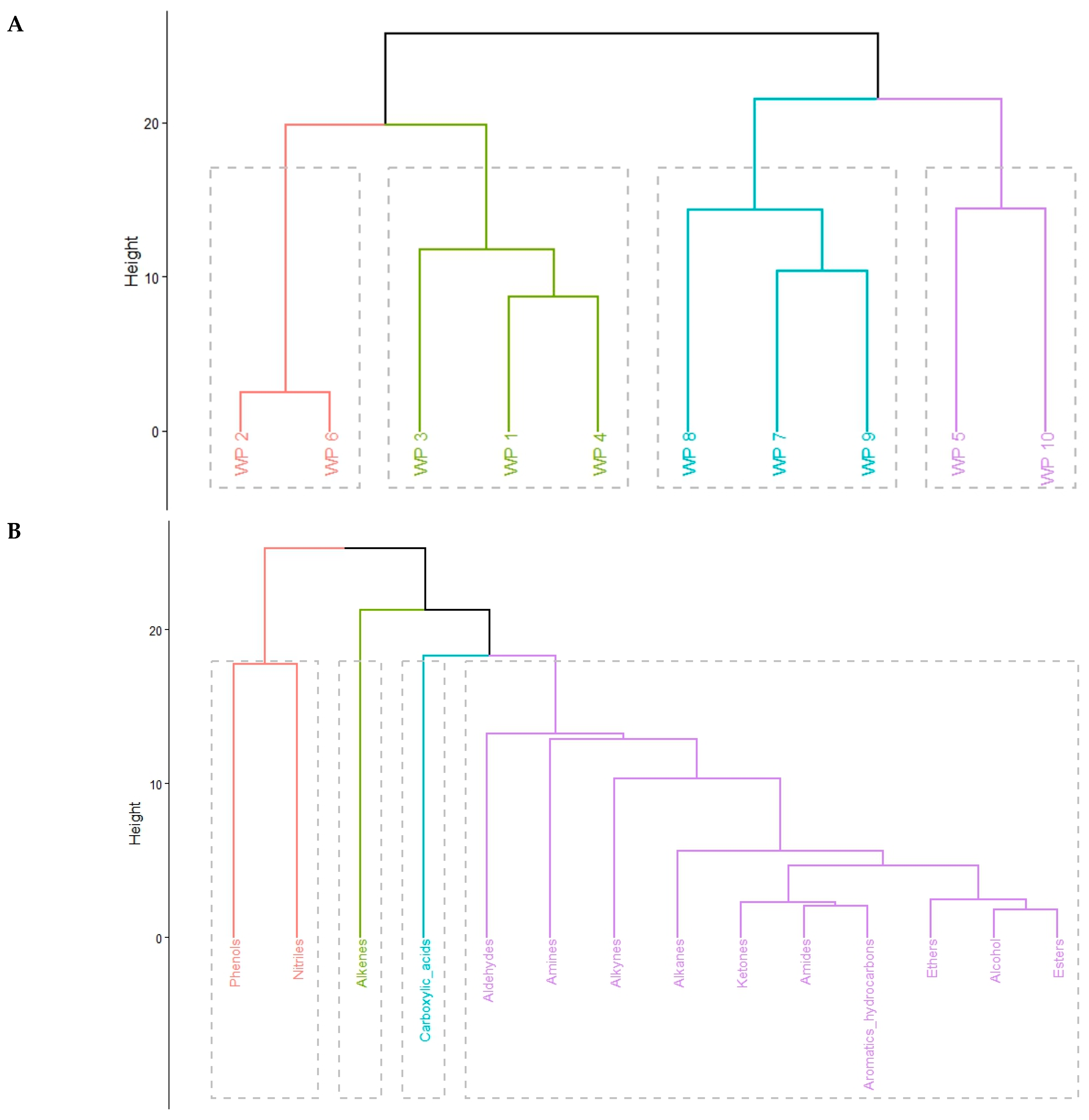
To provide a robust statistical basis for categorizing firefighting runoffs, a dual agglomerative hierarchical clustering analysis (HCA) was performed on both fire scenarios (observations) and chemical functional groups (variables). Prior to analysis, the data were standardized (z-score transformation) to ensure comparability across different concentration ranges. Dissimilarities were calculated using the Euclidean distance metric, and the hierarchy was constructed using Ward’s minimum variance method (Ward.D2).
The resulting HCA of the GC-MS/MS data demonstrates that the chemical “fingerprint” of the effluent is a direct function of the fuel–foam matrix (
Figure 6A). The primary bifurcation of the dendrogram into two macro-clusters suggests a fundamental divergence between nitrogen-oxygenated organic loads and lipophilic hydrocarbon-rich matrices. The first cluster (red) shows a high degree of similarity between WP2 (Industrial) and WP6 (Upholstery). Despite their different scales, their chemical redundancy is driven by a high co-variance of alcohols, amides, and esters, as confirmed by the variable clustering in
Figure 6B. This association points to a shared thermolysis pathway of polyurethane-based materials and synthetic surfactants. From an environmental management perspective, this implies that industrial and domestic interior fires may discharge nearly identical suites of polar organic compounds, potentially requiring similar localized treatment strategies.
Conversely, the second macro-cluster in
Figure 6A highlights the unique risks associated with polymer-dominated fires, specifically WP10 (tires) and WP5 (mixed plastics). The clustering of variables (
Figure 6B) further elucidates these signatures; for instance, the close association between phenols and nitriles (red cluster in
Figure 6B) serves as a molecular marker for elastomer and synthetic rubber degradation. While WP10 was identified in bioassays as a metabolic outlier (highest Toxi-Chromo LID Score), the HCA confirms that its chemical matrix is fundamentally linked to the thermal breakdown of nitrogen-containing synthetic rubbers. Furthermore, the grouping of alkenes and carboxylic acids in the variable dendrogram suggests coordinated degradation patterns of long-chain polymers. These chemical signatures identified via HCA are not merely a product of the fuel itself but also reflect the complex interaction between the combustible material and the chemical additives used during firefighting interventions.
During fire suppression operations, a variety of extinguishing agents are employed, selected according to the specific nature of the combustible materials and the prevailing incident conditions. Water remains the primary extinguishing medium. However, its efficacy can be insufficient in certain scenarios, particularly regarding the combustion of solids and flammable liquids. Thus, to enhance its performance, additives in the form of aqueous solutions of foam concentrates are widely utilized to generate firefighting foam [
28].
From a physicochemical perspective, it is a colloidal system consisting of a mixture of foam solution (a blend of water and concentrate) and air. Depending on the expansion ratio (defined as the ratio of the foam volume to the liquid volume prior to gas induction), firefighting foams are classified as low-expansion (heavy), medium-expansion, and high-expansion (light) foams [
28]. According to their chemical composition, foam concentrates are classified into two categories: synthetic and protein-based. The synthetic group is composed of hydrocarbon surfactant-based concentrates (including Class A and wetting agents) and aqueous film-forming foams (AFFFs), which contain both synthetic and fluorinated surfactants. Protein-based agents are formulated using hydrolyzed proteins and are further divided into protein (P), fluoroprotein (FP), and film-forming fluoroprotein (FFFP) types. For the suppression of water-miscible liquids, alcohol-resistant (AR) foams are utilized, as they contain specific polymers that create a protective layer between the fuel and oxygen [
29]. The primary extinguishing effect of foam is achieved by separating the surface of the combustible material from the flame. The combustion zone and the fuel are cooled by the foam solution draining from the foam structure. Additionally, the combustion zone is isolated from the air, and fuel evaporation is suppressed. Thermal insulation is also provided, and fire gases are displaced, particularly when rooms are filled or flooded with foam [
30]. The fundamental constituents of these concentrates include surfactants, solvents, preservatives, antifreeze agents, corrosion inhibitors, stabilizers, and colorants [
31].
Despite their high extinguishing efficiency, firefighting foams impose a significant burden on ecosystems. Previous studies indicate that the environmental impact of foams is primarily associated with the presence of surfactants and solvents. These substances may increase the organic load, measured as Chemical Oxygen Demand (COD) and Biochemical Oxygen Demand (BOD). Furthermore, acute toxic effects may be caused by receiving waters with low dilution, while soil and vegetation can be affected through changes in nutrient availability and surface properties, such as wetting and emulsification [
28,
30,
31].
In the fire scenarios analyzed in this study, the synthetic foaming agent Roteor M-Premium was employed. According to its Safety Data Sheet (SDS), this preparation is a mixture of anionic surfactants (ethoxylated alcohol sulfates, sodium salts-SLES) and co-solvents, including 2-(2-butoxyethoxy)ethanol, ethane-1,2-diol, butan-1-ol, and C12–C14 alcohol fractions. From a toxicological perspective, the mixture is classified as a skin irritant and as causing serious eye damage. Furthermore, SLES is classified under Aquatic Chronic 3. It should also be noted that the samples were collected at various stages of fire development and suppression operations; this variability could have influenced the dilution levels of both the foam concentrates and the toxic combustion products, which may explain the differences in toxicity results observed between individual samples. These results suggest that despite the presence of irritants and surfactants in the composition of Roteor M-Premium, their concentration in the final fire wastewater did not determine the toxicity level of the samples.
It should be emphasized that the current international literature largely overlooks this aspect, focusing either on the toxicity of the concentrates themselves (under laboratory conditions) or on general water contamination without differentiating between the sources of toxicity. Thus, these results represent a significant novelty, indicating that even when modern, fluorine-free and biodegradable foam concentrates (such as the one used in this study) are applied, the chemistry of the fire itself generates a pollutant load of critical ecotoxicological importance.
The integrated toxicity patterns observed across the ten fire scenarios confirm that firewater runoff induces pronounced and multidimensional toxic effects, capable of triggering both acute lethality and sublethal metabolic disturbances across different trophic levels. These findings are consistent with reports from industrial and wildfire-related events, where runoff transported complex mixtures of combustion residues and firefighting agents into receiving waters [
3,
13,
14,
15,
32,
33]. In our study, the
Aliivibrio fischeri bioassay proved to be the most sensitive indicator, often reaching near-total bioluminescence inhibition that required significant dilution to determine valid EC
50 values. This high sensitivity identifies the bacterial component of the ecosystem as the most immediate “target” of acute chemical stress, confirming that the hazard associated with firewater runoff is primarily mixture-driven rather than attributable to individual compounds, a conclusion also reached by Silva et al. [
13] and Ré et al. [
14] in their investigations of post-fire ash and metal mixtures.
The comparative analysis of trophic sensitivity revealed distinct physiological responses to the same effluents. While samples WP3, WP8, and WP9 induced 100% inhibition in seed germination for
Sinapis alba, other samples like WP5 and WP6 showed negative inhibition values, reaching as low as −12.25%. This stimulatory effect on root development, or hormesis, likely stems from the presence of diluted nitrogenous compounds or nutrients within the extinguishing agents that act as fertilizers at lower concentrations, masking the underlying toxic potential [
3,
34]. Karrikins, potent chemical signals derived from smoke and charred organic matter, may promote plant growth. They activate the KAI2/MAX2 signaling pathway, increasing seed sensivity to light and promoting seedling development [
34]. However, as demonstrated in studies on biochars, this response is strictly dose- and species-dependent. As concentrations increase, inhibitors begin to dominate over karrikin signals, leading to inhibition of root and shoot growth (Kochanek et al., 2016, Ref. [
34]). The observed growth stimulation may mask the actual biochemical stress. Even if a plant’s biomass increases, it may be experiencing severe oxidative stress, as evidenced by a sharp rise in prolonine levels—an amino acid that protects against reactive oxygen species (ROS). Studies on synthetic fire-extinguishing agents, such as Triodol- S, show that even at minimal concentrations, there is a significant decrease in chlorophyll A and B content leading to chlorosis and tissue necrosis after seven-day incubation of
Lemna minor [
35].
The complex nature of phytotoxicity results from the fact that fire effluents are mixtures of natural combustion products, synthetic components of firefighting foams, and other materials present within the fire. This “fire mixture” may exhibit a synergistic effect, where toxins from the foam can impair photosynthesis, induce ROS-mediated oxidative stress and lipid peroxidation in chloroplast membranes, while pyrolytic compounds alter the plant hormonal balance. In the ecosystem scale, both terrestrial and aquatic plants may suffer damage, leading to loss of biotop and filtration functions, which may intensify the transport of pollutants up the food chain.
However, the absolute mortality observed in the Ostracodtoxkit F™ assay for most samples (WP2, WP3, WP6, WP8, WP9, and WP10) underscores the severe risk to benthic invertebrates. These acute toxic responses are consistent with documented severe biological effects following exposure to firewater and ash-contaminated runoff, including genotoxicity in
Chironomus riparius [
15].
The long-term environmental implications of these discharges are further complicated by the interaction between the water column and sediments. Although the present study focused primarily on waterborne toxicity, the extreme responses in ostracods suggest that contaminants bound to particles and ash, which eventually settle in sediments, induce sustained biological effects [
14]. As observed by Muñiz González et al. [
15], molecular responses in
Chironomus riparius larvae exposed to wildfire ashes indicate that sediment-bound contaminants may trigger sublethal stress responses even when acute toxicity in the water column decreases due to dilution. Furthermore, the inhibition of primary producers, as seen in the growth suppression of benthic diatoms [
36], suggests that the ecological balance may be disrupted far beyond the immediate post-fire period.
Efforts to mitigate this toxicity through biological processes present a significant trade-off. Silva et al. [
13] demonstrated that filtration by the freshwater clam
Corbicula fluminea could reduce the toxicity of ash-loaded runoff, yet this occurred at the cost of increased stress and mortality for the clams themselves. Our chemical profiling, which identified high concentrations of phenols (up to 22%) and nitriles (15.9% in tire-related WP10), suggests that the chemical load in real-world industrial fires would likely exceed the remediation capacity of such invasive species, turning biological filtration into a source of secondary ecological collapse rather than a sustainable strategy.
Ultimately, the results of this study underscore the need for integrated, effect-based approaches in assessing environmental risks. The molecular complexity identified, characterized by nitriles, esters (reaching 41% in WP9), and phenols, poses a direct threat to public health through the potential contamination of drinking water reservoirs. Phenolic compounds, acting as neurotoxins and endocrine disruptors, may lead to the formation of highly toxic chlorinated by-products during standard water disinfection. Evidence from major incidents like the Grenfell Tower fire demonstrates that fire-related contamination can result in concentrations of hazardous substances, such as PAHs and dioxins, far exceeding urban soil reference levels [
4]. The identification of these “chemical fingerprints” should, therefore, be treated not only as ecological hazards but as high-risk indicators for human chemical safety, necessitating rigorous and prolonged post-fire monitoring of hydrological catchments within the “One Health” framework.
Future studies may focus on developing quantitative methodologies, such as targeted MRM or SIM modes in GC-MS/MS, to precisely determine the concentrations of the identified organic pollutants (e.g., esters, alcohols, phenols) in firefighting runoff. This will enable robust environmental risk assessments by integrating quantitative chemical data with toxicity outcomes from biotests like Microtox, Ostracodtoxkit, and Phytotoxkit. Such advances will strengthen the correlation between contaminant levels and observed ecotoxicological effects, allowing for the development of mitigation strategies for post-fire water contamination.




 ,
,