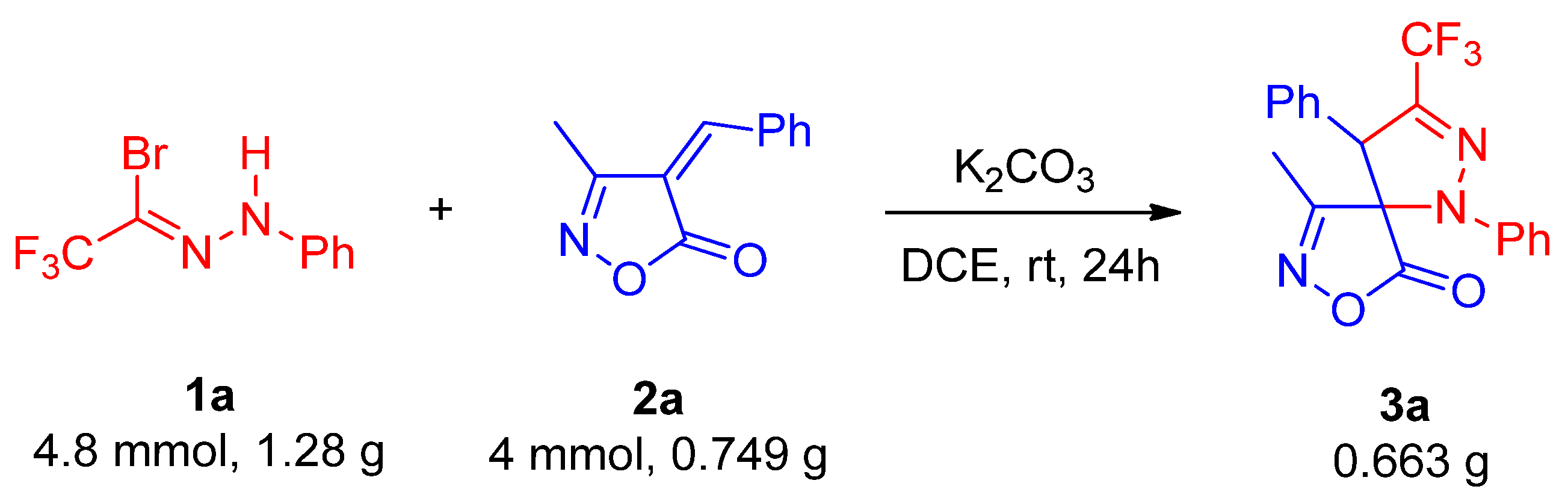
3.3. General Procedure for the Synthesis of Spiroisoxazolones 3
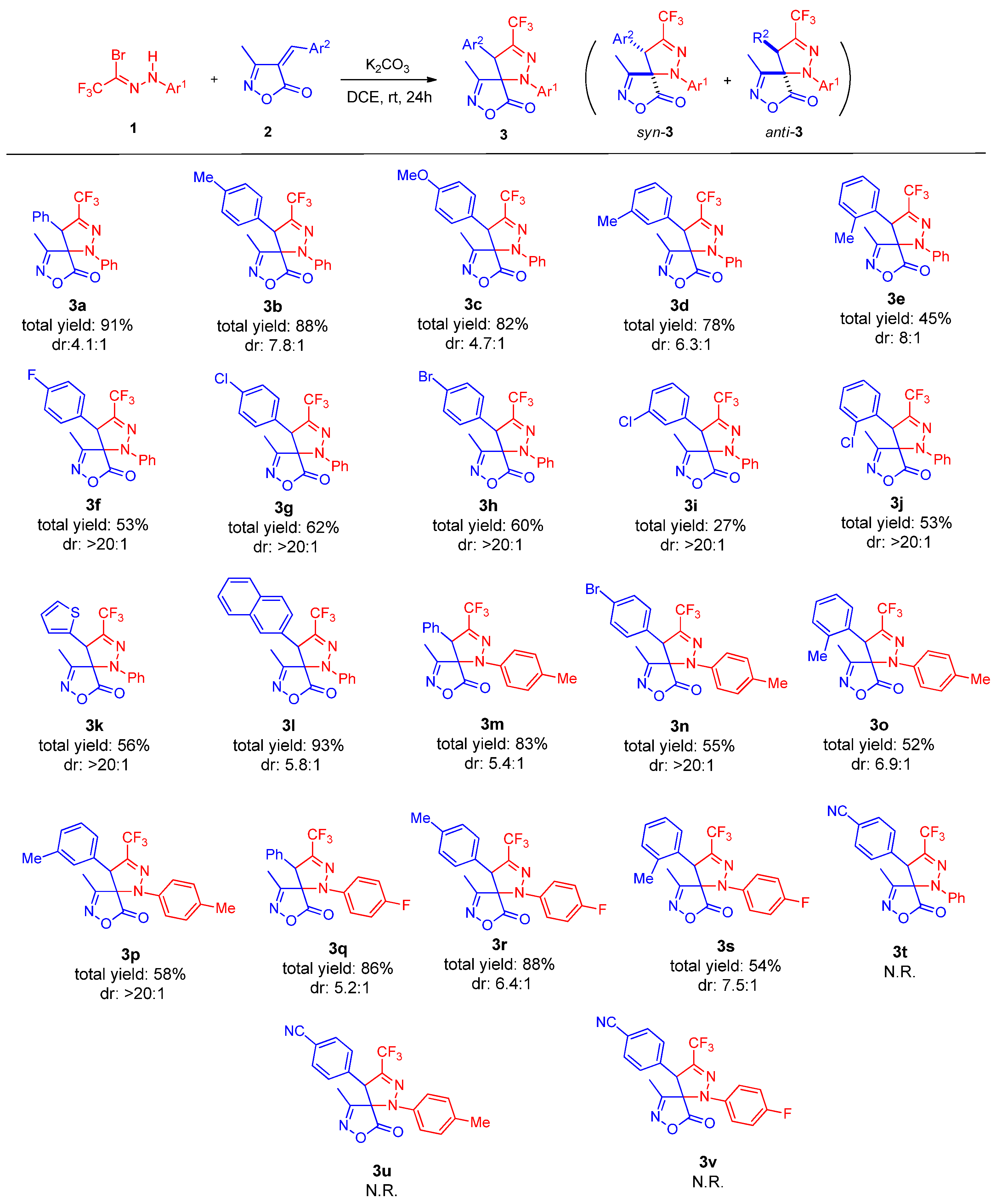
To a solution of K2CO3 (0.4 mmol) in 1,2-dichloroethane (2 mL) was added trifluoromethyl bromohydrazone 1 (0.48 mmol, 1.2 equiv) and unsaturated isoxazolone derivative 2 (0.4 mmol, 1.0 equiv). The reaction mixture was stirred at room temperature for 24 h. Upon completion, the solvent was removed under reduced pressure, and the residue was purified by flash chromatography on silica gel (eluent: petroleum ether/ethyl acetate = 20:1, v/v) to afford product 3.
(rel-4S,5R)-9-Methyl-1,4-diphenyl-3-(trifluoromethyl)-7-oxa-1,2,8-triazaspiro[4.4]nona-2,8-dien-6-one (syn-3a). The synthesis of this compound was conducted using a standardized protocol, followed by purification through column chromatography on silica gel (200–300 mesh) with petroleum ether/ethyl acetate (20:1 v/v) as the eluent to give 109.0 mg, 73% yield, yellow oil; 1H NMR (500 MHz, CDCl3): δ 7.41–7.36 (m, 3H, ArH), 7.32–7.28 (m, 2H, ArH), 7.19–7.17 (m, 2H, ArH), 7.07 (t, J = 7.5 Hz, 1H, ArH), 7.00 (dd, J1 = 9.0 Hz, J2 = 0.8 Hz, 2H, ArH), 4.85 (s, 1H, CH), 2.18 (s, 3H, CH3) ppm; 13C NMR (126 MHz, CDCl3): δ 169.8, 165.5, 141.3, 138.5 (q, 2JC–F = 37.9 Hz), 130.1, 129.9, 129.4, 129.1, 128.4, 123.9, 119.9 (q, 1JC–F = 272.0 Hz), 114.9, 77.3, 60.6, 11.8 ppm; 19F NMR (471 MHz, CDCl3): δ −62.3 (s, 3F) ppm. HRMS (ESI): m/z calcd. for C19H15F3N3O2 [M + H]+ 374.1111, found 374.1142.
(rel-4R,5R)-9-Methyl-1,4-diphenyl-3-(trifluoromethyl)-7-oxa-1,2,8-triazaspiro[4.4]nona-2,8-dien-6-one (anti-3a). The synthesis of this compound was conducted using a standardized protocol, followed by purification through column chromatography on silica gel (200–300 mesh) with petroleum ether/ethyl acetate (20:1 v/v) as the eluent to give 26.9 mg, 18% yield, yellow solid; m.p. 192–194 °C; 1H NMR (500 MHz, CDCl3): δ 7.44 (t, J = 2.5 Hz, 3H, ArH), 7.33–7.29 (m, 2H, ArH), 7.23–7.21 (m, 2H, ArH), 7.09 (t, J = 7.5 Hz, 1H, ArH), 6.99 (d, J = 8.0 Hz, 2H, ArH), 5.16 (s, 1H, CH), 1.38 (s, 3H, CH3) ppm; 13C NMR (126 MHz, CDCl3): δ 169.8, 165.5, 141.3, 138.5 (q, 2JC–F = 37.8 Hz), 130.0, 129.9, 129.3, 129.1, 128.4, 123.9, 119.9 (q, 1JC–F = 272.0 Hz), 114.9, 77.3, 60.5 11.8 ppm; 19F NMR (471 MHz, CDCl3): δ −62.3 (s, 3F) ppm. HRMS (ESI): m/z calcd. for C19H15F3N3O2 [M + H]+ 374.1111, found 374.1141.
(rel-4S,5R)-9-Methyl-1-phenyl-4-(p-tolyl)-3-(trifluoromethyl)-7-oxa-1,2,8-triazaspiro[4.4]nona-2,8-dien-6-one (syn-3b). The synthesis of this compound was conducted using a standardized protocol, followed by purification through column chromatography on silica gel (200–300 mesh) with petroleum ether/ethyl acetate (20:1 v/v) as the eluent to give 117.7 mg, 78% yield, yellow solid; m.p. 202–204 °C; 1H NMR (500 MHz, CDCl3): δ 7.32–7.29 (m, 2H, ArH), 7.19 (d, J = 8.0 Hz, 2H, ArH), 7.08–7.05 (m, 3H, ArH), 6.99 (d, J = 7.5 Hz, 2H, ArH), 4.83 (s, 1H, CH), 2.35 (s, 3H, CH3), 2.19 (s, 3H, CH3) ppm; 13C NMR (126 MHz, CDCl3): δ 169.9, 165.6, 141.3, 140.2, 138.6 (q, 2JC–F = 37.6 Hz), 129.9, 129.8, 129.2, 125.3, 123.8, 119.9 (q, 1JC–F = 272.0 Hz), 114.9, 77.4, 60.4, 21.3, 11.8 ppm; 19F NMR (471 MHz, CDCl3): δ −62.3 (s, 3F) ppm. HRMS (ESI): m/z calcd. for C20H17F3N3O2 [M + H]+ 388.1267, found 388.1255.
(rel-4R,5R)-9-Methyl-1-phenyl-4-(p-tolyl)-3-(trifluoromethyl)-7-oxa-1,2,8-triazaspiro[4.4]nona-2,8-dien-6-one (anti-3b). The synthesis of this compound was conducted using a standardized protocol, followed by purification through column chromatography on silica gel (200–300 mesh) with petroleum ether/ethyl acetate (20:1 v/v) as the eluent to give 15.5 mg, 10% yield, yellow oil; 1H NMR (500 MHz, CDCl3): δ 7.31 (t, J = 7.8 Hz, 2H, ArH), 7.23 (d, J = 8.0 Hz, 2H, ArH), 7.10–7.06 (m, 3H, ArH), 6.98 (d, J = 8.0 Hz, 2H, ArH), 5.13 (s, 1H, CH), 2.37 (s, 3H, CH3), 1.41 (s, 3H, CH3) ppm; 13C NMR (126 MHz, CDCl3): δ 174.5, 164.7, 141.3, 140.2, 138.9 (q, 2JC–F = 38.2 Hz), 130.2, 129.9, 128.6, 126.5, 124.1, 120.0 (q, 1JC–F = 272.3 Hz), 115.2, 77.3, 62.7, 21.2, 13.6 ppm; 19F NMR (471 MHz, CDCl3): δ −62.3 (s, 3F) ppm. HRMS (ESI): m/z calcd. for C20H17F3N3O2 [M + H]+ 388.1267, found 388.1273.
(rel-4S,5R)-4-(4-Methoxyphenyl)-9-methyl-1-phenyl-3-(trifluoromethyl)-7-oxa-1,2,8-triazaspiro[4.4]nona-2,8-dien-6-one (syn-3c). The synthesis of this compound was conducted using a standardized protocol, followed by purification through column chromatography on silica gel (200–300 mesh) with petroleum ether/ethyl acetate (20:1 v/v) as the eluent to give 108.1 mg, 67% yield, brown oil; 1H NMR (500 MHz, CDCl3): δ 7.32–7.29 (m, 2H, ArH), 7.11 (d, J = 9.0 Hz, 2H, ArH), 7.07 (t, J = 7.5 Hz, 1H, ArH), 6.99 (d, J = 8.0 Hz, 2H, ArH), 6.89 (d, J = 9.0 Hz, 2H, ArH), 4.84 (s, 1H, CH), 3.79 (s, 3H, OCH3), 2.18 (s, 3H, CH3) ppm; 13C NMR (126 MHz, CDCl3): δ 170.0, 165.6, 160.8, 141.4, 138.7 (q, 2JC–F = 37.5 Hz), 130.7, 129.9, 123.2, 120.0, 119.9 (q, 1JC–F = 272.0 Hz), 114.8, 114.5, 77.3, 60.2, 55.2, 11.8 ppm; 19F NMR (471 MHz, CDCl3): δ −62.3 (s, 3F) ppm. HRMS (ESI): m/z calcd. for C20H17F3N3O3 [M + H]+ 404.1217, found 404.1210.
(rel-4R,5R)-4-(4-Methoxyphenyl)-9-methyl-1-phenyl-3-(trifluoromethyl)-7-oxa-1,2,8-triazaspiro[4.4]nona-2,8-dien-6-one (anti-3c). The synthesis of this compound was conducted using a standardized protocol, followed by purification through column chromatography on silica gel (200–300 mesh) with petroleum ether/ethyl acetate (20:1 v/v) as the eluent to give 24.2 mg, 15% yield, colorless oil; 1H NMR (500 MHz, CDCl3): δ 7.32–7.29 (m, 2H, ArH), 7.14 (d, J = 8.5 Hz 2H, ArH), 7.08 (t, J = 7.5 Hz, 1H, ArH), 6.98 (d, J = 7.5 Hz, 2H, ArH), 6.95–6.92 (m, 2H, ArH), 5.13 (s, 1H, CH), 3.83 (s, 3H, OCH3), 1.42 (s, 3H, CH3) ppm; 13C NMR (126 MHz, CDCl3): δ 174.5, 164.8, 160.7, 141.3, 138.9 (q, 2JC–F = 38.1 Hz), 130.0, 129.9, 124.1, 121.3, 120.0 (q, 1JC–F = 272.1 Hz), 115.2, 114.9, 77.2, 62.4, 55.4, 13.6 ppm; 19F NMR (471 MHz, CDCl3): δ −62.3 (s, 3F) ppm. HRMS (ESI): m/z calcd. for C20H17F3N3O3 [M + H]+ 404.1217, found 404.1210.
(rel-4S,5R)-9-Methyl-1-phenyl-4-(m-tolyl)-3-(trifluoromethyl)-7-oxa-1,2,8-triazaspiro[4.4]nona-2,8-dien-6-one (syn-3d). The synthesis of this compound was conducted using a standardized protocol, followed by purification through column chromatography on silica gel (200–300 mesh) with petroleum ether/ethyl acetate (20:1 v/v) as the eluent to give 103.8 mg, 67% yield, yellow oil; 1H NMR (500 MHz, CDCl3): δ 7.32–7.28 (m, 2H, ArH), 7.26–7.24 (m, 1H, ArH), 7.20 (d, J = 7.5 Hz, 1H, ArH), 7.06 (t, J = 7.3 Hz, 1H, ArH), 7.00 (t, J = 8.5 Hz, 4H, ArH), 4.81 (s, 1H, CH), 2.34 (s, 3H, CH3), 2.18 (s, 3H, CH3) ppm; 13C NMR (126 MHz, CDCl3): δ 169.8, 165.5, 141.3, 138.9, 138.6 (q, 2JC–F = 37.7 Hz), 130.8, 129.92, 129.86, 128.9, 128.3, 126.4, 123.9, 119.9 (q, 1JC–F = 272.0 Hz), 114.9, 77.3, 60.6, 21.3, 11.8 ppm; 19F NMR (471 MHz, CDCl3): δ −62.3 (s, 3F) ppm. HRMS (ESI): m/z calcd. for C20H17F3N3O2 [M + H]+ 388.1267, found 388.1272.
(rel-4R,5R)-9-Methyl-1-phenyl-4-(m-tolyl)-3-(trifluoromethyl)-7-oxa-1,2,8-triazaspiro[4.4]nona-2,8-dien-6-one (anti-3d). The synthesis of this compound was conducted using a standardized protocol, followed by purification through column chromatography on silica gel (200–300 mesh) with petroleum ether/ethyl acetate (20:1 v/v) as the eluent to give 17.0 mg, 11% yield, yellow oil; 1H NMR (500 MHz, CDCl3): δ 7.33–7.29 (m, Hz, 3H, ArH), 7.24 (d, J = 8.0 Hz, 2H, ArH), 7.08 (d, J = 7.5 Hz, 1H, ArH), 7.02–6.98 (m, 4H, ArH), 5.11 (s, 1H, CH), 2.37 (s, 3H, CH3), 1.40 (s, 3H, CH3) ppm; 13C NMR (126 MHz, CDCl3): δ 174.5, 164.7, 141.3, 139.6, 138.9 (q, 2JC–F = 38.2 Hz), 130.8, 129.8, 129.5, 129.4, 129.3, 125.7, 124.1, 119.9 (q, 1JC–F = 271.6 Hz), 118.9, 115.3, 77.2, 62.8, 21.4, 13.5 ppm; 19F NMR (471 MHz, CDCl3): δ −61.8 (s, 3F) ppm. HRMS (ESI): m/z calcd. for C20H17F3N3O2 [M + H]+ 388.1267, found 388.1264.
(rel-4S,5R)-9-Methyl-1-phenyl-4-(o-tolyl)-3-(trifluoromethyl)-7-oxa-1,2,8-triazaspiro[4.4]nona-2,8-dien-6-one (syn-3e). The synthesis of this compound was conducted using a standardized protocol, followed by purification through column chromatography on silica gel (200–300 mesh) with petroleum ether/ethyl acetate (20:1 v/v) as the eluent to give 62.0 mg, 40% yield, yellow solid; m.p. 156–158 °C; 1H NMR (500 MHz, CDCl3): δ 7.32–7.26 (m, 4H, ArH), 7.24–7.22 (m, 1H, ArH), 7.16 (d, J = 7.0 Hz, 1H, ArH), 7.07 (t, J = 7.2 Hz 1H, ArH), 6.98 (d, J = 8.5 Hz, 2H, ArH), 5.16 (s, 1H, CH), 2.30 (s, 3H, CH3), 2.16 (s, 3H, CH3) ppm; 13C NMR (126 MHz, CDCl3): δ 169.8, 165.6, 141.1, 139.2 (q, 2JC–F = 37.8 Hz), 135.6, 131.1, 130.5, 129.9, 129.8, 126.9, 126.5, 123.8, 119.9 (q, 1JC–F = 271.8 Hz), 114.7, 75.8, 56.1, 19.5, 11.8 ppm; 19F NMR (471 MHz, CDCl3): δ −62.3 (s, 3F) ppm. HRMS (ESI): m/z calcd. for C20H17F3N3O2 [M + H]+ 388.1267, found 388.1264.
(rel-4R,5R)-9-Methyl-1-phenyl-4-(o-tolyl)-3-(trifluoromethyl)-7-oxa-1,2,8-triazaspiro[4.4]nona-2,8-dien-6-one (anti-3e). The synthesis of this compound was conducted using a standardized protocol, followed by purification through column chromatography on silica gel (200–300 mesh) with petroleum ether/ethyl acetate (20:1 v/v) as the eluent to give 7.7 mg, 5% yield, yellow solid; m.p. 131–133 °C; 1H NMR (500 MHz, CDCl3): δ 7.34–7.26 (m, 5H, ArH), 7.17 (d, J = 8.0 Hz, 1H, ArH), 7.08 (t, J = 7.2 Hz, 1H, ArH), 6.98 (d, J = 8.0 Hz, 2H, ArH), 5.37 (s, 1H, CH), 2.31 (s, 3H, CH3), 1.31 (s, 3H, CH3) ppm; 13C NMR (126 MHz, CDCl3): δ 174.3, 165.6, 141.4, 139.6 (q, 2JC–F = 38.0 Hz), 136.9, 131.9, 130.0, 129.8, 129.1, 128.3, 126.6, 124.1, 119.9 (q, 1JC–F = 272.2 Hz), 115.4, 75.7, 58.8, 19.6, 13.5 ppm; 19F NMR (471 MHz, CDCl3): δ −61.9 (s, 3F) ppm. HRMS (ESI): m/z calcd. for C20H17F3N3O2 [M + H]+ 388.1267, found 388.1268.
(rel-4S,5R)-4-(4-Fluorophenyl)-9-methyl-1-phenyl-3-(trifluoromethyl)-7-oxa-1,2,8-triazaspiro[4.4]nona-2,8-dien-6-one (syn-3f). The synthesis of this compound was conducted using a standardized protocol, followed by purification through column chromatography on silica gel (200–300 mesh) with petroleum ether/ethyl acetate (20:1 v/v) as the eluent to give 82.9 mg, 53% yield, yellow oil; 1H NMR (500 MHz, CDCl3): δ 7.33–7.29 (m, 2H, ArH), 7.19–7.16 (m, 2H, ArH), 7.09–7.06 (m, 3H, ArH), 6.99 (d, J = 8.0 Hz, 2H, ArH), 4.84 (s, 1H, CH), 2.17 (s, 3H, CH3) ppm; 13C NMR (126 MHz, CDCl3): δ 169.9, 165.5, 163.6 (d, 1JC–F = 250.9 Hz), 141.1, 138.2 (q, 2JC–F = 37.9 Hz), 131.3 (d, 3JC–F = 8.7 Hz), 129.9, 124.2 (d, 4JC–F = 3.4 Hz), 124.1, 119.9 (q, 1JC–F = 272.0 Hz), 116.3 (d, 2JC–F = 22.2 Hz), 114.9, 77.2, 59.7, 11.8 ppm; 19F NMR (471 MHz, CDCl3): δ −62.3 (s, 3F), −110.2 (m, 1F) ppm. HRMS (ESI): m/z calcd. for C19H14F4N3O2 [M + H]+ 392.1017, found 392.0996.
(rel-4S,5R)-4-(4-Chlorophenyl)-9-methyl-1-phenyl-3-(trifluoromethyl)-7-oxa-1,2,8-triazaspiro[4.4]nona-2,8-dien-6-one (syn-3g). The synthesis of this compound was conducted using a standardized protocol, followed by purification through column chromatography on silica gel (200–300 mesh) with petroleum ether/ethyl acetate (20:1 v/v) as the eluent to give 101.1 mg, 62% yield, yellow oil; 1H NMR (500 MHz, CDCl3): δ 7.37 (d, J = 7.5 Hz, 2H, ArH), 7.33–7.30 (m, 2H, ArH), 7.12 (d, J = 8.5 Hz, 2H, ArH), 7.09 (t, J = 7.5 Hz, 1H, ArH), 6.99 (d, J = 8.0 Hz, 2H, ArH), 4.81 (s, 1H, CH), 2.17 (s, 3H, CH3) ppm; 13C NMR (126 MHz, CDCl3): δ 169.8, 165.4, 141.1, 138.0 (q, 2JC–F = 37.9 Hz), 136.4, 130.7, 129.9, 129.4, 126.9, 124.1, 119.8 (q, 1JC–F = 272.7 Hz), 115.0, 77.1, 59.7, 11.8 ppm; 19F NMR (471 MHz, CDCl3): δ −62.1 (s, 3F), ppm. HRMS (ESI): m/z calcd. for C19H14ClF3N3O2 [M + H]+408.0721, found 408.0712.
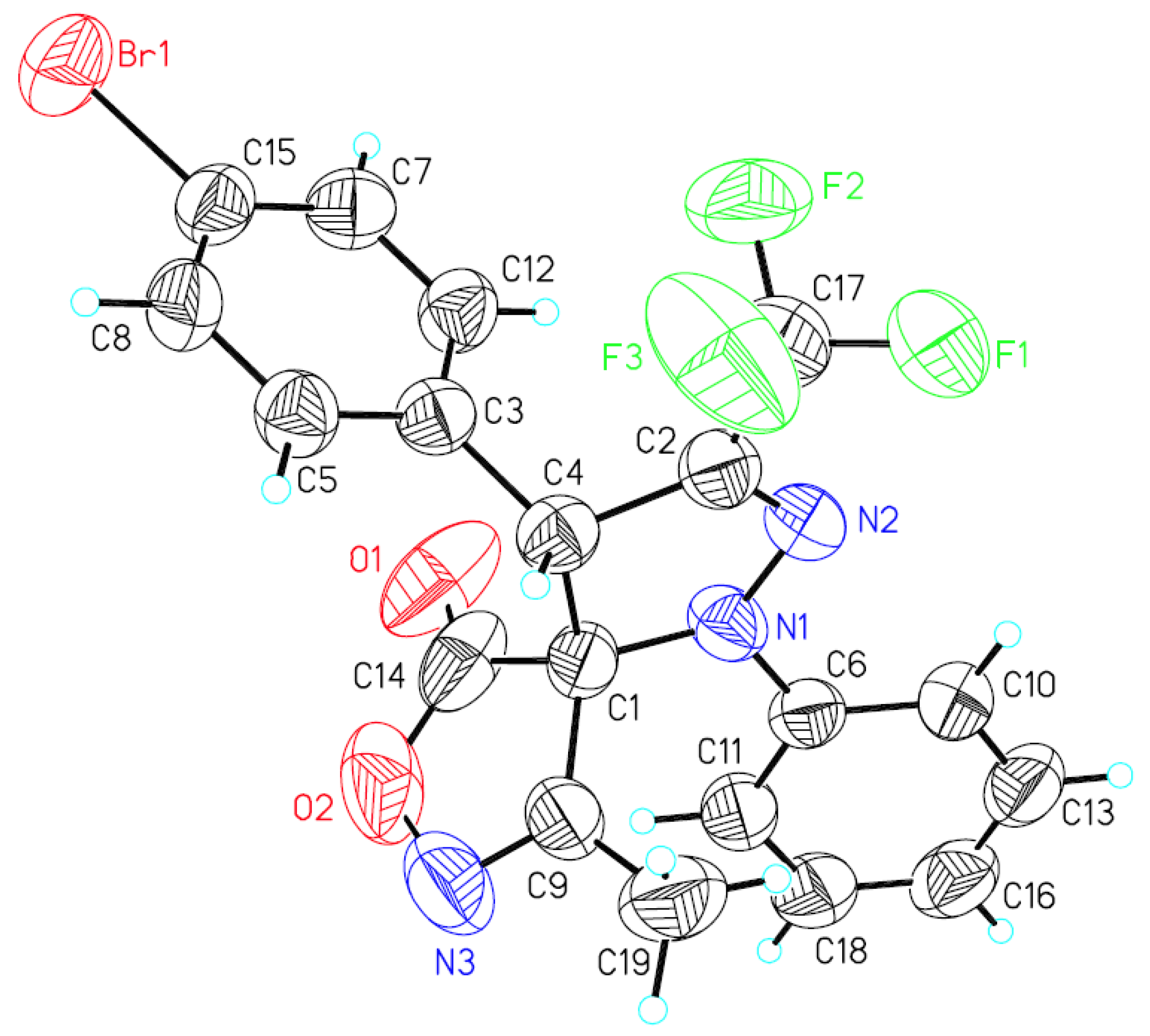
(rel-4S,5R)-4-(4-Bromophenyl)-9-methyl-1-phenyl-3-(trifluoromethyl)-7-oxa-1,2,8-triazaspiro[4.4]nona-2,8-dien-6-one (syn-3h). The synthesis of this compound was conducted using a standardized protocol, followed by purification through column chromatography on silica gel (200–300 mesh) with petroleum ether/ethyl acetate (20:1 v/v) as the eluent to give 108.5 mg, 60% yield, yellow solid; m.p. 233–235 °C; 1H NMR (500 MHz, CDCl3): δ 7.37 (d, J = 8.5 Hz, 2H, ArH), 7.33–7.29 (m, 2H, ArH), 7.12 (d, J = 8.5 Hz 2H, ArH), 7.09 (t, J = 7.5 Hz, 1H, ArH), 6.99 (d, J = 8.0 Hz 2H, ArH), 4.81 (s, 1H, CH), 2.18 (s, 3H, CH3) ppm; 13C NMR (126 MHz, CDCl3): δ 169.8, 165.3, 141.1, 137.9 (q, 2JC–F = 38.0 Hz), 132.4, 130.9, 129.9, 127.4, 124.6, 124.1, 119.8 (q, 1JC–F = 272.0 Hz), 116.6, 77.1, 59.8, 11.8 ppm; 19F NMR (471 MHz, CDCl3): δ −62.3 (s, 3F) ppm. HRMS (ESI): m/z calcd. for C19H14BrF3N3O2 [M + H]+ 452.0216, found 452.0209.
(rel-4S,5R)-4-(3-Chlorophenyl)-9-methyl-1-phenyl-3-(trifluoromethyl)-7-oxa-1,2,8-triazaspiro[4.4]nona-2,8-dien-6-one (syn-3i). The synthesis of this compound was conducted using a standardized protocol, followed by purification through column chromatography on silica gel (200–300 mesh) with petroleum ether/ethyl acetate (20:1 v/v) as the eluent to give 44.0 mg, 27% yield, yellow oil; 1H NMR (500 MHz, CDCl3): δ 7.14 (d, J = 8.0 Hz, 2H, ArH), 7.07 (t, J = 7.8 Hz, 2H, ArH), 6.94–6.86 (m, 3H, ArH), 6.80 (s, 1H, ArH), 6.74 (d, J = 7.5 Hz, 1H, ArH), 6.04 (s, 1H, CH), 2.54 (s, 3H, CH3) ppm; 13C NMR (126 MHz, CDCl3): δ 169.4, 142.4, 140.8 (q, 2JC–F = 37.1 Hz), 135.6, 133.4, 128.7, 128.5, 128.4, 127.6, 126.9, 125.6, 125.2, 119.7 (q, 1JC–F = 272.7 Hz), 119.4, 105.0, 77.2, 22.5 ppm; 19F NMR (471 MHz, CDCl3): δ −70.1 (s, 3F) ppm. HRMS (ESI): m/z calcd. for C19H14ClF3N3O2 [M + H]+ 408.0721, found 408.0707.
(rel-4S,5R)-4-(2-Chlorophenyl)-9-methyl-1-phenyl-3-(trifluoromethyl)-7-oxa-1,2,8-triazaspiro[4.4]nona-2,8-dien-6-one (syn-3j). The synthesis of this compound was conducted using a standardized protocol, followed by purification through column chromatography on silica gel (200–300 mesh) with petroleum ether/ethyl acetate (20:1 v/v) as the eluent to give 86.4 mg, 53% yield, yellow oil; 1H NMR (500 MHz, CDCl3): δ 7.54–7.51 (m, 1H, ArH), 7.42–7.35 (m, 2H, ArH), 7.32–7.28 (m, 3H, ArH), 7.10 (t, J = 7.2 Hz, 1H, ArH), 6.99 (d, J = 8.5 Hz, 2H, ArH), 5.67 (s, 1H, CH), 1.34 (s, 3H, CH3) ppm; 13C NMR (126 MHz, CDCl3): δ 174.0, 163.7, 141.0, 138.1 (q, 2JC–F = 38.3 Hz), 134.7, 131.3, 130.8, 130.3, 129.8, 128.6, 127.3, 124.4, 119.8 (q, 1JC–F = 272.1 Hz), 115.8, 75.6, 58.6, 13.3 ppm; 19F NMR (471 MHz, CDCl3): δ −61.6 (s, 3F), ppm. HRMS (ESI): m/z calcd. for C19H14ClF3N3O2 [M + H]+ 408.0721, found 408.0722.
(rel-4S,5R)-9-Methyl-1-phenyl-4-(thiophen-3-yl)-3-(trifluoromethyl)-7-oxa-1,2,8-triazaspiro[4.4]nona-2,8-dien-6-one (syn-3k). The synthesis of this compound was conducted using a standardized protocol, followed by purification through column chromatography on silica gel (200–300 mesh) with petroleum ether/ethyl acetate (20:1 v/v) as the eluent to give 85.0 mg, 56% yield, yellow oil; 1H NMR (500 MHz, CDCl3): δ 7.36 (d, J = 5.0 Hz, 1H, ArH), 7.30 (d, J = 8.0 Hz, 2H, ArH), 7.09–7.04 (m, 3H, ArH), 7.00 (d, J = 8.0 Hz, 2H, ArH), 5.17 (s, 1H, CH), 2.18 (s, 3H, CH3) ppm; 13C NMR (126 MHz, CDCl3): δ 169.6, 165.2, 141.3, 137.5 (q, 2JC–F = 38.1 Hz), 130.3, 129.9, 128.5, 128.2, 127.8, 124.2, 119.7 (q, 1JC–F = 272.0 Hz), 115.2, 77.8, 54.6, 11.8 ppm; 19F NMR (471 MHz, CDCl3): δ −62.2 (s, 3F) ppm. HRMS (ESI): m/z calcd. for C17H13F3N3O2S [M + H]+ 380.0675, found 380.0663.
(rel-4S,5R)-9-Methyl-4-(naphthalen-1-yl)-1-phenyl-3-(trifluoromethyl)-7-oxa-1,2,8-triazaspiro[4.4]nona-2,8-dien-6-one (syn-3l). The synthesis of this compound was conducted using a standardized protocol, followed by purification through column chromatography on silica gel (200–300 mesh) with petroleum ether/ethyl acetate (20:1 v/v) as the eluent to give 133.8 mg, 79% yield, yellow solid; m.p. 197–199 °C; 1H NMR (500 MHz, CDCl3): δ 7.93–7.90 (m, 2H, ArH), 7.64 (d, J = 8.0 Hz, 1H, ArH), 7.60–7.51 (m, 3H, ArH), 7.41 (d, J = 7.5 Hz, 1H, ArH), 7.30 (t, J = 8.0 Hz, 2H, ArH), 7.07 (t, J = 7.5 Hz, 1H, ArH), 7.00 (d, J = 8.0 Hz, 2H, ArH), 5.71 (s, 1H, CH), 2.26 (s, 3H, CH3) ppm; 13C NMR (126 MHz, CDCl3): δ 169.8, 165.1, 141.1, 138.9 (q, 2JC–F = 38.0 Hz), 134.1, 130.8, 130.6, 129.9, 129.7, 129.1, 127.6, 126.3, 125.2, 124.1, 123.9, 121.0, 120.0 (q, 1JC–F = 272.1 Hz), 114.9, 75.9, 55.0, 11.9 ppm. 19F NMR (471 MHz, CDCl3): δ −61.9 (s, 3F) ppm. HRMS (ESI): m/z calcd. for C23H17F3N3O2 [M + H]+424.1267, found 424.1269.
(rel-4R,5R)-9-Methyl-4-(naphthalen-1-yl)-1-phenyl-3-(trifluoromethyl)-7-oxa-1,2,8-triazaspiro[4.4]nona-2,8-dien-6-one (anti-3l). The synthesis of this compound was conducted using a standardized protocol, followed by purification through column chromatography on silica gel (200–300 mesh) with petroleum ether/ethyl acetate (20:1 v/v) as the eluent to give 23.7 mg, 14% yield, colorless oil; 1H NMR (500 MHz, CDCl3): δ 7.94 (t, J = 7.5 Hz, 2H, ArH), 7.77 (d, J = 8.5 Hz, 1H, ArH), 7.66–7.58 (m, 2H, ArH), 7.51 (t, J = 7.8 Hz, 1H, ArH), 7.43 (d, J = 7.0 Hz, 2H, ArH), 7.32–7.28 (m, 2H, ArH), 7.08 (t, J = 7.5 Hz, 1H, ArH), 7.00 (d, J = 8.0 Hz, 1H, ArH), 5.97 (s, 1H, CH), 1.12 (s, 3H, CH3) ppm; 13C NMR (126 MHz, CDCl3): δ 174.7, 164.8, 141.3, 139.2 (q, 2JC–F = 38.0 Hz), 134.1, 131.0, 130.9, 129.8, 129.4, 128.1, 127.5, 127.0, 125.9, 124.7, 124.2, 121.8, 120.0 (q, 1JC–F = 272.2 Hz), 115.6, 76.2, 57.9, 13.5 ppm. 19F NMR (471 MHz, CDCl3): δ −61.4 (s, 3F), ppm. HRMS (ESI): m/z calcd. for C23H17F3N3O2 [M + H]+ 424.1267, found 424.1272.
(rel-4S,5R)-9-Mmethyl-4-phenyl-1-(p-tolyl)-3-(trifluoromethyl)-7-oxa-1,2,8-triazaspiro[4.4]nona-2,8-dien-6-one (syn-3m). The synthesis of this compound was conducted using a standardized protocol, followed by purification through column chromatography on silica gel (200–300 mesh) with petroleum ether/ethyl acetate (20:1 v/v) as the eluent to give 108.5 mg, 70% yield, white solid; m.p. 195–197 °C; 1H NMR (400 MHz, CDCl3): δ 7.42–7.38 (m, 3H, ArH), 7.20–7.17 (m, 2H, ArH), 7.11 (d, J = 8.0 Hz, 2H, ArH), 6.90 (d, J = 8.8 Hz, 2H, ArH), 4.84 (s, 1H, CH), 2.29 (s, 3H, CH3), 2.20 (s, 3H, CH3) ppm; 13C NMR (101 MHz, CDCl3): δ 169.9, 165.5, 139.0, 138.1 (q, 2JC–F = 37.8 Hz), 133.8, 130.3, 130.0, 129.4, 129.1, 128.5, 120.0 (q, 1JC–F = 272.3 Hz), 115.9, 77.7, 60.4, 20.6, 11.8 ppm; 19F NMR (376 MHz, CDCl3): δ −62.2 (s, 3F) ppm. HRMS (ESI): m/z calcd. for C20H17F3N3O2 [M + H]+ 388.1267, found 388.1254.
(rel-4R,5R)-9-Methyl-4-phenyl-1-(p-tolyl)-3-(trifluoromethyl)-7-oxa-1,2,8-triazaspiro[4.4]nona-2,8-dien-6-one (anti-3m). The synthesis of this compound was conducted using a standardized protocol, followed by purification through column chromatography on silica gel (200–300 mesh) with petroleum ether/ethyl acetate (20:1 v/v) as the eluent to give 20.1 mg, 13% yield, yellow oil; 1H NMR (400 MHz, CDCl3): δ 7.44–7.42 (m, 3H, ArH), 7.23–7.21 (m, 2H, ArH), 7.10 (d, J = 8.0 Hz, 2H, ArH), 6.89 (d, J = 8.8 Hz, 2H, ArH), 5.14 (s, 1H, CH), 2.29 (s, 3H, CH3), 1.37 (s, 3H, CH3) ppm; 13C NMR (101MHz, CDCl3): δ 174.5, 164.5, 138.9,138.4 (q, 2JC–F = 38.1 Hz), 134.2, 130.3, 130.0, 129.7, 129.6, 128.7, 120.0 (q, 1JC–F = 272.4 Hz), 115.8, 77.6, 62.6, 20.6, 13.5 ppm; 19F NMR (376 MHz, CDCl3): δ −61.8 (s, 3F) ppm. HRMS (ESI): m/z calcd. for C20H17F3N3O2 [M + H]+ 388.1267, found 388.1256.
(rel-4S,5R)-4-(4-Bromophenyl)-9-methyl-1-(p-tolyl)-3-(trifluoromethyl)-7-oxa-1,2,8-triazaspiro[4.4]nona-2,8-dien-6-one (syn-3n). The synthesis of this compound was conducted using a standardized protocol, followed by purification through column chromatography on silica gel (200–300 mesh) with petroleum ether/ethyl acetate (20:1 v/v) as the eluent to give 102.6 mg, 55% yield, yellow oil; 1H NMR (500 MHz, CDCl3): δ 7.52 (d, J = 8.0 Hz, 2H, ArH), 7.11 (d, J = 8.0 Hz, 2H, ArH), 7.06 (d, J = 8.0 Hz, 2H, ArH), 6.89 (d, J = 8.5 Hz, 2H, ArH), 4.78 (s, 1H, CH), 2.29 (s, 3H, CH3), 2.18 (s, 3H, CH3) ppm; 13C NMR (126 MHz, CDCl3): δ 169.9, 165.3, 138.8, 137.6 (q, 2JC–F = 37.8 Hz), 134.1, 132.4, 130.9, 130.4, 127.5, 124.5, 119.9 (q, 1JC–F = 272.0 Hz), 115.4, 77.5, 59.7, 20.6, 11.8 ppm; 19F NMR (471 MHz, CDCl3): δ −62.2 (s, 3F) ppm. HRMS (ESI): m/z calcd. for C20H16BrF3N3O2 [M + H]+ 466.0373, found 466.0316.
(rel-4S,5R)-9-Methyl-4-(o-tolyl)-1-(p-tolyl)-3-(trifluoromethyl)-7-oxa-1,2,8-triazaspiro[4.4]nona-2,8-dien-6-one (syn-3o). The synthesis of this compound was conducted using a standardized protocol, followed by purification through column chromatography on silica gel (200–300 mesh) with petroleum ether/ethyl acetate (20:1 v/v) as the eluent to give 72.3 mg, 45% yield, yellow oil; 1H NMR (500 MHz, CDCl3): δ 7.29–7.23 (m, 2H, ArH), 7.21 (d, J = 8.0 Hz, 1H, ArH), 7.16 (d, J = 7.5 Hz, 1H, ArH), 7.10 (d, J = 8.5 Hz, 2H, ArH), 6.89 (d, J = 8.5 Hz, 2H, ArH), 5.14 (s, 1H, CH), 2.29 (s, 3H, CH3), 2.28 (s, 3H, CH3), 2.16 (s, 3H, CH3) ppm; 13C NMR (126 MHz, CDCl3): δ 170.0, 165.7, 138.9, 138.8 (q, 2JC–F = 37.6 Hz), 135.6, 133.7, 131.1, 130.5, 130.3, 129.7, 127.0, 126.5, 119.9 (q, 1JC–F = 271.9 Hz), 115.1, 76.2, 56.0, 20.6, 19.5, 11.8 ppm; 19F NMR (471 MHz, CDCl3): δ −62.2 (s, 3F) ppm. HRMS (ESI): m/z calcd. for C21H19F3N3O2 [M + H]+ 402.1424, found 402.1429.
(rel-4R,5R)-9-Mmethyl-4-(o-tolyl)-1-(p-tolyl)-3-(trifluoromethyl)-7-oxa-1,2,8-triazaspiro[4.4]nona-2,8-dien-6-one (anti-3o). The synthesis of this compound was conducted using a standardized protocol, followed by purification through column chromatography on silica gel (200–300 mesh) with petroleum ether/ethyl acetate (20:1 v/v) as the eluent to give 11.2 mg, 7% yield, yellow oil; 1H NMR (500 MHz, CDCl3): δ 7.34–7.28 (m, 2H, ArH), 7.27–7.25 (m, 1H, ArH), 7.17 (d, J = 7.5 Hz, 1H, ArH), 7.10 (d, J = 9.0 Hz, 2H, ArH), 6.88 (d, J = 8.5 Hz, 2H, ArH), 5.34 (s, 1H, CH), 2.30 (s, 3H, CH3), 2.29 (s, 3H, CH3), 1.31 (s, 3H, CH3) ppm; 13C NMR (126 MHz, CDCl3): δ 174.4, 165.6, 139.3 (q, 2JC–F = 38.0 Hz), 139.1, 136.8, 134.2, 131.8, 130.3, 129.9, 129.1, 128.5, 126.6, 119.9 (q, 1JC–F = 272.4 Hz), 116.1, 76.1, 58.6, 20.6, 19.6, 13.5 ppm; 19F NMR (471 MHz, CDCl3): δ −61.8 (s, 3F), ppm. HRMS (ESI): m/z calcd. for C21H19F3N3O2 [M + H]+ 402.1424, found 402.1429.
(rel-4S,5R)-9-Methyl-4-(m-tolyl)-1-(p-tolyl)-3-(trifluoromethyl)-7-oxa-1,2,8-triazaspiro[4.4]nona-2,8-dien-6-one (syn-3p). The synthesis of this compound was conducted using a standardized protocol, followed by purification through column chromatography on silica gel (200–300 mesh) with petroleum ether/ethyl acetate (20:1 v/v) as the eluent to give 93.1 mg, 58% yield, yellow oil; 1H NMR (500 MHz, CDCl3): δ 7.27 (t, J = 7.8 Hz, 1H, ArH), 7.20 (d, J = 7.5 Hz, 1H, ArH), 7.10 (d, J = 8.5 Hz, 2H, ArH), 6.98 (d, J = 9.5 Hz, 2H, ArH), 6.90 (d, J = 8.5 Hz, 2H, ArH), 4.80 (s, 1H, CH), 2.34 (s, 3H, CH3), 2.28 (s, 3H, CH3), 2.19 (s, 3H, CH3) ppm; 13C NMR (126 MHz, CDCl3): δ 169.9, 165.5, 139.1, 138.9, 138.2 (q, 2JC–F =37.8 Hz), 133.7, 130.8, 130.3, 129.9, 128.9, 128.4, 126.5, 120.0 (q, 1JC–F = 271.8 Hz), 115.3, 77.7, 60.5, 21.3, 20.6, 11.8 ppm; 19F NMR (471 MHz, CDCl3): δ −62.2 (s, 3F) ppm. HRMS (ESI): m/z calcd. for C21H19F3N3O2 [M + H]+ 402.1424, found 402.1420.
(rel-4S,5R)-1-(4-Fluorophenyl)-9-methyl-4-phenyl-3-(trifluoromethyl)-7-oxa-1,2,8-triazaspiro[4.4]nona-2,8-dien-6-one (syn-3q). The synthesis of this compound was conducted using a standardized protocol, followed by purification through column chromatography on silica gel (200–300 mesh) with petroleum ether/ethyl acetate (20:1 v/v) as the eluent to give 112.7 mg, 72% yield, yellow oil; 1H NMR (400 MHz, CDCl3): δ 7.42–7.36 (m, 3H, ArH), 7.19–7.17 (m, 2H, ArH), 7.04–6.96 (m, 4H, ArH), 4.87 (s, 1H, CH), 2.21 (s, 3H, CH3) ppm; 13C NMR (101 MHz, CDCl3): δ 169.8, 165.2, 159.4 (d, 1J = 245.1 Hz), 138.9 (q, 2J = 38.0 Hz), 137.6 (d, 4J = 2.4 Hz), 130.1, 129.3, 129.1, 128.2, 119.8 (q, 1J = 272.6 Hz), 117.2 (d, 3J = 8.1 Hz), 116.7 (d, 2J = 22.9 Hz), 78.0, 60.6, 11.8 ppm; 19F NMR (376 MHz, CDCl3): δ −62.3 (s, 3F), 118.4 (m, 1F) ppm. HRMS (ESI): m/z calcd. for C19H14F4N3O2 [M + H]+ 392.1017, found 392.0983.
(rel-4R,5R)-1-(4-Fluorophenyl)-9-methyl-4-phenyl-3-(trifluoromethyl)-7-oxa-1,2,8-triazaspiro[4.4]nona-2,8-dien-6-one (anti-3q). The synthesis of this compound was conducted using a standardized protocol, followed by purification through column chromatography on silica gel (200–300 mesh) with petroleum ether/ethyl acetate (20:1 v/v) as the eluent to give 21.9 mg, 14% yield, yellow oil; 1H NMR (400 MHz, CDCl3): δ 7.46–7.44 (m, 3H, ArH), 7.23–7.21 (m, 2H, ArH), 7.04–6.96 (m, 4H, ArH), 5.15 (s,1H, CH), 1.39 (s, 3H, CH3) ppm; 13C NMR (101 MHz, CDCl3): δ 174.2, 164.3, 159.7 (d, 1J = 245.5 Hz), 139.4 (q, 2JC-F = 38.3 Hz), 137.5 (d, 4J = 2.7 Hz), 130.1, 129.7, 129.5, 128.7, 119.8 (q, 1JC-F = 272.7 Hz), 117.9 (d, 3J = 8.2 Hz), 116.6 (d, 2J = 23.0 Hz), 77.6, 62.6, 13.5 ppm; 19F NMR (376 MHz, CDCl3): δ −62.0 (s, 3F), 117.9 (m, 1F) ppm. HRMS (ESI): m/z calcd. for C19H14F4N3O2 [M + H]+ 392.1017, found 392.1004.
(rel-4S,5R)-1-(4-Fluorophenyl)-9-methyl-4-(p-tolyl)-3-(trifluoromethyl)-7-oxa-1,2,8-triazaspiro[4.4]nona-2,8-dien-6-one (syn-3r). The synthesis of this compound was conducted using a standardized protocol, followed by purification through column chromatography on silica gel (200–300 mesh) with petroleum ether/ethyl acetate (20:1 v/v) as the eluent to give 123.2 mg, 76% yield, yellow oil; 1H NMR (500 MHz, CDCl3): δ 7.19 (d, J = 8.0 Hz, 2H, ArH), 7.06 (d, J = 8.0 Hz, 2H, ArH), 7.03–6.96 (m, 4H, ArH), 4.85 (s, 1H, CH), 2.34 (s, 3H, CH3), 2.21 (s, 3H, CH3) ppm; 13C NMR (126 MHz, CDCl3): δ 169.8, 165.2, 159.4 (d, 1J = 244.9 Hz), 140.2, 139.1 (q, 2J = 37.8 Hz), 137.7 (4d, J = 2.5 Hz), 129.9, 129.2, 125.1, 119.8 (q, 1J = 272.2 Hz), 117.1 (d, 3J = 7.3 Hz), 116.6 (d, 2J = 22.9 Hz), 78.1, 60.4, 21.2, 11.8 ppm; 19F NMR (471 MHz, CDCl3): δ −62.3 (s, 3F), 118.6 (m, 1F) ppm. HRMS (ESI): m/z calcd. for C20H16F4N3O2 [M + H]+ 406.1173, found 406.1178.
(rel-4R,5R)-1-(4-Fluorophenyl)-9-methyl-4-(p-tolyl)-3-(trifluoromethyl)-7-oxa-1,2,8-triazaspiro[4.4]nona-2,8-dien-6-one (anti-3r). The synthesis of this compound was conducted using a standardized protocol, followed by purification through column chromatography on silica gel (200–300 mesh) with petroleum ether/ethyl acetate (20:1 v/v) as the eluent to give 19.5 mg, 12% yield, yellow oil; 1H NMR (500 MHz, CDCl3): δ 7.24 (d, J = 8.0 Hz, 2H, ArH), 7.09 (d, J = 8.0 Hz, 2H, ArH), 7.04–6.95 (m, 4H, ArH), 5.12 (s, 1H, CH), 2.38 (s, 3H, CH3), 1.42 (s, 3H, CH3) ppm; 13C NMR (126 MHz, CDCl3): δ 174.3, 164.4, 159.6 (d, 1J = 244.9 Hz), 140.3, 139.6 (q, 2J = 37.9 Hz), 137.6 (d, 4J = 2.6 Hz), 130.3, 128.6, 126.4, 119.9 (q, 1J = 272.3 Hz), 117.7 (d, 3J = 8.1 Hz), 116.6 (d, 2J = 23.1 Hz), 77.7, 62.5, 21.2, 13.6 ppm; 19F NMR (471 MHz, CDCl3): δ −62.0 (s, 3F), 118.1 (m, 1F) ppm. HRMS (ESI): m/z calcd. for C20H16F4N3O2 [M + H]+ 406.1173, found 406.1181.
(rel-4S,5R)-1-(4-Fluorophenyl)-9-methyl-4-(o-tolyl)-3-(trifluoromethyl)-7-oxa-1,2,8-triazaspiro[4.4]nona-2,8-dien-6-one (syn-3s). The synthesis of this compound was conducted using a standardized protocol, followed by purification through column chromatography on silica gel (200–300 mesh) with petroleum ether/ethyl acetate (20:1 v/v) as the eluent to give 77.8 mg, 48% yield, yellow oil; 1H NMR (500 MHz, CDCl3): δ 7.30–7.25 (m, 2H, ArH), 7.24–7.21 (m, 1H, ArH), 7.15 (d, J = 7.5 Hz, 1H, ArH), 7.03–6.95 (m, 4H, ArH), 5.16 (s,1H, CH), 2.29 (s, 3H, CH3), 2.17 (s, 3H, CH3) ppm; 13C NMR (126 MHz, CDCl3): δ 169.8, 165.4, 159.3 (d, 1J = 244.4 Hz), 139.6 (q, 2J = 38.0 Hz), 137.5 (d, 4J = 2.5 Hz), 135.6, 131.2, 130.5, 129.8, 126.8, 126.6, 119.8 (q, 1J = 272.2), 116.9 (d, 3J = 8.1 Hz), 116.7 (d, 2J = 23.2 Hz), 76.3, 56.2, 19.5, 11.8 ppm; 19F NMR (471 MHz, CDCl3): δ −62.7 (s, 3F), 118.7 (m, 1F) ppm. HRMS (ESI): m/z calcd. for C20H16F4N3O2 [M + H]+ 406.1173, found 406.1170.
(rel-4R,5R)-1-(4-Fluorophenyl)-9-methyl-4-(o-tolyl)-3-(trifluoromethyl)-7-oxa-1,2,8-triazaspiro[4.4]nona-2,8-dien-6-one (anti-3s). The synthesis of this compound was conducted using a standardized protocol, followed by purification through column chromatography on silica gel (200–300 mesh) with petroleum ether/ethyl acetate (20:1 v/v) as the eluent to give 9.7 mg, 6% yield, yellow oil; 1H NMR (500 MHz, CDCl3): δ 7.35–7.27 (m, 3H, ArH), 7.17 (d, J = 7.5 Hz, 1H, ArH), 7.04–6.95 (m, 4H, ArH), 5.36 (s, 1H, CH), 2.30 (s, 3H, CH3), 1.32 (s, 3H, CH3) ppm; 13C NMR (126 MHz, CDCl3): δ 174.1, 165.3, 159.7 (d, 1J = 245.1 Hz), 140.4 (q, 2J = 38.1 Hz), 137.7 (d, 4J = 2.6 Hz), 136.8, 131.9, 130.1, 129.0, 128.2, 126.7, 119.8 (q, 1J = 272.2 Hz), 118.1 (d, 3J = 8.2 Hz), 116.7 (d, 2J = 23.1 Hz), 76.3, 58.7, 19.6, 13.5 ppm; 19F NMR (471 MHz, CDCl3): δ −62.1 (s, 3F), 117.9 (m, 1F) ppm. HRMS (ESI): m/z calcd. for C20H16F4N3O2 [M + H]+ 406.1173, found 406.1170.