Abstract
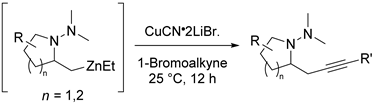
Nitrogen-containing heterocycles represent the majority of FDA-approved small-molecule pharmaceuticals. Herein, we describe a synthetic method to produce saturated N-heterocyclic drug scaffolds with an internal alkyne for elaboration. The treatment of N,N-dimethylhydrazinoalkenes with Et2Zn, followed by a Cu(I)-catalyzed cross-coupling with 1-bromoalkynes, results in piperidines and pyrrolidines with a good yield. Five examples are reported and a proposed mechanism for the Cu(I)-catalyzed cross-coupling is presented.
1. Introduction
Nitrogen-containing heterocycles are recognized as privileged scaffolds for pharmaceuticals due to their increased pharmacokinetics and bioavailability [1,2,3]. As such, N-heterocycles are present in nearly 59% of all FDA-approved small molecule drugs and make up a plurality of newly approved drugs each year [4,5,6]. Piperidines and pyrrolidines appear in the top five most common N-heterocycles in FDA-approved drugs [1]. Industrial drug discovery initiatives often approach drug synthesis by creating large molecular libraries that can comprise hundreds of variations of one scaffold [7,8]. The use of neural networks and powerful algorithms to identify better and more specific target compounds has helped narrow the scope of these libraries [8]. However, each of these target compounds and their variants must be synthesized, purified, and assayed, which can take a significant amount of time to achieve for even a single drug candidate. Therefore, a synthetic method that provides stereodefined N-heterocyclic scaffolds with functional groups that can easily be modified would be extremely useful for drug discovery.
We have previously reported one such method involving the use of Et2Zn in a Zn(II)-mediated metalloamination/cyclization cascade with subsequent electrophilic functionalization (Scheme 1) [9,10,11].
Scheme 1.
Zn(II)-mediated metalloamination/cyclization with subsequent functionalization [9].
Unlike previously reported methods, the Zn(II)-mediated metalloamination/cyclization cascade does not rely on transient intermediates that limit the following functionalization to only those electrophiles which react quickly and completely [12,13,14,15,16,17,18,19,20]. The Zn(II) cascade generates a stable organozinc intermediate that can readily be transmetallated, resulting in the formation of a diverse repository of scaffolds. Here, we expand the scope of this method to the use of 1-bromoalkynes in Cu(I)-catalyzed functionalizations.
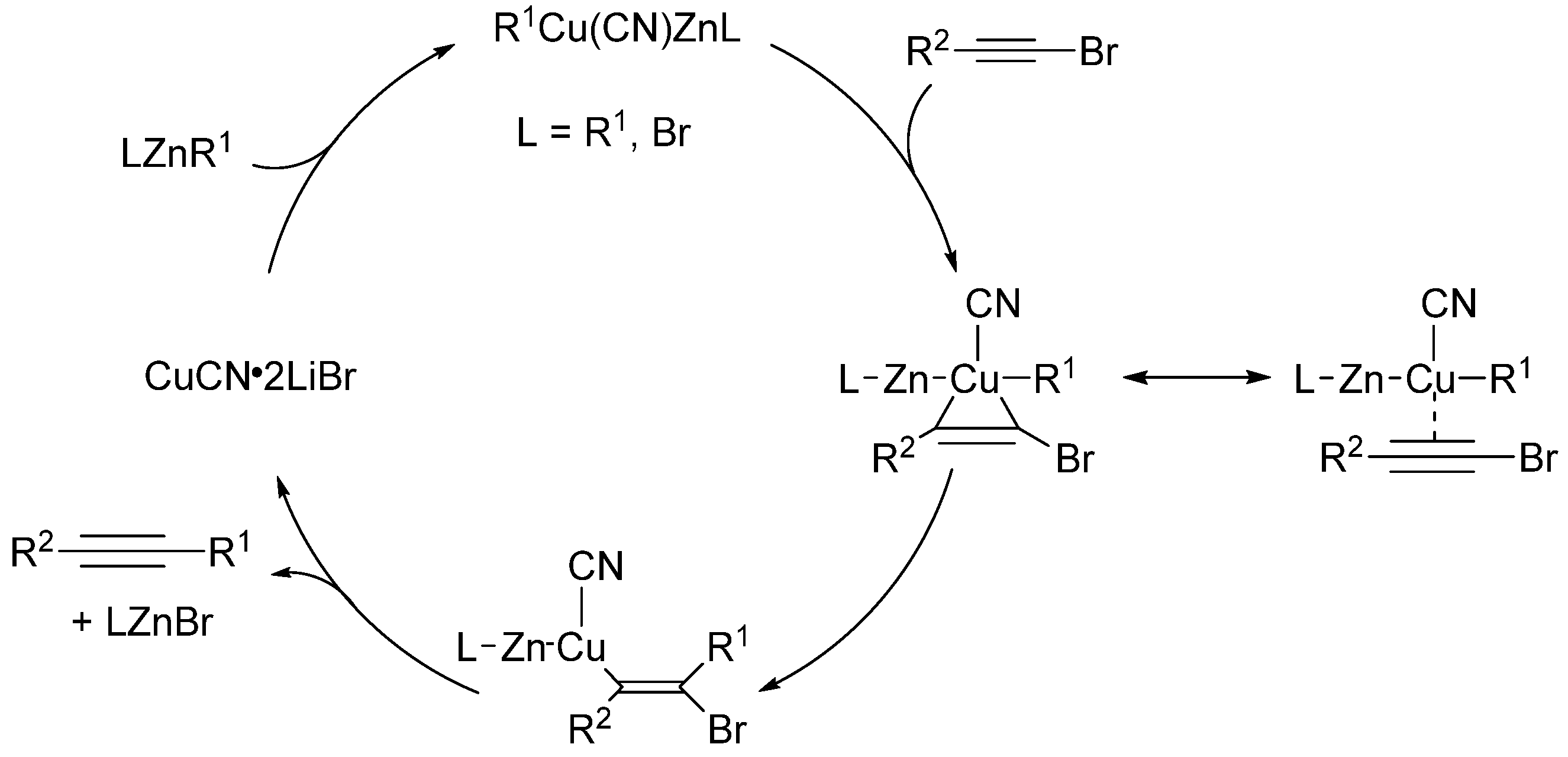
The cross-coupling of 1-haloalkynes with organozinc reagents was first reported by Knochel [21]. This initial report involved the coupling of alkyl organozincs with bromo- and iodoalkynes in the presence of catalytic CuCN·2LiCl to produce internal alkynes in good yields. The copper/zinc reagent RCu(CN)ZnX formed during this reaction is not well characterized, but subsequent studies by Knochel and others have elucidated the likely mechanism of this reaction (Figure 1, adapted from Thapa et al.) [22,23,24]. This original study demonstrated the usefulness of this method by its application to the synthesis of a pheromone present in Amathes c-nigram [21].
Figure 1.
Proposed mechanism for the Cu(I)-catalyzed cross-coupling of 1-bromoalkynes with alkyl zinc reagents [24].
2. Results and Discussion
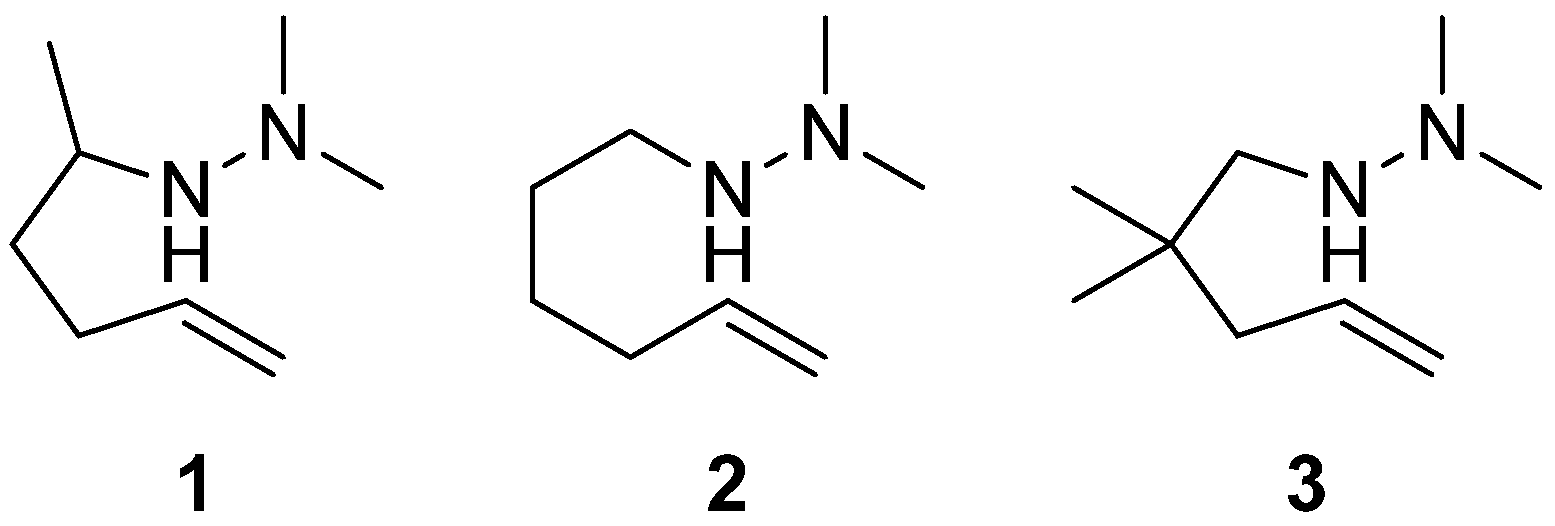
Our investigation started with N,N-dimethylhydrazinoalkenes 1–3 (Figure 2), which underwent metalloamination/cyclization as reported previously [9,11]. Benzotriflouride and toluene provided excellent conversion to the organozinc intermediate, with toluene proceeding at slower rate. In contrast, 1,2-dichlorethane, diisopropyl ether, acetonitrile, and isobutyronitrile were found to provide incomplete conversion.
Figure 2.
N,N-dimethylhydrazinoalkenes used in this study.
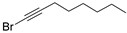
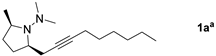
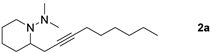
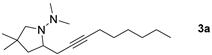
These intermediates were treated with 1-bromo-1-octyne (two equiv.), CuCN·2LiBr (5 mol%), and LiBr (one equiv.). The utilization of LiBr as an additive confers a significant stabilizing and accelerating influence, as we have previously reported [9]. Ethereal solvents were necessary, with THF being optimal for Cu(I)-catalyzed electrophilic functionalization. The isolation of the products was straightforward and produced 1a and 2a in good yields (Table 1). Product 3a demonstrates that an increased steric bulk on the N-heterocycle still leads to successful coupling. Having found success with these reactions, we moved forward to coupling with the more reactive alkyne, 1-bromo-2-phenylethyne.
Table 1.
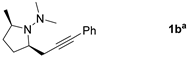
Results of the cross-coupling of 1-bromo-1-octyne and 1-bromo-2-phenylethyne with N,N-dimethylhydrazinoalkenes 1, 2, and 3.
Knochel reported that Cu(I)-catalyzed cross-couplings with 1-bromo-2-phenylethyne were difficult to control. Successful reactions with 1-bromo-2-phenylethyne took 1–4 h at −76 °C to complete, and increasing the temperature inevitably led to decreased yields [21]. Diamine ligands can exert a stabilizing effect on copper catalysts [25]. These ligands also accelerate Cu(I)-catalyzed cross-coupling reactions [26,27]. Unfortunately, in our hands, the coupling of 2 with 1-bromo-2-phenylethyne in the presence of TMEDA (one equiv.) led to a marked decrease in the yield of 2b (25%). Lowering the reaction temperature led to no improvement. In this case, the product mixture contained a homocoupled diyne product and the Zn metalloamination intermediate derived from 2. In consonance with our previously reported conditions [9], the inclusion of one equiv. of LiBr allowed the alkynyalation reactions leading to both 2a and 2b to be run at room temperature with improved yields.
3. Materials and Methods
3.1. Materials
All materials were either prepared according to previous literature or purchased from commercial sources. N,N-dimethylhydrazinoalkene substrates 1–3 were synthesized by previously reported methods [11,27] and stored in an inert atmosphere glovebox. All solvents were obtained from a JC Meyer solvent dispensing system. Inorganic salts were dried by heating under a high vacuum before use. Thin-layer chromatography (TLC) employed 0.25 mm glass silica gel plates with UV indicator and were visualized with UV light (254 nm) or potassium permanganate staining. Nuclear magnetic resonance (NMR) data were obtained from a Bruker AVANCE III HD NMR spectrometer equipped with an Ascend 500 (500 MHz) magnet. High-resolution mass spectra (HRMS) were obtained from a Bruker MicroTOF with a Dart 100–SVP 100 ion source.
3.2. Experimental Procedures
3.2.1. General Procedure for the Synthesis of Alkynyl N,N-Dimethylhydrazinoalkenes
In an inert atmosphere glovebox, a 5 mm J. Young NMR tube with a sealed 3 mm NMR calibration tube containing C6D6 was charged with benzotrifluoride (BTF, 0.4 mL), 2 M diethyl zinc in BTF (60 μL, 0.12 mmol, 1.2 equiv.), and the requisite N,N-dimethylhydrazinoalkene (0.1 mmol). The J. Young tube was placed in a 90 °C oil bath and the cyclization reaction was monitored by NMR (indicated by the recession of the alkene peaks), using BTF as an internal standard. Upon completion of the cyclization, the volatiles were removed in vacuo. The J. Young NMR tube was returned to the glovebox and was charged with THF (0.3 mL), the requisite 1-bromoalkyne (0.2 mmol), 0.5 M CuCN·2LiBr solution in THF (10 μL, 5 mol%), and 2 M LiBr in THF (50 μL, 0.1 mmol, 1 equiv.). The reactant mixture was allowed to stand at room temperature overnight. The resulting solution was dispersed in diethyl ether (1 mL) and washed with an aqueous solution of 1:1 sat. NH4OH/sat. NH4SO4 (3 × 1 mL). The combined aqueous washes were then back-extracted with diethyl ether (2 × 1 mL) and the combined organic layers were concentrated in vacuo. The resulting crude product was dissolved in CH2Cl2 (1 mL), dispersed onto silica gel (50 mg), and dried in vacuo. This was purified by dry-loading the resulting silica gel onto a silica gel plug and eluting with pentane. The product was then flushed from the silica gel using diethyl ether and concentrated in vacuo. The product could be further purified, if necessary, by column chromatography (15% ether/pentane for elution).
1-(N,N-dimethylamino)-2-(2-heptynyl)-5-methyl-2a-3,4-5a-tetrahydropyrrole (1a). The title compound was synthesized by the general procedure, producing 19.2 mg (77%) of the title compound as a clear to yellow oil. 1H NMR (CDCl3, 500 MHz): δ 3.04 (dquint, 1H, J = 8.2, 6.2 Hz), 3.02–2.95 (m, 1H), 2.55–2.49 (m, 1H), 2.48 (s, 6H), 2.19–2.13 (m, 2H), 2.10 (ddt, 1H, J = 16.2, 9.3, 2.4 Hz), 1.83 (dq, 1H, J = 12.4, 8.0 Hz), 1.78–1.70 (m, 1H), 1.64–1.55 (m, 1H), 1.53–1.45 (m, 2H), 1.44–1.25 (m, 7H), 1.13 (d, 3H, J = 6.2 Hz), 0.91 (t, 3H, J = 7.0 Hz). 13C NMR (CDCl3, 126 MHz): δ 80.87, 78.79, 59.34, 54.56, 41.37, 31.53, 30.48, 29.28, 28.67, 27.84, 26.41, 22.73, 22.15, 18.95, 14.21. HRMS electrospray ionization (ESI) m/z calcd. for C16H30N2: 250.2409, found: 250.2415 (mass error Δm = 2.46 ppm). 1H NMR and 13C NMR spectra of product 1a can be found in the supplementary materials.
1-(N,N-dimethylamino)-2-(2-heptynyl)-2a-,3,4,5,6-pentahydropyridine (2a). The title compound was synthesized by the general procedure, producing 20.3 mg (81%) of the title compound as a clear to yellow oil. 1H NMR (CDCl3, 500 MHz): δ 2.99–2.94 (m, 1H), 2.91 (ddt, 1H, J = 16.4, 3.3, 2.5 Hz), 2.37–2.31 (ddt, 1H, J = 10.6, 9.0, 3.1 Hz), 2.29 (s, 6H), 2.17–2.10 (m, 3H), 2.05 (ddt, 1H, J = 16.4, 9.0, 2.5 Hz), 2.05–1.99 (m, 1H), 1.73–1.64 (m, 2H), 1.52–1.42 (m, 3H), 1.41–1.34 (m, 2H), 1.33–1.22 (m, 5H), 1.14 (qt, 1H, J = 13.2, 4.0 Hz), 0.88 (t, 3H, J = 7.0 Hz). 13C NMR (CDCl3, 126 MHz): δ 81.50, 78.92, 59.82, 42.90, 39.14, 32.32, 31.53, 29.35, 28.71, 26.34, 24.74, 23.79, 22.73, 19.06, 14.19. HRMS electrospray ionization (ESI) m/z calcd. for C16H30N2: 250.2409, found: 250.2412 (mass error Δm = 1.00 ppm). 1H NMR and 13C NMR spectra of product 2a can be found in the supplementary materials.
1-(N,N-dimethylamino)-2-(2-heptynyl)-4,4-dimethyl-2a-3,5-tetrahydropyrrole (3a). The title compound was synthesized by the general procedure, producing 15.3 mg (58%) of the title compound as a clear to yellow oil. 1H NMR (CDCl3, 500 MHz): δ 2.85 (ddd, 1H, J = 8.9, 8.0, 3.3 Hz) 2.6 (d, 1H, J = 8.2 Hz), 2.62 (ddt, 1H, J = 16.2, 3.3, 2.4 Hz), 2.44 (d, 1H, J = 8.2 Hz), 2.35 (s, 6H), 2.15 (m, 2H), 2.09 (ddt, 1H, J = 16.2, 8.9, 2.4 Hz), 1.69 (dd, 1H, J = 8.0, 12.6 Hz), 1.52–1.45 (m, 2H), 1.44–1.36 (m, 3H), 1.36–1.25 (m, 4H), 1.12 (s, 3H), 1.05 (s, 3H), 0.91 (t, 3H, J = 7.1 Hz). 13C NMR (CDCl3, 126 MHz): δ 80.88, 78.73, 59.92, 54.30, 43.97, 40.46, 34.06, 31.54, 30.54, 29.40, 29.30, 28.67, 24.44, 22.75, 18.97, 14.21. HRMS electrospray ionization (ESI) m/z calcd. for C17H32N2: 264.2565, found: 264.2567 (mass error Δm = 0.69 ppm). 1H NMR and 13C NMR spectra of product 3a can be found in the supplementary materials.
1-(N,N-dimethylamino)-2-(3-phenyl-2-propynyl)-5-methyl-2a-3,4-5a-tetrahydropyrrole (1b). The title compound was synthesized by the general procedure, producing 16.0 mg (66%) of the title compound as a clear to yellow oil. 1H NMR (CDCl3, 500 MHz): δ 7.44–7.40 (m, 2H), 7.32–7.25 (m, 3H), 3.15–3.06 (m, 2H), 2.77 (dd, 1H, J = 16.6, 3.7 Hz), 2.53 (s, 6H), 2.39 (dd, 1H, J = 16.6, 9.0 Hz), 1.95–1.85 (m, 1H), 1.83–1.74 (m, 1H), 1.74–1.65 (m, 1H), 1.47–1.37 (m, 1H), (d, 3H, J = 6.0 Hz). 13C NMR (CDCl3, 126 MHz): δ 131.70, 128.29, 127.54, 124.36, 89.23, 81.15, 59.28, 54.29, 41.43, 30.60, 27.86, 26.93, 22.27. HRMS electrospray ionization (ESI) m/z calcd. for C16H22N2: 242.1783, found: 242.1784 (mass error Δm = 0.48 ppm). 1H NMR and 13C NMR spectra of product 1b can be found in the supplementary materials.
1-(N,N-dimethylamino)-2-(3-phenyl-2-propynyl)-2a-3,4,5,6-pentahydropyridine (2b). The title compound was synthesized by the general procedure, producing 17.4 mg (72%) of the title compound as a clear to yellow oil. 1H NMR (CDCl3, 500 MHz): δ 7.40–7.45 (m, 2H), 7.24–7.32 (m, 3H), 3.18 (dd, 1H, J = 16.7, 3.5 Hz), 2.99–3.05 (m, 1H), 2.48–2.55 (m, 1H), 2.36 (s, 6H), 2.36 (dd, 1H, J = 16.6, 8.9 Hz), 2.20 (ddd, 1H, J = 12.3, 10.6, 2.5 Hz), 2.08–2.15 (m, 1H), 1.69–1.78 (m, 2H), 1.47–1.58 (m, 1H), 1.34–1.44 (m, 1H), 1.15–1.26 (m, 1H). 13C NMR (CDCl3, 126 MHz): δ 131.71, 128.27, 127.44, 124.55, 89.66, 81.78, 59.65, 42.93, 39.27, 32.52, 26.33, 24.75, 24.60. HRMS electrospray ionization (ESI) m/z calcd. for C16H22N2: 242.1783, found: 242.1784 (mass error Δm = 0.62 ppm). 1H NMR and 13C NMR spectra of product 2b can be found in the supplementary materials.
3.2.2. Procedure for Preparative Scale Synthesis of 3a
1-(N,N-dimethylamino)-2-(2-heptynyl)-4,4-dimethyl-2a-3,5-tetrahydropyrrole (3a). In an inert atmosphere glovebox, a 5 mm J. Young NMR tube was charged with 0.4 mL of benzotrifluoride, 300 μL of 2-(2,2-dimethylpent-4-en-1-yl)-1,1-dimethylhydrazine (1.5 mmol), and 185 μL of Et2Zn (1.8 mmol, 1.2 equiv.). The J. Young tube was placed in a 90 °C oil bath and the cyclization reaction was monitored by No-D NMR (indicated by the recession of the alkene peaks) using BTF as an internal standard. Upon completion of the cyclization, the J. Young tube was returned to the glovebox and the contents were transferred to a 10 mL Schlenk flask equipped with a magnetic stirring bar, and a Schlenk adapter with a septum on the sidearm. The J. Young tube was rinsed with THF (3 × 0.5 mL), which was added to the Schlenk flask, and the flask was then removed from the glovebox. The volatiles were removed in vacuo and the resulting solids were redissolved in a preformed solution of 500 μL of 1-bromo-1-octyne (3.125 mmol, 2.08 equiv.) in 1.5 mL of THF. The resulting solution was cooled to −78 °C and a preformed solution of 130 mg of LiBr (1.5 mmol, 1 equiv.) and 150 μL of 0.5 M CuCN·2LiBr solution in THF (5 mol%) in 3 mL of THF was slowly added. The solution was allowed to warm to RT with stirring overnight. The reactant mixture was then dispersed in 5 mL of diethyl ether and washed with a 1:1 sat. aqueous NH4Cl: sat. aqueous NH4OH solution (3 × 2 mL). The combined aqueous layers were back-extracted with diethyl ether (2 × 2 mL). The combined organic layers were dried with brine and Na2SO4, concentrated in vacuo, and the volatile components were removed under a high vacuum. The crude product was further purified by column chromatography using gradient elution (hexane to 20% EtOAc/hexane) to provide 293.1 mg (76%) of the title compound as a yellow oil. 1H NMR (CDCl3, 500 MHz): δ 2.85 (ddd, 1H, J = 8.9, 8.0, 3.3 Hz) 2.6 (d, 1H, J = 8.2 Hz), 2.62 (ddt, 1H, J = 16.2, 3.3, 2.4 Hz), 2.44 (d, 1H, J = 8.2 Hz), 2.35 (s, 6H), 2.15 (m, 2H), 2.09 (ddt, 1H, J = 16.2, 8.9, 2.4 Hz), 1.69 (dd, 1H, J = 8.0, 12.6 Hz), 1.52–1.45 (m, 2H), 1.44–1.36 (m, 3H), 1.36–1.25 (m, 4H), 1.12 (s, 3H), 1.05 (s, 3H), 0.91 (t, 3H, J = 7.1 Hz). 13C NMR (CDCl3, 126 MHz): δ 80.88, 78.73, 59.92, 54.30, 43.97, 40.46, 34.06, 31.54, 30.54, 29.40, 29.30, 28.67, 24.44, 22.75, 18.97, 14.21. HRMS electrospray ionization (ESI) m/z calcd. for C17H32N2: 264.2565, found: 264.2567 (mass error Δm = 0.69 ppm). 1H NMR and 13C NMR spectra of product 3a can be found in the supplementary materials.
3.2.3. General Procedure for the Synthesis of 1-Bromoalkynes
To a 100 mL round bottomed flask equipped with a magnetic stirring bar, acetone (30 mL) and the requisite 1-alkyne (12.5 mmol) were added. To this solution, AgNO3 (0.213 g, 1.25 mmol) was added and, with vigorous stirring, N-bromosuccinimide (2.5 g, 14 mmol) was added in portions. The mixture was stirred at room temperature for 2 h when confirmed to be completed by TLC. The reactant mixture was diluted in pentane (75 mL) and filtered. The resulting solution was washed with water (2 × 25 mL) and the combined aqueous washes were back-extracted with 1:1 diethyl ether/pentane (2 × 15 mL). The combined organic layers were dried with Na2SO4, filtered through a plug of silica gel, and concentrated in vacuo. The product could be further purified by vacuum distillation or flash column chromatography. Procedure adapted from Gao et al. [28].
1-Bromo-1-octyne. The title compound was synthesized by the general procedure. Short-path distillation in vacuo over CaH2 produced 2.10 g (89%) of the title compound as a clear liquid. 1H NMR (C6D6, 500 MHz): δ, 1.87 (t, 2H, J = 6.9 Hz), 1.19–1.27 (m, 2H), 1.10–1.19 (m, 4H), 1.00–1.08 (m, 2H), 0.80 (t, 3H, J = 7.2 Hz). 13C NMR (C6D6, 126 MHz): δ 80.81. 38.26, 31.53, 28.69, 28.50, 22.82, 19.80, 14.21. HRMS data has been previously reported [29]. 1H NMR and 13C NMR spectra of 1-bromo-1-octyne can be found in the supplementary materials.
1-Bromo-2-phenylethyne. The title compound was synthesized by the general procedure. Flash column chromatography with 1:1 ether/pentane produced 2.24 g (99%) of the title compound as a clear liquid. 1H NMR (C6D6, 500 MHz): δ 7.24–7.27 (m, 2H), 6.83–6.92 (m, 3H). 13C NMR (C6D6, 126 MHz): δ 132.28, 128.80, 128.55, 123.13, 80.73, 50.49. HRMS data has been previously reported [29]. 1H NMR and 13C NMR spectra of 1-bromo-2-phenylethyne can be found in the supplementary materials.
4. Conclusions
The Cu(I)-catalyzed cross-coupling of 1-bromoalkynes with the aminozincation intermediates derived from N,N-dimethylhydrazinoalkenes is described here. The use of LiBr as an adjuvant led to higher conversions and improved yields in this transformation. The incorporation of TMEDA (1.0 equiv.) was detrimental in the cross-couplings involving 1-bromo-2-phenylethyne. It is significant from a practical standpoint that this method can easily be extended to a preparative scale with no decrease in yield. The present technique provides saturated N-heterocyclic pharmaceutical scaffolds possessing a highly modifiable internal alkyne for further synthetic elaboration. The extension of this method to the utilization of heteroatom-bearing 1-bromoalkynes, as well as alternative N,N-dimethylhydrazinoalkenes, will be the topic of future reports from this laboratory.
Supplementary Materials
The following supporting information can be downloaded at: https://www.mdpi.com/article/10.3390/molecules27144561/s1. 1H NMR and 13C NMR spectra of all reported products and 1-bromoalkynes.
Author Contributions
Conceptualization, T.L. and C.F.; methodology, T.L. and C.F.; validation, J.L.; investigation, C.F. and J.L.; resources, T.L.; data curation, J.L.; writing—original draft preparation, C.F.; writing—review and editing, T.L. and J.L.; visualization, C.F. and J.L.; supervision, T.L.; project administration, T.L.; funding acquisition, T.L. All authors have read and agreed to the published version of the manuscript.
Funding
Generous funding for this research was provided by the National Institute for General Medical Science [GM11694].
Institutional Review Board Statement
Not applicable.
Informed Consent Statement
Not applicable.
Data Availability Statement
Not applicable.
Acknowledgments
Mass spectrometry was performed by the Proteomics, Metabolomics, and Mass Spectrometry Facility at Montana State University, Bozeman, Mt, 59717.
Conflicts of Interest
The authors declare no conflict of interest.
Sample Availability
Not available.
References
- Meanwell, N.A. Improving Drug Candidates by Design: A Focus on Physicochemical Properties as a Means of Improving Compound Disposition and Safety. Chem. Res. Toxicol. 2011, 24, 1420–1456. [Google Scholar] [CrossRef] [PubMed]
- Welsch, M.E.; Snyder, S.A.; Stockwell, B.R. Privileged scaffolds for library design and drug discovery. Curr. Opin. Chem. Biol. 2010, 14, 347–361. [Google Scholar] [CrossRef] [PubMed] [Green Version]
- Roughley, S.D.; Jordan, A.M. The Medicinal Chemist’s Toolbox: An Analysis of Reactions Used in the Pursuit of Drug Candidates. J. Med. Chem. 2011, 54, 3451–3479. [Google Scholar] [CrossRef] [PubMed]
- Vitaku, E.; Smith, D.T.; Njardarson, J.T. Analysis of the structural diversity, substitution patterns, and frequency of nitrogen heterocycles among U.S. FDA approved pharmaceuticals. J. Med. Chem. 2014, 57, 10257–10274. [Google Scholar] [CrossRef] [PubMed]
- de la Torre, B.G.; Albericio, F. The Pharmaceutical Industry in 2021. An Analysis of FDA Drug Approvals from the Perspective of Molecules. Molecules 2022, 27, 1075. [Google Scholar] [CrossRef] [PubMed]
- de la Torre, B.G.; Albericio, F. The Pharmaceutical Industry in 2020. An Analysis of FDA Drug Approvals from the Perspective of Molecules. Molecules 2021, 26, 627. [Google Scholar] [CrossRef]
- Jones, L.; Bunnage, M. Applications of chemogenomic library screening in drug discovery. Nat. Rev. Drug. Discov. 2017, 16, 285–296. [Google Scholar] [CrossRef]
- Sliwoski, G.; Kothiwale, S.; Meiler, J.; Lowe, E.W. Computational Methods in Drug Discovery. Pharmacol. Rev. 2012, 66, 334–395. [Google Scholar] [CrossRef] [Green Version]
- Mickelsen, K.; Zabawa, S.; Livinghouse, T. Diethylzinc-Mediated Metalloamination–Alkylation of N,N-Dimethylhydrazinoalkenes Catalysis of C–Zn Alkylation Using Simple Cu(I) Salts. Synlett 2018, 29, 181–184. [Google Scholar] [CrossRef]
- Sunsdahl, B.; Mickelsen, K.; Zabawa, S.; Anderson, B.K.; Livinghouse, T. 1,2-Disubstituted Alkenes as Migratory Insertion Participants in Zn(II)-Promoted Metalloamination/Cyclization of N,N-Dimethylhydrazinoalkenes. J. Org. Chem. 2016, 81, 10160–10164. [Google Scholar] [CrossRef]
- Sunsdahl, B.; Smith, A.R.; Livinghouse, T. Intramolecular Metalloamination of N,N-Dimethylhydrazinoalkenes: A Versatile Method to Access Functionalized Piperidines and Pyrrolidines. Angew. Chem. Int. Ed. 2014, 53, 14352–14356. [Google Scholar] [CrossRef] [PubMed]
- Babij, N.R.; Jordan, R.B.; McKenna, G.M.; Fornwald, R.M.; Wolfe, J.P. Stereocontrolled Synthesis of Bicyclic Ureas and Sulfamides via Pd-Catalyzed Alkene Carboamination Reactions. Tetrahedron 2019, 75, 4228–4243. [Google Scholar] [CrossRef] [PubMed]
- Hinds, E.J.; Wolfe, J.P. A Cross-Metathesis/Aza-Michael Reaction Strategy for the Synthesis of Cyclic and Bicyclic Ureas. J. Org. Chem. 2018, 83, 10668–10676. [Google Scholar] [CrossRef] [PubMed]
- Wolfe, J.P. Palladium-Catalyzed Carboetherification and Carboamination Reactions of γ-Hydroxy and γ-Aminoalkenes for the Synthesis of Tetrahydrofurans and Pyrrolidines. Eur. J. Org. Chem. 2007, 4, 571–582. [Google Scholar] [CrossRef] [PubMed] [Green Version]
- Nicolai, S.; Orcel, U.; Muriel, B.; Greenwood, P.D.G.; Buzzetti, L.; Purins, M.; Waser, J. Palladium-Catalyzed Functionalization of olefins and Alkynes: From Oxyalkynylation to Tethered Dynaimc Kinetic Asymmetric Transforamtions (DYKAT). Synlett 2021, 32, 472–487. [Google Scholar] [CrossRef]
- Nicolai, S.; Sedigh-Zadeh, R.; Waser, J. Pd(0)-Catalyzed Alkene Oxy- and Aminoalkynylation with Aliphatic Bromoacetylenes. J. Org. Chem. 2013, 78, 3783–3801. [Google Scholar] [CrossRef] [Green Version]
- Waser, J.; Nicolai, S. Pd(0)-Catalyzed Oxy- and Aminoalkynylation of Olefins for the Synthesis of Tetrahydrofurans and Pyrrolidines. Org. Lett. 2011, 13, 6324–6327. [Google Scholar]
- Shikora, J.M.; Um, C.; Khoder, A.M.; Chemler, S.R. Saturated oxygen and nitrogen heterocycles via oxidative coupling of alkylfluroborates with alkenols, alkenoic acids and protected alkenylamines. Chem. Sci. 2019, 40, 9265–9269. [Google Scholar] [CrossRef]
- Chemler, S.R.; Karyakarte, S.D.; Khoder, Z.M. Stereoselective and Regioselective Synthesis of hetereocycles via Copper-Catalyzed Additions of Amine Derivatives and Alcohols to Alkenes. J. Org. Chem. 2017, 82, 11311–11325. [Google Scholar] [CrossRef]
- Wdowik, T.; Chemler, S. R Direct Synthesis of 2-Formylpyrrolidines, 2-Pyrrolidinones and 2-Dihydrofuranones via Aerobic Copper-Catalyzed Aminooxygenation and deoxygenation of 4-Pentenylsulonaminds and 4-Pentenylalcohols. J. Am. Chem. Soc. 2017, 139, 9515–9518. [Google Scholar] [CrossRef]
- Yeh, M.C.P.; Knochel, P. The Reactivity of Highly Functionalized Copper, Zinc Reagents RCu(CN)ZnI Toward 1-Haloalkynes and Acetylenic Esters. Tetrahedron Lett. 1989, 30, 4799–4802. [Google Scholar] [CrossRef] [Green Version]
- Lipshutz, B.H.; Sharma, S.; Ellsworth, E.L. Higher order cyanocuprates R2Cu(CN)Li2: Discrete reagents or lower order lithium cyanide (LiCN) modified Gilman cuprates? J. Am. Chem. Soc. 1990, 112, 4032–4034. [Google Scholar] [CrossRef]
- Knochel, P.; Millot, N.; Rodriguez, A.L.; Tucker, C.E. Preparation and Applications of Functionalized Organozinc Compounds. In Organic Reactions; John Wiley & Sons, Inc.: Hoboken, NJ, USA, 2004. [Google Scholar]
- Thapa, S.; Shrestha, B.; Gurung, S.K.; Giri, R. Copper-catalysed cross-coupling: An untapped potential. Org. Biomol. Chem. 2015, 13, 4816–4827. [Google Scholar] [CrossRef] [PubMed]
- Klapars, A.; Antilla, J.C.; Huang, X.H.; Buchwald, S.L. A general and efficient copper catalyst for the amidation of aryl halides and the N-arylation of nitrogen heterocycles. J. Am. Chem. Soc. 2001, 123, 7727–7729. [Google Scholar] [CrossRef] [PubMed]
- Surry, D.S.; Buchwald, S.L. Diamine ligands in copper-catalyzed reactions. Chem. Sci. 2010, 1, 13–31. [Google Scholar] [CrossRef] [Green Version]
- Frabitore, C.; Lépeule, J.; Towey, B.; Livinghouse, T.; Robinson, W.C. Efficient reductions of dimethylhydrazones using preformed primary amine boranes. Syn. Comm. 2022, 52, 185–189. [Google Scholar] [CrossRef]
- Gao, Y.; Wu, G.; Zhou, Q.; Wang, J. Palladium-Catalyzed Oxygenative Cross-Coupling of Ynamide and Benzyl Bromides by Carbene Migratory Insertion. Angew. Chem. Int. Ed. 2018, 57, 2716–2720. [Google Scholar] [CrossRef]
- He, L.-Y.; Shulz-Senft, M.; Thiedemann, B.; Linshoeft, J.; Gates, P.G.; Staubitz, A. Nucleophile-Selective Cross-Coupling Reactions with Vinyl and Alkynyl Bromides on a Dinucleophilic Aromatic Substrate. Eur. J. Org. Chem. 2015, 11, 2498–2502. [Google Scholar] [CrossRef]
Publisher’s Note: MDPI stays neutral with regard to jurisdictional claims in published maps and institutional affiliations. |
© 2022 by the authors. Licensee MDPI, Basel, Switzerland. This article is an open access article distributed under the terms and conditions of the Creative Commons Attribution (CC BY) license (https://creativecommons.org/licenses/by/4.0/).