The Rényi Entropy and Entropic Cosmology

1
Department of Physics, University of Toronto, 60 St. Georges St., Toronto, ON M5S 1A7, Canada
2
Canadian Quantum Research Center, 204-3002 32 Ave., Vernon, BC V1T 2L7, Canada
Entropy 2026, 28(4), 467; https://doi.org/10.3390/e28040467
Submission received: 3 March 2026
/
Revised: 12 April 2026
/
Accepted: 15 April 2026
/
Published: 20 April 2026
(This article belongs to the Section Statistical Physics)
Abstract
Entropic cosmology with the Rényi entropy of the apparent horizon , where is the Bekenstein–Hawking entropy, is studied. By virtue of the thermodynamics–gravity correspondence, a model of dark energy is investigated. The generalized Friedmann equations for the Friedmann–Lemaître–Robertson–Walker spatially flat universe with barotropic matter fluid are obtained. We compute the dark energy density , pressure , and the deceleration parameter q of the universe. At some model parameters, the normalized density parameter of the matter and the deceleration parameter for the current epoch, which are in the agreement with the Planck data, are found. Making use of the thermodynamics–gravity correspondence, we describe the late-time acceleration of the universe. The entropic cosmology considered here is equivalent to cosmology based on the teleparallel gravity with the definite function . The Hubble parameters are in approximate agreement (within 5 percents) with the observational Hubble data for redshifts at the entropy parameter .
1. Introduction
Data from observations of type Ia supernovae (SNe Ia) [1,2] and the cosmic microwave background (CMB) anisotropies [3], and baryon acoustic oscillations (BAO) [4] have shown that the universe currently accelerates. Thus, observations provide evidence for a dark-energy component. The current universe acceleration can be explained by the introduction of the cosmological constant in the Einstein–Hilbert action. Then, there will be the contribution to the energy density in the Friedmann equation. Such energy density, named the dark energy, leads to the current universe acceleration and large-scale homogeneity and isotropy. But according to the observational data, there is a deviation from such a scenario with the constant cosmological constant in favor of the dynamical cosmological constant. Thus, there are discrepancies in the determination of the Hubble constant from different sources (Cepheids, supernovae Ia, and CMB) [5,6,7,8].
There is another way to describe universe acceleration by exploring entropic cosmology based on the thermodynamics of the apparent horizon in space-time with the Friedmann–Lemaître–Robertson–Walker (FLRW) metric [9,10,11,12,13,14,15,16,17,18,19,20] because of a correspondence between gravity and thermodynamics. The entropy of black holes as well as the entropy of the apparent horizon in cosmology is a function of the horizon area, and the temperature is linked with the surface gravity [21,22,23,24,25,26]. The first law of apparent horizon thermodynamics allows us to obtain Friedmann equations because the apparent horizon for the FLRW spatially flat space-time presents a thermodynamic system [9,11,27,28]. Due to the long-range nature of gravity, nonadditive entropies [29,30,31,32,33,34,35,36] were studied and holographic dark-energy models were considered [37,38,39,40,41,42,43].
Here, we explore the Rényi entropy to study the entropic cosmology based on the modified Friedmann equations. The equation of state (EoS) for barotropic perfect fluid with , where p is the matter pressure and is the matter energy density, was utilized. We compute the dark-energy density and pressure and show that late-time universe acceleration occurs. For some model parameters, the normalized density parameter of the matter and the deceleration parameter for the current epoch are obtained, which are in agreement with the Planck data. It is shown that the entropic cosmology considered is equivalent to cosmology within the teleparallel gravity with torsion. The values of the predicted Hubble parameters are in approximate agreement with the observational Hubble data for redshifts within 5 percent.
We utilize units with .
2. The Apparent Horizon Thermodynamics and Friedmann Equations
Let us study the thermodynamics of the apparent horizon in a space-time with the FLRW spatially flat metric, which is given by
where is a scale factor. In a space-time with the FLRW spatially flat metric, the apparent horizon radius coincides with the Hubble radius, which is the distance from an observer where the expansion of the universe causes objects to recede at the speed of light. The apparent horizon radius is defined for as
where the Hubble parameter of the universe is and . To obtain the Friedmann equation within entropic cosmology, we consider the first law of apparent horizon thermodynamics, which is given by [26,27,28]
where is the work density, and , p are the energy density and pressure of a matter, respectively. The apparent horizon temperature reads [11]
It was mentioned in [11] that the term with in Equation (4) is very small. With the help of the continuity equation, which represents the conservation law
and Equations (3) and (4), we obtain [35]
According to Equations (5) and (6), to obtain the Friedmann equation, we need the entropy function. Here, we utilize the Rényi entropy [31]
where is the Bekenstein–Hawking (BH) entropy. The Rényi entropy (7) represents the deformation of the BH entropy. To obtain the corrections to BH entropy, we use the series expansion of the entropy (7) for small values of , which is given by
Equation (8) shows that corrections to the BH entropy decrease the entropy. A similar effect occurs in quantum gravity [44]. One can assume that entropy (7) mimics the quantum gravity corrections to entropy. By making use of Equations (6) and (7), one obtains the generalized Friedmann equation
where . The dimension of parameter b is the same as the dimension of . In our units () the value of is dimensionless. Taking into account Equation (5) and integrating Equation (9), we find the second generalized Friedmann equation
If () in Equation (10), we arrive at the Friedmann equation of general relativity. The second term in the left side of Equation (10) can be treated as a contribution of dark energy to the matter density .
3. The Dark Energy Density, Pressure, and Deceleration Parameter
We represent Equation (10) in the standard form of Friedmann’ equation,
where the dark energy density is given by
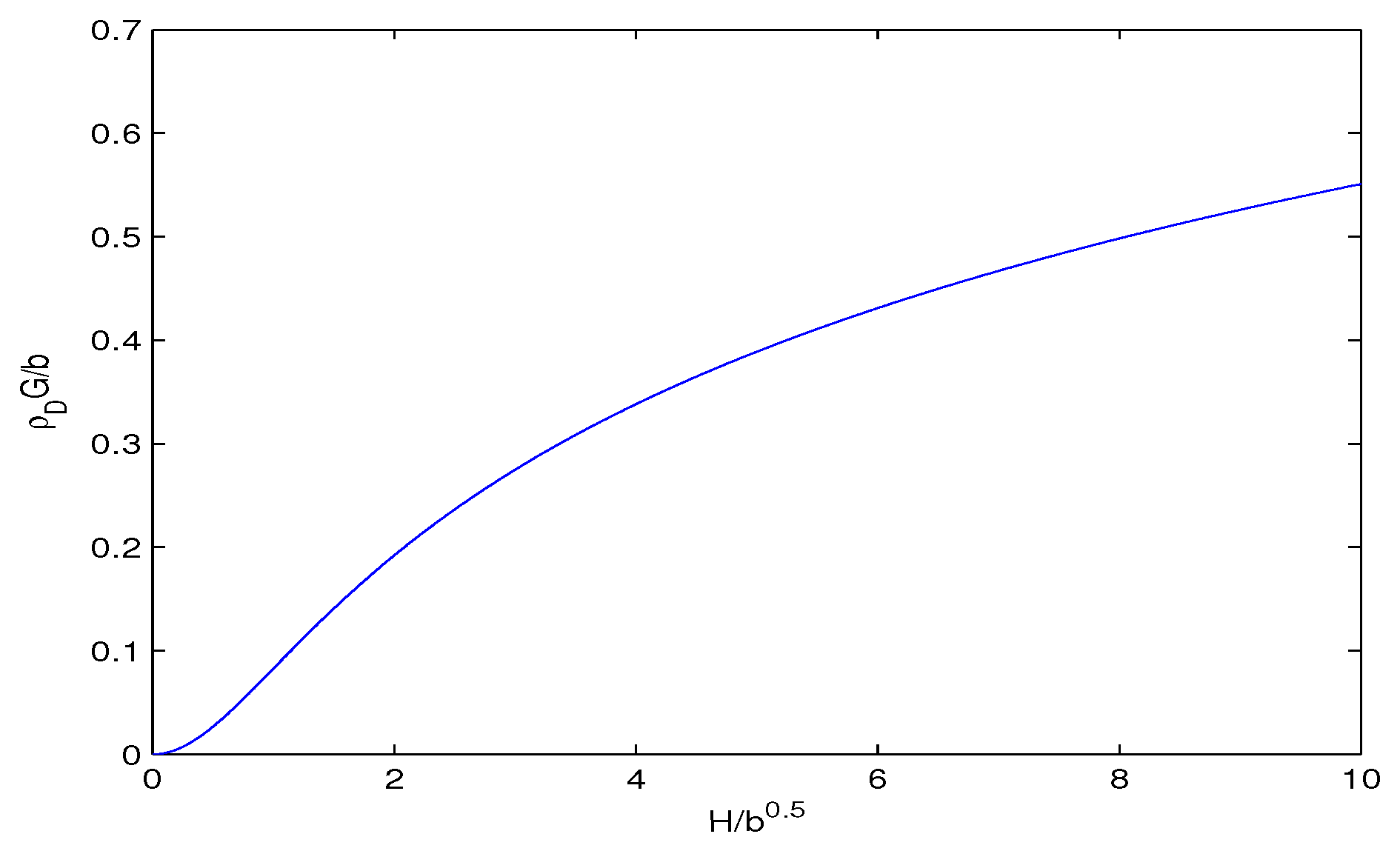
We plotted the dimensionless variable versus in Figure 1.
When increases, the reduced dark-energy density also increases and . As we have which corresponds to the future era.
It is convenient to introduce the normalized density parameter of the matter and the normalized density parameter of dark energy , where is the reduced Planck mass. Then, from Equation (11), we obtain . By the virtue of Equation (12), one obtains the normalized density for the matter and the normalized density parameter of dark energy, as follows:
Making use of the dimensionless variable , Equation (13) becomes
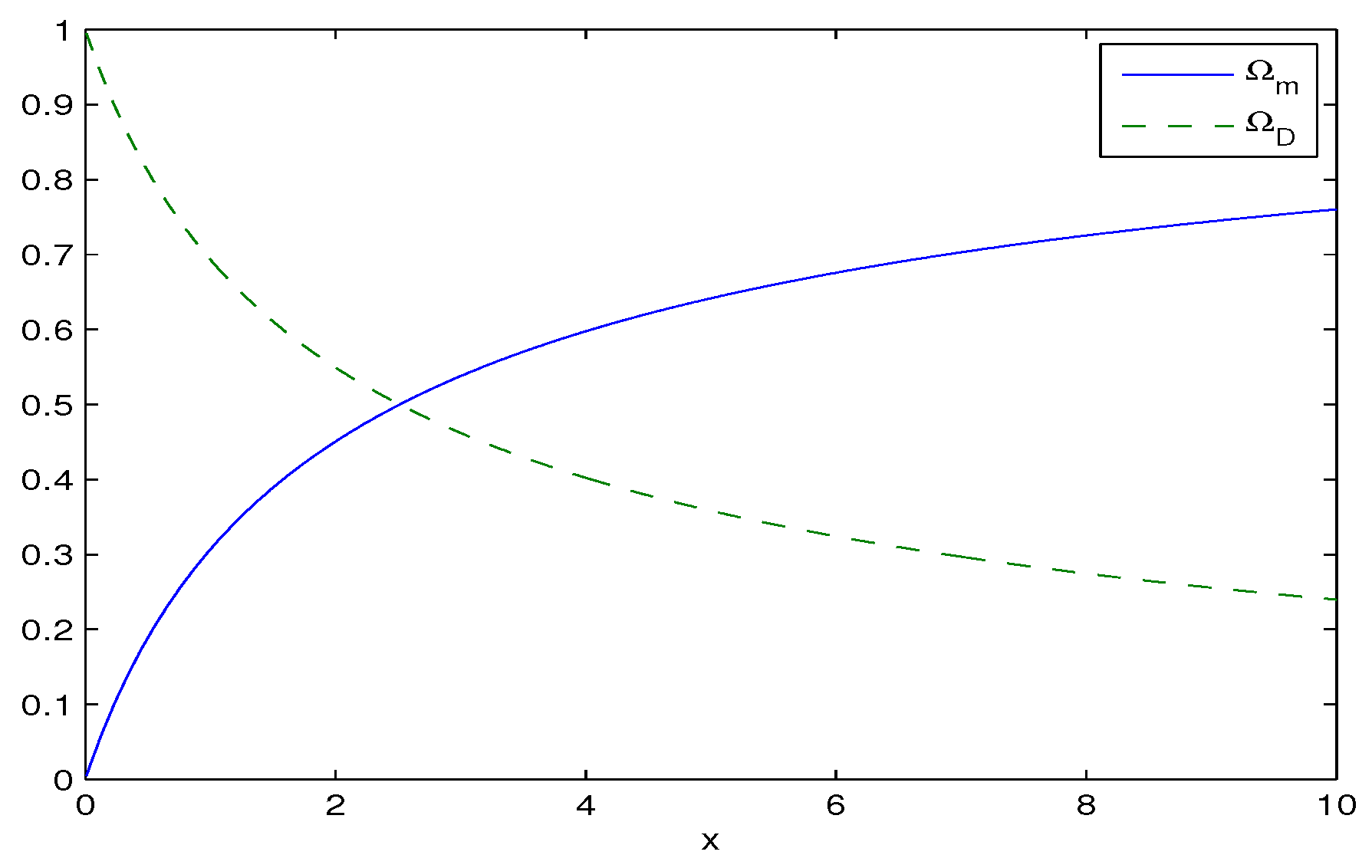
The normalized density parameter of the matter and the normalized density parameter of dark energy are depicted in Figure 2.
According to Figure 2 as (, ), we have and corresponding to the matter-dominated era. As (, ), and correspond to the dark-energy dominated epoch (the future era). The Planck data show that [3] for the current era. The solution to Equation (14) for is given by
where is the Lambert function, which obeys the equation . The is the lower branch of for . Then, we obtain the entropy parameter
where is the Hubble rate at the current time. To compute the EoS for dark energy , we need the pressure . We assume that the dark energy and pressure obey the continuity equation (Equation (5)), which gives
By virtue of Equations (12) and (17), one finds the equation for the pressure corresponding to dark energy
Making use of Equations (9), (10), and (18) and the equation of state EoS for barotropic matter fluid , we obtain the pressure
From Equations (12) and (19), we find the EoS for dark energy ,
By using the dimensionless variable , Equation (20) becomes
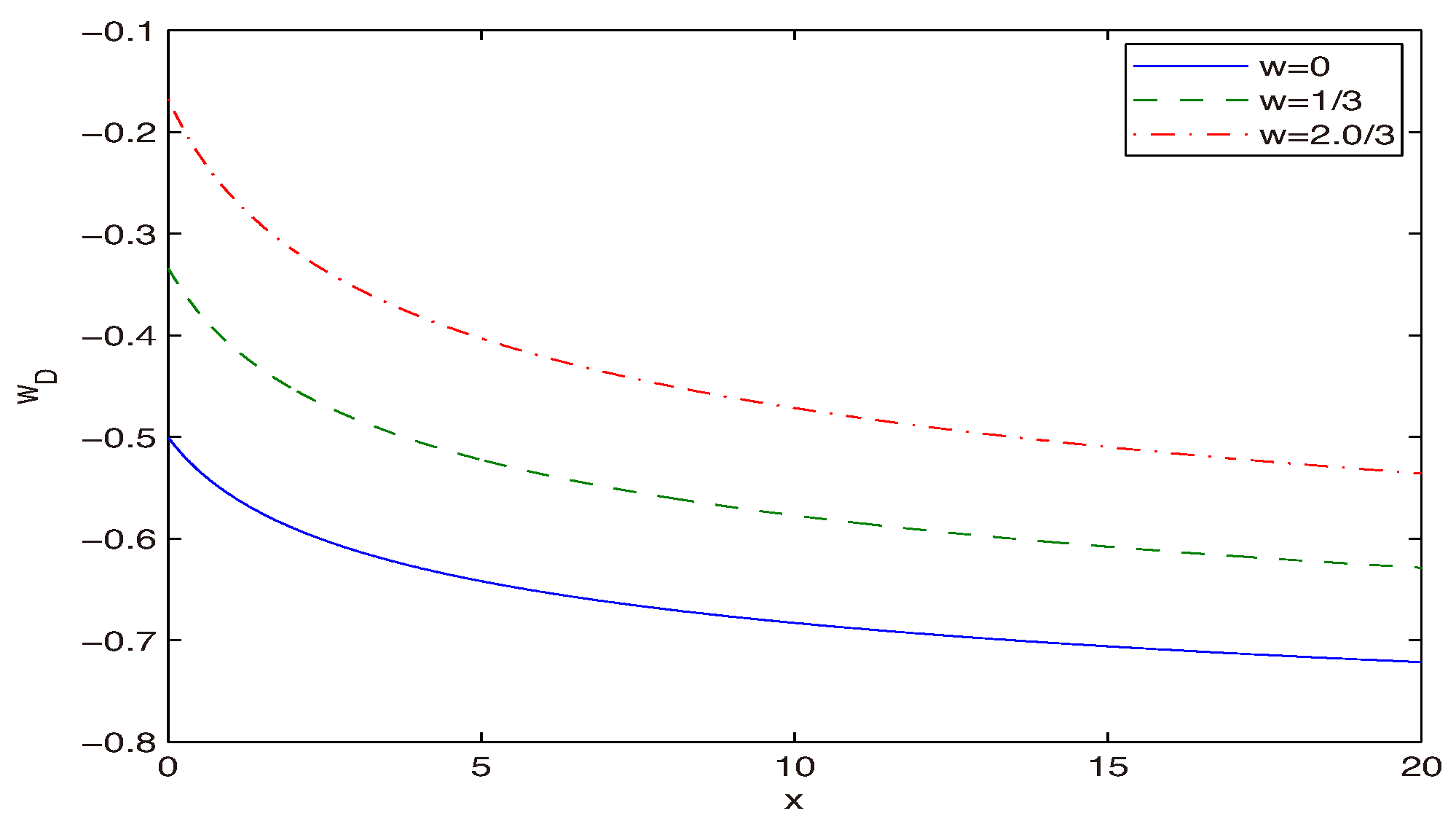
The EoS for dark energy versus x is depicted in Figure 3.
By the virtue of Equation (21), one has and . Thus, for the large Hubble parameter H (the small ), the dark-energy EoS is , which corresponds to the inflation era.
To analyze the observational data, it is convenient to introduce the redshift . Then, using the continuity Equation (5) and EoS , we obtain the density energy of the matter in the form
where is the energy density of the matter at the present time. From Equations (10) and (22), we obtain the generalized Friedmann equation as follows:
To plot the Hubble parameter versus redshift, we find from Equation (23) the redshift
and introducing dimensionless parameters , , we represent Equation (24) as
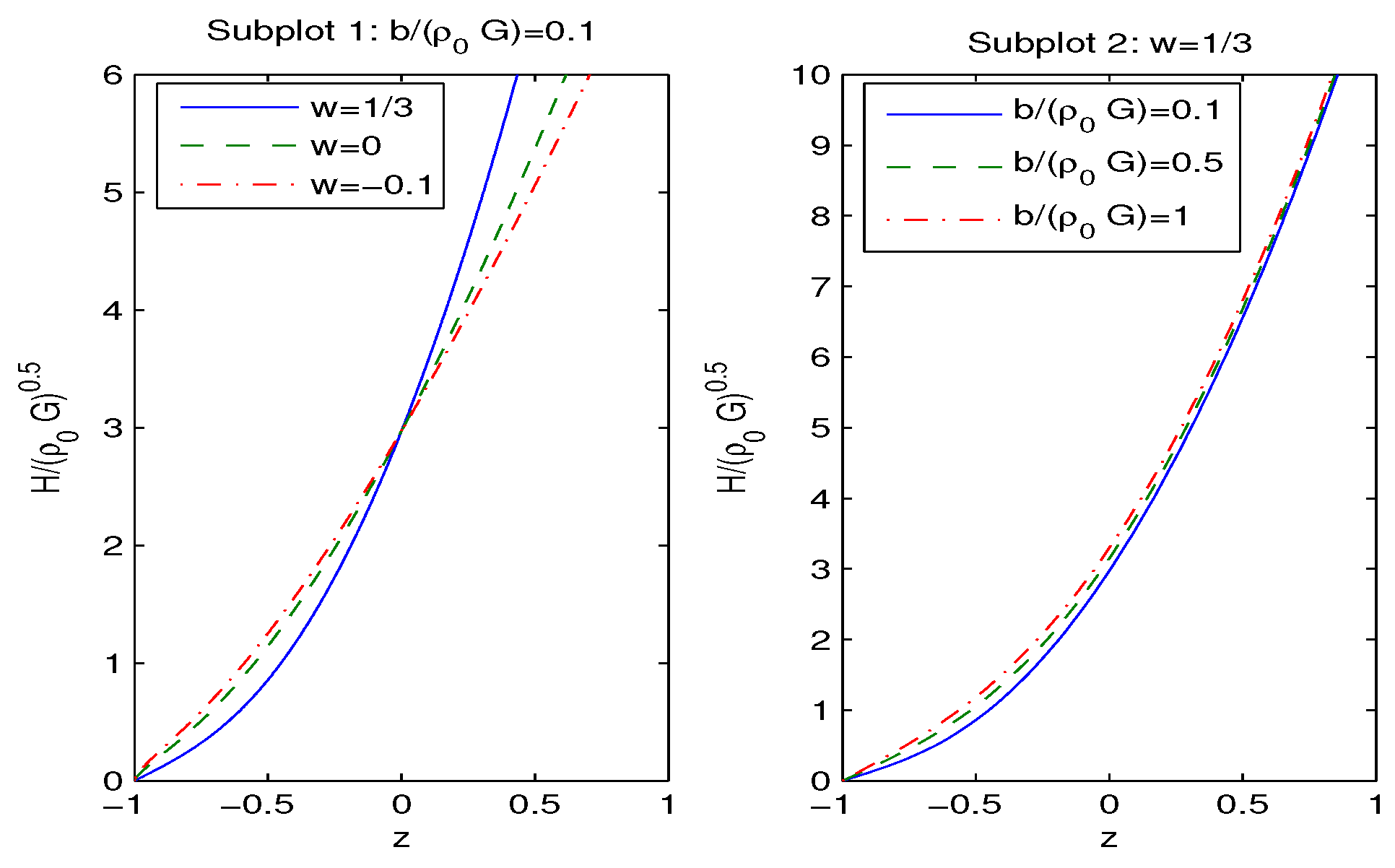
By the virtue of Equation (25), we depicted the reduced Hubble parameter versus redshift z in Figure 4.
In accordance with Figure 4, when the redshift z increases, the reduced Hubble parameter also increases. According to the left panel of Figure 4, when parameter w increases at fixed , the redshift z decreases at . The right panel of Figure 4 shows that when parameter increases at fixed z, the reduced Hubble parameter also increases. At , we have .
Now, we are going to fix the model parameter w to agree with the Plank data. For this goal, we consider the deceleration parameter, which is given by
The acceleration phase of the universe occurs when and when , the deceleration phase takes place. Making use of Equations (9), (22), and (26), we obtain the deceleration parameter as
By virtue of Equations (23) and (27), we find
Using dimensionless variable , Equation (28) becomes
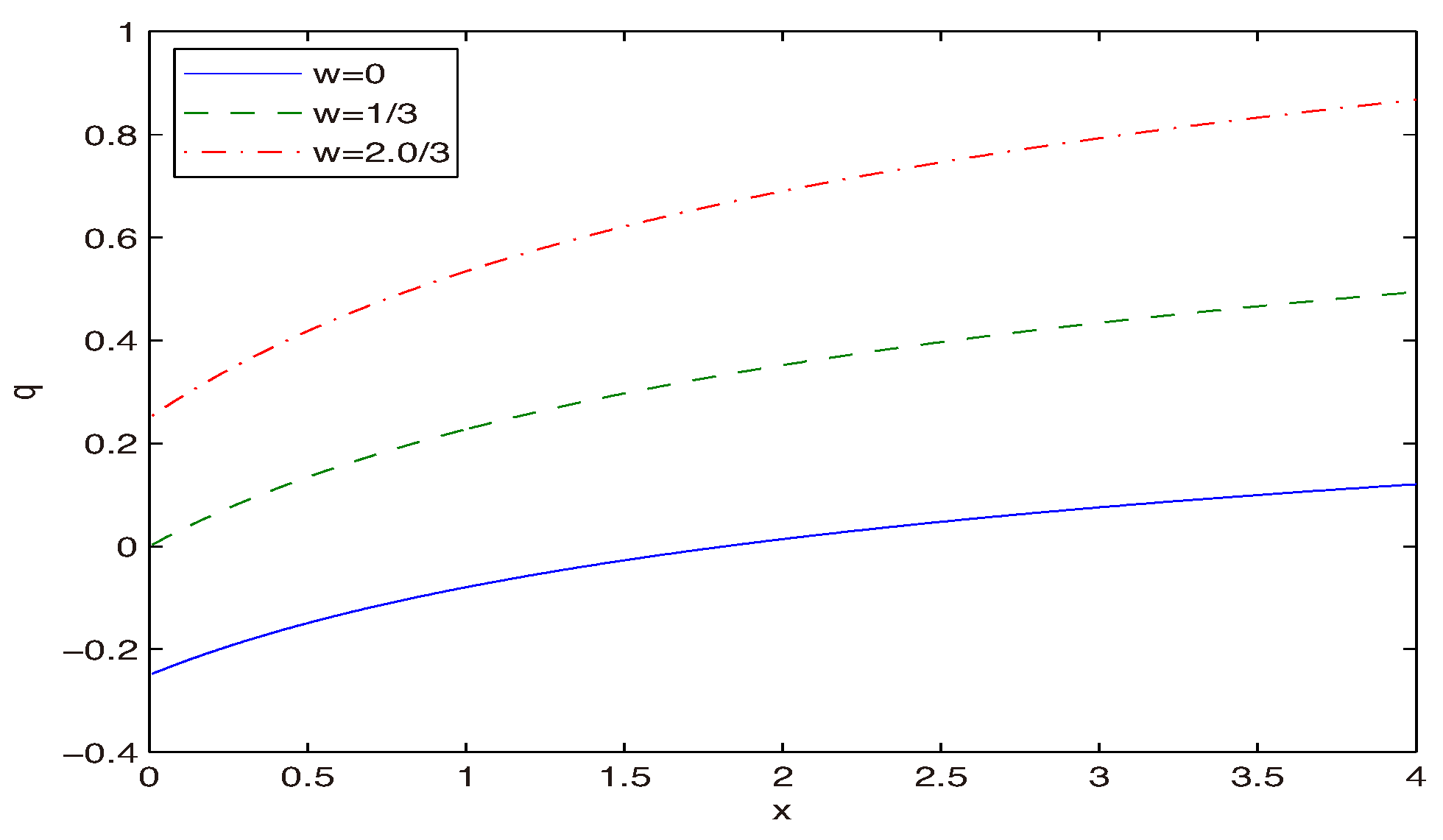
Making use of the value (), this gives the normalized density of the matter field at the current time , and the deceleration parameter [3], we obtain the solution to Equation (29) for the EoS parameter of the matter . We plotted the deceleration parameter q versus x in Figure 5.
In accordance with Figure 5, we have two phases, the universe acceleration and deceleration. Taking into account Equation (28), we obtain the asymptotic
It follows from Equation (30) that when () at large H, the universe decelerates and the universe accelerates at . The calculated value is in agreement with this requirement. Using Equation (29) at , we obtain the equation for the transition phase
We obtain limits of the EoS parameter w at and as follows:
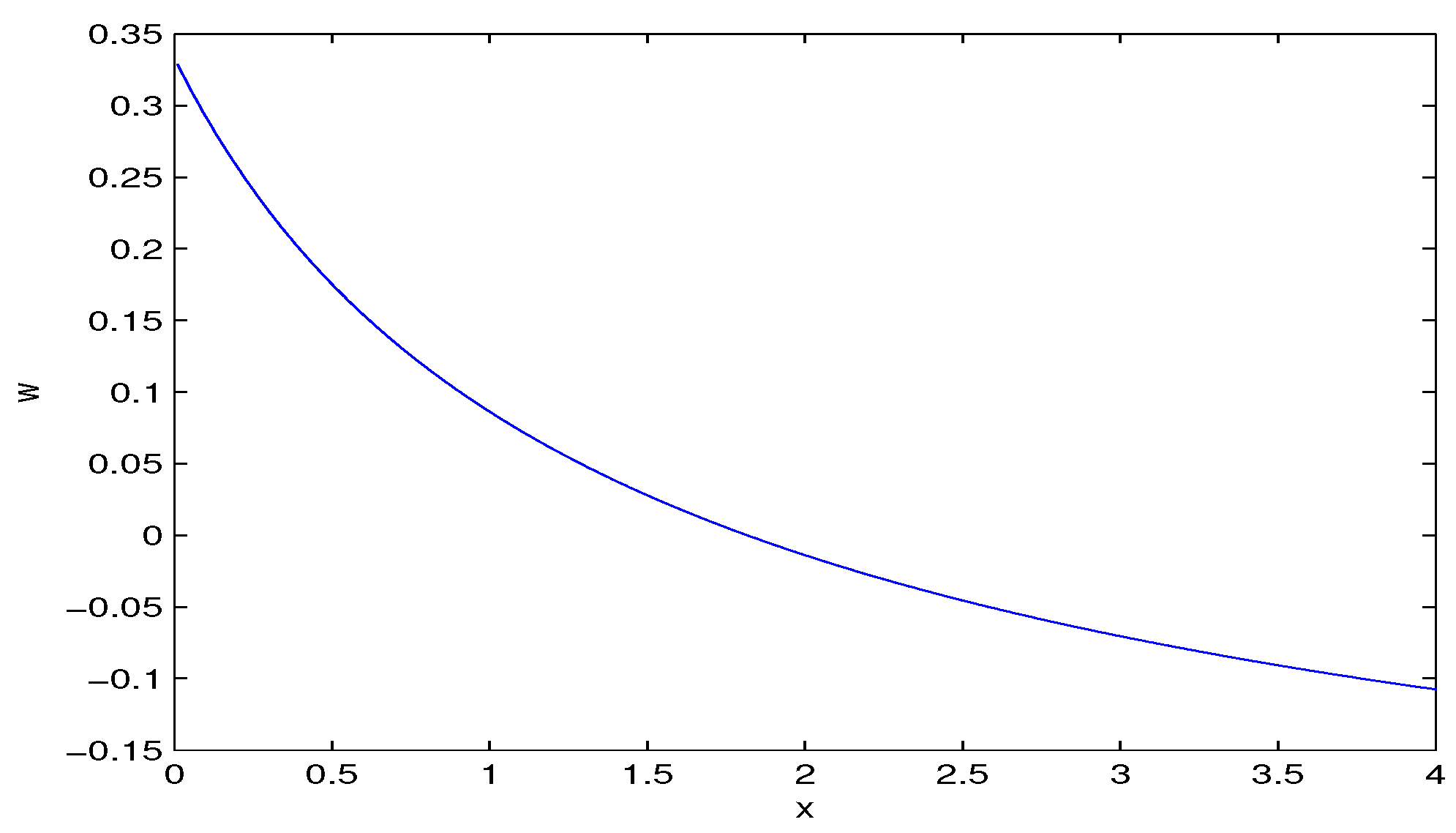
We plotted the EoS parameter for the matter w versus x in Figure 6.
According to Figure 6, when increases, the EoS parameter w decreases. At a large Hubble parameter H, for , and at small H, we have .
The entropy parameter is given by . For the current era and . Because , we have for the current era and, therefore, quantum corrections to the Bekenstein–Hawking entropy , according to Equation (8), are small. When parameter x is small, the entropy parameter will be large and the quantum effects are quite dominant. According to Figure 2, this happens when the normalized density parameter of dark energy approaches .
4. F(T)-Gravity from the Rényi Entropy
In the theory of Teleparallel Equivalent to General Relativity (TEGR), the curvature is replaced by torsion. In this self-consistent theory of gravity, the dynamics are the same as in general relativity. In TEGR, tetrad fields (vierbeins) define a basis that describes the geometry of space-time. Vierbeins define a torsion tensor which is the source of gravity presenting the antisymmetric contribution of the Christoffel connection. The torsion scalar T is constructed by the torsion tensor and defines the gravitational action. In gravity, the Lagrangian density of TEGR is modified by using an arbitrary function of the torsion scalar. In the teleparallel theory of gravity, the Weitzenböck connection is used, and the field equations are of the second-order. The torsion field T is given by [45,46]
The superpotential and the contortion tensor are
and the torsion tensor is defined as
where () is a vierbein field. In the flat metric of the tangent spacetime , the metric tensor is . In FLRW metric (1), the vierbein field is and the torsion scalar becomes . The variation of the action with respect to with the Lagrangian gives the equation [47]
Making use of Equations (10) and (36) and , we obtain
By integrating Equation (37) we find the equation as follows:
where we use the integration constant to be . We used the relation because . Some teleparallel gravity models were studied in [48,49]. Thus, we showed that the entropic cosmology with the Rényi entropy (7) is equivalent to a cosmology based on the teleparallel gravity with the function (38).
5. Conclusions
We studied the entropic cosmology with the Rényi entropy , which describes the dark energy and leads to the current acceleration of the universe. The spatial flat FLRW universe and the matter barotropic perfect fluid are implied. By the virtue of the first law of apparent horizon thermodynamics, we obtained the modified Friedmann equations, which include the density of dark energy. We assumed that the dark energy density and pressure obey the continuity equation (the conservation law). The EoS has been computed with , which shows that at , the de Sitter space-time occurs and the inflation of the universe takes place. In the model under consideration, the universe may have two phases, acceleration and deceleration, due to the dark energy. We showed that at the entropy parameter and the deceleration parameter has the value and the normalized density parameter of the matter is , which are in agrement with the Planck data at the current epoch [3]. It was shown that entropic cosmology studied can be considered as the cosmology based on the teleparallel gravity with the function obtained. The Hubble parameters are in approximate agreement with the observational Hubble data for at the entropy parameter (see Appendix A).
Funding
This research received no external funding.
Data Availability Statement
Data are contained within the article.
Conflicts of Interest
The author declares no conflicts of interest.
Appendix A. The Hubble Parameter and Observational Data
Making use of Equation (10) and the energy density
where is the energy density of the non-relativistic matter in the form of dust () and is the radiation energy density (), we obtain
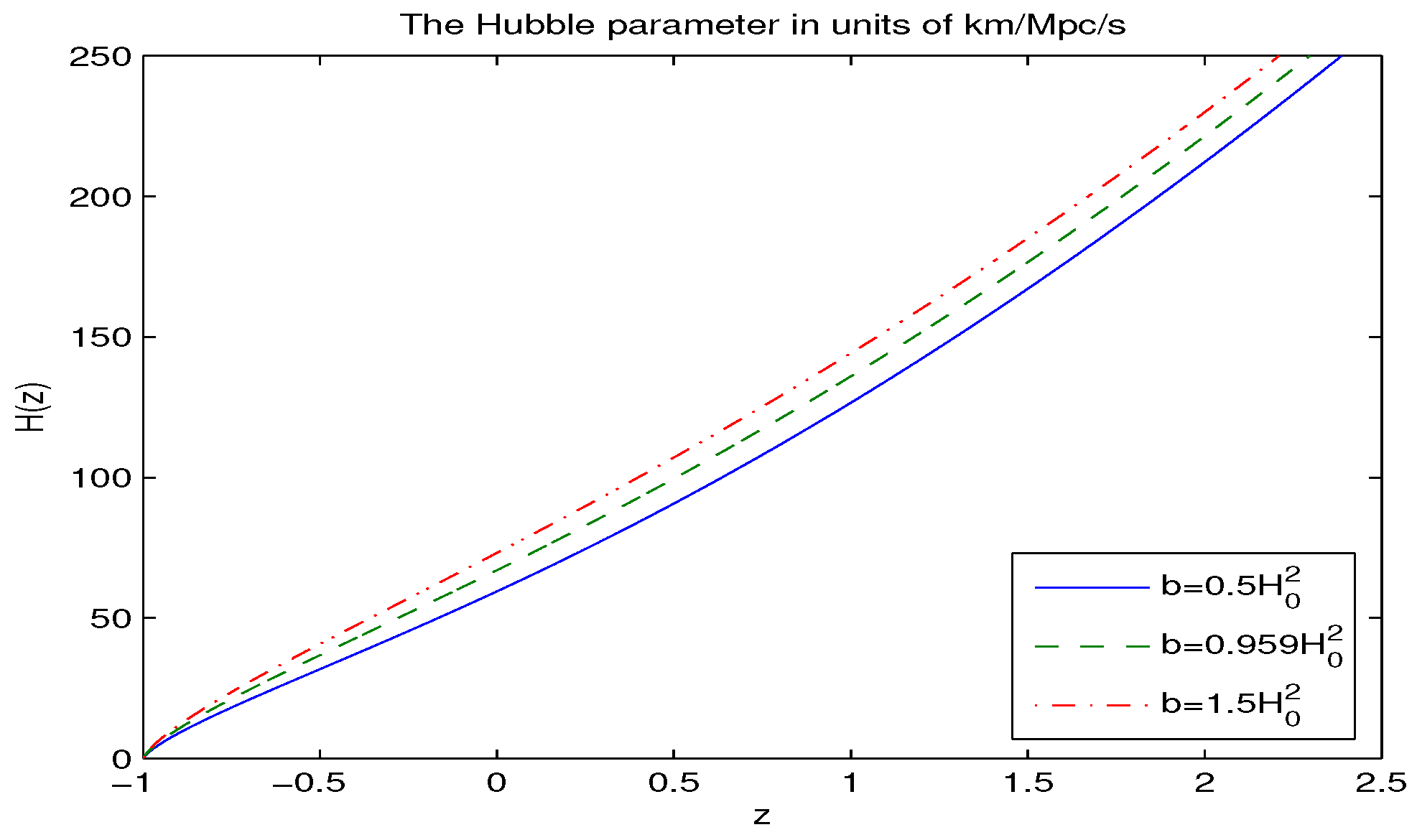
One can neglect the contribution of the radiation energy density for small redshifts because . In accordance with Equation (A2) at we have the value . By the virtue of Equation (A2) with the current Hubble parameter and , we depicted the Hubble parameter in units of km/Mpc/s in Figure A1.
Figure A1.
The Hubble parameter in units of km/Mpc/s vs. z.

According to Figure A1, the values of Hubble parameters are in approximate agreement with the observational Hubble data for [50,51,52,53,54,55,56,57,58,59,60] at () which gives the correct value for the normalized density parameter of the matter at the current era. Some observational Hubble data for are represented in Table A1.

Table A1.
Observational Hubble data for . The Hubble parameter is in units of km/Mpc/s.
| z | 0.07 | 0.18 | 0.24 | 0.429 | 0.45 | 0.48 | 0.593 | 0.875 | 1.3 | 1.75 |
| 69 | 75 | 79.7 | 91.8 | 92.8 | 97 | 104 | 125 | 168 | 202 | |
| Ref. | [50] | [54] | [52] | [51] | [51] | [53] | [54] | [54] | [52] | [52] |
Introducing the dimensionless parameter and making use of parameter which gives the normalized density parameter , we represent Equation (A2) as follows:
Solving Equation (A3) and by virtue of relation with km/Mpc/s, we obtain the Hubble parameters for the interval represented in Table A2. We include also in Table A2 the relative percentage deviation , which shows the deviation of observational Hubble parameters from the predicted Hubble parameters.
Table A2.
The Hubble parameters (in km/Mpc/s) for , calculated from Equation (A3) with the relation , and the relative percentage deviation R.
Table A2.
The Hubble parameters (in km/Mpc/s) for , calculated from Equation (A3) with the relation , and the relative percentage deviation R.
| z | 0.07 | 0.18 | 0.24 | 0.429 | 0.45 | 0.48 | 0.593 | 0.875 | 1.3 | 1.75 |
| H | 71.4 | 78.4 | 82.2 | 94.7 | 95 | 98.2 | 106.0 | 125 | 159.8 | 198.5 |
| R | 3.43 | 4.47 | 3.17 | 3.20 | 2.37 | 1.25 | 1.96 | 0 | −4.88 | −1.76 |
Table A2 shows that the deviation of predicted values of Hubble parameters from the observational Hubble data are small and the relative percentage deviations are within 5 percent.
References
- Riess, A.G.; Filippenko, A.V.; Challis, P.; Clocchiatti, A.; Diercks, A.; Garnavich, P.M.; Gilliland, R.L.; Hogan, C.J.; Jha, S.; Kirshner, R.P.; et al. Observational Evidence from Supernovae for an Accelerating Universe and a Cosmological Constant. Astron. J. 1998, 116, 1009–1038. [Google Scholar] [CrossRef]
- Perlmutter, S.; Aldering, G.; Goldhaber, G.; Knop, R.A.; Nugent, P.; Castro, P.G.; Deustua, S.; Fabbro, S.; Goobar, A.; Groom, D.E.; et al. Measurements of Omega and Lambda from 42 High-Redshift Supernovae. Astrophys. J. 1999, 517, 565–586. [Google Scholar] [CrossRef]
- Planck Collaboration; Aghanim, N.; Akrami, Y.; Ashdown, M.; Aumont, J.; Baccigalupi, C.; Ballardini, M.; Banday, A.J.; Barreiro, R.B.; Bartolo, N.; et al. Cosmological parameters. Astron. Astrophys. 2020, 641, A6, Erratum in Astron. Astrophys. 2021, 652, C4. [Google Scholar]
- Adame, A.G.; Aguilar, J.; Ahlen, S.; Alam, S.; Alexander, D.M.; Alvarez, M.; Alves, O.; Anand, A.; Andrade, U.; Armengaud, E.; et al. Desi 2024 results: Baryon acoustic oscillations from the first two years of desi observations. arXiv 2024, arXiv:2404.03002. [Google Scholar]
- Lusso, E.; Piedipalumbo, E.; Risaliti, G.; Paolillo, M.; Bisogni, S.; Nardini, E.; Amati, L. Tension with the flat ΛCDM model from a high-redshift hubble diagram of supernovae, quasars, and gamma-ray bursts. Astron. Astrophys. 2019, 628, L4. [Google Scholar] [CrossRef]
- Di Valentino, E.; Anchordoqui, L.; Akarsu, O.; Ali-Haïmoud, Y.; Amendola, L.; Arendse, N.; Asgari, M.; Ballardini, M.; Battistelli, E.; Benetti, M.; et al. Cosmology Intertwined II: The Hubble Constant Tension. Astropart. Phys. 2021, 131, 102605. [Google Scholar] [CrossRef]
- Riess, A.G.; Strolger, L.G.; Tonry, J.; Casertano, S.; Ferguson, H.C.; Mobasher, B.; Challis, P.; Filippenko, A.V.; Jha, S.; Li, W.; et al. Type Ia supernova discoveries at z > 1 from the Hubble space telescope: Evidence for past deceleration and constraints on dark energy evolution. Astrophys. J. 2004, 607, 665. [Google Scholar] [CrossRef]
- Riess, A.G.; Casertano, S.; Yuan, W.; Macri, L.M.; Scolnic, D. Large magellanic cloud cepheid standards provide a One percent foundation for the determination of the hubble constant and stronger evidence for physics beyond ΛCDM. Astrophys. J. 2019, 876, 85. [Google Scholar] [CrossRef]
- Akbar, M.; Cai, R.G. Thermodynamic Behavior of Friedmann Equation at Apparent Horizon of FRW Universe. Phys. Rev. D 2007, 75, 084003. [Google Scholar] [CrossRef]
- Cai, R.G.; Cao, L.M. Unified First Law and Thermodynamics of Apparent Horizon in FRW Universe. Phys. Rev. D 2007, 75, 064008. [Google Scholar] [CrossRef]
- Cai, R.G.; Kim, S.P. First Law of Thermodynamics and Friedmann Equations of Friedmann-Robertson-Walker Universe. J. High Energy Phys. 2005, 2005, 050. [Google Scholar] [CrossRef]
- Paranjape, A.; Sarkar, S.; Padmanabhan, T. Thermodynamic route to Field equations in Lanczos-Lovelock Gravity. Phys. Rev. D 2006, 74, 104015. [Google Scholar] [CrossRef]
- Sheykhi, A.; Wang, B.; Cai, R.G. Thermodynamical Properties of Apparent Horizon in Warped DGP Braneworld. Nucl. Phys. B 2007, 779, 1–12. [Google Scholar] [CrossRef]
- Cai, R.G.; Ohta, N. Horizon Thermodynamics and Gravitational Field Equations in Horava-Lifshitz Gravity. Phys. Rev. D 2010, 81, 084061. [Google Scholar] [CrossRef]
- Wang, S.; Wang, Y.; Li, M. Holographic Dark Energy. Phys. Rep. 2017, 696, 1–57. [Google Scholar] [CrossRef]
- Jamil, M.; Saridakis, E.N.; Setare, M.R. The generalized second law of thermodynamics in Horava-Lifshitz cosmology. J. Cosmol. Astropart. Phys. 2010, 2010, 032. [Google Scholar] [CrossRef]
- Gim, Y.; Kim, W.; Yi, S.H. The first law of thermodynamics in Lifshitz black holes revisited. J. High Energy Phys. 2014, 2014, 2. [Google Scholar] [CrossRef]
- Fan, Z.Y.; Lu, H. Thermodynamical First Laws of Black Holes in Quadratically-Extended Gravities. Phys. Rev. D 2015, 91, 064009. [Google Scholar] [CrossRef]
- D’Agostino, R. Holographic dark energy from nonadditive entropy: Cosmological perturbations and observational constraints. Phys. Rev. D 2019, 99, 103524. [Google Scholar] [CrossRef]
- Sanchez, L.M.; Quevedo, H. Thermodynamics of the FLRW apparent horizon. Phys. Lett. B 2023, 839, 137778. [Google Scholar] [CrossRef]
- Bekenstein, J.D. Black Holes and Entropy. Phys. Rev. D 1973, 7, 2333–2346. [Google Scholar] [CrossRef]
- Hawking, S.W. Particle creation by black holes. Commun. Math. Phys. 1975, 43, 199–220, Erratum in Commun. Math. Phys. 1976, 46, 206. [Google Scholar] [CrossRef]
- Jacobson, T. Thermodynamics of Spacetime: The Einstein Equation of State. Phys. Rev. Lett. 1995, 75, 1260. [Google Scholar] [CrossRef]
- Padmanabhan, T. Gravity and the Thermodynamics of Horizons. Phys. Rep. 2005, 406, 49. [Google Scholar] [CrossRef]
- Padmanabhan, T. Thermodynamical Aspects of Gravity: New insights. Rep. Prog. Phys. 2010, 73, 046901. [Google Scholar] [CrossRef]
- Hayward, S.A. Unified first law of black-hole dynamics and relativistic thermodynamics. Class. Quantum Gravity 1998, 15, 3147–3162. [Google Scholar] [CrossRef]
- Hayward, S.A.; Mukohyana, S.; Ashworth, M.C. Dynamic black-hole entropy. Phys. Lett. A 1999, 256, 347. [Google Scholar] [CrossRef]
- Bak, D.; Rey, S.J. Cosmic holography. Class. Quantum Gravity 2000, 17, 83. [Google Scholar] [CrossRef]
- Tsallis, C. Possible generalization of Boltzmann-Gibbs statistics. J. Stat. Phys. 1988, 52, 479–487. [Google Scholar] [CrossRef]
- Barrow, J.D. The Area of a Rough Black Hole. Phys. Lett. B 2020, 808, 135643. [Google Scholar] [CrossRef]
- Rényi, A. Proceedings of the Fourth Berkeley Symposium on Mathematics, Statistics and Probability; University of California Press: Oakland, CA, USA, 1960; pp. 547–556. [Google Scholar]
- Kaniadakis, G. Statistical mechanics in the context of special relativity II. Phys. Rev. E 2005, 72, 036108. [Google Scholar] [CrossRef]
- Masi, M. A step beyond Tsallis and Rényi entropies. Phys. Lett. A 2005, 338, 217–224. [Google Scholar] [CrossRef]
- Czinner, V.G.; Iguchi, H. Rényi entropy and the thermodynamic stability of black holes. Phys. Lett. B 2016, 752, 306–310. [Google Scholar] [CrossRef]
- Kruglov, S.I. Cosmology Due to Thermodynamics of Apparent Horizon. Ann. Phys. 2025, 534, e00204. [Google Scholar] [CrossRef]
- Kruglov, S.I. Cosmology, new entropy and thermodynamics of apparent horizon. Chin. J. Phys. 2025, 98, 277–286. [Google Scholar] [CrossRef]
- Jahromi, A.S.; Moosavi, S.A.; Moradpour, H.; Graca, J.P.M.; Lobo, I.P.; Salako, I.G.; Jawad, A. Generalized entropy formalism and a new holographic dark energy model. Phys. Lett. B 2018, 780, 21–24. [Google Scholar] [CrossRef]
- Ren, J. Analytic critical points of charged Rényi entropies from hyperbolic black holes. J. High Energy Phys. 2021, 2021, 80. [Google Scholar] [CrossRef]
- Mejrhit, K.; Ennadifi, S.E. Thermodynamics, stability and Hawking–Page transition of black holes from non-extensive statistical mechanics in quantum geometry. Phys. Lett. B 2019, 794, 45–49. [Google Scholar] [CrossRef]
- Majhi, A. Non-extensive Statistical Mechanics and Black Hole Entropy From Quantum Geometry. Phys. Lett. B 2017, 775, 32–36. [Google Scholar] [CrossRef]
- Pavon, D.; Zimdahl, W. Holographic dark energy and cosmic coincidence. Phys. Lett. B 2005, 628, 206. [Google Scholar] [CrossRef]
- Landim, R.C.G. Holographic dark energy from minimal supergravity. Int. J. Mod. Phys. D 2016, 25, 1650050. [Google Scholar] [CrossRef]
- Tamri, Z.; Aghamohammadi, A.; Golanbari, T.; Khodam-Mohammadi, A. A new Rényi holographic dark energy model and its cosmological implications. Eur. Phys. J. C 2026, 96, 86. [Google Scholar] [CrossRef]
- Ashtekar, A.; Wilson-Ewing, E. The covariant entropy bound and loop quantum cosmology. Phys. Rev. D 2008, 78, 064047. [Google Scholar] [CrossRef]
- Weitzenböck, R. Invarianten Theorie; Nordhoff: Groningen, The Netherlands, 1923. [Google Scholar]
- Maluf, J.W. Hamiltonian formulation of the teleparallel description of general relativity. J. Math. Phys. 1994, 35, 335. [Google Scholar] [CrossRef]
- Bengochea, G.R.; Ferraro, R. Dark torsion as the cosmic speed-up. Phys. Rev. D 2009, 79, 124019. [Google Scholar] [CrossRef]
- Wu, P.; Yu, H.W. f(T) models with phantom divide line crossing. Eur. Phys. J. C 2011, 71, 1552. [Google Scholar] [CrossRef]
- Nesseris, S.; Basilakos, S.; Saridakis, E.N.; Perivolaropoulos, L. Viable f(T) models are practically indistinguishable from LCDM. Phys. Rev. D 2013, 88, 103010. [Google Scholar]
- Zhang, C.; Zhang, H.; Yuan, S.; Liu, S.; Zhang, T.J.; Sun, Y.C. Four new observational h(z) data from luminous red galaxies in the sloan digital sky survey data release seven. Res. Astron. Astrophys. 2014, 14, 1221–1233. [Google Scholar] [CrossRef]
- Moresco, M.; Pozzetti, L.; Cimatti, A.; Jimenez, R.; Maraston, C.; Verde, L.; Thomas, D.; Citro, A.; Tojeiro, R.; Wilkinson, D. A 6% measurement of the Hubble parameter at z∼0.45: Direct evidence of the epoch of cosmic re-acceleration. J. Cosmol. Astropart. Phys. 2016, 2016, 014. [Google Scholar] [CrossRef]
- Simon, J.; Verde, L.; Jimenez, R. Constraints on the redshift dependence of the dark energy potential. Phys. Rev. D 2005, 71, 123001. [Google Scholar] [CrossRef]
- Stern, D.; Jimenez, R.; Verde, L.; Kamionkowski, M.; Stanford, S.A. Cosmic chronometers: Constraining the equation of state of dark energy. i: H(z) measurements. J. Cosmol. Astropart. Phys. 2010, 2010, 008. [Google Scholar] [CrossRef]
- Loubser, S.I. Measuring the expansion history of the Universe with DESI cosmic chronometers. Mon. Not. R. Astron. Soc. 2025, 544, 3064–3075. [Google Scholar] [CrossRef]
- Moresco, M.; Cimatti, A.; Jimenez, R.; Pozzetti, L.; Zamorani, G.; Bolzonella, M.; Dunlop, J.; Lamareille, F.; Mignoli, M.; Pearce, H.; et al. Improved constraints on the expansion rate of the universe up to z∼1.1 from the spectroscopic evolution of cosmic chronometers. J. Cosmol. Astropart. Phys. 2012, 2012, 006. [Google Scholar] [CrossRef]
- Jimenez, R.; Moresco, M.; Verde, L.; Wandelt, B.D. Photometric cosmic chronometers: A new route to h(z). J. Cosmol. Astropart. Phys. 2023, 2023, 013. [Google Scholar] [CrossRef]
- Jiao, K.; Borghi, N.; Moresco, M.; Zhang, T.-J. New Observational H(z) Data from Full-spectrum Fitting of Cosmic Chronometers in the Lega-C Survey. Astrophys. J. Suppl. 2023, 265, 48. [Google Scholar] [CrossRef]
- Tomasetti, E.; Moresco, M.; Borghi, N.; Jiao, K.; Cimatti, A.; Pozzetti, L.; Carnall, A.C.; McLure, R.J.; Pentericci, L. A new measurement of the expansion history of the Universe at z = 1.26 with cosmic chronometers in VANDELS. Astron. Astrophys. 2023, 679, A96. [Google Scholar] [CrossRef]
- Moresco, M. Raising the bar: New constraints on the hubble parameter with cosmic chronometers at z∼2. Mon. Not. R. Astron. Soc. 2015, 450, 16–20. [Google Scholar] [CrossRef]
- Ratsimbazafy, A.L.; Loubser, S.I.; Crawford, S.M.; Cress, C.M.; Bassett, B.A.; Nichol, R.C.; Väisänen, P. Age-dating luminous red galaxies observed with the southern african large telescope. Mon. Not. R. Astron. Soc. 2017, 467, 3239–3254. [Google Scholar] [CrossRef]
Figure 1.
The reduced dark-energy density vs. the parameter .

Figure 2.
The normalized density parameters and vs. .

Figure 3.
The EoS for dark energy vs. the dimensionless variable .

Figure 4.
The reduced Hubble rate vs. redshift z.

Figure 5.
The deceleration parameter q vs. at .

Figure 6.
The EoS parameter for the matter w vs. at .

Disclaimer/Publisher’s Note: The statements, opinions and data contained in all publications are solely those of the individual author(s) and contributor(s) and not of MDPI and/or the editor(s). MDPI and/or the editor(s) disclaim responsibility for any injury to people or property resulting from any ideas, methods, instructions or products referred to in the content. |
© 2026 by the author. Licensee MDPI, Basel, Switzerland. This article is an open access article distributed under the terms and conditions of the Creative Commons Attribution (CC BY) license.
Share and Cite
MDPI and ACS Style
Kruglov, S.I. The Rényi Entropy and Entropic Cosmology. Entropy 2026, 28, 467. https://doi.org/10.3390/e28040467
AMA Style
Kruglov SI. The Rényi Entropy and Entropic Cosmology. Entropy. 2026; 28(4):467. https://doi.org/10.3390/e28040467
Chicago/Turabian StyleKruglov, S. I. 2026. "The Rényi Entropy and Entropic Cosmology" Entropy 28, no. 4: 467. https://doi.org/10.3390/e28040467
APA StyleKruglov, S. I. (2026). The Rényi Entropy and Entropic Cosmology. Entropy, 28(4), 467. https://doi.org/10.3390/e28040467
Note that from the first issue of 2016, this journal uses article numbers instead of page numbers. See further details here.