1. Introduction
In many engineering and biomedical systems, failure rates do not strictly follow a simple monotonic trend; instead, they frequently exhibit a non-monotonic, unimodal trajectory. During the early operational phase, the hazard rate rises due to initial stress factors, reaches a finite peak, and eventually declines as the system stabilizes. This upside-down bathtub (UBT) pattern is widely observed in systems such as medical devices, rotating machinery, and communication components.
To evaluate system reliability and capture these UBT characteristics, researchers conventionally rely on life-testing experiments. However, the prohibitive cost and time constraints of such experiments often result in incomplete or censored failure data. Under these constraints, extracting predictive inference from limited observations becomes essential for assessing the remaining life of surviving units. Predicting future failure times provides practical guidance for engineering decisions, such as establishing warranty periods, optimizing spare parts inventory, and scheduling preventive maintenance.
From a statistical perspective, this translates into a formal prediction problem. Prediction problems are generally categorized into two types: one-sample prediction (OSP), where the future variables to be predicted originate from the same experiment and are correlated with the observed sample; and two-sample prediction (TSP), where the future variables come from an independent future sample. This paper focuses on the OSP framework, which aligns with the aforementioned life-testing scenarios, aiming to perform predictive inference for unobserved failure times using available censored data.
OSP has received considerable attention, with extensive theoretical frameworks developed under classical lifetime models. For instance, Lawless [
1] provided a comprehensive treatment of prediction intervals for the Weibull and Exponential distributions, while Kundu and Raqab [
2] addressed Bayesian Prediction for Type-II censored Weibull data. However, classical lifetime models may be restrictive when failure mechanisms exhibit non-monotonic hazard behavior or pronounced tail heterogeneity. The Weibull distribution is limited to monotone hazard rates and therefore cannot represent UBT-shaped hazards [
3]. Although the Log-normal distribution is more flexible in this respect, models with more direct survival and quantile representations may be advantageous in censored settings from the standpoint of analytical tractability. This motivates consideration of alternative lifetime models, such as the Log-Logistic distribution, which can accommodate UBT-shaped hazard behavior and heavy-tailed survival patterns.
The Log-Logistic distribution serves as an effective alternative for modeling such non-monotonic hazard processes. Originally introduced by Fisk [
4], this distribution is characterized by a shape parameter that allows it to generate either a strictly decreasing or a unimodal hazard rate, making it well-suited for products experiencing early wear-in failures followed by a recovery phase. Let the random variable
T follow a Log-Logistic distribution with scale parameter
and shape parameter
; its cumulative distribution function is
From this expression, the corresponding probability density function is
Furthermore, the survival (or reliability) function, which represents the probability that a unit survives beyond a specific time
t (i.e.,
), is essential for handling censored observations and has a highly tractable closed form:
and consequently, the hazard function, which quantifies the instantaneous failure rate at time
t conditional on survival up to that time, takes the form
Its shape parameter allows for either strictly decreasing or unimodal hazard rates, while its heavy-tailed property accommodates long-lived components. These features make the Log-Logistic distribution a useful candidate for modeling lifetime data with non-monotonic failure behavior. In addition, its survival function and hazard function admit simple closed-form expressions, which facilitate likelihood-based inference and prediction under censoring.
Due to these properties, the Log-Logistic distribution is widely used across various fields. In reliability engineering, Nelson [
5] analyzed general failure data, and Clavijo-Blanco et al. [
6] applied it to distribution network reliability indices. Applications extend to seismic risk estimation [
7], hydrology for flood frequency analysis [
8], and economics for income inequality [
4]. In the medical domain, it has been used as parametric regression baselines for time-to-event outcomes, including applications to cancer survival data [
9,
10].
Statistical inference for the Log-Logistic distribution was initially developed in the complete-sample setting. Fisk [
4] established early foundational properties of the distribution. O’Quigley and Struthers [
11] subsequently introduced logistic and Log-Logistic survival models and provided practical fitting tools for censored survival data. Classical estimation for the Log-Logistic model was further studied by Balakrishnan and Malik [
12], who derived best linear unbiased estimators (BLUEs) for the location and scale parameters. From a Bayesian perspective, Al-Shomrani et al. [
13] employed MCMC techniques for complete data, while Abbas and Tang [
14] developed an objective Bayesian analysis based on reference and Jeffreys priors.
In reliability testing, complete failure data are rarely available, necessitating censored inference. The most fundamental frameworks are Type-I (time) and Type-II (failure) censoring. Inference for the Log-Logistic distribution under these classical schemes is well established: Howlader and Weiss [
15] estimated survival functions under Type-II censoring, while Kantam et al. [
16] developed reliability test plans under Type-I censoring. To balance the temporal and failure-count constraints of individual schemes, hybrid censoring integrates Type-I and Type-II mechanisms. For the Log-Logistic model, Hyun et al. [
17] derived maximum likelihood estimators and asymptotic confidence intervals under hybrid censored data.
However, traditional and hybrid schemes generally restrict the withdrawal of surviving units to the experiment’s termination. To accelerate testing and optimize resource allocation, Progressive Type-II Censoring allows the withdrawal of surviving units at various stages during the experiment rather than only at the end. Consider an experiment with n independent units, and let denote the i-th observed failure time in a progressively censored sample of size m. Prior to the experiment, a progressive censoring scheme is pre-specified, satisfying the sample size constraint . Under this scheme, when the first failure occurs at , surviving units are randomly selected and removed. At the second failure , surviving units are randomly removed, and the process continues iteratively until the m-th failure, , where the experiment terminates and all remaining survivors are removed.
This framework is highly advantageous in industrial settings, as the early withdrawn units can be repurposed or subjected to different screening tests, thereby reducing the total duration and cost. This scheme reduces to classical Type-II censoring when
and
; see Balakrishnan and Aggarwala [
18] for a systematic treatment.
Extensive inference methodologies have been developed under Progressive Type-II Censoring for various models [
19]. These include maximum-likelihood estimation and exact interval inference for the Weibull distribution [
20]. For heavy-tailed models, interval estimation [
21] and prediction intervals [
22] were developed for the Burr-XII distribution, while predictive inference for the Pareto distribution under progressive Type-II censoring has also been investigated [
23]. Research also covers models with non-monotonic hazards, such as the Chen [
24], Generalized Exponential [
25], and Inverse Weibull [
26] distributions.
Despite these methodological developments, predictive inference for the Log-Logistic distribution under Progressive Type-II Censoring remains unexplored. Specifically, there is a lack of one-sample prediction methodologies that integrate both frequentist and Bayesian frameworks for this distribution. Addressing this is practically relevant, as combining the heavy-tailed Log-Logistic model with progressive censoring provides a flexible approach for analyzing long-duration reliability data. Consequently, this paper investigates parameter estimation and predictive inference for future failure times under the Log-Logistic distribution with Progressive Type-II Censoring.
The remainder of this paper is organized as follows.
Section 2 derives the Maximum Likelihood Estimators (MLEs) and Asymptotic Confidence Intervals (ACIs) for the Log-Logistic parameters under Progressive Type-II censoring.
Section 3 develops the Bayesian inference procedure, utilizing independent Gamma priors and a Metropolis–Hastings within Gibbs algorithm to obtain the Bayes estimates and Credible Intervals (CIs).
Section 4 derives three point predictors: the Best Unbiased Predictor (BUP), the Conditional Median Predictor (CMP), and the Bayesian Predictor (BP).
Section 5 constructs the interval predictors, including frequentist pivotal prediction Intervals (PPIs), the Bayesian Equal-Tailed Intervals (ETIs), and the Highest Posterior Density (HPD) intervals.
Section 6 evaluates the finite-sample performance of the proposed methods through a Monte Carlo simulation study.
Section 7 applies the methodologies to two real-world datasets. Finally,
Section 8 provides concluding remarks.
2. Frequentist Statistical Analysis
This section investigates the frequentist maximum likelihood estimation of the Log-Logistic distribution parameters
and
under progressive Type-II censoring. Let
, where
, denote a progressively Type-II censored sample of size
m obtained from a population with an initial sample size
n under the censoring scheme
. For notational simplicity, we write
as
. Recall that the cumulative distribution function
and probability density function
of the underlying Log-Logistic distribution are given by Equations (
1) and (
2), respectively.
Conditioning on the censoring scheme
, it follows from Balakrishnan and Aggarwala [
18] that the likelihood function of the progressively Type-II censored sample can be expressed as
where
is a constant independent of the unknown parameters.
Substituting the specific forms of the Log-Logistic distribution into Equation (
5), the likelihood function can be explicitly written as
Taking the natural logarithm of Equation (
6) yields the corresponding log-likelihood function, up to an additive constant:
Taking the partial derivatives of the log-likelihood with respect to
and
, and equating them to zero, we obtain the following score equations:
The existence of the maximum likelihood estimators can be established by analyzing the behavior of the log-likelihood function at the boundaries of the parameter space
. Specifically,
is continuous on
and diverges to
as either
or
approaches
or
∞. This asymptotic property implies that all upper-level sets of the log-likelihood function are closed and bounded. As demonstrated by Mäkeläinen et al. [
27], such boundary behavior ensures that
attains its global maximum within the interior of
, thereby confirming the existence of the MLEs.
Consequently, since the global maximum lies in the interior of the open set
and the log-likelihood function is differentiable, the MLEs must satisfy the score Equations (
8) and (
9). However, because these nonlinear equations lack closed-form analytical solutions, numerical procedures are required. Here, we employ the Newton–Raphson method to obtain the parameter estimates. Letting
, the update at the
-th iteration is given by
where
is the gradient vector, and the Hessian matrix
is defined as
The specific components of the Hessian matrix are explicitly derived as follows:
While the classical Newton–Raphson update operates on directly, it is highly sensitive to initial values and may fail to converge when the log-likelihood surface is flat. Furthermore, standard updates do not inherently prevent the parameters from crossing into invalid negative territories.
To enforce strict positivity constraints (
) and improve overall numerical stability, our computational implementation is executed in the unconstrained log-space
. The gradient and Hessian with respect to
can be readily evaluated via the chain rule from their original-space counterparts derived above. This modified Newton–Raphson procedure, which additionally incorporates OLS initialization, step-halving, and ridge regularization, is summarized in Algorithm 1.
| Algorithm 1 Modified Newton–Raphson procedure for Maximum Likelihood Estimation |
- 1:
Input: Progressively censored data , censoring scheme , total sample size n, gradient tolerance , step tolerance , maximum iterations . - 2:
Initialization: - 3:
Compute the empirical survival estimates via the Herd–Johnson product-limit method designed for progressive censoring: - 4:
Construct the linearized regression variables based on the Log-Logistic odds ratio: - 5:
Perform ordinary least squares (OLS) regression of against to yield intercept and slope . - 6:
Extract initial values: and . - 7:
Space Transformation: To enforce positivity constraints strictly, map parameters to the unconstrained log-space: - 8:
. Set iteration counter . - 9:
Repeat until convergence or : - 10:
Evaluate the gradient vector and the Hessian matrix . - 11:
Regularization: If is near zero, apply ridge regularization: , where . - 12:
Compute the full Newton step: . - 13:
Backtracking Line Search (Step-halving): - 14:
Set . - 15:
While and halving steps do: - 16:
- 17:
- 18:
End While - 19:
Update: . - 20:
Check Convergence: If and , terminate loop. - 21:
- 22:
Output: Transform back to the original parameter space: and
|
Under standard regularity conditions for censored lifetime models, and under an increasing-sample framework in which the total sample size
, the number of observed failures
, and the progressive censoring scheme remains asymptotically stable, the MLE
is asymptotically normal; see, e.g., Lawless [
28] for general likelihood theory for censored lifetime data and Lin and Balakrishnan [
29] for progressive Type-II censoring. Specifically,
where
denotes the limiting Fisher information matrix per unit.
In practical applications, since
depends on the unknown true parameter, the asymptotic variance–covariance matrix of
is commonly estimated by the inverse observed information matrix evaluated at the MLE, namely,
where
is the full-sample observed information matrix.
Finally, let
and
denote the
and
diagonal elements of
. Then the approximate
Wald confidence intervals for
and
are given by
where
is the
-th quantile of the standard normal distribution.
3. Bayesian Statistical Analysis
This section derives the posterior distribution of the Log-Logistic distribution parameters based on a progressively Type-II-censored sample. While the parameters were treated as a vector in the previous section for asymptotic matrix derivations, we treat them component-wise in the Bayesian framework. This scalar representation is more natural for constructing independent prior distributions and formulating the sequential updating steps in the Markov Chain Monte Carlo scheme.
In Bayesian inference, the choice of prior distributions plays a key role in determining the flexibility and interpretability of the model. Since both and are positive-valued parameters, a natural and widely adopted specification is to assign independent Gamma priors to them, namely, and , where the hyperparameters encode prior knowledge. Gamma priors enjoy several appealing properties, including support compatibility and computational convenience, making them prevalent in reliability literature. Moreover, in the absence of substantial prior information, weakly informative priors can be constructed by choosing relatively small hyperparameter values, thereby mitigating subjective influence.
The corresponding prior density functions are
Assuming prior independence, the joint prior density is
. Hence, the normalized joint posterior distribution is given by
Under the squared error loss (SEL) function, the Bayes estimator of any parametric function
is defined as its posterior mean:
Because the joint posterior distribution
does not admit a closed-form normalization integral, explicit Bayes estimators are not available. We therefore resort to MCMC-based numerical methods. Given
and
, the full conditional kernel of
is
and, similarly, given
and
, the full conditional kernel of
is
Clearly, neither conditional distribution can be reduced to a familiar conjugate form. To address this, we adopt a Metropolis–Hastings-within-Gibbs MCMC scheme. To ensure unconstrained random-walk proposals, we reparameterize the variables to the real line via
and
. Accounting for the Jacobian of the transformation (
and
), the full conditional distributions in the log-space are given by
Given the current state , we update and sequentially via Metropolis–Hastings steps using Gaussian random-walk proposal distributions. At the end of each iteration, the updated parameters are transformed back to their original positive space via the inverse mapping and . This yields a Markov chain whose stationary distribution corresponds to the joint posterior of the original scale and shape parameters. The detailed procedure is summarized in Algorithm 2.
Upon completion, Algorithm 2 yields a sequence of draws . To mitigate the influence of initial values and allow the Markov chains to approach the stationary distribution, the first B iterations are discarded as burn-in. Furthermore, to reduce sample autocorrelation, a thinning interval of h is applied to the post-burn-in chains. This yields an effective sample of size .
For notational convenience, let denote the index of these final retained draws, defining the re-indexed sequence as . Assuming adequate MCMC convergence, these samples are treated as approximately independent realizations from the joint posterior distribution . Consequently, Bayesian inference proceeds via standard Monte Carlo integration.
For any parametric function of interest
, its Bayes estimator under the SEL is approximated by the empirical average:
Similarly, the posterior uncertainty of
is characterized by a
equal-tailed credible interval. By evaluating the function for each retained sample, we obtain a sequence of posterior realizations
for
. Sorting these values in ascending order yields the order statistics
. The approximate
credible interval is then constructed directly from the empirical quantiles:
where
denotes the floor function. Setting
or
directly provides the respective Bayes estimates and credible intervals for the individual parameters.
| Algorithm 2 Metropolis–Hastings-within-Gibbs sampler for |
- 1:
Input: Progressively censored data , total iterations N, burn-in length B, proposal standard deviations and . - 2:
Initialization: Set initial values and (equivalently, and ). - 3:
For do: - 4:
Update : - 5:
Generate a candidate . - 6:
Compute the acceptance ratio using the log-space kernel ( 23): - 7:
Generate . - 8:
If then else . - 9:
Update : - 10:
Generate a candidate . - 11:
Compute the acceptance ratio using the log-space kernel ( 24): - 12:
Generate . - 13:
If then else . - 14:
Parameter Transformation: and . - 15:
End For - 16:
Output: The joint posterior MCMC sequence .
|
6. Simulation Study
In this section, we conduct a Monte Carlo simulation study to evaluate the finite-sample performance of the proposed point predictors (BUP, CMP, BP) and interval predictors (PP, BPI, HPD).
As a baseline configuration, we generate progressive Type-II censored samples with and so that units are removed in total, corresponding to a censoring proportion of 33.3%. This configuration reflects a typical reliability testing scenario, balancing experimental duration with the statistical efficiency required for reliable estimation.
To further examine the effects of sample size and censoring proportion, we additionally conduct two sensitivity analyses. Specifically, we first consider proportional settings with fixed , namely , , , and , to study the effect of increasing sample size under a stable censoring proportion. We then fix and vary m over , corresponding to , to study the effect of increasing the observed-failure proportion under a fixed total sample size.
Following Abou Ghaida and Baklizi [
32], the true scale parameter is set to
. Because
acts purely as a scale parameter, its specific value merely scales the time axis without altering the underlying distribution shape. Therefore, fixing
entails no loss of generality, as the relative performance of the prediction methods remains theoretically unaffected.
The shape parameter is varied as
. For the Log-Logistic (Fisk) distribution, the
r-th raw moment exists if and only if
; in particular, the mean exists for
and the variance exists for
[
33,
34,
35].
: A finite-variance regime () where both the mean and variance exist. This serves as a baseline scenario where classical expectation-based predictors typically perform well.
: The infinite-variance boundary, marking the critical transition to pronounced heavy-tailed behavior.
: Astrict heavy-tailed regime (
) where the mean exists but the variance is infinite. In this regime, conventional predictors relying on the
norm are prone to severe error inflation [
36].
This parameter configuration enables a systematic comparison of predictive performance across progressively heavier tails. As decreases toward and below 2, extreme realizations occur more frequently, so performance summaries driven by squared deviations become more sensitive to large errors. Examining the competing methods under these three regimes helps reveal how their point and interval predictions respond to increasing tail heaviness.
Importantly, from a theoretical perspective, the nonexistence of higher-order raw moments of the Log-Logistic distribution in the heavier-tailed regimes does not, by itself, invalidate likelihood-based inference for the model parameters . The convergence behavior of the MLE and Bayes estimators is governed by the censored likelihood structure, parameter identifiability, and the effective information contained in the progressively censored sample, rather than by the existence of all raw moments of the lifetime variable itself. What changes in the heavy-tailed settings is mainly the finite-sample stability: as approaches or falls below the variance boundary, extreme realizations become more frequent, squared-error-based evaluation criteria become inherently less stable, and the empirical convergence of error summaries tends to be slower. Therefore, although parameter estimation remains theoretically justified and meaningful in these regimes, one should expect larger variability and slower finite-sample improvement than in the light-tailed case.
Three structurally distinct progressive censoring schemes are evaluated:
Scheme I (Early Censoring): . All removals occur at the first observed failure. In engineering practice, this mimics burn-in screening or facility reallocation scenarios, where test channels are freed up for subsequent batches after capturing initial defective units (infant mortalities).
Scheme II (Late Censoring): . All removals are delayed until the terminal m-th failure, matching conventional Type-II right censoring. This corresponds to standard life testing setups where components are continuously monitored without intermediate interruption until the required failure quota is met, terminating the experiment to save long-term operational costs.
Scheme III (Uniform Censoring): . Removals are distributed evenly throughout the testing process. This design is highly relevant to scheduled periodic maintenance or destructive post-mortem inspections, where surviving components are systematically withdrawn at various life stages to analyze internal degradation and wear mechanisms.
To evaluate the predictive robustness across different extrapolation horizons and conditional variances, we specify three representative targets for the k-th future failure among the units withdrawn at stage j:
Target 1 (Early-Min): . This target represents the first failure among units withdrawn at the initial stage. It serves as a short-horizon prediction where the temporal gap between the last observation and the target is minimal.
Target 2 (Early-Median): . This involves predicting the median failure time among the initially removed units. Compared to Target 1, it requires a more extensive forward extrapolation, testing the model’s ability to capture the heavy-tailed behavior of the Log-Logistic distribution.
Target 3 (Late-Min): . This target focuses on the first failure among units removed at the terminal stage. It is designed for deep-tail prediction, assessing the accuracy of the predictors at the very end of the experimental life cycle.
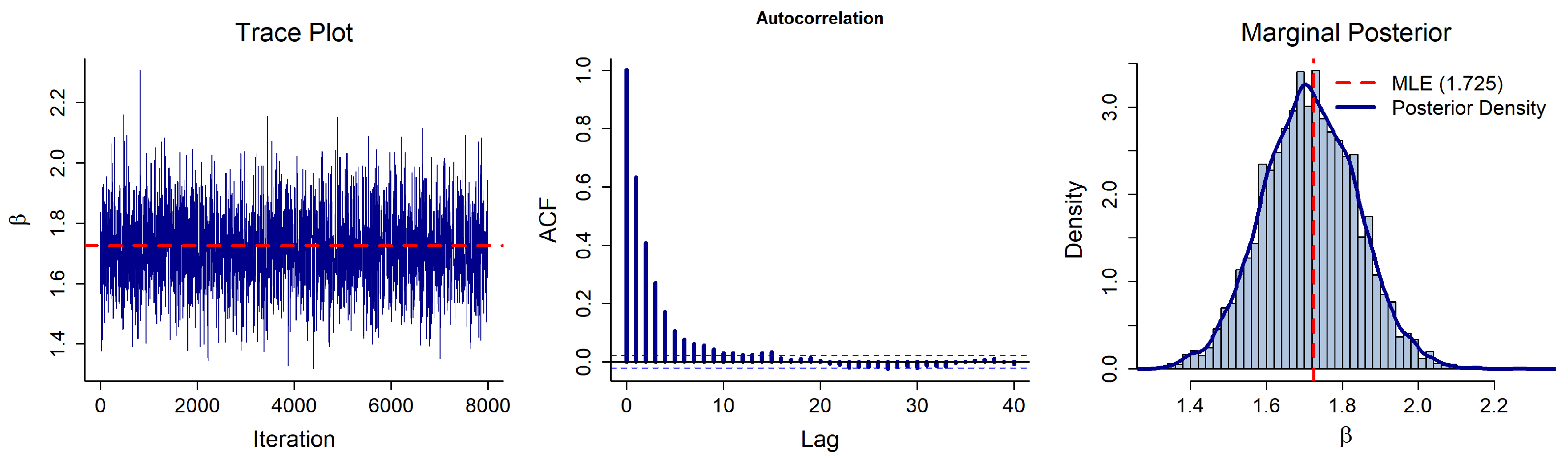
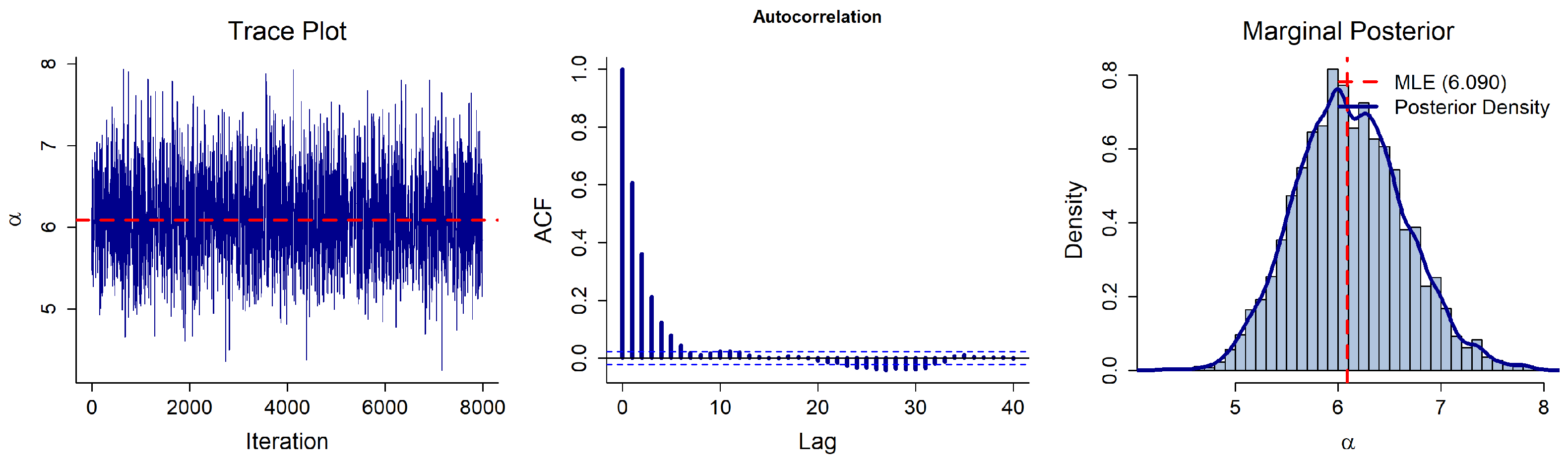
For the Bayesian framework, joint posterior samples are generated using a Metropolis–Hastings within Gibbs algorithm in the unconstrained log-space. For each simulated dataset, the algorithm is run for N = 10,000 iterations. To mitigate the influence of initial values and allow the Markov chains to approach the stationary distribution, the first B = 2000 iterations are discarded as burn-in. The adequacy of this burn-in period was verified during pilot runs by examining trace plots for stationarity and autocorrelation function (ACF) plots for mixing behavior.
During the automated Monte Carlo replications, the proposal variances are dynamically tuned to maintain the M-H acceptance rates within the theoretically optimal range of to , promoting adequate exploration of the parameter space. To reduce sample autocorrelation, a thinning interval of 10 is applied to the post-burn-in chains, yielding a final sample of roughly independent draws for subsequent posterior inference.
Bayesian inference is conducted under two distinct prior specifications:
Prior 0 (Non-informative): The standard Jeffreys prior . Although strictly an improper prior, it mathematically transforms into a flat uniform prior () in the unconstrained log-space () after multiplying by the Jacobian . Consequently, the undefined proportionality constant cancels out within the Metropolis–Hastings acceptance ratio, reducing the target density ratio directly to the likelihood ratio. To ensure numerical stability and prevent the Markov chains from drifting into pathological regions during computation, this prior is practically implemented with a mild truncation ( and ). This guarantees algorithmic validity provided the posterior is proper (i.e., ).
Prior 1 (Empirical Bayes): Independent Gamma priors and , where the hyperparameters are dynamically calibrated by the MLEs of the current sample. We set , , and . This configuration yields a prior coefficient of variation of approximately (), providing sufficient empirical regularization in heavy-tailed regimes without overly dominating the likelihood.
The performance of the predictors is evaluated over = 1000 independent Monte Carlo replications. Let and denote the predicted value and the true realized future failure time in the s-th replication, respectively.
For point predictors, the accuracy is quantified using Bias and Mean Squared Prediction Error (MSPE):
For interval predictors (PP, BPI, and HPD) with a nominal confidence level of
, the performance is evaluated using the Coverage Probability (CP) and the Average Length (AL). Let
denote the lower and upper bounds constructed in the
s-th replication:
where
is the indicator function.
Table 1 compares the parameter estimation performance—measured by Root Mean Square Error (RMSE), Coverage Probability (CP), and Average Length (AL)—of the frequentist Maximum Likelihood Estimates (MLEs) and the Bayes estimates under both a non-informative prior (Prior 0) and the proposed empirical prior (Prior 1). As the distribution tail becomes heavier (i.e., as
decreases from 5.0 to 1.5), the estimation accuracy for the scale parameter
deteriorates, reflected by increased RMSEs across all methods. Nevertheless, the Bayes estimates under Prior 1 consistently yield the lowest RMSEs for both parameters across all censoring schemes, outperforming the frequentist MLEs and the Prior 0 Bayes estimates. For example, in the strict heavy-tailed regime (
, Scheme I), Prior 1 reduces the RMSE of
from 0.5183 (MLE) to 0.3724. This reduction demonstrates the regularization effect of the empirical prior in heavy-tailed settings. For interval estimation, Prior 1 produces substantially narrower credible intervals (e.g., the AL for
under Scheme II at
decreases from 2.4402 under the frequentist approach to 1.7615) while maintaining empirical coverage probabilities near or slightly above the nominal 0.95 level.
Table 2 reports the RMSEs of the estimators across four proportional
settings with a fixed censoring proportion
. Overall, the estimation accuracy improves as the sample size increases. This pattern is also consistent with the findings of Barranco-Chamorro et al. [
37]. For example, under the frequentist MLE, the RMSE of
decreases from 0.1434 to 0.1039 when
, from 0.3588 to 0.2599 when
, and from 0.4805 to 0.3473 when
as
increases from
to
. A similar monotone decline is observed for the estimation of
, with the corresponding RMSEs decreasing from 0.7180 to 0.4934, from 0.2872 to 0.1974, and from 0.2154 to 0.1480, respectively. Moreover, the Bayesian estimator under Prior 1 remains the most accurate method in nearly all settings. Its advantage is particularly evident for estimating the shape parameter
in the heavier-tailed regimes. For instance, when
, the RMSE of
under Prior 1 decreases from 0.1140 to 0.0951 across the four sample-size settings, whereas the corresponding values under the MLE are 0.2154, 0.1907, 0.1712, and 0.1480. Even at
, Prior 1 still reduces the RMSE of
by about 35.7% relative to the MLE.
Table 3 examines the effect of reducing censoring intensity by increasing the observed-failure proportion
from 0.400 to 0.800 while keeping
fixed. A clear feature of the results is that the gain is more pronounced for the estimation of the shape parameter
than for the scale parameter
. Under the frequentist MLE, the RMSE of
decreases moderately, from 0.1538 to 0.1207 when
, from 0.3806 to 0.3033 when
, and from 0.5069 to 0.4065 when
as
m increases from 30 to 60. In contrast, the corresponding RMSEs for
show a much larger reduction, falling from 0.9741 to 0.5865, from 0.3897 to 0.2346, and from 0.2922 to 0.1760, respectively. This indicates that the estimation of the tail-related shape parameter benefits particularly strongly from observing a larger proportion of failures, which is also in line with the general pattern reported by Barranco-Chamorro et al. [
37]. Another notable point is that the Bayesian estimator under Prior 1 remains uniformly the most stable competitor across all
settings. For example, when
, its RMSE for
changes only from 0.1113 to 0.0982 as
increases, whereas the MLE decreases from 0.2922 to 0.1760 over the same range. Thus, increasing
improves all methods, but the empirical prior continues to provide substantial additional stabilization, especially in the heavier-tailed regimes.
Table 4 reports the biases and MSPEs of the point predictors under various progressive censoring schemes, prediction targets, and tail regimes (
). The proposed BP under Prior 1 yields the lowest bias magnitude and MSPE across most scenarios. In the finite-variance regime (Panel A,
), the frequentist BUP and the CMP perform comparably. However, in the strictly heavy-tailed regime (Panel C,
), the MSPEs for both the mean-based BUP and the median-based CMP increase substantially, though for distinct statistical reasons. This divergence stems from the extreme right-skewness of the distribution. For the BUP, the heavy right tail makes the mean highly sensitive to extreme observations, leading to a severe inflation in prediction variance. For the CMP, the right-skewness forces the conditional median to fall well below the conditional mean. While the median-based approach avoids variance inflation, it introduces a systematic downward bias (e.g., a bias of −5.5516 for the CMP compared to 0.4197 for the BUP in predicting the Mid-Min target under Scheme III). Under the bias-variance decomposition of MSPE, this persistent underestimation dominates the squared error term. Consequently, the overall prediction error of the CMP actually exceeds that of the BUP (614.8127 vs. 600.9724). In short, the high MSPE of the BUP is primarily driven by uncontrolled variance, whereas the CMP suffers from systematic underestimation. The performance improvement of the BP under Prior 1 over the BUP stems from two factors: the shift to a Bayesian framework and the injection of prior information. The Bayesian framework alone provides only marginal stability, as evidenced by the comparable performance of the BUP and the BP under the non-informative Prior 0. Therefore, the reduction in MSPE—such as the decrease from 2.9412 (BUP) to 2.3734 (Prior 1)—is primarily driven by the regularization effect of the empirical Bayes strategy rather than posterior integration alone. As expected, predicting further into the future (e.g., from Early-Min to Mid-Min) consistently increases prediction errors across all methods due to the greater uncertainty inherent in longer extrapolation horizons.
Table 5 summarizes the ALs and CPs for the five interval prediction methods. The frequentist PP method exhibits under-coverage for median targets, with CPs dropping to approximately 0.90. Conversely, all Bayesian methods maintain CPs near the nominal 0.95 level. The HPD methods consistently produce the shortest PIs. This advantage stems from how the ETI and HPD approaches handle the severe right-skewness of the Log-Logistic predictive distribution. Standard ETI methods trim an equal probability mass (
) from both tails. Because the distribution features a steep left side and a heavy, flat right tail, symmetrically discarding
forces the upper bound to extend further into extreme values, yielding wider intervals. In contrast, HPD intervals minimize the total width by enforcing identical boundary densities (i.e.,
for unimodal distributions). This constraint shifts the interval toward the mode, capturing the high-density region while omitting the low-density right tail. Consequently, the Bayes HPD method under Prior 1 reduces the AL (e.g., from 45.7393 under ETI to 27.6640 under HPD for the Mid-Min target in Panel C, Scheme III) without compromising the nominal coverage probability.
In summary, the selection of appropriate predictors depends strongly on the tail characteristics of the underlying data. For point prediction, the proposed BP under Prior 1 demonstrates the most stable and accurate overall performance across the evaluated scenarios. This advantage appears to arise primarily from the data-driven regularization induced by the empirical prior, rather than from Bayesian integration alone, as it helps stabilize prediction under heavy-tailed regimes and improves the overall bias–variance trade-off. When a frequentist procedure is preferred or the relevant moments are undefined, the CMP remains a moment-free alternative. However, under extremely heavy-tailed and strongly right-skewed predictive distributions, its practical performance may also deteriorate substantially due to systematic downward bias. For interval prediction, the Bayes HPD method under Prior 1 is the most effective strategy. By adapting to the right-skewness of the predictive distribution, it achieves shorter intervals while maintaining coverage probabilities close to the nominal level.