Article

Digital Transformation and Corporate Breakthrough Innovation: The Role of Supply Chain Spillovers

1
School of Economics, Henan University, Kaifeng 475001, China
2
School of Finance and Economics, Jimei University, Xiamen 361021, China
*
Author to whom correspondence should be addressed.
J. Theor. Appl. Electron. Commer. Res. 2026, 21(4), 110; https://doi.org/10.3390/jtaer21040110
Submission received: 27 February 2026 / Revised: 29 March 2026 / Accepted: 30 March 2026 / Published: 1 April 2026

Abstract

This study investigates how digital transformation influences corporate breakthrough innovation through supply chain spillovers. Using data from Chinese listed companies between 2006 and 2023, we find that upstream digital transformation significantly promotes downstream breakthrough innovation via three mechanisms: knowledge spillover, digital peer effects, and information synergy, the latter helping to mitigate the bullwhip effect. Robustness checks confirm the reliability of these results. Heterogeneity analyses reveal that the effect is stronger for firms with high absorptive capacity, operating in highly competitive industries, or with concentrated supplier bases. In contrast, downstream digital transformation also affects upstream firms, but the spillover is weaker, asymmetric, and operates only through peer effects. These findings enrich the literature on supply chain dynamics and innovation, offering practical insights for firms to harness digital synergy to expand their innovative capabilities.

1. Introduction

Breakthrough innovation, distinct from incremental innovation, entails the “creative destruction” of existing technologies, products, or industrial rules [1]. Rather than improving current offerings, it addresses unmet market needs or creates entirely new markets through novel technologies, design concepts, or application scenarios, reshaping industrial competition [2]. As a form of innovation that transcends established frameworks, breakthrough innovation reflects the expansion of an enterprise’s innovation boundary and serves as a core indicator of its innovation elasticity [3].
The formation and expansion of an enterprise’s innovation boundary, which reflects the achievement of breakthrough innovation, is shaped by a mix of internal and external factors. Internally, resource and financial constraints [4], characteristics of the CEO team [5], organizational size [6], knowledge absorptive capacity [7], as well as the scope and depth of collaboration [8], determine the inherent innovation potential of an enterprise. Externally, technological environmental dynamism [9], market competition intensity [10], and industrial policies [11] constitute the external conditions for adjusting innovation boundaries. These internal and external factors jointly determine the extent of innovation boundary expansion and the probability of breakthrough innovation realization for enterprises. However, despite these insights, existing research largely overlooks inter-organizational linkages in the digital economy context.
Against the backdrop of the digital economy, digital transformation has emerged as a critical force in reshaping the enterprise innovation ecosystem. By leveraging digital technologies, firms can alleviate internal resource constraints and reduce external environmental rigidities [12,13]. Beyond these direct effects, digital transformation also enables the diffusion of knowledge and information across supply chain networks. Digital supply chain platforms, often supported by blockchain and cloud technologies, facilitate real-time information sharing, enhance transparency, and reduce coordination frictions, thereby creating favorable conditions for cross-firm collaboration and breakthrough innovation [14].
Existing literature can be broadly categorized into two streams. The first stream focuses on the direct effects of digital transformation on corporate innovation, generally confirming its positive role in improving innovation efficiency and expanding innovation pathways [15,16,17]. The second stream examines supply chain spillovers, emphasizing mechanisms such as knowledge diffusion and technology transfer among upstream and downstream firms. However, this line of research mainly concentrates on firm performance [18,19,20] or incremental innovation [21,22], with limited attention to breakthrough innovation. More importantly, these two streams remain largely disconnected, and the inter-organizational effects of digital transformation through supply chain networks have not been systematically integrated into the analysis of innovation boundary expansion.
Therefore, several important research gaps remain. First, existing studies rarely examine breakthrough innovation from the perspective of innovation boundary expansion in a supply chain context. Second, the indirect effects of digital transformation through inter-firm spillovers remain underexplored. Third, the underlying mechanisms through which digital transformation influences innovation boundaries across supply chain partners have not been sufficiently unpacked. Addressing these gaps is essential for understanding how digital transformation reshapes innovation dynamics in interconnected production networks.
Building on this, we take digital transformation as the starting point to examine the intrinsic link between supply chain spillovers and firm innovation boundaries. Specifically, we aim to uncover the transmission mechanisms through which digital transformation influences breakthrough innovation via supply chain spillovers, and to identify heterogeneous effects across firms with different supply chain positions and characteristics.
This study makes three contributions. First, we construct an integrated analytical framework that links digital transformation, supply chain spillovers, and enterprise innovation boundaries, thereby extending the literature on the external determinants of breakthrough innovation from a network perspective. Second, we identify and empirically test three key mechanisms—knowledge spillover, digital peer effects, and information synergy—thus unpacking the “black box” of how digital transformation spillovers operate within supply chains. Third, by examining firm heterogeneity and asymmetric spillover effects between upstream and downstream firms, we provide new evidence on how differences in absorptive capacity, competitive environment, and resource dependence shape firms’ ability to leverage digital spillovers for breakthrough innovation.

2. Theoretical Framework

Affected by the asymmetry of production network structures and input–output relationships, the spillover effects of digital transformation differ significantly between upstream and downstream firms in the supply chain. By virtue of their control over key resources and strong market power, upstream firms can achieve technology spillovers through intermediate products via their digital investments and drive downstream innovation with patents, while downstream firms also exhibit stronger absorptive capacity. In contrast, downstream firms lack reverse influence due to their dependence on upstream supply, resulting in weak spillover effects from their digital initiatives. The spillover effects of digital transformation are therefore likely to be asymmetric between upstream and downstream links. For this reason, the theoretical mechanism analysis in subsequent sections focuses on how upstream digital transformation impacts breakthrough innovation in downstream firms.

2.1. Knowledge Spillover Effect

Knowledge spillover effect serves as a critical mediator linking upstream digital transformation and downstream breakthrough innovation. Digital technologies inherently possess replicability and network effects, which fundamentally break the temporal-spatial boundaries and carrier constraints of traditional knowledge dissemination, creating an efficient channel for vertical knowledge transfer in supply chains [23,24]. Traditional knowledge transmission often relies on inefficient methods like face-to-face communication or offline training. In contrast, digital technologies enable rapid replication and diffusion through code reuse, cloud sharing, and system integration. Moreover, the resulting network effects further expand the coverage and depth of transmission as more supply chain nodes participate [25]. Upstream enterprises accumulate specific digital technical knowledge during transformation, which transcends organizational boundaries and is accurately transmitted to downstream via supply chain transactions, data interactions, and cooperation [26]. Bartelsman, et al. [27] categorized such supply chain knowledge spillover as supply-driven (led by upstream), which exerts more significant long-term impacts on downstream technical capabilities due to its professionalism and systematicness. Patent citation, a direct and quantifiable carrier, reflects downstream’s efficiency in absorbing upstream core digital knowledge [28], as downstream selectively references upstream digital patents (e.g., intelligent scheduling algorithms, data security encryption) through supply chain agreements or joint R&D.
This targeted knowledge spillover effectively empowers downstream breakthrough innovation by removing key technical and resource barriers. It helps downstream enterprises quickly overcome technical bottlenecks, bypass the basic R&D “valley of death,” and avoid redundant investment waste [1]. More importantly, it promotes the integration of internal and external resources—allowing downstream to combine upstream technical knowledge with their own business scenarios to realize the “introduction-digestion-absorption-re-innovation” iteration path [29]. Additionally, it provides new technical perspectives for cross-border integration: for example, integrating upstream intelligent algorithms with in-house manufacturing can develop independent decision-making intelligent production units [30]. By accessing cutting-edge knowledge at lower thresholds and optimizing innovation resource allocation, downstream enterprises significantly reduce innovation risks and improve success rates [31], ultimately enhancing breakthrough innovation capabilities with market competitiveness and disruptiveness.

2.2. Peer Effect of Digital Transformation

The peer effect of digital transformation in the supply chain is a critical mechanism linking upstream digitalization and downstream breakthrough innovation. Tight inter-firm linkages in supply chain networks endow upstream digital transformation with prominent demonstration and coercive effects, which focus on synchronized transformation strategies and models across the supply chain rather than the transfer of specific technical knowledge [32]. A significant “digital divide” between supply chain partners will increase transaction friction costs and reduce overall operational efficiency [33]. To address this, upstream firms provide non-technical resources such as transformation path planning and experience summaries to help downstream firms cut decision-making risks and trial-and-error costs [34]. Empirical evidence supports this logic: Geng, et al. [35] show that supply chain spillovers force downstream firms to pursue digital transformation to reduce costs, while Xu, et al. [36] confirm that there is a peer effect in digital transformation.
This supply chain peer effect lays a solid foundation for downstream breakthrough innovation. By learning from upstream experience, downstream firms can introduce suitable digital technologies and management models to optimize production processes and resource allocation [37], providing technical and organizational support for breakthrough innovation. Moreover, digital transformation enhances supply chain information network connectivity [38], accelerating the diffusion of transformation concepts and forming a positive cycle of “upstream leadership-downstream follow-up”. This cycle further empowers downstream firms to carry out high-value breakthrough innovation.

2.3. Information Synergy Effect

Bullwhip effect mitigation also acts as a critical mediator between the two variables. By applying digital technologies such as the Internet of Things and big data, upstream firms can optimize supply chain structures [39]. They break down information barriers between firms in traditional supply chains, enabling efficient transmission and transparent sharing of supply and demand information across upstream and downstream links [40]. The improvement of such information synergy is directly reflected in the weakening of the bullwhip effect. When upstream firms use digital tools to capture real-time production, inventory and demand data, and accurately transmit it to downstream segments, the distortion and amplification of demand information during multi-level transmission can be effectively suppressed [41]. Studies by Li, et al. [42] have clearly confirmed that corporate digital transformation mitigates the bullwhip effect. Yang, et al. [43] have further verified that supply chain information synergy reduces decision-making biases caused by information asymmetry. These findings provide theoretical support for upstream digital transformation to empower downstream innovation by weakening the bullwhip effect.
The effective mitigation of the bullwhip effect removes key obstacles for downstream firms’ breakthrough innovation and builds an efficient innovation support system. In traditional supply chains with a significant bullwhip effect, downstream firms often face large demand forecast deviations and unclear upstream supply dynamics [44]. They have to allocate substantial resources to cope with demand fluctuations and supply uncertainties, which both lengthen the innovation cycle and increase the risk of innovation failure. However, after upstream digital transformation drives the upgrading of information synergy, downstream firms can accurately capture real market demand trends, as well as key dynamics such as upstream supply capacity and delivery cycles [38]. They can quickly adjust innovation directions and rhythms based on reliable information, significantly shortening the innovation cycle from idea generation to product launch. More importantly, the precise matching of supply and demand information allows downstream firms to avoid resource waste caused by blind innovation. They can focus core resources such as R&D and capital on breakthrough innovation projects with high market potential [45]. This reduces innovation risks while significantly improving innovation success rates, ultimately achieving a substantial enhancement of breakthrough innovation capability.

3. Research Design

3.1. Model

3.1.1. Baseline Regression Model

To verify whether upstream digital transformation affects the breakthrough innovation of downstream enterprises through the supply chain, this paper adopts econometric regression tests and constructs the baseline econometric model as follows:
B I f , i , t = a 1 + β 1 U p s t r e a m _ D i g i , t + β 2 Z f , i , t + μ f + θ t + ε f , i , t
where B I f , i , t denotes the level of breakthrough innovation of firm f in industry i during year t . U p s t r e a m _ D i g i , t represents the degree of digital transformation in the upstream industry, Z f , i , t denotes the control variables, μ f stands for firm fixed effects, θ t for time fixed effects, and ε f , i , t for the error term. To avoid the interference of autocorrelation on empirical results, standard errors are clustered at the firm level. A significantly positive coefficient of β 1 indicates that digital transformation in upstream industries exerts a facilitating effect on the breakthrough innovation of downstream firms.

3.1.2. Double Machine Learning Model

Linear regression models assume a simple linear relationship between control variables, digital transformation, and breakthrough innovation. They fail to account for actual confounding factors, potentially leading to model specification bias. In contrast, double machine learning is founded on machine learning algorithms and boasts distinct advantages in predicting nonlinear relationships. It effectively mitigates estimation bias arising from model misspecification. On the other hand, double machine learning alleviates the “regularization bias” inherent in traditional machine learning and ensures the unbiasedness of the estimators for explanatory variable coefficients even with small samples. Drawing on Chernozhukov, et al. [46], we construct a partially linear double machine learning model, which is presented as follows:
B I f , t = θ 0 U p s t r e a m _ d i g f , t + g ( Z f , t ) + U f , t , E ( U f , t Z f , t , U p s t r e a m _ D i g f , t ) = 0
The key difference between the above equation and Equation (1) is that g ( Z f , t ) does not represent a simple linear relationship between the control variables and the explained variable; instead, its estimator g ^ ( Z ) is derived via machine learning methods, and U denotes the error term with a conditional mean of 0. The estimator directly obtained from Equation (2) tends to be inconsistent in converging to the true value. Therefore, the orthogonalization method can be introduced to correct the bias. In this framework, two separate machine learning models are used to estimate the relationships of control variables with the treatment and outcome, and the orthogonalization step ensures that the estimated effect of upstream digital transformation is unbiased.

3.2. Variables Definition

3.2.1. Dependent Variable

The core feature of breakthrough innovation lies in discontinuous technological changes that go beyond a firm’s existing technological boundaries. Existing studies mainly adopt methods such as IPC classification overlap [47], patent citation deviation [48,49], and textual similarity analysis [50]. Patent citation-based measures capture technological influence but often suffer from time lags, while textual similarity approaches can better reflect novelty but are computationally intensive and require extensive data. Compared with these alternatives, the IPC-based classification overlap method is relatively simple, transparent, and widely applicable in large-sample empirical studies.
Building on Guan and Liu [47], this study employs the IPC classification overlap method to measure breakthrough innovation. The core idea is that breakthrough innovation reflects discontinuous technological changes that go beyond a firm’s existing technological boundaries. Specifically, we adopt a five-year time window based on the first four digits of IPC patent classification numbers. If the IPC classification codes of patents applied for by a firm in the current year do not overlap with those in the previous five years, such patents are identified as breakthrough innovation patents. The number of such patents is counted, and the variable is constructed by adding 1 and taking the natural logarithm.
Although relying solely on IPC classification overlap may overlook deep technological advances within the same technological domain and cannot distinguish the technological impact or economic value of patents, which may lead to an overestimation of low-quality “new-domain” patents. This approach, however, directly identifies whether firms enter new technological domains, thereby aligning with the essence of breakthrough innovation as the expansion of innovation boundaries. In addition, IPC classification information is relatively complete and readily available in the patent data of Chinese listed firms, which ensures sample coverage and comparability. Therefore, despite its simplified nature, this measure remains a practical and reliable proxy for breakthrough innovation in large-sample empirical research and is consistent with the objectives of this study.

3.2.2. Independent Variable

Existing studies measure firms’ digital transformation using approaches such as keyword frequency counts [51], digital patent counts [52], and the proportion of digital intangible assets [53]. Keyword-based methods are easy to implement but often fail to capture semantic and contextual information and are vulnerable to firms’ strategic disclosure (“talk more, do less”), which may bias measurement results. Patent-based measures are objective and quantifiable but mainly reflect technological inputs, thus overlooking non-technological dimensions such as management processes and business model transformation. Measures based on the proportion of digital intangible assets depend on the comparability of financial data; however, they are subject to incomplete disclosure and potential distortions arising from accounting practices.
Following Jin, et al. [54], this study adopts a text-based semantic analysis approach using the Enhanced Representation through Knowledge Integration (ERNIE) model to construct a firm-level digital transformation index. Specifically, we collect annual report disclosures of listed firms from 2006 to 2023, build a dictionary of digital technology keywords, and segment the texts into sentences to construct a sentence-level corpus. Sentences containing references to six categories of digital technologies—big data, artificial intelligence, mobile internet, cloud computing, the Internet of Things, and blockchain—are manually annotated. A classifier based on the ERNIE model is then trained to identify relevant sentences, and the number (or proportion) of identified sentences is used to construct the digital transformation index.
This measure captures firms’ strategic emphasis on digital technologies by extracting context-aware information from narrative disclosures, going beyond simple keyword matching. Although it relies on annual report texts and may be subject to selection bias in corporate disclosures, the semantic-based approach mitigates the limitations of keyword frequency methods by incorporating contextual information, and does not depend on patenting activity or accounting items, thereby providing broader coverage of firms’ digital strategies. In large-sample settings, this method offers advantages in terms of data availability, cross-firm comparability, and its ability to reflect firms’ strategic orientation toward digital transformation, making it a suitable proxy for this study.
To measure the degree of upstream digital transformation, this paper refers to the method of Yang, Li and Meng [32] and calculates the upstream industry digital transformation degree ( U p s t r e a m _ D i g i , t ) for each firm based on China’s Input–Output Tables. This indicator characterizes the extent to which a focal firm is exposed to digital transformation through its upstream supply chain linkages, thereby highlighting a key channel through which digital spillovers may occur. The specific formula is presented as follows:
U p s t r e a m _ D i g i , t = j C o m p C o n s u m p i , j , 2012 × D i g I j , t
D i g I j , t = f S a l e f , j , t f S a l e f , j , t × D i g f , i , t
where j C o m p C o n s u m p i , j , 2012 denotes the direct consumption coefficient of industry j for industry i as reported in the 2012 Input–Output Table. D i g I j , t represents the weighted average of the digital transformation degree D i g f , i , t of each firm f in industry j , where the weight is calculated as the ratio of the operating income S a l e f , j , t of firm f to the total operating income of the industry. A higher value of D i g I j , t indicates a higher level of digital transformation in industry j in year t .

3.2.3. Control Variables

A firm’s decision-making on breakthrough innovation is shaped by multiple factors. Accordingly, we include a set of control variables capturing firm characteristics and corporate governance. Firm characteristics include firm size (Size), leverage ratio (Lev), cash flow ratio (Cashflow), and firm age (FirmAge). Corporate governance variables consist of board size (Board), CEO duality (Dual), and the proportion of independent directors (Indep).

3.3. Data Source and Process

Given the data availability, this paper sets the sample period from 2006 to 2023. The obtained raw data are processed as follows: (1) excluding ST, ST*, and PT firms during the sample period; (2) removing samples with missing observations of key variables; (3) eliminating financial industry companies; (4) performing a logarithmic transformation on non-ratio variables to mitigate heteroscedasticity and non-stationarity of the data. After the above processing, a final sample of 3327 listed companies with a total of 31,711 observations is obtained.
The patent data used in this paper are sourced from the Chinese Patent Data Project (CPDP) database. The annual report data of listed companies comes from Wind, the China Securities Regulatory Commission (CSRC) Information Disclosure Website (CNINFO), and the official websites of listed companies themselves. The relevant data of listed firms are retrieved from the China Research Data Services (CNRDS) database and the China Stock Market & Accounting Research (CSMAR) database. The input–output table data are obtained from the National Bureau of Statistics of China. The supplier–customer data are extracted from the Listed Companies’ Supply Chain Information Table in the CSMAR database. The results of the descriptive statistics of variables are presented in Table 1.

4. Results

4.1. Baseline Regression

Table 2 reports the impact of digital transformation in upstream industries on the breakthrough innovation of downstream enterprises. The results in columns (1) to (3) show that the coefficient of upstream digital transformation is significantly positive at the 1% level, regardless of whether control variables are included or two-way fixed effects (time and individual) are incorporated. These findings suggest that upstream digital transformation is positively associated with downstream enterprises’ breakthrough innovation, potentially reflecting its role in facilitating knowledge spillovers and innovation activities.

4.2. Double Machine Learning Model Test

This paper employs the DML method for robustness checks, with the results reported in Table 3. Across algorithms including random forest, Lasso regression, support vector machines, gradient boosting, and neural networks, the DML-estimated coefficients remain significantly positive. Moreover, after adjusting the sample ratio to 1:2 and 1:7, the positive association between upstream digital transformation and firms’ breakthrough innovation remains. These results provide further support for the robustness of the baseline findings.

4.3. Endogenous Discussion

4.3.1. Lagged Independent Variable

Table 4 reports the results using lagged variables to mitigate potential bidirectional causality. The coefficient of lagged upstream digital transformation remains significantly positive at the 1% level. Moreover, its magnitude is larger than that in the baseline regression. These results provide additional support for a positive association between upstream digital transformation and firms’ breakthrough innovation, and suggest that the relationship may exhibit some degree of persistence.

4.3.2. Instrumental Variable (IV) Method

To mitigate endogeneity concerns, we employ instrumental variable (IV) methods. First, drawing on Bartik [55], we use the shift-share method to construct a predicted value of the upstream digital transformation level as the first IV. Specifically, we take the upstream digital transformation level of an industry in the base period and multiply it by 1 plus the growth rate of the digital transformation level of other upstream industries (excluding the focal industry). This Bartik IV is expected to be correlated with the upstream digital transformation level of the focal industry, yet is less likely to directly affect the breakthrough innovation of firms in that industry, thus potentially satisfying the relevance and exogeneity requirements for an instrumental variable.
Second, we adopt the heteroscedasticity-based IV approach proposed by Lewbel [56]. Unlike traditional IV methods that require exogenous variables uncorrelated with the error term, the Lewbel method leverages heteroscedasticity to identify endogeneity without strict exclusion restrictions. Specifically, we regress the endogenous variable on the exogenous variables to obtain residuals, then multiply these residuals by the exogenous variables to construct the Lewbel IV.
Table 5 reports the two-stage least squares regression results. Both instrumental variables exhibit strong first-stage correlations with upstream digital transformation, with first-stage F-statistics above 10, suggesting that weak instrument concerns are unlikely to be severe. The Kleibergen–Paap rk LM statistic suggests that the model is identified. As shown in columns (2) and (4), the coefficient of upstream digital transformation remains positive and statistically significant for both the Bartik and Lewbel IVs. Moreover, the 2SLS coefficient is larger in absolute value than in the baseline regression, which provides additional support for the robustness of the main findings.

4.3.3. Difference-in-Differences Estimation

To further address endogeneity, we construct a continuous difference-in-differences (DID) model based on China’s supply chain innovation and application pilot program [57], which has been used in prior studies as a quasi-natural experimental setting for examining supply chain digital transformation [58]. Using pilot enterprises, we generate industry-level policy shocks combined with input–output tables for DID tests. Following Yang, Li and Meng [32], industries with a high concentration of pilot enterprises are assumed to face stronger policy shocks. Industries are divided into strong and weak pilot shock groups based on the average number of pilot enterprises, and an industry shock dummy is multiplied by the 2018 pilot-year dummy to form the DID term.
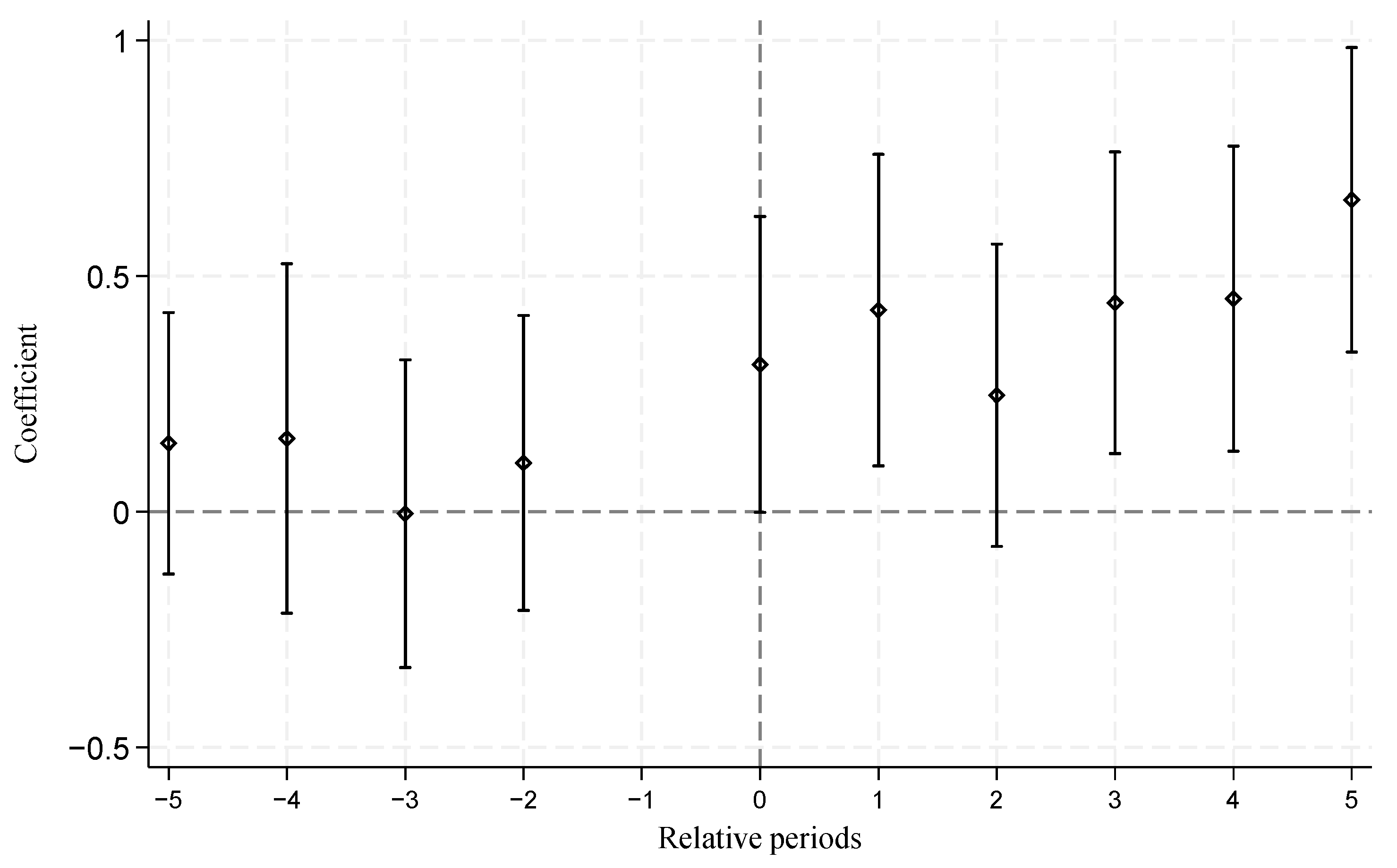
To validate the link between the pilot program and digital transformation, we examine the Pearson correlation between the pilot policy dummy and upstream industry digital transformation, finding a significant positive correlation of 0.7378. Thus, the pilot program can be viewed as providing a useful quasi-experimental setting that generates upstream supply chain digitalization shocks. As shown in Column (1) of Table 5, these shocks are positively associated with downstream firms’ breakthrough innovation at the 1% level. Figure 1 provides supportive evidence for the parallel trends assumption and suggests that the estimated relationship may persist over time.

4.4. Robustness Test

4.4.1. Interactive Fixed Effect and Higher-Level Clustering

To control for time-varying regional characteristics, we incorporate city-year interaction fixed effects into the model. This step helps account for the potential impact of time-varying city characteristics on breakthrough innovation. The results with interaction fixed effects are reported in Column (1) of Table 6. In addition, standard errors in the baseline regression are clustered at the firm level. This paper further clusters the standard errors at the provincial level to relax the assumptions about error term correlation, with the results shown in Column (2) of Table 6. The results remain consistent in both sign and statistical significance, providing further support for the robustness of the main findings.

4.4.2. Replace the Core Variable

First, we replace the measurement method of digital transformation. Existing literature suggests that firms may overstate their digitalization level in annual reports. To avoid measurement errors of digital transformation caused by firms’ strategic disclosure behaviors, we draw on Tao, Wang, Xu and Zhu [37] and use the number of digital patent applications to measure the degree of firms’ digital transformation. The results after replacing the key independent variable are presented in Column (1) of Table 7.
Second, we replace the measurement method of breakthrough innovation. Drawing on Bray and Mendelson [59], we adopt the difference between the total number of invention and utility model patent applications and the number of patent applications under the category of familiar technologies, then take the logarithm of this difference to re-measure the degree of corporate breakthrough innovation. The results after replacing the dependent variable are shown in Column (2) of Table 7. Under this alternative measure, the estimated coefficients remain similar in both sign and statistical significance, indicating consistency with the baseline findings and reinforcing the stability of the main results.

4.4.3. Replace the Sample

First, we exclude observations with industry changes. To mitigate potential industry self-selection concerns associated with industry adjustments, we remove firms that changed their industries during the sample period and rerun the regression, with the results reported in Column (1) of Table 8. Second, we exclude the COVID-19 pandemic subsample. Given the potential disruptions caused by the COVID-19 outbreak at the end of 2019, data of listed firms after 2020 may have fluctuated significantly, which could further affect the regression results; thus, we delete the post-2020 observations and rerun the regression, and the results are shown in Column (2) of Table 8. Third, we retain only the manufacturing subsample. The manufacturing industry features a clear division of labor and close technological linkages along its upstream and downstream industrial chains. Focusing on this industry helps ensure a relatively more comparable setting across firms and reduces potential heterogeneity across sectors. Therefore, we keep only the manufacturing observations and rerun the regression, with the results presented in Column (3) of Table 8. Across these alternative sample restrictions, the estimated coefficients remain similar in both sign and statistical significance, providing additional support for the robustness of the main findings.

4.5. Mechanism Test

4.5.1. Knowledge Spillover Effect Test

According to theoretical analysis, upstream digital transformation may affect downstream enterprises through knowledge spillover channels. Patent citation and being cited data between enterprises are often used to characterize knowledge flow and spillover effects. If an enterprise cites patents from other enterprises, it can be considered that this enterprise has acquired and absorbed knowledge from those enterprises. Accordingly, patent citations from upstream firms provide a direct observable proxy for cross-firm knowledge diffusion along the supply chain. Therefore, referring to Yang, et al. [60], we use the number of patents that enterprises cite from upstream industries (CUI) to measure knowledge spillovers. Specifically, we obtain the cited information of applied patents from CNRDS. We match the stock code and basic information of listed companies according to the names of citing and cited enterprises, and delete the data of unlisted companies that cannot be matched, finally obtaining the patent cross-citation data of listed companies. We aggregate the cited volume by industry and then calculate the upstream citation volume of each enterprise based on the input–output table to measure the knowledge spillover effect.
As shown in Column (1) of Table 9, upstream digital transformation is positively associated with enterprises’ patent citations from upstream industries. This pattern is consistent with the knowledge spillover channel, as increased upstream citations indicate that downstream firms absorb more technological knowledge from digitally transformed upstream partners. Overall, the results indicate that upstream digital transformation may facilitate knowledge diffusion along the supply chain and is associated with downstream firms’ breakthrough innovation.

4.5.2. Peer Effect Test of Digital Transformation

To test whether digital transformation exhibits a peer effect along the supply chain, we analyze whether upstream digital transformation is associated with similar digitalization behavior in downstream firms through imitation and benchmarking. Column (2) of Table 9 reports the impact of upstream digital transformation on the digitalization of downstream firms (Dig). The results show that upstream digital transformation is positively associated with downstream firms’ digitalization. This pattern suggests that downstream firms tend to align their digital strategies with those of upstream partners, which is consistent with peer-driven adoption behavior along the supply chain. Specifically, the digital upgrading of upstream sectors may influence downstream firms’ digital transformation decisions through supply chain linkages, thereby facilitating downstream firms’ breakthrough innovation.

4.5.3. Information Synergy Effect Test

Drawing on Bray and Mendelson [59], we measure the bullwhip effect (Bullwhip) using the deviation degree between firms’ production fluctuations and demand fluctuations. This measure reflects the level of information coordination within the supply chain, where a lower bullwhip effect indicates more efficient information sharing and higher information synergy. A higher value of this indicator indicates a more severe imbalance between upstream supply and downstream demand in the supply chain dominated by core firms, corresponding to a lower level of information synergy effect; conversely, a lower value reflects a higher level of information synergy effect. Specifically, the deviation degree is defined as the ratio of the quarterly standard deviation of production volume to that of demand volume. Herein, quarterly production volume is calculated as the sum of quarterly cost of goods sold and quarterly net inventory, while quarterly demand volume is the total of operating revenue and other operating revenue.
As shown in Column (3) of Table 9, a higher degree of digital transformation among upstream firms in the supply chain is associated with a lower bullwhip effect, which suggests an improvement in information synergy across supply chain partners. The reduction in the bullwhip effect is consistent with enhanced information transparency and coordination efficiency, indicating that digital transformation may improve information sharing within the supply chain, thereby facilitating downstream firms’ breakthrough innovation.

4.6. Heterogeneity Test

4.6.1. Corporate Absorptive Capacity

According to the absorptive capacity theory, a firm’s external knowledge absorptive capacity is a key determinant of its innovation performance [61]. Building on this perspective, the absorptive capacity of downstream firms may influence their ability to identify and integrate the technical knowledge released by upstream digital transformation. To examine this heterogeneity, we compile firms’ patent citation volumes from patent citation databases as a measure of corporate absorptive capacity. The sample is divided into high-absorptive-capacity and low-absorptive-capacity groups using the median, with subgroup regressions conducted accordingly. Results in columns (1) and (2) of Table 10 show that for firms with high absorptive capacity, the coefficient of upstream digital transformation on breakthrough innovation is larger. For firms with low absorptive capacity, the coefficient is smaller. Since both coefficients are significant, we conducted Fisher’s combined test. The test statistic is 18.609, rejecting the null hypothesis of no inter-group difference at the 1% significance level. These results indicate heterogeneous effects across firms with different levels of absorptive capacity, suggesting that higher absorptive capacity may strengthen the positive association between upstream digital transformation and downstream breakthrough innovation.

4.6.2. Industry Competition Intensity

From the perspective of the Structure–Conduct–Performance (SCP) framework in industrial organization theory, industry competition intensity, as a core market structure characteristic, may affect firms’ motivation to absorb external knowledge and their innovation decisions [62]. In highly competitive industries, firms face greater survival pressure. Homogeneous competition forces them to pursue breakthrough innovation to build differentiated advantages. In such cases, downstream firms may be more likely to capture the technology spillovers brought by upstream digital transformation. In less competitive industries, firms often hold certain market power and have relatively weak innovation incentives. The spillover effects of upstream digital transformation may be more likely to be used for optimizing existing production processes (incremental innovation) rather than investing in high-risk breakthrough innovation.
We measure industry competition intensity using the Herfindahl-Hirschman Index (HHI), which is calculated based on the market share of each firm’s total assets in its industry. An HHI above the median indicates low competition intensity, and vice versa. Results in Columns (1) and (2) of Table 11 suggest that upstream digital transformation is more positively associated with breakthrough innovation in highly competitive industries, while the effect is insignificant in less competitive industries. These results indicate heterogeneous effects across industries with different levels of competition intensity, suggesting that competitive pressure may strengthen the positive association between upstream digital transformation and downstream breakthrough innovation.

4.6.3. Supplier Concentration

From the perspectives of resource dependence theory, supplier concentration directly determines the bargaining power and resource interaction mode of upstream and downstream firms [63]. Downstream firms often rely on a few large suppliers for their core inputs, and the two sides tend to form close collaborative relationships. Digital transformation of upstream suppliers, such as intelligent production and data-driven supply chain management, may facilitate the opening of technical interfaces and the sharing of data resources with downstream firms. This may help downstream firms reduce innovation trial-and-error costs and integrate cross-organizational knowledge.
Following the approach of Irvine, et al. [64], we measure supplier concentration by calculating the ratio of procurement from the top five suppliers to total annual procurement, based on the Listed Companies Supply Chain Information Table in the CSMAR database. Results in Columns (1) and (2) of Table 12 show that the coefficient is significantly positive for the high supplier concentration group, but insignificant for the low concentration group. These results indicate heterogeneous effects across firms with different levels of supplier concentration, suggesting that upstream digital transformation is more strongly associated with downstream breakthrough innovation when supplier concentration is higher. This pattern is consistent with the view that closer supply chain relationships may facilitate knowledge transfer and enhance the benefits of upstream digital transformation.

5. Further Analysis: The Asymmetric Spillover of Downstream Digital Transformation

We further explored whether downstream digital transformation generates spillover effects that are comparable to those of its upstream counterpart. Columns (1)–(3) of Table 13 present the regression results of downstream digital transformation on breakthrough innovation. The findings suggest that spillover effects also exist in the downstream context, but their magnitude is notably smaller than that of upstream spillover effects. The results of Table 14 report the robustness test of these downstream effects, showing that the promotional impact on upstream firms’ breakthrough innovation is not robust. Overall, these results indicate an asymmetric pattern of spillover effects between upstream and downstream digital transformation.
To explore why the spillover effect of downstream digital transformation is weaker than that of upstream digital transformation, we further examine the underlying channels of downstream digital transformation. As shown in Columns (4)–(6) of Table 13, downstream digital transformation is primarily associated with upstream breakthrough innovation through the digital peer effect, while the other two channels do not exhibit significant effects. The limited evidence for the knowledge spillover and bullwhip effect channels may be related to the asymmetry in innovation needs and supply chain transmission mechanisms between upstream and downstream firms.
One possible explanation is that downstream digital transformation tends to focus on application-level scenarios, such as terminal channels and user demand analysis. The digital knowledge generated in this process is often highly contextualized, which may limit its applicability to upstream firms’ core innovation activities, such as material R&D and production process upgrading, thereby weakening the knowledge spillover channel. Similarly, the bullwhip effect is typically associated with information distortion along the supply chain. While downstream digitalization can improve information processing efficiency at the firm level, it may have limited influence on upstream production decisions that are constrained by capacity and raw material conditions, reducing its effectiveness in alleviating supply-demand mismatches. In contrast, the digital peer effect operates through technological demonstration and imitation among firms and is less dependent on direct supply-demand alignment. Under competitive pressure, upstream firms may be more inclined to learn from downstream digital practices, thereby indirectly enhancing their own breakthrough innovation capabilities.

6. Conclusions and Policy Implications

6.1. Conclusions

In today’s digital economy, enterprises increasingly rely on digital transformation to enhance innovation capabilities and maintain a competitive advantage. This study explores how digital transformation influences corporate breakthrough innovation through supply chain spillovers, using data from Chinese listed companies between 2006 and 2023. Focusing on the inter-organizational impact of digital transformation, we examine the transmission mechanisms along supply chains and analyze heterogeneity across firms with different absorptive capacities, industry competition levels, and supplier concentrations. By integrating digital transformation, supply chain spillovers, and innovation boundaries, this research addresses a gap in the literature regarding the external determinants of breakthrough innovation.
Our results show that upstream firms’ digital transformation significantly drives downstream breakthrough innovation through three mechanisms: knowledge spillover, digital peer effects, and information synergy, with the latter helping to mitigate the bullwhip effect. This impact is stronger for firms with high absorptive capacity, operating in highly competitive industries, or with concentrated supplier bases. In contrast, the spillover from downstream to upstream firms is weaker, asymmetric, and operates only through peer effects. These findings provide new insights into how digital transformation reshapes innovation dynamics across supply chains and highlight the importance of leveraging digital synergies to enhance corporate innovation capabilities.

6.2. Policy Implications

Based on this study, the following policy insights are drawn: First, a digital collaboration platform for the supply chain should be established at the policy level. In designing such platforms, policymakers should also consider features that enable secure anonymization of sensitive supply chain data, as well as functionalities for tendering and financial arrangements. These enhancements can improve platform adoption, facilitate broader participation, and strengthen the overall efficiency and resilience of supply chain networks. Second, enterprises should be guided to enhance their absorptive capacity. Digital transformation subsidies should be provided to firms with high absorptive capacity, those in highly competitive industries, and those with high supplier concentration. This will help them efficiently convert spillover value from the supply chain. Third, balanced digital development between upstream and downstream should be promoted. Special policies should support core upstream enterprises in deepening digitalization. Meanwhile, downstream enterprises should be encouraged to leverage peer effects. This will help reduce asymmetric spillover gaps and fully stimulate innovation momentum across the supply chain.

6.3. Limitations

Despite the contributions of this study, several limitations should be noted. First, our analysis does not directly measure firms’ willingness to share data or the quality of relational governance within supply chains. While we use observable proxies such as supplier concentration and documented collaborations, survey-based measures, textual analysis of contracts, or in-depth interviews could provide more direct evidence on the conditions under which digital knowledge is transmitted. Second, our study focuses exclusively on Chinese listed companies, which generally maintain relatively stable supplier–customer relationships and have higher levels of digital adoption. Consequently, caution is warranted when generalizing the findings to other contexts, such as smaller firms, less developed markets, or countries with different regulatory and digital environments. Future research could extend this analysis to cross-country settings to examine whether the spillover mechanisms of digital transformation and their effects on breakthrough innovation vary across national contexts.


Author Contributions

Conceptualization, L.L. and R.L.; data curation, J.X. and R.L.; formal analysis, L.L. and R.L.; funding acquisition, L.L.; investigation, J.X. and R.L.; methodology, L.L. and R.L.; software, J.X. and R.L.; validation, L.L.; visualization, J.X.; writing—original draft preparation, L.L. and R.L.; writing—review and editing, L.L. and R.L. All authors have read and agreed to the published version of the manuscript.

Funding

This work was supported by the National Social Science Fund of China (25CRK004).

Institutional Review Board Statement

Not applicable.

Informed Consent Statement

Not applicable.

Data Availability Statement

The original data presented in the study are openly available in FigShare at https://doi.org/10.6084/m9.figshare.31431904.

Acknowledgments

The authors are grateful to the anonymous referees who provided valuable comments and suggestions to significantly improve the quality of the paper.

Conflicts of Interest

The authors declare no conflicts of interest.

References

  1. Byun, S.K.; Oh, J.-M.; Xia, H. Incremental vs. breakthrough innovation: The role of technology spillovers. Manag. Sci. 2021, 67, 1779–1802. [Google Scholar] [CrossRef]
  2. Capponi, G.; Martinelli, A.; Nuvolari, A. Breakthrough innovations and where to find them. Res. Policy 2022, 51, 104376. [Google Scholar] [CrossRef]
  3. Datta, A.A.; Srivastava, S. (Re)conceptualizing technological breakthrough innovation: A systematic review of the literature and proposed framework. Technol. Forecast. Soc. Change 2023, 194, 122740. [Google Scholar] [CrossRef]
  4. Chen, S.; Shen, T. Resource constraints and firm innovation: When less is more? Chin. J. Popul. Resour. Environ. 2023, 21, 172–180. [Google Scholar] [CrossRef]
  5. Lee, J.Y.; Wei, Y.; Tang, R.W.; Choi, B.; Cooke, F.L. CEO narcissism, subsidiary top management team international diversity, and radical digital innovation in multinational enterprises. Res. Policy 2025, 54, 105242. [Google Scholar] [CrossRef]
  6. Mabenge, B.K.; Ngorora-Madzimure, G.P.K.; Makanyeza, C. Dimensions of innovation and their effects on the performance of small and medium enterprises: The moderating role of firm’s age and size. J. Small Bus. Entrep. 2022, 34, 684–708. [Google Scholar] [CrossRef]
  7. Wang, C.; Zhang, X.E.; Teng, X. How to convert green entrepreneurial orientation into green innovation: The role of knowledge creation process and green absorptive capacity. Bus. Strategy Environ. 2023, 32, 1260–1273. [Google Scholar] [CrossRef]
  8. Kesidou, E.; Love, J.H.; Ozusaglam, S.; Wong, C.Y. Changing the geographic scope of collaboration: Implications for product innovation novelty and commercialization. J. Prod. Innov. Manag. 2023, 40, 859–881. [Google Scholar] [CrossRef]
  9. Kyrdoda, Y.; Balzano, M.; Marzi, G. Learn to survive crises: The role of firm resilience, innovation capabilities and environmental dynamism. Technol. Soc. 2023, 74, 102285. [Google Scholar] [CrossRef]
  10. Zu, Y.; Zhang, R. Supplier change, market competition and enterprise innovation. Eur. J. Innov. Manag. 2023, 26, 1034–1053. [Google Scholar] [CrossRef]
  11. Yang, W.; Wang, X.; Zhou, D. Research on the impact of industrial policy on the innovation behavior of strategic emerging industries. Behav. Sci. 2024, 14, 346. [Google Scholar] [CrossRef] [PubMed]
  12. He, J.; Du, X.; Tu, W. Can corporate digital transformation alleviate financing constraints? Appl. Econ. 2024, 56, 2434–2450. [Google Scholar] [CrossRef]
  13. Xiao, S.; Xu, J.; Li, R. Are digital trends driving corporate environmental, social, and governance practices? Evidence from China. Bus. Strategy Environ. 2024, 33, 5366–5385. [Google Scholar]
  14. Culotta, C.; Blome, C.; Henke, M. Theories of digital platforms for supply chain management: A systematic literature review. Int. J. Phys. Distrib. Logist. Manag. 2024, 54, 449–475. [Google Scholar] [CrossRef]
  15. Nadeem, A.; Abedin, B.; Cerpa, N.; Chew, E. Digital transformation & digital business strategy in electronic commerce-the role of organizational capabilities. J. Theor. Appl. Electron. Commer. Res. 2018, 13, I–VIII. [Google Scholar]
  16. Gao, P.; Wu, W.; Yang, Y. Discovering themes and trends in digital transformation and innovation research. J. Theor. Appl. Electron. Commer. Res. 2022, 17, 1162–1184. [Google Scholar] [CrossRef]
  17. Vărzaru, A.A.; Bocean, C.G. Digital transformation and innovation: The influence of digital technologies on turnover from innovation activities and types of innovation. Systems 2024, 12, 359. [Google Scholar] [CrossRef]
  18. Xie, G.; Hou, X.; Chu, P. Green Spillover Effects of Corporate Digital Transformation: Evidence from a Supply Chain Perspective. Emerg. Mark. Financ. Trade 2025, 61, 3144–3161. [Google Scholar] [CrossRef]
  19. Liu, Y.; Chi, G. Does digital transformation promote supply chain efficiency? Evidence from China. Manag. Decis. Econ. 2024, 45, 5562–5576. [Google Scholar] [CrossRef]
  20. Xin, A.; Chen, X.; Wu, C. Digital transformation and supply chain concentration: Evidence from China. Appl. Econ. 2024, 57, 9661–9678. [Google Scholar] [CrossRef]
  21. Wei, J.; Zhang, X.; Tamamine, T. Digital transformation in supply chains: Assessing the spillover effects on midstream firm innovation. J. Innov. Knowl. 2024, 9, 100483. [Google Scholar] [CrossRef]
  22. Liu, B. The Ripple Effect: Does Digital Transformation Spark Enterprises’ Technological Innovation in Supply Chains? Technol. Soc. 2025, 85, 103155. [Google Scholar] [CrossRef]
  23. Di Vaio, A.; Palladino, R.; Pezzi, A.; Kalisz, D.E. The role of digital innovation in knowledge management systems: A systematic literature review. J. Bus. Res. 2021, 123, 220–231. [Google Scholar] [CrossRef]
  24. Núñez-Merino, M.; Maqueira-Marín, J.M.; Moyano-Fuentes, J.; Martínez-Jurado, P.J. Information and digital technologies of Industry 4.0 and Lean supply chain management: A systematic literature review. Int. J. Prod. Res. 2020, 58, 5034–5061. [Google Scholar] [CrossRef]
  25. Cui, L.; Wu, H.; Wu, L.; Kumar, A.; Tan, K.H. Investigating the relationship between digital technologies, supply chain integration and firm resilience in the context of COVID-19. Ann. Oper. Res. 2023, 327, 825–853. [Google Scholar] [CrossRef]
  26. Chesbrough, H. Open innovation: Where we’ve been and where we’re going. Res. Technol. Manag. 2012, 55, 20–27. [Google Scholar] [CrossRef]
  27. Bartelsman, E.J.; Caballero, R.J.; Lyons, R.K. Customer-and supplier-driven externalities. Am. Econ. Rev. 1994, 84, 1075–1084. [Google Scholar]
  28. Shokouhyar, S.; Maghsoudi, M.; Khanizadeh, S.; Jorfi, S. Analyzing supply chain technology trends through network analysis and clustering techniques: A patent-based study. Ann. Oper. Res. 2024, 341, 313–348. [Google Scholar] [CrossRef]
  29. Aghion, P.; Jaravel, X. Knowledge spillovers, innovation and growth. Econ. J. 2015, 125, 533–573. [Google Scholar] [CrossRef]
  30. Isaksson, O.H.; Simeth, M.; Seifert, R.W. Knowledge spillovers in the supply chain: Evidence from the high tech sectors. Res. Policy 2016, 45, 699–706. [Google Scholar] [CrossRef]
  31. Hsu, P.H.; Hui, H.P.; Lee, H.H.; Tseng, K. Supply chain technology spillover, customer concentration, and product invention. J. Econ. Manag. Strategy 2022, 31, 393–417. [Google Scholar]
  32. Yang, R.; Li, Y.; Meng, S. Corporate digitization development, total factor productivity and industrial chain spillover effects. Econ. Res. J. 2023, 58, 44–61. [Google Scholar]
  33. Lythreatis, S.; Singh, S.K.; El-Kassar, A.-N. The digital divide: A review and future research agenda. Technol. Forecast. Soc. Change 2022, 175, 121359. [Google Scholar] [CrossRef]
  34. Wang, S.; Tang, J.; Liu, D. Research on the Diffusion Effect of Digital Transformation of Customer Enterprises in Supply Chain Networks and Its Mechanisms. China Bus. Mark 2024, 38, 87–99. [Google Scholar]
  35. Geng, Y.; Xiang, X.; Zhang, G.; Li, X. Digital transformation along the supply chain: Spillover effects from vertical partnerships. J. Bus. Res. 2024, 183, 114842. [Google Scholar] [CrossRef]
  36. Xu, J.; Li, R.; Peng, Z. Digital Ripples in Industries: An Institutional Theory Perspective on How Peer Transformation Dismantles Greenwashing Behavior. J. Theor. Appl. Electron. Commer. Res. 2025, 20, 351. [Google Scholar] [CrossRef]
  37. Tao, F.; Wang, X.; Xu, Y.; Zhu, P. Digital transformation, resilience of industrial chain and supply chain, and enterprise productivity. China Ind. Econ. 2023, 5, 118–136. [Google Scholar]
  38. Chai, L.; Lai, K.-h.; Zong, L. How digital transformation enhances supply chain transparency? Based on the perspective of information improvement and resource optimization. Transp. Res. Part E Logist. Transp. Rev. 2025, 201, 104256. [Google Scholar] [CrossRef]
  39. Hu, H.; Xu, J.; Liu, M.; Lim, M.K. Vaccine supply chain management: An intelligent system utilizing blockchain, IoT and machine learning. J. Bus. Res. 2023, 156, 113480. [Google Scholar]
  40. Liu, F.; Fang, M.; Xiao, S.; Shi, Y. Mitigating bullwhip effect in supply chains by engaging in digital transformation: The moderating role of customer concentration. Ann. Oper. Res. 2025, 344, 825–846. [Google Scholar]
  41. Huang, Z.; Qiao, G.; Zhao, S. Mitigating the bullwhip effect through digital transformation: How customer firms shape supplier risk-taking behaviour. Int. J. Prod. Res. 2025, 64, 1038–1054. [Google Scholar] [CrossRef]
  42. Li, Q.; Li, Y.; Zhang, Y.; Zheng, H. Information spillover of enterprise digital transformation: Evidence from supply chain. China Ind. Econ. 2023, 7, 142–159. [Google Scholar]
  43. Yang, Z.; Tang, S.; Li, Z. Information disclosure in capital market, relational contract and bullwhip effect in supply chain: Empirical research based on information spillover effect. Manag. World 2020, 7, 89–105. [Google Scholar]
  44. Wang, X.; Disney, S.M. The bullwhip effect: Progress, trends and directions. Eur. J. Oper. Res. 2016, 250, 691–701. [Google Scholar] [CrossRef]
  45. Yunus, E.N. Leveraging supply chain collaboration in pursuing radical innovation. Int. J. Innov. Sci. 2018, 10, 350–370. [Google Scholar] [CrossRef]
  46. Chernozhukov, V.; Chetverikov, D.; Demirer, M.; Duflo, E.; Hansen, C.; Newey, W.; Robins, J. Double/Debiased Machine Learning for Treatment and Structural Parameters; Oxford University Press: Oxford, UK, 2018. [Google Scholar]
  47. Guan, J.; Liu, N. Exploitative and exploratory innovations in knowledge network and collaboration network: A patent analysis in the technological field of nano-energy. Res. Policy 2016, 45, 97–112. [Google Scholar] [CrossRef]
  48. Funk, R.J.; Owen-Smith, J. A dynamic network measure of technological change. Manag. Sci. 2017, 63, 791–817. [Google Scholar] [CrossRef]
  49. Park, M.; Leahey, E.; Funk, R.J. Papers and patents are becoming less disruptive over time. Nature 2023, 613, 138–144. [Google Scholar] [CrossRef]
  50. Kelly, B.; Papanikolaou, D.; Seru, A.; Taddy, M. Measuring technological innovation over the long run. Am. Econ. Rev. Insights 2021, 3, 303–320. [Google Scholar] [CrossRef]
  51. Wu, F.; Hu, H.; Lin, H.; Ren, X. Enterprise digital transformation and capital market performance: Empirical evidence from stock liquidity. Manag. World 2021, 37, 130–144. [Google Scholar]
  52. Huang, Q.; Xu, C.; Xue, X.; Zhu, H. Can digital innovation improve firm performance: Evidence from digital patents of Chinese listed firms. Int. Rev. Financ. Anal. 2023, 89, 102810. [Google Scholar] [CrossRef]
  53. Zhang, Y.; Li, X.; Xing, M. Enterprise digital transformation and audit pricing. Audit. Res. 2021, 3, 62–71. [Google Scholar]
  54. Jin, X.; Zuo, C.; Fang, M.; Li, T.; Nie, H. Measurement problem of enterprise digital transformation: New methods and findings based on large language models. China Econ. 2025, 20, 70–95. [Google Scholar]
  55. Bartik, T.J. Who Benefits from State and Local Economic Development Policies? W. E. Upjohn Institute for Employment Research: Kalamazoo, MI, USA, 1991. [Google Scholar]
  56. Lewbel, A. Using heteroscedasticity to identify and estimate mismeasured and endogenous regressor models. J. Bus. Econ. Stat. 2012, 30, 67–80. [Google Scholar] [CrossRef]
  57. Wu, T.; Du, J. Digital economy policy, supply chain finance, and enterprise innovation resilience: A quasi-natural experiment based on pilot innovative industry clusters. Financ. Res. Lett. 2025, 85, 108161. [Google Scholar] [CrossRef]
  58. Chen, M.; Tan, X.; Zhu, J.; Dong, R.K. Can supply chain digital innovation policy improve the sustainable development performance of manufacturing companies? Humanit. Soc. Sci. Commun. 2025, 12, 307. [Google Scholar] [CrossRef]
  59. Bray, R.L.; Mendelson, H. Information transmission and the bullwhip effect: An empirical investigation. Manag. Sci. 2012, 58, 860–875. [Google Scholar] [CrossRef]
  60. Yang, J.; Peng, Q.; Ge, Z. Spillover effect of digital transformation along the supply chain—The perspective of supplier innovation. China Ind. Econ. 2022, 8, 156–174. [Google Scholar]
  61. Cohen, W.M.; Levinthal, D.A. Absorptive capacity: A new perspective on learning and innovation. Adm. Sci. Q. 1990, 35, 128–152. [Google Scholar] [CrossRef]
  62. Panagiotou, G. The impact of managerial cognitions on the structure-conduct-performance (SCP) paradigm: A strategic group perspective. Manag. Decis. 2006, 44, 423–441. [Google Scholar] [CrossRef]
  63. Hofer, C.; Jin, H.; Swanson, R.D.; Waller, M.A.; Williams, B.D. The impact of key retail accounts on supplier performance: A collaborative perspective of resource dependency theory. J. Retail. 2012, 88, 412–420. [Google Scholar] [CrossRef]
  64. Irvine, P.J.; Park, S.S.; Yıldızhan, Ç. Customer-base concentration, profitability, and the relationship life cycle. Account. Rev. 2016, 91, 883–906. [Google Scholar] [CrossRef]
Figure 1. Parallel trends test.
Jtaer 21 00110 g001
Table 1. Descriptive statistics.
VariablesObsMeanStd. DevMinMax
BI31,7111.34551.18560.00007.1982
Upstream_Dig31,7110.16850.11660.00420.5004
Size31,71122.45241.346414.941628.6969
Board31,7112.14180.20530.69312.9444
Indep31,71137.42855.66250.000080.0000
Dual31,7110.21240.40900.00001.0000
Lev31,7110.47070.20010.00710.9976
Cashflow31,7110.04810.0768−1.07720.8759
FirmAge31,7112.99140.31131.79184.2905
Table 2. Baseline regression results.
(1)(2)(3)
BIBIBI
Upstream_Dig0.2556 ***0.6706 ***0.6088 ***
(0.0553)(0.1754)(0.1722)
Control variablesNoNoYes
Time-fixed effectsNoYesYes
Individual-fixed effectsNoYesYes
N31,71131,71131,711
R20.00060.12740.1457
Note: *** denotes significance at the 1% level.
Table 3. Results of the double machine learning model.
(1)(2)(3)(4)(5)(6)(7)
BIBIBIBIBIBIBI
Upstream_Dig0.5641 ***0.7432 ***1.2792 ***0.6912 ***0.6803 ***0.5988 ***0.5976 ***
(0.1164)(0.1083)(0.1018)(0.1102)(0.0068)(0.1154)(0.1172)
Control variablesYesYesYesYesYesYesYes
Time-fixed effectsYesYesYesYesYesYesYes
Individual-fixed effectsYesYesYesYesYesYesYes
N31,71131,71131,71131,71131,71131,71131,711
AlgorithmRandom forestLassoSvmGradboostNnetRandom forestRandom forest
Sample proportion1:41:41:41:41:41:21:7
Note: *** denotes significance at the 1% level.
Table 4. Results of the lagged independent variable.
(1)(2)(3)(4)(5)(6)
BIBIBIBIBIBI
L1.Upstream_Dig0.6810 ***
(0.1714)
L2.Upstream_Dig 0.7805 ***
(0.1735)
L3.Upstream_Dig 0.8983 ***
(0.1864)
L4.Upstream_Dig 1.0220 ***
(0.1917)
L5.Upstream_Dig 0.9903 ***
(0.1896)
L6.Upstream_Dig 1.1672 ***
(0.2045)
Control variablesYesYesYesYesYesYes
Time-fixed effectsYesYesYesYesYesYes
Individual-fixed effectsYesYesYesYesYesYes
N30,23529,08828,03226,97325,90122,726
R20.13450.12290.11370.10800.10550.1076
Note: *** denotes significance at the 1% level.
Table 5. Results of the two-stage least squares method and difference-in-differences estimation.
(1)(2)(3)(4)(5)
First StageSecond StageFirst StageSecond Stage
Upstream_DigBIUpstream_DigBIBI
Upstream_Dig 0.9573 *** 1.1183 ***
(0.1803) (0.2745)
Bartik IV0.0327 ***
(0.0003)
Lewbel IV
DID 0.3641 ***
(0.1332)
Control variablesYesYesYesYesYes
Time-fixed effectsYesYesYesYesYes
Individual-fixed effectsYesYesYesYesYes
Kleibergen–Paap rk LM3185.678 *** 810.698 ***
First stage F value12,428.95 *** 232.63 ***
N31,61031,61031,61031,61031,610
Note: *** denotes significance at the 1% level.
Table 6. Results of interactive fixed effect and higher-level clustering.
(1)(2)
BIBI
Upstream_Dig0.5979 ***0.6088 ***
(0.1953)(0.2137)
Control variablesYesYes
Time-fixed effectsYesYes
Individual-fixed effectsYesYes
City#Time-fixed effectsYesNo
N31,71131,711
R20.58780.1457
Note: *** denotes significance at the 1% level.
Table 7. Results of replacing the core variable.
(1)(2)
BIBI2
Upstream_Dig 0.5614 ***
(0.1644)
Upstream_Dig20.1057 **
(0.0436)
Control variablesYesYes
Time-fixed effectsYesYes
Individual-fixed effectsYesYes
N28,53027,995
R20.12980.1668
Note: **, *** denote significance at the 5%, and 1% levels, respectively.
Table 8. Results of replacing the sample.
(1)(2)(3)
BIBIBI
Upstream_Dig1.2288 ***0.3374 *0.9674 ***
(0.3218)(0.2003)(0.2696)
Control variablesYesYesYes
Time-fixed effectsYesYesYes
Individual-fixed effectsYesYesYes
N19,92122,77319,711
R20.14690.14060.1612
Note: *, *** denote significance at the 10%, and 1% levels, respectively.
Table 9. Mechanism test results.
(1)(2)(3)
CUIDigBullwhip
Upstream_Dig0.3639 **0.4018 ***−0.1101 *
(0.1723)(0.0650)(0.0592)
Control variablesYesYesYes
Time-fixed effectsYesYesYes
Individual-fixed effectsYesYesYes
N20,54146,08744,925
R20.01250.22530.0087
Note: *, **, and *** denote significance at the 10%, 5%, and 1% levels, respectively.
Table 10. Heterogeneity test based on corporate absorptive capacity.
(1)(2)
High Absorptive CapacityLow Absorptive Capacity
BIBI
Upstream_Dig1.1934 ***0.4630 **
(0.4426)(0.1851)
Control variablesYesYes
Time-fixed effectsYesYes
Individual-fixed effectsYesYes
N520426,507
R20.15830.1487
Note: **, *** denote significance at the 5%, and 1% levels, respectively.
Table 11. Heterogeneity test based on industry competition intensity.
(1)(2)
High Competition IntensityLow Competition Intensity
BIBI
Upstream_Dig0.9434 ***0.3786
(0.3333)(0.2511)
Control variablesYesYes
Time-fixed effectsYesYes
Individual-fixed effectsYesYes
N15,83915,830
R20.14110.1402
Note: *** denotes significance at the 1% level.
Table 12. Heterogeneity test based on supplier concentration.
(1)(2)
High Supplier ConcentrationLow Supplier Concentration
BIBI
Upstream_Dig0.9705 ***0.0713
(0.2722)(0.2972)
Control variablesYesYes
Time-fixed effectsYesYes
Individual-fixed effectsYesYes
N12,82712,835
R20.12530.1450
Note: *** denotes significance at the 1% level.
Table 13. Downstream digital transformation spillover mechanism test results.
(1)(2)(3)(4)(5)(6)
BIBIBICUIDigBullwhip
Downstream_dig0.5738 ***0.2048 **0.2991 ***−0.50360.1602 ***−0.0424
(0.0304)(0.0925)(0.0876)(0.4704)(0.0325)(0.0279)
Control variablesNoNoYesYesYesYes
Time-fixed effectsNoYesYesYesYesYes
Individual-fixed effectsNoYesYesYesYesYes
N31,71131,71131,71120,54146,08744,925
R20.00060.12740.14570.01160.22450.0087
Note: **, *** denote significance at the 5%, and 1% levels, respectively.
Table 14. Robustness test results for downstream spillover effects.
(1)(2)(3)(4)(5)(6)(7)
BIBIBIBI2BIBIBI
Downstream_dig0.2699 ***0.2991 *** −0.06450.9783 ***0.2581 **0.0989
(0.1017)(0.0977) (0.0872)(0.1856)(0.1017)(0.1444)
Downstream_dig2 0.2375 ***
(0.0519)
Control variablesYesYesYesYesYesYesYes
Time-fixed effectsYesYesYesYesYesYesYes
Individual-fixed effectsYesYesYesYesYesYesYes
City#Time-fixed effectsYesNoNoNoNoNoNo
N29,23231,61028,53027,99519,92122,77319,711
R20.58780.52690.13120.16590.14840.14090.1600
Note: **, *** denote significance at the 5%, and 1% levels, respectively.
Disclaimer/Publisher’s Note: The statements, opinions and data contained in all publications are solely those of the individual author(s) and contributor(s) and not of MDPI and/or the editor(s). MDPI and/or the editor(s) disclaim responsibility for any injury to people or property resulting from any ideas, methods, instructions or products referred to in the content.