
<?xml version="1.0" encoding="UTF-8"?>
<!DOCTYPE article PUBLIC "-//NLM//DTD Journal Publishing DTD v2.3 20070202//EN" "journalpublishing.dtd">
<article xmlns:mml="http://www.w3.org/1998/Math/MathML" xmlns:xlink="http://www.w3.org/1999/xlink" xml:lang="en" article-type="review-article">
  <front>
    <journal-meta>
      <journal-id journal-id-type="publisher-id">jsan</journal-id>
      <journal-title>Journal of Sensor and Actuator Networks</journal-title>
      <abbrev-journal-title abbrev-type="publisher">JSAN</abbrev-journal-title>
      <abbrev-journal-title abbrev-type="pubmed">JSAN</abbrev-journal-title>
      <issn pub-type="epub">2224-2708</issn>
      <publisher>
        <publisher-name>MDPI</publisher-name>
      </publisher>
    </journal-meta>
    <article-meta>
      <article-id pub-id-type="doi">10.3390/jsan1020123</article-id>
      <article-id pub-id-type="publisher-id">jsan-01-00123</article-id>
      <article-categories>
        <subj-group>
          <subject>Review</subject>
        </subj-group>
      </article-categories>
      <title-group>
        <article-title>Wireless Industrial Monitoring and Control Networks: The Journey So Far and the Road Ahead</article-title>
      </title-group>
      <contrib-group>
        <contrib contrib-type="author">
          <name>
            <surname>Zand</surname>
            <given-names>Pouria</given-names>
          </name>
          <xref rid="c1-jsan-01-00123" ref-type="corresp">*</xref>
        </contrib>
        <contrib contrib-type="author">
          <name>
            <surname>Chatterjea</surname>
            <given-names>Supriyo</given-names>
          </name>
        </contrib>
        <contrib contrib-type="author">
          <name>
            <surname>Das</surname>
            <given-names>Kallol</given-names>
          </name>
        </contrib>
        <contrib contrib-type="author">
          <name>
            <surname>Havinga</surname>
            <given-names>Paul</given-names>
          </name>
        </contrib>
      </contrib-group>
      <aff id="af1-jsan-01-00123">Pervasive Systems Group, Faculty of Electrical Engineering, Mathematics and Computer Science, University of Twente, P.O. Box 217, 7500AE Enschede, The Netherlands; Email: <email>s.chatterjea@utwente.nl</email> (S.C.); <email>k.das@utwente.nl</email> (K.D.); <email>p.j.m.havinga@utwente.nl</email> (P.H.)</aff>
      <author-notes>
        <corresp id="c1-jsan-01-00123"><label>*</label> Author to whom correspondence should be addressed; Email: <email>p.zand@utwente.nl</email>; Tel.: +31-53-489-3798.</corresp>
      </author-notes>
      <pub-date pub-type="epub">
        <day>31</day>
        <month>08</month>
        <year>2012</year>
      </pub-date>
      <pub-date pub-type="collection">
        <month>09</month>
        <year>2012</year>
      </pub-date>
      <volume>1</volume>
      <issue>2</issue>
      <fpage>123</fpage>
      <lpage>152</lpage>
      <history>
        <date date-type="received">
          <day>23</day>
          <month>07</month>
          <year>2012</year>
        </date>
        <date date-type="rev-recd">
          <day>20</day>
          <month>08</month>
          <year>2012</year>
        </date>
        <date date-type="accepted">
          <day>28</day>
          <month>08</month>
          <year>2012</year>
        </date>
      </history>
      <permissions>
        <copyright-statement>© 2012 by the authors; licensee MDPI, Basel, Switzerland.</copyright-statement>
        <copyright-year>2012</copyright-year>
        <license xmlns:xlink="http://www.w3.org/1999/xlink" license-type="open-access" xlink:href="http://creativecommons.org/licenses/by/3.0/">
          <p>This article is an open-access article distributed under the terms and conditions of the Creative Commons Attribution license (http://creativecommons.org/licenses/by/3.0/).</p>
        </license>
      </permissions>
      <abstract>
        <p>While traditional wired communication technologies have played a crucial role in industrial monitoring and control networks over the past few decades, they are increasingly proving to be inadequate to meet the highly dynamic and stringent demands of today’s industrial applications, primarily due to the very rigid nature of wired infrastructures. Wireless technology, however, through its increased pervasiveness, has the potential to revolutionize the industry, not only by mitigating the problems faced by wired solutions, but also by introducing a completely new class of applications. While present day wireless technologies made some preliminary inroads in the monitoring domain, they still have severe limitations especially when real-time, reliable distributed control operations are concerned. This article provides the reader with an overview of existing wireless technologies commonly used in the monitoring and control industry. It highlights the pros and cons of each technology and assesses the degree to which each technology is able to meet the stringent demands of industrial monitoring and control networks. Additionally, it summarizes mechanisms proposed by academia, especially serving critical applications by addressing the real-time and reliability requirements of industrial process automation. The article also describes certain key research problems from the physical layer communication for sensor networks and the wireless networking perspective that have yet to be addressed to allow the successful use of wireless technologies in industrial monitoring and control networks.</p>
      </abstract>
      <kwd-group>
        <kwd>WirelessHART</kwd>
        <kwd>ISA100.11a</kwd>
        <kwd>WIA-PA</kwd>
        <kwd>real-time</kwd>
        <kwd>industrial</kwd>
        <kwd>automation </kwd>
      </kwd-group>
    </article-meta>
  </front>
  <body>
    <sec sec-type="intro">
      <title>1. Introduction</title>
      <p>Present-day large-scale industrial monitoring and control systems may typically consist of thousands of sensors, controllers and actuators. In order to carry out their assigned tasks, it is essential for the devices to communicate. In the past, this communication was performed over point-to-point wired systems. Such systems, however, involved a huge amount of wiring which in turn introduced a large number of physical points of failure, such as connectors and wire harnesses, resulting in a highly unreliable system. These drawbacks resulted in the replacement of point-to-point systems using industrial computer networks known as <italic>fieldbuses</italic>. Over the past few decades, the industry has developed a myriad of fieldbus protocols (e.g., Foundation Fieldbus H1, ControlNet, PROFIBUS, CAN, <italic>etc</italic>.). Compared to traditional point-to-point systems, fieldbuses allow higher reliability and visibility and also enable capabilities, such as distributed control, diagnostics, safety, and device interoperability [<xref ref-type="bibr" rid="B1-jsan-01-00123">1</xref>].</p>
      <p>However, industrial processes are rapidly increasing in complexity in terms of factors such as scale, quality, inter-dependencies, and time and cost constraints. For example, globalization has led to companies opening up their manufacturing plants in not just one, but multiple geographic locations. Yet, in order to maximize the utilization of these distributed resources and optimize global operation, it is essential for companies to have a <italic>detailed</italic> outlook of the various operational characteristics of every single piece of equipment within every industrial plant. This could possibly require both static and moving parts of a piece of machinery to be monitored. In other words, accurate, fine-grained, large-scale, remote monitoring is an essential requirement [<xref ref-type="bibr" rid="B2-jsan-01-00123">2</xref>]. </p>
      <p>Similarly, the view of increasing complexity also holds when considering applications which go beyond monitoring but also require <italic>control</italic>. Control operations have traditionally been carried out at the point of sensing, but more complex applications are now requiring distributed sensing and control. For example, in order to optimize overall energy usage, an industrial plant might require several pieces of machinery located in different parts of the plant to change their operational characteristics. This would require distributed sensing, control and subsequently actuation.</p>
      <p>While existing industrial networking technologies are sufficient for performing localized monitoring and control, the distributed nature of upcoming industrial applications requires a paradigm shift from present-day strategies. The focus needs to shift from localized operations to a distributed approach where new benefits and synergies are discovered from the interconnection and communication of individual systems.</p>
      <p>Wireless technologies have the potential to play a key role in industrial monitoring and control systems, as they have certain key advantages over conventional wired networks. In addition to extensively reducing bulk and installation costs, the unobtrusiveness of the technology allows it to be deployed easily in areas which simply cannot be monitored using wired solutions (e.g., in moving parts) [<xref ref-type="bibr" rid="B3-jsan-01-00123">3</xref>]. Modifications of the network topology (in terms of the addition or reorganization of nodes) can also be easily performed without incurring additional costs for wiring. With increased scalability, wireless sensor networks can also run collaborative algorithms (e.g., for vibration monitoring applications) to improve the robustness of the overall system. Wireless systems also require less maintenance, since unlike their wired counterparts, they are not prone to damage due to corrosion or wear and tear. Thus, this unique combination of increased scalability and robustness through using distributed mechanisms makes wireless technologies an invaluable option for developing future industrial applications that require fine-grained, flexible, robust, low-cost and low-maintenance monitoring and control.</p>
      <p>However, wireless strategies also introduce a set of problems that can detrimentally affect various performance metrics (e.g., reliability and real-time capability). In <xref ref-type="sec" rid="sec2-jsan-01-00123">Section 2</xref>, this article provides the reader with an overview of existing wireless technologies commonly used in the monitoring and control industry. <xref ref-type="sec" rid="sec3-jsan-01-00123">Section 3</xref> highlights the pros and cons of each technology and assesses the degree to which each technology is able to meet the stringent demands of industrial monitoring and control networks. <xref ref-type="sec" rid="sec4-jsan-01-00123">Section 4</xref> presents mechanisms proposed by academia for addressing the real-time and reliability requirement existing in industrial process automation. In <xref ref-type="sec" rid="sec5-jsan-01-00123">Section 5</xref> this article presents mechanisms used by industrial technologies for addressing the requirements of industrial automation wireless networks in terms of real-time capability and reliability. In <xref ref-type="sec" rid="sec6-jsan-01-00123">Section 6</xref> the article goes on to describe different aspects of the physical layer that is utilized in several wireless industrial technologies. <xref ref-type="sec" rid="sec7-jsan-01-00123">Section 7</xref> describes key research problems from the wireless networking perspective that have yet to be addressed to allow wireless technologies to be successfully used in industrial monitoring and control applications. Finally, <xref ref-type="sec" rid="sec8-jsan-01-00123">Section 8</xref> concludes the paper.</p>
    </sec>
    <sec id="sec2-jsan-01-00123">
      <title>2. Overview of Existing Wireless Standards and Protocols</title>
      <p>This section presents an overview of the wireless technologies that have been specifically tailored for use in industrial automation. They can be categorized into two parts, the IEEE 802.15.1 and IEEE 802.15.4 [<xref ref-type="bibr" rid="B4-jsan-01-00123">4</xref>] based standards. </p>
      <p>Wireless Interface for Sensor and Actuators (WISA) [<xref ref-type="bibr" rid="B5-jsan-01-00123">5</xref>] is a protocol based on the IEEE 802.15.1 standard. It has been developed by ABB and allows wireless communication between sensors and actuators. It is specifically designed to address the stringent real-time requirements of factory automation. </p>
      <p>ZigBee Pro [<xref ref-type="bibr" rid="B6-jsan-01-00123">6</xref>], WirelessHART [<xref ref-type="bibr" rid="B7-jsan-01-00123">7</xref>], WIA-PA [<xref ref-type="bibr" rid="B8-jsan-01-00123">8</xref>], ISA100.11a [<xref ref-type="bibr" rid="B9-jsan-01-00123">9</xref>], and IEEE 802.15.4e [<xref ref-type="bibr" rid="B10-jsan-01-00123">10</xref>] (Time Slotted Channel Hopping (TSCH) mode) are the IEEE 802.15.4 based standards. Among these, WirelessHART, WIA-PA, ISA100.11a and IEEE 802.15.4e are designed for industrial process automation requirements using concepts derived from the Time Synchronized Mesh Protocol (TSMP) [<xref ref-type="bibr" rid="B11-jsan-01-00123">11</xref>]. TSMP, developed by DustNetworks, is a media access and networking protocol that is designed for low power and low bandwidth reliable communication. </p>
      <p>The WirelessHART protocol, developed by the HART Communication Foundation, uses a time-synchronized, self-organizing and self-healing mesh architecture. WirelessHART is backward compatible with the HART (Highway Addressable Remote Transducer) protocol, which is a global standard for sending and receiving digital information over analog wires between monitoring and control systems. </p>
      <p>WIA-PA is a kind of system architecture and communication protocol of wireless networks that was first developed by the Chinese Industrial Wireless Alliance (CIWA). </p>
      <table-wrap id="jsan-01-00123-t001" position="anchor">
        <object-id pub-id-type="pii">jsan-01-00123-t001_Table 1</object-id>
        <label>Table 1</label>
        <caption>
          <p>Summary of the main features of TSMP, WISA, ZigBee Pro, WirelessHART, ISA100.11a, and IEEE 802.15.4.</p>
        </caption>
        <table rules="all" style="border: solid thin">
          <thead>
            <tr>
              <th rowspan="2" align="center" valign="top">Item</th>
              <th colspan="2" align="center" valign="top">Protocols</th>
              <th colspan="5" align="center" valign="top">Standards</th>
            </tr>
            <tr>
              <th align="center" valign="top">TSMP</th>
              <th align="center" valign="top">802.15.4e</th>
              <th align="center" valign="top">WISA</th>
              <th align="center" valign="top">ZigBee Pro</th>
              <th align="center" valign="top">WirelessHART</th>
              <th align="center" valign="top">WIA-PA</th>
              <th align="center" valign="top">ISA100.11a</th>
            </tr>
          </thead>
          <tbody>
            <tr>
              <td align="center" valign="top">Application Layer</td>
              <td align="center" valign="top">------</td>
              <td align="center" valign="top">------</td>
              <td align="center" valign="top">Released by ABB for strong real-time requirement such as Factory Automation</td>
              <td align="center" valign="top">ZigBee Application layer</td>
              <td align="center" valign="top">HART command</td>
              <td align="center" valign="top">Multi wired fieldbus protocol interoperability; Virtual device</td>
              <td align="center" valign="top">
			  <list>
			  <list-item>
			  <p>-  Publishing/ Subscribe, Client/ Server, Bulk, Alert (event notification)</p>
			  </list-item>
			  <list-item>
			  <p>-  Multi-wired fieldbus protocol interoperability by Object mapping or protocol tunneling (through the native Application Layer)</p>
			  </list-item>
			  </list></td>
            </tr>
            <tr>
              <td align="center" valign="top">Transport Layer</td>
              <td align="center" valign="top">-----</td>
              <td align="center" valign="top">------</td>
              <td align="center" valign="top">------</td>
              <td align="center" valign="top">------</td>
              <td align="center" valign="top">Connection-orient and connectionless communication, TL acknowledgements, Message-based priority</td>
              <td align="center" valign="top">------</td>
              <td align="center" valign="top">TL acknowledgements, Message-based priority and Contract-based priority</td>
            </tr>
            <tr>
              <td align="center" valign="top">Network Layer</td>
              <td align="center" valign="top">------</td>
              <td align="center" valign="top">------</td>
              <td align="center" valign="top">------</td>
              <td align="center" valign="top">Distributed Routing Algorithm: AODV, Route Aggregation, Tree routing (in ZigBee)</td>
              <td align="center" valign="top">Extended HART address</td>
              <td align="center" valign="top">Addressing, Fragmentation and reassembly</td>
              <td align="center" valign="top">IPv6 addressing (6LoWPAN)</td>
            </tr>
            <tr>
              <td align="center" valign="top">Data Link Layer</td>
              <td align="center" valign="top">Network-wide time synchronization, channel hopping, Channel Blacklisting, Graph and source routing, dedicated slotted unicast communication bandwidth, link-layer ACKs, concurrent link activation, and omitting the poor method for synch such as sending Beacon</td>
              <td align="center" valign="top">Time Slotted Channel Hopping (TSCH) or TSMP, MAC amendment to the existing standard 802.15.4-2006</td>
              <td align="center" valign="top">TDMA, Channel Hopping</td>
              <td align="center" valign="top">CSMA/CA, Beacon Sync., GTS, Frequency Agility</td>
              <td align="center" valign="top">TSMP features, Superframe Optimization, no frequency reuse for dedicated links</td>
              <td align="center" valign="top">CSMA/CA, TDMA, and FDMA. Channel Hopping (AFH, AFS, and TH)</td>
              <td align="center" valign="top">TSMP features, CSMA/CA (In SH period), Channel Hopping (SH, FH, Hybrid), AFH and BlackListing, Superframe Optimization</td>
            </tr>
            <tr>
              <td align="center" valign="top">Physical Layer</td>
              <td align="center" valign="top">Compatible with multi-channel standard such as the IEEE 802.15.4 2006 standard</td>
              <td align="center" valign="top">IEEE 802.15.4, 2.4 GHz, DSSS (Direct-Sequence Spread Spectrum), Data rate 250 Kb/s</td>
              <td align="center" valign="top">IEEE 802.15.1, 2.4 GHz, Data rate 1 Mb/s</td>
              <td align="center" valign="top">IEEE 802.15.4, 2.4 GHz, 868 MHz, 915 MHz, DSSS (Direct-Sequence Spread Spectrum), Data rate 250 Kb/s</td>
              <td align="center" valign="top">IEEE 802.15.4, 2.4 GHz, DSSS (Direct-Sequence Spread Spectrum), Data rate 250 Kb/s</td>
              <td align="center" valign="top">IEEE 802.15.4, 2.4 GHz, DSSS (Direct-Sequence Spread Spectrum), Data rate 250 Kb/s</td>
              <td align="center" valign="top">IEEE 802.15.4, 2.4 GHz, DSSS (Direct-Sequence Spread Spectrum), Data rate 250 Kb/s</td>
            </tr>
            <tr>
              <td align="center" valign="top">System Management</td>
              <td align="center" valign="top">Centralized (Coordinates the communication schedule for the network and finding the routes)</td>
              <td align="center" valign="top">Centralized &amp; Distributed</td>
              <td align="center" valign="top">------</td>
              <td align="center" valign="top">Distributed</td>
              <td align="center" valign="top">Centralized</td>
              <td align="center" valign="top">Centralized &amp; Distributed (The routing devices, serving as cluster heads, implement the task of an agent of the network manager)</td>
              <td align="center" valign="top">Centralized &amp; Distributed</td>
            </tr>
            <tr>
              <td align="center" valign="top">Network Topology</td>
              <td align="center" valign="top">Star, Mesh (Flat topology since all nodes are required to have routing capability)</td>
              <td align="center" valign="top">------</td>
              <td align="center" valign="top">Tree, Star (Allows two types of nodes, end devices and cell coordinators)</td>
              <td align="center" valign="top">Tree, Star, Mesh (Allows two classes of nodes RFD and FFD)</td>
              <td align="center" valign="top">Star, Mesh (Flat topology since all nodes are required to have routing capability)</td>
              <td align="center" valign="top">Star, Mesh (The routing and gateway devices deploy the mesh topology. In star topology, which is called a cluster, the routing and field devices are deployed)</td>
              <td align="center" valign="top">Star, Mesh (Nodes with and without routing capability)</td>
            </tr>
            <tr>
              <td align="center" valign="top">Network Scalability</td>
              <td align="center" valign="top">------</td>
              <td align="center" valign="top">------</td>
              <td align="center" valign="top">Three Cells, 120 end device in each cell</td>
              <td align="center" valign="top">16-bit node address and 16-bit group address or 64-bit extended network address (Replace tree adressing with stochanstic addressing and allows thousands of nodes)</td>
              <td align="center" valign="top">16-bit network address and 16-bit nickname and 64-bit address (Does not allow such large numbers)</td>
              <td align="center" valign="top">64-bit physical address (EUI-64) and a 16-bit network address (short address)</td>
              <td align="center" valign="top">64-bit network address and 64-bit device address (Allows multiple subnets each with 30,000 of nodes)</td>
            </tr>
            <tr>
              <td align="center" valign="top">System management: Time measurement</td>
              <td align="center" valign="top">Network-wide time synchronization</td>
              <td align="center" valign="top">Network-wide time synchronization</td>
              <td align="center" valign="top">------</td>
              <td align="center" valign="top">Beacon Enabled and non-beacon Enabled mode (no syncronization)</td>
              <td align="center" valign="top">Time measured in absolute slot counts that is translated to UTC</td>
              <td align="center" valign="top">All nodes align to UTC/TAI time</td>
              <td align="center" valign="top">Time is measured using International Atomic Time (TAI)</td>
            </tr>
            <tr>
              <td align="center" valign="top">System management: Timeslot Duration</td>
              <td align="center" valign="top"> </td>
              <td align="center" valign="top">Flexible</td>
              <td align="center" valign="top">Fixed timeslot duration, 64 and 128 μs</td>
              <td align="center" valign="top">Flexible</td>
              <td align="center" valign="top">All slots are 10 ms</td>
              <td align="center" valign="top">All slots are 10 ms</td>
              <td align="center" valign="top">Configurable timeslot duration: Timeslot duration is set by the system manager to a specific value. Timeslot duration of 10–12 ms is a typical value</td>
            </tr>
            <tr>
              <td align="center" valign="top">Important Strength</td>
              <td align="center" valign="top">Solves the time synchronization problem in a more energy-efficient manner by relying on ACKs to exchange timing offset information, Multipath routing</td>
              <td align="center" valign="top">Low Power Consumption, Reliability, Robustness, Enhance and add functionality to the 802.15.4-2006 MAC to better support the industrial markets</td>
              <td align="center" valign="top">High data rate, Minimum delay, Robustness</td>
              <td align="center" valign="top">Scalability</td>
              <td align="center" valign="top">Low Power Consumption, Reliability, Robustness, Multipath routing, Coexistence with other</td>
              <td align="center" valign="top">Reliability, Using AFH for intra-cluster communications, Two-level packet aggregation</td>
              <td align="center" valign="top">Scalability, Reliability, Robustness, Coexistence with other, Integration with internet, Low Power Consumption and Energy savings (adjustable transmission power of individual nodes), Multipath routing, Interoperability, Using field device aggregation.</td>
            </tr>
            <tr>
              <td align="center" valign="top">Important Drawback</td>
              <td align="center" valign="top">Dependent to the Centralized System Management, In the case of Distributed Management, a mechanism is missing which allows each pair of neighbor nodes to agree on cells to communicate on</td>
              <td align="center" valign="top">TSMP Drawback</td>
              <td align="center" valign="top">Interoperability, Multipath routing</td>
              <td align="center" valign="top">Reliability, Multipath routing, Realtime, Robustness, Beacon transmision not permitted in mesh networks and introduces a larger overhead in terms of higher energy consumption as the radio needs to remain in listen mode for long periods</td>
              <td align="center" valign="top">Scalability, Using blind channel hopping and not using ACH, Lack of centralized network management algorithm</td>
              <td align="center" valign="top">Proving synchronization by beacon transmission, Supporting hybrid topology, Multipath routing, Lack of centralized/Distributed network management algorithm</td>
              <td align="center" valign="top">Using blind channel hopping and not using ACH, Lack of centralized/Distributed network management algorithm as well as node’s transmission power adjustment algorithm</td>
            </tr>
          </tbody>
        </table>
      </table-wrap>
      <p>ISA100.11a has been developed by the ISA100 standard committee, which is a part of the International Society of Automation (ISA). ISA100.11a uses IPv6 over Low power WPAN (6LoWPAN) protocol in the network layer. The 6LoWPAN was originally targeted at IEEE 802.15.4 radio standards assuming layer-2 mesh forwarding capability. Using the 6LoWPAN protocol in the network layer in ISA100.11a allows IP-based communication over IEEE 802.15.4. ISA100.11a uses a synchronized mesh protocol (based on TSMP) in the data link layer which allows peer-to-peer communication and mesh forwarding. This makes every node in the sensor network directly accessible through the Internet. WISA, WirelessHART, WIA-PA and Zigbee Pro do not have the capability to provide such access. </p>
      <p><xref ref-type="table" rid="jsan-01-00123-t001">Table 1</xref> summarizes the main features of TSMP, IEEE 802.15.4e, WISA, ZigBee pro, WirelessHART, WIA-PA, and ISA100.11a, as well as their important strengths and drawbacks.</p>
    </sec>
    <sec id="sec3-jsan-01-00123">
      <title>3. Critical Metrics for Industrial Monitoring and Control</title>
      <p>This section first evaluates the existing wireless technologies based on certain metrics that are essential for large-scale industrial monitoring and control applications, such as real-time capability, scalability, power consumption and robustness.</p>
      <sec>
        <title>3.1. Real Time Capability</title>
        <p>Based on the criticality and importance of the applications, the International Society of Automation (ISA) considers six classes of wireless communication, from critical control to monitoring applications, in which the importance of the message response time and Quality of Service (QoS) requirements varies [<xref ref-type="bibr" rid="B12-jsan-01-00123">12</xref>]. In the more critical applications, process values need to be transmitted to the destination in a reliable, timely and accurate manner. The details of the classes are shown in <xref ref-type="table" rid="jsan-01-00123-t002">Table 2</xref>.</p>
        <table-wrap id="jsan-01-00123-t002" position="anchor">
          <object-id pub-id-type="pii">jsan-01-00123-t002_Table 2</object-id>
          <label>Table 2</label>
          <caption>
            <p>Different classes of applications as defined by ISA.</p>
          </caption>
          <table rules="all" style="border: solid thin">
            <tbody>
              <tr>
                <td align="center" valign="middle">
                  <bold>Category</bold>
                </td>
                <td align="center" valign="middle">
                  <bold>Class</bold>
                </td>
                <td align="center" valign="middle">
                  <bold>Application</bold>
                </td>
                <td align="center" valign="middle">
                  <bold>Description</bold>
                </td>
                <td rowspan="7" align="center" valign="middle"><inline-graphic xmlns:xlink="http://www.w3.org/1999/xlink" xlink:href="jsan-01-00123-i001.tif"/></td>
              </tr>
              <tr>
                <td align="center" valign="middle">Safety</td>
                <td align="center" valign="middle">0</td>
                <td align="center" valign="middle">Emergency action</td>
                <td align="center" valign="middle">Always critical e.g., Instrumented protective systems/Safeguarding systems</td>
              </tr>
              <tr>
                <td rowspan="3" align="center" valign="middle">Control</td>
                <td align="center" valign="middle">1</td>
                <td align="center" valign="middle">Closed-loop regulatory control</td>
                <td align="center" valign="middle">Often critical e.g., Regular control loops</td>
              </tr>
              <tr>
                <td align="center" valign="middle">2</td>
                <td align="center" valign="middle">Closed-loop supervisory control</td>
                <td align="center" valign="middle">Usually noncritical e.g., Set point manipulation for control system optimization</td>
              </tr>
              <tr>
                <td align="center" valign="middle">3</td>
                <td align="center" valign="middle">Open-loop control</td>
                <td align="center" valign="middle">Human in loop e.g., Manual human actions on alerts</td>
              </tr>
              <tr>
                <td rowspan="2" align="center" valign="middle">Monitoring</td>
                <td align="center" valign="middle">4</td>
                <td align="center" valign="middle">Alerting</td>
                <td align="center" valign="middle">Short-term operational consequence e.g., Short term operational consequence, event-based maintenance</td>
              </tr>
              <tr>
                <td align="center" valign="middle">5</td>
                <td align="center" valign="middle">Logging and downloading/uploading</td>
                <td align="center" valign="middle">No immediate operational consequence e.g. history collection, sequence-of-events, preventive maintenance</td>
              </tr>
            </tbody>
          </table>
        </table-wrap>
        <p>While ISA100.11a supports industrial applications from class 1 to 5, WirelessHART supports industrial applications ranging from class 2 to 5 [<xref ref-type="bibr" rid="B12-jsan-01-00123">12</xref>]. ZigBee Pro is designed for applications which have softer real-time requirements [<xref ref-type="bibr" rid="B13-jsan-01-00123">13</xref>]. Traditional wireless sensor networks (WSNs) are deployed in class 4–5 applications [<xref ref-type="bibr" rid="B12-jsan-01-00123">12</xref>], where low-power consumption is given priority over providing a bounded response time delay. Such WSNs are not suitable for controlling tight control loops as nodes usually spend a large proportion of the time in a low-power sleep state.</p>
        <p>WISA is the only wireless protocol that is suitable for factory automation applications as it can provide some strict real-time guarantees. There are related basic wireless requirements in such applications, for example, low additional latency due to wireless link (e.g., &lt;10 ms).</p>
        <p>We carry out a more detailed analysis of the real-time capabilities of ZigBee Pro, WirelessHART, WIA-PA, WISA and ISA100.11a later in the paper by discussing specific details relating to the MAC layer contention mechanism and priority management schemes.</p>
      </sec>
      <sec>
        <title>3.2. Scalability</title>
        <p>As industrial processes increase in complexity, the number of points that need to be monitored and controlled increases rapidly. This makes it essential to design network architectures which are capable of scaling up. In other words, the objective is to ensure optimal network performance even when the network size or rate of data generation increases. </p>
        <p>Current wireless technologies designed specifically for industrial applications such as WirelessHART, WIA-PA (in centralized management scheme) and ISA100.11a mostly use a centralized approach for managing resources. While centralized approaches are technically easier to develop and manage, they are unable to cope with sudden changes that might occur frequently in a harsh industrial environment. This problem is further exacerbated as the network is scaled up. For example, a motor capable of running at different speeds may cause radio interference at different frequencies as it changes its operational speed. Wireless nodes operating in the vicinity of the motor should ideally reorganize their communication protocols using distributed techniques as and when interference is detected to quickly adapt to the changing environment. Traditional centralized approaches are unable to cope with such sudden unexpected changes, as they would then require detailed network statistics to be sent back to the central system manager which would then clog up the limited network resources. Thus, the larger the scale of the deployment, the more important it is to utilize distributed approaches to ensure that the system continues to perform optimally.</p>
      </sec>
      <sec>
        <title>3.3. Power Consumption</title>
        <p>Unlike traditional wireless sensor networks, power consumption has a lower priority than other performance metrics, such as reliability and real-time capability in industrial sensor networks. However, the degree of importance of power consumption varies greatly depending on the class of application. Industrial control applications can be categorized into two main classes: (i) process control, and (ii) factory automation.</p>
        <p>Process control is typically used for monitoring fluids (e.g., oil level in a tank, pressure of a gas, <italic>etc</italic>.). Such applications which typically involve non-critical applications requiring closed-loop control usually transmit process values at regular intervals. Furthermore, due to the non-critical nature of the process control applications, latency requirements are not usually stringent (&gt;100 ms). This allows nodes to reduce power consumption by carrying out aggressive duty cycling of their radios and sensor sampling operations. Factory automation applications, however, involve machines (e.g., robots) that perform discrete actions and are highly sensitive to message delays. Thus, such applications generate ‘bursty’ data and may require latency in the region of 2–50 ms. In such instances, reducing power consumption has a lower priority than other performance metrics such as real-time capability and reliability.</p>
        <p>In terms of energy consumption, ZigBee Pro and WIA-PA (in the cluster/star level) do not perform as well as the other competing technologies as it carries out time synchronization using the beacon-enabled mode of IEEE 802.15.4. Using beacons introduces a large overhead in terms of higher energy consumption, as the radio needs to remain in listen mode for long periods. Conversely, TSMP solves the time synchronization problem in a more energy-efficient manner by only relying on ACKs to exchange timing offset information. WirelessHART, WIA-PA (in the mesh level) and ISA100.11a also benefit from this approach as they both utilize TSMP. Furthermore, the ISA100.11a specification allows the transmission power of individual nodes to be controlled. This can result in additional energy savings. However, the specifications do not describe any algorithms indicating the strategies to be followed to carry out adaptive power control.</p>
      </sec>
      <sec>
        <title>3.4. Reliability</title>
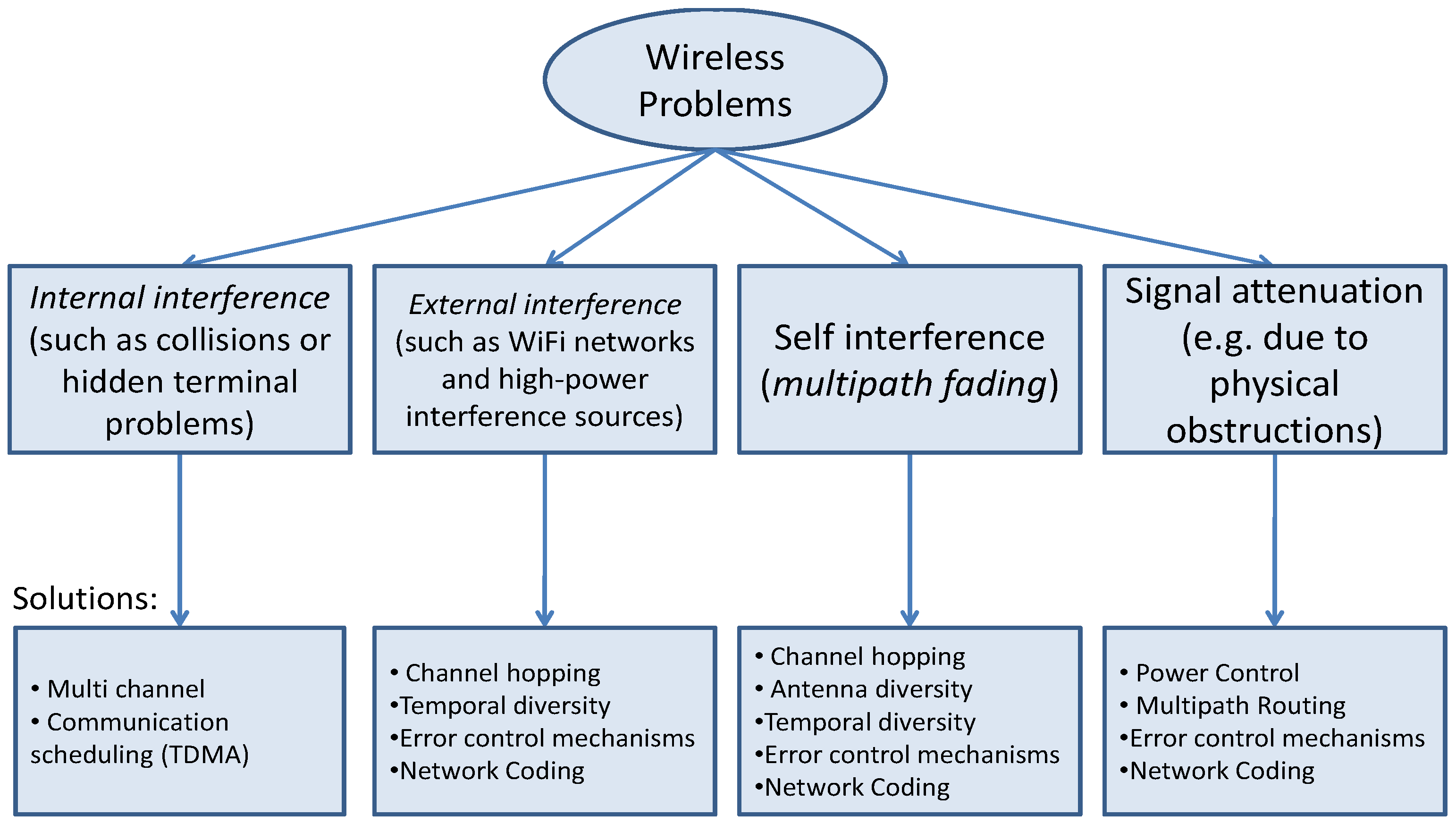
        <p>Reliability is an integral part of any industrial monitoring and control system as any slight degradation in communication can potentially result in complete system malfunction. In order to ensure reliable wireless communication, various techniques can be used to mitigate communication problems such as interference and weak signals. <xref ref-type="fig" rid="jsan-01-00123-f001">Figure 1</xref> gives an overview of the different classes of problems in wireless communication commonly present in industrial environments and their relevant solutions. We present some of the more important solutions developed both in academia and industry in greater detail in the following sections. The PHY aspects of reliability are addressed in <xref ref-type="sec" rid="sec6-jsan-01-00123">Section 6</xref>.</p>
        <fig id="jsan-01-00123-f001" position="anchor">
          <label>Figure 1</label>
          <caption>
            <p>Common wireless communication problems and relevant solutions in typical industrial environments.</p>
          </caption>
          <graphic xmlns:xlink="http://www.w3.org/1999/xlink" xlink:href="jsan-01-00123-g001.tif"/>
        </fig>
      </sec>
    </sec>
    <sec id="sec4-jsan-01-00123">
      <title>4. Techniques Used in Academia to Improve Performance Metrics</title>
      <p>It is important to reiterate that reliability and real-time capability have higher priorities than other performance metrics in industrial sensor networks. In this section, we highlight some of the mechanisms introduced in academia to address the reliability and real-time requirements of WSNs applications.</p>
      <sec>
        <title>4.1. Mechanisms to Improve Reliability</title>
        <p>Reliability is an integral part of any industrial monitoring and control system as any slight degradation in communication can potentially result in complete system malfunction. The industrial environment may suffer from noise, internal interferences, multipath propagation, external interferences, collision, and physical obstruction. In order to ensure reliable wireless communication, various techniques are introduced to mitigate communication problems such as interference and weak signals. We discuss the mechanisms presented in academia for addressing the reliability requirement in an industrial automation environment, such as diversity, error control schemes, multipath routing, and network coding.</p>
        <sec id="sec4dot1dot1-jsan-01-00123">
          <title>4.1.1. Diversity</title>
          <p>When the wireless channel is in a deep fade, any communication scheme will suffer from error. In case of narrowband fading, by passing the information symbols through multiple signal paths, multiple independently faded replicas of data symbols are received at the receiver. This is a potential way to improve the performance of the communication over fading channels, provided one of the signal paths is strong [<xref ref-type="bibr" rid="B14-jsan-01-00123">14</xref>]. This mechanism is called diversity. The common diversity methods that are widely utilized in wireless communication systems are spatial diversity (or antenna diversity), cooperative diversity, temporal diversity, and frequency diversity.</p>
        <sec>
          <title>Spatial Diversity and Cooperative Diversity</title>
          <p>Antenna diversity can be achieved by equipping the transmitter and/or receiver with multiple antennas. If the antennas are sufficiently apart from each other, and the local scattering environment is rich enough, then each antenna will see independent fading. References [<xref ref-type="bibr" rid="B15-jsan-01-00123">15</xref>] and [<xref ref-type="bibr" rid="B16-jsan-01-00123">16</xref>] use spatial diversity to improve the reliability of the link. In [<xref ref-type="bibr" rid="B17-jsan-01-00123">17</xref>] the authors study the antenna switching in a WSN setting in a laboratory. They analyze their results for two types of data links <italic>i.e.</italic>, with and without feedback channel. In the former scenario, the transmitter switches the antenna if it does not receive any acknowledgment, and in the latter scenario, the transmitter sequentially sends multiple copies of the same packet on a different antenna. References [<xref ref-type="bibr" rid="B18-jsan-01-00123">18</xref>] and [<xref ref-type="bibr" rid="B19-jsan-01-00123">19</xref>] explore the use of directional antennas in WSNs and show their potential to provide increased throughput and reduced latency. </p>
          <p>However, deploying several antennas at each wireless sensor node is difficult due to constraints in terms of analog device power consumption, space limitation and simplicity in implementation. The collaborative (or cooperative) diversity proposed by [<xref ref-type="bibr" rid="B20-jsan-01-00123">20</xref>,<xref ref-type="bibr" rid="B21-jsan-01-00123">21</xref>], creates a virtual antenna array by enabling the single-antenna network nodes to share their antenna through relaying. In this approach, nodes help each other to relay information in order to realize spatial diversity advantages. Significant performance gains in terms of link reliability and diversity gain can be achieved by utilizing collaborative diversity. In [<xref ref-type="bibr" rid="B22-jsan-01-00123">22</xref>,<xref ref-type="bibr" rid="B23-jsan-01-00123">23</xref>,<xref ref-type="bibr" rid="B24-jsan-01-00123">24</xref>,<xref ref-type="bibr" rid="B25-jsan-01-00123">25</xref>] authors study the cooperative communications in resource-constrained wireless networks and wireless sensor networks.</p>
          <p>WSNs require a distributed cooperative protocol, in which users independently decide with whom to cooperate at any given time. In distributed cooperative diversity, the challenge is how to establish ways in which the scheme can treat the users fairly, does not have too much overhead, and will be compatible with the system’s multiple access protocols [<xref ref-type="bibr" rid="B22-jsan-01-00123">22</xref>]. Laneman <italic>et al</italic>. explore a distributed partner assignment algorithm by applying the cooperative protocol when the channel has a high signal-to-noise ratio (SNR). Otherwise the network reverts to the non-cooperative mode [<xref ref-type="bibr" rid="B20-jsan-01-00123">20</xref>].</p>
          <p>Receiver diversity in the form of route choices at each hop can also be considered as a type of spatial diversity in case of multipath routing scheme, which is discussed in <xref ref-type="sec" rid="sec4dot1dot3-jsan-01-00123">Section 4.1.3</xref>.</p>
        </sec>
        <sec>
          <title>Temporal Diversity</title>
          <p>Time diversity can be achieved via (1) channel coding in conjunction with time interleaving or (2) simply by transmitting the packet several times. In the former scheme, the information is coded first and then dispersed in different coherent periods over time [<xref ref-type="bibr" rid="B14-jsan-01-00123">14</xref>]. In the latter scheme, the messages are transmitted over different time slots with time separation. </p>
          <p>In channel coding with time interleaving, the coherent period should be larger than the coherence time of the channel in order to experience independent fading in transmission of different parts of the code words. The interleaving fails if the fading is very slow.</p>
          <p>In the retransmission scheme, if the time between consecutive transmissions is larger than the coherence time, then each transmission will see independent fading. Furthermore, if there is an end-to-end delay constraint or a large channel coherence time, the retransmission scheme fails to work.</p>
          <p>In [<xref ref-type="bibr" rid="B17-jsan-01-00123">17</xref>], the author studies time diversity in conjunction with antenna diversity, based on CC2431 radio modules. </p>
        </sec>
        <sec>
          <title>Frequency Diversity</title>
          <p>Diversity can be used over frequency, in case of a frequency-selective channel. Transmitting the same information on two frequency channels that are separated by more than the coherence bandwidth value (<italic>i.e.</italic>, the frequency-shift by which a link has to undergo transition from deep fade) leads to independent fading. </p>
          <p>In the physical layer, the frequency hopping spread spectrum (FHSS) mechanism is an example of frequency/spectral diversity, in which multiple channels are used to communicate. Modulation techniques, such as the direct-sequence spread spectrum (DSSS), minimize the effect of noise on a given channel.</p>
          <p>In the MAC layer, frequency hopping is a diversity technique, in which each node-to-node transmission occurs on a different frequency than the previous one. The frequency-hopping scheme is studied in [<xref ref-type="bibr" rid="B26-jsan-01-00123">26</xref>,<xref ref-type="bibr" rid="B27-jsan-01-00123">27</xref>,<xref ref-type="bibr" rid="B28-jsan-01-00123">28</xref>,<xref ref-type="bibr" rid="B29-jsan-01-00123">29</xref>,<xref ref-type="bibr" rid="B30-jsan-01-00123">30</xref>,<xref ref-type="bibr" rid="B31-jsan-01-00123">31</xref>]. In [<xref ref-type="bibr" rid="B26-jsan-01-00123">26</xref>], authors show that the multipath effects are handled by channel hopping, while Reference [<xref ref-type="bibr" rid="B30-jsan-01-00123">30</xref>] argues that the adaptive routing provides sufficient results to mitigate multipath fading. Furthermore, Reference [<xref ref-type="bibr" rid="B31-jsan-01-00123">31</xref>] evaluates the impact of channel hopping and adaptive routing on the delay and reliability.</p>
        </sec>
        </sec>
        <sec>
          <title>4.1.2. Error Control Mechanisms</title>
          <p>The three main error control schemes employed by WSNs to combat the unreliability of the wireless channel are Forward Error Correction (FEC), Automatic Repeat Request (ARQ) and Hybrid ARQ (HARQ) [<xref ref-type="bibr" rid="B32-jsan-01-00123">32</xref>]. </p>
          <p>FEC is accomplished by adding redundancy to the transmitted information so that the receiver can retrieve the information if a limited number of bits are corrupted. FEC schemes improve error resiliency at the cost of communication overhead by exchanging more information as well as decoding packet energy. Decoding energy is one of the main concerns when applying the FEC scheme in WSNs, where low clock-rate CPUs are used.</p>
          <p>ARQ schemes depend on the retransmission of failed packets. In case of errors, ARQ incurs significant communication overhead as well as additional latency. ARQ is, therefore, infeasible for applications with real-time requirements. However, in the case of good channel quality, ARQ overhead is low compared to FEC. ARQ can be considered as a temporal diversity technique.</p>
          <p>Hybrid ARQ schemes combine the advantages of both FEC and ARQ by incrementally using more powerful FEC codes in the transmitted packets when the packet is received in error.</p>
          <p>In [<xref ref-type="bibr" rid="B32-jsan-01-00123">32</xref>], it is shown that the FEC schemes can be exploited to improve network error resiliency by reducing the transmit power, which improves the network capacity by reducing the communication interference, or by constructing longer hops compared to ARQ by using the same transmit power. Reference [<xref ref-type="bibr" rid="B32-jsan-01-00123">32</xref>] reveals that an increase in the hop-length can decrease the end-to-end delay. FEC is, therefore, more suitable to delay sensitive applications in WSNs when compared to ARQ. Similarly, in [<xref ref-type="bibr" rid="B33-jsan-01-00123">33</xref>], a cross-layer analysis framework, which considers the impact of routing and MAC protocol, is presented. Additionally, in [<xref ref-type="bibr" rid="B33-jsan-01-00123">33</xref>], Reed-Solomon codes have been included to exploit the benefit of FEC codes in WSNs. In [<xref ref-type="bibr" rid="B34-jsan-01-00123">34</xref>], Biswas <italic>et al</italic>. use ARQ schemes, which provide reliability by applying both implicit and explicit acknowledgments. Reference [<xref ref-type="bibr" rid="B34-jsan-01-00123">34</xref>] exploits an adaptive retransmission scheme, in which maximum retransmission attempts are adjusted, based on the packet error rate at each node.</p>
        </sec>
        <sec id="sec4dot1dot3-jsan-01-00123">
          <title>4.1.3. Multipath Routing</title>
          <p>Another technique to increase the reliability of the system is multipath routing. There are two interpretations of multipath routing [<xref ref-type="bibr" rid="B35-jsan-01-00123">35</xref>]. The first is to construct multiple paths for each node to reach a particular destination in the network. In this approach, multiple next hops are specified at any particular node to forward the packet. If communication between a node and its next hop is disrupted due to interference, an alternative path can be used to transport the data. In [<xref ref-type="bibr" rid="B36-jsan-01-00123">36</xref>], Ganesan <italic>et al</italic>. define a mechanism that constructs multiple paths, whereby one is used as a primary and the second as an alternative path.</p>
          <p>In the second interpretation, several paths are defined from source to destination and the source sends the same packet through each of them. This approach requires a large amount of network resources. In order to use the network resources more efficiently, a mechanism is introduced in [<xref ref-type="bibr" rid="B37-jsan-01-00123">37</xref>] that splits the data packet into <italic>n</italic> subpackets, <italic>i.e.</italic>, by using erasure or FEC codes, and then transmits it instead of the whole packet. In the destination, only <italic>k</italic> subnets (<italic>k &lt; n</italic>) are required to reconstruct the original information. ReInForM [<xref ref-type="bibr" rid="B38-jsan-01-00123">38</xref>] simultaneously sends redundant copies of a packet along multiple paths in order to increase the end-to-end probability of data delivery. The number of paths and the degree of redundancy are determined based on channel error rate and desired reliability. Reference [<xref ref-type="bibr" rid="B39-jsan-01-00123">39</xref>] uses multiple paths in order to deliver packets to the sink for QoS provisioning, in terms of reliability and delay.</p>
        </sec>
        <sec>
          <title>4.1.4. Network Coding</title>
          <p>The broadcasting nature of wireless networks offers opportunities to address WSNs problems, such as lack of reliability and low throughput. This characteristic provides a large overlap in the information available in the network. While two nodes are communicating, the same information is being delivered to the nodes within the transmitter’s communication range. This data redundancy in the network can be used to improve the robustness of the lossy wireless networks, as well as the throughput, and also to save bandwidth. In addition, application of network coding in the WSNs requires a simple, easily implemented protocol.</p>
          <p>Robustness enhancement on data transmission can be achieved by applying network coding in wireless networks. Network error correcting codes and network erasure correcting codes are considered as two possible techniques which use spatial redundancy concepts to improve robustness [<xref ref-type="bibr" rid="B40-jsan-01-00123">40</xref>]. Network coding can help to enhance the robustness in data transfer by playing a similar role in traditional FEC, <italic>i.e.</italic>, source-based coding schemes. In [<xref ref-type="bibr" rid="B41-jsan-01-00123">41</xref>], Al-Kofahi and Kamal apply the network erasure correcting codes in wireless sensor and wireless mesh networks to provide proactive protection against link failures. In [<xref ref-type="bibr" rid="B42-jsan-01-00123">42</xref>], Widmer <italic>et al</italic>. show that network coding performs better than probabilistic routing in terms of reliability and robustness.</p>
          <p>Network coding can be applied to infer internal network characteristics, called network tomography. Loss tomography is referred to as the study of link loss rate inference through network coding. In [<xref ref-type="bibr" rid="B43-jsan-01-00123">43</xref>], authors study the loss inference problem in sensor networks and present a passive loss network tomography scheme using network coding. However, in [<xref ref-type="bibr" rid="B44-jsan-01-00123">44</xref>], authors study the identifiability problem and precisely compute the loss rate of links, rather than merely categorizing the links as either good or bad, as done in [<xref ref-type="bibr" rid="B43-jsan-01-00123">43</xref>].</p>
        </sec>
      </sec>
      <sec>
        <title>4.2. Mechanisms to Improve Latency and Real-Time Capability</title>
        <p>In this section, we discuss MAC and routing protocols introduced in academia for addressing the real-time and latency requirements existing in WSNs applications, such as industrial process automation.</p>
        <sec>
          <title>4.2.1. MAC Protocols to Improve Latency</title>
          <p>Generally, mechanisms used in MAC protocols can be categorized into two classes: (i) contention-free (scheduled communication) and (ii) contention-based. The contention-free protocols are presented first, after which a discussion of contention-based protocols will follow.</p>
        <sec>
          <title>Contention-Free (Scheduled Communication)</title>
          <p>Most contention-free protocols exploit the Time Division Multiple Access (TDMA) technique. In this scheme, the neighbor nodes are scheduled (either in a centralized or distributed manner) to communicate at a predefined timeslot. This mechanism provides a guaranteed and reliable hop-to-hop data transfer. Furthermore, scheduling and reserving the timeslots along the path toward the destination provides an end-to-end real-time data transfer. </p>
          <p>PEDAMACS [<xref ref-type="bibr" rid="B45-jsan-01-00123">45</xref>] uses the centralized approach in scheduling the communication in the network. It supports the tree topology and provides an end-to-end bounded delay data transfer. In [<xref ref-type="bibr" rid="B46-jsan-01-00123">46</xref>], Chintalapudi and Venkatraman present the MAC protocol that uses time and frequency multiplexing. In this protocol, the star topology is considered and a contention-free scheme is utilized to restrict the hop-to-hop delivery time. They assume that the sink is equipped with multiple transceivers, which can operate at different channels selected adaptively, while the other nodes use one transceiver. Furthermore, HyMAC [<xref ref-type="bibr" rid="B47-jsan-01-00123">47</xref>] is designed for a network in which the nodes are equipped with multiple-channel transceivers, <italic>i.e.</italic>, a different channel can be selected in each transmission. In this protocol, the combination of TDMA and FDMA features are exploited. HyMAC uses the centralized approach to schedule the communication in the network and guarantees end-to-end bounded delivery time.</p>
        </sec>
        <sec>
          <title>Contention-Based</title>
          <p>Most of the contention-based protocols adopt the CSMA scheme. However, this scheme is unable to guarantee the bounded delivery time, neither in the hop-to-hop nor in the end-to-end data transfer. </p>
          <p>Several MAC protocols have been introduced that try to decrease the message delivery time in hop-to-hop communication. For example, in [<xref ref-type="bibr" rid="B48-jsan-01-00123">48</xref>] Ye <italic>et al</italic>. present a MAC protocol based on S-MAC [<xref ref-type="bibr" rid="B49-jsan-01-00123">49</xref>] that improves the hop-to-hop forwarding delay by applying an adaptive listening enhancement. Similarly, References [<xref ref-type="bibr" rid="B50-jsan-01-00123">50</xref>] and [<xref ref-type="bibr" rid="B51-jsan-01-00123">51</xref>] decrease the forwarding hop-to-hop delay, by exploiting an adaptive active period in S-MAC. In Alert [<xref ref-type="bibr" rid="B52-jsan-01-00123">52</xref>], each node is equipped with one transceiver that can operate at different channels. Alert is designed to reduce the overall hop-to-hop delay to collect the messages from one hop neighbor in a star topology network.</p>
          <p>Furthermore, reducing the end-to-end delay is addressed in several other MAC protocols. For instance, reference [<xref ref-type="bibr" rid="B53-jsan-01-00123">53</xref>] presents a new contention-based MAC protocol that notifies the nodes on a multi-hop path to the sink of data delivery in progress. This protocol reduces the end-to-end forwarding delay in the network by coordinating sleep schedules. Similarly, in [<xref ref-type="bibr" rid="B54-jsan-01-00123">54</xref>], Vasanthi and Annadurai present Q-MAC that provides a minimum end-to-end latency by alerting the intermediate nodes in advance using dynamic schedule. In [<xref ref-type="bibr" rid="B55-jsan-01-00123">55</xref>], Yang and Vaidya present a wakeup scheme that helps to improve the end-to-end delay. They assume the presence of two transceivers in each node, one to transmit a wakeup signal and the other to transmit data packets.</p>
        </sec>
        </sec>
        <sec>
          <title>4.2.2. Routing Protocols to Improve Latency</title>
          <p>The previous section listed a number of MAC layer mechanisms that are utilized to improve the latency. Furthermore, a considerable amount of work has been done in the routing layer to restrict end-to-end latency. This section highlights several routing protocols that are designed to reduce the end-to-end packet delivery time. For example, MERLIN [<xref ref-type="bibr" rid="B56-jsan-01-00123">56</xref>] combines routing and MAC features into a single architecture. MERLIN shows that by employing multicast upstream and multicast downstream schemes for communication to and from gateways, the end-to-end delay is improved. In [<xref ref-type="bibr" rid="B57-jsan-01-00123">57</xref>], the authors present an energy-aware QoS routing protocol, which finds a delay-constrained path that has the least possible cost based on a cost function defined for each link. SPEED [<xref ref-type="bibr" rid="B58-jsan-01-00123">58</xref>] is a QoS routing protocol that provides soft real-time end-to-end guarantees. In SPEED, each node maintains information about its one-hop neighbors and exploits geographic forwarding to find the paths.</p>
        </sec>
      </sec>
    </sec>
    <sec id="sec5-jsan-01-00123">
      <title>5. Mechanisms Used by Industrial Technologies to Improve Performance Metrics</title>
      <p>This section discusses the mechanisms used by industrial technologies for addressing the requirements of industrial automation wireless networks in terms of real-time capability and reliability. The mechanisms include Media Access Control (MAC) layer contention techniques, priority management schemes, channel hopping, and multipath routing.</p>
      <sec>
        <title>5.1. MAC Layer Contention Mechanism and Communication Scheduling</title>
        <p>A MAC protocol can generally be designed to operate using two mechanisms: (i) contention-free (scheduled communication) and (ii) contention-based. Contention‐free approaches, e.g., dedicated timeslot-based, are more suitable for supporting real-time communication while shared timeslots (<italic>i.e.</italic>, contention-based mechanisms) favor soft real-time applications. </p>
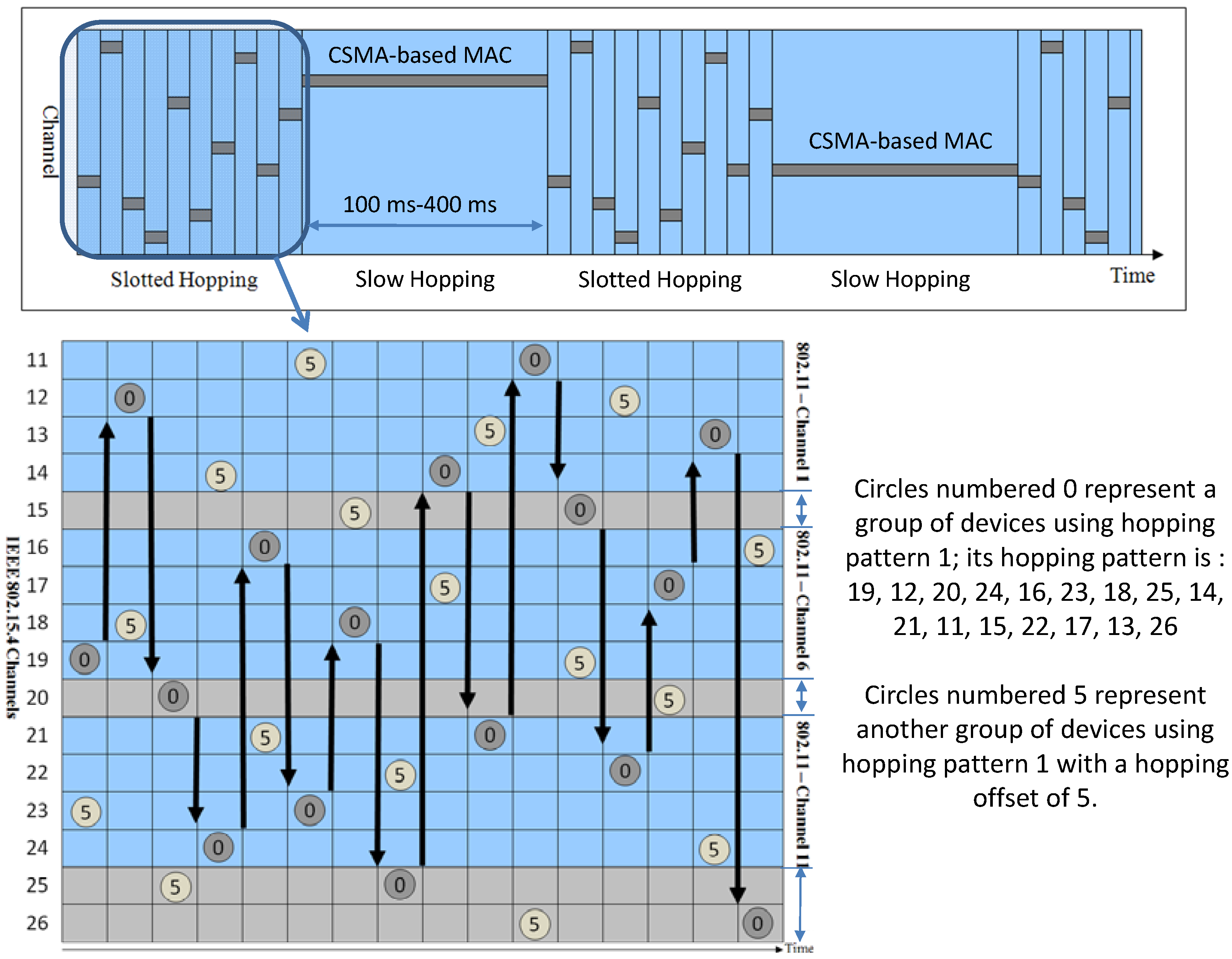
        <p>Contention-based communication protocols, such as CSMA, are unable to provide timing guarantees when delivering messages. They are prone to packet loss by the hidden terminal problem (internal interference). Since ZigBee Pro runs on a CSMA-based MAC protocol, it is unsuitable for applications that require reliable and timely packet delivery, although WIA-PA and ISA100.11a use a CSMA-based MAC (slow hopping) for subnet discovery and retries. These latter are capable of switching to a slotted scheme where every link is scheduled to transmit at a predefined slot (TDMA) and channel offset, thereby avoiding the issue of internal interference. This mechanism is shown in <xref ref-type="fig" rid="jsan-01-00123-f002">Figure 2</xref>, in which the combination of slow hopping and slotted hopping is displayed. A similar form of communication scheduling is also used in TSMP, WirelessHART, and IEEE 802.15.4e. </p>
        <p>Both WISA, WirelessHART, and WIA-PA use TDMA-based mechanisms with exclusively dedicated timeslots which do not support any variation in traffic [<xref ref-type="bibr" rid="B13-jsan-01-00123">13</xref>]. However, ZigBee Pro, ISA100.11a, and the 802.15.4e MAC standard allow the user or centralized system manager to configure the timeslot length. This could be advantageous for coping with variable data traffic rates on the network which could be a characteristic of factory automation applications requiring real-time operations. However, as individual nodes are unable to make autonomous decisions, existing technologies are unable to provide hard real-time guarantees, especially in the presence of variable data traffic.</p>
        <p>ISA100.11a and WirelessHART use a superframe management technique to maintain real-time communication for high traffic loads. The superframe period can determine several network performance parameters, such as packet delivery latency, energy consumption, and bandwidth utilization. ISA100.11a allows tradeoffs by enabling the system manager to determine the superframe period. A shorter-period superframe results in lower packet delivery latency and higher bandwidth utilization, but results in greater energy consumption, while a longer-period superframe has the opposite effect. ZigBee Pro and WIA-PA (in the cluster/star level) also allow the transmission of superframes with different lengths in the beacon mode.</p>
        <fig id="jsan-01-00123-f002" position="anchor">
          <label>Figure 2</label>
          <caption>
            <p>The ISA100.11a communication scheduling mechanism that alternates between a TDMA and CSMA-based scheme. </p>
          </caption>
          <graphic xmlns:xlink="http://www.w3.org/1999/xlink" xlink:href="jsan-01-00123-g002.tif"/>
        </fig>
      </sec>
      <sec>
        <title>5.2. Priority Management Schemes</title>
        <p>Timely and reliable data transport is crucial for industrial automation applications. Communication networks are usually designed to meet such criteria by using certain Quality of Service (QoS) mechanisms. QoS mechanisms generally use two techniques to achieve their goals: (i) <italic>traffic classification</italic> and (ii) <italic>resource reservation</italic>.</p>
        <p>The <italic>traffic classification</italic> mechanism can be used for channel access and packet delivery along the path between the endpoints, by labeling the packets with a priority value and placing them on the corresponding queue in the path. The <italic>resource reservation</italic> mechanism is used for allocating and reserving the resources along the path between two end-points for the specific traffic or class of traffic to achieve the desired QoS requirement.</p>
        <p>Fox example, in the wired CAN protocol (a communication system for industrial and automotive applications), a MAC layer technique is used to resolve the contention between several nodes to access the channel. It involves bit-wise priority arbitration for collision resolution that relies on a node’s ability to transmit and receive simultaneously. Each packet has a priority value that is used to resolve the contention among different nodes trying to access the channel. The node with a higher priority label in its data packet has a higher chance of accessing the channel. Each contender node transmits its priority value and receives feedback from the channel simultaneously. A node realizes that it has lost the contention when it detects a higher priority bit on the channel compared to the bit transmitted by the node itself [<xref ref-type="bibr" rid="B59-jsan-01-00123">59</xref>,<xref ref-type="bibr" rid="B60-jsan-01-00123">60</xref>].</p>
        <p>This technique cannot be used in wireless sensor networks as they typically have half-duplex transceivers. WIA-PA uses the traffic classification method for addressing different QoS requests. They define four priority levels, based on different classes of data: <italic>command packets</italic>, <italic>process data</italic>, <italic>normal packets</italic> and <italic>alarm packets</italic>. Low priority packets are declined when the device buffers become full. WirelessHART and ISA100.11a use a combination of traffic classification and resource reservation techniques for providing different QoS requests. When a device wants to establish communication with the central system manager or another device, it sends the contract request (Service request in WirelessHART), including input parameters, such as communication service type (scheduled or unscheduled communication), destination address, traffic classification (best effort queued, real time sequential, real time buffer and network control), requested period, and committed burst for non-periodic communication, to the system manager. The system manager uses its centralized optimization algorithm to determine the required allocation of the network resources (such as graphs and links) and sends a contract response to the source after all necessary network resources have been configured and reserved along the path. However, WirelessHART and ISA100.11a do not specify the specific optimization algorithms that can be used by the system manager to allocate resources.</p>
      </sec>
      <sec>
        <title>5.3. Channel Hopping Techniques</title>
        <p>Channel hopping is often used to mitigate <italic>external interference</italic> and <italic>multipath fading</italic>. The proper reception of wireless signals may be prevented by other radio signals generated by the devices outside the network. This kind of interference is known as <italic>external interference</italic>. Signals in the same frequency range can be generated by Bluetooth devices, microwave ovens, other external networks (such as the IEEE 802.11 network) or many unintended sources of radio interference, such as other high-power interference sources. Channel hopping techniques are a way to mitigate <italic>external interference</italic> and <italic>multipath fading</italic>.</p>
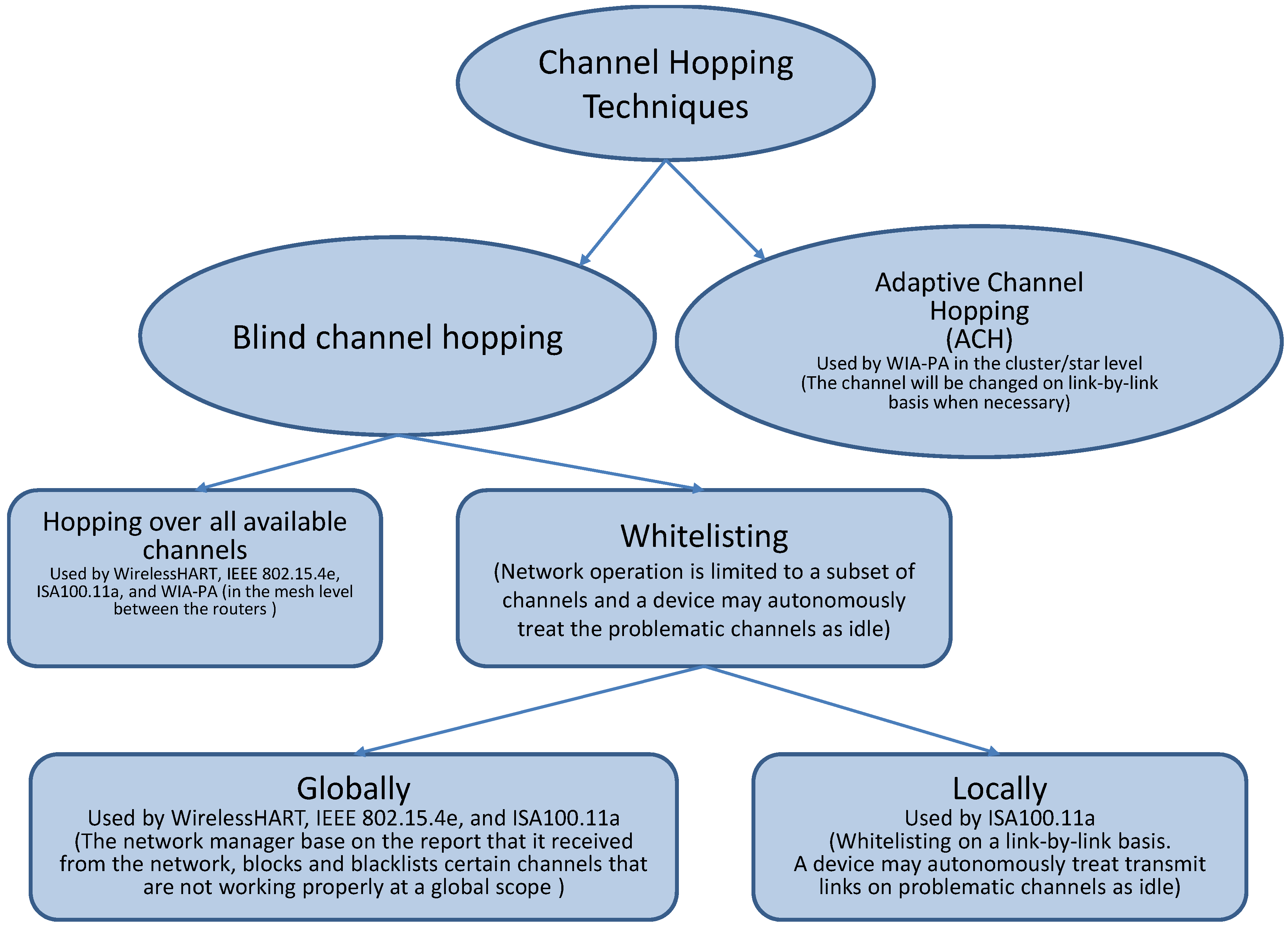
        <p><xref ref-type="fig" rid="jsan-01-00123-f003">Figure 3</xref> provides a classification of the different channel hopping techniques as well as the standards which use each of these techniques.</p>
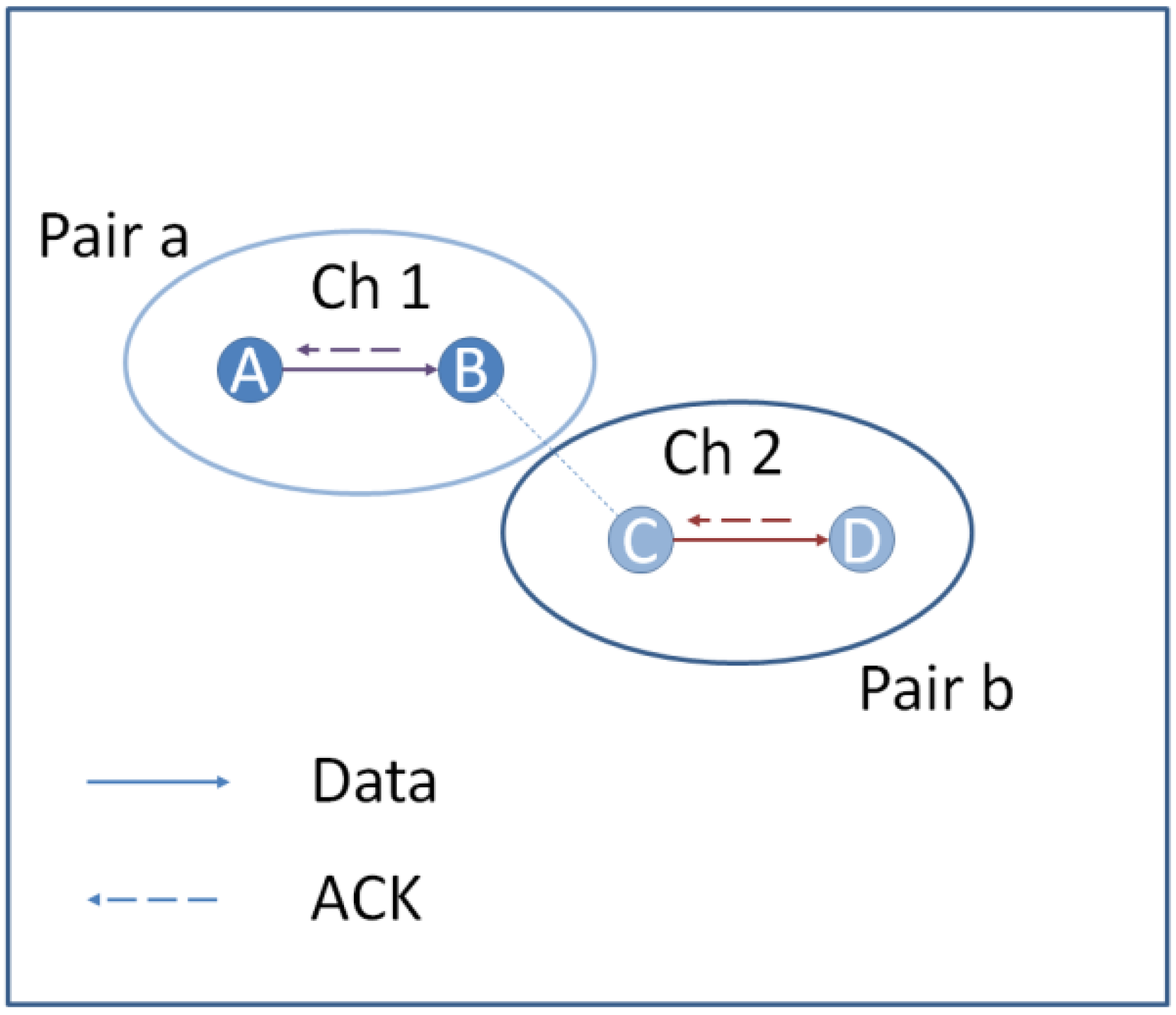
        <p>There is a tradeoff between using <italic>blind channel hopping</italic> and <italic>adaptive channel hopping</italic> (ACH). In the former, if the node switches to another congested channel or switches from a good channel to a congested one, this hopping does not help to mitigate the interference and just wastes energy [<xref ref-type="bibr" rid="B30-jsan-01-00123">30</xref>]. However, in spite of this disadvantage, blind channel hopping has less overhead as the hopping pattern is already known by the network devices. In addition, if the system manager decides to blacklist a particular channel, nodes in the network still hop to the channel, but simply remain idle in that time period. Thus the larger the number of blacklisted channels, the more time is lost by nodes idling on blacklisted channels. Blind channel hopping techniques ensure that while two communicating nodes hop in unison, neighboring node pairs never use the same frequency at the same time in order to prevent hidden terminal problems. This is shown in <xref ref-type="fig" rid="jsan-01-00123-f004">Figure 4</xref>.</p>
        <fig id="jsan-01-00123-f003" position="anchor">
          <label>Figure 3</label>
          <caption>
            <p>Channel hopping techniques.</p>
          </caption>
          <graphic xmlns:xlink="http://www.w3.org/1999/xlink" xlink:href="jsan-01-00123-g003.tif"/>
        </fig>
        <fig id="jsan-01-00123-f004" position="anchor">
          <label>Figure 4</label>
          <caption>
            <p>Two pairs of nodes using different communication channels.</p>
          </caption>
          <graphic xmlns:xlink="http://www.w3.org/1999/xlink" xlink:href="jsan-01-00123-g004.tif"/>
        </fig>
        <p>ACH differs from blind hopping in the sense that unlike in blind hopping, nodes do not keep on changing from one operating frequency to another at regular time intervals. In other words, nodes <italic>only</italic> change their frequencies when interference is detected on the current operating channel. However, nodes need to collaborate to decide which channel to switch to and this can introduce a significant overhead since nodes need to continuously scan all channels for interference levels and also because nodes need to ensure that while communicating nodes choose the same frequency, neighboring node pairs use different channels [<xref ref-type="bibr" rid="B61-jsan-01-00123">61</xref>]. In WIA-PA in each cluster/star network, the cluster head and each node irregularly change their channel on a link-by-link basis only when channel conditions require it to. However to the best of our knowledge, there are currently no algorithms indicating strategies to be followed for ACH approaches in the multi-hop network.</p>
        <p>Both WirelessHART and ISA100.11a networks use blacklisting techniques to mitigate external interference or multipath fading. WISA and ZigBee Pro do not have this capability.</p>
        <p>ZigBee Pro, however, uses “frequency agility”. This mechanism is not as tolerant to fluctuating wireless conditions as WirelessHART, WIA-PA, and ISA100.11a. In this technique, the network channel manager collects interference reports from all the nodes. If external interference is detected, the network channel manager scans for a better channel and moves the <italic>entire</italic> network to a new channel. This technique requires network formation to be carried out again and thus introduces inconvenient delays. Note that ACH is clearly a better technique as it only requires nodes facing interference to make changes to their operating frequencies—it does not affect the entire network.</p>
        <p>ISA100.11a tries to separate the successive channels in the hopping pattern by at least 20 MHz. That means that at least a three-channel separation exists in each consecutive hop and, in the case of retries in the next hop, that they will not encounter the same IEEE 802.11 channel. The way by which this standard can coexist with the IEEE 802.11 standard has been predefined. This hopping separation is more than the <italic>coherence bandwidth value</italic>—the frequency-shift by which a link has to undergo transition from deep fade-in the case of indoor multi-path interference [<xref ref-type="bibr" rid="B26-jsan-01-00123">26</xref>]. </p>
        <p>WISA employs frequency-hopping sequences in which the consecutive hops are widely separated in frequency and the sub-band bandwidth is more than the typical bandwidth of the coherence bandwidth. WISA uses frame-by-frame frequency hopping in which the used radio channel for retransmission is independent of the previous one, so likelihood of a successful transmission increases.</p>
      </sec>
      <sec>
        <title>5.4. Multipath Routing</title>
        <p>To ensure real-time capability, WISA protocols require the network to be deployed in a star topology rather than a multi-hop meshed network that is used in ZigBee Pro, WirelessHART, WIA-PA and ISA100.11a. A disadvantage of this approach is that if communication between a node and its cluster head is disrupted due to interference, alternative routes cannot be established to transport the data. The multi-hop approach of ZigBee Pro, WirelessHART and ISA100.11a prevent such problems from occurring. Additionally, to ensure robust communication in WirelessHART and ISA100.11a, the system manager defines multiple paths for each node to reach a particular destination in the network. </p>
      </sec>
    </sec>
    <sec id="sec6-jsan-01-00123">
      <title>6. Physical Layer Aspects</title>
      <p>Although this paper does not aim to provide the reader with a detailed analysis of PHY research, we feel that without briefly discussing PHY, the survey will not be complete. Not wanting to detail all the standards (e.g., IEEE 802.15.1, IEEE 802.11) used for WSNs, we solely discuss the IEEE 802.15.4 standard in this section, since most of the popular standards, such as ZigBee Pro, WirelessHART, and ISA100.11a, are built on top of this one. The IEEE 802.15.4 standard is developed for low data rate applications. The PHY of this standard operates in different frequency bands, mostly in the 2.4 GHz band, using Orthogonal Quadrature Phase Shift Keying (O-QPSK) modulation with a data rate of 250 kbps. </p>
      <p>No channel model has been proposed in this standard, so most of the analysis has been done with the channel model prescribed in the IEEE 802.11 standard. We can adjust this channel model to represent an industrial environment, which can be represented as:</p>
      <p><disp-formula id="jsan-01-00123-i002">
          <inline-graphic xmlns:xlink="http://www.w3.org/1999/xlink" xlink:href="jsan-01-00123-i002.tif"/>
          <label>(1)</label>
          </disp-formula></p>
      <p><disp-formula id="jsan-01-00123-i003">
          <inline-graphic xmlns:xlink="http://www.w3.org/1999/xlink" xlink:href="jsan-01-00123-i003.tif"/>
          <label>(2)</label>
          </disp-formula></p>
      <p>where, <italic>P<sub>t</sub></italic> is the transmit power in dB; <italic>P<sub>r</sub></italic> is the received power in dB at distance <italic>d</italic>; <inline-graphic xmlns:xlink="http://www.w3.org/1999/xlink" xlink:href="jsan-01-00123-i004.tif"/> [dB] is a Gauss distributed random variable with a certain mean and <inline-graphic xmlns:xlink="http://www.w3.org/1999/xlink" xlink:href="jsan-01-00123-i005.tif"/> variance generated due to the shadowing effect. In the case of a home environment, <inline-graphic xmlns:xlink="http://www.w3.org/1999/xlink" xlink:href="jsan-01-00123-i004.tif"/>is generally considered as a zero mean random variable. However, in the industrial environment, we expect large shadowing due to the presence of heavy machinery, which typically causes a positive biased shadowing effect. The mean of the shadow fading can vary according to different industrial setups.</p>

      <p>The authors in [<xref ref-type="bibr" rid="B62-jsan-01-00123">62</xref>] claim that the Signal-to-Noise Ratio (SNR) should not be used as a performance matrix to calculate the reliability of IEEE 802.15.4 communication links, as the relationship between SNR and the Packet Error Rate (PER) is non-linear. A small degradation in SNR beyond the threshold can shift the PER from 0 to 1. However, SNR has a direct relationship with the bit error probability and outage probability, which are two important criteria of interest in the performance analysis of IEEE 802.15.4 PHY. These performance matrices are dependent on the channel model. As most of the sensors and actuators in an industrial environment are immobile, we consider the channel as a slow fading channel, which has almost the same performance as an Additive White Gaussian Noise (AWGN) channel. </p>
      <p>In AWGN, the bit error probability for the QPSK modulation is defined as:</p>
      <p><disp-formula id="jsan-01-00123-i006">
          <inline-graphic xmlns:xlink="http://www.w3.org/1999/xlink" xlink:href="jsan-01-00123-i006.tif"/>
          <label>(3)</label>
          </disp-formula></p>
      <p>where, <italic>γ</italic><sub>0</sub> is the SNR of the received signal. The outage probability, <italic>P<sub>out</sub></italic> is the probability that the received signal’s average SNR, <inline-graphic xmlns:xlink="http://www.w3.org/1999/xlink" xlink:href="jsan-01-00123-i007.tif"/> falls below the minimum required SNR, <italic>γ</italic><sub>0</sub> for the pre-defined acceptable communication performance [<xref ref-type="bibr" rid="B63-jsan-01-00123">63</xref>]. Mathematically, </p>
      <p><disp-formula id="jsan-01-00123-i008">
          <inline-graphic xmlns:xlink="http://www.w3.org/1999/xlink" xlink:href="jsan-01-00123-i008.tif"/>
          <label>(4)</label>
          </disp-formula></p>
      <p>From Equations (3) and (4) the required average SNR is:</p>
      <p><disp-formula id="jsan-01-00123-i009">
          <inline-graphic xmlns:xlink="http://www.w3.org/1999/xlink" xlink:href="jsan-01-00123-i009.tif"/>
          <label>(5)</label>
          </disp-formula></p>
      <p>In AWGN, the carrier-to-noise ratio of the received signal can be expressed as:</p>
      <p><disp-formula id="jsan-01-00123-i010">
          <inline-graphic xmlns:xlink="http://www.w3.org/1999/xlink" xlink:href="jsan-01-00123-i010.tif"/>
          <label>(6)</label>
          </disp-formula></p>
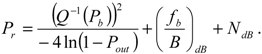
      <p>where, <inline-graphic xmlns:xlink="http://www.w3.org/1999/xlink" xlink:href="jsan-01-00123-i011.tif"/>is the SNR per bit; <italic>f<sub>b</sub></italic> is the channel data rate (net bitrate) and <italic>B</italic> is the channel bandwidth [<xref ref-type="bibr" rid="B64-jsan-01-00123">64</xref>]. As <italic>C<sub>dB</sub></italic> = <italic>P<sub>r</sub></italic> and for the QPSK modulation, <inline-graphic xmlns:xlink="http://www.w3.org/1999/xlink" xlink:href="jsan-01-00123-i012.tif"/>, Equation (6) can be rewritten as:</p>
      <p><disp-formula id="jsan-01-00123-i013">
          <inline-graphic xmlns:xlink="http://www.w3.org/1999/xlink" xlink:href="jsan-01-00123-i013.tif"/>
          <label>(7)</label>
          </disp-formula></p>
      <p>By using Equation (7), the required received power can be calculated for a given bit error rate and outage probability, which can give us the range of communication from Equation (1) and (2). In wireless communication (PHY), typically a bit error rate of 10<sup>−4</sup> and an outage probability of 0.02 are considered for the receiver design. According to the IEEE 802.15.4 standard, these result in a short communication range of 20–50 m, with acceptable outage probability. However, if interference from the devices operating in the same frequency band is considered, an even lower communication range will result in guaranteeing the same outage. Experiments show that IEEE 802.15.4 systems can operate with almost no problems in the presence of IEEE 802.11 systems in range. However, if another IEEE 802.15.4 system exists nearby, the result can be catastrophic. Such a discussion about coexistence issues has been held in [<xref ref-type="bibr" rid="B4-jsan-01-00123">4</xref>].</p>
    </sec>
    <sec id="sec7-jsan-01-00123">
      <title>7. Open Research Areas</title>
      <p>While existing wireless technologies developed for industrial applications are able to carry out monitoring tasks fairly well, significant advances are required before they can be used for reliable, real-time, distributed control operations. We now highlight some of the key areas which need to be addressed to make this a reality.</p>
      <sec>
        <title>7.1. A Distributed Approach to Achieving Real-Time Operation</title>
        <p>Large-scale, distributed, real-time control applications require data to be transmitted over long distances through a multi-hop network in a timely manner. A distributed resource reservation algorithm is needed which would allow source nodes, based on the requirements of the application and traffic characteristic, to reserve network resources for its peer communications along their paths for addressing different QoS needs. The distributed nature allows the system to adapt quickly to disturbances or changes within the network to meet timing guarantees to support real-time control operation. While such mechanisms do not exist for present day sensor nodes in a distributed manner, relevant techniques from other networking-related domains could potentially be adapted to develop solutions that are suitable for wireless sensor and actuator networks. We briefly describe some of these relevant techniques.</p>
        <p>QoS in multi-hop networks can be supported by different mechanisms, such as <italic>circuit switching</italic>, <italic>Asynchronous Transfer Mode (ATM) networks</italic>, and <italic>internet protocols</italic> (such as Integrated Services/RSVP, Differentiated Services, MPLS and constraint-based routing). It is also supported by <italic>IEEE 802.11e</italic> [<xref ref-type="bibr" rid="B65-jsan-01-00123">65</xref>], ISA100.11a and WirelessHART in a centralized manner.</p>
        <p>ATM signaling protocols address certain performance issues in terms of reliability and timeliness of packet delivery that are of importance in industrial applications that require closed-loop, real-time control. The ATM protocol uses a switching technique that combines the concepts of circuit switching and packet switching. For example, similar to circuit switching, before initiating data transfer, a virtual circuit is first established between the source and destination. The protocol also includes admission control mechanisms that help determine whether the required QoS guarantees can be provided. ATM uses statistical multiplexing techniques, similar to those used in packet switching, in order to cope with variable bit rates (<italic>i.e.</italic>, ‘bursty’ traffic).</p>
        <p>Internet protocols are mainly designed for multimedia applications. In those protocols, some mechanisms exist that allow a data receiver to request a special end-to-end quality of service for its data flows or classes of data. RSVP signaling is used by several internet protocols, such as <italic>Integrated Services Architecture</italic>, <italic>differentiated service</italic>, and MPLS, through which the application can reserve the resource and set up the path between the source and destinations.</p>
        <p>The IEEE 802.11e, based on <italic>traffic classification</italic> mechanisms, provides different degrees of satisfaction for the users of the service. They define different priorities through which traffic can be delivered in several access categories. This differentiation is achieved by considering different amounts of time for sensing the channel to be idle and by considering different lengths of the contention window during backoff. This implies that high-priority traffic can access the channel by shorter back-offs than low-priority traffic. In addition, the packets are labeled with priority value and introduced into the corresponding queue in the path. Admission control in this standard as an important component limits the amount of traffic admitted into a particular service class so that the network resources can be efficiently utilized.</p>
      </sec>
      <sec>
        <title>7.2. Distributed Network Management</title>
        <p>WirelessHART, WIA-PA (in the mesh level) and ISA100.11a use centralized network management techniques for communication scheduling and managing routes. While such an approach may be easier in terms of implementation, they have numerous disadvantages. Centralized systems often perform poorly in terms of reaction time, as all updates need to be sent first to the centralized system manager (<italic>i.e.</italic>, gateway) for further processing. The gateway node then performs recalculations and disseminates updated instructions to the relevant nodes in the network. As the round-trip time for such decision-making actions can be very high (especially when network contention is high), centralized approaches are unable to cope with highly dynamic situations (e.g., ‘bursty’ data traffic/varying link quality, and node mobility). This problem is further exacerbated as the network is scaled up. This in turn may result in problems, including increased packet loss and delayed data delivery, which increase energy consumption. The distributed nature of a distributed approach allows the system to adapt quickly to disturbances or changes within the network in real-time. However, current wireless control technologies that use distributed approaches also perform poorly in terms of reliability, efficiency and robustness.</p>
      </sec>
      <sec>
        <title>7.3. Adaptive Channel Hopping (ACH) Algorithms</title>
        <p>In the previous section, it was discussed that one of the solutions to mitigate interference and multipath fading is channel hopping. In adaptive channel hopping, the channel on a link-by-link basis will be changed when interference is detected on the current operating channel. However, nodes need to collaborate to decide which channel to switch to and this can introduce a significant overhead since nodes need to continuously scan all channels for interference levels and also because nodes need to ensure that while communicating nodes choose the same frequency, neighboring node pairs use different channels. To the best of our knowledge, there are currently no algorithms indicating strategies to be followed for ACH approaches in multi-hop networks. The challenges in defining the appropriate solutions are overhead and simplicity of the algorithm.</p>
      </sec>
      <sec>
        <title>7.4. Distributed or Centralized Radio Transmission Power Control</title>
        <p>The transmission power used by a node can have a direct impact on the radio link quality, the level of interference and energy consumption. Ideally, all nodes should always use the least transmission power that will allow them to carry out their assigned tasks effectively. While the ISA100.11a specification allows the transmission power of individual nodes to be controlled, it does not describe any specific algorithms to perform adaptive power control. Several autonomous power control strategies, developed specifically for WSNs, can be found in the literature [<xref ref-type="bibr" rid="B66-jsan-01-00123">66</xref>,<xref ref-type="bibr" rid="B67-jsan-01-00123">67</xref>]. However, they all have certain drawbacks which would prevent them from being used in a harsh industrial environment. For example, while the technique presented in [<xref ref-type="bibr" rid="B66-jsan-01-00123">66</xref>] can adapt, it is not designed to handle rapid link quality fluctuations that could be caused by moving metal objects or electromagnetic interference from motors or pumps that may be common in an industrial environment. While the authors in [<xref ref-type="bibr" rid="B67-jsan-01-00123">67</xref>] rightly point out that interference is an issue that needs to be addressed when developing adaptive power control algorithms, the presented solution does not perform optimally as it is unable to correctly distinguish between weak signals and interference. This is an area that still requires further investigation.</p>
      </sec>
      <sec>
        <title>7.5. Network Management Algorithms for Different Traffic Patterns</title>
        <p>WirelessHART, WIA-PA (in the mesh level) and ISA100.11a use centralized network management techniques for communication scheduling and managing routes. However, those standards do not specify the specific optimization algorithms that can be used by the system manager to allocate resources. In [<xref ref-type="bibr" rid="B68-jsan-01-00123">68</xref>,<xref ref-type="bibr" rid="B69-jsan-01-00123">69</xref>,<xref ref-type="bibr" rid="B70-jsan-01-00123">70</xref>] the authors have proposed the centralized scheduling algorithm in WirelessHART for convergecast by considering linear and tree networks models. ISA100.11a standard supports peer-to-peer communication, in addition to uplink and downlink traffics. This feature makes the communication scheduling and route managing algorithm more complicated than WirelessHART, in which the main concern is forwarding the traffic toward the gateway and <italic>vice versa</italic>. To the best of our knowledge, there are currently no algorithms indicating strategies to be followed for communication scheduling and route formation in ISA100.11a.</p>
      </sec>
      <sec>
        <title>7.6. In-Network Data Aggregation for Control Operations</title>
        <p>Two types of aggregation, data aggregation and packet aggregation, are supported by WIA-PA in order to reduce the number of packet transmissions. WirelessHART, WISA, and ZigBee Pro do not support this function. In certain industrial closed-loop control applications involving multiple sensors and an actuator, raw sensor readings are streamed from the sensors to the actuator. The actuator subsequently performs computations using the readings to carry out the relevant control operations. This traditional approach, however, is not suitable for multihop wireless sensor networks, since they have highly limited bandwidths. The idea would then be to allow an intermediate node to carry out the computations and only send the final control output to the actuator, thus saving network bandwidth. However, as every actuation operation may be dependent on a different set of sensors, the nodes need to autonomously decide which node should act as the intermediate aggregation node that will be responsible for computing the control output. This technique will also contribute towards improving real-time operation.</p>
      </sec>
      <sec>
        <title>7.7. Applying MIMO and OFDM in Physical Layer</title>
        <p>Over the last decade, multiple antenna and Multiple Input Multiple Output (MIMO) techniques have been widely discussed to increase the reliability and throughput of various wireless systems. As discussed in <xref ref-type="sec" rid="sec4dot1dot1-jsan-01-00123">Section 4.1.1</xref>, the antenna diversity can also improve reliability by achieving multiple different realizations of channel. So, if one antenna gets an interfered/distorted signal, which is non-recoverable due to signal propagation through a deep faded channel, another antenna may receive a copy of the signal which is suitable for decoding. This can significantly improve link reliability. MIMO can increase the system throughput without increasing the bandwidth. Several antennas to transmit/receive a portion of a signal with spatial diversity make this possible. Orthogonal Frequency Division Multiplexing (OFDM) takes this to the next step by using orthogonal sub-carriers in a frequency band. OFDM not only increases the throughput of a system, but also enables the facility to use different levels of modulation for different sub-carriers, based on the channel state information (CSI). Such techniques have been applied in the recently developed IEEE 802.11n standard to increase WiFi throughput to a next level [<xref ref-type="bibr" rid="B64-jsan-01-00123">64</xref>]. However, the complexity of the receivers also increases to facilitate this technology, which makes it challenging to implement in WSN applications. Building simple MIMO transceivers with a low power consumption is still in a research phase [<xref ref-type="bibr" rid="B71-jsan-01-00123">71</xref>].</p>
      </sec>
    </sec>
    <sec sec-type="conclusions" id="sec8-jsan-01-00123">
      <title>8. Conclusions</title>
      <p>Traditional wired industrial networking technologies have numerous drawbacks. They lack flexibility, face reliability issues (due to wear and tear) and are expensive to deploy and maintain. Wireless technology, however, through its increased pervasiveness, can introduce a completely new range of industrial applications as it has the potential to provide fine-grained, flexible, robust, low-cost and low-maintenance monitoring and control. While present-day wireless technologies have taken a step in the right direction, they still have severe limitations, especially when real-time, reliable distributed control operations are concerned. This article presents an overview of current wireless technologies and academic researches and their deficiencies, and describes some key research issues that still need to be addressed in order to successfully extend the use of wireless technologies to the industrial monitoring and control sector.</p>
    </sec>
  </body>
  <back>
    <ack>
      <title>Acknowledgements</title>
      <p>This work is supported by Wi-BRATE: “Wireless, Self-Powered Vibration Monitoring and Control for Complex Industrial Systems” (wibrate.eu), a Collaborative Project supported by the European 7th Framework Programme, contract number 289041.</p>
    </ack>
    <ref-list>
      <title>References and Notes</title>
      <ref id="B1-jsan-01-00123">
        <label>1.</label>
        <citation citation-type="book">
          <person-group person-group-type="author">
            <name>
              <surname>Berge</surname>
              <given-names>J.</given-names>
            </name>
          </person-group>
          <source>Fieldbuses for Process Control: Engineering, Operation, and Maintenance</source>
          <publisher-name>ISA</publisher-name>
          <publisher-loc>Research Triangle Park, NC, USA</publisher-loc>
          <year>2001</year>
        </citation>
      </ref>
      <ref id="B2-jsan-01-00123">
        <label>2.</label>
        <citation citation-type="journal">
          <person-group person-group-type="author">
            <name>
              <surname>Gungor</surname>
              <given-names>V.C.</given-names>
            </name>
            <name>
              <surname>Hancke</surname>
              <given-names>G.P.</given-names>
            </name>
          </person-group>
          <article-title>Industrial wireless sensor networks: Challenges, design principles, and technical approaches</article-title>
          <source>IEEE Trans. Ind. Electron.</source>
          <year>2009</year>
          <volume>56</volume>
          <fpage>4258</fpage>
          <lpage>4265</lpage>
        <pub-id pub-id-type="doi">10.1109/TIE.2009.2015754</pub-id></citation>
      </ref>
      <ref id="B3-jsan-01-00123">
        <label>3.</label>
        <citation citation-type="journal">
          <person-group person-group-type="author">
            <name>
              <surname>Willig</surname>
              <given-names>A.</given-names>
            </name>
            <name>
              <surname>Matheus</surname>
              <given-names>K.</given-names>
            </name>
            <name>
              <surname>Wolisz</surname>
              <given-names>A.</given-names>
            </name>
          </person-group>
          <article-title>Wireless technology in industrial networks</article-title>
          <source>Proc. IEEE</source>
          <year>2005</year>
          <volume>93</volume>
          <fpage>1130</fpage>
          <lpage>1151</lpage>
          <pub-id pub-id-type="doi">10.1109/JPROC.2005.849717</pub-id>
        </citation>
      </ref>
      <ref id="B4-jsan-01-00123">
        <label>4.</label>
        <citation citation-type="other">
          <source>IEEE Standard for Local and Metropolitan Area Networks—Part 15.4: Low-Rate Wireless Personal Area Networks (LR-WPANs); IEEE Stdandard 802.15.4-2011 (Revision of IEEE Std 802.15.4-2006)</source>
          <year>2011</year>
        </citation>
      </ref>
      <ref id="B5-jsan-01-00123">
        <label>5.</label>
        <citation citation-type="journal">
          <person-group person-group-type="author">
            <name>
              <surname>Scheible</surname>
              <given-names>G.</given-names>
            </name>
            <name>
              <surname>Dacfey</surname>
              <given-names>D.</given-names>
            </name>
            <name>
              <surname>Endresen</surname>
              <given-names>J.</given-names>
            </name>
            <name>
              <surname>Frey</surname>
              <given-names>J.E.</given-names>
            </name>
          </person-group>
          <article-title>Unplugged but connected [Design and implementation of a truly wireless real-time sensor/actuator interface]</article-title>
          <source>IEEE Ind. Electron. Mag.</source>
          <year>2007</year>
          <volume>1</volume>
          <fpage>25</fpage>
          <lpage>34</lpage>
        <pub-id pub-id-type="doi">10.1109/MIE.2007.901481</pub-id></citation>
      </ref>
      <ref id="B6-jsan-01-00123">
        <label>6.</label>
        <citation citation-type="other">
          <source>ZigBee PRO Specification; ZigBee Alliance Standard</source>
          <month>October</month>
          <year>2007</year>
        </citation>
      </ref>
      <ref id="B7-jsan-01-00123">
        <label>7.</label>
        <citation citation-type="other">
          <collab>British Standards Institute</collab>
          <source>Industrial Communication Networks-Fieldbus Specifications, WirelessHART Communication Network and Communication Profile</source>
          <edition>1.0</edition>
          <year>2009</year>
          <comment>IEC/PAS 62591</comment>
        </citation>
      </ref>
      <ref id="B8-jsan-01-00123">
        <label>8.</label>
        <citation citation-type="journal">
          <person-group person-group-type="author">
            <name>
              <surname>Liang</surname>
              <given-names>W.</given-names>
            </name>
            <name>
              <surname>Zhang</surname>
              <given-names>X.</given-names>
            </name>
            <name>
              <surname>Xiao</surname>
              <given-names>Y.</given-names>
            </name>
            <name>
              <surname>Wang</surname>
              <given-names>F.</given-names>
            </name>
            <name>
              <surname>Zeng</surname>
              <given-names>P.</given-names>
            </name>
            <name>
              <surname>Yu</surname>
              <given-names>H.</given-names>
            </name>
          </person-group>
          <article-title>Survey and experiments of WIA-PA specification of industrial wireless network</article-title>
          <source>Wirel. Commun. Mob. Comput.</source>
          <year>2011</year>
          <volume>11</volume>
          <fpage>1197</fpage>
          <lpage>1212</lpage>
          <pub-id pub-id-type="doi">10.1002/wcm.976</pub-id>
        </citation>
      </ref>
      <ref id="B9-jsan-01-00123">
        <label>9.</label>
        <citation citation-type="other">
          <collab>The International Society of Automation</collab>
          <source>Wireless Systems for Industrial Automation: Process Control and Related Applications; ISA Standard ISA-100.11a-2011</source>
          <year>2009</year>
        </citation>
      </ref>
      <ref id="B10-jsan-01-00123">
        <label>10.</label>
        <citation citation-type="other">
          <source>IEEE Standard for Local and Metropolitan Area Networks--Part 15.4: Low-Rate Wireless Personal Area Networks (LR-WPANs) Amendment 1: MAC Sublayer; IEEE Stdandard 802.15.4e-2012 (Amendment to IEEE Std 802.15.4-2011)</source>
          <year>2012</year>
        </citation>
      </ref>
      <ref id="B11-jsan-01-00123">
        <label>11.</label>
        <citation citation-type="confproc">
          <person-group person-group-type="author">
            <name>
              <surname>Pister</surname>
              <given-names>K.</given-names>
            </name>
            <name>
              <surname>Doherty</surname>
              <given-names>L.</given-names>
            </name>
          </person-group>
          <article-title>TSMP: Time Synchronized Mesh Protocol</article-title>
          <source>Proceedings of IASTED Distributed Sensor Networks</source>
          <conf-loc>Orlando, FL, USA</conf-loc>
          <conf-date>16–18 November 2008</conf-date>
          <fpage>391</fpage>
          <lpage>398</lpage>
        </citation>
      </ref>
      <ref id="B12-jsan-01-00123">
        <label>12.</label>
        <citation citation-type="book">
          <person-group person-group-type="author">
            <name>
              <surname>Zurawski</surname>
              <given-names>R.</given-names>
            </name>
          </person-group>
          <source>Networked Embedded Systems</source>
          <publisher-name>CRC Press</publisher-name>
          <publisher-loc>Boca Raton, FL, USA</publisher-loc>
          <year>2009</year>
        </citation>
      </ref>
      <ref id="B13-jsan-01-00123">
        <label>13.</label>
        <citation citation-type="journal">
          <person-group person-group-type="author">
            <name>
              <surname>Christin</surname>
              <given-names>D.</given-names>
            </name>
            <name>
              <surname>Mogre</surname>
              <given-names>P.S.</given-names>
            </name>
            <name>
              <surname>Hollick</surname>
              <given-names>M.</given-names>
            </name>
          </person-group>
          <article-title>Survey on wireless sensor network technologies for industrial automation: The security and quality of service perspectives</article-title>
          <source>Future Internet</source>
          <year>2010</year>
          <volume>2</volume>
          <fpage>96</fpage>
          <lpage>125</lpage>
          <pub-id pub-id-type="doi">10.3390/fi2020096</pub-id>
        </citation>
      </ref>
      <ref id="B14-jsan-01-00123">
        <label>14.</label>
        <citation citation-type="book">
          <person-group person-group-type="author">
            <name>
              <surname>Tse</surname>
              <given-names>D.</given-names>
            </name>
            <name>
              <surname>Viswanath</surname>
              <given-names>P.</given-names>
            </name>
          </person-group>
          <source>Fundamentals of Wireless Communication</source>
          <publisher-name>Cambridge University Press</publisher-name>
          <publisher-loc>Cambridge, UK</publisher-loc>
          <year>2005</year>
        </citation>
      </ref>
      <ref id="B15-jsan-01-00123">
        <label>15.</label>
        <citation citation-type="confproc">
          <person-group person-group-type="author">
            <name>
              <surname>Ketcham</surname>
              <given-names>R.</given-names>
            </name>
            <name>
              <surname>Frolik</surname>
              <given-names>J.</given-names>
            </name>
          </person-group>
          <article-title>A Low-Complexity, Compact Antenna for Mitigating Frequency-Selective Fading</article-title>
          <source>Proceedings of the 6th International Symposium on Information Processing in Sensor Networks (IPSN 2007)</source>
          <conf-loc>Cambridge, MA, USA</conf-loc>
          <conf-date>25–27 April 2007</conf-date>
          <fpage>573</fpage>
          <lpage>574</lpage>
        </citation>
      </ref>
      <ref id="B16-jsan-01-00123">
        <label>16.</label>
        <citation citation-type="confproc">
          <person-group person-group-type="author">
            <name>
              <surname>Liang</surname>
              <given-names>J.</given-names>
            </name>
            <name>
              <surname>Liang</surname>
              <given-names>Q.</given-names>
            </name>
          </person-group>
          <article-title>Channel Selection Algorithms in Virtual MIMO Sensor Networks</article-title>
          <source>Proceedings of the 1st ACM International Workshop on Heterogeneous Sensor and Actor Networks</source>
          <conf-loc>Hong Kong, China</conf-loc>
          <conf-date>30 May 2008</conf-date>
          <fpage>73</fpage>
          <lpage>80</lpage>
        </citation>
      </ref>
      <ref id="B17-jsan-01-00123">
        <label>17.</label>
        <citation citation-type="confproc">
          <person-group person-group-type="author">
            <name>
              <surname>Nethi</surname>
              <given-names>S.</given-names>
            </name>
            <name>
              <surname>Jantti</surname>
              <given-names>R.</given-names>
            </name>
            <name>
              <surname>Nassi</surname>
              <given-names>V.</given-names>
            </name>
          </person-group>
          <article-title>Time and Antenna Diversity in Wireless Sensor and Actuator Networks</article-title>
          <source>Proceedings of 2009 IEEE the 9th Malaysia International Conference on Communications (MICC)</source>
          <conf-loc>Kuala Lumpur, Malaysia</conf-loc>
          <conf-date>15–17 December 2009</conf-date>
          <fpage>932</fpage>
          <lpage>937</lpage>
        </citation>
      </ref>
      <ref id="B18-jsan-01-00123">
        <label>18.</label>
        <citation citation-type="confproc">
          <person-group person-group-type="author">
            <name>
              <surname>Giorgetti</surname>
              <given-names>G.</given-names>
            </name>
            <name>
              <surname>Cidronali</surname>
              <given-names>A.</given-names>
            </name>
            <name>
              <surname>Gupta</surname>
              <given-names>S.K.S.</given-names>
            </name>
            <name>
              <surname>Manes</surname>
              <given-names>G.</given-names>
            </name>
          </person-group>
          <article-title>Exploiting Low-Cost Directional Antennas in 2.4 GHz IEEE 802.15.4 Wireless Sensor Networks</article-title>
          <source>Proceedings of 2007 European Conference on Wireless Technologies</source>
          <conf-loc>Kuala Lumpur, Malaysia</conf-loc>
          <conf-date>8–10 October 2007</conf-date>
          <fpage>217</fpage>
          <lpage>220</lpage>
        </citation>
      </ref>
      <ref id="B19-jsan-01-00123">
        <label>19.</label>
        <citation citation-type="confproc">
          <person-group person-group-type="author">
            <name>
              <surname>Santivanez</surname>
              <given-names>C.</given-names>
            </name>
            <name>
              <surname>Redi</surname>
              <given-names>J.</given-names>
            </name>
          </person-group>
          <article-title>On the use of Directional Antennas for Sensor Networks</article-title>
          <source>Proceedings of 2003 IEEE Military Communications Conference (MILCOM ’03)</source>
          <conf-loc>Boston, MA, USA</conf-loc>
          <conf-date>13–16 October 2003</conf-date>
		  <volume>971</volume>
          <fpage>670</fpage>
          <lpage>675</lpage>
        </citation>
      </ref>
      <ref id="B20-jsan-01-00123">
        <label>20.</label>
        <citation citation-type="journal">
          <person-group person-group-type="author">
            <name>
              <surname>Laneman</surname>
              <given-names>J.N.</given-names>
            </name>
            <name>
              <surname>Wornell</surname>
              <given-names>G.W.</given-names>
            </name>
          </person-group>
          <article-title>Distributed space-time-coded protocols for exploiting cooperative diversity in wireless networks</article-title>
          <source>IEEE Trans. Inf. Theory</source>
          <year>2003</year>
          <volume>49</volume>
          <fpage>2415</fpage>
          <lpage>2425</lpage>
          <pub-id pub-id-type="doi">10.1109/TIT.2003.817829</pub-id>
        </citation>
      </ref>
      <ref id="B21-jsan-01-00123">
        <label>21.</label>
        <citation citation-type="journal">
          <person-group person-group-type="author">
            <name>
              <surname>Sendonaris</surname>
              <given-names>A.</given-names>
            </name>
            <name>
              <surname>Erkip</surname>
              <given-names>E.</given-names>
            </name>
            <name>
              <surname>Aazhang</surname>
              <given-names>B.</given-names>
            </name>
          </person-group>
          <article-title>User cooperation diversity. Part I. System description</article-title>
          <source>IEEE Trans. Commun.</source>
          <year>2003</year>
          <volume>51</volume>
          <fpage>1927</fpage>
          <lpage>1938</lpage>
          <pub-id pub-id-type="doi">10.1109/TCOMM.2003.818096</pub-id>
        </citation>
      </ref>
      <ref id="B22-jsan-01-00123">
        <label>22.</label>
        <citation citation-type="journal">
          <person-group person-group-type="author">
            <name>
              <surname>Nosratinia</surname>
              <given-names>A.</given-names>
            </name>
            <name>
              <surname>Hunter</surname>
              <given-names>T.E.</given-names>
            </name>
            <name>
              <surname>Hedayat</surname>
              <given-names>A.</given-names>
            </name>
          </person-group>
          <article-title>Cooperative communication in wireless networks</article-title>
          <source>IEEE Commun. Mag.</source>
          <year>2004</year>
          <volume>42</volume>
          <fpage>74</fpage>
          <lpage>80</lpage>
          <pub-id pub-id-type="doi">10.1109/MCOM.2004.1341264</pub-id>
        </citation>
      </ref>
      <ref id="B23-jsan-01-00123">
        <label>23.</label>
        <citation citation-type="journal">
          <person-group person-group-type="author">
            <name>
              <surname>Hong</surname>
              <given-names>Y.W.</given-names>
            </name>
            <name>
              <surname>Huang</surname>
              <given-names>W.J.</given-names>
            </name>
            <name>
              <surname>Chiu</surname>
              <given-names>F.H.</given-names>
            </name>
            <name>
              <surname>Kuo</surname>
              <given-names>C.C.J.</given-names>
            </name>
          </person-group>
          <article-title>Cooperative communications in resource-constrained wireless networks</article-title>
          <source>IEEE Signal Proc. Mag.</source>
          <year>2007</year>
          <volume>24</volume>
          <fpage>47</fpage>
          <lpage>57</lpage>
        </citation>
      </ref>
      <ref id="B24-jsan-01-00123">
        <label>24.</label>
        <citation citation-type="confproc">
          <person-group person-group-type="author">
            <name>
              <surname>Ochiai</surname>
              <given-names>H.</given-names>
            </name>
            <name>
              <surname>Mitran</surname>
              <given-names>P.</given-names>
            </name>
            <name>
              <surname>Tarokh</surname>
              <given-names>V.</given-names>
            </name>
          </person-group>
          <article-title>Design and Analysis of Collaborative Diversity Protocols for Wireless Sensor Networks</article-title>
          <source>Proceedings of 2004 IEEE 60th Vehicular Technology Conference (VTC2004-Fall)</source>
          <conf-loc>Los Angeles, CA, USA</conf-loc>
          <conf-date>26–29 September 2004</conf-date>
		  <volume>4647</volume>
          <fpage>4645</fpage>
          <lpage>4649</lpage>
        </citation>
      </ref>
      <ref id="B25-jsan-01-00123">
        <label>25.</label>
        <citation citation-type="confproc">
          <person-group person-group-type="author">
            <name>
              <surname>Xuedong</surname>
              <given-names>L.</given-names>
            </name>
            <name>
              <surname>Min</surname>
              <given-names>C.</given-names>
            </name>
            <name>
              <surname>Yang</surname>
              <given-names>X.</given-names>
            </name>
            <name>
              <surname>Balasingham</surname>
              <given-names>I.</given-names>
            </name>
            <name>
              <surname>Leung</surname>
              <given-names>V.C.M.</given-names>
            </name>
          </person-group>
          <article-title>A Novel Cooperative Communication Protocol for QoS Provisioning in Wireless Sensor Networks</article-title>
          <source>Proceedings of the 5th International Conference onTestbeds and Research Infrastructures for the Development of Networks &amp; Communities and Workshops (TridentCom 2009)</source>
          <conf-loc>Washington, DC, USA</conf-loc>
          <conf-date>6–8 April 2009</conf-date>
          <fpage>1</fpage>
          <lpage>6</lpage>
        </citation>
      </ref>
      <ref id="B26-jsan-01-00123">
        <label>26.</label>
        <citation citation-type="confproc">
          <person-group person-group-type="author">
            <name>
              <surname>Watteyne</surname>
              <given-names>T.</given-names>
            </name>
            <name>
              <surname>Lanzisera</surname>
              <given-names>S.</given-names>
            </name>
            <name>
              <surname>Mehta</surname>
              <given-names>A.</given-names>
            </name>
            <name>
              <surname>Pister</surname>
              <given-names>K.S.J.</given-names>
            </name>
          </person-group>
          <article-title>Mitigating Multipath Fading through Channel Hopping in Wireless Sensor Networks</article-title>
          <source>Proceedings of 2010 IEEE International Conference on Communications (ICC)</source>
          <conf-loc>Cape Town, South Africa</conf-loc>
          <conf-date>23–27 May 2010</conf-date>
          <fpage>1</fpage>
          <lpage>5</lpage>
        </citation>
      </ref>
      <ref id="B27-jsan-01-00123">
        <label>27.</label>
        <citation citation-type="confproc">
          <person-group person-group-type="author">
            <name>
              <surname>Watteyne</surname>
              <given-names>T.</given-names>
            </name>
            <name>
              <surname>Mehta</surname>
              <given-names>A.</given-names>
            </name>
            <name>
              <surname>Pister</surname>
              <given-names>K.</given-names>
            </name>
          </person-group>
          <article-title>Reliability through Frequency Diversity: Why Channel Hopping Makes Sense</article-title>
          <source>Proceedings of the 6th ACM Symposium on Performance Evaluation of Wireless ad hocSensorand Ubiquitous Networks</source>
          <conf-loc>Tenerife, Spain</conf-loc>
          <conf-date>28–29 October 2009</conf-date>
          <fpage>116</fpage>
          <lpage>123</lpage>
        </citation>
      </ref>
      <ref id="B28-jsan-01-00123">
        <label>28.</label>
        <citation citation-type="confproc">
          <person-group person-group-type="author">
            <name>
              <surname>Liu</surname>
              <given-names>R.</given-names>
            </name>
            <name>
              <surname>Yan</surname>
              <given-names>W.</given-names>
            </name>
            <name>
              <surname>Wassell</surname>
              <given-names>I.J.</given-names>
            </name>
            <name>
              <surname>Soga</surname>
              <given-names>K.</given-names>
            </name>
          </person-group>
          <article-title>Can Frequency Diversity Provide Performance Gains for WSNs at 2.4GHz for the Fire Hydrant to above Ground Channel</article-title>
          <source>Proceedings of Antennas &amp; Propagation Conference (LAPC 2009)</source>
          <conf-loc>Leicestershire, UK</conf-loc>
          <conf-date>16–17 November 2009</conf-date>
          <fpage>545</fpage>
          <lpage>548</lpage>
        </citation>
      </ref>
      <ref id="B29-jsan-01-00123">
        <label>29.</label>
        <citation citation-type="confproc">
          <person-group person-group-type="author">
            <name>
              <surname>Kusy</surname>
              <given-names>B.</given-names>
            </name>
            <name>
              <surname>Richter</surname>
              <given-names>C.</given-names>
            </name>
            <name>
              <surname>Wen</surname>
              <given-names>H.</given-names>
            </name>
            <name>
              <surname>Afanasyev</surname>
              <given-names>M.</given-names>
            </name>
            <name>
              <surname>Jurdak</surname>
              <given-names>R.</given-names>
            </name>
            <name>
              <surname>Brunig</surname>
              <given-names>M.</given-names>
            </name>
            <name>
              <surname>Abbott</surname>
              <given-names>D.</given-names>
            </name>
            <name>
              <surname>Cong</surname>
              <given-names>H.</given-names>
            </name>
            <name>
              <surname>Ostry</surname>
              <given-names>D.</given-names>
            </name>
          </person-group>
          <article-title>Radio Diversity for Reliable Communication in WSNs</article-title>
          <source>Proceedings of 2011 10th International Conference on Information Processing in Sensor Networks (IPSN)</source>
          <conf-loc>Chicago, IL, USA</conf-loc>
          <conf-date>12–14 April 2011</conf-date>
          <fpage>270</fpage>
          <lpage>281</lpage>
        </citation>
      </ref>
      <ref id="B30-jsan-01-00123">
        <label>30.</label>
        <citation citation-type="confproc">
          <person-group person-group-type="author">
            <name>
              <surname>Ortiz</surname>
              <given-names>J.</given-names>
            </name>
            <name>
              <surname>Culler</surname>
              <given-names>D.</given-names>
            </name>
          </person-group>
          <article-title>Multichannel Reliability Assessment in Real World WSNs</article-title>
          <source>Proceedings of the 9th ACM/IEEE International Conference on Information Processing in Sensor Networks</source>
          <conf-loc>Stockholm, Sweden</conf-loc>
          <conf-date>12–16 April 2010</conf-date>
          <fpage>162</fpage>
          <lpage>173</lpage>
        </citation>
      </ref>
      <ref id="B31-jsan-01-00123">
        <label>31.</label>
        <citation citation-type="confproc">
          <person-group person-group-type="author">
            <name>
              <surname>Gonga</surname>
              <given-names>A.</given-names>
            </name>
            <name>
              <surname>Landsiedel</surname>
              <given-names>O.</given-names>
            </name>
            <name>
              <surname>Soldati</surname>
              <given-names>P.</given-names>
            </name>
            <name>
              <surname>Johansson</surname>
              <given-names>M.</given-names>
            </name>
          </person-group>
          <article-title>Multi-Channel Communication vs. Adaptive Routing for Reliable Communication in WSNs</article-title>
          <source>Proceedings of the 11th International Conference on Information Processing in Sensor Networks</source>
          <conf-loc>Beijing, China</conf-loc>
          <conf-date>April 2012</conf-date>
          <fpage>125</fpage>
          <lpage>126</lpage>
        </citation>
      </ref>
      <ref id="B32-jsan-01-00123">
        <label>32.</label>
        <citation citation-type="confproc">
          <person-group person-group-type="author">
            <name>
              <surname>Vuran</surname>
              <given-names>M.C.</given-names>
            </name>
            <name>
              <surname>Akyildiz</surname>
              <given-names>I.F.</given-names>
            </name>
          </person-group>
          <article-title>Cross-Layer Analysis of Error Control in Wireless Sensor Networks</article-title>
          <source>Proceedings of the 3rd Annual IEEE Communications Society on Sensor and Ad Hoc Communications and Networks (SECON ’06)</source>
          <conf-loc>Reston, VA, USA</conf-loc>
          <conf-date>28–28 September 2006</conf-date>
          <fpage>585</fpage>
          <lpage>594</lpage>
        </citation>
      </ref>
      <ref id="B33-jsan-01-00123">
        <label>33.</label>
        <citation citation-type="journal">
          <person-group person-group-type="author">
            <name>
              <surname>Vuran</surname>
              <given-names>M.C.</given-names>
            </name>
            <name>
              <surname>Akyildiz</surname>
              <given-names>I.F.</given-names>
            </name>
          </person-group>
          <article-title>Error control in wireless sensor networks: A cross layer analysis</article-title>
          <source>IEEE/ACM Trans. Netw.</source>
          <year>2009</year>
          <volume>17</volume>
          <fpage>1186</fpage>
          <lpage>1199</lpage>
          <pub-id pub-id-type="doi">10.1109/TNET.2008.2009971</pub-id>
        </citation>
      </ref>
      <ref id="B34-jsan-01-00123">
        <label>34.</label>
        <citation citation-type="confproc">
          <person-group person-group-type="author">
            <name>
              <surname>Biswas</surname>
              <given-names>R.</given-names>
            </name>
            <name>
              <surname>Jain</surname>
              <given-names>V.</given-names>
            </name>
            <name>
              <surname>Ghosh</surname>
              <given-names>C.</given-names>
            </name>
            <name>
              <surname>Agrawal</surname>
              <given-names>D.P.</given-names>
            </name>
          </person-group>
          <article-title>On-Demand Reliable Medium Access in Sensor Networks</article-title>
          <source>Proceedings of the 2006 International Symposium on on World of WirelessMobile and Multimedia Networks</source>
          <conf-loc>Buffalo, NY, USA</conf-loc>
          <conf-date>26–29 June 2006</conf-date>
          <fpage>251</fpage>
          <lpage>257</lpage>
        </citation>
      </ref>
      <ref id="B35-jsan-01-00123">
        <label>35.</label>
        <citation citation-type="journal">
          <person-group person-group-type="author">
            <name>
              <surname>Shigang</surname>
              <given-names>C.</given-names>
            </name>
            <name>
              <surname>Nahrstedt</surname>
              <given-names>K.</given-names>
            </name>
          </person-group>
          <article-title>An overview of quality of service routing for next-generation high-speed networks: Problems and solutions</article-title>
          <source>IEEE Netw.</source>
          <year>1998</year>
          <volume>12</volume>
          <fpage>64</fpage>
          <lpage>79</lpage>
          <pub-id pub-id-type="doi">10.1109/65.752646</pub-id>
        </citation>
      </ref>
      <ref id="B36-jsan-01-00123">
        <label>36.</label>
        <citation citation-type="journal">
          <person-group person-group-type="author">
            <name>
              <surname>Ganesan</surname>
              <given-names>D.</given-names>
            </name>
            <name>
              <surname>Govindan</surname>
              <given-names>R.</given-names>
            </name>
            <name>
              <surname>Shenker</surname>
              <given-names>S.</given-names>
            </name>
            <name>
              <surname>Estrin</surname>
              <given-names>D.</given-names>
            </name>
          </person-group>
          <article-title>Highly-resilient, energy-efficient multipath routing in wireless sensor networks</article-title>
          <source>SIGMOBILE Mob. Comput. Commun. Rev.</source>
          <year>2001</year>
          <volume>5</volume>
          <fpage>11</fpage>
          <lpage>25</lpage>
        </citation>
      </ref>
      <ref id="B37-jsan-01-00123">
        <label>37.</label>
        <citation citation-type="confproc">
          <person-group person-group-type="author">
            <name>
              <surname>Dulman</surname>
              <given-names>S.</given-names>
            </name>
            <name>
              <surname>Nieberg</surname>
              <given-names>T.</given-names>
            </name>
            <name>
              <surname>Wu</surname>
              <given-names>J.</given-names>
            </name>
            <name>
              <surname>Havinga</surname>
              <given-names>P.</given-names>
            </name>
          </person-group>
          <article-title>Trade-off between Traffic Overhead and Reliability in Multipath Routing for Wireless Sensor Networks</article-title>
          <source>Proceeding of 2003 IEEE Wireless Communications and Networking (WCNC 2003)</source>
          <conf-loc>New Orleans, LA, USA</conf-loc>
          <conf-date>20–20 March 2003</conf-date>
		  <volume>1913</volume>
          <fpage>1918</fpage>
          <lpage>1922</lpage>
        </citation>
      </ref>
      <ref id="B38-jsan-01-00123">
        <label>38.</label>
        <citation citation-type="confproc">
          <person-group person-group-type="author">
            <name>
              <surname>Deb</surname>
              <given-names>B.</given-names>
            </name>
            <name>
              <surname>Bhatnagar</surname>
              <given-names>S.</given-names>
            </name>
            <name>
              <surname>Nath</surname>
              <given-names>B.</given-names>
            </name>
          </person-group>
          <article-title>ReInForM: Reliable Information Forwarding Using Multiple Paths in Sensor Networks</article-title>
          <source>Proceedings of the 28th Annual IEEE International Conference on Local Computer Networks (LCN ’03)</source>
          <conf-loc>Bonn/Königswinter, Germany</conf-loc>
          <conf-date>20–24 October 2003</conf-date>
          <fpage>406</fpage>
          <lpage>415</lpage>
        </citation>
      </ref>
      <ref id="B39-jsan-01-00123">
        <label>39.</label>
        <citation citation-type="journal">
          <person-group person-group-type="author">
            <name>
              <surname>Huang</surname>
              <given-names>X.</given-names>
            </name>
            <name>
              <surname>Fang</surname>
              <given-names>Y.</given-names>
            </name>
          </person-group>
          <article-title>Multiconstrained QoS multipath routing in wireless sensor networks</article-title>
          <source>Wirel. Netw.</source>
          <year>2008</year>
          <volume>14</volume>
          <fpage>465</fpage>
          <lpage>478</lpage>
          <pub-id pub-id-type="doi">10.1007/s11276-006-0731-9</pub-id>
        </citation>
      </ref>
      <ref id="B40-jsan-01-00123">
        <label>40.</label>
        <citation citation-type="journal">
          <person-group person-group-type="author">
            <name>
              <surname>Matsuda</surname>
              <given-names>T.</given-names>
            </name>
            <name>
              <surname>Noguchi</surname>
              <given-names>T.</given-names>
            </name>
            <name>
              <surname>Takine</surname>
              <given-names>T.</given-names>
            </name>
          </person-group>
          <article-title>Survey of network coding and its applications</article-title>
          <source>IEICE Trans. Commun.</source>
          <year>2011</year>
          <volume>94</volume>
          <fpage>698</fpage>
          <lpage>717</lpage>
        </citation>
      </ref>
      <ref id="B41-jsan-01-00123">
        <label>41.</label>
        <citation citation-type="journal">
          <person-group person-group-type="author">
            <name>
              <surname>Al-Kofahi</surname>
              <given-names>O.M.</given-names>
            </name>
            <name>
              <surname>Kamal</surname>
              <given-names>A.</given-names>
            </name>
          </person-group>
          <article-title>Network coding-based protection of many-to-one wireless flows</article-title>
          <source>IEEE J. Sel. Areas Commun.</source>
          <year>2009</year>
          <volume>27</volume>
          <fpage>797</fpage>
          <lpage>813</lpage>
          <pub-id pub-id-type="doi">10.1109/JSAC.2009.090619</pub-id>
        </citation>
      </ref>
      <ref id="B42-jsan-01-00123">
        <label>42.</label>
        <citation citation-type="confproc">
          <person-group person-group-type="author">
            <name>
              <surname>Widmer</surname>
              <given-names>J.</given-names>
            </name>
            <name>
              <surname>Boudec</surname>
              <given-names>J.-Y.L.</given-names>
            </name>
          </person-group>
          <article-title>Network Coding for Efficient Communication in Extreme Networks</article-title>
          <source>Proceedings of the 2005 ACM SIGCOMM Workshop on Delay-Tolerant Networking</source>
          <conf-loc>Philadelphia, PA, USA</conf-loc>
          <conf-date>August 2005</conf-date>
          <fpage>284</fpage>
          <lpage>291</lpage>
        </citation>
      </ref>
      <ref id="B43-jsan-01-00123">
        <label>43.</label>
        <citation citation-type="confproc">
          <person-group person-group-type="author">
            <name>
              <surname>Yunfeng</surname>
              <given-names>L.</given-names>
            </name>
            <name>
              <surname>Liang</surname>
              <given-names>B.</given-names>
            </name>
            <name>
              <surname>Baochun</surname>
              <given-names>L.</given-names>
            </name>
          </person-group>
          <article-title>Passive Loss Inference in Wireless Sensor Networks Based on Network Coding</article-title>
          <source>Proceedings of IEEE INFOCOM 2009</source>
          <conf-loc>Rio De Janeiro, Brazil</conf-loc>
          <conf-date>19–25 April 2009</conf-date>
          <fpage>1809</fpage>
          <lpage>1817</lpage>
        </citation>
      </ref>
      <ref id="B44-jsan-01-00123">
        <label>44.</label>
        <citation citation-type="confproc">
          <person-group person-group-type="author">
            <name>
              <surname>Shah-Mansouri</surname>
              <given-names>V.</given-names>
            </name>
            <name>
              <surname>Wong</surname>
              <given-names>V.W.S.</given-names>
            </name>
          </person-group>
          <article-title>Link Loss Inference in Wireless Sensor Networks with Randomized Network Coding</article-title>
          <source>Proceedings of 2010 IEEE Global Telecommunications Conference (GLOBECOM 2010)</source>
          <conf-loc>Miami, FL, USA</conf-loc>
          <conf-date>6–10 December 2010</conf-date>
          <fpage>1</fpage>
          <lpage>6</lpage>
        </citation>
      </ref>
      <ref id="B45-jsan-01-00123">
        <label>45.</label>
        <citation citation-type="journal">
          <person-group person-group-type="author">
            <name>
              <surname>Ergen</surname>
              <given-names>S.C.</given-names>
            </name>
            <name>
              <surname>Varaiya</surname>
              <given-names>P.</given-names>
            </name>
          </person-group>
          <article-title>PEDAMACS: Power efficient and delay aware medium access protocol for sensor networks</article-title>
          <source>IEEE Trans. Mob. Comput.</source>
          <year>2006</year>
          <volume>5</volume>
          <fpage>920</fpage>
          <lpage>930</lpage>
          <pub-id pub-id-type="doi">10.1109/TMC.2006.100</pub-id>
        </citation>
      </ref>
      <ref id="B46-jsan-01-00123">
        <label>46.</label>
        <citation citation-type="confproc">
          <person-group person-group-type="author">
            <name>
              <surname>Chintalapudi</surname>
              <given-names>K.K.</given-names>
            </name>
            <name>
              <surname>Venkatraman</surname>
              <given-names>L.</given-names>
            </name>
          </person-group>
          <article-title>On the Design of MAC Protocols for Low-Latency Hard Real-Time Discrete Control Applications over 802.15.4 Hardware</article-title>
          <source>Proceedings of International Conference on Information Processing in Sensor Networks (IPSN ’08)</source>
          <conf-loc>Louis, MO, USA</conf-loc>
          <conf-date>22–24 April 2008</conf-date>
          <fpage>356</fpage>
          <lpage>367</lpage>
        </citation>
      </ref>
      <ref id="B47-jsan-01-00123">
        <label>47.</label>
        <citation citation-type="confproc">
          <person-group person-group-type="author">
            <name>
              <surname>Salajegheh</surname>
              <given-names>M.</given-names>
            </name>
            <name>
              <surname>Soroush</surname>
              <given-names>H.</given-names>
            </name>
            <name>
              <surname>Kalis</surname>
              <given-names>A.</given-names>
            </name>
          </person-group>
          <article-title>HYMAC: Hybrid TDMA/FDMA Medium Access Control Protocol for Wireless Sensor Networks</article-title>
          <source>Proceedings of IEEE the 18th International Symposium on PersonalIndoor and Mobile Radio Communications (PIMRC 2007)</source>
          <conf-loc>Athens, Greece</conf-loc>
          <conf-date>3–7 September 2007</conf-date>
          <fpage>1</fpage>
          <lpage>5</lpage>
        </citation>
      </ref>
      <ref id="B48-jsan-01-00123">
        <label>48.</label>
        <citation citation-type="journal">
          <person-group person-group-type="author">
            <name>
              <surname>Ye</surname>
              <given-names>W.</given-names>
            </name>
            <name>
              <surname>Heidemann</surname>
              <given-names>J.</given-names>
            </name>
            <name>
              <surname>Estrin</surname>
              <given-names>D.</given-names>
            </name>
          </person-group>
          <article-title>Medium access control with coordinated adaptive sleeping for wireless sensor networks</article-title>
          <source>IEEE/ACM Trans. Netw.</source>
          <year>2004</year>
          <volume>12</volume>
          <fpage>493</fpage>
          <lpage>506</lpage>
          <pub-id pub-id-type="doi">10.1109/TNET.2004.828953</pub-id>
        </citation>
      </ref>
      <ref id="B49-jsan-01-00123">
        <label>49.</label>
        <citation citation-type="confproc">
          <person-group person-group-type="author">
            <name>
              <surname>Wei</surname>
              <given-names>Y.</given-names>
            </name>
            <name>
              <surname>Heidemann</surname>
              <given-names>J.</given-names>
            </name>
            <name>
              <surname>Estrin</surname>
              <given-names>D.</given-names>
            </name>
          </person-group>
          <article-title>An Energy-Efficient MAC Protocol for Wireless Sensor Networks</article-title>
          <source>Proceedings of IEEE INFOCOM 2002. Twenty-First Annual Joint Conference of the IEEE Computer and Communications Societies</source>
          <conf-loc>New York, NY, USA</conf-loc>
          <conf-date>23–27 June 2002</conf-date>
          <volume>1563</volume>
          <fpage>1567</fpage>
          <lpage>1576</lpage>
        </citation>
      </ref>
      <ref id="B50-jsan-01-00123">
        <label>50.</label>
        <citation citation-type="book">
          <person-group person-group-type="author">
            <name>
              <surname>van Dam</surname>
              <given-names>T.</given-names>
            </name>
            <name>
              <surname>Langendoen</surname>
              <given-names>K.</given-names>
            </name>
          </person-group>
          <source>An Adaptive Energy-Efficient MAC Protocol for Wireless Sensor Networks</source>
          <publisher-name>ACM</publisher-name>
          <publisher-loc>New York, NY, USA</publisher-loc>
          <year>2003</year>
          <fpage>171</fpage>
          <lpage>180</lpage>
        </citation>
      </ref>
      <ref id="B51-jsan-01-00123">
        <label>51.</label>
        <citation citation-type="confproc">
          <person-group person-group-type="author">
            <name>
              <surname>Lin</surname>
              <given-names>P.</given-names>
            </name>
            <name>
              <surname>Qiao</surname>
              <given-names>C.</given-names>
            </name>
            <name>
              <surname>Wang</surname>
              <given-names>X.</given-names>
            </name>
          </person-group>
          <article-title>Medium Access Control with a Dynamic Duty Cycle for Sensor Networks</article-title>
          <source>Proceedings of 2004 IEEE Wireless Communications and Networking Conference (WCNC)</source>
          <conf-loc>Atlanta, GA, USA</conf-loc>
          <conf-date>21–25 March 2004</conf-date>
		  <volume>1533</volume>
          <fpage>1534</fpage>
          <lpage>1539</lpage>
        </citation>
      </ref>
      <ref id="B52-jsan-01-00123">
        <label>52.</label>
        <citation citation-type="confproc">
          <person-group person-group-type="author">
            <name>
              <surname>Namboodiri</surname>
              <given-names>V.</given-names>
            </name>
            <name>
              <surname>Keshavarzian</surname>
              <given-names>A.</given-names>
            </name>
          </person-group>
          <article-title>Alert: An Adaptive Low-Latency Event-Driven MAC Protocol for Wireless Sensor Networks</article-title>
          <source>Proceedings of the 7th International Conference on Information Processing in Sensor Networks</source>
          <conf-loc>St. Louis, MO, USA</conf-loc>
          <conf-date>22–24 April 2008</conf-date>
          <fpage>159</fpage>
          <lpage>170</lpage>
        </citation>
      </ref>
      <ref id="B53-jsan-01-00123">
        <label>53.</label>
        <citation citation-type="confproc">
          <person-group person-group-type="author">
            <name>
              <surname>Lu</surname>
              <given-names>G.</given-names>
            </name>
            <name>
              <surname>Krishnamachari</surname>
              <given-names>B.</given-names>
            </name>
            <name>
              <surname>Raghavendra</surname>
              <given-names>C.S.</given-names>
            </name>
          </person-group>
          <article-title>An Adaptive Energy-Efficient and Low-Latency MAC for Data Gathering in Wireless Sensor Networks</article-title>
          <source>Proceedings of the 18th InternationalParallel and Distributed Processing Symposium</source>
          <conf-loc>Santa Fe, NM, USA</conf-loc>
          <conf-date>26–30 April 2004</conf-date>
          <fpage>224</fpage>
        </citation>
      </ref>
      <ref id="B54-jsan-01-00123">
        <label>54.</label>
        <citation citation-type="confproc">
          <person-group person-group-type="author">
            <name>
              <surname>Vasanthi</surname>
              <given-names>N.A.</given-names>
            </name>
            <name>
              <surname>Annadurai</surname>
              <given-names>S.</given-names>
            </name>
          </person-group>
          <article-title>Energy Efficient Sleep Schedule for Achieving Minimum Latency in Query based Sensor Networks</article-title>
          <source>Proceedings of IEEE International Conference on Sensor NetworksUbiquitousand Trustworthy Computing</source>
          <conf-loc>Taichung, Taiwan</conf-loc>
          <conf-date>5–7 June 2006</conf-date>
          <fpage>214</fpage>
          <lpage>219</lpage>
        </citation>
      </ref>
      <ref id="B55-jsan-01-00123">
        <label>55.</label>
        <citation citation-type="confproc">
          <person-group person-group-type="author">
            <name>
              <surname>Xue</surname>
              <given-names>Y.</given-names>
            </name>
            <name>
              <surname>Vaidya</surname>
              <given-names>N.H.</given-names>
            </name>
          </person-group>
          <article-title>A Wakeup Scheme for Sensor Networks: Achieving Balance between Energy Saving and End-to-End Delay</article-title>
          <source>Proceedings of the 10th IEEE Real-Time and Embedded Technology and Applications Symposium (RTAS 2004)</source>
          <conf-loc>Toronto, ON, Canada</conf-loc>
          <conf-date>25–28 May 2004</conf-date>
          <fpage>19</fpage>
          <lpage>26</lpage>
        </citation>
      </ref>
      <ref id="B56-jsan-01-00123">
        <label>56.</label>
        <citation citation-type="confproc">
          <person-group person-group-type="author">
            <name>
              <surname>Ruzzelli</surname>
              <given-names>A.G.</given-names>
            </name>
            <name>
              <surname>O’Hare</surname>
              <given-names>G.M.P.</given-names>
            </name>
            <name>
              <surname>O’Grady</surname>
              <given-names>M.J.</given-names>
            </name>
            <name>
              <surname>Tynan</surname>
              <given-names>R.</given-names>
            </name>
          </person-group>
          <article-title>MERLIN: A Synergetic Integration of MAC and Routing Protocol for Distributed Sensor Networks</article-title>
          <source>Proceedings of the 3rd Annual IEEE Communications Society on Sensor and Ad Hoc Communications and Networks (SECON ’06)</source>
          <conf-loc>Reston, VA, USA</conf-loc>
          <conf-date>28–28 September 2006</conf-date>
          <fpage>266</fpage>
          <lpage>275</lpage>
        </citation>
      </ref>
      <ref id="B57-jsan-01-00123">
        <label>57.</label>
        <citation citation-type="confproc">
          <person-group person-group-type="author">
            <name>
              <surname>Akkaya</surname>
              <given-names>K.</given-names>
            </name>
            <name>
              <surname>Younis</surname>
              <given-names>M.</given-names>
            </name>
          </person-group>
          <article-title>An Energy-Aware QoS Routing Protocol for Wireless Sensor Networks</article-title>
          <source>Proceedings of the 23rd International Conference on Distributed Computing Systems Workshops</source>
          <conf-loc>Providence, RI, USA</conf-loc>
          <conf-date>19–22 May 2003</conf-date>
          <fpage>710</fpage>
          <lpage>715</lpage>
        </citation>
      </ref>
      <ref id="B58-jsan-01-00123">
        <label>58.</label>
        <citation citation-type="confproc">
          <person-group person-group-type="author">
            <name>
              <surname>Tian</surname>
              <given-names>H.</given-names>
            </name>
            <name>
              <surname>Stankovic</surname>
              <given-names>J.A.</given-names>
            </name>
            <name>
              <surname>Chenyang</surname>
              <given-names>L.</given-names>
            </name>
            <name>
              <surname>Abdelzaher</surname>
              <given-names>T.</given-names>
            </name>
          </person-group>
          <article-title>SPEED: A Stateless Protocol for Real-Time Communication in Sensor Networks</article-title>
          <source>Proceedings of the 23rd International Conference on Distributed Computing Systems</source>
          <conf-loc>Providence, RI, USA</conf-loc>
          <conf-date>19–22 May 2003</conf-date>
          <fpage>46</fpage>
          <lpage>55</lpage>
        </citation>
      </ref>
      <ref id="B59-jsan-01-00123">
        <label>59.</label>
        <citation citation-type="journal">
          <person-group person-group-type="author">
            <name>
              <surname>Willig</surname>
              <given-names>A.</given-names>
            </name>
          </person-group>
          <article-title>Recent and emerging topics in wireless industrial communications: A selection</article-title>
          <source>IEEE Trans. Ind. Inf.</source>
          <year>2008</year>
          <volume>4</volume>
          <fpage>102</fpage>
          <lpage>124</lpage>
          <pub-id pub-id-type="doi">10.1109/TII.2008.923194</pub-id>
        </citation>
      </ref>
      <ref id="B60-jsan-01-00123">
        <label>60.</label>
        <citation citation-type="other">
          <collab>International Organization for Standardization (ISO)</collab>
          <source>Road Vehicles–Controller Area Network; ISO 11898-1:2003</source>
          <publisher-name>International Organization for Standardization</publisher-name>
          <publisher-loc>Geneva, Switzerland</publisher-loc>
          <year>2003</year>
        </citation>
      </ref>
      <ref id="B61-jsan-01-00123">
        <label>61.</label>
        <citation citation-type="confproc">
          <person-group person-group-type="author">
            <name>
              <surname>Kerkez</surname>
              <given-names>B.</given-names>
            </name>
            <name>
              <surname>Watteyne</surname>
              <given-names>T.</given-names>
            </name>
            <name>
              <surname>Magliocco</surname>
              <given-names>M.</given-names>
            </name>
            <name>
              <surname>Glaser</surname>
              <given-names>S.</given-names>
            </name>
            <name>
              <surname>Pister</surname>
              <given-names>K.</given-names>
            </name>
          </person-group>
          <article-title>Feasibility Analysis of Controller Design for Adaptive Channel Hopping</article-title>
          <source>Proceedings of the Fourth International ICST Conference on Performance Evaluation Methodologies and Tools</source>
          <conf-loc>Pisa, Italy</conf-loc>
          <conf-date>20–22 October 2009</conf-date>
          <fpage>1</fpage>
          <lpage>6</lpage>
        </citation>
      </ref>
      <ref id="B62-jsan-01-00123">
        <label>62.</label>
        <citation citation-type="confproc">
          <person-group person-group-type="author">
            <name>
              <surname>Goyal</surname>
              <given-names>M.</given-names>
            </name>
            <name>
              <surname>Prakash</surname>
              <given-names>S.</given-names>
            </name>
            <name>
              <surname>Xie</surname>
              <given-names>W.</given-names>
            </name>
            <name>
              <surname>Bashir</surname>
              <given-names>Y.</given-names>
            </name>
            <name>
              <surname>Hosseini</surname>
              <given-names>H.</given-names>
            </name>
            <name>
              <surname>Durresi</surname>
              <given-names>A.</given-names>
            </name>
          </person-group>
          <article-title>Evaluating the Impact of Signal to Noise Ratio on IEEE 802.15.4 PHY-Level Packet Loss Rate</article-title>
          <source>Proceedings of 2010 13th International Conference on Network-Based Information Systems (NBiS)</source>
          <conf-loc>Takayama, Japan</conf-loc>
          <conf-date>14–16 September 2010</conf-date>
          <fpage>279</fpage>
          <lpage>284</lpage>
        </citation>
      </ref>
      <ref id="B63-jsan-01-00123">
        <label>63.</label>
        <citation citation-type="book">
          <person-group person-group-type="author">
            <name>
              <surname>Goldsmith</surname>
              <given-names>A.</given-names>
            </name>
          </person-group>
          <source>Wireless Communications</source>
          <publisher-name>Cambridge University Press</publisher-name>
          <publisher-loc>Cambridge, UK</publisher-loc>
          <year>2005</year>
        </citation>
      </ref>
      <ref id="B64-jsan-01-00123">
        <label>64.</label>
        <citation citation-type="journal">
          <person-group person-group-type="author">
            <name>
              <surname>Jee-Hye</surname>
              <given-names>L.</given-names>
            </name>
            <name>
              <surname>Myung-Sun</surname>
              <given-names>B.</given-names>
            </name>
            <name>
              <surname>Hyoung-Kyu</surname>
              <given-names>S.</given-names>
            </name>
          </person-group>
          <article-title>Efficient MIMO receiving technique in IEEE 802.11n system for enhanced services</article-title>
          <source>IEEE Trans. Consum. Electron.</source>
          <year>2007</year>
          <volume>53</volume>
          <fpage>344</fpage>
          <lpage>349</lpage>
          <pub-id pub-id-type="doi">10.1109/TCE.2007.381699</pub-id>
        </citation>
      </ref>
      <ref id="B65-jsan-01-00123">
        <label>65.</label>
        <citation citation-type="other">
          <source>IEEE Standard for Information Technology—Telecommunications and Information Exchange Between Systems—Local and Metropolitan Area Networks—Specific Requirements Part 11: Wireless LAN Medium Access Control (MAC) and Physical Layer (PHY) Specifications; IEEE Stdandard 802.11e-2005 (Amendment 8: Medium Access Control (MAC) Quality of Service Enhancements)</source>
          <year>2005</year>
        </citation>
      </ref>
      <ref id="B66-jsan-01-00123">
        <label>66.</label>
        <citation citation-type="confproc">
          <person-group person-group-type="author">
            <name>
              <surname>Lin</surname>
              <given-names>S.</given-names>
            </name>
            <name>
              <surname>Zhang</surname>
              <given-names>J.</given-names>
            </name>
            <name>
              <surname>Zhou</surname>
              <given-names>G.</given-names>
            </name>
            <name>
              <surname>Gu</surname>
              <given-names>L.</given-names>
            </name>
            <name>
              <surname>Stankovic</surname>
              <given-names>J.A.</given-names>
            </name>
            <name>
              <surname>He</surname>
              <given-names>T.</given-names>
            </name>
          </person-group>
          <article-title>ATPC: Adaptive Transmission Power Control for Wireless Sensor Networks</article-title>
          <source>Proceedings of the 4th International Conference on Embedded Networked Sensor Systems</source>
          <conf-loc>Boulder, CO, USA</conf-loc>
          <conf-date>19–22 June 2006</conf-date>
          <fpage>223</fpage>
          <lpage>236</lpage>
        </citation>
      </ref>
      <ref id="B67-jsan-01-00123">
        <label>67.</label>
        <citation citation-type="confproc">
          <person-group person-group-type="author">
            <name>
              <surname>Hackmann</surname>
              <given-names>G.</given-names>
            </name>
            <name>
              <surname>Chipara</surname>
              <given-names>O.</given-names>
            </name>
            <name>
              <surname>Lu</surname>
              <given-names>C.</given-names>
            </name>
          </person-group>
          <article-title>Robust Topology Control for Indoor Wireless Sensor Networks</article-title>
          <source>Proceedings of the 6th ACM Conference on EMBEDDED Network Sensor Systems</source>
          <conf-loc>Raleigh, NC, USA</conf-loc>
          <conf-date>5–7 November 2008</conf-date>
          <fpage>57</fpage>
          <lpage>70</lpage>
        </citation>
      </ref>
      <ref id="B68-jsan-01-00123">
        <label>68.</label>
        <citation citation-type="confproc">
          <person-group person-group-type="author">
            <name>
              <surname>Haibo</surname>
              <given-names>Z.</given-names>
            </name>
            <name>
              <surname>Soldati</surname>
              <given-names>P.</given-names>
            </name>
            <name>
              <surname>Johansson</surname>
              <given-names>M.</given-names>
            </name>
          </person-group>
          <article-title>Optimal Link Scheduling and Channel Assignment for Convergecast in Linear WirelessHART Networks</article-title>
          <source>Proceedings of the 7th International Symposium on Modeling and Optimization in MobileAd Hocand Wireless Networks (WiOPT 2009)</source>
          <conf-loc>Seoul, Korea</conf-loc>
          <conf-date>23–27 June 2009</conf-date>
          <fpage>1</fpage>
          <lpage>8</lpage>
        </citation>
      </ref>
      <ref id="B69-jsan-01-00123">
        <label>69.</label>
        <citation citation-type="confproc">
          <person-group person-group-type="author">
            <name>
              <surname>Soldati</surname>
              <given-names>P.</given-names>
            </name>
            <name>
              <surname>Zhang</surname>
              <given-names>H.</given-names>
            </name>
            <name>
              <surname>Johansson</surname>
              <given-names>M.</given-names>
            </name>
          </person-group>
          <article-title>Deadline-Constrained Transmission Scheduling and Data Evacuation in Wirelesshart Networks</article-title>
          <source>Proceedings of 10th European Control Conference (ECC)</source>
          <conf-loc>Budapest, Hungary</conf-loc>
          <conf-date>23–26 August 2009</conf-date>
        </citation>
      </ref>
      <ref id="B70-jsan-01-00123">
        <label>70.</label>
        <citation citation-type="book">
          <person-group person-group-type="author">
            <name>
              <surname>Zhang</surname>
              <given-names>H.</given-names>
            </name>
            <name>
              <surname>Soldati</surname>
              <given-names>P.</given-names>
            </name>
            <name>
              <surname>Johansson</surname>
              <given-names>M.</given-names>
            </name>
          </person-group>
          <source>Efficient Link Scheduling and Channel Hopping for Convergecast in Wirelesshart Networks; Techchnical Report</source>
          <publisher-name>School of Electrical Engineering, Royal Institute of Technology (KTH)</publisher-name>
          <publisher-loc>Stockholm, Sweden</publisher-loc>
          <year>2009</year>
        </citation>
      </ref>
      <ref id="B71-jsan-01-00123">
        <label>71.</label>
        <citation citation-type="confproc">
          <person-group person-group-type="author">
            <name>
              <surname>Ahmad</surname>
              <given-names>M.R.</given-names>
            </name>
            <name>
              <surname>Dutkiewicz</surname>
              <given-names>E.</given-names>
            </name>
            <name>
              <surname>Xiaojing</surname>
              <given-names>H.</given-names>
            </name>
          </person-group>
          <article-title>BER-Delay Characteristics Analysis of IEEE 802.15.4 Wireless Sensor Networks with Cooperative MIMO</article-title>
          <source>Proceedings of Asia-Pacific Conference on Applied Electromagnetics (APACE 2007)</source>
          <conf-loc>Melaka, Malaysia</conf-loc>
          <conf-date>4–6 December 2007</conf-date>
          <fpage>1</fpage>
          <lpage>5</lpage>
        </citation>
      </ref>
    </ref-list>
  </back>
</article>