<?xml version="1.0" encoding="UTF-8"?>
<!DOCTYPE article PUBLIC "-//NLM//DTD Journal Publishing DTD v2.3 20070202//EN" "journalpublishing.dtd">
<article xmlns:mml="http://www.w3.org/1998/Math/MathML" xmlns:xlink="http://www.w3.org/1999/xlink" xml:lang="en" article-type="review-article">
  <front>
    <journal-meta>
      <journal-id journal-id-type="publisher-id">metabolites</journal-id>
      <journal-title>Metabolites</journal-title>
      <abbrev-journal-title abbrev-type="publisher">Metabolites</abbrev-journal-title>
      <abbrev-journal-title abbrev-type="pubmed">Metabolites</abbrev-journal-title>
      <issn pub-type="epub">2218-1989</issn>
      <publisher>
        <publisher-name>MDPI</publisher-name>
      </publisher>
    </journal-meta>
    <article-meta>
      <article-id pub-id-type="doi">10.3390/metabo2030496</article-id>
      <article-id pub-id-type="publisher-id">metabolites-02-00496</article-id>
      <article-categories>
        <subj-group>
          <subject>Review</subject>
        </subj-group>
      </article-categories>
      <title-group>
        <article-title>Separation Technique for the Determination of Highly Polar Metabolites in Biological Samples</article-title>
      </title-group>
      <contrib-group>
        <contrib contrib-type="author">
          <name>
            <surname>Iwasaki</surname>
            <given-names>Yusuke</given-names>
          </name>
        </contrib>
        <contrib contrib-type="author">
          <name>
            <surname>Sawada</surname>
            <given-names>Takahiro</given-names>
          </name>
        </contrib>
        <contrib contrib-type="author">
          <name>
            <surname>Hatayama</surname>
            <given-names>Kentaro</given-names>
          </name>
        </contrib>
        <contrib contrib-type="author">
          <name>
            <surname>Ohyagi</surname>
            <given-names>Akihito</given-names>
          </name>
        </contrib>
        <contrib contrib-type="author">
          <name>
            <surname>Tsukuda</surname>
            <given-names>Yuri</given-names>
          </name>
        </contrib>
        <contrib contrib-type="author">
          <name>
            <surname>Namekawa</surname>
            <given-names>Kyohei</given-names>
          </name>
        </contrib>
        <contrib contrib-type="author">
          <name>
            <surname>Ito</surname>
            <given-names>Rie</given-names>
          </name>
        </contrib>
        <contrib contrib-type="author">
          <name>
            <surname>Saito</surname>
            <given-names>Koichi</given-names>
          </name>
        </contrib>
        <contrib contrib-type="author">
          <name>
            <surname>Nakazawa</surname>
            <given-names>Hiroyuki</given-names>
          </name>
          <xref rid="c1-metabolites-02-00496" ref-type="corresp">*</xref>
        </contrib>
      </contrib-group>
      <aff id="af1-metabolites-02-00496">Department of Analytical Chemistry, Faculty of Pharmaceutical Sciences, Hoshi University, 2-4-41 Ebara, Shinagawa-ku, Tokyo 142-8501, Japan</aff>
      <author-notes>
        <corresp id="c1-metabolites-02-00496"><label>*</label> Author to whom correspondence should be addressed; Email: <email>nakazawa@hoshi.ac.jp</email>; Tel.: +81-3-5498-5765; Fax: +81-3-5498-5765.</corresp>
      </author-notes>
      <pub-date pub-type="epub">
        <day>16</day>
        <month>08</month>
        <year>2012</year>
      </pub-date>
      <pub-date pub-type="collection"><month>09</month>
        <year>2012</year>
      </pub-date>
      <volume>2</volume>
      <issue>3</issue>
      <fpage>496</fpage>
      <lpage>515</lpage>
      <history>
        <date date-type="received">
          <day>08</day>
          <month>06</month>
          <year>2012</year>
        </date>
        <date date-type="rev-recd">
          <day>31</day>
          <month>07</month>
          <year>2012</year>
        </date>
        <date date-type="accepted">
          <day>06</day>
          <month>08</month>
          <year>2012</year>
        </date>
      </history>
      <permissions>
        <copyright-statement>©  2012 by the authors; licensee MDPI, Basel, Switzerland.</copyright-statement>
        <copyright-year>2012</copyright-year>
        <license xmlns:xlink="http://www.w3.org/1999/xlink" license-type="open-access" xlink:href="http://creativecommons.org/licenses/by/3.0/">
          <p>This article is an open-access article distributed under the terms and conditions of the Creative Commons Attribution license (http://creativecommons.org/licenses/by/3.0/).</p>
        </license>
      </permissions>
      <abstract>
        <p>Metabolomics is a new approach that is based on the systematic study of the full complement of metabolites in a biological sample. Metabolomics has the potential to fundamentally change clinical chemistry and, by extension, the fields of nutrition, toxicology, and medicine. However, it can be difficult to separate highly polar compounds. Mass spectrometry (MS), in combination with capillary electrophoresis (CE), gas chromatography (GC), or high performance liquid chromatography (HPLC) is the key analytical technique on which emerging "omics" technologies, namely, proteomics, metabolomics, and lipidomics, are based. In this review, we introduce various methods for the separation of highly polar metabolites.</p>
      </abstract>
      <kwd-group>
        <kwd>capillary electrophoresis</kwd>
        <kwd>gas chromatography</kwd>
        <kwd>high performance liquid chromatography</kwd>
        <kwd>highly polar metabolite</kwd>
      </kwd-group>
    </article-meta>
  </front>
  <body>
    <sec sec-type="intro">
      <title>1. Introduction</title>
      <p>Recent advances in genome sequencing have underscored the fact that our knowledge of gene function is still limited, with typically 30%–40% of open reading frames having no known function to this day [<xref ref-type="bibr" rid="B1-metabolites-02-00496">1</xref>]. In life sciences, there is an obvious need to determine the biological function of the so-called orphan genes, some of which may be molecular targets for therapeutic intervention. The search for specific mRNAs, proteins, or metabolites that can serve as diagnostic markers has intensified, as has the fact that these biomarkers may be useful in monitoring and predicting disease progression or response to therapy [<xref ref-type="bibr" rid="B2-metabolites-02-00496">2</xref>,<xref ref-type="bibr" rid="B3-metabolites-02-00496">3</xref>,<xref ref-type="bibr" rid="B4-metabolites-02-00496">4</xref>]. Metabolomics has the potential to fundamentally change clinical chemistry and, by extension, the fields of nutrition, toxicology, and medicine. Functional analyses have become increasingly popular. They include investigations at the level of gene expression (transcriptomics), protein translation (proteomics), and more recently, the metabolite network (metabolomics).</p>
      <p>As with transcriptomics and proteomics, the analytical tools employed in metabolomics can yield massive data sets. The main obstacle in metabolomics studies is that the discovery phase is most commonly undertaken by mass spectrometry (MS) [<xref ref-type="bibr" rid="B5-metabolites-02-00496">5</xref>,<xref ref-type="bibr" rid="B6-metabolites-02-00496">6</xref>,<xref ref-type="bibr" rid="B7-metabolites-02-00496">7</xref>,<xref ref-type="bibr" rid="B8-metabolites-02-00496">8</xref>,<xref ref-type="bibr" rid="B9-metabolites-02-00496">9</xref>] or nuclear magnetic resonance (NMR) spectrometry [<xref ref-type="bibr" rid="B10-metabolites-02-00496">10</xref>,<xref ref-type="bibr" rid="B11-metabolites-02-00496">11</xref>]. MS and NMR are among the most important emerging technologies in metabolomics, offering the shortest route toward metabolite identification and quantification [<xref ref-type="bibr" rid="B12-metabolites-02-00496">12</xref>]. NMR has demonstrated great potential, essentially due to the high measurement reproducibility and the high throughput of analysis [<xref ref-type="bibr" rid="B13-metabolites-02-00496">13</xref>,<xref ref-type="bibr" rid="B14-metabolites-02-00496">14</xref>]. However, one major problem in metabolomics studies by NMR is the relatively poor sensitivity of the technique. Furthermore, the number of MS researchers is much larger than that of NMR researchers trained to acquire metabolomics data [<xref ref-type="bibr" rid="B15-metabolites-02-00496">15</xref>]. In parallel, capillary electrophoresis (CE) [<xref ref-type="bibr" rid="B16-metabolites-02-00496">16</xref>], gas chromatography (GC) [<xref ref-type="bibr" rid="B17-metabolites-02-00496">17</xref>], and high performance liquid chromatography (HPLC) [<xref ref-type="bibr" rid="B18-metabolites-02-00496">18</xref>,<xref ref-type="bibr" rid="B19-metabolites-02-00496">19</xref>,<xref ref-type="bibr" rid="B20-metabolites-02-00496">20</xref>] separation techniques coupled to online MS detection can provide higher levels of sensitivity.</p>
      <p>Many important endogenous metabolites exist at very low concentrations in biological systems. Metabolomics could enable mapping of perturbations of early biochemical changes in diseases and hence provide an opportunity to develop predictive biomarkers that could result in earlier intervention and provide valuable insights into the mechanisms of diseases. The primary goal of metabolomics analysis is the unbiased relative quantification of every metabolite in a biological system. Organic acids and amino acids represent metabolite classes of high significance because these metabolites are involved in a multitude of biochemical pathways and fluxes and are thus important for the diagnosis/evaluation of a number of critical metabolic states. However, these metabolite classes can be difficult to separate from each other and matrix components because of their polar nature.</p>
      <p>In this review, we introduce various separation methods, such as CE, GC, and HPLC, for the determination of endogenous highly polar metabolites in biological samples.</p>
    </sec>
    <sec>
      <title>2. Non-Target and Target Metabolomics</title>
      <p>Metabolomics is a promising approach aimed at facilitating our understanding of the dynamics of the biological composition in living systems. Metabolomics is classified into non-targeted or targeted metabolomics. Non-targeted metabolomics seeks to assign as many compounds as possible by either <italic>de novo</italic> analyte identification or ideally, utilizing reference standards to achieve the highest level of confidence. Changes in the metabolites can be mapped to specific pathways, thereby providing mechanistic information of the process under study. Targeted metabolomics measures analytes that have been selected <italic>a priori</italic>, on the basis of known biology and chemistry. Thus, targeted metabolomics is similar to conventional multiplexed bioanalytical assays. Metabolomics is employed in studies of cancer [<xref ref-type="bibr" rid="B21-metabolites-02-00496">21</xref>,<xref ref-type="bibr" rid="B22-metabolites-02-00496">22</xref>,<xref ref-type="bibr" rid="B23-metabolites-02-00496">23</xref>], diabetes [<xref ref-type="bibr" rid="B24-metabolites-02-00496">24</xref>,<xref ref-type="bibr" rid="B25-metabolites-02-00496">25</xref>], plants [<xref ref-type="bibr" rid="B26-metabolites-02-00496">26</xref>,<xref ref-type="bibr" rid="B27-metabolites-02-00496">27</xref>], drugs [<xref ref-type="bibr" rid="B28-metabolites-02-00496">28</xref>,<xref ref-type="bibr" rid="B29-metabolites-02-00496">29</xref>], and biomarkers of several diseases [<xref ref-type="bibr" rid="B30-metabolites-02-00496">30</xref>,<xref ref-type="bibr" rid="B31-metabolites-02-00496">31</xref>,<xref ref-type="bibr" rid="B32-metabolites-02-00496">32</xref>].</p>
      <p>Sample pretreatment for metabolomic analysis depends on non-targeted or targeted study. For non-targeted metabolomics, it is desirable that the biological sample is analyzed with minimal pretreatment to prevent the loss of metabolites. For targeted metabolomics, deproteinization of the biological sample is often followed by off-line solid phase extraction (SPE), which is used for sample desalting and preconcentration of the target metabolites from the sample matrix. However, highly polar metabolites do not show retention on commonly used SPE columns and elute simultaneously with the salts.</p>
      <p>A major obstacle in metabolomics remains the identification and quantification of a large fraction of unknown metabolites in complex biological samples when purified standards are unavailable. Generally, metabolite identification or confirmation is based on accurate mass, retention time, and fragmentation patterns, using standards and databases [<xref ref-type="bibr" rid="B33-metabolites-02-00496">33</xref>]. Hence, most metabolomics researchers experimentally compare the MS/MS pattern of a model compound to that of the putatively identified molecule from the research sample. Metabolite quantification and identification is still a highly challenging task in non-targeted metabolomics studies.</p>
    </sec>
    <sec>
      <title>3. Separation Technique of Highly Polar Metabolites</title>
      <sec>
        <title>3.1. Capillary Electrophoresis</title>
        <p>Different methodologies offer distinct advantages that can be exploited in order to investigate in detail a variety of metabolite classes, and the resulting information is accumulated to better characterize a particular metabolome. Complementary approaches are of utmost importance. In this regard, CE-MS definitely has a place in metabolomics research [<xref ref-type="bibr" rid="B34-metabolites-02-00496">34</xref>]. </p>
        <p>CE is a separation technique that is based on the differential transportation of charged species in an electric field through a conductive medium. CE has a number of separation modes, such as capillary zone electrophoresis (CZE), capillary gel electrophoresis (CGE), capillary isoelectric focusing (CIEF), micellar electrokinetic chromatography (MEKC), electrokinetic chromatography (EKC), and non-aqueous capillary electrophoresis (NACE). CE is versatile in that it enables separation of a wide range of analytes, from small inorganic ions [<xref ref-type="bibr" rid="B35-metabolites-02-00496">35</xref>] to large proteins [<xref ref-type="bibr" rid="B36-metabolites-02-00496">36</xref>]. The separation conditions (capillary length, buffer ionic strength, pH, and viscosity) have a direct influence on the intensity of electroosmotic flow (EOF). MEKC is a powerful tool for separating neutral compounds based on their partition to charged micelles [<xref ref-type="bibr" rid="B37-metabolites-02-00496">37</xref>]. In MEKC, various chiral surfactants, including polymerized surfactants, were developed for the enantioseparation of amino acids [<xref ref-type="bibr" rid="B38-metabolites-02-00496">38</xref>]. However, CE cannot be combined with MS in a straightforward way because micelles tend to contaminate the ion source, suppress analyte ionization, and decrease MS response. CE buffers are generally aqueous systems, although nonaqueous systems are used as well, particularly for analytes that are insoluble or sparingly soluble in water. Moreover, they enable better exploration of certain hydrophilic interactions, such as hydrogen-bonding, dipole-related, and ionic interactions, which are thermodynamically strengthened in a hydrophobic environment [<xref ref-type="bibr" rid="B39-metabolites-02-00496">39</xref>].</p>
        <p>Since its initial trials in the mid-1980s and its first presentation in 1987 [<xref ref-type="bibr" rid="B40-metabolites-02-00496">40</xref>], CE has been coupled online to MS. ESI is the softest ionization technique currently available [<xref ref-type="bibr" rid="B41-metabolites-02-00496">41</xref>]. It transforms ions in solution into ions in the gas phase prior to MS. Although borate- or phosphate-based electrolytes have been shown to provide highly efficient CE separation, such systems are not amenable to MS [<xref ref-type="bibr" rid="B42-metabolites-02-00496">42</xref>]. The lack of volatility of borates generates an unstable ESI signal because of tip clogging and considerable ion suppression. Significant improvements in spray stability were obtained by decreasing the borate-based buffer concentration. On the other hand, such a procedure is not applicable to highly complex mixtures, since low-electrolyte concentrations result in a severe deterioration of the CE separation efficiency. As an effect of these technical problems and contradictory conditions for separation and detection, only a limited number of methodologies for online CE-MS implementation in biological analysis have so far been developed. When hyphenated with MS via ESI, NACE circumvents buffer compatibility problems and even enhances the sample ionization process to result in improved detection limits compared to separation in aqueous buffer systems [<xref ref-type="bibr" rid="B43-metabolites-02-00496">43</xref>]. Bianco <italic>et al</italic>. [<xref ref-type="bibr" rid="B44-metabolites-02-00496">44</xref>] used NACE to determine glycoalkaloids in <italic>Solanum tuberosum</italic> (potato), and the results were comparable to those obtained using LC-MS. In most biomedical and clinical metabolomics studies, CE-MS has been mainly used as a profiling method [<xref ref-type="bibr" rid="B45-metabolites-02-00496">45</xref>]. All CE-MS-based metabolomics studies have been performed with ESI, which is suitable for the analysis of highly polar compounds [<xref ref-type="bibr" rid="B46-metabolites-02-00496">46</xref>,<xref ref-type="bibr" rid="B47-metabolites-02-00496">47</xref>]. The above separation strategies are the basis of many studies aimed at furthering our understanding of mixtures, such as proteomics [<xref ref-type="bibr" rid="B48-metabolites-02-00496">48</xref>], metabolic profiling, or metabolomics [<xref ref-type="bibr" rid="B49-metabolites-02-00496">49</xref>], particularly when those strategies are used in combination with MS and such soft ionization techniques as ESI. CE-MS applications are summarized in <xref ref-type="table" rid="metabolites-02-00496-t001">Table 1</xref>. </p>
        <table-wrap id="metabolites-02-00496-t001" position="anchor">
          <object-id pub-id-type="pii">metabolites-02-00496-t001_Table 1</object-id>
          <label>Table 1</label>
          <caption>
            <p>Summary of CE-MS applications in metabolomics.</p>
          </caption>
          <table rules="all" style="border:solid thin">
           <thead>
              <tr>
                <th align="left" valign="top">Sample</th>
                <th align="left" valign="top">Analyte</th>
                <th align="left" valign="top">Separation method</th>
                <th align="left" valign="top">Sample preparation</th>
                <th align="left" valign="top">Separation condition</th>
                <th align="left" valign="top">Reference</th>
              </tr>
              </thead>
          <tbody>
              <tr>
                <td rowspan="2" align="left" valign="top">Rat urine</td>
                <td rowspan="2" align="left" valign="top">Non-targeted</td>
                <td align="left" valign="top">CD-MERK</td>
                <td rowspan="2" align="left" valign="top">Filtered urine</td>
                <td rowspan="2" align="left" valign="top">25 mM sodium tetraborate decahydrate, 75 mM SDS and 6.25 mM sulfated β-cyclodextrin. The pH was adjusted to pH 9.50 (apparent) with 2 M NaOH (after addition of SDS and cyclodextrin) with 2.25% v/v hexafluoroisopropanol.</td>
                <td rowspan="2" align="left" valign="top">
                  [<xref ref-type="bibr" rid="B50-metabolites-02-00496">50</xref>]
                </td>
              </tr>
              <tr>
                <td align="left" valign="top">CZE</td>
              </tr>
              <tr>
                <td align="left" valign="top">Red blood cell</td>
                <td align="left" valign="top">Amino acid</td>
                <td align="left" valign="top">CE-ESI-MS</td>
                <td align="left" valign="top">Prepared in 200 mM ammonium acetate</td>
                <td align="left" valign="top">1.4 M formic acid (pH 1.8)</td>
                <td align="left" valign="top">
                  [<xref ref-type="bibr" rid="B51-metabolites-02-00496">51</xref>]
                </td>
              </tr>
              <tr>
                <td rowspan="2" align="left" valign="top">Tumor tissues (colon and stomach)</td>
                <td rowspan="2" align="left" valign="top">Anionic, cationic metabolites and nucleotide</td>
                <td rowspan="2" align="left" valign="top">CE-ESI-time-of-flight mass spectrometry (TOFMS)</td>
                <td rowspan="2" align="left" valign="top">Homogenized in water. Liquid-liquid extraction with water and chloroform. Filtered through a 5-kDa cutoff filter.</td>
                <td align="left" valign="top">Anionic metabolites: 50 mM ammonium acetate</td>
                <td rowspan="2" align="left" valign="top">
                  [<xref ref-type="bibr" rid="B52-metabolites-02-00496">52</xref>]
                </td>
              </tr>
              <tr>
                <td align="left" valign="top">Cationic metabolites: 1 M formic acid</td>
              </tr>
              <tr>
                <td align="left" valign="top">Neurons (
                <italic>Aplysia californica</italic>) </td>
                <td align="left" valign="top">Neurotransmitters</td>
                <td align="left" valign="top">CE-ESI-TOFMS</td>
                <td align="left" valign="top">After the protease treatment, ganglia were washed in artificial seawater.</td>
                <td align="left" valign="top">1% formic acid</td>
                <td align="left" valign="top">
                  [<xref ref-type="bibr" rid="B53-metabolites-02-00496">53</xref>]
                </td>
              </tr>
              <tr>
                <td align="left" valign="top">Plant extract</td>
                <td align="left" valign="top">Anionic metabolite</td>
                <td align="left" valign="top">CE-ESI-TOFMS</td>
                <td align="left" valign="top">The frozen leaf disc was homogenized in methanol. Liquid-liquid extraction with water and chloroform.</td>
                <td align="left" valign="top">50 mM ammonium acetate adjusted to pH 9.0 by the addition of ammonium hydroxide.</td>
                <td align="left" valign="top">
                  [<xref ref-type="bibr" rid="B54-metabolites-02-00496">54</xref>]
                </td>
              </tr>
              <tr>
                <td rowspan="2" align="left" valign="top">Mouse blood and tissue</td>
                <td rowspan="2" align="left" valign="top">Anionic and cationic metabolites</td>
                <td rowspan="2" align="left" valign="top">CE-ESI-TOFMS</td>
                <td rowspan="2" align="left" valign="top">The frozen tissue was homogenized in methanol. Liquid-liquid extraction with water and chloroform. Filtered through a 5-kDa cutoff filter. The filtrate was lyophilized and dissolved in water.</td>
                <td align="left" valign="top">Anionic metabolites: 50 mM ammonium acetate solution (pH 8.5)</td>
                <td rowspan="2" align="left" valign="top">
                  [<xref ref-type="bibr" rid="B55-metabolites-02-00496">55</xref>]
                </td>
              </tr>
              <tr>
                <td align="left" valign="top">Cationic metabolites: 1 M formic acid</td>
              </tr>
              <tr>
                <td rowspan="2" align="left" valign="top">Rat plasma</td>
                <td rowspan="2" align="left" valign="top">Anionic and cationic metabolites</td>
                <td rowspan="2" align="left" valign="top">CE-ESI-TOFMS</td>
                <td rowspan="2" align="left" valign="top">The plasma was plunged into methanol. Liquid-liquid extraction with water and chloroform. Filtered through a 5-kDa cutoff filter. The filtrate was lyophilized and dissolved in water.</td>
                <td align="left" valign="top">Anionic metabolites: 50 mM ammonium acetate solution (pH 8.5)</td>
                <td rowspan="2" align="left" valign="top">
                  [<xref ref-type="bibr" rid="B56-metabolites-02-00496">56</xref>]
                </td>
              </tr>
              <tr>
                <td align="left" valign="top">Cationic metabolites: 1 M formic acid</td>
              </tr>
              <tr>
                <td rowspan="3" align="left" valign="top">Human HT29 colon cancer cell</td>
                <td rowspan="3" align="left" valign="top">Non-targeted</td>
                <td rowspan="3" align="left" valign="top">CE-ESI-TOFMS</td>
                <td align="left" valign="top">SPE</td>
                <td rowspan="3" align="left" valign="top">1 M formic acid</td>
                <td rowspan="3" align="left" valign="top">
                  [<xref ref-type="bibr" rid="B57-metabolites-02-00496">57</xref>]
                </td>
              </tr>
              <tr>
                <td align="left" valign="top">Protein precipitation</td>
              </tr>
              <tr>
                <td align="left" valign="top">Ultracentrifugation</td>
              </tr>
              <tr>
                <td align="left" valign="top">Human urine</td>
                <td align="left" valign="top">Non-targeted</td>
                <td align="left" valign="top">CE-ESI-MS</td>
                <td align="left" valign="top">Urine sample was diluted and centrifuged.</td>
                <td align="left" valign="top">10% acetic acid (pH 2.2)</td>
                <td align="left" valign="top">
                  [<xref ref-type="bibr" rid="B47-metabolites-02-00496">47</xref>]
                </td>
              </tr>
          </tbody>
          </table>
        </table-wrap>
      </sec>
      <sec>
        <title>3.2. Gas Chromatography</title>
        <p>GC is most useful for the analysis of trace amounts of organically extractable, non-polar, volatile compounds and highly volatile compounds. Moreover, the use of GC-MS in the scan mode allows for non-targeted metabolic profiling and the discovery of novel compounds and metabolites [<xref ref-type="bibr" rid="B58-metabolites-02-00496">58</xref>]. However, GC-MS has limitations in the analysis of highly polar compounds due to their thermolability and low volatility. For that reason, samples must be derivatized prior to separation by GC, which increases the volatility and stability of the analytes. Hydroxyl, amine, and thiol groups are derivatized by a silylating reagent to increase volatility. There are two main classes of silylating reagents: those producing trimethylsilyl (TMS) derivatives and those producing <italic>tert</italic>-butyldimethylsilyl (TBDMS) derivatives. TMS derivatives can be produced by a wide variety of reagents, including <italic>N</italic>,<italic>O</italic>-bis(trimethylsilyl)trifluoroacetamide (BSTFA) and <italic>N</italic>-methyl-<italic>N</italic>-(trimethylsilyl)trifluoroacetamide (MSTFA). TBDMS derivatives are prepared by the reaction with <italic>N</italic>-methyl-<italic>N</italic>-(<italic>tert</italic>-butyldimethylsilyl)trifluoroacetamide (MTBSTFA) [<xref ref-type="bibr" rid="B59-metabolites-02-00496">59</xref>,<xref ref-type="bibr" rid="B60-metabolites-02-00496">60</xref>]. Higher reproducibility is realized with GC-MS than with LC-MS, and better compound separation is achieved. However, the main advantages of LC-MS/MS over the classical GC-MS procedures are the reduced time of analysis due to the elimination of derivatization steps prior to the chromatographic separation, and the fact that LC-MS/MS allows us to determine the ratio of the conjugated fraction (glucuronide and sulfate) to the free fraction, thus reducing the risk of false-positive or misleading results [<xref ref-type="bibr" rid="B61-metabolites-02-00496">61</xref>].</p>
      </sec>
      <sec>
        <title>3.3. High Performance Liquid Chromatography</title>
        <p>Compared to GC, HPLC is a powerful tool for determining highly polar compounds in several matrices [<xref ref-type="bibr" rid="B62-metabolites-02-00496">62</xref>]. In particular, reversed-phase liquid chromatography (RPLC) run on an octadecyl silica column is an indispensable technique, <italic>i.e.</italic>, RPLC enables use of both aqueous and organic solvents.</p>
        <p>HPLC is the most widely used analytical technique in the pharmaceutical industry because of its versatility and ability to retain and resolve a number of compounds. However, the retention of polar analytes often requires a highly aqueous mobile phase, which can cause a number of problems, such as decreased sensitivity in electrospray ionization mass spectrometry (ESI-MS) [<xref ref-type="bibr" rid="B63-metabolites-02-00496">63</xref>].</p>
        <p>Although it is a powerful separation mode, one major limitation of RPLC is its inability to adequately retain extreme polar compounds (<italic>i.e.</italic>, more highly polar compounds). In particular, the major focus of untargeted LC-MS-based metabolomics studies in recent years has been to improve the separation of water-soluble compounds. In this case, normal-phase liquid chromatography (NPLC), which includes silica or alumina as the stationary phase, is used. NPLC is generally used to separate highly polar compounds with no water in the mobile phase, e.g., hexane, chloroform, or benzene, under isocratic elution conditions [<xref ref-type="bibr" rid="B64-metabolites-02-00496">64</xref>]. However, because it is difficult to dissolve hydrophilic compounds, such as peptides and nucleosides, in a non-aqueous mobile phase, the application of NPLC to biological samples is limited. On the other hand, despite the versatility of RPLC, serious retention and/or selectivity problems may arise for highly polar compounds. Ion pair chromatography offers a robust method for separating highly polar compounds, such as sugar phosphates [<xref ref-type="bibr" rid="B65-metabolites-02-00496">65</xref>], nucleotides [<xref ref-type="bibr" rid="B66-metabolites-02-00496">66</xref>], and carboxylic acids, by using an RP column.</p>
        <p>For example, the retention of polar acids in RPLC usually requires strongly acidic eluents with a large volume of water or the addition of cationic ion-pairing additives [<xref ref-type="bibr" rid="B67-metabolites-02-00496">67</xref>]. These elution conditions may, however, affect MS-based detection by reducing the ionization yield of the target analyte [<xref ref-type="bibr" rid="B63-metabolites-02-00496">63</xref>,<xref ref-type="bibr" rid="B68-metabolites-02-00496">68</xref>].</p>
        <p>In general, highly polar compounds can be separated by (i) hydrophilic interaction chromatography (HILIC), (ii) the addition of ion-pairing agents to the mobile phase, and (iii) the incorporation of ion ligands within conventional RP surfaces to enable mixed mode separation [<xref ref-type="bibr" rid="B33-metabolites-02-00496">33</xref>]. In particular, HILIC, which was developed by Alpert for the separation of highly polar compounds in 1990 [<xref ref-type="bibr" rid="B69-metabolites-02-00496">69</xref>], is a powerful separation technique. HILIC-MS was employed to separate and quantify highly polar compounds in biological samples [<xref ref-type="bibr" rid="B70-metabolites-02-00496">70</xref>,<xref ref-type="bibr" rid="B71-metabolites-02-00496">71</xref>,<xref ref-type="bibr" rid="B72-metabolites-02-00496">72</xref>]. In HILIC, retention increases with increasing polarity of the stationary phase and solutes and with decreasing polarity of the organic solvent systems used for elution; this contrasts with the trend observed with RPLC. Recently, HILIC was coupled to MS and used in metabolomics studies [<xref ref-type="bibr" rid="B73-metabolites-02-00496">73</xref>]. Analytical methods for biological samples were developed [<xref ref-type="bibr" rid="B74-metabolites-02-00496">74</xref>,<xref ref-type="bibr" rid="B75-metabolites-02-00496">75</xref>,<xref ref-type="bibr" rid="B76-metabolites-02-00496">76</xref>,<xref ref-type="bibr" rid="B77-metabolites-02-00496">77</xref>], the focus of which was on metabolic pathways. Metabolic profiling offers important information for interpreting the efficacy outcome, explaining the toxicity of lead compounds, and rationalizing the toxicity of specific drugs during drug discovery or development [<xref ref-type="bibr" rid="B78-metabolites-02-00496">78</xref>]. HILIC clearly provides different selectivity from RPLC for the separation of highly polar compounds [<xref ref-type="bibr" rid="B73-metabolites-02-00496">73</xref>,<xref ref-type="bibr" rid="B79-metabolites-02-00496">79</xref>]. Therefore, HILIC is useful for determining polar metabolic compounds. LC-MS applications are summarized in <xref ref-type="table" rid="metabolites-02-00496-t002">Table 2</xref>.</p>
        <table-wrap id="metabolites-02-00496-t002" position="anchor">
          <object-id pub-id-type="pii">metabolites-02-00496-t002_Table 2</object-id>
          <label>Table 2</label>
          <caption>
            <p>Summary of LC-MS applications in metabolomics.</p>
          </caption>
          <table rules="all" style="border:solid thin">
<thead>
              <tr>
                <th align="left" valign="top">Sample</th>
                <th align="left" valign="top">Analyte</th>
                <th align="left" valign="top">Separation method</th>
                <th align="left" valign="top">Sample preparation</th>
                <th align="left" valign="top">Separation condition</th>
                <th align="left" valign="top">Reference</th>
              </tr>
            </thead>
            <tbody>
              <tr>
                <td rowspan="2" align="left" valign="top">Human plasma</td>
                <td rowspan="2" align="left" valign="top">Non-targeted</td>
                <td rowspan="2" align="left" valign="top">LC-MS/MS</td>
                <td rowspan="2" align="left" valign="top">Human plasma was mixed with water, extraction buffer, and extraction solvent. The sample was shaken and centrifuged; then, supernatant was transferred onto a plate, dried down under nitrogen flow, and reconstituted in acetonitrile/water (20/80) with 0.1% formic acid. </td>
                <td align="left" valign="top">0.1% formic acid in water and 0.1% formic acid in acetonitrile</td>
                <td rowspan="2" align="left" valign="top">
                  [[<xref ref-type="bibr" rid="B80-metabolites-02-00496">80</xref>]                </td>
              </tr>
              <tr>
                <td align="left" valign="top">Acquity UPLC BEH Shield RP18 column (1.7 μm, 50 mm × 2.1 mm)</td>
              </tr>
              <tr>
                <td rowspan="2" align="left" valign="top">Human urine</td>
                <td rowspan="2" align="left" valign="top">Non-targeted</td>
                <td rowspan="2" align="left" valign="top">HILIC-MS</td>
                <td rowspan="2" align="left" valign="top">Urine was mixed with acetonitrile before being centrifuged.</td>
                <td align="left" valign="top">13 mM ammonium acetate buffer (pH 9.1) and acetonitrile</td>
                <td rowspan="2" align="left" valign="top">
                  [<xref ref-type="bibr" rid="B81-metabolites-02-00496">81</xref>]                </td>
              </tr>
              <tr>
                <td align="left" valign="top">Aphera NH<sub>2</sub> polymer (5 μm, 150 mm × 2 mm)</td>
              </tr>
              <tr>
                <td rowspan="2" align="left" valign="top">Human serum</td>
                <td rowspan="2" align="left" valign="top">Non targeted</td>
                <td rowspan="2" align="left" valign="top">LC-TOFMS</td>
                <td rowspan="2" align="left" valign="top">Serum was mixed with acetonitrile and centrifuged. The supernatant was lyophilized and reconstituted.</td>
                <td align="left" valign="top">0.1% formic acid in water and acetonitrile (98:2), and acetonitrile.</td>
                <td rowspan="2" align="left" valign="top">
                  [<xref ref-type="bibr" rid="B82-metabolites-02-00496">82</xref>]                </td>
              </tr>
              <tr>
                <td align="left" valign="top">BEH C18 column (1.7 μm, 50 mm × 2.1 mm)</td>
              </tr>
              <tr>
                <td align="left" valign="top"><italic>Trypanosoma brucei brucei</italic> </td>
                <td rowspan="2" align="left" valign="top">Non-targeted</td>
                <td rowspan="2" align="left" valign="top">HILIC-Orbitrap LC-MS</td>
                <td rowspan="2" align="left" valign="top">Metabolites were extracted from the cell pellet by addition of chloroform/methanol/ water (1:3:1).</td>
                <td align="left" valign="top">0.1% formic acid in water and 0.08% formic acid in acetonitrile</td>
                <td rowspan="2" align="left" valign="top">
                  [<xref ref-type="bibr" rid="B83-metabolites-02-00496">83</xref>]                </td>
              </tr>
              <tr>
                <td align="left" valign="top">(strain 427)</td>
                <td align="left" valign="top">ZIC-HILIC (5 μm, 150 mm × 4.6 mm)</td>
              </tr>
              <tr>
                <td rowspan="2" align="left" valign="top">Human aortic endothelial cells </td>
                <td rowspan="2" align="left" valign="top">Amine</td>
                <td rowspan="2" align="left" valign="top">LC-MS/MS</td>
                <td rowspan="2" align="left" valign="top">Cell sample was lysed with a sonic dismembranator.</td>
                <td align="left" valign="top">10 mM formic acid in water and 10 mM formic acid in methanol</td>
                <td rowspan="2" align="left" valign="top">
                  [<xref ref-type="bibr" rid="B84-metabolites-02-00496">84</xref>]                </td>
              </tr>
              <tr>
                <td align="left" valign="top">Capillary column with in-house made (3 μm, 200 mm × 0.075 mm)</td>
              </tr>
              <tr>
                <td rowspan="2" align="left" valign="top">Human urine</td>
                <td rowspan="2" align="left" valign="top">Carnitine and acylcarnitine</td>
                <td rowspan="2" align="left" valign="top">LC-MS/MS</td>
                <td rowspan="2" align="left" valign="top">Urine sample was extracted using methanol.</td>
                <td align="left" valign="top">Eluent A, acetonitrile/water (80/20); eluent B, acetonitrile/water (20/80); eluent C, acetonitrile/ water/acetic acid/triethylamine (20/80/0.5/0.5); and eluent D, acetonitrile/water/acetic acid/ triethylamine (90/10/0.5/0.5)</td>
                <td rowspan="2" align="left" valign="top">
                  [<xref ref-type="bibr" rid="B85-metabolites-02-00496">85</xref>]                </td>
              </tr>
              <tr>
                <td align="left" valign="top">Hypersil MOS-1 C<sub>8</sub> (3 μm, 100 mm × 4.6 mm)</td>
              </tr>
              <tr>
                <td rowspan="2" align="left" valign="top">Extracellular metabolites from acute lymphoblastic leukemia cell</td>
                <td rowspan="2" align="left" valign="top">Purine and pyrimidine metabolite</td>
                <td rowspan="2" align="left" valign="top">HILIC-TOFMS</td>
                <td rowspan="2" align="left" valign="top">T Culture medium sample was processed by adding of acetonitrile, vortexing, and centrifuging.</td>
                <td align="left" valign="top">0.1% formic acid in water and 0.1% formic acid in acetonitrile</td>
                <td rowspan="2" align="left" valign="top">
                  [<xref ref-type="bibr" rid="B86-metabolites-02-00496">86</xref>]                </td>
              </tr>
              <tr>
                <td align="left" valign="top">Acquity amide column (1.7 μm, 150 mm × 2.1 mm). </td>
              </tr>
              <tr>
                <td rowspan="3" align="left" valign="top">Human serum</td>
                <td rowspan="3" align="left" valign="top">Non-targeted</td>
                <td rowspan="3" align="left" valign="top">LC-TOFMS</td>
                <td align="left" valign="top">Deproteinization</td>
                <td align="left" valign="top">0.1% formic acid in water and 0.1% formic acid in acetonitrile</td>
                <td rowspan="3" align="left" valign="top">
                  [<xref ref-type="bibr" rid="B87-metabolites-02-00496">87</xref>]                </td>
              </tr>
              <tr>
                <td align="left" valign="top">Liquid-liquid extraction</td>
                <td rowspan="2" align="left" valign="top">Mediterranea reversed-phase C18 analytical column (3 μm, 100 mm × 0.46 mm) 　</td>
              </tr>
              <tr>
                <td align="left" valign="top">Solid-phase extraction</td>
              </tr>
              <tr>
                <td rowspan="2" align="left" valign="top">Human platelet</td>
                <td rowspan="2" align="left" valign="top">Non-targeted</td>
                <td rowspan="2" align="left" valign="top">HILIC-MS</td>
                <td rowspan="2" align="left" valign="top">Cell sample was extracted using several solvents.</td>
                <td align="left" valign="top">0.1% formic acid in water and 0.1% formic acid in acetonitrile</td>
                <td rowspan="2" align="left" valign="top">
                  [<xref ref-type="bibr" rid="B88-metabolites-02-00496">88</xref>]                </td>
              </tr>
              <tr>
                <td align="left" valign="top">Acquity amide column (1.7 μm, 150 mm × 2.1 mm) </td>
              </tr>
              <tr>
                <td rowspan="2" align="left" valign="top">
                  <italic>Saccharomyces cerevisiae</italic>                </td>
                <td rowspan="2" align="left" valign="top">Phospholipid</td>
                <td rowspan="2" align="left" valign="top">HILIC-MS/MS</td>
                <td rowspan="2" align="left" valign="top">Liquid-liquid extraction with methanol and chloroform. Aliquot of the upper phase was collected.</td>
                <td align="left" valign="top">Acetonitrile/water, 70:30 (v/v) with 10 mM ammonium acetate adjusted to pH 4.5</td>
                <td rowspan="2" align="left" valign="top">
                  [<xref ref-type="bibr" rid="B89-metabolites-02-00496">89</xref>]                </td>
              </tr>
              <tr>
                <td align="left" valign="top">Xbridge HILIC (5 μm, 150 mm × 4.6 mm)</td>
              </tr>
            </tbody>
          </table>
        </table-wrap>
      </sec>
    </sec>
    <sec>
      <title>4. Applications</title>
      <sec>
        <title>4.1. Amino Acids</title>
        <p>Amino acids are precursors for the synthesis of proteins, other nitrogenous substances, glucose, and fatty acids [<xref ref-type="bibr" rid="B90-metabolites-02-00496">90</xref>,<xref ref-type="bibr" rid="B91-metabolites-02-00496">91</xref>]. Amino acids play a major role in energy metabolism, neurotransmission, and lipid transport, and are important in disease diagnostics, and in elucidating nutritional influences on physiology [<xref ref-type="bibr" rid="B92-metabolites-02-00496">92</xref>,<xref ref-type="bibr" rid="B93-metabolites-02-00496">93</xref>]. Amino acids not only act as building blocks of proteins but also serve as key regulators of metabolic pathways in cells. However, the mechanisms responsible for the effects of amino acids are largely unknown. Metabolomics studies are very difficult to perform because of the wide variability of biological fluids (mainly urine) in association with different confounding factors, such as gender, age, time of day, state of health, lifestyle, diet, and phenotype [<xref ref-type="bibr" rid="B94-metabolites-02-00496">94</xref>]. Therefore, the integration of various omics technologies and bioinformatics with conventional techniques is expected to provide comprehensive information about amino acid metabolism and nutrition in organisms. </p>
        <p>Waldhier <italic>et al</italic>. applied GC×GC-TOFMS to the separation of amino acid enantiomers after derivatization with methyl chloroformate [<xref ref-type="bibr" rid="B95-metabolites-02-00496">95</xref>], and were able to successfully separate 10 amino acid enantiomers from serum and urine matrix. On the other hand, Williams <italic>et al</italic>. developed CE-MS for the metabolic profiling of amino acids [<xref ref-type="bibr" rid="B96-metabolites-02-00496">96</xref>] and concluded that CE-MS is a valid alternative to GC-MS for the targeted profiling of metabolites, such as amino acids, because it possesses significant advantages over GC-MS. Liu <italic>et al</italic>. applied a sensitive and precise metabolomics method based on HILIC-TOFMS to investigate metabolic changes [<xref ref-type="bibr" rid="B97-metabolites-02-00496">97</xref>]. They were able to detect biochemical changes in the mesencephalon of transgenic mouse, specifically S100B, a Ca<sup>2+</sup> binding protein. HILIC-TOFMS may help improve our understanding of the mechanism of action of S100B protein in the development of Parkinson’s disease.</p>
      </sec>
      <sec>
        <title>4.2. Glutathione and Related Compounds</title>
        <p>Reduced glutathione (GSH) is a major intracellular nonprotein thiol that plays a vital role in protecting cells and tissues from oxidative injury. It is a tripeptide composed of cysteine (Cys), glutamic acid, and glycine. GSH is present in all organs, particularly the liver. It is present in virtually all mammalian tissues. GSH plays an essential role in maintaining an intracellular redox environment that is critical for the function of cellular proteins. Under oxidative stress conditions, GSH is oxidized to glutathione disulfide (GSSG) and/or bound to a protein. Therefore, the GSH to GSSG (oxidized GSH and protein-bound GSH) ratio is altered. RPLC can simultaneously detect GSH, other low-molecular-mass thiols and disulfides, but requires sample derivatization because non-derivatized GSH and GSSG are highly polar compounds and thus difficult to determine.</p>
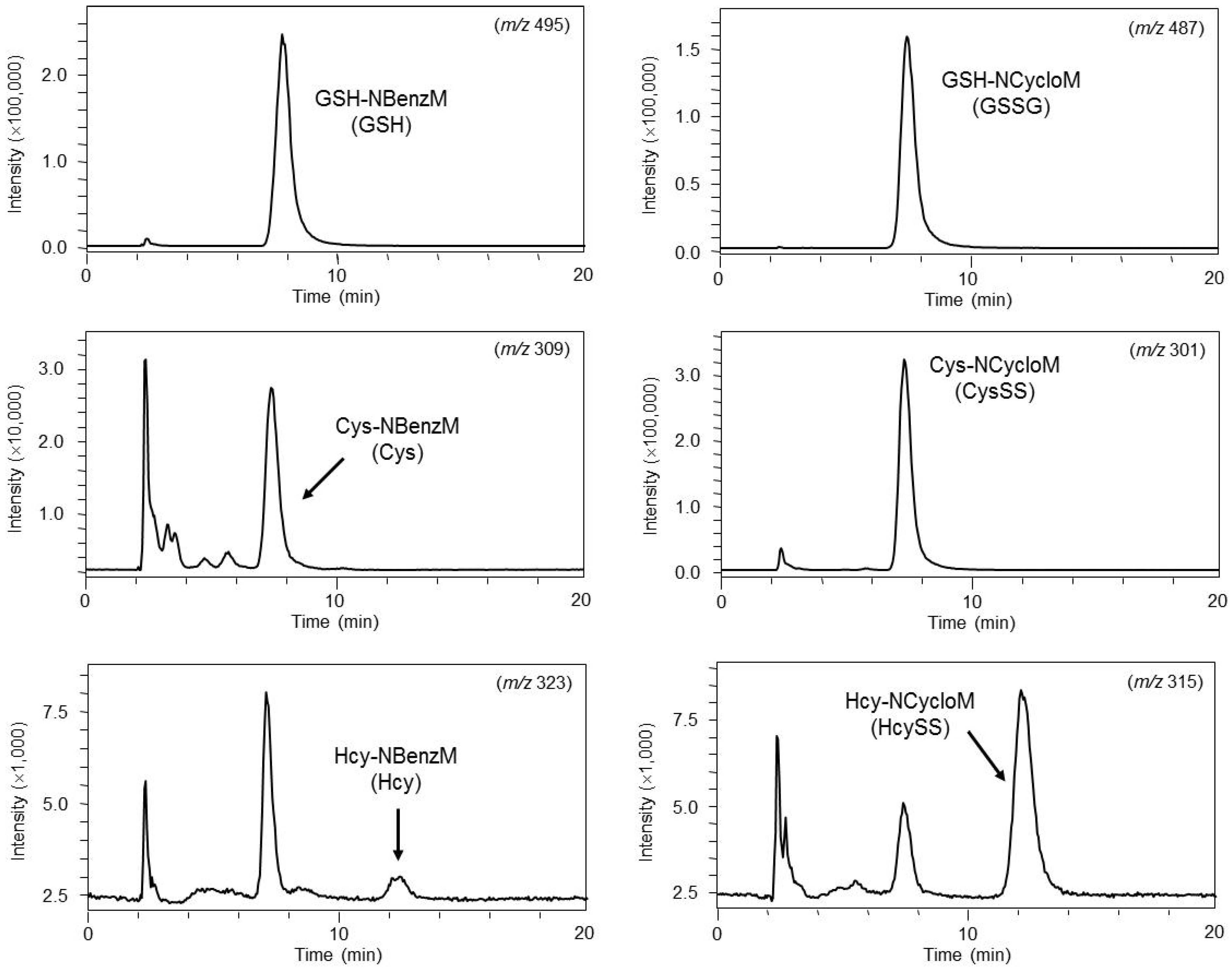
        <p>Dernovics <italic>et al</italic>. confirmed the potential of electrospray quadrupole time-of-flight (QTOF) MS/MS for the identification of selenium metabolites, such as GSH conjugate, which is in the low intra scan dynamic range [<xref ref-type="bibr" rid="B98-metabolites-02-00496">98</xref>]. Iwasaki <italic>et al</italic>. developed a highly sensitive and accurate method that employs column-switching HILIC-MS for the determination of reduced and oxidized thiols [<xref ref-type="bibr" rid="B75-metabolites-02-00496">75</xref>]. Representative chromatograms of serum samples are shown in <xref ref-type="fig" rid="metabolites-02-00496-f001">Figure 1</xref>. They succeed in measuring thiol compounds in mouse serum.</p>
        <fig id="metabolites-02-00496-f001" position="anchor">
          <label>Figure 1</label>
          <caption>
            <p>Chromatograms of reduced and oxidized thiols in mouse serum sample subjected to column-switching HILIC-MS. Adapted from reference [<xref ref-type="bibr" rid="B75-metabolites-02-00496">75</xref>].</p>
          </caption>
          <graphic xmlns:xlink="http://www.w3.org/1999/xlink" xlink:href="metabolites-02-00496-g001.tif"/>
        </fig>
        <p>On the other hand, D'Agostino <italic>et al</italic>. developed an analytical method for thiols, which utilizes CE-MS [<xref ref-type="bibr" rid="B99-metabolites-02-00496">99</xref>]. Husain <italic>et al</italic>. applied CE-TOFMS to quantitate cysteine deprivation in <italic>Entamoeba histolytica</italic> [<xref ref-type="bibr" rid="B100-metabolites-02-00496">100</xref>]. The optimization of maleimide labeling in conjunction with online sample preconcentration allows for the simultaneous analysis of nanomolar levels of reduced thiols and free oxidized thiols. This method integrates both specific and nonspecific approaches toward sensitivity enhancement for the artifact-free quantification of labile plasma thiols without complicated sample handling. Plasma thiol redox status determination, together with untargeted metabolite profiling, offers a systemic approach for the elucidation of the causal role of dysregulated thiol metabolism in the etiology of human diseases.</p>
      </sec>
      <sec>
        <title>4.3. Neurochemicals</title>
        <p>Given the physiological importance of neurotransmitters as signaling molecules in the central nervous system (CNS), the ability to measure changes in neurotransmitter concentrations has become an integral part of CNS drug discovery and development. These neuroactive molecules and metabolites, consisting of neurotransmitters, such as glutamate, or neuromodulators, such as acetylcholine (ACh), can be detected by appropriate techniques in the extracellular fluid of the brain. Many of these neurotransmitters also exist in blood, but their concentrations are different from those in the brain because of the differential permeability of the blood-brain barrier (BBB) and of differences in absorption mechanism, synthesis, and metabolism. In recent years, the accurate measurement of neurotransmitter concentrations in an accessible matrix has provided an opportunity to use those concentrations as preclinical and clinical biomarkers of CNS penetration and target engagement [<xref ref-type="bibr" rid="B101-metabolites-02-00496">101</xref>,<xref ref-type="bibr" rid="B102-metabolites-02-00496">102</xref>]. ACh, one of the neurotransmitters released by cholinergic neurons in the CNS, plays an important role in sleep regulation, learning and memory, cognitive function, and the pathology of neurological disorders, such as Parkinson’s disease, Alzheimer’s disease, and schizophrenia. Therefore, an analytical technique that enables the simultaneous determination of biomarkers of both cholinergic and histaminergic systems in an accessible biological matrix, such as CSF, would be a useful research tool to better understand the underlying mechanisms and implications for therapeutic interventions.</p>
        <p>Diao <italic>et al</italic>. developed a simple and sensitive method for the simultaneous analysis of three catecholamines: dopamine, epinephrine, and norepinephrine, in urine, by CE, coupled with in-column fiber-optic light-emitting diode-induced fluorescence detection (ICFO-LED-IFD) [<xref ref-type="bibr" rid="B103-metabolites-02-00496">103</xref>]. CE-ICFO-LED-IFD has been successfully applied to the analysis of catecholamines in human urine samples, offering good accuracy and satisfactory recovery. Meanwhile, Zhang <italic>et al</italic>. developed and validated a UPLC-MS/MS method to simultaneously quantify neurochemical concentrations in rat CSF. They used a HILIC column to separate highly polar compounds [<xref ref-type="bibr" rid="B104-metabolites-02-00496">104</xref>]. Li <italic>et al</italic>. determined neurochemicals in brain and blood samples of non-human primates in parallel by dual microdialysis, and subsequently conducted analysis by a direct capillary HILIC-MS-based method [<xref ref-type="bibr" rid="B105-metabolites-02-00496">105</xref>].</p>
      </sec>
      <sec>
        <title>4.4. Tricarboxylic Acid Cycle</title>
        <p>Studies of the metabolites in the tricarboxylic acid (TCA) cycle are considered to be essential for metabolomics analysis. The main metabolites in the TCA cycle are di- and tricarboxylic (TCA) acids. The TCA cycle has three primary functions: (i) to provide biosynthetic intermediates, (ii) to generate reducing potential, and (iii) to directly produce a small amount of ATP. The availability of biosynthetic intermediates affects the availability of amino acids and nucleic acids. Mammalian cells depend on the metabolism of glucose and glutamine for proliferation. The coupling of separation methods, such as CE [<xref ref-type="bibr" rid="B106-metabolites-02-00496">106</xref>], GC [<xref ref-type="bibr" rid="B107-metabolites-02-00496">107</xref>], RPLC [<xref ref-type="bibr" rid="B108-metabolites-02-00496">108</xref>], and HILIC [<xref ref-type="bibr" rid="B109-metabolites-02-00496">109</xref>], to MS has proven to be effective for the detection of large numbers of metabolites in complex mixtures.</p>
        <p>Büscher <italic>et al</italic>. compared the three separation platforms that are most widely used in the analysis of intracellular metabolites: CE, GC, and LC, all in combination with a TOFMS detector [<xref ref-type="bibr" rid="B110-metabolites-02-00496">110</xref>]. The more limited coverage of GC is due to a bias in the detection of large polar molecules. This is caused by the derivatization that renders nonvolatile polar compounds amendable to gas-phase separation, but cannot be completed because of steric hindrance of the numerous silyl groups that are necessary to modify all amino, carboxy and hydroxy groups in large molecules. According to their conclusions, for analyses on a single platform, LC provides the best combination of both versatility and robustness. If a second platform can be used, it is best complemented by GC.</p>
      </sec>
    </sec>
    <sec sec-type="conclusions">
      <title>5. Conclusions</title>
      <p>Metabolomics is a promising approach aimed at facilitating our understanding of the dynamics of biological composition in living systems. Metabolites tend to be converted into highly polar compounds and are therefore difficult to separate. In this review, we discussed recent progress in the separation of biological samples. CE, GC, and HPLC are powerful tools for the separation of biological samples. Methods based on chromatographic separation coupled to MS seem optimal to meet these requirements. GC-MS needs laborious clean-up and often derivatization and it can only be applied for thermally stable compounds. CE-MS and LC-MS is a suitable alternative in many cases. These techniques will be useful to bioanalytical scientists.</p>
    </sec>
  </body>
  <back>
    <ack>
      <title>Acknowledgments</title>
      <p>This work was supported by a MEXT-Supported Program for the Strategic Research Foundation at Private Universities, 2008-2012.</p>
    </ack>
    <notes>
      <title>Conflict of Interest</title>
      <p>The authors declare no conflict of interest.</p>
    </notes>
    <ref-list>
      <title>References</title>
      <ref id="B1-metabolites-02-00496">
        <label>1.</label>
        <citation citation-type="journal">
          <person-group person-group-type="author">
            <name>
              <surname>Hollywood</surname>
              <given-names>K.</given-names>
            </name>
            <name>
              <surname>Brison</surname>
              <given-names>D.R.</given-names>
            </name>
            <name>
              <surname>Goodacre</surname>
              <given-names>R.</given-names>
            </name>
          </person-group>
          <article-title>Metabolomics: current technologies and future trends</article-title>
          <source>Proteomics</source>
          <year>2006</year>
          <volume>6</volume>
          <fpage>4716</fpage>
          <lpage>4723</lpage>
          <pub-id pub-id-type="doi">10.1002/pmic.200600106</pub-id>
        </citation>
      </ref>
      <ref id="B2-metabolites-02-00496">
        <label>2.</label>
        <citation citation-type="journal">
          <person-group person-group-type="author">
            <name>
              <surname>Chen</surname>
              <given-names>Y.</given-names>
            </name>
            <name>
              <surname>Lin</surname>
              <given-names>M.C.</given-names>
            </name>
            <name>
              <surname>Wang</surname>
              <given-names>H.</given-names>
            </name>
            <name>
              <surname>Chan</surname>
              <given-names>C.Y.</given-names>
            </name>
            <name>
              <surname>Jiang</surname>
              <given-names>L.</given-names>
            </name>
            <name>
              <surname>Ngai</surname>
              <given-names>S.M.</given-names>
            </name>
            <name>
              <surname>Yu</surname>
              <given-names>J.</given-names>
            </name>
            <name>
              <surname>He</surname>
              <given-names>M.L.</given-names>
            </name>
            <name>
              <surname>Shaw</surname>
              <given-names>P.C.</given-names>
            </name>
            <name>
              <surname>Yew</surname>
              <given-names>D.T.</given-names>
            </name>
            <etal/>
          </person-group>
          <article-title>Proteomic analysis of EZH2 downstream target proteins in hepatocellular carcinoma</article-title>
          <source>Proteomics</source>
          <year>2007</year>
          <volume>7</volume>
          <fpage>3097</fpage>
          <lpage>3104</lpage>
          <pub-id pub-id-type="doi">10.1002/pmic.200700019</pub-id>
        </citation>
      </ref>
      <ref id="B3-metabolites-02-00496">
        <label>3.</label>
        <citation citation-type="journal">
          <person-group person-group-type="author">
            <name>
              <surname>Struck</surname>
              <given-names>W.</given-names>
            </name>
            <name>
              <surname>Waszczuk-Jankowska</surname>
              <given-names>M.</given-names>
            </name>
            <name>
              <surname>Kaliszan</surname>
              <given-names>R.</given-names>
            </name>
            <name>
              <surname>Markuszewski</surname>
              <given-names>M.J.</given-names>
            </name>
          </person-group>
          <article-title>The state-of-the-art determination of urinary nucleosides using chromatographic techniques "hyphenated" with advanced bioinformatic methods</article-title>
          <source>Anal. Bioanal. Chem.</source>
          <year>2011</year>
          <volume>401</volume>
          <fpage>2039</fpage>
          <lpage>2050</lpage>
          <pub-id pub-id-type="doi">10.1007/s00216-011-4789-6</pub-id>
        </citation>
      </ref>
      <ref id="B4-metabolites-02-00496">
        <label>4.</label>
        <citation citation-type="journal">
          <person-group person-group-type="author">
            <name>
              <surname>Ishiwata</surname>
              <given-names>J.</given-names>
            </name>
            <name>
              <surname>Kasamatsu</surname>
              <given-names>A.</given-names>
            </name>
            <name>
              <surname>Sakuma</surname>
              <given-names>K.</given-names>
            </name>
            <name>
              <surname>Iyoda</surname>
              <given-names>M.</given-names>
            </name>
            <name>
              <surname>Yamatoji</surname>
              <given-names>M.</given-names>
            </name>
            <name>
              <surname>Usukura</surname>
              <given-names>K.</given-names>
            </name>
            <name>
              <surname>Ishige</surname>
              <given-names>S.</given-names>
            </name>
            <name>
              <surname>Shimizu</surname>
              <given-names>T.</given-names>
            </name>
            <name>
              <surname>Yamano</surname>
              <given-names>Y.</given-names>
            </name>
            <name>
              <surname>Ogawara</surname>
              <given-names>K.</given-names>
            </name>
            <etal/>
          </person-group>
          <article-title>State of heat shock factor 1 expression as a putative diagnostic marker for oral squamous cell carcinoma</article-title>
          <source>Int. J. Oncol.</source>
          <year>2012</year>
          <volume>40</volume>
          <fpage>47</fpage>
          <lpage>52</lpage>
        <pub-id pub-id-type="pmid">21879256</pub-id></citation>
      </ref>
      <ref id="B5-metabolites-02-00496">
        <label>5.</label>
        <citation citation-type="journal">
          <person-group person-group-type="author">
            <name>
              <surname>Nordström</surname>
              <given-names>A.</given-names>
            </name>
            <name>
              <surname>O'Maille</surname>
              <given-names>G.</given-names>
            </name>
            <name>
              <surname>Qin</surname>
              <given-names>C.</given-names>
            </name>
            <name>
              <surname>Siuzdak</surname>
              <given-names>G.</given-names>
            </name>
          </person-group>
          <article-title>Nonlinear data alignment for UPLC-MS and HPLC-MS based metabolomics: quantitative analysis of endogenous and exogenous metabolites in human serum</article-title>
          <source>Anal. Chem.</source>
          <year>2006</year>
          <volume>78</volume>
          <fpage>3289</fpage>
          <lpage>3295</lpage>
          <pub-id pub-id-type="doi">10.1021/ac060245f</pub-id>
        </citation>
      </ref>
      <ref id="B6-metabolites-02-00496">
        <label>6.</label>
        <citation citation-type="journal">
          <person-group person-group-type="author">
            <name>
              <surname>Qi</surname>
              <given-names>X.</given-names>
            </name>
            <name>
              <surname>Zhang</surname>
              <given-names>Y.</given-names>
            </name>
            <name>
              <surname>Gao</surname>
              <given-names>J.</given-names>
            </name>
            <name>
              <surname>Chen</surname>
              <given-names>T.</given-names>
            </name>
            <name>
              <surname>Zhao</surname>
              <given-names>A.</given-names>
            </name>
            <name>
              <surname>Yan</surname>
              <given-names>Y.</given-names>
            </name>
            <name>
              <surname>Jia</surname>
              <given-names>W.</given-names>
            </name>
          </person-group>
          <article-title>Metabolite profiling of hemodialysate using gas chromatography time-of-flight mass spectrometry</article-title>
          <source>J. Pharm. Biomed. Anal.</source>
          <year>2011</year>
          <volume>55</volume>
          <fpage>1142</fpage>
          <lpage>1147</lpage>
          <pub-id pub-id-type="doi">10.1016/j.jpba.2011.04.001</pub-id>
        </citation>
      </ref>
      <ref id="B7-metabolites-02-00496">
        <label>7.</label>
        <citation citation-type="journal">
          <person-group person-group-type="author">
            <name>
              <surname>Li</surname>
              <given-names>S.</given-names>
            </name>
            <name>
              <surname>Liu</surname>
              <given-names>H.</given-names>
            </name>
            <name>
              <surname>Jin</surname>
              <given-names>Y.</given-names>
            </name>
            <name>
              <surname>Lin</surname>
              <given-names>S.</given-names>
            </name>
            <name>
              <surname>Cai</surname>
              <given-names>Z.</given-names>
            </name>
            <name>
              <surname>Jiang</surname>
              <given-names>Y.</given-names>
            </name>
          </person-group>
          <article-title>Metabolomics study of alcohol-induced liver injury and hepatocellular carcinoma xenografts in mice</article-title>
          <source>J. Chromatogr. B Analyt. Technol. Biomed. Life Sci.</source>
          <year>2011</year>
          <volume>879</volume>
          <fpage>2369</fpage>
          <lpage>2375</lpage>
          <pub-id pub-id-type="doi">10.1016/j.jchromb.2011.06.018</pub-id>
        </citation>
      </ref>
      <ref id="B8-metabolites-02-00496">
        <label>8.</label>
        <citation citation-type="journal">
          <person-group person-group-type="author">
            <name>
              <surname>Rhee</surname>
              <given-names>E.P.</given-names>
            </name>
            <name>
              <surname>Gerszten</surname>
              <given-names>R.E.</given-names>
            </name>
          </person-group>
          <article-title>Metabolomics and cardiovascular biomarker discovery</article-title>
          <source>Clin. Chem.</source>
          <year>2012</year>
          <volume>58</volume>
          <fpage>139</fpage>
          <lpage>147</lpage>
          <pub-id pub-id-type="doi">10.1373/clinchem.2011.169573</pub-id>
        </citation>
      </ref>
      <ref id="B9-metabolites-02-00496">
        <label>9.</label>
        <citation citation-type="journal">
          <person-group person-group-type="author">
            <name>
              <surname>Theodoridis</surname>
              <given-names>G.</given-names>
            </name>
            <name>
              <surname>Gika</surname>
              <given-names>H.G.</given-names>
            </name>
            <name>
              <surname>Wilson</surname>
              <given-names>I.D.</given-names>
            </name>
          </person-group>
          <article-title>Mass spectrometry-based holistic analytical approaches for metabolite profiling in systems biology studies</article-title>
          <source>Mass Spectrom. Rev.</source>
          <year>2011</year>
          <volume>30</volume>
          <fpage>884</fpage>
          <lpage>906</lpage>
        </citation>
      </ref>
      <ref id="B10-metabolites-02-00496">
        <label>10.</label>
        <citation citation-type="journal">
          <person-group person-group-type="author">
            <name>
              <surname>Viant</surname>
              <given-names>M.R.</given-names>
            </name>
            <name>
              <surname>Rosenblum</surname>
              <given-names>E.S.</given-names>
            </name>
            <name>
              <surname>Tieerdema</surname>
              <given-names>R.S.</given-names>
            </name>
          </person-group>
          <article-title>NMR-based metabolomics: a powerful approach for characterizing the effects of environmental stressors on organism health</article-title>
          <source>Environ. Sci. Technol.</source>
          <year>2003</year>
          <volume>37</volume>
          <fpage>4982</fpage>
          <lpage>4989</lpage>
          <pub-id pub-id-type="doi">10.1021/es034281x</pub-id>
        </citation>
      </ref>
      <ref id="B11-metabolites-02-00496">
        <label>11.</label>
        <citation citation-type="journal">
          <person-group person-group-type="author">
            <name>
              <surname>Chylla</surname>
              <given-names>R.A.</given-names>
            </name>
            <name>
              <surname>Hu</surname>
              <given-names>K.</given-names>
            </name>
            <name>
              <surname>Ellinger</surname>
              <given-names>J.J.</given-names>
            </name>
            <name>
              <surname>Markley</surname>
              <given-names>J.L.</given-names>
            </name>
          </person-group>
          <article-title>Deconvolution of two-dimensional NMR spectra by fast maximum likelihood reconstruction: application to quantitative metabolomics</article-title>
          <source>Anal. Chem.</source>
          <year>2011</year>
          <volume>83</volume>
          <fpage>4871</fpage>
          <lpage>4880</lpage>
        <pub-id pub-id-type="doi">10.1021/ac200536b</pub-id><pub-id pub-id-type="pmid">21526800</pub-id></citation>
      </ref>
      <ref id="B12-metabolites-02-00496">
        <label>12.</label>
        <citation citation-type="journal">
          <person-group person-group-type="author">
            <name>
              <surname>Zhang</surname>
              <given-names>A.</given-names>
            </name>
            <name>
              <surname>Sun</surname>
              <given-names>H.</given-names>
            </name>
            <name>
              <surname>Wang</surname>
              <given-names>P.</given-names>
            </name>
            <name>
              <surname>Han</surname>
              <given-names>Y.</given-names>
            </name>
            <name>
              <surname>Wang</surname>
              <given-names>X.</given-names>
            </name>
          </person-group>
          <article-title>Modern analytical techniques in metabolomics analysis</article-title>
          <source>Analyst</source>
          <year>2012</year>
          <volume>137</volume>
          <fpage>293</fpage>
          <lpage>300</lpage>
          <pub-id pub-id-type="doi">10.1039/c1an15605e</pub-id>
        </citation>
      </ref>
      <ref id="B13-metabolites-02-00496">
        <label>13.</label>
        <citation citation-type="journal">
          <person-group person-group-type="author">
            <name>
              <surname>Araníbar</surname>
              <given-names>N.</given-names>
            </name>
            <name>
              <surname>Ott</surname>
              <given-names>K.H.</given-names>
            </name>
            <name>
              <surname>Roongta</surname>
              <given-names>V.</given-names>
            </name>
            <name>
              <surname>Mueller</surname>
              <given-names>L.</given-names>
            </name>
          </person-group>
          <article-title>Metabolomic analysis using optimized NMR and statistical methods</article-title>
          <source>Anal. Biochem.</source>
          <year>2006</year>
          <volume>355</volume>
          <fpage>62</fpage>
          <lpage>70</lpage>
        <pub-id pub-id-type="doi">10.1016/j.ab.2006.04.014</pub-id><pub-id pub-id-type="pmid">16762305</pub-id></citation>
      </ref>
      <ref id="B14-metabolites-02-00496">
        <label>14.</label>
        <citation citation-type="journal">
          <person-group person-group-type="author">
            <name>
              <surname>Dalsgaard</surname>
              <given-names>P.W.</given-names>
            </name>
            <name>
              <surname>Petersen</surname>
              <given-names>B.O.</given-names>
            </name>
            <name>
              <surname>Duus</surname>
              <given-names>J.Ø.</given-names>
            </name>
            <name>
              <surname>Zidorn</surname>
              <given-names>C.</given-names>
            </name>
            <name>
              <surname>Frisvad</surname>
              <given-names>J.C.</given-names>
            </name>
            <name>
              <surname>Christophersen</surname>
              <given-names>C.</given-names>
            </name>
            <name>
              <surname>Larsen</surname>
              <given-names>T.O.</given-names>
            </name>
          </person-group>
          <article-title>Atlantinone A, a meroterpenoid produced by <italic>Penicillium ribeum</italic> and several cheese associated <italic>Penicillium</italic> species</article-title>
          <source>Metabolites</source>
          <year>2012</year>
          <volume>2</volume>
          <fpage>214</fpage>
          <lpage>220</lpage>
          <pub-id pub-id-type="doi">10.3390/metabo2010214</pub-id>
        </citation>
      </ref>
      <ref id="B15-metabolites-02-00496">
        <label>15.</label>
        <citation citation-type="journal">
          <person-group person-group-type="author">
            <name>
              <surname>Theodoridis</surname>
              <given-names>G.A.</given-names>
            </name>
            <name>
              <surname>Gika</surname>
              <given-names>H.G.</given-names>
            </name>
            <name>
              <surname>Want</surname>
              <given-names>E.J.</given-names>
            </name>
            <name>
              <surname>Wilson</surname>
              <given-names>I.D.</given-names>
            </name>
          </person-group>
          <article-title>Liquid chromatography-mass spectrometry based global metabolite profiling: a review</article-title>
          <source>Anal. Chim. Acta</source>
          <year>2012</year>
          <volume>711</volume>
          <fpage>7</fpage>
          <lpage>16</lpage>
          <pub-id pub-id-type="doi">10.1016/j.aca.2011.09.042</pub-id>
        </citation>
      </ref>
      <ref id="B16-metabolites-02-00496">
        <label>16.</label>
        <citation citation-type="journal">
          <person-group person-group-type="author">
            <name>
              <surname>Barbas</surname>
              <given-names>C.</given-names>
            </name>
            <name>
              <surname>Moraes</surname>
              <given-names>E.P.</given-names>
            </name>
            <name>
              <surname>Villaseñor</surname>
              <given-names>A.</given-names>
            </name>
          </person-group>
          <article-title>Capillary electrophoresis as a metabolomics tool for non-targeted fingerprinting of biological samples</article-title>
          <source>J. Pharm. Biomed. Anal.</source>
          <year>2011</year>
          <volume>55</volume>
          <fpage>823</fpage>
          <lpage>831</lpage>
          <pub-id pub-id-type="doi">10.1016/j.jpba.2011.02.001</pub-id>
        </citation>
      </ref>
      <ref id="B17-metabolites-02-00496">
        <label>17.</label>
        <citation citation-type="journal">
          <person-group person-group-type="author">
            <name>
              <surname>Jonsson</surname>
              <given-names>P.</given-names>
            </name>
            <name>
              <surname>Gullberg</surname>
              <given-names>J.</given-names>
            </name>
            <name>
              <surname>Nordström</surname>
              <given-names>A.</given-names>
            </name>
            <name>
              <surname>Kusano</surname>
              <given-names>M.</given-names>
            </name>
            <name>
              <surname>Kowalczyk</surname>
              <given-names>M.</given-names>
            </name>
            <name>
              <surname>Sjöström</surname>
              <given-names>M.</given-names>
            </name>
            <name>
              <surname>Moritz</surname>
              <given-names>T.</given-names>
            </name>
          </person-group>
          <article-title>A strategy for identifying differences in large series of metabolomic samples analyzed by GC/MS</article-title>
          <source>Anal. Chem.</source>
          <year>2004</year>
          <volume>76</volume>
          <fpage>1738</fpage>
          <lpage>1745</lpage>
          <pub-id pub-id-type="doi">10.1021/ac0352427</pub-id>
        </citation>
      </ref>
      <ref id="B18-metabolites-02-00496">
        <label>18.</label>
        <citation citation-type="journal">
          <person-group person-group-type="author">
            <name>
              <surname>Guy</surname>
              <given-names>P.A.</given-names>
            </name>
            <name>
              <surname>Tavazzi</surname>
              <given-names>I.</given-names>
            </name>
            <name>
              <surname>Bruce</surname>
              <given-names>S.J.</given-names>
            </name>
            <name>
              <surname>Ramadan</surname>
              <given-names>Z.</given-names>
            </name>
            <name>
              <surname>Kochhar</surname>
              <given-names>S.</given-names>
            </name>
          </person-group>
          <article-title>Global metabolic profiling analysis on human urine by UPLC-TOFMS: issues and method validation in nutritional metabolomics</article-title>
          <source>J. Chromatogr. B Analyt. Technol. Biomed. Life Sci.</source>
          <year>2008</year>
          <volume>871</volume>
          <fpage>253</fpage>
          <lpage>260</lpage>
          <pub-id pub-id-type="doi">10.1016/j.jchromb.2008.04.034</pub-id>
        </citation>
      </ref>
      <ref id="B19-metabolites-02-00496">
        <label>19.</label>
        <citation citation-type="journal">
          <person-group person-group-type="author">
            <name>
              <surname>Zhou</surname>
              <given-names>B.</given-names>
            </name>
            <name>
              <surname>Xiao</surname>
              <given-names>J.F.</given-names>
            </name>
            <name>
              <surname>Tuli</surname>
              <given-names>L.</given-names>
            </name>
            <name>
              <surname>Ressom</surname>
              <given-names>H.W.</given-names>
            </name>
          </person-group>
          <article-title>LC-MS-based metabolomics</article-title>
          <source>Mol. Biosyst.</source>
          <year>2012</year>
          <volume>8</volume>
          <fpage>470</fpage>
          <lpage>481</lpage>
          <pub-id pub-id-type="doi">10.1039/c1mb05350g</pub-id>
        </citation>
      </ref>
      <ref id="B20-metabolites-02-00496">
        <label>20.</label>
        <citation citation-type="journal">
          <person-group person-group-type="author">
            <name>
              <surname>Haag</surname>
              <given-names>M.</given-names>
            </name>
            <name>
              <surname>Schmidt</surname>
              <given-names>A.</given-names>
            </name>
            <name>
              <surname>Sachsenheimer</surname>
              <given-names>T.</given-names>
            </name>
            <name>
              <surname>Brügger</surname>
              <given-names>B.</given-names>
            </name>
          </person-group>
          <article-title>Quantification of signaling lipids by nano-electrospray ionization tandem mass spectrometry (Nano-ESI MS/MS)</article-title>
          <source>Metabolites</source>
          <year>2012</year>
          <volume>2</volume>
          <fpage>57</fpage>
          <lpage>76</lpage>
          <pub-id pub-id-type="doi">10.3390/metabo2010057</pub-id>
        </citation>
      </ref>
      <ref id="B21-metabolites-02-00496">
        <label>21.</label>
        <citation citation-type="journal">
          <person-group person-group-type="author">
            <name>
              <surname>Sreekumar</surname>
              <given-names>A.</given-names>
            </name>
            <name>
              <surname>Poisson</surname>
              <given-names>L.M.</given-names>
            </name>
            <name>
              <surname>Rajendiran</surname>
              <given-names>T.M.</given-names>
            </name>
            <name>
              <surname>Khan</surname>
              <given-names>A.P.</given-names>
            </name>
            <name>
              <surname>Cao</surname>
              <given-names>Q.</given-names>
            </name>
            <name>
              <surname>Yu</surname>
              <given-names>J.</given-names>
            </name>
            <name>
              <surname>Laxman</surname>
              <given-names>B.</given-names>
            </name>
            <name>
              <surname>Mehra</surname>
              <given-names>R.</given-names>
            </name>
            <name>
              <surname>Lonigro</surname>
              <given-names>R.J.</given-names>
            </name>
            <name>
              <surname>Li</surname>
              <given-names>Y.</given-names>
            </name>
            <name>
              <surname>Nyati</surname>
              <given-names>M.K.</given-names>
            </name>
            <name>
              <surname>Ahsan</surname>
              <given-names>A.</given-names>
            </name>
            <name>
              <surname>Kalyana-Sundaram</surname>
              <given-names>S.</given-names>
            </name>
            <name>
              <surname>Han</surname>
              <given-names>B.</given-names>
            </name>
            <name>
              <surname>Cao</surname>
              <given-names>X.</given-names>
            </name>
            <name>
              <surname>Byun</surname>
              <given-names>J.</given-names>
            </name>
            <name>
              <surname>Omenn</surname>
              <given-names>G.S.</given-names>
            </name>
            <name>
              <surname>Ghosh</surname>
              <given-names>D.</given-names>
            </name>
            <name>
              <surname>Pennathur</surname>
              <given-names>S.</given-names>
            </name>
            <name>
              <surname>Alexander</surname>
              <given-names>D.C.</given-names>
            </name>
            <name>
              <surname>Berger</surname>
              <given-names>A.</given-names>
            </name>
            <name>
              <surname>Shuster</surname>
              <given-names>J.R.</given-names>
            </name>
            <name>
              <surname>Wei</surname>
              <given-names>J.T.</given-names>
            </name>
            <name>
              <surname>Varambally</surname>
              <given-names>S.</given-names>
            </name>
            <name>
              <surname>Beecher</surname>
              <given-names>C.</given-names>
            </name>
            <name>
              <surname>Chinnaiyan</surname>
              <given-names>A.M.</given-names>
            </name>
          </person-group>
          <article-title>Metabolomic profiles delineate potential role for sarcosine in prostate cancer progression</article-title>
          <source>Nature</source>
          <year>2009</year>
          <volume>457</volume>
          <fpage>910</fpage>
          <lpage>914</lpage>
        <pub-id pub-id-type="doi">10.1038/nature07762</pub-id><pub-id pub-id-type="pmid">19212411</pub-id></citation>
      </ref>
      <ref id="B22-metabolites-02-00496">
        <label>22.</label>
        <citation citation-type="journal">
          <person-group person-group-type="author">
            <name>
              <surname>Wu</surname>
              <given-names>H.</given-names>
            </name>
            <name>
              <surname>Xue</surname>
              <given-names>R.</given-names>
            </name>
            <name>
              <surname>Lu</surname>
              <given-names>C.</given-names>
            </name>
            <name>
              <surname>Deng</surname>
              <given-names>C.</given-names>
            </name>
            <name>
              <surname>Liu</surname>
              <given-names>T.</given-names>
            </name>
            <name>
              <surname>Zeng</surname>
              <given-names>H.</given-names>
            </name>
            <name>
              <surname>Wang</surname>
              <given-names>Q.</given-names>
            </name>
            <name>
              <surname>Shen</surname>
              <given-names>X.</given-names>
            </name>
          </person-group>
          <article-title>Metabolomic study for diagnostic model of oesophageal cancer using gas chromatography/mass spectrometry</article-title>
          <source>J. Chromatogr. B.</source>
          <year>2009</year>
          <volume>877</volume>
          <fpage>3111</fpage>
          <lpage>3117</lpage>
          <pub-id pub-id-type="doi">10.1016/j.jchromb.2009.07.039</pub-id>
        </citation>
      </ref>
      <ref id="B23-metabolites-02-00496">
        <label>23.</label>
        <citation citation-type="journal">
          <person-group person-group-type="author">
            <name>
              <surname>Blekherman</surname>
              <given-names>G.</given-names>
            </name>
            <name>
              <surname>Laubenbacher</surname>
              <given-names>R.</given-names>
            </name>
            <name>
              <surname>Cortes</surname>
              <given-names>D.F.</given-names>
            </name>
            <name>
              <surname>Mendes</surname>
              <given-names>P.</given-names>
            </name>
            <name>
              <surname>Torti</surname>
              <given-names>F.M.</given-names>
            </name>
            <name>
              <surname>Akman</surname>
              <given-names>S.</given-names>
            </name>
            <name>
              <surname>Torti</surname>
              <given-names>S.V.</given-names>
            </name>
            <name>
              <surname>Shulaev</surname>
              <given-names>V.</given-names>
            </name>
          </person-group>
          <article-title>Bioinformatics tools for cancer metabolomics</article-title>
          <source>Metabolomics</source>
          <year>2011</year>
          <volume>7</volume>
          <fpage>329</fpage>
          <lpage>343</lpage>
          <pub-id pub-id-type="doi">10.1007/s11306-010-0270-3</pub-id>
        </citation>
      </ref>
      <ref id="B24-metabolites-02-00496">
        <label>24.</label>
        <citation citation-type="journal">
          <person-group person-group-type="author">
            <name>
              <surname>Huo</surname>
              <given-names>T.</given-names>
            </name>
            <name>
              <surname>Cai</surname>
              <given-names>S.</given-names>
            </name>
            <name>
              <surname>Lu</surname>
              <given-names>X.</given-names>
            </name>
            <name>
              <surname>Sha</surname>
              <given-names>Y.</given-names>
            </name>
            <name>
              <surname>Yu</surname>
              <given-names>M.</given-names>
            </name>
            <name>
              <surname>Li</surname>
              <given-names>F.</given-names>
            </name>
          </person-group>
          <article-title>Metabonomic study of biochemical changes in the serum of type 2 diabetes mellitus patients after the treatment of metformin hydrochloride</article-title>
          <source>J. Pharm. Biomed. Anal.</source>
          <year>2009</year>
          <volume>49</volume>
          <fpage>976</fpage>
          <lpage>982</lpage>
          <pub-id pub-id-type="doi">10.1016/j.jpba.2009.01.008</pub-id>
        </citation>
      </ref>
      <ref id="B25-metabolites-02-00496">
        <label>25.</label>
        <citation citation-type="journal">
          <person-group person-group-type="author">
            <name>
              <surname>Wang</surname>
              <given-names>T.J.</given-names>
            </name>
            <name>
              <surname>Larson</surname>
              <given-names>M.G.</given-names>
            </name>
            <name>
              <surname>Vasan</surname>
              <given-names>R.S.</given-names>
            </name>
            <name>
              <surname>Cheng</surname>
              <given-names>S.</given-names>
            </name>
            <name>
              <surname>Rhee</surname>
              <given-names>E.P.</given-names>
            </name>
            <name>
              <surname>McCabe</surname>
              <given-names>E.</given-names>
            </name>
            <name>
              <surname>Lewis</surname>
              <given-names>G.D.</given-names>
            </name>
            <name>
              <surname>Fox</surname>
              <given-names>C.S.</given-names>
            </name>
            <name>
              <surname>Jacques</surname>
              <given-names>P.F.</given-names>
            </name>
            <name>
              <surname>Fernandez</surname>
              <given-names>C.</given-names>
            </name>
            <etal/>
          </person-group>
          <article-title>Metabolite profiles and the risk of developing diabetes</article-title>
          <source>Nat. Med.</source>
          <year>2011</year>
          <volume>17</volume>
          <fpage>448</fpage>
          <lpage>453</lpage>
        <pub-id pub-id-type="doi">10.1038/nm.2307</pub-id><pub-id pub-id-type="pmid">21423183</pub-id></citation>
      </ref>
      <ref id="B26-metabolites-02-00496">
        <label>26.</label>
        <citation citation-type="journal">
          <person-group person-group-type="author">
            <name>
              <surname>Chu</surname>
              <given-names>F.L.</given-names>
            </name>
            <name>
              <surname>Pirastru</surname>
              <given-names>L.</given-names>
            </name>
            <name>
              <surname>Popovic</surname>
              <given-names>R.</given-names>
            </name>
            <name>
              <surname>Sleno</surname>
              <given-names>L.</given-names>
            </name>
          </person-group>
          <article-title>Carotenogenesis up-regulation in Scenedesmus sp. using a targeted metabolomics approach by liquid chromatography-high-resolution mass spectrometry</article-title>
          <source>J. Agric. Food Chem.</source>
          <year>2011</year>
          <volume>59</volume>
          <fpage>3004</fpage>
          <lpage>3013</lpage>
          <pub-id pub-id-type="doi">10.1021/jf105005q</pub-id>
        </citation>
      </ref>
      <ref id="B27-metabolites-02-00496">
        <label>27.</label>
        <citation citation-type="journal">
          <person-group person-group-type="author">
            <name>
              <surname>Zhang</surname>
              <given-names>H.M.</given-names>
            </name>
            <name>
              <surname>Li</surname>
              <given-names>S.L.</given-names>
            </name>
            <name>
              <surname>Zhang</surname>
              <given-names>H.</given-names>
            </name>
            <name>
              <surname>Wang</surname>
              <given-names>Y.</given-names>
            </name>
            <name>
              <surname>Zhao</surname>
              <given-names>Z.L.</given-names>
            </name>
            <name>
              <surname>Chen</surname>
              <given-names>S.L.</given-names>
            </name>
            <name>
              <surname>Xu</surname>
              <given-names>H.X.</given-names>
            </name>
          </person-group>
          <article-title>Holistic quality evaluation of commercial white and red ginseng using a UPLC-QTOF-MS/MS-based metabolomics approach</article-title>
          <source>J. Pharm. Biomed. Anal.</source>
          <year>2012</year>
          <volume>62</volume>
          <fpage>258</fpage>
          <lpage>273</lpage>
          <pub-id pub-id-type="doi">10.1016/j.jpba.2012.01.010</pub-id>
        </citation>
      </ref>
      <ref id="B28-metabolites-02-00496">
        <label>28.</label>
        <citation citation-type="journal">
          <person-group person-group-type="author">
            <name>
              <surname>Watkins</surname>
              <given-names>S.M.</given-names>
            </name>
            <name>
              <surname>German</surname>
              <given-names>J.B.</given-names>
            </name>
          </person-group>
          <article-title>Metabolomics and biochemical profiling in drug discovery and development</article-title>
          <source>Curr. Opin. Mol. Ther.</source>
          <year>2002</year>
          <volume>4</volume>
          <fpage>224</fpage>
          <lpage>228</lpage>
        <pub-id pub-id-type="pmid">12139307</pub-id></citation>
      </ref>
      <ref id="B29-metabolites-02-00496">
        <label>29.</label>
        <citation citation-type="journal">
          <person-group person-group-type="author">
            <name>
              <surname>Chen</surname>
              <given-names>C.</given-names>
            </name>
            <name>
              <surname>Gonzalez</surname>
              <given-names>F.J.</given-names>
            </name>
            <name>
              <surname>Idle</surname>
              <given-names>J.R.</given-names>
            </name>
          </person-group>
          <article-title>LC-MS-based metabolomics in drug metabolism</article-title>
          <source>Drug Metab. Rev.</source>
          <year>2007</year>
          <volume>39</volume>
          <fpage>581</fpage>
          <lpage>597</lpage>
          <pub-id pub-id-type="doi">10.1080/03602530701497804</pub-id>
        </citation>
      </ref>
      <ref id="B30-metabolites-02-00496">
        <label>30.</label>
        <citation citation-type="journal">
          <person-group person-group-type="author">
            <name>
              <surname>Chen</surname>
              <given-names>X.</given-names>
            </name>
            <name>
              <surname>Liu</surname>
              <given-names>L.</given-names>
            </name>
            <name>
              <surname>Palacios</surname>
              <given-names>G.</given-names>
            </name>
            <name>
              <surname>Gao</surname>
              <given-names>J.</given-names>
            </name>
            <name>
              <surname>Zhang</surname>
              <given-names>N.</given-names>
            </name>
            <name>
              <surname>Li</surname>
              <given-names>G.</given-names>
            </name>
            <name>
              <surname>Lu</surname>
              <given-names>J.</given-names>
            </name>
            <name>
              <surname>Song</surname>
              <given-names>T.</given-names>
            </name>
            <name>
              <surname>Zhang</surname>
              <given-names>Y.</given-names>
            </name>
            <name>
              <surname>Lv</surname>
              <given-names>H.</given-names>
            </name>
          </person-group>
          <article-title>Plasma metabolomics reveals biomarkers of the atherosclerosis</article-title>
          <source>J. Sep. Sci.</source>
          <year>2010</year>
          <volume>33</volume>
          <fpage>2776</fpage>
          <lpage>2783</lpage>
          <pub-id pub-id-type="doi">10.1002/jssc.201000395</pub-id>
        </citation>
      </ref>
      <ref id="B31-metabolites-02-00496">
        <label>31.</label>
        <citation citation-type="journal">
          <person-group person-group-type="author">
            <name>
              <surname>Mamas</surname>
              <given-names>M.</given-names>
            </name>
            <name>
              <surname>Dunn</surname>
              <given-names>W.B.</given-names>
            </name>
            <name>
              <surname>Neyses</surname>
              <given-names>L.</given-names>
            </name>
            <name>
              <surname>Goodacre</surname>
              <given-names>R.</given-names>
            </name>
          </person-group>
          <article-title>The role of metabolites and metabolomics in clinically applicable biomarkers of disease</article-title>
          <source>Arch. Toxicol.</source>
          <year>2011</year>
          <volume>85</volume>
          <fpage>5</fpage>
          <lpage>17</lpage>
          <pub-id pub-id-type="doi">10.1007/s00204-010-0609-6</pub-id>
        </citation>
      </ref>
      <ref id="B32-metabolites-02-00496">
        <label>32.</label>
        <citation citation-type="journal">
          <person-group person-group-type="author">
            <name>
              <surname>Kotłowska</surname>
              <given-names>A.</given-names>
            </name>
            <name>
              <surname>Sworczak</surname>
              <given-names>K.</given-names>
            </name>
            <name>
              <surname>Stepnowski</surname>
              <given-names>P.</given-names>
            </name>
          </person-group>
          <article-title>Urine metabolomics analysis for adrenal incidentaloma activity detection and biomarker discovery</article-title>
          <source>J. Chromatogr. B Analyt. Technol. Biomed. Life Sci.</source>
          <year>2011</year>
          <volume>879</volume>
          <fpage>359</fpage>
          <lpage>363</lpage>
          <pub-id pub-id-type="doi">10.1016/j.jchromb.2010.12.021</pub-id>
        </citation>
      </ref>
      <ref id="B33-metabolites-02-00496">
        <label>33.</label>
        <citation citation-type="journal">
          <person-group person-group-type="author">
            <name>
              <surname>Patti</surname>
              <given-names>G.J.</given-names>
            </name>
          </person-group>
          <article-title>Separation strategies for untargeted metabolomics</article-title>
          <source>J. Sep. Sci.</source>
          <year>2011</year>
          <volume>34</volume>
          <fpage>3460</fpage>
          <lpage>3469</lpage>
          <pub-id pub-id-type="doi">10.1002/jssc.201100532</pub-id>
        </citation>
      </ref>
      <ref id="B34-metabolites-02-00496">
        <label>34.</label>
        <citation citation-type="journal">
          <person-group person-group-type="author">
            <name>
              <surname>Monton</surname>
              <given-names>M.R.</given-names>
            </name>
            <name>
              <surname>Soga</surname>
              <given-names>T.</given-names>
            </name>
          </person-group>
          <article-title>Metabolome analysis by capillary electrophoresis-mass spectrometry</article-title>
          <source>J. Chromatogr.A.</source>
          <year>1168</year>
          <fpage>237</fpage>
          <lpage>246</lpage>
        </citation>
      </ref>
      <ref id="B35-metabolites-02-00496">
        <label>35.</label>
        <citation citation-type="journal">
          <person-group person-group-type="author">
            <name>
              <surname>Breadmore</surname>
              <given-names>M.C.</given-names>
            </name>
            <name>
              <surname>Quirino</surname>
              <given-names>J.P.</given-names>
            </name>
          </person-group>
          <article-title>100,000-fold concentration of anions in capillary zone electrophoresis using electroosmotic flow controlled counterflow isotachophoretic stacking under field amplified conditions</article-title>
          <source>Anal. Chem.</source>
          <year>2008</year>
          <volume>80</volume>
          <fpage>6373</fpage>
          <lpage>6381</lpage>
          <pub-id pub-id-type="doi">10.1021/ac8007835</pub-id>
        </citation>
      </ref>
      <ref id="B36-metabolites-02-00496">
        <label>36.</label>
        <citation citation-type="journal">
          <person-group person-group-type="author">
            <name>
              <surname>Wang</surname>
              <given-names>T.</given-names>
            </name>
            <name>
              <surname>Ma</surname>
              <given-names>J.</given-names>
            </name>
            <name>
              <surname>Wu</surname>
              <given-names>S.</given-names>
            </name>
            <name>
              <surname>Sun</surname>
              <given-names>L.</given-names>
            </name>
            <name>
              <surname>Yuan</surname>
              <given-names>H.</given-names>
            </name>
            <name>
              <surname>Zhang</surname>
              <given-names>L.</given-names>
            </name>
            <name>
              <surname>Liang</surname>
              <given-names>Z.</given-names>
            </name>
            <name>
              <surname>Zhang</surname>
              <given-names>Y.</given-names>
            </name>
          </person-group>
          <article-title>On-line combination of monolithic immobilized pH gradient-based capillary isoelectric focusing and capillary zone electrophoresis via a partially etched porous interface for protein analysis</article-title>
          <source>J. Chromatogr. B Analyt. Technol. Biomed. Life Sci.</source>
          <year>2011</year>
          <volume>879</volume>
          <fpage>804</fpage>
          <lpage>810</lpage>
          <pub-id pub-id-type="doi">10.1016/j.jchromb.2011.02.020</pub-id>
        </citation>
      </ref>
      <ref id="B37-metabolites-02-00496">
        <label>37.</label>
        <citation citation-type="journal">
          <person-group person-group-type="author">
            <name>
              <surname>Kitagawa</surname>
              <given-names>F.</given-names>
            </name>
            <name>
              <surname>Otsuka</surname>
              <given-names>K.</given-names>
            </name>
          </person-group>
          <article-title>Recent progress in capillary electrophoretic analysis of amino acid enantiomers</article-title>
          <source>J. Chromatogr. B Analyt. Technol. Biomed. Life Sci.</source>
          <year>2011</year>
          <volume>879</volume>
          <fpage>3078</fpage>
          <lpage>3095</lpage>
          <pub-id pub-id-type="doi">10.1016/j.jchromb.2011.03.016</pub-id>
        </citation>
      </ref>
      <ref id="B38-metabolites-02-00496">
        <label>38.</label>
        <citation citation-type="journal">
          <person-group person-group-type="author">
            <name>
              <surname>Chiesl</surname>
              <given-names>T.N.</given-names>
            </name>
            <name>
              <surname>Chu</surname>
              <given-names>W.K.</given-names>
            </name>
            <name>
              <surname>Stockton</surname>
              <given-names>A.M.</given-names>
            </name>
            <name>
              <surname>Amashukeli</surname>
              <given-names>X.</given-names>
            </name>
            <name>
              <surname>Grunthaner</surname>
              <given-names>F.</given-names>
            </name>
            <name>
              <surname>Mathies</surname>
              <given-names>R.A.</given-names>
            </name>
          </person-group>
          <article-title>Enhanced amine and amino acid analysis using Pacific Blue and the Mars Organic Analyzer microchip capillary electrophoresis system</article-title>
          <source>Anal. Chem.</source>
          <year>2009</year>
          <volume>81</volume>
          <fpage>2537</fpage>
          <lpage>2544</lpage>
        <pub-id pub-id-type="doi">10.1021/ac8023334</pub-id><pub-id pub-id-type="pmid">19245228</pub-id></citation>
      </ref>
      <ref id="B39-metabolites-02-00496">
        <label>39.</label>
        <citation citation-type="journal">
          <person-group person-group-type="author">
            <name>
              <surname>Riekkola</surname>
              <given-names>M.L.</given-names>
            </name>
          </person-group>
          <article-title>Recent advances in nonaqueous capillary electrophoresis</article-title>
          <source>Electrophoresis</source>
          <year>2002</year>
          <volume>23</volume>
          <fpage>3865</fpage>
          <lpage>3883</lpage>
          <pub-id pub-id-type="doi">10.1002/elps.200290007</pub-id>
        </citation>
      </ref>
      <ref id="B40-metabolites-02-00496">
        <label>40.</label>
        <citation citation-type="journal">
          <person-group person-group-type="author">
            <name>
              <surname>Olivares</surname>
              <given-names>J.A.</given-names>
            </name>
            <name>
              <surname>Nguyen</surname>
              <given-names>N.T.</given-names>
            </name>
            <name>
              <surname>Yonker</surname>
              <given-names>C.R.</given-names>
            </name>
            <name>
              <surname>Smith</surname>
              <given-names>R.D.</given-names>
            </name>
          </person-group>
          <article-title>On-line mass spectrometric detection for capillary zone electrophoresis</article-title>
          <source>Anal. Chem.</source>
          <year>1987</year>
          <volume>59</volume>
          <fpage>1230</fpage>
          <lpage>1232</lpage>
          <pub-id pub-id-type="doi">10.1021/ac00135a034</pub-id>
        </citation>
      </ref>
      <ref id="B41-metabolites-02-00496">
        <label>41.</label>
        <citation citation-type="journal">
          <person-group person-group-type="author">
            <name>
              <surname>Schmitt-Kopplin</surname>
              <given-names>P.</given-names>
            </name>
            <name>
              <surname>Frommberger</surname>
              <given-names>M.</given-names>
            </name>
          </person-group>
          <article-title>Capillary electrophoresis-mass spectrometry: 15 years of developments and applications</article-title>
          <source>Electrophoresis</source>
          <year>2003</year>
          <volume>24</volume>
          <fpage>3837</fpage>
          <lpage>3867</lpage>
          <pub-id pub-id-type="doi">10.1002/elps.200305659</pub-id>
        </citation>
      </ref>
      <ref id="B42-metabolites-02-00496">
        <label>42.</label>
        <citation citation-type="journal">
          <person-group person-group-type="author">
            <name>
              <surname>Sisu</surname>
              <given-names>E.</given-names>
            </name>
            <name>
              <surname>Flangea</surname>
              <given-names>C.</given-names>
            </name>
            <name>
              <surname>Serb</surname>
              <given-names>A.</given-names>
            </name>
            <name>
              <surname>Rizzi</surname>
              <given-names>A.</given-names>
            </name>
            <name>
              <surname>Zamfir</surname>
              <given-names>A.D.</given-names>
            </name>
          </person-group>
          <article-title>High-performance separation techniques hyphenated to mass spectrometry for ganglioside analysis</article-title>
          <source>Electrophoresis</source>
          <year>2011</year>
          <volume>32</volume>
          <fpage>1591</fpage>
          <lpage>1609</lpage>
        <pub-id pub-id-type="pmid">21604285</pub-id></citation>
      </ref>
      <ref id="B43-metabolites-02-00496">
        <label>43.</label>
        <citation citation-type="journal">
          <person-group person-group-type="author">
            <name>
              <surname>Bjørnsdottir</surname>
              <given-names>I.</given-names>
            </name>
            <name>
              <surname>Tjørnelund</surname>
              <given-names>J.</given-names>
            </name>
            <name>
              <surname>Hansen</surname>
              <given-names>S.H.</given-names>
            </name>
          </person-group>
          <article-title>Nonaqueous capillary electrophoresis-its applicability in the analysis of food, pharmaceuticals and biological fluids</article-title>
          <source>Electrophoresis</source>
          <year>1998</year>
          <volume>19</volume>
          <fpage>2179</fpage>
          <lpage>2186</lpage>
          <pub-id pub-id-type="doi">10.1002/elps.1150191223</pub-id>
        </citation>
      </ref>
      <ref id="B44-metabolites-02-00496">
        <label>44.</label>
        <citation citation-type="journal">
          <person-group person-group-type="author">
            <name>
              <surname>Bianco</surname>
              <given-names>G.</given-names>
            </name>
            <name>
              <surname>Schmitt-Kopplin</surname>
              <given-names>P.</given-names>
            </name>
            <name>
              <surname>De Benedetto</surname>
              <given-names>G.</given-names>
            </name>
            <name>
              <surname>Kettrup</surname>
              <given-names>A.</given-names>
            </name>
            <name>
              <surname>Cataldi</surname>
              <given-names>T.R.</given-names>
            </name>
          </person-group>
          <article-title>Determination of glycoalkaloids and relative aglycones by nonaqueous capillary electrophoresis coupled with electrospray ionization-ion trap mass spectrometry</article-title>
          <source>Electrophoresis</source>
          <year>2002</year>
          <volume>23</volume>
          <fpage>2904</fpage>
          <lpage>2912</lpage>
          <pub-id pub-id-type="doi">10.1002/1522-2683(200209)23:17&lt;2904::AID-ELPS2904&gt;3.0.CO;2-1</pub-id>
        </citation>
      </ref>
      <ref id="B45-metabolites-02-00496">
        <label>45.</label>
        <citation citation-type="journal">
          <person-group person-group-type="author">
            <name>
              <surname>Ramautar</surname>
              <given-names>R.</given-names>
            </name>
            <name>
              <surname>Mayboroda</surname>
              <given-names>O.A.</given-names>
            </name>
            <name>
              <surname>Somsen</surname>
              <given-names>G.W.</given-names>
            </name>
            <name>
              <surname>de Jong</surname>
              <given-names>G.J.</given-names>
            </name>
          </person-group>
          <article-title>CE-MS for metabolomics: Developments and applications in the period 2008-2010</article-title>
          <source>Electrophoresis</source>
          <year>2011</year>
          <volume>32</volume>
          <fpage>52</fpage>
          <lpage>65</lpage>
          <pub-id pub-id-type="doi">10.1002/elps.201000378</pub-id>
        </citation>
      </ref>
      <ref id="B46-metabolites-02-00496">
        <label>46.</label>
        <citation citation-type="journal">
          <person-group person-group-type="author">
            <name>
              <surname>Ramautar</surname>
              <given-names>R.</given-names>
            </name>
            <name>
              <surname>Toraño</surname>
              <given-names>J.S.</given-names>
            </name>
            <name>
              <surname>Somsen</surname>
              <given-names>G.W.</given-names>
            </name>
            <name>
              <surname>de Jong</surname>
              <given-names>G.J.</given-names>
            </name>
          </person-group>
          <article-title>Evaluation of CE methods for global metabolic profiling of urine</article-title>
          <source>Electrophoresis</source>
          <year>2010</year>
          <volume>31</volume>
          <fpage>2319</fpage>
          <lpage>2327</lpage>
          <pub-id pub-id-type="doi">10.1002/elps.200900750</pub-id>
        </citation>
      </ref>
      <ref id="B47-metabolites-02-00496">
        <label>47.</label>
        <citation citation-type="journal">
          <person-group person-group-type="author">
            <name>
              <surname>Ramautar</surname>
              <given-names>R.</given-names>
            </name>
            <name>
              <surname>Busnel</surname>
              <given-names>J.M.</given-names>
            </name>
            <name>
              <surname>Deelder</surname>
              <given-names>A.M.</given-names>
            </name>
            <name>
              <surname>Mayboroda</surname>
              <given-names>O.A.</given-names>
            </name>
          </person-group>
          <article-title>Enhancing the coverage of the urinary metabolome by sheathless capillary electrophoresis-mass spectrometry</article-title>
          <source>Anal. Chem.</source>
          <year>2012</year>
          <volume>84</volume>
          <fpage>885</fpage>
          <lpage>892</lpage>
          <pub-id pub-id-type="doi">10.1021/ac202407v</pub-id>
        </citation>
      </ref>
      <ref id="B48-metabolites-02-00496">
        <label>48.</label>
        <citation citation-type="journal">
          <person-group person-group-type="author">
            <name>
              <surname>Peng</surname>
              <given-names>J.</given-names>
            </name>
            <name>
              <surname>Gygi</surname>
              <given-names>S.P.</given-names>
            </name>
          </person-group>
          <article-title>Proteomics: the move to mixtures</article-title>
          <source>J. Mass Spectrom.</source>
          <year>2001</year>
          <volume>36</volume>
          <fpage>1083</fpage>
          <lpage>1091</lpage>
          <pub-id pub-id-type="doi">10.1002/jms.229</pub-id>
        </citation>
      </ref>
      <ref id="B49-metabolites-02-00496">
        <label>49.</label>
        <citation citation-type="journal">
          <person-group person-group-type="author">
            <name>
              <surname>Nicholson</surname>
              <given-names>J.K.</given-names>
            </name>
            <name>
              <surname>Lindon</surname>
              <given-names>J.C.</given-names>
            </name>
            <name>
              <surname>Holmes</surname>
              <given-names>E.</given-names>
            </name>
          </person-group>
          <article-title>Metabonomics': understanding the metabolic responses of living systems to pathophysiological stimuli via multivariate statistical analysis of biological NMR spectroscopic data</article-title>
          <source>Xenobiotica</source>
          <year>1999</year>
          <volume>29</volume>
          <fpage>1181</fpage>
          <lpage>1189</lpage>
          <pub-id pub-id-type="doi">10.1080/004982599238047</pub-id>
        </citation>
      </ref>
      <ref id="B50-metabolites-02-00496">
        <label>50.</label>
        <citation citation-type="journal">
          <person-group person-group-type="author">
            <name>
              <surname>Ruperez</surname>
              <given-names>F.J.</given-names>
            </name>
            <name>
              <surname>Garcia-Martinez</surname>
              <given-names>D.</given-names>
            </name>
            <name>
              <surname>Baena</surname>
              <given-names>B.</given-names>
            </name>
            <name>
              <surname>Maeso</surname>
              <given-names>N.</given-names>
            </name>
            <name>
              <surname>Vallejo</surname>
              <given-names>M.</given-names>
            </name>
            <name>
              <surname>Angulo</surname>
              <given-names>S.</given-names>
            </name>
            <name>
              <surname>Garcia</surname>
              <given-names>A.</given-names>
            </name>
            <name>
              <surname>Ibañez</surname>
              <given-names>E.</given-names>
            </name>
            <name>
              <surname>Señorans</surname>
              <given-names>F.J.</given-names>
            </name>
            <name>
              <surname>Cifuentes</surname>
              <given-names>A.</given-names>
            </name>
            <etal/>
          </person-group>
          <article-title>Dunaliella salina extract effect on diabetic rats: metabolic fingerprinting and target metabolite analysis</article-title>
          <source>J. Pharm. Biomed. Anal.</source>
          <year>2009</year>
          <volume>49</volume>
          <fpage>786</fpage>
          <lpage>792</lpage>
          <pub-id pub-id-type="doi">10.1016/j.jpba.2008.12.041</pub-id>
        </citation>
      </ref>
      <ref id="B51-metabolites-02-00496">
        <label>51.</label>
        <citation citation-type="journal">
          <person-group person-group-type="author">
            <name>
              <surname>Chalcraft</surname>
              <given-names>K.R.</given-names>
            </name>
            <name>
              <surname>Lee</surname>
              <given-names>R.</given-names>
            </name>
            <name>
              <surname>Mills</surname>
              <given-names>C.</given-names>
            </name>
            <name>
              <surname>Britz-McKibbin</surname>
              <given-names>P.</given-names>
            </name>
          </person-group>
          <article-title>Virtual quantification of metabolites by capillary electrophoresis-electrospray ionization-mass spectrometry: predicting ionization efficiency without chemical standards</article-title>
          <source>Anal. Chem.</source>
          <year>2009</year>
          <volume>81</volume>
          <fpage>2506</fpage>
          <lpage>2515</lpage>
          <pub-id pub-id-type="doi">10.1021/ac802272u</pub-id>
        </citation>
      </ref>
      <ref id="B52-metabolites-02-00496">
        <label>52.</label>
        <citation citation-type="journal">
          <person-group person-group-type="author">
            <name>
              <surname>Hirayama</surname>
              <given-names>A.</given-names>
            </name>
            <name>
              <surname>Kami</surname>
              <given-names>K.</given-names>
            </name>
            <name>
              <surname>Sugimoto</surname>
              <given-names>M.</given-names>
            </name>
            <name>
              <surname>Sugawara</surname>
              <given-names>M.</given-names>
            </name>
            <name>
              <surname>Toki</surname>
              <given-names>N.</given-names>
            </name>
            <name>
              <surname>Onozuka</surname>
              <given-names>H.</given-names>
            </name>
            <name>
              <surname>Kinoshita</surname>
              <given-names>T.</given-names>
            </name>
            <name>
              <surname>Saito</surname>
              <given-names>N.</given-names>
            </name>
            <name>
              <surname>Ochiai</surname>
              <given-names>A.</given-names>
            </name>
            <name>
              <surname>Tomita</surname>
              <given-names>M.</given-names>
            </name>
            <etal/>
          </person-group>
          <article-title>Quantitative metabolome profiling of colon and stomach cancer microenvironment by capillary electrophoresis time-of-flight mass spectrometry</article-title>
          <source>Cancer Res.</source>
          <year>2009</year>
          <volume>69</volume>
          <fpage>4918</fpage>
          <lpage>4925</lpage>
        <pub-id pub-id-type="doi">10.1158/0008-5472.CAN-08-4806</pub-id><pub-id pub-id-type="pmid">19458066</pub-id></citation>
      </ref>
      <ref id="B53-metabolites-02-00496">
        <label>53.</label>
        <citation citation-type="journal">
          <person-group person-group-type="author">
            <name>
              <surname>Lapainis</surname>
              <given-names>T.</given-names>
            </name>
            <name>
              <surname>Rubakhin</surname>
              <given-names>S.S.</given-names>
            </name>
            <name>
              <surname>Sweedler</surname>
              <given-names>J.V.</given-names>
            </name>
          </person-group>
          <article-title>Capillary electrophoresis with electrospray ionization mass spectrometric detection for single-cell metabolomics</article-title>
          <source>Anal. Chem.</source>
          <year>2009</year>
          <volume>81</volume>
          <fpage>5858</fpage>
          <lpage>5864</lpage>
          <pub-id pub-id-type="doi">10.1021/ac900936g</pub-id>
        </citation>
      </ref>
      <ref id="B54-metabolites-02-00496">
        <label>54.</label>
        <citation citation-type="journal">
          <person-group person-group-type="author">
            <name>
              <surname>Hasunuma</surname>
              <given-names>T.</given-names>
            </name>
            <name>
              <surname>Harada</surname>
              <given-names>K.</given-names>
            </name>
            <name>
              <surname>Miyazawa</surname>
              <given-names>S.</given-names>
            </name>
            <name>
              <surname>Kondo</surname>
              <given-names>A.</given-names>
            </name>
            <name>
              <surname>Fukusaki</surname>
              <given-names>E.</given-names>
            </name>
            <name>
              <surname>Miyake</surname>
              <given-names>C.</given-names>
            </name>
          </person-group>
          <article-title>Metabolic turnover analysis by a combination of <italic>in vivo</italic> <sup>13</sup>C-labelling from <sup>13</sup>CO<sub>2</sub> and metabolic profiling with CE-MS/MS reveals rate-limiting steps of the C3 photosynthetic pathway in Nicotiana tabacum leaves</article-title>
          <source>J. Exp. Bot.</source>
          <year>2010</year>
          <volume>61</volume>
          <fpage>1041</fpage>
          <lpage>1051</lpage>
          <pub-id pub-id-type="doi">10.1093/jxb/erp374</pub-id>
        </citation>
      </ref>
      <ref id="B55-metabolites-02-00496">
        <label>55.</label>
        <citation citation-type="journal">
          <person-group person-group-type="author">
            <name>
              <surname>Kato</surname>
              <given-names>Y.</given-names>
            </name>
            <name>
              <surname>Kubo</surname>
              <given-names>Y.</given-names>
            </name>
            <name>
              <surname>Iwata</surname>
              <given-names>D.</given-names>
            </name>
            <name>
              <surname>Kato</surname>
              <given-names>S.</given-names>
            </name>
            <name>
              <surname>Sudo</surname>
              <given-names>T.</given-names>
            </name>
            <name>
              <surname>Sugiura</surname>
              <given-names>T.</given-names>
            </name>
            <name>
              <surname>Kagaya</surname>
              <given-names>T.</given-names>
            </name>
            <name>
              <surname>Wakayama</surname>
              <given-names>T.</given-names>
            </name>
            <name>
              <surname>Hirayama</surname>
              <given-names>A.</given-names>
            </name>
            <name>
              <surname>Sugimoto</surname>
              <given-names>M.</given-names>
            </name>
            <etal/>
          </person-group>
          <article-title>Gene knockout and metabolome analysis of carnitine/organic cation transporter OCTN1</article-title>
          <source>Pharm. Res.</source>
          <year>2010</year>
          <volume>27</volume>
          <fpage>832</fpage>
          <lpage>840</lpage>
          <pub-id pub-id-type="doi">10.1007/s11095-010-0076-z</pub-id>
        </citation>
      </ref>
      <ref id="B56-metabolites-02-00496">
        <label>56.</label>
        <citation citation-type="journal">
          <person-group person-group-type="author">
            <name>
              <surname>Toyohara</surname>
              <given-names>T.</given-names>
            </name>
            <name>
              <surname>Suzuki</surname>
              <given-names>T.</given-names>
            </name>
            <name>
              <surname>Akiyama</surname>
              <given-names>Y.</given-names>
            </name>
            <name>
              <surname>Yoshihara</surname>
              <given-names>D.</given-names>
            </name>
            <name>
              <surname>Takeuchi</surname>
              <given-names>Y.</given-names>
            </name>
            <name>
              <surname>Mishima</surname>
              <given-names>E.</given-names>
            </name>
            <name>
              <surname>Kikuchi</surname>
              <given-names>K.</given-names>
            </name>
            <name>
              <surname>Suzuki</surname>
              <given-names>C.</given-names>
            </name>
            <name>
              <surname>Tanemoto</surname>
              <given-names>M.</given-names>
            </name>
            <name>
              <surname>Ito</surname>
              <given-names>S.</given-names>
            </name>
            <etal/>
          </person-group>
          <article-title>Metabolomic profiling of the autosomal dominant polycystic kidney disease rat model</article-title>
          <source>Clin. Exp. Nephrol.</source>
          <year>2011</year>
          <volume>15</volume>
          <fpage>676</fpage>
          <lpage>687</lpage>
          <pub-id pub-id-type="doi">10.1007/s10157-011-0467-4</pub-id>
        </citation>
      </ref>
      <ref id="B57-metabolites-02-00496">
        <label>57.</label>
        <citation citation-type="journal">
          <person-group person-group-type="author">
            <name>
              <surname>Simó</surname>
              <given-names>C.</given-names>
            </name>
            <name>
              <surname>Ibáñez</surname>
              <given-names>C.</given-names>
            </name>
            <name>
              <surname>Gómez-Martínez</surname>
              <given-names>A.</given-names>
            </name>
            <name>
              <surname>Ferragut</surname>
              <given-names>J.A.</given-names>
            </name>
            <name>
              <surname>Cifuentes</surname>
              <given-names>A.</given-names>
            </name>
          </person-group>
          <article-title>Is metabolomics reachable? Different purification strategies of human colon cancer cells provide different CE-MS metabolite profiles</article-title>
          <source>Electrophoresis</source>
          <year>2011</year>
          <volume>32</volume>
          <fpage>1765</fpage>
          <lpage>1777</lpage>
        <pub-id pub-id-type="pmid">21626520</pub-id></citation>
      </ref>
      <ref id="B58-metabolites-02-00496">
        <label>58.</label>
        <citation citation-type="journal">
          <person-group person-group-type="author">
            <name>
              <surname>Krone</surname>
              <given-names>N.</given-names>
            </name>
            <name>
              <surname>Hughes</surname>
              <given-names>B.A.</given-names>
            </name>
            <name>
              <surname>Lavery</surname>
              <given-names>G.G.</given-names>
            </name>
            <name>
              <surname>Stewart</surname>
              <given-names>P.M.</given-names>
            </name>
            <name>
              <surname>Arlt</surname>
              <given-names>W.</given-names>
            </name>
            <name>
              <surname>Shackleton</surname>
              <given-names>C.H.</given-names>
            </name>
          </person-group>
          <article-title>Gas chromatography/mass spectrometry (GC/MS) remains a pre-eminent discovery tool in clinical steroid investigations even in the era of fast liquid chromatography tandem mass spectrometry (LC/MS/MS)</article-title>
          <source>J. Steroid Biochem. Mol. Biol.</source>
          <year>2010</year>
          <volume>121</volume>
          <fpage>496</fpage>
          <lpage>504</lpage>
          <pub-id pub-id-type="doi">10.1016/j.jsbmb.2010.04.010</pub-id>
        </citation>
      </ref>
      <ref id="B59-metabolites-02-00496">
        <label>59.</label>
        <citation citation-type="journal">
          <person-group person-group-type="author">
            <name>
              <surname>Halket</surname>
              <given-names>J.M.</given-names>
            </name>
            <name>
              <surname>Waterman</surname>
              <given-names>D.</given-names>
            </name>
            <name>
              <surname>Przyborowska</surname>
              <given-names>A.M.</given-names>
            </name>
            <name>
              <surname>Patel</surname>
              <given-names>R.K.</given-names>
            </name>
            <name>
              <surname>Fraser</surname>
              <given-names>P.D.</given-names>
            </name>
            <name>
              <surname>Bramley</surname>
              <given-names>P.M.</given-names>
            </name>
          </person-group>
          <article-title>Chemical derivatization and mass spectral libraries in metabolic profiling by GC/MS and LC/MS/MS</article-title>
          <source>J. Exp. Bot.</source>
          <year>2005</year>
          <volume>56</volume>
          <fpage>219</fpage>
          <lpage>243</lpage>
        <pub-id pub-id-type="pmid">15618298</pub-id></citation>
      </ref>
      <ref id="B60-metabolites-02-00496">
        <label>60.</label>
        <citation citation-type="journal">
          <person-group person-group-type="author">
            <name>
              <surname>Farré</surname>
              <given-names>M.</given-names>
            </name>
            <name>
              <surname>Petrovic</surname>
              <given-names>M.</given-names>
            </name>
            <name>
              <surname>Barceló</surname>
              <given-names>D.</given-names>
            </name>
          </person-group>
          <article-title>Recently developed GC/MS and LC/MS methods for determining NSAIDs in water samples</article-title>
          <source>Anal. Bioanal. Chem.</source>
          <year>2007</year>
          <volume>387</volume>
          <fpage>1203</fpage>
          <lpage>1214</lpage>
          <pub-id pub-id-type="doi">10.1007/s00216-006-0936-x</pub-id>
        </citation>
      </ref>
      <ref id="B61-metabolites-02-00496">
        <label>61.</label>
        <citation citation-type="journal">
          <person-group person-group-type="author">
            <name>
              <surname>Buiarelli</surname>
              <given-names>F.</given-names>
            </name>
            <name>
              <surname>Giannetti</surname>
              <given-names>L.</given-names>
            </name>
            <name>
              <surname>Jasionowska</surname>
              <given-names>R.</given-names>
            </name>
            <name>
              <surname>Cruciani</surname>
              <given-names>C.</given-names>
            </name>
            <name>
              <surname>Neri</surname>
              <given-names>B.</given-names>
            </name>
          </person-group>
          <article-title>Determination of nandrolone metabolites in human urine: comparison between liquid chromatography/tandem mass spectrometry and gas chromatography/mass spectrometry</article-title>
          <source>Rapid Commun. Mass Spectrom.</source>
          <year>2010</year>
          <volume>24</volume>
          <fpage>1881</fpage>
          <lpage>1894</lpage>
        <pub-id pub-id-type="doi">10.1002/rcm.4583</pub-id><pub-id pub-id-type="pmid">20533318</pub-id></citation>
      </ref>
      <ref id="B62-metabolites-02-00496">
        <label>62.</label>
        <citation citation-type="journal">
          <person-group person-group-type="author">
            <name>
              <surname>Iwasaki</surname>
              <given-names>Y.</given-names>
            </name>
            <name>
              <surname>Nakano</surname>
              <given-names>Y.</given-names>
            </name>
            <name>
              <surname>Mochizuki</surname>
              <given-names>K.</given-names>
            </name>
            <name>
              <surname>Nomoto</surname>
              <given-names>M.</given-names>
            </name>
            <name>
              <surname>Takahashi</surname>
              <given-names>Y.</given-names>
            </name>
            <name>
              <surname>Ito</surname>
              <given-names>R.</given-names>
            </name>
            <name>
              <surname>Saito</surname>
              <given-names>K.</given-names>
            </name>
            <name>
              <surname>Nakazawa</surname>
              <given-names>H.</given-names>
            </name>
          </person-group>
          <article-title>A new strategy for ionization enhancement by derivatization for mass spectrometry</article-title>
          <source>J. Chromatogr. B Analyt. Technol. Biomed. Life Sci.</source>
          <year>2011</year>
          <volume>879</volume>
          <fpage>1159</fpage>
          <lpage>1165</lpage>
          <pub-id pub-id-type="doi">10.1016/j.jchromb.2011.02.008</pub-id>
        </citation>
      </ref>
      <ref id="B63-metabolites-02-00496">
        <label>63.</label>
        <citation citation-type="journal">
          <person-group person-group-type="author">
            <name>
              <surname>Gao</surname>
              <given-names>S.</given-names>
            </name>
            <name>
              <surname>Zhang</surname>
              <given-names>Z.P.</given-names>
            </name>
            <name>
              <surname>Karnes</surname>
              <given-names>H.T.</given-names>
            </name>
          </person-group>
          <article-title>Sensitivity enhancement in liquid chromatography/ atmospheric pressure ionization mass spectrometry using derivatization and mobile phase additives</article-title>
          <source>J. Chromatogr. B Analyt. Technol. Biomed. Life Sci.</source>
          <year>2005</year>
          <volume>825</volume>
          <fpage>98</fpage>
          <lpage>110</lpage>
          <pub-id pub-id-type="doi">10.1016/j.jchromb.2005.04.021</pub-id>
        </citation>
      </ref>
      <ref id="B64-metabolites-02-00496">
        <label>64.</label>
        <citation citation-type="journal">
          <person-group person-group-type="author">
            <name>
              <surname>Gautam</surname>
              <given-names>U.G.</given-names>
            </name>
            <name>
              <surname>Gautam</surname>
              <given-names>M.P.</given-names>
            </name>
            <name>
              <surname>Sawada</surname>
              <given-names>T.</given-names>
            </name>
            <name>
              <surname>Takafuji</surname>
              <given-names>M.</given-names>
            </name>
            <name>
              <surname>Ihara</surname>
              <given-names>H.</given-names>
            </name>
          </person-group>
          <article-title>Thermodynamic investigations on shape selective separation behaviors of poly(4-vinylpyridine)-grafted silica for polycyclic aromatic hydrocarbons in both normal-phase and reversed-phase high-performance liquid chromatography</article-title>
          <source>J. Chromatogr. A.</source>
          <year>1216</year>
          <fpage>3571</fpage>
          <lpage>3577</lpage>
        </citation>
      </ref>
      <ref id="B65-metabolites-02-00496">
        <label>65.</label>
        <citation citation-type="journal">
          <person-group person-group-type="author">
            <name>
              <surname>Canelas</surname>
              <given-names>A.B.</given-names>
            </name>
            <name>
              <surname>ten Pierick</surname>
              <given-names>A.</given-names>
            </name>
            <name>
              <surname>Ras</surname>
              <given-names>C.</given-names>
            </name>
            <name>
              <surname>Seifar</surname>
              <given-names>R.M.</given-names>
            </name>
            <name>
              <surname>van Dam</surname>
              <given-names>J.C.</given-names>
            </name>
            <name>
              <surname>van Gulik</surname>
              <given-names>W.M.</given-names>
            </name>
            <name>
              <surname>Heijnen</surname>
              <given-names>J.J.</given-names>
            </name>
          </person-group>
          <article-title>Quantitative evaluation of intracellular metabolite extraction techniques for yeast metabolomics</article-title>
          <source>Anal. Chem.</source>
          <year>2009</year>
          <volume>81</volume>
          <fpage>7379</fpage>
          <lpage>7389</lpage>
        <pub-id pub-id-type="doi">10.1021/ac900999t</pub-id><pub-id pub-id-type="pmid">19653633</pub-id></citation>
      </ref>
      <ref id="B66-metabolites-02-00496">
        <label>66.</label>
        <citation citation-type="journal">
          <person-group person-group-type="author">
            <name>
              <surname>Coulier</surname>
              <given-names>L.</given-names>
            </name>
            <name>
              <surname>Bas</surname>
              <given-names>R.</given-names>
            </name>
            <name>
              <surname>Jespersen</surname>
              <given-names>S.</given-names>
            </name>
            <name>
              <surname>Verheij</surname>
              <given-names>E.</given-names>
            </name>
            <name>
              <surname>van der Werf</surname>
              <given-names>M.J.</given-names>
            </name>
            <name>
              <surname>Hankemeier</surname>
              <given-names>T.</given-names>
            </name>
          </person-group>
          <article-title>Simultaneous quantitative analysis of metabolites using ion-pair liquid chromatography-electrospray ionization mass spectrometry</article-title>
          <source>Anal. Chem.</source>
          <year>2006</year>
          <volume>78</volume>
          <fpage>6573</fpage>
          <lpage>6582</lpage>
        <pub-id pub-id-type="doi">10.1021/ac0607616</pub-id><pub-id pub-id-type="pmid">16970336</pub-id></citation>
      </ref>
      <ref id="B67-metabolites-02-00496">
        <label>67.</label>
        <citation citation-type="journal">
          <person-group person-group-type="author">
            <name>
              <surname>Kiefer</surname>
              <given-names>P.</given-names>
            </name>
            <name>
              <surname>Delmotte</surname>
              <given-names>N.</given-names>
            </name>
            <name>
              <surname>Vorholt</surname>
              <given-names>J.A.</given-names>
            </name>
          </person-group>
          <article-title>Nanoscale ion-pair reversed-phase HPLC-MS for sensitive metabolome analysis</article-title>
          <source>Anal. Chem.</source>
          <year>2011</year>
          <volume>83</volume>
          <fpage>850</fpage>
          <lpage>855</lpage>
        <pub-id pub-id-type="doi">10.1021/ac102445r</pub-id><pub-id pub-id-type="pmid">21166460</pub-id></citation>
      </ref>
      <ref id="B68-metabolites-02-00496">
        <label>68.</label>
        <citation citation-type="journal">
          <person-group person-group-type="author">
            <name>
              <surname>Apfelthaler</surname>
              <given-names>E.</given-names>
            </name>
            <name>
              <surname>Bicker</surname>
              <given-names>W.</given-names>
            </name>
            <name>
              <surname>Lämmerhofer</surname>
              <given-names>M.</given-names>
            </name>
            <name>
              <surname>Sulyok</surname>
              <given-names>M.</given-names>
            </name>
            <name>
              <surname>Krska</surname>
              <given-names>R.</given-names>
            </name>
            <name>
              <surname>Lindner</surname>
              <given-names>W.</given-names>
            </name>
            <name>
              <surname>Schuhmacher</surname>
              <given-names>R.</given-names>
            </name>
          </person-group>
          <article-title>Retention pattern profiling of fungal metabolites on mixed-mode reversed-phase/weak anion exchange stationary phases in comparison to reversed-phase and weak anion exchange separation materials by liquid chromatography-electrospray ionisation-tandem mass spectrometry</article-title>
          <source>J. Chromatogr. A.</source>
          <year>2008</year>
          <volume>1191</volume>
          <fpage>171</fpage>
          <lpage>181</lpage>
          <pub-id pub-id-type="doi">10.1016/j.chroma.2007.12.067</pub-id>
        </citation>
      </ref>
      <ref id="B69-metabolites-02-00496">
        <label>69.</label>
        <citation citation-type="journal">
          <person-group person-group-type="author">
            <name>
              <surname>Alpert</surname>
              <given-names>A.J.</given-names>
            </name>
          </person-group>
          <article-title>Hydrophilic-interaction chromatography for the separation of peptides, nucleic acids and other polar compounds</article-title>
          <source>J. Chromatogr.</source>
          <year>1990</year>
          <volume>499</volume>
          <fpage>177</fpage>
          <lpage>196</lpage>
          <pub-id pub-id-type="doi">10.1016/S0021-9673(00)96972-3</pub-id>
        </citation>
      </ref>
      <ref id="B70-metabolites-02-00496">
        <label>70.</label>
        <citation citation-type="journal">
          <person-group person-group-type="author">
            <name>
              <surname>Iwasaki</surname>
              <given-names>Y.</given-names>
            </name>
            <name>
              <surname>Hoshi</surname>
              <given-names>M.</given-names>
            </name>
            <name>
              <surname>Ito</surname>
              <given-names>R.</given-names>
            </name>
            <name>
              <surname>Saito</surname>
              <given-names>K.</given-names>
            </name>
            <name>
              <surname>Nakazawa</surname>
              <given-names>H.</given-names>
            </name>
          </person-group>
          <article-title>Analysis of glutathione and glutathione disulfide in human saliva using hydrophilic interaction chromatography with mass spectrometry</article-title>
          <source>J. Chromatogr. B Analyt. Technol. Biomed. Life Sci.</source>
          <year>2006</year>
          <volume>839</volume>
          <fpage>74</fpage>
          <lpage>79</lpage>
          <pub-id pub-id-type="doi">10.1016/j.jchromb.2006.03.033</pub-id>
        </citation>
      </ref>
      <ref id="B71-metabolites-02-00496">
        <label>71.</label>
        <citation citation-type="journal">
          <person-group person-group-type="author">
            <name>
              <surname>Iwasaki</surname>
              <given-names>Y.</given-names>
            </name>
            <name>
              <surname>Ishii</surname>
              <given-names>Y.</given-names>
            </name>
            <name>
              <surname>Ito</surname>
              <given-names>R.</given-names>
            </name>
            <name>
              <surname>Saito</surname>
              <given-names>K.</given-names>
            </name>
            <name>
              <surname>Nakazawa</surname>
              <given-names>H.</given-names>
            </name>
          </person-group>
          <article-title>New approaches for analysis of metabolism compounds in hydrophilic interaction chromatography</article-title>
          <source>J. Liq. Chromatogr. Relat. Technol.</source>
          <year>2007</year>
          <volume>30</volume>
          <fpage>2117</fpage>
          <lpage>2126</lpage>
          <pub-id pub-id-type="doi">10.1080/10826070701435111</pub-id>
        </citation>
      </ref>
      <ref id="B72-metabolites-02-00496">
        <label>72.</label>
        <citation citation-type="journal">
          <person-group person-group-type="author">
            <name>
              <surname>Iwasaki</surname>
              <given-names>Y.</given-names>
            </name>
            <name>
              <surname>Goto</surname>
              <given-names>M.</given-names>
            </name>
            <name>
              <surname>Mochizuki</surname>
              <given-names>K.</given-names>
            </name>
            <name>
              <surname>Terayama</surname>
              <given-names>E.</given-names>
            </name>
            <name>
              <surname>Ito</surname>
              <given-names>R.</given-names>
            </name>
            <name>
              <surname>Saito</surname>
              <given-names>K.</given-names>
            </name>
            <name>
              <surname>Sugino</surname>
              <given-names>N.</given-names>
            </name>
            <name>
              <surname>Makino</surname>
              <given-names>T.</given-names>
            </name>
            <name>
              <surname>Nakazawa</surname>
              <given-names>H.</given-names>
            </name>
          </person-group>
          <article-title>Development and validation of a hydrophilic interaction chromatography-tandem mass spectrometry for quantification of nicotine and its metabolites in human maternal and cord sera</article-title>
          <source>Biomed. Chromatogr.</source>
          <year>2011</year>
          <volume>25</volume>
          <fpage>503</fpage>
          <lpage>510</lpage>
          <pub-id pub-id-type="doi">10.1002/bmc.1475</pub-id>
        </citation>
      </ref>
      <ref id="B73-metabolites-02-00496">
        <label>73.</label>
        <citation citation-type="journal">
          <person-group person-group-type="author">
            <name>
              <surname>Spagou</surname>
              <given-names>K.</given-names>
            </name>
            <name>
              <surname>Tsoukali</surname>
              <given-names>H.</given-names>
            </name>
            <name>
              <surname>Raikos</surname>
              <given-names>N.</given-names>
            </name>
            <name>
              <surname>Gika</surname>
              <given-names>H.</given-names>
            </name>
            <name>
              <surname>Wilson</surname>
              <given-names>I.D.</given-names>
            </name>
            <name>
              <surname>Theodoridis</surname>
              <given-names>G.</given-names>
            </name>
          </person-group>
          <article-title>Hydrophilic interaction chromatography coupled to MS for metabonomic/metabolomic studies</article-title>
          <source>J. Sep. Sci.</source>
          <year>2010</year>
          <volume>33</volume>
          <fpage>716</fpage>
          <lpage>727</lpage>
          <pub-id pub-id-type="doi">10.1002/jssc.200900803</pub-id>
        </citation>
      </ref>
      <ref id="B74-metabolites-02-00496">
        <label>74.</label>
        <citation citation-type="journal">
          <person-group person-group-type="author">
            <name>
              <surname>Zhou</surname>
              <given-names>T.</given-names>
            </name>
            <name>
              <surname>Lucy</surname>
              <given-names>C.A.</given-names>
            </name>
          </person-group>
          <article-title>Hydrophilic interaction chromatography of nucleotides and their pathway intermediates on titania</article-title>
          <source>J. Chromatogr. A.</source>
          <year>2008</year>
          <volume>1187</volume>
          <fpage>87</fpage>
          <lpage>93</lpage>
          <pub-id pub-id-type="doi">10.1016/j.chroma.2008.02.027</pub-id>
        </citation>
      </ref>
      <ref id="B75-metabolites-02-00496">
        <label>75.</label>
        <citation citation-type="journal">
          <person-group person-group-type="author">
            <name>
              <surname>Iwasaki</surname>
              <given-names>Y.</given-names>
            </name>
            <name>
              <surname>Nakano</surname>
              <given-names>Y.</given-names>
            </name>
            <name>
              <surname>Mochizuki</surname>
              <given-names>K.</given-names>
            </name>
            <name>
              <surname>Ogawa</surname>
              <given-names>T.</given-names>
            </name>
            <name>
              <surname>Oda</surname>
              <given-names>M.</given-names>
            </name>
            <name>
              <surname>Ito</surname>
              <given-names>R.</given-names>
            </name>
            <name>
              <surname>Saito</surname>
              <given-names>K.</given-names>
            </name>
            <name>
              <surname>Nakazawa</surname>
              <given-names>H.</given-names>
            </name>
          </person-group>
          <article-title>Quantification of reduced and oxidized thiols in mouse serum by column-switching hydrophilic interaction chromatography coupled with mass spectrometry</article-title>
          <source>J. Pharm. Biomed. Anal.</source>
          <year>2011</year>
          <volume>56</volume>
          <fpage>103</fpage>
          <lpage>113</lpage>
          <pub-id pub-id-type="doi">10.1016/j.jpba.2011.04.025</pub-id>
        </citation>
      </ref>
      <ref id="B76-metabolites-02-00496">
        <label>76.</label>
        <citation citation-type="journal">
          <person-group person-group-type="author">
            <name>
              <surname>Schiesel</surname>
              <given-names>S.</given-names>
            </name>
            <name>
              <surname>Lämmerhofer</surname>
              <given-names>M.</given-names>
            </name>
            <name>
              <surname>Lindner</surname>
              <given-names>W.</given-names>
            </name>
          </person-group>
          <article-title>Multitarget quantitative metabolic profiling of hydrophilic metabolites in fermentation broths of β-lactam antibiotics production by HILIC-ESI-MS/MS</article-title>
          <source>Anal. Bioanal. Chem.</source>
          <year>2010</year>
          <volume>396</volume>
          <fpage>1655</fpage>
          <lpage>1679</lpage>
          <pub-id pub-id-type="doi">10.1007/s00216-009-3432-2</pub-id>
        </citation>
      </ref>
      <ref id="B77-metabolites-02-00496">
        <label>77.</label>
        <citation citation-type="journal">
          <person-group person-group-type="author">
            <name>
              <surname>Preinerstorfer</surname>
              <given-names>B.</given-names>
            </name>
            <name>
              <surname>Schiesel</surname>
              <given-names>S.</given-names>
            </name>
            <name>
              <surname>Lämmerhofer</surname>
              <given-names>M.</given-names>
            </name>
            <name>
              <surname>Lindner</surname>
              <given-names>W.</given-names>
            </name>
          </person-group>
          <article-title>Metabolic profiling of intracellular metabolites in fermentation broths from beta-lactam antibiotics production by liquid chromatography-tandem mass spectrometry methods</article-title>
          <source>J. Chromatogr. A.</source>
          <year>2010</year>
          <volume>1217</volume>
          <fpage>312</fpage>
          <lpage>328</lpage>
          <pub-id pub-id-type="doi">10.1016/j.chroma.2009.11.051</pub-id>
        </citation>
      </ref>
      <ref id="B78-metabolites-02-00496">
        <label>78.</label>
        <citation citation-type="journal">
          <person-group person-group-type="author">
            <name>
              <surname>Fan</surname>
              <given-names>T.W.</given-names>
            </name>
            <name>
              <surname>Lorkiewicz</surname>
              <given-names>P.K.</given-names>
            </name>
            <name>
              <surname>Sellers</surname>
              <given-names>K.</given-names>
            </name>
            <name>
              <surname>Moseley</surname>
              <given-names>H.N.</given-names>
            </name>
            <name>
              <surname>Higashi</surname>
              <given-names>R.M.</given-names>
            </name>
            <name>
              <surname>Lane</surname>
              <given-names>A.N.</given-names>
            </name>
          </person-group>
          <article-title>Stable isotope-resolved metabolomics and applications for drug development</article-title>
          <source>Pharmacol. Ther.</source>
          <year>2012</year>
          <volume>133</volume>
          <fpage>366</fpage>
          <lpage>391</lpage>
          <pub-id pub-id-type="doi">10.1016/j.pharmthera.2011.12.007</pub-id>
        </citation>
      </ref>
      <ref id="B79-metabolites-02-00496">
        <label>79.</label>
        <citation citation-type="journal">
          <person-group person-group-type="author">
            <name>
              <surname>Cubbon</surname>
              <given-names>S.</given-names>
            </name>
            <name>
              <surname>Antonio</surname>
              <given-names>C.</given-names>
            </name>
            <name>
              <surname>Wilson</surname>
              <given-names>J.</given-names>
            </name>
            <name>
              <surname>Thomas-Oates</surname>
              <given-names>J.</given-names>
            </name>
          </person-group>
          <article-title>Metabolomic applications of HILIC-LC-MS</article-title>
          <source>Mass Spectrom. Rev.</source>
          <year>2010</year>
          <volume>29</volume>
          <fpage>671</fpage>
          <lpage>684</lpage>
          <pub-id pub-id-type="doi">10.1002/mas.20252</pub-id>
        </citation>
      </ref>
      <ref id="B80-metabolites-02-00496">
        <label>80.</label>
        <citation citation-type="journal">
          <person-group person-group-type="author">
            <name>
              <surname>Liu</surname>
              <given-names>G.</given-names>
            </name>
            <name>
              <surname>Snapp</surname>
              <given-names>H.M.</given-names>
            </name>
            <name>
              <surname>Ji</surname>
              <given-names>Q.C.</given-names>
            </name>
            <name>
              <surname>Arnold</surname>
              <given-names>M.E.</given-names>
            </name>
          </person-group>
          <article-title>Strategy of accelerated method development for high-throughput bioanalytical assays using ultra high-performance liquid chromatography coupled with mass spectrometry</article-title>
          <source>Anal. Chem.</source>
          <year>2009</year>
          <volume>81</volume>
          <fpage>9225</fpage>
          <lpage>9232</lpage>
        <pub-id pub-id-type="doi">10.1021/ac901316w</pub-id><pub-id pub-id-type="pmid">19856950</pub-id></citation>
      </ref>
      <ref id="B81-metabolites-02-00496">
        <label>81.</label>
        <citation citation-type="journal">
          <person-group person-group-type="author">
            <name>
              <surname>Kim</surname>
              <given-names>K.</given-names>
            </name>
            <name>
              <surname>Aronov</surname>
              <given-names>P.</given-names>
            </name>
            <name>
              <surname>Zakharkin</surname>
              <given-names>S.O.</given-names>
            </name>
            <name>
              <surname>Anderson</surname>
              <given-names>D.</given-names>
            </name>
            <name>
              <surname>Perroud</surname>
              <given-names>B.</given-names>
            </name>
            <name>
              <surname>Thompson</surname>
              <given-names>I.M.</given-names>
            </name>
            <name>
              <surname>Weiss</surname>
              <given-names>R.H.</given-names>
            </name>
          </person-group>
          <article-title>Urine metabolomics analysis for kidney cancer detection and biomarker discovery</article-title>
          <source>Mol. Cell Proteomics</source>
          <year>2009</year>
          <volume>8</volume>
          <fpage>558</fpage>
          <lpage>570</lpage>
          <pub-id pub-id-type="doi">10.1074/mcp.M800165-MCP200</pub-id>
        </citation>
      </ref>
      <ref id="B82-metabolites-02-00496">
        <label>82.</label>
        <citation citation-type="journal">
          <person-group person-group-type="author">
            <name>
              <surname>Chen</surname>
              <given-names>J.</given-names>
            </name>
            <name>
              <surname>Zhang</surname>
              <given-names>X.</given-names>
            </name>
            <name>
              <surname>Cao</surname>
              <given-names>R.</given-names>
            </name>
            <name>
              <surname>Lu</surname>
              <given-names>X.</given-names>
            </name>
            <name>
              <surname>Zhao</surname>
              <given-names>S.</given-names>
            </name>
            <name>
              <surname>Fekete</surname>
              <given-names>A.</given-names>
            </name>
            <name>
              <surname>Huang</surname>
              <given-names>Q.</given-names>
            </name>
            <name>
              <surname>Schmitt-Kopplin</surname>
              <given-names>P.</given-names>
            </name>
            <name>
              <surname>Wang</surname>
              <given-names>Y.</given-names>
            </name>
            <name>
              <surname>Xu</surname>
              <given-names>Z.</given-names>
            </name>
            <name>
              <surname>Wan</surname>
              <given-names>X.</given-names>
            </name>
            <name>
              <surname>Wu</surname>
              <given-names>X.</given-names>
            </name>
            <name>
              <surname>Zhao</surname>
              <given-names>N.</given-names>
            </name>
            <name>
              <surname>Xu</surname>
              <given-names>C.</given-names>
            </name>
            <name>
              <surname>Xu</surname>
              <given-names>G.</given-names>
            </name>
          </person-group>
          <article-title>Serum 27-nor-5β-cholestane-3,7,12,24,25 pentol glucuronide discovered by metabolomics as potential diagnostic biomarker for epithelium ovarian cancer</article-title>
          <source>J. Proteome Res.</source>
          <year>2011</year>
          <volume>10</volume>
          <fpage>2625</fpage>
          <lpage>2632</lpage>
          <pub-id pub-id-type="doi">10.1021/pr200173q</pub-id>
        </citation>
      </ref>
      <ref id="B83-metabolites-02-00496">
        <label>83.</label>
        <citation citation-type="journal">
          <person-group person-group-type="author">
            <name>
              <surname>Creek</surname>
              <given-names>D.J.</given-names>
            </name>
            <name>
              <surname>Jankevics</surname>
              <given-names>A.</given-names>
            </name>
            <name>
              <surname>Breitling</surname>
              <given-names>R.</given-names>
            </name>
            <name>
              <surname>Watson</surname>
              <given-names>D.G.</given-names>
            </name>
            <name>
              <surname>Barrett</surname>
              <given-names>M.P.</given-names>
            </name>
            <name>
              <surname>Burgess</surname>
              <given-names>K.E.</given-names>
            </name>
          </person-group>
          <article-title>Toward global metabolomics analysis with hydrophilic interaction liquid chromatography-mass spectrometry: improved metabolite identification by retention time prediction</article-title>
          <source>Anal. Chem.</source>
          <year>2011</year>
          <volume>83</volume>
          <fpage>8703</fpage>
          <lpage>8710</lpage>
        <pub-id pub-id-type="doi">10.1021/ac2021823</pub-id><pub-id pub-id-type="pmid">21928819</pub-id></citation>
      </ref>
      <ref id="B84-metabolites-02-00496">
        <label>84.</label>
        <citation citation-type="journal">
          <person-group person-group-type="author">
            <name>
              <surname>Yuan</surname>
              <given-names>W.</given-names>
            </name>
            <name>
              <surname>Zhang</surname>
              <given-names>J.</given-names>
            </name>
            <name>
              <surname>Li</surname>
              <given-names>S.</given-names>
            </name>
            <name>
              <surname>Edwards</surname>
              <given-names>J.L.</given-names>
            </name>
          </person-group>
          <article-title>Amine metabolomics of hyperglycemic endothelial cells using capillary LC-MS with isobaric tagging</article-title>
          <source>J. Proteome Res.</source>
          <year>2011</year>
          <volume>10</volume>
          <fpage>5242</fpage>
          <lpage>5250</lpage>
          <pub-id pub-id-type="doi">10.1021/pr200815c</pub-id>
        </citation>
      </ref>
      <ref id="B85-metabolites-02-00496">
        <label>85.</label>
        <citation citation-type="journal">
          <person-group person-group-type="author">
            <name>
              <surname>Ganti</surname>
              <given-names>S.</given-names>
            </name>
            <name>
              <surname>Taylor</surname>
              <given-names>S.L.</given-names>
            </name>
            <name>
              <surname>Kim</surname>
              <given-names>K.</given-names>
            </name>
            <name>
              <surname>Hoppel</surname>
              <given-names>C.L.</given-names>
            </name>
            <name>
              <surname>Guo</surname>
              <given-names>L.</given-names>
            </name>
            <name>
              <surname>Yang</surname>
              <given-names>J.</given-names>
            </name>
            <name>
              <surname>Evans</surname>
              <given-names>C.</given-names>
            </name>
            <name>
              <surname>Weiss</surname>
              <given-names>R.H.</given-names>
            </name>
          </person-group>
          <article-title>Urinary acylcarnitines are altered in human kidney cancer</article-title>
          <source>Int. J. Cancer</source>
          <year>2012</year>
          <volume>130</volume>
          <fpage>2791</fpage>
          <lpage>2800</lpage>
          <pub-id pub-id-type="doi">10.1002/ijc.26274</pub-id>
        </citation>
      </ref>
      <ref id="B86-metabolites-02-00496">
        <label>86.</label>
        <citation citation-type="journal">
          <person-group person-group-type="author">
            <name>
              <surname>Paglia</surname>
              <given-names>G.</given-names>
            </name>
            <name>
              <surname>Hrafnsdóttir</surname>
              <given-names>S.</given-names>
            </name>
            <name>
              <surname>Magnúsdóttir</surname>
              <given-names>M.</given-names>
            </name>
            <name>
              <surname>Fleming</surname>
              <given-names>R.M.</given-names>
            </name>
            <name>
              <surname>Thorlacius</surname>
              <given-names>S.</given-names>
            </name>
            <name>
              <surname>Palsson</surname>
              <given-names>B.Ø.</given-names>
            </name>
            <name>
              <surname>Thiele</surname>
              <given-names>I.</given-names>
            </name>
          </person-group>
          <article-title>Monitoring metabolites consumption and secretion in cultured cells using ultra-performance liquid chromatography quadrupole-time of flight mass spectrometry (UPLC-Q-ToF-MS)</article-title>
          <source>Anal. Bioanal. Chem.</source>
          <year>2012</year>
          <volume>402</volume>
          <fpage>1183</fpage>
          <lpage>1198</lpage>
          <pub-id pub-id-type="doi">10.1007/s00216-011-5556-4</pub-id>
        </citation>
      </ref>
      <ref id="B87-metabolites-02-00496">
        <label>87.</label>
        <citation citation-type="journal">
          <person-group person-group-type="author">
            <name>
              <surname>Ferreiro-Vera</surname>
              <given-names>C.</given-names>
            </name>
            <name>
              <surname>Priego-Capote</surname>
              <given-names>F.</given-names>
            </name>
            <name>
              <surname>Luque de Castro</surname>
              <given-names>M.D.</given-names>
            </name>
          </person-group>
          <article-title>Comparison of sample preparation approaches for phospholipids profiling in human serum by liquid chromatography-tandem mass spectrometry</article-title>
          <source>J. Chromatogr. A.</source>
          <year>2012</year>
          <volume>1240</volume>
          <fpage>21</fpage>
          <lpage>28</lpage>
          <pub-id pub-id-type="doi">10.1016/j.chroma.2012.03.074</pub-id>
        </citation>
      </ref>
      <ref id="B88-metabolites-02-00496">
        <label>88.</label>
        <citation citation-type="journal">
          <person-group person-group-type="author">
            <name>
              <surname>Paglia</surname>
              <given-names>G.</given-names>
            </name>
            <name>
              <surname>Magnúsdóttir</surname>
              <given-names>M.</given-names>
            </name>
            <name>
              <surname>Thorlacius</surname>
              <given-names>S.</given-names>
            </name>
            <name>
              <surname>Sigurjónsson</surname>
              <given-names>O.E.</given-names>
            </name>
            <name>
              <surname>Guðmundsson</surname>
              <given-names>S.</given-names>
            </name>
            <name>
              <surname>Palsson</surname>
              <given-names>B.Ø.</given-names>
            </name>
            <name>
              <surname>Thiele</surname>
              <given-names>I.</given-names>
            </name>
          </person-group>
          <article-title>Intracellular metabolite profiling of platelets: Evaluation of extraction processes and chromatographic strategies</article-title>
          <source>J. Chromatogr. B, Analyt. Technol. Biomed. Life Sci.</source>
          <year>2012</year>
          <volume>898</volume>
          <fpage>111</fpage>
          <lpage>120</lpage>
          <pub-id pub-id-type="doi">10.1016/j.jchromb.2012.04.026</pub-id>
        </citation>
      </ref>
      <ref id="B89-metabolites-02-00496">
        <label>89.</label>
        <citation citation-type="journal">
          <person-group person-group-type="author">
            <name>
              <surname>Sun</surname>
              <given-names>T.</given-names>
            </name>
            <name>
              <surname>Wetzel</surname>
              <given-names>S.J.</given-names>
            </name>
            <name>
              <surname>Johnson</surname>
              <given-names>M.E.</given-names>
            </name>
            <name>
              <surname>Surlow</surname>
              <given-names>B.A.</given-names>
            </name>
            <name>
              <surname>Patton-Vogt</surname>
              <given-names>J.</given-names>
            </name>
          </person-group>
          <article-title>Development and validation of a hydrophilic interaction liquid chromatography-tandem mass spectrometry method for the quantification of lipid-related extracellular metabolites in <italic>Saccharomyces cerevisiae</italic></article-title>
          <source>J. Chromatogr. B</source>
          <year>2012</year>
          <volume>897</volume>
          <fpage>1</fpage>
          <lpage>9</lpage>
          <pub-id pub-id-type="doi">10.1016/j.jchromb.2012.03.034</pub-id>
        </citation>
      </ref>
      <ref id="B90-metabolites-02-00496">
        <label>90.</label>
        <citation citation-type="journal">
          <person-group person-group-type="author">
            <name>
              <surname>Li</surname>
              <given-names>P.</given-names>
            </name>
            <name>
              <surname>Yin</surname>
              <given-names>Y.L.</given-names>
            </name>
            <name>
              <surname>Li</surname>
              <given-names>D.</given-names>
            </name>
            <name>
              <surname>Kim</surname>
              <given-names>S.W.</given-names>
            </name>
            <name>
              <surname>Wu</surname>
              <given-names>G.</given-names>
            </name>
          </person-group>
          <article-title>Amino acids and immune function</article-title>
          <source>Br. J. Nutr.</source>
          <year>2007</year>
          <volume>98</volume>
          <fpage>237</fpage>
          <lpage>252</lpage>
          <pub-id pub-id-type="doi">10.1017/S000711450769936X</pub-id>
        </citation>
      </ref>
      <ref id="B91-metabolites-02-00496">
        <label>91.</label>
        <citation citation-type="journal">
          <person-group person-group-type="author">
            <name>
              <surname>Galli</surname>
              <given-names>F.</given-names>
            </name>
          </person-group>
          <article-title>Amino acid and protein modification by oxygen and nitrogen species</article-title>
          <source>Amino Acids</source>
          <year>2012</year>
          <volume>42</volume>
          <fpage>1</fpage>
          <lpage>4</lpage>
          <pub-id pub-id-type="doi">10.1007/s00726-010-0670-8</pub-id>
        </citation>
      </ref>
      <ref id="B92-metabolites-02-00496">
        <label>92.</label>
        <citation citation-type="journal">
          <person-group person-group-type="author">
            <name>
              <surname>Janečková</surname>
              <given-names>H.</given-names>
            </name>
            <name>
              <surname>Hron</surname>
              <given-names>K.</given-names>
            </name>
            <name>
              <surname>Wojtowicz</surname>
              <given-names>P.</given-names>
            </name>
            <name>
              <surname>Hlídková</surname>
              <given-names>E.</given-names>
            </name>
            <name>
              <surname>Barešová</surname>
              <given-names>A.</given-names>
            </name>
            <name>
              <surname>Friedecký</surname>
              <given-names>D.</given-names>
            </name>
            <name>
              <surname>Zídková</surname>
              <given-names>L.</given-names>
            </name>
            <name>
              <surname>Hornik</surname>
              <given-names>P.</given-names>
            </name>
            <name>
              <surname>Behúlová</surname>
              <given-names>D.</given-names>
            </name>
            <name>
              <surname>Procházková</surname>
              <given-names>D.</given-names>
            </name>
            <name>
              <surname>Vinohradská</surname>
              <given-names>H.</given-names>
            </name>
            <name>
              <surname>Pešková</surname>
              <given-names>K.</given-names>
            </name>
            <name>
              <surname>Bruheim</surname>
              <given-names>P.</given-names>
            </name>
            <name>
              <surname>Smolka</surname>
              <given-names>V.</given-names>
            </name>
            <name>
              <surname>Sťastná</surname>
              <given-names>S.</given-names>
            </name>
            <name>
              <surname>Adam</surname>
              <given-names>T.</given-names>
            </name>
          </person-group>
          <article-title>Targeted metabolomic analysis of plasma samples for the diagnosis of inherited metabolic disorders</article-title>
          <source>J. Chromatogr. A.</source>
          <year>2012</year>
          <volume>1226</volume>
          <fpage>11</fpage>
          <lpage>17</lpage>
          <pub-id pub-id-type="doi">10.1016/j.chroma.2011.09.074</pub-id>
        </citation>
      </ref>
      <ref id="B93-metabolites-02-00496">
        <label>93.</label>
        <citation citation-type="journal">
          <person-group person-group-type="author">
            <name>
              <surname>Iwasaki</surname>
              <given-names>Y.</given-names>
            </name>
            <name>
              <surname>Mochizuki</surname>
              <given-names>K.</given-names>
            </name>
            <name>
              <surname>Nakano</surname>
              <given-names>Y.</given-names>
            </name>
            <name>
              <surname>Maruya</surname>
              <given-names>N.</given-names>
            </name>
            <name>
              <surname>Goto</surname>
              <given-names>M.</given-names>
            </name>
            <name>
              <surname>Maruyama</surname>
              <given-names>Y.</given-names>
            </name>
            <name>
              <surname>Ito</surname>
              <given-names>R.</given-names>
            </name>
            <name>
              <surname>Saito</surname>
              <given-names>K.</given-names>
            </name>
            <name>
              <surname>Nakazawa</surname>
              <given-names>H.</given-names>
            </name>
          </person-group>
          <article-title>Comparison of fluorescence reagents for simultaneous determination of hydroxylated phenylalanine and nitrated tyrosine by high-performance liquid chromatography with fluorescence detection</article-title>
          <source>Biomed. Chromatogr.</source>
          <year>2012</year>
          <volume>26</volume>
          <fpage>41</fpage>
          <lpage>50</lpage>
          <pub-id pub-id-type="doi">10.1002/bmc.1623</pub-id>
        </citation>
      </ref>
      <ref id="B94-metabolites-02-00496">
        <label>94.</label>
        <citation citation-type="journal">
          <person-group person-group-type="author">
            <name>
              <surname>Bollard</surname>
              <given-names>M.E.</given-names>
            </name>
            <name>
              <surname>Stanley</surname>
              <given-names>E.G.</given-names>
            </name>
            <name>
              <surname>Lindon</surname>
              <given-names>J.C.</given-names>
            </name>
            <name>
              <surname>Nicholson</surname>
              <given-names>J.K.</given-names>
            </name>
            <name>
              <surname>Holmes</surname>
              <given-names>E.</given-names>
            </name>
          </person-group>
          <article-title>NMR-based metabonomic approaches for evaluating physiological influences on biofluid composition</article-title>
          <source>NMR Biomed.</source>
          <year>2005</year>
          <volume>18</volume>
          <fpage>143</fpage>
          <lpage>162</lpage>
          <pub-id pub-id-type="doi">10.1002/nbm.935</pub-id>
        </citation>
      </ref>
      <ref id="B95-metabolites-02-00496">
        <label>95.</label>
        <citation citation-type="journal">
          <person-group person-group-type="author">
            <name>
              <surname>Waldhier</surname>
              <given-names>M.C.</given-names>
            </name>
            <name>
              <surname>Almstetter</surname>
              <given-names>M.F.</given-names>
            </name>
            <name>
              <surname>Nürnberger</surname>
              <given-names>N.</given-names>
            </name>
            <name>
              <surname>Gruber</surname>
              <given-names>M.A.</given-names>
            </name>
            <name>
              <surname>Dettmer</surname>
              <given-names>K.</given-names>
            </name>
            <name>
              <surname>Oefner</surname>
              <given-names>P.J.</given-names>
            </name>
          </person-group>
          <article-title>Improved enantiomer resolution and quantification of free D-amino acids in serum and urine by comprehensive two-dimensional gas chromatography-time-of-flight mass spectrometry</article-title>
          <source>J. Chromatogr. A</source>
          <year>2011</year>
          <volume>1218</volume>
          <fpage>4537</fpage>
          <lpage>4544</lpage>
          <pub-id pub-id-type="doi">10.1016/j.chroma.2011.05.039</pub-id>
        </citation>
      </ref>
      <ref id="B96-metabolites-02-00496">
        <label>96.</label>
        <citation citation-type="journal">
          <person-group person-group-type="author">
            <name>
              <surname>Williams</surname>
              <given-names>B.J.</given-names>
            </name>
            <name>
              <surname>Cameron</surname>
              <given-names>C.J.</given-names>
            </name>
            <name>
              <surname>Workman</surname>
              <given-names>R.</given-names>
            </name>
            <name>
              <surname>Broeckling</surname>
              <given-names>C.D.</given-names>
            </name>
            <name>
              <surname>Sumner</surname>
              <given-names>L.W.</given-names>
            </name>
            <name>
              <surname>Smith</surname>
              <given-names>J.T.</given-names>
            </name>
          </person-group>
          <article-title>Amino acid profiling in plant cell cultures: an inter-laboratory comparison of CE-MS and GC-MS</article-title>
          <source>Electrophoresis</source>
          <year>2007</year>
          <volume>28</volume>
          <fpage>1371</fpage>
          <lpage>1379</lpage>
          <pub-id pub-id-type="doi">10.1002/elps.200600609</pub-id>
        </citation>
      </ref>
      <ref id="B97-metabolites-02-00496">
        <label>97.</label>
        <citation citation-type="journal">
          <person-group person-group-type="author">
            <name>
              <surname>Liu</surname>
              <given-names>J.L.</given-names>
            </name>
            <name>
              <surname>Wang</surname>
              <given-names>H.L.</given-names>
            </name>
            <name>
              <surname>Zhang</surname>
              <given-names>L.F.</given-names>
            </name>
            <name>
              <surname>Xu</surname>
              <given-names>Y.F.</given-names>
            </name>
            <name>
              <surname>Deng</surname>
              <given-names>W.</given-names>
            </name>
            <name>
              <surname>Zhu</surname>
              <given-names>H.</given-names>
            </name>
            <name>
              <surname>Qin</surname>
              <given-names>C.</given-names>
            </name>
          </person-group>
          <article-title>Metabonomics study of brain-specific human S100B transgenic mice by using high-performance liquid chromatography coupled with quadrupole time of flight mass spectrometry</article-title>
          <source>Biol. Pharm. Bull.</source>
          <year>2011</year>
          <volume>34</volume>
          <fpage>871</fpage>
          <lpage>876</lpage>
          <pub-id pub-id-type="doi">10.1248/bpb.34.871</pub-id>
        </citation>
      </ref>
      <ref id="B98-metabolites-02-00496">
        <label>98.</label>
        <citation citation-type="journal">
          <person-group person-group-type="author">
            <name>
              <surname>Dernovics</surname>
              <given-names>M.</given-names>
            </name>
            <name>
              <surname>Far</surname>
              <given-names>J.</given-names>
            </name>
            <name>
              <surname>Lobinski</surname>
              <given-names>R.</given-names>
            </name>
          </person-group>
          <article-title>Identification of anionic selenium species in Se-rich yeast by electrospray QTOF MS/MS and hybrid linear ion trap/orbitrap MSn</article-title>
          <source>Metallomics</source>
          <year>2009</year>
          <volume>1</volume>
          <fpage>317</fpage>
          <lpage>329</lpage>
          <pub-id pub-id-type="doi">10.1039/b901184f</pub-id>
        </citation>
      </ref>
      <ref id="B99-metabolites-02-00496">
        <label>99.</label>
        <citation citation-type="journal">
          <person-group person-group-type="author">
            <name>
              <surname>D'Agostino</surname>
              <given-names>L.A.</given-names>
            </name>
            <name>
              <surname>Lam</surname>
              <given-names>K.P.</given-names>
            </name>
            <name>
              <surname>Lee</surname>
              <given-names>R.</given-names>
            </name>
            <name>
              <surname>Britz-McKibbin</surname>
              <given-names>P.</given-names>
            </name>
          </person-group>
          <article-title>Comprehensive plasma thiol redox status determination for metabolomics</article-title>
          <source>J. Proteome Res.</source>
          <year>2011</year>
          <volume>10</volume>
          <fpage>592</fpage>
          <lpage>603</lpage>
          <pub-id pub-id-type="doi">10.1021/pr100771g</pub-id>
        </citation>
      </ref>
      <ref id="B100-metabolites-02-00496">
        <label>100.</label>
        <citation citation-type="journal">
          <person-group person-group-type="author">
            <name>
              <surname>Husain</surname>
              <given-names>A.</given-names>
            </name>
            <name>
              <surname>Sato</surname>
              <given-names>D.</given-names>
            </name>
            <name>
              <surname>Jeelani</surname>
              <given-names>G.</given-names>
            </name>
            <name>
              <surname>Mi-ichi</surname>
              <given-names>F.</given-names>
            </name>
            <name>
              <surname>Ali</surname>
              <given-names>V.</given-names>
            </name>
            <name>
              <surname>Suematsu</surname>
              <given-names>M.</given-names>
            </name>
            <name>
              <surname>Soga</surname>
              <given-names>T.</given-names>
            </name>
            <name>
              <surname>Nozaki</surname>
              <given-names>T.</given-names>
            </name>
          </person-group>
          <article-title>Metabolome analysis revealed increase in S-methylcysteine and phosphatidylisopropanolamine synthesis upon L-cysteine deprivation in the anaerobic protozoan parasite <italic>Entamoeba histolytica</italic></article-title>
          <source>J. Biol. Chem.</source>
          <year>2010</year>
          <volume>285</volume>
          <fpage>39160</fpage>
          <lpage>39170</lpage>
        <pub-id pub-id-type="doi">10.1074/jbc.M110.167304</pub-id><pub-id pub-id-type="pmid">20923776</pub-id></citation>
      </ref>
      <ref id="B101-metabolites-02-00496">
        <label>101.</label>
        <citation citation-type="journal">
          <person-group person-group-type="author">
            <name>
              <surname>Zhang</surname>
              <given-names>X.</given-names>
            </name>
            <name>
              <surname>Rauch</surname>
              <given-names>A.</given-names>
            </name>
            <name>
              <surname>Xiao</surname>
              <given-names>H.</given-names>
            </name>
            <name>
              <surname>Rainer</surname>
              <given-names>G.</given-names>
            </name>
            <name>
              <surname>Logothetis</surname>
              <given-names>N.K.</given-names>
            </name>
          </person-group>
          <article-title>Mass spectrometry-based neurochemical analysis: perspectives for primate research</article-title>
          <source>Expert Rev. Proteomics</source>
          <year>2008</year>
          <volume>5</volume>
          <fpage>641</fpage>
          <lpage>652</lpage>
          <pub-id pub-id-type="doi">10.1586/14789450.5.5.641</pub-id>
        </citation>
      </ref>
      <ref id="B102-metabolites-02-00496">
        <label>102.</label>
        <citation citation-type="journal">
          <person-group person-group-type="author">
            <name>
              <surname>Nirogi</surname>
              <given-names>R.</given-names>
            </name>
            <name>
              <surname>Mudigonda</surname>
              <given-names>K.</given-names>
            </name>
            <name>
              <surname>Kandikere</surname>
              <given-names>V.</given-names>
            </name>
            <name>
              <surname>Ponnamaneni</surname>
              <given-names>R.</given-names>
            </name>
          </person-group>
          <article-title>Quantification of acetylcholine, an essential neurotransmitter, in brain microdialysis samples by liquid chromatography mass spectrometry</article-title>
          <source>Biomed. Chromatogr.</source>
          <year>2010</year>
          <volume>24</volume>
          <fpage>39</fpage>
          <lpage>48</lpage>
          <pub-id pub-id-type="doi">10.1002/bmc.1347</pub-id>
        </citation>
      </ref>
      <ref id="B103-metabolites-02-00496">
        <label>103.</label>
        <citation citation-type="journal">
          <person-group person-group-type="author">
            <name>
              <surname>Diao</surname>
              <given-names>P.</given-names>
            </name>
            <name>
              <surname>Yuan</surname>
              <given-names>H.</given-names>
            </name>
            <name>
              <surname>Huo</surname>
              <given-names>F.</given-names>
            </name>
            <name>
              <surname>Chen</surname>
              <given-names>L.</given-names>
            </name>
            <name>
              <surname>Xiao</surname>
              <given-names>D.</given-names>
            </name>
            <name>
              <surname>Paau</surname>
              <given-names>M.C.</given-names>
            </name>
            <name>
              <surname>Choi</surname>
              <given-names>M.M.</given-names>
            </name>
          </person-group>
          <article-title>A simple and sensitive CE method for the simultaneous determination of catecholamines in urine with in-column optical fiber light-emitting diode-induced fluorescence detection</article-title>
          <source>Talanta</source>
          <year>2011</year>
          <volume>85</volume>
          <fpage>1279</fpage>
          <lpage>1284</lpage>
          <pub-id pub-id-type="doi">10.1016/j.talanta.2011.06.007</pub-id>
        </citation>
      </ref>
      <ref id="B104-metabolites-02-00496">
        <label>104.</label>
        <citation citation-type="journal">
          <person-group person-group-type="author">
            <name>
              <surname>Zhang</surname>
              <given-names>Y.</given-names>
            </name>
            <name>
              <surname>Tingley</surname>
              <given-names>F.D.</given-names>
              <suffix>III</suffix>
            </name>
            <name>
              <surname>Tseng</surname>
              <given-names>E.</given-names>
            </name>
            <name>
              <surname>Tella</surname>
              <given-names>M.</given-names>
            </name>
            <name>
              <surname>Yang</surname>
              <given-names>X.</given-names>
            </name>
            <name>
              <surname>Groeber</surname>
              <given-names>E.</given-names>
            </name>
            <name>
              <surname>Liu</surname>
              <given-names>J.</given-names>
            </name>
            <name>
              <surname>Li</surname>
              <given-names>W.</given-names>
            </name>
            <name>
              <surname>Schmidt</surname>
              <given-names>C.J.</given-names>
            </name>
            <name>
              <surname>Steenwyk</surname>
              <given-names>R.</given-names>
            </name>
          </person-group>
          <article-title>Development and validation of a sample stabilization strategy and a UPLC-MS/MS method for the simultaneous quantitation of acetylcholine (ACh), histamine (HA), and its metabolites in rat cerebrospinal fluid (CSF)</article-title>
          <source>J. Chromatogr. B</source>
          <year>2011</year>
          <volume>879</volume>
          <fpage>2023</fpage>
          <lpage>2033</lpage>
          <pub-id pub-id-type="doi">10.1016/j.jchromb.2011.05.030</pub-id>
        </citation>
      </ref>
      <ref id="B105-metabolites-02-00496">
        <label>105.</label>
        <citation citation-type="journal">
          <person-group person-group-type="author">
            <name>
              <surname>Li</surname>
              <given-names>J.</given-names>
            </name>
            <name>
              <surname>von Pföstl</surname>
              <given-names>V.</given-names>
            </name>
            <name>
              <surname>Zaldivar</surname>
              <given-names>D.</given-names>
            </name>
            <name>
              <surname>Zhang</surname>
              <given-names>X.</given-names>
            </name>
            <name>
              <surname>Logothetis</surname>
              <given-names>N.</given-names>
            </name>
            <name>
              <surname>Rauch</surname>
              <given-names>A.</given-names>
            </name>
          </person-group>
          <article-title>Measuring multiple neurochemicals and related metabolites in blood and brain of the rhesus monkey by using dual microdialysis sampling and capillary hydrophilic interaction chromatography-mass spectrometry</article-title>
          <source>Anal. Bioanal. Chem.</source>
          <year>2012</year>
          <volume>402</volume>
          <fpage>2545</fpage>
          <lpage>2554</lpage>
          <pub-id pub-id-type="doi">10.1007/s00216-011-5427-z</pub-id>
        </citation>
      </ref>
      <ref id="B106-metabolites-02-00496">
        <label>106.</label>
        <citation citation-type="journal">
          <person-group person-group-type="author">
            <name>
              <surname>Gao</surname>
              <given-names>P.</given-names>
            </name>
            <name>
              <surname>Shi</surname>
              <given-names>C.</given-names>
            </name>
            <name>
              <surname>Tian</surname>
              <given-names>J.</given-names>
            </name>
            <name>
              <surname>Shi</surname>
              <given-names>X.</given-names>
            </name>
            <name>
              <surname>Yuan</surname>
              <given-names>K.</given-names>
            </name>
            <name>
              <surname>Lu</surname>
              <given-names>X.</given-names>
            </name>
            <name>
              <surname>Xu</surname>
              <given-names>G.</given-names>
            </name>
          </person-group>
          <article-title>Investigation on response of the metabolites in tricarboxylic acid cycle of Escherichia coli and Pseudomonas aeruginosa to antibiotic perturbation by capillary electrophoresis</article-title>
          <source>J. Pharm. Biomed. Anal.</source>
          <year>2007</year>
          <volume>44</volume>
          <fpage>180</fpage>
          <lpage>187</lpage>
          <pub-id pub-id-type="doi">10.1016/j.jpba.2007.02.015</pub-id>
        </citation>
      </ref>
      <ref id="B107-metabolites-02-00496">
        <label>107.</label>
        <citation citation-type="journal">
          <person-group person-group-type="author">
            <name>
              <surname>Bando</surname>
              <given-names>K.</given-names>
            </name>
            <name>
              <surname>Kunimatsu</surname>
              <given-names>T.</given-names>
            </name>
            <name>
              <surname>Sakai</surname>
              <given-names>J.</given-names>
            </name>
            <name>
              <surname>Kimura</surname>
              <given-names>J.</given-names>
            </name>
            <name>
              <surname>Funabashi</surname>
              <given-names>H.</given-names>
            </name>
            <name>
              <surname>Seki</surname>
              <given-names>T.</given-names>
            </name>
            <name>
              <surname>Bamba</surname>
              <given-names>T.</given-names>
            </name>
            <name>
              <surname>Fukusaki</surname>
              <given-names>E.</given-names>
            </name>
          </person-group>
          <article-title>GC-MS-based metabolomics reveals mechanism of action for hydrazine induced hepatotoxicity in rats</article-title>
          <source>J. Appl. Toxicol.</source>
          <year>2011</year>
          <volume>31</volume>
          <fpage>524</fpage>
          <lpage>535</lpage>
          <pub-id pub-id-type="doi">10.1002/jat.1591</pub-id>
        </citation>
      </ref>
      <ref id="B108-metabolites-02-00496">
        <label>108.</label>
        <citation citation-type="journal">
          <person-group person-group-type="author">
            <name>
              <surname>Buescher</surname>
              <given-names>J.M.</given-names>
            </name>
            <name>
              <surname>Moco</surname>
              <given-names>S.</given-names>
            </name>
            <name>
              <surname>Sauer</surname>
              <given-names>U.</given-names>
            </name>
            <name>
              <surname>Zamboni</surname>
              <given-names>N.</given-names>
            </name>
          </person-group>
          <article-title>Ultrahigh performance liquid chromatography-tandem mass spectrometry method for fast and robust quantification of anionic and aromatic metabolites</article-title>
          <source>Anal. Chem.</source>
          <year>2010</year>
          <volume>82</volume>
          <fpage>4403</fpage>
          <lpage>4412</lpage>
          <pub-id pub-id-type="doi">10.1021/ac100101d</pub-id>
        </citation>
      </ref>
      <ref id="B109-metabolites-02-00496">
        <label>109.</label>
        <citation citation-type="journal">
          <person-group person-group-type="author">
            <name>
              <surname>Lorenz</surname>
              <given-names>M.A.</given-names>
            </name>
            <name>
              <surname>Burant</surname>
              <given-names>C.F.</given-names>
            </name>
            <name>
              <surname>Kennedy</surname>
              <given-names>R.T.</given-names>
            </name>
          </person-group>
          <article-title>Reducing time and increasing sensitivity in sample preparation for adherent mammalian cell metabolomics</article-title>
          <source>Anal. Chem.</source>
          <year>2011</year>
          <volume>83</volume>
          <fpage>3406</fpage>
          <lpage>3414</lpage>
        <pub-id pub-id-type="doi">10.1021/ac103313x</pub-id><pub-id pub-id-type="pmid">21456517</pub-id></citation>
      </ref>
      <ref id="B110-metabolites-02-00496">
        <label>110.</label>
        <citation citation-type="journal">
          <person-group person-group-type="author">
            <name>
              <surname>Büscher</surname>
              <given-names>J.M.</given-names>
            </name>
            <name>
              <surname>Czernik</surname>
              <given-names>D.</given-names>
            </name>
            <name>
              <surname>Ewald</surname>
              <given-names>J.C.</given-names>
            </name>
            <name>
              <surname>Sauer</surname>
              <given-names>U.</given-names>
            </name>
            <name>
              <surname>Zamboni</surname>
              <given-names>N.</given-names>
            </name>
          </person-group>
          <article-title>Cross-platform comparison of methods for quantitative metabolomics of primary metabolism</article-title>
          <source>Anal. Chem.</source>
          <year>2009</year>
          <volume>81</volume>
          <fpage>2135</fpage>
          <lpage>2143</lpage>
          <pub-id pub-id-type="doi">10.1021/ac8022857</pub-id>
        </citation>
      </ref>
    </ref-list>
  </back>
</article>