
<?xml version="1.0" encoding="UTF-8"?>
<!DOCTYPE article PUBLIC "-//NLM//DTD Journal Publishing DTD v2.3 20070202//EN" "journalpublishing.dtd">
<article xmlns:mml="http://www.w3.org/1998/Math/MathML" xmlns:xlink="http://www.w3.org/1999/xlink" xml:lang="en" article-type="research-article">
  <front>
    <journal-meta>
      <journal-id journal-id-type="publisher-id">biology</journal-id>
      <journal-title>Biology</journal-title>
      <abbrev-journal-title abbrev-type="publisher">Biology</abbrev-journal-title>
      <abbrev-journal-title abbrev-type="pubmed">Biology</abbrev-journal-title>
      <issn pub-type="epub">2079-7737</issn>
      <publisher>
        <publisher-name>MDPI</publisher-name>
      </publisher>
    </journal-meta>
    <article-meta>
      <article-id pub-id-type="doi">10.3390/biology1030617</article-id>
      <article-id pub-id-type="publisher-id">biology-01-00617</article-id>
      <article-categories>
        <subj-group>
          <subject>Article</subject>
        </subj-group>
      </article-categories>
      <title-group>
        <article-title>Vulnerability to Climate Change of Mangroves: Assessment from Cameroon, Central Africa</article-title>
      </title-group>
      <contrib-group>
        <contrib contrib-type="author">
          <name>
            <surname>Ellison</surname>
            <given-names>Joanna C.</given-names>
          </name>
          <xref rid="af1-biology-01-00617" ref-type="aff">1</xref>
          <xref rid="c1-biology-01-00617" ref-type="corresp">*</xref>
        </contrib>
        <contrib contrib-type="author">
          <name>
            <surname>Zouh</surname>
            <given-names>Isabella</given-names>
          </name>
          <xref rid="af2-biology-01-00617" ref-type="aff">2</xref>
        </contrib>
      </contrib-group>
      <aff id="af1-biology-01-00617"><label>1</label> School of Geography and Environmental Studies, University of Tasmania, Locked Bag 1376, Launceston 7250, Tasmania, Australia</aff>
      <aff id="af2-biology-01-00617"><label>2</label> Ministry of Environment and the Protection of Nature, MINEP, PB 320 Yaoundé, Cameroon; Email: <email>zouhtem@yahoo.com</email></aff>
      <author-notes>
        <corresp id="c1-biology-01-00617"><label>*</label> Author to whom correspondence should be addressed; Email: <email>Joanna.Ellison@utas.edu.au</email>; Tel.: +61-03-6324-3834; Fax: +61-03-6324-3839.</corresp>
      </author-notes>
      <pub-date pub-type="epub">
        <day>06</day>
        <month>11</month>
        <year>2012</year>
      </pub-date>
      <pub-date pub-type="collection"><month>12</month>
        <year>2012</year>
      </pub-date>
      <volume>1</volume>
      <issue>3</issue>
      <fpage>617</fpage>
      <lpage>638</lpage>
      <history>
        <date date-type="received">
          <day>24</day>
          <month>08</month>
          <year>2012</year>
        </date>
        <date date-type="rev-recd">
          <day>28</day>
          <month>09</month>
          <year>2012</year>
        </date>
        <date date-type="accepted">
          <day>31</day>
          <month>10</month>
          <year>2012</year>
        </date>
      </history>
      <permissions>
        <copyright-statement>©  2012 by the authors; licensee MDPI, Basel, Switzerland.</copyright-statement>
        <copyright-year>2012</copyright-year>
        <license xmlns:xlink="http://www.w3.org/1999/xlink" license-type="open-access" xlink:href="http://creativecommons.org/licenses/by/3.0/">
          <p>This article is an open-access article distributed under the terms and conditions of the Creative Commons Attribution license (http://creativecommons.org/licenses/by/3.0/).</p>
        </license>
      </permissions>
      <abstract>
        <p>Intertidal mangrove ecosystems are sensitive to climate change impacts, particularly to associated relative sea level rise. Human stressors and low tidal range add to vulnerability, both characteristics of the Doula Estuary, Cameroon. To investigate vulnerability, spatial techniques were combined with ground surveys to map distributions of mangrove zones, and compare with historical spatial records to quantify change over the last few decades. Low technology techniques were used to establish the tidal range and relative elevation of the mapped mangrove area. Stratigraphic coring and palaeobiological reconstruction were used to show the longer term biological history of mangroves and net sedimentation rate, and oral history surveys of local communities were used to provide evidence of recent change and identify possible causes. Results showed that the seaward edge of mangroves had over two thirds of the shoreline experienced dieback at up to 3 m per year over the last three decades, and an offshore mangrove island had suffered 89% loss. Results also showed low net sedimentation rates under seaward edge mangroves, and restricted intertidal elevation habitats of all mangroves, and <italic>Avicennia</italic> and <italic>Laguncularia</italic> in particular. To reduce vulnerability, adaptation planning can be improved by reducing the non-climate stressors on the mangrove area, particularly those resulting from human impacts. Other priorities for adaptation planning in mangrove areas that are located in such low tidal range regions are to plan inland migration areas and strategic protected areas for mangroves, and to undertake management activities that enhance accretion within the mangroves.</p>
      </abstract>
      <kwd-group>
        <kwd>mangroves</kwd>
        <kwd>vulnerability</kwd>
        <kwd>sea-level rise</kwd>
        <kwd>shoreline change</kwd>
        <kwd>elevation</kwd>
        <kwd>geographic information systems</kwd>
        <kwd>pollen analysis</kwd>
      </kwd-group>
    </article-meta>
  </front>
  <body>
    <sec sec-type="intro">
      <title>1. Introduction</title>
      <p>Mangrove forests are the primary biological systems of sheltered, sedimentary coastlines of the tropics, where trees have evolved unique adaptations for an intertidal habitat such as aerial roots, vivipary and salt regulation. Mangrove systems play an integral role at the interface between terrestrial, freshwater and marine systems, providing protection to both terrestrial and estuarine systems from high-energy marine processes. They have an important role in protecting coasts during storm and tsunami events, both by frictional reduction of wave energy and by promoting sedimentary resilience to erosion through the root mat [<xref ref-type="bibr" rid="B1-biology-01-00617">1</xref>,<xref ref-type="bibr" rid="B2-biology-01-00617">2</xref>,<xref ref-type="bibr" rid="B3-biology-01-00617">3</xref>,<xref ref-type="bibr" rid="B4-biology-01-00617">4</xref>,<xref ref-type="bibr" rid="B5-biology-01-00617">5</xref>]. Studies following the 2004 tsunami found that, in some places, human deaths and loss of property were reduced by the presence of coastal vegetation shielding coastal villages [<xref ref-type="bibr" rid="B2-biology-01-00617">2</xref>,<xref ref-type="bibr" rid="B4-biology-01-00617">4</xref>,<xref ref-type="bibr" rid="B6-biology-01-00617">6</xref>]. Reduction of wave height and energy is influenced by the structure of the mangrove forest and the type of aerial root systems.</p>
      <p>The forests also act to filter runoff water and so protect offshore sea grass beds and coral reefs from deposition of suspended matter discharged by rivers. One of the most important values of mangroves to people is their support of ecologically and economically important fish species [<xref ref-type="bibr" rid="B7-biology-01-00617">7</xref>,<xref ref-type="bibr" rid="B8-biology-01-00617">8</xref>,<xref ref-type="bibr" rid="B9-biology-01-00617">9</xref>,<xref ref-type="bibr" rid="B10-biology-01-00617">10</xref>,<xref ref-type="bibr" rid="B11-biology-01-00617">11</xref>]. The ecosystem is known to act as a nursery site for many fish and crustacean species important for both commercial and subsistence purposes [<xref ref-type="bibr" rid="B10-biology-01-00617">10</xref>,<xref ref-type="bibr" rid="B12-biology-01-00617">12</xref>], enhancing juvenile survivorship and the diversity and abundance of fish in offshore waters.</p>
      <p>Mangrove ecosystems are a significant carbon sink in terms of forest biomass as well as organic sediment accumulation [<xref ref-type="bibr" rid="B13-biology-01-00617">13</xref>,<xref ref-type="bibr" rid="B14-biology-01-00617">14</xref>]. For centuries, mangroves have provided a wide range of products for coastal communities, such as timber and fuelwood and bioactive compounds for tanning and medicinal purposes [<xref ref-type="bibr" rid="B15-biology-01-00617">15</xref>,<xref ref-type="bibr" rid="B16-biology-01-00617">16</xref>,<xref ref-type="bibr" rid="B17-biology-01-00617">17</xref>].</p>
      <p>Despite these values, many mangrove systems have become degraded and destroyed [<xref ref-type="bibr" rid="B18-biology-01-00617">18</xref>,<xref ref-type="bibr" rid="B19-biology-01-00617">19</xref>,<xref ref-type="bibr" rid="B20-biology-01-00617">20</xref>]. As a result of conversion to development, aquaculture or agriculture, overharvesting for timber, unsustainable fishing and other extractive uses, the worldwide mangrove area fell from over 200,000 km<sup>2</sup> before 1950 to 188,000 km<sup>2</sup> in 1980, and to below 150,000 km<sup>2</sup> by the end of 2000 [<xref ref-type="bibr" rid="B19-biology-01-00617">19</xref>], with the vast majority of that loss after 1980. Asia has suffered the highest losses [<xref ref-type="bibr" rid="B21-biology-01-00617">21</xref>]; and because data used in these assessments preceded the 2004 Asian tsunami, the losses were due to human impacts [<xref ref-type="bibr" rid="B18-biology-01-00617">18</xref>,<xref ref-type="bibr" rid="B22-biology-01-00617">22</xref>,<xref ref-type="bibr" rid="B23-biology-01-00617">23</xref>]. A recent GIS reassessment using Landsat archives put the 2000 global extent of mangroves at only 137,760 km<sup>2</sup> [<xref ref-type="bibr" rid="B20-biology-01-00617">20</xref>]. The implied rates of loss are faster than of tropical rainforests or coral reefs [<xref ref-type="bibr" rid="B23-biology-01-00617">23</xref>], but generally receive far less attention [<xref ref-type="bibr" rid="B19-biology-01-00617">19</xref>].</p>
      <p>Climate change has begun to compound the effects of many of these threats, as reviewed in the next section. Degradation and loss of these coastal systems due to climate change and direct human impacts negates the protection they provide during extreme events and reduces their adaptive capacity, with significant environmental, social and economic consequences for coastal communities.</p>
    </sec>
    <sec>
      <title>2. Mangrove Vulnerability to Climate Change</title>
      <p>It has been substantially demonstrated that mangroves are sensitive to projected climate change [<xref ref-type="bibr" rid="B24-biology-01-00617">24</xref>]. the primary impact likely to be rising sea level, affecting inundation period, productivity and sediment budgets to cause dieback from the seaward edge and migration landward, subject to topography, and human modifications [<xref ref-type="bibr" rid="B25-biology-01-00617">25</xref>,<xref ref-type="bibr" rid="B26-biology-01-00617">26</xref>,<xref ref-type="bibr" rid="B27-biology-01-00617">27</xref>,<xref ref-type="bibr" rid="B28-biology-01-00617">28</xref>,<xref ref-type="bibr" rid="B29-biology-01-00617">29</xref>]. Climate warming is likely to have little negative impact, even increasing mangrove productivity and biodiversity at higher latitudes [<xref ref-type="bibr" rid="B24-biology-01-00617">24</xref>,<xref ref-type="bibr" rid="B28-biology-01-00617">28</xref>,<xref ref-type="bibr" rid="B30-biology-01-00617">30</xref>,<xref ref-type="bibr" rid="B31-biology-01-00617">31</xref>,<xref ref-type="bibr" rid="B32-biology-01-00617">32</xref>,<xref ref-type="bibr" rid="B33-biology-01-00617">33</xref>].</p>
      <p>Rainfall changes are of greater significance to mangroves, particularly reduced rainfall, with drier coastal areas showing lower tree stature and biodiversity relative to humid coastlines [<xref ref-type="bibr" rid="B34-biology-01-00617">34</xref>]. Reduced rainfall may change sediment inputs and salinity to affect productivity [<xref ref-type="bibr" rid="B35-biology-01-00617">35</xref>,<xref ref-type="bibr" rid="B36-biology-01-00617">36</xref>,<xref ref-type="bibr" rid="B37-biology-01-00617">37</xref>]. However, the effects of relative sea level rise are the primary climate change impact of concern, giving a range of severely detrimental effects on mangroves.</p>
      <p>Sea-level rise was globally projected to be 0.18–0.59 m by 2099 (1.5–9.7 mm a<sup>−1</sup>) [<xref ref-type="bibr" rid="B38-biology-01-00617">38</xref>] and subsequent assessments consider this to be underestimated; it could be 1 m or more [<xref ref-type="bibr" rid="B39-biology-01-00617">39</xref>,<xref ref-type="bibr" rid="B40-biology-01-00617">40</xref>,<xref ref-type="bibr" rid="B41-biology-01-00617">41</xref>]. Sedimentation in mangroves allows the mangrove substrate to “keep up” with sea level rise, and so reduce impacts of increased inundation stress, as a natural adaptation process in mangrove systems. Different contributions to mangrove sediment accretion are organic detritus from the mangroves, mineral sediment from river discharge, and soil volume change/compaction [<xref ref-type="bibr" rid="B27-biology-01-00617">27</xref>,<xref ref-type="bibr" rid="B42-biology-01-00617">42</xref>,<xref ref-type="bibr" rid="B43-biology-01-00617">43</xref>]. For a vulnerability assessment the net vertical accretion that is the consequence of all of these is a sensitivity factor, referring to the characteristics of a system in relation to tolerance to change [<xref ref-type="bibr" rid="B44-biology-01-00617">44</xref>].</p>
      <p>Tropical Africa is predicted to experience among the most dire consequences of global climate change [<xref ref-type="bibr" rid="B45-biology-01-00617">45</xref>], particularly low lying deltas in countries with low GDP limiting adaptive capacity. The IPCC synthesis report stated with high confidence that by the 2080’s, many millions more people will experience floods every year due to sea level rise [<xref ref-type="bibr" rid="B45-biology-01-00617">45</xref>], and Cameroon has been shown to have particular vulnerability to sea level rise [<xref ref-type="bibr" rid="B46-biology-01-00617">46</xref>]. On these coastlines sedimentary sheltered areas are dominated by mangroves which provide coastal accretion, stability and protection values, as well as a food resource for local communities [<xref ref-type="bibr" rid="B16-biology-01-00617">16</xref>,<xref ref-type="bibr" rid="B47-biology-01-00617">47</xref>]. Direct human pressure has resulted in significant mangrove losses in the last few decades [<xref ref-type="bibr" rid="B16-biology-01-00617">16</xref>,<xref ref-type="bibr" rid="B20-biology-01-00617">20</xref>,<xref ref-type="bibr" rid="B48-biology-01-00617">48</xref>], to which sea-level rise impacts will add further pressure.</p>
      <p>This study uses interdisciplinary approaches to assess the vulnerability of a key mangrove area of Cameroon, Central Africa to the impacts of sea-level rise. This site was selected owing to well documented heavy human usage of the resource adding pressures to the ecosystem [<xref ref-type="bibr" rid="B47-biology-01-00617">47</xref>,<xref ref-type="bibr" rid="B48-biology-01-00617">48</xref>,<xref ref-type="bibr" rid="B49-biology-01-00617">49</xref>], combined with having a microtidal range rendering the intertidal habitat more subject to disruption by sea level rise [<xref ref-type="bibr" rid="B50-biology-01-00617">50</xref>]. This is because of the differing degrees of habitat change and disruption associated with different tidal ranges. For example 70 cm of sea level rise implies a 100% change in a mangrove habitat with a 1.4 m tidal range but only a 20% shift in one with a 7 m range.</p>
      <p>Mangrove climate change vulnerability assessment methodology has eight components: forest assessment of mangroves, recent spatial changes of mangroves, ground elevations in and behind mangroves, relative sea level trends, sedimentation rates under mangroves, adjacent ecosystem resilience, climate (rainfall) modeling and compilation of local community knowledge [<xref ref-type="bibr" rid="B51-biology-01-00617">51</xref>]. This assessment from Cameroon investigates the key parameters of vulnerability related to low tidal range sites, of spatial change, elevations and sedimentation rates.</p>
    </sec>
    <sec>
      <title>3. Environmental Setting</title>
      <p>Cameroon has a total mangrove area of 1,957 km<sup>2</sup>, and with 6 true native mangrove species present. The dominant species is <italic>Rhizophora racemosa</italic>, accounting for over 90% of mangrove forest including seaward zones, and other species present are <italic>R. mangle</italic> and <italic>R. harrisonii</italic>, <italic>Avicennia germinans</italic> (Acanthaceae), and towards land <italic>Laguncularia racemosa</italic> and <italic>Conocarpus erectus</italic> (both Combretaceae) [<xref ref-type="bibr" rid="B52-biology-01-00617">52</xref>,<xref ref-type="bibr" rid="B53-biology-01-00617">53</xref>]. All of these species are of the Western mangrove species group, found in America and West Africa [<xref ref-type="bibr" rid="B54-biology-01-00617">54</xref>]. Basal areas in the Douala-Edea mangrove reserve are high at 31 m<sup>2</sup>/ha in unexploited forest, reducing to 10.3 m<sup>2</sup>/ha under moderate exploitation and 3.9 m<sup>2</sup>/ha under heavy exploitation [<xref ref-type="bibr" rid="B51-biology-01-00617">51</xref>,<xref ref-type="bibr" rid="B53-biology-01-00617">53</xref>]. Undergrowth in upper zones can include the pan tropical <italic>Acrostichum aureum</italic> (Pteridaceae) where the canopy is disturbed. <italic>Nypa fruticans</italic> was introduced in 1910 from SE Asia, and today remains occasional.</p>
      <p>Mangrove associate species occurring on landward margins include <italic>Annona glaba</italic> (Annonaceae), <italic>Cocos nucifera</italic> (Arenaceae), <italic>Guiborutia demensei</italic> (Caesalpiniaceae), <italic>Achornea cordifolia</italic> (Euphorbiaceae), <italic>Dalbergia ecastaphylum</italic> and <italic>Drepanocarpus lunatus</italic> (both Fabaceae), <italic>Athocleista vogeli</italic> (Loganiaceae), <italic>Pandanus candelabrum</italic> (Pandanaceae), <italic>Hibiscus tilaceus</italic> (Malvaceae), and <italic>Bambusa vulgaus</italic>, <italic>Paspalum vaginatum</italic>, and <italic>Sesuvium portulacastrum</italic> (all Poaceae) [<xref ref-type="bibr" rid="B53-biology-01-00617">53</xref>].</p>
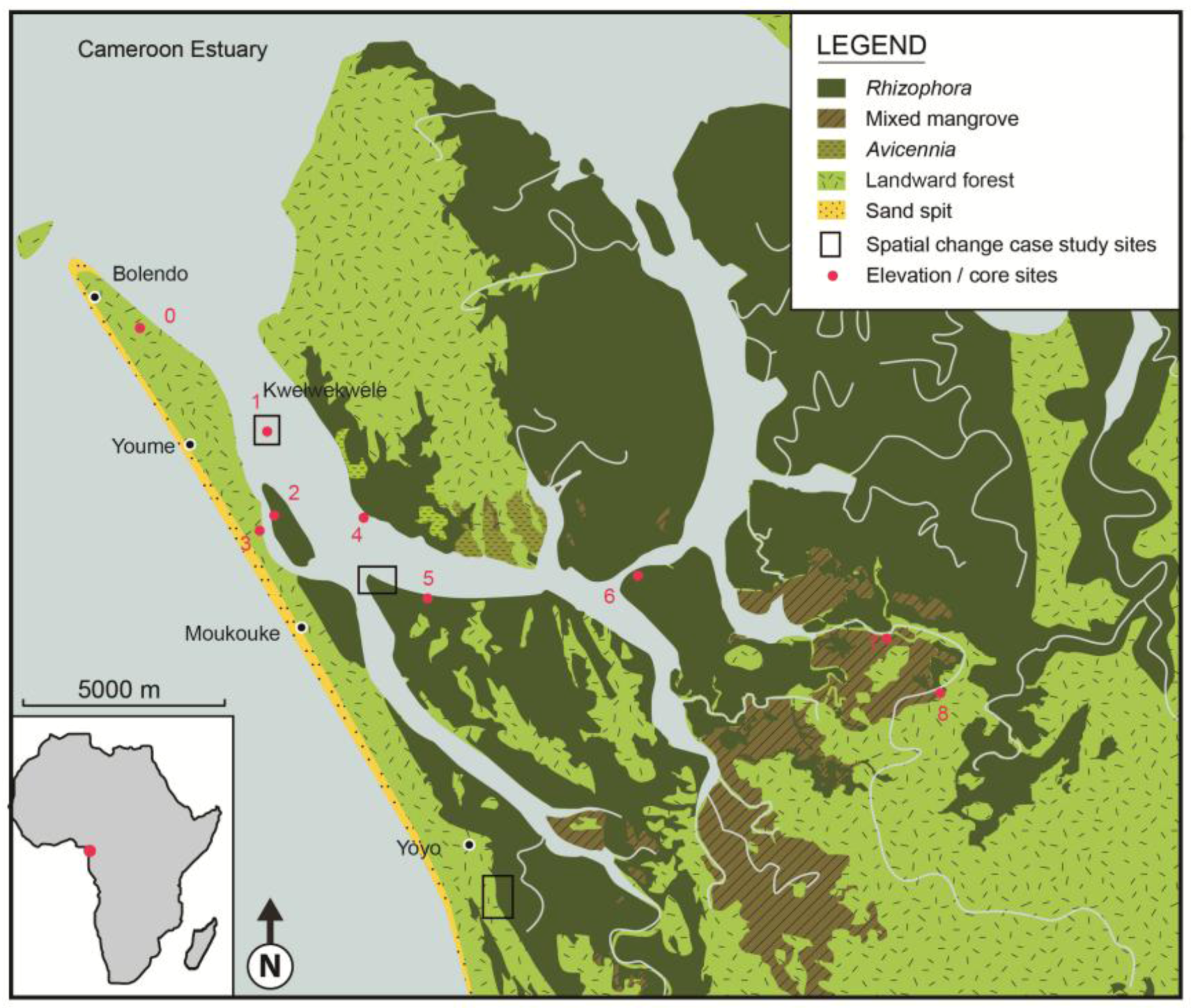
      <p>The Cameroon Estuary (<xref ref-type="fig" rid="biology-01-00617-f001">Figure 1</xref>) is one of three significant mangrove areas in Cameroon, located south of the horst of Mount Cameroon (4,095 m) in the central section of the coast where a number of riversdischarge [<xref ref-type="bibr" rid="B47-biology-01-00617">47</xref>,<xref ref-type="bibr" rid="B48-biology-01-00617">48</xref>,<xref ref-type="bibr" rid="B49-biology-01-00617">49</xref>]. Douala, the largest city in Cameroon borders the mangroves to the East and the mangroves are a significant resource to local communities through fishing, hunting and especially logging for fuelwood and charcoal [<xref ref-type="bibr" rid="B47-biology-01-00617">47</xref>,<xref ref-type="bibr" rid="B48-biology-01-00617">48</xref>,<xref ref-type="bibr" rid="B49-biology-01-00617">49</xref>]. On the southern shore of the Cameroon Estuary is the Douala-Edea Wildlife Reserve, with a total area of 1,600 km<sup>2</sup> [<xref ref-type="bibr" rid="B53-biology-01-00617">53</xref>].</p>
      <fig id="biology-01-00617-f001" position="anchor">
        <label>Figure 1</label>
        <caption>
          <p>Cameroon Estuary southern mangrove area showing mangrove species zones and locations of spatial change case study sites.</p>
        </caption>
        <graphic xmlns:xlink="http://www.w3.org/1999/xlink" xlink:href="biology-01-00617-g001.tif"/>
      </fig>
      <p>Coastal littoral drift carries sediments from the Sanaga main river mouth located south of <xref ref-type="fig" rid="biology-01-00617-f001">Figure 1</xref>, creating a 15 km long coastal sand spit that encloses the Cameroon estuary mangroves from wave action, and along which a number of villages are located that are dependent on mangrove resources [<xref ref-type="bibr" rid="B47-biology-01-00617">47</xref>]. The climate is equatorial with generally warm temperatures with a mean monthly average of 26.5 °C and abundant rainfall of 3,000–4,000 mm. Cameroon has a semi-diurnal micro-tidal regime [<xref ref-type="bibr" rid="B55-biology-01-00617">55</xref>,<xref ref-type="bibr" rid="B56-biology-01-00617">56</xref>]. Northern summer SW monsoonal winds tend to sweep sand into the Cameroon estuary mouth, where sand banks are evident on charts [<xref ref-type="bibr" rid="B56-biology-01-00617">56</xref>], and sand deposits occur on the northern edge of the mangrove margins (<xref ref-type="fig" rid="biology-01-00617-f001">Figure 1</xref>), these are utilized as village sites and largely vegetated by <italic>Cocos nucifera</italic>.</p>
    </sec>
    <sec>
      <title>4. Material and Methods</title>
      <p>Using spatial techniques combined with ground truthing we mapped the current distribution of mangrove zones, and compared with historical spatial records to show change over the last few decades. We used low technology techniques to establish the tidal range and relative elevation of the mapped mangrove area. Stratigraphic coring and paleobiological reconstruction was used to show the longer term biological history of mangroves and net sedimentation rate, and oral history surveys of local communities were used to investigate evidence of recent change and identify possible causes.</p>
      <p>To map recent and historical mangrove area coverage, satellite images for the Cameroon estuary mangrove area were acquired through the USGS Landsat image archives. Landsat imagery was used for this study because Landsat has the longest image archive, dating back to 1973. However, due to heavy cloud cover, which is common in such equatorial latitudes, the oldest cloud-free image of this area was from 1975. <xref ref-type="table" rid="biology-01-00617-t001">Table 1</xref> gives information about the images used for analysis, complemented by ground-truth data.</p>
      <p>GIS analysis firstly involved geometric correction of distortion in images using 67 ground control points, and resized to have the same spatial resolution during sub-setting of the image scenes, by use of Environment for Visualizing Images (ENVI) software image processing tools. Then digital shoreline mapping and analysis was performed following procedures first developed by [<xref ref-type="bibr" rid="B57-biology-01-00617">57</xref>]. Analysis of individual images was then undertaken and results compared through an overlay methodology using GIS.</p>
      <table-wrap id="biology-01-00617-t001" position="float">
        <object-id pub-id-type="pii">biology-01-00617-t001_Table 1</object-id>
        <label>Table 1</label>
        <caption>
          <p>Characteristics of satellite images used in the Cameroon spatial change analysis.</p>
        </caption>
        <table rules="all" style="border:solid thin">
          <thead>
            <tr>
              <th align="center" valign="middle">Available image date</th>
              <th align="center" valign="middle">Image</th>
              <th align="center" valign="middle">Time interval (years)</th>
              <th align="center" valign="middle">Cumulative time relative to base (years)</th>
              <th align="center" valign="middle">Clear status</th>
            </tr>
          </thead>
          <tbody>
            <tr>
              <td align="center" valign="middle">1975</td>
              <td align="center" valign="middle">Landsat MSS</td>
              <td align="center" valign="middle">base</td>
              <td align="center" valign="middle">base</td>
              <td align="center" valign="middle">Very clear</td>
            </tr>
            <tr>
              <td align="center" valign="middle">1986</td>
              <td align="center" valign="middle">LandsatTM</td>
              <td align="center" valign="middle">11</td>
              <td align="center" valign="middle">11</td>
              <td align="center" valign="middle">clear</td>
            </tr>
            <tr>
              <td align="center" valign="middle">2000</td>
              <td align="center" valign="middle">LandsatETM</td>
              <td align="center" valign="middle">14</td>
              <td align="center" valign="middle">25</td>
              <td align="center" valign="middle">Partially clouded</td>
            </tr>
            <tr>
              <td align="center" valign="middle">2007</td>
              <td align="center" valign="middle">LandsatETM+</td>
              <td align="center" valign="middle">7</td>
              <td align="center" valign="middle">32</td>
              <td align="center" valign="middle">Clear but with gaps due to sensor’s scan line corrector mechanism failure</td>
            </tr>
            <tr>
              <td align="center" valign="middle">2010</td>
              <td align="center" valign="middle"> </td>
              <td align="center" valign="middle">3</td>
              <td align="center" valign="middle">35</td>
              <td align="center" valign="middle">Ground truthing</td>
            </tr>
          </tbody>
        </table>
      </table-wrap>
      <p>The US Geological Survey’s Digital shoreline analysis system (DSAS) was then undertaken [<xref ref-type="bibr" rid="B58-biology-01-00617">58</xref>], using an application that works within ArcGIS 9.x software. The DSAS extension was designed to aid in historic shoreline change analysis [<xref ref-type="bibr" rid="B58-biology-01-00617">58</xref>] to compute rate-of-change statistics determined by fitting a least squares regression to a time series of shoreline positions to estimate rates of change of mangrove seaward edges and landward margins [<xref ref-type="bibr" rid="B59-biology-01-00617">59</xref>]. On the main body of the mangroves, linear regression rate of change (LRR) statistics were used to analyze 246 transect measurements perpendicular to the mangrove edge over the period 1975–2007. These locations were chosen because they encompass the seaward edges of the mangrove areas shown in <xref ref-type="fig" rid="biology-01-00617-f001">Figure 1</xref>.</p>
      <p>The DSAS approach established a baseline from which the different time series of mangrove margins were measured, using a 200 m buffer offset of the 2000 Landsat ETM+ image edge. The offset was converted into a polyline, which was split and the onshore or offshore segment was used as the baseline for some areas while the other corresponding segment was deleted. The mangroves seaward edges for the 1975 Landsat MSS, 1986 Landsat TM, 2000 Landsat ETM+ and 2007 Landsat ETM+ were generated through digitalization of the respective mangroves edges at a scale of 1:10,000 from the images. These years are evenly spaced through time so avoiding the main problem that occurs with linear regression that one early date and a cluster of recent dates can skew results [<xref ref-type="bibr" rid="B59-biology-01-00617">59</xref>]. The baseline and respective mangroves edges cardinalities were defined using transects spaced at 300 m cast perpendicular to the baseline.</p>
      <p>Field ground truthing was carried out by boat, with a total of 67 GPS waypoints collected in the field with attribute information ranging from mangrove species type, location of specific features such as the seaward edge and landward margin of areas of the mangroves, shores of the offshore Kwelekwele Island, villages in and around the mangroves area, monitoring sites used for water level measurement, and the stratigraphy core site. These GPS points were entered in a database (Microsoft Access) and imported in to ArcGIS 9.3 for analysis.</p>
      <p>To establish the longer term biological history of the site, a stratigraphic core was sampled from the seaward edge of mangroves, located 20 m inside the northern seaward edge of the mangrove swamp at Moukouke Island (site 2 in <xref ref-type="fig" rid="biology-01-00617-f001">Figure 1</xref>), in 25–30 m tall undisturbed <italic>Rhizophora racemosa</italic> forest. The canopy was open with numerous young seedlings as undergrowth. This 2 m core was recovered using a Hiller corer of 28 mm internal diameter, for ease of penetration through mangrove roots and sand. Contamination was prevented by washing outside of the corer before opening, and dismantling and washing it before recovering the next lower section. Stratigraphy was described and sub-sampled at 10 cm intervals, with color of stratigraphic units was determined by comparison with Munsell Soil Charts, and texture determined by feel analysis [<xref ref-type="bibr" rid="B60-biology-01-00617">60</xref>].</p>
      <p>The different contributions to mangrove sediment accretion, such as organic detritus from the mangroves, mineral sediment from river discharge and soil volume change or compaction can be concurrently measured using surface elevation tables [<xref ref-type="bibr" rid="B27-biology-01-00617">27</xref>,<xref ref-type="bibr" rid="B42-biology-01-00617">42</xref>,<xref ref-type="bibr" rid="B43-biology-01-00617">43</xref>]. Radiocarbon dating or lead-210 dating the last few decades [<xref ref-type="bibr" rid="B25-biology-01-00617">25</xref>] provides net accretion rates that represent the average for the entire record and do not include variation within different time periods [<xref ref-type="bibr" rid="B61-biology-01-00617">61</xref>]. Modern measurements of surface elevation change may overestimate it due to the short term record, while radiocarbon dating of cores may underestimate the ability of a mangrove system to build vertically [<xref ref-type="bibr" rid="B61-biology-01-00617">61</xref>], so providing a precautionary approach to the vulnerability assessment. To determine the net sedimentation rate, the base of organic strata was sampled for radiocarbon dating, and age determination was carried out by accelerator mass spectrometry, with acid wash pretreatments and δ13C determination. Calibration to conventional years was carried out using the Pretoria Calibration procedure [<xref ref-type="bibr" rid="B62-biology-01-00617">62</xref>].</p>
      <p>Pollen analysis was carried out using standard techniques [<xref ref-type="bibr" rid="B63-biology-01-00617">63</xref>,<xref ref-type="bibr" rid="B64-biology-01-00617">64</xref>] modified for resistant mangrove sediments [<xref ref-type="bibr" rid="B65-biology-01-00617">65</xref>] to concentrate fossil pollen. To each sample a known number of exotic <italic>Lycopodium</italic> was added, to allow the determination of pollen concentration per sediment volume. Broadly negative relationships between pollen concentrations and sedimentation rates are expected in allochthonous environments where high sediment input dilutes the pollen concentration [<xref ref-type="bibr" rid="B66-biology-01-00617">66</xref>]. Pollen were identified by comparison with a reference collection and published descriptions [<xref ref-type="bibr" rid="B67-biology-01-00617">67</xref>]. Other palynomorphs such as fungal spores, microforaminifera, dinoflagellates and chlorophyllaceae were excluded from the count. Results were transferred into pollen diagrams using TILIA and TILIAGRAPH [<xref ref-type="bibr" rid="B68-biology-01-00617">68</xref>], showing the relative representation of each taxon as a percentage of the total pollen sum which includes mangrove taxa, non-mangrove trees and shrubs, ferns, herbs and aquatics. The remainder of each sample was analysed for percent organic matter content by loss-on-ignition at 550 °C for 4 hours [<xref ref-type="bibr" rid="B69-biology-01-00617">69</xref>], where higher organic content is indicative of mangrove strata relative to offshore deposits being more inorganic [<xref ref-type="bibr" rid="B70-biology-01-00617">70</xref>,<xref ref-type="bibr" rid="B71-biology-01-00617">71</xref>].</p>
      <p>Relative topographic elevations of the seaward edge, mangrove zone margins, the landward edge of mangrove and the core site were determined by simultaneous measurement of water height at each location and also at a reference station [<xref ref-type="bibr" rid="B51-biology-01-00617">51</xref>,<xref ref-type="bibr" rid="B53-biology-01-00617">53</xref>], a technique refined from the high tide mark topographic technique of [<xref ref-type="bibr" rid="B72-biology-01-00617">72</xref>]. Measurement of water surface slopes within tidal creeks [<xref ref-type="bibr" rid="B73-biology-01-00617">73</xref>,<xref ref-type="bibr" rid="B74-biology-01-00617">74</xref>,<xref ref-type="bibr" rid="B75-biology-01-00617">75</xref>], all found that during rising tide the water surface slope is relatively level, thus comparison of its height above the mud surface can indicate relative elevation.</p>
      <p>Social surveys in villages close to the mangrove area (<xref ref-type="fig" rid="biology-01-00617-f001">Figure 1</xref>) were conducted using structured interviews, with the objective to interview senior members of the community regarding changes they had observed in the mangrove area over time. The target group was the aged population with past experiences of the region, and this proved to be a rarer age group. In total 5 persons were interviewed with ages ranging from 45 to 65 years old.</p>
    </sec>
    <sec sec-type="results">
      <title>5. Results</title>
      <p>Analysis of the most recent 2007 satellite image combined with ground truth observations and forest composition assessments [<xref ref-type="bibr" rid="B53-biology-01-00617">53</xref>] resulted in the map of mangrove zones of the Douala-Edea area shown in <xref ref-type="fig" rid="biology-01-00617-f001">Figure 1</xref>. Analysis of spatial change 1975–2007 showed there has been an overall decline of 5% in mangrove area since 1975, and most of this occurred 1975–1986, with a slight recovery 1986–2000, followed by a further decline 2000–2007 (<xref ref-type="table" rid="biology-01-00617-t002">Table 2</xref>). During this time period of 1986–2007 the area used for agriculture remained stable, while the area of human settlements increased.</p>
      <table-wrap id="biology-01-00617-t002" position="float">
        <object-id pub-id-type="pii">biology-01-00617-t002_Table 2</object-id>
        <label>Table 2</label>
        <caption>
          <p>Cameroon estuary spatial change in area of vegetation and landuse cover (hectares).</p>
        </caption>
        <table rules="all" style="border:solid thin">
          <thead>
            <tr>
              <th align="left" valign="middle">Year</th>
              <th align="right" valign="middle">1975</th>
              <th align="right" valign="middle">1986</th>
              <th align="right" valign="middle">2000</th>
              <th align="right" valign="middle">2007</th>
            </tr>
          </thead>
          <tbody>
            <tr>
              <td align="left" valign="middle">Mangroves</td>
              <td align="right" valign="middle">18,258</td>
              <td align="right" valign="middle">17,190</td>
              <td align="right" valign="middle">17,580</td>
              <td align="right" valign="middle">17,279</td>
            </tr>
            <tr>
              <td align="left" valign="middle">Settlements</td>
              <td align="right" valign="middle">176</td>
              <td align="right" valign="middle">176</td>
              <td align="right" valign="middle">182</td>
              <td align="right" valign="middle">183</td>
            </tr>
            <tr>
              <td align="left" valign="middle">Agriculture</td>
              <td align="right" valign="middle">592</td>
              <td align="right" valign="middle">583</td>
              <td align="right" valign="middle">583</td>
              <td align="right" valign="middle">583</td>
            </tr>
            <tr>
              <td align="left" valign="middle">Mudflat/sand</td>
              <td align="right" valign="middle">613</td>
              <td align="right" valign="middle">308</td>
              <td align="right" valign="middle">303</td>
              <td align="right" valign="middle">265</td>
            </tr>
            <tr>
              <td align="left" valign="middle">Lowland Forest</td>
              <td align="right" valign="middle">21,662</td>
              <td align="right" valign="middle">20,504</td>
              <td align="right" valign="middle">21,927</td>
              <td align="right" valign="middle">22,183</td>
            </tr>
          </tbody>
        </table>
      </table-wrap>
      <p><italic>Rhizophora</italic> was confirmed to be the most prevalent mangrove community, with small areas of mixed forest towards landward margins and small areas of <italic>Avicennia</italic>. The sand spit enclosing the mangrove area from the ocean was shown by GIS analysis to have prograded towards the north by about 1.1 km between 1975–2007, with most of this spit growth occurring in the most recent period 2000–2007.</p>
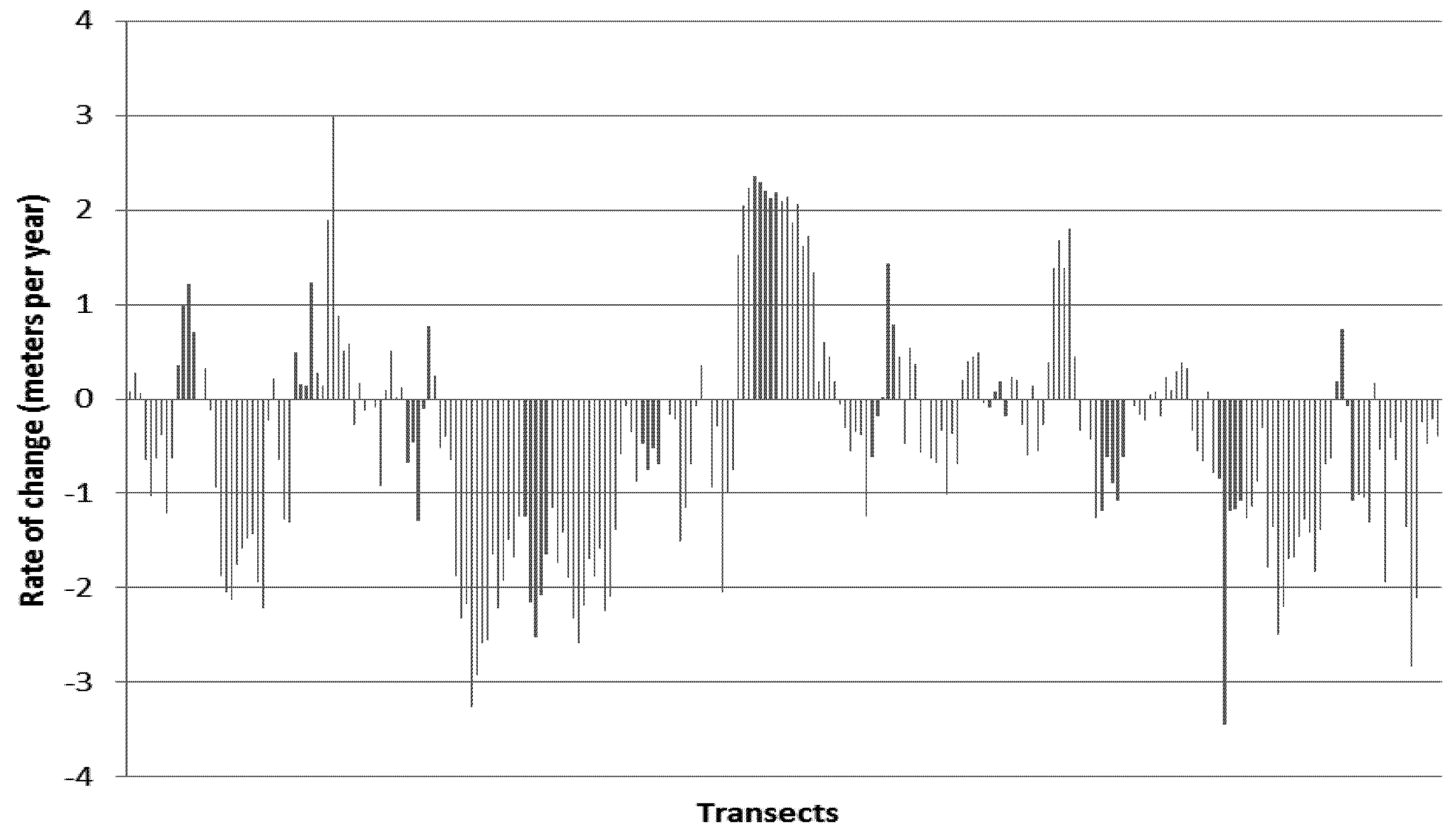
      <p>The seaward edge of mangroves was analyzed in detail owing to its sensitivity to sea level rise impacts. On the seaward shoreline main body of the mangroves (excluding offshore islands), linear regression rate of change (LRR) statistics used to analyze 246 transect measurements perpendicular to the mangrove edge over the period 1975–2007. Results found that 79 showed a positive LRR (rate of mangrove movement seawards) with a maximum of 3.0 m a<sup>−1</sup>, mean 0.79 m a<sup>−1</sup> (SD = 0.77), while 164 showed a negative LRR (rate of mangrove retreat landwards) of maximum of 3.4 m a<sup>−1</sup>, mean of 1.1 m a<sup>−1</sup> (SD = 0.76), and 3 showed no rate of change (<xref ref-type="fig" rid="biology-01-00617-f002">Figure 2</xref>).</p>
      <fig id="biology-01-00617-f002" position="anchor">
        <label>Figure 2</label>
        <caption>
          <p>Rate of change results from 246 transects across the seaward edge of mangroves, Cameroon Estuary, 1975–2007. A negative rate of change shows mangrove retreat, while a positive rate of change shows mangrove advance or progradation.</p>
        </caption>
        <graphic xmlns:xlink="http://www.w3.org/1999/xlink" xlink:href="biology-01-00617-g002.tif"/>
      </fig>
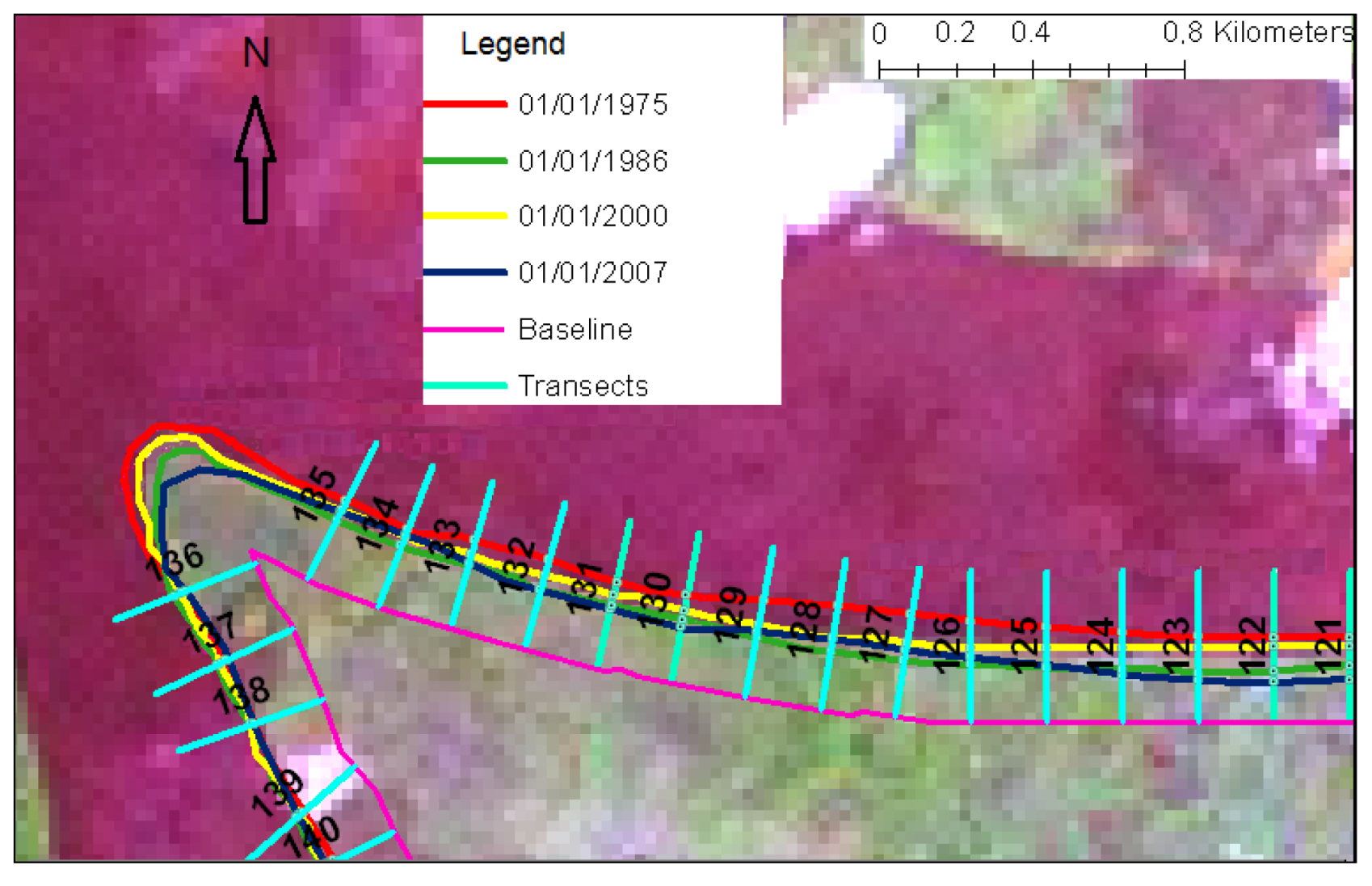
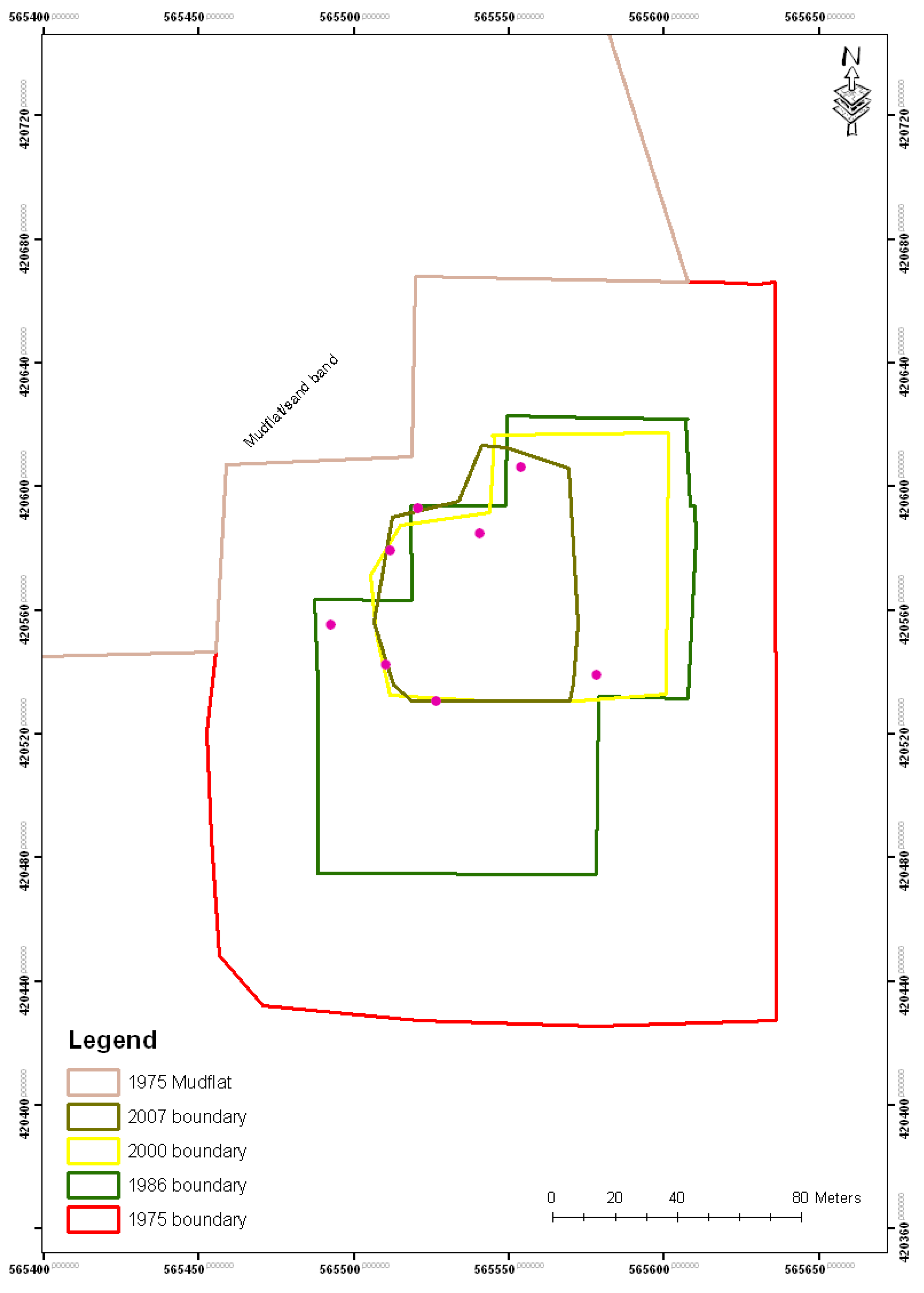
      <p>These results are further illustrated in two seaward edge case studies located in <xref ref-type="fig" rid="biology-01-00617-f001">Figure 1</xref>. <xref ref-type="fig" rid="biology-01-00617-f003">Figure 3</xref> shows the seaward edge of part of the main body of mangrove forest, closest to the ocean entrance to the Cameroon estuary as shown by the central case study box in <xref ref-type="fig" rid="biology-01-00617-f001">Figure 1</xref>. This edge of the substantial mangrove forest area showed loss or extension of +/−30 m at most (<xref ref-type="fig" rid="biology-01-00617-f003">Figure 3</xref>), with the majority showing slight retreat. This was found to be typical of results from elsewhere along the seaward edge of larger areas of mangrove.</p>
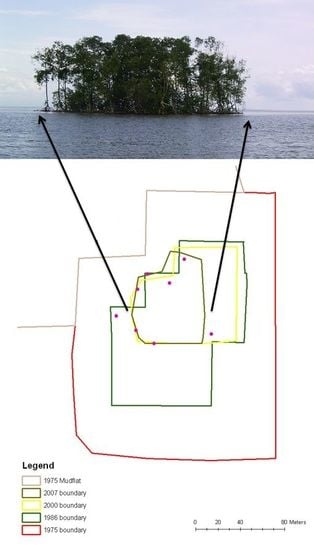
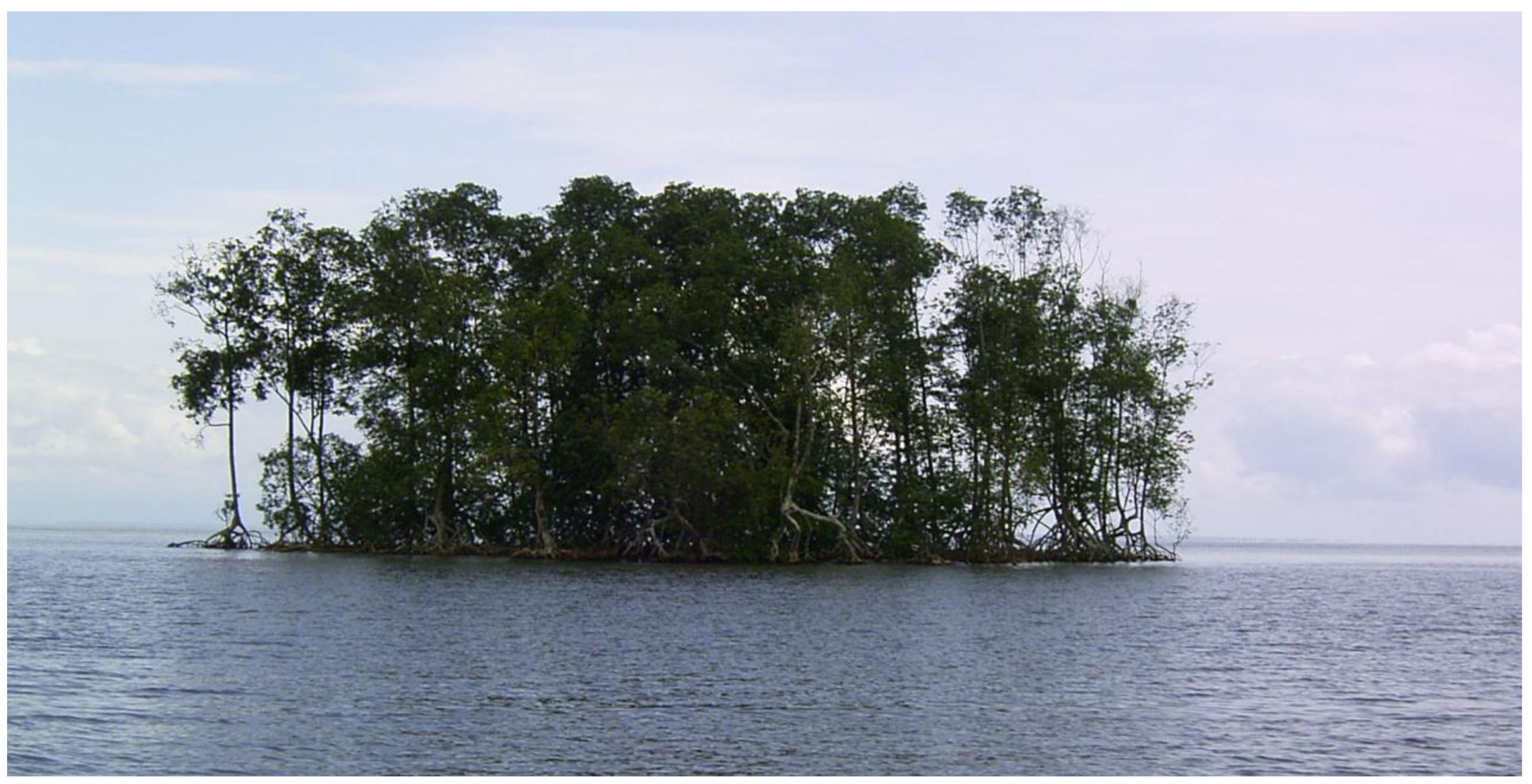
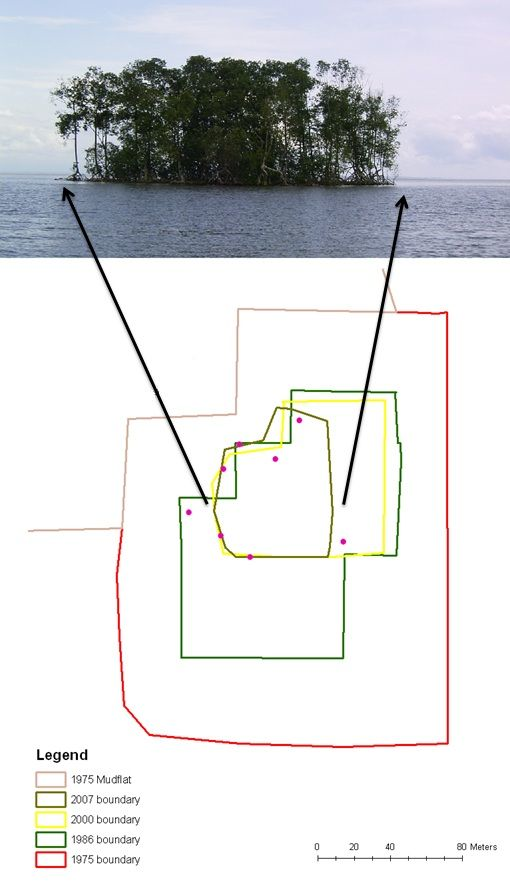
      <p>By contrast, the offshore mangrove island Kwelekwele Island (the northern case study box in <xref ref-type="fig" rid="biology-01-00617-f001">Figure 1</xref>) was shown to have significantly reduced in area over the time period (<xref ref-type="fig" rid="biology-01-00617-f004">Figure 4</xref>). This mangrove island was observed early in the study to have evidence of forest retreats with open tree trunks visible at the island edge (<xref ref-type="fig" rid="biology-01-00617-f005">Figure 5</xref>), while it is normal for the seaward edge of mangroves to have dense canopy cover descending to near water level as the mangrove foliage takes advantage of light availability. The spatial change discovered at Kwelekwele Island was quantified using GIS to give the area change results in <xref ref-type="table" rid="biology-01-00617-t003">Table 3</xref>, showing that by 2007 this offshore mangrove island had declined to 11% of the area that it covered in 1975.</p>
      <fig id="biology-01-00617-f003" position="anchor">
        <label>Figure 3</label>
        <caption>
          <p>Seaward edge of mangroves showing change 1975–2007, demonstrating the DSAS technique of measuring change against a measurement baseline, by use of regular perpendicular sample transects.</p>
        </caption>
        <graphic xmlns:xlink="http://www.w3.org/1999/xlink" xlink:href="biology-01-00617-g003.tif"/>
      </fig>
      <fig id="biology-01-00617-f004" position="anchor">
        <label>Figure 4</label>
        <caption>
          <p>Seaward edge retreat of Kwelekwele Island from 1975 to 2007.</p>
        </caption>
        <graphic xmlns:xlink="http://www.w3.org/1999/xlink" xlink:href="biology-01-00617-g004.tif"/>
      </fig>
      <fig id="biology-01-00617-f005" position="anchor">
        <label>Figure 5</label>
        <caption>
          <p>Kwelekwele Island in June 2009, showing evidence of forest retreat with open trees at the island edge and lack of canopy cover descending to near water level that is normal for seaward edge mangroves.</p>
        </caption>
        <graphic xmlns:xlink="http://www.w3.org/1999/xlink" xlink:href="biology-01-00617-g005.tif"/>
      </fig>
      <table-wrap id="biology-01-00617-t003" position="float">
        <object-id pub-id-type="pii">biology-01-00617-t003_Table 3</object-id>
        <label>Table 3</label>
        <caption>
          <p>Kwelekwele island mangrove area change 1975 to 2010.</p>
        </caption>
        <table rules="all" style="border:solid thin">
          <thead>
            <tr>
              <th align="center" valign="middle">Year</th>
              <th align="center" valign="middle">Island area (m<sup>2</sup>)</th>
            </tr>
          </thead>
          <tbody>
            <tr>
              <td align="center" valign="middle">1975</td>
              <td align="center" valign="middle">39,200</td>
            </tr>
            <tr>
              <td align="center" valign="middle">1986</td>
              <td align="center" valign="middle">17,300</td>
            </tr>
            <tr>
              <td align="center" valign="middle">2000</td>
              <td align="center" valign="middle">6,900</td>
            </tr>
            <tr>
              <td align="center" valign="middle">2007</td>
              <td align="center" valign="middle">4,400</td>
            </tr>
            <tr>
              <td align="center" valign="middle">2010</td>
              <td align="center" valign="middle">4,300</td>
            </tr>
          </tbody>
        </table>
      </table-wrap>
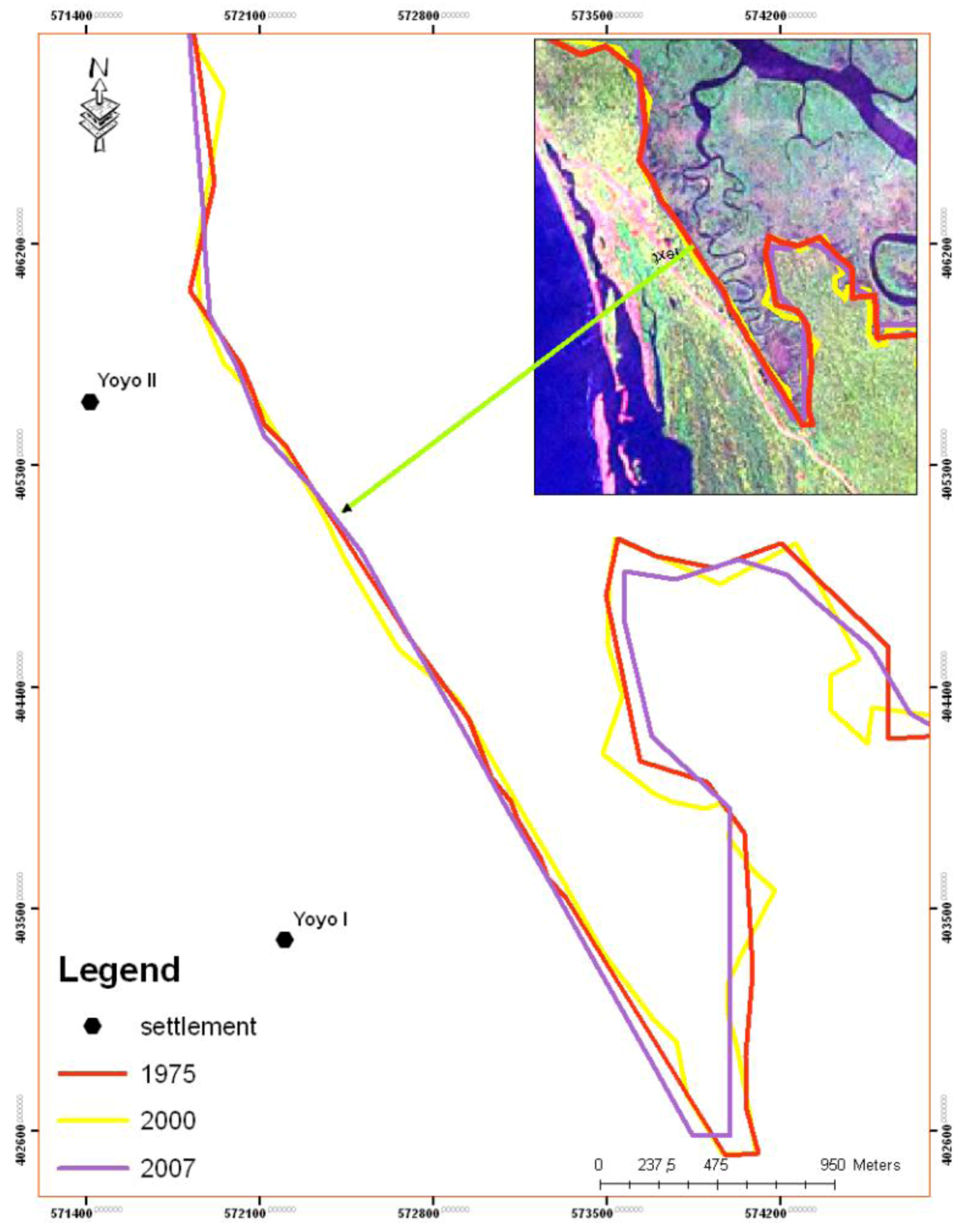
      <p>Comparison of satellite imagery 1975–2007 showed the landward edge of mangroves with lowland forest to show some changes, as demonstrated by a case study from near Yoyo village (the southern case study box on <xref ref-type="fig" rid="biology-01-00617-f001">Figure 1</xref>) shown in <xref ref-type="fig" rid="biology-01-00617-f006">Figure 6</xref>.</p>
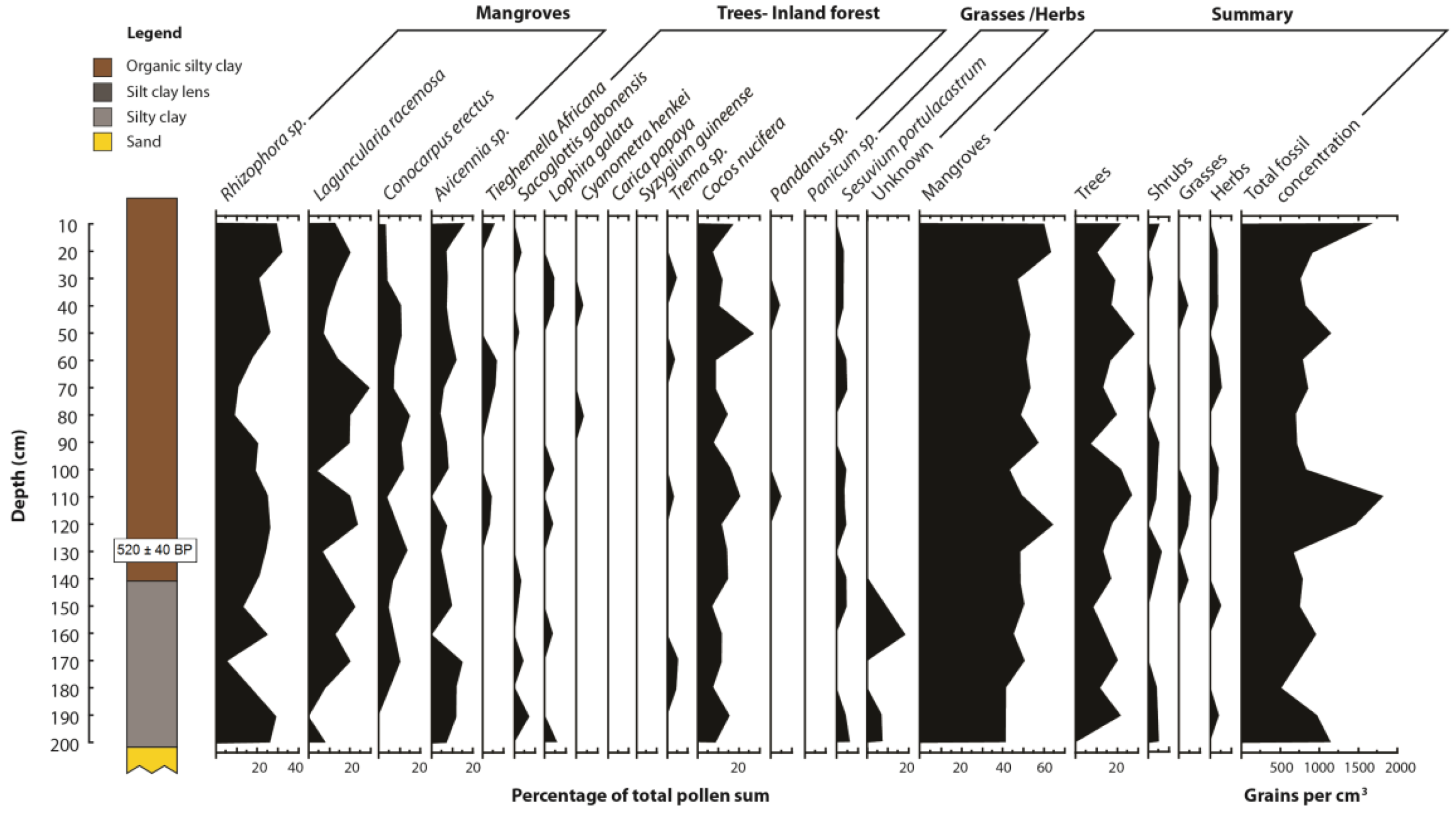
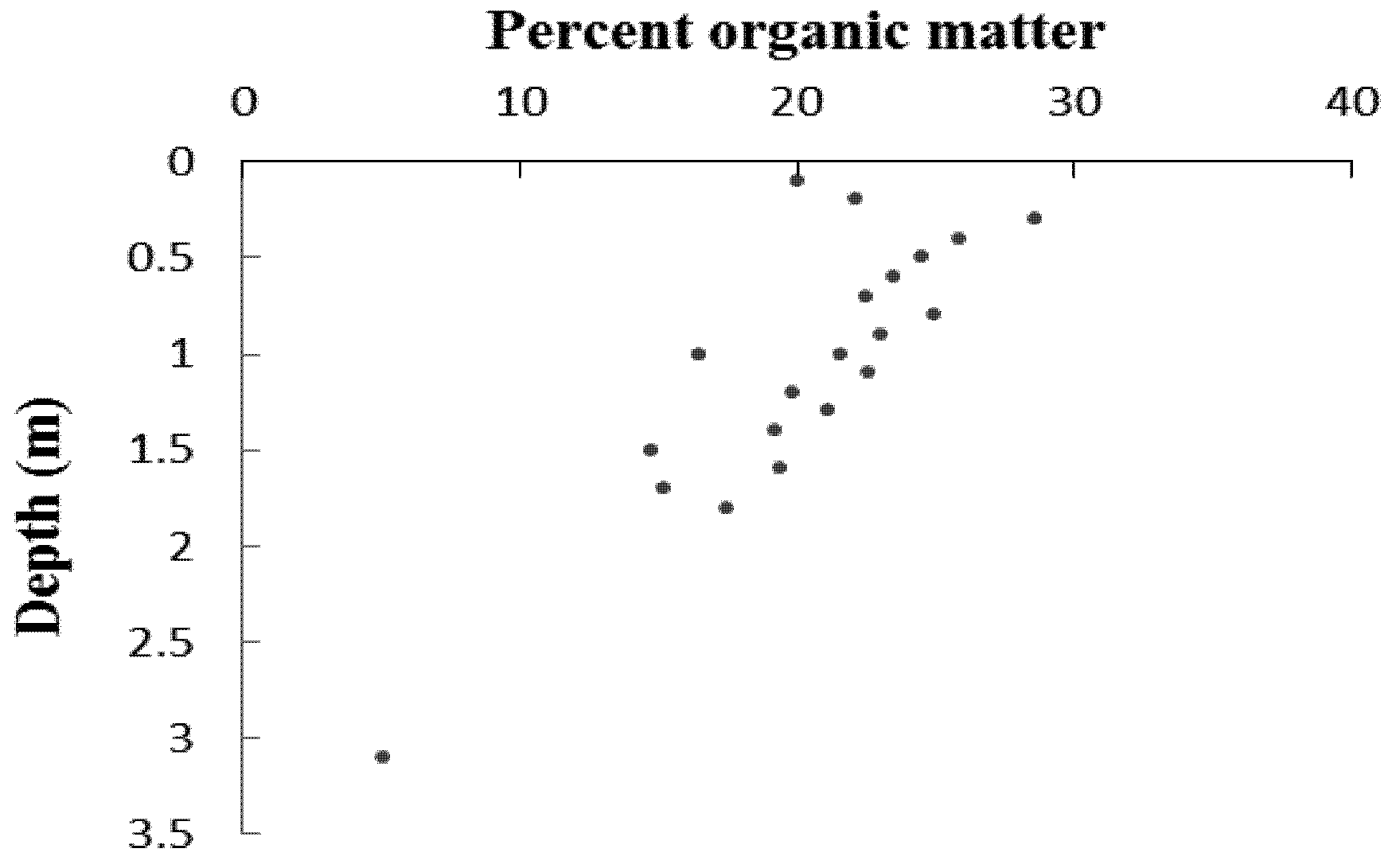
      <p>Longer term results from stratigraphy of the Moukouke Island core taken at site 2 on <xref ref-type="fig" rid="biology-01-00617-f001">Figure 1</xref> showed a record of loose organic silty clay from the surface to 1.40 m (very dark grey 7.5YR 3/1) (<xref ref-type="fig" rid="biology-01-00617-f007">Figure 7</xref>), becoming more compact with depth. Calcareous shell fragments increased in occurrence with depth. Below 1.40 m was consistent dark grey silty clay (7.5YR 4/1) to 2.00 m. There was increasing shelly sand content below 2.00 m, and the core ended in solid sand at 3.10 m. There was no macro-fossil evidence of mangrove presence below the organic silty clay upper layer, with stratigraphy below this shown to be inorganic. Percentage organic matter results (<xref ref-type="fig" rid="biology-01-00617-f008">Figure 8</xref>), showed a consistent decline with depth in the stratigraphic core of organic fraction from 20%–30% near the surface to c. 15% below 1.50 m.</p>
      <p>The AMS radiocarbon dating sample was taken from the base of the more organic surface unit of the core where the percentage organic matter was falling to below 20% (<xref ref-type="fig" rid="biology-01-00617-f008">Figure 8</xref>). This result is shown in <xref ref-type="table" rid="biology-01-00617-t004">Table 4</xref>, along with the long-term net sedimentation rate calculated from the calibrated date and depth. The δ13C result is typical of mangrove strata [<xref ref-type="bibr" rid="B76-biology-01-00617">76</xref>].</p>
      <fig id="biology-01-00617-f006" position="anchor">
        <label>Figure 6</label>
        <caption>
          <p>Mangrove landward margin change; near to Yoyo I and II villages segments, Cameroon estuary, Cameroon.</p>
        </caption>
        <graphic xmlns:xlink="http://www.w3.org/1999/xlink" xlink:href="biology-01-00617-g006.tif"/>
      </fig>
      <fig id="biology-01-00617-f007" position="anchor">
        <label>Figure 7</label>
        <caption>
          <p>Stratigraphy and pollen results of the Moukouke Island core. Pollen is shown by percentage of pollen presence of the total pollen sum, and total fossil pollen concentration.</p>
        </caption>
        <graphic xmlns:xlink="http://www.w3.org/1999/xlink" xlink:href="biology-01-00617-g007.tif"/>
      </fig>
      <fig id="biology-01-00617-f008" position="anchor">
        <label>Figure 8</label>
        <caption>
          <p>Percentage organic results from the Moukouke Island core.</p>
        </caption>
        <graphic xmlns:xlink="http://www.w3.org/1999/xlink" xlink:href="biology-01-00617-g008.tif"/>
      </fig>
      <table-wrap id="biology-01-00617-t004" position="float">
        <object-id pub-id-type="pii">biology-01-00617-t004_Table 4</object-id>
        <label>Table 4</label>
        <caption>
          <p>Radiocarbon dating results from Moukouke Island core, Cameroon estuary.</p>
        </caption>
        <table rules="all" style="border:solid thin">
          <thead>
            <tr>
              <th align="left" valign="middle">Sample</th>
              <th align="left" valign="middle">Depth (mm)</th>
              <th align="left" valign="middle"><sup>δ13</sup>C</th>
              <th align="left" valign="middle"><sup>14</sup>C age (year BP)</th>
              <th align="left" valign="middle">Calibrated years before present</th>
              <th align="left" valign="middle">Sedimentation rate (mm a <sup>−1</sup>)</th>
            </tr>
          </thead>
          <tbody>
            <tr>
              <td align="left" valign="middle">Beta-261195</td>
              <td align="left" valign="middle">1,300</td>
              <td align="left" valign="middle">−26.4</td>
              <td align="left" valign="middle">540 ±40</td>
              <td align="left" valign="middle">520 ± 40</td>
              <td align="left" valign="middle">2.5</td>
            </tr>
          </tbody>
        </table>
      </table-wrap>
      <p>The pollen diagram (<xref ref-type="fig" rid="biology-01-00617-f007">Figure 7</xref>) of the stratigraphic core at Moukouke Island shows the relative representation of each mangrove taxon as well as the total mangrove pollen proportion of this pollen sum as a percentage of the total pollen sum which includes mangrove taxa, non-mangrove trees, shrubs, herbs, aquatics and ferns. In the 3.00 m core, mangrove pollen was dominant at 60% of the total sum 0–20 cm depth, falling to c. 40% lower in the core (<xref ref-type="fig" rid="biology-01-00617-f006">Figure 6</xref>). <italic>Rhizophora</italic> was found at 30% of the pollen sum at the top of the core, falling to 10%–30% below 30 cm, combined with very low pollen concentrations of between 500–1,000 grains cm<sup>−</sup><sup>3</sup>, with some outliers up to 1,500 grains cm<sup>−</sup><sup>3</sup>, which is low for a mangrove forest of this species group [<xref ref-type="bibr" rid="B77-biology-01-00617">77</xref>]. <italic>Laguncularia racemosa</italic>, <italic>Conocarpus erectus</italic>, and <italic>Avicennia marina</italic> also occurred but at lower proportions (<xref ref-type="fig" rid="biology-01-00617-f007">Figure 7</xref>). Throughout the core there was a significant presence of <italic>Cocos nucifera</italic> pollen, at 10%–20% of the pollen sum, there being significant <italic>Cocos</italic> plantations on the sand ridges adjacent to the core 1 site (<xref ref-type="fig" rid="biology-01-00617-f001">Figure 1</xref>). Pollen of littoral shrubs such as <italic>Hibiscus</italic> and <italic>Gardenia</italic> were very occasional and were excluded from the pollen diagram.</p>
      <p>Relative elevation results are show in <xref ref-type="table" rid="biology-01-00617-t005">Table 5</xref>, with the range of mangroves shown to be between 6.8 and 75.4 cm above the reference station, across a 69 cm elevation bracket. Elevations under mangroves on Kwelekwele Island (<xref ref-type="fig" rid="biology-01-00617-f004">Figure 4</xref> and <xref ref-type="fig" rid="biology-01-00617-f005">Figure 5</xref>) are about 35 cm lower than seaward edge mangroves elsewhere in the estuary. <italic>Rhizophora racemosa</italic> showed the broadest elevational range of about 6–54 cm. <italic>Laguncularia</italic> and <italic>Avicennia</italic> were shown to have narrower elevation brackets of 20 cm or less.</p>
      <p>In village interviews with senior citizens, most of those interviewed could remember that they either visited Kwelekwele Island (<xref ref-type="fig" rid="biology-01-00617-f005">Figure 5</xref>) in the late 1970’s and early 1980’s or they lived there. They related that it was a major fishing market for the region. Then increased flooding that appeared to them as rising water caused constant destruction of buildings, and the inhabiting population began to reduce gradually, until there was a major inundation on the island in the mid-1980s which finally caused the remaining population to move out. The reason for the inundation was thought to be due to the vexation of the mermaid (a mythical sea creature believed to be in control of the sea and lands close to it). They did not think it is possible to reinstall the island.</p>
      <table-wrap id="biology-01-00617-t005" position="float">
        <object-id pub-id-type="pii">biology-01-00617-t005_Table 5</object-id>
        <label>Table 5</label>
        <caption>
          <p>Relative elevation of mangrove substrate surface of the Doula-Edea mangrove area.</p>
        </caption>
        <table rules="all" style="border:solid thin">
          <thead>
            <tr>
              <th align="left" valign="middle">Station</th>
              <th align="left" valign="middle">Location</th>
              <th align="left" valign="middle">GPS Position</th>
              <th align="left" valign="middle">Mangrove zone</th>
              <th align="left" valign="middle">Elevation (cm)</th>
            </tr>
          </thead>
          <tbody>
            <tr>
              <td align="left" valign="middle">0</td>
              <td align="left" valign="middle">Reference station Jonathan Creek</td>
              <td align="left" valign="middle">03° 48' 01.9" N 09° 34' 04.4" E</td>
              <td align="left" valign="middle">Seaward of mangroves</td>
              <td align="left" valign="middle">0</td>
            </tr>
            <tr>
              <td align="left" valign="middle">1</td>
              <td align="left" valign="middle">Kwelekwele Island</td>
              <td align="left" valign="middle">03° 48' 17.6" N 09° 35' 24.0" E</td>
              <td align="left" valign="middle">
                <italic>Rhizophora racemosa</italic>
              </td>
              <td align="left" valign="middle">6.8</td>
            </tr>
            <tr>
              <td align="left" valign="middle">2</td>
              <td align="left" valign="middle">Moukouke Island core site</td>
              <td align="left" valign="middle">03° 45' 54.9" N 09° 35' 40.4" E</td>
              <td align="left" valign="middle">
                <italic>Rhizophora</italic>
              </td>
              <td align="left" valign="middle">47.0</td>
            </tr>
            <tr>
              <td align="left" valign="middle">3</td>
              <td align="left" valign="middle">Seaward edge</td>
              <td align="left" valign="middle">03° 45' 27.5" N 09° 35' 37.6" E</td>
              <td align="left" valign="middle"><italic>Rhizophora</italic> and <italic>Avicennia</italic></td>
              <td align="left" valign="middle">44.4</td>
            </tr>
            <tr>
              <td align="left" valign="middle">4</td>
              <td align="left" valign="middle">Seaward edge</td>
              <td align="left" valign="middle">03° 45' 35.1" N 09° 37' 09.0" E</td>
              <td align="left" valign="middle">
                <italic>Avicennia</italic>
              </td>
              <td align="left" valign="middle">21.3</td>
            </tr>
            <tr>
              <td align="left" valign="middle">5</td>
              <td align="left" valign="middle">Mid swamp</td>
              <td align="left" valign="middle">03° 44' 31.9" N 09° 37' 52.6" E</td>
              <td align="left" valign="middle">
                <italic>R. mangle</italic>
              </td>
              <td align="left" valign="middle">75.4</td>
            </tr>
            <tr>
              <td align="left" valign="middle">6</td>
              <td align="left" valign="middle">Mid swamp-Nkamba </td>
              <td align="left" valign="middle">03° 44' 46.7" N 09° 40' 41.42" E</td>
              <td align="left" valign="middle">
                <italic>R. racemosa</italic>
              </td>
              <td align="left" valign="middle">54.1</td>
            </tr>
            <tr>
              <td align="left" valign="middle">7</td>
              <td align="left" valign="middle">Landward edge</td>
              <td align="left" valign="middle">03° 43' 58.6" N 09° 44' 02.2" E</td>
              <td align="left" valign="middle"><italic>Laguncularia</italic> with some <italic>Raphia</italic> palms</td>
              <td align="left" valign="middle">73.1</td>
            </tr>
            <tr>
              <td align="left" valign="middle">8</td>
              <td align="left" valign="middle">Landward edge</td>
              <td align="left" valign="middle">03° 43' 05.6" N 09° 45' 09.0" E</td>
              <td align="left" valign="middle">Freshwater swamp</td>
              <td align="left" valign="middle">75.2</td>
            </tr>
          </tbody>
        </table>
      </table-wrap>
    </sec>
    <sec sec-type="discussion">
      <title>6. Discussion</title>
      <p>Spatial analysis can identify and quantify mangrove retreat at the seaward edge, recruitment inland [<xref ref-type="bibr" rid="B78-biology-01-00617">78</xref>,<xref ref-type="bibr" rid="B79-biology-01-00617">79</xref>,<xref ref-type="bibr" rid="B80-biology-01-00617">80</xref>] or stability of mangrove distributions. Vulnerability is shown by change in mangrove area over time, caused by both human impacts and influences such as sea level rise. Lack of spatial change shows resilience of the mangrove system over time, which maintains older-growth trees and better reproductive success. Sea level rise impacts are shown by consistent mortality and retreat at the seaward edge and inland recruitment at the landward edge, while expansion of the seaward edge over time suggests either a strong sediment supply or sea level fall and is a sign of good mangrove resilience. Retreat of the seaward edge over time, if consistent along the coast, very likely shows vulnerability to sea level rise.</p>
      <p>Spatial change analysis of mangroves of the Douala-Edea mangrove area 1975–2010 has shown that the area lost 979 hectares of mangroves 1975–2007 (<xref ref-type="table" rid="biology-01-00617-t002">Table 2</xref>), declining to 94% of its previous area. The area of lowland forest increased, partly owing to the extension of the sand spit to the west of the area, and the area of human settlements increased. The majority of the seaward edge of the main body of mangroves retreated between 1975–2007, with 67% of transects showing a negative rate of change, of a mean rate of −1.06 m a<sup>−1</sup>, while only 31% showed a positive rate of change of mean +0.79 m a<sup>−1</sup>.</p>
      <p>The offshore mangrove island Kwelekwele however suffered a consistent loss over the period, losing a total of 3.49 hectares (<xref ref-type="table" rid="biology-01-00617-t003">Table 3</xref>) or declining to only 11% of the area that it had in 1975. Through community surveys this was found to have been linked with human settlement on the island, which likely caused increased pressure on the forest resources for fuelwood, combined with substrate disturbance and disaggregation that would have led to erosion during high tides, leading to inundation stress to the remaining trees. Greatest rates of island loss were found to have occurred 1975–1986 (<xref ref-type="table" rid="biology-01-00617-t003">Table 3</xref>, <xref ref-type="fig" rid="biology-01-00617-f004">Figure 4</xref>), when according to interviews the island was inhabited. </p>
      <p>Longer term history as evident from the core taken from the mangrove seaward margin showed a stratigraphy in the Cameroon estuarine mangrove area of lower levels of inorganic sand at 2.0–3.5 m below the mangrove surface (<xref ref-type="fig" rid="biology-01-00617-f007">Figure 7</xref>), fining upwards to inorganic silty clay to 2.0–1.4 m below the mangrove surface, with shallow levels of more organic silty clay above this from 1.4 m below the surface. The sand to silt fining upwards sequence demonstrates an environment of decreasing wave and/ or current energy, followed more recently by colonization by mangroves as indicated by the upper organic content to the silty clay. Percent organic matter levels are slightly higher in this surface unit, but are overall very low, indicative of significant allochthonous inorganic sediment input. Pollen concentrations are also very low at c. 1,000 grains cm<sup>−</sup><sup>3</sup> (<xref ref-type="fig" rid="biology-01-00617-f007">Figure 7</xref>) compared with study sites also having the Atlantic mangrove species group [<xref ref-type="bibr" rid="B66-biology-01-00617">66</xref>,<xref ref-type="bibr" rid="B76-biology-01-00617">76</xref>,<xref ref-type="bibr" rid="B77-biology-01-00617">77</xref>], further indicative of inorganic sediment dilution of pollen deposition. </p>
      <p>In the surface organic mangrove unit, the net sedimentation rate was shown to be 2.5 mm a<sup>−1</sup> (<xref ref-type="table" rid="biology-01-00617-t004">Table 4</xref>). This is similar to elevation change rates shown by surface elevation tables and marker horizons for a fringe and basin mangroves of the same species in Belize and Florida [<xref ref-type="bibr" rid="B42-biology-01-00617">42</xref>]. From stratigraphy in West Papua net mangrove sedimentation rates were found of 0.6–1.5 mm a<sup>−1</sup> [<xref ref-type="bibr" rid="B81-biology-01-00617">81</xref>]. If accretion is at the same rate as relative sea level rise, then tidal inundation frequencies are maintained and mangrove vulnerability to rising sea level is much reduced.</p>
      <p>These rates are however low relative to sea level rise projections; rates projected by the IPCC 4th Assessment are of 1.5–9.7 mm a<sup>−1</sup> [<xref ref-type="bibr" rid="B38-biology-01-00617">38</xref>]. Furthermore, global mean sea level has already been rising, at a global average rate of sea level rise of 1.8 ± 0.5 mm a<sup>−1</sup> between 1961 and 2003. Estimates of sea level change for the coast of Cameroon were calculated using satellite data and the Takadori, Ghana tide gauge data 1930–1965 to give a corrected rate of 1.8–2.2 mm a<sup>−1</sup> for the period 1948–2003 [<xref ref-type="bibr" rid="B46-biology-01-00617">46</xref>]. These rates of recent sea level rise are close to the net mangrove accretion rate from core 1 (<xref ref-type="table" rid="biology-01-00617-t004">Table 4</xref>), and would have contributed to the increased inundation observed by residents of the low-lying Kwelekwele island. </p>
      <p>Kwelekwele Island mangrove substrate surfaces were shown to be about 35 cm lower than seaward edge mangroves elsewhere in the estuary (<xref ref-type="fig" rid="biology-01-00617-f004">Figure 4</xref> and <xref ref-type="table" rid="biology-01-00617-t005">Table 5</xref>), contributing to its vulnerability. Community knowledge of older residents of nearby villages confirmed this loss of island area and related increased inundation at a time when sea level rise is estimated to be 1.8 to 2.2 mm a<sup>−1</sup> [<xref ref-type="bibr" rid="B46-biology-01-00617">46</xref>]. This case study demonstrates how offshore islands at the seaward edge are especially vulnerable to rising sea level owing to their lower elevation, particularly when combined with human disturbance. The lower elevation increases inundation levels to disadvantage mangrove productivity, while the offshore location (<xref ref-type="fig" rid="biology-01-00617-f001">Figure 1</xref>) reduces sediment supply as it is further from riverine sources. </p>
      <p>The pollen diagram results showed higher proportions of mangrove pollen of 60% at the surface under well-established tall <italic>Rhizophora</italic> stands down to 30 cm depth (<xref ref-type="fig" rid="biology-01-00617-f007">Figure 7</xref>). Below 40 cm mangrove pollen declines to around 40%, which combined with very low concentrations and shell presence probably represents offshore tidal flats. This seaward edge core was at the lower elevational range of mangrove tolerance (<xref ref-type="table" rid="biology-01-00617-t005">Table 5</xref>), hence the 30 cm depth of organic mangrove stratigraphy and the low mangrove pollen proportions lower in the core indicates that recent sea-levels were 10–20 cm lower than present, which corresponds with global trends in the last 100 years [<xref ref-type="bibr" rid="B82-biology-01-00617">82</xref>].</p>
      <p>The range of mangrove substrate elevations (<xref ref-type="table" rid="biology-01-00617-t005">Table 5</xref>) shows about a 70 cm elevation bracket in a tidal range of 1.2 m, and it is normal for mangroves to occupy the upper half of the tidal range [<xref ref-type="bibr" rid="B83-biology-01-00617">83</xref>]. <italic>Rhizophora racemosa</italic> has the broadest elevational range of about 48 cm, which would make it the most resilient species to sea level rise of all present, in tolerating a changing sea level [<xref ref-type="bibr" rid="B50-biology-01-00617">50</xref>,<xref ref-type="bibr" rid="B51-biology-01-00617">51</xref>]. <italic>Laguncularia</italic> in particular, and <italic>Avicennia</italic> both have narrower elevation brackets (<xref ref-type="table" rid="biology-01-00617-t005">Table 5</xref>), making them less able to tolerate a rising sea level.</p>
      <p>The Cameroon Estuary mangroves of Cameroon show resilience in the area of mangroves reducing by only 5% 1975–2007 but this study also demonstrates predominant seaward edge retreat, and some additional inherent vulnerability due to the low tidal range of the area. Vulnerability can be reduced by addressing the non-climate stressors on the mangrove area, particularly those resulting from human impacts, and by fostering management actions that enhance sedimentation rates. Priorities for adaptation planning in mangrove areas that are located in such low tidal range regions are to plan inland migration areas and strategic protected areas for mangroves, and to undertake management activities that enhance accretion within the mangroves.</p>
      <p>Protected areas support key centers of biodiversity and provide refuges for wildlife, and mangroves are frequently underrepresented ecosystem types in marine protected areas [<xref ref-type="bibr" rid="B84-biology-01-00617">84</xref>]. Mangrove protected areas that are strategic choices in light of climate change are those that have a good sediment supply and high species diversity, as both of these factors enhance resilience.</p>
      <p>Long-term planning of strategic protected areas is improved if these areas have designated inland migration areas defined by elevation for sea level rise of up to 1 m and more. Also, larger reserves better ensure representation of all mangrove community types to spread risk and increase chances for mangrove ecosystems to adapt to climate change and other stresses [<xref ref-type="bibr" rid="B28-biology-01-00617">28</xref>,<xref ref-type="bibr" rid="B85-biology-01-00617">85</xref>]. Areas that have a microtidal range have unique mangrove settings that are important to protect; and, although they have higher exposure to sea level rise, their vulnerability can be reduced by adaptation actions that reduce other stresses.</p>
      <p>The habitat stability of mangroves depends on the maintenance of soil elevation relative to sea level, which, in the case of sea level rise, requires surface accretion. This allows mangroves to naturally adapt to rising sea level and can be facilitated by managers. Reduction in sediment supply at the coastline can result from increased human population at the coast and associated development, such as jetties that starve down-drift sections of sediment supply [<xref ref-type="bibr" rid="B86-biology-01-00617">86</xref>]. Dam construction on rivers reduces the volume of water and riverine sediment supply to the sea and coastal mangroves [<xref ref-type="bibr" rid="B87-biology-01-00617">87</xref>], which can lead to a sediment supply deficit which contributes to the increased vulnerability of mangrove areas to rising sea level, as resilience depends on sediment supply. Management actions to enhance sedimentation in mangroves therefore need to include coastal planners, infrastructure managers and river management agencies to build in design components that ensure continued sediment supply to the mangrove areas.</p>
      <p>Root mat growth has been found to be a major contributor to surface elevation gain and is enhanced when mangroves are more productive [<xref ref-type="bibr" rid="B61-biology-01-00617">61</xref>]. Root mat growth has been shown to be higher under dense, healthy mangrove forests and lower under dwarf or scrub mangroves [<xref ref-type="bibr" rid="B42-biology-01-00617">42</xref>]. Enhancement of the productivity of mangroves leads to marsh elevation gain [<xref ref-type="bibr" rid="B88-biology-01-00617">88</xref>]. Hence improving the condition of mangroves also promotes accretion in those mangroves, which can be done by reducing human pressure, to enhance root mat growth and so reduce vulnerability to rising sea level.</p>
    </sec>
    <sec sec-type="conclusions">
      <title>7. Conclusions</title>
      <p>This study demonstrates how an interdisciplinary combination of approaches can quantitatively assess the vulnerability of a sensitive ecosystem such as mangroves to climate change influences. Spatial change analysis of the Doula-Edea mangrove area has shown predominant seaward edge retreat in recent decades, and marginal mangroves subject to increased human pressure and ocean influences have shown decimation. Long term contexts from stratigraphic pollen analysis showed that the net sedimentation rate is close to current rates of sea-level rise, but the mangrove area has in the past shown resilience and progradation owing to sediment supply. Low technology measurement of relative elevation of the large mangrove area showed that it is located in only a 70 cm elevation bracket, hence its vulnerability to projected sea level rise of equal to above this range is high. </p>
      <p>Stratigraphic and pollen analysis results of this study indicate that sea-level has been stable on the central Cameroon coastline until recent global sea level rise caused by industrial greenhouse emissions, and with fairly rapid inorganic river-dominated sedimentation rates, mangroves have been prograding seawards. This is shown by higher levels of mangrove pollen in stratigraphy only at shallow depths where mangroves currently occur, and is supported by low pollen concentrations and low organic fraction in stratigraphy. </p>
      <p>In the last few decades global mean sea level has been rising [<xref ref-type="bibr" rid="B82-biology-01-00617">82</xref>], at an average rate of sea level rise of 1.8 ± 0.5 mm a<sup>–1</sup> between 1961 and 2003, and stratigraphy shows that mangroves have recently been present up to 30 cm below current seaward elevations supporting that such trends have also been the case for this area. Mangrove loss has been indicated by GIS spatial evidence of predominant retreat of the seaward edge and decimation of an island offshore, an event supported by oral history evidence.</p>
      <p>Vulnerability can be reduced by reduction of other impacts on mangrove productivity, particularly by ceasing any fuelwood harvesting from seaward edge locations, and reducing this elsewhere as propagules are less likely to establish on cleared areas [<xref ref-type="bibr" rid="B89-biology-01-00617">89</xref>]. Adaptive capacity can be increased by enhancement of sedimentation through restricting any further dam development on rivers, restricting coastal constructions that block sediment supply, and enhancing mangrove ecosystem health. </p>
    </sec>
  </body>
  <back>
    <ack>
      <title>Acknowledgments</title>
      <p>This research was funded by the UNEP GEF project “Coastal Resilience to Climate Change: Developing a Generalizable Method for Assessing Vulnerability and Adaptation of Mangroves and Associated Ecosystems” awarded to the World Wildlife Fund (WWF). The authors are grateful to Gordon Ajonina (Cameroon Wildlife Conservation Society) for fieldwork assistance and site guidance, Pippa Strickland for laboratory analyses, Bertin Tchikangwa and Martin Tchamba (WWF Central Africa Regional Program Office) and Jonathan Cook (WWF US) for facilitation of research, and Michael Helman who drew <xref ref-type="fig" rid="biology-01-00617-f001">Figure 1</xref> and <xref ref-type="fig" rid="biology-01-00617-f006">Figure 6</xref>. We also thank two anonymous reviewers for their comments and the improvements to the paper that resulted from these.</p>
    </ack>
    <ref-list>
      <title>References and Notes</title>
      <ref id="B1-biology-01-00617">
        <label>1.</label>
        <citation citation-type="journal">
          <person-group person-group-type="author">
            <name>
              <surname>Massel</surname>
              <given-names>S.R.</given-names>
            </name>
            <name>
              <surname>Furukawa</surname>
              <given-names>K.</given-names>
            </name>
            <name>
              <surname>Brinkman</surname>
              <given-names>R.M.</given-names>
            </name>
          </person-group>
          <article-title>Surface wave propagation in mangrove forests</article-title>
          <source>Fluid Dyn. Res.</source>
          <year>1999</year>
          <volume>24</volume>
          <fpage>219</fpage>
          <lpage>249</lpage>
          <pub-id pub-id-type="doi">10.1016/S0169-5983(98)00024-0</pub-id>
        </citation>
      </ref>
      <ref id="B2-biology-01-00617">
        <label>2.</label>
        <citation citation-type="journal">
          <person-group person-group-type="author">
            <name>
              <surname>Dahdouh-Guebas</surname>
              <given-names>F.</given-names>
            </name>
            <name>
              <surname>Jayatissa</surname>
              <given-names>L.P.</given-names>
            </name>
            <name>
              <surname>di Nitto</surname>
              <given-names>D.</given-names>
            </name>
            <name>
              <surname>Bosire</surname>
              <given-names>J.O.</given-names>
            </name>
            <name>
              <surname>Lo Seen</surname>
              <given-names>D.</given-names>
            </name>
            <name>
              <surname>Koedam</surname>
              <given-names>N.</given-names>
            </name>
          </person-group>
          <article-title>How effective were mangroves as a defence against the recent tsunami?</article-title>
          <source>Curr. Biol.</source>
          <year>2005</year>
          <volume>15</volume>
          <fpage>R443</fpage>
          <lpage>R447</lpage>
        <pub-id pub-id-type="doi">10.1016/j.cub.2005.06.008</pub-id><pub-id pub-id-type="pmid">15964259</pub-id></citation>
      </ref>
      <ref id="B3-biology-01-00617">
        <label>3.</label>
        <citation citation-type="journal">
          <person-group person-group-type="author">
            <name>
              <surname>Danielson</surname>
              <given-names>F.</given-names>
            </name>
            <name>
              <surname>Soerensen</surname>
              <given-names>M.</given-names>
            </name>
            <name>
              <surname>Olwig</surname>
              <given-names>M.</given-names>
            </name>
            <name>
              <surname>Selvam</surname>
              <given-names>V.</given-names>
            </name>
            <name>
              <surname>Parish</surname>
              <given-names>F.</given-names>
            </name>
            <name>
              <surname>Burgess</surname>
              <given-names>N.</given-names>
            </name>
            <name>
              <surname>Hiraishi</surname>
              <given-names>T.</given-names>
            </name>
            <name>
              <surname>Karunagaran</surname>
              <given-names>V.</given-names>
            </name>
            <name>
              <surname>Rasmussen</surname>
              <given-names>M.</given-names>
            </name>
            <name>
              <surname>Hansen</surname>
              <given-names>L.</given-names>
            </name>
            <etal/>
          </person-group>
          <article-title>The Asian tsunami: A protective role for coastal vegetation</article-title>
          <source>Science</source>
          <year>2005</year>
          <volume>310</volume>
          <fpage>643</fpage>
        <pub-id pub-id-type="doi">10.1126/science.1118387</pub-id><pub-id pub-id-type="pmid">16254180</pub-id></citation>
      </ref>
      <ref id="B4-biology-01-00617">
        <label>4.</label>
        <citation citation-type="journal">
          <person-group person-group-type="author">
            <name>
              <surname>Katharesan</surname>
              <given-names>K.</given-names>
            </name>
            <name>
              <surname>Rajendran</surname>
              <given-names>N.</given-names>
            </name>
          </person-group>
          <article-title>Coastal mangrove forests mitigates tsunami</article-title>
          <source>Estuar. Coast. Shelf Sci.</source>
          <year>2005</year>
          <volume>65</volume>
          <fpage>601</fpage>
          <lpage>606</lpage>
          <pub-id pub-id-type="doi">10.1016/j.ecss.2005.06.022</pub-id>
        </citation>
      </ref>
      <ref id="B5-biology-01-00617">
        <label>5.</label>
        <citation citation-type="confproc">
          <person-group person-group-type="author">
            <name>
              <surname>Hirashi</surname>
              <given-names>T.</given-names>
            </name>
          </person-group>
          <article-title>Effectiveness of coastal forests in mitigating tsunami hazards</article-title>
          <source>Proceedings of the Meeting and Workshop on Guidelines for the Rehabilitation of Mangroves and other Coastal Forests Damaged by Tsunamis and other Natural Hazards in the Asia-Pacific Region</source>
          <person-group person-group-type="editor">
            <name>
              <surname>Chan</surname>
              <given-names>H.T.</given-names>
            </name>
            <name>
              <surname>Ong</surname>
              <given-names>J.E.</given-names>
            </name>
          </person-group>
          <publisher-name>ITTO/ISME</publisher-name>
          <publisher-loc>Okinawa, Japan</publisher-loc>
          <year>2008</year>
          <fpage>65</fpage>
          <lpage>73</lpage>
        </citation>
      </ref>
      <ref id="B6-biology-01-00617">
        <label>6.</label>
        <citation citation-type="journal">
          <person-group person-group-type="author">
            <name>
              <surname>Walters</surname>
              <given-names>B.B.</given-names>
            </name>
            <name>
              <surname>Ronnback</surname>
              <given-names>P.</given-names>
            </name>
            <name>
              <surname>Kovacs</surname>
              <given-names>J.M.</given-names>
            </name>
            <name>
              <surname>Crona</surname>
              <given-names>B.</given-names>
            </name>
            <name>
              <surname>Hussain</surname>
              <given-names>S.A.</given-names>
            </name>
            <name>
              <surname>Badola</surname>
              <given-names>R.</given-names>
            </name>
            <name>
              <surname>Primavera</surname>
              <given-names>J.H.</given-names>
            </name>
            <name>
              <surname>Barbier</surname>
              <given-names>E.</given-names>
            </name>
            <name>
              <surname>Dahdouh-Guebas</surname>
              <given-names>F.</given-names>
            </name>
          </person-group>
          <article-title>Ethnobiology, socio-economics and management of mangrove forests: A review</article-title>
          <source>Aquat. Bot.</source>
          <year>2008</year>
          <volume>89</volume>
          <fpage>220</fpage>
          <lpage>236</lpage>
          <pub-id pub-id-type="doi">10.1016/j.aquabot.2008.02.009</pub-id>
        </citation>
      </ref>
      <ref id="B7-biology-01-00617">
        <label>7.</label>
        <citation citation-type="journal">
          <person-group person-group-type="author">
            <name>
              <surname>Robertson</surname>
              <given-names>A.I.</given-names>
            </name>
            <name>
              <surname>Duke</surname>
              <given-names>N.C.</given-names>
            </name>
          </person-group>
          <article-title>Recruitment, growth and residence times of fishes in a tropical Australian mangrove system</article-title>
          <source>Estuar. Coast. Shelf Sci.</source>
          <year>1990</year>
          <volume>31</volume>
          <fpage>725</fpage>
          <lpage>745</lpage>
        </citation>
      </ref>
      <ref id="B8-biology-01-00617">
        <label>8.</label>
        <citation citation-type="journal">
          <person-group person-group-type="author">
            <name>
              <surname>Kimani</surname>
              <given-names>E.N.</given-names>
            </name>
            <name>
              <surname>Mwatha</surname>
              <given-names>G.K.</given-names>
            </name>
            <name>
              <surname>Wakwabi</surname>
              <given-names>E.O.</given-names>
            </name>
            <name>
              <surname>Ntiba</surname>
              <given-names>J.M.</given-names>
            </name>
            <name>
              <surname>Okoth</surname>
              <given-names>B.K.</given-names>
            </name>
          </person-group>
          <article-title>Fishes of a shallow tropical mangrove estuary, Gazi, Kenya</article-title>
          <source>Mar. Freshw. Res.</source>
          <year>1996</year>
          <volume>47</volume>
          <fpage>857</fpage>
          <lpage>868</lpage>
          <pub-id pub-id-type="doi">10.1071/MF9960857</pub-id>
        </citation>
      </ref>
      <ref id="B9-biology-01-00617">
        <label>9.</label>
        <citation citation-type="journal">
          <person-group person-group-type="author">
            <name>
              <surname>Baran</surname>
              <given-names>E.</given-names>
            </name>
            <name>
              <surname>Hambrey</surname>
              <given-names>J.</given-names>
            </name>
          </person-group>
          <article-title>Mangrove Conservation and Coastal Management in Southeast Asia, What Impact on Fishery Resources?</article-title>
          <source>Mar. Pollut. Bull.</source>
          <year>1999</year>
          <volume>37</volume>
          <fpage>431</fpage>
          <lpage>440</lpage>
          <pub-id pub-id-type="doi">10.1016/S0025-326X(99)00076-4</pub-id>
        </citation>
      </ref>
      <ref id="B10-biology-01-00617">
        <label>10.</label>
        <citation citation-type="journal">
          <person-group person-group-type="author">
            <name>
              <surname>Mumby</surname>
              <given-names>P.J.</given-names>
            </name>
            <name>
              <surname>Edwards</surname>
              <given-names>A.J.</given-names>
            </name>
            <name>
              <surname>Arias-González</surname>
              <given-names>J.E.</given-names>
            </name>
            <name>
              <surname>Lindeman</surname>
              <given-names>K.C.</given-names>
            </name>
            <name>
              <surname>Blackwell</surname>
              <given-names>P.G.</given-names>
            </name>
            <name>
              <surname>Gall</surname>
              <given-names>A.</given-names>
            </name>
            <name>
              <surname>Gorczynska</surname>
              <given-names>M.I.</given-names>
            </name>
            <name>
              <surname>Harborne</surname>
              <given-names>A.R.</given-names>
            </name>
            <name>
              <surname>Pescod</surname>
              <given-names>C.L.</given-names>
            </name>
            <name>
              <surname>Renken</surname>
              <given-names>H.</given-names>
            </name>
            <etal/>
          </person-group>
          <article-title>Mangroves enhance the biomass of coral reef fish communities in the Caribbean</article-title>
          <source>Nature</source>
          <year>2004</year>
          <volume>427</volume>
          <fpage>533</fpage>
          <lpage>536</lpage>
        <pub-id pub-id-type="doi">10.1038/nature02286</pub-id><pub-id pub-id-type="pmid">14765193</pub-id></citation>
      </ref>
      <ref id="B11-biology-01-00617">
        <label>11.</label>
        <citation citation-type="journal">
          <person-group person-group-type="author">
            <name>
              <surname>Chitaro</surname>
              <given-names>P.</given-names>
            </name>
            <name>
              <surname>Usseglio</surname>
              <given-names>P.</given-names>
            </name>
            <name>
              <surname>Sale</surname>
              <given-names>P.F.</given-names>
            </name>
          </person-group>
          <article-title>Variation in fish density, assemblage composition and relative rates of predation among mangrove, seagrass and coral reef habitats</article-title>
          <source>Environ. Biol. Fishes</source>
          <year>2005</year>
          <volume>72</volume>
          <fpage>175</fpage>
          <lpage>187</lpage>
          <pub-id pub-id-type="doi">10.1007/s10641-004-9077-2</pub-id>
        </citation>
      </ref>
      <ref id="B12-biology-01-00617">
        <label>12.</label>
        <citation citation-type="book">
          <person-group person-group-type="author">
            <name>
              <surname>Ley</surname>
              <given-names>J.A.</given-names>
            </name>
            <name>
              <surname>McIvor</surname>
              <given-names>C.C.</given-names>
            </name>
          </person-group>
          <article-title>Linkages between estuarine and reef fish assemblages: Enhancement by the presence of well-developed mangrove shorelines</article-title>
          <source>The Everglades,Florida bay, and Coral Reefs of the Florida Keys. An Ecosystem Sourcebook</source>
          <person-group person-group-type="editor">
            <name>
              <surname>Porter</surname>
              <given-names>J.W.</given-names>
            </name>
            <name>
              <surname>Porter</surname>
              <given-names>K.G.</given-names>
            </name>
          </person-group>
          <publisher-name>CRC Press</publisher-name>
          <publisher-loc>Boca Raton, FL, USA</publisher-loc>
          <year>2002</year>
          <fpage>539</fpage>
          <lpage>562</lpage>
        </citation>
      </ref>
      <ref id="B13-biology-01-00617">
        <label>13.</label>
        <citation citation-type="journal">
          <person-group person-group-type="author">
            <name>
              <surname>Donato</surname>
              <given-names>D.C.</given-names>
            </name>
            <name>
              <surname>Kauffman</surname>
              <given-names>J.B.</given-names>
            </name>
            <name>
              <surname>Murdiyarso</surname>
              <given-names>D.</given-names>
            </name>
            <name>
              <surname>Kurnianto</surname>
              <given-names>S.</given-names>
            </name>
            <name>
              <surname>Stidham</surname>
              <given-names>M.</given-names>
            </name>
            <name>
              <surname>Kanninen</surname>
              <given-names>M.</given-names>
            </name>
          </person-group>
          <article-title>Mangroves among the most carbon-rich forests in the tropics</article-title>
          <source>Nat. Geosci.</source>
          <year>2011</year>
          <volume>4</volume>
          <fpage>293</fpage>
          <lpage>297</lpage>
          <pub-id pub-id-type="doi">10.1038/ngeo1123</pub-id>
        </citation>
      </ref>
      <ref id="B14-biology-01-00617">
        <label>14.</label>
        <citation citation-type="journal">
          <person-group person-group-type="author">
            <name>
              <surname>Bouillon</surname>
              <given-names>S.</given-names>
            </name>
          </person-group>
          <article-title>Storage beneath mangroves</article-title>
          <source>Nat. Geosci.</source>
          <year>2011</year>
          <volume>4</volume>
          <fpage>282</fpage>
          <lpage>283</lpage>
          <pub-id pub-id-type="doi">10.1038/ngeo1130</pub-id>
        </citation>
      </ref>
      <ref id="B15-biology-01-00617">
        <label>15.</label>
        <citation citation-type="journal">
          <person-group person-group-type="author">
            <name>
              <surname>MacNae</surname>
              <given-names>W.</given-names>
            </name>
          </person-group>
          <article-title>A general account of the fauna and flora of mangrove swamps and forests in the Indo-West Pacific region</article-title>
          <source>Adv. Mar. Biol.</source>
          <year>1968</year>
          <volume>6</volume>
          <fpage>73</fpage>
          <lpage>270</lpage>
          <pub-id pub-id-type="doi">10.1016/S0065-2881(08)60438-1</pub-id>
        </citation>
      </ref>
      <ref id="B16-biology-01-00617">
        <label>16.</label>
        <citation citation-type="book">
          <person-group person-group-type="author">
            <name>
              <surname>Spalding</surname>
              <given-names>M.</given-names>
            </name>
            <name>
              <surname>Kainuma</surname>
              <given-names>M.</given-names>
            </name>
            <name>
              <surname>Collins</surname>
              <given-names>L.</given-names>
            </name>
          </person-group>
          <source>World Atlas of Mangroves</source>
          <publisher-name>Earthscan</publisher-name>
          <publisher-loc>London, UK, Washington, DC, USA</publisher-loc>
          <year>2010</year>
          <fpage>1</fpage>
          <lpage>261</lpage>
        </citation>
      </ref>
      <ref id="B17-biology-01-00617">
        <label>17.</label>
        <citation citation-type="journal">
          <person-group person-group-type="author">
            <name>
              <surname>Nfotabong-Atheull</surname>
              <given-names>A.</given-names>
            </name>
            <name>
              <surname>Din</surname>
              <given-names>N.</given-names>
            </name>
            <name>
              <surname>Essomè Koum</surname>
              <given-names>L.G.</given-names>
            </name>
            <name>
              <surname>Satyanarayana</surname>
              <given-names>B.</given-names>
            </name>
            <name>
              <surname>Koedam</surname>
              <given-names>N.</given-names>
            </name>
            <name>
              <surname>Dahdouh-Guebas</surname>
              <given-names>F.</given-names>
            </name>
          </person-group>
          <article-title>Assessing forest products usage and local residents’ perception of environmental changes in peri-urban and rural mangroves of Cameroon, Central Africa</article-title>
          <source>J. Ethnobiol. Ethnomed.</source>
          <year>2011</year>
          <volume>7</volume>
          <fpage>41</fpage>
          <pub-id pub-id-type="doi">10.1186/1746-4269-7-41</pub-id>
        </citation>
      </ref>
      <ref id="B18-biology-01-00617">
        <label>18.</label>
        <citation citation-type="journal">
          <person-group person-group-type="author">
            <name>
              <surname>Valiela</surname>
              <given-names>I.</given-names>
            </name>
            <name>
              <surname>Bowen</surname>
              <given-names>J.L.</given-names>
            </name>
            <name>
              <surname>York</surname>
              <given-names>J.K.</given-names>
            </name>
          </person-group>
          <article-title>Mangrove forests, one of the world’s threatened major tropical environments</article-title>
          <source>BioScience</source>
          <year>2001</year>
          <volume>51</volume>
          <fpage>807</fpage>
          <lpage>815</lpage>
          <pub-id pub-id-type="doi">10.1641/0006-3568(2001)051[0807:MFOOTW]2.0.CO;2</pub-id>
        </citation>
      </ref>
      <ref id="B19-biology-01-00617">
        <label>19.</label>
        <citation citation-type="journal">
          <person-group person-group-type="author">
            <name>
              <surname>Wilkie</surname>
              <given-names>M.L.</given-names>
            </name>
            <name>
              <surname>Fortuna</surname>
              <given-names>S.</given-names>
            </name>
          </person-group>
          <article-title>Status and trends in mangrove area extent worldwide</article-title>
          <source>For. Resour. Assess. Work. Pap.</source>
          <year>2003</year>
          <volume>63</volume>
          <fpage>J1533</fpage>
        </citation>
      </ref>
      <ref id="B20-biology-01-00617">
        <label>20.</label>
        <citation citation-type="journal">
          <person-group person-group-type="author">
            <name>
              <surname>Giri</surname>
              <given-names>C.</given-names>
            </name>
            <name>
              <surname>Ochieng</surname>
              <given-names>E.</given-names>
            </name>
            <name>
              <surname>Tieszen</surname>
              <given-names>L.L.</given-names>
            </name>
            <name>
              <surname>Zhu</surname>
              <given-names>Z.</given-names>
            </name>
            <name>
              <surname>Singh</surname>
              <given-names>A.</given-names>
            </name>
            <name>
              <surname>Loveland</surname>
              <given-names>T.</given-names>
            </name>
            <name>
              <surname>Masek</surname>
              <given-names>J.</given-names>
            </name>
            <name>
              <surname>Duke</surname>
              <given-names>N.</given-names>
            </name>
          </person-group>
          <article-title>Status and distribution of mangrove forests of the world using earth observation satellite data</article-title>
          <source>Glob. Ecol. Biogeogr.</source>
          <year>2011</year>
          <volume>20</volume>
          <fpage>154</fpage>
          <lpage>159</lpage>
          <pub-id pub-id-type="doi">10.1111/j.1466-8238.2010.00584.x</pub-id>
        </citation>
      </ref>
      <ref id="B21-biology-01-00617">
        <label>21.</label>
        <citation citation-type="gov">
		<collab>Food and Agriculture Organization</collab>
          <source>The World’s Mangroves 1980-2005: A Thematic Study Prepared in the Framework of the Global Resources Assessment 2005</source>
          <publisher-name>Food and Agriculture Organization (FAO)</publisher-name>
          <publisher-loc>Rome, Italy</publisher-loc>
          <year>2007</year>
          <fpage>1</fpage>
          <lpage>77</lpage>
        </citation>
      </ref>
      <ref id="B22-biology-01-00617">
        <label>22.</label>
        <citation citation-type="journal">
          <person-group person-group-type="author">
            <name>
              <surname>Manhas</surname>
              <given-names>R.K.</given-names>
            </name>
            <name>
              <surname>Negi</surname>
              <given-names>J.D.S.</given-names>
            </name>
            <name>
              <surname>Kumar</surname>
              <given-names>R.</given-names>
            </name>
            <name>
              <surname>Chauhan</surname>
              <given-names>R.</given-names>
            </name>
          </person-group>
          <article-title>Temporal assessment of growing stock, biomass and carbon stock of Indian forests</article-title>
          <source>Clim. Change</source>
          <year>2006</year>
          <volume>74</volume>
          <fpage>191</fpage>
          <lpage>221</lpage>
          <pub-id pub-id-type="doi">10.1007/s10584-005-9011-4</pub-id>
        </citation>
      </ref>
      <ref id="B23-biology-01-00617">
        <label>23.</label>
        <citation citation-type="journal">
          <person-group person-group-type="author">
            <name>
              <surname>Duke</surname>
              <given-names>N.C.</given-names>
            </name>
            <name>
              <surname>Meynecke</surname>
              <given-names>J.-O.</given-names>
            </name>
            <name>
              <surname>Dittmann</surname>
              <given-names>S.</given-names>
            </name>
            <name>
              <surname>Ellison</surname>
              <given-names>A.M.</given-names>
            </name>
            <name>
              <surname>Anger</surname>
              <given-names>K.</given-names>
            </name>
            <name>
              <surname>Berger</surname>
              <given-names>U.</given-names>
            </name>
            <name>
              <surname>Cannicci</surname>
              <given-names>S.</given-names>
            </name>
            <name>
              <surname>Diele</surname>
              <given-names>K.</given-names>
            </name>
            <name>
              <surname>Ewel</surname>
              <given-names>K.C.</given-names>
            </name>
            <name>
              <surname>Field</surname>
              <given-names>C.D.</given-names>
            </name>
            <etal/>
          </person-group>
          <article-title>A world without mangroves?</article-title>
          <source>Science</source>
          <year>2007</year>
          <volume>317</volume>
          <fpage>41</fpage>
          <lpage>42</lpage>
        <pub-id pub-id-type="pmid">17615322</pub-id></citation>
      </ref>
      <ref id="B24-biology-01-00617">
        <label>24.</label>
        <citation citation-type="book">
          <person-group person-group-type="author">
            <name>
              <surname>Nicholls</surname>
              <given-names>R.J.</given-names>
            </name>
            <name>
              <surname>Wong</surname>
              <given-names>P.P.</given-names>
            </name>
            <name>
              <surname>Burkett</surname>
              <given-names>V.R.</given-names>
            </name>
            <name>
              <surname>Codignotto</surname>
              <given-names>J.O.</given-names>
            </name>
            <name>
              <surname>Hay</surname>
              <given-names>J.E.</given-names>
            </name>
            <name>
              <surname>McLean</surname>
              <given-names>R.F.</given-names>
            </name>
            <name>
              <surname>Ragoonaden</surname>
              <given-names>S.</given-names>
            </name>
            <name>
              <surname>Woodroffe</surname>
              <given-names>C.D.</given-names>
            </name>
          </person-group>
          <article-title>Coastal systems and low-lying areas</article-title>
          <source>Climate Change 2007: Impacts,Adaptation and Vulnerability. Contribution of Working Group II to the Fourth Assessment Report of the Intergovernmental Panel on Climate Change</source>
          <person-group person-group-type="editor">
            <name>
              <surname>Parry</surname>
              <given-names>M.L.</given-names>
            </name>
            <name>
              <surname>Canziani</surname>
              <given-names>O.F.</given-names>
            </name>
            <name>
              <surname>Palutikof</surname>
              <given-names>J.P.</given-names>
            </name>
            <name>
              <surname>van der Linden</surname>
              <given-names>P.J.</given-names>
            </name>
            <name>
              <surname>Hanson</surname>
              <given-names>C.E.</given-names>
            </name>
          </person-group>
          <publisher-name>Cambridge University Press</publisher-name>
          <publisher-loc>Cambridge, UK</publisher-loc>
          <year>2007</year>
          <fpage>315</fpage>
          <lpage>356</lpage>
        </citation>
      </ref>
      <ref id="B25-biology-01-00617">
        <label>25.</label>
        <citation citation-type="journal">
          <person-group person-group-type="author">
            <name>
              <surname>Ellison</surname>
              <given-names>J.C.</given-names>
            </name>
          </person-group>
          <article-title>Mangrove retreat with rising sea-level, Bermuda</article-title>
          <source>Estuar. Coast. Shelf Sci.</source>
          <year>1993</year>
          <volume>37</volume>
          <fpage>75</fpage>
          <lpage>87</lpage>
          <pub-id pub-id-type="doi">10.1006/ecss.1993.1042</pub-id>
        </citation>
      </ref>
      <ref id="B26-biology-01-00617">
        <label>26.</label>
        <citation citation-type="journal">
          <person-group person-group-type="author">
            <name>
              <surname>Semeniuk</surname>
              <given-names>V.</given-names>
            </name>
          </person-group>
          <article-title>Predicting the Effect of Sea-Level Rise on Mangroves in Northwestern Australia</article-title>
          <source>J. Coast. Res.</source>
          <year>1994</year>
          <volume>10</volume>
          <fpage>1050</fpage>
          <lpage>1076</lpage>
        </citation>
      </ref>
      <ref id="B27-biology-01-00617">
        <label>27.</label>
        <citation citation-type="book">
          <person-group person-group-type="author">
            <name>
              <surname>Cahoon</surname>
              <given-names>D.</given-names>
            </name>
            <name>
              <surname>Hensel</surname>
              <given-names>P.</given-names>
            </name>
            <name>
              <surname>Spencer</surname>
              <given-names>T.</given-names>
            </name>
            <name>
              <surname>Reed</surname>
              <given-names>D.J.</given-names>
            </name>
            <name>
              <surname>McKee</surname>
              <given-names>K.L.</given-names>
            </name>
            <name>
              <surname>Saintilan</surname>
              <given-names>N.</given-names>
            </name>
          </person-group>
          <article-title>Coastal wetland vulnerability to relative sea-level rise: Wetland elevation trends and process controls</article-title>
          <source>Wetlands and Natural Resource Management</source>
          <person-group person-group-type="editor">
            <name>
              <surname>Verhoeven</surname>
              <given-names>J.T.A.</given-names>
            </name>
            <name>
              <surname>Beltman</surname>
              <given-names>B.</given-names>
            </name>
            <name>
              <surname>Bobbink</surname>
              <given-names>R.</given-names>
            </name>
            <name>
              <surname>Whigham</surname>
              <given-names>D.F.</given-names>
            </name>
          </person-group>
          <publisher-name>Springer-Verlag</publisher-name>
          <publisher-loc>Berlin, Germany</publisher-loc>
          <year>2006</year>
          <fpage>271</fpage>
          <lpage>292</lpage>
        </citation>
      </ref>
      <ref id="B28-biology-01-00617">
        <label>28.</label>
        <citation citation-type="journal">
          <person-group person-group-type="author">
            <name>
              <surname>Gilman</surname>
              <given-names>E.</given-names>
            </name>
            <name>
              <surname>Ellison</surname>
              <given-names>J.C.</given-names>
            </name>
            <name>
              <surname>Duke</surname>
              <given-names>N.C.</given-names>
            </name>
            <name>
              <surname>Field</surname>
              <given-names>C.</given-names>
            </name>
            <name>
              <surname>Fortuna</surname>
              <given-names>S.</given-names>
            </name>
          </person-group>
          <article-title>Threats to mangroves from climate change and adaptation options: A review</article-title>
          <source>Aquat. Bot.</source>
          <year>2008</year>
          <volume>89</volume>
          <fpage>237</fpage>
          <lpage>250</lpage>
          <pub-id pub-id-type="doi">10.1016/j.aquabot.2007.12.009</pub-id>
        </citation>
      </ref>
      <ref id="B29-biology-01-00617">
        <label>29.</label>
        <citation citation-type="journal">
          <person-group person-group-type="author">
            <name>
              <surname>Soares</surname>
              <given-names>M.L.G.</given-names>
            </name>
          </person-group>
          <article-title>A conceptual model for the responses of mangrove forests to sea level rise</article-title>
          <source>J. Coast. Res.</source>
          <year>2009</year>
          <volume>56</volume>
          <fpage>267</fpage>
          <lpage>271</lpage>
        </citation>
      </ref>
      <ref id="B30-biology-01-00617">
        <label>30.</label>
        <citation citation-type="journal">
          <person-group person-group-type="author">
            <name>
              <surname>Clough</surname>
              <given-names>B.F.</given-names>
            </name>
            <name>
              <surname>Sim</surname>
              <given-names>R.G.</given-names>
            </name>
          </person-group>
          <article-title>Changes in gas exchange characteristics and water use efficiency of mangroves in response to salinity and vapour pressure deficit</article-title>
          <source>Oecologia</source>
          <year>1989</year>
          <volume>79</volume>
          <fpage>38</fpage>
          <lpage>44</lpage>
          <pub-id pub-id-type="doi">10.1007/BF00378237</pub-id>
        </citation>
      </ref>
      <ref id="B31-biology-01-00617">
        <label>31.</label>
        <citation citation-type="journal">
          <person-group person-group-type="author">
            <name>
              <surname>Cheeseman</surname>
              <given-names>J.M.</given-names>
            </name>
            <name>
              <surname>Clough</surname>
              <given-names>B.F.</given-names>
            </name>
            <name>
              <surname>Carter</surname>
              <given-names>D.R.</given-names>
            </name>
            <name>
              <surname>Lovelock</surname>
              <given-names>C.E.</given-names>
            </name>
            <name>
              <surname>Eong</surname>
              <given-names>O.J.</given-names>
            </name>
            <name>
              <surname>Sim</surname>
              <given-names>R.G.</given-names>
            </name>
          </person-group>
          <article-title>The analysis of photosynthetic performance in leaves under field conditions, a case study using <italic>Bruguiera</italic> mangroves</article-title>
          <source>Photosynth. Res.</source>
          <year>1991</year>
          <volume>29</volume>
          <fpage>11</fpage>
          <lpage>22</lpage>
        </citation>
      </ref>
      <ref id="B32-biology-01-00617">
        <label>32.</label>
        <citation citation-type="book">
          <person-group person-group-type="author">
            <name>
              <surname>Cheeseman</surname>
              <given-names>J.M.</given-names>
            </name>
          </person-group>
          <article-title>Depressions of photosynthesis in mangrove canopies</article-title>
          <source>Photoinhibition of Photosynthesis, From Molecular Mechanisms to the Field</source>
          <person-group person-group-type="editor">
            <name>
              <surname>Baker</surname>
              <given-names>N.R.</given-names>
            </name>
            <name>
              <surname>Bowyer</surname>
              <given-names>J.R.</given-names>
            </name>
            <name>
              <surname>Baker</surname>
              <given-names>N.R.</given-names>
            </name>
            <name>
              <surname>Bowyer</surname>
              <given-names>J.R.</given-names>
            </name>
          </person-group>
          <publisher-name>Bios Scientific Publishers</publisher-name>
          <publisher-loc>Oxford, UK</publisher-loc>
          <year>1994</year>
          <fpage>377</fpage>
          <lpage>389</lpage>
        </citation>
      </ref>
      <ref id="B33-biology-01-00617">
        <label>33.</label>
        <citation citation-type="journal">
          <person-group person-group-type="author">
            <name>
              <surname>Cheeseman</surname>
              <given-names>J.M.</given-names>
            </name>
            <name>
              <surname>Herendeen</surname>
              <given-names>L.B.</given-names>
            </name>
            <name>
              <surname>Cheeseman</surname>
              <given-names>A.T.</given-names>
            </name>
            <name>
              <surname>Clough</surname>
              <given-names>B.F.</given-names>
            </name>
          </person-group>
          <article-title>Photosynthesis and photoprotection in mangroves under field conditions</article-title>
          <source>Plant Cell Environ.</source>
          <year>1997</year>
          <volume>20</volume>
          <fpage>579</fpage>
          <lpage>588</lpage>
        <pub-id pub-id-type="doi">10.1111/j.1365-3040.1997.00096.x</pub-id></citation>
      </ref>
      <ref id="B34-biology-01-00617">
        <label>34.</label>
        <citation citation-type="journal">
          <person-group person-group-type="author">
            <name>
              <surname>Duke</surname>
              <given-names>N.C.</given-names>
            </name>
            <name>
              <surname>Ball</surname>
              <given-names>M.C.</given-names>
            </name>
            <name>
              <surname>Ellison</surname>
              <given-names>J.C.</given-names>
            </name>
          </person-group>
          <article-title>Factors influencing biodiversity and distributional gradients in mangroves</article-title>
          <source>Glob. Ecol. Biogeogr. Lett.</source>
          <year>1998</year>
          <volume>7</volume>
          <fpage>27</fpage>
          <lpage>47</lpage>
          <pub-id pub-id-type="doi">10.2307/2997695</pub-id>
        </citation>
      </ref>
      <ref id="B35-biology-01-00617">
        <label>35.</label>
        <citation citation-type="journal">
          <person-group person-group-type="author">
            <name>
              <surname>Rogers</surname>
              <given-names>K.</given-names>
            </name>
            <name>
              <surname>Saintilan</surname>
              <given-names>N.</given-names>
            </name>
            <name>
              <surname>Cahoon</surname>
              <given-names>D.R.</given-names>
            </name>
          </person-group>
          <article-title>Surface elevation dynamics in a regenerating mangrove forest at Homebush Bay, Australia</article-title>
          <source>Wetlands Ecol. Manag.</source>
          <year>2005</year>
          <volume>13</volume>
          <fpage>587</fpage>
          <lpage>598</lpage>
        <pub-id pub-id-type="doi">10.1007/s11273-004-0003-3</pub-id></citation>
      </ref>
      <ref id="B36-biology-01-00617">
        <label>36.</label>
        <citation citation-type="journal">
          <person-group person-group-type="author">
            <name>
              <surname>Rogers</surname>
              <given-names>K.</given-names>
            </name>
            <name>
              <surname>Saintilan</surname>
              <given-names>N.</given-names>
            </name>
            <name>
              <surname>Heijnis</surname>
              <given-names>H.</given-names>
            </name>
          </person-group>
          <article-title>Mangrove encroachment of salt marsh in Western Port Bay, Victoria, the role of sedimentation, subsidence, and sea level rise</article-title>
          <source>Estuaries</source>
          <year>2005</year>
          <volume>28</volume>
          <fpage>551</fpage>
          <lpage>559</lpage>
          <pub-id pub-id-type="doi">10.1007/BF02696066</pub-id>
        </citation>
      </ref>
      <ref id="B37-biology-01-00617">
        <label>37.</label>
        <citation citation-type="journal">
          <person-group person-group-type="author">
            <name>
              <surname>Whelan</surname>
              <given-names>K.R.T.</given-names>
            </name>
            <name>
              <surname>Smith</surname>
              <given-names>T.J.</given-names>
              <suffix>III</suffix>
            </name>
            <name>
              <surname>Cahoon</surname>
              <given-names>D.R.</given-names>
            </name>
            <name>
              <surname>Lynch</surname>
              <given-names>J.C.</given-names>
            </name>
            <name>
              <surname>Anderson</surname>
              <given-names>G.H.</given-names>
            </name>
          </person-group>
          <article-title>Groundwater control of mangrove surface elevation, Shrink and swell varies with soil depth</article-title>
          <source>Estuaries</source>
          <year>2005</year>
          <volume>28</volume>
          <fpage>833</fpage>
          <lpage>843</lpage>
          <pub-id pub-id-type="doi">10.1007/BF02696013</pub-id>
        </citation>
      </ref>
      <ref id="B38-biology-01-00617">
        <label>38.</label>
        <citation citation-type="book">
          <person-group person-group-type="author">
            <name>
              <surname>Meehl</surname>
              <given-names>G.A.</given-names>
            </name>
            <name>
              <surname>Stocker</surname>
              <given-names>T.F.</given-names>
            </name>
            <name>
              <surname>Collins</surname>
              <given-names>W.</given-names>
            </name>
            <name>
              <surname>Friedlingstein</surname>
              <given-names>P.</given-names>
            </name>
            <name>
              <surname>Gaye</surname>
              <given-names>A.T.</given-names>
            </name>
            <name>
              <surname>Gregory</surname>
              <given-names>J.M.</given-names>
            </name>
            <name>
              <surname>Kitoh</surname>
              <given-names>A.</given-names>
            </name>
            <name>
              <surname>Knutti</surname>
              <given-names>R.</given-names>
            </name>
            <name>
              <surname>Murphy</surname>
              <given-names>J.M.</given-names>
            </name>
            <name>
              <surname>Noda</surname>
              <given-names>A.</given-names>
            </name>
            <etal/>
          </person-group>
          <article-title>Global climate projections</article-title>
          <source>Climate Change 2007: The Physical Science Basis. Contribution of Working Group I to the Fourth Assessment Report of the Intergovernmental Panel on Climate Change</source>
          <person-group person-group-type="editor">
            <name>
              <surname>Solomon</surname>
              <given-names>S.</given-names>
            </name>
            <name>
              <surname>Qin</surname>
              <given-names>W.</given-names>
            </name>
            <name>
              <surname>Manning</surname>
              <given-names>M.</given-names>
            </name>
            <name>
              <surname>Chen</surname>
              <given-names>Z.</given-names>
            </name>
            <name>
              <surname>Marquis</surname>
              <given-names>M.</given-names>
            </name>
            <name>
              <surname>Averyt</surname>
              <given-names>K.B.</given-names>
            </name>
          </person-group>
          <publisher-name>Cambridge University Press</publisher-name>
          <publisher-loc>Cambridge, UK</publisher-loc>
          <year>2007</year>
          <fpage>747</fpage>
          <lpage>846</lpage>
        </citation>
      </ref>
      <ref id="B39-biology-01-00617">
        <label>39.</label>
        <citation citation-type="journal">
          <person-group person-group-type="author">
            <name>
              <surname>Vermeer</surname>
              <given-names>M.</given-names>
            </name>
            <name>
              <surname>Rahmstorf</surname>
              <given-names>S.</given-names>
            </name>
          </person-group>
          <article-title>Global sea level linked to global temperature</article-title>
          <source>Proc. Natl. Acad. Sci. USA</source>
          <year>2009</year>
          <volume>106</volume>
          <fpage>21527</fpage>
          <lpage>21532</lpage>
          <pub-id pub-id-type="doi">10.1073/pnas.0907765106</pub-id>
        </citation>
      </ref>
      <ref id="B40-biology-01-00617">
        <label>40.</label>
        <citation citation-type="journal">
          <person-group person-group-type="author">
            <name>
              <surname>Grinsted</surname>
              <given-names>A.</given-names>
            </name>
            <name>
              <surname>Moore</surname>
              <given-names>J.C.</given-names>
            </name>
            <name>
              <surname>Jevrejeva</surname>
              <given-names>S.</given-names>
            </name>
          </person-group>
          <article-title>Reconstructing sea level from paleo and projected temperatures 200 to 2100 ad</article-title>
          <source>Clim. Dyn.</source>
          <year>2010</year>
          <volume>34</volume>
          <fpage>461</fpage>
          <lpage>472</lpage>
          <pub-id pub-id-type="doi">10.1007/s00382-008-0507-2</pub-id>
        </citation>
      </ref>
      <ref id="B41-biology-01-00617">
        <label>41.</label>
        <citation citation-type="journal">
          <person-group person-group-type="author">
            <name>
              <surname>Jevrejeva</surname>
              <given-names>S.</given-names>
            </name>
            <name>
              <surname>Moore</surname>
              <given-names>J.C.</given-names>
            </name>
            <name>
              <surname>Grinsted</surname>
              <given-names>A.</given-names>
            </name>
          </person-group>
          <article-title>How will sea level respond to changes in natural and anthropogenic forcings by 2100?</article-title>
          <source>Geophys. Res. Lett.</source>
          <year>2010</year>
          <volume>37</volume>
          <pub-id pub-id-type="doi">10.1029/2010gl042947</pub-id>
        </citation>
      </ref>
      <ref id="B42-biology-01-00617">
        <label>42.</label>
        <citation citation-type="journal">
          <person-group person-group-type="author">
            <name>
              <surname>McKee</surname>
              <given-names>K.L.</given-names>
            </name>
          </person-group>
          <article-title>Biophysical controls on accretion and elevation change in Caribbean mangrove ecosystems</article-title>
          <source>Estuar. Coast. Shelf Sci.</source>
          <year>2011</year>
          <volume>91</volume>
          <fpage>475</fpage>
          <lpage>483</lpage>
          <pub-id pub-id-type="doi">10.1016/j.ecss.2010.05.001</pub-id>
        </citation>
      </ref>
      <ref id="B43-biology-01-00617">
        <label>43.</label>
        <citation citation-type="journal">
          <person-group person-group-type="author">
            <name>
              <surname>Krauss</surname>
              <given-names>K.W.</given-names>
            </name>
            <name>
              <surname>Cahoon</surname>
              <given-names>D.R.</given-names>
            </name>
            <name>
              <surname>Allen</surname>
              <given-names>J.A.</given-names>
            </name>
            <name>
              <surname>Ewel</surname>
              <given-names>K.C.</given-names>
            </name>
            <name>
              <surname>Lynch</surname>
              <given-names>J.C.</given-names>
            </name>
            <name>
              <surname>Cormier</surname>
              <given-names>N.</given-names>
            </name>
          </person-group>
          <article-title>Surface Elevation Change and Susceptibility of Different Mangrove Zones to Sea-Level Rise on Pacific High Islands of Micronesia</article-title>
          <source>Ecosystems</source>
          <year>2010</year>
          <volume>13</volume>
          <fpage>129</fpage>
          <lpage>143</lpage>
        </citation>
      </ref>
      <ref id="B44-biology-01-00617">
        <label>44.</label>
        <citation citation-type="book">
          <person-group person-group-type="author">
            <name>
              <surname>Adger</surname>
              <given-names>W.N.</given-names>
            </name>
            <name>
              <surname>Agrawala</surname>
              <given-names>S.</given-names>
            </name>
            <name>
              <surname>Mirza</surname>
              <given-names>M.M.Q.</given-names>
            </name>
            <name>
              <surname>Conde</surname>
              <given-names>C.</given-names>
            </name>
            <name>
              <surname>O’Brien</surname>
              <given-names>K.</given-names>
            </name>
            <name>
              <surname>Pulhin</surname>
              <given-names>J.</given-names>
            </name>
            <name>
              <surname>Pulwarty</surname>
              <given-names>R.</given-names>
            </name>
            <name>
              <surname>Smit</surname>
              <given-names>B.</given-names>
            </name>
            <name>
              <surname>Takahashi</surname>
              <given-names>K.</given-names>
            </name>
          </person-group>
          <article-title>Assessment of adaptation practices, options, constraints and capacity</article-title>
          <source>Climate Change 2007: Impacts, Adaptation and Vulnerability. Contribution of Working Group II to the Fourth Assessment Report of the Intergovernmental Panel on Climate Change</source>
          <person-group person-group-type="editor">
            <name>
              <surname>Parry</surname>
              <given-names>M.L.</given-names>
            </name>
            <name>
              <surname>Canziani</surname>
              <given-names>O.F.</given-names>
            </name>
            <name>
              <surname>Palutikof</surname>
              <given-names>J.P.</given-names>
            </name>
            <name>
              <surname>van der Linden</surname>
              <given-names>P.J.</given-names>
            </name>
            <name>
              <surname>Hanson</surname>
              <given-names>C.E.</given-names>
            </name>
          </person-group>
          <publisher-name>Cambridge University Press</publisher-name>
          <publisher-loc>Cambridge, UK</publisher-loc>
          <year>2007</year>
          <fpage>717</fpage>
          <lpage>743</lpage>
        </citation>
      </ref>
      <ref id="B45-biology-01-00617">
        <label>45.</label>
        <citation citation-type="gov">
		<collab>Intergovernmental Panel on Climate Change</collab>
          <source>Climate Change 2007: Synthesis Report. Contribution of Working Groups I, II and III to the Fourth Assessment</source>
          <publisher-name>Intergovernmental Panel on Climate Change</publisher-name>
          <publisher-loc>Geneva, Switzerland</publisher-loc>
          <year>2007</year>
          <fpage>28</fpage>
        </citation>
      </ref>
      <ref id="B46-biology-01-00617">
        <label>46.</label>
        <citation citation-type="journal">
          <person-group person-group-type="author">
            <name>
              <surname>Fonteh</surname>
              <given-names>M.</given-names>
            </name>
            <name>
              <surname>Esteves</surname>
              <given-names>L.S.</given-names>
            </name>
            <name>
              <surname>Gehrels</surname>
              <given-names>W.R.</given-names>
            </name>
          </person-group>
          <article-title>Mapping and valuation of ecosystems and economic activities along the coast of Cameroon: Implications of future sea level rise</article-title>
          <source>Coastline Rep.</source>
          <year>2009</year>
          <volume>13</volume>
          <fpage>47</fpage>
          <lpage>63</lpage>
        </citation>
      </ref>
      <ref id="B47-biology-01-00617">
        <label>47.</label>
        <citation citation-type="journal">
          <person-group person-group-type="author">
            <name>
              <surname>Nfotabong-Atheull</surname>
              <given-names>A.</given-names>
            </name>
            <name>
              <surname>Din</surname>
              <given-names>N.</given-names>
            </name>
            <name>
              <surname>Longonje</surname>
              <given-names>S.N.</given-names>
            </name>
            <name>
              <surname>Koedam</surname>
              <given-names>N.</given-names>
            </name>
            <name>
              <surname>Dahdouh-Guebas</surname>
              <given-names>F.</given-names>
            </name>
          </person-group>
          <article-title>Commercial activities and subsistence utilization of mangrove forests around the Wouri estuary and the Douala-Edea reserve</article-title>
          <source>J. Ethnobiol. Ethnomed.</source>
          <year>2009</year>
          <volume>5</volume>
          <fpage>35</fpage>
          <pub-id pub-id-type="doi">10.1186/1746-4269-5-35</pub-id>
        </citation>
      </ref>
      <ref id="B48-biology-01-00617">
        <label>48.</label>
        <citation citation-type="journal">
          <person-group person-group-type="author">
            <name>
              <surname>Feka</surname>
              <given-names>N.Z.</given-names>
            </name>
            <name>
              <surname>Ajonina</surname>
              <given-names>G.N.</given-names>
            </name>
          </person-group>
          <article-title>Drivers causing decline of mangrove in West-Central Africa: A review</article-title>
          <source>Int. J. Biodivers. Sci. Ecosyst. Serv. Manag.</source>
          <year>2011</year>
          <volume>7</volume>
          <fpage>217</fpage>
          <lpage>230</lpage>
          <pub-id pub-id-type="doi">10.1080/21513732.2011.634436</pub-id>
        </citation>
      </ref>
      <ref id="B49-biology-01-00617">
        <label>49.</label>
        <citation citation-type="journal">
          <person-group person-group-type="author">
            <name>
              <surname>Din</surname>
              <given-names>N.</given-names>
            </name>
            <name>
              <surname>Saenger</surname>
              <given-names>P.</given-names>
            </name>
            <name>
              <surname>Jules</surname>
              <given-names>P.R.</given-names>
            </name>
            <name>
              <surname>Siegried</surname>
              <given-names>D.D.</given-names>
            </name>
            <name>
              <surname>Blasco</surname>
              <given-names>F.</given-names>
            </name>
          </person-group>
          <article-title>Logging activities in mangrove forests: A case study of Douala Cameroon African</article-title>
          <source>J. Environ. Sci. Technol.</source>
          <year>2008</year>
          <volume>2</volume>
          <fpage>22</fpage>
          <lpage>30</lpage>
        </citation>
      </ref>
      <ref id="B50-biology-01-00617">
        <label>50.</label>
        <citation citation-type="book">
          <person-group person-group-type="author">
            <name>
              <surname>Lovelock</surname>
              <given-names>C.E.</given-names>
            </name>
            <name>
              <surname>Ellison</surname>
              <given-names>J.C.</given-names>
            </name>
          </person-group>
          <article-title>Vulnerability of mangroves and tidal wetlands of the Great Barrier Reef to climate change</article-title>
          <source>Climate Change and the Great Barrier Reef: A Vulnerability Assessment</source>
          <person-group person-group-type="editor">
            <name>
              <surname>Johnson</surname>
              <given-names>J.E.</given-names>
            </name>
            <name>
              <surname>Marshall</surname>
              <given-names>P.A.</given-names>
            </name>
          </person-group>
          <publisher-name>Great Barrier Reef Marine Park Authority and Australian Greenhouse Office</publisher-name>
          <publisher-loc>Townsville, Australia</publisher-loc>
          <year>2007</year>
          <fpage>237</fpage>
          <lpage>269</lpage>
        </citation>
      </ref>
      <ref id="B51-biology-01-00617">
        <label>51.</label>
        <citation citation-type="book">
          <person-group person-group-type="author">
            <name>
              <surname>Ellison</surname>
              <given-names>J.C.</given-names>
            </name>
          </person-group>
          <source>Climate Change Vulnerability Assessment and Adaptation Planning for Mangrove Systems</source>
          <publisher-name>WWF US</publisher-name>
          <publisher-loc>Washington, DC, USA</publisher-loc>
          <year>2012</year>
          <fpage>12</fpage>
          <lpage>85</lpage>
        </citation>
      </ref>
      <ref id="B52-biology-01-00617">
        <label>52.</label>
        <citation citation-type="book">
          <person-group person-group-type="author">
            <name>
              <surname>Corcoran</surname>
              <given-names>E.</given-names>
            </name>
            <name>
              <surname>Ravilious</surname>
              <given-names>C.</given-names>
            </name>
            <name>
              <surname>Skuja</surname>
              <given-names>M.</given-names>
            </name>
          </person-group>
          <source>Mangroves of Western and Central Africa</source>
          <publisher-name>UNEP-Regional Seas Programme,World Conservation Monitoring Centre</publisher-name>
          <publisher-loc>Cambridge, UK</publisher-loc>
          <year>2007</year>
          <fpage>89</fpage>
        </citation>
      </ref>
      <ref id="B53-biology-01-00617">
        <label>53.</label>
        <citation citation-type="book">
          <person-group person-group-type="author">
            <name>
              <surname>Ajonina</surname>
              <given-names>G.N.</given-names>
            </name>
            <name>
              <surname>Chuyong</surname>
              <given-names>P.D.</given-names>
            </name>
            <name>
              <surname>Nkanje</surname>
              <given-names>B.T.</given-names>
            </name>
          </person-group>
          <source>Developing a Generalizable Methodology for Assessing the Vulnerability of Mangroves and Associated Ecosystems in Cameroon: A Country Synthesis</source>
          <publisher-name>WWF Central African Regional Programme Office</publisher-name>
          <publisher-loc>Yaoundé, Cameroon</publisher-loc>
          <year>2011</year>
        </citation>
      </ref>
      <ref id="B54-biology-01-00617">
        <label>54.</label>
        <citation citation-type="book">
          <person-group person-group-type="author">
            <name>
              <surname>Tomlinson</surname>
              <given-names>P.B.</given-names>
            </name>
          </person-group>
          <source>The Botany of Mangroves</source>
          <publisher-name>Cambridge University Press</publisher-name>
          <publisher-loc>Cambridge, UK</publisher-loc>
          <year>2008</year>
          <fpage>40</fpage>
          <lpage>61</lpage>
        </citation>
      </ref>
      <ref id="B55-biology-01-00617">
        <label>55.</label>
        <citation citation-type="journal">
          <person-group person-group-type="author">
            <name>
              <surname>Allersma</surname>
              <given-names>E.</given-names>
            </name>
            <name>
              <surname>Tilmans</surname>
              <given-names>W.M.K.</given-names>
            </name>
          </person-group>
          <article-title>Coastal conditions in West Africa: A review</article-title>
          <source>Ocean Coast. Manag.</source>
          <year>1993</year>
          <volume>19</volume>
          <fpage>199</fpage>
          <lpage>240</lpage>
          <pub-id pub-id-type="doi">10.1016/0964-5691(93)90043-X</pub-id>
        </citation>
      </ref>
      <ref id="B56-biology-01-00617">
        <label>56.</label>
        <citation citation-type="book">
          <person-group person-group-type="author">
            <name>
              <surname>Romain</surname>
              <given-names>T.</given-names>
            </name>
          </person-group>
          <source>Sea Level Measurement and Analysis in the Cameroon Ocean and River (Wouri). National Report Cameroon</source>
          <publisher-name>Intergovernmental Oceanographic Commission of UNESCO</publisher-name>
          <publisher-loc>Limbe, Cameroon</publisher-loc>
          <year>2006</year>
          <fpage>4</fpage>
          <lpage>12</lpage>
        </citation>
      </ref>
      <ref id="B57-biology-01-00617">
        <label>57.</label>
        <citation citation-type="journal">
          <person-group person-group-type="author">
            <name>
              <surname>Thieler</surname>
              <given-names>E.R.</given-names>
            </name>
            <name>
              <surname>Danforth</surname>
              <given-names>W.W.</given-names>
            </name>
          </person-group>
          <article-title>Historical Shoreline Mapping (II): Application of the Digital Shoreline Mapping and Analysis Systems (DSMS/DSAS) to Shoreline Change Mapping in Puerto Rico</article-title>
          <source>J. Coast. Res.</source>
          <year>1994</year>
          <volume>10</volume>
          <fpage>600</fpage>
          <lpage>620</lpage>
        </citation>
      </ref>
      <ref id="B58-biology-01-00617">
        <label>58.</label>
        <citation citation-type="book">
          <person-group person-group-type="author">
            <name>
              <surname>Thieler</surname>
              <given-names>E.R.</given-names>
            </name>
            <name>
              <surname>Himmelstoss</surname>
              <given-names>E.A.</given-names>
            </name>
            <name>
              <surname>Zichichi</surname>
              <given-names>J.L.</given-names>
            </name>
            <name>
              <surname>Ergul</surname>
              <given-names>A.</given-names>
            </name>
          </person-group>
          <source>Digital Shoreline Analysis System (DSAS) Version 4.0-An ArcGIS Extension for Calculating Shoreline Change</source>
          <publisher-name>Open-File Report for U.S. Geological Survey</publisher-name>
          <publisher-loc>Reston, VA, USA</publisher-loc>
          <year>2009</year>
        </citation>
      </ref>
      <ref id="B59-biology-01-00617">
        <label>59.</label>
        <citation citation-type="journal">
          <person-group person-group-type="author">
            <name>
              <surname>Dolan</surname>
              <given-names>R.</given-names>
            </name>
            <name>
              <surname>Fenster</surname>
              <given-names>M.S.</given-names>
            </name>
            <name>
              <surname>Holme</surname>
              <given-names>S.J.</given-names>
            </name>
          </person-group>
          <article-title>Temporal analysis of shoreline recession and accretion</article-title>
          <source>J. Coast. Res.</source>
          <year>1991</year>
          <volume>7</volume>
          <fpage>723</fpage>
          <lpage>744</lpage>
        </citation>
      </ref>
      <ref id="B60-biology-01-00617">
        <label>60.</label>
        <citation citation-type="journal">
          <person-group person-group-type="author">
            <name>
              <surname>Thien</surname>
              <given-names>S.J.</given-names>
            </name>
          </person-group>
          <article-title>A flow diagram for teaching texture by feel analysis</article-title>
          <source>J. Agron. Edu.</source>
          <year>1979</year>
          <volume>8</volume>
          <fpage>54</fpage>
          <lpage>55</lpage>
        </citation>
      </ref>
      <ref id="B61-biology-01-00617">
        <label>61.</label>
        <citation citation-type="journal">
          <person-group person-group-type="author">
            <name>
              <surname>McKee</surname>
              <given-names>K.L.</given-names>
            </name>
            <name>
              <surname>Cahoon</surname>
              <given-names>D.R.</given-names>
            </name>
            <name>
              <surname>Feller</surname>
              <given-names>I.C.</given-names>
            </name>
          </person-group>
          <article-title>Caribbean mangroves adjust to rising sea levels through biotic controls on change in soil elevation</article-title>
          <source>Glob. Ecol. Biogeogr.</source>
          <year>2007</year>
          <volume>16</volume>
          <fpage>545</fpage>
          <lpage>556</lpage>
          <pub-id pub-id-type="doi">10.1111/j.1466-8238.2007.00317.x</pub-id>
        </citation>
      </ref>
      <ref id="B62-biology-01-00617">
        <label>62.</label>
        <citation citation-type="journal">
          <person-group person-group-type="author">
            <name>
              <surname>Vogel</surname>
              <given-names>J.C.</given-names>
            </name>
            <name>
              <surname>Fuls</surname>
              <given-names>A.M.</given-names>
            </name>
            <name>
              <surname>Visser</surname>
              <given-names>E.</given-names>
            </name>
            <name>
              <surname>Becker</surname>
              <given-names>B.</given-names>
            </name>
          </person-group>
          <article-title>Pretoria Calibration Curve for Short-Lived Samples, 1930-3350 BC</article-title>
          <source>Radiocarbon</source>
          <year>1993</year>
          <volume>35</volume>
          <fpage>73</fpage>
          <lpage>85</lpage>
        </citation>
      </ref>
      <ref id="B63-biology-01-00617">
        <label>63.</label>
        <citation citation-type="book">
          <person-group person-group-type="author">
            <name>
              <surname>Erdtman</surname>
              <given-names>O.E.G.</given-names>
            </name>
          </person-group>
          <source>Handbook of Palynology: Morphology, Taxonomy, Ecology</source>
          <publisher-name>Munksgaard</publisher-name>
          <publisher-loc>Copenhagen,  The Netherlands</publisher-loc>
          <year>1969</year>
          <fpage>1</fpage>
          <lpage>486</lpage>
        </citation>
      </ref>
      <ref id="B64-biology-01-00617">
        <label>64.</label>
        <citation citation-type="book">
          <person-group person-group-type="author">
            <name>
              <surname>Faegri</surname>
              <given-names>K.</given-names>
            </name>
            <name>
              <surname>Iverson</surname>
              <given-names>J.</given-names>
            </name>
          </person-group>
          <source>Textbook of Pollen Analysis</source>
          <edition>4th</edition>
          <publisher-name>John Wiley and Sons</publisher-name>
          <publisher-loc>New York, NY, USA</publisher-loc>
          <year>1989</year>
          <fpage>1</fpage>
          <lpage>328</lpage>
        </citation>
      </ref>
      <ref id="B65-biology-01-00617">
        <label>65.</label>
        <citation citation-type="journal">
          <person-group person-group-type="author">
            <name>
              <surname>Ellison</surname>
              <given-names>J.C.</given-names>
            </name>
          </person-group>
          <article-title>Long-term retrospection on mangrove development using sediment cores and pollen analysis: A review</article-title>
          <source>Aquat. Bot.</source>
          <year>2008</year>
          <volume>89</volume>
          <fpage>93</fpage>
          <lpage>104</lpage>
          <pub-id pub-id-type="doi">10.1016/j.aquabot.2008.02.007</pub-id>
        </citation>
      </ref>
      <ref id="B66-biology-01-00617">
        <label>66.</label>
        <citation citation-type="journal">
          <person-group person-group-type="author">
            <name>
              <surname>Behling</surname>
              <given-names>H.</given-names>
            </name>
            <name>
              <surname>Cohen</surname>
              <given-names>M.C.L.</given-names>
            </name>
            <name>
              <surname>Lara</surname>
              <given-names>R.J.</given-names>
            </name>
          </person-group>
          <article-title>Studies on Holocene mangrove ecosystem dynamics of the Bragança Peninsula in north-eastern Pará, Brazil</article-title>
          <source>Palaeogeogr. Palaeoclimatol. Palaeoecol.</source>
          <year>2001</year>
          <volume>167</volume>
          <fpage>431</fpage>
          <lpage>440</lpage>
        </citation>
      </ref>
      <ref id="B67-biology-01-00617">
        <label>67.</label>
        <citation citation-type="journal">
          <person-group person-group-type="author">
            <name>
              <surname>Salard-Cheboldaeff</surname>
              <given-names>M.</given-names>
            </name>
          </person-group>
          <article-title>Palynologie Camerounaise II. Grains du pollen de la forêt littorale de basse altitude</article-title>
          <source>Congr. Natl. Soc. Savantes</source>
          <year>1981</year>
          <volume>106</volume>
          <fpage>125</fpage>
          <lpage>136</lpage>
        </citation>
      </ref>
      <ref id="B68-biology-01-00617">
        <label>68.</label>
        <citation citation-type="book">
          <person-group person-group-type="author">
            <name>
              <surname>Grimm</surname>
              <given-names>E.</given-names>
            </name>
          </person-group>
          <article-title>Data analysis and display</article-title>
          <source>Vegetation History</source>
          <person-group person-group-type="editor">
            <name>
              <surname>Huntley</surname>
              <given-names>B.</given-names>
            </name>
            <name>
              <surname>Webb</surname>
              <given-names>T.</given-names>
            </name>
          </person-group>
          <publisher-name>Klewer</publisher-name>
          <publisher-loc>Dordrecht, The Netherlands</publisher-loc>
          <year>1988</year>
          <fpage>43</fpage>
          <lpage>76</lpage>
        </citation>
      </ref>
      <ref id="B69-biology-01-00617">
        <label>69.</label>
        <citation citation-type="journal">
          <person-group person-group-type="author">
            <name>
              <surname>Heiri</surname>
              <given-names>O.</given-names>
            </name>
            <name>
              <surname>Lotter</surname>
              <given-names>A.F.</given-names>
            </name>
            <name>
              <surname>Lemcke</surname>
              <given-names>G.</given-names>
            </name>
          </person-group>
          <article-title>Loss on ignition as a method for estimating organic and carbonate content in sediments: Reproducibility and comparability of results</article-title>
          <source>J. Paleolimnol.</source>
          <year>2001</year>
          <volume>25</volume>
          <fpage>101</fpage>
          <lpage>110</lpage>
          <pub-id pub-id-type="doi">10.1023/A:1008119611481</pub-id>
        </citation>
      </ref>
      <ref id="B70-biology-01-00617">
        <label>70.</label>
        <citation citation-type="journal">
          <person-group person-group-type="author">
            <name>
              <surname>Woodroffe</surname>
              <given-names>C.D.</given-names>
            </name>
          </person-group>
          <article-title>Mangrove swamp stratigraphy and Holocene transgression, Grand Cayman Island, West Indies</article-title>
          <source>Mar. Geol.</source>
          <year>1981</year>
          <volume>41</volume>
          <fpage>271</fpage>
          <lpage>294</lpage>
          <pub-id pub-id-type="doi">10.1016/0025-3227(81)90085-2</pub-id>
        </citation>
      </ref>
      <ref id="B71-biology-01-00617">
        <label>71.</label>
        <citation citation-type="journal">
          <person-group person-group-type="author">
            <name>
              <surname>Ellison</surname>
              <given-names>J.C.</given-names>
            </name>
            <name>
              <surname>Stoddart</surname>
              <given-names>D.R.</given-names>
            </name>
          </person-group>
          <article-title>Mangrove ecosystem collapse during predicted sea level rise: Holocene analogues and implications</article-title>
          <source>J. Coast. Res.</source>
          <year>1991</year>
          <volume>7</volume>
          <fpage>151</fpage>
          <lpage>165</lpage>
        </citation>
      </ref>
      <ref id="B72-biology-01-00617">
        <label>72.</label>
        <citation citation-type="book">
          <person-group person-group-type="author">
            <name>
              <surname>English</surname>
              <given-names>S.</given-names>
            </name>
            <name>
              <surname>Wilkinson</surname>
              <given-names>C.</given-names>
            </name>
            <name>
              <surname>Baker</surname>
              <given-names>V.</given-names>
            </name>
          </person-group>
          <source>Manual for Survey of Tropical Marine Resources</source>
          <edition>2nd</edition>
          <publisher-name>Australian Institute of Marine Science</publisher-name>
          <publisher-loc>Townsville, Australia</publisher-loc>
          <year>1994</year>
          <fpage>185</fpage>
          <lpage>190</lpage>
        </citation>
      </ref>
      <ref id="B73-biology-01-00617">
        <label>73.</label>
        <citation citation-type="journal">
          <person-group person-group-type="author">
            <name>
              <surname>Healey</surname>
              <given-names>R.G.</given-names>
            </name>
            <name>
              <surname>Pye</surname>
              <given-names>K.</given-names>
            </name>
            <name>
              <surname>Stoddart</surname>
              <given-names>D.R.</given-names>
            </name>
            <name>
              <surname>Bayliss-Smith</surname>
              <given-names>T.P.</given-names>
            </name>
          </person-group>
          <article-title>Velocity variations in salt marsh creeks, Norfolk, England</article-title>
          <source>Estuar. Coast. Shelf Sci.</source>
          <year>1981</year>
          <volume>13</volume>
          <fpage>535</fpage>
          <lpage>545</lpage>
          <pub-id pub-id-type="doi">10.1016/S0302-3524(81)80056-4</pub-id>
        </citation>
      </ref>
      <ref id="B74-biology-01-00617">
        <label>74.</label>
        <citation citation-type="journal">
          <person-group person-group-type="author">
            <name>
              <surname>French</surname>
              <given-names>J.R.</given-names>
            </name>
            <name>
              <surname>Stoddart</surname>
              <given-names>D.R.</given-names>
            </name>
          </person-group>
          <article-title>Hydrodynamics of salt marsh creek systems: Implications for marsh morphological development and material exchange</article-title>
          <source>Earth Surf. Process. Landforms</source>
          <year>1992</year>
          <volume>17</volume>
          <fpage>235</fpage>
          <lpage>252</lpage>
          <pub-id pub-id-type="doi">10.1002/esp.3290170304</pub-id>
        </citation>
      </ref>
      <ref id="B75-biology-01-00617">
        <label>75.</label>
        <citation citation-type="journal">
          <person-group person-group-type="author">
            <name>
              <surname>Lawrence</surname>
              <given-names>D.S.L.</given-names>
            </name>
            <name>
              <surname>Allen</surname>
              <given-names>J.R.L.</given-names>
            </name>
            <name>
              <surname>Havelock</surname>
              <given-names>G.M.</given-names>
            </name>
          </person-group>
          <article-title>Salt marsh morphodynamics: An investigation of tidal flows and marsh channel equilibrium</article-title>
          <source>J. Coast. Res.</source>
          <year>2004</year>
          <volume>20</volume>
          <fpage>301</fpage>
          <lpage>316</lpage>
        </citation>
      </ref>
      <ref id="B76-biology-01-00617">
        <label>76.</label>
        <citation citation-type="journal">
          <person-group person-group-type="author">
            <name>
              <surname>Kristensen</surname>
              <given-names>E.</given-names>
            </name>
            <name>
              <surname>Bouillon</surname>
              <given-names>S.</given-names>
            </name>
            <name>
              <surname>Dittmar</surname>
              <given-names>T.</given-names>
            </name>
            <name>
              <surname>Marchand</surname>
              <given-names>C.</given-names>
            </name>
          </person-group>
          <article-title>Organic carbon dynamics in mangrove ecosystems: A review</article-title>
          <source>Aquat. Bot.</source>
          <year>2008</year>
          <volume>89</volume>
          <fpage>201</fpage>
          <lpage>219</lpage>
          <pub-id pub-id-type="doi">10.1016/j.aquabot.2007.12.005</pub-id>
        </citation>
      </ref>
      <ref id="B77-biology-01-00617">
        <label>77.</label>
        <citation citation-type="journal">
          <person-group person-group-type="author">
            <name>
              <surname>Willard</surname>
              <given-names>D.A.</given-names>
            </name>
            <name>
              <surname>Bernhardt</surname>
              <given-names>C.E.</given-names>
            </name>
          </person-group>
          <article-title>Impacts of past climate and sea level change on Everglades wetlands: Placing a century of anthropogenic change into a late-Holocene context</article-title>
          <source>Clim. Change</source>
          <year>2011</year>
          <volume>107</volume>
          <fpage>9</fpage>
          <lpage>80</lpage>
        </citation>
      </ref>
      <ref id="B78-biology-01-00617">
        <label>78.</label>
        <citation citation-type="journal">
          <person-group person-group-type="author">
            <name>
              <surname>Lucas</surname>
              <given-names>R.M.</given-names>
            </name>
            <name>
              <surname>Ellison</surname>
              <given-names>J.C.</given-names>
            </name>
            <name>
              <surname>Mitchell</surname>
              <given-names>A.</given-names>
            </name>
            <name>
              <surname>Donnelly</surname>
              <given-names>B.</given-names>
            </name>
            <name>
              <surname>Finlayson</surname>
              <given-names>C.M.</given-names>
            </name>
            <name>
              <surname>Milne</surname>
              <given-names>A.K.</given-names>
            </name>
          </person-group>
          <article-title>Use of Stereo Aerial Photography for Assessing Changes in the Extent and Height of Mangrove Canopies in Tropical Australia</article-title>
          <source>Wetlands Ecol. Manag.</source>
          <year>2002</year>
          <volume>10</volume>
          <fpage>159</fpage>
          <lpage>173</lpage>
          <pub-id pub-id-type="doi">10.1023/A:1016547214434</pub-id>
        </citation>
      </ref>
      <ref id="B79-biology-01-00617">
        <label>79.</label>
        <citation citation-type="journal">
          <person-group person-group-type="author">
            <name>
              <surname>Gilman</surname>
              <given-names>E.</given-names>
            </name>
            <name>
              <surname>Ellison</surname>
              <given-names>J.C.</given-names>
            </name>
            <name>
              <surname>Coleman</surname>
              <given-names>R.</given-names>
            </name>
          </person-group>
          <article-title>Assessment of mangrove response to projected relative sea-level rise and recent historical reconstruction of shoreline position, American Samoa</article-title>
          <source>Environ. Monit. Assess.</source>
          <year>2007</year>
          <volume>124</volume>
          <fpage>105</fpage>
          <lpage>130</lpage>
          <pub-id pub-id-type="doi">10.1007/s10661-006-9212-y</pub-id>
        </citation>
      </ref>
      <ref id="B80-biology-01-00617">
        <label>80.</label>
        <citation citation-type="journal">
          <person-group person-group-type="author">
            <name>
              <surname>Shearman</surname>
              <given-names>P.L.</given-names>
            </name>
          </person-group>
          <article-title>Recent change in the extent of mangroves in the Northern Gulf of Papua, Papua New Guinea</article-title>
          <source>Ambio</source>
          <year>2010</year>
          <volume>39</volume>
          <fpage>181</fpage>
          <lpage>189</lpage>
          <pub-id pub-id-type="doi">10.1007/s13280-010-0025-4</pub-id>
        </citation>
      </ref>
      <ref id="B81-biology-01-00617">
        <label>81.</label>
        <citation citation-type="journal">
          <person-group person-group-type="author">
            <name>
              <surname>Ellison</surname>
              <given-names>J.C.</given-names>
            </name>
          </person-group>
          <article-title>Holocene palynology and sea-level change in two estuaries in Southern Irian Jaya</article-title>
          <source>Palaeogeogr. Palaeoclimatol. Palaeoecol.</source>
          <year>2005</year>
          <volume>220</volume>
          <fpage>291</fpage>
          <lpage>309</lpage>
          <pub-id pub-id-type="doi">10.1016/j.palaeo.2005.01.008</pub-id>
        </citation>
      </ref>
      <ref id="B82-biology-01-00617">
        <label>82.</label>
        <citation citation-type="book">
          <person-group person-group-type="author">
            <name>
              <surname>Bindoff</surname>
              <given-names>N.L.</given-names>
            </name>
            <name>
              <surname>Willebrand</surname>
              <given-names>J.</given-names>
            </name>
            <name>
              <surname>Artale</surname>
              <given-names>V.</given-names>
            </name>
            <name>
              <surname>Cazenave</surname>
              <given-names>A.</given-names>
            </name>
            <name>
              <surname>Gregory</surname>
              <given-names>J.</given-names>
            </name>
            <name>
              <surname>Gulev</surname>
              <given-names>S.</given-names>
            </name>
            <name>
              <surname>Hanawa</surname>
              <given-names>K.</given-names>
            </name>
            <name>
              <surname>Le Quéré</surname>
              <given-names>C.</given-names>
            </name>
            <name>
              <surname>Levitus</surname>
              <given-names>S.</given-names>
            </name>
            <name>
              <surname>Nojiri</surname>
              <given-names>Y.</given-names>
            </name>
            <etal/>
          </person-group>
          <article-title>Observations: Oceanic Climate Change and Sea Level</article-title>
          <source>Climate Change 2007: The Physical Science Basis. Contribution of Working Group I to the Fourth Assessment Report of the Intergovernmental Panel on Climate Change</source>
          <person-group person-group-type="editor">
            <name>
              <surname>Solomon</surname>
              <given-names>S.</given-names>
            </name>
            <name>
              <surname>Qin</surname>
              <given-names>D.</given-names>
            </name>
            <name>
              <surname>Manning</surname>
              <given-names>M.</given-names>
            </name>
            <name>
              <surname>Chen</surname>
              <given-names>Z.</given-names>
            </name>
            <name>
              <surname>Marquis</surname>
              <given-names>M.</given-names>
            </name>
            <name>
              <surname>Averyt</surname>
              <given-names>K.B.</given-names>
            </name>
            <name>
              <surname>Tignor</surname>
              <given-names>M.</given-names>
            </name>
            <name>
              <surname>Miller</surname>
              <given-names>H.L.</given-names>
            </name>
          </person-group>
          <publisher-name>Cambridge University Press</publisher-name>
          <publisher-loc>Cambridge, UK</publisher-loc>
          <year>2007</year>
          <fpage>355</fpage>
          <lpage>382</lpage>
        </citation>
      </ref>
      <ref id="B83-biology-01-00617">
        <label>83.</label>
        <citation citation-type="book">
          <person-group person-group-type="author">
            <name>
              <surname>Ellison</surname>
              <given-names>J.C.</given-names>
            </name>
          </person-group>
          <article-title>Geomorphology and sedimentology of mangrove swamps</article-title>
          <source>Coastal Wetlands: An Ecosystem Integrated Approach</source>
          <person-group person-group-type="editor">
            <name>
              <surname>Wolanski</surname>
              <given-names>E.</given-names>
            </name>
            <name>
              <surname>Cahoon</surname>
              <given-names>D.</given-names>
            </name>
            <name>
              <surname>Perillo</surname>
              <given-names>G.M.E.</given-names>
            </name>
          </person-group>
          <publisher-name>Elsevier Science</publisher-name>
          <publisher-loc>Amsterdam, The Netherlands</publisher-loc>
          <year>2009</year>
          <fpage>564</fpage>
          <lpage>591</lpage>
        </citation>
      </ref>
      <ref id="B84-biology-01-00617">
        <label>84.</label>
        <citation citation-type="book">
          <person-group person-group-type="author">
            <name>
              <surname>Pomeroy</surname>
              <given-names>R.S.</given-names>
            </name>
            <name>
              <surname>Parks</surname>
              <given-names>J.E.</given-names>
            </name>
            <name>
              <surname>Watson</surname>
              <given-names>L.M.</given-names>
            </name>
          </person-group>
          <source>How is Your MPA Doing? A Guidebook of Natural and Social Indicators of Evaluating Marine Protected Area Management Effectiveness</source>
          <publisher-name>IUCN</publisher-name>
          <publisher-loc>Gland, Switzerland</publisher-loc>
          <year>2007</year>
          <fpage>46</fpage>
        </citation>
      </ref>
      <ref id="B85-biology-01-00617">
        <label>85.</label>
        <citation citation-type="book">
          <person-group person-group-type="author">
            <name>
              <surname>Baron</surname>
              <given-names>J.S.</given-names>
            </name>
            <name>
              <surname>Allen</surname>
              <given-names>C.D.</given-names>
            </name>
            <name>
              <surname>Fleishman</surname>
              <given-names>E.</given-names>
            </name>
            <name>
              <surname>Gunderson</surname>
              <given-names>L.</given-names>
            </name>
            <name>
              <surname>McKenzie</surname>
              <given-names>D.</given-names>
            </name>
            <name>
              <surname>Meyerson</surname>
              <given-names>L.</given-names>
            </name>
            <name>
              <surname>Oropeza</surname>
              <given-names>J.</given-names>
            </name>
            <name>
              <surname>Stephenson</surname>
              <given-names>N.</given-names>
            </name>
          </person-group>
          <article-title>National Parks</article-title>
          <source>Preliminary Review of Adaptation Options for Climate-SensitiveEcosystems and Resources</source>
          <person-group person-group-type="editor">
            <name>
              <surname>Julius</surname>
              <given-names>S.H.</given-names>
            </name>
            <name>
              <surname>West</surname>
              <given-names>J.M.</given-names>
            </name>
          </person-group>
          <publisher-name>U.S. Environmental Protection Agency</publisher-name>
          <publisher-loc>Washington, DC, USA</publisher-loc>
          <year>2008</year>
          <fpage>95</fpage>
          <lpage>130</lpage>
        </citation>
      </ref>
      <ref id="B86-biology-01-00617">
        <label>86.</label>
        <citation citation-type="journal">
          <person-group person-group-type="author">
            <name>
              <surname>Appeaning Addo</surname>
              <given-names>K.</given-names>
            </name>
          </person-group>
          <article-title>Changing morphology of Ghana’s Accra coast</article-title>
          <source>J. Coast. Conserv.</source>
          <year>2011</year>
          <volume>15</volume>
          <fpage>433</fpage>
          <lpage>443</lpage>
          <pub-id pub-id-type="doi">10.1007/s11852-010-0134-z</pub-id>
        </citation>
      </ref>
      <ref id="B87-biology-01-00617">
        <label>87.</label>
        <citation citation-type="book">
          <person-group person-group-type="author">
            <name>
              <surname>Arthuron</surname>
              <given-names>R.</given-names>
            </name>
            <name>
              <surname>Korateng</surname>
              <given-names>K.</given-names>
            </name>
          </person-group>
          <article-title>Coastal and Marine Environments</article-title>
          <source>Africa Environment Outlook2-Our Environment, Our Wealth</source>
          <edition>2nd</edition>
          <person-group person-group-type="editor">
            <name>
              <surname>Mohamed-Katerere</surname>
              <given-names>J.C.</given-names>
            </name>
          </person-group>
          <publisher-name>United Nations Environment Programme</publisher-name>
          <publisher-loc>Nairobi, Kenya</publisher-loc>
          <year>2006</year>
          <fpage>155</fpage>
          <lpage>195</lpage>
        </citation>
      </ref>
      <ref id="B88-biology-01-00617">
        <label>88.</label>
        <citation citation-type="journal">
          <person-group person-group-type="author">
            <name>
              <surname>Langley</surname>
              <given-names>J.A.</given-names>
            </name>
            <name>
              <surname>McKee</surname>
              <given-names>K.L.</given-names>
            </name>
            <name>
              <surname>Cahoon</surname>
              <given-names>D.R.</given-names>
            </name>
            <name>
              <surname>Cherry</surname>
              <given-names>J.A.</given-names>
            </name>
            <name>
              <surname>Megonigala</surname>
              <given-names>J.P.</given-names>
            </name>
          </person-group>
          <article-title>Elevated CO2 stimulates marsh elevation gain, counterbalancing sea-level rise</article-title>
          <source>Proc. Natl. Acad. Sci. USA</source>
          <year>2009</year>
          <volume>106</volume>
          <fpage>6182</fpage>
          <lpage>6186</lpage>
        <pub-id pub-id-type="pmid">19325121</pub-id></citation>
      </ref>
      <ref id="B89-biology-01-00617">
        <label>89.</label>
        <citation citation-type="journal">
          <person-group person-group-type="author">
            <name>
              <surname>Di Nitto</surname>
              <given-names>D.</given-names>
            </name>
            <name>
              <surname>Dahdouh-Guebas</surname>
              <given-names>F.</given-names>
            </name>
            <name>
              <surname>Kairo</surname>
              <given-names>J.G.</given-names>
            </name>
            <name>
              <surname>Decleir</surname>
              <given-names>H.</given-names>
            </name>
            <name>
              <surname>Koedam</surname>
              <given-names>N.</given-names>
            </name>
          </person-group>
          <article-title>Digital terrain modelling to investigate the effects of sea level rise on mangrove propagule establishment</article-title>
          <source>Mar. Ecol. Prog. Ser.</source>
          <year>2008</year>
          <volume>356</volume>
          <fpage>175</fpage>
          <lpage>188</lpage>
          <pub-id pub-id-type="doi">10.3354/meps07228</pub-id>
        </citation>
      </ref>
    </ref-list>
  </back>
</article>