
<?xml version="1.0" encoding="UTF-8"?>
<!DOCTYPE article PUBLIC "-//NLM//DTD Journal Publishing DTD v2.3 20070202//EN" "journalpublishing.dtd">
<article xmlns:mml="http://www.w3.org/1998/Math/MathML" xmlns:xlink="http://www.w3.org/1999/xlink" xml:lang="en" article-type="research-article">
  <front>
    <journal-meta>
      <journal-id journal-id-type="publisher-id">biosensors</journal-id>
      <journal-title>Biosensors</journal-title>
      <abbrev-journal-title abbrev-type="publisher">Biosensors</abbrev-journal-title>
      <abbrev-journal-title abbrev-type="pubmed">Biosensors</abbrev-journal-title>
      <issn pub-type="epub">2079-6374</issn>
      <publisher>
        <publisher-name>MDPI</publisher-name>
      </publisher>
    </journal-meta>
    <article-meta>
      <article-id pub-id-type="doi">10.3390/bios2020221</article-id>
      <article-id pub-id-type="publisher-id">biosensors-02-00221</article-id>
      <article-categories>
        <subj-group>
          <subject>Article</subject>
        </subj-group>
      </article-categories>
      <title-group>
        <article-title>Structural Stability and Performance of Noble Metal-Free SnO<sub>2</sub>-Based Gas Sensors</article-title>
      </title-group>
      <contrib-group>
        <contrib contrib-type="author">
          <name>
            <surname>Tricoli</surname>
            <given-names>Antonio</given-names>
          </name>
        </contrib>
      </contrib-group>
      <aff id="af1-biosensors-02-00221">Department of Mechanical and Process Engineering, ETH Zurich, CH-8092 Zurich, Switzerland; Email: <email>atricoli@ethz.ch</email>; Tel.: +41-44-632-8503; Fax: +41-44-632-1276</aff>
      <pub-date pub-type="epub">
        <day>29</day>
        <month>05</month>
        <year>2012</year>
      </pub-date>
      <pub-date pub-type="collection">
        <month>06</month>
        <year>2012</year>
      </pub-date>
      <volume>2</volume>
      <issue>2</issue>
      <fpage>221</fpage>
      <lpage>233</lpage>
      <history>
        <date date-type="received">
          <day>22</day>
          <month>04</month>
          <year>2012</year>
        </date>
        <date date-type="rev-recd">
          <day>18</day>
          <month>05</month>
          <year>2012</year>
        </date>
        <date date-type="accepted">
          <day>25</day>
          <month>05</month>
          <year>2012</year>
        </date>
      </history>
      <permissions>
        <copyright-statement>© 2012 by the authors; licensee MDPI, Basel, Switzerland.</copyright-statement>
        <copyright-year>2012</copyright-year>
        <license xmlns:xlink="http://www.w3.org/1999/xlink" license-type="open-access" xlink:href="http://creativecommons.org/licenses/by/3.0/">
          <p>This article is an open-access article distributed under the terms and conditions of the Creative Commons Attribution license (http://creativecommons.org/licenses/by/3.0/).</p>
        </license>
      </permissions>
      <abstract>
        <p>The structural stability of pure SnO<sub>2</sub> nanoparticles and highly sensitive SnO<sub>2</sub>-SiO<sub>2</sub> nanocomposites (0–15 SiO<sub>2</sub> wt%) has been investigated for conditions relevant to their utilization as chemoresistive gas sensors. Thermal stabilization by SiO<sub>2</sub> co-synthesis has been investigated at up to 600 °C determining regimes of crystal size stability as a function of SiO<sub>2</sub>-content. For operation up to 400 °C, thermally stable crystal sizes of <italic>ca</italic>. 24 and 11 nm were identified for SnO<sub>2</sub> nanoparticles and 1.4 wt% SnO<sub>2</sub>-SiO<sub>2</sub> nanocomposites, respectively. The effect of crystal growth during operation (T<sub>O</sub> = 320 °C) on the sensor response to ethanol has been reported, revealing possible long-term destabilization mechanisms. In particular, crystal growth and sintering-neck formation were discussed with respect to their potential to change the sensor response and calibration. Furthermore, the effect of SiO<sub>2</sub> cosynthesis on the cross-sensitivity to humidity of these noble metal-free SnO<sub>2</sub>-based gas sensors was assessed.</p>
      </abstract>
      <kwd-group>
        <kwd>gas sensors</kwd>
        <kwd>SnO<sub>2</sub></kwd>
        <kwd>semiconductors</kwd>
        <kwd>chemoresistive</kwd>
        <kwd>nanoparticles</kwd>
        <kwd>long-term stability</kwd>
        <kwd>grain growth</kwd>
        <kwd>relative humidity</kwd>
        <kwd>noble metals</kwd>
        <kwd>SiO<sub>2</sub></kwd>
      </kwd-group>
    </article-meta>
  </front>
  <body>
    <sec sec-type="intro">
      <title>1. Introduction</title>
      <p>Metal-oxide nanoparticles of a few nanometers such as SnO<sub>2</sub> are excellent materials for the fabrication of solid-state gas sensors [<xref ref-type="bibr" rid="B1-biosensors-02-00221">1</xref>]. Highly porous film morphologies constituted by such nanoparticles have remarkable potential for several novel and demanding applications such as non-invasive medical diagnostics [<xref ref-type="bibr" rid="B2-biosensors-02-00221">2</xref>]. However, small nanoparticles suffer from poor thermal stability resulting in insufficient long-term stability of the sensing properties (e.g., baseline and calibration drifts) already at standard operation temperatures (250–500 °C) [<xref ref-type="bibr" rid="B3-biosensors-02-00221">3</xref>]. Utilization of large particles allow synthesis of thermally more stable film structures with, however, considerably lower sensitivity [<xref ref-type="bibr" rid="B4-biosensors-02-00221">4</xref>]. In fact, the sensitivity of SnO<sub>2</sub> nanoparticles increases drastically with decreasing grain size toward twice their Debye length (<italic>ca</italic>. 6 nm at 300 °C) [<xref ref-type="bibr" rid="B4-biosensors-02-00221">4</xref>,<xref ref-type="bibr" rid="B5-biosensors-02-00221">5</xref>]. Furthermore, small variation of the neck size between large particles is possible during operation and may also result in a drift of the sensing properties.</p>
      <p>Often, addition of noble metals (Ag and Pt) is utilized to enhance the sensitivity of large SnO<sub>2</sub> grains by the spill-over effect [<xref ref-type="bibr" rid="B6-biosensors-02-00221">6</xref>]. However, clustering and growth of the noble metal on the metal-oxide surface during sensor operation is in itself a potential long-term destabilization mechanism [<xref ref-type="bibr" rid="B3-biosensors-02-00221">3</xref>]. Additionally, deposition of noble metals on the metal-oxide surface increases material cost and process complexity. Noble metal-free enhancement of the sensitivity of SnO<sub>2</sub> nanoparticles has been achieved, recently, by flame-cosynthesis of SiO<sub>2</sub> [<xref ref-type="bibr" rid="B7-biosensors-02-00221">7</xref>]. Optimized SnO<sub>2</sub>-SiO<sub>2</sub> nanocomposites have demonstrated both drastically higher sensor response and short-term thermal stability [<xref ref-type="bibr" rid="B7-biosensors-02-00221">7</xref>]. </p>
      <p>The long-term stability of these nanocomposites and the effect of SiO<sub>2</sub> cosynthesis on other important sensors properties such as the cross-sensitivity to humidity have not been investigated so far [<xref ref-type="bibr" rid="B7-biosensors-02-00221">7</xref>,<xref ref-type="bibr" rid="B8-biosensors-02-00221">8</xref>,<xref ref-type="bibr" rid="B9-biosensors-02-00221">9</xref>]. Deposition of flame-made SiO<sub>2</sub> led to the synthesis of super-hydrophilic surfaces suggesting that its cosynthesis may increase the cross-sensitivity of SnO<sub>2</sub>-based gas sensors to humidity [<xref ref-type="bibr" rid="B10-biosensors-02-00221">10</xref>,<xref ref-type="bibr" rid="B11-biosensors-02-00221">11</xref>]. Furthermore, flame-synthesis of SiO<sub>2</sub> at low precursor concentration has shown that SiO<sub>2</sub> does not nucleate as easily as other oxides (e.g., SnO<sub>2</sub> and TiO<sub>2</sub>) [<xref ref-type="bibr" rid="B9-biosensors-02-00221">9</xref>,<xref ref-type="bibr" rid="B11-biosensors-02-00221">11</xref>] and thus may condense directly on the surface of the SnO<sub>2</sub> nanoparticles. Surface localized SiO<sub>2</sub> could act as active center for the adsorption of H<sub>2</sub>O molecules. This would limit the utilization of SnO<sub>2</sub>-SiO<sub>2</sub> nanocomposites to constant humidity applications and may even result in a drastic drop of their sensing performance [<xref ref-type="bibr" rid="B9-biosensors-02-00221">9</xref>]. </p>
      <p>The long-term stability of nanoparticles is dependent on their grain size and sintering/operation temperature [<xref ref-type="bibr" rid="B3-biosensors-02-00221">3</xref>,<xref ref-type="bibr" rid="B12-biosensors-02-00221">12</xref>] Although, SiO<sub>2</sub> cosynthesis has demonstrated to drastically decrease sintering rates [<xref ref-type="bibr" rid="B7-biosensors-02-00221">7</xref>], the thermodynamically stable crystal and grain sizes of SnO<sub>2</sub>-SiO<sub>2</sub> nanocomposites have not been determined. In particular, films made of fine nanoparticles may require a very long time to reach sufficient structural stability [<xref ref-type="bibr" rid="B12-biosensors-02-00221">12</xref>] causing a continuous drift of their electronic properties [<xref ref-type="bibr" rid="B3-biosensors-02-00221">3</xref>]. The thermal stabilization mechanism of SiO<sub>2</sub> also plays an important role in the resulting sensor performance dynamics and requires further investigation [<xref ref-type="bibr" rid="B7-biosensors-02-00221">7</xref>,<xref ref-type="bibr" rid="B13-biosensors-02-00221">13</xref>,<xref ref-type="bibr" rid="B14-biosensors-02-00221">14</xref>]. </p>
      <p>Here, we investigate the long-term structural stability of flame-made SnO<sub>2</sub>-SiO<sub>2</sub> nanocomposites focusing on the electronic properties of the resulting sensing films. Temperature-dependent thermally stable sizes are identified for pure SnO<sub>2</sub> nanoparticles and tailored SnO<sub>2</sub>-SiO<sub>2</sub> nanocomposites. The effect of crystal growth during sensor operation is investigated and discussed with respect to possible long-term instability mechanisms. Furthermore, the effect of SiO<sub>2</sub> cosynthesis on the cross-sensitivity to humidity of the resulting gas sensors is critically compared to that of pure SnO<sub>2</sub>.</p>
    </sec>
    <sec>
      <title>2. Experimental Section</title>
      <p>Pure SnO<sub>2</sub> nanoparticles with 12 and 21 ± 0.5 nm average crystal size (d<sub>XRD</sub>) and tailored SnO<sub>2</sub>-SiO<sub>2</sub>nanocomposites were produced by flame spray pyrolysis (FSP) as previously described [<xref ref-type="bibr" rid="B7-biosensors-02-00221">7</xref>,<xref ref-type="bibr" rid="B15-biosensors-02-00221">15</xref>]. In particular, the deposition time was 4 min for all sensors and was followed by a 30 s <italic>in situ</italic> annealing step at 14 cm HAB with a particle-free xylene flame (12 mL/min) leading to a film bulk thickness of <italic>ca</italic>. 0.8 μm. It is expected that SiO<sub>2</sub> formation may slightly increase the visible film thickness due to its lower density and by inhibiting SnO<sub>2</sub> grain sintering. During deposition the substrate back temperature was 120–130 °C as measured by a n-type thermocouple. Furthermore, nanoparticles were collected on water cooled glass-fiber filters placed at 50 cm height above the burner (HAB) and characterized by transmission electron microscopy (TEM) with a Hitachi H600 microscope, operated at 100 kV. X-ray diffraction (XRD) patterns were obtained by a Bruker, AXS D8 Advance diffractometer operated at 40 kV, 40 mA at 2θ (Cu Kα) = 15–75°, step = 0.03 and scan speed = 0.6°/min. The d<sub>XRD</sub> was determined using the Rietveld fundamental parameter method with the structural parameters of cassiterite [<xref ref-type="bibr" rid="B16-biosensors-02-00221">16</xref>]. Sintering studies were performed by placing the nanoparticles in a furnace (Carbolite) in air under atmospheric pressure. </p>
      <p>The nanoparticle specific surface area (SSA) was measured by BET analysis using a Micromeritics Tristar 3000. The BET equivalent diameter (d<sub>BET</sub>) was calculated using the density of SnO<sub>2</sub> and SiO<sub>2</sub>. Sensing films were obtained by direct impingement of the FSP aerosol and <italic>in situ</italic> flame annealing on alumina substrates with Au interdigitated electrodes as previously described [<xref ref-type="bibr" rid="B7-biosensors-02-00221">7</xref>,<xref ref-type="bibr" rid="B15-biosensors-02-00221">15</xref>]. The sensor measurements were performed as described in detail elsewhere [<xref ref-type="bibr" rid="B17-biosensors-02-00221">17</xref>]. The analyte mixture was EtOH (105 ppm ± 3% synthetic air, Pan Gas 5.0) in synthetic air (20.8% ± 2% O<sub>2</sub> rest nitrogen, Pan Gas 5.0). Water vapor was supplied by an air flow let through a bubbler kept at 20 °C. The temperature was measured with a n-type thermocouple [<xref ref-type="bibr" rid="B17-biosensors-02-00221">17</xref>]. The sensor response (S) was defined as in Equation (1) [<xref ref-type="bibr" rid="B18-biosensors-02-00221">18</xref>]:</p>
      <p><inline-graphic xmlns:xlink="http://www.w3.org/1999/xlink" xlink:href="biosensors-02-00221-i001.tif"/></p>
      <p>where R<sub>air</sub> is the film resistance in air with a given relative humidity (r.h.) and R<sub>EtOH</sub> is the film resistance with a given concentration of ethanol at the same r.h.. The cross-sensitivity (CS) to humidity was defined as [<xref ref-type="bibr" rid="B9-biosensors-02-00221">9</xref>]: </p>
      <p><inline-graphic xmlns:xlink="http://www.w3.org/1999/xlink" xlink:href="biosensors-02-00221-i002.tif"/></p>
      <p>where S<sub>dry</sub> is the response in dry air and S<sub>%r.h.</sub> is the response at a given r.h. as defined in Equation (1).</p>
    </sec>
    <sec sec-type="results">
      <title>3. Results and Discussion</title>
      <sec>
        <title>3.1. Long-Term Structural Stability of SnO<sub>2</sub>-SiO<sub>2</sub> Nanocomposites</title>
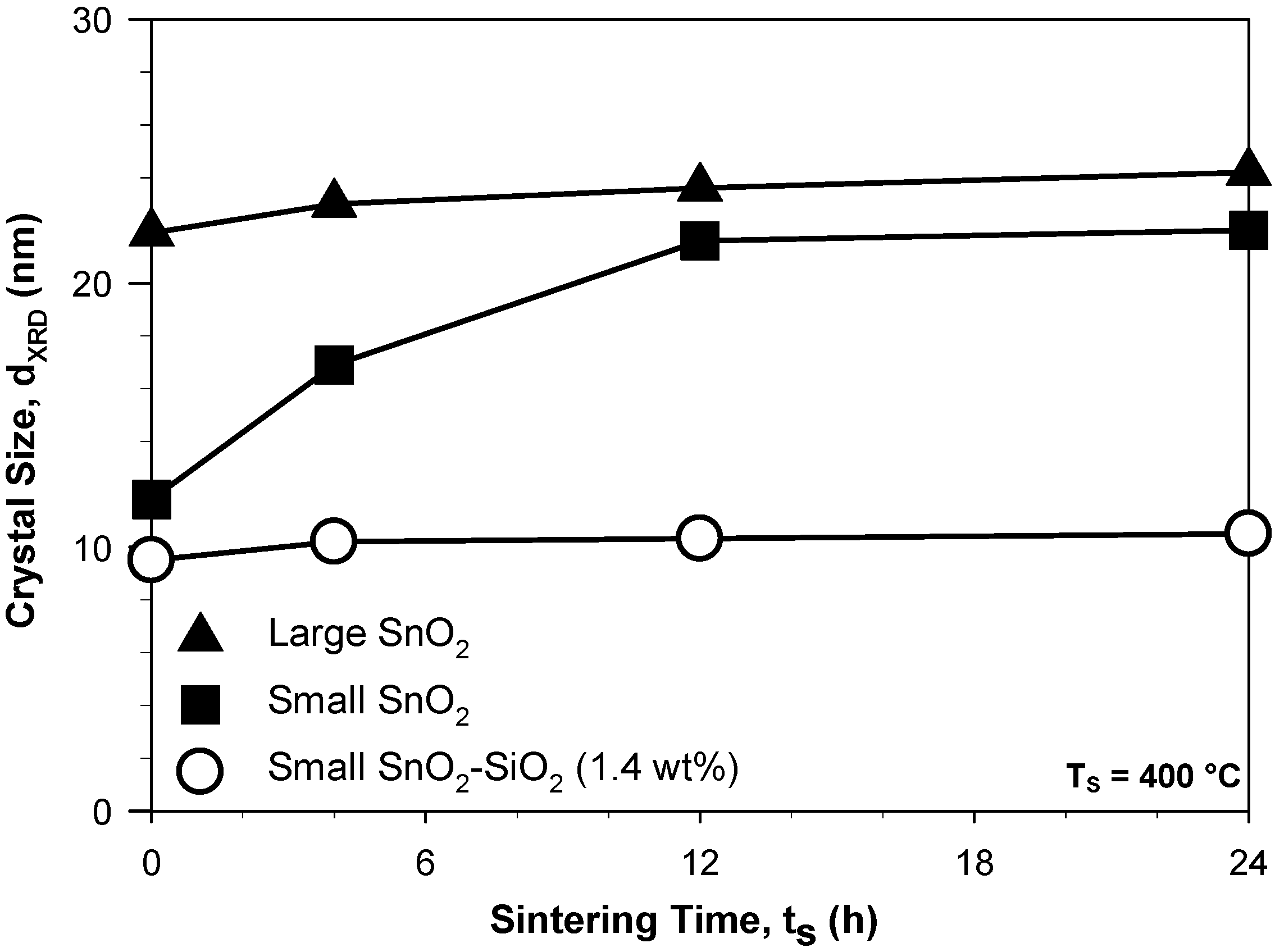
        <p>Crystal growth during operation at the elevated working-temperatures (250–500 °C) of metal-oxide gas sensors is considered to contribute to the drift of their baseline (film resistance without the analyte) and poor long-term stability of their response [<xref ref-type="bibr" rid="B2-biosensors-02-00221">2</xref>,<xref ref-type="bibr" rid="B3-biosensors-02-00221">3</xref>]. The BET and XRD size were within 1 nm suggesting formation of mainly monocrystalline particles. <xref ref-type="fig" rid="biosensors-02-00221-f001">Figure 1</xref> shows the average crystal size of large (triangles) and small (squares) SnO<sub>2</sub> nanoparticles as a function of the sintering time at 400 °C. The crystal size of the better performing, small SnO<sub>2</sub> nanoparticles (<xref ref-type="fig" rid="biosensors-02-00221-f001">Figure 1</xref>, squares) increased from 12 to 22 nm with increasing sintering time from 0 to 24 h. A crystal size of 21.6 nm was obtained already after 12 h sintering (<xref ref-type="fig" rid="biosensors-02-00221-f001">Figure 1</xref>, squares). In contrast, the crystal size of the large SnO<sub>2</sub> nanoparticles (<xref ref-type="fig" rid="biosensors-02-00221-f001">Figure 1</xref>, triangles) increased only from 21.9 to 24.2 with increasing sintering time from 0 to 24 h. This indicates that, for sensor operation at 400 °C, flame-made nanoparticles constituted by pure SnO<sub>2</sub> crystals have a thermodynamically stable size of nearly 24 nm in agreement with the poor thermal stability of small SnO<sub>2</sub> nanoparticles and with the grain size stability conditions reported for several other synthesis methods [<xref ref-type="bibr" rid="B3-biosensors-02-00221">3</xref>]. This is in line with the rapid crystal and grain growth of flame-made SnO<sub>2</sub> nanoparticles observed already at low sintering temperatures [<xref ref-type="bibr" rid="B7-biosensors-02-00221">7</xref>] suggesting that obtaining stable sensor responses requires testing of the sensors for several consecutive days. In particular, the asymptotic-like growth of the small SnO<sub>2</sub> nanoparticles (<xref ref-type="fig" rid="biosensors-02-00221-f001">Figure 1</xref>, squares) toward 22 nm suggests that small drift of sensor response and baseline may continue for a very long time span (&gt;&gt;24 h). In fact, the thermodynamically stable crystal size (at 400 °C) of 24 nm was still not obtained upon 24 h sintering.</p>
        <fig id="biosensors-02-00221-f001" position="anchor">
          <label>Figure 1</label>
          <caption>
            <p>Average crystal size (d<sub>XRD</sub>) of large (triangles) and small (squares) SnO<sub>2</sub> nanoparticles as a function of the sintering time at 400 °C. Cosynthesis of 1.4 wt% SiO<sub>2</sub> (circles) drastically increased the long-term thermal-stability of SnO<sub>2</sub> crystals.</p>
          </caption>
          <graphic xmlns:xlink="http://www.w3.org/1999/xlink" xlink:href="biosensors-02-00221-g001.tif"/>
        </fig>
        <fig id="biosensors-02-00221-f002" position="anchor">
          <label>Figure 2</label>
          <caption>
            <p>ED patterns of pure (<bold>a</bold>) SnO<sub>2</sub> nanoparticles and (<bold>b</bold>) 1.4 wt% SnO<sub>2</sub>-SiO<sub>2 </sub>nanocomposites after 4 h sintering at 400 °C and corresponding transmission electron microscopy (TEM) images (<bold>c,d</bold>).</p>
          </caption>
          <graphic xmlns:xlink="http://www.w3.org/1999/xlink" xlink:href="biosensors-02-00221-g002.tif"/>
        </fig>
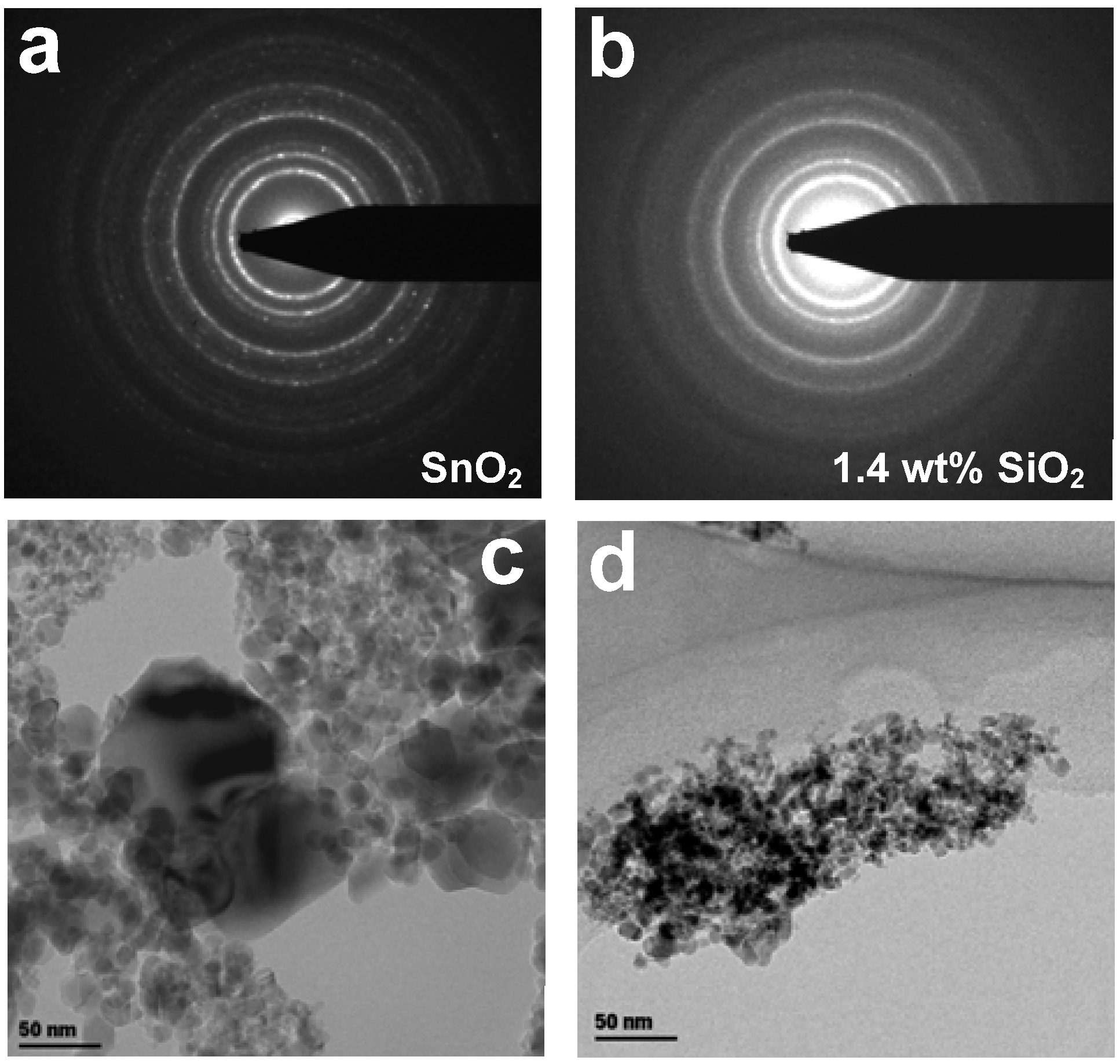
        <p>Cosynthesis of SiO<sub>2</sub> led already at very low content (1.4 wt%) to remarkable long-term thermal-stabilization of the small SnO<sub>2</sub> nanoparticles. The average crystal size of these SnO<sub>2</sub>-SiO<sub>2</sub> nanocomposites (<xref ref-type="fig" rid="biosensors-02-00221-f001">Figure 1</xref>, circles) increased only from 9.5 to 10.5 nm with increasing sintering time from 0 to 24 h. The particles were mainly polyhedrical (<xref ref-type="fig" rid="biosensors-02-00221-f002">Figure 2</xref>(c,d)) consisting of a crystalline SnO<sub>2</sub> core and some dispersed SiO<sub>2</sub> phase. At high SiO<sub>2</sub> content, the SnO<sub>2</sub> and SiO<sub>2</sub> phase were segregated in crystalline and amorphous domains, respectively. This is in line with the reported thermal stabilization and performance maximization of SnO<sub>2</sub>- [<xref ref-type="bibr" rid="B7-biosensors-02-00221">7</xref>] and WO<sub>3</sub>-based [<xref ref-type="bibr" rid="B19-biosensors-02-00221">19</xref>] gas sensors by Si-doping. Here, it is shown that this noble metal-free approach to improve the performance of metal-oxide chemoresistive gas sensors offers also superior long-term structural stability. </p>
        <p>The thermal stabilization mechanism of the small SnO<sub>2</sub> crystals by SiO<sub>2</sub> cosynthesis was further investigated by electron diffraction analysis, XRD and TEM analysis of the nanoparticles upon sintering for 4 h at 400 °C. In line with previous results [<xref ref-type="bibr" rid="B7-biosensors-02-00221">7</xref>], increasing the SiO<sub>2</sub> content increased the homogeneity of the visible SnO<sub>2</sub> TEM size both for the as-prepared and sintered samples. The electron diffraction (ED) patterns of the small SnO<sub>2</sub> nanoparticles (<xref ref-type="fig" rid="biosensors-02-00221-f002">Figure 2</xref>(a)) showed the presence of crystalline structures in line with the XRD analysis [<xref ref-type="bibr" rid="B7-biosensors-02-00221">7</xref>] that corresponded to 100 wt% cassiterite phase [<xref ref-type="bibr" rid="B16-biosensors-02-00221">16</xref>] while the numerous bright spots indicate the formation of large crystals already upon short (4 h) sintering at 400 °C. This is in line with the rapid increase in average crystal size of the small SnO<sub>2</sub> nanoparticles (<xref ref-type="fig" rid="biosensors-02-00221-f001">Figure 1</xref>, squares) with increasing sintering time and suggests a polydisperse crystal size distribution. In contrast, the ED patterns of the 1.4 wt% SnO<sub>2</sub>-SiO<sub>2</sub> nanocomposites (<xref ref-type="fig" rid="biosensors-02-00221-f002">Figure 2</xref>(b)) did not shown nearly any bright spot. This indicates that the formation of large crystals is homogeneously inhibited by cosynthesis of SiO<sub>2</sub>. In this respect, a possible thermal stabilization mechanism is the pinning of the SnO<sub>2</sub> crystal boundaries by SiO<sub>2</sub> [<xref ref-type="bibr" rid="B13-biosensors-02-00221">13</xref>,<xref ref-type="bibr" rid="B14-biosensors-02-00221">14</xref>]. Condensation of the SiO<sub>2</sub> molecules on the surface of the nucleated SnO<sub>2</sub> clusters during flame-synthesis may explain the lower sintering rates of these SnO<sub>2</sub>-SiO<sub>2</sub> nanoparticles already at very low SiO<sub>2</sub> content. In fact, it is expected that SiO<sub>2</sub> segregates from the SnO<sub>2</sub> already at low content (<italic>ca</italic>. 2 wt%) [<xref ref-type="bibr" rid="B7-biosensors-02-00221">7</xref>].</p>
        <p>This homogeneous inhibition of SnO<sub>2</sub> crystal growth is necessary to achieve long-term stability of the sensing properties. In fact, irregular growth of some un-stabilized SnO<sub>2</sub> nanoparticles would also lead to change in the structural and electronic properties of the sensing film. However, the crystal size of the SnO<sub>2</sub>-SiO<sub>2</sub> nanocomposites (<xref ref-type="fig" rid="biosensors-02-00221-f001">Figure 1</xref>, circles) was not completely stable and approached slowly 10.5 nm. Although, this crystal growth is very small with respect to that of pure SnO<sub>2</sub> (<xref ref-type="fig" rid="biosensors-02-00221-f001">Figure 1</xref>, squares), it still indicates a restructuring of the nanoparticle interface. In particular, growth of sintering necks may drastically change the performance of the sensing film while showing very small variations in the measured crystal size [<xref ref-type="bibr" rid="B7-biosensors-02-00221">7</xref>]. </p>
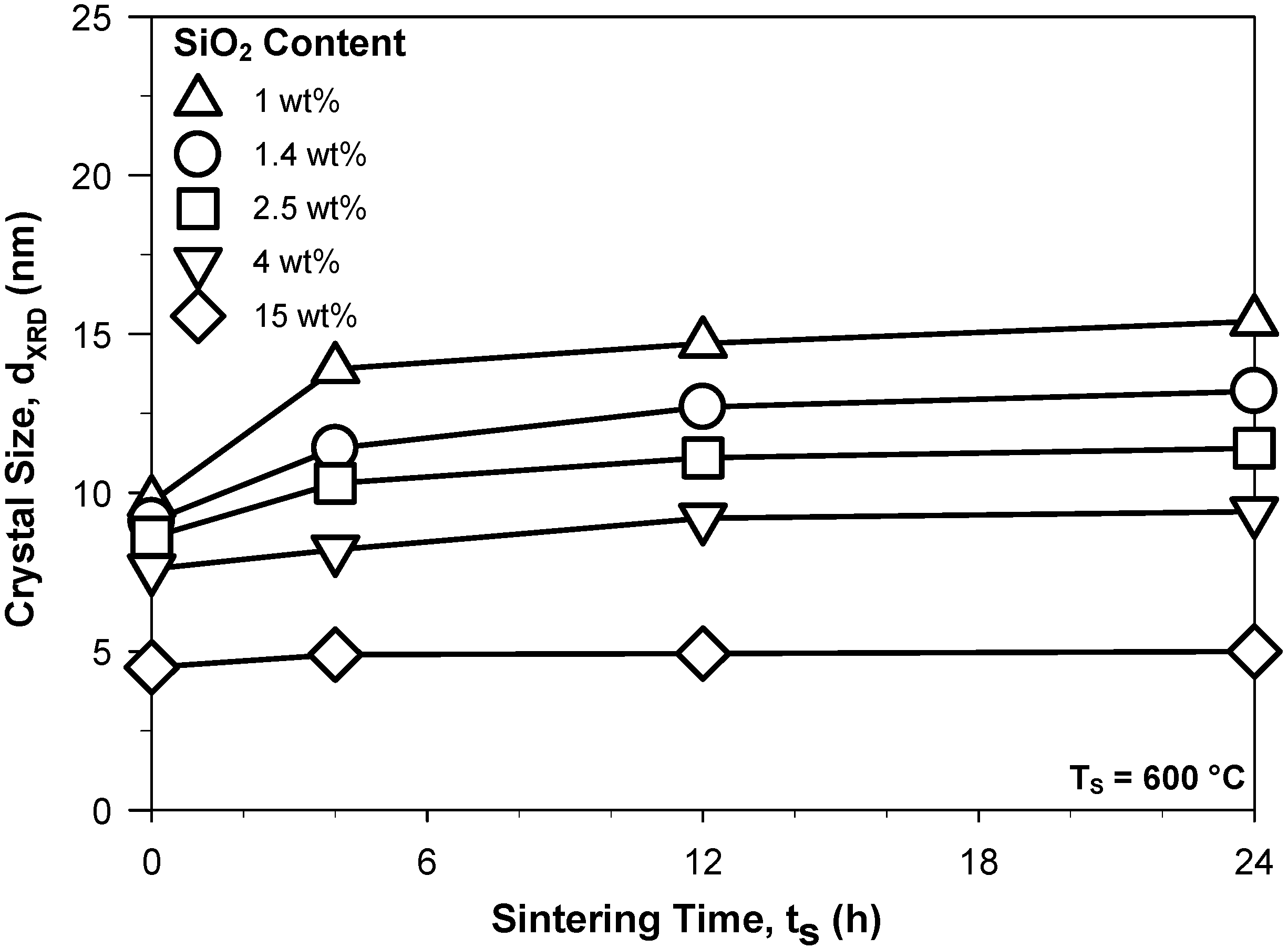
        <p>Reduction of the long-term drift of the SnO<sub>2</sub> and SnO<sub>2</sub>-SiO<sub>2</sub> sensors may be obtained by pre-sintering of the films at temperatures above the operational ones (e.g., at 600 °C) [<xref ref-type="bibr" rid="B7-biosensors-02-00221">7</xref>] leading to the achievement of a thermodynamically stable grain size prior to sensor testing (e.g., at 400 °C). <xref ref-type="fig" rid="biosensors-02-00221-f003">Figure 3</xref> shows the average SnO<sub>2</sub> crystal size of several SnO<sub>2</sub>-SiO<sub>2</sub> nanocomposites as a function of such a pre-sintering step at 600 °C. The 1 wt% SnO<sub>2</sub>-SiO<sub>2</sub> crystal size (<xref ref-type="fig" rid="biosensors-02-00221-f003">Figure 3</xref>, triangles up) increased from 9.7 to 15.4 with increasing sintering time at 600 °C from 0 to 24 h. This shows that even the smallest addition of SiO<sub>2</sub> leads to stabilization of the SnO<sub>2</sub> crystal size far below that of pure SnO<sub>2</sub> at 400 °C (<xref ref-type="fig" rid="biosensors-02-00221-f001">Figure 1</xref>, solid triangles). In particular, the 1.4 wt% SnO<sub>2</sub>-SiO<sub>2</sub> reached a size of 11.4 nm already after 4 h sintering (<xref ref-type="fig" rid="biosensors-02-00221-f003">Figure 3</xref>, circles). This is more than the thermodynamically stable size (≈10.5 nm) at 400 °C and thus pre-sintering of the sensing films prior to sensor utilization may be utilized to considerably shorten the time required for achievement of a stable sensor response. Furthermore, up to 4 wt% SiO<sub>2</sub>, the as-prepared SnO<sub>2</sub> crystal size (<xref ref-type="fig" rid="biosensors-02-00221-f003">Figure 3</xref>) of these nanocomposites was very close (<italic>ca</italic>. 10 ± 1.5 nm) suggesting further that SiO<sub>2</sub> may condense directly on the formed SnO<sub>2</sub> nanoparticles inhibiting further crystal and grain growth during flame-synthesis. In comparison, the initial crystal size of the pure SnO<sub>2</sub> nanoparticles was 12 nm (<xref ref-type="fig" rid="biosensors-02-00221-f001">Figure 1</xref>, solid squares) which is attributed to particle coagulation during the residence time in the flame. In line, the as-prepared powder SSA increased from 100 to 211 m<sup>2</sup>/g with increasing SiO<sub>2</sub> content from 0 to 15 wt%. The 15 wt% SiO<sub>2</sub>-SnO<sub>2</sub> demonstrated the highest long-term stability growing only from 4.5 to 5 nm (<xref ref-type="fig" rid="biosensors-02-00221-f003">Figure 3</xref>, diamonds) with increasing sintering time from 0 to 24 h. This is in agreement with the grain growth inhibition demonstrated by SiO<sub>2</sub> cosynthesis [<xref ref-type="bibr" rid="B7-biosensors-02-00221">7</xref>]. However, utilization of such high SiO<sub>2</sub> contents results in the formation of insulating domains and a drastic drop of the sensing performance [<xref ref-type="bibr" rid="B7-biosensors-02-00221">7</xref>] and thus, here, the dynamics of the sensor response stabilization has been investigated at low SiO<sub>2</sub> content (1–4 wt%).</p>
        <fig id="biosensors-02-00221-f003" position="anchor">
          <label>Figure 3</label>
          <caption>
            <p>Average SnO<sub>2</sub> crystal size (d<sub>XRD</sub>) of the SnO<sub>2</sub>-SiO<sub>2</sub> nanocomposites as a function of the sintering time at 600 °C for several SiO<sub>2</sub> contents. </p>
          </caption>
          <graphic xmlns:xlink="http://www.w3.org/1999/xlink" xlink:href="biosensors-02-00221-g003.tif"/>
        </fig>
      </sec>
      <sec>
        <title>3.2. Sensing Performance Stability</title>
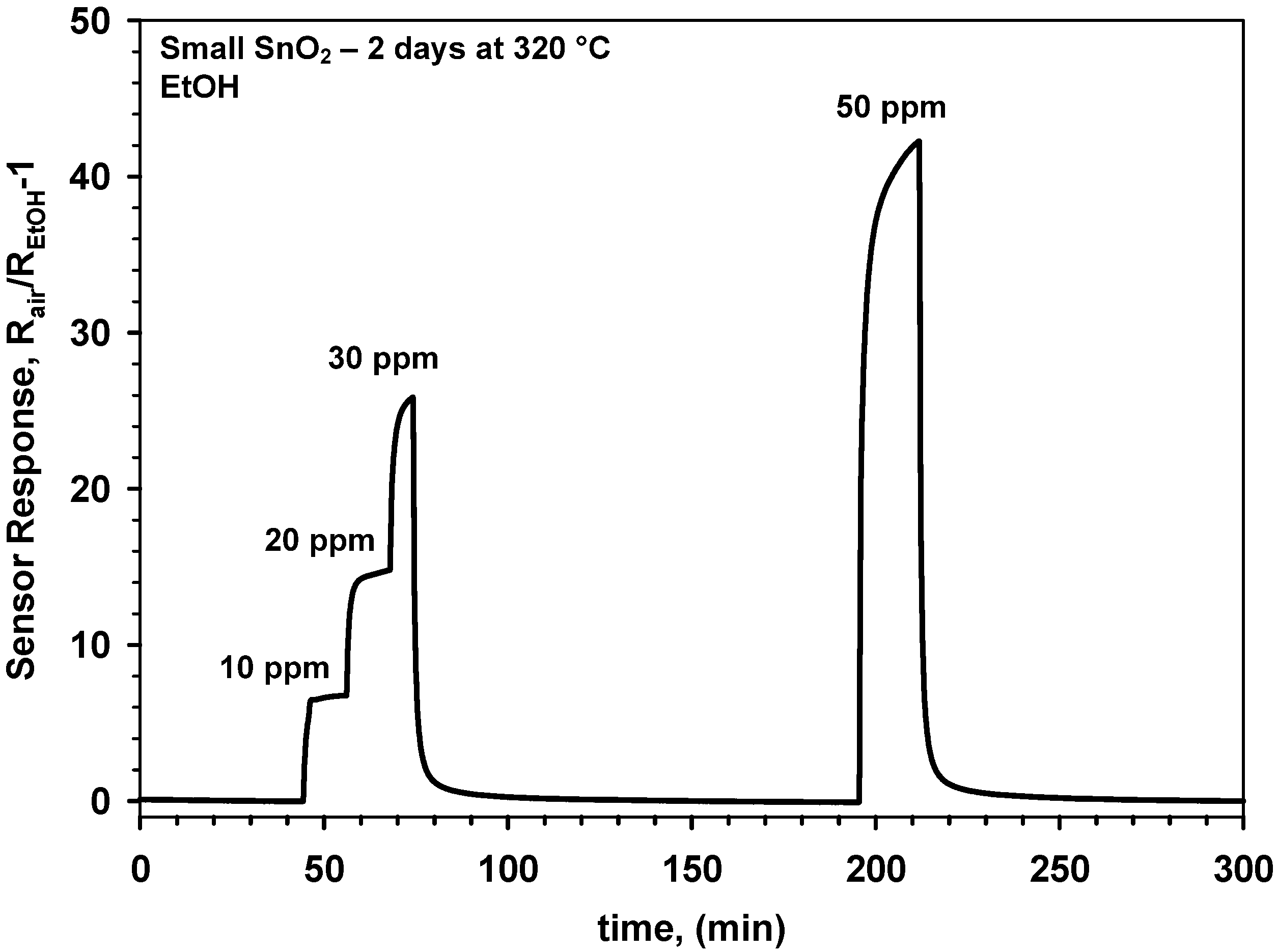
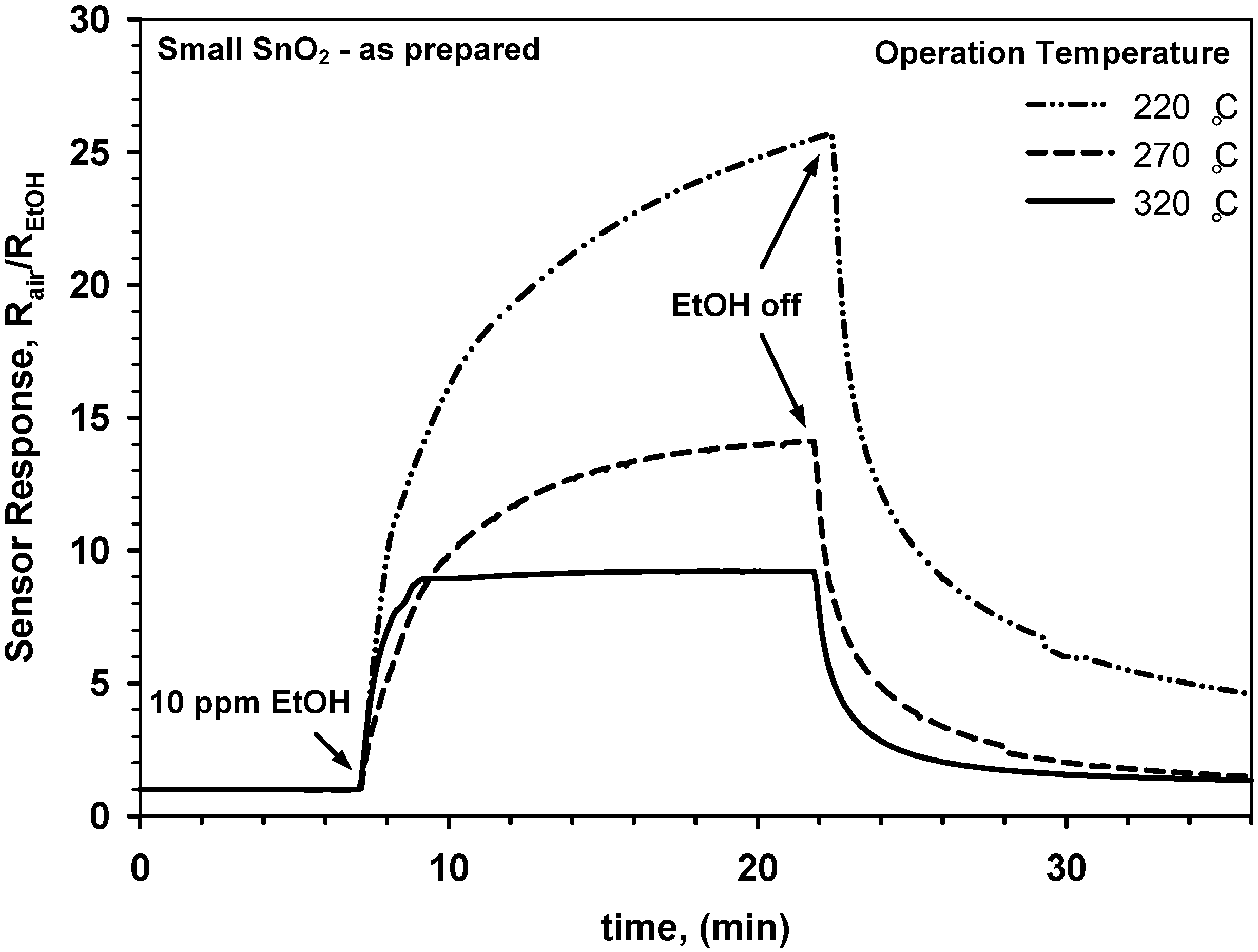
        <p>The sensing properties of these SnO<sub>2</sub>-SiO<sub>2</sub> nanoparticles were tested with EtOH, a standard volatile organic compound that is particularly important for detection of drunken drivers and is increasingly investigated also for non-invasive breath analysis. <xref ref-type="fig" rid="biosensors-02-00221-f004">Figure 4</xref> shows the response to 10 ppm ethanol of a pure SnO<sub>2</sub> (d<sub>XRD</sub> = 12 nm) gas sensor, that was not stabilized by a pre-sintering step, for several operation temperatures. The response of this sensor (<xref ref-type="fig" rid="biosensors-02-00221-f004">Figure 4</xref>) decreased considerably with increasing operation temperature from 220 to 320 °C. This is surprising as pure SnO<sub>2</sub> has maximal response to EtOH at around 300–350 °C [<xref ref-type="bibr" rid="B20-biosensors-02-00221">20</xref>]. The drop in the sensor response was attributed to the sintering of the SnO<sub>2</sub> nanoparticles already during operation at such moderate temperatures. This is in line with the measured crystal growth of the small SnO<sub>2</sub> nanoparticles (<xref ref-type="fig" rid="biosensors-02-00221-f001">Figure 1</xref>, solid squares) that is expected to drastically reduce their sensitivity [<xref ref-type="bibr" rid="B3-biosensors-02-00221">3</xref>,<xref ref-type="bibr" rid="B5-biosensors-02-00221">5</xref>,<xref ref-type="bibr" rid="B7-biosensors-02-00221">7</xref>]. Additionally, operation of the SnO<sub>2</sub> sensor at 220 °C was characterized (<xref ref-type="fig" rid="biosensors-02-00221-f004">Figure 4</xref>, dotted line) by an unstable response and it was not possible to fully recover the initial baseline. This indicates that without prior stabilization the sensing behavior of pure SnO<sub>2</sub> nanoparticles is characterized by very poor long-term stability. After two days at 320 °C (<xref ref-type="fig" rid="biosensors-02-00221-f004">Figure 4</xref>, solid line), the sensor properties were considerably more stable demonstrating a well-defined response to 10 ppm EtOH and full recovery of the initial baseline. Nevertheless, increasing the EtOH concentration to 30 and 50 ppm (<xref ref-type="fig" rid="biosensors-02-00221-f005">Figure 5</xref>) resulted in very long response times. </p>
        <fig id="biosensors-02-00221-f004" position="anchor">
          <label>Figure 4</label>
          <caption>
            <p>Response of a gas sensor made of as prepared SnO<sub>2</sub> nanoparticles (d<sub>XRD</sub> = 12 nm) to 10 ppm ethanol as a function of time for increasing operation temperature from 220 to 320 °C. </p>
          </caption>
          <graphic xmlns:xlink="http://www.w3.org/1999/xlink" xlink:href="biosensors-02-00221-g004.tif"/>
        </fig>
        <fig id="biosensors-02-00221-f005" position="anchor">
          <label>Figure 5</label>
          <caption>
            <p>Response of a gas sensor made of small SnO<sub>2</sub> nanocrystals to ethanol without prior stabilization upon two days at 320 °C in dry air. </p>
          </caption>
          <graphic xmlns:xlink="http://www.w3.org/1999/xlink" xlink:href="biosensors-02-00221-g005.tif"/>
        </fig>
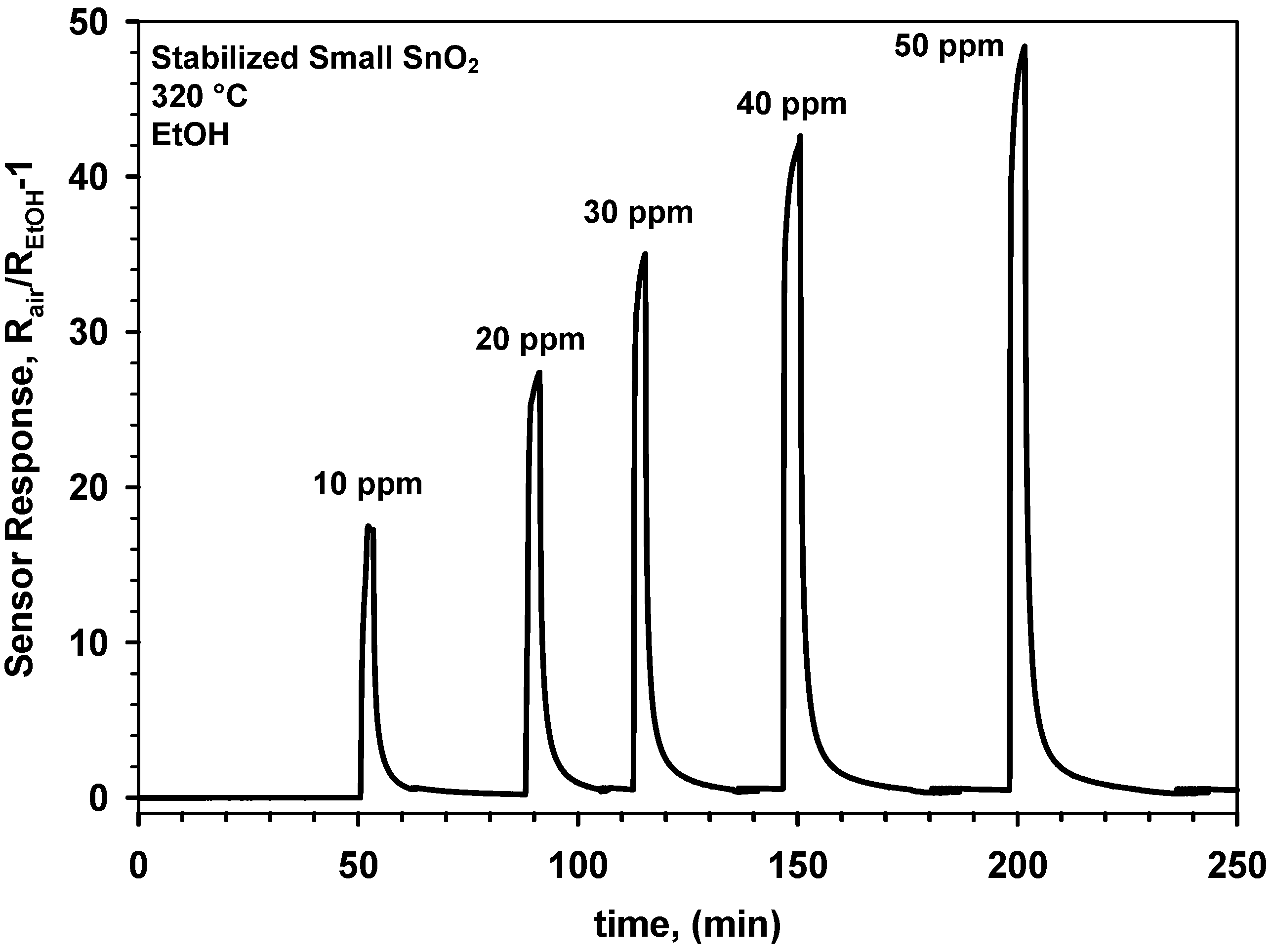
        <p>The step-wise increase of the EtOH concentration (<xref ref-type="fig" rid="biosensors-02-00221-f005">Figure 5</xref>) from 10 to 30 ppm at 320 °C demonstrated sufficient sensor sensitivity for discerning among small (&lt;10 ppm) EtOH variations. Furthermore, a very good recovery of the initial baseline was observed (<xref ref-type="fig" rid="biosensors-02-00221-f005">Figure 5</xref>) in line with the single EtOH step at 320 °C (<xref ref-type="fig" rid="biosensors-02-00221-f004">Figure 4</xref>, solid line). However, the sensitivity of this SnO<sub>2</sub> sensor to EtOH was pretty low with respect to noble-metals [<xref ref-type="bibr" rid="B6-biosensors-02-00221">6</xref>] or metal-oxide [<xref ref-type="bibr" rid="B7-biosensors-02-00221">7</xref>] doped nanoparticles. This was also attributed to the growth of the SnO<sub>2</sub> crystals during operation and that was found to undermine the reproducibility of the sensor performance. To have more stable sensing properties, novel sensors made of pure SnO<sub>2</sub> nanoparticles (d<sub>XRD</sub> = 12 nm) were also tested for EtOH sensing after a sintering step at 600 °C (12 h). Their performance was compared to the sensors (<xref ref-type="fig" rid="biosensors-02-00221-f004">Figure 4</xref> and <xref ref-type="fig" rid="biosensors-02-00221-f005">Figure 5</xref>) with the as prepared nanoparticle films.</p>
        <fig id="biosensors-02-00221-f006" position="anchor">
          <label>Figure 6</label>
          <caption>
            <p>Response of a gas sensor made of small SnO<sub>2</sub> nanocrystals to ethanol after a 12 h sintering step at 600 °C.</p>
          </caption>
          <graphic xmlns:xlink="http://www.w3.org/1999/xlink" xlink:href="biosensors-02-00221-g006.tif"/>
        </fig>
        <p><xref ref-type="fig" rid="biosensors-02-00221-f006">Figure 6</xref> shows the response to increasing EtOH concentrations of a SnO<sub>2</sub> sensor made of small nanoparticles that was sintered at 600 °C for 12 h prior to gas sensing. The sensor shows (<xref ref-type="fig" rid="biosensors-02-00221-f006">Figure 6</xref>) similar response and recovery time to that having an as prepared SnO<sub>2</sub> nanoparticle film (<xref ref-type="fig" rid="biosensors-02-00221-f005">Figure 5</xref>). This is in agreement with the identical surface composition and film thickness of the as prepared and sintered SnO<sub>2</sub> films. However, the magnitude of the sensor response was drastically increased with respect to the latter. In particular, the sintered sensor (<xref ref-type="fig" rid="biosensors-02-00221-f006">Figure 6</xref>) had a response of nearly 17 to 10 ppm of EtOH while the as prepared barely reached 8. This is surprising as high temperature sintering is expected to increase crystal size leading to lower sensitivity [<xref ref-type="bibr" rid="B3-biosensors-02-00221">3</xref>,<xref ref-type="bibr" rid="B5-biosensors-02-00221">5</xref>]. Here, it is suggested that the enhancement of the sensor response arise from the formation of sintering necks with size below that of the main grains between the SnO<sub>2</sub> particles. Formation of partially or fully depleted sintering necks can increase the sensitivity of metal-oxide gas sensors and can hardly be measured by XRD or nitrogen adsorption [<xref ref-type="bibr" rid="B7-biosensors-02-00221">7</xref>]. As a result, two instability mechanisms are suggested for the pure SnO<sub>2</sub> nanoparticles. A first, where the average crystal (and grain) size is increased (<xref ref-type="fig" rid="biosensors-02-00221-f004">Figure 4</xref>) resulting in a drop of the sensor response, and a second, where partially depleted sintering necks are formed increasing the sensitivity. Similar effects were observed for size selected SnO<sub>2</sub> agglomerates [<xref ref-type="bibr" rid="B21-biosensors-02-00221">21</xref>]. There, very small changes in the sintering properties of the agglomerates that could hardly be tracked by XRD analysis led to drastic variations in their sensing response to EtOH. Both dynamics can be accelerated by a pre-sintering step leading to (<xref ref-type="fig" rid="biosensors-02-00221-f006">Figure 6</xref>) higher response and more stable sensing properties.</p>
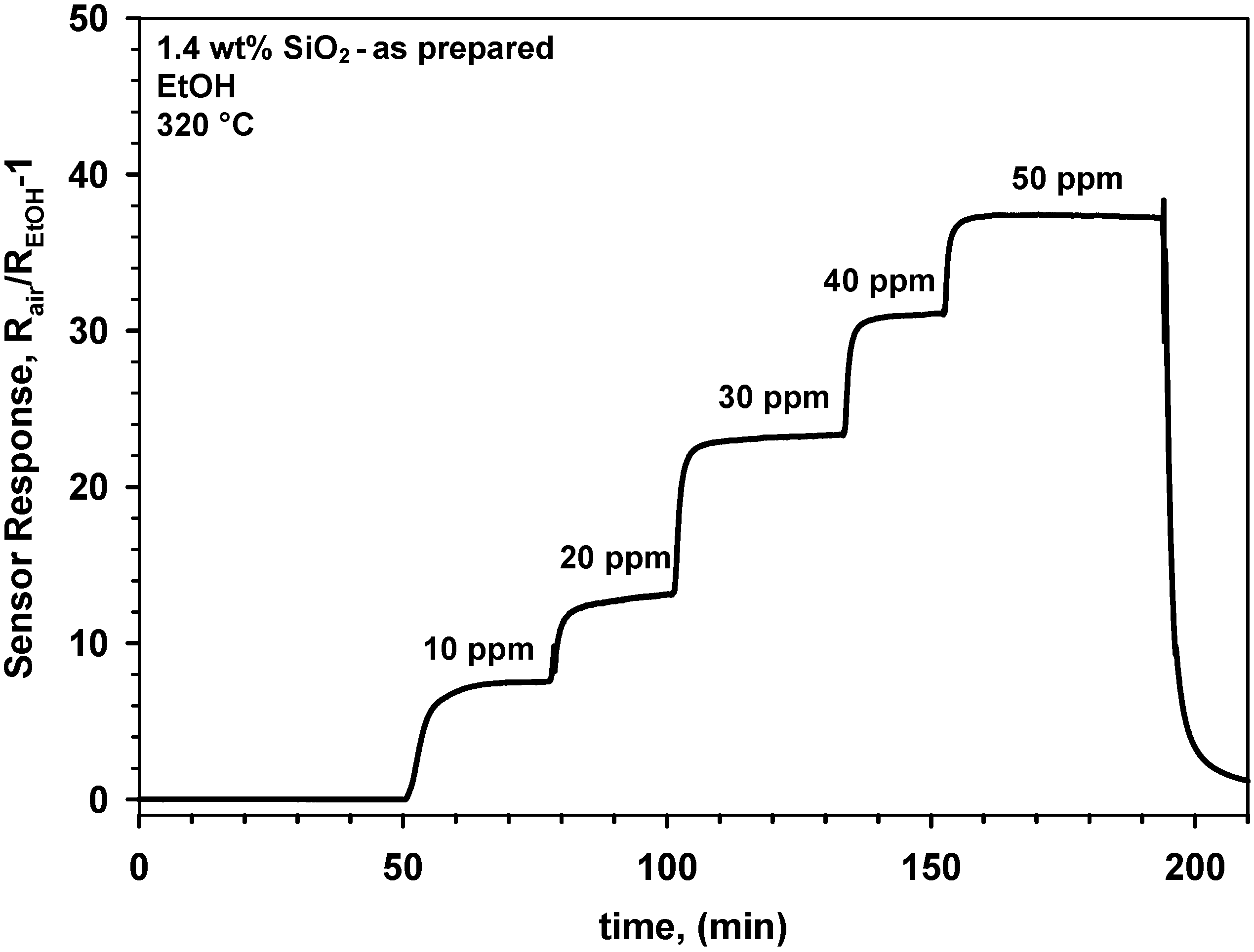
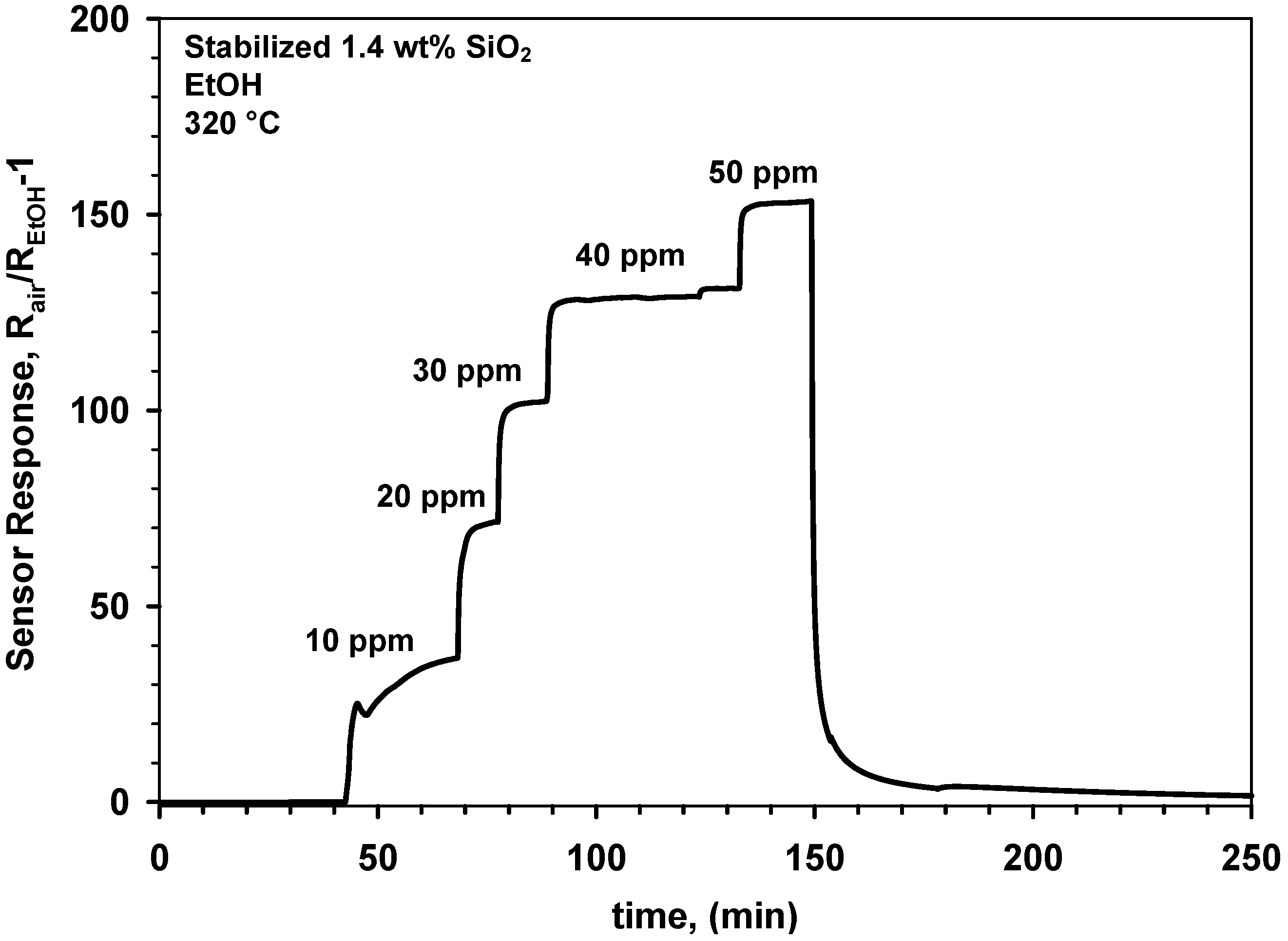
        <p>The sensing dynamics of the SnO<sub>2</sub>-SiO<sub>2</sub> composites was different from that of the pure SnO<sub>2</sub> nanoparticles (<xref ref-type="fig" rid="biosensors-02-00221-f004">Figure 4</xref>, <xref ref-type="fig" rid="biosensors-02-00221-f005">Figure 5</xref> and <xref ref-type="fig" rid="biosensors-02-00221-f006">Figure 6</xref>). To better investigate the effect of SiO<sub>2</sub> cosynthesis on the sensing properties, all synthesis parameters were kept constant and only the Si-content was varied. <xref ref-type="fig" rid="biosensors-02-00221-f007">Figure 7</xref> shows the response to step-wise increases in EtOH concentration of a sensor made of as prepared 1.4 wt% SnO<sub>2</sub>-SiO<sub>2</sub>. The response and recovery times of these nanocomposites (<xref ref-type="fig" rid="biosensors-02-00221-f007">Figure 7</xref>) were comparable to that of the pure SnO<sub>2</sub> (<xref ref-type="fig" rid="biosensors-02-00221-f005">Figure 5</xref>). Nevertheless, the magnitude of the sensor response was initially lower than that of the SnO<sub>2</sub> nanoparticles (<xref ref-type="fig" rid="biosensors-02-00221-f005">Figure 5</xref>) reaching about 37 at 50 ppm EtOH (<xref ref-type="fig" rid="biosensors-02-00221-f007">Figure 7</xref>). This is in contrast to the smaller crystal size of these nanocomposites (<xref ref-type="fig" rid="biosensors-02-00221-f003">Figure 3</xref>, triangles up) that should lead to higher sensitivity [<xref ref-type="bibr" rid="B5-biosensors-02-00221">5</xref>]. This is attributed to the sintering inhibition effect of the SiO<sub>2</sub> that may have limited the growth of sintering neck between the main SnO<sub>2</sub> grains.</p>
        <fig id="biosensors-02-00221-f007" position="anchor">
          <label>Figure 7</label>
          <caption>
            <p>Response of a gas sensor made of as prepared 1.4 wt% SnO<sub>2</sub>-SiO<sub>2</sub> nanocomposites to increasing EtOH concentrations in dry air.</p>
          </caption>
          <graphic xmlns:xlink="http://www.w3.org/1999/xlink" xlink:href="biosensors-02-00221-g007.tif"/>
        </fig>
        <p>After sintering these films at 600 °C for 12 h, their response was greatly increased (<xref ref-type="fig" rid="biosensors-02-00221-f008">Figure 8</xref>). More in details, upon this stabilization step, the response of the 1.4 wt% SnO<sub>2</sub>-SiO<sub>2</sub> to 50 ppm EtOH increased from 37 (<xref ref-type="fig" rid="biosensors-02-00221-f007">Figure 7</xref>) to 153 (<xref ref-type="fig" rid="biosensors-02-00221-f008">Figure 8</xref>). This 4 fold increase in sensitivity is in line with the reported optimal Si-doping of SnO<sub>2</sub> nanoparticles [<xref ref-type="bibr" rid="B7-biosensors-02-00221">7</xref>]. Furthermore, it confirms the long-term instability mechanisms observed for pure SnO<sub>2</sub>. As the presence of SiO<sub>2</sub> drastically inhibit the crystal growth, the sintering necks formed at 600 °C are smaller and thus more depleted than for pure SnO<sub>2</sub>(<xref ref-type="fig" rid="biosensors-02-00221-f005">Figure 5</xref> and <xref ref-type="fig" rid="biosensors-02-00221-f006">Figure 6</xref>) resulting in a more drastic enhancement of their sensing performance (<xref ref-type="fig" rid="biosensors-02-00221-f007">Figure 7</xref> and <xref ref-type="fig" rid="biosensors-02-00221-f008">Figure 8</xref>). A more detailed analysis of the neck morphologies and growth dynamics is required to quantitatively describe the sensing response enhancement of these nanocomposites [<xref ref-type="bibr" rid="B4-biosensors-02-00221">4</xref>]. Higher SiO<sub>2</sub> contents (<xref ref-type="fig" rid="biosensors-02-00221-f003">Figure 3</xref>), up to 4 wt%, resulted in a similar enhancement of the sensing properties. Overall, cosynthesis of SiO<sub>2</sub> increases the variation of sensor resistance during injection of EtOH concentration as it was previously investigated in details [<xref ref-type="bibr" rid="B7-biosensors-02-00221">7</xref>].</p>
        <fig id="biosensors-02-00221-f008" position="anchor">
          <label>Figure 8</label>
          <caption>
            <p>Response to increasing EtOH concentrations in dry air of a gas sensor made of 1.4 wt% SnO<sub>2</sub>-SiO<sub>2</sub> nanocomposites upon stabilization by sintering for 12 h at 600 °C.</p>
          </caption>
          <graphic xmlns:xlink="http://www.w3.org/1999/xlink" xlink:href="biosensors-02-00221-g008.tif"/>
        </fig>
      </sec>
      <sec>
        <title>3.3. Cross-Sensitivity to Humidity</title>
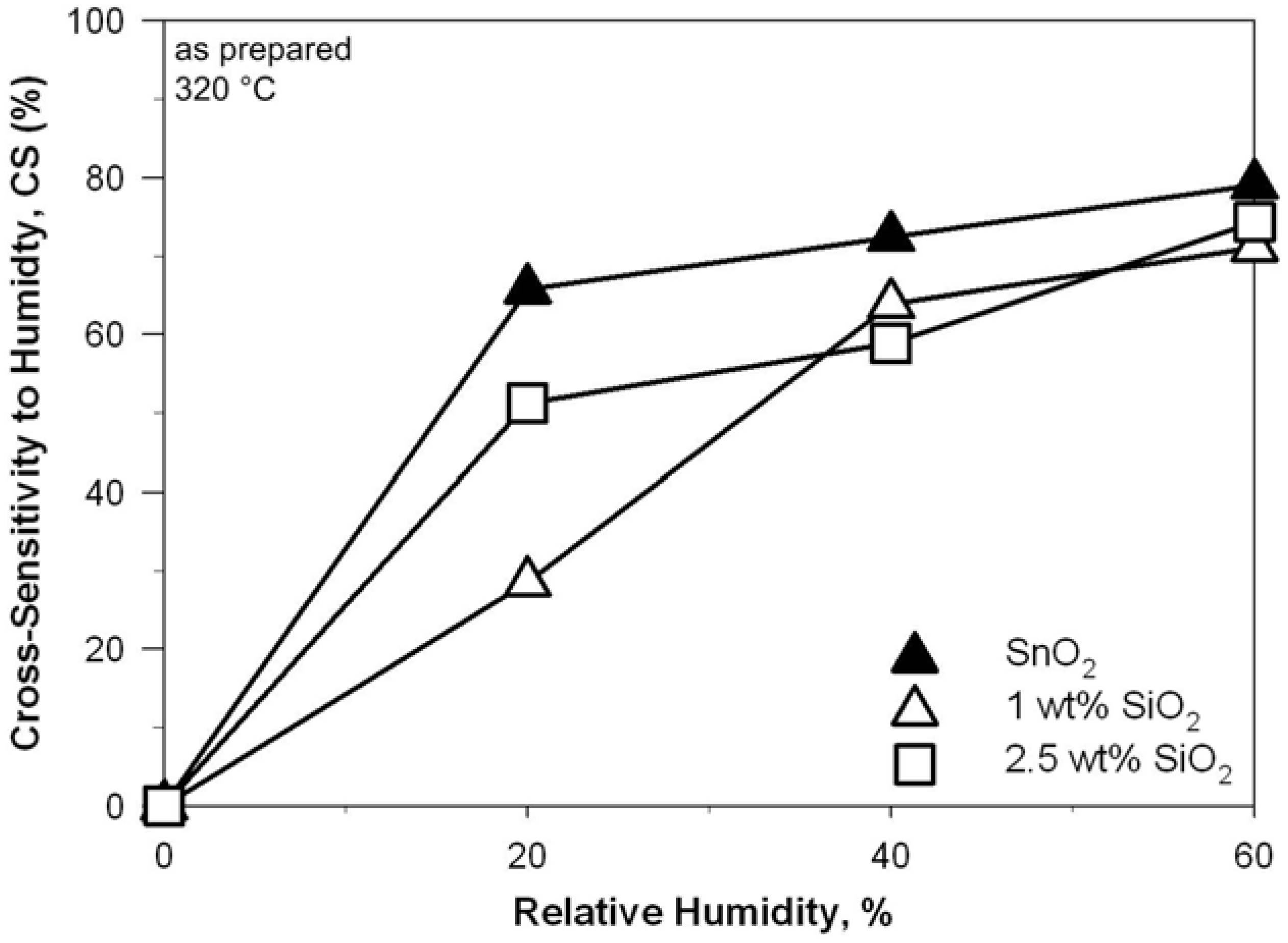
        <p>The stability of the sensor response toward variations in relative humidity is of major importance for several applications [<xref ref-type="bibr" rid="B2-biosensors-02-00221">2</xref>,<xref ref-type="bibr" rid="B22-biosensors-02-00221">22</xref>]. Doping of SnO<sub>2</sub> nanoparticles with Ti has been reported to drastically decrease their cross-sensitivity to humidity [<xref ref-type="bibr" rid="B9-biosensors-02-00221">9</xref>]. Recently, this has been attributed to thermodynamically dictated enrichment of the SnO<sub>2</sub> surface with Ti atoms [<xref ref-type="bibr" rid="B23-biosensors-02-00221">23</xref>] that lower the adsorption energy of dissociatively adsorbed H<sub>2</sub>O [<xref ref-type="bibr" rid="B24-biosensors-02-00221">24</xref>]. The effect of SiO<sub>2</sub> cosynthesis on the cross-sensitivity (CS) to humidity of SnO<sub>2</sub> nanoparticles, however, has not been investigated yet. This is particularly important as flame-made SiO<sub>2</sub> has high surface concentration of hydroxyl groups that facilitate the binding of H<sub>2</sub>O molecules [<xref ref-type="bibr" rid="B10-biosensors-02-00221">10</xref>] and thus may result in a strong enhancement of the CS to humidity. <xref ref-type="fig" rid="biosensors-02-00221-f009">Figure 9</xref> shows the CS to humidity during EtOH detection, defined as change of the sensor response in dry air (Equation (2)), of the pure SnO<sub>2</sub> (triangles solid), 1 wt% (empty triangles) and 2.5 wt% (empty squares) SnO<sub>2</sub>-SiO<sub>2</sub> nanocomposites as a function of the relative humidity. The CS to humidity of the pure SnO<sub>2</sub> sensors (<xref ref-type="fig" rid="biosensors-02-00221-f009">Figure 9</xref>, solid triangles) increased from 51 to 74% with increasing r.h. from 20 to 60%. This is in agreement with the drastic change in sensor response reported for SnO<sub>2</sub> nanoparticles with increasing r.h. content [<xref ref-type="bibr" rid="B9-biosensors-02-00221">9</xref>]. The continuous increase in CS above 20% r.h. (<xref ref-type="fig" rid="biosensors-02-00221-f009">Figure 9</xref>, solid triangles) indicates that the SnO<sub>2</sub> surface has not yet been saturated with adsorbed H<sub>2</sub>O species. More important, the CS of both SnO<sub>2</sub>-SiO<sub>2</sub> sensors (<xref ref-type="fig" rid="biosensors-02-00221-f009">Figure 9</xref>, empty squares and triangles) was comparable to that of the pure SnO<sub>2</sub> (<xref ref-type="fig" rid="biosensors-02-00221-f009">Figure 9</xref>, solid triangles). This is different than the effect of Ti-doping [<xref ref-type="bibr" rid="B7-biosensors-02-00221">7</xref>] and in contrast to the super-hydrophilic properties of flame-made SiO<sub>2</sub> [<xref ref-type="bibr" rid="B10-biosensors-02-00221">10</xref>]. However, as SiO<sub>2</sub> is an isolator, localized SiO<sub>2</sub> molecules/clusters on the SnO<sub>2</sub> surface may act as active sites for H<sub>2</sub>O binding but still have minimal impact on the sensing properties of the SnO<sub>2</sub> nanocrystals due to its inefficient electron conduction properties. As a result, SiO<sub>2</sub> cosynthesis leads to the same CS than pure SnO<sub>2</sub> nanoparticles. This is in contrast to the modification of SnO<sub>2</sub> crystals with hydrophilic zeolites [<xref ref-type="bibr" rid="B25-biosensors-02-00221">25</xref>,<xref ref-type="bibr" rid="B26-biosensors-02-00221">26</xref>] where notable variations from the sensing response of the pure SnO<sub>2 </sub>were observed. Minimization of the CS while improving the long-term stability and sensitivity of SnO<sub>2</sub>-based gas sensors may be achieved by synthesis of Sn<sub>1</sub><sub>−x</sub>Ti<sub>x</sub>O<sub>2</sub>-SiO<sub>2</sub> nanocomposites [<xref ref-type="bibr" rid="B9-biosensors-02-00221">9</xref>]. </p>
        <fig id="biosensors-02-00221-f009" position="anchor">
          <label>Figure 9</label>
          <caption>
            <p>Cross-sensitivity to relative humidity (20 °C) of as prepared SnO<sub>2</sub> nanoparticles (solid triangles), and of 1 wt% (empty triangles) and 2.5 wt% (squares) SnO<sub>2</sub>-SiO<sub>2</sub> nanocomposites at 320 °C.</p>
          </caption>
          <graphic xmlns:xlink="http://www.w3.org/1999/xlink" xlink:href="biosensors-02-00221-g009.tif"/>
        </fig>
        <p>It should be pointed out that the sensing chamber geometry has considerable influence on the resulting sensor response dynamics as previously discussed in details [<xref ref-type="bibr" rid="B27-biosensors-02-00221">27</xref>]. The setup utilized here was previously tested for several other materials [<xref ref-type="bibr" rid="B7-biosensors-02-00221">7</xref>,<xref ref-type="bibr" rid="B9-biosensors-02-00221">9</xref>,<xref ref-type="bibr" rid="B15-biosensors-02-00221">15</xref>,<xref ref-type="bibr" rid="B17-biosensors-02-00221">17</xref>] and, for the utilized total gas flow (1 L/min), results in reaction limited sensor responses [<xref ref-type="bibr" rid="B27-biosensors-02-00221">27</xref>].</p>
      </sec>
    </sec>
    <sec sec-type="conclusions">
      <title>4. Conclusions</title>
      <p>The long-term structural stability of small SnO<sub>2</sub> nanoparticles has been investigated for temperatures relevant to metal-oxide gas sensor operation. A stable SnO<sub>2</sub> crystal size of <italic>ca</italic>. 24 nm has been determined for operation at up to 400 °C. This stable size was decreased to <italic>ca</italic>. 11 nm by cosynthesis of 1.4 wt% SiO<sub>2</sub>. However, the slow asymptotic-like growth of the SnO<sub>2</sub> crystals indicated poor long-term stability even for such thermodynamically more stable nanocomposites. This was further confirmed by investigation of the sensing response of the as prepared SnO<sub>2</sub> nanoparticle sensors. Two main instability mechanisms were suggested: first a response drop due to crystal growth and then a response enhancement due to the formation of full or partially depleted sintering necks. Analysis of the performance of SnO<sub>2</sub>-SiO<sub>2</sub> nanocomposites confirmed that sintering the films at 600 °C for 12 h prior gas sensing increases sensor stability and performance. Furthermore, the effect of SiO<sub>2</sub> cosynthesis on the cross-sensitivity to humidity of SnO<sub>2</sub>-based gas sensors was investigated. Cosynthesis of up to 2.5 wt% SiO<sub>2</sub> had no effect on the sensor cross-sensitivity to humidity suggesting minimal electronic interaction between SnO<sub>2</sub> and SiO<sub>2</sub>. These result shows that SnO<sub>2</sub>-SiO<sub>2</sub> nanocomposites can enhance the long-term stability and sensitivity of SnO<sub>2</sub>-based gas sensors while having minimal impact on the residual SnO<sub>2</sub> properties. </p>
    </sec>
  </body>
  <back>
    <ack>
      <title>Acknowledgments</title>
      <p>The author is thankful to M. Righettoni (ETH Zurich) for the help with the characterization of the SnO<sub>2</sub>-SiO<sub>2</sub> nanocomposites, to F. Krumeich (EMEZ, ETH Zurich) for electron microscope analysis, and to S.E. Pratsinis (ETH Zurich) and P. Gouma (SUNY) for fruitful discussions. Financial support was provided by CCMX and NANOPRIM.</p>
    </ack>
    <ref-list>
      <title>References</title>
      <ref id="B1-biosensors-02-00221">
        <label>1.</label>
        <citation citation-type="journal">
          <person-group person-group-type="author">
            <name>
              <surname>Eranna</surname>
              <given-names>G.</given-names>
            </name>
            <name>
              <surname>Joshi</surname>
              <given-names>B.C.</given-names>
            </name>
            <name>
              <surname>Runthala</surname>
              <given-names>D.P.</given-names>
            </name>
            <name>
              <surname>Gupta</surname>
              <given-names>R.P.</given-names>
            </name>
          </person-group>
          <article-title>Oxide materials for development of integrated gas sensors—A comprehensive review</article-title>
          <source>Crit. Rev. Solid State Mater. Sci.</source>
          <year>2004</year>
          <volume>29</volume>
          <fpage>111</fpage>
          <lpage>188</lpage>
          <pub-id pub-id-type="doi">10.1080/10408430490888977</pub-id>
        </citation>
      </ref>
      <ref id="B2-biosensors-02-00221">
        <label>2.</label>
        <citation citation-type="journal">
          <person-group person-group-type="author">
            <name>
              <surname>Tricoli</surname>
              <given-names>A.</given-names>
            </name>
            <name>
              <surname>Righettoni</surname>
              <given-names>M.</given-names>
            </name>
            <name>
              <surname>Teleki</surname>
              <given-names>A.</given-names>
            </name>
          </person-group>
          <article-title>Semiconductor gas sensors: Dry synthesis and application</article-title>
          <source>Angew. Chem. Inter. Ed.</source>
          <year>2010</year>
          <volume>49</volume>
          <fpage>7632</fpage>
          <lpage>7659</lpage>
        <pub-id pub-id-type="doi">10.1002/anie.200903801</pub-id></citation>
      </ref>
      <ref id="B3-biosensors-02-00221">
        <label>3.</label>
        <citation citation-type="journal">
          <person-group person-group-type="author">
            <name>
              <surname>Korotcenkov</surname>
              <given-names>G.</given-names>
            </name>
          </person-group>
          <article-title>Gas response control through structural and chemical modification of metal oxide films: State of the art and approaches</article-title>
          <source>Sens. Actuat. B Chem.</source>
          <year>2005</year>
          <volume>107</volume>
          <fpage>209</fpage>
          <lpage>232</lpage>
          <pub-id pub-id-type="doi">10.1016/j.snb.2004.10.006</pub-id>
        </citation>
      </ref>
      <ref id="B4-biosensors-02-00221">
        <label>4.</label>
        <citation citation-type="journal">
          <person-group person-group-type="author">
            <name>
              <surname>Rothschild</surname>
              <given-names>A.</given-names>
            </name>
            <name>
              <surname>Komem</surname>
              <given-names>Y.</given-names>
            </name>
          </person-group>
          <article-title>The effect of grain size on the sensitivity of nanocrystalline metal-oxide gas sensors</article-title>
          <source>J. Appl. Phys.</source>
          <year>2004</year>
          <volume>95</volume>
          <fpage>6374</fpage>
          <lpage>6380</lpage>
          <pub-id pub-id-type="doi">10.1063/1.1728314</pub-id>
        </citation>
      </ref>
      <ref id="B5-biosensors-02-00221">
        <label>5.</label>
        <citation citation-type="journal">
          <person-group person-group-type="author">
            <name>
              <surname>Ogawa</surname>
              <given-names>H.</given-names>
            </name>
            <name>
              <surname>Nishikawa</surname>
              <given-names>M.</given-names>
            </name>
            <name>
              <surname>Abe</surname>
              <given-names>A.</given-names>
            </name>
          </person-group>
          <article-title>Hall measurement studies and an electrical-conduction model of tin oxide ultrafine particle films</article-title>
          <source>J. Appl. Phys.</source>
          <year>1982</year>
          <volume>53</volume>
          <fpage>4448</fpage>
          <lpage>4455</lpage>
          <pub-id pub-id-type="doi">10.1063/1.331230</pub-id>
        </citation>
      </ref>
      <ref id="B6-biosensors-02-00221">
        <label>6.</label>
        <citation citation-type="journal">
          <person-group person-group-type="author">
            <name>
              <surname>Joshi</surname>
              <given-names>R.K.</given-names>
            </name>
            <name>
              <surname>Kruis</surname>
              <given-names>F.E.</given-names>
            </name>
          </person-group>
          <article-title>Influence of Ag particle size on ethanol sensing of SnO<sub>1.8</sub>: Ag nanoparticle films: A method to develop parts per billion level gas sensors</article-title>
          <source>Appl. Phys. Lett.</source>
          <year>2006</year>
          <volume>89</volume>
          <fpage>153116</fpage>
          <lpage>153113</lpage>
          <pub-id pub-id-type="doi">10.1063/1.2360245</pub-id>
        </citation>
      </ref>
      <ref id="B7-biosensors-02-00221">
        <label>7.</label>
        <citation citation-type="journal">
          <person-group person-group-type="author">
            <name>
              <surname>Tricoli</surname>
              <given-names>A.</given-names>
            </name>
            <name>
              <surname>Graf</surname>
              <given-names>M.</given-names>
            </name>
            <name>
              <surname>Pratsinis</surname>
              <given-names>S.E.</given-names>
            </name>
          </person-group>
          <article-title>Optimal doping for enhanced SnO<sub>2</sub> sensitivity and thermal stability</article-title>
          <source>Adv. Funct. Mat.</source>
          <year>2008</year>
          <volume>18</volume>
          <fpage>1969</fpage>
          <lpage>1976</lpage>
          <pub-id pub-id-type="doi">10.1002/adfm.200700784</pub-id>
        </citation>
      </ref>
      <ref id="B8-biosensors-02-00221">
        <label>8.</label>
        <citation citation-type="journal">
          <person-group person-group-type="author">
            <name>
              <surname>Carotta</surname>
              <given-names>M.C.</given-names>
            </name>
            <name>
              <surname>Ferroni</surname>
              <given-names>M.</given-names>
            </name>
            <name>
              <surname>Gnani</surname>
              <given-names>D.</given-names>
            </name>
            <name>
              <surname>Guidi</surname>
              <given-names>V.</given-names>
            </name>
            <name>
              <surname>Merli</surname>
              <given-names>M.</given-names>
            </name>
            <name>
              <surname>Martinelli</surname>
              <given-names>G.</given-names>
            </name>
            <name>
              <surname>Casale</surname>
              <given-names>M.C.</given-names>
            </name>
            <name>
              <surname>Notaro</surname>
              <given-names>M.</given-names>
            </name>
          </person-group>
          <article-title>Nanostructured pure and Nb-doped TiO<sub>2</sub> as thick film gas sensors for environmental monitoring</article-title>
          <source>Sens. Actuat. B Chem.</source>
          <year>1999</year>
          <volume>58</volume>
          <fpage>310</fpage>
          <lpage>317</lpage>
          <pub-id pub-id-type="doi">10.1016/S0925-4005(99)00148-3</pub-id>
        </citation>
      </ref>
      <ref id="B9-biosensors-02-00221">
        <label>9.</label>
        <citation citation-type="journal">
          <person-group person-group-type="author">
            <name>
              <surname>Tricoli</surname>
              <given-names>A.</given-names>
            </name>
            <name>
              <surname>Righettoni</surname>
              <given-names>M.</given-names>
            </name>
            <name>
              <surname>Pratsinis</surname>
              <given-names>S.E.</given-names>
            </name>
          </person-group>
          <article-title>Minimal cross-sensitivity to humidity during ethanol detection by SnO<sub>2</sub>-TiO<sub>2</sub> solid solutions</article-title>
          <source>Nanotechnology</source>
          <year>2009</year>
          <pub-id pub-id-type="doi">10.1088/0957-4484/20/31/315502</pub-id>
        </citation>
      </ref>
      <ref id="B10-biosensors-02-00221">
        <label>10.</label>
        <citation citation-type="journal">
          <person-group person-group-type="author">
            <name>
              <surname>Tricoli</surname>
              <given-names>A.</given-names>
            </name>
            <name>
              <surname>Righettoni</surname>
              <given-names>M.</given-names>
            </name>
            <name>
              <surname>Pratsinis</surname>
              <given-names>S.E.</given-names>
            </name>
          </person-group>
          <article-title>Anti-fogging nanofibrous SiO<sub>2</sub> and nanostructured SiO<sub>2</sub>-TiO<sub>2</sub> films made by rapid flame deposition and <italic>in situ</italic> Annealing</article-title>
          <source>Langmuir</source>
          <year>2009</year>
          <volume>25</volume>
          <fpage>12578</fpage>
          <lpage>12584</lpage>
          <pub-id pub-id-type="doi">10.1021/la901759p</pub-id>
        </citation>
      </ref>
      <ref id="B11-biosensors-02-00221">
        <label>11.</label>
        <citation citation-type="other">
          <person-group person-group-type="author">
            <name>
              <surname>Tricoli</surname>
              <given-names>A.</given-names>
            </name>
            <name>
              <surname>Righettoni</surname>
              <given-names>M.</given-names>
            </name>
            <name>
              <surname>Krumeich</surname>
              <given-names>F.</given-names>
            </name>
            <name>
              <surname>Stark</surname>
              <given-names>W.J.</given-names>
            </name>
            <name>
              <surname>Pratsinis</surname>
              <given-names>S.E.</given-names>
            </name>
          </person-group>
          <article-title>Scalable flame synthesis of SiO<sub>2</sub> nanowires: Dynamics of growth</article-title>
          <year>2010</year>
          <pub-id pub-id-type="doi">10.1088/0957-4484/21/46/465604</pub-id>
        </citation>
      </ref>
      <ref id="B12-biosensors-02-00221">
        <label>12.</label>
        <citation citation-type="journal">
          <person-group person-group-type="author">
            <name>
              <surname>Kobata</surname>
              <given-names>A.</given-names>
            </name>
            <name>
              <surname>Kusakabe</surname>
              <given-names>K.</given-names>
            </name>
            <name>
              <surname>Morooka</surname>
              <given-names>S.</given-names>
            </name>
          </person-group>
          <article-title>Growth and transformation of TiO<sub>2</sub> crystallites in aerosol reactor</article-title>
          <source>AIChE J.</source>
          <year>1991</year>
          <volume>37</volume>
          <fpage>347</fpage>
          <lpage>359</lpage>
          <pub-id pub-id-type="doi">10.1002/aic.690370305</pub-id>
        </citation>
      </ref>
      <ref id="B13-biosensors-02-00221">
        <label>13.</label>
        <citation citation-type="journal">
          <person-group person-group-type="author">
            <name>
              <surname>O’Dell</surname>
              <given-names>L.A.</given-names>
            </name>
            <name>
              <surname>Savin</surname>
              <given-names>S.L.P.</given-names>
            </name>
            <name>
              <surname>Chadwick</surname>
              <given-names>A.V.</given-names>
            </name>
            <name>
              <surname>Smith</surname>
              <given-names>M.E.</given-names>
            </name>
          </person-group>
          <article-title>Structural studies of silica- and alumina-pinned nanocrystalline SnO<sub>2</sub></article-title>
          <source>Nanotechnology</source>
          <year>2005</year>
          <volume>16</volume>
          <fpage>1836</fpage>
          <lpage>1843</lpage>
          <pub-id pub-id-type="doi">10.1088/0957-4484/16/9/070</pub-id>
        </citation>
      </ref>
      <ref id="B14-biosensors-02-00221">
        <label>14.</label>
        <citation citation-type="journal">
          <person-group person-group-type="author">
            <name>
              <surname>Savin</surname>
              <given-names>S.</given-names>
            </name>
            <name>
              <surname>Chadwick</surname>
              <given-names>A.V.</given-names>
            </name>
          </person-group>
          <article-title>Restricting the high-temperature growth of nanocrystalline tin oxide</article-title>
          <source>Radiat. Eff. Defects Solids</source>
          <year>2003</year>
          <volume>158</volume>
          <fpage>73</fpage>
          <lpage>76</lpage>
          <pub-id pub-id-type="doi">10.1080/1042015021000052520</pub-id>
        </citation>
      </ref>
      <ref id="B15-biosensors-02-00221">
        <label>15.</label>
        <citation citation-type="journal">
          <person-group person-group-type="author">
            <name>
              <surname>Tricoli</surname>
              <given-names>A.</given-names>
            </name>
            <name>
              <surname>Graf</surname>
              <given-names>M.</given-names>
            </name>
            <name>
              <surname>Mayer</surname>
              <given-names>F.</given-names>
            </name>
            <name>
              <surname>Kühne</surname>
              <given-names>S.</given-names>
            </name>
            <name>
              <surname>Hierlemann</surname>
              <given-names>A.</given-names>
            </name>
            <name>
              <surname>Pratsinis</surname>
              <given-names>S.E.</given-names>
            </name>
          </person-group>
          <article-title>Micropatterning layers by flame aerosol deposition-annealing</article-title>
          <source>Adv. Mater.</source>
          <year>2008</year>
          <volume>20</volume>
          <fpage>3005</fpage>
          <lpage>3010</lpage>
          <pub-id pub-id-type="doi">10.1002/adma.200701844</pub-id>
        </citation>
      </ref>
      <ref id="B16-biosensors-02-00221">
        <label>16.</label>
        <citation citation-type="journal">
          <person-group person-group-type="author">
            <name>
              <surname>Bolzan</surname>
              <given-names>A.A.</given-names>
            </name>
            <name>
              <surname>Fong</surname>
              <given-names>C.</given-names>
            </name>
            <name>
              <surname>Kennedy</surname>
              <given-names>B.J.</given-names>
            </name>
            <name>
              <surname>Howard</surname>
              <given-names>C.J.</given-names>
            </name>
          </person-group>
          <article-title>Structural studies of rutile-type metal dioxides</article-title>
          <source>Acta Crystallogr. Sect. B Struct. Commun.</source>
          <year>1997</year>
          <volume>53</volume>
          <fpage>373</fpage>
          <lpage>380</lpage>
          <pub-id pub-id-type="doi">10.1107/S0108768197001468</pub-id>
        </citation>
      </ref>
      <ref id="B17-biosensors-02-00221">
        <label>17.</label>
        <citation citation-type="journal">
          <person-group person-group-type="author">
            <name>
              <surname>Teleki</surname>
              <given-names>A.</given-names>
            </name>
            <name>
              <surname>Pratsinis</surname>
              <given-names>S.E.</given-names>
            </name>
            <name>
              <surname>Kalyanasundaram</surname>
              <given-names>K.</given-names>
            </name>
            <name>
              <surname>Gouma</surname>
              <given-names>P.I.</given-names>
            </name>
          </person-group>
          <article-title>Sensing of organic vapors by flame-made TiO<sub>2</sub> nanoparticles</article-title>
          <source>Sens. Actuat. BChem.</source>
          <year>2006</year>
          <volume>119</volume>
          <fpage>683</fpage>
          <lpage>690</lpage>
          <pub-id pub-id-type="doi">10.1016/j.snb.2006.01.027</pub-id>
        </citation>
      </ref>
      <ref id="B18-biosensors-02-00221">
        <label>18.</label>
        <citation citation-type="journal">
          <person-group person-group-type="author">
            <name>
              <surname>D’Amico</surname>
              <given-names>A.</given-names>
            </name>
            <name>
              <surname>di Natale</surname>
              <given-names>C.</given-names>
            </name>
          </person-group>
          <article-title>A contribution on some basic definitions of sensor properties</article-title>
          <source>IEEE Sens. J.</source>
          <year>2001</year>
          <volume>1</volume>
          <fpage>183</fpage>
          <lpage>190</lpage>
          <pub-id pub-id-type="doi">10.1109/JSEN.2001.954831</pub-id>
        </citation>
      </ref>
      <ref id="B19-biosensors-02-00221">
        <label>19.</label>
        <citation citation-type="journal">
          <person-group person-group-type="author">
            <name>
              <surname>Righettoni</surname>
              <given-names>M.</given-names>
            </name>
            <name>
              <surname>Tricoli</surname>
              <given-names>A.</given-names>
            </name>
            <name>
              <surname>Pratsinis</surname>
              <given-names>S.E.</given-names>
            </name>
          </person-group>
          <article-title>Thermally stable, silica-doped ε-WO<sub>3</sub> for sensing of acetone in the human breath</article-title>
          <source>Chem. Mat.</source>
          <year>2010</year>
          <volume>22</volume>
          <fpage>3152</fpage>
          <lpage>3157</lpage>
          <pub-id pub-id-type="doi">10.1021/cm1001576</pub-id>
        </citation>
      </ref>
      <ref id="B20-biosensors-02-00221">
        <label>20.</label>
        <citation citation-type="journal">
          <person-group person-group-type="author">
            <name>
              <surname>Bittencourt</surname>
              <given-names>C.</given-names>
            </name>
            <name>
              <surname>Llobet</surname>
              <given-names>E.</given-names>
            </name>
            <name>
              <surname>Ivanov</surname>
              <given-names>P.</given-names>
            </name>
            <name>
              <surname>Correig</surname>
              <given-names>X.</given-names>
            </name>
            <name>
              <surname>Vilanova</surname>
              <given-names>X.</given-names>
            </name>
            <name>
              <surname>Brezmes</surname>
              <given-names>J.</given-names>
            </name>
            <name>
              <surname>Hubalek</surname>
              <given-names>J.</given-names>
            </name>
            <name>
              <surname>Malysz</surname>
              <given-names>K.</given-names>
            </name>
            <name>
              <surname>Pireaux</surname>
              <given-names>J.J.</given-names>
            </name>
            <name>
              <surname>Calderer</surname>
              <given-names>J.</given-names>
            </name>
          </person-group>
          <article-title>Influence of the doping method on the sensitivity of Pt-doped screen-printed SnO<sub>2</sub> sensors</article-title>
          <source>Sens. Actuat. B Chem.</source>
          <year>2004</year>
          <volume>97</volume>
          <fpage>67</fpage>
          <lpage>73</lpage>
          <pub-id pub-id-type="doi">10.1016/S0925-4005(03)00648-8</pub-id>
        </citation>
      </ref>
      <ref id="B21-biosensors-02-00221">
        <label>21.</label>
        <citation citation-type="journal">
          <person-group person-group-type="author">
            <name>
              <surname>Keskinen</surname>
              <given-names>H.</given-names>
            </name>
            <name>
              <surname>Tricoli</surname>
              <given-names>A.</given-names>
            </name>
            <name>
              <surname>Marjamäki</surname>
              <given-names>M.</given-names>
            </name>
            <name>
              <surname>Mäkelä</surname>
              <given-names>J.M.</given-names>
            </name>
            <name>
              <surname>Pratsinis</surname>
              <given-names>S.E.</given-names>
            </name>
          </person-group>
          <article-title>Size-selected agglomerates of SnO<sub>2</sub> nanoparticles as gas sensors</article-title>
          <source>J. Appl. Phys.</source>
          <year>2009</year>
          <volume>106</volume>
          <fpage>084316</fpage>
          <lpage>1</lpage>
          <supplement>084316:1-084316:8</supplement>
        <pub-id pub-id-type="doi">10.1063/1.3212995</pub-id></citation>
      </ref>
      <ref id="B22-biosensors-02-00221">
        <label>22.</label>
        <citation citation-type="journal">
          <person-group person-group-type="author">
            <name>
              <surname>Barsan</surname>
              <given-names>N.</given-names>
            </name>
            <name>
              <surname>Weimar</surname>
              <given-names>U.</given-names>
            </name>
          </person-group>
          <article-title>Understanding the fundamental principles of metal oxide based gas sensors; the example of CO sensing with SnO<sub>2</sub> sensors in the presence of humidity</article-title>
          <source>J. Phys. Condes. Matter</source>
          <year>2003</year>
          <volume>15</volume>
          <fpage>R813</fpage>
          <lpage>R839</lpage>
        <pub-id pub-id-type="doi">10.1088/0953-8984/15/20/201</pub-id></citation>
      </ref>
      <ref id="B23-biosensors-02-00221">
        <label>23.</label>
        <citation citation-type="journal">
          <person-group person-group-type="author">
            <name>
              <surname>Hahn</surname>
              <given-names>K.R.</given-names>
            </name>
            <name>
              <surname>Tricoli</surname>
              <given-names>A.</given-names>
            </name>
            <name>
              <surname>Santarossa</surname>
              <given-names>G.</given-names>
            </name>
            <name>
              <surname>Vargas</surname>
              <given-names>A.</given-names>
            </name>
            <name>
              <surname>Baiker</surname>
              <given-names>A.</given-names>
            </name>
          </person-group>
          <article-title>Theoretical study of the (110) surface of Sn<sub>1-x</sub>Ti<sub>x</sub>O<sub>2</sub> solid solutions with different distribution and content of Ti</article-title>
          <source>Surf. Sci.</source>
          <year>2011</year>
          <volume>605</volume>
          <fpage>1476</fpage>
          <lpage>1482</lpage>
        <pub-id pub-id-type="doi">10.1016/j.susc.2011.05.016</pub-id></citation>
      </ref>
      <ref id="B24-biosensors-02-00221">
        <label>24.</label>
        <citation citation-type="journal">
          <person-group person-group-type="author">
            <name>
              <surname>Hahn</surname>
              <given-names>K.R.</given-names>
            </name>
            <name>
              <surname>Tricoli</surname>
              <given-names>A.</given-names>
            </name>
            <name>
              <surname>Santarossa</surname>
              <given-names>G.</given-names>
            </name>
            <name>
              <surname>Vargas</surname>
              <given-names>A.</given-names>
            </name>
            <name>
              <surname>Baiker</surname>
              <given-names>A.</given-names>
            </name>
          </person-group>
          <article-title>First principles analysis of H<sub>2</sub>O adsorption on the (110) surfaces of SnO<sub>2</sub>, TiO<sub>2</sub> and their solid solutions</article-title>
          <source>Langmuir</source>
          <year>2011</year>
          <fpage>1646</fpage>
          <lpage>1656</lpage>
        </citation>
      </ref>
      <ref id="B25-biosensors-02-00221">
        <label>25.</label>
        <citation citation-type="journal">
          <person-group person-group-type="author">
            <name>
              <surname>Vilaseca</surname>
              <given-names>M.</given-names>
            </name>
            <name>
              <surname>Coronas</surname>
              <given-names>J.</given-names>
            </name>
            <name>
              <surname>Cirera</surname>
              <given-names>A.</given-names>
            </name>
            <name>
              <surname>Cornet</surname>
              <given-names>A.</given-names>
            </name>
            <name>
              <surname>Morante</surname>
              <given-names>J.R.</given-names>
            </name>
            <name>
              <surname>Santamaria</surname>
              <given-names>J.</given-names>
            </name>
          </person-group>
          <article-title>Use of zeolite films to improve the selectivity of reactive gas sensors</article-title>
          <source>Catal. Today</source>
          <year>2003</year>
          <volume>82</volume>
          <fpage>179</fpage>
          <lpage>185</lpage>
        <pub-id pub-id-type="doi">10.1016/S0920-5861(03)00230-X</pub-id></citation>
      </ref>
      <ref id="B26-biosensors-02-00221">
        <label>26.</label>
        <citation citation-type="journal">
          <person-group person-group-type="author">
            <name>
              <surname>Vilaseca</surname>
              <given-names>M.</given-names>
            </name>
            <name>
              <surname>Coronas</surname>
              <given-names>J.</given-names>
            </name>
            <name>
              <surname>Cirera</surname>
              <given-names>A.</given-names>
            </name>
            <name>
              <surname>Cornet</surname>
              <given-names>A.</given-names>
            </name>
            <name>
              <surname>Morante</surname>
              <given-names>J.R.</given-names>
            </name>
            <name>
              <surname>Santamaria</surname>
              <given-names>J.</given-names>
            </name>
          </person-group>
          <article-title>Gas detection with SnO<sub>2</sub> sensors modified by zeolite films</article-title>
          <source>Sens. Actuat. B Chem.</source>
          <year>2007</year>
          <volume>124</volume>
          <fpage>99</fpage>
          <lpage>110</lpage>
          <pub-id pub-id-type="doi">10.1016/j.snb.2006.12.009</pub-id>
        </citation>
      </ref>
      <ref id="B27-biosensors-02-00221">
        <label>27.</label>
        <citation citation-type="journal">
          <person-group person-group-type="author">
            <name>
              <surname>Righettoni</surname>
              <given-names>M.</given-names>
            </name>
            <name>
              <surname>Tricoli</surname>
              <given-names>A.</given-names>
            </name>
          </person-group>
          <article-title>Toward portable breath acetone analysis for diabetes detection</article-title>
          <source>J. Breath Res.</source>
          <year>2011</year>
          <pub-id pub-id-type="doi">10.1088/1752-7155/5/3/037109</pub-id>
        </citation>
      </ref>
    </ref-list>
  </back>
</article>