<?xml version="1.0" encoding="UTF-8"?>
<!DOCTYPE article PUBLIC "-//NLM//DTD Journal Publishing DTD v2.3 20070202//EN" "journalpublishing.dtd">
<article xmlns:mml="http://www.w3.org/1998/Math/MathML" xmlns:xlink="http://www.w3.org/1999/xlink" xml:lang="en" article-type="research-article">
<front>
<journal-meta>
<journal-id journal-id-type="publisher-id">Journal of Functional Biomaterials</journal-id>
<journal-title>Journal of Functional Biomaterials</journal-title>
<issn pub-type="epub">2079-4983</issn>
<publisher>
<publisher-name>Molecular Diversity Preservation International (MDPI)</publisher-name></publisher></journal-meta>
<article-meta>
<article-id pub-id-type="doi">10.3390/jfb2020031</article-id>
<article-id pub-id-type="publisher-id">jfb-02-00031</article-id>
<article-categories>
<subj-group>
<subject>Article</subject></subj-group></article-categories>
<title-group>
<article-title>Strontium Ions Substitution in Brushite Crystals: The Role of Strontium Chloride</article-title></title-group>
<contrib-group>
<contrib contrib-type="author">
<name><surname>Alkhraisat</surname><given-names>Mohammad H.</given-names></name><xref ref-type="corresp" rid="c1-jfb-02-00031"><sup>*</sup></xref></contrib>
<contrib contrib-type="author">
<name><surname>Rueda</surname><given-names>Carmen</given-names></name></contrib>
<contrib contrib-type="author">
<name><surname>Cabarcos</surname><given-names>Enrique López</given-names></name></contrib>
<aff id="af1-jfb-02-00031">Departamento de Química Física II, Facultad de Farmacia, UCM, 28040 Madrid, Spain; E-Mails: <email>crueda@farm.ucm.es</email> (C.R.); <email>cabarcos@farm.ucm.es</email> (E.L.C.)</aff></contrib-group>
<author-notes>
<corresp id="c1-jfb-02-00031">
<label>*</label>Author to whom correspondence should be addressed; E-Mail: <email>mkhresat@farm.ucm.es</email>.</corresp></author-notes>
<pub-date pub-type="collection">
<year>2011</year></pub-date>
<pub-date pub-type="epub">
<day>31</day>
<month>05</month>
<year>2011</year></pub-date>
<volume>2</volume>
<issue>2</issue>
<fpage>31</fpage>
<lpage>38</lpage>
<history>
<date date-type="received">
<day>08</day>
<month>04</month>
<year>2011</year></date>
<date date-type="rev-recd">
<day>16</day>
<month>05</month>
<year>2011</year></date>
<date date-type="accepted">
<day>30</day>
<month>05</month>
<year>2011</year></date></history>
<permissions>
<copyright-statement>© 2011 by the authors; licensee MDPI, Basel, Switzerland.</copyright-statement>
<copyright-year>2011</copyright-year>
<license>
<p>This article is an open access article distributed under the terms and conditions of the Creative Commons Attribution license (http://creativecommons.org/licenses/by/3.0/).</p></license></permissions>
<abstract>
<p>The incorporation of strontium chloride to brushite cement was successful to introduce strontium ions within the lattice of brushite crystals. The effect of strontium ions on brushite cement properties was concentration dependent; such that, the addition of 5% and 10% (w/w) SrCl<sub>2</sub> significantly increased the cement FST and the addition of 10% SrCl<sub>2</sub> decreased the cement tensile strength. Further, cement weight loss was shown to be increased by cement modification with SrCl<sub>2</sub>. The combination of ionic substitution and the degradability of brushite cements would constitute a system for the local delivery of strontium ions in the treatment of osteoporosis.</p></abstract>
<kwd-group>
<kwd>Brushite</kwd>
<kwd>calcium phosphate cement</kwd>
<kwd>strontium</kwd>
<kwd>glycolic acid</kwd></kwd-group></article-meta></front>
<body>
<sec sec-type="intro">
<label>1.</label>
<title>Introduction</title>
<p>Osteoporosis results from reduced bone mass and disruption of the micro-architecture of bone, giving decreased bone strength and increased risk of fracture, particularly of the spine, hip, wrist, humerus, and pelvis. Epidemiologically, fractures caused by osteoporosis affect one in two women and one in five men over the age of 50, resulting in an estimated annual cost to the health services of around 30 billion Euros in Europe with increased risk of disability and mortality [<xref ref-type="bibr" rid="b1-jfb-02-00031">1</xref>,<xref ref-type="bibr" rid="b2-jfb-02-00031">2</xref>].</p>
<p>Treatment of osteoporosis with strontium containing compounds was reported about 40 years ago [<xref ref-type="bibr" rid="b3-jfb-02-00031">3</xref>,<xref ref-type="bibr" rid="b4-jfb-02-00031">4</xref>]. Nowadays, a commercial strontium containing drug has been used clinically and shown to reduce vertebral and non-vertebral (including hip) fractures in postmenopausal women with osteoporosis [<xref ref-type="bibr" rid="b5-jfb-02-00031">5</xref>,<xref ref-type="bibr" rid="b6-jfb-02-00031">6</xref>]. The beneficial effects of strontium stem from the prevention of bone loss. <italic>In vitro</italic> studies showed that strontium ions (Sr<sup>2+</sup>) decreased the differentiation and resorping activity of osteoclasts as well as increased osteoclast apoptosis [<xref ref-type="bibr" rid="b7-jfb-02-00031">7</xref>-<xref ref-type="bibr" rid="b9-jfb-02-00031">9</xref>]. Meanwhile, Sr<sup>2+</sup> was shown to enhance preosteoblastic cell proliferation and collagen synthesis [<xref ref-type="bibr" rid="b10-jfb-02-00031">10</xref>]. Consequently, Sr<sup>2+</sup> ions depress bone resorption and maintain bone formation.</p>
<p>Strontium-based and zinc-based ionomeric cements were tested for their osteoconductive properties [<xref ref-type="bibr" rid="b11-jfb-02-00031">11</xref>] and the results indicated that ionomeric cement with higher Sr content was the most osteoconductive. Leroux <italic>et al.</italic> synthesized calcium strontium hydroxyapatites based on ionic calcium phosphate cements [<xref ref-type="bibr" rid="b12-jfb-02-00031">12</xref>]. The presence of a significant amount of NO<sup>3−</sup> containing impurities prevents its further application. Therefore, novel Sr-containing hydroxyapatite cement with no impurities in its final product was developed [<xref ref-type="bibr" rid="b13-jfb-02-00031">13</xref>].</p>
<p>Substitution of calcium by strontium within amorphous calcium phosphate, apatitic calcium phosphate, hydroxyapatite, octacalcium phosphate and dicalcium phosphate dihydrate (DCPD) was studied [<xref ref-type="bibr" rid="b14-jfb-02-00031">14</xref>]. It was reported that calcium substitution by strontium in DCPD was the most efficient, due to the fact that all Ca sites in the DCPD lattice can be occupied by Sr atoms [<xref ref-type="bibr" rid="b14-jfb-02-00031">14</xref>].</p>
<p>Subsequently, brushite (DCPD) cement has the advantage of being resorbable [<xref ref-type="bibr" rid="b15-jfb-02-00031">15</xref>], strontium substitution for calcium is more efficient [<xref ref-type="bibr" rid="b14-jfb-02-00031">14</xref>] and the set brushite cement does not have harmful impurities [<xref ref-type="bibr" rid="b15-jfb-02-00031">15</xref>]. For this reason, brushite cement set with 1M glycolic acid was modified by the addition of 1%, 2%, 5%, 8%, and 10% (w/w) SrCl<sub>2</sub>. Thereafter, the effect of the added SrCl<sub>2</sub> on cement microstructure, final setting time, cohesion, diameter tensile strength and morphology was studied.</p></sec>
<sec sec-type="materials|methods">
<label>2.</label>
<title>Materials and Methods</title>
<sec>
<label>2.1.</label>
<title>Brushite Cement Synthesis</title>
<p>DCPD, monocalcium phosphate (MCP), calcium carbonate (CC), sodium pyrophosphate, glycolic acid (from Sigma-Aldrich) and strontium chloride (SrCl<sub>2</sub>) (from Merck) were used without further purification. Beta-tricalcium phosphate (β-TCP) was synthesized by heating a stoichiometric mixture of CC and DCPD at 900 °C for 14 hours (<xref rid="FD1" ref-type="disp-formula">Eq. (1)</xref>). Formation of pure β-TCP was assured by X-ray diffraction analysis.</p>
<p>
<disp-formula id="FD1">
<label>(1)</label>
<mml:math id="mm1" display="block">
<mml:semantics id="sm1">
<mml:mrow>
<mml:mtext>CaC</mml:mtext>
<mml:msub>
<mml:mi mathvariant="normal">O</mml:mi>
<mml:mn>3</mml:mn></mml:msub>
<mml:mo>+</mml:mo>
<mml:mn>2</mml:mn>
<mml:mtext>CaHP</mml:mtext>
<mml:msub>
<mml:mi mathvariant="normal">O</mml:mi>
<mml:mn>4</mml:mn></mml:msub>
<mml:mo>⋅</mml:mo>
<mml:mn>2</mml:mn>
<mml:msub>
<mml:mi mathvariant="normal">H</mml:mi>
<mml:mn>2</mml:mn></mml:msub>
<mml:mi mathvariant="normal">O</mml:mi>
<mml:mo>→</mml:mo>
<mml:mi mathvariant="normal">C</mml:mi>
<mml:msub>
<mml:mi mathvariant="normal">a</mml:mi>
<mml:mn>3</mml:mn></mml:msub>
<mml:msub>
<mml:mrow>
<mml:mrow>
<mml:mo>(</mml:mo>
<mml:mrow>
<mml:mi mathvariant="normal">P</mml:mi>
<mml:msub>
<mml:mi mathvariant="normal">O</mml:mi>
<mml:mn>4</mml:mn></mml:msub></mml:mrow>
<mml:mo>)</mml:mo></mml:mrow></mml:mrow>
<mml:mn>2</mml:mn></mml:msub>
<mml:mo>+</mml:mo>
<mml:mn>5</mml:mn>
<mml:msub>
<mml:mi mathvariant="normal">H</mml:mi>
<mml:mn>2</mml:mn></mml:msub>
<mml:mi mathvariant="normal">O</mml:mi>
<mml:mo>+</mml:mo>
<mml:mi mathvariant="normal">C</mml:mi>
<mml:msub>
<mml:mi mathvariant="normal">O</mml:mi>
<mml:mn>2</mml:mn></mml:msub></mml:mrow></mml:semantics></mml:math></disp-formula></p>
<p>The cement solid phase made of β-TCP (1.428 g), MCP (0.8 g) and sodium pyrophosphate (0.012 g) was modified with 1%, 2%, 5%, 8%, 10% (w/w) SrCl<sub>2</sub>. The β-TCP/ MCP molar ratio of 1.35 was selected to obtain an excess of β-TCP that improves cement compatibility and slows down the resorption rate of the cement <italic>in vivo</italic> [<xref ref-type="bibr" rid="b15-jfb-02-00031">15</xref>,<xref ref-type="bibr" rid="b16-jfb-02-00031">16</xref>].</p>
<p>Cement liquid phase was 1M glycolic acid aqueous solution. The cement setting reaction was induced by mixing the solid phase with the liquid phase using a spatula over a glass slab for 30 s, in a powder to liquid ratio (P/L) of 2.5. The cement setting reaction occurs as follows (<xref rid="FD2" ref-type="disp-formula">Equation 2</xref>):
<disp-formula id="FD2">
<label>(2)</label>
<mml:math id="mm2" display="block">
<mml:semantics id="sm2">
<mml:mrow>
<mml:mi mathvariant="normal">β</mml:mi>
<mml:mo>−</mml:mo>
<mml:mi mathvariant="normal">C</mml:mi>
<mml:msub>
<mml:mi mathvariant="normal">a</mml:mi>
<mml:mn>3</mml:mn></mml:msub>
<mml:msub>
<mml:mrow>
<mml:mrow>
<mml:mo>(</mml:mo>
<mml:mrow>
<mml:mi mathvariant="normal">P</mml:mi>
<mml:msub>
<mml:mi mathvariant="normal">O</mml:mi>
<mml:mn>4</mml:mn></mml:msub></mml:mrow>
<mml:mo>)</mml:mo></mml:mrow></mml:mrow>
<mml:mn>2</mml:mn></mml:msub>
<mml:mo>+</mml:mo>
<mml:mtext>Ca</mml:mtext>
<mml:msub>
<mml:mrow>
<mml:mrow>
<mml:mo>(</mml:mo>
<mml:mrow>
<mml:msub>
<mml:mi mathvariant="normal">H</mml:mi>
<mml:mn>2</mml:mn></mml:msub>
<mml:mi mathvariant="normal">P</mml:mi>
<mml:msub>
<mml:mi mathvariant="normal">O</mml:mi>
<mml:mn>4</mml:mn></mml:msub></mml:mrow>
<mml:mo>)</mml:mo></mml:mrow></mml:mrow>
<mml:mn>2</mml:mn></mml:msub>
<mml:mo>+</mml:mo>
<mml:mn>8</mml:mn>
<mml:msub>
<mml:mi mathvariant="normal">H</mml:mi>
<mml:mn>2</mml:mn></mml:msub>
<mml:mi mathvariant="normal">O</mml:mi>
<mml:mo>→</mml:mo>
<mml:mn>4</mml:mn>
<mml:mtext>CaHP</mml:mtext>
<mml:msub>
<mml:mi mathvariant="normal">O</mml:mi>
<mml:mn>4</mml:mn></mml:msub>
<mml:mo>.</mml:mo>
<mml:mn>2</mml:mn>
<mml:msub>
<mml:mi mathvariant="normal">H</mml:mi>
<mml:mn>2</mml:mn></mml:msub>
<mml:mi mathvariant="normal">O</mml:mi></mml:mrow></mml:semantics></mml:math></disp-formula></p></sec>
<sec>
<label>2.2.</label>
<title>Preparation of Cylindrical Brushite Cement Samples</title>
<p>The cement paste resulting from mixing the liquid and solid phases was used to fill one-face-opened polyethylene cylinders with an internal diameter of 10 mm and a height of 5 mm. The cement sample volume (∼392.5 mm<sup>3</sup>) and the exposed cement surface (∼78.5 mm<sup>2</sup>) were kept constant for all specimens.</p></sec>
<sec>
<label>2.3.</label>
<title>Measurement of Cement Final Setting Time and Diametral Tensile Strength</title>
<p>The cement setting time was measured according to the international standard ISO1566 for dental zinc phosphate cement. According to this method, the cement is considered set when a 400 g weight loaded onto a Vicat needle with a tip diameter of 1 mm fails to make a perceptible circular indentation on the cement surface. New cement samples (10 mm in Φ, 5mm thick) were aged in double-distilled water at 37 °C for 24 h prior to testing. Wet diametral tensile strength (DTS) was measured on Pharma Test PTB 311 and calculated from the failure load applied along the diametral plane of the samples (N = 5).</p></sec>
<sec>
<label>2.4.</label>
<title>Particle Release from Cement Surface</title>
<p>The cement cylinders were left to set at room temperature and humidity. Afterwards, each sample was immersed in 5 mL of distilled water at 37 ± 1 °C for 24 hours in a thermostatic bath under constant stirring (70 rpm). Three specimens were prepared for each combination of liquid/solid phase. After 24 h of incubation, the cement particles released to the liquid media were collected using a Millipore membrane (Millipore Ibérica S.A, Madrid, Spain) with a pore size of 0.10 μm and analyzed by optical microscopy (Motic, Barcelona, Spain). Then, the Millipore membranes and cement cylinders were dried and weighed. The percentage of weight loss was calculated from the cement specimen dried weight (Cw) and the released particles dry weight (Pw) as follows:
<disp-formula id="FD3">
<label>(3)</label>
<mml:math id="mm3" display="block">
<mml:semantics id="sm3">
<mml:mrow>
<mml:mtext>Solid weight loss</mml:mtext>
<mml:mrow>
<mml:mo>(</mml:mo>
<mml:mo>%</mml:mo>
<mml:mo>)</mml:mo></mml:mrow>
<mml:mo>=</mml:mo>
<mml:mfrac>
<mml:mrow>
<mml:mi mathvariant="normal">P</mml:mi>
<mml:mi mathvariant="normal">w</mml:mi></mml:mrow>
<mml:mrow>
<mml:mi mathvariant="normal">P</mml:mi>
<mml:mi mathvariant="normal">w</mml:mi>
<mml:mo>+</mml:mo>
<mml:mi mathvariant="normal">C</mml:mi>
<mml:mi mathvariant="normal">w</mml:mi></mml:mrow></mml:mfrac>
<mml:mn>100</mml:mn>
<mml:mo>%</mml:mo></mml:mrow></mml:semantics></mml:math></disp-formula></p></sec>
<sec>
<label>2.5.</label>
<title>X-ray Diffraction of Brushite Cements</title>
<p>Rietveld analysis of the set cements diffraction patterns obtained by X-ray diffraction using a Philips X'pert diffractometer (Cu-<italic>K</italic><sub>a</sub> radiation, 45 kV, 40 mA) was done. Data were collected in the interval between 2θ = 10° and 80° with a step size of 0.03°, and a normalized count time of 3 s/step. The mineral composition of the cement was checked by means of structural model files of brushite (ICSD 016132) and β-TCP (ICSD 06191).</p></sec></sec>
<sec sec-type="results">
<label>3.</label>
<title>Results</title>
<p>The effect of SrCl<sub>2</sub> on the cement setting reaction was concentration dependent as indicated by the measurement of the cement FST. Such that the addition of low concentration of SrCl<sub>2</sub> did not significantly affect the cement FST, whereas concentrations of 5% and 10% (w/w) SrCl<sub>2</sub> increased the cement FST to <italic>ca.</italic> 20 and 45 minutes, respectively (<xref ref-type="table" rid="t1-jfb-02-00031">Table 1</xref>). Moreover, it was observed that the cement paste was more liquid-like with the increase in SrCl<sub>2</sub> concentration.</p>
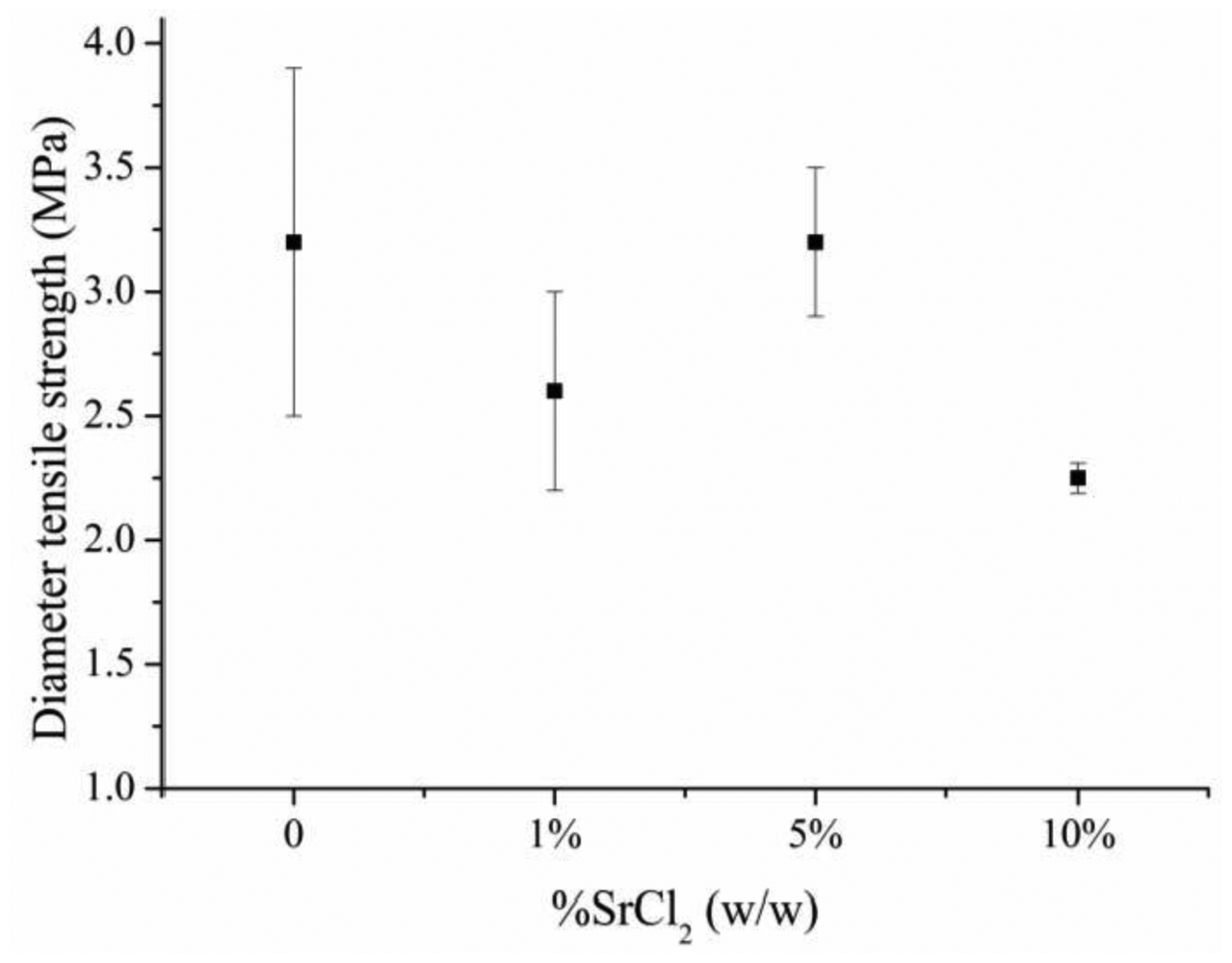
<p>The presence of Sr<sup>2+</sup> in the cement paste seems to affect the cement diameter tensile strength. Unmodified brushite cement had a diameter tensile strength of 3.2 ± 0.7 MPa. SrCl<sub>2</sub> concentrations up to 5% did not significantly affect the cement tensile strength. Nevertheless, the addition of 10% (w/w) SrCl<sub>2</sub> decreased the cement tensile strength to <italic>ca.</italic> 2 MPa (<xref ref-type="fig" rid="f1-jfb-02-00031">Figure 1</xref>).</p>
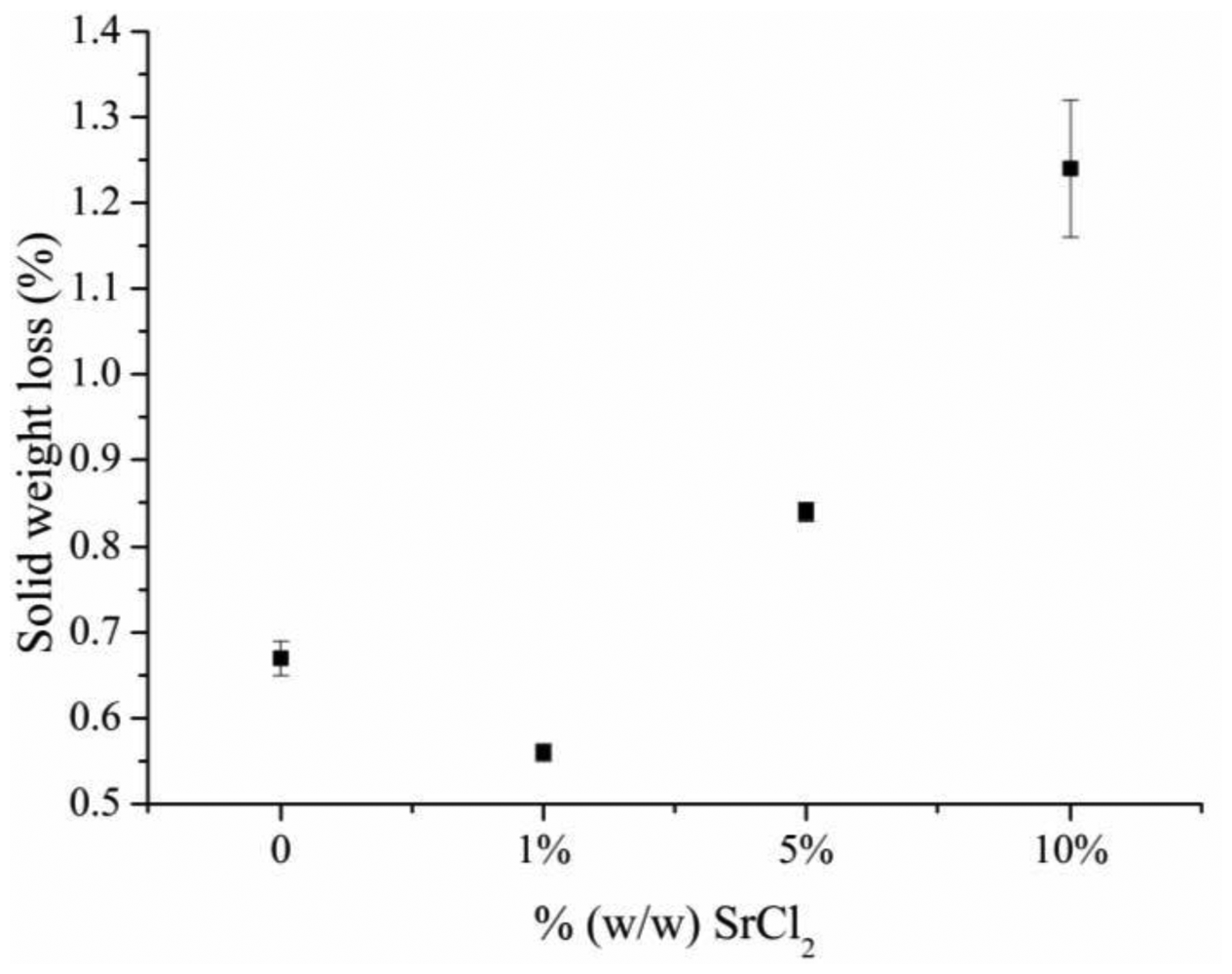
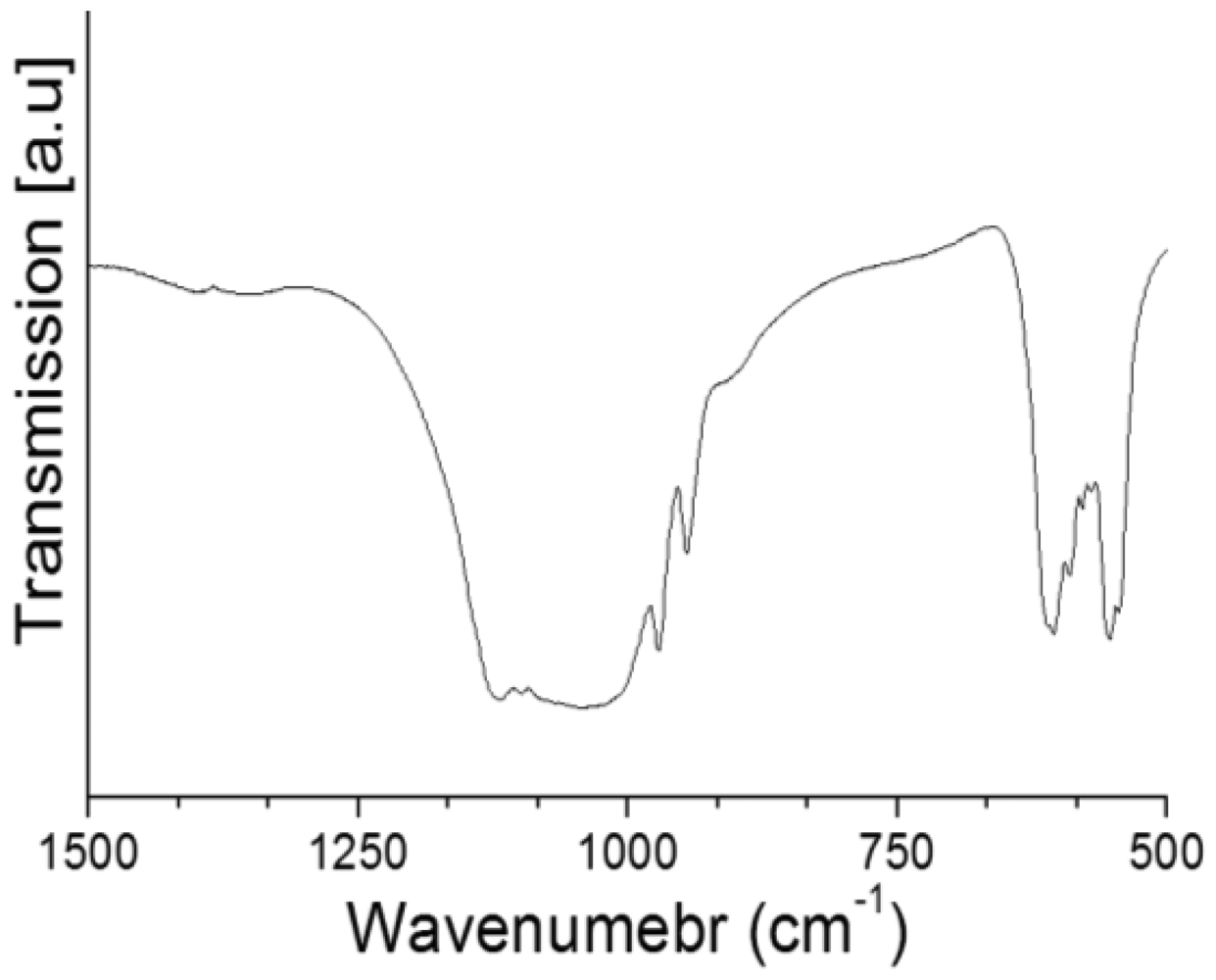
<p>Herein, the cement solid weight loss was used as an indicator for cement cohesion as reported in previous studies [<xref ref-type="bibr" rid="b17-jfb-02-00031">17</xref>-<xref ref-type="bibr" rid="b19-jfb-02-00031">19</xref>]. The cement weight loss was generally increased with the increase in SrCl<sub>2</sub> concentration (<xref ref-type="fig" rid="f2-jfb-02-00031">Figure 2</xref>). The solid weight loss of Sr-free cements was about 0.5% that was increased to <italic>ca.</italic> 0.9 and 1.7% for cements prepared with SrCl<sub>2</sub> of 5 and 10%. The released particles were β-TCP as indicated by FTIR spectroscopy (<xref ref-type="fig" rid="f3-jfb-02-00031">Figure 3</xref>).</p>
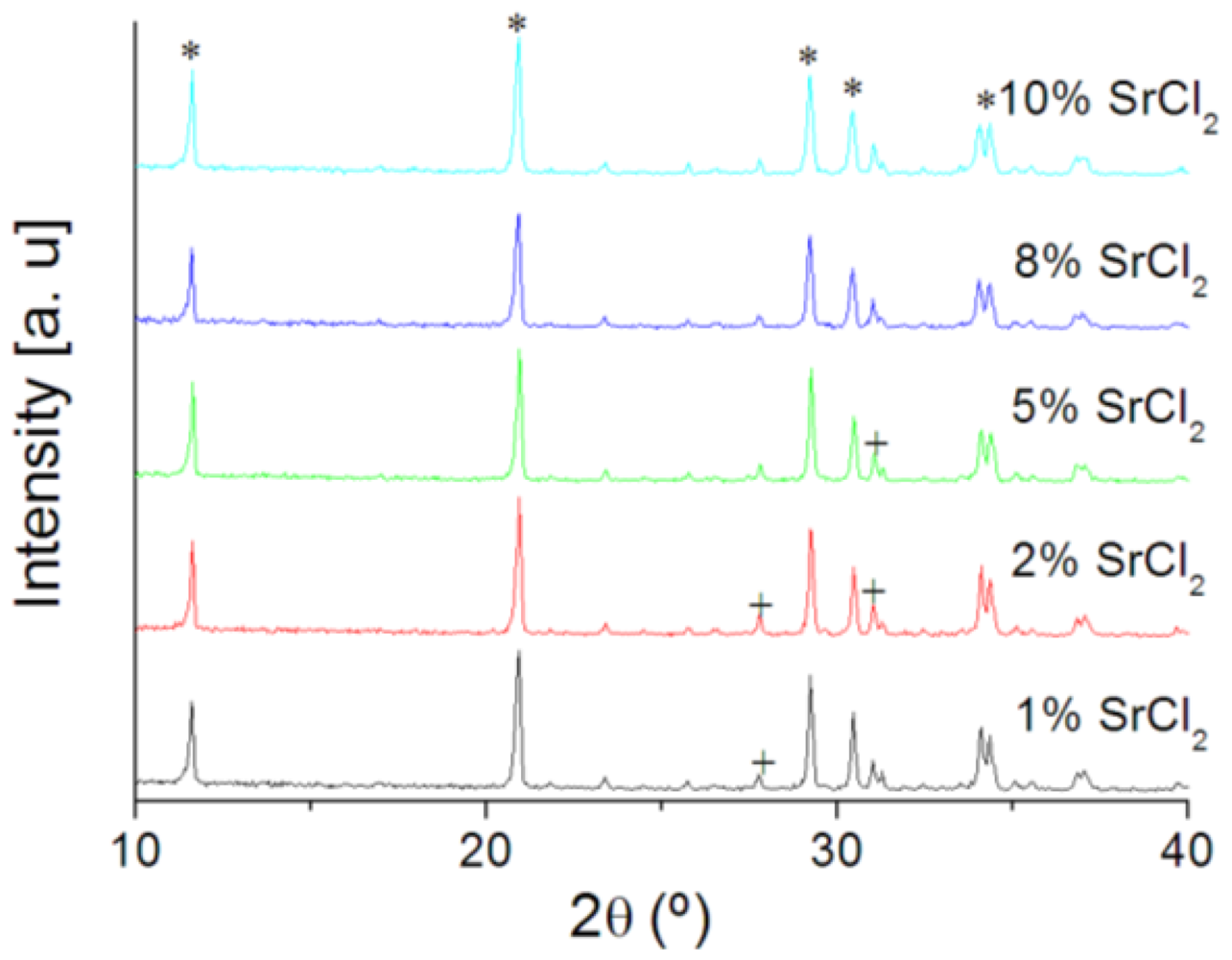
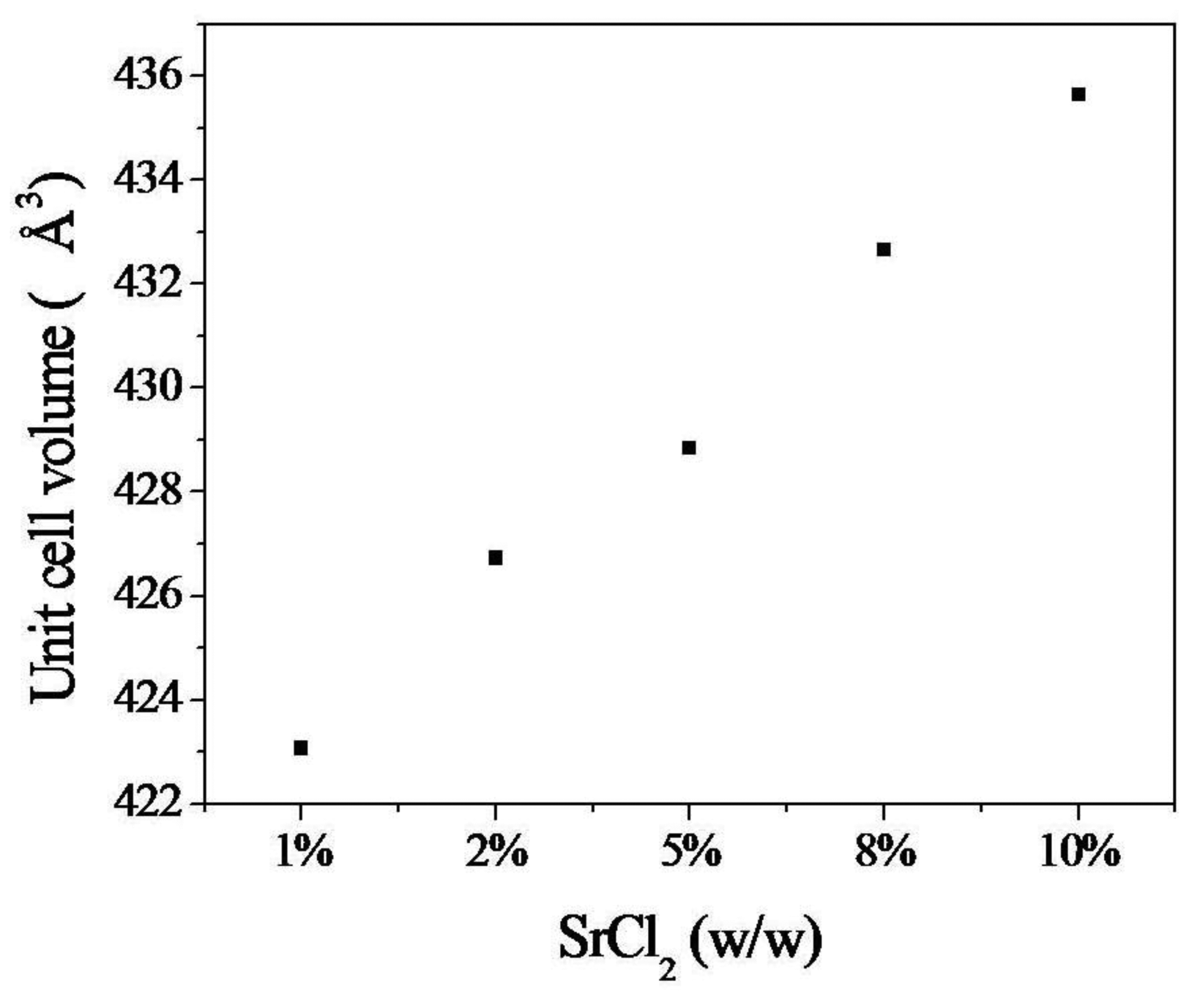
<p>Rietveld analysis of the XRD spectra of cement samples was summarized in <xref ref-type="table" rid="t2-jfb-02-00031">Table 2</xref>. The cement matrix were composed of β-TCP in a predominantly brushite matrix (<xref ref-type="fig" rid="f4-jfb-02-00031">Figure 4</xref>). The diffraction peaks of brushite are shifted toward lower diffraction angles indicating an increase in unit cell volume. The relative amount of brushite in cement matrix did not seem to be affected by the increase in SrCl<sub>2</sub>. Rietveld refinement of brushite unit cell parameters indicated a conspicuous increase in the parameters value with the increase in strontium concentration up to 8% (w/w). However, the unit cell parameters <italic>a</italic>, <italic>c</italic> decreased while the <italic>b</italic> increased at 10% (w/w) SrCl<sub>2</sub> (<xref ref-type="table" rid="t2-jfb-02-00031">Table 2</xref>). Nevertheless, the unit cell volume calculated for monoclinic system increased linearly for all SrCl<sub>2</sub> concentrations (<xref ref-type="fig" rid="f5-jfb-02-00031">Figure 5</xref>).</p></sec>
<sec sec-type="discussion">
<label>4.</label>
<title>Discussion</title>
<p>The unit cell of DCPD contains four calcium and four phosphorus atoms. The Ca and P atoms are linked to form corrugated sheets where each two sheets are joined together by water molecules. All Ca sites in the crystal lattice are characterized by almost identical coordination [<xref ref-type="bibr" rid="b14-jfb-02-00031">14</xref>]. As all Ca sites in the DCPD lattice can be occupied by Sr atoms, brushite cements could be used as a delivery system for strontium ions.</p>
<p>Strontium ions were successfully incorporated in the structure of brushite crystals as evidenced by an increase of unit cell volume with the increased strontium content (<xref ref-type="fig" rid="f5-jfb-02-00031">Figure 5</xref>). This is related to the fact that the ionic radius of Sr<sup>2+</sup> (1.13 Å) is larger than calcium ion (1.00 Å).</p>
<p>Brushite cement FST was increased significantly at high SrCl<sub>2</sub> concentration (<xref ref-type="table" rid="t1-jfb-02-00031">Table 1</xref>). The dissolution of the basic β-TCP is determinant to brushite cement FST. Christoffersen <italic>et al.</italic> reported that Sr<sup>2+</sup> inhibits the rate of dissolution of hydroxyapatite, similarly, the presence of Sr<sup>2+</sup> in the cement paste could inhibit the dissolution rate of β-TCP increasing the cement FST [<xref ref-type="bibr" rid="b20-jfb-02-00031">20</xref>]. Strontium ions were also reported to inhibit apatite deposition and retard calcium phosphate precipitation. Thus, Sr<sup>2+</sup> could inhibit brushite crystal growth [<xref ref-type="bibr" rid="b21-jfb-02-00031">21</xref>] and increase the cement FST.</p>
<p>The solid particles released from the brushite cements were β-TCP. Cement solid weight loss was used to indicate brushite cement cohesion [<xref ref-type="bibr" rid="b17-jfb-02-00031">17</xref>-<xref ref-type="bibr" rid="b19-jfb-02-00031">19</xref>]. Brushite solubility affects the cement cohesion as reported in a previous study [<xref ref-type="bibr" rid="b17-jfb-02-00031">17</xref>); such that the more soluble the brushite crystals are, the more β-TCP particles are released. It was reported that strontium substitution for calcium expands hydroxyapatite crystals lattice and increases their solubility [<xref ref-type="bibr" rid="b20-jfb-02-00031">20</xref>]. Herein, strontium incorporation causes brushite crystals to expand and thus decreases their stability, resulting in more soluble brushite crystals. Consequently, β-TCP particles release and cement solid weight loss increased.</p>
<p>Brushite cement diameter tensile strength was significantly affected when 10% (w/w) SrCl<sub>2</sub> was added. At this concentration, strontium content within brushite lattice was the highest as indicated by cell unit volume. This high content of strontium may decrease the microhardness of brushite crystals and, therefore, the cement diameter tensile strength. Cement porosity is determinant to the cement mechanical properties. The increased solubility of Sr-containing brushite crystals could increase the number and/or the size of cement pores and thus decrease cement tensile strength.</p></sec>
<sec sec-type="conclusions">
<label>5.</label>
<title>Conclusions</title>
<p>The modification of brushite cements with strontium chloride is efficient to induce calcium ions substitution by strontium ions.</p></sec></body>
<back>
<sec sec-type="display-objects">
<title>Figures and Tables</title>
<fig id="f1-jfb-02-00031" position="float">
<label>Figure 1.</label>
<caption>
<p>The effect of strontium ions in brushite cement tensile strength.</p></caption>
<graphic xlink:href="jfb-02-00031f1.gif"/></fig>
<fig id="f2-jfb-02-00031" position="float">
<label>Figure 2.</label>
<caption>
<p>Strontium ions effect on brushite cement cohesion.</p></caption>
<graphic xlink:href="jfb-02-00031f2.gif"/></fig>
<fig id="f3-jfb-02-00031" position="float">
<label>Figure 3.</label>
<caption>
<p>FTIR spectrum of the particles released from cement surface.</p></caption>
<graphic xlink:href="jfb-02-00031f3.gif"/></fig>
<fig id="f4-jfb-02-00031" position="float">
<label>Figure 4.</label>
<caption>
<p>X-ray diffraction patterns of brushite cements modified by SrCl<sub>2</sub>. Predominant peaks of brushite (*) and β-TCP (+) are labeled.</p></caption>
<graphic xlink:href="jfb-02-00031f4.gif"/></fig>
<fig id="f5-jfb-02-00031" position="float">
<label>Figure 5.</label>
<caption>
<p>Cell unit volume of Sr-modified brushite cements.</p></caption>
<graphic xlink:href="jfb-02-00031f5.gif"/></fig>
<table-wrap id="t1-jfb-02-00031" position="float">
<label>Table 1.</label>
<caption>
<p>Strontium effect on brushite cement final setting time.</p></caption>
<table frame="box" rules="all">
<thead>
<tr>
<th align="left" valign="top"><bold>% SrCl<sub>2</sub> (w/w)</bold></th>
<th align="center" valign="top"><bold>FST (minutes)</bold></th></tr></thead>
<tbody>
<tr>
<td align="left" valign="top">0</td>
<td align="center" valign="top">6.9 ± 0.3</td></tr>
<tr>
<td align="left" valign="top">1%</td>
<td align="center" valign="top">7.1 ± 0.1</td></tr>
<tr>
<td align="left" valign="top">5%</td>
<td align="center" valign="top">19.1 ± 0.2</td></tr>
<tr>
<td align="left" valign="top">10%</td>
<td align="center" valign="top">45 ± 1</td></tr></tbody></table></table-wrap>
<table-wrap id="t2-jfb-02-00031" position="float">
<label>Table 2.</label>
<caption>
<p>Lattice parameters of brushite crystals in set cement.</p></caption>
<table frame="box" rules="all">
<thead>
<tr>
<th align="center" valign="middle" rowspan="2"><bold>% SrCl<sub>2</sub> (w/w)</bold></th>
<th colspan="2" align="center" valign="top"><bold>Cement composition</bold></th>
<th colspan="3" align="center" valign="middle"><bold>Lattice parameters (Å)</bold></th></tr>
<tr>
<th align="center" valign="top"><bold>DCPD (%)</bold></th>
<th align="center" valign="top"><bold>β-TCP (%)</bold></th>
<th align="center" valign="middle"><bold><italic>a</italic></bold></th>
<th align="center" valign="middle"><bold><italic>b</italic></bold></th>
<th align="center" valign="middle"><bold><italic>c</italic></bold></th></tr></thead>
<tbody>
<tr>
<td align="center" valign="top">1</td>
<td align="center" valign="top">83</td>
<td align="center" valign="top">17</td>
<td align="center" valign="top">6.365250 ± 0.002</td>
<td align="center" valign="top">15.187980 ± 0.006</td>
<td align="center" valign="top">5.812983 ± 0.003</td></tr>
<tr>
<td align="center" valign="top">2</td>
<td align="center" valign="top">81</td>
<td align="center" valign="top">19</td>
<td align="center" valign="top">6.367848 ± 0.002</td>
<td align="center" valign="top">15.191320 ± 0.006</td>
<td align="center" valign="top">5.814205 ± 0.002</td></tr>
<tr>
<td align="center" valign="top">5</td>
<td align="center" valign="top">82</td>
<td align="center" valign="top">18</td>
<td align="center" valign="top">6.369741 ± 0.001</td>
<td align="center" valign="top">15.192880 ± 0.004</td>
<td align="center" valign="top">5.815243 ± 0.002</td></tr>
<tr>
<td align="center" valign="top">8</td>
<td align="center" valign="top">83</td>
<td align="center" valign="top">17</td>
<td align="center" valign="top">6.376474 ± 0.004</td>
<td align="center" valign="top">15.196140 ± 0.008</td>
<td align="center" valign="top">5.818215 ± 0.003</td></tr>
<tr>
<td align="center" valign="top">10</td>
<td align="center" valign="top">87</td>
<td align="center" valign="top">13</td>
<td align="center" valign="top">6.375908 ± 0.002</td>
<td align="center" valign="top">15.204630 ± 0.006</td>
<td align="center" valign="top">5.818039 ± 0.003</td></tr></tbody></table></table-wrap></sec>
<ref-list>
<title>References</title>
<ref id="b1-jfb-02-00031"><label>1.</label><citation citation-type="journal"><person-group person-group-type="author"><name><surname>Cummings</surname><given-names>S.R.</given-names></name><name><surname>Melton</surname><given-names>L.J.</given-names></name></person-group><article-title>Epidemiology and outcomes of osteoporotic fractures</article-title><source>Lancet</source><year>2002</year><volume>359</volume><fpage>1761</fpage><lpage>1767</lpage><pub-id pub-id-type="doi">10.1016/S0140-6736(02)08657-9</pub-id><pub-id pub-id-type="pmid">12049882</pub-id></citation></ref>
<ref id="b2-jfb-02-00031"><label>2.</label><citation citation-type="journal"><person-group person-group-type="author"><name><surname>Poole</surname><given-names>K.E.</given-names></name><name><surname>Compston</surname><given-names>J.E.</given-names></name></person-group><article-title>Osteoporosis and its management</article-title><source>BMJ</source><year>2006</year><volume>333</volume><fpage>1251</fpage><lpage>1256</lpage><pub-id pub-id-type="doi">10.1136/bmj.39050.597350.47</pub-id><pub-id pub-id-type="pmid">17170416</pub-id></citation></ref>
<ref id="b3-jfb-02-00031"><label>3.</label><citation citation-type="journal"><person-group person-group-type="author"><name><surname>Shorr</surname><given-names>E.</given-names></name><name><surname>Carter</surname><given-names>A.C.</given-names></name></person-group><article-title>The usefulness of strontium as an adjuvant to calcium in the remineralization of the skeleton in man</article-title><source>Bull. Hosp. Joint Dis. Orthop. Inst.</source><year>1952</year><volume>13</volume><fpage>59</fpage><lpage>66</lpage></citation></ref>
<ref id="b4-jfb-02-00031"><label>4.</label><citation citation-type="journal"><person-group person-group-type="author"><name><surname>McCaslin</surname><given-names>F.E.</given-names></name><name><surname>Janes</surname><given-names>J.M.</given-names></name></person-group><article-title>The effect of strontium lactate in the treatment of osteoporosis</article-title><source>Proc. Staff. Meet. Mayo. Clin.</source><year>1959</year><volume>34</volume><fpage>329</fpage><lpage>334</lpage></citation></ref>
<ref id="b5-jfb-02-00031"><label>5.</label><citation citation-type="journal"><person-group person-group-type="author"><name><surname>Meunier</surname><given-names>P.J.</given-names></name><name><surname>Roux</surname><given-names>C.</given-names></name><name><surname>Seeman</surname><given-names>E.</given-names></name><name><surname>Ortolani</surname><given-names>S.</given-names></name><name><surname>Badurski</surname><given-names>J.</given-names></name><name><surname>Spector</surname><given-names>T.D.</given-names></name><name><surname>Cannata</surname><given-names>J.</given-names></name><name><surname>Balogh</surname><given-names>A.</given-names></name><name><surname>Lemmel</surname><given-names>E.M.</given-names></name><name><surname>Pors-Nielsen</surname><given-names>S.</given-names></name><name><surname>Rizzoli</surname><given-names>R.</given-names></name><name><surname>Genant</surname><given-names>H.K.</given-names></name><name><surname>Reginster</surname><given-names>J.Y.</given-names></name></person-group><article-title>The effects of strontium ranelate on the risk of vertebral fracture in women with postmenopausal osteoporosis</article-title><source>New Eng. J. Med.</source><year>2004</year><volume>350</volume><fpage>459</fpage><lpage>468</lpage><pub-id pub-id-type="doi">10.1056/NEJMoa022436</pub-id><pub-id pub-id-type="pmid">14749454</pub-id></citation></ref>
<ref id="b6-jfb-02-00031"><label>6.</label><citation citation-type="journal"><person-group person-group-type="author"><name><surname>Reginster</surname><given-names>J.Y.</given-names></name><name><surname>Seeman</surname><given-names>E.</given-names></name><name><surname>De Vernejoul</surname><given-names>M.C.</given-names></name><name><surname>Adami</surname><given-names>S.</given-names></name><name><surname>Compston</surname><given-names>J.</given-names></name><name><surname>Phenekos</surname><given-names>C.</given-names></name><name><surname>Devogelaer</surname><given-names>J.P.</given-names></name><name><surname>Diaz Curiel</surname><given-names>M.</given-names></name><name><surname>Sawicki</surname><given-names>A.</given-names></name><name><surname>Goemaere</surname><given-names>S.</given-names></name><name><surname>Sorensen</surname><given-names>O.H.</given-names></name><name><surname>Felsenberg</surname><given-names>D.</given-names></name><name><surname>Meunier</surname><given-names>P.J.</given-names></name></person-group><article-title>Strontium ranelate reduces the risk of nonvertebral fractures in postmenopausal women with osteoporosis: Treatment of Peripheral Osteoporosis (TROPOS) study</article-title><source>J. Clin. Endocrinol. Metab.</source><year>2005</year><volume>90</volume><fpage>2816</fpage><lpage>2822</lpage><pub-id pub-id-type="doi">10.1210/jc.2004-1774</pub-id><pub-id pub-id-type="pmid">15728210</pub-id></citation></ref>
<ref id="b7-jfb-02-00031"><label>7.</label><citation citation-type="journal"><person-group person-group-type="author"><name><surname>Baron</surname><given-names>R.</given-names></name><name><surname>Tsouderos</surname><given-names>Y.</given-names></name></person-group><article-title><italic>In vitro</italic> effects of S12911-2 on osteoclast function and bone marrow macrophage differentiation</article-title><source>Eur. J. Pharmacol.</source><year>2002</year><volume>450</volume><fpage>11</fpage><lpage>17</lpage><pub-id pub-id-type="doi">10.1016/S0014-2999(02)02040-X</pub-id><pub-id pub-id-type="pmid">12176103</pub-id></citation></ref>
<ref id="b8-jfb-02-00031"><label>8.</label><citation citation-type="journal"><person-group person-group-type="author"><name><surname>Takahashi</surname><given-names>N.</given-names></name><name><surname>Sasaki</surname><given-names>T.</given-names></name><name><surname>Tsouderos</surname><given-names>Y.</given-names></name><name><surname>Suda</surname><given-names>T.</given-names></name></person-group><article-title>S 12911-2 inhibits osteoclastic bone resorption <italic>in vitro</italic></article-title><source>J. Bone Miner Res.</source><year>2003</year><volume>18</volume><fpage>1082</fpage><lpage>1087</lpage><pub-id pub-id-type="doi">10.1359/jbmr.2003.18.6.1082</pub-id><pub-id pub-id-type="pmid">12817762</pub-id></citation></ref>
<ref id="b9-jfb-02-00031"><label>9.</label><citation citation-type="journal"><person-group person-group-type="author"><name><surname>Marie</surname><given-names>P.J.</given-names></name></person-group><article-title>Strontium ranelate: A physiological approach for optimizing bone formation and resorption</article-title><source>Bone</source><year>2006</year><volume>38</volume><fpage>S10</fpage><lpage>S14</lpage><pub-id pub-id-type="pmid">16439191</pub-id></citation></ref>
<ref id="b10-jfb-02-00031"><label>10.</label><citation citation-type="journal"><person-group person-group-type="author"><name><surname>Canalis</surname><given-names>E.</given-names></name><name><surname>Hott</surname><given-names>M.</given-names></name><name><surname>Deloffre</surname><given-names>P.</given-names></name><name><surname>Tsouderos</surname><given-names>Y.</given-names></name><name><surname>Marie</surname><given-names>P.J.</given-names></name></person-group><article-title>The divalent strontium salts S12911 enhances bone cell replication and bone formation <italic>in vitro</italic></article-title><source>Bone</source><year>1996</year><volume>18</volume><fpage>517</fpage><lpage>523</lpage><pub-id pub-id-type="doi">10.1016/8756-3282(96)00080-4</pub-id><pub-id pub-id-type="pmid">8805991</pub-id></citation></ref>
<ref id="b11-jfb-02-00031"><label>11.</label><citation citation-type="journal"><person-group person-group-type="author"><name><surname>Johal</surname><given-names>K.K.</given-names></name><name><surname>Hill</surname><given-names>R.G.</given-names></name><name><surname>Brook</surname><given-names>I.M.</given-names></name></person-group><article-title><italic>In vivo</italic> response of strontium and zinc based ionomeric cement implants in bone</article-title><source>J. Mater. Sci. Mater. Med.</source><year>2002</year><volume>13</volume><fpage>375</fpage><lpage>379</lpage><pub-id pub-id-type="doi">10.1023/A:1014336517741</pub-id><pub-id pub-id-type="pmid">15348612</pub-id></citation></ref>
<ref id="b12-jfb-02-00031"><label>12.</label><citation citation-type="journal"><person-group person-group-type="author"><name><surname>Leroux</surname><given-names>L.</given-names></name><name><surname>Lacout</surname><given-names>J.L.</given-names></name></person-group><article-title>Preparation of calcium strontium hydroxyapatites by a new route involving calcium phosphate cements</article-title><source>J. Mater. Res.</source><year>2001</year><volume>16</volume><fpage>171</fpage><lpage>176</lpage><pub-id pub-id-type="doi">10.1557/JMR.2001.0028</pub-id></citation></ref>
<ref id="b13-jfb-02-00031"><label>13.</label><citation citation-type="journal"><person-group person-group-type="author"><name><surname>Guo</surname><given-names>D.</given-names></name><name><surname>Xu</surname><given-names>K.</given-names></name><name><surname>Zhao</surname><given-names>X.</given-names></name><name><surname>Han</surname><given-names>Y.</given-names></name></person-group><article-title>Development of a strontiumcontaining hydroxyapatite bone cement</article-title><source>Biomaterials</source><year>2005</year><volume>26</volume><fpage>4073</fpage><lpage>4083</lpage><pub-id pub-id-type="doi">10.1016/j.biomaterials.2004.10.032</pub-id><pub-id pub-id-type="pmid">15664634</pub-id></citation></ref>
<ref id="b14-jfb-02-00031"><label>14.</label><citation citation-type="journal"><person-group person-group-type="author"><name><surname>Rokita</surname><given-names>E.</given-names></name><name><surname>Hermes</surname><given-names>C.</given-names></name><name><surname>Nolting</surname><given-names>H.F.</given-names></name><name><surname>Ryczek</surname><given-names>J.</given-names></name></person-group><article-title>Substitution of calcium by strontium within selected calcium phosphates</article-title><source>J. Cryst. Growth</source><year>1993</year><volume>130</volume><fpage>543</fpage><lpage>552</lpage><pub-id pub-id-type="doi">10.1016/0022-0248(93)90543-6</pub-id></citation></ref>
<ref id="b15-jfb-02-00031"><label>15.</label><citation citation-type="journal"><person-group person-group-type="author"><name><surname>Penel</surname><given-names>G.</given-names></name><name><surname>Leroy</surname><given-names>N.</given-names></name><name><surname>Van Landuyt</surname><given-names>P.</given-names></name><name><surname>Flautre</surname><given-names>B.</given-names></name><name><surname>Hardouin</surname><given-names>P.</given-names></name><name><surname>Lemaitre</surname><given-names>J.</given-names></name><name><surname>Leroy</surname><given-names>G.</given-names></name></person-group><article-title>Raman microspectrometry studies of bruhsite cement: <italic>In vivo</italic> evolution in a sheep model</article-title><source>Bone</source><year>1999</year><volume>25</volume><fpage>81S</fpage><lpage>84S</lpage><pub-id pub-id-type="doi">10.1016/S8756-3282(99)00139-8</pub-id><pub-id pub-id-type="pmid">10458282</pub-id></citation></ref>
<ref id="b16-jfb-02-00031"><label>16.</label><citation citation-type="patent"><person-group person-group-type="author"><name><surname>Bohner</surname><given-names>M.</given-names></name><name><surname>Matter</surname><given-names>S.</given-names></name></person-group><article-title>Brushite hydraulic cement stabilized with a magnesium salt</article-title><patent>U.S. Patent 6,733,582, 2004</patent></citation></ref>
<ref id="b17-jfb-02-00031"><label>17.</label><citation citation-type="journal"><person-group person-group-type="author"><name><surname>Alkhraisat</surname><given-names>M.H.</given-names></name><name><surname>Marino</surname><given-names>F.T.</given-names></name><name><surname>Retama</surname><given-names>J.R.</given-names></name><name><surname>Jerez</surname><given-names>L.B.</given-names></name><name><surname>Lopez-Cabarcos</surname><given-names>E.</given-names></name></person-group><article-title>Betatricalcium phosphate release from brushite cement surface</article-title><source>J. Biomed. Mater. Res. A</source><year>2008</year><volume>84</volume><fpage>710</fpage><lpage>717</lpage><pub-id pub-id-type="pmid">17635024</pub-id></citation></ref>
<ref id="b18-jfb-02-00031"><label>18.</label><citation citation-type="journal"><person-group person-group-type="author"><name><surname>Alkhraisat</surname><given-names>M.H.</given-names></name><name><surname>Rueda</surname><given-names>C.</given-names></name><name><surname>Jerez</surname><given-names>L.B.</given-names></name><name><surname>Tamimi</surname><given-names>M.F.</given-names></name><name><surname>Torres</surname><given-names>J.</given-names></name><name><surname>Gbureck</surname><given-names>U.</given-names></name><name><surname>Cabarcos</surname><given-names>E.L.</given-names></name></person-group><article-title>Effect of silica gel on the cohesion, properties and biological performance of brushite cement</article-title><source>Acta Biomater.</source><year>2010</year><volume>6</volume><fpage>257</fpage><lpage>265</lpage><pub-id pub-id-type="doi">10.1016/j.actbio.2009.06.010</pub-id><pub-id pub-id-type="pmid">19523541</pub-id></citation></ref>
<ref id="b19-jfb-02-00031"><label>19.</label><citation citation-type="journal"><person-group person-group-type="author"><name><surname>Alkhraisat</surname><given-names>M.H.</given-names></name><name><surname>Rueda</surname><given-names>C.</given-names></name><name><surname>Mariño</surname><given-names>F.T.</given-names></name><name><surname>Torres</surname><given-names>J.</given-names></name><name><surname>Jerez</surname><given-names>L.B.</given-names></name><name><surname>Gbureck</surname><given-names>U.</given-names></name><name><surname>Cabarcos</surname><given-names>E.L.</given-names></name></person-group><article-title>The effect of hyaluronic acid on brushite cement cohesion</article-title><source>Acta Biomater.</source><year>2009</year><volume>5</volume><fpage>3150</fpage><lpage>3156</lpage><pub-id pub-id-type="doi">10.1016/j.actbio.2009.04.001</pub-id><pub-id pub-id-type="pmid">19409871</pub-id></citation></ref>
<ref id="b20-jfb-02-00031"><label>20.</label><citation citation-type="journal"><person-group person-group-type="author"><name><surname>Christoffersen</surname><given-names>J.</given-names></name><name><surname>Christoffersen</surname><given-names>M.R.</given-names></name><name><surname>Kolthoff</surname><given-names>N.</given-names></name><name><surname>Barenhold</surname><given-names>O.</given-names></name></person-group><article-title>Effects of strontium ions on growth and dissolution of hydroxyapatite and on bone mineral detection</article-title><source>Bone</source><year>1997</year><volume>20</volume><fpage>47</fpage><lpage>54</lpage><pub-id pub-id-type="doi">10.1016/S8756-3282(96)00316-X</pub-id><pub-id pub-id-type="pmid">8988347</pub-id></citation></ref>
<ref id="b21-jfb-02-00031"><label>21.</label><citation citation-type="journal"><person-group person-group-type="author"><name><surname>Zawacki</surname><given-names>S.J.</given-names></name><name><surname>Koutsoukos</surname><given-names>P.B.</given-names></name><name><surname>Salimi</surname><given-names>M.H.</given-names></name><name><surname>Nancollas</surname><given-names>G.H.</given-names></name></person-group><article-title>The growth of calcium phosphates</article-title><source>Geochem. Process. Min. Surface.</source><year>1987</year><volume>32</volume><fpage>650</fpage><lpage>662</lpage></citation></ref></ref-list></back></article>