
<?xml version="1.0" encoding="UTF-8"?>
<!DOCTYPE article PUBLIC "-//NLM//DTD Journal Publishing DTD v2.3 20070202//EN" "journalpublishing.dtd">
<article xmlns:mml="http://www.w3.org/1998/Math/MathML" xmlns:xlink="http://www.w3.org/1999/xlink" xml:lang="en" article-type="research-article">
  <front>
    <journal-meta>
      <journal-id journal-id-type="publisher-id">metals</journal-id>
      <journal-title>Metals</journal-title>
      <abbrev-journal-title abbrev-type="publisher">Metals</abbrev-journal-title>
      <abbrev-journal-title abbrev-type="pubmed">Metals</abbrev-journal-title>
      <issn pub-type="epub">2075-4701</issn>
      <publisher>
        <publisher-name>MDPI</publisher-name>
      </publisher>
    </journal-meta>
    <article-meta>
      <article-id pub-id-type="doi">10.3390/met2030219</article-id>
      <article-id pub-id-type="publisher-id">metals-02-00219</article-id>
      <article-categories>
        <subj-group>
          <subject>Article</subject>
        </subj-group>
      </article-categories>
      <title-group>
        <article-title>Dehydrogenation Kinetics and Modeling Studies of MgH<sub>2</sub> Enhanced by Transition Metal Oxide Catalysts Using Constant Pressure Thermodynamic Driving Forces</article-title>
      </title-group>
      <contrib-group>
        <contrib contrib-type="author">
          <name>
            <surname>Sabitu</surname>
            <given-names>Saidi Temitope</given-names>
          </name>
        </contrib>
        <contrib contrib-type="author">
          <name>
            <surname>Goudy</surname>
            <given-names>Andrew J.</given-names>
          </name>
          <xref rid="c1-metals-02-00219" ref-type="corresp">*</xref>
        </contrib>
      </contrib-group>
      <aff id="af1-metals-02-00219">Department of Chemistry, Delaware State University, Dover, DE 19901, USA; Email: <email>sabtemmy@yahoo.com</email> </aff>
      <author-notes>
        <corresp id="c1-metals-02-00219"><label>*</label> Author to whom correspondence should be addressed; Email: <email>agoudy@desu.edu</email>; Tel.: +1-302-857-6534; Fax: +1-302-857-6539.</corresp>
      </author-notes>
      <pub-date pub-type="epub">
        <day>25</day>
        <month>06</month>
        <year>2012</year>
      </pub-date>
      <pub-date pub-type="collection"><month>09</month>
        <year>2012</year>
      </pub-date>
      <volume>2</volume>
      <issue>3</issue>
      <fpage>219</fpage>
      <lpage>228</lpage>
      <history>
        <date date-type="received">
          <day>27</day>
          <month>05</month>
          <year>2012</year>
        </date>
        <date date-type="rev-recd">
          <day>13</day>
          <month>06</month>
          <year>2012</year>
        </date>
        <date date-type="accepted">
          <day>14</day>
          <month>06</month>
          <year>2012</year>
        </date>
      </history>
      <permissions>
        <copyright-statement>©  2012 by the authors; licensee MDPI, Basel, Switzerland.</copyright-statement>
        <copyright-year>2012</copyright-year>
        <license xmlns:xlink="http://www.w3.org/1999/xlink" license-type="open-access" xlink:href="http://creativecommons.org/licenses/by/3.0/">
          <p>This article is an open-access article distributed under the terms and conditions of the Creative Commons Attribution license (http://creativecommons.org/licenses/by/3.0/).</p>
        </license>
      </permissions>
      <abstract>
        <p>The influence of transition metal oxide catalysts (ZrO<sub>2</sub>, CeO<sub>2</sub>, Fe<sub>3</sub>O<sub>4</sub> and Nb<sub>2</sub>O<sub>5</sub>) on the hydrogen desorption kinetics of MgH<sub>2</sub> was investigated using constant pressure thermodynamic driving forces in which the ratio of the equilibrium plateau pressure (<italic>p</italic><sub>m</sub>) to the opposing plateau (<italic>p</italic><sub>op</sub>) was the same in all the reactions studied. The results showed Nb<sub>2</sub>O<sub>5</sub> to be vastly superior to other catalysts for improving the thermodynamics and kinetics of MgH<sub>2</sub>. The modeling studies showed reaction at the phase boundary to be likely process controlling the reaction rates of all the systems studied.</p>
      </abstract>
      <kwd-group>
        <kwd>hydrogen storage</kwd>
        <kwd>magnesium hydride</kwd>
        <kwd>kinetics</kwd>
        <kwd>modeling</kwd>
      </kwd-group>
    </article-meta>
  </front>
  <body>
    <sec sec-type="intro">
      <title>1. Introduction</title>
      <p>Magnesium hydride has received considerable attention as a promising hydrogen storage material for on-board vehicular applications because of its high theoretical hydrogen storage capacity (7.6 wt%) and high volumetric density (110 g/L) as well as low cost. However, its practical application is hindered by its high thermal stability and slow desorption kinetics [<xref ref-type="bibr" rid="B1-metals-02-00219">1</xref>,<xref ref-type="bibr" rid="B2-metals-02-00219">2</xref>,<xref ref-type="bibr" rid="B3-metals-02-00219">3</xref>,<xref ref-type="bibr" rid="B4-metals-02-00219">4</xref>,<xref ref-type="bibr" rid="B5-metals-02-00219">5</xref>,<xref ref-type="bibr" rid="B6-metals-02-00219">6</xref>,<xref ref-type="bibr" rid="B7-metals-02-00219">7</xref>,<xref ref-type="bibr" rid="B8-metals-02-00219">8</xref>,<xref ref-type="bibr" rid="B9-metals-02-00219">9</xref>]. Several attempts have been made to improve the thermodynamics and kinetics properties of MgH<sub>2</sub> by reducing the particle size via ball milling and alloying with other transition metals and their oxides [<xref ref-type="bibr" rid="B4-metals-02-00219">4</xref>,<xref ref-type="bibr" rid="B9-metals-02-00219">9</xref>,<xref ref-type="bibr" rid="B10-metals-02-00219">10</xref>,<xref ref-type="bibr" rid="B11-metals-02-00219">11</xref>]. Sohn and Enami [<xref ref-type="bibr" rid="B11-metals-02-00219">11</xref>] reported the loss of hydrogen capacity when transition metals are added to the MgH<sub>2</sub> system. They stated that only a small amount of these transition elements is needed to improve the reaction kinetics and prevent a significant decrease in the hydrogen storage capacity of MgH<sub>2</sub>. Oelerich <italic>et al</italic><italic>.</italic> [<xref ref-type="bibr" rid="B12-metals-02-00219">12</xref>] investigated the influence of metal oxides such as Sc<sub>2</sub>O<sub>3</sub>, TiO<sub>2</sub>, V<sub>2</sub>O<sub>5</sub>, Cr<sub>2</sub>O<sub>3</sub>, Mn<sub>2</sub>O<sub>3</sub>, Fe<sub>3</sub>O<sub>4</sub>, CuO, Al<sub>2</sub>O<sub>3</sub> and SiO<sub>2</sub> on the hydrogen sorption behavior of MgH<sub>2</sub>. They found that the composite material containing Fe<sub>3</sub>O<sub>4</sub> showed the fastest desorption kinetics. They also reported that as little as 0.2 mol% of the catalysts is enough to provide fast sorption kinetics. Barkhordarian <italic>et al</italic><italic>.</italic> [<xref ref-type="bibr" rid="B9-metals-02-00219">9</xref>] researched the efficiency of Nb<sub>2</sub>O<sub>5</sub> as a catalyst for fast hydrogen absorption/desorption kinetics of magnesium and found the catalytic effect of Nb<sub>2</sub>O<sub>5</sub> to be superior when compared to other metal and metal oxide catalysts for both absorption and desorption reactions. Subsequent studies [<xref ref-type="bibr" rid="B9-metals-02-00219">9</xref>] on the effect of varying Nb<sub>2</sub>O<sub>5</sub> content on the hydrogen reaction kinetics of magnesium showed that fastest kinetics was obtained using 0.5 mol% of Nb<sub>2</sub>O<sub>5</sub> and that the activation energy for hydrogen desorption reaction varies exponentially with Nb<sub>2</sub>O<sub>5</sub> concentration. It should be noted that none of these kinetics studies attempted to compare the intrinsic reaction rates of catalyzed magnesium hydride systems using constant pressure thermodynamic driving forces. It is very important that this be done because without constant pressure driving forces, results will vary largely as the conditions change. The importance of this unique method was first demonstrated by Goudy and coworkers [<xref ref-type="bibr" rid="B13-metals-02-00219">13</xref>,<xref ref-type="bibr" rid="B14-metals-02-00219">14</xref>,<xref ref-type="bibr" rid="B15-metals-02-00219">15</xref>] when they analyzed the kinetic behavior of a series of LaNi<sub>5</sub>-based intermetallic hydrides. Since that time, they have used this technique to study the kinetics of other materials such as sodium alanate [<xref ref-type="bibr" rid="B16-metals-02-00219">16</xref>], MgH<sub>2</sub> [<xref ref-type="bibr" rid="B2-metals-02-00219">2</xref>], CaH<sub>2</sub>/LiBH<sub>4</sub> [<xref ref-type="bibr" rid="B17-metals-02-00219">17</xref>] and LiNH<sub>2</sub>/MgH<sub>2</sub> [<xref ref-type="bibr" rid="B18-metals-02-00219">18</xref>] systems. In this study, an attempt has been made to compare the intrinsic dehydriding kinetics of MgH<sub>2</sub> ball milled with various transition metal oxides using constant pressure thermodynamic driving forces. The results should provide more insight into the role that catalysts may have on reaction temperature and rates.</p>
    </sec>
    <sec>
      <title>2. Experimental Section</title>
      <p>The materials used in this research were obtained from Sigma Aldrich. The MgH<sub>2</sub> powder was hydrogen storage grade, and according to the information provided by the supplier, the total amount of trace metal contaminants was less than 0.1%. Sample handling, weighing and loading were performed in a Vacuum Atmospheres argon-filled glove box that was capable of achieving less than 1 ppm oxygen and moisture. Prior to analysis, each sample mixture was milled for up to 10 h in a SPEX 8000M Mixer/Mill that had an argon-filled stainless steel pot which contained four small stainless steel balls. Temperature Programmed Desorption (TPD) and Pressure Composition Isotherm (PCI) analyses were done in a gas reaction controller unit to evaluate the hydrogen desorption properties of each reaction mixture. This apparatus was manufactured by the Advanced Materials Corporation in Pittsburgh, PA. The unit was fully automated and was controlled by a Lab View-based software program. The TPD and PCI analyses were done on freshly ball-milled materials and no activation procedure was necessary. The TPD analyses were done in the 30–450 °C range at a temperature ramp of 4 °C/min. Thermal Gravimetric and Differential Thermal Analysis (TG/DTA) was conducted to determine the thermal stability of the mixtures using a Perkin Elmer Diamond TG/DTA. The experimental apparatus used to perform kinetics was made essentially of stainless steel and equipped with ports for adding hydrogen, venting and evacuating. Pressure regulators were installed to control the hydrogen pressure applied to the sample and to allow hydrogen to flow to or from the sample into a remote reservoir. A method that allowed samples to be measured at the same constant pressure driving force was employed in order to compare the kinetics of the different samples. High purity hydrogen gas of 99.999% purity was used throughout the analyses. </p>
    </sec>
    <sec sec-type="results">
      <title>3. Results and Discussion</title>
      <sec>
        <title>3.1. Temperature Programmed Desorption Measurements</title>
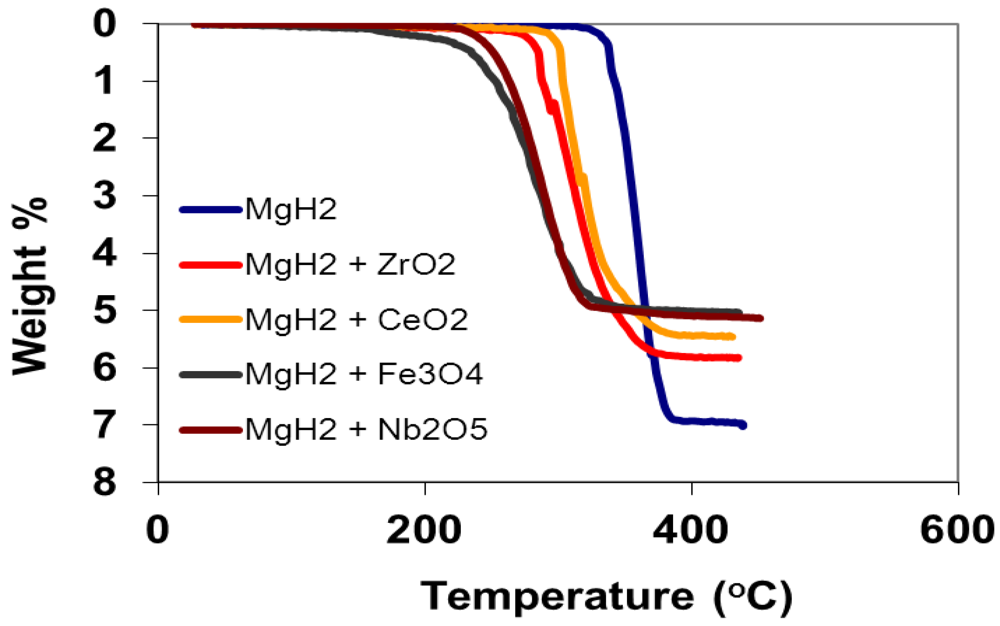
        <p>Temperature Programmed Desorption (TPD) measurements were done on several ball milled mixtures of MgH<sub>2</sub> with 4 mol% of Nb<sub>2</sub>O<sub>5</sub>, ZrO<sub>2</sub>, CeO<sub>2</sub> and Fe<sub>3</sub>O<sub>4</sub>. The samples were ball milled for 10 h and their thermal desorption performance was studied to determine the temperature at which hydrogen was released from the sample mixtures. By so doing, we can understand the effect of each catalyst on the hydrogen desorption properties of MgH<sub>2</sub>. It can be seen from the desorption curves shown in <xref ref-type="fig" rid="metals-02-00219-f001">Figure 1</xref> that MgH<sub>2</sub> has the highest onset temperature of about 310 °C and that the catalyzed samples have lower desorption temperatures. The mixture of MgH<sub>2</sub> + Fe<sub>3</sub>O<sub>4</sub> has the lowest onset desorption temperature of about 200 °C. The onset temperature of the reacting mixtures are in the order: pure MgH<sub>2</sub> &gt; CeO<sub>2</sub> &gt; ZrO<sub>2</sub> &gt; Nb<sub>2</sub>O<sub>5</sub> &gt; Fe<sub>3</sub>O<sub>4</sub>. The plot also revealed that all of the samples released less than 6 wt% of hydrogen. The reduction in hydrogen weight percentage is most likely due to the partial oxidation of the Mg in the alloy caused by the presence of oxide in all the transition metal oxide catalysts. These results confirm that the addition of transition metal oxide catalysts is effective in reducing the desorption temperature of MgH<sub>2</sub>, although accompanied with a small weight penalty. The values of the onset temperatures are summarized in <xref ref-type="table" rid="metals-02-00219-t001">Table 1</xref>.</p>
        <fig id="metals-02-00219-f001" position="anchor">
          <label>Figure 1</label>
          <caption>
            <p>Temperature Programmed Desorption (TPD) profiles for MgH<sub>2</sub> and catalyzed MgH<sub>2</sub> materials.</p>
          </caption>
          <graphic xmlns:xlink="http://www.w3.org/1999/xlink" xlink:href="metals-02-00219-g001.tif"/>
        </fig>
        <table-wrap id="metals-02-00219-t001" position="anchor">
          <object-id pub-id-type="pii">metals-02-00219-t001_Table 1</object-id>
          <label>Table 1</label>
          <caption>
            <p>Thermodynamic and kinetics parameters for catalyzed MgH<sub>2</sub> materials.</p>
          </caption>
          <table>
<thead>
              <tr>
                <th align="center" valign="middle">Sample</th>
                <th align="center" valign="middle">Onset Temperature/°C</th>
                <th align="center" valign="middle">∆H/(kJ/mol)</th>
                <th align="center" valign="middle"><italic>T</italic><sub>90</sub>/min</th>
                <th align="center" valign="middle"><italic>E</italic><sub>a</sub>/(kJ/mol)</th>
              </tr>
            </thead>
            <tbody>
              <tr>
                <td align="center" valign="middle">MgH<sub>2</sub></td>
                <td align="center" valign="middle">310</td>
                <td align="center" valign="middle">78.8</td>
                <td align="center" valign="middle">32</td>
                <td align="center" valign="middle">174</td>
              </tr>
              <tr>
                <td align="center" valign="middle">MgH<sub>2</sub> + 4 mol % ZrO<sub>2</sub></td>
                <td align="center" valign="middle">260</td>
                <td align="center" valign="middle">75.2</td>
                <td align="center" valign="middle">21</td>
                <td align="center" valign="middle">140</td>
              </tr>
              <tr>
                <td align="center" valign="middle">MgH<sub>2</sub> + 4 mol% CeO<sub>2</sub></td>
                <td align="center" valign="middle">270</td>
                <td align="center" valign="middle">74.7</td>
                <td align="center" valign="middle">19</td>
                <td align="center" valign="middle">113</td>
              </tr>
              <tr>
                <td align="center" valign="middle">MgH<sub>2</sub> + 4 mol% Fe<sub>3</sub>O<sub>4</sub></td>
                <td align="center" valign="middle">200</td>
                <td align="center" valign="middle">72.4</td>
                <td align="center" valign="middle">17</td>
                <td align="center" valign="middle">108</td>
              </tr>
              <tr>
                <td align="center" valign="middle">MgH<sub>2</sub> + 4 mol% Nb<sub>2</sub>O<sub>5</sub></td>
                <td align="center" valign="middle">205</td>
                <td align="center" valign="middle">70.2</td>
                <td align="center" valign="middle">16</td>
                <td align="center" valign="middle">95</td>
              </tr>
            </tbody>
          </table>
        </table-wrap>
      </sec>
      <sec>
        <title>3.2. Programmed Composition Isotherm Measurements</title>
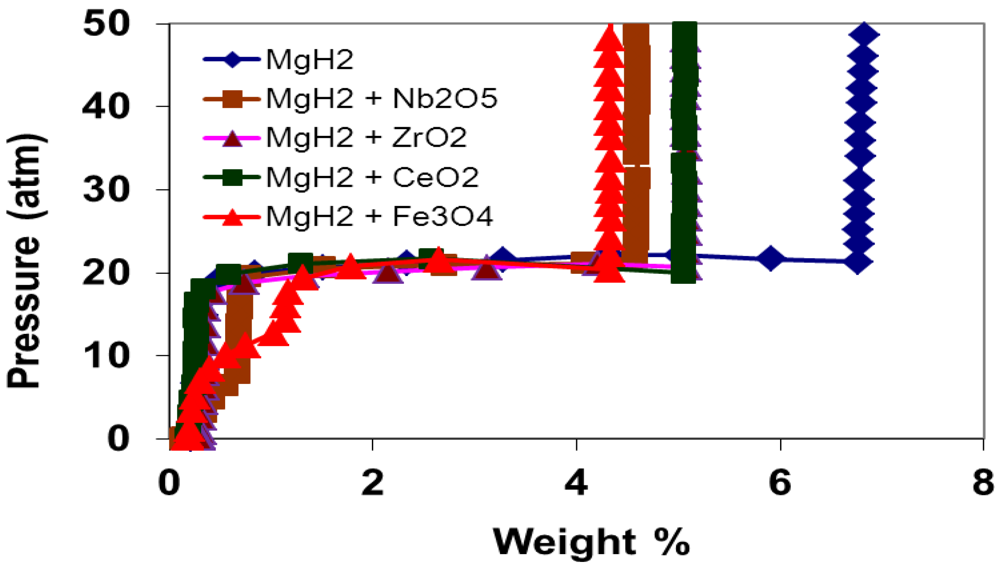
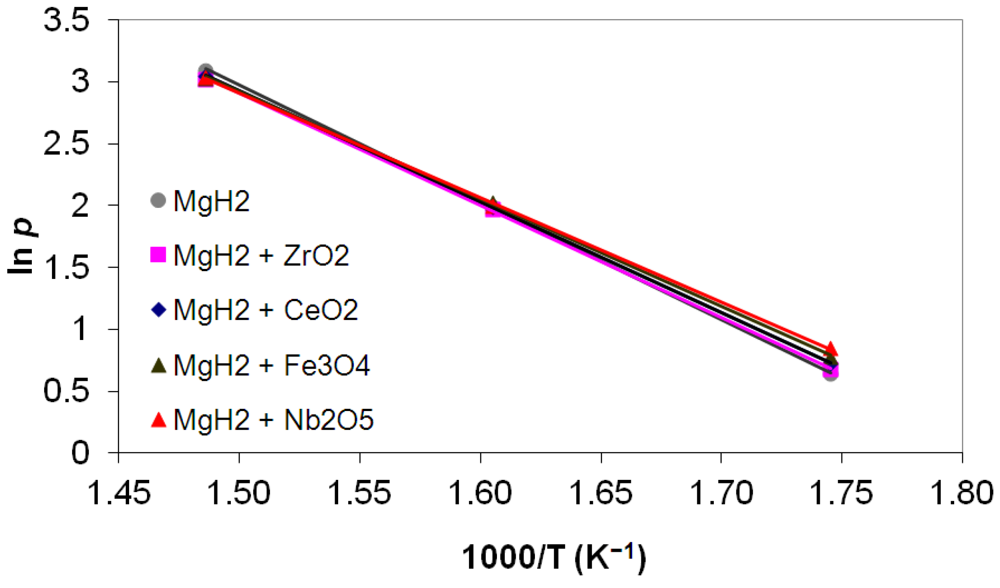
        <p>Pressure Composition Isotherms were constructed for MgH<sub>2</sub> and the catalyzed MgH<sub>2</sub> mixtures. <xref ref-type="fig" rid="metals-02-00219-f002">Figure 2</xref> shows the desorption isotherms for these samples at 400 °C. It can be seen from the curves that the plateau pressures are about the same for all the samples. The data from these isotherms were used to construct the Van’t Hoff plots shown in <xref ref-type="fig" rid="metals-02-00219-f003">Figure 3</xref>. The reaction enthalpies for the mixtures were determined from the slopes of these plots and the values are summarized in <xref ref-type="table" rid="metals-02-00219-t001">Table 1</xref>. It is evident from the Δ<italic>H </italic>values that the thermodynamic stability of MgH<sub>2</sub> decreases with the addition of transition metal oxide catalysts. </p>
        <fig id="metals-02-00219-f002" position="anchor">
          <label>Figure 2</label>
          <caption>
            <p>Desorption isotherms for MgH<sub>2</sub> and catalyzed MgH<sub>2</sub> materials.</p>
          </caption>
          <graphic xmlns:xlink="http://www.w3.org/1999/xlink" xlink:href="metals-02-00219-g002.tif"/>
        </fig>
        <fig id="metals-02-00219-f003" position="anchor">
          <label>Figure 3</label>
          <caption>
            <p>Van’t Hoff desorption plots for MgH<sub>2</sub> and catalyzed MgH<sub>2</sub> materials.</p>
          </caption>
          <graphic xmlns:xlink="http://www.w3.org/1999/xlink" xlink:href="metals-02-00219-g003.tif"/>
        </fig>
      </sec>
      <sec>
        <title>3.3. Kinetics Measurements</title>
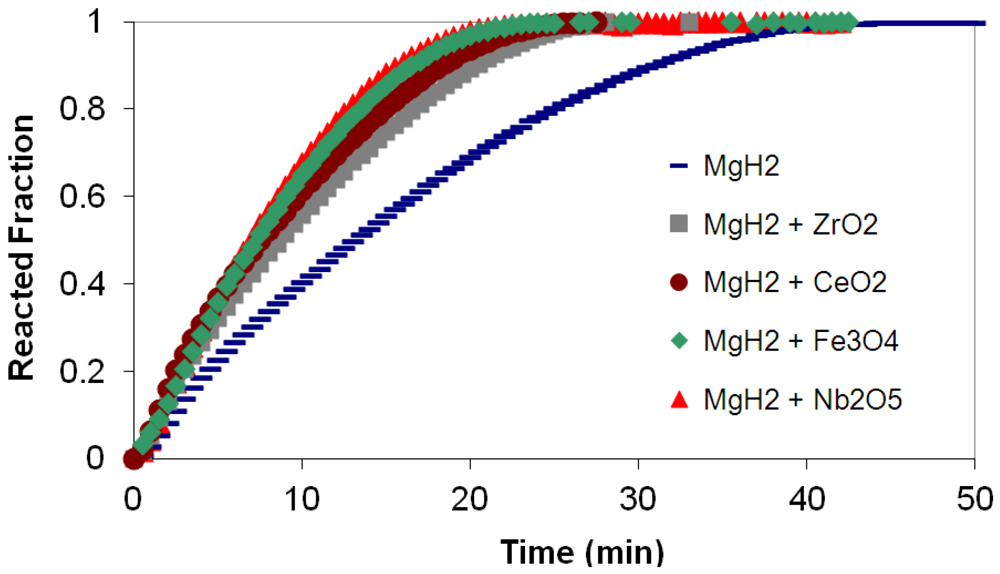
        <p>In addition to having a low desorption temperature, it is also important that samples have fast reaction rates. Desorption kinetics experiments were carried out on each sample at 400 °C to determine the catalytic effect of transition metal oxides on hydrogen desorption rates from MgH<sub>2</sub>. A novel concept of constant pressure thermodynamic driving force was used to achieve these desorption kinetics measurements. This was done by adjusting the hydrogen pressure in the reactor to a slightly higher value than that of the mid-plateau pressure (<italic>p</italic><sub>m</sub>), to ensure that only the hydrogen rich phase was present initially and sealing off the reactor. The pressure in the remaining system (<italic>p</italic><sub>op</sub>) was then adjusted to a value such that the ratio between the mid-plateau pressure and the opposing pressure (<italic>p</italic><sub>m</sub>/<italic>p</italic><sub>op</sub>) was a small whole number. This ratio is defined as the N-value. In these experiments, the N-value was set at 5 for all the sample mixtures. The theoretical basis for using constant pressure thermodynamic forces is that the pressure ratio is proportional to Δ<italic>G</italic> (the Gibbs free energy). The proportionality can be expressed as: Δ<italic>G</italic> ≈ <italic>RT</italic> ln(<italic>p</italic><sub>m</sub>/<italic>p</italic><sub>op</sub>). If the pressure ratio is the same then Δ<italic>G</italic> will be the same for all the reactions. <xref ref-type="fig" rid="metals-02-00219-f004">Figure 4</xref> contains plots of the reacted fraction versus the time for hydrogen desorption from the MgH<sub>2</sub> mixtures with and without catalysts. It can be seen that the uncatalyzed MgH<sub>2</sub> sample has the slowest hydrogen desorption rate. The addition of transition metal oxides improved the kinetics of MgH<sub>2</sub> with Nb<sub>2</sub>O<sub>5</sub> and Fe<sub>3</sub>O<sub>4</sub> having the fastest desorption reaction kinetics. The times required for all of these reactions to reach 90 percent completion (<italic>T</italic><sub>90</sub>) are summarized in <xref ref-type="table" rid="metals-02-00219-t001">Table 1</xref>. </p>
        <fig id="metals-02-00219-f004" position="anchor">
          <label>Figure 4</label>
          <caption>
            <p>Desorption kinetics for MgH<sub>2</sub> and catalyzed MgH<sub>2</sub> materials at 400 °C and <italic>N </italic>= 5.</p>
          </caption>
          <graphic xmlns:xlink="http://www.w3.org/1999/xlink" xlink:href="metals-02-00219-g004.tif"/>
        </fig>
      </sec>
      <sec>
        <title>3.4. Kinetics Modeling Studies</title>
        <p>Smith and Goudy [<xref ref-type="bibr" rid="B15-metals-02-00219">15</xref>], while performing kinetics modeling studies on LaNi<sub>5−<italic>x</italic></sub>Co<italic><sub>x</sub></italic> hydride system (<italic>x</italic> = 0, 1, 2 and 3), reported two theoretical equations based on the shrinking core model that were successfully used to model the system. The equations are shown below:</p>
        <p><inline-graphic xmlns:xlink="http://www.w3.org/1999/xlink" xlink:href="metals-02-00219-i005.tif"/>    (1)</p>
        <p>where <inline-graphic xmlns:xlink="http://www.w3.org/1999/xlink" xlink:href="metals-02-00219-i006.tif"/></p>
        <p><inline-graphic xmlns:xlink="http://www.w3.org/1999/xlink" xlink:href="metals-02-00219-i007.tif"/>    (2)</p>
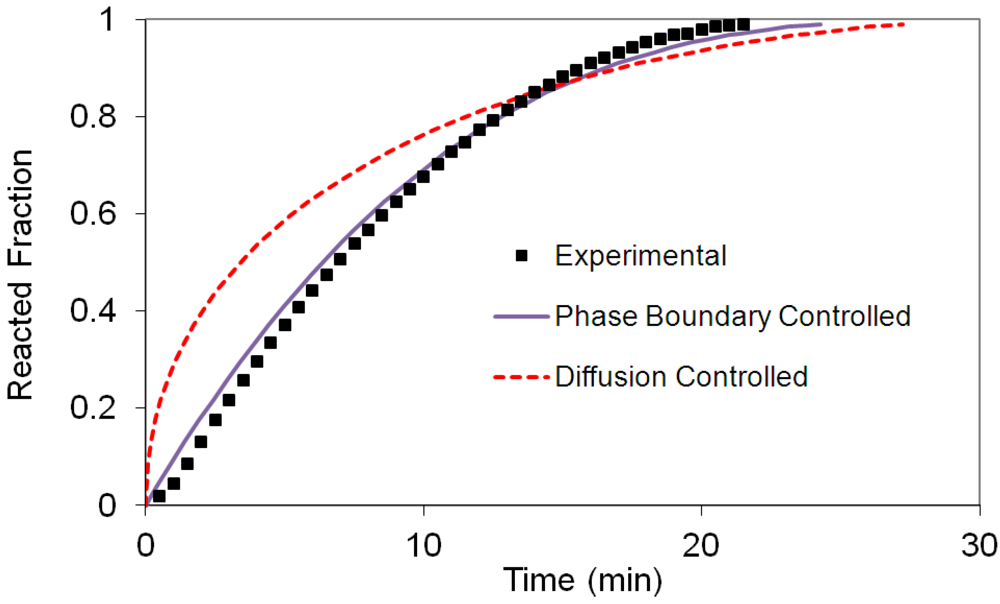
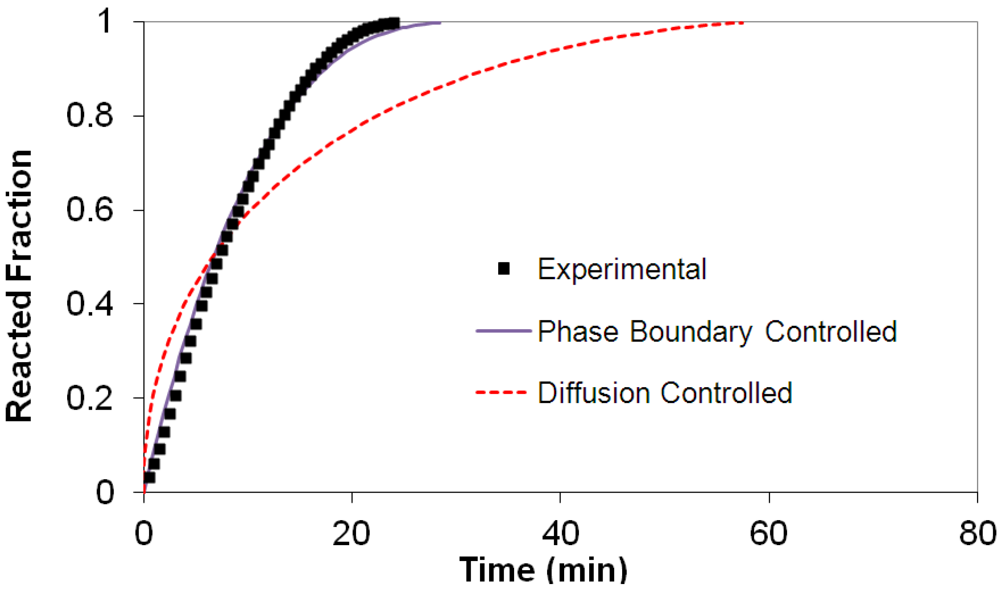
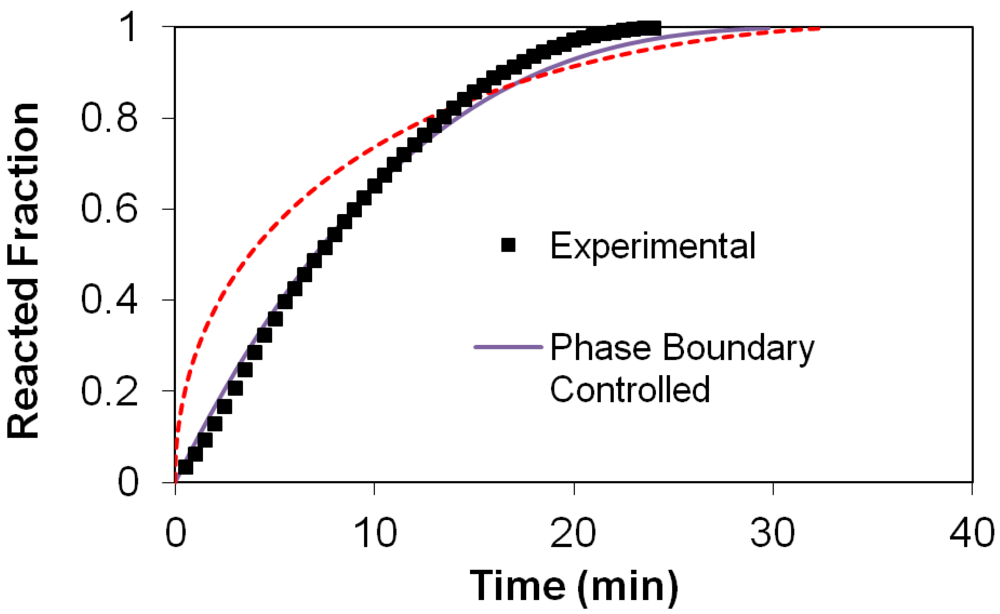
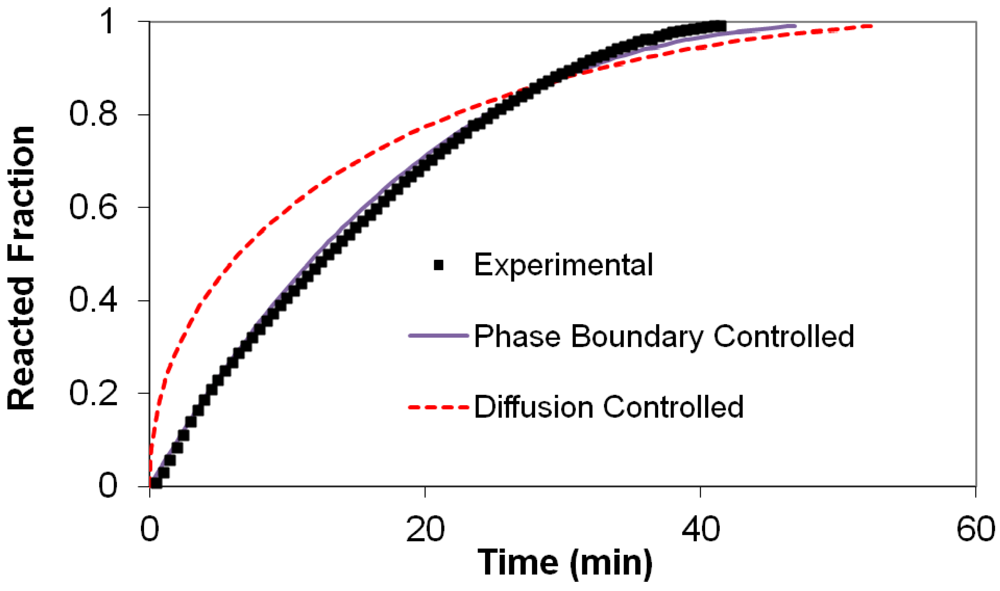
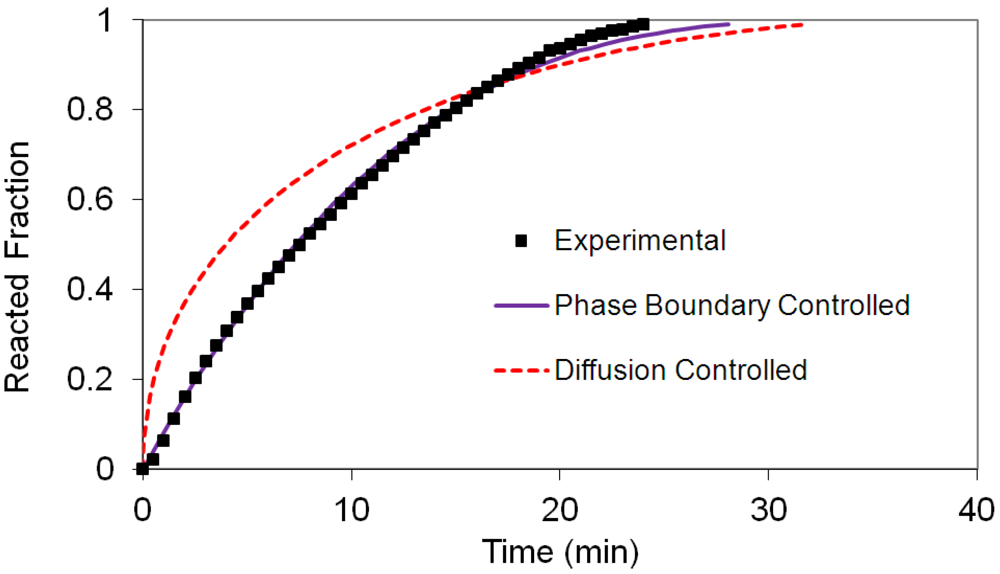
        <p>where , <inline-graphic xmlns:xlink="http://www.w3.org/1999/xlink" xlink:href="metals-02-00219-i008.tif"/> <italic>t</italic> is the time at a specific point in the reaction, <italic>X</italic><sub>B</sub> is the fraction of the metal reacted. <italic>R</italic> is the initial radius of the hydride particles, <italic>b</italic> is a stoichiometric coefficient of the metal, <italic>C</italic><sub>Ag</sub> is the gas phase concentration of reactant, <italic>D</italic><sub>e</sub> is the effective diffusivity of hydrogen atoms in the hydride, <italic>ρ</italic><sub>B</sub> is the density of the metal hydride and <italic>k</italic><sub>s</sub> is a rate constant. It was found that a model based on Equation (1) will have chemical reaction at the phase boundary controlling the reaction rate. This is called the shrinking particle model (SPM). A model based on Equation (2) is one in which the overall reaction rate is controlled by diffusion. Both models were applied to the current study to determine which kinetic model best describes the reactions. Equations (1) and (2) were fitted to the kinetic data for each of the reaction sample mixtures. <xref ref-type="fig" rid="metals-02-00219-f005">Figure 5</xref>, <xref ref-type="fig" rid="metals-02-00219-f006">Figure 6</xref>, <xref ref-type="fig" rid="metals-02-00219-f007">Figure 7</xref>, <xref ref-type="fig" rid="metals-02-00219-f008">Figure 8</xref>, <xref ref-type="fig" rid="metals-02-00219-f009">Figure 9</xref> each contain three curves. One is an experimental curve taken from the desorption kinetics curve shown in <xref ref-type="fig" rid="metals-02-00219-f004">Figure 4</xref>, a second curve was calculated from the SCM with diffusion controlling the overall reaction and a third curve was calculated with chemical reaction at the phase boundary controlling the rate. In order to determine the theoretical curves, it was first necessary to determine <italic>a</italic> value for <italic>τ</italic><italic>.</italic> It was not necessary to know the values of all the physical parameters in Equations (1) and (2) in order to do this. The determination of <italic>τ</italic> was accomplished through a series of statistical data analyses in which the value of <italic>τ</italic> necessary to minimize the standard deviation between the experimental and theoretical data was calculated. Thus <italic>τ</italic> was a fitting parameter in these analyses As shown in <xref ref-type="fig" rid="metals-02-00219-f005">Figure 5</xref>, <xref ref-type="fig" rid="metals-02-00219-f006">Figure 6</xref>, <xref ref-type="fig" rid="metals-02-00219-f007">Figure 7</xref>, <xref ref-type="fig" rid="metals-02-00219-f008">Figure 8</xref>, <xref ref-type="fig" rid="metals-02-00219-f009">Figure 9</xref>, data generated from the SPM with chemical reaction at the phase boundary controlling the overall rate fits the experimental data better than the data generated from the SCM with diffusion controlling the overall reaction rate. Therefore we can say that chemical reaction at the phase boundary is the most likely mechanism for all the reactions in this study.</p>
        <fig id="metals-02-00219-f005" position="anchor">
          <label>Figure 5</label>
          <caption>
            <p>Modeling results for MgH<sub>2</sub> + 4 mol% CeO<sub>2</sub>.</p>
          </caption>
          <graphic xmlns:xlink="http://www.w3.org/1999/xlink" xlink:href="metals-02-00219-g005.tif"/>
        </fig>
        <fig id="metals-02-00219-f006" position="anchor">
          <label>Figure 6</label>
          <caption>
            <p>Modeling results for MgH<sub>2</sub> + 4 mol% Nb<sub>2</sub>O<sub>5</sub>.</p>
          </caption>
          <graphic xmlns:xlink="http://www.w3.org/1999/xlink" xlink:href="metals-02-00219-g006.tif"/>
        </fig>
        <fig id="metals-02-00219-f007" position="anchor">
          <label>Figure 7</label>
          <caption>
            <p>Modeling results for MgH<sub>2</sub> + 4 mol% ZrO<sub>2</sub>.</p>
          </caption>
          <graphic xmlns:xlink="http://www.w3.org/1999/xlink" xlink:href="metals-02-00219-g007.tif"/>
        </fig>
        <fig id="metals-02-00219-f008" position="anchor">
          <label>Figure 8</label>
          <caption>
            <p>Modeling results for MgH<sub>2</sub> + 4 mol% Fe<sub>3</sub>O<sub>4</sub>.</p>
          </caption>
          <graphic xmlns:xlink="http://www.w3.org/1999/xlink" xlink:href="metals-02-00219-g008.tif"/>
        </fig>
        <fig id="metals-02-00219-f009" position="anchor">
          <label>Figure 9</label>
          <caption>
            <p>Modeling results for MgH<sub>2</sub>.</p>
          </caption>
          <graphic xmlns:xlink="http://www.w3.org/1999/xlink" xlink:href="metals-02-00219-g009.tif"/>
        </fig>
      </sec>
      <sec>
        <title>3.5. Differential Thermal Analysis and Kissinger Plots</title>
        <p>To further understand the effects of the transition metal oxide catalysts on the dehydrogenation of MgH<sub>2</sub>, the activation energy of dehydrogenation for the systems studied were investigated using an isoconversion method based on the Kissinger Equation stated below.</p>
        <p><inline-graphic xmlns:xlink="http://www.w3.org/1999/xlink" xlink:href="metals-02-00219-i014.tif"/>    (3)</p>
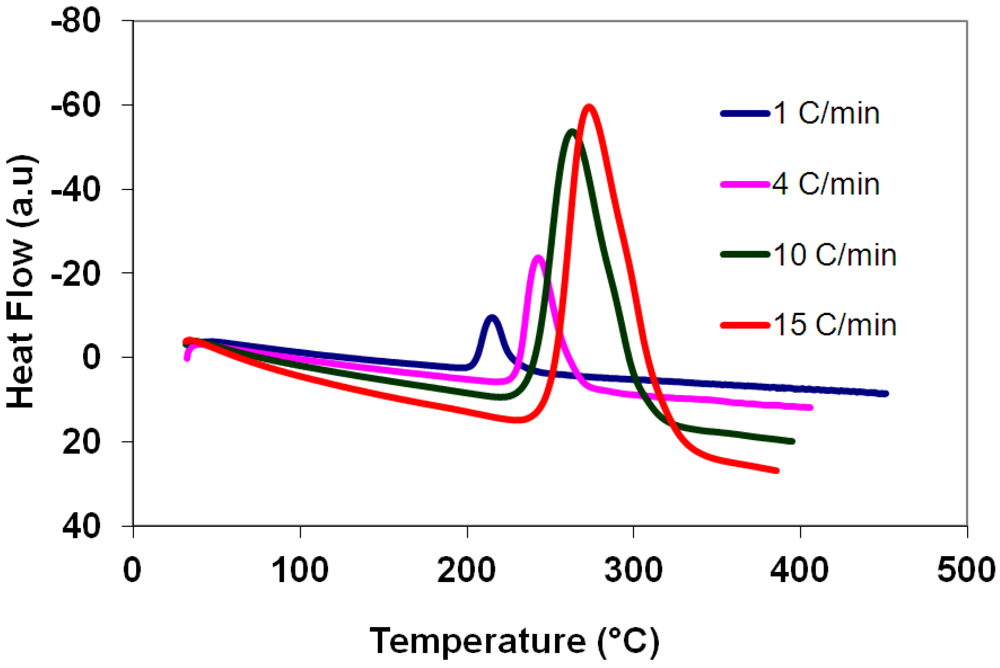
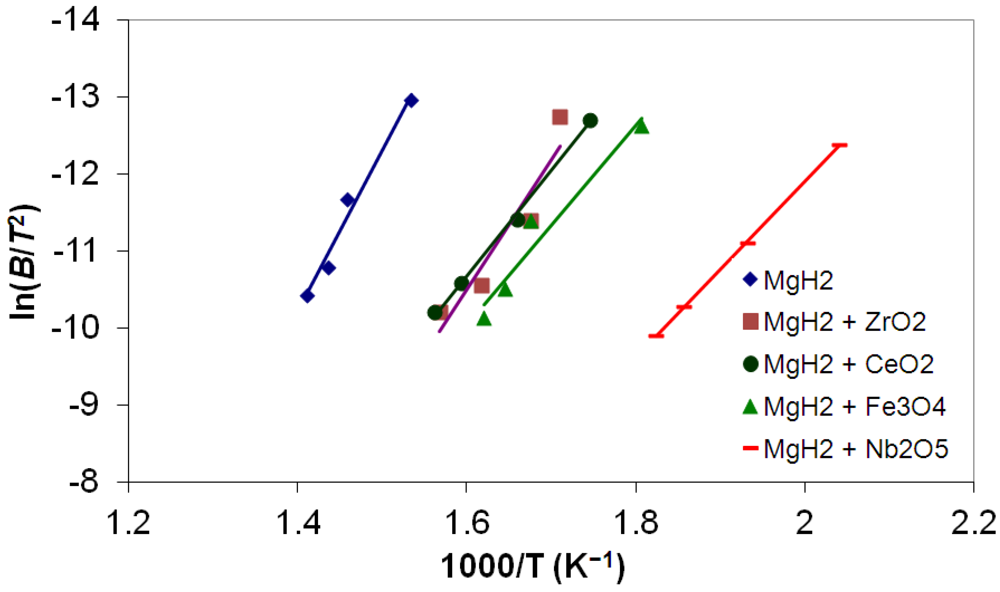
        <p>where <italic>T</italic><sub>max</sub> is the temperature at maximum reaction rate, <italic>β</italic> the heating rate, <italic>E</italic><sub>a</sub> the activation energy, <italic>α</italic> the fraction of transformation, <italic>F</italic><sub>KAS</sub>(<italic>α</italic>) a function of the fraction of transformation, and <italic>R</italic> is the gas constant. <xref ref-type="fig" rid="metals-02-00219-f010">Figure 10</xref> shows the DTA curves for one of the samples (MgH<sub>2</sub> + 4 mol% Nb<sub>2</sub>O<sub>5</sub>) at different heating rates from 1 to 15 °C per minute. The figure shows that the endothermic peak corresponding to the maximum rate of dehydrogenation shifts to higher temperatures as the heating rate is increased. The same trend was observed in all the other samples. The plots based on the Kissinger equation are shown in <xref ref-type="fig" rid="metals-02-00219-f011">Figure 11</xref>. A good linear relationship between ln (<italic>β</italic>/<italic>T</italic><sup>2</sup><sub>max</sub>) versus 1/<italic>T</italic><sub>max </sub>existed for all the samples. Activation energies of dehydrogenation were calculated from the slopes of the straight lines. The calculated activation energies are summarized in <xref ref-type="table" rid="metals-02-00219-t001">Table 1</xref>. From the values it is clear that the addition of transition metal oxide catalysts to MgH<sub>2</sub> helped lower its activation energy. The calculated activation energies correlate well with the times required for 90% of the hydrogen to desorb from the samples (<italic>T</italic><sub>90</sub>). Lower activation energies correspond to faster desorption kinetics. There was also a slight correlation between the activation energy and desorption temperatures as well. Samples with high activation energies tended to have high thermal stabilities. </p>
        <fig id="metals-02-00219-f010" position="anchor">
          <label>Figure 10</label>
          <caption>
            <p>Differential Thermal Analysis (DTA) curves for MgH<sub>2</sub> + 4 mol% Nb<sub>2</sub>O<sub>5</sub> at heating rates of 1, 4, 10 and 15 °C/min.</p>
          </caption>
          <graphic xmlns:xlink="http://www.w3.org/1999/xlink" xlink:href="metals-02-00219-g010.tif"/>
        </fig>
        <fig id="metals-02-00219-f011" position="anchor">
          <label>Figure 11</label>
          <caption>
            <p>Kissinger plot for MgH<sub>2</sub> and catalyzed MgH<sub>2</sub> materials.</p>
          </caption>
          <graphic xmlns:xlink="http://www.w3.org/1999/xlink" xlink:href="metals-02-00219-g011.tif"/>
        </fig>
      </sec>
    </sec>
    <sec sec-type="conclusions">
      <title>4. Conclusions</title>
      <p>This study has shown that transition metal oxide catalysts are effective catalysts for lowering the reaction temperature and increasing the reaction rates of MgH<sub>2</sub>. The dehydriding rates of MgH<sub>2</sub> mixed with transition metal oxide metals were in the order Nb<sub>2</sub>O<sub>5</sub> &gt; Fe<sub>3</sub>O<sub>4</sub> &gt; CeO<sub>2</sub> &gt; ZrO<sub>2</sub> &gt; pure MgH<sub>2</sub>. The mixtures with Nb<sub>2</sub>O<sub>5</sub> and Fe<sub>3</sub>O<sub>4</sub> both have the lowest desorption temperatures as well as the fastest kinetics although the mixture with Nb<sub>2</sub>O<sub>5</sub> has a slight advantage. As seen in <xref ref-type="table" rid="metals-02-00219-t001">Table 1</xref>, the mixtures with the fastest reaction times also had the lowest activation energies and Δ<italic>H</italic> values. Modeling studies show that reaction at the phase boundary is the mechanism controlling the reaction rates in all the reaction mixtures. </p>
    </sec>
  </body>
  <back>
    <ack>
      <title>Acknowledgments</title>
      <p>This work was financially supported by grants from the Department of Energy and the U.S. Department of Transportation.</p>
    </ack>
    <notes>
      <title>Conflict of Interest</title>
      <p>The authors declare no conflict of interest. </p>
    </notes>
    <ref-list>
      <title>References</title>
      <ref id="B1-metals-02-00219">
        <label>1.</label>
        <citation citation-type="journal">
          <person-group person-group-type="author">
            <name>
              <surname>Sabitu</surname>
              <given-names>S.T.</given-names>
            </name>
            <name>
              <surname>Gallo</surname>
              <given-names>G.</given-names>
            </name>
            <name>
              <surname>Goudy</surname>
              <given-names>A.J.</given-names>
            </name>
          </person-group>
          <article-title>Effect of TiH<sub>2</sub> and Mg<sub>2</sub>Ni additives on the hydrogen storage properties of magnesium hydride</article-title>
          <source>J. Alloys Comp.</source>
          <year>2010</year>
          <volume>499</volume>
          <fpage>35</fpage>
          <lpage>38</lpage>
          <pub-id pub-id-type="doi">10.1016/j.jallcom.2010.03.128</pub-id>
        </citation>
      </ref>
      <ref id="B2-metals-02-00219">
        <label>2.</label>
        <citation citation-type="journal">
          <person-group person-group-type="author">
            <name>
              <surname>Sabitu</surname>
              <given-names>S.T.</given-names>
            </name>
            <name>
              <surname>Fagbami</surname>
              <given-names>O.</given-names>
            </name>
            <name>
              <surname>Goudy</surname>
              <given-names>A.J.</given-names>
            </name>
          </person-group>
          <article-title>Kinetics and modeling study of magnesium hydride with various additives at constant pressure thermodynamic forces</article-title>
          <source>J. Alloys Comp.</source>
          <year>2011</year>
          <volume>509</volume>
          <fpage>S588</fpage>
          <lpage>S591</lpage>
        <pub-id pub-id-type="doi">10.1016/j.jallcom.2010.11.174</pub-id></citation>
      </ref>
      <ref id="B3-metals-02-00219">
        <label>3.</label>
        <citation citation-type="journal">
          <person-group person-group-type="author">
            <name>
              <surname>Yang</surname>
              <given-names>W.N.</given-names>
            </name>
            <name>
              <surname>Shang</surname>
              <given-names>C.X.</given-names>
            </name>
            <name>
              <surname>Guo</surname>
              <given-names>Z.X.</given-names>
            </name>
          </person-group>
          <article-title>Site density effect of Ni particles on hydrogen desorption of MgH<sub>2</sub></article-title>
          <source>Int. J. Hydrogen Energy</source>
          <year>2010</year>
          <volume>35</volume>
          <fpage>4534</fpage>
          <lpage>4542</lpage>
        <pub-id pub-id-type="doi">10.1016/j.ijhydene.2010.02.047</pub-id></citation>
      </ref>
      <ref id="B4-metals-02-00219">
        <label>4.</label>
        <citation citation-type="journal">
          <person-group person-group-type="author">
            <name>
              <surname>Hanada</surname>
              <given-names>N.</given-names>
            </name>
            <name>
              <surname>Ichikawa</surname>
              <given-names>T.</given-names>
            </name>
            <name>
              <surname>Fujii</surname>
              <given-names>H.</given-names>
            </name>
          </person-group>
          <article-title>Catalytic effect of Ni nano-particle and Nb oxide on H-desorption properties in MgH<sub>2</sub> prepared by ball milling</article-title>
          <source>J. Alloys Comp.</source>
          <year>2005</year>
          <volume>404-406</volume>
          <fpage>716</fpage>
          <lpage>719</lpage>
          <pub-id pub-id-type="doi">10.1016/j.jallcom.2004.12.166</pub-id>
        </citation>
      </ref>
      <ref id="B5-metals-02-00219">
        <label>5.</label>
        <citation citation-type="journal">
          <person-group person-group-type="author">
            <name>
              <surname>Aguey-Zinsou</surname>
              <given-names>K.-F.</given-names>
            </name>
            <name>
              <surname>Ares-Fernandez</surname>
              <given-names>J.R.</given-names>
            </name>
            <name>
              <surname>Klassen</surname>
              <given-names>T.</given-names>
            </name>
            <name>
              <surname>Bormann</surname>
              <given-names>R.</given-names>
            </name>
          </person-group>
          <article-title>Effect of Nb<sub>2O</sub>5 on MgH<sub>2</sub> properties during mechanical milling</article-title>
          <source>Int. J. Hydrogen Energy</source>
          <year>2007</year>
          <volume>32</volume>
          <fpage>2400</fpage>
          <lpage>2407</lpage>
          <pub-id pub-id-type="doi">10.1016/j.ijhydene.2006.10.068</pub-id>
        </citation>
      </ref>
      <ref id="B6-metals-02-00219">
        <label>6.</label>
        <citation citation-type="journal">
          <person-group person-group-type="author">
            <name>
              <surname>Hanada</surname>
              <given-names>N.</given-names>
            </name>
            <name>
              <surname>Ichikawa</surname>
              <given-names>T.</given-names>
            </name>
            <name>
              <surname>Hino</surname>
              <given-names>S.</given-names>
            </name>
            <name>
              <surname>Fujii</surname>
              <given-names>H.</given-names>
            </name>
          </person-group>
          <article-title>Remarkable improvement of hydrogen sorption kinetics in magnesium catalyzed by Nb<sub>2</sub>O<sub>5</sub></article-title>
          <source>J. Alloys Comp.</source>
          <year>2006</year>
          <volume>420</volume>
          <fpage>46</fpage>
          <lpage>49</lpage>
          <pub-id pub-id-type="doi">10.1016/j.jallcom.2005.08.084</pub-id>
        </citation>
      </ref>
      <ref id="B7-metals-02-00219">
        <label>7.</label>
        <citation citation-type="journal">
          <person-group person-group-type="author">
            <name>
              <surname>Evard</surname>
              <given-names>E.</given-names>
            </name>
            <name>
              <surname>Gabis</surname>
              <given-names>I.</given-names>
            </name>
            <name>
              <surname>Yartys</surname>
              <given-names>V.A.</given-names>
            </name>
          </person-group>
          <article-title>Kinetics of hydrogen evolution from MgH<sub>2</sub>: Experimental studies, mechanism and modeling</article-title>
          <source>Int. J. Hydrogen Energy</source>
          <year>2010</year>
          <volume>35</volume>
          <fpage>9060</fpage>
          <lpage>9069</lpage>
          <pub-id pub-id-type="doi">10.1016/j.ijhydene.2010.05.092</pub-id>
        </citation>
      </ref>
      <ref id="B8-metals-02-00219">
        <label>8.</label>
        <citation citation-type="journal">
          <person-group person-group-type="author">
            <name>
              <surname>Luo</surname>
              <given-names>Y.</given-names>
            </name>
            <name>
              <surname>Wang</surname>
              <given-names>P.</given-names>
            </name>
            <name>
              <surname>Ma</surname>
              <given-names>L.</given-names>
            </name>
            <name>
              <surname>Cheng</surname>
              <given-names>H.</given-names>
            </name>
          </person-group>
          <article-title>Hydrogen sorption kinetics of MgH<sub>2</sub> catalyzed with NbF<sub>5</sub></article-title>
          <source>J. Alloys Comp.</source>
          <year>2008</year>
          <volume>453</volume>
          <fpage>138</fpage>
          <lpage>142</lpage>
          <pub-id pub-id-type="doi">10.1016/j.jallcom.2006.11.113</pub-id>
        </citation>
      </ref>
      <ref id="B9-metals-02-00219">
        <label>9.</label>
        <citation citation-type="journal">
          <person-group person-group-type="author">
            <name>
              <surname>Barkhordarian</surname>
              <given-names>G.</given-names>
            </name>
            <name>
              <surname>Klassen</surname>
              <given-names>T.</given-names>
            </name>
            <name>
              <surname>Bormann</surname>
              <given-names>R.</given-names>
            </name>
          </person-group>
          <article-title>Effect of Nb<sub>2</sub>O<sub>5</sub> content on hydrogen reaction kinetics of Mg</article-title>
          <source>J. Alloys Comp.</source>
          <year>2004</year>
          <volume>364</volume>
          <fpage>242</fpage>
          <lpage>246</lpage>
          <pub-id pub-id-type="doi">10.1016/S0925-8388(03)00530-9</pub-id>
        </citation>
      </ref>
      <ref id="B10-metals-02-00219">
        <label>10.</label>
        <citation citation-type="journal">
          <person-group person-group-type="author">
            <name>
              <surname>Jain</surname>
              <given-names>I.P.</given-names>
            </name>
            <name>
              <surname>Lal</surname>
              <given-names>C.</given-names>
            </name>
            <name>
              <surname>Jain</surname>
              <given-names>A.</given-names>
            </name>
          </person-group>
          <article-title>Hydrogen storage in Mg: A most promising material</article-title>
          <source>Int. J. Hydrogen Energy</source>
          <year>2010</year>
          <volume>35</volume>
          <fpage>5133</fpage>
          <lpage>5144</lpage>
          <pub-id pub-id-type="doi">10.1016/j.ijhydene.2009.08.088</pub-id>
        </citation>
      </ref>
      <ref id="B11-metals-02-00219">
        <label>11.</label>
        <citation citation-type="journal">
          <person-group person-group-type="author">
            <name>
              <surname>Sohn</surname>
              <given-names>H.Y.</given-names>
            </name>
            <name>
              <surname>Emami</surname>
              <given-names>S.</given-names>
            </name>
          </person-group>
          <article-title>Kinetics of dehydrogenation of the Mg-Ti-H hydrogen storage system</article-title>
          <source>Int. J. Hydrogen Energy</source>
          <year>2011</year>
          <volume>36</volume>
          <fpage>8344</fpage>
          <lpage>8350</lpage>
          <pub-id pub-id-type="doi">10.1016/j.ijhydene.2011.03.167</pub-id>
        </citation>
      </ref>
      <ref id="B12-metals-02-00219">
        <label>12.</label>
        <citation citation-type="journal">
          <person-group person-group-type="author">
            <name>
              <surname>Oelerich</surname>
              <given-names>W.</given-names>
            </name>
            <name>
              <surname>Klassen</surname>
              <given-names>T.</given-names>
            </name>
            <name>
              <surname>Bormann</surname>
              <given-names>R.</given-names>
            </name>
          </person-group>
          <article-title>Metal oxides as catalysts for improved hydrogen sorption in nanocrystalline Mg-based materials</article-title>
          <source>J. Alloys Comp.</source>
          <year>2001</year>
          <volume>315</volume>
          <fpage>237</fpage>
          <lpage>242</lpage>
          <pub-id pub-id-type="doi">10.1016/S0925-8388(00)01284-6</pub-id>
        </citation>
      </ref>
      <ref id="B13-metals-02-00219">
        <label>13.</label>
        <citation citation-type="journal">
          <person-group person-group-type="author">
            <name>
              <surname>Koh</surname>
              <given-names>J.T.</given-names>
            </name>
            <name>
              <surname>Goudy</surname>
              <given-names>A.J.</given-names>
            </name>
            <name>
              <surname>Huang</surname>
              <given-names>P.</given-names>
            </name>
            <name>
              <surname>Zhou</surname>
              <given-names>J.</given-names>
            </name>
          </person-group>
          <article-title>A comparison of the hydriding and dehydriding kinetics of LaNi<sub>5</sub> hydride</article-title>
          <source>J. Less-Common Metals</source>
          <year>1989</year>
          <volume>153</volume>
          <fpage>89</fpage>
          <lpage>100</lpage>
          <pub-id pub-id-type="doi">10.1016/0022-5088(89)90536-5</pub-id>
        </citation>
      </ref>
      <ref id="B14-metals-02-00219">
        <label>14.</label>
        <citation citation-type="journal">
          <person-group person-group-type="author">
            <name>
              <surname>Zhang</surname>
              <given-names>W.</given-names>
            </name>
            <name>
              <surname>Cimato</surname>
              <given-names>J.</given-names>
            </name>
            <name>
              <surname>Goudy</surname>
              <given-names>A.J.</given-names>
            </name>
          </person-group>
          <article-title>The hydriding and dehydring kinetics of some LaNi<sub>5-x</sub>Al<sub>x</sub> alloys</article-title>
          <source>J. Alloys Comp.</source>
          <year>1993</year>
          <volume>201</volume>
          <fpage>175</fpage>
          <lpage>179</lpage>
          <pub-id pub-id-type="doi">10.1016/0925-8388(93)90880-V</pub-id>
        </citation>
      </ref>
      <ref id="B15-metals-02-00219">
        <label>15.</label>
        <citation citation-type="journal">
          <person-group person-group-type="author">
            <name>
              <surname>Smith</surname>
              <given-names>G.</given-names>
            </name>
            <name>
              <surname>Goudy</surname>
              <given-names>A.J.</given-names>
            </name>
          </person-group>
          <article-title>Thermodynamics, kinetics and modeling studies of LaNi<sub>5-x</sub>Co<sub>x</sub> hydride system</article-title>
          <source>J. Alloys Comp.</source>
          <year>2001</year>
          <volume>316</volume>
          <fpage>93</fpage>
          <lpage>98</lpage>
          <pub-id pub-id-type="doi">10.1016/S0925-8388(00)01512-7</pub-id>
        </citation>
      </ref>
      <ref id="B16-metals-02-00219">
        <label>16.</label>
        <citation citation-type="journal">
          <person-group person-group-type="author">
            <name>
              <surname>Yang</surname>
              <given-names>H.</given-names>
            </name>
            <name>
              <surname>Ojo</surname>
              <given-names>A.</given-names>
            </name>
            <name>
              <surname>Ogaro</surname>
              <given-names>P.</given-names>
            </name>
            <name>
              <surname>Goudy</surname>
              <given-names>A.J.</given-names>
            </name>
          </person-group>
          <article-title>Hydriding and dehydriding kinetics of sodium alanate at constant pressure thermodynamic driving forces</article-title>
          <source>J. Phys. Chem. C</source>
          <year>2009</year>
          <volume>113</volume>
          <fpage>14512</fpage>
          <lpage>14517</lpage>
          <pub-id pub-id-type="doi">10.1021/jp902073u</pub-id>
        </citation>
      </ref>
      <ref id="B17-metals-02-00219">
        <label>17.</label>
        <citation citation-type="journal">
          <person-group person-group-type="author">
            <name>
              <surname>Ibikunle</surname>
              <given-names>A.</given-names>
            </name>
            <name>
              <surname>Goudy</surname>
              <given-names>A.J.</given-names>
            </name>
            <name>
              <surname>Yang</surname>
              <given-names>H.</given-names>
            </name>
          </person-group>
          <article-title>Hydrogen storage in a CaH<sub>2</sub>/LiBH<sub>4</sub> destabilized metal hydride system</article-title>
          <source>J. Alloys Comp.</source>
          <year>2009</year>
          <volume>475</volume>
          <fpage>110</fpage>
          <lpage>115</lpage>
          <pub-id pub-id-type="doi">10.1016/j.jallcom.2008.08.010</pub-id>
        </citation>
      </ref>
      <ref id="B18-metals-02-00219">
        <label>18.</label>
        <citation citation-type="journal">
          <person-group person-group-type="author">
            <name>
              <surname>Durojaiye</surname>
              <given-names>T.</given-names>
            </name>
            <name>
              <surname>Goudy</surname>
              <given-names>A.J.</given-names>
            </name>
          </person-group>
          <article-title>Desorption kinetics of lithium amide/magnesium hydride systems at constant pressure thermodynamic driving forces</article-title>
          <source>Int. J. Hydrogen Energy</source>
          <year>2012</year>
          <volume>37</volume>
          <fpage>3298</fpage>
          <lpage>3304</lpage>
          <pub-id pub-id-type="doi">10.1016/j.ijhydene.2011.11.071</pub-id>
        </citation>
      </ref>
    </ref-list>
  </back>
</article>