
<?xml version="1.0" encoding="UTF-8"?>
<!DOCTYPE article PUBLIC "-//NLM//DTD Journal Publishing DTD v2.3 20070202//EN" "journalpublishing.dtd">
<article xmlns:mml="http://www.w3.org/1998/Math/MathML" xmlns:xlink="http://www.w3.org/1999/xlink" xml:lang="en" article-type="review-article">
  <front>
    <journal-meta>
      <journal-id journal-id-type="publisher-id">insects</journal-id>
      <journal-title>Insects</journal-title>
      <abbrev-journal-title abbrev-type="publisher">Insects</abbrev-journal-title>
      <abbrev-journal-title abbrev-type="pubmed">Insects</abbrev-journal-title>
      <issn pub-type="epub">2075-4450</issn>
      <publisher>
        <publisher-name>MDPI</publisher-name>
      </publisher>
    </journal-meta>
    <article-meta>
      <article-id pub-id-type="doi">10.3390/insects3030727</article-id>
      <article-id pub-id-type="publisher-id">insects-03-00727</article-id>
      <article-categories>
        <subj-group>
          <subject>Review</subject>
        </subj-group>
      </article-categories>
      <title-group>
        <article-title>Regional Suppression of <italic>Bactrocera</italic> Fruit Flies (Diptera: Tephritidae) in the Pacific through Biological Control and Prospects for Future Introductions into Other Areas of the World</article-title>
      </title-group>
      
      <contrib-group>
        <contrib contrib-type="author">
          <name>
            <surname>Vargas</surname>
            <given-names>Roger I.</given-names>
          </name>
          <xref rid="af1-insects-03-00727" ref-type="aff">1</xref>
          <xref rid="c1-insects-03-00727" ref-type="corresp">*</xref>
        </contrib>
        <contrib contrib-type="author">
          <name>
            <surname>Leblanc</surname>
            <given-names>Luc</given-names>
          </name>
          <xref rid="af2-insects-03-00727" ref-type="aff">2</xref>
        </contrib>
        <contrib contrib-type="author">
          <name>
            <surname>Harris</surname>
            <given-names>Ernest J.</given-names>
          </name>
          <xref rid="af1-insects-03-00727" ref-type="aff">1</xref>
        </contrib>
        <contrib contrib-type="author">
          <name>
            <surname>Manoukis</surname>
            <given-names>Nicholas C.</given-names>
          </name>
          <xref rid="af1-insects-03-00727" ref-type="aff">1</xref>
        </contrib>
      </contrib-group>
      <aff id="af1-insects-03-00727"><label>1 </label>USDA-ARS, U.S. Pacific Basin Agricultural Research Center, 64 Nowelo St., Hilo, HI 96720, USA; Email: <email>ernest96822@lycos.com</email> (E.J.H.); <email>nicholas.manoukis@ars.usda.gov</email> (N.C.M.)</aff>
      <aff id="af2-insects-03-00727"><label>2 </label>Department of Plant Environmental Protection Sciences, University of Hawaii, Honolulu, HI 96822, USA; Email: <email>leblancl@ctahr.hawaii.edu</email></aff>
      <author-notes>
        <corresp id="c1-insects-03-00727"><label>*</label> Author  to whom correspondence should be addressed; Email: <email>roger.vargas@ars.usda.gov</email>; Tel.: +1-808-959-4329.</corresp>
      </author-notes>
      <pub-date pub-type="epub">
        <day>10</day>
        <month>08</month>
        <year>2012</year>
      </pub-date>
      <pub-date pub-type="collection"><month>09</month>
        <year>2012</year>
      </pub-date>
      <volume>3</volume>
      <issue>3</issue>
      <fpage>727</fpage>
      <lpage>742</lpage>
      <history>
        <date date-type="received">
          <day>06</day>
          <month>06</month>
          <year>2012</year>
        </date>
        <date date-type="rev-recd">
          <day>18</day>
          <month>07</month>
          <year>2012</year>
        </date>
        <date date-type="accepted">
          <day>26</day>
          <month>07</month>
          <year>2012</year>
        </date>
      </history>
      <permissions>
        <copyright-statement>©  2012 by the authors; licensee MDPI, Basel, Switzerland.</copyright-statement>
        <copyright-year>2012</copyright-year>
        <license xmlns:xlink="http://www.w3.org/1999/xlink" license-type="open-access" xlink:href="http://creativecommons.org/licenses/by/3.0/">
          <p>This article is an open-access article distributed under the terms and conditions of the Creative Commons Attribution license (http://creativecommons.org/licenses/by/3.0/).</p>
        </license>
      </permissions>
      <abstract>
        <p><italic>Bactrocera</italic> fruit fly species are economically important throughout the Pacific. The USDA, ARS U.S. Pacific Basin Agricultural Research Center has been a world leader in promoting biological control of <italic>Bactrocera</italic> spp. that includes classical, augmentative, conservation and IPM approaches. In Hawaii, establishment of <italic>Bactrocera cucurbitae</italic> (Coquillett) in 1895 resulted in the introduction of the most successful parasitoid, <italic>Psyttalia fletcheri</italic> (Silvestri); similarly, establishment of <italic>Bactrocera dorsalis</italic> (Hendel) in 1945 resulted in the introduction of 32 natural enemies of which <italic>Fopius arisanus</italic> (Sonan), <italic>Diachasmimorpha longicaudata</italic> (Ashmead) and <italic>Fopius vandenboschi</italic> (Fullaway) were most successful. Hawaii has also been a source of parasitoids for fruit fly control throughout the Pacific region including Australia, Pacific Island Nations, Central and South America, not only for <italic>Bactrocera</italic> spp. but also for <italic>Ceratitis</italic> and <italic>Anastrepha</italic> spp. Most recently, in 2002, <italic>F. arisanus</italic> was introduced into French Polynesia where <italic>B. dorsalis</italic> had invaded in 1996. Establishment of <italic>D. longicaudata</italic> into the new world has been important to augmentative biological control releases against <italic>Anastrepha</italic> spp. With the rapid expansion of airline travel and global trade there has been an alarming spread of <italic>Bactrocera</italic> spp. into new areas of the world (<italic>i.e.</italic>, South America and Africa). Results of studies in Hawaii and French Polynesia, support parasitoid introductions into South America and Africa, where <italic>B. carambolae</italic> and <italic>B. invadens</italic>, respectively, have become established. In addition, <italic>P. fletcheri</italic> is a candidate for biological control of <italic>B. cucurbitae</italic> in Africa. We review past and more recent successes against <italic>Bactrocera</italic> spp. and related tephritids, and outline simple rearing and release methods to facilitate this goal.</p>
      </abstract>
      <kwd-group>
        <kwd>parasitoids</kwd>
        <kwd>Braconidae</kwd>
        <kwd>Tephritidae</kwd>
        <kwd><italic>Bactrocera</italic>
        </kwd>
        <kwd>Hawaii</kwd>
      </kwd-group>
    </article-meta>
  </front>
  <body>
    <sec sec-type="intro">
      <title>1. Introduction</title>
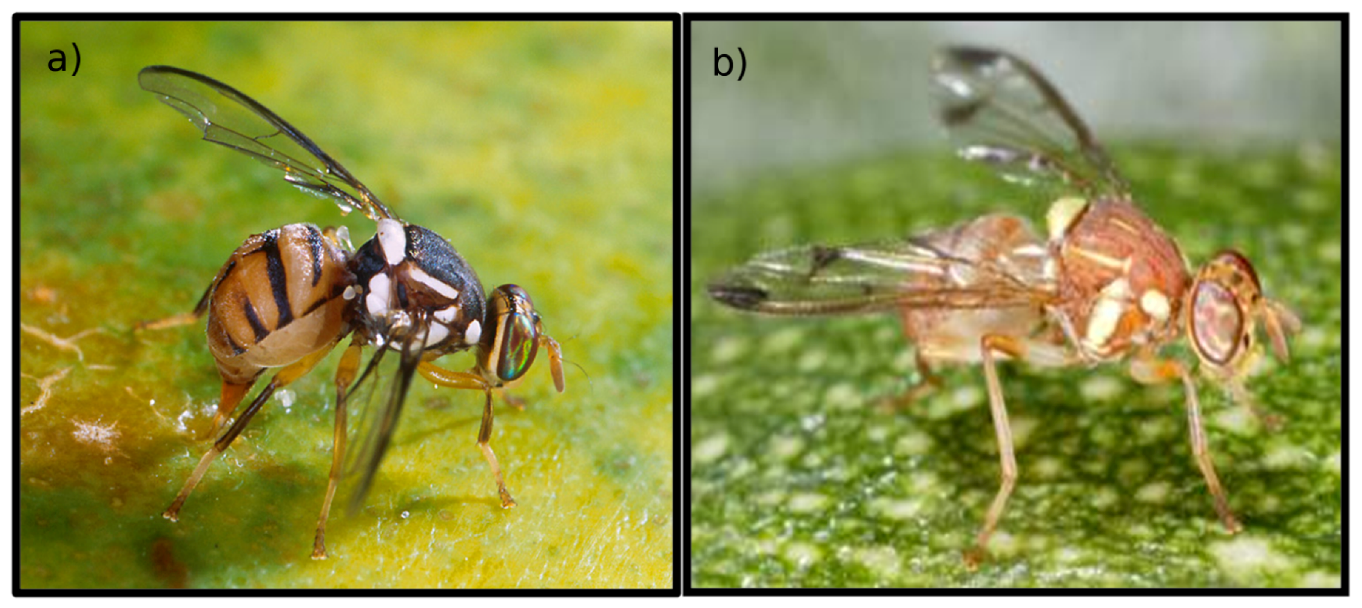
      <p>Fruit flies (Diptera: Tephritidae) are among the most economically important pests attacking soft fruits worldwide [<xref ref-type="bibr" rid="B1-insects-03-00727">1</xref>]. The <italic>Bactrocera</italic> genus is particularly important throughout the Pacific. It consists of at least 440 species distributed primarily in tropical Asia, Australia, and the South Pacific [<xref ref-type="bibr" rid="B1-insects-03-00727">1</xref>]. <italic>Bactrocera</italic> species are well-documented invaders and rank high on quarantine lists worldwide [<xref ref-type="bibr" rid="B2-insects-03-00727">2</xref>]. Polyphagy, superior mobility and dispersive powers, and high reproductive rates are among the common traits of invasive <italic>Bactrocera</italic> species. Throughout Pacific Island Nations, fruit flies have: (1) limited the development of a diversified tropical fruit and vegetable industry; (2) required that commercial fruits undergo quarantine treatment prior to export; and (3) provided a breeding reservoir for their introduction into other parts of the world due to unprecedented travel and trade between countries. Three invasive <italic>Bactrocera</italic> species (melon fly, <italic>Bactrocera. cucurbitae</italic> (Coquillett) (introduced in 1895) <xref ref-type="fig" rid="insects-03-00727-f001">Figure 1</xref>b, oriental fruit fly, <italic>Bactocera dorsalis</italic> (Hendel) (1945) <xref ref-type="fig" rid="insects-03-00727-f001">Figure 1</xref>a, and Malaysian fruit fly, <italic>Bactrocera</italic> <italic>latifrons</italic> (Hendel) (1983)), have been devastating to Hawaiian agriculture for over 100 years and have been studied extensively [<xref ref-type="bibr" rid="B3-insects-03-00727">3</xref>]. In addition to the development of area-wide technologies such as the sterile insect technique, protein bait sprays, and male annihilation, Hawaii has been a world leader in the development of classical, augmentative and conservation biological control approaches using parasitoid wasps (Hymenoptera: Braconidae) to suppress <italic>Bactrocera</italic> species.</p>
      <fig id="insects-03-00727-f001" position="anchor">
        <label>Figure 1</label>
        <caption>
          <p>(<bold>a</bold>) Bactrocera dorsalis; (<bold>b</bold>) Bactrocera cucurbitae.</p>
        </caption>
        <graphic xmlns:xlink="http://www.w3.org/1999/xlink" xlink:href="insects-03-00727-g001.tif"/>
      </fig>
      <p>We anticipate that with the recent introductions of <italic>B. cucurbitae</italic>, <italic>B. latifrons</italic>, and <italic>Bactrocera invadens</italic> Drew, Tsuruta, and White into Africa and <italic>Bactrocera carambolae</italic> Drew and Hancock into South America [<xref ref-type="bibr" rid="B4-insects-03-00727">4</xref>,<xref ref-type="bibr" rid="B5-insects-03-00727">5</xref>], there will be increased interest in biological control. The objectives of this paper are to (1) review past and recent biological control work in Hawaii and French Polynesia, particularly with respect to the <italic>Bactrocera</italic> species; (2) summarize the various introductions throughout the region; (3) summarize successes and failures; (4) summarize rearing and release methods for future introductions; and (5) comment on prospects for future introductions into other parts of the world.</p>
    </sec>
    <sec>
      <title>2. Biological Control of Fruit Flies in Hawaii</title>
      <p>Introduction of invasive <italic>Bactrocera</italic> spp into Hawaii resulted in the initiation of extensive biological control programs. Initially these were classical biological control programs, but later, when mass rearing was perfected, augmentative releases were done. For example, establishment of <italic>B. cucurbitae</italic> in Hawaii in 1895 resulted in the introduction of eight species of hymenopterous parasitoids and six predators [<xref ref-type="bibr" rid="B6-insects-03-00727">6</xref>]. However, except for the parasitoid <italic>Psyttalia fletcheri</italic> (Silvestri), a widespread larval-pupal parasitoid of <italic>B</italic>. <italic>cucurbitae</italic> in India and introduced into Hawaii in 1916, the natural enemies were of little importance from the standpoint of biological control due to their scarcity and non-specificity to <italic>B</italic>. <italic>cucurbitae</italic> [<xref ref-type="bibr" rid="B7-insects-03-00727">7</xref>,<xref ref-type="bibr" rid="B8-insects-03-00727">8</xref>]. The host fruit species infested by <italic>B</italic>. <italic>cucurbitae</italic> appears to influence rate of parasitization by <italic>P. fletcheri</italic>. For example, Nishida [<xref ref-type="bibr" rid="B6-insects-03-00727">6</xref>] found little or no parasitization of larvae in papaya (<italic>Carica papaya</italic> L.), bell pepper (<italic>Capsicum annuum</italic> L.), or tomato (<italic>Lycopersicon esculentum</italic> Mill.), while Willard [<xref ref-type="bibr" rid="B7-insects-03-00727">7</xref>] reported that parasitization ranged from 7.3% to 29.8% in cucumber (<italic>Cucumis sativus</italic> L.) and was as high as 96.9% on wild bitter melon (<italic>Momordica charantia</italic> L.). Parasitization is also influenced by the location of host larvae within the plant. For example, in melons, where the larvae may be found in both vines and fruits, consistently higher parasitization was obtained in vines than in fruit [<xref ref-type="bibr" rid="B6-insects-03-00727">6</xref>]. Apparently, in vines, the larvae remain just beneath the epidermis throughout the developmental period, remaining within reach of the parasitoid’s ovipositor. In contrast, larvae infesting fruit have a tendency to burrow deeply into the fruit flesh during later stages of development and consequently become less accessible to parasitoids. Interestingly, <italic>B</italic>. <italic>cucurbitae</italic> is generally immune to the development of <italic>Fopius arisanus</italic> (Sonan), a very successful braconid parasitoid of <italic>B</italic>. <italic>dorsalis</italic> [<xref ref-type="bibr" rid="B9-insects-03-00727">9</xref>]. However, Harris <italic>et al.</italic> [<xref ref-type="bibr" rid="B9-insects-03-00727">9</xref>] demonstrated that concurrent releases of <italic>F</italic>. <italic>arisanus</italic> and <italic>P</italic>. <italic>fletcheri</italic> increased suppression of <italic>B</italic>. <italic>cucurbitae</italic> in patches of wild ivy gourd (<italic>Coccinia grandis</italic> L.) compared to releases of <italic>P</italic>. <italic>fletcheri</italic> alone. It is suspected that, although survival of <italic>F</italic>. <italic>arisanus</italic> in <italic>B</italic>. <italic>cucurbitae</italic> is low, mortality due to puncturing of eggs added to suppression. Nonetheless, <italic>P</italic>. <italic>fletcheri</italic> has remained the most important parasitoid of <italic>B. cucurbitae</italic> for almost a century [<xref ref-type="bibr" rid="B10-insects-03-00727">10</xref>].</p>
      <p>With the introduction of <italic>B. dorsalis</italic> into Hawaii in 1945, the largest classical biological control program against fruit flies to date was undertaken to reduce its serious damage to fruits [<xref ref-type="bibr" rid="B8-insects-03-00727">8</xref>]. Thirty-two natural enemies were released between 1947 and 1952 [<xref ref-type="bibr" rid="B11-insects-03-00727">11</xref>]. <italic>Diachasmimorpha longicaudata</italic> (Ashmead) increased rapidly following its release in 1948, but suddenly lost its dominant position during the latter half of 1949 to <italic>Fopius vandenboschi</italic> (Fullaway), which was later superseded by the egg-pupal parasitoid <italic>F. arisanus</italic> [<xref ref-type="bibr" rid="B12-insects-03-00727">12</xref>,<xref ref-type="bibr" rid="B13-insects-03-00727">13</xref>,<xref ref-type="bibr" rid="B14-insects-03-00727">14</xref>]. Since its establishment, <italic>F. arisanus</italic> has resulted in a dramatic reduction in fruit infestation in Hawaii through a high level of <italic>B. dorsalis</italic> parasitism (65%–70%), and has remained the dominant parasitoid species [<xref ref-type="bibr" rid="B15-insects-03-00727">15</xref>,<xref ref-type="bibr" rid="B16-insects-03-00727">16</xref>]. Clearly, given the success of fruit fly biological control in Hawaii, a wealth of information was generated that can apply to other areas throughout the Pacific and the world.</p>
      <p>Although no parasitoids were deliberately introduced to control <italic>B</italic>. <italic>latifrons</italic>, the third economically important <italic>Bactrocera</italic> species detected in Hawaii in 1983, five primary parasitoid species have been recovered from individually held <italic>B. latifrons</italic> puparia: <italic>F</italic>. <italic>arisanus</italic>, <italic>Psyttalia incisi</italic> (Silvestri), <italic>D</italic>. <italic>longicaudata</italic>, <italic>Diachasmimorpha tryoni</italic> (Cameron) and <italic>Tetrastichus giffardianus</italic> Silvestri [<xref ref-type="bibr" rid="B17-insects-03-00727">17</xref>]. Of these, <italic>F. arisanus</italic> was the predominant species recovered at study sites [<xref ref-type="bibr" rid="B17-insects-03-00727">17</xref>].</p>
    </sec>
    <sec>
      <title>3. Biological Control Programs for Fruit Flies in French Polynesia</title>
      <p>The invasion of <italic>B. dorsalis</italic> (1996) was the most devastating of four accidental introductions of economically important <italic>Bactrocera</italic> species into French Polynesia, the others being <italic>Bactrocera kirki</italic> (Froggatt) (1928), <italic>Bactrocera tryoni</italic> (Froggatt), Queensland fruit fly, (1970), and <italic>Bactrocera xanthodes</italic> (Broun), Pacific fruit fly, (1998) [<xref ref-type="bibr" rid="B18-insects-03-00727">18</xref>]. <italic>Bactrocera dorsalis</italic> has been reported in the Society, Austral and Marquesas Islands while <italic>B. xanthodes</italic> is confined to the Austral Islands. Studies in French Polynesia are unique in that emergence data from large numbers of fruit samples were compared before and after releases of <italic>F. arisanus</italic> on Tahiti Island over ca. a 10 year period [<xref ref-type="bibr" rid="B19-insects-03-00727">19</xref>,<xref ref-type="bibr" rid="B20-insects-03-00727">20</xref>]. Starting in 2002, 10 parasitoid shipments from Hawaii, over 500,000 insects, were dispersed in two major locations and 10 minor locations around Tahiti Island. <italic>Fopius arisanus</italic> was established throughout all 21 communities within 3 years on Tahiti Island and nearby Moorea Island [<xref ref-type="bibr" rid="B19-insects-03-00727">19</xref>]. It became so abundant in guava fruits that parasitoids recovered from wild fruits were used to establish it on the Society Islands of Huahine, Tahaa, and Raiatea where <italic>B. dorsalis</italic> had spread [<xref ref-type="bibr" rid="B19-insects-03-00727">19</xref>]. By 2009 mean (±SD) parasitism of fruit flies infesting <italic>P. guajava</italic>, <italic>Inocarpus fagifer</italic> (Parkinson) Fosberg (Polynesian chestnut) and <italic>Terminalia catappa</italic>. (tropical almond) fruits on Tahiti Island was 64.8 ± 2.0% [<xref ref-type="bibr" rid="B20-insects-03-00727">20</xref>]. A second parasitoid, <italic>D. longicaudata</italic>, was released in 2007 [<xref ref-type="bibr" rid="B20-insects-03-00727">20</xref>]. Five shipments of <italic>D. longicaudata</italic> (of approximately 5,000 each with a total of about 10,000 surviving wasps) were made between September 2007 and August 2008. Although also becoming widespread, parasitism rates of <italic>D. longicaudata</italic> have not been higher than 10% [<xref ref-type="bibr" rid="B20-insects-03-00727">20</xref>]. As a result of parasitoid introduction, numbers of <italic>B. dorsalis</italic>, <italic>B. tryoni</italic> and <italic>B. kirki</italic> emerging (per kg of fruit) declined sharply. For example, for <italic>P. guajava</italic> there was a decline, between 2003 and 2009, of 92.3, 96.8, and 99.6% for each of the fly species, respectively [<xref ref-type="bibr" rid="B19-insects-03-00727">19</xref>]. Analysis of co‑infestation patterns (1998–2009) of <italic>B. dorsalis</italic>, <italic>B</italic>. <italic>tryoni</italic>, and <italic>B</italic>. <italic>kirki</italic> in four main host fruits suggest that <italic>B. dorsalis</italic> has become the most abundant species wherever it occurs [<xref ref-type="bibr" rid="B20-insects-03-00727">20</xref>]. Establishment of <italic>F</italic>. <italic>arisanus</italic> in French Polynesia is the most successful example of classical biological control of fruit flies in the Pacific outside of Hawaii and it was secondarily introduced from Tahiti as <italic>B. dorsalis</italic> spread to other French Polynesian islands, most recently to the Marquesas Islands (Nuku Hiva, Hiva Oa and Fatu Hiva) [<xref ref-type="bibr" rid="B20-insects-03-00727">20</xref>].</p>
      <p>French Polynesia is comprised of over 118 islands and atolls scattered over approximately 2,500,000 km<sup>2</sup> of ocean. <italic>Bactrocera dorsalis</italic> is currently established in the Society, Marquesas and Austral Islands of French Polynesia. Initially it was envisioned that <italic>F. arisanus</italic> could be mass reared in Hawaii at an estimated cost of US $2,000 per 1,000,000 parasitoids [<xref ref-type="bibr" rid="B21-insects-03-00727">21</xref>], and transferred to other islands as <italic>B</italic>. <italic>dorsalis</italic> was progressively spreading throughout French Polynesia. However, when <italic>F. arisanus</italic> became numerous in fruits infested with <italic>B</italic>. <italic>dorsalis</italic> on Tahiti Island, it became more cost effective to recover wasps from field-collected fruits and ship them to the outer islands, than to mass rear them in the laboratory. This is now the preferred approach for shipments and quick establishment to new islands where <italic>B</italic>. <italic>dorsalis</italic> has spread [<xref ref-type="bibr" rid="B19-insects-03-00727">19</xref>].</p>
    </sec>
    <sec>
      <title>4. Hawaii as a Source of Parasitoids throughout the Pacific</title>
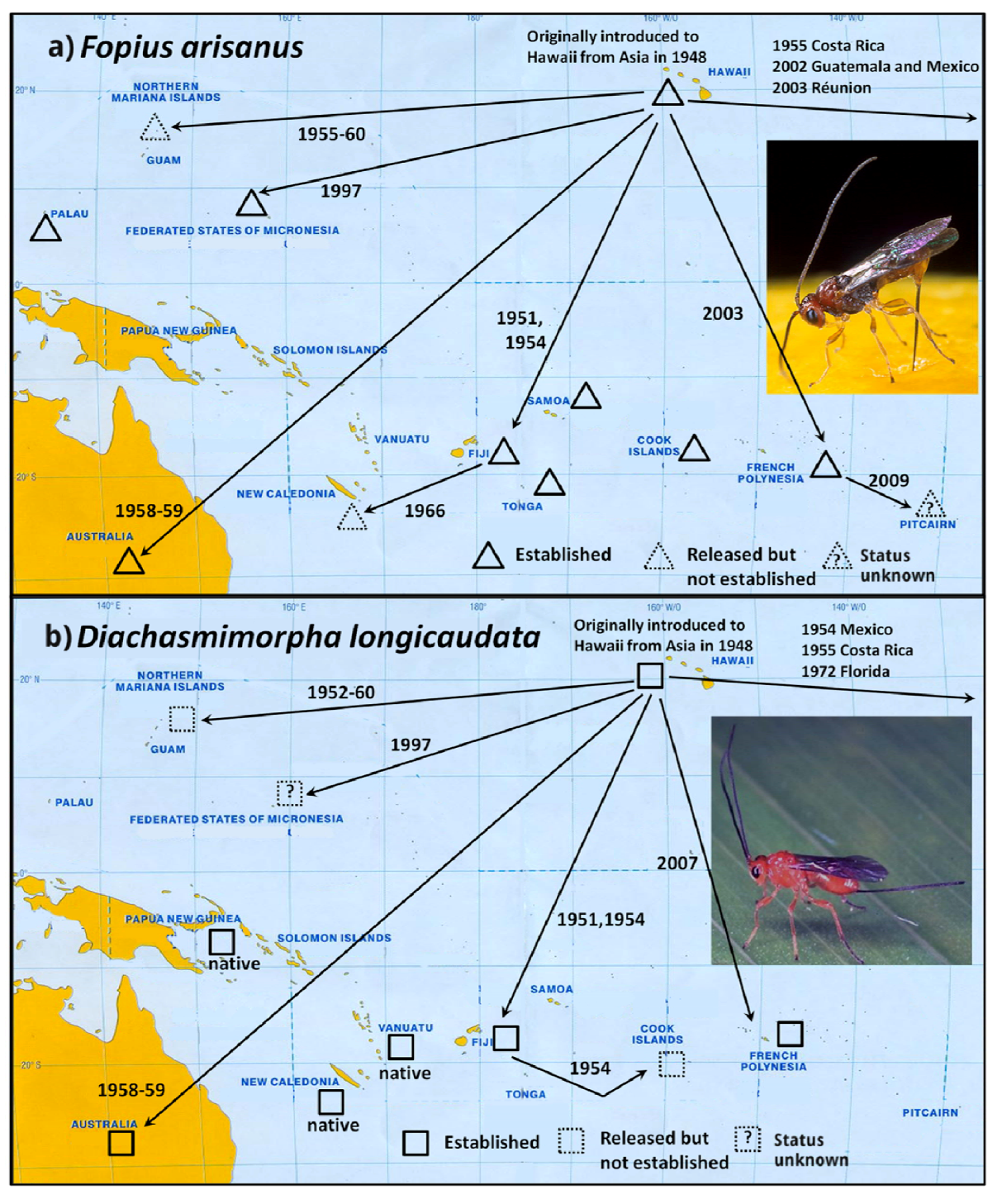
      <p>From 1935 to 2008 Hawaii has been very active in exporting fruit fly parasitoids throughout the world for suppression of a variety of fruit fly species with varying degrees of success [<xref ref-type="bibr" rid="B20-insects-03-00727">20</xref>,<xref ref-type="bibr" rid="B22-insects-03-00727">22</xref>]. Originally established in Hawaii around 1948, <italic>F. arisanus</italic> has since been released in 11 Pacific Island countries against various <italic>Bactrocera</italic> spp <xref ref-type="fig" rid="insects-03-00727-f002">Figure 2</xref>a. Establishment has been confirmed in seven countries (<xref ref-type="table" rid="insects-03-00727-t001">Table 1</xref>). Similarly, <italic>D</italic>. <italic>longicaudata</italic>, also introduced into Hawaii in 1948, has been released in six countries with establishment confirmed in three countries (<xref ref-type="fig" rid="insects-03-00727-f002">Figure 2</xref>b, <xref ref-type="table" rid="insects-03-00727-t001">Table 1</xref>). Throughout the Pacific region parasitism rates have varied depending on parasitoid species (<italic>F. arisanus</italic> or <italic>D. longicaudata</italic>), target host fruit fly species, and host fruit (<xref ref-type="table" rid="insects-03-00727-t001">Table 1</xref>). The highest <italic>F. arisanus</italic> parasitism rates have been obtained with the <italic>B</italic>. <italic>dorsalis</italic> complex species in Hawaii, French Polynesia, and Palau. <italic>Psyttalia fletcheri</italic> was established in Hawaii in 1916 and has been released and established in the Northern Mariana Islands (starting in 1950) and the Solomon Islands (in 1997) [<xref ref-type="bibr" rid="B23-insects-03-00727">23</xref>].</p>
     
      
      <p>The extensive biological control programs in Hawaii have also resulted in shipments of parasitoids to various localities in the US and Latin America [<xref ref-type="bibr" rid="B22-insects-03-00727">22</xref>], with the largest programs in Mexico, Costa Rica and Florida. The program in Costa Rica was in direct response to the establishment of <italic>Ceratitis capitata</italic> (Wiedemann), Mediterranean fruit fly, and its subsequent expansion to the rest of Central America [<xref ref-type="bibr" rid="B22-insects-03-00727">22</xref>]. Costa Rica then became the source of parasitoid introductions to 11 other American countries. Most of the control efforts targeted <italic>C</italic>. <italic>capitata</italic> and <italic>Anastrepha</italic> spp. in Central America (Nicaragua, Panama, El Salvador, Guatemala and Trinidad) and <italic>C</italic>. <italic>capitata</italic> and <italic>Anastrepha fraterculus</italic> (Wiedemann), South American fruit fly, in South America (Argentina, Bolivia, Peru, and Venezuela) [<xref ref-type="bibr" rid="B22-insects-03-00727">22</xref>]. The two most successful introduced parasitoids were <italic>D</italic>. <italic>longicaudata</italic> and the eulophid <italic>Aceratoneuromyia indica</italic> (Silvestri), both larval parasitoids [<xref ref-type="bibr" rid="B22-insects-03-00727">22</xref>]. These have become established on <italic>A</italic>. <italic>fraterculus</italic>, <italic>Anastrepha ludens</italic> (Loew) (Mexican fruit fly), <italic>Anastrepha obliqua</italic> (Macquart) (West Indian fruit fly), <italic>Anastrepha serpentina</italic> (Wiedemann) (sapote fruit fly), and <italic>Anastrepha striata</italic> Schiner (guava fruit fly) [<xref ref-type="bibr" rid="B22-insects-03-00727">22</xref>]. In Florida, populations of <italic>Anastrepha suspensa</italic> (Loew) (Caribbean fruit fly) decreased by 40% in the years following releases of the parasitoids <italic>Doryctobracon areolatus</italic> (Szepligeti) and <italic>D. longicaudata</italic> [<xref ref-type="bibr" rid="B24-insects-03-00727">24</xref>].</p>
      <fig id="insects-03-00727-f002" position="anchor">
        <label>Figure 2</label>
        <caption>
          <p>Introductions of parasitoids (Braconidae) for fruit fly biological control in the Pacific. (<bold>a</bold>) <italic>Fopius arisanus</italic>; (<bold>b</bold>) <italic>Diachasmimorpha longicaudata.</italic></p>
        </caption>
        <graphic xmlns:xlink="http://www.w3.org/1999/xlink" xlink:href="insects-03-00727-g002.tif"/>
      </fig>
       <table-wrap id="insects-03-00727-t001" position="anchor">
        <object-id pub-id-type="pii">insects-03-00727-t001_Table 1</object-id>
        <label>Table 1</label>
        <caption>
          <p>Percent parasitism by <italic>F. arisanus</italic> and <italic>D. longicaudata</italic> in various countries where they have been introduced.</p>
        </caption>
        <table rules="all" style="border: solid thin">
          <thead>
            <tr>
              <th align="center" valign="middle">Country</th>
              <th align="center" valign="middle">Parasitoids</th>
              <th align="center" valign="middle">Target economic species</th>
              <th align="center" valign="middle">Assessment period</th>
              <th align="center" valign="middle"><italic>Artocarpus</italic> <italic>altilis</italic></th>
              <th align="center" valign="middle"><italic>Averrhoa</italic> <italic>carambola</italic></th>
              <th align="center" valign="middle"><italic>Carica</italic> <italic>papaya</italic></th>
              <th align="center" valign="middle"><italic>Citrus</italic> spp <sup>1</sup></th>
              <th align="center" valign="middle"><italic>Inocarpus</italic> <italic>fagifer</italic></th>
              <th align="center" valign="middle"><italic>Psidium</italic> <italic>cattleianum</italic></th>
              <th align="center" valign="middle"><italic>Psidium</italic> <italic>guajava</italic></th>
              <th align="center" valign="middle"><italic>Syzygium</italic> spp</th>
              <th align="center" valign="middle"><italic>Terminalia</italic> <italic>catappa</italic></th>
              <th align="center" valign="middle">Reference <sup>2</sup></th>
            </tr>
          </thead>
          <tbody>
            <tr>
              <td align="center" valign="middle">Australia <sup>3</sup></td>
              <td align="center" valign="middle"><italic>F.</italic> <italic>arisanus</italic></td>
              <td align="center" valign="middle"><italic>B.</italic> <italic>tryoni</italic></td>
              <td align="center" valign="middle">1960–64</td>
              <td align="center" valign="middle">---</td>
              <td align="center" valign="middle">0–78%</td>
              <td align="center" valign="middle">---</td>
              <td align="center" valign="middle">0–21%</td>
              <td align="center" valign="middle">---</td>
              <td align="center" valign="middle">0–2%</td>
              <td align="center" valign="middle">0–21%</td>
              <td align="center" valign="middle">---</td>
              <td align="center" valign="middle">---</td>
              <td align="center" valign="middle">[<xref ref-type="bibr" rid="B25-insects-03-00727">25</xref>,<xref ref-type="bibr" rid="B26-insects-03-00727">26</xref>]</td>
            </tr>
            <tr>
              <td align="center" valign="middle">Australia <sup>4</sup></td>
              <td align="center" valign="middle"><italic>D.</italic> <italic>longicaudata</italic></td>
              <td align="center" valign="middle"><italic>B.</italic> <italic>tryoni</italic></td>
              <td align="center" valign="middle">1963–65</td>
              <td align="center" valign="middle">---</td>
              <td align="center" valign="middle">---</td>
              <td align="center" valign="middle">---</td>
              <td align="center" valign="middle">---</td>
              <td align="center" valign="middle">---</td>
              <td align="center" valign="middle">1%–5%</td>
              <td align="center" valign="middle">0–7%</td>
              <td align="center" valign="middle">---</td>
              <td align="center" valign="middle">---</td>
              <td align="center" valign="middle">[<xref ref-type="bibr" rid="B26-insects-03-00727">26</xref>]</td>
            </tr>
            <tr>
              <td align="center" valign="middle">Cook Islands</td>
              <td align="center" valign="middle"><italic>F.</italic> <italic>arisanus</italic></td>
              <td align="center" valign="middle"><italic>B.</italic> <italic>melanotus</italic>, <italic>B. xanthodes</italic></td>
              <td align="center" valign="middle">1991–92</td>
              <td align="center" valign="middle">0.6%</td>
              <td align="center" valign="middle">---</td>
              <td align="center" valign="middle">4.6%</td>
              <td align="center" valign="middle">---</td>
              <td align="center" valign="middle">1.0%</td>
              <td align="center" valign="middle">---</td>
              <td align="center" valign="middle">11.5%</td>
              <td align="center" valign="middle">5.4%</td>
              <td align="center" valign="middle">10.6%</td>
              <td align="center" valign="middle">RFFP</td>
            </tr>
            <tr>
              <td align="center" valign="middle">Fiji Islands</td>
              <td align="center" valign="middle"><italic>F.</italic> <italic>arisanus</italic></td>
              <td align="center" valign="middle"><italic>B.</italic> <italic>passiflorae</italic>, <italic>B. xanthodes</italic></td>
              <td align="center" valign="middle">1959–63</td>
              <td align="center" valign="middle">---</td>
              <td align="center" valign="middle">---</td>
              <td align="center" valign="middle">---</td>
              <td align="center" valign="middle">21.4%</td>
              <td align="center" valign="middle">0.5%</td>
              <td align="center" valign="middle">54.8%</td>
              <td align="center" valign="middle">22.1%</td>
              <td align="center" valign="middle">---</td>
              <td align="center" valign="middle">---</td>
              <td align="center" valign="middle">[<xref ref-type="bibr" rid="B27-insects-03-00727">27</xref>,<xref ref-type="bibr" rid="B28-insects-03-00727">28</xref>]</td>
            </tr>
            <tr>
              <td align="center" valign="middle">Fiji Islands</td>
              <td align="center" valign="middle"><italic>D.</italic> <italic>longicaudata</italic></td>
              <td align="center" valign="middle"><italic>B.</italic> <italic>passiflorae</italic>, <italic>B. xanthodes</italic></td>
              <td align="center" valign="middle">1959–63</td>
              <td align="center" valign="middle">---</td>
              <td align="center" valign="middle">---</td>
              <td align="center" valign="middle">---</td>
              <td align="center" valign="middle">0.3%</td>
              <td align="center" valign="middle">8.0%</td>
              <td align="center" valign="middle">6.5%</td>
              <td align="center" valign="middle">2.1%</td>
              <td align="center" valign="middle">---</td>
              <td align="center" valign="middle">---</td>
              <td align="center" valign="middle">[<xref ref-type="bibr" rid="B27-insects-03-00727">27</xref>,<xref ref-type="bibr" rid="B28-insects-03-00727">28</xref>]</td>
            </tr>
            <tr>
              <td align="center" valign="middle">Fiji Islands</td>
              <td align="center" valign="middle"><italic>F.</italic> <italic>arisanus</italic></td>
              <td align="center" valign="middle"><italic>B.</italic> <italic>passiflorae</italic>, <italic>B. xanthodes</italic></td>
              <td align="center" valign="middle">1990–99</td>
              <td align="center" valign="middle">3.3%</td>
              <td align="center" valign="middle">---</td>
              <td align="center" valign="middle">---</td>
              <td align="center" valign="middle">23.3%</td>
              <td align="center" valign="middle">30.3%</td>
              <td align="center" valign="middle">---</td>
              <td align="center" valign="middle">23.8%</td>
              <td align="center" valign="middle">6.2%</td>
              <td align="center" valign="middle">2.3%</td>
              <td align="center" valign="middle">RFFP</td>
            </tr>
            <tr>
              <td align="center" valign="middle">French Polynesia <sup>5</sup></td>
              <td align="center" valign="middle"><italic>F.</italic> <italic>arisanus</italic></td>
              <td align="center" valign="middle"><italic>B.</italic> <italic>dorsalis</italic></td>
              <td align="center" valign="middle">2005–09</td>
              <td align="center" valign="middle">34.7%</td>
              <td align="center" valign="middle">38.5%</td>
              <td align="center" valign="middle">32.4%</td>
              <td align="center" valign="middle">25.9%</td>
              <td align="center" valign="middle">50.2%</td>
              <td align="center" valign="middle">53.4%</td>
              <td align="center" valign="middle">54.2%</td>
              <td align="center" valign="middle">58.7%</td>
              <td align="center" valign="middle">45.5%</td>
              <td align="center" valign="middle">RFFP</td>
            </tr>
            <tr>
              <td align="center" valign="middle">French Polynesia <sup>5</sup></td>
              <td align="center" valign="middle"><italic>D.</italic> <italic>longicaudata</italic></td>
              <td align="center" valign="middle"><italic>B.</italic> <italic>dorsalis</italic></td>
              <td align="center" valign="middle">2008–09</td>
              <td align="center" valign="middle">3.5%</td>
              <td align="center" valign="middle">0.0%</td>
              <td align="center" valign="middle">0.8%</td>
              <td align="center" valign="middle">1.3%</td>
              <td align="center" valign="middle">2.4%</td>
              <td align="center" valign="middle">8.8%</td>
              <td align="center" valign="middle">0.6%</td>
              <td align="center" valign="middle">---</td>
              <td align="center" valign="middle">2.2%</td>
              <td align="center" valign="middle">[<xref ref-type="bibr" rid="B20-insects-03-00727">20</xref>]</td>
            </tr>
            <tr>
              <td align="center" valign="middle">Hawaii (Kauai)</td>
              <td align="center" valign="middle"><italic>F.</italic> <italic>arisanus</italic></td>
              <td align="center" valign="middle"><italic>B.</italic> <italic>dorsalis</italic></td>
              <td align="center" valign="middle">1988–89</td>
              <td align="center" valign="middle">---</td>
              <td align="center" valign="middle">---</td>
              <td align="center" valign="middle">---</td>
              <td align="center" valign="middle">35.2%</td>
              <td align="center" valign="middle">---</td>
              <td align="center" valign="middle">59.8%</td>
              <td align="center" valign="middle">58.6%</td>
              <td align="center" valign="middle">50.4%</td>
              <td align="center" valign="middle">---</td>
              <td align="center" valign="middle">[<xref ref-type="bibr" rid="B16-insects-03-00727">16</xref>]</td>
            </tr>
            <tr>
              <td align="center" valign="middle">Hawaii (Kauai)</td>
              <td align="center" valign="middle"><italic>D.</italic> <italic>longicaudata</italic></td>
              <td align="center" valign="middle"><italic>B.</italic> <italic>dorsalis</italic></td>
              <td align="center" valign="middle">1988–89</td>
              <td align="center" valign="middle">---</td>
              <td align="center" valign="middle">---</td>
              <td align="center" valign="middle">---</td>
              <td align="center" valign="middle">0.3%</td>
              <td align="center" valign="middle">---</td>
              <td align="center" valign="middle">2.6%</td>
              <td align="center" valign="middle">0.2%</td>
              <td align="center" valign="middle">0.8%</td>
              <td align="center" valign="middle">---</td>
              <td align="center" valign="middle">[<xref ref-type="bibr" rid="B16-insects-03-00727">16</xref>]</td>
            </tr>
            <tr>
              <td align="center" valign="middle">Palau</td>
              <td align="center" valign="middle"><italic>F.</italic> <italic>arisanus</italic></td>
              <td align="center" valign="middle"><italic>B.</italic> <italic>philippinensis</italic>, <italic>B. frauenfeldi</italic></td>
              <td align="center" valign="middle">2001</td>
              <td align="center" valign="middle">---</td>
              <td align="center" valign="middle">22.2%</td>
              <td align="center" valign="middle">---</td>
              <td align="center" valign="middle">---</td>
              <td align="center" valign="middle">---</td>
              <td align="center" valign="middle">---</td>
              <td align="center" valign="middle">4.5%</td>
              <td align="center" valign="middle">11.7%</td>
              <td align="center" valign="middle">---</td>
              <td align="center" valign="middle">RFFP</td>
            </tr>
            <tr>
              <td align="center" valign="middle">Samoa</td>
              <td align="center" valign="middle"><italic>F.</italic> <italic>arisanus</italic></td>
              <td align="center" valign="middle"><italic>B.</italic> <italic>kirki</italic>, <italic>B. xanthodes</italic></td>
              <td align="center" valign="middle">1991–95</td>
              <td align="center" valign="middle">---</td>
              <td align="center" valign="middle">---</td>
              <td align="center" valign="middle">0.8%</td>
              <td align="center" valign="middle">---</td>
              <td align="center" valign="middle">---</td>
              <td align="center" valign="middle">---</td>
              <td align="center" valign="middle">6.8%</td>
              <td align="center" valign="middle">---</td>
              <td align="center" valign="middle">0.4%</td>
              <td align="center" valign="middle">RFFP</td>
            </tr>
            <tr>
              <td align="center" valign="middle">Tonga</td>
              <td align="center" valign="middle"><italic>F.</italic> <italic>arisanus</italic></td>
              <td align="center" valign="middle"><italic>B.</italic> <italic>facialis</italic>, <italic>B. kirki</italic>, <italic>B. xanthodes</italic></td>
              <td align="center" valign="middle">1991–95</td>
              <td align="center" valign="middle">0.7%</td>
              <td align="center" valign="middle">---</td>
              <td align="center" valign="middle">---</td>
              <td align="center" valign="middle">---</td>
              <td align="center" valign="middle">0.1%</td>
              <td align="center" valign="middle">---</td>
              <td align="center" valign="middle">1.4%</td>
              <td align="center" valign="middle">1.2%</td>
              <td align="center" valign="middle">1.8%</td>
              <td align="center" valign="middle">RFFP</td>
            </tr>
          </tbody>
        </table>
        <table-wrap-foot>
        <fn>
        <p><sup>1</sup> <italic>C. paradisi</italic>, <italic>C. reticulata</italic> and <italic>C. sinensis</italic> in Australia; <italic>C. latifolia</italic>, <italic>C. maxima</italic> and <italic>C. sinensis</italic> in French Polynesia; <italic>C. maxima</italic> and <italic>C. sinensis</italic> in Fiji, and <italic>C. sinensis</italic> in Hawaii; <sup>2</sup> Regional Fruit Fly Project (RFFP): Intensive host surveys carried out under the Regional Fruit Fly Projects in the Pacific; <sup>3</sup> Northern Queensland (Cairns area); <sup>4</sup> Lord Howe Island; <sup>5</sup> Tahiti Island.</p>
        </fn>
        </table-wrap-foot>
      </table-wrap>
      
    </sec>
    <sec>
      <title>5. Rearing and Release Protocol</title>
      <p>We focus here on <italic>F. arisanus</italic> as a useful example of procedures for rearing fruit fly parasitoids, because it has historically been considered difficult to rear and maintain under colony conditions [<xref ref-type="bibr" rid="B13-insects-03-00727">13</xref>,<xref ref-type="bibr" rid="B14-insects-03-00727">14</xref>,<xref ref-type="bibr" rid="B22-insects-03-00727">22</xref>,<xref ref-type="bibr" rid="B29-insects-03-00727">29</xref>,<xref ref-type="bibr" rid="B30-insects-03-00727">30</xref>,<xref ref-type="bibr" rid="B31-insects-03-00727">31</xref>]. Complications with establishing and maintaining <italic>F. arisanus</italic> in the insectary might arise from the fact that it is an ovo-parasitoid, one of only three known species of opiine parasitoids to infest the host during that stage [<xref ref-type="bibr" rid="B32-insects-03-00727">32</xref>]. Despite these difficulties, United States Department of Agriculture-Agricultural Research Service (USDA-ARS) researchers were able to develop a robust protocol for establishing and maintaining <italic>F. arisanus</italic> in colony [<xref ref-type="bibr" rid="B33-insects-03-00727">33</xref>,<xref ref-type="bibr" rid="B34-insects-03-00727">34</xref>,<xref ref-type="bibr" rid="B35-insects-03-00727">35</xref>]. This basic protocol was recently described in a video-article [<xref ref-type="bibr" rid="B36-insects-03-00727">36</xref>], in an effort to facilitate the adaption of these methods in other parts of the world. We provide an overview here of the rearing method; interested readers are referred to the sources above for further details.</p>
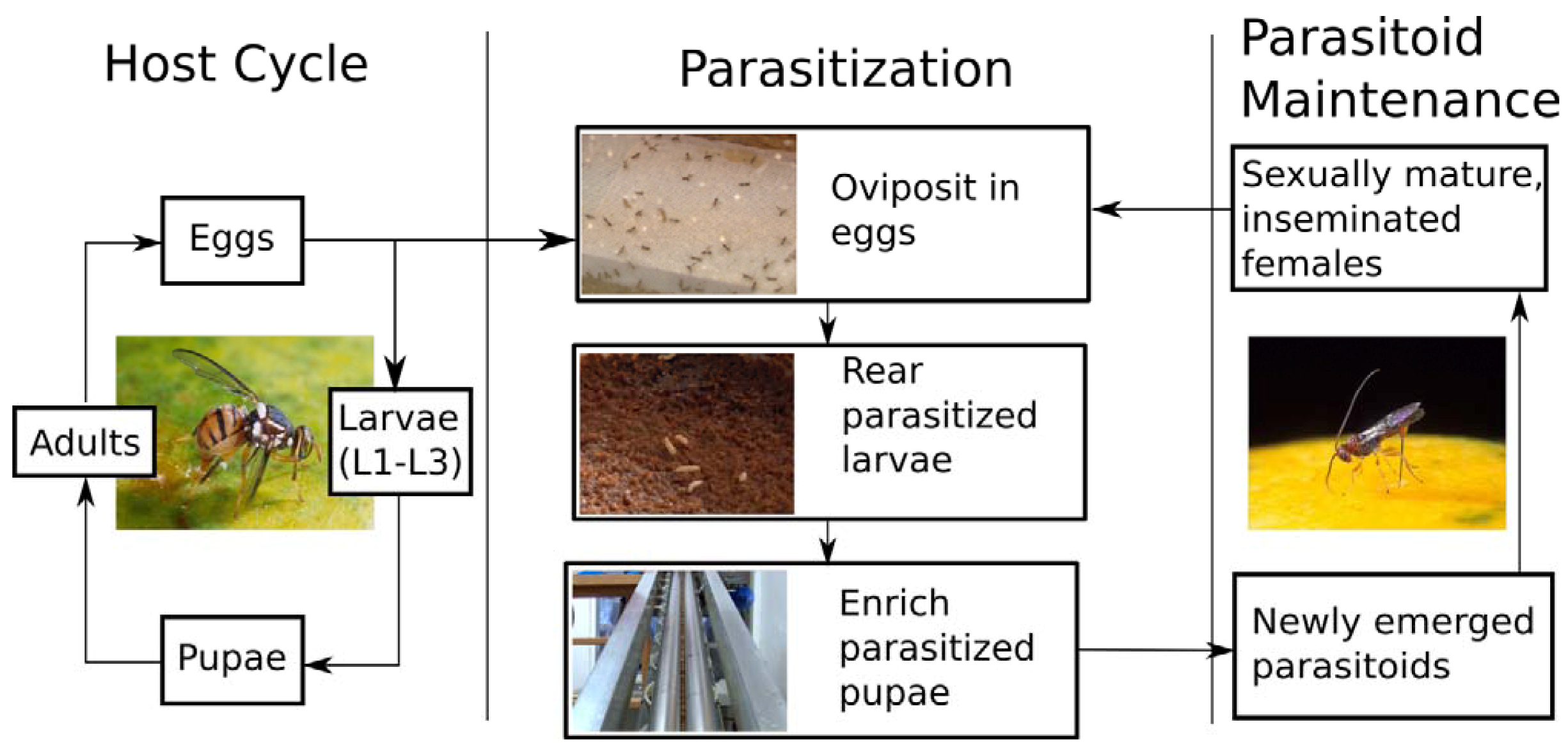
      <p>The current protocol used at USDA-ARS in Hilo, HI involves three major components: (1) maintaining a stock of host fruit flies (<italic>B. dorsalis</italic> is mainly used for this purpose, although <italic>F. arisanus</italic> is known to parasitize other species); (2) parasitization of the host eggs, development of the parasitoid in the host and enrichment of the proportion of parasitoids; and (3) maintenance of the parasitoid colony under conditions that allow high survivorship, sexual maturation and insemination of females. These three components are shown schematically in the flow chart in <xref ref-type="fig" rid="insects-03-00727-f003">Figure 3</xref>. The first component, maintaining host fruit fly stocks, has been extensively covered by Vargas [<xref ref-type="bibr" rid="B37-insects-03-00727">37</xref>] and will not be discussed here.</p>
      <fig id="insects-03-00727-f003" position="anchor">
        <label>Figure 3</label>
        <caption>
          <p>Rearing protocol for <italic>Fopius arisanus</italic> and related parasitoids.</p>
        </caption>
        <graphic xmlns:xlink="http://www.w3.org/1999/xlink" xlink:href="insects-03-00727-g003.tif"/>
      </fig>
      <p>Rearing of <italic>F</italic>. <italic>arisanus</italic> has been covered in detail by Bautista <italic>et al.</italic> [<xref ref-type="bibr" rid="B35-insects-03-00727">35</xref>] and most recently in a video by Manoukis <italic>et al.</italic> [<xref ref-type="bibr" rid="B36-insects-03-00727">36</xref>] and will only be summarized here. The second component, “Parasitization”, is the most technically involved and specific to <italic>F. arisanus</italic>. Fruit fly eggs are placed on an agar or glycerin substrate that has been prepared in a shallow dish. These dishes are then placed under the screened bottom of small holding cages containing mature <italic>F. arisanus</italic>. Females are then given 21 h to parasitize the eggs. The substrate with eggs is then placed on a dish of larval diet within a large covered fiberglass pupation container, and kept in the dark at 27 °C and 80% RH for one week. Pupae are then sifted from vermiculite or sand at the bottom of the fiberglass container and sorted by size. Pupae that are between 0.165 and 0.226 cm in diameter contain mostly parasitoids [<xref ref-type="bibr" rid="B35-insects-03-00727">35</xref>]; these are the pupae that are held for emergence after 7 more days.</p>
      <p>For the third component, Parasitiod Maintenance, there are a few important practices worthy of mention. <italic>Fopius arisanus</italic> should be kept in small cages (approximately 25 cm<sup>3</sup>). These should have a removable glass front, screened sides, top and bottom, and an access port in the back. The glass front should be tinted along the bottom edge (approx. 6 cm) to prevent parasitoids from accumulating in the corners and crowding each other. Parasitized pupae should be placed in a container with a coarse screened lid that allows <italic>F. arisanus</italic> to pass through while trapping any remaining fruit flies.</p>
      <p><italic>Fopius</italic> <italic>arisanus</italic> cultures are held in a room maintained at 24 °C and 45% RH with a 12:12 photoperiod and good ventilation. Feeding is accomplished by streaking spun honey along the top of the holding cages at least three times per week. Agar blocks are also placed on top of the holding cages to provide moisture for the parasitoids.</p>
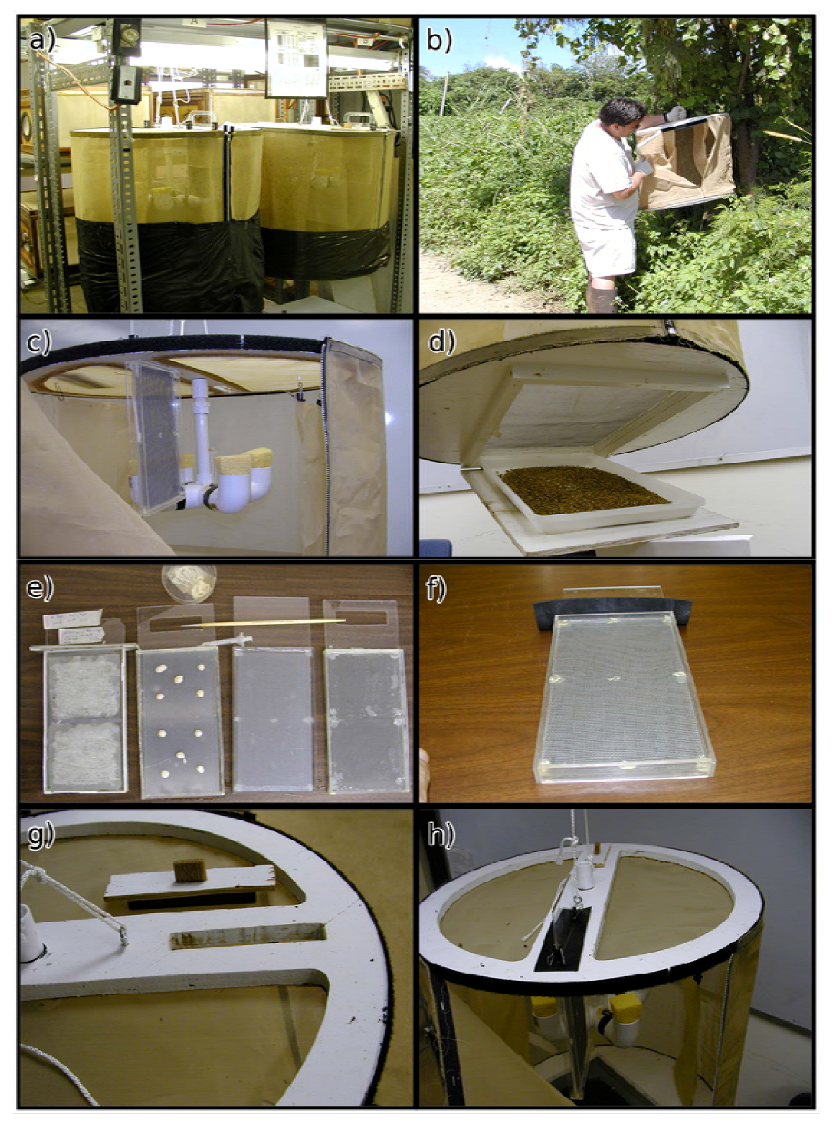
      <p>As an alternative to small cubical cages, a cylindrical cage (<xref ref-type="fig" rid="insects-03-00727-f004">Figure 4</xref>) was also developed for the dual purpose of rearing (<xref ref-type="fig" rid="insects-03-00727-f004">Figure 4</xref>a) and transport and release (<xref ref-type="fig" rid="insects-03-00727-f004">Figure 4</xref>b) of the parasitoids [<xref ref-type="bibr" rid="B9-insects-03-00727">9</xref>]. The 60 × 65 cm screened cage can hold 10,000 adult <italic>F. arisanus</italic>. Some larger “release-only” cages used in the Hawaii Area-Wide Pest Management (AWPM) program, hold up to 30,000 parasitoids [<xref ref-type="bibr" rid="B38-insects-03-00727">38</xref>]. The cage shown in the figure includes a water dispenser and a vertical stinging unit (<xref ref-type="fig" rid="insects-03-00727-f004">Figure 4</xref>c), and food is provided as spun honey smeared on the outside walls of the cage [<xref ref-type="bibr" rid="B9-insects-03-00727">9</xref>]. To initiate a colony, parasitized pupae are placed in a tray in a trapdoor below the cage (<xref ref-type="fig" rid="insects-03-00727-f004">Figure 4</xref>d) [<xref ref-type="bibr" rid="B9-insects-03-00727">9</xref>]. Emerging parasitoids escape through the screened cage floor, while flies are excluded because of small screen mesh size (0.1 cm<sup>2</sup>) [<xref ref-type="bibr" rid="B35-insects-03-00727">35</xref>]. <italic>Bactrocera dorsalis</italic> eggs as host material are provided on a stinging unit (<xref ref-type="fig" rid="insects-03-00727-f004">Figure 4</xref>e) that consists of agar poured over a rigid screen mesh, covered with tissue paper, over which eggs are evenly distributed using a fine paintbrush, and covered with a fine fabric screen to hold eggs in place [<xref ref-type="bibr" rid="B35-insects-03-00727">35</xref>]. The prepared unit (<xref ref-type="fig" rid="insects-03-00727-f004">Figure 4</xref>f) is inserted through a slot on the cage roof (<xref ref-type="fig" rid="insects-03-00727-f004">Figure 4</xref>g), allowing wasps to sting the fly eggs held in the vertical unit (<xref ref-type="fig" rid="insects-03-00727-f004">Figure 4</xref>h) [<xref ref-type="bibr" rid="B35-insects-03-00727">35</xref>]. After 24 h of exposure, the unit is removed and the agar plate with parasitized eggs is placed over larval diet [<xref ref-type="bibr" rid="B35-insects-03-00727">35</xref>].</p>
      <fig id="insects-03-00727-f004" position="anchor">
        <label>Figure 4</label>
        <caption>
          <p>(<bold>a</bold> to <bold>h</bold>) The cylindrical cage for mass-rearing and release of <italic>Fopius arisanus</italic>.</p>
        </caption>
        <graphic xmlns:xlink="http://www.w3.org/1999/xlink" xlink:href="insects-03-00727-g004.tif"/>
      </fig>
    </sec>
    <sec>
      <title>6. Prospects for the Future</title>
      <p><italic>Fopius</italic> <italic>arisanus</italic> occurs from south India to Taiwan, and has been introduced and established in Australia, Cook Islands, Costa Rica, Fiji, Hawaii, Mauritius, Samoa, Tonga, Reunion, and Israel [<xref ref-type="bibr" rid="B39-insects-03-00727">39</xref>,<xref ref-type="bibr" rid="B40-insects-03-00727">40</xref>]. <italic>Diachasmimorpha longicaudata</italic> occurs throughout southeast Asia, east to Papua New Guinea, and has been introduced and established in Australia, Fiji, Mexico, Costa Rica, Florida and Trinidad on a variety of hosts [<xref ref-type="bibr" rid="B40-insects-03-00727">40</xref>], and was more recently recorded from Vanuatu [<xref ref-type="bibr" rid="B39-insects-03-00727">39</xref>]. <italic>Psyttalia fletcheri</italic> is a widespread larval-pupal parasitoid of <italic>B</italic>. <italic>cucurbitae</italic> and occurs throughout India, Sri Lanka, Malaysia and Indonesia, and has been established in Hawaii, the Solomon Islands and Northern Marianas [<xref ref-type="bibr" rid="B40-insects-03-00727">40</xref>]. Perhaps no fruit fly parasitoids have been studied more thoroughly than <italic>F. arisanus</italic>, <italic>D</italic>. <italic>longicaudata</italic> and <italic>Psyttalia concolor</italic> (Szépligeti). Because of its habit of attacking host eggs, which are more exposed below the fruit skin surface than larvae, <italic>F. arisanus</italic> can achieve high levels of parasitism, often surpassing 50% in the field [<xref ref-type="bibr" rid="B16-insects-03-00727">16</xref>,<xref ref-type="bibr" rid="B41-insects-03-00727">41</xref>]. In Hawaii, its introduction resulted in a 95% reduction in the <italic>B</italic>. <italic>dorsalis</italic> population, compared to the 1947–1949 peak abundance of <italic>B</italic>. <italic>dorsalis</italic> [<xref ref-type="bibr" rid="B42-insects-03-00727">42</xref>]. Furthermore, <italic>F</italic>. <italic>arisanus</italic> also became the major parasitoid of <italic>C</italic>. <italic>capitata</italic> in Hawaii [<xref ref-type="bibr" rid="B42-insects-03-00727">42</xref>,<xref ref-type="bibr" rid="B43-insects-03-00727">43</xref>]. Haramoto and Bess [<xref ref-type="bibr" rid="B15-insects-03-00727">15</xref>] reported that the mean number of fruit fly pupae (<italic>B</italic>. <italic>dorsalis</italic> and <italic>C</italic>. <italic>capitata</italic>) collected from <italic>Coffea arabica</italic> L. (coffee) berries in Kona, Hawaii, decreased from 23.6 pupae per 100 fruits (8.7% parasitism) in 1949 to 5.2 (66.6% parasitism) in 1969. With this level of impact on infestation level, establishment of <italic>F. arisanus</italic> has reduced the threat of movement of fruit flies to the mainland from Hawaii. When <italic>D. longicaudata</italic> was established in French Polynesia to complement <italic>F. arisanus</italic>, data suggested it rarely accounted for more than 8.8% parasitism, but still has become widespread [<xref ref-type="bibr" rid="B20-insects-03-00727">20</xref>]. Nonetheless, establishment of <italic>D. longicaudata</italic> has increased total parasitoid mortality and more time may be necessary for <italic>D. longicaudata</italic> populations to increase [<xref ref-type="bibr" rid="B20-insects-03-00727">20</xref>]. During surveys, one specimen of <italic>Diachasmimorpha tryoni</italic> (Cameron) was reared from <italic>Inocarpus fagifer</italic> (Polynesian chestnut) on Tahiti in October 2003, probably a result of previous releases against <italic>B. kirki</italic> previously not known to have established [<xref ref-type="bibr" rid="B44-insects-03-00727">44</xref>]. In Florida, populations of <italic>A</italic>. <italic>suspensa</italic> decreased by 40% in the years following releases of the parasitoids <italic>Doryctobracon areolatus</italic> (Szépligeti) and <italic>D</italic>. <italic>longicaudata</italic> [<xref ref-type="bibr" rid="B24-insects-03-00727">24</xref>]. The larval parasitoid, <italic>Psyttalia</italic> cf. <italic>concolor</italic>, collected from tephritids infesting coffee in Kenya and reared on <italic>C</italic>. <italic>capitata</italic> by USDA-Animal Plant Health Inspection Service, Plant Protection and Quarantine in Guatemala, was recently imported into California for biological control of olive fruit fly, <italic>Bactrocera oleae</italic> (Gmelin) (introduced in 1998). Further details are found in Yokoyama <italic>et al.</italic> [<xref ref-type="bibr" rid="B45-insects-03-00727">45</xref>].</p>
      <p><italic>Fopius</italic> <italic>arisanus</italic> polyphagy has been studied extensively [<xref ref-type="bibr" rid="B46-insects-03-00727">46</xref>]. For example, in Hawaii, it attacks eggs of <italic>B. dorsalis</italic>, <italic>C. capitata</italic>, and <italic>B. cucurbitae</italic>, but does not develop successfully in <italic>B. cucurbitae</italic> [<xref ref-type="bibr" rid="B13-insects-03-00727">13</xref>,<xref ref-type="bibr" rid="B47-insects-03-00727">47</xref>]. Sometimes <italic>F. arisanus</italic> adults emerge from field-collected fruits infested by several fruit fly species, so exact host relationships cannot be inferred accurately, unless the fruit fly species can be distinguished at the pupal stage [<xref ref-type="bibr" rid="B25-insects-03-00727">25</xref>]. Vargas <italic>et al.</italic> [<xref ref-type="bibr" rid="B43-insects-03-00727">43</xref>] segregated <italic>B. dorsalis</italic> and <italic>C. capitata</italic> pupae from field collections and found <italic>F. arisanus</italic> to also be the dominant <italic>C. capitata</italic> parasitoid in Hawaii. In Australia, Quimio and Walter [<xref ref-type="bibr" rid="B46-insects-03-00727">46</xref>] were able to rear <italic>F. arisanus</italic> on <italic>B. tryoni</italic> in the laboratory and it has also been recovered from the field [<xref ref-type="bibr" rid="B25-insects-03-00727">25</xref>], but percent parasitism is lower than on <italic>B. dorsalis</italic> (<xref ref-type="table" rid="insects-03-00727-t001">Table 1</xref>). Although <italic>B</italic>. <italic>tryoni</italic> parasitism in French Polynesia was never confirmed due to mixed infestation, <italic>F. arisanus</italic> was reared in the laboratory on <italic>B. tryoni</italic> [<xref ref-type="bibr" rid="B38-insects-03-00727">38</xref>]. It is suspected, as was the case in Hawaii with <italic>C. capitata</italic>, that <italic>F. arisanus</italic> also has an impact on lesser preferred species, such as <italic>B. tryoni</italic>, by increasing its numbers on a large <italic>B. dorsalis</italic> population. Furthermore, parasitism of <italic>B. tryoni</italic> and <italic>B. kirki</italic> eggs in fruits with mixed infestations may result in significant mortality of host species in the egg or larval stage, although parasitoids may have lower survivorship, as has been shown with <italic>B. cucurbitae</italic> [<xref ref-type="bibr" rid="B9-insects-03-00727">9</xref>,<xref ref-type="bibr" rid="B48-insects-03-00727">48</xref>].</p>
    </sec>
    <sec sec-type="conclusions">
      <title>7. Conclusions</title>
      <p>In surveys in Hawaii, the egg-pupal parasitoid <italic>F. arisanus</italic> and the larval-pupal parasitoid <italic>D. longicaudata</italic> constitute 87.5%–95.1% and 0.9%–9% of the parasitoid guild, respectively, and are very common in tree fruits, particularly <italic>P. guajava</italic> and <italic>P. cattleianum</italic> (Sabine), strawberry guava [<xref ref-type="bibr" rid="B16-insects-03-00727">16</xref>]. Since its establishment in Hawaii, <italic>F. arisanus</italic> has resulted in a dramatic reduction in infestation of fruit through a high level of <italic>B. dorsalis</italic> parasitism (65%–70%) [<xref ref-type="bibr" rid="B15-insects-03-00727">15</xref>]. In Tahiti, parasitism on <italic>P.</italic> <italic>guajava</italic>, <italic>I. fagifer</italic>, and <italic>T.</italic> <italic>catappa</italic> fruit collections has increased from approximately 50% to 65% from 2006 to 2009 [<xref ref-type="bibr" rid="B20-insects-03-00727">20</xref>]. These percentages are very similar to those obtained in Hawaii and the observed increases during the period of <italic>D.</italic> <italic>longicaudata</italic> establishment would suggest few negative effects of <italic>D. longicaudata</italic> on <italic>F. arisanus</italic> [<xref ref-type="bibr" rid="B20-insects-03-00727">20</xref>].</p>
      <p>The impact of <italic>F</italic>. <italic>arisanus</italic> releases has not always been as impressive in locations outside of Hawaii and French Polynesia to date [<xref ref-type="bibr" rid="B4-insects-03-00727">4</xref>]. For example, it was released and recovered in Costa Rica, but its impact has not been high, although little information is available on its present status or distribution on coffee farms, where <italic>C. capitata</italic> infests fruits [<xref ref-type="bibr" rid="B49-insects-03-00727">49</xref>]. Similarly, in Australia, <italic>F</italic>. <italic>arisanus</italic> was introduced from Hawaii and was established on the native <italic>B</italic>. <italic>tryoni</italic> in 1962, but reputedly had only a negligible effect [<xref ref-type="bibr" rid="B46-insects-03-00727">46</xref>]. Likewise, parasitism has been lower on the species of <italic>Bactrocera</italic> endemic to south Pacific Islands (<xref ref-type="table" rid="insects-03-00727-t001">Table 1</xref>) than on the <italic>B. dorsalis</italic> complex species.</p>
      <p>The role of parasitoids were tested in the Hawaii AWPM fruit fly program at three levels of application: (1) conservation; (2) augmentative releases; and (3) classical releases [<xref ref-type="bibr" rid="B3-insects-03-00727">3</xref>]. <italic>Fopius arisanus</italic> and <italic>P</italic>. <italic>fletcheri</italic> were reared and released in wild guava and cucurbit patches, respectively, near agro-ecosystems [<xref ref-type="bibr" rid="B3-insects-03-00727">3</xref>], with the objective of demonstrating a cost-effective, sustainable technology that could be integrated with reduced risk bait sprays (<italic>i.e.</italic>, GF-120 Fruit Fly Bait) and male annihilation treatments [Specialized Pheromone Lure Application Technology-Male Annihilation Technique (SPLAT-MAT)-Methyl Eugenol-Spinosad]. In augmentative releases of <italic>P. fletcheri</italic> against melon fly, numbers of <italic>B</italic>. <italic>cucurbitae</italic> emerging from fruits placed inside field treatment cages were reduced by up to 21 fold and numbers of parasitoids were increased by 11 fold [<xref ref-type="bibr" rid="B10-insects-03-00727">10</xref>]. In open field releases of <italic>P</italic>. <italic>fletcheri</italic> into ivy gourd patches throughout the Kailua-Kona area, parasitism rates were 4.7 times higher in release plots compared to those in control plots. However there was no significant reduction in emergence of flies from fruits. Similarly, in releases of <italic>P</italic>. <italic>fletcheri</italic> in zucchini plots in Waimea, there was an increase in parasitoid recovery rates, but no reduction in melon fly damage. <italic>Fopius arisanus</italic> was also tested as an augmentative tool in small plots of guava in Waimea where the existing population of <italic>F</italic>. <italic>arisanus</italic> was low. Levels of parasitism were increased, but infestation was not reduced [<xref ref-type="bibr" rid="B3-insects-03-00727">3</xref>]. Therefore although augmentative releases of parasitoids were shown to increase parasitism in the field, limited rearing capacity, the high cost and the limited impact at reducing fruit fly infestations below economic thresholds limited their level of implementation in a sustainable AWPM-program. On the other hand, classical biological control was demonstrated to be very cost effective and sustainable in the French Polynesia program.</p>
      <p>The establishment of natural enemies of invasive tephritid fly pests may have significant and beneficial impacts in regions otherwise lacking in natural enemies. Results from Hawaii support introduction of <italic>F</italic>. <italic>arisanus</italic> and <italic>D</italic>. <italic>longicaudata</italic> into South America and Africa, where <italic>B. carambolae</italic> and <italic>B. invadens</italic> have become established, respectively [<xref ref-type="bibr" rid="B4-insects-03-00727">4</xref>,<xref ref-type="bibr" rid="B5-insects-03-00727">5</xref>]. It is also thought that <italic>F. arisanus</italic> and <italic>D</italic>. <italic>longicaudata</italic> evolved in areas where the <italic>B</italic>. <italic>dorsalis</italic> complex species are indigenous and their success is likely to be higher on species of that complex than other fruit flies. Given <italic>F. arisanus</italic> attacks the egg stage and forages on ripening fruits, while <italic>D</italic>. <italic>longicaudata</italic> attacks third instar larvae and tends to forage among fallen fruits [<xref ref-type="bibr" rid="B38-insects-03-00727">38</xref>], they are, to an extent, complementary to each other. Furthermore, based on data collected in Hawaii, <italic>F</italic>. <italic>arisanus</italic> and <italic>D</italic>. <italic>longicaudata</italic> could also be released against <italic>B</italic>. <italic>latifrons</italic>, which has recently invaded the African continent, and the peach fruit fly, <italic>B. zonata</italic> (Saunders), in Africa and the Indian Ocean region (e.g., [<xref ref-type="bibr" rid="B50-insects-03-00727">50</xref>]). <italic>Pysttalia fletcheri</italic> is also a candidate for releases in Africa where <italic>B</italic>. <italic>cucurbitae</italic> has invaded.</p>
    </sec>
    
  </body>
  <back>
   <ack>
      <title>Acknowledgments</title>
      <p>We are grateful to Neil Miller and Steven Souder, USDA, ARS, PBARC, Hilo, HI for their assistance with this research and manuscript. We also appreciate the technical assistance in French Polynesia of Rudolph Putoa, Axelle Maitere, Berthe Neagle, Djeeen Cheou, Jules Wohler, and Jean-Marc Tinirau, Service du Développement Rural, Département de la Protection des Végétaux, Papeete, Tahiti. Special thanks to Danny Seo, Michael McKenney, Thomas Mangine and Keith Shigeteni for their work in the insectary, essential to this work. We thank Ronald Mau, John Stark and Victoria Yokoyama for reviewing an earlier draft of this manuscript and Colin Mathis for help with the images. Finally, without USDA, Foreign Agricultural Service and USDA, ARS, Area-Wide Pest Management funds, this work could not have been accomplished.</p>
      <p>This article reports the results of research only. Mention of proprietary product does not constitute an endorsement or recommendation by the USDA.</p>
    </ack>
    <ref-list>
      <title>References</title>
      <ref id="B1-insects-03-00727">
        <label>1.</label>
        <citation citation-type="book">
          <person-group person-group-type="author">
            <name>
              <surname>White</surname>
              <given-names>I.M.</given-names>
            </name>
            <name>
              <surname>Elson-Harris</surname>
              <given-names>M.M.</given-names>
            </name>
          </person-group>
          <source>Fruit Flies of Economic Significance: Their Identification and Bionomics</source>
          <publisher-name>CABI</publisher-name>
          <publisher-loc>Wallingford, UK</publisher-loc>
          <year>1992</year>
        </citation>
      </ref>
      <ref id="B2-insects-03-00727">
        <label>2.</label>
        <citation citation-type="journal">
          <person-group person-group-type="author">
            <name>
              <surname>Clarke</surname>
              <given-names>A.R.</given-names>
            </name>
            <name>
              <surname>Armstrong</surname>
              <given-names>K.F.</given-names>
            </name>
            <name>
              <surname>Carmichael</surname>
              <given-names>A.E.</given-names>
            </name>
            <name>
              <surname>Milne</surname>
              <given-names>J.R.</given-names>
            </name>
            <name>
              <surname>Raghu</surname>
              <given-names>S.</given-names>
            </name>
            <name>
              <surname>Roderick</surname>
              <given-names>G.K.</given-names>
            </name>
            <name>
              <surname>Yeates</surname>
              <given-names>D.K.</given-names>
            </name>
          </person-group>
          <article-title>Invasive phytophagous pests arising through a recent tropical evolutionary radiation: The <italic>Bactrocera dorsalis</italic> complex of fruit flies</article-title>
          <source>Annu. Rev. Entomol.</source>
          <year>2005</year>
          <volume>50</volume>
          <fpage>293</fpage>
          <lpage>319</lpage>
          <pub-id pub-id-type="doi">10.1146/annurev.ento.50.071803.130428</pub-id>
        </citation>
      </ref>
      <ref id="B3-insects-03-00727">
        <label>3.</label>
        <citation citation-type="book">
          <person-group person-group-type="author">
            <name>
              <surname>Vargas</surname>
              <given-names>R.I.</given-names>
            </name>
            <name>
              <surname>Mau</surname>
              <given-names>R.F.L.</given-names>
            </name>
            <name>
              <surname>Jang</surname>
              <given-names>E.B.</given-names>
            </name>
            <name>
              <surname>Faust</surname>
              <given-names>R.M.</given-names>
            </name>
            <name>
              <surname>Wong</surname>
              <given-names>L.</given-names>
            </name>
            <name>
              <surname>Koul</surname>
              <given-names>O.</given-names>
            </name>
            <name>
              <surname>Cuperus</surname>
              <given-names>G.</given-names>
            </name>
            <name>
              <surname>Elliott</surname>
              <given-names>N.</given-names>
            </name>
          </person-group>
          <article-title>The Hawaii fruit fly areawide pest management programme</article-title>
          <source>Areawide Pest Management: Theory and Implementation</source>
          <publisher-name>CABI</publisher-name>
          <publisher-loc>Cambridge, MA, USA</publisher-loc>
          <year>2008</year>
          <fpage>300</fpage>
          <lpage>325</lpage>
        </citation>
      </ref>
      <ref id="B4-insects-03-00727">
        <label>4.</label>
        <citation citation-type="journal">
          <person-group person-group-type="author">
            <name>
              <surname>Rousse</surname>
              <given-names>P.</given-names>
            </name>
            <name>
              <surname>Harris</surname>
              <given-names>E.J.</given-names>
            </name>
            <name>
              <surname>Quilici</surname>
              <given-names>S.</given-names>
            </name>
          </person-group>
          <article-title><italic>Fopius arisanus</italic>, an egg-pupal parasitoid of Tephritidae. Overview</article-title>
          <source>Biocontrol News Infor.</source>
          <year>2005</year>
          <volume>26</volume>
          <fpage>59N</fpage>
          <lpage>69N</lpage>
        </citation>
      </ref>
      <ref id="B5-insects-03-00727">
        <label>5.</label>
        <citation citation-type="journal">
          <person-group person-group-type="author">
            <name>
              <surname>Drew</surname>
              <given-names>R.</given-names>
            </name>
            <name>
              <surname>Tsuruta</surname>
              <given-names>K.</given-names>
            </name>
            <name>
              <surname>White</surname>
              <given-names>I.</given-names>
            </name>
          </person-group>
          <article-title>A new species of pest fruit fly (Diptera: Tephritidae: Dacinae) from Sri Lanka and Africa</article-title>
          <source>Afr. Entomol.</source>
          <year>2005</year>
          <volume>13</volume>
          <fpage>149</fpage>
          <lpage>154</lpage>
        </citation>
      </ref>
      <ref id="B6-insects-03-00727">
        <label>6.</label>
        <citation citation-type="journal">
          <person-group person-group-type="author">
            <name>
              <surname>Nishida</surname>
              <given-names>T.</given-names>
            </name>
          </person-group>
          <article-title>Natural enemies of the melon fly, <italic>Dacus curcurbitae</italic> Coq. in Hawaii</article-title>
          <source>Ann. Entomol. Soc. Am.</source>
          <year>1955</year>
          <volume>48</volume>
          <fpage>171</fpage>
          <lpage>178</lpage>
        </citation>
      </ref>
      <ref id="B7-insects-03-00727">
        <label>7.</label>
        <citation citation-type="journal">
          <person-group person-group-type="author">
            <name>
              <surname>Willard</surname>
              <given-names>H.F.</given-names>
            </name>
          </person-group>
          <article-title><italic>Opius fletcheri</italic> as a parasite of the melon fly in Hawaii</article-title>
          <source>J. Agr. Res.</source>
          <year>1920</year>
          <volume>20</volume>
          <fpage>423</fpage>
          <lpage>438</lpage>
        </citation>
      </ref>
      <ref id="B8-insects-03-00727">
        <label>8.</label>
        <citation citation-type="book">
          <person-group person-group-type="author">
            <name>
              <surname>Clausen</surname>
              <given-names>C.P.</given-names>
            </name>
            <name>
              <surname>Clancy</surname>
              <given-names>D.W.</given-names>
            </name>
            <name>
              <surname>Chock</surname>
              <given-names>Q.C.</given-names>
            </name>
          </person-group>
          <source>Biological Control of the Oriental Fruit Fly (Dacus dorsalisHendel) and Other Fruit Flies in Hawaii</source>
          <publisher-name>Agricultural Research Service. US Dept. of Agriculture</publisher-name>
          <publisher-loc>Washington, DC, USA</publisher-loc>
          <year>1965</year>
        </citation>
      </ref>
      <ref id="B9-insects-03-00727">
        <label>9.</label>
        <citation citation-type="journal">
          <person-group person-group-type="author">
            <name>
              <surname>Harris</surname>
              <given-names>E.J.</given-names>
            </name>
            <name>
              <surname>Bautista</surname>
              <given-names>R.C.</given-names>
            </name>
            <name>
              <surname>Vargas</surname>
              <given-names>R.I.</given-names>
            </name>
            <name>
              <surname>Jang</surname>
              <given-names>E.B.</given-names>
            </name>
            <name>
              <surname>Eitam</surname>
              <given-names>A.</given-names>
            </name>
            <name>
              <surname>Leblanc</surname>
              <given-names>L.</given-names>
            </name>
          </person-group>
          <article-title>Suppression of melon fly (Diptera: Tephritidae) populations with releases of <italic>Fopius arisanus</italic> and <italic>Psyttalia fletcheri</italic> (Hymenoptera: Braconidae) in North Shore Oahu, HI, USA</article-title>
          <source>Biocontrol</source>
          <year>2010</year>
          <volume>55</volume>
          <fpage>593</fpage>
          <lpage>599</lpage>
          <pub-id pub-id-type="doi">10.1007/s10526-010-9282-1</pub-id>
        </citation>
      </ref>
      <ref id="B10-insects-03-00727">
        <label>10.</label>
        <citation citation-type="journal">
          <person-group person-group-type="author">
            <name>
              <surname>Vargas</surname>
              <given-names>R.I.</given-names>
            </name>
            <name>
              <surname>Long</surname>
              <given-names>J.</given-names>
            </name>
            <name>
              <surname>Miller</surname>
              <given-names>N.W.</given-names>
            </name>
            <name>
              <surname>Delate</surname>
              <given-names>K.</given-names>
            </name>
            <name>
              <surname>Jackson</surname>
              <given-names>C.G.</given-names>
            </name>
            <name>
              <surname>Uchida</surname>
              <given-names>G.K.</given-names>
            </name>
            <name>
              <surname>Bautista</surname>
              <given-names>R.C.</given-names>
            </name>
            <name>
              <surname>Harris</surname>
              <given-names>E.J.</given-names>
            </name>
          </person-group>
          <article-title>Releases of <italic>Psyttalia fletcheri</italic> (Hymenoptera: Braconidae) and sterile flies to suppress melon fly (Diptera: Tephritidae) in Hawaii</article-title>
          <source>J. Econ. Entomol.</source>
          <year>2004</year>
          <volume>97</volume>
          <fpage>1531</fpage>
          <lpage>1539</lpage>
        <pub-id pub-id-type="doi">10.1603/0022-0493-97.5.1531</pub-id><pub-id pub-id-type="pmid">15568340</pub-id></citation>
      </ref>
      <ref id="B11-insects-03-00727">
        <label>11.</label>
        <citation citation-type="journal">
          <person-group person-group-type="author">
            <name>
              <surname>Bess</surname>
              <given-names>H.A.</given-names>
            </name>
            <name>
              <surname>van Den Bosch</surname>
              <given-names>R.</given-names>
            </name>
            <name>
              <surname>Haramoto</surname>
              <given-names>F.H.</given-names>
            </name>
          </person-group>
          <article-title>Fruit fly parasites and their activities in Hawaii</article-title>
          <source>P. Hawaii Entomol. Soc.</source>
          <year>1961</year>
          <volume>17</volume>
          <fpage>367</fpage>
          <lpage>378</lpage>
        </citation>
      </ref>
      <ref id="B12-insects-03-00727">
        <label>12.</label>
        <citation citation-type="journal">
          <person-group person-group-type="author">
            <name>
              <surname>van den Bosch</surname>
              <given-names>R.</given-names>
            </name>
            <name>
              <surname>Haramoto</surname>
              <given-names>F.H.</given-names>
            </name>
          </person-group>
          <article-title>Competition among parasites of the Oriental fruit fly</article-title>
          <source>P. Hawaii Entomol. Soc.</source>
          <year>1953</year>
          <volume>15</volume>
          <fpage>201</fpage>
          <lpage>206</lpage>
        </citation>
      </ref>
      <ref id="B13-insects-03-00727">
        <label>13.</label>
        <citation citation-type="thesis">
          <person-group person-group-type="author">
            <name>
              <surname>Haramoto</surname>
              <given-names>F.H.</given-names>
            </name>
          </person-group>
          <article-title>The Biology of <italic>Opius oophilus</italic> Fullaway (Hymenoptera: Braconidae)</article-title>
          <comment>M.S. thesis, University of Hawaii, Honolulu, HI, USA, June 1953.</comment>
        </citation>
      </ref>
      <ref id="B14-insects-03-00727">
        <label>14.</label>
        <citation citation-type="journal">
          <person-group person-group-type="author">
            <name>
              <surname>Ramadan</surname>
              <given-names>M.M.</given-names>
            </name>
            <name>
              <surname>Wong</surname>
              <given-names>T.T.Y.</given-names>
            </name>
            <name>
              <surname>Beardsley</surname>
              <given-names>J.W.</given-names>
            </name>
          </person-group>
          <article-title>Reproductive behavior of <italic>Biosteres arisanus</italic> (Sonan) (Hymenoptera: Braconidae), an egg-larval parasitoid of the Oriental fruit fly</article-title>
          <source>Biol. Control</source>
          <year>1992</year>
          <volume>2</volume>
          <fpage>28</fpage>
          <lpage>34</lpage>
          <pub-id pub-id-type="doi">10.1016/1049-9644(92)90072-L</pub-id>
        </citation>
      </ref>
      <ref id="B15-insects-03-00727">
        <label>15.</label>
        <citation citation-type="journal">
          <person-group person-group-type="author">
            <name>
              <surname>Haramoto</surname>
              <given-names>F.H.</given-names>
            </name>
            <name>
              <surname>Bess</surname>
              <given-names>H.A.</given-names>
            </name>
          </person-group>
          <article-title>Recent studies on the abundance of the Oriental and Mediterranean fruit flies and the status of their parasites</article-title>
          <source>Proc. Hawaii. Entomol. Soc.</source>
          <year>1970</year>
          <volume>20</volume>
          <fpage>551</fpage>
          <lpage>566</lpage>
        </citation>
      </ref>
      <ref id="B16-insects-03-00727">
        <label>16.</label>
        <citation citation-type="journal">
          <person-group person-group-type="author">
            <name>
              <surname>Vargas</surname>
              <given-names>R.I.</given-names>
            </name>
            <name>
              <surname>Stark</surname>
              <given-names>J.D.</given-names>
            </name>
            <name>
              <surname>Uchida</surname>
              <given-names>G.</given-names>
            </name>
            <name>
              <surname>Purcell</surname>
              <given-names>M.</given-names>
            </name>
          </person-group>
          <article-title>Opiine parasitoids (Hymenoptera, Braconidae) of Oriental fruit fly (Diptera, Tephritidae) on Kauai Island, Hawaii—Islandwide relative abundance and parasitism rates in wild and orchard guava habitats</article-title>
          <source>Environ. Entomol.</source>
          <year>1993</year>
          <volume>22</volume>
          <fpage>246</fpage>
          <lpage>253</lpage>
        </citation>
      </ref>
      <ref id="B17-insects-03-00727">
        <label>17.</label>
        <citation citation-type="journal">
          <person-group person-group-type="author">
            <name>
              <surname>Bokonon-Ganta</surname>
              <given-names>A.H.</given-names>
            </name>
            <name>
              <surname>Ramadan</surname>
              <given-names>M.M.</given-names>
            </name>
            <name>
              <surname>Messing</surname>
              <given-names>R.H.</given-names>
            </name>
          </person-group>
          <article-title>Reproductive biology of <italic>Fopius ceratitivorus</italic> (Hymenoptera: Braconidae), an egg-larval parasitold of the Mediterranean fruit fly, <italic>Ceratitis capitata</italic> (Diptera: Tephritidae)</article-title>
          <source>Biol. Control</source>
          <year>2007</year>
          <volume>41</volume>
          <fpage>361</fpage>
          <lpage>367</lpage>
        <pub-id pub-id-type="doi">10.1016/j.biocontrol.2007.02.011</pub-id></citation>
      </ref>
      <ref id="B18-insects-03-00727">
        <label>18.</label>
        <citation citation-type="book">
          <person-group person-group-type="author">
            <name>
              <surname>Leblanc</surname>
              <given-names>L.</given-names>
            </name>
            <name>
              <surname>Putoa</surname>
              <given-names>R.</given-names>
            </name>
          </person-group>
          <source>Fruit Flies in French Polynesia and Pitcairn Islands</source>
          <publisher-name>Plant Protection Service, Secretariat of the Pacific Community</publisher-name>
          <publisher-loc>Suva, Fiji</publisher-loc>
          <year>2000</year>
          <fpage>4</fpage>
        </citation>
      </ref>
      <ref id="B19-insects-03-00727">
        <label>19.</label>
        <citation citation-type="journal">
          <person-group person-group-type="author">
            <name>
              <surname>Vargas</surname>
              <given-names>R.I.</given-names>
            </name>
            <name>
              <surname>Leblanc</surname>
              <given-names>L.</given-names>
            </name>
            <name>
              <surname>Putoa</surname>
              <given-names>R.</given-names>
            </name>
            <name>
              <surname>Eitam</surname>
              <given-names>A.</given-names>
            </name>
          </person-group>
          <article-title>Impact of introduction of <italic>Bactrocera dorsalis</italic> (Diptera:Tephritidae) and classical biological control releases of <italic>Fopius arisanus</italic> (Hymenoptera:Braconidae) on economically important fruit flies in French Polynesia</article-title>
          <source>J. Econ. Entomol.</source>
          <year>2007</year>
          <volume>100</volume>
          <fpage>670</fpage>
          <lpage>679</lpage>
          <pub-id pub-id-type="doi">10.1603/0022-0493(2007)100[670:IOIOBD]2.0.CO;2</pub-id>
        </citation>
      </ref>
      <ref id="B20-insects-03-00727">
        <label>20.</label>
        <citation citation-type="journal">
          <person-group person-group-type="author">
            <name>
              <surname>Vargas</surname>
              <given-names>R.I.</given-names>
            </name>
            <name>
              <surname>Leblanc</surname>
              <given-names>L.</given-names>
            </name>
            <name>
              <surname>Putoa</surname>
              <given-names>R.</given-names>
            </name>
            <name>
              <surname>Piñero</surname>
              <given-names>J.C.</given-names>
            </name>
          </person-group>
          <article-title>Population dynamics of three <italic>Bactrocera</italic> spp. fruit flies (Diptera: Tephritidae) and two introduced natural enemies, <italic>Fopius arisanus</italic> (Sonan) and <italic>Diachasmimorpha longicaudata</italic> (Ashmead) (Hymenoptera: Braconidae), after an invasion by <italic>Bactrocera dorsalis</italic> (Hendel) in Tahiti</article-title>
          <source>Biol. Control</source>
          <year>2012</year>
          <volume>60</volume>
          <fpage>199</fpage>
          <lpage>206</lpage>
        <pub-id pub-id-type="doi">10.1016/j.biocontrol.2011.10.012</pub-id></citation>
      </ref>
      <ref id="B21-insects-03-00727">
        <label>21.</label>
        <citation citation-type="journal">
          <person-group person-group-type="author">
            <name>
              <surname>Harris</surname>
              <given-names>E.J.</given-names>
            </name>
            <name>
              <surname>Bautista</surname>
              <given-names>R.C.</given-names>
            </name>
          </person-group>
          <article-title>Implications of host mortality on the economics of <italic>Fopius arisanus</italic> (Hymenoptera: Braconidae) mass rearing</article-title>
          <source>Biocontrol</source>
          <year>2001</year>
          <volume>46</volume>
          <fpage>275</fpage>
          <lpage>287</lpage>
        <pub-id pub-id-type="doi">10.1023/A:1011430503470</pub-id></citation>
      </ref>
      <ref id="B22-insects-03-00727">
        <label>22.</label>
        <citation citation-type="journal">
          <person-group person-group-type="author">
            <name>
              <surname>Ovruski</surname>
              <given-names>S.</given-names>
            </name>
            <name>
              <surname>Aluja</surname>
              <given-names>M.</given-names>
            </name>
            <name>
              <surname>Sivinski</surname>
              <given-names>J.</given-names>
            </name>
            <name>
              <surname>Wharton</surname>
              <given-names>R.</given-names>
            </name>
          </person-group>
          <article-title>Hymenopteran parasitoids on fruit-infesting Tephritidae (Diptera) in Latin America and the southern United States: Diversity, distribution, taxonomic status and their use in fruit fly biological control</article-title>
          <source>Integr. Pest Manage. Rev.</source>
          <year>2000</year>
          <volume>5</volume>
          <fpage>81</fpage>
          <lpage>107</lpage>
        <pub-id pub-id-type="doi">10.1023/A:1009652431251</pub-id></citation>
      </ref>
      <ref id="B23-insects-03-00727">
        <label>23.</label>
        <citation citation-type="book">
          <person-group person-group-type="author">
            <name>
              <surname>Hollingsworth</surname>
              <given-names>R.G.</given-names>
            </name>
          </person-group>
          <source>Project on Regional Management of Fruit Flies in the Pacific Status of Fruit Flies (Family Tephritidae) and Fruit Fly Research in the Solomon Islands</source>
          <publisher-name>Solomon Islands Ministry of Agriculture and Fisheries</publisher-name>
          <publisher-loc>Honiara, Solomon Islands</publisher-loc>
          <year>1998</year>
          <fpage>54</fpage>
        </citation>
      </ref>
      <ref id="B24-insects-03-00727">
        <label>24.</label>
        <citation citation-type="journal">
          <person-group person-group-type="author">
            <name>
              <surname>Baranowski</surname>
              <given-names>R.</given-names>
            </name>
            <name>
              <surname>Glenn</surname>
              <given-names>H.</given-names>
            </name>
            <name>
              <surname>Sivinski</surname>
              <given-names>J.</given-names>
            </name>
          </person-group>
          <article-title>Biological control of the Caribbean fruit fly (Diptera: Tephritidae)</article-title>
          <source>Fla Entomol.</source>
          <year>1993</year>
          <volume>76</volume>
          <fpage>245</fpage>
          <lpage>251</lpage>
          <pub-id pub-id-type="doi">10.2307/3495721</pub-id>
        </citation>
      </ref>
      <ref id="B25-insects-03-00727">
        <label>25.</label>
        <citation citation-type="journal">
          <person-group person-group-type="author">
            <name>
              <surname>Snowball</surname>
              <given-names>G.J.</given-names>
            </name>
            <name>
              <surname>Lukins</surname>
              <given-names>R.G.</given-names>
            </name>
          </person-group>
          <article-title>Status of introduced parasites of Queensland fruit fly (<italic>Strumeta tryoni</italic>)</article-title>
          <source>Aust. J. Agr. Res.</source>
          <year>1964</year>
          <volume>15</volume>
          <fpage>586</fpage>
          <lpage>608</lpage>
          <pub-id pub-id-type="doi">10.1071/AR9640586</pub-id>
        </citation>
      </ref>
      <ref id="B26-insects-03-00727">
        <label>26.</label>
        <citation citation-type="journal">
          <person-group person-group-type="author">
            <name>
              <surname>Snowball</surname>
              <given-names>G.J.</given-names>
            </name>
            <name>
              <surname>Lukins</surname>
              <given-names>R.G.</given-names>
            </name>
          </person-group>
          <article-title>Status of introduced parasites of Queensland fruit fly (<italic>Strumeta tryoni</italic>), 1962–1965</article-title>
          <source>Aust. J. Agr. Res.</source>
          <year>1966</year>
          <volume>17</volume>
          <fpage>719</fpage>
          <lpage>739</lpage>
          <pub-id pub-id-type="doi">10.1071/AR9660719</pub-id>
        </citation>
      </ref>
      <ref id="B27-insects-03-00727">
        <label>27.</label>
        <citation citation-type="journal">
          <person-group person-group-type="author">
            <name>
              <surname>O’Connor</surname>
              <given-names>B.</given-names>
            </name>
          </person-group>
          <article-title>A decade of biological control work in Fiji</article-title>
          <source>Agric. J. Fiji</source>
          <year>1960</year>
          <volume>30</volume>
          <fpage>44</fpage>
          <lpage>54</lpage>
        </citation>
      </ref>
      <ref id="B28-insects-03-00727">
        <label>28.</label>
        <citation citation-type="journal">
          <person-group person-group-type="author">
            <name>
              <surname>Hinckley</surname>
              <given-names>A.D.</given-names>
            </name>
          </person-group>
          <article-title>Fruit fly infestation and parasitization in Fiji</article-title>
          <source>P. Hawaii Entomol. Soc.</source>
          <year>1965</year>
          <volume>19</volume>
          <fpage>91</fpage>
          <lpage>95</lpage>
        </citation>
      </ref>
      <ref id="B29-insects-03-00727">
        <label>29.</label>
        <citation citation-type="journal">
          <person-group person-group-type="author">
            <name>
              <surname>Chong</surname>
              <given-names>M.</given-names>
            </name>
          </person-group>
          <article-title>Production methods for fruit fly parasites</article-title>
          <source>P. Hawaii Entomol. Soc.</source>
          <year>1962</year>
          <volume>18</volume>
          <fpage>61</fpage>
          <lpage>63</lpage>
        </citation>
      </ref>
      <ref id="B30-insects-03-00727">
        <label>30.</label>
        <citation citation-type="journal">
          <person-group person-group-type="author">
            <name>
              <surname>Snowball</surname>
              <given-names>G.V.</given-names>
            </name>
            <name>
              <surname>Wilson</surname>
              <given-names>F.</given-names>
            </name>
          </person-group>
          <article-title>Culture and consignment techniques used for parasites introduced against Queensland fruit fly (<italic>Strumeta tryoni</italic> Frogg.)</article-title>
          <source>Aust. J. Agr. Res.</source>
          <year>1962</year>
          <volume>13</volume>
          <fpage>233</fpage>
          <lpage>248</lpage>
          <pub-id pub-id-type="doi">10.1071/AR9620233</pub-id>
        </citation>
      </ref>
      <ref id="B31-insects-03-00727">
        <label>31.</label>
        <citation citation-type="journal">
          <person-group person-group-type="author">
            <name>
              <surname>Ramadan</surname>
              <given-names>M.M.</given-names>
            </name>
            <name>
              <surname>Wong</surname>
              <given-names>T.T.Y.</given-names>
            </name>
            <name>
              <surname>McInnis</surname>
              <given-names>D.</given-names>
            </name>
          </person-group>
          <article-title>Reproductive biology of <italic>Biosteres arisanus</italic> (Sonan), an egg-larval parasitoid of the oriental fruit fly</article-title>
          <source>Biol. Control</source>
          <year>1994</year>
          <volume>4</volume>
          <fpage>93</fpage>
          <lpage>100</lpage>
          <pub-id pub-id-type="doi">10.1006/bcon.1994.1016</pub-id>
        </citation>
      </ref>
      <ref id="B32-insects-03-00727">
        <label>32.</label>
        <citation citation-type="journal">
          <person-group person-group-type="author">
            <name>
              <surname>Wang</surname>
              <given-names>X.G.</given-names>
            </name>
            <name>
              <surname>Bokonon-Ganta</surname>
              <given-names>A.H.</given-names>
            </name>
            <name>
              <surname>Ramadan</surname>
              <given-names>M.M.</given-names>
            </name>
            <name>
              <surname>Messing</surname>
              <given-names>R.H.</given-names>
            </name>
          </person-group>
          <article-title>Egg-larval Opiine parasitoids (Hym., Braconidae) of tephritid fruit fly pests do not attack the flowerhead-feeder <italic>Trupanea dubautiae</italic> (Dipt., Tephritidae)</article-title>
          <source>J. Appl. Entomol.</source>
          <year>2004</year>
          <volume>128</volume>
          <fpage>716</fpage>
          <lpage>722</lpage>
        <pub-id pub-id-type="doi">10.1111/j.1439-0418.2004.00920.x</pub-id></citation>
      </ref>
      <ref id="B33-insects-03-00727">
        <label>33.</label>
        <citation citation-type="journal">
          <person-group person-group-type="author">
            <name>
              <surname>Harris</surname>
              <given-names>E.J.</given-names>
            </name>
            <name>
              <surname>Okamoto</surname>
              <given-names>R.Y.</given-names>
            </name>
            <name>
              <surname>Lee</surname>
              <given-names>C.Y.L.</given-names>
            </name>
            <name>
              <surname>Nishida</surname>
              <given-names>T.</given-names>
            </name>
          </person-group>
          <article-title>Suitability of <italic>Dacus dorsalis</italic> and <italic>Ceratitis capitata</italic> [Diptera, Tephritidae] as hosts of the parasitoid, <italic>Biosteres arisanus</italic> [Hymenoptera, Braconidae]</article-title>
          <source>Entomophaga</source>
          <year>1991</year>
          <volume>36</volume>
          <fpage>425</fpage>
          <lpage>430</lpage>
          <pub-id pub-id-type="doi">10.1007/BF02377948</pub-id>
        </citation>
      </ref>
      <ref id="B34-insects-03-00727">
        <label>34.</label>
        <citation citation-type="journal">
          <person-group person-group-type="author">
            <name>
              <surname>Bautista</surname>
              <given-names>R.C.</given-names>
            </name>
            <name>
              <surname>Harris</surname>
              <given-names>E.J.</given-names>
            </name>
            <name>
              <surname>Lawrence</surname>
              <given-names>P.O.</given-names>
            </name>
          </person-group>
          <article-title>Biology and rearing of the fruit fly parasitoid <italic>Biosteres arisanus</italic>: Clues to insectary propagation</article-title>
          <source>Entomol. Exp. Appl.</source>
          <year>1998</year>
          <volume>89</volume>
          <fpage>79</fpage>
          <lpage>85</lpage>
        <pub-id pub-id-type="doi">10.1046/j.1570-7458.1998.00384.x</pub-id></citation>
      </ref>
      <ref id="B35-insects-03-00727">
        <label>35.</label>
        <citation citation-type="journal">
          <person-group person-group-type="author">
            <name>
              <surname>Bautista</surname>
              <given-names>R.C.</given-names>
            </name>
            <name>
              <surname>Mochizuki</surname>
              <given-names>N.</given-names>
            </name>
            <name>
              <surname>Spencer</surname>
              <given-names>J.P.</given-names>
            </name>
            <name>
              <surname>Harris</surname>
              <given-names>E.J.</given-names>
            </name>
            <name>
              <surname>Ichimura</surname>
              <given-names>D.M.</given-names>
            </name>
          </person-group>
          <article-title>Mass-rearing of the tephritid fruit fly parasitoid <italic>Fopius arisanus</italic> (Hymenoptera: Braconidae)</article-title>
          <source>Biol. Control</source>
          <year>1999</year>
          <volume>15</volume>
          <fpage>137</fpage>
          <lpage>144</lpage>
          <pub-id pub-id-type="doi">10.1006/bcon.1999.0707</pub-id>
        </citation>
      </ref>
      <ref id="B36-insects-03-00727">
        <label>36.</label>
        <citation citation-type="journal">
          <person-group person-group-type="author">
            <name>
              <surname>Manoukis</surname>
              <given-names>N.</given-names>
            </name>
            <name>
              <surname>Geib</surname>
              <given-names>S.</given-names>
            </name>
            <name>
              <surname>Seo</surname>
              <given-names>D.</given-names>
            </name>
            <name>
              <surname>McKenney</surname>
              <given-names>M.</given-names>
            </name>
            <name>
              <surname>Vargas</surname>
              <given-names>R.</given-names>
            </name>
            <name>
              <surname>Jang</surname>
              <given-names>E.</given-names>
            </name>
          </person-group>
          <article-title>An optimized protocol for rearing <italic>Fopius arisanus</italic>, a parasitoid of Tephritid fruit flies</article-title>
          <source>J. Vis. Exp.</source>
          <year>2011</year>
          <volume>53</volume>
          <fpage>e2901</fpage>
        </citation>
      </ref>
      <ref id="B37-insects-03-00727">
        <label>37.</label>
        <citation citation-type="book">
          <person-group person-group-type="author">
            <name>
              <surname>Vargas</surname>
              <given-names>R.I.</given-names>
            </name>
          </person-group>
          <article-title>Mass production of tephritid fruit flies</article-title>
          <source>World Crop Pests. Fruit Flies: Their Biology, Natural Enemies and Control</source>
          <publisher-name>Elsevier</publisher-name>
          <publisher-loc>Amsterdam, The Netherlands</publisher-loc>
          <year>1989</year>
          <volume>3</volume>
          <fpage>141</fpage>
          <lpage>151</lpage>
        </citation>
      </ref>
      <ref id="B38-insects-03-00727">
        <label>38.</label>
        <citation citation-type="journal">
          <person-group person-group-type="author">
            <name>
              <surname>Vargas</surname>
              <given-names>R.I.</given-names>
            </name>
            <name>
              <surname>Stark</surname>
              <given-names>J.D.</given-names>
            </name>
            <name>
              <surname>Banks</surname>
              <given-names>J.</given-names>
            </name>
            <name>
              <surname>Leblanc</surname>
              <given-names>L.</given-names>
            </name>
            <name>
              <surname>Manoukis</surname>
              <given-names>N.C.</given-names>
            </name>
          </person-group>
          <article-title>Spatial dynamics of two oriental fruit Fly (Diptera: Tephritidae) parasitoids, <italic>Fopius arisanus </italic>(Sonan) and <italic>Diachasmimorpha longicaudata</italic> (Ashmead) (Hymenoptera: Braconidae), in a guava orchard in Hawai</article-title>
          <source>Biocontrol</source>
          <year>2013</year>
          <comment>sumbitted</comment>
        </citation>
      </ref>
      <ref id="B39-insects-03-00727">
        <label>39.</label>
        <citation citation-type="journal">
          <person-group person-group-type="author">
            <name>
              <surname>Carmichael</surname>
              <given-names>A.E.</given-names>
            </name>
            <name>
              <surname>Wharton</surname>
              <given-names>R.A.</given-names>
            </name>
            <name>
              <surname>Clarke</surname>
              <given-names>A.R.</given-names>
            </name>
          </person-group>
          <article-title>Opiine parasitoids (Hymenoptera: Braconidae) of tropical fruit flies (Diptera: Tephritidae) of the Australian and South Pacific region</article-title>
          <source>Bull. Entomol. Res.</source>
          <year>2005</year>
          <volume>95</volume>
          <fpage>545</fpage>
          <lpage>569</lpage>
        <pub-id pub-id-type="pmid">16336703</pub-id></citation>
      </ref>
      <ref id="B40-insects-03-00727">
        <label>40.</label>
        <citation citation-type="book">
          <person-group person-group-type="author">
            <name>
              <surname>Waterhouse</surname>
              <given-names>D.F.</given-names>
            </name>
          </person-group>
          <article-title>Pest fruit flies in the Oceanic Pacific</article-title>
          <source>Biological Control: Pacific Prospects—Supplement 2</source>
          <publisher-name>Australian Centre for International Agricultural Research</publisher-name>
          <publisher-loc>Canberra, Australia</publisher-loc>
          <year>1993</year>
          <volume>2</volume>
          <fpage>4</fpage>
          <lpage>47</lpage>
        </citation>
      </ref>
      <ref id="B41-insects-03-00727">
        <label>41.</label>
        <citation citation-type="journal">
          <person-group person-group-type="author">
            <name>
              <surname>Purcell</surname>
              <given-names>M.F.</given-names>
            </name>
            <name>
              <surname>John</surname>
              <given-names>C.</given-names>
            </name>
            <name>
              <surname>Messing</surname>
              <given-names>R.H.</given-names>
            </name>
            <name>
              <surname>Wong</surname>
              <given-names>T.T.Y.</given-names>
            </name>
          </person-group>
          <article-title>Interactions between augmentatively released <italic>Diachasmimorpha longicaudata </italic>(Hymenoptera: Braconidae) and a complex of Opiine parasitoids in a commercial guava orchard</article-title>
          <source>Biocontrol Sci. Technol.</source>
          <year>1998</year>
          <volume>8</volume>
          <fpage>139</fpage>
          <lpage>151</lpage>
          <pub-id pub-id-type="doi">10.1080/09583159830504</pub-id>
        </citation>
      </ref>
      <ref id="B42-insects-03-00727">
        <label>42.</label>
        <citation citation-type="book">
          <person-group person-group-type="author">
            <name>
              <surname>DeBach</surname>
              <given-names>P.</given-names>
            </name>
            <name>
              <surname>Rosen</surname>
              <given-names>D.</given-names>
            </name>
          </person-group>
          <source>Biological Control by Natural Enemies</source>
          <publisher-name>Cambridge University Press</publisher-name>
          <publisher-loc>Cambridge, UK</publisher-loc>
          <year>1991</year>
        </citation>
      </ref>
      <ref id="B43-insects-03-00727">
        <label>43.</label>
        <citation citation-type="journal">
          <person-group person-group-type="author">
            <name>
              <surname>Vargas</surname>
              <given-names>R.I.</given-names>
            </name>
            <name>
              <surname>Peck</surname>
              <given-names>S.L.</given-names>
            </name>
            <name>
              <surname>McQuate</surname>
              <given-names>G.T.</given-names>
            </name>
            <name>
              <surname>Jackson</surname>
              <given-names>C.G.</given-names>
            </name>
            <name>
              <surname>Stark</surname>
              <given-names>J.D.</given-names>
            </name>
            <name>
              <surname>Armstrong</surname>
              <given-names>J.W.</given-names>
            </name>
          </person-group>
          <article-title>Potential for areawide integrated management of Mediterranean fruit fly (Diptera: Tephritidae) with a Braconid parasitoid and a novel bait spray</article-title>
          <source>J. Econ. Entomol.</source>
          <year>2001</year>
          <volume>94</volume>
          <fpage>817</fpage>
          <lpage>825</lpage>
          <pub-id pub-id-type="doi">10.1603/0022-0493-94.4.817</pub-id>
        </citation>
      </ref>
      <ref id="B44-insects-03-00727">
        <label>44.</label>
        <citation citation-type="book">
          <person-group person-group-type="author">
            <name>
              <surname>Hoyt</surname>
              <given-names>C.P.</given-names>
            </name>
          </person-group>
          <source>Parasites and Predators Introduced into the Pacific Islands for the Biological Control of Insects and Other Pests; Technical Papers</source>
          <publisher-name>South Pacific Commission</publisher-name>
          <publisher-loc>Nouméa, New Caledonia</publisher-loc>
          <year>1957</year>
          <fpage>40</fpage>
        </citation>
      </ref>
      <ref id="B45-insects-03-00727">
        <label>45.</label>
        <citation citation-type="journal">
          <person-group person-group-type="author">
            <name>
              <surname>Yokoyama</surname>
              <given-names>V.Y.</given-names>
            </name>
            <name>
              <surname>Rendón</surname>
              <given-names>P.A.</given-names>
            </name>
            <name>
              <surname>Sivinski</surname>
              <given-names>J.</given-names>
            </name>
          </person-group>
          <article-title>Psyttalia <italic>cf.</italic> concolor (Hymenoptera: Braconidae) for biological control of olive fruit fly (Diptera: Tephritidae) in California</article-title>
          <source>Environ. Entomol.</source>
          <year>2008</year>
          <volume>37</volume>
          <fpage>764</fpage>
          <lpage>773</lpage>
        <pub-id pub-id-type="doi">10.1603/0046-225X(2008)37[764:PCCHBF]2.0.CO;2</pub-id><pub-id pub-id-type="pmid">18559183</pub-id></citation>
      </ref>
      <ref id="B46-insects-03-00727">
        <label>46.</label>
        <citation citation-type="journal">
          <person-group person-group-type="author">
            <name>
              <surname>Quimio</surname>
              <given-names>G.M.</given-names>
            </name>
            <name>
              <surname>Walter</surname>
              <given-names>G.H.</given-names>
            </name>
          </person-group>
          <article-title>Host preference and host suitability in an egg-pupal fruit fly parasitoid, <italic>Fopius arisanus</italic> (Sonan) (Hym., Braconidae)</article-title>
          <source>J. Appl. Entomol.</source>
          <year>2001</year>
          <volume>125</volume>
          <fpage>135</fpage>
          <lpage>140</lpage>
        <pub-id pub-id-type="doi">10.1046/j.1439-0418.2001.00514.x</pub-id></citation>
      </ref>
      <ref id="B47-insects-03-00727">
        <label>47.</label>
        <citation citation-type="journal">
          <person-group person-group-type="author">
            <name>
              <surname>Nishida</surname>
              <given-names>T.</given-names>
            </name>
            <name>
              <surname>Haramoto</surname>
              <given-names>F.H.</given-names>
            </name>
          </person-group>
          <article-title>Immunity of <italic>Dacus cucurbitae</italic> to attack by certain parasites of <italic>Dacus dorsalis</italic></article-title>
          <source>J. Econ. Entomol.</source>
          <year>1953</year>
          <volume>46</volume>
          <fpage>61</fpage>
          <lpage>64</lpage>
        </citation>
      </ref>
      <ref id="B48-insects-03-00727">
        <label>48.</label>
        <citation citation-type="journal">
          <person-group person-group-type="author">
            <name>
              <surname>Bautista</surname>
              <given-names>R.C.</given-names>
            </name>
            <name>
              <surname>Harris</surname>
              <given-names>E.J.</given-names>
            </name>
            <name>
              <surname>Vargas</surname>
              <given-names>R.I.</given-names>
            </name>
            <name>
              <surname>Jang</surname>
              <given-names>E.B.</given-names>
            </name>
          </person-group>
          <article-title>Parasitization of melon fly (Diptera: Tephritidae) by <italic>Fopius arisanus</italic> and <italic>Psyttalia fletcheri</italic> (Hymenoptera: Braconidae) and the effect of fruit substrates on host preference by parasitoids</article-title>
          <source>Biol. Control</source>
          <year>2004</year>
          <volume>30</volume>
          <fpage>156</fpage>
          <lpage>164</lpage>
          <pub-id pub-id-type="doi">10.1016/j.biocontrol.2004.01.005</pub-id>
        </citation>
      </ref>
      <ref id="B49-insects-03-00727">
        <label>49.</label>
        <citation citation-type="journal">
          <person-group person-group-type="author">
            <name>
              <surname>Wharton</surname>
              <given-names>R.A.</given-names>
            </name>
            <name>
              <surname>Gilstrap</surname>
              <given-names>F.E.</given-names>
            </name>
            <name>
              <surname>Rhode</surname>
              <given-names>R.H.</given-names>
            </name>
            <name>
              <surname>Fischel</surname>
              <given-names>M.</given-names>
            </name>
            <name>
              <surname>Hart</surname>
              <given-names>W.G.</given-names>
            </name>
          </person-group>
          <article-title>Hymenopterous egg-pupal and larval-pupal parasitoids of <italic>Ceratitis capitata</italic> and <italic>Anastrepha</italic> spp. [Dip.: Tephritidae] in Costa Rica</article-title>
          <source>Biocontrol</source>
          <year>1981</year>
          <volume>26</volume>
          <fpage>285</fpage>
          <lpage>290</lpage>
        </citation>
      </ref>
      <ref id="B50-insects-03-00727">
        <label>50.</label>
        <citation citation-type="journal">
		  <collab>FAO</collab>
           <article-title>IAEA Alert notice USDA-APHIS: Elevated risk of peach fruit fly (<italic>Bactrocera zonata</italic>) from Egypt</article-title>
          <source>Insect Pest Control Newsl.</source>
          <year>2005</year>
          <volume>65</volume>
          <fpage>18</fpage>
        </citation>
      </ref>
    </ref-list>
  </back>
</article>