
<?xml version="1.0" encoding="UTF-8"?>
<!DOCTYPE article PUBLIC "-//NLM//DTD Journal Publishing DTD v2.3 20070202//EN" "journalpublishing.dtd">
<article xmlns:mml="http://www.w3.org/1998/Math/MathML" xmlns:xlink="http://www.w3.org/1999/xlink" xml:lang="en" article-type="research-article">
  <front>
    <journal-meta>
      <journal-id journal-id-type="publisher-id">symmetry</journal-id>
      <journal-title>Symmetry</journal-title>
      <abbrev-journal-title abbrev-type="publisher">Symmetry</abbrev-journal-title>
      <abbrev-journal-title abbrev-type="pubmed">symmetry</abbrev-journal-title>
      <issn pub-type="epub">2073-8994</issn>
      <publisher>
        <publisher-name>MDPI</publisher-name>
      </publisher>
    </journal-meta>
    <article-meta>
      <article-id pub-id-type="doi">10.3390/sym4030441</article-id>
      <article-id pub-id-type="publisher-id">symmetry-04-00441</article-id>
      <article-categories>
        <subj-group>
          <subject>Article</subject>
        </subj-group>
      </article-categories>
      <title-group>
        <article-title>Soliton and Similarity Solutions of <italic>N </italic>= 2<italic>,</italic>4 Supersymmetric Equations</article-title>
      </title-group>
      
      <contrib-group>
        <contrib contrib-type="author">
          <name>
            <surname>Delisle</surname>
            <given-names>Laurent</given-names>
          </name>
          <xref rid="af1-symmetry-04-00441" ref-type="aff">1</xref>
          <xref rid="c1-symmetry-04-00441" ref-type="corresp">*</xref>
        </contrib>
        <contrib contrib-type="author">
          <name>
            <surname>Hussin</surname>
            <given-names>Véronique</given-names>
          </name>
          <xref rid="af1-symmetry-04-00441" ref-type="aff">1</xref>
          <xref rid="af2-symmetry-04-00441" ref-type="aff">2</xref>
        </contrib>
      </contrib-group>
      <aff id="af1-symmetry-04-00441"><label>1 </label>Département de Mathématiques et de Statistique, Université de Montréal, C.P. 6128, Succursale Centre-ville, Montréal, (QC) H3C 3J7, Canada; Email: <email>hussin@dms.umontreal.ca</email></aff>
      <aff id="af2-symmetry-04-00441"><label>2 </label>Centre de Recherches Mathématiques, Université de Montréal, C.P. 6128, Succursale Centre-ville, Montréal (Québec) H3C 3J7, Canada</aff>
      <author-notes>
        <corresp id="c1-symmetry-04-00441"><label>*</label> Author to whom correspondence should be addressed; Email: <email>delisle@dms.umontreal.ca</email>;  Tel.: +1-514-343-6743; Fax:+1-514-343-5700.</corresp>
      </author-notes>
      <pub-date pub-type="epub">
        <day>08</day>
        <month>08</month>
        <year>2012</year>
      </pub-date>
      <pub-date pub-type="collection"><month>09</month>
        <year>2012</year>
      </pub-date>
      <volume>4</volume>
      <issue>3</issue>
      <fpage>441</fpage>
      <lpage>451</lpage>
      <history>
        <date date-type="received">
          <day>25</day>
          <month>05</month>
          <year>2012</year>
        </date>
        <date date-type="accepted">
          <day>27</day>
          <month>07</month>
          <year>2012</year>
        </date>
      </history>
      <permissions>
        <copyright-statement>©  2012 by the authors; licensee MDPI, Basel, Switzerland.</copyright-statement>
        <copyright-year>2012</copyright-year>
        <license xmlns:xlink="http://www.w3.org/1999/xlink" license-type="open-access" xlink:href="http://creativecommons.org/licenses/by/3.0/">
          <p>This article is an open-access article distributed under the terms and conditions of the Creative Commons Attribution license (http://creativecommons.org/licenses/by/3.0/).</p>
        </license>
      </permissions>
      <abstract>
        <p>We produce soliton and similarity solutions of supersymmetric extensions of Burgers, Korteweg–de Vries and modified KdV equations. We give new representations of the <italic>τ</italic>-functions in Hirota bilinear formalism. Chiral superfields are used to obtain such solutions. We also introduce new solitons called virtual solitons whose nonlinear interactions produce no phase shifts.</p>
      </abstract>
      <kwd-group>
        <kwd>supersymmetric equations</kwd>
        <kwd>solitons</kwd>
        <kwd>Hirota bilinear formalism</kwd>
      </kwd-group>
      <kwd-group kwd-group-type="Classification">
      <title>Classification</title>
<kwd><bold>MSC</bold> 35Q51</kwd>
<kwd>35Q53</kwd>
<kwd>81Q60</kwd>
 </kwd-group>

    </article-meta>
  </front>
  <body>
     <sec sec-type="intro">
      <title>1. Introduction</title>
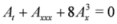
      <p>The study of <italic>N</italic> =2 supersymmetric (SUSY) extensions of nonlinear evolution equations has been largely studied in the past [<xref ref-type="bibr" rid="B1-symmetry-04-00441">1</xref>,<xref ref-type="bibr" rid="B2-symmetry-04-00441">2</xref>,<xref ref-type="bibr" rid="B3-symmetry-04-00441">3</xref>,<xref ref-type="bibr" rid="B4-symmetry-04-00441">4</xref>,<xref ref-type="bibr" rid="B5-symmetry-04-00441">5</xref>,<xref ref-type="bibr" rid="B6-symmetry-04-00441">6</xref>,<xref ref-type="bibr" rid="B7-symmetry-04-00441">7</xref>,<xref ref-type="bibr" rid="B8-symmetry-04-00441">8</xref>] in terms of integrability conditions and solutions. Such extensions are given as a Grassmann-valued partial differential equation with one dependent variable <italic>A</italic>(<italic>x</italic>,<italic>t</italic>;<italic>θ</italic><sub>1</sub>,<italic>θ</italic><sub>2</sub>)which is assumed to be bosonic to get nontrivial extensions. The independent variables are given as a set of even (commuting) space <italic>x</italic> and time <italic>t</italic> variables and a set of odd (anticommuting) variables variables <italic>θ</italic><sub>1</sub>, <italic>θ</italic><sub>2</sub>. Since the odd variables satisfy <inline-graphic xmlns:xlink="http://www.w3.org/1999/xlink" xlink:href="symmetry-04-00441-i001.tif"/>, the dependent variable <italic>A</italic> admits the following finite Taylor expansion </p>
     <disp-formula id="symmetry-04-00441-i002">
	<inline-graphic xmlns:xlink="http://www.w3.org/1999/xlink" xlink:href="symmetry-04-00441-i002.tif"/>
	<label>(1)</label>
	</disp-formula>
       <p>where <italic>u</italic> and <italic>v</italic> are bosonic complex valued functions and <italic>ξ</italic><sub>1</sub> and <italic>ξ</italic><sub>2</sub> are fermionic complex valued functions. In this paper, we show that some of these extensions can be related to a linear partial differential equation (PDE) by assuming that <italic>A</italic> is a chiral superfield [<xref ref-type="bibr" rid="B9-symmetry-04-00441">9</xref>]. Proving the integrability of an equation by linearization has been largely studied in the classical case [<xref ref-type="bibr" rid="B10-symmetry-04-00441">10</xref>,<xref ref-type="bibr" rid="B11-symmetry-04-00441">11</xref>] and has found new developments in the <italic>N</italic>=1 formalism [<xref ref-type="bibr" rid="B12-symmetry-04-00441">12</xref>]. We propose a similar development in the <italic>N</italic>=2 formalism. In <italic>N</italic>=2 SUSY, we consider a pair of supercovariant derivatives defined as </p>

      <disp-formula id="symmetry-04-00441-i003">
	<inline-graphic xmlns:xlink="http://www.w3.org/1999/xlink" xlink:href="symmetry-04-00441-i003.tif"/>
	<label>(2)</label>
	</disp-formula>
      <p>which satisfy the anticommutation relations <inline-graphic xmlns:xlink="http://www.w3.org/1999/xlink" xlink:href="symmetry-04-00441-i004.tif"/> and {<italic>D</italic><sub>1</sub>,<italic>D</italic><sub>2</sub>} = 0. We consider also the complex supercovariant derivatives </p>
      <disp-formula id="symmetry-04-00441-i005">
	<inline-graphic xmlns:xlink="http://www.w3.org/1999/xlink" xlink:href="symmetry-04-00441-i005.tif"/>
	<label>(3)</label>
	</disp-formula>
      <p>which satisfy {<italic>D</italic><sub>±</sub>,<italic>D</italic><sub>±</sub>}=0 and <inline-graphic xmlns:xlink="http://www.w3.org/1999/xlink" xlink:href="symmetry-04-00441-i006.tif"/>. In terms of the complex Grassmann variables <inline-graphic xmlns:xlink="http://www.w3.org/1999/xlink" xlink:href="symmetry-04-00441-i007.tif"/>, the derivatives Equation (3) admits the following representation </p>
      <disp-formula id="symmetry-04-00441-i008">
	<inline-graphic xmlns:xlink="http://www.w3.org/1999/xlink" xlink:href="symmetry-04-00441-i008.tif"/>
	<label>(4)</label>
	</disp-formula>
      <p>and the superfield <italic>A</italic> given in Equation (1) writes </p>
       <disp-formula id="symmetry-04-00441-i009">
		<inline-graphic xmlns:xlink="http://www.w3.org/1999/xlink" xlink:href="symmetry-04-00441-i009.tif"/>
		<label>(5)</label>
		</disp-formula>
      <p>The fermionic complex valued functions <italic>ρ</italic><sub>±</sub> are defined as <inline-graphic xmlns:xlink="http://www.w3.org/1999/xlink" xlink:href="symmetry-04-00441-i010.tif"/>.</p>
      <p>Chiral superfields are superfields of type Equation (5) satisfying <italic>D<sub>+</sub>A</italic>=0. In terms of components, we get </p>
      <disp-formula id="symmetry-04-00441-i011">
		<inline-graphic xmlns:xlink="http://www.w3.org/1999/xlink" xlink:href="symmetry-04-00441-i011.tif"/>
		<label>(6)</label>
		</disp-formula>
      <p>or equivalently <italic>ξ</italic><sub>2</sub> = <italic>iξ</italic><sub>1</sub> and <italic>v</italic>=<italic> -iu<sub>x</sub></italic>.</p>
      <p>In the subsequent sections, we produce solutions of <italic>N</italic>=2 SUSY extensions of the Korteweg–de Vries [<xref ref-type="bibr" rid="B1-symmetry-04-00441">1</xref>] (SKdV<italic><sub>α</sub></italic>), modified Korteweg–de Vries [<xref ref-type="bibr" rid="B6-symmetry-04-00441">6</xref>] (SmKdV) and Burgers [<xref ref-type="bibr" rid="B5-symmetry-04-00441">5</xref>] (SB) equations from a chiral superfield point of view. In this instance, the equations, in terms of the complex covariant derivatives Equation (3), reads, respectively, as </p>
      <disp-formula id="symmetry-04-00441-i012">
		<inline-graphic xmlns:xlink="http://www.w3.org/1999/xlink" xlink:href="symmetry-04-00441-i012.tif"/>
		<label>(7)</label>
		</disp-formula>
      <disp-formula id="symmetry-04-00441-i013">
		<inline-graphic xmlns:xlink="http://www.w3.org/1999/xlink" xlink:href="symmetry-04-00441-i013.tif"/>
		<label>(8)</label>
		</disp-formula>
      <disp-formula id="symmetry-04-00441-i014">
		<inline-graphic xmlns:xlink="http://www.w3.org/1999/xlink" xlink:href="symmetry-04-00441-i014.tif"/>
		<label>(9)</label>
		</disp-formula>
      <p>where [<italic>X</italic>,<italic>Y</italic>]=<italic>XY</italic> - <italic>YX</italic> is the commutator. In Equation (7), <italic>α</italic> is an arbitrary parameter but we will consider only the integrable cases [<xref ref-type="bibr" rid="B1-symmetry-04-00441">1</xref>] where <italic>α = </italic>−2,1,4.</p>
      <p>In this paper, we start by presenting a general reduction procedure of these equations using chiral superfields (<xref ref-type="sec" rid="sec2-symmetry-04-00441">Section II</xref>). We thus treat SKdV<sub>-2</sub> and SmKdV together and construct classical <italic>N</italic> super soliton solutions [<xref ref-type="bibr" rid="B4-symmetry-04-00441">4</xref>,<xref ref-type="bibr" rid="B7-symmetry-04-00441">7</xref>,<xref ref-type="bibr" rid="B8-symmetry-04-00441">8</xref>,<xref ref-type="bibr" rid="B13-symmetry-04-00441">13</xref>] and an infinite set of similarity solutions [<xref ref-type="bibr" rid="B7-symmetry-04-00441">7</xref>]. In <xref ref-type="sec" rid="sec4-symmetry-04-00441">Section IV</xref>, we demonstrate the existence of special <italic>N</italic> super soliton solutions, called virtual solitons [<xref ref-type="bibr" rid="B5-symmetry-04-00441">5</xref>], for the SUSY extensions of the KdV equation with <italic>α</italic>=1,4 and the Burgers equation using a related linear partial differential equation. The last section is devoted to a <italic>N</italic>=4 extension of the KdV equation [<xref ref-type="bibr" rid="B6-symmetry-04-00441">6</xref>] in an attempt to construct a general <italic>N</italic> super virtual soliton solution.</p>
    </sec>
    <sec id="sec2-symmetry-04-00441">
      <title>2. General Approach and Chiral Solutions</title>
      <p>Here, we propose a general approach for the construction of chiral solutions of SUSY extensions. This approach avoids treating SUSY extensions in terms of components of the bosonic field <italic>A</italic> given in Equation (1). Assuming <italic>D</italic><sub>+</sub><italic>A</italic> = 0, we get the chiral property {<italic>D</italic><sub>+</sub>,<italic>D<sub>-</sub></italic>}<italic>A</italic> = D<sub>+</sub>D<sub>-</sub>A = A<italic><sub>x</sub></italic> and the Equations (7–9) reduce to </p>
     <disp-formula id="symmetry-04-00441-i015">
	<inline-graphic xmlns:xlink="http://www.w3.org/1999/xlink" xlink:href="symmetry-04-00441-i015.tif"/>
	<label>(10)</label>
	</disp-formula>
      <disp-formula id="symmetry-04-00441-i016">
	<inline-graphic xmlns:xlink="http://www.w3.org/1999/xlink" xlink:href="symmetry-04-00441-i016.tif"/>
	<label>(11)</label>
	</disp-formula>
      <disp-formula id="symmetry-04-00441-i017">
	<inline-graphic xmlns:xlink="http://www.w3.org/1999/xlink" xlink:href="symmetry-04-00441-i017.tif"/>
	<label>(12)</label>
	</disp-formula>
      <p>Note that these equations may be evidently treated as classical [<xref ref-type="bibr" rid="B14-symmetry-04-00441">14</xref>] PDE's, but remains SUSY extensions due to the Grassmannian dependence of the bosonic field <italic>A</italic>.</p>
      <p>The absence of the Grassmannian variables <italic>θ</italic><sub>+</sub> and <italic>θ</italic><sub>-</sub> derivatives in Equations (10–12) indicates that the odd sectors of chiral solutions should be free from fermionic constraint. This property is in accordance with the integrability of these extensions due to arbitrary bosonization of the fermionic components [<xref ref-type="bibr" rid="B15-symmetry-04-00441">15</xref>] of the bosonic superfield <italic>A</italic>.</p>
      <p>From the classical case, we know that the methods of resolution of all these equations are similar. The same could be said for the SUSY case. Indeed, if we assume the introduction of a potential <italic>Ã</italic> such that <italic>A = Ã<sub>x</sub></italic> in Equation (10) and after one integration with respect to <italic>x</italic>, we get </p>
      <disp-formula id="symmetry-04-00441-i018">
	<inline-graphic xmlns:xlink="http://www.w3.org/1999/xlink" xlink:href="symmetry-04-00441-i018.tif"/>
	<label>(13)</label>
	</disp-formula>
      <p>where the constant of integration is set to zero. The same is done on Equation (12) and leads to </p>
      <disp-formula id="symmetry-04-00441-i019">
	<inline-graphic xmlns:xlink="http://www.w3.org/1999/xlink" xlink:href="symmetry-04-00441-i019.tif"/>
	<label>(14)</label>
	</disp-formula>
      <p>We thus observe that the Equations (11,13,14) are now on an equal footing, <italic>i.e</italic>., the order of the equation in <italic>x</italic> is equal to the number of appearance of ∂<italic><sub>x</sub></italic> in the nonlinear terms. This is standard in Hirota formalism. The choice <italic>α</italic> = -2 in Equation (13) gives, up to a slight change of variable, the SmKdV Equation (11). This means that the known [<xref ref-type="bibr" rid="B7-symmetry-04-00441">7</xref>] <italic>N</italic> super soliton solutions and similarity solutions of SKdV<sub>-2</sub> will lead to similar types of solutions for the SmKdV Equation (11).</p>
      <p>Now setting </p>
      <disp-formula id="symmetry-04-00441-i020">
	<inline-graphic xmlns:xlink="http://www.w3.org/1999/xlink" xlink:href="symmetry-04-00441-i020.tif"/>
	<label>(15)</label>
	</disp-formula>
      <p>in Equation (13), we obtain </p>
      <disp-formula id="symmetry-04-00441-i021">
	<inline-graphic xmlns:xlink="http://www.w3.org/1999/xlink" xlink:href="symmetry-04-00441-i021.tif"/>
	<label>(16)</label>
	</disp-formula>
      <p>The above equation reduces to the linear dispersive equation [<xref ref-type="bibr" rid="B14-symmetry-04-00441">14</xref>] </p>
      <disp-formula id="symmetry-04-00441-i022">
	<inline-graphic xmlns:xlink="http://www.w3.org/1999/xlink" xlink:href="symmetry-04-00441-i022.tif"/>
	<label>(17)</label>
	</disp-formula>
      <p>for the special and only values <italic>α</italic>=1 with <italic>β</italic><sub>1</sub>=<italic>i</italic> and <italic>α</italic>=4 with <inline-graphic xmlns:xlink="http://www.w3.org/1999/xlink" xlink:href="symmetry-04-00441-i023.tif"/> . For <italic>α</italic>=-2, Equation (16) writes </p>
      <disp-formula id="symmetry-04-00441-i024">
	<inline-graphic xmlns:xlink="http://www.w3.org/1999/xlink" xlink:href="symmetry-04-00441-i024.tif"/>
	<label>(18)</label>
	</disp-formula>
      <p>which does not linearize but can be bilinearized taking <italic>β</italic><sub>-2</sub>=<italic>i</italic>. It is discussed in the next Section.</p>
      <p>A similar change of variable as in Equation (15) but with <italic>Ã</italic>= <italic>β</italic><sub>B</sub> log <italic>H</italic><sub>B</sub> and <inline-graphic xmlns:xlink="http://www.w3.org/1999/xlink" xlink:href="symmetry-04-00441-i025.tif"/> in Equation (14) is assumed and leads to the linear Schrödinger Equation </p>
      <disp-formula id="symmetry-04-00441-i026">
	<inline-graphic xmlns:xlink="http://www.w3.org/1999/xlink" xlink:href="symmetry-04-00441-i026.tif"/>
	<label>(19)</label>
	</disp-formula>
    </sec>
    <sec>
      <title>3. SKdV<sub>-2</sub> and SmKdV Equations</title>
      <p>It is well known [<xref ref-type="bibr" rid="B13-symmetry-04-00441">13</xref>,<xref ref-type="bibr" rid="B14-symmetry-04-00441">14</xref>,<xref ref-type="bibr" rid="B15-symmetry-04-00441">15</xref>,<xref ref-type="bibr" rid="B16-symmetry-04-00441">16</xref>,<xref ref-type="bibr" rid="B17-symmetry-04-00441">17</xref>,<xref ref-type="bibr" rid="B18-symmetry-04-00441">18</xref>,<xref ref-type="bibr" rid="B19-symmetry-04-00441">19</xref>] that we can generate via the Hirota bilinear formalism <italic>N</italic> soliton and similarity solutions in the classical case and in SUSY <italic>N</italic>=1 extensions. Recently, the formalism was adapted to <italic>N</italic>=2 extensions [<xref ref-type="bibr" rid="B4-symmetry-04-00441">4</xref>,<xref ref-type="bibr" rid="B7-symmetry-04-00441">7</xref>,<xref ref-type="bibr" rid="B8-symmetry-04-00441">8</xref>] by splitting the equation into two <italic>N</italic>=1 equations, one fermionic and one bosonic. Our approach consists of treating the equation as a <italic>N</italic>=2 extension without splitting it, but imposing chirality conditions.</p>
      <p>Equation (11) can be bilinearized using the Hirota derivative defined as </p>
     <disp-formula id="symmetry-04-00441-i027">
	<inline-graphic xmlns:xlink="http://www.w3.org/1999/xlink" xlink:href="symmetry-04-00441-i027.tif"/>
	<label>(20)</label>
	</disp-formula>
      <p>Indeed, we take <italic>Ã</italic> as in Equation (15) with <italic>β</italic><sub>-2</sub>=<italic>i</italic> and <inline-graphic xmlns:xlink="http://www.w3.org/1999/xlink" xlink:href="symmetry-04-00441-i028.tif"/> , where <inline-graphic xmlns:xlink="http://www.w3.org/1999/xlink" xlink:href="symmetry-04-00441-i029.tif"/> are bosonic chiral superfields for <italic>i</italic>=1,2. Equation (11) leads to the set of bilinear equations </p>
      <disp-formula id="symmetry-04-00441-i030">
	<inline-graphic xmlns:xlink="http://www.w3.org/1999/xlink" xlink:href="symmetry-04-00441-i030.tif"/>
	<label>(21)</label>
	</disp-formula>
      <disp-formula id="symmetry-04-00441-i031">
	<inline-graphic xmlns:xlink="http://www.w3.org/1999/xlink" xlink:href="symmetry-04-00441-i031.tif"/>
	<label>(22)</label>
	</disp-formula>
      <p>This set is analogous to the corresponding bilinear equations in the classical mKdV equation [<xref ref-type="bibr" rid="B14-symmetry-04-00441">14</xref>] but we deal with superfields <italic>τ</italic><sub>1 </sub>and <italic>τ</italic><sub>2</sub>.</p>
      <p>In order to get chiral solutions, we have to solve the set of bilinear equations with the additional chiral property <italic>D</italic><sub>+</sub><italic>τ</italic><sub>i </sub>= 0 for <italic>i</italic>=1,2. It will lead to new solutions of the SmKdV equation which are related to our recent contribution [<xref ref-type="bibr" rid="B7-symmetry-04-00441">7</xref>].</p>
      <sec>
        <title>3.1. N Super Soliton Solutions</title>
        <p>The one soliton solution is easily retrieved. Indeed, we cast </p>
        <disp-formula id="symmetry-04-00441-i032">
	<inline-graphic xmlns:xlink="http://www.w3.org/1999/xlink" xlink:href="symmetry-04-00441-i032.tif"/>
	<label>(23)</label>
	</disp-formula>
        <p>where <italic>α</italic><sub>1</sub> is an even parameter. Ψ<sub>1</sub> is a <italic>N</italic>=2 chiral bosonic superfield defined as </p>
        <disp-formula id="symmetry-04-00441-i033">
	<inline-graphic xmlns:xlink="http://www.w3.org/1999/xlink" xlink:href="symmetry-04-00441-i033.tif"/>
	<label>(24)</label>
	</disp-formula>
        <p>and never appears on this form in other approaches of <italic>N</italic> = 2 SUSY. The parameters <italic>κ</italic><sub>1</sub> and <italic>ξ</italic><sub>1</sub> are, respectively, even and odd. The <italic>τ</italic>-functions Equation (23) together with Equation (24) solve the set of bilinear Equations (21,22) and give rise to a one super soliton solution. Since <italic>D</italic><sub>+</sub>Ψ<sub>1</sub>=0, the resulting traveling wave solution is chiral.</p>
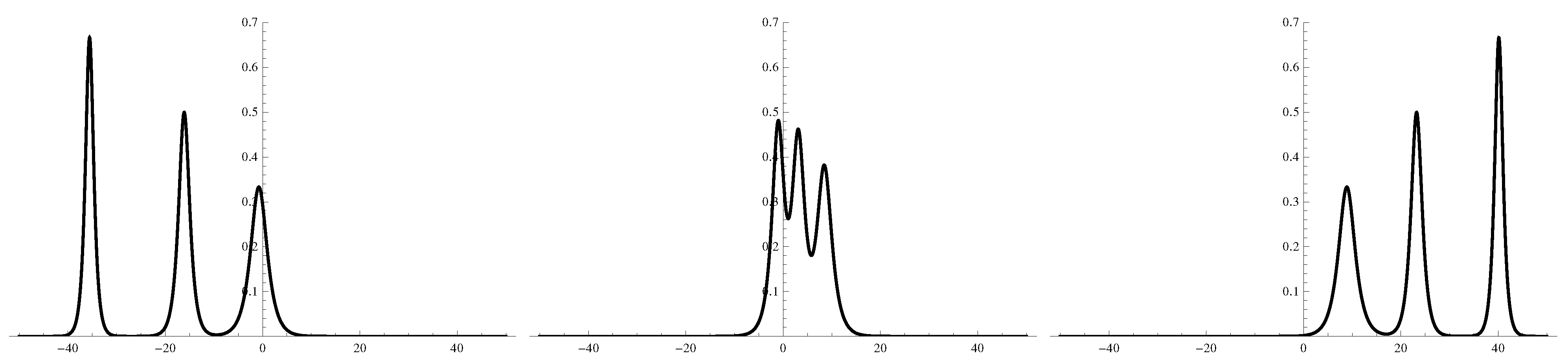
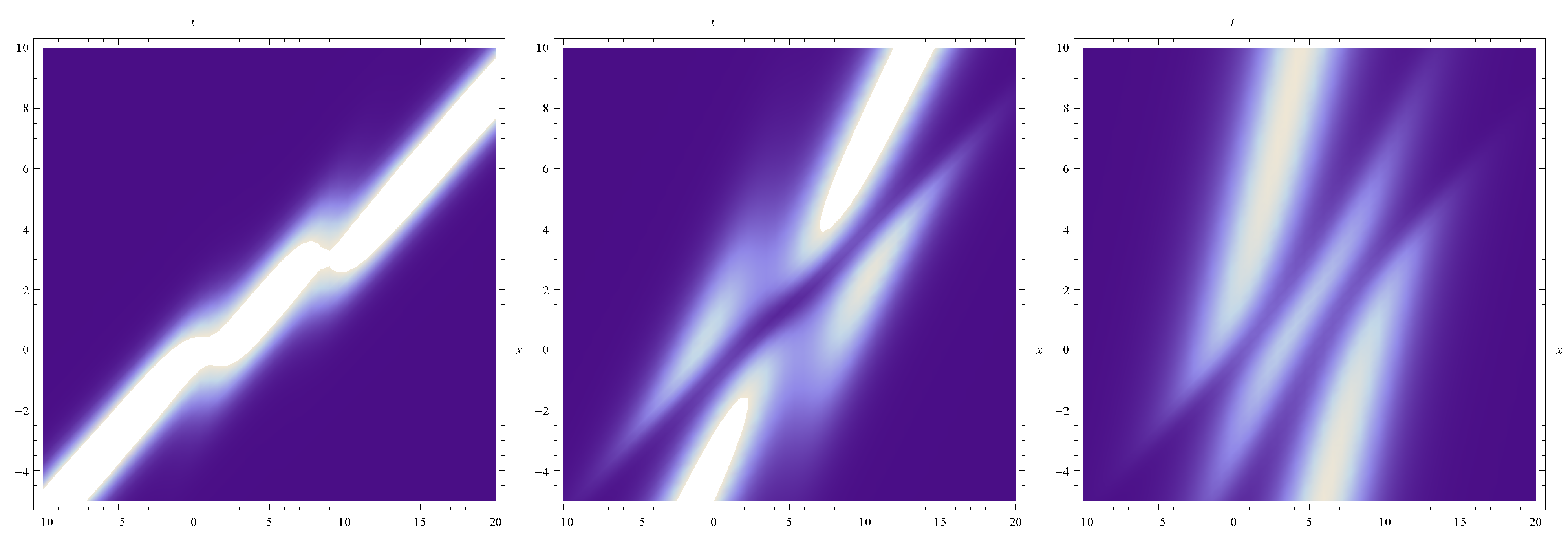
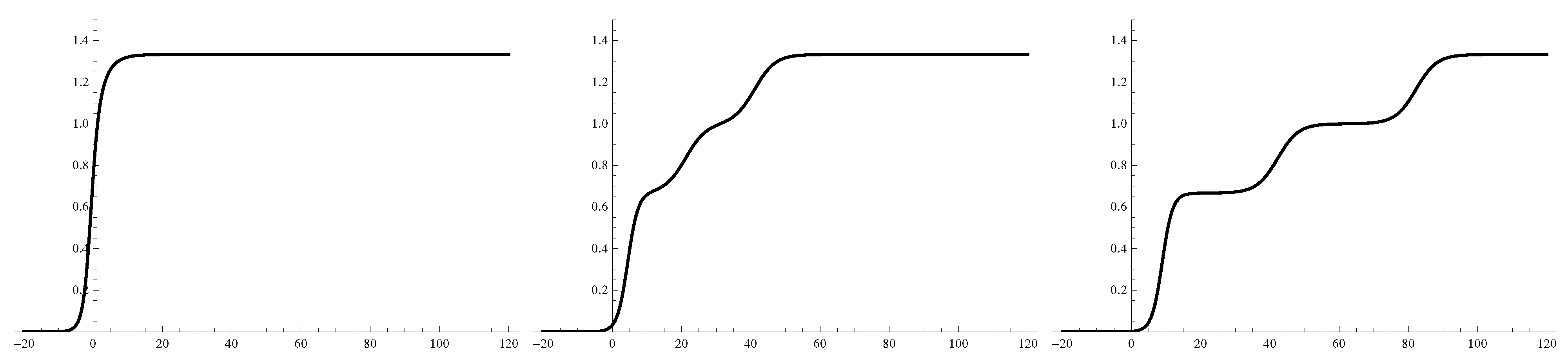
        <p>Since we exhibit the three super soliton solution of the SmKdV equation in <xref ref-type="fig" rid="symmetry-04-00441-f001">Figure 1</xref> and <xref ref-type="fig" rid="symmetry-04-00441-f002">Figure 2</xref>, we give the general expressions of <italic>τ</italic><sub>1</sub> and <italic>τ</italic><sub>2</sub>: </p>
        
       
        <disp-formula id="symmetry-04-00441-i034">
	<inline-graphic xmlns:xlink="http://www.w3.org/1999/xlink" xlink:href="symmetry-04-00441-i034.tif"/>
	<label>(25)</label>
	</disp-formula>
        <disp-formula id="symmetry-04-00441-i035">
	<inline-graphic xmlns:xlink="http://www.w3.org/1999/xlink" xlink:href="symmetry-04-00441-i035.tif"/>
	<label>(26)</label>
	</disp-formula>
        <p>Where <inline-graphic xmlns:xlink="http://www.w3.org/1999/xlink" xlink:href="symmetry-04-00441-i036.tif"/> and the Ψ<italic><sub>i</sub></italic>'s are defined as in Equation (24). The functions <italic>τ</italic><sub>1</sub> and <italic>τ</italic><sub>2</sub> solves the bilinear Equations (21) and (22) and are such that <italic>D</italic><sub>+</sub><italic>τ<sub>i</sub></italic> = 0 for <italic>i</italic>=1,2. The generalization to a <italic>N</italic> super soliton solution is direct using the <italic>τ</italic>-functions expressed above. The forms of the <italic>τ</italic>-functions given above are new representations of super soliton solutions and have never been introduced before.</p>
        <fig id="symmetry-04-00441-f001" position="anchor">
          <label>Figure 1</label>
          <caption>
            <p>The function Im(<italic>v</italic>) of the three soliton solution of the SmKdV equation where <inline-graphic xmlns:xlink="http://www.w3.org/1999/xlink" xlink:href="symmetry-04-00441-i037.tif"/> and <italic>t</italic> = -20,0,20</p>
          </caption>
          <graphic xmlns:xlink="http://www.w3.org/1999/xlink" xlink:href="symmetry-04-00441-g001.tif"/>
          
        </fig>
         <fig id="symmetry-04-00441-f002" position="anchor">
          <label>Figure 2</label>
          <caption>
            <p>The density plots of the functions <italic>f<sub>1</sub></italic>, <italic>f<sub>2</sub></italic> and <italic>f<sub>3</sub></italic>, respectively from left to right, of the three soliton solution of the SmKdV equation where <inline-graphic xmlns:xlink="http://www.w3.org/1999/xlink" xlink:href="symmetry-04-00441-i037.tif"/>.</p>
          </caption>
          <graphic xmlns:xlink="http://www.w3.org/1999/xlink" xlink:href="symmetry-04-00441-g002.tif"/>
        </fig>
        <p>In <xref ref-type="fig" rid="symmetry-04-00441-f001">Figure 1</xref>, we may enjoy the three soliton solution Im(<italic>v</italic>) of the SmKdV equation given by </p>
        <disp-formula id="symmetry-04-00441-i038">
	<inline-graphic xmlns:xlink="http://www.w3.org/1999/xlink" xlink:href="symmetry-04-00441-i038.tif"/>
	<label>(27)</label>
	</disp-formula>
        <p>as a function of <italic>x</italic>, for the special values <inline-graphic xmlns:xlink="http://www.w3.org/1999/xlink" xlink:href="symmetry-04-00441-i037.tif"/>, <italic>α</italic><sub>i</sub>=<italic>i</italic> in Equations (25) and (26) and <italic>t=-</italic>20,0,20. In <xref ref-type="fig" rid="symmetry-04-00441-f002">Figure 2</xref>, we explore the behavior of the fermionic component <italic>ρ</italic><sub>-</sub> of the superfield <italic>A</italic> for the same special values. To achieve this, we write <italic>ρ</italic><sub>-</sub> as </p>
        <disp-formula id="symmetry-04-00441-i039">
	<inline-graphic xmlns:xlink="http://www.w3.org/1999/xlink" xlink:href="symmetry-04-00441-i039.tif"/>
	<label>(28)</label>
	</disp-formula>
        <p>and trace out the bosonic functions <italic>f<sub>1</sub></italic>, <italic>f<sub>2</sub></italic> and <italic>f<sub>3</sub></italic>.</p>
      </sec>
      <sec>
        <title>3.2. Similarity Solutions</title>
        <p>In a recent paper [<xref ref-type="bibr" rid="B7-symmetry-04-00441">7</xref>], we have proven the existence of an infinite set of rational similarity solutions of the SKdV<sub>-2</sub> using a SUSY version of the Yablonskii–Vorob'ev polynomials [<xref ref-type="bibr" rid="B16-symmetry-04-00441">16</xref>,<xref ref-type="bibr" rid="B17-symmetry-04-00441">17</xref>,<xref ref-type="bibr" rid="B18-symmetry-04-00441">18</xref>]. We propose in this subsection to retrieve those solutions and find an infinite set of similarity solution for the SmKdV equation. To give us a hint into what change of variables we have to cast, we have used the symmetry reduction method associated to a dilatation invariance [<xref ref-type="bibr" rid="B2-symmetry-04-00441">2</xref>].</p>
        <p>Let us define the following <italic>τ</italic>-functions [<xref ref-type="bibr" rid="B7-symmetry-04-00441">7</xref>] </p>
        <disp-formula id="symmetry-04-00441-i040">
	<inline-graphic xmlns:xlink="http://www.w3.org/1999/xlink" xlink:href="symmetry-04-00441-i040.tif"/>
	<label>(29)</label>
	</disp-formula>
        <p>where <inline-graphic xmlns:xlink="http://www.w3.org/1999/xlink" xlink:href="symmetry-04-00441-i041.tif"/> and the functions <inline-graphic xmlns:xlink="http://www.w3.org/1999/xlink" xlink:href="symmetry-04-00441-i042.tif"/> are the Yablonskii–Vorob'ev polynomials defined by the recurrence relation </p>
        <disp-formula id="symmetry-04-00441-i043">
	<inline-graphic xmlns:xlink="http://www.w3.org/1999/xlink" xlink:href="symmetry-04-00441-i043.tif"/>
	<label>(30)</label>
	</disp-formula>
        <p>with <inline-graphic xmlns:xlink="http://www.w3.org/1999/xlink" xlink:href="symmetry-04-00441-i044.tif"/> and <inline-graphic xmlns:xlink="http://www.w3.org/1999/xlink" xlink:href="symmetry-04-00441-i045.tif"/> . We would like to insist that <inline-graphic xmlns:xlink="http://www.w3.org/1999/xlink" xlink:href="symmetry-04-00441-i046.tif"/> is a <italic>N</italic>=2 bosonic superfield (as it is the case for the Ψ<italic>i</italic> in the preceding subsection). Using the fact that the Yablonskii–Vorob'ev polynomials satisfy the following bilinear equations [<xref ref-type="bibr" rid="B17-symmetry-04-00441">17</xref>] </p>
        <disp-formula id="symmetry-04-00441-i047">
	<inline-graphic xmlns:xlink="http://www.w3.org/1999/xlink" xlink:href="symmetry-04-00441-i047.tif"/>
	<label>(31)</label>
	</disp-formula>
         <disp-formula id="symmetry-04-00441-i048">
	<inline-graphic xmlns:xlink="http://www.w3.org/1999/xlink" xlink:href="symmetry-04-00441-i048.tif"/>
	<label>(32)</label>
	</disp-formula>
        <p>we have that the pair of bilinear Equations (21) and (22) are such that [<xref ref-type="bibr" rid="B7-symmetry-04-00441">7</xref>,<xref ref-type="bibr" rid="B16-symmetry-04-00441">16</xref>,<xref ref-type="bibr" rid="B17-symmetry-04-00441">17</xref>,<xref ref-type="bibr" rid="B18-symmetry-04-00441">18</xref>] </p>
        <disp-formula id="symmetry-04-00441-i049">
	<inline-graphic xmlns:xlink="http://www.w3.org/1999/xlink" xlink:href="symmetry-04-00441-i049.tif"/>
	<label>(33)</label>
	</disp-formula>
       <disp-formula id="symmetry-04-00441-i050">
	<inline-graphic xmlns:xlink="http://www.w3.org/1999/xlink" xlink:href="symmetry-04-00441-i050.tif"/>
	<label>(34)</label>
	</disp-formula>
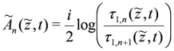
        <p>From the choice of the variable <inline-graphic xmlns:xlink="http://www.w3.org/1999/xlink" xlink:href="symmetry-04-00441-i046.tif"/>, we also have <italic>D</italic><sub>+</sub><italic>τ<sub>i,n</sub></italic> = 0 for all integers <italic>n</italic>. Taking <italic>τ<sub>2,n</sub> = τ<sub>1,n+1</sub></italic>, we have an infinite set of similarity solutions of the SmKdV Equation given by </p>
        <disp-formula id="symmetry-04-00441-i051">
	<inline-graphic xmlns:xlink="http://www.w3.org/1999/xlink" xlink:href="symmetry-04-00441-i051.tif"/>
	<label>(35)</label>
	</disp-formula>
        <p>for all integers <italic>n</italic>  ≥  0 and <italic>τ</italic><sub>1,n</sub> defined as in Equation (29). To get similarity solutions <italic>A</italic><sub>n</sub> of the SKdV<sub>-2</sub>, we use the above solution with <inline-graphic xmlns:xlink="http://www.w3.org/1999/xlink" xlink:href="symmetry-04-00441-i052.tif"/> . Plots of some similarity solutions are given in our recent contribution [<xref ref-type="bibr" rid="B7-symmetry-04-00441">7</xref>].</p>
      </sec>
    </sec>
    <sec id="sec4-symmetry-04-00441">
      <title>4. SKdV<sub>1</sub>, SKdV<sub>4</sub> and SB Equations and Virtual Solitons</title>
      <p>In this section, we exhibit <italic>N</italic> super soliton solutions, called <italic>N</italic> super virtual solitons, for the three equations SKdV<sub>1</sub>, SKdV<sub>4</sub> and SB. Virtual solitons are soliton-like solutions which exhibit no phase shifts in nonlinear interactions. In terms of classical <italic>N</italic> soliton solutions [<xref ref-type="bibr" rid="B3-symmetry-04-00441">3</xref>,<xref ref-type="bibr" rid="B4-symmetry-04-00441">4</xref>,<xref ref-type="bibr" rid="B5-symmetry-04-00441">5</xref>,<xref ref-type="bibr" rid="B7-symmetry-04-00441">7</xref>,<xref ref-type="bibr" rid="B14-symmetry-04-00441">14</xref>,<xref ref-type="bibr" rid="B16-symmetry-04-00441">16</xref>,<xref ref-type="bibr" rid="B19-symmetry-04-00441">19</xref>], this is equivalent to say that the interaction coefficients <italic>A<sub>ij</sub></italic> between soliton <italic>i</italic> and soliton <italic>j</italic> are zero, <inline-graphic xmlns:xlink="http://www.w3.org/1999/xlink" xlink:href="symmetry-04-00441-i053.tif"/> . They manifest as traveling wave solutions for negative time <italic>t</italic>«0 and decrease spontaneously at time <italic>t</italic>=0 to split into a <italic>N</italic> soliton profile which exhibit no phase shifts. It is often said that the traveling wave solution was charged with <italic>N-</italic>1 soliton, called virtual solitons [<xref ref-type="bibr" rid="B5-symmetry-04-00441">5</xref>].</p>
      <p>Using the change of variable Equation (15) for the unknown bosonic field <italic>Ã</italic>, we have seen that the bosonic field <italic>H<sub>α</sub></italic> must be a chiral superfield and solve the linear dispersive Equation (17) when <italic>α</italic>=1 and <italic>α</italic>=4. For the Burgers equation, the bosonic field <italic>H<sub>B</sub></italic> had to be chiral and solves Equation (19).</p>
      <p>It is easy to show that they admit the following solution </p>
      <disp-formula id="symmetry-04-00441-i054">
	<inline-graphic xmlns:xlink="http://www.w3.org/1999/xlink" xlink:href="symmetry-04-00441-i054.tif"/>
	<label>(36)</label>
	</disp-formula>
      <p>where the bosonic superfields Ψ<italic><sub>i</sub></italic> are given as </p>
       <disp-formula id="symmetry-04-00441-i055">
	<inline-graphic xmlns:xlink="http://www.w3.org/1999/xlink" xlink:href="symmetry-04-00441-i055.tif"/>
	<label>(37)</label>
	</disp-formula>
      <p>The frequencies <italic>ω</italic>(<italic>κ<sub>i</sub></italic>) are such that <italic>ω</italic>(<italic>κ<sub>i</sub></italic>)= - <italic>κ<sub>i</sub></italic><sup>3</sup> for SKdV<italic><sub>α</sub></italic> and <italic>ω</italic>(<italic>κ<sub>i</sub></italic>)=- <italic>κ<sub>i</sub></italic><sup>2</sup> for SB. It looks like a typical KdV type soliton solution where all the interaction coefficients <italic>A<sub>ij</sub></italic> are set to zero.</p>
      <p>We see that the virtual soliton solutions of the SKdV<sub>1</sub> and SKdV<sub>4</sub> equations are completely similar due to the form of <italic>Ã</italic> which differs only by the constant value of <italic>β<sub>α</sub></italic>. The expression of the original bosonic field is obtained from </p>
      <disp-formula id="symmetry-04-00441-i056">
	<inline-graphic xmlns:xlink="http://www.w3.org/1999/xlink" xlink:href="symmetry-04-00441-i056.tif"/>
	<label>(38)</label>
	</disp-formula>
      <p>where <italic>β</italic>=<italic>β<sub>α</sub></italic> for the SKdV<italic><sub>α</sub></italic> equation and <italic>β</italic>=<italic>β<sub>B</sub></italic> for the SB equation. Thus, we can give the explicit forms of the superfield components <italic>u</italic> and <italic>ρ</italic><sub>-</sub>. Indeed, we have </p>
       <disp-formula id="symmetry-04-00441-i057">
	<inline-graphic xmlns:xlink="http://www.w3.org/1999/xlink" xlink:href="symmetry-04-00441-i057.tif"/>
	<label>(39)</label>
	</disp-formula>
      <p>where <italic>η<sub>i</sub></italic>=<italic>κ<sub>i</sub>x</italic>+ <italic>ω</italic>(<italic>κ</italic><sub>i</sub>)<italic>t</italic> and the bosonic functions <italic>f<sub>i</sub>(x,t)</italic> are defined as </p>
      <disp-formula id="symmetry-04-00441-i058">
	<inline-graphic xmlns:xlink="http://www.w3.org/1999/xlink" xlink:href="symmetry-04-00441-i058.tif"/>
	<label>(40)</label>
	</disp-formula>
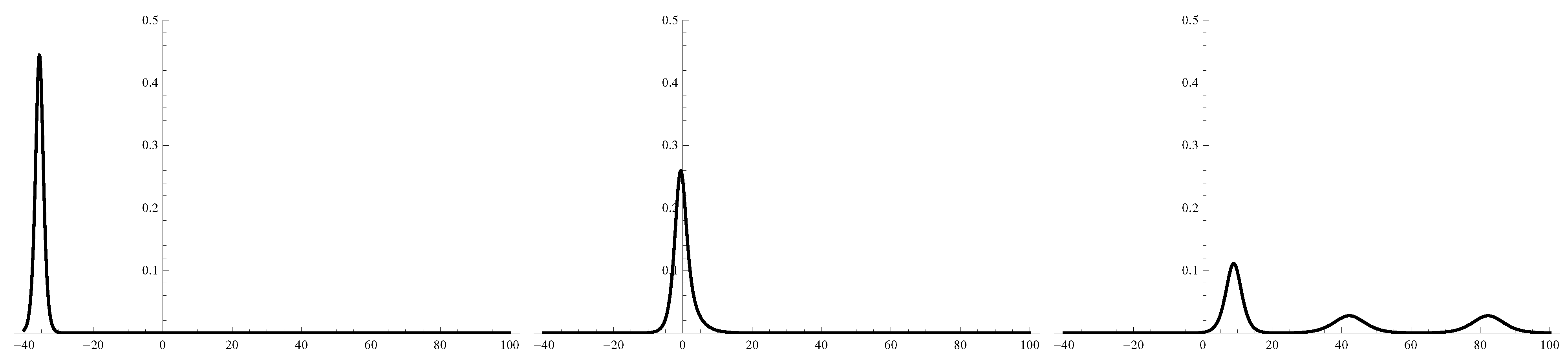
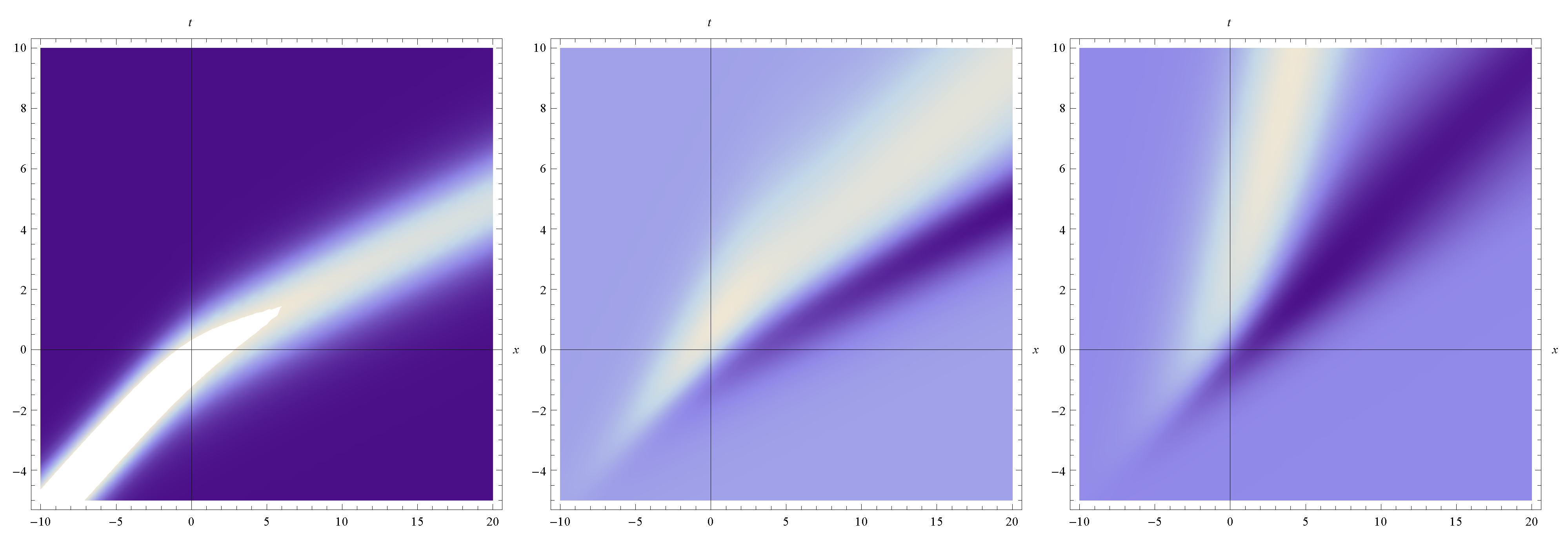
      <p>In <xref ref-type="fig" rid="symmetry-04-00441-f003">Figure 3</xref>, we may enjoy the three virtual soliton solution Im(<italic>u</italic>) of the SKdV<sub>1</sub> Equation for <inline-graphic xmlns:xlink="http://www.w3.org/1999/xlink" xlink:href="symmetry-04-00441-i037.tif"/> and <italic>α<sub>i</sub></italic> = 1 in Equation (36) and <italic>t=</italic> 0,10,20. In <xref ref-type="fig" rid="symmetry-04-00441-f004">Figure 4</xref>, we observe the behavior of the function <italic>v</italic> where <italic>v</italic> = - <italic>iu<sub>x</sub></italic>, <inline-graphic xmlns:xlink="http://www.w3.org/1999/xlink" xlink:href="symmetry-04-00441-i037.tif"/> and <italic>α<sub>i</sub></italic>=1 in Equation (36) and <italic>t=</italic>20,0,20. For the same special values, <xref ref-type="fig" rid="symmetry-04-00441-f005">Figure 5</xref> gives the density plots of the bosonic functions <italic>f</italic><sub>1</sub>, <italic>f</italic><sub>2</sub> and <italic>f</italic><sub>3</sub> as given in Equation (40).</p>
      <fig id="symmetry-04-00441-f003" position="anchor">
        <label>Figure 3</label>
        <caption>
          <p>The function Im(<italic>u</italic>) of the three virtual soliton solution of the SKdV<sub>1</sub> equation where <inline-graphic xmlns:xlink="http://www.w3.org/1999/xlink" xlink:href="symmetry-04-00441-i037.tif"/> and <italic>t=</italic>0,10,20.</p>
        </caption>
        <graphic xmlns:xlink="http://www.w3.org/1999/xlink" xlink:href="symmetry-04-00441-g003.tif"/>
      </fig>
      <fig id="symmetry-04-00441-f004" position="anchor">
        <label>Figure 4</label>
        <caption>
          <p>The function <italic>v</italic> of the three virtual soliton solution of the SKdV<sub>1</sub> equation where <inline-graphic xmlns:xlink="http://www.w3.org/1999/xlink" xlink:href="symmetry-04-00441-i037.tif"/> and <italic>t</italic>=20,0,20.</p>
        </caption>
        <graphic xmlns:xlink="http://www.w3.org/1999/xlink" xlink:href="symmetry-04-00441-g004.tif"/>
      </fig>
      <fig id="symmetry-04-00441-f005" position="anchor">
        <label>Figure 5</label>
        <caption>
          <p>The density plots of the functions <italic>f</italic><sub>1</sub>, <italic>f</italic><sub>2</sub> and <italic>f</italic><sub>3</sub>, respectively from left to right, of the three virtual soliton solution of the SKdV<sub>1</sub> equation where <inline-graphic xmlns:xlink="http://www.w3.org/1999/xlink" xlink:href="symmetry-04-00441-i037.tif"/>.</p>
        </caption>
        <graphic xmlns:xlink="http://www.w3.org/1999/xlink" xlink:href="symmetry-04-00441-g005.tif"/>
      </fig>
    </sec>
    <sec>
      <title>5. SUSY <italic>N</italic>=4 KdV Equation and Virtual Solitons</title>
      <p>The SUSY <italic>N</italic>=4 KdV equation, as proposed by Popowicz in [<xref ref-type="bibr" rid="B6-symmetry-04-00441">6</xref>], reads </p>
      <disp-formula id="symmetry-04-00441-i059">
	<inline-graphic xmlns:xlink="http://www.w3.org/1999/xlink" xlink:href="symmetry-04-00441-i059.tif"/>
	<label>(41)</label>
	</disp-formula>
      <p>where Г is a bosonic superfield and the complex supercovariant derivatives are defined as </p>


      <disp-formula id="symmetry-04-00441-i060">
	<inline-graphic xmlns:xlink="http://www.w3.org/1999/xlink" xlink:href="symmetry-04-00441-i060.tif"/>
	<label>(42)</label>
	</disp-formula>
      <p>where <inline-graphic xmlns:xlink="http://www.w3.org/1999/xlink" xlink:href="symmetry-04-00441-i061.tif"/> for <italic>i=</italic>1,2,3,4. Using the relations {<italic>D<sub>i</sub></italic>,<italic>D<sub>j</sub></italic>}=2<italic>δ<sub>ij</sub></italic>∂<italic><sub>x</sub></italic>, where <italic>δ<sub>ij</sub></italic> is the Kronecker delta, we have that the supercovariant derivatives Equation (42) satisfy the anticommutation rules </p>
      <disp-formula id="symmetry-04-00441-i062">
	<inline-graphic xmlns:xlink="http://www.w3.org/1999/xlink" xlink:href="symmetry-04-00441-i062.tif"/>
	<label>(43)</label>
	</disp-formula>
      <p>where <italic>μ</italic>,<italic>v </italic>∈ {+,-}. Equation (41) can easily be viewed as a generalization of a <italic>N</italic>=2 equation. Indeed, setting <italic>θ</italic><sub>3</sub>=<italic>θ<sub>4</sub>=0</italic> and <inline-graphic xmlns:xlink="http://www.w3.org/1999/xlink" xlink:href="symmetry-04-00441-i063.tif"/> in Equation (41), we retrieve the SmKdV Equation (8).</p>
      <p>To construct virtual solitons of <italic>N</italic>=2 SUSY extensions, we have considered chiral superfields. Here, we propose a generalization of this concept. Indeed, we impose the following constraints on the superfield Г </p>

      <disp-formula id="symmetry-04-00441-i064">
	<inline-graphic xmlns:xlink="http://www.w3.org/1999/xlink" xlink:href="symmetry-04-00441-i064.tif"/>
	<label>(44)</label>
	</disp-formula>
      <p>A bosonic superfield Ξ satisfying the chiral conditions Equation (44) has the following general form </p>

      <disp-formula id="symmetry-04-00441-i065">
	<inline-graphic xmlns:xlink="http://www.w3.org/1999/xlink" xlink:href="symmetry-04-00441-i065.tif"/>
	<label>(45)</label>
	</disp-formula>
      
      <p>where <italic>u=u</italic>(<italic>x</italic>,<italic>t</italic>) and <italic>w=w</italic>(<italic>x,t</italic>) are complex valued bosonic functions and <italic>ξ</italic>=<italic>ξ</italic>(<italic>x,t</italic>) and <italic>η</italic>=<italic>η</italic>(<italic>x,t</italic>) are complex valued fermionic functions. The Grassmann variables in Equation (45) are defined as <inline-graphic xmlns:xlink="http://www.w3.org/1999/xlink" xlink:href="symmetry-04-00441-i067.tif"/> and <inline-graphic xmlns:xlink="http://www.w3.org/1999/xlink" xlink:href="symmetry-04-00441-i068.tif"/> . Now, using the chirality conditions Equation (44), we have <inline-graphic xmlns:xlink="http://www.w3.org/1999/xlink" xlink:href="symmetry-04-00441-i069.tif"/> and Equation (41) reduces to the classical nonlinear PDE </p>
      <disp-formula id="symmetry-04-00441-i070">
	<inline-graphic xmlns:xlink="http://www.w3.org/1999/xlink" xlink:href="symmetry-04-00441-i070.tif"/>
	<label>(46)</label>
	</disp-formula>
      
      <p>Equation (46) is, up to a slight change of variable, similar to Equation (13) for the integrable cases <italic>α</italic>=1,4. Indeed, we retrieve Equation (13) for <italic>α</italic>=1,4by casting <inline-graphic xmlns:xlink="http://www.w3.org/1999/xlink" xlink:href="symmetry-04-00441-i071.tif"/> in Equation (46).</p>
      <p>The above equation can be linearized into the linear dispersive Equation (17) by the change of variable </p>

      
       <disp-formula id="symmetry-04-00441-i072">
	<inline-graphic xmlns:xlink="http://www.w3.org/1999/xlink" xlink:href="symmetry-04-00441-i072.tif"/>
	<label>(47)</label>
	</disp-formula>
      <p>Thus to obtain solutions of Equation (41), the superfield <inline-graphic xmlns:xlink="http://www.w3.org/1999/xlink" xlink:href="symmetry-04-00441-i066.tif"/> must satisfy the constraints </p>
     <disp-formula id="symmetry-04-00441-i073">
	<inline-graphic xmlns:xlink="http://www.w3.org/1999/xlink" xlink:href="symmetry-04-00441-i073.tif"/>
	<label>(48)</label>
	</disp-formula>
      <p>A solution to this system is </p>
       <disp-formula id="symmetry-04-00441-i074">
	<inline-graphic xmlns:xlink="http://www.w3.org/1999/xlink" xlink:href="symmetry-04-00441-i074.tif"/>
	<label>(49)</label>
	</disp-formula>
      <p>where <italic>φ</italic> is a <italic>N</italic>=4 chiral bosonic superfield of the form </p>

       <disp-formula id="symmetry-04-00441-i075">
	<inline-graphic xmlns:xlink="http://www.w3.org/1999/xlink" xlink:href="symmetry-04-00441-i075.tif"/>
	<label>(50)</label>
	</disp-formula>
      <p>with <inline-graphic xmlns:xlink="http://www.w3.org/1999/xlink" xlink:href="symmetry-04-00441-i076.tif"/> and <italic>λ</italic><sub>1</sub> is an even constant. This result can thus be generalized to give a <italic>N</italic> super virtual soliton solution of the SUSY <italic>N</italic>=4 KdV Equation (41) by taking </p>
     <disp-formula id="symmetry-04-00441-i077">
	<inline-graphic xmlns:xlink="http://www.w3.org/1999/xlink" xlink:href="symmetry-04-00441-i077.tif"/>
	<label>(51)</label>
	</disp-formula>
      <p>where the superfields <italic>φ<sub>i</sub></italic> are defined as in Equation (50) for <italic>i=</italic>1,…,<italic>N</italic>.</p>
      <p>It is interesting to note that by setting <inline-graphic xmlns:xlink="http://www.w3.org/1999/xlink" xlink:href="symmetry-04-00441-i078.tif"/> in Equation (50), one recovers the superfields Equation (24).</p>
    </sec>
    <sec>
      <title>6. Concluding Remarks and Future Outlook</title>
      <p>In this paper, we have studied special solutions of supersymmetric extensions of the Burgers, KdV and mKdV equations in a unified way and using a chirality of the superfield <italic>A</italic>.</p>
      <p>We have recovered interacting super soliton solutions (often called KdV type solitons) and an infinite set of rational similarity solutions. To produce such rational solutions, we have used an SUSY extension of the Yablonskii–Vorob'ev polynomials. We have introduce a new representation of the <italic>τ</italic>-functions to solve the bilinear equations. These <italic>τ</italic>-functions are <italic>N</italic>=2 extensions of classical <italic>τ</italic>-functions of the mKdV equation. Till now, in the literature, only <italic>N</italic>=1 extensions of the <italic>τ</italic>-functions were given.</p>
      <p>We have shown the existence of non-interacting super soliton solutions, called virtual solitons, for the Burgers and SKdV<sub>α</sub> (<italic>α</italic>=1,4). These special solutions are a direct generalization of the solutions obtained in a recent contribution [<xref ref-type="bibr" rid="B5-symmetry-04-00441">5</xref>] where <italic>N</italic> super virtual solitons have been found by setting to zero the fermionic contributions <italic>ξ</italic><sub>1</sub> and <italic>ξ</italic><sub>2</sub> in the bosonic superfield <italic>A</italic> given as in Equation (1). We retrieve those solutions by setting <italic>ς<sub>i</sub></italic>= 0 in the exponent terms Equation (37). Thus the chirality property, exposed in this paper, has produced a nontrivial fermionic sector for a <italic>N</italic> super virtual soliton. Furthermore, to obtain such solutions we have related the SUSY equations to linear PDE's showing the true origin of those special solutions.</p>
      <p>A <italic>N</italic>=4 extension of the KdV equation has been shown to produce a <italic>N</italic> super virtual soliton solution. The study of <italic>N</italic>=4 extensions is quite new to us and we hope in the future to produce a <italic>N</italic> super soliton solution with interaction terms.</p>
    </sec>
    
  </body>
  <back>
  <ack>
      <title>Acknowledgments</title>
      <p>L. Delisle acknowledges the support of a FQRNT doctoral research scholarship. V. Hussin acknowledges the support of research grants from NSERC of Canada. </p>
    </ack>
    <ref-list>
      <title>References</title>
      <ref id="B1-symmetry-04-00441">
        <label>1.</label>
        <citation citation-type="journal">
          <person-group person-group-type="author">
            <name>
              <surname>Labelle</surname>
              <given-names>P.</given-names>
            </name>
            <name>
              <surname>Mathieu</surname>
              <given-names>P.</given-names>
            </name>
          </person-group>
          <article-title>A new supersymmetric Korteweg–de Vries equation</article-title>
          <source>J. Math. Phys.</source>
          <year>1991</year>
          <volume>32</volume>
          <fpage>923</fpage>
          <lpage>927</lpage>
          <pub-id pub-id-type="doi">10.1063/1.529351</pub-id>
        </citation>
      </ref>
      <ref id="B2-symmetry-04-00441">
        <label>2.</label>
        <citation citation-type="journal">
          <person-group person-group-type="author">
            <name>
              <surname>Ayari</surname>
              <given-names>M.A.</given-names>
            </name>
            <name>
              <surname>Hussin</surname>
              <given-names>V.</given-names>
            </name>
            <name>
              <surname>Winternitz</surname>
              <given-names>P.</given-names>
            </name>
          </person-group>
          <article-title>Group invariant solutions for the<italic> N</italic>=2 super Korteweg–de Vries equation</article-title>
          <source>J. Math. Phys.</source>
          <year>1999</year>
          <volume>40</volume>
          <fpage>1951</fpage>
          <lpage>1965</lpage>
        <pub-id pub-id-type="doi">10.1063/1.532842</pub-id></citation>
      </ref>
      <ref id="B3-symmetry-04-00441">
        <label>3.</label>
        <citation citation-type="journal">
          <person-group person-group-type="author">
            <name>
              <surname>Ibort</surname>
              <given-names>A.</given-names>
            </name>
            <name>
              <surname>Martinez Alonso</surname>
              <given-names>L.</given-names>
            </name>
            <name>
              <surname>Medina Reus</surname>
              <given-names>E.</given-names>
            </name>
          </person-group>
          <article-title>Explicit solutions of supersymmetric KP hierarchies: Supersolitons and solitinos</article-title>
          <source>J. Math. Phys.</source>
          <year>1996</year>
          <volume>37</volume>
          <fpage>6157</fpage>
          <lpage>6172</lpage>
          <pub-id pub-id-type="doi">10.1063/1.531770</pub-id>
        </citation>
      </ref>
      <ref id="B4-symmetry-04-00441">
        <label>4.</label>
        <citation citation-type="journal">
          <person-group person-group-type="author">
            <name>
              <surname>Ghosh</surname>
              <given-names>S.</given-names>
            </name>
            <name>
              <surname>Sarma</surname>
              <given-names>D.</given-names>
            </name>
          </person-group>
          <article-title>Soliton solutions for the <italic>N</italic> =2 supersymmetric KdV equation</article-title>
          <source>Phys. Lett. B</source>
          <year>2001</year>
          <volume>522</volume>
          <fpage>189</fpage>
          <lpage>193</lpage>
          <pub-id pub-id-type="doi">10.1016/S0370-2693(01)01277-1</pub-id>
        </citation>
      </ref>
      <ref id="B5-symmetry-04-00441">
        <label>5.</label>
        <citation citation-type="journal">
          <person-group person-group-type="author">
            <name>
              <surname>Hussin</surname>
              <given-names>V.</given-names>
            </name>
            <name>
              <surname>Kiselev</surname>
              <given-names>A.V.</given-names>
            </name>
          </person-group>
          <article-title>Virtual Hirota' s multi-soliton solutions of <italic>N</italic> =2 supersymmetric Korteweg–de Vries equations</article-title>
          <source>Theor. Math. Phys.</source>
          <year>2009</year>
          <volume>159</volume>
          <fpage>832</fpage>
          <lpage>840</lpage>
        </citation>
      </ref>
      <ref id="B6-symmetry-04-00441">
        <label>6.</label>
        <citation citation-type="journal">
          <person-group person-group-type="author">
            <name>
              <surname>Popowicz</surname>
              <given-names>Z.</given-names>
            </name>
          </person-group>
          <article-title>Odd bihalmitonian structure of new supersymmetric <italic>N</italic> =2,4 KdV and odd SUSY Virasoro-like algebra</article-title>
          <source>Phys. Lett. B</source>
          <year>1999</year>
          <volume>459</volume>
          <fpage>150</fpage>
          <lpage>158</lpage>
          <pub-id pub-id-type="doi">10.1016/S0370-2693(99)00633-4</pub-id>
        </citation>
      </ref>
      <ref id="B7-symmetry-04-00441">
        <label>7.</label>
        <citation citation-type="journal">
          <person-group person-group-type="author">
            <name>
              <surname>Delisle</surname>
              <given-names>L.</given-names>
            </name>
            <name>
              <surname>Hussin</surname>
              <given-names>V.</given-names>
            </name>
          </person-group>
          <article-title>New solutions of the <italic>N</italic> =2 supersymmetric KdV equation via Hirota methods</article-title>
          <source>J. Phys. Conf. Ser.</source>
          <year>2012</year>
          <volume>343</volume>
          <fpage>012030:1</fpage>
          <lpage>012030:7</lpage>
        </citation>
      </ref>
      <ref id="B8-symmetry-04-00441">
        <label>8.</label>
        <citation citation-type="journal">
          <person-group person-group-type="author">
            <name>
              <surname>Zhang</surname>
              <given-names>M.-X.</given-names>
            </name>
            <name>
              <surname>Liu</surname>
              <given-names>Q.P.</given-names>
            </name>
            <name>
              <surname>Shen</surname>
              <given-names>Y.-L.</given-names>
            </name>
            <name>
              <surname>Wu</surname>
              <given-names>K.</given-names>
            </name>
          </person-group>
          <article-title>Bilinear approach to <italic>N</italic> =2 supersymmetric KdV equations</article-title>
          <source>Sci. China Ser. A Math.</source>
          <year>2008</year>
          <volume>52</volume>
          <fpage>1973</fpage>
          <lpage>1981</lpage>
        </citation>
      </ref>
      <ref id="B9-symmetry-04-00441">
        <label>9.</label>
        <citation citation-type="book">
          <person-group person-group-type="author">
            <name>
              <surname>Gieres</surname>
              <given-names>F.</given-names>
            </name>
          </person-group>
          <source>Geometry of Supersymmetric Gauge Theories; Lecture Notes in Physics 302</source>
          <publisher-name>Springer</publisher-name>
          <publisher-loc>Berlin/Heidelberg, Germany</publisher-loc>
          <year>1988</year>
        </citation>
      </ref>
      <ref id="B10-symmetry-04-00441">
        <label>10.</label>
        <citation citation-type="journal">
          <person-group person-group-type="author">
            <name>
              <surname>Grammaticos</surname>
              <given-names>B.</given-names>
            </name>
            <name>
              <surname>Ramani</surname>
              <given-names>A.</given-names>
            </name>
            <name>
              <surname>Lafortune</surname>
              <given-names>S.</given-names>
            </name>
          </person-group>
          <article-title>Discrete and continuous linearizable equations</article-title>
          <source>Phys. A</source>
          <year>1999</year>
          <volume>268</volume>
          <fpage>129</fpage>
          <lpage>141</lpage>
        <pub-id pub-id-type="doi">10.1016/S0378-4371(99)00026-6</pub-id></citation>
      </ref>
      <ref id="B11-symmetry-04-00441">
        <label>11.</label>
        <citation citation-type="journal">
          <person-group person-group-type="author">
            <name>
              <surname>Ramani</surname>
              <given-names>A.</given-names>
            </name>
            <name>
              <surname>Grammaticos</surname>
              <given-names>B.</given-names>
            </name>
            <name>
              <surname>Tremblay</surname>
              <given-names>S.</given-names>
            </name>
          </person-group>
          <article-title>Integrable systems without the Painlevé property</article-title>
          <source>J. Phys. A Math. Gen.</source>
          <year>2000</year>
          <volume>33</volume>
          <fpage>3045</fpage>
          <lpage>3052</lpage>
        <pub-id pub-id-type="doi">10.1088/0305-4470/33/15/311</pub-id></citation>
      </ref>
      <ref id="B12-symmetry-04-00441">
        <label>12.</label>
        <citation citation-type="journal">
          <person-group person-group-type="author">
            <name>
              <surname>Carstea</surname>
              <given-names>A.S.</given-names>
            </name>
            <name>
              <surname>Ramani</surname>
              <given-names>A.</given-names>
            </name>
            <name>
              <surname>Grammaticos</surname>
              <given-names>B.</given-names>
            </name>
          </person-group>
          <article-title>Linearisable supersymmetric equations</article-title>
          <source>Chaos Soliton. Fract.</source>
          <year>2002</year>
          <volume>14</volume>
          <fpage>155</fpage>
          <lpage>158</lpage>
          <pub-id pub-id-type="doi">10.1016/S0960-0779(01)00130-8</pub-id>
        </citation>
      </ref>
      <ref id="B13-symmetry-04-00441">
        <label>13.</label>
        <citation citation-type="journal">
          <person-group person-group-type="author">
            <name>
              <surname>Mc Arthur</surname>
              <given-names>I.N.</given-names>
            </name>
            <name>
              <surname>Yung</surname>
              <given-names>C.M.</given-names>
            </name>
          </person-group>
          <article-title>Hirota bilinear form for the super-KdV hierarchy</article-title>
          <source>Mod. Phys. Lett. A</source>
          <year>1993</year>
          <volume>8</volume>
          <fpage>1739</fpage>
          <lpage>1745</lpage>
          <pub-id pub-id-type="doi">10.1142/S0217732393001471</pub-id>
        </citation>
      </ref>
      <ref id="B14-symmetry-04-00441">
        <label>14.</label>
        <citation citation-type="book">
          <person-group person-group-type="author">
            <name>
              <surname>Drazin</surname>
              <given-names>P.G.</given-names>
            </name>
            <name>
              <surname>Johnson</surname>
              <given-names>R.S.</given-names>
            </name>
          </person-group>
          <source>Solitons: An Introduction</source>
          <publisher-name>Cambridge University Press</publisher-name>
          <publisher-loc>Cambridge, UK</publisher-loc>
          <year>1989</year>
        </citation>
      </ref>
      <ref id="B15-symmetry-04-00441">
        <label>15.</label>
        <citation citation-type="journal">
          <person-group person-group-type="author">
            <name>
              <surname>Gia</surname>
              <given-names>X.N.</given-names>
            </name>
            <name>
              <surname>Lou</surname>
              <given-names>S.Y.</given-names>
            </name>
          </person-group>
          <article-title>Bosonization of supersymmetric KdV equation</article-title>
          <source>Phys. Lett. B</source>
          <year>2012</year>
          <volume>707</volume>
          <fpage>209</fpage>
          <lpage>215</lpage>
          <pub-id pub-id-type="doi">10.1016/j.physletb.2011.12.021</pub-id>
        </citation>
      </ref>
      <ref id="B16-symmetry-04-00441">
        <label>16.</label>
        <citation citation-type="journal">
          <person-group person-group-type="author">
            <name>
              <surname>Ablowitz</surname>
              <given-names>M.J.</given-names>
            </name>
            <name>
              <surname>Satsuma</surname>
              <given-names>J.</given-names>
            </name>
          </person-group>
          <article-title>Solitons and rational solutions of nonlinear evolution equations</article-title>
          <source>J. Math. Phys.</source>
          <year>1978</year>
          <volume>19</volume>
          <fpage>2180</fpage>
          <lpage>2186</lpage>
          <pub-id pub-id-type="doi">10.1063/1.523550</pub-id>
        </citation>
      </ref>
      <ref id="B17-symmetry-04-00441">
        <label>17.</label>
        <citation citation-type="journal">
          <person-group person-group-type="author">
            <name>
              <surname>Clarkson</surname>
              <given-names>P.A.</given-names>
            </name>
          </person-group>
          <article-title>Remarks on the Yablonskii-Vorob'ev polynomials</article-title>
          <source>Phys. Lett. A</source>
          <year>2003</year>
          <volume>319</volume>
          <fpage>137</fpage>
          <lpage>144</lpage>
          <pub-id pub-id-type="doi">10.1016/j.physleta.2003.10.016</pub-id>
        </citation>
      </ref>
      <ref id="B18-symmetry-04-00441">
        <label>18.</label>
        <citation citation-type="journal">
          <person-group person-group-type="author">
            <name>
              <surname>Fukutani</surname>
              <given-names>S.</given-names>
            </name>
            <name>
              <surname>Okamoto</surname>
              <given-names>K.</given-names>
            </name>
            <name>
              <surname>Umemura</surname>
              <given-names>H.</given-names>
            </name>
          </person-group>
          <article-title>Special polynomials and the Hirota bilinear relations of the second and the fourth Painlevé equations</article-title>
          <source>Nagoya Math. J</source>
          <year>2000</year>
          <volume>159</volume>
          <fpage>179</fpage>
          <lpage>200</lpage>
        </citation>
      </ref>
      <ref id="B19-symmetry-04-00441">
        <label>19.</label>
        <citation citation-type="journal">
          <person-group person-group-type="author">
            <name>
              <surname>Ghosh</surname>
              <given-names>S.</given-names>
            </name>
            <name>
              <surname>Sarma</surname>
              <given-names>D.</given-names>
            </name>
          </person-group>
          <article-title>Bilinearization of <italic>N</italic> =1 supersymmetric modified KdV equations</article-title>
          <source>Nonlinearity</source>
          <year>2003</year>
          <volume>16</volume>
          <fpage>411</fpage>
          <lpage>418</lpage>
          <pub-id pub-id-type="doi">10.1088/0951-7715/16/2/302</pub-id>
        </citation>
      </ref>
    </ref-list>
  </back>
</article>