
<?xml version="1.0" encoding="UTF-8"?>
<!DOCTYPE article PUBLIC "-//NLM//DTD Journal Publishing DTD v2.3 20070202//EN" "journalpublishing.dtd">
<article xmlns:xlink="http://www.w3.org/1999/xlink" xml:lang="en" article-type="research-article">
<front>
<journal-meta>
<journal-id journal-id-type="publisher-id">Atmosphere</journal-id>
<journal-title>Atmosphere</journal-title>
<issn pub-type="epub">2073-4433</issn>
<publisher>
<publisher-name>Molecular Diversity Preservation International (MDPI)</publisher-name></publisher></journal-meta>
<article-meta>
<article-id pub-id-type="doi">10.3390/atmos2040702</article-id>
<article-id pub-id-type="publisher-id">atmosphere-02-00702</article-id>
<article-categories>
<subj-group>
<subject>Article</subject></subj-group></article-categories>
<title-group>
<article-title>Carbon Dioxide and Methane at a Desert Site—A Case Study at Railroad Valley Playa, Nevada, USA</article-title></title-group>
<contrib-group>
<contrib contrib-type="author">
<name><surname>Yates</surname><given-names>Emma L.</given-names></name><xref ref-type="aff" rid="af1-atmosphere-02-00702"><sup>1</sup></xref><xref ref-type="corresp" rid="c1-atmosphere-02-00702"><sup>*</sup></xref></contrib>
<contrib contrib-type="author">
<name><surname>Schiro</surname><given-names>Kathleen</given-names></name><xref ref-type="aff" rid="af1-atmosphere-02-00702"><sup>1</sup></xref><xref ref-type="aff" rid="af2-atmosphere-02-00702"><sup>2</sup></xref></contrib>
<contrib contrib-type="author">
<name><surname>Lowenstein</surname><given-names>Max</given-names></name><xref ref-type="aff" rid="af1-atmosphere-02-00702"><sup>1</sup></xref></contrib>
<contrib contrib-type="author">
<name><surname>Sheffner</surname><given-names>Edwin J.</given-names></name><xref ref-type="aff" rid="af1-atmosphere-02-00702"><sup>1</sup></xref></contrib>
<contrib contrib-type="author">
<name><surname>Iraci</surname><given-names>Laura T.</given-names></name><xref ref-type="aff" rid="af1-atmosphere-02-00702"><sup>1</sup></xref></contrib>
<contrib contrib-type="author">
<name><surname>Tadić</surname><given-names>Jovan M.</given-names></name><xref ref-type="aff" rid="af1-atmosphere-02-00702"><sup>1</sup></xref></contrib>
<contrib contrib-type="author">
<name><surname>Kuze</surname><given-names>Akihiko</given-names></name><xref ref-type="aff" rid="af3-atmosphere-02-00702"><sup>3</sup></xref></contrib></contrib-group>
<aff id="af1-atmosphere-02-00702">
<label>1</label> NASA Ames Research Center, Moffett Field, CA 94035, USA; E-Mails: <email>kschiro@ucla.edu</email> (K.S.); <email>max.loewenstein@nasa.gov</email> (M.L.); <email>edwin.j.sheffner@nasa.gov</email> (E.J.S.); <email>laura.t.iraci@nasa.gov</email> (L.T.I.); <email>jovan.tadic@nasa.gov</email> (J.M.T.)</aff>
<aff id="af2-atmosphere-02-00702">
<label>2</label> Johns Hopkins University, Baltimore, MD 21218, USA</aff>
<aff id="af3-atmosphere-02-00702">
<label>3</label> Japan Aerospace Exploration Agency 2-1-1 Sengen, Tsukuba, Ibaraki, 305-8505, Japan; E-Mail: <email>kuze.akihiko@jaxa.jp</email></aff>
<author-notes>
<corresp id="c1-atmosphere-02-00702">
<label>*</label> Author to whom correspondence should be addressed; E-Mail: <email>emma.l.yates@nasa.gov</email>; Tel.: +1-650-604-2237; Fax: +1-650-604-3625.</corresp></author-notes>
<pub-date pub-type="collection">
<year>2011</year></pub-date>
<pub-date pub-type="epub">
<day>08</day>
<month>12</month>
<year>2011</year></pub-date>
<volume>2</volume>
<issue>4</issue>
<fpage>702</fpage>
<lpage>714</lpage>
<history>
<date date-type="received">
<day>19</day>
<month>07</month>
<year>2011</year></date>
<date date-type="rev-recd">
<day>01</day>
<month>11</month>
<year>2011</year></date>
<date date-type="accepted">
<day>25</day>
<month>11</month>
<year>2011</year></date></history>
<permissions>
<copyright-statement>© 2011 by the authors; licensee MDPI, Basel, Switzerland.</copyright-statement>
<copyright-year>2011</copyright-year>
<license>
<p>This article is an open access article distributed under the terms and conditions of the Creative Commons Attribution license (http://creativecommons.org/licg/licenses/by/3.0/).</p></license></permissions>
<abstract>
<p>Ground based <italic>in-situ</italic> measurements of carbon dioxide (CO<sub>2</sub>) and methane (CH<sub>4</sub>) at the dry lakebed at Railroad Valley (RRV) playa, Nevada, USA (38°30.234′ N, 115°41.604′ W, elevation 1437 m) were conducted over a five day period from 20–25 June 2010. The playa is a flat, desert site with virtually no vegetation, an overall size of 15 km × 15 km and is approximately 110 km south-west of the nearest city, Ely (elevation 1962 m, inhabitants 4000). The measurements were taken in support of the vicarious calibration experiment to validate column-averaged dry air mole fractions of CO<sub>2</sub> and CH<sub>4</sub> (X<sub>CO2</sub> and X<sub>CH4</sub>) retrieved from the Greenhouse Gases Observing Satellite (GOSAT) which was launched in January 2009. This work reports on ground-based <italic>in-situ</italic> measurements of CO<sub>2</sub> and CH<sub>4</sub> from RRV playa and describes comparisons made between <italic>in-situ</italic> data and X<sub>CO2</sub> and X<sub>CH4</sub> from GOSAT.</p></abstract>
<kwd-group>
<kwd>CO<sub>2</sub></kwd>
<kwd>CH<sub>4</sub></kwd>
<kwd>playa</kwd></kwd-group></article-meta></front>
<body>
<sec sec-type="intro">
<label>1.</label>
<title>Introduction</title>
<p>Carbon dioxide (CO<sub>2</sub>) and methane (CH<sub>4</sub>) are the first and second most important increasing greenhouse gases respectively. Before the industrial revolution, the concentration of CO<sub>2</sub> in the atmosphere was 280 ± 10 ppm for several thousand years [<xref ref-type="bibr" rid="b1-atmosphere-02-00702">1</xref>-<xref ref-type="bibr" rid="b3-atmosphere-02-00702">3</xref>]. The global average mixing ratio of tropospheric CO<sub>2</sub> in 2009 was 386.8 parts per million, ppm, with the seasonal cycle superimposed onto this average [<xref ref-type="bibr" rid="b4-atmosphere-02-00702">4</xref>]. The amplitude of the ground-based seasonal cycle varies depending on location of the measurements; for example amplitudes of 15.5 ppm were reported at Ochsenkopf, Germany [<xref ref-type="bibr" rid="b5-atmosphere-02-00702">5</xref>] whereas amplitudes of 30.4 ppm have been reported from the Zotino tall tower in central Siberia [<xref ref-type="bibr" rid="b6-atmosphere-02-00702">6</xref>]. The atmospheric lifetime of CO<sub>2</sub> is a controversial topic. Some estimates describe a range of 50–200 years [<xref ref-type="bibr" rid="b7-atmosphere-02-00702">7</xref>] and others claiming a far longer time in the order of magnitude of a few centuries [<xref ref-type="bibr" rid="b8-atmosphere-02-00702">8</xref>]. The importance of CO<sub>2</sub> is amplified due to its long atmospheric life-time, its high global mean radiative forcing (+1.66 ± 0.17 Wm<sup>−2</sup> [<xref ref-type="bibr" rid="b1-atmosphere-02-00702">1</xref>]) and the fact that the average mixing ratio is increasing at a rate of 2 ppm/year [<xref ref-type="bibr" rid="b9-atmosphere-02-00702">9</xref>] due to anthropogenic activities [<xref ref-type="bibr" rid="b1-atmosphere-02-00702">1</xref>].</p>
<p>Since pre-industrial times the atmospheric concentration of CH<sub>4</sub> has more than doubled as a result of anthropogenic activities [<xref ref-type="bibr" rid="b1-atmosphere-02-00702">1</xref>]. The most important sources of CH<sub>4</sub> are wetlands, rice fields, energy production, ruminants, landfills and biomass burning, contributing to a total of approximately 600 Tg emitted annually [<xref ref-type="bibr" rid="b1-atmosphere-02-00702">1</xref>]. Recently (1999–2006) the increase in CH<sub>4</sub> mixing ratio started to stabilize, for reasons that are not well understood [<xref ref-type="bibr" rid="b10-atmosphere-02-00702">10</xref>,<xref ref-type="bibr" rid="b11-atmosphere-02-00702">11</xref>]. However, more recent reports suggest a renewed increase in atmospheric CH<sub>4</sub> [<xref ref-type="bibr" rid="b12-atmosphere-02-00702">12</xref>,<xref ref-type="bibr" rid="b13-atmosphere-02-00702">13</xref>]. The global average mixing ratio of tropospheric CH<sub>4</sub> in 2009 was 1.803 ppm [<xref ref-type="bibr" rid="b4-atmosphere-02-00702">4</xref>] and the mean atmospheric lifetime of CH<sub>4</sub> is 8.4 years [<xref ref-type="bibr" rid="b1-atmosphere-02-00702">1</xref>]. CH<sub>4</sub> is also considered the second most important trace gas in the atmosphere, in terms of its radiative forcing (+0.48 ± 0.05 Wm<sup>−2</sup> [<xref ref-type="bibr" rid="b1-atmosphere-02-00702">1</xref>]); hence CH<sub>4</sub> emissions have the ability to alter the state of the atmosphere on a global scale. CH<sub>4</sub> also plays an important role in the photochemistry of the atmosphere as it is primarily removed by oxidation with the hydroxyl radical (OH) and in so doing acts as a precursor for secondary pollutants, including ozone and eventually CO<sub>2</sub>, CH<sub>4</sub> sinks also include soils and losses to the stratosphere.</p>
<p>Satellite data can be used to provide a better understanding of the atmospheric processes and CO<sub>2</sub> and CH<sub>4</sub> budgets. In January 2009, the Greenhouse Gases Observing Satellite (GOSAT) instrument was launched with the aim of measuring the column amounts of CO<sub>2</sub> and CH<sub>4</sub> [<xref ref-type="bibr" rid="b14-atmosphere-02-00702">14</xref>]. GOSAT has a CO<sub>2</sub> target to achieve 4 ppm accuracy for a three month regional average using a combination of short-wavelength infrared, SWIR, and infrared, IR, channels [<xref ref-type="bibr" rid="b14-atmosphere-02-00702">14</xref>-<xref ref-type="bibr" rid="b16-atmosphere-02-00702">16</xref>]. This paper reports on ground-based <italic>in-situ</italic> measurements of CO<sub>2</sub> and CH<sub>4</sub> taken at a playa in Railroad Valley (RRV), Nevada during a field campaign in June 2010. The field campaign was part of a vicarious calibration experiment with the primary aim to validate column-averaged dry air mole fractions of CO<sub>2</sub> and CH<sub>4</sub> (X<sub>CO2</sub> and X<sub>CH4</sub>) retrieved from GOSAT. Comparisons of ground-based, <italic>in-situ</italic> data with X<sub>CO2</sub> and X<sub>CH4</sub> from GOSAT measurements taken on two cloud-free days are presented. Here, <italic>in-situ</italic> CO<sub>2</sub> and CH<sub>4</sub> data is presented from four measurement days to provide context to the daily and day-to-day variations and its potential relevance to satellite measurements.</p></sec>
<sec>
<label>2.</label>
<title>Experimental</title>
<p>Ground-based atmospheric measurements of CO<sub>2</sub> and CH<sub>4</sub> were taken on a dry lakebed, or playa, at Railroad Valley (RRV), Nevada, USA (38°30.234′ N, 115°41.604′ W, height 1437 m) from 20–25 June 2010. The playa is a flat, high altitude desert site which makes up part of the Great Basin desert of the United States; except for several small oil fields, RRV is an area where local sources and sinks of carbon-species are expected to be minimal. The playa has virtually no vegetation, an overall size of 15 km × 15 km and is approximately 110 km south-west of the nearest city, Ely (elevation: 1962 m, inhabitants: 4000); the location and characteristics of the RRV site are such that it provides an estimate of well-mixed continental air. RRV playa is a radiometrically flat region and has been used to calibrate various satellite radiometers for many years [<xref ref-type="bibr" rid="b17-atmosphere-02-00702">17</xref>-<xref ref-type="bibr" rid="b19-atmosphere-02-00702">19</xref>]. The CO<sub>2</sub> and CH<sub>4</sub> measurements were part of a vicarious calibration of the GOSAT data; other measurements included solar irradiance, spectral albedo, bidirectional reflectance distribution function (BRDF), radiosonde (temperature, humidity profiles) and meteorological data (temperature, humidity, pressure, wind speed and direction) [<xref ref-type="bibr" rid="b19-atmosphere-02-00702">19</xref>].</p>
<p>The CO<sub>2</sub> and CH<sub>4</sub> measurements were conducted using Wavelength-Scanned Cavity Ring-Down Spectroscopy (WS-CRDS) technique. The analyzer (Picarro Inc., CA, USA, model G1302) relies on the use of a high-finesse optical cavity consisting of three high-reflectivity mirrors (&gt;99.995%), two lasers, a high-precision wavelength monitor, and photo-detectors to enable extremely precise and simultaneous measurements of CO<sub>2</sub> and CH<sub>4</sub>. This technique has been described in detail elsewhere and is widely used as a ground-based and airborne-based instrument [<xref ref-type="bibr" rid="b6-atmosphere-02-00702">6</xref>,<xref ref-type="bibr" rid="b20-atmosphere-02-00702">20</xref>-<xref ref-type="bibr" rid="b22-atmosphere-02-00702">22</xref>].</p>
<p>Laboratory analyzer tests were performed with a synthetic standard to calibrate the analyzer before and after deployment at RRV (Scott-Marrin, Inc. 420 ppm CO<sub>2</sub>, 1.997 ppm CH<sub>4</sub> (±1% NIST) balance in ultrapure air). Instrument precision was calculated from the average 1-sigma standard deviation during standard sampling and was below 0.17 ppm for CO<sub>2</sub> and 0.56 ppb for CH<sub>4</sub>, with no outliers greater than ±0.20 and 0.001 ppm from the standard mean for CO<sub>2</sub> and CH<sub>4</sub> respectively. Applying least-squares linear fit to the measured standard values analyzed before and after the deployment gave an estimation of the analyzer drift. Drift was estimated to be −1.9 ppb/day for CO<sub>2</sub> and −0.002 ppb/day for CH<sub>4</sub>. A flow mixing system was used to dilute the standard with pure nitrogen to determine instrument linearity over a wide concentration range (100–400 ppm), the instrument proved to be extremely linear (slope = 1.04, <italic>r</italic><sup>2</sup> = 1.00).</p>
<p>The field deployment was conducted in support of GOSAT overpasses which occurred on 21 (20:44 UTC), 22 (21:16 UTC), 24 (20:44 UTC) and 26 (21:16 UTC) June 2010. The analyzer operated a minimum of 1.5 h either side of the GOSAT overpasses. The analyzer was located upwind of the base-camp and to prevent the use of a generator, the instrument was powered using two marine batteries wired in parallel and connected to an inverter which provided 110 VAC. The instrument inlet was approximately 3 m above the ground. During measurements, all generators were switched off and human interaction was prevented. The location of the analyzer was approximately 10 m from a ground-based meteorological station (R.M. Young Company, MI, USA) which reported wind direction and speed, temperature, humidity and pressure every second for the entire duration of the campaign.</p></sec>
<sec sec-type="results|discussion">
<label>3.</label>
<title>Results and Discussion</title>
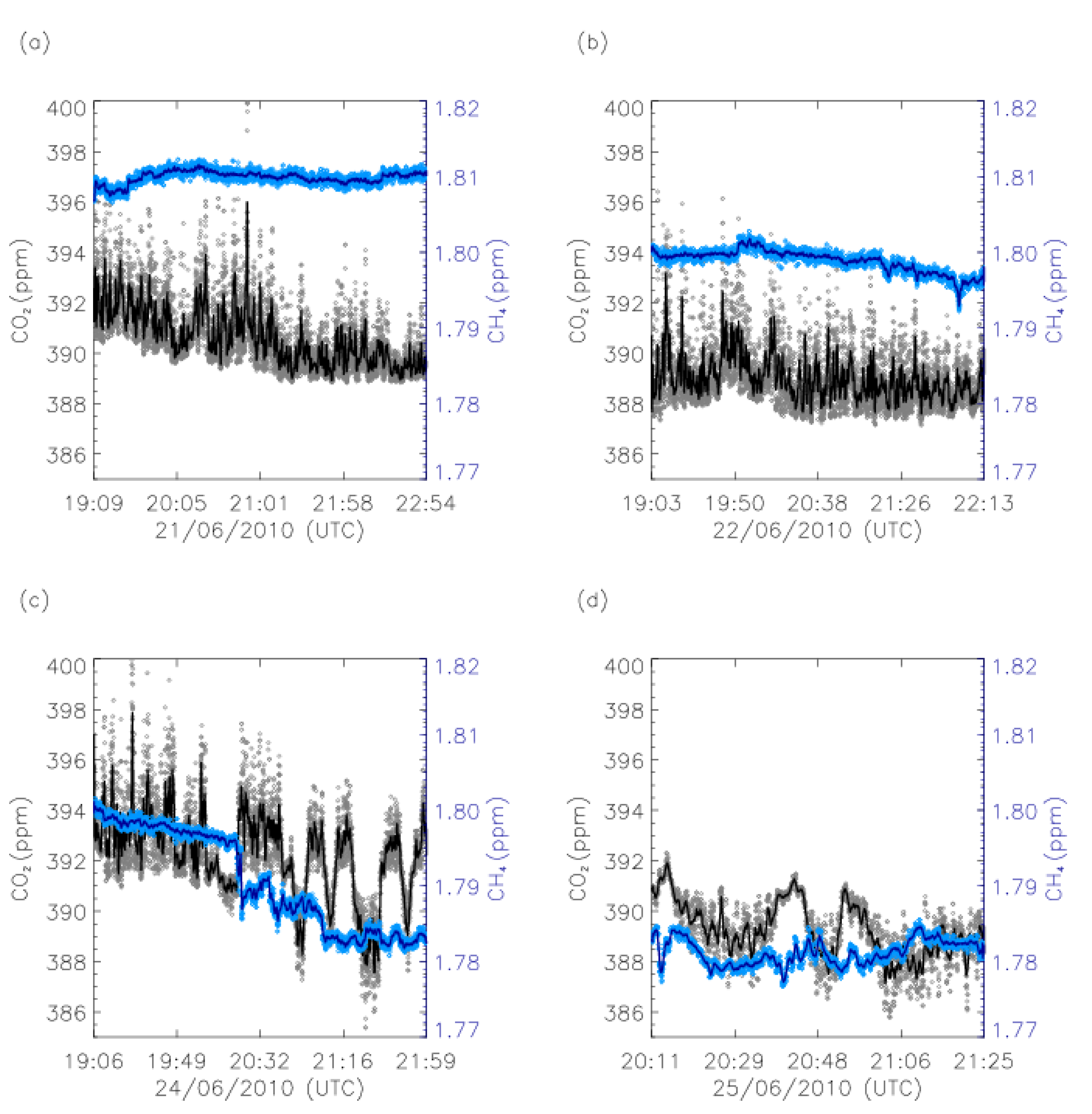
<p>The RRV field campaign bracketed the summer solstice, from 20–25 June 2010, and coincided with the decreasing phases of the seasonal cycles of the CO<sub>2</sub> and CH<sub>4</sub>. Data from the closest NOAA station at Wendover, Utah show that the CO<sub>2</sub> and CH<sub>4</sub> seasonal minima occur in August/September and July/August respectively (<ext-link xlink:href="www.esrl.noaa.gov/gmd/dv/iadv" ext-link-type="uri">www.esrl.noaa.gov/gmd/dv/iadv</ext-link>). The 2 s temporal resolution ground-based datasets of CO<sub>2</sub> and CH<sub>4</sub> are presented in <xref ref-type="fig" rid="f1-atmosphere-02-00702">Figure 1</xref> for each GOSAT overpass day.</p>
<p>The minimum and maximum concentrations during the measurement campaign were 385.39–404.25 ppm for CO<sub>2</sub> and 1.777–1.812 ppm for CH<sub>4</sub>. As expected the overall mean CO<sub>2</sub> and CH<sub>4</sub> concentrations on each measurement day were close to (although, always higher than for CO<sub>2</sub>) the global average of 386.8 ppm and 1.803 ppm respectively, see <xref ref-type="table" rid="t1-atmosphere-02-00702">Table 1</xref>. Differences from these mean concentrations are discussed more in the following sections. Day-to-day variations in the average CO<sub>2</sub> and CH<sub>4</sub> values result primarily from large scale mixing and variations on a time-scale of 2–5 days due to changes in emission sources and synoptic variability [<xref ref-type="bibr" rid="b23-atmosphere-02-00702">23</xref>] which mixes background, oceanic air with continental signals. The small time-scales of the daily CO<sub>2</sub> fluctuations, defined as lasting &lt;1 min in duration and consisting of &gt;10 data points, are seen in the raw data in <xref ref-type="fig" rid="f1-atmosphere-02-00702">Figure 1</xref>. The speed and magnitude of these fluctuations (most fluctuations are approximately 5 ppm (which is 30 times the instrument 1σ standard deviation)) were not observed in pre-deployment laboratory calibration testing. Given the location of the field instrument (removed from base-camp emissions and limited human interaction) we believe these fluctuations indicate local sources and/or sinks influence observations at this remote site.</p>
<sec>
<label>3.1.</label>
<title>Investigating Emission Sources</title>
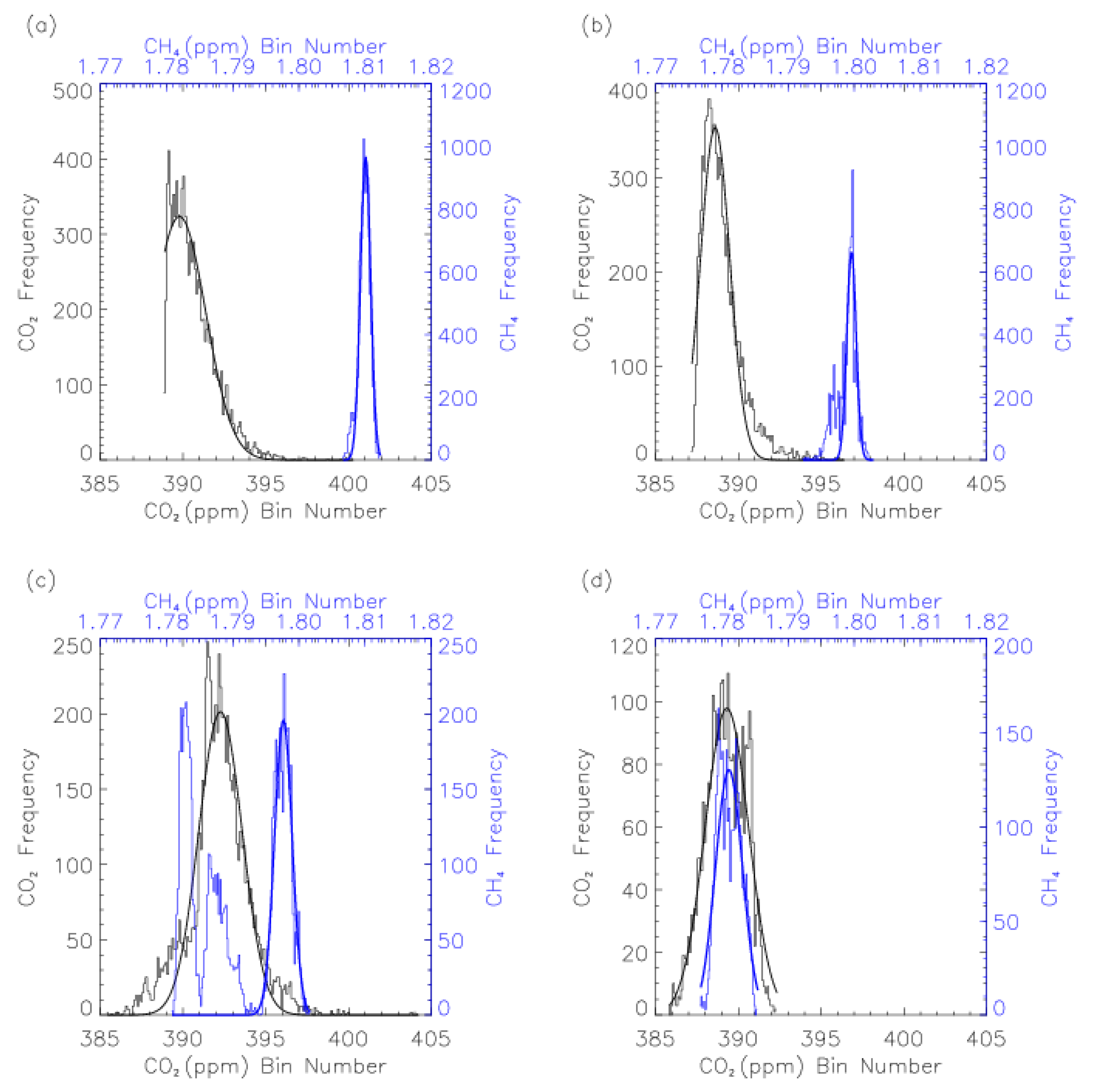
<p>The measured CO<sub>2</sub> and CH<sub>4</sub> probability distributions during each GOSAT overpass day are shown in <xref ref-type="fig" rid="f2-atmosphere-02-00702">Figure 2</xref>. Superimposed on the <xref ref-type="fig" rid="f2-atmosphere-02-00702">Figure 2</xref> histograms is a Gaussian probability distribution. The comparison of the actual and the Gaussian probability distributions, along with the statistical summary provided in <xref ref-type="table" rid="t1-atmosphere-02-00702">Table 1</xref>, informs us that each histogram is positively skewed (with varying extents), with more data points lying to the right of the centre. The non-symmetric, positive skew of the histograms suggests there are more fluctuations of CO<sub>2</sub> and CH<sub>4</sub> concentration values above the mean concentration than below, indicative of potential local sources influencing the observations at this remote site.</p>
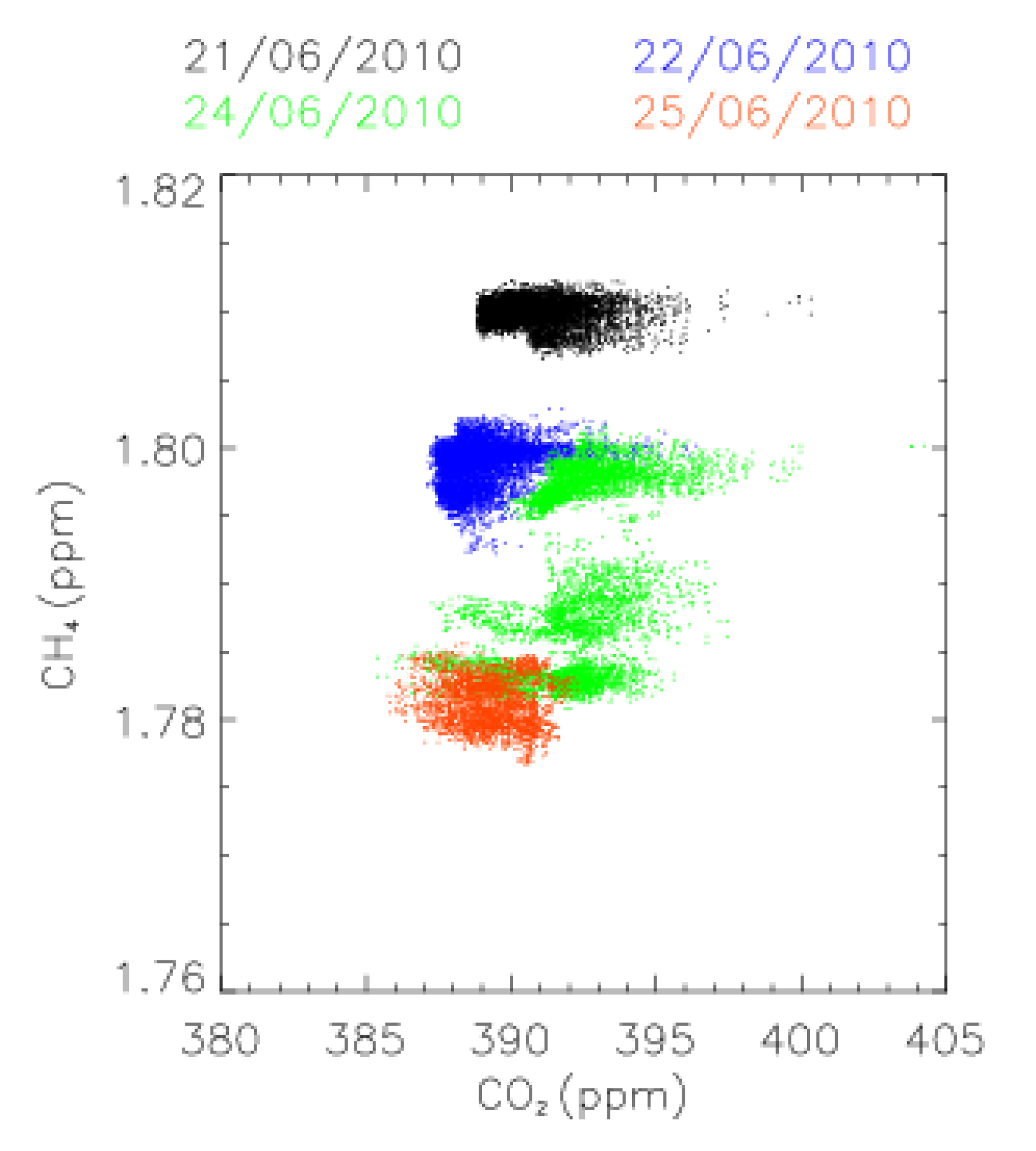
<p>The histogram plot of CH<sub>4</sub> on 24 June 2010 is bi-modal in shape, with two apparent peaks of similar occurrence frequency. This suggests that the data is from two separate processes or distinct sources, providing further evidence towards a local emission source. To investigate this possibility further a scatter plot of CH<sub>4</sub> <italic>versus</italic> CO<sub>2</sub> is presented in <xref ref-type="fig" rid="f3-atmosphere-02-00702">Figure 3</xref>. Excluding 24 June, it can be deduced from <xref ref-type="fig" rid="f3-atmosphere-02-00702">Figure 3</xref> that the CH<sub>4</sub> values on each day vary by less than 0.02 ppm (∼1% variation compared with background concentration value). Because, the day-to-day differences are larger than 0.02 ppm, each day's data falls into a distinct group bracketed by these small changes (0.02 ppm) in CH<sub>4</sub> concentration. CO<sub>2</sub>, on the other hand shows much more daily variation, in the order of 20 ppm. This is a ∼5% variation when compared with the background CO<sub>2</sub> value. On 24 June the CH<sub>4</sub> measurements span a wider range of concentrations (2 ppm) and appear to have several distinct groups. The scatter plot further confirms that measurements on 24 June 2010 were influenced by two or more distinct sources with differing CH<sub>4</sub>/CO<sub>2</sub> emission ratios.</p>
<p>The CH<sub>4</sub>/CO<sub>2</sub> ratio does not appear to have a very robust relationship, as represented by the variation in the <italic>r</italic><sup>2</sup> values (<italic>r</italic><sup>2</sup> values: 0.008, 0.06, 0.2, and 0.02 on 21, 22, 24, 25 June 2010 respectively). Using the reported, average background concentrations of CO<sub>2</sub> (386.8 ppm) and CH<sub>4</sub> (1.803 ppm) [<xref ref-type="bibr" rid="b4-atmosphere-02-00702">4</xref>] the expected CH<sub>4</sub>/CO<sub>2</sub> ratio is 0.0047. However, these are averaged concentrations, and in reality concentrations of CO<sub>2</sub> and CH<sub>4</sub> vary in time and space depending on the magnitude of local (or large regional and global) sources and sinks. The absence of a direct link between CH<sub>4</sub> and CO<sub>2</sub> concentrations can be expected when considering their independent and varying emission sources.</p>
<p>The fluctuations of CO<sub>2</sub> (up to 10 ppm) during each measurement period was unexpected given that the measurement period occurred at the same time on each day (late-morning to mid-afternoon) and considering the playa was virtually free from all vegetation. Further research is needed to investigate possible CO<sub>2</sub> fluxes. The Great Basin area (including RRV) is considered to have a minimal carbon emission, however due to the sparse measurement data of carbon fluxes in the desert region of United States Midwest the possibility of a local source/sink must also be considered. Further investigation is required to identify CO<sub>2</sub> (and CH<sub>4</sub>) sources and sinks including RRV oil fields and the role of soil-atmosphere interactions.</p></sec>
<sec sec-type="methods">
<label>3.2.</label>
<title>Comparisons with Meteorological Data</title>
<p>During the CO<sub>2</sub> and CH<sub>4</sub> measurement period, the first two GOSAT overpass days wind speeds were low (∼5 m/s) and the wind direction was highly variable. Temperatures on 21 and 22 June 2010 remained below 30 °C, skies were clear and mean humidity was 9–13%. Radiosonde data launched at GOSAT overpass time (20:44 and 21:16 UTC) on 21 and 22 June 2010 show a well-mixed planetary boundary layer (PBL) to 4000 m (above sea level) as indicated by the base of the temperature inversion and the level of minimum vertical gradient of relative humidity. Hence we expect the CO<sub>2</sub> and CH<sub>4</sub> mixing ratios within the PBL to be fairly constant during the measurement time and during the well-mixed PBL case. Indeed, evidence presented in <xref ref-type="fig" rid="f1-atmosphere-02-00702">Figures 1</xref> and <xref ref-type="fig" rid="f2-atmosphere-02-00702">2</xref> and <xref ref-type="table" rid="t1-atmosphere-02-00702">Table 1</xref> does show that the CO<sub>2</sub> and CH<sub>4</sub> observations are well-mixed, with fluctuations around the mean values.</p>
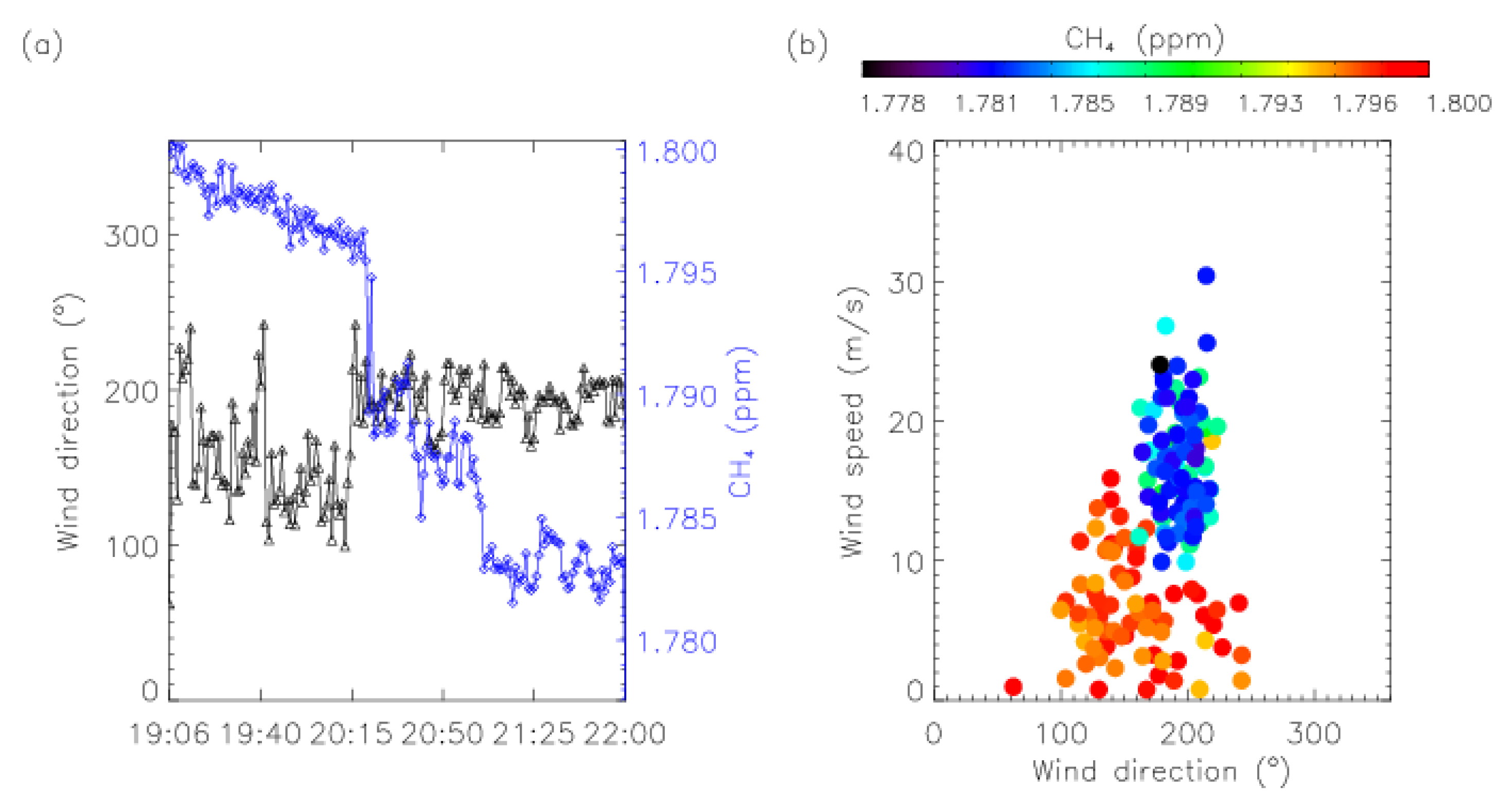
<p>In contrast, the final two measurement days were characterized by increasing wind speeds in the afternoon (average wind speed: 12.64 m/s and 19.08 m/s on 24 and 25 June 2010 respectively, with gusts up to 30 m/s) from a more sustained and less variable, (100–250°) direction, particularly during the afternoon winds. Temperatures on these final measurement days remained above 30 °C, cloud cover was present, and humidity decreased (mean: 7.69% and 4.90% on 24 and 25 June respectively). Comparing wind data with CH<sub>4</sub> mixing ratios on 24 June 2010 does indicate a relationship between CH<sub>4</sub> mixing ratios and wind direction/speed. The decrease in CH<sub>4</sub> concentration at 20:23 UTC on 24 June 2010 presented in <xref ref-type="fig" rid="f1-atmosphere-02-00702">Figures 1</xref> and <xref ref-type="fig" rid="f2-atmosphere-02-00702">2</xref> coincides with a change in wind direction from SW (higher CH<sub>4</sub> concentrations) to SE (lower CH<sub>4</sub> concentrations) with wind speeds from the SW direction being lower than those from the SE. <xref ref-type="fig" rid="f4-atmosphere-02-00702">Figure 4</xref> shows the relationship between CH<sub>4</sub> and wind speed/direction (CH<sub>4</sub> has been interpolated to the same temporal resolution as the wind data: once per minute) and points towards a local CH<sub>4</sub> source in the SW region. The origins of the source are inconclusive. Small oil fields are located in RRV, however most appear to be towards the north and east of RRV playa. Other potential sources could include biogenic emissions from the soil or thermal springs; all possibilities, and the subsequent effects on the local environment, require further investigation. The same behavior was not observed for CO<sub>2</sub>; fluctuations in CO<sub>2</sub> did not depend on wind direction/speed.</p>
<p>The effects of temperature and humidity on CO<sub>2</sub> and CH<sub>4</sub> concentrations have been investigated to help determine the role of biosphere interactions on the atmospheric levels of these carbon species. The area is not vegetated and hence evidence of photosynthesis as a key role in controlling CO<sub>2</sub> is not expected. However, there are local hot and cold springs which could potentially result in biogenic emissions of CH<sub>4</sub> and as such would be temperature dependent. Temperature and humidity would also determine the potential role of the playa soil itself, in terms of decomposition of organic matter. When CO<sub>2</sub> and CH<sub>4</sub> time series data is over-plotted with temperature and humidity there does appear to be a general degree of correlation; for example as temperature increases CO<sub>2</sub> appears to decrease. However, a scatter-plot of meteorological parameters (1 min resolution) <italic>versus</italic> (1 min average) CO<sub>2</sub> data shows little correlation, in terms of <italic>r</italic><sup>2</sup> values, due to the large variability in CO<sub>2</sub> concentration on each day. Given the general observations of decreasing CO<sub>2</sub> concentrations throughout each afternoon (as temperature increases) and the short time-frame of each day's measurements, no definite conclusion can be drawn regarding the effects of temperature on CO<sub>2</sub> mixing ratios. Comparisons of temperature and humidity with the less-variable CH<sub>4</sub> data result in a better degree of correlation, but <italic>r</italic><sup>2</sup> values vary dramatically from day-to-day. For example, the <italic>r</italic><sup>2</sup> values for temperature/CH<sub>4</sub> are 0.066, 0.50, 0.63, and 0.0043 on 21, 22, 24 and 25 June respectively. The lack of correlation between meteorological data and the carbon species leads us to deduce that in this instance local temperature and humidity conditions observed on the playa had little influence on the measured CO<sub>2</sub> and CH<sub>4</sub> concentrations, at least under the limited temperature and humidity range observed here. To better assess the role of temperature and humidity diurnal cycles would be required over larger temperature and humidity ranges.</p></sec>
<sec>
<label>3.3.</label>
<title>GOSAT Comparisons</title>
<p>The X<sub>CO2</sub> and X<sub>CH4</sub> GOSAT retrievals were derived using a method described elsewhere [<xref ref-type="bibr" rid="b24-atmosphere-02-00702">24</xref>-<xref ref-type="bibr" rid="b26-atmosphere-02-00702">26</xref>]. Briefly the data analysis method consists of three steps: (a) data is filtered by several cloud-detection methods to determine cloud-free observations, (b) determination of X<sub>CO2</sub> and X<sub>CH4</sub>, and (c) examination of retrieval quality. X<sub>CH4</sub> are obtained from the Japanese National Institute for Environmental Studies (NIES) products, whereas X<sub>CO2</sub> is retrieved with two different algorithms; X<sub>CO2</sub> from NIES products and from the NASA-sponsored Atmospheric CO<sub>2</sub> Observations from Space (ACOS) team. NIES X<sub>CO2</sub> and X<sub>CH4</sub> products V01.39 are retrieved as requested from L1 V110 data with NIES V01 algorithm and corrected the lower bias (8.9 ppm for XCO<sub>2</sub> and 0.02 ppm for XCH<sub>4</sub>). ACOS X<sub>CO2</sub> products are retrieved from L1 V130 data with ACOS b2.9 algorithm. GOSAT's onboard Thermal and Near infrared Sensor for carbon Observation Fourier Transform Spectrometer (TANSO-FTS) pointing mechanism has image motion compensation capability, this mechanism can view the same surface target for up to 20 s. The RRV GOSAT overpasses were approximately 13 s in total, comprising of up to three data points for each GOSAT overpass.</p>
<p>The ground based <italic>in-situ</italic> measurements of CO<sub>2</sub> and CH<sub>4</sub>, averaged over 30 min (15 min either side of the GOSAT overpass), were compared with the X<sub>CO2</sub> and X<sub>CH4</sub> retrievals by NIES and by ACOS from GOSAT overpasses on 21 and 22 June 2010. Comparisons of the GOSAT overpasses on 24 and 25 June 2010 could not be made due to large cloud cover fraction during these days, preventing X<sub>CO2</sub> and X<sub>CH4</sub> retrievals. The data is presented in <xref ref-type="table" rid="t2-atmosphere-02-00702">Table 2</xref>. Note that on 22 June NIES rejected two and ACOS rejected one of the possible three data points.</p>
<p>The differences in the measurements of <italic>in-situ</italic> CO<sub>2</sub> and CH<sub>4</sub> mixing ratios and X<sub>CO2</sub> and X<sub>CH4</sub> can be understood when considering the nature of the measurements. Ground-based, surface CO<sub>2</sub> mixing ratios are largely influenced by their diurnal cycle (which in turn is driven by synoptic-scale weather patterns which affect boundary layer mixing, photosynthesis and ecosystem respiration [<xref ref-type="bibr" rid="b27-atmosphere-02-00702">27</xref>]). In contrast, in order for there to be large-scale replacement of air within the column, column CO<sub>2</sub> is largely linked to events that have timescales in the order of 2 to 6 days [<xref ref-type="bibr" rid="b28-atmosphere-02-00702">28</xref>]. Despite these differences there appears to be a good agreement between <italic>in-situ</italic> CO<sub>2</sub> and X<sub>CO2</sub> and between <italic>in-situ</italic> CH<sub>4</sub> and X<sub>CH4</sub>. It has been previously concluded that the varying amplitude of the CO<sub>2</sub> seasonal cycle with altitude is responsible for column average CO<sub>2</sub> being greater than surface CO<sub>2</sub> in summer and fall and lower in winter and spring in the Northern Hemisphere mid-latitudes [<xref ref-type="bibr" rid="b28-atmosphere-02-00702">28</xref>]. However, during this summer study the NIES and ACOS X<sub>CO2</sub> values are less than the surface CO<sub>2</sub> mixing ratio on the 21 June and greater than on 22 June 2010. The reason for this discrepancy on 21 June 2010 may be due to the “rectifier effect”: interactions between biosphere emissions (here effects of photosynthesis rates are limited but other biogenic sources have not been accounted for) and boundary layer dynamics and/or local sources and sinks, and further investigation is required to better address these roles.</p></sec></sec>
<sec sec-type="conclusions">
<label>4.</label>
<title>Conclusions</title>
<p>Ground based <italic>in-situ</italic> measurements of CO<sub>2</sub> and CH<sub>4</sub> at RRV playa were carried out during June 2010. The measurements were in support of the vicarious calibration experiment which in turn helps validate GOSAT X<sub>CO2</sub> and X<sub>CH4</sub> retrievals. This work focuses on the analysis of the ground-based <italic>in-situ</italic> measurements of CO<sub>2</sub> and CH<sub>4</sub>. The daily mean CO<sub>2</sub> and CH<sub>4</sub> concentrations are close to the reported global average values. However, fluctuations were observed, which were greater than expected given the remoteness of the RRV site. Further investigation is required in order to analyze the cause of these fluctuations and their influence on satellite validations.</p>
<p>Comparisons of <italic>in-situ</italic> CO<sub>2</sub> and CH<sub>4</sub> measurements with X<sub>CO2</sub> and X<sub>CH4</sub> from GOSAT show a general good-approximation of boundary layer mixing ratios. However, due to the spatially limited coverage of the <italic>in-situ</italic> data and the reliance on cloud-free measurement days, the results presented should be regarded as a first attempt at comparison. Further validation including a more comprehensive study of the boundary layer is needed.</p>
<p>Planned improvements for future calibration campaigns include increased power availability to measure CO<sub>2</sub> and CH<sub>4</sub> for longer periods of time, including the analysis of diurnal cycles which would help identify the role of local sources/sinks. A detailed analysis of local emission sources/sinks would be advantageous, allowing the assessment of the role of the oil fields, identification of potential biogenic sources/sinks, and assessment of the potential influence of these on satellite measurements. Measurement of ground based CO<sub>2</sub> and CH<sub>4</sub> mixing ratios coincident with <italic>in-situ</italic> analysis of CO<sub>2</sub> and CH<sub>4</sub> in the free troposphere would allow for the investigation of CO<sub>2</sub> and CH<sub>4</sub> vertical profiles and provide a method of calculating column averages from aircraft profiles to directly compare with GOSAT column X<sub>CO2</sub> and X<sub>CH4</sub>, which is a method routinely used for satellite validation [<xref ref-type="bibr" rid="b9-atmosphere-02-00702">9</xref>,<xref ref-type="bibr" rid="b29-atmosphere-02-00702">29</xref>].</p></sec></body>
<back>
<sec sec-type="display-objects">
<title>Figures and Tables</title>
<fig id="f1-atmosphere-02-00702" position="float">
<label>Figure 1.</label>
<caption>
<p>Mixing ratios of CO<sub>2</sub> (gray) and CH<sub>4</sub> (blue) on (<bold>a</bold>) 21 June, (<bold>b</bold>) 22 June, (<bold>c</bold>) 24 June, (<bold>d</bold>) 25 June, 2010. For each species the one minute boxcar average (darker colored line) is overlaid with the raw data (lighter colored symbols) and is plotted against Coordinated Universal Time, UTC, (local time plus 7 h).</p></caption>
<graphic xlink:href="atmosphere-02-00702f1.gif"/></fig>
<fig id="f2-atmosphere-02-00702" position="float">
<label>Figure 2.</label>
<caption>
<p>Probabilistic histograms of CO<sub>2</sub> (black) and CH<sub>4</sub> (blue) mixing ratios during each overpass day. Superimposed is the Gaussian distribution. (<bold>a</bold>) 21 June, (<bold>b</bold>) 22 June, (<bold>c</bold>) 24 June, (<bold>d</bold>) 25 June, 2010.</p></caption>
<graphic xlink:href="atmosphere-02-00702f2.gif"/></fig>
<fig id="f3-atmosphere-02-00702" position="float">
<label>Figure 3.</label>
<caption>
<p>Scatter plot of CH<sub>4</sub> <italic>versus</italic> CO<sub>2</sub> on each GOSAT overpass day.</p></caption>
<graphic xlink:href="atmosphere-02-00702f3.gif"/></fig>
<fig id="f4-atmosphere-02-00702" position="float">
<label>Figure 4.</label>
<caption>
<p>Relationship between wind speed and direction and CH<sub>4</sub> concentration on 24 June 2010 (<bold>a</bold>) time series of wind direction and CH<sub>4</sub> (<bold>b</bold>) 3D plot of wind speed, direction, and (interpolated) CH<sub>4</sub> concentration.</p></caption>
<graphic xlink:href="atmosphere-02-00702f4.gif"/></fig>
<table-wrap id="t1-atmosphere-02-00702" position="float">
<label>Table 1.</label>
<caption>
<p>Statistics table for 0.5 Hz <italic>in-situ</italic>CO<sub>2</sub> and CH<sub>4</sub> mixing ratios during the ∼3h measurement period on each overpass day. Data reported: minimum, median, standard deviation, maximum, histogram, skewness andkurtosis.K</p></caption>
<table frame="box" rules="all">
<thead>
<tr>
<th align="left" valign="top" rowspan="2"/>
<th colspan="2" align="center" valign="top"><bold>21 June 2010</bold></th>
<th colspan="2" align="center" valign="top"><bold>22 June 2010</bold></th>
<th colspan="2" align="center" valign="top"><bold>24 June 2010</bold></th>
<th colspan="2" align="center" valign="top"><bold>25 June 2010</bold></th></tr>
<tr>
<th align="center" valign="top">CO<sub>2</sub></th>
<th align="center" valign="top">CH<sub>4</sub></th>
<th align="center" valign="top">CO<sub>2</sub></th>
<th align="center" valign="top">CH<sub>4</sub></th>
<th align="center" valign="top">CO<sub>2</sub></th>
<th align="center" valign="top">CH<sub>4</sub></th>
<th align="center" valign="top">CO<sub>2</sub></th>
<th align="center" valign="top">CH<sub>4</sub></th></tr></thead>
<tbody>
<tr>
<td align="center" valign="top">388.84</td>
<td align="center" valign="top">1.806</td>
<td align="center" valign="top">387.15</td>
<td align="center" valign="top">1.792</td>
<td align="center" valign="top">385.39</td>
<td align="center" valign="top">1.781</td>
<td align="center" valign="top">385.78</td>
<td align="center" valign="top">1.777</td></tr>
<tr>
<td align="center" valign="top">390.66</td>
<td align="center" valign="top">1.809</td>
<td align="center" valign="top">389.01</td>
<td align="center" valign="top">1.799</td>
<td align="center" valign="top">392.23</td>
<td align="center" valign="top">1.791</td>
<td align="center" valign="top">389.26</td>
<td align="center" valign="top">1.781</td></tr>
<tr>
<td align="center" valign="top">390.37</td>
<td align="center" valign="top">1.810</td>
<td align="center" valign="top">388.75</td>
<td align="center" valign="top">1.799</td>
<td align="center" valign="top">392.22</td>
<td align="center" valign="top">1.789</td>
<td align="center" valign="top">389.26</td>
<td align="center" valign="top">1.781</td></tr>
<tr>
<td align="center" valign="top">1.34</td>
<td align="center" valign="top">8.70e<sup>−4</sup></td>
<td align="center" valign="top">1.17</td>
<td align="center" valign="top">1.53e<sup>−4</sup></td>
<td align="center" valign="top">1.85</td>
<td align="center" valign="top">6.55e<sup>−3</sup></td>
<td align="center" valign="top">1.19</td>
<td align="center" valign="top">1.72e<sup>−3</sup></td></tr>
<tr>
<td align="center" valign="top">400.34</td>
<td align="center" valign="top">1.812</td>
<td align="center" valign="top">396.41</td>
<td align="center" valign="top">1.803</td>
<td align="center" valign="top">404.25</td>
<td align="center" valign="top">1.802</td>
<td align="center" valign="top">392.31</td>
<td align="center" valign="top">1.786</td></tr>
<tr>
<td align="left" valign="top">Skewness</td>
<td align="center" valign="top">1.27</td>
<td align="center" valign="top">0.719</td>
<td align="center" valign="top">1.24</td>
<td align="center" valign="top">1.938</td>
<td align="center" valign="top">1.86</td>
<td align="center" valign="top">0.796</td>
<td align="center" valign="top">0.14</td>
<td align="center" valign="top">0.002</td></tr>
<tr>
<td align="left" valign="top">Kurtosis</td>
<td align="center" valign="top">0.18</td>
<td align="center" valign="top">−1.096</td>
<td align="center" valign="top">0.04</td>
<td align="center" valign="top">3.569</td>
<td align="center" valign="top">2.48</td>
<td align="center" valign="top">−0.697</td>
<td align="center" valign="top">−1.522</td>
<td align="center" valign="top">−1.322</td></tr></tbody></table></table-wrap>
<table-wrap id="t2-atmosphere-02-00702" position="float">
<label>Table 2.</label>
<caption>
<p>Summary of the comparisons of GOSAT column-averaged dry air mole fractions of CO<sub>2</sub> and CH<sub>4</sub> with <italic>in-situ</italic> surface level mixing ratios averaged for 30 min centered on the overpass time (values reported in ppm).</p></caption>
<table frame="box" rules="all">
<thead>
<tr>
<th align="center" valign="top"><bold>Date/time of GOSAT overpass</bold></th>
<th align="center" valign="top"><bold>X<sub>CO2</sub> NIES</bold></th>
<th align="center" valign="top"><bold>X<sub>CO2</sub> ACOS</bold></th>
<th align="center" valign="top"><bold><italic>In-situ</italic> CO<sub>2</sub></bold></th>
<th align="center" valign="top"><bold>X<sub>CH4</sub> NIES</bold></th>
<th align="center" valign="top"><bold><italic>In-situ</italic> CH<sub>4</sub></bold></th></tr></thead>
<tbody>
<tr>
<td align="center" valign="middle" rowspan="3">21/06/2010 20:44</td>
<td align="center" valign="middle">392.7</td>
<td align="center" valign="middle">390.0</td>
<td align="center" valign="middle" rowspan="3">393.60</td>
<td align="center" valign="middle">1.814</td>
<td align="center" valign="middle" rowspan="3">1.810</td></tr>
<tr>
<td align="center" valign="middle">389.9</td>
<td align="center" valign="middle">389.3</td>
<td align="center" valign="middle">1.816</td></tr>
<tr>
<td align="center" valign="middle">390.3</td>
<td align="center" valign="middle">390.2</td>
<td align="center" valign="middle">1.806</td></tr>
<tr>
<td align="center" valign="middle" rowspan="3">22/06/2010 21:16</td>
<td align="center" valign="middle">-</td>
<td align="center" valign="middle">391.4</td>
<td align="center" valign="middle" rowspan="3">388.01</td>
<td align="center" valign="middle">-</td>
<td align="center" valign="middle" rowspan="3">1.798</td></tr>
<tr>
<td align="center" valign="middle">390.7</td>
<td align="center" valign="middle">391.3</td>
<td align="center" valign="middle">1.805</td></tr>
<tr>
<td align="center" valign="middle">-</td>
<td align="center" valign="middle">-</td></tr></tbody></table></table-wrap></sec>
<ack>
<p>We specifically acknowledge the cooperation and efforts of the personnel involved in the Railroad Valley vicarious calibration experiment from Atmospheric CO<sub>2</sub> Observations from Space (ACOS), Japan Aerospace Exploration Agency (JAXA), National Institute for Environmental Studies (NIES) and Colorado State University (CSU), particulary the work of Hiroshi Suto of JAXA, NIES GOSAT project office, David Crisp and Carol Bruegge of ACOS. We also thank the University of Arizona Remote Sensing Group for making the research facilities at Railroad Valley available. We acknowledge financial support from NASA's Earth Science Division and Oak Ridge Associated Universities (ORAU) through the NASA Postdoctoral Program (E.L.Y., J.M.T.). Helpful comments from two anonymous reviewers are appreciated.</p></ack>
<ref-list>
<title>References</title>
<ref id="b1-atmosphere-02-00702"><label>1.</label><citation citation-type="book"><person-group person-group-type="author"><collab>Intergovernmental Panel on Climate Change (IPCC)</collab></person-group><source>Climate Change 2007: The Physical Science Basis</source><person-group person-group-type="editor"><name><surname>Solomon</surname><given-names>S.</given-names></name><name><surname>Qin</surname><given-names>D.</given-names></name><name><surname>Manning</surname><given-names>M.</given-names></name><name><surname>Chen</surname><given-names>Z.</given-names></name><name><surname>Marquis</surname><given-names>M.</given-names></name><name><surname>Averyt</surname><given-names>K.B.</given-names></name><name><surname>Tignor</surname><given-names>M.</given-names></name><name><surname>Miller</surname><given-names>H.L.</given-names></name></person-group><publisher-name>Cambridge University Press</publisher-name><publisher-loc>Cambridge, UK</publisher-loc><year>2007</year></citation></ref>
<ref id="b2-atmosphere-02-00702"><label>2.</label><citation citation-type="book"><person-group person-group-type="author"><name><surname>Lorius</surname><given-names>C.</given-names></name><name><surname>Jouzel</surname><given-names>J.</given-names></name><name><surname>Raynaud</surname><given-names>D.</given-names></name></person-group><article-title>The Ice Core Record: Past Archive of the Climate and Signpost to the Future</article-title><source>Antarctica and Environmental Change</source><publisher-name>Oxford Science Publications</publisher-name><publisher-loc>Oxford, UK</publisher-loc><year>1993</year><fpage>27</fpage><lpage>34</lpage></citation></ref>
<ref id="b3-atmosphere-02-00702"><label>3.</label><citation citation-type="journal"><person-group person-group-type="author"><name><surname>Etheridge</surname><given-names>D.M.</given-names></name><name><surname>Steele</surname><given-names>L.P.</given-names></name><name><surname>Langenfelds</surname><given-names>R.L.</given-names></name><name><surname>Francey</surname><given-names>R.J.</given-names></name></person-group><article-title>Natural and anthropogenic changes in atmospheric CO2 over the last 1000 years from air in Arctic ice and firn</article-title><source>J. Geophys. Res.</source><year>1996</year><volume>101</volume><fpage>4115</fpage><lpage>4128</lpage><pub-id pub-id-type="doi">10.1029/95JD03410</pub-id></citation></ref>
<ref id="b4-atmosphere-02-00702"><label>4.</label><citation citation-type="web"><person-group person-group-type="author"><collab>WMO Secretariat</collab></person-group><article-title>WMO Greenhouse Gas Bulletin: The State of Greenhouse Gases in the Atmosphere Based on Global Observations through 2009, 2010</article-title><comment>World Meteorological Organization Available online: <ext-link xlink:href="http://www.wmo.int/pages/prog/arep/gaw/ghg/documents/GHG_bull_6en.pdf" ext-link-type="uri">http://www.wmo.int/pages/prog/arep/gaw/ghg/documents/GHG_bull_6en.pdf</ext-link> (accessed on 23 September 2011)</comment></citation></ref>
<ref id="b5-atmosphere-02-00702"><label>5.</label><citation citation-type="journal"><person-group person-group-type="author"><name><surname>Thompson</surname><given-names>R.L.</given-names></name><name><surname>Manning</surname><given-names>A.C.</given-names></name><name><surname>Gloor</surname><given-names>E.</given-names></name><name><surname>Schultz</surname><given-names>U.</given-names></name><name><surname>Seifert</surname><given-names>T.</given-names></name><name><surname>Hänsel</surname><given-names>F.</given-names></name><name><surname>Jordan</surname><given-names>A.</given-names></name><name><surname>Heinmann</surname><given-names>M.</given-names></name></person-group><article-title><italic>In-situ</italic> measurements of oxygen, carbon monoxide and greenhouse gases from Ochsenkopf tall tower in Germany</article-title><source>Atmos. Meas. Tech.</source><year>2009</year><volume>2</volume><fpage>573</fpage><lpage>591</lpage><pub-id pub-id-type="doi">10.5194/amt-2-573-2009</pub-id></citation></ref>
<ref id="b6-atmosphere-02-00702"><label>6.</label><citation citation-type="journal"><person-group person-group-type="author"><name><surname>Winderlich</surname><given-names>J.</given-names></name><name><surname>Chen</surname><given-names>H.</given-names></name><name><surname>Gerbig</surname><given-names>C.</given-names></name><name><surname>Seifert</surname><given-names>T.</given-names></name><name><surname>Kolle</surname><given-names>O.</given-names></name><name><surname>Laverič</surname><given-names>J.V.</given-names></name><name><surname>Kaiser</surname><given-names>C.</given-names></name><name><surname>Höfer</surname><given-names>A.</given-names></name><name><surname>Heimann</surname><given-names>M.</given-names></name></person-group><article-title>Continuous low-maintenance CO<sub>2</sub>/CH<sub>4</sub>/H<sub>2</sub>O measurements at the Zotino Tall Tower Observatory (ZOTTO) in Central Siberia</article-title><source>Atmos. Meas. Tech.</source><year>2010</year><volume>3</volume><fpage>1113</fpage><lpage>1128</lpage><pub-id pub-id-type="doi">10.5194/amt-3-1113-2010</pub-id></citation></ref>
<ref id="b7-atmosphere-02-00702"><label>7.</label><citation citation-type="book"><person-group person-group-type="author"><name><surname>Flannery</surname><given-names>T.</given-names></name></person-group><source>The Weather Makers: The History and Future Impact of Climate Change</source><publisher-name>Atlantic Monthly Press</publisher-name><publisher-loc>New York, NY, USA</publisher-loc><year>2005</year></citation></ref>
<ref id="b8-atmosphere-02-00702"><label>8.</label><citation citation-type="book"><person-group person-group-type="author"><name><surname>Archer</surname><given-names>D.</given-names></name></person-group><source>The Long Thaw: How Humans Are Changing the Next 100,000 Years of Earth's Climate</source><publisher-name>Princeton University Press</publisher-name><publisher-loc>Princeton, NJ, USA</publisher-loc><year>2008</year></citation></ref>
<ref id="b9-atmosphere-02-00702"><label>9.</label><citation citation-type="journal"><person-group person-group-type="author"><name><surname>Kulawik</surname><given-names>S.S.</given-names></name><name><surname>Jones</surname><given-names>D.B.A.</given-names></name><name><surname>Nassar</surname><given-names>R.</given-names></name><name><surname>Irion</surname><given-names>E.W.</given-names></name><name><surname>Worden</surname><given-names>J.R.</given-names></name><name><surname>Bowman</surname><given-names>K.W.</given-names></name><name><surname>Machida</surname><given-names>T.</given-names></name><name><surname>Matsueda</surname><given-names>H.</given-names></name><name><surname>Sawa</surname><given-names>Y.</given-names></name><name><surname>Biraud</surname><given-names>S.C.</given-names></name><etal/></person-group><article-title>Characterization of Tropospheric emission spectrometer (TES) CO<sub>2</sub> for carbon cycle science</article-title><source>Atmos. Chem. Phys.</source><year>2010</year><volume>10</volume><fpage>5601</fpage><lpage>5623</lpage><pub-id pub-id-type="doi">10.5194/acp-10-5601-2010</pub-id></citation></ref>
<ref id="b10-atmosphere-02-00702"><label>10.</label><citation citation-type="journal"><person-group person-group-type="author"><name><surname>Dlugokencky</surname><given-names>E.J.</given-names></name><name><surname>Houweling</surname><given-names>S.</given-names></name><name><surname>Bruhwiler</surname><given-names>L.</given-names></name><name><surname>Masarie</surname><given-names>K.A.</given-names></name><name><surname>Lang</surname><given-names>P.M.</given-names></name><name><surname>Miller</surname><given-names>J.B.</given-names></name><name><surname>Tans</surname><given-names>P.P.</given-names></name></person-group><article-title>Atmospheric methane levels off: Temporary pause or a new steady-state?</article-title><source>Geophys. Res. Lett.</source><year>2003</year><volume>30</volume><fpage>3</fpage><lpage>6</lpage></citation></ref>
<ref id="b11-atmosphere-02-00702"><label>11.</label><citation citation-type="journal"><person-group person-group-type="author"><name><surname>Bousquet</surname><given-names>P.</given-names></name><name><surname>Ciais</surname><given-names>P.</given-names></name><name><surname>Miller</surname><given-names>J.B.</given-names></name><name><surname>Dlugokencky</surname><given-names>E.J.</given-names></name><name><surname>Hauglustaine</surname><given-names>D.A.</given-names></name><name><surname>Prigent</surname><given-names>C.</given-names></name><name><surname>van der Werf</surname><given-names>G.R.</given-names></name><name><surname>Peylin</surname><given-names>P.</given-names></name><name><surname>Brunke</surname><given-names>E.G.</given-names></name><name><surname>Carouge</surname><given-names>C.</given-names></name><etal/></person-group><article-title>Contribution of anthropogenic and natural sources to atmospheric methane variability</article-title><source>Nature</source><year>2006</year><volume>443</volume><fpage>439</fpage><lpage>443</lpage><pub-id pub-id-type="doi">10.1038/nature05132</pub-id><pub-id pub-id-type="pmid">17006511</pub-id></citation></ref>
<ref id="b12-atmosphere-02-00702"><label>12.</label><citation citation-type="journal"><person-group person-group-type="author"><name><surname>Rigby</surname><given-names>M.</given-names></name><name><surname>Prinn</surname><given-names>R.G.</given-names></name><name><surname>Fraser</surname><given-names>P.B.</given-names></name><name><surname>Simmonds</surname><given-names>P.G.</given-names></name><name><surname>Langenfels</surname><given-names>R.L.</given-names></name><name><surname>Huang</surname><given-names>J.</given-names></name><name><surname>Cunnold</surname><given-names>D.M.</given-names></name><name><surname>Steele</surname><given-names>L.P.</given-names></name><name><surname>Krummel</surname><given-names>P.B.</given-names></name><name><surname>Weiss</surname><given-names>R.F.</given-names></name><etal/></person-group><article-title>Renewed growth of atmospheric methane</article-title><source>Geophys. Res. Lett.</source><year>2008</year><volume>35</volume><fpage>L22805</fpage><pub-id pub-id-type="doi">10.1029/2008GL036037</pub-id></citation></ref>
<ref id="b13-atmosphere-02-00702"><label>13.</label><citation citation-type="journal"><person-group person-group-type="author"><name><surname>Dlugokencky</surname><given-names>E.J.</given-names></name><name><surname>Bruhwiler</surname><given-names>L.</given-names></name><name><surname>White</surname><given-names>J.W.C.</given-names></name><name><surname>Emmons</surname><given-names>L.K.</given-names></name><name><surname>Novelli</surname><given-names>P.C.</given-names></name><name><surname>Montzka</surname><given-names>S.A.</given-names></name><name><surname>Masarie</surname><given-names>K.A.</given-names></name><name><surname>Lang</surname><given-names>P.M.</given-names></name><name><surname>Crotwell</surname><given-names>A.M.</given-names></name><name><surname>Miller</surname><given-names>J.B.</given-names></name><name><surname>Gatti</surname><given-names>L.V.</given-names></name><etal/></person-group><article-title>Observational constraints on recent increases in the atmospheric CH<sub>4</sub> burden</article-title><source>Geophys. Res. Lett.</source><year>2009</year><volume>36</volume><fpage>L18803</fpage><pub-id pub-id-type="doi">10.1029/2009GL039780</pub-id></citation></ref>
<ref id="b14-atmosphere-02-00702"><label>14.</label><citation citation-type="journal"><person-group person-group-type="author"><name><surname>Nikitin</surname><given-names>A.V.</given-names></name><name><surname>Lyulin</surname><given-names>O.M.</given-names></name><name><surname>Mikhailenko</surname><given-names>S.N.</given-names></name><name><surname>Perevalov</surname><given-names>V.I.</given-names></name><name><surname>Filippov</surname><given-names>N.N.</given-names></name><name><surname>Grigoriev</surname><given-names>I.M.</given-names></name><name><surname>Morino</surname><given-names>I.</given-names></name><name><surname>Yokota</surname><given-names>T.</given-names></name><name><surname>Kumazawa</surname><given-names>R.</given-names></name><name><surname>Watanabe</surname><given-names>T.</given-names></name></person-group><article-title>GOSAT-2009 methane spectral line list in the 5550–6236 cm<sup>−1</sup> range</article-title><source>J. Quant. Spectrosc. Radiat. Transf.</source><year>2010</year><volume>111</volume><fpage>2211</fpage><lpage>2224</lpage><pub-id pub-id-type="doi">10.1016/j.jqsrt.2010.05.010</pub-id></citation></ref>
<ref id="b15-atmosphere-02-00702"><label>15.</label><citation citation-type="journal"><person-group person-group-type="author"><name><surname>Kuze</surname><given-names>A.</given-names></name><name><surname>Suto</surname><given-names>H.</given-names></name><name><surname>Nakajima</surname><given-names>M.</given-names></name><name><surname>Hamazaki</surname><given-names>T.</given-names></name></person-group><article-title>Thermal and near infrared sensor for carbon observation Fourier-transform spectrometer on the Greenhouse Gases Observing Satellite for greenhouse gases monitoring</article-title><source>Appl. Opt.</source><year>2009</year><volume>48</volume><fpage>6716</fpage><lpage>6733</lpage><pub-id pub-id-type="doi">10.1364/AO.48.006716</pub-id><pub-id pub-id-type="pmid">20011012</pub-id></citation></ref>
<ref id="b16-atmosphere-02-00702"><label>16.</label><citation citation-type="journal"><person-group person-group-type="author"><name><surname>Yokota</surname><given-names>T.</given-names></name><name><surname>Yoshida</surname><given-names>Y.</given-names></name><name><surname>Eguchi</surname><given-names>N.</given-names></name><name><surname>Tanaka</surname><given-names>T.</given-names></name><name><surname>Watanabe</surname><given-names>H.</given-names></name><name><surname>Maksyutov</surname><given-names>S.</given-names></name></person-group><article-title>Global concentrations of CO<sub>2</sub> and CH<sub>4</sub> retrieved from GOSAT: First preliminary results</article-title><source>Sci. Online Lett. Atmos.</source><year>2009</year><volume>5</volume><fpage>160</fpage><lpage>163</lpage></citation></ref>
<ref id="b17-atmosphere-02-00702"><label>17.</label><citation citation-type="journal"><person-group person-group-type="author"><name><surname>Thome</surname><given-names>K.J.</given-names></name></person-group><article-title>Absolute radiometric calibration of Landsat 7 ETM+ using the reflectance-based method</article-title><source>Remote Sens. Environ.</source><year>2001</year><volume>78</volume><fpage>27</fpage><lpage>38</lpage><pub-id pub-id-type="doi">10.1016/S0034-4257(01)00247-4</pub-id></citation></ref>
<ref id="b18-atmosphere-02-00702"><label>18.</label><citation citation-type="journal"><person-group person-group-type="author"><name><surname>Tonooka</surname><given-names>H.</given-names></name><name><surname>Palluconi</surname><given-names>F.D.</given-names></name><name><surname>Hook</surname><given-names>S.J.</given-names></name><name><surname>Matsunaga</surname><given-names>T.</given-names></name></person-group><article-title>Vicarious calibration of ASTER thermal infrared bands</article-title><source>IEEE Trans. Geosci. Remote Sens.</source><year>2005</year><volume>43</volume><fpage>2733</fpage><lpage>2746</lpage><pub-id pub-id-type="doi">10.1109/TGRS.2005.857885</pub-id></citation></ref>
<ref id="b19-atmosphere-02-00702"><label>19.</label><citation citation-type="journal"><person-group person-group-type="author"><name><surname>Kuze</surname><given-names>A.</given-names></name><name><surname>O'Brien</surname><given-names>D.M.</given-names></name><name><surname>Taylor</surname><given-names>T.M.</given-names></name><name><surname>Day</surname><given-names>O.</given-names></name><name><surname>O'Dell</surname><given-names>C.W.</given-names></name><name><surname>Katakoka</surname><given-names>F.</given-names></name><name><surname>Yoshida</surname><given-names>M.</given-names></name><name><surname>Mitomi</surname><given-names>Y.</given-names></name><name><surname>Bruegee</surname><given-names>C.J.</given-names></name><name><surname>Pollock</surname><given-names>H.</given-names></name><etal/></person-group><article-title>Vicarious calibration of the GOSAT sensors using the Railroad Valley desert playa 2010</article-title><source>IEEE Trans. Geosci. Remote Sens.</source><year>2010</year><volume>48</volume><fpage>4331</fpage><lpage>4380</lpage><pub-id pub-id-type="doi">10.1109/TGRS.2010.2092631</pub-id></citation></ref>
<ref id="b20-atmosphere-02-00702"><label>20.</label><citation citation-type="journal"><person-group person-group-type="author"><name><surname>Crosson</surname><given-names>E.R.</given-names></name></person-group><article-title>A cavity ring-down analyzer for measuring atmospheric levels of methane, carbon dioxide and water vapor</article-title><source>Appl. Phys. B</source><year>2008</year><volume>92</volume><fpage>403</fpage><lpage>408</lpage><pub-id pub-id-type="doi">10.1007/s00340-008-3135-y</pub-id></citation></ref>
<ref id="b21-atmosphere-02-00702"><label>21.</label><citation citation-type="journal"><person-group person-group-type="author"><name><surname>Chen</surname><given-names>H.</given-names></name><name><surname>Winderlich</surname><given-names>J.</given-names></name><name><surname>Gerbig</surname><given-names>C.</given-names></name><name><surname>Hoefer</surname><given-names>A.</given-names></name><name><surname>Rella</surname><given-names>C.W.</given-names></name><name><surname>Crosson</surname><given-names>E.R.</given-names></name><name><surname>van Pelt</surname><given-names>A.D.</given-names></name><name><surname>Steinbach</surname><given-names>J.</given-names></name><name><surname>Kolle</surname><given-names>O.</given-names></name><name><surname>Beck</surname><given-names>V.</given-names></name><etal/></person-group><article-title>High-accuracy continuous airborne measurements of greenhouse gases (CO<sub>2</sub> and CH<sub>4</sub>) using cavity ring-down spectroscopy (CRDS) technique</article-title><source>Atmos. Meas. Tech.</source><year>2010</year><volume>3</volume><fpage>375</fpage><lpage>386</lpage><pub-id pub-id-type="doi">10.5194/amt-3-375-2010</pub-id></citation></ref>
<ref id="b22-atmosphere-02-00702"><label>22.</label><citation citation-type="journal"><person-group person-group-type="author"><name><surname>Corbin</surname><given-names>K.D.</given-names></name><name><surname>Denning</surname><given-names>A.S.</given-names></name><name><surname>Lokupititya</surname><given-names>E.Y.</given-names></name><name><surname>Schuh</surname><given-names>A.E.</given-names></name><name><surname>Miles</surname><given-names>N.L.</given-names></name><name><surname>Davis</surname><given-names>K.J.</given-names></name><name><surname>Richardson</surname><given-names>S.</given-names></name><name><surname>Baker</surname><given-names>I.T.</given-names></name></person-group><article-title>Assessing the impact of crops on regional CO<sub>2</sub> fluxes and atmospheric concentrations</article-title><source>Tellus B</source><year>2010</year><volume>62</volume><fpage>521</fpage><lpage>532</lpage><pub-id pub-id-type="doi">10.1111/j.1600-0889.2010.00485.x</pub-id></citation></ref>
<ref id="b23-atmosphere-02-00702"><label>23.</label><citation citation-type="journal"><person-group person-group-type="author"><name><surname>Zhou</surname><given-names>L.X.</given-names></name><name><surname>Worthy</surname><given-names>D.E.J.</given-names></name><name><surname>Lang</surname><given-names>P.M.</given-names></name><name><surname>Ernst</surname><given-names>M.K.</given-names></name><name><surname>Zhang</surname><given-names>X.C.</given-names></name><name><surname>Wen</surname><given-names>Y.P.</given-names></name><name><surname>Li</surname><given-names>J.L.</given-names></name></person-group><article-title>Ten years of atmospheric methane observations at a high elevation site in Western China</article-title><source>Atmos. Environ.</source><year>2004</year><volume>38</volume><fpage>7041</fpage><lpage>7054</lpage><pub-id pub-id-type="doi">10.1016/j.atmosenv.2004.02.072</pub-id></citation></ref>
<ref id="b24-atmosphere-02-00702"><label>24.</label><citation citation-type="journal"><person-group person-group-type="author"><name><surname>Yoshida</surname><given-names>Y.</given-names></name><name><surname>Ota</surname><given-names>Y.</given-names></name><name><surname>Eguchi</surname><given-names>N.</given-names></name><name><surname>Kikuchi</surname><given-names>N.</given-names></name><name><surname>Nobuta</surname><given-names>K.</given-names></name><name><surname>Tran</surname><given-names>H.</given-names></name><name><surname>Morino</surname><given-names>I.</given-names></name><name><surname>Yokota</surname><given-names>T.</given-names></name></person-group><article-title>Retrieval algorithm for CO2 and CH4 column abundances from short-wavelength infrared spectral observations by the Greenhouse Gases Observing Satellite</article-title><source>Atmos. Meas. Tech.</source><year>2011</year><volume>4</volume><fpage>717</fpage><lpage>734</lpage><pub-id pub-id-type="doi">10.5194/amt-4-717-2011</pub-id></citation></ref>
<ref id="b25-atmosphere-02-00702"><label>25.</label><citation citation-type="journal"><person-group person-group-type="author"><name><surname>O'Dell</surname><given-names>C.W.</given-names></name><name><surname>Connor</surname><given-names>B.</given-names></name><name><surname>Bősch</surname><given-names>H.</given-names></name><name><surname>O'Brien</surname><given-names>D.</given-names></name><name><surname>Frankenberg</surname><given-names>C.</given-names></name><name><surname>Castano</surname><given-names>R.</given-names></name><name><surname>Christi</surname><given-names>M.</given-names></name><name><surname>Crisp</surname><given-names>D.</given-names></name><name><surname>Eldering</surname><given-names>A.</given-names></name><name><surname>Fisher</surname><given-names>B.</given-names></name><etal/></person-group><article-title>The ACOS CO<sub>2</sub> retrieval algorithm—Part 1: Description and validation against synthetic observations</article-title><source>Atmos. Meas. Tech. Discuss.</source><year>2011</year><volume>4</volume><fpage>6097</fpage><lpage>6158</lpage><pub-id pub-id-type="doi">10.5194/amtd-4-6097-2011</pub-id></citation></ref>
<ref id="b26-atmosphere-02-00702"><label>26.</label><citation citation-type="journal"><person-group person-group-type="author"><name><surname>Butz</surname><given-names>A.</given-names></name><name><surname>Guerlet</surname><given-names>S.</given-names></name><name><surname>Hasekamp</surname><given-names>O.</given-names></name><name><surname>Schepers</surname><given-names>D.</given-names></name><name><surname>Galli</surname><given-names>A.</given-names></name><name><surname>Aben</surname><given-names>I.</given-names></name><name><surname>Frankenberg</surname><given-names>C.</given-names></name><name><surname>Hartmann</surname><given-names>J.-M.</given-names></name><name><surname>Tran</surname><given-names>H.</given-names></name><name><surname>Kuze</surname><given-names>A.</given-names></name><etal/></person-group><article-title>Toward accurate CO<sub>2</sub> and CH<sub>4</sub> observations from GOSAT</article-title><source>Geophys. Res. Lett.</source><year>2011</year><volume>38</volume><fpage>L14812</fpage><pub-id pub-id-type="doi">10.1029/2011GL047888</pub-id></citation></ref>
<ref id="b27-atmosphere-02-00702"><label>27.</label><citation citation-type="journal"><person-group person-group-type="author"><name><surname>Bakwin</surname><given-names>P.S.</given-names></name><name><surname>Tans</surname><given-names>P.P.</given-names></name><name><surname>Hurst</surname><given-names>D.F.</given-names></name><name><surname>Zhao</surname><given-names>C.</given-names></name></person-group><article-title>Measurements of carbon dioxide on very tall towers: Results of the NOAA/CMDL program</article-title><source>Tellus Ser. B</source><year>1998</year><volume>50</volume><fpage>401</fpage><lpage>415</lpage><pub-id pub-id-type="doi">10.1034/j.1600-0889.1998.t01-4-00001.x</pub-id></citation></ref>
<ref id="b28-atmosphere-02-00702"><label>28.</label><citation citation-type="journal"><person-group person-group-type="author"><name><surname>Olsen</surname><given-names>S.C.</given-names></name><name><surname>Randerson</surname><given-names>J.T.</given-names></name></person-group><article-title>Differences between surface and column atmospheric CO<sub>2</sub> and implications for carbon cycle research</article-title><source>J. Geophys. Res.</source><year>2004</year><volume>109</volume><fpage>D02301</fpage><pub-id pub-id-type="doi">10.1029/2003JD003968</pub-id></citation></ref>
<ref id="b29-atmosphere-02-00702"><label>29.</label><citation citation-type="journal"><person-group person-group-type="author"><name><surname>Macatangay</surname><given-names>R.</given-names></name><name><surname>Warneke</surname><given-names>T.</given-names></name><name><surname>Gerbig</surname><given-names>C.</given-names></name><name><surname>Kőrner</surname><given-names>S.</given-names></name><name><surname>Ahmadov</surname><given-names>R.</given-names></name><name><surname>Heimann</surname><given-names>M.</given-names></name><name><surname>Notholt</surname><given-names>J.</given-names></name></person-group><article-title>A framework for comparing remotely sensed and <italic>in-situ</italic> CO<sub>2</sub> concentrations</article-title><source>Atmos. Chem. Phys.</source><year>2008</year><volume>8</volume><fpage>1549</fpage><lpage>1588</lpage><pub-id pub-id-type="doi">10.5194/acpd-8-1549-2008</pub-id></citation></ref></ref-list></back></article>