
<?xml version="1.0" encoding="UTF-8"?>
<!DOCTYPE article PUBLIC "-//NLM//DTD Journal Publishing DTD v2.3 20070202//EN" "journalpublishing.dtd">
<article xmlns:mml="http://www.w3.org/1998/Math/MathML" xmlns:xlink="http://www.w3.org/1999/xlink" article-type="review-article">
  <front>
	<journal-meta>
	<journal-id journal-id-type="publisher-id">11</journal-id>
	<journal-title>Genes</journal-title>
	<abbrev-journal-title abbrev-type="publisher">Genes</abbrev-journal-title>
	<abbrev-journal-title abbrev-type="pubmed">Genes</abbrev-journal-title>
	<abbrev-journal-title abbrev-type="system">genes</abbrev-journal-title>
	<abbrev-journal-title>Genes</abbrev-journal-title>
	<issn pub-type="epub">2073-4425</issn>
	<publisher>
	<publisher-name>MDPI</publisher-name>
	</publisher>
	<abbrev-journal-title abbrev-type="publisher">Genes</abbrev-journal-title><abbrev-journal-title abbrev-type="pubmed">Genes</abbrev-journal-title><abbrev-journal-title abbrev-type="system">genes</abbrev-journal-title></journal-meta>
	<article-meta><article-id pub-id-type="pii">genes-01-00009</article-id>
	<article-id pub-id-type="pii">genes-01-00009</article-id>
	<article-id pub-id-type="doi">10.3390/genes1010009</article-id>
	<article-id pub-id-type="publisher-id">genes1010009</article-id>
	<article-categories>
	<subj-group>
	<subject>Review</subject>
	</subj-group>
	</article-categories>
      <title-group>
        <article-title>Asymmetric Introgressive Hybridization Among Louisiana Iris Species</article-title>
      </title-group>
      <contrib-group>
        <contrib contrib-type="author">
          <name>
            <surname>Arnold</surname>
            <given-names>Michael L.</given-names>
          </name>
          <xref rid="aff1" ref-type="aff">1</xref>
          <xref rid="c1" ref-type="corresp">*</xref>
        </contrib>
        <contrib contrib-type="author">
          <name>
            <surname>Tang</surname>
            <given-names>Shunxue</given-names>
          </name>
          <xref rid="aff2" ref-type="aff">2</xref>
        </contrib>
        <contrib contrib-type="author">
          <name>
            <surname>Knapp</surname>
            <given-names>Steven J.</given-names>
          </name>
          <xref rid="aff3" ref-type="aff">3</xref>
        </contrib>
        <contrib contrib-type="author">
          <name>
            <surname>Martin</surname>
            <given-names>Noland H.</given-names>
          </name>
          <xref rid="aff4" ref-type="aff">4</xref>
        </contrib>
      </contrib-group>
      <aff id="aff1"><label>1</label>Department of Genetics, Life Sciences Building, University of Georgia, Athens, GA 30602, USA</aff>
      <aff id="aff2"><label>2</label>Trait Genetics and Technologies, Dow AgroSciences LLC, 9330 Zionsville Road, Indianapolis, IN 46268, USA; E-Mail: stang3@dow.com</aff>
      <aff id="aff3"><label>3</label>Monsanto Vegetable Seeds, 37437 California Highway 16, Woodland, CA 95695, USA; E-Mail: steve.knapp@monsanto.com</aff>
      <aff id="aff4"><label>4</label>Department of Biology, Texas State University – San Marcos, San Marcos, TX 78666, USA; E-Mail: nm14@txstate.edu</aff>      
      <author-notes>
        <corresp id="c1">* Author to whom correspondence should be addressed; E-Mail: arnold@plantbio.uga.edu; Tel.: +1-706-542-1407; Fax: +1-706-769-8696.</corresp>
      </author-notes>
      <pub-date pub-type="epub">
        <day>15</day>
        <month>03</month>
        <year>2010</year>
      </pub-date>
      <volume>1</volume>
      <issue>1</issue>
      <fpage>9</fpage>
      <lpage>22</lpage>
      <history>
        <date date-type="received">
          <day>02</day>
          <month>02</month>
          <year>2010</year>
        </date>
        <date date-type="rev-recd">
          <day>05</day>
          <month>03</month>
          <year>2010</year>
        </date>
        <date date-type="accepted">
          <day>11</day>
          <month>03</month>
          <year>2010</year>
        </date>
      </history>
      <permissions>
        <copyright-statement>©  2010 by the authors; licensee MDPI, Basel, Switzerland</copyright-statement>
        <copyright-year>2010</copyright-year>
        <license xmlns:xlink="http://www.w3.org/1999/xlink" license-type="open-access" xlink:href="http://creativecommons.org/licenses/by/3.0/">
          <p>This is an open-access article distributed under the terms of the Creative Commons Attribution License, which permits unrestricted use, distribution, and reproduction in any medium, provided the original work is properly cited.</p>
        </license>
      </permissions>
      <abstract>
        <p>In this review, we discuss findings from studies carried out over the past 20+ years that document the occurrence of asymmetric introgressive hybridization in a plant clade. In particular, analyses of natural and experimental hybridization have demonstrated the consistent introgression of genes from <italic>Iris fulva</italic> into both <italic>Iris brevicaulis</italic> and <italic>Iris hexagona</italic>. Furthermore, our analyses have detected certain prezygotic and postzygotic barriers to reproduction that appear to contribute to the asymmetric introgression. Finally, our studies have determined that a portion of the genes transferred apparently affects adaptive traits.</p>
      </abstract>
      <kwd-group>
        <kwd>asymmetric introgressive hybridization</kwd>
        <kwd>Louisiana Irises</kwd>
        <kwd>segregation distortion</kwd>
        <kwd>natural hybrid zones</kwd>
      </kwd-group>
    <supplement>2010</supplement></article-meta>
  </front>
  <body>
    <sec sec-type="intro">
      <title>1. Introduction</title>
      <p>The network of interactions between flowering plants and their pollinators can be complex in terms of the number of pollinator classes visiting a given plant species. An added, and evolutionarily important, consequence can occur when there is spatial overlap between closely related plant taxa. Specifically, these co-occurrences may lead to the process of introgressive hybridization (or introgression), a process by which genes are transferred through the formation of an initial F<sub>1</sub> hybrid that subsequently crosses with individuals of one or both of the parental species [<xref ref-type="bibr" rid="B1">1</xref>]. Some of the possible outcomes from introgression include: 1) the transfer of adaptive traits between the hybridizing lineages, 2) the formation of hybrid taxa (e.g., subspecies or species) and/or 3) the loss of one of the parental forms through genetic assimilation by the other, e.g., [<xref ref-type="bibr" rid="B2">2</xref>,<xref ref-type="bibr" rid="B3">3</xref>,<xref ref-type="bibr" rid="B4">4</xref>,<xref ref-type="bibr" rid="B5">5</xref>,<xref ref-type="bibr" rid="B6">6</xref>,<xref ref-type="bibr" rid="B7">7</xref>].</p>
      <p>A pattern often seen in instances of introgression in natural populations is the asymmetric transfer of genetic material, see [<xref ref-type="bibr" rid="B6">6</xref>,<xref ref-type="bibr" rid="B9">9</xref>,<xref ref-type="bibr" rid="B10">10</xref>]. Thus, one of the hybridizing lineages acts mainly as a donor and the other taxon as a recipient of the genetic material in the transfer event. Some of the causal factors that have been suggested for asymmetric introgression include divergence among components of mating systems and ecological selection, e.g., [<xref ref-type="bibr" rid="B11">11</xref>,<xref ref-type="bibr" rid="B12">12</xref>].</p>
      <p>Though numerous studies have detected asymmetric introgressive hybridization in nature, there are few examples in which multiple components of reproductive isolation (that may contribute to the pattern of asymmetry) have also been determined. In this paper, we review an example of consistent asymmetric introgression among species belonging to the Louisiana Iris plant assemblage. In particular, we will discuss genetic analyses of natural and experimental hybrid populations formed from crosses between <italic>Iris fulva, Iris brevicaulis </italic>and <italic>Iris hexagona</italic> that 1) detected the occurrence of asymmetric introgression, 2) defined some of the reproductive isolating barriers contributing to the asymmetric introgression and 3) revealed the genetic architecture (in terms of the distribution of segregation distortion) associated with this asymmetric exchange.</p>
    </sec>
    <sec>
      <title>2. Louisiana Irises and asymmetric introgression in natural hybrid zones</title>
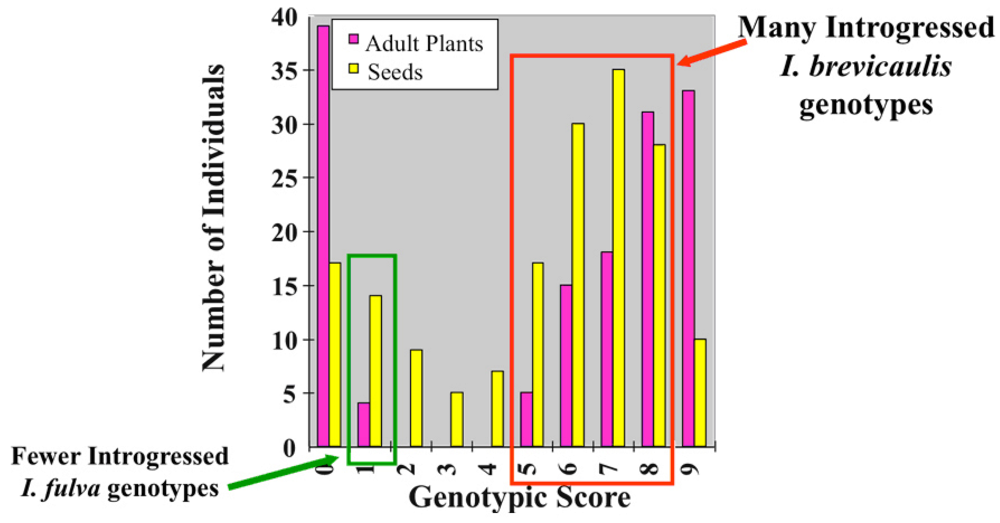
      <p>Natural hybrid zones between the various species of Louisiana Irises have been documented since the first half of the 20th Century, e.g., [<xref ref-type="bibr" rid="B13">13</xref>,<xref ref-type="bibr" rid="B14">14</xref>,<xref ref-type="bibr" rid="B15">15</xref>,<xref ref-type="bibr" rid="B16">16</xref>,<xref ref-type="bibr" rid="B17">17</xref>,<xref ref-type="bibr" rid="B18">18</xref>,<xref ref-type="bibr" rid="B19">19</xref>]. A common observation in many of these studies has been asymmetry in introgression, with the transfer of more genic material from <italic>I. fulva</italic> into either <italic>I. brevicaulis</italic> or <italic>I. hexagona</italic>, than this species has received from either of the latter taxa. <xref ref-type="fig" rid="figure1">Figure 1</xref> illustrates this class of observation for an <italic>I. fulva</italic> x <italic>I. brevicaulis</italic> hybrid population in southern Louisiana. The genetic markers used to define the various genotypic classes derived from both the chloroplast and nuclear genomes of these plants. Such combinations of cytoplasmic and nuclear data not only allow a cumulative genetic score to be obtained, but also provide estimates of cytonuclear incompatibilities, and are a standard measure for estimating genotypic diversity in natural hybrid zones (e.g., 5-7).</p>
      <p>A significant proportion of the hybrid seeds and adult plants fell within the introgressed <italic>I. brevicaulis</italic> category (<xref ref-type="fig" rid="figure1">Figure 1</xref>). This indicates that gene flow (<italic>i.e.,</italic> introgression) occurred from <italic>I. fulva</italic> genomes into those of <italic>I. brevicaulis</italic>. In comparison, the reverse flow occurred much less frequently, reflected by the significantly fewer hybrids categorized as introgressed <italic>I. fulva</italic> [<xref ref-type="bibr" rid="B20">20</xref>]. An additional indication of the strong directionality was detected when single loci were analyzed. <xref ref-type="table" rid="table1">Table 1</xref> presents one such nuclear locus. In particular, only 2.5% of the “<italic>I. fulva</italic>-like” plants and seeds were introgressed with <italic>I. brevicaulis</italic> alleles. In contrast, 72% of the <italic>I. brevicaulis</italic>-like plants possessed alleles introgressed from <italic>I. fulva</italic>. This highly significant difference in frequency of introgression [<xref ref-type="bibr" rid="B20">20</xref>] reflects well the extreme asymmetry in the pattern of gene flow between these two species.</p>
		<fig id="figure1" position="float">
		<label>Figure 1</label>
		<caption>
		<p>The distribution of genetic markers among adult plants and seeds collected from an <italic>I. fulva</italic> x <italic>I. brevicaulis</italic> natural hybrid population. The genotypic score was based upon nuclear and chloroplast DNA markers. Individuals 
		with scores of “0” or “9” indicated <italic>I. fulva</italic> or <italic>I. brevicaulis</italic> individuals, respectively. Those adult plants or seeds with scores from 1-8 were hybrids [<xref ref-type="bibr" rid="B20">20</xref>]</p>
		</caption>
		<graphic xmlns:xlink="http://www.w3.org/1999/xlink" xlink:href="genes-01-00009-g001.tif" scale="0"/>
		</fig>
     <table-wrap id="table1" position="float"><object-id pub-id-type="pii">genes-01-00009_table1</object-id>
        <object-id pub-id-type="pii">genes-01-00009_table1</object-id>
        <label>Table 1</label>
        <caption>
          <p>The frequency of homozygous <italic>I. brevicaulis</italic> (“bb”), heterozygous (“bf”) and homozygous <italic>I. fulva</italic> (“ff”) genotypes among adult plants and seeds from an <italic>I. fulva </italic>x<italic> I. brevicaulis</italic> natural hybrid zone [<xref ref-type="bibr" rid="B20">20</xref>].</p>
        </caption>
        <table>
          <thead>
            <tr>
              <th align="left" valign="middle"/>
              <th colspan="3" align="left" valign="middle">Adult Plant Genotypes</th>
              <th colspan="3" align="left" valign="middle">Seed Genotypes</th>
            </tr>
          </thead>
          <tbody>
            <tr>
              <td align="left" valign="middle"/>
              <td align="left" valign="middle">
                <italic>bb</italic>
              </td>
              <td align="left" valign="middle">
                <italic>bf</italic>
              </td>
              <td align="left" valign="middle">
                <italic>ff</italic>
              </td>
              <td align="left" valign="middle">
                <italic>bb</italic>
              </td>
              <td align="left" valign="middle">
                <italic>bf</italic>
              </td>
              <td align="left" valign="middle">
                <italic>ff</italic>
              </td>
            </tr>
            <tr>
              <td align="left" valign="middle"><italic>Iris brevicaulis</italic>-like</td>
              <td align="left" valign="middle">17</td>
              <td align="left" valign="middle">20</td>
              <td align="left" valign="middle">0</td>
              <td align="left" valign="middle">29</td>
              <td align="left" valign="middle">89</td>
              <td align="left" valign="middle">9</td>
            </tr>
            <tr>
              <td align="left" valign="middle"><italic>Iris fulva</italic>-like</td>
              <td align="left" valign="middle">0</td>
              <td align="left" valign="middle">0</td>
              <td align="left" valign="middle">37</td>
              <td align="left" valign="middle">0</td>
              <td align="left" valign="middle">2</td>
              <td align="left" valign="middle">42</td>
            </tr>
          </tbody>
        </table>
      </table-wrap>
      <p>The pattern of <italic>I. fulva &gt;&gt; I. brevicaulis</italic> introgressive hybridization has been substantiated by studies of additional, natural hybrid zones. Arnold [<xref ref-type="bibr" rid="B21">21</xref>] and Johnston <italic>et al.</italic> [<xref ref-type="bibr" rid="B19">19</xref>] thus found a majority of hybrids in two separate hybrid zones to consist of <italic>I. brevicaulis</italic> genomes introgressed with <italic>I. fulva</italic> alleles. Importantly, Arnold [<xref ref-type="bibr" rid="B21">21</xref>] also detected a small number of hybrids in one hybrid zone that possessed <italic>I. hexagona</italic> genomes introgressed with <italic>I. fulva</italic> alleles as well. These latter data suggested that introgression between <italic>I. fulva</italic> and <italic>I. hexagona</italic> might have demonstrated a pattern of biased introgression from the former into the latter. In the following sections, we extend our discussion to studies of experimental <italic>I. fulva</italic> x <italic>I. brevicaulis</italic> and <italic>I. fulva</italic> x <italic>I. hexagona</italic> hybrid zones. Like the analyses discussed above, the findings from the experimental populations allow inferences concerning the directionality and extent of asymmetric introgression.</p>
    </sec>
    <sec>
      <title>3. Louisiana Irises and asymmetric introgression: experimental hybrid populations</title>
      <sec>
        <title>3.1. I. fulva x I. brevicaulis</title>
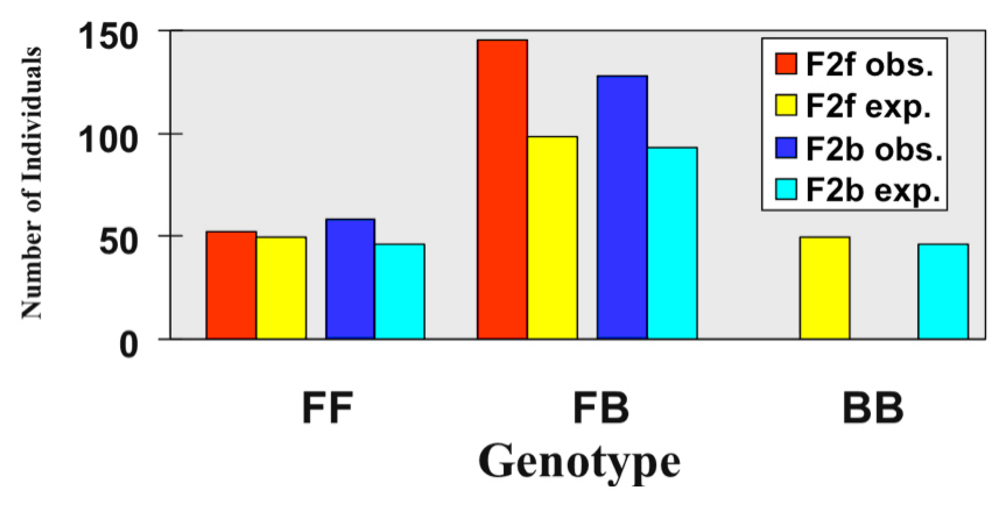
        <p>It is now well-recognized that hybridization can give rise to not only less fit genotypes, but also hybrid genotypes that, in certain environments, demonstrate elevated fitness relative to their parents (e.g., see [<xref ref-type="bibr" rid="B6">6-8</xref>,<xref ref-type="bibr" rid="B22">22</xref>]). In regard to the present discussion, such differential selection on hybrid genotypes could contribute to asymmetric introgression. <xref ref-type="fig" rid="figure2">Figure 2</xref> illustrates the results of a test for differential selection among <italic>I. fulva</italic> x <italic>I. brevicaulis</italic> F<sub>2</sub> genotypes at a single locus. The pattern of expected and observed frequencies of the three possible genotypes (homozygous for the <italic>I. fulva</italic> or <italic>I. brevicaulis</italic> alleles or heterozygous for these alleles) did indeed support a role for differential selection in the production of asymmetric introgression in this species pair. Specifically, the homozygous <italic>I. brevicaulis</italic> genotype was absent. Thus, there were significantly less than expected <italic>I. brevicaulis</italic> alleles in the F<sub>2</sub> hybrids, and a significantly greater than expected frequency of <italic>I. fulva </italic>alleles [<xref ref-type="bibr" rid="B23">23</xref>]. As with the findings for the single locus sampled in the natural hybrid population (<xref ref-type="table" rid="table1">Table 1</xref>), the presence of significantly more <italic>I. fulva</italic> than <italic>I. brevicaulis</italic> alleles in the F<sub>2</sub> hybrid progeny (<xref ref-type="fig" rid="figure2">Figure 2</xref>), is consistent with a greater level of introgression from the former species into the latter.</p>
		<fig id="figure2" position="float">
		<label>Figure 2</label>
		<caption>
		<p> The observed and expected genotypic distributions at the L180 RAPD locus in <italic>I. fulva</italic> x <italic>I. brevicaulis</italic> F<sub>2</sub> progeny derived from crosses with either <italic>I. fulva</italic> (“F2f”) or <italic>I. brevicaulis</italic> (“F2b”) as the female parent [<xref ref-type="bibr" rid="B23">23</xref>].</p>
		</caption>
		<graphic xmlns:xlink="http://www.w3.org/1999/xlink" xlink:href="genes-01-00009-g002.tif" scale="0"/>
		</fig>        
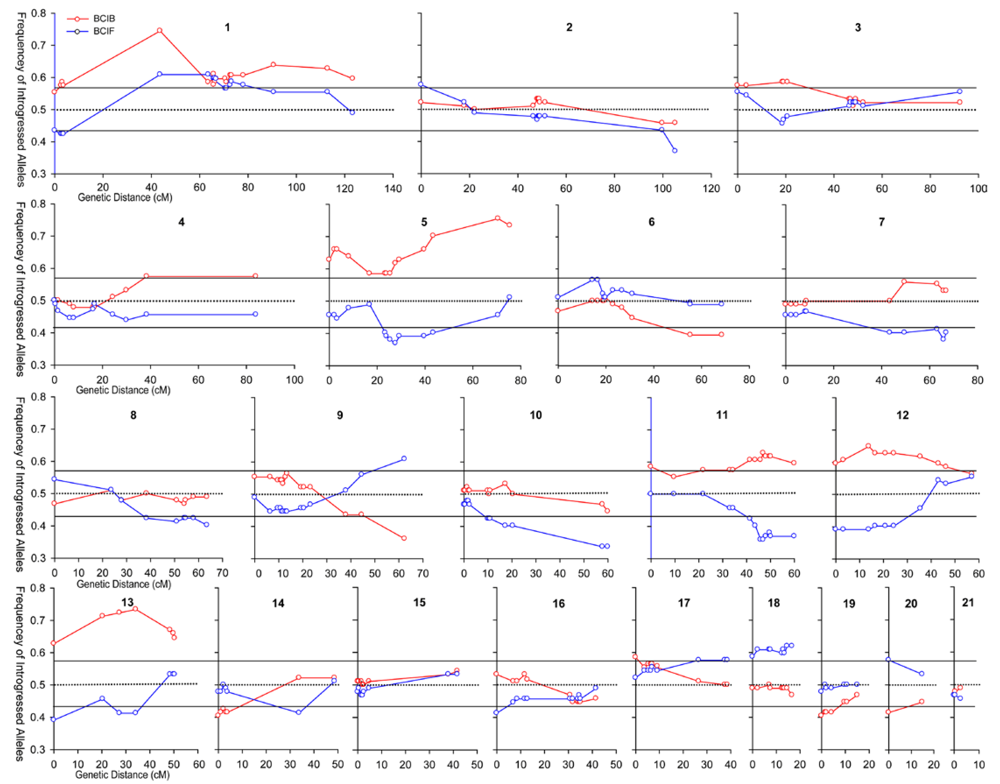
        <p>As with the analyses of allele frequencies at individual loci (<xref ref-type="table" rid="table1">Table 1</xref> and <xref ref-type="fig" rid="figure2">Figure 2</xref>), whole-genome scans have likewise detected asymmetric transfer of genetic material between <italic>I. fulva</italic> and <italic>I. brevicaulis</italic>. <xref ref-type="fig" rid="figure3">Figure 3</xref> illustrates the findings from a linkage map analysis using hybrid individuals from two first-generation backcross populations; one population was constructed by crossing an F<sub>1</sub> plant with <italic>I. fulva</italic> and the other through crosses between an F<sub>1</sub> individual and <italic>I. brevicaulis</italic>. Approximately 1/3 of the genetic markers occurred at either significantly higher or lower frequencies than expected (<italic>i.e.,</italic> demonstrated “transmission ratio distortion”) in each of the reciprocal backcross maps (<xref ref-type="fig" rid="figure3">Figure 3</xref>; [<xref ref-type="bibr" rid="B24">24</xref>]). The distortion in transmission was biased, with <italic>I. fulva </italic>alleles largely overrepresented at the expense of <italic>I. brevicaulis </italic>alleles. Specifically, 18 separate regions demonstrated significant introgression of <italic>I. fulva </italic>alleles into the <italic>I. brevicaulis</italic> genetic background (<italic>i.e.,</italic> in the backcross hybrids towards <italic>I. brevicaulis</italic>). Furthermore, 12 regions in the backcross population towards <italic>I. fulva</italic> also showed elevated frequencies of <italic>I. fulva</italic> alleles. In contrast, <italic>I. brevicaulis </italic>alleles were significantly overrepresented in only five locations in each of the backcross populations (<xref ref-type="fig" rid="figure3">Figure 3</xref>).</p>
		<fig id="figure3" position="float">
		<label>Figure 3</label>
		<caption>
		<p>The observed frequencies of introgressed alleles from either <italic>I. fulva</italic> (red lines) or <italic>I. brevicaulis</italic> (blue lines) into first generation backcross progeny formed from crosses between these two species. The X-axis indicates the genetic distances (in centimorgans) along each of the 21 linkage groups in the composite map. The Y-axis indicates the transmission ratio of either the <italic>I. fulva</italic> alleles or <italic>I. brevicaulis</italic> alleles introgressed into the backcrosses toward the alternate species. The expected frequency is 0.50 and is indicated by the dotted line. Data points above and below the solid lines indicate significant deviations from 0.50 (α = 0.05). Frequencies &gt; 0.50 indicate an overrepresentation of either the <italic>I. fulva</italic> (red line) or <italic>I. brevicaulis</italic> (blue line) alleles in the genetic background of the alternate species. Frequencies &lt; 0.50 indicate an underrepresentation of these same categories [<xref ref-type="bibr" rid="B24">24</xref>].</p>
		</caption>
		<graphic xmlns:xlink="http://www.w3.org/1999/xlink" xlink:href="genes-01-00009-g003.tif" scale="0"/>
		</fig>        
        <p>This pattern of transmission ratio distortion caused Tang <italic>et al.</italic> [<xref ref-type="bibr" rid="B24">24</xref>] to conclude the following: “Whatever the mechanism(s) involved, given that these two species hybridize in nature, this asymmetry in gene flow could have important implications for introgressive hybridization. Namely, we would expect that for a majority of the regions revealing transmission ratio distortion, <italic>I. fulva </italic>alleles might be favored to introgress into a predominately <italic>I. brevicaulis </italic>species-background, while the introgression of <italic>I. brevicaulis </italic>alleles into <italic>I. fulva </italic>would be retarded.”</p>
      </sec>
      <sec>
        <title>3.2. I. fulva x I. hexagona</title>
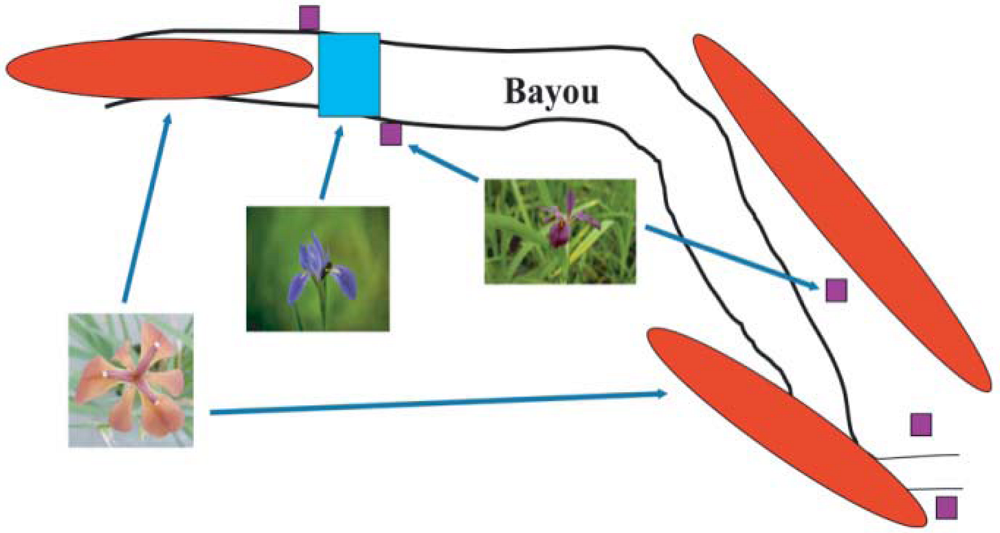
        <p>Natural and experimental hybridization between <italic>I. fulva</italic> and <italic>I. brevicaulis</italic> consistently produces asymmetric introgression. One hypothesis derived from this observation is that asymmetric introgressive hybridization is only typical for reproductive interactions between these two species, and not other species of Louisiana Irises. It is possible to test this hypothesis using a series of genotyping assays carried out in an experimentally constructed iris population in southern Louisiana (<xref ref-type="fig" rid="figure4">Figure 4</xref>).</p>
		<fig id="figure4" position="float">
		<label>Figure 4</label>
		<caption>
		<p>Schematic illustration of the distribution of 1) naturally occurring <italic>I. fulva</italic> plants (red ovals), 2) introduced <italic>I. hexagona</italic> (blue rectangle) and 3) <italic>I. fulva</italic> x <italic>I. hexagona</italic> F<sub>1</sub> plants (purple squares) [<xref ref-type="bibr" rid="B27">27</xref>,<xref ref-type="bibr" rid="B28">28</xref>].</p>
		</caption>
		<graphic xmlns:xlink="http://www.w3.org/1999/xlink" xlink:href="genes-01-00009-g004.tif" scale="0"/>
		</fig>        
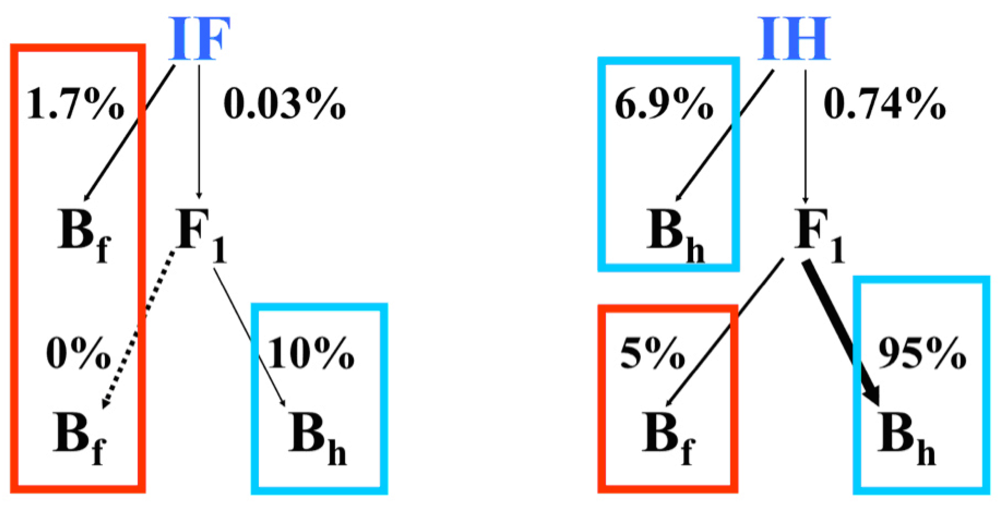
        <p>The experimental population lies within a region typified by numerous natural hybrid zones between <italic>I. fulva, I. brevicaulis</italic> and <italic>I. hexagona</italic>, e.g., [<xref ref-type="bibr" rid="B16">16</xref>,<xref ref-type="bibr" rid="B25">25</xref>,<xref ref-type="bibr" rid="B26">26</xref>]. Originally, this population consisted only of naturally occurring <italic>I. fulva</italic> individuals. In 1989, we introduced 200 <italic>I. hexagona</italic> plants in a centralized block (<xref ref-type="fig" rid="figure4">Figure 4</xref>). Over three consecutive years, we collected and genotyped &gt;5000 seeds from <italic>I. fulva</italic> and <italic>I. hexagona</italic> fruits formed by pollen transfer by natural pollinators. F<sub>1</sub> hybrid seed formation was very infrequent in the fruits of both species. However, there was a significant bias in the direction of hybrid formation (<xref ref-type="fig" rid="figure5">Figure 5</xref>) with F<sub>1</sub> seeds being formed at 50x the frequency in <italic>I. hexagona</italic> fruits (<italic>i.e.,</italic> 0.74%) relative to <italic>I. fulva</italic> fruits (<italic>i.e.,</italic> 0.03%; [<xref ref-type="bibr" rid="B27">27</xref>,<xref ref-type="bibr" rid="B28">28</xref>]).</p>
        <p>The asymmetry in the frequency of F<sub>1</sub> formation between <italic>I. fulva</italic> and <italic>I. hexagona</italic> – like hybrid formation in general being limited more in <italic>I. fulva</italic> fruits – is consistent with directional introgression from the former into the latter species. Yet, it should be kept in mind that, though F<sub>1</sub> hybrid formation is requisite for introgression, this hybrid stage does not reflect an introgressed generation. The introduction of experimentally formed F<sub>1</sub> hybrids into this same population did, however, allow a test for asymmetric introgression. In particular, we collected and genotyped seeds from fruits produced by <italic>I. fulva</italic>, <italic>I. hexagona</italic> and F<sub>1</sub> plants (spatially near either <italic>I. fulva</italic> or <italic>I. hexagona</italic> plants; [<xref ref-type="bibr" rid="B28">28</xref>]). The determination of the frequencies of backcross hybrids toward the two species allowed another test for asymmetric introgression.</p>
		<fig id="figure5" position="float">
		<label>Figure 5</label>
		<caption>
		<p>Percentage of F<sub>1</sub> (0.03% and 0.74% in <italic>I. fulva</italic> and <italic>I. hexagona</italic> fruits, respectively) and first generation backcross seeds (B<sub>f</sub> and B<sub>h</sub>) formed on plants in an experimental population by natural pollinations [<xref ref-type="bibr" rid="B27">27</xref>,<xref ref-type="bibr" rid="B28">28</xref>]. The B<sub>f</sub> and B<sub>h</sub> hybrid seeds reflect the first generation of introgression into <italic>I. fulva</italic> and <italic>I. hexagona</italic>, respectively.</p>
		</caption>
		<graphic xmlns:xlink="http://www.w3.org/1999/xlink" xlink:href="genes-01-00009-g005.tif" scale="0"/>
		</fig>        
        <p>The placement of F<sub>1</sub> plants near either <italic>I. fulva</italic> or <italic>I. hexagona</italic> individuals allowed an estimate of backcross formation in a spatial context (<xref ref-type="fig" rid="figure5">Figure 5</xref>). The frequencies of backcross seeds toward <italic>I. fulva</italic> were 1.7% and 0% in <italic>I. fulva</italic> and F<sub>1</sub> fruits, respectively when F<sub>1</sub> plants were spatially adjacent to <italic>I. fulva</italic> plants. Additionally, 5% of the seeds in F<sub>1</sub> fruits from hybrid plants near <italic>I. hexagona</italic> possessed <italic>I. fulva</italic> backcross genotypes. In contrast, the frequencies of backcross hybrids toward <italic>I. hexagona</italic> were significantly greater, regardless of spatial arrangement of F<sub>1</sub> plants. Thus, the frequency of backcross hybrids in F<sub>1</sub> fruits from plants near either <italic>I. fulva</italic> or <italic>I. hexagona</italic> was 10% and 95%, respectively (<xref ref-type="fig" rid="figure5">Figure 5</xref>). Finally, first generation backcross seeds were formed at a frequency of ca. 7% in <italic>I. hexagona</italic> fruits. Just as with introgression between <italic>I. fulva</italic> and <italic>I. brevicaulis</italic>, strong asymmetry in the formation of both F<sub>1</sub> and backcross hybrid progeny between <italic>I. fulva</italic> and <italic>I. hexagona</italic> was detected [<xref ref-type="bibr" rid="B28">28</xref>].</p>
      </sec>
    </sec>
    <sec>
      <title>4. The causes of asymmetric introgression in Louisiana Irises: Prezygotic reproductive isolation</title>
      <p>The Louisiana iris species complex has been recognized for decades as a paradigm for examining processes associated with natural hybridization and speciation [<xref ref-type="bibr" rid="B2">2</xref>,<xref ref-type="bibr" rid="B5">5</xref>,<xref ref-type="bibr" rid="B6">6</xref>,<xref ref-type="bibr" rid="B7">7</xref>]. Indeed, this complex is now recognized as a model system for describing a number of the possible outcomes of reticulate evolution [<xref ref-type="bibr" rid="B7">7</xref>], and the causal factors affecting the outcomes. In regard to the present discussion, it is possible to ask if prezygotic and/or postzygotic reproductive isolating barriers might contribute to the observed asymmetric introgressive hybridization between <italic>I. fulva</italic> and its two congeners.</p>
<fig id="figure6" position="float">
<label>Figure 6</label>
<caption>
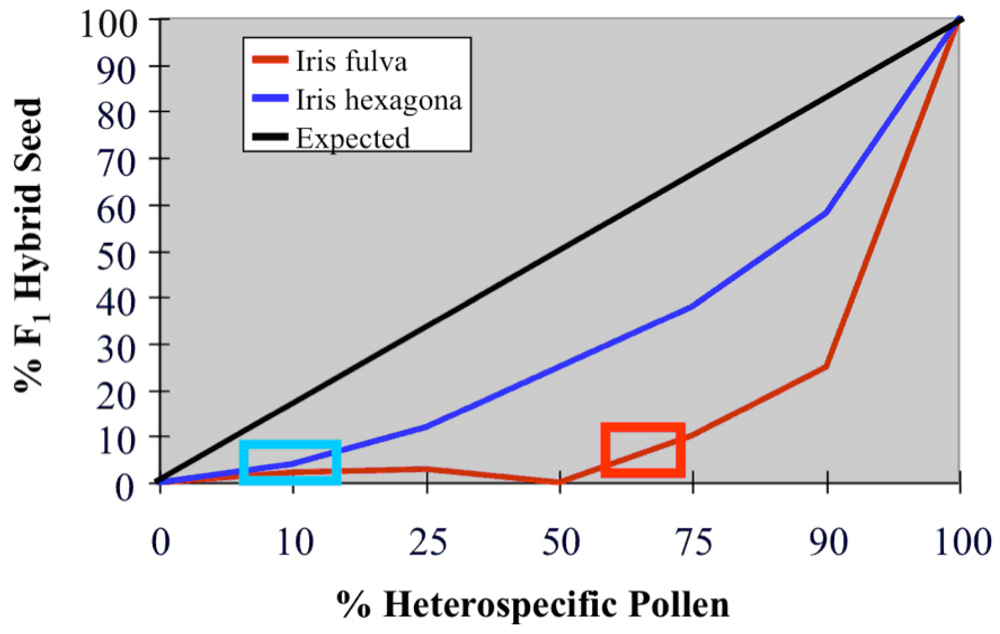
<p>Percent F<sub>1</sub> hybrid seeds produced by various mixtures of <italic>I. fulva</italic> and <italic>I. hexagona</italic> pollen. The solid line illustrates the expected percentage of hybrid seeds assuming random fertilization. All the observed F<sub>1</sub> percentages were significantly less than expected (except for the 0% and 100% treatments, in which there were no mixtures of conspecific and heterospecific pollen). The blue and red rectangles indicate the percentage of heterospecific pollen necessary to increase significantly F<sub>1</sub> hybrid formation above the value of “0” in <italic>I. hexagona</italic> and <italic>I. fulva</italic> fruits, respectively. Note the much greater frequency of F<sub>1</sub>s formed in <italic>I. hexagona</italic> fruits relative to <italic>I. fulva</italic> fruits [<xref ref-type="bibr" rid="B29">29</xref>].</p>
</caption>
<graphic xmlns:xlink="http://www.w3.org/1999/xlink" xlink:href="genes-01-00009-g006.tif" scale="0"/>
</fig>      
      <p>One of the best-documented, prezygotic, barriers between these three species is gamete competition. Gamete competition is defined by the observation that when mixtures of conspecific and heterospecific sperm or pollen are made available for the fertilization of eggs, the conspecific gametes father more offspring than expected. An example of gamete competition between <italic>I. fulva</italic> and <italic>I. hexagona</italic> is illustrated in <xref ref-type="fig" rid="figure6">Figure 6</xref>. Carney <italic>et al.</italic> [<xref ref-type="bibr" rid="B29">29</xref>] detected a significant reduction in the frequency of hybrid seed formation for each of their pollination treatments involving mixtures of conspecific and heterospecific pollen (<xref ref-type="fig" rid="figure6">Figure 6</xref>). The pattern of hybrid seed formation indicated that post-pollination (but pre-fertilization) phenomena were limiting the formation of F<sub>1</sub> hybrid seeds. As the proportion of heterospecific pollen in the mixtures increased, so did the proportion of hybrid seeds formed, albeit at a significantly lower frequency than expected. However, there was strong asymmetry in the degree of reproductive isolation, with F<sub>1</sub> formation being much greater in the direction of <italic>I. hexagona</italic> than towards <italic>I. fulva</italic>. As mentioned previously, the F<sub>1</sub> generation is not “introgressed”. However, if gamete competition continues to affect the formation of later generation hybrids, it could act as a causal factor in the observed asymmetric introgressive hybridization in natural hybrid zones between <italic>I. fulva</italic> and <italic>I. hexagona</italic>.</p>
      <p>In addition to the findings of Carney <italic>et al.</italic> [<xref ref-type="bibr" rid="B29">29</xref>], Emms <italic>et al.</italic> [<xref ref-type="bibr" rid="B30">30</xref>] also detected asymmetric effects from gamete competition between <italic>I. fulva</italic> and <italic>I. brevicaulis</italic>. Pollen tube growth measurements led to the prediction that relatively more conspecific progeny would be produced by <italic>I. fulva</italic> than <italic>I. brevicaulis</italic> flowers, when both pollen types were present on the same stigma. This prediction was supported with results from a seed siring experiment. The application of 50% : 50% mixtures of <italic>I. fulva</italic> and <italic>I. brevicaulis</italic> pollen to the stigmas of both species resulted in 24.1% and 38.6% F<sub>1</sub> hybrid seeds in <italic>I. fulva</italic> and <italic>I. brevicaulis</italic> fruits, respectively. These frequencies are significantly different from one another and from the expected 50% : 50% ratio [<xref ref-type="bibr" rid="B30">30</xref>], once again supportive of gamete competition playing a role in asymmetric introgression between these two iris species.</p>
    </sec>
    <sec>
      <title>5. The causes of asymmetric introgression in Louisiana Irises: Postzygotic reproductive isolation</title>
      <sec>
        <title>5.1. Selection at early life history stages</title>
        <p>As discussed above, introgression occurs largely from <italic>I. fulva</italic> into <italic>I. brevicaulis</italic> and <italic>I. hexagona</italic> in both natural and experimental hybrid populations. Some of these results also allow a determination of possible reproductive barriers that contribute to this asymmetry. Gamete (or pollen) competition was presented as one of the prezygotic barriers underlying this asymmetry. There is also evidence that postzygotic barriers contribute to the directionality of introgression. In particular, viability selection disfavors introgressed genotypes towards <italic>I. fulva</italic>, but favors those towards <italic>I. brevicaulis</italic>.</p>
        <p>Figures 1 and 2 and <xref ref-type="table" rid="table1">Table 1</xref> illustrate the effects of natural selection, at the seedling establishment stage, against certain hybrid genotypes in both natural and experimental hybrid populations. For example, there are numerous <italic>I. fulva</italic>-like introgressed genotypes present in the seeds sampled from the natural hybrid zone that are not present in the adult iris plants (e.g. those with genotypic scores of 2-4; <xref ref-type="fig" rid="figure1">Figure 1</xref>). In contrast, there are adult plants in all of the <italic>I. brevicaulis</italic>-like introgressed categories (<italic>i.e.,</italic> 5-8). This indicates viability selection <italic>against</italic> introgressed <italic>I. fulva</italic> genotypes, but likely <italic>for</italic> certain introgressed <italic>I. brevicaulis</italic> genotypes [<xref ref-type="bibr" rid="B6">6</xref>,<xref ref-type="bibr" rid="B20">20</xref>]. Similarly, <xref ref-type="fig" rid="figure2">Figure 2</xref> reflects selection that disfavors hybrids containing a higher frequency of introgressed <italic>I. brevicaulis</italic> alleles, but favors hybrids with a higher proportion of <italic>I. fulva</italic> alleles [<xref ref-type="bibr" rid="B23">23</xref>]. Finally, this lack of penetration of <italic>I. brevicaulis</italic> alleles can also be seen in the data presented in <xref ref-type="table" rid="table1">Table 1</xref>. In this instance, data from a single locus (as with those given in <xref ref-type="fig" rid="figure2">Figure 2</xref>) indicates that <italic>I. fulva</italic> alleles are incorporated into adult <italic>I. brevicaulis</italic>-like plants, but <italic>I. brevicaulis</italic> alleles are almost completely excluded from plants that are <italic>I. fulva</italic>-like [<xref ref-type="bibr" rid="B20">20</xref>].</p>
      </sec>
      <sec>
        <title>5.2. Selection at later life history stages</title>
        <p>From the above, we see that there is evidence consistent with selection-generated asymmetry in introgression due to differential viability at early life history stages in Louisiana Irises. Similarly, a number of analyses have detected asymmetry in survivorship at latter stages of plant development. For example, the segregation distortion illustrated by <xref ref-type="fig" rid="figure3">Figure 3</xref> is due to differential survivorship of adult plants maintained in the greenhouse. Thus, even under what is assumed to be highly favorable environmental conditions (<italic>i.e.,</italic> the greenhouse), asymmetric introgression from <italic>I. fulva</italic> into <italic>I. brevicaulis</italic> was detected [<xref ref-type="bibr" rid="B24">24</xref>].</p>
        <p>The pattern of survivorship under natural conditions has also been studied by transplanting the same genotypes maintained in the greenhouse [<xref ref-type="bibr" rid="B24">24</xref>] into field conditions in southern Louisiana. <xref ref-type="table" rid="table2">Table 2</xref> contains the observed survivorship frequencies for <italic>I. fulva</italic>, <italic>I. brevicaulis</italic> and introgressed genotypes of both species subsequent to a severe (water depth of several feet) and extended (ca. four month) natural flooding event [<xref ref-type="bibr" rid="B31">31</xref>]. We detected the following, hierarchical, survivorship values: <italic>I. fulva</italic> &gt; Introgressed <italic>I. fulva</italic> &gt; Introgressed <italic>I. brevicaulis</italic> &gt; <italic>I. brevicaulis</italic>. This pattern of survivorship is consistent with previous observations suggesting greater tolerance to root/rhizome submersion by <italic>I. fulva</italic> relative to <italic>I. brevicaulis</italic> [<xref ref-type="bibr" rid="B18">18</xref>]. </p>
        <table-wrap id="table2" position="float"><object-id pub-id-type="pii">genes-01-00009_table2</object-id>
          <object-id pub-id-type="pii">genes-01-00009_table2</object-id>
          <label>Table 2</label>
          <caption>
            <p>Survivorship frequencies for <italic>I. brevicaulis</italic>, <italic>I. fulva</italic> and introgressed genotypes of these two species. Survivorship estimates were derived after a severe flooding episode [<xref ref-type="bibr" rid="B31">31</xref>].</p>
          </caption>
          <table>
            <thead>
              <tr>
                <th align="left" valign="middle">Class</th>
                <th align="left" valign="middle">Alive</th>
                <th align="left" valign="middle">Dead</th>
                <th align="left" valign="middle">% Survival</th>
              </tr>
            </thead>
            <tbody>
              <tr>
                <td align="left" valign="middle">I. brevicaulis</td>
                <td align="left" valign="middle">0</td>
                <td align="left" valign="middle">13</td>
                <td align="left" valign="middle">0</td>
              </tr>
              <tr>
                <td align="left" valign="middle">Introgressed I. brevicaulis</td>
                <td align="left" valign="middle">23</td>
                <td align="left" valign="middle">393</td>
                <td align="left" valign="middle">0.055</td>
              </tr>
              <tr>
                <td align="left" valign="middle">Introgressed I. fulva</td>
                <td align="left" valign="middle">33</td>
                <td align="left" valign="middle">325</td>
                <td align="left" valign="middle">0.092</td>
              </tr>
              <tr>
                <td align="left" valign="middle">I. fulva</td>
                <td align="left" valign="middle">3</td>
                <td align="left" valign="middle">8</td>
                <td align="left" valign="middle">0.273</td>
              </tr>
            </tbody>
          </table>
        </table-wrap>
        <p>In regard to asymmetric introgression, it might be argued that the above pattern (of greater survivorship of Introgressed <italic>I. fulva</italic> genotypes relative to Introgressed <italic>I. brevicaulis</italic> genotypes) would facilitate greater levels of introgression into <italic>I. fulva</italic>. However, the data from both Tables 2 and 3 argue against this inference. Instead, it is apparent that <italic>I. fulva</italic> alleles often (but, not always, see [<xref ref-type="bibr" rid="B31">31</xref>]) provide the basis for higher survivorship. First, the surviving “Introgressed <italic>I. brevicaulis</italic>” genotypes contained a significantly higher number of positively selected <italic>I. fulva</italic> alleles than <italic>I. brevicaulis</italic> alleles (<xref ref-type="table" rid="table3">Table 3</xref>, [<xref ref-type="bibr" rid="B31">31</xref>]). Second, <italic>I. fulva</italic> and “Introgressed <italic>I. fulva</italic>” hybrids survived at the highest frequencies (<xref ref-type="table" rid="table2">Table 2</xref>), reflecting the selective advantage of this species’ genetic background in a flooded environment. These field surveys will also allow an estimate of temporal fluctuations in the direction and/or strength of selection (e.g. as expected if drier environmental conditions, favoring <italic>I. brevicaulis</italic>, occur).</p>
        <table-wrap id="table3" position="float"><object-id pub-id-type="pii">genes-01-00009_table3</object-id>
          <object-id pub-id-type="pii">genes-01-00009_table3</object-id>
          <label>Table 3</label>
          <caption>
            <p>The number of <italic>I. fulva</italic> and <italic>I. brevicaulis</italic> alleles inferred to be selectively favored in “Introgressed <italic>I. brevicaulis</italic>” plants that survived the flooding episode (see <xref ref-type="table" rid="table2">Table 2</xref>; [<xref ref-type="bibr" rid="B31">31</xref>]).</p>
          </caption>
          <table>
            <thead>
              <tr>
                <th align="left" valign="middle"> </th>
                <th colspan="2" align="left" valign="middle">Introgressed <italic>I. brevicaulis</italic></th>
              </tr>
            </thead>
            <tbody>
              <tr>
                <td align="left" valign="middle">Alleles Favored</td>
                <td align="left" valign="middle">
                  <italic>I. fulva</italic>
                </td>
                <td align="left" valign="middle">
                  <italic>I. brevicaulis</italic>
                </td>
              </tr>
              <tr>
                <td align="left" valign="middle">Number of Alleles Favored</td>
                <td align="left" valign="middle">101</td>
                <td align="left" valign="middle">41</td>
              </tr>
            </tbody>
          </table>
        </table-wrap>
      </sec>
    </sec>
    <sec>
      <title>6. Asymmetric introgression and adaptive trait transfer</title>
      <p>The studies discussed in this review provide evidence that selection causes at least a portion of the asymmetry in gene flow among the Louisiana Iris species. The available data also allow a test of whether or not some of the asymmetric introgression reflects adaptive exchanges: 1) the patterns of segregation distortion in the greenhouse-maintained plants (<xref ref-type="fig" rid="figure3">Figure 3</xref>), as well as survivorship under stress (<italic>i.e.,</italic> severe flooding), support the inference of adaptive transfers; and 2) the presence of <italic>I. fulva</italic> alleles allowed introgressed individuals to survive and persist at a significantly higher frequency than those plants with fewer (or no) <italic>I. fulva</italic> alleles, under a variety of environmental conditions.</p>
		<fig id="figure7" position="float">
		<label>Figure 7</label>
		<caption>
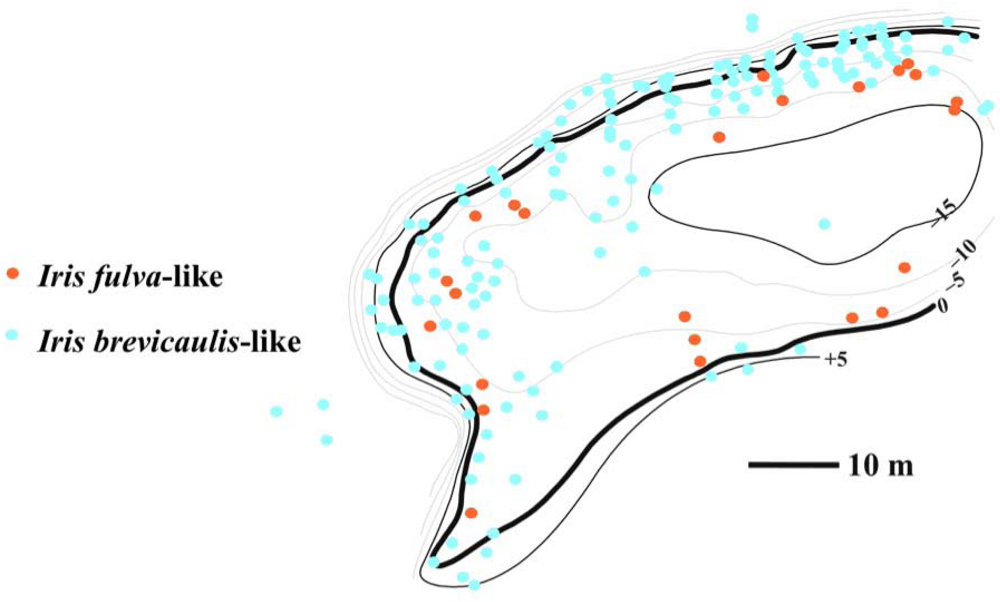
		<p>Spatial distribution of Louisiana Iris genotypes in a natural population containing “<italic>I.</italic> <italic>brevicaulis</italic>-like” and<italic> </italic>“<italic>I. fulva</italic>-like” genotypes. Each circle reflects a single plant. The numbers indicate elevations, with the “0” line indicating the water level of the pond. Negative values reflect flooded areas, and positive values reflect areas above the waterline [<xref ref-type="bibr" rid="B19">19</xref>].</p>
		</caption>
		<graphic xmlns:xlink="http://www.w3.org/1999/xlink" xlink:href="genes-01-00009-g007.tif" scale="0"/>
		</fig>      
      <p>The above two observations led Martin <italic>et al.</italic> [<xref ref-type="bibr" rid="B31">31</xref>] to conclude that introgression of adaptive alleles would occur in natural hybrid zones under certain environmental conditions. In particular they stated, “While some proportion of this introgression almost certainly involves neutral loci, any selectively advantageous alleles are likely to introgress across the species’ boundaries [<xref ref-type="bibr" rid="B32">32</xref>]. In the case of <italic>I. brevicaulis</italic> and <italic>I. fulva</italic> hybrid zones, we predict that the QTL found to promote tolerance to flooded environments are candidates for introgression, since they will presumably be positively selected under flooded conditions.” In this context, <xref ref-type="fig" rid="figure7">Figure 7</xref> illustrates a natural hybrid population between <italic>I. fulva</italic> and <italic>I. brevicaulis</italic> in which ecological-genetic associations suggest the process of asymmetric, adaptive trait introgression. <italic>Iris brevicaulis</italic> genotypes are not adapted to extended, flooded environments [<xref ref-type="bibr" rid="B18">18</xref>,<xref ref-type="bibr" rid="B31">31</xref>], yet in this population “<italic>I. brevicaulis</italic>-like” plants occur mostly in this type of habitat (<xref ref-type="fig" rid="figure7">Figure 7</xref>; [<xref ref-type="bibr" rid="B19">19</xref>]). This observation, in the light of previous findings [<xref ref-type="bibr" rid="B18">18</xref>,<xref ref-type="bibr" rid="B31">31</xref>], supports the inference of adaptive trait transfer from <italic>I. fulva</italic> into <italic>I. brevicaulis</italic> in this natural hybrid population allowing the latter to invade habitats not open to non-introgressed <italic>I. brevicaulis</italic>.</p>
    </sec>
    <sec sec-type="conclusions">
      <title>7. Conclusions</title>
      <p>Evolutionary and ecological studies of Louisiana Irises have confirmed the process of asymmetric introgression. In both experimental and natural hybrid populations, genetic material predominantly moves from <italic>I. fulva</italic> into both <italic>I. brevicaulis</italic> and <italic>I. hexagona</italic>. Furthermore, analyses designed to dissect out the various components of reproductive isolation have determined some of the causal factors – both prezygotic and postzygotic – that contribute to this asymmetry. In particular, gamete competition and viability selection likely contribute to the biased production of zygotes that contain more introgressed <italic>I. brevicaulis</italic> and <italic>I. hexagona</italic>, than introgressed <italic>I. fulva</italic> genotypes. It is also likely that, under certain environmental conditions, the incorporation of <italic>I. fulva</italic> alleles into the other two species is adaptive. Asymmetric introgressive hybridization among the Louisiana Iris species has thus likely affected not only the population genetic structure of hybrid zones, but also to some degree determined the ecological and evolutionary trajectories of the hybrids and introgressed species.</p>
    </sec>
  </body>
  <back>
    <ack>
      <p>Funding from the National Science Foundation to MLA supported much of the data collection upon which this review is based. The current funding is a collaborative National Science Foundation grant to MLA and NHM (DEB-0949424). In addition, funds from the Office of the Vice President for Research at the University of Georgia, the Georgia Research Alliance, the Society for Louisiana Irises and the American Iris Society supported portions of the research reported.</p>
    </ack>
    <ref-list>
      <ref id="B1">
        <citation citation-type="journal">
          <person-group person-group-type="author">
            <name>
              <surname>Anderson</surname>
              <given-names>E.</given-names>
            </name>
            <name>
              <surname>Hubricht</surname>
              <given-names>L.</given-names>
            </name>
          </person-group>
          <article-title>Hybridization in <italic>Tradescantia. III. The evidence for introgressive hybridization</italic> 
</article-title>
          <source>Am. J. Bot.</source>
          <year>1938</year>
          <volume>25</volume>
          <fpage>396</fpage>
          <lpage>402</lpage>
          <pub-id pub-id-type="doi">10.2307/2436413</pub-id>
        </citation>
      </ref>
      <ref id="B2">
        <citation citation-type="book">
          <person-group person-group-type="author">
            <name>
              <surname>Anderson</surname>
              <given-names>E.</given-names>
            </name>
          </person-group>
<source>Introgressive Hybridization</source>
          <publisher-name>John Wiley and Sons, Inc.</publisher-name>
          <publisher-loc>New York, NY, USA</publisher-loc>
          <year>1949</year>
        </citation>
      </ref>
      <ref id="B3">
        <citation citation-type="journal">
          <person-group person-group-type="author">
            <name>
              <surname>Lewontin</surname>
              <given-names>R.C.</given-names>
            </name>
            <name>
              <surname>Birch</surname>
              <given-names>L.C.</given-names>
            </name>
          </person-group>
          <article-title>Hybridization as a source of variation for adaptation to new environments</article-title>
          <source>Evolution</source>
          <year>1966</year>
          <volume>20</volume>
          <fpage>315</fpage>
          <lpage>336</lpage>
          <pub-id pub-id-type="doi">10.2307/2406633</pub-id>
        </citation>
      </ref>
      <ref id="B4">
        <citation citation-type="book">
          <person-group person-group-type="author">
            <name>
              <surname>Grant</surname>
              <given-names>V.</given-names>
            </name>
          </person-group>
<source>Plant Speciation</source>
          <publisher-name>Columbia University Press</publisher-name>
          <publisher-loc>New York, NY, USA</publisher-loc>
          <year>1981</year>
        </citation>
      </ref>
      <ref id="B5">
        <citation citation-type="journal">
          <person-group person-group-type="author">
            <name>
              <surname>Arnold</surname>
              <given-names>M.L.</given-names>
            </name>
          </person-group>
          <article-title>Natural hybridization as an evolutionary process</article-title>
          <source>Annu. Rev. Ecol. Syst.</source>
          <year>1992</year>
          <volume>23</volume>
          <fpage>237</fpage>
          <lpage>261</lpage>
        <pub-id pub-id-type="doi">10.1146/annurev.es.23.110192.001321</pub-id></citation>
      </ref>
      <ref id="B6">
        <citation citation-type="book">
          <person-group person-group-type="author">
            <name>
              <surname>Arnold</surname>
              <given-names>M.L.</given-names>
            </name>
          </person-group>
<source>Natural Hybridization and Evolution</source>
          <publisher-name>Oxford University Press</publisher-name>
          <publisher-loc>Oxford, UK</publisher-loc>
          <year>1997</year>
        </citation>
      </ref>
      <ref id="B7">
        <citation citation-type="book">
          <person-group person-group-type="author">
            <name>
              <surname>Arnold</surname>
              <given-names>M.L.</given-names>
            </name>
          </person-group>
<source>Evolution Through Genetic Exchange</source>
          <publisher-name>Oxford University Press</publisher-name>
          <publisher-loc>Oxford, UK</publisher-loc>
          <year>2006</year>
        </citation>
      </ref>
      <ref id="B8">
        <citation citation-type="journal">
          <person-group person-group-type="author">
            <name>
              <surname>Rieseberg</surname>
              <given-names>L.H.</given-names>
            </name>
          </person-group>
          <article-title>Hybrid origins of plant species</article-title>
          <source>Annu. Rev. Ecol. Syst.</source>
          <year>1997</year>
          <volume>28</volume>
          <fpage>359</fpage>
          <lpage>389</lpage>
          <pub-id pub-id-type="doi">10.1146/annurev.ecolsys.28.1.359</pub-id>
        </citation>
      </ref>
      <ref id="B9">
        <citation citation-type="journal">
          <person-group person-group-type="author">
            <name>
              <surname>Wirtz</surname>
              <given-names>P.</given-names>
            </name>
          </person-group>
          <article-title>Mother species–father species: unidirectional hybridization in animals with female choice</article-title>
          <source>Anim. Behav.</source>
          <year>1999</year>
          <volume>58</volume>
          <fpage>1</fpage>
          <lpage>12</lpage>
          <pub-id pub-id-type="doi">10.1006/anbe.1999.1144</pub-id>
          <pub-id pub-id-type="pmid">10413535</pub-id>
        </citation>
      </ref>
      <ref id="B10">
        <citation citation-type="journal">
          <person-group person-group-type="author">
            <name>
              <surname>Excoffier</surname>
              <given-names>L.</given-names>
            </name>
            <name>
              <surname>Foll</surname>
              <given-names>M.</given-names>
            </name>
            <name>
              <surname>Petit</surname>
              <given-names>R.</given-names>
            </name>
          </person-group>
          <article-title>Genetic consequences of range expansions</article-title>
          <source>Annu. Rev. Ecol. Evol. Syst.</source>
          <year>2009</year>
          <volume>40</volume>
          <fpage>481</fpage>
          <lpage>501</lpage>
          <pub-id pub-id-type="doi">10.1146/annurev.ecolsys.39.110707.173414</pub-id>
        </citation>
      </ref>
      <ref id="B11">
        <citation citation-type="journal">
          <person-group person-group-type="author">
            <name>
              <surname>Shaw</surname>
              <given-names>D.D.</given-names>
            </name>
            <name>
              <surname>Coates</surname>
              <given-names>D.J.</given-names>
            </name>
            <name>
              <surname>Arnold</surname>
              <given-names>M.L.</given-names>
            </name>
            <name>
              <surname>Wilkinson</surname>
              <given-names>P.</given-names>
            </name>
          </person-group>
          <article-title>Temporal variation in the chromosomal structure of a hybrid zone and its relationship to karyotypic repatterning</article-title>
          <source>Heredity</source>
          <year>1985</year>
          <volume>55</volume>
          <fpage>293</fpage>
          <lpage>306</lpage>
          <pub-id pub-id-type="doi">10.1038/hdy.1985.111</pub-id>
        </citation>
      </ref>
      <ref id="B12">
        <citation citation-type="journal">
          <person-group person-group-type="author">
            <name>
              <surname>Martin</surname>
              <given-names>N.H.</given-names>
            </name>
            <name>
              <surname>Willis</surname>
              <given-names>J.H.</given-names>
            </name>
          </person-group>
          <article-title>Ecological divergence associated with mating system causes nearly complete reproductive isolation between sympatric <italic>Mimulus</italic> species</article-title>
          <source>Evolution</source>
          <year>2007</year>
          <volume>61</volume>
          <fpage>68</fpage>
          <lpage>82</lpage>
          <pub-id pub-id-type="doi">10.1111/j.1558-5646.2007.00006.x</pub-id>
          <pub-id pub-id-type="pmid">17300428</pub-id>
        </citation>
      </ref>
      <ref id="B13">
        <citation citation-type="journal">
          <person-group person-group-type="author">
            <name>
              <surname>Viosca Jr.</surname>
              <given-names>P.</given-names>
            </name>
          </person-group>
          <article-title>The irises of southeastern Louisiana â a taxonomic and ecological interpretation 
 
</article-title>
          <source>Bull. Am. Iris Soc.</source>
          <year>1935</year>
          <volume>57</volume>
          <fpage>3</fpage>
          <lpage>56</lpage>
        </citation>
      </ref>
      <ref id="B14">
        <citation citation-type="journal">
          <person-group person-group-type="author">
            <name>
              <surname>Riley</surname>
              <given-names>H.P.</given-names>
            </name>
          </person-group>
          <article-title>A character analysis of colonies of <italic>Iris fulva</italic>, <italic>Iris hexagona</italic> var. <italic>giganticaerulea</italic> and natural hybrids</article-title>
          <source>Am. J. Bot.</source>
          <year>1938</year>
          <volume>25</volume>
          <fpage>727</fpage>
          <lpage>738</lpage>
          <pub-id pub-id-type="doi">10.2307/2436599</pub-id>
        </citation>
      </ref>
      <ref id="B15">
        <citation citation-type="journal">
          <person-group person-group-type="author">
            <name>
              <surname>Randolph</surname>
              <given-names>L.F.</given-names>
            </name>
            <name>
              <surname>Nelson</surname>
              <given-names>I.S.</given-names>
            </name>
            <name>
              <surname>Plaisted</surname>
              <given-names>R.L.</given-names>
            </name>
          </person-group>
          <article-title>Negative evidence of introgression affecting the stability of Louisiana <italic>Iris</italic> species</article-title>
          <source>Cornell Uni. Ag. Exp. Stat. Mem.</source>
          <year>1967</year>
          <volume>398</volume>
          <fpage>1</fpage>
          <lpage>56</lpage>
        </citation>
      </ref>
      <ref id="B16">
        <citation citation-type="journal">
          <person-group person-group-type="author">
            <name>
              <surname>Arnold</surname>
              <given-names>M.L.</given-names>
            </name>
            <name>
              <surname>Buckner</surname>
              <given-names>C.M.</given-names>
            </name>
            <name>
              <surname>Robinson</surname>
              <given-names>J.J.</given-names>
            </name>
          </person-group>
          <article-title>Pollen mediated introgression and hybrid speciation in Louisiana irises</article-title>
          <source>Proc. N. Acad. Sci. USA</source>
          <year>1991</year>
          <volume>88</volume>
          <fpage>1398</fpage>
          <lpage>1402</lpage>
          <pub-id pub-id-type="doi">10.1073/pnas.88.4.1398</pub-id>
        </citation>
      </ref>
      <ref id="B17">
        <citation citation-type="journal">
          <person-group person-group-type="author">
            <name>
              <surname>Arnold</surname>
              <given-names>M.L.</given-names>
            </name>
            <name>
              <surname>Robinson</surname>
              <given-names>J.J.</given-names>
            </name>
            <name>
              <surname>Buckner</surname>
              <given-names>C.M.</given-names>
            </name>
            <name>
              <surname>Bennett</surname>
              <given-names>B.D.</given-names>
            </name>
          </person-group>
          <article-title>Pollen dispersal and interspecific gene flow in Louisiana irises</article-title>
          <source>Heredity</source>
          <year>1992</year>
          <volume>68</volume>
          <fpage>399</fpage>
          <lpage>404</lpage>
        </citation>
      </ref>
      <ref id="B18">
        <citation citation-type="journal">
          <person-group person-group-type="author">
            <name>
              <surname>Cruzan</surname>
              <given-names>M.B.</given-names>
            </name>
            <name>
              <surname>Arnold</surname>
              <given-names>M.L.</given-names>
            </name>
          </person-group>
          <article-title>Ecological and genetic associations in an <italic>Iris</italic> hybrid zone</article-title>
          <source>Evolution</source>
          <year>1993</year>
          <volume>47</volume>
          <fpage>1432</fpage>
          <lpage>1445</lpage>
          <pub-id pub-id-type="doi">10.2307/2410158</pub-id>
        </citation>
      </ref>
      <ref id="B19">
        <citation citation-type="journal">
          <person-group person-group-type="author">
            <name>
              <surname>Johnston</surname>
              <given-names>J.A.</given-names>
            </name>
            <name>
              <surname>Wesselingh</surname>
              <given-names>R.A.</given-names>
            </name>
            <name>
              <surname>Bouck</surname>
              <given-names>A.C.</given-names>
            </name>
            <name>
              <surname>Donovan</surname>
              <given-names>L.A.</given-names>
            </name>
            <name>
              <surname>Arnold</surname>
              <given-names>M.L.</given-names>
            </name>
          </person-group>
          <article-title>Intimately linked or hardly speaking? The relationship between 
genotypic variation and environmental gradients in a Louisiana Iris 
hybrid population 
 
</article-title>
          <source>Mol. Ecol.</source>
          <year>2001</year>
          <volume>10</volume>
          <fpage>673</fpage>
          <lpage>681</lpage>
          <pub-id pub-id-type="doi">10.1046/j.1365-294x.2001.01217.x</pub-id>
          <pub-id pub-id-type="pmid">11298978</pub-id>
        </citation>
      </ref>
      <ref id="B20">
        <citation citation-type="journal">
          <person-group person-group-type="author">
            <name>
              <surname>Cruzan</surname>
              <given-names>M.B.</given-names>
            </name>
            <name>
              <surname>Arnold</surname>
              <given-names>M.L.</given-names>
            </name>
          </person-group>
          <article-title>Assortative mating and natural selection in an <italic>Iris</italic> hybrid zone</article-title>
          <source>Evolution</source>
          <year>1994</year>
          <volume>48</volume>
          <fpage>1946</fpage>
          <lpage>1958</lpage>
          <pub-id pub-id-type="doi">10.2307/2410519</pub-id>
        </citation>
      </ref>
      <ref id="B21">
        <citation citation-type="journal">
          <person-group person-group-type="author">
            <name>
              <surname>Arnold</surname>
              <given-names>M.L.</given-names>
            </name>
          </person-group>
          <article-title>Iris nelsonii: origin and genetic composition of a homoploid hybrid species</article-title>
          <source>Am. J. Bot.</source>
          <year>1993</year>
          <volume>80</volume>
          <fpage>577</fpage>
          <lpage>583</lpage>
          <pub-id pub-id-type="doi">10.2307/2445375</pub-id>
        </citation>
      </ref>
      <ref id="B22">
        <citation citation-type="journal">
          <person-group person-group-type="author">
            <name>
              <surname>Arnold</surname>
              <given-names>M.L.</given-names>
            </name>
            <name>
              <surname>Hodges</surname>
              <given-names>S.A.</given-names>
            </name>
          </person-group>
          <article-title>Are natural hybrids fit or unfit relative to their parents?</article-title>
          <source>TREE</source>
          <year>1995</year>
          <volume>10</volume>
          <fpage>67</fpage>
          <lpage>71</lpage>
        <pub-id pub-id-type="pmid">21236955</pub-id></citation>
      </ref>
      <ref id="B23">
        <citation citation-type="journal">
          <person-group person-group-type="author">
            <name>
              <surname>Burke</surname>
              <given-names>J.M.</given-names>
            </name>
            <name>
              <surname>Voss</surname>
              <given-names>T.J.</given-names>
            </name>
            <name>
              <surname>Arnold</surname>
              <given-names>M.L.</given-names>
            </name>
          </person-group>
          <article-title>Genetic interactions and natural selection in Louisiana Iris hybrids</article-title>
          <source>Evolution</source>
          <year>1998</year>
          <volume>52</volume>
          <fpage>1304</fpage>
          <lpage>1310</lpage>
          <pub-id pub-id-type="doi">10.2307/2411300</pub-id>
        </citation>
      </ref>
      <ref id="B24">
        <citation citation-type="journal">
          <person-group person-group-type="author">
            <name>
              <surname>Tang</surname>
              <given-names>S.</given-names>
            </name>
            <name>
              <surname>Okashah</surname>
              <given-names>R.A.</given-names>
            </name>
            <name>
              <surname>Knapp</surname>
              <given-names>S.J.</given-names>
            </name>
            <name>
              <surname>Arnold</surname>
              <given-names>M.L.</given-names>
            </name>
            <name>
              <surname>Martin</surname>
              <given-names>N.H.</given-names>
            </name>
          </person-group>
          <article-title>Reproductive isolation in Louisiana irises: transmission ratio distortion 
 
</article-title>
          <source>BMC Plant Biol.</source>
          <year>2010</year>
          <supplement>in press</supplement>
        </citation>
      </ref>
      <ref id="B25">
        <citation citation-type="journal">
          <person-group person-group-type="author">
            <name>
              <surname>Arnold</surname>
              <given-names>M.L.</given-names>
            </name>
            <name>
              <surname>Bennett</surname>
              <given-names>B.D.</given-names>
            </name>
            <name>
              <surname>Zimmer</surname>
              <given-names>E.A.</given-names>
            </name>
          </person-group>
          <article-title>Natural hybridization between <italic>Iris fulva</italic> and <italic>I. hexagona</italic>: pattern of ribosomal DNA variation</article-title>
          <source>Evolution</source>
          <year>1990</year>
          <volume>44</volume>
          <fpage>1512</fpage>
          <lpage>1521</lpage>
          <pub-id pub-id-type="doi">10.2307/2409333</pub-id>
        </citation>
      </ref>
      <ref id="B26">
        <citation citation-type="journal">
          <person-group person-group-type="author">
            <name>
              <surname>Nason</surname>
              <given-names>J.D.</given-names>
            </name>
            <name>
              <surname>Ellstrand</surname>
              <given-names>N.C.</given-names>
            </name>
            <name>
              <surname>Arnold</surname>
              <given-names>M.L.</given-names>
            </name>
          </person-group>
          <article-title>Patterns of hybridization and introgression in populations of oaks, manzanitas and irises</article-title>
          <source>Am. J. Bot.</source>
          <year>1992</year>
          <volume>79</volume>
          <fpage>101</fpage>
          <lpage>111</lpage>
          <pub-id pub-id-type="doi">10.2307/2445203</pub-id>
        </citation>
      </ref>
      <ref id="B27">
        <citation citation-type="journal">
          <person-group person-group-type="author">
            <name>
              <surname>Arnold</surname>
              <given-names>M.L.</given-names>
            </name>
            <name>
              <surname>Hamrick</surname>
              <given-names>J.L.</given-names>
            </name>
            <name>
              <surname>Bennett</surname>
              <given-names>B.D.</given-names>
            </name>
          </person-group>
          <article-title>Interspecific pollen competition and reproductive isolation in <italic>Iris</italic></article-title>
          <source>J. Hered.</source>
          <year>1993</year>
          <volume>84</volume>
          <fpage>13</fpage>
          <lpage>16</lpage>
        </citation>
      </ref>
      <ref id="B28">
        <citation citation-type="journal">
          <person-group person-group-type="author">
            <name>
              <surname>Hodges</surname>
              <given-names>S.A.</given-names>
            </name>
            <name>
              <surname>Burke</surname>
              <given-names>J.M.</given-names>
            </name>
            <name>
              <surname>Arnold</surname>
              <given-names>M.L.</given-names>
            </name>
          </person-group>
          <article-title>Natural formation of <italic>Iris</italic> hybrids: experimental evidence on the establishment of hybrid zones</article-title>
          <source>Evolution</source>
          <year>1996</year>
          <volume>50</volume>
          <fpage>2504</fpage>
          <lpage>2509</lpage>
          <pub-id pub-id-type="doi">10.2307/2410717</pub-id>
        </citation>
      </ref>
      <ref id="B29">
        <citation citation-type="journal">
          <person-group person-group-type="author">
            <name>
              <surname>Carney</surname>
              <given-names>S.E.</given-names>
            </name>
            <name>
              <surname>Cruzan</surname>
              <given-names>M.B.</given-names>
            </name>
            <name>
              <surname>Arnold</surname>
              <given-names>M.L.</given-names>
            </name>
          </person-group>
          <article-title>Reproductive interactions between hybridizing irises: analyses of pollen tube growth and fertilization success</article-title>
          <source>Am. J. Bot.</source>
          <year>1994</year>
          <volume>81</volume>
          <fpage>1169</fpage>
          <lpage>1175</lpage>
          <pub-id pub-id-type="doi">10.2307/2445479</pub-id>
        </citation>
      </ref>
      <ref id="B30">
        <citation citation-type="journal">
          <person-group person-group-type="author">
            <name>
              <surname>Emms</surname>
              <given-names>S.K.</given-names>
            </name>
            <name>
              <surname>Hodges</surname>
              <given-names>S.A.</given-names>
            </name>
            <name>
              <surname>Arnold</surname>
              <given-names>M.L.</given-names>
            </name>
          </person-group>
          <article-title>Pollen-tube competition, siring success, and consistent asymmetric hybridization in Louisiana Irises</article-title>
          <source>Evolution</source>
          <year>1996</year>
          <volume>50</volume>
          <fpage>2201</fpage>
          <lpage>2206</lpage>
          <pub-id pub-id-type="doi">10.2307/2410691</pub-id>
        </citation>
      </ref>
      <ref id="B31">
        <citation citation-type="journal">
          <person-group person-group-type="author">
            <name>
              <surname>Martin</surname>
              <given-names>N.H.</given-names>
            </name>
            <name>
              <surname>Bouck</surname>
              <given-names>A. C.</given-names>
            </name>
            <name>
              <surname>Arnold</surname>
              <given-names>M.L.</given-names>
            </name>
          </person-group>
          <article-title>Detecting adaptive trait introgression between <italic>Iris fulva</italic> and <italic>I. brevicaulis</italic> in highly selective field conditions</article-title>
          <source>Genetics</source>
          <year>2006</year>
          <volume>172</volume>
          <fpage>2481</fpage>
          <lpage>2489</lpage>
          <pub-id pub-id-type="doi">10.1534/genetics.105.053538</pub-id>
          <pub-id pub-id-type="pmid">16415358</pub-id>
        </citation>
      </ref>
      <ref id="B32">
        <citation citation-type="journal">
          <person-group person-group-type="author">
            <name>
              <surname>Barton</surname>
              <given-names>N.H.</given-names>
            </name>
            <name>
              <surname>Hewitt</surname>
              <given-names>G.M.</given-names>
            </name>
          </person-group>
          <article-title>Analysis of hybrid zones</article-title>
          <source>Annu. Rev. Ecol. Syst.</source>
          <year>1985</year>
          <volume>16</volume>
          <fpage>113</fpage>
          <lpage>148</lpage>
        <pub-id pub-id-type="doi">10.1146/annurev.es.16.110185.000553</pub-id></citation>
      </ref>
    </ref-list>
  </back>
</article>