
<?xml version="1.0" encoding="UTF-8"?>
<!DOCTYPE article PUBLIC "-//NLM//DTD Journal Publishing DTD v2.3 20070202//EN" "journalpublishing.dtd">
<article xmlns:mml="http://www.w3.org/1998/Math/MathML" xmlns:xlink="http://www.w3.org/1999/xlink" xml:lang="en" article-type="research-article">
  <front>
    <journal-meta>
      <journal-id journal-id-type="publisher-id">polymers</journal-id>
      <journal-title>Polymers</journal-title>
      <abbrev-journal-title abbrev-type="publisher">Polymers</abbrev-journal-title>
      <abbrev-journal-title abbrev-type="pubmed">polymers</abbrev-journal-title>
      <issn pub-type="epub">2073-4360</issn>
      <publisher>
        <publisher-name>MDPI</publisher-name>
      </publisher>
    </journal-meta>
    <article-meta>
      <article-id pub-id-type="doi">10.3390/polym5010234</article-id>
      <article-id pub-id-type="publisher-id">polymers-05-00234</article-id>
      <article-categories>
        <subj-group>
          <subject>Article</subject>
        </subj-group>
      </article-categories>
      <title-group>
        <article-title>Controlled Release of Damascone from Poly(styrene<italic>-co-</italic>maleic anhydride)-based Bioconjugates in Functional Perfumery</article-title>
      </title-group>
      <contrib-group>
        <contrib contrib-type="author">
          <name>
            <surname>Berthier</surname>
            <given-names>Damien L.</given-names>
          </name>
          <xref rid="c1-polymers-05-00234" ref-type="corresp">*</xref>
        </contrib>
        <contrib contrib-type="author">
          <name>
            <surname>Paret</surname>
            <given-names>Nicolas</given-names>
          </name>
        </contrib>
        <contrib contrib-type="author">
          <name>
            <surname>Trachsel</surname>
            <given-names>Alain</given-names>
          </name>
        </contrib>
        <contrib contrib-type="author">
          <name>
            <surname>Fieber</surname>
            <given-names>Wolfgang</given-names>
          </name>
        </contrib>
        <contrib contrib-type="author">
          <name>
            <surname>Herrmann</surname>
            <given-names>Andreas</given-names>
          </name>
        </contrib>
      </contrib-group>
      <aff id="af1-polymers-05-00234">Division Recherche &amp; Développement, Firmenich SA, Route des Jeunes 1, B.P. 239, Genève 8 1211, Switzerland; E-Mails: <email>nicolas.paret@firmenich.com</email> (N.P.); <email>alain.trachsel@firmenich.com</email> (A.T.); <email>wolfgang.fieber@firmenich.com</email> (W.F.); <email>andreas.herrmann@firmenich.com</email> (A.H.)</aff>
      <author-notes>
        <corresp id="c1-polymers-05-00234"><label>*</label> Author  to whom correspondence should be addressed; E-Mail: <email>damien.berthier@firmenich.com</email>; Fax: +41-22-780-3334.  </corresp>
      </author-notes>
      <pub-date pub-type="epub">
        <day>22</day>
        <month>02</month>
        <year>2013</year>
      </pub-date>
      <pub-date pub-type="collection"><month>01</month>
        <year>2013</year>
      </pub-date>
      <volume>5</volume>
      <issue>1</issue>
      <fpage>234</fpage>
      <lpage>253</lpage>
      <history>
        <date date-type="received">
          <day>23</day>
          <month>01</month>
          <year>2013</year>
        </date>
        <date date-type="rev-recd">
          <day>18</day>
          <month>02</month>
          <year>2013</year>
        </date>
        <date date-type="accepted">
          <day>19</day>
          <month>02</month>
          <year>2013</year>
        </date>
      </history>
      <permissions>
        <copyright-statement>© 2013 by the authors; licensee MDPI, Basel, Switzerland.</copyright-statement>
        <copyright-year>2013</copyright-year>
        <license xmlns:xlink="http://www.w3.org/1999/xlink" license-type="open-access" xlink:href="http://creativecommons.org/licenses/by/3.0/">
          <p>This article is an open access article distributed under the terms and conditions of the Creative Commons Attribution license (http://creativecommons.org/licenses/by/3.0/).</p>
        </license>
      </permissions>
      <abstract>
        <p>Poly(styrene<italic>-co-</italic>maleic anhydride)s were modified with poly(propylene oxide (PO)<italic>-co-</italic>ethylene oxide (EO)) side chains (Jeffamine<sup>®</sup>) with different EO/PO molar ratios, varying between 0.11 and 3.60. These copolymers were then further functionalized with a <italic>β</italic>-mercapto ketone of <italic>δ</italic>-damascone. The obtained poly(maleic acid monoamide)-based <italic>β</italic>-mercapto ketones were then studied as delivery systems for the controlled release of <italic>δ</italic>-damascone by retro 1,4-addition. The release of <italic>δ</italic>-damascone, a volatile, bioactive molecule of the family of rose ketones, was studied by dynamic headspace analysis above a cotton surface after deposition of a cationic surfactant containing fabric softening formulation, as a function of the ethylene oxide (EO)/propylene oxide (PO) molar ratio of the grafted copolymer side chains. The polarity of the EO/PO side chain influenced the release efficiency of the damascone in a typical fabric softening application. PO-rich copolymers and the corresponding poly(styrene<italic>-co-</italic>maleic anhydride) without Jeffamine<sup>®</sup> side chains were found to be less efficient for the desired fragrance release than the corresponding bioconjugate with a EO/PO ratio of 3.60 in the side chain. This copolymer conjugate seemed to represent a suitable balance between hydrophilicity and hydrophobicity to favor the release of the <italic>δ</italic>-damascone and to improve the deposition of the conjugate from an aqueous environment onto a cotton surface. </p>
      </abstract>
      <kwd-group>
        <kwd>controlled release</kwd>
        <kwd>damascones</kwd>
        <kwd>fragrances</kwd>
        <kwd>headspace analysis</kwd>
        <kwd>Jeffamines</kwd>
        <kwd>polymer conjugates</kwd>
        <kwd>poly(maleic anhydride)</kwd>
        <kwd>profragrances</kwd>
        <kwd>retro 1,4-additions</kwd>
        <kwd>thioethers </kwd>
      </kwd-group>
    </article-meta>
  </front>
  <body>
    <sec sec-type="intro">
      <title>1. Introduction</title>
      <p>Fragrances are highly volatile, biologically active organic compounds, which have been used since antiquity to perfume a broad variety of everyday products [<xref ref-type="bibr" rid="B1-polymers-05-00234">1</xref>,<xref ref-type="bibr" rid="B2-polymers-05-00234">2</xref>,<xref ref-type="bibr" rid="B3-polymers-05-00234">3</xref>,<xref ref-type="bibr" rid="B4-polymers-05-00234">4</xref>,<xref ref-type="bibr" rid="B5-polymers-05-00234">5</xref>]. Because of their high vapor pressures (volatilities), the perception of these molecules is usually limited in time [<xref ref-type="bibr" rid="B6-polymers-05-00234">6</xref>,<xref ref-type="bibr" rid="B7-polymers-05-00234">7</xref>]. With the performance of commercial body care and household products often being judged on the long-lastingness of perfume perception, the stability of the individual fragrances and their delivery in time are decisive factors for consumers favoring one product over another [<xref ref-type="bibr" rid="B8-polymers-05-00234">8</xref>]. </p>
      <p>Chemical delivery systems, so-called profragrances, have been developed to improve the performance of volatile perfumery molecules in terms of deposition and long-lastingness [<xref ref-type="bibr" rid="B9-polymers-05-00234">9</xref>,<xref ref-type="bibr" rid="B10-polymers-05-00234">10</xref>,<xref ref-type="bibr" rid="B11-polymers-05-00234">11</xref>]. Mild ambient conditions are used to cleave the covalent bond between the volatile and an (ideally) non-volatile substrate. Reaction conditions allowing covalent bond cleavage and the release of the volatile biomolecule from its precursor comprise changes in temperature or pH, hydrolysis, oxidation and exposure to daylight or enzymes [<xref ref-type="bibr" rid="B9-polymers-05-00234">9</xref>,<xref ref-type="bibr" rid="B10-polymers-05-00234">10</xref>,<xref ref-type="bibr" rid="B11-polymers-05-00234">11</xref>,<xref ref-type="bibr" rid="B12-polymers-05-00234">12</xref>,<xref ref-type="bibr" rid="B13-polymers-05-00234">13</xref>,<xref ref-type="bibr" rid="B14-polymers-05-00234">14</xref>,<xref ref-type="bibr" rid="B15-polymers-05-00234">15</xref>]. In addition to small molecular precursors, polymer bioconjugates have been investigated for the slow release of volatile compounds [<xref ref-type="bibr" rid="B9-polymers-05-00234">9</xref>,<xref ref-type="bibr" rid="B10-polymers-05-00234">10</xref>,<xref ref-type="bibr" rid="B11-polymers-05-00234">11</xref>,<xref ref-type="bibr" rid="B16-polymers-05-00234">16</xref>,<xref ref-type="bibr" rid="B17-polymers-05-00234">17</xref>,<xref ref-type="bibr" rid="B18-polymers-05-00234">18</xref>,<xref ref-type="bibr" rid="B19-polymers-05-00234">19</xref>,<xref ref-type="bibr" rid="B20-polymers-05-00234">20</xref>,<xref ref-type="bibr" rid="B21-polymers-05-00234">21</xref>,<xref ref-type="bibr" rid="B22-polymers-05-00234">22</xref>,<xref ref-type="bibr" rid="B23-polymers-05-00234">23</xref>,<xref ref-type="bibr" rid="B24-polymers-05-00234">24</xref>,<xref ref-type="bibr" rid="B25-polymers-05-00234">25</xref>,<xref ref-type="bibr" rid="B26-polymers-05-00234">26</xref>,<xref ref-type="bibr" rid="B27-polymers-05-00234">27</xref>,<xref ref-type="bibr" rid="B28-polymers-05-00234">28</xref>]. The ease of structural modulation of polymeric materials was expected to allow the selective influence of the properties of the delivery systems and their adaptation to the particular requirements of the formulations into which they were incorporated. The structure of polymers, especially amphiphilic ones, was found to strongly influence the release kinetics of the volatile biomolecules, especially if the formation of self-aggregated structures was possible. The solubility (dispersibility) of the delivery system in aqueous product formulations and the deposition of the conjugates on different surfaces have been identified as important parameters to be considered [<xref ref-type="bibr" rid="B23-polymers-05-00234">23</xref>,<xref ref-type="bibr" rid="B24-polymers-05-00234">24</xref>,<xref ref-type="bibr" rid="B25-polymers-05-00234">25</xref>,<xref ref-type="bibr" rid="B26-polymers-05-00234">26</xref>,<xref ref-type="bibr" rid="B27-polymers-05-00234">27</xref>]. </p>
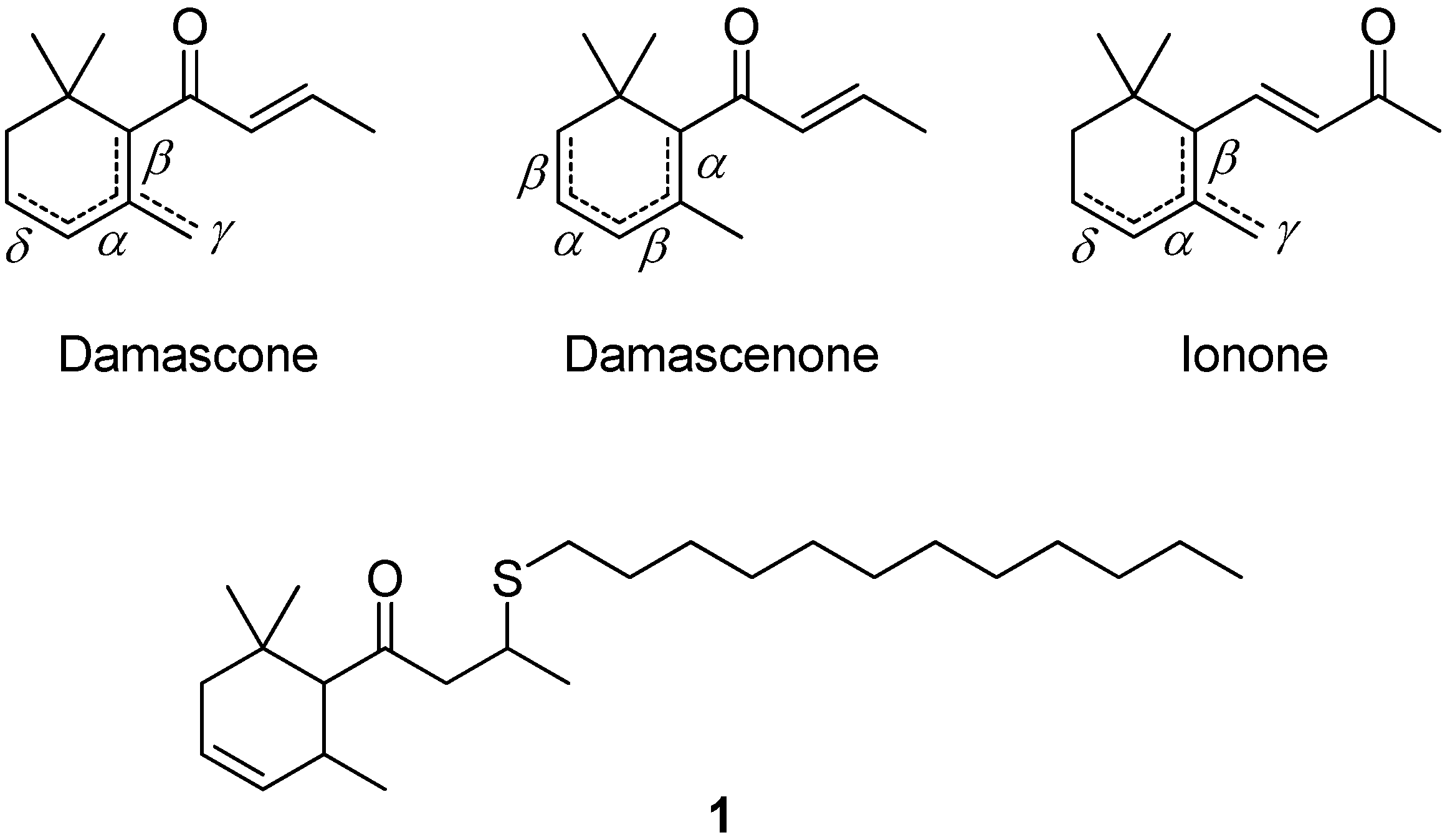
      <p>Previous work described Michael-type 1,4-addition of carboxylic acids or thiols to enones [<xref ref-type="bibr" rid="B29-polymers-05-00234">29</xref>], allowing the release of damascones, damascenones or ionones, the so-called rose ketones [<xref ref-type="bibr" rid="B30-polymers-05-00234">30</xref>,<xref ref-type="bibr" rid="B31-polymers-05-00234">31</xref>], in numerous applications of functional perfumery (<xref ref-type="fig" rid="polymers-05-00234-f001">Figure 1</xref>). The general concept works very well [<xref ref-type="bibr" rid="B29-polymers-05-00234">29</xref>], and <italic>δ</italic>-damascone-releasing profragrance <bold>1</bold> has now successfully been commercialized. </p>
      <fig id="polymers-05-00234-f001" position="float">
        <label>Figure 1</label>
        <caption>
          <p>Structures of volatile damascones, damascenones and ionones (the suffixes <italic>α</italic>-, <italic>β</italic>-, <italic>γ</italic>- or <italic>δ</italic>- designate the location of the double bond(s)) and commercially available profragrance <bold>1</bold>. </p>
        </caption>
        <graphic xmlns:xlink="http://www.w3.org/1999/xlink" xlink:href="polymers-05-00234-g001.tif"/>
      </fig>
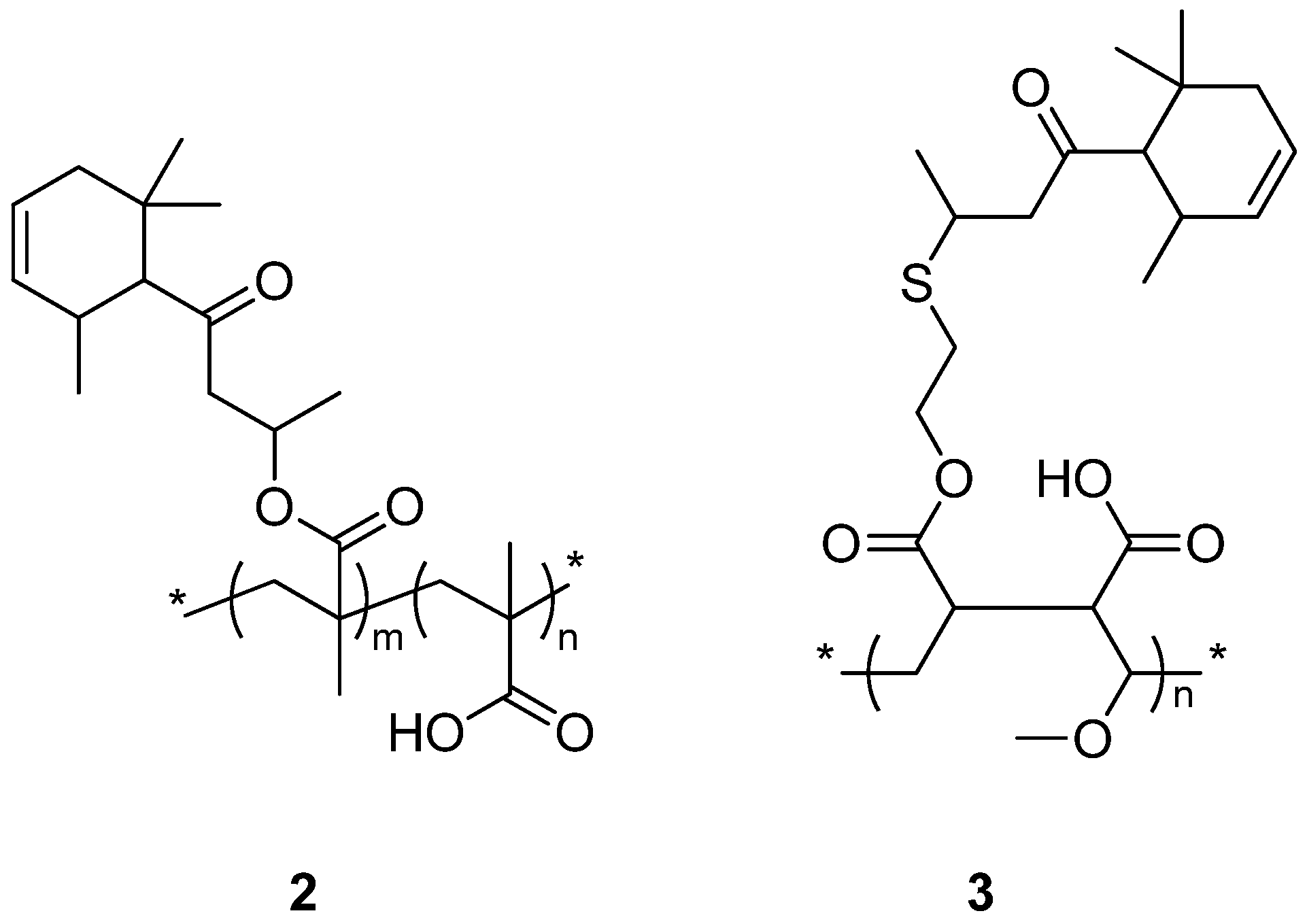
      <p>In a first study, we investigated the pH-dependent release of <italic>δ</italic>-damascone from amphiphilic random polymethacrylates (such as <bold>2</bold>, <xref ref-type="fig" rid="polymers-05-00234-f002">Figure 2</xref>) and showed that the kinetics of release depended on the molar ratio of a <italic>β</italic>-acyloxy ketone derivative of <italic>δ</italic>-damascone and methacrylic acid [<xref ref-type="bibr" rid="B20-polymers-05-00234">20</xref>]. This ratio controlled the polarity of the polymer backbone and, thus, its dispersibility in an aqueous environment and, simultaneously, influenced the efficiency of surface adsorption/deposition of the polymer on various substrates. </p>
      <fig id="polymers-05-00234-f002" position="float">
        <label>Figure 2</label>
        <caption>
          <p>Examples of polymer conjugates of <italic>δ</italic>-damascone investigated in previous work [<xref ref-type="bibr" rid="B20-polymers-05-00234">20</xref>,<xref ref-type="bibr" rid="B27-polymers-05-00234">27</xref>]. </p>
        </caption>
        <graphic xmlns:xlink="http://www.w3.org/1999/xlink" xlink:href="polymers-05-00234-g002.tif"/>
      </fig>
      <p>In a second study, alternating copolymers of maleic anhydride were modified by the ring opening of the reactive anhydride unit with the hydroxyl group of a precursor resulting from the reaction between <italic>δ</italic>-damascone and 2-mercaptoethanol [<xref ref-type="bibr" rid="B27-polymers-05-00234">27</xref>]. Various alternating copolymers of maleic anhydride with other comonomers (e.g., <bold>3</bold>, <xref ref-type="fig" rid="polymers-05-00234-f002">Figure 2</xref>) were easily prepared in a one-pot, two-step reaction sequence to afford a series of biocompatible delivery systems [<xref ref-type="bibr" rid="B27-polymers-05-00234">27</xref>]. </p>
      <p>The ease of structural modification by choosing suitable comonomers allowed the preparation of copolymers with enhanced surface deposition and/or an increased dispersibility of the conjugates in aqueous media. The release of <italic>δ</italic>-damascone from the polymer conjugates has been measured in buffered aqueous solution as a function of pH and time, as well as after deposition onto a fabric surface in the presence of a cationic surfactant. The most efficient release of <italic>δ</italic>-damascone was observed for a poly(maleic acid)-based copolymer with a well-adjusted balance between hydrophilicity (giving rise to high release rates) and hydrophobicity (resulting in increased surface deposition) of the polymer backbone [<xref ref-type="bibr" rid="B27-polymers-05-00234">27</xref>]. </p>
      <p>In addition to the influence of the polymer backbone on the release of <italic>δ</italic>-damascone, the grafting of specific side chains, which can further influence the release and deposition properties of the delivery systems, has been preliminarily described. For example, the grafting of polyethylene oxide onto poly(maleic anhydride) resulted in an increase of the release rate in water, but a decrease of the deposition on fabric and, thus, a limited overall efficiency of the delivery system in the targeted application [<xref ref-type="bibr" rid="B27-polymers-05-00234">27</xref>]. </p>
      <p>In the present work, we investigated the release of <italic>δ</italic>-damascone from poly(maleic anhydride)-based conjugates in more detail by extending the structural variety of the polymer structure with respect to our previous work. We thus prepared a series of poly(styrene<italic>-co-</italic>maleic anhydride)s and functionalized them with ethylene oxide (EO)/propylene oxide (PO) side chains (Jeffamines<sup>®</sup>) with different EO/PO molar ratios. The <italic>δ</italic>-damascone was grafted via a 2-cysteamine linker by 1,4-addition of the thiol group to the enone double bond of the damascone, followed by the nucleophilic ring opening of the maleic anhydride unit by the amino group. Furthermore, we were interested in particular in how the molar ratio of the EO/PO on the grafted copolymers influenced the release rate of <italic>δ</italic>-damascone. Besides being grafted onto polymeric profragrance bioconjugates to modify the polarity of the copolymers [<xref ref-type="bibr" rid="B20-polymers-05-00234">20</xref>,<xref ref-type="bibr" rid="B23-polymers-05-00234">23</xref>,<xref ref-type="bibr" rid="B27-polymers-05-00234">27</xref>], EO and/or EO/PO copolymers of different types have also been of interest as physical delivery systems to modify fragrance evaporation, such as in the encapsulation into micellar systems [<xref ref-type="bibr" rid="B32-polymers-05-00234">32</xref>,<xref ref-type="bibr" rid="B33-polymers-05-00234">33</xref>,<xref ref-type="bibr" rid="B34-polymers-05-00234">34</xref>,<xref ref-type="bibr" rid="B35-polymers-05-00234">35</xref>,<xref ref-type="bibr" rid="B36-polymers-05-00234">36</xref>]. The performance of the different polymer conjugates prepared in this work was investigated by dynamic headspace analysis on dry cotton under realistic conditions of functional perfumery in a fabric softening application [<xref ref-type="bibr" rid="B37-polymers-05-00234">37</xref>] under the previously described conditions [<xref ref-type="bibr" rid="B27-polymers-05-00234">27</xref>]. </p>
    </sec>
    <sec>
      <title>2. Experimental Section</title>
      <sec>
        <title>2.1. General</title>
        <p>Commercially available reagents and solvents were used without further purification, unless stated otherwise. Reactions were carried out in standard glassware under N<sub>2</sub> or Ar, and yields were not optimized. Demineralized H<sub>2</sub>O: Millipore-Synergy-185 water purifier. Infrared (IR) spectra: Perkin-Elmer-1600-FTIR spectrometer; <inline-graphic xmlns:xlink="http://www.w3.org/1999/xlink" xlink:href="polymers-05-00234-i001.tif"/> of weak (w), medium (m) or strong (s) bands in cm<sup>−1</sup>. <sup>1</sup>H- and <sup>13</sup>C-nuclear magnetic resonance (NMR) spectra: Bruker 400 MHz Avance III spectrometer; <italic>δ</italic> in ppm downfield from Me<sub>4</sub>Si as internal standard. Standard pulse sequences and parameters were used for one-dimensional <sup>1</sup>H- and <sup>13</sup>C-NMR experiments and for two-dimensional, gradient selected correlation spectroscopy (COSY), <sup>1</sup>H,<sup>13</sup>C-HSQC and <sup>1</sup>H,<sup>13</sup>C-heteronuclear multiple bond correlation (HMBC) experiments, respectively. </p>
      </sec>
      <sec>
        <title>2.2. Analytical Size-Exclusion Chromatography (SEC)</title>
        <p>Size-exclusion chromatography (SEC) analyses were carried out at room temperature (<italic>ca</italic>. 22 °C) on a Viscotek GPC max VE 2001 GPC Solvent Sample Module connected to a Viscotek UV detector 2500, a Viscotek VE3580 RI detector and a Viscotek-270-Dual-Detector viscometer. Samples were eluted from a Macherey-Nagel VA 300/7.7 Nucleogel GPC 500-5 column at a flow rate of 1.0 mL min<sup>−1</sup> with tetrahydrofuran (THF, high performance liquid chromatography (HPLC)-grade). Universal calibrations were performed using commercial poly(styrene) standards. The polymer standard (<italic>ca</italic>. 40 mg) was accurately weighed and dissolved in THF (10 mL); then, these solutions (100 μL) were injected for the calibration. Molecular weight averages and polydispersity indices (PDIs) of the different polymers are listed in <xref ref-type="table" rid="polymers-05-00234-t002">Table 2</xref> below. </p>
        </sec>
      <sec>
        <title>2.3. Preparation of 3-(2-Aminoethylthio)-1-(2,6,6-trimethyl-cyclohex-3-enyl)-butan-1-one (4) and 3-((2-((4-oxo-4-(2,6,6-Trimethylcyclohex-3-en-1-yl)butan-2-yl)amino)ethyl)thio)-1-(2,6,6-trimethylcyclohex-3-en-1-yl)butan-1-one (5)</title>
        <p>In a 100 mL round-bottomed flask, (<italic>E</italic>)-1-(2,6,6-trimethylcyclohex-3-enyl)but-2-en-1-one (<italic>δ</italic>-damascone, 20.0 g, 104.0 mmol), triethylamine (14.5 mL, 104.0 mmol) and 2-aminoethanethiol hydrochloride (11.8 g, 104.0 mmol) were dissolved in ethanol (50 mL) to give a colorless solution. 2,3,4,6,7,8,9,10-Octahydropyrimido[1,2-a]azepine (1,8-diazabicyclo[5.4.0]undec-7-ene (DBU), 1.6 g, 10.4 mmol) was added. The reaction mixture was then stirred at room temperature overnight. Cyclohexane (30 mL) was added to the reaction mixture to give a precipitate, which was removed by filtration. Ethanol was evaporated, and the reaction mixture was washed with NaCl (2 M, 2 × 50 mL), NaOH (10<sup>−3</sup> M, 40 mL) and H<sub>2</sub>O. The organic layer was dried with MgSO<sub>4</sub>, filtered and concentrated to give a yellow oil of <bold>4</bold> and <bold>5</bold> in a ratio of 1.2:1 as a mixture of diastereoisomers (m = 27 g). <sup>1</sup>H-NMR (CDCl<sub>3</sub>, 400 MHz) <bold>4</bold>: <italic>δ</italic> 5.53 (m, 1H), 5.44 (m, 1H), 3.32 (m, 1H), 2.91 (m, 1H, diastereoisomer 1), 2.72 (m, 2H, diastereoisomer 2), 2.66 (br m, 1H), 2.53 (m, 1H, diastereoisomer 1), 2.51 (m, 1H), 2.50 (m, 1H), 2.22 (m, 1H), 1.96 (m, 1H), 1.69 (m, 1H), 1.31 (m, 3H), 1.00 or 0.98 (m, 3H), 0.95 (m, 3H) and 0.89 (m, 3H) ppm. <sup>1</sup>H-NMR (CDCl<sub>3</sub>, 400 MHz) <bold>5</bold>: <italic>δ</italic> 5.53 (m, 2H), 5.44 (m, 2H), 3.32 (m, 1H), 3.18 (m, 1H), 2.91 (m, 1H, diastereoisomer 1), 2.86 (m, 1H), 2.77 (m, 1H, diastereoisomer 1), 2.75 (m, 1H), 2.72 (m, 2H, diastereoisomer 2), 2.71 (m, 2H), 2.61 (m, 2H, diastereoisomer 2), 2.53 (m, 1H, diastereoisomer 1), 2.50 (m, 1H), 2.46 (m, 1H, diastereoisomer 1), 2.24 (m, 1H), 2.22 (m, 1H), 1.96 (m, 2H), 1.69 (m, 2H), 1.31 (m, 3H), 1.10 (m, 3H), 1.00 (m, 3H), 0.98 (m, 3H), 0.95 (m, 6H) and 0.89 (m, 6H) ppm. <sup>13</sup>C-NMR (CDCl<sub>3</sub>, 100.6 MHz) <bold>4</bold>: <italic>δ</italic> 212.2 (s), 131.8 (d), 124.2 (d), 62.9 (d), 55.2 (t), 41.7 (t), 41.3 (br t), 34.8 (br t), 34.0 (d), 33.1 (s), 31.7 (d), 29.8 (q), 21.9 (q), 20.7 (q), 19.9 (q) ppm. <sup>13</sup>C-NMR (CDCl<sub>3</sub>, 100.6 MHz) <bold>5</bold>: <italic>δ</italic> 214.1 (s), 212.2 (s), 131.8 (d), 124.2 (d), 62.9 (d), 55.2 (t), 54.9 (t), 48.5 (d), 46.1 (t), 41.7 (t), 34.0 (d), 33.1 (s), 31.7 (d), 31.3 (t), 29.8 (q), 21.9 (q), 20.7 (q), 20.4 (q) and 19.9 (q) ppm. IR (neat): 3387w, 3317w, 3018m, 2957s, 2928m, 2871m, 2830m, 1703s, 1652m, 1457m, 1386m, 1366s, 1280w, 1250w, 1212w, 1194w, 1153m, 1116m, 1080m, 1039w, 998m, 953w, 932w, 896w, 842w, 787w, 691s, 683s and 641m cm<sup>−1</sup>.</p>
      </sec>
      <sec>
        <title>2.4. General Procedure to Prepare Copolymers of Styrene, Maleic Anhydride and 4-oxo-4-({ω-(2-Methoxyethyl)[poly(ethylene oxide)-co-poly(propylene oxide)]ethyl}amino)but-2-enoic Acid</title>
        <p>In a 50 mL round-bottomed flask, poly(styrene-<italic>co</italic>-maleic anhydride) (<bold>6</bold>, 4.0 g, 18.78 mmol with respect to the anhydride group) and α-(2-aminoethyl)-<italic>ω</italic>-(2-methoxyethyl)-poly(propylene glycol<italic>-co-</italic>ethylene glycol) (<bold>7</bold>–<bold>9</bold>, <xref ref-type="table" rid="polymers-05-00234-t001">Table 1</xref>, 1.88 mmol) were dissolved in acetone (20 mL) to give a yellow solution. The reaction mixture was stirred at 50 °C overnight. Copolymers <bold>10</bold>–<bold>12</bold> were obtained by precipitation from water, filtered and dried under vacuum at 50 °C for 24 h. </p>
        <sec>
          <title>2.4.1. Copolymer of Styrene, Maleic Anhydride and 4-oxo-4-({ω-(2-Methoxyethyl)[poly(ethylene oxide)-co-poly(propylene oxide)]ethyl}amino)but-2-enoic Acid (10) (Obtained by Grafting of Copolymer 7 with EO/PO = 0.11)</title>
          <p>Precipitation yielded a white solid (5.01 g, Y = 99%). <sup>1</sup>H-NMR (Acetone-d<sup>6</sup>, 400 MHz): <italic>δ</italic> 7.3 (m, 5H), 4.5–3.0 (m, 4.4H), 1.5–1.0 (m, 2.9H). <sup>13</sup>C-NMR (Acetone-d<sup>6</sup>, 100.6 MHz): <italic>δ</italic> 173.8 (s), 129.6 (d), 77.3 (t), 76.1 (d), 74.0 (t), 73.8 (t), 52.9 (br d), 43.3 (br d), 41.5 (br d) and 17.9 (q). IR (neat): 3594w, 3029w, 2972w, 2932w, 2876w, 1855w, 1775m, 1728m, 1602w, 1583w, 1540w, 1494w, 1454m, 1374w, 1338w, 1218w, 1159m, 1078m, 1030w, 947m, 917m, 847w, 763m, 729w and 700s cm<sup>−1</sup>. </p>
        </sec>
        <sec>
          <title>2.4.2. Copolymer of Styrene, Maleic Anhydride and 4-oxo-4-({ω-(2-Methoxyethyl)[poly(ethylene oxide)-co-poly(propylene oxide)]ethyl}amino)but-2-enoic Acid (11) (Obtained by Grafting of Copolymer 8 with EO/PO = 0.14)</title>
          <p>Precipitation afforded a white solid (7.40 g, Y = 99%). <sup>1</sup>H-NMR (Acetone-d<sup>6</sup>, 400 MHz): <italic>δ</italic> 7.3 (m, 5H), 4.0–3.0 (m, 10.5H) and 1.6–0.8 (m, 8.7H). <sup>13</sup>C-NMR (Acetone-d<sup>6</sup>, 100.6 MHz): <italic>δ</italic> 173.3 (br s), 129.5 (br d), 76.2 (d), 76.1 (d), 75.9 (d), 74.0 (t), 73.8 (t), 73.7 (t), 71.3 (t), 43.5 (br d) and 17.9 (q). IR (neat): 3590w, 3060w, 3028w, 2970w, 2929w, 2874w, 1855w, 1776m, 1728m, 1602w, 1583w, 1540w, 1494w, 1454m, 1374w, 1338w, 1218w, 1160m, 1080m, 1030w, 945m, 917m, 847w, 762m and 699s cm<sup>−1</sup>. </p>
        </sec>
        <sec>
          <title>2.4.3. Copolymer of Styrene, Maleic Anhydride and 4-oxo-4-({ω-(2-Methoxyethyl)[poly(ethylene oxide)-co-poly(propylene oxide)]ethyl}amino)but-2-enoic Acid (12) (Obtained by Grafting of Copolymer 9 with EO/PO = 3.60)</title>
          <p>Precipitation afforded a white solid (7.20 g, 97%). <sup>1</sup>H-NMR (Acetone-d<sup>6</sup>, 400 MHz): <italic>δ</italic> 7.29 (m, 5H), 4.0–3.0 (m, 14.5H) and 1.6–0.8 (m, 3H) ppm. <sup>13</sup>C-NMR (Acetone-d<sup>6</sup>, 100.6 MHz): <italic>δ</italic> 173.3 (s), 129.6 (d), 75.8 (t), 75.6 (d), 72.7 (t), 71.8 (t), 71.6 (t), 71.5 (t), 71.3 (t), 71.1 (t), 69.4 (t), 43.2 (br d) and 17.8 (q) ppm. IR (neat): 3591w, 3060w, 3020w, 2971w, 2930w, 2874w, 1853w, 1774m, 1727m, 1600w, 1581w, 1541w, 1493w, 1453m, 1375w, 1338w, 1218w, 1160m, 1080m, 945m, 917m, 847w, 762m and 699s cm<sup>−1</sup>. </p>
        </sec>
      </sec>
      <sec>
        <title>2.5. General Procedure to Prepare Copolymers of Styrene, 4-oxo-4-({ω-(2-Methoxy ethyl)[poly(ethylene oxide)-co-poly(propylene oxide)]ethyl}amino)but-2-enoic Acid and 4-oxo-4-[{2-([4-oxo-4-(2,6,6-trimethylcyclohex-3-en-1-yl)butan-2-yl]thio)ethyl}amino]but-2-enoic Acid</title>
        <p>In a 100 mL round-bottomed flask, copolymers <bold>10</bold>–<bold>12</bold> (4.65 mmol with respect to the anhydride groups) and a mixture of <bold>4</bold> and <bold>5</bold> (2.35 g, at a ratio of 1.2:1, corresponding to 4.68 mmol of <bold>4</bold>) were dissolved in acetone (40 mL) to give a yellow solution. The reaction mixture was stirred at 50°C overnight. Copolymers <bold>13</bold>–<bold>15</bold> were obtained by precipitation from <italic>n</italic>-heptane, filtered and dried under vacuum at 50 °C for 24 h. </p>
        <sec>
          <title>2.5.1. Copolymer of Styrene, 4-oxo-4-({ω-(2-Methoxy ethyl)[poly(ethylene oxide)-co-poly(propylene oxide)]ethyl}amino)but-2-enoic Acid (EO/PO = 0.11) and 4-oxo-4-[{2-([4-oxo-4-(2,6,6-Trimethylcyclohex-3-en-1-yl)butan-2-yl]thio)ethyl}amino]but-2-enoic Acid (13)</title>
          <p>Prepared from <bold>10</bold> (1.31 g), precipitation afforded a white solid (2.44 g, Y = 98%). <sup>1</sup>H-NMR (Acetone-d<sup>6</sup>, 400 MHz): <italic>δ</italic> 7.15 (br m, 5H), 5.53 (m, 1H), 5.44 (m, 1H), 4.5–3.2 (m, 6H), 3.0 (m, 1H), 2.9–2.6 (m, 4H) 2.5 (m, 2H), 2.3 (m, 2H), 1.99 (m, 1H), 1.7 (m, 2H), 1.3 (m, 4H), 1.1 (m, 3H), 1.00 or 0.98 (m, 3H) and 0.95 (m, 7H) ppm. <sup>13</sup>C-NMR (Acetone-d<sup>6</sup>, 100.6 MHz): <italic>δ</italic> 212.5 (s), 132.7 (d), 129.2 (br d), 125.1 (d), 77.4 (t), 76.1 (d), 74.1 (t), 73.8 (t), 63.0 (d), 56.0 (t), 55.8 (t), 52.1 (t), 43.6 (d), 40.7 (t), 35.1 (d), 34.8 (d), 33.7 (d), 32.6 (d), 31.9 (t), 22.3 (q), 21.2 (q), 20.3 (q) and 17.8 (q) ppm. IR (neat): 3406w, 3059w, 3020m, 2959m, 2931m, 2871m, 2830w, 1702s, 1648m, 1601m, 1548s, 1494m, 1453s, 1387m, 1366s, 1298w, 1269w, 1248w, 1212w, 1153m, 1113m, 1088m, 999m, 935w, 903w, 843w, 799w, 761m, 698s and 641m cm<sup>−1</sup>. </p>
        </sec>
        <sec>
          <title>2.5.2. Copolymer of Styrene, 4-oxo-4-({ω-(2-Methoxy ethyl)[poly(ethylene oxide)-co-poly(propylene oxide)]ethyl}amino)but-2-enoic Acid (EO/PO = 0.14) and 4-oxo-4-[{2-([4-oxo-4-(2,6,6-Trimethylcyclohex-3-en-1-yl)butan-2-yl]thio)ethyl}amino]but-2-enoic Acid (14)</title>
          <p>Prepared from <bold>11</bold> (2.00 g), precipitation afforded a white solid (2.78 g, Y = 88%). <sup>1</sup>H-NMR (Acetone-d<sup>6</sup>, 400 MHz): <italic>δ</italic> 7.15 (br m, 5H), 5.55 (m, 1H), 5.48 (m, 1H), 4.0–3.2 (m, 10.7H), 3.12 (m, 1H), 2.9–2.6 (m, 4H) 2.48 (m, 2H), 2.33 (m, 1H), 1.99 (m, 1H), 1.89 (m, 0.5H), 1.7 (m, 2H), 1.3 (m, 4H), 1.1 (m, 7H), 1.03 or 0.98 (m, 3H) and 0.95 (m, 6H) ppm. <sup>13</sup>C-NMR (Acetone-d<sup>6</sup>, 100.6 MHz): <italic>δ</italic> 212.5 (s), 132.6 (d), 129.1 (br d), 125.1 (d), 76.2 (d), 76.0 (d), 75.9 (d), 74.0 (t), 73.8 (t), 71.3 (t), 63.0 (d), 55.9 (t), 55.5 (t), 42.3 (t), 35.1 (d), 34.7 (d), 33.7 (s), 32.6 (d), 32.5 (d), 22.2 (q), 21.1 (q), 20.2 (q) and 17.90 (q) ppm. IR (neat): 3397w, 3059w, 3020m, 2964m, 2931m, 2870m, 1703s, 1649m, 1601m, 1553s, 1494m, 1453s, 1386m, 1369s, 1297w, 1269w, 1249w, 1212w, 1151m, 1097s, 1009m, 933w, 904w, 844w, 802w, 762m, 698s and 645m cm<sup>−1</sup>. </p>
        </sec>
        <sec>
          <title>2.5.3. Copolymer of Styrene, 4-oxo-4-({ω-(2-Methoxy ethyl)[poly(ethylene oxide)-co-poly(propylene oxide)]ethyl}amino)but-2-enoic Acid (EO/PO = 3.60) and 4-oxo-4-[{2-([4-oxo-4-(2,6,6-Trimethylcyclohex-3-en-1-yl)butan-2-yl]thio)ethyl}amino]but-2-enoic Acid (15)</title>
          <p>Prepared from <bold>12</bold> (2.01 g), precipitation afforded a white solid (3.14 g, Y = 98%). <sup>1</sup>H-NMR (Acetone-d<sup>6</sup>, 400 MHz): <italic>δ</italic> 7.20 (m, 5H), 5.58 (m, 1H), 5.48 (m, 1H), 4.0–3.0 (m, 17.5H), 3.12 (m, 0.5H), 2.9–2.6 (m, 4H) 2.48 (m, 2H), 2.34 (m, 1H), 1.99 (m, 1H), 1.89 (m, 0.5H), 1.7 (m, 2H), 1.3 (m, 4H), 1.1 (m, 3H), 1.03 or 0.98 (m, 3H) and 0.95 (m, 6H) ppm. <sup>13</sup>C-NMR (Acetone-d<sup>6</sup>, 100.6 MHz): <italic>δ</italic> 212.5 (s), 132.7 (d), 129.1 (d), 127.1 (d), 125.1 (d), 75.8 (t), 75.6 (d), 72.7 (t), 71.8 (t), 71.6 (t), 71.5 (t), 71.3 (t), 69.4 (t), 63.0 (d), 55.9 (t), 42.3 (t), 35.1 (d), 33.7 (s), 32.6 (d), 22.2 (q), 21.1 (q), 20.3 (q) and 17.8 (q) ppm. IR (neat): 3396w, 3060w, 3020m, 2956m, 2929m, 2870s, 1702s, 1649m, 1601m, 1553s, 1494m, 1454s, 1386m, 1366s, 1298w, 1249w, 1212w, 1094s, 1040m, 999m, 951w, 844w, 802w, 762m, 699s and 642m cm<sup>−1</sup>. </p>
        </sec>
        <sec>
          <title>2.5.4. Copolymer of Styrene and 4-oxo-4-[{2-([4-oxo-4-(2,6,6-Trimethylcyclohex-3-en-1-yl)butan-2-yl]thio)ethyl}amino]but-2-enoic Acid (16)</title>
          <p>In a 50 mL round-bottomed flask, a mixture of <bold>4</bold> and <bold>5</bold> (4.00 g, at a ratio of 1.2:1, corresponding to 7.98 mmol of <bold>4</bold>) and poly(styrene<italic>-co-</italic>maleic anhydride) <bold>6</bold> (2.00 g, 8.44 mmol of maleic anhydride units) were dissolved in acetone (40 mL) to give a yellow solution. The reaction mixture was stirred at 50 °C overnight. The solvent was partially evaporated, and the polymer was precipitated in water to afford a white solid after filtration (m = 4.26 g, Y = 99%). <sup>1</sup>H-NMR (Acetone-d<sup>6</sup>, 400 MHz): <italic>δ</italic> 7.17 (m, 5H), 5.55 (m, 1H), 5.48 (m, 1H), 3.51 (m, 1H), 3.35 (m, 2H), 3.16 (m, 0.5H), 2.99 (m, 1H), 2.82 (m, 3H), 2.66 (m, 1H), 2.48 (m, 2H), 2.34 (m, 1H), 1.99 (m, 1H), 1.89 (m, 0.5H), 1.7 (m, 2H), 1.3 (m, 4H), 1.03 or 0.98 (m, 3H) and 0.95 (m, 6H) ppm. <sup>13</sup>C-NMR (Acetone-d<sup>6</sup>, 100.6 MHz): <italic>δ</italic> 212.5 (s), 132.7 (d), 129.1 (br d), 125.1 (d), 63.0 (d), 55.8 (t), 42.3 (t), 34.9 (d), 33.7 (s), 32.6 (d), 22.3 (q), 21.2 (q) and 20.3 (q) ppm. IR (neat): 3395w, 3059w, 3019m, 2957m, 2929m, 2871m, 2829w, 1702s, 1652w, 1601m, 1547m, 1494m, 1453s, 1387m, 1365s, 1297w, 1269w, 1247w, 1212w, 1153w, 1084w, 1031w, 999m, 896w, 844w, 762m, 698s and 639m cm<sup>−1</sup>. </p>
        </sec>
      </sec>
      <sec>
        <title>2.6. Preparation of Aqueous Surfactant Emulsions</title>
        <p>A cationic triethanolamine (TEA)-esterquat surfactant formulation was prepared from the following ingredients: Stepantex<sup>®</sup> VK90 (Stepan) 16.5%, an aqueous solution of calcium chloride (10%) 0.2% and water 83.3%. Depending on the <italic>δ</italic>-damascone content of the polymers, a total of 1.26 to 1.88% of poly(maleic acid)-based copolymers <bold>13</bold>–<bold>16</bold> was added to the softener formulation (5.00 g) in order to release a total amount of 8.7 mg of <italic>δ</italic>-damascone from each sample. All values are given in % by weight. </p>
      </sec>
      <sec>
        <title>2.7. Procedure for Polymer Deposition on Cotton and Dynamic Headspace Analysis [<xref ref-type="bibr" rid="B27-polymers-05-00234">27</xref>]</title>
        <p>In a small vial, poly(maleic acid)-based copolymers <bold>13</bold>–<bold>16</bold>, dissolved in ethyl acetate (0.5 mL, <bold>13</bold>: 26.9 mg, <bold>14</bold>, <bold>15</bold>: 34.0 mg, <bold>16</bold>: 22.7 mg, all releasing a total amount of 8.7 mg of <italic>δ</italic>-damascone) were added to the aqueous surfactant formulation (1.80 g), and the resulting mixtures were stirred overnight. The emulsions were then placed in a beaker (1 L) and diluted with demineralized cold tap water (600 g). One cotton sheet (Eidgenössische Materialprüfanstalt (EMPA, Switzerland), cotton test cloth Nr. 221, cut to <italic>ca</italic>. 12 × 12 cm sheets (average mass <italic>ca</italic>. 3.12 g and prewashed with an unperfumed detergent powder) was added to each beaker. The sheet was manually stirred for 3 min, left standing for 2 min and then wrung out by hand and weighed (average mass <italic>ca</italic>. 7.0 g) to ensure a constant amount of residual water. A solution with an equimolar amount of unmodified <italic>δ</italic>-damascone (8.7 mg in 0.5 mL of acetone) was added to another sample of the fabric softener formulation (1.80 g), which was used as the reference sample and treated as described above. All cotton sheets were line dried for 1 day. </p>
        <p>Each of the line-dried cotton sheets was individually placed inside a headspace sampling cell (with a total internal volume of <italic>ca</italic>. 160 mL). The sampling device was thermostatted at 25 °C and exposed to a constant flow of air (<italic>ca</italic>. 200 mL min<sup>−1</sup>). The air was filtered through active charcoal and aspirated through a saturated solution of NaCl to ensure a constant humidity of <italic>ca</italic>. 75%. For 2 h, the volatiles were adsorbed onto a waste Tenax<sup>®</sup> cartridge and then for 15 min onto a clean Tenax<sup>®</sup> cartridge (corresponding to a total sample volume of 3 L of air). The sampling was repeated twice every 2 h (105 min of trapping on the waste cartridge and 15 min of sampling onto a clean cartridge); the waste cartridges were discarded. The other cartridges were thermally desorbed on a Perkin Elmer TurboMatrix ATD 350 desorber coupled to an Agilent Technologies 7890A gas chromatograph equipped with a HP-1 capillary column (30 m, i.d. 0.32 mm, film thickness 0.25 μm) and a flame ionization detector. The volatiles were analyzed using a two-step temperature gradient starting from 60 °C to 130 °C at 15 °C min<sup>−1</sup> and then heating to 220°C at 40°C min<sup>−1</sup>. The injection temperature was at 250 °C and the detector temperature at 250°C. External standard calibrations were carried out using five different concentrations of <italic>δ</italic>-damascone in acetone (varying between 7.09 × 10<sup>−5</sup> and 2.63 × 10<sup>−2</sup> mol L<sup>−1</sup>). Each calibration solution (0.2 μL) was injected onto three clean Tenax<sup>®</sup> cartridges. All cartridges were then desorbed immediately under the same conditions as those resulting from the headspace sampling (see above). Since the quantities of released compounds were monitored down to very low concentrations, the calibration curve was forced through the origin of the coordinate system. Plotting the concentrations (in ng L<sup>−1</sup>) against the peak areas gave a straight line (<italic>y</italic> = 1.452 <italic>x</italic>) with a correlation coefficient of <italic>r</italic><sup>2</sup> = 1.0000. All experiments were carried out in duplicate. </p>
      </sec>
    </sec>
    <sec sec-type="results">
      <title>3. Results and Discussion</title>
      <sec>
        <title>3.1. Preparation of the δ-Damascone-Releasing Unit</title>
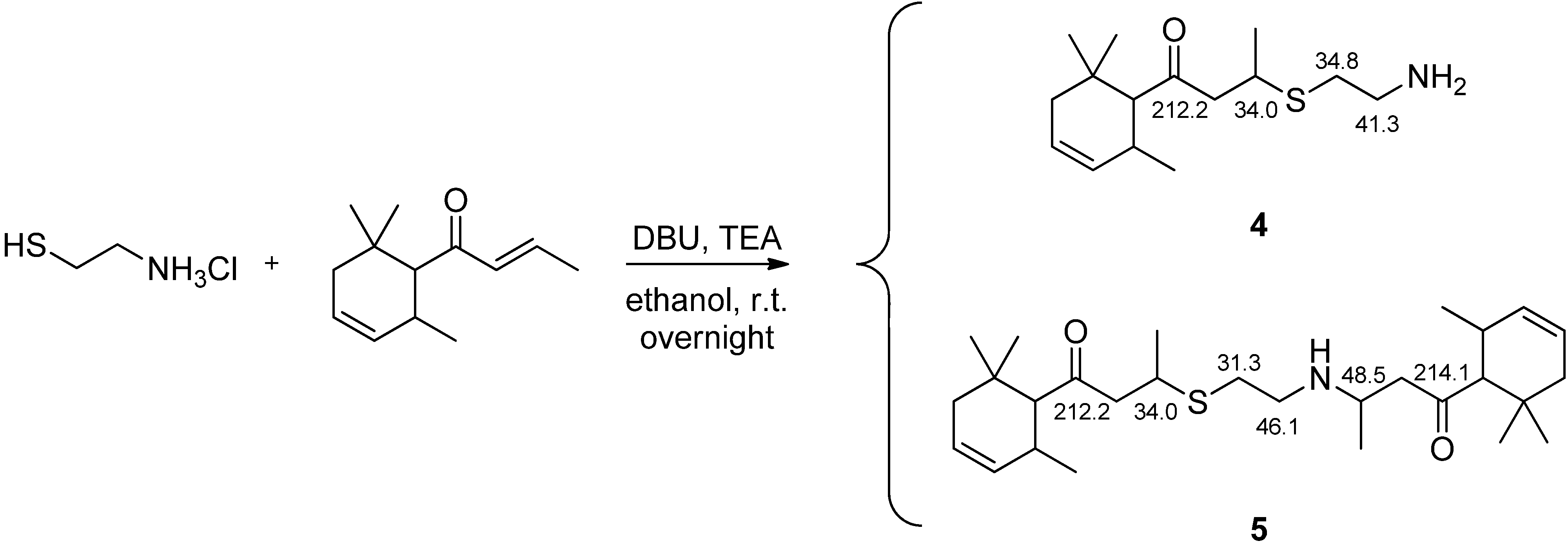
        <p><italic>δ</italic>-Damascone was conjugated to the poly(styrene<italic>-co-</italic>maleic anhydride) backbone by 1,4-Michael type addition of the thiol group from cysteamine hydrochloride onto the enone double bond to give the <italic>δ</italic>-damascone-releasing unit <bold>4</bold> (<xref ref-type="scheme" rid="polymers-05-00234-f008">Scheme 1</xref>). DBU was used as a catalyst, and triethylamine was added to deprotonate the ammonium function of the linker to facilitate its solubility in ethanol. The addition of the cysteamine on the enone can theoretically occur by reaction of either the NH<sub>2</sub> or –SH group. We expected that the more stable product <bold>4</bold> was preferentially formed. To verify the selectivity between the two possible reactions, the crude reaction product was characterized by FTIR and NMR spectroscopy. </p>
        <fig id="polymers-05-00234-f008" position="float">
          <object-id pub-id-type="pii">polymers-05-00234-f008_Scheme 1</object-id>
          <label>Scheme 1</label>
          <caption>
            <p>Synthesis of 3-((2-aminoethyl)thio)-1-(2,6,6-trimethylcyclohex-3-en-1-yl)butan-1-one (<bold>4</bold>) as <italic>δ</italic>-damascone-releasing unit and formation of diadduct (<bold>5</bold>). </p>
          </caption>
          <graphic xmlns:xlink="http://www.w3.org/1999/xlink" xlink:href="polymers-05-00234-g008.tif"/>
        </fig>
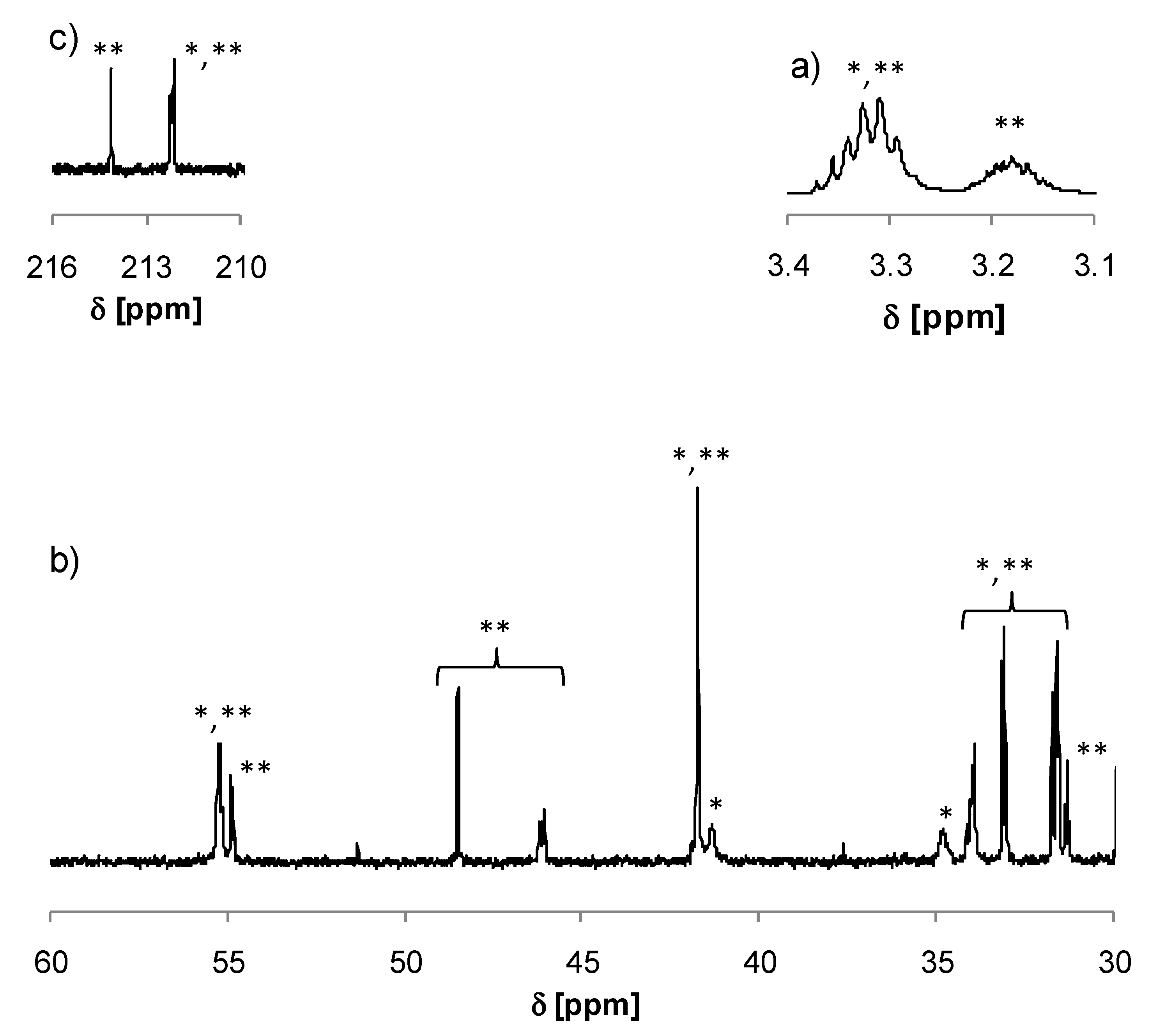
        <p><sup>1</sup>H-NMR spectroscopy showed that the reaction was not selective (see <xref ref-type="fig" rid="polymers-05-00234-f003">Figure 3</xref>a and Experimental Section). </p>
        <p>Interpretation of the <sup>13</sup>C-NMR spectrum revealed that a mixture of the desired compound <bold>4</bold> and diaddition product <bold>5</bold> was obtained (<xref ref-type="fig" rid="polymers-05-00234-f003">Figure 3</xref>b). Broad triplets at 34.8 and 41.3 ppm correspond to the two CH<sub>2</sub> groups of the thioether with a terminal NH<sub>2</sub> group. A signal, which would correspond to a CH<sub>2</sub> group next to the –SH function, was not detected. This assignment was confirmed by the absence of a peak between 2600 and 2650 cm<sup>−1</sup> in the IR spectrum, which would indicate the presence of a thiol group. In contrast, the presence of two peaks at 3,317 and 3,387 cm<sup>−1</sup> confirmed the presence of the NH<sub>2</sub> group in <bold>4</bold>. </p>
        <p>Subsequently, a comprehensive 2D-NMR analysis was carried out. The two triplets observed at 31.3 and 46.1 ppm in the <sup>13</sup>C-NMR spectrum further confirmed the presence of the diaddition product <bold>5</bold>. The carbonyl groups of the <italic>δ</italic>-damascone unit give rise to signals at 212.2 ppm (if linked via a thioether) and 214.1 ppm (if linked via a secondary amine, <xref ref-type="fig" rid="polymers-05-00234-f003">Figure 3</xref>c). Integration of these two signals resulted in a ratio of 2.2:1. After subtraction of the integral of the signal at 214.1 ppm (which corresponds exclusively to compound <bold>5</bold>) from that at 212.2 ppm (corresponding to both compounds <bold>4</bold> and <bold>5</bold>), a molar ratio of 1.2 to 1 was calculated for <bold>4</bold> and <bold>5</bold>. Similar values were obtained from integration of signals in the <sup>1</sup>H-NMR spectrum. Because diaddition product <bold>5</bold> does not react with the maleic anhydride of the polymer backbone, its presence should not be a problem for the next reaction step. It can easily be removed during the purification of the modified copolymer. </p>
      <fig id="polymers-05-00234-f003" position="float">
          <label>Figure 3</label>
          <caption>
            <p>Enlargements of the <sup>1</sup>H-NMR (<bold>a</bold>) and <sup>13</sup>C-NMR (<bold>b</bold>,<bold>c</bold>) spectra of the mixture of compounds <bold>4</bold> (*) and <bold>5</bold> (**).</p>
          </caption>
          <graphic xmlns:xlink="http://www.w3.org/1999/xlink" xlink:href="polymers-05-00234-g003.tif"/>
        </fig>
        </sec>
      <sec>
        <title>3.2. Synthesis of Copolymers</title>
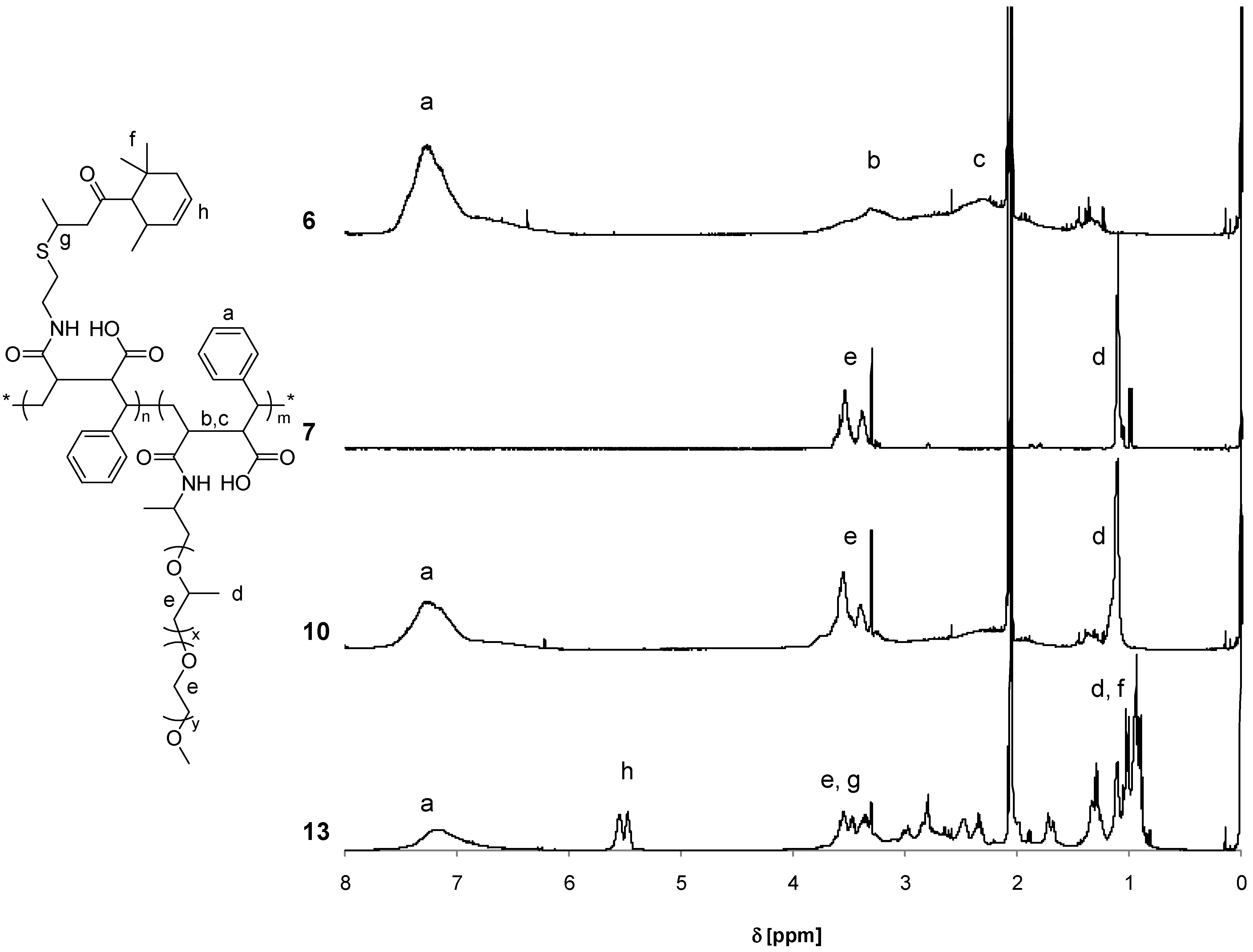
        <p>To determine the styrene/maleic anhydride (S/MA) molar ratio, commercially available copolymer <bold>6</bold> was analyzed by <sup>1</sup>H-NMR spectroscopy. Integration of the signals centered at 7.20 ppm (corresponding to the aromatic ring of styrene (a, <xref ref-type="fig" rid="polymers-05-00234-f004">Figure 4</xref>)) and those at 2.20 and 3.30 ppm (resulting from the styrene and the maleic anhydride backbone (b and c, respectively, <xref ref-type="fig" rid="polymers-05-00234-f004">Figure 4</xref>)) showed that the S/MA molar ratio was around 1.1, which is close to the value of 1.3 given by the supplier. Nevertheless, the peaks are not well resolved, and quantitative analysis is difficult. </p>
        <p>According to this ratio, the structure of copolymer <bold>6</bold> in <xref ref-type="scheme" rid="polymers-05-00234-f009">Scheme 2</xref> is represented as an alternating copolymer with a S/MA molar ratio of 1. With 1.1 equivalents of styrene and 1 equivalent of maleic anhydride, the molecular weight of the repeating unit corresponded to 213.51 g mol<sup>−1</sup>. The number average molecular weight <italic>M</italic><sub>n</sub> of <bold>6</bold> was measured by analytical SEC to be 2100 g mol<sup>−1</sup>, in contrast to a value of 1600 g mol<sup>−1</sup> given by the supplier. This molecular weight corresponds to a polymer consisting on average of 10 repeat units. </p>
        <fig id="polymers-05-00234-f004" position="float">
          <label>Figure 4</label>
          <caption>
            <p><sup>1</sup>H-NMR spectra of copolymers <bold>6</bold>, <bold>7</bold>, <bold>10</bold> and <bold>13</bold> recorded in acetone-d<sup>6</sup>.</p>
          </caption>
          <graphic xmlns:xlink="http://www.w3.org/1999/xlink" xlink:href="polymers-05-00234-g004.tif"/>
        </fig>
        <p>Amino functionalized ethylene oxide (EO)/propylene oxide (PO) copolymers (Jeffamine<sup>®</sup>) (<bold>7</bold>–<bold>9</bold> in <xref ref-type="scheme" rid="polymers-05-00234-f009">Scheme 2</xref>) are commercially available, and their molecular composition was given by the supplier as illustrated in <xref ref-type="table" rid="polymers-05-00234-t001">Table 1</xref>. Their EO/PO molar ratio was measured by <sup>1</sup>H-NMR spectroscopy. The signal centered at 1.10 ppm corresponds to the methyl group of the PO unit (d, <xref ref-type="fig" rid="polymers-05-00234-f004">Figure 4</xref>), whereas the signals between 3.10 and 3.60 ppm are from the protons of the methyne and methylene groups of the EO and PO units (e, <xref ref-type="fig" rid="polymers-05-00234-f004">Figure 4</xref>). The determination of the molar ratio was useful for the present study, because it indicated the polarity of the copolymer, with an increasing ratio of EO/PO, corresponding to an increase in polarity. </p>
        <p>In copolymer <bold>9</bold>, the EO/PO ratio corresponded to the values from the supplier, while the measured EO/PO ratios in copolymers <bold>7</bold> and <bold>8</bold> were lower than the values given by the supplier (0.11 and 0.14 as compared with 0.11 and 0.21, respectively, <xref ref-type="table" rid="polymers-05-00234-t001">Table 1</xref>). The measured values were used as the basis for the discussions in the present work. </p>
<table-wrap id="polymers-05-00234-t001" position="float">
          <object-id pub-id-type="pii">polymers-05-00234-t001_Table 1</object-id>
          <label>Table 1</label>
          <caption>
            <p>Composition of the molar ratio of ethylene oxide (EO) and propylene oxide (PO) in copolymers <bold>7</bold>–<bold>9</bold>, as indicated from the supplier and measured by <sup>1</sup>H-NMR spectroscopy. </p>
          </caption>
          <table>
            <thead>
              <tr>
                <th rowspan="2" align="center" valign="middle">Copolymer</th>
                <th rowspan="2" align="center" valign="middle">Jeffamine<sup>®</sup></th>
                <th colspan="3" align="center" valign="middle">From supplier</th>
                <th colspan="3" align="center" valign="middle">Measured by NMR</th>
              </tr>
              <tr style="border-top:solid thin">
                <th align="center" valign="middle">n EO</th>
                <th align="center" valign="middle">n PO</th>
                <th align="center" valign="middle">EO/PO</th>
                <th align="center" valign="middle">n EO</th>
                <th align="center" valign="middle">n PO</th>
                <th align="center" valign="middle">EO/PO</th>
              </tr>
            </thead>
            <tbody>
              <tr style="border-top:solid thin">
                <td align="center" valign="middle"><bold>7</bold></td>
                <td align="center" valign="middle">M600</td>
                <td align="center" valign="middle">1</td>
                <td align="center" valign="middle">9</td>
                <td align="center" valign="middle">0.11</td>
                <td align="center" valign="middle">1</td>
                <td align="center" valign="middle">9</td>
                <td align="center" valign="middle">0.11</td>
              </tr>
              <tr>
                <td align="center" valign="middle"><bold>8</bold></td>
                <td align="center" valign="middle">M2005</td>
                <td align="center" valign="middle">6</td>
                <td align="center" valign="middle">29</td>
                <td align="center" valign="middle">0.21</td>
                <td align="center" valign="middle">6</td>
                <td align="center" valign="middle">42</td>
                <td align="center" valign="middle">0.14</td>
              </tr>
              <tr>
                <td align="center" valign="middle"><bold>9</bold></td>
                <td align="center" valign="middle">M2070</td>
                <td align="center" valign="middle">31</td>
                <td align="center" valign="middle">10</td>
                <td align="center" valign="middle">3.10</td>
                <td align="center" valign="middle">36</td>
                <td align="center" valign="middle">10</td>
                <td align="center" valign="middle">3.60</td>
              </tr>
            </tbody>
  </table>
        </table-wrap>
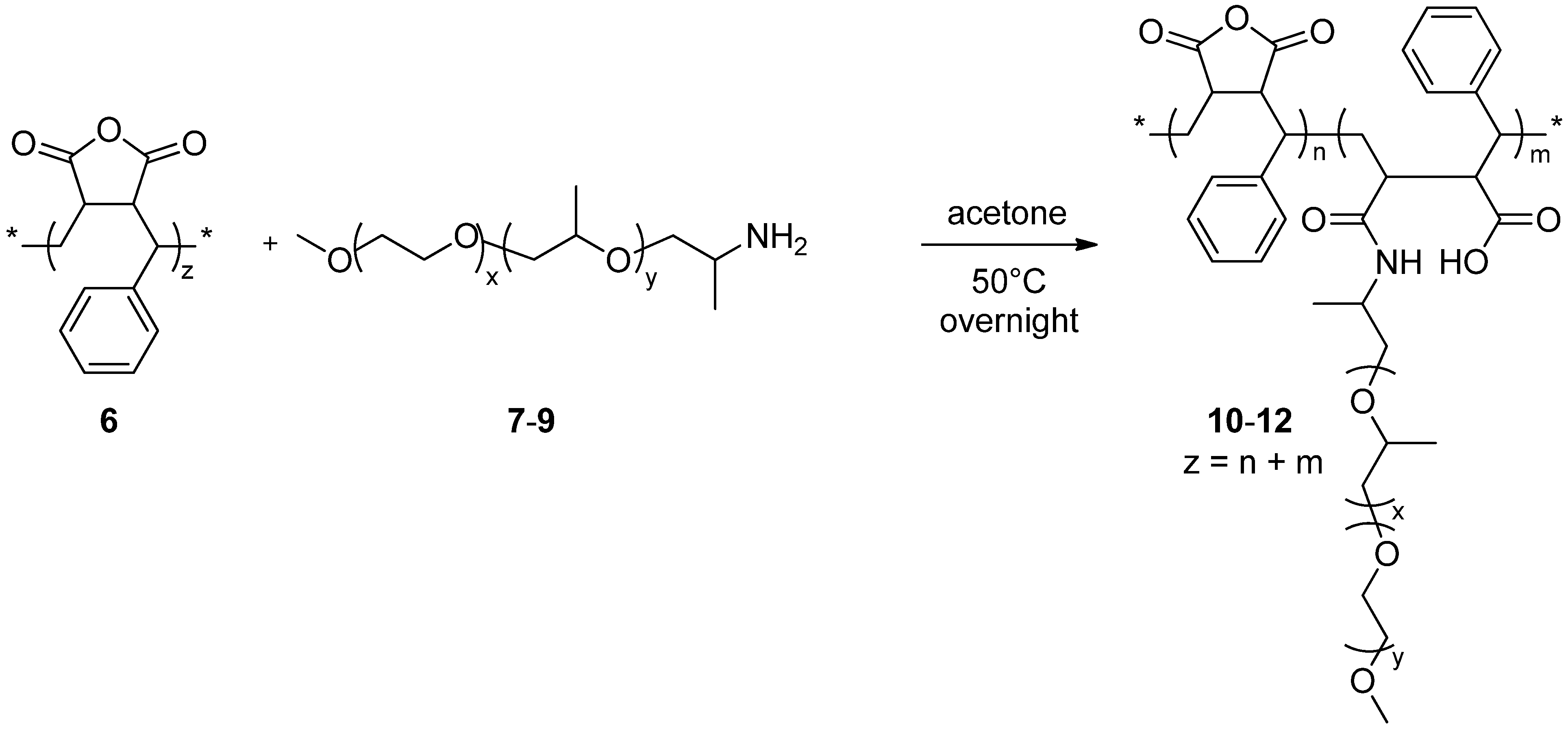
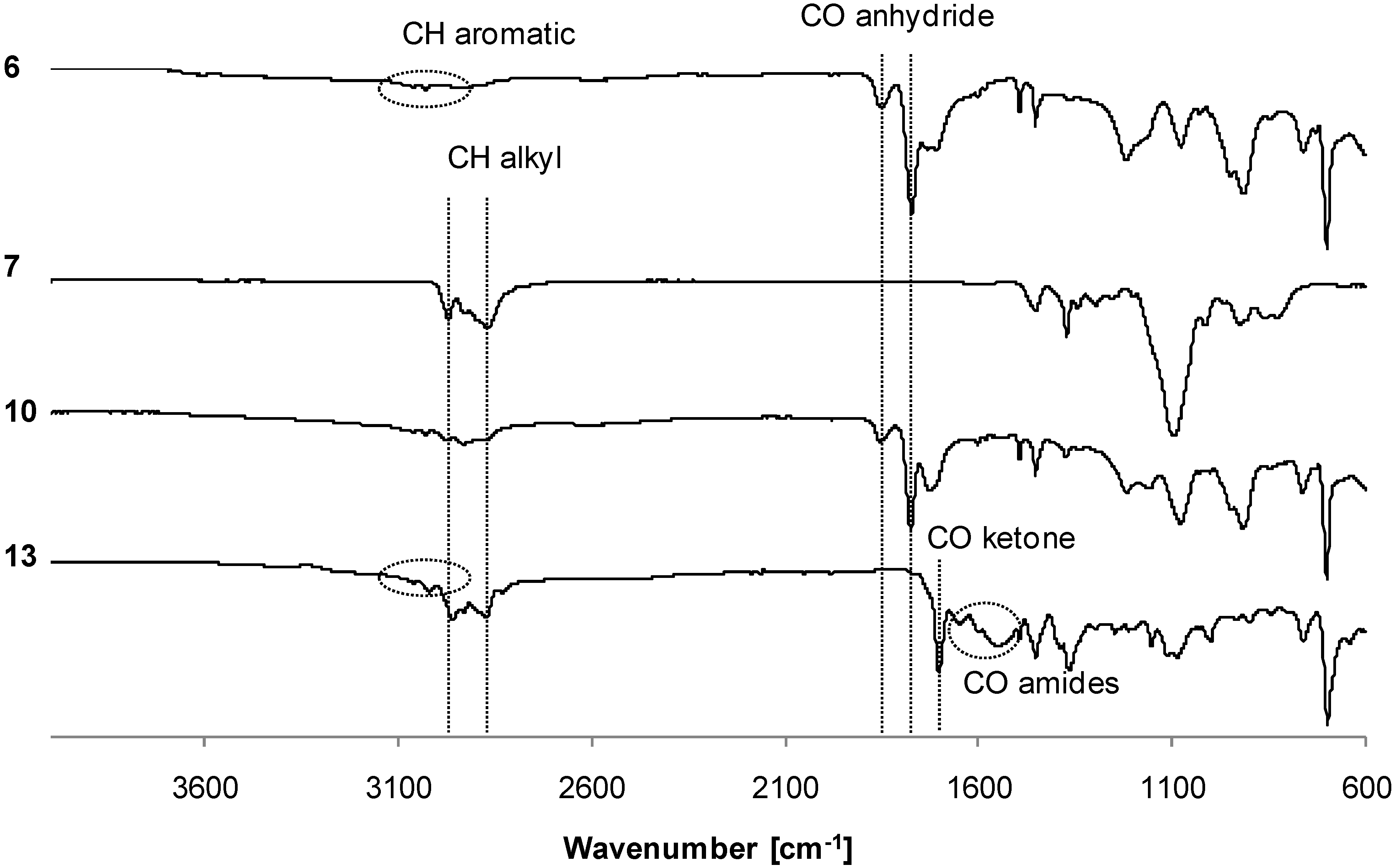
        <p>Copolymers <bold>7</bold>–<bold>9</bold> were grafted onto <bold>6</bold> by reaction in acetone at 50 °C. A constant grafting rate of 10 mol % was chosen to modify the polarity of copolymers <bold>10</bold>–<bold>12</bold> with the different Jeffamine<sup>®</sup> <bold>7</bold>–<bold>9</bold> (<xref ref-type="scheme" rid="polymers-05-00234-f009">Scheme 2</xref>). After purification, SEC showed one population, and an increase in molecular weight as compared with <bold>6</bold> was observed. The measured increase was in agreement with the expected structures (<xref ref-type="table" rid="polymers-05-00234-t002">Table 2</xref>). The presence of peaks at 2972 and 2876 cm<sup>−1</sup> (corresponding to the C–H stretch of the CH and CH<sub>2</sub> groups) and at 1583 and 1540 cm<sup>−1</sup> (from the CO of the amide group) in the IR spectra of <bold>7</bold>–<bold>9</bold> confirmed the addition of the amino group to the copolymers on <bold>6</bold>. The successful modification of <bold>6</bold> was also confirmed by <sup>1</sup>H-NMR spectroscopy. The amount of grafting was determined from integration of the signals centered at 7.20 ppm of <bold>6</bold> (a, 5 H, <xref ref-type="fig" rid="polymers-05-00234-f004">Figure 4</xref>) and the signals at 1.11 and 3.60 ppm from copolymers <bold>7</bold>–<bold>9</bold> (e and d, 3 H, <xref ref-type="fig" rid="polymers-05-00234-f004">Figure 4</xref>). The reaction was found to be complete under the present reaction conditions. </p>
        <fig id="polymers-05-00234-f009" position="float">
          <object-id pub-id-type="pii">polymers-05-00234-f009_Scheme 2</object-id>
          <label>Scheme 2</label>
          <caption>
            <p>Preparation of copolymers <bold>10</bold>–<bold>12</bold> in acetone.</p>
          </caption>
          <graphic xmlns:xlink="http://www.w3.org/1999/xlink" xlink:href="polymers-05-00234-g009.tif"/>
        </fig>
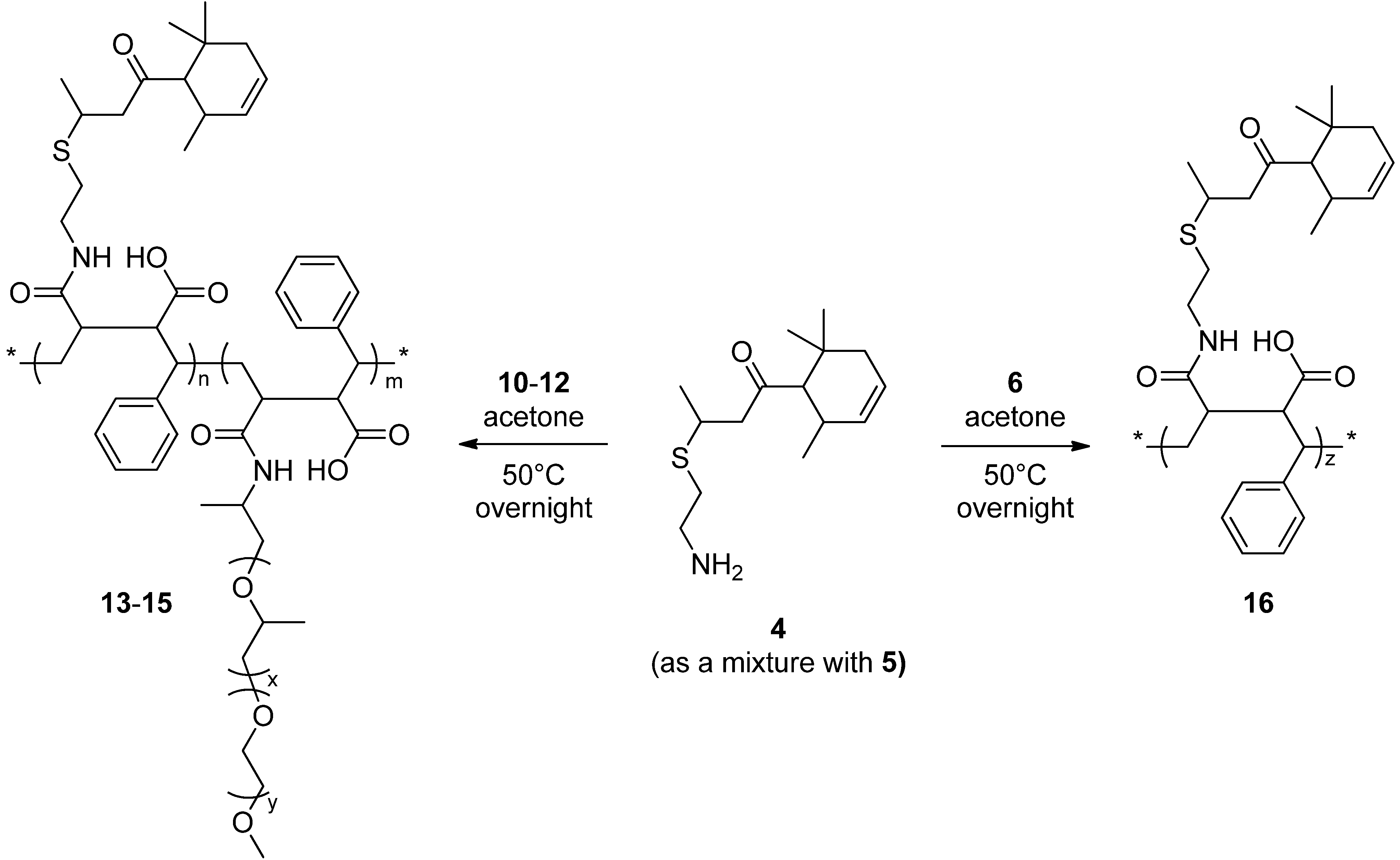
        <p>The grafting of <bold>4</bold> onto copolymers <bold>6</bold> and <bold>10</bold>–<bold>12</bold> was also carried out by reaction in acetone at 50°C. Taking the molar ratio of compounds <bold>4</bold> and <bold>5</bold> (1.2:1) into account, the amount of the mixture added to the reaction was chosen to correspond to a stoichiometric amount of <bold>4</bold>. A complete conversion was obtained (<xref ref-type="scheme" rid="polymers-05-00234-f010">Scheme 3</xref>). The presence of <italic>δ</italic>-damascone in copolymers <bold>13</bold>–<bold>16</bold> was confirmed by <sup>1</sup>H-NMR spectroscopy, where signals at 0.9 (f), 3.47 (g), 5.46 and 5.54 ppm (h, <xref ref-type="fig" rid="polymers-05-00234-f004">Figure 4</xref>) were observed. Integration of the signals at 5.46 and 5.54 ppm from the double bond of <bold>4</bold> (h, 2 H, <xref ref-type="fig" rid="polymers-05-00234-f004">Figure 4</xref>) and the signals at 7.20 ppm from the styrene units (a, 5 H, <xref ref-type="fig" rid="polymers-05-00234-f004">Figure 4</xref>) confirmed the complete conversion of <bold>4</bold>. In addition, IR spectra showed not only the absence of peaks at 1773 and 1854 cm<sup>−1</sup> of the maleic anhydride in copolymers <bold>6</bold> and <bold>10</bold>–<bold>12</bold>, but also the presence of new peaks at 3020 and 1702 cm<sup>−1</sup> (<xref ref-type="fig" rid="polymers-05-00234-f005">Figure 5</xref>), which were previously observed in <bold>4</bold>. Finally, an increase in molecular weight was measured by SEC (<xref ref-type="table" rid="polymers-05-00234-t002">Table 2</xref>). </p>
        <fig id="polymers-05-00234-f010" position="float">
          <object-id pub-id-type="pii">polymers-05-00234-f010_Scheme 3</object-id>
          <label>Scheme 3</label>
          <caption>
            <p>Preparation of <italic>δ</italic>-damascone-releasing bioconjugates <bold>13</bold>–<bold>16</bold>.</p>
          </caption>
          <graphic xmlns:xlink="http://www.w3.org/1999/xlink" xlink:href="polymers-05-00234-g010.tif"/>
        </fig>
        <table-wrap id="polymers-05-00234-t002" position="float">
          <object-id pub-id-type="pii">polymers-05-00234-t002_Table 2</object-id>
          <label>Table 2</label>
          <caption>
            <p>Number average (<italic>M</italic><sub>n</sub>) and weight average (<italic>M</italic><sub>w</sub>) molecular weights and polydispersity indices (PDIs) of copolymers <bold>6</bold> and <bold>10</bold>–<bold>16</bold> measured by size-exclusion chromatography (SEC) in tetrahydrofuran (THF) using poly(styrene) as the calibration standard. </p>
          </caption>
          <table>
            <thead>
              <tr>
                <th align="center" valign="middle">Copolymer</th>
                <th align="center" valign="middle">
                  <italic>M</italic><sub>n</sub>
                </th>
                <th align="center" valign="middle">
                  <italic>M</italic><sub>w</sub>
                </th>
                <th align="center" valign="middle">PDI</th>
                <th align="center" valign="middle">Copolymer</th>
                <th align="center" valign="middle">
                  <italic>M</italic><sub>n</sub>
                </th>
                <th align="center" valign="middle">
                  <italic>M</italic><sub>w</sub>
                </th>
                <th align="center" valign="middle">PDI</th>
              </tr>
            </thead>
            <tbody>
              <tr>
                <td align="center" valign="middle">6</td>
                <td align="center" valign="middle">2100</td>
                <td align="center" valign="middle">2800</td>
                <td align="center" valign="middle">1.33</td>
                <td align="center" valign="middle">13</td>
                <td align="center" valign="middle">3100</td>
                <td align="center" valign="middle">5800</td>
                <td align="center" valign="middle">1.87</td>
              </tr>
              <tr>
                <td align="center" valign="middle">10</td>
                <td align="center" valign="middle">2600</td>
                <td align="center" valign="middle">4800</td>
                <td align="center" valign="middle">1.85</td>
                <td align="center" valign="middle">14</td>
                <td align="center" valign="middle">3900</td>
                <td align="center" valign="middle">9000</td>
                <td align="center" valign="middle">2.31</td>
              </tr>
              <tr>
                <td align="center" valign="middle">11</td>
                <td align="center" valign="middle">3600</td>
                <td align="center" valign="middle">7600</td>
                <td align="center" valign="middle">2.11</td>
                <td align="center" valign="middle">15</td>
                <td align="center" valign="middle">3500</td>
                <td align="center" valign="middle">7000</td>
                <td align="center" valign="middle">2.00</td>
              </tr>
              <tr>
                <td align="center" valign="middle">12</td>
                <td align="center" valign="middle">3560</td>
                <td align="center" valign="middle">6300</td>
                <td align="center" valign="middle">1.77</td>
                <td align="center" valign="middle">16</td>
                <td align="center" valign="middle">3200</td>
                <td align="center" valign="middle">7100</td>
                <td align="center" valign="middle">2.22</td>
              </tr>
            </tbody>
  </table>
        </table-wrap>
      <p>The loading of <italic>δ</italic>-damascone in conjugates <bold>13</bold>–<bold>16</bold> was determined by <sup>1</sup>H-NMR spectroscopy (<xref ref-type="table" rid="polymers-05-00234-t003">Table 3</xref>). The loading varied between 25.6 wt % in copolymers <bold>14</bold> and <bold>15</bold>, 32.3 wt % in <bold>13</bold> and 38.3 wt % in <bold>16</bold>. </p>
      <table-wrap id="polymers-05-00234-t003" position="float">
          <object-id pub-id-type="pii">polymers-05-00234-t003_Table 3</object-id>
          <label>Table 3</label>
          <caption>
            <p>Loading of <italic>δ</italic>-damascone in conjugates <bold>13</bold>–<bold>16</bold> as determined by <sup>1</sup>H-NMR spectroscopy. </p>
          </caption>
          <table>
            <thead>
              <tr>
                <th align="center" valign="middle">Copolymer</th>
                <th align="center" valign="middle">wt % 
                <italic>δ</italic>-damascone</th>
              </tr>
            </thead>
            <tbody>
              <tr>
                <td align="center" valign="middle">
                  <bold>13</bold>
                </td>
                <td align="center" valign="middle">32.3</td>
              </tr>
              <tr>
                <td align="center" valign="middle">
                  <bold>14</bold>
                </td>
                <td align="center" valign="middle">25.6</td>
              </tr>
              <tr>
                <td align="center" valign="middle">
                  <bold>15</bold>
                </td>
                <td align="center" valign="middle">25.6</td>
              </tr>
              <tr>
                <td align="center" valign="middle">
                  <bold>16</bold>
                </td>
                <td align="center" valign="middle">38.3</td>
              </tr>
            </tbody>
  </table>
        </table-wrap>
      <fig id="polymers-05-00234-f005" position="float">
          <label>Figure 5</label>
          <caption>
            <p>Fourier transform infrared spectroscopy (FTIR) spectra of copolymers <bold>6</bold>, <bold>7</bold>, <bold>10</bold> and <bold>13</bold>. </p>
          </caption>
          <graphic xmlns:xlink="http://www.w3.org/1999/xlink" xlink:href="polymers-05-00234-g005.tif"/>
        </fig>
        </sec>
      <sec>
        <title>3.3. Performance on Fabric</title>
        <p>The influence of the structure of the grafted poly(ethylene oxide)-poly(propylene oxide) (PEO-PPO) copolymers on the release of <italic>δ</italic>-damascone was investigated by dynamic headspace analysis [<xref ref-type="bibr" rid="B38-polymers-05-00234">38</xref>,<xref ref-type="bibr" rid="B39-polymers-05-00234">39</xref>] of the volatile molecule from a cotton surface after application of a fabric softener solution. Typical fabric softener formulations consist of about 15% of a cationic surfactant, such as triethanolamine (TEA)-esterquats of fatty acids [<xref ref-type="bibr" rid="B40-polymers-05-00234">40</xref>,<xref ref-type="bibr" rid="B41-polymers-05-00234">41</xref>], in water. For the measurements, conjugates <bold>13</bold>–<bold>16</bold> were dissolved in ethyl acetate at a concentration to potentially release a total of 8.7 mg (0.05 mmol) of <italic>δ</italic>-damascone. The solutions were then dispersed in 5.0 g of a TEA-esterquat fabric softening formulation consisting of an emulsion of cationic surfactant at 16.5% in water. The samples were constantly stirred to obtain homogeneous dispersions. The different fabric softener dispersions (1.8 g) were dissolved with water (600 mL), which corresponds to the water added to a fabric softener in a washing machine. To this diluted aqueous emulsion, a cotton sheet was added and stirred for 3 min to simulate the deposition of fabric softener and then left standing for another 2 min in the dispersion. The cotton sheet was then wrung out and weighed to leave 3.9 g of the dispersion on the sheet. The cotton sheet was finally line dried at room temperature for 1 day [<xref ref-type="bibr" rid="B27-polymers-05-00234">27</xref>]. </p>
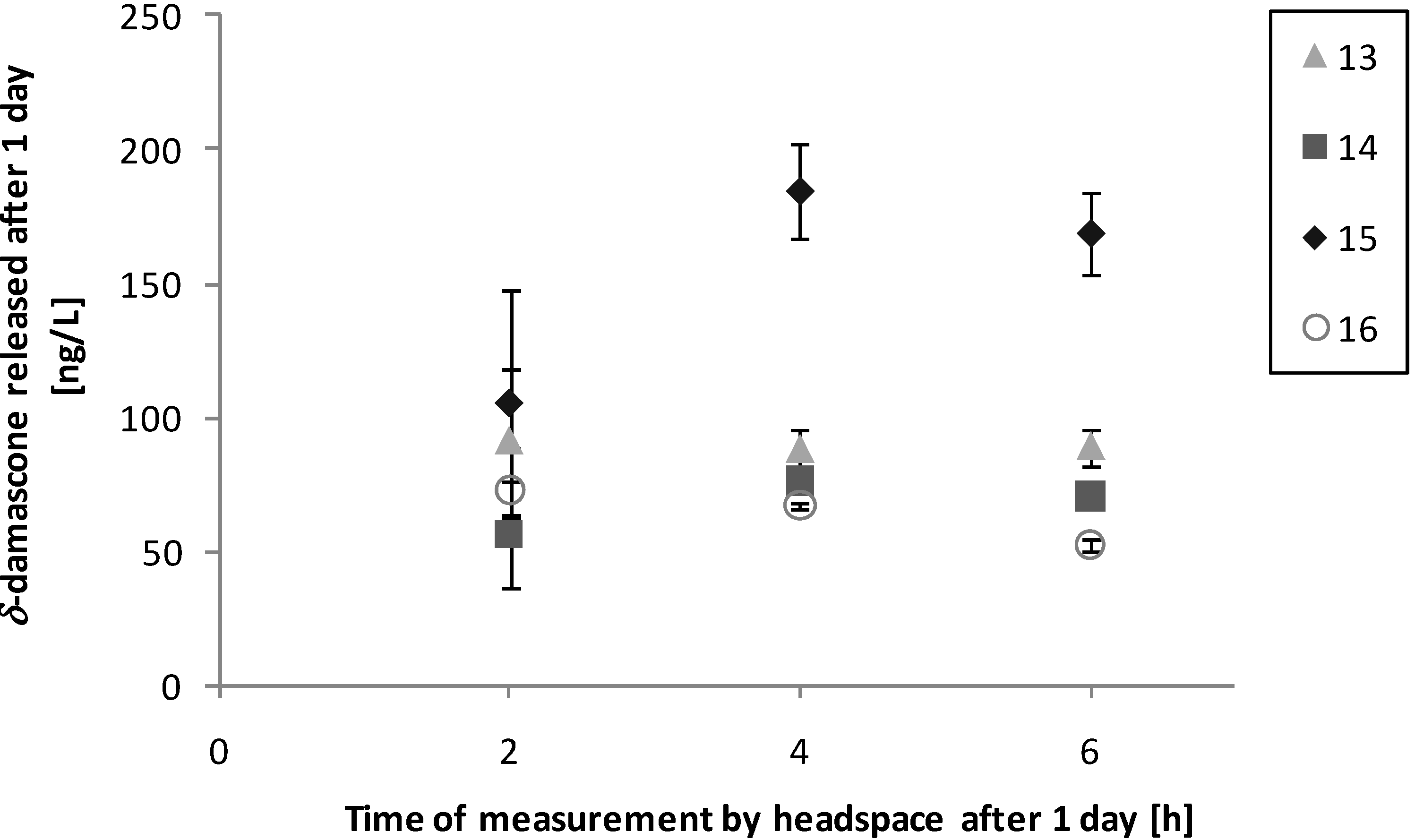
        <p>The cotton sheet was then placed inside a headspace sampling cell and exposed to a constant flow of air to constantly remove the volatiles evaporating from the cotton surface. The <italic>δ</italic>-damascone released from copolymers <bold>13</bold>–<bold>16</bold> was collected at constant time intervals on a Tenax<sup>®</sup> cartridge and then analyzed by gas chromatography after thermal desorption [<xref ref-type="bibr" rid="B27-polymers-05-00234">27</xref>]. Three measurements were taken, one each after 2, 4 and 6 h of sampling. The data illustrated in <xref ref-type="fig" rid="polymers-05-00234-f006">Figure 6</xref> are average values of at least two measurements. </p>
        <fig id="polymers-05-00234-f006" position="float">
          <label>Figure 6</label>
          <caption>
            <p>Headspace analysis of copolymers <bold>13</bold>–<bold>16</bold> as a function of time, measured after 24 h of line drying. </p>
          </caption>
          <graphic xmlns:xlink="http://www.w3.org/1999/xlink" xlink:href="polymers-05-00234-g006.tif"/>
        </fig>
        <p>The water content of the polymers has been neglected in the current study because the polymers were formulated in an aqueous environment for the application. Furthermore, the headspace sampling was carried out with constant humidity in the air. We therefore assume that the water activity was constant for all measurements. Dynamic scanning calorimetry measurements carried out on the pure polymers between −25 and 110 °C (to represent realistic application conditions) did not show phase transitions. This indicated that residual water did not have an influence on the release kinetics.</p>
        <p>After 2 h of sampling, headspace concentrations with relatively large standard deviations were measured, whereas relatively low standard deviations were obtained for the data acquired after 4 and 6 h of sampling. This suggests that the deviations observed at the beginning of the measurements are not the result of uncontrolled deposition of the conjugates on the cotton surface, but rather because an initial amount of time is necessary to equilibrate the headspace system before reaching a state in which headspace concentrations can be collected with good reproducibility. This phenomenon has been observed previously in a similar context [<xref ref-type="bibr" rid="B42-polymers-05-00234">42</xref>,<xref ref-type="bibr" rid="B43-polymers-05-00234">43</xref>]. Under the present reaction conditions, the highest headspace concentrations were measured after 4 h. </p>
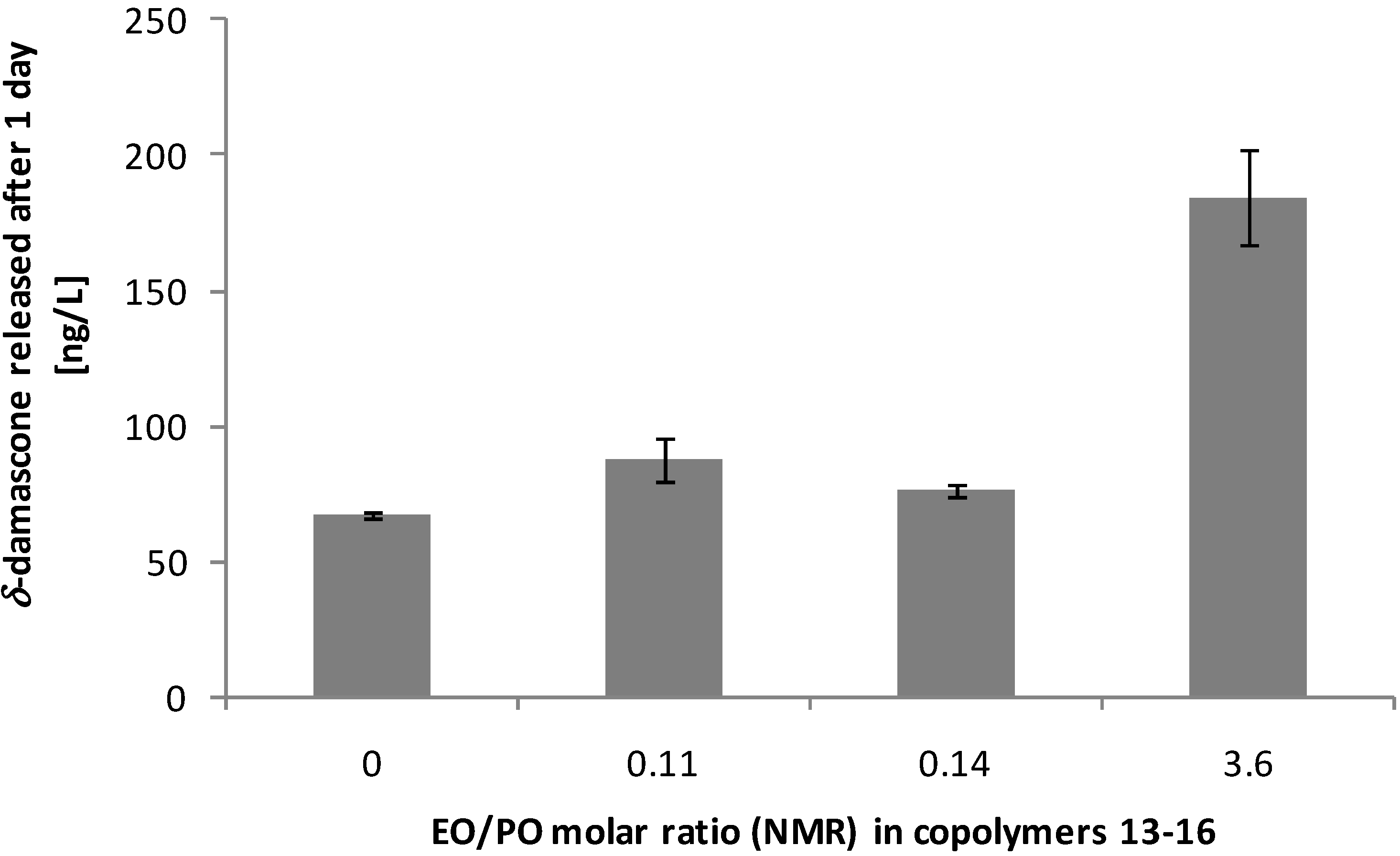
        <p>The headspace concentrations of <italic>δ</italic>-damascone released from conjugate <bold>16</bold> were found to be the lowest of the series, with 67 and 53 ng L<sup>−1</sup>, measured after 4 and 6 h, respectively. These concentrations increased slightly for the release from conjugates <bold>13</bold> and <bold>14</bold>, where 88 and 76 ng L<sup>−1</sup> were recorded after 4 h. The highest headspace concentrations of <italic>δ</italic>-damascone were measured above the sample of conjugate <bold>15</bold>, with a value of 184 ng L<sup>−1</sup> after 4 h (<xref ref-type="fig" rid="polymers-05-00234-f006">Figure 6</xref>). </p>
        <p><xref ref-type="fig" rid="polymers-05-00234-f007">Figure 7</xref> compares the performance of <italic>δ</italic>-damascone conjugates <bold>13</bold>–<bold>16</bold> by plotting the headspace concentrations measured after 4 h as a function of the EO/PO molar ratio in the Jeffamine<sup>®</sup> side chain. Conjugate <bold>13</bold>, with an EO/PO ratio of 0.11, gave rise to slightly higher headspace concentrations of <italic>δ</italic>-damascone (88 ng L<sup>−1</sup>) than conjugate <bold>16</bold> (67 ng L<sup>−1</sup>), which has no EO/PO side chains. Conjugate <bold>14</bold>, with an EO/PO ratio of 0.14 in the side chain, gave rise to 76 ng L<sup>−1</sup> of <italic>δ</italic>-damascone above the dry cotton surface. As a consequence, the grafting of PPO or of copolymers with a low EO/PO molar ratio did not improve the performance of the profragrances in the targeted application. </p>
        <fig id="polymers-05-00234-f007" position="float">
          <label>Figure 7</label>
          <caption>
            <p>Headspace concentrations of <italic>δ</italic>-damascone on dry cotton as a function of EO/PO molar ratio in the side chain of conjugates <bold>13</bold>–<bold>16</bold> after line drying for 24 h and sampling for 4 h.</p>
          </caption>
          <graphic xmlns:xlink="http://www.w3.org/1999/xlink" xlink:href="polymers-05-00234-g007.tif"/>
        </fig>
        <p>However, grafting of a side chain with a high EO/PO ratio significantly improved the amount of <italic>δ</italic>-damascone released into the headspace. Moving from <italic>δ</italic>-damascone conjugate <bold>16</bold> (with no EO/PO side chains) to copolymer <bold>15</bold> (with a EO/PO ratio of 3.60 in the side chains) increased the amount of <italic>δ</italic>-damascone in the headspace from 67 to 184 ng L<sup>−1</sup>, corresponding to an increase by a factor of more than three (<xref ref-type="fig" rid="polymers-05-00234-f007">Figure 7</xref>). This result was somehow unexpected. In our previous work, the grafting of a PEO side chain onto a <italic>δ</italic>-damascone-releasing poly(maleic anhydride) profragrance derived from <bold>3</bold> (<xref ref-type="fig" rid="polymers-05-00234-f002">Figure 2</xref>) resulted in a decrease in performance on dry cotton [<xref ref-type="bibr" rid="B27-polymers-05-00234">27</xref>]. Although the presence of the polar PEG side chain increased the performance of the delivery system in water, it was less efficiently deposited onto the cotton surface, which resulted in lower headspace concentrations in the final application. </p>
        <p>Our present data show that increasing the EO/PO molar ratio in the polymer side chain resulted in an increase of the headspace concentration of <italic>δ</italic>-damascone evaporated from the cotton surface. This suggests that the presence of PPO in the side chain has a positive effect in improving the performance of the delivery system. It seems that the side chain with an EO/PO ratio of 3.60 represents a good balance to be sufficiently hydrophilic to efficiently increase the release of <italic>δ</italic>-damascone from the conjugate, while the presence of PPO results in a certain hydrophobicity, which is useful for deposition on cotton. An EO/PO molar ratio is therefore suitable to achieve satisfactory deposition with sufficiently fast release kinetics. </p>
      </sec>
    </sec>
    <sec sec-type="conclusions">
      <title>4. Conclusions</title>
      <p>Poly(maleic anhydride)s are interesting starting materials to access a broad range of chemical delivery systems for the release of drugs or volatile bioactive molecules. The structure of the bioconjugates can easily be modulated by ring opening of the anhydride moiety, thus allowing the grafting of different comonomers with variable polarities onto the polymer backbone. We have seen that the structure of the comonomer in the backbone of alternating copolymer of maleic anhydride is an important parameter, which can strongly influence the release kinetics of the biomolecule, as well as the deposition of the delivery system on different substrates. </p>
      <p>In the present work, poly(styrene<italic>-co-</italic>maleic anhydride) was modified with Jeffamine<sup>®</sup> to give rise to EO/PO side chains with different molar ratios and then further functionalized with a <italic>β</italic>-mercapto ketone of <italic>δ</italic>-damascone as the fragrance-releasing unit. The different copolymer conjugates were obtained in a two-step procedure with excellent yields and complete conversions. </p>
      <p>The release of <italic>δ</italic>-damascone from the copolymer conjugates by retro 1,4-addition was investigated by dynamic headspace analysis after deposition onto a cotton surface in the presence of a cationic surfactant. The presence of side chains with a low EO/PO molar ratio did not significantly increase the rate of <italic>δ</italic>-damascone release in the desired application as compared to the corresponding poly(styrene<italic>-co-</italic>maleic anhydride) without Jeffamine<sup>®</sup> side chains. </p>
      <p>An efficient release of <italic>δ</italic>-damascone in the application was achieved with copolymers having a high EO/PO ratio in their grafted side chains. The presence of low amounts of PPO improved the overall performance of the present delivery system with respect to previously described materials with pure PEO side chains [<xref ref-type="bibr" rid="B27-polymers-05-00234">27</xref>]. Our data suggest that the present copolymer conjugates represent a suitable balance of hydrophilicity and hydrophobicity of the polymer backbone to favor the release of the <italic>δ</italic>-damascone in a rather polar environment, at the same time being sufficiently apolar to improve the deposition of the conjugate from an aqueous environment onto a cotton surface. Our data thus show that the suitable structural modification of a polymer backbone with an appropriate material can strongly influence the performance of a bioconjugate in terms of release. This concept should easily be adaptable to other delivery systems and, thus, better control the release of bioactive compounds in different biomedical applications. </p>
    </sec>
  </body>
  <back>
    <ref-list>
      <title>References</title>
      <ref id="B1-polymers-05-00234">
        <label>1.</label>
        <citation citation-type="book">
          <person-group person-group-type="author">
            <name>
              <surname>Ohloff</surname>
              <given-names>G.</given-names>
            </name>
            <name>
              <surname>Pickenhagen</surname>
              <given-names>W.</given-names>
            </name>
            <name>
              <surname>Kraft</surname>
              <given-names>P.</given-names>
            </name>
          </person-group>
          <source>Scent and Chemistry: The Molecular World of Odors</source>
          <publisher-name>Wiley-VCH</publisher-name>
          <publisher-loc>Weinheim, Germany</publisher-loc>
          <year>2011</year>
        </citation>
      </ref>
      <ref id="B2-polymers-05-00234">
        <label>2.</label>
        <citation citation-type="book">
          <person-group person-group-type="author">
            <name>
              <surname>Herrmann</surname>
              <given-names>A.</given-names>
            </name>
          </person-group>
          <source>The Chemistry and Biology of Volatiles</source>
          <publisher-name>John Wiley &amp; Sons</publisher-name>
          <publisher-loc>Chichester, UK</publisher-loc>
          <year>2010</year>
        </citation>
      </ref>
      <ref id="B3-polymers-05-00234">
        <label>3.</label>
        <citation citation-type="book">
          <person-group person-group-type="author">
            <name>
              <surname>Berger</surname>
              <given-names>R.G.</given-names>
            </name>
          </person-group>
          <source>Flavours and Fragrances—Chemistry, Bioprocessing and Sustainability</source>
          <publisher-name>Springer-Verlag</publisher-name>
          <publisher-loc>Berlin, Germany</publisher-loc>
          <year>2007</year>
        </citation>
      </ref>
      <ref id="B4-polymers-05-00234">
        <label>4.</label>
        <citation citation-type="book">
          <person-group person-group-type="author">
            <name>
              <surname>Sell</surname>
              <given-names>C.</given-names>
            </name>
          </person-group>
          <source>The Chemistry of Fragrances—From Perfumer to Consumer</source>
          <edition>2nd</edition>
          <publisher-name>Royal Society of Chemistry</publisher-name>
          <publisher-loc>Cambridge, UK</publisher-loc>
          <year>2006</year>
        </citation>
      </ref>
      <ref id="B5-polymers-05-00234">
        <label>5.</label>
        <citation citation-type="book">
          <person-group person-group-type="author">
            <name>
              <surname>Surburg</surname>
              <given-names>H.</given-names>
            </name>
            <name>
              <surname>Panten</surname>
              <given-names>J.</given-names>
            </name>
          </person-group>
          <source>Common Fragrance and Flavor Materials: Preparation, Properties and Uses</source>
          <edition>5th</edition>
          <publisher-name>Wiley-VCH</publisher-name>
          <publisher-loc>Weinheim, Germany</publisher-loc>
          <year>2006</year>
        </citation>
      </ref>
      <ref id="B6-polymers-05-00234">
        <label>6.</label>
        <citation citation-type="journal">
          <person-group person-group-type="author">
            <name>
              <surname>Friberg</surname>
              <given-names>S.E.</given-names>
            </name>
          </person-group>
          <article-title>Fragrance compounds and amphiphilic association structures</article-title>
          <source>Adv. Colloid Interface Sci.</source>
          <year>1998</year>
          <volume>75</volume>
          <fpage>181</fpage>
          <lpage>214</lpage>
          <pub-id pub-id-type="doi">10.1016/S0001-8686(98)00034-7</pub-id>
        </citation>
      </ref>
      <ref id="B7-polymers-05-00234">
        <label>7.</label>
        <citation citation-type="journal">
          <person-group person-group-type="author">
            <name>
              <surname>Zhang</surname>
              <given-names>Z.</given-names>
            </name>
            <name>
              <surname>Friberg</surname>
              <given-names>S.E.</given-names>
            </name>
            <name>
              <surname>Aikens</surname>
              <given-names>P.A.</given-names>
            </name>
          </person-group>
          <article-title>Change of amphiphilic association structures during evaporation from emulsions in surfactant-fragrance-water systems</article-title>
          <source>Int. J. Cosmet. Sci.</source>
          <year>2000</year>
          <volume>22</volume>
          <fpage>181</fpage>
          <lpage>199</lpage>
          <pub-id pub-id-type="doi">10.1046/j.1467-2494.2000.00046.x</pub-id>
        </citation>
      </ref>
      <ref id="B8-polymers-05-00234">
        <label>8.</label>
        <citation citation-type="journal">
          <person-group person-group-type="author">
            <name>
              <surname>Milotic</surname>
              <given-names>D.</given-names>
            </name>
          </person-group>
          <article-title>The impact of fragrance on consumer choice</article-title>
          <source>J. Consum. Behav.</source>
          <year>2003</year>
          <volume>3</volume>
          <fpage>179</fpage>
          <lpage>191</lpage>
          <pub-id pub-id-type="doi">10.1002/cb.131</pub-id>
        </citation>
      </ref>
      <ref id="B9-polymers-05-00234">
        <label>9.</label>
        <citation citation-type="journal">
          <person-group person-group-type="author">
            <name>
              <surname>Herrmann</surname>
              <given-names>A.</given-names>
            </name>
          </person-group>
          <article-title>Controlled release of volatiles under mild reaction conditions: From nature to everyday products</article-title>
          <source>Angew. Chem. Int. Ed.</source>
          <year>2007</year>
          <volume>46</volume>
          <fpage>5836</fpage>
          <lpage>5863</lpage>
          <pub-id pub-id-type="doi">10.1002/anie.200700264</pub-id>
        </citation>
      </ref>
      <ref id="B10-polymers-05-00234">
        <label>10.</label>
        <citation citation-type="book">
          <person-group person-group-type="author">
            <name>
              <surname>Herrmann</surname>
              <given-names>A.</given-names>
            </name>
          </person-group>
          <article-title>Profragrances and properfumes</article-title>
          <source>The Chemistry and Biology of Volatiles</source>
          <publisher-name>John Wiley &amp; Sons</publisher-name>
          <publisher-loc>Chichester, UK</publisher-loc>
          <year>2010</year>
          <fpage>333</fpage>
          <lpage>362</lpage>
        </citation>
      </ref>
      <ref id="B11-polymers-05-00234">
        <label>11.</label>
        <citation citation-type="book">
          <person-group person-group-type="author">
            <name>
              <surname>Perry</surname>
              <given-names>R.J.</given-names>
            </name>
          </person-group>
          <article-title>“Pro-fragrant” silicone delivery polymers</article-title>
          <source>Delivery System Handbook for Personal Care and Cosmetic Products: Technology, Applications, and Formulations</source>
          <person-group person-group-type="editor">
            <name>
              <surname>Rosen</surname>
              <given-names>M.R.</given-names>
            </name>
          </person-group>
          <publisher-name>William Andrew Publishing</publisher-name>
          <publisher-loc>Norwich, UK</publisher-loc>
          <year>2005</year>
          <fpage>667</fpage>
          <lpage>682</lpage>
        </citation>
      </ref>
      <ref id="B12-polymers-05-00234">
        <label>12.</label>
        <citation citation-type="journal">
          <person-group person-group-type="author">
            <name>
              <surname>Herrmann</surname>
              <given-names>A.</given-names>
            </name>
          </person-group>
          <article-title>Using photolabile protecting groups for the controlled release of bioactive volatiles</article-title>
          <source>Photochem. Photobiol. Sci.</source>
          <year>2012</year>
          <volume>11</volume>
          <fpage>446</fpage>
          <lpage>459</lpage>
          <pub-id pub-id-type="doi">10.1039/c1pp05231d</pub-id>
        </citation>
      </ref>
      <ref id="B13-polymers-05-00234">
        <label>13.</label>
        <citation citation-type="journal">
          <person-group person-group-type="author">
            <name>
              <surname>Derrer</surname>
              <given-names>S.</given-names>
            </name>
            <name>
              <surname>Flachsmann</surname>
              <given-names>F.</given-names>
            </name>
            <name>
              <surname>Plessis</surname>
              <given-names>C.</given-names>
            </name>
            <name>
              <surname>Stang</surname>
              <given-names>M.</given-names>
            </name>
          </person-group>
          <article-title>Applied photochemistry—Light controlled perfume release</article-title>
          <source>Chimia</source>
          <year>2007</year>
          <volume>61</volume>
          <fpage>665</fpage>
          <lpage>669</lpage>
          <pub-id pub-id-type="doi">10.2533/chimia.2007.665</pub-id>
        </citation>
      </ref>
      <ref id="B14-polymers-05-00234">
        <label>14.</label>
        <citation citation-type="journal">
          <person-group person-group-type="author">
            <name>
              <surname>Schilling</surname>
              <given-names>B.</given-names>
            </name>
            <name>
              <surname>Kaiser</surname>
              <given-names>R.</given-names>
            </name>
            <name>
              <surname>Natsch</surname>
              <given-names>A.</given-names>
            </name>
            <name>
              <surname>Gautschi</surname>
              <given-names>M.</given-names>
            </name>
          </person-group>
          <article-title>Investigation of odors in the fragrance industry</article-title>
          <source>Chemoecology</source>
          <year>2010</year>
          <volume>20</volume>
          <fpage>135</fpage>
          <lpage>147</lpage>
          <pub-id pub-id-type="doi">10.1007/s00049-009-0035-5</pub-id>
        </citation>
      </ref>
      <ref id="B15-polymers-05-00234">
        <label>15.</label>
        <citation citation-type="journal">
          <person-group person-group-type="author">
            <name>
              <surname>Rataj</surname>
              <given-names>V.</given-names>
            </name>
            <name>
              <surname>Ruyffelaere</surname>
              <given-names>F.</given-names>
            </name>
            <name>
              <surname>Aubry</surname>
              <given-names>J.-M.</given-names>
            </name>
          </person-group>
          <article-title>Libération contrôlée de molécules de parfum à partir de précurseurs</article-title>
          <source>Cah. Formul.</source>
          <year>2005</year>
          <volume>12</volume>
          <fpage>82</fpage>
          <lpage>96</lpage>
        </citation>
      </ref>
      <ref id="B16-polymers-05-00234">
        <label>16.</label>
        <citation citation-type="journal">
          <person-group person-group-type="author">
            <name>
              <surname>Kamogawa</surname>
              <given-names>H.</given-names>
            </name>
            <name>
              <surname>Mukai</surname>
              <given-names>H.</given-names>
            </name>
            <name>
              <surname>Nakajima</surname>
              <given-names>Y.</given-names>
            </name>
            <name>
              <surname>Nanasawa</surname>
              <given-names>M.</given-names>
            </name>
          </person-group>
          <article-title>Chemical release control—Schiff bases of perfume aldehydes and aminostyrenes</article-title>
          <source>J. Polym. Sci. Polym. Chem. Ed.</source>
          <year>1982</year>
          <volume>20</volume>
          <fpage>3121</fpage>
          <lpage>3129</lpage>
          <pub-id pub-id-type="doi">10.1002/pol.1982.170201108</pub-id>
        </citation>
      </ref>
      <ref id="B17-polymers-05-00234">
        <label>17.</label>
        <citation citation-type="journal">
          <person-group person-group-type="author">
            <name>
              <surname>Kamogawa</surname>
              <given-names>H.</given-names>
            </name>
            <name>
              <surname>Haramoto</surname>
              <given-names>Y.</given-names>
            </name>
            <name>
              <surname>Misaka</surname>
              <given-names>Y.</given-names>
            </name>
            <name>
              <surname>Asada</surname>
              <given-names>Y.</given-names>
            </name>
            <name>
              <surname>Ohno</surname>
              <given-names>Y.</given-names>
            </name>
            <name>
              <surname>Nanasawa</surname>
              <given-names>M.</given-names>
            </name>
          </person-group>
          <article-title>Chemical release control: sulfonate esters from perfume and herbicide alcohols and p-styrenesulfonyl chloride</article-title>
          <source>J. Polym. Sci. Polym. Chem. Ed.</source>
          <year>1985</year>
          <volume>23</volume>
          <fpage>1517</fpage>
          <lpage>1526</lpage>
          <pub-id pub-id-type="doi">10.1002/pol.1985.170230523</pub-id>
        </citation>
      </ref>
      <ref id="B18-polymers-05-00234">
        <label>18.</label>
        <citation citation-type="journal">
          <person-group person-group-type="author">
            <name>
              <surname>Galioğlu</surname>
              <given-names>O.</given-names>
            </name>
            <name>
              <surname>Akar</surname>
              <given-names>A.</given-names>
            </name>
          </person-group>
          <article-title>Perfume alcohols supported to sulfochlorinated poly(styrene-co-divinyl benzene) beads</article-title>
          <source>J. Polym. Sci. A Polym. Chem.</source>
          <year>1988</year>
          <volume>26</volume>
          <fpage>2355</fpage>
          <lpage>2357</lpage>
          <pub-id pub-id-type="doi">10.1002/pola.1988.080260908</pub-id>
        </citation>
      </ref>
      <ref id="B19-polymers-05-00234">
        <label>19.</label>
        <citation citation-type="journal">
          <person-group person-group-type="author">
            <name>
              <surname>Kamogawa</surname>
              <given-names>H.</given-names>
            </name>
            <name>
              <surname>Kohno</surname>
              <given-names>H.</given-names>
            </name>
            <name>
              <surname>Kitagawa</surname>
              <given-names>R.</given-names>
            </name>
          </person-group>
          <article-title>Chemical release control: carbamates of 3-vinylphenyl and 2-methacryloyloxyethyl isocyanates and perfume and herbicide alcohols</article-title>
          <source>J. Polym. Sci. A Polym. Chem.</source>
          <year>1989</year>
          <volume>27</volume>
          <fpage>487</fpage>
          <lpage>495</lpage>
          <pub-id pub-id-type="doi">10.1002/pola.1989.080270209</pub-id>
        </citation>
      </ref>
      <ref id="B20-polymers-05-00234">
        <label>20.</label>
        <citation citation-type="journal">
          <person-group person-group-type="author">
            <name>
              <surname>Berthier</surname>
              <given-names>D.</given-names>
            </name>
            <name>
              <surname>Trachsel</surname>
              <given-names>A.</given-names>
            </name>
            <name>
              <surname>Fehr</surname>
              <given-names>C.</given-names>
            </name>
            <name>
              <surname>Ouali</surname>
              <given-names>L.</given-names>
            </name>
            <name>
              <surname>Herrmann</surname>
              <given-names>A.</given-names>
            </name>
          </person-group>
          <article-title>Amphiphilic polymethacrylate- and polystyrene-based chemical delivery systems for damascones</article-title>
          <source>Helv. Chim. Acta</source>
          <year>2005</year>
          <volume>88</volume>
          <fpage>3089</fpage>
          <lpage>3108</lpage>
          <pub-id pub-id-type="doi">10.1002/hlca.200590249</pub-id>
        </citation>
      </ref>
      <ref id="B21-polymers-05-00234">
        <label>21.</label>
        <citation citation-type="journal">
          <person-group person-group-type="author">
            <name>
              <surname>Trachsel</surname>
              <given-names>A.</given-names>
            </name>
            <name>
              <surname>de Saint Laumer</surname>
              <given-names>J.-Y.</given-names>
            </name>
            <name>
              <surname>Haefliger</surname>
              <given-names>O.P.</given-names>
            </name>
            <name>
              <surname>Herrmann</surname>
              <given-names>A.</given-names>
            </name>
          </person-group>
          <article-title>Parameters influencing the release of tertiary alcohols from the surface of “spherical” dendrimers and “linear” stylomers by neighbouring-group-assisted hydrolysis of 2-carbamoylbenzoates</article-title>
          <source>Chem. Eur. J.</source>
          <year>2009</year>
          <volume>15</volume>
          <fpage>2846</fpage>
          <lpage>2860</lpage>
        <pub-id pub-id-type="doi">10.1002/chem.200801350</pub-id><pub-id pub-id-type="pmid">19191231</pub-id></citation>
      </ref>
      <ref id="B22-polymers-05-00234">
        <label>22.</label>
        <citation citation-type="journal">
          <person-group person-group-type="author">
            <name>
              <surname>Aulenta</surname>
              <given-names>F.</given-names>
            </name>
            <name>
              <surname>Drew</surname>
              <given-names>M.G.B.</given-names>
            </name>
            <name>
              <surname>Foster</surname>
              <given-names>A.</given-names>
            </name>
            <name>
              <surname>Hayes</surname>
              <given-names>W.</given-names>
            </name>
            <name>
              <surname>Rannard</surname>
              <given-names>S.</given-names>
            </name>
            <name>
              <surname>Thornwaite</surname>
              <given-names>D.W.</given-names>
            </name>
            <name>
              <surname>Youngs</surname>
              <given-names>T.G.A.</given-names>
            </name>
          </person-group>
          <article-title>Fragrance release from the surface of branched poly(amide)s</article-title>
          <source>Molecules</source>
          <year>2005</year>
          <volume>10</volume>
          <fpage>81</fpage>
          <lpage>97</lpage>
          <pub-id pub-id-type="doi">10.3390/10010081</pub-id>
        </citation>
      </ref>
      <ref id="B23-polymers-05-00234">
        <label>23.</label>
        <citation citation-type="journal">
          <person-group person-group-type="author">
            <name>
              <surname>Morinaga</surname>
              <given-names>H.</given-names>
            </name>
            <name>
              <surname>Morikawa</surname>
              <given-names>H.</given-names>
            </name>
            <name>
              <surname>Wang</surname>
              <given-names>Y.</given-names>
            </name>
            <name>
              <surname>Sudo</surname>
              <given-names>A.</given-names>
            </name>
            <name>
              <surname>Endo</surname>
              <given-names>T.</given-names>
            </name>
          </person-group>
          <article-title>Amphiphilic copolymer having acid-labile acetal in the side chain as a hydrotrope: controlled release of aldehyde by thermoresponsive aggregation-dissociation of polymer micelles</article-title>
          <source>Macromolecules</source>
          <year>2009</year>
          <volume>42</volume>
          <fpage>2229</fpage>
          <lpage>2235</lpage>
        <pub-id pub-id-type="doi">10.1021/ma802681f</pub-id></citation>
      </ref>
      <ref id="B24-polymers-05-00234">
        <label>24.</label>
        <citation citation-type="journal">
          <person-group person-group-type="author">
            <name>
              <surname>Morinaga</surname>
              <given-names>H.</given-names>
            </name>
            <name>
              <surname>Morikawa</surname>
              <given-names>H.</given-names>
            </name>
            <name>
              <surname>Sudo</surname>
              <given-names>A.</given-names>
            </name>
            <name>
              <surname>Endo</surname>
              <given-names>T.</given-names>
            </name>
          </person-group>
          <article-title>Design of controlled releasing system: synthesis of an amphiphilic copolymer endowed with acid-labile side chains based on quaternarization of amine-containing prepolymer with benzyl halide having acetal moiety</article-title>
          <source>J. Polym. Sci. A Polym. Chem.</source>
          <year>2009</year>
          <volume>47</volume>
          <fpage>3241</fpage>
          <lpage>3247</lpage>
          <pub-id pub-id-type="doi">10.1002/pola.23377</pub-id>
        </citation>
      </ref>
      <ref id="B25-polymers-05-00234">
        <label>25.</label>
        <citation citation-type="journal">
          <person-group person-group-type="author">
            <name>
              <surname>Wang</surname>
              <given-names>Y.</given-names>
            </name>
            <name>
              <surname>Morinaga</surname>
              <given-names>H.</given-names>
            </name>
            <name>
              <surname>Sudo</surname>
              <given-names>A.</given-names>
            </name>
            <name>
              <surname>Endo</surname>
              <given-names>T.</given-names>
            </name>
          </person-group>
          <article-title>Synthesis of amphiphilic polyacetal by polycondensation of aldehyde and polyethylene glycol as an acid-labile polymer for controlled release of aldehyde</article-title>
          <source>J. Polym. Sci. A Polym. Chem.</source>
          <year>2011</year>
          <volume>49</volume>
          <fpage>596</fpage>
          <lpage>602</lpage>
          <pub-id pub-id-type="doi">10.1002/pola.24425</pub-id>
        </citation>
      </ref>
      <ref id="B26-polymers-05-00234">
        <label>26.</label>
        <citation citation-type="journal">
          <person-group person-group-type="author">
            <name>
              <surname>Wang</surname>
              <given-names>Y.</given-names>
            </name>
            <name>
              <surname>Morinaga</surname>
              <given-names>H.</given-names>
            </name>
            <name>
              <surname>Sudo</surname>
              <given-names>A.</given-names>
            </name>
            <name>
              <surname>Endo</surname>
              <given-names>T.</given-names>
            </name>
          </person-group>
          <article-title>Synthesis of amphiphilic copolymer having acid-labile bicyclo bisoxazolidine in the side-chain for controlled release of fragrance aldehyde</article-title>
          <source>J. Polym. Sci. A Polym. Chem.</source>
          <year>2011</year>
          <volume>49</volume>
          <fpage>1881</fpage>
          <lpage>1886</lpage>
        <pub-id pub-id-type="doi">10.1002/pola.24615</pub-id></citation>
      </ref>
      <ref id="B27-polymers-05-00234">
        <label>27.</label>
        <citation citation-type="journal">
          <person-group person-group-type="author">
            <name>
              <surname>Berthier</surname>
              <given-names>D.</given-names>
            </name>
            <name>
              <surname>Paret</surname>
              <given-names>N.</given-names>
            </name>
            <name>
              <surname>Trachsel</surname>
              <given-names>A.</given-names>
            </name>
            <name>
              <surname>Herrmann</surname>
              <given-names>A.</given-names>
            </name>
          </person-group>
          <article-title>Influence of the backbone structure on the release of bioactive volatiles from maleic acid-based polymer conjugates</article-title>
          <source>Bioconjug. Chem.</source>
          <year>2010</year>
          <volume>21</volume>
          <fpage>2000</fpage>
          <lpage>2012</lpage>
          <pub-id pub-id-type="doi">10.1021/bc100223s</pub-id>
        </citation>
      </ref>
      <ref id="B28-polymers-05-00234">
        <label>28.</label>
        <citation citation-type="journal">
          <person-group person-group-type="author">
            <name>
              <surname>Tree-udom</surname>
              <given-names>T.</given-names>
            </name>
            <name>
              <surname>Wanichwecharungruang</surname>
              <given-names>S.P.</given-names>
            </name>
            <name>
              <surname>Seemork</surname>
              <given-names>J.</given-names>
            </name>
            <name>
              <surname>Arayachukeat</surname>
              <given-names>S.</given-names>
            </name>
          </person-group>
          <article-title>Fragrant chitosan nanospheres: Controlled release systems with physical and chemical barriers</article-title>
          <source>Carbohydr. Polym.</source>
          <year>2011</year>
          <volume>86</volume>
          <fpage>1602</fpage>
          <lpage>1609</lpage>
          <pub-id pub-id-type="doi">10.1016/j.carbpol.2011.06.074</pub-id>
        </citation>
      </ref>
      <ref id="B29-polymers-05-00234">
        <label>29.</label>
        <citation citation-type="journal">
          <person-group person-group-type="author">
            <name>
              <surname>Fehr</surname>
              <given-names>C.</given-names>
            </name>
            <name>
              <surname>Galindo</surname>
              <given-names>J.</given-names>
            </name>
          </person-group>
          <article-title>Aldols by Michael addition: Application of the retro-Michael addition to the slow release of enones</article-title>
          <source>Helv. Chim. Acta</source>
          <year>2005</year>
          <volume>88</volume>
          <fpage>3128</fpage>
          <lpage>3136</lpage>
          <pub-id pub-id-type="doi">10.1002/hlca.200590252</pub-id>
        </citation>
      </ref>
      <ref id="B30-polymers-05-00234">
        <label>30.</label>
        <citation citation-type="journal">
          <person-group person-group-type="author">
            <name>
              <surname>Kastner</surname>
              <given-names>D.</given-names>
            </name>
          </person-group>
          <article-title>25 Jahre Rosenketone—Thema mit Variationen</article-title>
          <source>Parfuem. Kosmet.</source>
          <year>1994</year>
          <volume>75</volume>
          <fpage>170</fpage>
          <lpage>181</lpage>
        </citation>
      </ref>
      <ref id="B31-polymers-05-00234">
        <label>31.</label>
        <citation citation-type="journal">
          <person-group person-group-type="author">
            <name>
              <surname>Williams</surname>
              <given-names>A.</given-names>
            </name>
          </person-group>
          <article-title>Rose ketones: Celebrating 30 years of success</article-title>
          <source>Perfum. Flavorist</source>
          <year>2002</year>
          <volume>27</volume>
          <fpage>18</fpage>
          <lpage>32</lpage>
        </citation>
      </ref>
      <ref id="B32-polymers-05-00234">
        <label>32.</label>
        <citation citation-type="journal">
          <person-group person-group-type="author">
            <name>
              <surname>Saito</surname>
              <given-names>Y.</given-names>
            </name>
            <name>
              <surname>Miura</surname>
              <given-names>K.</given-names>
            </name>
            <name>
              <surname>Tokuoka</surname>
              <given-names>Y.</given-names>
            </name>
            <name>
              <surname>Kondo</surname>
              <given-names>Y.</given-names>
            </name>
            <name>
              <surname>Abe</surname>
              <given-names>M.</given-names>
            </name>
            <name>
              <surname>Sato</surname>
              <given-names>T.</given-names>
            </name>
          </person-group>
          <article-title>Volatility and solubilization of synthetic fragrances by Pluronic<sup>®</sup> P-85</article-title>
          <source>J. Dispers. Sci. Technol.</source>
          <year>1996</year>
          <volume>17</volume>
          <fpage>567</fpage>
          <lpage>576</lpage>
          <pub-id pub-id-type="doi">10.1080/01932699608943525</pub-id>
        </citation>
      </ref>
      <ref id="B33-polymers-05-00234">
        <label>33.</label>
        <citation citation-type="journal">
          <person-group person-group-type="author">
            <name>
              <surname>Suzuki</surname>
              <given-names>K.</given-names>
            </name>
            <name>
              <surname>Saito</surname>
              <given-names>Y.</given-names>
            </name>
            <name>
              <surname>Tokuoka</surname>
              <given-names>Y.</given-names>
            </name>
            <name>
              <surname>Abe</surname>
              <given-names>M.</given-names>
            </name>
            <name>
              <surname>Sato</surname>
              <given-names>T.</given-names>
            </name>
          </person-group>
          <article-title>Poly(ethylene oxide)/poly(propylene oxide)/poly(ethylene oxide) triblock copolymer as a sustained-release carrier for perfume compounds</article-title>
          <source>J. Am. Oil Chem. Soc.</source>
          <year>1997</year>
          <volume>74</volume>
          <fpage>55</fpage>
          <lpage>59</lpage>
        <pub-id pub-id-type="doi">10.1007/s11746-997-0119-8</pub-id></citation>
      </ref>
      <ref id="B34-polymers-05-00234">
        <label>34.</label>
        <citation citation-type="journal">
          <person-group person-group-type="author">
            <name>
              <surname>Vauthey</surname>
              <given-names>S.</given-names>
            </name>
            <name>
              <surname>Leser</surname>
              <given-names>M.E.</given-names>
            </name>
            <name>
              <surname>Garti</surname>
              <given-names>N.</given-names>
            </name>
            <name>
              <surname>Watzke</surname>
              <given-names>H.J.</given-names>
            </name>
          </person-group>
          <article-title>Solubilization of hydrophilic compounds in copolymer aggregates</article-title>
          <source>J. Colloid Interface Sci.</source>
          <year>2000</year>
          <volume>225</volume>
          <fpage>16</fpage>
          <lpage>24</lpage>
          <pub-id pub-id-type="doi">10.1006/jcis.2000.6760</pub-id>
        </citation>
      </ref>
      <ref id="B35-polymers-05-00234">
        <label>35.</label>
        <citation citation-type="journal">
          <person-group person-group-type="author">
            <name>
              <surname>Kayali</surname>
              <given-names>I.</given-names>
            </name>
          </person-group>
          <article-title>Solubilization of fragrance compounds in block copolymer/water system</article-title>
          <source>Jordan. J. Appl. Sci.</source>
          <year>2003</year>
          <volume>5</volume>
          <fpage>42</fpage>
          <lpage>49</lpage>
        </citation>
      </ref>
      <ref id="B36-polymers-05-00234">
        <label>36.</label>
        <citation citation-type="journal">
          <person-group person-group-type="author">
            <name>
              <surname>Berthier</surname>
              <given-names>D.L.</given-names>
            </name>
            <name>
              <surname>Schmidt</surname>
              <given-names>I.</given-names>
            </name>
            <name>
              <surname>Fieber</surname>
              <given-names>W.</given-names>
            </name>
            <name>
              <surname>Schatz</surname>
              <given-names>C.</given-names>
            </name>
            <name>
              <surname>Furrer</surname>
              <given-names>A.</given-names>
            </name>
            <name>
              <surname>Wong</surname>
              <given-names>K.</given-names>
            </name>
            <name>
              <surname>Lecommandoux</surname>
              <given-names>S.</given-names>
            </name>
          </person-group>
          <article-title>Controlled release of volatile fragrance molecules from PEO-<italic>b</italic>-PPO-<italic>b</italic>-PEO block copolymer micelles in ethanol-water mixtures</article-title>
          <source>Langmuir</source>
          <year>2010</year>
          <volume>26</volume>
          <fpage>7953</fpage>
          <lpage>7961</lpage>
        <pub-id pub-id-type="doi">10.1021/la904832d</pub-id><pub-id pub-id-type="pmid">20146490</pub-id></citation>
      </ref>
      <ref id="B37-polymers-05-00234">
        <label>37.</label>
        <citation citation-type="patent">
          <person-group person-group-type="author">
            <name>
              <surname>Berthier</surname>
              <given-names>D.</given-names>
            </name>
            <name>
              <surname>Herrmann</surname>
              <given-names>A.</given-names>
            </name>
          </person-group>
          <article-title>Polymer conjugates for a controlled release of active molecules</article-title>
          <source>WO Patent</source>
          <patent>2008/044178</patent>
          <day>17</day>
          <month>April</month>
          <year>2008</year>
        </citation>
      </ref>
      <ref id="B38-polymers-05-00234">
        <label>38.</label>
        <citation citation-type="book">
          <person-group person-group-type="author">
            <name>
              <surname>Rouseff</surname>
              <given-names>R.L.</given-names>
            </name>
            <name>
              <surname>Cadwallader</surname>
              <given-names>K.R.</given-names>
            </name>
          </person-group>
          <source>Headspace Analysis of Foods and Flavors: Theory and Practice</source>
          <publisher-name>Kluwer Academic/Plenum Publishers</publisher-name>
          <publisher-loc>New York, NY, USA</publisher-loc>
          <year>2001</year>
        </citation>
      </ref>
      <ref id="B39-polymers-05-00234">
        <label>39.</label>
        <citation citation-type="book">
          <person-group person-group-type="author">
            <name>
              <surname>Rubiolo</surname>
              <given-names>P.</given-names>
            </name>
            <name>
              <surname>Sgorbini</surname>
              <given-names>B.</given-names>
            </name>
            <name>
              <surname>Liberto</surname>
              <given-names>E.</given-names>
            </name>
            <name>
              <surname>Cordero</surname>
              <given-names>C.</given-names>
            </name>
            <name>
              <surname>Bicchi</surname>
              <given-names>C.</given-names>
            </name>
          </person-group>
          <article-title>Analysis of the plant volatile fraction</article-title>
          <source>The Chemistry and Biology of Volatiles</source>
          <person-group person-group-type="editor">
            <name>
              <surname>Herrmann</surname>
              <given-names>A.</given-names>
            </name>
          </person-group>
          <publisher-name>John Wiley &amp; Sons</publisher-name>
          <publisher-loc>Chichester, UK</publisher-loc>
          <year>2010</year>
          <fpage>49</fpage>
          <lpage>93</lpage>
        </citation>
      </ref>
      <ref id="B40-polymers-05-00234">
        <label>40.</label>
        <citation citation-type="journal">
          <person-group person-group-type="author">
            <name>
              <surname>Levinson</surname>
              <given-names>M.I.</given-names>
            </name>
          </person-group>
          <article-title>Rinse-added fabric softener technology at the close of the twentieth century</article-title>
          <source>J. Surfactants Deterg.</source>
          <year>1999</year>
          <volume>2</volume>
          <fpage>223</fpage>
          <lpage>235</lpage>
          <pub-id pub-id-type="doi">10.1007/s11743-999-0077-4</pub-id>
        </citation>
      </ref>
      <ref id="B41-polymers-05-00234">
        <label>41.</label>
        <citation citation-type="journal">
          <person-group person-group-type="author">
            <name>
              <surname>Mishra</surname>
              <given-names>S.</given-names>
            </name>
            <name>
              <surname>Tyagi</surname>
              <given-names>V.K.</given-names>
            </name>
          </person-group>
          <article-title>Ester quats: The novel class of cationic fabric softeners</article-title>
          <source>J. Oleo Sci.</source>
          <year>2007</year>
          <volume>56</volume>
          <fpage>269</fpage>
          <lpage>276</lpage>
          <pub-id pub-id-type="doi">10.5650/jos.56.269</pub-id>
        </citation>
      </ref>
      <ref id="B42-polymers-05-00234">
        <label>42.</label>
        <citation citation-type="journal">
          <person-group person-group-type="author">
            <name>
              <surname>Levrand</surname>
              <given-names>B.</given-names>
            </name>
            <name>
              <surname>Fieber</surname>
              <given-names>W.</given-names>
            </name>
            <name>
              <surname>Lehn</surname>
              <given-names>J.-M.</given-names>
            </name>
            <name>
              <surname>Herrmann</surname>
              <given-names>A.</given-names>
            </name>
          </person-group>
          <article-title>Controlled release of volatile aldehydes and ketones from dynamic mixtures generated by reversible hydrazone formation</article-title>
          <source>Helv. Chim. Acta</source>
          <year>2007</year>
          <volume>90</volume>
          <fpage>2281</fpage>
          <lpage>2314</lpage>
          <pub-id pub-id-type="doi">10.1002/hlca.200790237</pub-id>
        </citation>
      </ref>
      <ref id="B43-polymers-05-00234">
        <label>43.</label>
        <citation citation-type="journal">
          <person-group person-group-type="author">
            <name>
              <surname>Buchs</surname>
              <given-names>B.</given-names>
            </name>
            <name>
              <surname>Godin</surname>
              <given-names>G.</given-names>
            </name>
            <name>
              <surname>Trachsel</surname>
              <given-names>A.</given-names>
            </name>
            <name>
              <surname>de Saint-Laumer</surname>
              <given-names>J.-Y.</given-names>
            </name>
            <name>
              <surname>Lehn</surname>
              <given-names>J.-M.</given-names>
            </name>
            <name>
              <surname>Herrmann</surname>
              <given-names>A.</given-names>
            </name>
          </person-group>
          <article-title>Reversible aminal formation: Controlling the evaporation of bioactive volatiles by dynamic combinatorial/covalent chemistry</article-title>
          <source>Eur. J. Org. Chem.</source>
          <year>2011</year>
          <fpage>681</fpage>
          <lpage>695</lpage>
        </citation>
      </ref>
    </ref-list>
  </back>
</article>