
<?xml version="1.0" encoding="UTF-8"?>
<!DOCTYPE article PUBLIC "-//NLM//DTD Journal Publishing DTD v2.3 20070202//EN" "journalpublishing.dtd">
<article xmlns:mml="http://www.w3.org/1998/Math/MathML" xmlns:xlink="http://www.w3.org/1999/xlink" xml:lang="en" article-type="rapid-communication">
  <front>
    <journal-meta>
      <journal-id journal-id-type="publisher-id">polymers</journal-id>
      <journal-title>Polymers</journal-title>
      <abbrev-journal-title abbrev-type="publisher">Polymers</abbrev-journal-title>
      <abbrev-journal-title abbrev-type="pubmed">polymers</abbrev-journal-title>
      <issn pub-type="epub">2073-4360</issn>
      <publisher>
        <publisher-name>MDPI</publisher-name>
      </publisher>
    </journal-meta>
    <article-meta>
      <article-id pub-id-type="doi">10.3390/polym4031580</article-id>
      <article-id pub-id-type="publisher-id">polymers-04-01580</article-id>
      <article-categories>
        <subj-group>
          <subject>Communication</subject>
        </subj-group>
      </article-categories>
      <title-group>
        <article-title>Selective Controlled/Living Photoradical Polymerization of Glycidyl Methacrylate, Using a Nitroxide Mediator in the Presence of a Photosensitive Triarylsulfonium Salt</article-title>
      </title-group>
      
      <contrib-group>
        <contrib contrib-type="author">
          <name>
            <surname>Yoshida</surname>
            <given-names>Eri</given-names>
          </name>
        </contrib>
      </contrib-group>
     <aff id="af1-polymers-04-01580">Department of Environmental and Life Sciences, Toyohashi University of Technology, 1-1 Hibarigaoka, Tempaku-cho, Toyohashi, Aichi 441-8580, Japan; Email: <email>eyoshida@ens.tut.ac.jp</email>; Tel.: +81-532-44-6814; Fax: +81-532-48-5833</aff>
      <pub-date pub-type="epub">
        <day>10</day>
        <month>09</month>
        <year>2012</year>
      </pub-date>
      <pub-date pub-type="collection"><month>09</month>
        <year>2012</year>
      </pub-date>
      <volume>4</volume>
      <issue>3</issue>
      <fpage>1580</fpage>
      <lpage>1589</lpage>
      <history>
        <date date-type="received">
          <day>23</day>
          <month>07</month>
          <year>2012</year>
        </date>
        <date date-type="rev-recd">
          <day>10</day>
          <month>08</month>
          <year>2012</year>
        </date>
        <date date-type="accepted">
          <day>30</day>
          <month>08</month>
          <year>2012</year>
        </date>
      </history>
      <permissions>
        <copyright-statement>©  2012 by the authors; licensee MDPI, Basel, Switzerland.</copyright-statement>
        <copyright-year>2012</copyright-year>
        <license xmlns:xlink="http://www.w3.org/1999/xlink" license-type="open-access" xlink:href="http://creativecommons.org/licenses/by/3.0/">
          <p>This article is an open-access article distributed under the terms and conditions of the Creative Commons Attribution license (http://creativecommons.org/licenses/by/3.0/).</p>
        </license>
      </permissions>
      <abstract>
        <p>The controlled/living photoradical polymerization of glycidyl methacrylate (GMA) was attained using 4-methoxy-2,2,6,6-tetramethylpiperidine-1-oxyl (MTEMPO) as the mediator and (2RS,2'RS)-azobis(4-methoxy-2,4-dimethylvaleronitrile) as the initiator in the presence of (4-<italic>tert</italic>-butylphenyl)diphenylsulfonium triflate (<italic><sup>t</sup></italic>BuS). Whereas the polymerization in the absence of MTEMPO yielded a gel-containing polymer, the MTEMPO-mediated polymerization produced poly(GMA) bonded at the vinyl site, and retained the oxirane ring structure. No occurrence of the cationic ring-opening photopolymerization of the oxirane ring even in the presence of the photosensitive onium salt indicated that <italic><sup>t</sup></italic>BuS served as the photoelectron transfer agent between MTEMPO in their excited states at the propagating chain end. The resulting polymers had comparatively narrow molecular weight distributions of <italic>M</italic><sub>w</sub>/<italic>M</italic><sub>n</sub> = 1.46–1.48. The living nature of the MTEMPO-mediated polymerization was confirmed on the basis of a linear increase in the conversion-molecular weight plots and gel permeation chromatography (GPC) analysis.</p>
      </abstract>
      <kwd-group>
        <kwd>photopolymerization</kwd>
        <kwd>controlled/living radical polymerization</kwd>
        <kwd>vinyl group</kwd>
        <kwd>glycidyl methacrylate</kwd>
        <kwd>oxirane ring</kwd>
        <kwd>4-methoxy-2,2,6,6-tetramethylpiperidine-1-oxyl</kwd>
        <kwd>cationic ring-opening photopolymerization</kwd>
        <kwd>(4-<italic>tert</italic>-butylphenyl)diphenylsulfonium triflate</kwd>
        <kwd> (2RS,2'RS)-azobis(4-methoxy-2,4-dimethylvaleronitrile)</kwd>
      </kwd-group>
    </article-meta>
  </front>
  <body>
    <sec sec-type="intro">
      <title>1. Introduction</title>
      <p>Poly(glycidyl methacrylate) (PGMA) and its copolymers have various industrial applications, such as coatings, adhesives, printing-ink, photo imaging [<xref ref-type="bibr" rid="B1-polymers-04-01580">1</xref>], enzyme immobilization [<xref ref-type="bibr" rid="B2-polymers-04-01580">2</xref>], and carbon dioxide fixation [<xref ref-type="bibr" rid="B3-polymers-04-01580">3</xref>] based on the highly reactive pendant oxirane rings that provide the sequential ring-opening reactions. The oxirane rings have also attracted considerable attention from the viewpoint of the photopolymerization chemistry. Monomers, for instance, cyclohexene oxide, <italic>n</italic>-butyl glycidyl ether, and phenyl glycidyl ether undergo cationic ring-opening photopolymerization in the presence of photosensitive onium salts, such as the diaryliodonium [<xref ref-type="bibr" rid="B4-polymers-04-01580">4</xref>,<xref ref-type="bibr" rid="B5-polymers-04-01580">5</xref>,<xref ref-type="bibr" rid="B6-polymers-04-01580">6</xref>,<xref ref-type="bibr" rid="B7-polymers-04-01580">7</xref>], triarylsulfonium [<xref ref-type="bibr" rid="B6-polymers-04-01580">6</xref>,<xref ref-type="bibr" rid="B7-polymers-04-01580">7</xref>,<xref ref-type="bibr" rid="B8-polymers-04-01580">8</xref>], and ferrocenium salts [<xref ref-type="bibr" rid="B1-polymers-04-01580">1</xref>,<xref ref-type="bibr" rid="B9-polymers-04-01580">9</xref>]. The cationic photopolymerization of such oxirane monomers is initiated by the strong Brønsted acid generated through the photolysis of these salts.</p>
      <p>While the photosensitive onium salts play the role of the photo-acid generator of the initiator for the cationic ring-opening photopolymerization of the oxirane monomers, it has been reported that these onium salts serve as an accelerator for the controlled/living photoradical polymerization of methacrylate monomers using 4-methoxy-2,2,6,6-tetramethylpiperidine-1-oxyl (MTEMPO) as the mediator [<xref ref-type="bibr" rid="B10-polymers-04-01580">10</xref>,<xref ref-type="bibr" rid="B11-polymers-04-01580">11</xref>,<xref ref-type="bibr" rid="B12-polymers-04-01580">12</xref>,<xref ref-type="bibr" rid="B13-polymers-04-01580">13</xref>,<xref ref-type="bibr" rid="B14-polymers-04-01580">14</xref>,<xref ref-type="bibr" rid="B15-polymers-04-01580">15</xref>,<xref ref-type="bibr" rid="B16-polymers-04-01580">16</xref>,<xref ref-type="bibr" rid="B17-polymers-04-01580">17</xref>,<xref ref-type="bibr" rid="B18-polymers-04-01580">18</xref>,<xref ref-type="bibr" rid="B19-polymers-04-01580">19</xref>,<xref ref-type="bibr" rid="B20-polymers-04-01580">20</xref>,<xref ref-type="bibr" rid="B21-polymers-04-01580">21</xref>,<xref ref-type="bibr" rid="B22-polymers-04-01580">22</xref>,<xref ref-type="bibr" rid="B23-polymers-04-01580">23</xref>,<xref ref-type="bibr" rid="B24-polymers-04-01580">24</xref>]. MTEMPO has high solubility both in organic solvents and water compared with 2,2,6,6-tetramethylpiperidine-1-oxyl (TEMPO) and is a model compound of TEMPO supported on a polymer by ether linkage [<xref ref-type="bibr" rid="B25-polymers-04-01580">25</xref>,<xref ref-type="bibr" rid="B26-polymers-04-01580">26</xref>]. During this photoradical polymerization, it has been suggested that the onium salts enhance the polymerization rate by promoting the dissociation of MTEMPO and the propagating radical at the chain end through the reversible electron transfer from MTEMPO to the onium salt in the excited state [<xref ref-type="bibr" rid="B12-polymers-04-01580">12</xref>,<xref ref-type="bibr" rid="B19-polymers-04-01580">19</xref>,<xref ref-type="bibr" rid="B22-polymers-04-01580">22</xref>]. It was demonstrated that MTEMPO controlled the propagating radical at the chain end as well as the MTEMPO-mediated thermal polymerization based on the fact that the resulting polymer had the MTEMPO moiety at the chain end [<xref ref-type="bibr" rid="B11-polymers-04-01580">11</xref>]. The electron transfer from MTEMPO to the onium salt has not been directly proved, however, this mechanism is supported by many electron transfer reactions from the electron donors to the onium salts [<xref ref-type="bibr" rid="B27-polymers-04-01580">27</xref>,<xref ref-type="bibr" rid="B28-polymers-04-01580">28</xref>,<xref ref-type="bibr" rid="B29-polymers-04-01580">29</xref>] and by the electrochemical potentials of TEMPO [<xref ref-type="bibr" rid="B30-polymers-04-01580">30</xref>,<xref ref-type="bibr" rid="B31-polymers-04-01580">31</xref>,<xref ref-type="bibr" rid="B32-polymers-04-01580">32</xref>] and the onium salts [<xref ref-type="bibr" rid="B33-polymers-04-01580">33</xref>,<xref ref-type="bibr" rid="B34-polymers-04-01580">34</xref>,<xref ref-type="bibr" rid="B35-polymers-04-01580">35</xref>].</p>
      <p>It was found that GMA selectively underwent controlled/living photoradical polymerization at the vinyl group using the MTEMPO mediator in the presence of the photosensitive onium salt, rather than the cationic ring-opening photopolymerization of the oxirane ring. This paper describes the controlled/living photoradical polymerization of GMA using MTEMPO as the mediator in the presence of the photosensitive (4-<italic>tert</italic>-butylphenyl)diphenylsulfonium triflate (<italic><sup>t</sup></italic>BuS).</p>
    </sec>
    <sec sec-type="results">
      <title>2. Results and Discussion</title>
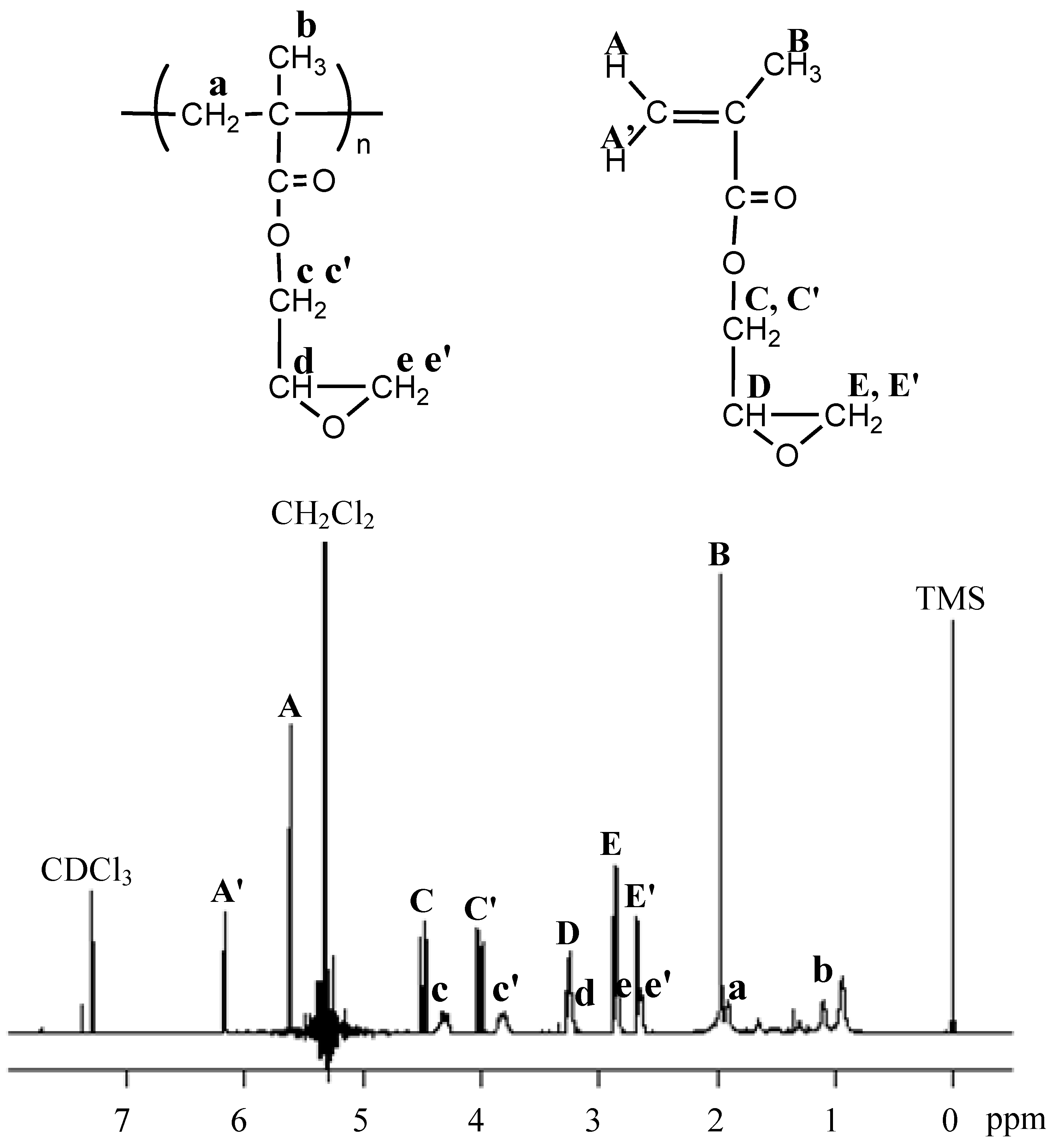
      <p>The photoradical polymerization of GMA was performed using <italic>r</italic>-AMDV as the initiator and MTEMPO as the mediator in the presence of <italic><sup>t</sup></italic>BuS at the molar ratios of MTEMPO/<italic>r</italic>-AMDV = 1.06 and <italic><sup>t</sup></italic>BuS/MTEMPO = 0.530. The bulk polymerization was carried out at room temperature by irradiation using a high-pressure mercury lamp. The orange-colored solution turned colorless within 2 h. After an 8 h polymerization, the stirrer bar stopped rotating, and a solid product was obtained. The monomer conversion was estimated to be 58% by <sup>1</sup>H NMR using the signal intensity at 3.9–3.7 ppm (the polymer, <bold>c'</bold>) and 4.00 ppm (the monomer, <bold>C'</bold>) for one of the two non-equivalent protons of the methylene attached to the ester oxygen (<xref ref-type="fig" rid="polymers-04-01580-f001">Figure 1</xref>). The polymerization produced a polymer with the molecular weight of <italic>M</italic><sub>n</sub> = 13,300 and its distribution of <italic>M</italic><sub>w</sub>/<italic>M</italic><sub>n</sub> = 1.48. On the other hand, the polymerization in the absence of MTEMPO rapidly proceeded to yield a polymer at a 100% conversion within 30 min, however, the resulting polymer contained gel. The molecular weight and its distribution for a THF-soluble part of the gel-containing polymer were <italic>M</italic><sub>n</sub> = 58,700 and <italic>M</italic><sub>w</sub>/<italic>M</italic><sub>n</sub> = 5.08, respectively. This gel production indicates that the uncontrolled polymerization occurred at both the groups; the radical polymerization of the vinyl group and the cationic ring-opening polymerization of the oxirane ring.</p>
      <fig id="polymers-04-01580-f001" position="anchor">
        <label>Figure 1</label>
        <caption>
          <p>The <sup>1</sup>H NMR spectrum of the product containing the monomer and resulting polymer obtained by the MTEMPO-mediated photopolymerization. Solvent: CDCl<sub>3</sub>. </p>
        </caption>
        <graphic xmlns:xlink="http://www.w3.org/1999/xlink" xlink:href="polymers-04-01580-g001.tif"/>
      </fig>
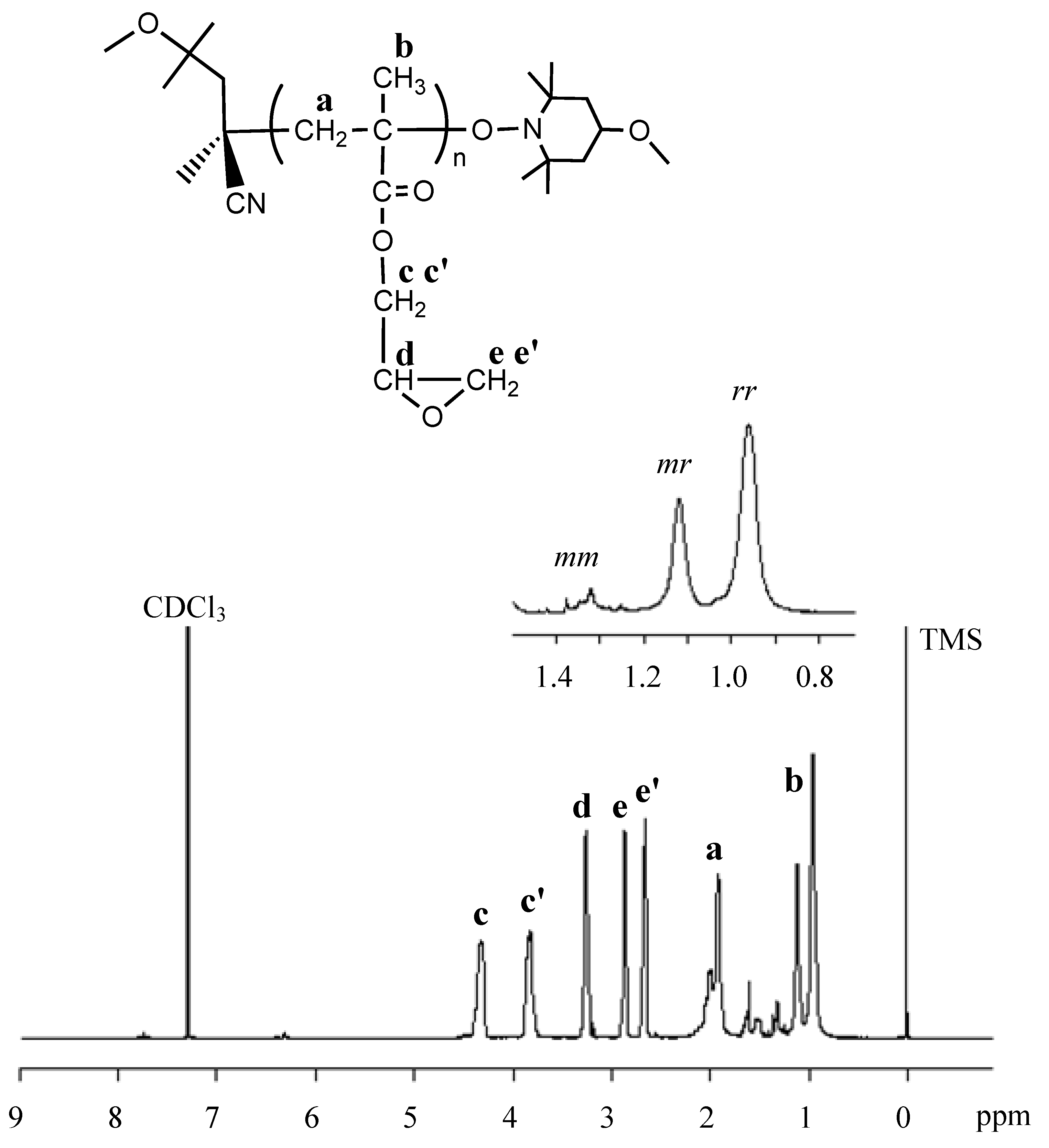
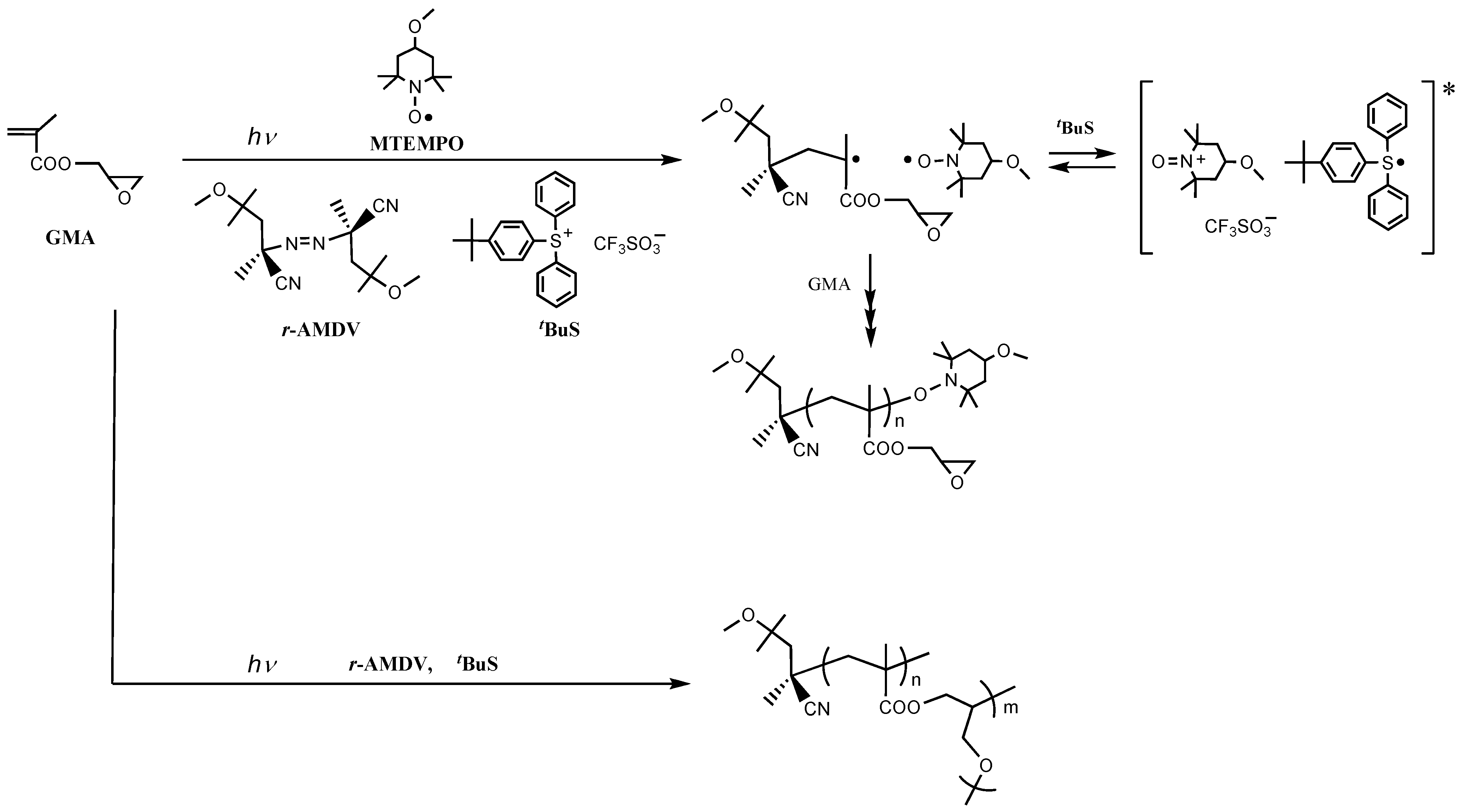
      <p>The <sup>1</sup>H NMR analysis revealed that the MTEMPO-mediated polymerization selectively proceeded at the vinyl group, retaining the oxirane ring. <xref ref-type="fig" rid="polymers-04-01580-f002">Figure 2</xref> shows the <sup>1</sup>H NMR spectrum of the polymer obtained by the MTEMPO-mediated polymerization. Signals originating from the two non-equivalent protons (<bold>c</bold> and <bold>c'</bold>) of the methylene bonded to the ester oxygen were observed at 4.4–4.2 ppm and 3.9–3.7 ppm. A signal attributed to the methine proton (<bold>d</bold>) of the oxirane ring was discerned at 3.3–3.2 ppm, while two non-equivalent proton signals (<bold>e</bold> and <bold>e'</bold>) for the methylene of the ring were observed at 2.9–2.8 ppm (trans) and 2.7–2.6 ppm (cis). The signals at 2.3–1.4 ppm and 1.4–0.7 ppm were based on the methylene (a) and methyl protons (b) of the main chain. These assignments agreed with those for PGMA obtained by the RAFT and free radical polymerizations of the vinyl group [<xref ref-type="bibr" rid="B36-polymers-04-01580">36</xref>,<xref ref-type="bibr" rid="B37-polymers-04-01580">37</xref>]. The presence of the oxirane rings in the polymer structure and good agreement in the ratio of the respective signal intensity with the PGMA structure obtained by the polymerization of the vinyl group indicate that no occurrence of the cationic ring-opening polymerization of the oxirane rings. It has been reported that the triarylsulfonium salt serves as a photoinitiator for the cationic ring-opening polymerization of oxirane monomers [<xref ref-type="bibr" rid="B6-polymers-04-01580">6</xref>,<xref ref-type="bibr" rid="B7-polymers-04-01580">7</xref>,<xref ref-type="bibr" rid="B8-polymers-04-01580">8</xref>]. The structure of the PGMA polymerized at the vinyl group indicates that <italic><sup>t</sup></italic>BuS served as the photoelectron transfer agent for the MTEMPO-mediated polymerization, rather than as the photoinitiator for the cationic ring-opening polymerization of the oxirane ring. The proposed mechanism is shown in <xref ref-type="fig" rid="polymers-04-01580-f005">Scheme 1</xref>. <italic><sup>t</sup></italic>BuS should enhance the polymerization rate by reversibly transferring an electron between MTEMPO and the onium salt. In addition, the MTEMPO-mediated polymerization in the absence of <italic><sup>t</sup></italic>BuS slowly proceeded to produce a polymer at a 38% conversion for 8 h (<italic>M</italic><sub>n</sub> = 11,000, <italic>M</italic><sub>w</sub>/<italic>M</italic><sub>n</sub> = 1.48).</p>
      <fig id="polymers-04-01580-f002" position="anchor">
        <label>Figure 2</label>
        <caption>
          <p>The <sup>1</sup>H NMR spectrum of the poly(glycidyl methacrylate) (PGMA) obtained by the MTEMPO-mediated photopolymerization. Conversion = 58%, <italic>M</italic><sub>n</sub> = 13,300, <italic>M</italic><sub>w</sub>/<italic>M</italic><sub>n</sub> = 1.48. Solvent: CDCl<sub>3</sub>.</p>
        </caption>
        <graphic xmlns:xlink="http://www.w3.org/1999/xlink" xlink:href="polymers-04-01580-g002.tif"/>
      </fig>
      <fig id="polymers-04-01580-f005" position="anchor">
        <object-id pub-id-type="pii">polymers-04-01580-scheme1_Scheme 1</object-id>
        <label>Scheme 1</label>
        <caption>
          <p>The proposed mechanism of the MTEMPO-mediated photopolymerization of glycidyl methacrylate (GMA).</p>
        </caption>
        <graphic xmlns:xlink="http://www.w3.org/1999/xlink" xlink:href="polymers-04-01580-g005.tif"/>
      </fig>
      <p>The tacticity of the PGMA obtained by the MTEMPO-mediated photopolymerization was estimated to be <italic>mm</italic>/<italic>mr</italic>/<italic>rr</italic> = 6/31/63 based on the signal intensity at 1.36–1.19 ppm for <italic>mm</italic>, 1.19–1.02 ppm for <italic>mr</italic>, and 1.02–0.73 ppm for <italic>rr</italic>. This syndiotactic-rich proportion was similar to that of the poly(methyl methacrylate) (<italic>mm</italic>/<italic>mr</italic>/<italic>rr</italic> = 3/28/69 for a 58% conversion, <italic>M</italic><sub>n</sub> = 11,300, <italic>M</italic><sub>w</sub>/<italic>M</italic><sub>n</sub> = 1.43) obtained by the MTEMPO-mediated polymerization under identical conditions [<xref ref-type="bibr" rid="B14-polymers-04-01580">14</xref>]. </p>
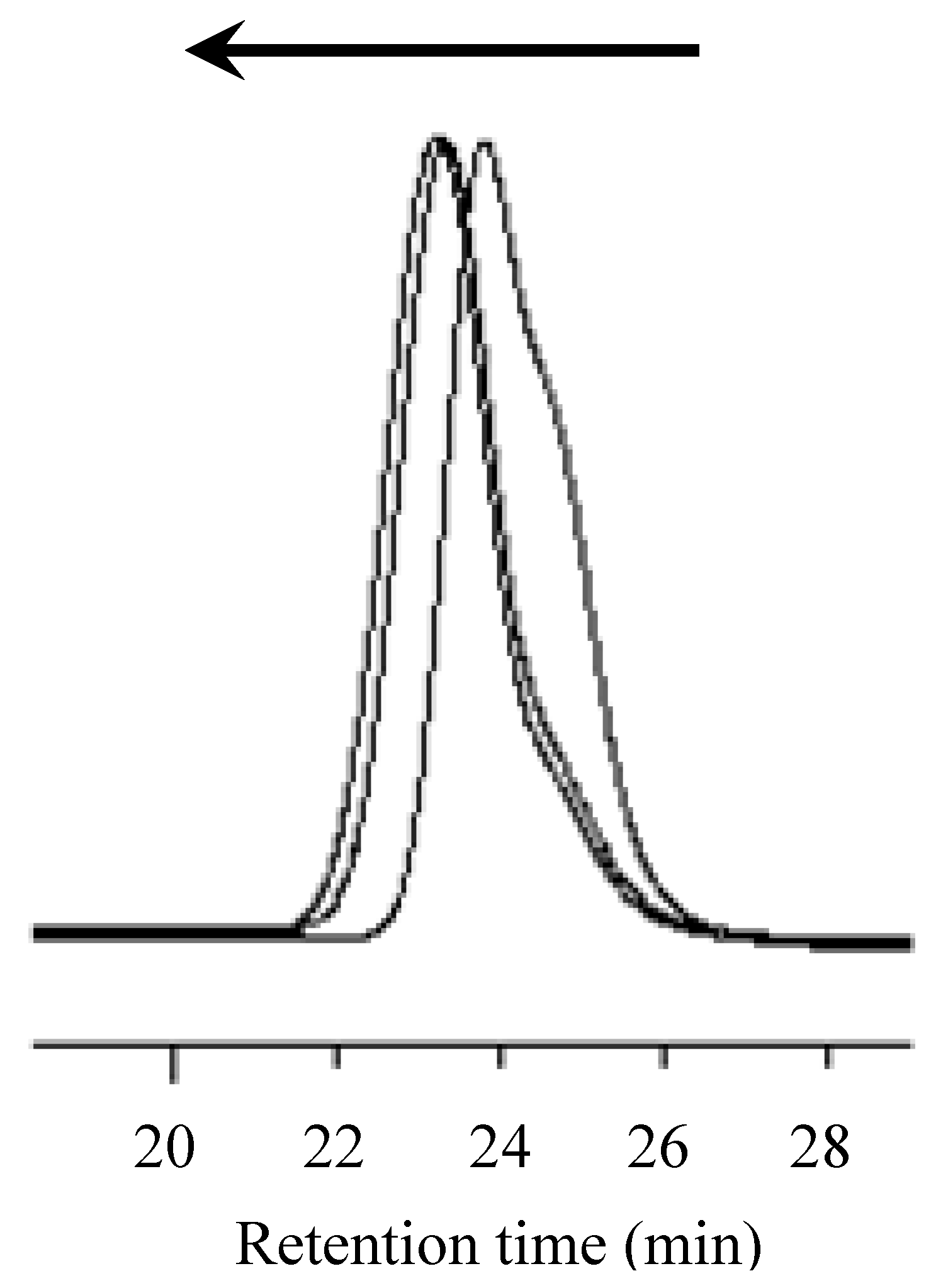
      <p>In order to evaluate the livingness of the polymerization, the correlation between the monomer conversion and the molecular weight of the resulting polymers was investigated. <xref ref-type="fig" rid="polymers-04-01580-f003">Figure 3</xref> shows the gel permeation chromatography (GPC) profiles of the polymers obtained by the polymerization for 4 h (conversion = 17%), 5 h (43%), and 8 h (58%). The curves were shifted to the higher molecular weight side with an increase in the conversion, implying the living nature of the polymerization. It is suggested that the MTEMPO-mediated photoradical polymerization of GMA in the presence of <italic><sup>t</sup></italic>BuS selectively proceeded at the vinyl group in accordance with a controlled/living mechanism.</p>
      
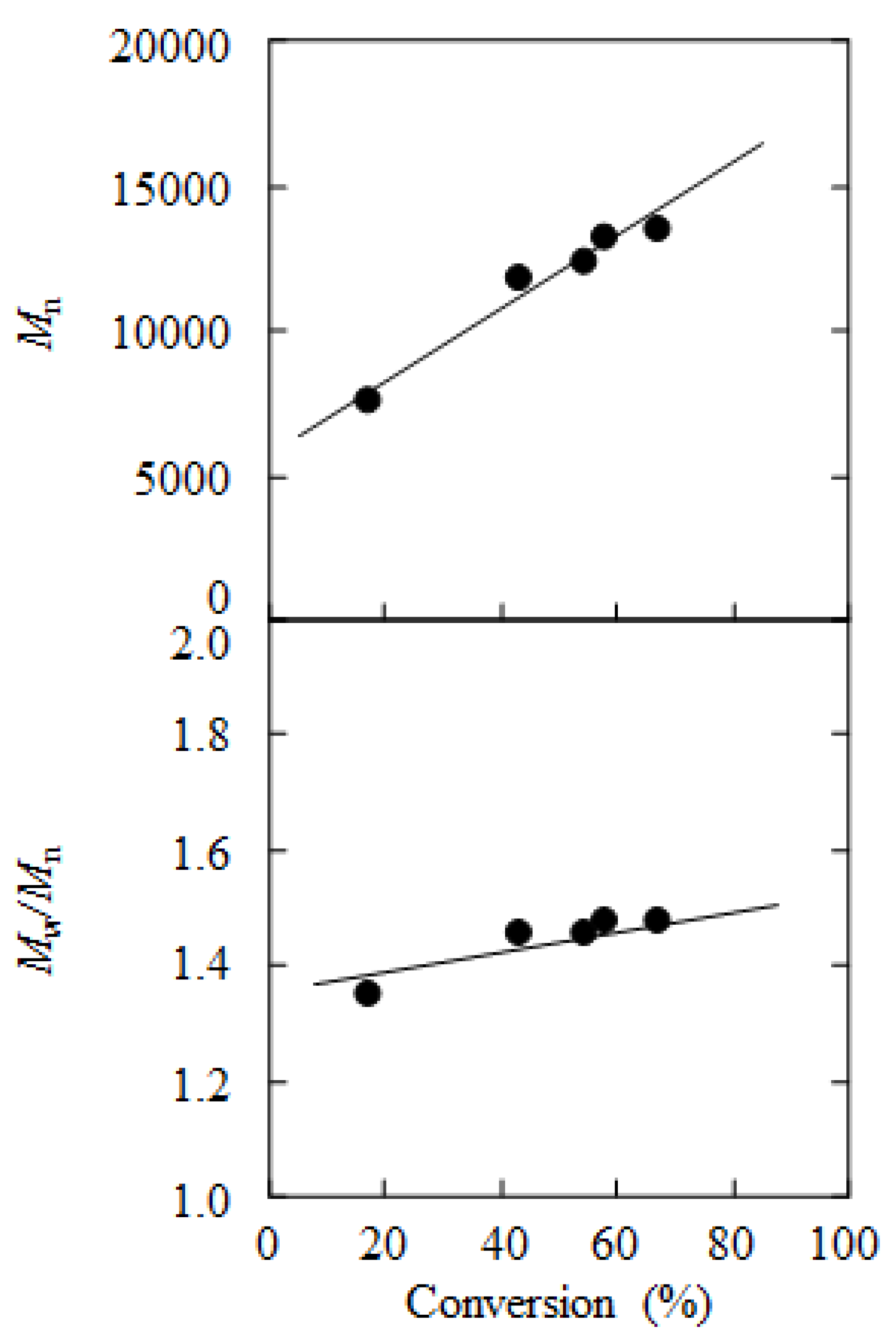
      <p>The correlation of the conversion and the molecular weight of the polymer is shown in <xref ref-type="fig" rid="polymers-04-01580-f004">Figure 4</xref>. The molecular weight linearly increased versus the conversion, although the line for the plots did not pass through zero. This phenomenon can be accounted for by the previous study of the MTEMPO-mediated polymerization; oligomers are formed under a non-steady state during the very early polymerization [<xref ref-type="bibr" rid="B12-polymers-04-01580">12</xref>,<xref ref-type="bibr" rid="B18-polymers-04-01580">18</xref>]. However, the molecular weight distribution remained at around 1.4 during the polymerization. The linear increase in the conversion-molecular weight plots and constant molecular weight distribution imply a controlled/living mechanism of the polymerization.</p>
      <fig id="polymers-04-01580-f003" position="anchor">
        <label>Figure 3</label>
        <caption>
          <p>Gel permeation chromatography (GPC) profiles of the PGMA for each conversion: 17% (4 h), 43% (5 h), and 58% (8 h) from the right.</p>
        </caption>
        <graphic xmlns:xlink="http://www.w3.org/1999/xlink" xlink:href="polymers-04-01580-g003.tif"/>
      </fig>
      <fig id="polymers-04-01580-f004" position="anchor">
        <label>Figure 4</label>
        <caption>
          <p>The plots of the molecular weight and its distribution <italic>vs.</italic> the conversion for the MTEMPO-mediated photopolymerization of GMA. MTEMPO/<italic>r</italic>-AMDV = 1.06, <italic><sup>t</sup></italic>BuS/MTEMPO = 0.53. Where<italic><sup> t</sup></italic>BuS was (4-<italic>tert</italic>-butylphenyl)diphenylsulfonium triflate, <italic>r</italic>-AMDV was (2RS,2'RS)-Azobis(4-methoxy-2,4-dimethylvaleronitrile. </p>
        </caption>
        <graphic xmlns:xlink="http://www.w3.org/1999/xlink" xlink:href="polymers-04-01580-g004.tif"/>
      </fig>
    </sec>
    <sec>
      <title>3. Experimental Section</title>
      <p><italic>Instrumentation:</italic> The photopolymerization was carried out using a Wacom HX-500 illuminator with a 500 W high-pressure mercury lamp (BMO-500D1, Wacom Co. Ltd.). Gel permeation chromatography (GPC) was performed using a Tosoh GPC-8020 instrument equipped with a DP-8020 dual pump, a CO-8020 column oven, and a RI-8020 refractometer. Three polystyrene gel columns, Tosoh TSKGEL G2000H<sub>XL</sub>, G4000H<sub>XL</sub>, and G6000H<sub>XL</sub> were used with tetrahydrofuran (THF) as the eluent at 40 °C. <sup>1</sup>H NMR measurements were conducted using Varian 300 and Jeol ECS 400 FT NMR spectrometers. </p>
      <p><italic>Materials</italic><italic>: </italic>(2RS,2'RS)-Azobis(4-methoxy-2,4-dimethylvaleronitrile) (<italic>r</italic>-AMDV) was obtained by separation from a mixture of the racemic and meso forms of 2,2'-azobis(4-methoxy-2,4-dimethylvaleronitrile) [<xref ref-type="bibr" rid="B38-polymers-04-01580">38</xref>]. MTEMPO was prepared as reported previously [<xref ref-type="bibr" rid="B39-polymers-04-01580">39</xref>]. GMA was distilled over calcium hydride under reduced pressure. <italic><sup>t</sup></italic>BuS was purchased from Sigma-Aldrich and used as received.</p>
      <p><italic>MTEMPO-mediated photopolymerization: General procedure </italic>GMA (1.042 g, 7.33 mmol), <italic>r</italic>-AMDV (14.0 mg, 0.0454 mmol), MTEMPO (9.0 mg, 0.0483 mmol), and <italic><sup>t</sup></italic>BuS (12.0 mg, 0.0256 mmol) were placed in an ampoule. The contents were degassed the contents several times by a freeze-pump-thaw cycle, and the ampoule was sealed under vacuum. The bulk polymerization was carried out at room temperature for 8 h with irradiation by reflective light using a mirror with a 500 W high-pressure mercury lamp. Dichloromethane (10 mL) was added to the product to dissolve it. Part of the dichloromethane solution (1 mL) was withdrawn using a syringe to determine the conversion by <sup>1</sup>H NMR. The residual solution was concentrated by an evaporator to <italic>ca.</italic> 3 mL and was poured into methanol (500 mL) to isolate a polymer. The precipitates were collected by filtration and dried <italic>in vacuo</italic> for several hours to obtain a polymer (594.0 mg).</p>
      <p><italic>Photopolymerization in the absence of MTEMPO</italic>: GMA (1.042 g, 7.33 mmol), <italic>r</italic>-AMDV (14.0 mg, 0.0454 mmol), and <italic><sup>t</sup></italic>BuS (12.0 mg, 0.0256 mmol) were placed in an ampoule. The contents were degassed the contents several times by a freeze-pump-thaw cycle, and the ampoule was sealed under vacuum. The bulk polymerization was carried out at room temperature for 30 min with irradiation by reflective light using a mirror with a 500 W high-pressure mercury lamp. Dichloromethane (10 mL) was added to the gel-containing product to swell it. The product was poured into methanol (500 mL) to isolate a polymer. The precipitates were collected by filtration and dried <italic>in vacuo</italic> for several hours to obtain a polymer (1.047 g). The conversion was estimated gravimetrically.</p>
    </sec>
    <sec sec-type="conclusions">
      <title>4. Conclusions</title>
      <p>The controlled/living photoradical polymerization of GMA was attained using the MTEMPO mediator in the presence of <italic><sup>t</sup></italic>BuS. The polymerization selectively proceeded in a radical manner to produce a polymer bonded at the vinyl site. No occurrence of the cationic ring-opening photopolymerization of the oxirane ring even in the presence of the onium salt indicated that the onium salt did not serve as the photo-acid generator, but as the photoelectron transfer agent between MTEMPO in the excited state at the propagating chain end. This electron transfer from MTEMPO to the onium salt resulted in enhancement of the polymerization rate. The living nature of the polymerization was confirmed on the basis of the linear increase in the conversion-molecular weight plots, coupled with the constant molecular weight distribution, and GPC analysis.</p>
    </sec>
   
  </body>
  <back>
   <ack>
      <title>Acknowledgments</title>
      <p>The author is thankful for Shiseido Female Researcher Science Grant.</p>
    </ack>
    <ref-list>
      <title>References</title>
      <ref id="B1-polymers-04-01580">
        <label>1.</label>
        <citation citation-type="journal">
          <person-group person-group-type="author">
            <name>
              <surname>Meier</surname>
              <given-names>K.</given-names>
            </name>
            <name>
              <surname>Zweifel</surname>
              <given-names>H.</given-names>
            </name>
          </person-group>
          <article-title>Imaging with iron arene photoinitiators</article-title>
          <source>J. Imag. Sci.</source>
          <year>1986</year>
          <volume>30</volume>
          <fpage>174</fpage>
          <lpage>177</lpage>
        </citation>
      </ref>
      <ref id="B2-polymers-04-01580">
        <label>2.</label>
        <citation citation-type="journal">
          <person-group person-group-type="author">
            <name>
              <surname>Xu</surname>
              <given-names>F.</given-names>
            </name>
            <name>
              <surname>Cai</surname>
              <given-names>Q.</given-names>
            </name>
            <name>
              <surname>Li</surname>
              <given-names>Y.</given-names>
            </name>
            <name>
              <surname>Kang</surname>
              <given-names>E.</given-names>
            </name>
            <name>
              <surname>Neoh</surname>
              <given-names>K.G.</given-names>
            </name>
          </person-group>
          <article-title>Covalent immobilization of glucose oxidase on well-defined poly(glycidyl methacrylate)−Si(111) hybrids from surface-initiated atom-transfer radical polymerization</article-title>
          <source>Biomacromolecules</source>
          <year>2005</year>
          <volume>6</volume>
          <fpage>1012</fpage>
          <lpage>1020</lpage>
          <pub-id pub-id-type="doi">10.1021/bm0493178</pub-id>
        </citation>
      </ref>
      <ref id="B3-polymers-04-01580">
        <label>3.</label>
        <citation citation-type="journal">
          <person-group person-group-type="author">
            <name>
              <surname>Kihara</surname>
              <given-names>H.</given-names>
            </name>
            <name>
              <surname>Endo</surname>
              <given-names>T.</given-names>
            </name>
          </person-group>
          <article-title>Incorporation of carbon dioxide into poly(glycidyl methacrylate)</article-title>
          <source>Macromolecules</source>
          <year>1992</year>
          <volume>25</volume>
          <fpage>4824</fpage>
          <lpage>4825</lpage>
          <pub-id pub-id-type="doi">10.1021/ma00044a053</pub-id>
        </citation>
      </ref>
      <ref id="B4-polymers-04-01580">
        <label>4.</label>
        <citation citation-type="journal">
          <person-group person-group-type="author">
            <name>
              <surname>Crivello</surname>
              <given-names>J.V.</given-names>
            </name>
          </person-group>
          <article-title>Cationic photopolymerization of alkyl glycidyl ethers</article-title>
          <source>J. Polym. Sci. A Polym. Chem.</source>
          <year>2006</year>
          <volume>44</volume>
          <fpage>3036</fpage>
          <lpage>3052</lpage>
          <pub-id pub-id-type="doi">10.1002/pola.21419</pub-id>
        </citation>
      </ref>
      <ref id="B5-polymers-04-01580">
        <label>5.</label>
        <citation citation-type="journal">
          <person-group person-group-type="author">
            <name>
              <surname>Crivello</surname>
              <given-names>J.V.</given-names>
            </name>
          </person-group>
          <article-title>Design and synthesis of multifunctional glycidyl ethers that undergo frontal polymerization</article-title>
          <source>J. Polym. Sci. A Polym. Chem.</source>
          <year>2006</year>
          <volume>44</volume>
          <fpage>6435</fpage>
          <lpage>6448</lpage>
          <pub-id pub-id-type="doi">10.1002/pola.21761</pub-id>
        </citation>
      </ref>
      <ref id="B6-polymers-04-01580">
        <label>6.</label>
        <citation citation-type="journal">
          <person-group person-group-type="author">
            <name>
              <surname>Crivello</surname>
              <given-names>J.V.</given-names>
            </name>
          </person-group>
          <article-title>The discovery and development of onium salt cationic photoinitiators</article-title>
          <source>J. Polym. Sci. A Polym. Chem.</source>
          <year>1999</year>
          <volume>37</volume>
          <fpage>4241</fpage>
          <lpage>4254</lpage>
          <pub-id pub-id-type="doi">10.1002/(SICI)1099-0518(19991201)37:23&lt;4241::AID-POLA1&gt;3.0.CO;2-R</pub-id>
        </citation>
      </ref>
      <ref id="B7-polymers-04-01580">
        <label>7.</label>
        <citation citation-type="journal">
          <person-group person-group-type="author">
            <name>
              <surname>Lazauskaite</surname>
              <given-names>R.</given-names>
            </name>
            <name>
              <surname>Stanislovaityte</surname>
              <given-names>E.</given-names>
            </name>
            <name>
              <surname>Grazulevicius</surname>
              <given-names>J.V.</given-names>
            </name>
          </person-group>
          <article-title>Cationic photopolymerization of 1,3-di(9-carbazolyl)-2-propanol glycidyl ether</article-title>
          <source>Monatsh. Chem.</source>
          <year>2008</year>
          <volume>139</volume>
          <fpage>887</fpage>
          <lpage>893</lpage>
          <pub-id pub-id-type="doi">10.1007/s00706-008-0852-1</pub-id>
        </citation>
      </ref>
      <ref id="B8-polymers-04-01580">
        <label>8.</label>
        <citation citation-type="journal">
          <person-group person-group-type="author">
            <name>
              <surname>Ionescu-Vasii</surname>
              <given-names>L.L.</given-names>
            </name>
            <name>
              <surname>Dimonie</surname>
              <given-names>M.D.</given-names>
            </name>
            <name>
              <surname>Abadie</surname>
              <given-names>M.J.M.</given-names>
            </name>
          </person-group>
          <article-title>Kinetic model of photoinitiated polymerization of phenyl glycidyl ether monomer</article-title>
          <source>Polym. Int.</source>
          <year>2008</year>
          <volume>47</volume>
          <fpage>221</fpage>
          <lpage>225</lpage>
        </citation>
      </ref>
      <ref id="B9-polymers-04-01580">
        <label>9.</label>
        <citation citation-type="journal">
          <person-group person-group-type="author">
            <name>
              <surname>Meier</surname>
              <given-names>K.</given-names>
            </name>
            <name>
              <surname>Zweifel</surname>
              <given-names>H.</given-names>
            </name>
          </person-group>
          <article-title>Photoinitiated cationic polymerization of epoxides with iron-arene complexes</article-title>
          <source>J. Rad. Curing</source>
          <year>1986</year>
          <volume>13</volume>
          <fpage>26</fpage>
          <lpage>32</lpage>
        </citation>
      </ref>
      <ref id="B10-polymers-04-01580">
        <label>10.</label>
        <citation citation-type="journal">
          <person-group person-group-type="author">
            <name>
              <surname>Yoshida</surname>
              <given-names>E.</given-names>
            </name>
          </person-group>
          <article-title>Photo-living radical polymerization of methyl methacrylate by a nitroxide mediator</article-title>
          <source>Colloid Polym. Sci.</source>
          <year>2008</year>
          <volume>286</volume>
          <fpage>1663</fpage>
          <lpage>1666</lpage>
          <pub-id pub-id-type="doi">10.1007/s00396-008-1930-y</pub-id>
        </citation>
      </ref>
      <ref id="B11-polymers-04-01580">
        <label>11.</label>
        <citation citation-type="journal">
          <person-group person-group-type="author">
            <name>
              <surname>Yoshida</surname>
              <given-names>E.</given-names>
            </name>
          </person-group>
          <article-title>Photo-living radical polymerization of methyl methacrylate by 2,2,6,6-tetramethylpiperidine-1-oxyl in the presence of a photo-acid generator</article-title>
          <source>Colloid Polym. Sci.</source>
          <year>2009</year>
          <volume>287</volume>
          <fpage>767</fpage>
          <lpage>772</lpage>
          <pub-id pub-id-type="doi">10.1007/s00396-009-2023-2</pub-id>
        </citation>
      </ref>
      <ref id="B12-polymers-04-01580">
        <label>12.</label>
        <citation citation-type="journal">
          <person-group person-group-type="author">
            <name>
              <surname>Yoshida</surname>
              <given-names>E.</given-names>
            </name>
          </person-group>
          <article-title>Photo-living radical polymerization of methyl methacrylate using alkoxyamine as an initiator</article-title>
          <source>Colloid Polym. Sci.</source>
          <year>2010</year>
          <volume>288</volume>
          <fpage>7</fpage>
          <lpage>13</lpage>
          <pub-id pub-id-type="doi">10.1007/s00396-009-2113-1</pub-id>
        </citation>
      </ref>
      <ref id="B13-polymers-04-01580">
        <label>13.</label>
        <citation citation-type="journal">
          <person-group person-group-type="author">
            <name>
              <surname>Yoshida</surname>
              <given-names>E.</given-names>
            </name>
          </person-group>
          <article-title>Nitroxide-mediated photo-living radical polymerization of vinyl acetate</article-title>
          <source>Colloid Polym. Sci.</source>
          <year>2010</year>
          <volume>288</volume>
          <fpage>73</fpage>
          <lpage>78</lpage>
          <pub-id pub-id-type="doi">10.1007/s00396-009-2123-z</pub-id>
        </citation>
      </ref>
      <ref id="B14-polymers-04-01580">
        <label>14.</label>
        <citation citation-type="journal">
          <person-group person-group-type="author">
            <name>
              <surname>Yoshida</surname>
              <given-names>E.</given-names>
            </name>
          </person-group>
          <article-title>Nitroxide-mediated photo-living radical polymerization of methyl methacrylate using (4-<italic>tert</italic>-butylphenyl)diphenylsulfonium triflate as a photo-acid generator</article-title>
          <source>Colloid Polym. Sci.</source>
          <year>2010</year>
          <volume>288</volume>
          <fpage>239</fpage>
          <lpage>243</lpage>
          <pub-id pub-id-type="doi">10.1007/s00396-009-2161-6</pub-id>
        </citation>
      </ref>
      <ref id="B15-polymers-04-01580">
        <label>15.</label>
        <citation citation-type="journal">
          <person-group person-group-type="author">
            <name>
              <surname>Yoshida</surname>
              <given-names>E.</given-names>
            </name>
          </person-group>
          <article-title>Effect of azoinitiators on nitroxide-mediated photo-living radical polymerization of methyl methacrylate</article-title>
          <source>Colloid Polym. Sci.</source>
          <year>2010</year>
          <volume>288</volume>
          <fpage>341</fpage>
          <lpage>345</lpage>
          <pub-id pub-id-type="doi">10.1007/s00396-009-2163-4</pub-id>
        </citation>
      </ref>
      <ref id="B16-polymers-04-01580">
        <label>16.</label>
        <citation citation-type="journal">
          <person-group person-group-type="author">
            <name>
              <surname>Yoshida</surname>
              <given-names>E.</given-names>
            </name>
          </person-group>
          <article-title>Effects of initiators and photo-acid generators on nitroxide-mediated photo-living radical polymerization of methyl methacrylate</article-title>
          <source>Colloid Polym. Sci.</source>
          <year>2010</year>
          <volume>288</volume>
          <fpage>901</fpage>
          <lpage>905</lpage>
          <pub-id pub-id-type="doi">10.1007/s00396-010-2220-z</pub-id>
        </citation>
      </ref>
      <ref id="B17-polymers-04-01580">
        <label>17.</label>
        <citation citation-type="journal">
          <person-group person-group-type="author">
            <name>
              <surname>Yoshida</surname>
              <given-names>E.</given-names>
            </name>
          </person-group>
          <article-title>Stability of growing polymer chain ends for nitroxide-mediated photo-living radical polymerization</article-title>
          <source>Colloid Polym. Sci.</source>
          <year>2010</year>
          <volume>288</volume>
          <fpage>1027</fpage>
          <lpage>1030</lpage>
          <pub-id pub-id-type="doi">10.1007/s00396-010-2230-x</pub-id>
        </citation>
      </ref>
      <ref id="B18-polymers-04-01580">
        <label>18.</label>
        <citation citation-type="journal">
          <person-group person-group-type="author">
            <name>
              <surname>Yoshida</surname>
              <given-names>E.</given-names>
            </name>
          </person-group>
          <article-title>Nitroxide-mediated photo-living radical polymerization of methyl methacrylate in solution</article-title>
          <source>Colloid Polym. Sci.</source>
          <year>2010</year>
          <volume>288</volume>
          <fpage>1639</fpage>
          <lpage>1643</lpage>
          <pub-id pub-id-type="doi">10.1007/s00396-010-2287-6</pub-id>
        </citation>
      </ref>
      <ref id="B19-polymers-04-01580">
        <label>19.</label>
        <citation citation-type="journal">
          <person-group person-group-type="author">
            <name>
              <surname>Yoshida</surname>
              <given-names>E.</given-names>
            </name>
          </person-group>
          <article-title>Nitroxide-mediated photo-living radical polymerization of methyl methacrylate in the presence of (η<sup>6</sup>-benzene)(η<sup>5</sup>-cyclopentadienyl)Fe<sup>II</sup> hexafluorophosphate</article-title>
          <source>Colloid Polym. Sci.</source>
          <year>2010</year>
          <volume>288</volume>
          <fpage>1745</fpage>
          <lpage>1749</lpage>
          <pub-id pub-id-type="doi">10.1007/s00396-010-2292-9</pub-id>
        </citation>
      </ref>
      <ref id="B20-polymers-04-01580">
        <label>20.</label>
        <citation citation-type="journal">
          <person-group person-group-type="author">
            <name>
              <surname>Yoshida</surname>
              <given-names>E.</given-names>
            </name>
          </person-group>
          <article-title>Nitroxide-mediated photo-controlled/living radical polymerization of ethyl acrylate</article-title>
          <source>Colloid Polym. Sci.</source>
          <year>2011</year>
          <volume>289</volume>
          <fpage>1127</fpage>
          <lpage>1132</lpage>
          <pub-id pub-id-type="doi">10.1007/s00396-011-2435-7</pub-id>
        </citation>
      </ref>
      <ref id="B21-polymers-04-01580">
        <label>21.</label>
        <citation citation-type="journal">
          <person-group person-group-type="author">
            <name>
              <surname>Yoshida</surname>
              <given-names>E.</given-names>
            </name>
          </person-group>
          <article-title>Nitroxide-mediated photo-controlled/living radical dispersion polymerization of methyl methacrylate</article-title>
          <source>Colloid Polym. Sci.</source>
          <year>2011</year>
          <volume>289</volume>
          <fpage>1625</fpage>
          <lpage>1630</lpage>
          <pub-id pub-id-type="doi">10.1007/s00396-011-2487-8</pub-id>
        </citation>
      </ref>
      <ref id="B22-polymers-04-01580">
        <label>22.</label>
        <citation citation-type="journal">
          <person-group person-group-type="author">
            <name>
              <surname>Yoshida</surname>
              <given-names>E.</given-names>
            </name>
          </person-group>
          <article-title>Photo-controlled/living radical polymerization of <italic>tert</italic>-butyl methacrylate in the presence of a photo-acid generator using a nitroxide mediator</article-title>
          <source>Colloid Polym. Sci.</source>
          <year>2012</year>
          <volume>290</volume>
          <fpage>661</fpage>
          <lpage>665</lpage>
          <pub-id pub-id-type="doi">10.1007/s00396-012-2605-2</pub-id>
        </citation>
      </ref>
      <ref id="B23-polymers-04-01580">
        <label>23.</label>
        <citation citation-type="journal">
          <person-group person-group-type="author">
            <name>
              <surname>Yoshida</surname>
              <given-names>E.</given-names>
            </name>
          </person-group>
          <article-title>Aqueous photo-living radical polymerization of sodium methacrylate using a water-soluble nitroxide mediator</article-title>
          <source>Int. Sch. Res. Netw. ISRN Polym. Sci.</source>
          <year>2012</year>
          <comment>submitted</comment>
        </citation>
      </ref>
      <ref id="B24-polymers-04-01580">
        <label>24.</label>
        <citation citation-type="journal">
          <person-group person-group-type="author">
            <name>
              <surname>Yoshida</surname>
              <given-names>E.</given-names>
            </name>
          </person-group>
          <article-title>Effects of illuminance and heat rays on photo-controlled/living radical polymerization mediated by 4-methoxy-2,2,6,6-tetramethylpiperidine-1-oxyl</article-title>
          <source>Int. Sch. Res. Netw. ISRN Polym. Sci.</source>
          <year>2012</year>
          <comment>submitted</comment>
        </citation>
      </ref>
      <ref id="B25-polymers-04-01580">
        <label>25.</label>
        <citation citation-type="journal">
          <person-group person-group-type="author">
            <name>
              <surname>Yoshida</surname>
              <given-names>E.</given-names>
            </name>
          </person-group>
          <article-title>Synthesis of poly(methyl methacrylate)-block-poly(tetrahydrofuran) by photo-living radical polymerization using a 2,2,6,6-tetramethylpiperidine-1-oxyl macromediator</article-title>
          <source>Colloid Polym Sci.</source>
          <year>2009</year>
          <volume>287</volume>
          <fpage>1417</fpage>
          <lpage>1424</lpage>
          <pub-id pub-id-type="doi">10.1007/s00396-009-2105-1</pub-id>
        </citation>
      </ref>
      <ref id="B26-polymers-04-01580">
        <label>26.</label>
        <citation citation-type="journal">
          <person-group person-group-type="author">
            <name>
              <surname>Yoshida</surname>
              <given-names>E.</given-names>
            </name>
          </person-group>
          <article-title>Graft copolymerization of methyl methacrylate on polystyrene backbone through nitroxide-mediated photo-living radical polymerization</article-title>
          <source>Colloid Polym. Sci.</source>
          <year>2011</year>
          <volume>289</volume>
          <fpage>837</fpage>
          <lpage>841</lpage>
          <pub-id pub-id-type="doi">10.1007/s00396-011-2385-0</pub-id>
        </citation>
      </ref>
      <ref id="B27-polymers-04-01580">
        <label>27.</label>
        <citation citation-type="journal">
          <person-group person-group-type="author">
            <name>
              <surname>Rodrigues</surname>
              <given-names>M.R.</given-names>
            </name>
            <name>
              <surname>Neumann</surname>
              <given-names>M.G.</given-names>
            </name>
          </person-group>
          <article-title>Cationic photopolymerization of tetrahydrofuran: A mechanistic study on the use of a sulfonium salt-phenothiazine initiation system</article-title>
          <source>J. Polym. Sci. Polym. Chem.</source>
          <year>2001</year>
          <volume>39</volume>
          <fpage>46</fpage>
          <lpage>55</lpage>
          <pub-id pub-id-type="doi">10.1002/1099-0518(20010101)39:1&lt;46::AID-POLA50&gt;3.0.CO;2-S</pub-id>
        </citation>
      </ref>
      <ref id="B28-polymers-04-01580">
        <label>28.</label>
        <citation citation-type="journal">
          <person-group person-group-type="author">
            <name>
              <surname>Rodrigues</surname>
              <given-names>M.R.</given-names>
            </name>
            <name>
              <surname>Neumann</surname>
              <given-names>M.G.</given-names>
            </name>
          </person-group>
          <article-title>Mechanistic study of tetrahydrofuran polymerization photoinitiated by a sulfonium salt/thioxanthone system</article-title>
          <source>Macromol. Chem. Phys.</source>
          <year>2001</year>
          <volume>202</volume>
          <fpage>2776</fpage>
          <lpage>2782</lpage>
          <pub-id pub-id-type="doi">10.1002/1521-3935(20010901)202:13&lt;2776::AID-MACP2776&gt;3.0.CO;2-H</pub-id>
        </citation>
      </ref>
      <ref id="B29-polymers-04-01580">
        <label>29.</label>
        <citation citation-type="journal">
          <person-group person-group-type="author">
            <name>
              <surname>Guo</surname>
              <given-names>H.</given-names>
            </name>
            <name>
              <surname>Kajiwara</surname>
              <given-names>A.</given-names>
            </name>
            <name>
              <surname>Morishima</surname>
              <given-names>Y.</given-names>
            </name>
            <name>
              <surname>Kamachi</surname>
              <given-names>M.</given-names>
            </name>
          </person-group>
          <article-title>Radical/cation transformation polymerization and its application to the preparation of block copolymers of <italic>p</italic>-methoxystyrene and cyclohexene oxide</article-title>
          <source>Macromolecules</source>
          <year>1996</year>
          <volume>29</volume>
          <fpage>2354</fpage>
          <lpage>2358</lpage>
          <pub-id pub-id-type="doi">10.1021/ma951096y</pub-id>
        </citation>
      </ref>
      <ref id="B30-polymers-04-01580">
        <label>30.</label>
        <citation citation-type="journal">
          <person-group person-group-type="author">
            <name>
              <surname>Endo</surname>
              <given-names>T.</given-names>
            </name>
            <name>
              <surname>Miyazawa</surname>
              <given-names>T.</given-names>
            </name>
            <name>
              <surname>Shiihashi</surname>
              <given-names>S.</given-names>
            </name>
            <name>
              <surname>Okawara</surname>
              <given-names>M.</given-names>
            </name>
          </person-group>
          <article-title>Oxidation of hydroxide ion by immonium oxide</article-title>
          <source>J. Am. Chem. Soc.</source>
          <year>1984</year>
          <volume>106</volume>
          <fpage>6732</fpage>
          <lpage>6734</lpage>
        </citation>
      </ref>
      <ref id="B31-polymers-04-01580">
        <label>31.</label>
        <citation citation-type="journal">
          <person-group person-group-type="author">
            <name>
              <surname>Semmelhack</surname>
              <given-names>M.F.</given-names>
            </name>
            <name>
              <surname>Schmid</surname>
              <given-names>C.R.</given-names>
            </name>
          </person-group>
          <article-title>Nitroxy-mediated electrooxidation of amines to nitriles and carbonyl compounds</article-title>
          <source>J. Am. Chem. Soc.</source>
          <year>1983</year>
          <volume>105</volume>
          <fpage>3877</fpage>
          <lpage>3878</lpage>
        </citation>
      </ref>
      <ref id="B32-polymers-04-01580">
        <label>32.</label>
        <citation citation-type="journal">
          <person-group person-group-type="author">
            <name>
              <surname>Semmelhack</surname>
              <given-names>M.F.</given-names>
            </name>
            <name>
              <surname>Chou</surname>
              <given-names>C.S.</given-names>
            </name>
            <name>
              <surname>Cortes</surname>
              <given-names>D.A.</given-names>
            </name>
          </person-group>
          <article-title>Nitroxy-mediated electrooxidation of aalcohols to aldehydes and ketones</article-title>
          <source>J. Am. Chem. Soc.</source>
          <year>1983</year>
          <volume>105</volume>
          <fpage>4492</fpage>
          <lpage>4494</lpage>
        <pub-id pub-id-type="doi">10.1021/ja00351a070</pub-id></citation>
      </ref>
      <ref id="B33-polymers-04-01580">
        <label>33.</label>
        <citation citation-type="journal">
          <person-group person-group-type="author">
            <name>
              <surname>Pappas</surname>
              <given-names>S.P.</given-names>
            </name>
            <name>
              <surname>Gatechair</surname>
              <given-names>L.R.</given-names>
            </name>
            <name>
              <surname>Jilek</surname>
              <given-names>J.H.</given-names>
            </name>
          </person-group>
          <article-title>Photoinitiation of cationic polymerization. III. Photosensitization of diphenyliodonium and triphenylsulfonium salts</article-title>
          <source>J. Polym. Sci. Polym. Chem.</source>
          <year>1984</year>
          <volume>22</volume>
          <fpage>77</fpage>
          <lpage>84</lpage>
        <pub-id pub-id-type="doi">10.1002/pol.1984.170220108</pub-id></citation>
      </ref>
      <ref id="B34-polymers-04-01580">
        <label>34.</label>
        <citation citation-type="journal">
          <person-group person-group-type="author">
            <name>
              <surname>McKinney</surname>
              <given-names>P.S.</given-names>
            </name>
            <name>
              <surname>Rosenthal</surname>
              <given-names>S.</given-names>
            </name>
          </person-group>
          <article-title>The electrochemical reduction of the triphenylsulfonium ion</article-title>
          <source>J. Electroanal. Chem.</source>
          <year>1968</year>
          <volume>16</volume>
          <fpage>261</fpage>
          <lpage>270</lpage>
          <pub-id pub-id-type="doi">10.1016/S0022-0728(68)80066-X</pub-id>
        </citation>
      </ref>
      <ref id="B35-polymers-04-01580">
        <label>35.</label>
        <citation citation-type="journal">
          <person-group person-group-type="author">
            <name>
              <surname>Crivello</surname>
              <given-names>J.V.</given-names>
            </name>
            <name>
              <surname>Sangermano</surname>
              <given-names>M.</given-names>
            </name>
          </person-group>
          <article-title>Visible and long-wavelength photoinitiated cationic polymerization</article-title>
          <source>J. Polym. Sci. Polym. Chem.</source>
          <year>2001</year>
          <volume>39</volume>
          <fpage>343</fpage>
          <lpage>356</lpage>
          <pub-id pub-id-type="doi">10.1002/1099-0518(20010201)39:3&lt;343::AID-POLA1001&gt;3.0.CO;2-J</pub-id>
        </citation>
      </ref>
      <ref id="B36-polymers-04-01580">
        <label>36.</label>
        <citation citation-type="journal">
          <person-group person-group-type="author">
            <name>
              <surname>Yin</surname>
              <given-names>H.</given-names>
            </name>
            <name>
              <surname>Zheng</surname>
              <given-names>H.</given-names>
            </name>
            <name>
              <surname>Lu</surname>
              <given-names>L.</given-names>
            </name>
            <name>
              <surname>Liu</surname>
              <given-names>P.</given-names>
            </name>
            <name>
              <surname>Cai</surname>
              <given-names>Y.</given-names>
            </name>
          </person-group>
          <article-title>Highly efficient and well-controlled ambient temperature RAFT polymerization of glycidyl methacrylate under visible light radiation</article-title>
          <source>J. Polym. Sci. Polym. Chem.</source>
          <year>2007</year>
          <volume>45</volume>
          <fpage>5091</fpage>
          <lpage>5102</lpage>
          <pub-id pub-id-type="doi">10.1002/pola.22251</pub-id>
        </citation>
      </ref>
      <ref id="B37-polymers-04-01580">
        <label>37.</label>
        <citation citation-type="journal">
          <person-group person-group-type="author">
            <name>
              <surname>Yamamoto</surname>
              <given-names>S.</given-names>
            </name>
            <name>
              <surname>Moriya</surname>
              <given-names>O.</given-names>
            </name>
            <name>
              <surname>Endo</surname>
              <given-names>T.</given-names>
            </name>
          </person-group>
          <article-title>Efficient fixation of carbon dioxide into poly(glycidyl methacrylate) containing pendant crown ether</article-title>
          <source>Macromolecules</source>
          <year>2003</year>
          <volume>36</volume>
          <fpage>1514</fpage>
          <lpage>1521</lpage>
          <pub-id pub-id-type="doi">10.1021/ma021316p</pub-id>
        </citation>
      </ref>
      <ref id="B38-polymers-04-01580">
        <label>38.</label>
        <citation citation-type="journal">
          <person-group person-group-type="author">
            <name>
              <surname>Kita</surname>
              <given-names>Y.</given-names>
            </name>
            <name>
              <surname>Gotanda</surname>
              <given-names>K.</given-names>
            </name>
            <name>
              <surname>Murata</surname>
              <given-names>K.</given-names>
            </name>
            <name>
              <surname>Suemura</surname>
              <given-names>M.</given-names>
            </name>
            <name>
              <surname>Sano</surname>
              <given-names>A.</given-names>
            </name>
            <name>
              <surname>Yamaguchi</surname>
              <given-names>T.</given-names>
            </name>
            <name>
              <surname>Oka</surname>
              <given-names>M.</given-names>
            </name>
            <name>
              <surname>Matsugi</surname>
              <given-names>M.</given-names>
            </name>
          </person-group>
          <article-title>Practical radical additions under mild conditions using 2,2'-azobis(2,4-dimethyl-4-methoxyvaleronitrile)[V-70] as an initiator</article-title>
          <source>Org. Process Res. Dev.</source>
          <year>1998</year>
          <volume>2</volume>
          <fpage>250</fpage>
          <lpage>254</lpage>
          <pub-id pub-id-type="doi">10.1021/op970059z</pub-id>
        </citation>
      </ref>
      <ref id="B39-polymers-04-01580">
        <label>39.</label>
        <citation citation-type="journal">
          <person-group person-group-type="author">
            <name>
              <surname>Miyazawa</surname>
              <given-names>T.</given-names>
            </name>
            <name>
              <surname>Endo</surname>
              <given-names>T.</given-names>
            </name>
            <name>
              <surname>Shiihashi</surname>
              <given-names>S.</given-names>
            </name>
            <name>
              <surname>Ogawara</surname>
              <given-names>M.</given-names>
            </name>
          </person-group>
          <article-title>Selective oxidation of alcohols by oxoaminium salts (R<sub>2</sub>N = O<sup>+</sup>X<sup>−</sup>)</article-title>
          <source>J. Org. Chem.</source>
          <year>1985</year>
          <volume>50</volume>
          <fpage>1332</fpage>
          <lpage>1334</lpage>
        <pub-id pub-id-type="doi">10.1021/jo00208a047</pub-id></citation>
      </ref>
    </ref-list>
  </back>
</article>