
<?xml version="1.0" encoding="UTF-8"?>
<!DOCTYPE article PUBLIC "-//NLM//DTD Journal Publishing DTD v2.3 20070202//EN" "journalpublishing.dtd">
<article xmlns:xlink="http://www.w3.org/1999/xlink" xml:lang="en" article-type="review-article">
<front>
<journal-meta>
<journal-id journal-id-type="publisher-id">Polymers</journal-id>
<journal-title>Polymers</journal-title>
<issn pub-type="epub">2073-4360</issn>
<publisher>
<publisher-name>Molecular Diversity Preservation International (MDPI)</publisher-name></publisher></journal-meta>
<article-meta>
<article-id pub-id-type="doi">10.3390/polym3020899</article-id>
<article-id pub-id-type="publisher-id">polymers-03-00899</article-id>
<article-categories>
<subj-group>
<subject>Review</subject></subj-group></article-categories>
<title-group>
<article-title>Synthetic Polymer Scaffolds for Stem Cell Transplantation in Retinal Tissue Engineering</article-title></title-group>
<contrib-group>
<contrib contrib-type="author">
<name><surname>Yao</surname><given-names>Jing</given-names></name><xref ref-type="aff" rid="af1-polymers-03-00899"><sup>1</sup></xref><xref ref-type="aff" rid="af2-polymers-03-00899"><sup>2</sup></xref></contrib>
<contrib contrib-type="author">
<name><surname>Tao</surname><given-names>Sarah L.</given-names></name><xref ref-type="aff" rid="af3-polymers-03-00899"><sup>3</sup></xref></contrib>
<contrib contrib-type="author">
<name><surname>Young</surname><given-names>Michael J.</given-names></name><xref ref-type="aff" rid="af2-polymers-03-00899"><sup>2</sup></xref><xref ref-type="corresp" rid="c1-polymers-03-00899"><sup>*</sup></xref></contrib></contrib-group>
<aff id="af1-polymers-03-00899">
<label>1</label> Department of Ophthalmology, Eye &amp; ENT Hospital, Shanghai Medical School, Fudan University, 83 Fenyang Road, Shanghai 200031, China</aff>
<aff id="af2-polymers-03-00899">
<label>2</label> Schepens Eye Research Institute, Department of Ophthalmology, Harvard Medical School, 20 Staniford Street, Boston, MA 02114, USA; E-Mail: <email>jing.yao@schepens.harvard.edu</email></aff>
<aff id="af3-polymers-03-00899">
<label>3</label> The Charles Stark Draper Laboratory, Inc., 555 Technology Square, MS37 Cambridge, MA 02139, USA; E-Mail: <email>stao@draper.com</email></aff>
<author-notes>
<corresp id="c1-polymers-03-00899">
<label>*</label> Author to whom correspondence should be addressed; E-Mail: <email>michael.young@schepens.harvard.edu</email>; Tel.: +1-617-912-7419; Fax: +1-617-912-0101.</corresp></author-notes>
<pub-date pub-type="collection">
<year>2011</year></pub-date>
<pub-date pub-type="epub">
<day>26</day>
<month>05</month>
<year>2011</year></pub-date>
<volume>3</volume>
<issue>2</issue>
<fpage>899</fpage>
<lpage>914</lpage>
<history>
<date date-type="received">
<day>17</day>
<month>04</month>
<year>2011</year></date>
<date date-type="rev-recd">
<day>23</day>
<month>05</month>
<year>2011</year></date>
<date date-type="accepted">
<day>25</day>
<month>05</month>
<year>2011</year></date></history>
<permissions>
<copyright-statement>© 2011 by the authors; licensee MDPI, Basel, Switzerland.</copyright-statement>
<copyright-year>2011</copyright-year>
<license>
<p>This article is an open access article distributed under the terms and conditions of the Creative Commons Attribution license (http://creativecommons.org/licenses/by/3.0/).</p></license></permissions>
<abstract>
<p>Age-related macular degeneration and retinitis pigmentosa are two leading causes of irreversible blindness characterized by photoreceptor loss. Cell transplantation may be one of the most promising approaches of retinal repair. However, several problems hinder the success of retinal regeneration, including cell delivery and survival, limited cell integration and incomplete cell differentiation. Recent studies show that polymer scaffolds can address these three problems. This article reviews the current literature on synthetic polymer scaffolds used for stem cell transplantation, especially retinal progenitor cells. The advantages and disadvantages of different polymer scaffolds, the role of different surface modifications on cell attachment and differentiation, and controlled drug delivery are discussed. The development of material and surface modification techniques is vital in making cell transplantation a clinical success.</p></abstract>
<kwd-group>
<kwd>progenitor cell</kwd>
<kwd>transplantation</kwd>
<kwd>polymer</kwd>
<kwd>tissue engineering</kwd>
<kwd>retina</kwd></kwd-group></article-meta></front>
<body>
<sec sec-type="intro">
<label>1.</label>
<title>Introduction</title>
<p>Photoreceptor loss causes irreversible blindness in many retinal degenerative diseases. As the inner retinal circuitry remains intact, transplantation of cells to the degenerative retina is one of the most promising approaches of retinal repair. However, a number of problems need to be solved, such as more precise cell delivery and enhanced cell survival, robust cell integration and controlled cell differentiation, before the success of cell replacement can be realized. Recent studies show that the seeding of cells onto polymer scaffolds can address these three problems.</p></sec>
<sec>
<label>2.</label>
<title>Cell Transplantation</title>
<sec>
<label>2.1.</label>
<title>Cell Delivery and Survival</title>
<p>Cell delivery and survival is a formidable challenge. To achieve functional retinal regeneration, an efficient and reliable means of cell delivery is required. Bolus injection of cell suspension is the typical method. However, this technique results in disorganized or incorrectly localized grafts. Bolus injection also contributes to poor cell survival due to shearing forces during injection and reflux of cells from the injection site [<xref ref-type="bibr" rid="b1-polymers-03-00899">1</xref>]. Our experience, as well as that of many others, suggests the survival of grafted cells is quite low by bolus injection, with less than 1% of the grafted cells surviving 2–4 weeks after transplantation [<xref ref-type="bibr" rid="b2-polymers-03-00899">2</xref>,<xref ref-type="bibr" rid="b3-polymers-03-00899">3</xref>]. In contrast, our work delivering cells to the retina via a degradable poly(L-lactic acid)/poly(lactic-co-glycolic acid) (PLLA/PLGA) scaffold demonstrated a decrease in the number of cells lost to reflux and/or shearing forces by nearly 50%. Four weeks after transplantation, the scaffold improved overall survival by 10-fold over cell suspension grafts, corresponding to a survival rate of 78% [<xref ref-type="bibr" rid="b1-polymers-03-00899">1</xref>]. This suggests the use of polymer scaffolds can solve both cell delivery and survival problems, resulting in an improved graft outcome.</p></sec>
<sec>
<label>2.2.</label>
<title>Cell Integration</title>
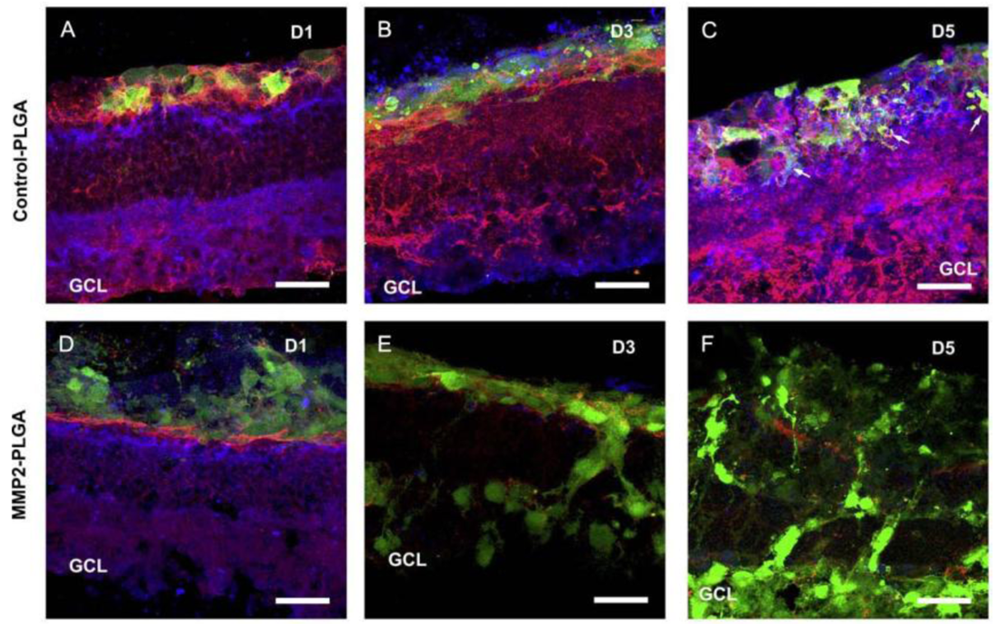
<p>The limited integration of grafted cells is another problem. This is in large partly due to the barrier formed by inhibitory extracellular matrix (ECM) and cell adhesion molecules associated with reactive gliosis after degeneration or injury [<xref ref-type="bibr" rid="b4-polymers-03-00899">4</xref>-<xref ref-type="bibr" rid="b6-polymers-03-00899">6</xref>]. A previous study used adult mice deficient in glial fibrillary acidic protein and vimentin as the host, and demonstrated that the grafted cells integrated robustly into the host retina with distinct neuronal identity and appropriate neuronal projections [<xref ref-type="bibr" rid="b7-polymers-03-00899">7</xref>]. This suggests removal of the barrier produced by reactive glial cells in the degenerative host retina is important in encouraging cell integration. In an attempt to increase cell integration, different drugs with the ability to disrupt the outer limiting membrane or degrade ECM molecules or their hyaluronan binding targets have been tried, such as DL-alpha-aminoadipic acid, chondroitinase ABC and MMP2 [<xref ref-type="bibr" rid="b8-polymers-03-00899">8</xref>-<xref ref-type="bibr" rid="b10-polymers-03-00899">10</xref>]. The transplantation of different cell types has also been investigated. Gage <italic>et al.</italic> demonstrated that adult rat hippocampus-derived neural progenitor cells (NPCs) could integrate to a high degree in most layers of the retina when injected into the eyes of neonatal rats or mature rats with active retinal degeneration [<xref ref-type="bibr" rid="b11-polymers-03-00899">11</xref>,<xref ref-type="bibr" rid="b12-polymers-03-00899">12</xref>]. The high migratory potential of these cells could be attributed to the expression of matrix metalloproteinase-2 (MMP2) [<xref ref-type="bibr" rid="b10-polymers-03-00899">10</xref>]. We isolated retinal progenitor cells (RPCs) from postnatal mammalian neuroretina and showed they also possessed integrative abilities similar to NPCs [<xref ref-type="bibr" rid="b2-polymers-03-00899">2</xref>]. Transplantation of RPCs stimulated the host retina to increase MMP2 secretion, partly from activated glial cells. In turn, increased MMP2 expression induced degradation of the inhibitory glial scar related molecules, such as CD44 and neurocan, deposited at the outer limits of the degenerative retina. This resulted in enhanced host donor integration following retinal transplantation [<xref ref-type="bibr" rid="b13-polymers-03-00899">13</xref>]. This study provided the first identification of an MMP2-dependent mechanism in cell integration. As the endogenous MMP2 was not enough to achieve sufficient cell integration <italic>in vivo</italic>, we then transplanted a biodegradable MMP2-PLGA scaffold, in conjunction with RPCs, to the subretinal space of Rho–/– mice and demonstrated enhancement of cell integration with evident degradation of CD44 and neurocan [<xref ref-type="bibr" rid="b14-polymers-03-00899">14</xref>] (<xref ref-type="fig" rid="f1-polymers-03-00899">Figure 1</xref>). Similarly, when RPCs were co-transplanted with biodegradable MMP2-PLGA microspheres, an increased number of cells were integrated with the degenerative host retina [<xref ref-type="bibr" rid="b15-polymers-03-00899">15</xref>]. Maclaren <italic>et al.</italic> used photoreceptor precursors from the developing retina at the peak of rod genesis and showed enhanced cell integration, suggesting the post-mitotic developmental donor stage may facilitate cell integration [<xref ref-type="bibr" rid="b3-polymers-03-00899">3</xref>]. Our work with induced pluripotent stem cells (iPS) derived-photoreceptors demonstrated significant integration of grafted cells with host retina [<xref ref-type="bibr" rid="b16-polymers-03-00899">16</xref>], suggesting photoreceptor-committed cells may also promote cell integration.</p></sec>
<sec>
<label>2.3.</label>
<title>Cell Differentiation</title>
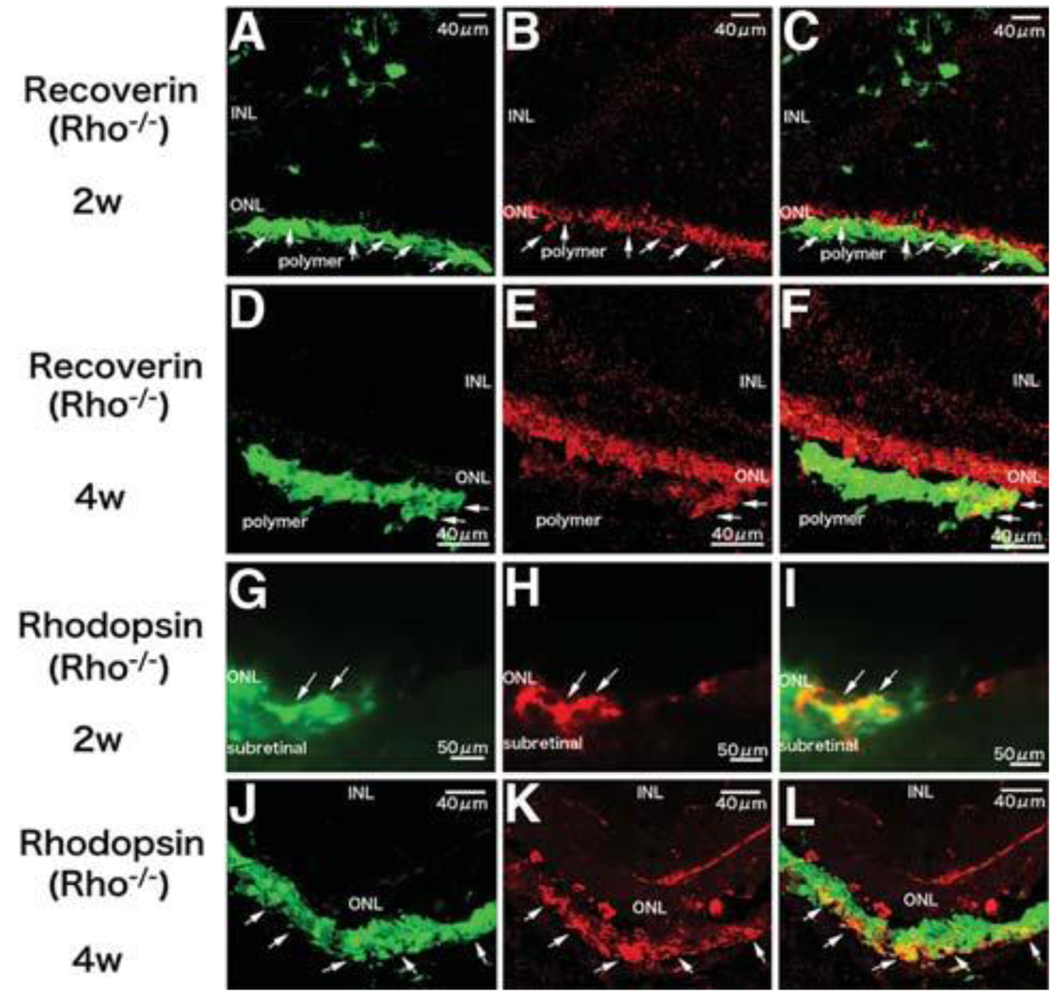
<p>A third problem is controlling the differentiation of grafted cells to a specified cell type, which is an essential requirement for functional cell replacement. Despite high integration and morphological evidence of differentiation, NPCs cannot express retinal specific markers [<xref ref-type="bibr" rid="b12-polymers-03-00899">12</xref>], which may in part be attributed to cell intrinsic factors. Photoreceptor precursors derived only from immature post-mitotic rod precursors and not from proliferating progenitor cells could differentiate into mature rod photoreceptors, form synaptic connections and improve visual function [<xref ref-type="bibr" rid="b3-polymers-03-00899">3</xref>]. We transplanted iPS-derived photoreceptors into Rho–/– mice and demonstrated that integrated cells in the degenerative retina could express photoreceptor specific markers recoverin, rhodopsin and opsin, form synaptic connections with the inner retina and improve visual function [<xref ref-type="bibr" rid="b16-polymers-03-00899">16</xref>]. RPCs were also able to differentiate into mature photoreceptors, express photoreceptor markers recoverin, rhodopsin and opsin, as well as exhibit photoreceptor morphological similarities [<xref ref-type="bibr" rid="b2-polymers-03-00899">2</xref>]. Moreover, recipient mice showed improved visual function as determined by light-mediated behavior over a 25-week period when only a few photoreceptors left. However, no rhodopsin positive cells could be found in the Rho–/– mice model whether these cells were transplanted alone or co-transplanted with MMP2 microspheres [<xref ref-type="bibr" rid="b15-polymers-03-00899">15</xref>]. This may be related to the complete absence of rhodopsin expression in Rho–/– hosts. Polymer scaffolds have been demonstrated to promote differentiation of RPCs <italic>in vitro</italic> prior to transplantation. When RPCs cultured on polymer scaffolds for one week were transplanted, they were able to express rhodopsin even in Rho–/– mice [<xref ref-type="bibr" rid="b1-polymers-03-00899">1</xref>,<xref ref-type="bibr" rid="b13-polymers-03-00899">13</xref>] (<xref ref-type="fig" rid="f2-polymers-03-00899">Figure 2</xref>). These results suggest post-mitotic photoreceptor precursors and photoreceptor-committed cells (differentiated from iPS, RPCs or other cells), may facilitate differentiation into mature photoreceptors regardless of host settings. Limited source is a problem for photoreceptor precursors. <italic>In vitro</italic> expansion of proliferating donor cells can overcome this problem. Using polymer scaffolds to direct stem cells towards photoreceptor-committed cells may facilitate the desired outcome while simultaneously inhibiting undesirable proliferation.</p></sec></sec>
<sec>
<label>3.</label>
<title>Polymer Scaffolds</title>
<p>Tissue engineering can be defined as using a polymer scaffold with the appropriate architecture to guide the repair and restoration of function to damaged tissues or organs [<xref ref-type="bibr" rid="b17-polymers-03-00899">17</xref>]. The field was largely developed in order to address the shortage of tissues and organs available for transplantation [<xref ref-type="bibr" rid="b18-polymers-03-00899">18</xref>]. Previous studies have shown that cells grown on a polymer scaffold were able to reconstruct complex tissues correctly, including bone, skin, cartilage and blood vessels [<xref ref-type="bibr" rid="b19-polymers-03-00899">19</xref>-<xref ref-type="bibr" rid="b25-polymers-03-00899">25</xref>]. In the past 20 years, retinal transplantation has been investigated. Various dissociated cells and tissue microaggregates were transplanted via subretinal and intravitreal injection and showed disorganized or incorrectly localized grafts [<xref ref-type="bibr" rid="b26-polymers-03-00899">26</xref>-<xref ref-type="bibr" rid="b29-polymers-03-00899">29</xref>]. Studies of retinal pigment epithelial (RPE) cells showed the importance of cellular continuity and polarity in the success of transplantation [<xref ref-type="bibr" rid="b30-polymers-03-00899">30</xref>-<xref ref-type="bibr" rid="b32-polymers-03-00899">32</xref>]. Following this, biodegradable polymer scaffolds were used to obtain organized sheets of RPE with distinct apical/basal characteristics [<xref ref-type="bibr" rid="b33-polymers-03-00899">33</xref>]. A number of polymers, both natural and synthetic, have been widely investigated for use in retinal tissue engineering. Despite the advantage of closely resembling native ECM, concerns exist regarding the use of natural polymers, such as limitation of availability, purity of animal-derived polymers, transmission of disease, serious immune response as well as the consistency of quality, mechanical properties and degradation rates [<xref ref-type="bibr" rid="b34-polymers-03-00899">34</xref>-<xref ref-type="bibr" rid="b41-polymers-03-00899">41</xref>]. Conversely, the composition and corresponding properties of synthetic polymers are easily controlled. Biodegradable synthetic polymers used in the eye provide temporary scaffolding and then dissolve as the tissue forms, avoiding long-term foreign body responses and retinal detachment [<xref ref-type="bibr" rid="b34-polymers-03-00899">34</xref>,<xref ref-type="bibr" rid="b41-polymers-03-00899">41</xref>]. A number of biodegradable polymers, including PLGA, poly(glycerol-sebacate) (PGS), and polycaprolactone (PCL) have been applied in retinal engineering.</p>
<sec>
<label>3.1.</label>
<title>PLGA</title>
<p>The most common synthetic biodegradable polymers are poly(-lactic acid) (PLA), poly(glycolic acid) (PGA), and their copolymer, PLGA. These polymers are degraded by hydrolysis of the ester linkage into lactic and glycolic acids, which are subsequently metabolized by the body. By controlling the crystallinity, molecular weight, and the ratio of lactic to glycolic acid subunits, the degradation time of PLGA can be tailored over a wide range [<xref ref-type="bibr" rid="b42-polymers-03-00899">42</xref>]. PLGA has been approved by the FDA for uses in drug delivery, diagnostics and other applications of clinical science research, including cardiovascular disease, cancer, vaccine and tissue engineering [<xref ref-type="bibr" rid="b43-polymers-03-00899">43</xref>-<xref ref-type="bibr" rid="b45-polymers-03-00899">45</xref>]. Furthermore, PLGA has been shown to exhibit a high degree of biocompatibility in the eye [<xref ref-type="bibr" rid="b34-polymers-03-00899">34</xref>]. We have shown that PLGA/PLLA scaffolds improved the survival of RPCs in different retinal degenerative models, promoted differentiation of RPCs and provided physical guidance, resulting in a more normal anatomical organization [<xref ref-type="bibr" rid="b1-polymers-03-00899">1</xref>,<xref ref-type="bibr" rid="b46-polymers-03-00899">46</xref>]. RPC/PLGA scaffold constructs showed at least a 16-fold and 10-fold increase in cell delivery and survival respectively, thereby promoting cellular integration. RPCs delivered via the PLGA scaffolds could express photoreceptor markers recoverin and rhodopsin [<xref ref-type="bibr" rid="b1-polymers-03-00899">1</xref>]. These results suggest PLGA scaffolds facilitate the survival, integration and differentiation of the grafted cells. Despite the aforementioned benefits, PLGA scaffolds have extremely limited flexibility, even when blended with PLLA. Their thickness (150–250 μm) is substantially greater than the photoreceptor layer of the rodent retina (∼30 μm), thus resulting in damage to the host retina and presenting a substantial barrier to functional photoreceptor replacement in rodent models [<xref ref-type="bibr" rid="b1-polymers-03-00899">1</xref>,<xref ref-type="bibr" rid="b46-polymers-03-00899">46</xref>]. In addition to retinal detachment, other complications have also been reported, such as inflammation, fibrosis and foreign body response [<xref ref-type="bibr" rid="b47-polymers-03-00899">47</xref>,<xref ref-type="bibr" rid="b48-polymers-03-00899">48</xref>] (<xref ref-type="table" rid="t1-polymers-03-00899">Table 1</xref>).</p></sec>
<sec>
<label>3.2.</label>
<title>Poly(methyl methacrylate) (PMMA)</title>
<p>In order to reduce the incidence of trauma, ultra-thin PMMA scaffolds (6 μm) were introduced. Due to their thinness, these scaffolds increased the ease of delivery and reduced the risk of trauma, thereby enhancing potential integration with the host. The grafted RPCs were able to express at least three markers of mature retinal cells. Moreover, no foreign body responses were seen four weeks after transplantation [<xref ref-type="bibr" rid="b49-polymers-03-00899">49</xref>]. However, PMMA cannot be degraded and remains in the subretinal space permanently or until removed. We suggest that this may interfere with retinal reattachment and increase the risk of scarring and inflammatory response (<xref ref-type="table" rid="t1-polymers-03-00899">Table 1</xref>).</p></sec>
<sec>
<label>3.3.</label>
<title>PGS</title>
<p>A biodegradable and elastomeric PGS scaffold of intermediate thickness (45 μm) was then introduced [<xref ref-type="bibr" rid="b50-polymers-03-00899">50</xref>]. Compared to PLGA, PGS has several advantages: (1) PGS has improved biocompatibility, including less inflammation and fibrosis and no foreign body giant cell response [<xref ref-type="bibr" rid="b48-polymers-03-00899">48</xref>,<xref ref-type="bibr" rid="b50-polymers-03-00899">50</xref>]. (2) PGS has an ideal degradation profile. PGS has been shown to be degraded by surface erosion, which results in preservation of geometry, no detectable swelling, and slow loss of mechanical strength relative to mass, whereas PLGA underwent bulk degradation accompanied by extensive deformation, swelling, and faster loss of mechanical strength than mass. PLGA lost &gt; 98% of its mechanical strength after 7 days which was approximately the cell seeding time prior to transplantation, whereas PGS lost only about 8% over the same time despite a greater loss in mass. Significant loss of mechanical strength increased fragility of the scaffolds and difficulty of transplantation. Moreover, PGS is a rapidly degrading polymer with an <italic>in vivo</italic> degradation time of about 4–8 weeks [<xref ref-type="bibr" rid="b51-polymers-03-00899">51</xref>]. (3) PGS is an elastic and soft material with an elastic modulus of 1.66 ± 0.23 MPa and a maximum strain at failure of 113 ± 22%, whereas PLLA/PLGA is a brittle material with an elastic modulus of 9.0 ± 1.7 MPa and a maximum strain at failure of only about 9% [<xref ref-type="bibr" rid="b46-polymers-03-00899">46</xref>,<xref ref-type="bibr" rid="b52-polymers-03-00899">52</xref>]. As retinal tissue has an elastic modulus of 0.1 MPa and a maximum strain at failure of about 83% [<xref ref-type="bibr" rid="b53-polymers-03-00899">53</xref>], PGS possesses improved mechanical properties that are more similar to those of retinal tissue. The elastomeric property of PGS allows the polymer scaffolds to be scrolled and transplanted via syringe injection, thereby protecting cells from shearing forces and reducing trauma to retinal tissue (<xref ref-type="table" rid="t1-polymers-03-00899">Table 1</xref>). We have shown that PGS scaffolds promoted RPC survival, differentiation and glutamate induced calcium influxes. By using PGS scaffolds as a cell delivery vehicle, 13% and 7% of grafted cells migrated into the C57BL/6 and Rho–/– mouse retinal explants at one week. 1.5% and 0.8% of grafted cells migrated into the C57BL/6 and Rho–/ – mouse retina four weeks post-transplantation [<xref ref-type="bibr" rid="b54-polymers-03-00899">54</xref>].</p></sec>
<sec>
<label>3.4.</label>
<title>PCL</title>
<p>Another potential scaffold material is PCL, which has also been utilized extensively for the delivery of drugs or proteins [<xref ref-type="bibr" rid="b55-polymers-03-00899">55</xref>-<xref ref-type="bibr" rid="b57-polymers-03-00899">57</xref>]. To date, the PCL scaffolds are the thinnest biodegradable substrates used in retinal tissue engineering (5 μm) [<xref ref-type="bibr" rid="b58-polymers-03-00899">58</xref>]. They are fifty times thinner than the PLGA scaffolds and nine times thinner than the PGS scaffolds. They can be placed into the subretinal space with minimal physical distortion. Moreover, PCL is highly permeable, allowing for the passage of physiologically significant molecules. However, it takes about 2–3 years to degrade completely. PCL degradation occurs gradually from its surfaces, the same as PGS, with no pathologic increase in local acidity [<xref ref-type="bibr" rid="b58-polymers-03-00899">58</xref>,<xref ref-type="bibr" rid="b59-polymers-03-00899">59</xref>] (<xref ref-type="table" rid="t1-polymers-03-00899">Table 1</xref>). We showed that structured PCL scaffolds increased the expression of mature photoreceptor and bipolar markers and that the PCL-delivered RPCs migrated into both normal and degenerative retina [<xref ref-type="bibr" rid="b60-polymers-03-00899">60</xref>].</p></sec></sec>
<sec>
<label>4.</label>
<title>Surface Modification</title>
<sec>
<label>4.1.</label>
<title>Surface Chemistry</title>
<p>In order to achieve functional retinal regeneration, controlled cell differentiation is required. Studies of photoreceptor precursors and iPS suggest photoreceptor-committed cells may facilitate differentiation into mature photoreceptors after transplantation [<xref ref-type="bibr" rid="b3-polymers-03-00899">3</xref>,<xref ref-type="bibr" rid="b16-polymers-03-00899">16</xref>]. An ideal polymer scaffold should not only deliver an appropriate number of healthy cells to the retina, but also promote cell differentiation towards photoreceptor lineage prior to transplantation in order to improve the yield of desired cellular phenotypes and decrease the probability of undesired mitotic activity post-transplantation. All the above mentioned polymer scaffolds have demonstrated the ability to promote differentiation of RPCs and other cell types [<xref ref-type="bibr" rid="b61-polymers-03-00899">61</xref>-<xref ref-type="bibr" rid="b65-polymers-03-00899">65</xref>]. To achieve this, cells must attach to the polymer scaffolds first. This can be more difficult for some cell types, such as RPCs, which often form non-adherent neurospheres and do not readily adhere to a growth substrate. Generally, an extracellular matrix protein, such as laminin [<xref ref-type="bibr" rid="b2-polymers-03-00899">2</xref>], is used to modify the surface for cell attachment. Laminin is known to influence differentiation of progenitor cells toward mature retinal phenotypes [<xref ref-type="bibr" rid="b66-polymers-03-00899">66</xref>,<xref ref-type="bibr" rid="b67-polymers-03-00899">67</xref>]. Other proteins, including fibronectin, collagen and poly-L-lysine, are also used. Significantly longer outgrowth of neurites occurred on laminin coated fibers compared to fibronectin coated fibers [<xref ref-type="bibr" rid="b68-polymers-03-00899">68</xref>]. Collagen-functionalized nanofibers improved cell adhesion and migration compared to non-functionalized nanofibers [<xref ref-type="bibr" rid="b69-polymers-03-00899">69</xref>]. Polymer scaffolds made from PLGA [<xref ref-type="bibr" rid="b1-polymers-03-00899">1</xref>,<xref ref-type="bibr" rid="b46-polymers-03-00899">46</xref>], PMMA [<xref ref-type="bibr" rid="b49-polymers-03-00899">49</xref>] and PGS [<xref ref-type="bibr" rid="b52-polymers-03-00899">52</xref>,<xref ref-type="bibr" rid="b54-polymers-03-00899">54</xref>] required protein modification of the surface with either laminin or a combination of laminin and poly-L-lysine to achieve RPC attachment. Additionally, PLLA/PLGA scaffolds needed a concentrated cell solution in order to achieve appropriate levels of cell attachment [<xref ref-type="bibr" rid="b46-polymers-03-00899">46</xref>].</p></sec>
<sec>
<label>4.2.</label>
<title>Surface Topography</title>
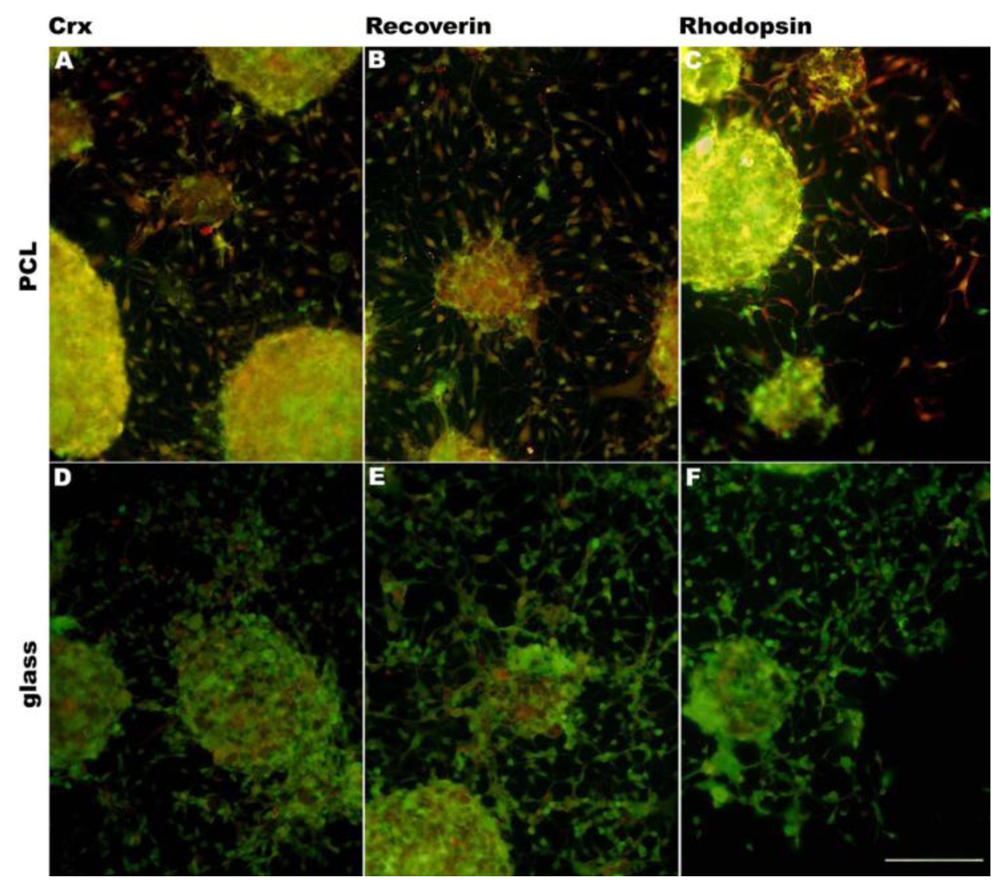
<p>In addition to changing surface chemistry, polymer surface topography and architecture can also be altered. Microscale and nanoscale topographies have been found to induce reorientation and differentiation of multiple cell types, including neural progenitor cells [<xref ref-type="bibr" rid="b62-polymers-03-00899">62</xref>], astroglial cells [<xref ref-type="bibr" rid="b70-polymers-03-00899">70</xref>], smooth muscle cells [<xref ref-type="bibr" rid="b71-polymers-03-00899">71</xref>] and mesenchymal stem cells [<xref ref-type="bibr" rid="b72-polymers-03-00899">72</xref>]. Furthermore, surface topography can direct cell morphologic adaptations and subsequent changes in protein expression levels [<xref ref-type="bibr" rid="b62-polymers-03-00899">62</xref>,<xref ref-type="bibr" rid="b73-polymers-03-00899">73</xref>-<xref ref-type="bibr" rid="b76-polymers-03-00899">76</xref>]. Surface topographic cues similar to endogenous ECM can direct cell morphogenesis via cell-surface contact [<xref ref-type="bibr" rid="b60-polymers-03-00899">60</xref>,<xref ref-type="bibr" rid="b75-polymers-03-00899">75</xref>]. It is suggested that the influence of surface topography on differentiation is via cell–cell surface receptors which act as mechanochemical transducers, activating signal transduction pathways and ultimately modulating gene expression and protein expression [<xref ref-type="bibr" rid="b76-polymers-03-00899">76</xref>]. In the intact retina, the orientation of photoreceptors and retinal bipolar cells is radial with respect to the curvature of the globe. To approximate this highly ordered physical characteristics of the retina, a variety of techniques have been attempted. RPCs attached to the PLGA porous scaffolds created by phase-inversion casting and solid-liquid phase separation [<xref ref-type="bibr" rid="b77-polymers-03-00899">77</xref>] demonstrated down-regulation of immature markers and up-regulation of markers of differentiation. These cells also exhibited morphologies consistent with photoreceptors, including a high degree of polarization of the cells and high survival [<xref ref-type="bibr" rid="b46-polymers-03-00899">46</xref>]. PMMA scaffolds microfabricated [<xref ref-type="bibr" rid="b78-polymers-03-00899">78</xref>] to provide precisely defined pores demonstrated enhanced RPC adherence during transplantation and allowed for greater process outgrowth and cell migration into the host retinal layers. Integrated cells expressed the mature neuronal marker neurofilament-200, the glial marker glial fibrillary acidic protein and the retinal-specific marker recoverin [<xref ref-type="bibr" rid="b49-polymers-03-00899">49</xref>]. Utilizing microfabrication processes and soft lithography (or creation of a polydimethylsiloxane (PDMS) inverse replica) in combination with polymer molding, porous scaffolds can be structured precisely, simply, rapidly, and at low-cost without the further use of specialized microfabrication equipment. Scaffolds of varying porosity and pore structure can be quickly and easily produced by this technique. PGS scaffolds fabricated using this method demonstrated increased differentiation of RPCs towards mature phenotypes as evidenced by changes in mRNA, protein levels, and enhanced sensitivity to glutamate. Transplanting composites into the subretinal space of C57BL/6 and Rho–/– mice resulted in long-term RPC survival, and integrated cells exhibiting mature retinal markers [<xref ref-type="bibr" rid="b52-polymers-03-00899">52</xref>,<xref ref-type="bibr" rid="b53-polymers-03-00899">53</xref>]. RPCs grown on PCL scaffolds molded from a PDMS inverse replica exhibited an increase in gene expression for the photoreceptor markers recoverin and rhodopsin [<xref ref-type="bibr" rid="b61-polymers-03-00899">61</xref>]. PCL scaffolds fabricated by template synthesis [<xref ref-type="bibr" rid="b58-polymers-03-00899">58</xref>] (or inverse replication) from a nanoporous anodized aluminum oxide substrate comprised a surface topography of vertically oriented nanowires which facilitated RPC adhesion, growth, long-time survival and differentiation [<xref ref-type="bibr" rid="b60-polymers-03-00899">60</xref>]. Recently, we have investigated a PCL scaffold templated from nanostructured silicon wafers. RPCs cultured on these scaffolds had a tendency to differentiate towards photoreceptors, expressing photoreceptor markers crx, recoverin and rhodopsin (<xref ref-type="fig" rid="f3-polymers-03-00899">Figure 3</xref>).</p></sec></sec>
<sec>
<label>5.</label>
<title>Drug Delivery</title>
<p>Most synthetic polymers utilized in scaffold fabrication are also well-suited for use as drug delivery systems [<xref ref-type="bibr" rid="b14-polymers-03-00899">14</xref>,<xref ref-type="bibr" rid="b15-polymers-03-00899">15</xref>,<xref ref-type="bibr" rid="b18-polymers-03-00899">18</xref>,<xref ref-type="bibr" rid="b44-polymers-03-00899">44</xref>,<xref ref-type="bibr" rid="b79-polymers-03-00899">79</xref>,<xref ref-type="bibr" rid="b80-polymers-03-00899">80</xref>]. Therapeutic drugs could feasibly be integrated into the polymer scaffolds during fabrication and processing. The release kinetics are dependent on a number of factors, including drug hydrophilicity, loading concentration and distribution, as well as the polymer properties, such as degradation rate and surface area [<xref ref-type="bibr" rid="b34-polymers-03-00899">34</xref>]. The MMP2-PLGA microspheres have a continuously controlled delivery of active MMP2 up to 30 days [<xref ref-type="bibr" rid="b15-polymers-03-00899">15</xref>]. The PCL implant can elute steroid for a period of at least 4 weeks [<xref ref-type="bibr" rid="b79-polymers-03-00899">79</xref>].</p>
<p>Different drug mechanisms have been investigated for retinal tissue engineering. A variety of growth factors and neurotrophins, such as retinoic acid, taurine, ciliary neurotrophic factor (CNTF) [<xref ref-type="bibr" rid="b81-polymers-03-00899">81</xref>] have been implicated in the differentiation of photoreceptors. Aside from directing donor cell response, drugs to modulate the host environment may also be necessary in order to promote integration of the transplanted constructs. Studies of MMP2 showed the importance of MMP2 in encouraging cell integration by degradation of inhibitory ECM and adhesion molecules, such as CD44 and neurocan, at the outer surface of degenerative retina [<xref ref-type="bibr" rid="b13-polymers-03-00899">13</xref>,<xref ref-type="bibr" rid="b82-polymers-03-00899">82</xref>]. A PLGA scaffold was then created by two-phase electrospinning to produce a highly porous interwoven mat of PLGA fibers ranging from 100 to 5,000 nm in diameter interlaced with picoliter domains of active-MMP2. Compared to control polymers, the controlled release of MMP2 from the polymer scaffold was able to enhance RPC integration and repopulation of the retinal outer nuclear layer while preserving retinal architecture and stem cell function [<xref ref-type="bibr" rid="b14-polymers-03-00899">14</xref>]. PLGA microspheres containing MMP2 developed by a water-oil-water solvent evaporation technique showed enhancement of cell integration coincident with degradation of CD44 and neurocan. Over the course of the study, there was no discernible detrimental influence on the host retina [<xref ref-type="bibr" rid="b15-polymers-03-00899">15</xref>]. Therefore, polymers used as a drug delivery system can provide sustained, controlled, and localized drug delivery to the posterior segment after transplantation. Although the subretinal space is an immuno-privileged site, the state is disrupted after retinal degeneration [<xref ref-type="bibr" rid="b83-polymers-03-00899">83</xref>]. Restoration of immune privilege through delivery of immunosuppressive or anti-inflammatory factors may be an important strategy for modulating the host environment and promoting graft-host integration [<xref ref-type="bibr" rid="b84-polymers-03-00899">84</xref>,<xref ref-type="bibr" rid="b85-polymers-03-00899">85</xref>]. In the future, polymer scaffolds may serve as a platform to incorporate drugs with the aim of enhancing cell integration, directing cell differentiation and/or promoting synaptic connections.</p></sec>
<sec sec-type="conclusions">
<label>6.</label>
<title>Conclusions</title>
<p>Retinal tissue engineering is a multidisciplinary field. To achieve successful cell transplantation, several hurdles must be overcome. Polymer scaffolds can deliver cells to the correct site, improve cell survival, enhance cell integration and direct cell differentiation, thereby providing a promising platform for cell transplantation. Different polymers have distinct advantages and disadvantages. An ideal polymer scaffold should have the following properties: biocompatible, degradable by surface, thin, strong yet flexible and easy for drug loading. Surface modification facilitates cell attachment and differentiation, but reliable and optimal architecture has not been determined. Seeding cells on polymer scaffolds with or without drug loading to induce changes towards a more differentiated phenotype prior to transplantation represents a future direction. Elucidating the interactions between cells and polymer scaffolds with development of materials and surface modification techniques may lead to the success of cell transplantation.</p></sec></body>
<back>
<sec sec-type="display-objects">
<title>Figures and Table</title>
<fig id="f1-polymers-03-00899" position="float">
<label>Figure 1.</label>
<caption>
<p>Degradation of CD44 and neurocan via controlled delivery of active MMP2 enhanced stem cell integration. Retinal explants were cultured in the absence (<bold>A</bold>–<bold>C</bold>, control-PLGA) or presence (<bold>D</bold>–<bold>F</bold>, MMP2–PLGA) of active MMP2 for 1, 3 and 5 days at 37 °C, and subsequently fixed, cryosectioned and immunolabeled for GFP (green), CD44 (red) and neurocan (blue). Magnification 40×, scale bar: 25 μm. Reprinted with kind permission from Tucker, B.A.; Redenti, S.M.; Jiang, C; Swift, J.S.; Klassen, H.J.; Smith, M.E.; Wnek, G.E.; Young, M.J. The use of progenitor cell/biodegradable MMP2-PLGA polymer constructs to enhance cellular integration and retinal repopulation. <italic>Biomaterials</italic> 2010, <italic>31</italic>, 9-19.</p></caption>
<graphic xlink:href="polymers-03-00899f1.gif"/></fig>
<fig id="f2-polymers-03-00899" position="float">
<label>Figure 2.</label>
<caption>
<p>Migration and differentiation of retinal progenitor cells (RPCs) from polymer composite grafts into the Rho–/– retina. Confocal (<bold>A</bold>–<bold>F</bold>, <bold>J</bold>–<bold>L</bold>) and epifluorescent (<bold>G</bold>–<bold>I</bold>) images of the expression of neural and photoreceptor markers by RPCs were taken 2 and 4 weeks after polymer composite grafts were transplanted into the eye of adult Rho–/– mice. Recoverin co-expressing RPCs were found in the retina of Rho–/– mice at (<bold>A</bold>–<bold>C</bold>) 2 weeks and (<bold>D</bold>–<bold>F</bold>) 4 weeks after transplantation. Rhodopsin co-expressing RPCs were found in Rho–/– mice at (<bold>G</bold>–<bold>I</bold>) 2 weeks and (<bold>J</bold>–<bold>L</bold>) 4 weeks. Reprinted with kind permission from Tomita, M.; Lavik, E.; Klassen, H.; Zahir, T.; Langer, R; Young, M.J. Biodegradable Polymer Composite Grafts Promote the Survival and Differentiation of Retinal Progenitor Cells. <italic>Stem Cells</italic> 2005, <italic>23</italic>, 1579-1588.</p></caption>
<graphic xlink:href="polymers-03-00899f2.gif"/></fig>
<fig id="f3-polymers-03-00899" position="float">
<label>Figure 3.</label>
<caption>
<p>Differentiation of RPCs. GFP+ RPCs were cultured on polycaprolactone (PCL) polymer scaffolds (<bold>A</bold>–<bold>C</bold>) or glass (<bold>D</bold>–<bold>F</bold>) for 7 days. Most cells attached tightly to the PCL and expressed photoreceptor markers crx (<bold>A</bold>), recoverin (<bold>B</bold>) and rhodopsin (<bold>C</bold>). Almost no crx (<bold>D</bold>), recoverin (<bold>E</bold>) and rhodopsin (<bold>F</bold>) positive cells were found on glass. Scale bar: 200 μm.</p></caption>
<graphic xlink:href="polymers-03-00899f3.gif"/></fig>
<table-wrap id="t1-polymers-03-00899" position="float">
<label>Table 1.</label>
<caption>
<p>Synthetic polymer scaffolds in retinal tissue engineering.</p></caption>
<table frame="box" rules="all">
<thead>
<tr>
<th align="left" valign="top"/>
<th align="left" valign="top"><bold>citation</bold></th>
<th align="left" valign="top"><bold>thickness</bold></th>
<th align="left" valign="top"><bold>fabrication method</bold></th>
<th align="left" valign="top"><bold>surface chemistry</bold></th>
<th align="left" valign="top"><bold>surface topography</bold></th>
<th align="left" valign="top"><bold>advantages</bold></th>
<th align="left" valign="top"><bold>disadvantages</bold></th>
<th align="left" valign="top"><bold>research levels</bold></th>
<th align="left" valign="top"><bold>results</bold></th></tr></thead>
<tbody>
<tr>
<td align="left" valign="top" rowspan="7"><bold>PLGA/ PLLA</bold></td>
<td align="left" valign="top" rowspan="3">Lavik <italic>et al.</italic> [<xref ref-type="bibr" rid="b45-polymers-03-00899">45</xref>]</td>
<td align="left" valign="top" rowspan="3">150 μm</td>
<td align="left" valign="top" rowspan="3">phase-inversion casting and solid–liquid phase separation</td>
<td align="left" valign="top" rowspan="3"/>
<td align="left" valign="top" rowspan="3">uniform pore structure and high degree of porosity with diameters of approximately 100-200 μm, oriented normal to the plane of scaffolds</td>
<td align="left" valign="top" rowspan="7">(1) degradable; (2) bicompatible; (3) better for drug and protein loading</td>
<td align="left" valign="top" rowspan="7">(1) thickest; (2) no flexibility; (3) inflammation, fibrosis and foreign body response; (4) bulk degradation resulting in a non- uniform release profile</td>
<td align="left" valign="top"><italic>in vitro</italic> cell/polymer constructs</td>
<td align="left" valign="top">down-regulation of immature markers and up-regulation of markers of differentiation</td></tr>
<tr>
<td align="left" valign="top"><italic>in vitro</italic> explant (3-week-old rd1 mice)</td>
<td align="left" valign="top">exhibiting morphologies consistent with photoreceptors, including a high degree of polarization of the cells</td></tr>
<tr>
<td align="left" valign="top"><italic>in vivo</italic> subretinal transplantation (adult SD rat)</td>
<td align="left" valign="top">increased RPC survival</td></tr>
<tr>
<td align="left" valign="top" rowspan="2">Tomita <italic>et al.</italic> [<xref ref-type="bibr" rid="b1-polymers-03-00899">1</xref>]</td>
<td align="left" valign="top" rowspan="2">150 μm</td>
<td align="left" valign="top" rowspan="2">phase-inversion casting and solid-liquid phase separation</td>
<td align="left" valign="top" rowspan="2">laminin</td>
<td align="left" valign="top" rowspan="2">largely uniform pore structure with diameters of approximately 35-50 μm, oriented normal to the plane of scaffolds</td>
<td align="left" valign="top"><italic>in vitro</italic> cell/polymer constructs</td>
<td align="left" valign="top">remaining undifferentiated except a subset expressing early markers of more mature neuron or glia</td></tr>
<tr>
<td align="left" valign="top"><italic>in vivo</italic> subretinal transplantation (4-8-week-old C57BL/6 and Rho−/− mice)</td>
<td align="left" valign="top">(1) at least 16-fold and 10-fold increase in cell delivery and survival; (2) grafted cells migrating into the host retina and expressing mature markers, including recoverin and rhodopsin</td></tr>
<tr>
<td align="left" valign="top" rowspan="2">Tucker <italic>et al.</italic> [<xref ref-type="bibr" rid="b13-polymers-03-00899">13</xref>]<xref ref-type="table-fn" rid="tfn1-polymers-03-00899">*</xref></td>
<td align="left" valign="top" rowspan="2"/>
<td align="left" valign="top" rowspan="2">two-phase electrospinning</td>
<td align="left" valign="top" rowspan="2">laminin</td>
<td align="left" valign="top" rowspan="2">a highly porous interwoven mat of PLGA fibers ranging from 100-5,000 nm in diameter</td>
<td align="left" valign="top"><italic>in vitro</italic> explant (adult rd1 and Rho−/− mice)</td>
<td align="left" valign="top" rowspan="2">(1) significant degradation of CD44 and neurocan without disruption of retinal architecture; (2) enhancement of RPC integration into the host retina; (3) grafted cells in the outer nuclear layer adopting photoreceptor morphology and expressing mature photoreceptor markers recoverin and rhodopsin</td></tr>
<tr>
<td align="left" valign="top"><italic>in vivo</italic> subretinal transplantation (adult Rho−/− mice)</td></tr>
<tr>
<td align="left" valign="top"><bold>PMMA</bold></td>
<td align="left" valign="top">Tao <italic>et al.</italic> [<xref ref-type="bibr" rid="b48-polymers-03-00899">48</xref>]</td>
<td align="left" valign="top">6 μm</td>
<td align="left" valign="top">photolithography and reactive ion etching</td>
<td align="left" valign="top">laminin and poly-L lysine</td>
<td align="left" valign="top">pores with diameters of approximately 11 μm and an interpore distance of 63 μm</td>
<td align="left" valign="top">(1) thin; (2) no foreign body response</td>
<td align="left" valign="top">(1) non-degradable</td>
<td align="left" valign="top"><italic>in vivo</italic> subretinal transplantation (adult C57BL/6 mice)</td>
<td align="left" valign="top">(1) porous scaffolds demonstrating enhanced RPC adherence and allowing for greater process outgrowth and cell migration; (2)integrated cells expressing at least three mature markers, including recoverin</td></tr>
<tr>
<td align="left" valign="top" rowspan="4"><bold>PGS</bold></td>
<td align="left" valign="top">Neeley <italic>et al.</italic> [<xref ref-type="bibr" rid="b51-polymers-03-00899">51</xref>]</td>
<td align="left" valign="top">45 μm</td>
<td align="left" valign="top">soft lithography and polymer casting</td>
<td align="left" valign="top">laminin</td>
<td align="left" valign="top">50 μm diameter pores spaced 175 μm apart, center to center</td>
<td align="left" valign="top" rowspan="4">(1) improved biocompatibility; (2) superiority of degradation; (3) elastic</td>
<td align="left" valign="top" rowspan="4">(1) thick; (2) difficult to fabricate drugs or proteins</td>
<td align="left" valign="top"><italic>in vitro</italic> cell/polymer constructs</td>
<td align="left" valign="top">strongly adherence to the scaffolds and expresing a mixture of immature and mature markers</td></tr>
<tr>
<td align="left" valign="top" rowspan="3">Stephen <italic>et al.</italic> [<xref ref-type="bibr" rid="b53-polymers-03-00899">53</xref>]</td>
<td align="left" valign="top" rowspan="3">45 μm</td>
<td align="left" valign="top" rowspan="3">soft lithography and polymer casting</td>
<td align="left" valign="top" rowspan="3">laminin</td>
<td align="left" valign="top" rowspan="3">50 μm diameter pores spaced 175 μm apart</td>
<td align="left" valign="top"><italic>in vitro</italic> cell/polymer constructs</td>
<td align="left" valign="top">RPCs adherent to scaffolds differentiating to mature phenotypes and enhancing sensitivity to glutamate</td></tr>
<tr>
<td align="left" valign="top"><italic>in vitro</italic> explant (adult C57BL/6 and Rho−/− mice)</td>
<td align="left" valign="top" rowspan="2">long-term survival and expression of mature markers, including crx and rhodopsin</td></tr>
<tr>
<td align="left" valign="top"><italic>in vivo</italic> subretinal transplantation (adult C57BL/6 and Rho−/− mice)</td></tr>
<tr>
<td align="left" valign="top" rowspan="4"><bold>PCL</bold></td>
<td align="left" valign="top" rowspan="3">Stephen <italic>et al.</italic> [<xref ref-type="bibr" rid="b59-polymers-03-00899">59</xref>]</td>
<td align="left" valign="top" rowspan="3">5 μm</td>
<td align="left" valign="top" rowspan="3">hot melt template synthesis</td>
<td align="left" valign="top" rowspan="3">laminin</td>
<td align="left" valign="top" rowspan="3">nanowires with an average diameter of 150-200 nm and an interwire distance of 20 nm</td>
<td align="left" valign="top" rowspan="4">(1) thinnest; (2) permeable; (3) easy to fabricate drugs or proteins</td>
<td align="left" valign="top" rowspan="4">(1) long degradation time</td>
<td align="left" valign="top"><italic>in vitro</italic> cell/polymer constructs</td>
<td align="left" valign="top">down-regulation of several early progenitor markers and increased expression of mature bipolar and photoreceptor markers</td></tr>
<tr>
<td align="left" valign="top"><italic>in vitro</italic> explant (adult C57BL/6 and Rho−/− mice)</td>
<td align="left" valign="top">cells migrating into the host retina and expressing mature markers including recoverin and PKC</td></tr>
<tr>
<td align="left" valign="top"><italic>in vivo</italic> subretinal transplantation (adult C57BL/6 and Rho−/− mice)</td>
<td align="left" valign="top">(1) developing an apparent cell polarity with early photoreceptor-like morphology; (2) expressing photoreceptor marker recoverin in cells migrating into the outer nuclear layer</td></tr>
<tr>
<td align="left" valign="top">Steedman <italic>et al.</italic> [<xref ref-type="bibr" rid="b60-polymers-03-00899">60</xref>]</td>
<td align="left" valign="top">5μm</td>
<td align="left" valign="top">soft lithography and polymer casting</td>
<td align="left" valign="top"/>
<td align="left" valign="top">25 μm diameter microwells spaced 25 μm apart</td>
<td align="left" valign="top"><italic>in vitro</italic> cell/polymer constructs</td>
<td align="left" valign="top">(1) increased cell attachement and organization;(2) higer gene expression for photoreceptor markers recoverin and rhodopsin</td></tr></tbody></table>
<table-wrap-foot><fn id="tfn1-polymers-03-00899">
<label>*</label>
<p>PLGA scaffolds used in [<xref ref-type="bibr" rid="b13-polymers-03-00899">13</xref>] were loaded with active MMP2. Cells used in these researches were RPCs.</p></fn></table-wrap-foot></table-wrap></sec>
<ack>
<p>The authors acknowledge the Foundation Fighting Blindness for support.</p></ack>
<ref-list>
<title>References</title>
<ref id="b1-polymers-03-00899"><label>1.</label><citation citation-type="journal"><person-group person-group-type="author"><name><surname>Tomita</surname><given-names>M.</given-names></name><name><surname>Lavik</surname><given-names>E.</given-names></name><name><surname>Klassen</surname><given-names>H.</given-names></name><name><surname>Zahir</surname><given-names>T.</given-names></name><name><surname>Langer</surname><given-names>R.</given-names></name><name><surname>Young</surname><given-names>M.J.</given-names></name></person-group><article-title>Biodegradable polymer composite grafts promote the survival and differentiation of retinal progenitor cells</article-title><source>Stem Cells</source><year>2005</year><volume>23</volume><fpage>1579</fpage><lpage>1588</lpage><pub-id pub-id-type="doi">10.1634/stemcells.2005-0111</pub-id><pub-id pub-id-type="pmid">16293582</pub-id></citation></ref>
<ref id="b2-polymers-03-00899"><label>2.</label><citation citation-type="journal"><person-group person-group-type="author"><name><surname>Klassen</surname><given-names>H.J.</given-names></name><name><surname>Ng</surname><given-names>T.F.</given-names></name><name><surname>Kurimoto</surname><given-names>Y.</given-names></name><name><surname>Kirov</surname><given-names>I.</given-names></name><name><surname>Shatos</surname><given-names>M.</given-names></name><name><surname>Coffey</surname><given-names>P.</given-names></name><name><surname>Young</surname><given-names>M.J.</given-names></name></person-group><article-title>Multipotent retinal progenitors express developmental markers, differentiate into retinal neurons, and preserve light-mediated behavior</article-title><source>Invest. Ophthalmol. Vis. Sci.</source><year>2004</year><volume>45</volume><fpage>4167</fpage><lpage>4173</lpage><pub-id pub-id-type="doi">10.1167/iovs.04-0511</pub-id><pub-id pub-id-type="pmid">15505071</pub-id></citation></ref>
<ref id="b3-polymers-03-00899"><label>3.</label><citation citation-type="journal"><person-group person-group-type="author"><name><surname>MacLaren</surname><given-names>R.E.</given-names></name><name><surname>Pearson</surname><given-names>R.A.</given-names></name><name><surname>MacNeil</surname><given-names>A.</given-names></name><name><surname>Douglas</surname><given-names>R.H.</given-names></name><name><surname>Salt</surname><given-names>T.E.</given-names></name><name><surname>Akimoto</surname><given-names>M.</given-names></name><name><surname>Swaroop</surname><given-names>A.</given-names></name><name><surname>Sowden</surname><given-names>J.C.</given-names></name><name><surname>Ali</surname><given-names>R.R.</given-names></name></person-group><article-title>Retinal repair by transplantation of photoreceptor precursors</article-title><source>Nature</source><year>2006</year><volume>444</volume><fpage>203</fpage><lpage>207</lpage><pub-id pub-id-type="doi">10.1038/nature05161</pub-id><pub-id pub-id-type="pmid">17093405</pub-id></citation></ref>
<ref id="b4-polymers-03-00899"><label>4.</label><citation citation-type="journal"><person-group person-group-type="author"><name><surname>Zhang</surname><given-names>Y.</given-names></name><name><surname>Caffe</surname><given-names>A.R.</given-names></name><name><surname>Azadi</surname><given-names>S.</given-names></name><name><surname>van Veen</surname><given-names>T.</given-names></name><name><surname>Ehinger</surname><given-names>B.</given-names></name><name><surname>Perez</surname><given-names>M.T.</given-names></name></person-group><article-title>Neuronal integration in an abutting-retinas culture system</article-title><source>Invest. Ophthalmol. Vis. Sci.</source><year>2003</year><volume>44</volume><fpage>4936</fpage><lpage>4946</lpage><pub-id pub-id-type="doi">10.1167/iovs.02-0640</pub-id><pub-id pub-id-type="pmid">14578420</pub-id></citation></ref>
<ref id="b5-polymers-03-00899"><label>5.</label><citation citation-type="journal"><person-group person-group-type="author"><name><surname>Inatani</surname><given-names>M.</given-names></name><name><surname>Tanihara</surname><given-names>H.</given-names></name><name><surname>Oohira</surname><given-names>A.</given-names></name><name><surname>Honjo</surname><given-names>M.</given-names></name><name><surname>Kido</surname><given-names>N.</given-names></name><name><surname>Honda</surname><given-names>Y.</given-names></name></person-group><article-title>Upregulated expression of neurocan, a nervous tissue specific proteoglycan, in transient retinal ischemia</article-title><source>Invest. Ophthalmol. Vis. Sci.</source><year>2000</year><volume>41</volume><fpage>2748</fpage><lpage>2754</lpage><pub-id pub-id-type="pmid">10937593</pub-id></citation></ref>
<ref id="b6-polymers-03-00899"><label>6.</label><citation citation-type="journal"><person-group person-group-type="author"><name><surname>Krishnamoorthy</surname><given-names>R.</given-names></name><name><surname>Agarwal</surname><given-names>N.</given-names></name><name><surname>Chaitin</surname><given-names>M.H.</given-names></name></person-group><article-title>Upregulation of CD44 expression in the retina during the rds degeneration</article-title><source>Brain Res. Mol. Brain Res.</source><year>2000</year><volume>77</volume><fpage>125</fpage><lpage>130</lpage><pub-id pub-id-type="doi">10.1016/S0169-328X(00)00035-8</pub-id><pub-id pub-id-type="pmid">10814838</pub-id></citation></ref>
<ref id="b7-polymers-03-00899"><label>7.</label><citation citation-type="journal"><person-group person-group-type="author"><name><surname>Kinouchi</surname><given-names>R.</given-names></name><name><surname>Takeda</surname><given-names>M.</given-names></name><name><surname>Yang</surname><given-names>L.</given-names></name><name><surname>Wilhelmsson</surname><given-names>U.</given-names></name><name><surname>Lundkvist</surname><given-names>A.</given-names></name><name><surname>Pekny</surname><given-names>M.</given-names></name><name><surname>Chen</surname><given-names>D.F.</given-names></name></person-group><article-title>Robust neural integration from retinal transplants in mice deficient in GFAP and vimentin</article-title><source>Nat. Neurosci.</source><year>2003</year><volume>6</volume><fpage>863</fpage><lpage>868</lpage><pub-id pub-id-type="doi">10.1038/nn1088</pub-id><pub-id pub-id-type="pmid">12845328</pub-id></citation></ref>
<ref id="b8-polymers-03-00899"><label>8.</label><citation citation-type="journal"><person-group person-group-type="author"><name><surname>West</surname><given-names>E.L.</given-names></name><name><surname>Pearson</surname><given-names>R.A.</given-names></name><name><surname>Tschernutter</surname><given-names>M.</given-names></name><name><surname>Sowden</surname><given-names>J.C.</given-names></name><name><surname>Maclaren</surname><given-names>R.E.</given-names></name><name><surname>Ali</surname><given-names>R.R.</given-names></name></person-group><article-title>Pharmacological disruption of the outer limiting membrane leads to increased retinal integration of transplanted photoreceptor precursors</article-title><source>Exp. Eye. Res.</source><year>2008</year><volume>86</volume><fpage>601</fpage><lpage>611</lpage><pub-id pub-id-type="doi">10.1016/j.exer.2008.01.004</pub-id><pub-id pub-id-type="pmid">18294631</pub-id></citation></ref>
<ref id="b9-polymers-03-00899"><label>9.</label><citation citation-type="journal"><person-group person-group-type="author"><name><surname>Suzuki</surname><given-names>T.</given-names></name><name><surname>Akimoto</surname><given-names>M.</given-names></name><name><surname>Imai</surname><given-names>H.</given-names></name><name><surname>Ueda</surname><given-names>Y.</given-names></name><name><surname>Mandai</surname><given-names>M.</given-names></name><name><surname>Yoshimura</surname><given-names>N.</given-names></name><name><surname>Swaroop</surname><given-names>A.</given-names></name><name><surname>Takahashi</surname><given-names>M.</given-names></name></person-group><article-title>Chondroitinase ABC treatment enhances synaptogenesis between transplant and host neurons in model of retinal degeneration</article-title><source>Cell Transplant.</source><year>2007</year><volume>16</volume><fpage>493</fpage><lpage>503</lpage><pub-id pub-id-type="pmid">17708339</pub-id></citation></ref>
<ref id="b10-polymers-03-00899"><label>10.</label><citation citation-type="journal"><person-group person-group-type="author"><name><surname>Suzuki</surname><given-names>T.</given-names></name><name><surname>Mandai</surname><given-names>M.</given-names></name><name><surname>Akimoto</surname><given-names>M.</given-names></name><name><surname>Yoshimura</surname><given-names>N.</given-names></name><name><surname>Takahashi</surname><given-names>M.</given-names></name></person-group><article-title>The simultaneous treatment of MMP-2 stimulants in retinal transplantation enhances grafted cell migration into the host retina</article-title><source>Stem Cells</source><year>2006</year><volume>24</volume><fpage>2406</fpage><lpage>2411</lpage><pub-id pub-id-type="doi">10.1634/stemcells.2005-0587</pub-id><pub-id pub-id-type="pmid">17071857</pub-id></citation></ref>
<ref id="b11-polymers-03-00899"><label>11.</label><citation citation-type="journal"><person-group person-group-type="author"><name><surname>Takahashi</surname><given-names>M.</given-names></name><name><surname>Palmer</surname><given-names>T.D.</given-names></name><name><surname>Takahashi</surname><given-names>J.</given-names></name><name><surname>Gage</surname><given-names>F.H.</given-names></name></person-group><article-title>Widespread integration and survival of adult-derived neural progenitor cells in the developing optic retina</article-title><source>Mol. Cell Neurosci.</source><year>1998</year><volume>12</volume><fpage>340</fpage><lpage>348</lpage><pub-id pub-id-type="doi">10.1006/mcne.1998.0721</pub-id><pub-id pub-id-type="pmid">9888988</pub-id></citation></ref>
<ref id="b12-polymers-03-00899"><label>12.</label><citation citation-type="journal"><person-group person-group-type="author"><name><surname>Young</surname><given-names>M.J.</given-names></name><name><surname>Ray</surname><given-names>J.</given-names></name><name><surname>Whiteley</surname><given-names>S.J.</given-names></name><name><surname>Klassen</surname><given-names>H.</given-names></name><name><surname>Gage</surname><given-names>F.H.</given-names></name></person-group><article-title>Neuronal differentiation and morphological integration of hippocampal progenitor cells transplanted to the retina of immature and mature dystrophic rats</article-title><source>Mol. Cell Neurosci.</source><year>2000</year><volume>16</volume><fpage>197</fpage><lpage>205</lpage><pub-id pub-id-type="doi">10.1006/mcne.2000.0869</pub-id><pub-id pub-id-type="pmid">10995547</pub-id></citation></ref>
<ref id="b13-polymers-03-00899"><label>13.</label><citation citation-type="journal"><person-group person-group-type="author"><name><surname>Zhang</surname><given-names>Y.</given-names></name><name><surname>Klassen</surname><given-names>H.J.</given-names></name><name><surname>Tucker</surname><given-names>B.A.</given-names></name><name><surname>Perez</surname><given-names>M.T.</given-names></name><name><surname>Young</surname><given-names>M.J.</given-names></name></person-group><article-title>CNS progenitor cells promote a permissive environment for neurite outgrowth via a matrix metalloproteinase-2-dependent mechanism</article-title><source>J. Neurosci.</source><year>2007</year><volume>27</volume><fpage>4499</fpage><lpage>4506</lpage><pub-id pub-id-type="doi">10.1523/JNEUROSCI.0200-07.2007</pub-id><pub-id pub-id-type="pmid">17460063</pub-id></citation></ref>
<ref id="b14-polymers-03-00899"><label>14.</label><citation citation-type="journal"><person-group person-group-type="author"><name><surname>Tucker</surname><given-names>B.A.</given-names></name><name><surname>Redenti</surname><given-names>S.M.</given-names></name><name><surname>Jiang</surname><given-names>C.</given-names></name><name><surname>Swift</surname><given-names>J.S.</given-names></name><name><surname>Klassen</surname><given-names>H.J.</given-names></name><name><surname>Smith</surname><given-names>M.E.</given-names></name><name><surname>Wnek</surname><given-names>G.E.</given-names></name><name><surname>Young</surname><given-names>M.J.</given-names></name></person-group><article-title>The use of progenitor cell/biodegradable MMP2-PLGA polymer constructs to enhance cellular integration and retinal repopulation</article-title><source>Biomaterials</source><year>2010</year><volume>31</volume><fpage>9</fpage><lpage>19</lpage><pub-id pub-id-type="doi">10.1016/j.biomaterials.2009.09.015</pub-id><pub-id pub-id-type="pmid">19775744</pub-id></citation></ref>
<ref id="b15-polymers-03-00899"><label>15.</label><citation citation-type="journal"><person-group person-group-type="author"><name><surname>Yao</surname><given-names>J.</given-names></name><name><surname>Tucker</surname><given-names>B.A.</given-names></name><name><surname>Zhang</surname><given-names>X.</given-names></name><name><surname>Checa-Casalengua</surname><given-names>P.</given-names></name><name><surname>Herrero-Vanrell</surname><given-names>R.</given-names></name><name><surname>Young</surname><given-names>M.J.</given-names></name></person-group><article-title>Robust cell integration from co-transplantation of biodegradable MMP2-PLGA microspheres with retinal progenitor cells</article-title><source>Biomaterials</source><year>2011</year><volume>32</volume><fpage>1041</fpage><lpage>1050</lpage><pub-id pub-id-type="doi">10.1016/j.biomaterials.2010.09.063</pub-id><pub-id pub-id-type="pmid">21030072</pub-id></citation></ref>
<ref id="b16-polymers-03-00899"><label>16.</label><citation citation-type="confproc"><person-group person-group-type="author"><name><surname>Tucker</surname><given-names>B.A.</given-names></name><name><surname>Park</surname><given-names>I.H.</given-names></name><name><surname>Klassen</surname><given-names>H.J.</given-names></name><name><surname>Redenti</surname><given-names>S.M.</given-names></name><name><surname>Jiang</surname><given-names>C.</given-names></name><name><surname>Qi</surname><given-names>S.D.</given-names></name><name><surname>Daley</surname><given-names>G.Q.</given-names></name><name><surname>Young</surname><given-names>M.J.</given-names></name></person-group><article-title>Transplantation of adult mouse iPS cell-derived photoreceptor precursors restores retinal structure and function in retinal degenerative mice</article-title><source>Abstracts of ARVO Annual Meeting</source><conf-name>Proceedings of ARVO Annual Meeting</conf-name><conf-loc>Fort Lauderdale, FL, USA</conf-loc><conf-date>3–6 May 2010</conf-date></citation></ref>
<ref id="b17-polymers-03-00899"><label>17.</label><citation citation-type="journal"><person-group person-group-type="author"><name><surname>Hynes</surname><given-names>S.R.</given-names></name><name><surname>Lavik</surname><given-names>E.B.</given-names></name></person-group><article-title>A tissue-engineered approach towards retinal repair: scaffolds for cell transplantation to the subretinal space</article-title><source>Graefes Arch. Clin. Exp. Ophthalmol.</source><year>2010</year><volume>248</volume><fpage>763</fpage><lpage>778</lpage><pub-id pub-id-type="doi">10.1007/s00417-009-1263-7</pub-id><pub-id pub-id-type="pmid">20169358</pub-id></citation></ref>
<ref id="b18-polymers-03-00899"><label>18.</label><citation citation-type="journal"><person-group person-group-type="author"><name><surname>Langer</surname><given-names>R.</given-names></name><name><surname>Vacanti</surname><given-names>J.P.</given-names></name></person-group><article-title>Tissue engineering</article-title><source>Science</source><year>1993</year><volume>260</volume><fpage>920</fpage><lpage>926</lpage><pub-id pub-id-type="doi">10.1126/science.8493529</pub-id><pub-id pub-id-type="pmid">8493529</pub-id></citation></ref>
<ref id="b19-polymers-03-00899"><label>19.</label><citation citation-type="journal"><person-group person-group-type="author"><name><surname>Yaszemski</surname><given-names>M.J.</given-names></name><name><surname>Payne</surname><given-names>R.G.</given-names></name><name><surname>Hayes</surname><given-names>W.C.</given-names></name><name><surname>Langer</surname><given-names>R.</given-names></name><name><surname>Mikos</surname><given-names>A.G.</given-names></name></person-group><article-title>Evolution of bone transplantation: Molecular, cellular and tissue strategies to engineer human bone</article-title><source>Biomaterials</source><year>1996</year><volume>17</volume><fpage>175</fpage><lpage>185</lpage><pub-id pub-id-type="doi">10.1016/0142-9612(96)85762-0</pub-id><pub-id pub-id-type="pmid">8624394</pub-id></citation></ref>
<ref id="b20-polymers-03-00899"><label>20.</label><citation citation-type="journal"><person-group person-group-type="author"><name><surname>Pomahac</surname><given-names>B.</given-names></name><name><surname>Svensjo</surname><given-names>T.</given-names></name><name><surname>Yao</surname><given-names>F.</given-names></name><name><surname>Brown</surname><given-names>H.</given-names></name><name><surname>Eriksson</surname><given-names>E.</given-names></name></person-group><article-title>Tissue engineering of skin</article-title><source>Crit. Rev. Oral Biol. Med.</source><year>1998</year><volume>9</volume><fpage>333</fpage><lpage>344</lpage><pub-id pub-id-type="doi">10.1177/10454411980090030601</pub-id><pub-id pub-id-type="pmid">9715370</pub-id></citation></ref>
<ref id="b21-polymers-03-00899"><label>21.</label><citation citation-type="journal"><person-group person-group-type="author"><name><surname>Temenoff</surname><given-names>J.S.</given-names></name><name><surname>Mikos</surname><given-names>A.G.</given-names></name></person-group><article-title>Review: Tissue engineering for regeneration of articular cartilage</article-title><source>Biomaterials</source><year>2000</year><volume>21</volume><fpage>431</fpage><lpage>440</lpage><pub-id pub-id-type="doi">10.1016/S0142-9612(99)00213-6</pub-id><pub-id pub-id-type="pmid">10674807</pub-id></citation></ref>
<ref id="b22-polymers-03-00899"><label>22.</label><citation citation-type="journal"><person-group person-group-type="author"><name><surname>Niklason</surname><given-names>L.E.</given-names></name><name><surname>Gao</surname><given-names>J.</given-names></name><name><surname>Abbott</surname><given-names>W.M.</given-names></name><name><surname>Hirschi</surname><given-names>K.K.</given-names></name><name><surname>Houser</surname><given-names>S.</given-names></name><name><surname>Marini</surname><given-names>R.</given-names></name><name><surname>Langer</surname><given-names>R.</given-names></name></person-group><article-title>Functional arteries grown <italic>in vitro</italic></article-title><source>Science</source><year>1999</year><volume>284</volume><fpage>489</fpage><lpage>493</lpage><pub-id pub-id-type="doi">10.1126/science.284.5413.489</pub-id><pub-id pub-id-type="pmid">10205057</pub-id></citation></ref>
<ref id="b23-polymers-03-00899"><label>23.</label><citation citation-type="journal"><person-group person-group-type="author"><name><surname>Mooney</surname><given-names>D.J.</given-names></name><name><surname>Sano</surname><given-names>K.</given-names></name><name><surname>Kaufmann</surname><given-names>P.M.</given-names></name><name><surname>Majahod</surname><given-names>K.</given-names></name><name><surname>Schloo</surname><given-names>B.</given-names></name><name><surname>Vacanti</surname><given-names>J.P.</given-names></name><name><surname>Langer</surname><given-names>R.</given-names></name></person-group><article-title>Long-term engraftment of hepatocytes transplanted on biodegradable polymer sponges</article-title><source>J. Biomed. Mater. Res.</source><year>1997</year><volume>37</volume><fpage>413</fpage><lpage>420</lpage><pub-id pub-id-type="doi">10.1002/(SICI)1097-4636(19971205)37:3&lt;413::AID-JBM12&gt;3.0.CO;2-C</pub-id><pub-id pub-id-type="pmid">9368146</pub-id></citation></ref>
<ref id="b24-polymers-03-00899"><label>24.</label><citation citation-type="journal"><person-group person-group-type="author"><name><surname>Hadlock</surname><given-names>T.</given-names></name><name><surname>Elisseeff</surname><given-names>J.</given-names></name><name><surname>Langer</surname><given-names>R.</given-names></name><name><surname>Vacanti</surname><given-names>J.</given-names></name><name><surname>Cheney</surname><given-names>M.</given-names></name></person-group><article-title>A tissue-engineered conduit for peripheral nerve repair</article-title><source>Arch. Otolaryngol. Head Neck Surg.</source><year>1998</year><volume>124</volume><fpage>1081</fpage><lpage>1086</lpage><pub-id pub-id-type="pmid">9776185</pub-id></citation></ref>
<ref id="b25-polymers-03-00899"><label>25.</label><citation citation-type="journal"><person-group person-group-type="author"><name><surname>Atala</surname><given-names>A.</given-names></name></person-group><article-title>Tissue engineering for bladder substitution</article-title><source>World J. Urol.</source><year>2000</year><volume>18</volume><fpage>364</fpage><lpage>370</lpage><pub-id pub-id-type="doi">10.1007/s003450000152</pub-id><pub-id pub-id-type="pmid">11131316</pub-id></citation></ref>
<ref id="b26-polymers-03-00899"><label>26.</label><citation citation-type="journal"><person-group person-group-type="author"><name><surname>Silverman</surname><given-names>M.S.</given-names></name><name><surname>Hughes</surname><given-names>S.E.</given-names></name></person-group><article-title>Transplantation of photoreceptors to light-damaged retina</article-title><source>Invest. Ophthalmol. Vis. Sci.</source><year>1989</year><volume>30</volume><fpage>1684</fpage><lpage>1690</lpage><pub-id pub-id-type="pmid">2527211</pub-id></citation></ref>
<ref id="b27-polymers-03-00899"><label>27.</label><citation citation-type="journal"><person-group person-group-type="author"><name><surname>Gouras</surname><given-names>P.</given-names></name><name><surname>Lopez</surname><given-names>R.</given-names></name><name><surname>Kjeldbye</surname><given-names>H.</given-names></name><name><surname>Sullivan</surname><given-names>B.</given-names></name><name><surname>Brittis</surname><given-names>M.</given-names></name></person-group><article-title>Transplantation of retinal pigment epithelium prevents photoreceptor degeneration in the RCS rat</article-title><source>Prog. Clin. Biol. Res.</source><year>1989</year><volume>314</volume><fpage>659</fpage><lpage>671</lpage><pub-id pub-id-type="pmid">2608683</pub-id></citation></ref>
<ref id="b28-polymers-03-00899"><label>28.</label><citation citation-type="journal"><person-group person-group-type="author"><name><surname>Gouras</surname><given-names>P.</given-names></name><name><surname>Du</surname><given-names>J.</given-names></name><name><surname>Kjeldbye</surname><given-names>H.</given-names></name><name><surname>Yamaoto</surname><given-names>S.</given-names></name><name><surname>Zack</surname><given-names>D.J.</given-names></name></person-group><article-title>Reconstruction of degenerate rd mouse retina by transplantation of transgenic photoreceptors</article-title><source>Invest. Ophthalmol. Vis. Sci.</source><year>1992</year><volume>33</volume><fpage>2579</fpage><lpage>2586</lpage><pub-id pub-id-type="pmid">1639605</pub-id></citation></ref>
<ref id="b29-polymers-03-00899"><label>29.</label><citation citation-type="journal"><person-group person-group-type="author"><name><surname>Litchfield</surname><given-names>T.M.</given-names></name><name><surname>Whiteley</surname><given-names>S.J.</given-names></name><name><surname>Lund</surname><given-names>R.D.</given-names></name></person-group><article-title>Transplantation of retinal pigment epithelial, photoreceptor and other cells as treatment for retinal degeneration</article-title><source>Exp. Eye Res.</source><year>1997</year><volume>64</volume><fpage>655</fpage><lpage>666</lpage><pub-id pub-id-type="doi">10.1006/exer.1996.0253</pub-id><pub-id pub-id-type="pmid">9245894</pub-id></citation></ref>
<ref id="b30-polymers-03-00899"><label>30.</label><citation citation-type="journal"><person-group person-group-type="author"><name><surname>Lund</surname><given-names>R.D.</given-names></name><name><surname>Coffey</surname><given-names>P.J.</given-names></name><name><surname>Sauve</surname><given-names>Y.</given-names></name><name><surname>Lawrence</surname><given-names>J.M.</given-names></name></person-group><article-title>Intraretinal transplantation to prevent photoreceptor degeneration</article-title><source>Ophthalmic. Res.</source><year>1997</year><volume>29</volume><fpage>305</fpage><lpage>319</lpage><pub-id pub-id-type="doi">10.1159/000268029</pub-id><pub-id pub-id-type="pmid">9323722</pub-id></citation></ref>
<ref id="b31-polymers-03-00899"><label>31.</label><citation citation-type="journal"><person-group person-group-type="author"><name><surname>Castillo</surname><given-names>B.V.</given-names><suffix>Jr.</suffix></name><name><surname>Little</surname><given-names>C.W.</given-names></name><name><surname>del Cerro</surname><given-names>C.</given-names></name><name><surname>del Cerro</surname><given-names>M.</given-names></name></person-group><article-title>An improved method of isolating fetal human retinal pigment epithelium</article-title><source>Curr. Eye Res.</source><year>1995</year><volume>14</volume><fpage>677</fpage><lpage>683</lpage><pub-id pub-id-type="doi">10.3109/02713689508998495</pub-id><pub-id pub-id-type="pmid">8529403</pub-id></citation></ref>
<ref id="b32-polymers-03-00899"><label>32.</label><citation citation-type="journal"><person-group person-group-type="author"><name><surname>Little</surname><given-names>C.W.</given-names></name><name><surname>Cox</surname><given-names>C.</given-names></name><name><surname>Wyatt</surname><given-names>J.</given-names></name><name><surname>del Cerro</surname><given-names>C.</given-names></name><name><surname>del Cerro</surname><given-names>M.</given-names></name></person-group><article-title>Correlates of photoreceptor rescue by transplantation of human fetal RPE in the RCS rat</article-title><source>Exp. Neurol.</source><year>1998</year><volume>149</volume><fpage>151</fpage><lpage>160</lpage><pub-id pub-id-type="doi">10.1006/exnr.1997.6642</pub-id><pub-id pub-id-type="pmid">9454624</pub-id></citation></ref>
<ref id="b33-polymers-03-00899"><label>33.</label><citation citation-type="journal"><person-group person-group-type="author"><name><surname>Giordano</surname><given-names>G.G.</given-names></name><name><surname>Thomson</surname><given-names>R.C.</given-names></name><name><surname>Ishaug</surname><given-names>S.L.</given-names></name><name><surname>Mikos</surname><given-names>A.G.</given-names></name><name><surname>Cumber</surname><given-names>S.</given-names></name><name><surname>Garcia</surname><given-names>C.A.</given-names></name><name><surname>Lahiri-Munir</surname><given-names>D.</given-names></name></person-group><article-title>Retinal pigment epithelium cells cultured on synthetic biodegradable polymers</article-title><source>J. Biomed. Mater. Res.</source><year>1997</year><volume>34</volume><fpage>87</fpage><lpage>93</lpage><pub-id pub-id-type="doi">10.1002/(SICI)1097-4636(199701)34:1&lt;87::AID-JBM12&gt;3.0.CO;2-M</pub-id><pub-id pub-id-type="pmid">8978657</pub-id></citation></ref>
<ref id="b34-polymers-03-00899"><label>34.</label><citation citation-type="journal"><person-group person-group-type="author"><name><surname>Colthurst</surname><given-names>M.J.</given-names></name><name><surname>Williams</surname><given-names>R.L.</given-names></name><name><surname>Hiscott</surname><given-names>P.S.</given-names></name><name><surname>Grierson</surname><given-names>I.</given-names></name></person-group><article-title>Biomaterials used in the posterior segment of the eye</article-title><source>Biomaterials</source><year>2000</year><volume>21</volume><fpage>649</fpage><lpage>665</lpage><pub-id pub-id-type="doi">10.1016/S0142-9612(99)00220-3</pub-id><pub-id pub-id-type="pmid">10711963</pub-id></citation></ref>
<ref id="b35-polymers-03-00899"><label>35.</label><citation citation-type="journal"><person-group person-group-type="author"><name><surname>Malafaya</surname><given-names>P.B.</given-names></name><name><surname>Silva</surname><given-names>G.A.</given-names></name><name><surname>Reis</surname><given-names>R.L.</given-names></name></person-group><article-title>Natural-origin polymers as carriers and scaffolds for biomolecules and cell delivery in tissue engineering applications</article-title><source>Adv. Drug. Deliv. Rev.</source><year>2007</year><volume>59</volume><fpage>207</fpage><lpage>233</lpage><pub-id pub-id-type="doi">10.1016/j.addr.2007.03.012</pub-id><pub-id pub-id-type="pmid">17482309</pub-id></citation></ref>
<ref id="b36-polymers-03-00899"><label>36.</label><citation citation-type="journal"><person-group person-group-type="author"><name><surname>Karwatowski</surname><given-names>W.S.</given-names></name><name><surname>Jeffries</surname><given-names>T.E.</given-names></name><name><surname>Duance</surname><given-names>V.C.</given-names></name><name><surname>Albon</surname><given-names>J.</given-names></name><name><surname>Bailey</surname><given-names>A.J.</given-names></name><name><surname>Easty</surname><given-names>D.L.</given-names></name></person-group><article-title>Preparation of Bruch's membrane and analysis of the age-related changes in the structural collagens</article-title><source>Br. J. Ophthalmol.</source><year>1995</year><volume>79</volume><fpage>944</fpage><lpage>952</lpage><pub-id pub-id-type="doi">10.1136/bjo.79.10.944</pub-id><pub-id pub-id-type="pmid">7488585</pub-id></citation></ref>
<ref id="b37-polymers-03-00899"><label>37.</label><citation citation-type="journal"><person-group person-group-type="author"><name><surname>Sheridan</surname><given-names>C.</given-names></name><name><surname>Williams</surname><given-names>R.</given-names></name><name><surname>Grierson</surname><given-names>I.</given-names></name></person-group><article-title>Basement membranes and artificial substrates in cell transplantation</article-title><source>Graefes Arch. Clin. Exp. Ophthalmol.</source><year>2004</year><volume>242</volume><fpage>68</fpage><lpage>75</lpage><pub-id pub-id-type="doi">10.1007/s00417-003-0800-z</pub-id><pub-id pub-id-type="pmid">14628146</pub-id></citation></ref>
<ref id="b38-polymers-03-00899"><label>38.</label><citation citation-type="journal"><person-group person-group-type="author"><name><surname>Veis</surname><given-names>A.</given-names></name><name><surname>Cohen</surname><given-names>J.</given-names></name></person-group><article-title>Reversible transformation of gelatin to the collagen structure</article-title><source>Nature</source><year>1960</year><volume>186</volume><fpage>720</fpage><lpage>721</lpage><pub-id pub-id-type="doi">10.1038/186720a0</pub-id><pub-id pub-id-type="pmid">13841564</pub-id></citation></ref>
<ref id="b39-polymers-03-00899"><label>39.</label><citation citation-type="journal"><person-group person-group-type="author"><name><surname>Del Priore</surname><given-names>L.V.</given-names></name><name><surname>Tezel</surname><given-names>T.H.</given-names></name><name><surname>Kaplan</surname><given-names>H.J.</given-names></name></person-group><article-title>Survival of allogeneic porcine retinal pigment epithelial sheets after subretinal transplantation</article-title><source>Invest. Ophthalmol. Vis. Sci.</source><year>2004</year><volume>45</volume><fpage>985</fpage><lpage>992</lpage><pub-id pub-id-type="doi">10.1167/iovs.03-0662</pub-id><pub-id pub-id-type="pmid">14985321</pub-id></citation></ref>
<ref id="b40-polymers-03-00899"><label>40.</label><citation citation-type="journal"><person-group person-group-type="author"><name><surname>Blomback</surname><given-names>B.</given-names></name></person-group><article-title>Fibrinogen and fibrin-proteins with complex roles in hemostasis and thrombosis</article-title><source>Thromb. Res.</source><year>1996</year><volume>83</volume><fpage>1</fpage><lpage>75</lpage><pub-id pub-id-type="doi">10.1016/0049-3848(96)00111-9</pub-id><pub-id pub-id-type="pmid">8837305</pub-id></citation></ref>
<ref id="b41-polymers-03-00899"><label>41.</label><citation citation-type="journal"><person-group person-group-type="author"><name><surname>Lavik</surname><given-names>E.</given-names></name><name><surname>Langer</surname><given-names>R.</given-names></name></person-group><article-title>Tissue engineering: current state and perspectives</article-title><source>Appl. Microbiol. Biotechnol.</source><year>2004</year><volume>65</volume><fpage>1</fpage><lpage>8</lpage><pub-id pub-id-type="pmid">15221227</pub-id></citation></ref>
<ref id="b42-polymers-03-00899"><label>42.</label><citation citation-type="journal"><person-group person-group-type="author"><name><surname>Gunatillake</surname><given-names>P.</given-names></name><name><surname>Mayadunne</surname><given-names>R.</given-names></name><name><surname>Adhikari</surname><given-names>R.</given-names></name></person-group><article-title>Recent developments in biodegradable synthetic polymers</article-title><source>Biotechnol. Annu. Rev.</source><year>2006</year><volume>12</volume><fpage>301</fpage><lpage>347</lpage><pub-id pub-id-type="pmid">17045198</pub-id></citation></ref>
<ref id="b43-polymers-03-00899"><label>43.</label><citation citation-type="journal"><person-group person-group-type="author"><name><surname>Lü</surname><given-names>J.M.</given-names></name><name><surname>Wang</surname><given-names>X.</given-names></name><name><surname>Marin-Muller</surname><given-names>C.</given-names></name><name><surname>Wang</surname><given-names>H.</given-names></name><name><surname>Lin</surname><given-names>P.H.</given-names></name><name><surname>Yao</surname><given-names>Q.</given-names></name><name><surname>Chen</surname><given-names>C.</given-names></name></person-group><article-title>Current advances in research and clinical applications of PLGA-based nanotechnology</article-title><source>Expert Rev. Mol. Diagn.</source><year>2009</year><volume>9</volume><fpage>325</fpage><lpage>341</lpage><pub-id pub-id-type="doi">10.1586/erm.09.15</pub-id><pub-id pub-id-type="pmid">19435455</pub-id></citation></ref>
<ref id="b44-polymers-03-00899"><label>44.</label><citation citation-type="journal"><person-group person-group-type="author"><name><surname>Langer</surname><given-names>R.</given-names></name></person-group><article-title>Biomaterials in drug delivery and tissue engineering: One laboratory's experience</article-title><source>Acc. Chem. Res.</source><year>2000</year><volume>33</volume><fpage>94</fpage><lpage>101</lpage><pub-id pub-id-type="doi">10.1021/ar9800993</pub-id><pub-id pub-id-type="pmid">10673317</pub-id></citation></ref>
<ref id="b45-polymers-03-00899"><label>45.</label><citation citation-type="journal"><person-group person-group-type="author"><name><surname>Lavik</surname><given-names>E.</given-names></name><name><surname>Teng</surname><given-names>Y.D.</given-names></name><name><surname>Snyder</surname><given-names>E.</given-names></name><name><surname>Langer</surname><given-names>R.</given-names></name></person-group><article-title>Seeding neural stem cells on scaffolds of PGA, PLA, and their copolymers</article-title><source>Methods Mol. Biol.</source><year>2002</year><volume>198</volume><fpage>89</fpage><lpage>97</lpage><pub-id pub-id-type="pmid">11951644</pub-id></citation></ref>
<ref id="b46-polymers-03-00899"><label>46.</label><citation citation-type="journal"><person-group person-group-type="author"><name><surname>Lavik</surname><given-names>E.B.</given-names></name><name><surname>Klassen</surname><given-names>H.</given-names></name><name><surname>Warfvinge</surname><given-names>K.</given-names></name><name><surname>Langer</surname><given-names>R.</given-names></name><name><surname>Young</surname><given-names>M.J.</given-names></name></person-group><article-title>Fabrication of degradable polymer scaffolds to direct the integration and differentiation of retinal progenitors</article-title><source>Biomaterials</source><year>2005</year><volume>26</volume><fpage>3187</fpage><lpage>3196</lpage><pub-id pub-id-type="doi">10.1016/j.biomaterials.2004.08.022</pub-id><pub-id pub-id-type="pmid">15603813</pub-id></citation></ref>
<ref id="b47-polymers-03-00899"><label>47.</label><citation citation-type="journal"><person-group person-group-type="author"><name><surname>Warfvinge</surname><given-names>K.</given-names></name><name><surname>Kiilgaard</surname><given-names>J.F.</given-names></name><name><surname>Lavik</surname><given-names>E.B.</given-names></name><name><surname>Scherfig</surname><given-names>E.</given-names></name><name><surname>Langer</surname><given-names>R.</given-names></name><name><surname>Klassen</surname><given-names>H.J.</given-names></name><name><surname>Young</surname><given-names>M.J.</given-names></name></person-group><article-title>Retinal progenitor cell xenografts to the pig retina—Morphologic integration and cytochemical differentiation</article-title><source>Arch. Ophthalmol.</source><year>2005</year><volume>123</volume><fpage>1385</fpage><lpage>1393</lpage><pub-id pub-id-type="doi">10.1001/archopht.123.10.1385</pub-id><pub-id pub-id-type="pmid">16219730</pub-id></citation></ref>
<ref id="b48-polymers-03-00899"><label>48.</label><citation citation-type="journal"><person-group person-group-type="author"><name><surname>Sundback</surname><given-names>C.A.</given-names></name><name><surname>Shyu</surname><given-names>J.Y.</given-names></name><name><surname>Wang</surname><given-names>Y.</given-names></name><name><surname>Faquin</surname><given-names>W.C.</given-names></name><name><surname>Langer</surname><given-names>R.S.</given-names></name><name><surname>Vacanti</surname><given-names>J.P.</given-names></name><name><surname>Hadlock</surname><given-names>T.A.</given-names></name></person-group><article-title>Biocompatibility analysis of poly(glycerol sebacate) as a nerve guide material</article-title><source>Biomaterials</source><year>2005</year><volume>26</volume><fpage>5454</fpage><lpage>5464</lpage><pub-id pub-id-type="doi">10.1016/j.biomaterials.2005.02.004</pub-id><pub-id pub-id-type="pmid">15860202</pub-id></citation></ref>
<ref id="b49-polymers-03-00899"><label>49.</label><citation citation-type="journal"><person-group person-group-type="author"><name><surname>Tao</surname><given-names>S.</given-names></name><name><surname>Young</surname><given-names>C.</given-names></name><name><surname>Redenti</surname><given-names>S.</given-names></name><name><surname>Zhang</surname><given-names>Y.</given-names></name><name><surname>Klassen</surname><given-names>H.</given-names></name><name><surname>Desai</surname><given-names>T.</given-names></name><name><surname>Young</surname><given-names>M.J.</given-names></name></person-group><article-title>Survival, migration and differentiation of retinal progenitor cells transplanted on micro-machined poly(methyl methacrylate) scaffolds to the subretinal space</article-title><source>Lab Chip</source><year>2007</year><volume>7</volume><fpage>695</fpage><lpage>701</lpage><pub-id pub-id-type="doi">10.1039/b618583e</pub-id><pub-id pub-id-type="pmid">17538710</pub-id></citation></ref>
<ref id="b50-polymers-03-00899"><label>50.</label><citation citation-type="journal"><person-group person-group-type="author"><name><surname>Wang</surname><given-names>Y.</given-names></name><name><surname>Ameer</surname><given-names>G.A.</given-names></name><name><surname>Sheppard</surname><given-names>B.J.</given-names></name><name><surname>Langer</surname><given-names>R.</given-names></name></person-group><article-title>A tough biodegradable elastomer</article-title><source>Nat. Biotechnol.</source><year>2002</year><volume>20</volume><fpage>602</fpage><lpage>606</lpage><pub-id pub-id-type="doi">10.1038/nbt0602-602</pub-id><pub-id pub-id-type="pmid">12042865</pub-id></citation></ref>
<ref id="b51-polymers-03-00899"><label>51.</label><citation citation-type="journal"><person-group person-group-type="author"><name><surname>Wang</surname><given-names>Y.</given-names></name><name><surname>Kim</surname><given-names>Y.M.</given-names></name><name><surname>Langer</surname><given-names>R.</given-names></name></person-group><article-title><italic>In vivo</italic> degradation characteristics of poly(glycerol sebacate)</article-title><source>J. Biomed. Mater. Res. A</source><year>2003</year><volume>66</volume><fpage>192</fpage><lpage>197</lpage><pub-id pub-id-type="pmid">12833446</pub-id></citation></ref>
<ref id="b52-polymers-03-00899"><label>52.</label><citation citation-type="journal"><person-group person-group-type="author"><name><surname>Neeley</surname><given-names>W.L.</given-names></name><name><surname>Redenti</surname><given-names>S.</given-names></name><name><surname>Klassen</surname><given-names>H.</given-names></name><name><surname>Tao</surname><given-names>S.</given-names></name><name><surname>Desai</surname><given-names>T.</given-names></name><name><surname>Young</surname><given-names>M.J.</given-names></name><name><surname>Langer</surname><given-names>R.</given-names></name></person-group><article-title>A microfabricated scaffold for retinal progenitor cell grafting</article-title><source>Biomaterials</source><year>2008</year><volume>29</volume><fpage>418</fpage><lpage>426</lpage><pub-id pub-id-type="doi">10.1016/j.biomaterials.2007.10.007</pub-id><pub-id pub-id-type="pmid">17961646</pub-id></citation></ref>
<ref id="b53-polymers-03-00899"><label>53.</label><citation citation-type="journal"><person-group person-group-type="author"><name><surname>Wollensak</surname><given-names>G.</given-names></name><name><surname>Spoerl</surname><given-names>E.</given-names></name></person-group><article-title>Biomechanical characteristics of retina</article-title><source>Retina</source><year>2004</year><volume>24</volume><fpage>967</fpage><lpage>970</lpage><pub-id pub-id-type="doi">10.1097/00006982-200412000-00021</pub-id><pub-id pub-id-type="pmid">15579999</pub-id></citation></ref>
<ref id="b54-polymers-03-00899"><label>54.</label><citation citation-type="journal"><person-group person-group-type="author"><name><surname>Redenti</surname><given-names>S.</given-names></name><name><surname>Neeley</surname><given-names>W.L.</given-names></name><name><surname>Rompani</surname><given-names>S.</given-names></name><name><surname>Saigal</surname><given-names>S.</given-names></name><name><surname>Yang</surname><given-names>J.</given-names></name><name><surname>Klassen</surname><given-names>H.</given-names></name><name><surname>Langer</surname><given-names>R.</given-names></name><name><surname>Young</surname><given-names>M.J.</given-names></name></person-group><article-title>Engineering retinal progenitor cell and scrollable poly(glycerol-sebacate) composites for expansion and subretinal transplantation</article-title><source>Biomaterials</source><year>2009</year><volume>30</volume><fpage>3405</fpage><lpage>3414</lpage><pub-id pub-id-type="doi">10.1016/j.biomaterials.2009.02.046</pub-id><pub-id pub-id-type="pmid">19361860</pub-id></citation></ref>
<ref id="b55-polymers-03-00899"><label>55.</label><citation citation-type="journal"><person-group person-group-type="author"><name><surname>Huang</surname><given-names>Q.</given-names></name><name><surname>Goh</surname><given-names>J.C.</given-names></name><name><surname>Hutmacher</surname><given-names>D.W.</given-names></name><name><surname>Lee</surname><given-names>E.H.</given-names></name></person-group><article-title><italic>In vivo</italic> mesenchymal cell recruitment by a scaffold loaded with transforming growth factor beta 1 and the potential for <italic>in situ</italic> chondrogenesis</article-title><source>Tissue Eng.</source><year>2002</year><volume>8</volume><fpage>469</fpage><lpage>482</lpage><pub-id pub-id-type="doi">10.1089/107632702760184727</pub-id><pub-id pub-id-type="pmid">12167232</pub-id></citation></ref>
<ref id="b56-polymers-03-00899"><label>56.</label><citation citation-type="journal"><person-group person-group-type="author"><name><surname>Giavaresi</surname><given-names>G.</given-names></name><name><surname>Tschon</surname><given-names>M.</given-names></name><name><surname>Borsari</surname><given-names>V.</given-names></name><name><surname>Daly</surname><given-names>J.H.</given-names></name><name><surname>Liggat</surname><given-names>J.J.</given-names></name><name><surname>Fini</surname><given-names>M.</given-names></name><name><surname>Bonazzi</surname><given-names>V.</given-names></name><name><surname>Nicolini</surname><given-names>A.</given-names></name><name><surname>Carpi</surname><given-names>A.</given-names></name><name><surname>Morra</surname><given-names>M.</given-names></name><etal/></person-group><article-title>New polymers for drug delivery systems in orthopaedics: <italic>In vivo</italic> biocompatibility evaluation</article-title><source>Biomed. Pharmacother.</source><year>2004</year><volume>58</volume><fpage>411</fpage><lpage>417</lpage><pub-id pub-id-type="pmid">15464867</pub-id></citation></ref>
<ref id="b57-polymers-03-00899"><label>57.</label><citation citation-type="journal"><person-group person-group-type="author"><name><surname>Beeley</surname><given-names>N.R.</given-names></name><name><surname>Rossi</surname><given-names>J.V.</given-names></name><name><surname>Mello-Filho</surname><given-names>P.A.</given-names></name><name><surname>Mahmoud</surname><given-names>M.I.</given-names></name><name><surname>Fujii</surname><given-names>G.Y.</given-names></name><name><surname>de Juan</surname><given-names>E.</given-names><suffix>Jr.</suffix></name><name><surname>Varner</surname><given-names>S.E.</given-names></name></person-group><article-title>Fabrication, implantation, elution, and retrieval of a steroid-loaded polycaprolactone subretinal implant</article-title><source>J. Biomed. Mater. Res. A</source><year>2005</year><volume>73</volume><fpage>437</fpage><lpage>444</lpage><pub-id pub-id-type="pmid">15900615</pub-id></citation></ref>
<ref id="b58-polymers-03-00899"><label>58.</label><citation citation-type="journal"><person-group person-group-type="author"><name><surname>Tao</surname><given-names>S.L.</given-names></name><name><surname>Desai</surname><given-names>T.A.</given-names></name></person-group><article-title>Aligned arrays of biodegradable poly(epsilon-caprolactone) nanowires and nanofibers by template synthesis</article-title><source>Nano Lett.</source><year>2007</year><volume>7</volume><fpage>1463</fpage><lpage>1468</lpage><pub-id pub-id-type="doi">10.1021/nl0700346</pub-id><pub-id pub-id-type="pmid">17488047</pub-id></citation></ref>
<ref id="b59-polymers-03-00899"><label>59.</label><citation citation-type="journal"><person-group person-group-type="author"><name><surname>Grayson</surname><given-names>A.C.</given-names></name><name><surname>Voskerician</surname><given-names>G.</given-names></name><name><surname>Lynn</surname><given-names>A.</given-names></name><name><surname>Anderson</surname><given-names>J.M.</given-names></name><name><surname>Cima</surname><given-names>M.J.</given-names></name><name><surname>Langer</surname><given-names>R.</given-names></name></person-group><article-title>Differential degradation rates <italic>in vivo</italic> and <italic>in vitro</italic> of biocompatible poly(lactic acid) and poly(glycolic acid) homo- and co-polymers for a polymeric drug-delivery microchip</article-title><source>J. Biomater. Sci. Polym. Ed.</source><year>2004</year><volume>15</volume><fpage>1281</fpage><lpage>1304</lpage><pub-id pub-id-type="doi">10.1163/1568562041959991</pub-id><pub-id pub-id-type="pmid">15559850</pub-id></citation></ref>
<ref id="b60-polymers-03-00899"><label>60.</label><citation citation-type="journal"><person-group person-group-type="author"><name><surname>Redenti</surname><given-names>S.</given-names></name><name><surname>Tao</surname><given-names>S.</given-names></name><name><surname>Yang</surname><given-names>J.</given-names></name><name><surname>Gu</surname><given-names>P.</given-names></name><name><surname>Klassen</surname><given-names>H.</given-names></name><name><surname>Saigal</surname><given-names>S.</given-names></name><name><surname>Desai</surname><given-names>T.</given-names></name><name><surname>Young</surname><given-names>M.J.</given-names></name></person-group><article-title>Retinal tissue engineering using mouse retinal progenitor cells and a novel biodegradable, thin-film poly(e-caprolactone) nanowire scaffold</article-title><source>J. Ocul. Biol. Dis. Infor.</source><year>2008</year><volume>1</volume><fpage>19</fpage><lpage>29</lpage><pub-id pub-id-type="doi">10.1007/s12177-008-9005-3</pub-id><pub-id pub-id-type="pmid">20072632</pub-id></citation></ref>
<ref id="b61-polymers-03-00899"><label>61.</label><citation citation-type="journal"><person-group person-group-type="author"><name><surname>Steedman</surname><given-names>M.R.</given-names></name><name><surname>Tao</surname><given-names>S.L.</given-names></name><name><surname>Klassen</surname><given-names>H.</given-names></name><name><surname>Desai</surname><given-names>T.A.</given-names></name></person-group><article-title>Enhanced differentiation of retinal progenitor cells using microfabricated topographical cues</article-title><source>Biomed. Microdevices</source><year>2010</year><volume>12</volume><fpage>363</fpage><lpage>369</lpage><pub-id pub-id-type="doi">10.1007/s10544-009-9392-7</pub-id><pub-id pub-id-type="pmid">20077017</pub-id></citation></ref>
<ref id="b62-polymers-03-00899"><label>62.</label><citation citation-type="journal"><person-group person-group-type="author"><name><surname>Recknor</surname><given-names>J.B.</given-names></name><name><surname>Sakaguchi</surname><given-names>D.S.</given-names></name><name><surname>Mallapragada</surname><given-names>S.K.</given-names></name></person-group><article-title>Directed growth and selective differentiation of neural progenitor cells on micropatterned polymer substrates</article-title><source>Biomaterials</source><year>2006</year><volume>27</volume><fpage>4098</fpage><lpage>4108</lpage><pub-id pub-id-type="doi">10.1016/j.biomaterials.2006.03.029</pub-id><pub-id pub-id-type="pmid">16616776</pub-id></citation></ref>
<ref id="b63-polymers-03-00899"><label>63.</label><citation citation-type="journal"><person-group person-group-type="author"><name><surname>Endres</surname><given-names>M.</given-names></name><name><surname>Hutmacher</surname><given-names>D.W.</given-names></name><name><surname>Salgado</surname><given-names>A.J.</given-names></name><name><surname>Kaps</surname><given-names>C.</given-names></name><name><surname>Ringe</surname><given-names>J.</given-names></name><name><surname>Reis</surname><given-names>R.L.</given-names></name><name><surname>Sittinger</surname><given-names>M.</given-names></name><name><surname>Brandwood</surname><given-names>A.</given-names></name><name><surname>Schantz</surname><given-names>J.T.</given-names></name></person-group><article-title>Osteogenic induction of human bone marrow-derived mesenchymal progenitor cells in novel synthetic polymer-hydrogel matrices</article-title><source>Tissue Eng.</source><year>2003</year><volume>9</volume><fpage>689</fpage><lpage>702</lpage><pub-id pub-id-type="doi">10.1089/107632703768247386</pub-id><pub-id pub-id-type="pmid">13678447</pub-id></citation></ref>
<ref id="b64-polymers-03-00899"><label>64.</label><citation citation-type="journal"><person-group person-group-type="author"><name><surname>Marletta</surname><given-names>G.</given-names></name><name><surname>Ciapetti</surname><given-names>G.</given-names></name><name><surname>Satriano</surname><given-names>C.</given-names></name><name><surname>Perut</surname><given-names>F.</given-names></name><name><surname>Salerno</surname><given-names>M.</given-names></name><name><surname>Baldini</surname><given-names>N.</given-names></name></person-group><article-title>Improved osteogenic differentiation of human marrow stromal cells cultured on ion-induced chemically structured poly-epsilon-caprolactone</article-title><source>Biomaterials</source><year>2007</year><volume>28</volume><fpage>1132</fpage><lpage>1140</lpage><pub-id pub-id-type="doi">10.1016/j.biomaterials.2006.10.027</pub-id><pub-id pub-id-type="pmid">17118444</pub-id></citation></ref>
<ref id="b65-polymers-03-00899"><label>65.</label><citation citation-type="journal"><person-group person-group-type="author"><name><surname>Garcia-Giralt</surname><given-names>N.</given-names></name><name><surname>Izquierdo</surname><given-names>R.</given-names></name><name><surname>Nogués</surname><given-names>X.</given-names></name><name><surname>Perez-Olmedilla</surname><given-names>M.</given-names></name><name><surname>Benito</surname><given-names>P.</given-names></name><name><surname>Gómez-Ribelles</surname><given-names>J.L.</given-names></name><name><surname>Checa</surname><given-names>M.A.</given-names></name><name><surname>Suay</surname><given-names>J.</given-names></name><name><surname>Caceres</surname><given-names>E.</given-names></name><name><surname>Monllau</surname><given-names>J.C.</given-names></name></person-group><article-title>A porous PCL scaffold promotes the human chondrocytes redifferentiation and hyaline-specific extracellular matrix protein synthesis</article-title><source>J. Biomed. Mater. Res. A</source><year>2008</year><volume>85</volume><fpage>1082</fpage><lpage>1089</lpage><pub-id pub-id-type="pmid">17937412</pub-id></citation></ref>
<ref id="b66-polymers-03-00899"><label>66.</label><citation citation-type="journal"><person-group person-group-type="author"><name><surname>Hunter</surname><given-names>D.D.</given-names></name><name><surname>Brunken</surname><given-names>W.J.</given-names></name></person-group><article-title>Beta 2 laminins modulate neuronal phenotype in the rat retina</article-title><source>Mol. Cell Neurosci.</source><year>1997</year><volume>10</volume><fpage>7</fpage><lpage>15</lpage><pub-id pub-id-type="doi">10.1006/mcne.1997.0632</pub-id><pub-id pub-id-type="pmid">9361284</pub-id></citation></ref>
<ref id="b67-polymers-03-00899"><label>67.</label><citation citation-type="journal"><person-group person-group-type="author"><name><surname>Libby</surname><given-names>R.</given-names></name><name><surname>Hunter</surname><given-names>D.</given-names></name><name><surname>Brunken</surname><given-names>W.</given-names></name></person-group><article-title>Developmental expression of laminin beta2 in rat retina: Further support for a role in rod morphogenesis</article-title><source>Invest. Ophthalmol. Vis. Sci.</source><year>1996</year><volume>37</volume><fpage>1651</fpage><lpage>1661</lpage><pub-id pub-id-type="pmid">8675409</pub-id></citation></ref>
<ref id="b68-polymers-03-00899"><label>68.</label><citation citation-type="journal"><person-group person-group-type="author"><name><surname>Wen</surname><given-names>X.</given-names></name><name><surname>Tresco</surname><given-names>P.A.</given-names></name></person-group><article-title>Effect of filament diameter and extracellular matrix molecule precoating on neurite outgrowth and Schwann cell behavior on multifilament entubulation bridging device <italic>in vitro</italic></article-title><source>J. Biomed. Mater. Res. A</source><year>2006</year><volume>76</volume><fpage>626</fpage><lpage>637</lpage><pub-id pub-id-type="pmid">16287096</pub-id></citation></ref>
<ref id="b69-polymers-03-00899"><label>69.</label><citation citation-type="journal"><person-group person-group-type="author"><name><surname>Gerardo-Nava</surname><given-names>J.</given-names></name><name><surname>Fuhrmann</surname><given-names>T.</given-names></name><name><surname>Klinkhammer</surname><given-names>K.</given-names></name><name><surname>Seiler</surname><given-names>N.</given-names></name><name><surname>Mey</surname><given-names>J.</given-names></name><name><surname>Klee</surname><given-names>D.</given-names></name><name><surname>Möller</surname><given-names>M.</given-names></name><name><surname>Dalton</surname><given-names>P.D.</given-names></name><name><surname>Brook</surname><given-names>G.A.</given-names></name></person-group><article-title>Human neural cell interactions with orientated electrospun nanofibers <italic>in vitro</italic></article-title><source>Nanomedicine (Lond)</source><year>2009</year><volume>4</volume><fpage>11</fpage><lpage>30</lpage><pub-id pub-id-type="doi">10.2217/17435889.4.1.11</pub-id></citation></ref>
<ref id="b70-polymers-03-00899"><label>70.</label><citation citation-type="journal"><person-group person-group-type="author"><name><surname>Recknor</surname><given-names>J.B.</given-names></name><name><surname>Recknor</surname><given-names>J.C.</given-names></name><name><surname>Sakaguchi</surname><given-names>D.S.</given-names></name><name><surname>Mallapragada</surname><given-names>S.K.</given-names></name></person-group><article-title>Oriented astroglial cell growth on micropatterned polystyrene substrates</article-title><source>Biomaterials</source><year>2004</year><volume>25</volume><fpage>2753</fpage><lpage>2767</lpage><pub-id pub-id-type="doi">10.1016/j.biomaterials.2003.11.045</pub-id><pub-id pub-id-type="pmid">14962554</pub-id></citation></ref>
<ref id="b71-polymers-03-00899"><label>71.</label><citation citation-type="journal"><person-group person-group-type="author"><name><surname>Yim</surname><given-names>E.K.</given-names></name><name><surname>Reano</surname><given-names>R.M.</given-names></name><name><surname>Pang</surname><given-names>S.W.</given-names></name><name><surname>Yee</surname><given-names>A.F.</given-names></name><name><surname>Chen</surname><given-names>C.S.</given-names></name><name><surname>Leong</surname><given-names>K.W.</given-names></name></person-group><article-title>Nanopattern-induced changes in morphology and motility of smooth muscle cells</article-title><source>Biomaterials</source><year>2005</year><volume>26</volume><fpage>5405</fpage><lpage>5413</lpage><pub-id pub-id-type="doi">10.1016/j.biomaterials.2005.01.058</pub-id><pub-id pub-id-type="pmid">15814139</pub-id></citation></ref>
<ref id="b72-polymers-03-00899"><label>72.</label><citation citation-type="journal"><person-group person-group-type="author"><name><surname>Yim</surname><given-names>E.K.</given-names></name><name><surname>Pang</surname><given-names>S.W.</given-names></name><name><surname>Leong</surname><given-names>K.W.</given-names></name></person-group><article-title>Synthetic nanostructures inducing differentiation of human mesenchymal stem cells into neuronal lineage</article-title><source>Exp. Cell Res.</source><year>2007</year><volume>313</volume><fpage>1820</fpage><lpage>1829</lpage><pub-id pub-id-type="doi">10.1016/j.yexcr.2007.02.031</pub-id><pub-id pub-id-type="pmid">17428465</pub-id></citation></ref>
<ref id="b73-polymers-03-00899"><label>73.</label><citation citation-type="journal"><person-group person-group-type="author"><name><surname>Andersson</surname><given-names>A.S.</given-names></name><name><surname>Backhed</surname><given-names>F.</given-names></name><name><surname>von Euler</surname><given-names>A.</given-names></name><name><surname>Richter-Dahlfors</surname><given-names>A.</given-names></name><name><surname>Sutherland</surname><given-names>D.</given-names></name><name><surname>Kasemo</surname><given-names>B.</given-names></name></person-group><article-title>Nanoscale features influence epithelial cell morphology and cytokine production</article-title><source>Biomaterials</source><year>2003</year><volume>24</volume><fpage>3427</fpage><lpage>3436</lpage><pub-id pub-id-type="doi">10.1016/S0142-9612(03)00208-4</pub-id><pub-id pub-id-type="pmid">12809771</pub-id></citation></ref>
<ref id="b74-polymers-03-00899"><label>74.</label><citation citation-type="journal"><person-group person-group-type="author"><name><surname>Leng</surname><given-names>T.</given-names></name><name><surname>Wu</surname><given-names>P.</given-names></name><name><surname>Mehenti</surname><given-names>N.Z.</given-names></name><name><surname>Bent</surname><given-names>S.F.</given-names></name><name><surname>Marmor</surname><given-names>M.F.</given-names></name><name><surname>Blumenkranz</surname><given-names>M.S.</given-names></name><name><surname>Fisherman</surname><given-names>H.A.</given-names></name></person-group><article-title>Directed retinal nerve cell growth for use in a retinal prosthesis interface</article-title><source>Invest. Ophthalmol. Vis. Sci.</source><year>2004</year><volume>45</volume><fpage>4132</fpage><lpage>4137</lpage><pub-id pub-id-type="doi">10.1167/iovs.03-1335</pub-id><pub-id pub-id-type="pmid">15505066</pub-id></citation></ref>
<ref id="b75-polymers-03-00899"><label>75.</label><citation citation-type="journal"><person-group person-group-type="author"><name><surname>Foley</surname><given-names>J.D.</given-names></name><name><surname>Grunwald</surname><given-names>E.W.</given-names></name><name><surname>Nealey</surname><given-names>P.F.</given-names></name><name><surname>Murphy</surname><given-names>C.J.</given-names></name></person-group><article-title>Cooperative modulation of neuritogenesis by PC12 cells by topography and nerve growth factor</article-title><source>Biomaterials</source><year>2005</year><volume>26</volume><fpage>3639</fpage><lpage>3644</lpage><pub-id pub-id-type="doi">10.1016/j.biomaterials.2004.09.048</pub-id><pub-id pub-id-type="pmid">15621254</pub-id></citation></ref>
<ref id="b76-polymers-03-00899"><label>76.</label><citation citation-type="journal"><person-group person-group-type="author"><name><surname>Flemming</surname><given-names>R.G.</given-names></name><name><surname>Murphy</surname><given-names>C.J.</given-names></name><name><surname>Abrams</surname><given-names>G.A.</given-names></name><name><surname>Goodman</surname><given-names>S.L.</given-names></name><name><surname>Nealey</surname><given-names>P.F.</given-names></name></person-group><article-title>Effects of synthetic micro- and nano-structured surfaces on cell behavior</article-title><source>Biomaterials</source><year>1999</year><volume>20</volume><fpage>573</fpage><lpage>588</lpage><pub-id pub-id-type="doi">10.1016/S0142-9612(98)00209-9</pub-id><pub-id pub-id-type="pmid">10213360</pub-id></citation></ref>
<ref id="b77-polymers-03-00899"><label>77.</label><citation citation-type="journal"><person-group person-group-type="author"><name><surname>Schurgens</surname><given-names>C.</given-names></name><name><surname>Maquet</surname><given-names>V.</given-names></name><name><surname>Grandfils</surname><given-names>C.</given-names></name><name><surname>Jerome</surname><given-names>R.</given-names></name><name><surname>Teyssie</surname><given-names>P.</given-names></name></person-group><article-title>Polylactide macroporous biodegradable implants for cell transplantation. II. Preparation of polylactide foams by liquid-liquid phase separation</article-title><source>J. Biomed. Mater. Res.</source><year>1996</year><volume>30</volume><fpage>449</fpage><lpage>461</lpage><pub-id pub-id-type="doi">10.1002/(SICI)1097-4636(199604)30:4&lt;449::AID-JBM3&gt;3.0.CO;2-P</pub-id><pub-id pub-id-type="pmid">8847353</pub-id></citation></ref>
<ref id="b78-polymers-03-00899"><label>78.</label><citation citation-type="journal"><person-group person-group-type="author"><name><surname>Tao</surname><given-names>S.L.</given-names></name><name><surname>Lubeley</surname><given-names>M.W.</given-names></name><name><surname>Desai</surname><given-names>T.A.</given-names></name></person-group><article-title>Bioadhesive poly(methyl methacrylate) microdevices for controlled drug delivery</article-title><source>J. Control. Release</source><year>2003</year><volume>8</volume><fpage>215</fpage><lpage>228</lpage></citation></ref>
<ref id="b79-polymers-03-00899"><label>79.</label><citation citation-type="journal"><person-group person-group-type="author"><name><surname>Beeley</surname><given-names>N.R.</given-names></name><name><surname>Rossi</surname><given-names>J.V.</given-names></name><name><surname>Mello-Filho</surname><given-names>P.A.</given-names></name><name><surname>Mahmoud</surname><given-names>M.I.</given-names></name><name><surname>Fujii</surname><given-names>G.Y.</given-names></name><name><surname>de Juan</surname><given-names>E.</given-names><suffix>Jr.</suffix></name><name><surname>Varner</surname><given-names>S.E.</given-names></name></person-group><article-title>Fabrication, implantation, elution, and retrieval of a steroid-loaded polycaprolactone subretinal implant</article-title><source>J. biomed. Mater. Res. A</source><year>2005</year><volume>73</volume><fpage>437</fpage><lpage>444</lpage><pub-id pub-id-type="pmid">15900615</pub-id></citation></ref>
<ref id="b80-polymers-03-00899"><label>80.</label><citation citation-type="journal"><person-group person-group-type="author"><name><surname>Sun</surname><given-names>Z.J.</given-names></name><name><surname>Chen</surname><given-names>C.</given-names></name><name><surname>Sun</surname><given-names>M.Z.</given-names></name><name><surname>Ai</surname><given-names>C.H.</given-names></name><name><surname>Lu</surname><given-names>X.L.</given-names></name><name><surname>Zheng</surname><given-names>Y.F.</given-names></name><name><surname>Yang</surname><given-names>B.F.</given-names></name><name><surname>Dong</surname><given-names>D.L.</given-names></name></person-group><article-title>The application of poly(glycerol-sebacate) as biodegradable drug carrier</article-title><source>Biomaterials</source><year>2009</year><volume>30</volume><fpage>5209</fpage><lpage>5214</lpage><pub-id pub-id-type="doi">10.1016/j.biomaterials.2009.06.007</pub-id><pub-id pub-id-type="pmid">19560817</pub-id></citation></ref>
<ref id="b81-polymers-03-00899"><label>81.</label><citation citation-type="journal"><person-group person-group-type="author"><name><surname>Cepko</surname><given-names>C.L.</given-names></name><name><surname>Austin</surname><given-names>C.P.</given-names></name><name><surname>Yang</surname><given-names>X.</given-names></name><name><surname>Alexiades</surname><given-names>M.</given-names></name><name><surname>Ezzeddine</surname><given-names>D.</given-names></name></person-group><article-title>Cell fate determination in the vertebrate retina</article-title><source>Proc. Natl. Acad. Sci. USA</source><year>1996</year><volume>93</volume><fpage>589</fpage><lpage>595</lpage><pub-id pub-id-type="doi">10.1073/pnas.93.2.589</pub-id><pub-id pub-id-type="pmid">8570600</pub-id></citation></ref>
<ref id="b82-polymers-03-00899"><label>82.</label><citation citation-type="journal"><person-group person-group-type="author"><name><surname>Tucker</surname><given-names>B.</given-names></name><name><surname>Klassen</surname><given-names>H.</given-names></name><name><surname>Yang</surname><given-names>L.</given-names></name><name><surname>Chen</surname><given-names>D.F.</given-names></name><name><surname>Young</surname><given-names>M.J.</given-names></name></person-group><article-title>Elevated MMP Expression in the MRL mouse retina creates a permissive environment for retinal regeneration</article-title><source>Invest. Ophthalmol. Vis. Sci.</source><year>2008</year><volume>49</volume><fpage>1686</fpage><lpage>1695</lpage><pub-id pub-id-type="doi">10.1167/iovs.07-1058</pub-id><pub-id pub-id-type="pmid">18385092</pub-id></citation></ref>
<ref id="b83-polymers-03-00899"><label>83.</label><citation citation-type="journal"><person-group person-group-type="author"><name><surname>Forrester</surname><given-names>J.V.</given-names></name><name><surname>Xu</surname><given-names>H.</given-names></name><name><surname>Kuffová</surname><given-names>L.</given-names></name><name><surname>Dick</surname><given-names>A.D.</given-names></name><name><surname>McMenamin</surname><given-names>P.G.</given-names></name></person-group><article-title>Dendritic cell physiology and function in the eye</article-title><source>Immunol. Rev.</source><year>2010</year><volume>234</volume><fpage>282</fpage><lpage>304</lpage><pub-id pub-id-type="doi">10.1111/j.0105-2896.2009.00873.x</pub-id><pub-id pub-id-type="pmid">20193026</pub-id></citation></ref>
<ref id="b84-polymers-03-00899"><label>84.</label><citation citation-type="journal"><person-group person-group-type="author"><name><surname>Singhal</surname><given-names>S.</given-names></name><name><surname>Lawrence</surname><given-names>J.M.</given-names></name><name><surname>Bhatia</surname><given-names>B.</given-names></name><name><surname>Ellis</surname><given-names>J.S.</given-names></name><name><surname>Kwan</surname><given-names>A.S.</given-names></name><name><surname>Macneil</surname><given-names>A.</given-names></name><name><surname>Luthert</surname><given-names>P.J.</given-names></name><name><surname>Fawcett</surname><given-names>J.W.</given-names></name><name><surname>Perez</surname><given-names>M.T.</given-names></name><name><surname>Khaw</surname><given-names>P.T.</given-names></name><name><surname>Limb</surname><given-names>G.A.</given-names></name></person-group><article-title>Chondroitin sulfate proteoglycans and microglia prevent migration and integration of grafted Müller stem cells into degenerating retina</article-title><source>Stem Cells</source><year>2008</year><volume>26</volume><fpage>1074</fpage><lpage>1082</lpage><pub-id pub-id-type="doi">10.1634/stemcells.2007-0898</pub-id><pub-id pub-id-type="pmid">18218817</pub-id></citation></ref>
<ref id="b85-polymers-03-00899"><label>85.</label><citation citation-type="journal"><person-group person-group-type="author"><name><surname>Singhal</surname><given-names>S.</given-names></name><name><surname>Lawrence</surname><given-names>J.M.</given-names></name><name><surname>Salt</surname><given-names>T.E.</given-names></name><name><surname>Khaw</surname><given-names>P.T.</given-names></name><name><surname>Limb</surname><given-names>G.A.</given-names></name></person-group><article-title>Triamcinolone attenuates macrophage/microglia accumulation associated with NMDA-induced RGC death and facilitates survival of Müller stem cell grafts</article-title><source>Exp. Eye Res.</source><year>2010</year><volume>90</volume><fpage>308</fpage><lpage>315</lpage><pub-id pub-id-type="doi">10.1016/j.exer.2009.11.008</pub-id><pub-id pub-id-type="pmid">19961848</pub-id></citation></ref></ref-list></back></article>