
<?xml version="1.0" encoding="UTF-8"?>
<!DOCTYPE article PUBLIC "-//NLM//DTD Journal Publishing DTD v2.3 20070202//EN" "journalpublishing.dtd">
<article xmlns:xlink="http://www.w3.org/1999/xlink" xml:lang="en" article-type="research-article">
<front>
<journal-meta>
<journal-id journal-id-type="publisher-id">Crystals</journal-id>
<journal-title>crystals</journal-title>
<issn pub-type="epub">2073-4352</issn>
<publisher>
<publisher-name>Molecular Diversity Preservation International (MDPI)</publisher-name></publisher></journal-meta>
<article-meta>
<article-id pub-id-type="doi">10.3390/cryst1040220</article-id>
<article-id pub-id-type="publisher-id">crystals-01-00220</article-id>
<article-categories>
<subj-group>
<subject>Article</subject></subj-group></article-categories>
<title-group>
<article-title>(B15c5)BiI<sub>3</sub>(I<sub>2</sub>): Molecular Benzo-15-Crown-5—BiI<sub>3</sub> Complexes Bridged by Iodine Molecules to Chains</article-title></title-group>
<contrib-group>
<contrib contrib-type="author">
<name><surname>Fiolka</surname><given-names>Christoph</given-names></name><xref ref-type="aff" rid="af1-crystals-01-00220"><sup>1</sup></xref></contrib>
<contrib contrib-type="author">
<name><surname>Richter</surname><given-names>Mark</given-names></name><xref ref-type="aff" rid="af2-crystals-01-00220"><sup>2</sup></xref></contrib>
<contrib contrib-type="author">
<name><surname>Pantenburg</surname><given-names>Ingo</given-names></name><xref ref-type="aff" rid="af1-crystals-01-00220"><sup>1</sup></xref></contrib>
<contrib contrib-type="author">
<name><surname>Mudring</surname><given-names>Anja-Verena</given-names></name><xref ref-type="aff" rid="af2-crystals-01-00220"><sup>2</sup></xref></contrib>
<contrib contrib-type="author">
<name><surname>Meyer</surname><given-names>Gerd</given-names></name><xref ref-type="aff" rid="af1-crystals-01-00220"><sup>1</sup></xref><xref ref-type="corresp" rid="c1-crystals-01-00220"><sup>*</sup></xref></contrib></contrib-group>
<aff id="af1-crystals-01-00220">
<label>1</label> Department für Chemie, Universität zu Köln, Greinstraße 6, D-50939 Köln, Germany</aff>
<aff id="af2-crystals-01-00220">
<label>2</label> Fakultät für Chemie, Ruhr-Universität Bochum, D-44780 Bochum, Germany; E-Mail: <email>anja.mudring@rub.de</email> (A.-V.M.)</aff>
<author-notes>
<corresp id="c1-crystals-01-00220">
<label>*</label> Author to whom correspondence should be addressed; E-Mail: <email>gerd.meyer@uni-koeln.de</email>; Tel.: +49-221-470-3262; Fax: +49-221-470-5083.</corresp></author-notes>
<pub-date pub-type="collection">
<year>2011</year></pub-date>
<pub-date pub-type="epub">
<day>24</day>
<month>10</month>
<year>2011</year></pub-date>
<volume>1</volume>
<issue>4</issue>
<fpage>220</fpage>
<lpage>228</lpage>
<history>
<date date-type="received">
<day>23</day>
<month>08</month>
<year>2011</year></date>
<date date-type="rev-recd">
<day>08</day>
<month>10</month>
<year>2011</year></date>
<date date-type="accepted">
<day>21</day>
<month>10</month>
<year>2011</year></date></history>
<permissions>
<copyright-statement>© 2011 by the authors; licensee MDPI, Basel, Switzerland.</copyright-statement>
<copyright-year>2011</copyright-year>
<license>
<p>This article is an open access article distributed under the terms and conditions of the Creative Commons Attribution license (http://creativecommons.org/licenses/by/3.0/).</p></license></permissions>
<abstract>
<p>The reaction of bismuth triiodide with iodine and benzo-15-crown-5 in ethanol/dichloromethane yielded red single crystals of (b15c5)BiI<sub>3</sub>(I<sub>2</sub>) (monoclinic, <italic>P2<sub>1</sub>/c</italic> (no. 14), <italic>a</italic> = 1376.9(1), <italic>b</italic> = 1172.7(1), <italic>c</italic> = 1700.2(2) pm, <italic>β</italic> = 115.197(6), <italic>V</italic> = 2484.1(4)·10<sup>6</sup> pm<sup>3</sup>, <italic>Z</italic> = 4). Neutral pseudo-octahedral complexes (b15c5)BiI<sub>3</sub> are connected by secondary bonding interactions via iodine molecules to chains. Electronic structure calculations of the neutral complex (b15c5)BiI<sub>3</sub> reveal that the compound can indeed be described as b15c5 interacting with a molecular BiI<sub>3</sub> unit. However, bonding has to be mainly electrostatic as the interactions of the bismuth 6s lone pair with the 2p orbitals of the oxygen atoms of the crown ether are clearly antibonding.</p></abstract>
<kwd-group>
<kwd>bismuth</kwd>
<kwd>iodine</kwd>
<kwd>crown ether</kwd>
<kwd>crystal structure</kwd>
<kwd>chemical bonding</kwd></kwd-group></article-meta></front>
<body>
<sec sec-type="intro">
<label>1.</label>
<title>Introduction</title>
<p>Transition metals form numerous iodido-complexes which are normally anionic, as for example in (NH<sub>4</sub>)<sub>7</sub>[HgI<sub>4</sub>]<sub>2</sub>[Hg<sub>2</sub>I<sub>7</sub>](H<sub>2</sub>O) [<xref ref-type="bibr" rid="b1-crystals-01-00220">1</xref>] or (Bu<sub>4</sub>N)<sub>2</sub>[Hg<sub>4</sub>I<sub>10</sub>] [<xref ref-type="bibr" rid="b2-crystals-01-00220">2</xref>]. In iodine-rich systems, such anions may be bridged by iodine molecules as in [Me<sub>3</sub>S]<sub>2</sub>[Hg<sub>2</sub>I<sub>6</sub>(I<sub>2</sub>)<sub>6</sub>] [<xref ref-type="bibr" rid="b3-crystals-01-00220">3</xref>]. Neutral complexes such as [Cd(NH<sub>3</sub>)<sub>4</sub>I<sub>2</sub>] are also known to be incorporated in chains by bridging iodine molecules as in [Cd(NH<sub>3</sub>)<sub>4</sub>I<sub>2</sub>(I<sub>2</sub>)] [<xref ref-type="bibr" rid="b4-crystals-01-00220">4</xref>]. For further examples see [<xref ref-type="bibr" rid="b5-crystals-01-00220">5</xref>].</p>
<p>In an attempt to include Pd(II) into crown-ether ligands, we have recently found another example of the first kind of iodine-molecule bridging in [H<sub>5</sub>O<sub>2</sub>(db24c8)]<sub>2</sub>[Pd<sub>2</sub>I<sub>6</sub>(I<sub>2</sub>)] [<xref ref-type="bibr" rid="b6-crystals-01-00220">6</xref>]. In the anionic chains, I<sup>−</sup>—I–I—I<sup>−</sup> distances are 332.4(2) and 276.5(2) pm, respectively. Thus, the iodine molecule is only slightly elongated when compared with the I–I distance in solid iodine, 271.5(6) pm at 110 K [<xref ref-type="bibr" rid="b7-crystals-01-00220">7</xref>,<xref ref-type="bibr" rid="b8-crystals-01-00220">8</xref>]. The crown ether dibenzo-24-crown-8 even includes an iodine molecule, in (db24c8)I<sub>2</sub> [<xref ref-type="bibr" rid="b9-crystals-01-00220">9</xref>], with an I–I distance of only 268.39(7) pm, even closer to gaseous iodine, 267 pm at 360 K [<xref ref-type="bibr" rid="b10-crystals-01-00220">10</xref>].</p>
<p>Although not with palladium, crown ethers have been found to be excellent ligands for a large number of mono- to trivalent metal ions, functioning as large templating cations for polyiodide architectures [<xref ref-type="bibr" rid="b11-crystals-01-00220">11</xref>,<xref ref-type="bibr" rid="b12-crystals-01-00220">12</xref>]. Post-transition metal iodides such as bismuth(III) iodide, BiI<sub>3</sub>, have also been tested, and one of these reactions yielded red crystalline (b15c5)BiI<sub>3</sub>(I<sub>2</sub>).</p></sec>
<sec sec-type="results|discussion">
<label>2.</label>
<title>Results and Discussion</title>
<sec>
<label>2.1.</label>
<title>Crystal Structure of (b15c5)BiI<sub>3</sub>(I<sub>2</sub>)</title>
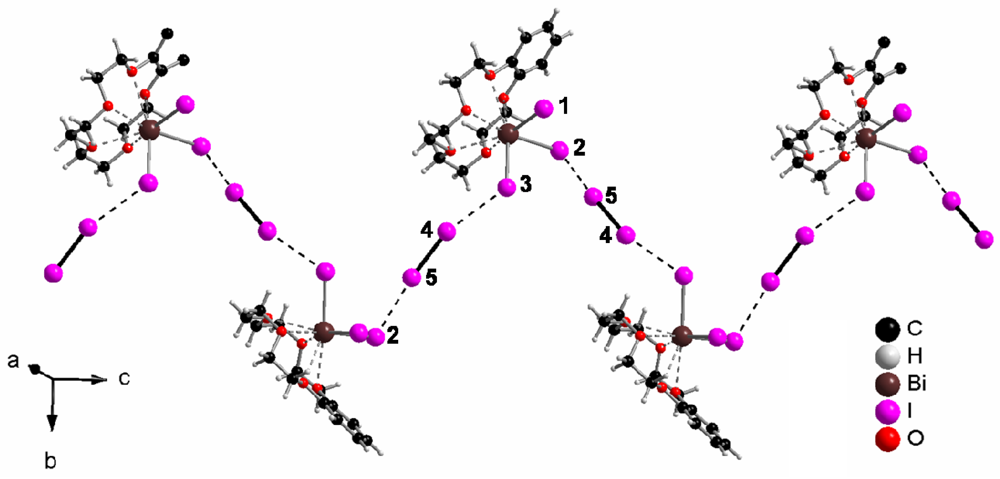
<p>In the crystal structure of (b15c5)BiI<sub>3</sub>(I<sub>2</sub>), a bismuth(III) iodide molecule of ψ<sup>3</sup>-octahedral structure is attached to a benzo-15-crown-5 ligand to form a neutral (b15c5)BiI<sub>3</sub> complex. Bi<sup>3+</sup>−I<sup>−</sup> distances are 287.9(1) (to I1), 296.4(6) (I2) and 287.3(1) pm (I3), see <xref ref-type="fig" rid="f1-crystals-01-00220">Figure 1</xref>. These distances with an average of 290.5 pm correspond very well to the Bi–I(terminal) distances of 292.0(2) pm in Cs<sub>3</sub>Bi<sub>2</sub>I<sub>9</sub> [<xref ref-type="bibr" rid="b13-crystals-01-00220">13</xref>], which contains confacial bioctahedra [Bi<sub>2</sub>I<sub>9</sub>]<sup>3−</sup>. The distance from the central Bi<sup>3+</sup> to the bridging I<sup>−</sup> in this compound is 324.4(2) pm; for one [BiI<sub>6</sub>] octahedron they average 308.2 pm, a distance that matches very well the 309.0 pm average of the individual Bi–I distances of 305.41(3) and 312.53(3) pm (three times each) in solid BiI<sub>3</sub> [<xref ref-type="bibr" rid="b14-crystals-01-00220">14</xref>]. In (b15c5)BiI<sub>3</sub>(I<sub>2</sub>), I–Bi–I angles are 88.62(2) (I1–Bi–I2), 92.90(2) (I1–Bi–I3), and 91.45(2) pm (I2–Bi–I3), hence there is a meridional configuration with respect to an octahedron. The five oxygen atoms of benzo-15-crown-5 are situated opposite to the I1–I2–I3 triangle with Bi–O distances ranging from 282.4(7) to 291.1(5) pm, with an average of 286.7 pm.</p>
<p>Isostructural complexes (b15c5)BiX<sub>3</sub> with X = Cl, Br have already been characterized [<xref ref-type="bibr" rid="b15-crystals-01-00220">15</xref>]. In these complexes the Bi–O distances are 283 (X = Cl) and 285 (Br) pm; hence the Bi–O distances are very similar, as expected, although there seems to be a slight trend from chloride to iodide. The Bi–X distances follow, with averages of 253 (X = Cl), 268 (Br) and 291 (I) pm, the increase of ionic radii from Cl<sup>−</sup> via Br<sup>−</sup> to I<sup>−</sup>. When these (167, 182, and 206 pm) [<xref ref-type="bibr" rid="b16-crystals-01-00220">16</xref>] are subtracted from the mentioned averaged Bi–X distances, a reasonable ionic radius for Bi<sup>3+</sup> of 85–86 pm is obtained.</p>
<p>In (b15c5)BiI<sub>3</sub>(I<sub>2</sub>), the discrete complexes (b15c5)BiI<sub>3</sub> are connected via iodine molecules to zig-zag chains, as <xref ref-type="fig" rid="f1-crystals-01-00220">Figure 1</xref> shows. The I–I distance in the I<sub>2</sub> molecule is, with 273.9(3) pm, only slightly longer than in solid iodine, 271.5(6) pm at 110 K [<xref ref-type="bibr" rid="b7-crystals-01-00220">7</xref>,<xref ref-type="bibr" rid="b8-crystals-01-00220">8</xref>]. The distances I<sup>−</sup>–I (from (b15c5) (I<sup>-</sup>)<sub>2</sub>Bi<sup>3+</sup>–I<sup>−</sup> to the I–I molecule) are 335.0(5) (I2-I5) and 353.7(2) pm (I3-I4), respectively. Both distances are close to the sum of the ionic radius of iodide (206 pm) and the atomic radius of iodine (140 pm) [<xref ref-type="bibr" rid="b17-crystals-01-00220">17</xref>], 346 pm. The latter distance, 354 pm, is close to I–I distances between neighboring iodine molecules in solid iodine (350 pm). Both distances are considerably shorter than twice the van der Waals radius [<xref ref-type="bibr" rid="b18-crystals-01-00220">18</xref>] of iodine, 2 × 198 = 396 pm. In summary, iodide–iodine interactions that form the zig-zag chains, qualify as “secondary bonding” [<xref ref-type="bibr" rid="b19-crystals-01-00220">19</xref>].</p>
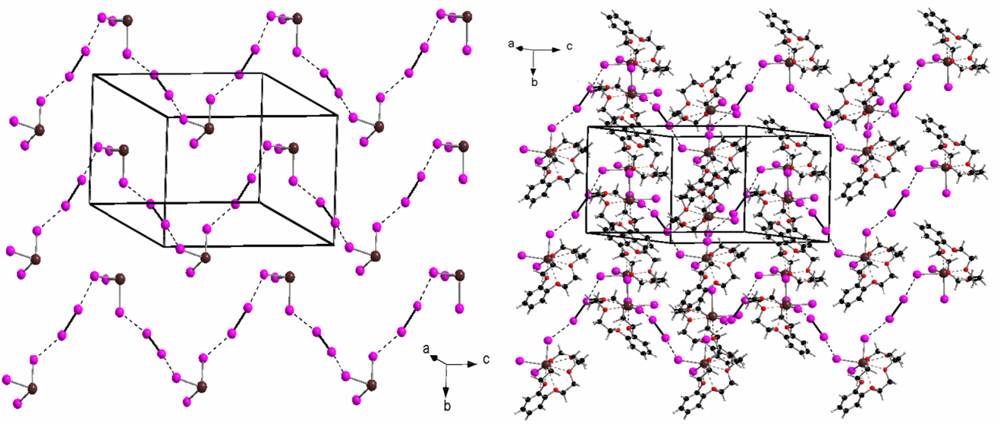
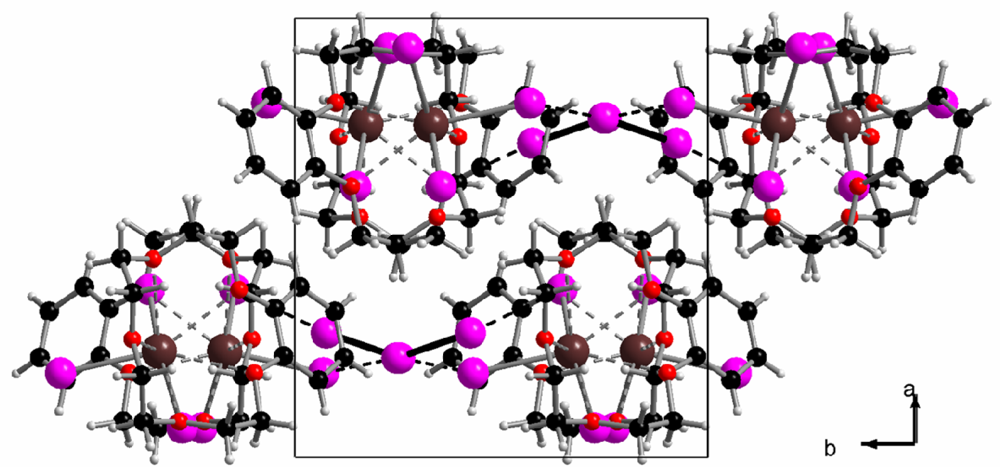
<p>Topologically, the zig-zag chains are arranged in layers, as <xref ref-type="fig" rid="f2-crystals-01-00220">Figure 2</xref> shows, and the layers are stacked parallel to [100], as <xref ref-type="fig" rid="f3-crystals-01-00220">Figure 3</xref> exhibits.</p>
<p>Trivalent bismuth has an electronic configuration of [Xe]6s<sup>2</sup>5d<sup>10</sup>4f<sup>14</sup>, hence filled 4f and 5d subshells and a lone 6s<sup>2</sup> electron pair. One could, therefore, believe that the special architecture of the (b15c5)BiI<sub>3</sub> complex were due to the 6s<sup>2</sup> pair being stereochemically active, as was suggested previously for (b15c5)BiX<sub>3</sub> (X = Cl, Br) [<xref ref-type="bibr" rid="b15-crystals-01-00220">15</xref>]. If this were the case, a ψ<sup>1</sup>-tetrahedral (with I–Bi–I angles around 109°) rather than a ψ<sup>3</sup>-octahedral structure (with I–Bi–I angles around 90°) would be expected. Indeed, it has been shown recently that lone-pair ions such as Tl(I)—isoelectronic with Bi(III)—suffer from 6s<sup>2</sup>-lone-pair–oxygen-2p orbital antibonding interactions leading to structural distortions [<xref ref-type="bibr" rid="b20-crystals-01-00220">20</xref>].</p></sec>
<sec>
<label>2.2.</label>
<title>Electronic Structure of (b15c5)BiI<sub>3</sub></title>
<p>As the interactions between the molecular complex (b15c5)BiI<sub>3</sub> and the iodine molecules in (b15c5)BiI<sub>3</sub>(I<sub>2</sub>) qualify as “secondary bonding”, calculations of the electronic structure have only been carried out for the (b15c5)BiI<sub>3</sub> complex. This subunit can be structurally described as a BiI<sub>3</sub> molecule interacting with the crown ether b15c5. Albeit BiI<sub>3</sub> itself forms an extended structure [<xref ref-type="bibr" rid="b14-crystals-01-00220">14</xref>], it appears that the interaction with the crown ether favors the formation of a molecular unit.</p>
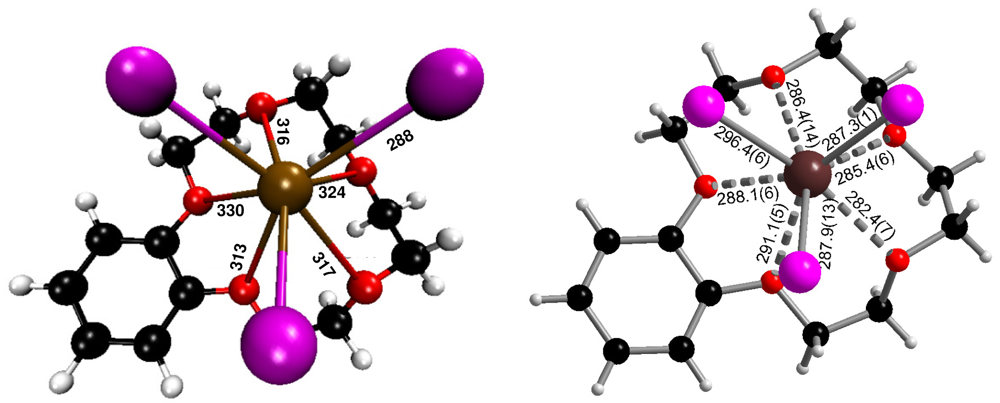
<p><italic>Ab initio</italic> calculations were carried out with the aid of density functional theory (DFT); for technical details see Experimental Section and Supporting Information. <xref ref-type="fig" rid="f4-crystals-01-00220">Figure 4</xref> shows the optimized ground state geometry of (b15c5)BiI<sub>3</sub> in comparison with the corresponding structural motif as observed in the crystal structure of (b15c5)BiI<sub>3</sub>(I<sub>2</sub>). No geometric or symmetry restraints were applied during the optimization process.</p>
<p>The theoretically calculated gas phase ground state geometry compares quite well with the experimentally observed structure of the complex. With 288 pm, the calculated interatomic Bi–I distances of the complex (b15c5)BiI<sub>3</sub> are slightly shorter than the average of the experimentally observed distances, 291 pm. However, as the calculations are done for <italic>T</italic> = 0 K and, furthermore, two of the iodide ions are connected to iodine molecules in (b15c5)BiI<sub>3</sub>(I<sub>2</sub>), these small deviations are no surprise. The mean interatomic Bi–O distances for the calculated (b15c5)BiI<sub>3</sub> unit are somewhat larger (324 pm) than experimentally observed distances, 291 pm, which is perhaps the result of packing effects in solid (b15c5)BiI<sub>3</sub>(I<sub>2</sub>).</p>
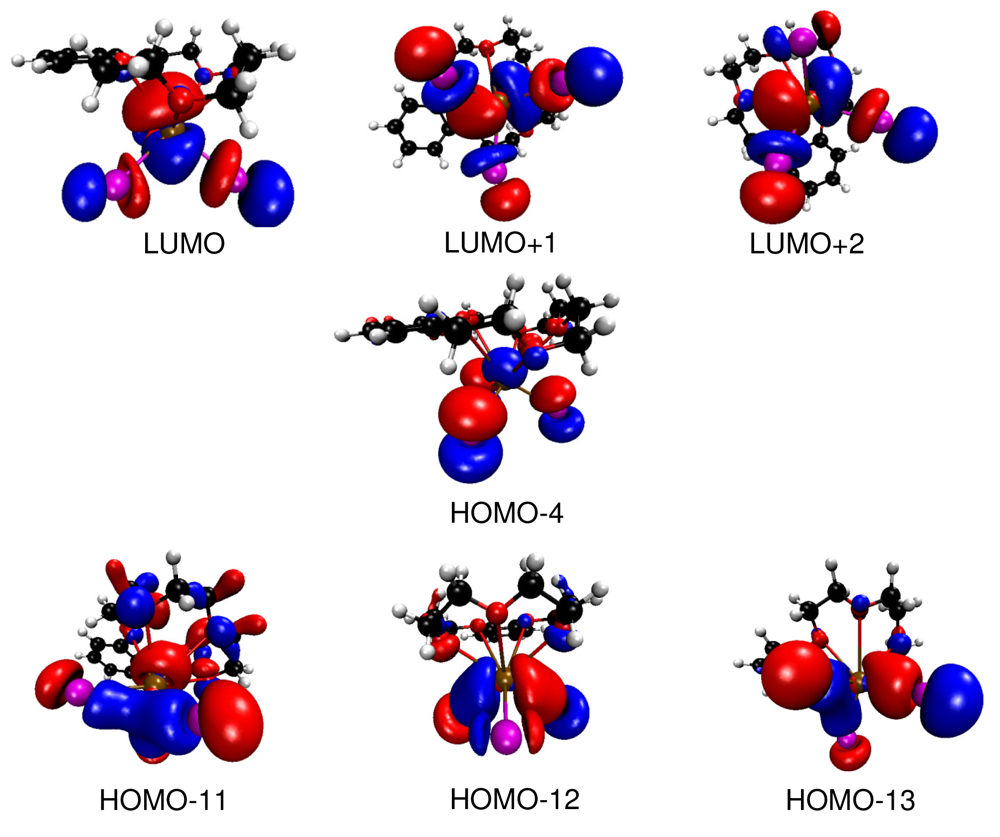
<p>Bi—I bonding interactions as represented by the HOMOs -11, -12 and -13 (<xref ref-type="fig" rid="f5-crystals-01-00220">Figure 5</xref>) are found at comparatively low energies. They are formed by interaction of iodine 6p orbitals with bismuth 6p orbitals. These molecular orbitals show only small contributions from the crown ether. The empty LUMOs (LUMO, LUMO+1 and LUMO+2) correspond to the anti-bonding set of the bismuth 6p and iodine 6p interactions. Again, only a small contribution of the crown ether moiety to these orbitals is observed. Thus, it is indeed justified to speak of a molecular BiI<sub>3</sub> unit interacting with the crown ether b15c5. However, the attractive BiI<sub>3</sub>—crown-ether interactions have to be mainly electrostatic as HOMO-4, which is basically Bi—I nonbonding, shows a clearly antibonding interaction of the 6s orbital of bismuth with the 2p orbitals of the oxygen atoms of the crown ether. This is a similar situation as found for the interaction of isolated Tl<sup>+</sup> cations with organic macrocycles [<xref ref-type="bibr" rid="b20-crystals-01-00220">20</xref>]. In this case the combination of the occupied 6s orbital of Tl<sup>+</sup> with the oxygen 2p orbitals of the macrocycle lead to fully occupied bonding and anti-bonding levels, and a subtle counterplay between repulsive covalent interactions and attractive electrostatic forces is observed. In the case of (b15c5)BiI<sub>3</sub> where BiI<sub>3</sub> interacts with the organic macrocycle b15c5 a similar bonding scenario is found. However, here it is not an isolated cation but a molecular BiI<sub>3</sub> unit which interacts. Thus, the anti-bonding interaction forms by a Bi-I group orbital with strong Bi-6s contribution.</p>
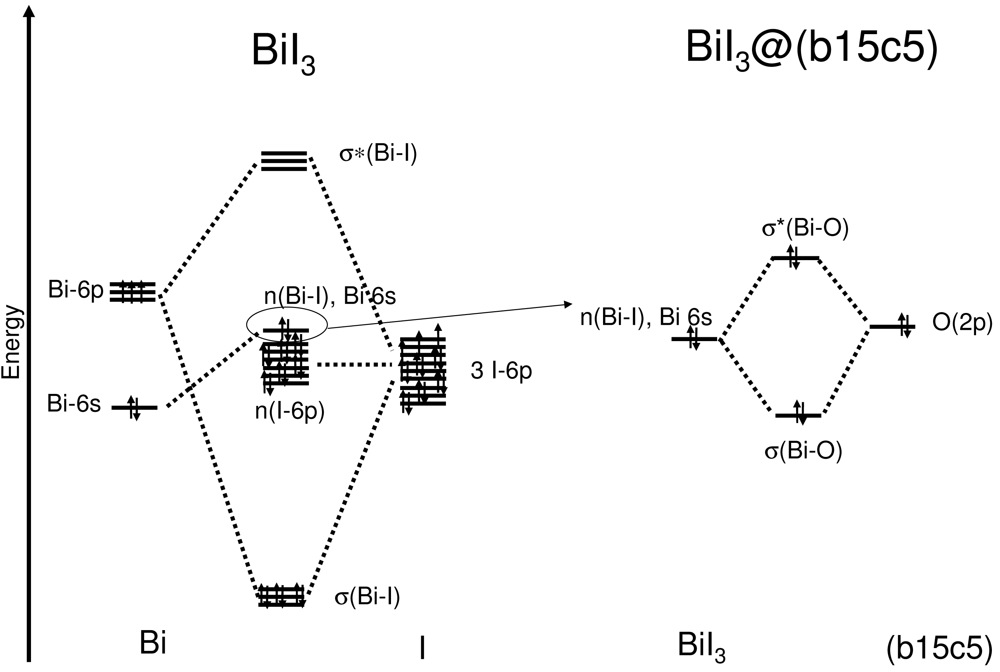
<p>A simplified, schematic energy diagram describing the interaction between bismuth and iodine to form BiI<sub>3</sub> and then between the BiI<sub>3</sub> fragment and the crown ether yielding (b15c5)BiI<sub>3</sub> is depicted in <xref ref-type="fig" rid="f6-crystals-01-00220">Figure 6</xref>.</p></sec></sec>
<sec>
<label>3.</label>
<title>Experimental Section</title>
<p>Anhydrous bismuth triiodide, BiI<sub>3</sub> (Alfa Aesar, 99.999%, 0.059 g, 0.1 mmol), benzo-15-crown-5, b15c5 (Alfa Aesar, 98%, 0.025 g, 0.1 mmol) and iodine, I<sub>2</sub> (Merck, 0.888 g, 3.5 mmol) were dissolved in 40 mL of a 1:1 mixture of ethanol and dichloromethane. Slow evaporation of the solvent yielded red polyhedral single crystals of (b15c5)BiI<sub>3</sub>(I<sub>2</sub>).</p>
<p>Single crystals were selected under a microscope and mounted in thin-walled glass capillaries. Their quality was checked on a single-crystal X-ray diffractometer (Stoe Image Plate Diffraction System, IPDS II) and a complete intensity data set was collected at ambient temperature using graphite-monochromated Mo-K<sub>α</sub> radiation. The data were corrected for Lorentz and polarization effects. A numerical absorption correction based on crystal-shape optimization was applied for all data; the programs used in this work are Stoe's X-Area, including X-RED and X-SHAPE for data reduction and absorption correction [<xref ref-type="bibr" rid="b21-crystals-01-00220">21</xref>,<xref ref-type="bibr" rid="b22-crystals-01-00220">22</xref>]. The WinGX suite of programs [<xref ref-type="bibr" rid="b23-crystals-01-00220">23</xref>], including SIR-92 [<xref ref-type="bibr" rid="b24-crystals-01-00220">24</xref>] and the SHELX programs [<xref ref-type="bibr" rid="b25-crystals-01-00220">25</xref>-<xref ref-type="bibr" rid="b27-crystals-01-00220">27</xref>] were used for structure solution and refinement. Hydrogen atoms were placed in idealized positions and constrained to ride on their respective parent atom. The last refinement cycles included atomic positions for all atoms, anisotropic thermal parameters for all non-hydrogen atoms and isotropic thermal parameters for all hydrogen atoms. Crystallographic data for the structure have been deposited with the Cambridge Crystallographic Data Centre as supplementary publication no. CCDC-838985. Copies of the data can be obtained, free of charge, on application to CHGC, 12 Union Road, Cambridge CB2 1EZ, UK (fax: +44 1223 336033 or e-mail: <email>deposit@ccdc.cam.ac.uk</email>).</p>
<p>Crystal data for (b15c5)BiI<sub>3</sub>(I<sub>2</sub>). C<sub>14</sub>H<sub>20</sub>O<sub>5</sub>I<sub>5</sub>Bi, 1111.78 g mol<sup>−1</sup>. Monoclinic, <italic>P2<sub>1</sub></italic>/<italic>c</italic> (no. 14), <italic>a</italic> = 1376.9(1), <italic>b</italic> = 1172.7(1), <italic>c</italic> = 1700.2(2) pm, <italic>β</italic> = 115.197(6)°, <italic>V</italic> = 2484.1(4)·10<sup>6</sup> pm<sup>3</sup>, <italic>Z</italic> = 4. Diffractometer IPDS-II, Stoe Darmstadt; Mo-K<sub>α</sub> (graphite monochromator, <italic>λ</italic> = 71.073 pm); <italic>T</italic> = 293(2) K; 4.36° ≤ 2<italic>θ</italic><sub>max</sub> ≤ 54.62°; 0° ≤ <italic>ω</italic> ≤ 180°, <italic>φ</italic> = 0°; 0° ≤ <italic>ω</italic> &lt; 88°, <italic>φ</italic> = 90°; Δ<italic>ω</italic> = 2°; 134 images; −17 ≤ h ≤ 15, −15 ≤ k ≤ 15, −21 ≤ l ≤ 21; <italic>ρ</italic><sub>calc</sub> = 2.973 g cm<sup>−3</sup>; 17644 reflections measured of which 5371 were symmetrically independent; <italic>R</italic><sub>int</sub> = 0.0470; F(000) = 1968; <italic>μ</italic> = 13.330 mm<sup>−1</sup>. 229 refined parameters; <italic>R</italic> values: <italic>R</italic><sub>1</sub>/w<italic>R</italic><sub>2</sub> for 4389 reflections with [I<sub>0</sub> &gt; 2<italic>σ</italic>(I<sub>0</sub>)]: 0.0290/0.0637, for all data: 0.0395/0.0713; <italic>S</italic><sub>all</sub> = 1.047; Δρ(min/max): −1.236·× 10<sup>−6</sup> pm<sup>−3</sup> / +1.515·× 10<sup>−6</sup> pm<sup>−3</sup>.</p>
<p>For the calculations of the electronic structure of (b15c5)BiI<sub>3</sub>, the BP86 hybrid functional [<xref ref-type="bibr" rid="b28-crystals-01-00220">28</xref>] was used to describe exchange and correlation in combination with a doubled polarized triplet-ζ-valence basis set (def2-TZVPP) [<xref ref-type="bibr" rid="b29-crystals-01-00220">29</xref>,<xref ref-type="bibr" rid="b30-crystals-01-00220">30</xref>] within the framework of the RI-approximation [<xref ref-type="bibr" rid="b31-crystals-01-00220">31</xref>,<xref ref-type="bibr" rid="b32-crystals-01-00220">32</xref>]. This method is well known for obtaining accurate results concerning geometries and vibrational spectra especially for metal complexes [<xref ref-type="bibr" rid="b33-crystals-01-00220">33</xref>]. The quantum chemistry program package TURBOMOLE (V. 6.1) [<xref ref-type="bibr" rid="b34-crystals-01-00220">34</xref>] was used for all calculations.</p></sec></body>
<back>
<sec sec-type="display-objects">
<title>Figures</title>
<fig id="f1-crystals-01-00220" position="float">
<label>Figure 1.</label>
<caption>
<p>Part of the zig-zag chain of (b15c5)BiI<sub>3</sub> complexes bridged by iodine molecules in the crystal structure of (b15c5)BiI<sub>3</sub>(I<sub>2</sub>).</p></caption>
<graphic xlink:href="crystals-01-00220f1.gif"/></fig>
<fig id="f2-crystals-01-00220" position="float">
<label>Figure 2.</label>
<caption>
<p>The arrangement of the zig-zag chains in (b15c5)BiI<sub>3</sub>(I<sub>2</sub>) to “layers” without (left) and with crown ether molecules (right) shown.</p></caption>
<graphic xlink:href="crystals-01-00220f2.gif"/></fig>
<fig id="f3-crystals-01-00220" position="float">
<label>Figure 3.</label>
<caption>
<p>Layers of zig-zag chains of (b15c5)BiI<sub>3</sub>(I<sub>2</sub>) stacked parallel to [100].</p></caption>
<graphic xlink:href="crystals-01-00220f3.gif"/></fig>
<fig id="f4-crystals-01-00220" position="float">
<label>Figure 4.</label>
<caption>
<p>Optimized gas phase ground state geometry of (b15c5)BiI<sub>3</sub> (left) and corresponding cut-out of the crystal structure of (b15c5)BiI<sub>3</sub>(I<sub>2</sub>) (right). Relevant interatomic distances are labeled in pm.</p></caption>
<graphic xlink:href="crystals-01-00220f4.gif"/></fig>
<fig id="f5-crystals-01-00220" position="float">
<label>Figure 5.</label>
<caption>
<p>Selected graphical representations of frontier orbitals of (b15c5)BiI<sub>3</sub>.</p></caption>
<graphic xlink:href="crystals-01-00220f5.gif"/></fig>
<fig id="f6-crystals-01-00220" position="float">
<label>Figure 6.</label>
<caption>
<p>Schematic energy diagram describing the interaction between Bi<sup>3+</sup> and I<sup>-</sup> in BiI<sub>3</sub> (left) and the relevant frontier orbitals of BiI<sub>3</sub> and the crown ether orbitals in (B15c5)BiI<sub>3</sub> (right).</p></caption>
<graphic xlink:href="crystals-01-00220f6.gif"/></fig></sec>
<ack>
<p>This work was generously supported by the State of Nordrhein-Westfalen through the Universität zu Köln and the Ruhr-Universität Bochum.</p></ack>
<ref-list>
<title>References</title>
<ref id="b1-crystals-01-00220"><label>1.</label><citation citation-type="journal"><person-group person-group-type="author"><name><surname>Nockemann</surname><given-names>P.</given-names></name><name><surname>Pantenburg</surname><given-names>I.</given-names></name><name><surname>Meyer</surname><given-names>G.</given-names></name></person-group><article-title>Tetrahedra and Vertex-Sharing Double Tetrahedra in the Ammonium Iodomercurates(II) (NH<sub>4</sub>)<sub>7</sub>[HgI<sub>4</sub>]<sub>2</sub>[Hg<sub>2</sub>I<sub>7</sub>](H<sub>2</sub>O) and (NH<sub>4</sub>)<sub>3</sub>[Hg<sub>2</sub>I<sub>7</sub>]</article-title><source>Z. Anorg. Allg. Chem.</source><year>2006</year><volume>632</volume><fpage>1972</fpage><lpage>1974</lpage><pub-id pub-id-type="doi">10.1002/zaac.200600133</pub-id></citation></ref>
<ref id="b2-crystals-01-00220"><label>2.</label><citation citation-type="journal"><person-group person-group-type="author"><name><surname>Nockemann</surname><given-names>P.</given-names></name><name><surname>Meyer</surname><given-names>G.</given-names></name></person-group><article-title>Bis(tetrabutylammonium)dodecaiodotetra-mercurate(II), (Bu<sub>4</sub>N)<sub>2</sub>[Hg<sub>4</sub>I<sub>10</sub>]</article-title><source>Acta Crystallogr.</source><year>2003</year><volume>E59</volume><fpage>m236</fpage><lpage>m238</lpage></citation></ref>
<ref id="b3-crystals-01-00220"><label>3.</label><citation citation-type="journal"><person-group person-group-type="author"><name><surname>Stegemann</surname><given-names>H.</given-names></name><name><surname>Tebbe</surname><given-names>K.-F.</given-names></name><name><surname>Bengtsson</surname><given-names>L.A.</given-names></name></person-group><article-title>Der erste Polyiodokomplex—Triethylsulfoniumtriiodomercurat(II)-tris(diiod), (Et<sub>3</sub>S)[Hg<sub>2</sub>I<sub>6</sub>]<sub>1/2</sub>·3I<sub>2</sub></article-title><source>Z. Anorg. Allg. Chem.</source><year>1995</year><volume>621</volume><fpage>165</fpage><lpage>170</lpage><pub-id pub-id-type="doi">10.1002/zaac.19956210130</pub-id></citation></ref>
<ref id="b4-crystals-01-00220"><label>4.</label><citation citation-type="journal"><person-group person-group-type="author"><name><surname>Tebbe</surname><given-names>K.-F.</given-names></name><name><surname>Plewa</surname><given-names>M.</given-names></name></person-group><article-title>Untersuchungen an Polyhalogeniden. IV. Tetrammin-cadmium-tetraiodid, [Cd(NH<sub>3</sub>)<sub>4</sub>I<sub>2</sub>·I<sub>2</sub>], und Tetrammin-cadmium-hexaiodid, [Cd(NH<sub>3</sub>)<sub>4</sub>(I·I<sub>2</sub>)<sub>2</sub>]</article-title><source>Z. Anorg. Allg. Chem.</source><year>1982</year><volume>489</volume><fpage>111</fpage><lpage>125</lpage><pub-id pub-id-type="doi">10.1002/zaac.19824890113</pub-id></citation></ref>
<ref id="b5-crystals-01-00220"><label>5.</label><citation citation-type="journal"><person-group person-group-type="author"><name><surname>Svensson</surname><given-names>P.H.</given-names></name><name><surname>Kloo</surname><given-names>L.</given-names></name></person-group><article-title>Synthesis, Structure, and Bonding in Polyiodide and Metal Iodide–Iodine Systems</article-title><source>Chem. Rev.</source><year>2003</year><volume>103</volume><fpage>1649</fpage><lpage>1684</lpage><pub-id pub-id-type="doi">10.1021/cr0204101</pub-id><pub-id pub-id-type="pmid">12744691</pub-id></citation></ref>
<ref id="b6-crystals-01-00220"><label>6.</label><citation citation-type="journal"><person-group person-group-type="author"><name><surname>Walbaum</surname><given-names>C.</given-names></name><name><surname>Pantenburg</surname><given-names>I.</given-names></name><name><surname>Meyer</surname><given-names>G.</given-names></name></person-group><article-title>Molecular iodine catenation in the anionic chains [Pd<sub>2</sub>I<sub>6</sub>(I<sub>2</sub>)]<sup>2−</sup></article-title><source>Cryst. Res. Technol.</source><year>2008</year><volume>43</volume><fpage>1183</fpage><lpage>1186</lpage><pub-id pub-id-type="doi">10.1002/crat.200800363</pub-id></citation></ref>
<ref id="b7-crystals-01-00220"><label>7.</label><citation citation-type="journal"><person-group person-group-type="author"><name><surname>Harris</surname><given-names>P.M.</given-names></name><name><surname>Mack</surname><given-names>E.</given-names></name><name><surname>Blake</surname><given-names>F.C.</given-names></name></person-group><article-title>The atomic arrangement in the crystal of orthorhombic iodine</article-title><source>J. Am. Chem. Soc.</source><year>1928</year><volume>50</volume><fpage>1583</fpage><lpage>1600</lpage><pub-id pub-id-type="doi">10.1021/ja01393a009</pub-id></citation></ref>
<ref id="b8-crystals-01-00220"><label>8.</label><citation citation-type="journal"><person-group person-group-type="author"><name><surname>Van Bolhuis</surname><given-names>F.</given-names></name><name><surname>Koster</surname><given-names>P.B.</given-names></name><name><surname>Migchelsen</surname><given-names>T.</given-names></name></person-group><article-title>Refinement of the crystal structure of iodine at 110° K</article-title><source>Acta Crystallogr.</source><year>1967</year><volume>23</volume><fpage>90</fpage><lpage>91</lpage><pub-id pub-id-type="doi">10.1107/S0365110X6700218X</pub-id></citation></ref>
<ref id="b9-crystals-01-00220"><label>9.</label><citation citation-type="journal"><person-group person-group-type="author"><name><surname>Walbaum</surname><given-names>C.</given-names></name><name><surname>Pantenburg</surname><given-names>I.</given-names></name><name><surname>Meyer</surname><given-names>G.</given-names></name></person-group><article-title>Iodine Molecules Included in the Structure of Dibenzo-24-Crown-8, (I<sub>2</sub>)@(db24c8)</article-title><source>Crystals</source><year>2011</year><volume>1</volume><fpage>215</fpage><lpage>219</lpage><pub-id pub-id-type="doi">10.3390/cryst1040215</pub-id></citation></ref>
<ref id="b10-crystals-01-00220"><label>10.</label><citation citation-type="journal"><person-group person-group-type="author"><name><surname>Karle</surname><given-names>I.L.</given-names></name></person-group><article-title>Anomalous Electron Scattering from Iodine Vapor</article-title><source>J. Chem. Phys.</source><year>1955</year><volume>23</volume><fpage>1739</fpage></citation></ref>
<ref id="b11-crystals-01-00220"><label>11.</label><citation citation-type="thesis"><person-group person-group-type="author"><name><surname>Walbaum</surname><given-names>C.</given-names></name></person-group><article-title>Neue Poly(inter)halogenide mit Kronenether-stabilisierten Kationen</article-title><source>PhD Dissertation</source><publisher-name>Universität zu Köln</publisher-name><publisher-loc>Köln, Germany</publisher-loc><year>2009</year></citation></ref>
<ref id="b12-crystals-01-00220"><label>12.</label><citation citation-type="thesis"><person-group person-group-type="author"><name><surname>Fiolka</surname><given-names>C.</given-names></name></person-group><article-title>Polyiodide komplexer Übergangsmetalle</article-title><source>PhD Dissertation</source><publisher-name>Universität zu Köln</publisher-name><publisher-loc>Köln, Germany</publisher-loc><year>2010</year></citation></ref>
<ref id="b13-crystals-01-00220"><label>13.</label><citation citation-type="journal"><person-group person-group-type="author"><name><surname>Chabot</surname><given-names>B.</given-names></name><name><surname>Parthé</surname><given-names>E.</given-names></name></person-group><article-title>Cs<sub>3</sub>Sb<sub>2</sub>I<sub>9</sub> and Cs<sub>3</sub>Bi<sub>2</sub>I<sub>9</sub> with the Hexagonal Cs<sub>3</sub>Cr<sub>2</sub>Cl<sub>9</sub> Structure Type</article-title><source>Acta Cryst.</source><year>1978</year><volume>B34</volume><fpage>645</fpage><lpage>648</lpage></citation></ref>
<ref id="b14-crystals-01-00220"><label>14.</label><citation citation-type="journal"><person-group person-group-type="author"><name><surname>Ruck</surname><given-names>M.</given-names></name></person-group><article-title>Darstellung und Kristallstruktur von fehlordnungsfreiem Bismuttriodid</article-title><source>Z. Kristallogr.</source><year>1995</year><volume>210</volume><fpage>650</fpage><lpage>655</lpage><pub-id pub-id-type="doi">10.1524/zkri.1995.210.9.650</pub-id></citation></ref>
<ref id="b15-crystals-01-00220"><label>15.</label><citation citation-type="journal"><person-group person-group-type="author"><name><surname>Rogers</surname><given-names>R.D.</given-names></name><name><surname>Bond</surname><given-names>A.H.</given-names></name><name><surname>Aguinaga</surname><given-names>S.</given-names></name><name><surname>Reves</surname><given-names>A.</given-names></name></person-group><article-title>Complexation Chemistry of Bismuth(III) Halides with Crown Ethers and Polyethelyne Glycols. Structural Manifestations of a Stereochemically Active Lone Pair</article-title><source>J. Am. Chem. Soc.</source><year>1992</year><volume>114</volume><fpage>2967</fpage><lpage>2977</lpage><pub-id pub-id-type="doi">10.1021/ja00034a032</pub-id></citation></ref>
<ref id="b16-crystals-01-00220"><label>16.</label><citation citation-type="journal"><person-group person-group-type="author"><name><surname>Shannon</surname><given-names>R.D.</given-names></name></person-group><article-title>Revised effective ionic radii and systematic studies of interatomic distances in halides and chalcogenides</article-title><source>Acta Cryst.</source><year>1976</year><volume>A32</volume><fpage>751</fpage><lpage>767</lpage></citation></ref>
<ref id="b17-crystals-01-00220"><label>17.</label><citation citation-type="journal"><person-group person-group-type="author"><name><surname>Slater</surname><given-names>J.C.</given-names></name></person-group><article-title>Atomic Radii in Crystals</article-title><source>J. Chem. Phys.</source><year>1964</year><volume>41</volume><fpage>3199</fpage><lpage>3205</lpage><pub-id pub-id-type="doi">10.1063/1.1725697</pub-id></citation></ref>
<ref id="b18-crystals-01-00220"><label>18.</label><citation citation-type="journal"><person-group person-group-type="author"><name><surname>Bondi</surname><given-names>A.</given-names></name></person-group><article-title>Van der Waals Volumes and Radii</article-title><source>J. Phys. Chem.</source><year>1964</year><volume>68</volume><fpage>441</fpage><lpage>451</lpage><pub-id pub-id-type="doi">10.1021/j100785a001</pub-id></citation></ref>
<ref id="b19-crystals-01-00220"><label>19.</label><citation citation-type="journal"><person-group person-group-type="author"><name><surname>Alcock</surname><given-names>N.W.</given-names></name></person-group><article-title>Secondary Bonding to Nonmetallic Elements</article-title><source>Adv. Inorg. Chem. Radiochem.</source><year>1972</year><volume>15</volume><fpage>1</fpage><lpage>58</lpage></citation></ref>
<ref id="b20-crystals-01-00220"><label>20.</label><citation citation-type="journal"><person-group person-group-type="author"><name><surname>Mudring</surname><given-names>A.-V.</given-names></name><name><surname>Rieger</surname><given-names>F.</given-names></name></person-group><article-title>Lone Pair Effect in Thallium(I) Macrocyclic Compounds</article-title><source>Inorg. Chem.</source><year>2005</year><volume>44</volume><fpage>6240</fpage><lpage>6243</lpage><pub-id pub-id-type="doi">10.1021/ic050547k</pub-id><pub-id pub-id-type="pmid">16124801</pub-id></citation></ref>
<ref id="b21-crystals-01-00220"><label>21.</label><citation citation-type="book"><source>X-RED 1.22, Stoe Data Reduction Program (C)</source><publisher-name>Stoe &amp; Cie GmbH</publisher-name><publisher-loc>Darmstadt, Germany</publisher-loc><year>1999</year></citation></ref>
<ref id="b22-crystals-01-00220"><label>22.</label><citation citation-type="book"><source>X-Shape 1.06, Crystal Optimisation for Numerical Absorption Correction (C)</source><publisher-name>Stoe &amp; Cie GmbH</publisher-name><publisher-loc>Darmstadt, Germany</publisher-loc><year>1999</year></citation></ref>
<ref id="b23-crystals-01-00220"><label>23.</label><citation citation-type="book"><person-group person-group-type="author"><name><surname>Farrugia</surname><given-names>L.J.</given-names></name></person-group><source>WinGX, A MS-Windows System of Programs for Solving, Refining and Analysing Single X-ray Diffraction Data for Small Molecules</source><publisher-name>University of Glasgow</publisher-name><publisher-loc>Glasgow, Scotland</publisher-loc><year>2005</year></citation></ref>
<ref id="b24-crystals-01-00220"><label>24.</label><citation citation-type="journal"><person-group person-group-type="author"><name><surname>Altomare</surname><given-names>A.</given-names></name><name><surname>Cascarano</surname><given-names>G.</given-names></name><name><surname>Giacovazzo</surname><given-names>C.</given-names></name><name><surname>Gualardi</surname><given-names>A.</given-names></name></person-group><article-title>SIR92, A Program for Automatic Solution of Crystal Structures by Direct Methods</article-title><source>J. Appl. Crystallogr.</source><year>1993</year><volume>26</volume><fpage>343</fpage><lpage>350</lpage><pub-id pub-id-type="doi">10.1107/S0021889892010331</pub-id></citation></ref>
<ref id="b25-crystals-01-00220"><label>25.</label><citation citation-type="journal"><person-group person-group-type="author"><name><surname>Sheldrick</surname><given-names>G.M.</given-names></name></person-group><article-title>A short history of <italic>SHELX</italic></article-title><source>Acta Cryst.</source><year>2008</year><volume>A64</volume><fpage>112</fpage><lpage>122</lpage></citation></ref>
<ref id="b26-crystals-01-00220"><label>26.</label><citation citation-type="book"><person-group person-group-type="author"><name><surname>Sheldrick</surname><given-names>G.M.</given-names></name></person-group><source>SHELXS-97, Program for Structure Analysis</source><publisher-name>University of Göttingen</publisher-name><publisher-loc>Göttingen, Germany</publisher-loc><year>1998</year></citation></ref>
<ref id="b27-crystals-01-00220"><label>27.</label><citation citation-type="book"><person-group person-group-type="author"><name><surname>Sheldrick</surname><given-names>G.M.</given-names></name></person-group><source>SHELXL-93, Program for Crystal Structure Refinement</source><publisher-name>University of Göttingen</publisher-name><publisher-loc>Göttingen, Germany</publisher-loc><year>1993</year></citation></ref>
<ref id="b28-crystals-01-00220"><label>28.</label><citation citation-type="journal"><person-group person-group-type="author"><name><surname>Becke</surname><given-names>A.D.</given-names></name></person-group><article-title>Density-functional exchange-energy approximation with correct asymptotic behavior</article-title><source>Phys.Rev.</source><year>1988</year><volume>A38</volume><fpage>3098</fpage><lpage>3100</lpage></citation></ref>
<ref id="b29-crystals-01-00220"><label>29.</label><citation citation-type="journal"><person-group person-group-type="author"><name><surname>Schäfer</surname><given-names>A.</given-names></name><name><surname>Huber</surname><given-names>C.</given-names></name><name><surname>Ahlrichs</surname><given-names>R.</given-names></name></person-group><article-title>Fully Optimized Contracted Gaussian Basis Sets of Triple Zeta Valence Quality for Atoms Li to Kr</article-title><source>J. Chem. Phys.</source><year>1994</year><volume>100</volume><fpage>5829</fpage><lpage>5835</lpage><pub-id pub-id-type="doi">10.1063/1.467146</pub-id></citation></ref>
<ref id="b30-crystals-01-00220"><label>30.</label><citation citation-type="journal"><person-group person-group-type="author"><name><surname>Weigend</surname><given-names>F.</given-names></name><name><surname>Ahlrichs</surname><given-names>R.</given-names></name></person-group><article-title>Balanced basis sets of split valence, triple zeta valence and quadruple zeta valence quality for H to Rn: Design an assessment of accuracy</article-title><source>Phys. Chem. Chem. Phys.</source><year>2005</year><volume>7</volume><fpage>3297</fpage><lpage>3305</lpage><pub-id pub-id-type="doi">10.1039/b508541a</pub-id><pub-id pub-id-type="pmid">16240044</pub-id></citation></ref>
<ref id="b31-crystals-01-00220"><label>31.</label><citation citation-type="journal"><person-group person-group-type="author"><name><surname>Hellweg</surname><given-names>A.</given-names></name><name><surname>Hättig</surname><given-names>C.</given-names></name><name><surname>Höfener</surname><given-names>S.</given-names></name><name><surname>Klopper</surname><given-names>W.</given-names></name></person-group><article-title>Optimized accurate auxiliary basis sets for RI-MP2 and RI-CC2 calculations for the atoms Rb to Rn</article-title><source>Theor. Chem. Acc.</source><year>2007</year><volume>117</volume><fpage>587</fpage><lpage>597</lpage><pub-id pub-id-type="doi">10.1007/s00214-007-0250-5</pub-id></citation></ref>
<ref id="b32-crystals-01-00220"><label>32.</label><citation citation-type="journal"><person-group person-group-type="author"><name><surname>Ahlrichs</surname><given-names>R.</given-names></name></person-group><article-title>Efficient evaluation of three-center two-electron integrals over Gaussian functions</article-title><source>Phys. Chem. Chem. Phys.</source><year>2004</year><volume>6</volume><fpage>5119</fpage><lpage>5121</lpage><pub-id pub-id-type="doi">10.1039/b413539c</pub-id></citation></ref>
<ref id="b33-crystals-01-00220"><label>33.</label><citation citation-type="journal"><person-group person-group-type="author"><name><surname>Bühl</surname><given-names>M.</given-names></name><name><surname>Kabrede</surname><given-names>H.</given-names></name></person-group><article-title>Geometries of Transition-Metal Complexes from Density Functional Theory</article-title><source>J. Chem. Theory Comput.</source><year>2006</year><volume>2</volume><fpage>1282</fpage><lpage>1290</lpage><pub-id pub-id-type="doi">10.1021/ct6001187</pub-id></citation></ref>
<ref id="b34-crystals-01-00220"><label>34.</label><note><p>TURBOMOLE V6.1 2009—A development of University of Karlsruhe and Forschungszentrum Karlsruhe GmbH, 1989-2007, TURBOMOLE GmbH, since 2007</p></note></ref></ref-list></back></article>