
<?xml version="1.0" encoding="UTF-8"?>
<!DOCTYPE article PUBLIC "-//NLM//DTD Journal Publishing DTD v2.3 20070202//EN" "journalpublishing.dtd">
<article xmlns:mml="http://www.w3.org/1998/Math/MathML" xmlns:xlink="http://www.w3.org/1999/xlink" xml:lang="en" article-type="review-article">
  <front>
    <journal-meta>
      <journal-id journal-id-type="publisher-id">catalysts</journal-id>
      <journal-title>Catalysts</journal-title>
      <abbrev-journal-title abbrev-type="publisher">Catalysts</abbrev-journal-title>
      <abbrev-journal-title abbrev-type="pubmed">Catalysts</abbrev-journal-title>
      <issn pub-type="epub">2073-4344</issn>
      <publisher>
        <publisher-name>MDPI</publisher-name>
      </publisher>
    </journal-meta>
    <article-meta>
      <article-id pub-id-type="doi">10.3390/catal3010189</article-id>
      <article-id pub-id-type="publisher-id">catalysts-03-00189</article-id>
      <article-categories>
        <subj-group>
          <subject>Review</subject>
        </subj-group>
      </article-categories>
      <title-group>
        <article-title>Heterogeneous Photocatalysis: Recent Advances and Applications</article-title>
      </title-group>
      <contrib-group>
        <contrib contrib-type="author">
          <name>
            <surname>Ibhadon</surname>
            <given-names>Alex Omo</given-names>
          </name>
          <xref rid="af1-catalysts-03-00189" ref-type="aff">1</xref>
          <xref rid="c1-catalysts-03-00189" ref-type="corresp">*</xref>
        </contrib>
        <contrib contrib-type="author">
          <name>
            <surname>Fitzpatrick</surname>
            <given-names>Paul</given-names>
          </name>
          <xref rid="af2-catalysts-03-00189" ref-type="aff">2</xref>
        </contrib>
      </contrib-group>
      <aff id="af1-catalysts-03-00189"><label>1 </label>Centre for Environmental and Marine Sciences, Faculty of Science, University of Hull, Scarborough Campus, Scarborough YO11 3AZ, UK</aff>
      <aff id="af2-catalysts-03-00189"><label>2 </label>C-Tech Innovation, Capenhurst Technology Park, Capenhurst, Chester, CH1 6EH, UK; E-Mail: <email>paul.fitzpatrick@ctechinnovation.com</email></aff>
      <author-notes>
        <corresp id="c1-catalysts-03-00189"><label>*</label> Author  to whom correspondence should be addressed; E-Mail: <email>a.o.ibhadon@hull.ac.uk</email>; Tel.: +44-1-482-346311; Fax: +44-1-482-466511.</corresp>
      </author-notes>
      <pub-date pub-type="epub">
        <day>01</day>
        <month>03</month>
        <year>2013</year>
      </pub-date>
      <pub-date pub-type="collection"><month>03</month>
        <year>2013</year>
      </pub-date>
      <volume>3</volume>
      <issue>1</issue>
      <fpage>189</fpage>
      <lpage>218</lpage>
      <history>
        <date date-type="received">
          <day>28</day>
          <month>11</month>
          <year>2012</year>
        </date>
        <date date-type="rev-recd">
          <day>18</day>
          <month>12</month>
          <year>2012</year>
        </date>
        <date date-type="accepted">
          <day>25</day>
          <month>01</month>
          <year>2013</year>
        </date>
      </history>
      <permissions>
        <copyright-statement>© 2013 by the authors; licensee MDPI, Basel, Switzerland.</copyright-statement>
        <copyright-year>2013</copyright-year>
        <license xmlns:xlink="http://www.w3.org/1999/xlink" license-type="open-access" xlink:href="http://creativecommons.org/licenses/by/3.0/">
          <p>This article is an open access article distributed under the terms and conditions of the Creative Commons Attribution license (http://creativecommons.org/licenses/by/3.0/).</p>
        </license>
      </permissions>
      <abstract>
        <p>Semiconductor heterogeneous photocatalysis, the subject of this review, is a versatile, low-cost and environmentally benign treatment technology for a host of pollutants. These may be of biological, organic and inorganic in origin within water and air. The efficient and successful application of photocatalysis demands that the pollutant, the catalyst and source of illumination are in close proximity or contact with each other. The ability of advanced oxidation technology to remove low levels of persistent organic pollutants as well as microorganisms in water has been widely demonstrated and, progressively, the technology is now being commercialized in many areas of the world including developing nations. This review considers recent developments in the research and application of heterogeneous semiconductor photocatalysis for the treatment of low-level concentrations of pollutants in water and air using titanium dioxide as a “model” semiconductor. The review considers charge transport characteristics on the semiconductor surface, photocatalyst reactor design and organic degradation mechanistic pathways. The effects of photoreactor operating parameters on the photocatalytic process are discussed in addition to mineralization and disinfection kinetics. </p>
      </abstract>
      <kwd-group>
        <kwd>semiconductor</kwd>
        <kwd>photocatalysis</kwd>
        <kwd>band gap</kwd>
        <kwd>illumination</kwd>
        <kwd>reactor</kwd>
        <kwd>catalyst</kwd>
        <kwd>mineralization</kwd>
        <kwd>degradation</kwd>
      </kwd-group>
    </article-meta>
  </front>
  <body>
    <sec sec-type="intro">
      <title>1. Introduction</title>
      <p>The field of heterogeneous photocatalysis has expanded rapidly within the last four decades, having undergone various developments especially in relation to energy and the environment. It can be defined as the acceleration of photoreaction in the presence of a catalyst. The two most significant applications of photocatalysis have been in solar water splitting and the purification of air and water containing low concentrations of pollutants. The multidisciplinary nature of the field has also increased significantly and includes semiconductor physics, surface sciences, photo and physical chemistry, materials science and chemical engineering [<xref ref-type="bibr" rid="B1-catalysts-03-00189">1</xref>].</p>
      <p>Heterogeneous photocatalysis can be described as the acceleration of photoreaction in the presence of a catalyst. In the contexts of history and research, interest in heterogeneous photocatalysis can be traced back to many decades when Fujishima and Honda discovered in 1972 the photochemical splitting of water into hydrogen and oxygen in the presence of TiO<sub>2</sub> From this time, extensive research, much of it published, has been carried out to produce hydrogen from water in oxidation reduction reactions using a variety of semiconductor catalyst materials.</p>
      <p>In recent years, interest in photocatalysis has focused on the use of semiconductor materials as photocatalysts for the removal of ambient concentrations of organic and inorganic species from aqueous or gas phase systems in environmental clean-up, drinking water treatment, industrial and health applications. This is because of the ability of TiO<sub>2</sub> to oxidize organic and inorganic substrates in air and water through redox processes In this context, TiO<sub>2</sub> has not only emerged as one of the most fascinating materials in both homogeneous and heterogeneous catalysis, but has also succeeded in engaging the attention of physical chemists, physicists, material scientists and engineers in exploring distinctive semiconducting and catalytic properties.</p>
      <p>Inertness to chemical environment and long-term photostability has made TiO<sub>2</sub> an important material in many practical applications, and, in commercial products ranging from drugs to foods, cosmetics to catalysts, paints to pharmaceuticals, and sunscreens to solar cells in which TiO<sub>2</sub> is used as a desiccant, brightener, or reactive mediator [<xref ref-type="bibr" rid="B2-catalysts-03-00189">2</xref>]. The U.S. Food and Drug Administration permits up to 1% TiO<sub>2</sub> as an inactive ingredient in food products. While there are no known health effects associated with the use of TiO<sub>2</sub>, a recent study found that 3–6 year old children are the most affected group of people that consume TiO<sub>2</sub> particles from food products. Many new properties of TiO<sub>2</sub> have been explored during the past few years [<xref ref-type="bibr" rid="B3-catalysts-03-00189">3</xref>]. It should be stated that regulatory frame work for the use of TiO<sub>2</sub> in food products are yet to be firmly established in many countries, especially developing nations. The catalyst itself is unchanged during the process and no consumable chemicals are required. This results in considerable savings and simpler operation of the equipment involved.</p>
      <p>Large bandgap semiconductors like TiO<sub>2</sub> are commonly investigated in the rutile (bandgap 3.0 eV) and anatase (bandgap 3.2 eV) phases and TiO<sub>2</sub> response to UV light has not only led to photocatalysis research [<xref ref-type="bibr" rid="B4-catalysts-03-00189">4</xref>,<xref ref-type="bibr" rid="B5-catalysts-03-00189">5</xref>,<xref ref-type="bibr" rid="B6-catalysts-03-00189">6</xref>] but also to an extensive investigation of TiO<sub>2</sub> superhydrophilicity its use in environmental remediation and solar fuel production. Bandgap excitation of TiO<sub>2</sub> causes charge separation followed by scavenging of electrons and holes by surface adsorbed species, <xref ref-type="fig" rid="catalysts-03-00189-f001">Figure 1</xref>:</p>
      <fig id="catalysts-03-00189-f001" position="float">
        <label>Figure 1</label>
        <caption>
          <p>Schematic of semiconductor excitation by band gap illumination [<xref ref-type="bibr" rid="B4-catalysts-03-00189">4</xref>,<xref ref-type="bibr" rid="B7-catalysts-03-00189">7</xref>] leading to the creation of “electrons” in the conduction band and “holes” in the valance band.</p>
        </caption>
        <graphic xmlns:xlink="http://www.w3.org/1999/xlink" xlink:href="catalysts-03-00189-g001.tif"/>
      </fig>
      <p>Visible photocatalysis can thus be utilized by doping TiO<sub>2</sub> with a sensitizing dye or short bandgap semiconductors. By controlling the surface treatment and medium conditions, it is possible to fine-tune the photocatalytic properties of TiO<sub>2</sub> to desired applications including the effective mineralization of contaminants in air, as self-cleaning glass and ceramic tiles. On the other hand, the practical use of TiO<sub>2</sub> for remediation of chemical contaminants in wastewater is a challenge because of catalyst poisoning or deactivation. In addition, there remain some challenges with respect to extending the photocatalytic response of TiO<sub>2</sub> in the visible region [<xref ref-type="bibr" rid="B6-catalysts-03-00189">6</xref>], an area that merits fundamental research.</p>
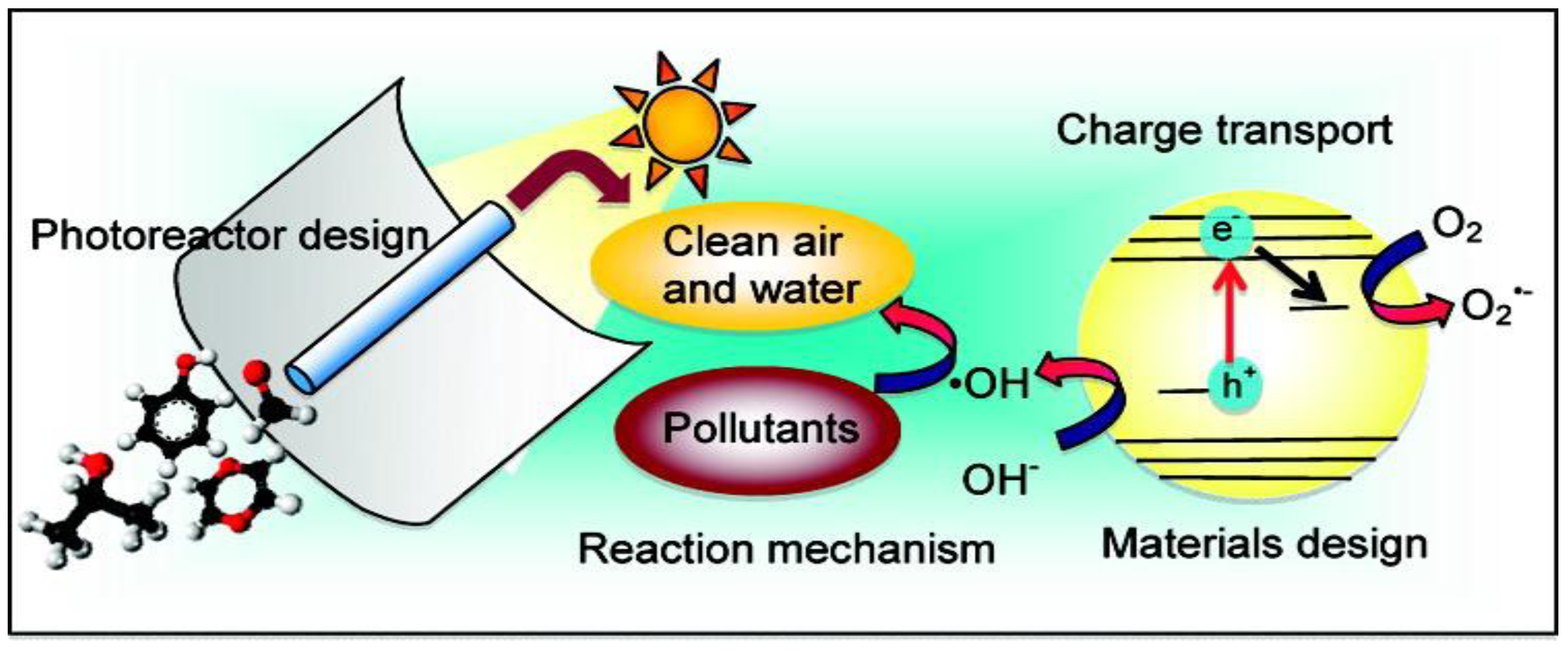
      <p>In spite of the extensive efforts to dope TiO<sub>2</sub> with C, N, S and transition metal ions such as Ag, Au, Fe, Ru, photocatalytic activity of TiO<sub>2</sub> in the visible region has remained quite low, an issue that has been addressed in recent articles highlighting issues and challenges associated with the application of photocatalysis. Generally, two or more phases are involved in a photocatalytic reaction—a light source and a semiconductor material are used to initiate the photoreaction while the catalyst system can simultaneously carry out oxidation and reduction reactions using long wavelength, UV light as well as sunlight. As a method for contaminant control in water and air, <xref ref-type="fig" rid="catalysts-03-00189-f002">Figure 2</xref>, heterogeneous photocatalysis using semiconductors such as titanium dioxide is more efficient than conventional methods. This is because as the photocatalytic process gradually breaks down the contaminant molecules, no residue of the original material remains and therefore no sludge requiring disposal to landfill is produced. The catalyst itself is unchanged during the process and no consumable chemicals are required. This results in considerable savings and a simpler operation of the equipment involved. Additionally, because the contaminant is attracted strongly to the surface of the catalyst, the process will continue to work at very low concentrations. Taken together, these advantages mean that the process results in considerable savings in water production cost and keeping the environment clean.</p>
      <fig id="catalysts-03-00189-f002" position="float">
        <label>Figure 2</label>
        <caption>
          <p>Schematic of the interplay of photocatalysis treatment, reactor and material design and photocatalytic reaction mechanism [<xref ref-type="bibr" rid="B1-catalysts-03-00189">1</xref>]. Note: This figure is reproduced with permission from [<xref ref-type="bibr" rid="B1-catalysts-03-00189">1</xref>], Copyright © 2012 American Chemical Society.</p>
        </caption>
        <graphic xmlns:xlink="http://www.w3.org/1999/xlink" xlink:href="catalysts-03-00189-g002.tif"/>
      </fig>
      <p>In order to activate the degradation process, pure TiO<sub>2</sub> requires photo-excitation with light at wavelengths exceeding the band gap of the active anatase phase of 3.2 eV, that is, wavelengths of &lt;387 nm. Indeed, commercially available photocatalytic water treatment plant using artificial UV-light as the energy source is available and can be considered as a developed market.</p>
      <p>However, UV in natural sunlight represents only 5%–8% of the solar spectrum at sea level and this provides a limitation and the requirement of artificial illumination of the catalysts in order to achieve degradation of the organic material in times that are practical for water treatment processing. This greatly restricts the application of the technology to areas where abundant electricity supplies are available. The need for more stable, efficient catalysts which can be activated by natural sunlight is now the goal of researchers. In order to achieve significant improvements in catalytic activity using visible light, precise control of the stoichiometry of the catalytic metal oxides and mixed metal oxides, addition of dopants, particle shape and pore topology are all critical factors for catalyst developers.</p>
      <p>Advances in the manipulation of matter at the nanoscale are leading to potential solutions for the depollution of water in remote locations. In recent years, the development of nanoscale metal oxides has greatly increased the catalytic activity by virtue of the high specific surface area available for reaction of the smaller particles. In addition, the strategy to alter the band gap of the catalyst is an important approach as this determines the portion of the solar spectrum the catalyst absorbs and, consequently, the amount of energy that is converted to reactive species. Photocatalysts that have high activity using wavelengths of light in the visible spectrum (380 nm &lt; λ &lt; 500 nm) have been demonstrated where potentially greater amounts of energy is available (solar peak energy is around 460 nm). This has been achieved by altering the band gap of, for example, TiO<sub>2</sub>. Doping of TiO<sub>2</sub> with transition metal ions (for example, V, Cr, Mn, Fe and Ni) as well as with Ag, Au and Ru, have been demonstrated to red-shift the TiO<sub>2</sub> absorption band from the UV into the visible region, resulting in a great increase in the efficiency of solar-light photocatalysis. </p>
      <p>Many industrial waste streams are not suitable for biological processing due to their inherent toxicity, but their treatment by traditional non-catalytic chemical processes or by incineration is energy intensive [<xref ref-type="bibr" rid="B7-catalysts-03-00189">7</xref>]. On the other hand, TiO<sub>2</sub> photocatalysts has been shown to decompose organic contaminants in water efficiently because a strong oxidizing ability is generated when the TiO<sub>2</sub> is irradiated by appropriate band gap illumination [<xref ref-type="bibr" rid="B8-catalysts-03-00189">8</xref>]. Increased attention is being paid to heterogeneous solution phase catalysis in order to develop an environment-friendly technology to purify polluted air and water without electricity or other energy consuming sources. </p>
      <p>Heterogeneous photocatalytic reactions are carried out either in a slurry-type reactor where the catalyst particles are suspended in the contaminated water or in an immobilized-type reactor where the catalyst particles are immobilized onto the surface of various inert substrates of various types and configurations [<xref ref-type="bibr" rid="B9-catalysts-03-00189">9</xref>,<xref ref-type="bibr" rid="B10-catalysts-03-00189">10</xref>,<xref ref-type="bibr" rid="B11-catalysts-03-00189">11</xref>] and the process can be explained on the basis of the following mechanism. </p>
    </sec>
    <sec>
      <title>2. Mechanism of Semiconductor Catalysis</title>
      <p>A photocatalyst harnesses UV radiation from sunlight or artificial light and uses the energy to break down different substances including organic materials, organic acids, estrogens, pesticides, dyes, crude oil, microbes (including viruses) and chlorine resistant organisms, inorganic molecules such as nitrous oxides (NO<italic><sub>x</sub></italic>) and, in combination with precipitation or filtration, can also remove metals such as mercury [<xref ref-type="bibr" rid="B13-catalysts-03-00189">13</xref>,<xref ref-type="bibr" rid="B14-catalysts-03-00189">14</xref>,<xref ref-type="bibr" rid="B15-catalysts-03-00189">15</xref>]. Due to this universal applicability, photocatalysis with nanoparticles as catalysts is used to reduce air pollution, in building materials, for self-cleaning surfaces in addition to water purification. Titanium dioxide (TiO<sub>2</sub>) is the most common photocatalyst and comparably little research has been conducted on zinc oxide, ZnO, which could be a viable alternative for some applications. To avoid free nanoparticles in water, TiO<sub>2</sub> nanoparticles are usually immobilized on a substrate [<xref ref-type="bibr" rid="B16-catalysts-03-00189">16</xref>] or integrated into thin-films and other materials. For the activation of TiO<sub>2</sub>, UV irradiation from sunlight or artificial light is needed, with UVB more efficient than UVA. To allow activation by visible light, TiO<sub>2</sub> can be modified with a second semiconductor, dyes, nitrogen, carbon or sulphur. For example, TiO<sub>2</sub> doped with nitrogen demonstrated superior photocatalytic activities compared to commonly used unmodified TiO<sub>2</sub> nanoparticles in both chemical compound degradation and bactericidal reactions [<xref ref-type="bibr" rid="B17-catalysts-03-00189">17</xref>].</p>
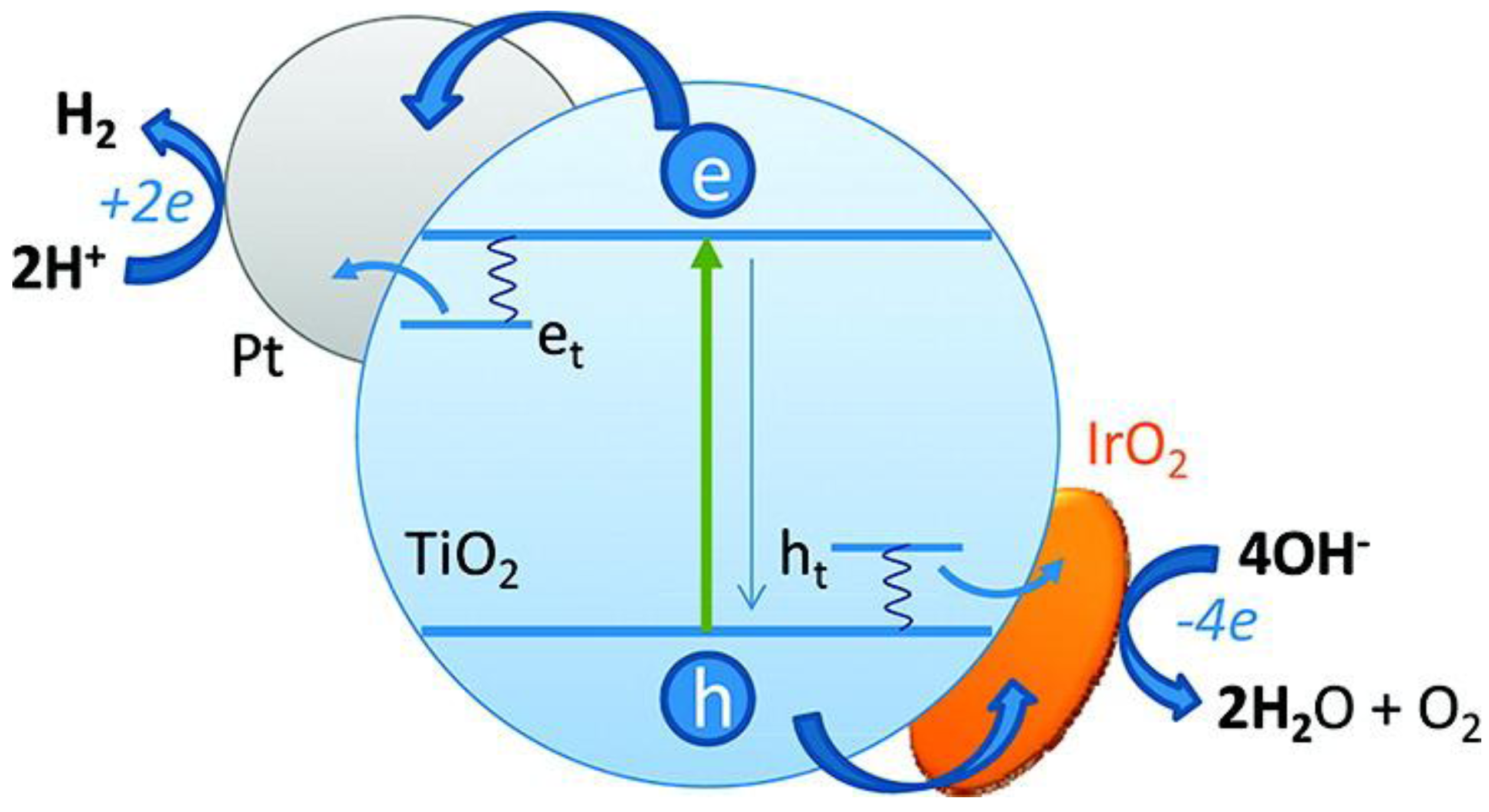
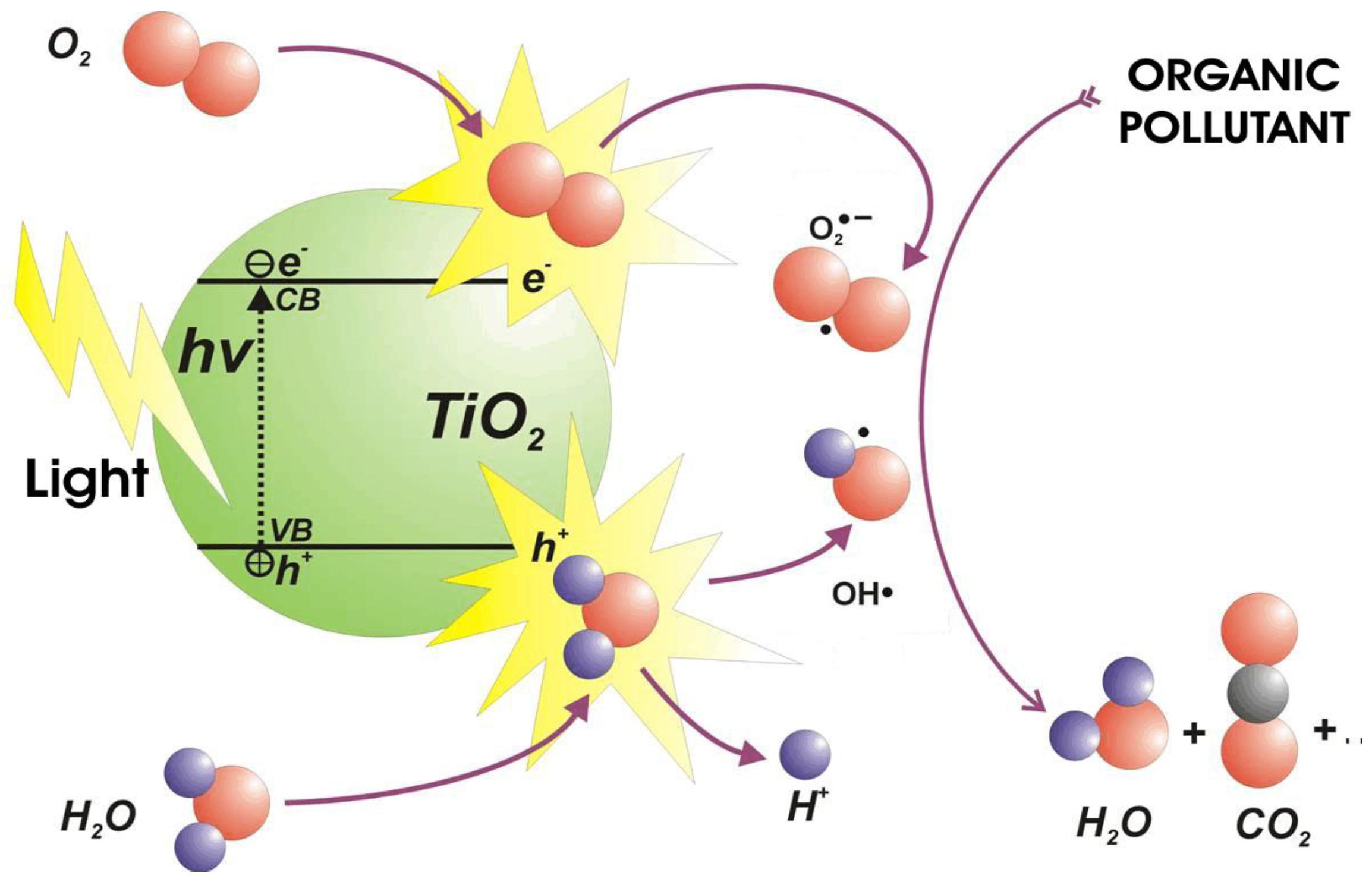
      <p>With respect to a semiconductor oxide such as TiO<sub>2</sub>, photocatalytic reactions are initiated by the absorption of illumination with energy equal to or greater than the band gap of the semiconductor. This produces electron-hole (e<sup>−</sup>/h<sup>+</sup>) pairs as in Equation (1), <xref ref-type="fig" rid="catalysts-03-00189-f003">Figure 3</xref>:
      <disp-formula id="catalysts-03-00189-i001"> 
        <inline-graphic xmlns:xlink="http://www.w3.org/1999/xlink" xlink:href="catalysts-03-00189-i001.tif"/> 
        <label>(1)</label>
      </disp-formula>
       where cb is the conduction band and vb is the valence band. Thus, as a result of irradiation, the TiO<sub>2</sub> particle can behave either as an electron donor or acceptor for molecules in contact with the semiconductor. The electron and hole can recombine, releasing the absorbed light energy as heat, with no chemical reaction taking place. On the other hand, they can participate in redox reactions with adsorbed species as the valence band hole is strongly oxidizing while the conduction band electron is strongly reducing. On the semiconductor surface, the excited electron and the hole can participate in redox reactions with water, hydroxide ion (OH<sup>−</sup>), organic compounds or oxygen leading to mineralization of the pollutant.</p>
      <fig id="catalysts-03-00189-f003" position="float">
        <label>Figure 3</label>
        <caption>
          <p>Schematic of the charge transfer across semicopnductor interface. Note: This figure is reproduced with permission from [<xref ref-type="bibr" rid="B12-catalysts-03-00189">12</xref>], Copyright © 2012 American Chemical Society.</p>
        </caption>
        <graphic xmlns:xlink="http://www.w3.org/1999/xlink" xlink:href="catalysts-03-00189-g003.tif"/>
      </fig>
      <p>In fact, research shows that the charges can react directly with adsorbed pollutants, but reactions with water are predominant since the water molecules are more abundant than contaminant molecules. Consequently, oxidation of water or OH<sup>−</sup> by the hole produces the hydroxyl radical (·OH), a powerful oxidant. For the purpose of comparison, it is important to compare the oxidation potential of hydroxyl radical (·OH) which is 2.8 V relative to the normal hydrogen electrode. Apart from electron and their holes, other substances that may be used for water disinfection include ozone (2.07 V), H<sub>2</sub>O<sub>2</sub> (1.78 V), HOCl (1.49 V) and chlorine (1.36 V). OH radicals are able to rapidly attack pollutants on the semiconductor surface and, as such, are the most important radicals formed in TiO<sub>2</sub> photocatalysis. An important reaction of the conduction band electron is reduction of adsorbed oxygen to oxygen radicals and this prevents the electron from recombining with the hole and results in an accumulation of oxygen radicals that can also participate in degrading contaminants in solution [<xref ref-type="bibr" rid="B11-catalysts-03-00189">11</xref>,<xref ref-type="bibr" rid="B18-catalysts-03-00189">18</xref>]. </p>
      <p>Published work indicate that heterogeneous photocatalytic process involves at least five separate reaction steps [<xref ref-type="bibr" rid="B19-catalysts-03-00189">19</xref>] and include (1) diffusion of reactants to the surface of semiconductor, (2) adsorption of reactants onto the surface of semiconductor, (3) reaction on the surface of semiconductor, (4) desorption of products from the surface of the semiconductor and (5) diffusion of products from the surface of the semiconductor. There are two routes through which OH radicals can be formed—the reaction of the valence-band holes with either adsorbed H<sub>2</sub>O or with the surface OH groups on the TiO<sub>2</sub> particle. These processes have been summarized using appropriate equations [<xref ref-type="bibr" rid="B20-catalysts-03-00189">20</xref>].</p>
    </sec>
    <sec>
      <title>3. Photocatalyst Materials and Supports</title>
      <p>Current and past research in photocatalytic materials has investigated several photocatalysts and their properties. Ideally, a photocatalyst should possess the following properties: photoactivity, biological and chemical inertness, stability toward photo-corrosion, suitability for visible or near UV light energy harnessing, low cost and lack of toxicity [<xref ref-type="bibr" rid="B21-catalysts-03-00189">21</xref>]. TiO<sub>2</sub> as a semiconductor photocatalyst, has excellent pigmentary properties, high ultraviolet absorption and high stability which allow it to be used in different applications such as electro-ceramics, glass and in the photocatalytic degradation of chemicals in water and air. It has been used in the form of a suspension, or a thin film in water treatment [<xref ref-type="bibr" rid="B22-catalysts-03-00189">22</xref>,<xref ref-type="bibr" rid="B23-catalysts-03-00189">23</xref>] and has different crystalline forms, the most common forms being anatase and rutile while the third, brookite, is uncommon, unstable and hence does not feature in discussion of catalyst materials.</p>
      <p>Anatase TiO<sub>2</sub>, the most stable form of TiO<sub>2</sub> [<xref ref-type="bibr" rid="B24-catalysts-03-00189">24</xref>], can be converted to rutile by heating to temperatures above 700 °C. In photocatalytic applications, research has shown that anatase is more efficient than rutile because of its more open structure compared with rutile. Degussa P-25 is the commercially available form of TiO<sub>2</sub> and consists of two forms of approximating 25% rutile and 75% anatase, and has been used in many studies of photocatalytic degradation because of its chemical stability, ready availability, reproducibility and activity as a catalyst for oxidation processes [<xref ref-type="bibr" rid="B13-catalysts-03-00189">13</xref>,<xref ref-type="bibr" rid="B25-catalysts-03-00189">25</xref>]. However, studies are being carried out to develop existing or prepare new materials which can be used under solar energy and hence shortening the time needed for degradation. </p>
      <p>This development includes increasing the surface area, the active sites, the absorption of photon and reducing the band gap energies of the semiconductor. For industrial applications, high activity, resistance to poisoning and stability for prolonged use at elevated temperatures, mechanical stability, and resistance to attrition, physical and chemical stability in various conditions, are required characteristics of catalysts [<xref ref-type="bibr" rid="B21-catalysts-03-00189">21</xref>]. In addition, in the degradation of organic compounds, the redox potential of the H<sub>2</sub>O/·OH electrode, OH<sup>−</sup> → ·OH + e<sup>−</sup>; <italic>E</italic><sub>0</sub> = −2.8 V, must lie within the band gap of the photocatalyst as illustrated in <xref ref-type="fig" rid="catalysts-03-00189-f001">Figure 1</xref>. Nowadays, many semiconductors are used as photocatalysts because of their narrow band gap between the valence and conduction bands and they need to absorb energy equal to or more than this energy gap. This involves the movement of electrons from e<sup>−</sup>/h<sup>+</sup> or negatively charged electrons to positively charged hole pairs [<xref ref-type="bibr" rid="B26-catalysts-03-00189">26</xref>].</p>
      <p>Many semiconductors have enough band-gap energies for the effective catalysis of many chemical reactions and this includes materials such as TiO<sub>2</sub>, WO<sub>3</sub> and ZnO. Though it is well known that metal oxides are usually less active catalysts than noble metals in the majority of applications, metal oxides are more suitable since they are more resistant to poisoning and deactivation. In addition, combining two or more metal oxide catalysts could improve or enhance catalytic activity. TiO<sub>2</sub> is the most frequently used photocatalyst because of its photostability and low cost, combined with its biological and chemical inertness and resistant to photo and chemical corrosion. On the other hand, binary metal sulfide semiconductors such as CdS and PbS are regarded as insufficiently stable for catalysis and are toxic. ZnO is also unstable in illuminated aqueous solutions while WO<sub>3</sub> has been investigated as a potential photocatalyst, but it is generally less active catalytically than TiO<sub>2.</sub> However, these can be combined with other semiconductors including TiO<sub>2</sub> to achieve greater photocatalytic efficiency or stability [<xref ref-type="bibr" rid="B27-catalysts-03-00189">27</xref>,<xref ref-type="bibr" rid="B28-catalysts-03-00189">28</xref>,<xref ref-type="bibr" rid="B29-catalysts-03-00189">29</xref>,<xref ref-type="bibr" rid="B30-catalysts-03-00189">30</xref>]. </p>
      <p>There are many semiconductor support materials that have been investigated. Usually, semiconductor supports are classified by their chemical nature and these can be organic or inorganic supports. They play an important role in immobilizing active catalyst, increase the surface area of catalytic material, decrease sintering and improve hydrophobicity, thermal, hydrolytic and chemical stability of the catalytic material. Examples include glass, carbon fibers and woven fiber cloths and these have been studied as support materials in groundwater denitrification and in the photocatalytic oxidation of water pollutants as well as in other applications. When fibrous supports are applied, loss of pressure is low and pore diffusion resistance is significantly lower than with pellet shaped catalysts. Glass possess an advantage as a catalyst support because of its transparency to UV light in photocatalytic applications [<xref ref-type="bibr" rid="B30-catalysts-03-00189">30</xref>]. </p>
      <p>Studies by Teoh, Kamat and others [<xref ref-type="bibr" rid="B1-catalysts-03-00189">1</xref>,<xref ref-type="bibr" rid="B9-catalysts-03-00189">9</xref>,<xref ref-type="bibr" rid="B12-catalysts-03-00189">12</xref>,<xref ref-type="bibr" rid="B31-catalysts-03-00189">31</xref>,<xref ref-type="bibr" rid="B32-catalysts-03-00189">32</xref>,<xref ref-type="bibr" rid="B33-catalysts-03-00189">33</xref>], show that interest in photocatalysis has also centered on ZnO, which has similar energy characteristic to TiO<sub>2</sub>. They report that ZnO however suffers from photo-corrosion problems upon excitation in solution. Hematite (α-Fe<sub>2</sub>O<sub>3</sub>) on the other hand, which is low cost, abundant and has narrow bandgap for harnessing solar energy, suffers from rapid charge recombination and a short charge carrier diffusion length. As a result of these draw backs, renewed interest in this material has focused on its modification with cationic dopants such as Cr and Mo to improve its charge transport properties [<xref ref-type="bibr" rid="B34-catalysts-03-00189">34</xref>] or doping with Si to reduce the charge diffusion path length. Other reviews have also talked about Tungsten trioxide WO<sub>3</sub> as another narrow bandgap material, 2.7 eV, and, as such, it has received renewed interest. Like hermatite, Tungsten trioxide, has the disadvantage of a low electron conduction band, although studies claim that coupling with Pt cocatalyst has been observed to be useful in promoting alternative multiple-electron reduction processes with lower reduction potentials. This has increased the use of WO<sub>3</sub> as one of the very few highly visible-light-active single-phase oxide photocatalysts [<xref ref-type="bibr" rid="B29-catalysts-03-00189">29</xref>,<xref ref-type="bibr" rid="B30-catalysts-03-00189">30</xref>,<xref ref-type="bibr" rid="B31-catalysts-03-00189">31</xref>,<xref ref-type="bibr" rid="B34-catalysts-03-00189">34</xref>,<xref ref-type="bibr" rid="B35-catalysts-03-00189">35</xref>,<xref ref-type="bibr" rid="B36-catalysts-03-00189">36</xref>,<xref ref-type="bibr" rid="B37-catalysts-03-00189">37</xref>,<xref ref-type="bibr" rid="B38-catalysts-03-00189">38</xref>,<xref ref-type="bibr" rid="B39-catalysts-03-00189">39</xref>,<xref ref-type="bibr" rid="B40-catalysts-03-00189">40</xref>,<xref ref-type="bibr" rid="B41-catalysts-03-00189">41</xref>].</p>
      <p>In many cases, the superiority of other photocatalyst materials over P25 is based on a selection of test reactions or only a single organic substrate and this has its problems as all of the important factors cannot be validated in a single experiment or reaction. An example is the pairing of test substrate degradation mechanistic Langmuir-Hinshelwood kinetic model, direct charge transfer, hydroxyl radicals, and superoxide radicals with many physicochemical characteristics of the photocatalyst such as the crystallinity, hydroxyl group density, size, specific surface area, surface defects, surface energetic and aggregation [<xref ref-type="bibr" rid="B12-catalysts-03-00189">12</xref>]. Even among flame-made TiO<sub>2</sub> of similar crystallinity, about 80% anatase and 20% rutile, and exact anatase-rutile content, differences in the photocatalytic activity of P25 were observed [<xref ref-type="bibr" rid="B42-catalysts-03-00189">42</xref>] due mainly to the class of organic substrate [<xref ref-type="bibr" rid="B43-catalysts-03-00189">43</xref>] used and the materials intrinsic efficiencies for ·OH generation and direct charge transfer, which governed the dominant degradation mechanism for each of the substrate functional groups. In a broader context, Ryu and Choi [<xref ref-type="bibr" rid="B44-catalysts-03-00189">44</xref>] compared the photocatalytic performance of commercial variants of TiO<sub>2</sub> and observed that one photocatalyst cannot meet all photocatalytic requirements, a fact borne out by several studies [<xref ref-type="bibr" rid="B45-catalysts-03-00189">45</xref>]. </p>
      <p>With respect to the synergy between anatase and rutile, the dominant phases of TiO<sub>2</sub> studies [<xref ref-type="bibr" rid="B46-catalysts-03-00189">46</xref>] have suggested that polymorphic characteristics of these materials was one of the reasons for the high photocatalytic efficiency of P25 and that the heterojunction of anatase-rutile promoted efficient charge separation as evidenced by studies indicating discrete trapping of electrons and holes across the different crystal phases. Any synergistic effect, however, is difficult to measure because of the differences in the physicochemical characteristics of pure anatase and rutile (surface area, crystallite size, defect content, surface hydroxylation, <italic>etc.</italic>), compared with the individual components in the mixture. Ohtani and other studies [<xref ref-type="bibr" rid="B46-catalysts-03-00189">46</xref>,<xref ref-type="bibr" rid="B47-catalysts-03-00189">47</xref>,<xref ref-type="bibr" rid="B48-catalysts-03-00189">48</xref>] on the other hand, isolated the individual components of P25 by selective acid dissolution and assessed the single components for a range of photocatalytic reactions. The studies concluded, at least for P25, a less probable synergistic effect beyond the photocatalytic activity of the individual components. By carefully synthesizing highly crystalline and physically similar anatase and rutile nanoparticles, Kho [<xref ref-type="bibr" rid="B49-catalysts-03-00189">49</xref>,<xref ref-type="bibr" rid="B50-catalysts-03-00189">50</xref>] and other studies demonstrated higher rates of hydrogen evolution from aqueous methanol across a wide range of mixed anatase-rutile compositions. The effect, however, was only observed when a strong inter-particle contact existed between the anatase and rutile nanocrystals, supporting the view of an efficient charge separation across heterojunctions in these materials [<xref ref-type="bibr" rid="B1-catalysts-03-00189">1</xref>].</p>
      <p>Doping of TiO<sub>2</sub> with fine noble metals such as silver (Ag), gold (Au) and palladium (Pd) has been carried out extensively as a means of enhancing charge separation. Doping has been reported [<xref ref-type="bibr" rid="B51-catalysts-03-00189">51</xref>] to establish a barrier through equilibration between the photocatalyst and metal deposits and is governed by the difference in work function of the deposits and the electron conduction band of the photocatalyst and does not influence the mechanism of the specific reaction [<xref ref-type="bibr" rid="B1-catalysts-03-00189">1</xref>]. Previous studies noted differences in the enhancement by Pt and Ag as well as other noble metals, on TiO<sub>2</sub> over a range of organic classes arising from the combination of substrate or functional group specificity and the dark catalytic oxidation effects [<xref ref-type="bibr" rid="B12-catalysts-03-00189">12</xref>,<xref ref-type="bibr" rid="B32-catalysts-03-00189">32</xref>,<xref ref-type="bibr" rid="B33-catalysts-03-00189">33</xref>,<xref ref-type="bibr" rid="B51-catalysts-03-00189">51</xref>,<xref ref-type="bibr" rid="B52-catalysts-03-00189">52</xref>]. The latter included the catalytic oxidation of formic acid, oxalic acid, methanol, and the opening of aromatic rings, with each reaction induced by the catalytic properties of the metals. Studies have shown that when a photocatalyst is illuminated, a type of synergistic effect between the catalytic and photocatalytic processes is possible and in fact studies have shown these effects do exist. [<xref ref-type="bibr" rid="B33-catalysts-03-00189">33</xref>,<xref ref-type="bibr" rid="B52-catalysts-03-00189">52</xref>,<xref ref-type="bibr" rid="B53-catalysts-03-00189">53</xref>]. </p>
      <p>With respect to new materials for use in photocatalytic work, Teoh <italic>et al.</italic> [<xref ref-type="bibr" rid="B1-catalysts-03-00189">1</xref>] reported in a recent article that a graphene oxide material was demonstrated to act as a mediator for electron transport and for visible-light water splitting in photocatalysis. It has to be stated that prior to this development, electron mediators were largely based on aqueous redox couples such as Fe<sup>2+</sup>/Fe<sup>3+</sup> and CO<sub>2</sub><sup>+</sup>/CO<sub>3</sub><sup>+</sup> as well as Au and Ag. A recent study by Wei and coworkers [<xref ref-type="bibr" rid="B54-catalysts-03-00189">54</xref>] using hybrid Fe<sub>2</sub>O<sub>3</sub>-Pd nanoparticle photocatalyst grown by epitaxial growth of Fe<sub>2</sub>O<sub>3</sub> on Pd nanoparticles, showed improved photocatalytic efficiency, although this was limited by the presence of organic stabilizers which are difficult to remove. Other materials considered in recent work include ZnS, ZnO, CdSe, Fe<sub>2</sub>O<sub>3</sub> and InP [<xref ref-type="bibr" rid="B55-catalysts-03-00189">55</xref>]. Some of these materials were reported to show some photocatalytic promise, but with uncertainty over their efficiencies and spectral characteristics [<xref ref-type="bibr" rid="B56-catalysts-03-00189">56</xref>]. Fe<sub>2</sub>O<sub>3</sub> is particularly interesting because of its stability against photo/chemical corrosion at neutral or basic pH and has band gap energy of about 2.0 to 2.2 eV corresponding to the absorption of 564 to 620 nm light [<xref ref-type="bibr" rid="B54-catalysts-03-00189">54</xref>].</p>
    </sec>
    <sec>
      <title>4. Photocatalytic Test Materials</title>
      <p>Investigations of photcatalytic degradation processes including the mechanisms have usually been carried out by using model compounds. This can strongly influence the photocatalytic performance of a material according to Teoh and co-workers [<xref ref-type="bibr" rid="B1-catalysts-03-00189">1</xref>] because of the effect of the structure of such model compounds and other factors on the degradation process. The study show that, for example, while monitoring the decolourization of dyes in solution using spectroscopic techniques is simple and convenient, using a dye as the model compound can yield unreliable results as this may not represent the intrinsic photocatalytic activity of the semiconductor, especially for visible-light-activated materials for which dyes are a good example and these include methyl orange, congo red, alizarin yellow, <italic>etc.</italic></p>
      <p>Cationic and anionic azo-dyes can undergo photolysis or sensitize the semiconductor and thereby inject an electron into its conduction band [<xref ref-type="bibr" rid="B1-catalysts-03-00189">1</xref>,<xref ref-type="bibr" rid="B12-catalysts-03-00189">12</xref>]. In addition, because of their complex structure, dyes have complex photodegradation mechanistic pathways thus making determining accurate photocatalytic efficiencies a very difficult exercise [<xref ref-type="bibr" rid="B56-catalysts-03-00189">56</xref>]. In addition, studies [<xref ref-type="bibr" rid="B1-catalysts-03-00189">1</xref>] have indicated that dyes do not necessarily require carbon oxidation for decolorization to occur. Although photocatalysis can play a significant role in treating dye-polluted systems [<xref ref-type="bibr" rid="B57-catalysts-03-00189">57</xref>], the choice of a model pollutant substrate should be undertaken with due consideration when assessing a photocatalytic activity under visible illumination. This reviewer has carried out photocatalytic work using azo-dyes as model substrates and would agree with the conclusion reached regarding the use of model compounds activated by visible light to validate photocatalytic degradation mechanisms and efficiency.</p>
    </sec>
    <sec>
      <title>5. Doping Mechanisms</title>
      <p>Research into photocatalyst doping has spanned several decades. Usually doping involves the use of metals or non-metals and is designed to extend the photocatalytic activity of a semiconductor lower energy excitation. Technically, doping is the introduction of foreign elements into the parent photocatalyst without giving rise to a new crystallographic forms, phases or structures and the aims are [<xref ref-type="bibr" rid="B1-catalysts-03-00189">1</xref>] to enhance the net separation of photogenerated charges and thereby efficiently harness the wide visible-light component of about 43% in the solar spectrum as opposed to the narrow ultraviolet component of 5%. It is thus an area of increasing research activity in photocatalysis. </p>
      <p>Although discovered as a modification technique in the early 1980s, doping has become a standard and routine method in the design of water-splitting photocatalysts [<xref ref-type="bibr" rid="B12-catalysts-03-00189">12</xref>]. Modifying pure photocatalyst materials with metal ions, especially d block metal ions such as Fe<sup>3+</sup> and Cr<sup>3+</sup> results in the insertion of impurity energy levels between the parent conduction and valence bands. In this case, the inserted energy levels provide sub-bandgap irradiation from which electrons can be excited from dopant d-band to conduction band or from valance band to dopant d-band by lower energy photons than are required by the pure photocatalysts. However, there are a number of issues associated with metal ion doping, related to the efficiency of subsequent photocatalytic processes. Whereas the presence of metal dopants was found in some cases to enhance charge separation as well as interfacial charge transfer [<xref ref-type="bibr" rid="B58-catalysts-03-00189">58</xref>,<xref ref-type="bibr" rid="B59-catalysts-03-00189">59</xref>] in many other cases, the metal dopants actually resulted in rapid charge recombination through their switchable redox states, for example, Fe<sup>3+</sup> ↔ Fe<sup>2+</sup> and thereby reducing the electron diffusion length and lifetime [<xref ref-type="bibr" rid="B1-catalysts-03-00189">1</xref>,<xref ref-type="bibr" rid="B9-catalysts-03-00189">9</xref>,<xref ref-type="bibr" rid="B12-catalysts-03-00189">12</xref>,<xref ref-type="bibr" rid="B60-catalysts-03-00189">60</xref>]. This is one of the reasons for the reduced quantum efficiency in many photo response-extended doped photocatalysts.</p>
      <p>Several studies have indicated that doping creates structural defects that could be sources for charge recombination and in this sense are potentially negative in their effects. The only exception being doping using high-energy RF and magnetron sputtering, which provide the uncommon existence of tetravalent dopants such as Fe<sup>4+</sup> and Cr<sup>4+</sup> that match the valency of Ti<sup>4+</sup> in TiO<sub>2</sub>  [<xref ref-type="bibr" rid="B61-catalysts-03-00189">61</xref>]. Co-doping with a conjugate metal cation pair such as Rh<sup>3+</sup>/Sb<sup>5+</sup> can preserve charge equality of the doped photocatalysts and result in improved and extended photocatalytic ability. However, this may not necessarily prevent structural defects arising from the differences in cationic radii between dopants and the host photocatalyst. In a recent study, Serpone and co-workers [<xref ref-type="bibr" rid="B62-catalysts-03-00189">62</xref>] provided a substantiated alternative argument that the extended photo-response instead of arising from d-band insertion, may actually originate from the color centers and oxygen vacancies that arise from the doping [<xref ref-type="bibr" rid="B63-catalysts-03-00189">63</xref>,<xref ref-type="bibr" rid="B64-catalysts-03-00189">64</xref>].</p>
      <p>Doping involving the use of non metals has also been investigated and studies have reported that the introduction of non-metal such as N, C and S impurity energy levels above the parent photocatalyst valence band has been a popular doping technique and although doping wide bandgap photocatalysts such as TiO<sub>2</sub> and ZrO<sub>2</sub> with F [<xref ref-type="bibr" rid="B64-catalysts-03-00189">64</xref>,<xref ref-type="bibr" rid="B65-catalysts-03-00189">65</xref>,<xref ref-type="bibr" rid="B66-catalysts-03-00189">66</xref>,<xref ref-type="bibr" rid="B67-catalysts-03-00189">67</xref>,<xref ref-type="bibr" rid="B68-catalysts-03-00189">68</xref>,<xref ref-type="bibr" rid="B69-catalysts-03-00189">69</xref>] does not result in coloration, their enhanced photocatalytic efficiencies, even under sub-bandgap excitation, likely results from enhanced stoichiometric defects and this is useful in photocatalytic processes. Higher photocatalytic activity, stability [<xref ref-type="bibr" rid="B28-catalysts-03-00189">28</xref>] and nontoxicity of dopant ions are among the advantages of nonmetal over metal dopants and, in general, TiO<sub>2</sub> and several other materials have been studied including the effect of impurity levels in the dopant on photocatalytic efficiency. In addition, results obtained using TiO<sub>2</sub> and oxides such as WO<sub>3</sub>, Ta<sub>2</sub>O<sub>5</sub> and Ba<sub>5</sub>Ta<sub>4</sub>O<sub>15</sub> have been published [<xref ref-type="bibr" rid="B69-catalysts-03-00189">69</xref>,<xref ref-type="bibr" rid="B70-catalysts-03-00189">70</xref>,<xref ref-type="bibr" rid="B71-catalysts-03-00189">71</xref>]. By studying nitrogen doped TiO<sub>2</sub> using real-time fluorescence imaging, Tachikawa and coworkers [<xref ref-type="bibr" rid="B72-catalysts-03-00189">72</xref>] confirmed the absence of ·OH under sub-bandgap irradiation but retained the formation of O<sub>2</sub><sup>•–</sup>, which, in turn, became the dominant radicals. Whereas full band gap excitation from the valance to the conduction band may result in the original oxidative potential of the parent photocatalysts, the quantum efficiency is hampered because of the pronounced charge recombination at dopant-induced defect sites [<xref ref-type="bibr" rid="B36-catalysts-03-00189">36</xref>].</p>
      <p>Similar to metal-doping strategies, anionic co-doping, for example involving N/F-TiO<sub>2</sub> or N/F- and C/N-ZnWO<sub>4</sub> [<xref ref-type="bibr" rid="B73-catalysts-03-00189">73</xref>,<xref ref-type="bibr" rid="B74-catalysts-03-00189">74</xref>,<xref ref-type="bibr" rid="B75-catalysts-03-00189">75</xref>] has been used to lower charge defects, but in many cases, the quantum efficiencies remain unmatched compared with the excited photocatalysts. Many studies, for example [<xref ref-type="bibr" rid="B76-catalysts-03-00189">76</xref>,<xref ref-type="bibr" rid="B77-catalysts-03-00189">77</xref>], have also reported that new conduction and valence bands are produced in a semiconductor when significant levels of foreign elements are introduced to the photocatalyst. Research using this band gap engineering approach has been carried out successfully and resulted in the emergence of new photocatalytic materials for water-splitting purposes including Bi<sup>3+</sup>, Ti<sup>4+</sup> and W<sup>6+</sup> [<xref ref-type="bibr" rid="B78-catalysts-03-00189">78</xref>,<xref ref-type="bibr" rid="B79-catalysts-03-00189">79</xref>]. From the various studies carried out on doping and the effect of doping, it is obvious that the exploration of new photocatalytic doping materials will continue to be driven mainly by efforts in water splitting reactions although these materials will find relevance in other photocatalytic applications such as PbBi<sub>2</sub>Nb<sub>2</sub>O<sub>9</sub>, for the treatment or remediation of aqueous pollutants, CaBi<sub>2</sub>O<sub>4</sub> for the oxidation of gaseous pollutants and ZnGa<sub>2</sub>O<sub>4</sub> for the reduction of carbon dioxide and similar materials [<xref ref-type="bibr" rid="B77-catalysts-03-00189">77</xref>,<xref ref-type="bibr" rid="B80-catalysts-03-00189">80</xref>,<xref ref-type="bibr" rid="B81-catalysts-03-00189">81</xref>].</p>
    </sec>
    <sec>
      <title>6. Morphology of Photocatalyst Materials</title>
      <p>Generally, for all catalyst materials, a high surface area is an advantage in terms of a greater concentration of active sites per square meter and this generally leads to higher reactivity. The smaller the particle size, the larger the surface area, and the higher the expected activity [<xref ref-type="bibr" rid="B81-catalysts-03-00189">81</xref>]. This can be explained in terms of an increase in the number of active sites per square meter as well as greater absorbance of the pollutant on the catalyst surface [<xref ref-type="bibr" rid="B80-catalysts-03-00189">80</xref>]. It has often been reported however that while the activity of the TiO<sub>2</sub> catalyst is affected by its external surface [<xref ref-type="bibr" rid="B82-catalysts-03-00189">82</xref>], photocatalytic activity is not a function of the surface area alone. For example, while an increase in the extent of heat treatment applied leads to a reduction in the surface area, the impact of this reaction on the photocatalytic activity is not as significant as that of the phase transformation. The increase in crystallite size and changes in the microstructure with a decrease in surface area greatly influence the photocatalytic property of the catalyst [<xref ref-type="bibr" rid="B83-catalysts-03-00189">83</xref>,<xref ref-type="bibr" rid="B84-catalysts-03-00189">84</xref>].</p>
      <p>One of the ways to increase the efficiency of photocatalytic reaction is to couple semiconductor nanoparticles to noble metal co-catalysts to enhance the quantum yield of the electron transfer processes through improvement in charge separation in the semiconductor, discharging photogenerated electrons across the interface and providing a redox pathway with low over-potential. The interfacial charge transfer processes are influenced by the presence of a metal co-catalyst or surface bound molecular relays. If metal nanoparticles are coupled to the semiconductor nanoparticle, then they readily accept and shuttle electrons to an acceptor molecule at the interface easily. The discharge capacity of metal nanoparticles plays an important role in dictating Fermi level equilibration between semiconductors and metal nanoparticles [<xref ref-type="bibr" rid="B1-catalysts-03-00189">1</xref>,<xref ref-type="bibr" rid="B9-catalysts-03-00189">9</xref>,<xref ref-type="bibr" rid="B12-catalysts-03-00189">12</xref>].</p>
      <p>It follows from these studies that in order to enhance the photoactivity of titanium oxide particles, interfacial charge-transfer reactions need to be enhanced. Improved charge separation and inhibition of charge carrier recombination is essential in improving the overall quantum efficiency for interfacial charge transfer. This can be achieved by modifying the properties of the particles by selective surface treatment and several approaches have been taken to achieve this including surface modification of the semiconductor particles with redox couples or noble metals and the coupling of two semiconductor particles with different electronic energy levels. To this end, catalytic thin films, foams and hybrid nanoparticles of TiO<sub>2</sub> as well as gels have been made and used in various catalytic applications [<xref ref-type="bibr" rid="B85-catalysts-03-00189">85</xref>,<xref ref-type="bibr" rid="B86-catalysts-03-00189">86</xref>,<xref ref-type="bibr" rid="B87-catalysts-03-00189">87</xref>,<xref ref-type="bibr" rid="B88-catalysts-03-00189">88</xref>] as described in this review.</p>
    </sec>
    <sec>
      <title>7. Semiconductor Films and Foams</title>
      <p>In thin film deposition, a thin layer of material is prepared on a suitable substrate or a previously deposited layer. “Thin” is a relative term, since a film may look operationally thin or thick compared to the wavelength of the light used. Compared to conventional thin film forming processes such as evaporation, or sputtering, sol-gel processing makes it possible to control the microstructure of the deposited film including the pore volume, pore size, and surface area [<xref ref-type="bibr" rid="B89-catalysts-03-00189">89</xref>] and uses mainly alkoxide, organic/ inorganic salts, metal oxides and other salts in a liquid phase chemical reaction. The method provides excellent chemical homogeneity and the possibility of deriving unique metastable structures at low reaction temperatures [<xref ref-type="bibr" rid="B90-catalysts-03-00189">90</xref>]. The liquid phase reaction enhances the uniformity of the product produced and the process can be operated under ambient conditions. The reactant concentration, temperature and type of solvent will affect the quality of the final product. </p>
      <p>In the production of TiO<sub>2</sub> particles, calcinations at high temperatures are necessary to change the crystalline structure of TiO<sub>2</sub> that possesses photo catalytic activity and the specific surface area, particle size, and other properties of TiO<sub>2</sub> can be altered after calcinations at different temperatures. Thus thin films formed by dipping or spinning, use little raw materials and may be processed quickly without cracking and thus overcoming most of the disadvantages of sol-gel processing. In addition, large substrates may be accommodated and it is possible to uniformly coat both sides of planar and axially symmetric substrates such as pipes, tubes, rods and fibers which are not easily handled by more conventional coating processes.</p>
      <p>There are two main ways to synthesize gels at room temperature: spin coating and dip coating. Spin coating is used for applications where relatively flat substrates or objects are coated with thin layers of material. On the other hand, the dip-coating process, involves immersion, start-up, deposition, evaporation and drainage. The substrate is slowly dipped into and withdrawn from a tank containing the sol, with a uniform velocity, in order to obtain a uniform coating. The gel samples are dried at 100 °C and then fired at 450 °C to remove organics from the film pyrotically. Once the sample has reached the desired thickness through multiple coatings, it is crystallized by heating. The maximum thickness of crack free coatings that can be achieved is 0.5 microns. Sol-gel and “doctor blade” TiO<sub>2</sub> films vary in thickness from 0.2 microns to 0.8 microns.</p>
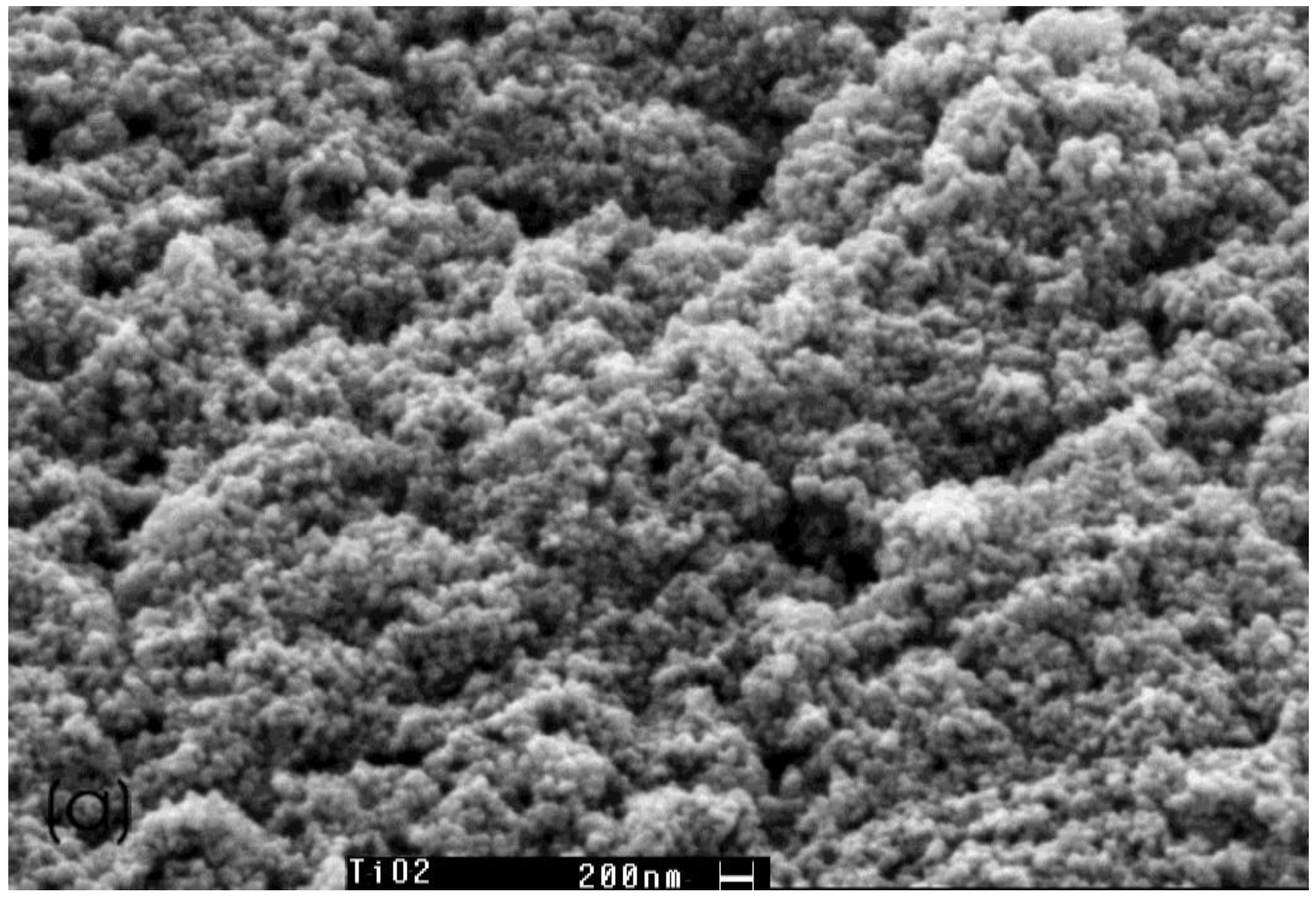
      <p>A foam is a substance that is formed by trapping pockets of gas in a liquid or solid. Particle sizes, porosity differ for various materials depending on the synthetic routes chosen, we have synthesized TiO<sub>2</sub> foams (reported in nano-letters) of 100–500 nm in thickness. TiO<sub>2</sub> films similarly have various thicknesses ranging from a few microns to hundreds or even more depending on the synthetic conditions. We have produced sol-gel and “doctor blade” TiO<sub>2</sub> films varying in thickness from 0.2 microns to 0.8 microns. Generally, the porosity of the foam is larger than that of films (depending on the film and process conditions). Foams usually offer more diffusion pathways than films especially for solution phase degradation. Films on the other hand are usually easier to integrate into structured photocatalytic reactors and light absorption is better than in films. Foams usually get “clogged” at some stage during the photocatalytic process. The synthetic route for TiO<sub>2</sub> foam as reported in the literature [<xref ref-type="bibr" rid="B91-catalysts-03-00189">91</xref>]. The thickness of the TiO<sub>2</sub> foam produced by this process was 100 nm and it should be pointed out that particle size of 500 nm is possible depending on the synthetic process. The TiO<sub>2</sub> foam offers extended porosity which is important for “light harvesting”, <xref ref-type="fig" rid="catalysts-03-00189-f004">Figure 4</xref>.</p>
      <fig id="catalysts-03-00189-f004" position="float">
        <label>Figure 4</label>
        <caption>
          <p>Degradation of Benzene, Toluene and Xylene in contaminated air with TiO<sub>2</sub> Foam [<xref ref-type="bibr" rid="B82-catalysts-03-00189">82</xref>,<xref ref-type="bibr" rid="B86-catalysts-03-00189">86</xref>]. The porous structure results in “improved light harvesting” by the catalyst.</p>
        </caption>
        <graphic xmlns:xlink="http://www.w3.org/1999/xlink" xlink:href="catalysts-03-00189-g004.tif"/>
      </fig>
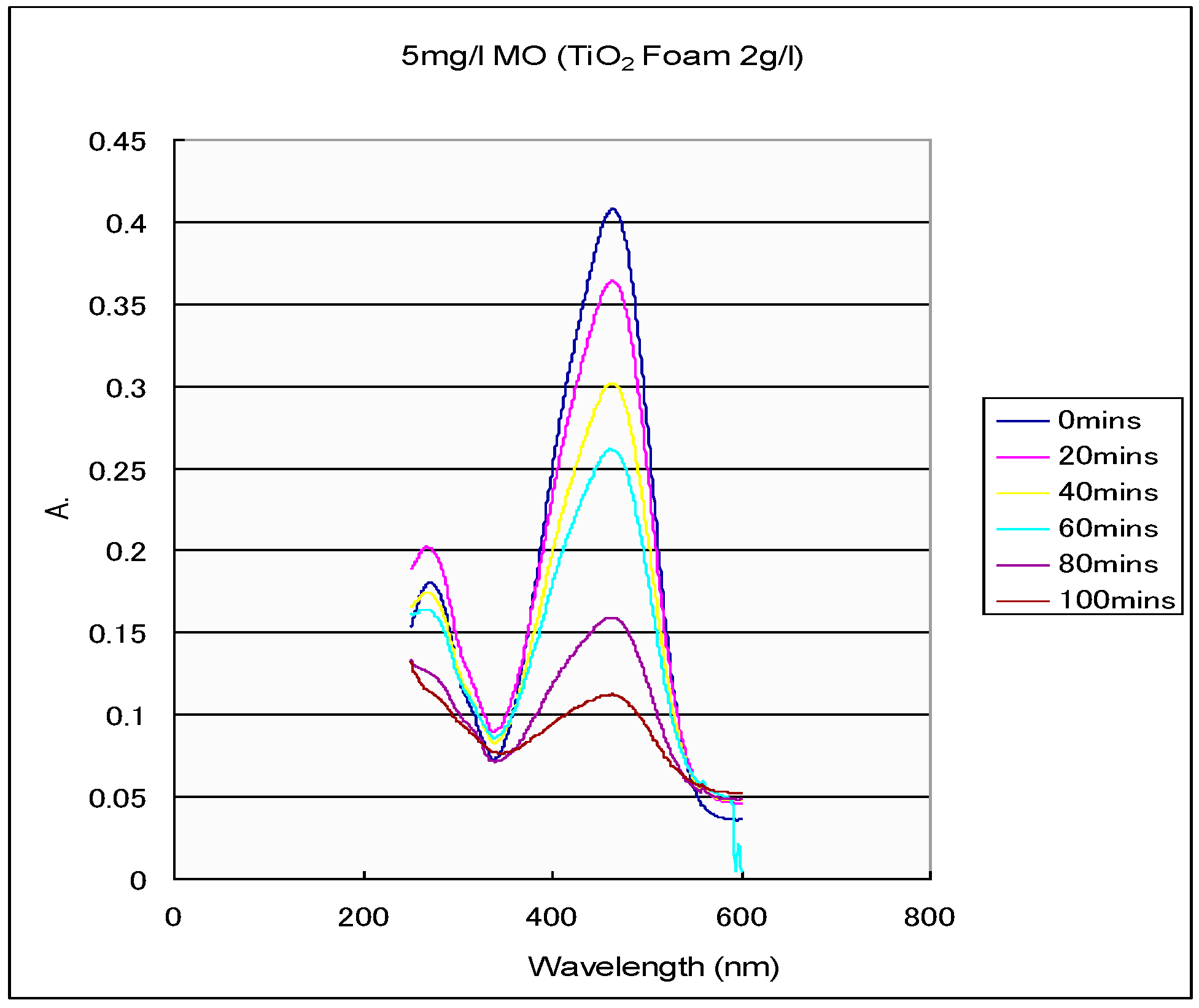
      <p>The TiO<sub>2</sub> foams have been used as catalyst materials in the degradation of low concentrations of benzene, toluene and xylene (BTX) in contaminated air. The degradation of anionic and cationic dyes in industrial effluents [<xref ref-type="bibr" rid="B8-catalysts-03-00189">8</xref>,<xref ref-type="bibr" rid="B82-catalysts-03-00189">82</xref>,<xref ref-type="bibr" rid="B86-catalysts-03-00189">86</xref>] as shown in <xref ref-type="fig" rid="catalysts-03-00189-f005">Figure 5</xref>, an example given with methyl orange has been undertaken.</p>
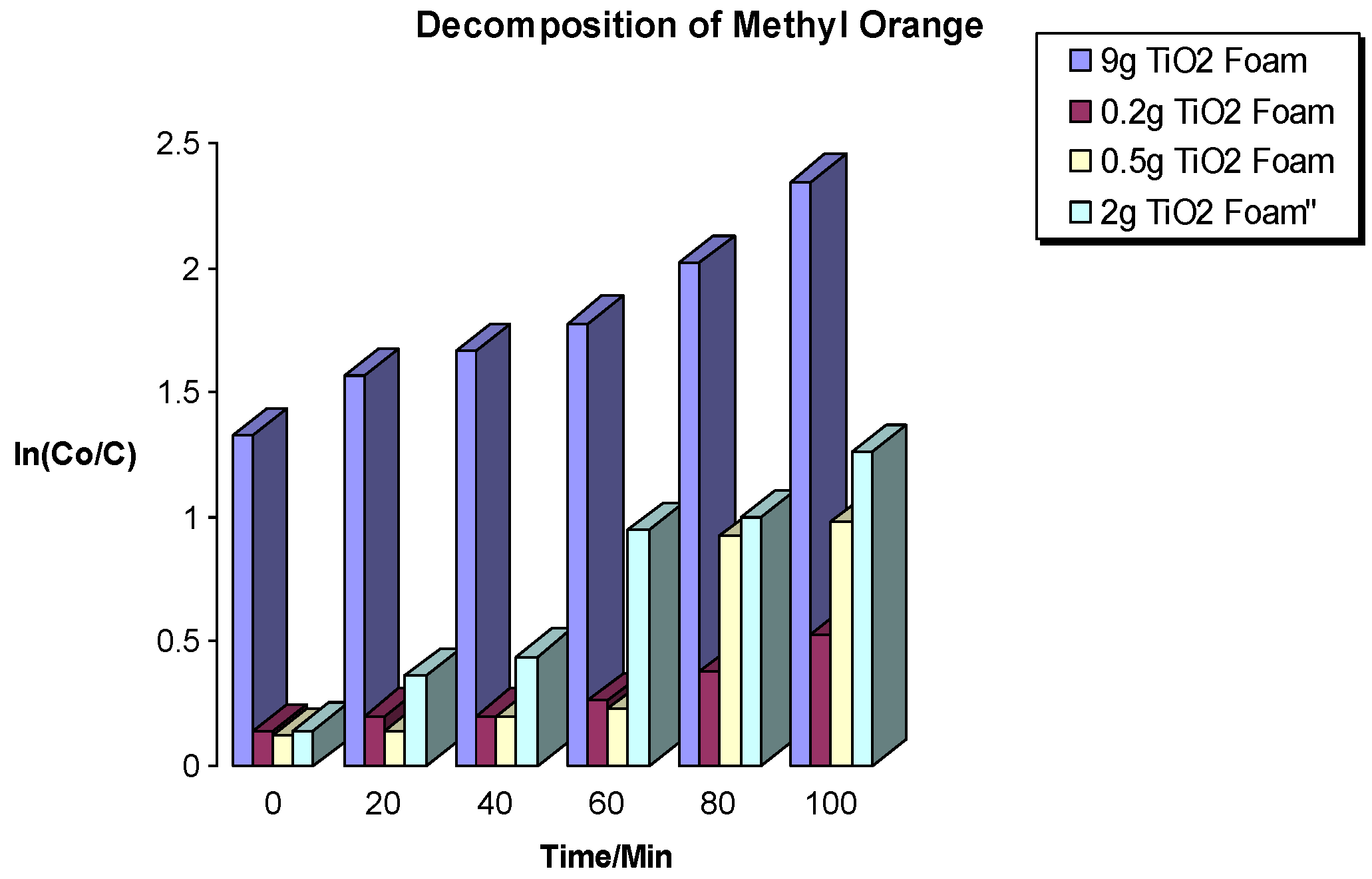
      <p>A metal can affect the surface properties of a semiconductor by generating a “barrier” which acts as an electron trap of the metal in contact with the semiconductor surface. Similarly, doping of transition metal ions to semiconductors improves the trapping of electron and inhibits e<sup>−</sup>/h<sup>+</sup> recombination because the relatively low photoactivity of TiO<sub>2</sub> is believed to be due to the fast recombination of photogenerated electrons and holes. In recent years, researchers have focused on the combination of different kinds of metallic oxide particles. Oliviero <italic>et al.</italic> [<xref ref-type="bibr" rid="B89-catalysts-03-00189">89</xref>] showed that Ru/CeO<sub>2</sub> particle catalysts have very different behavior in the catalytic wet air oxidation of acrylic, succinic and acetic acids depending on the support morphology and the metal/support contact. The use of metal nanoparticles and hybrids has also been researched [<xref ref-type="bibr" rid="B92-catalysts-03-00189">92</xref>] and the synthetic route for TiO<sub>2</sub>/RuO<sub>2</sub>/SiO<sub>2</sub> nanoparticles is reported elsewhere [<xref ref-type="bibr" rid="B92-catalysts-03-00189">92</xref>]. These materials have been used in the degradation of low concentrations of anionic and cationic azo-dyes in industrial effluents, <xref ref-type="fig" rid="catalysts-03-00189-f006">Figure 6</xref>.</p>
      <fig id="catalysts-03-00189-f005" position="float">
        <label>Figure 5</label>
        <caption>
          <p>The photocatalytic degradation of an anionic azo-dye in a UV irradiated porous titania foam [<xref ref-type="bibr" rid="B8-catalysts-03-00189">8</xref>,<xref ref-type="bibr" rid="B86-catalysts-03-00189">86</xref>]. The decrease in absorption peaks is an evidence of degradation. This evidence cannot however be conclusive (see section 4-on the use model compounds in this review).</p>
        </caption>
        <graphic xmlns:xlink="http://www.w3.org/1999/xlink" xlink:href="catalysts-03-00189-g005.tif"/>
      </fig>
      <fig id="catalysts-03-00189-f006" position="float">
        <label>Figure 6</label>
        <caption>
          <p>The photocatalytic activity of TiO<sub>2</sub> foam and surface modified binary oxide nanoparticles [<xref ref-type="bibr" rid="B8-catalysts-03-00189">8</xref>,<xref ref-type="bibr" rid="B86-catalysts-03-00189">86</xref>]. As expected, a higher catalyst concentration results in increased photocatalytic efficiency until a maximum catalyst loading is reached.</p>
        </caption>
        <graphic xmlns:xlink="http://www.w3.org/1999/xlink" xlink:href="catalysts-03-00189-g006.tif"/>
      </fig>
      <p>Recent work by Wei <italic>et al.</italic> [<xref ref-type="bibr" rid="B54-catalysts-03-00189">54</xref>] using hybrid Fe<sub>2</sub>O<sub>3</sub>/Pd nanoparticulate photocatalyst grown by epitaxial growth of Fe<sub>2</sub>O<sub>3</sub> on Pd nanoparticles showed improved photocatalytic efficiency, although this was limited by the presence of organic stabilizers which are difficult to remove. Other materials considered in recent work include ZnS, ZnO, CdSe, Fe<sub>2</sub>O<sub>3</sub> and InP [<xref ref-type="bibr" rid="B93-catalysts-03-00189">93</xref>]. Some of these materials were reported to show some photocatalytic promise, but with uncertainty over their efficiencies and spectral characteristics. Fe<sub>2</sub>O<sub>3</sub> is particularly interesting because of its stability against photo and chemical corrosion at neutral to basic pH and has a band gap energy of about 2.0 to 2.2 eV corresponding to the absorption of 564 to 620 nm light.</p>
    </sec>
    <sec>
      <title>8. Photocatalytic Reactor Design</title>
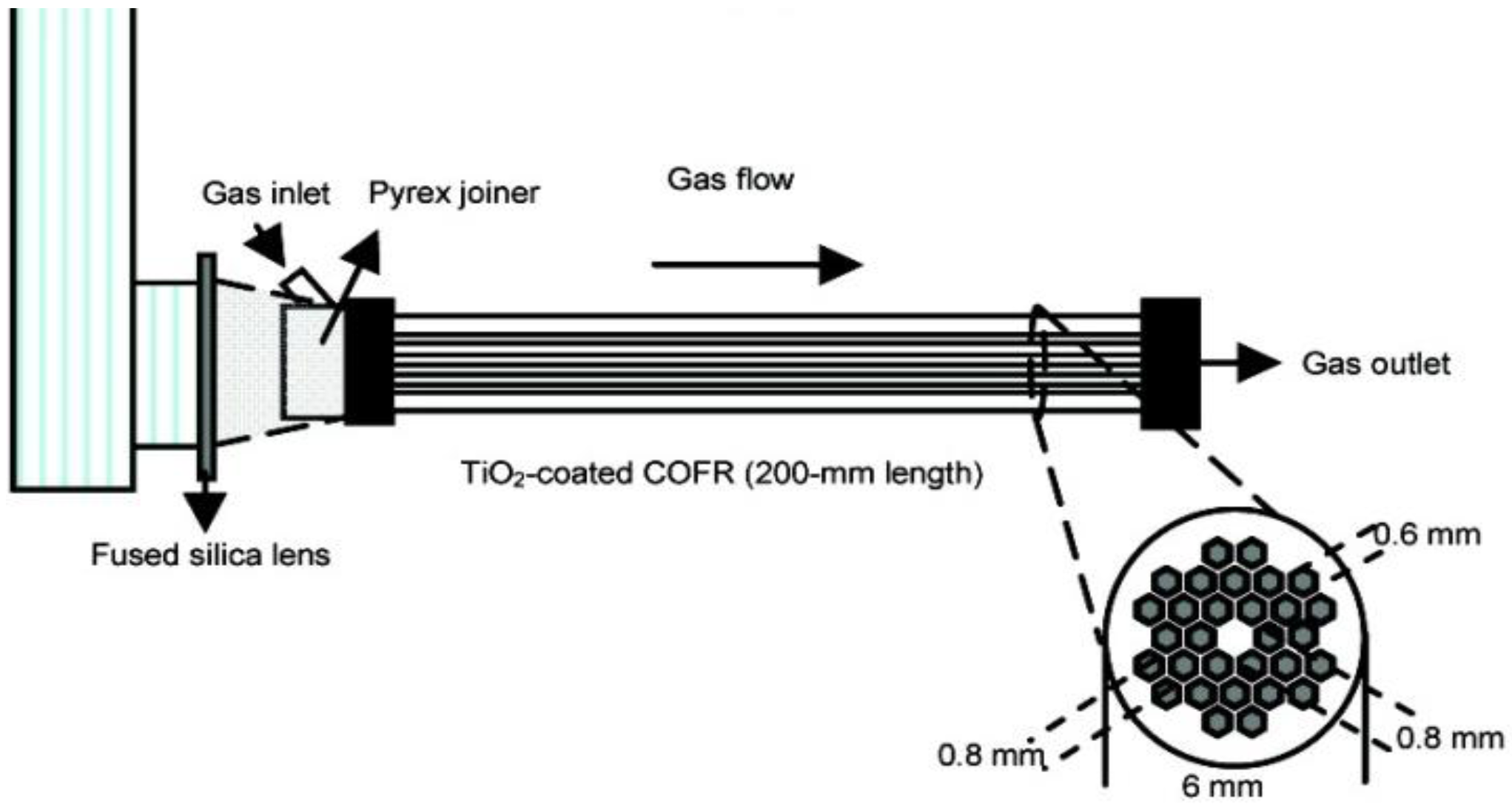
      <p>Significant advances have been made in reactor design for various photocatalytic reactions. Published literature contains several types and designs of photocatalytic reactors [<xref ref-type="bibr" rid="B1-catalysts-03-00189">1</xref>,<xref ref-type="bibr" rid="B12-catalysts-03-00189">12</xref>,<xref ref-type="bibr" rid="B92-catalysts-03-00189">92</xref>,<xref ref-type="bibr" rid="B93-catalysts-03-00189">93</xref>,<xref ref-type="bibr" rid="B94-catalysts-03-00189">94</xref>] .Apart from the conventional reactor design parameters, the major challenge in the design of a photocatalytic reactor is the efficient illumination of the catalyst. For a high activity in the reactor, a large area has to be illuminated. Therefore, in immobilized systems the thickness of the supported catalyst layer should be small enough to enable the light to reach all the catalyst. Therefore, one of the most important parameters in design consideration for photocatalytic reactors is light intensity and how the reactor is to be designed to accommodate various light sources. Types of reactors developed include fixed bed and slurry bed. With regard to design considerations, various models have been reported to deal with irradiation of the photocatalyst and how the photocatalyst affects the irradiation—the degree of absorption, scattering, the nature and type of particles, surface of the photocatalyst, <italic>etc.</italic> Light intensity is an important reactor design factor when considering light sources because the major requirement of any photocatalytic process is that the catalyst, pollutant and source of illumination must be in close proximity. This partly because studies have shown that the rate of photocatalytic degradation has a nonlinear dependence on light intensity and is proportional to <italic>I</italic><sup>0.5</sup> at high intensity and <italic>I</italic><sup>1.0</sup> at low intensity [<xref ref-type="bibr" rid="B93-catalysts-03-00189">93</xref>]. It has also been shown that an excess of light promotes a faster electron-hole recombination and the low activation energy of photocatalytic reactions (5–20 kJ/mol), compared with ordinary thermal reactions. In slurry type systems, catalyst loading is an important design parameter for the effective use of reactor space and photocatalyst and a wide range (0.15 to 8 g/L) of optimal catalyst loading in aqueous suspensions has been reported for different photocatalyst systems and reactor configurations [<xref ref-type="bibr" rid="B1-catalysts-03-00189">1</xref>,<xref ref-type="bibr" rid="B12-catalysts-03-00189">12</xref>,<xref ref-type="bibr" rid="B91-catalysts-03-00189">91</xref>,<xref ref-type="bibr" rid="B92-catalysts-03-00189">92</xref>,<xref ref-type="bibr" rid="B93-catalysts-03-00189">93</xref>,<xref ref-type="bibr" rid="B94-catalysts-03-00189">94</xref>,<xref ref-type="bibr" rid="B95-catalysts-03-00189">95</xref>,<xref ref-type="bibr" rid="B96-catalysts-03-00189">96</xref>,<xref ref-type="bibr" rid="B97-catalysts-03-00189">97</xref>,<xref ref-type="bibr" rid="B98-catalysts-03-00189">98</xref>,<xref ref-type="bibr" rid="B99-catalysts-03-00189">99</xref>], <xref ref-type="fig" rid="catalysts-03-00189-f007">Figure 7</xref>:</p>
      <fig id="catalysts-03-00189-f007" position="float">
        <label>Figure 7</label>
        <caption>
          <p>Schematic diagram of Channelled Optical Fiber Reactor (COFR) system for gas-phase photocatalytic degradation of volatile organic compounds [<xref ref-type="bibr" rid="B1-catalysts-03-00189">1</xref>]. </p>
        </caption>
        <graphic xmlns:xlink="http://www.w3.org/1999/xlink" xlink:href="catalysts-03-00189-g007.tif"/>
      </fig>
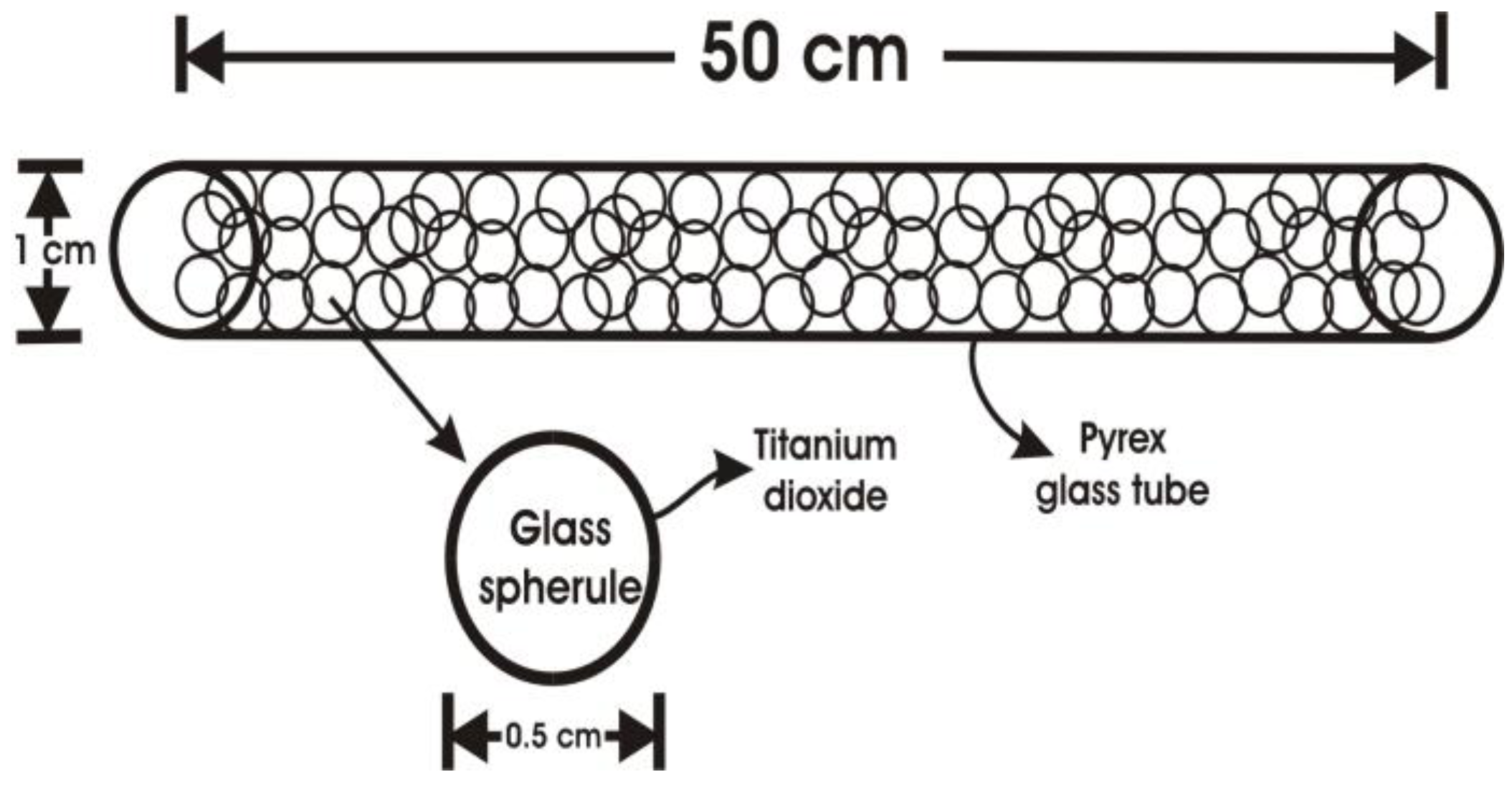
      <p>Another example of a design that has been used in the degradation of organic in polluted air is shown in <xref ref-type="fig" rid="catalysts-03-00189-f008">Figure 8</xref>. This reactor is filled with silica beads coated with titania paste and is externally irradiated by UV irradiation and used in the photocatalytic degradation of organic pollutants in air or water. </p>
      <fig id="catalysts-03-00189-f008" position="float">
        <label>Figure 8</label>
        <caption>
          <p>A photocatalytic reactor filled with silica beads coated with titania paste externally irradiated by UV irradiation [<xref ref-type="bibr" rid="B4-catalysts-03-00189">4</xref>].</p>
        </caption>
        <graphic xmlns:xlink="http://www.w3.org/1999/xlink" xlink:href="catalysts-03-00189-g008.tif"/>
      </fig>
      <p>The design and selection of a photocatalytic reactor depends on the experimental conditions and the application and two main types have been extensively researched-reactors that use a catalyst as suspension form and reactors that use a thin film catalyst either coated to the reactor wall or coated in spherical glass beads. Both reactors can be designed as an immersion wall or flat wall. Immersion well photoreactors are normally used at laboratory scale for evaluation purposes and are operated in batch or continuous mode where oxidant flow and temperature can be easily monitored. The light source can be either single or multiple with or without reflectors. Catalyst in these reactors can be used as thin film or as suspension form, with suspension system more preferable as they are more efficient than thin film reactors due to the large surface area in contact with the substrates. This allows more number of photons to hit the catalyst and large adsorption capacity results. Other reactors are flat wall and tubular photoreactors, which are simple and easy to design and generally use solar energy. In tubular reactors, reflectors are used to concentrate the light and enhance the photoreaction.</p>
    </sec>
    <sec>
      <title>9. Applications of Photocatalysis</title>
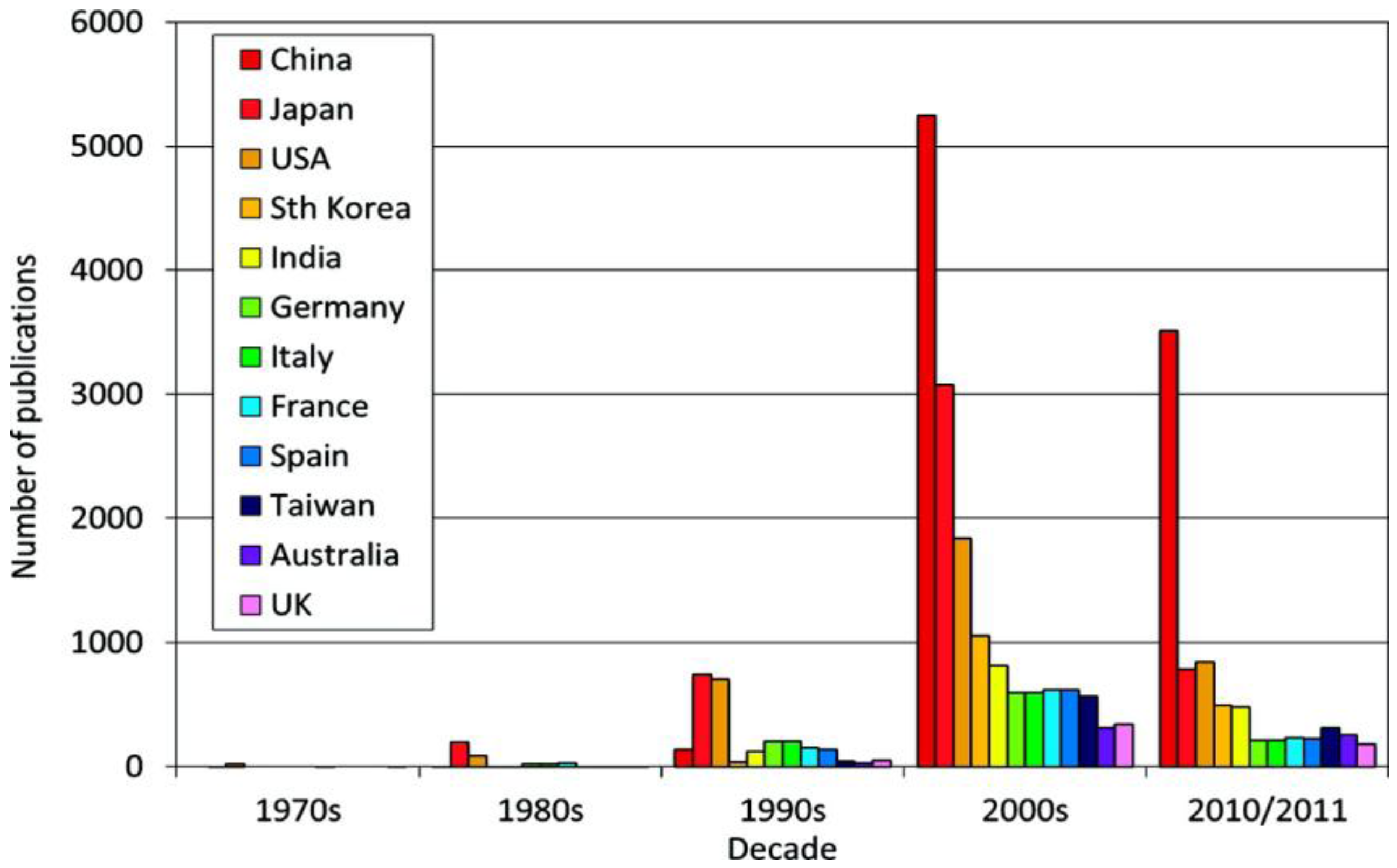
      <p>Selected applications of photocatalysis are given in <xref ref-type="table" rid="catalysts-03-00189-t001">Table 1</xref>, <xref ref-type="table" rid="catalysts-03-00189-t002">Table 2</xref>, <xref ref-type="table" rid="catalysts-03-00189-t003">Table 3</xref>. Heterogeneous photocatalysis has been demonstrated as a low cost and sustainable technology for the treatment of a host of pollutants in air and water including organics and heavy metals, <italic>etc</italic>., with Japan, USA, India and China as major users of this technology as partly demonstrated by the number of research publications in this area, <xref ref-type="fig" rid="catalysts-03-00189-f009">Figure 9</xref> [<xref ref-type="bibr" rid="B1-catalysts-03-00189">1</xref>]. Unlike reverse osmosis, nano and ultrafiltration, photocatalysis is a cheap and a potential “stand alone” technology for water treatment. As photocatalysis makes use of sunlight or UV radiation, the technology is inexpensive, environmentally friendly and can be applied worldwide. It requires minimal equipment, is highly deployable and appropriate for developing countries and remote sites with no access to electricity. Photocatalysis has also been used successfully in many developing nations to destroy pathogens [<xref ref-type="bibr" rid="B5-catalysts-03-00189">5</xref>,<xref ref-type="bibr" rid="B92-catalysts-03-00189">92</xref>] and algal blooms in fresh water supplies. Photodisinfection sensitized by TiO<sub>2</sub> has been used to degrade the green algae, treat humic substances [<xref ref-type="bibr" rid="B100-catalysts-03-00189">100</xref>] which act as substrates for bacterial growth, inhibit bacterial degradation of impurities in natural water, and aid the transport of metals in the environment and complex with Fe, Pb, Mn, making it harder to remove them. Specific examples of applications are as follows.</p>
      <fig id="catalysts-03-00189-f009" position="float">
        <label>Figure 9</label>
        <caption>
          <p>Number of publications pertaining to photocatalysis since 1970. China, Japan, USA and India have the edge in the number of publications on this Subject. Note: This figure is reproduced with permission from [<xref ref-type="bibr" rid="B1-catalysts-03-00189">1</xref>], Copyright © 2012 American Chemical Society.</p>
        </caption>
        <graphic xmlns:xlink="http://www.w3.org/1999/xlink" xlink:href="catalysts-03-00189-g009.tif"/>
      </fig>
      <table-wrap id="catalysts-03-00189-t001" position="float">
        <object-id pub-id-type="pii">catalysts-03-00189-t001_Table 1</object-id>
        <label>Table 1</label>
        <caption>
          <p>Selected applications of photocatalysis. Note: this Table is reproduced with permission from [<xref ref-type="bibr" rid="B92-catalysts-03-00189">92</xref>], Copyright © 2000 Elsevier Science S.A.</p>
        </caption>
        <table>
          <thead>
            <tr>
              <th align="center" valign="middle">Property</th>
              <th align="center" valign="middle">Category</th>
              <th align="center" valign="middle">Application</th>
            </tr>
          </thead>
          <tbody>
            <tr>
              <td rowspan="4" align="left" valign="top" style="border-top:solid thin">Self-cleaning</td>
              <td align="left" valign="top" style="border-top:solid thin">Materials for residential and office buildings</td>
              <td align="left" valign="top" style="border-top:solid thin">Exterior tiles, kitchen and bathroom components, interior furnishings, plastic surfaces, aluminum siding, building stone and curtains, paper window blinds</td>
            </tr>
            <tr>
              <td align="left" valign="top">Indoor and outdoor lamps and related systems</td>
              <td align="left" valign="top">Translucent paper for indoor lamp covers, coatings on fluorescent lamps and highway tunnel lamp cover glass</td>
            </tr>
            <tr>
              <td align="left" valign="top">Materials for roads</td>
              <td align="left" valign="top">Tunnel wall, soundproofed wall, traffic signs and reflectors</td>
            </tr>
            <tr>
              <td align="left" valign="top">Others</td>
              <td align="left" valign="top">Tent material, cloth for hospital garments and uniforms and spray coatings for cars</td>
            </tr>
            <tr>
              <td rowspan="2" align="left" valign="top" style="border-top:solid thin">Air cleaning</td>
              <td align="left" valign="top" style="border-top:solid thin">Indoor air cleaners</td>
              <td align="left" valign="top" style="border-top:solid thin">Room air cleaner, photocatalyst-equipped air conditioners and interior air cleaner for factories</td>
            </tr>
            <tr>
              <td align="left" valign="top">Outdoor air purifiers</td>
              <td align="left" valign="top">Concrete for highways, roadways and footpaths, tunnel walls, soundproof walls and building walls</td>
            </tr>
            <tr>
              <td rowspan="2" align="left" valign="top" style="border-top:solid thin">Water purification</td>
              <td align="left" valign="top" style="border-top:solid thin">Drinking water</td>
              <td align="left" valign="top" style="border-top:solid thin">River water, ground water, lakes and water-storage tanks</td>
            </tr>
            <tr>
              <td align="left" valign="top">Others</td>
              <td align="left" valign="top">Fish feeding tanks, drainage water and industrial wastewater</td>
            </tr>
            <tr>
              <td align="left" valign="top" style="border-top:solid thin">Antitumor activity</td>
              <td align="left" valign="top" style="border-top:solid thin">Cancer therapy</td>
              <td align="left" valign="top" style="border-top:solid thin">Endoscopic-like instruments</td>
            </tr>
            <tr>
              <td rowspan="2" align="left" valign="top" style="border-top:solid thin">Self-sterilizing</td>
              <td align="left" valign="top" style="border-top:solid thin">Hospital</td>
              <td align="left" valign="top" style="border-top:solid thin">Tiles to cover the floor and walls of operating rooms, silicone rubber for medical catheters and hospital garments and uniforms</td>
            </tr>
            <tr>
              <td align="left" valign="top">Others</td>
              <td align="left" valign="top">Public rest rooms, bathrooms and rat breeding rooms</td>
            </tr>
          </tbody>
        </table>
      </table-wrap>
      <table-wrap id="catalysts-03-00189-t002" position="float">
        <object-id pub-id-type="pii">catalysts-03-00189-t002_Table 2</object-id>
        <label>Table 2</label>
        <caption>
          <p>Applications of super hydrophilic technology. Note: this Table is reproduced with permission from [<xref ref-type="bibr" rid="B92-catalysts-03-00189">92</xref>], Copyright © 2000 Elsevier Science S.A.</p>
        </caption>
        <table>
          <thead>
            <tr>
              <th align="left" valign="top">Property</th>
              <th align="left" valign="top">Category</th>
              <th align="left" valign="top">Application</th>
            </tr>
          </thead>
          <tbody>
            <tr>
              <td rowspan="8" align="left" valign="top" style="border-top:solid thin">Self-cleaning</td>
              <td align="left" valign="top" style="border-top:solid thin">Roads</td>
              <td align="left" valign="top" style="border-top:solid thin">Tunnel lighting, tunnel walls, traffic signs and sound proof walls</td>
            </tr>
            <tr>
              <td align="left" valign="top">Houses</td>
              <td align="left" valign="top">Tiles on kitchen walls and bathrooms, exterior tiles, roofs and windows</td>
            </tr>
            <tr>
              <td align="left" valign="top">Buildings</td>
              <td align="left" valign="top">Aluminum panels, tiles, building stone, crystallized glass and glass film</td>
            </tr>
            <tr>
              <td align="left" valign="top">Agriculture</td>
              <td align="left" valign="top">Plastic and glass greenhouses</td>
            </tr>
            <tr>
              <td align="left" valign="top">Electrical and electronic equipment</td>
              <td align="left" valign="top">Computer displays and cover glass for solar cells</td>
            </tr>
            <tr>
              <td align="left" valign="top">Vehicles</td>
              <td align="left" valign="top">Paint work, coatings for exterior surfaces of windows and headlights</td>
            </tr>
            <tr>
              <td align="left" valign="top">Daily necessities and consumer products</td>
              <td align="left" valign="top">Tableware, kitchenware and spray-on anti-fouling coatings</td>
            </tr>
            <tr>
              <td align="left" valign="top">Paint</td>
              <td align="left" valign="top">General-purpose paints and coatings</td>
            </tr>
            <tr>
              <td rowspan="8" align="left" valign="top" style="border-top:solid thin">Anti-fogging property</td>
              <td align="left" valign="top" style="border-top:solid thin">Roads</td>
              <td align="left" valign="top" style="border-top:solid thin">Road mirrors</td>
            </tr>
            <tr>
              <td align="left" valign="top">Houses</td>
              <td align="left" valign="top">Mirrors for bathrooms and dressers</td>
            </tr>
            <tr>
              <td align="left" valign="top">Stores</td>
              <td align="left" valign="top">Refrigerated showcases</td>
            </tr>
            <tr>
              <td align="left" valign="top">Electrical and electronic equipment</td>
              <td align="left" valign="top">Heat exchangers for air conditioners and high-voltage electric transmission equipment</td>
            </tr>
            <tr>
              <td align="left" valign="top">Vehicles</td>
              <td align="left" valign="top">Inside surfaces of windows, glass films, rear-view mirrors and windshields</td>
            </tr>
            <tr>
              <td align="left" valign="top">Daily necessities and consumer products</td>
              <td align="left" valign="top">Spray-on antifogging coatings and films</td>
            </tr>
            <tr>
              <td align="left" valign="top">Paint</td>
              <td align="left" valign="top">General-purpose paints and coatings</td>
            </tr>
            <tr>
              <td align="left" valign="top">Optical instruments</td>
              <td align="left" valign="top">Optical lenses</td>
            </tr>
            <tr>
              <td align="left" valign="top" style="border-top:solid thin">Bio-compatibility</td>
              <td align="left" valign="top" style="border-top:solid thin">Medical instruments and supplies</td>
              <td align="left" valign="top" style="border-top:solid thin">Contact lenses and catheters</td>
            </tr>
          </tbody>
        </table>
      </table-wrap>
      <table-wrap id="catalysts-03-00189-t003" position="float">
        <object-id pub-id-type="pii">catalysts-03-00189-t003_Table 3</object-id>
        <label>Table 3</label>
        <caption>
          <p>Waterborne microbial species known to be inactivated by solar disinfection [<xref ref-type="bibr" rid="B5-catalysts-03-00189">5</xref>].</p>
        </caption>
        <table>
          <thead>
            <tr>
              <th align="left" valign="top">Microbe</th>
              <th align="left" valign="top">Species</th>
            </tr>
          </thead>
          <tbody>
            <tr>
              <td rowspan="14" align="left" valign="top" style="border-top:solid thin">Bacteria</td>
              <td align="left" valign="top" style="border-top:solid thin"><italic>Campylobacter jejuni</italic>
              </td>
            </tr>
            <tr>
              <td align="left" valign="top"><italic>Enterococcus</italic> sp.</td>
            </tr>
            <tr>
              <td align="left" valign="top">Enteropathogenic <italic>E. coli</italic></td>
            </tr>
            <tr>
              <td align="left" valign="top"><italic>Mycobacterium avium</italic>
              </td>
            </tr>
            <tr>
              <td align="left" valign="top"><italic>Mycobacterium intracellulare</italic>
              </td>
            </tr>
            <tr>
              <td align="left" valign="top"><italic>Pseudomonas aeruginosa</italic>
              </td>
            </tr>
            <tr>
              <td align="left" valign="top"><italic>Salmonella typhi</italic>
              </td>
            </tr>
            <tr>
              <td align="left" valign="top"><italic>Salmonella typhimurium</italic>
              </td>
            </tr>
            <tr>
              <td align="left" valign="top"><italic>Shigella dysenteriae type 1</italic>
              </td>
            </tr>
            <tr>
              <td align="left" valign="top"><italic>Shigella flexneri</italic>
              </td>
            </tr>
            <tr>
              <td align="left" valign="top"><italic>Streptococcus faecalis</italic>
              </td>
            </tr>
            <tr>
              <td align="left" valign="top"><italic>Staphylococcus epidermidis</italic>
              </td>
            </tr>
            <tr>
              <td align="left" valign="top"><italic>Vibrio cholerae</italic>
              </td>
            </tr>
            <tr>
              <td align="left" valign="top"><italic>Yersinia enterocolitica</italic>
              </td>
            </tr>
            <tr>
              <td rowspan="6" align="left" valign="top" style="border-top:solid thin">Viruses</td>
              <td align="left" valign="top" style="border-top:solid thin">Bacteriophagef2</td>
            </tr>
            <tr>
              <td align="left" valign="top">Encephalomyocarditis virus</td>
            </tr>
            <tr>
              <td align="left" valign="top">Polio virus</td>
            </tr>
            <tr>
              <td align="left" valign="top">Rotavirus</td>
            </tr>
            <tr>
              <td align="left" valign="top">Coxsackie virus A/B </td>
            </tr>
            <tr>
              <td align="left" valign="top">Hepatitis A </td>
            </tr>
            <tr>
              <td rowspan="5" align="left" valign="top" style="border-top:solid thin">Protozoa</td>
              <td align="left" valign="top" style="border-top:solid thin"><italic>Acanthamoeba polyphaga</italic> (cyst )</td>
            </tr>
            <tr>
              <td align="left" valign="top"><italic>Cryptosporidium parvum</italic> (oocyst)</td>
            </tr>
            <tr>
              <td align="left" valign="top"><italic>Entamoeba</italic> sp. (cysts)</td>
            </tr>
            <tr>
              <td align="left" valign="top"><italic>Giardia</italic> sp.(cysts)</td>
            </tr>
            <tr>
              <td align="left" valign="top"><italic>Naegleria</italic> sp.</td>
            </tr>
          </tbody>
        </table>
      </table-wrap>
      <sec>
        <title>9.1. Water Treatment</title>
        <p>Growth in the global population, the diminishing supply of clean water, heightened environmental concerns, and the strong link between water quality and human health require the identiﬁcation and employment of eﬀective sustainable water treatments to meet the urgent global need for clean water. Advanced oxidation processes (AOPs) have shown tremendous promise in water puriﬁcation and treatment, including for the destruction of naturally occurring toxins, contaminants of emerging concern, pesticides, and other deleterious contaminants. One of the ﬁrst references to AOPs was by Glaze in 1987 as processes that involve the generation of hydroxyl radicals in suﬃcient quantity to aﬀect water puriﬁcation. The deﬁnition and development of AOPs have evolved since the 1990s and include a variety of methods for generating hydroxyl radical and other reactive oxygen species including superoxide anion radical, hydrogen peroxide, and singlet oxygen. However, hydroxyl radical is still the species most commonly tied to the eﬀectiveness of AOPs. Most organic compounds react with hydroxyl radical by addition or hydrogen abstraction pathways to form a carbon-centered radical. The resulting carbon-centred radical reacts with molecular oxygen to form a peroxyl radical that undergoes subsequent reactions, ultimately producing a host of oxidation products such as ketones, aldehydes and alcohols [<xref ref-type="bibr" rid="B21-catalysts-03-00189">21</xref>]. </p>
        <p>Hydroxyl radical can also abstract an electron from electron-rich substrates to form a radical cation, which in aqueous media, is readily hydrolyzed, ultimately leading to an oxidized product. The oxidation products are often less toxic and more susceptible to bioremediation. AOPs include UV/O<sub>3</sub>, UV/H<sub>2</sub>O<sub>2</sub>, Fenton, photo-Fenton, non-thermal plasmas, sonolysis, photocatalysis, radiolysis and supercritical water oxidation processes. Problematic substances in wastewater can include organic matter and/or different trace contaminants and industrial wastewater may also contain heavy loads of metals or organic compounds and these cannot be treated by disinfection. In drinking water production microbe contamination is a problem especially in developing countries and remote locations without access to a centralized drinking water supply. </p>
        <p>In Europe, conventional technologies for wastewater treatment are in most cases able to meet the current water quality standards. The chances and potential fields of application of photocatalytic systems with artificial UV-sources include new water treatment plants or plants where conventional methods need to be replaced and the treatment of water contaminated with trace contaminants such as estrogens, the treatment of industrial wastewater contaminated with high loads of organic compounds or metals as well as small scale systems, for example, for the disinfection of swimming pools [<xref ref-type="bibr" rid="B92-catalysts-03-00189">92</xref>,<xref ref-type="bibr" rid="B100-catalysts-03-00189">100</xref>].</p>
        <p>Globally, 1 billion people lack access to safe water supplies and 2.6 billion are without access to basic sanitation [<xref ref-type="bibr" rid="B5-catalysts-03-00189">5</xref>]. This is especially true for the least developed regions of Asia, Central and South America, and Africa, innovative methods for water treatment are needed urgently. In the most developed markets such as the USA, Canada, Japan, and most of Western Europe, the success of a new water treatment method is mainly based on its ability to improve the quality of drinking water and/or to reduce water contamination. The beneficial effects of clean water are obvious. Most importantly, the improvement of water supply, sanitation, hygiene, and management of water resources could prevent almost one-tenth of all diseases worldwide. Nanotechnology is one of the most promising emerging technologies for efficient, economical and environmentally friendly water and waste water treatment offering great potential for manufacturers in Europe. </p>
        <p>The demand for water treatment products globally reached $44.6 billion in 2008 and it is predicted, by Freedonia Group Inc., to increase annually by 5.7% reaching $59 billion by 2013 [<xref ref-type="bibr" rid="B5-catalysts-03-00189">5</xref>]. The fastest annual growth was predicted to be in large developing countries like China and India due to rapid industrialization and increased efforts to expand access to safe water supplies and adequate sanitation facilities especially in rural areas. The worldwide turnover of nanotechnological applications in water and wastewater treatment reached $1.6 billion in 2007 and was predicted to increase to $6.6 billion in 2015. In 2015 the leading countries in water treatment with nanoparticle-based methods are the USA, Germany, Japan, and China [<xref ref-type="bibr" rid="B101-catalysts-03-00189">101</xref>]. Disinfection is one of the fastest growing market segments with broad applications and benefits; photocatalysis with nano-catalysts is a promising method for disinfection. In addition, photocatalysts combined with filtration membranes can reduce membrane fouling and thus enhance water cleaning efficiency significantly. Small-scale photocatalytic systems with artificial UV-light have already been on the market for several years whereas solar photocatalytic water treatment plants are at a demonstration phase and pilot projects for drinking water purification in developing countries have only just started.</p>
        <p>Recently, humic substance was also decomposed both in highly saline and natural seawater using different photocatalytic materials. The decomposition rate of humic substances in seawater was slow compared with pure water media and no toxic byproducts were detected during the decomposition. Minero and other workers [<xref ref-type="bibr" rid="B29-catalysts-03-00189">29</xref>,<xref ref-type="bibr" rid="B100-catalysts-03-00189">100</xref>,<xref ref-type="bibr" rid="B102-catalysts-03-00189">102</xref>,<xref ref-type="bibr" rid="B103-catalysts-03-00189">103</xref>,<xref ref-type="bibr" rid="B104-catalysts-03-00189">104</xref>] studied the decomposition of dodecane and toluene in crude oil in seawater media and found that no chlorinated compounds were detected during the irradiation. Complete decomposition was achieved after a few hours of irradiation. Another study conducted on the decomposition of seawater-soluble crude-oil fractions found that it can be decomposed under illumination of nanoparticles of TiO<sub>2</sub> using artificial light [<xref ref-type="bibr" rid="B47-catalysts-03-00189">47</xref>].</p>
        <p>Photocatalysis can also be used to destroy bacteria and viruses [<xref ref-type="bibr" rid="B92-catalysts-03-00189">92</xref>,<xref ref-type="bibr" rid="B100-catalysts-03-00189">100</xref>,<xref ref-type="bibr" rid="B105-catalysts-03-00189">105</xref>]. The increasing incidence of algal blooms in fresh water supplies and the consequent possibility of cyanobacterial microcystin contamination of potable water <italic>Microcystin toxins</italic> are also degraded on immobilized titanium dioxide catalyst. Photodisinfection sensitized by TiO<sub>2</sub> had some effect on the degradation of the green algae which has a thick cell wall. This is being used to great advantage in many developed and developing nations to treat water especially in remote and disaster areas without portable water supply or electricity, as shown in <xref ref-type="fig" rid="catalysts-03-00189-f010">Figure 10</xref>.</p>
        <fig id="catalysts-03-00189-f010" position="float">
          <label>Figure 10</label>
          <caption>
            <p>Inactivation of bacteria Ecoli K-12 in drinking water exposed to solar irradiation. Adapted from EU Contract Number INCO-DEV 031650 (2006) [<xref ref-type="bibr" rid="B5-catalysts-03-00189">5</xref>].</p>
          </caption>
          <graphic xmlns:xlink="http://www.w3.org/1999/xlink" xlink:href="catalysts-03-00189-g010.tif"/>
        </fig>
        <p>Specific successful applications have been in the following areas, amongst others.</p>
      </sec>
      <sec>
        <title>9.2. Removal of Trace Metals</title>
        <p>Trace metal such as mercury (Hg), chromium (Cr), lead (Pb) and others metals are considered to be highly health hazardous. Thus, removing these toxic metals is essentially important for human health and water quality. The environmental applications of heterogeneous photocatalysis include removing heavy metals such as (Hg), chromium (Cr), lead (Pb), Cadmium (Cd), lead (Pb), Arsenic (As), nickel (Ni) copper (Cu). The photoreducing ability of photocatalysis has been used to recover expensive metals from industrial effluent, such as gold (Au), platinum (Pt) and silver (Au) [<xref ref-type="bibr" rid="B22-catalysts-03-00189">22</xref>].</p>
      </sec>
      <sec>
        <title>9.3. Destruction of Organics</title>
        <p>Photocatalysis has been used for the destruction of organic compounds such as alcohols, carboxylic acids, phenolic derivatives, or chlorinated aromatics, into harmless products, for example, carbon dioxide, water, and simple mineral acids. Water contaminated by oil can be treated efficiently by photocatalytic reaction. Herbicides and pesticides that may contaminate water such as 2,4,5 trichlorophenoxyacetic acid, 2,4,5 trichlorophenol, <italic>S</italic>-triazine herbicides and 1,1,1-trichloro-2,2-di(4-chlorophenyl)ethane (DDT) have also been successfully degraded [<xref ref-type="bibr" rid="B22-catalysts-03-00189">22</xref>].</p>
      </sec>
      <sec>
        <title>9.4. Removal of Inorganic Compounds</title>
        <p>In addition to organic compounds, wide ranges of inorganic compounds are sensitive to photochemical transformation on the catalyst surfaces. Inorganic species such as bromate, or chlorate, azide, halide ions, nitric oxide, palladium and rhodium species, and sulfur species can be decomposed. Metal salts such as AgNO<sub>3</sub>, HgCl and organometalic compound (e.g., CH<sub>3</sub>HgCl) can be removed from water as well as cyanide, thiocyanate, ammonia, nitrates and nitrites [<xref ref-type="bibr" rid="B22-catalysts-03-00189">22</xref>].</p>
      </sec>
      <sec>
        <title>9.5. Degradation of Natural Organic Matter</title>
        <p>Humic substances have also been degraded photochemically. Humic are naturally occurring biogenic heterogeneous organic substances characterized as being yellow brown and having high molecular weights They can also be described as the fraction of filtered water that adsorbs on non-ionic polymeric adsorbent at pH 2. They are the main constituents of the dissolved organic carbon pool in surface and ground waters, imparting a yellowish-brown color to the water system. The concentration of humic substances varies from place to place, the values in seawater being normally from 2–3 mg/L. Humic substances affect the behaviour of some pollutants in natural environments, such as trace metal speciation and toxicity, solubilization and adsorption of hydrophobic pollutants. They act as substrates for bacterial growth; inhibit the bacterial degradation of impurities in natural water, complex with heavy metals such as Fe, Pb, Mn making it harder to remove them. Advanced oxidation has been used to decrease the organic content in water including humic acid [<xref ref-type="bibr" rid="B100-catalysts-03-00189">100</xref>] and it has the advantage of not leaving any toxic byproducts or sludge.</p>
        <p>Bekbolet and Ozkosemen [<xref ref-type="bibr" rid="B103-catalysts-03-00189">103</xref>] investigated the photocatalytic degradation using humic acid as a model and observed that after 1 h irradiation and in the presence of 1.0 g/L TiO<sub>2</sub> (P25), 40% TOC and 75% of the colour (400 nm) were removed. On the other hand, Eggins and coworkers found the suspension of TiO<sub>2</sub> (P25) irradiated by a mercury lamp showed a very efficient reduction of humic acid concentration of about 50% in 12 min. Heterogeneous photocatalysis has also been coupled with other physical methods in order to increase the degradation rate of organic molecules including humic substances [<xref ref-type="bibr" rid="B100-catalysts-03-00189">100</xref>,<xref ref-type="bibr" rid="B103-catalysts-03-00189">103</xref>].</p>
      </sec>
      <sec>
        <title>9.6. Medical Applications</title>
        <p>Application in TiO<sub>2</sub> Fabrics is a major and important application of TiO<sub>2</sub> photocatalysis. The ability of TiO<sub>2</sub> to disinfect microbes, viruses and bacteria has been put into good used by Japanese researchers. Hospital garments worn by doctors and nurses have “doses” of TiO<sub>2</sub> added to the fabric during processing operations and the fabric are used to make hospital garments that are worn to control hospital infections, including MRSA. Many lives have been lost because of methicillin resistant <italic>Staphylococcus</italic> (MRSA) and research is concentrating efforts on “TiO<sub>2</sub> fabrics” as well as the use of antimicrobial photodynamic therapy (APDT) to decolonize MRSA from patients [<xref ref-type="bibr" rid="B92-catalysts-03-00189">92</xref>].</p>
      </sec>
      <sec>
        <title>9.7. Application Photodynamic Therapy</title>
        <p>Targeting cancer such as colon or kidney cancer (tumor therapy) in an organism with a source of irradiation is easy. However, tumors in rats have shown to respond to PDT treatment. Basically, TiO<sub>2</sub> is introduced in the site of the cancer and illuminated by and is photo sensitized using an optic fiber cable to introduce the illumination [<xref ref-type="bibr" rid="B92-catalysts-03-00189">92</xref>]. The activation of the photo sensitizer on illumination creates reactive oxygen species that kill the surrounding cells of the tumor. </p>
      </sec>
      <sec>
        <title>9.8. Applications in Construction</title>
        <p>TiO<sub>2</sub> cement (“pellite cement”) containing TiO<sub>2</sub> has been used in road construction (tunnels) in some European countries to control exhaust emissions due principally to NO and NO<sub>2</sub>. These are especially severe in summer months especially in dense and large urban cities with high traffic levels. This application however, is not new to the market [<xref ref-type="bibr" rid="B106-catalysts-03-00189">106</xref>].</p>
      </sec>
    </sec>
    <sec>
      <title>10. Societal Impact of Photocatalysis</title>
      <p>The widespread application of nanoparticle TiO<sub>2</sub> should, in theory, have beneficial impacts on the health of the general public and thus on the quality of life [<xref ref-type="bibr" rid="B3-catalysts-03-00189">3</xref>]. Since nanoparticle TiO<sub>2</sub> particles are inexpensive and may be integrated into different materials, photocatalytic systems and surfaces, they are not limited to large-scale applications in water treatment facilities. They may also be applied in homes, hospitals, or offices for disinfection or the degradation of water and air pollutants [<xref ref-type="bibr" rid="B6-catalysts-03-00189">6</xref>,<xref ref-type="bibr" rid="B9-catalysts-03-00189">9</xref>,<xref ref-type="bibr" rid="B10-catalysts-03-00189">10</xref>,<xref ref-type="bibr" rid="B11-catalysts-03-00189">11</xref>]. The use of nanoparticle TiO<sub>2</sub> for water treatment and disinfection is expected to have a positive effect on the environment, as it can replace more toxic substances such as organic biocides. This has a significant implication for developing nations. It can also improve the quality of the water released from water treatment plants by assisting traditional treatment methods to target more substances and thereby obtain a higher efficiency of the whole process [<xref ref-type="bibr" rid="B14-catalysts-03-00189">14</xref>,<xref ref-type="bibr" rid="B15-catalysts-03-00189">15</xref>,<xref ref-type="bibr" rid="B16-catalysts-03-00189">16</xref>].</p>
    </sec>
    <sec>
      <title>11. Outlook and Challenges</title>
      <p>TiO<sub>2</sub> has been extensively studied worldwide resulting in more than 13,600 publications between 2010 and 2011. Opportunities for TiO<sub>2</sub> now lie in areas such as energy conversion and storage. TiO<sub>2</sub> nanostructures have shown promise in designing Li-ion and Na-ion storage batteries and shape- and size-controlled TiO<sub>2</sub> nanostructures will continue to provide the base architecture to construct light-harvesting assemblies and facilitate photo-induced charge separation processes. As stated earlier in this review, pure nanoparticle TiO<sub>2</sub> is only activated by UV-light and this means that for indoor applications it is important to develop a TiO<sub>2</sub> based catalysts that can absorb visible wavelengths. Furthermore, the most efficient system set-up and substrate materials have to be determined for different applications in private and public facilities to assure maximal longevity, efficiency, and functionality of the photo-catalyst. A significant problem that still needs to be addressed is suppressing charge recombination in semiconductor materials. Studies have shown that manipulation of interfacial charge transfer can assist in improving photocatalytic and solar cell conversion efficiency. This may be achieved by surface modification surface modification and/or with a co-catalyst [<xref ref-type="bibr" rid="B12-catalysts-03-00189">12</xref>].</p>
      <p>Another major challenge is that nanoparticle TiO<sub>2</sub> does not only destroy all organic materials but also the organic matrix in which the nanoparticles are embedded. This limits its application to inorganic environments. Nanoparticle TiO<sub>2</sub> is expected to have minimal negative effect both on human health and the environment since it is usually immobilized in/on a substrate material, for example, metals, tiles, or glass beads. However, nanoparticle TiO<sub>2</sub> can accumulate if its use is widespread and could potentially have health impacts for workers exposed to nanoparticle TiO<sub>2</sub> dust. There are currently no regulations related to the use of nanoparticle TiO<sub>2</sub> for water treatment, but standards on test methods for photocatalytic water purification are under development. Stricter water treatments standards would require new treatment methods and could thus further the application of photocatalytic systems with nanomaterials.</p>
    </sec>
    <sec>
      <title>12. Conclusion</title>
      <p>This review covered mainly TiO<sub>2</sub> semiconductor as well as RuO<sub>2</sub> and SnO<sub>2</sub>. The principles and methods covered in this review apply to all photocatalyst materials in general. It is now possible to tailor catalysts to specific applications and there are ways of enhancing photocatalyst activity and improving performance. As well as destruction of viruses and bacteria, heterogeneous photocatalysis has been used to decompose natural organic matter, volatile organic compounds in water, air and soil and there are applications in consumer goods, food and medicine. Extending the wavelength for TiO<sub>2</sub> application is an area of increasing research. One of the ways of doing this is by doping, as already described in this review and this merits continuing research efforts.</p>
    </sec>
    </body>
  <back>
    <notes>
      <title>Conflict of Interest</title>
      <p>The authors declare no conflict of interest. </p>
    </notes>
    <ref-list>
      <title>References</title>
      <ref id="B1-catalysts-03-00189">
        <label>1.</label>
        <citation citation-type="journal">
          <person-group person-group-type="author">
            <name>
              <surname>Teoh</surname>
              <given-names>W.Y.</given-names>
            </name>
            <name>
              <surname>Amal</surname>
              <given-names>R.</given-names>
            </name>
            <name>
              <surname>Scott</surname>
              <given-names>J.</given-names>
            </name>
          </person-group>
          <article-title>Progress in heterogenours photocatalysis: From classical radical chemistry to engineering nanomaterials and solar reactors</article-title>
          <source>J. Phys. Chem. Lett.</source>
          <year>2012</year>
          <volume>3</volume>
          <fpage>629</fpage>
          <lpage>639</lpage>
          <pub-id pub-id-type="doi">10.1021/jz3000646</pub-id>
        </citation>
      </ref>
      <ref id="B2-catalysts-03-00189">
        <label>2.</label>
        <citation citation-type="journal">
          <person-group person-group-type="author">
            <name>
              <surname>Kamat</surname>
              <given-names>P.</given-names>
            </name>
          </person-group>
          <article-title>TiO<sub>2</sub> nanostructures: Recent physical chemistry advances</article-title>
          <source>J. Phys. Chem. Lett.</source>
          <year>2012</year>
          <volume>116</volume>
          <fpage>11849</fpage>
          <lpage>11851</lpage>
          <pub-id pub-id-type="doi">10.1021/jp305026h</pub-id>
        </citation>
      </ref>
      <ref id="B3-catalysts-03-00189">
        <label>3.</label>
        <citation citation-type="journal">
          <person-group person-group-type="author">
            <name>
              <surname>Weir</surname>
              <given-names>A.</given-names>
            </name>
            <name>
              <surname>Westerhoff</surname>
              <given-names>P.</given-names>
            </name>
            <name>
              <surname>Fabricus</surname>
              <given-names>L.</given-names>
            </name>
            <name>
              <surname>Hristovski</surname>
              <given-names>K.</given-names>
            </name>
            <name>
              <surname>von Goetz</surname>
              <given-names>N.</given-names>
            </name>
          </person-group>
          <article-title>Titanium dioxide nanoparticles in food and personal care products</article-title>
          <source>Environ. Sci. Technol.</source>
          <year>2012</year>
          <volume>46</volume>
          <fpage>2242</fpage>
          <lpage>2250</lpage>
        <pub-id pub-id-type="doi">10.1021/es204168d</pub-id><pub-id pub-id-type="pmid">22260395</pub-id></citation>
      </ref>
      <ref id="B4-catalysts-03-00189">
        <label>4.</label>
        <citation citation-type="confproc">
          <person-group person-group-type="author">
            <name>
              <surname>Ibhadon</surname>
              <given-names>A.O.</given-names>
            </name>
          </person-group>
          <article-title>Multifunctional TiO<sub>2</sub> Catalysis and Applications</article-title>
          <source>Proceedings of Green Chemistry and Engineering International Conference</source>
          <conf-loc>Washington, DC, USA</conf-loc>
          <conf-date>24–26 June 2008</conf-date>
        </citation>
      </ref>
      <ref id="B5-catalysts-03-00189">
        <label>5.</label>
        <citation citation-type="web">
          <article-title>Sodis Water Project</article-title>
          <comment>Available online:<ext-link xmlns:xlink="http://www.w3.org/1999/xlink" xlink:href="http://cordis.europa.eu/documents/documentlibrary/122807461EN6.pdf" ext-link-type="uri">http://cordis.europa.eu/documents/documentlibrary/122807461EN6.pdf</ext-link></comment>
         <access-date>(accessed on 20 February 2013)</access-date>
          </citation>
      </ref>
      <ref id="B6-catalysts-03-00189">
        <label>6.</label>
        <citation citation-type="journal">
          <person-group person-group-type="author">
            <name>
              <surname>Cho</surname>
              <given-names>M.</given-names>
            </name>
            <name>
              <surname>Chung</surname>
              <given-names>H.</given-names>
            </name>
            <name>
              <surname>Choi</surname>
              <given-names>W.</given-names>
            </name>
            <name>
              <surname>Yoon</surname>
              <given-names>J.</given-names>
            </name>
          </person-group>
          <article-title>Linear correlation between inactivation of <italic>E. coli</italic> and OH radical concentration in TiO<sub>2</sub> photocatalytic disinfection</article-title>
          <source>Water Res.</source>
          <year>2004</year>
          <volume>38</volume>
          <fpage>1069</fpage>
          <lpage>1077</lpage>
          <pub-id pub-id-type="doi">10.1016/j.watres.2003.10.029</pub-id>
        </citation>
      </ref>
      <ref id="B7-catalysts-03-00189">
        <label>7.</label>
        <citation citation-type="journal">
          <person-group person-group-type="author">
            <name>
              <surname>Fujishima</surname>
              <given-names>A.</given-names>
            </name>
            <name>
              <surname>Zhang</surname>
              <given-names>X.</given-names>
            </name>
            <name>
              <surname>Tryk</surname>
              <given-names>D.A.</given-names>
            </name>
          </person-group>
          <article-title>TiO<sub>2</sub> photocatalysis and related surface phenomena</article-title>
          <source>Surf. Sci. Rep.</source>
          <year>2008</year>
          <volume>63</volume>
          <fpage>515</fpage>
          <lpage>582</lpage>
          <pub-id pub-id-type="doi">10.1016/j.surfrep.2008.10.001</pub-id>
        </citation>
      </ref>
      <ref id="B8-catalysts-03-00189">
        <label>8.</label>
        <citation citation-type="journal">
          <person-group person-group-type="author">
            <name>
              <surname>Ibhadon</surname>
              <given-names>A.O.</given-names>
            </name>
            <name>
              <surname>Yue</surname>
              <given-names>Y.</given-names>
            </name>
            <name>
              <surname>Greenway</surname>
              <given-names>G.M.</given-names>
            </name>
          </person-group>
          <article-title>The photocatalytic activity of surface modified TiO<sub>2</sub>/RuO<sub>2</sub>/SiO<sub>2</sub> nanoparticles for azo-dye degradation</article-title>
          <source>Catal. Commun.</source>
          <year>2008</year>
          <volume>9</volume>
          <fpage>153</fpage>
          <lpage>157</lpage>
          <pub-id pub-id-type="doi">10.1016/j.catcom.2007.05.038</pub-id>
        </citation>
      </ref>
      <ref id="B9-catalysts-03-00189">
        <label>9.</label>
        <citation citation-type="journal">
          <person-group person-group-type="author">
            <name>
              <surname>Kamat</surname>
              <given-names>P.V.</given-names>
            </name>
          </person-group>
          <article-title>Manipulation of charge transfer across semiconductor Interface</article-title>
          <source>J. Phy. Chem. Lett.</source>
          <year>2012</year>
          <volume>3</volume>
          <fpage>663</fpage>
          <lpage>672</lpage>
          <pub-id pub-id-type="doi">10.1021/jz201629p</pub-id>
        </citation>
      </ref>
      <ref id="B10-catalysts-03-00189">
        <label>10.</label>
        <citation citation-type="journal">
          <person-group person-group-type="author">
            <name>
              <surname>Chen</surname>
              <given-names>D.</given-names>
            </name>
            <name>
              <surname>Ray</surname>
              <given-names>A.K.</given-names>
            </name>
          </person-group>
          <article-title>Removal of toxic metal ions from wastewater by semiconductor photocatalysis</article-title>
          <source>Chem. Eng. Sci.</source>
          <year>2001</year>
          <volume>56</volume>
          <fpage>1561</fpage>
          <lpage>1570</lpage>
          <pub-id pub-id-type="doi">10.1016/S0009-2509(00)00383-3</pub-id>
        </citation>
      </ref>
      <ref id="B11-catalysts-03-00189">
        <label>11.</label>
        <citation citation-type="journal">
          <person-group person-group-type="author">
            <name>
              <surname>Bhatkhande</surname>
              <given-names>D.S.</given-names>
            </name>
            <name>
              <surname>Pangarkar</surname>
              <given-names>V.G.</given-names>
            </name>
            <name>
              <surname>Beenackers</surname>
              <given-names>A.A.C.M.</given-names>
            </name>
          </person-group>
          <article-title>Photocatalytic degradation for environmental applications—A review</article-title>
          <source>J. Chem. Technol. Biotechnol.</source>
          <year>2001</year>
          <volume>77</volume>
          <fpage>102</fpage>
          <lpage>116</lpage>
        </citation>
      </ref>
      <ref id="B12-catalysts-03-00189">
        <label>12.</label>
        <citation citation-type="journal">
          <person-group person-group-type="author">
            <name>
              <surname>Kamat</surname>
              <given-names>P.V.</given-names>
            </name>
          </person-group>
          <article-title>Graphene-based nanoarchitectures. Anchoring semiconductor and metal nanoparticles on a two-dimensional carbon support</article-title>
          <source>J. Phys. Chem. Lett.</source>
          <year>2010</year>
          <volume>1</volume>
          <fpage>520</fpage>
          <lpage>527</lpage>
        <pub-id pub-id-type="doi">10.1021/jz900265j</pub-id></citation>
      </ref>
      <ref id="B13-catalysts-03-00189">
        <label>13.</label>
        <citation citation-type="book">
          <person-group person-group-type="author">
            <name>
              <surname>Blake</surname>
              <given-names>D.M.</given-names>
            </name>
          </person-group>
          <source>Bibliography of Work on the Heterogeneous Photocatalytic Removal of Hazardous Compounds from Water and Air</source>
          <publisher-name>National Renewable Energy Laboratory</publisher-name>
          <publisher-loc>Denver, CO, USA</publisher-loc>
          <year>2001</year>
          <fpage>1</fpage>
          <lpage>158</lpage>
        </citation>
      </ref>
      <ref id="B14-catalysts-03-00189">
        <label>14.</label>
        <citation citation-type="journal">
          <person-group person-group-type="author">
            <name>
              <surname>Schmitt-Kopplin</surname>
              <given-names>P.</given-names>
            </name>
            <name>
              <surname>Hertkorn</surname>
              <given-names>N.K.A.</given-names>
            </name>
          </person-group>
          <article-title>Structural changes in dissolved soil humic matter during photochemical degradation processes under nitrogen and oxygen atmospheres</article-title>
          <source>Environ. Sci. Technol.</source>
          <year>1998</year>
          <volume>32</volume>
          <fpage>2531</fpage>
          <lpage>2541</lpage>
          <pub-id pub-id-type="doi">10.1021/es970636z</pub-id>
        </citation>
      </ref>
      <ref id="B15-catalysts-03-00189">
        <label>15.</label>
        <citation citation-type="journal">
          <person-group person-group-type="author">
            <name>
              <surname>Paleologou</surname>
              <given-names>A.</given-names>
            </name>
            <name>
              <surname>Marakas</surname>
              <given-names>H.</given-names>
            </name>
            <name>
              <surname>Xekoukoulotakis</surname>
              <given-names>N.P.</given-names>
            </name>
            <name>
              <surname>Moya</surname>
              <given-names>A.</given-names>
            </name>
            <name>
              <surname>Vergara</surname>
              <given-names>Y.</given-names>
            </name>
            <name>
              <surname>Kalogerakis</surname>
              <given-names>N.</given-names>
            </name>
            <name>
              <surname>Gikas</surname>
              <given-names>P.</given-names>
            </name>
            <name>
              <surname>Mantzavinos</surname>
              <given-names>D.</given-names>
            </name>
          </person-group>
          <article-title>Disinfection of water and wastewater by TiO<sub>2</sub> photocatalysis, sonolysis and UV-C irradiation</article-title>
          <source>Catal. Today</source>
          <year>2007</year>
          <volume>129</volume>
          <fpage>136</fpage>
          <lpage>142</lpage>
        <pub-id pub-id-type="doi">10.1016/j.cattod.2007.06.059</pub-id></citation>
      </ref>
      <ref id="B16-catalysts-03-00189">
        <label>16.</label>
        <citation citation-type="journal">
          <person-group person-group-type="author">
            <name>
              <surname>Sunada</surname>
              <given-names>K.</given-names>
            </name>
            <name>
              <surname>Watanabe</surname>
              <given-names>T.</given-names>
            </name>
            <name>
              <surname>Hashimoto</surname>
              <given-names>K.</given-names>
            </name>
          </person-group>
          <article-title>Studies on photo-killing of bacteria on TiO<sub>2</sub> thin film</article-title>
          <source>J. Photochem. Photobiol. A</source>
          <year>2003</year>
          <volume>156</volume>
          <fpage>227</fpage>
          <lpage>233</lpage>
          <pub-id pub-id-type="doi">10.1016/S1010-6030(02)00434-3</pub-id>
        </citation>
      </ref>
      <ref id="B17-catalysts-03-00189">
        <label>17.</label>
        <citation citation-type="journal">
          <person-group person-group-type="author">
            <name>
              <surname>Daneshvar</surname>
              <given-names>N.</given-names>
            </name>
            <name>
              <surname>Niaei</surname>
              <given-names>A.</given-names>
            </name>
            <name>
              <surname>Akbari</surname>
              <given-names>S.</given-names>
            </name>
            <name>
              <surname>Aber</surname>
              <given-names>S.</given-names>
            </name>
            <name>
              <surname>Kazemian</surname>
              <given-names>N.</given-names>
            </name>
          </person-group>
          <article-title>Photocatalytic disinfection of water polluted with <italic>Pseudomonas aeruginosa</italic></article-title>
          <source>Glob. Nest J.</source>
          <year>2007</year>
          <volume>9</volume>
          <fpage>132</fpage>
          <lpage>136</lpage>
        </citation>
      </ref>
      <ref id="B18-catalysts-03-00189">
        <label>18.</label>
        <citation citation-type="journal">
          <person-group person-group-type="author">
            <name>
              <surname>Pirkanniemi</surname>
              <given-names>K.</given-names>
            </name>
            <name>
              <surname>Sillanpa</surname>
              <given-names>M.</given-names>
            </name>
          </person-group>
          <article-title>Heterogeneous water phase catalysis as an environmental application: A review</article-title>
          <source>Chemosphere</source>
          <year>2002</year>
          <volume>48</volume>
          <fpage>1047</fpage>
          <lpage>1060</lpage>
          <pub-id pub-id-type="doi">10.1016/S0045-6535(02)00168-6</pub-id>
        </citation>
      </ref>
      <ref id="B19-catalysts-03-00189">
        <label>19.</label>
        <citation citation-type="journal">
          <person-group person-group-type="author">
            <name>
              <surname>Huang</surname>
              <given-names>A.</given-names>
            </name>
            <name>
              <surname>Cao</surname>
              <given-names>L.</given-names>
            </name>
            <name>
              <surname>Chen</surname>
              <given-names>J.</given-names>
            </name>
            <name>
              <surname>Spiess</surname>
              <given-names>F.J.</given-names>
            </name>
            <name>
              <surname>Suib</surname>
              <given-names>S.L.</given-names>
            </name>
            <name>
              <surname>Obee</surname>
              <given-names>T.N.</given-names>
            </name>
            <name>
              <surname>Hay</surname>
              <given-names>S.O.</given-names>
            </name>
            <name>
              <surname>Freihaut</surname>
              <given-names>J.D.</given-names>
            </name>
          </person-group>
          <article-title>Photocatalytic degradation of triethylamine on titanium dioxide thin films</article-title>
          <source>J. Catal.</source>
          <year>1999</year>
          <volume>188</volume>
          <fpage>40</fpage>
          <lpage>47</lpage>
        <pub-id pub-id-type="doi">10.1006/jcat.1999.2617</pub-id></citation>
      </ref>
      <ref id="B20-catalysts-03-00189">
        <label>20.</label>
        <citation citation-type="journal">
          <person-group person-group-type="author">
            <name>
              <surname>Arabatzis</surname>
              <given-names>I.M.</given-names>
            </name>
            <name>
              <surname>Antonaaraki</surname>
              <given-names>S.</given-names>
            </name>
            <name>
              <surname>Stergiopoulos</surname>
              <given-names>T.</given-names>
            </name>
            <name>
              <surname>Hiskia</surname>
              <given-names>A.</given-names>
            </name>
            <name>
              <surname>Papaconstantinou</surname>
              <given-names>E.</given-names>
            </name>
            <name>
              <surname>Bernard</surname>
              <given-names>M.C.</given-names>
            </name>
            <name>
              <surname>Falaras</surname>
              <given-names>P.</given-names>
            </name>
          </person-group>
          <article-title>Enhanced performance of dye-sensitized solar cells via plasmonic sandwiched structure</article-title>
          <source>J. Photochem. Photobiol. A</source>
          <year>2002</year>
          <volume>149</volume>
          <fpage>237</fpage>
          <lpage>245</lpage>
          <pub-id pub-id-type="doi">10.1016/S1010-6030(01)00645-1</pub-id>
        </citation>
      </ref>
      <ref id="B21-catalysts-03-00189">
        <label>21.</label>
        <citation citation-type="confproc">
          <person-group person-group-type="author">
            <name>
              <surname>Al-Rasheed</surname>
              <given-names>R.A.</given-names>
            </name>
          </person-group>
          <article-title>Water Treatment by Heterogeneous Photocatalysis: An Review</article-title>
          <source>Proceedings of the 4th SWCC Acquired Experience Symposium</source>
          <conf-loc>Jeddah, Saudi Arabia</conf-loc>
          <conf-date>7 May 2005</conf-date>
        </citation>
      </ref>
      <ref id="B22-catalysts-03-00189">
        <label>22.</label>
        <citation citation-type="journal">
          <person-group person-group-type="author">
            <name>
              <surname>Bekbolet</surname>
              <given-names>M.</given-names>
            </name>
            <name>
              <surname>Boyacioglu</surname>
              <given-names>Z.</given-names>
            </name>
            <name>
              <surname>Ozkaraova</surname>
              <given-names>B.</given-names>
            </name>
          </person-group>
          <article-title>The influence of solution matrix on the photocatalytic removal of color from natural waters</article-title>
          <source>Water Sci. Technol.</source>
          <year>1998</year>
          <volume>38</volume>
          <fpage>155</fpage>
          <lpage>162</lpage>
        </citation>
      </ref>
      <ref id="B23-catalysts-03-00189">
        <label>23.</label>
        <citation citation-type="journal">
          <person-group person-group-type="author">
            <name>
              <surname>Mills</surname>
              <given-names>A.</given-names>
            </name>
            <name>
              <surname>Belghazi</surname>
              <given-names>A.</given-names>
            </name>
            <name>
              <surname>Rodman</surname>
              <given-names>D.</given-names>
            </name>
          </person-group>
          <article-title>Bromate removal from water by semiconductor photocatalysis</article-title>
          <source>Water Res.</source>
          <year>1996</year>
          <volume>3</volume>
          <fpage>1973</fpage>
          <lpage>1978</lpage>
          <pub-id pub-id-type="doi">10.1016/0043-1354(96)00012-7</pub-id>
        </citation>
      </ref>
      <ref id="B24-catalysts-03-00189">
        <label>24.</label>
        <citation citation-type="book">
          <person-group person-group-type="author">
            <name>
              <surname>Kokorin</surname>
              <given-names>A.I.</given-names>
            </name>
            <name>
              <surname>Bahnemann</surname>
              <given-names>D.W.</given-names>
            </name>
          </person-group>
          <source>Chemical Physics of Nanostructured Semiconductors</source>
          <publisher-name>VSP</publisher-name>
          <publisher-loc>Boston, MA, USA</publisher-loc>
          <year>2003</year>
        </citation>
      </ref>
      <ref id="B25-catalysts-03-00189">
        <label>25.</label>
        <citation citation-type="journal">
          <person-group person-group-type="author">
            <name>
              <surname>Mills</surname>
              <given-names>A.</given-names>
            </name>
            <name>
              <surname>Lehunte</surname>
              <given-names>S.</given-names>
            </name>
          </person-group>
          <article-title>An overview of semiconductor photocatalysis</article-title>
          <source>Chem. Soc. Rev.</source>
          <year>1997</year>
          <volume>22</volume>
          <fpage>417</fpage>
          <lpage>425</lpage>
          <pub-id pub-id-type="doi">10.1039/cs9932200417</pub-id>
        </citation>
      </ref>
      <ref id="B26-catalysts-03-00189">
        <label>26.</label>
        <citation citation-type="journal">
          <person-group person-group-type="author">
            <name>
              <surname>Gerischer</surname>
              <given-names>H.</given-names>
            </name>
          </person-group>
          <article-title>Electrochemical behaviour of semiconductors under illumination</article-title>
          <source>J. Electrochem. Soc.</source>
          <year>1966</year>
          <volume>113</volume>
          <fpage>1174</fpage>
          <lpage>1182</lpage>
          <pub-id pub-id-type="doi">10.1149/1.2423779</pub-id>
        </citation>
      </ref>
      <ref id="B27-catalysts-03-00189">
        <label>27.</label>
        <citation citation-type="journal">
          <person-group person-group-type="author">
            <name>
              <surname>Minero</surname>
              <given-names>C.</given-names>
            </name>
            <name>
              <surname>Pelizzatti</surname>
              <given-names>E.</given-names>
            </name>
            <name>
              <surname>Sega</surname>
              <given-names>M.</given-names>
            </name>
            <name>
              <surname>Friberg</surname>
              <given-names>S.E.</given-names>
            </name>
            <name>
              <surname>Sjoblom</surname>
              <given-names>J.</given-names>
            </name>
          </person-group>
          <article-title>The role of humic substances in photocatalytic degradation of water contaminants</article-title>
          <source>J. Dispersion. Sci. Technol.</source>
          <year>1999</year>
          <volume>20</volume>
          <fpage>643</fpage>
          <lpage>661</lpage>
          <pub-id pub-id-type="doi">10.1080/01932699908943812</pub-id>
        </citation>
      </ref>
      <ref id="B28-catalysts-03-00189">
        <label>28.</label>
        <citation citation-type="journal">
          <person-group person-group-type="author">
            <name>
              <surname>Cherepy</surname>
              <given-names>N.J.</given-names>
            </name>
            <name>
              <surname>Liston</surname>
              <given-names>D.B.</given-names>
            </name>
            <name>
              <surname>Lovejoy</surname>
              <given-names>J.A.</given-names>
            </name>
            <name>
              <surname>Deng</surname>
              <given-names>H.</given-names>
            </name>
            <name>
              <surname>Zhang</surname>
              <given-names>J.Z.</given-names>
            </name>
          </person-group>
          <article-title>Ultrafast studies of photoexcited electron dynamics in γ- and α-Fe<sub>2</sub>O<sub>3</sub> semiconductor nanoparticles</article-title>
          <source>J. Phys. Chem. B</source>
          <year>1998</year>
          <volume>102</volume>
          <fpage>770</fpage>
          <lpage>776</lpage>
        <pub-id pub-id-type="doi">10.1021/jp973149e</pub-id></citation>
      </ref>
      <ref id="B29-catalysts-03-00189">
        <label>29.</label>
        <citation citation-type="journal">
          <person-group person-group-type="author">
            <name>
              <surname>Eggleston</surname>
              <given-names>C.M.</given-names>
            </name>
          </person-group>
          <article-title>Toward new uses for hematite</article-title>
          <source>Science</source>
          <year>2008</year>
          <volume>320</volume>
          <fpage>184</fpage>
          <lpage>185</lpage>
          <pub-id pub-id-type="doi">10.1126/science.1157189</pub-id>
        </citation>
      </ref>
      <ref id="B30-catalysts-03-00189">
        <label>30.</label>
        <citation citation-type="journal">
          <person-group person-group-type="author">
            <name>
              <surname>Kleiman-Shwarsctein</surname>
              <given-names>A.</given-names>
            </name>
            <name>
              <surname>Hu</surname>
              <given-names>Y.S.</given-names>
            </name>
            <name>
              <surname>Forman</surname>
              <given-names>A.J.</given-names>
            </name>
            <name>
              <surname>Stucky</surname>
              <given-names>G.D.</given-names>
            </name>
            <name>
              <surname>McFarland</surname>
              <given-names>E.</given-names>
            </name>
          </person-group>
          <article-title>Electrodeposition of α-Fe<sub>2</sub>O<sub>3</sub> doped with Mo or Cr as photoanodes for photocatalytic water splitting</article-title>
          <source>J. Phys. Chem. C</source>
          <year>2008</year>
          <volume>112</volume>
          <fpage>15900</fpage>
          <lpage>15907</lpage>
        <pub-id pub-id-type="doi">10.1021/jp803775j</pub-id></citation>
      </ref>
      <ref id="B31-catalysts-03-00189">
        <label>31.</label>
        <citation citation-type="journal">
          <person-group person-group-type="author">
            <name>
              <surname>Teoh</surname>
              <given-names>W.Y.</given-names>
            </name>
            <name>
              <surname>Denny</surname>
              <given-names>F.</given-names>
            </name>
            <name>
              <surname>Amal</surname>
              <given-names>R.</given-names>
            </name>
            <name>
              <surname>Friedmann</surname>
              <given-names>D.</given-names>
            </name>
            <name>
              <surname>Mädler</surname>
              <given-names>L.</given-names>
            </name>
            <name>
              <surname>Pratsinis</surname>
              <given-names>S.E.</given-names>
            </name>
          </person-group>
          <article-title>Photocatalytic mineralisation of organic compounds: A comparison of flame-made TiO<sub>2</sub> catalysts top</article-title>
          <source>Catalysis</source>
          <year>2007</year>
          <volume>44</volume>
          <fpage>489</fpage>
          <lpage>497</lpage>
        </citation>
      </ref>
      <ref id="B32-catalysts-03-00189">
        <label>32.</label>
        <citation citation-type="journal">
          <person-group person-group-type="author">
            <name>
              <surname>Teoh</surname>
              <given-names>W.Y.</given-names>
            </name>
            <name>
              <surname>Mädler</surname>
              <given-names>L.</given-names>
            </name>
            <name>
              <surname>Amal</surname>
              <given-names>R.</given-names>
            </name>
          </person-group>
          <article-title>Inter-relationship between Pt oxidation states on TiO<sub>2</sub> and the photocatalytic mineralisation of organic matter</article-title>
          <source>J. Catal.</source>
          <year>2007</year>
          <volume>251</volume>
          <fpage>271</fpage>
          <lpage>280</lpage>
          <pub-id pub-id-type="doi">10.1016/j.jcat.2007.08.008</pub-id>
        </citation>
      </ref>
      <ref id="B33-catalysts-03-00189">
        <label>33.</label>
        <citation citation-type="journal">
          <person-group person-group-type="author">
            <name>
              <surname>Teoh</surname>
              <given-names>W.Y.</given-names>
            </name>
            <name>
              <surname>Mädler</surname>
              <given-names>L.</given-names>
            </name>
            <name>
              <surname>Beydoun</surname>
              <given-names>D.</given-names>
            </name>
            <name>
              <surname>Pratsinis</surname>
              <given-names>S.E.</given-names>
            </name>
            <name>
              <surname>Amal</surname>
              <given-names>R.</given-names>
            </name>
          </person-group>
          <article-title>Direct (one-step) synthesis of TiO<sub>2</sub> and Pt/TiO<sub>2</sub> nanoparticles for photocatalytic mineralisation of sucrose</article-title>
          <source>Chem. Eng. Sci.</source>
          <year>2005</year>
          <volume>60</volume>
          <fpage>5852</fpage>
          <lpage>5861</lpage>
          <pub-id pub-id-type="doi">10.1016/j.ces.2005.05.037</pub-id>
        </citation>
      </ref>
      <ref id="B34-catalysts-03-00189">
        <label>34.</label>
        <citation citation-type="journal">
          <person-group person-group-type="author">
            <name>
              <surname>Tran</surname>
              <given-names>H.</given-names>
            </name>
            <name>
              <surname>Chiang</surname>
              <given-names>K.</given-names>
            </name>
            <name>
              <surname>Scott</surname>
              <given-names>J.</given-names>
            </name>
            <name>
              <surname>Amal</surname>
              <given-names>R.</given-names>
            </name>
          </person-group>
          <article-title>Understanding selective enhancement by silver during photocatalytic oxidation</article-title>
          <source>Photochem. Photobiol. Sci.</source>
          <year>2005</year>
          <volume>4</volume>
          <fpage>565</fpage>
          <lpage>567</lpage>
          <pub-id pub-id-type="doi">10.1039/b506320e</pub-id>
        </citation>
      </ref>
      <ref id="B35-catalysts-03-00189">
        <label>35.</label>
        <citation citation-type="journal">
          <person-group person-group-type="author">
            <name>
              <surname>Cesar</surname>
              <given-names>I.</given-names>
            </name>
            <name>
              <surname>Kay</surname>
              <given-names>A.</given-names>
            </name>
            <name>
              <surname>Gonzalez-Martinez</surname>
              <given-names>J.A.</given-names>
            </name>
            <name>
              <surname>Grätzel</surname>
              <given-names>M.</given-names>
            </name>
          </person-group>
          <article-title>Translucent thin film Fe<sub>2</sub>O<sub>3</sub> photoanodes for efficient water splitting by sunlight: Nanostructure-directing effect of Si-doping</article-title>
          <source>J. Am. Chem. Soc.</source>
          <year>2006</year>
          <volume>128</volume>
          <fpage>4582</fpage>
          <lpage>4583</lpage>
        <pub-id pub-id-type="doi">10.1021/ja060292p</pub-id><pub-id pub-id-type="pmid">16594689</pub-id></citation>
      </ref>
      <ref id="B36-catalysts-03-00189">
        <label>36.</label>
        <citation citation-type="journal">
          <person-group person-group-type="author">
            <name>
              <surname>Abe</surname>
              <given-names>R.</given-names>
            </name>
            <name>
              <surname>Takami</surname>
              <given-names>H.</given-names>
            </name>
            <name>
              <surname>Murakami</surname>
              <given-names>N.</given-names>
            </name>
            <name>
              <surname>Ohtani</surname>
              <given-names>B.</given-names>
            </name>
          </person-group>
          <article-title>Pristine simple oxides as visible light driven photocatalysts: Highly efficient decomposition of organic compounds over platinum-loaded tungsten oxide</article-title>
          <source>J. Am. Chem. Soc.</source>
          <year>2008</year>
          <volume>130</volume>
          <fpage>7780</fpage>
          <lpage>7781</lpage>
        <pub-id pub-id-type="doi">10.1021/ja800835q</pub-id><pub-id pub-id-type="pmid">18512908</pub-id></citation>
      </ref>
      <ref id="B37-catalysts-03-00189">
        <label>37.</label>
        <citation citation-type="journal">
          <person-group person-group-type="author">
            <name>
              <surname>Tada</surname>
              <given-names>H.</given-names>
            </name>
            <name>
              <surname>Mitsui</surname>
              <given-names>T.</given-names>
            </name>
            <name>
              <surname>Kiyonaga</surname>
              <given-names>T.</given-names>
            </name>
            <name>
              <surname>Akita</surname>
              <given-names>T.</given-names>
            </name>
            <name>
              <surname>Tanaka</surname>
              <given-names>K.</given-names>
            </name>
          </person-group>
          <article-title>All-solid-state Z-scheme in CdS-Au-TiO<sub>2</sub> three-component nano-junction system</article-title>
          <source>Nat. Mater.</source>
          <year>2006</year>
          <volume>5</volume>
          <fpage>782</fpage>
          <lpage>786</lpage>
          <pub-id pub-id-type="doi">10.1038/nmat1734</pub-id>
        </citation>
      </ref>
      <ref id="B38-catalysts-03-00189">
        <label>38.</label>
        <citation citation-type="journal">
          <person-group person-group-type="author">
            <name>
              <surname>Bickley</surname>
              <given-names>R.I.</given-names>
            </name>
            <name>
              <surname>Gonzalez-Carreno</surname>
              <given-names>T.</given-names>
            </name>
            <name>
              <surname>Lees</surname>
              <given-names>J.S.</given-names>
            </name>
            <name>
              <surname>Palmisano</surname>
              <given-names>R.L.</given-names>
            </name>
            <name>
              <surname>Tilley</surname>
              <given-names>J.D.</given-names>
            </name>
          </person-group>
          <article-title>A structural investigation of titanium dioxide photocatalysts</article-title>
          <source>J. Solid State Chem.</source>
          <year>1991</year>
          <volume>92</volume>
          <fpage>178</fpage>
          <lpage>190</lpage>
          <pub-id pub-id-type="doi">10.1016/0022-4596(91)90255-G</pub-id>
        </citation>
      </ref>
      <ref id="B39-catalysts-03-00189">
        <label>39.</label>
        <citation citation-type="book">
          <person-group person-group-type="author">
            <name>
              <surname>Gaffney</surname>
              <given-names>J.S.</given-names>
            </name>
            <name>
              <surname>Marley</surname>
              <given-names>N.A.</given-names>
            </name>
            <name>
              <surname>Clark</surname>
              <given-names>S.B.</given-names>
            </name>
          </person-group>
          <article-title>Humic and Fulvic Acids and Organic Colloidal Material in the Environmen</article-title>
          <source>Humic and Fulvic Acids: Isolation, Structure, and Environmental Role</source>
          <publisher-name>American Chemical Society</publisher-name>
          <publisher-loc>Washington, DC, USA</publisher-loc>
          <year>1996</year>
        </citation>
      </ref>
      <ref id="B40-catalysts-03-00189">
        <label>40.</label>
        <citation citation-type="journal">
          <person-group person-group-type="author">
            <name>
              <surname>Ohno</surname>
              <given-names>T.</given-names>
            </name>
            <name>
              <surname>Sarukawa</surname>
              <given-names>K.</given-names>
            </name>
            <name>
              <surname>Matsumura</surname>
              <given-names>M.</given-names>
            </name>
          </person-group>
          <article-title>Photocatalytic activities of pure rutile particles isolated from TiO<sub>2</sub> powder by dissolving the anatase component in HF solution</article-title>
          <source>J. Phys. Chem. B</source>
          <year>2001</year>
          <volume>105</volume>
          <fpage>2417</fpage>
          <lpage>2420</lpage>
          <pub-id pub-id-type="doi">10.1021/jp003211z</pub-id>
        </citation>
      </ref>
      <ref id="B41-catalysts-03-00189">
        <label>41.</label>
        <citation citation-type="journal">
          <person-group person-group-type="author">
            <name>
              <surname>Hurum</surname>
              <given-names>D.C.</given-names>
            </name>
            <name>
              <surname>Agrios</surname>
              <given-names>A.G.</given-names>
            </name>
            <name>
              <surname>Gray</surname>
              <given-names>K.A.</given-names>
            </name>
            <name>
              <surname>Rajh</surname>
              <given-names>T.</given-names>
            </name>
            <name>
              <surname>Thurnauer</surname>
              <given-names>M.C.</given-names>
            </name>
          </person-group>
          <article-title>Explaining the enhanced photocatalytic activity of degussa P25 mixed-phase TiO<sub>2</sub> using EPR</article-title>
          <source>J. Phys. Chem. B</source>
          <year>2003</year>
          <volume>107</volume>
          <fpage>4545</fpage>
          <lpage>4549</lpage>
        <pub-id pub-id-type="doi">10.1021/jp0273934</pub-id></citation>
      </ref>
      <ref id="B42-catalysts-03-00189">
        <label>42.</label>
        <citation citation-type="journal">
          <person-group person-group-type="author">
            <name>
              <surname>Li</surname>
              <given-names>G.</given-names>
            </name>
            <name>
              <surname>Chen</surname>
              <given-names>L.</given-names>
            </name>
            <name>
              <surname>Graham</surname>
              <given-names>M.E.</given-names>
            </name>
            <name>
              <surname>Gray</surname>
              <given-names>K.A.</given-names>
            </name>
          </person-group>
          <article-title>A comparison of mixed phase titania photocatalysts prepared by physical and chemical methods: The importance of the solid-solid interface</article-title>
          <source>J. Mol. Catal. A</source>
          <year>2007</year>
          <volume>275</volume>
          <fpage>30</fpage>
          <lpage>35</lpage>
          <pub-id pub-id-type="doi">10.1016/j.molcata.2007.05.017</pub-id>
        </citation>
      </ref>
      <ref id="B43-catalysts-03-00189">
        <label>43.</label>
        <citation citation-type="journal">
          <person-group person-group-type="author">
            <name>
              <surname>Ohtani</surname>
              <given-names>B.</given-names>
            </name>
            <name>
              <surname>Prieto-Mahaney</surname>
              <given-names>O.O.</given-names>
            </name>
            <name>
              <surname>Lia</surname>
              <given-names>D.</given-names>
            </name>
            <name>
              <surname>Abe</surname>
              <given-names>R.</given-names>
            </name>
          </person-group>
          <article-title>What is degussa (evonik) P25? Crystalline composition analysis, reconstruction from isolated pure particles and photocatalytic activity test</article-title>
          <source>J. Photochem. Photobiol. A</source>
          <year>2010</year>
          <volume>218</volume>
          <fpage>179</fpage>
          <lpage>182</lpage>
        </citation>
      </ref>
      <ref id="B44-catalysts-03-00189">
        <label>44.</label>
        <citation citation-type="journal">
          <person-group person-group-type="author">
            <name>
              <surname>Ryu</surname>
              <given-names>J.</given-names>
            </name>
            <name>
              <surname>Choi</surname>
              <given-names>W.</given-names>
            </name>
          </person-group>
          <article-title>Substrate specific photocatalytic activities of TiO<sub>2</sub> and multiactivity test for water treatment application</article-title>
          <source>Environ. Sci. Technol.</source>
          <year>2008</year>
          <volume>42</volume>
          <fpage>294</fpage>
          <lpage>300</lpage>
          <pub-id pub-id-type="doi">10.1021/es071470x</pub-id>
        </citation>
      </ref>
      <ref id="B45-catalysts-03-00189">
        <label>45.</label>
        <citation citation-type="journal">
          <person-group person-group-type="author">
            <name>
              <surname>Tanka</surname>
              <given-names>S.</given-names>
            </name>
            <name>
              <surname>Oba</surname>
              <given-names>K.</given-names>
            </name>
            <name>
              <surname>Fukushima</surname>
              <given-names>M.</given-names>
            </name>
            <name>
              <surname>Nakayasu</surname>
              <given-names>K.</given-names>
            </name>
            <name>
              <surname>Hasebe</surname>
              <given-names>K.</given-names>
            </name>
          </person-group>
          <article-title>Water solubility enhancement of pyrene in the presence of humic substances</article-title>
          <source>Anal. Chim. Acta</source>
          <year>1997</year>
          <volume>337</volume>
          <fpage>351</fpage>
          <lpage>357</lpage>
          <pub-id pub-id-type="doi">10.1016/S0003-2670(96)00422-9</pub-id>
        </citation>
      </ref>
      <ref id="B46-catalysts-03-00189">
        <label>46.</label>
        <citation citation-type="journal">
          <person-group person-group-type="author">
            <name>
              <surname>Ohtani</surname>
              <given-names>B.</given-names>
            </name>
          </person-group>
          <article-title>Preparing articles on photocatalysis—Beyond the illusions, misconceptions, and speculation</article-title>
          <source>Chem. Lett.</source>
          <year>2008</year>
          <volume>37</volume>
          <fpage>217</fpage>
          <lpage>229</lpage>
          <pub-id pub-id-type="doi">10.1246/cl.2008.216</pub-id>
        </citation>
      </ref>
      <ref id="B47-catalysts-03-00189">
        <label>47.</label>
        <citation citation-type="book">
          <person-group person-group-type="author">
            <name>
              <surname>Memming</surname>
              <given-names>R.</given-names>
            </name>
          </person-group>
          <source>Applications in Semiconductor Electrochemistry</source>
          <publisher-name>Wiley-VCH</publisher-name>
          <publisher-loc>Weinheim, Germany</publisher-loc>
          <year>2007</year>
        </citation>
      </ref>
      <ref id="B48-catalysts-03-00189">
        <label>48.</label>
        <citation citation-type="journal">
          <person-group person-group-type="author">
            <name>
              <surname>Coleman</surname>
              <given-names>H.M.</given-names>
            </name>
            <name>
              <surname>Chiang</surname>
              <given-names>K.</given-names>
            </name>
            <name>
              <surname>Amal</surname>
              <given-names>R.</given-names>
            </name>
          </person-group>
          <article-title>Effects of Ag and Pt on photocatalytic degradation of endocrine disrupting chemicals in water</article-title>
          <source>Chem. Eng. J.</source>
          <year>2005</year>
          <volume>113</volume>
          <fpage>65</fpage>
          <lpage>72</lpage>
          <pub-id pub-id-type="doi">10.1016/j.cej.2005.07.014</pub-id>
        </citation>
      </ref>
      <ref id="B49-catalysts-03-00189">
        <label>49.</label>
        <citation citation-type="journal">
          <person-group person-group-type="author">
            <name>
              <surname>Kho</surname>
              <given-names>Y.K.</given-names>
            </name>
            <name>
              <surname>Teoh</surname>
              <given-names>W.Y.</given-names>
            </name>
            <name>
              <surname>Mädler</surname>
              <given-names>L.</given-names>
            </name>
            <name>
              <surname>Amal</surname>
              <given-names>R.</given-names>
            </name>
          </person-group>
          <article-title>Dopant-free, polymorphic design of TiO<sub>2</sub> nanocrystals by flame aerosol synthesis</article-title>
          <source>Chem. Eng. Sci.</source>
          <year>2011</year>
          <volume>66</volume>
          <fpage>2409</fpage>
          <lpage>2416</lpage>
          <pub-id pub-id-type="doi">10.1016/j.ces.2011.02.058</pub-id>
        </citation>
      </ref>
      <ref id="B50-catalysts-03-00189">
        <label>50.</label>
        <citation citation-type="journal">
          <person-group person-group-type="author">
            <name>
              <surname>Denny</surname>
              <given-names>F.</given-names>
            </name>
            <name>
              <surname>Scott</surname>
              <given-names>J.</given-names>
            </name>
            <name>
              <surname>Chiang</surname>
              <given-names>K.</given-names>
            </name>
            <name>
              <surname>Teoh</surname>
              <given-names>W.Y.</given-names>
            </name>
            <name>
              <surname>Amal</surname>
              <given-names>R.</given-names>
            </name>
          </person-group>
          <article-title>Insight towards the role of platinum in the photocatalytic mineralisation of organic compounds</article-title>
          <source>J. Mol. Catal. A</source>
          <year>2007</year>
          <volume>263</volume>
          <fpage>93</fpage>
          <lpage>102</lpage>
          <pub-id pub-id-type="doi">10.1016/j.molcata.2006.08.031</pub-id>
        </citation>
      </ref>
      <ref id="B51-catalysts-03-00189">
        <label>51.</label>
        <citation citation-type="journal">
          <person-group person-group-type="author">
            <name>
              <surname>Kudo</surname>
              <given-names>A.</given-names>
            </name>
          </person-group>
          <article-title>Z-scheme photocatalyst systems for water splitting under visible light irradiation</article-title>
          <source>MRS Bull.</source>
          <year>2011</year>
          <volume>36</volume>
          <fpage>32</fpage>
          <lpage>38</lpage>
          <pub-id pub-id-type="doi">10.1557/mrs.2010.3</pub-id>
        </citation>
      </ref>
      <ref id="B52-catalysts-03-00189">
        <label>52.</label>
        <citation citation-type="journal">
          <person-group person-group-type="author">
            <name>
              <surname>Young</surname>
              <given-names>C.</given-names>
            </name>
            <name>
              <surname>Lim</surname>
              <given-names>T.M.</given-names>
            </name>
            <name>
              <surname>Chiang</surname>
              <given-names>K.</given-names>
            </name>
            <name>
              <surname>Scott</surname>
              <given-names>J.</given-names>
            </name>
            <name>
              <surname>Amal</surname>
              <given-names>R.</given-names>
            </name>
          </person-group>
          <article-title>Photocatalytic oxidation of toluene and trichloroethylene in the gas-phase by metallised (Pt, Ag) titanium dioxide</article-title>
          <source>Appl. Catal. BEnviron.</source>
          <year>2008</year>
          <volume>78</volume>
          <fpage>1</fpage>
          <lpage>10</lpage>
          <pub-id pub-id-type="doi">10.1016/j.apcatb.2007.08.011</pub-id>
        </citation>
      </ref>
      <ref id="B53-catalysts-03-00189">
        <label>53.</label>
        <citation citation-type="journal">
          <person-group person-group-type="author">
            <name>
              <surname>Lee</surname>
              <given-names>J.</given-names>
            </name>
            <name>
              <surname>Choi</surname>
              <given-names>W.</given-names>
            </name>
          </person-group>
          <article-title>Photocatalytic reactivity of surface platinized TiO<sub>2</sub>: Substrate specificity and the effect of Pt oxidation state</article-title>
          <source>J. Phys. Chem. B</source>
          <year>2005</year>
          <volume>109</volume>
          <fpage>7399</fpage>
          <lpage>7406</lpage>
          <pub-id pub-id-type="doi">10.1021/jp044425+</pub-id>
        </citation>
      </ref>
      <ref id="B54-catalysts-03-00189">
        <label>54.</label>
        <citation citation-type="journal">
          <person-group person-group-type="author">
            <name>
              <surname>Wei</surname>
              <given-names>Y.</given-names>
            </name>
            <name>
              <surname>Han</surname>
              <given-names>S.</given-names>
            </name>
            <name>
              <surname>Walker</surname>
              <given-names>D.A.</given-names>
            </name>
            <name>
              <surname>Warren</surname>
              <given-names>S.C.</given-names>
            </name>
            <name>
              <surname>Grzybowski</surname>
              <given-names>B.A.</given-names>
            </name>
          </person-group>
          <article-title>Enhanced photocatalytic activity of hybrid Fe<sub>2</sub>O<sub>3</sub>-Pd nanoparticle catalyst</article-title>
          <source>Chem. Sci.</source>
          <year>2012</year>
          <volume>3</volume>
          <fpage>1090</fpage>
          <lpage>1094</lpage>
          <pub-id pub-id-type="doi">10.1039/c2sc00673a</pub-id>
        </citation>
      </ref>
      <ref id="B55-catalysts-03-00189">
        <label>55.</label>
        <citation citation-type="journal">
          <person-group person-group-type="author">
            <name>
              <surname>Xu</surname>
              <given-names>Q.C.</given-names>
            </name>
            <name>
              <surname>Ng</surname>
              <given-names>Y.H.</given-names>
            </name>
            <name>
              <surname>Zhang</surname>
              <given-names>Y.</given-names>
            </name>
            <name>
              <surname>Loo</surname>
              <given-names>J.S.C.</given-names>
            </name>
            <name>
              <surname>Amal</surname>
              <given-names>R.</given-names>
            </name>
            <name>
              <surname>Tan</surname>
              <given-names>T.T.Y.</given-names>
            </name>
          </person-group>
          <article-title>A three-way synergy of triple-modified Bi<sub>2</sub>WO<sub>6</sub>/Ag/N-TiO<sub>2</sub> nanojunction film for enhanced photogenerated charges utilization</article-title>
          <source>Chem. Commun.</source>
          <year>2011</year>
          <volume>47</volume>
          <fpage>8641</fpage>
          <lpage>8643</lpage>
        <pub-id pub-id-type="doi">10.1039/c1cc13159a</pub-id></citation>
      </ref>
      <ref id="B56-catalysts-03-00189">
        <label>56.</label>
        <citation citation-type="journal">
          <person-group person-group-type="author">
            <name>
              <surname>Anpo</surname>
              <given-names>M.</given-names>
            </name>
            <name>
              <surname>Takeuchi</surname>
              <given-names>M.</given-names>
            </name>
          </person-group>
          <article-title>The design and development of highly reactive titanium oxide photocatalysts operating under visible light irradiation</article-title>
          <source>J. Catal.</source>
          <year>2003</year>
          <volume>216</volume>
          <fpage>505</fpage>
          <lpage>516</lpage>
          <pub-id pub-id-type="doi">10.1016/S0021-9517(02)00104-5</pub-id>
        </citation>
      </ref>
      <ref id="B57-catalysts-03-00189">
        <label>57.</label>
        <citation citation-type="journal">
          <person-group person-group-type="author">
            <name>
              <surname>Rajeshwar</surname>
              <given-names>K.</given-names>
            </name>
            <name>
              <surname>Osugi</surname>
              <given-names>M.E.</given-names>
            </name>
            <name>
              <surname>Chanmanee</surname>
              <given-names>W.</given-names>
            </name>
            <name>
              <surname>Chethanmarakshan</surname>
              <given-names>C.R.</given-names>
            </name>
            <name>
              <surname>Zanoni</surname>
              <given-names>M.V.B.</given-names>
            </name>
            <name>
              <surname>Kajitvichyanukul</surname>
              <given-names>P.</given-names>
            </name>
            <name>
              <surname>Krishnan-Ayer</surname>
              <given-names>R.</given-names>
            </name>
          </person-group>
          <article-title>Heterogeneous photocatalytic treatment of organic dyes in air and aqueous media</article-title>
          <source>J. Photochem. Photobiol. C</source>
          <year>2008</year>
          <volume>9</volume>
          <fpage>171</fpage>
          <lpage>192</lpage>
          <pub-id pub-id-type="doi">10.1016/j.jphotochemrev.2008.09.001</pub-id>
        </citation>
      </ref>
      <ref id="B58-catalysts-03-00189">
        <label>58.</label>
        <citation citation-type="journal">
          <person-group person-group-type="author">
            <name>
              <surname>Nah</surname>
              <given-names>Y.C.</given-names>
            </name>
            <name>
              <surname>Paramasivam</surname>
              <given-names>I.</given-names>
            </name>
            <name>
              <surname>Hahn</surname>
              <given-names>R.</given-names>
            </name>
            <name>
              <surname>Shrestha</surname>
              <given-names>N.K.</given-names>
            </name>
            <name>
              <surname>Schmuki</surname>
              <given-names>P.</given-names>
            </name>
          </person-group>
          <article-title>Nitrogen doping of nanoporous WO<sub>3</sub> layers by NH3 treatment for increased visible light photoresponse</article-title>
          <source>Nanotechnology</source>
          <year>2010</year>
          <volume>21</volume>
          <fpage>105704</fpage>
          <pub-id pub-id-type="doi">10.1088/0957-4484/21/10/105704</pub-id>
        </citation>
      </ref>
      <ref id="B59-catalysts-03-00189">
        <label>59.</label>
        <citation citation-type="journal">
          <person-group person-group-type="author">
            <name>
              <surname>Lam</surname>
              <given-names>S.W.</given-names>
            </name>
            <name>
              <surname>Chiang</surname>
              <given-names>K.</given-names>
            </name>
            <name>
              <surname>Lim</surname>
              <given-names>T.M.</given-names>
            </name>
            <name>
              <surname>Amal</surname>
              <given-names>R.</given-names>
            </name>
            <name>
              <surname>Low</surname>
              <given-names>G.K.C.</given-names>
            </name>
          </person-group>
          <article-title>The effect of platinum and silver deposits in the photocatalytic oxidation of resorcinol</article-title>
          <source>Appl. Catal. B</source>
          <year>2007</year>
          <volume>72</volume>
          <fpage>363</fpage>
          <lpage>372</lpage>
          <pub-id pub-id-type="doi">10.1016/j.apcatb.2006.11.019</pub-id>
        </citation>
      </ref>
      <ref id="B60-catalysts-03-00189">
        <label>60.</label>
        <citation citation-type="journal">
          <person-group person-group-type="author">
            <name>
              <surname>Di Paolo</surname>
              <given-names>A.</given-names>
            </name>
            <name>
              <surname>Marci</surname>
              <given-names>G.</given-names>
            </name>
            <name>
              <surname>Palmisano</surname>
              <given-names>L.</given-names>
            </name>
            <name>
              <surname>Schiavello</surname>
              <given-names>M.</given-names>
            </name>
            <name>
              <surname>Uosaki</surname>
              <given-names>K.</given-names>
            </name>
            <name>
              <surname>Ikeda</surname>
              <given-names>S.</given-names>
            </name>
            <name>
              <surname>Ohtani</surname>
              <given-names>B.</given-names>
            </name>
          </person-group>
          <article-title>Preparation of polycrystalline TiO<sub>2</sub> photocatalysts impregnated with various transition metal ions: Characterization and photocatalytic activity for the degradation of 4-nitrophenol</article-title>
          <source>J. Phys. Chem. B</source>
          <year>2009</year>
          <volume>106</volume>
          <fpage>637</fpage>
          <lpage>645</lpage>
        </citation>
      </ref>
      <ref id="B61-catalysts-03-00189">
        <label>61.</label>
        <citation citation-type="journal">
          <person-group person-group-type="author">
            <name>
              <surname>Teoh</surname>
              <given-names>W.Y.</given-names>
            </name>
            <name>
              <surname>Amal</surname>
              <given-names>R.</given-names>
            </name>
            <name>
              <surname>Mädler</surname>
              <given-names>L.</given-names>
            </name>
            <name>
              <surname>Pratsinis</surname>
              <given-names>S.E.</given-names>
            </name>
          </person-group>
          <article-title>Flame sprayed visible light-active Fe-TiO<sub>2</sub> for photomineralisation of oxalic acid</article-title>
          <source>Catal. Today</source>
          <year>2007</year>
          <volume>120</volume>
          <fpage>203</fpage>
          <lpage>213</lpage>
        <pub-id pub-id-type="doi">10.1016/j.cattod.2006.07.049</pub-id></citation>
      </ref>
      <ref id="B62-catalysts-03-00189">
        <label>62.</label>
        <citation citation-type="journal">
          <person-group person-group-type="author">
            <name>
              <surname>Serpone</surname>
              <given-names>N.</given-names>
            </name>
          </person-group>
          <article-title>Is the band gap of pristine TiO<sub>2</sub> narrowed by anion- and cation-doping of titanium dioxide in second-generation photocatalysts?</article-title>
          <source>J. Phys. Chem. B</source>
          <year>2006</year>
          <volume>110</volume>
          <fpage>24287</fpage>
          <lpage>24293</lpage>
          <pub-id pub-id-type="doi">10.1021/jp065659r</pub-id>
        </citation>
      </ref>
      <ref id="B63-catalysts-03-00189">
        <label>63.</label>
        <citation citation-type="journal">
          <person-group person-group-type="author">
            <name>
              <surname>Murase</surname>
              <given-names>T.</given-names>
            </name>
            <name>
              <surname>Irie</surname>
              <given-names>H.</given-names>
            </name>
            <name>
              <surname>Hashimoto</surname>
              <given-names>K.</given-names>
            </name>
          </person-group>
          <article-title>Visible light sensitive photocatalysts, nitrogen-doped Ta<sub>2</sub>O<sub>5</sub> powders</article-title>
          <source>J. Phys. Chem. B</source>
          <year>2004</year>
          <volume>108</volume>
          <fpage>15803</fpage>
          <lpage>15807</lpage>
          <pub-id pub-id-type="doi">10.1021/jp047874i</pub-id>
        </citation>
      </ref>
      <ref id="B64-catalysts-03-00189">
        <label>64.</label>
        <citation citation-type="journal">
          <person-group person-group-type="author">
            <name>
              <surname>Emeline</surname>
              <given-names>A.V.</given-names>
            </name>
            <name>
              <surname>Sheremetyeva</surname>
              <given-names>N.V.</given-names>
            </name>
            <name>
              <surname>Khomchenko</surname>
              <given-names>N.V.</given-names>
            </name>
            <name>
              <surname>Kuzmin</surname>
              <given-names>G.N.</given-names>
            </name>
            <name>
              <surname>Ryabchuk</surname>
              <given-names>V.K.</given-names>
            </name>
            <name>
              <surname>Teoh</surname>
              <given-names>W.Y.</given-names>
            </name>
            <name>
              <surname>Amal</surname>
              <given-names>R.</given-names>
            </name>
          </person-group>
          <article-title>Spectroscopic studies of pristine and fluorinated nano-ZrO<sub>2</sub> in photostimulated heterogeneous processes</article-title>
          <source>J. Phys. Chem. C</source>
          <year>2009</year>
          <volume>113</volume>
          <fpage>4566</fpage>
          <lpage>4574</lpage>
        <pub-id pub-id-type="doi">10.1021/jp809992g</pub-id></citation>
      </ref>
      <ref id="B65-catalysts-03-00189">
        <label>65.</label>
        <citation citation-type="journal">
          <person-group person-group-type="author">
            <name>
              <surname>Asahi</surname>
              <given-names>R.</given-names>
            </name>
            <name>
              <surname>Morikawa</surname>
              <given-names>T.</given-names>
            </name>
            <name>
              <surname>Ohwaki</surname>
              <given-names>T.</given-names>
            </name>
            <name>
              <surname>Aoki</surname>
              <given-names>K.</given-names>
            </name>
            <name>
              <surname>Taga</surname>
              <given-names>Y.</given-names>
            </name>
          </person-group>
          <article-title>Visible-light photocatalysis in nitrogen-doped titanium oxides</article-title>
          <source>Science</source>
          <year>2001</year>
          <volume>293</volume>
          <fpage>269</fpage>
          <lpage>271</lpage>
          <pub-id pub-id-type="doi">10.1126/science.1061051</pub-id>
        </citation>
      </ref>
      <ref id="B66-catalysts-03-00189">
        <label>66.</label>
        <citation citation-type="journal">
          <person-group person-group-type="author">
            <name>
              <surname>Sakthivel</surname>
              <given-names>S.</given-names>
            </name>
            <name>
              <surname>Kisch</surname>
              <given-names>H.</given-names>
            </name>
          </person-group>
          <article-title>Daylight photocatalysis by carbon-modified titanium dioxide</article-title>
          <source>Angew. Chem. Int. Ed.</source>
          <year>2003</year>
          <volume>42</volume>
          <fpage>4908</fpage>
          <lpage>4911</lpage>
          <pub-id pub-id-type="doi">10.1002/anie.200351577</pub-id>
        </citation>
      </ref>
      <ref id="B67-catalysts-03-00189">
        <label>67.</label>
        <citation citation-type="journal">
          <person-group person-group-type="author">
            <name>
              <surname>Umebayashi</surname>
              <given-names>T.</given-names>
            </name>
            <name>
              <surname>Yamaki</surname>
              <given-names>T.</given-names>
            </name>
            <name>
              <surname>Itoh</surname>
              <given-names>H.</given-names>
            </name>
            <name>
              <surname>Asai</surname>
              <given-names>K.</given-names>
            </name>
          </person-group>
          <article-title>Band gap narrowing of titanium dioxide by sulfur doping</article-title>
          <source>Appl. Phys. Lett.</source>
          <year>2002</year>
          <volume>81</volume>
          <fpage>454</fpage>
          <pub-id pub-id-type="doi">10.1063/1.1493647</pub-id>
        </citation>
      </ref>
      <ref id="B68-catalysts-03-00189">
        <label>68.</label>
        <citation citation-type="journal">
          <person-group person-group-type="author">
            <name>
              <surname>Wang</surname>
              <given-names>L.</given-names>
            </name>
            <name>
              <surname>Mukheji</surname>
              <given-names>A.</given-names>
            </name>
            <name>
              <surname>Lu</surname>
              <given-names>G.Q.</given-names>
            </name>
            <name>
              <surname>Sun</surname>
              <given-names>C.</given-names>
            </name>
            <name>
              <surname>Smith</surname>
              <given-names>S.C.</given-names>
            </name>
          </person-group>
          <article-title>Photocatalytic hydrogen production from water using <italic>N</italic>-doped Ba<sub>5</sub>Ta<sub>2</sub>4<sub>15</sub> under solar irradiation</article-title>
          <source>J. Phys. Chem. C</source>
          <year>2011</year>
          <volume>115</volume>
          <fpage>15674</fpage>
          <lpage>15678</lpage>
        <pub-id pub-id-type="doi">10.1021/jp202783t</pub-id></citation>
      </ref>
      <ref id="B69-catalysts-03-00189">
        <label>69.</label>
        <citation citation-type="journal">
          <person-group person-group-type="author">
            <name>
              <surname>Yu</surname>
              <given-names>J.C.</given-names>
            </name>
            <name>
              <surname>Yu</surname>
              <given-names>J.</given-names>
            </name>
            <name>
              <surname>Ho</surname>
              <given-names>W.</given-names>
            </name>
            <name>
              <surname>Jiang</surname>
              <given-names>Z.</given-names>
            </name>
            <name>
              <surname>Zhang</surname>
              <given-names>L.</given-names>
            </name>
          </person-group>
          <article-title>Effects of <italic>F</italic>-doping on the photocatalytic activity and microstructures of nanocrystalline TiO<sub>2</sub> powders</article-title>
          <source>Chem. Mater.</source>
          <year>2002</year>
          <volume>14</volume>
          <fpage>3808</fpage>
          <lpage>3816</lpage>
          <pub-id pub-id-type="doi">10.1021/cm020027c</pub-id>
        </citation>
      </ref>
      <ref id="B70-catalysts-03-00189">
        <label>70.</label>
        <citation citation-type="journal">
          <person-group person-group-type="author">
            <name>
              <surname>Carp</surname>
              <given-names>O.</given-names>
            </name>
            <name>
              <surname>Huisman</surname>
              <given-names>C.L.</given-names>
            </name>
            <name>
              <surname>Reller</surname>
              <given-names>A.</given-names>
            </name>
          </person-group>
          <article-title>Photoinduced reactivity of titanium dioxide</article-title>
          <source>Prog. Solid State Chem.</source>
          <year>2004</year>
          <volume>32</volume>
          <fpage>33</fpage>
          <lpage>177</lpage>
        <pub-id pub-id-type="doi">10.1016/j.progsolidstchem.2004.08.001</pub-id></citation>
      </ref>
      <ref id="B71-catalysts-03-00189">
        <label>71.</label>
        <citation citation-type="journal">
          <person-group person-group-type="author">
            <name>
              <surname>Li</surname>
              <given-names>D.</given-names>
            </name>
            <name>
              <surname>Haneda</surname>
              <given-names>H.</given-names>
            </name>
            <name>
              <surname>Hishita</surname>
              <given-names>S.</given-names>
            </name>
            <name>
              <surname>Ohashi</surname>
              <given-names>N.</given-names>
            </name>
          </person-group>
          <article-title>Visible-light-driven <italic>N</italic>-<italic>F</italic>-codoped TiO<sub>2</sub> photocatalysts. 2. Optical characterization, photocatalysis, and potential application to air purification</article-title>
          <source>Chem. Mater.</source>
          <year>2005</year>
          <volume>17</volume>
          <fpage>2596</fpage>
          <lpage>2602</lpage>
        <pub-id pub-id-type="doi">10.1021/cm049099p</pub-id></citation>
      </ref>
      <ref id="B72-catalysts-03-00189">
        <label>72.</label>
        <citation citation-type="journal">
          <person-group person-group-type="author">
            <name>
              <surname>Tachikawa</surname>
              <given-names>T.</given-names>
            </name>
            <name>
              <surname>Fujitsuka</surname>
              <given-names>M.</given-names>
            </name>
            <name>
              <surname>Majima</surname>
              <given-names>T.</given-names>
            </name>
          </person-group>
          <article-title>Mechanistic insight into the TiO<sub>2</sub> photocatalytic reactions: Design of new photocatalysts</article-title>
          <source>J. Phys. Chem. C</source>
          <year>2007</year>
          <volume>111</volume>
          <fpage>5259</fpage>
          <lpage>5275</lpage>
          <pub-id pub-id-type="doi">10.1021/jp069005u</pub-id>
        </citation>
      </ref>
      <ref id="B73-catalysts-03-00189">
        <label>73.</label>
        <citation citation-type="journal">
          <person-group person-group-type="author">
            <name>
              <surname>Sun</surname>
              <given-names>L.</given-names>
            </name>
            <name>
              <surname>Zhao</surname>
              <given-names>X.</given-names>
            </name>
            <name>
              <surname>Sun</surname>
              <given-names>H.</given-names>
            </name>
            <name>
              <surname>Li</surname>
              <given-names>Y.</given-names>
            </name>
            <name>
              <surname>Li</surname>
              <given-names>P.</given-names>
            </name>
            <name>
              <surname>Fan</surname>
              <given-names>W.</given-names>
            </name>
            <name>
              <surname>Cheng</surname>
              <given-names>X.</given-names>
            </name>
          </person-group>
          <article-title>Evaluating the C, N and F pairwise codoping effect on the enhanced photoactivity of ZnWO<sub>4</sub>: The charge compensation mechanism in donor-acceptor pairs</article-title>
          <source>J. Phys. Chem. C</source>
          <year>2011</year>
          <volume>115</volume>
          <fpage>15516</fpage>
          <lpage>15524</lpage>
        <pub-id pub-id-type="doi">10.1021/jp204324n</pub-id></citation>
      </ref>
      <ref id="B74-catalysts-03-00189">
        <label>74.</label>
        <citation citation-type="journal">
          <person-group person-group-type="author">
            <name>
              <surname>Yamakata</surname>
              <given-names>A.</given-names>
            </name>
            <name>
              <surname>Ishibashi</surname>
              <given-names>T.</given-names>
            </name>
            <name>
              <surname>Kato</surname>
              <given-names>H.</given-names>
            </name>
            <name>
              <surname>Kudo</surname>
              <given-names>A.</given-names>
            </name>
            <name>
              <surname>Onishi</surname>
              <given-names>H.</given-names>
            </name>
          </person-group>
          <article-title>Photodynamics of NaTaO<sub>3</sub> catalysts for efficient water splitting</article-title>
          <source>J. Phys. Chem. B</source>
          <year>2003</year>
          <volume>107</volume>
          <fpage>14383</fpage>
          <lpage>14387</lpage>
        <pub-id pub-id-type="doi">10.1021/jp036473k</pub-id></citation>
      </ref>
      <ref id="B75-catalysts-03-00189">
        <label>75.</label>
        <citation citation-type="journal">
          <person-group person-group-type="author">
            <name>
              <surname>Kudo</surname>
              <given-names>A.</given-names>
            </name>
            <name>
              <surname>Miseki</surname>
              <given-names>Y.</given-names>
            </name>
          </person-group>
          <article-title>Heterogeneous photocatalyst materials for water splitting</article-title>
          <source>Chem.Soc. Rev.</source>
          <year>2009</year>
          <volume>38</volume>
          <fpage>253</fpage>
          <lpage>278</lpage>
          <pub-id pub-id-type="doi">10.1039/b800489g</pub-id>
        </citation>
      </ref>
      <ref id="B76-catalysts-03-00189">
        <label>76.</label>
        <citation citation-type="journal">
          <person-group person-group-type="author">
            <name>
              <surname>Maeda</surname>
              <given-names>K.</given-names>
            </name>
            <name>
              <surname>Domen</surname>
              <given-names>K.</given-names>
            </name>
          </person-group>
          <article-title>Photocatalytic water splitting: Recent progress and future challenges</article-title>
          <source>J. Phys. Chem. Lett.</source>
          <year>2010</year>
          <volume>1</volume>
          <fpage>2655</fpage>
          <lpage>2661</lpage>
          <pub-id pub-id-type="doi">10.1021/jz1007966</pub-id>
        </citation>
      </ref>
      <ref id="B77-catalysts-03-00189">
        <label>77.</label>
        <citation citation-type="journal">
          <person-group person-group-type="author">
            <name>
              <surname>Tang</surname>
              <given-names>J.</given-names>
            </name>
            <name>
              <surname>Zou</surname>
              <given-names>Z.</given-names>
            </name>
            <name>
              <surname>Ye</surname>
              <given-names>J.</given-names>
            </name>
          </person-group>
          <article-title>Efficient photocatalytic decomposition of organic contaminants over CaBi<sub>2</sub>O<sub>4</sub> under visible-light irradiation</article-title>
          <source>Angew. Chem. Int. Ed.</source>
          <year>2004</year>
          <volume>43</volume>
          <fpage>4463</fpage>
          <lpage>4466</lpage>
          <pub-id pub-id-type="doi">10.1002/anie.200353594</pub-id>
        </citation>
      </ref>
      <ref id="B78-catalysts-03-00189">
        <label>78.</label>
        <citation citation-type="journal">
          <person-group person-group-type="author">
            <name>
              <surname>Maeda</surname>
              <given-names>K.</given-names>
            </name>
            <name>
              <surname>Teramura</surname>
              <given-names>K.</given-names>
            </name>
            <name>
              <surname>Lu</surname>
              <given-names>D.</given-names>
            </name>
            <name>
              <surname>Takata</surname>
              <given-names>T.</given-names>
            </name>
            <name>
              <surname>Saito</surname>
              <given-names>N.</given-names>
            </name>
            <name>
              <surname>Inoue</surname>
              <given-names>Y.</given-names>
            </name>
            <name>
              <surname>Domen</surname>
              <given-names>K.</given-names>
            </name>
          </person-group>
          <article-title>Photocatalyst releasing hydrogen from water</article-title>
          <source>Nature</source>
          <year>2006</year>
          <volume>440</volume>
          <fpage>295</fpage>
        <pub-id pub-id-type="doi">10.1038/440295a</pub-id><pub-id pub-id-type="pmid">16541063</pub-id></citation>
      </ref>
      <ref id="B79-catalysts-03-00189">
        <label>79.</label>
        <citation citation-type="journal">
          <person-group person-group-type="author">
            <name>
              <surname>Kim</surname>
              <given-names>H.G.</given-names>
            </name>
            <name>
              <surname>Hwang</surname>
              <given-names>D.W.</given-names>
            </name>
            <name>
              <surname>Lee</surname>
              <given-names>J.S.</given-names>
            </name>
          </person-group>
          <article-title>An undoped, single-phase oxide photocatalyst working under visible light</article-title>
          <source>J. Am. Chem. Soc.</source>
          <year>2004</year>
          <volume>126</volume>
          <fpage>8912</fpage>
          <lpage>8913</lpage>
        <pub-id pub-id-type="doi">10.1021/ja049676a</pub-id><pub-id pub-id-type="pmid">15264819</pub-id></citation>
      </ref>
      <ref id="B80-catalysts-03-00189">
        <label>80.</label>
        <citation citation-type="journal">
          <person-group person-group-type="author">
            <name>
              <surname>Yan</surname>
              <given-names>S.C.</given-names>
            </name>
            <name>
              <surname>Ouyang</surname>
              <given-names>S.X.</given-names>
            </name>
            <name>
              <surname>Gao</surname>
              <given-names>J.</given-names>
            </name>
            <name>
              <surname>Yang</surname>
              <given-names>M.</given-names>
            </name>
            <name>
              <surname>Feng</surname>
              <given-names>J.Y.</given-names>
            </name>
            <name>
              <surname>Fan</surname>
              <given-names>X.X.</given-names>
            </name>
            <name>
              <surname>Wan</surname>
              <given-names>L.J.</given-names>
            </name>
            <name>
              <surname>Li</surname>
              <given-names>Z.S.</given-names>
            </name>
            <name>
              <surname>Ye</surname>
              <given-names>J.H.</given-names>
            </name>
            <name>
              <surname>Zhou</surname>
              <given-names>Y.</given-names>
            </name>
            <etal/>
          </person-group>
          <article-title>A room-temperature reactive-template route to mesoporous ZnGa2O4 with improved photocatalytic activity in reduction of CO<sub>2</sub></article-title>
          <source>Angew. Chem. Int. Ed.</source>
          <year>2010</year>
          <volume>122</volume>
          <fpage>6544</fpage>
          <lpage>6548</lpage>
          <pub-id pub-id-type="doi">10.1002/ange.201003270</pub-id>
        </citation>
      </ref>
      <ref id="B81-catalysts-03-00189">
        <label>81.</label>
        <citation citation-type="journal">
          <person-group person-group-type="author">
            <name>
              <surname>Chang</surname>
              <given-names>H.T.</given-names>
            </name>
            <name>
              <surname>Wu</surname>
              <given-names>N.M.</given-names>
            </name>
            <name>
              <surname>Zhu</surname>
              <given-names>F.</given-names>
            </name>
          </person-group>
          <article-title>A kinetic model for photocatalytic degradation of organic contaminants in a thin-film TiO<sub>2</sub> catalyst</article-title>
          <source>Water Res.</source>
          <year>2000</year>
          <volume>34</volume>
          <fpage>407</fpage>
          <lpage>416</lpage>
          <pub-id pub-id-type="doi">10.1016/S0043-1354(99)00247-X</pub-id>
        </citation>
      </ref>
      <ref id="B82-catalysts-03-00189">
        <label>82.</label>
        <citation citation-type="journal">
          <person-group person-group-type="author">
            <name>
              <surname>Arabatzis</surname>
              <given-names>M.I.</given-names>
            </name>
            <name>
              <surname>Falaras</surname>
              <given-names>P.</given-names>
            </name>
          </person-group>
          <article-title>Synthesis of TiO<sub>2</sub> foam</article-title>
          <source>Nano Lett.</source>
          <year>2003</year>
          <volume>3</volume>
          <fpage>249</fpage>
          <lpage>251</lpage>
          <pub-id pub-id-type="doi">10.1021/nl0259028</pub-id>
        </citation>
      </ref>
      <ref id="B83-catalysts-03-00189">
        <label>83.</label>
        <citation citation-type="journal">
          <person-group person-group-type="author">
            <name>
              <surname>Chen</surname>
              <given-names>X.</given-names>
            </name>
            <name>
              <surname>Mao</surname>
              <given-names>S.S.</given-names>
            </name>
          </person-group>
          <article-title>Titanium dioxide nanomaterials: Synthesis, properties, modifications and applications</article-title>
          <source>Chem. Rev.</source>
          <year>2007</year>
          <volume>107</volume>
          <fpage>2891</fpage>
          <lpage>2959</lpage>
          <pub-id pub-id-type="doi">10.1021/cr0500535</pub-id>
        </citation>
      </ref>
      <ref id="B84-catalysts-03-00189">
        <label>84.</label>
        <citation citation-type="journal">
          <person-group person-group-type="author">
            <name>
              <surname>Joanna</surname>
              <given-names>G.</given-names>
            </name>
            <name>
              <surname>Maciej</surname>
              <given-names>H.</given-names>
            </name>
            <name>
              <surname>Antoni</surname>
              <given-names>W.M.</given-names>
            </name>
          </person-group>
          <article-title>Photocatalytic decompstion of oil in water</article-title>
          <source>Water Res.</source>
          <year>2000</year>
          <volume>34</volume>
          <fpage>1638</fpage>
          <lpage>1644</lpage>
          <pub-id pub-id-type="doi">10.1016/S0043-1354(99)00275-4</pub-id>
        </citation>
      </ref>
      <ref id="B85-catalysts-03-00189">
        <label>85.</label>
        <citation citation-type="journal">
          <person-group person-group-type="author">
            <name>
              <surname>Henderson</surname>
              <given-names>M.A.</given-names>
            </name>
          </person-group>
          <article-title>A surface science perspective on TiO<sub>2</sub> photocatalysis</article-title>
          <source>Surf. Sci. Rep.</source>
          <year>2011</year>
          <volume>66</volume>
          <fpage>185</fpage>
          <lpage>297</lpage>
          <pub-id pub-id-type="doi">10.1016/j.surfrep.2011.01.001</pub-id>
        </citation>
      </ref>
      <ref id="B86-catalysts-03-00189">
        <label>86.</label>
        <citation citation-type="journal">
          <person-group person-group-type="author">
            <name>
              <surname>Ibhadon</surname>
              <given-names>A.O.</given-names>
            </name>
            <name>
              <surname>Yue</surname>
              <given-names>Y.</given-names>
            </name>
            <name>
              <surname>Greenway</surname>
              <given-names>G.M.</given-names>
            </name>
            <name>
              <surname>Falaras</surname>
              <given-names>P.</given-names>
            </name>
            <name>
              <surname>Tsoukleris</surname>
              <given-names>D.</given-names>
            </name>
          </person-group>
          <article-title>The photocatalytic activity of TiO<sub>2</sub> foam and surface modified binary oxide nanoparticles</article-title>
          <source>J. Photochem. Photobiol. A</source>
          <year>2008</year>
          <volume>197</volume>
          <fpage>321</fpage>
          <lpage>328</lpage>
          <pub-id pub-id-type="doi">10.1016/j.jphotochem.2008.01.010</pub-id>
        </citation>
      </ref>
      <ref id="B87-catalysts-03-00189">
        <label>87.</label>
        <citation citation-type="journal">
          <person-group person-group-type="author">
            <name>
              <surname>Yang</surname>
              <given-names>H.G.</given-names>
            </name>
            <name>
              <surname>Sun</surname>
              <given-names>C.H.</given-names>
            </name>
            <name>
              <surname>Qiao</surname>
              <given-names>S.Z.</given-names>
            </name>
            <name>
              <surname>Zou</surname>
              <given-names>J.</given-names>
            </name>
            <name>
              <surname>Liu</surname>
              <given-names>G.</given-names>
            </name>
            <name>
              <surname>Smith</surname>
              <given-names>S.C.</given-names>
            </name>
            <name>
              <surname>Cheng</surname>
              <given-names>H.M.</given-names>
            </name>
            <name>
              <surname>Lu</surname>
              <given-names>G.Q.</given-names>
            </name>
          </person-group>
          <article-title>Anatase TiO<sub>2</sub> single crystals with a large percentage of reactive facets</article-title>
          <source>Nature</source>
          <year>2008</year>
          <volume>453</volume>
          <fpage>638</fpage>
          <lpage>641</lpage>
        <pub-id pub-id-type="doi">10.1038/nature06964</pub-id><pub-id pub-id-type="pmid">18509440</pub-id></citation>
      </ref>
      <ref id="B88-catalysts-03-00189">
        <label>88.</label>
        <citation citation-type="journal">
          <person-group person-group-type="author">
            <name>
              <surname>Kontos</surname>
              <given-names>A.G.</given-names>
            </name>
            <name>
              <surname>Pelaez</surname>
              <given-names>M.</given-names>
            </name>
            <name>
              <surname>Likodimos</surname>
              <given-names>V.</given-names>
            </name>
            <name>
              <surname>Vaenas</surname>
              <given-names>N.</given-names>
            </name>
            <name>
              <surname>Dionysiou</surname>
              <given-names>D.D.</given-names>
            </name>
            <name>
              <surname>Falaras</surname>
              <given-names>P.</given-names>
            </name>
          </person-group>
          <article-title>Isible light induced wetting of nanostructured <italic>N</italic>-<italic>F</italic> co-doped titania films</article-title>
          <source>Photochem. Photobiol. Sci.</source>
          <year>2011</year>
          <pub-id pub-id-type="doi">10.1039/c0pp00159g/</pub-id>
        </citation>
      </ref>
      <ref id="B89-catalysts-03-00189">
        <label>89.</label>
        <citation citation-type="journal">
          <person-group person-group-type="author">
            <name>
              <surname>Legrini</surname>
              <given-names>O.</given-names>
            </name>
            <name>
              <surname>Oliveros</surname>
              <given-names>E.</given-names>
            </name>
            <name>
              <surname>Braun</surname>
              <given-names>A.M.</given-names>
            </name>
          </person-group>
          <article-title>Photochemical processes for water treatment</article-title>
          <source>Chem. Rev.</source>
          <year>1993</year>
          <volume>93</volume>
          <fpage>671</fpage>
          <lpage>698</lpage>
          <pub-id pub-id-type="doi">10.1021/cr00018a003</pub-id>
        </citation>
      </ref>
      <ref id="B90-catalysts-03-00189">
        <label>90.</label>
        <citation citation-type="journal">
          <person-group person-group-type="author">
            <name>
              <surname>Ibhadon</surname>
              <given-names>A.O.</given-names>
            </name>
            <name>
              <surname>Yue</surname>
              <given-names>Y.</given-names>
            </name>
            <name>
              <surname>Greenway</surname>
              <given-names>G.</given-names>
            </name>
          </person-group>
          <article-title>Design and synthesis of polymetallic nanoparticles and their catalytic applications</article-title>
          <source>Mater. Lett.</source>
          <year>2011</year>
          <volume>65</volume>
          <fpage>602</fpage>
          <lpage>605</lpage>
          <pub-id pub-id-type="doi">10.1016/j.matlet.2010.11.011</pub-id>
        </citation>
      </ref>
      <ref id="B91-catalysts-03-00189">
        <label>91.</label>
        <citation citation-type="journal">
          <person-group person-group-type="author">
            <name>
              <surname>Prieto-Mahaney</surname>
              <given-names>O.O.</given-names>
            </name>
            <name>
              <surname>Murakami</surname>
              <given-names>N.</given-names>
            </name>
            <name>
              <surname>Abe</surname>
              <given-names>R.</given-names>
            </name>
            <name>
              <surname>Ohtani</surname>
              <given-names>B.</given-names>
            </name>
          </person-group>
          <article-title>Correlation between photocatalytic activities and structural and physical properties of titanium dioxide powders</article-title>
          <source>Chem. Lett.</source>
          <year>2009</year>
          <volume>38</volume>
          <fpage>238</fpage>
          <lpage>239</lpage>
          <pub-id pub-id-type="doi">10.1246/cl.2009.238</pub-id>
        </citation>
      </ref>
      <ref id="B92-catalysts-03-00189">
        <label>92.</label>
        <citation citation-type="journal">
          <person-group person-group-type="author">
            <name>
              <surname>Akira</surname>
              <given-names>F.</given-names>
            </name>
            <name>
              <surname>Rao</surname>
              <given-names>T.</given-names>
            </name>
            <name>
              <surname>Tryk</surname>
              <given-names>D.</given-names>
            </name>
          </person-group>
          <article-title>Titanium dioxide photocatalysis</article-title>
          <source>J. Photochem. Photobiol. C</source>
          <year>2000</year>
          <volume>1</volume>
          <fpage>1</fpage>
          <lpage>21</lpage>
          <pub-id pub-id-type="doi">10.1016/S1389-5567(00)00002-2</pub-id>
        </citation>
      </ref>
      <ref id="B93-catalysts-03-00189">
        <label>93.</label>
        <citation citation-type="journal">
          <person-group person-group-type="author">
            <name>
              <surname>Denny</surname>
              <given-names>F.</given-names>
            </name>
            <name>
              <surname>Scott</surname>
              <given-names>J.</given-names>
            </name>
            <name>
              <surname>Peng</surname>
              <given-names>G.D.</given-names>
            </name>
            <name>
              <surname>Amal</surname>
              <given-names>R.</given-names>
            </name>
          </person-group>
          <article-title>Channelled optical fibre photoreactor for improved air quality control</article-title>
          <source>Chem. Eng. Sci.</source>
          <year>2010</year>
          <volume>65</volume>
          <fpage>882</fpage>
          <lpage>889</lpage>
          <pub-id pub-id-type="doi">10.1016/j.ces.2009.09.038</pub-id>
        </citation>
      </ref>
      <ref id="B94-catalysts-03-00189">
        <label>94.</label>
        <citation citation-type="journal">
          <person-group person-group-type="author">
            <name>
              <surname>Xu</surname>
              <given-names>N.</given-names>
            </name>
            <name>
              <surname>Shi</surname>
              <given-names>Z.</given-names>
            </name>
            <name>
              <surname>Fam</surname>
              <given-names>Y.</given-names>
            </name>
            <name>
              <surname>Dong</surname>
              <given-names>J.</given-names>
            </name>
            <name>
              <surname>Shi</surname>
              <given-names>J.</given-names>
            </name>
            <name>
              <surname>Hu</surname>
              <given-names>M.Z.C.</given-names>
            </name>
          </person-group>
          <article-title>Effects of particle size of TiO<sub>2</sub> on photocatalytic degradation of methylene blue in aqueous suspensions</article-title>
          <source>Ind. Eng. Chem. Res.</source>
          <year>1999</year>
          <volume>38</volume>
          <fpage>373</fpage>
          <lpage>379</lpage>
          <pub-id pub-id-type="doi">10.1021/ie980378u</pub-id>
        </citation>
      </ref>
      <ref id="B95-catalysts-03-00189">
        <label>95.</label>
        <citation citation-type="journal">
          <person-group person-group-type="author">
            <name>
              <surname>Fang</surname>
              <given-names>W.Q.</given-names>
            </name>
            <name>
              <surname>Gong</surname>
              <given-names>X.Q.</given-names>
            </name>
            <name>
              <surname>Yang</surname>
              <given-names>H.G.</given-names>
            </name>
          </person-group>
          <article-title>On the unusual properties of anatase TiO<sub>2</sub> exposed by highly reactive facets</article-title>
          <source>J. Phys. Chem. Lett.</source>
          <year>2011</year>
          <volume>2</volume>
          <fpage>725</fpage>
          <lpage>734</lpage>
          <pub-id pub-id-type="doi">10.1021/jz200117r</pub-id>
        </citation>
      </ref>
      <ref id="B96-catalysts-03-00189">
        <label>96.</label>
        <citation citation-type="journal">
          <person-group person-group-type="author">
            <name>
              <surname>Hsien</surname>
              <given-names>Y.H.</given-names>
            </name>
            <name>
              <surname>Chang</surname>
              <given-names>C.F.</given-names>
            </name>
            <name>
              <surname>Chen</surname>
              <given-names>Y.H.</given-names>
            </name>
            <name>
              <surname>Cheng</surname>
              <given-names>S.</given-names>
            </name>
          </person-group>
          <article-title>Photodegradation of aromatic pollutants in water over TiO<sub>2</sub> supported on molecular sieves</article-title>
          <source>Appl. Catal. B</source>
          <year>2001</year>
          <volume>31</volume>
          <fpage>241</fpage>
          <lpage>249</lpage>
          <pub-id pub-id-type="doi">10.1016/S0926-3373(00)00283-6</pub-id>
        </citation>
      </ref>
      <ref id="B97-catalysts-03-00189">
        <label>97.</label>
        <citation citation-type="journal">
          <person-group person-group-type="author">
            <name>
              <surname>Al-Rasheed</surname>
              <given-names>R.</given-names>
            </name>
            <name>
              <surname>Cardin</surname>
              <given-names>D.J.</given-names>
            </name>
          </person-group>
          <article-title>Photocatalytic degradation of humic acid in saline waters. Part 2. Effect of various photocatalytic materials</article-title>
          <source>Appl. Catal. A</source>
          <year>2003</year>
          <volume>246</volume>
          <fpage>39</fpage>
          <lpage>48</lpage>
          <pub-id pub-id-type="doi">10.1016/S0926-860X(02)00667-1</pub-id>
        </citation>
      </ref>
      <ref id="B98-catalysts-03-00189">
        <label>98.</label>
        <citation citation-type="journal">
          <person-group person-group-type="author">
            <name>
              <surname>Herrmann</surname>
              <given-names>J.M.</given-names>
            </name>
          </person-group>
          <article-title>Fundamentals and misconceptions in photocatalysis</article-title>
          <source>J. Photochem. Photobiol. A</source>
          <year>2010</year>
          <volume>216</volume>
          <fpage>85</fpage>
          <lpage>93</lpage>
          <pub-id pub-id-type="doi">10.1016/j.jphotochem.2010.05.015</pub-id>
        </citation>
      </ref>
      <ref id="B99-catalysts-03-00189">
        <label>99.</label>
        <citation citation-type="journal">
          <person-group person-group-type="author">
            <name>
              <surname>Ibhadon</surname>
              <given-names>A.O.</given-names>
            </name>
            <name>
              <surname>Falaras</surname>
              <given-names>P.</given-names>
            </name>
            <name>
              <surname>Tsoukleris</surname>
              <given-names>D.S.</given-names>
            </name>
            <name>
              <surname>Arabatzis</surname>
              <given-names>I.M.</given-names>
            </name>
          </person-group>
          <article-title>The design and photoreaction kinetic modeling of a gas-phase titania foam packed bed reactor</article-title>
          <source>Chem. Eng. J.</source>
          <year>2007</year>
          <volume>133</volume>
          <fpage>317</fpage>
          <lpage>323</lpage>
          <pub-id pub-id-type="doi">10.1016/j.cej.2007.02.018</pub-id>
        </citation>
      </ref>
      <ref id="B100-catalysts-03-00189">
        <label>100.</label>
        <citation citation-type="journal">
          <person-group person-group-type="author">
            <name>
              <surname>Eggins</surname>
              <given-names>B.R.</given-names>
            </name>
            <name>
              <surname>Palmer</surname>
              <given-names>F.L.</given-names>
            </name>
            <name>
              <surname>Bryne</surname>
              <given-names>J.A.</given-names>
            </name>
          </person-group>
          <article-title>Photocatalytic treatment of humic substances in drinking water</article-title>
          <source>Water Res.</source>
          <year>1997</year>
          <volume>31</volume>
          <fpage>1223</fpage>
          <lpage>1226</lpage>
          <pub-id pub-id-type="doi">10.1016/S0043-1354(96)00341-7</pub-id>
        </citation>
      </ref>
      <ref id="B101-catalysts-03-00189">
        <label>101.</label>
        <citation citation-type="journal">
          <person-group person-group-type="author">
            <name>
              <surname>Kerc</surname>
              <given-names>A.</given-names>
            </name>
            <name>
              <surname>Bekbolet</surname>
              <given-names>M.</given-names>
            </name>
            <name>
              <surname>Saatci</surname>
              <given-names>A.M.</given-names>
            </name>
          </person-group>
          <article-title>Effect of partial oxidation by ozonation on the photocatalytic degradation of humic acids</article-title>
          <source>Int. J. Photoenergy</source>
          <year>2003</year>
          <volume>5</volume>
          <fpage>75</fpage>
          <lpage>80</lpage>
          <pub-id pub-id-type="doi">10.1155/S1110662X03000163</pub-id>
        </citation>
      </ref>
      <ref id="B102-catalysts-03-00189">
        <label>102.</label>
        <citation citation-type="journal">
          <person-group person-group-type="author">
            <name>
              <surname>Matatov</surname>
              <given-names>M.Y.I.</given-names>
            </name>
            <name>
              <surname>Sheintuch</surname>
              <given-names>M.</given-names>
            </name>
          </person-group>
          <article-title>Catalytic abatement of water pollutants</article-title>
          <source>Ind. Eng. Chem. Res.</source>
          <year>1998</year>
          <volume>37</volume>
          <fpage>309</fpage>
          <lpage>326</lpage>
          <pub-id pub-id-type="doi">10.1021/ie9702439</pub-id>
        </citation>
      </ref>
      <ref id="B103-catalysts-03-00189">
        <label>103.</label>
        <citation citation-type="journal">
          <person-group person-group-type="author">
            <name>
              <surname>Bekbolet</surname>
              <given-names>M.</given-names>
            </name>
            <name>
              <surname>Ozkosemen</surname>
              <given-names>G.</given-names>
            </name>
          </person-group>
          <article-title>A preliminary investigation on the photocatalytic degradation of a model humic acid</article-title>
          <source>Water Sci. Technol.</source>
          <year>1996</year>
          <volume>33</volume>
          <fpage>189</fpage>
          <lpage>194</lpage>
        </citation>
      </ref>
      <ref id="B104-catalysts-03-00189">
        <label>104.</label>
        <citation citation-type="book">
          <person-group person-group-type="author">
            <name>
              <surname>Praire</surname>
              <given-names>M.R.</given-names>
            </name>
            <name>
              <surname>Stange</surname>
              <given-names>B.M.</given-names>
            </name>
            <name>
              <surname>Evans</surname>
              <given-names>I.R.</given-names>
            </name>
          </person-group>
          <source>Photocatalytic Purification and Treatment of Water and Air</source>
          <person-group person-group-type="editor">
            <name>
              <surname>Ollis</surname>
              <given-names>D.F.</given-names>
            </name>
            <name>
              <surname>Al-Ekabi</surname>
              <given-names>H.</given-names>
            </name>
          </person-group>
          <publisher-name>Elsevier Science Publishers</publisher-name>
          <publisher-loc>Amsterdam, The Netherlands</publisher-loc>
          <year>1993</year>
          <fpage>353</fpage>
          <lpage>363</lpage>
        </citation>
      </ref>
      <ref id="B105-catalysts-03-00189">
        <label>105.</label>
        <citation citation-type="journal">
          <person-group person-group-type="author">
            <name>
              <surname>Fukushima</surname>
              <given-names>M.</given-names>
            </name>
            <name>
              <surname>Tatsumi</surname>
              <given-names>K.</given-names>
            </name>
            <name>
              <surname>Moimoto</surname>
              <given-names>K.</given-names>
            </name>
          </person-group>
          <article-title>Influence of Fe (III) and humic acid on the phototodegradation of pentachlorophenol</article-title>
          <source>Environ. Toxicol. Chem.</source>
          <year>2000</year>
          <volume>19</volume>
          <fpage>1711</fpage>
          <lpage>1716</lpage>
          <pub-id pub-id-type="doi">10.1002/etc.5620190703</pub-id>
        </citation>
      </ref>
      <ref id="B106-catalysts-03-00189">
        <label>106.</label>
        <citation citation-type="book">
          <person-group person-group-type="author">
            <name>
              <surname>Ohama</surname>
              <given-names>Y.</given-names>
            </name>
            <name>
              <surname>van Gemert</surname>
              <given-names>D.</given-names>
            </name>
          </person-group>
          <source>Application of Titanium Dioxide Photocatalysis to Construction Materials</source>
          <publisher-name>Springer</publisher-name>
          <publisher-loc>London, UK</publisher-loc>
          <year>2011</year>
          <fpage>15</fpage>
          <lpage>33</lpage>
        </citation>
      </ref>
    </ref-list>
  </back>
</article>