
<?xml version="1.0" encoding="UTF-8"?>
<!DOCTYPE article PUBLIC "-//NLM//DTD Journal Publishing DTD v2.3 20070202//EN" "journalpublishing.dtd">
<article xmlns:mml="http://www.w3.org/1998/Math/MathML" xmlns:xlink="http://www.w3.org/1999/xlink" xml:lang="en" article-type="research-article">
  <front>
    <journal-meta>
      <journal-id journal-id-type="publisher-id">catalysts</journal-id>
      <journal-title>Catalysts</journal-title>
      <abbrev-journal-title abbrev-type="publisher">Catalysts</abbrev-journal-title>
      <abbrev-journal-title abbrev-type="pubmed">Catalysts</abbrev-journal-title>
      <issn pub-type="epub">2073-4344</issn>
      <publisher>
        <publisher-name>MDPI</publisher-name>
      </publisher>
    </journal-meta>
    <article-meta>
      <article-id pub-id-type="doi">10.3390/catal2010085</article-id>
      <article-id pub-id-type="publisher-id">catalysts-02-00085</article-id>
      <article-categories>
        <subj-group>
          <subject>Article</subject>
        </subj-group>
      </article-categories>
      <title-group>
        <article-title>Hydrogenation of Anthracene in Supercritical Carbon Dioxide Solvent Using Ni Supported on Hβ-Zeolite Catalyst</article-title>
      </title-group>
      <contrib-group>
        <contrib contrib-type="author">
          <name>
            <surname>Sahle-Demessie</surname>
            <given-names>Endalkachew</given-names>
          </name>
          <xref rid="c1-catalysts-02-00085" ref-type="corresp">*</xref>
        </contrib>
        <contrib contrib-type="author">
          <name>
            <surname>Devulapelli</surname>
            <given-names>Venu Gopal</given-names>
          </name>
        </contrib>
        <contrib contrib-type="author">
          <name>
            <surname>Hassan</surname>
            <given-names>Ashraf Aly</given-names>
          </name>
        </contrib>
      </contrib-group>
      <aff id="af1-catalysts-02-00085">U.S. Environmental Protection Agency, Office of Research &amp; Development, National Risk Management Research Laboratory, 26 West, Martin Luther King Dr., Cincinnati, OH 45268, USA; Email: <email>venudevula@yahoo.com</email> (V.G.D.); <email>hassan.ashraf@epa.gov</email> (A.A.H.)</aff>
      <author-notes>
        <corresp id="c1-catalysts-02-00085"><label>*</label> Author to whom correspondence should be addressed; Email: <email>sahle-demessie.endalkachew@epa.gov</email>; Tel.: +1-513-569-7739; Fax: +1-513-569-7677.</corresp>
      </author-notes>
      <pub-date pub-type="epub">
        <day>30</day>
        <month>01</month>
        <year>2012</year>
      </pub-date>
      <pub-date pub-type="collection">
        <month>03</month>
        <year>2012</year>
      </pub-date>
      <volume>2</volume>
      <issue>1</issue>
      <fpage>85</fpage>
      <lpage>100</lpage>
      <history>
        <date date-type="received">
          <day>26</day>
          <month>10</month>
          <year>2011</year>
        </date>
        <date date-type="rev-recd">
          <day>20</day>
          <month>12</month>
          <year>2011</year>
        </date>
        <date date-type="accepted">
          <day>11</day>
          <month>01</month>
          <year>2012</year>
        </date>
      </history>
      <permissions>
        <copyright-statement>© 2012 by the authors; licensee MDPI, Basel, Switzerland.</copyright-statement>
        <copyright-year>2012</copyright-year>
        <license xmlns:xlink="http://www.w3.org/1999/xlink" license-type="open-access" xlink:href="http://creativecommons.org/licenses/by/3.0/">
          <p>This article is an open-access article distributed under the terms and conditions of the Creative Commons Attribution license (http://creativecommons.org/licenses/by/3.0/).</p>
        </license>
      </permissions>
      <abstract>
        <p>Catalytic hydrogenation of anthracene was studied over Ni supported on Hβ-zeolite catalyst under supercritical carbon dioxide (sc-CO<sub>2</sub>) solvent. Hydrogenation of anthracene in sc-CO<sub>2</sub> yielded 100% conversion at 100 °C, which is attributed to the reduced mass transfer limitations, and increased solubility of H<sub>2</sub> and substrate in the reaction medium. The total pressure of 7 MPa was found to be optimum for high selectivity of octahydroanthracene (OHA). The conversion and selectivity for OHA increased with an increase in H<sub>2</sub> partial pressure, which is attributed to higher concentration of hydrogen atoms at higher H<sub>2</sub> pressures. The selectivity reduced the pressure below 7 MPa because of enhanced desorption of the tetrahydro-molecules and intermediates from Ni active sites, due to higher solubility of the surface species in sc-CO<sub>2</sub>. The selectivity of OHA increased with the increase in catalyst weight and reaction time. The rate of hydrogenation of anthracene was compared with that found for napthalene and phenanthrene. The use of acetonitrile as co-solvent or expanded liquid with CO<sub>2</sub> decreased the catalytic activity.</p>
      </abstract>
      <kwd-group>
        <kwd>supercritical carbon dioxide</kwd>
        <kwd>nickel/zeolite catalyst</kwd>
        <kwd>anthracene</kwd>
        <kwd>hydrogenation</kwd>
      </kwd-group>
    </article-meta>
  </front>
  <body>
    <sec sec-type="intro">
      <title>1. Introduction</title>
      <p>Cyclic saturated hydrocarbons are proposed as a new mobile hydrogen storage media for proton exchange membrane fuel cells [<xref ref-type="bibr" rid="B1-catalysts-02-00085">1</xref>,<xref ref-type="bibr" rid="B2-catalysts-02-00085">2</xref>,<xref ref-type="bibr" rid="B3-catalysts-02-00085">3</xref>,<xref ref-type="bibr" rid="B4-catalysts-02-00085">4</xref>]. A hydrogen storage system with cyclic saturated hydrocarbons is more stable and inexpensive than systems with inorganic hydrogen-adsorbing alloys. Hydrogenation of aromatic compounds is important for the production of high performance diesel fuel (low aromatic diesel fuels) [<xref ref-type="bibr" rid="B5-catalysts-02-00085">5</xref>,<xref ref-type="bibr" rid="B6-catalysts-02-00085">6</xref>,<xref ref-type="bibr" rid="B7-catalysts-02-00085">7</xref>,<xref ref-type="bibr" rid="B8-catalysts-02-00085">8</xref>]. Polycyclic aromatic compounds (PAHs) are components of coal tar, creosote and crude oil, and are formed by incomplete combustion of organic materials. Because of their carcinogenic and mutagenic properties, PAHs are regarded as environmental priority pollutants [<xref ref-type="bibr" rid="B9-catalysts-02-00085">9</xref>,<xref ref-type="bibr" rid="B10-catalysts-02-00085">10</xref>].</p>
      <p>In the past two decades, supercritical carbon dioxide (sc-CO<sub>2</sub>) has emerged as an environmentally benign green solvent for performing hydrogenation of organic compounds, due to its low toxicity and cost resulting in little environmental burden compared to more expensive volatile organic solvents. The ability of the sc-CO<sub>2</sub> to dissolve many of reactive gases like H<sub>2</sub>, O<sub>2</sub> and also a variety of organic compounds facilitates oxidation and hydrogenation reactions in this medium, thereby eliminating inter-phase mass transfer limitations and enhancing the reaction rate. The primary rationale for use of a sc-CO<sub>2</sub> as a solvent in hydrogenation reactions is the elimination of transport limitations, by improving the solubility of hydrogen in the reaction mixture. </p>
      <p>sc-CO<sub>2</sub> medium has shown to be more favorable for hydrogenation, oxidation, alkylation and hydroformylation compared to the reactions in organic solvents [<xref ref-type="bibr" rid="B11-catalysts-02-00085">11</xref>,<xref ref-type="bibr" rid="B12-catalysts-02-00085">12</xref>]. Moreover, eliminating the use of organic solvent is highly desirable for environmentally benign processing. Near the critical point of the solvent, slight changes in temperature and pressure can change the activity and selectivity of the reaction significantly, which can provide a remarkable potential for its use. Phase control in sc-CO<sub>2</sub> is also used to separate the reaction products by means of pressure release. Several researchers have demonstrated the potential of sc-CO<sub>2</sub> as an alternative reaction medium for a variety of synthetic transformations including production of fine chemicals and pharmaceuticals [<xref ref-type="bibr" rid="B13-catalysts-02-00085">13</xref>,<xref ref-type="bibr" rid="B14-catalysts-02-00085">14</xref>,<xref ref-type="bibr" rid="B15-catalysts-02-00085">15</xref>]. Poliakoff <italic>et al.</italic> have reported hydrogenations of a variety of liquid compounds in sc-CO<sub>2</sub> medium over Deloxan aminopolysiloxane supported noble metal (Pd, Ru, Pt) catalysts [<xref ref-type="bibr" rid="B16-catalysts-02-00085">16</xref>] and Subramaniam <italic>et al.</italic> have reported fixed-bed hydrogenation of cyclohexene to cyclohexane in sc-CO<sub>2</sub> over Pd/C catalyst [<xref ref-type="bibr" rid="B17-catalysts-02-00085">17</xref>].</p>
      <p>Shirai <italic>et al.</italic> [<xref ref-type="bibr" rid="B18-catalysts-02-00085">18</xref>], studied the hydrogenation of naphthalene and 1-naphthol over supported metal catalysts in sc-CO<sub>2 </sub>solvent. Hiyoshi <italic>et al.</italic> [<xref ref-type="bibr" rid="B19-catalysts-02-00085">19</xref>], studied the tuning of cis-decalin selectivity in naphthalene hydrogenation over carbon-supported rhodium catalyst in sc-CO<sub>2</sub>. Yuan <italic>et al.</italic> [<xref ref-type="bibr" rid="B20-catalysts-02-00085">20</xref>], reported the catalytic hydrogenation of poly cyclic aromatic hydrocarbons over palladium supported on γ-Alumina catalyst under mild conditions. Hydrogenation of polycyclic hydrocarbons such as naphthalene, anthracene and phenanthrene was carried out over metalloporphyrins by Nelkenbaum <italic>et al.</italic> [<xref ref-type="bibr" rid="B21-catalysts-02-00085">21</xref>]. Hydrogenation activity increased in the order of naphthalene &lt; phenanthrene &lt; anthracene. Di-, tetra-, octahydrogenation products were obtained for anthracene hydrogenation.</p>
      <p>The present study aims at fine tuning reaction conditions for the catalytic hydrogenation of anthracene over nickel supported on Hβ-zeolite catalyst using supercritical carbon dioxide as solvent. Reaction conditions studied need to be optimized with respect to pressure, hydrogen concentration, catalyst weight and reaction time. The use of sc-CO<sub>2</sub> is limited by inadequate reaction solubilities, and the need for high pressure to obtain sufficient reaction rates, may cause high capital and operating costs. The application of CO<sub>2</sub> expanded acetonitrile mixed binary solvent composed of CO<sub>2 </sub>condensed into an organic solvent, would have the benefits of high solubility of the organic liquid and improved transport properties of the sc-CO<sub>2</sub> [<xref ref-type="bibr" rid="B22-catalysts-02-00085">22</xref>]. In this study we also looked at the use CO<sub>2</sub> expanded acetonitrile for the hydrogenation of anthracene. </p>
    </sec>
    <sec sec-type="results">
      <title>2. Results and Discussion</title>
      <sec>
        <title>2.1. Catalyst Characterization</title>
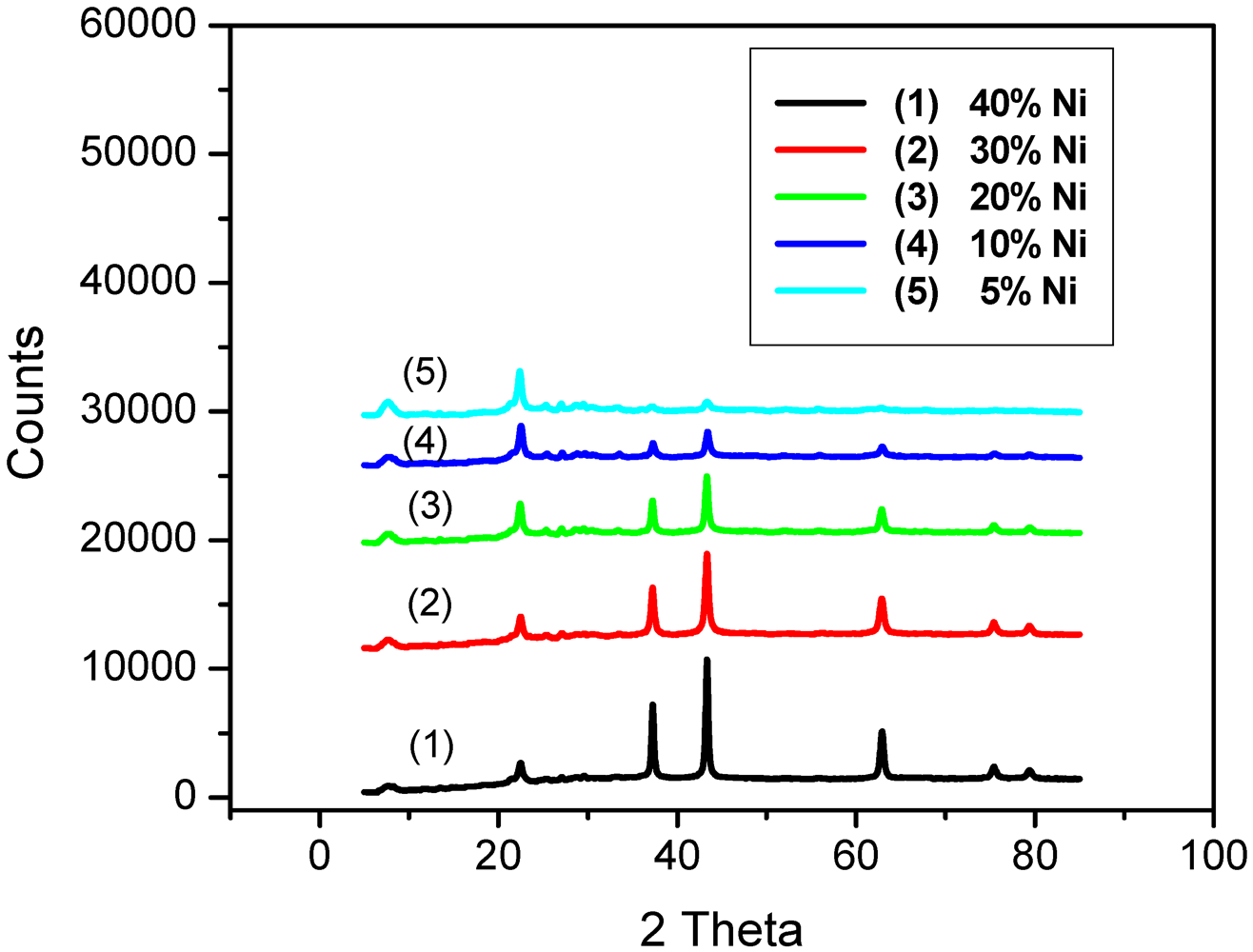
        <p>The X-ray diffraction patterns of Ni supported on H-β zeolite are shown in <xref ref-type="fig" rid="catalysts-02-00085-f001">Figure 1</xref>. The peaks located in the region of 5° &lt; 2<italic>θ</italic> &lt; 35° are representative peaks of a typical H-β zeolite. The peaks at 2<italic>θ</italic> = 43.26°, 62.73°, 75.38° and 79.9° are representative peaks of a nickel oxide. As can be seen in <xref ref-type="fig" rid="catalysts-02-00085-f001">Figure 1</xref>, the intensity of peaks corresponding to H-β zeolite decreased, whereas, the intensity of peaks corresponding to nickel oxide increased on increasing the nickel loading on H-β zeolite.</p>
        <fig id="catalysts-02-00085-f001" position="anchor">
          <label>Figure 1</label>
          <caption>
            <p>X-ray diffraction patterns of Ni/Hβ-zeolite catalysts with increasing nickel loading.</p>
          </caption>
          <graphic xmlns:xlink="http://www.w3.org/1999/xlink" xlink:href="catalysts-02-00085-g001.tif"/>
        </fig>
        <p>The BET surface areas of nickel supported Hβ-zeolite catalysts are given in <xref ref-type="table" rid="catalysts-02-00085-t001">Table 1</xref>. The surface areas of the Ni/Hβ-zeolite catalyst decreased with increased nickel loading. This decrease is expected since the impregnation of low surface area materials onto a high surface area porous H-β zeolite decreases the surface area of the latter. </p>
        <table-wrap id="catalysts-02-00085-t001" position="anchor">
          <object-id pub-id-type="pii">catalysts-02-00085-t001_Table 1</object-id>
          <label>Table 1</label>
          <caption>
            <p>Physicochemical property of Ni/Hβ-zeolite catalysts.</p>
          </caption>
          <table>
            <thead>
              <tr>
                <th rowspan="2" align="center" valign="middle">Sample Number</th>
                <th rowspan="2" align="center" valign="middle">Catalyst</th>
                <th rowspan="2" align="center" valign="middle">BET-SA (m<sup>2</sup>·g<sup>−1</sup>)</th>
                <th align="center" valign="middle">
                  <italic>T</italic>
                  <sub>max</sub>
                </th>
                <th align="center" valign="middle">H<sub>2</sub> uptake</th>
                <th align="center" valign="middle">
                  <italic>T</italic>
                  <sub>max</sub>
                </th>
                <th align="center" valign="middle">H<sub>2</sub> uptake</th>
                <th align="center" valign="middle">Total H<sub>2</sub> uptake</th>
              </tr>
              <tr style="border-top: solid thin">
                <th align="center" valign="middle">°C</th>
                <th align="center" valign="middle">mMol</th>
                <th align="center" valign="middle">°C</th>
                <th align="center" valign="middle">mMol</th>
                <th align="center" valign="middle">mMol</th>
              </tr>
            </thead>
            <tbody>
              <tr>
                <td align="center" valign="middle">1</td>
                <td align="center" valign="middle">5% Ni-Hβ</td>
                <td align="center" valign="middle">258</td>
                <td align="center" valign="middle">354</td>
                <td align="center" valign="middle">118</td>
                <td align="center" valign="middle">478</td>
                <td align="center" valign="middle">95</td>
                <td align="center" valign="middle">214</td>
              </tr>
              <tr>
                <td align="center" valign="middle">2</td>
                <td align="center" valign="middle">10% Ni-Hβ</td>
                <td align="center" valign="middle">163.65</td>
                <td align="center" valign="middle">217372</td>
                <td align="center" valign="middle">41178</td>
                <td align="center" valign="middle">525</td>
                <td align="center" valign="middle">102</td>
                <td align="center" valign="middle">321</td>
              </tr>
              <tr>
                <td align="center" valign="middle">3</td>
                <td align="center" valign="middle">20% Ni-Hβ</td>
                <td align="center" valign="middle">141.6</td>
                <td align="center" valign="middle">376</td>
                <td align="center" valign="middle">416</td>
                <td align="center" valign="middle">498</td>
                <td align="center" valign="middle">86</td>
                <td align="center" valign="middle">502</td>
              </tr>
              <tr>
                <td align="center" valign="middle">4</td>
                <td align="center" valign="middle">30% Ni-Hβ</td>
                <td align="center" valign="middle">95.6</td>
                <td align="center" valign="middle">389</td>
                <td align="center" valign="middle">716</td>
                <td align="center" valign="middle">577</td>
                <td align="center" valign="middle">33</td>
                <td align="center" valign="middle">749</td>
              </tr>
              <tr>
                <td align="center" valign="middle">5</td>
                <td align="center" valign="middle">40% Ni-Hβ</td>
                <td align="center" valign="middle">50.6</td>
                <td align="center" valign="middle">382</td>
                <td align="center" valign="middle">801</td>
                <td align="center" valign="middle">530</td>
                <td align="center" valign="middle">36</td>
                <td align="center" valign="middle">838</td>
              </tr>
            </tbody>
          </table>
        </table-wrap>
        <fig id="catalysts-02-00085-f002" position="anchor">
          <label>Figure 2</label>
          <caption>
            <p>Temperature programmed reduction (TPR) patterns of Ni/Hβ-zeolite catalysts.</p>
          </caption>
          <graphic xmlns:xlink="http://www.w3.org/1999/xlink" xlink:href="catalysts-02-00085-g002.tif"/>
        </fig>
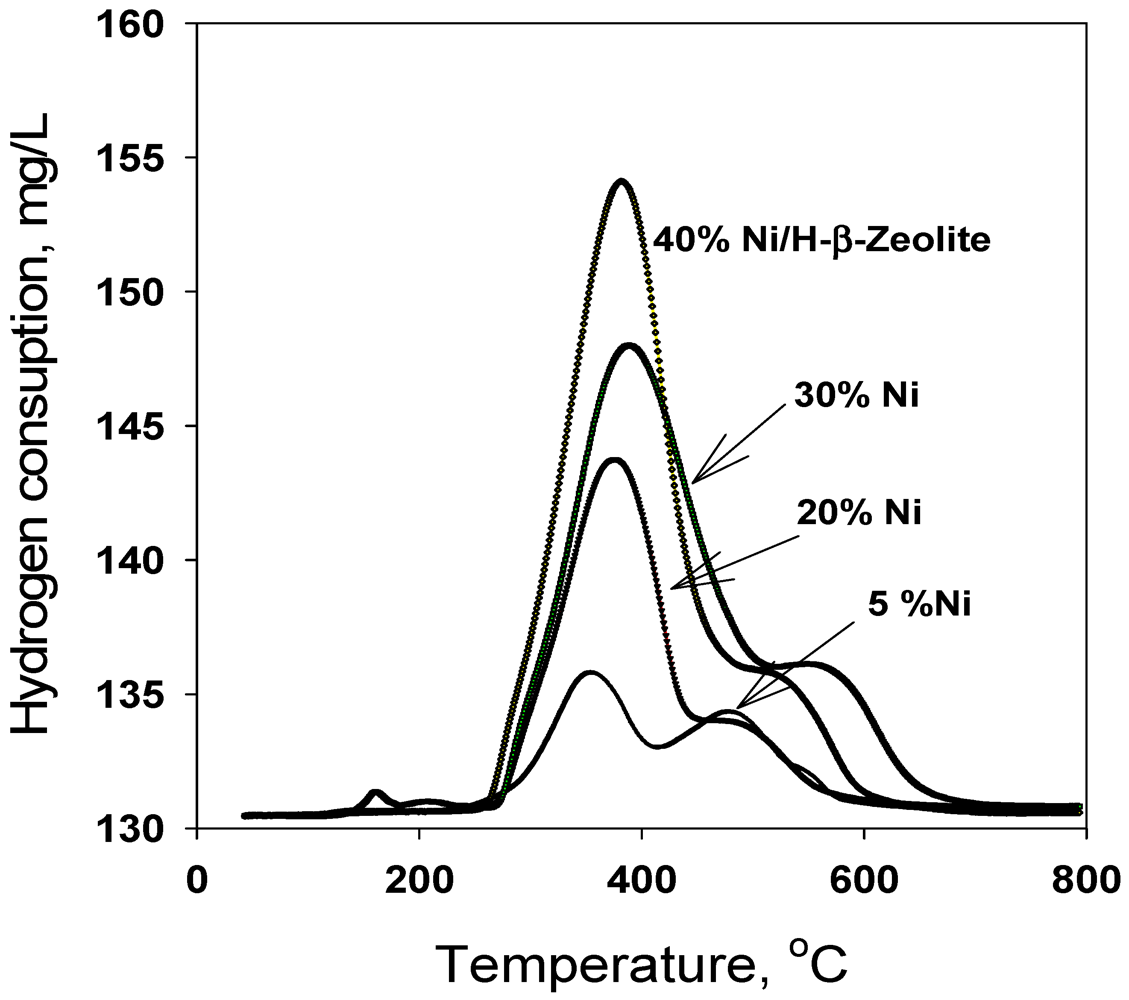
        <p>The reducibilities of the nickel phases over the catalysts were investigated by TPR technique. The TPR profiles of the Ni/H-β-Zeolite catalysts are shown in <xref ref-type="fig" rid="catalysts-02-00085-f002">Figure 2</xref>. As can be observed, the four peaks overlapped and these peaks shift to higher temperatures as the nickel loading increases. The first peak at temperature less than 420 °C, corresponds to a typical reduction of the supported nickel oxide, <italic>i.e.</italic>, supported nickel oxide present on the outer surface of the zeolite. The second peak accounts for nickel in Ni-zeolite that is reducible above 500 °C [<xref ref-type="bibr" rid="B23-catalysts-02-00085">23</xref>,<xref ref-type="bibr" rid="B24-catalysts-02-00085">24</xref>]. Others have also observed that the reduction of NiO bulk occurs at 220 to 420 °C [<xref ref-type="bibr" rid="B25-catalysts-02-00085">25</xref>,<xref ref-type="bibr" rid="B26-catalysts-02-00085">26</xref>]. Pedrosa <italic>et al.</italic> [<xref ref-type="bibr" rid="B27-catalysts-02-00085">27</xref>] studying TPR of nickel on H Y zeolite, suggested that the different reduction temperatures for Ni<sup>2+</sup> corresponded to the location of cations in the zeolite. The first and second peaks of nickel reduction, at 238 and 507 °C, are attributed to the reduction of Ni<sup>2+</sup> species located in the sodalite and hexagonal cavities, respectively. The ratios of the areas for the peaks with a maximum near 400 °C with that around 520 °C, is 1.6. Thus the TPR data suggests that more than 60% of the nickel oxide is located on the external surface of the support. The TPR peaks at temperatures above 500 °C may correspond to the reduction of nickel particles located inside the cavities of the zeolite, including the channels and cages of the structure. The differences in TPR profiles may be due to nickel species being present in the cavities and/or on the surface of the zeolite catalyst supported.</p>
        <p>It could also be observed that the number of diffraction peaks did not change with respect to H-β-Zeolite, indicating that no crystalline transformation occurred during metal impregnation. The XRD pattern of 5% nickel loading on H-β-Zeolite shows the peak intensity was strong at 2<italic>θ</italic> = 22 and weak at 2<italic>θ</italic> = 38, 43, and 62 (<xref ref-type="fig" rid="catalysts-02-00085-f001">Figure 1</xref>). Most of the expected peaks could not be observed because of their low concentration or amorphous nature. Hydrogen consumption during TPR, in temperatures below 400 °C, showed strong interaction between NiO particles and H-β-Zeolite. Thus, these peaks can be associated with the reduction of nickel that interacts with zeolite in different intensities. The reduction at profile of lower concentration nickel is in accordance with Rynkawski <italic>et al.</italic> [<xref ref-type="bibr" rid="B28-catalysts-02-00085">28</xref>], who observed a bimodal nature of nickel oxide species, which includes an amorphous over layer on nickel oxide that interacts but is not chemically bound with the support and reduced at lower temperatures and spinels of Ni-H-β-Zeolite oxides at higher temperatures.</p>
      </sec>
      <sec>
        <title>2.2. Catalytic Activity</title>
        <sec>
          <title>2.2.1. Effect of Reaction Temperature on Hydrogenation of Anthracene</title>
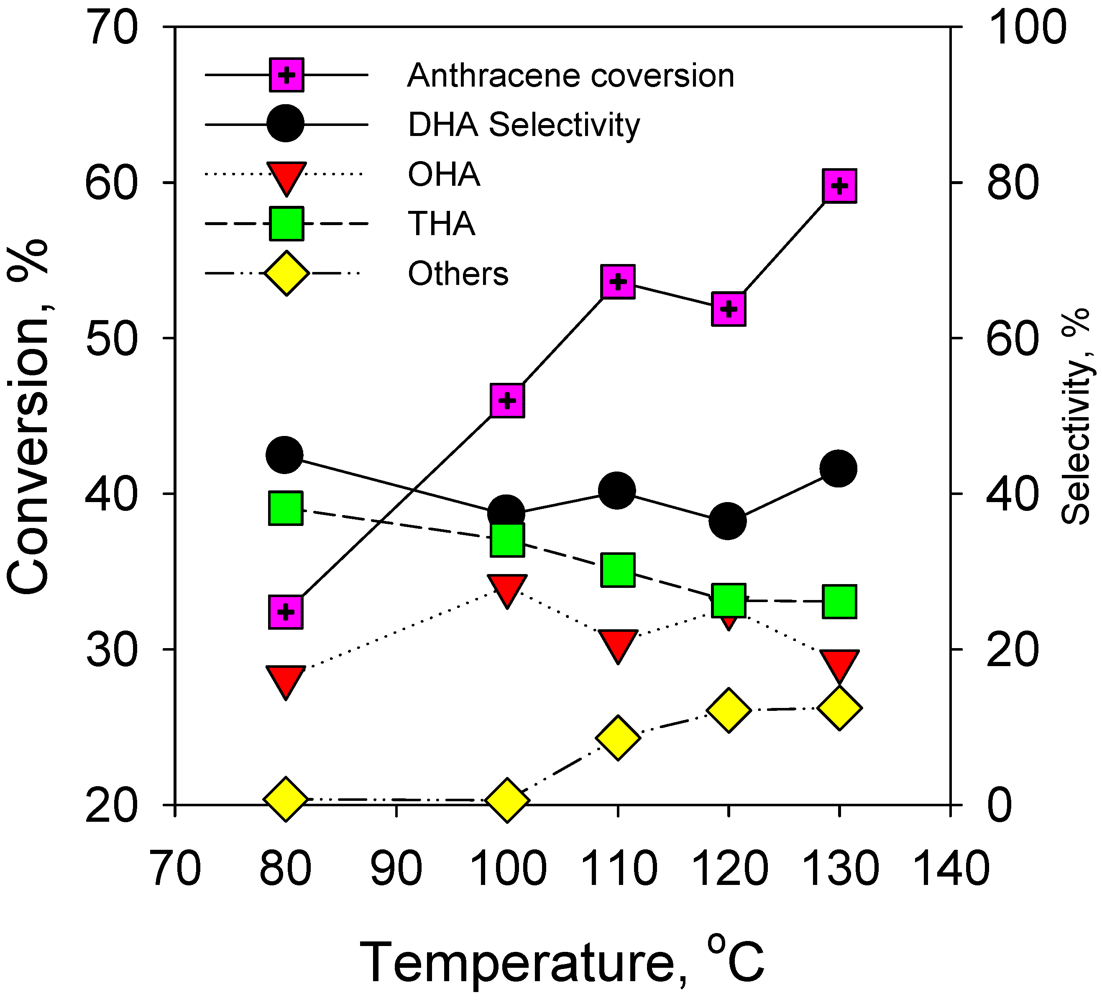
          <p>Effect of temperature on hydrogenation of anthracene was studied in the range of 80–130 °C over 10 wt.% Ni/Hβ-zeolite. The results are shown in <xref ref-type="fig" rid="catalysts-02-00085-f003">Figure 3</xref>. The conversion of anthracene increased from 32.4 to 59.8% with increased temperature from 80 °C to 130 °C.</p>
          <fig id="catalysts-02-00085-f003" position="anchor">
            <label>Figure 3</label>
            <caption>
              <p>Effect of temperature on hydrogenation of anthracene over 10 wt.% Ni/Hβ-zeolite catalyst. Catalyst weight: 0.5 g; Reaction pressure: 6.9 MPa; H<sub>2</sub> partial pressure: 2.76 MPa;volume of the reactor: 50 mL; reaction time: 6 h.</p>
            </caption>
            <graphic xmlns:xlink="http://www.w3.org/1999/xlink" xlink:href="catalysts-02-00085-g003.tif"/>
          </fig>
        </sec>
        <sec>
          <title>2.2.2. Effect of Nickel Loading on Hydrogenation of Anthracene</title>
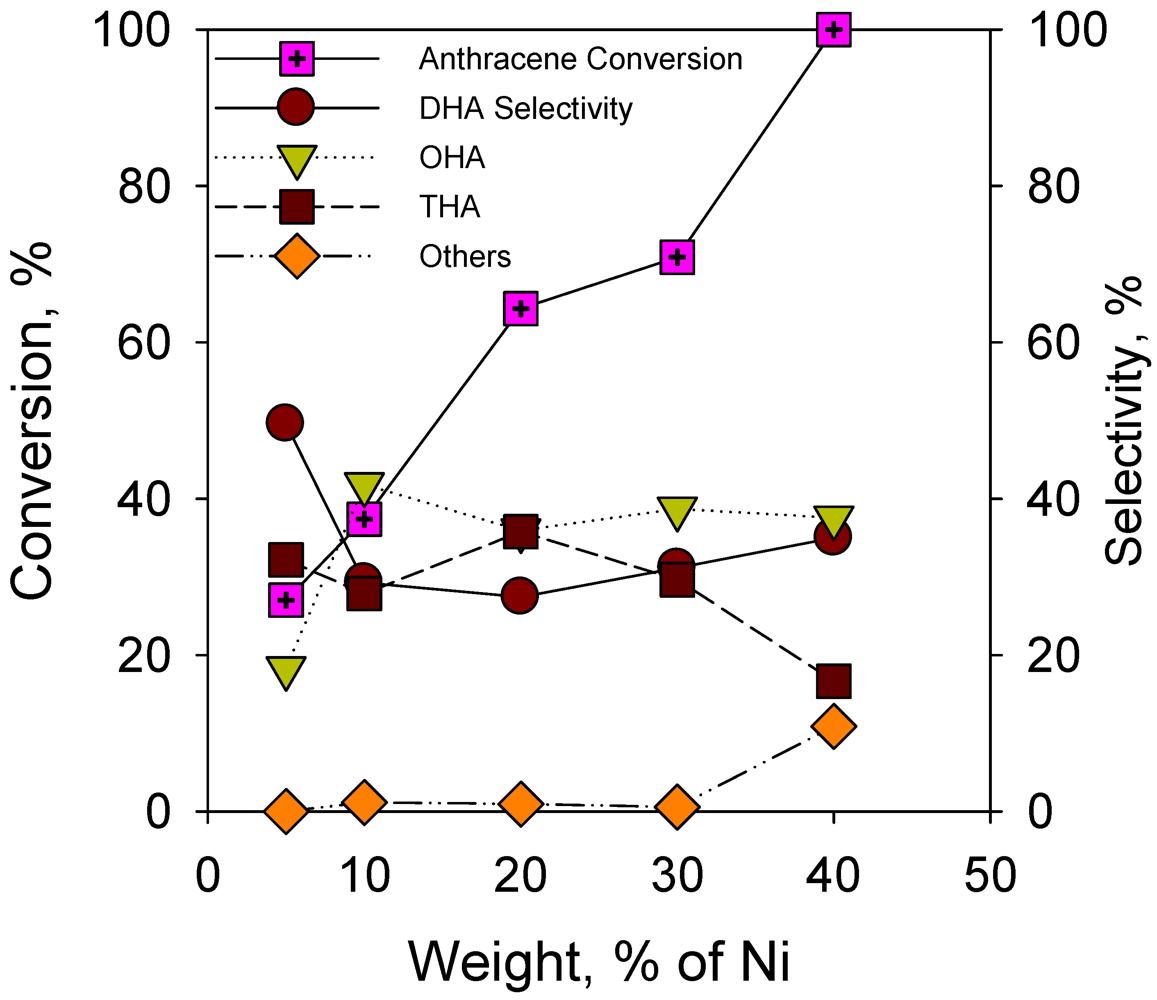
          <p>Although, the reaction medium is a mixture of CO<sub>2</sub> and H<sub>2</sub> the literature data indicates that the substrates have solubility around (0.1–2) × 10<sup>−4</sup> mole fraction at reaction conditions [<xref ref-type="bibr" rid="B29-catalysts-02-00085">29</xref>,<xref ref-type="bibr" rid="B30-catalysts-02-00085">30</xref>]. The conversion of anthracene increased as the weight fraction of Ni on Hβ-zeolite support increased from 5 wt.% to 40 wt.% (<xref ref-type="fig" rid="catalysts-02-00085-f004">Figure 4</xref>). This indicates the conversion of anthracene improves with the increase in the number of active sites on the catalyst. The TPR studies of the catalyst indicated the hydrogen uptake by the catalyst, in turn, the number of active sites, increased on increasing the wt.% of nickel on the support. The catalytic activity results are in correlation with hydrogen uptake of the catalyst. Meanwhile, the selectivity of the products did not change significantly with increasing the nickel loading on Hβ-zeolite support. The results indicate that using sc-CO<sub>2</sub> as a solvent 100% hydrogenation of anthracene was achieved at 100 °C over 40 wt./% Ni/Hβ-zeolite, which is attributed to the reduced mass transfer limitations, and increased solubility of H<sub>2</sub> and substrate in the dense CO<sub>2</sub> medium.</p>
          <fig id="catalysts-02-00085-f004" position="anchor">
            <label>Figure 4</label>
            <caption>
              <p>Effect of metal loading on hydrogenation of anthracene. Catalyst weight: 0.5 g; Reaction temperature: 100 °C; Reaction pressure: 6.9 MPa; H<sub>2</sub> partial pressure: 2.76 MPa; volume of the reactor: 50 mL; reaction time: 6 h.</p>
            </caption>
            <graphic xmlns:xlink="http://www.w3.org/1999/xlink" xlink:href="catalysts-02-00085-g004.tif"/>
          </fig>
        </sec>
        <sec>
          <title>2.2.3. Effect of Reaction Pressure on Hydrogenation of Anthracene</title>
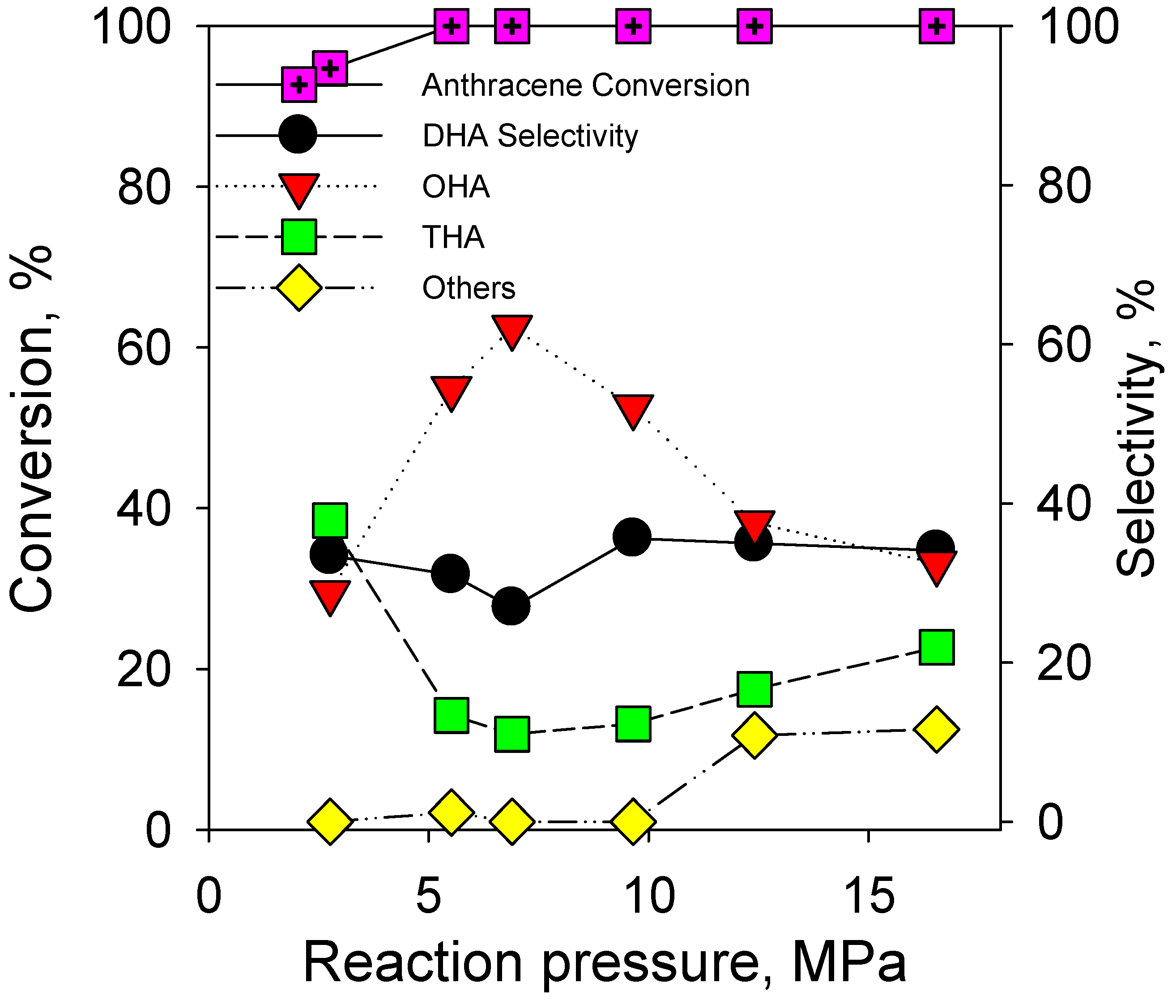
          <p>The effect of reaction pressure on hydrogenation of anthracene was studied from 2.8–16.6 MPa and the results are shown in <xref ref-type="fig" rid="catalysts-02-00085-f005">Figure 5</xref>. The conversion anthracene is almost 100% in all cases, except at 2.76 MPa reaction pressure where the conversion was 94%. It is interesting to see in the figure that the selectivity of octahydroanthracene increased with increasing reaction pressure in the range of 2.8–6.9 MPa and decreased beyond 6.9 MPa. The results indicate that tetrahydroanthracene is the predominant product at low reaction pressure and is further hydrogenated to octahydroanthracene with increasing reaction pressure up to 6.9 MPa. Higher pressures above 6.9 MPa showed no significant effect on the reaction. The total pressure of 6.9 MPa was found to be optimum for the high selectivity of octahydroanthracene. The drop in selectivity beyond 6.9 MPa could be explained by the enhanced desorption tetrahydro-molecules and intermediates from Ni active sites due to higher solubility of surface species in sc-CO<sub>2</sub>. Hiyoshi <italic>et al.</italic> [<xref ref-type="bibr" rid="B31-catalysts-02-00085">31</xref>], observed the same effect while studying hydrogenation of biphenyl over supported transition metal catalyst under sc-CO<sub>2</sub> solvent. </p>
          <fig id="catalysts-02-00085-f005" position="anchor">
            <label>Figure 5</label>
            <caption>
              <p>Effect of reaction pressure on hydrogenation of anthracene over 40% Ni/Hβ-zeolite catalyst. Catalyst weight: 0.5 g; Reaction temperature: 100 °C; H<sub>2</sub> partial pressure: 2.76 MPa; volume of the reactor: 50 mL; reaction time: 6 h.</p>
            </caption>
            <graphic xmlns:xlink="http://www.w3.org/1999/xlink" xlink:href="catalysts-02-00085-g005.tif"/>
          </fig>
        </sec>
        <sec>
          <title>2.2.4. Effect of Hydrogen Partial Pressure on Hydrogenation of Anthracene</title>
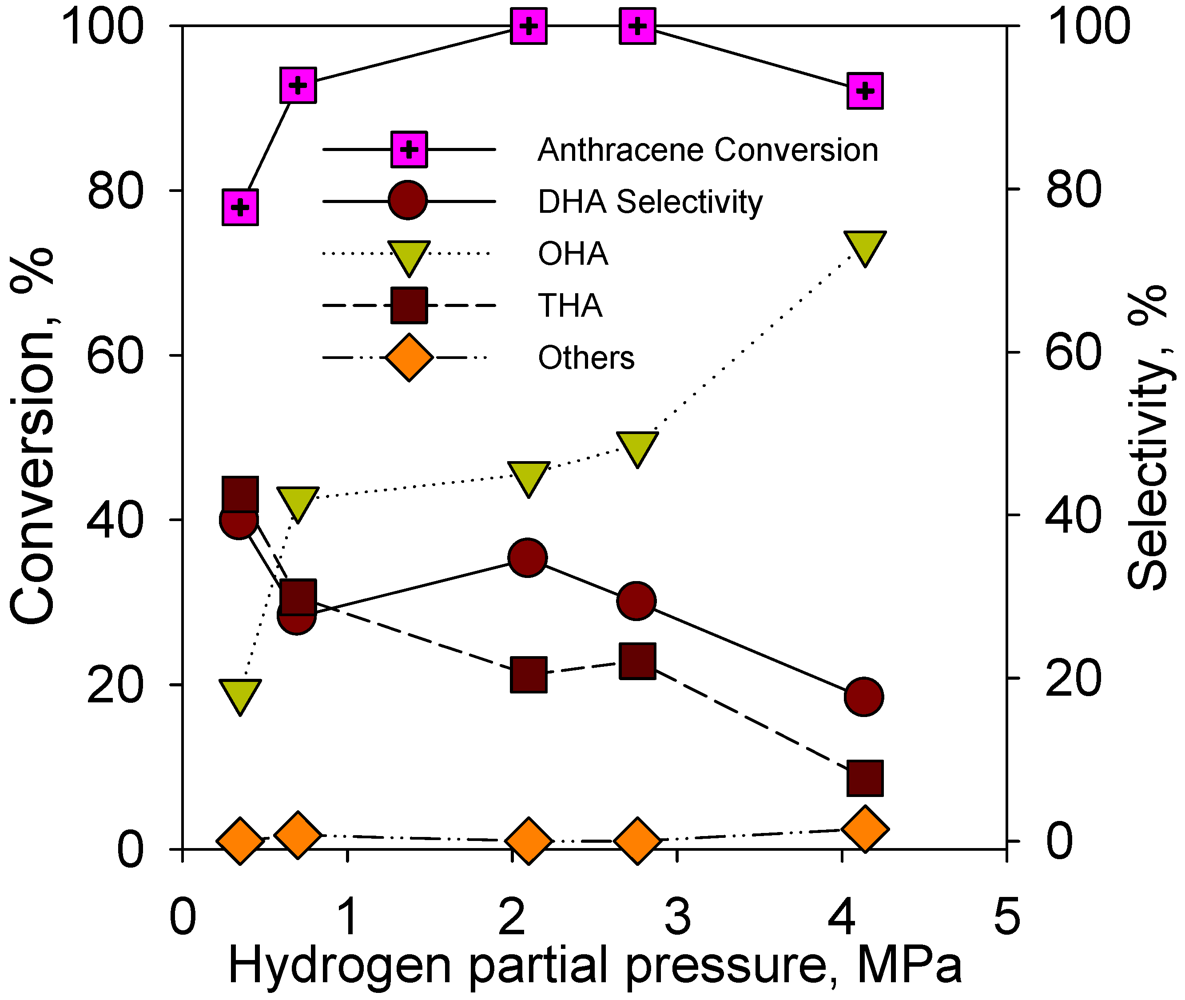
          <p>The effect of hydrogen partial pressure on hydrogenation of anthracene was studied from 0.35–4.1 MPa hydrogen partial pressure and the results are presented in <xref ref-type="fig" rid="catalysts-02-00085-f006">Figure 6</xref>. The results shown in <xref ref-type="fig" rid="catalysts-02-00085-f006">Figure 6</xref> indicate that the conversion of anthracene increased on increasing hydrogen partial pressure. The selectivity for dihydroanthracene and tetrahydroanthracene decreased, whereas the selectivity for octahydroanthracene increased on increasing the hydrogen partial pressure. This implies the degree of hydrogenation improves with increasing the hydrogen partial pressure. The increase in the concentration of hydrogen around the active sites is responsible for the increase in the degree of hydrogenation and these results are in agreement with results reported in the literature [<xref ref-type="bibr" rid="B18-catalysts-02-00085">18</xref>,<xref ref-type="bibr" rid="B19-catalysts-02-00085">19</xref>,<xref ref-type="bibr" rid="B30-catalysts-02-00085">30</xref>]. At the hydrogen partial pressure of 4 MPa there was a moderate decrease in the conversion of the total hydrogenation of anthracene, although the patterns in selectivities did not change. This might be caused by the changes in the phase behavior of hydrogen-CO<sub>2</sub>-anthracene mixture, however further investigation is needed. </p>
        </sec>
        <sec>
          <title>2.2.5. Effect of Catalyst Weight on Hydrogenation of Anthracene</title>
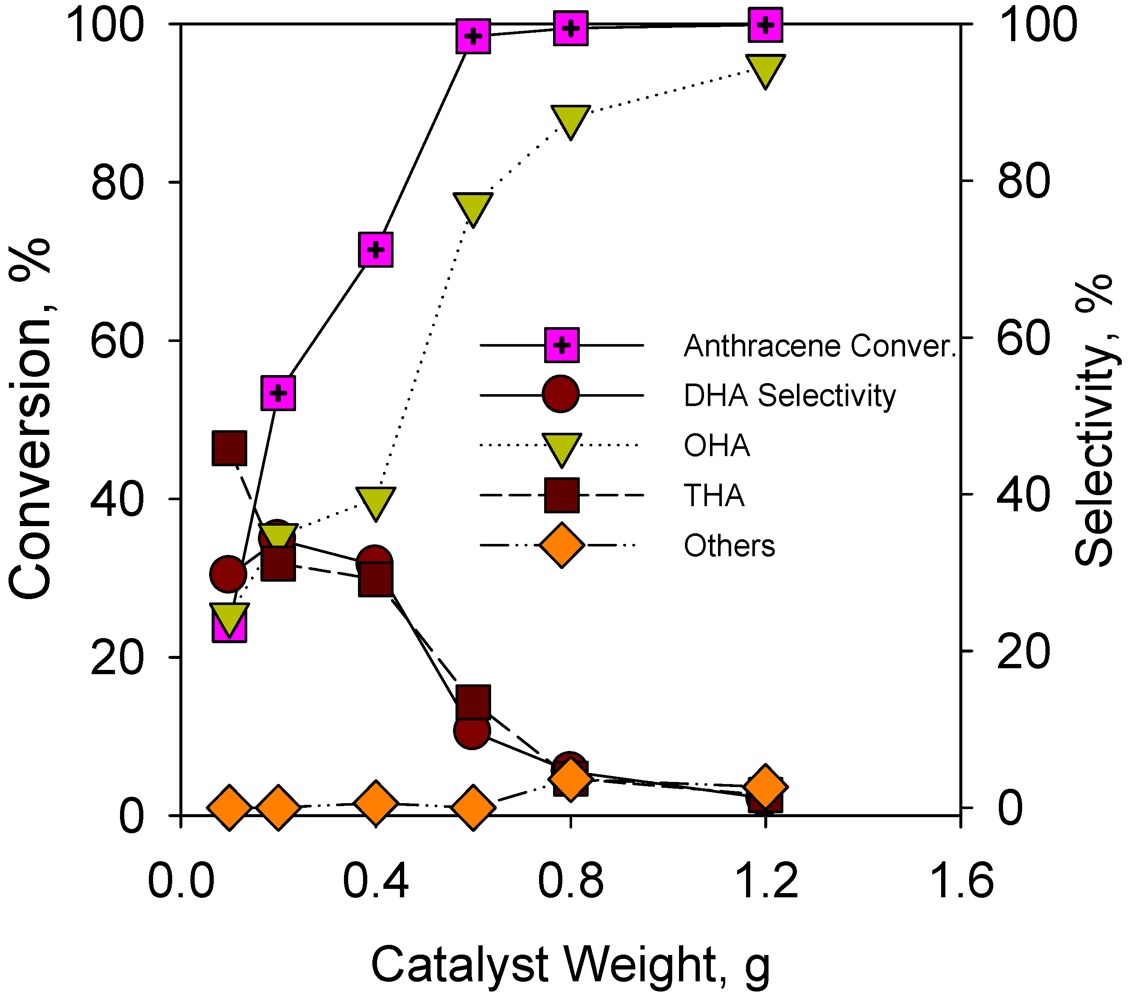
          <p><xref ref-type="fig" rid="catalysts-02-00085-f007">Figure 7</xref> presents the effect of catalyst weight on hydrogenation of anthracene. The conversion of anthracene and the selectivity for octahydroanthracene increased with increasing amount of catalyst. The increase for active sites as a result of increased catalyst concentration is responsible for the increased activity and selectivity. It could be understood from the results presented that the reaction is not mass transfer controlled at reaction conditions studied. </p>
          <fig id="catalysts-02-00085-f006" position="anchor">
            <label>Figure 6</label>
            <caption>
              <p>Effect of hydrogen partial pressure on hydrogenation of anthracene over 40% Ni/Hβ-zeolite catalyst. Catalyst weight: 0.5 g; Reaction temperature: 100 °C; Reaction pressure: 6.9 MPa; volume of the reactor: 50 mL; reaction time: 6 h.</p>
            </caption>
            <graphic xmlns:xlink="http://www.w3.org/1999/xlink" xlink:href="catalysts-02-00085-g006.tif"/>
          </fig>
          <fig id="catalysts-02-00085-f007" position="anchor">
            <label>Figure 7</label>
            <caption>
              <p>Effect of catalyst weight on hydrogenation of anthracene over 40% Ni/Hβ-zeolite catalyst. Reaction temperature: 100 °C; Reaction pressure: 6.9 MPa; H<sub>2</sub> partial pressure: 2.76 MPa; volume of the reactor: 50 mL; reaction time: 6 h. </p>
            </caption>
            <graphic xmlns:xlink="http://www.w3.org/1999/xlink" xlink:href="catalysts-02-00085-g007.tif"/>
          </fig>
        </sec>
        <sec>
          <title>2.2.6. Effect of Reaction Time on Hydrogenation of Anthracene</title>
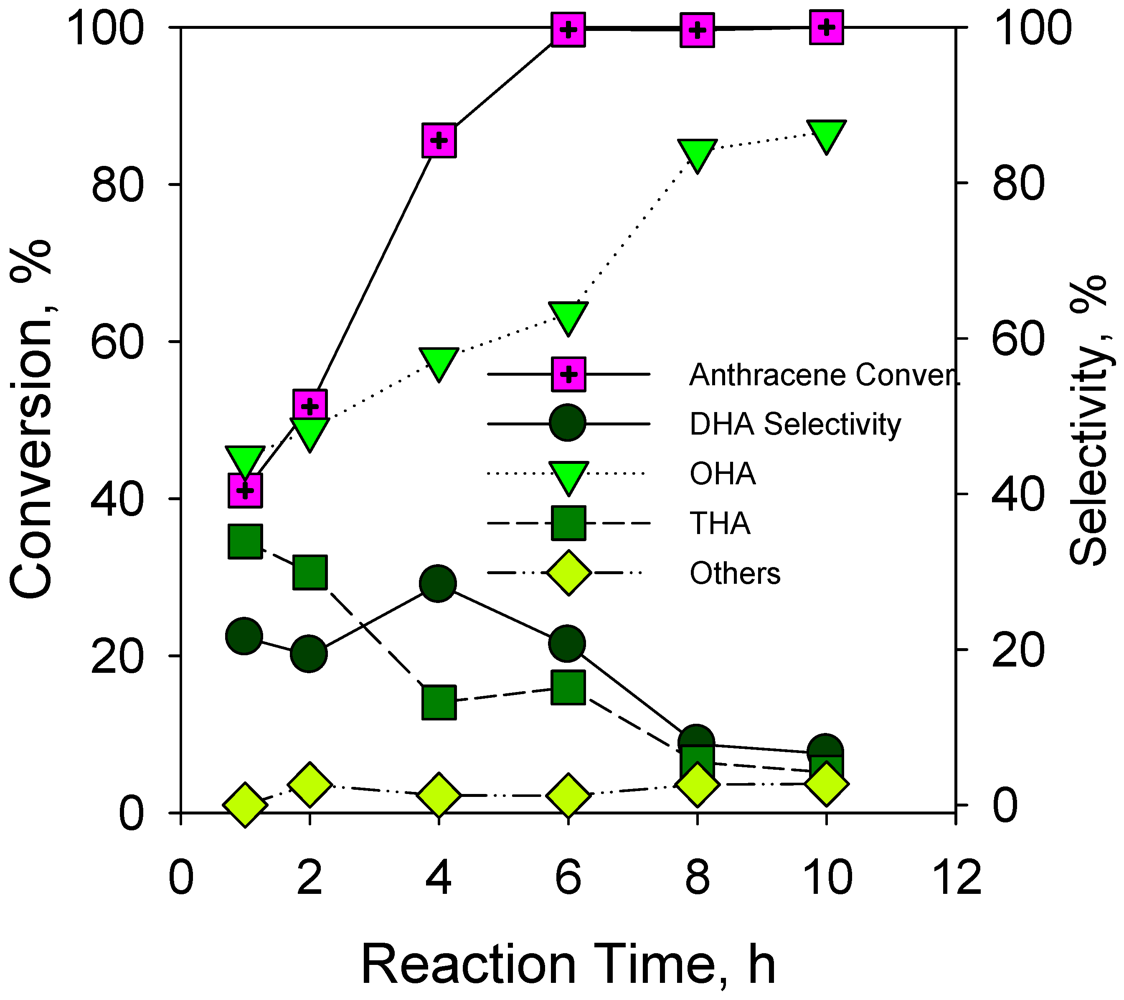
          <p>The effect of reaction time on the hydrogenation of anthracene was studied over 40 wt.% Ni/H-β zeolite and the results are shown in <xref ref-type="fig" rid="catalysts-02-00085-f008">Figure 8</xref>. Longer reaction times improved the conversion of anthracene. It is interesting to see that the selectivity of octahydroanthracene increased and the selecetivities of di-, and tetrahydroanthracene decreased with increased reaction time. This indicates the di-, and tetrahydroanthracene formed were converted to octahydroanthracene on increasing the reaction time.</p>
          <fig id="catalysts-02-00085-f008" position="anchor">
            <label>Figure 8</label>
            <caption>
              <p>Effect of reaction time on hydrogenation of anthracene over 40% Ni/Hβ-zeolite catalyst. Catalyst weight: 0.5 g; Reaction temperature: 100 °C; Reaction pressure: 6.9 MPa; H<sub>2</sub> partial pressure: 2.76 MPa; volume of the reactor: 50 mL; reaction time: 6 h.</p>
            </caption>
            <graphic xmlns:xlink="http://www.w3.org/1999/xlink" xlink:href="catalysts-02-00085-g008.tif"/>
          </fig>
        </sec>
        <sec>
          <title>2.2.7. Effect of Solvent on Hydrogenation of Anthracene</title>
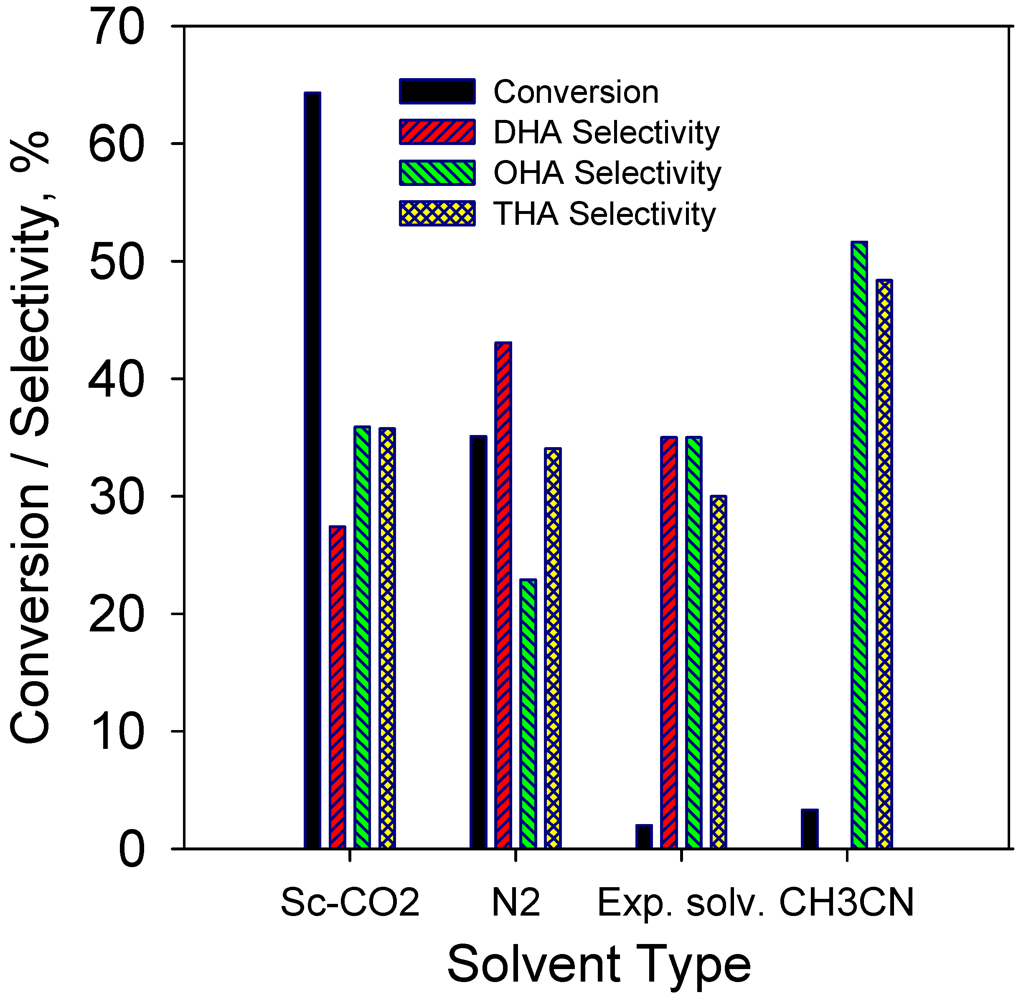
          <p>The effect of solvent on hydrogenation of anthracene was carried out at 100 °C over 10 wt.% Ni/Hβ-zeolite and the results are shown in <xref ref-type="fig" rid="catalysts-02-00085-f009">Figure 9</xref>. The reaction carried out under nitrogen pressure showed less conversion of anthracene compared to the reaction carried at the same amount of carbon dioxide pressure. This indicates that the sc-CO<sub>2</sub> eliminates the transport limitations, by improving the solubility of hydrogen at the reaction mixture. Whereas, the reactions carried under acetonitrile and sc-CO<sub>2</sub> expanded acetonitrile showed almost negligible conversions of anthracene. The low catalytic activity in sc-CO<sub>2</sub> expanded acetonitrile might be due to the fact the specific solvation of carbon dioxide molecule for anthracene suppressed by co-solvent. Aizawa <italic>et al.</italic> [<xref ref-type="bibr" rid="B32-catalysts-02-00085">32</xref>], reported the co-solvent shields specific interaction between solute and the CO<sub>2</sub> solvent. Moreover, we observed the hydrogenated products of acetonitrile such as ethylamine, diethylamine and triethylamine, which may have a poisoning effect on the catalyst.</p>
          <fig id="catalysts-02-00085-f009" position="anchor">
            <label>Figure 9</label>
            <caption>
              <p>Effect of solvent on hydrogenation of anthracene over 10 wt.% Ni/Hβ-zeolite catalyst. Catalyst weight: 0.5 g; Reaction temperature: 100 °C; Reaction pressure: 6.9 MPa; H<sub>2</sub> partial pressure: 2.76 MPa; volume of the reactor: 50 mL; reaction time: 6 h.</p>
            </caption>
            <graphic xmlns:xlink="http://www.w3.org/1999/xlink" xlink:href="catalysts-02-00085-g009.tif"/>
          </fig>
        </sec>
        <sec>
          <title>2.2.8. Reaction Mechanism of Anthracene Hydrogenation</title>
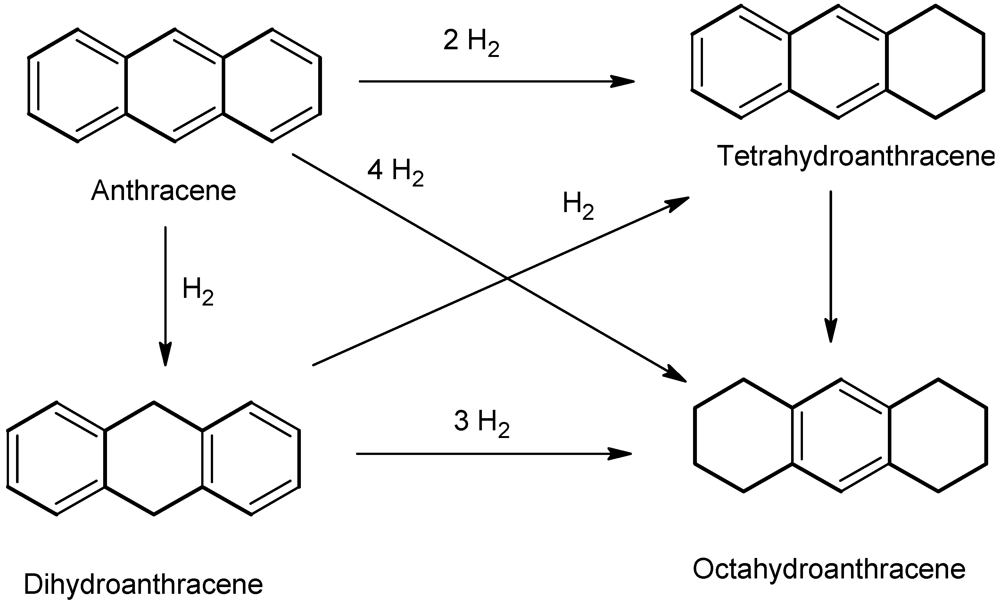
          <p>A scheme of reaction mechanism of hydrogenation of anthracene based on the product distribution is shown in <xref ref-type="fig" rid="catalysts-02-00085-f012">Scheme 1</xref>. Although more than twelve products were detected including 1,2,3,4-tetrahydroanthracene that are present in trace quantity at lower reaction temperatures, four isomers of octahydroanthracene, and six isomers pf tetradecahydroanthracene, we only report the major products. Hydrogenation of anthracene results mainly in the formation of di- and tetrahydroanthracene which were further hydrogenated to octa-hydroanthracene as a major product. In order to understand the reaction pathway, the hydrogenation of di-, tetra- and octahydroanthracene were carried out. The hydrogenation of di- and tetrahydro anthracene completely converted to octahydroanthracene whereas, no conversion was obtained from octahydroanthracene. The results indicate that dihydroanthracene can be either directly converted and/or via tetrahydroanthracene to octahydroanthracene.</p>
          <fig id="catalysts-02-00085-f012" position="anchor">
            <label>Scheme 1</label>
            <caption>
              <p>Reaction pathway for hydrogenation of anthracene.</p>
            </caption>
            <graphic xmlns:xlink="http://www.w3.org/1999/xlink" xlink:href="catalysts-02-00085-g012.tif"/>
          </fig>
        </sec>
        <sec>
          <title>2.2.9. Comparison of Reaction Kinetics of Hydrogenation Anthracene with Phenanthrene and Naphthalene</title>
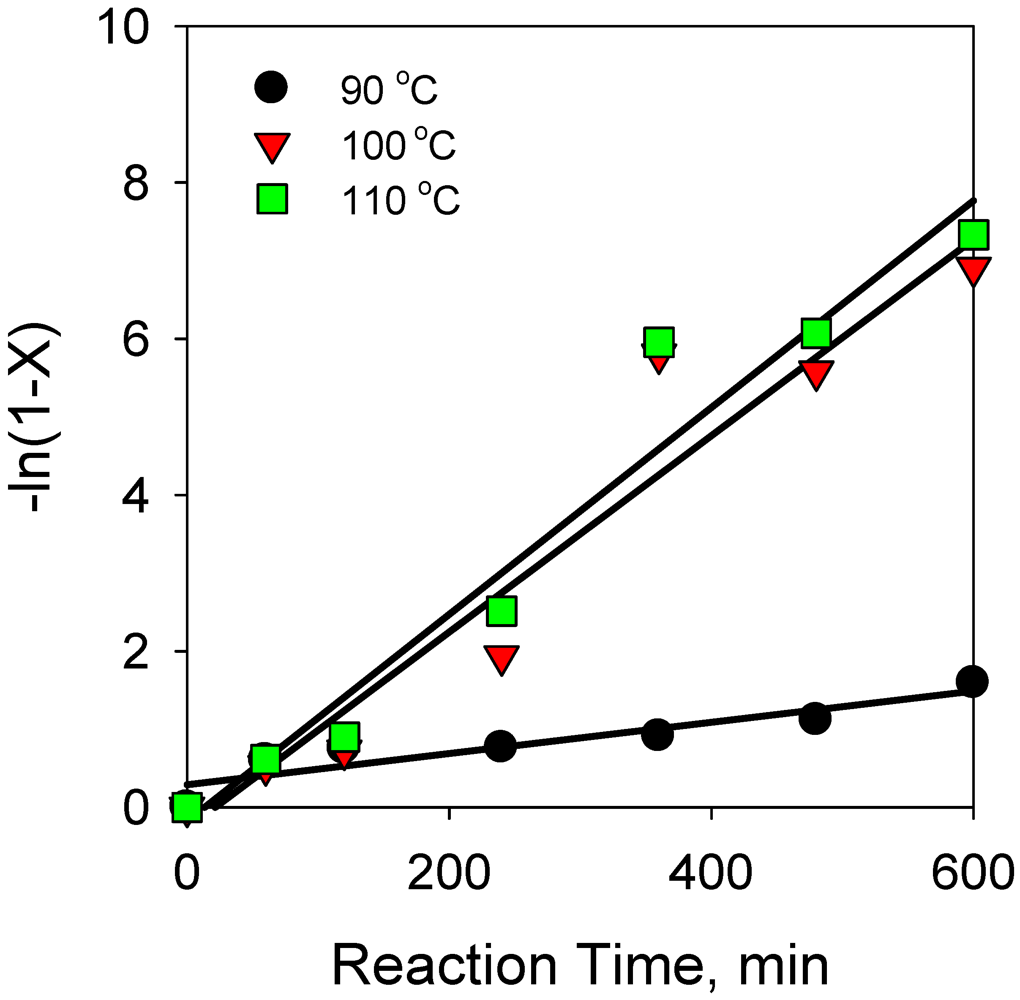
          <p>A plot of −ln(1 − X) <italic>versus</italic> reaction time, where X is fractional conversion of anthracene, for anthracene hydrogenation reactions carried out at 90°, 100° and 110 °C showed a near linear character. This suggests a first-order dependence of the rate of the reaction on anthracene concentration. Hence, the rate expression for anthracene (M) can be written as:</p>
		  <p>
		  <disp-formula id="catalysts-02-00085-i001">
          <inline-graphic xmlns:xlink="http://www.w3.org/1999/xlink" xlink:href="catalysts-02-00085-i001.tif">
          </inline-graphic>
          <label>(1)</label>
          </disp-formula>
		  </p>
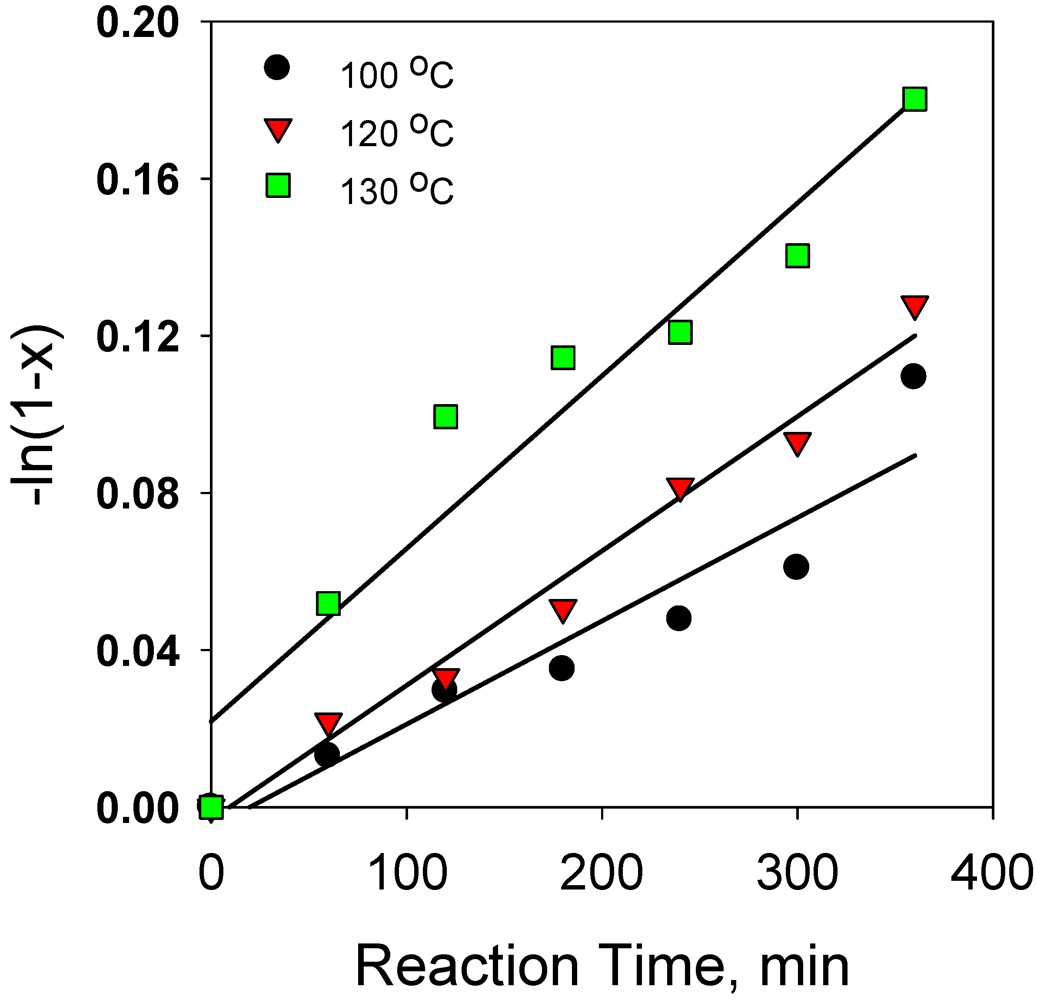
          <p>The reaction rate constants calculated from the slopes of plots in <xref ref-type="fig" rid="catalysts-02-00085-f010">Figure 10</xref> are 2.7 × 10<sup>−3</sup> min<sup>−1</sup>, 11.9 × 10<sup>−3</sup> min<sup>−1</sup> and 12.8 × 10<sup>−3</sup> for anthracene hydrogenation at 90°, 100° and 110 °C, respectively. A plot of −ln(1 − X) <italic>versus</italic> reaction time, where X is fractional conversion of phenanthrene, for phenanthrene hydrogenation reactions carried out at 90°, 100° and 110 °C showed a near linear character with the R-square values of 0.85, 0.93, and 0.95, respectively (<xref ref-type="fig" rid="catalysts-02-00085-f011">Figure 11</xref>). The reaction rate constants calculated from the slopes of plots in <xref ref-type="fig" rid="catalysts-02-00085-f011">Figure 11</xref> are 0.3 × 10<sup>−3</sup>, 0.3 × 10<sup>−3</sup> and 0.5 × 10<sup>−3</sup> min<sup>−1</sup> for phenanthrene hydrogenation at 100°, 120° and 130 °C, respectively. The goodness of fit for the first-order model for three isothermal reactions is given by R-square values of 0.85, 0.93, and 0.95, respectively. Moreover, negligible conversions were obtained during the hydrogenation of naphthalene. The hydrogenation activity of polycyclic aromatic compounds followed the order naphthalene &lt; phenanthrene &lt; anthracene. The same trend was observed by Nelkenbaum <italic>et al.</italic> [<xref ref-type="bibr" rid="B21-catalysts-02-00085">21</xref>]. </p>
          <fig id="catalysts-02-00085-f010" position="anchor">
            <label>Figure 10</label>
            <caption>
              <p>First-order dependence plot for hydrogenation of anthracene at 90 °C, 100 °C and 110 °C over 40 wt.% Ni/Hβzeolite catalyst. Catalyst weight: 0.5 g; Reaction pressure: 6.9 MPa; H<sub>2</sub> partial pressure: 2.76 MPa; volume of the reactor: 50 mL.</p>
            </caption>
            <graphic xmlns:xlink="http://www.w3.org/1999/xlink" xlink:href="catalysts-02-00085-g010.tif"/>
          </fig>
          <fig id="catalysts-02-00085-f011" position="anchor">
            <label>Figure 11</label>
            <caption>
              <p>First-order dependence plot for hydrogenation of phenanthrene at 100 °C, 120 °C and 130 °C over 40 wt.% Ni/Hβzeolite catalyst. Catalyst weight: 0.5 g; Reaction pressure: 6.9 MPa; H<sub>2</sub> partial pressure: 2.76 MPa; volume of the reactor: 50 mL.</p>
            </caption>
            <graphic xmlns:xlink="http://www.w3.org/1999/xlink" xlink:href="catalysts-02-00085-g011.tif"/>
          </fig>
        </sec>
      </sec>
    </sec>
    <sec>
      <title>3. Experimental Section</title>
      <sec>
        <title>3.1. Catalyst Preparation</title>
        <p>Ni supported on Hβ-zeolite catalysts was prepared by impregnation method. A typical procedure for the impregnation involves the soaking of Hβ-zeolite powder in aqueous solutions of nickel nitrate in appropriate mole ratios for 2 h followed by evaporating the water on a hot plate under constant stirring. The metal oxide impregnated catalyst was obtained by drying this material in vacuum oven at 110 °C for 6 h followed by calcination in air at 450 °C for 4 h at a temperature ramp of 10 °C/min. Prior to hydrogenation, the calcined catalyst was reduced under hydrogen flow of 30 mL/min at 450 °C for 4 h at a temperature ramp of 10 °C/min. </p>
      </sec>
      <sec>
        <title>3.2. Catalyst Characterization</title>
        <p>The calcined catalysts were characterized using powder X-ray diffraction (XRD), BET surface area, and TPR techniques. Powder diffraction patterns were recorded on a GBC Minimaterial analyzer (Australia) using Cu <italic>K</italic><sub>α</sub> radiation source. Scans were performed over the 2<italic>θ</italic> range from 5° to 90° at 0.02 stepsize and 1 degree/min scan speed and 1 kW power. </p>
        <p>The BET surface areas of the catalysts were measured using nitrogen adsorption at 77 K on a Micromeretics (AutoChem 2920, Norcross, GA, USA) surface area analyzer. Prior to analyses, 0.35 g of sample catalysts were loaded into a quartz reactor and degassed at 120 °C with a helium purge for 60 min. A single-point nitrogen adsorption isotherm was used to determine the BET surface area of the sample. Temperature programmed reduction (TPR) analyses of the catalysts were performed on a Micrometric Autochem 2920 instrument using hydrogen as a reducing gas. The catalyst (0.35 g) was charged into a U-tube reactor and pretreated in oxygen at 450 °C for 2 h. TPR was performed at heating rates of 10 °C/min up to 800 °C under a flow of 11.2% H<sub>2</sub>/Ar (50 cm<sup>3</sup>/min). The temperature was decreased to ambient and then the temperature was increased at temperature ramp of 10 °C to 600 °C under hydrogen flow. The consumption of hydrogen was monitored by a thermal conductivity detector (TCD) and recorded at a signal rate of 5 points/min. The hydrogen consumption was quantified by a pulse calibration. The temperature was measured adjacent to the catalyst bed and followed a strictly linear trend. </p>
      </sec>
      <sec>
        <title>3.3. Catalytic Reactions</title>
        <p>The catalytic hydrogenation of anthracene over Ni/Hβ-zeolite catalysts was carried out in a 50 mL stainless steel reactor equipped with temperature controller, pressure sensor and a furnace. Before the reaction, the catalyst was reduced at 450 °C for 4 h. 0.5 g of the pre-reduced catalyst and 0.01 mol (1.78 g) of anthracene were quickly added to the reactor. The reactor was flushed three times with hydrogen to remove air from the reactor and the reaction temperature was raised to 100 °C. Then the reactor was filled with 2.76 MPa of hydrogen and 6.9 MPa of carbon dioxide pressure. After the reaction, the reactor was cooled to room temperature and vented slowly. View cell was used to verify that the density of the sc-CO<sub>2</sub> was sufficient to ensure that the reactants are substantially in a single phase. The products were collected and analyzed by a Hewlett-Packard 6890 Gas Chromatograph using a HP-5 Capillary Column. (30 m × 320 m × 0.25 m) and a quadruple mass filter equipped HP 5973 mass selective detector under a temperature programmed heating from 40 to 200 °C at 10 °C/min. Quantification of each product was obtained using a multi-point calibration curve for each product.</p>
      </sec>
    </sec>
    <sec sec-type="conclusions">
      <title>4. Conclusions</title>
      <p>XRD analyses showed the main peaks and bands characteristic of the structure in all samples. TPR profiles showed two peaks for nickel reduction in Ni*/H-β-zeolite. Higher density of acid sites was obtained on Ni*/H-β-zeolite.</p>
      <p>Hydrogenation of anthracene in sc-CO<sub>2</sub> as solvent gave 100% conversion at 100 °C which is attributed to the reduced mass transfer limitations, and increased solubility of H<sub>2</sub> and substrate in dense CO<sub>2</sub> medium. The total pressure of 6.9 MPa was found to be optimum for the high selectivity of octahydroanthracene. The conversion and selectivity of octahydroanthracene increased with the increase in H<sub>2</sub> partial pressure, which is attributed to the higher concentration of hydrogen atoms at higher H<sub>2</sub> pressures. The selectivity of octahydroanthracene increased with the increase in catalyst weight and reaction time. The use of acetonitrile as co-solvent decreased the catalytic activity.</p>
    </sec>
  </body>
  <back>
    <ref-list>
      <title>References</title>
      <ref id="B1-catalysts-02-00085">
        <label>1.</label>
        <citation citation-type="journal">
          <person-group person-group-type="author">
            <name>
              <surname>Alhumaidan</surname>
              <given-names>F.</given-names>
            </name>
            <name>
              <surname>Cresswell</surname>
              <given-names>D.</given-names>
            </name>
            <name>
              <surname>Garforth</surname>
              <given-names>A.</given-names>
            </name>
          </person-group>
          <article-title>Hydrogen storage in liquid organic hydride: Producing hydrogen catalytically from methylcyclohexane</article-title>
          <source>Energy Fuels</source>
          <year>2011</year>
          <volume>25</volume>
          <fpage>4217</fpage>
          <lpage>4234</lpage>
          <pub-id pub-id-type="doi">10.1021/ef200829x</pub-id>
        </citation>
      </ref>
      <ref id="B2-catalysts-02-00085">
        <label>2.</label>
        <citation citation-type="journal">
          <person-group person-group-type="author">
            <name>
              <surname>Hodoshima</surname>
              <given-names>S.</given-names>
            </name>
            <name>
              <surname>Arai</surname>
              <given-names>H.</given-names>
            </name>
            <name>
              <surname>Takaiwa</surname>
              <given-names>S.</given-names>
            </name>
            <name>
              <surname>Saito</surname>
              <given-names>Y.</given-names>
            </name>
          </person-group>
          <article-title>Catalytic decalin dehydrogenation/naphthalene hydrogenation pair as a hydrogen source for fuel-cell vehicle</article-title>
          <source>Int. J. Hydrog. Energy</source>
          <year>2003</year>
          <volume>28</volume>
          <fpage>1255</fpage>
          <lpage>1262</lpage>
          <pub-id pub-id-type="doi">10.1016/S0360-3199(02)00250-1</pub-id>
        </citation>
      </ref>
      <ref id="B3-catalysts-02-00085">
        <label>3.</label>
        <citation citation-type="journal">
          <person-group person-group-type="author">
            <name>
              <surname>Kariya</surname>
              <given-names>N.</given-names>
            </name>
            <name>
              <surname>Fukuoka</surname>
              <given-names>A.</given-names>
            </name>
            <name>
              <surname>Ichikawa</surname>
              <given-names>M.</given-names>
            </name>
          </person-group>
          <article-title>Efficient evolution of hydrogen from liquid cycloalkanes over pt-containing catalysts supported on active carbons under “wet-dry multiphase conditions”</article-title>
          <source>Appl. Catal. A</source>
          <year>2002</year>
          <volume>233</volume>
          <fpage>91</fpage>
          <lpage>102</lpage>
          <pub-id pub-id-type="doi">10.1016/S0926-860X(02)00139-4</pub-id>
        </citation>
      </ref>
      <ref id="B4-catalysts-02-00085">
        <label>4.</label>
        <citation citation-type="journal">
          <person-group person-group-type="author">
            <name>
              <surname>Wang</surname>
              <given-names>Y.</given-names>
            </name>
            <name>
              <surname>Shah</surname>
              <given-names>N.</given-names>
            </name>
            <name>
              <surname>Huffman</surname>
              <given-names>G.P.</given-names>
            </name>
          </person-group>
          <article-title>Pure hydrogen production by partial dehydrogenation of cyclohexane and methylcyclohexane over nanotube-supported pt and pd catalysts</article-title>
          <source>Energy Fuels</source>
          <year>2004</year>
          <volume>18</volume>
          <fpage>1429</fpage>
          <lpage>1433</lpage>
          <pub-id pub-id-type="doi">10.1021/ef049959o</pub-id>
        </citation>
      </ref>
      <ref id="B5-catalysts-02-00085">
        <label>5.</label>
        <citation citation-type="journal">
          <person-group person-group-type="author">
            <name>
              <surname>Zieliński</surname>
              <given-names>M.</given-names>
            </name>
            <name>
              <surname>Pietrowski</surname>
              <given-names>M.</given-names>
            </name>
            <name>
              <surname>Wojciechowska</surname>
              <given-names>M.</given-names>
            </name>
          </person-group>
          <article-title>New promising iridium catalyst for toluene hydrogenation</article-title>
          <source>ChemCatChem</source>
          <year>2011</year>
          <volume>3</volume>
          <fpage>1653</fpage>
          <lpage>1658</lpage>
          <pub-id pub-id-type="doi">10.1002/cctc.201100061</pub-id>
        </citation>
      </ref>
      <ref id="B6-catalysts-02-00085">
        <label>6.</label>
        <citation citation-type="journal">
          <person-group person-group-type="author">
            <name>
              <surname>Cooper</surname>
              <given-names>B.H.</given-names>
            </name>
            <name>
              <surname>Donnis</surname>
              <given-names>B.B.L.</given-names>
            </name>
          </person-group>
          <article-title>Aromatic saturation of distillates: An overview</article-title>
          <source>Appl. Catal. A</source>
          <year>1996</year>
          <volume>137</volume>
          <fpage>203</fpage>
          <lpage>223</lpage>
          <pub-id pub-id-type="doi">10.1016/0926-860X(95)00258-8</pub-id>
        </citation>
      </ref>
      <ref id="B7-catalysts-02-00085">
        <label>7.</label>
        <citation citation-type="journal">
          <person-group person-group-type="author">
            <name>
              <surname>Huang</surname>
              <given-names>T.-C.</given-names>
            </name>
            <name>
              <surname>Kang</surname>
              <given-names>B.-C.</given-names>
            </name>
          </person-group>
          <article-title>Naphthalene hydrogenation over pt/al2o3 catalyst in a trickle bed reactor</article-title>
          <source>Ind. Eng. Chem. Res.</source>
          <year>1995</year>
          <volume>34</volume>
          <fpage>2349</fpage>
          <lpage>2357</lpage>
          <pub-id pub-id-type="doi">10.1021/ie00046a017</pub-id>
        </citation>
      </ref>
      <ref id="B8-catalysts-02-00085">
        <label>8.</label>
        <citation citation-type="journal">
          <person-group person-group-type="author">
            <name>
              <surname>Qian</surname>
              <given-names>W.</given-names>
            </name>
            <name>
              <surname>Shirai</surname>
              <given-names>H.</given-names>
            </name>
            <name>
              <surname>Ifuku</surname>
              <given-names>M.</given-names>
            </name>
            <name>
              <surname>Ishihara</surname>
              <given-names>A.</given-names>
            </name>
            <name>
              <surname>Kabe</surname>
              <given-names>T.</given-names>
            </name>
          </person-group>
          <article-title>Reactions of tetralin with tritiated molecular hydrogen on pt/al2o3, pd/al2o3, and pt-pd/al2o3 catalysts</article-title>
          <source>Energy Fuels</source>
          <year>2000</year>
          <volume>14</volume>
          <fpage>1205</fpage>
          <lpage>1211</lpage>
          <pub-id pub-id-type="doi">10.1021/ef0000882</pub-id>
        </citation>
      </ref>
      <ref id="B9-catalysts-02-00085">
        <label>9.</label>
        <citation citation-type="journal">
          <person-group person-group-type="author">
            <name>
              <surname>Keith</surname>
              <given-names>L.H.</given-names>
            </name>
            <name>
              <surname>Telliard</surname>
              <given-names>W.A.</given-names>
            </name>
          </person-group>
          <article-title>Priority pollutants. I. A perspective view</article-title>
          <source>Environ. Sci. Technol.</source>
          <year>1979</year>
          <volume>13</volume>
          <fpage>416</fpage>
          <lpage>423</lpage>
          <pub-id pub-id-type="doi">10.1021/es60152a601</pub-id>
        </citation>
      </ref>
      <ref id="B10-catalysts-02-00085">
        <label>10.</label>
        <citation citation-type="book">
          <collab>Agency for Toxic Substances and Disease Registry (ATSDR)</collab>
          <source>Toxicology Profile for Polyaromatic Hydrocarbons (CD-ROM)</source>
          <publisher-name>CRC Press</publisher-name>
          <publisher-loc>Boca Raton, FL, USA</publisher-loc>
          <year>2005</year>
        </citation>
      </ref>
      <ref id="B11-catalysts-02-00085">
        <label>11.</label>
        <citation citation-type="journal">
          <person-group person-group-type="author">
            <name>
              <surname>Sun</surname>
              <given-names>Z.</given-names>
            </name>
            <name>
              <surname>Zhang</surname>
              <given-names>H.</given-names>
            </name>
            <name>
              <surname>An</surname>
              <given-names>G.</given-names>
            </name>
            <name>
              <surname>Yang</surname>
              <given-names>G.</given-names>
            </name>
            <name>
              <surname>Liu</surname>
              <given-names>Z.</given-names>
            </name>
          </person-group>
          <article-title>Supercritical CO<sub>2</sub>-facilitating large-scale synthesis of ceo<sub>2</sub> nanowires and their application for solvent-free selective hydrogenation of nitroarenes</article-title>
          <source>J. Mater. Chem.</source>
          <year>2010</year>
          <volume>20</volume>
          <fpage>1947</fpage>
          <lpage>1952</lpage>
        <pub-id pub-id-type="doi">10.1039/b921510g</pub-id></citation>
      </ref>
      <ref id="B12-catalysts-02-00085">
        <label>12.</label>
        <citation citation-type="book">
          <person-group person-group-type="author">
            <name>
              <surname>List</surname>
              <given-names>G.R.</given-names>
            </name>
            <name>
              <surname>King</surname>
              <given-names>J.W.</given-names>
            </name>
          </person-group>
          <source>Hydrogenation of Fats and Oils: Theory and Practice</source>
          <publisher-name>AOCS Press</publisher-name>
          <publisher-loc>Urbana, IL, USA</publisher-loc>
          <year>2011</year>
        </citation>
      </ref>
      <ref id="B13-catalysts-02-00085">
        <label>13.</label>
        <citation citation-type="journal">
          <person-group person-group-type="author">
            <name>
              <surname>Kröcher</surname>
              <given-names>O.</given-names>
            </name>
            <name>
              <surname>Köppel</surname>
              <given-names>R.A.</given-names>
            </name>
            <name>
              <surname>Baiker</surname>
              <given-names>A.</given-names>
            </name>
          </person-group>
          <article-title>Sol-gel derived hybrid materials as heterogeneous catalysts for the synthesis of <italic>n</italic>,<italic>n</italic>-dimethylformamide from supercritical carbon dioxide</article-title>
          <source>Chem. Commun.</source>
          <year>1996</year>
          <fpage>1497</fpage>
          <lpage>1498</lpage>
        </citation>
      </ref>
      <ref id="B14-catalysts-02-00085">
        <label>14.</label>
        <citation citation-type="journal">
          <person-group person-group-type="author">
            <name>
              <surname>Sahle-Demessie</surname>
              <given-names>E.</given-names>
            </name>
            <name>
              <surname>Gonzalez</surname>
              <given-names>M.A.</given-names>
            </name>
            <name>
              <surname>Enriquez</surname>
              <given-names>J.</given-names>
            </name>
            <name>
              <surname>Zhao</surname>
              <given-names>Q.</given-names>
            </name>
          </person-group>
          <article-title>Selective oxidation in supercritical carbon dioxide using clean oxidants</article-title>
          <source>Ind. Eng. Chem. Res.</source>
          <year>2000</year>
          <volume>39</volume>
          <fpage>4858</fpage>
          <lpage>4864</lpage>
          <pub-id pub-id-type="doi">10.1021/ie000175h</pub-id>
        </citation>
      </ref>
      <ref id="B15-catalysts-02-00085">
        <label>15.</label>
        <citation citation-type="journal">
          <person-group person-group-type="author">
            <name>
              <surname>Stevens</surname>
              <given-names>J.G.</given-names>
            </name>
            <name>
              <surname>Bourne</surname>
              <given-names>R.A.</given-names>
            </name>
            <name>
              <surname>Twigg</surname>
              <given-names>M.V.</given-names>
            </name>
            <name>
              <surname>Poliakoff</surname>
              <given-names>M.</given-names>
            </name>
          </person-group>
          <article-title>Real-time product switching using a twin catalyst system for the hydrogenation of furfural in supercritical CO<sub>2</sub></article-title>
          <source>Angew. Chem. Int. Ed.</source>
          <year>2010</year>
          <volume>49</volume>
          <fpage>8856</fpage>
          <lpage>8859</lpage>
          <pub-id pub-id-type="doi">10.1002/anie.201005092</pub-id>
        </citation>
      </ref>
      <ref id="B16-catalysts-02-00085">
        <label>16.</label>
        <citation citation-type="journal">
          <person-group person-group-type="author">
            <name>
              <surname>Hitzler</surname>
              <given-names>M.G.</given-names>
            </name>
            <name>
              <surname>Smail</surname>
              <given-names>F.R.</given-names>
            </name>
            <name>
              <surname>Ross</surname>
              <given-names>S.K.</given-names>
            </name>
            <name>
              <surname>Poliakoff</surname>
              <given-names>M.</given-names>
            </name>
          </person-group>
          <article-title>Selective catalytic hydrogenation of organic compounds in supercritical fluids as a continuous process</article-title>
          <source>Org. Process Res. Dev.</source>
          <year>1998</year>
          <volume>2</volume>
          <fpage>137</fpage>
          <lpage>146</lpage>
          <pub-id pub-id-type="doi">10.1021/op970056m</pub-id>
        </citation>
      </ref>
      <ref id="B17-catalysts-02-00085">
        <label>17.</label>
        <citation citation-type="journal">
          <person-group person-group-type="author">
            <name>
              <surname>Arunajatesan</surname>
              <given-names>V.</given-names>
            </name>
            <name>
              <surname>Subramaniam</surname>
              <given-names>B.</given-names>
            </name>
            <name>
              <surname>Hutchenson</surname>
              <given-names>K.W.</given-names>
            </name>
            <name>
              <surname>Herkes</surname>
              <given-names>F.E.</given-names>
            </name>
          </person-group>
          <article-title>Fixed-bed hydrogenation of organic compounds in supercritical carbon dioxide</article-title>
          <source>Chem. Eng. Sci.</source>
          <year>2001</year>
          <volume>56</volume>
          <fpage>1363</fpage>
          <lpage>1369</lpage>
          <pub-id pub-id-type="doi">10.1016/S0009-2509(00)00359-6</pub-id>
        </citation>
      </ref>
      <ref id="B18-catalysts-02-00085">
        <label>18.</label>
        <citation citation-type="journal">
          <person-group person-group-type="author">
            <name>
              <surname>Shirai</surname>
              <given-names>M.</given-names>
            </name>
            <name>
              <surname>Rode</surname>
              <given-names>C.V.</given-names>
            </name>
            <name>
              <surname>Mine</surname>
              <given-names>E.</given-names>
            </name>
            <name>
              <surname>Sasaki</surname>
              <given-names>A.</given-names>
            </name>
            <name>
              <surname>Sato</surname>
              <given-names>O.</given-names>
            </name>
            <name>
              <surname>Hiyoshi</surname>
              <given-names>N.</given-names>
            </name>
          </person-group>
          <article-title>Ring hydrogenation of naphthalene and 1-naphthol over supported metal catalysts in supercritical carbon dioxide solvent</article-title>
          <source>Catal. Today</source>
          <year>2006</year>
          <volume>115</volume>
          <fpage>248</fpage>
          <lpage>253</lpage>
        <pub-id pub-id-type="doi">10.1016/j.cattod.2006.02.048</pub-id></citation>
      </ref>
      <ref id="B19-catalysts-02-00085">
        <label>19.</label>
        <citation citation-type="journal">
          <person-group person-group-type="author">
            <name>
              <surname>Hiyoshi</surname>
              <given-names>N.</given-names>
            </name>
            <name>
              <surname>Inoue</surname>
              <given-names>T.</given-names>
            </name>
            <name>
              <surname>Rode</surname>
              <given-names>C.V.</given-names>
            </name>
            <name>
              <surname>Sato</surname>
              <given-names>O.</given-names>
            </name>
            <name>
              <surname>Shirai</surname>
              <given-names>M.</given-names>
            </name>
          </person-group>
          <article-title>Tuning cis-decalin selectivity in naphthalene hydrogenation over carbon-supported rhodium catalyst under supercritical carbon dioxide</article-title>
          <source>Catal. Lett.</source>
          <year>2006</year>
          <volume>106</volume>
          <fpage>133</fpage>
          <lpage>138</lpage>
          <pub-id pub-id-type="doi">10.1007/s10562-005-9620-6</pub-id>
        </citation>
      </ref>
      <ref id="B20-catalysts-02-00085">
        <label>20.</label>
        <citation citation-type="journal">
          <person-group person-group-type="author">
            <name>
              <surname>Yuan</surname>
              <given-names>T.</given-names>
            </name>
            <name>
              <surname>Marshall</surname>
              <given-names>W.D.</given-names>
            </name>
          </person-group>
          <article-title>Catalytic hydrogenation of polycyclic aromatic hydrocarbons over palladium/γ-Al<sub>2</sub>O<sub>3</sub> under mild conditions</article-title>
          <source>J. Hazard. Mater.</source>
          <year>2005</year>
          <volume>126</volume>
          <fpage>149</fpage>
          <lpage>157</lpage>
          <pub-id pub-id-type="doi">10.1016/j.jhazmat.2005.06.022</pub-id>
        </citation>
      </ref>
      <ref id="B21-catalysts-02-00085">
        <label>21.</label>
        <citation citation-type="journal">
          <person-group person-group-type="author">
            <name>
              <surname>Nelkenbaum</surname>
              <given-names>E.</given-names>
            </name>
            <name>
              <surname>Dror</surname>
              <given-names>I.</given-names>
            </name>
            <name>
              <surname>Berkowitz</surname>
              <given-names>B.</given-names>
            </name>
          </person-group>
          <article-title>Reductive hydrogenation of polycyclic aromatic hydrocarbons catalyzed by metalloporphyrins</article-title>
          <source>Chemosphere</source>
          <year>2007</year>
          <volume>68</volume>
          <fpage>210</fpage>
          <lpage>217</lpage>
          <pub-id pub-id-type="doi">10.1016/j.chemosphere.2007.01.034</pub-id>
        </citation>
      </ref>
      <ref id="B22-catalysts-02-00085">
        <label>22.</label>
        <citation citation-type="journal">
          <person-group person-group-type="author">
            <name>
              <surname>Houndonougbo</surname>
              <given-names>Y.</given-names>
            </name>
            <name>
              <surname>Jin</surname>
              <given-names>H.</given-names>
            </name>
            <name>
              <surname>Rajagopalan</surname>
              <given-names>B.</given-names>
            </name>
            <name>
              <surname>Wong</surname>
              <given-names>K.</given-names>
            </name>
            <name>
              <surname>Kuczera</surname>
              <given-names>K.</given-names>
            </name>
            <name>
              <surname>Subramaniam</surname>
              <given-names>B.</given-names>
            </name>
            <name>
              <surname>Laird</surname>
              <given-names>B.</given-names>
            </name>
          </person-group>
          <article-title>Phase equilibria in carbon dioxide expanded solvents: Experiments and molecular simulations</article-title>
          <source>J. Phys. Chem. B</source>
          <year>2006</year>
          <volume>110</volume>
          <fpage>13195</fpage>
          <lpage>13202</lpage>
        <pub-id pub-id-type="pmid">16805632</pub-id></citation>
      </ref>
      <ref id="B23-catalysts-02-00085">
        <label>23.</label>
        <citation citation-type="journal">
          <person-group person-group-type="author">
            <name>
              <surname>Cheng</surname>
              <given-names>Z.X.</given-names>
            </name>
            <name>
              <surname>Zhao</surname>
              <given-names>X.G.</given-names>
            </name>
            <name>
              <surname>Li</surname>
              <given-names>J.L.</given-names>
            </name>
            <name>
              <surname>Zhu</surname>
              <given-names>Q.M.</given-names>
            </name>
          </person-group>
          <article-title>Role of support in CO<sub>2</sub> reforming of CH4 over a Ni/γ-Al<sub>2</sub>O<sub>3</sub> catalyst</article-title>
          <source>Appl. Catal. A</source>
          <year>2001</year>
          <volume>205</volume>
          <fpage>31</fpage>
          <lpage>36</lpage>
          <pub-id pub-id-type="doi">10.1016/S0926-860X(00)00560-3</pub-id>
        </citation>
      </ref>
      <ref id="B24-catalysts-02-00085">
        <label>24.</label>
        <citation citation-type="journal">
          <person-group person-group-type="author">
            <name>
              <surname>Li</surname>
              <given-names>C.</given-names>
            </name>
            <name>
              <surname>Chen</surname>
              <given-names>Y.-W.</given-names>
            </name>
          </person-group>
          <article-title>Temperature-programmed reduction studies of nickel oxide/alumina catalysts: Effects of the preparation method</article-title>
          <source>Thermochim. Acta</source>
          <year>1995</year>
          <volume>256</volume>
          <pub-id pub-id-type="doi">10.1002/ls.3010130406</pub-id>
        </citation>
      </ref>
      <ref id="B25-catalysts-02-00085">
        <label>25.</label>
        <citation citation-type="journal">
          <person-group person-group-type="author">
            <name>
              <surname>Rynkowski</surname>
              <given-names>J.M.</given-names>
            </name>
            <name>
              <surname>Paryjczak</surname>
              <given-names>T.</given-names>
            </name>
            <name>
              <surname>Lenik</surname>
              <given-names>M.</given-names>
            </name>
          </person-group>
          <article-title>On the nature of oxidic phases in NiO/γ-Al<sub>2</sub>O<sub>3</sub> catalysts</article-title>
          <source>Appl. Catal. A</source>
          <year>1993</year>
          <volume>106</volume>
          <fpage>73</fpage>
          <lpage>82</lpage>
          <pub-id pub-id-type="doi">10.1016/0926-860X(93)80156-K</pub-id>
        </citation>
      </ref>
      <ref id="B26-catalysts-02-00085">
        <label>26.</label>
        <citation citation-type="journal">
          <person-group person-group-type="author">
            <name>
              <surname>Wang</surname>
              <given-names>S.</given-names>
            </name>
            <name>
              <surname>Lu</surname>
              <given-names>G.Q.</given-names>
            </name>
          </person-group>
          <article-title>Reforming of methane with carbon dioxide over Ni/Al2O3 catalysts: Effect of nickel precursor</article-title>
          <source>Appl. Catal. A</source>
          <year>1998</year>
          <volume>169</volume>
          <fpage>271</fpage>
          <lpage>280</lpage>
          <pub-id pub-id-type="doi">10.1016/S0926-860X(98)00017-9</pub-id>
        </citation>
      </ref>
      <ref id="B27-catalysts-02-00085">
        <label>27.</label>
        <citation citation-type="confproc">
          <person-group person-group-type="author">
            <name>
              <surname>Mattos</surname>
              <given-names>M.</given-names>
            </name>
            <name>
              <surname>Souza</surname>
              <given-names>V.M.</given-names>
            </name>
            <name>
              <surname>Schmal</surname>
              <given-names>M.</given-names>
            </name>
          </person-group>
          <article-title>Supported Nickel catalysts for steam reforming of Methane</article-title>
          <source>Proceedings of the 2nd Mercosur Congress on Chemical Engineering4th Mercosur Congress on Process Systems Engineering</source>
          <conf-loc>Rio de Janeiro, Brazil</conf-loc>
          <conf-date>14–18 August 2005</conf-date>
          <comment>ISBN 85-7650-043-4</comment>
        </citation>
      </ref>
      <ref id="B28-catalysts-02-00085">
        <label>28.</label>
        <citation citation-type="journal">
          <person-group person-group-type="author">
            <name>
              <surname>Pendrosa</surname>
              <given-names>A.M.G.</given-names>
            </name>
            <name>
              <surname>Souxa</surname>
              <given-names>M.J.B.</given-names>
            </name>
            <name>
              <surname>Melo</surname>
              <given-names>D.M.A.</given-names>
            </name>
            <name>
              <surname>Araujo</surname>
              <given-names>A.S.</given-names>
            </name>
          </person-group>
          <article-title>Cobalt and nickel supported on HY zeolite: Synthesis, characterization and catalytic properties</article-title>
          <source>Res. Bull.</source>
          <year>2006</year>
          <volume>41</volume>
          <fpage>1105</fpage>
          <lpage>1111</lpage>
          <pub-id pub-id-type="doi">10.1016/j.materresbull.2005.11.010</pub-id>
        </citation>
      </ref>
      <ref id="B29-catalysts-02-00085">
        <label>29.</label>
        <citation citation-type="journal">
          <person-group person-group-type="author">
            <name>
              <surname>Hampson</surname>
              <given-names>J.W.</given-names>
            </name>
          </person-group>
          <article-title>A recirculating equilibrium procedure for determining organic compound solubility in supercritical fluids. Anthracene in carbon dioxide</article-title>
          <source>J. Chem. Eng. Data</source>
          <year>1996</year>
          <volume>41</volume>
          <fpage>97</fpage>
          <lpage>100</lpage>
          <pub-id pub-id-type="doi">10.1021/je950167l</pub-id>
        </citation>
      </ref>
      <ref id="B30-catalysts-02-00085">
        <label>30.</label>
        <citation citation-type="journal">
          <person-group person-group-type="author">
            <name>
              <surname>Ashraf-Khorassani</surname>
              <given-names>M.</given-names>
            </name>
            <name>
              <surname>Combs</surname>
              <given-names>M.T.</given-names>
            </name>
            <name>
              <surname>Taylor</surname>
              <given-names>L.T.</given-names>
            </name>
            <name>
              <surname>Schweighardt</surname>
              <given-names>F.K.</given-names>
            </name>
            <name>
              <surname>Mathias</surname>
              <given-names>P.S.</given-names>
            </name>
          </person-group>
          <article-title>Solubility study of sulfamethazine and sulfadimethoxine in supercritical carbon dioxide, fluoroform, and subcritical freon 134A</article-title>
          <source>J. Chem. Eng. Data</source>
          <year>1997</year>
          <volume>42</volume>
          <fpage>636</fpage>
          <lpage>640</lpage>
          <pub-id pub-id-type="doi">10.1021/je960402f</pub-id>
        </citation>
      </ref>
      <ref id="B31-catalysts-02-00085">
        <label>31.</label>
        <citation citation-type="journal">
          <person-group person-group-type="author">
            <name>
              <surname>Hiyoshi</surname>
              <given-names>N.</given-names>
            </name>
            <name>
              <surname>Rode</surname>
              <given-names>C.V.</given-names>
            </name>
            <name>
              <surname>Sato</surname>
              <given-names>O.</given-names>
            </name>
            <name>
              <surname>Shirai</surname>
              <given-names>M.</given-names>
            </name>
          </person-group>
          <article-title>Biphenyl hydrogenation over supported transition metal catalysts under supercritical carbon dioxide solvent</article-title>
          <source>Appl. Catal. A</source>
          <year>2005</year>
          <volume>288</volume>
          <fpage>43</fpage>
          <lpage>47</lpage>
          <pub-id pub-id-type="doi">10.1016/j.apcata.2005.04.021</pub-id>
        </citation>
      </ref>
      <ref id="B32-catalysts-02-00085">
        <label>32.</label>
        <citation citation-type="journal">
          <person-group person-group-type="author">
            <name>
              <surname>Aizawa</surname>
              <given-names>T.</given-names>
            </name>
            <name>
              <surname>Janttarakeeree</surname>
              <given-names>S.</given-names>
            </name>
            <name>
              <surname>Ikushima</surname>
              <given-names>Y.</given-names>
            </name>
            <name>
              <surname>Saitoh</surname>
              <given-names>N.</given-names>
            </name>
            <name>
              <surname>Arai</surname>
              <given-names>K.</given-names>
            </name>
            <name>
              <surname>Smith</surname>
              <given-names>R.</given-names>
              <suffix>Jr.</suffix>
            </name>
          </person-group>
          <article-title>Cosolvent effect on enhancement of reaction rate constant in near-critical region</article-title>
          <source>J. Supercrit. Fluids</source>
          <year>2003</year>
          <volume>27</volume>
          <fpage>247</fpage>
          <lpage>253</lpage>
          <pub-id pub-id-type="doi">10.1016/S0896-8446(02)00243-7</pub-id>
        </citation>
      </ref>
    </ref-list>
  </back>
</article>