
<?xml version="1.0" encoding="UTF-8"?>
<!DOCTYPE article PUBLIC "-//NLM//DTD Journal Publishing DTD v2.3 20070202//EN" "journalpublishing.dtd">
<article xmlns:mml="http://www.w3.org/1998/Math/MathML" xmlns:xlink="http://www.w3.org/1999/xlink" xml:lang="en" article-type="review-article">
  <front>
    <journal-meta>
      <journal-id journal-id-type="publisher-id">catalysts</journal-id>
      <journal-title>Catalysts</journal-title>
      <abbrev-journal-title abbrev-type="publisher">Catalysts</abbrev-journal-title>
      <abbrev-journal-title abbrev-type="pubmed">Catalysts</abbrev-journal-title>
      <issn pub-type="epub">2073-4344</issn>
      <publisher>
        <publisher-name>MDPI</publisher-name>
      </publisher>
    </journal-meta>
    <article-meta>
      <article-id pub-id-type="doi">10.3390/catal2010191</article-id>
      <article-id pub-id-type="publisher-id">catalysts-02-00191</article-id>
      <article-categories>
        <subj-group>
          <subject>Review</subject>
        </subj-group>
      </article-categories>
      <title-group>
        <article-title>Catalytic Technologies for Biodiesel Fuel Production and Utilization of Glycerol: A Review</article-title>
      </title-group>
      
      <contrib-group>
        <contrib contrib-type="author">
          <name>
            <surname>Thanh</surname>
            <given-names>Le Tu</given-names>
          </name>
          <xref rid="af1-catalysts-02-00191" ref-type="aff">1</xref>
        </contrib>
        <contrib contrib-type="author">
          <name>
            <surname>Okitsu</surname>
            <given-names>Kenji</given-names>
          </name>
          <xref rid="af2-catalysts-02-00191" ref-type="aff">2</xref>
          <xref rid="c1-catalysts-02-00191" ref-type="corresp">*</xref>
        </contrib>
        <contrib contrib-type="author">
          <name>
            <surname>Boi</surname>
            <given-names>Luu Van</given-names>
          </name>
          <xref rid="af3-catalysts-02-00191" ref-type="aff">3</xref>
        </contrib>
        <contrib contrib-type="author">
          <name>
            <surname>Maeda</surname>
            <given-names>Yasuaki</given-names>
          </name>
          <xref rid="af1-catalysts-02-00191" ref-type="aff">1</xref>
          <xref rid="c1-catalysts-02-00191" ref-type="corresp">*</xref>
        </contrib>
      </contrib-group>
      <aff id="af1-catalysts-02-00191"><label>1 </label>Research Organization for University–Community Collaborations, Osaka Prefecture University, 1-2 Gakuen-cho, Naka-ku, Sakai 599-8531, Japan; Email: <email>lethanh@chem.osakafu-u.ac.jp</email> </aff>
      <aff id="af2-catalysts-02-00191"><label>2 </label>Graduate School of Engineering, Osaka Prefecture University, 1-1 Gakuen-cho, Naka-ku, Sakai 599-8531, Japan</aff>
      <aff id="af3-catalysts-02-00191"><label>3 </label>Faculty of Chemistry, Vietnam National University, 19 Le Thanh Tong St., Hanoi, Vietnam; Email: <email>luu.vanboi@vnu.edu.vn</email></aff>
      <author-notes>
        <corresp id="c1-catalysts-02-00191"><label>*</label> Authors  to whom correspondence should be addressed; Email: <email>okitsu@mtr.osakafu-u.ac.jp</email> (K.O.); <email>y-maeda@chem.osakafu-u.ac.jp</email> (Y.M.); Tel./Fax: +81-72-254-9863.</corresp>
      </author-notes>
      <pub-date pub-type="epub">
        <day>22</day>
        <month>03</month>
        <year>2012</year>
      </pub-date>
      <pub-date pub-type="collection">
        <month>03</month>
        <year>2012</year>
      </pub-date>
      <volume>2</volume>
      <issue>1</issue>
      <fpage>191</fpage>
      <lpage>222</lpage>
      <history>
        <date date-type="received">
          <day>19</day>
          <month>01</month>
          <year>2012</year>
        </date>
        <date date-type="rev-recd">
          <day>11</day>
          <month>02</month>
          <year>2012</year>
        </date>
        <date date-type="accepted">
          <day>16</day>
          <month>02</month>
          <year>2012</year>
        </date>
      </history>
      <permissions>
        <copyright-statement>© 2012 by the authors; licensee MDPI, Basel, Switzerland.</copyright-statement>
        <copyright-year>2012</copyright-year>
        <license xmlns:xlink="http://www.w3.org/1999/xlink" license-type="open-access" xlink:href="http://creativecommons.org/licenses/by/3.0/">
          <p>This article is an open-access article distributed under the terms and conditions of the Creative Commons Attribution license (http://creativecommons.org/licenses/by/3.0/).</p>
        </license>
      </permissions>
      <abstract>
        <p>More than 10 million tons of biodiesel fuel (BDF) have been produced in the world from the transesterification of vegetable oil with methanol by using acid catalysts (sulfuric acid, H<sub>2</sub>SO<sub>4</sub>), alkaline catalysts (sodium hydroxide, NaOH or potassium hydroxide, KOH), solid catalysts and enzymes. Unfortunately, the price of BDF is still more expensive than that of petro diesel fuel due to the lack of a suitable raw material oil. Here, we review the best selection of BDF production systems including raw materials, catalysts and production technologies. In addition, glycerol formed as a by-product needs to be converted to useful chemicals to reduce the amount of glycerol waste. With this in mind, we have also reviewed some recent studies on the utilization of glycerol.</p>
      </abstract>
      <kwd-group>
        <kwd>biodiesel</kwd>
        <kwd>vegetable oils</kwd>
        <kwd>catalyst</kwd>
        <kwd>esterification</kwd>
        <kwd>transesterification</kwd>
        <kwd>fuel cell</kwd>
        <kwd>utilization of glycerol </kwd>
      </kwd-group>
    </article-meta>
  </front>
  <body>
    <sec sec-type="intro">
      <title>1. Introduction</title>
      <p>After the disaster of Fukushima’s nuclear power plant on 11th of March in 2011 in Japan, we should reconsider the role of atomic energy to protect global warming. Besides solar battery, wind power generation, and geothermal power generation, biomass energy resources such as methane, ethanol and BDF have attracted much attention as green energy for the mitigation of global warming due to the advantage of carbon neutrality of biomass. However, many scientists have been warning against the effectiveness of biomass energy. For example, with bio-ethanol produced in Brazil it has been pointed out that this is not mitigation but sometimes increases global warming because it is produced from plants cultivated at tropical forest area. </p>
      <p>The term biofuel refers to solid (bio-char), liquid (ethanol and biodiesel), or gaseous (biogas, biohydrogen and biosynthetic gas) fuels that are predominantly produced from biomass. The most popular biofuels such as ethanol from sugar cane, corn, wheat or cassava and biodiesel from sunflower, soybean, canola are produced from food crops that require good quality land for plantation. However, ethanol can be produced from inexpensive cellulosic biomass resources such as herbaceous and woody plants from agriculture and forestry residues. Therefore, production of bioethanol from biomass is one excellent way to reduce raw material costs. In contrast, biodiesel production is the most popular one because the formation process is faster and the simpler compared with ethanol and methane production. There is also a growing interest in the use of waste cooking oil, and animal fats as cheap raw materials for biodiesel production [<xref ref-type="bibr" rid="B1-catalysts-02-00191">1</xref>,<xref ref-type="bibr" rid="B2-catalysts-02-00191">2</xref>]. </p>
      <p>Advantages of biofuels are the following: (a) biofuels are widely adapted with existing filling-fuel stations; (b) they can be used with current vehicles; (c) they are easily available from common biomass sources; (d) they are easily biodegradable; (e) they present a carbon-cycle in combustion; (f) there are many benefits to the environment, economy and consumers in using biofuels. Due to the reasons listed above, biofuels have become more attractive to several countries. <xref ref-type="table" rid="catalysts-02-00191-t001">Table 1</xref> shows the main advantages of using biofuels [<xref ref-type="bibr" rid="B1-catalysts-02-00191">1</xref>,<xref ref-type="bibr" rid="B3-catalysts-02-00191">3</xref>].</p>
      <table-wrap id="catalysts-02-00191-t001" position="anchor">
        <object-id pub-id-type="pii">catalysts-02-00191-t001_Table 1</object-id>
        <label>Table 1</label>
        <caption>
          <p>Major benefits of biofuels.</p>
        </caption>
        <table rules="all">
          <tbody>
            <tr>
              <td rowspan="5" align="left" valign="middle" style="border-left: solid thin">
                <bold>Environmental impacts</bold>
              </td>
              <td align="left" valign="middle" style="border-right: solid thin">Reduction of green house gasses</td>
            </tr>
            <tr>
              <td align="left" valign="middle" style="border-right: solid thin">Reduction of air pollution</td>
            </tr>
            <tr>
              <td align="left" valign="middle" style="border-right: solid thin">Higher combustion efficiency</td>
            </tr>
            <tr>
              <td align="left" valign="middle" style="border-right: solid thin">Easily biodegradable</td>
            </tr>
            <tr>
              <td align="left" valign="middle" style="border-right: solid thin">Carbon neutral</td>
            </tr>
            <tr>
              <td rowspan="6" align="left" valign="middle" style="border-left: solid thin">
                <bold>Energy security</bold>
              </td>
              <td align="left" valign="middle" style="border-right: solid thin">Domestically distributed</td>
            </tr>
            <tr>
              <td align="left" valign="middle" style="border-right: solid thin">Supply reliability</td>
            </tr>
            <tr>
              <td align="left" valign="middle" style="border-right: solid thin">Reducing use of fossil fuels</td>
            </tr>
            <tr>
              <td align="left" valign="middle" style="border-right: solid thin">Reducing the dependency on imported petroleum</td>
            </tr>
            <tr>
              <td align="left" valign="middle" style="border-right: solid thin">Renewable</td>
            </tr>
            <tr>
              <td align="left" valign="middle" style="border-right: solid thin">Fuel diversity</td>
            </tr>
            <tr>
              <td rowspan="4" align="left" valign="middle" style="border-left: solid thin">
                <bold>Economic impacts</bold>
              </td>
              <td align="left" valign="middle" style="border-right: solid thin">Sustainability</td>
            </tr>
            <tr>
              <td align="left" valign="middle" style="border-right: solid thin">Increased number of rural manufacturing jobs</td>
            </tr>
            <tr>
              <td align="left" valign="middle" style="border-right: solid thin">Increased farmer income</td>
            </tr>
            <tr>
              <td align="left" valign="middle" style="border-right: solid thin">Agricultural development</td>
            </tr>
          </tbody>
        </table>
      </table-wrap>
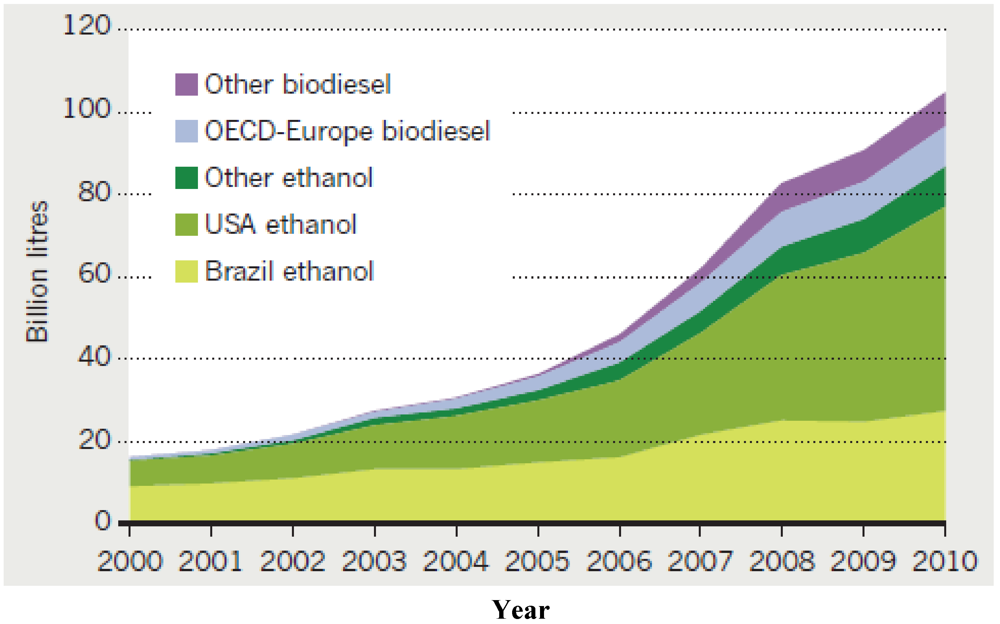
      <p>Biofuels production has dramatically increased in the last two decades. <xref ref-type="fig" rid="catalysts-02-00191-f001">Figure 1</xref> shows the world production of ethanol and biodiesel between 2000 and 2010 [<xref ref-type="bibr" rid="B4-catalysts-02-00191">4</xref>]. In this stage, world ethanol production has increased from around 17 billion liters to 85 billion liters per year. Brazil was the world’s leading ethanol producer until 2005 when USA roughly equaled Brazil but USA produced about twice that of Brazil in 2010. In contrast, Germany is the world’s leader in biodiesel production with 30% of the world production. At present, since almost all liquid fuels are produced from food crops such as cereals, sugar cane and oil seeds, the raw materials supplied for biofuel production are limited. Therefore, to increase the yield of biofuels satisfying energy demand in the near future, it is necessary to find abundant inedible biomass such as agricultural residue, wood chip, industrial waste, <italic>etc.</italic> [<xref ref-type="bibr" rid="B5-catalysts-02-00191">5</xref>]. BDF has many advantages such as (1) high cetane number about 50; (2) built-in oxygen content; (3) burns fully; (4) no sulphur content; (5) no aromatics; (6) complete CO<sub>2</sub> cycle (carbon neutral in 1 year).</p>
      <fig id="catalysts-02-00191-f001" position="anchor">
        <label>Figure 1</label>
        <caption>
          <p>Global Biofuel Production. Reprinted with permission from [<xref ref-type="bibr" rid="B4-catalysts-02-00191">4</xref>]. Copyright OECD/IEA (2011).</p>
        </caption>
        <graphic xmlns:xlink="http://www.w3.org/1999/xlink" xlink:href="catalysts-02-00191-g001.tif"/>
      </fig>
      <p>BDF could be produced by adding methanol to waste cooking oil with small amounts of KOH or NaOH as a catalyst. However, some questions remain: (1) What is the best raw material available that does not increase food prices or deforestation? (2) What is the best production method for a green process by which fatty acid methyl ester (FAME) can be obtained with a minimal emission of waste and low energy consumption? One solution proposed to reduce the formation of soap with an alkaline catalyst was the application of an enzyme catalyst but the reaction rate was too slow. Another solution is the addition of solvent to the reaction mixture of oil and methanol to produce BDF in a homogeneous phase [<xref ref-type="bibr" rid="B6-catalysts-02-00191">6</xref>].</p>
      <p>In general, there is no problem with alkaline catalyst processes with the use of good quality raw oil materials. If we use poor raw oil materials containing a high amount of free fatty acid (FFA) and moisture, we would need the excellent acidic catalyst of the esterification reaction of FFA and methanol. However, at present, the best catalyst might be still sulfuric acid at relatively high temperature. The most interesting scientific field of catalysts in biodiesel production is the transformation of glycerol to useful chemicals. In this review, we will briefly present the conventional catalysts and thriving technologies for the production of BDF as well as the new trends for utilization of the by-product glycerol.</p>
    </sec>
    <sec>
      <title>2. Biodiesel Production</title>
      <sec>
        <title>2.1. How to Produce Biodiesel?</title>
        <p>The main components of vegetable oils and animal fats are triglycerides, which are esters of FFA with glycerol. The triglyceride typically contains several FFA, and thus different FFA can be attached to one glycerol backbone. With different FFA, triglyceride has different physical and chemical properties. The FFA composition is the most important factor influencing the corresponding properties of vegetable oils and animal fats. The fatty acid compositions of normal vegetable oils and fat are shown in <xref ref-type="table" rid="catalysts-02-00191-t002">Table 2</xref>, and the physical properties of oils, fat and petro-diesel are listed in <xref ref-type="table" rid="catalysts-02-00191-t003">Table 3</xref> [<xref ref-type="bibr" rid="B6-catalysts-02-00191">6</xref>,<xref ref-type="bibr" rid="B7-catalysts-02-00191">7</xref>,<xref ref-type="bibr" rid="B8-catalysts-02-00191">8</xref>,<xref ref-type="bibr" rid="B9-catalysts-02-00191">9</xref>].</p>
        
        <p>Because vegetable oils or animal fats have high viscosity, <italic>i.e.</italic>, 35–50 mm<sup>2</sup> s<sup>−1</sup>, it is necessary to reduce the viscosity in order to use them in a common diesel engine. There are four methods used to solve this problem: blending with petro-diesel, pyrolysis, microemusification (co-solvent blending) and transesterification. Among these methods, only the transesterification reaction creates the products commonly known as biodiesel [<xref ref-type="bibr" rid="B7-catalysts-02-00191">7</xref>].</p>
        <p>Biodiesel can be synthesized by the transesterification reaction of a triglyceride with a primary alcohol in the presence of catalysts. Among primary alcohols, methanol is favored for the transesterification due to its high reactivity (the shortest alkyl chain and most polar alcohol) and the least expensive alcohol, except in some countries. In Brazil, for example, where ethanol is cheaper, ethyl esters are used as fuel. Furthermore, methanol has a low boiling point, thus excess methanol from the glycerol phase is easily recovered after phase separation [<xref ref-type="bibr" rid="B7-catalysts-02-00191">7</xref>].</p>
        <p>The choice of a catalyst for the transesterification mainly depends on the amount of FFA and of raw materials. <xref ref-type="table" rid="catalysts-02-00191-t004">Table 4</xref> shows the concentration of FFA in the representative oils. If the oils have high FFA content and water, the acid-catalyst transesterification process is preferable. However, this process requires relatively high temperatures, <italic>i.e.</italic>, 60–100 °C, and long reaction times, <italic>i.e.</italic>, 2–10 h, in addition to causing undesired corrosion of the equipment. Therefore, to reduce the reaction time, the process with an acid-catalyst is adapted as a pretreatment step only when necessary to convert FFA to esters. Then, the addition of an alkaline-catalyst is followed for the transesterification step to transform triglycerides to esters [<xref ref-type="bibr" rid="B10-catalysts-02-00191">10</xref>,<xref ref-type="bibr" rid="B11-catalysts-02-00191">11</xref>]. In contrast, when the FFA content in the oils is less than one wt.%, many researchers have recommended that only an alkaline-catalyst assisted process should be applied, because this process requires less and simpler equipment than that for the case of higher FFA content mentioned above.</p>
        <table-wrap id="catalysts-02-00191-t002" position="anchor">
          <object-id pub-id-type="pii">catalysts-02-00191-t002_Table 2</object-id>
          <label>Table 2</label>
          <caption>
            <p>Major fatty acids in oils and fat [<xref ref-type="bibr" rid="B6-catalysts-02-00191">6</xref>,<xref ref-type="bibr" rid="B7-catalysts-02-00191">7</xref>,<xref ref-type="bibr" rid="B8-catalysts-02-00191">8</xref>,<xref ref-type="bibr" rid="B9-catalysts-02-00191">9</xref>].</p>
          </caption>
          <table>
            <thead>
              <tr>
                <th rowspan="2" align="left" valign="middle">Oils and fat</th>
                <th rowspan="2" align="center" valign="middle">Iodine value</th>
                <th rowspan="2" align="center" valign="middle">Soponification value</th>
                <th colspan="9" align="center" valign="middle">Fatty acid composition (wt.%)</th>
              </tr>
              <tr style="border-top: solid thin">
                <th valign="middle">10:0</th>
                <th valign="middle">12:0</th>
                <th valign="middle">14:0</th>
                <th valign="middle">16:0</th>
                <th valign="middle">18:0</th>
                <th valign="middle">18:1</th>
                <th valign="middle">18:2</th>
                <th valign="middle">18:3</th>
                <th valign="middle">22:1</th>
              </tr>
            </thead>
            <tbody>
              <tr>
                <td align="center" valign="middle">
                  <italic>Oils</italic>                </td>
                <td align="center" valign="middle"> </td>
                <td align="center" valign="middle"> </td>
                <td align="center" valign="middle"> </td>
                <td align="center" valign="middle"> </td>
                <td align="center" valign="middle"> </td>
                <td align="center" valign="middle"> </td>
                <td align="center" valign="middle"> </td>
                <td align="center" valign="middle"> </td>
                <td align="center" valign="middle"> </td>
                <td align="center" valign="middle"> </td>
                <td align="center" valign="middle"> </td>
              </tr>
              <tr>
                <td align="left" valign="middle">Canola</td>
                <td align="center" valign="middle">109–126</td>
                <td align="center" valign="middle">188–193</td>
                <td align="center" valign="middle">-</td>
                <td align="center" valign="middle">-</td>
                <td align="center" valign="middle">-</td>
                <td align="center" valign="middle">2.5–5.7</td>
                <td align="center" valign="middle">1.15–2.4</td>
                <td align="center" valign="middle">52–61.9</td>
                <td align="center" valign="middle">15.1–22.3</td>
                <td align="center" valign="middle">6.4–11.7</td>
                <td align="center" valign="middle">0.8–1.6</td>
              </tr>
              <tr>
                <td align="left" valign="middle">Olive</td>
                <td align="center" valign="middle">75–94</td>
                <td align="center" valign="middle">184–196</td>
                <td align="center" valign="middle">-</td>
                <td align="center" valign="middle">0–1.3</td>
                <td align="center" valign="middle">7–20</td>
                <td align="center" valign="middle">0.5–5</td>
                <td align="center" valign="middle">55–84.5</td>
                <td align="center" valign="middle">3.5–21</td>
                <td align="center" valign="middle">-</td>
                <td align="center" valign="middle">-</td>
                <td align="center" valign="middle">-</td>
              </tr>
              <tr>
                <td align="left" valign="middle">Corn</td>
                <td align="center" valign="middle">103–140</td>
                <td align="center" valign="middle">187–198</td>

                <td align="center" valign="middle">-</td>
                <td align="center" valign="middle">-</td>
                <td align="center" valign="middle">0–0.3</td>
                <td align="center" valign="middle">7–16.5</td>
                <td align="center" valign="middle">1–3.3</td>
                <td align="center" valign="middle">20–43</td>
                <td align="center" valign="middle">39–62.5</td>
                <td align="center" valign="middle">0.5–1.5</td>
                <td align="center" valign="middle">-</td>
              </tr>
              <tr>
                <td align="left" valign="middle">Catfish</td>
                <td align="center" valign="middle">31–57</td>
                <td align="center" valign="middle">187–192</td>
                <td align="center" valign="middle">-</td>
                <td align="center" valign="middle">-</td>
                <td align="center" valign="middle">2.0–3.5</td>
                <td align="center" valign="middle">21.2–27.4</td>
                <td align="center" valign="middle">7.1–9.3</td>
                <td align="center" valign="middle">45.1–48.0</td>
                <td align="center" valign="middle">12.0–16.0</td>
                <td align="center" valign="middle">1.0–2.3</td>
                <td align="center" valign="middle">0.3–0.5</td>
              </tr>
              <tr>
                <td align="left" valign="middle">Cottonseed</td>
                <td align="center" valign="middle">9–119</td>
                <td align="center" valign="middle">189–198</td>
                <td align="center" valign="middle">-</td>
                <td align="center" valign="middle">-</td>
                <td align="center" valign="middle">0.6–1.5</td>
                <td align="center" valign="middle">21.4–26.4</td>
                <td align="center" valign="middle">2.1–5</td>
                <td align="center" valign="middle">14.7–21.7</td>
                <td align="center" valign="middle">46.7–58.2</td>
                <td align="center" valign="middle">-</td>
                <td align="center" valign="middle">-</td>
              </tr>
              <tr>
                <td align="left" valign="middle">
                  <italic>Jatropha curcas</italic>
                </td>
                <td align="center" valign="middle">92–112</td>
                <td align="center" valign="middle">177–189</td>
                <td align="center" valign="middle">-</td>
                <td align="center" valign="middle">-</td>
                <td align="center" valign="middle">0.3–0.4</td>
                <td align="center" valign="middle">12.6–14.2</td>
                <td align="center" valign="middle">5.97–6.9</td>
                <td align="center" valign="middle">39.5–44.1</td>
                <td align="center" valign="middle">34.4–37.8</td>
                <td align="center" valign="middle">2.4–3.4</td>
                <td align="center" valign="middle">0.5–0.7</td>
              </tr>
              <tr>
                <td align="left" valign="middle">Palm</td>
                <td align="center" valign="middle">35–61</td>
                <td align="center" valign="middle">186–209</td>
                <td align="center" valign="middle">0–0.4</td>
                <td align="center" valign="middle">0.5–2.4</td>
                <td align="center" valign="middle">32–47.5</td>
                <td align="center" valign="middle">36–53</td>
                <td align="center" valign="middle">3.5–6.3</td>
                <td align="center" valign="middle">6–12</td>
                <td align="center" valign="middle">-</td>
                <td align="center" valign="middle">-</td>
                <td align="center" valign="middle">-</td>
              </tr>
              <tr>
                <td align="left" valign="middle">Peanut</td>
                <td align="center" valign="middle">80–106</td>
                <td align="center" valign="middle">187–196</td>
                <td align="center" valign="middle">-</td>
                <td align="center" valign="middle">-</td>
                <td align="center" valign="middle">0–0.5</td>
                <td align="center" valign="middle">6–14</td>
                <td align="center" valign="middle">1.9–6</td>
                <td align="center" valign="middle">36.4–67.1</td>
                <td align="center" valign="middle">13–43</td>
                <td align="center" valign="middle">-</td>
                <td align="center" valign="middle">0–0.3</td>
              </tr>
              <tr>
                <td align="left" valign="middle">Rapeseed</td>
                <td align="center" valign="middle">94–120</td>
                <td align="center" valign="middle">168–187</td>
                <td align="center" valign="middle">-</td>
                <td align="center" valign="middle">-</td>
                <td align="center" valign="middle">0–1.5</td>
                <td align="center" valign="middle">1–6</td>
                <td align="center" valign="middle">0.5–3.5</td>
                <td align="center" valign="middle">8–60</td>
                <td align="center" valign="middle">9.5–23</td>
                <td align="center" valign="middle">1–13</td>
                <td align="center" valign="middle">5–64</td>
              </tr>
              <tr>
                <td align="left" valign="middle">Soybean</td>
                <td align="center" valign="middle">117–143</td>
                <td align="center" valign="middle">189–195</td>
                <td align="center" valign="middle">-</td>
                <td align="center" valign="middle">-</td>
                <td align="center" valign="middle">-</td>
                <td align="center" valign="middle">4.3–13.3</td>
                <td align="center" valign="middle">2.4–6</td>
                <td align="center" valign="middle">17.7–30.8</td>
                <td align="center" valign="middle">49–57.1</td>
                <td align="center" valign="middle">2–10.5</td>
                <td align="center" valign="middle">0–0.3</td>
              </tr>
              <tr>
                <td align="left" valign="middle">Sunflower</td>
                <td align="center" valign="middle">110–143</td>
                <td align="center" valign="middle">186–194</td>
                <td align="center" valign="middle">-</td>
                <td align="center" valign="middle">-</td>
                <td align="center" valign="middle">-</td>
                <td align="center" valign="middle">3.5–7.6</td>
                <td align="center" valign="middle">1.3–6.5</td>
                <td align="center" valign="middle">14–43</td>
                <td align="center" valign="middle">44–74</td>
                <td align="center" valign="middle">-</td>
                <td align="center" valign="middle">-</td>
              </tr>
              <tr>
                <td align="center" valign="middle">
                  <italic>Fat</italic>                </td>
                <td align="center" valign="middle"> </td>
                <td align="center" valign="middle"> </td>
                <td align="center" valign="middle"> </td>
                <td align="center" valign="middle"> </td>
                <td align="center" valign="middle"> </td>
                <td align="center" valign="middle"> </td>
                <td align="center" valign="middle"> </td>
                <td align="center" valign="middle"> </td>
                <td align="center" valign="middle"> </td>
                <td align="center" valign="middle"> </td>
                <td align="center" valign="middle"> </td>
              </tr>
              <tr>
                <td align="left" valign="middle">Tallow</td>
                <td align="center" valign="middle">35–48</td>
                <td align="center" valign="middle">218–235</td>
                <td align="center" valign="middle">-</td>
                <td align="center" valign="middle">-</td>
                <td align="center" valign="middle">2.1–6.9</td>
                <td align="center" valign="middle">25–37</td>
                <td align="center" valign="middle">9.5–34.2</td>
                <td align="center" valign="middle">14–50</td>
                <td align="center" valign="middle">26–50</td>
                <td align="center" valign="middle">-</td>
                <td align="center" valign="middle">-</td>
              </tr>
            </tbody>
  </table>
  <table-wrap-foot><fn><p>Note: <sup>a</sup> (Carbon number:double bond).</p></fn></table-wrap-foot>
        </table-wrap>
        <table-wrap id="catalysts-02-00191-t003" position="anchor">
          <object-id pub-id-type="pii">catalysts-02-00191-t003_Table 3</object-id>
          <label>Table 3</label>
          <caption>
            <p>Physical properties of oils, fat and petro-diesel [<xref ref-type="bibr" rid="B7-catalysts-02-00191">7</xref>,<xref ref-type="bibr" rid="B8-catalysts-02-00191">8</xref>].</p>
          </caption>
          <table>
            <thead>
              <tr>
                <th align="left" valign="middle">Oils, fat and petro-diesel</th>
                <th align="center" valign="middle">Cetane number</th>
                <th align="center" valign="middle">Kinematic viscosity (37.8 °C, mm<sup>2</sup> s<sup>−1</sup>)</th>
                <th align="center" valign="middle">Flash point (°C)</th>
              </tr>
            </thead>
            <tbody>
              <tr>
                <td align="center" valign="middle">
                  <italic>Oils</italic>                </td>
                <td align="center" valign="middle"> </td>
                <td align="center" valign="middle"> </td>
                <td align="center" valign="middle"> </td>
              </tr>
              <tr>
                <td align="left" valign="middle">Corn</td>
                <td align="center" valign="middle">37.6</td>
                <td align="center" valign="middle">34.9</td>
                <td align="center" valign="middle">277</td>
              </tr>
              <tr>
                <td align="left" valign="middle">Cottonseed</td>
                <td align="center" valign="middle">41.8</td>
                <td align="center" valign="middle">33.5</td>
                <td align="center" valign="middle">234</td>
              </tr>
              <tr>
                <td align="left" valign="middle">
                  <italic>Jatropha curcas</italic>
                </td>
                <td align="center" valign="middle">38.0</td>
                <td align="center" valign="middle">37.0</td>
                <td align="center" valign="middle">240</td>
              </tr>
              <tr>
                <td align="left" valign="middle">Peanut</td>
                <td align="center" valign="middle">41.8</td>
                <td align="center" valign="middle">39.6</td>
                <td align="center" valign="middle">271</td>
              </tr>
              <tr>
                <td align="left" valign="middle">Rapeseed</td>
                <td align="center" valign="middle">37.6</td>
                <td align="center" valign="middle">37.0</td>
                <td align="center" valign="middle">246</td>
              </tr>
              <tr>
                <td align="left" valign="middle">Soybean</td>
                <td align="center" valign="middle">37.9</td>
                <td align="center" valign="middle">32.6</td>
                <td align="center" valign="middle">254</td>
              </tr>
              <tr>
                <td align="left" valign="middle">Sunflower</td>
                <td align="center" valign="middle">37.1</td>
                <td align="center" valign="middle">37.1</td>
                <td align="center" valign="middle">274</td>
              </tr>
              <tr>
                <td align="center" valign="middle">
                  <italic>Fat</italic>                </td>
                <td align="center" valign="middle"> </td>
                <td align="center" valign="middle"> </td>
                <td align="center" valign="middle"> </td>
              </tr>
              <tr>
                <td align="left" valign="middle">Tallow</td>
                <td align="center" valign="middle">-</td>
                <td align="center" valign="middle">51.2</td>
                <td align="center" valign="middle">201</td>
              </tr>
              <tr>
                <td align="center" valign="middle">
                  <italic>Petro-diesel</italic>                </td>
                <td align="center" valign="middle"> </td>
                <td align="center" valign="middle"> </td>
                <td align="center" valign="middle"> </td>
              </tr>
              <tr>
                <td align="left" valign="middle">Diesel fuel No. 2</td>
                <td align="center" valign="middle">47.0</td>
                <td align="center" valign="middle">2.7</td>
                <td align="center" valign="middle">52</td>
              </tr>
            </tbody>
          </table>
        </table-wrap>
        <table-wrap id="catalysts-02-00191-t004" position="anchor">
          <object-id pub-id-type="pii">catalysts-02-00191-t004_Table 4</object-id>
          <label>Table 4</label>
          <caption>
            <p>Acid value in representative oils.</p>
          </caption>
          <table>
            <thead>
              <tr>
                <th align="left" valign="middle">Oils and Fats</th>
                <th align="center" valign="middle">Acid value mg KOH/1 g oil</th>
                <th align="center" valign="middle">References</th>
              </tr>
            </thead>
            <tbody>
              <tr>
                <td align="left" valign="middle">Refined sunflower </td>
                <td align="center" valign="middle">0.2–0.5</td>
                <td align="center" valign="middle">[<xref ref-type="bibr" rid="B12-catalysts-02-00191">12</xref>,<xref ref-type="bibr" rid="B13-catalysts-02-00191">13</xref>]</td>
              </tr>
              <tr>
                <td align="left" valign="middle">Crude <italic>Jatropha curcas</italic></td>
                <td align="center" valign="middle">15.6–43</td>
                <td align="center" valign="middle">[<xref ref-type="bibr" rid="B8-catalysts-02-00191">8</xref>,<xref ref-type="bibr" rid="B14-catalysts-02-00191">14</xref>]</td>
              </tr>
              <tr>
                <td align="left" valign="middle">Refined Safflower</td>
                <td align="center" valign="middle">0.35</td>
                <td align="center" valign="middle">[<xref ref-type="bibr" rid="B15-catalysts-02-00191">15</xref>]</td>
              </tr>
              <tr>
                <td align="left" valign="middle">Crude palm</td>
                <td align="center" valign="middle">6.9–50.8</td>
                <td align="center" valign="middle">[<xref ref-type="bibr" rid="B16-catalysts-02-00191">16</xref>,<xref ref-type="bibr" rid="B17-catalysts-02-00191">17</xref>]</td>
              </tr>
              <tr>
                <td align="left" valign="middle">Cottonseed</td>
                <td align="center" valign="middle">0.6–2.87</td>
                <td align="center" valign="middle">[<xref ref-type="bibr" rid="B18-catalysts-02-00191">18</xref>,<xref ref-type="bibr" rid="B19-catalysts-02-00191">19</xref>]</td>
              </tr>
              <tr>
                <td align="left" valign="middle">Corn</td>
                <td align="center" valign="middle">0.1–5.72</td>
                <td align="center" valign="middle">[<xref ref-type="bibr" rid="B20-catalysts-02-00191">20</xref>.<xref ref-type="bibr" rid="B21-catalysts-02-00191">21</xref>]</td>
              </tr>
              <tr>
                <td align="left" valign="middle">Coconut</td>
                <td align="center" valign="middle">1.99–12.8</td>
                <td align="center" valign="middle">[<xref ref-type="bibr" rid="B22-catalysts-02-00191">22</xref>,<xref ref-type="bibr" rid="B23-catalysts-02-00191">23</xref>]</td>
              </tr>
              <tr>
                <td align="left" valign="middle">Soybean </td>
                <td align="center" valign="middle">0.1–0.2</td>
                <td align="center" valign="middle">[<xref ref-type="bibr" rid="B24-catalysts-02-00191">24</xref>,<xref ref-type="bibr" rid="B25-catalysts-02-00191">25</xref>]</td>
              </tr>
              <tr>
                <td align="left" valign="middle">Animal fats</td>
                <td align="center" valign="middle">4.9–13.5</td>
                <td align="center" valign="middle">[<xref ref-type="bibr" rid="B26-catalysts-02-00191">26</xref>]</td>
              </tr>
              <tr>
                <td align="left" valign="middle">Canola </td>
                <td align="center" valign="middle">0.6–0.8</td>
                <td align="center" valign="middle">[<xref ref-type="bibr" rid="B27-catalysts-02-00191">27</xref>,<xref ref-type="bibr" rid="B28-catalysts-02-00191">28</xref>]</td>
              </tr>
              <tr>
                <td align="left" valign="middle">Waste cooking</td>
                <td align="center" valign="middle">0.67–3.64</td>
                <td align="center" valign="middle">[<xref ref-type="bibr" rid="B29-catalysts-02-00191">29</xref>]</td>
              </tr>
            </tbody>
  </table>
        </table-wrap>
        
        <p>Several reviews dealing with the production of biodiesel by transesterification have been published [<xref ref-type="bibr" rid="B10-catalysts-02-00191">10</xref>,<xref ref-type="bibr" rid="B30-catalysts-02-00191">30</xref>]. Commonly, the transesterification can be catalyzed by a base or acid-catalyst. The triglyceride is converted stepwise to diglyceride and monoglyceride intermediates, and finally to glycerol [<xref ref-type="bibr" rid="B31-catalysts-02-00191">31</xref>]. Mechanisms of the transesterification of triglyceride with alcohol in the presence of a base or acid-catalyst are shown as follows:</p>
        <p><italic>Base-catalyst</italic> [<xref ref-type="bibr" rid="B32-catalysts-02-00191">32</xref>]:</p>
        <disp-formula id="catalysts-02-00191-i001">
<inline-graphic xmlns:xlink="http://www.w3.org/1999/xlink" xlink:href="catalysts-02-00191-i001.tif">
</inline-graphic>
<label>(1)</label>
</disp-formula>
<disp-formula id="catalysts-02-00191-i002">
<inline-graphic xmlns:xlink="http://www.w3.org/1999/xlink" xlink:href="catalysts-02-00191-i002.tif">
</inline-graphic>
<label>(2)</label>
</disp-formula>
<disp-formula id="catalysts-02-00191-i003">
<inline-graphic xmlns:xlink="http://www.w3.org/1999/xlink" xlink:href="catalysts-02-00191-i003.tif">
</inline-graphic>
<label>(3)</label>
</disp-formula>
<disp-formula id="catalysts-02-00191-i004">
<inline-graphic xmlns:xlink="http://www.w3.org/1999/xlink" xlink:href="catalysts-02-00191-i004.tif">
</inline-graphic>
<label>(4)</label>
</disp-formula>
        <p><italic>Acid-catalyst</italic> [<xref ref-type="bibr" rid="B33-catalysts-02-00191">33</xref>]:</p>
        <disp-formula id="catalysts-02-00191-i005">
<inline-graphic xmlns:xlink="http://www.w3.org/1999/xlink" xlink:href="catalysts-02-00191-i005.tif">
</inline-graphic>
<label>(5)</label>
</disp-formula>
<disp-formula id="catalysts-02-00191-i006">
<inline-graphic xmlns:xlink="http://www.w3.org/1999/xlink" xlink:href="catalysts-02-00191-i006.tif">
</inline-graphic>
<label>(6)</label>
</disp-formula>
<disp-formula id="catalysts-02-00191-i007">
<inline-graphic xmlns:xlink="http://www.w3.org/1999/xlink" xlink:href="catalysts-02-00191-i007.tif">
</inline-graphic>
<label>(7)</label>
</disp-formula>
<disp-formula id="catalysts-02-00191-i008">
<inline-graphic xmlns:xlink="http://www.w3.org/1999/xlink" xlink:href="catalysts-02-00191-i008.tif">
</inline-graphic>
<label>(8)</label>
</disp-formula>
        <p>These reactions demonstrate the conversion of triglyceride into diglyceride. The reaction mechanisms of diglyceride and monoglyceride, which convert into monoglyceride and glycerol, respectively, take place in the same way as for triglyceride. The overall reactions are shown as follows:</p>
        <disp-formula id="catalysts-02-00191-i009">
<inline-graphic xmlns:xlink="http://www.w3.org/1999/xlink" xlink:href="catalysts-02-00191-i009.tif">
</inline-graphic>
<label>(9)</label>
</disp-formula>
        <p>where <italic>R</italic>, <italic>R</italic><sub>1</sub>, <italic>R</italic><sub>2</sub> and <italic>R</italic><sub>3</sub> are alkyl groups.</p>
      </sec>
      <sec>
        <title>2.2. Possible Methods for Biodiesel Production</title>
        <p>It is believed that the transesterification process includes three stages: (1) the mass transfer between oil and alcohol; (2) the transesterification reaction; and (3) the establishment of equilibrium. Because alcohol and oil are immiscible, mixing efficiency is one of the most important factors to improve the yield of transesterification. Therefore, this section focuses on methods that can improve the efficiency of the mass transfer between the reactants. There are many adaptable methods to conduct transesterification such as mechanical stirring, supercritical alcohol, ultrasonic irradiation, <italic>etc.</italic> [<xref ref-type="bibr" rid="B34-catalysts-02-00191">34</xref>,<xref ref-type="bibr" rid="B35-catalysts-02-00191">35</xref>,<xref ref-type="bibr" rid="B36-catalysts-02-00191">36</xref>,<xref ref-type="bibr" rid="B37-catalysts-02-00191">37</xref>,<xref ref-type="bibr" rid="B38-catalysts-02-00191">38</xref>,<xref ref-type="bibr" rid="B39-catalysts-02-00191">39</xref>]. More details of each method will be demonstrated in the followings sections.</p>
        <sec>
          <title>2.2.1. Mechanical Stirring Method</title>
          <p>Normally, the transesterification of a triglyceride with alcohol in the presence of a catalyst is carried out in a batch reactor. At first, the reactants are heated up to a desired temperature, and then they are mixed well by a mechanical stirring tool. The fatty acid methyl ester (FAME) yield is dependent on various parameters such as type and amount of the catalyst, reaction temperature, ratio of alcohol to oil, mixing intensity, <italic>etc.</italic> The mechanical stirring method, a popular one for BDF production, is suitable for both homogeneous and heterogeneous catalysts. This method is described as follows.</p>
       
        <sec>
          <title>2.2.1.1. Homogeneous Base-Catalyst Transesterification</title>
          <p>The transesterification reaction is catalyzed by alkaline metal hydroxides or alkoxides, as well as sodium or potassium carbonates. The alkaline catalysts give good performance when raw materials with high quality (FFA &lt; 1 wt.% and moisture &lt; 0.5 wt.%) are used [<xref ref-type="bibr" rid="B40-catalysts-02-00191">40</xref>]. The reaction is carried out at a temperature of 60–65 °C under atmospheric pressure with an excess amount of alcohol, usually methanol. The molar ratio of alcohol to oil is often 6:1 or more. This ratio is two-times higher or more than the stoichiometric ratio of alcohol given in the reaction scheme (9) as described above. It often takes several hours to complete the reaction when alkaline hydroxides such as NaOH or KOH are used. Alkaline alkoxides, e.g., sodium alkoxide, are the most reactive catalysts because the yield of FAME that can be attained is higher than 98% in a short reaction time of 30 min. Alkaline hydroxides are cheaper than the alkaline alkoxides, but less active. The yield of FAME can be improved by simply increasing the amount of the alkaline hydroxides by one or two mol% to oil, and thus they are a good alternative to the alkaline alkoxides [<xref ref-type="bibr" rid="B41-catalysts-02-00191">41</xref>]. Sivakumar <italic>et al.</italic> produced BDF from raw material dairy waste scum and the FAME yield reached 96.7% under the optimal conditions: KOH 1.2 wt.%; molar ratio of methanol to oil 6:1; reaction temperature 75 °C; reaction time 30 min at 350 rpm [<xref ref-type="bibr" rid="B42-catalysts-02-00191">42</xref>].</p>
          <p>One of the biggest drawbacks for the base-catalyst is that it cannot be applied directly when the oils or fats contain large amounts of FFA, <italic>i.e.</italic>, &gt;1 wt.%. Since the FFA is neutralized by the base catalyst to produce soap and water, the activity of the catalyst is decreased. Additionally, the formation of soap inhibits the separation of glycerol from the reaction mixture and the purification of FAME with water [<xref ref-type="bibr" rid="B43-catalysts-02-00191">43</xref>]. Removal of these saponified catalysts is technically difficult and it adds extra cost to the production of biodiesel. Furthermore, since homogeneous base catalysts mainly dissolve in the glycerol and alcohol phase after the reaction is completed, they cannot be recycled for the following batches, and the crude BDF must be purified by a washing process with water or a distillation at high temperature under reduced pressure. </p>
          <p>In consequence, with vegetable oils or fats containing low FFA and water, the base-catalyst transesterification is much faster than the acid-catalyst transesterification and is most commonly used commercially on the industrial scale [<xref ref-type="bibr" rid="B44-catalysts-02-00191">44</xref>].</p>
        </sec>
        <sec>
          <title>2.2.1.2. Homogeneous Acid-Catalyst Transesterification</title>
          <p>With starting raw materials containing a high amount of FFA such as waste cooking, <italic>Jatropha curcas</italic>, rubber, tobacco oils, <italic>etc.</italic>, an acid-catalyst, usually a strong acid such as sulfuric, hydrochloric or phosphoric acid, is more favorable than base-catalyst because the reaction does not form soap. However, the acid-catalyst is very sensitive to the water content of the raw materials. It was reported that a small amount of water, <italic>i.e.</italic>, 0.1 wt.% in the reaction mixture affected the FAME yield of the transesterification of vegetable oil with methanol. If the concentration of water is 5 wt.%, the reaction is completely inhibited. Canakci and Gerpen conducted simultaneous esterification and transesterification reactions with acid catalysts where the yield of FAME attained was more than 90% with water content of less than 0.5 wt.% under the reaction conditions of temperature 60 °C; molar ratio of methanol to oil 6:1; sulfuric acid 3.0 wt.%, and reaction time 96 h [<xref ref-type="bibr" rid="B45-catalysts-02-00191">45</xref>]. </p>
          <p>Disadvantages of the acid-catalyst are that they require higher temperature and longer reaction time, in addition to causing undesired corrosion of the equipment. Moreover, to increase the conversion of triglyceride, a large excess amount of methanol, e.g., molar ratio of methanol to oil of higher than 12:1, should be used. In practice, therefore, to reduce the reaction time, the process with an acid-catalyst is adapted as a pretreatment step only when it is necessary to convert FFA to esters, and is followed by a base-catalyst addition for the transesterification step to transform triglyceride to esters. In general, acid-catalyst transesterification is usually performed at the following conditions: a high molar ratio of methanol to oil of 12:1; high temperatures of 80–100 °C; and a strong acid namely sulfuric acid [<xref ref-type="bibr" rid="B10-catalysts-02-00191">10</xref>]. Patil <italic>et al.</italic> performed a two-step process for production of BDF from <italic>Jatropha curcas</italic> oil with a maximum yield of 95% attained according to the reaction conditions: at the first acid esterification, <italic>i.e.</italic>, methanol to oil molar ratio of 6:1, sulfuric acid of 0.5 wt.%, and reaction temperature of 40 ± 5 °C; followed by alkaline transesterification with methanol to oil molar ratio of 9:1, KOH of 2 wt.%, and reaction temperature of 60 °C [<xref ref-type="bibr" rid="B46-catalysts-02-00191">46</xref>].</p>
        </sec>
        <sec>
          <title>2.2.1.3. Heterogeneous Solid-Catalyst Transesterification</title>
          <p>As mentioned above, the disadvantages of homogeneous base-catalyst transesterification are high energy-consumption, costly separation of the catalyst from the reaction mixture and the purification of crude BDF. Therefore, to reduce the cost of the purification process, heterogeneous solid catalysts such as metal oxides, zeolites, hydrotalcites, and γ-alumina, have been used recently, because these catalysts can be easily separated from the reaction mixture, and can be reused. Most of these catalysts are alkali or alkaline oxides supported on materials with a large surface area. Similar to homogeneous catalyst, solid base-catalysts are more active than solid acid-catalysts [<xref ref-type="bibr" rid="B47-catalysts-02-00191">47</xref>,<xref ref-type="bibr" rid="B48-catalysts-02-00191">48</xref>]. In this review, we focus on popular solid base and acid catalysts.</p>
        
        
        <sec>
          <title>Activated Oxides of Calcium and Magnesium</title>
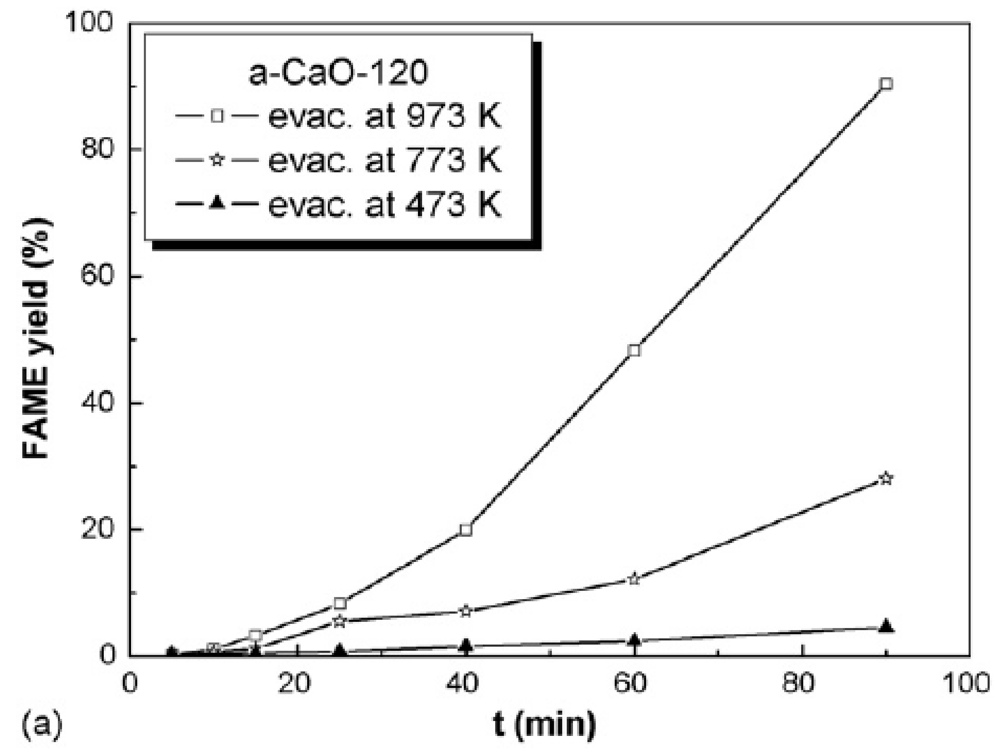
          <p>Oxides of alkaline earth metals such as Be, Mg, Ca, Sr and Ba have been used for synthesis of BDF in several studies. CaO and MgO are abundant in nature and widely used among alkaline earth metals [<xref ref-type="bibr" rid="B49-catalysts-02-00191">49</xref>,<xref ref-type="bibr" rid="B50-catalysts-02-00191">50</xref>,<xref ref-type="bibr" rid="B51-catalysts-02-00191">51</xref>,<xref ref-type="bibr" rid="B52-catalysts-02-00191">52</xref>,<xref ref-type="bibr" rid="B53-catalysts-02-00191">53</xref>]. Ngamcharussrivichai <italic>et al.</italic> calcined domomite, mainly consisting of CaCO<sub>3</sub> and MgCO<sub>3</sub>, at 800 °C for 2 h to prepare CaO and MgO catalysts for the transesterification of palm kernel oil. Under the optimal reaction conditions: amount of catalyst of 6 wt.% based on oil; molar ratio of methanol to oil of 30:1; reaction time of 3 h and reaction temperature of 60 °C, the yield of FAME was 98%. After each run, the catalyst was recovered by centrifuge and washed with methanol, and used for the next run. The results showed that the yield of FAME was more than 90% up to the seventh repetition [<xref ref-type="bibr" rid="B54-catalysts-02-00191">54</xref>]. Huaping <italic>et al.</italic> carried out the transesterification of <italic>Jatropha curcas</italic> oil with methanol catalyzed by calcium oxide, and the yield of FAME was higher than 93% under the conditions namely the catalyst amount of 1.5 wt.%; temperature of 70 °C; molar ratio of 9:1; and reaction time 3.5 h [<xref ref-type="bibr" rid="B55-catalysts-02-00191">55</xref>]. The activity of the solid catalyst is dependent on the active sites on the surface of CaO or MgO. Since the surface of these metal oxides is easily poisoned by absorption of carbon dioxide and water in the air to form carbonates and hydroxides, respectively, the activity of these catalysts decreases with time. However, the catalytic activity of these metal oxides can be recovered by calcination of the catalysts to remove carbon dioxide and water at high temperature. Grandos <italic>et al.</italic> activated CaO, which was exposed to the air for 120 days, at temperatures of 473 K, 773 K and 973 K, respectively. <xref ref-type="fig" rid="catalysts-02-00191-f002">Figure 2</xref> shows the yield of FAME with the CaO catalyst activated at different temperatures. The CaO catalyst pretreated by evacuation at 473 K gave a very low activity. The evacuation of the catalyst at 773 K can improve the catalytic activity due to dehydration of the Ca(OH)<sub>2</sub> present in the CaO catalyst. The best catalytic activation can be attained at 973 K due to the transformation of the CaCO<sub>3</sub> to CaO [<xref ref-type="bibr" rid="B56-catalysts-02-00191">56</xref>]. </p>
          <fig id="catalysts-02-00191-f002" position="anchor">
            <label>Figure 2</label>
            <caption>
              <p>Effect of activated temperature and time of CaO catalyst on the fatty acid methyl ester (FAME) yields (Notes: a-CaO-120 means that the fresh CaO was exposed to room air for 120 days; evac. at 473 K, activated at 473 K). The reaction conditions: sunflower oil; catalyst amount to oil, 1 wt.%; molar ratio of methanol to oil, 13:1, temperature, 333 K; reaction time 100 min at 1000 rpm. Reprinted with permission from [<xref ref-type="bibr" rid="B56-catalysts-02-00191">56</xref>]. Copyright 2007 Elsevier.</p>
            </caption>
            <graphic xmlns:xlink="http://www.w3.org/1999/xlink" xlink:href="catalysts-02-00191-g002.tif"/>
          </fig>
        </sec>
        <sec>
          <title>Alkaline Modified Zirconia Catalyst</title>
          <p>Omar <italic>et al.</italic> studied alkaline modified zirconia catalysts such as Mg/ZrO<sub>2</sub>, Ca/ZrO<sub>2</sub>, Sr/ZrO<sub>2</sub>, and Ba/ZrO<sub>2</sub> as heterogeneous catalysts for biodiesel production from waste cooking oil. The catalysts were prepared via wet impregnation of alkaline nitrate salts supported on zirconia. Among the tested catalysts, Sr/ZrO<sub>2</sub> had the highest catalytic activity. The active sites of the Sr/ZrO<sub>2</sub> can assist simultaneous esterification and transesterification reactions in the ethanolysis process. About 79.7% ME yield can be attained at 2.7 wt.% catalyst loading (Sr/ZrO<sub>2</sub>), 29:1 of methanol ratio to oil, for 169 min and at 115.5 °C which was determined as the optimal reaction conditions [<xref ref-type="bibr" rid="B57-catalysts-02-00191">57</xref>].</p>
        </sec>
        <sec>
          <title>Tri-Potassium Phosphate</title>
          <p>The transesterification of waste cooking oil with methanol, using solid catalysts such as tri-potassium phosphate (K<sub>3</sub>PO<sub>4</sub>), KOH and tri-sodium phosphate (Na<sub>3</sub>PO<sub>4</sub>), was investigated by Guan <italic>et al.</italic> Among the tested catalysts, K<sub>3</sub>PO<sub>4</sub> showed the highest catalytic activity for the transesterification reaction. K<sub>3</sub>PO<sub>4</sub> was hydrolyzed in the presence of water, and HPO<sub>4</sub><sup>2</sup><sup>−</sup>, H<sub>2</sub>PO<sub>4</sub><sup>−</sup> and OH<sup>−</sup> ions were formed in the reaction solution. As a result, the reaction mixture showed a strong alkaline property. The FAME yield reached 97.3% when the transesterification was performed with a catalyst concentration of 4 wt.% at 60 °C for 120 min. The used K<sub>3</sub>PO<sub>4</sub> was regenerated using an aqueous KOH solution. A FAME yield of 88% could be achieved when the regenerated catalyst was used [<xref ref-type="bibr" rid="B58-catalysts-02-00191">58</xref>].</p>
        </sec>
        <sec>
          <title>Metal Oxides Supported on Silica</title>
          <p>Jacobson <italic>et al.</italic> synthesized and utilized various solid acid catalysts such as MoO<sub>3</sub>/SiO<sub>2</sub>, MoO<sub>3</sub>/ZrO<sub>2</sub>, WO<sub>3</sub>/SiO<sub>2</sub>, WO<sub>3</sub>/SiO<sub>2</sub>–Al<sub>2</sub>O<sub>3</sub>, zinc stearate supported on silica, zinc ethanoate supported on silica and 12-tungstophosphoric acid (TPA) supported on zirconia. They were synthesized and evaluated for biodiesel preparation from waste cooking oil containing 15 wt.% FFA. The results revealed that the zinc stearate immobilized on silica gel (ZS/Si) was the most effective catalyst in simultaneously catalyzing the transesterification of triglycerides and esterification of FFA present in waste cooking oil to methyl esters. The maximum FAME yield of 98 wt.% was obtained at the optimal parameters: molar ratio of methanol to oil of 18:1; catalyst amount of 3 wt.%; stirring speed of 600 rpm and reaction temperature of 200 °C with the most active ZS/Si catalyst. Particularly, the catalyst was recycled and reused many times without any loss in activity [<xref ref-type="bibr" rid="B59-catalysts-02-00191">59</xref>]. </p>
        </sec>
        <sec>
          <title>Mixed Oxides of TiO<sub>2</sub>-MgO</title>
          <p>Wen <italic>et al.</italic> used mixed oxides of TiO<sub>2</sub>–MgO produced by the sol–gel method to convert waste cooking oil into biodiesel. The best catalyst was MT-1-923 comprising a Mg/Ti molar ratio of 1 and calcined at 650 °C. The main reaction parameters such as methanol/oil molar ratio, catalyst amount, and temperature were investigated. The best yield of FAME 92.3% was obtained at a molar ratio of methanol to oil of 50:1; catalyst amount of 10 wt.%; reaction time of 6 h and reaction temperature of 160 °C. They observed that the catalytic activity of MT-1-923 decreased slowly in the recycle process. To improve catalytic activity, MT-1-923 was regenerated by a two-step washing method (the catalyst was washed with methanol four times and subsequently with n-hexane once before being dried at 120 °C). The FAME yield slightly increased to 93.8% compared with 92.8% for the fresh catalyst due to an increase in the specific surface area and average pore diameter. The mixed oxides catalyst, TiO<sub>2</sub>–MgO, showed good potential in large-scale biodiesel production from waste cooking oil [<xref ref-type="bibr" rid="B60-catalysts-02-00191">60</xref>].</p>
        </sec>
        <sec>
          <title>Solid Acid-Catalysts</title>
          <p>Despite lower activity, solid acid catalysts have been used in many industrial processes because they contain a variety of acid sites on their surfaces with different strengths of Brönsted or Lewis acidity, compared to the homogenous acid-catalysts. Solid acid-catalysts such as Nafion-NR50, sulfated zirconia and tungstated zirconia were chosen to catalyze biodiesel-forming transesterification due to the presence of sufficient acid site strength [<xref ref-type="bibr" rid="B61-catalysts-02-00191">61</xref>]. Sulfonic acid ion-exchange resins have been reported to show excellent catalytic activity in esterification reaction as a pretreatment step for oils containing a high amount of FFA [<xref ref-type="bibr" rid="B62-catalysts-02-00191">62</xref>,<xref ref-type="bibr" rid="B63-catalysts-02-00191">63</xref>]. In a pioneering study, Santacesaria <italic>et al.</italic> studied the kinetics of esterification of a mixture of triglyceride and oleic acid (with initial acidity in the range of 47.1–58.3 wt.%) with methanol using an acid ion-exchange polymeric resin (2 wt.%) as the heterogeneous catalyst. The sulfonic acid resin displays an active catalyst for esterification with the conversion of oleic acid to methyl oleate reaching more than 80% within 2 h reaction time at 85 °C [<xref ref-type="bibr" rid="B64-catalysts-02-00191">64</xref>]. Melero <italic>et al.</italic> performed the transesterification of refined and crude vegetable oils with a sulfonic acid-modified mesostructured catalyst resulting in a yield of FAME purity of over 95 wt.%, for oil conversion close to 100%, under the best reaction conditions: temperature 180 °C, methanol/oil molar ratio 10, and catalyst loading 6 wt.% with regard to the amount of oil. They found that these sulfonated mesostructured materials are promising catalysts for the preparation of biodiesel; however, some aspects related to the adsorption properties of the silica surface and the enhancement of the catalyst’s reusability need to be addressed [<xref ref-type="bibr" rid="B65-catalysts-02-00191">65</xref>].</p>
          <p>Recently, promising catalysts based on biomass pyrolysis by-products (sugars, biochar, flyash, <italic>etc.</italic>) have been developed for production of biodiesel [<xref ref-type="bibr" rid="B66-catalysts-02-00191">66</xref>,<xref ref-type="bibr" rid="B67-catalysts-02-00191">67</xref>,<xref ref-type="bibr" rid="B68-catalysts-02-00191">68</xref>,<xref ref-type="bibr" rid="B69-catalysts-02-00191">69</xref>,<xref ref-type="bibr" rid="B70-catalysts-02-00191">70</xref>]. Hara <italic>et al.</italic> sulphonated incompletely carbonized natural products such as sugars, starch or cellulose resulting in a rigid carbon material. They used the solid sulphonated carbon catalyst to produce high-grade biodiesel. The results revealed that the activity of their catalyst is more than half again compared with that of a liquid sulfuric acid catalyst and much higher than that of conventional solid acid catalyst, and there was no loss of activity or leaching of –SO<sub>3</sub>H group during the process. In addition to this, the use of biomass materials is inexpensive and ecologically friendly [<xref ref-type="bibr" rid="B66-catalysts-02-00191">66</xref>]. Zong <italic>et al.</italic> successfully conducted the esterification of FFAs such as oleic, palmitic and stearic acids with methanol with a <sc>D</sc>-glucose-derived catalyst. The yields of FAME were higher than 95% under the reaction conditions: 10 mmol FFA; 100 mmol methanol; 0.14 g sugar catalyst; reaction temperature 80 °C [<xref ref-type="bibr" rid="B69-catalysts-02-00191">69</xref>].</p>
        </sec>
        </sec>
        <sec>
          <title>2.2.1.4. Enzyme-Catalyst Transesterification</title>
          <p>The use of lipases as enzyme-catalysts for biodiesel production is also increasingly interesting [<xref ref-type="bibr" rid="B71-catalysts-02-00191">71</xref>]. The main purpose is to overcome the issues involving recovery and treatment of the by-products that requires complex processing apparatus [<xref ref-type="bibr" rid="B72-catalysts-02-00191">72</xref>]. The main drawback of the enzyme-catalyzed process is the high cost of the lipases. In order to reduce the cost, enzyme immobilization has been studied for ease of recovery and reuse [<xref ref-type="bibr" rid="B73-catalysts-02-00191">73</xref>]. Additionally, inactivation of the enzyme that leads to decrease of yields is mostly restricted by the low solubility of the enzyme in methanol [<xref ref-type="bibr" rid="B74-catalysts-02-00191">74</xref>]. Although lipase catalyzed transesterification offers an attractive alternative, the industrial application of this technology has been slow due to feasibility aspects and some technical challenges [<xref ref-type="bibr" rid="B40-catalysts-02-00191">40</xref>].</p>
          <p>For instance, the optimized reaction conditions for the transesterification of tallow were as follows: temperatureof 45 °C; stirring speed of 200 rpm; enzyme concentrations of 12.5–25%, based on triglyceride; molar ratio of methanol to oil of 3:1, and reaction time 4–8 h (for primary alcohols) and 16 h (for secondary alcohols). Lipozyme, <italic>i.e.</italic>, IM 60 was most effective for the transesterification of tallow with a conversion of 95% when primary alcohols were used. In contrast, lipase from <italic>C.</italic><italic>antarctica</italic> and <italic>P. cepacia</italic> (PS-30) was the most efficient with a conversion of 90% when secondary alcohols were used [<xref ref-type="bibr" rid="B75-catalysts-02-00191">75</xref>].</p>
        </sec>
         </sec>
        <sec>
          <title>2.2.2. Ultrasonic Irradiation Method</title>
          <p>Since chemical and physical properties of vegetable oils are quite different from methanol, they are completely immiscible. The mass transfer between these reactants is one of the most important parameters affecting the yield of FAME. Ultrasonic irradiation is known to be a useful tool for strengthening mass transfer in liquid-liquid heterogeneous systems [<xref ref-type="bibr" rid="B36-catalysts-02-00191">36</xref>]. With increased liquid-liquid mass transfer, oils and methanol are easily mixed together. When sound waves with a suitable frequency are transmitted effectively from a transducer to liquids of oil and alcohol, a number of cavitation bubbles are formed in the liquids. The formation and collapse of cavitation bubbles disrupt the phase boundary in a two-phase liquid system. Owing to this aspect, alcohol and oil form easily a fine emulsion, where the droplet size of methanol and oil is in micrometers. As a result, the interface area of droplets of alcohol and oil is increased, and thus the transesterification reaction proceeds effectively. Under ultrasonic irradiation, therefore, the transesterification can be carried out at lower temperature with smaller amounts of catalyst and methanol compared with the conventional mechanical stirring method.</p>
          <p>Since a low frequency of ultrasound gives a high mixing efficiency, the frequency adapted for biodiesel production is in the range from 20 to 40 kHz. Many researchers have studied the production of biodiesel in a laboratory scale using an ultrasonic water bath with frequency of 24, 28 and 40 kHz [<xref ref-type="bibr" rid="B76-catalysts-02-00191">76</xref>,<xref ref-type="bibr" rid="B77-catalysts-02-00191">77</xref>,<xref ref-type="bibr" rid="B78-catalysts-02-00191">78</xref>,<xref ref-type="bibr" rid="B79-catalysts-02-00191">79</xref>,<xref ref-type="bibr" rid="B80-catalysts-02-00191">80</xref>].</p>
          <p>There are several types of transducers used for biodiesel production such as ultrasonic horn transducers, push-pull ultrasonic transducers, multiple transducers equipped to a water bath, <italic>etc.</italic> [<xref ref-type="bibr" rid="B81-catalysts-02-00191">81</xref>,<xref ref-type="bibr" rid="B82-catalysts-02-00191">82</xref>]. The ultrasonic-assisted transesterification can be carried out in batch or continuous reactors. Batch reactors using water bath or small horn type transducers are suitable for small capacities with a reactor volume in the range of 0.1–1 L [<xref ref-type="bibr" rid="B83-catalysts-02-00191">83</xref>,<xref ref-type="bibr" rid="B84-catalysts-02-00191">84</xref>,<xref ref-type="bibr" rid="B85-catalysts-02-00191">85</xref>,<xref ref-type="bibr" rid="B86-catalysts-02-00191">86</xref>]. Therefore, the batch transesterification process cannot be applied for production of biodiesel on large industrial scales. On the other hand, the reactor for the continuous process usually uses the horn type high power transducer with a capacity of 1–3 kW, and the transducer is connected to a reactor with volume of 1–3 L. Oil, methanol and catalyst are continuously introduced to the reactor by a pump system. Furthermore, the continuous separation and purification processes can be operated automatically when a continuous reactor is used [<xref ref-type="bibr" rid="B9-catalysts-02-00191">9</xref>,<xref ref-type="bibr" rid="B11-catalysts-02-00191">11</xref>]. Therefore, the continuous reactor is favorable for the production of biodiesel on a large industrial scale.</p>
          <p>Since the ultrasonic irradiation method gives strong mixing effects, the reaction can be carried out at ambient temperature. Therefore, it is supposed that acid or base homogeneous catalysts are both suitable for the esterification and transesterification reaction [<xref ref-type="bibr" rid="B36-catalysts-02-00191">36</xref>,<xref ref-type="bibr" rid="B76-catalysts-02-00191">76</xref>]. Hanh <italic>et al.</italic> reported the esterification of oleic acid with several alcohols (ethanol, propanol and butanol) in the presence of H<sub>2</sub>SO<sub>4</sub> in a batch reactor at temperatures of 10–60 °C, molar ratios of alcohol to oleic acid of 1:1–10:1, amount of catalysts of 0.5–10% based on oleic acid weight and irradiation times of 0.5–10 h. The optimum conditions for the esterification process were molar ratio of alcohol to oleic acid of 3:1; 5 wt.% of H<sub>2</sub>SO<sub>4</sub> at 60 °C and irradiation time of 2 h [<xref ref-type="bibr" rid="B83-catalysts-02-00191">83</xref>]. Recently, Mootabadi <italic>et al.</italic> performed the transesterification of palm oil with methanol in the presence of alkaline earth metal oxide catalysts (CaO, BaO and SrO) in a batch process assisted by 20 kHz ultrasonic irradiation. They revealed that catalytic activity was in the sequence of CaO &lt; SrO &lt; BaO. The yields achieved in 10–60 min reaction times increased from 5.5% to 77.3% (CaO), 48.2% to 95.2% (SrO), and 67.3% to 95.2 (BaO) under the following reaction conditions: molar ratio of methanol to oil of 9:1; catalyst amount of 3 wt.%; and reaction temperature 65 °C [<xref ref-type="bibr" rid="B85-catalysts-02-00191">85</xref>]. </p>
          <p>Georgogianni <italic>et al.</italic> carried out the transesterification from waste oil in the presence of alkaline catalysts and that from soybean frying oils in the presence of other heterogeneous catalysts, using ultrasonic irradiation of 24 kHz and mechanical stirring of 600 rpm. Their results showed many advantages of ultrasonic irradiation such as high yield of FAME, time saving procedure, <italic>etc.</italic> compared to the mechanical stirring method [<xref ref-type="bibr" rid="B2-catalysts-02-00191">2</xref>,<xref ref-type="bibr" rid="B34-catalysts-02-00191">34</xref>]. Other studies on the transesterification of various vegetable oils with different types of alcohols in the presence of a base-catalyst have been published. Maeda <italic>et al.</italic> reported that the yield of FAME was greater than 95% within a 20 min reaction time at room temperature on the laboratory scale [<xref ref-type="bibr" rid="B82-catalysts-02-00191">82</xref>,<xref ref-type="bibr" rid="B86-catalysts-02-00191">86</xref>]. </p>
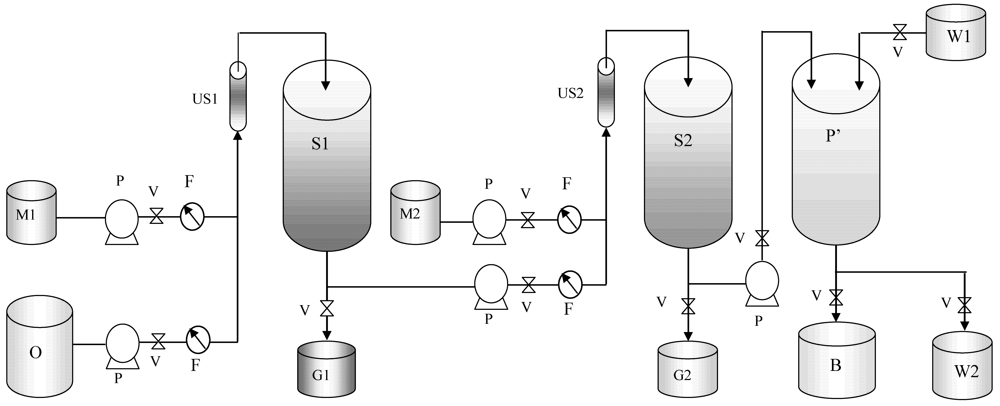
          <p>In order to apply the ultrasonic technique for larger scale production, Thanh <italic>et al.</italic> designed a pilot plant using the horn type transducer with a capacity of 1 kW and frequency of 20 kHz for production of biodiesel from canola oil and methanol. This system was carried out by a circulation process with a tank volume of 100 L. The high yield of FAME obtained was more than 99% under the following optimal conditions: molar ratio to oil 5:1, and KOH catalyst 0.7 wt.%, reaction time 1 h at ambient temperature. However, it was quite difficult to scale up this system to hundreds or thousands of liters because the methanol and glycerol separate from the reaction mixture and make the mixture non-uniform in the circulation tank [<xref ref-type="bibr" rid="B9-catalysts-02-00191">9</xref>]. Then, Thanh <italic>et al.</italic> attempted to modify the circulation reaction system to a continuous reaction system in order to adapt for large scale production. The experimental setup for the transesterification and purification is schematically depicted in <xref ref-type="fig" rid="catalysts-02-00191-f003">Figure 3</xref> [<xref ref-type="bibr" rid="B11-catalysts-02-00191">11</xref>]. The transesterification of waste cooking oil with methanol in the presence of KOH catalyst was carried out in the continuous ultrasonic reactor by a two-step process. The effects of the residence time of reactants in the reactor, molar ratio of methanol to waste cooking oil and separation time of glycerol from the reaction mixture in each step were investigated. It was found that the optimal conditions for the transesterification were the total molar ratio of methanol to oil 4:1, KOH 1.0 wt.%, and a residence time in the reactor of 56 s for the entire process. Under these conditions, the recovery of biodiesel from waste cooking oil is 93.83 wt.%. The properties of the product satisfy the Japanese Industrial Standard for biodiesel B100 (JIS K2390). This process significantly reduces the use of methanol compared to conventional methods (the mechanical stirring and supercritical methanol methods), which need a molar ratio of methanol to oil of at least 6:1. Therefore, the continuous ultrasonic reactor with a two-step process would be a beneficial technique for the production of biodiesel from waste cooking oil.</p>
          
        </sec>
        <sec>
          <title>2.2.3. Supercritical Alcohol Method</title>
          <p>As a catalyst free method for transesterification uses, a supercritical methanol method has been investigated at high pressure (around 80 atm) and high temperatures (300–400 °C) in a continuous reactor. Under the supercritical condition, the reaction mixture becomes a single phase, and the reaction takes place rapidly and spontaneously [<xref ref-type="bibr" rid="B87-catalysts-02-00191">87</xref>]. Compared to processes using catalysts, the supercritical method has three main advantages as follows:</p>
          <p>The first, this process is friendly for the environment, because no catalyst is needed in the reaction, therefore, the separation process of the catalyst and soap from alkyl esters is unnecessary. The second, the supercritical reaction has a shorter reaction time, <italic>i.e.</italic>, 2–4 min, than conventional methods using catalysts, and the conversion rate is very high [<xref ref-type="bibr" rid="B88-catalysts-02-00191">88</xref>]. The third, neither FFA nor the water content influences the reaction in the supercritical method. The FFA is converted to FAME instead of soap. Therefore, this process can be applied to a wide variety of feedstocks [<xref ref-type="bibr" rid="B89-catalysts-02-00191">89</xref>]. However, the disadvantages of the supercritical methods stem mainly from the high pressure and temperature requirement, and the high molar ratio of methanol to oil (usually 42:1) that makes the cost of the production process expensive [<xref ref-type="bibr" rid="B5-catalysts-02-00191">5</xref>].</p>
          <p>To conduct the transesterification in the supercritical condition under a lower temperature, Demirbas carried out the reaction of sunflower oil with methanol in the presence of CaO catalyst in supercritical methanol for biodiesel production. The results revealed that the transesterification was essentially completed within 6 min with an amount of CaO catalyst of 3 wt.%, molar ratio methanol to oil 41:1 at 525 K instead of a temperature of more than 600 K in the case without catalyst [<xref ref-type="bibr" rid="B49-catalysts-02-00191">49</xref>].</p>
        </sec>
        <sec>
          <title>2.2.4. Co-Solvent Method</title>
          <p>In order to conduct the reaction in a single phase, co-solvents such as tetrahydrofuran (THF), 1,4-dioxane and diethyl ether were examined. Among co-solvents listed above, THF was the first solvent used for the transesterification. At a molar ratio of methanol to oil of 6:1, the addition of THF 1.25 volumes to methanol into oil produced a one phase system in which the transesterification process was speeded up dramatically. Moreover, THF is chosen because its boiling point (67 °C) is only two degrees higher than that of methanol. Therefore, the excess methanol and THF can be co-distilled and recycled [<xref ref-type="bibr" rid="B6-catalysts-02-00191">6</xref>].</p>
          <p>The transesterification of soybean oil with methanol was carried out at different concentrations of NaOH catalyst using co-solvent THF. The FAME yields were 82.5, 85, 87 and 96% obtained at catalyst concentrations of 1.1, 1.3, 1.4 and 2.0 wt.%, respectively, for a reaction time of 1 min. Similarly, for the transesterification of coconut oil using THF/methanol volume ratio 0.87 with NaOH of 1 wt.%, the conversion was 99% in 1 min [<xref ref-type="bibr" rid="B37-catalysts-02-00191">37</xref>].</p>
          <fig id="catalysts-02-00191-f003" position="anchor">
            <label>Figure 3</label>
            <caption>
              <p>Flow diagram of an ultrasound-assisted continuous reactor for biodiesel production through a two-step process on the pilot plant. O: Oil tank; M1, M2: Methanol and catalyst tanks; P: Liquid pumps; V: Valve; F: Flow meters; US1, US2: Ultrasonic reactors; S1, S2: Separation tanks; G1, G2: glycerol tanks; P’: Purification tank; B: Biodiesel production tank; W1, W2: fresh and waste water tanks. Reprinted with permission from [<xref ref-type="bibr" rid="B11-catalysts-02-00191">11</xref>]. Copyright 2010 Elsevier.</p>
            </caption>
            <graphic xmlns:xlink="http://www.w3.org/1999/xlink" xlink:href="catalysts-02-00191-g003.tif"/>
          </fig>
          <p>Recently, Maeda <italic>et al.</italic> presented the transesterification of vegetable oils and methanol in the presence of KOH catalyst by using several solvents such as acetone, THF, acetonitrile, diethyl ether, iso-propanol, <italic>etc.</italic> The transesterification assisted by the solvents shows the following new results: (1) the formation of FAME is completed even with smaller amounts of methanol added to oil (4 moles methanol to 1 mole oil), KOH catalyst (0.1–0.5 wt.% to oil) at room temperature; (2) the formation of soap is negligibly small due to the small amount of catalyst used and the reaction at ambient temperature; and (3) the separation rate of FAME with the by-product glycerol is speeded up more than 10 times compared with the conventional mechanical stirring method. In the case of acetone, which does not dissolve glycerol, the separation of FAME from glycerol was very fast because of the lower viscosity of the FAME-acetone solution and the larger difference between the low-density FAME-acetone solution.</p>
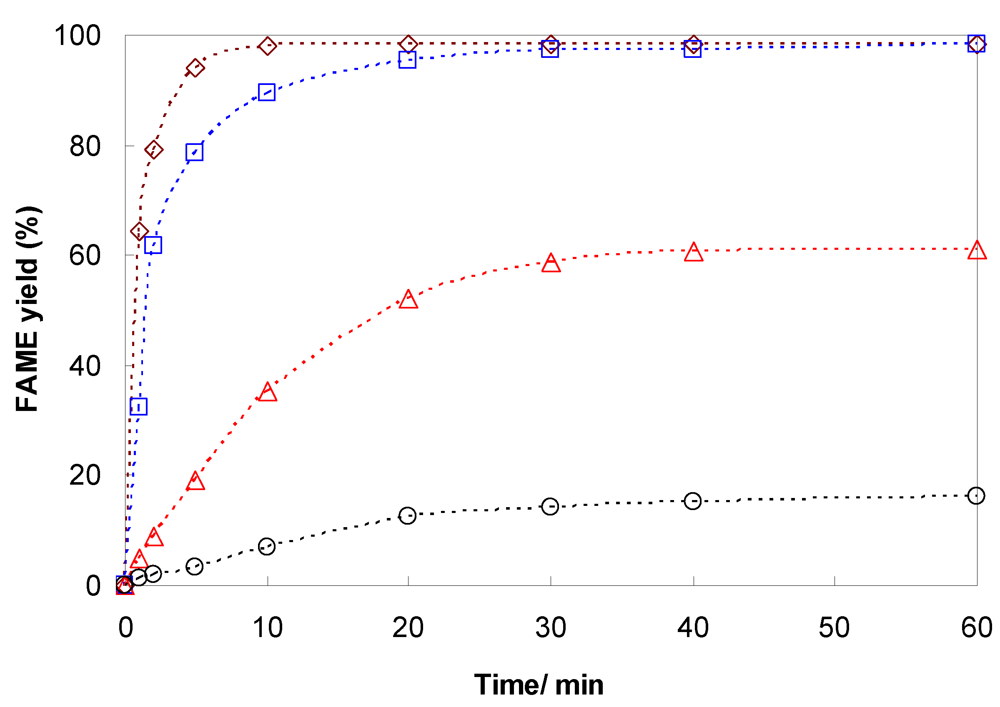
          <p>Surprisingly, the formation of FAME was not retarded in the co-solvent method even in the presence of 5 wt.% of water as shown in <xref ref-type="fig" rid="catalysts-02-00191-f004">Figure 4</xref>. In contrast, the yield of FAME at 60 min became <italic>ca.</italic> 15% in the presence of 5 wt.% of water in the conventional mechanical stirring method. Furthermore, the excess amounts of methanol and acetone in the BDF layer after phase separation were simultaneously recovered by distilling the BDF layer at 60 °C under reduced pressure of 0.1 atm, and they were used for the next experiment. Maeda <italic>et al.</italic> also elucidated that the retardation of FAME formation after the glycerol formation could be explained due to the elimination of reactant methanol, which is easily dissolved into glycerol, but not due to the back reaction of the products. The co-solvent method could be recognized as a new green technology for the production of renewable biomass energy because BDF can be produced with minimum energy consumption and minimum waste emission. The optimal results from this work were applied to produce good quality of BDF from catfish oil on a pilot plant scale with a capacity of 300 L per batch. The time consumption for production of 300 L BDF from catfish oil at this pilot plant was 3 h which is shorter than the conventional method (12–20 h) [<xref ref-type="bibr" rid="B6-catalysts-02-00191">6</xref>].</p>
          <fig id="catalysts-02-00191-f004" position="anchor">
            <label>Figure 4</label>
            <caption>
              <p>The effect of water on the formation rate of FAME (Notes: (<inline-graphic xmlns:xlink="http://www.w3.org/1999/xlink" xlink:href="catalysts-02-00191-i010.tif"/>) 2 wt.% water, co-solvent; (<inline-graphic xmlns:xlink="http://www.w3.org/1999/xlink" xlink:href="catalysts-02-00191-i011.tif"/>) 5 wt.% water, co-solvent; (<inline-graphic xmlns:xlink="http://www.w3.org/1999/xlink" xlink:href="catalysts-02-00191-i012.tif"/>) 2 wt.% water, mechanical stirring; (Ο) 5 wt.% water, mechanical stirring. The conditions: molar ratio of methanol to waste cooking oil, 4.5:1; solvent acetone to oil, 25 wt.%; KOH to oil, 0.5 wt.%; temperature, 20 °C). Reprinted with permission from [<xref ref-type="bibr" rid="B6-catalysts-02-00191">6</xref>]. Copyright 2010 Royal Society of Chemistry.</p>
            </caption>
            <graphic xmlns:xlink="http://www.w3.org/1999/xlink" xlink:href="catalysts-02-00191-g004.tif"/>
          </fig>
        </sec>
        <sec>
          <title>2.2.5. Continuous Method Using a Gas-Liquid Reactor</title>
          <p>A novel continuous reactor process has been developed for the production of biodiesel from fats and oils. This process was performed by atomizing the heated oil/fat and then introducing it into a reaction chamber filled with methanol and alkaline catalyst vapor in a counter current flow arrangement. The atomization process increased the oil/methanol contact area by producing micro sized droplets of 100–200 µm, and therefore increased the heat and mass transfer that is vital for a rapid reaction. In addition, the process allows the use of a very high excess of methanol since unlike the batch process methanol vapor can be recycled back to the reactor without requiring an expensive separation process and intensive energy. The transesterification of soybean oil with methanol was carried out in the continuous gas-liquid reactor with optimal conditions of NaOH 5–7 g L<sup>−1</sup> of methanol; methanol flow rate of 17.2 L h<sup>−1</sup>; oil flow rate of 10 L h<sup>−1</sup>; and temperatures 100–120 °C. Under these conditions, the conversion of triglyceride can be achieved of 94–96% [<xref ref-type="bibr" rid="B90-catalysts-02-00191">90</xref>].</p>
          <sec>
          <title>Manganese (II) Oxide (MnO) and Titanium (II) Oxide (TiO) Catalysts</title>
          <p>Recently, Gombotz <italic>et al.</italic> have used Manganese (II) oxide (MnO) and titanium (II) oxide (TiO) as solid catalysts for both the transesterification of triglycerides and the esterification of FFA into FAME. These catalysts can be applied for low quality feedstocks containing high water content without the pretreatment steps as for the traditional process. In this study, a continuous reactor of a stainless steel tube with an inside diameter of 0.85 cm and a length of 23 cm packed with either MnO (28.1 g) or TiO (36.9 g) was used. The oil and methanol were introduced into the reactor by a HPLC pump with flow rates adjusted to provide a methanol to oil molar ratio of 6:1–30:1. A backpressure gauge was utilized on the outlet side of the column to apply a backpressure of 8.3–9.0 MPa. They produced high quality BDF (meeting ASTM specifications) from yellow grease with 15% FFA at the optimal reaction conditions: 29:1 methanol to oil mol ratio in stage 1, 15:1 methanol to oil molar ratio in stage 2, and reaction temperature 260 °C at pressure 9.0 MPa with MnO catalyst [<xref ref-type="bibr" rid="B91-catalysts-02-00191">91</xref>].</p>
          <p><xref ref-type="table" rid="catalysts-02-00191-t005">Table 5</xref> presents comparisons of production methods and reaction conditions using various types of catalysts and oils of the yield or conversion of FAME.</p>
          </sec>
        </sec>
      </sec>
    </sec>
    <sec>
      <title>3. Development of New Utilization and Reforming Techniques for Glycerin</title>
      <p>When BDF is produced as an alternative to petro-based diesel fuel, a large amount of glycerol is formed as a by-product. Glycerol is currently used as an additive and a media for pharmaceuticals, cosmetics, foods, <italic>etc.</italic>, however, the amount of glycerol is too much to apply to such applications: the balance between the supply and demand of glycerol would break down when the industrial BDF production starts on a full scale. Therefore, it is necessary to develop new utilization and reforming techniques for glycerol. Several recent works for the development of such techniques for glycerol are described here.</p>
          <table-wrap id="catalysts-02-00191-t005" position="anchor">
            <object-id pub-id-type="pii">catalysts-02-00191-t005_Table 5</object-id>
            <label>Table 5</label>
            <caption>
              <p>Summary of production methods, kind of catalysts and reaction conditions on the fatty acid methyl ester (FAME)yield.</p>
            </caption>
            <table>
              <thead>
                <tr>
                  <th rowspan="2" align="left" valign="middle">Methods</th>
                  <th rowspan="2" align="center" valign="middle">Oils and fats</th>
                  <th rowspan="2" align="center" valign="middle">Catalysts</th>
                  <th colspan="4" align="center" valign="middle">Reaction conditions</th>
                  <th rowspan="2" align="center" valign="middle">Yield/Conversion (Y/C, %)</th>
                  <th rowspan="2" align="center" valign="middle">References</th>
                </tr>
                <tr style="border-top: solid thin">
                  <th align="center" valign="middle">Temperature (°C)</th>
                  <th align="center" valign="middle">Molar ratio (methanol to oil)</th>
                  <th align="center" valign="middle">Catalyst amount (wt.%)</th>
                  <th align="center" valign="middle">Reaction time (h)</th>
                </tr>
              </thead>
              <tbody>
                <tr>
                  <td align="left" valign="middle"> </td>
                  <td align="left" valign="middle"> </td>
                  <td align="left" valign="middle">
                    <italic>Homogeneous base catalyst</italic> 
                  </td>
                  <td align="left" valign="middle"> </td>
                  <td align="left" valign="middle"> </td>
                  <td align="left" valign="middle"> </td>
                  <td align="left" valign="middle"> </td>
                  <td align="left" valign="middle"> </td>
                  <td align="left" valign="middle"> </td>
                </tr>
                <tr>
                  <td align="left" valign="middle">Mechanical stirring</td>
                  <td align="left" valign="middle">Used frying</td>
                  <td align="left" valign="middle">NaOH</td>
                  <td align="center" valign="middle">60</td>
                  <td align="center" valign="middle">7:1</td>
                  <td align="center" valign="middle">1.1</td>
                  <td align="center" valign="middle">0.33</td>
                  <td align="center" valign="middle">Y = 88.8</td>
                  <td align="center" valign="middle">[<xref ref-type="bibr" rid="B10-catalysts-02-00191">10</xref>]</td>
                </tr>
                <tr>
                  <td align="left" valign="middle">Mechanical stirring</td>
                  <td align="left" valign="middle">Waste cooking </td>
                  <td align="left" valign="middle">KOH</td>
                  <td align="center" valign="middle">70</td>
                  <td align="center" valign="middle"> </td>
                  <td align="center" valign="middle">1</td>
                  <td align="center" valign="middle">1</td>
                  <td align="center" valign="middle">Y = 98.2</td>
                  <td align="center" valign="middle">[<xref ref-type="bibr" rid="B92-catalysts-02-00191">92</xref>]</td>
                </tr>
                <tr>
                  <td align="left" valign="middle">Ultrasonic irradiation</td>
                  <td align="left" valign="middle">Canola, soybean</td>
                  <td align="left" valign="middle">NaOH</td>
                  <td align="center" valign="middle">25</td>
                  <td align="center" valign="middle">6:1</td>
                  <td align="center" valign="middle">0.5</td>
                  <td align="center" valign="middle">0.33</td>
                  <td align="center" valign="middle">Y = 98</td>
                  <td align="center" valign="middle">[<xref ref-type="bibr" rid="B76-catalysts-02-00191">76</xref>]</td>
                </tr>
                <tr>
                  <td align="left" valign="middle">Ultrasonic irradiation</td>
                  <td align="left" valign="middle">Soy bean</td>
                  <td align="left" valign="middle">KOH</td>
                  <td align="center" valign="middle">40</td>
                  <td align="center" valign="middle">6:1</td>
                  <td align="center" valign="middle">1.5–2.2</td>
                  <td align="center" valign="middle">0.25</td>
                  <td align="center" valign="middle">Y = 99.4</td>
                  <td align="center" valign="middle">[<xref ref-type="bibr" rid="B84-catalysts-02-00191">84</xref>]</td>
                </tr>
                <tr>
                  <td align="left" valign="middle">Ultrasonic irradiation</td>
                  <td align="left" valign="middle">Canola </td>
                  <td align="left" valign="middle">KOH</td>
                  <td align="center" valign="middle">25</td>
                  <td align="center" valign="middle">5:1</td>
                  <td align="center" valign="middle">0.7</td>
                  <td align="center" valign="middle">50</td>
                  <td align="center" valign="middle">Y = 99</td>
                  <td align="center" valign="middle">[<xref ref-type="bibr" rid="B9-catalysts-02-00191">9</xref>]</td>
                </tr>
                <tr>
                  <td align="left" valign="middle">Ultrasonic irradiation</td>
                  <td align="left" valign="middle">Waste cooking </td>
                  <td align="left" valign="middle">KOH (<italic>two-step reaction)</italic></td>
                  <td align="center" valign="middle">27–32</td>
                  <td align="center" valign="middle">4:1</td>
                  <td align="center" valign="middle">1</td>
                  <td align="center" valign="middle">0.016</td>
                  <td align="center" valign="middle">Y= 99</td>
                  <td align="center" valign="middle">[<xref ref-type="bibr" rid="B11-catalysts-02-00191">11</xref>]</td>
                </tr>
                <tr>
                  <td align="left" valign="middle"> </td>
                  <td align="left" valign="middle"> </td>
                  <td align="left" valign="middle">
                    <italic>Homogeneous acid catalyst</italic>
                  </td>
                  <td align="center" valign="middle"> </td>
                  <td align="center" valign="middle"> </td>
                  <td align="center" valign="middle"> </td>
                  <td align="center" valign="middle"> </td>
                  <td align="center" valign="middle"> </td>
                  <td align="center" valign="middle"> </td>
                </tr>
                <tr>
                  <td align="left" valign="middle">Mechanical stirring</td>
                  <td align="left" valign="middle">Waste cooking</td>
                  <td align="left" valign="middle">H<sub>2</sub>SO<sub>4</sub></td>
                  <td align="center" valign="middle">95</td>
                  <td align="center" valign="middle">20:1</td>
                  <td align="center" valign="middle">4</td>
                  <td align="center" valign="middle">20</td>
                  <td align="center" valign="middle">C &gt; 90</td>
                  <td align="center" valign="middle">[<xref ref-type="bibr" rid="B93-catalysts-02-00191">93</xref>]</td>
                </tr>
                <tr>
                  <td align="left" valign="middle">Mechanical stirring</td>
                  <td align="left" valign="middle">Sun flower</td>
                  <td align="left" valign="middle">H<sub>2</sub>SO<sub>4</sub></td>
                  <td align="center" valign="middle">65</td>
                  <td align="center" valign="middle">30:1</td>
                  <td align="center" valign="middle">1</td>
                  <td align="center" valign="middle">69</td>
                  <td align="center" valign="middle">C = 90</td>
                  <td align="center" valign="middle">[<xref ref-type="bibr" rid="B94-catalysts-02-00191">94</xref>]</td>
                </tr>
                <tr>
                  <td align="left" valign="middle"> </td>
                  <td align="left" valign="middle"> </td>
                  <td align="left" valign="middle">
                    <italic>Two-step: acid catalyst follow by base catalyst</italic>
                  </td>
                  <td align="center" valign="middle"> </td>
                  <td align="center" valign="middle"> </td>
                  <td align="center" valign="middle"> </td>
                  <td align="center" valign="middle"> </td>
                  <td align="center" valign="middle"> </td>
                  <td align="center" valign="middle"> </td>
                </tr>
                <tr>
                  <td align="left" valign="middle">Mechanical stirring</td>
                  <td align="left" valign="middle">Karanja</td>
                  <td align="left" valign="middle">First-step H<sub>2</sub>SO<sub>4</sub></td>
                  <td align="center" valign="middle">60</td>
                  <td align="center" valign="middle">6:1</td>
                  <td align="center" valign="middle">2.2</td>
                  <td align="center" valign="middle">1</td>
                  <td align="center" valign="middle">FFA, C = 90.6</td>
                  <td align="center" valign="middle">[<xref ref-type="bibr" rid="B95-catalysts-02-00191">95</xref>]</td>
                </tr>
                <tr>
                  <td align="left" valign="middle">Mechanical stirring</td>
                  <td align="left" valign="middle">Karanja </td>
                  <td align="left" valign="middle">Second-step KOH </td>
                  <td align="center" valign="middle">60</td>
                  <td align="center" valign="middle">8:1</td>
                  <td align="center" valign="middle">1</td>
                  <td align="center" valign="middle">1</td>
                  <td align="center" valign="middle">Y = 96–100</td>
                  <td align="center" valign="middle">[<xref ref-type="bibr" rid="B95-catalysts-02-00191">95</xref>]</td>
                </tr>
                <tr>
                  <td align="left" valign="middle">Mechanical stirring</td>
                  <td align="left" valign="middle">Waste cooking</td>
                  <td align="left" valign="middle">First-step Fe<sub>3</sub>(SO<sub>4</sub>)<sub>3</sub></td>
                  <td align="center" valign="middle">60</td>
                  <td align="center" valign="middle">7:1</td>
                  <td align="center" valign="middle">0.4</td>
                  <td align="center" valign="middle">3</td>
                  <td align="center" valign="middle">Y = 81.3</td>
                  <td align="center" valign="middle">[<xref ref-type="bibr" rid="B96-catalysts-02-00191">96</xref>]</td>
                </tr>
                <tr>
                  <td align="left" valign="middle">Mechanical stirring</td>
                  <td align="left" valign="middle">Waste cooking</td>
                  <td align="left" valign="middle">Second-step CaO </td>
                  <td align="center" valign="middle">60</td>
                  <td align="center" valign="middle">7:1</td>
                  <td align="center" valign="middle">Not specified</td>
                  <td align="center" valign="middle">3</td>
                  <td align="center" valign="middle"> </td>
                  <td align="center" valign="middle"> </td>
                </tr>
                <tr>
                  <td align="left" valign="middle"> </td>
                  <td align="left" valign="middle"> </td>
                  <td align="left" valign="middle">
                    <italic>Heterogeneous base catalyst</italic>
                  </td>
                  <td align="center" valign="middle"> </td>
                  <td align="center" valign="middle"> </td>
                  <td align="center" valign="middle"> </td>
                  <td align="center" valign="middle"> </td>
                  <td align="center" valign="middle"> </td>
                  <td align="center" valign="middle"> </td>
                </tr>
                <tr>
                  <td align="left" valign="middle">Mechanical stirring</td>
                  <td align="left" valign="middle">Palm kernel</td>
                  <td align="left" valign="middle">CaO</td>
                  <td align="center" valign="middle">60</td>
                  <td align="center" valign="middle">30:1</td>
                  <td align="center" valign="middle">6</td>
                  <td align="center" valign="middle">3</td>
                  <td align="center" valign="middle">Y = 98</td>
                  <td align="center" valign="middle">[<xref ref-type="bibr" rid="B53-catalysts-02-00191">53</xref>]</td>
                </tr>
                <tr>
                  <td align="left" valign="middle">Supercritical methanol</td>
                  <td align="left" valign="middle">Sunflower </td>
                  <td align="left" valign="middle">CaO</td>
                  <td align="center" valign="middle">252</td>
                  <td align="center" valign="middle">41:1</td>
                  <td align="center" valign="middle">3</td>
                  <td align="center" valign="middle">0.1</td>
                  <td align="center" valign="middle">completed</td>
                  <td align="center" valign="middle">[<xref ref-type="bibr" rid="B48-catalysts-02-00191">48</xref>]</td>
                </tr>
                <tr>
                  <td align="left" valign="middle">Mechanical stirring</td>
                  <td align="left" valign="middle">Soy bean</td>
                  <td align="left" valign="middle">MgO</td>
                  <td align="center" valign="middle">130</td>
                  <td align="center" valign="middle">55:1</td>
                  <td align="center" valign="middle">5</td>
                  <td align="center" valign="middle">7</td>
                  <td align="center" valign="middle">Y = 60</td>
                  <td align="center" valign="middle">[<xref ref-type="bibr" rid="B50-catalysts-02-00191">50</xref>]</td>
                </tr>
                <tr>
                  <td align="left" valign="middle">Mechanical stirring</td>
                  <td align="left" valign="middle">Waste cooking</td>
                  <td align="left" valign="middle">K<sub>3</sub>PO<sub>4</sub></td>
                  <td align="center" valign="middle">60</td>
                  <td align="center" valign="middle">6:1</td>
                  <td align="center" valign="middle">4</td>
                  <td align="center" valign="middle">2</td>
                  <td align="center" valign="middle">Y = 97.3</td>
                  <td align="center" valign="middle">[<xref ref-type="bibr" rid="B97-catalysts-02-00191">97</xref>]</td>
                </tr>
                <tr>
                  <td align="left" valign="middle"> </td>
                  <td align="left" valign="middle"> </td>
                  <td align="left" valign="middle">
                    <italic>Heterogeneous acid catalyst</italic>
                  </td>
                  <td align="center" valign="middle"> </td>
                  <td align="center" valign="middle"> </td>
                  <td align="center" valign="middle"> </td>
                  <td align="center" valign="middle"> </td>
                  <td align="center" valign="middle"> </td>
                  <td align="center" valign="middle"> </td>
                </tr>
                <tr>
                  <td align="left" valign="middle">Microwave</td>
                  <td align="left" valign="middle">Yellow horn</td>
                  <td align="left" valign="middle">Cs<sub>2.5</sub>H0<sub>0.5</sub>PW<sub>12</sub>O<sub>40</sub></td>
                  <td align="center" valign="middle">60</td>
                  <td align="center" valign="middle">12:1</td>
                  <td align="center" valign="middle">1</td>
                  <td align="center" valign="middle">0.16</td>
                  <td align="center" valign="middle">Y = 96.22</td>
                  <td align="center" valign="middle">[<xref ref-type="bibr" rid="B98-catalysts-02-00191">98</xref>]</td>
                </tr>
                <tr>
                  <td align="left" valign="middle">Mechanical stirring</td>
                  <td align="left" valign="middle">Waste cooking </td>
                  <td align="left" valign="middle">SO<sub>4</sub><sup>2−</sup>/ZrO<sub>2</sub></td>
                  <td align="center" valign="middle">120</td>
                  <td align="center" valign="middle">9:1</td>
                  <td align="center" valign="middle">3</td>
                  <td align="center" valign="middle">4</td>
                  <td align="center" valign="middle">Y = 93.6</td>
                  <td align="center" valign="middle">[<xref ref-type="bibr" rid="B99-catalysts-02-00191">99</xref>]</td>
                </tr>
                <tr>
                  <td align="left" valign="middle">Mechanical stirring</td>
                  <td align="left" valign="middle">Soybean </td>
                  <td align="left" valign="middle">Sr(NO<sub>3</sub>)<sub>2</sub>/ZnO</td>
                  <td align="center" valign="middle">65</td>
                  <td align="center" valign="middle">12:1</td>
                  <td align="center" valign="middle">5</td>
                  <td align="center" valign="middle">4</td>
                  <td align="center" valign="middle">Y = 94.7</td>
                  <td align="center" valign="middle">[<xref ref-type="bibr" rid="B100-catalysts-02-00191">100</xref>]</td>
                </tr>
                <tr>
                  <td align="left" valign="middle"> </td>
                  <td align="left" valign="middle"> </td>
                  <td align="left" valign="middle">
                    <italic>Enzymatic catalyst</italic>
                  </td>
                  <td align="center" valign="middle"> </td>
                  <td align="center" valign="middle"> </td>
                  <td align="center" valign="middle"> </td>
                  <td align="center" valign="middle"> </td>
                  <td align="center" valign="middle"> </td>
                  <td align="center" valign="middle"> </td>
                </tr>
                <tr>
                  <td align="left" valign="middle">Mechanical stirring </td>
                  <td align="left" valign="middle">Waste edible</td>
                  <td align="left" valign="middle">Novozym 435</td>
                  <td align="center" valign="middle">30</td>
                  <td align="center" valign="middle">3:1</td>
                  <td align="center" valign="middle">4</td>
                  <td align="center" valign="middle">50</td>
                  <td align="center" valign="middle">C = 90.9</td>
                  <td align="center" valign="middle">[<xref ref-type="bibr" rid="B101-catalysts-02-00191">101</xref>]</td>
                </tr>
                <tr>
                  <td align="left" valign="middle">Mechanical stirring </td>
                  <td align="left" valign="middle">Waste cooking </td>
                  <td align="left" valign="middle">Rhizopus oryzae</td>
                  <td align="center" valign="middle">40</td>
                  <td align="center" valign="middle">4:1</td>
                  <td align="center" valign="middle">30</td>
                  <td align="center" valign="middle">30</td>
                  <td align="center" valign="middle">Y = 88–90</td>
                  <td align="center" valign="middle">[<xref ref-type="bibr" rid="B102-catalysts-02-00191">102</xref>]</td>
                </tr>
                <tr>
                  <td align="left" valign="middle">Mechanical stirring</td>
                  <td align="left" valign="middle">grease</td>
                  <td align="left" valign="middle">Pseudomonas cepacia (PS30)</td>
                  <td align="center" valign="middle">38.4</td>
                  <td align="center" valign="middle">Ethanol (6.6:1)</td>
                  <td align="center" valign="middle">13.7</td>
                  <td align="center" valign="middle">2.47</td>
                  <td align="center" valign="middle">Y = 96</td>
                  <td align="center" valign="middle">[<xref ref-type="bibr" rid="B103-catalysts-02-00191">103</xref>]</td>
                </tr>
              </tbody>
            </table>
          </table-wrap>
      <sec>
        <title>3.1. Reforming of Glycerol to Produce Biofuels and Valuable Chemicals by Bioprocessing</title>
        <p>Bioprocessing of glycerol to produce biofuels and alternative chemicals has been investigated actively [<xref ref-type="bibr" rid="B104-catalysts-02-00191">104</xref>,<xref ref-type="bibr" rid="B105-catalysts-02-00191">105</xref>,<xref ref-type="bibr" rid="B106-catalysts-02-00191">106</xref>,<xref ref-type="bibr" rid="B107-catalysts-02-00191">107</xref>,<xref ref-type="bibr" rid="B108-catalysts-02-00191">108</xref>,<xref ref-type="bibr" rid="B109-catalysts-02-00191">109</xref>,<xref ref-type="bibr" rid="B110-catalysts-02-00191">110</xref>]. <xref ref-type="fig" rid="catalysts-02-00191-f005">Figure 5</xref> shows examples of products synthesized from glycerol fermentation [<xref ref-type="bibr" rid="B105-catalysts-02-00191">105</xref>]. It can be seen that the formation of 1,3-propanediol, succinic acid, butanol, ethanol, formic acid, propionic acid, H<sub>2</sub> and CO<sub>2</sub> occurs during anaerobic fermentation of glycerol. Yazdani and Gonzalez reported that the maximum theoretical yield in each case from glycerol is higher than that obtained from the use of common sugars such as glucose and xylose [<xref ref-type="bibr" rid="B105-catalysts-02-00191">105</xref>].</p>
        <fig id="catalysts-02-00191-f005" position="anchor">
          <label>Figure 5</label>
          <caption>
            <p>Examples of products synthesized from glycerol fermentation. Broken lines represent pathways composed of several reactions. (Abbreviations: AcCoA, acetyl-coenzyme A; DHAP, dihydroxyacetone phosphate; PEP, phosphoenolpyruvate; PYR, pyruvate; 1,3-PDO, 1,3-propanediol). Reprinted with permission from [<xref ref-type="bibr" rid="B105-catalysts-02-00191">105</xref>]. Copyright 2007 Elsevier.</p>
          </caption>
          <graphic xmlns:xlink="http://www.w3.org/1999/xlink" xlink:href="catalysts-02-00191-g005.tif"/>
        </fig>
        <p>1,2-propanediol can also be produced from glycerol by using metabolic engineering <italic>Escherichia coli</italic> [<xref ref-type="bibr" rid="B106-catalysts-02-00191">106</xref>]. Diols such as 1,3-propanediol, 1,2-propanediol, <italic>etc.</italic>, are useful chemicals as platform chemicals. For example, 1,3-propanediol has been used as a monomer for the synthesis of polytrimethylene terephthalate (PTT) which can be used as a fiber. It is easy to imagine the importance of PTT when we say that it is related to polyethylene terephthalate, which is well-known as PET. 1,2-propandiol can also be used in various ways as a monomer for the synthesis of polyesters and as antifreeze in breweries etc. [<xref ref-type="bibr" rid="B107-catalysts-02-00191">107</xref>]. To enhance the yield of valuable chemicals from the fermentation of glycerol, a number of attempts such as strain-based improvements and process-based improvements have been performed [<xref ref-type="bibr" rid="B105-catalysts-02-00191">105</xref>]. Trinh and Srienc investigated the conversion of glycerol to ethanol with an <italic>Escherichia coli</italic> strain which was designed on the basis of elementary mode analysis. They reported that the evolved strain was able to convert 40 g/L of glycerol to ethanol in 48 h with 90% of the theoretical ethanol yield [<xref ref-type="bibr" rid="B109-catalysts-02-00191">109</xref>].</p>
      </sec>
      <sec>
        <title>3.2. Utilization of Glycerol as a Sustainable Solvent for Green Chemistry</title>
        <p>In chemical approaches, one of the fundamental uses of glycerol is its use as a solvent for catalysis, organic synthesis, inorganic synthesis, as well as separation and material chemistry [<xref ref-type="bibr" rid="B111-catalysts-02-00191">111</xref>,<xref ref-type="bibr" rid="B112-catalysts-02-00191">112</xref>,<xref ref-type="bibr" rid="B113-catalysts-02-00191">113</xref>]. Taking into account the properties of glycerol such as low toxicity, good biodegradability and low vapor pressure (high boiling point), glycerol has recently been shown to be an excellent sustainable solvent. For example, an advantage of the use of glycerol as a solvent is that chemical reactions can be carried out at higher temperature compared with low boiling point solvents, therefore, acceleration of the reactions or progress of different reaction pathways would be expected. As a disadvantage, the chemical reactivity of the hydroxyl groups of glycerol has to be taken into consideration. As a simple idea, glycerol can be used as a solvent instead of conventional alcohols such as methanol, ethanol, ethylene glycol, <italic>etc.</italic> However, we should use glycerol not only as an alternative to the conventional alcohol solvents but also as an effective solvent to enhance the rate of reactions, selectivity of reactions or yield of products. Gu <italic>et al.</italic> investigated an aza-Michael reaction of <italic>p-</italic>anisidine with butyl acrylate in different solvent systems under catalyst-free conditions [<xref ref-type="bibr" rid="B113-catalysts-02-00191">113</xref>]. The products were analyzed after 20 h of reaction at 100 °C. In general, aza-Michael reactions are performed in the presence of an appropriate catalyst such as Pd and Cu complexes, Lewis acids, Bronsted acids, <italic>etc.</italic>, to enhance the yield of products. Gu <italic>et al.</italic> found that no reaction occurred in toluene, dimethylformamide, dimethyl sulfoxide and 1,2-dichloroethane under catalyst-free conditions, but glycerol acted as a very efficient promoting medium for this reaction (yield: about 80%). This promoting effect is due to the fact that the hydroxyl groups of glycerol are able to directly catalyze the reaction. Although water also acted as a catalyst (yield: &lt;5%), the affinity of glycerol to <italic>p</italic>-anisidine was considered to be better than that of water to <italic>p</italic>-anisidine. In addition, it should be noted that the aza-Michael reaction proceeds effectively even in a crude glycerol solvent including about 15 wt.% of water and 5 wt.% of soap (yield: about 80%). A number of reactions which can be performed in glycerol are reviewed elsewhere [<xref ref-type="bibr" rid="B111-catalysts-02-00191">111</xref>,<xref ref-type="bibr" rid="B112-catalysts-02-00191">112</xref>].</p>
      </sec>
      <sec>
        <title>3.3. Utilization of Glycerol for Energy Generation</title>
        <p>Direct alcohol fuel cells are actively being researched nowadays, because alcohols such as methanol, ethanol, ethylene glycol and glycerol have an advantage compared to hydrogen in terms of volumetric energy density. In addition, the handling of alcohols is easier for storage and transport compared to that of hydrogen.</p>
        <p>Bianchini and Shen pointed out that unlike Pt-based electrocatalysts, Pd-based electrocatalysts would be highly active for the oxidation of a large variety of substrates in alkaline solution [<xref ref-type="bibr" rid="B114-catalysts-02-00191">114</xref>]. Since BDF is effectively synthesized in the presence of alkaline catalysts such as NaOH and KOH as seen in the previous sections, Pd-based electrocatalysts should be convenient to use without pH adjustment for crude glycerol formed from the BDF industry. Here, Pd-based electrocatalysts are briefly introduced on the basis of recent works.</p>
        <p>Wang <italic>et al.</italic> reported the preparation of Pd/(carbonized porous anodic alumina, CPAA) electrode by the direct reduction of PdCl<sub>2</sub> with excessive NaBH<sub>4</sub> on CPAA in aqueous solution and its electrocatalytic application for alcohol oxidation [<xref ref-type="bibr" rid="B115-catalysts-02-00191">115</xref>]. <xref ref-type="fig" rid="catalysts-02-00191-f006">Figure 6</xref> shows the linear potential sweep curves in 1.0 M alcohol/1.0 M KOH solution at 50 mV s<sup>−1</sup>. It can be seen that all alcohols can be oxidized with a Pd/CPAA electrode. They reported that the performance of Pd/CPAA for alcohol oxidation is better than that of Pd/C. Since the characteristics of Pd catalysts were not investigated by them, further examples are shown later.</p>
        <fig id="catalysts-02-00191-f006" position="anchor">
          <label>Figure 6</label>
          <caption>
            <p>Linear potential sweep curves of the oxidation of methanol, ethanol, glycerol and ethylene glycol on the as-prepared three-dimensional Pd/(carbonized porous anodic alumina) electrode in 1.0 M alcohol/1.0 M KOH solution, 303 K, scan rate: 50 mV s<sup>−1</sup>. Reprinted with permission from [<xref ref-type="bibr" rid="B115-catalysts-02-00191">115</xref>]. Copyright 2006 Elsevier.</p>
          </caption>
          <graphic xmlns:xlink="http://www.w3.org/1999/xlink" xlink:href="catalysts-02-00191-g006.tif"/>
        </fig>
        <p><xref ref-type="fig" rid="catalysts-02-00191-f007">Figure 7</xref> shows cyclic voltammograms of the oxidation of methanol, ethanol and glycerol on Pd nanoparticles supported on multi-walled carbon nanotubes (Pd/MWCNT) in 2 M KOH solution, where Pd/MWCNT was synthesized by using the impregnation-reduction method. The average size of Pd nanoparticles was 4.3 nm [<xref ref-type="bibr" rid="B116-catalysts-02-00191">116</xref>]. It can be seen that Pd nanoparticles are the active catalyst for the oxidation of all alcohols investigated here. From <xref ref-type="fig" rid="catalysts-02-00191-f007">Figure 7</xref>, the peak current density is found to be in the order of 2.8 mA/(μg-Pd) for oxidation of 5% glycerol &gt; 2.1 mA/(μg-Pd) for oxidation of 10% ethanol &gt; 1.1 mA/(μg-Pd) for oxidation of 10% methanol. This result shows that glycerol is the best performing fuel in spite of the lower concentration.</p>
        <fig id="catalysts-02-00191-f007" position="anchor">
          <label>Figure 7</label>
          <caption>
            <p>Cyclic voltammograms (at the fifth cycle) of methanol, ethanol and glycerol oxidation on a Pd/(multi-walled carbon nanotubes) electrode in 2 M KOH solution. Pd loading: 17 μg cm<sup>−</sup><sup>2</sup>. Scan rate: 50 mVs<sup>−</sup><sup>1</sup>. Average size of Pd: 4.3 nm. Reprinted with permission from [<xref ref-type="bibr" rid="B116-catalysts-02-00191">116</xref>]. Copyright 2009 Elsevier.</p>
          </caption>
          <graphic xmlns:xlink="http://www.w3.org/1999/xlink" xlink:href="catalysts-02-00191-g007.tif"/>
        </fig>
        <p>The surface modification of foreign atoms to Pd or Pt is suggested to enhance and improve their catalytic activity for alcohol oxidation. Simões <italic>et al.</italic> investigated the effects of modification of Bi to Pd or Pt on glycerol oxidation, where Pt, Pd, Pd<sub>0.9</sub>Bi<sub>0.1</sub>, Pt<sub>0.9</sub>Bi<sub>0.1</sub> and Pd<sub>0.45</sub>Pt<sub>0.45</sub>Bi<sub>0.1</sub> nanoparticles were synthesized by the “water-in-oil” microemulsion method [<xref ref-type="bibr" rid="B117-catalysts-02-00191">117</xref>]. The average size of the particles prepared was 4.0 nm for Pd, 5.3 nm for Pt, 5.2 nm for Pd<sub>0.9</sub>Bi<sub>0.1</sub>, 4.7 nm for Pt<sub>0.9</sub>Bi<sub>0.1</sub>, and 4.5 nm for Pd<sub>0.45</sub>Pt<sub>0.45</sub>Bi<sub>0.1</sub>, respectively. Based on analyzing the onset potential of the oxidation wave, it was found that the catalytic activity for glycerol oxidation was in the order of Pd/C &lt; Pt/C = Pd<sub>0.9</sub>Bi<sub>0.1</sub>/C &lt; Pt<sub>0.9</sub>Bi<sub>0.1</sub>/C = Pd<sub>0.45</sub>Pt<sub>0.45</sub>Bi<sub>0.1</sub>/C. The enhancement of the catalytic activity by adding Bi on Pd and/or Pt was suggested to be due to the changes in the electronic interactions between the reactant and the active sites of the catalyst, which are induced by the bifunctional effect and/or by the ensemble effect. The products formed during glycerol oxidation with Pd<sub>0.9</sub>Bi<sub>0.1</sub>/C, Pt<sub>0.9</sub>Bi<sub>0.1</sub>/C and Pd<sub>0.45</sub>Pt<sub>0.45</sub>Bi<sub>0.1</sub>/C catalysts were tartronate, mesoxalate, oxalate and formate ions which were confirmed by HPLC combined with chronoamperometry experiments. This oxidation mechanism was almost the same as previous reports with other electrocatalysts [<xref ref-type="bibr" rid="B114-catalysts-02-00191">114</xref>].</p>
        <p>The researches of direct methanol or ethanol fuel cells are advancing quickly compared with those of direct glycerol fuel cells. It is probable that similar catalysts for the oxidation of methanol and ethanol are effective for the oxidation of glycerol.</p>
      </sec>
      <sec>
        <title>3.4. Reforming of Glycerol to Valuable Chemicals by Catalysis</title>
        <p>The reforming of glycerol is actively being researched by catalysis. Zhou <italic>et al.</italic> summarized the comprehensive review about catalytic conversion of glycerol to valuable chemicals in detail [<xref ref-type="bibr" rid="B118-catalysts-02-00191">118</xref>]. To convert glycerol into valuable chemicals, oxidation, hydrogenolysis, dehydration, pyrolysis/gasification, transesterification/esterification, etherification, oligomerization/polymerization, chlorination and carboxylation of glycerol have been investigated under various experimental conditions in the presence of catalysts. Here, several recent works are briefly introduced.</p>
        <p>In the case of selective oxidation of glycerol, the formation of various products such as dihydroxyacetone, hydroxypyruvic acid, <italic>etc.</italic>, has been reported to occur. Takagaki <italic>et al.</italic> reported selective oxidation of glycerol to glycolic acid in water with molecular oxygen by use of hydrotalcite-supported gold nanoparticle catalysts [<xref ref-type="bibr" rid="B119-catalysts-02-00191">119</xref>]. They found that a high yield (53%) of glycolic acid was obtained at 293 K compared to 333 K. This is due to the fact that the basicity of hydrotalcite acts not only as promoter by proton abstraction of alcohol but also as <italic>in situ</italic> generator of hydrogen peroxide.</p>
        <p>In hydrogenolysis of glycerol, 1,2-propanediol, 1,3-propanediol and ethylene glycol can be synthesized selectively. Wu <italic>et al.</italic> reported the synthesis of 1,2-propanediol from hydrogenolysis of glycerol over a Cu-Ru/carbon nanotube catalyst [<xref ref-type="bibr" rid="B120-catalysts-02-00191">120</xref>]. The conversions of glycerol and selectivity for the formation of 1,2-propanediol were 99.8% and 86.5%, respectively. Shimao <italic>et al.</italic> reported the promoting effect of Re addition to Rh/SiO<sub>2</sub> on glycerol hydrogenolysis [<xref ref-type="bibr" rid="B121-catalysts-02-00191">121</xref>]. They found that the modification of ReO<sub>x</sub> to Rh enhanced the activity of glycerol hydrogenolysis and the formation of 1,3-propanediol became more favorable on the Rh-ReO<sub>x</sub>/SiO<sub>2</sub>. Ueda <italic>et al.</italic> reported that the formation of ethylene glycol in glycerol hydrogenolysis was enhanced over Pt-modified Ni catalyst, where the conversion of glycerol to ethylene glycol was suggested to occur via retro-aldol reaction of glyceraldehyde [<xref ref-type="bibr" rid="B122-catalysts-02-00191">122</xref>]. </p>
        <p>The chlorination of glycerol has been investigated to produce dichloropropanol [<xref ref-type="bibr" rid="B123-catalysts-02-00191">123</xref>,<xref ref-type="bibr" rid="B124-catalysts-02-00191">124</xref>,<xref ref-type="bibr" rid="B125-catalysts-02-00191">125</xref>,<xref ref-type="bibr" rid="B126-catalysts-02-00191">126</xref>] which can be used as an intermediate for epichlorohydrin. In addition, the etherification of glycerol with isobutylene has been investigated to produce an oxygenate additive which can be used as an ignition accelerator and octane booster [<xref ref-type="bibr" rid="B127-catalysts-02-00191">127</xref>].</p>
        <p>A number of papers have reported the formation of gaseous products form glycerol reforming. Vaidya and Rodrigues reviewed H<sub>2</sub> production from glycerol reforming over Ni, Pt and Ru catalysts [<xref ref-type="bibr" rid="B128-catalysts-02-00191">128</xref>]. The synthesis of H<sub>2</sub> and CO from glycerol has also been investigated over Pt-based catalysts [<xref ref-type="bibr" rid="B129-catalysts-02-00191">129</xref>]. It is important to develop an effective catalytic process to transform glycerol to various useful chemicals in the future.</p>
      </sec>
    </sec>
    <sec sec-type="conclusions">
      <title>4. Conclusions</title>
      <p>Biodiesel is a renewable and alternative fuel to petro diesel fuel. In addition, biodiesel is environmental friendly due to its easy biodegradability, non-toxicity, being primarily free of sulfur and aromatics and containing oxygen in its structure resulting in production of more tolerable exhaust gas emissions than conventional fossil diesel, despite providing similar levels of fuel efficiency. Currently, biodiesel is produced thank to esterification and transesterification reactions from edible and non-edible vegetable oils or animal fats with primary alcohols in the presence of an acid- or base-catalyst. Several catalysts such as homogeneous acid/base, heterogeneous acid/base, enzymes, <italic>etc.</italic> have been studied and applied to the synthesis of biodiesel. However, in commercial production, a homogeneous alkaline catalyst transesterification is predominately used for good quality oils containing a low content of FFA because the base alkaline catalyst gives a high FAME yield in a short reaction time and the reaction can be carried out in simple equipment. In contrast, with poor quality raw oils containing a high amount of FFA, a strong sulfuric acid catalyst esterification used as a pre-treatment step followed by an alkaline catalyst transesterification is the most popular way to produce biodiesel. </p>
      <p>Currently, the mechanical stirring method with a batch reactor is the conventional method for biodiesel production on the industrial scale, because this method is simple and cheap. However, the production process has long reaction times and separation of crude BDF from the reaction mixture, and the reaction is performed at relatively high temperature with a base-catalyst resulting in soap formation. To solve these disadvantages, the ultrasonic irradiation and co-solvent methods have been developed and applied for the production of biodiesel on the industrial scale. With these innovative methods, the reaction can be conducted at ambient temperature with shorter reaction times and reduced raw material consumption. Combination of these new methods with solid catalysts will give green technologies for production of biodiesel in the near future.</p>
      <p>In addition, new utilization technologies for glycerol must be developed to reduce the amount of glycerol waste. While various technologies such as “reforming of glycerol to produce biofuels and valuable chemicals by bioprocessing or catalysis”, “utilization of glycerol as a sustainable solvent for green chemistry” and “utilization of glycerol for energy generation”, are being actively studied by a number of researchers, the catalysis process could become one of the most important processes to reform glycerol to useful chemicals in the future.</p>
    </sec>

  </body>
  <back>
    <ack>
    <title>Acknowledgments</title>
      <p>We acknowledge the support from Science and Technology Research Partnership for Sustainable Development (SATREPS, Project: Multi-beneficial Measure for the Mitigation of Climate Change by the Integrated Utilization of Biomass Energy in Vietnam and Indochina countries), JST-JICA, Japan. </p>
    </ack>
    <ref-list>
      <title>References</title>
      <ref id="B1-catalysts-02-00191">
        <label>1.</label>
        <citation citation-type="journal">
          <person-group person-group-type="author">
            <name>
              <surname>Demirbas</surname>
              <given-names>A.</given-names>
            </name>
          </person-group>
          <article-title>Political, economic and environmental impacts of biofuels: A review</article-title>
          <source>Appl. Energy</source>
          <year>2009</year>
          <volume>86</volume>
          <fpage>S108</fpage>
          <lpage>S117</lpage>
          <pub-id pub-id-type="doi">10.1016/j.apenergy.2009.04.036</pub-id>
        </citation>
      </ref>
      <ref id="B2-catalysts-02-00191">
        <label>2.</label>
        <citation citation-type="journal">
          <person-group person-group-type="author">
            <name>
              <surname>Georgogianni</surname>
              <given-names>K.G.</given-names>
            </name>
            <name>
              <surname>Kontominas</surname>
              <given-names>M.G.</given-names>
            </name>
            <name>
              <surname>Tegou</surname>
              <given-names>E.</given-names>
            </name>
            <name>
              <surname>Avlonitis</surname>
              <given-names>D.</given-names>
            </name>
            <name>
              <surname>Gergis</surname>
              <given-names>V.</given-names>
            </name>
          </person-group>
          <article-title>Biodiesel production: Reaction and process parameters of alkali-catalyzed transesterification of waste frying oils</article-title>
          <source>Energy Fuels</source>
          <year>2007</year>
          <volume>21</volume>
          <fpage>3023</fpage>
          <lpage>3027</lpage>
          <pub-id pub-id-type="doi">10.1021/ef070102b</pub-id>
        </citation>
      </ref>
      <ref id="B3-catalysts-02-00191">
        <label>3.</label>
        <citation citation-type="journal">
          <person-group person-group-type="author">
            <name>
              <surname>Zah</surname>
              <given-names>R.</given-names>
            </name>
            <name>
              <surname>Ruddy</surname>
              <given-names>T.F.</given-names>
            </name>
          </person-group>
          <article-title>International trade in biofuels: An introduction to the special issue</article-title>
          <source>J. Clean. Prod.</source>
          <year>2009</year>
          <volume>17</volume>
          <fpage>S1</fpage>
          <lpage>S3</lpage>
          <pub-id pub-id-type="doi">10.1016/j.jclepro.2009.05.005</pub-id>
        </citation>
      </ref>
      <ref id="B4-catalysts-02-00191">
        <label>4.</label>
        <citation citation-type="book">
          <person-group person-group-type="author">
            <name>
              <surname>Eisentraut</surname>
              <given-names>A.</given-names>
            </name>
          </person-group>
          <source>Technology Roadmap Biofuels for Transport</source>
          <publisher-name>International Energy Agency</publisher-name>
          <publisher-loc>Paris, France</publisher-loc>
          <year>2011</year>
          <fpage>12</fpage>
        </citation>
      </ref>
      <ref id="B5-catalysts-02-00191">
        <label>5.</label>
        <citation citation-type="journal">
          <person-group person-group-type="author">
            <name>
              <surname>Balat</surname>
              <given-names>M.</given-names>
            </name>
            <name>
              <surname>Balat</surname>
              <given-names>H.</given-names>
            </name>
          </person-group>
          <article-title>A critical review of bio-diesel as a vehicular fuel</article-title>
          <source>Energy Convers. Manag.</source>
          <year>2008</year>
          <volume>49</volume>
          <fpage>2727</fpage>
          <lpage>2741</lpage>
          <pub-id pub-id-type="doi">10.1016/j.enconman.2008.03.016</pub-id>
        </citation>
      </ref>
      <ref id="B6-catalysts-02-00191">
        <label>6.</label>
        <citation citation-type="journal">
          <person-group person-group-type="author">
            <name>
              <surname>Maeda</surname>
              <given-names>Y.</given-names>
            </name>
            <name>
              <surname>Thanh</surname>
              <given-names>L.T.</given-names>
            </name>
            <name>
              <surname>Imamura</surname>
              <given-names>K.</given-names>
            </name>
            <name>
              <surname>Izutani</surname>
              <given-names>K.</given-names>
            </name>
            <name>
              <surname>Okitsu</surname>
              <given-names>K.</given-names>
            </name>
            <name>
              <surname>Boi</surname>
              <given-names>L.V.</given-names>
            </name>
            <name>
              <surname>Lan</surname>
              <given-names>P.N.</given-names>
            </name>
            <name>
              <surname>Tuan</surname>
              <given-names>N.C.</given-names>
            </name>
            <name>
              <surname>Yoo</surname>
              <given-names>Y.E.</given-names>
            </name>
            <name>
              <surname>Takenaka</surname>
              <given-names>N.</given-names>
            </name>
          </person-group>
          <article-title>New technology for the production of biodiesel fuel</article-title>
          <source>Green Chem.</source>
          <year>2010</year>
          <volume>13</volume>
          <fpage>1124</fpage>
          <lpage>1128</lpage>
        </citation>
      </ref>
      <ref id="B7-catalysts-02-00191">
        <label>7.</label>
        <citation citation-type="book">
          <person-group person-group-type="author">
            <name>
              <surname>Knothe</surname>
              <given-names>G.</given-names>
            </name>
            <name>
              <surname>Gerpen</surname>
              <given-names>J.V.</given-names>
            </name>
            <name>
              <surname>Krahl</surname>
              <given-names>J.</given-names>
            </name>
          </person-group>
          <source>The Biodiesel Handbook</source>
          <publisher-name>AOCS Press</publisher-name>
          <publisher-loc>Champaign, IL, USA</publisher-loc>
          <year>2005</year>
          <fpage>34</fpage>
          <lpage>274</lpage>
          <page-range>34, 35, 164, 269, 270-274</page-range>
        </citation>
      </ref>
      <ref id="B8-catalysts-02-00191">
        <label>8.</label>
        <citation citation-type="journal">
          <person-group person-group-type="author">
            <name>
              <surname>Jain</surname>
              <given-names>S.</given-names>
            </name>
            <name>
              <surname>Sharma</surname>
              <given-names>M.P.</given-names>
            </name>
          </person-group>
          <article-title>Biodiesel production from <italic>Jatropha curcas</italic> oil</article-title>
          <source>Renew. Sustain. Energy Rev.</source>
          <year>2010</year>
          <volume>14</volume>
          <fpage>3140</fpage>
          <lpage>3147</lpage>
          <pub-id pub-id-type="doi">10.1016/j.rser.2010.07.047</pub-id>
        </citation>
      </ref>
      <ref id="B9-catalysts-02-00191">
        <label>9.</label>
        <citation citation-type="journal">
          <person-group person-group-type="author">
            <name>
              <surname>Thanh</surname>
              <given-names>L.T.</given-names>
            </name>
            <name>
              <surname>Okitsu</surname>
              <given-names>K.</given-names>
            </name>
            <name>
              <surname>Sadanaga</surname>
              <given-names>Y.</given-names>
            </name>
            <name>
              <surname>Takenaka</surname>
              <given-names>N.</given-names>
            </name>
            <name>
              <surname>Yasuaki Maeda</surname>
              <given-names>Y.</given-names>
            </name>
            <name>
              <surname>Bandow</surname>
              <given-names>H.</given-names>
            </name>
          </person-group>
          <article-title>Ultrasound-assisted production of biodiesel fuel from vegetable oils in a small scale circulation process</article-title>
          <source>Bioresour. Technol.</source>
          <year>2010</year>
          <volume>101</volume>
          <fpage>639</fpage>
          <lpage>645</lpage>
        <pub-id pub-id-type="doi">10.1016/j.biortech.2009.08.050</pub-id><pub-id pub-id-type="pmid">19736002</pub-id></citation>
      </ref>
      <ref id="B10-catalysts-02-00191">
        <label>10.</label>
        <citation citation-type="journal">
          <person-group person-group-type="author">
            <name>
              <surname>Leung</surname>
              <given-names>D.Y.C.</given-names>
            </name>
            <name>
              <surname>Guo</surname>
              <given-names>Y.</given-names>
            </name>
          </person-group>
          <article-title>Transesterification of neat and used frying oil: Optimization for biodiesel production</article-title>
          <source>Fuel Process. Technol.</source>
          <year>2006</year>
          <volume>87</volume>
          <fpage>883</fpage>
          <lpage>890</lpage>
        <pub-id pub-id-type="doi">10.1016/j.fuproc.2006.06.003</pub-id></citation>
      </ref>
      <ref id="B11-catalysts-02-00191">
        <label>11.</label>
        <citation citation-type="journal">
          <person-group person-group-type="author">
            <name>
              <surname>Thanh</surname>
              <given-names>L.T.</given-names>
            </name>
            <name>
              <surname>Okitsu</surname>
              <given-names>K.</given-names>
            </name>
            <name>
              <surname>Sadanaga</surname>
              <given-names>Y.</given-names>
            </name>
            <name>
              <surname>Takenaka</surname>
              <given-names>N.</given-names>
            </name>
            <name>
              <surname>Maeda</surname>
              <given-names>Y.</given-names>
            </name>
            <name>
              <surname>Bandow</surname>
              <given-names>H.</given-names>
            </name>
          </person-group>
          <article-title>A two-step continuous ultrasound assisted production of biodiesel fuel from waste cooking oils: A practical and economical approach to produce high quality biodiesel fuel</article-title>
          <source>Bioresour. Technol.</source>
          <year>2010</year>
          <volume>101</volume>
          <fpage>5394</fpage>
          <lpage>5401</lpage>
        <pub-id pub-id-type="doi">10.1016/j.biortech.2010.02.060</pub-id><pub-id pub-id-type="pmid">20219362</pub-id></citation>
      </ref>
      <ref id="B12-catalysts-02-00191">
        <label>12.</label>
        <citation citation-type="journal">
          <person-group person-group-type="author">
            <name>
              <surname>Ghanei</surname>
              <given-names>R.</given-names>
            </name>
            <name>
              <surname>Moradi</surname>
              <given-names>G.R.</given-names>
            </name>
            <name>
              <surname>TaherpourKalantari</surname>
              <given-names>R.</given-names>
            </name>
            <name>
              <surname>Arjmandzadeh</surname>
              <given-names>E.</given-names>
            </name>
          </person-group>
          <article-title>Variation of physical properties during transesterification of sunflower oil to biodiesel as an approach to predict reaction progress</article-title>
          <source>Fuel Process. Technol.</source>
          <year>2011</year>
          <volume>92</volume>
          <fpage>1593</fpage>
          <lpage>1598</lpage>
          <pub-id pub-id-type="doi">10.1016/j.fuproc.2011.04.003</pub-id>
        </citation>
      </ref>
      <ref id="B13-catalysts-02-00191">
        <label>13.</label>
        <citation citation-type="journal">
          <person-group person-group-type="author">
            <name>
              <surname>Vujicic</surname>
              <given-names>D.</given-names>
            </name>
            <name>
              <surname>Comic</surname>
              <given-names>D.</given-names>
            </name>
            <name>
              <surname>Zarubica</surname>
              <given-names>A.</given-names>
            </name>
            <name>
              <surname>Micic</surname>
              <given-names>R.</given-names>
            </name>
            <name>
              <surname>Boskovic</surname>
              <given-names>G.</given-names>
            </name>
          </person-group>
          <article-title>Kinetics of biodiesel synthesis from sunflower oil over CaO heterogeneous catalyst</article-title>
          <source>Fuel</source>
          <year>2010</year>
          <volume>89</volume>
          <fpage>2054</fpage>
          <lpage>2061</lpage>
          <pub-id pub-id-type="doi">10.1016/j.fuel.2009.11.043</pub-id>
        </citation>
      </ref>
      <ref id="B14-catalysts-02-00191">
        <label>14.</label>
        <citation citation-type="journal">
          <person-group person-group-type="author">
            <name>
              <surname>Corro</surname>
              <given-names>G.</given-names>
            </name>
            <name>
              <surname>Tellez</surname>
              <given-names>N.</given-names>
            </name>
            <name>
              <surname>Ayala</surname>
              <given-names>E.</given-names>
            </name>
            <name>
              <surname>Marinez-Ayala</surname>
              <given-names>A.</given-names>
            </name>
          </person-group>
          <article-title>Two-step biodiesel production from <italic>Jatropha curcas</italic> crude oil using SiO2·HF solid catalyst for FFA esterification step</article-title>
          <source>Fuel</source>
          <year>2010</year>
          <volume>89</volume>
          <fpage>2815</fpage>
          <lpage>2821</lpage>
          <pub-id pub-id-type="doi">10.1016/j.fuel.2010.04.023</pub-id>
        </citation>
      </ref>
      <ref id="B15-catalysts-02-00191">
        <label>15.</label>
        <citation citation-type="journal">
          <person-group person-group-type="author">
            <name>
              <surname>Rashid</surname>
              <given-names>U.</given-names>
            </name>
            <name>
              <surname>Anwar</surname>
              <given-names>F.</given-names>
            </name>
          </person-group>
          <article-title>Production of biodiesel through base-catalyzed transesterification of safflower oil using an optimized protocol</article-title>
          <source>Energy Fuels</source>
          <year>2008</year>
          <volume>22</volume>
          <fpage>1306</fpage>
          <lpage>1312</lpage>
          <pub-id pub-id-type="doi">10.1021/ef700548s</pub-id>
        </citation>
      </ref>
      <ref id="B16-catalysts-02-00191">
        <label>16.</label>
        <citation citation-type="journal">
          <person-group person-group-type="author">
            <name>
              <surname>Hayyan</surname>
              <given-names>A.</given-names>
            </name>
            <name>
              <surname>Alam</surname>
              <given-names>M.Z.</given-names>
            </name>
            <name>
              <surname>Mirghani</surname>
              <given-names>M.E.S.</given-names>
            </name>
            <name>
              <surname>Kabbashi</surname>
              <given-names>N.A.</given-names>
            </name>
            <name>
              <surname>Hakimi</surname>
              <given-names>N.I.N.M.</given-names>
            </name>
            <name>
              <surname>Siran</surname>
              <given-names>Y.M.</given-names>
            </name>
            <name>
              <surname>Tahiruddin</surname>
              <given-names>S.</given-names>
            </name>
          </person-group>
          <article-title>Reduction of high content of free fatty acid in sludge palm oil via acid catalyst for biodiesel production</article-title>
          <source>Fuel Process. Technol.</source>
          <year>2011</year>
          <volume>92</volume>
          <fpage>920</fpage>
          <lpage>924</lpage>
          <pub-id pub-id-type="doi">10.1016/j.fuproc.2010.12.011</pub-id>
        </citation>
      </ref>
      <ref id="B17-catalysts-02-00191">
        <label>17.</label>
        <citation citation-type="journal">
          <person-group person-group-type="author">
            <name>
              <surname>Crabbe</surname>
              <given-names>E.</given-names>
            </name>
            <name>
              <surname>Nolasco-Hipolito</surname>
              <given-names>C.</given-names>
            </name>
            <name>
              <surname>Kobayashi</surname>
              <given-names>G.</given-names>
            </name>
            <name>
              <surname>Sonomoto</surname>
              <given-names>K.</given-names>
            </name>
            <name>
              <surname>Ishizaki</surname>
              <given-names>A.</given-names>
            </name>
          </person-group>
          <article-title>Biodiesel production from crude palm oil and evaluation of butanol extraction and fuel properties</article-title>
          <source>Process Biochem.</source>
          <year>2001</year>
          <volume>37</volume>
          <fpage>65</fpage>
          <lpage>71</lpage>
          <pub-id pub-id-type="doi">10.1016/S0032-9592(01)00178-9</pub-id>
        </citation>
      </ref>
      <ref id="B18-catalysts-02-00191">
        <label>18.</label>
        <citation citation-type="journal">
          <person-group person-group-type="author">
            <name>
              <surname>Shu</surname>
              <given-names>Q.</given-names>
            </name>
            <name>
              <surname>Zhang</surname>
              <given-names>Q.</given-names>
            </name>
            <name>
              <surname>Xu</surname>
              <given-names>G.</given-names>
            </name>
            <name>
              <surname>Nawaz</surname>
              <given-names>Z.</given-names>
            </name>
            <name>
              <surname>Wang</surname>
              <given-names>D.</given-names>
            </name>
            <name>
              <surname>Wang</surname>
              <given-names>J.</given-names>
            </name>
          </person-group>
          <article-title>Synthesis of biodiesel from cottonseed oil and methanol using a carbon-based solid acid catalyst</article-title>
          <source>Fuel Process. Technol.</source>
          <year>2009</year>
          <volume>90</volume>
          <fpage>1002</fpage>
          <lpage>1008</lpage>
          <pub-id pub-id-type="doi">10.1016/j.fuproc.2009.03.007</pub-id>
        </citation>
      </ref>
      <ref id="B19-catalysts-02-00191">
        <label>19.</label>
        <citation citation-type="journal">
          <person-group person-group-type="author">
            <name>
              <surname>Qian</surname>
              <given-names>J.</given-names>
            </name>
            <name>
              <surname>Yun</surname>
              <given-names>Z.</given-names>
            </name>
            <name>
              <surname>Shi</surname>
              <given-names>H.</given-names>
            </name>
          </person-group>
          <article-title>Cogeneration of biodiesel and nontoxic cottonseed meal from cottonseed processed by two-phase solvent extraction</article-title>
          <source>Energy Convers. Manag.</source>
          <year>2010</year>
          <volume>51</volume>
          <fpage>2750</fpage>
          <lpage>2756</lpage>
          <pub-id pub-id-type="doi">10.1016/j.enconman.2010.06.011</pub-id>
        </citation>
      </ref>
      <ref id="B20-catalysts-02-00191">
        <label>20.</label>
        <citation citation-type="journal">
          <person-group person-group-type="author">
            <name>
              <surname>Bi</surname>
              <given-names>Y.</given-names>
            </name>
            <name>
              <surname>Ding</surname>
              <given-names>D.</given-names>
            </name>
            <name>
              <surname>Wang</surname>
              <given-names>D.</given-names>
            </name>
          </person-group>
          <article-title>Low-melting-point biodiesel derived from corn oil via urea complexation</article-title>
          <source>Bioresour.Technol.</source>
          <year>2010</year>
          <volume>101</volume>
          <fpage>1220</fpage>
          <lpage>1226</lpage>
        <pub-id pub-id-type="doi">10.1016/j.biortech.2009.09.036</pub-id><pub-id pub-id-type="pmid">19818605</pub-id></citation>
      </ref>
      <ref id="B21-catalysts-02-00191">
        <label>21.</label>
        <citation citation-type="journal">
          <person-group person-group-type="author">
            <name>
              <surname>Moreau</surname>
              <given-names>R.A.</given-names>
            </name>
            <name>
              <surname>Powell</surname>
              <given-names>M.J.</given-names>
            </name>
            <name>
              <surname>Hicks</surname>
              <given-names>K.B.</given-names>
            </name>
          </person-group>
          <article-title>Extraction and quantitative analysis of oil from commercial corn fiber</article-title>
          <source>J. Agric. Food Chem.</source>
          <year>1996</year>
          <volume>44</volume>
          <fpage>2149</fpage>
          <lpage>2154</lpage>
          <pub-id pub-id-type="doi">10.1021/jf950743h</pub-id>
        </citation>
      </ref>
      <ref id="B22-catalysts-02-00191">
        <label>22.</label>
        <citation citation-type="journal">
          <person-group person-group-type="author">
            <name>
              <surname>Kumar</surname>
              <given-names>D.</given-names>
            </name>
            <name>
              <surname>Kumar</surname>
              <given-names>G.</given-names>
            </name>
            <name>
              <surname>Poonam</surname>
            </name>
            <name>
              <surname>Singh</surname>
              <given-names>C.P.</given-names>
            </name>
          </person-group>
          <article-title>Fast, easy ethanolysis of coconut oil for biodiesel production assisted by ultrasonication</article-title>
          <source>Ultrason. Sonochem.</source>
          <year>2010</year>
          <volume>17</volume>
          <fpage>555</fpage>
          <lpage>559</lpage>
          <pub-id pub-id-type="doi">10.1016/j.ultsonch.2009.10.018</pub-id>
        </citation>
      </ref>
      <ref id="B23-catalysts-02-00191">
        <label>23.</label>
        <citation citation-type="journal">
          <person-group person-group-type="author">
            <name>
              <surname>Nakpong</surname>
              <given-names>P.</given-names>
            </name>
            <name>
              <surname>Wootthikanokkhan</surname>
              <given-names>S.</given-names>
            </name>
          </person-group>
          <article-title>High free fatty acid coconut oil as a potential feedstock for biodiesel production in Thailand</article-title>
          <source>Renew. Energy</source>
          <year>2010</year>
          <volume>35</volume>
          <fpage>1682</fpage>
          <lpage>1687</lpage>
          <pub-id pub-id-type="doi">10.1016/j.renene.2009.12.004</pub-id>
        </citation>
      </ref>
      <ref id="B24-catalysts-02-00191">
        <label>24.</label>
        <citation citation-type="journal">
          <person-group person-group-type="author">
            <name>
              <surname>Kouzu</surname>
              <given-names>M.</given-names>
            </name>
            <name>
              <surname>Kasuno</surname>
              <given-names>T.</given-names>
            </name>
            <name>
              <surname>Tajika</surname>
              <given-names>M.</given-names>
            </name>
            <name>
              <surname>Sugimoto</surname>
              <given-names>Y.</given-names>
            </name>
            <name>
              <surname>Yamanaka</surname>
              <given-names>S.</given-names>
            </name>
            <name>
              <surname>Hidaka</surname>
              <given-names>J.</given-names>
            </name>
          </person-group>
          <article-title>Calcium oxide as a solid base catalyst for transesterification of soybean oil and its application to biodiesel production</article-title>
          <source>Fuel</source>
          <year>2008</year>
          <volume>87</volume>
          <fpage>2798</fpage>
          <lpage>2806</lpage>
          <pub-id pub-id-type="doi">10.1016/j.fuel.2007.10.019</pub-id>
        </citation>
      </ref>
      <ref id="B25-catalysts-02-00191">
        <label>25.</label>
        <citation citation-type="journal">
          <person-group person-group-type="author">
            <name>
              <surname>Trentin</surname>
              <given-names>C.M.</given-names>
            </name>
            <name>
              <surname>Lima</surname>
              <given-names>A.P.</given-names>
            </name>
            <name>
              <surname>Alkimim</surname>
              <given-names>I.P.</given-names>
            </name>
            <name>
              <surname>da Silva</surname>
              <given-names>C.</given-names>
            </name>
            <name>
              <surname>de Castilhos</surname>
              <given-names>F.</given-names>
            </name>
            <name>
              <surname>Mazutti</surname>
              <given-names>M.A.</given-names>
            </name>
            <name>
              <surname>Oliveira</surname>
              <given-names>J.V.</given-names>
            </name>
          </person-group>
          <article-title>Continuous production of soybean biodiesel with compressed ethanol in a microtube reactor using carbon dioxide as co-solvent</article-title>
          <source>Fuel Process. Technol.</source>
          <year>2011</year>
          <volume>92</volume>
          <fpage>952</fpage>
          <lpage>958</lpage>
          <pub-id pub-id-type="doi">10.1016/j.fuproc.2010.12.016</pub-id>
        </citation>
      </ref>
      <ref id="B26-catalysts-02-00191">
        <label>26.</label>
        <citation citation-type="journal">
          <person-group person-group-type="author">
            <name>
              <surname>Encinar</surname>
              <given-names>J.M.</given-names>
            </name>
            <name>
              <surname>Sanchez</surname>
              <given-names>N.</given-names>
            </name>
            <name>
              <surname>Martinez</surname>
              <given-names>G.</given-names>
            </name>
            <name>
              <surname>Garcia</surname>
              <given-names>L.</given-names>
            </name>
          </person-group>
          <article-title>Study of biodiesel production from animal fats with high free fatty acid content</article-title>
          <source>Bioresour.Technol.</source>
          <year>2011</year>
          <volume>102</volume>
          <fpage>10907</fpage>
          <lpage>10914</lpage>
        <pub-id pub-id-type="doi">10.1016/j.biortech.2011.09.068</pub-id><pub-id pub-id-type="pmid">21993326</pub-id></citation>
      </ref>
      <ref id="B27-catalysts-02-00191">
        <label>27.</label>
        <citation citation-type="journal">
          <person-group person-group-type="author">
            <name>
              <surname>Cheng</surname>
              <given-names>L.H.</given-names>
            </name>
            <name>
              <surname>Yen</surname>
              <given-names>S.Y.</given-names>
            </name>
            <name>
              <surname>Su</surname>
              <given-names>L.S.</given-names>
            </name>
            <name>
              <surname>Chen</surname>
              <given-names>J.</given-names>
            </name>
          </person-group>
          <article-title>Study on membrane reactors for biodiesel production by phase behaviors of canola oil methanolysis in batch reactors</article-title>
          <source>Bioresour.Technol.</source>
          <year>2010</year>
          <volume>101</volume>
          <fpage>6663</fpage>
          <lpage>6668</lpage>
          <pub-id pub-id-type="doi">10.1016/j.biortech.2010.03.095</pub-id>
        </citation>
      </ref>
      <ref id="B28-catalysts-02-00191">
        <label>28.</label>
        <citation citation-type="journal">
          <person-group person-group-type="author">
            <name>
              <surname>Dizge</surname>
              <given-names>N.</given-names>
            </name>
            <name>
              <surname>Keskinler</surname>
              <given-names>B.</given-names>
            </name>
          </person-group>
          <article-title>Enzymatic production of biodiesel from canola oil using immobilized lipase</article-title>
          <source>Biomass Bioenergy</source>
          <year>2008</year>
          <volume>32</volume>
          <fpage>1274</fpage>
          <lpage>1278</lpage>
          <pub-id pub-id-type="doi">10.1016/j.biombioe.2008.03.005</pub-id>
        </citation>
      </ref>
      <ref id="B29-catalysts-02-00191">
        <label>29.</label>
        <citation citation-type="journal">
          <person-group person-group-type="author">
            <name>
              <surname>Phan</surname>
              <given-names>A.N.</given-names>
            </name>
            <name>
              <surname>Phan</surname>
              <given-names>T.M.</given-names>
            </name>
          </person-group>
          <article-title>Biodiesel production from waste cooking oils</article-title>
          <source>Fuel</source>
          <year>2008</year>
          <volume>87</volume>
          <fpage>3490</fpage>
          <lpage>3496</lpage>
          <pub-id pub-id-type="doi">10.1016/j.fuel.2008.07.008</pub-id>
        </citation>
      </ref>
      <ref id="B30-catalysts-02-00191">
        <label>30.</label>
        <citation citation-type="journal">
          <person-group person-group-type="author">
            <name>
              <surname>Freedman</surname>
              <given-names>B.</given-names>
            </name>
            <name>
              <surname>Butterfield</surname>
              <given-names>R.O.</given-names>
            </name>
            <name>
              <surname>Pryde</surname>
              <given-names>E.H.</given-names>
            </name>
          </person-group>
          <article-title>Transesterification kinetics of soybean oil</article-title>
          <source>J. Am. Oil Chem. Soc.</source>
          <year>1986</year>
          <volume>63</volume>
          <fpage>1375</fpage>
          <lpage>1380</lpage>
          <pub-id pub-id-type="doi">10.1007/BF02679606</pub-id>
        </citation>
      </ref>
      <ref id="B31-catalysts-02-00191">
        <label>31.</label>
        <citation citation-type="journal">
          <person-group person-group-type="author">
            <name>
              <surname>Darnoko</surname>
              <given-names>D.</given-names>
            </name>
            <name>
              <surname>Cheryan</surname>
              <given-names>M.</given-names>
            </name>
          </person-group>
          <article-title>Kinetics of palm oil transesterification in a batch reactor</article-title>
          <source>J. Am. Oil Chem. Soc.</source>
          <year>2000</year>
          <volume>77</volume>
          <fpage>1263</fpage>
          <lpage>1267</lpage>
          <pub-id pub-id-type="doi">10.1007/s11746-000-0198-y</pub-id>
        </citation>
      </ref>
      <ref id="B32-catalysts-02-00191">
        <label>32.</label>
        <citation citation-type="journal">
          <person-group person-group-type="author">
            <name>
              <surname>Lee</surname>
              <given-names>D.W.</given-names>
            </name>
            <name>
              <surname>Park</surname>
              <given-names>Y.M.</given-names>
            </name>
            <name>
              <surname>Lee</surname>
              <given-names>K.Y.</given-names>
            </name>
          </person-group>
          <article-title>Heterogeneous base catalysts for transesterification in biodiesel synthesis</article-title>
          <source>Catal. Surv. Asia</source>
          <year>2009</year>
          <volume>13</volume>
          <fpage>63</fpage>
          <lpage>67</lpage>
          <pub-id pub-id-type="doi">10.1007/s10563-009-9068-6</pub-id>
        </citation>
      </ref>
      <ref id="B33-catalysts-02-00191">
        <label>33.</label>
        <citation citation-type="journal">
          <person-group person-group-type="author">
            <name>
              <surname>Meher</surname>
              <given-names>L.C.</given-names>
            </name>
            <name>
              <surname>Sagar</surname>
              <given-names>D.V.</given-names>
            </name>
            <name>
              <surname>Naik</surname>
              <given-names>S.N.</given-names>
            </name>
          </person-group>
          <article-title>Technical aspects of biodiesel production by tranesterification—a review</article-title>
          <source>Renew. Sustain. Energy Rev.</source>
          <year>2006</year>
          <volume>10</volume>
          <fpage>248</fpage>
          <lpage>268</lpage>
          <pub-id pub-id-type="doi">10.1016/j.rser.2004.09.002</pub-id>
        </citation>
      </ref>
      <ref id="B34-catalysts-02-00191">
        <label>34.</label>
        <citation citation-type="journal">
          <person-group person-group-type="author">
            <name>
              <surname>Georgogianni</surname>
              <given-names>K.G.</given-names>
            </name>
            <name>
              <surname>Katsoulidis</surname>
              <given-names>A.P.</given-names>
            </name>
            <name>
              <surname>Pomonis</surname>
              <given-names>P.J.</given-names>
            </name>
            <name>
              <surname>Kontominas</surname>
              <given-names>M.G.</given-names>
            </name>
          </person-group>
          <article-title>Transesterification of soybean frying oil to biodiesel using heterogeneous catalysts</article-title>
          <source>Fuel Process. Technol.</source>
          <year>2009</year>
          <volume>90</volume>
          <fpage>671</fpage>
          <lpage>676</lpage>
        <pub-id pub-id-type="doi">10.1016/j.fuproc.2008.12.004</pub-id></citation>
      </ref>
      <ref id="B35-catalysts-02-00191">
        <label>35.</label>
        <citation citation-type="journal">
          <person-group person-group-type="author">
            <name>
              <surname>Ilham</surname>
              <given-names>Z.</given-names>
            </name>
            <name>
              <surname>Saka</surname>
              <given-names>S.</given-names>
            </name>
          </person-group>
          <article-title>Dimethyl carbonate as potential reactant in non-catalytic biodiesel production by supercritical method</article-title>
          <source>Bioresour. Technol.</source>
          <year>2009</year>
          <volume>100</volume>
          <fpage>1793</fpage>
          <lpage>1796</lpage>
          <pub-id pub-id-type="doi">10.1016/j.biortech.2008.09.050</pub-id>
        </citation>
      </ref>
      <ref id="B36-catalysts-02-00191">
        <label>36.</label>
        <citation citation-type="journal">
          <person-group person-group-type="author">
            <name>
              <surname>Ji</surname>
              <given-names>J.</given-names>
            </name>
            <name>
              <surname>Wang</surname>
              <given-names>J.</given-names>
            </name>
            <name>
              <surname>Li</surname>
              <given-names>Y.</given-names>
            </name>
            <name>
              <surname>Yu</surname>
              <given-names>Y.</given-names>
            </name>
            <name>
              <surname>Xu</surname>
              <given-names>Z.</given-names>
            </name>
          </person-group>
          <article-title>Preparation of biodiesel with the help of ultrasonic and hydrodynamic cavitation</article-title>
          <source>Ultrasonics</source>
          <year>2006</year>
          <volume>44</volume>
          <fpage>411</fpage>
          <lpage>414</lpage>
          <pub-id pub-id-type="doi">10.1016/j.ultras.2006.05.020</pub-id>
        </citation>
      </ref>
      <ref id="B37-catalysts-02-00191">
        <label>37.</label>
        <citation citation-type="journal">
          <person-group person-group-type="author">
            <name>
              <surname>Meher</surname>
              <given-names>L.C.</given-names>
            </name>
            <name>
              <surname>Dharmagadda</surname>
              <given-names>V.S.S.</given-names>
            </name>
            <name>
              <surname>Naik</surname>
              <given-names>S.N.</given-names>
            </name>
          </person-group>
          <article-title>Optimization of alkaline-catalyzed transesterification of <italic>Pongamia pinnata</italic> oil for production of biodiesel</article-title>
          <source>Bioresour. Technol.</source>
          <year>2006</year>
          <volume>97</volume>
          <fpage>1392</fpage>
          <lpage>1397</lpage>
          <pub-id pub-id-type="doi">10.1016/j.biortech.2005.07.003</pub-id>
        </citation>
      </ref>
      <ref id="B38-catalysts-02-00191">
        <label>38.</label>
        <citation citation-type="journal">
          <person-group person-group-type="author">
            <name>
              <surname>Noureddini</surname>
              <given-names>H.</given-names>
            </name>
            <name>
              <surname>Harkey</surname>
              <given-names>D.</given-names>
            </name>
            <name>
              <surname>Medikonduru</surname>
              <given-names>V.</given-names>
            </name>
          </person-group>
          <article-title>A continuous process for the conversion of vegetable oils into methyl esters of fatty acids</article-title>
          <source>J. Am. Oil Chem. Soc.</source>
          <year>1998</year>
          <volume>75</volume>
          <fpage>1775</fpage>
          <lpage>1783</lpage>
          <pub-id pub-id-type="doi">10.1007/s11746-998-0331-1</pub-id>
        </citation>
      </ref>
      <ref id="B39-catalysts-02-00191">
        <label>39.</label>
        <citation citation-type="journal">
          <person-group person-group-type="author">
            <name>
              <surname>Ramachandran</surname>
              <given-names>K.B.</given-names>
            </name>
            <name>
              <surname>Al-Zuhair</surname>
              <given-names>S.</given-names>
            </name>
            <name>
              <surname>Fong</surname>
              <given-names>C.S.</given-names>
            </name>
            <name>
              <surname>Gak</surname>
              <given-names>C.W.</given-names>
            </name>
          </person-group>
          <article-title>Kinetic study on hydrolysis of oils by lipase with ultrasonic emulsification</article-title>
          <source>Biochem.Eng. J.</source>
          <year>2006</year>
          <volume>32</volume>
          <fpage>19</fpage>
          <lpage>24</lpage>
          <pub-id pub-id-type="doi">10.1016/j.bej.2006.08.012</pub-id>
        </citation>
      </ref>
      <ref id="B40-catalysts-02-00191">
        <label>40.</label>
        <citation citation-type="journal">
          <person-group person-group-type="author">
            <name>
              <surname>Helwani</surname>
              <given-names>Z.</given-names>
            </name>
            <name>
              <surname>Othman</surname>
              <given-names>M.R.</given-names>
            </name>
            <name>
              <surname>Aziz</surname>
              <given-names>N.</given-names>
            </name>
            <name>
              <surname>Fernando</surname>
              <given-names>W.J.N.</given-names>
            </name>
            <name>
              <surname>Kim</surname>
              <given-names>J.</given-names>
            </name>
          </person-group>
          <article-title>Technologies for production of biodiesel focusing on green catalytic techniques: A review</article-title>
          <source>Fuel Process. Technol.</source>
          <year>2009</year>
          <volume>90</volume>
          <fpage>1502</fpage>
          <lpage>1514</lpage>
          <pub-id pub-id-type="doi">10.1016/j.fuproc.2009.07.016</pub-id>
        </citation>
      </ref>
      <ref id="B41-catalysts-02-00191">
        <label>41.</label>
        <citation citation-type="journal">
          <person-group person-group-type="author">
            <name>
              <surname>Schuchardta</surname>
              <given-names>R.</given-names>
            </name>
            <name>
              <surname>Serchelia</surname>
              <given-names>R.</given-names>
            </name>
            <name>
              <surname>Vargas</surname>
              <given-names>R.M.</given-names>
            </name>
          </person-group>
          <article-title>Transesterification of vegetable oils: A review</article-title>
          <source>J. Braz. Chem. Soc.</source>
          <year>1998</year>
          <volume>9</volume>
          <fpage>199</fpage>
          <lpage>210</lpage>
        </citation>
      </ref>
      <ref id="B42-catalysts-02-00191">
        <label>42.</label>
        <citation citation-type="journal">
          <person-group person-group-type="author">
            <name>
              <surname>Sivakumar</surname>
              <given-names>P.</given-names>
            </name>
            <name>
              <surname>Anbarasu</surname>
              <given-names>K.</given-names>
            </name>
            <name>
              <surname>Renganathan</surname>
              <given-names>S.</given-names>
            </name>
          </person-group>
          <article-title>Bio-diesel production by alkaline catalyzed transesterification of dairy waste scum</article-title>
          <source>Fuel</source>
          <year>2011</year>
          <volume>90</volume>
          <fpage>147</fpage>
          <lpage>151</lpage>
          <pub-id pub-id-type="doi">10.1016/j.fuel.2010.08.024</pub-id>
        </citation>
      </ref>
      <ref id="B43-catalysts-02-00191">
        <label>43.</label>
        <citation citation-type="journal">
          <person-group person-group-type="author">
            <name>
              <surname>Canakci</surname>
              <given-names>M.</given-names>
            </name>
            <name>
              <surname>Gerpen</surname>
              <given-names>J.V.</given-names>
            </name>
          </person-group>
          <article-title>A pilot plant to produce biodiesel from high free fatty acid feedstocks</article-title>
          <source>Trans. Autom. Sci. Eng.</source>
          <year>2003</year>
          <volume>46</volume>
          <fpage>945</fpage>
          <lpage>955</lpage>
        </citation>
      </ref>
      <ref id="B44-catalysts-02-00191">
        <label>44.</label>
        <citation citation-type="journal">
          <person-group person-group-type="author">
            <name>
              <surname>Ma</surname>
              <given-names>F.</given-names>
            </name>
            <name>
              <surname>Clements</surname>
              <given-names>L.D.</given-names>
            </name>
            <name>
              <surname>Hanna</surname>
              <given-names>M.A.</given-names>
            </name>
          </person-group>
          <article-title>Biodiesel from animal fat. Ancillary studies on transesterification of beef tallow</article-title>
          <source>Ind. Eng. Chem. Res.</source>
          <year>1998</year>
          <volume>37</volume>
          <fpage>3768</fpage>
          <lpage>3771</lpage>
          <pub-id pub-id-type="doi">10.1021/ie980162s</pub-id>
        </citation>
      </ref>
      <ref id="B45-catalysts-02-00191">
        <label>45.</label>
        <citation citation-type="journal">
          <person-group person-group-type="author">
            <name>
              <surname>Canakci</surname>
              <given-names>M.</given-names>
            </name>
            <name>
              <surname>Gerpen</surname>
              <given-names>J.V.</given-names>
            </name>
          </person-group>
          <article-title>Biodiesel production via acid-catalyst</article-title>
          <source>Trans. Autom. Sci. Eng.</source>
          <year>1999</year>
          <volume>42</volume>
          <fpage>1203</fpage>
          <lpage>1210</lpage>
        </citation>
      </ref>
      <ref id="B46-catalysts-02-00191">
        <label>46.</label>
        <citation citation-type="journal">
          <person-group person-group-type="author">
            <name>
              <surname>Patil</surname>
              <given-names>P.D.</given-names>
            </name>
            <name>
              <surname>Gude</surname>
              <given-names>V.G.</given-names>
            </name>
            <name>
              <surname>Deng</surname>
              <given-names>S.</given-names>
            </name>
          </person-group>
          <article-title>Biodiesel production from <italic>Jatropha curcas</italic>, waste cooking, and camelina Sativa</article-title>
          <source>Ind. Eng. Chem. Res.</source>
          <year>2009</year>
          <volume>48</volume>
          <fpage>10850</fpage>
          <lpage>10856</lpage>
          <pub-id pub-id-type="doi">10.1021/ie901146c</pub-id>
        </citation>
      </ref>
      <ref id="B47-catalysts-02-00191">
        <label>47.</label>
        <citation citation-type="journal">
          <person-group person-group-type="author">
            <name>
              <surname>Arzamendi</surname>
              <given-names>G.</given-names>
            </name>
            <name>
              <surname>Campoa</surname>
              <given-names>I.</given-names>
            </name>
            <name>
              <surname>Arguinarena</surname>
              <given-names>E.</given-names>
            </name>
            <name>
              <surname>Sanchez</surname>
              <given-names>M.</given-names>
            </name>
            <name>
              <surname>Montes</surname>
              <given-names>M.</given-names>
            </name>
            <name>
              <surname>Gandia</surname>
              <given-names>L.M.</given-names>
            </name>
          </person-group>
          <article-title>Synthesis of biodiesel with heterogeneous NaOH/alumina catalysts: comparison with homogeneous NaOH</article-title>
          <source>Chem. Eng. J.</source>
          <year>2007</year>
          <volume>134</volume>
          <fpage>123</fpage>
          <lpage>130</lpage>
          <pub-id pub-id-type="doi">10.1016/j.cej.2007.03.049</pub-id>
        </citation>
      </ref>
      <ref id="B48-catalysts-02-00191">
        <label>48.</label>
        <citation citation-type="journal">
          <person-group person-group-type="author">
            <name>
              <surname>Perego</surname>
              <given-names>C.</given-names>
            </name>
            <name>
              <surname>Bosetti</surname>
              <given-names>A.</given-names>
            </name>
          </person-group>
          <article-title>Biomass to fuels: The role of zeolite and mesoporous materials</article-title>
          <source>Microporous Mesoporous Mater.</source>
          <year>2011</year>
          <volume>144</volume>
          <fpage>28</fpage>
          <lpage>39</lpage>
          <pub-id pub-id-type="doi">10.1016/j.micromeso.2010.11.034</pub-id>
        </citation>
      </ref>
      <ref id="B49-catalysts-02-00191">
        <label>49.</label>
        <citation citation-type="journal">
          <person-group person-group-type="author">
            <name>
              <surname>Demirbas</surname>
              <given-names>A.</given-names>
            </name>
          </person-group>
          <article-title>Biodiesel from sunflower oil in supercritical methanol with calcium oxide</article-title>
          <source>Energy Convers. Manag.</source>
          <year>2007</year>
          <volume>48</volume>
          <fpage>937</fpage>
          <lpage>941</lpage>
          <pub-id pub-id-type="doi">10.1016/j.enconman.2006.08.004</pub-id>
        </citation>
      </ref>
      <ref id="B50-catalysts-02-00191">
        <label>50.</label>
        <citation citation-type="journal">
          <person-group person-group-type="author">
            <name>
              <surname>Chouhan</surname>
              <given-names>P.S.</given-names>
            </name>
            <name>
              <surname>Sarma</surname>
              <given-names>A.K.</given-names>
            </name>
          </person-group>
          <article-title>Modern heterogeneous catalysts for biodiesel production: A comprehensive review</article-title>
          <source>Renew. Sustain. Energy Rev.</source>
          <year>2011</year>
          <volume>15</volume>
          <fpage>4378</fpage>
          <lpage>4399</lpage>
          <pub-id pub-id-type="doi">10.1016/j.rser.2011.07.112</pub-id>
        </citation>
      </ref>
      <ref id="B51-catalysts-02-00191">
        <label>51.</label>
        <citation citation-type="journal">
          <person-group person-group-type="author">
            <name>
              <surname>Antunes</surname>
              <given-names>W.M.</given-names>
            </name>
            <name>
              <surname>Veloso</surname>
              <given-names>C.O.</given-names>
            </name>
            <name>
              <surname>Henriques</surname>
              <given-names>C.A.</given-names>
            </name>
          </person-group>
          <article-title>Transesterification of soybean oil with methanol catalyzed by basic solids</article-title>
          <source>Catal. Today</source>
          <year>2008</year>
          <volume>133–135</volume>
          <fpage>548</fpage>
          <lpage>554</lpage>
        </citation>
      </ref>
      <ref id="B52-catalysts-02-00191">
        <label>52.</label>
        <citation citation-type="journal">
          <person-group person-group-type="author">
            <name>
              <surname>Verziu</surname>
              <given-names>M.</given-names>
            </name>
            <name>
              <surname>Cojocaru</surname>
              <given-names>B.</given-names>
            </name>
            <name>
              <surname>Hu</surname>
              <given-names>J.</given-names>
            </name>
            <name>
              <surname>Richards</surname>
              <given-names>R.</given-names>
            </name>
            <name>
              <surname>Ciuculescu</surname>
              <given-names>C.</given-names>
            </name>
            <name>
              <surname>Filip</surname>
              <given-names>P.</given-names>
            </name>
            <name>
              <surname>Parvulescu</surname>
              <given-names>V.I.</given-names>
            </name>
          </person-group>
          <article-title>Sunflower and rapeseed oil transesterification to biodiesel over different nanocrytalline MgO catalysts</article-title>
          <source>Green Chem.</source>
          <year>2008</year>
          <volume>10</volume>
          <fpage>373</fpage>
          <lpage>381</lpage>
          <pub-id pub-id-type="doi">10.1039/b712102d</pub-id>
        </citation>
      </ref>
      <ref id="B53-catalysts-02-00191">
        <label>53.</label>
        <citation citation-type="journal">
          <person-group person-group-type="author">
            <name>
              <surname>Sharma</surname>
              <given-names>Y.C.</given-names>
            </name>
            <name>
              <surname>Signh</surname>
              <given-names>B.</given-names>
            </name>
            <name>
              <surname>Korstad</surname>
              <given-names>J.</given-names>
            </name>
          </person-group>
          <article-title>Latest developments on application of heterogeneous basic catalysts for an efficient and eco friendly synthesis of biodiesel: A review</article-title>
          <source>Fuel</source>
          <year>2011</year>
          <volume>90</volume>
          <fpage>1309</fpage>
          <lpage>1324</lpage>
          <pub-id pub-id-type="doi">10.1016/j.fuel.2010.10.015</pub-id>
        </citation>
      </ref>
      <ref id="B54-catalysts-02-00191">
        <label>54.</label>
        <citation citation-type="journal">
          <person-group person-group-type="author">
            <name>
              <surname>Ngamcharussrivichai</surname>
              <given-names>C.</given-names>
            </name>
            <name>
              <surname>Nunthasanti</surname>
              <given-names>P.</given-names>
            </name>
            <name>
              <surname>Tanachai</surname>
              <given-names>S.</given-names>
            </name>
            <name>
              <surname>Bunyakiat</surname>
              <given-names>K.</given-names>
            </name>
          </person-group>
          <article-title>Biodiesel production through transesterification over natural calciums</article-title>
          <source>Fuel Process. Technol.</source>
          <year>2010</year>
          <volume>91</volume>
          <fpage>1409</fpage>
          <lpage>1415</lpage>
          <pub-id pub-id-type="doi">10.1016/j.fuproc.2010.05.014</pub-id>
        </citation>
      </ref>
      <ref id="B55-catalysts-02-00191">
        <label>55.</label>
        <citation citation-type="journal">
          <person-group person-group-type="author">
            <name>
              <surname>Huaping</surname>
              <given-names>Z.</given-names>
            </name>
            <name>
              <surname>Zongbin</surname>
              <given-names>W.</given-names>
            </name>
            <name>
              <surname>Yuanxiao</surname>
              <given-names>C.</given-names>
            </name>
            <name>
              <surname>Ping</surname>
              <given-names>Z.</given-names>
            </name>
            <name>
              <surname>Shije</surname>
              <given-names>D.</given-names>
            </name>
            <name>
              <surname>Xiaohua</surname>
              <given-names>L.</given-names>
            </name>
            <name>
              <surname>Zongqian</surname>
              <given-names>M.</given-names>
            </name>
          </person-group>
          <article-title>Preparation of biodiesel catalyzed by solid super base of calcium hydroxide and its refining process</article-title>
          <source>Chin. J. Catal.</source>
          <year>2006</year>
          <volume>27</volume>
          <fpage>391</fpage>
          <lpage>396</lpage>
          <pub-id pub-id-type="doi">10.1016/S1872-2067(06)60024-7</pub-id>
        </citation>
      </ref>
      <ref id="B56-catalysts-02-00191">
        <label>56.</label>
        <citation citation-type="journal">
          <person-group person-group-type="author">
            <name>
              <surname>Grandos</surname>
              <given-names>M.L.</given-names>
            </name>
            <name>
              <surname>Poves</surname>
              <given-names>M.D.</given-names>
            </name>
            <name>
              <surname>Alonso</surname>
              <given-names>D.</given-names>
            </name>
            <name>
              <surname>Miriscal</surname>
              <given-names>R.</given-names>
            </name>
            <name>
              <surname>Galisteo</surname>
              <given-names>F.C.</given-names>
            </name>
          </person-group>
          <article-title>Biodiesel from sunflower oil by using activated calcium oxide</article-title>
          <source>Appl. Catal. B</source>
          <year>2007</year>
          <volume>73</volume>
          <fpage>317</fpage>
          <lpage>326</lpage>
          <pub-id pub-id-type="doi">10.1016/j.apcatb.2006.12.017</pub-id>
        </citation>
      </ref>
      <ref id="B57-catalysts-02-00191">
        <label>57.</label>
        <citation citation-type="journal">
          <person-group person-group-type="author">
            <name>
              <surname>Omar</surname>
              <given-names>W.N.N.W.</given-names>
            </name>
            <name>
              <surname>Amin</surname>
              <given-names>N.A.S.</given-names>
            </name>
          </person-group>
          <article-title>Biodiesel production from waste cooking oil over alkaline modified zirconia catalyst</article-title>
          <source>Fuel Process. Technol.</source>
          <year>2011</year>
          <volume>92</volume>
          <fpage>397</fpage>
          <lpage>2405</lpage>
        </citation>
      </ref>
      <ref id="B58-catalysts-02-00191">
        <label>58.</label>
        <citation citation-type="journal">
          <person-group person-group-type="author">
            <name>
              <surname>Guan</surname>
              <given-names>G.</given-names>
            </name>
            <name>
              <surname>Kusakabe</surname>
              <given-names>K.</given-names>
            </name>
            <name>
              <surname>Yamasaki</surname>
              <given-names>S.</given-names>
            </name>
          </person-group>
          <article-title>Tri-potassium phosphate as a solid catalyst for biodiesel production from waste cooking oil</article-title>
          <source>Fuel Process. Technol.</source>
          <year>2009</year>
          <volume>90</volume>
          <fpage>520</fpage>
          <lpage>524</lpage>
          <pub-id pub-id-type="doi">10.1016/j.fuproc.2009.01.008</pub-id>
        </citation>
      </ref>
      <ref id="B59-catalysts-02-00191">
        <label>59.</label>
        <citation citation-type="journal">
          <person-group person-group-type="author">
            <name>
              <surname>Jacobson</surname>
              <given-names>K.</given-names>
            </name>
            <name>
              <surname>Gopinath</surname>
              <given-names>R.</given-names>
            </name>
            <name>
              <surname>Meher</surname>
              <given-names>L.C.</given-names>
            </name>
            <name>
              <surname>Dalai</surname>
              <given-names>A.K.</given-names>
            </name>
          </person-group>
          <article-title>Solid acid catalyzed biodiesel production from waste cooking oil</article-title>
          <source>Appl. Catal.B</source>
          <year>2008</year>
          <volume>85</volume>
          <fpage>86</fpage>
          <lpage>91</lpage>
          <pub-id pub-id-type="doi">10.1016/j.apcatb.2008.07.005</pub-id>
        </citation>
      </ref>
      <ref id="B60-catalysts-02-00191">
        <label>60.</label>
        <citation citation-type="journal">
          <person-group person-group-type="author">
            <name>
              <surname>Wen</surname>
              <given-names>Z.</given-names>
            </name>
            <name>
              <surname>Yu</surname>
              <given-names>X.</given-names>
            </name>
            <name>
              <surname>Tu</surname>
              <given-names>S.T.</given-names>
            </name>
            <name>
              <surname>Yan</surname>
              <given-names>J.</given-names>
            </name>
            <name>
              <surname>Dahlquist</surname>
              <given-names>E.</given-names>
            </name>
          </person-group>
          <article-title>Biodiesel production from waste cooking oil catalyzed by TiO<sub>2</sub>–MgO mixed oxides</article-title>
          <source>Bioresour.Technol.</source>
          <year>2010</year>
          <volume>101</volume>
          <fpage>9570</fpage>
          <lpage>9576</lpage>
        <pub-id pub-id-type="doi">10.1016/j.biortech.2010.07.066</pub-id><pub-id pub-id-type="pmid">20696572</pub-id></citation>
      </ref>
      <ref id="B61-catalysts-02-00191">
        <label>61.</label>
        <citation citation-type="journal">
          <person-group person-group-type="author">
            <name>
              <surname>Lopez</surname>
              <given-names>D.E.</given-names>
            </name>
            <name>
              <surname>Goodwin</surname>
              <given-names>J.G.</given-names>
            </name>
            <name>
              <surname>Bruce</surname>
              <given-names>J.D.A.</given-names>
            </name>
          </person-group>
          <article-title>Transesterification of triacetin with methanol on Nafion-acid resins</article-title>
          <source>J. Catal.</source>
          <year>2007</year>
          <volume>245</volume>
          <fpage>381</fpage>
          <lpage>391</lpage>
        <pub-id pub-id-type="doi">10.1016/j.jcat.2006.10.027</pub-id></citation>
      </ref>
      <ref id="B62-catalysts-02-00191">
        <label>62.</label>
        <citation citation-type="journal">
          <person-group person-group-type="author">
            <name>
              <surname>Merelo</surname>
              <given-names>J.A.</given-names>
            </name>
            <name>
              <surname>Iglesias</surname>
              <given-names>J.</given-names>
            </name>
            <name>
              <surname>Morales</surname>
              <given-names>G.</given-names>
            </name>
          </person-group>
          <article-title>Heterogeneous acid catalysts for biodiesel production: current status and future challenges</article-title>
          <source>Green Chem.</source>
          <year>2009</year>
          <volume>11</volume>
          <fpage>1285</fpage>
          <lpage>1308</lpage>
          <pub-id pub-id-type="doi">10.1039/b902086a</pub-id>
        </citation>
      </ref>
      <ref id="B63-catalysts-02-00191">
        <label>63.</label>
        <citation citation-type="journal">
          <person-group person-group-type="author">
            <name>
              <surname>Russbueldt</surname>
              <given-names>B.M.E.</given-names>
            </name>
            <name>
              <surname>Hoelderich</surname>
              <given-names>W.F.</given-names>
            </name>
          </person-group>
          <article-title>New sulfonic ion exchange resins for preesterification of different oils and fats with high content of free fatty acid</article-title>
          <source>Appl. Catal. A</source>
          <year>2009</year>
          <volume>362</volume>
          <fpage>47</fpage>
          <lpage>57</lpage>
          <pub-id pub-id-type="doi">10.1016/j.apcata.2009.04.019</pub-id>
        </citation>
      </ref>
      <ref id="B64-catalysts-02-00191">
        <label>64.</label>
        <citation citation-type="journal">
          <person-group person-group-type="author">
            <name>
              <surname>Tesser</surname>
              <given-names>R.</given-names>
            </name>
            <name>
              <surname>Serio</surname>
              <given-names>M.D.</given-names>
            </name>
            <name>
              <surname>Guida</surname>
              <given-names>M.</given-names>
            </name>
            <name>
              <surname>Nastasi</surname>
              <given-names>M.</given-names>
            </name>
            <name>
              <surname>Santacesaria</surname>
              <given-names>E.</given-names>
            </name>
          </person-group>
          <article-title>Kinetics of oleic acid esterification with methanol in the presence of triglycerides</article-title>
          <source>Ind. Eng. Chem. Res.</source>
          <year>2005</year>
          <volume>44</volume>
          <fpage>7978</fpage>
          <lpage>7982</lpage>
        <pub-id pub-id-type="doi">10.1021/ie050588o</pub-id></citation>
      </ref>
      <ref id="B65-catalysts-02-00191">
        <label>65.</label>
        <citation citation-type="journal">
          <person-group person-group-type="author">
            <name>
              <surname>Melero</surname>
              <given-names>J.A.</given-names>
            </name>
            <name>
              <surname>Bautista</surname>
              <given-names>L.F.</given-names>
            </name>
            <name>
              <surname>Morales</surname>
              <given-names>G.</given-names>
            </name>
            <name>
              <surname>Iglesias</surname>
              <given-names>J.</given-names>
            </name>
            <name>
              <surname>Briones</surname>
              <given-names>D.</given-names>
            </name>
          </person-group>
          <article-title>Biodiesel production with heterogeneous sulfonic acid-functionalized mesostructured catalysts</article-title>
          <source>Energy Fuels</source>
          <year>2009</year>
          <volume>23</volume>
          <fpage>539</fpage>
          <lpage>547</lpage>
          <pub-id pub-id-type="doi">10.1021/ef8005756</pub-id>
        </citation>
      </ref>
      <ref id="B66-catalysts-02-00191">
        <label>66.</label>
        <citation citation-type="journal">
          <person-group person-group-type="author">
            <name>
              <surname>Toda</surname>
              <given-names>M.</given-names>
            </name>
            <name>
              <surname>Takagaki</surname>
              <given-names>A.</given-names>
            </name>
            <name>
              <surname>Okamura</surname>
              <given-names>M.</given-names>
            </name>
            <name>
              <surname>Kondo</surname>
              <given-names>J.N.</given-names>
            </name>
            <name>
              <surname>Hayashi</surname>
              <given-names>S.</given-names>
            </name>
            <name>
              <surname>Domen</surname>
              <given-names>K.</given-names>
            </name>
            <name>
              <surname>Hara</surname>
              <given-names>M.</given-names>
            </name>
          </person-group>
          <article-title>Biodiesel made with sugar catalyst</article-title>
          <source>Nature</source>
          <year>2005</year>
          <volume>438</volume>
          <fpage>178</fpage>
        <pub-id pub-id-type="doi">10.1038/438178a</pub-id><pub-id pub-id-type="pmid">16281026</pub-id></citation>
      </ref>
      <ref id="B67-catalysts-02-00191">
        <label>67.</label>
        <citation citation-type="journal">
          <person-group person-group-type="author">
            <name>
              <surname>Hara</surname>
              <given-names>M.</given-names>
            </name>
          </person-group>
          <article-title>Biomass conversion by a solid acid catalyst</article-title>
          <source>Energy Environ. Sci.</source>
          <year>2010</year>
          <volume>3</volume>
          <fpage>601</fpage>
          <lpage>607</lpage>
          <pub-id pub-id-type="doi">10.1039/b922917e</pub-id>
        </citation>
      </ref>
      <ref id="B68-catalysts-02-00191">
        <label>68.</label>
        <citation citation-type="journal">
          <person-group person-group-type="author">
            <name>
              <surname>Dehkhoha</surname>
              <given-names>A.M.</given-names>
            </name>
            <name>
              <surname>West</surname>
              <given-names>A.H.</given-names>
            </name>
            <name>
              <surname>Ellis</surname>
              <given-names>N.</given-names>
            </name>
          </person-group>
          <article-title>Biochar based solid acid catalyst for biobiodiesel production</article-title>
          <source>Appl. Catal. A</source>
          <year>2010</year>
          <volume>382</volume>
          <fpage>197</fpage>
          <lpage>204</lpage>
          <pub-id pub-id-type="doi">10.1016/j.apcata.2010.04.051</pub-id>
        </citation>
      </ref>
      <ref id="B69-catalysts-02-00191">
        <label>69.</label>
        <citation citation-type="journal">
          <person-group person-group-type="author">
            <name>
              <surname>Zong</surname>
              <given-names>M.H.</given-names>
            </name>
            <name>
              <surname>Duan</surname>
              <given-names>Z.Q.</given-names>
            </name>
            <name>
              <surname>Lou</surname>
              <given-names>W.Y.</given-names>
            </name>
            <name>
              <surname>Smith</surname>
              <given-names>T.J.</given-names>
            </name>
            <name>
              <surname>Wu</surname>
              <given-names>H.</given-names>
            </name>
          </person-group>
          <article-title>Preparation of a sugar catalyst and its use for highly efficient production of biodiesel</article-title>
          <source>Green Chem.</source>
          <year>2007</year>
          <volume>9</volume>
          <fpage>434</fpage>
          <lpage>437</lpage>
          <pub-id pub-id-type="doi">10.1039/b615447f</pub-id>
        </citation>
      </ref>
      <ref id="B70-catalysts-02-00191">
        <label>70.</label>
        <citation citation-type="journal">
          <person-group person-group-type="author">
            <name>
              <surname>Kotwal</surname>
              <given-names>M.S.</given-names>
            </name>
            <name>
              <surname>Niphadkar</surname>
              <given-names>P.S.</given-names>
            </name>
            <name>
              <surname>Deshpadkar</surname>
              <given-names>S.S.</given-names>
            </name>
            <name>
              <surname>Bokade</surname>
              <given-names>V.V.</given-names>
            </name>
            <name>
              <surname>Joshi</surname>
              <given-names>P.N.</given-names>
            </name>
          </person-group>
          <article-title>Transesterification of sunflower oil catalyzed by flyash-based solid catalysts</article-title>
          <source>Fuel</source>
          <year>2009</year>
          <volume>88</volume>
          <fpage>1773</fpage>
          <lpage>1778</lpage>
          <pub-id pub-id-type="doi">10.1016/j.fuel.2009.04.004</pub-id>
        </citation>
      </ref>
      <ref id="B71-catalysts-02-00191">
        <label>71.</label>
        <citation citation-type="journal">
          <person-group person-group-type="author">
            <name>
              <surname>Moreira</surname>
              <given-names>A.B.R.</given-names>
            </name>
            <name>
              <surname>Perez</surname>
              <given-names>V.H.</given-names>
            </name>
            <name>
              <surname>Zanin</surname>
              <given-names>G.M.</given-names>
            </name>
            <name>
              <surname>Castro</surname>
              <given-names>H.F.</given-names>
            </name>
          </person-group>
          <article-title>Biodiesel Synthesis by Enzymatic Transesterification of Palm Oil with Ethanol Using Lipases from Several Sources Immobilized on Silica–PVA Composite</article-title>
          <source>Energy Fuels</source>
          <year>2007</year>
          <volume>21</volume>
          <fpage>3689</fpage>
          <lpage>3694</lpage>
          <pub-id pub-id-type="doi">10.1021/ef700399b</pub-id>
        </citation>
      </ref>
      <ref id="B72-catalysts-02-00191">
        <label>72.</label>
        <citation citation-type="journal">
          <person-group person-group-type="author">
            <name>
              <surname>Ha</surname>
              <given-names>S.H.</given-names>
            </name>
            <name>
              <surname>Lan</surname>
              <given-names>M.N.</given-names>
            </name>
            <name>
              <surname>Lee</surname>
              <given-names>S.H.</given-names>
            </name>
            <name>
              <surname>Hwang</surname>
              <given-names>S.M.</given-names>
            </name>
            <name>
              <surname>Koo</surname>
              <given-names>Y.M.</given-names>
            </name>
          </person-group>
          <article-title>Lipase-catalyzed biodiesel production from soybean oil in ionic liquids</article-title>
          <source>Enzym. Microb. Technol.</source>
          <year>2007</year>
          <volume>41</volume>
          <fpage>480</fpage>
          <lpage>483</lpage>
          <pub-id pub-id-type="doi">10.1016/j.enzmictec.2007.03.017</pub-id>
        </citation>
      </ref>
      <ref id="B73-catalysts-02-00191">
        <label>73.</label>
        <citation citation-type="journal">
          <person-group person-group-type="author">
            <name>
              <surname>Modi</surname>
              <given-names>M.K.</given-names>
            </name>
            <name>
              <surname>Reddy</surname>
              <given-names>J.R.C.</given-names>
            </name>
            <name>
              <surname>Roa</surname>
              <given-names>B.V.S.K.</given-names>
            </name>
            <name>
              <surname>Prasad</surname>
              <given-names>R.B.N.</given-names>
            </name>
          </person-group>
          <article-title>Lipase-mediated conversion of vegetable oils into biodiesel using ethyl acetate as acyl acceptor</article-title>
          <source>Bioresour. Technol.</source>
          <year>2007</year>
          <volume>98</volume>
          <fpage>1260</fpage>
          <lpage>1264</lpage>
          <pub-id pub-id-type="doi">10.1016/j.biortech.2006.05.006</pub-id>
        </citation>
      </ref>
      <ref id="B74-catalysts-02-00191">
        <label>74.</label>
        <citation citation-type="journal">
          <person-group person-group-type="author">
            <name>
              <surname>Shimada</surname>
              <given-names>Y.</given-names>
            </name>
            <name>
              <surname>Watanabe</surname>
              <given-names>Y.</given-names>
            </name>
            <name>
              <surname>Sugihara</surname>
              <given-names>A.</given-names>
            </name>
            <name>
              <surname>Tominaga</surname>
              <given-names>Y.</given-names>
            </name>
          </person-group>
          <article-title>Enzymatic alcoholysis for biodiesel fuel production and application of the reaction to oil processing</article-title>
          <source>J. Mol. Catal. B Enzym.</source>
          <year>2002</year>
          <volume>17</volume>
          <fpage>133</fpage>
          <lpage>142</lpage>
          <pub-id pub-id-type="doi">10.1016/S1381-1177(02)00020-6</pub-id>
        </citation>
      </ref>
      <ref id="B75-catalysts-02-00191">
        <label>75.</label>
        <citation citation-type="journal">
          <person-group person-group-type="author">
            <name>
              <surname>Nelson</surname>
              <given-names>L.A.</given-names>
            </name>
            <name>
              <surname>Foglia</surname>
              <given-names>T.A.</given-names>
            </name>
            <name>
              <surname>Marmer</surname>
              <given-names>W.N.</given-names>
            </name>
          </person-group>
          <article-title>Lipase-catalyzed production of biodiesel</article-title>
          <source>J. Am. Oil Chem. Soc.</source>
          <year>1996</year>
          <volume>73</volume>
          <fpage>1191</fpage>
          <lpage>1194</lpage>
          <pub-id pub-id-type="doi">10.1007/BF02523383</pub-id>
        </citation>
      </ref>
      <ref id="B76-catalysts-02-00191">
        <label>76.</label>
        <citation citation-type="journal">
          <person-group person-group-type="author">
            <name>
              <surname>Stavarache</surname>
              <given-names>C.</given-names>
            </name>
            <name>
              <surname>Vinatoru</surname>
              <given-names>M.</given-names>
            </name>
            <name>
              <surname>Nishimura</surname>
              <given-names>R.</given-names>
            </name>
            <name>
              <surname>Maeda</surname>
              <given-names>Y.</given-names>
            </name>
          </person-group>
          <article-title>Conversion of vegetable oil to biodiesel using ultrasonic irradiation</article-title>
          <source>Chem. Lett.</source>
          <year>2003</year>
          <volume>32</volume>
          <fpage>716</fpage>
          <lpage>717</lpage>
          <pub-id pub-id-type="doi">10.1246/cl.2003.716</pub-id>
        </citation>
      </ref>
      <ref id="B77-catalysts-02-00191">
        <label>77.</label>
        <citation citation-type="journal">
          <person-group person-group-type="author">
            <name>
              <surname>Stavarache</surname>
              <given-names>C.</given-names>
            </name>
            <name>
              <surname>Vinatoru</surname>
              <given-names>M.</given-names>
            </name>
            <name>
              <surname>Maeda</surname>
              <given-names>Y.</given-names>
            </name>
          </person-group>
          <article-title>Ultrasonic<italic> versus</italic> silent methylation of vegetable oils</article-title>
          <source>Ultrason. Sonochem.</source>
          <year>2006</year>
          <volume>13</volume>
          <fpage>401</fpage>
          <lpage>407</lpage>
          <pub-id pub-id-type="doi">10.1016/j.ultsonch.2005.08.001</pub-id>
        </citation>
      </ref>
      <ref id="B78-catalysts-02-00191">
        <label>78.</label>
        <citation citation-type="journal">
          <person-group person-group-type="author">
            <name>
              <surname>Thanh</surname>
              <given-names>L.T.</given-names>
            </name>
            <name>
              <surname>Okitsu</surname>
              <given-names>K.</given-names>
            </name>
            <name>
              <surname>Sadanaga</surname>
              <given-names>Y.</given-names>
            </name>
            <name>
              <surname>Takenaka</surname>
              <given-names>N.</given-names>
            </name>
            <name>
              <surname>Bandow</surname>
              <given-names>H.</given-names>
            </name>
          </person-group>
          <article-title>Biodiesel production from virgin and waste oils using ultrasonic reactor in pilot scale</article-title>
          <source>Proc. Symp. Ultrason. Electron.</source>
          <year>2008</year>
          <volume>29</volume>
          <fpage>395</fpage>
          <lpage>396</lpage>
        </citation>
      </ref>
      <ref id="B79-catalysts-02-00191">
        <label>79.</label>
        <citation citation-type="journal">
          <person-group person-group-type="author">
            <name>
              <surname>Hanh</surname>
              <given-names>H.D.</given-names>
            </name>
            <name>
              <surname>Dong</surname>
              <given-names>N.T.</given-names>
            </name>
            <name>
              <surname>Stavarache</surname>
              <given-names>C.</given-names>
            </name>
            <name>
              <surname>Okitsu</surname>
              <given-names>K.</given-names>
            </name>
            <name>
              <surname>Maeda</surname>
              <given-names>Y.</given-names>
            </name>
            <name>
              <surname>Nishimura</surname>
              <given-names>R.</given-names>
            </name>
          </person-group>
          <article-title>Methanolysis of triolein by low frequency ultrasonic irradiation</article-title>
          <source>Energy Convers. Manag.</source>
          <year>2008</year>
          <volume>49</volume>
          <fpage>276</fpage>
          <lpage>280</lpage>
          <pub-id pub-id-type="doi">10.1016/j.enconman.2007.06.016</pub-id>
        </citation>
      </ref>
      <ref id="B80-catalysts-02-00191">
        <label>80.</label>
        <citation citation-type="journal">
          <person-group person-group-type="author">
            <name>
              <surname>Georgogianni</surname>
              <given-names>K.G.</given-names>
            </name>
            <name>
              <surname>Kontominas</surname>
              <given-names>M.G.</given-names>
            </name>
            <name>
              <surname>Pomonis</surname>
              <given-names>P.J.</given-names>
            </name>
            <name>
              <surname>Avlonitis</surname>
              <given-names>D.</given-names>
            </name>
            <name>
              <surname>Gergis</surname>
              <given-names>V.</given-names>
            </name>
          </person-group>
          <article-title>Conventional and<italic> in situ</italic> transesterification of sunflower seed oil for the production of biodiesel</article-title>
          <source>Fuel Process. Technol.</source>
          <year>2008</year>
          <volume>89</volume>
          <fpage>503</fpage>
          <lpage>509</lpage>
          <pub-id pub-id-type="doi">10.1016/j.fuproc.2007.10.004</pub-id>
        </citation>
      </ref>
      <ref id="B81-catalysts-02-00191">
        <label>81.</label>
        <citation citation-type="journal">
          <person-group person-group-type="author">
            <name>
              <surname>Gogate</surname>
              <given-names>P.R.</given-names>
            </name>
            <name>
              <surname>Kabadi</surname>
              <given-names>A.M.</given-names>
            </name>
          </person-group>
          <article-title>A review of applications of cavitation in biochemical engineering/biotechnology</article-title>
          <source>Biochem. Eng. J.</source>
          <year>2009</year>
          <volume>44</volume>
          <fpage>60</fpage>
          <lpage>72</lpage>
          <pub-id pub-id-type="doi">10.1016/j.bej.2008.10.006</pub-id>
        </citation>
      </ref>
      <ref id="B82-catalysts-02-00191">
        <label>82.</label>
        <citation citation-type="journal">
          <person-group person-group-type="author">
            <name>
              <surname>Stavarache</surname>
              <given-names>C.</given-names>
            </name>
            <name>
              <surname>Vinatoru</surname>
              <given-names>M.</given-names>
            </name>
            <name>
              <surname>Maeda</surname>
              <given-names>Y.</given-names>
            </name>
            <name>
              <surname>Bandow</surname>
              <given-names>H.</given-names>
            </name>
          </person-group>
          <article-title>Ultrasonically driven continuous process for vegetable oil transesterification</article-title>
          <source>Ultrason. Sonochem.</source>
          <year>2007</year>
          <volume>14</volume>
          <fpage>413</fpage>
          <lpage>417</lpage>
          <pub-id pub-id-type="doi">10.1016/j.ultsonch.2006.09.014</pub-id>
        </citation>
      </ref>
      <ref id="B83-catalysts-02-00191">
        <label>83.</label>
        <citation citation-type="journal">
          <person-group person-group-type="author">
            <name>
              <surname>Hanh</surname>
              <given-names>H.D.</given-names>
            </name>
            <name>
              <surname>Dong</surname>
              <given-names>N.T.</given-names>
            </name>
            <name>
              <surname>Okitsu</surname>
              <given-names>K.</given-names>
            </name>
            <name>
              <surname>Nishimura</surname>
              <given-names>R.</given-names>
            </name>
            <name>
              <surname>Maeda</surname>
              <given-names>Y.</given-names>
            </name>
          </person-group>
          <article-title>Biodiesel production by esterification of oleic acid with short-chain alcohols under ultrasonic irradiation condition</article-title>
          <source>Renew. Energy</source>
          <year>2009</year>
          <volume>34</volume>
          <fpage>780</fpage>
          <lpage>783</lpage>
          <pub-id pub-id-type="doi">10.1016/j.renene.2008.04.001</pub-id>
        </citation>
      </ref>
      <ref id="B84-catalysts-02-00191">
        <label>84.</label>
        <citation citation-type="journal">
          <person-group person-group-type="author">
            <name>
              <surname>Clucci</surname>
              <given-names>J.A.</given-names>
            </name>
            <name>
              <surname>Borrero</surname>
              <given-names>E.E.</given-names>
            </name>
            <name>
              <surname>Alape</surname>
              <given-names>F.</given-names>
            </name>
          </person-group>
          <article-title>Biodiesel from an alkaline transesterification reaction of soybean oil using ultrasonic mixing</article-title>
          <source>J. Am. Oil Chem. Soc.</source>
          <year>2005</year>
          <volume>82</volume>
          <fpage>525</fpage>
          <lpage>530</lpage>
          <pub-id pub-id-type="doi">10.1007/s11746-005-1104-3</pub-id>
        </citation>
      </ref>
      <ref id="B85-catalysts-02-00191">
        <label>85.</label>
        <citation citation-type="journal">
          <person-group person-group-type="author">
            <name>
              <surname>Mootabadi</surname>
              <given-names>H.</given-names>
            </name>
            <name>
              <surname>Salamatinia</surname>
              <given-names>B.</given-names>
            </name>
            <name>
              <surname>Bhatia</surname>
              <given-names>S.</given-names>
            </name>
            <name>
              <surname>Abdullah</surname>
              <given-names>A.Z.</given-names>
            </name>
          </person-group>
          <article-title>Ultrasonic-assisted biodiesel production process from palm oil using alkaline earth metal oxides as the heterogeneous catalysts</article-title>
          <source>Fuel</source>
          <year>2010</year>
          <volume>89</volume>
          <fpage>1818</fpage>
          <lpage>1825</lpage>
          <pub-id pub-id-type="doi">10.1016/j.fuel.2009.12.023</pub-id>
        </citation>
      </ref>
      <ref id="B86-catalysts-02-00191">
        <label>86.</label>
        <citation citation-type="journal">
          <person-group person-group-type="author">
            <name>
              <surname>Stavarache</surname>
              <given-names>C.</given-names>
            </name>
            <name>
              <surname>Vinatoru</surname>
              <given-names>M.</given-names>
            </name>
            <name>
              <surname>Nishimura</surname>
              <given-names>R.</given-names>
            </name>
            <name>
              <surname>Maeda</surname>
              <given-names>Y.</given-names>
            </name>
          </person-group>
          <article-title>Fatty acids methyl esters from vegetable oil by means of ultrasonic energy</article-title>
          <source>Ultrason. Sonochem.</source>
          <year>2005</year>
          <volume>12</volume>
          <fpage>367</fpage>
          <lpage>372</lpage>
          <pub-id pub-id-type="doi">10.1016/j.ultsonch.2004.04.001</pub-id>
        </citation>
      </ref>
      <ref id="B87-catalysts-02-00191">
        <label>87.</label>
        <citation citation-type="journal">
          <person-group person-group-type="author">
            <name>
              <surname>Bunkyakiat</surname>
              <given-names>K.</given-names>
            </name>
            <name>
              <surname>Makmee</surname>
              <given-names>S.</given-names>
            </name>
            <name>
              <surname>Sawangkeaw</surname>
              <given-names>R.</given-names>
            </name>
            <name>
              <surname>Ngamprasertsith</surname>
              <given-names>S.</given-names>
            </name>
          </person-group>
          <article-title>Continuous production of biodiesel via transesterification from vegetable oils in supercritical methanol</article-title>
          <source>Energy Fuels</source>
          <year>2006</year>
          <volume>20</volume>
          <fpage>812</fpage>
          <lpage>817</lpage>
          <pub-id pub-id-type="doi">10.1021/ef050329b</pub-id>
        </citation>
      </ref>
      <ref id="B88-catalysts-02-00191">
        <label>88.</label>
        <citation citation-type="journal">
          <person-group person-group-type="author">
            <name>
              <surname>Saka</surname>
              <given-names>S.</given-names>
            </name>
            <name>
              <surname>Kusdiana</surname>
              <given-names>D.</given-names>
            </name>
          </person-group>
          <article-title>Biodiesel fuel from rapeseed oil as prepared in supercritical methanol</article-title>
          <source>Fuel</source>
          <year>2001</year>
          <volume>80</volume>
          <fpage>225</fpage>
          <lpage>231</lpage>
          <pub-id pub-id-type="doi">10.1016/S0016-2361(00)00083-1</pub-id>
        </citation>
      </ref>
      <ref id="B89-catalysts-02-00191">
        <label>89.</label>
        <citation citation-type="journal">
          <person-group person-group-type="author">
            <name>
              <surname>Demirbas</surname>
              <given-names>A.</given-names>
            </name>
          </person-group>
          <article-title>Biodiesel production from vegetable oils by supercritical methanol</article-title>
          <source>J. Sci. Ind. Res.</source>
          <year>2005</year>
          <volume>64</volume>
          <fpage>858</fpage>
          <lpage>865</lpage>
        </citation>
      </ref>
      <ref id="B90-catalysts-02-00191">
        <label>90.</label>
        <citation citation-type="journal">
          <person-group person-group-type="author">
            <name>
              <surname>Behzadi</surname>
              <given-names>S.</given-names>
            </name>
            <name>
              <surname>Farid</surname>
              <given-names>M.M.</given-names>
            </name>
          </person-group>
          <article-title>Production of biodiesel using a continuous gas-liquid reactor</article-title>
          <source>Bioresour. Technol.</source>
          <year>2009</year>
          <volume>100</volume>
          <fpage>683</fpage>
          <lpage>689</lpage>
          <pub-id pub-id-type="doi">10.1016/j.biortech.2008.06.037</pub-id>
        </citation>
      </ref>
      <ref id="B91-catalysts-02-00191">
        <label>91.</label>
        <citation citation-type="journal">
          <person-group person-group-type="author">
            <name>
              <surname>Gombotz</surname>
              <given-names>K.</given-names>
            </name>
            <name>
              <surname>Parette</surname>
              <given-names>R.</given-names>
            </name>
            <name>
              <surname>Austic</surname>
              <given-names>G.</given-names>
            </name>
            <name>
              <surname>Kannan</surname>
              <given-names>D.</given-names>
            </name>
            <name>
              <surname>Matson</surname>
              <given-names>J.V.</given-names>
            </name>
          </person-group>
          <article-title>MnO and TiO solid catalysts with low-grade feedstocks for biodiesel production</article-title>
          <source>Fuel</source>
          <year>2012</year>
          <volume>92</volume>
          <fpage>9</fpage>
          <lpage>15</lpage>
          <pub-id pub-id-type="doi">10.1016/j.fuel.2011.08.031</pub-id>
        </citation>
      </ref>
      <ref id="B92-catalysts-02-00191">
        <label>92.</label>
        <citation citation-type="journal">
          <person-group person-group-type="author">
            <name>
              <surname>Agarwal</surname>
              <given-names>M.</given-names>
            </name>
            <name>
              <surname>Chauhan</surname>
              <given-names>G.</given-names>
            </name>
            <name>
              <surname>Chaurasia</surname>
              <given-names>S.P.</given-names>
            </name>
            <name>
              <surname>Singh</surname>
              <given-names>K.</given-names>
            </name>
          </person-group>
          <article-title>Study of catalytic behavior of KOH as homogeneous and heterogeneous catalyst for biodiesel production</article-title>
          <source>J. Taiwan Inst. Chem. Eng.</source>
          <year>2012</year>
          <volume>43</volume>
          <fpage>89</fpage>
          <lpage>94</lpage>
          <pub-id pub-id-type="doi">10.1016/j.jtice.2011.06.003</pub-id>
        </citation>
      </ref>
      <ref id="B93-catalysts-02-00191">
        <label>93.</label>
        <citation citation-type="journal">
          <person-group person-group-type="author">
            <name>
              <surname>Wang</surname>
              <given-names>Y.</given-names>
            </name>
            <name>
              <surname>Ou</surname>
              <given-names>S.</given-names>
            </name>
            <name>
              <surname>Liu</surname>
              <given-names>P.</given-names>
            </name>
            <name>
              <surname>Xue</surname>
              <given-names>F.</given-names>
            </name>
            <name>
              <surname>Tang</surname>
              <given-names>S.</given-names>
            </name>
          </person-group>
          <article-title>Comparison of two different processes to synthesize biodiesel by waste cooking oil</article-title>
          <source>J. Mol. Catal. A Chem.</source>
          <year>2006</year>
          <volume>252</volume>
          <fpage>107</fpage>
          <lpage>112</lpage>
          <pub-id pub-id-type="doi">10.1016/j.molcata.2006.02.047</pub-id>
        </citation>
      </ref>
      <ref id="B94-catalysts-02-00191">
        <label>94.</label>
        <citation citation-type="journal">
          <person-group person-group-type="author">
            <name>
              <surname>Freedman</surname>
              <given-names>B.</given-names>
            </name>
            <name>
              <surname>Pryde</surname>
              <given-names>E.H.</given-names>
            </name>
            <name>
              <surname>Mounts</surname>
              <given-names>T.L.</given-names>
            </name>
          </person-group>
          <article-title>Variables affecting the yields of fatty esters from transesterified vegetable oils</article-title>
          <source>J. Am. Oil Chem. Soc.</source>
          <year>1984</year>
          <volume>61</volume>
          <fpage>1638</fpage>
          <lpage>1643</lpage>
          <pub-id pub-id-type="doi">10.1007/BF02541649</pub-id>
        </citation>
      </ref>
      <ref id="B95-catalysts-02-00191">
        <label>95.</label>
        <citation citation-type="journal">
          <person-group person-group-type="author">
            <name>
              <surname>Sharma</surname>
              <given-names>Y.C.</given-names>
            </name>
            <name>
              <surname>Singh</surname>
              <given-names>B.</given-names>
            </name>
            <name>
              <surname>Kortad</surname>
              <given-names>J.</given-names>
            </name>
          </person-group>
          <article-title>High yield and conversion of biodiesel from a Nonedible feekstock (<italic>Pongamia pinnata</italic>)</article-title>
          <source>J. Agric. Food. Chem.</source>
          <year>2010</year>
          <volume>58</volume>
          <fpage>242</fpage>
          <lpage>247</lpage>
          <pub-id pub-id-type="doi">10.1021/jf903227e</pub-id>
        </citation>
      </ref>
      <ref id="B96-catalysts-02-00191">
        <label>96.</label>
        <citation citation-type="journal">
          <person-group person-group-type="author">
            <name>
              <surname>Omar</surname>
              <given-names>W.</given-names>
            </name>
            <name>
              <surname>Nordin</surname>
              <given-names>N.</given-names>
            </name>
            <name>
              <surname>Mohamed</surname>
              <given-names>M.</given-names>
            </name>
            <name>
              <surname>Amin</surname>
              <given-names>N.A.S.</given-names>
            </name>
          </person-group>
          <article-title>A two-step biodiesel production from waste cooking oil: optimization of pre-treatment step</article-title>
          <source>J. Appl. Sci.</source>
          <year>2009</year>
          <volume>9</volume>
          <fpage>3098</fpage>
          <lpage>4103</lpage>
          <pub-id pub-id-type="doi">10.3923/jas.2009.3098.3103</pub-id>
        </citation>
      </ref>
      <ref id="B97-catalysts-02-00191">
        <label>97.</label>
        <citation citation-type="journal">
          <person-group person-group-type="author">
            <name>
              <surname>Guan</surname>
              <given-names>G.</given-names>
            </name>
            <name>
              <surname>Kusakabe</surname>
              <given-names>K.</given-names>
            </name>
            <name>
              <surname>Yamasaki</surname>
              <given-names>S.</given-names>
            </name>
          </person-group>
          <article-title>Tri-potassium phosphate as a solid catalyst for biodiesel production from waste cooking oil</article-title>
          <source>Fuel Process. Technol.</source>
          <year>2009</year>
          <volume>90</volume>
          <fpage>520</fpage>
          <lpage>524</lpage>
          <pub-id pub-id-type="doi">10.1016/j.fuproc.2009.01.008</pub-id>
        </citation>
      </ref>
      <ref id="B98-catalysts-02-00191">
        <label>98.</label>
        <citation citation-type="journal">
          <person-group person-group-type="author">
            <name>
              <surname>Zhang</surname>
              <given-names>S.</given-names>
            </name>
            <name>
              <surname>Zu</surname>
              <given-names>Y.-G.</given-names>
            </name>
            <name>
              <surname>Fu</surname>
              <given-names>Y.-J.</given-names>
            </name>
            <name>
              <surname>Luo</surname>
              <given-names>M.</given-names>
            </name>
            <name>
              <surname>Zhang</surname>
              <given-names>D.-Y.</given-names>
            </name>
            <name>
              <surname>Efferth</surname>
              <given-names>T.</given-names>
            </name>
          </person-group>
          <article-title>Rapid microwave-assited transeterification of yellow horn oil to biodiesel using a heterogeneuous solid catalyst</article-title>
          <source>Bioresour. Technol.</source>
          <year>2010</year>
          <volume>101</volume>
          <fpage>931</fpage>
          <lpage>936</lpage>
        <pub-id pub-id-type="doi">10.1016/j.biortech.2009.08.069</pub-id><pub-id pub-id-type="pmid">19793648</pub-id></citation>
      </ref>
      <ref id="B99-catalysts-02-00191">
        <label>99.</label>
        <citation citation-type="journal">
          <person-group person-group-type="author">
            <name>
              <surname>Fu</surname>
              <given-names>B.</given-names>
            </name>
            <name>
              <surname>Gao</surname>
              <given-names>L.</given-names>
            </name>
            <name>
              <surname>Niu</surname>
              <given-names>L.</given-names>
            </name>
            <name>
              <surname>Wei</surname>
              <given-names>R.</given-names>
            </name>
            <name>
              <surname>Xiao</surname>
              <given-names>G.</given-names>
            </name>
          </person-group>
          <article-title>Biodiesel from waste cooking oil via heterogeneous superacid catalyst SO<sub>4</sub><sup>2−</sup>/ZrO<sub>2</sub></article-title>
          <source>Energy Fuels</source>
          <year>2009</year>
          <volume>23</volume>
          <fpage>569</fpage>
          <lpage>572</lpage>
        <pub-id pub-id-type="doi">10.1021/ef800751z</pub-id></citation>
      </ref>
      <ref id="B100-catalysts-02-00191">
        <label>100.</label>
        <citation citation-type="journal">
          <person-group person-group-type="author">
            <name>
              <surname>Yang</surname>
              <given-names>Z.</given-names>
            </name>
            <name>
              <surname>Xie</surname>
              <given-names>W.</given-names>
            </name>
          </person-group>
          <article-title>Soybean oil transesterification over zinc oxide modified with alkaline earth metals</article-title>
          <source>Fuel process. Technol.</source>
          <year>2007</year>
          <volume>88</volume>
          <fpage>631</fpage>
          <lpage>638</lpage>
          <pub-id pub-id-type="doi">10.1016/j.fuproc.2007.02.006</pub-id>
        </citation>
      </ref>
      <ref id="B101-catalysts-02-00191">
        <label>101.</label>
        <citation citation-type="journal">
          <person-group person-group-type="author">
            <name>
              <surname>Watanabe</surname>
              <given-names>Y.</given-names>
            </name>
            <name>
              <surname>Shimada</surname>
              <given-names>Y.</given-names>
            </name>
            <name>
              <surname>Sugihar</surname>
              <given-names>A.</given-names>
            </name>
            <name>
              <surname>Tominaga</surname>
              <given-names>Y.</given-names>
            </name>
          </person-group>
          <article-title>Enzymatic conversion of waste edible oil to biodiesel fuel in a fixed-bed bioreactor</article-title>
          <source>J. Am. Chem. Soc.</source>
          <year>2001</year>
          <volume>78</volume>
          <fpage>703</fpage>
          <lpage>707</lpage>
          <pub-id pub-id-type="doi">10.1007/s11746-001-0329-5</pub-id>
        </citation>
      </ref>
      <ref id="B102-catalysts-02-00191">
        <label>102.</label>
        <citation citation-type="journal">
          <person-group person-group-type="author">
            <name>
              <surname>Chen</surname>
              <given-names>G.</given-names>
            </name>
            <name>
              <surname>Ying</surname>
              <given-names>M.</given-names>
            </name>
            <name>
              <surname>Li</surname>
              <given-names>W.</given-names>
            </name>
          </person-group>
          <article-title>Enzymatic conversion of waste cooking oils into alternative fuel-biodiesel</article-title>
          <source>Appl. Biochem. Biotechnol.</source>
          <year>2006</year>
          <volume>132</volume>
          <fpage>911</fpage>
          <lpage>921</lpage>
          <pub-id pub-id-type="doi">10.1385/ABAB:132:1:911</pub-id>
        </citation>
      </ref>
      <ref id="B103-catalysts-02-00191">
        <label>103.</label>
        <citation citation-type="journal">
          <person-group person-group-type="author">
            <name>
              <surname>Wu</surname>
              <given-names>W.H.</given-names>
            </name>
            <name>
              <surname>Foglia</surname>
              <given-names>T.A.</given-names>
            </name>
            <name>
              <surname>Marmer</surname>
              <given-names>W.N.</given-names>
            </name>
            <name>
              <surname>Phillips</surname>
              <given-names>J.G.</given-names>
            </name>
          </person-group>
          <article-title>Optimizing production of ethyl esters of grease using 95% ethanol by response surface methodology</article-title>
          <source>J. Am. Oil Chem. Soc.</source>
          <year>1999</year>
          <volume>76</volume>
          <fpage>517</fpage>
          <lpage>521</lpage>
          <pub-id pub-id-type="doi">10.1007/s11746-999-0034-2</pub-id>
        </citation>
      </ref>
      <ref id="B104-catalysts-02-00191">
        <label>104.</label>
        <citation citation-type="journal">
          <person-group person-group-type="author">
            <name>
              <surname>Coombs</surname>
              <given-names>A.</given-names>
            </name>
          </person-group>
          <article-title>Glycerin bioprocessing goes green</article-title>
          <source>Nat. Biotechnol.</source>
          <year>2007</year>
          <volume>25</volume>
          <fpage>953</fpage>
          <lpage>954</lpage>
          <pub-id pub-id-type="doi">10.1038/nbt0907-953</pub-id>
        </citation>
      </ref>
      <ref id="B105-catalysts-02-00191">
        <label>105.</label>
        <citation citation-type="journal">
          <person-group person-group-type="author">
            <name>
              <surname>Yazdani</surname>
              <given-names>S.S.</given-names>
            </name>
            <name>
              <surname>Gonzalez</surname>
              <given-names>R.</given-names>
            </name>
          </person-group>
          <article-title>Anaerobic fermentation of glycerol: A path to economic viability for the biofuels industry</article-title>
          <source>Curr. Opin. Biotechnol.</source>
          <year>2007</year>
          <volume>18</volume>
          <fpage>213</fpage>
          <lpage>219</lpage>
          <pub-id pub-id-type="doi">10.1016/j.copbio.2007.05.002</pub-id>
        </citation>
      </ref>
      <ref id="B106-catalysts-02-00191">
        <label>106.</label>
        <citation citation-type="journal">
          <person-group person-group-type="author">
            <name>
              <surname>Clomburg</surname>
              <given-names>J.M.</given-names>
            </name>
            <name>
              <surname>Gonzalez</surname>
              <given-names>R.</given-names>
            </name>
          </person-group>
          <article-title>Metabolic engineering of <italic>Escherichia coli</italic> for the production of 1,2-propanediol from glycerol</article-title>
          <source>Biotechnol. Bioeng.</source>
          <year>2011</year>
          <volume>108</volume>
          <fpage>867</fpage>
          <lpage>879</lpage>
          <pub-id pub-id-type="doi">10.1002/bit.22993</pub-id>
        </citation>
      </ref>
      <ref id="B107-catalysts-02-00191">
        <label>107.</label>
        <citation citation-type="journal">
          <person-group person-group-type="author">
            <name>
              <surname>Zeng</surname>
              <given-names>A.-P.</given-names>
            </name>
            <name>
              <surname>Sabra</surname>
              <given-names>W.</given-names>
            </name>
          </person-group>
          <article-title>Microbial production of diols as platform chemicals: recent progresses</article-title>
          <source>Curr. Opin. Biotechnol.</source>
          <year>2011</year>
          <volume>22</volume>
          <fpage>749</fpage>
          <lpage>757</lpage>
          <pub-id pub-id-type="doi">10.1016/j.copbio.2011.05.005</pub-id>
        </citation>
      </ref>
      <ref id="B108-catalysts-02-00191">
        <label>108.</label>
        <citation citation-type="journal">
          <person-group person-group-type="author">
            <name>
              <surname>Ito</surname>
              <given-names>T.</given-names>
            </name>
            <name>
              <surname>Nakashimada</surname>
              <given-names>Y.</given-names>
            </name>
            <name>
              <surname>Senba</surname>
              <given-names>K.</given-names>
            </name>
            <name>
              <surname>Matsui</surname>
              <given-names>T.</given-names>
            </name>
            <name>
              <surname>Nishio</surname>
              <given-names>N.</given-names>
            </name>
          </person-group>
          <article-title>Hydrogen and ethanol production from glycerol-containing wastes discharged after biodiesel manufacturing process</article-title>
          <source>J. Biosci. Bioeng.</source>
          <year>2005</year>
          <volume>100</volume>
          <fpage>260</fpage>
          <lpage>265</lpage>
          <pub-id pub-id-type="doi">10.1263/jbb.100.260</pub-id>
        </citation>
      </ref>
      <ref id="B109-catalysts-02-00191">
        <label>109.</label>
        <citation citation-type="journal">
          <person-group person-group-type="author">
            <name>
              <surname>Trinh</surname>
              <given-names>C.T.</given-names>
            </name>
            <name>
              <surname>Srienc</surname>
              <given-names>F.</given-names>
            </name>
            <name>
              <surname>Choi</surname>
              <given-names>W.J.</given-names>
            </name>
            <name>
              <surname>Hartono</surname>
              <given-names>M.R.</given-names>
            </name>
            <name>
              <surname>Chan</surname>
              <given-names>W.H.</given-names>
            </name>
            <name>
              <surname>Yeo</surname>
              <given-names>S.S.</given-names>
            </name>
          </person-group>
          <article-title>Metabolic engineering of <italic>Escherichia coli</italic> for Efficient conversion of glycerol to ethanol</article-title>
          <source>Appl. Environ. Microbiol.</source>
          <year>2009</year>
          <volume>75</volume>
          <fpage>6696</fpage>
          <lpage>6705</lpage>
        <pub-id pub-id-type="doi">10.1128/AEM.00670-09</pub-id><pub-id pub-id-type="pmid">19734340</pub-id></citation>
      </ref>
      <ref id="B110-catalysts-02-00191">
        <label>110.</label>
        <citation citation-type="journal">
          <person-group person-group-type="author">
            <name>
              <surname>Choi</surname>
              <given-names>W.J.</given-names>
            </name>
            <name>
              <surname>Hartono</surname>
              <given-names>M.R.</given-names>
            </name>
            <name>
              <surname>Chan</surname>
              <given-names>W.H.</given-names>
            </name>
            <name>
              <surname>Yeo</surname>
              <given-names>S.S.</given-names>
            </name>
          </person-group>
          <article-title>Ethanol production from biodiesel-derived crude glycerol by newly isolated <italic>Kluyvera cryocrescens</italic></article-title>
          <source>Appl. Microbiol. Biotechnol.</source>
          <year>2011</year>
          <volume>89</volume>
          <fpage>1255</fpage>
          <lpage>1264</lpage>
          <pub-id pub-id-type="doi">10.1007/s00253-010-3076-3</pub-id>
        </citation>
      </ref>
      <ref id="B111-catalysts-02-00191">
        <label>111.</label>
        <citation citation-type="journal">
          <person-group person-group-type="author">
            <name>
              <surname>Gu</surname>
              <given-names>Y.</given-names>
            </name>
            <name>
              <surname>Jerome</surname>
              <given-names>F.</given-names>
            </name>
          </person-group>
          <article-title>Glycerol as a sustainable solvent for green chemistry</article-title>
          <source>Green Chem.</source>
          <year>2010</year>
          <volume>12</volume>
          <fpage>1127</fpage>
          <lpage>1138</lpage>
          <pub-id pub-id-type="doi">10.1039/c001628d</pub-id>
        </citation>
      </ref>
      <ref id="B112-catalysts-02-00191">
        <label>112.</label>
        <citation citation-type="journal">
          <person-group person-group-type="author">
            <name>
              <surname>Diaz-Alvarez</surname>
              <given-names>A.E.</given-names>
            </name>
            <name>
              <surname>Francos</surname>
              <given-names>J.</given-names>
            </name>
            <name>
              <surname>Lastra-Barreira</surname>
              <given-names>B.</given-names>
            </name>
            <name>
              <surname>Crochet</surname>
              <given-names>P.</given-names>
            </name>
            <name>
              <surname>Cadierno</surname>
              <given-names>V.</given-names>
            </name>
          </person-group>
          <article-title>Glycerol and derived solvents: new sustainable reaction media for organic synthesis</article-title>
          <source>Chem. Commun.</source>
          <year>2011</year>
          <volume>47</volume>
          <fpage>6208</fpage>
          <lpage>6227</lpage>
        <pub-id pub-id-type="doi">10.1039/c1cc10620a</pub-id></citation>
      </ref>
      <ref id="B113-catalysts-02-00191">
        <label>113.</label>
        <citation citation-type="journal">
          <person-group person-group-type="author">
            <name>
              <surname>Gu</surname>
              <given-names>Y.</given-names>
            </name>
            <name>
              <surname>Barrault</surname>
              <given-names>J.</given-names>
            </name>
            <name>
              <surname>Jerome</surname>
              <given-names>F.</given-names>
            </name>
          </person-group>
          <article-title>Glycerol as an efficient promoting medium for organic reactions</article-title>
          <source>Adv. Synth. Catal.</source>
          <year>2008</year>
          <volume>350</volume>
          <fpage>2007</fpage>
          <lpage>2012</lpage>
          <pub-id pub-id-type="doi">10.1002/adsc.200800328</pub-id>
        </citation>
      </ref>
      <ref id="B114-catalysts-02-00191">
        <label>114.</label>
        <citation citation-type="journal">
          <person-group person-group-type="author">
            <name>
              <surname>Bianchini</surname>
              <given-names>C.</given-names>
            </name>
            <name>
              <surname>Shen</surname>
              <given-names>K.</given-names>
            </name>
          </person-group>
          <article-title>Palladium-based electrocatalysts for alcohol oxidation in half cells and in direct alcohol fuel cells</article-title>
          <source>Chem. Rev.</source>
          <year>2009</year>
          <volume>109</volume>
          <fpage>4183</fpage>
          <lpage>4206</lpage>
          <pub-id pub-id-type="doi">10.1021/cr9000995</pub-id>
        </citation>
      </ref>
      <ref id="B115-catalysts-02-00191">
        <label>115.</label>
        <citation citation-type="journal">
          <person-group person-group-type="author">
            <name>
              <surname>Wang</surname>
              <given-names>Z.</given-names>
            </name>
            <name>
              <surname>Hu</surname>
              <given-names>F.</given-names>
            </name>
            <name>
              <surname>Shen</surname>
              <given-names>P.K.</given-names>
            </name>
          </person-group>
          <article-title>Carbonized porous anodic alumina as electrocatalyst support for alcohol oxidation</article-title>
          <source>Electrochem. Commun.</source>
          <year>2006</year>
          <volume>8</volume>
          <fpage>1764</fpage>
          <lpage>1768</lpage>
          <pub-id pub-id-type="doi">10.1016/j.elecom.2006.08.014</pub-id>
        </citation>
      </ref>
      <ref id="B116-catalysts-02-00191">
        <label>116.</label>
        <citation citation-type="journal">
          <person-group person-group-type="author">
            <name>
              <surname>Bambagioni</surname>
              <given-names>C.</given-names>
            </name>
            <name>
              <surname>Bianchini</surname>
              <given-names>A.</given-names>
            </name>
            <name>
              <surname>Marchionni</surname>
              <given-names>J.</given-names>
            </name>
            <name>
              <surname>Filippi</surname>
              <given-names>F.</given-names>
            </name>
            <name>
              <surname>Vizzaa</surname>
              <given-names>J.</given-names>
            </name>
            <name>
              <surname>Teddy</surname>
              <given-names>P.</given-names>
            </name>
            <name>
              <surname>Serp</surname>
              <given-names>M.</given-names>
            </name>
            <name>
              <surname>Zhiani</surname>
              <given-names>M.</given-names>
            </name>
          </person-group>
          <article-title>Pd and Pt–Ru anode electrocatalysts supported on multi-walled carbon nanotubes and their use in passive and active direct alcohol fuel cells with an anion-exchange membrane (alcohol = methanol, ethanol, glycerol)</article-title>
          <source>J. Power Sour.</source>
          <year>2009</year>
          <volume>190</volume>
          <fpage>241</fpage>
          <lpage>251</lpage>
          <pub-id pub-id-type="doi">10.1016/j.jpowsour.2009.01.044</pub-id>
        </citation>
      </ref>
      <ref id="B117-catalysts-02-00191">
        <label>117.</label>
        <citation citation-type="journal">
          <person-group person-group-type="author">
            <name>
              <surname>Simões</surname>
              <given-names>M.</given-names>
            </name>
            <name>
              <surname>Baranton</surname>
              <given-names>S.</given-names>
            </name>
            <name>
              <surname>Coutanceau</surname>
              <given-names>C.</given-names>
            </name>
          </person-group>
          <article-title>Enhancement of catalytic properties for glycerol electrooxidation on Pt and Pd nanoparticles induced by Bi surface modification</article-title>
          <source>Appl. Catal. B</source>
          <year>2011</year>
          <volume>110</volume>
          <fpage>40</fpage>
          <lpage>49</lpage>
          <pub-id pub-id-type="doi">10.1016/j.apcatb.2011.08.020</pub-id>
        </citation>
      </ref>
      <ref id="B118-catalysts-02-00191">
        <label>118.</label>
        <citation citation-type="journal">
          <person-group person-group-type="author">
            <name>
              <surname>Zhou</surname>
              <given-names>C.H.</given-names>
            </name>
            <name>
              <surname>Beltramini</surname>
              <given-names>J.N.</given-names>
            </name>
            <name>
              <surname>Fan</surname>
              <given-names>Y.X.</given-names>
            </name>
            <name>
              <surname>Lu</surname>
              <given-names>G.Q.</given-names>
            </name>
          </person-group>
          <article-title>Chemoselective catalytic conversion of glycerol as a biorenewable source to valuable commodity chemicals</article-title>
          <source>Chem. Soc. Rev.</source>
          <year>2008</year>
          <volume>37</volume>
          <fpage>527</fpage>
          <lpage>549</lpage>
          <pub-id pub-id-type="doi">10.1039/b707343g</pub-id>
        </citation>
      </ref>
      <ref id="B119-catalysts-02-00191">
        <label>119.</label>
        <citation citation-type="journal">
          <person-group person-group-type="author">
            <name>
              <surname>Takagaki</surname>
              <given-names>A.</given-names>
            </name>
            <name>
              <surname>Tsuji</surname>
              <given-names>A.</given-names>
            </name>
            <name>
              <surname>Nishimura</surname>
              <given-names>S.</given-names>
            </name>
            <name>
              <surname>Ebitani</surname>
              <given-names>K.</given-names>
            </name>
          </person-group>
          <article-title>Genesis of catalytically active gold nanoparticles supported on hydrotalcite for base-free selective oxidation of glycerol in water with molecular oxygen</article-title>
          <source>Chem. Lett.</source>
          <year>2011</year>
          <volume>40</volume>
          <fpage>150</fpage>
          <lpage>152</lpage>
          <pub-id pub-id-type="doi">10.1246/cl.2011.150</pub-id>
        </citation>
      </ref>
      <ref id="B120-catalysts-02-00191">
        <label>120.</label>
        <citation citation-type="journal">
          <person-group person-group-type="author">
            <name>
              <surname>Wu</surname>
              <given-names>Z.</given-names>
            </name>
            <name>
              <surname>Mao</surname>
              <given-names>Y.</given-names>
            </name>
            <name>
              <surname>Wang</surname>
              <given-names>X.</given-names>
            </name>
            <name>
              <surname>Zhang</surname>
              <given-names>M.</given-names>
            </name>
          </person-group>
          <article-title>Preparation of a Cu-Ru/carbon nanotube catalyst for hydrogenolysis of glycerol to 1,2-propanediol via hydrogen spillover</article-title>
          <source>Green Chem.</source>
          <year>2011</year>
          <volume>13</volume>
          <fpage>1311</fpage>
          <lpage>1316</lpage>
          <pub-id pub-id-type="doi">10.1039/c0gc00809e</pub-id>
        </citation>
      </ref>
      <ref id="B121-catalysts-02-00191">
        <label>121.</label>
        <citation citation-type="journal">
          <person-group person-group-type="author">
            <name>
              <surname>Shimao</surname>
              <given-names>A.</given-names>
            </name>
            <name>
              <surname>Koso</surname>
              <given-names>S.</given-names>
            </name>
            <name>
              <surname>Ueda</surname>
              <given-names>N.</given-names>
            </name>
            <name>
              <surname>Shinmi</surname>
              <given-names>Y.</given-names>
            </name>
            <name>
              <surname>Furikado</surname>
              <given-names>I.</given-names>
            </name>
            <name>
              <surname>Tomishige</surname>
              <given-names>K.</given-names>
            </name>
          </person-group>
          <article-title>Promoting effect of Re addition to Rh/SiO<sub>2</sub> on glycerol hydrogenolysis</article-title>
          <source>Chem. Lett.</source>
          <year>2009</year>
          <volume>38</volume>
          <fpage>540</fpage>
          <lpage>541</lpage>
        <pub-id pub-id-type="doi">10.1246/cl.2009.540</pub-id></citation>
      </ref>
      <ref id="B122-catalysts-02-00191">
        <label>122.</label>
        <citation citation-type="journal">
          <person-group person-group-type="author">
            <name>
              <surname>Ueda</surname>
              <given-names>N.</given-names>
            </name>
            <name>
              <surname>Nakagawa</surname>
              <given-names>Y.</given-names>
            </name>
            <name>
              <surname>Tomishige</surname>
              <given-names>K.</given-names>
            </name>
          </person-group>
          <article-title>Conversion of glycerol to ethylene glycol over Pt-modified Ni catalyst</article-title>
          <source>Chem. Lett.</source>
          <year>2010</year>
          <volume>39</volume>
          <fpage>506</fpage>
          <lpage>507</lpage>
          <pub-id pub-id-type="doi">10.1246/cl.2010.506</pub-id>
        </citation>
      </ref>
      <ref id="B123-catalysts-02-00191">
        <label>123.</label>
        <citation citation-type="journal">
          <person-group person-group-type="author">
            <name>
              <surname>Tesser</surname>
              <given-names>R.</given-names>
            </name>
            <name>
              <surname>Santacesaria</surname>
              <given-names>E.</given-names>
            </name>
            <name>
              <surname>Di Serio</surname>
              <given-names>M.</given-names>
            </name>
            <name>
              <surname>Di Nuzzi</surname>
              <given-names>G.</given-names>
            </name>
            <name>
              <surname>Fiandra</surname>
              <given-names>V.</given-names>
            </name>
          </person-group>
          <article-title>Kinetics of glycerol chlorination with hydrochloric acid: A new route to α,γ-dichlorohydrin</article-title>
          <source>Ind. Eng. Chem. Res.</source>
          <year>2007</year>
          <volume>46</volume>
          <fpage>6456</fpage>
          <lpage>6465</lpage>
        <pub-id pub-id-type="doi">10.1021/ie070708n</pub-id></citation>
      </ref>
      <ref id="B124-catalysts-02-00191">
        <label>124.</label>
        <citation citation-type="journal">
          <person-group person-group-type="author">
            <name>
              <surname>Lim</surname>
              <given-names>J.H.</given-names>
            </name>
            <name>
              <surname>Song</surname>
              <given-names>W.S.</given-names>
            </name>
            <name>
              <surname>Woo</surname>
              <given-names>S.Y.</given-names>
            </name>
            <name>
              <surname>Lee</surname>
              <given-names>D.H.</given-names>
            </name>
          </person-group>
          <article-title>Kinetic model of glycerol chlorination with hydrochloric acid</article-title>
          <source>Korean J. Chem. Eng.</source>
          <year>2010</year>
          <volume>27</volume>
          <fpage>785</fpage>
          <lpage>790</lpage>
          <pub-id pub-id-type="doi">10.1007/s11814-010-0121-y</pub-id>
        </citation>
      </ref>
      <ref id="B125-catalysts-02-00191">
        <label>125.</label>
        <citation citation-type="journal">
          <person-group person-group-type="author">
            <name>
              <surname>Santacesaria</surname>
              <given-names>E.</given-names>
            </name>
            <name>
              <surname>Tesser</surname>
              <given-names>R.</given-names>
            </name>
            <name>
              <surname>Di Serio</surname>
              <given-names>M.</given-names>
            </name>
            <name>
              <surname>Casale</surname>
              <given-names>L.</given-names>
            </name>
            <name>
              <surname>Verde</surname>
              <given-names>D.</given-names>
            </name>
          </person-group>
          <article-title>New process for producing epichlorohidrin via glycerol chlorination</article-title>
          <source>Ind. Eng. Chem. Res.</source>
          <year>2010</year>
          <volume>49</volume>
          <fpage>964</fpage>
          <lpage>970</lpage>
        <pub-id pub-id-type="doi">10.1021/ie900650x</pub-id></citation>
      </ref>
      <ref id="B126-catalysts-02-00191">
        <label>126.</label>
        <citation citation-type="journal">
          <person-group person-group-type="author">
            <name>
              <surname>Lim</surname>
              <given-names>J.H.</given-names>
            </name>
            <name>
              <surname>Song</surname>
              <given-names>W.S.</given-names>
            </name>
            <name>
              <surname>Kwan</surname>
              <given-names>M.S.</given-names>
            </name>
            <name>
              <surname>Woo</surname>
              <given-names>S.Y.</given-names>
            </name>
            <name>
              <surname>Sung</surname>
              <given-names>S.W.</given-names>
            </name>
            <name>
              <surname>Bae</surname>
              <given-names>J.W.</given-names>
            </name>
            <name>
              <surname>Lee</surname>
              <given-names>D.H.</given-names>
            </name>
          </person-group>
          <article-title>Modified kinetic model for dichloropropanol synthesis from glycerin and anhydrous HCl at high pressure</article-title>
          <source>J. Chem. Eng. Jpn.</source>
          <year>2011</year>
          <volume>44</volume>
          <fpage>336</fpage>
          <lpage>344</lpage>
        <pub-id pub-id-type="doi">10.1252/jcej.11we014</pub-id></citation>
      </ref>
      <ref id="B127-catalysts-02-00191">
        <label>127.</label>
        <citation citation-type="journal">
          <person-group person-group-type="author">
            <name>
              <surname>Zhao</surname>
              <given-names>W.</given-names>
            </name>
            <name>
              <surname>Yang</surname>
              <given-names>B.</given-names>
            </name>
            <name>
              <surname>Yi</surname>
              <given-names>C.</given-names>
            </name>
            <name>
              <surname>Lei</surname>
              <given-names>Z.</given-names>
            </name>
            <name>
              <surname>Xu</surname>
              <given-names>J.</given-names>
            </name>
          </person-group>
          <article-title>Etherification of Glycerol with Isobutylene to Produce Oxygenate Additive Using Sulfonated Peanut Shell Catalyst</article-title>
          <source>Ind. Eng. Chem. Res.</source>
          <year>2010</year>
          <volume>49</volume>
          <fpage>12399</fpage>
          <lpage>12404</lpage>
          <pub-id pub-id-type="doi">10.1021/ie101461g</pub-id>
        </citation>
      </ref>
      <ref id="B128-catalysts-02-00191">
        <label>128.</label>
        <citation citation-type="journal">
          <person-group person-group-type="author">
            <name>
              <surname>Vaidya</surname>
              <given-names>P.D.</given-names>
            </name>
            <name>
              <surname>Rodrigues</surname>
              <given-names>A.E.</given-names>
            </name>
          </person-group>
          <article-title>Glycerol reforming for hydrogen production: a review</article-title>
          <source>Chem. Eng. Technol.</source>
          <year>2009</year>
          <volume>32</volume>
          <fpage>1463</fpage>
          <lpage>1469</lpage>
          <pub-id pub-id-type="doi">10.1002/ceat.200900120</pub-id>
        </citation>
      </ref>
      <ref id="B129-catalysts-02-00191">
        <label>129.</label>
        <citation citation-type="journal">
          <person-group person-group-type="author">
            <name>
              <surname>Serrano-Ruiz</surname>
              <given-names>J.C.</given-names>
            </name>
            <name>
              <surname>Dumesic</surname>
              <given-names>J.A.</given-names>
            </name>
          </person-group>
          <article-title>Catalytic routes for the conversion of biomass into liquid hydrocarbon transportation fuels</article-title>
          <source>Energy Environ. Sci.</source>
          <year>2011</year>
          <volume>4</volume>
          <fpage>83</fpage>
          <lpage>99</lpage>
          <pub-id pub-id-type="doi">10.1039/c0ee00436g</pub-id>
        </citation>
      </ref>
    </ref-list>
  </back>
</article>