
<?xml version="1.0" encoding="UTF-8"?>
<!DOCTYPE article PUBLIC "-//NLM//DTD Journal Publishing DTD v2.3 20070202//EN" "journalpublishing.dtd">
<article xmlns:xlink="http://www.w3.org/1999/xlink" xml:lang="en" article-type="review-article">
<front>
<journal-meta>
<journal-id journal-id-type="publisher-id">cancers</journal-id>
<journal-title>cancers</journal-title>
<issn pub-type="epub">2072-6694</issn>
<publisher>
<publisher-name>Molecular Diversity Preservation International (MDPI)</publisher-name></publisher></journal-meta>
<article-meta>
<article-id pub-id-type="doi">10.3390/cancers3010267</article-id>
<article-id pub-id-type="publisher-id">cancers-03-00267</article-id>
<article-categories>
<subj-group>
<subject>Review</subject></subj-group></article-categories>
<title-group>
<article-title>The Hemostasis Apparatus in Pancreatic Cancer and Its Importance beyond Thrombosis</article-title></title-group>
<contrib-group>
<contrib contrib-type="author">
<name><surname>Echrish</surname><given-names>Hussein</given-names></name><xref ref-type="aff" rid="af1-cancers-03-00267"><sup>1</sup></xref></contrib>
<contrib contrib-type="author">
<name><surname>Madden</surname><given-names>Leigh A.</given-names></name><xref ref-type="aff" rid="af1-cancers-03-00267"><sup>1</sup></xref></contrib>
<contrib contrib-type="author">
<name><surname>Greenman</surname><given-names>John</given-names></name><xref ref-type="aff" rid="af1-cancers-03-00267"><sup>1</sup></xref></contrib>
<contrib contrib-type="author">
<name><surname>Maraveyas</surname><given-names>Anthony</given-names></name><xref ref-type="aff" rid="af2-cancers-03-00267"><sup>2</sup></xref><xref ref-type="corresp" rid="c1-cancers-03-00267"><sup>*</sup></xref></contrib></contrib-group>
<aff id="af1-cancers-03-00267">
<label>1</label> Centre for Biomedical Research, PGMI, University of Hull, Hull, HU6 7RX, UK; E-Mails: <email>H.H.Echrish@2007.hull.ac.uk</email> (H.E.); <email>L.A.Madden@hull.ac.uk</email> (L.A.M.); <email>J.Greenman@hull.ac.uk</email> (J.G.)</aff>
<aff id="af2-cancers-03-00267">
<label>2</label> Queen's Centre for Oncology and Haematology, Castle Hill Hospital, Castle Road, Cottingham, HU16 5JQ, UK</aff>
<author-notes>
<corresp id="c1-cancers-03-00267">
<label>*</label> Author to whom correspondence should be addressed; E-Mail: <email>anthony.maraveyas@hey.nhs.uk</email>; Tel.: +44 1482 461318; Fax: +44 1482 461848.</corresp></author-notes>
<pub-date pub-type="collection">
<year>2011</year></pub-date>
<pub-date pub-type="epub">
<day>11</day>
<month>01</month>
<year>2011</year></pub-date>
<volume>3</volume>
<issue>1</issue>
<fpage>267</fpage>
<lpage>284</lpage>
<history>
<date date-type="received">
<day>05</day>
<month>11</month>
<year>2010</year></date>
<date date-type="rev-recd">
<day>05</day>
<month>12</month>
<year>2010</year></date>
<date date-type="accepted">
<day>10</day>
<month>01</month>
<year>2011</year></date></history>
<permissions>
<copyright-statement>© 2011 by the authors; licensee MDPI, Basel, Switzerland.</copyright-statement>
<copyright-year>2011</copyright-year>
<license>
<p>This article is an open access article distributed under the terms and conditions of the Creative Commons Attribution license (http://creativecommons.org/licenses/by/3.0/).</p></license></permissions>
<abstract>
<p>Laboratory evidence of aberrant coagulation is found in the majority of patients with advanced pancreatic cancer and a clinical consequence of this is the high incidence and prevalence of vascular thromboembolic events. Other sequelae are hypothesized to be the facilitation and acceleration of mechanisms that define the malignant phenotype, such as invasion, trafficking and anchoring, establishing the metastatic niche and inducing angiogenesis. We review the <italic>in vitro</italic> and preclinical evidence that supports the role of the coagulation apparatus in the metastatic process of pancreatic cancer, with a particular emphasis on interaction of this pathway with clinically-targeted growth factor receptor pathways. Links between hemostasis, angiogenesis and epidermal growth factor pathways and their significance as therapeutic targets are considered.</p></abstract>
<kwd-group>
<kwd>pancreatic cancer</kwd>
<kwd>thrombosis</kwd>
<kwd>hemostasis</kwd>
<kwd>tissue factor</kwd>
<kwd>microparticles</kwd></kwd-group></article-meta></front>
<body>
<sec sec-type="intro">
<label>1.</label>
<title>Introduction</title>
<p>In 1865, Trousseau described thrombosis as a major complication of cancer [<xref ref-type="bibr" rid="b1-cancers-03-00267">1</xref>]; the risk of thrombosis being increased by 2–7 fold in patients with cancer compared with a non-cancer population [<xref ref-type="bibr" rid="b2-cancers-03-00267">2</xref>-<xref ref-type="bibr" rid="b4-cancers-03-00267">4</xref>]. Aberrant coagulation is commonly detected by laboratory tests in many patients with malignancy, especially in advanced or disseminated stages [<xref ref-type="bibr" rid="b5-cancers-03-00267">5</xref>]. The higher the prevalence of abnormalities in coagulation the greater the likelihood a recognizable hemostasis-related clinical syndrome will occur. The most commonly observed syndromes in solid malignancies are thromboembolism (TE) and disseminated intravascular coagulation [<xref ref-type="bibr" rid="b6-cancers-03-00267">6</xref>].</p>
<p>A seminal post-mortem study reported in 1938 showed that TE is a major complication of pancreatic cancer (PC) with the highest incidence being found in pancreatic tail tumors [<xref ref-type="bibr" rid="b7-cancers-03-00267">7</xref>]. Many recent studies have verified that PC is one of the malignancies with the highest prevalence of TE (up to 57% of PC cases) [<xref ref-type="bibr" rid="b8-cancers-03-00267">8</xref>-<xref ref-type="bibr" rid="b10-cancers-03-00267">10</xref>] and that a patient's risk of developing thrombosis is further increased with chemotherapy treatment [<xref ref-type="bibr" rid="b11-cancers-03-00267">11</xref>-<xref ref-type="bibr" rid="b14-cancers-03-00267">14</xref>].</p>
<p>The presence of TE in PC patients is correlated with a shorter survival period [<xref ref-type="bibr" rid="b15-cancers-03-00267">15</xref>] and the associated early mortality may be directly related to the incidence of TE [<xref ref-type="bibr" rid="b16-cancers-03-00267">16</xref>]. There are three, non-mutually exclusive explanations for the relationship between thrombosis in PC and reduced survival. The first is that the thrombosis itself is a potentially lethal event that causes mortality [<xref ref-type="bibr" rid="b17-cancers-03-00267">17</xref>] and the use of many of the conventional therapies, including chemotherapy [<xref ref-type="bibr" rid="b12-cancers-03-00267">12</xref>,<xref ref-type="bibr" rid="b13-cancers-03-00267">13</xref>], anti-angiogenic drugs [<xref ref-type="bibr" rid="b18-cancers-03-00267">18</xref>,<xref ref-type="bibr" rid="b19-cancers-03-00267">19</xref>] and erythropoietin [<xref ref-type="bibr" rid="b20-cancers-03-00267">20</xref>] directly increase this risk. Secondly, malignant cells and the tumor microparticles (MP) are shed into the circulation and are associated with a more malignant phenotype [<xref ref-type="bibr" rid="b21-cancers-03-00267">21</xref>], however it remains unclear whether these MP are a direct result, or an epiphenomenon of malignancy. Finally, the aberrant coagulation exacerbates the malignant phenotype by sustaining a continuous loop of factors that promote trafficking and anchoring, invasion, tumor growth and metastasis.</p></sec>
<sec>
<label>2.</label>
<title>Tissue Factor in Pancreatic Cancer</title>
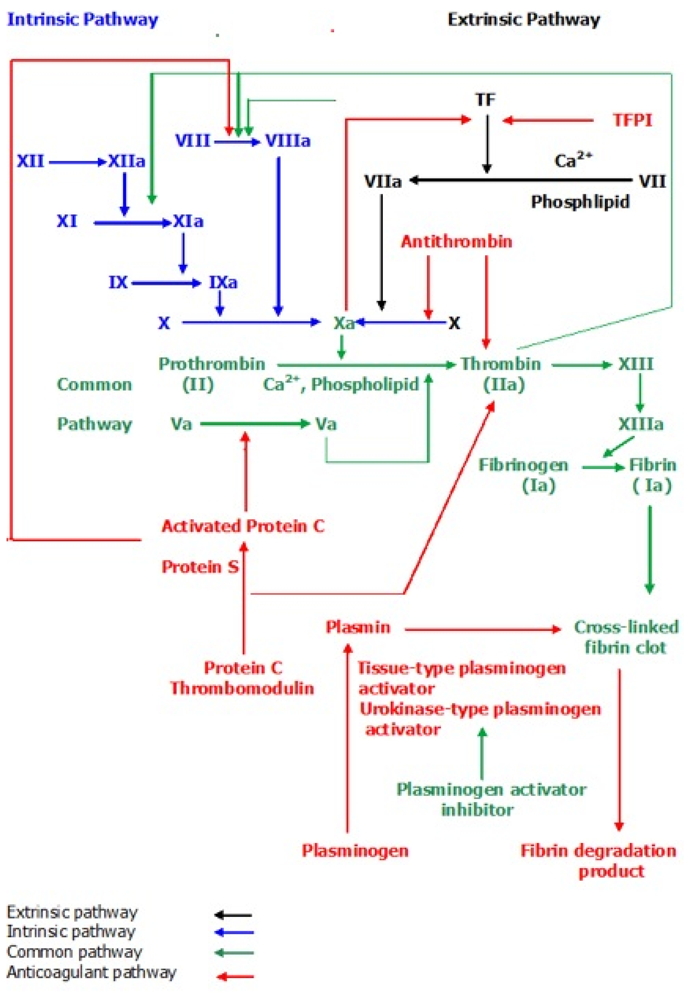
<p>Tissue factor (TF), designated CD 142, is a glycoprotein receptor [<xref ref-type="bibr" rid="b22-cancers-03-00267">22</xref>]. In addition to its principal role in the initiation of the extrinsic pathway of coagulation [<xref ref-type="bibr" rid="b23-cancers-03-00267">23</xref>-<xref ref-type="bibr" rid="b25-cancers-03-00267">25</xref>] (<xref ref-type="fig" rid="f1-cancers-03-00267">Figure 1</xref>), TF also has a major role in angiogenesis and tumor growth [<xref ref-type="bibr" rid="b26-cancers-03-00267">26</xref>-<xref ref-type="bibr" rid="b34-cancers-03-00267">34</xref>]. TF consists of three domains (extracellular, transmembrane and cytoplasmic) that have distinct roles [<xref ref-type="bibr" rid="b25-cancers-03-00267">25</xref>]. TF is normally expressed in host cells such as endothelial cells, monocytes, macrophages and fibroblasts in response to inflammatory stimuli, or remodeling signals in malignant cases [<xref ref-type="bibr" rid="b35-cancers-03-00267">35</xref>]. The plasma of healthy individuals contains relatively minor amounts of biologically active TF [<xref ref-type="bibr" rid="b36-cancers-03-00267">36</xref>], but this increases in various conditions including cancer [<xref ref-type="bibr" rid="b37-cancers-03-00267">37</xref>]. PC has been associated with increased plasma TF concentration, which is positively correlated with the incidence of TE [<xref ref-type="bibr" rid="b11-cancers-03-00267">11</xref>,<xref ref-type="bibr" rid="b38-cancers-03-00267">38</xref>].</p>
<p>There are several mechanisms that control TF activity, principally TF pathway inhibitor (TFPI) (<xref ref-type="fig" rid="f1-cancers-03-00267">Figure 1</xref>), which is a serine protease inhibitor [<xref ref-type="bibr" rid="b39-cancers-03-00267">39</xref>] released from endothelial cells [<xref ref-type="bibr" rid="b40-cancers-03-00267">40</xref>] and acts as an endogenous regulator of TF [<xref ref-type="bibr" rid="b41-cancers-03-00267">41</xref>]. TFPI is composed of three Kunitz type protease inhibitor domains and a C-terminal polybasic motif. The first TFPI domain reacts with and inhibits FVII in TF-FVIIa complex; the second TFPI domain reacts with and inhibits FXa in TF-FVII-FXa complex [<xref ref-type="bibr" rid="b39-cancers-03-00267">39</xref>,<xref ref-type="bibr" rid="b42-cancers-03-00267">42</xref>] and the third domain of TFPI has an unknown function at this time.</p>
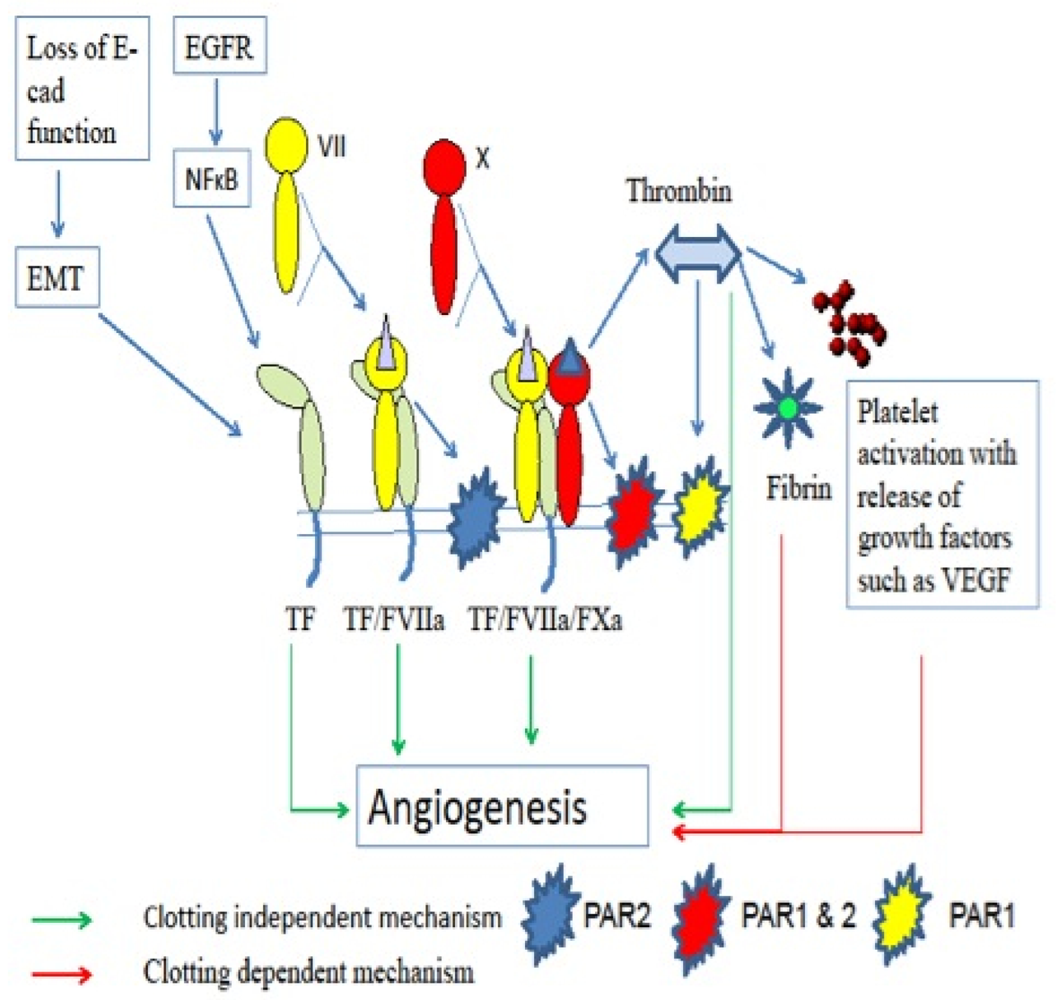
<p>TF expression can be regulated by epidermal growth factor receptor (EGFR) signaling via nuclear factor kappa B (NF-κB) and through the loss of E-cadherin (<xref ref-type="fig" rid="f2-cancers-03-00267">Figure 2</xref>) [<xref ref-type="bibr" rid="b43-cancers-03-00267">43</xref>] and by FXa, which has a negative feedback effect on the regulation of TF (<xref ref-type="fig" rid="f1-cancers-03-00267">Figure 1</xref>) [<xref ref-type="bibr" rid="b44-cancers-03-00267">44</xref>]. TF expression may also be affected by changes in the activity of phosphatidylinositol 3-kinases (PI3K), and the mitogen-activated protein kinase (MAPK) family members MAPKp38 and extracellular signal-regulated kinases-1/2 (Erk1/2). In tumor cells, the activity of PI3K is decreased and both p38 and Erk1/2 are increased [<xref ref-type="bibr" rid="b45-cancers-03-00267">45</xref>] resulting in an increase in cell proliferation.</p></sec>
<sec>
<label>3.</label>
<title>Angiogenesis in Pancreatic Cancer</title>
<p>Angiogenesis is defined as new blood vessel formation from the pre-existing vascular network, consisting of three stages: migration, proliferation and differentiation. It can be physiological as in wound healing, tissue remodeling, regeneration and the menstrual cycle or patho-physiological as in cancer, rheumatoid arthritis and atherosclerosis. Tumors can grow up to 1–2 mm<sup>3</sup> without formation of new blood vessels; however angiogenesis is essential for greater growth [<xref ref-type="bibr" rid="b46-cancers-03-00267">46</xref>]. Recently, Lomberk <italic>et al.</italic> suggested that PC is one of the more angiogenesis-driven tumors and rapid tumor growth with a poor prognosis has been positively correlated with increased angiogenesis [<xref ref-type="bibr" rid="b47-cancers-03-00267">47</xref>]. There are two mechanisms for promotion of angiogenesis in which proteins of the coagulation pathway can be involved: clotting dependent and clotting independent.</p>
<sec>
<label>3.1.</label>
<title>Clotting Dependent Mechanism of Angiogenesis</title>
<p>The extrinsic pathway of the coagulation cascade and clotting dependent mechanism of angiogenesis is initiated by activation of TF receptors via ligand binding; TF binds with FVII to form TF/ FVIIa complex [<xref ref-type="bibr" rid="b48-cancers-03-00267">48</xref>]. This complex triggers the coagulation cascade (<xref ref-type="fig" rid="f1-cancers-03-00267">Figure 1</xref>) which involves activation of FX to FXa in the presence of Ca<sup>2+</sup> and phospholipid (PL), followed by the conversion of prothrombin (FII) to thrombin (FIIa) [<xref ref-type="bibr" rid="b48-cancers-03-00267">48</xref>] which is crucial in clot formation due to fibrin formation and platelet activation [<xref ref-type="bibr" rid="b49-cancers-03-00267">49</xref>]. Activated platelets can then promote angiogenesis by releasing a number of pro-angiogenic factors such as vascular endothelial factor (VEGF), beta fibroblast growth factor (β-FGF) and platelet derived growth factor (PDGF) [<xref ref-type="bibr" rid="b50-cancers-03-00267">50</xref>] (<xref ref-type="fig" rid="f2-cancers-03-00267">Figure 2</xref>).</p></sec>
<sec>
<label>3.2.</label>
<title>Clotting Independent Mechanism of Angiogenesis</title>
<p>In addition to its role in the clotting dependent mechanism, thrombin also has a role in the clotting independent mechanism of angiogenesis through proteolytic cleavage of protease-activated receptors (PAR). There are four PAR, of which PAR-1, PAR-3 and PAR-4 are cleaved by thrombin while the proteases trypsin, tryptase, TF-FVIIa and FXa can activate PAR-2 [<xref ref-type="bibr" rid="b51-cancers-03-00267">51</xref>-<xref ref-type="bibr" rid="b56-cancers-03-00267">56</xref>]. There are several different pathways for clotting independent mechanisms of angiogenesis (<xref ref-type="fig" rid="f2-cancers-03-00267">Figure 2</xref>), including a direct effect of TF-FVIIa that is dependent on phosphorylation of the cytoplasmic domain of TF, as mediated by PAR-2. Other pathways are mediated by FVIIa and FXa activation of PAR-2 [<xref ref-type="bibr" rid="b57-cancers-03-00267">57</xref>], for example the TF/FVIIa complex reacts with FXa to form TF/FVIIa/FXa, and this complex triggers protease-activated G protein-coupled receptors, through PAR-1 and PAR-2 [<xref ref-type="bibr" rid="b58-cancers-03-00267">58</xref>]. Furthermore, TF-FVIIa-PAR-2 signaling induces the production of pro-angiogenic factors including VEGF [<xref ref-type="bibr" rid="b59-cancers-03-00267">59</xref>,<xref ref-type="bibr" rid="b60-cancers-03-00267">60</xref>]. In addition, thrombin stimulates adhesion of pancreatic cancer cells to endothelial cells and extracellular matrix [<xref ref-type="bibr" rid="b61-cancers-03-00267">61</xref>] and also stimulates gelatinase matrix metalloproteinase-2 (MMP-2), which is a collagen type IV degrading enzyme [<xref ref-type="bibr" rid="b62-cancers-03-00267">62</xref>], therefore enhancing invasion of the basement membrane. All these mechanisms contribute to enhance tumor progression, growth, angiogenesis cell invasion.</p></sec></sec>
<sec>
<label>4.</label>
<title>Factors That Can Enhance Thrombosis in PC</title>
<sec>
<label>4.1.</label>
<title>Extrinsic Factors</title>
<p>The association of increased TE in PC is enhanced with the appearance of distant metastases [<xref ref-type="bibr" rid="b63-cancers-03-00267">63</xref>] and conventional superimposed risk factors such as acute medical conditions (e.g., concurrent infection, heart failure and obstructive pulmonary disorders (COPD) [<xref ref-type="bibr" rid="b64-cancers-03-00267">64</xref>] and surgery can further exacerbate this risk [<xref ref-type="bibr" rid="b65-cancers-03-00267">65</xref>]. Moreover, the systemic treatments used in PC patients may have a significant prothrombotic effect; chemotherapy for example increases the incidence of TE in PC up to 4.8 fold [<xref ref-type="bibr" rid="b14-cancers-03-00267">14</xref>]. There are distinct mechanisms which may enhance TE in cancer treated with chemotherapy; platelet activation, decrease of the natural inhibitor factors (such as antithrombin III, protein S and protein C), damage of the blood vessel wall/endothelium [<xref ref-type="bibr" rid="b66-cancers-03-00267">66</xref>] and more recently it has been postulated that chemotherapy increases apoptosis in PC [<xref ref-type="bibr" rid="b67-cancers-03-00267">67</xref>]. The latter process could lead to apoptotic cells and cellular fragments being increased within the circulation, both having a generally pro-coagulant surface due to TF and PL/phosphatidylserine exposure.</p></sec>
<sec>
<label>4.2.</label>
<title>Intrinsic Factors</title>
<p>Tumor cells could directly activate the host cells (endothelial cells, platelets, leucocytes) due to secretion of mucin. Although most of the mucin that enters the blood circulation is cleared by the liver, some of it remains in the circulation and can react with P-selectin on platelets, L-selectin on the leukocytes and P-and E-selectin on vascular endothelium leading to formation of platelet-rich thrombi [<xref ref-type="bibr" rid="b68-cancers-03-00267">68</xref>]. Additionally, the expression of many pro-angiogenic factors such as VEGF [<xref ref-type="bibr" rid="b69-cancers-03-00267">69</xref>-<xref ref-type="bibr" rid="b74-cancers-03-00267">74</xref>], EGFR [<xref ref-type="bibr" rid="b73-cancers-03-00267">73</xref>], and platelet-derived endothelial cell growth factor [<xref ref-type="bibr" rid="b75-cancers-03-00267">75</xref>] are increased in PC. The expression of VEGF in PC tissue is associated with the microvessel density (MVD) [<xref ref-type="bibr" rid="b71-cancers-03-00267">71</xref>]. Furthermore, clinical and laboratory studies suggest that expression of pro-angiogenic markers such as epidermal growth factor (EGF), VEGF, and thymidine phosphorylase on malignant cells including PC are all positively associated with an increase in angiogenesis and a poor prognosis [<xref ref-type="bibr" rid="b48-cancers-03-00267">48</xref>,<xref ref-type="bibr" rid="b76-cancers-03-00267">76</xref>].</p>
<p>Pro-angiogenic factors enhance tumor cell invasion and angiogenesis as they cause decreased apoptosis, increase survival and cell proliferation [<xref ref-type="bibr" rid="b77-cancers-03-00267">77</xref>,<xref ref-type="bibr" rid="b78-cancers-03-00267">78</xref>]. Although the mechanism by which pro-angiogenic factors control survival and apoptosis is not clear, it is thought that the binding of these factors results in PI3K/Akt, Ras/MAPK up-regulation [<xref ref-type="bibr" rid="b79-cancers-03-00267">79</xref>], and p38MAPK-dependent apoptosis pathways down-regulation [<xref ref-type="bibr" rid="b80-cancers-03-00267">80</xref>,<xref ref-type="bibr" rid="b82-cancers-03-00267">82</xref>]. Furthermore, VEGF can regulate αvβ3 integrin which enhances cell migration and survival when it is associated with VEGF receptor-2 (VEGFR2) [<xref ref-type="bibr" rid="b83-cancers-03-00267">83</xref>,<xref ref-type="bibr" rid="b84-cancers-03-00267">84</xref>]. Other contributing mechanisms could include the Ras/MAK, PI3K/Akt, Janus kinase (JAK)/Stat and phospholipase C /protein kinase C pathways which are the main signaling pathways activated by EGFR1, resulting in activation of genes that cause over-expression of angiogenic factors, increased cell proliferation, migration, adhesion, differentiation and apoptosis [<xref ref-type="bibr" rid="b85-cancers-03-00267">85</xref>].</p></sec></sec>
<sec>
<label>5.</label>
<title>EGFR in Hemostasis and Angiogenesis</title>
<p>It has been noted that over-expression of EGFR1 was seen in 43% of human PC cases and its expression appears to be correlated with poor prognosis, an increased tumor aggressiveness and enhanced angiogenesis [<xref ref-type="bibr" rid="b73-cancers-03-00267">73</xref>,<xref ref-type="bibr" rid="b86-cancers-03-00267">86</xref>]. EGFR1 expression on PC differs according to the part of the pancreas that is cancerous. For example, cancer of the papilla of Vater did not show an over-expression of EGFR1 compared with a normal control, while cancer of other parts of the pancreas showed over-expression of EGFR1 reaching up to 60%. A range of EGFR2 expression has been reported in PC [<xref ref-type="bibr" rid="b87-cancers-03-00267">87</xref>-<xref ref-type="bibr" rid="b88-cancers-03-00267">88</xref>] however, no effect on prognosis was observed. The dysregulation of EGFR1 and EGFR2 is involved in oncogenesis [<xref ref-type="bibr" rid="b89-cancers-03-00267">89</xref>]. In addition EGFR1 and EGFR2 may affect tumor growth by up-regulation of pro-angiogenic markers such as VEGF [<xref ref-type="bibr" rid="b85-cancers-03-00267">85</xref>,<xref ref-type="bibr" rid="b90-cancers-03-00267">90</xref>,<xref ref-type="bibr" rid="b91-cancers-03-00267">91</xref>], and TF [<xref ref-type="bibr" rid="b30-cancers-03-00267">30</xref>] and in this way will enhance angiogenesis and tumor growth. Milson <italic>et al.</italic> postulated that TF expression could be regulated by EGFR, likely controlled partially via NF-κB signaling [<xref ref-type="bibr" rid="b43-cancers-03-00267">43</xref>].</p>
<p>Kinase suppressor of Ras1 (KSR1) is involved in the control of both pro-coagulant and aggressive phenotypes of cancer cells by up-regulation of TF downstream of Erb (EGFR) oncogenes [<xref ref-type="bibr" rid="b92-cancers-03-00267">92</xref>], and the use of KSR1 targeting agents is being explored as a therapeutic strategy [<xref ref-type="bibr" rid="b93-cancers-03-00267">93</xref>-<xref ref-type="bibr" rid="b95-cancers-03-00267">95</xref>]. Based on these studies, EGFR-driven up-regulation of TF (and therefore targeting of EGFR receptor directly or indirectly through KSR1) is a potential target for the treatment of PC</p></sec>
<sec>
<label>6.</label>
<title>Thrombosis and Microparticles in Pancreatic Cancer</title>
<p>MP are membrane vesicles of approximately 0.1-1 μm in diameter shed from the plasma membrane of healthy, apoptotic and stimulated cells [<xref ref-type="bibr" rid="b96-cancers-03-00267">96</xref>,<xref ref-type="bibr" rid="b97-cancers-03-00267">97</xref>]. MP express antigenic markers distinctive of the parent cell [<xref ref-type="bibr" rid="b98-cancers-03-00267">98</xref>], and may also have a pro-coagulant, negatively charged PL surface, which could support coagulation [<xref ref-type="bibr" rid="b99-cancers-03-00267">99</xref>-<xref ref-type="bibr" rid="b101-cancers-03-00267">101</xref>]. There is accumulating evidence of a correlation between TF activity expressed on MP and TE in cancers [<xref ref-type="bibr" rid="b99-cancers-03-00267">99</xref>]. It has been reported by some investigators that TF bearing MP (TF + MP) involved in coagulation results in an increase of blood clot size rather than initiate coagulation [<xref ref-type="bibr" rid="b102-cancers-03-00267">102</xref>], because the TF within the MP is thought to be either at too low a level to trigger clot formation itself or is encrypted; other investigators however, suggest that TF + MP promotes coagulation and has an effect on vascular function [<xref ref-type="bibr" rid="b97-cancers-03-00267">97</xref>]. Pro-coagulant activity in cancer patients depends to a large degree on numbers of circulating TF and PL bearing MP [<xref ref-type="bibr" rid="b29-cancers-03-00267">29</xref>]. Evidence that the tumor may be the main source of TF + MP comes from the demonstration that TF + MP reduces substantially after successful surgery to remove tumors [<xref ref-type="bibr" rid="b101-cancers-03-00267">101</xref>,<xref ref-type="bibr" rid="b103-cancers-03-00267">103</xref>] and a correlation between the level of TF + MP activity and number with thrombosis has been demonstrated [<xref ref-type="bibr" rid="b21-cancers-03-00267">21</xref>,<xref ref-type="bibr" rid="b103-cancers-03-00267">103</xref>-<xref ref-type="bibr" rid="b105-cancers-03-00267">105</xref>].</p>
<p>There is cumulative evidence that P-selectin ligand-1 (PSGL-1), in addition to its role in leukocyte trafficking, has a role in blood coagulation due to its effect on TF-containing hybrid MP of platelet and monocyte origin [<xref ref-type="bibr" rid="b106-cancers-03-00267">106</xref>,<xref ref-type="bibr" rid="b107-cancers-03-00267">107</xref>] which can activate the coagulation cascade and enhance the TF-FVIIa complex proteolytic activity [<xref ref-type="bibr" rid="b108-cancers-03-00267">108</xref>]. For this reason P-selectin has been used as an independent indicator for TE risk [<xref ref-type="bibr" rid="b109-cancers-03-00267">109</xref>].</p>
<p>It has also been demonstrated that tumour growth, metastasis, angiogenesis and thrombosis can be stimulated by TF + MP [<xref ref-type="bibr" rid="b29-cancers-03-00267">29</xref>,<xref ref-type="bibr" rid="b31-cancers-03-00267">31</xref>-<xref ref-type="bibr" rid="b34-cancers-03-00267">34</xref>] . Furthermore, increased levels of MP can be found in patients with a number of cancers but the highest levels of TF activity are those in PC patients [<xref ref-type="bibr" rid="b99-cancers-03-00267">99</xref>,<xref ref-type="bibr" rid="b104-cancers-03-00267">104</xref>]. In a series of 37 cancer-free controls, 23 advanced PC and 17 advanced breast cancer, the upper limit of TF activity in the normal range was 273 fM Xa min<sup>-1</sup>. Thirty-four percent of PC patients and 29% of advanced breast cancer cases involved in this study had TF activity above the upper limit of the normal range. Interestingly, there was no correlation between the absolute number of MP and the reported TF activity [<xref ref-type="bibr" rid="b103-cancers-03-00267">103</xref>].</p>
<p>Tesselaar <italic>et al.</italic> [<xref ref-type="bibr" rid="b104-cancers-03-00267">104</xref>] used the same upper limit for normal range of TF activity, and also reported that the TF activity associated with TF + MP was significantly higher in cancer patients than non-cancer patients. For 51 cancer patients with thrombosis the mean TF activity was 1125 fM Xa min<sup>−1</sup> (19–12,333 fM Xa min<sup>-1</sup>). This group consisted of patients with the following types of tumor: 14 colorectal, 10 pancreatic, six testicular, four renal, three ovarian, two esophageal, two prostatic, two bone, two laryngeal, two breast, two respiratory tract, one bile duct and one adrenal cancer. Of these, the highest noted MP associated TF activity was 2,080 fM Xa min<sup>−1</sup> (510–12,333) in PC. TF activity was also relatively high (55–1,578 fM Xa min<sup>−1</sup>) in colorectal cancer. The range of other tumors studied showed a TF activity between 80–603 fM Xa min<sup>−1</sup> [<xref ref-type="bibr" rid="b104-cancers-03-00267">104</xref>]. The mean TF + MP activity in 49 cancer patients without thrombosis was 162 fM Xa min<sup>−1</sup> (23–535 fM Xa min<sup>−1</sup>). In a series of nine patients with lung cancer, three with breast cancer, one with PC, one with renal, one with sarcoma and 23 healthy controls, Tilley <italic>et al.</italic> reported that PC has the highest TF activity (48.3 pM) of all malignancies tested within the study [<xref ref-type="bibr" rid="b99-cancers-03-00267">99</xref>].</p>
<p>Zwicker <italic>et al.</italic> observed that there was no statistical difference in TF + MP numbers in healthy controls and non-small cell lung cancer, while TF + MP were significantly higher in pancreatic cancer (32 of 47 PC cases) [<xref ref-type="bibr" rid="b105-cancers-03-00267">105</xref>]. It was reported that the highest incidence of patients with TF + MP above a lower detectable limit was observed in PC (25 of 39) followed by colorectal carcinoma (7 of 12), compared with non-cancer controls (6 of 31) and that the number of TF + MP in PC and colorectal cancer was significantly higher than in non-cancer controls [<xref ref-type="bibr" rid="b101-cancers-03-00267">101</xref>]. However, the difference in the number of TF + MP compared with non-cancer controls was insignificant in lung cancer (5 of 28), breast cancer (4 of 9) and ovarian cancer (5 of 8) suggesting that TF + MP have an important role in the pro-coagulant phenotype and may be a contributing factor related to the high incidence of TE associated with PC patients [<xref ref-type="bibr" rid="b29-cancers-03-00267">29</xref>].</p></sec>
<sec>
<label>7.</label>
<title>The Clinical Experience of Targeting Growth Factor Receptors in Pancreatic Cancer</title>
<p>From the clinical perspective, two recently completed trials of antiangiogenic agents (bevacizumab or Avastin®) and axitinib (S1005 and AG-013736)], when used as a first line treatment in combination with standard therapy in the setting of PC, yielded disappointing results. Firstly, axitnib in combination with gemcitabine resulted in a median overall survival of 7.4 months, compared to 8.2 months for gemcitabine alone, in 630 patients [<xref ref-type="bibr" rid="b110-cancers-03-00267">110</xref>]. Secondly, bevacizumab, in combination with gemcitabine also failed to confer any increase in overall survival (5.8 months) when compared to gemcitabine alone (5.9 months) in a study of 535 patients [<xref ref-type="bibr" rid="b111-cancers-03-00267">111</xref>]. Gemcitabine is one of the standard chemotherapy treatments that has been used widely in PC and has a cytotoxic action toward proliferative cells during the S phase of the cell cycle [<xref ref-type="bibr" rid="b112-cancers-03-00267">112</xref>]. Furthermore, in a large (607 patients) randomized phase III clinical trial, where a triple combination of bevacizumab , erlotinib and gemcitabine was compared to gemcitabine, erlotinib and placebo, no statistical difference in the median overall survival rate was found (7.1 <italic>vs.</italic> 6.0 months respectively; p = 0.209) [<xref ref-type="bibr" rid="b113-cancers-03-00267">113</xref>]. A concern remains that these agents also drive thrombosis and whatever potential benefit from anti-cancer treatments may exist may be lost through excess thrombotic events [<xref ref-type="bibr" rid="b17-cancers-03-00267">17</xref>].</p>
<p>Two other recently concluded trials of anti-EGFR agents [erlotinib (Tarceva®) and cetuximab (Erbitux)] in the setting of advanced pancreatic cancer (APC) have yielded conflicting results. A large randomized clinical trial of Tarceva® and gemcitabine <italic>vs.</italic> gemcitabine alone produced one of the few positive results in APC [<xref ref-type="bibr" rid="b14-cancers-03-00267">14</xref>]. In this series of 569 cases of APC, the median overall survival was significantly prolonged with Tarceva® (100 mg/ daily) and gemcitabine compared with gemcitabine only (6.24 <italic>vs.</italic> 5.91 months, p = 0.038); a marginal clinical improvement that was seen only in the stage IV patients. There was no significant difference in the objective response rate and there were many grade I and II side effects in the group treated with Tarceva® and gemcitabine, such as rash, diarrhea, stomatitis and infection [<xref ref-type="bibr" rid="b14-cancers-03-00267">14</xref>]. However, a larger randomized clinical trial of cetuximab (IgG1 monoclonal antibody against EGFR) and gemcitabine <italic>vs.</italic> gemcitabine alone was negative. In this randomized controlled trial of 745 patients with APC, the gemcitabine and cetuximab did not demonstrate a survival prolongation compared to gemcitabine alone (6.3 months for gemcitabine plus cetuximab <italic>vs.</italic> 5.9 months for gemcitabine alone; p = 0.23) [<xref ref-type="bibr" rid="b114-cancers-03-00267">114</xref>]. To date, therefore, there is little positive outcome demonstrated for the targeting of growth factor receptors in PC.</p></sec>
<sec>
<label>8.</label>
<title>Clinical Evidence of Benefit from Direct Interference with the Coagulation Apparatus</title>
<p>Heparin can potentially act as an anti-cancer factor via a variety of mechanisms. It inhibits several coagulation factors such as thrombin, FXa, FIXa, FXIa, FXIIa [<xref ref-type="bibr" rid="b50-cancers-03-00267">50</xref>] and inhibits cell proliferation, particularly of those cells that over express PAR-1 [<xref ref-type="bibr" rid="b115-cancers-03-00267">115</xref>]. Heparin also it interacts with VEGF-165 and VEGF-189 expressed on malignant cells [<xref ref-type="bibr" rid="b116-cancers-03-00267">116</xref>] and could inhibit angiogenesis via blocking of P-and L-selectin [<xref ref-type="bibr" rid="b117-cancers-03-00267">117</xref>]. We have recently shown that low molecular weight heparin (LMWH) can decrease the angiogenic and chemoattractant activity of PC patients' sera [<xref ref-type="bibr" rid="b118-cancers-03-00267">118</xref>].</p>
<p>A recent randomized phase IIb study in APC of gemcitabine <italic>vs.</italic> weight-adjusted dalteparin, a type of LMWH, demonstrated a significant decrease in the overall incidence of venous TE from 31% to 12%, with a reduction of recorded lethal TE and sudden death from 9% to 0%. These differences were significant but the trial was too small to demonstrate an overall survival advantage [<xref ref-type="bibr" rid="b119-cancers-03-00267">119</xref>]. In a second larger randomized trial, Reiss <italic>et al.</italic> [<xref ref-type="bibr" rid="b120-cancers-03-00267">120</xref>] studied 312 APC patients receiving chemotherapy randomized into two groups: those with enoxaparin (Fragmin®), which is another type of LMWH, and those without enoxaparin. Similar to Maraveyas <italic>et al.</italic>, a significant decrease of clinical TE was found 5% <italic>vs.</italic> 15%, respectively, in the group treated with LMWH. However, once again no overall survival benefit was documented [<xref ref-type="bibr" rid="b120-cancers-03-00267">120</xref>]. Epstein <italic>et al.</italic> [<xref ref-type="bibr" rid="b121-cancers-03-00267">121</xref>] studied 6,870 PC cases of which 19% of patients suffered TE, 95% of PC patients that developed TE were treated with chemotherapy and LMWH and the survival time of PC patients who developed thrombosis at the time of the diagnosis was 6.2 months while that of those with secondary thrombosis after PC was 13.7 months [<xref ref-type="bibr" rid="b120-cancers-03-00267">120</xref>].</p></sec>
<sec sec-type="conclusions">
<label>9.</label>
<title>Conclusions</title>
<p>There is a clinical correlation between short survival time related to TE in PC; however, the underlying drivers of this phenomenon are complex. The use of LMWH can decrease plasma levels of TF, reduce thrombin activation and reduce the incidence of TE. Whether there is an overall survival gain from these treatments as suggested by some meta-analyses for mixed cancer populations [<xref ref-type="bibr" rid="b122-cancers-03-00267">122</xref>] is dependent upon future, appropriately powered studies. There is significant experimental evidence that the coagulation pathway and the growth factor pathways are linked exerting significant influence on the cancer process. However, randomized controlled clinical studies of single agent targeting of these pathways in conjunction with chemotherapy have not provided evidence of clinical benefit to date. More recently even, a dual targeting approach (EGFR1 and VEGF inhibition) has not produced survival benefit.</p>
<p>It is possible that refinement of these targeting strategies will also need the concurrent use of heparin-based treatment. Potentially beneficial impact could result through enhancement of the ‘targeted’ effects while simultaneously offsetting any prothrombotic impact these targeted molecules may have.</p></sec></body>
<back>
<sec sec-type="display-objects">
<title>Figures</title>
<fig id="f1-cancers-03-00267" position="float">
<label>Figure 1.</label>
<caption>
<p>The coagulation cascade.</p></caption>
<graphic xlink:href="cancers-03-00267f1.gif"/></fig>
<fig id="f2-cancers-03-00267" position="float">
<label>Figure 2.</label>
<caption>
<p>Clotting dependent and independent mechanisms of angiogenesis.</p></caption>
<graphic xlink:href="cancers-03-00267f2.gif"/></fig></sec>
<ref-list>
<title>References</title>
<ref id="b1-cancers-03-00267"><label>1.</label><citation citation-type="journal"><person-group person-group-type="author"><name><surname>Trousseau</surname><given-names>A.</given-names></name></person-group><article-title>Phlegmasia alba dolens</article-title><source>Clin. Med. Hotel. Dieu. Paris</source><year>1865</year><volume>3</volume><fpage>654</fpage><lpage>712</lpage></citation></ref>
<ref id="b2-cancers-03-00267"><label>2.</label><citation citation-type="journal"><person-group person-group-type="author"><name><surname>Stein</surname><given-names>P.D.</given-names></name><name><surname>Kayali</surname><given-names>F.</given-names></name><name><surname>Silbergleit</surname><given-names>A.</given-names></name><name><surname>Hull</surname><given-names>R.D.</given-names></name><name><surname>On</surname><given-names>R.E.O.</given-names></name></person-group><article-title>Incidence of pregnancy-associated venous thromboembolism</article-title><source>Ann. Internal. Med.</source><year>2006</year><volume>144</volume><fpage>453</fpage><lpage>454</lpage></citation></ref>
<ref id="b3-cancers-03-00267"><label>3.</label><citation citation-type="journal"><person-group person-group-type="author"><name><surname>Blom</surname><given-names>J.W.</given-names></name><name><surname>Doggen</surname><given-names>C.J.M.</given-names></name><name><surname>Osanto</surname><given-names>S.</given-names></name><name><surname>Rosendaal</surname><given-names>F.R.</given-names></name></person-group><article-title>Malignancies, prothrombotic mutations, and the risk of venous thrombosis</article-title><source>JAMA</source><year>2005</year><volume>293</volume><fpage>715</fpage><lpage>722</lpage><pub-id pub-id-type="doi">10.1001/jama.293.6.715</pub-id><pub-id pub-id-type="pmid">15701913</pub-id></citation></ref>
<ref id="b4-cancers-03-00267"><label>4.</label><citation citation-type="journal"><person-group person-group-type="author"><name><surname>Heit</surname><given-names>J.A.</given-names></name><name><surname>O'Fallon</surname><given-names>W.M.</given-names></name><name><surname>Petterson</surname><given-names>T.M.</given-names></name><name><surname>Lohse</surname><given-names>C.M.</given-names></name><name><surname>Silverstein</surname><given-names>M.D.</given-names></name><name><surname>Mohr</surname><given-names>D.N.</given-names></name><name><surname>Melton</surname><given-names>L.J.</given-names></name></person-group><article-title>Relative impact of risk factors for deep vein thrombosis and pulmonary embolism - A population-based study</article-title><source>Arch. Intern. Med.</source><year>2002</year><volume>162</volume><fpage>1245</fpage><lpage>1248</lpage><pub-id pub-id-type="doi">10.1001/archinte.162.11.1245</pub-id><pub-id pub-id-type="pmid">12038942</pub-id></citation></ref>
<ref id="b5-cancers-03-00267"><label>5.</label><citation citation-type="journal"><person-group person-group-type="author"><name><surname>Kirwan</surname><given-names>C.C.</given-names></name><name><surname>Nath</surname><given-names>E.</given-names></name><name><surname>Byrne</surname><given-names>G.J.</given-names></name><name><surname>McCollum</surname><given-names>C.N.</given-names></name></person-group><article-title>Prophylaxis for venous thromboembolism during treatment for cancer: Questionnaire survey</article-title><source>BMJ</source><year>2003</year><volume>327</volume><fpage>597</fpage><lpage>598</lpage><pub-id pub-id-type="doi">10.1136/bmj.327.7415.597</pub-id><pub-id pub-id-type="pmid">12969928</pub-id></citation></ref>
<ref id="b6-cancers-03-00267"><label>6.</label><citation citation-type="journal"><person-group person-group-type="author"><name><surname>Kakkar</surname><given-names>A.K.</given-names></name><name><surname>Levine</surname><given-names>M.</given-names></name><name><surname>Pinedo</surname><given-names>H.M.</given-names></name><name><surname>Wolff</surname><given-names>R.</given-names></name><name><surname>Wong</surname><given-names>J.</given-names></name></person-group><article-title>Venous thrombosis in cancer patients: Insights from the FRONTLINE survey</article-title><source>Oncologist</source><year>2003</year><volume>8</volume><fpage>381</fpage><lpage>388</lpage><pub-id pub-id-type="doi">10.1634/theoncologist.8-4-381</pub-id><pub-id pub-id-type="pmid">12897335</pub-id></citation></ref>
<ref id="b7-cancers-03-00267"><label>7.</label><citation citation-type="journal"><person-group person-group-type="author"><name><surname>Sproul</surname><given-names>E.</given-names></name></person-group><article-title>Carcinoma and venous thrombosis: The frequency of association of carcinoma in the body or tail of the pancreas with multiple venous thrombosis</article-title><source>Am. J. Cancer</source><year>1938</year><volume>34</volume><fpage>566</fpage><lpage>585</lpage></citation></ref>
<ref id="b8-cancers-03-00267"><label>8.</label><citation citation-type="journal"><person-group person-group-type="author"><name><surname>Ogren</surname><given-names>M.</given-names></name><name><surname>Bergqvist</surname><given-names>D.</given-names></name><name><surname>Wahlander</surname><given-names>K.</given-names></name><name><surname>Eriksson</surname><given-names>H.</given-names></name><name><surname>Sternby</surname><given-names>N.H.</given-names></name></person-group><article-title>Trousseau'ssyndrome - what is the evidence? A population-based autopsy study</article-title><source>Thromb. Haemost</source><year>2006</year><volume>95</volume><fpage>541</fpage><lpage>545</lpage><pub-id pub-id-type="pmid">16525584</pub-id></citation></ref>
<ref id="b9-cancers-03-00267"><label>9.</label><citation citation-type="journal"><person-group person-group-type="author"><name><surname>Khorana</surname><given-names>A.A.</given-names></name><name><surname>Fine</surname><given-names>R.L.</given-names></name></person-group><article-title>Pancreatic cancer and thromboembolic disease</article-title><source>Lancet Oncol.</source><year>2004</year><volume>5</volume><fpage>655</fpage><lpage>663</lpage><pub-id pub-id-type="doi">10.1016/S1470-2045(04)01606-7</pub-id><pub-id pub-id-type="pmid">15522652</pub-id></citation></ref>
<ref id="b10-cancers-03-00267"><label>10.</label><citation citation-type="journal"><person-group person-group-type="author"><name><surname>Shah</surname><given-names>M.M.</given-names></name><name><surname>Saif</surname><given-names>M.W.</given-names></name></person-group><article-title>Pancreatic Cancer and Thrombosis</article-title><source>J. Pancreas</source><year>2010</year><volume>5</volume><fpage>331</fpage><lpage>333</lpage></citation></ref>
<ref id="b11-cancers-03-00267"><label>11.</label><citation citation-type="journal"><person-group person-group-type="author"><name><surname>Khorana</surname><given-names>A.A.</given-names></name><name><surname>Francis</surname><given-names>C.W.</given-names></name><name><surname>Menzies</surname><given-names>K.E.</given-names></name><name><surname>Wang</surname><given-names>J.G.</given-names></name><name><surname>Hyrien</surname><given-names>O.</given-names></name><name><surname>Hathcock</surname><given-names>J.</given-names></name><name><surname>Mackman</surname><given-names>N.</given-names></name><name><surname>Taubman</surname><given-names>M.B.</given-names></name></person-group><article-title>Plasma tissue factor may be predictive of venous thromboembolism in pancreatic cancer</article-title><source>J. Thromb. Haematol.</source><year>2008</year><volume>6</volume><fpage>1983</fpage><lpage>1985</lpage><pub-id pub-id-type="doi">10.1111/j.1538-7836.2008.03156.x</pub-id></citation></ref>
<ref id="b12-cancers-03-00267"><label>12.</label><citation citation-type="journal"><person-group person-group-type="author"><name><surname>Heit</surname><given-names>J.A.</given-names></name><name><surname>Mohr</surname><given-names>D.N.</given-names></name><name><surname>Silverstein</surname><given-names>M.D.</given-names></name><name><surname>Petterson</surname><given-names>T.M.</given-names></name><name><surname>O'Fallon</surname><given-names>W.M.</given-names></name><name><surname>Melton</surname><given-names>L.J.</given-names></name></person-group><article-title>Predictors of recurrence after deep vein thrombosis and pulmonary embolism - A population-based cohort study</article-title><source>Arch. Intern. Med.</source><year>2000</year><volume>160</volume><fpage>761</fpage><lpage>768</lpage><pub-id pub-id-type="doi">10.1001/archinte.160.6.761</pub-id><pub-id pub-id-type="pmid">10737275</pub-id></citation></ref>
<ref id="b13-cancers-03-00267"><label>13.</label><citation citation-type="journal"><person-group person-group-type="author"><name><surname>Wall</surname><given-names>J.G.</given-names></name><name><surname>Weiss</surname><given-names>R.B.</given-names></name><name><surname>Norton</surname><given-names>L.</given-names></name><name><surname>Perloff</surname><given-names>M.</given-names></name><name><surname>Rice</surname><given-names>M.A.</given-names></name><name><surname>Korzun</surname><given-names>A.H.</given-names></name><name><surname>Wood</surname><given-names>W.C.</given-names></name></person-group><article-title>Arterial thrombosis associated with adjuvant chemotherapy for breast carcinoma-a cancer and leukemia group study</article-title><source>Am. J. Med.</source><year>1989</year><volume>87</volume><fpage>501</fpage><lpage>504</lpage><pub-id pub-id-type="doi">10.1016/S0002-9343(89)80604-7</pub-id><pub-id pub-id-type="pmid">2510514</pub-id></citation></ref>
<ref id="b14-cancers-03-00267"><label>14.</label><citation citation-type="journal"><person-group person-group-type="author"><name><surname>Moore</surname><given-names>M.J.</given-names></name><name><surname>Goldstein</surname><given-names>D.</given-names></name><name><surname>Hamm</surname><given-names>J.</given-names></name><name><surname>Figer</surname><given-names>A.</given-names></name><name><surname>Hecht</surname><given-names>J.</given-names></name><name><surname>Gallinger</surname><given-names>S.</given-names></name><name><surname>Au</surname><given-names>H.</given-names></name><name><surname>Ding</surname><given-names>K.</given-names></name><name><surname>Christy-Bittel</surname><given-names>J.</given-names></name><name><surname>Parulekar</surname><given-names>W.</given-names></name></person-group><article-title>Erlotinib plus gemcitabine compared to gemcitabine alone in patients with advanced pancreatic cancer. A phase III trial of the National Cancer Institute of Canada Clinical Trials Group NCIC-CTG</article-title><source>J. Clin. Oncol.</source><year>2005</year><volume>25</volume><fpage>1960</fpage><lpage>1966</lpage></citation></ref>
<ref id="b15-cancers-03-00267"><label>15.</label><citation citation-type="journal"><person-group person-group-type="author"><name><surname>Mandala</surname><given-names>M.</given-names></name><name><surname>Reni</surname><given-names>M.</given-names></name><name><surname>Cascinu</surname><given-names>S.</given-names></name><name><surname>Barni</surname><given-names>S.</given-names></name><name><surname>Floriani</surname><given-names>I.</given-names></name><name><surname>Cereda</surname><given-names>S.</given-names></name><name><surname>Berardi</surname><given-names>R.</given-names></name><name><surname>Mosconi</surname><given-names>S.</given-names></name><name><surname>Torri</surname><given-names>V.</given-names></name><name><surname>Labianca</surname><given-names>R.</given-names></name></person-group><article-title>Venous thromboembolism predicts poor prognosis in irresectable pancreatic cancer patients</article-title><source>Ann. Oncol.</source><year>2007</year><volume>18</volume><fpage>1660</fpage><lpage>1665</lpage><pub-id pub-id-type="doi">10.1093/annonc/mdm284</pub-id><pub-id pub-id-type="pmid">17660490</pub-id></citation></ref>
<ref id="b16-cancers-03-00267"><label>16.</label><citation citation-type="journal"><person-group person-group-type="author"><name><surname>Sgouros</surname><given-names>J.</given-names></name><name><surname>Maraveyas</surname><given-names>A.</given-names></name></person-group><article-title>Excess premature (3-month) mortality in advanced pancreatic cancer could be related to fatal vascular thromboembolic events. A hypothesis based on a systematic review of phase III chemotherapy studies in advanced pancreatic cancer</article-title><source>Acta Oncologica</source><year>2008</year><volume>47</volume><fpage>337</fpage><lpage>346</lpage><pub-id pub-id-type="doi">10.1080/02841860701687267</pub-id><pub-id pub-id-type="pmid">17957501</pub-id></citation></ref>
<ref id="b17-cancers-03-00267"><label>17.</label><citation citation-type="journal"><person-group person-group-type="author"><name><surname>Maraveyas</surname><given-names>A.</given-names></name><name><surname>Johnson</surname><given-names>M.</given-names></name></person-group><article-title>Does clinical method mask significant VTE-related mortality and morbidity in malignant disease?</article-title><source>Brit. J. Cancer</source><year>2009</year><volume>100</volume><fpage>1837</fpage><lpage>1841</lpage><pub-id pub-id-type="doi">10.1038/sj.bjc.6605091</pub-id><pub-id pub-id-type="pmid">19491905</pub-id></citation></ref>
<ref id="b18-cancers-03-00267"><label>18.</label><citation citation-type="journal"><person-group person-group-type="author"><name><surname>Nalluri</surname><given-names>S.R.</given-names></name><name><surname>Chu</surname><given-names>D.</given-names></name><name><surname>Keresztes</surname><given-names>R.</given-names></name><name><surname>Zhu</surname><given-names>X.L.</given-names></name><name><surname>Wu</surname><given-names>S.H.</given-names></name></person-group><article-title>Risk of Venous Thromboembolism With the Angiogenesis Inhibitor Bevacizumab in Cancer Patients A Meta-analysis</article-title><source>JAMA</source><year>2008</year><volume>300</volume><fpage>2277</fpage><lpage>2285</lpage><pub-id pub-id-type="doi">10.1001/jama.2008.656</pub-id><pub-id pub-id-type="pmid">19017914</pub-id></citation></ref>
<ref id="b19-cancers-03-00267"><label>19.</label><citation citation-type="journal"><person-group person-group-type="author"><name><surname>Heit</surname><given-names>J.A.</given-names></name><name><surname>Silverstein</surname><given-names>M.D.</given-names></name><name><surname>Mohr</surname><given-names>D.N.</given-names></name><name><surname>Petterson</surname><given-names>T.M.</given-names></name><name><surname>O'Fallon</surname><given-names>W.M.</given-names></name><name><surname>Melton</surname><given-names>L.J.</given-names></name></person-group><article-title>Risk factors for deep vein thrombosis and pulmonary embolism - A population-based case-control study</article-title><source>Arch. Intern. Med.</source><year>2000</year><volume>160</volume><fpage>809</fpage><lpage>815</lpage><pub-id pub-id-type="doi">10.1001/archinte.160.6.809</pub-id><pub-id pub-id-type="pmid">10737280</pub-id></citation></ref>
<ref id="b20-cancers-03-00267"><label>20.</label><citation citation-type="journal"><person-group person-group-type="author"><name><surname>Bennett</surname><given-names>C.L.</given-names></name><name><surname>Silver</surname><given-names>S.M.</given-names></name><name><surname>Djulbegovic</surname><given-names>B.</given-names></name><name><surname>Samaras</surname><given-names>A.T.</given-names></name><name><surname>Blau</surname><given-names>C.A.</given-names></name><name><surname>Gleason</surname><given-names>K.J.</given-names></name><name><surname>Barnato</surname><given-names>S.E.</given-names></name><name><surname>Elverman</surname><given-names>K.M.</given-names></name><name><surname>Courtney</surname><given-names>D.M.</given-names></name><name><surname>McKoy</surname><given-names>J.M.</given-names></name><name><surname>Edwards</surname><given-names>B.J.</given-names></name><name><surname>Tigue</surname><given-names>C.C.</given-names></name><name><surname>Raisch</surname><given-names>D.W.</given-names></name><name><surname>Yarnold</surname><given-names>P.R.</given-names></name><name><surname>Dorr</surname><given-names>D.A.</given-names></name><name><surname>Kuzel</surname><given-names>T.M.</given-names></name><name><surname>Tallman</surname><given-names>M.S.</given-names></name><name><surname>Trifilio</surname><given-names>S.M.</given-names></name><name><surname>West</surname><given-names>D.P.</given-names></name><name><surname>Lai</surname><given-names>S.Y.</given-names></name><name><surname>Henke</surname><given-names>M.</given-names></name></person-group><article-title>Venous thromboembolism and mortality associated with recombinant erythropoietin and darbepoetin administration for the treatment of cancer-associated anemia</article-title><source>JAMA</source><year>2008</year><volume>299</volume><fpage>914</fpage><lpage>924</lpage><pub-id pub-id-type="doi">10.1001/jama.299.8.914</pub-id><pub-id pub-id-type="pmid">18314434</pub-id></citation></ref>
<ref id="b21-cancers-03-00267"><label>21.</label><citation citation-type="journal"><person-group person-group-type="author"><name><surname>Khorana</surname><given-names>A.A.</given-names></name><name><surname>Ahrendt</surname><given-names>S.A.</given-names></name><name><surname>Ryan</surname><given-names>C.K.</given-names></name><name><surname>Francis</surname><given-names>C.W.</given-names></name><name><surname>Hruban</surname><given-names>R.H.</given-names></name><name><surname>Hu</surname><given-names>Y.C.</given-names></name><name><surname>Hostetter</surname><given-names>G.</given-names></name><name><surname>Harvey</surname><given-names>J.</given-names></name><name><surname>Taubman</surname><given-names>M.B.</given-names></name></person-group><article-title>Tissue factor expression, angiogenesis, and thrombosis in pancreatic cancer</article-title><source>Clin. Cancer Res.</source><year>2007</year><volume>13</volume><fpage>2870</fpage><lpage>2875</lpage><pub-id pub-id-type="doi">10.1158/1078-0432.CCR-06-2351</pub-id><pub-id pub-id-type="pmid">17504985</pub-id></citation></ref>
<ref id="b22-cancers-03-00267"><label>22.</label><citation citation-type="journal"><person-group person-group-type="author"><name><surname>Spicer</surname><given-names>E.K.</given-names></name><name><surname>Horton</surname><given-names>R.</given-names></name><name><surname>Bloem</surname><given-names>L.</given-names></name><name><surname>Bach</surname><given-names>R.</given-names></name><name><surname>Williams</surname><given-names>K.R.</given-names></name><name><surname>Guha</surname><given-names>A.</given-names></name><name><surname>Kraus</surname><given-names>J.</given-names></name><name><surname>Lin</surname><given-names>T.C.</given-names></name><name><surname>Nemerson</surname><given-names>Y.</given-names></name><name><surname>Konigsberg</surname><given-names>W.H.</given-names></name></person-group><article-title>Isolation of CAD clones codingfor human-tissue factor-primary structure of the protein and</article-title><source>Proc. Natl. Acad. Sci. USA</source><year>1987</year><volume>84</volume><fpage>5148</fpage><lpage>5152</lpage><pub-id pub-id-type="doi">10.1073/pnas.84.15.5148</pub-id><pub-id pub-id-type="pmid">3037536</pub-id></citation></ref>
<ref id="b23-cancers-03-00267"><label>23.</label><citation citation-type="journal"><person-group person-group-type="author"><name><surname>Gouaulthelimann</surname><given-names>M.</given-names></name><name><surname>Josso</surname><given-names>F.</given-names></name></person-group><article-title>Initiation invivo of blood coagulation-role of white blood-cells and tissue factor</article-title><source>Nouv. Presse. Med.</source><year>1979</year><volume>8</volume><fpage>3249</fpage><lpage>3253</lpage><pub-id pub-id-type="pmid">392457</pub-id></citation></ref>
<ref id="b24-cancers-03-00267"><label>24.</label><citation citation-type="journal"><person-group person-group-type="author"><name><surname>Paborsky</surname><given-names>L.R.</given-names></name><name><surname>Tate</surname><given-names>K.M.</given-names></name><name><surname>Harris</surname><given-names>R.J.</given-names></name><name><surname>Yansura</surname><given-names>D.G.</given-names></name><name><surname>Band</surname><given-names>L.</given-names></name><name><surname>McCray</surname><given-names>G.</given-names></name><name><surname>Gorman</surname><given-names>C.M.</given-names></name><name><surname>Obrien</surname><given-names>D.P.</given-names></name><name><surname>Chang</surname><given-names>J.Y.</given-names></name><name><surname>Swartz</surname><given-names>J.R.</given-names></name><name><surname>Fung</surname><given-names>V.P.</given-names></name><name><surname>Thomas</surname><given-names>J.N.</given-names></name><name><surname>Vehar</surname><given-names>G.A.</given-names></name></person-group><article-title>Purification of recombinant human tissue factor</article-title><source>Biochemistry</source><year>1989</year><volume>28</volume><fpage>8072</fpage><lpage>8077</lpage><pub-id pub-id-type="doi">10.1021/bi00446a016</pub-id><pub-id pub-id-type="pmid">2690932</pub-id></citation></ref>
<ref id="b25-cancers-03-00267"><label>25.</label><citation citation-type="journal"><person-group person-group-type="author"><name><surname>Nemerson</surname><given-names>Y.</given-names></name></person-group><article-title>Tissue factor and hemostasis</article-title><source>Blood</source><year>1988</year><volume>71</volume><fpage>1</fpage><lpage>8</lpage><pub-id pub-id-type="pmid">3275472</pub-id></citation></ref>
<ref id="b26-cancers-03-00267"><label>26.</label><citation citation-type="journal"><person-group person-group-type="author"><name><surname>Mechtcheriakova</surname><given-names>D.</given-names></name><name><surname>Wlachos</surname><given-names>A.</given-names></name><name><surname>Holzmuller</surname><given-names>H.</given-names></name><name><surname>Binder</surname><given-names>B.R.</given-names></name><name><surname>Hofer</surname><given-names>E.</given-names></name></person-group><article-title>Vascular endothelial cell growth factor-induced tissue factor expression in endothelial cells is mediated by EGR-1</article-title><source>Thromb. Haemost.</source><year>1999</year><fpage>1827</fpage></citation></ref>
<ref id="b27-cancers-03-00267"><label>27.</label><citation citation-type="journal"><person-group person-group-type="author"><name><surname>Zhang</surname><given-names>Y.M.</given-names></name><name><surname>Deng</surname><given-names>Y.H.</given-names></name><name><surname>Luther</surname><given-names>T.</given-names></name><name><surname>Muller</surname><given-names>M.</given-names></name><name><surname>Ziegler</surname><given-names>R.</given-names></name><name><surname>Waldherr</surname><given-names>R.</given-names></name><name><surname>Stern</surname><given-names>D.M.</given-names></name><name><surname>Nawroth</surname><given-names>P.P.</given-names></name></person-group><article-title>Tissue factor controls the balance of angiogenic and antiangiogenic properties of tumour-cells in mice</article-title><source>J. Clin. Invest.</source><year>1994</year><volume>94</volume><fpage>1320</fpage><lpage>1327</lpage><pub-id pub-id-type="doi">10.1172/JCI117451</pub-id><pub-id pub-id-type="pmid">7521887</pub-id></citation></ref>
<ref id="b28-cancers-03-00267"><label>28.</label><citation citation-type="journal"><person-group person-group-type="author"><name><surname>Carmeliet</surname><given-names>P.</given-names></name><name><surname>Mackman</surname><given-names>N.</given-names></name><name><surname>Moons</surname><given-names>L.</given-names></name><name><surname>Luther</surname><given-names>T.</given-names></name><name><surname>Gressens</surname><given-names>P.</given-names></name><name><surname>VanVlaenderen</surname><given-names>I.</given-names></name><name><surname>Demunck</surname><given-names>H.</given-names></name><name><surname>Kasper</surname><given-names>M.</given-names></name><name><surname>Breier</surname><given-names>G.</given-names></name><name><surname>Evrard</surname><given-names>P.</given-names></name><name><surname>Muller</surname><given-names>M.</given-names></name><name><surname>Risau</surname><given-names>W.</given-names></name><name><surname>Edgington</surname><given-names>T.</given-names></name><name><surname>Collen</surname><given-names>D.</given-names></name></person-group><article-title>Role of tissue factor in embryonic blood vessel development</article-title><source>Nature</source><year>1996</year><volume>383</volume><fpage>73</fpage><lpage>75</lpage><pub-id pub-id-type="doi">10.1038/383073a0</pub-id><pub-id pub-id-type="pmid">8779717</pub-id></citation></ref>
<ref id="b29-cancers-03-00267"><label>29.</label><citation citation-type="journal"><person-group person-group-type="author"><name><surname>Debaugnies</surname><given-names>F.</given-names></name><name><surname>Azerad</surname><given-names>M.A.</given-names></name><name><surname>Noubouossie</surname><given-names>D.</given-names></name><name><surname>Rozen</surname><given-names>L.</given-names></name><name><surname>Hemker</surname><given-names>H.C.</given-names></name><name><surname>Efira</surname><given-names>A.</given-names></name><name><surname>Demulder</surname><given-names>A.</given-names></name></person-group><article-title>Evaluation of the procoagulant activity in the plasma of cancer patients using a thrombin generation assay and an automated procoagulant assay</article-title><source>Thromb. Res.</source><year>2010</year><volume>125</volume><fpage>S180</fpage><lpage>S180</lpage></citation></ref>
<ref id="b30-cancers-03-00267"><label>30.</label><citation citation-type="journal"><person-group person-group-type="author"><name><surname>Abe</surname><given-names>K.</given-names></name><name><surname>Shoji</surname><given-names>M.</given-names></name><name><surname>Chen</surname><given-names>J.</given-names></name><name><surname>Bierhaus</surname><given-names>A.</given-names></name><name><surname>Danave</surname><given-names>I.</given-names></name><name><surname>Micko</surname><given-names>C.</given-names></name><name><surname>Casper</surname><given-names>K.</given-names></name><name><surname>Dillehay</surname><given-names>D.L.</given-names></name><name><surname>Nawroth</surname><given-names>P.P.</given-names></name><name><surname>Rickles</surname><given-names>F.R.</given-names></name></person-group><article-title>Regulation of vascular endothelial growth factor production and angiogenesis by the cytoplasmic tail of tissue factor</article-title><source>Proc. Natl. Acad. Sci. USA</source><year>1999</year><volume>96</volume><fpage>8663</fpage><lpage>8668</lpage><pub-id pub-id-type="doi">10.1073/pnas.96.15.8663</pub-id><pub-id pub-id-type="pmid">10411932</pub-id></citation></ref>
<ref id="b31-cancers-03-00267"><label>31.</label><citation citation-type="journal"><person-group person-group-type="author"><name><surname>Kim</surname><given-names>H.K.</given-names></name><name><surname>Song</surname><given-names>K.S.</given-names></name><name><surname>Chung</surname><given-names>J.H.</given-names></name><name><surname>Lee</surname><given-names>K.R.</given-names></name><name><surname>Lee</surname><given-names>S.N.</given-names></name></person-group><article-title>Platelet microparticles induce angiogenesis in vitro</article-title><source>Brit. J. Haematol.</source><year>2004</year><volume>124</volume><fpage>376</fpage><lpage>384</lpage><pub-id pub-id-type="doi">10.1046/j.1365-2141.2003.04773.x</pub-id></citation></ref>
<ref id="b32-cancers-03-00267"><label>32.</label><citation citation-type="journal"><person-group person-group-type="author"><name><surname>Eilertsen</surname><given-names>K.E.</given-names></name><name><surname>Osterud</surname><given-names>B.</given-names></name></person-group><article-title>The role of blood cells and their microparticles in blood coagulation</article-title><source>Biocheme. Soc. Trans.</source><year>2005</year><volume>33</volume><fpage>418</fpage><lpage>422</lpage><pub-id pub-id-type="doi">10.1042/BST0330418</pub-id></citation></ref>
<ref id="b33-cancers-03-00267"><label>33.</label><citation citation-type="journal"><person-group person-group-type="author"><name><surname>Yu</surname><given-names>J.L.</given-names></name><name><surname>Rak</surname><given-names>J.W.</given-names></name></person-group><article-title>Shedding of tissue factor (TF)-containing microparticles rather than alternatively spliced TF is the main source of TF activity released from human cancer cells</article-title><source>J. Thromb. Haematol.</source><year>2004</year><volume>2</volume><fpage>2065</fpage><lpage>2067</lpage><pub-id pub-id-type="doi">10.1111/j.1538-7836.2004.00972.x</pub-id></citation></ref>
<ref id="b34-cancers-03-00267"><label>34.</label><citation citation-type="journal"><person-group person-group-type="author"><name><surname>Muller</surname><given-names>I.</given-names></name><name><surname>Klocke</surname><given-names>A.</given-names></name><name><surname>Alex</surname><given-names>M.</given-names></name><name><surname>Kotzsch</surname><given-names>M.</given-names></name><name><surname>Luther</surname><given-names>T.</given-names></name><name><surname>Morgenstern</surname><given-names>E.</given-names></name><name><surname>Zieseniss</surname><given-names>S.</given-names></name><name><surname>Zahler</surname><given-names>S.</given-names></name><name><surname>Preissner</surname><given-names>K.</given-names></name><name><surname>Engelmann</surname><given-names>B.</given-names></name></person-group><article-title>Intravascular tissue factor initiates coagulation via circulating microvesicles and platelets</article-title><source>FASEB J.</source><year>2003</year><volume>17</volume><fpage>476</fpage><lpage>478</lpage><pub-id pub-id-type="doi">10.1096/fj.02-0574fje</pub-id></citation></ref>
<ref id="b35-cancers-03-00267"><label>35.</label><citation citation-type="journal"><person-group person-group-type="author"><name><surname>Ruf</surname><given-names>W.</given-names></name><name><surname>Fischer</surname><given-names>E.G.</given-names></name><name><surname>Huang</surname><given-names>H.Y.</given-names></name><name><surname>Miyagi</surname><given-names>Y.</given-names></name><name><surname>Ott</surname><given-names>I.</given-names></name><name><surname>Riewald</surname><given-names>M.</given-names></name><name><surname>Mueller</surname><given-names>B.M.</given-names></name></person-group><article-title>Diverse functions of protease receptor tissue factor in inflammation and metastasis</article-title><source>Immunol. Res.</source><year>2000</year><volume>21</volume><fpage>289</fpage><lpage>292</lpage><pub-id pub-id-type="doi">10.1385/IR:21:2-3:289</pub-id><pub-id pub-id-type="pmid">10852129</pub-id></citation></ref>
<ref id="b36-cancers-03-00267"><label>36.</label><citation citation-type="journal"><person-group person-group-type="author"><name><surname>Wada</surname><given-names>H.</given-names></name><name><surname>Wakita</surname><given-names>Y.</given-names></name><name><surname>Shiku</surname><given-names>H.</given-names></name></person-group><article-title>Tissue factor expression in endothelial-cells in health and disease</article-title><source>Blood. Coagul. Fibrin.</source><year>1995</year><volume>6</volume><fpage>S26</fpage><lpage>S31</lpage><pub-id pub-id-type="doi">10.1097/00001721-199506001-00005</pub-id></citation></ref>
<ref id="b37-cancers-03-00267"><label>37.</label><citation citation-type="journal"><person-group person-group-type="author"><name><surname>Rak</surname><given-names>J.</given-names></name><name><surname>Milsom</surname><given-names>C.</given-names></name><name><surname>May</surname><given-names>L.</given-names></name><name><surname>Klement</surname><given-names>P.</given-names></name><name><surname>Yu</surname><given-names>J.</given-names></name></person-group><article-title>Tissue factor in cancer and angiogenesis: The molecular link between genetic tumor progression, tumor neovascularization, and cancer Coagulopathy</article-title><source>Sem. Thromb. Hemost.</source><year>2006</year><volume>32</volume><fpage>54</fpage><lpage>70</lpage><pub-id pub-id-type="doi">10.1055/s-2006-933341</pub-id></citation></ref>
<ref id="b38-cancers-03-00267"><label>38.</label><citation citation-type="journal"><person-group person-group-type="author"><name><surname>Bharthuar</surname><given-names>A.</given-names></name><name><surname>Khorana</surname><given-names>A.A.</given-names></name><name><surname>Hutson</surname><given-names>A.</given-names></name><name><surname>Wang</surname><given-names>J.</given-names></name><name><surname>Mackman</surname><given-names>N.</given-names></name><name><surname>Iyer</surname><given-names>R.V.</given-names></name></person-group><article-title>Association of elevated tissue factor (TF) with survival andthromboembolism (TE) in pancreaticobiliary cancers (PBC)</article-title><source>J. Clin. Oncol.</source><year>2010</year><volume>28</volume><fpage>4126</fpage></citation></ref>
<ref id="b39-cancers-03-00267"><label>39.</label><citation citation-type="journal"><person-group person-group-type="author"><name><surname>Broze</surname><given-names>G.J.</given-names></name></person-group><article-title>Tissue factor pathway inhibitor and the revised theory of coagulation</article-title><source>Annu. Rev. Med.</source><year>1995</year><volume>46</volume><fpage>103</fpage><lpage>112</lpage><pub-id pub-id-type="doi">10.1146/annurev.med.46.1.103</pub-id><pub-id pub-id-type="pmid">7598447</pub-id></citation></ref>
<ref id="b40-cancers-03-00267"><label>40.</label><citation citation-type="journal"><person-group person-group-type="author"><name><surname>Bajaj</surname><given-names>M.S.</given-names></name><name><surname>Kuppuswamy</surname><given-names>M.N.</given-names></name><name><surname>Saito</surname><given-names>H.</given-names></name><name><surname>Spitzer</surname><given-names>S.G.</given-names></name><name><surname>Bajaj</surname><given-names>S.P.</given-names></name></person-group><article-title>Cultured normal human hepatocytes do not synthesize lipoprotein-associated goagulation inhibitor-evidence that endothelium is the principal site of its synthesis</article-title><source>Proc. Natl. Acad. Sci. USA</source><year>1990</year><volume>87</volume><fpage>8869</fpage><lpage>8873</lpage><pub-id pub-id-type="doi">10.1073/pnas.87.22.8869</pub-id><pub-id pub-id-type="pmid">2247459</pub-id></citation></ref>
<ref id="b41-cancers-03-00267"><label>41.</label><citation citation-type="journal"><person-group person-group-type="author"><name><surname>Sandset</surname><given-names>P.M.</given-names></name></person-group><article-title>Tissue factor pathway inhibitor (TFPI) - An update</article-title><source>Haemostasis</source><year>1996</year><volume>26</volume><fpage>154</fpage><lpage>165</lpage><pub-id pub-id-type="pmid">8979119</pub-id></citation></ref>
<ref id="b42-cancers-03-00267"><label>42.</label><citation citation-type="journal"><person-group person-group-type="author"><name><surname>Girard</surname><given-names>T.J.</given-names></name><name><surname>Warren</surname><given-names>L.A.</given-names></name><name><surname>Novotny</surname><given-names>W.F.</given-names></name><name><surname>Likert</surname><given-names>K.M.</given-names></name><name><surname>Brown</surname><given-names>S.G.</given-names></name><name><surname>Miletich</surname><given-names>J.P.</given-names></name><name><surname>Broze</surname><given-names>G.J.</given-names></name></person-group><article-title>Functionalsignificance of the kunitz-type inhibitory domains of lipoprotein-associated coagulation inhibitor</article-title><source>Nature</source><year>1989</year><volume>338</volume><fpage>518</fpage><lpage>520</lpage><pub-id pub-id-type="doi">10.1038/338518a0</pub-id><pub-id pub-id-type="pmid">2927510</pub-id></citation></ref>
<ref id="b43-cancers-03-00267"><label>43.</label><citation citation-type="journal"><person-group person-group-type="author"><name><surname>Milsom</surname><given-names>C.C.</given-names></name><name><surname>Yu</surname><given-names>J.L.</given-names></name><name><surname>Mackman</surname><given-names>N.</given-names></name><name><surname>Micallef</surname><given-names>J.</given-names></name><name><surname>Anderson</surname><given-names>G.M.</given-names></name><name><surname>Guha</surname><given-names>A.</given-names></name><name><surname>Rak</surname><given-names>J.W.</given-names></name></person-group><article-title>Tissue Factor Regulation by Epidermal Growth Factor Receptor and Epithelial-to-Mesenchymal Transitions: Effect on Tumor Initiation and Angiogenesis</article-title><source>Cancer Res.</source><year>2008</year><volume>68</volume><fpage>10068</fpage><lpage>10076</lpage><pub-id pub-id-type="doi">10.1158/0008-5472.CAN-08-2067</pub-id><pub-id pub-id-type="pmid">19074872</pub-id></citation></ref>
<ref id="b44-cancers-03-00267"><label>44.</label><citation citation-type="journal"><person-group person-group-type="author"><name><surname>Ettelaie</surname><given-names>C.</given-names></name><name><surname>Li</surname><given-names>C.</given-names></name><name><surname>Collier</surname><given-names>M.E.W.</given-names></name><name><surname>Pradier</surname><given-names>A.</given-names></name><name><surname>Frentzou</surname><given-names>G.A.</given-names></name><name><surname>Wood</surname><given-names>C.G.</given-names></name><name><surname>Chetter</surname><given-names>I.C.</given-names></name><name><surname>McCollum</surname><given-names>P.T.</given-names></name><name><surname>Bruckdorfer</surname><given-names>K.R.</given-names></name><name><surname>James</surname><given-names>N.J.</given-names></name></person-group><article-title>Differential functions of tissue factor in the trans-activation of Cell Signall pathways</article-title><source>Atherosclerosis</source><year>2007</year><volume>194</volume><fpage>88</fpage><lpage>101</lpage><pub-id pub-id-type="doi">10.1016/j.atherosclerosis.2006.10.010</pub-id><pub-id pub-id-type="pmid">17137581</pub-id></citation></ref>
<ref id="b45-cancers-03-00267"><label>45.</label><citation citation-type="journal"><person-group person-group-type="author"><name><surname>Blum</surname><given-names>S.</given-names></name><name><surname>Issbruker</surname><given-names>K.</given-names></name><name><surname>Willuweit</surname><given-names>A.</given-names></name><name><surname>Hehlgans</surname><given-names>S.</given-names></name><name><surname>Lucerna</surname><given-names>M.</given-names></name><name><surname>Mechtcheriakova</surname><given-names>D.</given-names></name><name><surname>Walsh</surname><given-names>K.</given-names></name><name><surname>von der Ahe</surname><given-names>D.</given-names></name><name><surname>Hofer</surname><given-names>E.</given-names></name><name><surname>Clauss</surname><given-names>M.</given-names></name></person-group><article-title>An inhibitory role of the phosphatidylinositol 3-kinase-signaling pathway in vascular endothelial growth factor-induced tissue factor expression</article-title><source>J. Biol. Chem.</source><year>2001</year><volume>276</volume><fpage>33428</fpage><lpage>33434</lpage><pub-id pub-id-type="doi">10.1074/jbc.M105474200</pub-id><pub-id pub-id-type="pmid">11445586</pub-id></citation></ref>
<ref id="b46-cancers-03-00267"><label>46.</label><citation citation-type="journal"><person-group person-group-type="author"><name><surname>Folkman</surname><given-names>J.</given-names></name></person-group><article-title>Angiogenesis inhibitors generated by tumors</article-title><source>Mol. Med.</source><year>1995</year><volume>1</volume><fpage>120</fpage><lpage>122</lpage><pub-id pub-id-type="pmid">8529090</pub-id></citation></ref>
<ref id="b47-cancers-03-00267"><label>47.</label><citation citation-type="journal"><person-group person-group-type="author"><name><surname>Lomberk</surname><given-names>G.</given-names></name></person-group><article-title>Angiogenesis</article-title><source>Pancreatology</source><year>2010</year><volume>10</volume><fpage>112</fpage><lpage>113</lpage><pub-id pub-id-type="doi">10.1159/000297465</pub-id><pub-id pub-id-type="pmid">20460942</pub-id></citation></ref>
<ref id="b48-cancers-03-00267"><label>48.</label><citation citation-type="journal"><person-group person-group-type="author"><name><surname>Gilbert</surname><given-names>G.E.</given-names></name><name><surname>Arena</surname><given-names>A.A.</given-names></name></person-group><article-title>Phosphatidylethanolamine induces high-affinity binding sites for factor-VIII on membranes containing phosphatidyl-L-serin</article-title><source>J. Biol. Chem.</source><year>1995</year><volume>270</volume><fpage>18500</fpage><lpage>18505</lpage><pub-id pub-id-type="doi">10.1074/jbc.270.31.18500</pub-id><pub-id pub-id-type="pmid">7629178</pub-id></citation></ref>
<ref id="b49-cancers-03-00267"><label>49.</label><citation citation-type="journal"><person-group person-group-type="author"><name><surname>Falanga</surname><given-names>A.</given-names></name><name><surname>Rickles</surname><given-names>F.R.</given-names></name></person-group><article-title>Pathophysiology of the thrombophilic state in the cancer patient</article-title><source>Sem. Thromb. Hemost.</source><year>1999</year><volume>25</volume><fpage>173</fpage><lpage>182</lpage><pub-id pub-id-type="doi">10.1055/s-2007-994919</pub-id></citation></ref>
<ref id="b50-cancers-03-00267"><label>50.</label><citation citation-type="journal"><person-group person-group-type="author"><name><surname>Palumbo</surname><given-names>J.S.</given-names></name><name><surname>Kombrinck</surname><given-names>K.W.</given-names></name><name><surname>Drew</surname><given-names>A.F.</given-names></name><name><surname>Grimes</surname><given-names>T.S.</given-names></name><name><surname>Kiser</surname><given-names>J.H.</given-names></name><name><surname>Degen</surname><given-names>J.L.</given-names></name><name><surname>Bugge</surname><given-names>T.H.</given-names></name></person-group><article-title>Fibrinogen is an important determinant of the metastatic potential of circulating tumor cells</article-title><source>Blood</source><year>2000</year><volume>96</volume><fpage>3302</fpage><lpage>3309</lpage><pub-id pub-id-type="pmid">11071621</pub-id></citation></ref>
<ref id="b51-cancers-03-00267"><label>51.</label><citation citation-type="journal"><person-group person-group-type="author"><name><surname>Ishihara</surname><given-names>H.</given-names></name><name><surname>Connolly</surname><given-names>A.J.</given-names></name><name><surname>Zeng</surname><given-names>D.W.</given-names></name><name><surname>Kahn</surname><given-names>M.L.</given-names></name><name><surname>Zheng</surname><given-names>Y.W.</given-names></name><name><surname>Timmons</surname><given-names>C.</given-names></name><name><surname>Tram</surname><given-names>T.</given-names></name><name><surname>Coughlin</surname><given-names>S.R.</given-names></name></person-group><article-title>Protease-activated receptor 3 is a second thrombin receptor in humans</article-title><source>Nature</source><year>1997</year><volume>386</volume><fpage>502</fpage><lpage>506</lpage><pub-id pub-id-type="doi">10.1038/386502a0</pub-id><pub-id pub-id-type="pmid">9087410</pub-id></citation></ref>
<ref id="b52-cancers-03-00267"><label>52.</label><citation citation-type="journal"><person-group person-group-type="author"><name><surname>Kahn</surname><given-names>M.L.</given-names></name><name><surname>Zheng</surname><given-names>Y.W.</given-names></name><name><surname>Huang</surname><given-names>W.</given-names></name><name><surname>Bigornia</surname><given-names>V.</given-names></name><name><surname>Zeng</surname><given-names>D.W.</given-names></name><name><surname>Moff</surname><given-names>S.</given-names></name><name><surname>Farese</surname><given-names>R.V.</given-names></name><name><surname>Tam</surname><given-names>C.</given-names></name><name><surname>Coughlin</surname><given-names>S.R.</given-names></name></person-group><article-title>A dual thrombin receptor system for platelet activation</article-title><source>Nature</source><year>1998</year><volume>394</volume><fpage>690</fpage><lpage>694</lpage><pub-id pub-id-type="doi">10.1038/29325</pub-id><pub-id pub-id-type="pmid">9716134</pub-id></citation></ref>
<ref id="b53-cancers-03-00267"><label>53.</label><citation citation-type="journal"><person-group person-group-type="author"><name><surname>Traynelis</surname><given-names>S.F.</given-names></name><name><surname>Trejo</surname><given-names>J.</given-names></name></person-group><article-title>Protease-activated receptor signaling: New roles and regulatory mechanisms</article-title><source>Curr. Opin. Hematol.</source><year>2007</year><volume>14</volume><fpage>230</fpage><lpage>235</lpage><pub-id pub-id-type="doi">10.1097/MOH.0b013e3280dce568</pub-id><pub-id pub-id-type="pmid">17414212</pub-id></citation></ref>
<ref id="b54-cancers-03-00267"><label>54.</label><citation citation-type="journal"><person-group person-group-type="author"><name><surname>Hu</surname><given-names>L.</given-names></name><name><surname>Lee</surname><given-names>M.</given-names></name><name><surname>Campbell</surname><given-names>W.</given-names></name><name><surname>Perez-Soler</surname><given-names>R.</given-names></name><name><surname>Karpatkin</surname><given-names>S.</given-names></name></person-group><article-title>Role of endogenous thrombin in tumor implantation, seeding, and spontaneous metastasis</article-title><source>Blood</source><year>2004</year><volume>104</volume><fpage>2746</fpage><lpage>2751</lpage><pub-id pub-id-type="doi">10.1182/blood-2004-03-1047</pub-id><pub-id pub-id-type="pmid">15265791</pub-id></citation></ref>
<ref id="b55-cancers-03-00267"><label>55.</label><citation citation-type="journal"><person-group person-group-type="author"><name><surname>Mohle</surname><given-names>R.</given-names></name><name><surname>Green</surname><given-names>D.</given-names></name><name><surname>Moore</surname><given-names>M.A.S.</given-names></name><name><surname>Nachman</surname><given-names>R.L.</given-names></name><name><surname>Rafii</surname><given-names>S.</given-names></name></person-group><article-title>Constitutive production and thrombin-induced release of vascular endothelial growth factor by human megakaryocytes and platelets</article-title><source>Proc. Natl. Acad. Sci. USA</source><year>1997</year><volume>94</volume><fpage>663</fpage><lpage>668</lpage><pub-id pub-id-type="doi">10.1073/pnas.94.2.663</pub-id><pub-id pub-id-type="pmid">9012841</pub-id></citation></ref>
<ref id="b56-cancers-03-00267"><label>56.</label><citation citation-type="journal"><person-group person-group-type="author"><name><surname>Nystedt</surname><given-names>S.</given-names></name><name><surname>Emilsson</surname><given-names>K.</given-names></name><name><surname>Larsson</surname><given-names>A.K.</given-names></name><name><surname>Strombeck</surname><given-names>B.</given-names></name><name><surname>Sundelin</surname><given-names>J.</given-names></name></person-group><article-title>Mollecular--cloning and functional expression of the gen encoding the human proteinase-activated receptor-2</article-title><source>Eur. J. Biochem.</source><year>1995</year><volume>232</volume><fpage>84</fpage><lpage>89</lpage><pub-id pub-id-type="doi">10.1111/j.1432-1033.1995.tb20784.x</pub-id><pub-id pub-id-type="pmid">7556175</pub-id></citation></ref>
<ref id="b57-cancers-03-00267"><label>57.</label><citation citation-type="journal"><person-group person-group-type="author"><name><surname>Camerer</surname><given-names>E.</given-names></name><name><surname>Huang</surname><given-names>W.</given-names></name><name><surname>Coughlin</surname><given-names>S.R.</given-names></name></person-group><article-title>Tissue factor-and factor X-dependent activation of protease-activated receptor 2 by factor VIIa</article-title><source>Proc. Natl. Acad. Sci. USA</source><year>2000</year><volume>97</volume><fpage>5255</fpage><lpage>5260</lpage><pub-id pub-id-type="doi">10.1073/pnas.97.10.5255</pub-id><pub-id pub-id-type="pmid">10805786</pub-id></citation></ref>
<ref id="b58-cancers-03-00267"><label>58.</label><citation citation-type="journal"><person-group person-group-type="author"><name><surname>Camerer</surname><given-names>E.</given-names></name><name><surname>Gjernes</surname><given-names>E.</given-names></name><name><surname>Wiiger</surname><given-names>M.</given-names></name><name><surname>Pringle</surname><given-names>S.</given-names></name><name><surname>Prydz</surname><given-names>H.</given-names></name></person-group><article-title>Binding of Factor VIIa to tissue factor on keratinocytes induces gene expression</article-title><source>J. Biol. Chem.</source><year>2000</year><volume>275</volume><fpage>6580</fpage><lpage>6585</lpage><pub-id pub-id-type="doi">10.1074/jbc.275.9.6580</pub-id><pub-id pub-id-type="pmid">10692465</pub-id></citation></ref>
<ref id="b59-cancers-03-00267"><label>59.</label><citation citation-type="journal"><person-group person-group-type="author"><name><surname>Albrektsen</surname><given-names>T.</given-names></name><name><surname>Sorensen</surname><given-names>B.B.</given-names></name><name><surname>Hjorto</surname><given-names>G.M.</given-names></name><name><surname>Fleckner</surname><given-names>J.</given-names></name><name><surname>Rao</surname><given-names>L.V.M.</given-names></name><name><surname>Petersen</surname><given-names>L.C.</given-names></name></person-group><article-title>Transcriptional program induced by factor VIIa-tissue factor, PAR1 and PAR2 in MDA-MB-231 cells</article-title><source>J. Thromb. Haematol.</source><year>2007</year><volume>5</volume><fpage>1588</fpage><lpage>1597</lpage><pub-id pub-id-type="doi">10.1111/j.1538-7836.2007.02603.x</pub-id></citation></ref>
<ref id="b60-cancers-03-00267"><label>60.</label><citation citation-type="journal"><person-group person-group-type="author"><name><surname>Liu</surname><given-names>Y.</given-names></name><name><surname>Mueller</surname><given-names>B.M.</given-names></name></person-group><article-title>Protease-activated receptor-2 regulates vascular endothelial growth factor expression in MDA-MB-231 cells via MAPK pathways</article-title><source>Biochem. Bioph. Res.</source><year>2006</year><volume>344</volume><fpage>1263</fpage><lpage>1270</lpage><pub-id pub-id-type="doi">10.1016/j.bbrc.2006.04.005</pub-id></citation></ref>
<ref id="b61-cancers-03-00267"><label>61.</label><citation citation-type="journal"><person-group person-group-type="author"><name><surname>Rudroff</surname><given-names>C.</given-names></name><name><surname>Schafberg</surname><given-names>H.</given-names></name><name><surname>Nowak</surname><given-names>G.</given-names></name><name><surname>Weinel</surname><given-names>R.</given-names></name><name><surname>Scheele</surname><given-names>J.</given-names></name><name><surname>Kaufmann</surname><given-names>R.</given-names></name></person-group><article-title>Characterization of functional thrombin receptors in human pancreatic tumor cells (MIA PACA-2)</article-title><source>Pancreas</source><year>1998</year><volume>16</volume><fpage>189</fpage><lpage>194</lpage><pub-id pub-id-type="doi">10.1097/00006676-199803000-00013</pub-id><pub-id pub-id-type="pmid">9510143</pub-id></citation></ref>
<ref id="b62-cancers-03-00267"><label>62.</label><citation citation-type="journal"><person-group person-group-type="author"><name><surname>Page-McCaw</surname><given-names>A.</given-names></name><name><surname>Ewald</surname><given-names>A.J.</given-names></name><name><surname>Werb</surname><given-names>Z.</given-names></name></person-group><article-title>Matrix metalloproteinases and the regulation of tissue remodelling</article-title><source>Nat. Rev. Molec. Cell Biol.</source><year>2007</year><volume>8</volume><fpage>221</fpage><lpage>233</lpage><pub-id pub-id-type="doi">10.1038/nrm2125</pub-id></citation></ref>
<ref id="b63-cancers-03-00267"><label>63.</label><citation citation-type="journal"><person-group person-group-type="author"><name><surname>Blom</surname><given-names>J.W.</given-names></name><name><surname>Vanderschoot</surname><given-names>J.P.M.</given-names></name><name><surname>Oostindier</surname><given-names>M.J.</given-names></name><name><surname>Osanto</surname><given-names>S.</given-names></name><name><surname>van der Meer</surname><given-names>F.J.M.</given-names></name><name><surname>Rosendaal</surname><given-names>F.R.</given-names></name></person-group><article-title>Incidence of venous thrombosis in a large cohort of 66 329 cancer patients: Results of a record linkage study</article-title><source>J. Thromb. Haematol.</source><year>2006</year><volume>4</volume><fpage>529</fpage><lpage>535</lpage><pub-id pub-id-type="doi">10.1111/j.1538-7836.2006.01804.x</pub-id></citation></ref>
<ref id="b64-cancers-03-00267"><label>64.</label><citation citation-type="journal"><person-group person-group-type="author"><name><surname>Offord</surname><given-names>R.</given-names></name><name><surname>Lloyd</surname><given-names>A.C.</given-names></name><name><surname>Anderson</surname><given-names>P.</given-names></name><name><surname>Bearne</surname><given-names>A.</given-names></name></person-group><article-title>Economic evaluation of enoxaparin for the prevention of venous thromboembolism in acutely ill medical patients</article-title><source>Pharmacy World Sci.</source><year>2004</year><volume>26</volume><fpage>214</fpage><lpage>220</lpage><pub-id pub-id-type="doi">10.1023/B:PHAR.0000035887.23072.e5</pub-id></citation></ref>
<ref id="b65-cancers-03-00267"><label>65.</label><citation citation-type="journal"><person-group person-group-type="author"><name><surname>Bergqvist</surname><given-names>D.</given-names></name><name><surname>Agnelli</surname><given-names>G.</given-names></name><name><surname>Cohen</surname><given-names>A.T.</given-names></name><name><surname>Eldor</surname><given-names>A.</given-names></name><name><surname>Nilsson</surname><given-names>P.E.</given-names></name><name><surname>Le Moigne-Amrani</surname><given-names>A.</given-names></name><name><surname>Dietrich-Neto</surname><given-names>F.</given-names></name><name><surname>Investigators</surname><given-names>E.I.</given-names></name></person-group><article-title>Duration of prophylaxis against venous thromboembolism with enoxaparin after surgery for cancer</article-title><source>New Engl. J. Med.</source><year>2002</year><volume>346</volume><fpage>975</fpage><lpage>980</lpage><pub-id pub-id-type="doi">10.1056/NEJMoa012385</pub-id><pub-id pub-id-type="pmid">11919306</pub-id></citation></ref>
<ref id="b66-cancers-03-00267"><label>66.</label><citation citation-type="journal"><person-group person-group-type="author"><name><surname>Mandala</surname><given-names>M.</given-names></name><name><surname>Falanga</surname><given-names>A.</given-names></name><name><surname>Piccioli</surname><given-names>A.</given-names></name><name><surname>Prandoni</surname><given-names>P.</given-names></name><name><surname>Pogliani</surname><given-names>E.M.</given-names></name><name><surname>Labianca</surname><given-names>R.</given-names></name><name><surname>Barni</surname><given-names>S.</given-names></name></person-group><article-title>Aiom Venous thromboembolism and cancer: Guidelines of the Italian Association of Med Oncol (AIOM)</article-title><source>Critl. Rev. Oncol. Hematol.</source><year>2006</year><volume>59</volume><fpage>194</fpage><lpage>204</lpage><pub-id pub-id-type="doi">10.1016/j.critrevonc.2006.05.001</pub-id></citation></ref>
<ref id="b67-cancers-03-00267"><label>67.</label><citation citation-type="journal"><person-group person-group-type="author"><name><surname>Yao</surname><given-names>J.</given-names></name><name><surname>Qian</surname><given-names>C.J.</given-names></name></person-group><article-title>Inhibition of Notch3 enhances sensitivity to gemcitabine in pancreatic cancer through an inactivation of PI3K/Akt-dependent pathway</article-title><source>Med. Oncol.</source><year>2010</year><volume>27</volume><fpage>1017</fpage><lpage>1022</lpage><pub-id pub-id-type="doi">10.1007/s12032-009-9326-5</pub-id><pub-id pub-id-type="pmid">19816816</pub-id></citation></ref>
<ref id="b68-cancers-03-00267"><label>68.</label><citation citation-type="journal"><person-group person-group-type="author"><name><surname>Wahrenbrock</surname><given-names>M.</given-names></name><name><surname>Borsig</surname><given-names>L.</given-names></name><name><surname>Le</surname><given-names>D.</given-names></name><name><surname>Varki</surname><given-names>N.</given-names></name><name><surname>Varki</surname><given-names>A.</given-names></name></person-group><article-title>Selectin-mucin interactions as a probable molecular explanation for the association of Trousseau syndrome with mucinous adenocarcinomas</article-title><source>J. Clin. Invest.</source><year>2003</year><volume>112</volume><fpage>853</fpage><lpage>862</lpage><pub-id pub-id-type="pmid">12975470</pub-id></citation></ref>
<ref id="b69-cancers-03-00267"><label>69.</label><citation citation-type="journal"><person-group person-group-type="author"><name><surname>Chang</surname><given-names>Y.T.</given-names></name><name><surname>Chang</surname><given-names>M.C.</given-names></name><name><surname>Wei</surname><given-names>S.C.</given-names></name><name><surname>Tien</surname><given-names>Y.W.</given-names></name><name><surname>Hsu</surname><given-names>C.</given-names></name><name><surname>Liang</surname><given-names>P.C.</given-names></name><name><surname>Tsao</surname><given-names>P.N.</given-names></name><name><surname>Jan</surname><given-names>I.S.</given-names></name><name><surname>Wong</surname><given-names>J.M.</given-names></name></person-group><article-title>Serum vascular endothelial growth factor/soluble vascular endothelial growth factor receptor 1 ratio is an independent prognostic marker in pancreatic cancer</article-title><source>Pancreas</source><year>2008</year><volume>37</volume><fpage>145</fpage><lpage>150</lpage><pub-id pub-id-type="doi">10.1097/MPA.0b013e318164548a</pub-id><pub-id pub-id-type="pmid">18665074</pub-id></citation></ref>
<ref id="b70-cancers-03-00267"><label>70.</label><citation citation-type="journal"><person-group person-group-type="author"><name><surname>Pistol-Tanase</surname><given-names>C.</given-names></name><name><surname>Raducan</surname><given-names>E.</given-names></name><name><surname>Dima</surname><given-names>S.O.</given-names></name><name><surname>Albulescu</surname><given-names>L.</given-names></name><name><surname>Alina</surname><given-names>I.</given-names></name><name><surname>Marius</surname><given-names>P.</given-names></name><name><surname>Cruceru</surname><given-names>L.M.</given-names></name><name><surname>Codorean</surname><given-names>E.</given-names></name><name><surname>Neagu</surname><given-names>T.M.</given-names></name><name><surname>Popescu</surname><given-names>I.</given-names></name></person-group><article-title>Assessment of soluble angiogenic markers in pancreatic cancer</article-title><source>Biomark. Med.</source><year>2008</year><volume>2</volume><fpage>447</fpage><lpage>455</lpage><pub-id pub-id-type="doi">10.2217/17520363.2.5.447</pub-id><pub-id pub-id-type="pmid">20477422</pub-id></citation></ref>
<ref id="b71-cancers-03-00267"><label>71.</label><citation citation-type="journal"><person-group person-group-type="author"><name><surname>Niedergethmann</surname><given-names>M.</given-names></name><name><surname>Hildenbrand</surname><given-names>R.</given-names></name><name><surname>Wostbrock</surname><given-names>B.</given-names></name><name><surname>Hartel</surname><given-names>M.</given-names></name><name><surname>Sturm</surname><given-names>J.W.</given-names></name><name><surname>Richter</surname><given-names>A.</given-names></name><name><surname>Post</surname><given-names>S.</given-names></name></person-group><article-title>High expression of vascular endothelial growth factor predicts early recurrence and poor prognosis after curative resection for ductal adenocarcinoma of the pancreas</article-title><source>Pancreas</source><year>2002</year><volume>25</volume><fpage>122</fpage><lpage>129</lpage><pub-id pub-id-type="doi">10.1097/00006676-200208000-00002</pub-id><pub-id pub-id-type="pmid">12142733</pub-id></citation></ref>
<ref id="b72-cancers-03-00267"><label>72.</label><citation citation-type="journal"><person-group person-group-type="author"><name><surname>Inoki</surname><given-names>K.</given-names></name><name><surname>Li</surname><given-names>Y.</given-names></name><name><surname>Zhu</surname><given-names>T.Q.</given-names></name><name><surname>Wu</surname><given-names>J.</given-names></name><name><surname>Guan</surname><given-names>K.L.</given-names></name></person-group><article-title>TSC2 is phosphorylated and inhibited by Akt and suppresses mTOR signalling</article-title><source>Nat. Cell. Biol.</source><year>2002</year><volume>4</volume><fpage>648</fpage><lpage>657</lpage><pub-id pub-id-type="doi">10.1038/ncb839</pub-id><pub-id pub-id-type="pmid">12172553</pub-id></citation></ref>
<ref id="b73-cancers-03-00267"><label>73.</label><citation citation-type="journal"><person-group person-group-type="author"><name><surname>Yamanaka</surname><given-names>Y.</given-names></name><name><surname>Friess</surname><given-names>H.</given-names></name><name><surname>Kobrin</surname><given-names>M.S.</given-names></name><name><surname>Buchler</surname><given-names>M.</given-names></name><name><surname>Beger</surname><given-names>H.G.</given-names></name><name><surname>Korc</surname><given-names>M.</given-names></name></person-group><article-title>Coexpression of epidermal growth factor receptor and ligands in human pancreatic cancer is associated with enhanced tumor aggressiveness</article-title><source>Anticancer Res.</source><year>1993</year><volume>13</volume><fpage>565</fpage><lpage>569</lpage><pub-id pub-id-type="pmid">8317885</pub-id></citation></ref>
<ref id="b74-cancers-03-00267"><label>74.</label><citation citation-type="journal"><person-group person-group-type="author"><name><surname>Heer</surname><given-names>K.</given-names></name><name><surname>Kumar</surname><given-names>H.</given-names></name><name><surname>Read</surname><given-names>J.R.</given-names></name><name><surname>Fox</surname><given-names>J.N.</given-names></name><name><surname>Monson</surname><given-names>J.R.T.</given-names></name><name><surname>Kerin</surname><given-names>M.J.</given-names></name></person-group><article-title>Serum vascular endothelial growth factor in breast cancer: Its relation with cancer type and estrogen receptor status</article-title><source>Clin. Cancer Res.</source><year>2001</year><volume>7</volume><fpage>3491</fpage><lpage>3494</lpage><pub-id pub-id-type="pmid">11705867</pub-id></citation></ref>
<ref id="b75-cancers-03-00267"><label>75.</label><citation citation-type="journal"><person-group person-group-type="author"><name><surname>Ikeda</surname><given-names>N.</given-names></name><name><surname>Adachi</surname><given-names>M.</given-names></name><name><surname>Taki</surname><given-names>T.</given-names></name><name><surname>Huang</surname><given-names>C.</given-names></name><name><surname>Hashida</surname><given-names>H.</given-names></name><name><surname>Takabayashi</surname><given-names>A.</given-names></name><name><surname>Sho</surname><given-names>M.</given-names></name><name><surname>Nakajima</surname><given-names>Y.</given-names></name><name><surname>Kanehiro</surname><given-names>H.</given-names></name><name><surname>Hisanaga</surname><given-names>M.</given-names></name><name><surname>Nakano</surname><given-names>H.</given-names></name><name><surname>Miyake</surname><given-names>M.</given-names></name></person-group><article-title>Prognostic significance of angiogenesis in human pancreatic cancer</article-title><source>Brit. J. Cancer</source><year>1999</year><volume>79</volume><fpage>1553</fpage><lpage>1563</lpage><pub-id pub-id-type="doi">10.1038/sj.bjc.6690248</pub-id><pub-id pub-id-type="pmid">10188906</pub-id></citation></ref>
<ref id="b76-cancers-03-00267"><label>76.</label><citation citation-type="journal"><person-group person-group-type="author"><name><surname>Fujioka</surname><given-names>S.</given-names></name><name><surname>Yoshida</surname><given-names>K.</given-names></name><name><surname>Yanagisawa</surname><given-names>S.</given-names></name><name><surname>Kawakami</surname><given-names>M.</given-names></name><name><surname>Aoki</surname><given-names>T.</given-names></name><name><surname>Yamazaki</surname><given-names>Y.</given-names></name></person-group><article-title>Angiogenesis in pancreatic carcinoma - Thymidine phosphorylase expression in stromal cells and intratumoral microvessel density as independent predictors of overall and relapse-free survival</article-title><source>Cancer</source><year>2001</year><volume>92</volume><fpage>1788</fpage><lpage>1797</lpage><pub-id pub-id-type="doi">10.1002/1097-0142(20011001)92:7&lt;1788::AID-CNCR1695&gt;3.0.CO;2-Z</pub-id><pub-id pub-id-type="pmid">11745251</pub-id></citation></ref>
<ref id="b77-cancers-03-00267"><label>77.</label><citation citation-type="journal"><person-group person-group-type="author"><name><surname>Neutzner</surname><given-names>M.</given-names></name><name><surname>Lopez</surname><given-names>T.</given-names></name><name><surname>Feng</surname><given-names>X.</given-names></name><name><surname>Bergmann-Leitner</surname><given-names>E.S.</given-names></name><name><surname>Leitner</surname><given-names>W.W.</given-names></name><name><surname>Udey</surname><given-names>M.C.</given-names></name></person-group><article-title>MFG-E8/lactadherin promotes tumor growth in an angiogenesis-dependent transgenic mouse model of multistage carcinogenesis</article-title><source>Cancer Res.</source><year>2007</year><volume>67</volume><fpage>6777</fpage><lpage>6785</lpage><pub-id pub-id-type="doi">10.1158/0008-5472.CAN-07-0165</pub-id><pub-id pub-id-type="pmid">17638889</pub-id></citation></ref>
<ref id="b78-cancers-03-00267"><label>78.</label><citation citation-type="journal"><person-group person-group-type="author"><name><surname>Herbst</surname><given-names>R.S.</given-names></name></person-group><article-title>Review of epidermal growth factor receptor biology</article-title><source>Int. J. Radiat. Oncol.</source><year>2004</year><volume>59</volume><fpage>21</fpage><lpage>26</lpage><pub-id pub-id-type="doi">10.1016/j.ijrobp.2003.10.027</pub-id></citation></ref>
<ref id="b79-cancers-03-00267"><label>79.</label><citation citation-type="journal"><person-group person-group-type="author"><name><surname>Suhara</surname><given-names>T.</given-names></name><name><surname>Mano</surname><given-names>T.</given-names></name><name><surname>Oliveira</surname><given-names>B.E.</given-names></name><name><surname>Walsh</surname><given-names>K.</given-names></name></person-group><article-title>Phosphatidylinositol 3-kinase/Akt signaling controls endothelial cell sensitivity to Fas-mediated apoptosis via regulation of FLICE-inhibitory protein (FLIP)</article-title><source>Circ. Res.</source><year>2001</year><volume>89</volume><fpage>13</fpage><lpage>19</lpage><pub-id pub-id-type="doi">10.1161/hh1301.092506</pub-id><pub-id pub-id-type="pmid">11440972</pub-id></citation></ref>
<ref id="b80-cancers-03-00267"><label>80.</label><citation citation-type="journal"><person-group person-group-type="author"><name><surname>Gratton</surname><given-names>J.P.</given-names></name><name><surname>Morales-Ruiz</surname><given-names>M.</given-names></name><name><surname>Kureishi</surname><given-names>Y.</given-names></name><name><surname>Fulton</surname><given-names>D.</given-names></name><name><surname>Walsh</surname><given-names>K.</given-names></name><name><surname>Sessa</surname><given-names>W.C.</given-names></name></person-group><article-title>Akt down-regulation of p38 signaling provides a novel mechanism of vascular endothelial growth factor-mediated cytoprotection in endothelial cells</article-title><source>J. Biol. Chem.</source><year>2001</year><volume>276</volume><fpage>30359</fpage><lpage>30365</lpage><pub-id pub-id-type="doi">10.1074/jbc.M009698200</pub-id><pub-id pub-id-type="pmid">11387313</pub-id></citation></ref>
<ref id="b81-cancers-03-00267"><label>81.</label><citation citation-type="journal"><person-group person-group-type="author"><name><surname>Nicholson</surname><given-names>K.M.</given-names></name><name><surname>Anderson</surname><given-names>N.G.</given-names></name></person-group><article-title>The protein kinase B/Akt signalling pathway in human malignancy</article-title><source>Cell Signal.</source><year>2002</year><volume>14</volume><fpage>381</fpage><lpage>395</lpage><pub-id pub-id-type="doi">10.1016/S0898-6568(01)00271-6</pub-id><pub-id pub-id-type="pmid">11882383</pub-id></citation></ref>
<ref id="b82-cancers-03-00267"><label>82.</label><citation citation-type="journal"><person-group person-group-type="author"><name><surname>Yu</surname><given-names>Y.</given-names></name><name><surname>Sato</surname><given-names>J.D.</given-names></name></person-group><article-title>MAP kinases, phosphatidylinositol 3-kinase, and p70 S6 kinase mediate the mitogenic response of human endothelial cells to vascular endothelial growth factor</article-title><source>Cancer Res.</source><year>1999</year><volume>178</volume><fpage>235</fpage><lpage>246</lpage></citation></ref>
<ref id="b83-cancers-03-00267"><label>83.</label><citation citation-type="journal"><person-group person-group-type="author"><name><surname>Mahabeleshwar</surname><given-names>G.H.</given-names></name><name><surname>Feng</surname><given-names>W.Y.</given-names></name><name><surname>Phillips</surname><given-names>D.R.</given-names></name><name><surname>Byzova</surname><given-names>T.V.</given-names></name></person-group><article-title>Integrin signaling is critical for pathological angiogenesis</article-title><source>J. Exp. Med.</source><year>2006</year><volume>203</volume><fpage>2495</fpage><lpage>2507</lpage><pub-id pub-id-type="doi">10.1084/jem.20060807</pub-id><pub-id pub-id-type="pmid">17030947</pub-id></citation></ref>
<ref id="b84-cancers-03-00267"><label>84.</label><citation citation-type="journal"><person-group person-group-type="author"><name><surname>Hood</surname><given-names>J.D.</given-names></name><name><surname>Frausto</surname><given-names>R.</given-names></name><name><surname>Kiosses</surname><given-names>W.B.</given-names></name><name><surname>Schwartz</surname><given-names>M.A.</given-names></name><name><surname>Cheresh</surname><given-names>D.A.</given-names></name></person-group><article-title>Differential alpha v integrin-mediated Ras-ERK signaling during two pathways of angiogenesis</article-title><source>J. Cell Biol.</source><year>2003</year><volume>162</volume><fpage>933</fpage><lpage>943</lpage><pub-id pub-id-type="doi">10.1083/jcb.200304105</pub-id><pub-id pub-id-type="pmid">12952943</pub-id></citation></ref>
<ref id="b85-cancers-03-00267"><label>85.</label><citation citation-type="journal"><person-group person-group-type="author"><name><surname>Yu</surname><given-names>J.L.</given-names></name><name><surname>May</surname><given-names>L.</given-names></name><name><surname>Lhotak</surname><given-names>V.</given-names></name><name><surname>Shahrzad</surname><given-names>S.</given-names></name><name><surname>Shirasawa</surname><given-names>S.</given-names></name><name><surname>Weitz</surname><given-names>J.I.</given-names></name><name><surname>Coomber</surname><given-names>B.L.</given-names></name><name><surname>Mackman</surname><given-names>N.</given-names></name><name><surname>Rak</surname><given-names>J.W.</given-names></name></person-group><article-title>Oncogenic events regulate tissue factor expression in colorectal cancer cells: Implications for tumor progression and angiogenesis</article-title><source>Blood</source><year>2005</year><volume>105</volume><fpage>1734</fpage><lpage>1741</lpage><pub-id pub-id-type="doi">10.1182/blood-2004-05-2042</pub-id><pub-id pub-id-type="pmid">15494427</pub-id></citation></ref>
<ref id="b86-cancers-03-00267"><label>86.</label><citation citation-type="journal"><person-group person-group-type="author"><name><surname>Friess</surname><given-names>H.</given-names></name><name><surname>Wang</surname><given-names>L.</given-names></name><name><surname>Zhu</surname><given-names>Z.W.</given-names></name><name><surname>Gerber</surname><given-names>R.</given-names></name><name><surname>Schroder</surname><given-names>M.</given-names></name><name><surname>Fukuda</surname><given-names>A.</given-names></name><name><surname>Zimmermann</surname><given-names>A.</given-names></name><name><surname>Korc</surname><given-names>M.</given-names></name><name><surname>Buchler</surname><given-names>M.W.</given-names></name></person-group><article-title>Growth factor receptors are differentially expressed in cancers of the papilla of vater and pancreas</article-title><source>Ann. Surg.</source><year>1999</year><volume>230</volume><fpage>767</fpage><lpage>774</lpage><pub-id pub-id-type="doi">10.1097/00000658-199912000-00005</pub-id><pub-id pub-id-type="pmid">10615931</pub-id></citation></ref>
<ref id="b87-cancers-03-00267"><label>87.</label><citation citation-type="journal"><person-group person-group-type="author"><name><surname>Dergham</surname><given-names>S.T.</given-names></name><name><surname>Dugan</surname><given-names>M.C.</given-names></name><name><surname>Arlauskas</surname><given-names>P.</given-names></name><name><surname>Du</surname><given-names>W.</given-names></name><name><surname>Vaitkevicius</surname><given-names>V.K.</given-names></name><name><surname>Crissman</surname><given-names>J.D.</given-names></name><name><surname>Sarkar</surname><given-names>F.H.</given-names></name></person-group><article-title>Relationship of family cancer history to the expression of p53, p21(WAF-1), HER-2/neu, and K-ras mutation in pancreatic adenocarcinoma</article-title><source>Int. J. Pancreatol.</source><year>1997</year><volume>21</volume><fpage>225</fpage><lpage>234</lpage><pub-id pub-id-type="doi">10.1007/BF02821608</pub-id><pub-id pub-id-type="pmid">9322121</pub-id></citation></ref>
<ref id="b88-cancers-03-00267"><label>88.</label><citation citation-type="journal"><person-group person-group-type="author"><name><surname>Koka</surname><given-names>V.</given-names></name><name><surname>Potti</surname><given-names>A.</given-names></name><name><surname>Koch</surname><given-names>M.</given-names></name><name><surname>Fraiman</surname><given-names>G.</given-names></name><name><surname>Mehdi</surname><given-names>S.</given-names></name><name><surname>Levitt</surname><given-names>R.</given-names></name></person-group><article-title>Role of immunohistochemical identification of Her-2/neu and detection of variability in overexpression in pancreatic carcinoma</article-title><source>Anticancer Res.</source><year>2002</year><volume>22</volume><fpage>1593</fpage><lpage>1597</lpage><pub-id pub-id-type="pmid">12168842</pub-id></citation></ref>
<ref id="b89-cancers-03-00267"><label>89.</label><citation citation-type="journal"><person-group person-group-type="author"><name><surname>Citri</surname><given-names>A.</given-names></name><name><surname>Yarden</surname><given-names>Y.</given-names></name></person-group><article-title>EGF-ERBB signalling: Towards the systems level</article-title><source>Nat. Rev. Mol. Cell Biol.</source><year>2006</year><volume>7</volume><fpage>505</fpage><lpage>516</lpage><pub-id pub-id-type="doi">10.1038/nrm1962</pub-id><pub-id pub-id-type="pmid">16829981</pub-id></citation></ref>
<ref id="b90-cancers-03-00267"><label>90.</label><citation citation-type="journal"><person-group person-group-type="author"><name><surname>Petit</surname><given-names>A.M.V.</given-names></name><name><surname>Rak</surname><given-names>J.</given-names></name><name><surname>Hung</surname><given-names>M.C.</given-names></name><name><surname>Rockwell</surname><given-names>P.</given-names></name><name><surname>Goldstein</surname><given-names>N.</given-names></name><name><surname>Fendly</surname><given-names>B.</given-names></name><name><surname>Kerbel</surname><given-names>R.S.</given-names></name></person-group><article-title>Neutralizing antibodies against epidermal growth factor and ErbB-2/neu receptor tyrosine kinases down-regulate vascular endothelial growth factor production by tumor cells <italic>in vitro</italic> and <italic>in vivo</italic> - Angiogenic implications for signal transduction therapy of solid tumors</article-title><source>Am. J. Pathol.</source><year>1997</year><volume>151</volume><fpage>1523</fpage><lpage>1530</lpage><pub-id pub-id-type="pmid">9403702</pub-id></citation></ref>
<ref id="b91-cancers-03-00267"><label>91.</label><citation citation-type="journal"><person-group person-group-type="author"><name><surname>Viloria-Petit</surname><given-names>A.</given-names></name><name><surname>Miquerol</surname><given-names>L.</given-names></name><name><surname>Yu</surname><given-names>J.L.</given-names></name><name><surname>Gertsenstein</surname><given-names>M.</given-names></name><name><surname>Sheehan</surname><given-names>C.</given-names></name><name><surname>May</surname><given-names>L.</given-names></name><name><surname>Henkin</surname><given-names>J.</given-names></name><name><surname>Lobe</surname><given-names>C.</given-names></name><name><surname>Nagy</surname><given-names>A.</given-names></name><name><surname>Kerbel</surname><given-names>R.S.</given-names></name><name><surname>Rak</surname><given-names>J.</given-names></name></person-group><article-title>Contrasting effects of VEGF gene disruption in embryonic stem cell-derived versus oncogene-induced tumors</article-title><source>EMBO J.</source><year>2003</year><volume>22</volume><fpage>4091</fpage><lpage>4102</lpage><pub-id pub-id-type="doi">10.1093/emboj/cdg408</pub-id><pub-id pub-id-type="pmid">12912908</pub-id></citation></ref>
<ref id="b92-cancers-03-00267"><label>92.</label><citation citation-type="journal"><person-group person-group-type="author"><name><surname>Yu</surname><given-names>J.L.</given-names></name><name><surname>Xing</surname><given-names>R.</given-names></name><name><surname>Milsom</surname><given-names>C.</given-names></name><name><surname>Rak</surname><given-names>J.</given-names></name></person-group><article-title>Modulation of the oncogene-dependent tissue factor expression by kinase suppressor of ras 1</article-title><source>Thromb. Res.</source><year>2010</year><volume>126</volume><fpage>E6</fpage><lpage>E10</lpage><pub-id pub-id-type="doi">10.1016/j.thromres.2010.04.014</pub-id><pub-id pub-id-type="pmid">20553947</pub-id></citation></ref>
<ref id="b93-cancers-03-00267"><label>93.</label><citation citation-type="journal"><person-group person-group-type="author"><name><surname>Zhang</surname><given-names>J.J.</given-names></name><name><surname>Zafrullah</surname><given-names>M.</given-names></name><name><surname>Yang</surname><given-names>X.</given-names></name><name><surname>Yin</surname><given-names>X.L.</given-names></name><name><surname>Zhang</surname><given-names>Z.G.</given-names></name><name><surname>Fuks</surname><given-names>Z.</given-names></name><name><surname>Kolesnick</surname><given-names>R.</given-names></name></person-group><article-title>Downregulation of KSR1 in pancreatic cancer xenografts by antisense oligonucleotide correlates with tumor drug uptake</article-title><source>Cancer Biol. Ther.</source><year>2008</year><volume>7</volume><fpage>1492</fpage><lpage>1497</lpage></citation></ref>
<ref id="b94-cancers-03-00267"><label>94.</label><citation citation-type="journal"><person-group person-group-type="author"><name><surname>Xing</surname><given-names>H.R.</given-names></name><name><surname>Cordon-Cardo</surname><given-names>C.</given-names></name><name><surname>Deng</surname><given-names>X.Z.</given-names></name><name><surname>Tong</surname><given-names>W.</given-names></name><name><surname>Campodonico</surname><given-names>L.</given-names></name><name><surname>Fuks</surname><given-names>Z.</given-names></name><name><surname>Kolesnick</surname><given-names>R.</given-names></name></person-group><article-title>Pharmacologic inactivation of kinase suppressor of ras-1 abrogates Ras-mediated pancreatic cancer</article-title><source>Nat. Med.</source><year>2003</year><volume>9</volume><fpage>1266</fpage><lpage>1268</lpage><pub-id pub-id-type="pmid">12960962</pub-id></citation></ref>
<ref id="b95-cancers-03-00267"><label>95.</label><citation citation-type="journal"><person-group person-group-type="author"><name><surname>Mostefai</surname><given-names>H.A.</given-names></name><name><surname>Agouni</surname><given-names>A.</given-names></name><name><surname>Carusio</surname><given-names>N.</given-names></name><name><surname>Mastronardi</surname><given-names>M.L.</given-names></name><name><surname>Heymes</surname><given-names>C.</given-names></name><name><surname>Henrion</surname><given-names>D.</given-names></name><name><surname>Andriantsitohaina</surname><given-names>R.</given-names></name><name><surname>Martinez</surname><given-names>M.C.</given-names></name></person-group><article-title>Phosphatidylinositol 3-kinase and xanthine oxidase regulate nitiric oxide and reactive oxygen species productions by apoptotic lymphocyte microparticles in endothelial cells</article-title><source>J. Immunol.</source><year>2008</year><volume>180</volume><fpage>5028</fpage><lpage>5035</lpage><pub-id pub-id-type="pmid">18354228</pub-id></citation></ref>
<ref id="b96-cancers-03-00267"><label>96.</label><citation citation-type="journal"><person-group person-group-type="author"><name><surname>Freyssinet</surname><given-names>J.M.</given-names></name></person-group><article-title>Cellular microparticles: What are they bad or good for?</article-title><source>J. Thromb. Haematol.</source><year>2003</year><volume>1</volume><fpage>1655</fpage><lpage>1662</lpage><pub-id pub-id-type="doi">10.1046/j.1538-7836.2003.00309.x</pub-id></citation></ref>
<ref id="b97-cancers-03-00267"><label>97.</label><citation citation-type="journal"><person-group person-group-type="author"><name><surname>VanWijk</surname><given-names>M.J.</given-names></name><name><surname>VanBavel</surname><given-names>E.</given-names></name><name><surname>Sturk</surname><given-names>A.</given-names></name><name><surname>Nieuwland</surname><given-names>R.</given-names></name></person-group><article-title>Microparticles in cardiovascular diseases</article-title><source>Cardiovas. Res.</source><year>2003</year><volume>59</volume><fpage>277</fpage><lpage>287</lpage><pub-id pub-id-type="doi">10.1016/S0008-6363(03)00367-5</pub-id></citation></ref>
<ref id="b98-cancers-03-00267"><label>98.</label><citation citation-type="journal"><person-group person-group-type="author"><name><surname>Abid Hussein</surname><given-names>M.N.</given-names></name><name><surname>Meesters</surname><given-names>E.W.</given-names></name><name><surname>Osmanovic</surname><given-names>N.</given-names></name><name><surname>Romijn</surname><given-names>F.P.H.T.M.</given-names></name><name><surname>Nieuwland</surname><given-names>R.</given-names></name><name><surname>Sturk</surname><given-names>A.</given-names></name></person-group><article-title>Antigenic characterization of endothelial cell-derived microparticles and their detection ex vivo</article-title><source>J. Thromb. Haemost.</source><year>2003</year><volume>1</volume><fpage>2434</fpage><lpage>2443</lpage><pub-id pub-id-type="doi">10.1046/j.1538-7836.2003.00455.x</pub-id><pub-id pub-id-type="pmid">14629480</pub-id></citation></ref>
<ref id="b99-cancers-03-00267"><label>99.</label><citation citation-type="journal"><person-group person-group-type="author"><name><surname>Tilley</surname><given-names>R.E.</given-names></name><name><surname>Holscher</surname><given-names>T.</given-names></name><name><surname>Belani</surname><given-names>R.</given-names></name><name><surname>Nieva</surname><given-names>J.</given-names></name><name><surname>Mackman</surname><given-names>N.</given-names></name></person-group><article-title>Tissue factor activity is increased in a combined platelet and microparticle sample from cancer patients</article-title><source>Thromb. Res.</source><year>2008</year><volume>122</volume><fpage>604</fpage><lpage>609</lpage><pub-id pub-id-type="doi">10.1016/j.thromres.2007.12.023</pub-id><pub-id pub-id-type="pmid">18262600</pub-id></citation></ref>
<ref id="b100-cancers-03-00267"><label>100.</label><citation citation-type="journal"><person-group person-group-type="author"><name><surname>Del Conde</surname><given-names>I.</given-names></name><name><surname>Bharwani</surname><given-names>L.D.</given-names></name><name><surname>Dietzen</surname><given-names>D.J.</given-names></name><name><surname>Pendurthi</surname><given-names>U.</given-names></name><name><surname>Thiagarajan</surname><given-names>P.</given-names></name><name><surname>Lopez</surname><given-names>J.A.</given-names></name></person-group><article-title>Microvesicle-associated tissue factor and Trousseau's syndrome</article-title><source>J. Thromb. Haematol.</source><year>2007</year><volume>5</volume><fpage>70</fpage><lpage>74</lpage><pub-id pub-id-type="doi">10.1111/j.1538-7836.2006.02301.x</pub-id></citation></ref>
<ref id="b101-cancers-03-00267"><label>101.</label><citation citation-type="journal"><person-group person-group-type="author"><name><surname>Zwicker</surname><given-names>J.I.</given-names></name><name><surname>Liebman</surname><given-names>H.A.</given-names></name><name><surname>Neuberg</surname><given-names>D.</given-names></name><name><surname>Lacroix</surname><given-names>R.</given-names></name><name><surname>Bauer</surname><given-names>K.A.</given-names></name><name><surname>Furie</surname><given-names>B.C.</given-names></name><name><surname>Furie</surname><given-names>B.</given-names></name></person-group><article-title>Tumor-Derived Tissue Factor-Bearing Microparticles Are Associated With Venous Thromboembolic Events in Malignancy</article-title><source>Clin. Cancer Res.</source><year>2009</year><volume>15</volume><fpage>6830</fpage><lpage>6840</lpage><pub-id pub-id-type="doi">10.1158/1078-0432.CCR-09-0371</pub-id><pub-id pub-id-type="pmid">19861441</pub-id></citation></ref>
<ref id="b102-cancers-03-00267"><label>102.</label><citation citation-type="journal"><person-group person-group-type="author"><name><surname>Giesen</surname><given-names>P.L.A.</given-names></name><name><surname>Rauch</surname><given-names>U.</given-names></name><name><surname>Bohrmann</surname><given-names>B.</given-names></name><name><surname>Kling</surname><given-names>D.</given-names></name><name><surname>Roque</surname><given-names>M.</given-names></name><name><surname>Fallon</surname><given-names>J.T.</given-names></name><name><surname>Badimon</surname><given-names>J.J.</given-names></name><name><surname>Himber</surname><given-names>J.</given-names></name><name><surname>Riederer</surname><given-names>M.A.</given-names></name><name><surname>Nemerson</surname><given-names>Y.</given-names></name></person-group><article-title>Blood-borne tissue factor: Another view of thrombosis</article-title><source>Proc. Natl. Acad. Sci. USA</source><year>1999</year><volume>96</volume><fpage>2311</fpage><lpage>2315</lpage><pub-id pub-id-type="doi">10.1073/pnas.96.5.2311</pub-id><pub-id pub-id-type="pmid">10051638</pub-id></citation></ref>
<ref id="b103-cancers-03-00267"><label>103.</label><citation citation-type="journal"><person-group person-group-type="author"><name><surname>Tesselaar</surname><given-names>M.E.T.</given-names></name><name><surname>Romijn</surname><given-names>F.</given-names></name><name><surname>Van der Linden</surname><given-names>I.K.</given-names></name><name><surname>Prins</surname><given-names>F.A.</given-names></name><name><surname>Bertina</surname><given-names>R.M.</given-names></name><name><surname>Osanto</surname><given-names>S.</given-names></name></person-group><article-title>Microparticle-associated tissue factor activity: A link between cancer and thrombosis?</article-title><source>J. Thromb. Haematol.</source><year>2007</year><volume>5</volume><fpage>520</fpage><lpage>527</lpage><pub-id pub-id-type="doi">10.1111/j.1538-7836.2007.02369.x</pub-id></citation></ref>
<ref id="b104-cancers-03-00267"><label>104.</label><citation citation-type="journal"><person-group person-group-type="author"><name><surname>Tesselaar</surname><given-names>M.E.T.</given-names></name><name><surname>Romijn</surname><given-names>F.</given-names></name><name><surname>van der Linden</surname><given-names>I.K.</given-names></name><name><surname>Bertina</surname><given-names>R.M.</given-names></name><name><surname>Osanto</surname><given-names>S.</given-names></name></person-group><article-title>Microparticle-associated tissue factor activity in cancer patients with and without thrombosis</article-title><source>J. Thromb. Haematol.</source><year>2009</year><volume>7</volume><fpage>1421</fpage><lpage>1423</lpage><pub-id pub-id-type="doi">10.1111/j.1538-7836.2009.03504.x</pub-id></citation></ref>
<ref id="b105-cancers-03-00267"><label>105.</label><citation citation-type="journal"><person-group person-group-type="author"><name><surname>Zwicker</surname><given-names>J.I.</given-names></name><name><surname>Kos</surname><given-names>C.A.</given-names></name><name><surname>Johnston</surname><given-names>K.A.</given-names></name><name><surname>Liebman</surname><given-names>H.A.</given-names></name><name><surname>Furie</surname><given-names>B.C.</given-names></name><name><surname>Furie</surname><given-names>B.</given-names></name></person-group><article-title>Tissue factor-bearing microparticles are associated with an increased risk of venous thromboembolic events in cancer patients</article-title><source>Thromb. Res.</source><year>2007</year><volume>120</volume><fpage>S143</fpage><lpage>S143</lpage></citation></ref>
<ref id="b106-cancers-03-00267"><label>106.</label><citation citation-type="journal"><person-group person-group-type="author"><name><surname>Falati</surname><given-names>S.</given-names></name><name><surname>Liu</surname><given-names>Q.D.</given-names></name><name><surname>Gross</surname><given-names>P.</given-names></name><name><surname>Merrill-Skoloff</surname><given-names>G.</given-names></name><name><surname>Chou</surname><given-names>J.</given-names></name><name><surname>Vandendries</surname><given-names>E.</given-names></name><name><surname>Celi</surname><given-names>A.</given-names></name><name><surname>Croce</surname><given-names>K.</given-names></name><name><surname>Furie</surname><given-names>B.C.</given-names></name><name><surname>Furie</surname><given-names>B.</given-names></name></person-group><article-title>Accumulation of tissue factor into developing thrombi in vivo is dependent upon microparticle P-selectin glycoprotein ligand 1 and platelet P-selectin</article-title><source>J. Exp. Med.</source><year>2003</year><volume>197</volume><fpage>1585</fpage><lpage>1598</lpage><pub-id pub-id-type="doi">10.1084/jem.20021868</pub-id><pub-id pub-id-type="pmid">12782720</pub-id></citation></ref>
<ref id="b107-cancers-03-00267"><label>107.</label><citation citation-type="journal"><person-group person-group-type="author"><name><surname>Thomas</surname><given-names>G.M.</given-names></name><name><surname>Panicot-Dubois</surname><given-names>L.</given-names></name><name><surname>Lacroix</surname><given-names>R.</given-names></name><name><surname>Dignat-George</surname><given-names>F.</given-names></name><name><surname>Lombardo</surname><given-names>D.</given-names></name><name><surname>Dubois</surname><given-names>C.</given-names></name></person-group><article-title>Cancer cell-derived microparticles bearing P-selectin glycoprotein ligand 1 accelerate thrombus formation in vivo</article-title><source>J. Exp. Med.</source><year>2009</year><volume>206</volume><fpage>1913</fpage><lpage>1927</lpage><pub-id pub-id-type="doi">10.1084/jem.20082297</pub-id><pub-id pub-id-type="pmid">19667060</pub-id></citation></ref>
<ref id="b108-cancers-03-00267"><label>108.</label><citation citation-type="journal"><person-group person-group-type="author"><name><surname>del Conde</surname><given-names>I.</given-names></name><name><surname>Shrimpton</surname><given-names>C.N.</given-names></name><name><surname>Thiagarajan</surname><given-names>P.</given-names></name><name><surname>Lopez</surname><given-names>J.A.</given-names></name></person-group><article-title>Tissue-factor-bearing microvesicles arise from lipid rafts and fuse with activated platelets to initiate coagulation</article-title><source>Blood</source><year>2005</year><volume>106</volume><fpage>1604</fpage><lpage>1611</lpage><pub-id pub-id-type="doi">10.1182/blood-2004-03-1095</pub-id><pub-id pub-id-type="pmid">15741221</pub-id></citation></ref>
<ref id="b109-cancers-03-00267"><label>109.</label><citation citation-type="journal"><person-group person-group-type="author"><name><surname>Ay</surname><given-names>C.</given-names></name><name><surname>Simanek</surname><given-names>R.</given-names></name><name><surname>Vormittag</surname><given-names>R.</given-names></name><name><surname>Dunkler</surname><given-names>D.</given-names></name><name><surname>Alguel</surname><given-names>G.</given-names></name><name><surname>Koder</surname><given-names>S.</given-names></name><name><surname>Kornek</surname><given-names>G.</given-names></name><name><surname>Marosi</surname><given-names>C.</given-names></name><name><surname>Wagner</surname><given-names>O.</given-names></name><name><surname>Zielinski</surname><given-names>C.</given-names></name><name><surname>Pabinger</surname><given-names>I.</given-names></name></person-group><article-title>High plasma levels of soluble P-selectin are predictive of venous thromboembolism in cancer patients: Results from the Vienna Cancer and Thrombosis Study (CATS)</article-title><source>Blood</source><year>2008</year><volume>112</volume><fpage>2703</fpage><lpage>2708</lpage><pub-id pub-id-type="doi">10.1182/blood-2008-02-142422</pub-id><pub-id pub-id-type="pmid">18539899</pub-id></citation></ref>
<ref id="b110-cancers-03-00267"><label>110.</label><citation citation-type="journal"><person-group person-group-type="author"><name><surname>Kindler</surname><given-names>H.L.</given-names></name><name><surname>Ioka</surname><given-names>T.</given-names></name><name><surname>Richel</surname><given-names>D.J.</given-names></name><name><surname>Bennouna</surname><given-names>J.</given-names></name><name><surname>Letourneau</surname><given-names>R.</given-names></name><name><surname>Okusaka</surname><given-names>T.</given-names></name><name><surname>Bycott</surname><given-names>P.</given-names></name><name><surname>Ricart</surname><given-names>A.D.</given-names></name><name><surname>Kim</surname><given-names>S.</given-names></name><name><surname>Van Cutsem</surname><given-names>E.</given-names></name></person-group><article-title>A double-blinded, placebo-controlled, randomized, phase III study of axitinib (AG-013736; A) plus gemcitabine (G) vs. G plus placebo (P) in advanced pancreatic cancer (PC) patients (pts)</article-title><source>EJC Suppl.</source><year>2009</year><volume>7</volume><fpage>361</fpage><lpage>362</lpage></citation></ref>
<ref id="b111-cancers-03-00267"><label>111.</label><citation citation-type="journal"><person-group person-group-type="author"><name><surname>Kindler</surname><given-names>H.L.</given-names></name><name><surname>Niedzwiecki</surname><given-names>D.</given-names></name><name><surname>Hollis</surname><given-names>D.</given-names></name><name><surname>Sutherland</surname><given-names>S.</given-names></name><name><surname>Schrag</surname><given-names>D.</given-names></name><name><surname>Hurwitz</surname><given-names>H.</given-names></name><name><surname>Innocenti</surname><given-names>F.</given-names></name><name><surname>Mulcahy</surname><given-names>M.F.</given-names></name><name><surname>O'Reilly</surname><given-names>E.</given-names></name><name><surname>Wozniak</surname><given-names>T.F.</given-names></name><name><surname>Picus</surname><given-names>J.</given-names></name><name><surname>Bhargava</surname><given-names>P.</given-names></name><name><surname>Mayer</surname><given-names>R.J.</given-names></name><name><surname>Schilsky</surname><given-names>R.L.</given-names></name><name><surname>Goldberg</surname><given-names>R.</given-names></name></person-group><article-title>M Gemcitabine Plus Bevacizumab Compared With Gemcitabine Plus Placebo in Patients With Advanced Pancreatic Cancer: Phase III Trial of the Cancer and Leukemia Group B (CALGB 80303)</article-title><source>J. Clin. Oncol.</source><year>2010</year><volume>28</volume><fpage>3617</fpage><lpage>3622</lpage><pub-id pub-id-type="doi">10.1200/JCO.2010.28.1386</pub-id><pub-id pub-id-type="pmid">20606091</pub-id></citation></ref>
<ref id="b112-cancers-03-00267"><label>112.</label><citation citation-type="journal"><person-group person-group-type="author"><name><surname>Burris</surname><given-names>H.A.</given-names></name><name><surname>Moore</surname><given-names>M.J.</given-names></name><name><surname>Andersen</surname><given-names>J.</given-names></name><name><surname>Green</surname><given-names>M.R.</given-names></name><name><surname>Rothenberg</surname><given-names>M.L.</given-names></name><name><surname>Madiano</surname><given-names>M.R.</given-names></name><name><surname>Cripps</surname><given-names>M.C.</given-names></name><name><surname>Portenoy</surname><given-names>R.K.</given-names></name><name><surname>Storniolo</surname><given-names>A.M.</given-names></name><name><surname>Tarassoff</surname><given-names>P.</given-names></name><name><surname>Nelson</surname><given-names>R.</given-names></name><name><surname>Dorr</surname><given-names>F.A.</given-names></name><name><surname>Stephens</surname><given-names>C.D.</given-names></name><name><surname>VanHoff</surname><given-names>D.D.</given-names></name></person-group><article-title>Improvements in survival and clinical benefit with gemcitabine as first-line therapy for patients with advanced pancreas cancer: A randomized trial</article-title><source>J. Clin. Oncol.</source><year>1997</year><volume>15</volume><fpage>2403</fpage><lpage>2413</lpage><pub-id pub-id-type="pmid">9196156</pub-id></citation></ref>
<ref id="b113-cancers-03-00267"><label>113.</label><citation citation-type="journal"><person-group person-group-type="author"><name><surname>Van Cutsem</surname><given-names>E.</given-names></name><name><surname>Vervenne</surname><given-names>W.L.</given-names></name><name><surname>Bennouna</surname><given-names>J.</given-names></name><name><surname>Humblet</surname><given-names>Y.</given-names></name><name><surname>Gill</surname><given-names>S.</given-names></name><name><surname>Van Laethem</surname><given-names>J.L.</given-names></name><name><surname>Verslype</surname><given-names>C.</given-names></name><name><surname>Scheithauer</surname><given-names>W.</given-names></name><name><surname>Cosaert</surname><given-names>A.S.J.</given-names></name><name><surname>Moore</surname><given-names>M.J.</given-names></name></person-group><article-title>Phase III Trial of Bevacizumab in Combination With Gemcitabine and Erlotinib in Patients With Metastatic Pancreatic Cancer</article-title><source>J. Clin. Oncol.</source><year>2009</year><volume>27</volume><fpage>2231</fpage><lpage>2237</lpage><pub-id pub-id-type="doi">10.1200/JCO.2008.20.0238</pub-id><pub-id pub-id-type="pmid">19307500</pub-id></citation></ref>
<ref id="b114-cancers-03-00267"><label>114.</label><citation citation-type="journal"><person-group person-group-type="author"><name><surname>Philip</surname><given-names>P.A.</given-names></name><name><surname>Benedetti</surname><given-names>J.</given-names></name><name><surname>Corless</surname><given-names>C.L.</given-names></name><name><surname>Wong</surname><given-names>R.</given-names></name><name><surname>O'Reilly</surname><given-names>E.M.</given-names></name><name><surname>Flynn</surname><given-names>P.J.</given-names></name><name><surname>Rowland</surname><given-names>K.M.</given-names></name><name><surname>Atkins</surname><given-names>J.N.</given-names></name><name><surname>Mirtsching</surname><given-names>B.C.</given-names></name><name><surname>Rivkin</surname><given-names>S.E.</given-names></name><name><surname>Khorana</surname><given-names>A.A.</given-names></name><name><surname>Goldman</surname><given-names>B.</given-names></name><name><surname>Fenoglio-Preiser</surname><given-names>C.M.</given-names></name><name><surname>Abbruzzese</surname><given-names>J.L.</given-names></name><name><surname>Blanke</surname><given-names>C.D.</given-names></name></person-group><article-title>Phase III Study Comparing Gemcitabine Plus Cetuximab Versus Gemcitabine in Patients With Advanced Pancreatic Adenocarcinoma: Southwest Oncology Group-Directed Intergroup Trial S0205</article-title><source>J. Clin. Oncol.</source><year>2010</year><volume>28</volume><fpage>3605</fpage><lpage>3610</lpage><pub-id pub-id-type="doi">10.1200/JCO.2009.25.7550</pub-id><pub-id pub-id-type="pmid">20606093</pub-id></citation></ref>
<ref id="b115-cancers-03-00267"><label>115.</label><citation citation-type="journal"><person-group person-group-type="author"><name><surname>Balzarotti</surname><given-names>M.</given-names></name><name><surname>Fontana</surname><given-names>F.</given-names></name><name><surname>Marras</surname><given-names>C.</given-names></name><name><surname>Boiardi</surname><given-names>A.</given-names></name><name><surname>Croci</surname><given-names>D.</given-names></name><name><surname>Ciusani</surname><given-names>E.</given-names></name><name><surname>Salmaggi</surname><given-names>A.</given-names></name></person-group><article-title>In vitro study of low molecular weight heparin effect on cell growth and cell invasion in primary cell cultures of high-grade gliomas</article-title><source>Oncol. Res.</source><year>2006</year><volume>16</volume><fpage>245</fpage><lpage>250</lpage><pub-id pub-id-type="pmid">17294805</pub-id></citation></ref>
<ref id="b116-cancers-03-00267"><label>116.</label><citation citation-type="journal"><person-group person-group-type="author"><name><surname>Yu</surname><given-names>J.L.</given-names></name><name><surname>Rak</surname><given-names>J.W.</given-names></name><name><surname>Klement</surname><given-names>G.</given-names></name><name><surname>Kerbel</surname><given-names>R.S.</given-names></name></person-group><article-title>Vascular endothelial growth factor isoform expression as a determinant of blood vessel patterning in human melanoma xenografts</article-title><source>Cancer Res.</source><year>2002</year><volume>62</volume><fpage>1838</fpage><lpage>1846</lpage><pub-id pub-id-type="pmid">11912163</pub-id></citation></ref>
<ref id="b117-cancers-03-00267"><label>117.</label><citation citation-type="journal"><person-group person-group-type="author"><name><surname>Borsig</surname><given-names>L.</given-names></name></person-group><article-title>Antimetastatic activities of heparins and modified heparins. Experimental evidence</article-title><source>Thromb. Res.</source><year>2010</year><volume>125</volume><fpage>S66</fpage><lpage>S71</lpage><pub-id pub-id-type="doi">10.1016/S0049-3848(10)70017-7</pub-id><pub-id pub-id-type="pmid">20434009</pub-id></citation></ref>
<ref id="b118-cancers-03-00267"><label>118.</label><citation citation-type="journal"><person-group person-group-type="author"><name><surname>Maraveyas</surname><given-names>A.</given-names></name><name><surname>Ettelaie</surname><given-names>C.</given-names></name><name><surname>Echrish</surname><given-names>H.</given-names></name><name><surname>Li</surname><given-names>C.</given-names></name><name><surname>Gardiner</surname><given-names>E.</given-names></name><name><surname>Greenman</surname><given-names>J.</given-names></name><name><surname>Madden</surname><given-names>L.A.</given-names></name></person-group><article-title>Weight-adjusted dalteparin for prevention of vascular thromboembolism in advanced pancreatic cancer patients decreases serum tissue factor and serum-mediated induction of cancer cell invasion</article-title><source>Blood Coagul. Fibrin.</source><year>2010</year><volume>21</volume><fpage>452</fpage><lpage>458</lpage><pub-id pub-id-type="doi">10.1097/MBC.0b013e328338dc49</pub-id></citation></ref>
<ref id="b119-cancers-03-00267"><label>119.</label><citation citation-type="journal"><person-group person-group-type="author"><name><surname>Maraveyas</surname><given-names>A.</given-names></name><name><surname>Waters</surname><given-names>J.</given-names></name><name><surname>Roy</surname><given-names>R.</given-names></name><name><surname>Propper</surname><given-names>D.</given-names></name><name><surname>Fyfe</surname><given-names>D.</given-names></name><name><surname>Lofts</surname><given-names>F.</given-names></name><name><surname>Bozas</surname><given-names>G.</given-names></name><name><surname>Gardiner</surname><given-names>E.</given-names></name><name><surname>Sgouros</surname><given-names>J.</given-names></name><name><surname>Wedgewood</surname><given-names>K.R.</given-names></name></person-group><article-title>Gemcitabine with or without prophylactic weight-adjusted dalteparin (WAD) in patients with advanced or metastatic pancreatic cancer (APC): A multicentre, randomised phase IIB trial (the UK FRAGEM study)</article-title><source>Thromb. Res.</source><year>2010</year><volume>125</volume><fpage>S161</fpage><lpage>S161</lpage></citation></ref>
<ref id="b120-cancers-03-00267"><label>120.</label><citation citation-type="journal"><person-group person-group-type="author"><name><surname>Riess</surname><given-names>H.</given-names></name><name><surname>Pelzer</surname><given-names>U.</given-names></name><name><surname>Opitz</surname><given-names>B.</given-names></name><name><surname>Stauch</surname><given-names>M.</given-names></name><name><surname>Reitzig</surname><given-names>P.</given-names></name><name><surname>Hahnfeld</surname><given-names>S.</given-names></name></person-group><article-title>A prospective, randomised trial of simultaneous pancreatic cancer treatment with enoxaparin and chemotherapy: Final results of the CONKO-004 trial</article-title><source>J. Clin. Oncol.</source><year>2010</year><volume>28</volume><fpage>4033</fpage></citation></ref>
<ref id="b121-cancers-03-00267"><label>121.</label><citation citation-type="journal"><person-group person-group-type="author"><name><surname>Epstein</surname><given-names>A.S.</given-names></name><name><surname>Crosbie</surname><given-names>C.</given-names></name><name><surname>Gardos</surname><given-names>S.</given-names></name><name><surname>Soff</surname><given-names>A.</given-names></name><name><surname>Shah</surname><given-names>M.A.</given-names></name><name><surname>Kelsen</surname><given-names>D.P.</given-names></name><name><surname>O'Reilly</surname><given-names>E.P.</given-names></name></person-group><article-title>A single-institution (MSKCC) analysis of incidence andclinical outcomes in patients with thromboembolic events and exocrine pancreas cancer</article-title><source>J. Clin. Oncol.</source><year>2010</year><volume>28</volume><fpage>4062</fpage></citation></ref>
<ref id="b122-cancers-03-00267"><label>122.</label><citation citation-type="journal"><person-group person-group-type="author"><name><surname>Akl</surname><given-names>EA</given-names></name><name><surname>van Doormaal</surname><given-names>FF</given-names></name><name><surname>Barba</surname><given-names>M</given-names></name><name><surname>Kamath</surname><given-names>G</given-names></name><name><surname>Kim</surname><given-names>SY</given-names></name><name><surname>Kuipers</surname><given-names>S</given-names></name><name><surname>Middeldorp</surname><given-names>S</given-names></name><name><surname>Yosuico</surname><given-names>VED</given-names></name><name><surname>Dickinson</surname><given-names>HO</given-names></name><name><surname>Schunemann</surname><given-names>H.</given-names></name></person-group><article-title>Parenteral anticoagulation for prolonging survival in patients with cancer who have no other indication for anticoagulation</article-title><source>Cochrane Database Systematic Rev.</source><year>2007</year><volume>3</volume><comment>Art. No.: CD006652</comment><pub-id pub-id-type="doi">10.1002/14651858</pub-id><fpage>CD006652</fpage></citation></ref></ref-list></back></article>