
<?xml version="1.0" encoding="UTF-8"?>
<!DOCTYPE article PUBLIC "-//NLM//DTD Journal Publishing DTD v2.3 20070202//EN" "journalpublishing.dtd">
<article xmlns:xlink="http://www.w3.org/1999/xlink" xml:lang="en" article-type="review-article">
<front>
<journal-meta>
<journal-id journal-id-type="publisher-id">Cancers</journal-id>
<journal-title>Cancers</journal-title>
<issn pub-type="epub">2072-6694</issn>
<publisher>
<publisher-name>Molecular Diversity Preservation International (MDPI)</publisher-name></publisher></journal-meta>
<article-meta>
<article-id pub-id-type="doi">10.3390/cancers3011383</article-id>
<article-id pub-id-type="publisher-id">cancers-03-01383</article-id>
<article-categories>
<subj-group>
<subject>Review</subject></subj-group></article-categories>
<title-group>
<article-title>Epigenetic Regulation by Lysine Demethylase 5 (KDM5) Enzymes in Cancer</article-title></title-group>
<contrib-group>
<contrib contrib-type="author">
<name><surname>Blair</surname><given-names>Lauren P.</given-names></name></contrib>
<contrib contrib-type="author">
<name><surname>Cao</surname><given-names>Jian</given-names></name></contrib>
<contrib contrib-type="author">
<name><surname>Zou</surname><given-names>Mike Ran</given-names></name></contrib>
<contrib contrib-type="author">
<name><surname>Sayegh</surname><given-names>Joyce</given-names></name></contrib>
<contrib contrib-type="author">
<name><surname>Yan</surname><given-names>Qin</given-names></name><xref ref-type="corresp" rid="c1-cancers-03-01383"><sup>*</sup></xref></contrib>
<aff id="af1-cancers-03-01383">Department of Pathology, Yale University School of Medicine, New Haven, CT, USA; E-Mails: <email>lauren.blair@yale.edu</email> (L.P.B.); <email>jian.cao@yale.edu</email> (J.C.); <email>ran.zou@yale.edu</email> (M.R.Z.); <email>joyce.sayegh@yale.edu</email> (J.S.)</aff></contrib-group>
<author-notes>
<corresp id="c1-cancers-03-01383">
<label>*</label> Author to whom correspondence should be addressed; <email>qin.yan@yale.edu</email>; Tel.: +1-203-785-6672; Fax: +1-203-785-2443.</corresp></author-notes>
<pub-date pub-type="collection">
<year>2011</year></pub-date>
<pub-date pub-type="epub">
<day>16</day>
<month>03</month>
<year>2011</year></pub-date>
<volume>3</volume>
<issue>1</issue>
<fpage>1383</fpage>
<lpage>1404</lpage>
<history>
<date date-type="received">
<day>30</day>
<month>01</month>
<year>2011</year></date>
<date date-type="rev-recd">
<day>07</day>
<month>03</month>
<year>2011</year></date>
<date date-type="accepted">
<day>08</day>
<month>03</month>
<year>2011</year></date></history>
<permissions>
<copyright-statement>© 2011 by the authors; licensee MDPI, Basel, Switzerland.</copyright-statement>
<copyright-year>2011</copyright-year>
<license>
<p>This article is an open access article distributed under the terms and conditions of the Creative Commons Attribution license (http://creativecommons.org/licenses/by/3.0/).</p></license></permissions>
<abstract>
<p>Similar to genetic alterations, epigenetic aberrations contribute significantly to tumor initiation and progression. In many cases, these changes are caused by activation or inactivation of the regulators that maintain epigenetic states. Here we review our current knowledge on the KDM5/JARID1 family of histone demethylases. This family of enzymes contains a JmjC domain and is capable of removing tri- and di- methyl marks from lysine 4 on histone H3. Among these proteins, RBP2 mediates drug resistance while JARID1B is required for melanoma maintenance. Preclinical studies suggest inhibition of these enzymes can suppress tumorigenesis and provide strong rationale for development of their inhibitors for use in cancer therapy.</p></abstract>
<kwd-group>
<kwd>KDM5</kwd>
<kwd>JARID1</kwd>
<kwd>RBP2</kwd>
<kwd>PLU1</kwd>
<kwd>SMCX</kwd>
<kwd>SMCY</kwd>
<kwd>Lid</kwd>
<kwd>histone demethylase</kwd>
<kwd>cancer stem cell</kwd>
<kwd>drug resistance</kwd></kwd-group></article-meta></front>
<body>
<sec sec-type="intro">
<label>1.</label>
<title>Introduction</title>
<sec>
<label>1.1.</label>
<title>Epigenetics in Cancer</title>
<p>Stable inheritance of epigenetic states is essential for the maintenance of tissue and cell type specific functions [<xref ref-type="bibr" rid="b1-cancers-03-01383">1</xref>]. It is now apparent that epigenetic alterations contribute significantly to tumor initiation and progression [<xref ref-type="bibr" rid="b1-cancers-03-01383">1</xref>,<xref ref-type="bibr" rid="b2-cancers-03-01383">2</xref>]. Epigenetic changes are reversible, raising the possibility that inhibition of specific enzymes that regulate epigenetic marks would have antitumor effects. In fact, two key families of epigenetic regulators, histone deacetylases (HDACs) and DNA methyltransferases (DNMTs), have been successfully targeted for cancer treatment [<xref ref-type="bibr" rid="b2-cancers-03-01383">2</xref>]. For example, an HDAC inhibitor, suberoylanilide hydroxamic acid (vorinostat), has been approved by FDA for the treatment of cutaneous T-cell lymphoma [<xref ref-type="bibr" rid="b3-cancers-03-01383">3</xref>]. Two DNMT inhibitors, 5-azacytidine (azacytidine) and 5-aza-2′-deoxycytidine (decitabine), have been approved for the treatment of myelodysplastic syndrome [<xref ref-type="bibr" rid="b4-cancers-03-01383">4</xref>,<xref ref-type="bibr" rid="b5-cancers-03-01383">5</xref>]. The importance of epigenetic regulation in cancer is also underscored by the findings that a number of genes encoding critical epigenetic regulators, including MLL1, MEN1, EZH2, SETD2, JARID1C, BAF180 and UTX, have been identified as mutated in various human cancers [<xref ref-type="bibr" rid="b6-cancers-03-01383">6</xref>-<xref ref-type="bibr" rid="b13-cancers-03-01383">13</xref>].</p></sec>
<sec>
<label>1.2.</label>
<title>Histone Methylation and Histone Methyltransferases</title>
<p>In eukaryotes, DNA is packaged in the form of chromatin [<xref ref-type="bibr" rid="b14-cancers-03-01383">14</xref>,<xref ref-type="bibr" rid="b15-cancers-03-01383">15</xref>]. The basic building block of chromatin, the nucleosome, consists of 146 base pairs of DNA wrapped around an octamer of four core histones (H2A, H2B, H3 and H4) [<xref ref-type="bibr" rid="b16-cancers-03-01383">16</xref>]. Histone tails are subject to a variety of posttranslational modifications that affect chromatin structure and therefore influence processes such as gene expression and DNA repair. These covalent modifications include acetylation, methylation, phosphorylation, ubiquitylation and sumoylation (reviewed in [<xref ref-type="bibr" rid="b17-cancers-03-01383">17</xref>]).</p>
<p>Recent studies have highlighted the importance of histone methylation on specific lysine residues with respect to transcription. These specific residues can be mono- (me1), di- (me2), or tri-methylated (me3). Whether methylation leads to transcriptional activation or repression depends on the site and the degree of methylation. Methylation on H3K9, H3K27, or H4K20 is usually linked to gene silencing, while methylation on H3K4, H3K36, and H3K79 is generally associated with active gene expression [<xref ref-type="bibr" rid="b18-cancers-03-01383">18</xref>]. Among these modifications, methylation of the H3K4 residue is of particular interest due to its crucial role in gene activation [<xref ref-type="bibr" rid="b19-cancers-03-01383">19</xref>]. Specifically, H3K4me3/2 residues mark the transcriptional start sites of actively transcribed genes [<xref ref-type="bibr" rid="b20-cancers-03-01383">20</xref>-<xref ref-type="bibr" rid="b22-cancers-03-01383">22</xref>], while a high level of H3K4me1 is associated with enhancer sequences [<xref ref-type="bibr" rid="b23-cancers-03-01383">23</xref>]. The importance of the H3K4 methylation marks in development and disease has been discussed in several recent reviews [<xref ref-type="bibr" rid="b24-cancers-03-01383">24</xref>-<xref ref-type="bibr" rid="b26-cancers-03-01383">26</xref>].</p>
<p>The effect of histone methylation on chromatin structure is normally mediated through the recruitment of methylation specific binding proteins. Four major protein subdomains that are capable of binding to methylated lysine have been identified: the chromodomain [<xref ref-type="bibr" rid="b27-cancers-03-01383">27</xref>-<xref ref-type="bibr" rid="b31-cancers-03-01383">31</xref>], Tudor domain [<xref ref-type="bibr" rid="b32-cancers-03-01383">32</xref>-<xref ref-type="bibr" rid="b34-cancers-03-01383">34</xref>], the WD40 repeat [<xref ref-type="bibr" rid="b35-cancers-03-01383">35</xref>], and the PHD domain [<xref ref-type="bibr" rid="b36-cancers-03-01383">36</xref>-<xref ref-type="bibr" rid="b39-cancers-03-01383">39</xref>]. Many methyltransferases contain one or more of these domains and can thus serve as both “readers” and “writers” of the “histone code.”</p>
<p>Three families of enzymes are capable of methylating histones: the PRMT family, which methylate arginine residues, and the SET-domain containing and the non-SET-domain families which both methylate lysine residues (reviewed in [<xref ref-type="bibr" rid="b18-cancers-03-01383">18</xref>]). These enzymes add methyl marks to lysine and arginine residues predominantly on the N-terminal tails of histones although they can also modify some core histone residues, such as H3K79.</p></sec>
<sec>
<label>1.3.</label>
<title>Histone Demethylases</title>
<p>Histone lysine methylation, like many other histone modifications, is reversible. The first lysine demethylase to be discovered was lysine specific demethylase 1 (LSD1/KDM1), which demethylates H3K4 or H3K9 [<xref ref-type="bibr" rid="b40-cancers-03-01383">40</xref>,<xref ref-type="bibr" rid="b41-cancers-03-01383">41</xref>]. LSD1 removes these marks in a reaction that utilizes flavin as a cofactor, but its activity is limited to mono- or di- methylated substrates. Trewick and coworkers predicted the existence of a second class of Jumonji C (JmjC) domain containing histone demethylases [<xref ref-type="bibr" rid="b42-cancers-03-01383">42</xref>]. This domain is present in many proteins that also contain other domains involved in chromatin regulation and are known, or suspected, to play roles in gene regulation. Zhang and coworkers independently identified this group of histone demethylases. They successfully purified a histone H3K36 demethylase from cells using a formaldehyde release assay to track demethylase activity. This enzyme was the first identified JmjC domain containing histone demethylase, JHDM1/KDM2A [<xref ref-type="bibr" rid="b43-cancers-03-01383">43</xref>].</p>
<p>Thirty JmjC domain-containing proteins have been identified in mammals [<xref ref-type="bibr" rid="b44-cancers-03-01383">44</xref>]. This class of proteins can be phylogenetically clustered into seven subfamilies (JHDM1, JHDM2, JHDM3/JMJD2, JARID, PHF2/PHF8, UTX/UTY, and JmjC domain only) [<xref ref-type="bibr" rid="b44-cancers-03-01383">44</xref>]. Most JmjC domain-containing proteins have been shown to possess histone demethylase activity toward specific histone methylation marks [<xref ref-type="bibr" rid="b25-cancers-03-01383">25</xref>,<xref ref-type="bibr" rid="b45-cancers-03-01383">45</xref>-<xref ref-type="bibr" rid="b47-cancers-03-01383">47</xref>]. Recently a common nomenclature for histone modifying enzymes was suggested and now lysine demethylases are abbreviated as KDMs [<xref ref-type="bibr" rid="b45-cancers-03-01383">45</xref>,<xref ref-type="bibr" rid="b47-cancers-03-01383">47</xref>,<xref ref-type="bibr" rid="b48-cancers-03-01383">48</xref>]. Many studies have suggested that these demethylases could serve as oncoproteins or tumor suppressors due to their ability to sculpt the histone methylation landscape [<xref ref-type="bibr" rid="b49-cancers-03-01383">49</xref>].</p>
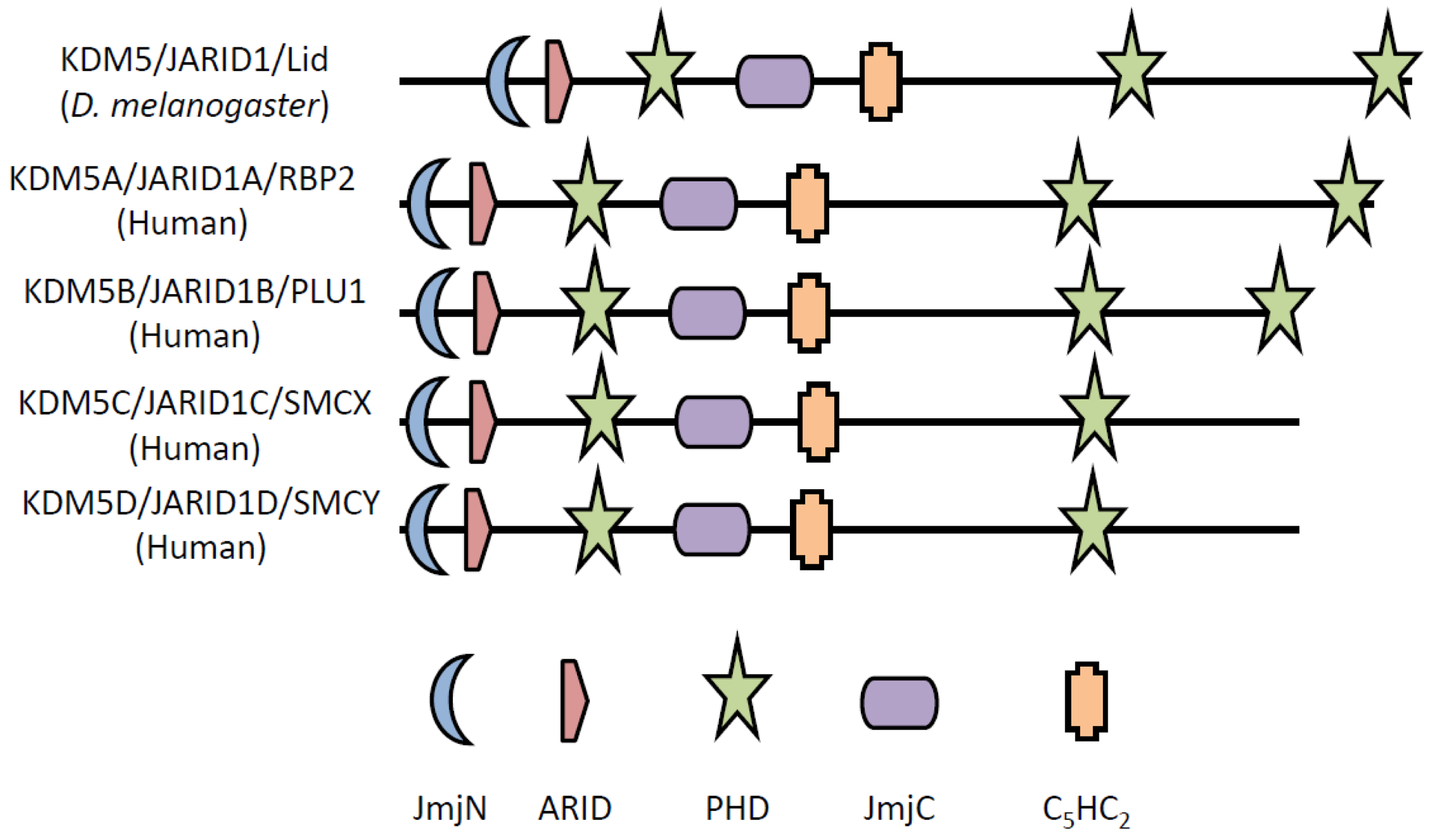
<p>This review focuses on the KDM5/JARID1 family of demethylases, which contain five conserved domains: JmjN, ARID, JmjC, PHD and a C<sub>5</sub>HC<sub>2</sub> zinc finger (<xref ref-type="fig" rid="f1-cancers-03-01383">Figure 1</xref>). The KDM5 family of demethylases is represented in many different organisms including yeast and worms. The <italic>C. elegans</italic> KDM5 gene is called r<italic>br-2</italic>. Loss of r<italic>br-2</italic> leads to defects in vulva development [<xref ref-type="bibr" rid="b50-cancers-03-01383">50</xref>] and decreased or increased life span [<xref ref-type="bibr" rid="b51-cancers-03-01383">51</xref>,<xref ref-type="bibr" rid="b52-cancers-03-01383">52</xref>]. The JmjC domain of these enzymes sets them apart from other demethylases in that it allows them to utilize a mechanism capable of removing tri- and di-methyl marks from H3K4. Their PHD domains can bind certain methylated residues allowing them to recruit other proteins, such as HDACs, to the site of methylated histones. For these reasons they can serve as both “readers” and “erasers” of the “histone code” [<xref ref-type="bibr" rid="b53-cancers-03-01383">53</xref>].</p></sec>
<sec>
<label>1.4.</label>
<title>Histone Methylation in Cancer</title>
<p>It is increasingly clear that alterations in histone methylation play important roles in cancer [<xref ref-type="bibr" rid="b18-cancers-03-01383">18</xref>,<xref ref-type="bibr" rid="b49-cancers-03-01383">49</xref>,<xref ref-type="bibr" rid="b54-cancers-03-01383">54</xref>]. The presence or absence of methyl marks on certain histone residues is very important to gene expression and has many implications in cancer progression. Aberrant methylation is thought to contribute to excessive proliferation of cells and therefore to tumorigenesis. Esteller and coworkers showed that a common hallmark of human cancer is loss of the trimethylation mark on lysine 20 and the acetylation mark on lysine 16 of histone H4 [<xref ref-type="bibr" rid="b55-cancers-03-01383">55</xref>]. Additionally, the H3K4me0 state in combination with H3K27 acetylation has been associated with poor prognosis of breast cancer [<xref ref-type="bibr" rid="b56-cancers-03-01383">56</xref>].</p>
<p>Misregulation of histone lysine methylation can have negative effects on development and has been shown to contribute to many cancers [<xref ref-type="bibr" rid="b57-cancers-03-01383">57</xref>-<xref ref-type="bibr" rid="b60-cancers-03-01383">60</xref>]. Additionally, the role of histone methyltransferases and histone demethylases in development has been well noted and may contribute to the establishment of cancer stem cells [<xref ref-type="bibr" rid="b24-cancers-03-01383">24</xref>,<xref ref-type="bibr" rid="b61-cancers-03-01383">61</xref>,<xref ref-type="bibr" rid="b62-cancers-03-01383">62</xref>]. Genome-wide analyses of chromatin states of embryonic stem cells and progenitor cells suggest that genes important for developmental control are marked by “bivalent marks”, which include both the active H3K4me3 and the repressive H3K27me3 marks [<xref ref-type="bibr" rid="b21-cancers-03-01383">21</xref>,<xref ref-type="bibr" rid="b22-cancers-03-01383">22</xref>,<xref ref-type="bibr" rid="b63-cancers-03-01383">63</xref>]. Although the existence of these “bivalent marks” is currently debated, they provide a logical model of a gene being poised for transcriptional activation or repression during development. Dysregulation of these chromatin marks could change the properties of the stem cells and progenitor cells and impair their differentiation potential, which could result in cancer initiation and progression. Thus, the enzymes that regulate these modifications likely play important roles in cancer.</p>
<p>There are several examples in current literature that are consistent with the idea that enzymes capable of maintaining histone methylation are important in cancer. For example, MLL1, the catalytic subunit of an H3K4 methyltransferase complex, is frequently translocated in leukemia [<xref ref-type="bibr" rid="b58-cancers-03-01383">58</xref>,<xref ref-type="bibr" rid="b59-cancers-03-01383">59</xref>] and another H3K4 methyltransferase subunit MEN1, has been shown to be frequently mutated in endocrine tumors [<xref ref-type="bibr" rid="b9-cancers-03-01383">9</xref>,<xref ref-type="bibr" rid="b60-cancers-03-01383">60</xref>,<xref ref-type="bibr" rid="b64-cancers-03-01383">64</xref>]. Additionally, EZH2, the catalytic subunit of an H3K27 methyltransferase polycomb repressive complex 2 (PRC2) [<xref ref-type="bibr" rid="b57-cancers-03-01383">57</xref>], is overexpressed in advanced prostate cancer [<xref ref-type="bibr" rid="b65-cancers-03-01383">65</xref>]. EZH2 activates oncogenes Ras and NF-κB and triggers metastasis by epigenetic silencing of the tumor suppressor DAB2IP/AIP1 [<xref ref-type="bibr" rid="b66-cancers-03-01383">66</xref>-<xref ref-type="bibr" rid="b68-cancers-03-01383">68</xref>]. Finally, genomic alterations (amplification or deletion) and/or point mutations of several histone methyltransferses and demethylases are increasingly being identified in cancers through the use of high-density SNP arrays and deep sequencing technologies [<xref ref-type="bibr" rid="b8-cancers-03-01383">8</xref>,<xref ref-type="bibr" rid="b10-cancers-03-01383">10</xref>-<xref ref-type="bibr" rid="b13-cancers-03-01383">13</xref>,<xref ref-type="bibr" rid="b69-cancers-03-01383">69</xref>,<xref ref-type="bibr" rid="b70-cancers-03-01383">70</xref>]. For example, inactivating mutations of UTX, an H3K27 histone demethylase, were identified in multiple cancer types, including multiple myeloma, esophageal squamous cell carcinoma, renal cell carcinoma, myeloid leukemia, breast and colorectal cancers, and glioblastoma [<xref ref-type="bibr" rid="b8-cancers-03-01383">8</xref>,<xref ref-type="bibr" rid="b12-cancers-03-01383">12</xref>]. It has recently been shown that methyltransferases and demethylases act in concert to regulate both activating and repressive marks on histones in a dynamic process [<xref ref-type="bibr" rid="b71-cancers-03-01383">71</xref>]. This review focuses on a class of enzymes capable of removing H3K4me3/2 marks and their potential as targets for cancer therapies.</p></sec></sec>
<sec>
<label>2.</label>
<title><italic>Drosophila</italic> KDM5/JARID1/Lid</title>
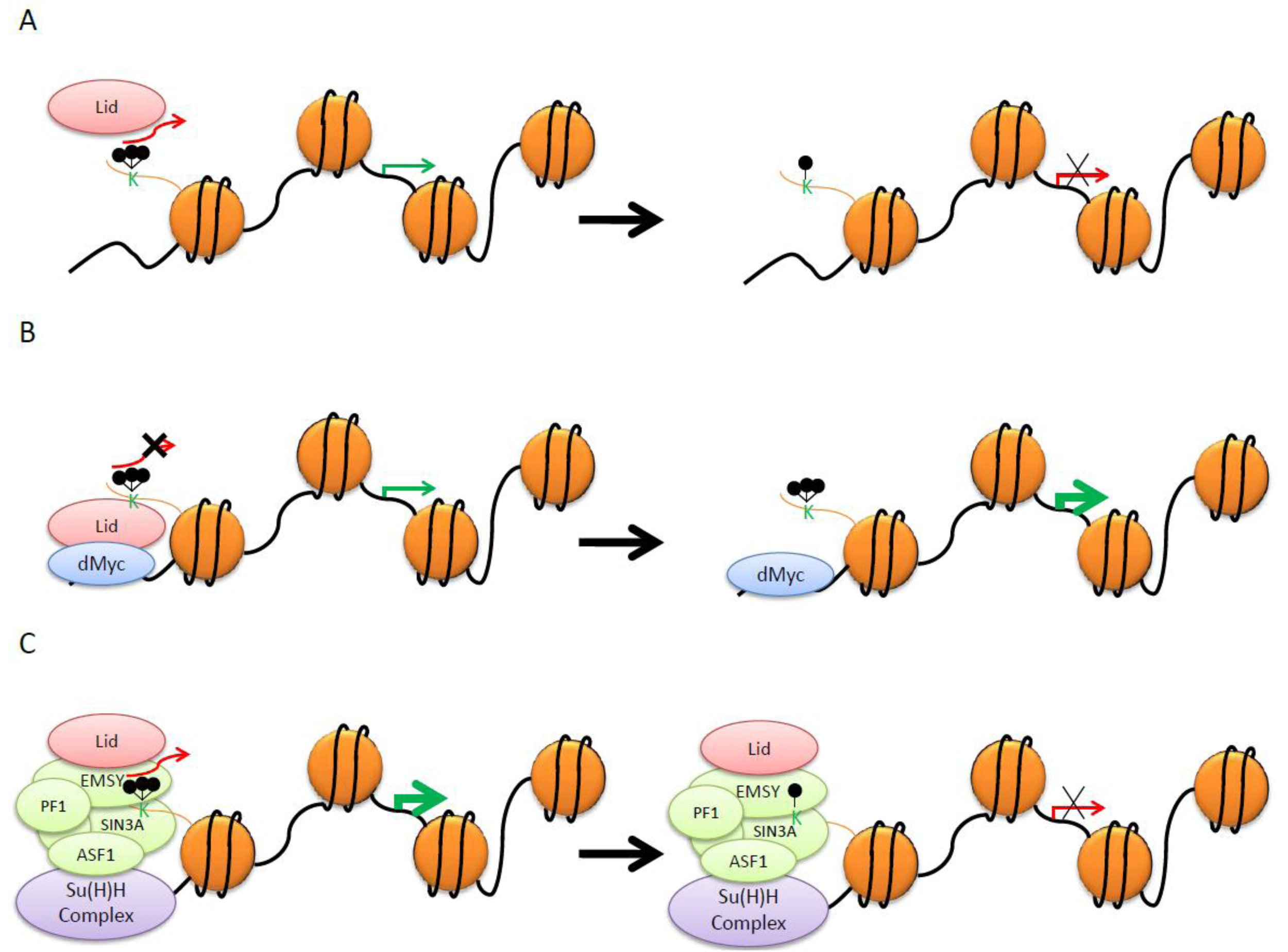
<p>The only known JARID1 protein in <italic>Drosophila melanogaster</italic> is Lid, named for the phenotype seen in mutant larvae (Little Imaginal Discs) (<xref ref-type="fig" rid="f2-cancers-03-01383">Figure 2A</xref>) [<xref ref-type="bibr" rid="b72-cancers-03-01383">72</xref>]. Lid has recently been classified as an H3K4me3/2 demethylase and it shares all the domains of the human JARID1 family (<xref ref-type="fig" rid="f1-cancers-03-01383">Figure 1</xref>) [<xref ref-type="bibr" rid="b73-cancers-03-01383">73</xref>-<xref ref-type="bibr" rid="b75-cancers-03-01383">75</xref>]. Because Lid is the only JARID1 family protein in <italic>Drosophila</italic>, it has provided an excellent model for studying the role of this class of enzymes in gene expression and tumorigenesis. Studies on Lid have shown that its knockdown in fly cells results in an increase in global H3K4me3 levels [<xref ref-type="bibr" rid="b73-cancers-03-01383">73</xref>,<xref ref-type="bibr" rid="b75-cancers-03-01383">75</xref>]. Like RBP2 and JARID1B, Lid has three PHD fingers which conventionally bind methylated lysines (<xref ref-type="fig" rid="f1-cancers-03-01383">Figure 1</xref>). Recently Li <italic>et al.</italic> probed the binding capabilities of Lid PHD domains in detail and discovered that the PHD1 domain of Lid binds all methylated forms of H3K9 and unmethylated H3K4 [<xref ref-type="bibr" rid="b76-cancers-03-01383">76</xref>]. They also discovered that the PHD3 domain binds di and tri-methylated H3K4 and suggested that Lid uses this binding to recruit dMyc to regions of active transcription (<xref ref-type="fig" rid="f2-cancers-03-01383">Figure 2B</xref>) [<xref ref-type="bibr" rid="b76-cancers-03-01383">76</xref>].</p>
<p>Myc is a transcription factor that is known to regulate the expression of roughly 15% of genes [<xref ref-type="bibr" rid="b77-cancers-03-01383">77</xref>]. Activation of the Myc gene by amplification or translocation causes cancer [<xref ref-type="bibr" rid="b77-cancers-03-01383">77</xref>]. The Eisenman lab performed a genetic screen to identify mutations that compensated for overexpression of dMyc, the <italic>Drosophila</italic> homolog of human Myc. In this screen, they discovered two independent mutations of <italic>Lid</italic> that suppress the rough eye phenotype caused by dMyc overexpression, suggesting that <italic>Lid</italic> and <italic>dMyc</italic> interact genetically [<xref ref-type="bibr" rid="b74-cancers-03-01383">74</xref>]. In contrast to the notion that an H3K4me3 demethylase represses gene expression, Lid was shown to antagonize gene silencing by allowing the expression of the homeotic gene Ubx [<xref ref-type="bibr" rid="b80-cancers-03-01383">80</xref>]. Lid is also required to maintain H3 acetylation, which is associated with open chromatin, through a mechanism that negates the deacetylase activity of Rpd3 [<xref ref-type="bibr" rid="b80-cancers-03-01383">80</xref>,<xref ref-type="bibr" rid="b81-cancers-03-01383">81</xref>]. Secombe <italic>et al.</italic> found that Lid physically interacts with dMyc, and this interaction abolishes the ability of Lid to demethylate H3K4me3 marks but allows Lid to maintain its ability to bind these marks using its PHD3 domain (<xref ref-type="fig" rid="f2-cancers-03-01383">Figure 2B</xref>) [<xref ref-type="bibr" rid="b74-cancers-03-01383">74</xref>]. They also discovered that Lid facilitates dMyc binding to E-boxes, regions on DNA commonly bound by transcription factors. These findings suggest that in the presence of dMyc, Lid likely acts as a “reader” of H3K4me3 to recruit dMyc to activate gene expression, but not as an “eraser” as its demethylation activity is inhibited by dMyc (<xref ref-type="fig" rid="f2-cancers-03-01383">Figure 2B</xref>).</p>
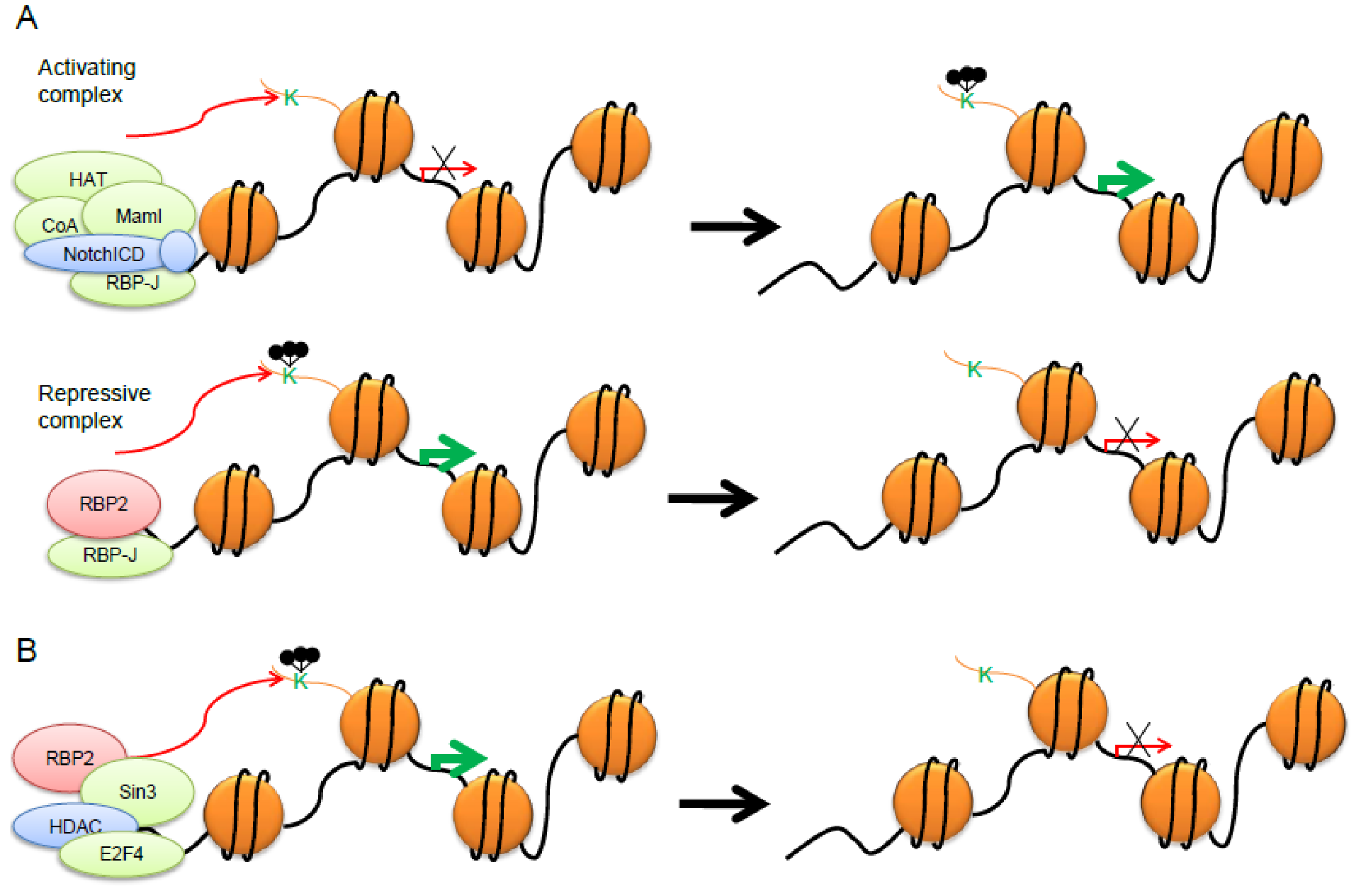
<p>Recently, several labs have linked Lid with Notch signaling. Notch is a transmembrane protein that, upon binding its ligands, is cleaved. Upon cleavage, Notch intracellular domain (ICD) acts as a transcription factor activating many different genes (<xref ref-type="fig" rid="f3-cancers-03-01383">Figure 3A</xref>). When overexpressed Notch serves as an oncogene; however, it can act as a tumor suppressor in other contexts [<xref ref-type="bibr" rid="b82-cancers-03-01383">82</xref>]. Many cancers have aberrant Notch signaling cascades and Notch has been linked to some specific cancers such as T-cell acute lymphoblastic leukemia (T-ALL) [<xref ref-type="bibr" rid="b79-cancers-03-01383">79</xref>]. The Notch system is highly conserved between humans and flies [<xref ref-type="bibr" rid="b82-cancers-03-01383">82</xref>].</p>
<p>NAP1 and ASF1 are <italic>Drosophila</italic> histone chaperones and are components of the complexes RLAF-N and LAF-A respectively. These complexes regulate H3K4me3 and H3 acetylation levels at Notch target genes and are required for silencing of Notch genes that are crucial to development in all metazoan systems. Moshkin <italic>et al.</italic> discovered that ASF1 co-purifies with Lid and that Lid can interact physically with both ASF1 and NAP1 [<xref ref-type="bibr" rid="b78-cancers-03-01383">78</xref>]. They suggest that ASF1 aids in the silencing of Notch genes by providing a link between the LAF complex and the Su(H)/H co-repressor complex. In this complex, Lid aids in gene repression by demethylating H3K4me3 at Notch genes (<xref ref-type="fig" rid="f2-cancers-03-01383">Figure 2C</xref>). They propose a similar mechanism for the involvement of Lid in the RLAF-N complex. A report by Liefke <italic>et al.</italic> has probed the interaction between Lid and Notch even further by establishing that Lid physically interacts with Su(H), and with recombinant RBP-J, the mammalian homolog of Su(H) [<xref ref-type="bibr" rid="b83-cancers-03-01383">83</xref>]. They show that mutation or reduced expression of Lid enhances tumorigenesis and growth related to Notch signaling in flies [<xref ref-type="bibr" rid="b83-cancers-03-01383">83</xref>]. Due to the high degree of conservation between human and fly signaling pathways, Lid provides an excellent model system for elucidation of the role of KDM5 enzymes in cancer.</p></sec>
<sec>
<label>3.</label>
<title>KDM5A/JARID1A/RBP2</title>
<p>RBP2, also called KDM5A or JARID1A, was initially isolated as a binding partner of retinoblastoma protein (pRB) [<xref ref-type="bibr" rid="b84-cancers-03-01383">84</xref>]. The gene coding for pRB, <italic>Rb1</italic>, is a well documented tumor suppressor gene that is frequently inactivated, directly or indirectly, in a wide variety of cancers [<xref ref-type="bibr" rid="b85-cancers-03-01383">85</xref>]. pRB not only inhibits cell cycle progression by blocking S-phase entry, but also promotes differentiation and senescence. The ability of pRB to promote differentiation and senescence tightly correlates with its ability to bind to RBP2 and, in many models, this phenomenon can be recapitulated by inhibiting RBP2 with siRNA [<xref ref-type="bibr" rid="b86-cancers-03-01383">86</xref>]. Consistent with these observations, RBP2 can repress certain genes that are activated by pRB [<xref ref-type="bibr" rid="b86-cancers-03-01383">86</xref>]. Interestingly, genome-wide location analyses indicated that RBP2 binding sites are also enriched for E2F binding sites, suggesting that the functions of pRB in cell cycle control and differentiation are inter-connected [<xref ref-type="bibr" rid="b87-cancers-03-01383">87</xref>].</p>
<p>In 2007, RBP2 was discovered to function as an H3K4me3/2 histone demethylase [<xref ref-type="bibr" rid="b50-cancers-03-01383">50</xref>,<xref ref-type="bibr" rid="b88-cancers-03-01383">88</xref>]. Our report outlining the catalytic activity of RBP2 also noted that deletion of RBP2 causes increased H3K4me3 at the SDF1 promoter [<xref ref-type="bibr" rid="b88-cancers-03-01383">88</xref>]. Restoration of the methylation state requires that RBP2 have an intact JmjC catalytic domain [<xref ref-type="bibr" rid="b88-cancers-03-01383">88</xref>]. It has also been determined that, mechanistically, RBP2 promotes cell growth and inhibits senescence and differentiation. In a mixed genetic background, <italic>RBP2</italic> knockout mice are viable and grossly normal [<xref ref-type="bibr" rid="b88-cancers-03-01383">88</xref>]. Using this knockout mouse model, we showed that loss of the RBP2 gene causes decreased apoptosis and increased G1 entry of the cell cycle in hematopoietic stem cell and myeloid progenitor cell compartments [<xref ref-type="bibr" rid="b88-cancers-03-01383">88</xref>]. Additionally, knockdown of RBP2 in SAOS-2 osteosarcoma cells leads to upregulation of cell cycle regulators p21, p27 and p130 [<xref ref-type="bibr" rid="b86-cancers-03-01383">86</xref>]. Consistent with these results, complete loss of RBP2 leads to increased expression of p27 [<xref ref-type="bibr" rid="b88-cancers-03-01383">88</xref>].</p>
<p>Other studies have shown that RBP2 is overexpressed in gastric cancer [<xref ref-type="bibr" rid="b91-cancers-03-01383">91</xref>]. RBP2 triggers cellular senescence of gastric and cervical cancer cells through binding to the promoters of cyclin-dependent kinase inhibitors p16, p21, and p27 and removing tri-methylated H3K4 at these sites [<xref ref-type="bibr" rid="b91-cancers-03-01383">91</xref>]. Complete abrogation of RBP2 from mouse cells inhibits cell growth, induces senescence and differentiation, and causes loss of the “stemness” property of embryonic stem cells <italic>in vitro</italic>. Moreover, loss of RBP2 dramatically inhibits tumorigenesis in a mouse cancer model [<xref ref-type="bibr" rid="b92-cancers-03-01383">92</xref>]. These findings suggest that RBP2 is an ideal target for cancer therapy in multiple cancer types.</p>
<p>In addition to pRB, RBP2 interacts with many proteins involved in oncogenesis, including p107, TBP [<xref ref-type="bibr" rid="b93-cancers-03-01383">93</xref>], LMO2 [<xref ref-type="bibr" rid="b94-cancers-03-01383">94</xref>], nuclear receptors [<xref ref-type="bibr" rid="b95-cancers-03-01383">95</xref>], Myc [<xref ref-type="bibr" rid="b74-cancers-03-01383">74</xref>], Sin3/HDACs [<xref ref-type="bibr" rid="b88-cancers-03-01383">88</xref>-<xref ref-type="bibr" rid="b90-cancers-03-01383">90</xref>], Mad1[<xref ref-type="bibr" rid="b96-cancers-03-01383">96</xref>], and RBP-J [<xref ref-type="bibr" rid="b83-cancers-03-01383">83</xref>]. The fact that RBP2 interacts with nuclear receptors and enhances expression of their target genes [<xref ref-type="bibr" rid="b86-cancers-03-01383">86</xref>,<xref ref-type="bibr" rid="b95-cancers-03-01383">95</xref>] suggests that RBP2 could recruit additional factors important for nuclear receptor-mediated transcription, which plays important roles in breast and prostate cancer progression. Of special interest is the interaction of RBP2 with Myc, which is often activated in cancers as mentioned above [<xref ref-type="bibr" rid="b74-cancers-03-01383">74</xref>]. A recent report, however, indicated that RBP2 is recruited by Mad1 to a Myc target gene hTERT. By removing the activating histone marks at the hTERT promoter, RBP2 represses hTERT expression when associated with Mad1 [<xref ref-type="bibr" rid="b96-cancers-03-01383">96</xref>]. The Lid/Notch relationship mentioned above is conserved in humans with relation to RBP2. Liefke <italic>et al.</italic> report that RBP2 is an essential component of the Notch/RBP-J repressor complex and that it is necessary for removal of H3K4me3 at RBP-J sites [<xref ref-type="bibr" rid="b83-cancers-03-01383">83</xref>]. This group also showed that RBP2 binds RBP-J in place of NotchICD when Notch cleavage is inhibited (<xref ref-type="fig" rid="f3-cancers-03-01383">Figure 3A</xref>) [<xref ref-type="bibr" rid="b83-cancers-03-01383">83</xref>]. This leads to a decrease in H3K4me3 and a subsequent suppression of Notch target genes (<xref ref-type="fig" rid="f3-cancers-03-01383">Figure 3A</xref>). Taken together, RBP2 can suppress Notch signaling through histone demethylation and could be crucial to the suppression of Notch-induced tumorigenesis.</p>
<p>In acute myeloid leukemia patients RBP2 has been shown to form a fusion protein with a nuclear pore complex protein, NUP98 [<xref ref-type="bibr" rid="b97-cancers-03-01383">97</xref>]. This fusion retains the third PHD finger of RBP2, which binds H3K4me3 marks on histones. Overexpression of this fusion protein alone is sufficient to arrest hematopoietic differentiation and induce acute myeloid leukemia in murine models [<xref ref-type="bibr" rid="b98-cancers-03-01383">98</xref>]. RBP2-NUP98 can bind to and prevent the removal of H3K4me3 at promoters of many lineage-specific transcription factors and thus increase gene expression. Mechanistically, it serves to prevent the demethylase activity of KDM5s and the methyltransferase activity of the PRC2 complex and allows for methylation patterns distinct to leukemic stem cells [<xref ref-type="bibr" rid="b98-cancers-03-01383">98</xref>].</p>
<p>A recent study suggested that increased expression of RBP2 promoted a stem cell like phenotype and enhanced resistance to anti-cancer agents by changing chromatin structure [<xref ref-type="bibr" rid="b99-cancers-03-01383">99</xref>]. The Settleman lab generated erlotinib resistant versions of PC9 lung cancer cells, which are normally erlotinib sensitive, by exposing these cells to media containing increasing concentrations of erlotinib [<xref ref-type="bibr" rid="b99-cancers-03-01383">99</xref>]. Interestingly, they showed that the resistance could be reversed after withdrawing the drug, suggesting that erlotinib resistance arises from changes of epigenetic states of these cells [<xref ref-type="bibr" rid="b99-cancers-03-01383">99</xref>]. In the erlotinib resistant population of PC9 cells, RBP2 expression was increased, leading to decreased global levels of H3K4me3 and H3K4me2. Moreover, they showed that RBP2 is required to maintain the drug tolerant state of PC9 cells [<xref ref-type="bibr" rid="b99-cancers-03-01383">99</xref>]. RBP2 has previously been shown to be associated with HDAC activity (<xref ref-type="fig" rid="f3-cancers-03-01383">Figure 3B</xref>) [<xref ref-type="bibr" rid="b88-cancers-03-01383">88</xref>-<xref ref-type="bibr" rid="b90-cancers-03-01383">90</xref>], therefore the Settleman lab set out to determine the effect of HDAC inhibitors on drug resistant PC9 cell lines. They found that upon treatment with HDAC inhibitors, drug resistant cells were rendered drug sensitive [<xref ref-type="bibr" rid="b99-cancers-03-01383">99</xref>]. This provides strong rationale for development of small molecule inhibitors of RBP2 to overcome common drug resistance.</p></sec>
<sec>
<label>4.</label>
<title>KDM5B/PLU1/JARID1B</title>
<p>Another KDM5 family protein found in humans, JARID1B (also referred to as KDM5B and PLU1), was discovered in experiments targeting genes regulated by a tyrosine kinase, HER2 [<xref ref-type="bibr" rid="b100-cancers-03-01383">100</xref>]. Cells overexpressing HER2 were treated with the antibody 4D5 (Herceptin) which inhibited phosphorylation of HER2. JARID1B was identified as one gene remarkably downregulated by Herceptin treatment. Northern blotting was then used to show that JARID1B is consistently expressed in breast cancer cell lines, but is expressed at restricted levels in normal adult tissues with the exception of the testis [<xref ref-type="bibr" rid="b100-cancers-03-01383">100</xref>]. Barrett <italic>et al.</italic> verified the expression of JARID1B in breast cancer cell lines and in primary tissues and discovered that 90% of invasive ductal carcinomas express JARID1B [<xref ref-type="bibr" rid="b101-cancers-03-01383">101</xref>]. Other studies involving JARID1B and breast cancer have shown that it is a transcriptional repressor that physically interacts with developmental transcription factors BF-1 and PAX9 [<xref ref-type="bibr" rid="b102-cancers-03-01383">102</xref>]. Barrett <italic>et al.</italic> performed an extensive analysis of the interaction between JARID1B and HDAC4 [<xref ref-type="bibr" rid="b103-cancers-03-01383">103</xref>]. They found that two of the PHD domains of JARID1B interact with the N-terminal tail of HDAC4 and that JARID1B co-localizes with HDAC4 to matrix-associated deacetylase bodies [<xref ref-type="bibr" rid="b103-cancers-03-01383">103</xref>].</p>
<p>The exact enzymatic function of JARID1B was unknown until 2007 when several groups classified it as a histone demethylase [<xref ref-type="bibr" rid="b50-cancers-03-01383">50</xref>,<xref ref-type="bibr" rid="b104-cancers-03-01383">104</xref>,<xref ref-type="bibr" rid="b105-cancers-03-01383">105</xref>]. Yamane <italic>et al.</italic> showed that JARID1B represses tumor suppressor genes such as BRCA1, CAV1 and 14-3-3σ and that knockdown of JARID1B increases H3K4me3 at these target genes [<xref ref-type="bibr" rid="b104-cancers-03-01383">104</xref>]. Interestingly, they were able to demonstrate that downregulation of mouse JARID1B suppresses mammary tumor growth in a syngeneic mouse cancer model. This suggests that JARID1B could be a prime target for breast cancer therapies [<xref ref-type="bibr" rid="b104-cancers-03-01383">104</xref>]. Consistent with the limited gene expression pattern of JARID1B, <italic>JARID1B</italic> knockout mice are viable [<xref ref-type="bibr" rid="b106-cancers-03-01383">106</xref>], and will be a valuable tool to study its role in mammary development and breast cancer.</p>
<p>JARID1B has also been shown to be a potential oncogene in other cancers such as prostate, lung, bladder and melanoma [<xref ref-type="bibr" rid="b107-cancers-03-01383">107</xref>,<xref ref-type="bibr" rid="b108-cancers-03-01383">108</xref>]. Using data from the Oncomine database [<xref ref-type="bibr" rid="b109-cancers-03-01383">109</xref>,<xref ref-type="bibr" rid="b110-cancers-03-01383">110</xref>] as well as frozen tissues, Xiang <italic>et al.</italic> showed that JARID1B is up-regulated in prostate cancer samples while showing limited expression in the benign prostate. These up-regulations have been noted at both the mRNA and the protein levels [<xref ref-type="bibr" rid="b108-cancers-03-01383">108</xref>]. One explanation for this phenomenon might be the interaction of JARID1B with the androgen receptor (AR) which enhances AR-dependent transcriptional activity [<xref ref-type="bibr" rid="b108-cancers-03-01383">108</xref>].</p>
<p>Hayami <italic>et al.</italic> recently showed that at both the protein and mRNA levels, JARID1B is up-regulated in tumor tissues of bladder cancer and lung cancer (both SCLC and NSCLC) [<xref ref-type="bibr" rid="b107-cancers-03-01383">107</xref>]. They also noted that knockdown of JARID1B induces growth suppression in cell lines derived from these cancers [<xref ref-type="bibr" rid="b107-cancers-03-01383">107</xref>]. Further analysis of JARID1B knockdown cell lines led them to conclude that transcription factors E2F1 and E2F2 are downregulated when JARID1B expression is downregulated [<xref ref-type="bibr" rid="b107-cancers-03-01383">107</xref>]. These findings further support those found by the Zhang lab suggesting that JARID1B downregulation leads to suppression of tumor formation, which makes it an ideal drug target for many different cancers [<xref ref-type="bibr" rid="b104-cancers-03-01383">104</xref>].</p>
<p>JARID1B has also been suggested as a potential target for anti-cancer vaccines [<xref ref-type="bibr" rid="b111-cancers-03-01383">111</xref>]. Liggins <italic>et al.</italic> discovered that JARID1B is one of the non-X cancer-testis (CT) antigens. These types of proteins are of interest due to their limited expression in normal tissues but overexpression in many kinds of cancer. Additionally, they can induce a cytotoxic T-lymphocyte response which makes them prime candidates for cancer vaccine development. Among a panel of CT antigens screened in B- and T-cell malignancies, JARID1B is highly expressed in both cases at the mRNA level [<xref ref-type="bibr" rid="b111-cancers-03-01383">111</xref>]. Indeed, in breast cancer patients, there are T cells that react with HLA-A*201* peptides of JARID1B [<xref ref-type="bibr" rid="b112-cancers-03-01383">112</xref>].</p>
<p>JARID1B expression has previously been shown to be expressed at higher levels in melanocytic nevi than in advanced and metastatic melanomas [<xref ref-type="bibr" rid="b113-cancers-03-01383">113</xref>,<xref ref-type="bibr" rid="b114-cancers-03-01383">114</xref>], but its role in melanoma was unclear until recently. Roesch <italic>et al.</italic> found that increased JARID1B expression marks a slow cycling population of melanoma cells [<xref ref-type="bibr" rid="b113-cancers-03-01383">113</xref>]. This cell population is associated with prolonged growth and self-renewal potential in serial transplantation experiments. This study also noted a link between JARID1B and Notch signaling by showing that JARID1B represses the Notch ligand Jagged 1. This repression leads to less Notch cleavage and a subsequent decrease in expression of Notch target genes [<xref ref-type="bibr" rid="b113-cancers-03-01383">113</xref>]. These results suggest that, in melanoma, JARID1B may not be required for cancer establishment but that it most likely contributes to tumor progression and metastasis. Furthermore, they found that expression of JARID1B is dynamically regulated, which suggests that stemness of melanoma cells could be dynamic [<xref ref-type="bibr" rid="b113-cancers-03-01383">113</xref>].</p></sec>
<sec>
<label>5.</label>
<title>KDM5C/JARID1C/SMCX</title>
<p>Another KDM5 family protein, JARID1C (also known as KDM5C and SMCX), has mostly been studied in context of mental retardation but has been linked to some forms of cancer [<xref ref-type="bibr" rid="b105-cancers-03-01383">105</xref>,<xref ref-type="bibr" rid="b115-cancers-03-01383">115</xref>-<xref ref-type="bibr" rid="b117-cancers-03-01383">117</xref>]. Human papillomavirus (HPV) is thought to be the leading cause of cervical cancer and the second most common cause of cancer death in women worldwide [<xref ref-type="bibr" rid="b118-cancers-03-01383">118</xref>]. The long control region (LCR) of HPV contains oncogenes E6 and E7 which can be repressed when bound by E2. In an effort to determine genes involved in the tumor suppressor capabilities of E2, the Howley lab performed an siRNA screen. This screen identified JARID1C as a mediator of the HPV E2 tumor suppressor protein [<xref ref-type="bibr" rid="b119-cancers-03-01383">119</xref>]. They then determined that JARID1C is physically recruited by the E2 protein to repress the transcription of the oncoproteins E6 and E7 through the HPV LCR [<xref ref-type="bibr" rid="b119-cancers-03-01383">119</xref>].</p>
<p>Clear cell renal cell carcinomas (ccRCC) are traditionally classified as having mutations in the VHL gene and activation of the HIF pathway [<xref ref-type="bibr" rid="b120-cancers-03-01383">120</xref>,<xref ref-type="bibr" rid="b121-cancers-03-01383">121</xref>]. In an effort to discover other mutations in ccRCC as part of the Cancer Genome Project, the Sanger Institute underwent an extensive gene expression analysis of a ccRCC tumor panel. This screen led to the discovery that 3% of ccRCC tumors contain truncation mutations in JARID1C [<xref ref-type="bibr" rid="b8-cancers-03-01383">8</xref>]. They also noted that JARID1C is associated with hypoxic tumors rather than non-hypoxic tumors and that most tumors with JARID1C mutations also contained VHL mutations [<xref ref-type="bibr" rid="b8-cancers-03-01383">8</xref>]. JARID1C was shown to be a HIF target gene in RCC cells, but it suppresses tumor growth, suggesting that inactivation of both VHL and JARID1C is required for tumor formation in this subtype of ccRCC [<xref ref-type="bibr" rid="b122-cancers-03-01383">122</xref>].</p></sec>
<sec>
<label>6.</label>
<title>KDM5D/JARID1D/SMCY</title>
<p>The least well documented member of the KDM5 family, JARID1D (also referred to as KDM5D and SMCY), is coded for by the SMCY gene, which is located on the Y chromosome. JARID1D, like other KDM5 family members, is capable of demethylating di- and tri-methyl H3K4 [<xref ref-type="bibr" rid="b75-cancers-03-01383">75</xref>,<xref ref-type="bibr" rid="b105-cancers-03-01383">105</xref>,<xref ref-type="bibr" rid="b123-cancers-03-01383">123</xref>]. While there is no direct link between JARID1D and cancer, a deletion analysis of Y chromosome specific genes in human prostate cancer revealed that 52% of cases showed deletion of the JARID1D gene [<xref ref-type="bibr" rid="b124-cancers-03-01383">124</xref>]. This study associated loss of specific Y chromosome genes with prostate cancer, suggesting a role for JARID1D in the pathogenesis of the disease.</p></sec>
<sec sec-type="conclusions">
<label>7.</label>
<title>Summary</title>
<p>In recent years much has been discovered about histone demethylases and their roles in cancer. In this review, we have chosen to focus on the role of KDM5 family members in cancer, specifically, due to their ability to regulate an activating mark on H3K4. One of the primary hallmarks of cancer is its limitless replicative ability, much of which is acquired through overexpression of oncogenes and repression of tumor suppressor genes. KDM5 family members are capable of removing the H3K4me3 activating mark from histones which makes them potential players in the downregulation of tumor suppressors, but could also suggest that their activity could repress oncogenes. These activities indicate that KDM5 family members could be prime targets for many different therapies in a context dependent manner. Indeed these enzymes have been suggested to have oncogenic properties in some tissues and to have tumor suppressor functions in others (<xref ref-type="table" rid="t1-cancers-03-01383">Table 1</xref>). Therapies targeting this family of enzymes are currently under development by many groups.</p>
<p>The term “cancer stem cell” (CSC) has been defined as cancer cells within a given tumor that are capable of re-forming the tumor [<xref ref-type="bibr" rid="b126-cancers-03-01383">126</xref>]. These cells are thought to remain after other tumorigenic cells die off during most cancer therapies. These remaining cancer stem cells can re-develop into a more aggressive tumor that is resistant to therapies. Treating cancer stem cells could provide a potent method for treating these more aggressive cancers and preventing recurrence. It is generally thought that cancer may arise from a progenitor cell that becomes a cancer stem cell or from a stem cell that becomes cancerous. The connection between epigenetic regulation and development suggests that epigenetic changes may be the first step in cancer progression. In fact, it was proposed that cancer stem cells arise through epigenetic changes [<xref ref-type="bibr" rid="b1-cancers-03-01383">1</xref>]. A clear understanding of how histone demethylases act in stem cell development may give us hints of how to eliminate cancer stem cells. Specific to the KDM5 family proteins, drug resistant cells overexpressing RBP2 seem to have some features found in cancer stem cells [<xref ref-type="bibr" rid="b99-cancers-03-01383">99</xref>] and JARID1B marks a subpopulation of human melanoma cells that can sustain tumor growth and self renewal, suggesting a new definition of melanoma stem cells [<xref ref-type="bibr" rid="b113-cancers-03-01383">113</xref>].</p>
<p>One class of histone modifying enzymes that has been successfully targeted for cancer therapy is HDACs [<xref ref-type="bibr" rid="b3-cancers-03-01383">3</xref>]. Many histone demethylases, including RBP2 [<xref ref-type="bibr" rid="b88-cancers-03-01383">88</xref>-<xref ref-type="bibr" rid="b90-cancers-03-01383">90</xref>], JARID1B [<xref ref-type="bibr" rid="b103-cancers-03-01383">103</xref>] and JARID1C [<xref ref-type="bibr" rid="b116-cancers-03-01383">116</xref>], have been shown to interact with the HDAC complexes. Additionally, recent studies suggest that demethylases are linked to HDACs through the Sp1 protein [<xref ref-type="bibr" rid="b127-cancers-03-01383">127</xref>]. This link was discovered when the Chen lab noted that cells treated with HDAC inhibitors appeared to also be downregulated for KDM5 demethylase activity. These studies suggest that success of HDAC inhibitors could be correlated to their interactions with the KDM5 enzymes. HDACs generally act on many different histone residues, while the catalytic activity of the KDM enzymes is limited to specific histone residues. This suggests that KDM inhibitors are likely to have more specific biological effects and therefore be more specific anti-cancer epi-drugs than HDAC inhibitors.</p>
<p>In this review we have covered many different angles for development of anti-cancer therapies using the KDM5 family of demethylases. This family of enzymes can be crucial in the expression and repression of oncogenes and tumor suppressor genes and can themselves serve as both. They also provide insight into the cancer stem cell model and how we might develop drugs targeting these cells. Some of the limitations in drug discovery thus far have been the lack of appropriate readouts for demethylase activity and the similarity of mechanism between all proteins of this class. Recently, more accurate demethylase assays have been developed and high throughput screening techniques have been optimized for identifying specific inhibitors of these enzymes [<xref ref-type="bibr" rid="b128-cancers-03-01383">128</xref>,<xref ref-type="bibr" rid="b129-cancers-03-01383">129</xref>]. These inhibitors/epigenetic drugs will have the potential to reprogram cancer cells or cancer stem cells with the same gusto as the HDAC inhibitors and could have a revolutionary effect on the future of cancer treatment.</p></sec></body>
<back>
<sec sec-type="display-objects">
<title>Figures and Table</title>
<fig id="f1-cancers-03-01383" position="float">
<label>Figure 1.</label>
<caption>
<p>Domain structure of JARID1 proteins from <italic>Drosophila</italic> and humans.</p></caption>
<graphic xlink:href="cancers-03-01383f1.gif"/></fig>
<fig id="f2-cancers-03-01383" position="float">
<label>Figure 2.</label>
<caption>
<p><bold>(A)</bold> The demethylase capabilities of Lid can contribute to gene repression by removing H3K4me3 marks, which are associated with active genes [<xref ref-type="bibr" rid="b73-cancers-03-01383">73</xref>-<xref ref-type="bibr" rid="b75-cancers-03-01383">75</xref>]. <bold>(B)</bold> Binding of dMyc to Lid inactivates its demethylase activity but retains H3K4me3 binding ability, allowing it to recruit dMyc to actively transcribed genes [<xref ref-type="bibr" rid="b76-cancers-03-01383">76</xref>,<xref ref-type="bibr" rid="b77-cancers-03-01383">77</xref>]. <bold>(C)</bold> Lid represses Notch target genes by associating with the LAF complex and demethylating H3K4me3 [<xref ref-type="bibr" rid="b78-cancers-03-01383">78</xref>,<xref ref-type="bibr" rid="b79-cancers-03-01383">79</xref>].</p></caption>
<graphic xlink:href="cancers-03-01383f2.gif"/></fig>
<fig id="f3-cancers-03-01383" position="float">
<label>Figure 3.</label>
<caption>
<p><bold>(A)</bold> NotchICD activates genes by recruiting RBP-J and a histone acetyltransferase (HAT) complex that adds activating marks to histones, therefore allowing transcription on Notch target genes. In the absence of NotchICD, RBP2 can bind RBP-J and demethylate existing activating marks, leading to repression of Notch target genes [<xref ref-type="bibr" rid="b83-cancers-03-01383">83</xref>]. <bold>(B)</bold> RBP2 has been shown to interact with the Sin3/HDAC complexes which are crucial targets for anti-cancer therapies [<xref ref-type="bibr" rid="b88-cancers-03-01383">88</xref>-<xref ref-type="bibr" rid="b90-cancers-03-01383">90</xref>].</p></caption>
<graphic xlink:href="cancers-03-01383f3.gif"/></fig>
<table-wrap id="t1-cancers-03-01383" position="float">
<label>Table 1.</label>
<caption>
<p>KDM5 family demethylases in cancer.</p></caption>
<table frame="box" rules=" cols">
<thead>
<tr content-type="background-color:#000000; color:#FFFFFF">
<th align="center" valign="top"><bold>Demethylase</bold></th>
<th align="center" valign="top"><bold>Cancer type</bold></th>
<th align="center" valign="top"><bold>Notes</bold></th>
<th align="center" valign="top"><bold>Potential role</bold></th></tr>
<tr>
<th valign="bottom" colspan="4">
<hr/></th></tr></thead>
<tbody>
<tr>
<td align="left" valign="middle" rowspan="4"><bold>KDM5A/RBP2/JARID1A</bold></td>
<td align="left" valign="top">gastric</td>
<td align="left" valign="top">overexpressed [<xref ref-type="bibr" rid="b91-cancers-03-01383">91</xref>]</td>
<td align="left" valign="top">oncogene</td></tr>
<tr>
<td align="left" valign="top">leukemia</td>
<td align="left" valign="top">NUP98 fusion [<xref ref-type="bibr" rid="b97-cancers-03-01383">97</xref>]</td>
<td align="left" valign="top">oncogene</td></tr>
<tr>
<td align="left" valign="top">cervical</td>
<td align="left" valign="top">overexpressed [<xref ref-type="bibr" rid="b125-cancers-03-01383">125</xref>]</td>
<td align="left" valign="top">oncogene</td></tr>
<tr>
<td align="left" valign="top">lung</td>
<td align="left" valign="top">drug tolerance [<xref ref-type="bibr" rid="b99-cancers-03-01383">99</xref>]</td>
<td align="left" valign="top">oncogene</td></tr>
<tr>
<td valign="bottom" colspan="4">
<hr/></td></tr>
<tr>
<td align="left" valign="middle" rowspan="5"><bold>KDM5B/PLU1/JARID1B</bold></td>
<td align="left" valign="top">breast</td>
<td align="left" valign="top">overexpressed [<xref ref-type="bibr" rid="b100-cancers-03-01383">100</xref>]</td>
<td align="left" valign="top">oncogene</td></tr>
<tr>
<td align="left" valign="top">prostate</td>
<td align="left" valign="top">overexpressed [<xref ref-type="bibr" rid="b108-cancers-03-01383">108</xref>]</td>
<td align="left" valign="top">oncogene</td></tr>
<tr>
<td align="left" valign="top">bladder</td>
<td align="left" valign="top">overexpressed [<xref ref-type="bibr" rid="b107-cancers-03-01383">107</xref>]</td>
<td align="left" valign="top">oncogene</td></tr>
<tr>
<td align="left" valign="top">lung</td>
<td align="left" valign="top">overexpressed [<xref ref-type="bibr" rid="b107-cancers-03-01383">107</xref>]</td>
<td align="left" valign="top">oncogene</td></tr>
<tr>
<td align="left" valign="top">melanoma</td>
<td align="left" valign="top">tumor progression [<xref ref-type="bibr" rid="b113-cancers-03-01383">113</xref>]</td>
<td align="left" valign="top">oncogene</td></tr>
<tr>
<td valign="bottom" colspan="4">
<hr/></td></tr>
<tr>
<td align="left" valign="middle" rowspan="2"><bold>KDM5C/SMCX/JARID1C</bold></td>
<td align="left" valign="top">cervical</td>
<td align="left" valign="top">mediator of human papillomavirus protein E2 [<xref ref-type="bibr" rid="b119-cancers-03-01383">119</xref>]</td>
<td align="left" valign="top">tumor suppressor</td></tr>
<tr>
<td align="left" valign="top">kidney</td>
<td align="left" valign="top">inactivating mutations [<xref ref-type="bibr" rid="b8-cancers-03-01383">8</xref>]</td>
<td align="left" valign="top">tumor suppressor</td></tr>
<tr>
<td valign="bottom" colspan="4">
<hr/></td></tr>
<tr>
<td align="left" valign="middle"><bold>KDM5D/SMCY/JARID1D</bold></td>
<td align="left" valign="top">prostate</td>
<td align="left" valign="top">deleted [<xref ref-type="bibr" rid="b124-cancers-03-01383">124</xref>]</td>
<td align="left" valign="top">tumor suppressor</td></tr></tbody></table></table-wrap></sec>
<ack>
<p>This work was supported by V Scholar Award (to Q.Y.), Breast Cancer Alliance Young Investigator Grant (to Q.Y.), Melanoma Research Foundation Career Development Award (to Q.Y.), a Pilot Grant from the Yale Comprehensive Cancer Center (to Q.Y.), American Cancer Society grant IRG-58-012-51 (to Q.Y.), Department of Defense BCRP Concept Award W81XWH-07-1-0581 (to Q.Y.), and NIH grant CA16359 (to the Yale Comprehensive Cancer Center). We apologize to our colleagues whose work could not be cited due to space limitation.</p></ack>
<ref-list>
<title>References</title>
<ref id="b1-cancers-03-01383"><label>1.</label><citation citation-type="journal"><person-group person-group-type="author"><name><surname>Feinberg</surname><given-names>A.P.</given-names></name><name><surname>Ohlsson</surname><given-names>R.</given-names></name><name><surname>Henikoff</surname><given-names>S.</given-names></name></person-group><article-title>The epigenetic progenitor origin of human cancer</article-title><source>Nat. Rev. Genet.</source><year>2006</year><volume>7</volume><fpage>21</fpage><lpage>33</lpage><pub-id pub-id-type="doi">10.1038/nrg1748</pub-id><pub-id pub-id-type="pmid">16369569</pub-id></citation></ref>
<ref id="b2-cancers-03-01383"><label>2.</label><citation citation-type="journal"><person-group person-group-type="author"><name><surname>Esteller</surname><given-names>M.</given-names></name></person-group><article-title>Epigenetics in cancer</article-title><source>N. Engl. J. Med.</source><year>2008</year><volume>358</volume><fpage>1148</fpage><lpage>1159</lpage><pub-id pub-id-type="doi">10.1056/NEJMra072067</pub-id><pub-id pub-id-type="pmid">18337604</pub-id></citation></ref>
<ref id="b3-cancers-03-01383"><label>3.</label><citation citation-type="journal"><person-group person-group-type="author"><name><surname>Marks</surname><given-names>P.A.</given-names></name><name><surname>Breslow</surname><given-names>R.</given-names></name></person-group><article-title>Dimethyl sulfoxide to vorinostat: Development of this histone deacetylase inhibitor as an anticancer drug</article-title><source>Nat. Biotechnol.</source><year>2007</year><volume>25</volume><fpage>84</fpage><lpage>90</lpage><pub-id pub-id-type="doi">10.1038/nbt1272</pub-id><pub-id pub-id-type="pmid">17211407</pub-id></citation></ref>
<ref id="b4-cancers-03-01383"><label>4.</label><citation citation-type="journal"><person-group person-group-type="author"><name><surname>Kaminskas</surname><given-names>E.</given-names></name><name><surname>Farrell</surname><given-names>A.T.</given-names></name><name><surname>Wang</surname><given-names>Y.C.</given-names></name><name><surname>Sridhara</surname><given-names>R.</given-names></name><name><surname>Pazdur</surname><given-names>R.</given-names></name></person-group><article-title>FDA drug approval summary: Azacitidine (5-azacytidine, Vidaza) for injectable suspension</article-title><source>Oncologist</source><year>2005</year><volume>10</volume><fpage>176</fpage><lpage>182</lpage><pub-id pub-id-type="doi">10.1634/theoncologist.10-3-176</pub-id><pub-id pub-id-type="pmid">15793220</pub-id></citation></ref>
<ref id="b5-cancers-03-01383"><label>5.</label><citation citation-type="journal"><person-group person-group-type="author"><name><surname>Oki</surname><given-names>Y.</given-names></name><name><surname>Aoki</surname><given-names>E.</given-names></name><name><surname>Issa</surname><given-names>J.P.</given-names></name></person-group><article-title>Decitabine—Bedside to bench</article-title><source>Crit. Rev. Oncol. Hematol.</source><year>2007</year><volume>61</volume><fpage>140</fpage><lpage>152</lpage><pub-id pub-id-type="doi">10.1016/j.critrevonc.2006.07.010</pub-id><pub-id pub-id-type="pmid">17023173</pub-id></citation></ref>
<ref id="b6-cancers-03-01383"><label>6.</label><citation citation-type="journal"><person-group person-group-type="author"><name><surname>Rowley</surname><given-names>J.D.</given-names></name></person-group><article-title>Rearrangements involving chromosome band 11Q23 in acute leukaemia</article-title><source>Semin. Cancer Biol.</source><year>1993</year><volume>4</volume><fpage>377</fpage><lpage>385</lpage><pub-id pub-id-type="pmid">8142623</pub-id></citation></ref>
<ref id="b7-cancers-03-01383"><label>7.</label><citation citation-type="journal"><person-group person-group-type="author"><name><surname>Chandrasekharappa</surname><given-names>S.C.</given-names></name><name><surname>Guru</surname><given-names>S.C.</given-names></name><name><surname>Manickam</surname><given-names>P.</given-names></name><name><surname>Olufemi</surname><given-names>S.E.</given-names></name><name><surname>Collins</surname><given-names>F.S.</given-names></name><name><surname>Emmert-Buck</surname><given-names>M.R.</given-names></name><name><surname>Debelenko</surname><given-names>L.V.</given-names></name><name><surname>Zhuang</surname><given-names>Z.</given-names></name><name><surname>Lubensky</surname><given-names>I.A.</given-names></name><name><surname>Liotta</surname><given-names>L.A.</given-names></name><name><surname>Crabtree</surname><given-names>J.S.</given-names></name><name><surname>Wang</surname><given-names>Y.</given-names></name><name><surname>Roe</surname><given-names>B.A.</given-names></name><name><surname>Weisemann</surname><given-names>J.</given-names></name><name><surname>Boguski</surname><given-names>M.S.</given-names></name><name><surname>Agarwal</surname><given-names>S.K.</given-names></name><name><surname>Kester</surname><given-names>M.B.</given-names></name><name><surname>Kim</surname><given-names>Y.S.</given-names></name><name><surname>Heppner</surname><given-names>C.</given-names></name><name><surname>Dong</surname><given-names>Q.</given-names></name><name><surname>Spiegel</surname><given-names>A.M.</given-names></name><name><surname>Burns</surname><given-names>A.L.</given-names></name><name><surname>Marx</surname><given-names>S.J.</given-names></name></person-group><article-title>Positional cloning of the gene for multiple endocrine neoplasia-type 1</article-title><source>Science</source><year>1997</year><volume>276</volume><fpage>404</fpage><lpage>407</lpage><pub-id pub-id-type="doi">10.1126/science.276.5311.404</pub-id><pub-id pub-id-type="pmid">9103196</pub-id></citation></ref>
<ref id="b8-cancers-03-01383"><label>8.</label><citation citation-type="journal"><person-group person-group-type="author"><name><surname>Dalgliesh</surname><given-names>G.L.</given-names></name><name><surname>Furge</surname><given-names>K.</given-names></name><name><surname>Greenman</surname><given-names>C.</given-names></name><name><surname>Chen</surname><given-names>L.</given-names></name><name><surname>Bignell</surname><given-names>G.</given-names></name><name><surname>Butler</surname><given-names>A.</given-names></name><name><surname>Davies</surname><given-names>H.</given-names></name><name><surname>Edkins</surname><given-names>S.</given-names></name><name><surname>Hardy</surname><given-names>C.</given-names></name><name><surname>Latimer</surname><given-names>C.</given-names></name><name><surname>Teague</surname><given-names>J.</given-names></name><name><surname>Andrews</surname><given-names>J.</given-names></name><name><surname>Barthorpe</surname><given-names>S.</given-names></name><name><surname>Beare</surname><given-names>D.</given-names></name><name><surname>Buck</surname><given-names>G.</given-names></name><name><surname>Campbell</surname><given-names>P.J.</given-names></name><name><surname>Forbes</surname><given-names>S.</given-names></name><name><surname>Jia</surname><given-names>M.</given-names></name><name><surname>Jones</surname><given-names>D.</given-names></name><name><surname>Knott</surname><given-names>H.</given-names></name><name><surname>Kok</surname><given-names>C.Y.</given-names></name><name><surname>Lau</surname><given-names>K.W.</given-names></name><name><surname>Leroy</surname><given-names>C.</given-names></name><name><surname>Lin</surname><given-names>M.L.</given-names></name><name><surname>McBride</surname><given-names>D.J.</given-names></name><name><surname>Maddison</surname><given-names>M.</given-names></name><name><surname>Maguire</surname><given-names>S.</given-names></name><name><surname>McLay</surname><given-names>K.</given-names></name><name><surname>Menzies</surname><given-names>A.</given-names></name><name><surname>Mironenko</surname><given-names>T.</given-names></name><name><surname>Mulderrig</surname><given-names>L.</given-names></name><name><surname>Mudie</surname><given-names>L.</given-names></name><name><surname>O'Meara</surname><given-names>S.</given-names></name><name><surname>Pleasance</surname><given-names>E.</given-names></name><name><surname>Rajasingham</surname><given-names>A.</given-names></name><name><surname>Shepherd</surname><given-names>R.</given-names></name><name><surname>Smith</surname><given-names>R.</given-names></name><name><surname>Stebbings</surname><given-names>L.</given-names></name><name><surname>Stephens</surname><given-names>P.</given-names></name><name><surname>Tang</surname><given-names>G.</given-names></name><name><surname>Tarpey</surname><given-names>P.S.</given-names></name><name><surname>Turrell</surname><given-names>K.</given-names></name><name><surname>Dykema</surname><given-names>K.J.</given-names></name><name><surname>Khoo</surname><given-names>S.K.</given-names></name><name><surname>Petillo</surname><given-names>D.</given-names></name><name><surname>Wondergem</surname><given-names>B.</given-names></name><name><surname>Anema</surname><given-names>J.</given-names></name><name><surname>Kahnoski</surname><given-names>R.J.</given-names></name><name><surname>Teh</surname><given-names>B.T.</given-names></name><name><surname>Stratton</surname><given-names>M.R.</given-names></name><name><surname>Futreal</surname><given-names>P.A.</given-names></name></person-group><article-title>Systematic sequencing of renal carcinoma reveals inactivation of histone modifying genes</article-title><source>Nature</source><year>2010</year><volume>463</volume><fpage>360</fpage><lpage>363</lpage><pub-id pub-id-type="doi">10.1038/nature08672</pub-id><pub-id pub-id-type="pmid">20054297</pub-id></citation></ref>
<ref id="b9-cancers-03-01383"><label>9.</label><citation citation-type="journal"><person-group person-group-type="author"><name><surname>Hughes</surname><given-names>C.M.</given-names></name><name><surname>Rozenblatt-Rosen</surname><given-names>O.</given-names></name><name><surname>Milne</surname><given-names>T.A.</given-names></name><name><surname>Copeland</surname><given-names>T.D.</given-names></name><name><surname>Levine</surname><given-names>S.S.</given-names></name><name><surname>Lee</surname><given-names>J.C.</given-names></name><name><surname>Hayes</surname><given-names>D.N.</given-names></name><name><surname>Shanmugam</surname><given-names>K.S.</given-names></name><name><surname>Bhattacharjee</surname><given-names>A.</given-names></name><name><surname>Biondi</surname><given-names>C.A.</given-names></name><name><surname>Kay</surname><given-names>G.F.</given-names></name><name><surname>Hayward</surname><given-names>N.K.</given-names></name><name><surname>Hess</surname><given-names>J.L.</given-names></name><name><surname>Meyerson</surname><given-names>M.</given-names></name></person-group><article-title>Menin associates with a trithorax family histone methyltransferase complex and with the hoxc8 locus</article-title><source>Mol. Cell</source><year>2004</year><volume>13</volume><fpage>587</fpage><lpage>597</lpage><pub-id pub-id-type="doi">10.1016/S1097-2765(04)00081-4</pub-id><pub-id pub-id-type="pmid">14992727</pub-id></citation></ref>
<ref id="b10-cancers-03-01383"><label>10.</label><citation citation-type="journal"><person-group person-group-type="author"><name><surname>Morin</surname><given-names>R.D.</given-names></name><name><surname>Johnson</surname><given-names>N.A.</given-names></name><name><surname>Severson</surname><given-names>T.M.</given-names></name><name><surname>Mungall</surname><given-names>A.J.</given-names></name><name><surname>An</surname><given-names>J.</given-names></name><name><surname>Goya</surname><given-names>R.</given-names></name><name><surname>Paul</surname><given-names>J.E.</given-names></name><name><surname>Boyle</surname><given-names>M.</given-names></name><name><surname>Woolcock</surname><given-names>B.W.</given-names></name><name><surname>Kuchenbauer</surname><given-names>F.</given-names></name><name><surname>Yap</surname><given-names>D.</given-names></name><name><surname>Humphries</surname><given-names>R.K.</given-names></name><name><surname>Griffith</surname><given-names>O.L.</given-names></name><name><surname>Shah</surname><given-names>S.</given-names></name><name><surname>Zhu</surname><given-names>H.</given-names></name><name><surname>Kimbara</surname><given-names>M.</given-names></name><name><surname>Shashkin</surname><given-names>P.</given-names></name><name><surname>Charlot</surname><given-names>J.F.</given-names></name><name><surname>Tcherpakov</surname><given-names>M.</given-names></name><name><surname>Corbett</surname><given-names>R.</given-names></name><name><surname>Tam</surname><given-names>A.</given-names></name><name><surname>Varhol</surname><given-names>R.</given-names></name><name><surname>Smailus</surname><given-names>D.</given-names></name><name><surname>Moksa</surname><given-names>M.</given-names></name><name><surname>Zhao</surname><given-names>Y.</given-names></name><name><surname>Delaney</surname><given-names>A.</given-names></name><name><surname>Qian</surname><given-names>H.</given-names></name><name><surname>Birol</surname><given-names>I.</given-names></name><name><surname>Schein</surname><given-names>J.</given-names></name><name><surname>Moore</surname><given-names>R.</given-names></name><name><surname>Holt</surname><given-names>R.</given-names></name><name><surname>Horsman</surname><given-names>D.E.</given-names></name><name><surname>Connors</surname><given-names>J.M.</given-names></name><name><surname>Jones</surname><given-names>S.</given-names></name><name><surname>Aparicio</surname><given-names>S.</given-names></name><name><surname>Hirst</surname><given-names>M.</given-names></name><name><surname>Gascoyne</surname><given-names>R.D.</given-names></name><name><surname>Marra</surname><given-names>M.A.</given-names></name></person-group><article-title>Somatic mutations altering EZH2 (Tyr641) in follicular and diffuse large B-cell lymphomas of germinal-center origin</article-title><source>Nat. Genet.</source><year>2010</year><volume>42</volume><fpage>181</fpage><lpage>185</lpage><pub-id pub-id-type="doi">10.1038/ng.518</pub-id><pub-id pub-id-type="pmid">20081860</pub-id></citation></ref>
<ref id="b11-cancers-03-01383"><label>11.</label><citation citation-type="journal"><person-group person-group-type="author"><name><surname>Nikoloski</surname><given-names>G.</given-names></name><name><surname>Langemeijer</surname><given-names>S.M.</given-names></name><name><surname>Kuiper</surname><given-names>R.P.</given-names></name><name><surname>Knops</surname><given-names>R.</given-names></name><name><surname>Massop</surname><given-names>M.</given-names></name><name><surname>Tonnissen</surname><given-names>E.R.</given-names></name><name><surname>van der Heijden</surname><given-names>A.</given-names></name><name><surname>Scheele</surname><given-names>T.N.</given-names></name><name><surname>Vandenberghe</surname><given-names>P.</given-names></name><name><surname>de Witte</surname><given-names>T.</given-names></name><name><surname>van der Reijden</surname><given-names>B.A.</given-names></name><name><surname>Jansen</surname><given-names>J.H.</given-names></name></person-group><article-title>Somatic mutations of the histone methyltransferase gene EZH2 in myelodysplastic syndromes</article-title><source>Nat. Genet.</source><year>2010</year><volume>42</volume><fpage>665</fpage><lpage>667</lpage><pub-id pub-id-type="doi">10.1038/ng.620</pub-id><pub-id pub-id-type="pmid">20601954</pub-id></citation></ref>
<ref id="b12-cancers-03-01383"><label>12.</label><citation citation-type="journal"><person-group person-group-type="author"><name><surname>van Haaften</surname><given-names>G.</given-names></name><name><surname>Dalgliesh</surname><given-names>G.L.</given-names></name><name><surname>Davies</surname><given-names>H.</given-names></name><name><surname>Chen</surname><given-names>L.</given-names></name><name><surname>Bignell</surname><given-names>G.</given-names></name><name><surname>Greenman</surname><given-names>C.</given-names></name><name><surname>Edkins</surname><given-names>S.</given-names></name><name><surname>Hardy</surname><given-names>C.</given-names></name><name><surname>O'Meara</surname><given-names>S.</given-names></name><name><surname>Teague</surname><given-names>J.</given-names></name><name><surname>Butler</surname><given-names>A.</given-names></name><name><surname>Hinton</surname><given-names>J.</given-names></name><name><surname>Latimer</surname><given-names>C.</given-names></name><name><surname>Andrews</surname><given-names>J.</given-names></name><name><surname>Barthorpe</surname><given-names>S.</given-names></name><name><surname>Beare</surname><given-names>D.</given-names></name><name><surname>Buck</surname><given-names>G.</given-names></name><name><surname>Campbell</surname><given-names>P.J.</given-names></name><name><surname>Cole</surname><given-names>J.</given-names></name><name><surname>Forbes</surname><given-names>S.</given-names></name><name><surname>Jia</surname><given-names>M.</given-names></name><name><surname>Jones</surname><given-names>D.</given-names></name><name><surname>Kok</surname><given-names>C.Y.</given-names></name><name><surname>Leroy</surname><given-names>C.</given-names></name><name><surname>Lin</surname><given-names>M.L.</given-names></name><name><surname>McBride</surname><given-names>D.J.</given-names></name><name><surname>Maddison</surname><given-names>M.</given-names></name><name><surname>Maquire</surname><given-names>S.</given-names></name><name><surname>McLay</surname><given-names>K.</given-names></name><name><surname>Menzies</surname><given-names>A.</given-names></name><name><surname>Mironenko</surname><given-names>T.</given-names></name><name><surname>Mulderrig</surname><given-names>L.</given-names></name><name><surname>Mudie</surname><given-names>L.</given-names></name><name><surname>Pleasance</surname><given-names>E.</given-names></name><name><surname>Shepherd</surname><given-names>R.</given-names></name><name><surname>Smith</surname><given-names>R.</given-names></name><name><surname>Stebbings</surname><given-names>L.</given-names></name><name><surname>Stephens</surname><given-names>P.</given-names></name><name><surname>Tang</surname><given-names>G.</given-names></name><name><surname>Tarpey</surname><given-names>P.S.</given-names></name><name><surname>Turner</surname><given-names>R.</given-names></name><name><surname>Turrell</surname><given-names>K.</given-names></name><name><surname>Varian</surname><given-names>J.</given-names></name><name><surname>West</surname><given-names>S.</given-names></name><name><surname>Widaa</surname><given-names>S.</given-names></name><name><surname>Wray</surname><given-names>P.</given-names></name><name><surname>Collins</surname><given-names>V.P.</given-names></name><name><surname>Ichimura</surname><given-names>K.</given-names></name><name><surname>Law</surname><given-names>S.</given-names></name><name><surname>Wong</surname><given-names>J.</given-names></name><name><surname>Yuen</surname><given-names>S.T.</given-names></name><name><surname>Leung</surname><given-names>S.Y.</given-names></name><name><surname>Tonon</surname><given-names>G.</given-names></name><name><surname>DePinho</surname><given-names>R.A.</given-names></name><name><surname>Tai</surname><given-names>Y.T.</given-names></name><name><surname>Anderson</surname><given-names>K.C.</given-names></name><name><surname>Kahnoski</surname><given-names>R.J.</given-names></name><name><surname>Massie</surname><given-names>A.</given-names></name><name><surname>Khoo</surname><given-names>S.K.</given-names></name><name><surname>Teh</surname><given-names>B.T.</given-names></name><name><surname>Stratton</surname><given-names>M.R.</given-names></name><name><surname>Futreal</surname><given-names>P.A.</given-names></name></person-group><article-title>Somatic mutations of the histone H3K27 demethylase gene UTX in human cancer</article-title><source>Nat. Genet.</source><year>2009</year><volume>41</volume><fpage>521</fpage><lpage>523</lpage><pub-id pub-id-type="doi">10.1038/ng.349</pub-id><pub-id pub-id-type="pmid">19330029</pub-id></citation></ref>
<ref id="b13-cancers-03-01383"><label>13.</label><citation citation-type="journal"><person-group person-group-type="author"><name><surname>Varela</surname><given-names>I.</given-names></name><name><surname>Tarpey</surname><given-names>P.</given-names></name><name><surname>Raine</surname><given-names>K.</given-names></name><name><surname>Huang</surname><given-names>D.</given-names></name><name><surname>Ong</surname><given-names>C.K.</given-names></name><name><surname>Stephens</surname><given-names>P.</given-names></name><name><surname>Davies</surname><given-names>H.</given-names></name><name><surname>Jones</surname><given-names>D.</given-names></name><name><surname>Lin</surname><given-names>M.L.</given-names></name><name><surname>Teague</surname><given-names>J.</given-names></name><name><surname>Bignell</surname><given-names>G.</given-names></name><name><surname>Butler</surname><given-names>A.</given-names></name><name><surname>Cho</surname><given-names>J.</given-names></name><name><surname>Dalgliesh</surname><given-names>G.L.</given-names></name><name><surname>Galappaththige</surname><given-names>D.</given-names></name><name><surname>Greenman</surname><given-names>C.</given-names></name><name><surname>Hardy</surname><given-names>C.</given-names></name><name><surname>Jia</surname><given-names>M.</given-names></name><name><surname>Latimer</surname><given-names>C.</given-names></name><name><surname>Lau</surname><given-names>K.W.</given-names></name><name><surname>Marshall</surname><given-names>J.</given-names></name><name><surname>McLaren</surname><given-names>S.</given-names></name><name><surname>Menzies</surname><given-names>A.</given-names></name><name><surname>Mudie</surname><given-names>L.</given-names></name><name><surname>Stebbings</surname><given-names>L.</given-names></name><name><surname>Largaespada</surname><given-names>D.A.</given-names></name><name><surname>LF</surname><given-names>A.W.</given-names></name><name><surname>Richard</surname><given-names>S.</given-names></name><name><surname>Kahnoski</surname><given-names>R.J.</given-names></name><name><surname>Anema</surname><given-names>J.</given-names></name><name><surname>D</surname><given-names>A.T.</given-names></name><name><surname>Perez-Mancera</surname><given-names>P.A.</given-names></name><name><surname>Mustonen</surname><given-names>V.</given-names></name><name><surname>Fischer</surname><given-names>A.</given-names></name><name><surname>Adams</surname><given-names>D.J.</given-names></name><name><surname>Rust</surname><given-names>A.</given-names></name><name><surname>Chan-On</surname><given-names>W.</given-names></name><name><surname>Subimerb</surname><given-names>C.</given-names></name><name><surname>Dykema</surname><given-names>K.</given-names></name><name><surname>Furge</surname><given-names>K.</given-names></name><name><surname>Campbell</surname><given-names>P.J.</given-names></name><name><surname>Teh</surname><given-names>B.T.</given-names></name><name><surname>Stratton</surname><given-names>M.R.</given-names></name><name><surname>Futreal</surname><given-names>P.A.</given-names></name></person-group><article-title>Exome sequencing identifies frequent mutation of the SWI/SNF complex gene PBRM1 in renal carcinoma</article-title><source>Nature</source><year>2011</year><volume>469</volume><fpage>539</fpage><lpage>542</lpage><pub-id pub-id-type="doi">10.1038/nature09639</pub-id><pub-id pub-id-type="pmid">21248752</pub-id></citation></ref>
<ref id="b14-cancers-03-01383"><label>14.</label><citation citation-type="journal"><person-group person-group-type="author"><name><surname>Kornberg</surname><given-names>R.D.</given-names></name></person-group><article-title>Chromatin structure: A repeating unit of histones and DNA</article-title><source>Science</source><year>1974</year><volume>184</volume><fpage>868</fpage><lpage>871</lpage><pub-id pub-id-type="doi">10.1126/science.184.4139.868</pub-id><pub-id pub-id-type="pmid">4825889</pub-id></citation></ref>
<ref id="b15-cancers-03-01383"><label>15.</label><citation citation-type="journal"><person-group person-group-type="author"><name><surname>Kornberg</surname><given-names>R.D.</given-names></name><name><surname>Thomas</surname><given-names>J.O.</given-names></name></person-group><article-title>Chromatin structure; oligomers of the histones</article-title><source>Science</source><year>1974</year><volume>184</volume><fpage>865</fpage><lpage>868</lpage><pub-id pub-id-type="doi">10.1126/science.184.4139.865</pub-id><pub-id pub-id-type="pmid">4825888</pub-id></citation></ref>
<ref id="b16-cancers-03-01383"><label>16.</label><citation citation-type="journal"><person-group person-group-type="author"><name><surname>Luger</surname><given-names>K.</given-names></name><name><surname>Mader</surname><given-names>A.W.</given-names></name><name><surname>Richmond</surname><given-names>R.K.</given-names></name><name><surname>Sargent</surname><given-names>D.F.</given-names></name><name><surname>Richmond</surname><given-names>T.J.</given-names></name></person-group><article-title>Crystal structure of the nucleosome core particle at 2.8 A resolution</article-title><source>Nature</source><year>1997</year><volume>389</volume><fpage>251</fpage><lpage>260</lpage><pub-id pub-id-type="doi">10.1038/38444</pub-id><pub-id pub-id-type="pmid">9305837</pub-id></citation></ref>
<ref id="b17-cancers-03-01383"><label>17.</label><citation citation-type="journal"><person-group person-group-type="author"><name><surname>Shilatifard</surname><given-names>A.</given-names></name></person-group><article-title>Chromatin modifications by methylation and ubiquitination: implications in the regulation of gene expression</article-title><source>Annu. Rev. Biochem.</source><year>2006</year><volume>75</volume><fpage>243</fpage><lpage>269</lpage><pub-id pub-id-type="doi">10.1146/annurev.biochem.75.103004.142422</pub-id><pub-id pub-id-type="pmid">16756492</pub-id></citation></ref>
<ref id="b18-cancers-03-01383"><label>18.</label><citation citation-type="journal"><person-group person-group-type="author"><name><surname>Martin</surname><given-names>C.</given-names></name><name><surname>Zhang</surname><given-names>Y.</given-names></name></person-group><article-title>The diverse functions of histone lysine methylation</article-title><source>Nat. Rev. Mol. Cell Biol.</source><year>2005</year><volume>6</volume><fpage>838</fpage><lpage>849</lpage><pub-id pub-id-type="doi">10.1038/nrm1761</pub-id><pub-id pub-id-type="pmid">16261189</pub-id></citation></ref>
<ref id="b19-cancers-03-01383"><label>19.</label><citation citation-type="journal"><person-group person-group-type="author"><name><surname>Islam</surname><given-names>A.B.</given-names></name><name><surname>Richter</surname><given-names>W.F.</given-names></name><name><surname>Lopez-Bigas</surname><given-names>N.</given-names></name><name><surname>Benevolenskaya</surname><given-names>E.V.</given-names></name></person-group><article-title>Selective targeting of histone methylation</article-title><source>Cell Cycle</source><year>2011</year><volume>10</volume><fpage>413</fpage><lpage>424</lpage><pub-id pub-id-type="doi">10.4161/cc.10.3.14705</pub-id><pub-id pub-id-type="pmid">21270517</pub-id></citation></ref>
<ref id="b20-cancers-03-01383"><label>20.</label><citation citation-type="journal"><person-group person-group-type="author"><name><surname>Barski</surname><given-names>A.</given-names></name><name><surname>Cuddapah</surname><given-names>S.</given-names></name><name><surname>Cui</surname><given-names>K.</given-names></name><name><surname>Roh</surname><given-names>T.Y.</given-names></name><name><surname>Schones</surname><given-names>D.E.</given-names></name><name><surname>Wang</surname><given-names>Z.</given-names></name><name><surname>Wei</surname><given-names>G.</given-names></name><name><surname>Chepelev</surname><given-names>I.</given-names></name><name><surname>Zhao</surname><given-names>K.</given-names></name></person-group><article-title>High-resolution profiling of histone methylations in the human genome</article-title><source>Cell</source><year>2007</year><volume>129</volume><fpage>823</fpage><lpage>837</lpage><pub-id pub-id-type="doi">10.1016/j.cell.2007.05.009</pub-id><pub-id pub-id-type="pmid">17512414</pub-id></citation></ref>
<ref id="b21-cancers-03-01383"><label>21.</label><citation citation-type="journal"><person-group person-group-type="author"><name><surname>Bernstein</surname><given-names>B.E.</given-names></name><name><surname>Mikkelsen</surname><given-names>T.S.</given-names></name><name><surname>Xie</surname><given-names>X.</given-names></name><name><surname>Kamal</surname><given-names>M.</given-names></name><name><surname>Huebert</surname><given-names>D.J.</given-names></name><name><surname>Cuff</surname><given-names>J.</given-names></name><name><surname>Fry</surname><given-names>B.</given-names></name><name><surname>Meissner</surname><given-names>A.</given-names></name><name><surname>Wernig</surname><given-names>M.</given-names></name><name><surname>Plath</surname><given-names>K.</given-names></name><name><surname>Jaenisch</surname><given-names>R.</given-names></name><name><surname>Wagschal</surname><given-names>A.</given-names></name><name><surname>Feil</surname><given-names>R.</given-names></name><name><surname>Schreiber</surname><given-names>S.L.</given-names></name><name><surname>Lander</surname><given-names>E.S.</given-names></name></person-group><article-title>A bivalent chromatin structure marks key developmental genes in embryonic stem cells</article-title><source>Cell</source><year>2006</year><volume>125</volume><fpage>315</fpage><lpage>326</lpage><pub-id pub-id-type="doi">10.1016/j.cell.2006.02.041</pub-id><pub-id pub-id-type="pmid">16630819</pub-id></citation></ref>
<ref id="b22-cancers-03-01383"><label>22.</label><citation citation-type="journal"><person-group person-group-type="author"><name><surname>Mikkelsen</surname><given-names>T.S.</given-names></name><name><surname>Ku</surname><given-names>M.</given-names></name><name><surname>Jaffe</surname><given-names>D.B.</given-names></name><name><surname>Issac</surname><given-names>B.</given-names></name><name><surname>Lieberman</surname><given-names>E.</given-names></name><name><surname>Giannoukos</surname><given-names>G.</given-names></name><name><surname>Alvarez</surname><given-names>P.</given-names></name><name><surname>Brockman</surname><given-names>W.</given-names></name><name><surname>Kim</surname><given-names>T.K.</given-names></name><name><surname>Koche</surname><given-names>R.P.</given-names></name><name><surname>Lee</surname><given-names>W.</given-names></name><name><surname>Mendenhall</surname><given-names>E.</given-names></name><name><surname>O'Donovan</surname><given-names>A.</given-names></name><name><surname>Presser</surname><given-names>A.</given-names></name><name><surname>Russ</surname><given-names>C.</given-names></name><name><surname>Xie</surname><given-names>X.</given-names></name><name><surname>Meissner</surname><given-names>A.</given-names></name><name><surname>Wernig</surname><given-names>M.</given-names></name><name><surname>Jaenisch</surname><given-names>R.</given-names></name><name><surname>Nusbaum</surname><given-names>C.</given-names></name><name><surname>Lander</surname><given-names>E.S.</given-names></name><name><surname>Bernstein</surname><given-names>B.E.</given-names></name></person-group><article-title>Genome-wide maps of chromatin state in pluripotent and lineage-committed cells</article-title><source>Nature</source><year>2007</year><volume>448</volume><fpage>553</fpage><lpage>560</lpage><pub-id pub-id-type="doi">10.1038/nature06008</pub-id><pub-id pub-id-type="pmid">17603471</pub-id></citation></ref>
<ref id="b23-cancers-03-01383"><label>23.</label><citation citation-type="journal"><person-group person-group-type="author"><name><surname>Heintzman</surname><given-names>N.D.</given-names></name><name><surname>Stuart</surname><given-names>R.K.</given-names></name><name><surname>Hon</surname><given-names>G.</given-names></name><name><surname>Fu</surname><given-names>Y.</given-names></name><name><surname>Ching</surname><given-names>C.W.</given-names></name><name><surname>Hawkins</surname><given-names>R.D.</given-names></name><name><surname>Barrera</surname><given-names>L.O.</given-names></name><name><surname>Van Calcar</surname><given-names>S.</given-names></name><name><surname>Qu</surname><given-names>C.</given-names></name><name><surname>Ching</surname><given-names>K.A.</given-names></name><name><surname>Wang</surname><given-names>W.</given-names></name><name><surname>Weng</surname><given-names>Z.</given-names></name><name><surname>Green</surname><given-names>R.D.</given-names></name><name><surname>Crawford</surname><given-names>G.E.</given-names></name><name><surname>Ren</surname><given-names>B.</given-names></name></person-group><article-title>Distinct and predictive chromatin signatures of transcriptional promoters and enhancers in the human genome</article-title><source>Nat. Genet.</source><year>2007</year><volume>39</volume><fpage>311</fpage><lpage>318</lpage><pub-id pub-id-type="doi">10.1038/ng1966</pub-id><pub-id pub-id-type="pmid">17277777</pub-id></citation></ref>
<ref id="b24-cancers-03-01383"><label>24.</label><citation citation-type="journal"><person-group person-group-type="author"><name><surname>Nottke</surname><given-names>A.</given-names></name><name><surname>Colaiacovo</surname><given-names>M.P.</given-names></name><name><surname>Shi</surname><given-names>Y.</given-names></name></person-group><article-title>Developmental roles of the histone lysine demethylases</article-title><source>Development</source><year>2009</year><volume>136</volume><fpage>879</fpage><lpage>889</lpage><pub-id pub-id-type="doi">10.1242/dev.020966</pub-id><pub-id pub-id-type="pmid">19234061</pub-id></citation></ref>
<ref id="b25-cancers-03-01383"><label>25.</label><citation citation-type="journal"><person-group person-group-type="author"><name><surname>Agger</surname><given-names>K.</given-names></name><name><surname>Christensen</surname><given-names>J.</given-names></name><name><surname>Cloos</surname><given-names>P.A.</given-names></name><name><surname>Helin</surname><given-names>K.</given-names></name></person-group><article-title>The emerging functions of histone demethylases</article-title><source>Curr. Opin. Genet. Dev.</source><year>2008</year><volume>18</volume><fpage>159</fpage><lpage>168</lpage><pub-id pub-id-type="doi">10.1016/j.gde.2007.12.003</pub-id><pub-id pub-id-type="pmid">18281209</pub-id></citation></ref>
<ref id="b26-cancers-03-01383"><label>26.</label><citation citation-type="journal"><person-group person-group-type="author"><name><surname>Balch</surname><given-names>C.</given-names></name><name><surname>Nephew</surname><given-names>K.P.</given-names></name><name><surname>Huang</surname><given-names>T.H.</given-names></name><name><surname>Bapat</surname><given-names>S.A.</given-names></name></person-group><article-title>Epigenetic “bivalently marked” process of cancer stem cell-driven tumorigenesis</article-title><source>Bioessays</source><year>2007</year><volume>29</volume><fpage>842</fpage><lpage>845</lpage><pub-id pub-id-type="doi">10.1002/bies.20619</pub-id><pub-id pub-id-type="pmid">17688287</pub-id></citation></ref>
<ref id="b27-cancers-03-01383"><label>27.</label><citation citation-type="journal"><person-group person-group-type="author"><name><surname>Bannister</surname><given-names>A.J.</given-names></name><name><surname>Zegerman</surname><given-names>P.</given-names></name><name><surname>Partridge</surname><given-names>J.F.</given-names></name><name><surname>Miska</surname><given-names>E.A.</given-names></name><name><surname>Thomas</surname><given-names>J.O.</given-names></name><name><surname>Allshire</surname><given-names>R.C.</given-names></name><name><surname>Kouzarides</surname><given-names>T.</given-names></name></person-group><article-title>Selective recognition of methylated lysine 9 on histone H3 by the HP1 chromo domain</article-title><source>Nature</source><year>2001</year><volume>410</volume><fpage>120</fpage><lpage>124</lpage><pub-id pub-id-type="doi">10.1038/35065138</pub-id><pub-id pub-id-type="pmid">11242054</pub-id></citation></ref>
<ref id="b28-cancers-03-01383"><label>28.</label><citation citation-type="journal"><person-group person-group-type="author"><name><surname>Lachner</surname><given-names>M.</given-names></name><name><surname>O'Carroll</surname><given-names>D.</given-names></name><name><surname>Rea</surname><given-names>S.</given-names></name><name><surname>Mechtler</surname><given-names>K.</given-names></name><name><surname>Jenuwein</surname><given-names>T.</given-names></name></person-group><article-title>Methylation of histone H3 lysine 9 creates a binding site for HP1 proteins</article-title><source>Nature</source><year>2001</year><volume>410</volume><fpage>116</fpage><lpage>120</lpage><pub-id pub-id-type="doi">10.1038/35065132</pub-id><pub-id pub-id-type="pmid">11242053</pub-id></citation></ref>
<ref id="b29-cancers-03-01383"><label>29.</label><citation citation-type="journal"><person-group person-group-type="author"><name><surname>Fischle</surname><given-names>W.</given-names></name><name><surname>Wang</surname><given-names>Y.</given-names></name><name><surname>Jacobs</surname><given-names>S.A.</given-names></name><name><surname>Kim</surname><given-names>Y.</given-names></name><name><surname>Allis</surname><given-names>C.D.</given-names></name><name><surname>Khorasanizadeh</surname><given-names>S.</given-names></name></person-group><article-title>Molecular basis for the discrimination of repressive methyl-lysine marks in histone H3 by Polycomb and HP1 chromodomains</article-title><source>Genes Dev.</source><year>2003</year><volume>17</volume><fpage>1870</fpage><lpage>1881</lpage><pub-id pub-id-type="doi">10.1101/gad.1110503</pub-id><pub-id pub-id-type="pmid">12897054</pub-id></citation></ref>
<ref id="b30-cancers-03-01383"><label>30.</label><citation citation-type="journal"><person-group person-group-type="author"><name><surname>Min</surname><given-names>J.</given-names></name><name><surname>Zhang</surname><given-names>Y.</given-names></name><name><surname>Xu</surname><given-names>R.M.</given-names></name></person-group><article-title>Structural basis for specific binding of Polycomb chromodomain to histone H3 methylated at Lys 27</article-title><source>Genes Dev.</source><year>2003</year><volume>17</volume><fpage>1823</fpage><lpage>1828</lpage><pub-id pub-id-type="doi">10.1101/gad.269603</pub-id><pub-id pub-id-type="pmid">12897052</pub-id></citation></ref>
<ref id="b31-cancers-03-01383"><label>31.</label><citation citation-type="journal"><person-group person-group-type="author"><name><surname>Pray-Grant</surname><given-names>M.G.</given-names></name><name><surname>Daniel</surname><given-names>J.A.</given-names></name><name><surname>Schieltz</surname><given-names>D.</given-names></name><name><surname>Yates</surname><given-names>J.R.</given-names><suffix>3rd</suffix></name><name><surname>Grant</surname><given-names>P.A.</given-names></name></person-group><article-title>Chd1 chromodomain links histone H3 methylation with SAGA- and SLIK-dependent acetylation</article-title><source>Nature</source><year>2005</year><volume>433</volume><fpage>434</fpage><lpage>438</lpage><pub-id pub-id-type="doi">10.1038/nature03242</pub-id><pub-id pub-id-type="pmid">15647753</pub-id></citation></ref>
<ref id="b32-cancers-03-01383"><label>32.</label><citation citation-type="journal"><person-group person-group-type="author"><name><surname>Huyen</surname><given-names>Y.</given-names></name><name><surname>Zgheib</surname><given-names>O.</given-names></name><name><surname>Ditullio</surname><given-names>R.A.</given-names><suffix>Jr.</suffix></name><name><surname>Gorgoulis</surname><given-names>V.G.</given-names></name><name><surname>Zacharatos</surname><given-names>P.</given-names></name><name><surname>Petty</surname><given-names>T.J.</given-names></name><name><surname>Sheston</surname><given-names>E.A.</given-names></name><name><surname>Mellert</surname><given-names>H.S.</given-names></name><name><surname>Stavridi</surname><given-names>E.S.</given-names></name><name><surname>Halazonetis</surname><given-names>T.D.</given-names></name></person-group><article-title>Methylated lysine 79 of histone H3 targets 53BP1 to DNA double-strand breaks</article-title><source>Nature</source><year>2004</year><volume>432</volume><fpage>406</fpage><lpage>411</lpage><pub-id pub-id-type="doi">10.1038/nature03114</pub-id><pub-id pub-id-type="pmid">15525939</pub-id></citation></ref>
<ref id="b33-cancers-03-01383"><label>33.</label><citation citation-type="journal"><person-group person-group-type="author"><name><surname>Sanders</surname><given-names>S.L.</given-names></name><name><surname>Portoso</surname><given-names>M.</given-names></name><name><surname>Mata</surname><given-names>J.</given-names></name><name><surname>Bahler</surname><given-names>J.</given-names></name><name><surname>Allshire</surname><given-names>R.C.</given-names></name><name><surname>Kouzarides</surname><given-names>T.</given-names></name></person-group><article-title>Methylation of histone H4 lysine 20 controls recruitment of Crb2 to sites of DNA damage</article-title><source>Cell</source><year>2004</year><volume>119</volume><fpage>603</fpage><lpage>614</lpage><pub-id pub-id-type="doi">10.1016/j.cell.2004.11.009</pub-id><pub-id pub-id-type="pmid">15550243</pub-id></citation></ref>
<ref id="b34-cancers-03-01383"><label>34.</label><citation citation-type="journal"><person-group person-group-type="author"><name><surname>Huang</surname><given-names>Y.</given-names></name><name><surname>Fang</surname><given-names>J.</given-names></name><name><surname>Bedford</surname><given-names>M.T.</given-names></name><name><surname>Zhang</surname><given-names>Y.</given-names></name><name><surname>Xu</surname><given-names>R.M.</given-names></name></person-group><article-title>Recognition of histone H3 lysine-4 methylation by the double tudor domain of JMJD2A</article-title><source>Science</source><year>2006</year><volume>312</volume><fpage>748</fpage><lpage>751</lpage><pub-id pub-id-type="doi">10.1126/science.1125162</pub-id><pub-id pub-id-type="pmid">16601153</pub-id></citation></ref>
<ref id="b35-cancers-03-01383"><label>35.</label><citation citation-type="journal"><person-group person-group-type="author"><name><surname>Wysocka</surname><given-names>J.</given-names></name><name><surname>Swigut</surname><given-names>T.</given-names></name><name><surname>Milne</surname><given-names>T.A.</given-names></name><name><surname>Dou</surname><given-names>Y.</given-names></name><name><surname>Zhang</surname><given-names>X.</given-names></name><name><surname>Burlingame</surname><given-names>A.L.</given-names></name><name><surname>Roeder</surname><given-names>R.G.</given-names></name><name><surname>Brivanlou</surname><given-names>A.H.</given-names></name><name><surname>Allis</surname><given-names>C.D.</given-names></name></person-group><article-title>WDR5 associates with histone H3 methylated at K4 and is essential for H3 K4 methylation and vertebrate development</article-title><source>Cell</source><year>2005</year><volume>121</volume><fpage>859</fpage><lpage>872</lpage><pub-id pub-id-type="doi">10.1016/j.cell.2005.03.036</pub-id><pub-id pub-id-type="pmid">15960974</pub-id></citation></ref>
<ref id="b36-cancers-03-01383"><label>36.</label><citation citation-type="journal"><person-group person-group-type="author"><name><surname>Wysocka</surname><given-names>J.</given-names></name><name><surname>Swigut</surname><given-names>T.</given-names></name><name><surname>Xiao</surname><given-names>H.</given-names></name><name><surname>Milne</surname><given-names>T.A.</given-names></name><name><surname>Kwon</surname><given-names>S.Y.</given-names></name><name><surname>Landry</surname><given-names>J.</given-names></name><name><surname>Kauer</surname><given-names>M.</given-names></name><name><surname>Tackett</surname><given-names>A.J.</given-names></name><name><surname>Chait</surname><given-names>B.T.</given-names></name><name><surname>Badenhorst</surname><given-names>P.</given-names></name><name><surname>Wu</surname><given-names>C.</given-names></name><name><surname>Allis</surname><given-names>C.D.</given-names></name></person-group><article-title>A PHD finger of NURF couples histone H3 lysine 4 trimethylation with chromatin remodelling</article-title><source>Nature</source><year>2006</year><volume>442</volume><fpage>86</fpage><lpage>90</lpage><pub-id pub-id-type="pmid">16728976</pub-id></citation></ref>
<ref id="b37-cancers-03-01383"><label>37.</label><citation citation-type="journal"><person-group person-group-type="author"><name><surname>Shi</surname><given-names>X.</given-names></name><name><surname>Hong</surname><given-names>T.</given-names></name><name><surname>Walter</surname><given-names>K.L.</given-names></name><name><surname>Ewalt</surname><given-names>M.</given-names></name><name><surname>Michishita</surname><given-names>E.</given-names></name><name><surname>Hung</surname><given-names>T.</given-names></name><name><surname>Carney</surname><given-names>D.</given-names></name><name><surname>Pena</surname><given-names>P.</given-names></name><name><surname>Lan</surname><given-names>F.</given-names></name><name><surname>Kaadige</surname><given-names>M.R.</given-names></name><name><surname>Lacoste</surname><given-names>N.</given-names></name><name><surname>Cayrou</surname><given-names>C.</given-names></name><name><surname>Davrazou</surname><given-names>F.</given-names></name><name><surname>Saha</surname><given-names>A.</given-names></name><name><surname>Cairns</surname><given-names>B.R.</given-names></name><name><surname>Ayer</surname><given-names>D.E.</given-names></name><name><surname>Kutateladze</surname><given-names>T.G.</given-names></name><name><surname>Shi</surname><given-names>Y.</given-names></name><name><surname>Cote</surname><given-names>J.</given-names></name><name><surname>Chua</surname><given-names>K.F.</given-names></name><name><surname>Gozani</surname><given-names>O.</given-names></name></person-group><article-title>ING2 PHD domain links histone H3 lysine 4 methylation to active gene repression</article-title><source>Nature</source><year>2006</year><volume>442</volume><fpage>96</fpage><lpage>99</lpage><pub-id pub-id-type="pmid">16728974</pub-id></citation></ref>
<ref id="b38-cancers-03-01383"><label>38.</label><citation citation-type="journal"><person-group person-group-type="author"><name><surname>Pena</surname><given-names>P.V.</given-names></name><name><surname>Davrazou</surname><given-names>F.</given-names></name><name><surname>Shi</surname><given-names>X.</given-names></name><name><surname>Walter</surname><given-names>K.L.</given-names></name><name><surname>Verkhusha</surname><given-names>V.V.</given-names></name><name><surname>Gozani</surname><given-names>O.</given-names></name><name><surname>Zhao</surname><given-names>R.</given-names></name><name><surname>Kutateladze</surname><given-names>T.G.</given-names></name></person-group><article-title>Molecular mechanism of histone H3K4me3 recognition by plant homeodomain of ING2</article-title><source>Nature</source><year>2006</year><volume>442</volume><fpage>100</fpage><lpage>103</lpage><pub-id pub-id-type="pmid">16728977</pub-id></citation></ref>
<ref id="b39-cancers-03-01383"><label>39.</label><citation citation-type="journal"><person-group person-group-type="author"><name><surname>Li</surname><given-names>H.</given-names></name><name><surname>Ilin</surname><given-names>S.</given-names></name><name><surname>Wang</surname><given-names>W.</given-names></name><name><surname>Duncan</surname><given-names>E.M.</given-names></name><name><surname>Wysocka</surname><given-names>J.</given-names></name><name><surname>Allis</surname><given-names>C.D.</given-names></name><name><surname>Patel</surname><given-names>D.J.</given-names></name></person-group><article-title>Molecular basis for site-specific read-out of histone H3K4me3 by the BPTF PHD finger of NURF</article-title><source>Nature</source><year>2006</year><volume>442</volume><fpage>91</fpage><lpage>95</lpage><pub-id pub-id-type="pmid">16728978</pub-id></citation></ref>
<ref id="b40-cancers-03-01383"><label>40.</label><citation citation-type="journal"><person-group person-group-type="author"><name><surname>Metzger</surname><given-names>E.</given-names></name><name><surname>Wissmann</surname><given-names>M.</given-names></name><name><surname>Yin</surname><given-names>N.</given-names></name><name><surname>Muller</surname><given-names>J.M.</given-names></name><name><surname>Schneider</surname><given-names>R.</given-names></name><name><surname>Peters</surname><given-names>A.H.</given-names></name><name><surname>Gunther</surname><given-names>T.</given-names></name><name><surname>Buettner</surname><given-names>R.</given-names></name><name><surname>Schule</surname><given-names>R.</given-names></name></person-group><article-title>LSD1 demethylates repressive histone marks to promote androgen-receptor-dependent transcription</article-title><source>Nature</source><year>2005</year><volume>437</volume><fpage>436</fpage><lpage>439</lpage><pub-id pub-id-type="pmid">16079795</pub-id></citation></ref>
<ref id="b41-cancers-03-01383"><label>41.</label><citation citation-type="journal"><person-group person-group-type="author"><name><surname>Shi</surname><given-names>Y.</given-names></name><name><surname>Lan</surname><given-names>F.</given-names></name><name><surname>Matson</surname><given-names>C.</given-names></name><name><surname>Mulligan</surname><given-names>P.</given-names></name><name><surname>Whetstine</surname><given-names>J.R.</given-names></name><name><surname>Cole</surname><given-names>P.A.</given-names></name><name><surname>Casero</surname><given-names>R.A.</given-names></name><name><surname>Shi</surname><given-names>Y.</given-names></name></person-group><article-title>Histone demethylation mediated by the nuclear amine oxidase homolog LSD1</article-title><source>Cell</source><year>2004</year><volume>119</volume><fpage>941</fpage><lpage>953</lpage><pub-id pub-id-type="doi">10.1016/j.cell.2004.12.012</pub-id><pub-id pub-id-type="pmid">15620353</pub-id></citation></ref>
<ref id="b42-cancers-03-01383"><label>42.</label><citation citation-type="journal"><person-group person-group-type="author"><name><surname>Trewick</surname><given-names>S.C.</given-names></name><name><surname>McLaughlin</surname><given-names>P.J.</given-names></name><name><surname>Allshire</surname><given-names>R.C.</given-names></name></person-group><article-title>Methylation: Lost in hydroxylation?</article-title><source>EMBO Rep.</source><year>2005</year><volume>6</volume><fpage>315</fpage><lpage>320</lpage><pub-id pub-id-type="doi">10.1038/sj.embor.7400379</pub-id><pub-id pub-id-type="pmid">15809658</pub-id></citation></ref>
<ref id="b43-cancers-03-01383"><label>43.</label><citation citation-type="journal"><person-group person-group-type="author"><name><surname>Tsukada</surname><given-names>Y.</given-names></name><name><surname>Fang</surname><given-names>J.</given-names></name><name><surname>Erdjument-Bromage</surname><given-names>H.</given-names></name><name><surname>Warren</surname><given-names>M.E.</given-names></name><name><surname>Borchers</surname><given-names>C.H.</given-names></name><name><surname>Tempst</surname><given-names>P.</given-names></name><name><surname>Zhang</surname><given-names>Y.</given-names></name></person-group><article-title>Histone demethylation by a family of JmjC domain-containing proteins</article-title><source>Nature</source><year>2006</year><volume>439</volume><fpage>811</fpage><lpage>816</lpage><pub-id pub-id-type="doi">10.1038/nature04433</pub-id><pub-id pub-id-type="pmid">16362057</pub-id></citation></ref>
<ref id="b44-cancers-03-01383"><label>44.</label><citation citation-type="journal"><person-group person-group-type="author"><name><surname>Klose</surname><given-names>R.J.</given-names></name><name><surname>Kallin</surname><given-names>E.M.</given-names></name><name><surname>Zhang</surname><given-names>Y.</given-names></name></person-group><article-title>JmjC-domain-containing proteins and histone demethylation</article-title><source>Nat. Rev. Genet.</source><year>2006</year><volume>7</volume><fpage>715</fpage><lpage>727</lpage><pub-id pub-id-type="pmid">16983801</pub-id></citation></ref>
<ref id="b45-cancers-03-01383"><label>45.</label><citation citation-type="journal"><person-group person-group-type="author"><name><surname>Fortschegger</surname><given-names>K.</given-names></name><name><surname>Shiekhattar</surname><given-names>R.</given-names></name></person-group><article-title>Plant homeodomain fingers form a helping hand for transcription</article-title><source>Epigenetics</source><year>2011</year><volume>6</volume><fpage>4</fpage><lpage>8</lpage><pub-id pub-id-type="doi">10.4161/epi.6.1.13297</pub-id><pub-id pub-id-type="pmid">20818169</pub-id></citation></ref>
<ref id="b46-cancers-03-01383"><label>46.</label><citation citation-type="journal"><person-group person-group-type="author"><name><surname>Suganuma</surname><given-names>T.</given-names></name><name><surname>Workman</surname><given-names>J.L.</given-names></name></person-group><article-title>Features of the PHF8/KIAA1718 histone demethylase</article-title><source>Cell Res.</source><year>2010</year><volume>20</volume><fpage>861</fpage><lpage>862</lpage><pub-id pub-id-type="doi">10.1038/cr.2010.110</pub-id><pub-id pub-id-type="pmid">20644565</pub-id></citation></ref>
<ref id="b47-cancers-03-01383"><label>47.</label><citation citation-type="journal"><person-group person-group-type="author"><name><surname>Hsia</surname><given-names>D.A.</given-names></name><name><surname>Tepper</surname><given-names>C.G.</given-names></name><name><surname>Pochampalli</surname><given-names>M.R.</given-names></name><name><surname>Hsia</surname><given-names>E.Y.</given-names></name><name><surname>Izumiya</surname><given-names>C.</given-names></name><name><surname>Huerta</surname><given-names>S.B.</given-names></name><name><surname>Wright</surname><given-names>M.E.</given-names></name><name><surname>Chen</surname><given-names>H.W.</given-names></name><name><surname>Kung</surname><given-names>H.J.</given-names></name><name><surname>Izumiya</surname><given-names>Y.</given-names></name></person-group><article-title>KDM8, a H3K36me2 histone demethylase that acts in the cyclin A1 coding region to regulate cancer cell proliferation</article-title><source>Proc. Natl. Acad. Sci. USA</source><year>2010</year><volume>107</volume><fpage>9671</fpage><lpage>9676</lpage><pub-id pub-id-type="doi">10.1073/pnas.1000401107</pub-id><pub-id pub-id-type="pmid">20457893</pub-id></citation></ref>
<ref id="b48-cancers-03-01383"><label>48.</label><citation citation-type="journal"><person-group person-group-type="author"><name><surname>Allis</surname><given-names>C.D.</given-names></name><name><surname>Berger</surname><given-names>S.L.</given-names></name><name><surname>Cote</surname><given-names>J.</given-names></name><name><surname>Dent</surname><given-names>S.</given-names></name><name><surname>Jenuwien</surname><given-names>T.</given-names></name><name><surname>Kouzarides</surname><given-names>T.</given-names></name><name><surname>Pillus</surname><given-names>L.</given-names></name><name><surname>Reinberg</surname><given-names>D.</given-names></name><name><surname>Shi</surname><given-names>Y.</given-names></name><name><surname>Shiekhattar</surname><given-names>R.</given-names></name><name><surname>Shilatifard</surname><given-names>A.</given-names></name><name><surname>Workman</surname><given-names>J.</given-names></name><name><surname>Zhang</surname><given-names>Y.</given-names></name></person-group><article-title>New nomenclature for chromatin-modifying enzymes</article-title><source>Cell</source><year>2007</year><volume>131</volume><fpage>633</fpage><lpage>636</lpage><pub-id pub-id-type="doi">10.1016/j.cell.2007.10.039</pub-id><pub-id pub-id-type="pmid">18022353</pub-id></citation></ref>
<ref id="b49-cancers-03-01383"><label>49.</label><citation citation-type="journal"><person-group person-group-type="author"><name><surname>Cloos</surname><given-names>P.A.</given-names></name><name><surname>Christensen</surname><given-names>J.</given-names></name><name><surname>Agger</surname><given-names>K.</given-names></name><name><surname>Helin</surname><given-names>K.</given-names></name></person-group><article-title>Erasing the methyl mark: histone demethylases at the center of cellular differentiation and disease</article-title><source>Genes Dev.</source><year>2008</year><volume>22</volume><fpage>1115</fpage><lpage>1140</lpage><pub-id pub-id-type="doi">10.1101/gad.1652908</pub-id><pub-id pub-id-type="pmid">18451103</pub-id></citation></ref>
<ref id="b50-cancers-03-01383"><label>50.</label><citation citation-type="journal"><person-group person-group-type="author"><name><surname>Christensen</surname><given-names>J.</given-names></name><name><surname>Agger</surname><given-names>K.</given-names></name><name><surname>Cloos</surname><given-names>P.A.</given-names></name><name><surname>Pasini</surname><given-names>D.</given-names></name><name><surname>Rose</surname><given-names>S.</given-names></name><name><surname>Sennels</surname><given-names>L.</given-names></name><name><surname>Rappsilber</surname><given-names>J.</given-names></name><name><surname>Hansen</surname><given-names>K.H.</given-names></name><name><surname>Salcini</surname><given-names>A.E.</given-names></name><name><surname>Helin</surname><given-names>K.</given-names></name></person-group><article-title>RBP2 belongs to a family of demethylases, specific for tri-and dimethylated lysine 4 on histone 3</article-title><source>Cell</source><year>2007</year><volume>128</volume><fpage>1063</fpage><lpage>1076</lpage><pub-id pub-id-type="doi">10.1016/j.cell.2007.02.003</pub-id><pub-id pub-id-type="pmid">17320161</pub-id></citation></ref>
<ref id="b51-cancers-03-01383"><label>51.</label><citation citation-type="journal"><person-group person-group-type="author"><name><surname>Lee</surname><given-names>S.S.</given-names></name><name><surname>Kennedy</surname><given-names>S.</given-names></name><name><surname>Tolonen</surname><given-names>A.C.</given-names></name><name><surname>Ruvkun</surname><given-names>G.</given-names></name></person-group><article-title>DAF-16 target genes that control C. elegans life-span and metabolism</article-title><source>Science</source><year>2003</year><volume>300</volume><fpage>644</fpage><lpage>647</lpage><pub-id pub-id-type="doi">10.1126/science.1083614</pub-id><pub-id pub-id-type="pmid">12690206</pub-id></citation></ref>
<ref id="b52-cancers-03-01383"><label>52.</label><citation citation-type="journal"><person-group person-group-type="author"><name><surname>Greer</surname><given-names>E.L.</given-names></name><name><surname>Maures</surname><given-names>T.J.</given-names></name><name><surname>Hauswirth</surname><given-names>A.G.</given-names></name><name><surname>Green</surname><given-names>E.M.</given-names></name><name><surname>Leeman</surname><given-names>D.S.</given-names></name><name><surname>Maro</surname><given-names>G.S.</given-names></name><name><surname>Han</surname><given-names>S.</given-names></name><name><surname>Banko</surname><given-names>M.R.</given-names></name><name><surname>Gozani</surname><given-names>O.</given-names></name><name><surname>Brunet</surname><given-names>A.</given-names></name></person-group><article-title>Members of the H3K4 trimethylation complex regulate lifespan in a germline-dependent manner in C. elegans</article-title><source>Nature</source><year>2010</year><volume>466</volume><fpage>383</fpage><lpage>387</lpage><pub-id pub-id-type="doi">10.1038/nature09195</pub-id><pub-id pub-id-type="pmid">20555324</pub-id></citation></ref>
<ref id="b53-cancers-03-01383"><label>53.</label><citation citation-type="journal"><person-group person-group-type="author"><name><surname>Chi</surname><given-names>P.</given-names></name><name><surname>Allis</surname><given-names>C.D.</given-names></name><name><surname>Wang</surname><given-names>G.G.</given-names></name></person-group><article-title>Covalent histone modifications—Miswritten, misinterpreted and mis-erased in human cancers</article-title><source>Nat. Rev. Cancer</source><year>2010</year><volume>10</volume><fpage>457</fpage><lpage>469</lpage><pub-id pub-id-type="doi">10.1038/nrc2876</pub-id><pub-id pub-id-type="pmid">20574448</pub-id></citation></ref>
<ref id="b54-cancers-03-01383"><label>54.</label><citation citation-type="journal"><person-group person-group-type="author"><name><surname>Esteller</surname><given-names>M.</given-names></name><name><surname>Almouzni</surname><given-names>G.</given-names></name></person-group><article-title>How epigenetics integrates nuclear functions. Workshop on epigenetics and chromatin: transcriptional regulation and beyond</article-title><source>EMBO Rep.</source><year>2005</year><volume>6</volume><fpage>624</fpage><lpage>628</lpage><pub-id pub-id-type="doi">10.1038/sj.embor.7400456</pub-id><pub-id pub-id-type="pmid">15976819</pub-id></citation></ref>
<ref id="b55-cancers-03-01383"><label>55.</label><citation citation-type="journal"><person-group person-group-type="author"><name><surname>Fraga</surname><given-names>M.F.</given-names></name><name><surname>Ballestar</surname><given-names>E.</given-names></name><name><surname>Villar-Garea</surname><given-names>A.</given-names></name><name><surname>Boix-Chornet</surname><given-names>M.</given-names></name><name><surname>Espada</surname><given-names>J.</given-names></name><name><surname>Schotta</surname><given-names>G.</given-names></name><name><surname>Bonaldi</surname><given-names>T.</given-names></name><name><surname>Haydon</surname><given-names>C.</given-names></name><name><surname>Ropero</surname><given-names>S.</given-names></name><name><surname>Petrie</surname><given-names>K.</given-names></name><name><surname>Iyer</surname><given-names>N.G.</given-names></name><name><surname>Perez-Rosado</surname><given-names>A.</given-names></name><name><surname>Calvo</surname><given-names>E.</given-names></name><name><surname>Lopez</surname><given-names>J.A.</given-names></name><name><surname>Cano</surname><given-names>A.</given-names></name><name><surname>Calasanz</surname><given-names>M.J.</given-names></name><name><surname>Colomer</surname><given-names>D.</given-names></name><name><surname>Piris</surname><given-names>M.A.</given-names></name><name><surname>Ahn</surname><given-names>N.</given-names></name><name><surname>Imhof</surname><given-names>A.</given-names></name><name><surname>Caldas</surname><given-names>C.</given-names></name><name><surname>Jenuwein</surname><given-names>T.</given-names></name><name><surname>Esteller</surname><given-names>M.</given-names></name></person-group><article-title>Loss of acetylation at Lys16 and trimethylation at Lys20 of histone H4 is a common hallmark of human cancer</article-title><source>Nat. Genet.</source><year>2005</year><volume>37</volume><fpage>391</fpage><lpage>400</lpage><pub-id pub-id-type="doi">10.1038/ng1531</pub-id><pub-id pub-id-type="pmid">15765097</pub-id></citation></ref>
<ref id="b56-cancers-03-01383"><label>56.</label><citation citation-type="journal"><person-group person-group-type="author"><name><surname>Tsai</surname><given-names>W.W.</given-names></name><name><surname>Wang</surname><given-names>Z.</given-names></name><name><surname>Yiu</surname><given-names>T.T.</given-names></name><name><surname>Akdemir</surname><given-names>K.C.</given-names></name><name><surname>Xia</surname><given-names>W.</given-names></name><name><surname>Winter</surname><given-names>S.</given-names></name><name><surname>Tsai</surname><given-names>C.Y.</given-names></name><name><surname>Shi</surname><given-names>X.</given-names></name><name><surname>Schwarzer</surname><given-names>D.</given-names></name><name><surname>Plunkett</surname><given-names>W.</given-names></name><name><surname>Aronow</surname><given-names>B.</given-names></name><name><surname>Gozani</surname><given-names>O.</given-names></name><name><surname>Fischle</surname><given-names>W.</given-names></name><name><surname>Hung</surname><given-names>M.C.</given-names></name><name><surname>Patel</surname><given-names>D.J.</given-names></name><name><surname>Barton</surname><given-names>M.C.</given-names></name></person-group><article-title>TRIM24 links a non-canonical histone signature to breast cancer</article-title><source>Nature</source><year>2010</year><volume>468</volume><fpage>927</fpage><lpage>932</lpage><pub-id pub-id-type="doi">10.1038/nature09542</pub-id><pub-id pub-id-type="pmid">21164480</pub-id></citation></ref>
<ref id="b57-cancers-03-01383"><label>57.</label><citation citation-type="journal"><person-group person-group-type="author"><name><surname>Cao</surname><given-names>R.</given-names></name><name><surname>Wang</surname><given-names>L.</given-names></name><name><surname>Wang</surname><given-names>H.</given-names></name><name><surname>Xia</surname><given-names>L.</given-names></name><name><surname>Erdjument-Bromage</surname><given-names>H.</given-names></name><name><surname>Tempst</surname><given-names>P.</given-names></name><name><surname>Jones</surname><given-names>R.S.</given-names></name><name><surname>Zhang</surname><given-names>Y.</given-names></name></person-group><article-title>Role of histone H3 lysine 27 methylation in Polycomb-group silencing</article-title><source>Science</source><year>2002</year><volume>298</volume><fpage>1039</fpage><lpage>1043</lpage><pub-id pub-id-type="doi">10.1126/science.1076997</pub-id><pub-id pub-id-type="pmid">12351676</pub-id></citation></ref>
<ref id="b58-cancers-03-01383"><label>58.</label><citation citation-type="journal"><person-group person-group-type="author"><name><surname>Milne</surname><given-names>T.A.</given-names></name><name><surname>Briggs</surname><given-names>S.D.</given-names></name><name><surname>Brock</surname><given-names>H.W.</given-names></name><name><surname>Martin</surname><given-names>M.E.</given-names></name><name><surname>Gibbs</surname><given-names>D.</given-names></name><name><surname>Allis</surname><given-names>C.D.</given-names></name><name><surname>Hess</surname><given-names>J.L.</given-names></name></person-group><article-title>MLL targets SET domain methyltransferase activity to Hox gene promoters</article-title><source>Mol. Cell</source><year>2002</year><volume>10</volume><fpage>1107</fpage><lpage>1117</lpage><pub-id pub-id-type="doi">10.1016/S1097-2765(02)00741-4</pub-id><pub-id pub-id-type="pmid">12453418</pub-id></citation></ref>
<ref id="b59-cancers-03-01383"><label>59.</label><citation citation-type="journal"><person-group person-group-type="author"><name><surname>Nakamura</surname><given-names>T.</given-names></name><name><surname>Mori</surname><given-names>T.</given-names></name><name><surname>Tada</surname><given-names>S.</given-names></name><name><surname>Krajewski</surname><given-names>W.</given-names></name><name><surname>Rozovskaia</surname><given-names>T.</given-names></name><name><surname>Wassell</surname><given-names>R.</given-names></name><name><surname>Dubois</surname><given-names>G.</given-names></name><name><surname>Mazo</surname><given-names>A.</given-names></name><name><surname>Croce</surname><given-names>C.M.</given-names></name><name><surname>Canaani</surname><given-names>E.</given-names></name></person-group><article-title>ALL-1 is a histone methyltransferase that assembles a supercomplex of proteins involved in transcriptional regulation</article-title><source>Mol. Cell</source><year>2002</year><volume>10</volume><fpage>1119</fpage><lpage>1128</lpage><pub-id pub-id-type="doi">10.1016/S1097-2765(02)00740-2</pub-id><pub-id pub-id-type="pmid">12453419</pub-id></citation></ref>
<ref id="b60-cancers-03-01383"><label>60.</label><citation citation-type="journal"><person-group person-group-type="author"><name><surname>Yokoyama</surname><given-names>A.</given-names></name><name><surname>Wang</surname><given-names>Z.</given-names></name><name><surname>Wysocka</surname><given-names>J.</given-names></name><name><surname>Sanyal</surname><given-names>M.</given-names></name><name><surname>Aufiero</surname><given-names>D.J.</given-names></name><name><surname>Kitabayashi</surname><given-names>I.</given-names></name><name><surname>Herr</surname><given-names>W.</given-names></name><name><surname>Cleary</surname><given-names>M.L.</given-names></name></person-group><article-title>Leukemia proto-oncoprotein MLL forms a SET1-like histone methyltransferase complex with menin to regulate Hox gene expression</article-title><source>Mol. Cell. Biol.</source><year>2004</year><volume>24</volume><fpage>5639</fpage><lpage>5649</lpage><pub-id pub-id-type="doi">10.1128/MCB.24.13.5639-5649.2004</pub-id><pub-id pub-id-type="pmid">15199122</pub-id></citation></ref>
<ref id="b61-cancers-03-01383"><label>61.</label><citation citation-type="journal"><person-group person-group-type="author"><name><surname>Dambacher</surname><given-names>S.</given-names></name><name><surname>Hahn</surname><given-names>M.</given-names></name><name><surname>Schotta</surname><given-names>G.</given-names></name></person-group><article-title>Epigenetic regulation of development by histone lysine methylation</article-title><source>Heredity</source><year>2010</year><volume>105</volume><fpage>24</fpage><lpage>37</lpage><pub-id pub-id-type="doi">10.1038/hdy.2010.49</pub-id><pub-id pub-id-type="pmid">20442736</pub-id></citation></ref>
<ref id="b62-cancers-03-01383"><label>62.</label><citation citation-type="journal"><person-group person-group-type="author"><name><surname>Pedersen</surname><given-names>M.T.</given-names></name><name><surname>Helin</surname><given-names>K.</given-names></name></person-group><article-title>Histone demethylases in development and disease</article-title><source>Trends Cell Biol.</source><year>2010</year><volume>20</volume><fpage>662</fpage><lpage>671</lpage><pub-id pub-id-type="doi">10.1016/j.tcb.2010.08.011</pub-id><pub-id pub-id-type="pmid">20863703</pub-id></citation></ref>
<ref id="b63-cancers-03-01383"><label>63.</label><citation citation-type="journal"><person-group person-group-type="author"><name><surname>Ku</surname><given-names>M.</given-names></name><name><surname>Koche</surname><given-names>R.P.</given-names></name><name><surname>Rheinbay</surname><given-names>E.</given-names></name><name><surname>Mendenhall</surname><given-names>E.M.</given-names></name><name><surname>Endoh</surname><given-names>M.</given-names></name><name><surname>Mikkelsen</surname><given-names>T.S.</given-names></name><name><surname>Presser</surname><given-names>A.</given-names></name><name><surname>Nusbaum</surname><given-names>C.</given-names></name><name><surname>Xie</surname><given-names>X.</given-names></name><name><surname>Chi</surname><given-names>A.S.</given-names></name><name><surname>Adli</surname><given-names>M.</given-names></name><name><surname>Kasif</surname><given-names>S.</given-names></name><name><surname>Ptaszek</surname><given-names>L.M.</given-names></name><name><surname>Cowan</surname><given-names>C.A.</given-names></name><name><surname>Lander</surname><given-names>E.S.</given-names></name><name><surname>Koseki</surname><given-names>H.</given-names></name><name><surname>Bernstein</surname><given-names>B.E.</given-names></name></person-group><article-title>Genomewide analysis of PRC1 and PRC2 occupancy identifies two classes of bivalent domains</article-title><source>PLoS Genet.</source><year>2008</year><volume>4</volume><fpage>e1000242</fpage><pub-id pub-id-type="doi">10.1371/journal.pgen.1000242</pub-id><pub-id pub-id-type="pmid">18974828</pub-id></citation></ref>
<ref id="b64-cancers-03-01383"><label>64.</label><citation citation-type="journal"><person-group person-group-type="author"><name><surname>Yokoyama</surname><given-names>A.</given-names></name><name><surname>Somervaille</surname><given-names>T.C.</given-names></name><name><surname>Smith</surname><given-names>K.S.</given-names></name><name><surname>Rozenblatt-Rosen</surname><given-names>O.</given-names></name><name><surname>Meyerson</surname><given-names>M.</given-names></name><name><surname>Cleary</surname><given-names>M.L.</given-names></name></person-group><article-title>The menin tumor suppressor protein is an essential oncogenic cofactor for MLL-associated leukemogenesis</article-title><source>Cell</source><year>2005</year><volume>123</volume><fpage>207</fpage><lpage>218</lpage><pub-id pub-id-type="doi">10.1016/j.cell.2005.09.025</pub-id><pub-id pub-id-type="pmid">16239140</pub-id></citation></ref>
<ref id="b65-cancers-03-01383"><label>65.</label><citation citation-type="journal"><person-group person-group-type="author"><name><surname>Varambally</surname><given-names>S.</given-names></name><name><surname>Dhanasekaran</surname><given-names>S.M.</given-names></name><name><surname>Zhou</surname><given-names>M.</given-names></name><name><surname>Barrette</surname><given-names>T.R.</given-names></name><name><surname>Kumar-Sinha</surname><given-names>C.</given-names></name><name><surname>Sanda</surname><given-names>M.G.</given-names></name><name><surname>Ghosh</surname><given-names>D.</given-names></name><name><surname>Pienta</surname><given-names>K.J.</given-names></name><name><surname>Sewalt</surname><given-names>R.G.</given-names></name><name><surname>Otte</surname><given-names>A.P.</given-names></name><name><surname>Rubin</surname><given-names>M.A.</given-names></name><name><surname>Chinnaiyan</surname><given-names>A.M.</given-names></name></person-group><article-title>The polycomb group protein EZH2 is involved in progression of prostate cancer</article-title><source>Nature</source><year>2002</year><volume>419</volume><fpage>624</fpage><lpage>629</lpage><pub-id pub-id-type="doi">10.1038/nature01075</pub-id><pub-id pub-id-type="pmid">12374981</pub-id></citation></ref>
<ref id="b66-cancers-03-01383"><label>66.</label><citation citation-type="journal"><person-group person-group-type="author"><name><surname>Min</surname><given-names>J.</given-names></name><name><surname>Zaslavsky</surname><given-names>A.</given-names></name><name><surname>Fedele</surname><given-names>G.</given-names></name><name><surname>McLaughlin</surname><given-names>S.K.</given-names></name><name><surname>Reczek</surname><given-names>E.E.</given-names></name><name><surname>De Raedt</surname><given-names>T.</given-names></name><name><surname>Guney</surname><given-names>I.</given-names></name><name><surname>Strochlic</surname><given-names>D.E.</given-names></name><name><surname>Macconaill</surname><given-names>L.E.</given-names></name><name><surname>Beroukhim</surname><given-names>R.</given-names></name><name><surname>Bronson</surname><given-names>R.T.</given-names></name><name><surname>Ryeom</surname><given-names>S.</given-names></name><name><surname>Hahn</surname><given-names>W.C.</given-names></name><name><surname>Loda</surname><given-names>M.</given-names></name><name><surname>Cichowski</surname><given-names>K.</given-names></name></person-group><article-title>An oncogene-tumor suppressor cascade drives metastatic prostate cancer by coordinately activating Ras and nuclear factor-kappaB</article-title><source>Nat. Med.</source><year>2010</year><volume>16</volume><fpage>286</fpage><lpage>294</lpage><pub-id pub-id-type="doi">10.1038/nm.2100</pub-id><pub-id pub-id-type="pmid">20154697</pub-id></citation></ref>
<ref id="b67-cancers-03-01383"><label>67.</label><citation citation-type="journal"><person-group person-group-type="author"><name><surname>Xie</surname><given-names>D.</given-names></name><name><surname>Gore</surname><given-names>C.</given-names></name><name><surname>Liu</surname><given-names>J.</given-names></name><name><surname>Pong</surname><given-names>R.C.</given-names></name><name><surname>Mason</surname><given-names>R.</given-names></name><name><surname>Hao</surname><given-names>G.</given-names></name><name><surname>Long</surname><given-names>M.</given-names></name><name><surname>Kabbani</surname><given-names>W.</given-names></name><name><surname>Yu</surname><given-names>L.</given-names></name><name><surname>Zhang</surname><given-names>H.</given-names></name><name><surname>Chen</surname><given-names>H.</given-names></name><name><surname>Sun</surname><given-names>X.</given-names></name><name><surname>Boothman</surname><given-names>D.A.</given-names></name><name><surname>Min</surname><given-names>W.</given-names></name><name><surname>Hsieh</surname><given-names>J.T.</given-names></name></person-group><article-title>Role of DAB2IP in modulating epithelial-to-mesenchymal transition and prostate cancer metastasis</article-title><source>Proc. Natl. Acad. Sci. U. S. A.</source><year>2010</year><volume>107</volume><fpage>2485</fpage><lpage>2490</lpage><pub-id pub-id-type="doi">10.1073/pnas.0908133107</pub-id><pub-id pub-id-type="pmid">20080667</pub-id></citation></ref>
<ref id="b68-cancers-03-01383"><label>68.</label><citation citation-type="journal"><person-group person-group-type="author"><name><surname>Xie</surname><given-names>D.</given-names></name><name><surname>Gore</surname><given-names>C.</given-names></name><name><surname>Zhou</surname><given-names>J.</given-names></name><name><surname>Pong</surname><given-names>R.C.</given-names></name><name><surname>Zhang</surname><given-names>H.</given-names></name><name><surname>Yu</surname><given-names>L.</given-names></name><name><surname>Vessella</surname><given-names>R.L.</given-names></name><name><surname>Min</surname><given-names>W.</given-names></name><name><surname>Hsieh</surname><given-names>J.T.</given-names></name></person-group><article-title>DAB2IP coordinates both PI3K-Akt and ASK1 pathways for cell survival and apoptosis</article-title><source>Proc. Natl. Acad. Sci. U. S. A.</source><year>2009</year><volume>106</volume><fpage>19878</fpage><lpage>19883</lpage><pub-id pub-id-type="pmid">19903888</pub-id></citation></ref>
<ref id="b69-cancers-03-01383"><label>69.</label><citation citation-type="journal"><person-group person-group-type="author"><name><surname>Northcott</surname><given-names>P.A.</given-names></name><name><surname>Nakahara</surname><given-names>Y.</given-names></name><name><surname>Wu</surname><given-names>X.</given-names></name><name><surname>Feuk</surname><given-names>L.</given-names></name><name><surname>Ellison</surname><given-names>D.W.</given-names></name><name><surname>Croul</surname><given-names>S.</given-names></name><name><surname>Mack</surname><given-names>S.</given-names></name><name><surname>Kongkham</surname><given-names>P.N.</given-names></name><name><surname>Peacock</surname><given-names>J.</given-names></name><name><surname>Dubuc</surname><given-names>A.</given-names></name><name><surname>Ra</surname><given-names>Y.S.</given-names></name><name><surname>Zilberberg</surname><given-names>K.</given-names></name><name><surname>McLeod</surname><given-names>J.</given-names></name><name><surname>Scherer</surname><given-names>S.W.</given-names></name><name><surname>Sunil Rao</surname><given-names>J.</given-names></name><name><surname>Eberhart</surname><given-names>C.G.</given-names></name><name><surname>Grajkowska</surname><given-names>W.</given-names></name><name><surname>Gillespie</surname><given-names>Y.</given-names></name><name><surname>Lach</surname><given-names>B.</given-names></name><name><surname>Grundy</surname><given-names>R.</given-names></name><name><surname>Pollack</surname><given-names>I.F.</given-names></name><name><surname>Hamilton</surname><given-names>R.L.</given-names></name><name><surname>Van Meter</surname><given-names>T.</given-names></name><name><surname>Carlotti</surname><given-names>C.G.</given-names></name><name><surname>Boop</surname><given-names>F.</given-names></name><name><surname>Bigner</surname><given-names>D.</given-names></name><name><surname>Gilbertson</surname><given-names>R.J.</given-names></name><name><surname>Rutka</surname><given-names>J.T.</given-names></name><name><surname>Taylor</surname><given-names>M.D.</given-names></name></person-group><article-title>Multiple recurrent genetic events converge on control of histone lysine methylation in medulloblastoma</article-title><source>Nat. Genet.</source><year>2009</year><volume>41</volume><fpage>465</fpage><lpage>472</lpage><pub-id pub-id-type="doi">10.1038/ng.336</pub-id><pub-id pub-id-type="pmid">19270706</pub-id></citation></ref>
<ref id="b70-cancers-03-01383"><label>70.</label><citation citation-type="journal"><person-group person-group-type="author"><name><surname>Wood</surname><given-names>L.D.</given-names></name><name><surname>Parsons</surname><given-names>D.W.</given-names></name><name><surname>Jones</surname><given-names>S.</given-names></name><name><surname>Lin</surname><given-names>J.</given-names></name><name><surname>Sjoblom</surname><given-names>T.</given-names></name><name><surname>Leary</surname><given-names>R.J.</given-names></name><name><surname>Shen</surname><given-names>D.</given-names></name><name><surname>Boca</surname><given-names>S.M.</given-names></name><name><surname>Barber</surname><given-names>T.</given-names></name><name><surname>Ptak</surname><given-names>J.</given-names></name><name><surname>Silliman</surname><given-names>N.</given-names></name><name><surname>Szabo</surname><given-names>S.</given-names></name><name><surname>Dezso</surname><given-names>Z.</given-names></name><name><surname>Ustyanksky</surname><given-names>V.</given-names></name><name><surname>Nikolskaya</surname><given-names>T.</given-names></name><name><surname>Nikolsky</surname><given-names>Y.</given-names></name><name><surname>Karchin</surname><given-names>R.</given-names></name><name><surname>Wilson</surname><given-names>P.A.</given-names></name><name><surname>Kaminker</surname><given-names>J.S.</given-names></name><name><surname>Zhang</surname><given-names>Z.</given-names></name><name><surname>Croshaw</surname><given-names>R.</given-names></name><name><surname>Willis</surname><given-names>J.</given-names></name><name><surname>Dawson</surname><given-names>D.</given-names></name><name><surname>Shipitsin</surname><given-names>M.</given-names></name><name><surname>Willson</surname><given-names>J.K.</given-names></name><name><surname>Sukumar</surname><given-names>S.</given-names></name><name><surname>Polyak</surname><given-names>K.</given-names></name><name><surname>Park</surname><given-names>B.H.</given-names></name><name><surname>Pethiyagoda</surname><given-names>C.L.</given-names></name><name><surname>Pant</surname><given-names>P.V.</given-names></name><name><surname>Ballinger</surname><given-names>D.G.</given-names></name><name><surname>Sparks</surname><given-names>A.B.</given-names></name><name><surname>Hartigan</surname><given-names>J.</given-names></name><name><surname>Smith</surname><given-names>D.R.</given-names></name><name><surname>Suh</surname><given-names>E.</given-names></name><name><surname>Papadopoulos</surname><given-names>N.</given-names></name><name><surname>Buckhaults</surname><given-names>P.</given-names></name><name><surname>Markowitz</surname><given-names>S.D.</given-names></name><name><surname>Parmigiani</surname><given-names>G.</given-names></name><name><surname>Kinzler</surname><given-names>K.W.</given-names></name><name><surname>Velculescu</surname><given-names>V.E.</given-names></name><name><surname>Vogelstein</surname><given-names>B.</given-names></name></person-group><article-title>The genomic landscapes of human breast and colorectal cancers</article-title><source>Science</source><year>2007</year><volume>318</volume><fpage>1108</fpage><lpage>1113</lpage><pub-id pub-id-type="doi">10.1126/science.1145720</pub-id><pub-id pub-id-type="pmid">17932254</pub-id></citation></ref>
<ref id="b71-cancers-03-01383"><label>71.</label><citation citation-type="journal"><person-group person-group-type="author"><name><surname>Mosammaparast</surname><given-names>N.</given-names></name><name><surname>Shi</surname><given-names>Y.</given-names></name></person-group><article-title>Reversal of histone methylation: biochemical and molecular mechanisms of histone demethylases</article-title><source>Annu. Rev. Biochem.</source><year>2010</year><volume>79</volume><fpage>155</fpage><lpage>179</lpage><pub-id pub-id-type="doi">10.1146/annurev.biochem.78.070907.103946</pub-id><pub-id pub-id-type="pmid">20373914</pub-id></citation></ref>
<ref id="b72-cancers-03-01383"><label>72.</label><citation citation-type="journal"><person-group person-group-type="author"><name><surname>Gildea</surname><given-names>J.J.</given-names></name><name><surname>Lopez</surname><given-names>R.</given-names></name><name><surname>Shearn</surname><given-names>A.</given-names></name></person-group><article-title>A screen for new trithorax group genes identified little imaginal discs, the Drosophila melanogaster homologue of human retinoblastoma binding protein 2</article-title><source>Genetics</source><year>2000</year><volume>156</volume><fpage>645</fpage><lpage>663</lpage><pub-id pub-id-type="pmid">11014813</pub-id></citation></ref>
<ref id="b73-cancers-03-01383"><label>73.</label><citation citation-type="journal"><person-group person-group-type="author"><name><surname>Lee</surname><given-names>N.</given-names></name><name><surname>Zhang</surname><given-names>J.</given-names></name><name><surname>Klose</surname><given-names>R.J.</given-names></name><name><surname>Erdjument-Bromage</surname><given-names>H.</given-names></name><name><surname>Tempst</surname><given-names>P.</given-names></name><name><surname>Jones</surname><given-names>R.S.</given-names></name><name><surname>Zhang</surname><given-names>Y.</given-names></name></person-group><article-title>The trithorax-group protein Lid is a histone H3 trimethyl-Lys4 demethylase</article-title><source>Nat. Struct. Mol. Biol.</source><year>2007</year><volume>14</volume><fpage>341</fpage><lpage>343</lpage><pub-id pub-id-type="doi">10.1038/nsmb1216</pub-id><pub-id pub-id-type="pmid">17351631</pub-id></citation></ref>
<ref id="b74-cancers-03-01383"><label>74.</label><citation citation-type="journal"><person-group person-group-type="author"><name><surname>Secombe</surname><given-names>J.</given-names></name><name><surname>Li</surname><given-names>L.</given-names></name><name><surname>Carlos</surname><given-names>L.</given-names></name><name><surname>Eisenman</surname><given-names>R.N.</given-names></name></person-group><article-title>The Trithorax group protein Lid is a trimethyl histone H3K4 demethylase required for dMyc-induced cell growth</article-title><source>Genes Dev.</source><year>2007</year><volume>21</volume><fpage>537</fpage><lpage>551</lpage><pub-id pub-id-type="doi">10.1101/gad.1523007</pub-id><pub-id pub-id-type="pmid">17311883</pub-id></citation></ref>
<ref id="b75-cancers-03-01383"><label>75.</label><citation citation-type="journal"><person-group person-group-type="author"><name><surname>Eissenberg</surname><given-names>J.C.</given-names></name><name><surname>Lee</surname><given-names>M.G.</given-names></name><name><surname>Schneider</surname><given-names>J.</given-names></name><name><surname>Ilvarsonn</surname><given-names>A.</given-names></name><name><surname>Shiekhattar</surname><given-names>R.</given-names></name><name><surname>Shilatifard</surname><given-names>A.</given-names></name></person-group><article-title>The trithorax-group gene in Drosophila little imaginal discs encodes a trimethylated histone H3 Lys4 demethylase</article-title><source>Nat. Struct. Mol. Biol.</source><year>2007</year><volume>14</volume><fpage>344</fpage><lpage>346</lpage><pub-id pub-id-type="doi">10.1038/nsmb1217</pub-id><pub-id pub-id-type="pmid">17351630</pub-id></citation></ref>
<ref id="b76-cancers-03-01383"><label>76.</label><citation citation-type="journal"><person-group person-group-type="author"><name><surname>Li</surname><given-names>L.</given-names></name><name><surname>Greer</surname><given-names>C.</given-names></name><name><surname>Eisenman</surname><given-names>R.N.</given-names></name><name><surname>Secombe</surname><given-names>J.</given-names></name></person-group><article-title>Essential functions of the histone demethylase lid</article-title><source>PLoS Genet.</source><year>2010</year><volume>6</volume><fpage>e1001221</fpage><pub-id pub-id-type="doi">10.1371/journal.pgen.1001221</pub-id><pub-id pub-id-type="pmid">21124823</pub-id></citation></ref>
<ref id="b77-cancers-03-01383"><label>77.</label><citation citation-type="journal"><person-group person-group-type="author"><name><surname>Secombe</surname><given-names>J.</given-names></name><name><surname>Eisenman</surname><given-names>R.N.</given-names></name></person-group><article-title>The function and regulation of the JARID1 family of histone H3 lysine 4 demethylases: the Myc connection</article-title><source>Cell Cycle</source><year>2007</year><volume>6</volume><fpage>1324</fpage><lpage>1328</lpage><pub-id pub-id-type="doi">10.4161/cc.6.11.4269</pub-id><pub-id pub-id-type="pmid">17568193</pub-id></citation></ref>
<ref id="b78-cancers-03-01383"><label>78.</label><citation citation-type="journal"><person-group person-group-type="author"><name><surname>Moshkin</surname><given-names>Y.M.</given-names></name><name><surname>Kan</surname><given-names>T.W.</given-names></name><name><surname>Goodfellow</surname><given-names>H.</given-names></name><name><surname>Bezstarosti</surname><given-names>K.</given-names></name><name><surname>Maeda</surname><given-names>R.K.</given-names></name><name><surname>Pilyugin</surname><given-names>M.</given-names></name><name><surname>Karch</surname><given-names>F.</given-names></name><name><surname>Bray</surname><given-names>S.J.</given-names></name><name><surname>Demmers</surname><given-names>J.A.</given-names></name><name><surname>Verrijzer</surname><given-names>C.P.</given-names></name></person-group><article-title>Histone chaperones ASF1 and NAP1 differentially modulate removal of active histone marks by LID-RPD3 complexes during NOTCH silencing</article-title><source>Mol. Cell</source><year>2009</year><volume>35</volume><fpage>782</fpage><lpage>793</lpage><pub-id pub-id-type="doi">10.1016/j.molcel.2009.07.020</pub-id><pub-id pub-id-type="pmid">19782028</pub-id></citation></ref>
<ref id="b79-cancers-03-01383"><label>79.</label><citation citation-type="journal"><person-group person-group-type="author"><name><surname>Sharma</surname><given-names>V.M.</given-names></name><name><surname>Draheim</surname><given-names>K.M.</given-names></name><name><surname>Kelliher</surname><given-names>M.A.</given-names></name></person-group><article-title>The Notch1/c-Myc pathway in T cell leukemia</article-title><source>Cell Cycle</source><year>2007</year><volume>6</volume><fpage>927</fpage><lpage>930</lpage><pub-id pub-id-type="doi">10.4161/cc.6.8.4134</pub-id><pub-id pub-id-type="pmid">17404512</pub-id></citation></ref>
<ref id="b80-cancers-03-01383"><label>80.</label><citation citation-type="journal"><person-group person-group-type="author"><name><surname>Lloret-Llinares</surname><given-names>M.</given-names></name><name><surname>Carre</surname><given-names>C.</given-names></name><name><surname>Vaquero</surname><given-names>A.</given-names></name><name><surname>de Olano</surname><given-names>N.</given-names></name><name><surname>Azorin</surname><given-names>F.</given-names></name></person-group><article-title>Characterization of Drosophila melanogaster JmjC+N histone demethylases</article-title><source>Nucleic Acids Res.</source><year>2008</year><volume>36</volume><fpage>2852</fpage><lpage>2863</lpage><pub-id pub-id-type="doi">10.1093/nar/gkn098</pub-id><pub-id pub-id-type="pmid">18375980</pub-id></citation></ref>
<ref id="b81-cancers-03-01383"><label>81.</label><citation citation-type="journal"><person-group person-group-type="author"><name><surname>Lee</surname><given-names>N.</given-names></name><name><surname>Erdjument-Bromage</surname><given-names>H.</given-names></name><name><surname>Tempst</surname><given-names>P.</given-names></name><name><surname>Jones</surname><given-names>R.S.</given-names></name><name><surname>Zhang</surname><given-names>Y.</given-names></name></person-group><article-title>The H3K4 demethylase lid associates with and inhibits histone deacetylase Rpd3</article-title><source>Mol. Cell. Biol.</source><year>2009</year><volume>29</volume><fpage>1401</fpage><lpage>1410</lpage><pub-id pub-id-type="doi">10.1128/MCB.01643-08</pub-id><pub-id pub-id-type="pmid">19114561</pub-id></citation></ref>
<ref id="b82-cancers-03-01383"><label>82.</label><citation citation-type="journal"><person-group person-group-type="author"><name><surname>Maillard</surname><given-names>I.</given-names></name><name><surname>Pear</surname><given-names>W.S.</given-names></name></person-group><article-title>Notch and cancer: best to avoid the ups and downs</article-title><source>Cancer Cell</source><year>2003</year><volume>3</volume><fpage>203</fpage><lpage>205</lpage><pub-id pub-id-type="doi">10.1016/S1535-6108(03)00052-7</pub-id><pub-id pub-id-type="pmid">12676578</pub-id></citation></ref>
<ref id="b83-cancers-03-01383"><label>83.</label><citation citation-type="journal"><person-group person-group-type="author"><name><surname>Liefke</surname><given-names>R.</given-names></name><name><surname>Oswald</surname><given-names>F.</given-names></name><name><surname>Alvarado</surname><given-names>C.</given-names></name><name><surname>Ferres-Marco</surname><given-names>D.</given-names></name><name><surname>Mittler</surname><given-names>G.</given-names></name><name><surname>Rodriguez</surname><given-names>P.</given-names></name><name><surname>Dominguez</surname><given-names>M.</given-names></name><name><surname>Borggrefe</surname><given-names>T.</given-names></name></person-group><article-title>Histone demethylase KDM5A is an integral part of the core Notch-RBP-J repressor complex</article-title><source>Genes Dev.</source><year>2010</year><volume>24</volume><fpage>590</fpage><lpage>601</lpage><pub-id pub-id-type="doi">10.1101/gad.563210</pub-id><pub-id pub-id-type="pmid">20231316</pub-id></citation></ref>
<ref id="b84-cancers-03-01383"><label>84.</label><citation citation-type="journal"><person-group person-group-type="author"><name><surname>Defeo-Jones</surname><given-names>D.</given-names></name><name><surname>Huang</surname><given-names>P.S.</given-names></name><name><surname>Jones</surname><given-names>R.E.</given-names></name><name><surname>Haskell</surname><given-names>K.M.</given-names></name><name><surname>Vuocolo</surname><given-names>G.A.</given-names></name><name><surname>Hanobik</surname><given-names>M.G.</given-names></name><name><surname>Huber</surname><given-names>H.E.</given-names></name><name><surname>Oliff</surname><given-names>A.</given-names></name></person-group><article-title>Cloning of cDNAs for cellular proteins that bind to the retinoblastoma gene product</article-title><source>Nature</source><year>1991</year><volume>352</volume><fpage>251</fpage><lpage>254</lpage><pub-id pub-id-type="doi">10.1038/352251a0</pub-id><pub-id pub-id-type="pmid">1857421</pub-id></citation></ref>
<ref id="b85-cancers-03-01383"><label>85.</label><citation citation-type="journal"><person-group person-group-type="author"><name><surname>Sellers</surname><given-names>W.R.</given-names></name><name><surname>Kaelin</surname><given-names>W.G.</given-names><suffix>Jr.</suffix></name></person-group><article-title>Role of the retinoblastoma protein in the pathogenesis of human cancer</article-title><source>J. Clin. Oncol.</source><year>1997</year><volume>15</volume><fpage>3301</fpage><lpage>3312</lpage><pub-id pub-id-type="pmid">9363859</pub-id></citation></ref>
<ref id="b86-cancers-03-01383"><label>86.</label><citation citation-type="journal"><person-group person-group-type="author"><name><surname>Benevolenskaya</surname><given-names>E.V.</given-names></name><name><surname>Murray</surname><given-names>H.L.</given-names></name><name><surname>Branton</surname><given-names>P.</given-names></name><name><surname>Young</surname><given-names>R.A.</given-names></name><name><surname>Kaelin</surname><given-names>W.G.</given-names><suffix>Jr.</suffix></name></person-group><article-title>Binding of pRB to the PHD protein RBP2 promotes cellular differentiation</article-title><source>Mol. Cell</source><year>2005</year><volume>18</volume><fpage>623</fpage><lpage>635</lpage><pub-id pub-id-type="doi">10.1016/j.molcel.2005.05.012</pub-id><pub-id pub-id-type="pmid">15949438</pub-id></citation></ref>
<ref id="b87-cancers-03-01383"><label>87.</label><citation citation-type="journal"><person-group person-group-type="author"><name><surname>Lopez-Bigas</surname><given-names>N.</given-names></name><name><surname>Kisiel</surname><given-names>T.A.</given-names></name><name><surname>Dewaal</surname><given-names>D.C.</given-names></name><name><surname>Holmes</surname><given-names>K.B.</given-names></name><name><surname>Volkert</surname><given-names>T.L.</given-names></name><name><surname>Gupta</surname><given-names>S.</given-names></name><name><surname>Love</surname><given-names>J.</given-names></name><name><surname>Murray</surname><given-names>H.L.</given-names></name><name><surname>Young</surname><given-names>R.A.</given-names></name><name><surname>Benevolenskaya</surname><given-names>E.V.</given-names></name></person-group><article-title>Genome-wide analysis of the H3K4 histone demethylase RBP2 reveals a transcriptional program controlling differentiation</article-title><source>Mol. Cell</source><year>2008</year><volume>31</volume><fpage>520</fpage><lpage>530</lpage><pub-id pub-id-type="doi">10.1016/j.molcel.2008.08.004</pub-id><pub-id pub-id-type="pmid">18722178</pub-id></citation></ref>
<ref id="b88-cancers-03-01383"><label>88.</label><citation citation-type="journal"><person-group person-group-type="author"><name><surname>Klose</surname><given-names>R.J.</given-names></name><name><surname>Yan</surname><given-names>Q.</given-names></name><name><surname>Tothova</surname><given-names>Z.</given-names></name><name><surname>Yamane</surname><given-names>K.</given-names></name><name><surname>Erdjument-Bromage</surname><given-names>H.</given-names></name><name><surname>Tempst</surname><given-names>P.</given-names></name><name><surname>Gilliland</surname><given-names>D.G.</given-names></name><name><surname>Zhang</surname><given-names>Y.</given-names></name><name><surname>Kaelin</surname><given-names>W.G.</given-names><suffix>Jr.</suffix></name></person-group><article-title>The retinoblastoma binding protein RBP2 is an H3K4 demethylase</article-title><source>Cell</source><year>2007</year><volume>128</volume><fpage>889</fpage><lpage>900</lpage><pub-id pub-id-type="doi">10.1016/j.cell.2007.02.013</pub-id><pub-id pub-id-type="pmid">17320163</pub-id></citation></ref>
<ref id="b89-cancers-03-01383"><label>89.</label><citation citation-type="journal"><person-group person-group-type="author"><name><surname>van Oevelen</surname><given-names>C.</given-names></name><name><surname>Wang</surname><given-names>J.</given-names></name><name><surname>Asp</surname><given-names>P.</given-names></name><name><surname>Yan</surname><given-names>Q.</given-names></name><name><surname>Kaelin</surname><given-names>W.G.</given-names><suffix>Jr.</suffix></name><name><surname>Kluger</surname><given-names>Y.</given-names></name><name><surname>Dynlacht</surname><given-names>B.D.</given-names></name></person-group><article-title>A role for mammalian Sin3 in permanent gene silencing</article-title><source>Mol. Cell</source><year>2008</year><volume>32</volume><fpage>359</fpage><lpage>370</lpage><pub-id pub-id-type="doi">10.1016/j.molcel.2008.10.015</pub-id><pub-id pub-id-type="pmid">18995834</pub-id></citation></ref>
<ref id="b90-cancers-03-01383"><label>90.</label><citation citation-type="journal"><person-group person-group-type="author"><name><surname>Hayakawa</surname><given-names>T.</given-names></name><name><surname>Ohtani</surname><given-names>Y.</given-names></name><name><surname>Hayakawa</surname><given-names>N.</given-names></name><name><surname>Shinmyozu</surname><given-names>K.</given-names></name><name><surname>Saito</surname><given-names>M.</given-names></name><name><surname>Ishikawa</surname><given-names>F.</given-names></name><name><surname>Nakayama</surname><given-names>J.</given-names></name></person-group><article-title>RBP2 is an MRG15 complex component and down-regulates intragenic histone H3 lysine 4 methylation</article-title><source>Genes Cells</source><year>2007</year><volume>12</volume><fpage>811</fpage><lpage>826</lpage><pub-id pub-id-type="pmid">17573780</pub-id></citation></ref>
<ref id="b91-cancers-03-01383"><label>91.</label><citation citation-type="journal"><person-group person-group-type="author"><name><surname>Zeng</surname><given-names>J.</given-names></name><name><surname>Ge</surname><given-names>Z.</given-names></name><name><surname>Wang</surname><given-names>L.</given-names></name><name><surname>Li</surname><given-names>Q.</given-names></name><name><surname>Wang</surname><given-names>N.</given-names></name><name><surname>Bjorkholm</surname><given-names>M.</given-names></name><name><surname>Jia</surname><given-names>J.</given-names></name><name><surname>Xu</surname><given-names>D.</given-names></name></person-group><article-title>The histone demethylase RBP2 Is overexpressed in gastric cancer and its inhibition triggers senescence of cancer cells</article-title><source>Gastroenterology</source><year>2010</year><volume>138</volume><fpage>981</fpage><lpage>992</lpage><pub-id pub-id-type="doi">10.1053/j.gastro.2009.10.004</pub-id><pub-id pub-id-type="pmid">19850045</pub-id></citation></ref>
<ref id="b92-cancers-03-01383"><label>92.</label><note><p>Yan, Q.; Kaelin, W.G., Jr. Unpublished data.</p></note></ref>
<ref id="b93-cancers-03-01383"><label>93.</label><citation citation-type="journal"><person-group person-group-type="author"><name><surname>Kim</surname><given-names>Y.W.</given-names></name><name><surname>Otterson</surname><given-names>G.A.</given-names></name><name><surname>Kratzke</surname><given-names>R.A.</given-names></name><name><surname>Coxon</surname><given-names>A.B.</given-names></name><name><surname>Kaye</surname><given-names>F.J.</given-names></name></person-group><article-title>Differential specificity for binding of retinoblastoma binding protein 2 to RB, p107, and TATA-binding protein</article-title><source>Mol. Cell. Biol.</source><year>1994</year><volume>14</volume><fpage>7256</fpage><lpage>7264</lpage><pub-id pub-id-type="pmid">7935440</pub-id></citation></ref>
<ref id="b94-cancers-03-01383"><label>94.</label><citation citation-type="journal"><person-group person-group-type="author"><name><surname>Mao</surname><given-names>S.</given-names></name><name><surname>Neale</surname><given-names>G.A.</given-names></name><name><surname>Goorha</surname><given-names>R.M.</given-names></name></person-group><article-title>T-cell oncogene rhombotin-2 interacts with retinoblastoma-binding protein 2</article-title><source>Oncogene</source><year>1997</year><volume>14</volume><fpage>1531</fpage><lpage>1539</lpage><pub-id pub-id-type="doi">10.1038/sj.onc.1200988</pub-id><pub-id pub-id-type="pmid">9129143</pub-id></citation></ref>
<ref id="b95-cancers-03-01383"><label>95.</label><citation citation-type="journal"><person-group person-group-type="author"><name><surname>Chan</surname><given-names>S.W.</given-names></name><name><surname>Hong</surname><given-names>W.</given-names></name></person-group><article-title>Retinoblastoma-binding protein 2 (Rbp2) potentiates nuclear hormone receptor-mediated transcription</article-title><source>J. Biol. Chem.</source><year>2001</year><volume>276</volume><fpage>28402</fpage><lpage>28412</lpage><pub-id pub-id-type="doi">10.1074/jbc.M100313200</pub-id><pub-id pub-id-type="pmid">11358960</pub-id></citation></ref>
<ref id="b96-cancers-03-01383"><label>96.</label><citation citation-type="journal"><person-group person-group-type="author"><name><surname>Ge</surname><given-names>Z.</given-names></name><name><surname>Li</surname><given-names>W.</given-names></name><name><surname>Wang</surname><given-names>N.</given-names></name><name><surname>Liu</surname><given-names>C.</given-names></name><name><surname>Zhu</surname><given-names>Q.</given-names></name><name><surname>Bjorkholm</surname><given-names>M.</given-names></name><name><surname>Gruber</surname><given-names>A.</given-names></name><name><surname>Xu</surname><given-names>D.</given-names></name></person-group><article-title>Chromatin remodeling: recruitment of histone demethylase RBP2 by Mad1 for transcriptional repression of a Myc target gene, telomerase reverse transcriptase</article-title><source>FASEB J.</source><year>2010</year><volume>24</volume><fpage>579</fpage><lpage>586</lpage><pub-id pub-id-type="doi">10.1096/fj.09-140087</pub-id><pub-id pub-id-type="pmid">19762557</pub-id></citation></ref>
<ref id="b97-cancers-03-01383"><label>97.</label><citation citation-type="journal"><person-group person-group-type="author"><name><surname>van Zutven</surname><given-names>L.J.</given-names></name><name><surname>Onen</surname><given-names>E.</given-names></name><name><surname>Velthuizen</surname><given-names>S.C.</given-names></name><name><surname>van Drunen</surname><given-names>E.</given-names></name><name><surname>von Bergh</surname><given-names>A.R.</given-names></name><name><surname>van den Heuvel-Eibrink</surname><given-names>M.M.</given-names></name><name><surname>Veronese</surname><given-names>A.</given-names></name><name><surname>Mecucci</surname><given-names>C.</given-names></name><name><surname>Negrini</surname><given-names>M.</given-names></name><name><surname>de Greef</surname><given-names>G.E.</given-names></name><name><surname>Beverloo</surname><given-names>H.B.</given-names></name></person-group><article-title>Identification of NUP98 abnormalities in acute leukemia: JARID1A (12p13) as a new partner gene</article-title><source>Genes Chromosomes Cancer</source><year>2006</year><volume>45</volume><fpage>437</fpage><lpage>446</lpage><pub-id pub-id-type="doi">10.1002/gcc.20308</pub-id><pub-id pub-id-type="pmid">16419055</pub-id></citation></ref>
<ref id="b98-cancers-03-01383"><label>98.</label><citation citation-type="journal"><person-group person-group-type="author"><name><surname>Wang</surname><given-names>G.G.</given-names></name><name><surname>Song</surname><given-names>J.</given-names></name><name><surname>Wang</surname><given-names>Z.</given-names></name><name><surname>Dormann</surname><given-names>H.L.</given-names></name><name><surname>Casadio</surname><given-names>F.</given-names></name><name><surname>Li</surname><given-names>H.</given-names></name><name><surname>Luo</surname><given-names>J.L.</given-names></name><name><surname>Patel</surname><given-names>D.J.</given-names></name><name><surname>Allis</surname><given-names>C.D.</given-names></name></person-group><article-title>Haematopoietic malignancies caused by dysregulation of a chromatin-binding PHD finger</article-title><source>Nature</source><year>2009</year><volume>459</volume><fpage>847</fpage><lpage>851</lpage><pub-id pub-id-type="doi">10.1038/nature08036</pub-id><pub-id pub-id-type="pmid">19430464</pub-id></citation></ref>
<ref id="b99-cancers-03-01383"><label>99.</label><citation citation-type="journal"><person-group person-group-type="author"><name><surname>Sharma</surname><given-names>S.V.</given-names></name><name><surname>Lee</surname><given-names>D.Y.</given-names></name><name><surname>Li</surname><given-names>B.</given-names></name><name><surname>Quinlan</surname><given-names>M.P.</given-names></name><name><surname>Takahashi</surname><given-names>F.</given-names></name><name><surname>Maheswaran</surname><given-names>S.</given-names></name><name><surname>McDermott</surname><given-names>U.</given-names></name><name><surname>Azizian</surname><given-names>N.</given-names></name><name><surname>Zou</surname><given-names>L.</given-names></name><name><surname>Fischbach</surname><given-names>M.A.</given-names></name><name><surname>Wong</surname><given-names>K.K.</given-names></name><name><surname>Brandstetter</surname><given-names>K.</given-names></name><name><surname>Wittner</surname><given-names>B.</given-names></name><name><surname>Ramaswamy</surname><given-names>S.</given-names></name><name><surname>Classon</surname><given-names>M.</given-names></name><name><surname>Settleman</surname><given-names>J.</given-names></name></person-group><article-title>A chromatin-mediated reversible drug-tolerant state in cancer cell subpopulations</article-title><source>Cell</source><year>2010</year><volume>141</volume><fpage>69</fpage><lpage>80</lpage><pub-id pub-id-type="doi">10.1016/j.cell.2010.02.027</pub-id><pub-id pub-id-type="pmid">20371346</pub-id></citation></ref>
<ref id="b100-cancers-03-01383"><label>100.</label><citation citation-type="journal"><person-group person-group-type="author"><name><surname>Lu</surname><given-names>P.J.</given-names></name><name><surname>Sundquist</surname><given-names>K.</given-names></name><name><surname>Baeckstrom</surname><given-names>D.</given-names></name><name><surname>Poulsom</surname><given-names>R.</given-names></name><name><surname>Hanby</surname><given-names>A.</given-names></name><name><surname>Meier-Ewert</surname><given-names>S.</given-names></name><name><surname>Jones</surname><given-names>T.</given-names></name><name><surname>Mitchell</surname><given-names>M.</given-names></name><name><surname>Pitha-Rowe</surname><given-names>P.</given-names></name><name><surname>Freemont</surname><given-names>P.</given-names></name><name><surname>Taylor-Papadimitriou</surname><given-names>J.</given-names></name></person-group><article-title>A novel gene (PLU-1) containing highly conserved putative DNA/chromatin binding motifs is specifically up-regulated in breast cancer</article-title><source>J. Biol. Chem.</source><year>1999</year><volume>274</volume><fpage>15633</fpage><lpage>15645</lpage><pub-id pub-id-type="doi">10.1074/jbc.274.22.15633</pub-id><pub-id pub-id-type="pmid">10336460</pub-id></citation></ref>
<ref id="b101-cancers-03-01383"><label>101.</label><citation citation-type="journal"><person-group person-group-type="author"><name><surname>Barrett</surname><given-names>A.</given-names></name><name><surname>Madsen</surname><given-names>B.</given-names></name><name><surname>Copier</surname><given-names>J.</given-names></name><name><surname>Lu</surname><given-names>P.J.</given-names></name><name><surname>Cooper</surname><given-names>L.</given-names></name><name><surname>Scibetta</surname><given-names>A.G.</given-names></name><name><surname>Burchell</surname><given-names>J.</given-names></name><name><surname>Taylor-Papadimitriou</surname><given-names>J.</given-names></name></person-group><article-title>PLU-1 nuclear protein, which is upregulated in breast cancer, shows restricted expression in normal human adult tissues: a new cancer/testis antigen?</article-title><source>Int. J. Cancer</source><year>2002</year><volume>101</volume><fpage>581</fpage><lpage>588</lpage><pub-id pub-id-type="doi">10.1002/ijc.10644</pub-id><pub-id pub-id-type="pmid">12237901</pub-id></citation></ref>
<ref id="b102-cancers-03-01383"><label>102.</label><citation citation-type="journal"><person-group person-group-type="author"><name><surname>Tan</surname><given-names>K.</given-names></name><name><surname>Shaw</surname><given-names>A.L.</given-names></name><name><surname>Madsen</surname><given-names>B.</given-names></name><name><surname>Jensen</surname><given-names>K.</given-names></name><name><surname>Taylor-Papadimitriou</surname><given-names>J.</given-names></name><name><surname>Freemont</surname><given-names>P.S.</given-names></name></person-group><article-title>Human PLU-1 Has transcriptional repression properties and interacts with the developmental transcription factors BF-1 and PAX9</article-title><source>J. Biol. Chem.</source><year>2003</year><volume>278</volume><fpage>20507</fpage><lpage>20513</lpage><pub-id pub-id-type="doi">10.1074/jbc.M301994200</pub-id><pub-id pub-id-type="pmid">12657635</pub-id></citation></ref>
<ref id="b103-cancers-03-01383"><label>103.</label><citation citation-type="journal"><person-group person-group-type="author"><name><surname>Barrett</surname><given-names>A.</given-names></name><name><surname>Santangelo</surname><given-names>S.</given-names></name><name><surname>Tan</surname><given-names>K.</given-names></name><name><surname>Catchpole</surname><given-names>S.</given-names></name><name><surname>Roberts</surname><given-names>K.</given-names></name><name><surname>Spencer-Dene</surname><given-names>B.</given-names></name><name><surname>Hall</surname><given-names>D.</given-names></name><name><surname>Scibetta</surname><given-names>A.</given-names></name><name><surname>Burchell</surname><given-names>J.</given-names></name><name><surname>Verdin</surname><given-names>E.</given-names></name><name><surname>Freemont</surname><given-names>P.</given-names></name><name><surname>Taylor-Papadimitriou</surname><given-names>J.</given-names></name></person-group><article-title>Breast cancer associated transcriptional repressor PLU-1/JARID1B interacts directly with histone deacetylases</article-title><source>Int. J. Cancer</source><year>2007</year><volume>121</volume><fpage>265</fpage><lpage>275</lpage><pub-id pub-id-type="doi">10.1002/ijc.22673</pub-id><pub-id pub-id-type="pmid">17373667</pub-id></citation></ref>
<ref id="b104-cancers-03-01383"><label>104.</label><citation citation-type="journal"><person-group person-group-type="author"><name><surname>Yamane</surname><given-names>K.</given-names></name><name><surname>Tateishi</surname><given-names>K.</given-names></name><name><surname>Klose</surname><given-names>R.J.</given-names></name><name><surname>Fang</surname><given-names>J.</given-names></name><name><surname>Fabrizio</surname><given-names>L.A.</given-names></name><name><surname>Erdjument-Bromage</surname><given-names>H.</given-names></name><name><surname>Taylor-Papadimitriou</surname><given-names>J.</given-names></name><name><surname>Tempst</surname><given-names>P.</given-names></name><name><surname>Zhang</surname><given-names>Y.</given-names></name></person-group><article-title>PLU-1 is an H3K4 demethylase involved in transcriptional repression and breast cancer cell proliferation</article-title><source>Mol. Cell</source><year>2007</year><volume>25</volume><fpage>801</fpage><lpage>812</lpage><pub-id pub-id-type="doi">10.1016/j.molcel.2007.03.001</pub-id><pub-id pub-id-type="pmid">17363312</pub-id></citation></ref>
<ref id="b105-cancers-03-01383"><label>105.</label><citation citation-type="journal"><person-group person-group-type="author"><name><surname>Iwase</surname><given-names>S.</given-names></name><name><surname>Lan</surname><given-names>F.</given-names></name><name><surname>Bayliss</surname><given-names>P.</given-names></name><name><surname>de la Torre-Ubieta</surname><given-names>L.</given-names></name><name><surname>Huarte</surname><given-names>M.</given-names></name><name><surname>Qi</surname><given-names>H.H.</given-names></name><name><surname>Whetstine</surname><given-names>J.R.</given-names></name><name><surname>Bonni</surname><given-names>A.</given-names></name><name><surname>Roberts</surname><given-names>T.M.</given-names></name><name><surname>Shi</surname><given-names>Y.</given-names></name></person-group><article-title>The X-linked mental retardation gene SMCX/JARID1C defines a family of histone H3 lysine 4 demethylases</article-title><source>Cell</source><year>2007</year><volume>128</volume><fpage>1077</fpage><lpage>1088</lpage><pub-id pub-id-type="doi">10.1016/j.cell.2007.02.017</pub-id><pub-id pub-id-type="pmid">17320160</pub-id></citation></ref>
<ref id="b106-cancers-03-01383"><label>106.</label><note><p>Zou, M.R.; Kaelin, W.G., Jr.; Yan, Q. Unpublished data, 2011.</p></note></ref>
<ref id="b107-cancers-03-01383"><label>107.</label><citation citation-type="journal"><person-group person-group-type="author"><name><surname>Hayami</surname><given-names>S.</given-names></name><name><surname>Yoshimatsu</surname><given-names>M.</given-names></name><name><surname>Veerakumarasivam</surname><given-names>A.</given-names></name><name><surname>Unoki</surname><given-names>M.</given-names></name><name><surname>Iwai</surname><given-names>Y.</given-names></name><name><surname>Tsunoda</surname><given-names>T.</given-names></name><name><surname>Field</surname><given-names>H.I.</given-names></name><name><surname>Kelly</surname><given-names>J.D.</given-names></name><name><surname>Neal</surname><given-names>D.E.</given-names></name><name><surname>Yamaue</surname><given-names>H.</given-names></name><name><surname>Ponder</surname><given-names>B.A.</given-names></name><name><surname>Nakamura</surname><given-names>Y.</given-names></name><name><surname>Hamamoto</surname><given-names>R.</given-names></name></person-group><article-title>Overexpression of the JmjC histone demethylase KDM5B in human carcinogenesis: involvement in the proliferation of cancer cells through the E2F/RB pathway</article-title><source>Mol. Cancer</source><year>2010</year><volume>9</volume><fpage>59</fpage><pub-id pub-id-type="doi">10.1186/1476-4598-9-59</pub-id><pub-id pub-id-type="pmid">20226085</pub-id></citation></ref>
<ref id="b108-cancers-03-01383"><label>108.</label><citation citation-type="journal"><person-group person-group-type="author"><name><surname>Xiang</surname><given-names>Y.</given-names></name><name><surname>Zhu</surname><given-names>Z.</given-names></name><name><surname>Han</surname><given-names>G.</given-names></name><name><surname>Ye</surname><given-names>X.</given-names></name><name><surname>Xu</surname><given-names>B.</given-names></name><name><surname>Peng</surname><given-names>Z.</given-names></name><name><surname>Ma</surname><given-names>Y.</given-names></name><name><surname>Yu</surname><given-names>Y.</given-names></name><name><surname>Lin</surname><given-names>H.</given-names></name><name><surname>Chen</surname><given-names>A.P.</given-names></name><name><surname>Chen</surname><given-names>C.D.</given-names></name></person-group><article-title>JARID1B is a histone H3 lysine 4 demethylase up-regulated in prostate cancer</article-title><source>Proc. Natl. Acad. Sci. USA</source><year>2007</year><volume>104</volume><fpage>19226</fpage><lpage>19231</lpage><pub-id pub-id-type="doi">10.1073/pnas.0700735104</pub-id><pub-id pub-id-type="pmid">18048344</pub-id></citation></ref>
<ref id="b109-cancers-03-01383"><label>109.</label><citation citation-type="journal"><person-group person-group-type="author"><name><surname>Rhodes</surname><given-names>D.R.</given-names></name><name><surname>Kalyana-Sundaram</surname><given-names>S.</given-names></name><name><surname>Mahavisno</surname><given-names>V.</given-names></name><name><surname>Varambally</surname><given-names>R.</given-names></name><name><surname>Yu</surname><given-names>J.</given-names></name><name><surname>Briggs</surname><given-names>B.B.</given-names></name><name><surname>Barrette</surname><given-names>T.R.</given-names></name><name><surname>Anstet</surname><given-names>M.J.</given-names></name><name><surname>Kincead-Beal</surname><given-names>C.</given-names></name><name><surname>Kulkarni</surname><given-names>P.</given-names></name><name><surname>Varambally</surname><given-names>S.</given-names></name><name><surname>Ghosh</surname><given-names>D.</given-names></name><name><surname>Chinnaiyan</surname><given-names>A.M.</given-names></name></person-group><article-title>Oncomine 3.0: genes, pathways, and networks in a collection of 18,000 cancer gene expression profiles</article-title><source>Neoplasia</source><year>2007</year><volume>9</volume><fpage>166</fpage><lpage>180</lpage><pub-id pub-id-type="doi">10.1593/neo.07112</pub-id><pub-id pub-id-type="pmid">17356713</pub-id></citation></ref>
<ref id="b110-cancers-03-01383"><label>110.</label><citation citation-type="journal"><person-group person-group-type="author"><name><surname>Rhodes</surname><given-names>D.R.</given-names></name><name><surname>Yu</surname><given-names>J.</given-names></name><name><surname>Shanker</surname><given-names>K.</given-names></name><name><surname>Deshpande</surname><given-names>N.</given-names></name><name><surname>Varambally</surname><given-names>R.</given-names></name><name><surname>Ghosh</surname><given-names>D.</given-names></name><name><surname>Barrette</surname><given-names>T.</given-names></name><name><surname>Pandey</surname><given-names>A.</given-names></name><name><surname>Chinnaiyan</surname><given-names>A.M.</given-names></name></person-group><article-title>ONCOMINE: a cancer microarray database and integrated data-mining platform</article-title><source>Neoplasia</source><year>2004</year><volume>6</volume><fpage>1</fpage><lpage>6</lpage><pub-id pub-id-type="pmid">15068665</pub-id></citation></ref>
<ref id="b111-cancers-03-01383"><label>111.</label><citation citation-type="journal"><person-group person-group-type="author"><name><surname>Liggins</surname><given-names>A.P.</given-names></name><name><surname>Lim</surname><given-names>S.H.</given-names></name><name><surname>Soilleux</surname><given-names>E.J.</given-names></name><name><surname>Pulford</surname><given-names>K.</given-names></name><name><surname>Banham</surname><given-names>A.H.</given-names></name></person-group><article-title>A panel of cancer-testis genes exhibiting broad-spectrum expression in haematological malignancies</article-title><source>Cancer Immun</source><year>2010</year><volume>10</volume><fpage>8</fpage><pub-id pub-id-type="pmid">20726502</pub-id></citation></ref>
<ref id="b112-cancers-03-01383"><label>112.</label><citation citation-type="journal"><person-group person-group-type="author"><name><surname>Coleman</surname><given-names>J.A.</given-names></name><name><surname>Correa</surname><given-names>I.</given-names></name><name><surname>Cooper</surname><given-names>L.</given-names></name><name><surname>Bohnenkamp</surname><given-names>H.R.</given-names></name><name><surname>Poulsom</surname><given-names>R.</given-names></name><name><surname>Burchell</surname><given-names>J.M.</given-names></name><name><surname>Taylor-Papadimitriou</surname><given-names>J.</given-names></name></person-group><article-title>T cells reactive with HLA-A*0201 peptides from the histone demethylase JARID1B are found in the circulation of breast cancer patients</article-title><source>Int. J. Cancer</source><year>2011</year><volume>128</volume><fpage>2114</fpage><lpage>2124</lpage><pub-id pub-id-type="doi">10.1002/ijc.25792</pub-id><pub-id pub-id-type="pmid">21105039</pub-id></citation></ref>
<ref id="b113-cancers-03-01383"><label>113.</label><citation citation-type="journal"><person-group person-group-type="author"><name><surname>Roesch</surname><given-names>A.</given-names></name><name><surname>Fukunaga-Kalabis</surname><given-names>M.</given-names></name><name><surname>Schmidt</surname><given-names>E.C.</given-names></name><name><surname>Zabierowski</surname><given-names>S.E.</given-names></name><name><surname>Brafford</surname><given-names>P.A.</given-names></name><name><surname>Vultur</surname><given-names>A.</given-names></name><name><surname>Basu</surname><given-names>D.</given-names></name><name><surname>Gimotty</surname><given-names>P.</given-names></name><name><surname>Vogt</surname><given-names>T.</given-names></name><name><surname>Herlyn</surname><given-names>M.</given-names></name></person-group><article-title>A temporarily distinct subpopulation of slow-cycling melanoma cells is required for continuous tumor growth</article-title><source>Cell</source><year>2010</year><volume>141</volume><fpage>583</fpage><lpage>594</lpage><pub-id pub-id-type="doi">10.1016/j.cell.2010.04.020</pub-id><pub-id pub-id-type="pmid">20478252</pub-id></citation></ref>
<ref id="b114-cancers-03-01383"><label>114.</label><citation citation-type="journal"><person-group person-group-type="author"><name><surname>Roesch</surname><given-names>A.</given-names></name><name><surname>Becker</surname><given-names>B.</given-names></name><name><surname>Meyer</surname><given-names>S.</given-names></name><name><surname>Wild</surname><given-names>P.</given-names></name><name><surname>Hafner</surname><given-names>C.</given-names></name><name><surname>Landthaler</surname><given-names>M.</given-names></name><name><surname>Vogt</surname><given-names>T.</given-names></name></person-group><article-title>Retinoblastoma-binding protein 2-homolog 1: a retinoblastoma-binding protein downregulated in malignant melanomas</article-title><source>Mod. Pathol.</source><year>2005</year><volume>18</volume><fpage>1249</fpage><lpage>1257</lpage><pub-id pub-id-type="doi">10.1038/modpathol.3800413</pub-id><pub-id pub-id-type="pmid">15803180</pub-id></citation></ref>
<ref id="b115-cancers-03-01383"><label>115.</label><citation citation-type="journal"><person-group person-group-type="author"><name><surname>Jensen</surname><given-names>L.R.</given-names></name><name><surname>Bartenschlager</surname><given-names>H.</given-names></name><name><surname>Rujirabanjerd</surname><given-names>S.</given-names></name><name><surname>Tzschach</surname><given-names>A.</given-names></name><name><surname>Numann</surname><given-names>A.</given-names></name><name><surname>Janecke</surname><given-names>A.R.</given-names></name><name><surname>Sporle</surname><given-names>R.</given-names></name><name><surname>Stricker</surname><given-names>S.</given-names></name><name><surname>Raynaud</surname><given-names>M.</given-names></name><name><surname>Nelson</surname><given-names>J.</given-names></name><name><surname>Hackett</surname><given-names>A.</given-names></name><name><surname>Fryns</surname><given-names>J.P.</given-names></name><name><surname>Chelly</surname><given-names>J.</given-names></name><name><surname>de Brouwer</surname><given-names>A.P.</given-names></name><name><surname>Hamel</surname><given-names>B.</given-names></name><name><surname>Gecz</surname><given-names>J.</given-names></name><name><surname>Ropers</surname><given-names>H.H.</given-names></name><name><surname>Kuss</surname><given-names>A.W.</given-names></name></person-group><article-title>A distinctive gene expression fingerprint in mentally retarded male patients reflects disease-causing defects in the histone demethylase KDM5C</article-title><source>Pathogenetics</source><year>2010</year><volume>3</volume><fpage>2</fpage><pub-id pub-id-type="doi">10.1186/1755-8417-3-2</pub-id><pub-id pub-id-type="pmid">20181063</pub-id></citation></ref>
<ref id="b116-cancers-03-01383"><label>116.</label><citation citation-type="journal"><person-group person-group-type="author"><name><surname>Tahiliani</surname><given-names>M.</given-names></name><name><surname>Mei</surname><given-names>P.</given-names></name><name><surname>Fang</surname><given-names>R.</given-names></name><name><surname>Leonor</surname><given-names>T.</given-names></name><name><surname>Rutenberg</surname><given-names>M.</given-names></name><name><surname>Shimizu</surname><given-names>F.</given-names></name><name><surname>Li</surname><given-names>J.</given-names></name><name><surname>Rao</surname><given-names>A.</given-names></name><name><surname>Shi</surname><given-names>Y.</given-names></name></person-group><article-title>The histone H3K4 demethylase SMCX links REST target genes to X-linked mental retardation</article-title><source>Nature</source><year>2007</year><volume>447</volume><fpage>601</fpage><lpage>605</lpage><pub-id pub-id-type="doi">10.1038/nature05823</pub-id><pub-id pub-id-type="pmid">17468742</pub-id></citation></ref>
<ref id="b117-cancers-03-01383"><label>117.</label><citation citation-type="journal"><person-group person-group-type="author"><name><surname>Tzschach</surname><given-names>A.</given-names></name><name><surname>Lenzner</surname><given-names>S.</given-names></name><name><surname>Moser</surname><given-names>B.</given-names></name><name><surname>Reinhardt</surname><given-names>R.</given-names></name><name><surname>Chelly</surname><given-names>J.</given-names></name><name><surname>Fryns</surname><given-names>J.P.</given-names></name><name><surname>Kleefstra</surname><given-names>T.</given-names></name><name><surname>Raynaud</surname><given-names>M.</given-names></name><name><surname>Turner</surname><given-names>G.</given-names></name><name><surname>Ropers</surname><given-names>H.H.</given-names></name><name><surname>Kuss</surname><given-names>A.</given-names></name><name><surname>Jensen</surname><given-names>L.R.</given-names></name></person-group><article-title>Novel JARID1C/SMCX mutations in patients with X-linked mental retardation</article-title><source>Hum. Mutat.</source><year>2006</year><volume>27</volume><fpage>389</fpage><pub-id pub-id-type="pmid">16541399</pub-id></citation></ref>
<ref id="b118-cancers-03-01383"><label>118.</label><citation citation-type="journal"><person-group person-group-type="author"><name><surname>zur Hausen</surname><given-names>H.</given-names></name></person-group><article-title>Papillomaviruses in the causation of human cancers—A brief historical account</article-title><source>Virology</source><year>2009</year><volume>384</volume><fpage>260</fpage><lpage>265</lpage><pub-id pub-id-type="doi">10.1016/j.virol.2008.11.046</pub-id><pub-id pub-id-type="pmid">19135222</pub-id></citation></ref>
<ref id="b119-cancers-03-01383"><label>119.</label><citation citation-type="journal"><person-group person-group-type="author"><name><surname>Smith</surname><given-names>J.A.</given-names></name><name><surname>White</surname><given-names>E.A.</given-names></name><name><surname>Sowa</surname><given-names>M.E.</given-names></name><name><surname>Powell</surname><given-names>M.L.</given-names></name><name><surname>Ottinger</surname><given-names>M.</given-names></name><name><surname>Harper</surname><given-names>J.W.</given-names></name><name><surname>Howley</surname><given-names>P.M.</given-names></name></person-group><article-title>Genome-wide siRNA screen identifies SMCX, EP400, and Brd4 as E2-dependent regulators of human papillomavirus oncogene expression</article-title><source>Proc. Natl. Acad. Sci. USA</source><year>2010</year><volume>107</volume><fpage>3752</fpage><lpage>3757</lpage><pub-id pub-id-type="doi">10.1073/pnas.0914818107</pub-id><pub-id pub-id-type="pmid">20133580</pub-id></citation></ref>
<ref id="b120-cancers-03-01383"><label>120.</label><citation citation-type="journal"><person-group person-group-type="author"><name><surname>Yan</surname><given-names>Q.</given-names></name><name><surname>Bartz</surname><given-names>S.</given-names></name><name><surname>Mao</surname><given-names>M.</given-names></name><name><surname>Li</surname><given-names>L.</given-names></name><name><surname>Kaelin</surname><given-names>W.G.</given-names><suffix>Jr.</suffix></name></person-group><article-title>The hypoxia-inducible factor 2alpha N-terminal and C-terminal transactivation domains cooperate to promote renal tumorigenesis in vivo</article-title><source>Mol. Cell. Biol.</source><year>2007</year><volume>27</volume><fpage>2092</fpage><lpage>2102</lpage><pub-id pub-id-type="doi">10.1128/MCB.01514-06</pub-id><pub-id pub-id-type="pmid">17220275</pub-id></citation></ref>
<ref id="b121-cancers-03-01383"><label>121.</label><citation citation-type="journal"><person-group person-group-type="author"><name><surname>Li</surname><given-names>L.</given-names></name><name><surname>Zhang</surname><given-names>L.</given-names></name><name><surname>Zhang</surname><given-names>X.</given-names></name><name><surname>Yan</surname><given-names>Q.</given-names></name><name><surname>Minamishima</surname><given-names>Y.A.</given-names></name><name><surname>Olumi</surname><given-names>A.F.</given-names></name><name><surname>Mao</surname><given-names>M.</given-names></name><name><surname>Bartz</surname><given-names>S.</given-names></name><name><surname>Kaelin</surname><given-names>W.G.</given-names><suffix>Jr.</suffix></name></person-group><article-title>Hypoxia-inducible factor linked to differential kidney cancer risk seen with type 2A and type 2B VHL mutations</article-title><source>Mol. Cell. Biol.</source><year>2007</year><volume>27</volume><fpage>5381</fpage><lpage>5392</lpage><pub-id pub-id-type="doi">10.1128/MCB.00282-07</pub-id><pub-id pub-id-type="pmid">17526729</pub-id></citation></ref>
<ref id="b122-cancers-03-01383"><label>122.</label><note><p>Yang, H. Personal communication.</p></note></ref>
<ref id="b123-cancers-03-01383"><label>123.</label><citation citation-type="journal"><person-group person-group-type="author"><name><surname>Lee</surname><given-names>M.G.</given-names></name><name><surname>Norman</surname><given-names>J.</given-names></name><name><surname>Shilatifard</surname><given-names>A.</given-names></name><name><surname>Shiekhattar</surname><given-names>R.</given-names></name></person-group><article-title>Physical and functional association of a trimethyl H3K4 demethylase and Ring6a/MBLR, a polycomb-like protein</article-title><source>Cell</source><year>2007</year><volume>128</volume><fpage>877</fpage><lpage>887</lpage><pub-id pub-id-type="doi">10.1016/j.cell.2007.02.004</pub-id><pub-id pub-id-type="pmid">17320162</pub-id></citation></ref>
<ref id="b124-cancers-03-01383"><label>124.</label><citation citation-type="journal"><person-group person-group-type="author"><name><surname>Perinchery</surname><given-names>G.</given-names></name><name><surname>Sasaki</surname><given-names>M.</given-names></name><name><surname>Angan</surname><given-names>A.</given-names></name><name><surname>Kumar</surname><given-names>V.</given-names></name><name><surname>Carroll</surname><given-names>P.</given-names></name><name><surname>Dahiya</surname><given-names>R.</given-names></name></person-group><article-title>Deletion of Y-chromosome specific genes in human prostate cancer</article-title><source>J. Urol.</source><year>2000</year><volume>163</volume><fpage>1339</fpage><lpage>1342</lpage><pub-id pub-id-type="doi">10.1016/S0022-5347(05)67774-9</pub-id><pub-id pub-id-type="pmid">10737540</pub-id></citation></ref>
<ref id="b125-cancers-03-01383"><label>125.</label><citation citation-type="journal"><person-group person-group-type="author"><name><surname>Hidalgo</surname><given-names>A.</given-names></name><name><surname>Baudis</surname><given-names>M.</given-names></name><name><surname>Petersen</surname><given-names>I.</given-names></name><name><surname>Arreola</surname><given-names>H.</given-names></name><name><surname>Pina</surname><given-names>P.</given-names></name><name><surname>Vazquez-Ortiz</surname><given-names>G.</given-names></name><name><surname>Hernandez</surname><given-names>D.</given-names></name><name><surname>Gonzalez</surname><given-names>J.</given-names></name><name><surname>Lazos</surname><given-names>M.</given-names></name><name><surname>Lopez</surname><given-names>R.</given-names></name><name><surname>Perez</surname><given-names>C.</given-names></name><name><surname>Garcia</surname><given-names>J.</given-names></name><name><surname>Vazquez</surname><given-names>K.</given-names></name><name><surname>Alatorre</surname><given-names>B.</given-names></name><name><surname>Salcedo</surname><given-names>M.</given-names></name></person-group><article-title>Microarray comparative genomic hybridization detection of chromosomal imbalances in uterine cervix carcinoma</article-title><source>BMC Cancer</source><year>2005</year><volume>5</volume><fpage>77</fpage><pub-id pub-id-type="doi">10.1186/1471-2407-5-77</pub-id><pub-id pub-id-type="pmid">16004614</pub-id></citation></ref>
<ref id="b126-cancers-03-01383"><label>126.</label><citation citation-type="journal"><person-group person-group-type="author"><name><surname>Clarke</surname><given-names>M.F.</given-names></name><name><surname>Fuller</surname><given-names>M.</given-names></name></person-group><article-title>Stem cells and cancer: two faces of eve</article-title><source>Cell</source><year>2006</year><volume>124</volume><fpage>1111</fpage><lpage>1115</lpage><pub-id pub-id-type="doi">10.1016/j.cell.2006.03.011</pub-id><pub-id pub-id-type="pmid">16564000</pub-id></citation></ref>
<ref id="b127-cancers-03-01383"><label>127.</label><citation citation-type="journal"><person-group person-group-type="author"><name><surname>Huang</surname><given-names>P.-H.</given-names></name><name><surname>Chen</surname><given-names>C.-H.</given-names></name><name><surname>Chou</surname><given-names>C.-C.</given-names></name><name><surname>Sargeant</surname><given-names>A.M.</given-names></name><name><surname>Kulp</surname><given-names>S.K.</given-names></name><name><surname>Teng</surname><given-names>C.-M.</given-names></name><name><surname>Byrd</surname><given-names>J.C.</given-names></name><name><surname>Chen</surname><given-names>C.-S.</given-names></name></person-group><article-title>Histone Deacetylase Inhibitors Stimulate Histone H3 Lysine 4 Methylation in Part Via Transcriptional Repression of Histone H3 Lysine 4 Demethylases</article-title><source>Mol. Pharmacol.</source><year>2011</year><volume>79</volume><fpage>197</fpage><lpage>206</lpage><pub-id pub-id-type="doi">10.1124/mol.110.067702</pub-id><pub-id pub-id-type="pmid">20959362</pub-id></citation></ref>
<ref id="b128-cancers-03-01383"><label>128.</label><citation citation-type="journal"><person-group person-group-type="author"><name><surname>Blair</surname><given-names>L.P.</given-names></name><name><surname>Avaritt</surname><given-names>N.L.</given-names></name><name><surname>Huang</surname><given-names>R.</given-names></name><name><surname>Cole</surname><given-names>P.A.</given-names></name><name><surname>Taverna</surname><given-names>S.D.</given-names></name><name><surname>Tackett</surname><given-names>A.J.</given-names></name></person-group><article-title>MassSQUIRM: An assay for quantitative measurement of lysine demethylase activity</article-title><source>Epigenetics</source><year>2011</year><volume>6</volume><comment>published online</comment></citation></ref>
<ref id="b129-cancers-03-01383"><label>129.</label><citation citation-type="journal"><person-group person-group-type="author"><name><surname>Kawamura</surname><given-names>A.</given-names></name><name><surname>Tumber</surname><given-names>A.</given-names></name><name><surname>Rose</surname><given-names>N.R.</given-names></name><name><surname>King</surname><given-names>O.N.</given-names></name><name><surname>Daniel</surname><given-names>M.</given-names></name><name><surname>Oppermann</surname><given-names>U.</given-names></name><name><surname>Heightman</surname><given-names>T.D.</given-names></name><name><surname>Schofield</surname><given-names>C.</given-names></name></person-group><article-title>Development of homogeneous luminescence assays for histone demethylase catalysis and binding</article-title><source>Anal. Biochem.</source><year>2010</year><volume>404</volume><fpage>86</fpage><lpage>93</lpage><pub-id pub-id-type="doi">10.1016/j.ab.2010.04.030</pub-id><pub-id pub-id-type="pmid">20435012</pub-id></citation></ref></ref-list></back></article>