
<?xml version="1.0" encoding="UTF-8"?>
<!DOCTYPE article PUBLIC "-//NLM//DTD Journal Publishing DTD v2.3 20070202//EN" "journalpublishing.dtd">
<article xmlns:mml="http://www.w3.org/1998/Math/MathML" xmlns:xlink="http://www.w3.org/1999/xlink" xml:lang="en" article-type="research-article">
  <front>
    <journal-meta>
      <journal-id journal-id-type="publisher-id">micromachines</journal-id>
      <journal-title>Micromachines</journal-title>
      <abbrev-journal-title abbrev-type="publisher">Micromachines</abbrev-journal-title>
      <abbrev-journal-title abbrev-type="pubmed">Micromachines</abbrev-journal-title>
      <issn pub-type="epub">2072-666X</issn>
      <publisher>
        <publisher-name>MDPI</publisher-name>
      </publisher>
    </journal-meta>
    <article-meta>
      <article-id pub-id-type="doi">10.3390/mi3010036</article-id>
      <article-id pub-id-type="publisher-id">micromachines-03-00036</article-id>
      <article-categories>
        <subj-group>
          <subject>Article</subject>
        </subj-group>
      </article-categories>
      <title-group>
        <article-title>Design of an Angle Detector for Laser Beams Based on Grating Coupling</article-title>
      </title-group>
      <contrib-group>
        <contrib contrib-type="author">
          <name>
            <surname>Saha</surname>
            <given-names>Tapas Kumar</given-names>
          </name>
          <xref rid="af1-micromachines-03-00036" ref-type="aff">1</xref>
        </contrib>
        <contrib contrib-type="author">
          <name>
            <surname>Lu</surname>
            <given-names>Mingyu</given-names>
          </name>
          <xref rid="af1-micromachines-03-00036" ref-type="aff">1</xref>
        </contrib>
        <contrib contrib-type="author">
          <name>
            <surname>Ma</surname>
            <given-names>Zhenqiang</given-names>
          </name>
          <xref rid="af2-micromachines-03-00036" ref-type="aff">2</xref>
        </contrib>
        <contrib contrib-type="author">
          <name>
            <surname>Zhou</surname>
            <given-names>Weidong</given-names>
          </name>
          <xref rid="af1-micromachines-03-00036" ref-type="aff">1</xref>
          <xref rid="c1-micromachines-03-00036" ref-type="corresp">*</xref>
        </contrib>
      </contrib-group>
      <aff id="af1-micromachines-03-00036"><label>1</label> Department of Electrical Engineering, University of Texas at Arlington, Arlington, TX 76019, USA; Email: <email>tapaskumar.saha@mavs.uta.edu</email> (T.K.S.); <email>mingyulu@uta.edu</email> (M.L.);</aff>
      <aff id="af2-micromachines-03-00036"><label>2</label> Department of Electrical and Computer Engineering, University of Wisconsin-Madison, Madison, WI 53706, USA; Email: <email>mazq@engr.wisc.edu</email> </aff>
      <author-notes>
        <corresp id="c1-micromachines-03-00036"><label>*</label> Author to whom correspondence should be addressed; Email: <email>wzhou@uta.edu</email>; Tel.: +1-817-272-1227; Fax: +1-817-272-7458.</corresp>
      </author-notes>
      <pub-date pub-type="epub">
        <day>01</day>
        <month>02</month>
        <year>2012</year>
      </pub-date>
      <pub-date pub-type="collection"><month>03</month>
        <year>2012</year>
      </pub-date>
      <volume>3</volume>
      <issue>1</issue>
      <fpage>36</fpage>
      <lpage>44</lpage>
      <history>
        <date date-type="received">
          <day>24</day>
          <month>12</month>
          <year>2011</year>
        </date>
        <date date-type="rev-recd">
          <day>21</day>
          <month>01</month>
          <year>2012</year>
        </date>
        <date date-type="accepted">
          <day>21</day>
          <month>01</month>
          <year>2012</year>
        </date>
      </history>
      <permissions>
        <copyright-statement>©  2012 by the authors; licensee MDPI, Basel, Switzerland.</copyright-statement>
        <copyright-year>2012</copyright-year>
        <license xmlns:xlink="http://www.w3.org/1999/xlink" license-type="open-access" xlink:href="http://creativecommons.org/licenses/by/3.0/">
          <p>This article is an open-access article distributed under the terms and conditions of the Creative Commons Attribution license (http://creativecommons.org/licenses/by/3.0/).</p>
        </license>
      </permissions>
      <abstract>
        <p>A novel angle detector for laser beams is designed in this paper. It takes advantage of grating coupling to couple the incident light into a slab waveguide; and, the incident light’s angle can be determined by reading the outputs of light detectors within the waveguide. This device offers fast-responding on-chip detection of laser beam’s angle. Compared to techniques based on quadrant photodiodes or lateral effect photodiodes, the device in this paper has far greater detectable range (up to a few degrees, to be specific). Performance of the laser angle detector in this paper is demonstrated by finite-difference-time-domain simulations. Numerical results show that, the detectable angle range can be adjusted by several design parameters and can reach [−4°, 4°]. The laser beam angle detector in this paper is expected to find various applications such as ultra-fast optical interconnects.</p>
      </abstract>
      <kwd-group>
        <kwd>diffraction gratings</kwd>
        <kwd>guided waves</kwd>
        <kwd>laser beam steering</kwd>
      </kwd-group>
    </article-meta>
  </front>
  <body>
    <sec sec-type="intro">
      <title>1. Introduction</title>
      <p>Precise tracking of laser beams has innumerable applications, including but not limited to lidar, chemical/biochemical microsystems, microscopy, optical tweezers, telescopes, satellite communications, and optical interconnects [<xref ref-type="bibr" rid="B1-micromachines-03-00036">1</xref>,<xref ref-type="bibr" rid="B2-micromachines-03-00036">2</xref>]. Among these applications, in recent years optical interconnects have attracted enormous interests particularly [<xref ref-type="bibr" rid="B3-micromachines-03-00036">3</xref>,<xref ref-type="bibr" rid="B4-micromachines-03-00036">4</xref>,<xref ref-type="bibr" rid="B5-micromachines-03-00036">5</xref>]; and, fast on-chip optical beam detection/tracking/steering techniques are expected to play critical roles in the next-generation optical interconnects [<xref ref-type="bibr" rid="B6-micromachines-03-00036">6</xref>,<xref ref-type="bibr" rid="B7-micromachines-03-00036">7</xref>,<xref ref-type="bibr" rid="B8-micromachines-03-00036">8</xref>]. The most traditional laser beam detection techniques rely on mechanical steering [<xref ref-type="bibr" rid="B9-micromachines-03-00036">9</xref>,<xref ref-type="bibr" rid="B10-micromachines-03-00036">10</xref>]. Although mechanical steering provides broad range of angle detection, it leads to systems that are bulky, complex, costly, and slow. Various contemporary applications (such as optical interconnects) call for low-cost, fast-responding, and on-chip devices for precise beam detection. Quadrant photodiodes (QPDs) may be the most popularly adopted for the purpose of on-chip beam angle detection [<xref ref-type="bibr" rid="B11-micromachines-03-00036">11</xref>,<xref ref-type="bibr" rid="B12-micromachines-03-00036">12</xref>]. Other approaches for laser beam angle measurement include lateral-effect photodiodes (LEPs) [<xref ref-type="bibr" rid="B13-micromachines-03-00036">13</xref>] and dual focus Fresnel lens [<xref ref-type="bibr" rid="B14-micromachines-03-00036">14</xref>]. Nevertheless, the angle detection methods in [<xref ref-type="bibr" rid="B11-micromachines-03-00036">11</xref>,<xref ref-type="bibr" rid="B12-micromachines-03-00036">12</xref>,<xref ref-type="bibr" rid="B13-micromachines-03-00036">13</xref>,<xref ref-type="bibr" rid="B14-micromachines-03-00036">14</xref>] share one drawback: they can only detect very small angle variations up to 3 mrad or 0.2 degrees. </p>
      <p>In this paper, a novel angle detector is designed based on grating coupling. It consists of a grating layer on top of a silicon-on-insulator (SOI) slab waveguide. The incident light is coupled into guided modes within the waveguide via the grating layer, and then, the incident light’s angle can be determined by reading the outputs of light detectors within the waveguide. This device offers fast-responding on-chip detection of laser beam’s angle, without requiring any external objective lens. Its detectable angle range can reach a few degrees, which is far greater than those associated with QPDs or LEPs. Performance of the laser angle detector in this paper is demonstrated by full-wave finite-difference-time-domain (FDTD) simulations. Numerical results show that, the detectable angle range can be adjusted by several design parameters and can reach [−4°, 4°]. It is noted that grating coupling was applied to laser angle measurement in the past. For instance, in [<xref ref-type="bibr" rid="B15-micromachines-03-00036">15</xref>] laser angle was measured based on the spatial variation of the coupled light. Since the measurement precision is dictated by the number of photodetectors placed along the transverse direction of the waveguide, the device in [<xref ref-type="bibr" rid="B15-micromachines-03-00036">15</xref>] takes large real estate (around 3.5 mm) in order to measure angles up to 1 degree accurately. As a comparison, the detector in this paper only employs two photodetectors and is highly compact: the width of our coupler could be as small as 20 μm (depending on the integration density) with measurement range of ±4 degrees.</p>
      <p>The rest of this paper is organized as follows. The grating-based angle detector is described in <xref ref-type="sec" rid="sec2-micromachines-03-00036">Section 2</xref>. In <xref ref-type="sec" rid="sec3-micromachines-03-00036">Section 3</xref>, some numerical results are presented to demonstrate the device’s performance. Finally, <xref ref-type="sec" rid="sec4-micromachines-03-00036">Section 4</xref> relates to our conclusions of this study.</p>
    </sec>
    <sec id="sec2-micromachines-03-00036">
      <title>2. Design of the Angle Detector Based on Grating Coupling</title>
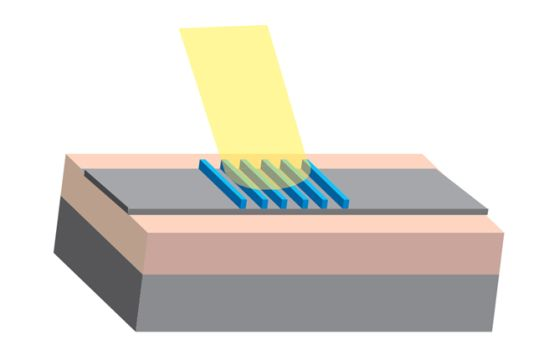
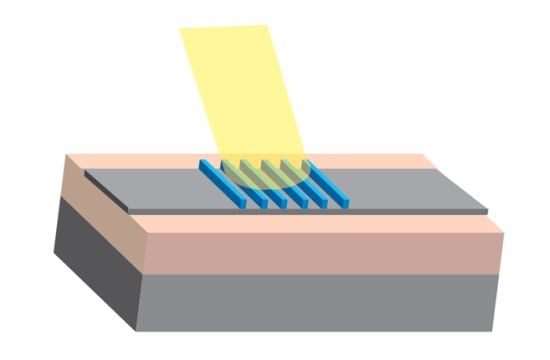
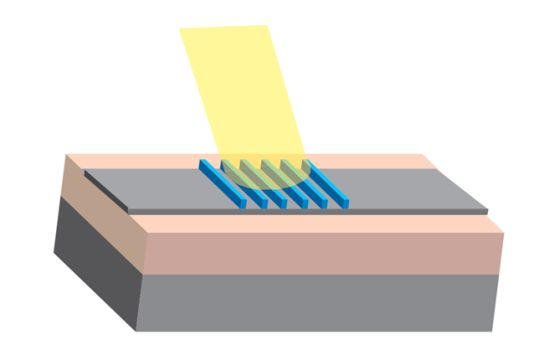
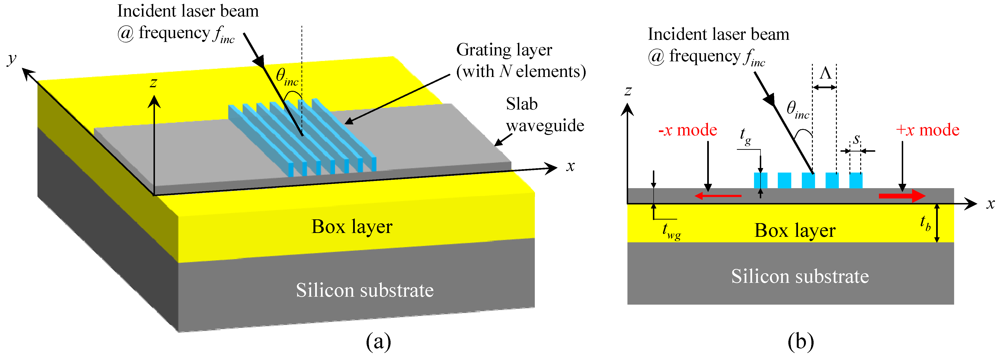
      <p>Schematic of the grating-based angle detector is depicted in <xref ref-type="fig" rid="micromachines-03-00036-f001">Figure 1</xref>. It is completely planar and composed of four layers. The top layer is “grating layer,” which consists of N grating elements. The grating elements are considered uniform and infinitely long along <italic>y</italic> direction in our modeling; and, they are deployed periodically along <italic>x</italic> direction with periodicity <inline-graphic xmlns:xlink="http://www.w3.org/1999/xlink" xlink:href="micromachines-03-00036-i001.tif"/>. The grating layer sits on top of an SOI slab waveguide. A laser beam with frequency <italic>f<sub>inc</sub></italic> is incident onto the device from the top. The incident direction is in the <italic>x–z</italic> plane. The angle between the incident laser and z direction (<italic>i.e.</italic>, surface normal direction) is denoted as <italic>θ<sub>inc</sub></italic>. When the laser is incident obliquely, <italic>θ<sub>inc</sub></italic> takes positive values when the incident laser is along +<italic>x</italic> direction and <italic>θ<sub>inc</sub></italic>is negative when the incident laser is along –<italic>x</italic> direction. Our device is designed such that the incident light is efficiently coupled to the “+<italic>x</italic> traveling mode” and “−<italic>x</italic> traveling mode” in the slab waveguide. When <italic>θ<sub>inc</sub></italic> = 0 (that is, normal incidence), “+<italic>x</italic> mode” and “−<italic>x</italic> mode” in the slab waveguide are equally strong, due to the geometrical symmetry. When <italic>θ<sub>inc</sub></italic> ≠ 0 (that is, oblique incidence), the “+<italic>x</italic> mode” and “−<italic>x</italic> mode” are unbalanced. As a result, <italic>θ<sub>inc</sub></italic> can be found by comparing the “+<italic>x</italic> mode” and “−<italic>x</italic> mode.” In our device, the “+<italic>x</italic> mode” and “−<italic>x</italic> mode” are observed by placing two detectors in the slab waveguide. The two detectors are named “+<italic>x</italic> detector” and “−<italic>x</italic> detector,” respectively. The “+<italic>x</italic> detector” is placed to the right of the grating structure and it serves to detect the power of the “+<italic>x</italic> mode;” similarly, the “−<italic>x</italic> detector” is placed to the left of the grating structure and it detects the power of the “−<italic>x</italic> mode.” The photodetectors in the waveguide can be implemented by following available architectures in [<xref ref-type="bibr" rid="B16-micromachines-03-00036">16</xref>,<xref ref-type="bibr" rid="B17-micromachines-03-00036">17</xref>,<xref ref-type="bibr" rid="B18-micromachines-03-00036">18</xref>].</p>
      <fig id="micromachines-03-00036-f001" position="anchor">
        <label>Figure 1</label>
        <caption>
          <p>(<bold>a</bold>) The device schematic. (<bold>b</bold>) The cross-section view in the <italic>x</italic>–<italic>z</italic> plane.</p>
        </caption>
        <graphic xmlns:xlink="http://www.w3.org/1999/xlink" xlink:href="micromachines-03-00036-g001.tif"/>
      </fig>
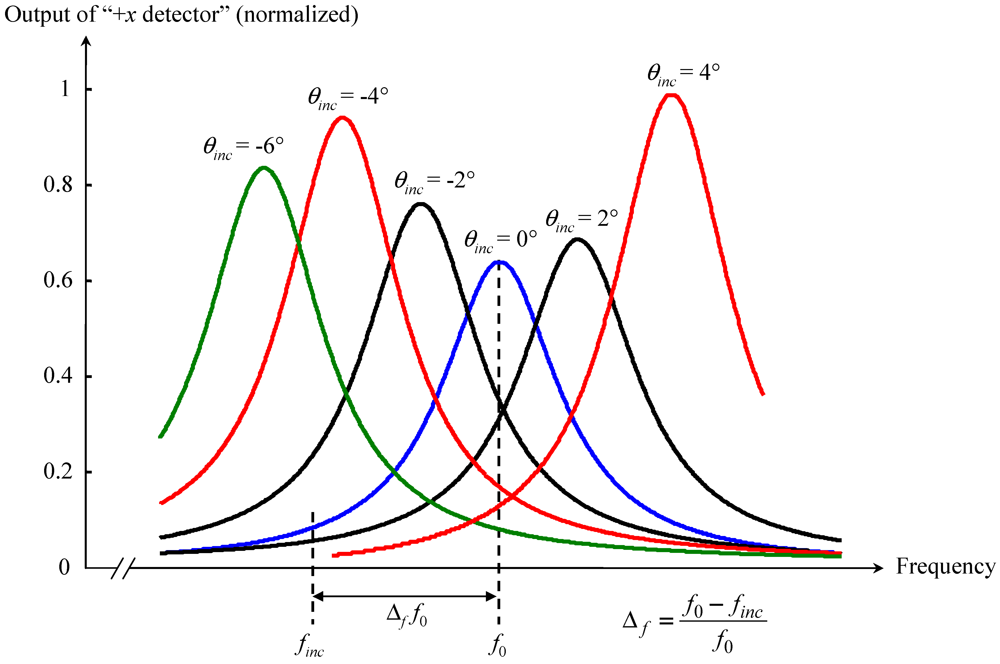
      <p>In <xref ref-type="fig" rid="micromachines-03-00036-f002">Figure 2</xref>, typical spectral outputs of the “+<italic>x</italic> detector” are illustrated with various <italic>θ<sub>inc</sub></italic> values. In our design, the incident light is coupled to the waveguide modes via the second-order Floquet mode predominantly. Consequently, transverse resonance occurs when the following condition is satisfied</p>
      <p><inline-graphic xmlns:xlink="http://www.w3.org/1999/xlink" xlink:href="micromachines-03-00036-i003.tif"/> (1)</p>
      <p>In the above equation, <italic>k<sub>inc</sub></italic> = 2π<italic>f<sub>inc</sub></italic>/<italic>c</italic>, <italic>c</italic> is the speed of light in free space, and <inline-graphic xmlns:xlink="http://www.w3.org/1999/xlink" xlink:href="micromachines-03-00036-i004.tif"/>is the wavenumber along <italic>x</italic> for the fundamental guided mode in the slab waveguide. It is noted that <inline-graphic xmlns:xlink="http://www.w3.org/1999/xlink" xlink:href="micromachines-03-00036-i004.tif"/>is non-linear with respect to the frequency. The transverse resonant frequency for <italic>θ<sub>inc</sub></italic> = 0 is denoted as “<italic>f</italic><sub>0</sub>.” The transverse resonant frequency increases with the increase of <italic>θ<sub>inc</sub></italic>, as shown in <xref ref-type="fig" rid="micromachines-03-00036-f002">Figure 2</xref>. Bandwidth of the resonance is measured by finding the frequencies at which the photodetector’s output drops by 3 dB with respect to the value at the resonant frequency. Further, quality factor is defined as the ratio between the resonant frequency and the bandwidth.</p>
      <p>In our design, <italic>f</italic><sub>0 </sub>is chosen to be close to <italic>f<sub>inc</sub></italic> and greater than <italic>f<sub>inc</sub></italic>; and, the offset between <italic>f</italic><sub>0</sub> and <italic>f<sub>inc</sub></italic> is characterized by</p>
      <p><inline-graphic xmlns:xlink="http://www.w3.org/1999/xlink" xlink:href="micromachines-03-00036-i005.tif"/> (2)</p>
      <p>Output of the “+<italic>x</italic> detector” varies with respect to <italic>θ<sub>inc</sub></italic> when <italic>f<sub>inc</sub></italic> is a constant frequency. Meanwhile, output of the “−<italic>x</italic> detector” exhibits variation with respect to <italic>θ<sub>inc</sub></italic> as well. It is not a difficult task to sketch the outputs of the “−<italic>x</italic> detector” based on <xref ref-type="fig" rid="micromachines-03-00036-f002">Figure 2</xref>, as negative <italic>θ<sub>inc</sub></italic> for the “−<italic>x</italic> detector” is equivalent to positive <italic>θ<sub>inc</sub></italic> for the “+<italic>x</italic> detector.” Since <italic>f</italic><sub>0</sub> and <italic>f<sub>inc</sub></italic> are close to each other, it is possible to derive the value of <italic>θ<sub>inc</sub></italic> by observing the outputs of the two detectors if the incident direction is not far off the normal direction. If <italic>θ<sub>inc</sub></italic> is too large, the outputs of both “+<italic>x</italic> detector” and “−<italic>x</italic> detector” would be too weak and hence unreliable. In order to enlarge the detectable range of <italic>θ<sub>inc</sub></italic>, one feasible way is to reduce the device’s quality factors because lower quality factors lead to wider bandwidths for the curves in <xref ref-type="fig" rid="micromachines-03-00036-f002">Figure 2</xref>. Nevertheless, wider bandwidths unavoidably diminishes the detection sensitivity for <italic>θ<sub>inc</sub></italic>. Other than quality factors, another important design parameter is ∆<italic><sub>f</sub></italic>. It is observed that, larger Δ<italic><sub>f</sub></italic> results in larger detectable range for <italic>θ<sub>inc</sub></italic>. However, large ∆<italic><sub>f</sub></italic> reduces the coupling efficiencies around <italic>θ<sub>inc</sub></italic>= 0. In <xref ref-type="sec" rid="sec3-micromachines-03-00036">Section 3</xref>, the device’s performances with respect to various design parameters are shown by some numerical results.</p>
      <fig id="micromachines-03-00036-f002" position="anchor">
        <label>Figure 2</label>
        <caption>
          <p>Illustration of the angle detector’s rationale.</p>
        </caption>
        <graphic xmlns:xlink="http://www.w3.org/1999/xlink" xlink:href="micromachines-03-00036-g002.tif"/>
      </fig>
    </sec>
    <sec id="sec3-micromachines-03-00036">
      <title>3. Numerical Results</title>
      <p>In this section, some numerical results are presented to demonstrate the performance of the angle detector described in the previous section. Specifically, the angle detector shown in <xref ref-type="fig" rid="micromachines-03-00036-f001">Figure 1</xref> is simulated by MEEP [<xref ref-type="bibr" rid="B19-micromachines-03-00036">19</xref>], which is a full-wave solver based on FDTD method. MEEP has been widely used to characterize various photonic devices, and its fidelity has been verified extensively [<xref ref-type="bibr" rid="B20-micromachines-03-00036">20</xref>,<xref ref-type="bibr" rid="B21-micromachines-03-00036">21</xref>,<xref ref-type="bibr" rid="B22-micromachines-03-00036">22</xref>].</p>
      <p>All the numerical results in this section are obtained with the following geometrical parameters: Λ = 1.065 μm, <italic>s</italic> = 0.234 μm, <italic>t<sub>g</sub></italic> = 0.26 μm, <italic>t<sub>wg</sub></italic> = 0.22 μm, and <italic>t<sub>b</sub></italic> = 2 μm, (please refer to <xref ref-type="fig" rid="micromachines-03-00036-f001">Figure 1</xref> for the definitions of these parameters; thickness of the substrate has negligible impact on the device, according to our observations). The refraction index of box layer is 1.48; and, the other three layers are made of silicon with refraction index 3.48. The incident light is a Gaussian beam with waist radius 23.4 Λ and frequency <italic>f<sub>inc</sub></italic>= 0.646 <italic>c</italic>/<italic>a</italic>, where <italic>a</italic> = 1 μm; in addition, electric field of the incident light is polarized along <italic>y</italic> direction. The two detectors are modeled by integrating the Poynting vectors along +<italic>x</italic> or –<italic>x</italic> direction within the waveguide. As for each detector, coupling efficiency is defined as <italic>P<sub>d</sub></italic>/<italic>P<sub>inc</sub></italic><sub>,</sub>, where <italic>P<sub>d</sub></italic> is the detector’s output and <italic>P<sub>inc </sub></italic>is calculated by integrating the incident light’s power density by the detector’s aperture. As discussed in <xref ref-type="sec" rid="sec2-micromachines-03-00036">Section 2</xref>, our device’s performance is dictated by two major design parameters: quality factors and ∆<italic><sub>f</sub></italic>. In the remainder of this section, various values of these two design parameters are employed to adjust the angle detector’s performance. The quality factors are controlled by <italic>N</italic>, the number of grating elements (apparently, the larger <italic>N</italic> is, the higher the quality factors are).</p>
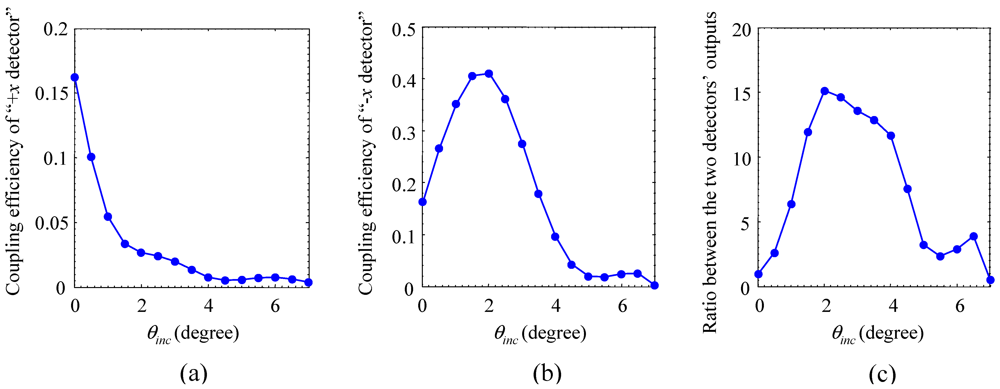
      <p>Outputs of the “+<italic>x</italic> detector” and “−<italic>x</italic> detector” are plotted in <xref ref-type="fig" rid="micromachines-03-00036-f003">Figure 3</xref>(a,b) respectively, with ∆<italic><sub>f</sub></italic> =0.88% and <italic>N</italic>=31. Since <italic>f<sub>inc</sub></italic>&lt; <italic>f<sub>0</sub></italic> in our design, the “−<italic>x</italic> output” is stronger than the “+<italic>x</italic> output” for positive <italic>θ<sub>inc</sub></italic>. The choice of ∆<italic><sub>f</sub></italic> makes<italic>f<sub>inc</sub></italic> coincide with the transverse resonant frequency of <italic>θ<sub>inc</sub></italic> = 2° for the “−<italic>x</italic> detector.” As a result, when the ratio between “−<italic>x</italic> output” and “+<italic>x</italic> output” is plotted in <xref ref-type="fig" rid="micromachines-03-00036-f003">Figure 3</xref>(c), it exhibits a steep increasing slope in range θinc Є [0, 2°]. When θinc is negative, the two detectors’ outputs would be “exchanged:” the ratio between “+x output” and “−x output” exhibits a steep slope in range θinc Є [–2°, 0]. The data for negative θinc are symmetric to those for positive θinc, hence are not shown in <xref ref-type="fig" rid="micromachines-03-00036-f003">Figure 3</xref>. Therefore, from the two detectors’ outputs, <italic>θ<sub>inc</sub></italic> can be reliably derived when it falls in the range −2° <italic>&lt;</italic> <italic>θ<sub>inc</sub></italic><italic> &lt;</italic> 2°.</p>
      <fig id="micromachines-03-00036-f003" position="anchor">
        <label>Figure 3</label>
        <caption>
          <p>Numerical results for the angle detector. (<bold>a</bold>) Coupling efficiency of the “+<italic>x</italic> detector.” (<bold>b</bold>) Coupling efficiency of the “−<italic>x</italic> detector.” (<bold>c</bold>) Ratio between the two detectors’ outputs. </p>
        </caption>
        <graphic xmlns:xlink="http://www.w3.org/1999/xlink" xlink:href="micromachines-03-00036-g003.tif"/>
      </fig>
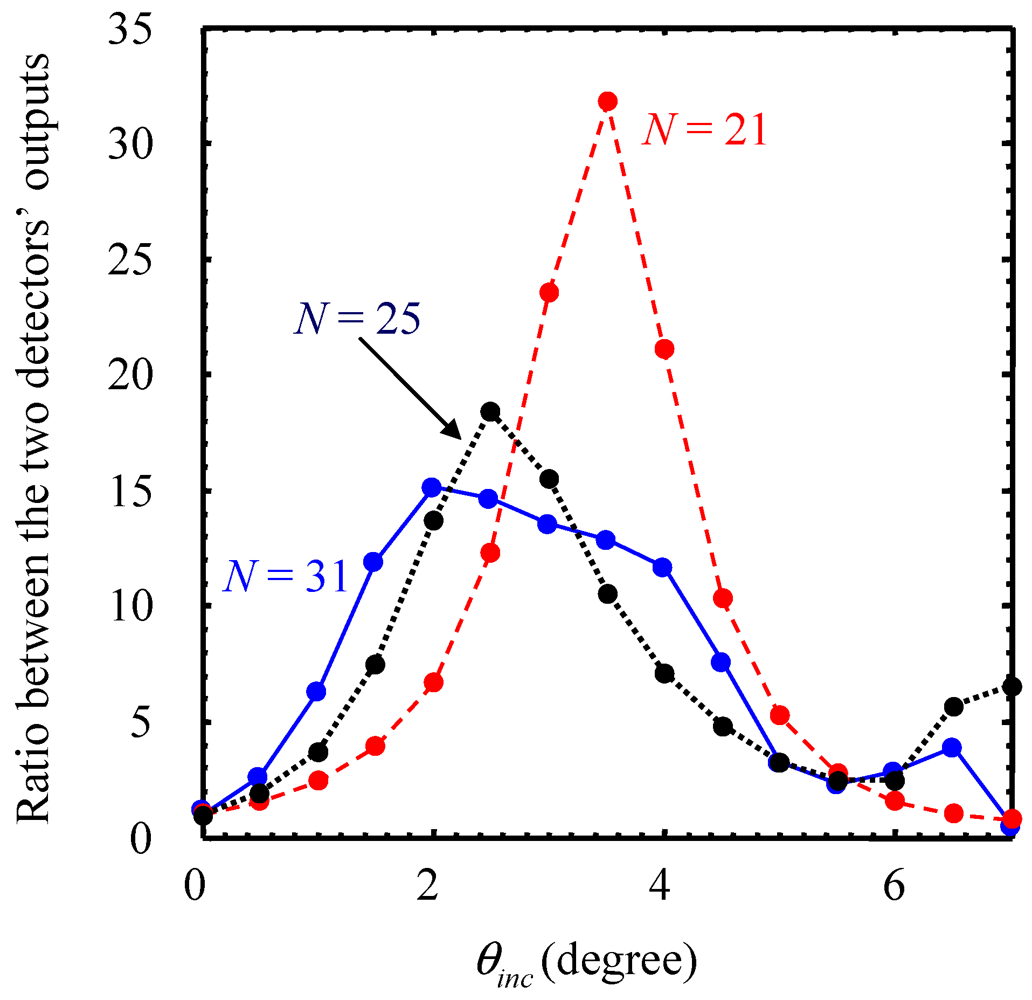
      <p>As analyzed in <xref ref-type="sec" rid="sec2-micromachines-03-00036">Section 2</xref>, the detectable range for <italic>θ<sub>inc</sub></italic> can be enlarged by reducing the quality factors. This analysis is verified by numerical results in <xref ref-type="fig" rid="micromachines-03-00036-f004">Figure 4</xref>. There are three curves in <xref ref-type="fig" rid="micromachines-03-00036-f004">Figure 4</xref>. One of them is the same as that in <xref ref-type="fig" rid="micromachines-03-00036-f003">Figure 3</xref>(c), with <italic>N</italic> = 31. On the basis of the curve in <xref ref-type="fig" rid="micromachines-03-00036-f003">Figure 3</xref>(c), the other two curves in <xref ref-type="fig" rid="micromachines-03-00036-f004">Figure 4</xref> are obtained with <italic>N</italic> = 25 and <italic>N</italic> = 21. As expected, the reduction of N diminishes the device’s quality factors, and thus, increases the detectable range. To be specific, the detectable range is [−2°, 2°] when N = 31; it is increased to [−2.5°, 2.5°] with N = 25 and further increased to [−3.5°, 3.5°] with N = 21. Nevertheless, the curves of “N = 21” and “N = 25” have smaller slopes in the range [0, 2°] compared to the slope of “N = 31” curve, which means that lower quality factors result in lower measurement sensitivity for θinc. </p>
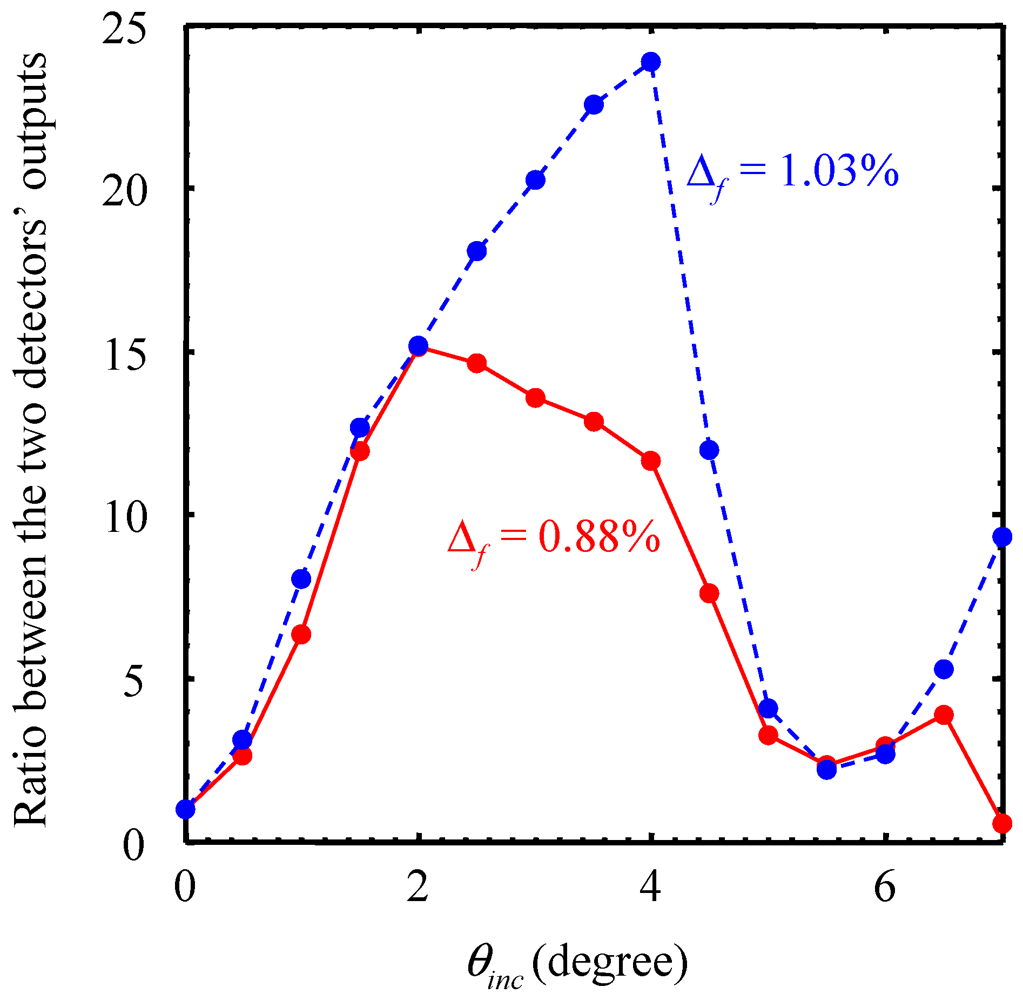
      <p><xref ref-type="fig" rid="micromachines-03-00036-f005">Figure 5</xref> serves to demonstrate the impact of ∆<italic><sub>f</sub></italic> on the device’s performance. One of the two curves in <xref ref-type="fig" rid="micromachines-03-00036-f005">Figure 5</xref> is the same as that in <xref ref-type="fig" rid="micromachines-03-00036-f003">Figure 3</xref>(c), where ∆<italic><sub>f</sub></italic> =0.88%. The other curve in <xref ref-type="fig" rid="micromachines-03-00036-f005">Figure 5</xref> is generated by increasing ∆<italic><sub>f</sub></italic> to 1.03% and with all the other parameters unchanged. It is observed that, the increase of ∆f enlarges the detectable range from [−2°, 2°] to [−4°, 4°]. As a price, the coupling efficiencies around θinc = 0 drop with the increase of ∆f. To be specific, the coupling efficiencies of both detectors at surface normal incidence are 17% when ∆<italic><sub>f</sub></italic> = 0.88%; and they drop to 11% when ∆<italic><sub>f</sub></italic> increases to 1.03%. </p>
      <fig id="micromachines-03-00036-f004" position="anchor">
        <label>Figure 4</label>
        <caption>
          <p>Numerical results for the angle detector with three different values of <italic>N</italic>.</p>
        </caption>
        <graphic xmlns:xlink="http://www.w3.org/1999/xlink" xlink:href="micromachines-03-00036-g004.tif"/>
      </fig>
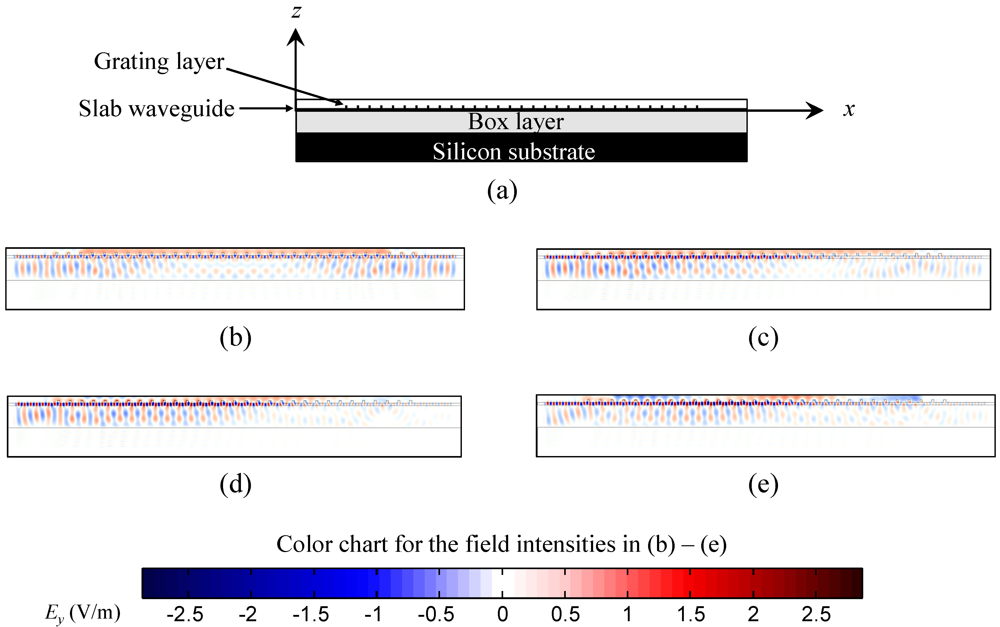
      <p>In order to visualize our device’s behavior better, field distributions are plotted in <xref ref-type="fig" rid="micromachines-03-00036-f006">Figure 6</xref> for several incident angles. The field distribution plots in <xref ref-type="fig" rid="micromachines-03-00036-f006">Figure 6</xref> correspond to the ∆<italic><sub>f</sub></italic> = 1.03% curve of <xref ref-type="fig" rid="micromachines-03-00036-f005">Figure 5</xref>. The device configuration is shown in <xref ref-type="fig" rid="micromachines-03-00036-f006">Figure 6</xref>(a). The incident wave is a continuous wave at <italic>f<sub>inc</sub></italic> = 0.645 <italic>c</italic>/<italic>a</italic>. In <xref ref-type="fig" rid="micromachines-03-00036-f006">Figure 6</xref>(b–e), electric field <italic>E<sub>y</sub></italic> at a certain time moment is plotted, with four different incident angles respectively. In <xref ref-type="fig" rid="micromachines-03-00036-f006">Figure 6</xref>(b–e), the strongest positive field intensity is represented by dark red color, the strongest negative field intensity is represented by dark blue color, and white color stands for zero field intensity, as specified at the end of <xref ref-type="fig" rid="micromachines-03-00036-f006">Figure 6</xref>. Two guided modes (which are traveling toward +<italic>x</italic> and −<italic>x</italic> directions, respectively) can be clearly identified in the waveguide. When <italic>θ<sub>inc</sub></italic> = 0, the two modes are equally strong. With the increase of incident angle, the two modes become more and more unbalanced. When <italic>θ<sub>inc</sub></italic> = 3°, the −<italic>x</italic> mode is much stronger than the +<italic>x</italic> mode.</p>
      <fig id="micromachines-03-00036-f005" position="anchor">
        <label>Figure 5</label>
        <caption>
          <p>Numerical results for the angle detector with two different values of ∆<italic><sub>f</sub></italic>.</p>
        </caption>
        <graphic xmlns:xlink="http://www.w3.org/1999/xlink" xlink:href="micromachines-03-00036-g005.tif"/>
      </fig>
      <fig id="micromachines-03-00036-f006" position="anchor">
        <label>Figure 6</label>
        <caption>
          <p>Field distribution plots with four different incident angles. (<bold>a</bold>) Device configuration. (<bold>b</bold>) Field distribution plot with <italic>θ<sub>inc</sub></italic> =0. (<bold>c</bold>) Field distribution plot with <italic>θ<sub>inc</sub></italic> =1°. (<bold>d</bold>) Field distribution plot with <italic>θ<sub>inc</sub></italic> =2°. (<bold>e</bold>) Field distribution plot with <italic>θ<sub>inc</sub></italic> =3°.</p>
        </caption>
        <graphic xmlns:xlink="http://www.w3.org/1999/xlink" xlink:href="micromachines-03-00036-g006.tif"/>
      </fig>
    </sec>
    <sec sec-type="conclusions" id="sec4-micromachines-03-00036">
      <title>4. Conclusions</title>
      <p>In this paper, a novel device is designed to detect the angle of a laser beam. It consists of a grating layer on top of an SOI slab waveguide. The incident light is coupled into guided modes within the waveguide via the grating layer, and the incident light’s angle can be determined by reading the outputs of light detectors within the waveguide. This device offers fast-responding on-chip detection of laser beam’s angle, with detectable angle range far greater than conventional techniques like QPDs and LEPs. Performance of the laser angle detector in this paper is demonstrated by full-wave FDTD simulations. Numerical results show that the detectable angle range can be adjusted by several design parameters and can reach [−4°, 4°]. Efforts on experimental verification of the grating-based angle detector are currently ongoing. According to our observations, it is challenging to achieve high measurement accuracy with large detectable angle range. We are currently investigating an innovative calibration scheme to improve the accuracy of angle measurement for our device.</p>
    </sec>
  </body>
  <back>
    <ack>
      <title>Acknowledgments</title>
      <p>This work is supported in part by US AFOSR MURI program under Grant FA9550-08-1-0337, by AFRL CONTACT program under Grant FA8650-07-2-5061, and in part by US ARO under Grant W911NF-09-1-0505.</p>
    </ack>
    <ref-list>
      <title>References and Notes</title>
      <ref id="B1-micromachines-03-00036">
        <label>1.</label>
        <citation citation-type="journal">
          <person-group person-group-type="author">
            <name>
              <surname>Mawatari</surname>
              <given-names>K.</given-names>
            </name>
            <name>
              <surname>Shimoide</surname>
              <given-names>K.</given-names>
            </name>
          </person-group>
          <article-title>Reflective thermal lens detection device</article-title>
          <source>Lab Chip</source>
          <year>2006</year>
          <volume>6</volume>
          <fpage>127</fpage>
          <lpage>130</lpage>
          <pub-id pub-id-type="doi">10.1039/b512596k</pub-id>
        </citation>
      </ref>
      <ref id="B2-micromachines-03-00036">
        <label>2.</label>
        <citation citation-type="journal">
          <person-group person-group-type="author">
            <name>
              <surname>Müller</surname>
              <given-names>H.</given-names>
            </name>
            <name>
              <surname>Chiow</surname>
              <given-names>S.-W.</given-names>
            </name>
            <name>
              <surname>Long</surname>
              <given-names>Q.</given-names>
            </name>
            <name>
              <surname>Vo</surname>
              <given-names>C.</given-names>
            </name>
            <name>
              <surname>Chu</surname>
              <given-names>S.</given-names>
            </name>
          </person-group>
          <article-title>Active sub-Rayleigh alignment of parallel or antiparallel laser beams</article-title>
          <source>Opt. Lett.</source>
          <year>2005</year>
          <volume>30</volume>
          <fpage>3323</fpage>
          <lpage>3325</lpage>
          <pub-id pub-id-type="doi">10.1364/OL.30.003323</pub-id>
        </citation>
      </ref>
      <ref id="B3-micromachines-03-00036">
        <label>3.</label>
        <citation citation-type="journal">
          <person-group person-group-type="author">
            <name>
              <surname>Mukai</surname>
              <given-names>S.</given-names>
            </name>
            <name>
              <surname>Watanabe</surname>
              <given-names>M.</given-names>
            </name>
            <name>
              <surname>Itoh</surname>
              <given-names>H.</given-names>
            </name>
            <name>
              <surname>Yajima</surname>
              <given-names>H.</given-names>
            </name>
            <name>
              <surname>Hosoi</surname>
              <given-names>Y.</given-names>
            </name>
            <name>
              <surname>Uekusa</surname>
              <given-names>S.</given-names>
            </name>
          </person-group>
          <article-title>Beam scanning and switching characteristics of twin-striped lasers with a reduced stripe spacing</article-title>
          <source>Opt. Quant. Electron.</source>
          <year>1985</year>
          <volume>17</volume>
          <fpage>431</fpage>
          <lpage>434</lpage>
          <pub-id pub-id-type="doi">10.1007/BF00619569</pub-id>
        </citation>
      </ref>
      <ref id="B4-micromachines-03-00036">
        <label>4.</label>
        <citation citation-type="journal">
          <person-group person-group-type="author">
            <name>
              <surname>Scifres</surname>
              <given-names>D.R.</given-names>
            </name>
            <name>
              <surname>Streifer</surname>
              <given-names>W.</given-names>
            </name>
            <name>
              <surname>Burnham</surname>
              <given-names>R.D.</given-names>
            </name>
          </person-group>
          <article-title>Beam scanning with twin-stripe injection-lasers</article-title>
          <source>Appl. Phys. Lett.</source>
          <year>1978</year>
          <volume>33</volume>
          <fpage>702</fpage>
          <lpage>704</lpage>
        <pub-id pub-id-type="doi">10.1063/1.90507</pub-id></citation>
      </ref>
      <ref id="B5-micromachines-03-00036">
        <label>5.</label>
        <citation citation-type="journal">
          <person-group person-group-type="author">
            <name>
              <surname>Kurosaka</surname>
              <given-names>Y.</given-names>
            </name>
            <name>
              <surname>Iwahashi</surname>
              <given-names>S.</given-names>
            </name>
            <name>
              <surname>Liang</surname>
              <given-names>Y.</given-names>
            </name>
            <name>
              <surname>Sakai</surname>
              <given-names>K.</given-names>
            </name>
            <name>
              <surname>Miyai</surname>
              <given-names>E.</given-names>
            </name>
            <name>
              <surname>Kunishi</surname>
              <given-names>W.</given-names>
            </name>
            <name>
              <surname>Ohnishi</surname>
              <given-names>D.</given-names>
            </name>
            <name>
              <surname>Noda</surname>
              <given-names>S.</given-names>
            </name>
          </person-group>
          <article-title>On-chip beam-steering photonic-crystal lasers</article-title>
          <source>Nat. Photon.</source>
          <year>2010</year>
          <volume>4</volume>
          <fpage>447</fpage>
          <lpage>450</lpage>
          <pub-id pub-id-type="doi">10.1038/nphoton.2010.118</pub-id>
        </citation>
      </ref>
      <ref id="B6-micromachines-03-00036">
        <label>6.</label>
        <citation citation-type="journal">
          <person-group person-group-type="author">
            <name>
              <surname>Tuantranont</surname>
              <given-names>A.</given-names>
            </name>
            <name>
              <surname>Bright</surname>
              <given-names>V.M.</given-names>
            </name>
            <name>
              <surname>Zhang</surname>
              <given-names>J.</given-names>
            </name>
            <name>
              <surname>Zhang</surname>
              <given-names>W.</given-names>
            </name>
            <name>
              <surname>Neff</surname>
              <given-names>J.A.</given-names>
            </name>
            <name>
              <surname>Lee</surname>
              <given-names>Y.C.</given-names>
            </name>
          </person-group>
          <article-title>Optical beam steering using MEMS-controllable microlens array</article-title>
          <source>Sensors Actuat. A: Phys.</source>
          <year>2001</year>
          <volume>91</volume>
          <fpage>363</fpage>
          <lpage>372</lpage>
          <pub-id pub-id-type="doi">10.1016/S0924-4247(01)00609-4</pub-id>
        </citation>
      </ref>
      <ref id="B7-micromachines-03-00036">
        <label>7.</label>
        <citation citation-type="journal">
          <person-group person-group-type="author">
            <name>
              <surname>May-Arrioja</surname>
              <given-names>D.A.</given-names>
            </name>
            <name>
              <surname>Bickel</surname>
              <given-names>N.</given-names>
            </name>
            <name>
              <surname>LiKamWa</surname>
              <given-names>P.</given-names>
            </name>
          </person-group>
          <article-title>Optical beam steering using InGaAsP multiple quantum wells</article-title>
          <source>IEEE Photonic Technol. Lett.</source>
          <year>2005</year>
          <volume>17</volume>
          <fpage>333</fpage>
          <lpage>335</lpage>
        <pub-id pub-id-type="doi">10.1109/LPT.2004.839374</pub-id></citation>
      </ref>
      <ref id="B8-micromachines-03-00036">
        <label>8.</label>
        <citation citation-type="journal">
          <person-group person-group-type="author">
            <name>
              <surname>Jarrahi</surname>
              <given-names>M.</given-names>
            </name>
            <name>
              <surname>Fabian</surname>
              <given-names>R.</given-names>
            </name>
            <name>
              <surname>Pease</surname>
              <given-names>W.</given-names>
            </name>
            <name>
              <surname>Miller</surname>
              <given-names>D.A.B.</given-names>
            </name>
            <name>
              <surname>Lee</surname>
              <given-names>T.H.</given-names>
            </name>
          </person-group>
          <article-title>High-speed optical beam-steering based on phase-arrayed waveguides</article-title>
          <source>J. Vac. Sci. Technol. B</source>
          <year>2008</year>
          <volume>26</volume>
          <fpage>2124</fpage>
          <lpage>2126</lpage>
          <pub-id pub-id-type="doi">10.1116/1.2978945</pub-id>
        </citation>
      </ref>
      <ref id="B9-micromachines-03-00036">
        <label>9.</label>
        <citation citation-type="journal">
          <person-group person-group-type="author">
            <name>
              <surname>Nakamura</surname>
              <given-names>O.</given-names>
            </name>
            <name>
              <surname>Goto</surname>
              <given-names>M.</given-names>
            </name>
            <name>
              <surname>Toyoda</surname>
              <given-names>K.</given-names>
            </name>
            <name>
              <surname>Takai</surname>
              <given-names>N.</given-names>
            </name>
            <name>
              <surname>Kurosawa</surname>
              <given-names>T.</given-names>
            </name>
            <name>
              <surname>Nakamata</surname>
              <given-names>T.</given-names>
            </name>
          </person-group>
          <article-title>A laser tracking robot-performance calibration system using ball-seated bearing mechanisms and a spherically shaped cat’s-eye retroreflector</article-title>
          <source>Rev. Sci. Instr.</source>
          <year>1994</year>
          <volume>65</volume>
          <fpage>1006</fpage>
          <pub-id pub-id-type="doi">10.1063/1.1145104</pub-id>
        </citation>
      </ref>
      <ref id="B10-micromachines-03-00036">
        <label>10.</label>
        <citation citation-type="journal">
          <person-group person-group-type="author">
            <name>
              <surname>Umetsu</surname>
              <given-names>K.</given-names>
            </name>
            <name>
              <surname>Furutnani</surname>
              <given-names>R.</given-names>
            </name>
            <name>
              <surname>Osawa</surname>
              <given-names>S.</given-names>
            </name>
            <name>
              <surname>Takatsuji</surname>
              <given-names>T.</given-names>
            </name>
            <name>
              <surname>Kurosawa</surname>
              <given-names>T.</given-names>
            </name>
          </person-group>
          <article-title>Geometric calibration of a coordinate measuring machine using a laser tracking system</article-title>
          <source>Meas. Sci. Technol.</source>
          <year>2005</year>
          <volume>16</volume>
          <fpage>2466</fpage>
          <lpage>2472</lpage>
          <pub-id pub-id-type="doi">10.1088/0957-0233/16/12/010</pub-id>
        </citation>
      </ref>
      <ref id="B11-micromachines-03-00036">
        <label>11.</label>
        <citation citation-type="journal">
          <person-group person-group-type="author">
            <name>
              <surname>Manojlovic</surname>
              <given-names>L.M.</given-names>
            </name>
            <name>
              <surname>Barbaric</surname>
              <given-names>Z.P.</given-names>
            </name>
          </person-group>
          <article-title>Optimization of optical receiver parameters for pulsed laser-tracking systems</article-title>
          <source>IEEE Trans. Instrum. Meas.</source>
          <year>2009</year>
          <volume>58</volume>
          <fpage>681</fpage>
          <lpage>690</lpage>
          <pub-id pub-id-type="doi">10.1109/TIM.2008.2005259</pub-id>
        </citation>
      </ref>
      <ref id="B12-micromachines-03-00036">
        <label>12.</label>
        <citation citation-type="journal">
          <person-group person-group-type="author">
            <name>
              <surname>Toyoda</surname>
              <given-names>M.</given-names>
            </name>
            <name>
              <surname>Araki</surname>
              <given-names>K.</given-names>
            </name>
            <name>
              <surname>Suzuki</surname>
              <given-names>Y.</given-names>
            </name>
          </person-group>
          <article-title>Measurement of the characteristics of a quadrant avalanche photodiode and its application to a laser tracking system</article-title>
          <source>Opt. Eng.</source>
          <year>2002</year>
          <volume>41</volume>
          <fpage>145</fpage>
          <lpage>149</lpage>
          <pub-id pub-id-type="doi">10.1117/1.1418222</pub-id>
        </citation>
      </ref>
      <ref id="B13-micromachines-03-00036">
        <label>13.</label>
        <citation citation-type="journal">
          <person-group person-group-type="author">
            <name>
              <surname>Makynen</surname>
              <given-names>A.</given-names>
            </name>
            <name>
              <surname>Kostamovaara</surname>
              <given-names>J.T.</given-names>
            </name>
            <name>
              <surname>Myllyla</surname>
              <given-names>R.A.</given-names>
            </name>
          </person-group>
          <article-title>Displacement sensing resolution of position-sensitive detectors in atmospheric turbulence using retroreflected beam</article-title>
          <source>IEEE Trans. Instrum. Meas.</source>
          <year>1997</year>
          <volume>46</volume>
          <fpage>1133</fpage>
          <lpage>1136</lpage>
          <pub-id pub-id-type="doi">10.1109/19.676726</pub-id>
        </citation>
      </ref>
      <ref id="B14-micromachines-03-00036">
        <label>14.</label>
        <citation citation-type="journal">
          <person-group person-group-type="author">
            <name>
              <surname>Fujita</surname>
              <given-names>T.</given-names>
            </name>
            <name>
              <surname>Nakamura</surname>
              <given-names>K.</given-names>
            </name>
            <name>
              <surname>Matozaki</surname>
              <given-names>T.</given-names>
            </name>
          </person-group>
          <article-title>Simple and accurate propagation-angle observation of a collimated laser beam within a short optical path range by use of a dual-focus Fresnel lens</article-title>
          <source>Opt. Rev.</source>
          <year>2005</year>
          <volume>12</volume>
          <fpage>260</fpage>
          <lpage>263</lpage>
          <pub-id pub-id-type="doi">10.1007/s10043-005-0260-2</pub-id>
        </citation>
      </ref>
      <ref id="B15-micromachines-03-00036">
        <label>15.</label>
        <citation citation-type="journal">
          <person-group person-group-type="author">
            <name>
              <surname>Kunz</surname>
              <given-names>R.E.</given-names>
            </name>
            <name>
              <surname>Dubendorfer</surname>
              <given-names>J.</given-names>
            </name>
          </person-group>
          <article-title>Novel miniature integrated optical goniometers</article-title>
          <source>Sensor Actuat. A: Phys.</source>
          <year>1997</year>
          <volume>60</volume>
          <fpage>23</fpage>
          <lpage>28</lpage>
          <pub-id pub-id-type="doi">10.1016/S0924-4247(96)01413-6</pub-id>
        </citation>
      </ref>
      <ref id="B16-micromachines-03-00036">
        <label>16.</label>
        <citation citation-type="journal">
          <person-group person-group-type="author">
            <name>
              <surname>Roelkens</surname>
              <given-names>G.</given-names>
            </name>
            <name>
              <surname>Van Thourhout</surname>
              <given-names>D.</given-names>
            </name>
            <name>
              <surname>Baets</surname>
              <given-names>R.</given-names>
            </name>
            <name>
              <surname>Notzel</surname>
              <given-names>R.</given-names>
            </name>
            <name>
              <surname>Smit</surname>
              <given-names>M.</given-names>
            </name>
          </person-group>
          <article-title>Laser emission and photodetection in an InP/InGaAsP layer integrated on and coupled to a Silicon-on-Insulator waveguide circuit</article-title>
          <source>Opt. Express</source>
          <year>2006</year>
          <volume>14</volume>
          <fpage>8154</fpage>
          <lpage>8159</lpage>
          <pub-id pub-id-type="doi">10.1364/OE.14.008154</pub-id>
        </citation>
      </ref>
      <ref id="B17-micromachines-03-00036">
        <label>17.</label>
        <citation citation-type="journal">
          <person-group person-group-type="author">
            <name>
              <surname>Liang</surname>
              <given-names>D.</given-names>
            </name>
            <name>
              <surname>Fiorentino</surname>
              <given-names>M.</given-names>
            </name>
            <name>
              <surname>Okumura</surname>
              <given-names>T.</given-names>
            </name>
            <name>
              <surname>Chang</surname>
              <given-names>H.-H.</given-names>
            </name>
            <name>
              <surname>Spencer</surname>
              <given-names>D.T.</given-names>
            </name>
            <name>
              <surname>Kuo</surname>
              <given-names>Y.-H.</given-names>
            </name>
            <name>
              <surname>Fang</surname>
              <given-names>A.W.</given-names>
            </name>
            <name>
              <surname>Dai</surname>
              <given-names>D.</given-names>
            </name>
            <name>
              <surname>Beausoleil</surname>
              <given-names>R. G.</given-names>
            </name>
            <name>
              <surname>Bowers</surname>
              <given-names>J. E.</given-names>
            </name>
          </person-group>
          <article-title>Electrically-pumped compact hybrid silicon microring lasers for optical interconnects</article-title>
          <source>Opt. Express</source>
          <year>2009</year>
          <volume>17</volume>
          <fpage>20355</fpage>
          <lpage>20364</lpage>
        <pub-id pub-id-type="doi">10.1364/OE.17.020355</pub-id><pub-id pub-id-type="pmid">19997264</pub-id></citation>
      </ref>
      <ref id="B18-micromachines-03-00036">
        <label>18.</label>
        <citation citation-type="journal">
          <person-group person-group-type="author">
            <name>
              <surname>Roelkens</surname>
              <given-names>G.</given-names>
            </name>
            <name>
              <surname>Brouckaert</surname>
              <given-names>J.</given-names>
            </name>
            <name>
              <surname>Taillaert</surname>
              <given-names>D.</given-names>
            </name>
            <name>
              <surname>Dumon</surname>
              <given-names>P.</given-names>
            </name>
            <name>
              <surname>Bogaerts</surname>
              <given-names>W.</given-names>
            </name>
            <name>
              <surname>Van Thourhout</surname>
              <given-names>D.</given-names>
            </name>
            <name>
              <surname>Baets</surname>
              <given-names>R.</given-names>
            </name>
            <name>
              <surname>Notzel</surname>
              <given-names>R.</given-names>
            </name>
            <name>
              <surname>Smit</surname>
              <given-names>M.</given-names>
            </name>
          </person-group>
          <article-title>Integration of InP/InGaAsP photodetectors onto silicon-on-insulator waveguide circuits</article-title>
          <source>Opt. Express</source>
          <year>2005</year>
          <volume>13</volume>
          <fpage>10102</fpage>
          <lpage>10108</lpage>
        <pub-id pub-id-type="doi">10.1364/OPEX.13.010102</pub-id><pub-id pub-id-type="pmid">19503223</pub-id></citation>
      </ref>
      <ref id="B19-micromachines-03-00036">
        <label>19.</label>
        <citation citation-type="web">
          <article-title>Meep</article-title>
          <access-date>(accessed on 30 January 2012)</access-date>
          <comment>Available online:<ext-link xmlns:xlink="http://www.w3.org/1999/xlink" xlink:href="http://ab-initio.mit.edu/wiki/index.php/Meep" ext-link-type="uri">http://ab-initio.mit.edu/wiki/index.php/Meep</ext-link></comment>
        </citation>
      </ref>
      <ref id="B20-micromachines-03-00036">
        <label>20.</label>
        <citation citation-type="journal">
          <person-group person-group-type="author">
            <name>
              <surname>Yang</surname>
              <given-names>X.</given-names>
            </name>
            <name>
              <surname>Yu</surname>
              <given-names>M.</given-names>
            </name>
            <name>
              <surname>Kwong</surname>
              <given-names>D.-L.</given-names>
            </name>
            <name>
              <surname>Wong</surname>
              <given-names>C.W.</given-names>
            </name>
          </person-group>
          <article-title>Coupled resonances in multiple silicon photonic crystal cavities in all-optical solid-state analogy to electromagnetically induced transparency</article-title>
          <source>IEEE J. Sel. Top. Quantum Electr.</source>
          <year>2010</year>
          <volume>16</volume>
          <fpage>288</fpage>
          <lpage>294</lpage>
          <pub-id pub-id-type="doi">10.1109/JSTQE.2009.2032665</pub-id>
        </citation>
      </ref>
      <ref id="B21-micromachines-03-00036">
        <label>21.</label>
        <citation citation-type="journal">
          <person-group person-group-type="author">
            <name>
              <surname>Baumann</surname>
              <given-names>K.</given-names>
            </name>
            <name>
              <surname>Stoferle</surname>
              <given-names>T.</given-names>
            </name>
            <name>
              <surname>Moll</surname>
              <given-names>N.</given-names>
            </name>
            <name>
              <surname>Raino</surname>
              <given-names>G.</given-names>
            </name>
            <name>
              <surname>Mahrt</surname>
              <given-names>R.F.</given-names>
            </name>
            <name>
              <surname>Wahlbrink</surname>
              <given-names>T.</given-names>
            </name>
            <name>
              <surname>Bolten</surname>
              <given-names>J.</given-names>
            </name>
            <name>
              <surname>Scherf</surname>
              <given-names>U.</given-names>
            </name>
          </person-group>
          <article-title>Design and optical characterization of photonic crystal lasers with organic gain material</article-title>
          <source>J. Opt.</source>
          <year>2010</year>
          <volume>12</volume>
          <fpage>065003</fpage>
          <pub-id pub-id-type="doi">10.1088/2040-8978/12/6/065003</pub-id>
        </citation>
      </ref>
      <ref id="B22-micromachines-03-00036">
        <label>22.</label>
        <citation citation-type="journal">
          <person-group person-group-type="author">
            <name>
              <surname>Kim</surname>
              <given-names>T.-T.</given-names>
            </name>
            <name>
              <surname>Lee</surname>
              <given-names>S.-G.</given-names>
            </name>
            <name>
              <surname>Kim</surname>
              <given-names>S.-H.</given-names>
            </name>
            <name>
              <surname>Kim</surname>
              <given-names>J.-E.</given-names>
            </name>
            <name>
              <surname>Park</surname>
              <given-names>H. Y.</given-names>
            </name>
            <name>
              <surname>Kee</surname>
              <given-names>C.-S.</given-names>
            </name>
          </person-group>
          <article-title>Ring-type Fabry-Perot filter based on the self-collimation effect in a 2D photonic crystal</article-title>
          <source>Opt. Express</source>
          <year>2010</year>
          <volume>18</volume>
          <fpage>17106</fpage>
          <lpage>17113</lpage>
        <pub-id pub-id-type="doi">10.1364/OE.18.017106</pub-id><pub-id pub-id-type="pmid">20721099</pub-id></citation>
      </ref>
    </ref-list>
  </back>
</article>