
<?xml version="1.0" encoding="UTF-8"?>
<!DOCTYPE article PUBLIC "-//NLM//DTD Journal Publishing DTD v2.3 20070202//EN" "journalpublishing.dtd">
<article xmlns:mml="http://www.w3.org/1998/Math/MathML" xmlns:xlink="http://www.w3.org/1999/xlink" xml:lang="en" article-type="review-article">
  <front>
    <journal-meta>
      <journal-id journal-id-type="publisher-id">toxins</journal-id>
      <journal-title>Toxins</journal-title>
      <abbrev-journal-title abbrev-type="publisher">Toxins</abbrev-journal-title>
      <abbrev-journal-title abbrev-type="pubmed">Toxins</abbrev-journal-title>
      <issn pub-type="epub">2072-6651</issn>
      <publisher>
        <publisher-name>MDPI</publisher-name>
      </publisher>
    </journal-meta>
    <article-meta>
      <article-id pub-id-type="doi">10.3390/toxins5020267</article-id>
      <article-id pub-id-type="publisher-id">toxins-05-00267</article-id>
      <article-categories>
        <subj-group>
          <subject>Review</subject>
        </subj-group>
      </article-categories>
      <title-group>
        <article-title>Is Protein Phosphatase Inhibition Responsible for the Toxic Effects of Okadaic Acid in Animals?</article-title>
      </title-group>
      <contrib-group>
        <contrib contrib-type="author">
          <name>
            <surname>Munday</surname>
            <given-names>Rex</given-names>
          </name>
        </contrib>
      </contrib-group>
      <aff id="af1-toxins-05-00267">AgResearch Ltd, Ruakura Research Centre, Private Bag 3123, Hamilton, New Zealand; E-Mail: <email>rex.munday@agresearch.co.nz</email>; Tel.:+64-7-838-5138; Fax: +64-7-838-5012</aff>
      <pub-date pub-type="epub">
        <day>04</day>
        <month>02</month>
        <year>2013</year>
      </pub-date>
      <pub-date pub-type="collection"><month>02</month>
        <year>2013</year>
      </pub-date>
      <volume>5</volume>
      <issue>2</issue>
      <fpage>267</fpage>
      <lpage>285</lpage>
      <history>
        <date date-type="received">
          <day>06</day>
          <month>11</month>
          <year>2012</year>
        </date>
        <date date-type="rev-recd">
          <day>08</day>
          <month>01</month>
          <year>2013</year>
        </date>
        <date date-type="accepted">
          <day>24</day>
          <month>01</month>
          <year>2013</year>
        </date>
      </history>
      <permissions>
        <copyright-statement>©  2013 by the authors; licensee MDPI, Basel, Switzerland.</copyright-statement>
        <copyright-year>2013</copyright-year>
        <license xmlns:xlink="http://www.w3.org/1999/xlink" license-type="open-access" xlink:href="http://creativecommons.org/licenses/by/3.0/">
          <p>This article is an open access article distributed under the terms and conditions of the Creative Commons Attribution license (http://creativecommons.org/licenses/by/3.0/).</p>
        </license>
      </permissions>
      <abstract>
        <p>Okadaic acid (OA) and its derivatives, which are produced by dinoflagellates of the genera <italic>Prorocentrum</italic> and <italic>Dinophysis</italic>, are responsible for diarrhetic shellfish poisoning in humans. In laboratory animals, these toxins cause epithelial damage and fluid accumulation in the gastrointestinal tract, and at high doses, they cause death. These substances have also been shown to be tumour promoters, and when injected into the brains of rodents, OA induces neuronal damage reminiscent of that seen in Alzheimer’s disease. OA and certain of its derivatives are potent inhibitors of protein phosphatases, which play many roles in cellular metabolism. In 1990, it was suggested that inhibition of these enzymes was responsible for the diarrhetic effect of these toxins. It is now repeatedly stated in the literature that protein phosphatase inhibition is not only responsible for the intestinal effects of OA and derivatives, but also for their acute toxic effects, their tumour promoting activity and their neuronal toxicity. In the present review, the evidence for the involvement of protein phosphatase inhibition in the induction of the toxic effects of OA and its derivatives is examined, with the conclusion that the mechanism of toxicity of these substances requires re-evaluation.</p>
      </abstract>
      <kwd-group>
        <kwd>okadaic acid toxicity</kwd>
        <kwd>protein phosphatase inhibition</kwd>
      </kwd-group>
    </article-meta>
  </front>
  <body>
    <sec sec-type="intro">
      <title>1. Introduction</title>
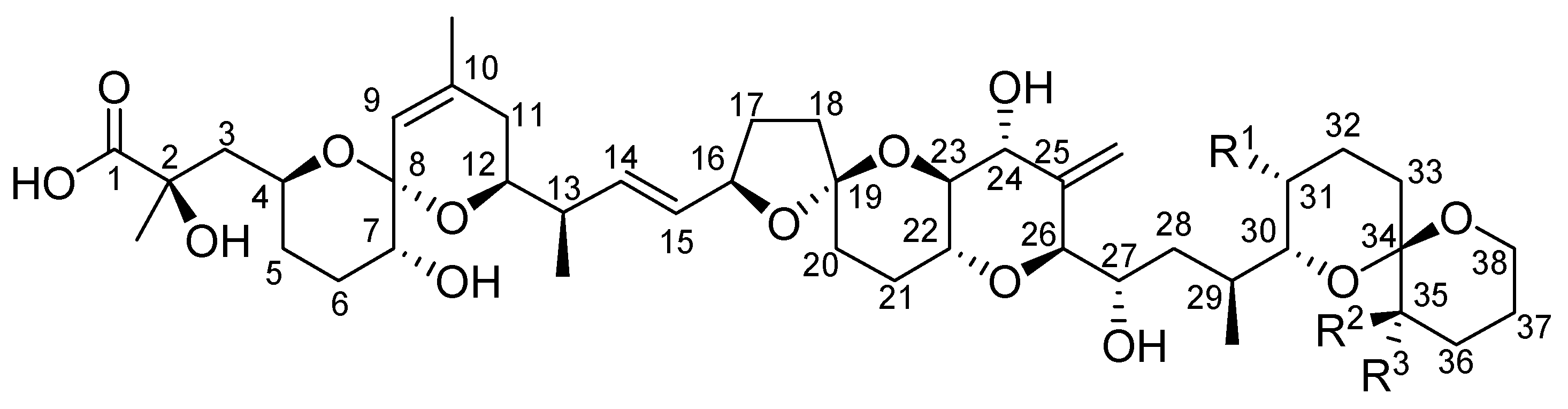
      <p>Okadaic acid (OA, <xref ref-type="fig" rid="toxins-05-00267-f001">Figure 1</xref>, R<sub>1</sub> = CH<sub>3</sub>, R<sub>2</sub> = H, R<sub>3</sub> = H) is produced by dinoflagellates of the genera <italic>Prorocentrum</italic> and <italic>Dinophysis</italic>, which are of worldwide distribution [<xref ref-type="bibr" rid="B1-toxins-05-00267">1</xref>]. These organisms also produce the isomeric compounds dinophysistoxin 2 (DTX-2, <xref ref-type="fig" rid="toxins-05-00267-f001">Figure 1</xref>, R<sub>1</sub> = H, R<sub>2</sub> = H, R<sub>3</sub> = CH<sub>3</sub>) and 19-<italic>epi</italic>-okadaic acid, together with the methylated derivative, dinophysistoxin 1 (DTX-1, <xref ref-type="fig" rid="toxins-05-00267-f001">Figure 1</xref>, R<sub>1</sub> = CH<sub>3</sub>, R<sub>2</sub> = CH<sub>3</sub>, R<sub>3</sub> = H). Many esters formed from OA and the dinophysistoxins by conjugation of the terminal carboxylic acid group with poly-hydroxylated, sulphated or unsaturated alcohols have also been isolated from these organisms [<xref ref-type="bibr" rid="B2-toxins-05-00267">2</xref>]. When ingested by shellfish, a proportion of the toxins present in the dinoflagellates are acylated at the C-7 hydroxyl group with long-chain fatty acids, forming derivatives collectively known as DTX-3 [<xref ref-type="bibr" rid="B3-toxins-05-00267">3</xref>].</p>
      <fig id="toxins-05-00267-f001" position="float">
        <label>Figure 1</label>
        <caption>
          <p>General structure of okadaic acid and derivatives.</p>
        </caption>
        <graphic xmlns:xlink="http://www.w3.org/1999/xlink" xlink:href="toxins-05-00267-g001.tif"/>
      </fig>
      <p>Shellfish contaminated with OA and its derivatives are responsible for Diarrhetic Shellfish Poisoning (DSP) in humans. DSP was first reported in Japan in the late 1970s [<xref ref-type="bibr" rid="B4-toxins-05-00267">4</xref>], but since that time, it has been recorded in many other parts of the world, including Europe, Scandinavia, North and South America and New Zealand [<xref ref-type="bibr" rid="B5-toxins-05-00267">5</xref>,<xref ref-type="bibr" rid="B6-toxins-05-00267">6</xref>]. The predominant symptoms associated with DSP are nausea, vomiting, diarrhoea and abdominal pain, observed soon after ingestion of contaminated shellfish. Symptoms generally resolve within 2–3 days, and no deaths associated with DSP have been reported.</p>
    </sec>
    <sec>
      <title>2. Toxicity of Okadaic Acid and Derivatives to Experimental Animals</title>
      <sec>
        <title>2.1. Acute Toxicity of Okadaic Acid and Derivatives</title>
        <p>OA itself is highly toxic to mice by intraperitoneal injection, with LD<sub>50</sub> values between 192 and 225 µg/kg being reported [<xref ref-type="bibr" rid="B7-toxins-05-00267">7</xref>,<xref ref-type="bibr" rid="B8-toxins-05-00267">8</xref>,<xref ref-type="bibr" rid="B9-toxins-05-00267">9</xref>,<xref ref-type="bibr" rid="B10-toxins-05-00267">10</xref>]. Although no LD<sub>50</sub> data on DTX-1 are available, it would appear that this compound, with a reported minimum lethal dose of 160 µg/kg [<xref ref-type="bibr" rid="B11-toxins-05-00267">11</xref>], is of similar toxicity to OA. DTX-2, DTX-3 and DTX-4 are somewhat less acutely toxic, with LD<sub>50</sub> values between 352 and 600 µg/kg [<xref ref-type="bibr" rid="B7-toxins-05-00267">7</xref>,<xref ref-type="bibr" rid="B12-toxins-05-00267">12</xref>,<xref ref-type="bibr" rid="B13-toxins-05-00267">13</xref>]. Acylation of the 7-hydroxyl group with a saturated fatty acid, to form 7-<italic>O</italic>-palmitoyl-OA or a di-unsaturated fatty acid, giving 7-<italic>O</italic>-linoleoyl-OA, greatly decreases toxicity, and these compounds are approximately 20-times less toxic than OA. In contrast, the polyunsaturated 7-<italic>O</italic>-docosahexaenoyl-OA was reported to be 10-times more toxic than the saturated or di-unsaturated esters, with a minimum lethal dose of 550 µg/kg [<xref ref-type="bibr" rid="B14-toxins-05-00267">14</xref>], indicating that this substance is of similar toxicity to DTX-2, DTX-3 and DTX-4 and approximately half as toxic as OA. </p>
        <p>OA is less toxic by oral administration than by intraperitoneal injection, although the data that are available are inconsistent. The median lethal dose of OA by gavage was reported as 400 µg/kg [<xref ref-type="bibr" rid="B15-toxins-05-00267">15</xref>] and 880 µg/kg [<xref ref-type="bibr" rid="B16-toxins-05-00267">16</xref>], while Tubaro <italic>et al.</italic> [<xref ref-type="bibr" rid="B9-toxins-05-00267">9</xref>] observed no deaths at 1,000 µg/kg. Even within the same laboratory, wide variations in estimates of the median lethal dose occur. Le Hégarat [<xref ref-type="bibr" rid="B17-toxins-05-00267">17</xref>] found 100% mortality in mice dosed with OA at 300 µg/kg in one experiment, but none at 610 µg/kg in a subsequent one. The reason or reasons for these disparate results are unknown, but it would appear that OA is between 2- and 5-fold less toxic by oral administration than by injection. Few data are available on the OA derivatives, but it would appear that DTX-1 is only slightly less toxic when administered orally than when given by intraperitoneal injection [<xref ref-type="bibr" rid="B18-toxins-05-00267">18</xref>,<xref ref-type="bibr" rid="B19-toxins-05-00267">19</xref>].</p>
        <p>Severe damage to the epithelium of villi in the duodenum and upper jejunum, with separation and desquamation of epithelial cells from the lamina propria, was seen after intraperitoneal injection of OA in mice, although little effect was seen in the crypts. Pronounced oedema of the lamina propria was observed, attributed to increased permeability of vessels of the intestinal villi [<xref ref-type="bibr" rid="B20-toxins-05-00267">20</xref>]. Erosion of the intestinal epithelium was recorded in animals injected with OA and DTX-1, while little effect on the gastrointestinal tract was observed in animals receiving the same dose of DTX-3 [<xref ref-type="bibr" rid="B18-toxins-05-00267">18</xref>,<xref ref-type="bibr" rid="B21-toxins-05-00267">21</xref>]. The toxic changes induced in the small intestine of mice by intraperitoneal injection of OA and its derivatives were also observed after oral administration of these substances, and some epithelial damage was also observed in the caecum and large intestine of these animals [<xref ref-type="bibr" rid="B9-toxins-05-00267">9</xref>,<xref ref-type="bibr" rid="B15-toxins-05-00267">15</xref>,<xref ref-type="bibr" rid="B18-toxins-05-00267">18</xref>,<xref ref-type="bibr" rid="B21-toxins-05-00267">21</xref>]. Oral administration of OA also caused oedema and mucosal erosion in the stomach of mice, accompanied by acute inflammatory changes in the submucosa [<xref ref-type="bibr" rid="B9-toxins-05-00267">9</xref>,<xref ref-type="bibr" rid="B15-toxins-05-00267">15</xref>,<xref ref-type="bibr" rid="B22-toxins-05-00267">22</xref>]. Oral administration of OA to rats induced changes in the gastrointestinal tract similar to those seen in mice [<xref ref-type="bibr" rid="B23-toxins-05-00267">23</xref>].</p>
        <p>The cause of death following administration of lethal doses of OA is presently unclear. After intraperitoneal injection, mice showed hypothermia and muscular paralysis (particularly in the hind legs) and respiratory paralysis [<xref ref-type="bibr" rid="B8-toxins-05-00267">8</xref>], and the latter may have been responsible for the death of the animals. In contrast, Ito and Terao [<xref ref-type="bibr" rid="B18-toxins-05-00267">18</xref>] attributed death after intraperitoneal injection to hypovolaemic shock following haemorrhage and congestion in the liver. Congestion of blood in the liver, associated with dissociation of biliary canalicular actin sheaths, was also observed in rats following intravenous administration of OA [<xref ref-type="bibr" rid="B23-toxins-05-00267">23</xref>]. Other authors, however, have reported relatively minor hepatic effects (isolated necrosis, lipidosis or vacuolation of hepatocytes) after injection of OA [<xref ref-type="bibr" rid="B9-toxins-05-00267">9</xref>]. No liver damage was observed in mice or rats dosed orally with OA at lethal doses [<xref ref-type="bibr" rid="B15-toxins-05-00267">15</xref>,<xref ref-type="bibr" rid="B21-toxins-05-00267">21</xref>,<xref ref-type="bibr" rid="B23-toxins-05-00267">23</xref>].</p>
      </sec>
      <sec>
        <title>2.2. Diarrhoeagenicity of Okadaic Acid</title>
        <p>After intraperitoneal injection of OA in mice, distension of the duodenum and upper jejunum was observed, associated with fluid accumulation in the lumen [<xref ref-type="bibr" rid="B9-toxins-05-00267">9</xref>,<xref ref-type="bibr" rid="B20-toxins-05-00267">20</xref>]. In a repeated-dose experiment with OA, five mice were dosed by gavage at a dose of 1,000 µg/kg/day for seven days. Diarrhoea was observed in all of the mice. In three animals, this ceased within a few hours, but in two of the mice, the diarrhoea was profuse and persistent, and these animals died after the fifth dose of the test compound. The surviving mice were killed on the eighth day of the experiment. At necropsy, the small intestines of the animals were observed to be full of fluid [<xref ref-type="bibr" rid="B24-toxins-05-00267">24</xref>].</p>
      </sec>
      <sec>
        <title>2.3. Toxicity of Okadaic Acid and Derivatives through Dermal Application</title>
        <p>OA and DTX-1 have been shown to cause severe irritation when applied to mouse skin [<xref ref-type="bibr" rid="B25-toxins-05-00267">25</xref>,<xref ref-type="bibr" rid="B26-toxins-05-00267">26</xref>].</p>
      </sec>
      <sec>
        <title>2.4. Tumour Promotion by Okadaic Acid and Derivatives</title>
        <p>Repeated application of OA or DTX-1 to mouse skin was shown to promote tumour formation following initiation with 7,12-dimethylbenz[<italic>a</italic>]anthracene (DMBA) [<xref ref-type="bibr" rid="B25-toxins-05-00267">25</xref>,<xref ref-type="bibr" rid="B26-toxins-05-00267">26</xref>,<xref ref-type="bibr" rid="B27-toxins-05-00267">27</xref>]. OA also acted as a tumour promoter in the rat glandular stomach after initiation with <italic>N</italic>-methyl-<italic>N’</italic>-nitro-<italic>N</italic>-nitrosoguanidine (MNNG) [<xref ref-type="bibr" rid="B28-toxins-05-00267">28</xref>].</p>
      </sec>
      <sec>
        <title>2.5. Neurotoxicity of Okadaic Acid after Intra-Cerebral Injection</title>
        <p>Injection of OA into the brain of rats causes neuronal cell death [<xref ref-type="bibr" rid="B29-toxins-05-00267">29</xref>,<xref ref-type="bibr" rid="B30-toxins-05-00267">30</xref>,<xref ref-type="bibr" rid="B31-toxins-05-00267">31</xref>,<xref ref-type="bibr" rid="B32-toxins-05-00267">32</xref>,<xref ref-type="bibr" rid="B33-toxins-05-00267">33</xref>,<xref ref-type="bibr" rid="B34-toxins-05-00267">34</xref>,<xref ref-type="bibr" rid="B35-toxins-05-00267">35</xref>] and memory impairment [<xref ref-type="bibr" rid="B35-toxins-05-00267">35</xref>,<xref ref-type="bibr" rid="B36-toxins-05-00267">36</xref>,<xref ref-type="bibr" rid="B37-toxins-05-00267">37</xref>,<xref ref-type="bibr" rid="B38-toxins-05-00267">38</xref>,<xref ref-type="bibr" rid="B39-toxins-05-00267">39</xref>]. In contrast, DTX-1 caused no neuronal death when injected into the brain at a dose equivalent to that at which OA caused severe neurodegeneration [<xref ref-type="bibr" rid="B31-toxins-05-00267">31</xref>].</p>
        <p>It has been reported that the neuronal damage induced by OA is accompanied by hyperphosphorylation of tau protein, increased formation of neurofibrillary tangles and deposits of β-amyloid [<xref ref-type="bibr" rid="B35-toxins-05-00267">35</xref>,<xref ref-type="bibr" rid="B40-toxins-05-00267">40</xref>,<xref ref-type="bibr" rid="B41-toxins-05-00267">41</xref>,<xref ref-type="bibr" rid="B42-toxins-05-00267">42</xref>,<xref ref-type="bibr" rid="B43-toxins-05-00267">43</xref>], although other authors have been unable to replicate such effects [<xref ref-type="bibr" rid="B29-toxins-05-00267">29</xref>,<xref ref-type="bibr" rid="B34-toxins-05-00267">34</xref>].</p>
      </sec>
    </sec>
    <sec>
      <title>3. Inhibition of Protein Phosphatases by Okadaic Acid and Derivatives</title>
      <p>In 1988, Bialojan and Takai [<xref ref-type="bibr" rid="B44-toxins-05-00267">44</xref>] reported that OA inhibited certain protein phosphatases <italic>in vitro</italic> at nanomolar concentrations. The inhibitory action of OA is greater against PP2A than against PP1 [<xref ref-type="bibr" rid="B45-toxins-05-00267">45</xref>]. It is also a potent inhibitor of PP4 and PP5 [<xref ref-type="bibr" rid="B46-toxins-05-00267">46</xref>]. This compound has proved valuable in the study of the functions of protein phosphatases in cells <italic>in vitro</italic> [<xref ref-type="bibr" rid="B46-toxins-05-00267">46</xref>,<xref ref-type="bibr" rid="B47-toxins-05-00267">47</xref>].</p>
      <p>DTX-1 is a somewhat more potent inhibitor of protein phosphatases than OA [<xref ref-type="bibr" rid="B45-toxins-05-00267">45</xref>,<xref ref-type="bibr" rid="B48-toxins-05-00267">48</xref>,<xref ref-type="bibr" rid="B49-toxins-05-00267">49</xref>,<xref ref-type="bibr" rid="B50-toxins-05-00267">50</xref>], while DTX-2 is half as active [<xref ref-type="bibr" rid="B7-toxins-05-00267">7</xref>]. DTX-4 is much less effective (~500-times less active than OA) [<xref ref-type="bibr" rid="B51-toxins-05-00267">51</xref>], while 7-<italic>O</italic>-palmitoyl-OA is a very weak inhibitor, more than 3,000-times less active than OA [<xref ref-type="bibr" rid="B45-toxins-05-00267">45</xref>]. 7-<italic>O</italic>-Docosahexaenoyl-OA is a little more effective than the palmitoyl derivative, showing 64% inhibition at a concentration of 1 mg/ml, compared to 40% for the palmitoyl derivative at the same concentration, but it is clearly still a very weak inhibitor [<xref ref-type="bibr" rid="B50-toxins-05-00267">50</xref>].</p>
      <p>The ability of OA and derivatives to inhibit protein phosphatases has been utilised in the development of sensitive assays for DSPs in shellfish [<xref ref-type="bibr" rid="B52-toxins-05-00267">52</xref>,<xref ref-type="bibr" rid="B53-toxins-05-00267">53</xref>,<xref ref-type="bibr" rid="B54-toxins-05-00267">54</xref>,<xref ref-type="bibr" rid="B55-toxins-05-00267">55</xref>].</p>
    </sec>
    <sec>
      <title>4. Involvement of Protein Phosphatase Inhibition in the Toxic Effects of Okadaic Acid</title>
      <p>In 1990, Cohen <italic>et al.</italic> [<xref ref-type="bibr" rid="B56-toxins-05-00267">56</xref>] published a review of the use of OA in the study of the biological processes involving protein phosphatases and stated that OA “probably” causes diarrhoea by stimulating the phosphorylation of proteins controlling sodium secretion by intestinal cells, although no evidence for this suggestion was given. This statement has been repeated many times in the literature, often with omission of the word “probably”, and, despite publications questioning the association between protein phosphatase inhibition and toxicity [<xref ref-type="bibr" rid="B57-toxins-05-00267">57</xref>,<xref ref-type="bibr" rid="B58-toxins-05-00267">58</xref>], it is often implied or stated, without supporting evidence, that inhibition of protein phosphatases is responsible not only for the diarrhoeagenicity of OA, but also for its acute toxic effects, its tumour-promoting activity and its neurotoxicity [<xref ref-type="bibr" rid="B2-toxins-05-00267">2</xref>,<xref ref-type="bibr" rid="B5-toxins-05-00267">5</xref>,<xref ref-type="bibr" rid="B15-toxins-05-00267">15</xref>,<xref ref-type="bibr" rid="B23-toxins-05-00267">23</xref>,<xref ref-type="bibr" rid="B24-toxins-05-00267">24</xref>,<xref ref-type="bibr" rid="B31-toxins-05-00267">31</xref>,<xref ref-type="bibr" rid="B48-toxins-05-00267">48</xref>,<xref ref-type="bibr" rid="B50-toxins-05-00267">50</xref>,<xref ref-type="bibr" rid="B52-toxins-05-00267">52</xref>,<xref ref-type="bibr" rid="B53-toxins-05-00267">53</xref>]. As discussed below, however, there is conflicting evidence for the validity of this suggestion, and the possible role of protein phosphatase inhibition in the toxic effects of OA and its derivatives requires re-evaluation.</p>
      <p>Support for a causal relationship between protein phosphatase inhibition and toxicity would be gained from a number of pieces of evidence:
      <list list-type="order">
        <list-item>
          <p>Demonstration of protein phosphatase inhibition <italic>in vivo</italic>, at the sites at which toxicity has been observed.</p>
        </list-item>
        <list-item>
          <p>Proportionality between the efficacy of OA derivatives in inhibition of protein phosphatases and the severity of the toxic effects that they induce.</p>
        </list-item>
        <list-item>
          <p>The induction of toxic effects similar to those observed with OA by other inhibitors of protein phosphatases.</p>
        </list-item>
        <list-item>
          <p>A defined pathway from protein phosphatase inhibition to the observed toxic effects.</p>
        </list-item>
      </list></p>
      <sec>
        <title>4.1. Protein Phosphatase Inhibition and Acute Toxicity of Okadaic Acid</title>
        <p>Comparisons between the relative acute toxicities of OA and its derivatives, as measured by intraperitoneal injection in mice, and the relative activities of these substances in inhibiting PP2A and PP1 are shown in <xref ref-type="table" rid="toxins-05-00267-t001">Table 1</xref>.</p>
        <table-wrap id="toxins-05-00267-t001" position="float">
          <object-id pub-id-type="pii">toxins-05-00267-t001_Table 1</object-id>
          <label>Table 1</label>
          <caption>
            <p>Relative toxicities of OA and derivatives to mice by intraperitoneal injection and relative inhibitory activities toward protein phosphatases.</p>
          </caption>
          <table rules="all" style="border:solid thin">
            <thead>
              <tr>
                <th align="left" valign="middle">Compound</th>
                <th align="left" valign="middle">Relative toxicity to mice (i.p. injection)</th>
                <th align="left" valign="middle">Relative inhibition of PP2A</th>
                <th align="left" valign="middle">Relative inhibition of PP1</th>
              </tr>
            </thead>
            <tbody>
              <tr>
                <td align="left" valign="middle">OA</td>
                <td align="left" valign="middle">1.0</td>
                <td align="left" valign="middle">1.0</td>
                <td align="left" valign="middle">1.0</td>
              </tr>
              <tr>
                <td align="left" valign="middle">DTX-1</td>
                <td align="left" valign="middle">1.0 [<xref ref-type="bibr" rid="B11-toxins-05-00267">11</xref>]</td>
                <td align="left" valign="middle">1.6–2.4 [<xref ref-type="bibr" rid="B45-toxins-05-00267">45</xref>,<xref ref-type="bibr" rid="B48-toxins-05-00267">48</xref>,<xref ref-type="bibr" rid="B49-toxins-05-00267">49</xref>]</td>
                <td align="left" valign="middle">0.4–0.9 [<xref ref-type="bibr" rid="B45-toxins-05-00267">45</xref>,<xref ref-type="bibr" rid="B48-toxins-05-00267">48</xref>]</td>
              </tr>
              <tr>
                <td align="left" valign="middle">DTX-2</td>
                <td align="left" valign="middle">0.6 [<xref ref-type="bibr" rid="B7-toxins-05-00267">7</xref>]</td>
                <td align="left" valign="middle">0.5 [<xref ref-type="bibr" rid="B7-toxins-05-00267">7</xref>]</td>
                <td align="left" valign="middle">-</td>
              </tr>
              <tr>
                <td align="left" valign="middle">DTX-4</td>
                <td align="left" valign="middle">0.3 [<xref ref-type="bibr" rid="B13-toxins-05-00267">13</xref>]</td>
                <td align="left" valign="middle">0.002 [<xref ref-type="bibr" rid="B51-toxins-05-00267">51</xref>]</td>
                <td align="left" valign="middle">-</td>
              </tr>
              <tr>
                <td align="left" valign="middle">7-<italic>O</italic>-palmitoyl-OA</td>
                <td align="left" valign="middle">0.05 [<xref ref-type="bibr" rid="B14-toxins-05-00267">14</xref>]</td>
                <td align="left" valign="middle">&lt;0.0003 [<xref ref-type="bibr" rid="B45-toxins-05-00267">45</xref>]</td>
                <td align="left" valign="middle">&lt;0.00005 [<xref ref-type="bibr" rid="B45-toxins-05-00267">45</xref>]</td>
              </tr>
              <tr>
                <td align="left" valign="middle">7-<italic>O</italic>-docosahexaenoyl-OA</td>
                <td align="left" valign="middle">0.5 [<xref ref-type="bibr" rid="B14-toxins-05-00267">14</xref>]</td>
                <td align="left" valign="middle">&lt;0.0003 [<xref ref-type="bibr" rid="B45-toxins-05-00267">45</xref>,<xref ref-type="bibr" rid="B50-toxins-05-00267">50</xref>]</td>
                <td align="left" valign="middle">-</td>
              </tr>
            </tbody>
          </table>
        </table-wrap>
        <p>The equivalent relative potency of OA and DTX-2 with regard to toxicity and enzyme inhibition is consistent with the involvement of protein phosphatases in the acute toxicity of these substances. Similarly, the relatively non-toxic 7-<italic>O</italic>-palmitoyl derivative is a weak inhibitor of the protein phosphatases. However, a rather higher acute toxicity of DTX-1 might have been expected in view of its relatively high potency against PP2A, and while DTX-4 is ~500-times less effective as a protein phosphatase inhibitor than OA, it is only three-times less toxic to mice when injected intraperitoneally. Similarly, 7-<italic>O</italic>-docosahexaenoyl-OA is a very weak inhibitor of protein phosphatases, yet it is highly toxic to mice.</p>
        <p>It could be argued that the relatively high acute toxicities of DTX-4 and 7-<italic>O</italic>-docosahexaenoyl-OA reflect saponification of the ester function within the peritoneal cavity, yielding OA. While esters of OA are known to be hydrolysed under acid or alkaline conditions or through the action of esterases or lipases within the intestine [<xref ref-type="bibr" rid="B59-toxins-05-00267">59</xref>], saponification of injected esters is unlikely under the neutral conditions pertaining in the peritoneum and in the absence of the hydrolytic enzymes. Furthermore, if the esters are converted to OA in the peritoneum, it would be expected that 7-<italic>O</italic>-palmitoyl-OA would be of similar toxicity to 7-<italic>O</italic>-docosahexaenoyl-OA, since it is difficult to see why the toxic unsaturated ester should be saponified more readily than the relatively non-toxic saturated ester.</p>
        <p>The possibility that OA-induced death is due to hypovolaemic shock following haemorrhage in the liver [<xref ref-type="bibr" rid="B18-toxins-05-00267">18</xref>] is of interest, since other compounds known to inhibit protein phosphatases, including microcystin-LR [<xref ref-type="bibr" rid="B60-toxins-05-00267">60</xref>,<xref ref-type="bibr" rid="B61-toxins-05-00267">61</xref>,<xref ref-type="bibr" rid="B62-toxins-05-00267">62</xref>], cantharidin and cantharidic acid [<xref ref-type="bibr" rid="B63-toxins-05-00267">63</xref>,<xref ref-type="bibr" rid="B64-toxins-05-00267">64</xref>] and acetaminophen [<xref ref-type="bibr" rid="B65-toxins-05-00267">65</xref>,<xref ref-type="bibr" rid="B66-toxins-05-00267">66</xref>], produce similar hepatic damage. However, such hepatotoxicity is not necessarily attributable to protein phosphatase inhibition. Inhibition of protein phosphatases has not been demonstrated in the livers of animals dosed with OA or its derivatives, and similar effects in the liver are induced by phalloidin [<xref ref-type="bibr" rid="B67-toxins-05-00267">67</xref>] and saponin [<xref ref-type="bibr" rid="B68-toxins-05-00267">68</xref>], which are not known to inhibit these enzymes. Furthermore, it must also be noted that the hepatic haemorrhage has not been seen in all studies involving injection of OA, and it is not seen after oral administration, even though OA causes death by this route and is taken up into the liver after administration by gavage [<xref ref-type="bibr" rid="B15-toxins-05-00267">15</xref>].</p>
        <p>The results of other studies [<xref ref-type="bibr" rid="B8-toxins-05-00267">8</xref>] suggest that death may be attributable to respiratory paralysis, and OA has been shown to inhibit the twitch response in the mouse phrenic nerve hemidiaphragm preparation [<xref ref-type="bibr" rid="B69-toxins-05-00267">69</xref>]. It may be that OA causes death through inhibition of neuromuscular transmission, as has been demonstrated with many other natural toxins [<xref ref-type="bibr" rid="B70-toxins-05-00267">70</xref>]. In this context, the report of Valdiglesias <italic>et al.</italic> [<xref ref-type="bibr" rid="B71-toxins-05-00267">71</xref>] that OA has significant effects on genes concerned with synaptic transmission in SHSY5Y neuroblastoma cells is of interest.</p>
        <p>More work on the acute toxicity of OA is required, particularly with regard to the mechanism of death and the association between toxicity and protein phosphatase inhibition <italic>in vivo</italic>. At present, it must be concluded that the suggestion that OA-induced death is due to protein phosphatase inhibition is not proven.</p>
      </sec>
      <sec>
        <title>4.2. Protein Phosphatase Inhibition and Diarrhoeagenicity of Okadaic Acid</title>
        <p>Protein phosphatase activity was significantly decreased in homogenates of the intestines of mice 3 and 6 hours after oral administration of OA at 750 µg/kg [<xref ref-type="bibr" rid="B72-toxins-05-00267">72</xref>], an observation that would satisfy the first criterion for an association between enzyme inhibition and toxicity. However, it should be noted that sloughing of intestinal villi was also observed at these time intervals, and it is possible that cellular loss could have contributed to the observed change in protein phosphatase activity.</p>
        <p>The often-cited suggestion that OA causes diarrhoea by mediating hyperphosphorylation of proteins controlling sodium secretion [<xref ref-type="bibr" rid="B56-toxins-05-00267">56</xref>] was disproved by subsequent studies by Tripuraneni <italic>et al.</italic> [<xref ref-type="bibr" rid="B73-toxins-05-00267">73</xref>], who showed that OA has no significant effect on ion currents in intestinal cell monolayers. It does, however, increase paracellular permeability in such monolayers <italic>in vitro</italic> [<xref ref-type="bibr" rid="B73-toxins-05-00267">73</xref>,<xref ref-type="bibr" rid="B74-toxins-05-00267">74</xref>] and in the rat colon <italic>in vivo </italic> [<xref ref-type="bibr" rid="B75-toxins-05-00267">75</xref>], and it was suggested that such an effect would lead to fluid accumulation in the intestine and, hence, to diarrhoea. The observed increase in paracellular permeability could reflect disruption of tight junctions (TJs), which are important in the regulation of paracellular permeability in epithelial cells. TJs form the physical barrier to diffusion through the paracellular space, and the structure of these junctions may be indirectly regulated by the adjacent adherens junctions (AJs) [<xref ref-type="bibr" rid="B76-toxins-05-00267">76</xref>]. TJs consist of assemblies of trans-membrane proteins, including claudins and occludin (an important sealing protein of TJs [<xref ref-type="bibr" rid="B77-toxins-05-00267">77</xref>]), scaffolding proteins of the zona occludens family and signalling proteins, such as protein kinases [<xref ref-type="bibr" rid="B78-toxins-05-00267">78</xref>] and protein phosphatases [<xref ref-type="bibr" rid="B79-toxins-05-00267">79</xref>]. AJs in epithelial cells are formed by interaction between E-cadherin and catenins [<xref ref-type="bibr" rid="B80-toxins-05-00267">80</xref>]. There is also evidence that peri-junctional actin [<xref ref-type="bibr" rid="B77-toxins-05-00267">77</xref>] and myosin light chain [<xref ref-type="bibr" rid="B81-toxins-05-00267">81</xref>] are involved in the regulation of the barrier function of TJs. </p>
        <p>Phosphorylation and dephosphorylation of components of the epithelial barrier have profound effects on paracellular permeability, and PP2A has been shown to play a crucial role in the formation and patency of tight junctions [<xref ref-type="bibr" rid="B82-toxins-05-00267">82</xref>,<xref ref-type="bibr" rid="B83-toxins-05-00267">83</xref>]. Formation of the E-cadherin/catenin complex is regulated by protein phosphatases [<xref ref-type="bibr" rid="B84-toxins-05-00267">84</xref>], in this case, primarily by tyrosine phosphatase 1B [<xref ref-type="bibr" rid="B80-toxins-05-00267">80</xref>]. The role of protein phosphatase inhibition and activation in the increase in paracellular permeability induced by OA and other protein phosphatase inhibitors therefore needs to be considered.</p>
        <p>Phosphorylation of occludin plays a crucial role in the regulation of TJ integrity, and this protein undergoes dephosphorylation on Ser and Thr residues and hyperphosphorylation of Tyr residues during the disruption of TJs induced by various pharmacological and toxic substances, and enhanced PP2A activity, which induces dephosphorylation of occludin, is associated with increased paracellular permeability [<xref ref-type="bibr" rid="B79-toxins-05-00267">79</xref>,<xref ref-type="bibr" rid="B85-toxins-05-00267">85</xref>]. In this situation, therefore, inhibition of Ser/Thr phosphatases by OA would be expected to protect against increased paracellular permeability, rather than inducing such an effect. The increased paracellular permeability in Caco-2 cell monolayers induced by hydrogen peroxide and by acetaldehyde was indeed shown to be ameliorated by OA and/or fostriecin, another potent protein phosphatase inhibitor, or by knockdown of PP2A [<xref ref-type="bibr" rid="B79-toxins-05-00267">79</xref>,<xref ref-type="bibr" rid="B86-toxins-05-00267">86</xref>]. Under the conditions of the above experiments, therefore, OA-induced increases in paracellular permeability do not appear to be due to effects on occludin. Furthermore, OA and other protein phosphatase inhibitors or knockdown of PP2A or PP1 enhanced the integrity of tight junctions and accelerated the calcium-induced reassembly of tight junctions in Caco-2 cell monolayers [<xref ref-type="bibr" rid="B82-toxins-05-00267">82</xref>]. OA also increased the calcium-induced biogenesis of TJs in Madin-Darby canine kidney (MDCK) cells through promotion of the phosphorylation and recruitment of proteins into TJs [<xref ref-type="bibr" rid="B83-toxins-05-00267">83</xref>], and no increase in paracellular permeability was observed at OA concentrations of up to 250 nM. Such an effect was seen only at very high concentrations of OA, at which the cells became rounded, indicating gross cytotoxicity [<xref ref-type="bibr" rid="B83-toxins-05-00267">83</xref>].</p>
        <p>Hyperphosphorylation of myosin light chain (MLC) increases tight junction permeability [<xref ref-type="bibr" rid="B81-toxins-05-00267">81</xref>]. Treatment of cultured human intestinal epithelial monolayers with OA at a concentration of 1 µM caused no increase in the phosphorylation of MLC [<xref ref-type="bibr" rid="B73-toxins-05-00267">73</xref>], although higher levels (10 µM) did lead to an increase in the phosphorylation of this protein in MDCK cells [<xref ref-type="bibr" rid="B87-toxins-05-00267">87</xref>].</p>
        <p>Disruption of the F-actin cytoskeleton by OA has been observed in several cell types <italic>in vitro</italic> [<xref ref-type="bibr" rid="B58-toxins-05-00267">58</xref>,<xref ref-type="bibr" rid="B74-toxins-05-00267">74</xref>,<xref ref-type="bibr" rid="B88-toxins-05-00267">88</xref>,<xref ref-type="bibr" rid="B89-toxins-05-00267">89</xref>], and it was suggested that such a change could decrease the patency of TJs [<xref ref-type="bibr" rid="B74-toxins-05-00267">74</xref>] and, thus, lead to diarrhoea <italic>in vivo</italic>. It has been shown, however, that methyl okadaate, which has little or no effect on the activities of PP2A and PP1, was of similar activity to OA in disrupting the F-actin cytoskeleton in hepatocytes [<xref ref-type="bibr" rid="B58-toxins-05-00267">58</xref>] and in neuroblastoma cells [<xref ref-type="bibr" rid="B90-toxins-05-00267">90</xref>]. It was suggested [<xref ref-type="bibr" rid="B58-toxins-05-00267">58</xref>] that methyl okadaate may inhibit protein phosphatases other than PP1 and PP2A or that this compound and OA may have targets other than the protein phosphatases for their effects on the actin cytoskeleton. </p>
        <p>It has been suggested that effects on E-cadherin could contribute to the increased paracellular permeability induced by OA [<xref ref-type="bibr" rid="B91-toxins-05-00267">91</xref>]. In one study [<xref ref-type="bibr" rid="B92-toxins-05-00267">92</xref>], OA was shown to induce hyperphosphorylation of β-catenin exclusively on Ser/Thr residues in keratinocytes, although no effect of OA on the phosphorylation state of β-catenin was seen in human intestinal epithelial T<sub>84</sub> monolayers [<xref ref-type="bibr" rid="B73-toxins-05-00267">73</xref>]. OA has been reported to decrease the expression of E-cadherin in MCF-7 breast cancer cells [<xref ref-type="bibr" rid="B93-toxins-05-00267">93</xref>], although the mechanism of this effect is presently unknown.</p>
        <p>It has been concluded that the mechanisms underlying the ability of OA to enhance paracellular permeability are not fully understood [<xref ref-type="bibr" rid="B94-toxins-05-00267">94</xref>]. There appear to be marked differences in the effect of OA on different cell types <italic>in vitro</italic>, and the evidence for the involvement of protein phosphatase inhibition in the induction of increased paracellular permeability is inconclusive.</p>
        <p>Alternative pathways to increased paracellular permeability have been proposed. A proteomic study by Wang <italic>et al.</italic> [<xref ref-type="bibr" rid="B72-toxins-05-00267">72</xref>] revealed that 58 proteins in the mouse intestine were altered in abundance after oral administration of OA. These proteins were identified as those involved in macromolecular metabolism, cytoskeleton reorganisation, signal transduction, molecular chaperoning and oxidative stress, and the authors concluded that multiple proteins, other than the protein phosphatases, could be involved in the diarrhoeagenicity of OA. OA induces TNFα release from cells <italic>in vitro</italic> [<xref ref-type="bibr" rid="B95-toxins-05-00267">95</xref>], and this cytokine has been shown to increase paracellular permeability in cultured epithelial monolayers [<xref ref-type="bibr" rid="B96-toxins-05-00267">96</xref>]. OA has also been shown to generate highly oxidising active oxygen species in cells <italic>in vitro</italic> [<xref ref-type="bibr" rid="B89-toxins-05-00267">89</xref>,<xref ref-type="bibr" rid="B97-toxins-05-00267">97</xref>,<xref ref-type="bibr" rid="B98-toxins-05-00267">98</xref>], and oxidative stress is known to increase paracellular permeability [<xref ref-type="bibr" rid="B86-toxins-05-00267">86</xref>,<xref ref-type="bibr" rid="B99-toxins-05-00267">99</xref>]. Hosokawa <italic>et al.</italic> [<xref ref-type="bibr" rid="B75-toxins-05-00267">75</xref>] demonstrated increased paracellular permeability in the rat colon <italic>in vivo</italic>, which was associated with the formation of micro-thrombi in the submucosal venules, followed by mucosal oedema. The change in paracellular permeability was attributed to increased permeability of the venule and subsequent mucosal damage. </p>
        <p>The epithelial barrier is known to be severely compromised when epithelial cells are lost, as occurs in intestinal erosion or ulceration [<xref ref-type="bibr" rid="B81-toxins-05-00267">81</xref>]. Indeed, diarrhoea could simply result from the structural damage induced by OA in the intestine. Secretion of fluid occurs in the crypts, while absorption is mediated by the cells at the tips of the villi [<xref ref-type="bibr" rid="B100-toxins-05-00267">100</xref>,<xref ref-type="bibr" rid="B101-toxins-05-00267">101</xref>]. The crypts are largely undamaged by OA [<xref ref-type="bibr" rid="B20-toxins-05-00267">20</xref>], so secretion will continue unabated, but loss of cells at the tips of villi will prevent fluid absorption, thus resulting in fluid accumulation in the intestinal lumen and, hence, diarrhoea. Reversible structural damage to intestinal epithelial cells, similar to that induced by OA, has been observed in animals following administration of irritant purgatives used in human medicine, such as castor oil [<xref ref-type="bibr" rid="B102-toxins-05-00267">102</xref>,<xref ref-type="bibr" rid="B103-toxins-05-00267">103</xref>], dioctyl sodium sulphosuccinate [<xref ref-type="bibr" rid="B104-toxins-05-00267">104</xref>], bisacodyl [<xref ref-type="bibr" rid="B105-toxins-05-00267">105</xref>], phenolphthalein [<xref ref-type="bibr" rid="B106-toxins-05-00267">106</xref>] and sennosides and other anthranoid cathartics [<xref ref-type="bibr" rid="B107-toxins-05-00267">107</xref>,<xref ref-type="bibr" rid="B108-toxins-05-00267">108</xref>], none of which are known to inhibit protein phosphatases.</p>
      </sec>
      <sec>
        <title>4.3. Protein Phosphatase Inhibition and Tumour Promotion by Okadaic Acid</title>
        <p>The initial studies by Fujiki and co-workers on tumour promotion by OA and DTX-1 were followed by a series of experiments on the promoting activity of calyculin A, microcystin LR and nodularin, which, like OA, are potent inhibitors of protein phosphatases. Repeated application of calyculin A was as effective as OA in promoting DMBA-initiated skin carcinogenesis [<xref ref-type="bibr" rid="B109-toxins-05-00267">109</xref>], while repeated intraperitoneal injections of microcystin LR or nodularin promoted tumour formation in the liver of rats following initiation with diethylnitrosamine [<xref ref-type="bibr" rid="B110-toxins-05-00267">110</xref>,<xref ref-type="bibr" rid="B111-toxins-05-00267">111</xref>]. These findings led to the conclusion that inhibition of protein phosphatases is a key factor in the mechanism of action of certain tumour promoters, classified as the “okadaic acid type promoters”, as distinct from promoters of the 12-<italic>O</italic>-tetradecanoylphorbol-13-acetate (TPA) type, and that promoting activity could be predicted on the basis of inhibitory effects on these enzymes.</p>
        <p>In 1995, however, the Fujiki group reported on results with tautomycin, another inhibitor of PP1 and PP2A. Unlike the other protein phosphatase inhibitors, tautomycin had no effect on the incidence or multiplicity of skin tumours induced by DMBA, and this substance actually protected against cancer of the glandular stomach induced by MNNG, rather than increasing carcinogenic activity, as was expected. It was therefore concluded that inhibition of protein phosphatases is not a sufficient condition for tumour promotion [<xref ref-type="bibr" rid="B112-toxins-05-00267">112</xref>].</p>
        <p>Later studies showed the importance of irritant potential for tumour promotion in the skin of mice. OA, DTX-1 and calyculin A caused severe irritation when applied to the mouse ear, but tautomycin did not [<xref ref-type="bibr" rid="B25-toxins-05-00267">25</xref>,<xref ref-type="bibr" rid="B26-toxins-05-00267">26</xref>,<xref ref-type="bibr" rid="B109-toxins-05-00267">109</xref>]. Similarly, oedema, inflammation and mucosal erosion were recorded in the stomach of mice after oral administration of OA or calyculin A, while no such effect was seen with tautomycin [<xref ref-type="bibr" rid="B22-toxins-05-00267">22</xref>].</p>
        <p>An ability to induce irritation and inflammation is a common property of tumour promoters [<xref ref-type="bibr" rid="B113-toxins-05-00267">113</xref>,<xref ref-type="bibr" rid="B114-toxins-05-00267">114</xref>,<xref ref-type="bibr" rid="B115-toxins-05-00267">115</xref>], and the importance of irritation in tumour promotion is consistent with the suggestion [<xref ref-type="bibr" rid="B116-toxins-05-00267">116</xref>,<xref ref-type="bibr" rid="B117-toxins-05-00267">117</xref>] that pro-inflammatory cytokines, notably TNF-α, are of critical importance in this process. OA increased <italic>TNF-α</italic> gene expression in mouse skin and induced TNF-α release from cultured cells <italic>in vitro</italic> [<xref ref-type="bibr" rid="B95-toxins-05-00267">95</xref>], as do many other irritant materials, including the “classical” tumour promoter TPA [<xref ref-type="bibr" rid="B117-toxins-05-00267">117</xref>,<xref ref-type="bibr" rid="B118-toxins-05-00267">118</xref>,<xref ref-type="bibr" rid="B119-toxins-05-00267">119</xref>,<xref ref-type="bibr" rid="B120-toxins-05-00267">120</xref>]. In contrast, tautomycin had no effect on cytokine production, and the inability of this substance to act as a tumour promoter was attributed to its failure to induce TNF-α [<xref ref-type="bibr" rid="B112-toxins-05-00267">112</xref>]. It is possible that irritation and TNF-α induction are downstream effects of protein phosphatase inhibition, although this appears unlikely in view of tumour promotion by other irritant materials, such as TPA, lyngbyatoxin and palytoxin [<xref ref-type="bibr" rid="B121-toxins-05-00267">121</xref>,<xref ref-type="bibr" rid="B122-toxins-05-00267">122</xref>], which have not been reported to inhibit protein phosphatases. It is possible, therefore, that the tumour promoting ability of OA is simply due to its irritant potential, not to its ability to inhibit protein phosphatases.</p>
      </sec>
      <sec>
        <title>4.4. Protein Phosphatase Inhibition and Neurotoxicity of Okadaic Acid</title>
        <p>Changes in the cerebral activity of protein phosphatases have been implicated in the pathogenesis of Alzheimer’s disease. Individuals suffering from this disease suffer memory loss, and histological examination of the brains of such individuals has revealed neuronal neurodegeneration and the presence of neurofibrillary tangles within neurons and extracellular deposits of β-amyloid [<xref ref-type="bibr" rid="B123-toxins-05-00267">123</xref>,<xref ref-type="bibr" rid="B124-toxins-05-00267">124</xref>,<xref ref-type="bibr" rid="B125-toxins-05-00267">125</xref>]. Neurofibrillary tangles result from accumulation of paired helical filaments within neurons, and such filaments consist largely of hyperphosphorylated tau protein [<xref ref-type="bibr" rid="B124-toxins-05-00267">124</xref>]. Hyperphosphorylation of tau has been suggested to be caused by an increase in kinase activity or by a decrease in phosphatase activity within the neurons during the development of Alzheimer’s disease [<xref ref-type="bibr" rid="B126-toxins-05-00267">126</xref>,<xref ref-type="bibr" rid="B127-toxins-05-00267">127</xref>], and Arendt <italic>et al.</italic> [<xref ref-type="bibr" rid="B32-toxins-05-00267">32</xref>] reasoned that injection of OA into the brain would increase tau phosphorylation by inhibiting PP2A, since this enzyme is predominantly responsible for the dephosphorylation of this protein [<xref ref-type="bibr" rid="B128-toxins-05-00267">128</xref>]. Arendt <italic>et al.</italic> showed inhibition of PP1 and PP2A in the brain of rats following intracerebral injection [<xref ref-type="bibr" rid="B32-toxins-05-00267">32</xref>,<xref ref-type="bibr" rid="B40-toxins-05-00267">40</xref>,<xref ref-type="bibr" rid="B42-toxins-05-00267">42</xref>], although others found no such effect [<xref ref-type="bibr" rid="B35-toxins-05-00267">35</xref>]. As noted above, intracerebral injection of OA causes tau hyperphosphorylation, formation of neurofibrillary tangles and deposits of β-amyloid, together with memory loss and neurodegeneration. It was therefore suggested that intracerebral injection of OA, through its ability to inhibit protein phosphatases, would provide a useful model of Alzheimer’s disease [<xref ref-type="bibr" rid="B32-toxins-05-00267">32</xref>].</p>
        <p>There is evidence for and against this suggestion. The observation that calyculin A and microcystins, which, like OA, are protein phosphatase inhibitors, cause memory deficit and/or tau hyperphosphorylation and neuronal degeneration when injected into the rat brain [<xref ref-type="bibr" rid="B129-toxins-05-00267">129</xref>,<xref ref-type="bibr" rid="B130-toxins-05-00267">130</xref>,<xref ref-type="bibr" rid="B131-toxins-05-00267">131</xref>] is evidence in support. However, DTX-1 did not induce neuronal death when injected into the hippocampus of rats [<xref ref-type="bibr" rid="B31-toxins-05-00267">31</xref>], even though this substance is of similar potency to OA in inhibiting protein phosphatases. Furthermore, other cytotoxic compounds that are not known to inhibit protein phosphatases, such as kainic acid [<xref ref-type="bibr" rid="B132-toxins-05-00267">132</xref>,<xref ref-type="bibr" rid="B133-toxins-05-00267">133</xref>], domoic acid [<xref ref-type="bibr" rid="B134-toxins-05-00267">134</xref>], isoproterenol [<xref ref-type="bibr" rid="B135-toxins-05-00267">135</xref>] and the peroxynitrite generator, SIN-1 [<xref ref-type="bibr" rid="B136-toxins-05-00267">136</xref>] cause similar changes after intracerebral injection. Furthermore, tau hyperphosphorylation is not dependent upon the administration of a protein phosphatase inhibitor, since this has been observed after injection of saline into the brain [<xref ref-type="bibr" rid="B32-toxins-05-00267">32</xref>,<xref ref-type="bibr" rid="B137-toxins-05-00267">137</xref>] and after transient cerebral ischaemia [<xref ref-type="bibr" rid="B138-toxins-05-00267">138</xref>,<xref ref-type="bibr" rid="B139-toxins-05-00267">139</xref>], and physical damage to the brain leads not only to hyperphosphorylation of tau, but also other cerebral changes characteristic of Alzheimer’s disease [<xref ref-type="bibr" rid="B140-toxins-05-00267">140</xref>]. The weight of evidence is therefore against the hypothesis that the primary event in OA-induced cerebral toxicity involves protein phosphatase inhibition, and it has been argued that the observed changes may simply reflect a cellular response to neuronal injury [<xref ref-type="bibr" rid="B29-toxins-05-00267">29</xref>,<xref ref-type="bibr" rid="B33-toxins-05-00267">33</xref>,<xref ref-type="bibr" rid="B137-toxins-05-00267">137</xref>].</p>
      </sec>
    </sec>
    <sec>
      <title>5. Conclusion</title>
      <p>Although it is widely accepted that the toxic effects of OA and derivatives are caused through inhibition of protein phosphatases, the evidence in support of such an association is very limited at the present time. In no case has a pathway from enzyme inhibition to toxic effect been identified, and the severity of the toxic effects of the OA derivatives are not in proportion to their inhibitory activity. Furthermore, the toxic effects induced by OA and derivatives are replicated by substances that are not protein phosphatase inhibitors, and known protein phosphatase inhibitors do not consistently exert the same toxic effects in animals as OA and derivatives. More work on the mechanism(s) of toxicity of these substances is required.</p>
    </sec>
  </body>
  <back>
    <ack>
      <title>Acknowledgment</title>
      <p>This work was supported by the New Zealand Foundation for Research, Science and Technology, Contract CAWX0703.</p>
    </ack>
    <notes>
      <title>Conflict of Interest</title>
      <p>The author declares no conflict of interest. </p>
    </notes>
    <ref-list>
      <title>References</title>
      <ref id="B1-toxins-05-00267">
        <label>1.</label>
        <citation citation-type="journal">
          <person-group person-group-type="author">
            <name>
              <surname>Reguera</surname>
              <given-names>B.</given-names>
            </name>
            <name>
              <surname>Velo-Suárez</surname>
              <given-names>L.</given-names>
            </name>
            <name>
              <surname>Raine</surname>
              <given-names>R.</given-names>
            </name>
            <name>
              <surname>Park</surname>
              <given-names>M.G.</given-names>
            </name>
          </person-group>
          <article-title>Harmful <italic>Dinophysis</italic> species: a review</article-title>
          <source>Harmful Algae</source>
          <year>2012</year>
          <volume>14</volume>
          <fpage>87</fpage>
          <lpage>106</lpage>
          <pub-id pub-id-type="doi">10.1016/j.hal.2011.10.016</pub-id>
        </citation>
      </ref>
      <ref id="B2-toxins-05-00267">
        <label>2.</label>
        <citation citation-type="journal">
          <person-group person-group-type="author">
            <name>
              <surname>Hu</surname>
              <given-names>W.</given-names>
            </name>
            <name>
              <surname>Xu</surname>
              <given-names>J.</given-names>
            </name>
            <name>
              <surname>Sinkkonen</surname>
              <given-names>J.</given-names>
            </name>
            <name>
              <surname>Wu</surname>
              <given-names>J.</given-names>
            </name>
          </person-group>
          <article-title>Polyketides from marine dinoflagellates of the genus <italic>Prorocentrum</italic>, biosynthetic origin and bioactivity of their okadaic acid analogues</article-title>
          <source>Mini-Rev. Med. Chem.</source>
          <year>2010</year>
          <volume>10</volume>
          <fpage>51</fpage>
          <lpage>61</lpage>
          <pub-id pub-id-type="doi">10.2174/138955710791112541</pub-id>
        </citation>
      </ref>
      <ref id="B3-toxins-05-00267">
        <label>3.</label>
        <citation citation-type="journal">
          <person-group person-group-type="author">
            <name>
              <surname>Suzuki</surname>
              <given-names>T.</given-names>
            </name>
            <name>
              <surname>Ota</surname>
              <given-names>H.</given-names>
            </name>
            <name>
              <surname>Yamasaki</surname>
              <given-names>M.</given-names>
            </name>
          </person-group>
          <article-title>Direct evidence of transformation of dinophysistoxin-1 to  7-<italic>O</italic>-acyl-dinophysistoxin-1 (dinophysistoxin-3) in the scallop <italic>Patinopecten yessoensis</italic></article-title>
          <source>Toxicon</source>
          <year>1999</year>
          <volume>37</volume>
          <fpage>187</fpage>
          <lpage>198</lpage>
          <pub-id pub-id-type="doi">10.1016/S0041-0101(98)00182-2</pub-id>
        </citation>
      </ref>
      <ref id="B4-toxins-05-00267">
        <label>4.</label>
        <citation citation-type="journal">
          <person-group person-group-type="author">
            <name>
              <surname>Yasumoto</surname>
              <given-names>T.</given-names>
            </name>
            <name>
              <surname>Oshima</surname>
              <given-names>Y.</given-names>
            </name>
            <name>
              <surname>Yamaguchi</surname>
              <given-names>M.</given-names>
            </name>
          </person-group>
          <article-title>Occurrence of a new type of shellfish poisoning in the Tohoku district</article-title>
          <source>Bull. Jpn. Soc. Sci. Fish.</source>
          <year>1978</year>
          <volume>44</volume>
          <fpage>1249</fpage>
          <lpage>1255</lpage>
          <pub-id pub-id-type="doi">10.2331/suisan.44.1249</pub-id>
        </citation>
      </ref>
      <ref id="B5-toxins-05-00267">
        <label>5.</label>
        <citation citation-type="journal">
          <person-group person-group-type="author">
            <name>
              <surname>James</surname>
              <given-names>K.J.</given-names>
            </name>
            <name>
              <surname>Carey</surname>
              <given-names>B.</given-names>
            </name>
            <name>
              <surname>O'Halloran</surname>
              <given-names>J.O.</given-names>
            </name>
            <name>
              <surname>van Pelt</surname>
              <given-names>F.N.A.M.</given-names>
            </name>
            <name>
              <surname>Škrabáková</surname>
              <given-names>Z.</given-names>
            </name>
          </person-group>
          <article-title>Shellfish toxicity: human health implications of marine algal toxins</article-title>
          <source>Epidemiol. Infect.</source>
          <year>2010</year>
          <volume>138</volume>
          <fpage>927</fpage>
          <lpage>940</lpage>
        <pub-id pub-id-type="doi">10.1017/S0950268810000853</pub-id><pub-id pub-id-type="pmid">20412612</pub-id></citation>
      </ref>
      <ref id="B6-toxins-05-00267">
        <label>6.</label>
        <citation citation-type="journal">
          <person-group person-group-type="author">
            <name>
              <surname>Picot</surname>
              <given-names>C.</given-names>
            </name>
            <name>
              <surname>Nguyen</surname>
              <given-names>T.A.</given-names>
            </name>
            <name>
              <surname>Roudot</surname>
              <given-names>A.C.</given-names>
            </name>
            <name>
              <surname>Parent-Massin</surname>
              <given-names>D.</given-names>
            </name>
          </person-group>
          <article-title>A preliminary risk assessment of human exposure to phycotoxins in shellfish: a review</article-title>
          <source>Hum. Ecol. Risk Assess.</source>
          <year>2011</year>
          <volume>17</volume>
          <fpage>328</fpage>
          <lpage>366</lpage>
          <pub-id pub-id-type="doi">10.1080/10807039.2011.552393</pub-id>
        </citation>
      </ref>
      <ref id="B7-toxins-05-00267">
        <label>7.</label>
        <citation citation-type="journal">
          <person-group person-group-type="author">
            <name>
              <surname>Aune</surname>
              <given-names>T.</given-names>
            </name>
            <name>
              <surname>Larsen</surname>
              <given-names>S.</given-names>
            </name>
            <name>
              <surname>Aasen</surname>
              <given-names>J.A.B.</given-names>
            </name>
            <name>
              <surname>Rehmann</surname>
              <given-names>N.</given-names>
            </name>
            <name>
              <surname>Satake</surname>
              <given-names>M.</given-names>
            </name>
            <name>
              <surname>Hess</surname>
              <given-names>P.</given-names>
            </name>
          </person-group>
          <article-title>Relative toxicity of dinophysistoxin-2 (DTX-2) compared with okadaic acid, based on acute intraperitoneal toxicity in mice</article-title>
          <source>Toxicon</source>
          <year>2007</year>
          <volume>49</volume>
          <fpage>1</fpage>
          <lpage>7</lpage>
          <pub-id pub-id-type="doi">10.1016/j.toxicon.2006.07.033</pub-id>
        </citation>
      </ref>
      <ref id="B8-toxins-05-00267">
        <label>8.</label>
        <citation citation-type="journal">
          <person-group person-group-type="author">
            <name>
              <surname>Dickey</surname>
              <given-names>R.W.</given-names>
            </name>
            <name>
              <surname>Bobzin</surname>
              <given-names>S.C.</given-names>
            </name>
            <name>
              <surname>Faulkner</surname>
              <given-names>D.J.</given-names>
            </name>
            <name>
              <surname>Bencsath</surname>
              <given-names>F.A.</given-names>
            </name>
            <name>
              <surname>Andrzejewski</surname>
              <given-names>D.</given-names>
            </name>
          </person-group>
          <article-title>Identification of okadaic acid from a Caribbean dinoflagellate, <italic>Prorocentrum concavum</italic></article-title>
          <source>Toxicon</source>
          <year>1990</year>
          <volume>28</volume>
          <fpage>371</fpage>
          <lpage>377</lpage>
          <pub-id pub-id-type="doi">10.1016/0041-0101(90)90074-H</pub-id>
        </citation>
      </ref>
      <ref id="B9-toxins-05-00267">
        <label>9.</label>
        <citation citation-type="journal">
          <person-group person-group-type="author">
            <name>
              <surname>Tubaro</surname>
              <given-names>A.</given-names>
            </name>
            <name>
              <surname>Sosa</surname>
              <given-names>S.</given-names>
            </name>
            <name>
              <surname>Carbonatto</surname>
              <given-names>M.</given-names>
            </name>
            <name>
              <surname>Altinier</surname>
              <given-names>G.</given-names>
            </name>
            <name>
              <surname>Vita</surname>
              <given-names>F.</given-names>
            </name>
            <name>
              <surname>Melato</surname>
              <given-names>M.</given-names>
            </name>
            <name>
              <surname>Satake</surname>
              <given-names>M.</given-names>
            </name>
            <name>
              <surname>Yasumoto</surname>
              <given-names>T.</given-names>
            </name>
          </person-group>
          <article-title>Oral and intraperitoneal acute toxicity studies of yessotoxin and homoyessotoxins in mice</article-title>
          <source>Toxicon</source>
          <year>2003</year>
          <volume>41</volume>
          <fpage>783</fpage>
          <lpage>792</lpage>
          <pub-id pub-id-type="doi">10.1016/S0041-0101(03)00032-1</pub-id>
        </citation>
      </ref>
      <ref id="B10-toxins-05-00267">
        <label>10.</label>
        <citation citation-type="journal">
          <person-group person-group-type="author">
            <name>
              <surname>Tachibana</surname>
              <given-names>K.</given-names>
            </name>
            <name>
              <surname>Scheuer</surname>
              <given-names>P.J.</given-names>
            </name>
            <name>
              <surname>Tsukitani</surname>
              <given-names>Y.</given-names>
            </name>
            <name>
              <surname>Kikuchi</surname>
              <given-names>H.</given-names>
            </name>
            <name>
              <surname>Van Engen</surname>
              <given-names>D.</given-names>
            </name>
            <name>
              <surname>Clardy</surname>
              <given-names>J.</given-names>
            </name>
            <name>
              <surname>Gopichand</surname>
              <given-names>Y.</given-names>
            </name>
            <name>
              <surname>Schmitz</surname>
              <given-names>F.J.</given-names>
            </name>
          </person-group>
          <article-title>Okadaic acid, a cytotoxic polyether from two marine sponges of the genus <italic>Halichondria</italic></article-title>
          <source>J. Am. Chem. Soc.</source>
          <year>1981</year>
          <volume>103</volume>
          <fpage>2469</fpage>
          <lpage>2471</lpage>
        <pub-id pub-id-type="doi">10.1021/ja00399a082</pub-id></citation>
      </ref>
      <ref id="B11-toxins-05-00267">
        <label>11.</label>
        <citation citation-type="journal">
          <person-group person-group-type="author">
            <name>
              <surname>Murata</surname>
              <given-names>M.</given-names>
            </name>
            <name>
              <surname>Shimatani</surname>
              <given-names>M.</given-names>
            </name>
            <name>
              <surname>Sugitani</surname>
              <given-names>H.</given-names>
            </name>
            <name>
              <surname>Oshima</surname>
              <given-names>Y.</given-names>
            </name>
            <name>
              <surname>Yasumoto</surname>
              <given-names>T.</given-names>
            </name>
          </person-group>
          <article-title>Isolation and structural elucidation of the causative toxin of the diarrhetic shellfish poisoning</article-title>
          <source>Bull. Jpn. Soc. Sci. Fish.</source>
          <year>1982</year>
          <volume>48</volume>
          <fpage>549</fpage>
          <lpage>552</lpage>
        <pub-id pub-id-type="doi">10.2331/suisan.48.549</pub-id></citation>
      </ref>
      <ref id="B12-toxins-05-00267">
        <label>12.</label>
        <citation citation-type="journal">
          <person-group person-group-type="author">
            <name>
              <surname>Yasumoto</surname>
              <given-names>T.</given-names>
            </name>
            <name>
              <surname>Murata</surname>
              <given-names>M.</given-names>
            </name>
            <name>
              <surname>Oshima</surname>
              <given-names>Y.</given-names>
            </name>
            <name>
              <surname>Sano</surname>
              <given-names>M.</given-names>
            </name>
            <name>
              <surname>Matsumoto</surname>
              <given-names>G.K.</given-names>
            </name>
            <name>
              <surname>Clardy</surname>
              <given-names>J.</given-names>
            </name>
          </person-group>
          <article-title>Diarrhetic shellfish toxins</article-title>
          <source>Tetrahedron</source>
          <year>1985</year>
          <volume>41</volume>
          <fpage>1019</fpage>
          <lpage>1025</lpage>
        <pub-id pub-id-type="doi">10.1016/S0040-4020(01)96469-5</pub-id></citation>
      </ref>
      <ref id="B13-toxins-05-00267">
        <label>13.</label>
        <citation citation-type="journal">
          <person-group person-group-type="author">
            <name>
              <surname>Hu</surname>
              <given-names>T.</given-names>
            </name>
            <name>
              <surname>Curtis</surname>
              <given-names>J.M.</given-names>
            </name>
            <name>
              <surname>Walter</surname>
              <given-names>J.A.</given-names>
            </name>
            <name>
              <surname>Wright</surname>
              <given-names>J.L.C.</given-names>
            </name>
          </person-group>
          <article-title>Identification of DTX-4, a new water-soluble phosphatase inhibitor from the toxic dinoflagellate <italic>Prorocentrum lima</italic></article-title>
          <source>J. Chem. Soc. Chem. Comm.</source>
          <year>1995</year>
          <fpage>597</fpage>
          <lpage>599</lpage>
        </citation>
      </ref>
      <ref id="B14-toxins-05-00267">
        <label>14.</label>
        <citation citation-type="journal">
          <person-group person-group-type="author">
            <name>
              <surname>Yanagi</surname>
              <given-names>T.</given-names>
            </name>
            <name>
              <surname>Murata</surname>
              <given-names>M.</given-names>
            </name>
            <name>
              <surname>Torigoe</surname>
              <given-names>K.</given-names>
            </name>
            <name>
              <surname>Yasumoto</surname>
              <given-names>T.</given-names>
            </name>
          </person-group>
          <article-title>Biological activities of semisynthetic analogs of dinophysistoxin-3, the major diarrhetic shellfish toxin</article-title>
          <source>Agric. Biol. Chem.</source>
          <year>1989</year>
          <volume>53</volume>
          <fpage>525</fpage>
          <lpage>529</lpage>
          <pub-id pub-id-type="doi">10.1271/bbb1961.53.525</pub-id>
        </citation>
      </ref>
      <ref id="B15-toxins-05-00267">
        <label>15.</label>
        <citation citation-type="journal">
          <person-group person-group-type="author">
            <name>
              <surname>Ito</surname>
              <given-names>E.</given-names>
            </name>
            <name>
              <surname>Yasumoto</surname>
              <given-names>T.</given-names>
            </name>
            <name>
              <surname>Takai</surname>
              <given-names>A.</given-names>
            </name>
            <name>
              <surname>Imanishi</surname>
              <given-names>S.</given-names>
            </name>
            <name>
              <surname>Harada</surname>
              <given-names>K.</given-names>
            </name>
          </person-group>
          <article-title>Investigation of the distribution and excretion of okadaic acid in mice using immunostaining method</article-title>
          <source>Toxicon</source>
          <year>2002</year>
          <volume>40</volume>
          <fpage>159</fpage>
          <lpage>165</lpage>
          <pub-id pub-id-type="doi">10.1016/S0041-0101(01)00207-0</pub-id>
        </citation>
      </ref>
      <ref id="B16-toxins-05-00267">
        <label>16.</label>
        <citation citation-type="journal">
          <person-group person-group-type="author">
            <name>
              <surname>Aune</surname>
              <given-names>T.</given-names>
            </name>
            <name>
              <surname>Espenes</surname>
              <given-names>A.</given-names>
            </name>
            <name>
              <surname>Aasen</surname>
              <given-names>J.A.B.</given-names>
            </name>
            <name>
              <surname>Quilliam</surname>
              <given-names>M.A.</given-names>
            </name>
            <name>
              <surname>Hess</surname>
              <given-names>P.</given-names>
            </name>
            <name>
              <surname>Larsen</surname>
              <given-names>S.</given-names>
            </name>
          </person-group>
          <article-title>Study of possible combined toxic effects of azaspiracid-1 and okadaic acid in mice via the oral route</article-title>
          <source>Toxicon</source>
          <year>2012</year>
          <volume>60</volume>
          <fpage>895</fpage>
          <lpage>906</lpage>
          <pub-id pub-id-type="doi">10.1016/j.toxicon.2012.06.007</pub-id>
        </citation>
      </ref>
      <ref id="B17-toxins-05-00267">
        <label>17.</label>
        <citation citation-type="journal">
          <person-group person-group-type="author">
            <name>
              <surname>Le Hégarat</surname>
              <given-names>L.</given-names>
            </name>
            <name>
              <surname>Jacquin</surname>
              <given-names>A.-G.</given-names>
            </name>
            <name>
              <surname>Bazin</surname>
              <given-names>E.</given-names>
            </name>
            <name>
              <surname>Fessard</surname>
              <given-names>V.</given-names>
            </name>
          </person-group>
          <article-title>Genotoxicity of the marine toxin okadaic acid, in human Caco-2 cells and in mice gut cells</article-title>
          <source>Environ. Toxicol.</source>
          <year>2006</year>
          <volume>21</volume>
          <fpage>55</fpage>
          <lpage>64</lpage>
        <pub-id pub-id-type="doi">10.1002/tox.20154</pub-id><pub-id pub-id-type="pmid">16463260</pub-id></citation>
      </ref>
      <ref id="B18-toxins-05-00267">
        <label>18.</label>
        <citation citation-type="journal">
          <person-group person-group-type="author">
            <name>
              <surname>Ito</surname>
              <given-names>E.</given-names>
            </name>
            <name>
              <surname>Terao</surname>
              <given-names>K.</given-names>
            </name>
          </person-group>
          <article-title>Injury and recovery process of intestine caused by okadaic acid and related compounds</article-title>
          <source>Nat. Toxins</source>
          <year>1994</year>
          <volume>2</volume>
          <fpage>371</fpage>
          <lpage>377</lpage>
        <pub-id pub-id-type="pmid">7704451</pub-id></citation>
      </ref>
      <ref id="B19-toxins-05-00267">
        <label>19.</label>
        <citation citation-type="journal">
          <person-group person-group-type="author">
            <name>
              <surname>Ogino</surname>
              <given-names>H.</given-names>
            </name>
            <name>
              <surname>Kumagai</surname>
              <given-names>M.</given-names>
            </name>
            <name>
              <surname>Yasumoto</surname>
              <given-names>T.</given-names>
            </name>
          </person-group>
          <article-title>Toxicologic evaluation of yessotoxin</article-title>
          <source>Nat. Toxins</source>
          <year>1997</year>
          <volume>5</volume>
          <fpage>255</fpage>
          <lpage>259</lpage>
          <pub-id pub-id-type="doi">10.1002/(SICI)1522-7189(1997)5:6&lt;255::AID-NT6&gt;3.0.CO;2-P</pub-id>
        </citation>
      </ref>
      <ref id="B20-toxins-05-00267">
        <label>20.</label>
        <citation citation-type="journal">
          <person-group person-group-type="author">
            <name>
              <surname>Terao</surname>
              <given-names>K.</given-names>
            </name>
            <name>
              <surname>Ito</surname>
              <given-names>E.</given-names>
            </name>
            <name>
              <surname>Yanagi</surname>
              <given-names>T.</given-names>
            </name>
            <name>
              <surname>Yasumoto</surname>
              <given-names>T.</given-names>
            </name>
          </person-group>
          <article-title>Histopathological studies on experimental marine toxin poisoning. I. Ultrastructural changes in the small intestine and liver of suckling mice induced by dinophysistoxin-1 and pectenotoxin-1</article-title>
          <source>Toxicon</source>
          <year>1986</year>
          <volume>24</volume>
          <fpage>1141</fpage>
          <lpage>1151</lpage>
          <pub-id pub-id-type="doi">10.1016/0041-0101(86)90140-6</pub-id>
        </citation>
      </ref>
      <ref id="B21-toxins-05-00267">
        <label>21.</label>
        <citation citation-type="book">
          <person-group person-group-type="author">
            <name>
              <surname>Terao</surname>
              <given-names>K.</given-names>
            </name>
            <name>
              <surname>Ito</surname>
              <given-names>E.</given-names>
            </name>
            <name>
              <surname>Ohkusu</surname>
              <given-names>M.</given-names>
            </name>
            <name>
              <surname>Yasumoto</surname>
              <given-names>T.</given-names>
            </name>
          </person-group>
          <article-title>A comparative study of the effects of DSP-toxins on mice and rats</article-title>
          <source>Toxic Phytoplankton Blooms in the Sea</source>
          <person-group person-group-type="editor">
            <name>
              <surname>Smayda</surname>
              <given-names>T.J.</given-names>
            </name>
            <name>
              <surname>Shimizu</surname>
              <given-names>Y.</given-names>
            </name>
          </person-group>
          <publisher-name>Elsevier</publisher-name>
          <publisher-loc>New York, NY, USA</publisher-loc>
          <year>1993</year>
          <fpage>581</fpage>
          <lpage>586</lpage>
        </citation>
      </ref>
      <ref id="B22-toxins-05-00267">
        <label>22.</label>
        <citation citation-type="journal">
          <person-group person-group-type="author">
            <name>
              <surname>Yuasa</surname>
              <given-names>H.</given-names>
            </name>
            <name>
              <surname>Yoshida</surname>
              <given-names>K.</given-names>
            </name>
            <name>
              <surname>Iwata</surname>
              <given-names>H.</given-names>
            </name>
            <name>
              <surname>Nakanishi</surname>
              <given-names>H.</given-names>
            </name>
            <name>
              <surname>Suganuma</surname>
              <given-names>M.</given-names>
            </name>
            <name>
              <surname>Tatematsu</surname>
              <given-names>M.</given-names>
            </name>
          </person-group>
          <article-title>Increase of labeling indices in gastrointestinal mucosae of mice and rats by compounds of the okadaic acid type</article-title>
          <source>J. Cancer Res. Clin. Oncol.</source>
          <year>1994</year>
          <volume>120</volume>
          <fpage>208</fpage>
          <lpage>212</lpage>
          <pub-id pub-id-type="doi">10.1007/BF01372558</pub-id>
        </citation>
      </ref>
      <ref id="B23-toxins-05-00267">
        <label>23.</label>
        <citation citation-type="journal">
          <person-group person-group-type="author">
            <name>
              <surname>Berven</surname>
              <given-names>G.</given-names>
            </name>
            <name>
              <surname>Sætre</surname>
              <given-names>F.</given-names>
            </name>
            <name>
              <surname>Halvorsen</surname>
              <given-names>K.</given-names>
            </name>
            <name>
              <surname>Seglen</surname>
              <given-names>P.O.</given-names>
            </name>
          </person-group>
          <article-title>Effects of the diarrhetic shellfish toxin, okadaic acid, on cytoskeletal elements, viability and functionality of rat liver and intestinal cells</article-title>
          <source>Toxicon</source>
          <year>2001</year>
          <volume>39</volume>
          <fpage>349</fpage>
          <lpage>362</lpage>
          <pub-id pub-id-type="doi">10.1016/S0041-0101(00)00137-9</pub-id>
        </citation>
      </ref>
      <ref id="B24-toxins-05-00267">
        <label>24.</label>
        <citation citation-type="journal">
          <person-group person-group-type="author">
            <name>
              <surname>Tubaro</surname>
              <given-names>A.</given-names>
            </name>
            <name>
              <surname>Sosa</surname>
              <given-names>S.</given-names>
            </name>
            <name>
              <surname>Altinier</surname>
              <given-names>G.</given-names>
            </name>
            <name>
              <surname>Soranzo</surname>
              <given-names>M.R.</given-names>
            </name>
            <name>
              <surname>Satake</surname>
              <given-names>M.</given-names>
            </name>
            <name>
              <surname>Della Loggia</surname>
              <given-names>R.</given-names>
            </name>
            <name>
              <surname>Yasumoto</surname>
              <given-names>T.</given-names>
            </name>
          </person-group>
          <article-title>Short-term oral toxicity of homoyessotoxins, yessotoxin and okadaic acid in mice</article-title>
          <source>Toxicon</source>
          <year>2004</year>
          <volume>43</volume>
          <fpage>439</fpage>
          <lpage>445</lpage>
          <pub-id pub-id-type="doi">10.1016/j.toxicon.2004.02.015</pub-id>
        </citation>
      </ref>
      <ref id="B25-toxins-05-00267">
        <label>25.</label>
        <citation citation-type="journal">
          <person-group person-group-type="author">
            <name>
              <surname>Fujiki</surname>
              <given-names>H.</given-names>
            </name>
            <name>
              <surname>Suganuma</surname>
              <given-names>M.</given-names>
            </name>
            <name>
              <surname>Suguri</surname>
              <given-names>H.</given-names>
            </name>
            <name>
              <surname>Yoshizawa</surname>
              <given-names>S.</given-names>
            </name>
            <name>
              <surname>Takagi</surname>
              <given-names>K.</given-names>
            </name>
            <name>
              <surname>Uda</surname>
              <given-names>N.</given-names>
            </name>
            <name>
              <surname>Wakamatsu</surname>
              <given-names>K.</given-names>
            </name>
            <name>
              <surname>Yamada</surname>
              <given-names>K.</given-names>
            </name>
            <name>
              <surname>Murata</surname>
              <given-names>M.</given-names>
            </name>
            <name>
              <surname>Yasumoto</surname>
              <given-names>T.</given-names>
            </name>
            <name>
              <surname>Sugimura</surname>
              <given-names>T.</given-names>
            </name>
          </person-group>
          <article-title>Diarrhetic shellfish toxin, dinophysistoxin-1, is a potent tumor promoter on mouse skin</article-title>
          <source>Jpn. J. Cancer Res.</source>
          <year>1988</year>
          <volume>79</volume>
          <fpage>1089</fpage>
          <lpage>1093</lpage>
        <pub-id pub-id-type="doi">10.1111/j.1349-7006.1988.tb01531.x</pub-id><pub-id pub-id-type="pmid">3143697</pub-id></citation>
      </ref>
      <ref id="B26-toxins-05-00267">
        <label>26.</label>
        <citation citation-type="journal">
          <person-group person-group-type="author">
            <name>
              <surname>Fujiki</surname>
              <given-names>H.</given-names>
            </name>
            <name>
              <surname>Suganuma</surname>
              <given-names>M.</given-names>
            </name>
            <name>
              <surname>Suguri</surname>
              <given-names>H.</given-names>
            </name>
            <name>
              <surname>Yoshizawa</surname>
              <given-names>S.</given-names>
            </name>
            <name>
              <surname>Ojika</surname>
              <given-names>M.</given-names>
            </name>
            <name>
              <surname>Wakamatsu</surname>
              <given-names>K.</given-names>
            </name>
            <name>
              <surname>Yamada</surname>
              <given-names>K.</given-names>
            </name>
            <name>
              <surname>Sugimura</surname>
              <given-names>T.</given-names>
            </name>
          </person-group>
          <article-title>Induction of ornithine decarboxylase activity in mouse skin by a possible tumor promoter, okadaic acid</article-title>
          <source>Proc. Jpn. Acad. Ser. B</source>
          <year>1987</year>
          <volume>63</volume>
          <fpage>51</fpage>
          <lpage>53</lpage>
          <pub-id pub-id-type="doi">10.2183/pjab.63.51</pub-id>
        </citation>
      </ref>
      <ref id="B27-toxins-05-00267">
        <label>27.</label>
        <citation citation-type="journal">
          <person-group person-group-type="author">
            <name>
              <surname>Suganuma</surname>
              <given-names>M.</given-names>
            </name>
            <name>
              <surname>Fujiki</surname>
              <given-names>H.</given-names>
            </name>
            <name>
              <surname>Suguri</surname>
              <given-names>H.</given-names>
            </name>
            <name>
              <surname>Yoshizawa</surname>
              <given-names>S.</given-names>
            </name>
            <name>
              <surname>Hirota</surname>
              <given-names>M.</given-names>
            </name>
            <name>
              <surname>Nakayasu</surname>
              <given-names>M.</given-names>
            </name>
            <name>
              <surname>Ojika</surname>
              <given-names>M.</given-names>
            </name>
            <name>
              <surname>Wakamatsu</surname>
              <given-names>K.</given-names>
            </name>
            <name>
              <surname>Yamada</surname>
              <given-names>K.</given-names>
            </name>
            <name>
              <surname>Sugimura</surname>
              <given-names>T.</given-names>
            </name>
          </person-group>
          <article-title>Okadaic acid: an additional non-phorbol-12-tetradecanoate-13-acetate-type tumor promoter</article-title>
          <source>Proc. Natl Acad. Sci. USA</source>
          <year>1988</year>
          <volume>85</volume>
          <fpage>1768</fpage>
          <lpage>1771</lpage>
          <pub-id pub-id-type="doi">10.1073/pnas.85.6.1768</pub-id>
        </citation>
      </ref>
      <ref id="B28-toxins-05-00267">
        <label>28.</label>
        <citation citation-type="journal">
          <person-group person-group-type="author">
            <name>
              <surname>Suganuma</surname>
              <given-names>M.</given-names>
            </name>
            <name>
              <surname>Tatematsu</surname>
              <given-names>M.</given-names>
            </name>
            <name>
              <surname>Yatsunami</surname>
              <given-names>J.</given-names>
            </name>
            <name>
              <surname>Yoshizawa</surname>
              <given-names>S.</given-names>
            </name>
            <name>
              <surname>Okabe</surname>
              <given-names>S.</given-names>
            </name>
            <name>
              <surname>Uemura</surname>
              <given-names>D.</given-names>
            </name>
            <name>
              <surname>Fujiki</surname>
              <given-names>H.</given-names>
            </name>
          </person-group>
          <article-title>An alternative theory of tissue specificity by tumor promotion of okadaic acid in glandular stomach of SD rats</article-title>
          <source>Carcinogenesis</source>
          <year>1992</year>
          <volume>13</volume>
          <fpage>1841</fpage>
          <lpage>1845</lpage>
          <pub-id pub-id-type="doi">10.1093/carcin/13.10.1841</pub-id>
        </citation>
      </ref>
      <ref id="B29-toxins-05-00267">
        <label>29.</label>
        <citation citation-type="journal">
          <person-group person-group-type="author">
            <name>
              <surname>Mudher</surname>
              <given-names>A.K.</given-names>
            </name>
            <name>
              <surname>Perry</surname>
              <given-names>V.H.</given-names>
            </name>
          </person-group>
          <article-title>Using okadaic acid as a tool for the <italic>in vivo</italic> induction of hyperphosphorylated tau</article-title>
          <source>Neuroscience</source>
          <year>1998</year>
          <volume>85</volume>
          <fpage>1329</fpage>
          <lpage>1332</lpage>
          <pub-id pub-id-type="doi">10.1016/S0306-4522(97)00695-7</pub-id>
        </citation>
      </ref>
      <ref id="B30-toxins-05-00267">
        <label>30.</label>
        <citation citation-type="journal">
          <person-group person-group-type="author">
            <name>
              <surname>He</surname>
              <given-names>J.</given-names>
            </name>
            <name>
              <surname>Yamada</surname>
              <given-names>K.</given-names>
            </name>
            <name>
              <surname>Zou</surname>
              <given-names>L.-B.</given-names>
            </name>
            <name>
              <surname>Nabeshima</surname>
              <given-names>T.</given-names>
            </name>
          </person-group>
          <article-title>Spatial memory deficit and neurodegeneration induced by the direct injection of okadaic acid into the hippocampus in rats</article-title>
          <source>J. Neural Transm.</source>
          <year>2001</year>
          <volume>108</volume>
          <fpage>1435</fpage>
          <lpage>1443</lpage>
        <pub-id pub-id-type="doi">10.1007/s007020100018</pub-id><pub-id pub-id-type="pmid">11810406</pub-id></citation>
      </ref>
      <ref id="B31-toxins-05-00267">
        <label>31.</label>
        <citation citation-type="journal">
          <person-group person-group-type="author">
            <name>
              <surname>Arias</surname>
              <given-names>C.</given-names>
            </name>
            <name>
              <surname>Becerra-García</surname>
              <given-names>F.</given-names>
            </name>
            <name>
              <surname>Arrieta</surname>
              <given-names>I.</given-names>
            </name>
            <name>
              <surname>Tapia</surname>
              <given-names>R.</given-names>
            </name>
          </person-group>
          <article-title>The protein phosphatase inhibitor okadaic acid induces heat shock protein expression and neurodegeneration in rat hippocampus <italic>in vivo</italic></article-title>
          <source>Exp. Neurol.</source>
          <year>1998</year>
          <volume>153</volume>
          <fpage>242</fpage>
          <lpage>254</lpage>
        <pub-id pub-id-type="doi">10.1006/exnr.1998.6900</pub-id><pub-id pub-id-type="pmid">9784284</pub-id></citation>
      </ref>
      <ref id="B32-toxins-05-00267">
        <label>32.</label>
        <citation citation-type="journal">
          <person-group person-group-type="author">
            <name>
              <surname>Arendt</surname>
              <given-names>T.</given-names>
            </name>
            <name>
              <surname>Hanisch</surname>
              <given-names>F.</given-names>
            </name>
            <name>
              <surname>Holzer</surname>
              <given-names>M.</given-names>
            </name>
            <name>
              <surname>Brückner</surname>
              <given-names>M.K.</given-names>
            </name>
          </person-group>
          <article-title><italic>In vivo</italic> phosphorylation in the rat basal nucleus induces PHF-like and APP immunoreactivity</article-title>
          <source>NeuroReport</source>
          <year>1994</year>
          <volume>5</volume>
          <fpage>1397</fpage>
          <lpage>1400</lpage>
        <pub-id pub-id-type="pmid">7919208</pub-id></citation>
      </ref>
      <ref id="B33-toxins-05-00267">
        <label>33.</label>
        <citation citation-type="journal">
          <person-group person-group-type="author">
            <name>
              <surname>Cummings</surname>
              <given-names>B.J.</given-names>
            </name>
            <name>
              <surname>Hayward</surname>
              <given-names>N.</given-names>
            </name>
            <name>
              <surname>Stoltzner</surname>
              <given-names>S.</given-names>
            </name>
            <name>
              <surname>Molineaux</surname>
              <given-names>S.</given-names>
            </name>
            <name>
              <surname>Nixon</surname>
              <given-names>R.A.</given-names>
            </name>
          </person-group>
          <article-title>Intraventricular infusion of okadaic acid induces mild changes in tau and APP, but fails to produce AD-like neuropathology in adult rats</article-title>
          <source>Soc. Neurosci. Abstracts</source>
          <year>1997</year>
          <volume>232</volume>
          <fpage>1639</fpage>
        </citation>
      </ref>
      <ref id="B34-toxins-05-00267">
        <label>34.</label>
        <citation citation-type="journal">
          <person-group person-group-type="author">
            <name>
              <surname>Van Dam</surname>
              <given-names>A.M.</given-names>
            </name>
            <name>
              <surname>Bol</surname>
              <given-names>J.G.J.M.</given-names>
            </name>
            <name>
              <surname>Binnekade</surname>
              <given-names>R.</given-names>
            </name>
            <name>
              <surname>van Muiswinkel</surname>
              <given-names>F.L.</given-names>
            </name>
          </person-group>
          <article-title>Acute or chronic administration of okadaic acid to rats induces brain damage rather than Alzheimer-like neuropathology</article-title>
          <source>Neuroscience</source>
          <year>1998</year>
          <volume>85</volume>
          <fpage>1333</fpage>
          <lpage>1335</lpage>
        <pub-id pub-id-type="doi">10.1016/S0306-4522(97)00696-9</pub-id><pub-id pub-id-type="pmid">9681967</pub-id></citation>
      </ref>
      <ref id="B35-toxins-05-00267">
        <label>35.</label>
        <citation citation-type="journal">
          <person-group person-group-type="author">
            <name>
              <surname>Zhang</surname>
              <given-names>Z.</given-names>
            </name>
            <name>
              <surname>Simpkins</surname>
              <given-names>J.W.</given-names>
            </name>
          </person-group>
          <article-title>An okadaic acid-induced model of tauopathy and cognitive deficiency</article-title>
          <source>Brain Res.</source>
          <year>2010</year>
          <volume>1359</volume>
          <fpage>233</fpage>
          <lpage>246</lpage>
        <pub-id pub-id-type="doi">10.1016/j.brainres.2010.08.077</pub-id><pub-id pub-id-type="pmid">20807517</pub-id></citation>
      </ref>
      <ref id="B36-toxins-05-00267">
        <label>36.</label>
        <citation citation-type="journal">
          <person-group person-group-type="author">
            <name>
              <surname>He</surname>
              <given-names>J.</given-names>
            </name>
            <name>
              <surname>Yang</surname>
              <given-names>Y.</given-names>
            </name>
            <name>
              <surname>Xu</surname>
              <given-names>H.</given-names>
            </name>
            <name>
              <surname>Zhang</surname>
              <given-names>X.</given-names>
            </name>
            <name>
              <surname>Li</surname>
              <given-names>X.-M.</given-names>
            </name>
          </person-group>
          <article-title>Olanzapine attenuates the okadaic acid-induced spatial memory impairment and hippocampal cell death in rats</article-title>
          <source>Neuropsychopharmacology</source>
          <year>2005</year>
          <volume>30</volume>
          <fpage>1511</fpage>
          <lpage>1520</lpage>
          <pub-id pub-id-type="doi">10.1038/sj.npp.1300757</pub-id>
        </citation>
      </ref>
      <ref id="B37-toxins-05-00267">
        <label>37.</label>
        <citation citation-type="journal">
          <person-group person-group-type="author">
            <name>
              <surname>Kamat</surname>
              <given-names>P.K.</given-names>
            </name>
            <name>
              <surname>Tota</surname>
              <given-names>S.</given-names>
            </name>
            <name>
              <surname>Rai</surname>
              <given-names>S.</given-names>
            </name>
            <name>
              <surname>Swarnkar</surname>
              <given-names>S.</given-names>
            </name>
            <name>
              <surname>Shukla</surname>
              <given-names>R.</given-names>
            </name>
            <name>
              <surname>Nath</surname>
              <given-names>C.</given-names>
            </name>
          </person-group>
          <article-title>A study on neuroinflammatory marker in brain areas of okadaic acid (ICV) induced memory impaired rats</article-title>
          <source>Life Sci.</source>
          <year>2012</year>
          <volume>90</volume>
          <fpage>713</fpage>
          <lpage>720</lpage>
          <pub-id pub-id-type="doi">10.1016/j.lfs.2012.03.012</pub-id>
        </citation>
      </ref>
      <ref id="B38-toxins-05-00267">
        <label>38.</label>
        <citation citation-type="journal">
          <person-group person-group-type="author">
            <name>
              <surname>Yin</surname>
              <given-names>Y.-Y.</given-names>
            </name>
            <name>
              <surname>Liu</surname>
              <given-names>H.</given-names>
            </name>
            <name>
              <surname>Cong</surname>
              <given-names>X.-B.</given-names>
            </name>
            <name>
              <surname>Liu</surname>
              <given-names>Z.</given-names>
            </name>
            <name>
              <surname>Wang</surname>
              <given-names>Q.</given-names>
            </name>
            <name>
              <surname>Wang</surname>
              <given-names>J.-Z.</given-names>
            </name>
            <name>
              <surname>Zhu</surname>
              <given-names>L.-Q.</given-names>
            </name>
          </person-group>
          <article-title>Acetyl-L-carnitine attenuates okadaic acid induced tau hyperphosphorylation and spatial memory impairment in rats</article-title>
          <source>J. Alzheimer's Dis.</source>
          <year>2010</year>
          <volume>19</volume>
          <fpage>735</fpage>
          <lpage>746</lpage>
        </citation>
      </ref>
      <ref id="B39-toxins-05-00267">
        <label>39.</label>
        <citation citation-type="journal">
          <person-group person-group-type="author">
            <name>
              <surname>Costa</surname>
              <given-names>A.P.</given-names>
            </name>
            <name>
              <surname>Tramontina</surname>
              <given-names>A.C.</given-names>
            </name>
            <name>
              <surname>Biasibetti</surname>
              <given-names>R.</given-names>
            </name>
            <name>
              <surname>Batassini</surname>
              <given-names>C.</given-names>
            </name>
            <name>
              <surname>Lopes</surname>
              <given-names>M.W.</given-names>
            </name>
            <name>
              <surname>Wartchow</surname>
              <given-names>K.M.</given-names>
            </name>
            <name>
              <surname>Bernardi</surname>
              <given-names>C.</given-names>
            </name>
            <name>
              <surname>Tortorelli</surname>
              <given-names>L.S.</given-names>
            </name>
            <name>
              <surname>Leal</surname>
              <given-names>R.B.</given-names>
            </name>
            <name>
              <surname>Gonçalves</surname>
              <given-names>C.-A.</given-names>
            </name>
          </person-group>
          <article-title>Neuroglial alterations in rats submitted to the okadaic acid-induced model of dementia</article-title>
          <source>Behav. Brain Res.</source>
          <year>2012</year>
          <volume>226</volume>
          <fpage>420</fpage>
          <lpage>427</lpage>
          <pub-id pub-id-type="doi">10.1016/j.bbr.2011.09.035</pub-id>
        </citation>
      </ref>
      <ref id="B40-toxins-05-00267">
        <label>40.</label>
        <citation citation-type="journal">
          <person-group person-group-type="author">
            <name>
              <surname>Arendt</surname>
              <given-names>T.</given-names>
            </name>
            <name>
              <surname>Holzer</surname>
              <given-names>M.</given-names>
            </name>
            <name>
              <surname>Fruth</surname>
              <given-names>R.</given-names>
            </name>
            <name>
              <surname>Brückner</surname>
              <given-names>M.K.</given-names>
            </name>
            <name>
              <surname>Gärtner</surname>
              <given-names>U.</given-names>
            </name>
          </person-group>
          <article-title>Paired helical filament-like phosphorylation of tau, deposition of <italic>β</italic>/A4-amyloid and memory impairment in rat induced by chronic inhibition of phosphatase 1 and 2A</article-title>
          <source>Neuroscience</source>
          <year>1995</year>
          <volume>69</volume>
          <fpage>691</fpage>
          <lpage>698</lpage>
          <pub-id pub-id-type="doi">10.1016/0306-4522(95)00347-L</pub-id>
        </citation>
      </ref>
      <ref id="B41-toxins-05-00267">
        <label>41.</label>
        <citation citation-type="journal">
          <person-group person-group-type="author">
            <name>
              <surname>Lee</surname>
              <given-names>J.-H.</given-names>
            </name>
            <name>
              <surname>Hong</surname>
              <given-names>H.-N.</given-names>
            </name>
            <name>
              <surname>Im</surname>
              <given-names>J.-O.</given-names>
            </name>
            <name>
              <surname>Byun</surname>
              <given-names>H.-S.</given-names>
            </name>
            <name>
              <surname>Kim</surname>
              <given-names>D.</given-names>
            </name>
          </person-group>
          <article-title>The formation of PHF-1 and SMI-31 positive dystrophic neurites in rat hippocampus following acute injection of okadaic acid</article-title>
          <source>Neurosci. Lett.</source>
          <year>2000</year>
          <volume>282</volume>
          <fpage>49</fpage>
          <lpage>52</lpage>
          <pub-id pub-id-type="doi">10.1016/S0304-3940(00)00863-6</pub-id>
        </citation>
      </ref>
      <ref id="B42-toxins-05-00267">
        <label>42.</label>
        <citation citation-type="journal">
          <person-group person-group-type="author">
            <name>
              <surname>Arendt</surname>
              <given-names>T.</given-names>
            </name>
            <name>
              <surname>Holzer</surname>
              <given-names>M.</given-names>
            </name>
            <name>
              <surname>Fruth</surname>
              <given-names>R.</given-names>
            </name>
            <name>
              <surname>Brückner</surname>
              <given-names>M.K.</given-names>
            </name>
            <name>
              <surname>Gärtner</surname>
              <given-names>U.</given-names>
            </name>
          </person-group>
          <article-title>Phosphorylation of tau,  Aβ-formation, and apoptosis after <italic> in vivo</italic> inhibition of PP-1 and PP-2A</article-title>
          <source>Neurobiol. Aging</source>
          <year>1998</year>
          <volume>19</volume>
          <fpage>3</fpage>
          <lpage>13</lpage>
          <pub-id pub-id-type="doi">10.1016/S0197-4580(98)00003-7</pub-id>
        </citation>
      </ref>
      <ref id="B43-toxins-05-00267">
        <label>43.</label>
        <citation citation-type="journal">
          <person-group person-group-type="author">
            <name>
              <surname>Arendt</surname>
              <given-names>T.</given-names>
            </name>
            <name>
              <surname>Holzer</surname>
              <given-names>M.</given-names>
            </name>
            <name>
              <surname>Brückner</surname>
              <given-names>M.K.</given-names>
            </name>
            <name>
              <surname>Janke</surname>
              <given-names>C.</given-names>
            </name>
            <name>
              <surname>Gärtner</surname>
              <given-names>U.</given-names>
            </name>
          </person-group>
          <article-title>The use of okadaic acid <italic>in vivo</italic> and the induction of molecular changes typical for Alzheimer's disease</article-title>
          <source>Neuroscience</source>
          <year>1998</year>
          <volume>85</volume>
          <fpage>1337</fpage>
          <lpage>1340</lpage>
          <pub-id pub-id-type="doi">10.1016/S0306-4522(97)00697-0</pub-id>
        </citation>
      </ref>
      <ref id="B44-toxins-05-00267">
        <label>44.</label>
        <citation citation-type="journal">
          <person-group person-group-type="author">
            <name>
              <surname>Bialojan</surname>
              <given-names>C.</given-names>
            </name>
            <name>
              <surname>Takai</surname>
              <given-names>A.</given-names>
            </name>
          </person-group>
          <article-title>Inhibitory effect of a marine-sponge toxin, okadaic acid, on protein phosphatases. Specificity and kinetics</article-title>
          <source>Biochem. J.</source>
          <year>1988</year>
          <volume>256</volume>
          <fpage>283</fpage>
          <lpage>290</lpage>
        <pub-id pub-id-type="pmid">2851982</pub-id></citation>
      </ref>
      <ref id="B45-toxins-05-00267">
        <label>45.</label>
        <citation citation-type="journal">
          <person-group person-group-type="author">
            <name>
              <surname>Takai</surname>
              <given-names>A.</given-names>
            </name>
            <name>
              <surname>Murata</surname>
              <given-names>M.</given-names>
            </name>
            <name>
              <surname>Torigoe</surname>
              <given-names>K.</given-names>
            </name>
            <name>
              <surname>Isobe</surname>
              <given-names>M.</given-names>
            </name>
            <name>
              <surname>Mieskes</surname>
              <given-names>G.</given-names>
            </name>
            <name>
              <surname>Yasumoto</surname>
              <given-names>T.</given-names>
            </name>
          </person-group>
          <article-title>Inhibitory effect of okadaic acid derivatives on protein phosphatases. A study on structure-affinity relationship</article-title>
          <source>Biochem. J.</source>
          <year>1992</year>
          <volume>284</volume>
          <fpage>539</fpage>
          <lpage>544</lpage>
        <pub-id pub-id-type="pmid">1318034</pub-id></citation>
      </ref>
      <ref id="B46-toxins-05-00267">
        <label>46.</label>
        <citation citation-type="book">
          <person-group person-group-type="author">
            <name>
              <surname>Swingle</surname>
              <given-names>M.</given-names>
            </name>
            <name>
              <surname>Ni</surname>
              <given-names>L.</given-names>
            </name>
            <name>
              <surname>Honkanen</surname>
              <given-names>R.E.</given-names>
            </name>
          </person-group>
          <article-title>Small-molecule inhibitors of Ser/Thr protein phosphatases</article-title>
          <source>Methods in Molecular Biology, Volume 365: Protein Phosphatase Protocols</source>
          <person-group person-group-type="editor">
            <name>
              <surname>Moorhead</surname>
              <given-names>G.</given-names>
            </name>
          </person-group>
          <publisher-name>Springer</publisher-name>
          <publisher-loc>New York, NY, USA</publisher-loc>
          <year>2007</year>
          <fpage>23</fpage>
          <lpage>38</lpage>
        </citation>
      </ref>
      <ref id="B47-toxins-05-00267">
        <label>47.</label>
        <citation citation-type="journal">
          <person-group person-group-type="author">
            <name>
              <surname>Sheppeck</surname>
              <given-names>J.E.</given-names>
            </name>
            <name>
              <surname>Gauss</surname>
              <given-names>C.-M.</given-names>
            </name>
            <name>
              <surname>Chamberlin</surname>
              <given-names>A.R.</given-names>
            </name>
          </person-group>
          <article-title>Inhibition of the Ser-Thr phosphatases PP1 and PP2A by naturally occurring toxins</article-title>
          <source>Bioorg. Med. Chem.</source>
          <year>1997</year>
          <volume>5</volume>
          <fpage>1739</fpage>
          <lpage>1750</lpage>
          <pub-id pub-id-type="doi">10.1016/S0968-0896(97)00146-6</pub-id>
        </citation>
      </ref>
      <ref id="B48-toxins-05-00267">
        <label>48.</label>
        <citation citation-type="journal">
          <person-group person-group-type="author">
            <name>
              <surname>Holmes</surname>
              <given-names>C.F.B.</given-names>
            </name>
            <name>
              <surname>Luu</surname>
              <given-names>H.A.</given-names>
            </name>
            <name>
              <surname>Carrier</surname>
              <given-names>F.</given-names>
            </name>
            <name>
              <surname>Schmitz</surname>
              <given-names>F.J.</given-names>
            </name>
          </person-group>
          <article-title>Inhibition of protein phosphatases-1 and  -2A with acanthifolicin. Comparison with diarrhetic shellfish toxins and identification of a region on okadaic acid important for phosphatase inhibition</article-title>
          <source>FEBS Lett.</source>
          <year>1990</year>
          <volume>270</volume>
          <fpage>216</fpage>
          <lpage>218</lpage>
        <pub-id pub-id-type="doi">10.1016/0014-5793(90)81271-O</pub-id><pub-id pub-id-type="pmid">2171991</pub-id></citation>
      </ref>
      <ref id="B49-toxins-05-00267">
        <label>49.</label>
        <citation citation-type="journal">
          <person-group person-group-type="author">
            <name>
              <surname>Rivas</surname>
              <given-names>M.</given-names>
            </name>
            <name>
              <surname>García</surname>
              <given-names>C.</given-names>
            </name>
            <name>
              <surname>Liberona</surname>
              <given-names>J.L.</given-names>
            </name>
            <name>
              <surname>Lagos</surname>
              <given-names>N.</given-names>
            </name>
          </person-group>
          <article-title>Biochemical characterization and inhibitory effects of dinophysistoxin-1, okadaic acid and microcystine l-r on protein phosphatase 2a purified from the mussel <italic>Mytilus chilensis</italic></article-title>
          <source>Biol. Res.</source>
          <year>2000</year>
          <volume>33</volume>
          <fpage>197</fpage>
          <lpage>206</lpage>
        <pub-id pub-id-type="pmid">15696679</pub-id></citation>
      </ref>
      <ref id="B50-toxins-05-00267">
        <label>50.</label>
        <citation citation-type="journal">
          <person-group person-group-type="author">
            <name>
              <surname>Nishiwaki</surname>
              <given-names>S.</given-names>
            </name>
            <name>
              <surname>Fujiki</surname>
              <given-names>H.</given-names>
            </name>
            <name>
              <surname>Suganuma</surname>
              <given-names>M.</given-names>
            </name>
            <name>
              <surname>Furuya-Suguri</surname>
              <given-names>H.</given-names>
            </name>
            <name>
              <surname>Matsushima</surname>
              <given-names>R.</given-names>
            </name>
            <name>
              <surname>Iida</surname>
              <given-names>Y.</given-names>
            </name>
            <name>
              <surname>Ojika</surname>
              <given-names>M.</given-names>
            </name>
            <name>
              <surname>Yamada</surname>
              <given-names>K.</given-names>
            </name>
            <name>
              <surname>Uemura</surname>
              <given-names>D.</given-names>
            </name>
            <name>
              <surname>Yasumoto</surname>
              <given-names>T.</given-names>
            </name>
            <name>
              <surname>Schmitz</surname>
              <given-names>F.J.</given-names>
            </name>
            <name>
              <surname>Sugimura</surname>
              <given-names>T.</given-names>
            </name>
          </person-group>
          <article-title>Structure-activity relationship within a series of okadaic acid derivatives</article-title>
          <source>Carcinogenesis</source>
          <year>1990</year>
          <volume>11</volume>
          <fpage>1837</fpage>
          <lpage>1841</lpage>
          <pub-id pub-id-type="doi">10.1093/carcin/11.10.1837</pub-id>
        </citation>
      </ref>
      <ref id="B51-toxins-05-00267">
        <label>51.</label>
        <citation citation-type="journal">
          <person-group person-group-type="author">
            <name>
              <surname>Hu</surname>
              <given-names>T.</given-names>
            </name>
            <name>
              <surname>Curtis</surname>
              <given-names>J.M.</given-names>
            </name>
            <name>
              <surname>Walter</surname>
              <given-names>J.A.</given-names>
            </name>
            <name>
              <surname>McLachlan</surname>
              <given-names>J.L.</given-names>
            </name>
            <name>
              <surname>Wright</surname>
              <given-names>J.L.C.</given-names>
            </name>
          </person-group>
          <article-title>Two new water-soluble DSP toxin derivatives from the dinoflagellate <italic>Prorocentrum maculosum</italic>: possible storage and excretion products</article-title>
          <source>Tetrahedron Lett.</source>
          <year>1995</year>
          <volume>36</volume>
          <fpage>9273</fpage>
          <lpage>9276</lpage>
          <pub-id pub-id-type="doi">10.1016/0040-4039(95)02010-M</pub-id>
        </citation>
      </ref>
      <ref id="B52-toxins-05-00267">
        <label>52.</label>
        <citation citation-type="journal">
          <person-group person-group-type="author">
            <name>
              <surname>Albano</surname>
              <given-names>C.</given-names>
            </name>
            <name>
              <surname>Ronzitti</surname>
              <given-names>G.</given-names>
            </name>
            <name>
              <surname>Rossini</surname>
              <given-names>A.M.</given-names>
            </name>
            <name>
              <surname>Callegari</surname>
              <given-names>F.</given-names>
            </name>
            <name>
              <surname>Rossini</surname>
              <given-names>G.P.</given-names>
            </name>
          </person-group>
          <article-title>The total activity of a mixture of okadaic acid-group compounds can be calculated by those of individual analogues in a phosphoprotein phosphatase 2A assay</article-title>
          <source>Toxicon</source>
          <year>2009</year>
          <volume>53</volume>
          <fpage>631</fpage>
          <lpage>637</lpage>
          <pub-id pub-id-type="doi">10.1016/j.toxicon.2009.01.026</pub-id>
        </citation>
      </ref>
      <ref id="B53-toxins-05-00267">
        <label>53.</label>
        <citation citation-type="journal">
          <person-group person-group-type="author">
            <name>
              <surname>Garibo</surname>
              <given-names>D.</given-names>
            </name>
            <name>
              <surname>Dàmaso</surname>
              <given-names>E.</given-names>
            </name>
            <name>
              <surname>Eixarch</surname>
              <given-names>H.</given-names>
            </name>
            <name>
              <surname>de la Iglesia</surname>
              <given-names>P.</given-names>
            </name>
            <name>
              <surname>Fernández-Tejedor</surname>
              <given-names>M.</given-names>
            </name>
            <name>
              <surname>Diogène</surname>
              <given-names>J.</given-names>
            </name>
            <name>
              <surname>Pazos</surname>
              <given-names>Y.</given-names>
            </name>
            <name>
              <surname>Campàs</surname>
              <given-names>M.</given-names>
            </name>
          </person-group>
          <article-title>Protein phosphatase inhibition assays for okadaic acid detection in shellfish: matrix effects, applicability and comparison with LC-MS/MS analysis</article-title>
          <source>Harmful Algae</source>
          <year>2012</year>
          <volume>19</volume>
          <fpage>68</fpage>
          <lpage>75</lpage>
          <pub-id pub-id-type="doi">10.1016/j.hal.2012.06.001</pub-id>
        </citation>
      </ref>
      <ref id="B54-toxins-05-00267">
        <label>54.</label>
        <citation citation-type="journal">
          <person-group person-group-type="author">
            <name>
              <surname>Ikehara</surname>
              <given-names>T.</given-names>
            </name>
            <name>
              <surname>Imamura</surname>
              <given-names>S.</given-names>
            </name>
            <name>
              <surname>Yoshino</surname>
              <given-names>A.</given-names>
            </name>
            <name>
              <surname>Yasumoto</surname>
              <given-names>T.</given-names>
            </name>
          </person-group>
          <article-title>PP2A inhibition assay using recombinant enzyme for rapid detection of okadaic acid and its analogs in shellfish</article-title>
          <source>Toxins</source>
          <year>2010</year>
          <volume>2</volume>
          <fpage>195</fpage>
          <lpage>204</lpage>
        <pub-id pub-id-type="doi">10.3390/toxins2010195</pub-id><pub-id pub-id-type="pmid">22069554</pub-id></citation>
      </ref>
      <ref id="B55-toxins-05-00267">
        <label>55.</label>
        <citation citation-type="journal">
          <person-group person-group-type="author">
            <name>
              <surname>Vilariño</surname>
              <given-names>N.</given-names>
            </name>
            <name>
              <surname>Louzao</surname>
              <given-names>M.C.</given-names>
            </name>
            <name>
              <surname>Vieytes</surname>
              <given-names>M.R.</given-names>
            </name>
            <name>
              <surname>Botana</surname>
              <given-names>L.M.</given-names>
            </name>
          </person-group>
          <article-title>Biological methods for marine toxin detection</article-title>
          <source>Anal. Bioanal. Chem.</source>
          <year>2010</year>
          <volume>397</volume>
          <fpage>1673</fpage>
          <lpage>1681</lpage>
          <pub-id pub-id-type="doi">10.1007/s00216-010-3782-9</pub-id>
        </citation>
      </ref>
      <ref id="B56-toxins-05-00267">
        <label>56.</label>
        <citation citation-type="journal">
          <person-group person-group-type="author">
            <name>
              <surname>Cohen</surname>
              <given-names>P.</given-names>
            </name>
            <name>
              <surname>Holmes</surname>
              <given-names>C.F.B.</given-names>
            </name>

            <name>
              <surname>Tsukitani</surname>
              <given-names>Y.</given-names>
            </name>
          </person-group>
          <article-title>Okadaic acid: a new probe for the study of cellular regulation</article-title>
          <source>Trends Biochem. Sci.</source>
          <year>1990</year>
          <volume>15</volume>
          <fpage>98</fpage>
          <lpage>102</lpage>
        <pub-id pub-id-type="doi">10.1016/0968-0004(90)90192-E</pub-id><pub-id pub-id-type="pmid">2158158</pub-id></citation>
      </ref>
      <ref id="B57-toxins-05-00267">
        <label>57.</label>
        <citation citation-type="journal">
          <person-group person-group-type="author">
            <name>
              <surname>Kikuchi</surname>
              <given-names>K.</given-names>
            </name>
            <name>
              <surname>Shima</surname>
              <given-names>H.</given-names>
            </name>
            <name>
              <surname>Mitsuhashi</surname>
              <given-names>S.</given-names>
            </name>
            <name>
              <surname>Suzuki</surname>
              <given-names>M.</given-names>
            </name>
            <name>
              <surname>Oikawa</surname>
              <given-names>H.</given-names>
            </name>
          </person-group>
          <article-title>The apoptosis-inducing activity of the two protein phosphatase inhibitors, tautomycin and thyrsiferyl 23-acetate, is not due to the inhibition of protein phosphatases PP1 and PP2A</article-title>
          <source>Int. J. Mol. Med.</source>
          <year>1999</year>
          <volume>4</volume>
          <fpage>395</fpage>
          <lpage>401</lpage>
        <pub-id pub-id-type="pmid">10493981</pub-id></citation>
      </ref>
      <ref id="B58-toxins-05-00267">
        <label>58.</label>
        <citation citation-type="journal">
          <person-group person-group-type="author">
            <name>
              <surname>Espiña</surname>
              <given-names>B.</given-names>
            </name>
            <name>
              <surname>Louzao</surname>
              <given-names>M.</given-names>
            </name>
            <name>
              <surname>Cagide</surname>
              <given-names>E.</given-names>
            </name>
            <name>
              <surname>Alfonso</surname>
              <given-names>A.</given-names>
            </name>
            <name>
              <surname>Vieytes</surname>
              <given-names>M.R.</given-names>
            </name>
            <name>
              <surname>Yasumoto</surname>
              <given-names>T.</given-names>
            </name>
            <name>
              <surname>Botana</surname>
              <given-names>L.M.</given-names>
            </name>
          </person-group>
          <article-title>The methyl ester of okadaic acid is more potent than okadaic acid in disrupting the actin cytoskeleton and metabolism of primary cultured hepatocytes</article-title>
          <source>Br. J. Pharmacol.</source>
          <year>2010</year>
          <volume>159</volume>
          <fpage>337</fpage>
          <lpage>344</lpage>
          <pub-id pub-id-type="doi">10.1111/j.1476-5381.2009.00512.x</pub-id>
        </citation>
      </ref>
      <ref id="B59-toxins-05-00267">
        <label>59.</label>
        <citation citation-type="journal">
          <person-group person-group-type="author">
            <name>
              <surname>Doucet</surname>
              <given-names>E.</given-names>
            </name>
            <name>
              <surname>Ross</surname>
              <given-names>N.</given-names>
            </name>
            <name>
              <surname>Quilliam</surname>
              <given-names>M.</given-names>
            </name>
          </person-group>
          <article-title>Enzymatic hydrolysis of esterified diarrhetic shellfish poisoning toxins and pectenotoxins</article-title>
          <source>Anal. Bioanal. Chem.</source>
          <year>2007</year>
          <volume>389</volume>
          <fpage>335</fpage>
          <lpage>342</lpage>
          <pub-id pub-id-type="doi">10.1007/s00216-007-1489-3</pub-id>
        </citation>
      </ref>
      <ref id="B60-toxins-05-00267">
        <label>60.</label>
        <citation citation-type="journal">
          <person-group person-group-type="author">
            <name>
              <surname>Runnegar</surname>
              <given-names>M.T.</given-names>
            </name>
            <name>
              <surname>Kong</surname>
              <given-names>S.</given-names>
            </name>
            <name>
              <surname>Berndt</surname>
              <given-names>N.</given-names>
            </name>
          </person-group>
          <article-title>Protein phosphatase inhibition and <italic>in vivo</italic> hepatotoxicity of microcystins</article-title>
          <source>Am. J. Physiol.</source>
          <year>1993</year>
          <volume>265</volume>
          <fpage>G224</fpage>
          <lpage>G230</lpage>
        <pub-id pub-id-type="pmid">8396333</pub-id></citation>
      </ref>
      <ref id="B61-toxins-05-00267">
        <label>61.</label>
        <citation citation-type="journal">
          <person-group person-group-type="author">
            <name>
              <surname>Falconer</surname>
              <given-names>I.R.</given-names>
            </name>
            <name>
              <surname>Jackson</surname>
              <given-names>A.R.B.</given-names>
            </name>
            <name>
              <surname>Langley</surname>
              <given-names>J.</given-names>
            </name>
            <name>
              <surname>Runnegar</surname>
              <given-names>M.T.</given-names>
            </name>
          </person-group>
          <article-title>Liver pathology in mice in poisoning by the blue-green alga <italic>Microcystis aeruginosa</italic></article-title>
          <source>Aust. J. Biol. Sci.</source>
          <year>1981</year>
          <volume>34</volume>
          <fpage>179</fpage>
          <lpage>188</lpage>
        </citation>
      </ref>
      <ref id="B62-toxins-05-00267">
        <label>62.</label>
        <citation citation-type="journal">
          <person-group person-group-type="author">
            <name>
              <surname>Seawright</surname>
              <given-names>A.A.</given-names>
            </name>
            <name>
              <surname>Cain</surname>
              <given-names>K.</given-names>
            </name>
            <name>
              <surname>Nolan</surname>
              <given-names>C.C.</given-names>
            </name>
            <name>
              <surname>Dinsdale</surname>
              <given-names>D.</given-names>
            </name>
            <name>
              <surname>Codd</surname>
              <given-names>G.A.</given-names>
            </name>
          </person-group>
          <article-title>The lesion caused by microcystin-LR in the liver of the rat. Is it a model for apoptosis <italic> in vivo</italic> in the liver?</article-title>
          <source>Phycologia</source>
          <year>1996</year>
          <volume>35</volume>
          <supplement>(Suppl. 6)</supplement>
          <fpage>172</fpage>
          <lpage>176</lpage>
          
        <pub-id pub-id-type="doi">10.2216/i0031-8884-35-6S-172.1</pub-id></citation>
      </ref>
      <ref id="B63-toxins-05-00267">
        <label>63.</label>
        <citation citation-type="journal">
          <person-group person-group-type="author">
            <name>
              <surname>Graziano</surname>
              <given-names>M.J.</given-names>
            </name>
            <name>
              <surname>Casida</surname>
              <given-names>J.E.</given-names>
            </name>
          </person-group>
          <article-title>Comparison of the acute toxicity of endothal and cantharidic acid on mouse liver <italic>in vivo</italic></article-title>
          <source>Toxicol. Lett.</source>
          <year>1987</year>
          <volume>37</volume>
          <fpage>143</fpage>
          <lpage>148</lpage>
        <pub-id pub-id-type="doi">10.1016/0378-4274(87)90150-0</pub-id><pub-id pub-id-type="pmid">2955551</pub-id></citation>
      </ref>
      <ref id="B64-toxins-05-00267">
        <label>64.</label>
        <citation citation-type="journal">
          <person-group person-group-type="author">
            <name>
              <surname>Bagatell</surname>
              <given-names>F.K.</given-names>
            </name>
            <name>
              <surname>Dugan</surname>
              <given-names>K.</given-names>
            </name>
            <name>
              <surname>Wilgram</surname>
              <given-names>G.F.</given-names>
            </name>
          </person-group>
          <article-title>Structural and biochemical changes in tissues isolated from the cantharidin-poisoned rat with special emphasis upon hepatic subcellular particles</article-title>
          <source>Toxicol. Appl. Pharmacol.</source>
          <year>1969</year>
          <volume>15</volume>
          <fpage>249</fpage>
          <lpage>261</lpage>
          <pub-id pub-id-type="doi">10.1016/0041-008X(69)90024-6</pub-id>
        </citation>
      </ref>
      <ref id="B65-toxins-05-00267">
        <label>65.</label>
        <citation citation-type="journal">
          <person-group person-group-type="author">
            <name>
              <surname>Ito</surname>
              <given-names>Y.</given-names>
            </name>
            <name>
              <surname>Abril</surname>
              <given-names>E.R.</given-names>
            </name>
            <name>
              <surname>Bethea</surname>
              <given-names>N.W.</given-names>
            </name>
            <name>
              <surname>McCuskey</surname>
              <given-names>R.S.</given-names>
            </name>
          </person-group>
          <article-title>Inhibition of matrix metalloproteinases minimizes hepatic microvascular injury in response to acetaminophen in mice</article-title>
          <source>Toxicol. Sci.</source>
          <year>2005</year>
          <volume>83</volume>
          <fpage>190</fpage>
          <lpage>196</lpage>
        <pub-id pub-id-type="pmid">15456921</pub-id></citation>
      </ref>
      <ref id="B66-toxins-05-00267">
        <label>66.</label>
        <citation citation-type="journal">
          <person-group person-group-type="author">
            <name>
              <surname>DeLeve</surname>
              <given-names>L.D.</given-names>
            </name>
            <name>
              <surname>Wang</surname>
              <given-names>X.</given-names>
            </name>
            <name>
              <surname>Kaplowitz</surname>
              <given-names>N.</given-names>
            </name>
            <name>
              <surname>Shulman</surname>
              <given-names>H.M.</given-names>
            </name>
            <name>
              <surname>Bart</surname>
              <given-names>J.A.</given-names>
            </name>
            <name>
              <surname>van der Hoek</surname>
              <given-names>A.</given-names>
            </name>
          </person-group>
          <article-title>Sinusoidal endothelial cells as a target for acetaminophen toxicity: direct action <italic> versus</italic> requirement for hepatocyte activation in different mouse strains</article-title>
          <source>Biochem. Pharmacol.</source>
          <year>1997</year>
          <volume>53</volume>
          <fpage>1339</fpage>
          <lpage>1345</lpage>
          <pub-id pub-id-type="doi">10.1016/S0006-2952(97)00048-8</pub-id>
        </citation>
      </ref>
      <ref id="B67-toxins-05-00267">
        <label>67.</label>
        <citation citation-type="journal">
          <person-group person-group-type="author">
            <name>
              <surname>Wieland</surname>
              <given-names>T.</given-names>
            </name>
            <name>
              <surname>Faulstich</surname>
              <given-names>H.</given-names>
            </name>
            <name>
              <surname>Fiume</surname>
              <given-names>L.</given-names>
            </name>
          </person-group>
          <article-title>Amatoxins, phallotoxins, phallolysin, and antamanide: the biologically active components of poisonous <italic>Amanita</italic> mushroo</article-title>
          <source>CRC Crit. Rev. Biochem. Mol. Biol.</source>
          <year>1978</year>
          <volume>5</volume>
          <fpage>185</fpage>
          <lpage>260</lpage>
          <pub-id pub-id-type="doi">10.3109/10409237809149870</pub-id>
        </citation>
      </ref>
      <ref id="B68-toxins-05-00267">
        <label>68.</label>
        <citation citation-type="journal">
          <person-group person-group-type="author">
            <name>
              <surname>Nakamura</surname>
              <given-names>S.-I.</given-names>
            </name>
            <name>
              <surname>Mori</surname>
              <given-names>K.J.</given-names>
            </name>
          </person-group>
          <article-title>Effects of reticuloendothelial blockade on acute saponin poisoning in mice</article-title>
          <source>Toxicology</source>
          <year>1984</year>
          <volume>29</volume>
          <fpage>235</fpage>
          <lpage>242</lpage>
          <pub-id pub-id-type="doi">10.1016/0300-483X(84)90024-6</pub-id>
        </citation>
      </ref>
      <ref id="B69-toxins-05-00267">
        <label>69.</label>
        <citation citation-type="journal">
          <person-group person-group-type="author">
            <name>
              <surname>Hong</surname>
              <given-names>S.J.</given-names>
            </name>
          </person-group>
          <article-title>Inhibition of mouse neuromuscular transmission and contractile function by okadaic acid and cantharidin</article-title>
          <source>Br. J. Pharmacol.</source>
          <year>2000</year>
          <volume>130</volume>
          <fpage>1211</fpage>
          <lpage>1218</lpage>
          <pub-id pub-id-type="doi">10.1038/sj.bjp.0703418</pub-id>
        </citation>
      </ref>
      <ref id="B70-toxins-05-00267">
        <label>70.</label>
        <citation citation-type="journal">
          <person-group person-group-type="author">
            <name>
              <surname>Munday</surname>
              <given-names>R.</given-names>
            </name>
            <name>
              <surname>Selwood</surname>
              <given-names>A.I.</given-names>
            </name>
            <name>
              <surname>Rhodes</surname>
              <given-names>L.</given-names>
            </name>
          </person-group>
          <article-title>Acute toxicity of pinnatoxins E, F and G to mice</article-title>
          <source>Toxicon</source>
          <year>2012</year>
          <volume>60</volume>
          <fpage>995</fpage>
          <lpage>999</lpage>
        <pub-id pub-id-type="doi">10.1016/j.toxicon.2012.07.002</pub-id><pub-id pub-id-type="pmid">22813782</pub-id></citation>
      </ref>
      <ref id="B71-toxins-05-00267">
        <label>71.</label>
        <citation citation-type="journal">
          <person-group person-group-type="author">
            <name>
              <surname>Valdiglesias</surname>
              <given-names>V.</given-names>
            </name>
            <name>
              <surname>Fernández-Tajes</surname>
              <given-names>J.</given-names>
            </name>
            <name>
              <surname>Pásaro</surname>
              <given-names>E.</given-names>
            </name>
            <name>
              <surname>Méndez</surname>
              <given-names>J.</given-names>
            </name>
            <name>
              <surname>Laffon</surname>
              <given-names>B.</given-names>
            </name>
          </person-group>
          <article-title>Identification of differentially expressed genes in SHSY5Y cells exposed to okadaic acid by suppression subtractive hybridization</article-title>
          <source>BMC Genomics</source>
          <year>2012</year>
          <volume>13:46</volume>
          <pub-id pub-id-type="doi">10.1186/1471-2164-13-46</pub-id>
        </citation>
      </ref>
      <ref id="B72-toxins-05-00267">
        <label>72.</label>
        <citation citation-type="journal">
          <person-group person-group-type="author">
            <name>
              <surname>Wang</surname>
              <given-names>J.</given-names>
            </name>
            <name>
              <surname>Wang</surname>
              <given-names>Y.-Y.</given-names>
            </name>
            <name>
              <surname>Lin</surname>
              <given-names>L.</given-names>
            </name>
            <name>
              <surname>Gao</surname>
              <given-names>Y.</given-names>
            </name>
            <name>
              <surname>Hong</surname>
              <given-names>H.-S.</given-names>
            </name>
            <name>
              <surname>Wang</surname>
              <given-names>D.-Z.</given-names>
            </name>
          </person-group>
          <article-title>Quantitative proteomic analysis of okadaic acid treated mouse small intestines reveals differentially expressed proteins involved in diarrhetic shellfish poisoning</article-title>
          <source>J. Proteomics</source>
          <year>2012</year>
          <volume>75</volume>
          <fpage>2038</fpage>
          <lpage>2052</lpage>
        <pub-id pub-id-type="doi">10.1016/j.jprot.2012.01.010</pub-id><pub-id pub-id-type="pmid">22270013</pub-id></citation>
      </ref>
      <ref id="B73-toxins-05-00267">
        <label>73.</label>
        <citation citation-type="journal">
          <person-group person-group-type="author">
            <name>
              <surname>Tripuraneni</surname>
              <given-names>J.</given-names>
            </name>
            <name>
              <surname>Koutsouris</surname>
              <given-names>A.</given-names>
            </name>
            <name>
              <surname>Pestic</surname>
              <given-names>L.</given-names>
            </name>
            <name>
              <surname>De Lanerolle</surname>
              <given-names>P.</given-names>
            </name>
            <name>
              <surname>Hecht</surname>
              <given-names>G.</given-names>
            </name>
          </person-group>
          <article-title>The toxin of diarrheic shellfish poisoning, okadaic acid, increases intestinal epithelial paracellular permeability</article-title>
          <source>Gastroenterology</source>
          <year>1997</year>
          <volume>112</volume>
          <fpage>100</fpage>
          <lpage>108</lpage>
          <pub-id pub-id-type="doi">10.1016/S0016-5085(97)70224-5</pub-id>
        </citation>
      </ref>
      <ref id="B74-toxins-05-00267">
        <label>74.</label>
        <citation citation-type="journal">
          <person-group person-group-type="author">
            <name>
              <surname>Okada</surname>
              <given-names>T.</given-names>
            </name>
            <name>
              <surname>Narai</surname>
              <given-names>A.</given-names>
            </name>
            <name>
              <surname>Matsunaga</surname>
              <given-names>S.</given-names>
            </name>
            <name>
              <surname>Fusetani</surname>
              <given-names>N.</given-names>
            </name>
            <name>
              <surname>Shimizu</surname>
              <given-names>M.</given-names>
            </name>
          </person-group>
          <article-title>Assessment of the marine toxins by monitoring the integrity of human intestinal Caco-2 cell monolayers</article-title>
          <source>Toxicol. in Vitro</source>
          <year>2000</year>
          <volume>14</volume>
          <fpage>219</fpage>
          <lpage>226</lpage>
          <pub-id pub-id-type="doi">10.1016/S0887-2333(00)00014-X</pub-id>
        </citation>
      </ref>
      <ref id="B75-toxins-05-00267">
        <label>75.</label>
        <citation citation-type="journal">
          <person-group person-group-type="author">
            <name>
              <surname>Hosokawa</surname>
              <given-names>M.</given-names>
            </name>
            <name>
              <surname>Tsukada</surname>
              <given-names>H.</given-names>
            </name>
            <name>
              <surname>Saitou</surname>
              <given-names>T.</given-names>
            </name>
            <name>
              <surname>Kodama</surname>
              <given-names>M.</given-names>
            </name>
            <name>
              <surname>Onomura</surname>
              <given-names>M.</given-names>
            </name>
            <name>
              <surname>Nakamura</surname>
              <given-names>H.</given-names>
            </name>
            <name>
              <surname>Fukuda</surname>
              <given-names>K.</given-names>
            </name>
            <name>
              <surname>Seino</surname>
              <given-names>Y.</given-names>
            </name>
          </person-group>
          <article-title>Effects of okadaic acid on rat colon</article-title>
          <source>Dig. Dis. Sci.</source>
          <year>1998</year>
          <volume>43</volume>
          <fpage>2526</fpage>
          <lpage>2535</lpage>
          <pub-id pub-id-type="doi">10.1023/A:1026658921369</pub-id>
        </citation>
      </ref>
      <ref id="B76-toxins-05-00267">
        <label>76.</label>
        <citation citation-type="journal">
          <person-group person-group-type="author">
            <name>
              <surname>Rao</surname>
              <given-names>R.K.</given-names>
            </name>
            <name>
              <surname>Basuroy</surname>
              <given-names>S.</given-names>
            </name>
            <name>
              <surname>Rao</surname>
              <given-names>V.U.</given-names>
            </name>
            <name>
              <surname>Karnaky</surname>
              <given-names>K.J.</given-names>
            </name>
            <name>
              <surname>Gupta</surname>
              <given-names>A.</given-names>
            </name>
          </person-group>
          <article-title>Tyrosine phosphorylation and dissociation of occludin-ZO-1 and E-cadherin-β-catenin complexes from the cytoskeleton by oxidative stress</article-title>
          <source>Biochem. J.</source>
          <year>2002</year>
          <volume>368</volume>
          <fpage>471</fpage>
          <lpage>481</lpage>
        <pub-id pub-id-type="doi">10.1042/BJ20011804</pub-id><pub-id pub-id-type="pmid">12169098</pub-id></citation>
      </ref>
      <ref id="B77-toxins-05-00267">
        <label>77.</label>
        <citation citation-type="journal">
          <person-group person-group-type="author">
            <name>
              <surname>Anderson</surname>
              <given-names>J.M.</given-names>
            </name>
            <name>
              <surname>van Itallie</surname>
              <given-names>C.M.</given-names>
            </name>
          </person-group>
          <article-title>Tight junctions and the molecular basis for regulation of paracellular permeability</article-title>
          <source>Am. J. Physiol.</source>
          <year>1995</year>
          <volume>269</volume>
          <fpage>G467</fpage>
          <lpage>G475</lpage>
        <pub-id pub-id-type="pmid">7485497</pub-id></citation>
      </ref>
      <ref id="B78-toxins-05-00267">
        <label>78.</label>
        <citation citation-type="journal">
          <person-group person-group-type="author">
            <name>
              <surname>Andreeva</surname>
              <given-names>A.Y.</given-names>
            </name>
            <name>
              <surname>Piontek</surname>
              <given-names>J.</given-names>
            </name>
            <name>
              <surname>Blasig</surname>
              <given-names>I.E.</given-names>
            </name>
            <name>
              <surname>Utepbergenov</surname>
              <given-names>D.I.</given-names>
            </name>
          </person-group>
          <article-title>Assembly of tight junction is regulated by the antagonism of conventional and novel protein kinase C isoforms</article-title>
          <source>Int. J. Biochem. Cell Biol.</source>
          <year>2006</year>
          <volume>38</volume>
          <fpage>222</fpage>
          <lpage>233</lpage>
        <pub-id pub-id-type="pmid">16257565</pub-id></citation>
      </ref>
      <ref id="B79-toxins-05-00267">
        <label>79.</label>
        <citation citation-type="journal">
          <person-group person-group-type="author">
            <name>
              <surname>Dunagan</surname>
              <given-names>M.</given-names>
            </name>
            <name>
              <surname>Chaudhry</surname>
              <given-names>K.</given-names>
            </name>
            <name>
              <surname>Samak</surname>
              <given-names>G.</given-names>
            </name>
            <name>
              <surname>Rao</surname>
              <given-names>R.K.</given-names>
            </name>
          </person-group>
          <article-title>Acetaldehyde disrupts tight junctions in Caco-2 cell monolayers by a protein phosphatase 2A-dependent mechanism</article-title>
          <source>Am. J. Physiol.</source>
          <year>2012</year>
          <volume>303</volume>
          <fpage>G1356</fpage>
          <lpage>G1364</lpage>
        </citation>
      </ref>
      <ref id="B80-toxins-05-00267">
        <label>80.</label>
        <citation citation-type="journal">
          <person-group person-group-type="author">
            <name>
              <surname>Sheth</surname>
              <given-names>P.</given-names>
            </name>
            <name>
              <surname>Seth</surname>
              <given-names>A.</given-names>
            </name>
            <name>
              <surname>Atkinson</surname>
              <given-names>K.J.</given-names>
            </name>
            <name>
              <surname>Gheyi</surname>
              <given-names>T.</given-names>
            </name>
            <name>
              <surname>Kale</surname>
              <given-names>G.</given-names>
            </name>
            <name>
              <surname>Giorgianni</surname>
              <given-names>F.</given-names>
            </name>
            <name>
              <surname>Desiderio</surname>
              <given-names>D.M.</given-names>
            </name>
            <name>
              <surname>Li</surname>
              <given-names>C.</given-names>
            </name>
            <name>
              <surname>Naren</surname>
              <given-names>A.</given-names>
            </name>
            <name>
              <surname>Rao</surname>
              <given-names>R.K.</given-names>
            </name>
          </person-group>
          <article-title>Acetaldehyde dissociates the PTP1B-E-cadherin-β-catenin complex in Caco-2 cell monolayers by a phosphorylation-dependent mechanism</article-title>
          <source>Biochem. J.</source>
          <year>2007</year>
          <volume>402</volume>
          <fpage>291</fpage>
          <lpage>300</lpage>
          <pub-id pub-id-type="doi">10.1042/BJ20060665</pub-id>
        </citation>
      </ref>
      <ref id="B81-toxins-05-00267">
        <label>81.</label>
        <citation citation-type="journal">
          <person-group person-group-type="author">
            <name>
              <surname>Turner</surname>
              <given-names>J.R.</given-names>
            </name>
          </person-group>
          <article-title>Molecular basis of epithelial barrier regulation: from basic mechanisms to clinical application</article-title>
          <source>Am. J. Path.</source>
          <year>2006</year>
          <volume>169</volume>
          <fpage>1901</fpage>
          <lpage>1909</lpage>
          <pub-id pub-id-type="doi">10.2353/ajpath.2006.060681</pub-id>
        </citation>
      </ref>
      <ref id="B82-toxins-05-00267">
        <label>82.</label>
        <citation citation-type="journal">
          <person-group person-group-type="author">
            <name>
              <surname>Seth</surname>
              <given-names>A.</given-names>
            </name>
            <name>
              <surname>Sheth</surname>
              <given-names>P.</given-names>
            </name>
            <name>
              <surname>Elias</surname>
              <given-names>B.C.</given-names>
            </name>
            <name>
              <surname>Rao</surname>
              <given-names>R.</given-names>
            </name>
          </person-group>
          <article-title>Protein phosphatases 2A and 1 interact with occludin and negatively regulate the assembly of tight junctions in the CACO-2 cell monolayer</article-title>
          <source>J. Biol. Chem.</source>
          <year>2007</year>
          <volume>282</volume>
          <fpage>11487</fpage>
          <lpage>11498</lpage>
          <pub-id pub-id-type="doi">10.1074/jbc.M610597200</pub-id>
        </citation>
      </ref>
      <ref id="B83-toxins-05-00267">
        <label>83.</label>
        <citation citation-type="journal">
          <person-group person-group-type="author">
            <name>
              <surname>Nunbhakdi-Craig</surname>
              <given-names>V.</given-names>
            </name>
            <name>
              <surname>Machleidt</surname>
              <given-names>T.</given-names>
            </name>
            <name>
              <surname>Ogris</surname>
              <given-names>E.</given-names>
            </name>
            <name>
              <surname>Bellotto</surname>
              <given-names>D.</given-names>
            </name>
            <name>
              <surname>White</surname>
              <given-names>C.L.</given-names>
            </name>
            <name>
              <surname>Sontag</surname>
              <given-names>E.</given-names>
            </name>
          </person-group>
          <article-title>Protein phosphatase 2A associates with and regulates atypical PKC and the epithelial tight junction complex</article-title>
          <source>J. Cell Biol.</source>
          <year>2002</year>
          <volume>158</volume>
          <fpage>967</fpage>
          <lpage>978</lpage>
        <pub-id pub-id-type="doi">10.1083/jcb.200206114</pub-id><pub-id pub-id-type="pmid">12196510</pub-id></citation>
      </ref>
      <ref id="B84-toxins-05-00267">
        <label>84.</label>
        <citation citation-type="journal">
          <person-group person-group-type="author">
            <name>
              <surname>Kemler</surname>
              <given-names>R.</given-names>
            </name>
          </person-group>
          <article-title>From cadherins to catenins: cytoplasmic protein interactions and regulation of cell adhesion</article-title>
          <source>Trends Genet.</source>
          <year>1993</year>
          <volume>9</volume>
          <fpage>317</fpage>
          <lpage>321</lpage>
          <pub-id pub-id-type="doi">10.1016/0168-9525(93)90250-L</pub-id>
        </citation>
      </ref>
      <ref id="B85-toxins-05-00267">
        <label>85.</label>
        <citation citation-type="journal">
          <person-group person-group-type="author">
            <name>
              <surname>Rao</surname>
              <given-names>R.K.</given-names>
            </name>
          </person-group>
          <article-title>Occludin phosphorylation in regulation of epithelial tight junctions</article-title>
          <source>Ann. N.Y. Acad. Sci.</source>
          <year>2009</year>
          <volume>1165</volume>
          <fpage>62</fpage>
          <lpage>68</lpage>
          <pub-id pub-id-type="doi">10.1111/j.1749-6632.2009.04054.x</pub-id>
        </citation>
      </ref>
      <ref id="B86-toxins-05-00267">
        <label>86.</label>
        <citation citation-type="journal">
          <person-group person-group-type="author">
            <name>
              <surname>Sheth</surname>
              <given-names>P.</given-names>
            </name>
            <name>
              <surname>Samak</surname>
              <given-names>G.</given-names>
            </name>
            <name>
              <surname>Shull</surname>
              <given-names>J.A.</given-names>
            </name>
            <name>
              <surname>Seth</surname>
              <given-names>A.</given-names>
            </name>
            <name>
              <surname>Rao</surname>
              <given-names>R.</given-names>
            </name>
          </person-group>
          <article-title>Protein phosphatase 2A plays a role in hydrogen peroxide-induced disruption of tight junctions in Caco-2 cell monolayers</article-title>
          <source>Biochem. J.</source>
          <year>2009</year>
          <volume>421</volume>
          <fpage>59</fpage>
          <lpage>70</lpage>
        <pub-id pub-id-type="doi">10.1042/BJ20081951</pub-id><pub-id pub-id-type="pmid">19356149</pub-id></citation>
      </ref>
      <ref id="B87-toxins-05-00267">
        <label>87.</label>
        <citation citation-type="journal">
          <person-group person-group-type="author">
            <name>
              <surname>Shasby</surname>
              <given-names>D.M.</given-names>
            </name>
            <name>
              <surname>Kamath</surname>
              <given-names>J.M.</given-names>
            </name>
            <name>
              <surname>Moy</surname>
              <given-names>A.B.</given-names>
            </name>
            <name>
              <surname>Shasby</surname>
              <given-names>S.S.</given-names>
            </name>
          </person-group>
          <article-title>Ionomycin and PDBU increase MDCK monolayer permeability independently of myosin light chain phosphorylation</article-title>
          <source>Am. J. Physiol.</source>
          <year>1995</year>
          <volume>269</volume>
          <fpage>L144</fpage>
          <lpage>L150</lpage>
        <pub-id pub-id-type="pmid">7653575</pub-id></citation>
      </ref>
      <ref id="B88-toxins-05-00267">
        <label>88.</label>
        <citation citation-type="journal">
          <person-group person-group-type="author">
            <name>
              <surname>Vale</surname>
              <given-names>C.</given-names>
            </name>
            <name>
              <surname>Botana</surname>
              <given-names>L.M.</given-names>
            </name>
          </person-group>
          <article-title>Marine toxins and the cytoskeleton: okadaic acid and dinophysistoxins</article-title>
          <source>FEBS J.</source>
          <year>2008</year>
          <volume>275</volume>
          <fpage>6060</fpage>
          <lpage>6086</lpage>
          <pub-id pub-id-type="doi">10.1111/j.1742-4658.2008.06711.x</pub-id>
        </citation>
      </ref>
      <ref id="B89-toxins-05-00267">
        <label>89.</label>
        <citation citation-type="journal">
          <person-group person-group-type="author">
            <name>
              <surname>Martín-López</surname>
              <given-names>A.</given-names>
            </name>
            <name>
              <surname>Gallardo-Rodríguez</surname>
              <given-names>J.J.</given-names>
            </name>
            <name>
              <surname>Sánchez-Mirón</surname>
              <given-names>A.</given-names>
            </name>
            <name>
              <surname>García-Camacho</surname>
              <given-names>F.</given-names>
            </name>
            <name>
              <surname>Molina-Grima</surname>
              <given-names>E.</given-names>
            </name>
          </person-group>
          <article-title>Cytotoxicity of yessotoxin and okadaic acid in mouse T lymphocyte cell line EL-4</article-title>
          <source>Toxicon</source>
          <year>2012</year>
          <volume>60</volume>
          <fpage>1049</fpage>
          <lpage>1056</lpage>
          <pub-id pub-id-type="doi">10.1016/j.toxicon.2012.07.008</pub-id>
        </citation>
      </ref>
      <ref id="B90-toxins-05-00267">
        <label>90.</label>
        <citation citation-type="journal">
          <person-group person-group-type="author">
            <name>
              <surname>Vilariño</surname>
              <given-names>N.</given-names>
            </name>
            <name>
              <surname>Ares</surname>
              <given-names>I.R.</given-names>
            </name>
            <name>
              <surname>Cagide</surname>
              <given-names>E.</given-names>
            </name>
            <name>
              <surname>Louzao</surname>
              <given-names>M.C.</given-names>
            </name>
            <name>
              <surname>Vieytes</surname>
              <given-names>M.R.</given-names>
            </name>
            <name>
              <surname>Yasumoto</surname>
              <given-names>T.</given-names>
            </name>
            <name>
              <surname>Botana</surname>
              <given-names>L.M.</given-names>
            </name>
          </person-group>
          <article-title>Induction of actin cytoskeleton rearrangement by methyl okadaate–comparison with okadaic acid</article-title>
          <source>FEBS J.</source>
          <year>2008</year>
          <volume>275</volume>
          <fpage>926</fpage>
          <lpage>934</lpage>
        <pub-id pub-id-type="doi">10.1111/j.1742-4658.2008.06256.x</pub-id><pub-id pub-id-type="pmid">18215167</pub-id></citation>
      </ref>
      <ref id="B91-toxins-05-00267">
        <label>91.</label>
        <citation citation-type="book">
          <person-group person-group-type="author">
            <name>
              <surname>Rossini</surname>
              <given-names>G.P.</given-names>
            </name>
            <name>
              <surname>Hess</surname>
              <given-names>P.</given-names>
            </name>
          </person-group>
          <article-title>Phycotoxins: chemistry, mechanisms of action and shellfish poisoning</article-title>
          <source>Molecular, Clinical and Environmental Toxicology. Volume2: Clinical Toxicology</source>
          <person-group person-group-type="editor">
            <name>
              <surname>Luch</surname>
              <given-names>A.</given-names>
            </name>
          </person-group>
          <publisher-name>Birkhäuser</publisher-name>
          <publisher-loc>Basel, Switzerland</publisher-loc>
          <year>2010</year>
          <fpage>65</fpage>
          <lpage>122</lpage>
        </citation>
      </ref>
      <ref id="B92-toxins-05-00267">
        <label>92.</label>
        <citation citation-type="journal">
          <person-group person-group-type="author">
            <name>
              <surname>Serres</surname>
              <given-names>M.</given-names>
            </name>
            <name>
              <surname>Grangeasse</surname>
              <given-names>C.</given-names>
            </name>
            <name>
              <surname>Haftek</surname>
              <given-names>M.</given-names>
            </name>
            <name>
              <surname>Durocher</surname>
              <given-names>Y.</given-names>
            </name>
            <name>
              <surname>Duclos</surname>
              <given-names>B.</given-names>
            </name>
            <name>
              <surname>Schmitt</surname>
              <given-names>D.</given-names>
            </name>
          </person-group>
          <article-title>Hyperphosphorylation of β-catenin on seine-threonine residues and loss of cell-cell contacts induced by calyculin A and okadaic acid in human epidermal cells</article-title>
          <source>Exp. Cell Res.</source>
          <year>1997</year>
          <volume>231</volume>
          <fpage>163</fpage>
          <lpage>172</lpage>
          <pub-id pub-id-type="doi">10.1006/excr.1996.3443</pub-id>
        </citation>
      </ref>
      <ref id="B93-toxins-05-00267">
        <label>93.</label>
        <citation citation-type="journal">
          <person-group person-group-type="author">
            <name>
              <surname>Malaguti</surname>
              <given-names>C.</given-names>
            </name>
            <name>
              <surname>Rossini</surname>
              <given-names>G.P.</given-names>
            </name>
          </person-group>
          <article-title>Recovery of cellular E-cadherin precedes replenishment of estrogen receptor and estrogen-dependent proliferation of breast cancer cells rescued from a death stimulus</article-title>
          <source>J. Cell. Physiol.</source>
          <year>2002</year>
          <volume>192</volume>
          <fpage>171</fpage>
          <lpage>181</lpage>
        <pub-id pub-id-type="doi">10.1002/jcp.10123</pub-id><pub-id pub-id-type="pmid">12115723</pub-id></citation>
      </ref>
      <ref id="B94-toxins-05-00267">
        <label>94.</label>
        <citation citation-type="journal">
          <person-group person-group-type="author">
            <name>
              <surname>Sontag</surname>
              <given-names>J.-M.</given-names>
            </name>
            <name>
              <surname>Sontag</surname>
              <given-names>E.</given-names>
            </name>
          </person-group>
          <article-title>Regulation of cell adhesion by PP2A and SV40 small tumor antigen: an important link to cell transformation</article-title>
          <source>Cell. Mol. Life Sci.</source>
          <year>2006</year>
          <volume>63</volume>
          <fpage>2979</fpage>
          <lpage>2991</lpage>
          <pub-id pub-id-type="doi">10.1007/s00018-006-6300-7</pub-id>
        </citation>
      </ref>
      <ref id="B95-toxins-05-00267">
        <label>95.</label>
        <citation citation-type="journal">
          <person-group person-group-type="author">
            <name>
              <surname>Fujiki</surname>
              <given-names>H.</given-names>
            </name>
            <name>
              <surname>Sueoka</surname>
              <given-names>E.</given-names>
            </name>
            <name>
              <surname>Komori</surname>
              <given-names>A.</given-names>
            </name>
            <name>
              <surname>Suganuma</surname>
              <given-names>M.</given-names>
            </name>
          </person-group>
          <article-title>Tumor promotion and TNF-α gene expression by the okadaic acid class tumor promoters</article-title>
          <source>Environ. Carcinogen. Ecotox. Rev.</source>
          <year>1997</year>
          <volume>15</volume>
          <fpage>1</fpage>
          <lpage>40</lpage>
        </citation>
      </ref>
      <ref id="B96-toxins-05-00267">
        <label>96.</label>
        <citation citation-type="journal">
          <person-group person-group-type="author">
            <name>
              <surname>Marano</surname>
              <given-names>C.W.</given-names>
            </name>
            <name>
              <surname>Lewis</surname>
              <given-names>S.A.</given-names>
            </name>
            <name>
              <surname>Garulacan</surname>
              <given-names>L.A.</given-names>
            </name>
            <name>
              <surname>Peralta Soler</surname>
              <given-names>A.</given-names>
            </name>
            <name>
              <surname>Mullin</surname>
              <given-names>J.M.</given-names>
            </name>
          </person-group>
          <article-title>Tumor necrosis factor-α increases sodium and chloride conductance across the tight junction of CACO-2 BNE, a human intestinal cell line</article-title>
          <source>J. Membrane Biol.</source>
          <year>1998</year>
          <volume>161</volume>
          <fpage>263</fpage>
          <lpage>274</lpage>
          <pub-id pub-id-type="doi">10.1007/s002329900333</pub-id>
        </citation>
      </ref>
      <ref id="B97-toxins-05-00267">
        <label>97.</label>
        <citation citation-type="journal">
          <person-group person-group-type="author">
            <name>
              <surname>Kamat</surname>
              <given-names>P.K.</given-names>
            </name>
            <name>
              <surname>Tota</surname>
              <given-names>S.</given-names>
            </name>
            <name>
              <surname>Shukla</surname>
              <given-names>R.</given-names>
            </name>
            <name>
              <surname>Ali</surname>
              <given-names>S.</given-names>
            </name>
            <name>
              <surname>Najmi</surname>
              <given-names>A.K.</given-names>
            </name>
            <name>
              <surname>Nath</surname>
              <given-names>C.</given-names>
            </name>
          </person-group>
          <article-title>Mitochondrial dysfunction: a crucial event in okadaic acid (ICV) induced memory impairment and apoptotic cell death in rat brain</article-title>
          <source>Pharmacol. Biochem. Behav.</source>
          <year>2011</year>
          <volume>100</volume>
          <fpage>311</fpage>
          <lpage>319</lpage>
          <pub-id pub-id-type="doi">10.1016/j.pbb.2011.08.019</pub-id>
        </citation>
      </ref>
      <ref id="B98-toxins-05-00267">
        <label>98.</label>
        <citation citation-type="journal">
          <person-group person-group-type="author">
            <name>
              <surname>Schmidt</surname>
              <given-names>K.N.</given-names>
            </name>
            <name>
              <surname>Traenckner</surname>
              <given-names>E.B.-M.</given-names>
            </name>
            <name>
              <surname>Meier</surname>
              <given-names>B.</given-names>
            </name>
            <name>
              <surname>Baeuerle</surname>
              <given-names>P.A.</given-names>
            </name>
          </person-group>
          <article-title>Induction of oxidative stress by okadaic acid is required for activation of transcription factor NF-κB</article-title>
          <source>J. Biol. Chem.</source>
          <year>1995</year>
          <volume>270</volume>
          <fpage>27136</fpage>
          <lpage>27142</lpage>
        <pub-id pub-id-type="doi">10.1074/jbc.270.45.27136</pub-id><pub-id pub-id-type="pmid">7592968</pub-id></citation>
      </ref>
      <ref id="B99-toxins-05-00267">
        <label>99.</label>
        <citation citation-type="journal">
          <person-group person-group-type="author">
            <name>
              <surname>Rao</surname>
              <given-names>R.K.</given-names>
            </name>
            <name>
              <surname>Baker</surname>
              <given-names>R.D.</given-names>
            </name>
            <name>
              <surname>Baker</surname>
              <given-names>S.S.</given-names>
            </name>
            <name>
              <surname>Gupta</surname>
              <given-names>A.</given-names>
            </name>
            <name>
              <surname>Holycross</surname>
              <given-names>M.</given-names>
            </name>
          </person-group>
          <article-title>Oxidant-induced disruption of intestinal barrier function: role of protein tyrosine phosphorylation</article-title>
          <source>Am. J. Physiol.</source>
          <year>1997</year>
          <volume>273</volume>
          <fpage>G812</fpage>
          <lpage>G823</lpage>
        <pub-id pub-id-type="pmid">9357822</pub-id></citation>
      </ref>
      <ref id="B100-toxins-05-00267">
        <label>100.</label>
        <citation citation-type="journal">
          <person-group person-group-type="author">
            <name>
              <surname>Ewe</surname>
              <given-names>K.</given-names>
            </name>
          </person-group>
          <article-title>Intestinal transport in constipation and diarrhoea</article-title>
          <source>Pharmacology</source>
          <year>1988</year>
          <volume>36</volume>
          <supplement>(Suppl. 1)</supplement>
          <fpage>73</fpage>
          <lpage>84</lpage>
          
          <pub-id pub-id-type="doi">10.1159/000138424</pub-id>
        </citation>
      </ref>
      <ref id="B101-toxins-05-00267">
        <label>101.</label>
        <citation citation-type="journal">
          <person-group person-group-type="author">
            <name>
              <surname>Gaginella</surname>
              <given-names>T.S.</given-names>
            </name>
            <name>
              <surname>Bass</surname>
              <given-names>P.</given-names>
            </name>
          </person-group>
          <article-title>Laxatives: an update on mechanism of action</article-title>
          <source>Life Sci.</source>
          <year>1978</year>
          <volume>23</volume>
          <fpage>1001</fpage>
          <lpage>1009</lpage>
        <pub-id pub-id-type="doi">10.1016/0024-3205(78)90659-8</pub-id><pub-id pub-id-type="pmid">713678</pub-id></citation>
      </ref>
      <ref id="B102-toxins-05-00267">
        <label>102.</label>
        <citation citation-type="journal">
          <person-group person-group-type="author">
            <name>
              <surname>Cline</surname>
              <given-names>W.S.</given-names>
            </name>
            <name>
              <surname>Lorenzsonn</surname>
              <given-names>V.</given-names>
            </name>
            <name>
              <surname>Benz</surname>
              <given-names>L.</given-names>
            </name>
            <name>
              <surname>Bass</surname>
              <given-names>P.</given-names>
            </name>
            <name>
              <surname>Olsen</surname>
              <given-names>W.</given-names>
            </name>
          </person-group>
          <article-title>The effects of sodium ricinoleate on small intestinal function and structure</article-title>
          <source>J. Clin. Invest.</source>
          <year>1976</year>
          <volume>58</volume>
          <fpage>380</fpage>
          <lpage>390</lpage>
          <pub-id pub-id-type="doi">10.1172/JCI108482</pub-id>
        </citation>
      </ref>
      <ref id="B103-toxins-05-00267">
        <label>103.</label>
        <citation citation-type="journal">
          <person-group person-group-type="author">
            <name>
              <surname>Reynell</surname>
              <given-names>P.C.</given-names>
            </name>
            <name>
              <surname>Spray</surname>
              <given-names>G.H.</given-names>
            </name>
          </person-group>
          <article-title>Chemical gastroenteritis in the rat</article-title>
          <source>Gastroenterology</source>
          <year>1958</year>
          <volume>34</volume>
          <fpage>867</fpage>
          <lpage>873</lpage>
        <pub-id pub-id-type="pmid">13538152</pub-id></citation>
      </ref>
      <ref id="B104-toxins-05-00267">
        <label>104.</label>
        <citation citation-type="journal">
          <person-group person-group-type="author">
            <name>
              <surname>Saunders</surname>
              <given-names>D.R.</given-names>
            </name>
            <name>
              <surname>Sillery</surname>
              <given-names>J.</given-names>
            </name>
            <name>
              <surname>Rachmilewitz</surname>
              <given-names>D.</given-names>
            </name>
          </person-group>
          <article-title>Effect of dioctyl sodium sulfosuccinate on structure and function of rodent and human intestine</article-title>
          <source>Gastroenterology</source>
          <year>1975</year>
          <volume>69</volume>
          <fpage>380</fpage>
          <lpage>386</lpage>
        <pub-id pub-id-type="pmid">1150046</pub-id></citation>
      </ref>
      <ref id="B105-toxins-05-00267">
        <label>105.</label>
        <citation citation-type="journal">
          <person-group person-group-type="author">
            <name>
              <surname>Saunders</surname>
              <given-names>D.R.</given-names>
            </name>
            <name>
              <surname>Sillery</surname>
              <given-names>J.</given-names>
            </name>
            <name>
              <surname>Rachmilewitz</surname>
              <given-names>D.</given-names>
            </name>
            <name>
              <surname>Rubin</surname>
              <given-names>C.</given-names>
            </name>
            <name>
              <surname>Tytgat</surname>
              <given-names>G.</given-names>
            </name>
          </person-group>
          <article-title>Effect of bisacodyl on the structure and function of rodent and human intestine</article-title>
          <source>Gastroenterology</source>
          <year>1977</year>
          <volume>72</volume>
          <fpage>849</fpage>
          <lpage>856</lpage>
        <pub-id pub-id-type="pmid">849815</pub-id></citation>
      </ref>
      <ref id="B106-toxins-05-00267">
        <label>106.</label>
        <citation citation-type="journal">
          <person-group person-group-type="author">
            <name>
              <surname>Surawicz</surname>
              <given-names>C.</given-names>
            </name>
            <name>
              <surname>Saunders</surname>
              <given-names>D.R.</given-names>
            </name>
            <name>
              <surname>Rubin</surname>
              <given-names>C.E.</given-names>
            </name>
            <name>
              <surname>Tytgat</surname>
              <given-names>G.N.</given-names>
            </name>
          </person-group>
          <article-title>Pharmacology of laxatives: effects of phenolphthalein (PHE) on structure and function of intestinal mucosa</article-title>
          <source>Gastroenterology</source>
          <year>1977</year>
          <volume>72</volume>
          <fpage>A-114</fpage>
        </citation>
      </ref>
      <ref id="B107-toxins-05-00267">
        <label>107.</label>
        <citation citation-type="journal">
          <person-group person-group-type="author">
            <name>
              <surname>Van Gorkom</surname>
              <given-names>B.A.P.</given-names>
            </name>
            <name>
              <surname>de Vries</surname>
              <given-names>E.G.E.</given-names>
            </name>
            <name>
              <surname>Karrenbeld</surname>
              <given-names>A.</given-names>
            </name>
            <name>
              <surname>Kleibeuker</surname>
              <given-names>J.H.</given-names>
            </name>
          </person-group>
          <article-title>Review article: anthranoid laxatives and their potential carcinogenic effects</article-title>
          <source>Aliment. Pharmacol. Ther.</source>
          <year>1999</year>
          <volume>13</volume>
          <fpage>443</fpage>
          <lpage>452</lpage>
          <pub-id pub-id-type="doi">10.1046/j.1365-2036.1999.00468.x</pub-id>
        </citation>
      </ref>
      <ref id="B108-toxins-05-00267">
        <label>108.</label>
        <citation citation-type="journal">
          <person-group person-group-type="author">
            <name>
              <surname>Van Gorkom</surname>
              <given-names>B.A.P.</given-names>
            </name>
            <name>
              <surname>Karrenbeld</surname>
              <given-names>A.</given-names>
            </name>
            <name>
              <surname>van der Sluis</surname>
              <given-names>T.</given-names>
            </name>
            <name>
              <surname>Koudstaal</surname>
              <given-names>J.</given-names>
            </name>
            <name>
              <surname>de Vries</surname>
              <given-names>E.G.E.</given-names>
            </name>
            <name>
              <surname>Kleibeuker</surname>
              <given-names>J.H.</given-names>
            </name>
          </person-group>
          <article-title>Influence of a highly purified senna extract on colonic epithelium</article-title>
          <source>Digestion</source>
          <year>2000</year>
          <volume>61</volume>
          <fpage>113</fpage>
          <lpage>120</lpage>
          <pub-id pub-id-type="doi">10.1159/000007743</pub-id>
        </citation>
      </ref>
      <ref id="B109-toxins-05-00267">
        <label>109.</label>
        <citation citation-type="journal">
          <person-group person-group-type="author">
            <name>
              <surname>Suganuma</surname>
              <given-names>M.</given-names>
            </name>
            <name>
              <surname>Fujiki</surname>
              <given-names>H.</given-names>
            </name>
            <name>
              <surname>Furuya-Suguri</surname>
              <given-names>H.</given-names>
            </name>
            <name>
              <surname>Yoshizawa</surname>
              <given-names>S.</given-names>
            </name>
            <name>
              <surname>Yasumoto</surname>
              <given-names>S.</given-names>
            </name>
            <name>
              <surname>Kato</surname>
              <given-names>Y.</given-names>
            </name>
            <name>
              <surname>Fusetani</surname>
              <given-names>N.</given-names>
            </name>
            <name>
              <surname>Sugimura</surname>
              <given-names>T.</given-names>
            </name>
          </person-group>
          <article-title>Calyculin A, an inhibitor of protein phosphatases, a potent tumor promoter on CD-1 mouse skin</article-title>
          <source>Cancer Res.</source>
          <year>1990</year>
          <volume>50</volume>
          <fpage>3521</fpage>
          <lpage>3525</lpage>
        <pub-id pub-id-type="pmid">2160320</pub-id></citation>
      </ref>
      <ref id="B110-toxins-05-00267">
        <label>110.</label>
        <citation citation-type="journal">
          <person-group person-group-type="author">
            <name>
              <surname>Ohta</surname>
              <given-names>T.</given-names>
            </name>
            <name>
              <surname>Sueoka</surname>
              <given-names>E.</given-names>
            </name>
            <name>
              <surname>Iida</surname>
              <given-names>N.</given-names>
            </name>
            <name>
              <surname>Komori</surname>
              <given-names>A.</given-names>
            </name>
            <name>
              <surname>Suganuma</surname>
              <given-names>M.</given-names>
            </name>
            <name>
              <surname>Nishiwaki</surname>
              <given-names>R.</given-names>
            </name>
            <name>
              <surname>Tatematsu</surname>
              <given-names>M.</given-names>
            </name>
            <name>
              <surname>Kim</surname>
              <given-names>S.J.</given-names>
            </name>
            <name>
              <surname>Carmichael</surname>
              <given-names>W.W.</given-names>
            </name>
            <name>
              <surname>Fujiki</surname>
              <given-names>H.</given-names>
            </name>
          </person-group>
          <article-title>Nodularin, a potent inhibitor of protein phosphatases 1 and 2A, is a new environmental carcinogen in male F344 rat liver</article-title>
          <source>Cancer Res.</source>
          <year>1994</year>
          <volume>54</volume>
          <fpage>6402</fpage>
          <lpage>6406</lpage>
        <pub-id pub-id-type="pmid">7527297</pub-id></citation>
      </ref>
      <ref id="B111-toxins-05-00267">
        <label>111.</label>
        <citation citation-type="journal">
          <person-group person-group-type="author">
            <name>
              <surname>Nishiwaki-Matsushima</surname>
              <given-names>R.</given-names>
            </name>
            <name>
              <surname>Ohta</surname>
              <given-names>T.</given-names>
            </name>
            <name>
              <surname>Nishiwaki</surname>
              <given-names>S.</given-names>
            </name>
            <name>
              <surname>Suganuma</surname>
              <given-names>M.</given-names>
            </name>
            <name>
              <surname>Kohyama</surname>
              <given-names>K.</given-names>
            </name>
            <name>
              <surname>Ishikawa</surname>
              <given-names>T.</given-names>
            </name>
            <name>
              <surname>Carmichael</surname>
              <given-names>W.W.</given-names>
            </name>
            <name>
              <surname>Fujiki</surname>
              <given-names>H.</given-names>
            </name>
          </person-group>
          <article-title>Liver tumor promotion by the cyanobacterial cyclic peptide toxin microcystin-LR</article-title>
          <source>J. Cancer Res. Clin. Oncol.</source>
          <year>1992</year>
          <volume>118</volume>
          <fpage>420</fpage>
          <lpage>424</lpage>
          <pub-id pub-id-type="doi">10.1007/BF01629424</pub-id>
        </citation>
      </ref>
      <ref id="B112-toxins-05-00267">
        <label>112.</label>
        <citation citation-type="journal">
          <person-group person-group-type="author">
            <name>
              <surname>Suganuma</surname>
              <given-names>M.</given-names>
            </name>
            <name>
              <surname>Okabe</surname>
              <given-names>S.</given-names>
            </name>
            <name>
              <surname>Sueoka</surname>
              <given-names>E.</given-names>
            </name>
            <name>
              <surname>Nishiwaki</surname>
              <given-names>R.</given-names>
            </name>
            <name>
              <surname>Komori</surname>
              <given-names>A.</given-names>
            </name>
            <name>
              <surname>Uda</surname>
              <given-names>N.</given-names>
            </name>
            <name>
              <surname>Isono</surname>
              <given-names>K.</given-names>
            </name>
            <name>
              <surname>Fujiki</surname>
              <given-names>H.</given-names>
            </name>
          </person-group>
          <article-title>Tautomycin: an inhibitor of protein phosphatases 1 and 2A but not a tumor promoter on mouse skin and in rat glandular stomach</article-title>
          <source>J. Cancer Res. Clin. Oncol.</source>
          <year>1995</year>
          <volume>121</volume>
          <fpage>621</fpage>
          <lpage>627</lpage>
        <pub-id pub-id-type="doi">10.1007/BF01197780</pub-id><pub-id pub-id-type="pmid">7559747</pub-id></citation>
      </ref>
      <ref id="B113-toxins-05-00267">
        <label>113.</label>
        <citation citation-type="journal">
          <person-group person-group-type="author">
            <name>
              <surname>Kuraishy</surname>
              <given-names>A.</given-names>
            </name>
            <name>
              <surname>Karin</surname>
              <given-names>M.</given-names>
            </name>
            <name>
              <surname>Grivennikov</surname>
              <given-names>S.I.</given-names>
            </name>
          </person-group>
          <article-title>Tumor promotion via injury- and death-induced inflammation</article-title>
          <source>Immunity</source>
          <year>2011</year>
          <volume>35</volume>
          <fpage>467</fpage>
          <lpage>477</lpage>
          <pub-id pub-id-type="doi">10.1016/j.immuni.2011.09.006</pub-id>
        </citation>
      </ref>
      <ref id="B114-toxins-05-00267">
        <label>114.</label>
        <citation citation-type="book">
          <person-group person-group-type="author">
            <name>
              <surname>Slaga</surname>
              <given-names>T.J.</given-names>
            </name>
          </person-group>
          <article-title>Antiinflammatory steroids: potent inhibitors of tumor promotion</article-title>
          <source>Carcinogenesis,Volume 5: Modifiers of Chemical Carcinogenesis</source>
          <person-group person-group-type="editor">
            <name>
              <surname>Slaga</surname>
              <given-names>T.J.</given-names>
            </name>
          </person-group>
          <publisher-name>Raven Press</publisher-name>
          <publisher-loc>New York, NY, USA</publisher-loc>
          <year>1980</year>
          <volume>5</volume>
          <fpage>111</fpage>
          <lpage>126</lpage>
        </citation>
      </ref>
      <ref id="B115-toxins-05-00267">
        <label>115.</label>
        <citation citation-type="journal">
          <person-group person-group-type="author">
            <name>
              <surname>Fürstenberger</surname>
              <given-names>G.</given-names>
            </name>
            <name>
              <surname>Csuk-Glänzer</surname>
              <given-names>B.I.</given-names>
            </name>
            <name>
              <surname>Marks</surname>
              <given-names>F.</given-names>
            </name>
            <name>
              <surname>Keppler</surname>
              <given-names>D.</given-names>
            </name>
          </person-group>
          <article-title>Phorbol ester-induced leukotriene biosynthesis and tumor promotion in mouse epidermis</article-title>
          <source>Carcinogenesis</source>
          <year>1994</year>
          <volume>15</volume>
          <fpage>2823</fpage>
          <lpage>2827</lpage>
          <pub-id pub-id-type="doi">10.1093/carcin/15.12.2823</pub-id>
        </citation>
      </ref>
      <ref id="B116-toxins-05-00267">
        <label>116.</label>
        <citation citation-type="journal">
          <person-group person-group-type="author">
            <name>
              <surname>Fujiki</surname>
              <given-names>H.</given-names>
            </name>
            <name>
              <surname>Suganuma</surname>
              <given-names>M.</given-names>
            </name>
          </person-group>
          <article-title>Unique features of the okadaic acid activity class of tumor promoters</article-title>
          <source>J. Cancer Res. Clin. Oncol.</source>
          <year>1999</year>
          <volume>125</volume>
          <fpage>150</fpage>
          <lpage>155</lpage>
          <pub-id pub-id-type="doi">10.1007/s004320050257</pub-id>
        </citation>
      </ref>
      <ref id="B117-toxins-05-00267">
        <label>117.</label>
        <citation citation-type="journal">
          <person-group person-group-type="author">
            <name>
              <surname>Suganuma</surname>
              <given-names>M.</given-names>
            </name>
            <name>
              <surname>Okabe</surname>
              <given-names>S.</given-names>
            </name>
            <name>
              <surname>Marino</surname>
              <given-names>M.W.</given-names>
            </name>
            <name>
              <surname>Sakai</surname>
              <given-names>A.</given-names>
            </name>
            <name>
              <surname>Sueoka</surname>
              <given-names>E.</given-names>
            </name>
            <name>
              <surname>Fujiki</surname>
              <given-names>H.</given-names>
            </name>
          </person-group>
          <article-title>Essential role of tumor necrosis factor α (TNF-α) in tumor promotion as revealed by TNF-α-deficient mice</article-title>
          <source>Cancer Res.</source>
          <year>1999</year>
          <volume>59</volume>
          <fpage>4516</fpage>
          <lpage>4518</lpage>
        <pub-id pub-id-type="pmid">10493498</pub-id></citation>
      </ref>
      <ref id="B118-toxins-05-00267">
        <label>118.</label>
        <citation citation-type="journal">
          <person-group person-group-type="author">
            <name>
              <surname>Fujiki</surname>
              <given-names>H.</given-names>
            </name>
            <name>
              <surname>Suganuma</surname>
              <given-names>M.</given-names>
            </name>
            <name>
              <surname>Okabe</surname>
              <given-names>S.</given-names>
            </name>
            <name>
              <surname>Sueoka</surname>
              <given-names>E.</given-names>
            </name>
            <name>
              <surname>Suga</surname>
              <given-names>K.</given-names>
            </name>
            <name>
              <surname>Imai</surname>
              <given-names>K.</given-names>
            </name>
            <name>
              <surname>Nakachi</surname>
              <given-names>K.</given-names>
            </name>
          </person-group>
          <article-title>A new concept of tumor promotion by tumor necrosis factor-α, and cancer preventive agents (-)-epigallocatechin gallate and green tea - a review</article-title>
          <source>Cancer Detect. Prev.</source>
          <year>2000</year>
          <volume>24</volume>
          <fpage>91</fpage>
          <lpage>99</lpage>
        <pub-id pub-id-type="pmid">10757128</pub-id></citation>
      </ref>
      <ref id="B119-toxins-05-00267">
        <label>119.</label>
        <citation citation-type="journal">
          <person-group person-group-type="author">
            <name>
              <surname>Corsini</surname>
              <given-names>E.</given-names>
            </name>
            <name>
              <surname>Galli</surname>
              <given-names>C.L.</given-names>
            </name>
          </person-group>
          <article-title>Cytokines and irritant contact dermatitis</article-title>
          <source>Toxicol. Lett.</source>
          <year>1998</year>
          <volume>102-103</volume>
          <fpage>277</fpage>
          <lpage>282</lpage>
          <pub-id pub-id-type="doi">10.1016/S0378-4274(98)00323-3</pub-id>
        </citation>
      </ref>
      <ref id="B120-toxins-05-00267">
        <label>120.</label>
        <citation citation-type="journal">
          <person-group person-group-type="author">
            <name>
              <surname>Lewis</surname>
              <given-names>R.W.</given-names>
            </name>
            <name>
              <surname>McCall</surname>
              <given-names>J.C.</given-names>
            </name>
            <name>
              <surname>Botham</surname>
              <given-names>P.A.</given-names>
            </name>
            <name>
              <surname>Kimber</surname>
              <given-names>I.</given-names>
            </name>
          </person-group>
          <article-title>Investigation of TNF-α release as a measure of skin irritancy</article-title>
          <source>Toxicol. in Vitro</source>
          <year>1993</year>
          <volume>7</volume>
          <fpage>393</fpage>
          <lpage>395</lpage>
          <pub-id pub-id-type="doi">10.1016/0887-2333(93)90034-3</pub-id>
        </citation>
      </ref>
      <ref id="B121-toxins-05-00267">
        <label>121.</label>
        <citation citation-type="journal">
          <person-group person-group-type="author">
            <name>
              <surname>Fujiki</surname>
              <given-names>H.</given-names>
            </name>
            <name>
              <surname>Suganuma</surname>
              <given-names>M.</given-names>
            </name>
            <name>
              <surname>Hakii</surname>
              <given-names>H.</given-names>
            </name>
            <name>
              <surname>Bartolini</surname>
              <given-names>G.</given-names>
            </name>
            <name>
              <surname>Moore</surname>
              <given-names>R.E.</given-names>
            </name>
            <name>
              <surname>Takayama</surname>

              <given-names>S.</given-names>
            </name>
            <name>
              <surname>Sugimura</surname>
              <given-names>T.</given-names>
            </name>
          </person-group>
          <article-title>A two-stage mouse skin carcinogenesis study of lyngbyatoxin A</article-title>
          <source>J. Cancer Res. Clin. Oncol.</source>
          <year>1984</year>
          <volume>108</volume>
          <fpage>174</fpage>
          <lpage>176</lpage>
          <pub-id pub-id-type="doi">10.1007/BF00390993</pub-id>
        </citation>
      </ref>
      <ref id="B122-toxins-05-00267">
        <label>122.</label>
        <citation citation-type="journal">
          <person-group person-group-type="author">
            <name>
              <surname>Fujiki</surname>
              <given-names>H.</given-names>
            </name>
            <name>
              <surname>Suganuma</surname>
              <given-names>M.</given-names>
            </name>
            <name>
              <surname>Nakayasu</surname>
              <given-names>M.</given-names>
            </name>
            <name>
              <surname>Hakii</surname>
              <given-names>H.</given-names>
            </name>
            <name>
              <surname>Horiuchi</surname>
              <given-names>T.</given-names>
            </name>
            <name>
              <surname>Takayama</surname>
              <given-names>S.</given-names>
            </name>
            <name>
              <surname>Sugimura</surname>
              <given-names>T.</given-names>
            </name>
          </person-group>
          <article-title>Palytoxin is a non-12-<italic>O</italic>-tetradecanoylphorbol-13-acetate type tumor promoter in two-stage mouse skin carcinogenesis</article-title>
          <source>Carcinogenesis</source>
          <year>1986</year>
          <volume>7</volume>
          <fpage>707</fpage>
          <lpage>710</lpage>
          <pub-id pub-id-type="doi">10.1093/carcin/7.5.707</pub-id>
        </citation>
      </ref>
      <ref id="B123-toxins-05-00267">
        <label>123.</label>
        <citation citation-type="journal">
          <person-group person-group-type="author">
            <name>
              <surname>Gong</surname>
              <given-names>C.-X.</given-names>
            </name>
            <name>
              <surname>Liu</surname>
              <given-names>F.</given-names>
            </name>
            <name>
              <surname>Grundke-Iqbal</surname>
              <given-names>I.</given-names>
            </name>
            <name>
              <surname>Iqbal</surname>
              <given-names>K.</given-names>
            </name>
          </person-group>
          <article-title>Dysregulation of protein phosphorylation/dephosphorylation in Alzheimer's disease: a therapeutic target</article-title>
          <source>J. Biomed. Biotechnol.</source>
          <year>2006</year>
          <comment>Article ID 31825</comment>
        </citation>
      </ref>
      <ref id="B124-toxins-05-00267">
        <label>124.</label>
        <citation citation-type="journal">
          <person-group person-group-type="author">
            <name>
              <surname>Blennow</surname>
              <given-names>K.</given-names>
            </name>
            <name>
              <surname>de Leon</surname>
              <given-names>M.J.</given-names>
            </name>
            <name>
              <surname>Zetterberg</surname>
              <given-names>H.</given-names>
            </name>
          </person-group>
          <article-title>Alzheimer's Disease</article-title>
          <source>Lancet</source>
          <year>2006</year>
          <volume>368</volume>
          <fpage>387</fpage>
          <lpage>403</lpage>
        <pub-id pub-id-type="doi">10.1016/S0140-6736(06)69113-7</pub-id><pub-id pub-id-type="pmid">16876668</pub-id></citation>
      </ref>
      <ref id="B125-toxins-05-00267">
        <label>125.</label>
        <citation citation-type="journal">
          <person-group person-group-type="author">
            <name>
              <surname>Gómez-Isla</surname>
              <given-names>T.</given-names>
            </name>
            <name>
              <surname>Hollister</surname>
              <given-names>R.</given-names>
            </name>
            <name>
              <surname>West</surname>
              <given-names>H.</given-names>
            </name>
            <name>
              <surname>Mui</surname>
              <given-names>S.</given-names>
            </name>
            <name>
              <surname>Growdon</surname>
              <given-names>J.H.</given-names>
            </name>
            <name>
              <surname>Petersen</surname>
              <given-names>R.C.</given-names>
            </name>
            <name>
              <surname>Parisi</surname>
              <given-names>J.E.</given-names>
            </name>
            <name>
              <surname>Hyman</surname>
              <given-names>B.T.</given-names>
            </name>
          </person-group>
          <article-title>Neuronal loss correlates with but exceeds neurofibrillary tangles in Alzheimer's disease</article-title>
          <source>Ann. Neurol.</source>
          <year>2004</year>
          <volume>41</volume>
          <fpage>17</fpage>
          <lpage>24</lpage>
        </citation>
      </ref>
      <ref id="B126-toxins-05-00267">
        <label>126.</label>
        <citation citation-type="journal">
          <person-group person-group-type="author">
            <name>
              <surname>Lovestone</surname>
              <given-names>S.</given-names>
            </name>
            <name>
              <surname>Reynolds</surname>
              <given-names>C.H.</given-names>
            </name>
          </person-group>
          <article-title>The phosphorylation of tau: a critical stage in neurodevelopment and neurodegenerative processes</article-title>
          <source>Neuroscience</source>
          <year>1997</year>
          <volume>78</volume>
          <fpage>309</fpage>
          <lpage>324</lpage>
          <pub-id pub-id-type="doi">10.1016/S0306-4522(96)00577-5</pub-id>
        </citation>
      </ref>
      <ref id="B127-toxins-05-00267">
        <label>127.</label>
        <citation citation-type="journal">
          <person-group person-group-type="author">
            <name>
              <surname>Martin</surname>
              <given-names>L.</given-names>
            </name>
            <name>
              <surname>Latypova</surname>
              <given-names>X.</given-names>
            </name>
            <name>
              <surname>Wilson</surname>
              <given-names>C.M.</given-names>
            </name>
            <name>
              <surname>Magnaudeix</surname>
              <given-names>A.</given-names>
            </name>
            <name>
              <surname>Perrin</surname>
              <given-names>M.-L.</given-names>
            </name>
            <name>
              <surname>Terro</surname>
              <given-names>F.</given-names>
            </name>
          </person-group>
          <article-title>Tau protein phosphatases in Alzheimer's disease: The leading role of PP2A</article-title>
          <source>Ageing Res. Rev.</source>
          <year>2013</year>
          <volume>12</volume>
          <fpage>39</fpage>
          <lpage>49</lpage>
          <pub-id pub-id-type="doi">10.1016/j.arr.2012.06.008</pub-id>
        </citation>
      </ref>
      <ref id="B128-toxins-05-00267">
        <label>128.</label>
        <citation citation-type="journal">
          <person-group person-group-type="author">
            <name>
              <surname>Liu</surname>
              <given-names>F.</given-names>
            </name>
            <name>
              <surname>Grundke-Iqbal</surname>
              <given-names>I.</given-names>
            </name>
            <name>
              <surname>Iqbal</surname>
              <given-names>K.</given-names>
            </name>
            <name>
              <surname>Gong</surname>
              <given-names>C.-X.</given-names>
            </name>
          </person-group>
          <article-title>Contributions of protein phosphatases PP1, PP2A, PP2B and PP5 to the regulation of tau phosphorylation</article-title>
          <source>Eur. J. Neurosci.</source>
          <year>2005</year>
          <volume>22</volume>
          <fpage>1942</fpage>
          <lpage>1950</lpage>
          <pub-id pub-id-type="doi">10.1111/j.1460-9568.2005.04391.x</pub-id>
        </citation>
      </ref>
      <ref id="B129-toxins-05-00267">
        <label>129.</label>
        <citation citation-type="journal">
          <person-group person-group-type="author">
            <name>
              <surname>Sun</surname>
              <given-names>L.</given-names>
            </name>
            <name>
              <surname>Liu</surname>
              <given-names>S.</given-names>
            </name>
            <name>
              <surname>Zhou</surname>
              <given-names>X.</given-names>
            </name>
            <name>
              <surname>Wang</surname>
              <given-names>X.</given-names>
            </name>
            <name>
              <surname>Liu</surname>
              <given-names>R.</given-names>
            </name>
            <name>
              <surname>Wang</surname>
              <given-names>Q.</given-names>
            </name>
            <name>
              <surname>Wang</surname>
              <given-names>J.</given-names>
            </name>
          </person-group>
          <article-title>Inhibition of protein phosphatase 2A-and protein phosphatase 1-induced tau hyperphosphorylation and impairment of spatial memory retention in rats</article-title>
          <source>Neuroscience</source>
          <year>2003</year>
          <volume>118</volume>
          <fpage>1175</fpage>
          <lpage>1182</lpage>
          <pub-id pub-id-type="doi">10.1016/S0306-4522(02)00697-8</pub-id>
        </citation>
      </ref>
      <ref id="B130-toxins-05-00267">
        <label>130.</label>
        <citation citation-type="journal">
          <person-group person-group-type="author">
            <name>
              <surname>Maidana</surname>
              <given-names>M.</given-names>
            </name>
            <name>
              <surname>Carlis</surname>
              <given-names>V.</given-names>
            </name>
            <name>
              <surname>Galhardi</surname>
              <given-names>F.G.</given-names>
            </name>
            <name>
              <surname>Yunes</surname>
              <given-names>J.S.</given-names>
            </name>
            <name>
              <surname>Geracitano</surname>
              <given-names>L.A.</given-names>
            </name>
            <name>
              <surname>Monserrat</surname>
              <given-names>J.M.</given-names>
            </name>
            <name>
              <surname>Barros</surname>
              <given-names>D.M.</given-names>
            </name>
          </person-group>
          <article-title>Effects of microcystins over short- and long-term memory and oxidative stress generation in hippocampus of rats</article-title>
          <source>Chem.-Biol. Interact.</source>
          <year>2006</year>
          <volume>159</volume>
          <fpage>223</fpage>
          <lpage>234</lpage>
          <pub-id pub-id-type="doi">10.1016/j.cbi.2005.12.001</pub-id>
        </citation>
      </ref>
      <ref id="B131-toxins-05-00267">
        <label>131.</label>
        <citation citation-type="journal">
          <person-group person-group-type="author">
            <name>
              <surname>Li</surname>
              <given-names>G.</given-names>
            </name>
            <name>
              <surname>Yan</surname>
              <given-names>W.</given-names>
            </name>
            <name>
              <surname>Cai</surname>
              <given-names>F.</given-names>
            </name>
            <name>
              <surname>Li</surname>
              <given-names>C.</given-names>
            </name>
            <name>
              <surname>Chen</surname>
              <given-names>N.</given-names>
            </name>
            <name>
              <surname>Wang</surname>
              <given-names>J.</given-names>
            </name>
          </person-group>
          <article-title>Spatial learning and memory impairment and pathological change in rats induced by acute exposure to microcystin-LR</article-title>
          <source>Environ. Toxicol.</source>
          <year>2012</year>
          <pub-id pub-id-type="doi">10.1002/tox.21754</pub-id>
        </citation>
      </ref>
      <ref id="B132-toxins-05-00267">
        <label>132.</label>
        <citation citation-type="journal">
          <person-group person-group-type="author">
            <name>
              <surname>Stein-Behrens</surname>
              <given-names>B.</given-names>
            </name>
            <name>
              <surname>Mattson</surname>
              <given-names>M.</given-names>
            </name>
            <name>
              <surname>Chang</surname>
              <given-names>I.</given-names>
            </name>
            <name>
              <surname>Yeh</surname>
              <given-names>M.</given-names>
            </name>
            <name>
              <surname>Sapolsky</surname>
              <given-names>R.</given-names>
            </name>
          </person-group>
          <article-title>Stress exacerbates neuron loss and cytoskeletal pathology in the hippocampus</article-title>
          <source>J. Neurosci.</source>
          <year>1994</year>
          <volume>14</volume>
          <fpage>5373</fpage>
          <lpage>5380</lpage>
        <pub-id pub-id-type="pmid">8083742</pub-id></citation>
      </ref>
      <ref id="B133-toxins-05-00267">
        <label>133.</label>
        <citation citation-type="journal">
          <person-group person-group-type="author">
            <name>
              <surname>Wang</surname>
              <given-names>Q.</given-names>
            </name>
            <name>
              <surname>Yu</surname>
              <given-names>S.</given-names>
            </name>
            <name>
              <surname>Simonyi</surname>
              <given-names>A.</given-names>
            </name>
            <name>
              <surname>Sun</surname>
              <given-names>G.Y.</given-names>
            </name>
            <name>
              <surname>Sun</surname>
              <given-names>A.Y.</given-names>
            </name>
          </person-group>
          <article-title>Kainic acid-mediated excitotoxicity as a model for neurodegeneration</article-title>
          <source>Mol. Neurobiol.</source>
          <year>2005</year>
          <volume>31</volume>
          <fpage>3</fpage>
          <lpage>16</lpage>
          <pub-id pub-id-type="doi">10.1385/MN:31:1-3:003</pub-id>
        </citation>
      </ref>
      <ref id="B134-toxins-05-00267">
        <label>134.</label>
        <citation citation-type="journal">
          <person-group person-group-type="author">
            <name>
              <surname>Antequera</surname>
              <given-names>D.</given-names>
            </name>
            <name>
              <surname>Bolos</surname>
              <given-names>M.</given-names>
            </name>
            <name>
              <surname>Spuch</surname>
              <given-names>C.</given-names>
            </name>
            <name>
              <surname>Pascual</surname>
              <given-names>C.</given-names>
            </name>
            <name>
              <surname>Ferrer</surname>
              <given-names>I.</given-names>
            </name>
            <name>
              <surname>Fernandez-Bachiller</surname>
              <given-names>M.I.</given-names>
            </name>
            <name>
              <surname>Rodríguez-Franco</surname>
              <given-names>M.I.</given-names>
            </name>
            <name>
              <surname>Carro</surname>
              <given-names>E.</given-names>
            </name>
          </person-group>
          <article-title>Effects of a tacrine-8-hydroxyquinoline hybrid (IQM-622) on Aβ accumulation and cell death: involvement in hippocampal neuronal loss in Alzheimer's disease</article-title>
          <source>Neurobiol. Dis.</source>
          <year>2012</year>
          <volume>46</volume>
          <fpage>682</fpage>
          <lpage>691</lpage>
          <pub-id pub-id-type="doi">10.1016/j.nbd.2012.03.009</pub-id>
        </citation>
      </ref>
      <ref id="B135-toxins-05-00267">
        <label>135.</label>
        <citation citation-type="journal">
          <person-group person-group-type="author">
            <name>
              <surname>Sun</surname>
              <given-names>L.</given-names>
            </name>
            <name>
              <surname>Wang</surname>
              <given-names>X.C.</given-names>
            </name>
            <name>
              <surname>Liu</surname>
              <given-names>S.</given-names>
            </name>
            <name>
              <surname>Wang</surname>
              <given-names>Q.</given-names>
            </name>
            <name>
              <surname>Wang</surname>
              <given-names>J.Z.</given-names>
            </name>
            <name>
              <surname>Bennecib</surname>
              <given-names>M.</given-names>
            </name>
            <name>
              <surname>Gong</surname>
              <given-names>C.-X.</given-names>
            </name>
            <name>
              <surname>Sengupta</surname>
              <given-names>A.</given-names>
            </name>
            <name>
              <surname>Grundke-Iqbal</surname>
              <given-names>I.</given-names>
            </name>
            <name>
              <surname>Iqbal</surname>
              <given-names>K.</given-names>
            </name>
          </person-group>
          <article-title>Bilateral injection of isoproterenol into hippocampus induces Alzheimer-like hyperphosphorylation of tau and spatial memory deficit in rat</article-title>
          <source>FEBS Lett.</source>
          <year>2005</year>
          <volume>579</volume>
          <fpage>251</fpage>
          <lpage>258</lpage>
        <pub-id pub-id-type="doi">10.1016/j.febslet.2004.11.083</pub-id><pub-id pub-id-type="pmid">15620722</pub-id></citation>
      </ref>
      <ref id="B136-toxins-05-00267">
        <label>136.</label>
        <citation citation-type="journal">
          <person-group person-group-type="author">
            <name>
              <surname>Zhang</surname>
              <given-names>Y.-J.</given-names>
            </name>
            <name>
              <surname>Xu</surname>
              <given-names>Y.-F.</given-names>
            </name>
            <name>
              <surname>Liu</surname>
              <given-names>Y.-H.</given-names>
            </name>
            <name>
              <surname>Yin</surname>
              <given-names>J.</given-names>
            </name>
            <name>
              <surname>Li</surname>
              <given-names>H.-L.</given-names>
            </name>
            <name>
              <surname>Wang</surname>
              <given-names>Q.</given-names>
            </name>
            <name>
              <surname>Wang</surname>
              <given-names>J.-Z.</given-names>
            </name>
          </person-group>
          <article-title>Peroxynitrite induces Alzheimer-like tau modifications and accumulation in rat brain and its underlying mechanisms</article-title>
          <source>FASEB J.</source>
          <year>2006</year>
          <volume>20</volume>
          <fpage>1431</fpage>
          <lpage>1442</lpage>
          <pub-id pub-id-type="doi">10.1096/fj.05-5223com</pub-id>
        </citation>
      </ref>
      <ref id="B137-toxins-05-00267">
        <label>137.</label>
        <citation citation-type="journal">
          <person-group person-group-type="author">
            <name>
              <surname>Janke</surname>
              <given-names>C.</given-names>
            </name>
            <name>
              <surname>Gärtner</surname>
              <given-names>U.</given-names>
            </name>
            <name>
              <surname>Holzer</surname>
              <given-names>M.</given-names>
            </name>
            <name>
              <surname>Arendt</surname>
              <given-names>T.</given-names>
            </name>
          </person-group>
          <article-title>Reversible <italic>in vivo</italic> phosphorylation of tau induced by okadaic acid and by unspecific brain lesion in rat</article-title>
          <source>J. Brain Res.</source>
          <year>1998</year>
          <volume>39</volume>
          <fpage>143</fpage>
          <lpage>153</lpage>
        </citation>
      </ref>
      <ref id="B138-toxins-05-00267">
        <label>138.</label>
        <citation citation-type="journal">
          <person-group person-group-type="author">
            <name>
              <surname>Wen</surname>
              <given-names>Y.</given-names>
            </name>
            <name>
              <surname>Yang</surname>
              <given-names>S.</given-names>
            </name>
            <name>
              <surname>Liu</surname>
              <given-names>R.</given-names>
            </name>
            <name>
              <surname>Brun-Zinkernagel</surname>
              <given-names>A.M.</given-names>
            </name>
            <name>
              <surname>Koulen</surname>
              <given-names>P.</given-names>
            </name>
            <name>
              <surname>Simpkins</surname>
              <given-names>J.W.</given-names>
            </name>
          </person-group>
          <article-title>Transient cerebral ischemia induces aberrant neuronal cell cycle re-entry and Alzheimer's disease-like tauopathy in female rats</article-title>
          <source>J. Biol. Chem.</source>
          <year>2004</year>
          <volume>279</volume>
          <fpage>22684</fpage>
          <lpage>22692</lpage>
        <pub-id pub-id-type="doi">10.1074/jbc.M311768200</pub-id><pub-id pub-id-type="pmid">14982935</pub-id></citation>
      </ref>
      <ref id="B139-toxins-05-00267">
        <label>139.</label>
        <citation citation-type="journal">
          <person-group person-group-type="author">
            <name>
              <surname>Wen</surname>
              <given-names>Y.</given-names>
            </name>
            <name>
              <surname>Yang</surname>
              <given-names>S.</given-names>
            </name>
            <name>
              <surname>Liu</surname>
              <given-names>R.</given-names>
            </name>
            <name>
              <surname>Simpkins</surname>
              <given-names>J.W.</given-names>
            </name>
          </person-group>
          <article-title>Transient cerebral ischemia induces site-specific hyperphosphorylation of tau protein</article-title>
          <source>Brain Res.</source>
          <year>2004</year>
          <volume>1022</volume>
          <fpage>30</fpage>
          <lpage>38</lpage>
        <pub-id pub-id-type="doi">10.1016/j.brainres.2004.05.106</pub-id><pub-id pub-id-type="pmid">15353210</pub-id></citation>
      </ref>
      <ref id="B140-toxins-05-00267">
        <label>140.</label>
        <citation citation-type="journal">
          <person-group person-group-type="author">
            <name>
              <surname>King</surname>
              <given-names>C.E.</given-names>
            </name>
            <name>
              <surname>Adlard</surname>
              <given-names>P.A.</given-names>
            </name>
            <name>
              <surname>Dickson</surname>
              <given-names>T.C.</given-names>
            </name>
            <name>
              <surname>Vickers</surname>
              <given-names>J.C.</given-names>
            </name>
          </person-group>
          <article-title>Neuronal response to physical injury and its relationship to the pathology of Alzheimer’s disease</article-title>
          <source>Clin. Exp. Pharmacol. Physiol.</source>
          <year>2000</year>
          <volume>27</volume>
          <fpage>548</fpage>
          <lpage>552</lpage>
          <pub-id pub-id-type="doi">10.1046/j.1440-1681.2000.03292.x</pub-id>
        </citation>
      </ref>
    </ref-list>
  </back>
</article>