
<?xml version="1.0" encoding="UTF-8"?>
<!DOCTYPE article PUBLIC "-//NLM//DTD Journal Publishing DTD v2.3 20070202//EN" "journalpublishing.dtd">
<article xmlns:mml="http://www.w3.org/1998/Math/MathML" xmlns:xlink="http://www.w3.org/1999/xlink" xml:lang="en" article-type="review-article">
<front>
<journal-meta>
<journal-id journal-id-type="publisher-id">toxins</journal-id>
<journal-title>Toxins</journal-title>
<abbrev-journal-title abbrev-type="publisher">Toxins</abbrev-journal-title>
<abbrev-journal-title abbrev-type="pubmed">Toxins</abbrev-journal-title>
<issn pub-type="epub">2072-6651</issn>
<publisher>
<publisher-name>MDPI</publisher-name>
</publisher>
</journal-meta>
<article-meta>
<article-id pub-id-type="doi">10.3390/toxins3040356</article-id>
<article-id pub-id-type="publisher-id">toxins-03-00356</article-id>
<article-categories>
<subj-group>
<subject>Review</subject>
</subj-group>
</article-categories>
<title-group>
<article-title>Cycle Inhibiting Factors (Cifs): Cyclomodulins That Usurp the Ubiquitin-Dependent Degradation Pathway of Host Cells</article-title>
</title-group>
<contrib-group>
<contrib contrib-type="author">
<name>
<surname>Taieb</surname>
<given-names>Frédéric</given-names>
</name>
<xref rid="af1-toxins-03-00356" ref-type="aff">1</xref>
<xref rid="af2-toxins-03-00356" ref-type="aff">2</xref>
<xref rid="af3-toxins-03-00356" ref-type="aff">3</xref>
<xref rid="af4-toxins-03-00356" ref-type="aff">4</xref>
<xref rid="c1-toxins-03-00356" ref-type="corresp">*</xref>
</contrib>
<contrib contrib-type="author">
<name>
<surname>Nougayrède</surname>
<given-names>Jean-Philippe</given-names>
</name>
<xref rid="af1-toxins-03-00356" ref-type="aff">1</xref>
<xref rid="af2-toxins-03-00356" ref-type="aff">2</xref>
<xref rid="af3-toxins-03-00356" ref-type="aff">3</xref>
<xref rid="af4-toxins-03-00356" ref-type="aff">4</xref>
</contrib>
<contrib contrib-type="author">
<name>
<surname>Oswald</surname>
<given-names>Eric</given-names>
</name>
<xref rid="af1-toxins-03-00356" ref-type="aff">1</xref>
<xref rid="af2-toxins-03-00356" ref-type="aff">2</xref>
<xref rid="af3-toxins-03-00356" ref-type="aff">3</xref>
<xref rid="af4-toxins-03-00356" ref-type="aff">4</xref>
<xref rid="af5-toxins-03-00356" ref-type="aff">5</xref>
</contrib>
</contrib-group>
<aff id="af1-toxins-03-00356">
<label>1</label> INRA, USC Molecular and Cellular Pathogenesis of <italic>Escherichia coli</italic> Infections, Toulouse, F-31300, France; Email: <email>jp.nougayrede@envt.fr</email> (J.-P.N.); <email>e.oswald@envt.fr</email> (E.O.)</aff>
<aff id="af2-toxins-03-00356">
<label>2</label> Inserm, U1043, Toulouse, F-31300, France</aff>
<aff id="af3-toxins-03-00356">
<label>3</label> University of Toulouse, UPS, Centre de Physiopathologie de Toulouse Purpan (CPTP), Toulouse, F-31300, France</aff>
<aff id="af4-toxins-03-00356">
<label>4</label> CNRS, U5282, Toulouse, F-31300, France</aff>
<aff id="af5-toxins-03-00356">
<label>5</label> CHU Toulouse, Hôpital Purpan, Service de Bactériologie-Hygiène, Toulouse, F-31300, France</aff>
<author-notes>
<corresp id="c1-toxins-03-00356">
<label>*</label> Author to whom correspondence should be addressed; Email: <email>f.taieb@envt.fr</email>; Tel.: +33-5-6119-3286; Fax: +33-5-6119-3975.</corresp>
</author-notes>
<pub-date pub-type="epub">
<day>29</day>
<month>03</month>
<year>2011</year>
</pub-date>
<pub-date pub-type="collection">
<month>04</month><year>2011</year>
</pub-date>
<volume>3</volume>
<issue>4</issue>
<fpage>356</fpage>
<lpage>368</lpage>
<history>
<date date-type="received">
<day>18</day>
<month>02</month>
<year>2011</year>
</date>
<date date-type="rev-recd">
<day>16</day>
<month>03</month>
<year>2011</year>
</date>
<date date-type="accepted">
<day>16</day>
<month>03</month>
<year>2011</year>
</date>
</history>
<permissions>
<copyright-statement>©  2011 by the authors; licensee MDPI, Basel, Switzerland.</copyright-statement>
<copyright-year>2011</copyright-year>
<license xmlns:xlink="http://www.w3.org/1999/xlink" license-type="open-access" xlink:href="http://creativecommons.org/licenses/by/3.0/">
<p>This article is an open-access article distributed under the terms and conditions of the Creative Commons Attribution license (http://creativecommons.org/licenses/by/3.0/).</p>
</license>
</permissions>
<abstract>
<p> Cycle inhibiting factors (Cifs) are type III secreted effectors produced by diverse pathogenic bacteria. Cifs are “cyclomodulins” that inhibit the eukaryotic host cell cycle and also hijack other key cellular processes such as those controlling the actin network and apoptosis. This review summarizes current knowledge on Cif since its first characterization in enteropathogenic <italic>Escherichia coli</italic>, the identification of several xenologues in distant pathogenic bacteria, to its structure elucidation and the recent deciphering of its mode of action. Cif impairs the host ubiquitin proteasome system through deamidation of ubiquitin or the ubiquitin-like protein NEDD8 that regulates Cullin-Ring-ubiquitin Ligase (CRL) complexes. The hijacking of the ubiquitin-dependent degradation pathway of host cells results in the modulation of various cellular functions such as epithelium renewal, apoptosis and immune response. Cif is therefore a powerful weapon in the continuous arm race that characterizes host-bacteria interactions.</p>
</abstract>
<kwd-group>
<kwd> bacterial toxin</kwd>
<kwd>type III secretion system</kwd>
<kwd>eukaryotic cell cycle</kwd>
<kwd>NEDD8</kwd>
<kwd>ubiquitin</kwd>
<kwd>cullin-RING E3 ubiquitin ligase</kwd>
</kwd-group>
</article-meta>
</front>
<body>
<sec>
<title>1. Discovery and Distribution of the Cycle Inhibiting Factors (Cifs) That Triggers an Original Cytopathic Effect in Host Cells</title>
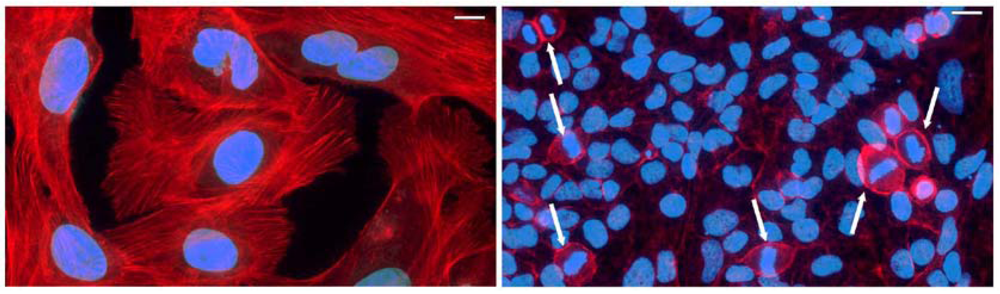
<p>The effect of Cif was first observed in 1997 by De Rycke <italic>et al.</italic> in HeLa cells transiently infected with enteropathogenic <italic>Escherichia coli</italic> (EPEC) strains isolated from weaning rabbits or human infants with diarrhea [<xref ref-type="bibr" rid="B1-toxins-03-00356">1</xref>]. This so-called cytopathic effect (CPE) was first characterized by the progressive formation of actin stress fibers together with focal adhesions, and a dramatic cell enlargement (<xref ref-type="fig" rid="toxins-03-00356-f001">Figure 1</xref>). It was further shown that these large cells were irreversibly impaired for cell proliferation, with a complete lack of mitotic figures [<xref ref-type="bibr" rid="B2-toxins-03-00356">2</xref>] (<xref ref-type="fig" rid="toxins-03-00356-f001">Figure 1</xref>). This effect is dependent on the locus of enterocyte effacement (LEE), the cluster of genes responsible for the attaching and effacing lesion, the hallmark of EPEC and enterohemorraghic <italic>E. coli</italic> (EHEC) infection [<xref ref-type="bibr" rid="B3-toxins-03-00356">3</xref>,<xref ref-type="bibr" rid="B4-toxins-03-00356">4</xref>]. The protein responsible for the CPE identified by Marches <italic>et al.</italic> was called Cif (cycle inhibiting factor). The gene coding for Cif is located outside the LEE, on a lambdoid prophage [<xref ref-type="bibr" rid="B5-toxins-03-00356">5</xref>]. </p>
<fig id="toxins-03-00356-f001" position="anchor">
<label>Figure 1</label>
<caption>
<p>Cycle inhibiting factor (Cif) induces cell enlargement, actin stress fibers and proliferation arrest. HeLa cells were infected with enteropathogenic <italic>Escherichia coli</italic> (EPEC) producing Cif (left panel) or Cif mutant EPEC (right panel). F-actin is stained with phalloidin (red) and DNA is stained with DAPI (blue). Arrows indicate mitotic/dividing cells. Bars represent 20 µM.</p>
</caption>
<graphic xmlns:xlink="http://www.w3.org/1999/xlink" xlink:href="toxins-03-00356-g001.tif"/>
</fig>
<p>Two epidemiological studies showed that 60 to 70% of EPEC and EHEC strains are <italic>cif</italic>-positive [6,7]. However, in one of these studies, it was shown that two thirds of these <italic>cif</italic>-positive <italic>E. coli</italic> strains do not induce a typical CPE due to frameshift mutations or insertion of an IS element in the <italic>cif</italic> gene. Strikingly, <italic>cif</italic> is always found as a pseudogene in EHEC strains; this could be due to the small size of the strain collection, or could suggest an evolutionary counter-selection of functional Cif in Shiga-like producing EHEC strains [<xref ref-type="bibr" rid="B6-toxins-03-00356">6</xref>]. Nonetheless, plasmid-mediated expression of wild type Cif in EHEC confers the CPE phenotype [<xref ref-type="bibr" rid="B5-toxins-03-00356">5</xref>].</p>
<p>The <italic>E. coli</italic> Cif protein is 282 amino-acids long, showing no similarity with any protein except several homologues in the human pathogens <italic>Yersinia pseudotuberculosis</italic> (56% of identity) and beta-proteobacterium <italic>Burkholderia pseudomallei</italic> (26%). Cif homologues are also found in the entomopathogens <italic>Photorhabdus luminescens</italic> (23%) and <italic>Photorhabdus asymbiotica</italic> (26%). The Cif proteins are thus named Cif<italic>
<sub>Ec</sub>
</italic>, Cif<italic>
<sub>Yp</sub>
</italic>, Cif<italic>
<sub>Bp</sub>
</italic>, Cif<italic>
<sub>Pl</sub>
</italic> and Cif<italic>
<sub>Pa</sub>
</italic> respectively. In all these bacteria the <italic>cif</italic> genes are located in prophage or prophage-like region (<italic>Escherichia</italic> and <italic>Photorhabdus</italic> species), bordered by two vestigial transposase genes (<italic>Burkholderia</italic>) and in a locus frequently rearranged nearby the <italic>yrs</italic> region homologous to a recombination target of bacteriophages (<italic>Yersinia</italic>) [<xref ref-type="bibr" rid="B8-toxins-03-00356">8</xref>]. Thus Cif-encoding regions are found in DNA domains prone to rearrangement, suggesting that the <italic>cif</italic> genes were acquired by horizontal gene transfer. Consistent with this hypothesis, the Cif-producing EPEC strain E22 was shown to produce <italic>cif</italic>-carrying infectious phage particles supporting that the <italic>cif</italic> gene was disseminated by horizontal gene transfer among EPEC and enterohemorrhagic (EHEC) strains, as shown for other non LEE-encoded effectors [<xref ref-type="bibr" rid="B6-toxins-03-00356">6</xref>,<xref ref-type="bibr" rid="B9-toxins-03-00356">9</xref>,<xref ref-type="bibr" rid="B10-toxins-03-00356">10</xref>].</p>
<p>Analysis of the Cif xenologues showed that they are all functional as they reproduced the typical Cif<italic>
<sub>Ec</sub>
</italic>-associated CPE when transfected into HeLa cells, or lipofected following purification [<xref ref-type="bibr" rid="B8-toxins-03-00356">8</xref>]. Importantly, Cif<italic>
<sub>Pl</sub>
</italic> was shown to be expressed <italic>in vivo</italic> in an insect model, the natural host of <italic>Photorhabdus</italic>, and reproduced the CPE in the non-mammalian insect Sf9 cell line <italic>in vitro</italic> [<xref ref-type="bibr" rid="B11-toxins-03-00356">11</xref>]. Similarly, Cif<italic>
<sub>Bp</sub>
</italic> is also active <italic>in vitro </italic>when strains of <italic>E. coli</italic> (EPEC) or <italic>Burkholderia thailandensis </italic>are transformed with a plasmid coding for Cif<italic>
<sub>Bp </sub>
</italic>and used to infect mammalian cell lines [<xref ref-type="bibr" rid="B8-toxins-03-00356">8</xref>,<xref ref-type="bibr" rid="B12-toxins-03-00356">12</xref>]. Such conservation of an effector function among very distant pathogens belonging to β-protobacteria and γ-protobacteria that infect invertebrate and mammal hosts is unique and remarkable. It also supports the role of Cifs as virulence factors and could reveal an original strategy of pathogenesis. However, <italic>Photorhabdus</italic> spp. are symbiotic of the nematode vector <italic>Heterorhabditis</italic> (that releases the bacteria into the insect) suggesting that Cif might also act as a fitness or symbiotic factor in the nematode host.</p>
</sec>
<sec>
<title>2. Cif Proteins are Type III Effectors That Traffic to the Nucleus of the Host Cells</title>
<p>Initial experiments showed that the CPE triggered by <italic>cif</italic>-positive EPEC strains was dependent on the type III secretion system (T3SS) encoded by the LEE as mutants of the secretion and translocation apparatus (EscN and EspA, EspB, EspD, respectively) were unable to induce the CPE [<xref ref-type="bibr" rid="B1-toxins-03-00356">1</xref>,<xref ref-type="bibr" rid="B2-toxins-03-00356">2</xref>,<xref ref-type="bibr" rid="B5-toxins-03-00356">5</xref>,<xref ref-type="bibr" rid="B13-toxins-03-00356">13</xref>]. This T3SS injects an arsenal of effector proteins into the host cell that hijack cellular functions for the pathogen’s benefit [<xref ref-type="bibr" rid="B3-toxins-03-00356">3</xref>,<xref ref-type="bibr" rid="B4-toxins-03-00356">4</xref>,<xref ref-type="bibr" rid="B14-toxins-03-00356">14</xref>]. Using a reporter system based on a translational fusion of the effector protein with β-lactamase that allows detection of translocation in living host cells, Charpentier and Oswald showed that an exchangeable <italic>N</italic>-terminal translocation signal comprising the first 16 amino acids of Cif<italic>
<sub>E</sub>
<sub>c</sub>
</italic> is necessary and sufficient to mediate its translocation by the EPEC T3SS [<xref ref-type="bibr" rid="B15-toxins-03-00356">15</xref>]. Using a lipid-based cell delivery system bypassing T3SS requirement, purified Cif<italic>
<sub>Ec</sub>
</italic> induced a CPE similar to that observed upon EPEC infection. This result indicated that Cif<italic>
<sub>Ec</sub>
</italic> is necessary and sufficient and does not require other bacterial molecules to induce the CPE [<xref ref-type="bibr" rid="B16-toxins-03-00356">16</xref>]. Once injected into the host cell cytoplasm by the T3SS, Cif<italic>
<sub>Ec</sub>
</italic> is rapidly sorted to the peri-nuclear area and the nucleus, as observed by confocal imaging and cell fractionation [<xref ref-type="bibr" rid="B17-toxins-03-00356">17</xref>]. As Cif<italic>
<sub>Ec</sub>
</italic> lacks classical nuclear localization sequences, the mechanism of nuclear targeting of Cif remains to be elucidated.</p>
<p>While Cif<italic>
<sub>Bp</sub>
</italic> has been shown to be injected by the T3SS of <italic>Escherichia</italic> and <italic>Burkholderia</italic> species and successfully reproduces the CPE [<xref ref-type="bibr" rid="B8-toxins-03-00356">8</xref>,<xref ref-type="bibr" rid="B12-toxins-03-00356">12</xref>], we and other have been unable to translocate Cif<italic>
<sub>Yp</sub>
</italic> and Cif<italic>
<sub>Pl</sub>
</italic> by the <italic>E. coli</italic> T3SS into the host cells. However, we have indirect evidence that they are <italic>bona fide</italic> type 3 effectors as both <italic>Yersinia</italic> and <italic>Photorabdhus</italic> strains possess T3SS. Moreover, none of the Cifs could induce the CPE without electroporation, transfection or lipofection suggesting that Cif activity depends on its injection into the host cell [<xref ref-type="bibr" rid="B8-toxins-03-00356">8</xref>,<xref ref-type="bibr" rid="B11-toxins-03-00356">11</xref>,<xref ref-type="bibr" rid="B16-toxins-03-00356">16</xref>]. </p>
</sec>
<sec>
<title>3. Crystal Structure Studies of Cif Homologs Reveals a Family of Proteins Sharing a Conserved Active Site</title>
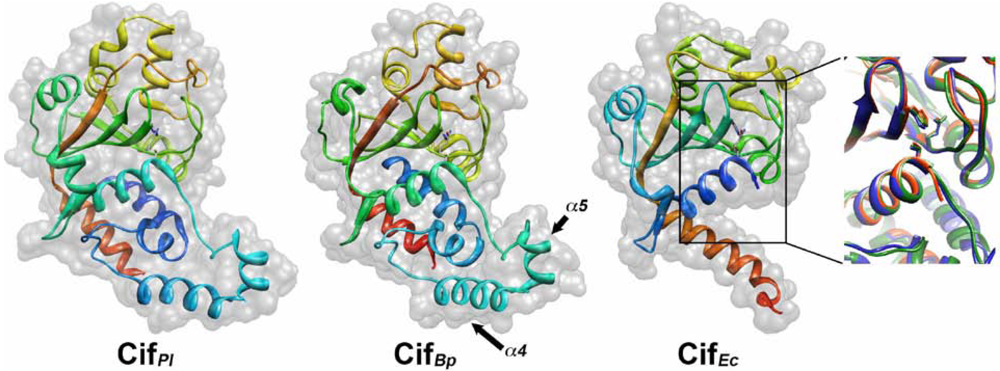
<p>Despite a low level of sequence similarity between Cif homologs, the crystal structure determination of Cif<italic>
<sub>Ec</sub>
</italic>, Cif<italic>
<sub>Pl </sub>
</italic>and Cif<italic>
<sub>Bp</sub>
</italic> showed that these proteins are structurally well-conserved (<xref ref-type="fig" rid="toxins-03-00356-f002">Figure 2</xref>) [<xref ref-type="bibr" rid="B18-toxins-03-00356">18</xref>,<xref ref-type="bibr" rid="B19-toxins-03-00356">19</xref>,<xref ref-type="bibr" rid="B20-toxins-03-00356">20</xref>]. The overall structure of these Cif can be divided in two lobes with head and tail domains where the <italic>N</italic>-terminal part corresponds to the tail and contains the potential substrate binding site (see below) whereas the <italic>C</italic>-terminal part forms the head domain hosting the enzymatic site. The enzymatic site consists in a catalytic triad composed of residues Cys, His and Gln strictly conserved in all Cifs homologs (<xref ref-type="fig" rid="toxins-03-00356-f002">Figure 2</xref>).</p>
<fig id="toxins-03-00356-f002" position="anchor">
<label>Figure 2</label>
<caption>
<p>Cif homolog proteins are structurally related and share a conserved catalytic site. Cif<italic>
<sub>Pl</sub>
</italic>, Cif<italic>
<sub>Bp</sub>
</italic> and Cif<italic>
<sub>Ec</sub>
</italic> are represented as composites of ribbon and surface plot diagrams. Note that the crystallized Cif<italic>
<sub>Ec</sub>
</italic> protein lacked 99 amino acids in its <italic>N</italic>-terminal part. The side chains of the critical residues of the catalytic triad (Cys, His, Gln) are shown. The α-helices α4 and α5 of Cif<italic>
<sub>Bp</sub>
</italic> are indicated. The right panel represents a superimposition of the three Cifs magnified at the level of the catalytic pocket.</p>
</caption>
<graphic xmlns:xlink="http://www.w3.org/1999/xlink" xlink:href="toxins-03-00356-g002.tif"/>
</fig>
<p>The conserved catalytic triad is located in a negative charged cleft with a putative occluding loop near the active site that might control the substrate accessibility to the catalytic site [<xref ref-type="bibr" rid="B19-toxins-03-00356">19</xref>]. The structural organization of this triad reveals that Cifs are divergent members of the superfamily of enzymes that comprises papain-like cysteine proteases, acetyl transferases, deamidases and transglutaminases. In particular, Cif shares homology with the avirulence effector AvrPphB from <italic>Pseudomonas syringae</italic> that belongs to the same superfamily and with the cysteine protease YopT from <italic>Yersinia</italic> spp. [<xref ref-type="bibr" rid="B19-toxins-03-00356">19</xref>]. Mutation of one of the residues of the catalytic triad abolishes Cif<italic>
<sub>Pl</sub>
</italic>, Cif<italic>
<sub>Bp</sub>
</italic>, Cif<italic>
<sub>Ec</sub>
</italic> and Cif<italic>
<sub>Yp</sub>
</italic> activity, corroborating the implication of an enzymatic-dependent activity [<xref ref-type="bibr" rid="B8-toxins-03-00356">8</xref>,<xref ref-type="bibr" rid="B16-toxins-03-00356">16</xref>,<xref ref-type="bibr" rid="B19-toxins-03-00356">19</xref>,<xref ref-type="bibr" rid="B20-toxins-03-00356">20</xref>]. Further analysis of the tail domain showed that deletion of the <italic>N</italic>-terminal protruding α4 and α5 helix of Cif<italic>
<sub>Bp</sub>
</italic> (<xref ref-type="fig" rid="toxins-03-00356-f002">Figure 2</xref>) and of the corresponding α4 domain of Cif<italic>
<sub>Ec</sub>
</italic> suppressed the toxin activity suggesting that this domain could mediate substrate recognition [<xref ref-type="bibr" rid="B17-toxins-03-00356">17</xref>,<xref ref-type="bibr" rid="B20-toxins-03-00356">20</xref>].</p>
<p>Based on the structure and function conservation, Cif homologs constitute a family of cyclomodulins that likely target a molecule/pathway conserved in a wide range of eukaryotic cells from invertebrates to mammals [<xref ref-type="bibr" rid="B8-toxins-03-00356">8</xref>,<xref ref-type="bibr" rid="B21-toxins-03-00356">21</xref>].</p>
</sec>
<sec>
<title>4. Cifs Are Cyclomodulins That Trigger Host Cell Cycle Arrest</title>
<p>Upon injection into host cells by the T3SS (or by transfection or lipofection of purified proteins) Cif proteins induce an irreversible cell cycle arrest with complete inhibition of mitotis entry (<xref ref-type="fig" rid="toxins-03-00356-f001">Figure 1</xref>: absence of mitotic figures in cells injected with Cif). This property makes Cifs as members of the cyclomodulin family defined as bacterial molecules that hijack host cell cycle functions [<xref ref-type="bibr" rid="B22-toxins-03-00356">22</xref>,<xref ref-type="bibr" rid="B23-toxins-03-00356">23</xref>].</p>
<p>The cell cycle arrest induced by Cif<italic>
<sub>Ec</sub>
</italic> is associated to the inhibitory phosphorylation of the cyclin dependent kinase (CDK) 1-CyclinB complex whose activation is necessary for the cell cycle G<sub>2</sub>/M transition [<xref ref-type="bibr" rid="B1-toxins-03-00356">1</xref>,<xref ref-type="bibr" rid="B2-toxins-03-00356">2</xref>,<xref ref-type="bibr" rid="B5-toxins-03-00356">5</xref>]. Other cyclomodulins, such as CDT or Colibactin, also block the G<sub>2</sub>/M transition through inhibition of CDK1 activity. However, in contrast to CDT and Colibactin, which have been shown to be <italic>bona fide</italic> genotoxins, Cif<italic>
<sub>Ec</sub>
</italic> does not induce DNA damage nor activate the DNA damage response pathway (ATM/ATR, CHK1/2, CDC25 sequestration) that leads to the inhibitory phosphorylation of CDK1 [<xref ref-type="bibr" rid="B16-toxins-03-00356">16</xref>]. Therefore, Cif<italic>
<sub>Ec</sub>
</italic> induces the cell cycle arrest by activating a pathway independent from the canonical activation of the G<sub>2</sub>/M checkpoint. Further studies, using synchronized cells, have shown that Cif<italic>
<sub>Ec</sub>
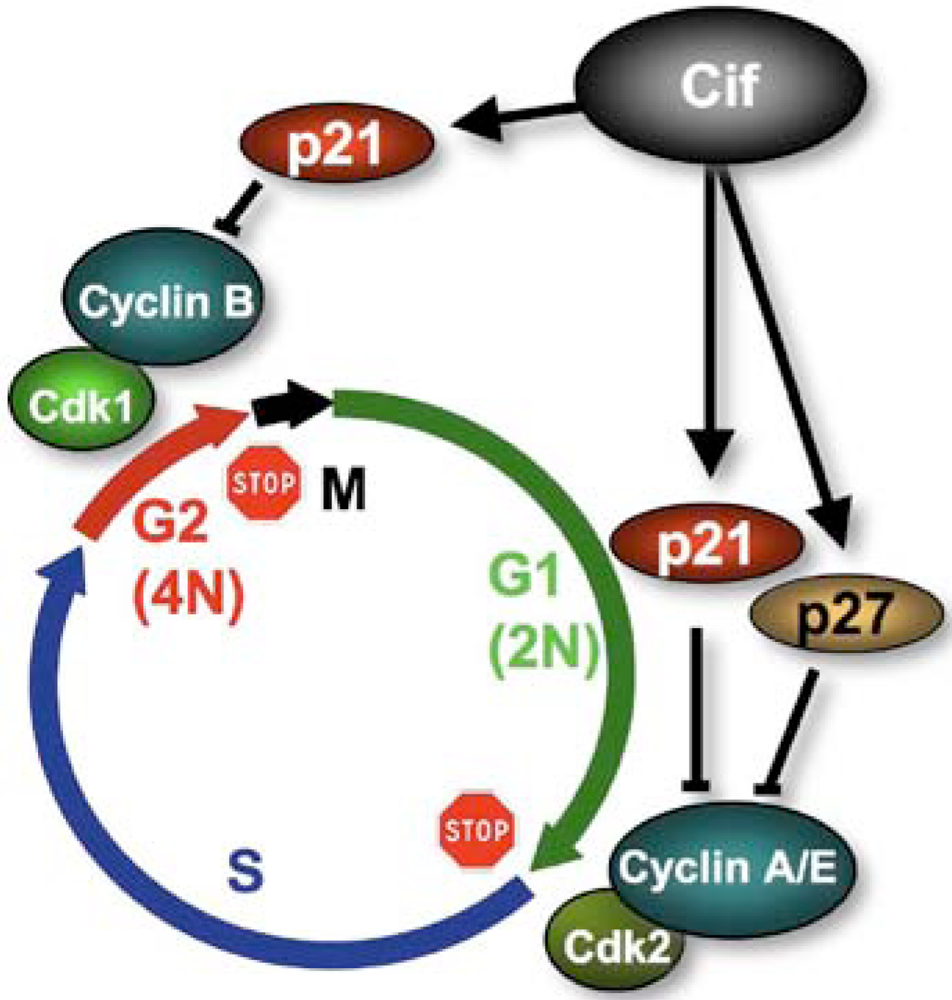
</italic> also blocks S-phase entry. Depending on the stage of the cell cycle during infection with <italic>cif</italic>-positive EPEC, cells arrest either at the G<sub>1</sub>/S or G<sub>2</sub>/M transition. The analysis of host cell proteins regulating both S- and M- phases entries demonstrated a Cif-dependent accumulation of p21<sup>Waf1/Cip1</sup> and p27<sup>kip2</sup> (hereafter called p21 and p27) [<xref ref-type="bibr" rid="B24-toxins-03-00356">24</xref>]. These proteins belong to the Cip/Kip family of CDK inhibitors (CKI). p21 is an inhibitor of the CDK1/CyclinB complex. This complex is the eukaryotic universal inducer of mitosis entry and p21 accumulation is known to inhibit G<sub>2</sub>/M transition. Both p21 and p27 inhibit CDK2-CyclinE and A complexes whose activation are also required for G1/S and S-phase progression. p21 also binds to PCNA, and the latter is required for S-phase progression [<xref ref-type="bibr" rid="B25-toxins-03-00356">25</xref>]. Therefore, Cif-dependent accumulation of CKI is consistent with the observed G<sub>1</sub>/S and G<sub>2</sub>/M cell cycle arrests (<xref ref-type="fig" rid="toxins-03-00356-f003">Figure 3</xref>). The inhibitory phosphorylation of CDK1 observed upon Cif<italic>
<sub>Ec</sub>
</italic> injection could be explained by the disruption of the CDK1 positive feed-back loop leading to CDK1 dephosphorylation via CDC25. Further investigation revealed that CKI accumulation does not depend on transcriptional activation but relies on their stabilization in infected cells [<xref ref-type="bibr" rid="B24-toxins-03-00356">24</xref>]. Since p21 and p27 are degraded by the ubiquitin-proteasome system, these results strongly suggested that Cif<italic>
<sub>Ec</sub>
</italic> controls this proteolytic pathway. However, suppression of p21 and/or p27 accumulation did not alleviate Cif-induced inhibition of G<sub>1</sub>/S or G<sub>2</sub>/M transitions implying an alternative mechanism for blockage of the cell cycle [<xref ref-type="bibr" rid="B24-toxins-03-00356">24</xref>]. Whether this arrest is associated to stress fibers induction was excluded since disruption of stress fiber formation in HeLa cells by C3 exoenzyme-mediated inhibition of RhoA, did not alleviate cell cycle inhibition [<xref ref-type="bibr" rid="B2-toxins-03-00356">2</xref>]. Morevover, only HeLa and RK13 cells exhibit stress fibers following <italic>cif</italic>
<sup>+</sup> EPEC infection suggesting that these two phenotypes are not related [<xref ref-type="bibr" rid="B16-toxins-03-00356">16</xref>]. Nonetheless, these results indicated that accumulation of CKI participates in a multi-step process leading to the Cif-induced arrest of cell proliferation. </p>
<p>This cell cycle inhibition and CKI accumulation was observed with all Cif homologues [<xref ref-type="bibr" rid="B8-toxins-03-00356">8</xref>] and in various cell lines derived from colonic epithelium (differentiated or not differentiated Caco-2 cells, DLD1, HCT116 wild-type, p21<sup>−/−</sup> or p53<sup>−/−</sup>) showing the independency of cell-cycle arrest from the p53 transcriptional program [<xref ref-type="bibr" rid="B16-toxins-03-00356">16</xref>,<xref ref-type="bibr" rid="B24-toxins-03-00356">24</xref>]. The Cif-induced cystostatic effect is also observed in non-transformed IEC-6 cells derived from rat intestinal crypt epithelium. However, the outcome of this arrest is cell type dependent as it persists for more than 3 days in HeLa cells without evident cell death, whereas it culminates in apoptosis 48 h after infection of IEC-6 cells [<xref ref-type="bibr" rid="B26-toxins-03-00356">26</xref>]. Whether this Cif-induced cell death is a consequence of the cytostatic effect or relies on an independent pathway is still unclear, but it is tempting to propose that the functionality of p53 pathway, intact in non-transformed cells, might be decisive for the fate of Cif-arrested cells. </p>
</sec>
<sec>
<title>5. Cif Effector Proteins Target NEDD8 to Inhibit Specific Ubiquitin-Dependent Degradation Pathways</title>
<p>Three independent teams recently deciphered the molecular mode of action of Cif<italic>
<sub>Ec</sub>
</italic> and Cif<italic>
<sub>Bp</sub>
</italic> [<xref ref-type="bibr" rid="B12-toxins-03-00356">12</xref>,<xref ref-type="bibr" rid="B17-toxins-03-00356">17</xref>,<xref ref-type="bibr" rid="B27-toxins-03-00356">27</xref>]. Despite few differences mainly related to the species origin of Cif and diverse approaches, these complementary studies showed a common mechanism of action between the two xenologs.</p>
<fig id="toxins-03-00356-f003" position="anchor">
<label>Figure 3</label>
<caption>
<p>Cif inhibits host cell cycle progression. Cif induces the accumulation of p21 and p27 that inhibits CDK1-CyclinB and CDK2-CyclinA/E. Since these complexes are responsible for G2/M and G1/S transitions, Cif provokes an accumulation of cells arrested in G1 and G2 phases of the cell cycle.</p>
</caption>
<graphic xmlns:xlink="http://www.w3.org/1999/xlink" xlink:href="toxins-03-00356-g003.tif"/>
</fig>
<sec>
<title>5.1. Cif<sub>Ec</sub> Interacts with Host Protein NEDD8</title>
<p>As mentioned earlier, Cif-dependent accumulation of p21 and p27 results from the inhibition of their degradation by the ubiquitin-proteasome system [<xref ref-type="bibr" rid="B28-toxins-03-00356">28</xref>]. Ubiquitylation is a well-known and highly controlled post-translational protein modification that involves three successive steps. First, ubiquitin is processed by the ubiquitin activating enzyme (E1) and then transferred to the ubiquitin conjugating enzyme (E2). The last step requires the ubiquitin ligase (E3) that determines the substrate to be ubiquitylated and promotes a direct transfer of ubiquitin from E2 to the substrate (RING-type E3s) or an indirect transfer via formation of an ubiquitin thioester-bound E3 prior ubiquitin transfer to the substrate (HECT-type E3s). Repetitions of this cycle lead to the attachment of a polyubiquitin chain to the target protein, resulting in modulation of its function or localization, or its sorting for degradation, depending on the length and the type of linkage within the polyubiquitin chain [<xref ref-type="bibr" rid="B29-toxins-03-00356">29</xref>,<xref ref-type="bibr" rid="B30-toxins-03-00356">30</xref>,<xref ref-type="bibr" rid="B31-toxins-03-00356">31</xref>]. Yeast two-hybrid screens and pull-down assays showed that Cif<italic>
<sub>Ec</sub>
</italic> interacts with the ubiquitin-like protein NEDD8 [<xref ref-type="bibr" rid="B17-toxins-03-00356">17</xref>,<xref ref-type="bibr" rid="B27-toxins-03-00356">27</xref>]. The main known role of NEDD8 is the conjugation of the cullin subunit of the complex cullin-RING E3 ubiquitin ligase (CRL) and activation of its ligase activity [<xref ref-type="bibr" rid="B32-toxins-03-00356">32</xref>,<xref ref-type="bibr" rid="B33-toxins-03-00356">33</xref>,<xref ref-type="bibr" rid="B34-toxins-03-00356">34</xref>]. CRL are composed of the scaffold protein cullin (at least five different cullins CUL1/2/3/4A/4B are known), the RING protein that associates with E2, and different substrate recognition modules that bind the target protein (<xref ref-type="fig" rid="toxins-03-00356-f004">Figure 4</xref>) [<xref ref-type="bibr" rid="B35-toxins-03-00356">35</xref>,<xref ref-type="bibr" rid="B36-toxins-03-00356">36</xref>]. Inactivation of Cif<italic>
<sub>Ec</sub>
</italic> by mutation of the catalytic cysteine increased its binding to NEDD8 [<xref ref-type="bibr" rid="B17-toxins-03-00356">17</xref>]. In contrast, deletion of the α4 domain of Cif<italic>
<sub>Ec</sub>
</italic>, which results in loss of activity, abolished the interaction with NEDD8 implying the role of this domain to mediate Cif effect. Cif<italic>
<sub>Ec</sub>
</italic> was unable to pull-down ubiquitin showing the specificity of interaction with NEDD8. Moreover, NEDD8 co-compartmentalizes with Cif<italic>
<sub>Ec</sub>
</italic> in the nuclei of infected cells supporting the functional binding of these 2 proteins [<xref ref-type="bibr" rid="B17-toxins-03-00356">17</xref>]. Co-immunoprecipitation experiments showed that Cif<italic>
<sub>Ec</sub>
</italic> interacts only with the neddylated forms of cullins (CUL1 to 4B) associated with the RING protein [<xref ref-type="bibr" rid="B17-toxins-03-00356">17</xref>] and with the recognition module Skp1 and Skp2 proteins [<xref ref-type="bibr" rid="B27-toxins-03-00356">27</xref>]. It thus appeared that Cif<italic>
<sub>Ec</sub>
</italic> interacts with the whole CRL complex through binding to NEDD8 (<xref ref-type="fig" rid="toxins-03-00356-f004">Figure 4</xref>).</p>
<fig id="toxins-03-00356-f004" position="anchor">
<label>Figure 4</label>
<caption>
<p>Model of Cif<italic>
<sub>Ec</sub>
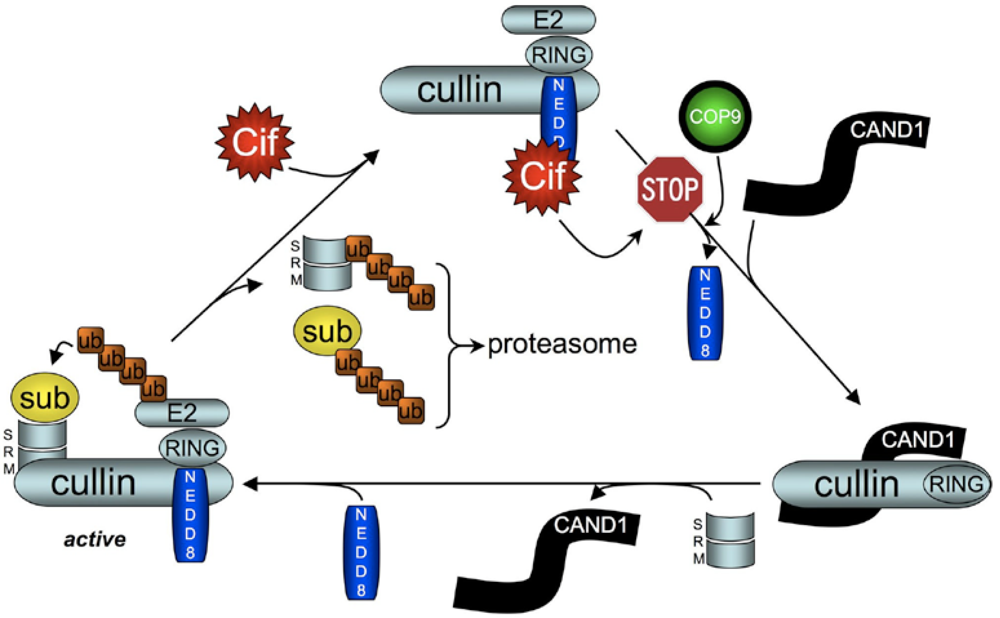
</italic> inhibition of CRL activation cycle. Neddylated active CRL (left) ubiquitylates the substrate (sub) and substrate recognition module (SRM) leading to their degradation and generating inactive CRL (top). Deneddylation of CRL by the COP9 signalosome allows binding of CAND1 (right). SRM fixation induces CAND1 release and subsequent neddylation of cullin to generate an active CRL [<xref ref-type="bibr" rid="B35-toxins-03-00356">35</xref>,<xref ref-type="bibr" rid="B36-toxins-03-00356">36</xref>]. Cif binding to and deamidation of NEDD8 impairs the action of COP9, blocking the activation cycle and locking the CRL in an inactive neddylated state.</p>
</caption>
<graphic xmlns:xlink="http://www.w3.org/1999/xlink" xlink:href="toxins-03-00356-g004.tif"/>
</fig>
</sec>
<sec>
<title>5.2. Cif Inhibits CRL Activity</title>
<p>Since Cif proteins induce the stabilization of p21 and p27, which are substrates of CRL associated to CUL1, <italic>in vitro</italic> studies were conducted to investigate the inhibitory effect of Cif on CRL. Jubelin <italic>et al.</italic> showed that addition of Cif<italic>
<sub>Ec</sub>
</italic> to reconstituted CRL inhibited its ubiquitin ligase activity [<xref ref-type="bibr" rid="B17-toxins-03-00356">17</xref>]. Moreover, <italic>in cellulo</italic> ubiquitylation of various CRL substrates such as p27 or RhoA was severely impaired by Cif<italic>
<sub>Ec</sub>
</italic> and Cif<italic>
<sub>Bp</sub>
</italic>, respectively [<xref ref-type="bibr" rid="B12-toxins-03-00356">12</xref>,<xref ref-type="bibr" rid="B27-toxins-03-00356">27</xref>]. Stabilization of various CUL1 to 4B-associated CRL substrates including β-catenin, RhoA, IκBα, Cdt1, CyclinD1 reveals that Cif<italic>
<sub>Ec</sub>
</italic> can interfere with all neddylated cullins [<xref ref-type="bibr" rid="B17-toxins-03-00356">17</xref>,<xref ref-type="bibr" rid="B27-toxins-03-00356">27</xref>].</p>
<p>How Cif<italic>
<sub>Ec</sub>
</italic> inhibits CRL activity is not fully elucidated. However, Cui <italic>et al.</italic> showed that the CRL inhibition is associated to Cif<italic>
<sub>Ec</sub>
</italic>-dependent NEDD8 deamidation of Gln40, converting glutamine residue in glutamic acid (Glu). Replacement of NEDD8 with deaminated NEDD8 (NEDD8Q40E) abolished the <italic>in vitro</italic> stimulatory effect on Nrf2 ubiquitylation by a CUL3/ROC1/Keap1 complex. Similarly, ectopic expression of NEDD8Q40E in HeLa cells resulted in the stabilization of CRL substrate and recapitulated the effects of Cif [<xref ref-type="bibr" rid="B12-toxins-03-00356">12</xref>]. On the other hand, Cif<italic>
<sub>Ec</sub>
</italic> was shown to promote cullin neddylation of CUL1 to 4B [<xref ref-type="bibr" rid="B17-toxins-03-00356">17</xref>] that correlates with the inhibition of deneddylation of cullin by the CSN complex (COP9 signalosome) [<xref ref-type="bibr" rid="B27-toxins-03-00356">27</xref>]. This phenotype is similar to the effect observed using CSN5 null cells that also accumulate CRL substrates such as p27 [<xref ref-type="bibr" rid="B37-toxins-03-00356">37</xref>]. Together, these results suggest that modification of NEDD8 by Cif inhibits cullin deneddylation by the CSN resulting in a decrease of CRL activation. Indeed, to be fully active, CRLs undergo an activation cycle in which cullins oscillate between neddylated and non-neddylated states [<xref ref-type="bibr" rid="B35-toxins-03-00356">35</xref>,<xref ref-type="bibr" rid="B36-toxins-03-00356">36</xref>]. Based on these results, we propose a model in which Cif<italic>
<sub>Ec</sub>
</italic> interferes with this cycle and thus locks CRLs in a neddylated but inactive state (<xref ref-type="fig" rid="toxins-03-00356-f004">Figure 4</xref>).</p>
<p>A notable difference between Cif<italic>
<sub>Bp</sub>
</italic> and Cif<italic>
<sub>Ec</sub>
</italic> is the capacity of Cif<italic>
<sub>Bp</sub>
</italic> to deamidate not only NEDD8, but also the Gln40 of ubiquitin. Cif<italic>
<sub>Bp</sub>
</italic> generates an E2-ubiquitinQ40E thioester complex that impairs ubiquitin chain synthesis and the ubiquitylation pathway <italic>in vitro</italic> and <italic>in vivo</italic> [<xref ref-type="bibr" rid="B12-toxins-03-00356">12</xref>]. This supplementary affinity to ubiquitin extends the inhibitory activity of Cif<italic>
<sub>Bp</sub>
</italic> to all ubiquitylation process independently of the E3 ligase. The relevance of this difference is still unclear and requires further studies on the range of action of other Cif homologs and bacterial deamidases toward ubiquitin and ubiquitin-like molecules. In this line, it is noteworthy that the <italic>Mycobacterium</italic> deamidase of Pup (Dop), required for the full virulence of <italic>M. tuberculosis</italic>, targets the prokaryotic ubiquitin-like molecule Pup to convert the terminal glutamine residue into glutamate [<xref ref-type="bibr" rid="B38-toxins-03-00356">38</xref>,<xref ref-type="bibr" rid="B39-toxins-03-00356">39</xref>]. Also, while acting through a different pathway to stimulate RhoA activity, it is remarkable that the cyclomodulin CNF-1 directly deamidates RhoA to induces actin stress fibers [<xref ref-type="bibr" rid="B40-toxins-03-00356">40</xref>,<xref ref-type="bibr" rid="B41-toxins-03-00356">41</xref>].</p>
</sec>
</sec>
<sec>
<title>6. Concluding remarks and perspectives</title>
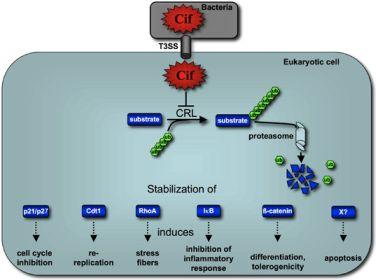
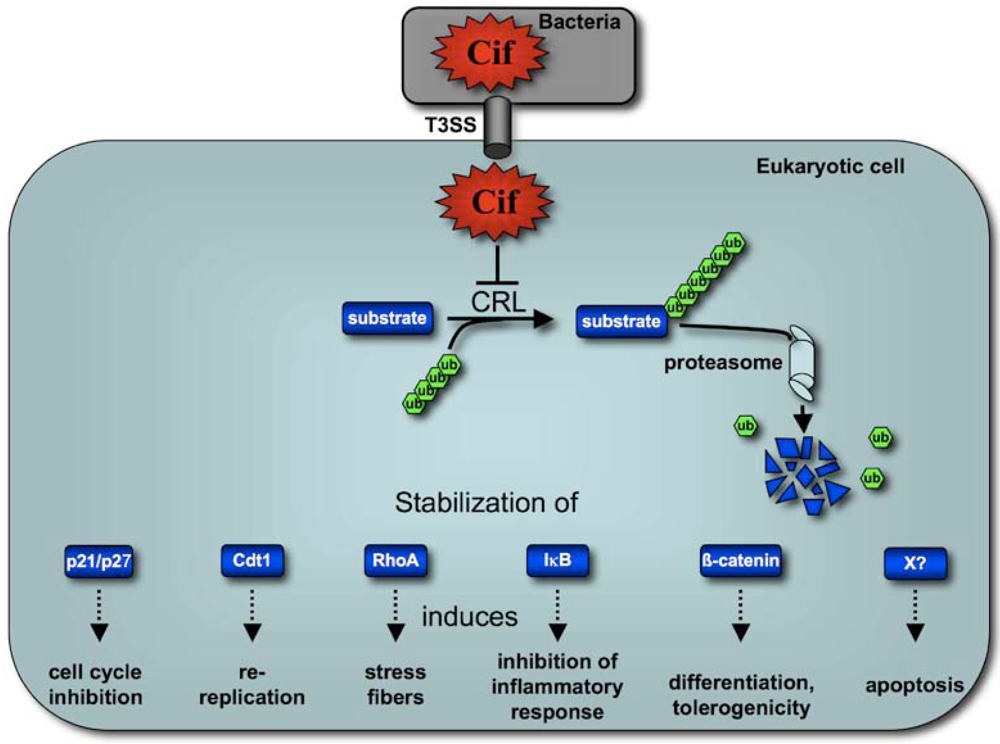
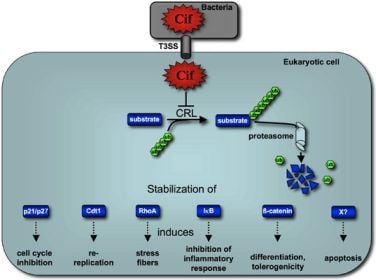
<p>The role of NEDD8 on CRL activation offers to the bacteria injecting Cif into the host cells an “Achilles heel” to hijack various cellular signaling functions. Indeed, CRLs represent the largest subfamily of E3s and therefore play regulatory roles in numerous and diverse cellular functions. The diversity of substrate recognition modules associated to the different cullin subunits gives to the CRL the capacity to ubiquitylate and thus to control the stability of hundreds of proteins [<xref ref-type="bibr" rid="B35-toxins-03-00356">35</xref>,<xref ref-type="bibr" rid="B36-toxins-03-00356">36</xref>]. Cif capacity to induce stress fibers in certain eukaryotic cells could be related to Cif-stabilization of RhoA [<xref ref-type="bibr" rid="B12-toxins-03-00356">12</xref>,<xref ref-type="bibr" rid="B17-toxins-03-00356">17</xref>], which is targeted by CUL3-associated CRL [<xref ref-type="bibr" rid="B42-toxins-03-00356">42</xref>]. Prevention of inappropriate replication depends on the degradation of the licensing factor Cdt1 during S-phase [<xref ref-type="bibr" rid="B43-toxins-03-00356">43</xref>]. As CUL4-associated CRL targets Cdt1 for ubiquitylation-dependent degradation [<xref ref-type="bibr" rid="B44-toxins-03-00356">44</xref>,<xref ref-type="bibr" rid="B45-toxins-03-00356">45</xref>], inhibition of CRL by Cif provides a satisfactory explanation for occurrence of re-replication observed 3 days following infection as Cdt1 is stabilized in infected HeLa cells [<xref ref-type="bibr" rid="B2-toxins-03-00356">2</xref>,<xref ref-type="bibr" rid="B16-toxins-03-00356">16</xref>,<xref ref-type="bibr" rid="B17-toxins-03-00356">17</xref>]. Moreover, Cif was shown to prevent the degradation of IκB, a central inhibitor of NF-κB pro-inflammatory response [<xref ref-type="bibr" rid="B12-toxins-03-00356">12</xref>,<xref ref-type="bibr" rid="B17-toxins-03-00356">17</xref>]. Down-regulation of the NF-κB pathway has been proposed to mediate the inflammatory tolerance of commensal bacteria in the mammalian intestinal epithelia [<xref ref-type="bibr" rid="B46-toxins-03-00356">46</xref>,<xref ref-type="bibr" rid="B47-toxins-03-00356">47</xref>]. In addition, stabilization of β-catenin by Cif might participate in dendritic cells tolerogenicity as it was recently shown that the WNT signaling pathway regulates immunosuppressive responses [<xref ref-type="bibr" rid="B48-toxins-03-00356">48</xref>]. </p>
<p>In conclusion, Cif might represent a fitness factor that facilitates bacterial evasion from the host immune response, via inhibition of inflammatory pathways in dendritic cells of the gut-associated lymphoid tissue. Cif-inhibition of the host cell cycle might slow down multiplication of intestinal progenitors to delay epithelial cells renewal, thus favoring gut colonization (<xref ref-type="fig" rid="toxins-03-00356-f005">Figure 5</xref>). We could also speculate about the role of Cif as a stabilizer of other type III co-injected effectors, to modulate their effect on host cells and boost the virulence of <italic>cif</italic>-expressing strains. Further studies of the impact of Cif in the pathogen-host interactions will undoubtedly contribute to our knowledge of bacterial pathogenic strategies. It also appears that the continuous “arm race” that characterizes host-pathogen relationship has lead the bacteria to develop sophisticated “weapons” (virulence factors) capable of controlling host’s functions for their own benefit. Therefore, much can be learned from eukaryotic functions using bacterial toxins such as Cif. While most pharmacological inhibitors or bacterial/viral proteins inhibit CRL by decreasing cullin neddylation [<xref ref-type="bibr" rid="B49-toxins-03-00356">49</xref>,<xref ref-type="bibr" rid="B50-toxins-03-00356">50</xref>,<xref ref-type="bibr" rid="B51-toxins-03-00356">51</xref>,<xref ref-type="bibr" rid="B52-toxins-03-00356">52</xref>], Cif is the first example of a bacterial effector that inhibits CRL functions by stabilizing cullin neddylation. Thus Cif represents a unique tool to study the regulation of the ubiquitin proteasome system. Lately, it was reported that inhibitors of NEDD8 represent a promising approach for cancer treatment [<xref ref-type="bibr" rid="B52-toxins-03-00356">52</xref>] opening a potential development of innovative therapeutics using Cif-producing bacteria.</p>
<fig id="toxins-03-00356-f005" position="anchor">
<label>Figure 5</label>
<caption>
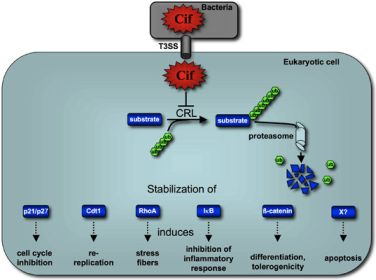
<p>Cif hijacks several and various signaling pathways by inhibiting the ubiquitin ligase activity of CRL. Cif is injected in the host cells and impairs CRL activity via binding to NEDD8. This inhibition results in stabilization of (<bold>i</bold>) p21 and p27 leading to cell cycle inhibition; (<bold>ii</bold>) Cdt1 allowing inappropriate replication; (<bold>iii</bold>) RhoA inducing actin stress fibers; (<bold>iv</bold>) IkB leading to alteration of inflammatory response; (<bold>v</bold>) β-catenin promoting differentiation process disruption and tolerogenicity; (<bold>vi</bold>) unidentified protein(s) inducing apoptosis.</p>
</caption>
<graphic xmlns:xlink="http://www.w3.org/1999/xlink" xlink:href="toxins-03-00356-g005.tif"/>
</fig>
</sec>
</body>
<back>
<ref-list>
<title>References</title>
<ref id="B1-toxins-03-00356">
<label>1.</label>
<citation citation-type="journal">
<person-group person-group-type="author">
<name>
<surname>de Rycke</surname>
<given-names>J.</given-names>
</name>
<name>
<surname>Comtet</surname>
<given-names>E.</given-names>
</name>
<name>
<surname>Chalareng</surname>
<given-names>C.</given-names>
</name>
<name>
<surname>Boury</surname>
<given-names>M.</given-names>
</name>
<name>
<surname>Tasca</surname>
<given-names>C.</given-names>
</name>
<name>
<surname>Milon</surname>
<given-names>A.</given-names>
</name>
</person-group>
<article-title>Enteropathogenic <italic>Escherichia coli</italic> O103 from rabbit elicits actin stress fibers and focal adhesions in HeLa epithelial cells, cytopathic effects that are linked to an analog of the locus of enterocyte effacement</article-title>
<source>Infect. Immun.</source>
<year>1997</year>
<volume>65</volume>
<fpage>2555</fpage>
<lpage>2563</lpage>
<pub-id pub-id-type="pmid">9199419</pub-id>
</citation>
</ref>
<ref id="B2-toxins-03-00356">
<label>2.</label>
<citation citation-type="journal">
<person-group person-group-type="author">
<name>
<surname>Nougayrede</surname>
<given-names>J.P.</given-names>
</name>
<name>
<surname>Boury</surname>
<given-names>M.</given-names>
</name>
<name>
<surname>Tasca</surname>
<given-names>C.</given-names>
</name>
<name>
<surname>Marches</surname>
<given-names>O.</given-names>
</name>
<name>
<surname>Milon</surname>
<given-names>A.</given-names>
</name>
<name>
<surname>Oswald</surname>
<given-names>E.</given-names>
</name>
<name>
<surname>de Rycke</surname>
<given-names>J.</given-names>
</name>
</person-group>
<article-title>Type III secretion-dependent cell cycle block caused in HeLa cells by enteropathogenic <italic>Escherichia coli</italic> O103</article-title>
<source>Infect. Immun.</source>
<year>2001</year>
<volume>69</volume>
<fpage>6785</fpage>
<lpage>6795</lpage>
<pub-id pub-id-type="pmid">11598051</pub-id>
</citation>
</ref>
<ref id="B3-toxins-03-00356">
<label>3.</label>
<citation citation-type="journal">
<person-group person-group-type="author">
<name>
<surname>Kaper</surname>
<given-names>J.B.</given-names>
</name>
<name>
<surname>Nataro</surname>
<given-names>J.P.</given-names>
</name>
<name>
<surname>Mobley</surname>
<given-names>H.L.</given-names>
</name>
</person-group>
<article-title>Pathogenic <italic>Escherichia coli</italic>
</article-title>
<source>Nat. Rev. Microbiol.</source>
<year>2004</year>
<volume>2</volume>
<fpage>123</fpage>
<lpage>140</lpage>
<pub-id pub-id-type="pmid">15040260</pub-id>
<pub-id pub-id-type="doi">10.1038/nrmicro818</pub-id>
</citation>
</ref>
<ref id="B4-toxins-03-00356">
<label>4.</label>
<citation citation-type="journal">
<person-group person-group-type="author">
<name>
<surname>Nataro</surname>
<given-names>J.P.</given-names>
</name>
<name>
<surname>Kaper</surname>
<given-names>J.B.</given-names>
</name>
</person-group>
<article-title>Diarrheagenic <italic>Escherichia coli</italic>
</article-title>
<source>Clin. Microbiol. Rev.</source>
<year>1998</year>
<volume>11</volume>
<fpage>142</fpage>
<lpage>201</lpage>
<pub-id pub-id-type="pmid">9457432</pub-id>
</citation>
</ref>
<ref id="B5-toxins-03-00356">
<label>5.</label>
<citation citation-type="journal">
<person-group person-group-type="author">
<name>
<surname>Marches</surname>
<given-names>O.</given-names>
</name>
<name>
<surname>Ledger</surname>
<given-names>T.N.</given-names>
</name>
<name>
<surname>Boury</surname>
<given-names>M.</given-names>
</name>
<name>
<surname>Ohara</surname>
<given-names>M.</given-names>
</name>
<name>
<surname>Tu</surname>
<given-names>X.</given-names>
</name>
<name>
<surname>Goffaux</surname>
<given-names>F.</given-names>
</name>
<name>
<surname>Mainil</surname>
<given-names>J.</given-names>
</name>
<name>
<surname>Rosenshine</surname>
<given-names>I.</given-names>
</name>
<name>
<surname>Sugai</surname>
<given-names>M.</given-names>
</name>
<name>
<surname>de Rycke</surname>
<given-names>J.</given-names>
</name>
<name>
<surname>Oswald</surname>
<given-names>E.</given-names>
</name>
</person-group>
<article-title>Enteropathogenic and enterohaemorrhagic <italic>Escherichia coli</italic> deliver a novel effector called Cif, which blocks cell cycle G2/M transition</article-title>
<source>Mol. Microbiol.</source>
<year>2003</year>
<volume>50</volume>
<fpage>1553</fpage>
<lpage>1567</lpage>
<pub-id pub-id-type="pmid">14651638</pub-id>
<pub-id pub-id-type="doi">10.1046/j.1365-2958.2003.03821.x</pub-id>
</citation>
</ref>
<ref id="B6-toxins-03-00356">
<label>6.</label>
<citation citation-type="journal">
<person-group person-group-type="author">
<name>
<surname>Loukiadis</surname>
<given-names>E.</given-names>
</name>
<name>
<surname>Nobe</surname>
<given-names>R.</given-names>
</name>
<name>
<surname>Herold</surname>
<given-names>S.</given-names>
</name>
<name>
<surname>Tramuta</surname>
<given-names>C.</given-names>
</name>
<name>
<surname>Ogura</surname>
<given-names>Y.</given-names>
</name>
<name>
<surname>Ooka</surname>
<given-names>T.</given-names>
</name>
<name>
<surname>Morabito</surname>
<given-names>S.</given-names>
</name>
<name>
<surname>Kerouredan</surname>
<given-names>M.</given-names>
</name>
<name>
<surname>Brugere</surname>
<given-names>H.</given-names>
</name>
<name>
<surname>Schmidt</surname>
<given-names>H.</given-names>
</name>
<name>
<surname>Hayashi</surname>
<given-names>T.</given-names>
</name>
<name>
<surname>Oswald</surname>
<given-names>E.</given-names>
</name>
</person-group>
<article-title>Distribution, functional expression, and genetic organization of Cif, a phage-encoded type III-secreted effector from enteropathogenic and enterohemorrhagic <italic>Escherichia coli</italic>
</article-title>
<source>J. Bacteriol.</source>
<year>2008</year>
<volume>190</volume>
<fpage>275</fpage>
<lpage>285</lpage>
<pub-id pub-id-type="pmid">17873042</pub-id>
</citation>
</ref>
<ref id="B7-toxins-03-00356">
<label>7.</label>
<citation citation-type="journal">
<person-group person-group-type="author">
<name>
<surname>Creuzburg</surname>
<given-names>K.</given-names>
</name>
<name>
<surname>Middendorf</surname>
<given-names>B.</given-names>
</name>
<name>
<surname>Mellmann</surname>
<given-names>A.</given-names>
</name>
<name>
<surname>Martaler</surname>
<given-names>T.</given-names>
</name>
<name>
<surname>Holz</surname>
<given-names>C.</given-names>
</name>
<name>
<surname>Fruth</surname>
<given-names>A.</given-names>
</name>
<name>
<surname>Karch</surname>
<given-names>H.</given-names>
</name>
<name>
<surname>Schmidt</surname>
<given-names>H.</given-names>
</name>
</person-group>
<article-title>Evolutionary analysis and distribution of type III effector genes in pathogenic <italic>Escherichia coli</italic> from human, animal and food sources</article-title>
<source>Environ. Microbiol.</source>
<year>2011</year>
<volume>13</volume>
<fpage>439</fpage>
<lpage>452</lpage>
<pub-id pub-id-type="pmid">20880329</pub-id>
<pub-id pub-id-type="doi">10.1111/j.1462-2920.2010.02349.x</pub-id>
</citation>
</ref>
<ref id="B8-toxins-03-00356">
<label>8.</label>
<citation citation-type="journal">
<person-group person-group-type="author">
<name>
<surname>Jubelin</surname>
<given-names>G.</given-names>
</name>
<name>
<surname>Chavez</surname>
<given-names>C.V.</given-names>
</name>
<name>
<surname>Taieb</surname>
<given-names>F.</given-names>
</name>
<name>
<surname>Banfield</surname>
<given-names>M.J.</given-names>
</name>
<name>
<surname>Samba-Louaka</surname>
<given-names>A.</given-names>
</name>
<name>
<surname>Nobe</surname>
<given-names>R.</given-names>
</name>
<name>
<surname>Nougayrede</surname>
<given-names>J.P.</given-names>
</name>
<name>
<surname>Zumbihl</surname>
<given-names>R.</given-names>
</name>
<name>
<surname>Givaudan</surname>
<given-names>A.</given-names>
</name>
<name>
<surname>Escoubas</surname>
<given-names>J.M.</given-names>
</name>
<name>
<surname>Oswald</surname>
<given-names>E.</given-names>
</name>
</person-group>
<article-title>Cycle inhibiting factors (CIFs) are a growing family of functional cyclomodulins present in invertebrate and mammal bacterial pathogens</article-title>
<source>PLoS ONE</source>
<year>2009</year>
<volume>4</volume>
<fpage>e4855</fpage>
<pub-id pub-id-type="pmid">19308257</pub-id>
</citation>
</ref>
<ref id="B9-toxins-03-00356">
<label>9.</label>
<citation citation-type="journal">
<person-group person-group-type="author">
<name>
<surname>Konczy</surname>
<given-names>P.</given-names>
</name>
<name>
<surname>Ziebell</surname>
<given-names>K.</given-names>
</name>
<name>
<surname>Mascarenhas</surname>
<given-names>M.</given-names>
</name>
<name>
<surname>Choi</surname>
<given-names>A.</given-names>
</name>
<name>
<surname>Michaud</surname>
<given-names>C.</given-names>
</name>
<name>
<surname>Kropinski</surname>
<given-names>A.M.</given-names>
</name>
<name>
<surname>Whittam</surname>
<given-names>T.S.</given-names>
</name>
<name>
<surname>Wickham</surname>
<given-names>M.</given-names>
</name>
<name>
<surname>Finlay</surname>
<given-names>B.</given-names>
</name>
<name>
<surname>Karmali</surname>
<given-names>M.A.</given-names>
</name>
</person-group>
<article-title>Genomic O island 122, locus for enterocyte effacement, and the evolution of virulent verocytotoxin-producing <italic>Escherichia coli</italic>
</article-title>
<source>J. Bacteriol.</source>
<year>2008</year>
<volume>190</volume>
<fpage>5832</fpage>
<lpage>5840</lpage>
<pub-id pub-id-type="pmid">18586943</pub-id>
<pub-id pub-id-type="doi">10.1128/JB.00480-08</pub-id>
</citation>
</ref>
<ref id="B10-toxins-03-00356">
<label>10.</label>
<citation citation-type="journal">
<person-group person-group-type="author">
<name>
<surname>Coombes</surname>
<given-names>B.K.</given-names>
</name>
<name>
<surname>Wickham</surname>
<given-names>M.E.</given-names>
</name>
<name>
<surname>Mascarenhas</surname>
<given-names>M.</given-names>
</name>
<name>
<surname>Gruenheid</surname>
<given-names>S.</given-names>
</name>
<name>
<surname>Finlay</surname>
<given-names>B.B.</given-names>
</name>
<name>
<surname>Karmali</surname>
<given-names>M.A.</given-names>
</name>
</person-group>
<article-title>Molecular analysis as an aid to assess the public health risk of non-O157 Shiga toxin-producing <italic>Escherichia coli</italic> strains</article-title>
<source>Appl. Environ. Microbiol.</source>
<year>2008</year>
<volume>74</volume>
<fpage>2153</fpage>
<lpage>2160</lpage>
<pub-id pub-id-type="pmid">18245257</pub-id>
<pub-id pub-id-type="doi">10.1128/AEM.02566-07</pub-id>
</citation>
</ref>
<ref id="B11-toxins-03-00356">
<label>11.</label>
<citation citation-type="journal">
<person-group person-group-type="author">
<name>
<surname>Chavez</surname>
<given-names>C.V.</given-names>
</name>
<name>
<surname>Jubelin</surname>
<given-names>G.</given-names>
</name>
<name>
<surname>Courties</surname>
<given-names>G.</given-names>
</name>
<name>
<surname>Gomard</surname>
<given-names>A.</given-names>
</name>
<name>
<surname>Ginibre</surname>
<given-names>N.</given-names>
</name>
<name>
<surname>Pages</surname>
<given-names>S.</given-names>
</name>
<name>
<surname>Taieb</surname>
<given-names>F.</given-names>
</name>
<name>
<surname>Girard</surname>
<given-names>P.A.</given-names>
</name>
<name>
<surname>Oswald</surname>
<given-names>E.</given-names>
</name>
<name>
<surname>Givaudan</surname>
<given-names>A.</given-names>
</name>
<name>
<surname>Zumbihl</surname>
<given-names>R.</given-names>
</name>
<name>
<surname>Escoubas</surname>
<given-names>J.M.</given-names>
</name>
</person-group>
<article-title>The cyclomodulin Cif of Photorhabdus luminescens inhibits insect cell proliferation and triggers host cell death by apoptosis</article-title>
<source>Microbes Infect.</source>
<year>2010</year>
<volume>12</volume>
<fpage>1208</fpage>
<lpage>1218</lpage>
<pub-id pub-id-type="pmid">20870031</pub-id>
<pub-id pub-id-type="doi">10.1016/j.micinf.2010.09.006</pub-id>
</citation>
</ref>
<ref id="B12-toxins-03-00356">
<label>12.</label>
<citation citation-type="journal">
<person-group person-group-type="author">
<name>
<surname>Cui</surname>
<given-names>J.</given-names>
</name>
<name>
<surname>Yao</surname>
<given-names>Q.</given-names>
</name>
<name>
<surname>Li</surname>
<given-names>S.</given-names>
</name>
<name>
<surname>Ding</surname>
<given-names>X.</given-names>
</name>
<name>
<surname>Lu</surname>
<given-names>Q.</given-names>
</name>
<name>
<surname>Mao</surname>
<given-names>H.</given-names>
</name>
<name>
<surname>Liu</surname>
<given-names>L.</given-names>
</name>
<name>
<surname>Zheng</surname>
<given-names>N.</given-names>
</name>
<name>
<surname>Chen</surname>
<given-names>S.</given-names>
</name>
<name>
<surname>Shao</surname>
<given-names>F.</given-names>
</name>
</person-group>
<article-title>Glutamine Deamidation and Dysfunction of Ubiquitin/NEDD8 Induced by a Bacterial Effector Family</article-title>
<source>Science</source>
<year>2010</year>
<volume>329</volume>
<fpage>1215</fpage>
<lpage>1218</lpage>
<pub-id pub-id-type="pmid">20688984</pub-id>
<pub-id pub-id-type="doi">10.1126/science.1193844</pub-id>
</citation>
</ref>
<ref id="B13-toxins-03-00356">
<label>13.</label>
<citation citation-type="journal">
<person-group person-group-type="author">
<name>
<surname>Nougayrede</surname>
<given-names>J.P.</given-names>
</name>
<name>
<surname>Marches</surname>
<given-names>O.</given-names>
</name>
<name>
<surname>Boury</surname>
<given-names>M.</given-names>
</name>
<name>
<surname>Mainil</surname>
<given-names>J.</given-names>
</name>
<name>
<surname>Charlier</surname>
<given-names>G.</given-names>
</name>
<name>
<surname>Pohl</surname>
<given-names>P.</given-names>
</name>
<name>
<surname>de Rycke</surname>
<given-names>J.</given-names>
</name>
<name>
<surname>Milon</surname>
<given-names>A.</given-names>
</name>
<name>
<surname>Oswald</surname>
<given-names>E.</given-names>
</name>
</person-group>
<article-title>The long-term cytoskeletal rearrangement induced by rabbit enteropathogenic <italic>Escherichia coli</italic> is Esp dependent but intimin independent</article-title>
<source>Mol. Microbiol.</source>
<year>1999</year>
<volume>31</volume>
<fpage>19</fpage>
<lpage>30</lpage>
<pub-id pub-id-type="pmid">9987106</pub-id>
<pub-id pub-id-type="doi">10.1046/j.1365-2958.1999.01138.x</pub-id>
</citation>
</ref>
<ref id="B14-toxins-03-00356">
<label>14.</label>
<citation citation-type="journal">
<person-group person-group-type="author">
<name>
<surname>Frankel</surname>
<given-names>G.</given-names>
</name>
<name>
<surname>Phillips</surname>
<given-names>A.D.</given-names>
</name>
<name>
<surname>Rosenshine</surname>
<given-names>I.</given-names>
</name>
<name>
<surname>Dougan</surname>
<given-names>G.</given-names>
</name>
<name>
<surname>Kaper</surname>
<given-names>J.B.</given-names>
</name>
<name>
<surname>Knutton</surname>
<given-names>S.</given-names>
</name>
</person-group>
<article-title>Enteropathogenic and enterohaemorrhagic <italic>Escherichia coli</italic>: more subversive elements</article-title>
<source>Mol. Microbiol.</source>
<year>1998</year>
<volume>30</volume>
<fpage>911</fpage>
<lpage>921</lpage>
<pub-id pub-id-type="pmid">9988469</pub-id>
<pub-id pub-id-type="doi">10.1046/j.1365-2958.1998.01144.x</pub-id>
</citation>
</ref>
<ref id="B15-toxins-03-00356">
<label>15.</label>
<citation citation-type="journal">
<person-group person-group-type="author">
<name>
<surname>Charpentier</surname>
<given-names>X.</given-names>
</name>
<name>
<surname>Oswald</surname>
<given-names>E.</given-names>
</name>
</person-group>
<article-title>Identification of the secretion and translocation domain of the enteropathogenic and enterohemorrhagic <italic>Escherichia coli</italic> effector Cif, using TEM-1 beta-lactamase as a new fluorescence-based reporter</article-title>
<source>J. Bacteriol.</source>
<year>2004</year>
<volume>186</volume>
<fpage>5486</fpage>
<lpage>5495</lpage>
<pub-id pub-id-type="doi">10.1128/JB.186.16.5486-5495.2004</pub-id>
</citation>
</ref>
<ref id="B16-toxins-03-00356">
<label>16.</label>
<citation citation-type="journal">
<person-group person-group-type="author">
<name>
<surname>Taieb</surname>
<given-names>F.</given-names>
</name>
<name>
<surname>Nougayrede</surname>
<given-names>J.P.</given-names>
</name>
<name>
<surname>Watrin</surname>
<given-names>C.</given-names>
</name>
<name>
<surname>Samba-Louaka</surname>
<given-names>A.</given-names>
</name>
<name>
<surname>Oswald</surname>
<given-names>E.</given-names>
</name>
</person-group>
<article-title>
<italic>Escherichia coli</italic> cyclomodulin Cif induces G2 arrest of the host cell cycle without activation of the DNA-damage checkpoint-signalling pathway</article-title>
<source>Cell Microbiol.</source>
<year>2006</year>
<volume>8</volume>
<fpage>1910</fpage>
<lpage>1921</lpage>
<pub-id pub-id-type="pmid">16848790</pub-id>
<pub-id pub-id-type="doi">10.1111/j.1462-5822.2006.00757.x</pub-id>
</citation>
</ref>
<ref id="B17-toxins-03-00356">
<label>17.</label>
<citation citation-type="journal">
<person-group person-group-type="author">
<name>
<surname>Jubelin</surname>
<given-names>G.</given-names>
</name>
<name>
<surname>Taieb</surname>
<given-names>F.</given-names>
</name>
<name>
<surname>Duda</surname>
<given-names>D.M.</given-names>
</name>
<name>
<surname>Hsu</surname>
<given-names>Y.</given-names>
</name>
<name>
<surname>Samba-Louaka</surname>
<given-names>A.</given-names>
</name>
<name>
<surname>Nobe</surname>
<given-names>R.</given-names>
</name>
<name>
<surname>Penary</surname>
<given-names>M.</given-names>
</name>
<name>
<surname>Watrin</surname>
<given-names>C.</given-names>
</name>
<name>
<surname>Nougayrede</surname>
<given-names>J.P.</given-names>
</name>
<name>
<surname>Schulman</surname>
<given-names>B.A.</given-names>
</name>
<name>
<surname>Stebbins</surname>
<given-names>C.E.</given-names>
</name>
<name>
<surname>Oswald</surname>
<given-names>E.</given-names>
</name>
</person-group>
<article-title>Pathogenic Bacteria Target NEDD8-Conjugated Cullins to Hijack Host-Cell Signaling Pathways</article-title>
<source>PLoS Pathog.</source>
<year>2010</year>
<volume>6</volume>
<fpage>e1001128</fpage>
<pub-id pub-id-type="pmid">20941356</pub-id>
<pub-id pub-id-type="doi">10.1371/journal.ppat.1001128</pub-id>
</citation>
</ref>
<ref id="B18-toxins-03-00356">
<label>18.</label>
<citation citation-type="journal">
<person-group person-group-type="author">
<name>
<surname>Crow</surname>
<given-names>A.</given-names>
</name>
<name>
<surname>Race</surname>
<given-names>P.R.</given-names>
</name>
<name>
<surname>Jubelin</surname>
<given-names>G.</given-names>
</name>
<name>
<surname>Varela Chavez</surname>
<given-names>C.</given-names>
</name>
<name>
<surname>Escoubas</surname>
<given-names>J.M.</given-names>
</name>
<name>
<surname>Oswald</surname>
<given-names>E.</given-names>
</name>
<name>
<surname>Banfield</surname>
<given-names>M.J.</given-names>
</name>
</person-group>
<article-title>Crystal structures of Cif from bacterial pathogens <italic>Photorhabdus luminescens</italic> and <italic>Burkholderia pseudomallei</italic>
</article-title>
<source>PLoS ONE</source>
<year>2009</year>
<volume>4</volume>
<fpage>e5582</fpage>
<pub-id pub-id-type="pmid">19440549</pub-id>
</citation>
</ref>
<ref id="B19-toxins-03-00356">
<label>19.</label>
<citation citation-type="journal">
<person-group person-group-type="author">
<name>
<surname>Hsu</surname>
<given-names>Y.</given-names>
</name>
<name>
<surname>Jubelin</surname>
<given-names>G.</given-names>
</name>
<name>
<surname>Taieb</surname>
<given-names>F.</given-names>
</name>
<name>
<surname>Nougayrede</surname>
<given-names>J.P.</given-names>
</name>
<name>
<surname>Oswald</surname>
<given-names>E.</given-names>
</name>
<name>
<surname>Stebbins</surname>
<given-names>C.E.</given-names>
</name>
</person-group>
<article-title>Structure of the cyclomodulin Cif from pathogenic <italic>Escherichia coli</italic>
</article-title>
<source>J. Mol. Biol.</source>
<year>2008</year>
<volume>384</volume>
<fpage>465</fpage>
<lpage>477</lpage>
<pub-id pub-id-type="pmid">18845161</pub-id>
<pub-id pub-id-type="doi">10.1016/j.jmb.2008.09.051</pub-id>
</citation>
</ref>
<ref id="B20-toxins-03-00356">
<label>20.</label>
<citation citation-type="journal">
<person-group person-group-type="author">
<name>
<surname>Yao</surname>
<given-names>Q.</given-names>
</name>
<name>
<surname>Cui</surname>
<given-names>J.</given-names>
</name>
<name>
<surname>Zhu</surname>
<given-names>Y.</given-names>
</name>
<name>
<surname>Wang</surname>
<given-names>G.</given-names>
</name>
<name>
<surname>Hu</surname>
<given-names>L.</given-names>
</name>
<name>
<surname>Long</surname>
<given-names>C.</given-names>
</name>
<name>
<surname>Cao</surname>
<given-names>R.</given-names>
</name>
<name>
<surname>Liu</surname>
<given-names>X.</given-names>
</name>
<name>
<surname>Huang</surname>
<given-names>N.</given-names>
</name>
<name>
<surname>Chen</surname>
<given-names>S.</given-names>
</name>
<name>
<surname>Liu</surname>
<given-names>L.</given-names>
</name>
<name>
<surname>Shao</surname>
<given-names>F.</given-names>
</name>
</person-group>
<article-title>A bacterial type III effector family uses the papain-like hydrolytic activity to arrest the host cell cycle</article-title>
<source>Proc. Natl. Acad. Sci. USA</source>
<year>2009</year>
<volume>106</volume>
<fpage>3716</fpage>
<lpage>3721</lpage>
<pub-id pub-id-type="doi">10.1073/pnas.0900212106</pub-id><pub-id pub-id-type="pmid">19225106</pub-id></citation>
</ref>
<ref id="B21-toxins-03-00356">
<label>21.</label>
<citation citation-type="journal">
<person-group person-group-type="author">
<name>
<surname>Samba-Louaka</surname>
<given-names>A.</given-names>
</name>
<name>
<surname>Taieb</surname>
<given-names>F.</given-names>
</name>
<name>
<surname>Nougayrede</surname>
<given-names>J.P.</given-names>
</name>
<name>
<surname>Oswald</surname>
<given-names>E.</given-names>
</name>
</person-group>
<article-title>Cif type III effector protein: A smart hijacker of the host cell cycle</article-title>
<source>Future Microbiol.</source>
<year>2009</year>
<volume>4</volume>
<fpage>867</fpage>
<lpage>877</lpage>
<pub-id pub-id-type="pmid">19722840</pub-id>
<pub-id pub-id-type="doi">10.2217/fmb.09.60</pub-id>
</citation>
</ref>
<ref id="B22-toxins-03-00356">
<label>22.</label>
<citation citation-type="journal">
<person-group person-group-type="author">
<name>
<surname>Nougayrede</surname>
<given-names>J.P.</given-names>
</name>
<name>
<surname>Taieb</surname>
<given-names>F.</given-names>
</name>
<name>
<surname>de Rycke</surname>
<given-names>J.</given-names>
</name>
<name>
<surname>Oswald</surname>
<given-names>E.</given-names>
</name>
</person-group>
<article-title>Cyclomodulins: Bacterial effectors that modulate the eukaryotic cell cycle</article-title>
<source>Trends Microbiol.</source>
<year>2005</year>
<volume>13</volume>
<fpage>103</fpage>
<lpage>110</lpage>
<pub-id pub-id-type="pmid">15737728</pub-id>
<pub-id pub-id-type="doi">10.1016/j.tim.2005.01.002</pub-id>
</citation>
</ref>
<ref id="B23-toxins-03-00356">
<label>23.</label>
<citation citation-type="journal">
<person-group person-group-type="author">
<name>
<surname>Oswald</surname>
<given-names>E.</given-names>
</name>
<name>
<surname>Nougayrede</surname>
<given-names>J.P.</given-names>
</name>
<name>
<surname>Taieb</surname>
<given-names>F.</given-names>
</name>
<name>
<surname>Sugai</surname>
<given-names>M.</given-names>
</name>
</person-group>
<article-title>Bacterial toxins that modulate host cell-cycle progression</article-title>
<source>Curr. Opin. Microbiol.</source>
<year>2005</year>
<volume>8</volume>
<fpage>83</fpage>
<lpage>91</lpage>
<pub-id pub-id-type="pmid">15694861</pub-id>
<pub-id pub-id-type="doi">10.1016/j.mib.2004.12.011</pub-id>
</citation>
</ref>
<ref id="B24-toxins-03-00356">
<label>24.</label>
<citation citation-type="journal">
<person-group person-group-type="author">
<name>
<surname>Samba-Louaka</surname>
<given-names>A.</given-names>
</name>
<name>
<surname>Nougayrede</surname>
<given-names>J.P.</given-names>
</name>
<name>
<surname>Watrin</surname>
<given-names>C.</given-names>
</name>
<name>
<surname>Jubelin</surname>
<given-names>G.</given-names>
</name>
<name>
<surname>Oswald</surname>
<given-names>E.</given-names>
</name>
<name>
<surname>Taieb</surname>
<given-names>F.</given-names>
</name>
</person-group>
<article-title>Bacterial cyclomodulin Cif blocks the host cell cycle by stabilizing the cyclin dependent kinase inhibitors p21(waf1) and p27(kip1)</article-title>
<source>Cell Microbiol.</source>
<year>2008</year>
<volume>10</volume>
<fpage>2496</fpage>
<lpage>2508</lpage>
<pub-id pub-id-type="pmid">18705694</pub-id>
<pub-id pub-id-type="doi">10.1111/j.1462-5822.2008.01224.x</pub-id>
</citation>
</ref>
<ref id="B25-toxins-03-00356">
<label>25.</label>
<citation citation-type="journal">
<person-group person-group-type="author">
<name>
<surname>Besson</surname>
<given-names>A.</given-names>
</name>
<name>
<surname>Dowdy</surname>
<given-names>S.F.</given-names>
</name>
<name>
<surname>Roberts</surname>
<given-names>J.M.</given-names>
</name>
</person-group>
<article-title>CDK inhibitors: Cell cycle regulators and beyond</article-title>
<source>Dev. Cell</source>
<year>2008</year>
<volume>14</volume>
<fpage>159</fpage>
<lpage>169</lpage>
<pub-id pub-id-type="pmid">18267085</pub-id>
<pub-id pub-id-type="doi">10.1016/j.devcel.2008.01.013</pub-id>
</citation>
</ref>
<ref id="B26-toxins-03-00356">
<label>26.</label>
<citation citation-type="journal">
<person-group person-group-type="author">
<name>
<surname>Samba-Louaka</surname>
<given-names>A.</given-names>
</name>
<name>
<surname>Nougayrede</surname>
<given-names>J.P.</given-names>
</name>
<name>
<surname>Watrin</surname>
<given-names>C.</given-names>
</name>
<name>
<surname>Oswald</surname>
<given-names>E.</given-names>
</name>
<name>
<surname>Taieb</surname>
<given-names>F.</given-names>
</name>
</person-group>
<article-title>The enteropathogenic <italic>Escherichia coli</italic> effector Cif induces delayed apoptosis in epithelial cells</article-title>
<source>Infect Immun.</source>
<year>2009</year>
<volume>77</volume>
<fpage>5471</fpage>
<lpage>5477</lpage>
<pub-id pub-id-type="pmid">19786559</pub-id>
<pub-id pub-id-type="doi">10.1128/IAI.00860-09</pub-id>
</citation>
</ref>
<ref id="B27-toxins-03-00356">
<label>27.</label>
<citation citation-type="journal">
<person-group person-group-type="author">
<name>
<surname>Morikawa</surname>
<given-names>H.</given-names>
</name>
<name>
<surname>Kim</surname>
<given-names>M.</given-names>
</name>
<name>
<surname>Mimuro</surname>
<given-names>H.</given-names>
</name>
<name>
<surname>Punginelli</surname>
<given-names>C.</given-names>
</name>
<name>
<surname>Koyama</surname>
<given-names>T.</given-names>
</name>
<name>
<surname>Nagai</surname>
<given-names>S.</given-names>
</name>
<name>
<surname>Miyawaki</surname>
<given-names>A.</given-names>
</name>
<name>
<surname>Iwai</surname>
<given-names>K.</given-names>
</name>
<name>
<surname>Sasakawa</surname>
<given-names>C.</given-names>
</name>
</person-group>
<article-title>The bacterial effector Cif interferes with SCF ubiquitin ligase function by inhibiting deneddylation of Cullin1</article-title>
<source>Biochem. Biophys. Res. Commun.</source>
<year>2010</year>
<volume>401</volume>
<fpage>268</fpage>
<lpage>274</lpage>
<pub-id pub-id-type="pmid">20850415</pub-id>
<pub-id pub-id-type="doi">10.1016/j.bbrc.2010.09.048</pub-id>
</citation>
</ref>
<ref id="B28-toxins-03-00356">
<label>28.</label>
<citation citation-type="journal">
<person-group person-group-type="author">
<name>
<surname>Kitagawa</surname>
<given-names>K.</given-names>
</name>
<name>
<surname>Kotake</surname>
<given-names>Y.</given-names>
</name>
<name>
<surname>Kitagawa</surname>
<given-names>M.</given-names>
</name>
</person-group>
<article-title>Ubiquitin-mediated control of oncogene and tumor suppressor gene products</article-title>
<source>Cancer Sci.</source>
<year>2009</year>
<volume>100</volume>
<fpage>1374</fpage>
<lpage>1381</lpage>
<pub-id pub-id-type="pmid">19459846</pub-id>
<pub-id pub-id-type="doi">10.1111/j.1349-7006.2009.01196.x</pub-id>
</citation>
</ref>
<ref id="B29-toxins-03-00356">
<label>29.</label>
<citation citation-type="journal">
<person-group person-group-type="author">
<name>
<surname>Ciechanover</surname>
<given-names>A.</given-names>
</name>
<name>
<surname>Finley</surname>
<given-names>D.</given-names>
</name>
<name>
<surname>Varshavsky</surname>
<given-names>A.</given-names>
</name>
</person-group>
<article-title>Ubiquitin dependence of selective protein degradation demonstrated in the mammalian cell cycle mutant ts85</article-title>
<source>Cell</source>
<year>1984</year>
<volume>37</volume>
<fpage>57</fpage>
<lpage>66</lpage>
<pub-id pub-id-type="pmid">6327060</pub-id>
<pub-id pub-id-type="doi">10.1016/0092-8674(84)90300-3</pub-id>
</citation>
</ref>
<ref id="B30-toxins-03-00356">
<label>30.</label>
<citation citation-type="journal">
<person-group person-group-type="author">
<name>
<surname>Hershko</surname>
<given-names>A.</given-names>
</name>
<name>
<surname>Ciechanover</surname>
<given-names>A.</given-names>
</name>
</person-group>
<article-title>The ubiquitin system for protein degradation</article-title>
<source>Annu. Rev. Biochem.</source>
<year>1992</year>
<volume>61</volume>
<fpage>761</fpage>
<lpage>807</lpage>
<pub-id pub-id-type="pmid">1323239</pub-id>
<pub-id pub-id-type="doi">10.1146/annurev.bi.61.070192.003553</pub-id>
</citation>
</ref>
<ref id="B31-toxins-03-00356">
<label>31.</label>
<citation citation-type="journal">
<person-group person-group-type="author">
<name>
<surname>Hershko</surname>
<given-names>A.</given-names>
</name>
<name>
<surname>Ciechanover</surname>
<given-names>A.</given-names>
</name>
</person-group>
<article-title>The ubiquitin system</article-title>
<source>Annu. Rev. Biochem.</source>
<year>1998</year>
<volume>67</volume>
<fpage>425</fpage>
<lpage>479</lpage>
<pub-id pub-id-type="pmid">9759494</pub-id>
</citation>
</ref>
<ref id="B32-toxins-03-00356">
<label>32.</label>
<citation citation-type="journal">
<person-group person-group-type="author">
<name>
<surname>Huang</surname>
<given-names>D.T.</given-names>
</name>
<name>
<surname>Ayrault</surname>
<given-names>O.</given-names>
</name>
<name>
<surname>Hunt</surname>
<given-names>H.W.</given-names>
</name>
<name>
<surname>Taherbhoy</surname>
<given-names>A.M.</given-names>
</name>
<name>
<surname>Duda</surname>
<given-names>D.M.</given-names>
</name>
<name>
<surname>Scott</surname>
<given-names>D.C.</given-names>
</name>
<name>
<surname>Borg</surname>
<given-names>L.A.</given-names>
</name>
<name>
<surname>Neale</surname>
<given-names>G.</given-names>
</name>
<name>
<surname>Murray</surname>
<given-names>P.J.</given-names>
</name>
<name>
<surname>Roussel</surname>
<given-names>M.F.</given-names>
</name>
<name>
<surname>Schulman</surname>
<given-names>B.A.</given-names>
</name>
</person-group>
<article-title>E2-RING expansion of the NEDD8 cascade confers specificity to cullin modification</article-title>
<source>Mol. Cell</source>
<year>2009</year>
<volume>33</volume>
<fpage>483</fpage>
<lpage>495</lpage>
<pub-id pub-id-type="pmid">19250909</pub-id>
</citation>
</ref>
<ref id="B33-toxins-03-00356">
<label>33.</label>
<citation citation-type="journal">
<person-group person-group-type="author">
<name>
<surname>Saha</surname>
<given-names>A.</given-names>
</name>
<name>
<surname>Deshaies</surname>
<given-names>R.J.</given-names>
</name>
</person-group>
<article-title>Multimodal activation of the ubiquitin ligase SCF by Nedd8 conjugation</article-title>
<source>Mol. Cell</source>
<year>2008</year>
<volume>32</volume>
<fpage>21</fpage>
<lpage>31</lpage>
<pub-id pub-id-type="pmid">18851830</pub-id>
<pub-id pub-id-type="doi">10.1016/j.molcel.2008.08.021</pub-id>
</citation>
</ref>
<ref id="B34-toxins-03-00356">
<label>34.</label>
<citation citation-type="journal">
<person-group person-group-type="author">
<name>
<surname>Duda</surname>
<given-names>D.M.</given-names>
</name>
<name>
<surname>Borg</surname>
<given-names>L.A.</given-names>
</name>
<name>
<surname>Scott</surname>
<given-names>D.C.</given-names>
</name>
<name>
<surname>Hunt</surname>
<given-names>H.W.</given-names>
</name>
<name>
<surname>Hammel</surname>
<given-names>M.</given-names>
</name>
<name>
<surname>Schulman</surname>
<given-names>B.A.</given-names>
</name>
</person-group>
<article-title>Structural insights into NEDD8 activation of cullin-RING ligases: Conformational control of conjugation</article-title>
<source>Cell</source>
<year>2008</year>
<volume>134</volume>
<fpage>995</fpage>
<lpage>1006</lpage>
<pub-id pub-id-type="pmid">18805092</pub-id>
<pub-id pub-id-type="doi">10.1016/j.cell.2008.07.022</pub-id>
</citation>
</ref>
<ref id="B35-toxins-03-00356">
<label>35.</label>
<citation citation-type="journal">
<person-group person-group-type="author">
<name>
<surname>Merlet</surname>
<given-names>J.</given-names>
</name>
<name>
<surname>Burger</surname>
<given-names>J.</given-names>
</name>
<name>
<surname>Gomes</surname>
<given-names>J.E.</given-names>
</name>
<name>
<surname>Pintard</surname>
<given-names>L.</given-names>
</name>
</person-group>
<article-title>Regulation of cullin-RING E3 ubiquitin-ligases by neddylation and dimerization</article-title>
<source>Cell Mol. Life Sci.</source>
<year>2009</year>
<volume>66</volume>
<fpage>1924</fpage>
<lpage>1938</lpage>
<pub-id pub-id-type="pmid">19194658</pub-id>
<pub-id pub-id-type="doi">10.1007/s00018-009-8712-7</pub-id>
</citation>
</ref>
<ref id="B36-toxins-03-00356">
<label>36.</label>
<citation citation-type="journal">
<person-group person-group-type="author">
<name>
<surname>Bosu</surname>
<given-names>D.R.</given-names>
</name>
<name>
<surname>Kipreos</surname>
<given-names>E.T.</given-names>
</name>
</person-group>
<article-title>Cullin-RING ubiquitin ligases: Global regulation and activation cycles</article-title>
<source>Cell Div.</source>
<year>2008</year>
<volume>3</volume>
<fpage>7</fpage>
<pub-id pub-id-type="pmid">18282298</pub-id>
<pub-id pub-id-type="doi">10.1186/1747-1028-3-7</pub-id>
</citation>
</ref>
<ref id="B37-toxins-03-00356">
<label>37.</label>
<citation citation-type="journal">
<person-group person-group-type="author">
<name>
<surname>Tomoda</surname>
<given-names>K.</given-names>
</name>
<name>
<surname>Yoneda-Kato</surname>
<given-names>N.</given-names>
</name>
<name>
<surname>Fukumoto</surname>
<given-names>A.</given-names>
</name>
<name>
<surname>Yamanaka</surname>
<given-names>S.</given-names>
</name>
<name>
<surname>Kato</surname>
<given-names>J.Y.</given-names>
</name>
</person-group>
<article-title>Multiple functions of Jab1 are required for early embryonic development and growth potential in mice</article-title>
<source>J. Biol. Chem.</source>
<year>2004</year>
<volume>279</volume>
<fpage>43013</fpage>
<lpage>43018</lpage>
<pub-id pub-id-type="pmid">15299027</pub-id>
</citation>
</ref>
<ref id="B38-toxins-03-00356">
<label>38.</label>
<citation citation-type="journal">
<person-group person-group-type="author">
<name>
<surname>Cerda-Maira</surname>
<given-names>F.A.</given-names>
</name>
<name>
<surname>Pearce</surname>
<given-names>M.J.</given-names>
</name>
<name>
<surname>Fuortes</surname>
<given-names>M.</given-names>
</name>
<name>
<surname>Bishai</surname>
<given-names>W.R.</given-names>
</name>
<name>
<surname>Hubbard</surname>
<given-names>S.R.</given-names>
</name>
<name>
<surname>Darwin</surname>
<given-names>K.H.</given-names>
</name>
</person-group>
<article-title>Molecular analysis of the prokaryotic ubiquitin-like protein (Pup) conjugation pathway in Mycobacterium tuberculosis</article-title>
<source>Mol. Microbiol.</source>
<year>2010</year>
<volume>77</volume>
<fpage>1123</fpage>
<lpage>1135</lpage>
<pub-id pub-id-type="pmid">20636328</pub-id>
<pub-id pub-id-type="doi">10.1111/j.1365-2958.2010.07276.x</pub-id>
</citation>
</ref>
<ref id="B39-toxins-03-00356">
<label>39.</label>
<citation citation-type="journal">
<person-group person-group-type="author">
<name>
<surname>Striebel</surname>
<given-names>F.</given-names>
</name>
<name>
<surname>Imkamp</surname>
<given-names>F.</given-names>
</name>
<name>
<surname>Sutter</surname>
<given-names>M.</given-names>
</name>
<name>
<surname>Steiner</surname>
<given-names>M.</given-names>
</name>
<name>
<surname>Mamedov</surname>
<given-names>A.</given-names>
</name>
<name>
<surname>Weber-Ban</surname>
<given-names>E.</given-names>
</name>
</person-group>
<article-title>Bacterial ubiquitin-like modifier Pup is deamidated and conjugated to substrates by distinct but homologous enzymes</article-title>
<source>Nat. Struct. Mol. Biol.</source>
<year>2009</year>
<volume>16</volume>
<fpage>647</fpage>
<lpage>651</lpage>
<pub-id pub-id-type="pmid">19448618</pub-id>
<pub-id pub-id-type="doi">10.1038/nsmb.1597</pub-id>
</citation>
</ref>
<ref id="B40-toxins-03-00356">
<label>40.</label>
<citation citation-type="journal">
<person-group person-group-type="author">
<name>
<surname>Flatau</surname>
<given-names>G.</given-names>
</name>
<name>
<surname>Lemichez</surname>
<given-names>E.</given-names>
</name>
<name>
<surname>Gauthier</surname>
<given-names>M.</given-names>
</name>
<name>
<surname>Chardin</surname>
<given-names>P.</given-names>
</name>
<name>
<surname>Paris</surname>
<given-names>S.</given-names>
</name>
<name>
<surname>Fiorentini</surname>
<given-names>C.</given-names>
</name>
<name>
<surname>Boquet</surname>
<given-names>P.</given-names>
</name>
</person-group>
<article-title>Toxin-induced activation of the G protein p21 Rho by deamidation of glutamine</article-title>
<source>Nature</source>
<year>1997</year>
<volume>387</volume>
<fpage>729</fpage>
<lpage>733</lpage>
<pub-id pub-id-type="pmid">9192901</pub-id>
</citation>
</ref>
<ref id="B41-toxins-03-00356">
<label>41.</label>
<citation citation-type="journal">
<person-group person-group-type="author">
<name>
<surname>Schmidt</surname>
<given-names>G.</given-names>
</name>
<name>
<surname>Sehr</surname>
<given-names>P.</given-names>
</name>
<name>
<surname>Wilm</surname>
<given-names>M.</given-names>
</name>
<name>
<surname>Selzer</surname>
<given-names>J.</given-names>
</name>
<name>
<surname>Mann</surname>
<given-names>M.</given-names>
</name>
<name>
<surname>Aktories</surname>
<given-names>K.</given-names>
</name>
</person-group>
<article-title>Gln 63 of Rho is deamidated by <italic>Escherichia coli</italic> cytotoxic necrotizing factor-1</article-title>
<source>Nature</source>
<year>1997</year>
<volume>387</volume>
<fpage>725</fpage>
<lpage>729</lpage>
<pub-id pub-id-type="pmid">9192900</pub-id>
<pub-id pub-id-type="doi">10.1038/42735</pub-id>
</citation>
</ref>
<ref id="B42-toxins-03-00356">
<label>42.</label>
<citation citation-type="journal">
<person-group person-group-type="author">
<name>
<surname>Chen</surname>
<given-names>Y.</given-names>
</name>
<name>
<surname>Yang</surname>
<given-names>Z.</given-names>
</name>
<name>
<surname>Meng</surname>
<given-names>M.</given-names>
</name>
<name>
<surname>Zhao</surname>
<given-names>Y.</given-names>
</name>
<name>
<surname>Dong</surname>
<given-names>N.</given-names>
</name>
<name>
<surname>Yan</surname>
<given-names>H.</given-names>
</name>
<name>
<surname>Liu</surname>
<given-names>L.</given-names>
</name>
<name>
<surname>Ding</surname>
<given-names>M.</given-names>
</name>
<name>
<surname>Peng</surname>
<given-names>H.B.</given-names>
</name>
<name>
<surname>Shao</surname>
<given-names>F.</given-names>
</name>
</person-group>
<article-title>Cullin mediates degradation of RhoA through evolutionarily conserved BTB adaptors to control actin cytoskeleton structure and cell movement</article-title>
<source>Mol. Cell</source>
<year>2009</year>
<volume>35</volume>
<fpage>841</fpage>
<lpage>855</lpage>
<pub-id pub-id-type="pmid">19782033</pub-id>
<pub-id pub-id-type="doi">10.1016/j.molcel.2009.09.004</pub-id>
</citation>
</ref>
<ref id="B43-toxins-03-00356">
<label>43.</label>
<citation citation-type="journal">
<person-group person-group-type="author">
<name>
<surname>Xouri</surname>
<given-names>G.</given-names>
</name>
<name>
<surname>Dimaki</surname>
<given-names>M.</given-names>
</name>
<name>
<surname>Bastiaens</surname>
<given-names>P.I.</given-names>
</name>
<name>
<surname>Lygerou</surname>
<given-names>Z.</given-names>
</name>
</person-group>
<article-title>Cdt1 interactions in the licensing process: A model for dynamic spatiotemporal control of licensing</article-title>
<source>Cell Cycle</source>
<year>2007</year>
<volume>6</volume>
<fpage>1549</fpage>
<lpage>1552</lpage>
<pub-id pub-id-type="pmid">17598984</pub-id>
<pub-id pub-id-type="doi">10.4161/cc.6.13.4455</pub-id>
</citation>
</ref>
<ref id="B44-toxins-03-00356">
<label>44.</label>
<citation citation-type="journal">
<person-group person-group-type="author">
<name>
<surname>Kim</surname>
<given-names>Y.</given-names>
</name>
<name>
<surname>Kipreos</surname>
<given-names>E.T.</given-names>
</name>
</person-group>
<article-title>The Caenorhabditis elegans replication licensing factor CDT-1 is targeted for degradation by the CUL-4/DDB-1 complex</article-title>
<source>Mol. Cell Biol.</source>
<year>2007</year>
<volume>27</volume>
<fpage>1394</fpage>
<lpage>1406</lpage>
<pub-id pub-id-type="pmid">17145765</pub-id>
<pub-id pub-id-type="doi">10.1128/MCB.00736-06</pub-id>
</citation>
</ref>
<ref id="B45-toxins-03-00356">
<label>45.</label>
<citation citation-type="journal">
<person-group person-group-type="author">
<name>
<surname>Nishitani</surname>
<given-names>H.</given-names>
</name>
<name>
<surname>Sugimoto</surname>
<given-names>N.</given-names>
</name>
<name>
<surname>Roukos</surname>
<given-names>V.</given-names>
</name>
<name>
<surname>Nakanishi</surname>
<given-names>Y.</given-names>
</name>
<name>
<surname>Saijo</surname>
<given-names>M.</given-names>
</name>
<name>
<surname>Obuse</surname>
<given-names>C.</given-names>
</name>
<name>
<surname>Tsurimoto</surname>
<given-names>T.</given-names>
</name>
<name>
<surname>Nakayama</surname>
<given-names>K.I.</given-names>
</name>
<name>
<surname>Nakayama</surname>
<given-names>K.</given-names>
</name>
<name>
<surname>Fujita</surname>
<given-names>M.</given-names>
</name>
<name>
<surname>Lygerou</surname>
<given-names>Z.</given-names>
</name>
<name>
<surname>Nishimoto</surname>
<given-names>T.</given-names>
</name>
</person-group>
<article-title>Two E3 ubiquitin ligases, SCF-Skp2 and DDB1-Cul4, target human Cdt1 for proteolysis</article-title>
<source>EMBO J.</source>
<year>2006</year>
<volume>25</volume>
<fpage>1126</fpage>
<lpage>1136</lpage>
<pub-id pub-id-type="pmid">16482215</pub-id>
</citation>
</ref>
<ref id="B46-toxins-03-00356">
<label>46.</label>
<citation citation-type="journal">
<person-group person-group-type="author">
<name>
<surname>Collier-Hyams</surname>
<given-names>L.S.</given-names>
</name>
<name>
<surname>Sloane</surname>
<given-names>V.</given-names>
</name>
<name>
<surname>Batten</surname>
<given-names>B.C.</given-names>
</name>
<name>
<surname>Neish</surname>
<given-names>A.S.</given-names>
</name>
</person-group>
<article-title>Cutting edge: Bacterial modulation of epithelial signaling via changes in neddylation of cullin-1</article-title>
<source>J. Immunol.</source>
<year>2005</year>
<volume>175</volume>
<fpage>4194</fpage>
<lpage>4198</lpage>
<pub-id pub-id-type="pmid">16177058</pub-id>
</citation>
</ref>
<ref id="B47-toxins-03-00356">
<label>47.</label>
<citation citation-type="journal">
<person-group person-group-type="author">
<name>
<surname>Kumar</surname>
<given-names>A.</given-names>
</name>
<name>
<surname>Wu</surname>
<given-names>H.</given-names>
</name>
<name>
<surname>Collier-Hyams</surname>
<given-names>L.S.</given-names>
</name>
<name>
<surname>Hansen</surname>
<given-names>J.M.</given-names>
</name>
<name>
<surname>Li</surname>
<given-names>T.</given-names>
</name>
<name>
<surname>Yamoah</surname>
<given-names>K.</given-names>
</name>
<name>
<surname>Pan</surname>
<given-names>Z.Q.</given-names>
</name>
<name>
<surname>Jones</surname>
<given-names>D.P.</given-names>
</name>
<name>
<surname>Neish</surname>
<given-names>A.S.</given-names>
</name>
</person-group>
<article-title>Commensal bacteria modulate cullin-dependent signaling via generation of reactive oxygen species</article-title>
<source>EMBO J.</source>
<year>2007</year>
<volume>26</volume>
<fpage>4457</fpage>
<lpage>4466</lpage>
<pub-id pub-id-type="pmid">17914462</pub-id>
<pub-id pub-id-type="doi">10.1038/sj.emboj.7601867</pub-id>
</citation>
</ref>
<ref id="B48-toxins-03-00356">
<label>48.</label>
<citation citation-type="journal">
<person-group person-group-type="author">
<name>
<surname>Manicassamy</surname>
<given-names>S.</given-names>
</name>
<name>
<surname>Reizis</surname>
<given-names>B.</given-names>
</name>
<name>
<surname>Ravindran</surname>
<given-names>R.</given-names>
</name>
<name>
<surname>Nakaya</surname>
<given-names>H.</given-names>
</name>
<name>
<surname>Salazar-Gonzalez</surname>
<given-names>R.M.</given-names>
</name>
<name>
<surname>Wang</surname>
<given-names>Y.C.</given-names>
</name>
<name>
<surname>Pulendran</surname>
<given-names>B.</given-names>
</name>
</person-group>
<article-title>Activation of beta-catenin in dendritic cells regulates immunity <italic>versus</italic> tolerance in the intestine</article-title>
<source>Science</source>
<year>2010</year>
<volume>329</volume>
<fpage>849</fpage>
<lpage>853</lpage>
<pub-id pub-id-type="pmid">20705860</pub-id>
<pub-id pub-id-type="doi">10.1126/science.1188510</pub-id>
</citation>
</ref>
<ref id="B49-toxins-03-00356">
<label>49.</label>
<citation citation-type="journal">
<person-group person-group-type="author">
<name>
<surname>Munro</surname>
<given-names>P.</given-names>
</name>
<name>
<surname>Flatau</surname>
<given-names>G.</given-names>
</name>
<name>
<surname>Lemichez</surname>
<given-names>E.</given-names>
</name>
</person-group>
<article-title>Bacteria and the ubiquitin pathway</article-title>
<source>Curr. Opin. Microbiol.</source>
<year>2007</year>
<volume>10</volume>
<fpage>39</fpage>
<lpage>46</lpage>
<pub-id pub-id-type="pmid">17157551</pub-id>
<pub-id pub-id-type="doi">10.1016/j.mib.2006.11.002</pub-id>
</citation>
</ref>
<ref id="B50-toxins-03-00356">
<label>50.</label>
<citation citation-type="journal">
<person-group person-group-type="author">
<name>
<surname>Rytkonen</surname>
<given-names>A.</given-names>
</name>
<name>
<surname>Holden</surname>
<given-names>D.W.</given-names>
</name>
</person-group>
<article-title>Bacterial interference of ubiquitination and deubiquitination</article-title>
<source>Cell Host Microbe</source>
<year>2007</year>
<volume>1</volume>
<fpage>13</fpage>
<lpage>22</lpage>
<pub-id pub-id-type="pmid">18005678</pub-id>
<pub-id pub-id-type="doi">10.1016/j.chom.2007.02.003</pub-id>
</citation>
</ref>
<ref id="B51-toxins-03-00356">
<label>51.</label>
<citation citation-type="journal">
<person-group person-group-type="author">
<name>
<surname>Angot</surname>
<given-names>A.</given-names>
</name>
<name>
<surname>Vergunst</surname>
<given-names>A.</given-names>
</name>
<name>
<surname>Genin</surname>
<given-names>S.</given-names>
</name>
<name>
<surname>Peeters</surname>
<given-names>N.</given-names>
</name>
</person-group>
<article-title>Exploitation of eukaryotic ubiquitin signaling pathways by effectors translocated by bacterial type III and type IV secretion systems</article-title>
<source>PLoS Pathog.</source>
<year>2007</year>
<volume>3</volume>
<fpage>e3</fpage>
<pub-id pub-id-type="pmid">17257058</pub-id>
<pub-id pub-id-type="doi">10.1371/journal.ppat.0030003</pub-id>
</citation>
</ref>
<ref id="B52-toxins-03-00356">
<label>52.</label>
<citation citation-type="journal">
<person-group person-group-type="author">
<name>
<surname>Soucy</surname>
<given-names>T.A.</given-names>
</name>
<name>
<surname>Smith</surname>
<given-names>P.G.</given-names>
</name>
<name>
<surname>Milhollen</surname>
<given-names>M.A.</given-names>
</name>
<name>
<surname>Berger</surname>
<given-names>A.J.</given-names>
</name>
<name>
<surname>Gavin</surname>
<given-names>J.M.</given-names>
</name>
<name>
<surname>Adhikari</surname>
<given-names>S.</given-names>
</name>
<name>
<surname>Brownell</surname>
<given-names>J.E.</given-names>
</name>
<name>
<surname>Burke</surname>
<given-names>K.E.</given-names>
</name>
<name>
<surname>Cardin</surname>
<given-names>D.P.</given-names>
</name>
<name>
<surname>Critchley</surname>
<given-names>S.</given-names>
</name>
<etal/>
</person-group>
<article-title>An inhibitor of NEDD8-activating enzyme as a new approach to treat cancer</article-title>
<source>Nature</source>
<year>2009</year>
<volume>458</volume>
<fpage>732</fpage>
<lpage>736</lpage>
<pub-id pub-id-type="pmid">19360080</pub-id>
</citation>
</ref>
</ref-list>
</back>
</article>