
<?xml version="1.0" encoding="UTF-8"?>
<!DOCTYPE article PUBLIC "-//NLM//DTD Journal Publishing DTD v2.3 20070202//EN" "journalpublishing.dtd">
<article xmlns:mml="http://www.w3.org/1998/Math/MathML" xmlns:xlink="http://www.w3.org/1999/xlink" xml:lang="en" article-type="research-article">
  <front>
    <journal-meta>
      <journal-id journal-id-type="publisher-id">sustainability</journal-id>
      <journal-title>Sustainability</journal-title>
      <abbrev-journal-title abbrev-type="publisher">Sustainability</abbrev-journal-title>
      <abbrev-journal-title abbrev-type="pubmed">Sustainability</abbrev-journal-title>
      <issn pub-type="epub">2071-1050</issn>
      <publisher>
        <publisher-name>MDPI</publisher-name>
      </publisher>
    </journal-meta>
    <article-meta>
      <article-id pub-id-type="doi">10.3390/su4040740</article-id>
      <article-id pub-id-type="publisher-id">sustainability-04-00740</article-id>
      <article-categories>
        <subj-group>
          <subject>Article</subject>
        </subj-group>
      </article-categories>
      <title-group>
        <article-title>Scenario Archetypes: Converging Rather than Diverging Themes</article-title>
      </title-group>
      <contrib-group>
        <contrib contrib-type="author">
          <name>
            <surname>Hunt</surname>
            <given-names>Dexter V. L.</given-names>
          </name>
          <xref rid="af1-sustainability-04-00740" ref-type="aff">1</xref>
          <xref rid="c1-sustainability-04-00740" ref-type="corresp">*</xref>
        </contrib>
        <contrib contrib-type="author">
          <name>
            <surname>Lombardi</surname>
            <given-names>D. Rachel</given-names>
          </name>
          <xref rid="af1-sustainability-04-00740" ref-type="aff">1</xref>
        </contrib>
        <contrib contrib-type="author">
          <name>
            <surname>Atkinson</surname>
            <given-names>Stuart</given-names>
          </name>
          <xref rid="af2-sustainability-04-00740" ref-type="aff">2</xref>
        </contrib>
        <contrib contrib-type="author">
          <name>
            <surname>Barber</surname>
            <given-names>Austin R. G.</given-names>
          </name>
          <xref rid="af3-sustainability-04-00740" ref-type="aff">3</xref>
        </contrib>
        <contrib contrib-type="author">
          <name>
            <surname>Barnes</surname>
            <given-names>Matthew</given-names>
          </name>
          <xref rid="af4-sustainability-04-00740" ref-type="aff">4</xref>
        </contrib>
        <contrib contrib-type="author">
          <name>
            <surname>Boyko</surname>
            <given-names>Christopher T.</given-names>
          </name>
          <xref rid="af5-sustainability-04-00740" ref-type="aff">5</xref>
        </contrib>
        <contrib contrib-type="author">
          <name>
            <surname>Brown</surname>
            <given-names>Julie</given-names>
          </name>
          <xref rid="af3-sustainability-04-00740" ref-type="aff">3</xref>
        </contrib>
        <contrib contrib-type="author">
          <name>
            <surname>Bryson</surname>
            <given-names>John</given-names>
          </name>
          <xref rid="af6-sustainability-04-00740" ref-type="aff">6</xref>
        </contrib>
        <contrib contrib-type="author">
          <name>
            <surname>Butler</surname>
            <given-names>David</given-names>
          </name>
          <xref rid="af2-sustainability-04-00740" ref-type="aff">2</xref>
        </contrib>
        <contrib contrib-type="author">
          <name>
            <surname>Caputo</surname>
            <given-names>Silvio</given-names>
          </name>
          <xref rid="af7-sustainability-04-00740" ref-type="aff">7</xref>
        </contrib>
        <contrib contrib-type="author">
          <name>
            <surname>Caserio</surname>
            <given-names>Maria</given-names>
          </name>
          <xref rid="af8-sustainability-04-00740" ref-type="aff">8</xref>
        </contrib>
        <contrib contrib-type="author">
          <name>
            <surname>Coles</surname>
            <given-names>Richard</given-names>
          </name>
          <xref rid="af8-sustainability-04-00740" ref-type="aff">8</xref>
        </contrib>
        <contrib contrib-type="author">
          <name>
            <surname>Cooper</surname>
            <given-names>Rachel F. D.</given-names>
          </name>
          <xref rid="af5-sustainability-04-00740" ref-type="aff">5</xref>
        </contrib>
        <contrib contrib-type="author">
          <name>
            <surname>Farmani</surname>
            <given-names>Raziyeh</given-names>
          </name>
          <xref rid="af2-sustainability-04-00740" ref-type="aff">2</xref>
        </contrib>
        <contrib contrib-type="author">
          <name>
            <surname>Gaterell</surname>
            <given-names>Mark</given-names>
          </name>
          <xref rid="af7-sustainability-04-00740" ref-type="aff">7</xref>
        </contrib>
        <contrib contrib-type="author">
          <name>
            <surname>Hale</surname>
            <given-names>James</given-names>
          </name>
          <xref rid="af6-sustainability-04-00740" ref-type="aff">6</xref>
        </contrib>
        <contrib contrib-type="author">
          <name>
            <surname>Hales</surname>
            <given-names>Chantal</given-names>
          </name>
          <xref rid="af6-sustainability-04-00740" ref-type="aff">6</xref>
        </contrib>
        <contrib contrib-type="author">
          <name>
            <surname>Hewitt</surname>
            <given-names>C. Nicholas</given-names>
          </name>
          <xref rid="af4-sustainability-04-00740" ref-type="aff">4</xref>
        </contrib>
        <contrib contrib-type="author">
          <name>
            <surname>Jankovic</surname>
            <given-names>Lubo</given-names>
          </name>
          <xref rid="af8-sustainability-04-00740" ref-type="aff">8</xref>
        </contrib>
        <contrib contrib-type="author">
          <name>
            <surname>Jefferson</surname>
            <given-names>I.</given-names>
          </name>
          <xref rid="af1-sustainability-04-00740" ref-type="aff">1</xref>
        </contrib>
        <contrib contrib-type="author">
          <name>
            <surname>Leach</surname>
            <given-names>J.</given-names>
          </name>
          <xref rid="af5-sustainability-04-00740" ref-type="aff">5</xref>
        </contrib>
        <contrib contrib-type="author">
          <name>
            <surname>MacKenzie</surname>
            <given-names>A. Rob</given-names>
          </name>
          <xref rid="af6-sustainability-04-00740" ref-type="aff">6</xref>
        </contrib>
        <contrib contrib-type="author">
          <name>
            <surname>Memon</surname>
            <given-names>Fayyaz Ali</given-names>
          </name>
          <xref rid="af2-sustainability-04-00740" ref-type="aff">2</xref>
        </contrib>
        <contrib contrib-type="author">
          <name>
            <surname>Sadler</surname>
            <given-names>Jon P.</given-names>
          </name>
          <xref rid="af6-sustainability-04-00740" ref-type="aff">6</xref>
        </contrib>
        <contrib contrib-type="author">
          <name>
            <surname>Weingaertner</surname>
            <given-names>Carina</given-names>
          </name>
          <xref rid="af3-sustainability-04-00740" ref-type="aff">3</xref>
        </contrib>
        <contrib contrib-type="author">
          <name>
            <surname>Whyatt</surname>
            <given-names>J. Duncan</given-names>
          </name>
          <xref rid="af4-sustainability-04-00740" ref-type="aff">4</xref>
        </contrib>
        <contrib contrib-type="author">
          <name>
            <surname>Rogers</surname>
            <given-names>Christopher D. F.</given-names>
          </name>
          <xref rid="af1-sustainability-04-00740" ref-type="aff">1</xref>
        </contrib>
      </contrib-group>
      <aff id="af1-sustainability-04-00740"><label>1 </label>Civil Engineering/College of Engineering and Physical Sciences, University of Birmingham, Birmingham, B152TT, UK; Email: <email>d.r.lombardi@bham.ac.uk</email> (D.R.L.); <email>I.Jefferson@bham.ac.uk</email> (I.J.); <email>C.D.F.Rogers@bham.ac.uk</email> (C.D.F.R.)</aff>
      <aff id="af2-sustainability-04-00740"><label>2 </label>Center for Water Systems/College of Engineering and Physical Sciences, University of Exeter, Exeter, EX4 4QF, UK; Email: <email>swa201@ex.ac.uk</email> (S.A.); <email>D.Butler@exeter.ac.uk</email> (D.B.); <email>r.farmani@exeter.ac.uk</email> (R.F.); <email>f.a.memon@exeter.ac.uk</email> (F.A.M.) </aff>
      <aff id="af3-sustainability-04-00740"><label>3 </label>The Centre for Urban and Regional Studies, School of Public Policy, University of Birmingham, Birmingham, B152TT, UK; Email: <email>A.R.G.Barber@bham.ac.uk</email> (A.R.G.B.); <email>j.brown.1@bham.ac.uk</email> (J.B.); <email>carina.weingaertner@gmail.com</email> (C.W.)</aff>
      <aff id="af4-sustainability-04-00740"><label>4 </label>The Lancaster Environment Centre, Lancaster University, Lancaster LA14YQ, UK; Email: <email>m.barnes1@lancaster.ac.uk</email> (M.B.); <email>n.hewitt@lancaster.ac.uk</email> (C.N.H.); <email>d.whyatt@lancaster.ac.uk</email> (J.D.W.) </aff>
      <aff id="af5-sustainability-04-00740"><label>5 </label>Faculty of Arts and Social Science/Lancaster University, Lancaster, LA1 4YD, UK; Email: <email>c.boyko@lancaster.ac.uk</email> (C.T.B.); <email>r.cooper@lancaster.ac.uk</email> (R.F.D.C.); <email>j.leach@bham.ac.uk</email> (J.L.)</aff>
      <aff id="af6-sustainability-04-00740"><label>6 </label>School of Geography, Earth and Environmental Science, University of Birmingham, Birmingham, B152TT, UK; Email: <email>J.R.Bryson@bham.ac.uk</email> (J.B.); <email>j.hale@bham.ac.uk</email> (J.H.); <email>a.c.hales@bham.ac.uk</email> (C.H.); <email>a.r.mackenzie@bham.ac.uk</email> (R.M.); <email>J.P.Sadler@bham.ac.uk</email> (J.S.)</aff>
      <aff id="af7-sustainability-04-00740"><label>7 </label>Department of Sustainable Construction, Coventry University Technology Park, Coventry, CV1 5FB, UK; Email: <email>ab0172@coventry.ac.uk</email> (S.C.); <email>aa9851@coventry.ac.uk</email> (M.G.)</aff>
      <aff id="af8-sustainability-04-00740"><label>8 </label>Birmingham Institute of Art and Design (BIAD), Birmingham City University, Birmingham B4 7DX, UK; Email: <email>maria.caserio@bcu.ac.uk</email> (M.C.); <email>Richard.Coles@bcu.ac.uk</email> (R.C.); <email>Lubo.Jankovic@bcu.ac.uk</email> (L.J.) </aff>
      <author-notes>
        <corresp id="c1-sustainability-04-00740"><label>*</label> Author to whom correspondence should be addressed; Email: <email>huntd@bham.ac.uk</email> or <email>dvlhunt@gmail.com</email>; Tel.: +44-121-414-3544; Fax: +44-121-414-3675.</corresp>
      </author-notes>
      <pub-date pub-type="epub">
        <day>20</day>
        <month>04</month>
        <year>2012</year>
      </pub-date>
      <pub-date pub-type="collection">
        <month>04</month>
        <year>2012</year>
      </pub-date>
      <volume>4</volume>
      <issue>4</issue>
      <fpage>740</fpage>
      <lpage>772</lpage>
      <history>
        <date date-type="received">
          <day>08</day>
          <month>03</month>
          <year>2012</year>
        </date>
        <date date-type="rev-recd">
          <day>26</day>
          <month>03</month>
          <year>2012</year>
        </date>
        <date date-type="accepted">
          <day>30</day>
          <month>03</month>
          <year>2012</year>
        </date>
      </history>
      <permissions>
        <copyright-statement>© 2012 by the authors; licensee MDPI, Basel, Switzerland.</copyright-statement>
        <copyright-year>2012</copyright-year>
        <license xmlns:xlink="http://www.w3.org/1999/xlink" license-type="open-access" xlink:href="http://creativecommons.org/licenses/by/3.0/">
          <p>This article is an open-access article distributed under the terms and conditions of the Creative Commons Attribution license (http://creativecommons.org/licenses/by/3.0/).</p>
        </license>
      </permissions>
      <abstract>
        <p>Future scenarios provide challenging, plausible and relevant stories about how the future could unfold. Urban Futures (UF) research has identified a substantial set (&gt;450) of seemingly disparate scenarios published over the period 1997–2011 and within this research, a sub-set of &gt;160 scenarios has been identified (and categorized) based on their narratives according to the structure first proposed by the Global Scenario Group (GSG) in 1997; three world types (Business as Usual, Barbarization, and Great Transitions) and six scenarios, two for each world type (Policy Reform—PR, Market Forces—MF, Breakdown—B, Fortress World—FW, Eco-Communalism—EC and New Sustainability Paradigm—NSP). It is suggested that four of these scenario archetypes (MF, PR, NSP and FW) are sufficiently distinct to facilitate active stakeholder engagement in futures thinking. Moreover they are accompanied by a well-established, internally consistent set of narratives that provide a deeper understanding of the key fundamental drivers (e.g., STEEP—Social, Technological, Economic, Environmental and Political) that could bring about realistic world changes through a push or a pull effect. This is testament to the original concept of the GSG scenarios and their development and refinement over a 16 year period. </p>
      </abstract>
      <kwd-group>
        <kwd>sustainability</kwd>
        <kwd>future scenarios</kwd>
        <kwd>scenario archetypes</kwd>
      </kwd-group>
    </article-meta>
  </front>
  <body>
    <sec sec-type="intro">
      <title>1. Introduction</title>
      <p>The publication of the 1987 Brundtland report, ‘<italic>Our Common Future</italic>’, by the World Commission on Environment and Development energized the concept of sustainable development and prompted the commitment of world leaders at the 1992 Earth Summit in Rio to development that “meets the needs of the present without compromising the ability of future generations to meet their own needs.” Undoubtedly these events helped place the sustainability agenda at the epicenter of national and international policy and research for the last 25 years. During this time it has been suggested that three dimensions are required to adequately address sustainability: ‘<italic>issues</italic>’ (<italic>i.e.</italic>, the sustainability indicator spectrum from demographics to water); ‘<italic>space</italic>’ (<italic>i.e.</italic>, international scale, different countries and regions); and ‘<italic>time</italic>’ (<italic>i.e.</italic>, future generations, their needs and aspirations). ‘Urban Futures’ (UF) (<uri>www.urban-futures.org</uri>) is a 4-year EPSRC-funded project tasked with testing the resilience of today’s sustainability solutions through scenario-based research, considering a diverse range of issues (biodiversity, air quality, water, energy, underground infrastructure, built environment, density and decision making, organizational behavior and innovation, enterprise and social needs, aspirations and policy) within UK urban regeneration sites, assuming a time step of 40 years hence (the approximate length of time for a regeneration cycle). This paper is conceptual survey research which focuses on <bold><italic>future scenarios</italic></bold>. In this case future scenarios are not forecasts or predictions; they are plausible, challenging and relevant stories about how the future may unfold [<xref ref-type="bibr" rid="B1-sustainability-04-00740">1</xref>,<xref ref-type="bibr" rid="B2-sustainability-04-00740">2</xref>,<xref ref-type="bibr" rid="B3-sustainability-04-00740">3</xref>,<xref ref-type="bibr" rid="B4-sustainability-04-00740">4</xref>]. The internally consistent descriptions/narratives used therein are determined by consideration of key drivers of change (e.g., STEEP—Social, Technological, Economic Environmental and Political) and provide a mix of qualitative and quantitative information that focuses upon aspects of <italic>greatest uncertainty </italic>and <italic>importance</italic>. This contrasts with scenario-building exercises which can be used as a practitioner tool in planning and community design contexts. In such cases a concise description (<italic>i.e.</italic>, a <bold><italic>vision</italic></bold>) of what the world looks like at some future time is produced on which consensus for a preferred future state is drawn, and a full strategy developed. </p>
      <p>The first step of UF research was to identify and review existing futures studies (a forthcoming monograph by Hunt <italic>et al.</italic>, [<xref ref-type="bibr" rid="B5-sustainability-04-00740">5</xref>] identified &gt;450 distinct scenarios variants since 1997) and then establish whether a distinct set of archetypes exists. The starting point for this paper is to investigate (based on qualitative detailing) the robustness of a set of archetypes first proposed by the Global Scenarios Group (GSG) in 1997. Conclusions are drawn as to whether the GSG scenarios might be adopted and refined for UF research that is UK-based, rather than necessitating the derivation of yet another set of scenarios.</p>
      <sec>
        <title>1.1. Contextual History of GSG</title>
        <p>In 1991 collaboration between the Tellus Institute and the Stockholm Environment Institute explored the following high-level research questions as part of the PoleStar Project (<uri>www.polestarproject.org</uri>, [<xref ref-type="bibr" rid="B6-sustainability-04-00740">6</xref>]): </p>
        <list list-type="order">
		<list-item>
		<p>What approaches and methods are appropriate for examining long-range socio-ecological prospects in a coherent and scientifically-grounded way? </p>
		</list-item>
		<list-item>
        <p>What policy adjustments in the near term are necessary to assure a vibrant and verdant civilization for the future? </p>
		</list-item>
		<list-item>
        <p>What are the implications for our values, behaviors, and lifestyles of taking seriously the concern for the well-being of people who are distant in space and time, and of the wider community of life with whom we share the biosphere?</p>
		</list-item>
		</list>
        <p>This research resulted in the development of the polestar system, a flexible tool for quantification of integrated alternative long-range scenarios at regional, national and global scales. As such, it was used to produce detailed data sets (parameters relevant to economy, society, resource use, and environment) which, combined with the richness of scenario narratives, provided a robust methodological framework for considering fundamental shifts in global development—including discontinuities and restructuring of socio-ecological systems [<xref ref-type="bibr" rid="B7-sustainability-04-00740">7</xref>]. To carry on this legacy the Global Scenario Group (GSG—<uri>www.gsg.org</uri>), an interdisciplinary and international group with a pedigree of conducting integrated scenario assessments, was assembled in 1995 by the Tellus Institute and Stockholm Environment Institute. In 1997 Gallopin and colleagues first proposed a set of three plausible, divergent world end-states [<xref ref-type="bibr" rid="B8-sustainability-04-00740">8</xref>]—referred to as Conventional, Great Transitions and Barbarization—to which a fourth was later added [<xref ref-type="bibr" rid="B9-sustainability-04-00740">9</xref>]: <bold>‘<italic>Muddling through</italic>’</bold>—a passive majority (<italic>i.e.</italic>, not pro-active) on the grand question of the global future. Over a five-year period, six scenario variants (<xref ref-type="table" rid="sustainability-04-00740-t001">Table 1</xref>) were subsequently defined, refined and checked repeatedly for internal consistency [<xref ref-type="bibr" rid="B10-sustainability-04-00740">10</xref>,<xref ref-type="bibr" rid="B11-sustainability-04-00740">11</xref>]. In addition, quantification of analyzed data (using the Polestar system) was made available in a Technical document for four scenarios; MF, PR, NSP and FW, <xref ref-type="table" rid="sustainability-04-00740-t001">Table 1</xref> [<xref ref-type="bibr" rid="B7-sustainability-04-00740">7</xref>], updated in 2009 using an additional 10 years of data and an expanding literature on environmental, resource, and social developments [<xref ref-type="bibr" rid="B6-sustainability-04-00740">6</xref>]. Two others (EC and B) were not quantified, presumably because of their extreme nature.</p>
        <table-wrap id="sustainability-04-00740-t001" position="anchor">
          <object-id pub-id-type="pii">sustainability-04-00740-t001_Table 1</object-id>
          <label>Table 1</label>
          <caption>
            <p>Global Scenario Group (GSG) Scenarios: Four archetypal social visions for the future, adapted from [<xref ref-type="bibr" rid="B1-sustainability-04-00740">1</xref>].</p>
          </caption>
          <table>
            <thead>
              <tr>
                <th align="left" valign="middle">
                  <bold>World end-state</bold>
                </th>
                <th align="left" valign="middle">
                  <bold>Scenario variants</bold>
                </th>
                <th align="left" valign="middle">
                  <bold>Archetypal Social Visions </bold>
                </th>
              </tr>
            </thead>
            <tbody>
              <tr>
                <td rowspan="2" align="left" valign="middle">
                  <bold>‘<italic>Conventional</italic>’</bold>
                </td>
                <td align="left" valign="middle">Market Forces (MF)</td>
                <td align="left" valign="middle">A world that evolves gradually, shaped by dominant driving forces</td>
              </tr>
              <tr>
                <td align="left" valign="middle">Policy Reform (PR)</td>
                <td align="left" valign="middle">A world that is influenced by a strong policy push for sustainability</td>
              </tr>
              <tr>
                <td rowspan="2" align="left" valign="middle">
                  <bold>‘<italic>Great Transitions</italic>’</bold>
                </td>
                <td align="left" valign="middle">New Sustainability Paradigm (NSP)</td>
                <td rowspan="2" align="left" valign="middle">A world where new human values and new approaches to development emerge</td>
              </tr>
              <tr>
                <td align="left" valign="middle">Eco-Communalism (EC)</td>
              </tr>
              <tr>
                <td rowspan="2" align="left" valign="middle">
                  <bold>‘</bold>
                  <bold><italic>Barbarization</italic>’</bold>
                </td>
                <td align="left" valign="middle">Fortress world (FW)</td>
                <td rowspan="2" align="left" valign="middle">A world that succumbs to fragmentation, environmental collapse, and institutional failure</td>
              </tr>
              <tr>
                <td align="left" valign="middle">Breakdown (B)</td>
              </tr>
            </tbody>
          </table>
        </table-wrap>
        <p>In 2005 Raskin (president of Tellus) compared GSGs’ visions of the future with five other well-reported scenario studies, WBCSD [<xref ref-type="bibr" rid="B12-sustainability-04-00740">12</xref>], OECD, [<xref ref-type="bibr" rid="B13-sustainability-04-00740">13</xref>,<xref ref-type="bibr" rid="B14-sustainability-04-00740">14</xref>,<xref ref-type="bibr" rid="B15-sustainability-04-00740">15</xref>], IPCC [<xref ref-type="bibr" rid="B16-sustainability-04-00740">16</xref>], UNEP [<xref ref-type="bibr" rid="B17-sustainability-04-00740">17</xref>,<xref ref-type="bibr" rid="B18-sustainability-04-00740">18</xref>] and WWV [<xref ref-type="bibr" rid="B19-sustainability-04-00740">19</xref>,<xref ref-type="bibr" rid="B20-sustainability-04-00740">20</xref>], and suggested that a common set of four archetypes could be found [<xref ref-type="bibr" rid="B21-sustainability-04-00740">21</xref>] (<xref ref-type="table" rid="sustainability-04-00740-t001">Table 1</xref>). Further mapping exercises have since been conducted, resulting from the development of yet more scenarios [<xref ref-type="bibr" rid="B22-sustainability-04-00740">22</xref>,<xref ref-type="bibr" rid="B23-sustainability-04-00740">23</xref>,<xref ref-type="bibr" rid="B24-sustainability-04-00740">24</xref>,<xref ref-type="bibr" rid="B25-sustainability-04-00740">25</xref>,<xref ref-type="bibr" rid="B26-sustainability-04-00740">26</xref>,<xref ref-type="bibr" rid="B27-sustainability-04-00740">27</xref>,<xref ref-type="bibr" rid="B28-sustainability-04-00740">28</xref>,<xref ref-type="bibr" rid="B29-sustainability-04-00740">29</xref>,<xref ref-type="bibr" rid="B30-sustainability-04-00740">30</xref>,<xref ref-type="bibr" rid="B31-sustainability-04-00740">31</xref>,<xref ref-type="bibr" rid="B32-sustainability-04-00740">32</xref>]. By combining this prior knowledge from the literature and adding in further scenario variants (based on qualitative details given within scenario narratives), a substantially increased evidence-base is provided herein to support the hypothesis that the world-end states (and scenario variants) first proposed by GSG continue to form a distinct set of archetypes (<xref ref-type="sec" rid="sec2-sustainability-04-00740">Section 2</xref>). The legacy of these GSG scenario variants are subsequently discussed in the context of providing a distinct set of archetypes relevant to anyone considering scenario-based studies (<xref ref-type="sec" rid="sec3-sustainability-04-00740">Section 3</xref>). Conclusions are subsequently drawn regarding the credibility of archetypes drawn from the GSG work (<xref ref-type="sec" rid="sec4-sustainability-04-00740">Section 4</xref>). </p>
      </sec>
    </sec>
    <sec id="sec2-sustainability-04-00740">
      <title>2. Comparing GSG Scenarios Variants with those from the Literature</title>
      <p>In this section each GSG scenario variant is outlined within the three world end-states. Aligned to each GSG scenario variant are observations from the literature (shown in <bold>Bold</bold> in <xref ref-type="table" rid="sustainability-04-00740-t002">Table 2</xref>) that identify similarities with other scenario based studies and additional similarities that have been identified during this review (shown in <italic>italics</italic> in <xref ref-type="table" rid="sustainability-04-00740-t002">Table 2</xref>) Scenarios that fall under more than one category are listed under each.</p>
      <table-wrap id="sustainability-04-00740-t002" position="anchor">
        <object-id pub-id-type="pii">sustainability-04-00740-t002_Table 2</object-id>
        <label>Table 2</label>
        <caption>
          <p>Scenarios grouped by GSG archetypes 1997–2011 (<bold>Bold</bold>—as described within the literature,<italic> Italics</italic>—additions from this research).</p>
        </caption>
        <table>
<thead>
  <tr>
 <th colspan="2" align="center" valign="top">CONVENTIONAL</th>
 <th colspan="2" align="center" valign="top">GREAT TRANSITIONS</th>
 <th colspan="2" align="center" valign="top">BARBARIZATION</th>
  </tr>
  <tr>
 <th align="right" valign="top"> (MF) <sup>[
   <xref ref-type="bibr" rid="B21-sustainability-04-00740">21</xref>]</sup></th>
 <th align="left" valign="top"> (PR) <sup>[<xref ref-type="bibr" rid="B21-sustainability-04-00740">21</xref>]</sup></th>
 <th align="right" valign="top"> (NSP) <sup>[
   <xref ref-type="bibr" rid="B21-sustainability-04-00740">21</xref>]</sup></th>
 <th align="left" valign="top"> (EC) <sup>[<xref ref-type="bibr" rid="B21-sustainability-04-00740">21</xref>]</sup></th>
 <th align="right" valign="top"> (FW) <sup>[
   <xref ref-type="bibr" rid="B21-sustainability-04-00740">21</xref>]</sup></th>
 <th align="left" valign="top">(B) <sup>[<xref ref-type="bibr" rid="B21-sustainability-04-00740">21</xref>]</sup></th>
  </tr>
 </thead>
 <tbody>
  <tr>
 <td align="right" valign="top"><bold>FROG </bold><sup>[<xref ref-type="bibr" rid="B12-sustainability-04-00740">12</xref>]</sup><break/>
   <bold>Business as Usual </bold><sup>[<xref ref-type="bibr" rid="B19-sustainability-04-00740">19</xref>,<xref ref-type="bibr" rid="B81-sustainability-04-00740">81</xref>]</sup><break/>
   <bold>Reference </bold><sup>[<xref ref-type="bibr" rid="B14-sustainability-04-00740">14</xref>,<xref ref-type="bibr" rid="B15-sustainability-04-00740">15</xref>]</sup><break/>
   <bold>A1 </bold><sup>[<xref ref-type="bibr" rid="B16-sustainability-04-00740">16</xref>]</sup><break/>
   <bold>Markets First </bold><sup>[<xref ref-type="bibr" rid="B17-sustainability-04-00740">17</xref>,<xref ref-type="bibr" rid="B18-sustainability-04-00740">18</xref>]</sup><break/>
   <bold>Economy First </bold><sup>[<xref ref-type="bibr" rid="B34-sustainability-04-00740">34</xref>]</sup><break/>
   <bold>Global Orchestration </bold><sup>[<xref ref-type="bibr" rid="B54-sustainability-04-00740">54</xref>]</sup><break/>
   <bold>Big is Beautiful </bold><sup>[<xref ref-type="bibr" rid="B112-sustainability-04-00740">112</xref>]</sup><break/>
   <bold>Global Economy </bold><sup>[<xref ref-type="bibr" rid="B78-sustainability-04-00740">78</xref>,<xref ref-type="bibr" rid="B90-sustainability-04-00740">90</xref>]</sup><break/>
   <bold>Great Escape </bold><sup>[<xref ref-type="bibr" rid="B77-sustainability-04-00740">77</xref>]</sup><break/>
   <bold>World Markets </bold><sup>[<xref ref-type="bibr" rid="B22-sustainability-04-00740">22</xref>,<xref ref-type="bibr" rid="B23-sustainability-04-00740">23</xref>,<xref ref-type="bibr" rid="B39-sustainability-04-00740">39</xref>,<xref ref-type="bibr" rid="B40-sustainability-04-00740">40</xref>,<xref ref-type="bibr" rid="B56-sustainability-04-00740">56</xref>,<xref ref-type="bibr" rid="B58-sustainability-04-00740">58</xref>,<xref ref-type="bibr" rid="B59-sustainability-04-00740">59</xref>,<xref ref-type="bibr" rid="B60-sustainability-04-00740">60</xref>,<xref ref-type="bibr" rid="B67-sustainability-04-00740">67</xref>,<xref ref-type="bibr" rid="B68-sustainability-04-00740">68</xref>,<xref ref-type="bibr" rid="B79-sustainability-04-00740">79</xref>,<xref ref-type="bibr" rid="B83-sustainability-04-00740">83</xref>]</sup><break/>
   <bold>Market World </bold><sup>[<xref ref-type="bibr" rid="B11-sustainability-04-00740">11</xref>,<xref ref-type="bibr" rid="B42-sustainability-04-00740">42</xref>]</sup><break/>
   <bold>Beta </bold><sup>[<xref ref-type="bibr" rid="B27-sustainability-04-00740">27</xref>]</sup><break/>
   <bold>Jeopardy </bold><sup>[<xref ref-type="bibr" rid="B51-sustainability-04-00740">51</xref>]</sup><break/>
   <bold>Blinkered Evolution </bold><sup>[<xref ref-type="bibr" rid="B43-sustainability-04-00740">43</xref>]</sup><break/>
   <bold>New Frontiers </bold><sup>[<xref ref-type="bibr" rid="B28-sustainability-04-00740">28</xref>]</sup><break/>
   <bold>Market Forces </bold><sup>[<xref ref-type="bibr" rid="B25-sustainability-04-00740">25</xref>]</sup><break/>
   <bold>Business as usual </bold><sup>[<xref ref-type="bibr" rid="B30-sustainability-04-00740">30</xref>]</sup><break/>
   <bold>Free Markets </bold><sup>[<xref ref-type="bibr" rid="B30-sustainability-04-00740">30</xref>]</sup><break/>
   <italic>Riding the Tiger </italic><sup>[<xref ref-type="bibr" rid="B44-sustainability-04-00740">44</xref>]</sup><break/>
   <italic>Triumphant Markets </italic><sup>[<xref ref-type="bibr" rid="B45-sustainability-04-00740">45</xref>]</sup><break/>
   <italic>World Markets </italic><sup>[<xref ref-type="bibr" rid="B83-sustainability-04-00740">83</xref>]</sup><break/>
   <italic>High Growth (F-0) </italic><sup>[<xref ref-type="bibr" rid="B46-sustainability-04-00740">46</xref>]</sup><break/>
   <italic>GO for GROWTH </italic><sup>[<xref ref-type="bibr" rid="B31-sustainability-04-00740">31</xref>]</sup><break/>
   <italic>Growing on </italic><sup>[<xref ref-type="bibr" rid="B57-sustainability-04-00740">57</xref>]</sup><break/>
   <italic>Perpetual Motion </italic><sup>[<xref ref-type="bibr" rid="B81-sustainability-04-00740">81</xref>]</sup><break/>
   <italic>Carry on Consuming </italic><sup>[<xref ref-type="bibr" rid="B48-sustainability-04-00740">48</xref>]</sup><break/>
   <italic>Economy First </italic><sup>[<xref ref-type="bibr" rid="B34-sustainability-04-00740">34</xref>,<xref ref-type="bibr" rid="B35-sustainability-04-00740">35</xref>]</sup><break/>
   <italic>Bazaar </italic><sup>[<xref ref-type="bibr" rid="B49-sustainability-04-00740">49</xref>]</sup><break/>
   <italic>High Emissions </italic><sup>[<xref ref-type="bibr" rid="B50-sustainability-04-00740">50</xref>]</sup><break/>
   <italic>Market Forces </italic><sup>[<xref ref-type="bibr" rid="B51-sustainability-04-00740">51</xref>]</sup><break/><italic> Uncontrolled Demand </italic><sup>[<xref ref-type="bibr" rid="B52-sustainability-04-00740">52</xref>]</sup></td>
 <td align="left" valign="top"><bold>GEOpolity </bold><sup>[<xref ref-type="bibr" rid="B12-sustainability-04-00740">12</xref>]</sup><break/>
   <bold>Technology, Economics &amp; the private sector </bold><sup>[<xref ref-type="bibr" rid="B19-sustainability-04-00740">19</xref>]</sup><break/>
   <bold>Policy variants </bold><sup>[<xref ref-type="bibr" rid="B14-sustainability-04-00740">14</xref>,<xref ref-type="bibr" rid="B15-sustainability-04-00740">15</xref>]</sup><break/>
   <bold>B1 </bold><sup>[<xref ref-type="bibr" rid="B16-sustainability-04-00740">16</xref>]</sup><break/>
   <bold>Policy First </bold><sup>[<xref ref-type="bibr" rid="B17-sustainability-04-00740">17</xref>,<xref ref-type="bibr" rid="B18-sustainability-04-00740">18</xref>]</sup><break/>
   <bold>Global sustainability </bold><sup>[<xref ref-type="bibr" rid="B22-sustainability-04-00740">22</xref>,<xref ref-type="bibr" rid="B39-sustainability-04-00740">39</xref>,<xref ref-type="bibr" rid="B40-sustainability-04-00740">40</xref>,<xref ref-type="bibr" rid="B58-sustainability-04-00740">58</xref>,<xref ref-type="bibr" rid="B59-sustainability-04-00740">59</xref>,<xref ref-type="bibr" rid="B60-sustainability-04-00740">60</xref>,<xref ref-type="bibr" rid="B67-sustainability-04-00740">67</xref>,<xref ref-type="bibr" rid="B68-sustainability-04-00740">68</xref>,<xref ref-type="bibr" rid="B79-sustainability-04-00740">79</xref>,<xref ref-type="bibr" rid="B81-sustainability-04-00740">81</xref>,<xref ref-type="bibr" rid="B83-sustainability-04-00740">83</xref>]</sup> <break/>
   <bold>Technogarden </bold><sup>[<xref ref-type="bibr" rid="B54-sustainability-04-00740">54</xref>]</sup><break/>
   <bold>Knowledge is King </bold><sup>[<xref ref-type="bibr" rid="B112-sustainability-04-00740">112</xref>]</sup><break/>
   <bold>Big Crisis </bold><sup>[<xref ref-type="bibr" rid="B77-sustainability-04-00740">77</xref>]</sup><break/>
   <bold>Strong Europe </bold><sup>[<xref ref-type="bibr" rid="B80-sustainability-04-00740">80</xref>]</sup><break/>
   <bold>Global Co-operation </bold><sup>[<xref ref-type="bibr" rid="B78-sustainability-04-00740">78</xref>]</sup><break/>
   <bold>Policy Rules </bold><sup>[<xref ref-type="bibr" rid="B34-sustainability-04-00740">34</xref>,<xref ref-type="bibr" rid="B35-sustainability-04-00740">35</xref>]</sup><break/>
   <bold>Alchemy </bold><sup>[<xref ref-type="bibr" rid="B51-sustainability-04-00740">51</xref>]</sup><break/>
   <bold>Global commons </bold><sup>[<xref ref-type="bibr" rid="B23-sustainability-04-00740">23</xref>]</sup><break/>
   <bold>Gamma </bold><sup>[<xref ref-type="bibr" rid="B27-sustainability-04-00740">27</xref>]</sup><break/>
   <bold>Green World </bold><sup>[<xref ref-type="bibr" rid="B42-sustainability-04-00740">42</xref>]</sup><break/>
   <bold>Strong government </bold><sup>[<xref ref-type="bibr" rid="B28-sustainability-04-00740">28</xref>]</sup><break/>
   <bold>Fruits for a few </bold><sup>[<xref ref-type="bibr" rid="B28-sustainability-04-00740">28</xref>]</sup><break/>
   <bold>SUCCEED through SCIENCE </bold><sup>[<xref ref-type="bibr" rid="B31-sustainability-04-00740">31</xref>]</sup><break/>
   <bold>Green policy </bold><sup>[<xref ref-type="bibr" rid="B30-sustainability-04-00740">30</xref>]</sup><break/>
   <bold>Technocratic </bold><sup>[<xref ref-type="bibr" rid="B30-sustainability-04-00740">30</xref>]</sup><break/>
   <bold>Policy reform </bold><sup>[<xref ref-type="bibr" rid="B25-sustainability-04-00740">25</xref>]</sup><break/>
   <italic>Leading the way </italic><sup>[<xref ref-type="bibr" rid="B55-sustainability-04-00740">55</xref>]</sup><break/>
   <italic>Prosperous-Stewardship </italic><sup>[<xref ref-type="bibr" rid="B56-sustainability-04-00740">56</xref>]</sup><break/>
   <italic>Urban Colonies </italic><sup>[<xref ref-type="bibr" rid="B81-sustainability-04-00740">81</xref>]</sup><break/>
   <italic> Low emissions </italic><sup>[<xref ref-type="bibr" rid="B50-sustainability-04-00740">50</xref>]</sup><break/>
   <italic>Innovation </italic><sup>[<xref ref-type="bibr" rid="B51-sustainability-04-00740">51</xref>]</sup><break/>
   <italic>Business as usual (F-1) </italic><sup>[<xref ref-type="bibr" rid="B46-sustainability-04-00740">46</xref>]</sup><break/>
   <italic>Powerdown </italic><sup>[<xref ref-type="bibr" rid="B57-sustainability-04-00740">57</xref>]</sup></td>
 <td align="right" valign="top"><bold>Jazz </bold><sup>[<xref ref-type="bibr" rid="B12-sustainability-04-00740">12</xref>]</sup> <break/>
   <bold>Values and Lifestyles </bold><sup>[<xref ref-type="bibr" rid="B19-sustainability-04-00740">19</xref>]</sup><break/>
   <bold> Sustainability First </bold><sup>[<xref ref-type="bibr" rid="B17-sustainability-04-00740">17</xref>,<xref ref-type="bibr" rid="B18-sustainability-04-00740">18</xref>]</sup><break/>
   <bold>Restoration </bold><sup>[<xref ref-type="bibr" rid="B51-sustainability-04-00740">51</xref>]</sup><break/>
   <bold>Sustainable Behavior </bold><sup>[<xref ref-type="bibr" rid="B51-sustainability-04-00740">51</xref>]</sup><break/>
   <bold>Global Sustainability </bold><sup>[<xref ref-type="bibr" rid="B22-sustainability-04-00740">22</xref>,<xref ref-type="bibr" rid="B39-sustainability-04-00740">39</xref>,<xref ref-type="bibr" rid="B40-sustainability-04-00740">40</xref>,<xref ref-type="bibr" rid="B58-sustainability-04-00740">58</xref>,<xref ref-type="bibr" rid="B59-sustainability-04-00740">59</xref>,<xref ref-type="bibr" rid="B60-sustainability-04-00740">60</xref>,<xref ref-type="bibr" rid="B67-sustainability-04-00740">67</xref>,<xref ref-type="bibr" rid="B68-sustainability-04-00740">68</xref>,<xref ref-type="bibr" rid="B79-sustainability-04-00740">79</xref>,<xref ref-type="bibr" rid="B83-sustainability-04-00740">83</xref>]</sup> <break/>
   <bold>Global Responsibility </bold><sup>[<xref ref-type="bibr" rid="B41-sustainability-04-00740">41</xref>]</sup><break/>
   <bold>B1 </bold><sup>[<xref ref-type="bibr" rid="B16-sustainability-04-00740">16</xref>]</sup><break/>
   <bold>Green World </bold><sup>[<xref ref-type="bibr" rid="B42-sustainability-04-00740">42</xref>]</sup><break/>
   <bold>Living on the No.8 wire </bold><sup>[<xref ref-type="bibr" rid="B28-sustainability-04-00740">28</xref>]</sup><break/>
   <bold>Civic Renewal </bold><sup>[<xref ref-type="bibr" rid="B43-sustainability-04-00740">43</xref>]</sup><break/>
   <bold>CONNECT for LIFE </bold><sup>[<xref ref-type="bibr" rid="B31-sustainability-04-00740">31</xref>]</sup><break/>
   <bold>Global Orchestration </bold><sup>[<xref ref-type="bibr" rid="B54-sustainability-04-00740">54</xref>]</sup><break/>
   <bold>Global Commons </bold><sup>[<xref ref-type="bibr" rid="B23-sustainability-04-00740">23</xref>]</sup><break/>
   <bold>Great Transitions </bold><sup>[<xref ref-type="bibr" rid="B25-sustainability-04-00740">25</xref>]</sup><break/>
   <bold>Sustainable world </bold><sup>[<xref ref-type="bibr" rid="B30-sustainability-04-00740">30</xref>]</sup><break/>
   <italic>Hearts </italic><sup>[<xref ref-type="bibr" rid="B61-sustainability-04-00740">61</xref>]</sup><break/>
   <italic>The Triple Whammy </italic><sup>[<xref ref-type="bibr" rid="B62-sustainability-04-00740">62</xref>]</sup><break/>
   <italic>Factor Four </italic><sup>[<xref ref-type="bibr" rid="B46-sustainability-04-00740">46</xref>]</sup></td>
 <td align="left" valign="top"><bold>Sustainability First </bold><sup>[<xref ref-type="bibr" rid="B17-sustainability-04-00740">17</xref>,<xref ref-type="bibr" rid="B18-sustainability-04-00740">18</xref>]</sup><break/>
   <bold>B2 </bold><sup>[<xref ref-type="bibr" rid="B16-sustainability-04-00740">16</xref>]</sup><break/>
   <bold>Local stewardship </bold><sup>[<xref ref-type="bibr" rid="B22-sustainability-04-00740">22</xref>,<xref ref-type="bibr" rid="B39-sustainability-04-00740">39</xref>,<xref ref-type="bibr" rid="B40-sustainability-04-00740">40</xref>,<xref ref-type="bibr" rid="B58-sustainability-04-00740">58</xref>,<xref ref-type="bibr" rid="B59-sustainability-04-00740">59</xref>,<xref ref-type="bibr" rid="B60-sustainability-04-00740">60</xref>,<xref ref-type="bibr" rid="B67-sustainability-04-00740">67</xref>,<xref ref-type="bibr" rid="B68-sustainability-04-00740">68</xref>,<xref ref-type="bibr" rid="B79-sustainability-04-00740">79</xref>,<xref ref-type="bibr" rid="B81-sustainability-04-00740">81</xref>,<xref ref-type="bibr" rid="B83-sustainability-04-00740">83</xref>]</sup><break/>
   <bold>Delta </bold><sup>[<xref ref-type="bibr" rid="B27-sustainability-04-00740">27</xref>]</sup><break/>
   <bold>Transformed World </bold><sup>[<xref ref-type="bibr" rid="B11-sustainability-04-00740">11</xref>]</sup><break/>
   <bold>Adapting Mosaic </bold><sup>[<xref ref-type="bibr" rid="B54-sustainability-04-00740">54</xref>]</sup><break/>
   <bold>Survivor </bold><sup>[<xref ref-type="bibr" rid="B51-sustainability-04-00740">51</xref>]</sup><break/>
   <bold>Local Resilience </bold><sup>[<xref ref-type="bibr" rid="B51-sustainability-04-00740">51</xref>]</sup><break/>
   <bold>Tribal Trading </bold><sup>[<xref ref-type="bibr" rid="B81-sustainability-04-00740">81</xref>]</sup><break/>
   <bold>Independent Aotearoa </bold><sup>[<xref ref-type="bibr" rid="B28-sustainability-04-00740">28</xref>]</sup><break/>
   <bold>Eco-Communalism </bold><sup>[<xref ref-type="bibr" rid="B30-sustainability-04-00740">30</xref>]</sup><break/>
   <bold>Blueprints </bold><sup>[<xref ref-type="bibr" rid="B82-sustainability-04-00740">82</xref>]</sup><break/>
   <bold>Lettuce Surprise U </bold><sup>[<xref ref-type="bibr" rid="B77-sustainability-04-00740">77</xref>]</sup><break/><bold> Evolved Society </bold><sup>[<xref ref-type="bibr" rid="B77-sustainability-04-00740">77</xref>]</sup><break/>
   <bold>Regional Communities </bold><sup>[<xref ref-type="bibr" rid="B78-sustainability-04-00740">78</xref>]</sup><break/>
   <bold>Sustainability Eventually </bold><sup>[<xref ref-type="bibr" rid="B34-sustainability-04-00740">34</xref>,<xref ref-type="bibr" rid="B35-sustainability-04-00740">35</xref>]</sup><break/>
   <italic>Building Lifeboats </italic><sup>[<xref ref-type="bibr" rid="B57-sustainability-04-00740">57</xref>]</sup><break/>
   <italic>Medium/Low Emissions </italic><sup>[<xref ref-type="bibr" rid="B50-sustainability-04-00740">50</xref>]</sup><italic>&nbsp;</italic></td>
 <td align="right" valign="top"><bold>Security First </bold><sup>[<xref ref-type="bibr" rid="B17-sustainability-04-00740">17</xref>,<xref ref-type="bibr" rid="B18-sustainability-04-00740">18</xref>]</sup><break/>
   <bold>Fortress Europe </bold><sup>[<xref ref-type="bibr" rid="B34-sustainability-04-00740">34</xref>]</sup><break/>
   <bold>Fortress World </bold><sup>[<xref ref-type="bibr" rid="B11-sustainability-04-00740">11</xref>,<xref ref-type="bibr" rid="B25-sustainability-04-00740">25</xref>,<xref ref-type="bibr" rid="B30-sustainability-04-00740">30</xref>]</sup><break/>
   <bold>A2 </bold><sup>[<xref ref-type="bibr" rid="B16-sustainability-04-00740">16</xref>]</sup><break/>
   <bold>National Enterprise </bold><sup>[<xref ref-type="bibr" rid="B39-sustainability-04-00740">39</xref>,<xref ref-type="bibr" rid="B41-sustainability-04-00740">41</xref>,<xref ref-type="bibr" rid="B59-sustainability-04-00740">59</xref>,<xref ref-type="bibr" rid="B60-sustainability-04-00740">60</xref>,<xref ref-type="bibr" rid="B68-sustainability-04-00740">68</xref>,<xref ref-type="bibr" rid="B83-sustainability-04-00740">83</xref>]</sup><break/>
   <bold>Regional- </bold><break/>
   <bold>Stewardship </bold><sup>[<xref ref-type="bibr" rid="B65-sustainability-04-00740">65</xref>]</sup><break/>
   <bold>Order from Strength </bold><sup>[<xref ref-type="bibr" rid="B54-sustainability-04-00740">54</xref>]</sup><break/>
   <bold>Scramble </bold><sup>[<xref ref-type="bibr" rid="B54-sustainability-04-00740">54</xref>,<xref ref-type="bibr" rid="B82-sustainability-04-00740">82</xref>]</sup><break/>
   <bold>Clustered Networks </bold><sup>[<xref ref-type="bibr" rid="B77-sustainability-04-00740">77</xref>]</sup><break/>
   <bold>Transatlantic Market </bold><sup>[<xref ref-type="bibr" rid="B80-sustainability-04-00740">80</xref>]</sup><break/>
   <bold>Continental Markets </bold><sup>[<xref ref-type="bibr" rid="B54-sustainability-04-00740">54</xref>,<xref ref-type="bibr" rid="B78-sustainability-04-00740">78</xref>]</sup><break/>
   <bold>Fortress Britain </bold><sup>[<xref ref-type="bibr" rid="B23-sustainability-04-00740">23</xref>]</sup><break/>
   <bold>Provincial Enterprise </bold><sup>[<xref ref-type="bibr" rid="B22-sustainability-04-00740">22</xref>,<xref ref-type="bibr" rid="B40-sustainability-04-00740">40</xref>,<xref ref-type="bibr" rid="B58-sustainability-04-00740">58</xref>,<xref ref-type="bibr" rid="B67-sustainability-04-00740">67</xref>,<xref ref-type="bibr" rid="B79-sustainability-04-00740">79</xref>,<xref ref-type="bibr" rid="B81-sustainability-04-00740">81</xref>]</sup> <break/>
   <bold>Medium/Low </bold><break/>
   <bold>-emissions </bold><sup>[<xref ref-type="bibr" rid="B50-sustainability-04-00740">50</xref>]</sup><break/>
   <bold>Alpha </bold><sup>[<xref ref-type="bibr" rid="B27-sustainability-04-00740">27</xref>]</sup><break/>
   <bold>Fortress Europe </bold><sup>[<xref ref-type="bibr" rid="B34-sustainability-04-00740">34</xref>,<xref ref-type="bibr" rid="B35-sustainability-04-00740">35</xref>,<xref ref-type="bibr" rid="B42-sustainability-04-00740">42</xref>]</sup><break/>
   <bold>Technogarden </bold><sup>[<xref ref-type="bibr" rid="B54-sustainability-04-00740">54</xref>]</sup><break/>
   <italic>Lords of Misrule </italic><sup>[<xref ref-type="bibr" rid="B22-sustainability-04-00740">22</xref>]</sup><break/>
   <italic>Rivers </italic><sup>[<xref ref-type="bibr" rid="B35-sustainability-04-00740">35</xref>]</sup><break/>
   <italic>Turbulent Neighborhoods </italic><sup>[<xref ref-type="bibr" rid="B45-sustainability-04-00740">45</xref>]</sup><break/>
   <italic>Boom and Blame</italic> <sup>[<xref ref-type="bibr" rid="B69-sustainability-04-00740">69</xref>]</sup><break/>
   <italic>Last Man Standing </italic><sup>[<xref ref-type="bibr" rid="B57-sustainability-04-00740">57</xref>]</sup><break/>
   <italic>Brown Tech </italic><sup>[<xref ref-type="bibr" rid="B70-sustainability-04-00740">70</xref>]</sup><break/>
   <italic>KEEP it LOCAL </italic><sup>[<xref ref-type="bibr" rid="B31-sustainability-04-00740">31</xref>]</sup><italic>&nbsp;</italic></td>
 <td align="left" valign="top"><bold>A2 </bold><sup>[<xref ref-type="bibr" rid="B16-sustainability-04-00740">16</xref>]</sup> <break/>
   <italic>Diamonds</italic> <sup>[<xref ref-type="bibr" rid="B61-sustainability-04-00740">61</xref>]</sup><break/>
   <italic>Decline to Disaster </italic><sup>[<xref ref-type="bibr" rid="B72-sustainability-04-00740">72</xref>]</sup></td>
  </tr>
  </tbody>
</table>
      </table-wrap>
      <sec id="sec2dot1-sustainability-04-00740">
        <title>2.1. Conventional Worlds</title>
        <p>The first GSG scenario variant within the conventional world archetype is ‘<italic>Market forces—</italic>MF’.</p>
        <disp-quote>
		<p><italic>‘MF is constructed as a future in which free market optimism remains dominant and proves well-founded [<xref ref-type="bibr" rid="B33-sustainability-04-00740">33</xref>]’. ‘Market-driven globalization, trade liberalization, institutional modernization—relies centrally on the self-correcting logic of competitive markets to address global challenges [<xref ref-type="bibr" rid="B21-sustainability-04-00740">21</xref>].’ Populations and the global economy expand and free trade and deregulation drive growth. The availability of sufficient resources—raw materials, land, water, energy—and the means of maintaining ecological resilience in such a huge economy are critical uncertainties. The challenge of satisfying bio-physical sustainability constraints is compounded by the challenge of maintaining social and economic sustainability in a world of profound inequalities between rich and poor countries, and within each country [<xref ref-type="bibr" rid="B33-sustainability-04-00740">33</xref>]’. </italic> </p>
		</disp-quote>
        <p>‘<italic>Market Forces</italic>’ was originally referred to as a ‘<italic>Reference</italic>’ or ‘<italic>Business-As-Usual</italic>’ scenario [<xref ref-type="bibr" rid="B8-sustainability-04-00740">8</xref>,<xref ref-type="bibr" rid="B10-sustainability-04-00740">10</xref>]. The name ‘<italic>Market forces</italic>’ came later [<xref ref-type="bibr" rid="B6-sustainability-04-00740">6</xref>,<xref ref-type="bibr" rid="B9-sustainability-04-00740">9</xref>,<xref ref-type="bibr" rid="B11-sustainability-04-00740">11</xref>] and illustrates the need for a generic worldwide application for each world end-state. Whilst MF may be based upon historical patterns and business-as-usual for the future in the U.S. [<xref ref-type="bibr" rid="B6-sustainability-04-00740">6</xref>], it may not be a fair representation for a reference scenario everywhere. </p>
        <p>Within the literature there are numerous scenarios aligning with the MF variant. Raskin [<xref ref-type="bibr" rid="B21-sustainability-04-00740">21</xref>] first suggested that the MF scenario was broadly similar to: </p>
        <list list-type="bullet">
		<list-item>
		<p>First Raise Our Growth—<italic>FROG!</italic>—a familiar world where economic growth and success is a major concern and where human social systems are unable to meet the challenge of sustainable development, [<xref ref-type="bibr" rid="B12-sustainability-04-00740">12</xref>]; </p>
		</list-item>
		<list-item>
        <p>‘<italic>Business as usual</italic>’—a continuation and extrapolation of current trends with limited investment in water infrastructure, [<xref ref-type="bibr" rid="B19-sustainability-04-00740">19</xref>]; </p>
		</list-item>
		<list-item>
        <p>‘<italic>Reference</italic>’—a market forces approach based on current UN predictions, [<xref ref-type="bibr" rid="B13-sustainability-04-00740">13</xref>,<xref ref-type="bibr" rid="B14-sustainability-04-00740">14</xref>,<xref ref-type="bibr" rid="B15-sustainability-04-00740">15</xref>]; </p>
		</list-item>
		<list-item>
        <p>‘<italic>A1</italic>’—an integrated unsustainable world of very rapid economic growth [<xref ref-type="bibr" rid="B16-sustainability-04-00740">16</xref>], and</p>
		</list-item>
		<list-item>
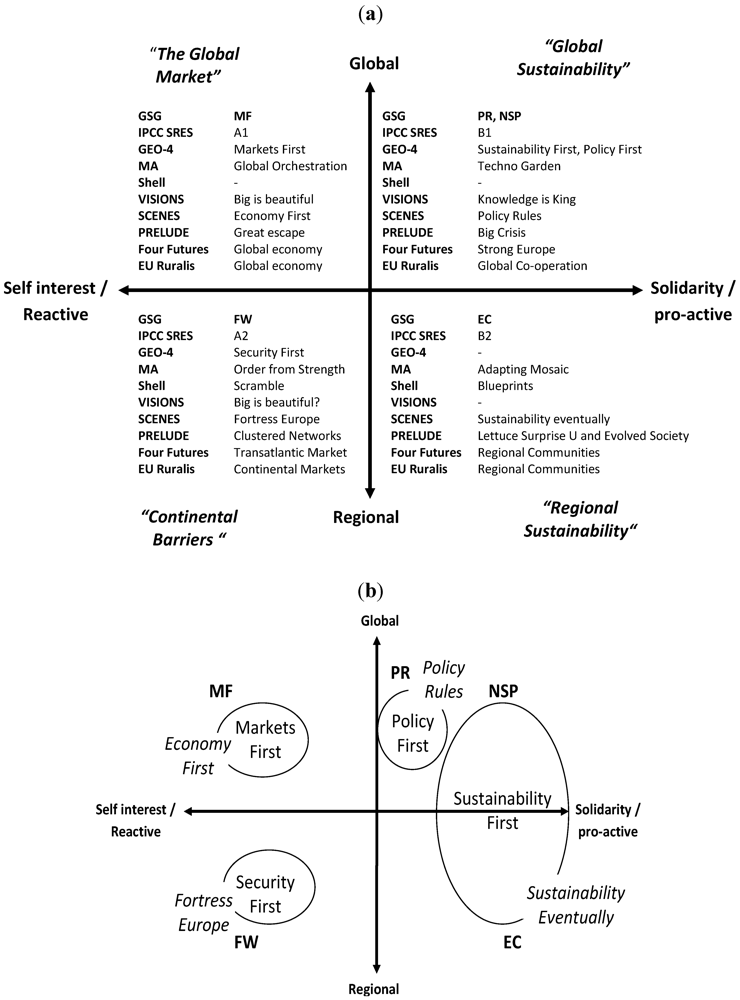
        <p>‘<italic>Markets First</italic>’—a world based upon market driven developments [<xref ref-type="bibr" rid="B17-sustainability-04-00740">17</xref>,<xref ref-type="bibr" rid="B18-sustainability-04-00740">18</xref>] (later developed to ‘<italic>Economy First</italic>’ [<xref ref-type="bibr" rid="B34-sustainability-04-00740">34</xref>,<xref ref-type="bibr" rid="B35-sustainability-04-00740">35</xref>], in which Globalization and Liberalization are embraced, economic growth is high and multinational companies dictate environmental standards, the close relationship being shown in <xref ref-type="fig" rid="sustainability-04-00740-f001">Figure 1</xref>b). </p>
		</list-item>
		</list>
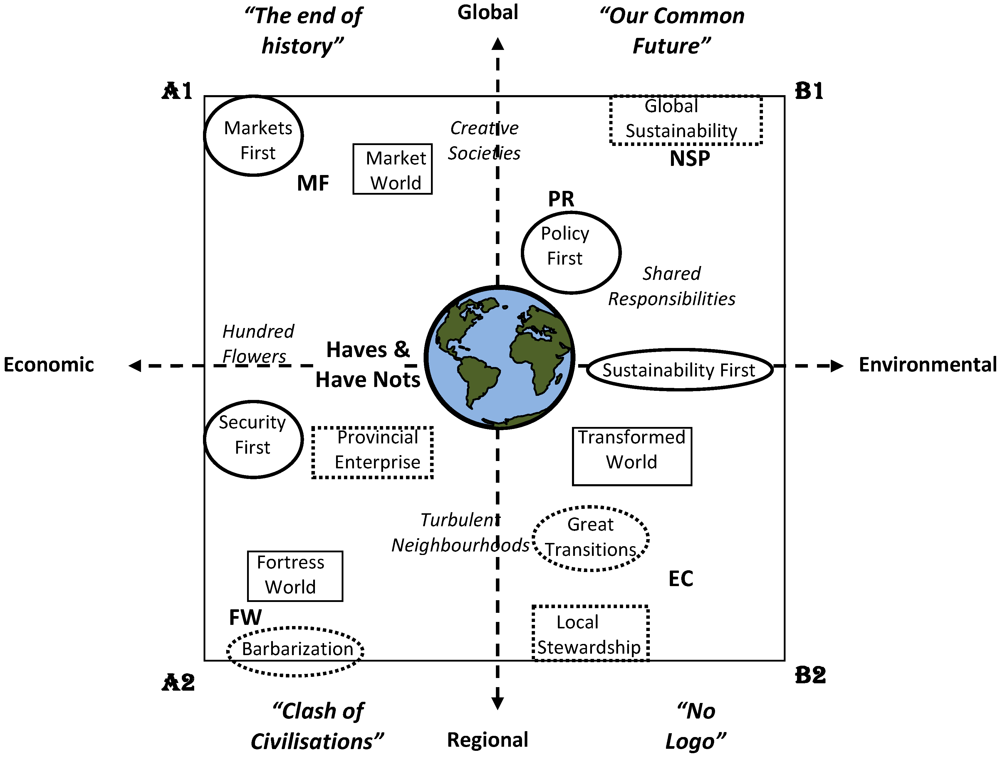
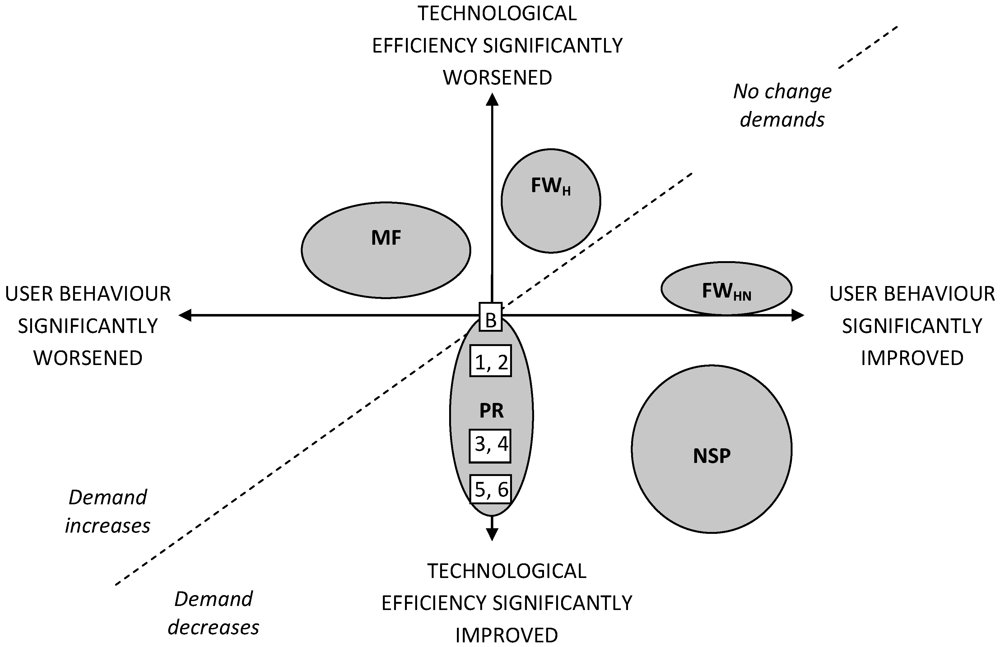
        <p>The compatibility between ‘<italic>A1</italic>’ and ‘<italic>FROG</italic>’ has been recognized previously by Morita <italic>et al.</italic> [<xref ref-type="bibr" rid="B36-sustainability-04-00740">36</xref>], and the strong links between ‘<italic>A1</italic>’ and ‘<italic>Markets first</italic>’ have been reinforced by numerous authors [<xref ref-type="bibr" rid="B23-sustainability-04-00740">23</xref>,<xref ref-type="bibr" rid="B24-sustainability-04-00740">24</xref>,<xref ref-type="bibr" rid="B26-sustainability-04-00740">26</xref>,<xref ref-type="bibr" rid="B32-sustainability-04-00740">32</xref>,<xref ref-type="bibr" rid="B37-sustainability-04-00740">37</xref>,<xref ref-type="bibr" rid="B38-sustainability-04-00740">38</xref>], based upon both having a strong global-economic-self-interest/reactive focus, a commonality shared by many of the scenarios described herein (<xref ref-type="fig" rid="sustainability-04-00740-f001">Figure 1</xref>a,b and <xref ref-type="fig" rid="sustainability-04-00740-f002">Figure 2</xref>). As such, ‘<italic>Great escape</italic>’ and ‘<italic>Global economy</italic>’ can also be added to the list. <xref ref-type="table" rid="sustainability-04-00740-t003">Table 3</xref> shows qualitative patterns for some of the previously mentioned scenarios according to a range of key drivers from where direct alignment with MF can be seen.</p>
        <fig id="sustainability-04-00740-f001" position="anchor">
          <label>Figure 1</label>
          <caption>
            <p>(<bold>a</bold>) 10 Scenario studies on two axes of uncertainty, modified from [<xref ref-type="bibr" rid="B26-sustainability-04-00740">26</xref>,<xref ref-type="bibr" rid="B32-sustainability-04-00740">32</xref>]; (<bold>b</bold>) Approximate location of selected scenarios, modified from [<xref ref-type="bibr" rid="B34-sustainability-04-00740">34</xref>,<xref ref-type="bibr" rid="B35-sustainability-04-00740">35</xref>].</p>
          </caption>
          <graphic xmlns:xlink="http://www.w3.org/1999/xlink" xlink:href="sustainability-04-00740-g001.tif"/>
        </fig>
        <fig id="sustainability-04-00740-f002" position="anchor">
          <label>Figure 2</label>
          <caption>
            <p>Various scenarios plotted against Special Report on Emissions Scenarios (SRES) axes, modified from [<xref ref-type="bibr" rid="B24-sustainability-04-00740">24</xref>]—scenario sets are identified by matching shapes/text. </p>
          </caption>
          <graphic xmlns:xlink="http://www.w3.org/1999/xlink" xlink:href="sustainability-04-00740-g002.tif"/>
        </fig>
        <table-wrap id="sustainability-04-00740-t003" position="anchor">
          <object-id pub-id-type="pii">sustainability-04-00740-t003_Table 3</object-id>
          <label>Table 3</label>
          <caption>
            <p>Qualitative patterns of change in Market Forces (MF) according to Social, Technological, Economic, Environmental and Political (STEEP) drivers.</p>
          </caption>
          <table>
            <thead>
              <tr style="border-bottom: solid thin">
                <th align="center" valign="top"> </th>
                <th align="center" valign="top">Society</th>
                <th align="center" valign="top">
                  Technology                </th>
                <th align="center" valign="top">
                  Economy                </th>
                <th align="center" valign="top">
                  Environment                </th>
                <th align="center" valign="top">
                  Policies                </th>
              </tr>
              <tr>
                <th align="center" valign="top">
                  Performance in MF [<xref ref-type="bibr" rid="B6-sustainability-04-00740">6</xref>]
                </th>
                <th align="center" valign="top">Worsens
                <break/><inline-graphic xmlns:xlink="http://www.w3.org/1999/xlink" xlink:href="sustainability-04-00740-i002.tif"/></th>
                <th align="center" valign="top">Slight improvement 
                <break/><inline-graphic xmlns:xlink="http://www.w3.org/1999/xlink" xlink:href="sustainability-04-00740-i001.tif"/></th>
                <th align="center" valign="top">Strengthens significantly
                <break/><inline-graphic xmlns:xlink="http://www.w3.org/1999/xlink" xlink:href="sustainability-04-00740-i001.tif"/><inline-graphic xmlns:xlink="http://www.w3.org/1999/xlink" xlink:href="sustainability-04-00740-i001.tif"/></th>
                <th align="center" valign="top">Worsens
                <break/><inline-graphic xmlns:xlink="http://www.w3.org/1999/xlink" xlink:href="sustainability-04-00740-i002.tif"/></th>
                <th align="center" valign="top">Weak
                <break/><inline-graphic xmlns:xlink="http://www.w3.org/1999/xlink" xlink:href="sustainability-04-00740-i002.tif"/></th>
              </tr>
            </thead>
            <tbody>
              <tr>
                <td align="left" valign="top">Generic qualitative patterns of change that resonate with other scenario sets</td>
                <td align="left" valign="top">Emphasis on individuals, low public participation in governance. Uncontrolled urbanization and an increasing ageing population. A consumerist world where the rich get richer.</td>
                <td align="left" valign="top">The focus is on economic efficiency. However, access depends on what you can pay for. Innovative technologies respond to consumer demands.</td>
                <td align="left" valign="top">Strongest economy with International decision-making. However there is low government intervention in a highly efficient formal economy in which most people work.</td>
                <td align="left" valign="top">Environment worsens due to high environmental impacts. Increase in pollutants, CO<sub>2</sub> emissions, resource use/capita and water stress (quality and quantity of groundwater decrease). Net deforestation.</td>
                <td align="left" valign="top">Weak social and environmental policies.</td>
              </tr>
            </tbody>
          </table>
        </table-wrap>
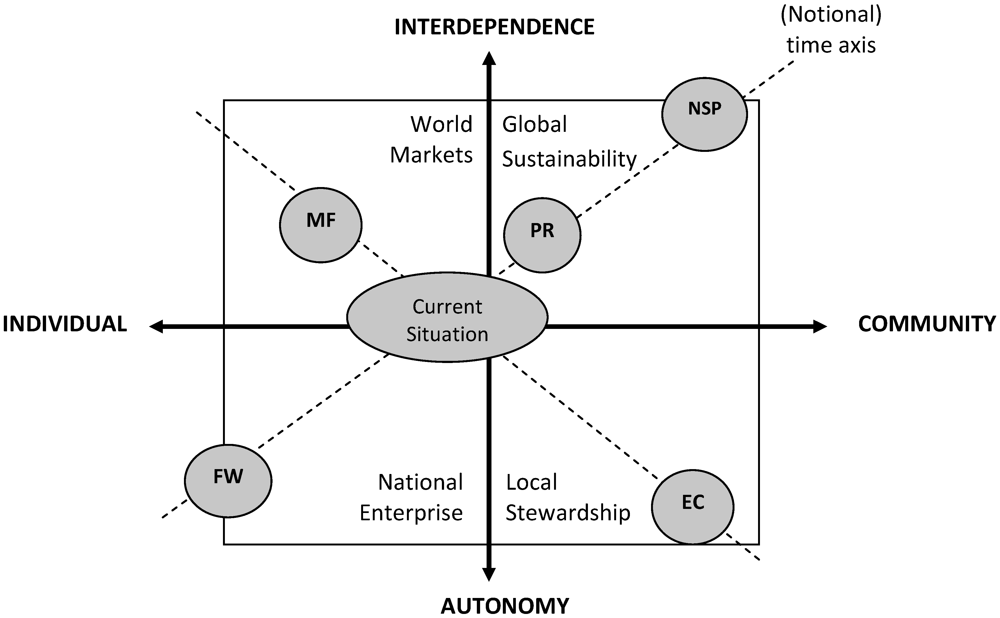
        <p>Pridmore [<xref ref-type="bibr" rid="B22-sustainability-04-00740">22</xref>] has previously suggested a close alignment between ‘<italic>A1</italic>’ and ‘<italic>World Markets</italic>’, e.g., they are similar to the present day USA [<xref ref-type="bibr" rid="B39-sustainability-04-00740">39</xref>], with consumerist values, global governance and declining manufacturing and agriculture [<xref ref-type="bibr" rid="B23-sustainability-04-00740">23</xref>,<xref ref-type="bibr" rid="B40-sustainability-04-00740">40</xref>,<xref ref-type="bibr" rid="B41-sustainability-04-00740">41</xref>]. The close relationship with MF is illustrated in <xref ref-type="fig" rid="sustainability-04-00740-f003">Figure 3</xref> [<xref ref-type="bibr" rid="B30-sustainability-04-00740">30</xref>] and is confirmed by Pinnegar <italic>et al. </italic>[<xref ref-type="bibr" rid="B23-sustainability-04-00740">23</xref>], with the addition of ‘<italic>Market world</italic>’ [<xref ref-type="bibr" rid="B42-sustainability-04-00740">42</xref>], ‘<italic>Beta</italic>’ (An early version of EA’s ‘<italic>Jeopardy</italic>’ scenario), and ‘<italic>Global Orchestration</italic>’ (although the last of these has not been added to the list as it resonates more evidently with NSP (<xref ref-type="sec" rid="sec2dot1-sustainability-04-00740">Section 2.1</xref>)). Around the same time EA [<xref ref-type="bibr" rid="B27-sustainability-04-00740">27</xref>] reported close links between ‘<italic>World Markets</italic>’ (previously linked to many other MF type scenarios) and their ‘<italic>Jeopardy</italic>’ scenario (an intensive materialistic consumerist culture, coupled with high economic growth, growing social fragmentation and a continuing reliance on fossil-based fuels [<xref ref-type="bibr" rid="B27-sustainability-04-00740">27</xref>], a scenario upon which ‘<italic>Blinkered Evolution</italic>’ (a world where mainstream behaviour is committed to an individualized consumption paradigm [<xref ref-type="bibr" rid="B43-sustainability-04-00740">43</xref>]) was based. Taylor <italic>et al. </italic>[<xref ref-type="bibr" rid="B28-sustainability-04-00740">28</xref>] confirms many of these relationships and further suggests close resemblance between ‘<italic>Market Forces</italic>’, a scenario based directly on the work of GSG that assumes economic growth paradigms, based on the experience of developed countries, are appropriate for the rest of the world [<xref ref-type="bibr" rid="B25-sustainability-04-00740">25</xref>], and their ‘<italic>New Frontiers</italic>’ scenario. This is not surprising given the references therein to market competition, individual meritocracy and unfettered consumption, as well as education and health for those that can afford it. </p>
        <fig id="sustainability-04-00740-f003" position="anchor">
          <label>Figure 3</label>
          <caption>
            <p>GSG scenarios within the Foresight Futures 2020 plane [<xref ref-type="bibr" rid="B30-sustainability-04-00740">30</xref>].</p>
          </caption>
          <graphic xmlns:xlink="http://www.w3.org/1999/xlink" xlink:href="sustainability-04-00740-g003.tif"/>
        </fig>
        <p>Several additions have been made to this list based on the adoption of similar descriptors and core values to MF: </p>
        <list list-type="bullet">
		<list-item>
		<p>‘<italic>Riding the Tiger</italic>’—a linear continuation of the current era [<xref ref-type="bibr" rid="B44-sustainability-04-00740">44</xref>]; </p>
		</list-item>
		<list-item>
        <p>‘<italic>Triumphant Markets</italic>’—a world of materialism, consumerism, free trade and market integration, [<xref ref-type="bibr" rid="B45-sustainability-04-00740">45</xref>]; </p>
		</list-item>
		<list-item>
        <p>‘<italic>World markets</italic>’—where material wealth and greater mobility is to the detriment of society and the environment [<xref ref-type="bibr" rid="B43-sustainability-04-00740">43</xref>]; </p>
		</list-item>
		<list-item>
        <p>‘<italic>High growth (F-0)</italic>’—a throw away economy with a free market model [<xref ref-type="bibr" rid="B46-sustainability-04-00740">46</xref>];</p>
		</list-item>
		<list-item>
        <p>‘<italic>Go for Growth</italic>’—where economic growth continues to be driven by consumption and new technology [<xref ref-type="bibr" rid="B31-sustainability-04-00740">31</xref>]; </p>
		</list-item>
		<list-item>
        <p>‘<italic>Growing on</italic>’—where high economic growth is at the expense of social cohesion and environmental sustainability [<xref ref-type="bibr" rid="B39-sustainability-04-00740">39</xref>]; </p>
		</list-item>
		<list-item>
        <p>‘<italic>Perpetual Motion</italic>’<italic>—</italic>a society driven by constant information, consumption and competition [<xref ref-type="bibr" rid="B47-sustainability-04-00740">47</xref>]; </p>
		</list-item>
		<list-item>
        <p>‘<italic>Carry on consuming</italic>’<italic>—</italic>where UK supply chains are dominated by a handful of companies and global competition has put greater reliance on production and processing within the European region [<xref ref-type="bibr" rid="B48-sustainability-04-00740">48</xref>]; </p>
		</list-item>
		<list-item>
        <p>‘<italic>Bazaar</italic>’—a market world where free market policies, corporate restructuring and entrepreneurship offer a model for the rest of the world [<xref ref-type="bibr" rid="B49-sustainability-04-00740">49</xref>]; </p>
		</list-item>
		<list-item>
        <p>‘<italic>High emissions</italic>’—contributing to high environmental impacts[<xref ref-type="bibr" rid="B50-sustainability-04-00740">50</xref>]; </p>
		</list-item>
		<list-item>
        <p>‘<italic>Market Forces</italic>’<italic>—</italic>in this scenario the Environment Agency focus on growth, consumerism and high water demand [<xref ref-type="bibr" rid="B51-sustainability-04-00740">51</xref>] it is not surprising that this has been rebranded as ‘<italic>uncontrolled demand</italic>’ [<xref ref-type="bibr" rid="B52-sustainability-04-00740">52</xref>], a significant concern in the water field.</p>
		</list-item>
		</list>
        <p>The second scenario within the conventional archetype is ‘<italic>Policy reform—</italic>PR’. </p>
        <disp-quote>
		<p><italic>The PR path requires unprecedented political will for establishing the necessary regulatory, economic, social, technological, and legal mechanisms [<xref ref-type="bibr" rid="B33-sustainability-04-00740">33</xref>]. This strong policy is used to meet social and environmental sustainability goals following widespread concern over environmental deterioration, social conflict, and economic instability. This leads to a marshalling of political will to implement comprehensive government action aimed at redirecting and constraining the global economy to achieve a broad set of social and environmental goals [<xref ref-type="bibr" rid="B21-sustainability-04-00740">21</xref>]. PR assumes the emergence of a massive government-led effort to achieve sustainability without major changes in the state-centric international order, modern institutional structures, and consumerist values [<xref ref-type="bibr" rid="B33-sustainability-04-00740">33</xref>]. For example PR is assumed to have adopted the best available technologies and yet behaviour has remained relatively unchanged [<xref ref-type="bibr" rid="B6-sustainability-04-00740">6</xref>]. There is a deep and widespread commitment to economic equity and strong and harmonized policies are implemented that, by redirecting the world economy and promoting technological innovation, are able to achieve internationally recognized goals for poverty reduction, climate change stabilization, ecosystem preservation, freshwater protection, and pollution control [<xref ref-type="bibr" rid="B33-sustainability-04-00740">33</xref>]. </italic> </p> 
		</disp-quote>
        <p>Raskin [<xref ref-type="bibr" rid="B21-sustainability-04-00740">21</xref>] first suggested that PR was broadly similar to: </p>
		<list list-type="bullet">
		<list-item>
        <p>Global Ecosystem Organization—‘<italic>GEOpolity</italic>’—a world where an environmental and social crisis looms and the response is to build an interlocking governance structure coordinated at the international level, [<xref ref-type="bibr" rid="B12-sustainability-04-00740">12</xref>]; </p>
		</list-item>
		<list-item>
        <p>‘<italic>Technology, Economics and the private sector</italic>’—where private sector initiatives lead research and development, and globalization drives economic growth, but the poorest countries are left behind [<xref ref-type="bibr" rid="B19-sustainability-04-00740">19</xref>]; </p>
		</list-item>
		<list-item>
        <p>‘<italic>Policy variants</italic>’—Decarbonization is a major theme in this world, prompted by a carbon market in which all goods and services carry a carbon price [<xref ref-type="bibr" rid="B13-sustainability-04-00740">13</xref>,<xref ref-type="bibr" rid="B14-sustainability-04-00740">14</xref>,<xref ref-type="bibr" rid="B15-sustainability-04-00740">15</xref>]; </p>
		</list-item>
		<list-item>
        <p>‘B1’—world that emphasizes global solutions to economic, social, and environmental sustainability with reductions in material intensity and the introduction of clean and resource-efficient technologies [<xref ref-type="bibr" rid="B16-sustainability-04-00740">16</xref>] , and </p>
		</list-item>
		<list-item>
        <p>‘<italic>Policy First</italic>’—where strong actions are undertaken by governments in an attempt to reach specific social and environmental goals, [<xref ref-type="bibr" rid="B17-sustainability-04-00740">17</xref>,<xref ref-type="bibr" rid="B18-sustainability-04-00740">18</xref>]; developed to ‘<italic>Policy Rules</italic>’ where Europe is at the forefront of a new socio-economic paradigm of public/private partnerships and leads a global shift in direction, water framework directive compliance is higher than ever—the close relationship can be seen in <xref ref-type="fig" rid="sustainability-04-00740-f001">Figure 1</xref> [<xref ref-type="bibr" rid="B34-sustainability-04-00740">34</xref>,<xref ref-type="bibr" rid="B35-sustainability-04-00740">35</xref>]. </p>
		</list-item>
		</list>
        <p>The compatibility between ‘<italic>B1</italic>’ and ‘<italic>GEOpolity</italic>’ has been recognized previously by Morita <italic>et al. </italic>[<xref ref-type="bibr" rid="B35-sustainability-04-00740">35</xref>] whilst correspondence between PR, ‘<italic>B1</italic>’ and ‘<italic>Policy first</italic>’<italic> i</italic>s reinforced by numerous authors [<xref ref-type="bibr" rid="B18-sustainability-04-00740">18</xref>,<xref ref-type="bibr" rid="B23-sustainability-04-00740">23</xref>,<xref ref-type="bibr" rid="B26-sustainability-04-00740">26</xref>,<xref ref-type="bibr" rid="B37-sustainability-04-00740">37</xref>,<xref ref-type="bibr" rid="B38-sustainability-04-00740">38</xref>]. In terms of high global-environmental-solidarity/pro-active considerations (<xref ref-type="fig" rid="sustainability-04-00740-f001">Figure 1</xref>a,b, and <xref ref-type="fig" rid="sustainability-04-00740-f002">Figure 2</xref>) very close compatibility is reported between ‘<italic>B1</italic>’ and ‘<italic>Global sustainability</italic>’ [<xref ref-type="bibr" rid="B22-sustainability-04-00740">22</xref>,<xref ref-type="bibr" rid="B24-sustainability-04-00740">24</xref>]. This view is upheld by Busch [<xref ref-type="bibr" rid="B26-sustainability-04-00740">26</xref>] and Kok <italic>et al. </italic>[<xref ref-type="bibr" rid="B32-sustainability-04-00740">32</xref>] with the addition of the following: ‘<italic>Technogarden,</italic><italic>Knowledge is King, Big Crisis, Strong Europe </italic>and<italic> Global Co-operation</italic>’. As ‘<italic>Global Sustainability</italic>’ and ‘<italic>B1</italic>’ align with both PR and NSP, albeit more strongly in NSP, they appear in both lists (<xref ref-type="table" rid="sustainability-04-00740-t002">Table 2</xref>). <xref ref-type="table" rid="sustainability-04-00740-t004">Table 4</xref> shows close alignment of previously-mentioned scenarios to PR when considering qualitative patterns of change according to a range of key drivers [<xref ref-type="bibr" rid="B26-sustainability-04-00740">26</xref>]. </p>
        <table-wrap id="sustainability-04-00740-t004" position="anchor">
          <object-id pub-id-type="pii">sustainability-04-00740-t004_Table 4</object-id>
          <label>Table 4</label>
          <caption>
            <p>Qualitative patterns of change in Policy Reform (PR) according to STEEP drivers. </p>
          </caption>
          <table>
            <thead>
              <tr style="border-bottom: solid thin">
                <th align="center" valign="top"> </th>
                <th align="center" valign="top">
                  Society                </th>
                <th align="center" valign="top">
                  Technology                </th>
                <th align="center" valign="top">
                  Economy                </th>
                <th align="center" valign="top">
                  Environment                </th>
                <th align="center" valign="top">
                  Policies                </th>
              </tr>
              <tr>
                <th align="center" valign="top">
                  Performance in PR [<xref ref-type="bibr" rid="B6-sustainability-04-00740">6</xref>]
                </th>
                <th align="center" valign="top">
                  Improvement<break/>
                  <inline-graphic xmlns:xlink="http://www.w3.org/1999/xlink" xlink:href="sustainability-04-00740-i001.tif"/>
                </th>
                <th align="center" valign="top">
                  Significant
                  Improvement<break/>
                  <inline-graphic xmlns:xlink="http://www.w3.org/1999/xlink" xlink:href="sustainability-04-00740-i001.tif"/> <inline-graphic xmlns:xlink="http://www.w3.org/1999/xlink" xlink:href="sustainability-04-00740-i001.tif"/>
                </th>
                <th align="center" valign="top">
                  Strengthens<break/>
                  <inline-graphic xmlns:xlink="http://www.w3.org/1999/xlink" xlink:href="sustainability-04-00740-i001.tif"/>
                </th>
                <th align="center" valign="top">
                  Improvement<break/>
                  <inline-graphic xmlns:xlink="http://www.w3.org/1999/xlink" xlink:href="sustainability-04-00740-i001.tif"/>
                </th>
                <th align="center" valign="top">
                  Strong<break/>
                  <inline-graphic xmlns:xlink="http://www.w3.org/1999/xlink" xlink:href="sustainability-04-00740-i001.tif"/>
                </th>
              </tr>
            </thead>
            <tbody>
              <tr>
                <td align="left" valign="top">Generic qualitative patterns of change that resonate with other scenario sets</td>
                <td align="left" valign="top">Emphasis on more community. Medium public participation in governance. Less chaotic urbanization and a growing population. User behaviors relatively unchanged.</td>
                <td align="left" valign="top">Focus on general efficiency and environment. Promotion of technology transfer and diffusion. Best practice technology. Dependence on increases in technological efficiency to reduce consumption.</td>
                <td align="left" valign="top">Strong economic growth with International decision making. High government intervention in an efficient and fair formal economy in which most people work.</td>
                <td align="left" valign="top">Environment improves due to reduced environmental impacts. Reduction in Pollutants, CO<sub>2</sub> emissions (20% of 1990 levels reached by 2050), resource use/capita and water stress. Moderately reduced deforestation.</td>
                <td align="left" valign="top">Strong social and environmental policies</td>
              </tr>
            </tbody>
          </table>
        </table-wrap>
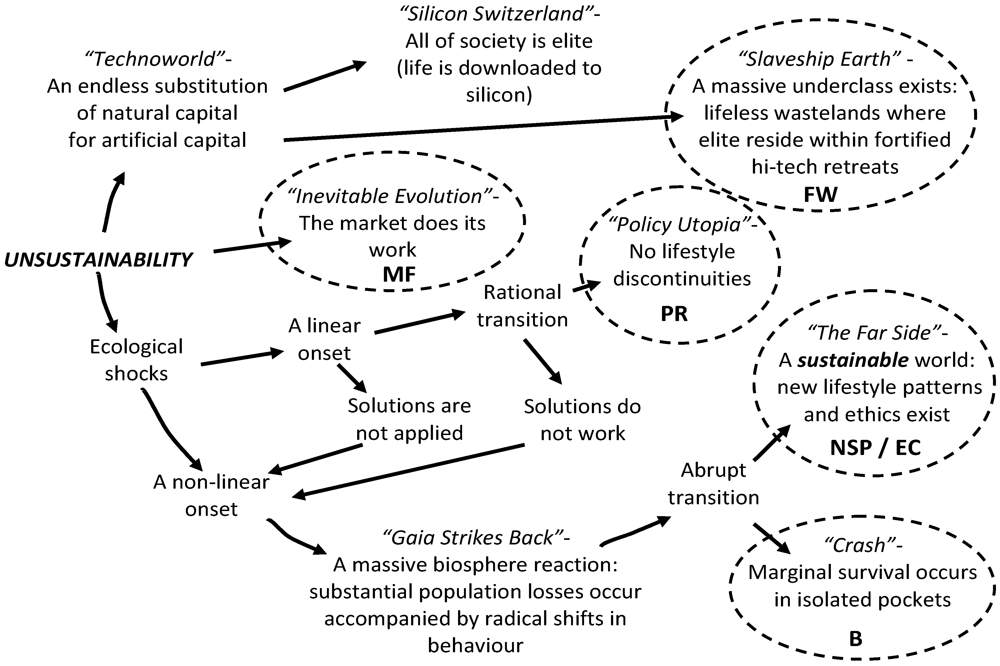
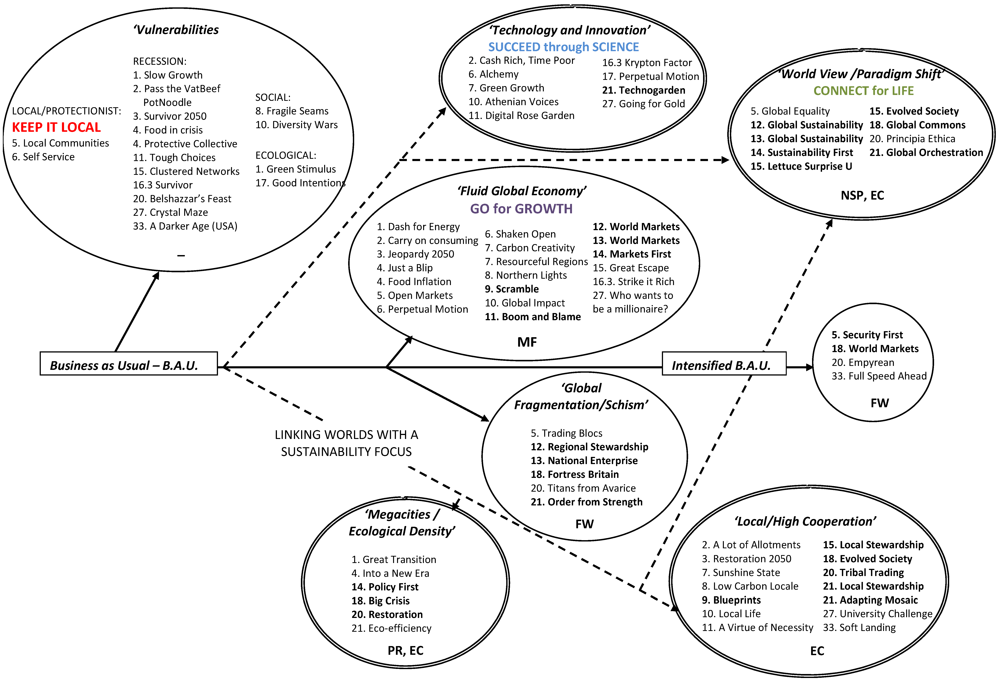
        <p>Whilst Makropoulos <italic>et al. </italic>[<xref ref-type="bibr" rid="B30-sustainability-04-00740">30</xref>] suggest that PR is on the way to NSP, Raskin [<xref ref-type="bibr" rid="B53-sustainability-04-00740">53</xref>] argues that the transition very much depends upon where branch points [<xref ref-type="bibr" rid="B8-sustainability-04-00740">8</xref>] might form. Pinnegar <italic>et al. </italic>[<xref ref-type="bibr" rid="B23-sustainability-04-00740">23</xref>] have aligned ‘<italic>B1</italic>’ with ‘<italic>Global commons</italic>’ (where people aspire to high levels of welfare and a sound environment, and international co-operation towards global sustainability [<xref ref-type="bibr" rid="B23-sustainability-04-00740">23</xref>]); ‘<italic>Gamma</italic>’ (An early version of EA’s ‘<italic>Alchemy</italic>’ scenario); ‘<italic>Green World</italic>’ [<xref ref-type="bibr" rid="B42-sustainability-04-00740">42</xref>] and ‘<italic>Technogarden</italic>’ (where Global markets in ecological property combine green technology, eco-efficiency, openness and competition [<xref ref-type="bibr" rid="B54-sustainability-04-00740">54</xref>]), which the Environment Agency suggests has similarities to their ‘<italic>Alchemy</italic>’ scenario (where a new regulatory environment spurs innovation in new technologies and new standards of producer responsibility [<xref ref-type="bibr" rid="B51-sustainability-04-00740">51</xref>]). Defra also noted similarities between ‘<italic>Alchemy</italic>’ and their own ‘<italic>Strong government</italic>’ scenario [<xref ref-type="bibr" rid="B43-sustainability-04-00740">43</xref>] (the latter built upon the former). Both ‘<italic>Alchemy</italic>’ and ‘<italic>Technogarden</italic>’ have been linked to Natural England’s ‘<italic>SUCCEED through SCIENCE</italic>’ scenario [<xref ref-type="bibr" rid="B31-sustainability-04-00740">31</xref>] (where the global economy continues to be driven by innovation and everyone relies on business to keep the country growing), as shown in <xref ref-type="fig" rid="sustainability-04-00740-f004">Figure 4</xref>. The ‘<italic>Green Policy</italic>’ (where ecologists influence central policy) and ‘<italic>Technocratic</italic>’ scenarios (where public engineers and technocrats influence policy) as proposed by Makropoulos<italic> et al.</italic> [<xref ref-type="bibr" rid="B30-sustainability-04-00740">30</xref>] are very much policy-related and therefore not dissimilar to PR. In ‘<italic>Policy reform</italic>’ (a scenario in which negative impacts of market mechanisms are tempered by the inclusion of mitigation programs) it is argued that the socio-economic and political considerations may make it expedient for governments to take actions that favor citizens, rather than wait for the operation of the market to correct these ills [<xref ref-type="bibr" rid="B25-sustainability-04-00740">25</xref>]. As this is drawn directly on the work of GSG the direct comparison with PR is unavoidable. </p>
        <p>Several additions have been made to this list based on the adoption of similar descriptors and core values to PR: </p>
		<list list-type="bullet">
		<list-item>
        <p>‘<italic>Leading the way</italic>’—UK Government takes a hands on approach to ensure the transition to a low-carbon economy; investment in environmental research and technology is high [<xref ref-type="bibr" rid="B55-sustainability-04-00740">55</xref>]; </p>
		</list-item>
		<list-item>
        <p>‘<italic>Prosperous stewardship</italic>’—a global player in economic terms with high regulation, innovation and a dry climate [<xref ref-type="bibr" rid="B56-sustainability-04-00740">56</xref>]; </p>
		</list-item>
		<list-item>
        <p><italic>Urban Colonies</italic>—good environmental practice is at the heart of the UK’s economic and social policies; new urban planning policies; consumption has fallen; resource use is now a fundamental part of the tax system and disposable items are less popular [<xref ref-type="bibr" rid="B47-sustainability-04-00740">47</xref>];</p>
		</list-item>
		<list-item>
        <p>’<italic> Low emissions</italic>’<italic>—</italic>resulting in reduced environmental impacts [<xref ref-type="bibr" rid="B50-sustainability-04-00740">50</xref>]<italic>;</italic> </p>
		</list-item>
		<list-item>
        <p><italic>Innovation</italic>—Previously <italic>Alchemy</italic>, in this world people work in regulation and compliance; environmental concerns are the problem of manufacturers and service providers — supply side regulation (for water) is an accepted integral part of the economy [<xref ref-type="bibr" rid="B52-sustainability-04-00740">52</xref>]<italic>; </italic> </p>
		</list-item>
		<list-item>
        <p>‘<italic>Business as usual—B-A-U</italic>’ describes strict controls for land-use planning, a balance between growing volumes and increasing recycling rates, and adoption of techno-fixes for carbon capture [<xref ref-type="bibr" rid="B46-sustainability-04-00740">46</xref>]—as such it describes perfectly a policy-centric B-A-U for the UK; and </p>
		</list-item>
		<list-item>
        <p>‘<italic>Powerdown</italic>’—refers to the path of self-limitation, cooperation and sharing; an orderly equitable transition to a low-carbon economy, which mirrors the steps being taken within a PR world [<xref ref-type="bibr" rid="B57-sustainability-04-00740">57</xref>].</p>
		</list-item>
		</list>
        <fig id="sustainability-04-00740-f004" position="anchor">
          <label>Figure 4</label>
          <caption>
            <p>Archetypes by theme clusters (<bold>Bold</bold> text shows scenarios included in this study), modified from [<xref ref-type="bibr" rid="B31-sustainability-04-00740">31</xref>].</p>
          </caption>
          <graphic xmlns:xlink="http://www.w3.org/1999/xlink" xlink:href="sustainability-04-00740-g004.tif"/>
        </fig>
		</sec>
		<sec>
		<title>2.2. Great Transitions</title>
        <p>The first variant within the great transitions archetype is ‘<italic>New Sustainability Paradigm</italic>—NSP’. </p>
        <disp-quote>
		<p><italic>NSP sees new humane globalization (rather than localism) change the character of urban industrial society [<xref ref-type="bibr" rid="B21-sustainability-04-00740">21</xref>]. A values-led change catalyzed by the push of deepening crises and the pull of desire for a just, sustainable, and planetary civilization. This new paradigm is rooted in human solidarity, universal access to education and health care services, ecological resilience, reduced consumerism (technology is as good as it gets but matched also by a step-change in behavior [<xref ref-type="bibr" rid="B6-sustainability-04-00740">6</xref>]), improved well-being, e.g., creativity, leisure, relationships, and community engagement) and quality of life [<xref ref-type="bibr" rid="B33-sustainability-04-00740">33</xref>]. NSP is a more cosmopolitan vision than EC, because it is a world that would transcend and transform urban and industrial civilization, and maintain global linkages and solidarity, rather than retreat into localism [<xref ref-type="bibr" rid="B10-sustainability-04-00740">10</xref>]. The improved social cohesion reduces conflict; crises may still linger, but the world is able to confront them with enhanced institutions for reconciliation and cooperation [<xref ref-type="bibr" rid="B33-sustainability-04-00740">33</xref>].</italic> </p>
		</disp-quote>
        <p>Raskin [<xref ref-type="bibr" rid="B21-sustainability-04-00740">21</xref>] first suggested that this scenario is broadly similar to:</p>
		<list list-type="bullet">
		<list-item>
        <p><italic>Jazz</italic>—where markets are harnessed for finding solutions to sustainable development [<xref ref-type="bibr" rid="B12-sustainability-04-00740">12</xref>]; </p>
		</list-item>
		<list-item>
        <p><italic>Values and Lifestyle—</italic>Sustainable development, with an emphasis on research and development in the poorest countries [<xref ref-type="bibr" rid="B19-sustainability-04-00740">19</xref>,<xref ref-type="bibr" rid="B20-sustainability-04-00740">20</xref>], and </p>
		</list-item>
		<list-item>
        <p><italic>Sustainability First</italic>—a world in which a new development paradigm emerges in response to the challenge of sustainability, supported by new, more equitable values and institutions [<xref ref-type="bibr" rid="B17-sustainability-04-00740">17</xref>,<xref ref-type="bibr" rid="B18-sustainability-04-00740">18</xref>]. </p>
		</list-item>
		</list>
        <p>According to the Environment Agency this scenario is also very similar to their ‘<italic>Restoration</italic>’ scenario (a world where societal values and behavior are oriented more towards sustainable development goals as a result of greater awareness and perception of environmental risk [<xref ref-type="bibr" rid="B51-sustainability-04-00740">51</xref>]—subsequently renamed to ‘<italic>Sustainable Behavior</italic>’ [<xref ref-type="bibr" rid="B52-sustainability-04-00740">52</xref>]). They also suggest similarity with Foresights ‘<italic>Global Sustainability</italic>’ scenario, (e.g., that it is similar to the Netherlands [<xref ref-type="bibr" rid="B39-sustainability-04-00740">39</xref>]) also known as ‘<italic>Global responsibility</italic>’ [<xref ref-type="bibr" rid="B41-sustainability-04-00740">41</xref>,<xref ref-type="bibr" rid="B58-sustainability-04-00740">58</xref>], a world with: a strong index of sustainable economic welfare and climate management, conservationist values (biodiversity is stable), global governance, renewable energy, less resource-intensive manufacturing, equity, and improved air and water quality [<xref ref-type="bibr" rid="B59-sustainability-04-00740">59</xref>,<xref ref-type="bibr" rid="B60-sustainability-04-00740">60</xref>]. Previously, Pridmore [<xref ref-type="bibr" rid="B22-sustainability-04-00740">22</xref>] suggested a closer alignment between ‘<italic>Global sustainability</italic>’ and ‘<italic>B1</italic>’ [<xref ref-type="bibr" rid="B16-sustainability-04-00740">16</xref>], based upon a strong global-environmental focus, this relationship being confirmed by de Vries [<xref ref-type="bibr" rid="B24-sustainability-04-00740">24</xref>] in <xref ref-type="fig" rid="sustainability-04-00740-f002">Figure 2</xref>. Hence, the subtle similarities with ‘<italic>Green World</italic>’ (aligned previously with PR) cannot be ignored. <xref ref-type="table" rid="sustainability-04-00740-t005">Table 5</xref> shows the close alignment of a number of the scenarios aligned under NSP, according to key drivers [<xref ref-type="bibr" rid="B26-sustainability-04-00740">26</xref>].</p>
        <p>Taylor <italic>et al. </italic>[<xref ref-type="bibr" rid="B28-sustainability-04-00740">28</xref>] suggest that some elements (<italic>i.e.</italic>, restorative stages) of their ‘<italic>Living on the No.8 Wire</italic>’ scenario (where New Zealand reacted too late to sustainability challenges and got left behind globally, but social cohesion has permitted an indigenous and inventive subsistence in the economy, as seen in other Pacific Islands) resonate well with ‘<italic>Restoration</italic>’ (mentioned earlier). This in turn is assumed by Defra [<xref ref-type="bibr" rid="B43-sustainability-04-00740">43</xref>] to closely resemble their ‘<italic>Civic renewal</italic>’ scenario (a world where British citizens and consumers, rather than British politicians, begin to change their behavior—this being a strong characteristic that resonates well within NSP). </p>
        <p>As can be seen in <xref ref-type="fig" rid="sustainability-04-00740-f004">Figure 4</xref>, Natural England align their ‘<italic>CONNECT for LIFE</italic>’ scenario (where people now connect through vast global networks [<xref ref-type="bibr" rid="B31-sustainability-04-00740">31</xref>]) with ‘<italic>Global Orchestration</italic>’ (a world of sustainable development, economic growth, fair trade, global public health, global education, global NGO and multilateral organizations [<xref ref-type="bibr" rid="B54-sustainability-04-00740">54</xref>]). </p>
        <table-wrap id="sustainability-04-00740-t005" position="anchor">
          <object-id pub-id-type="pii">sustainability-04-00740-t005_Table 5</object-id>
          <label>Table 5</label>
          <caption>
            <p>Qualitative patterns of change in New Sustainability Paradigm (NSP) according to STEEP drivers.</p>
          </caption>
          <table>
<thead>
              <tr style="border-bottom: solid thin">
                <th align="center" valign="top"> </th>
                <th align="center" valign="top">Society</th>
                <th align="center" valign="top">Technology</th>
                <th align="center" valign="top">Economy</th>
                <th align="center" valign="top">Environment</th>
                <th align="center" valign="top">Policies</th>
              </tr>
              <tr>
                <th align="center" valign="top">Performance in NSP [<xref ref-type="bibr" rid="B6-sustainability-04-00740">6</xref>] </th>
                <th align="center" valign="top">Significant improvement
                <break/><inline-graphic xmlns:xlink="http://www.w3.org/1999/xlink" xlink:href="sustainability-04-00740-i001.tif"/> <inline-graphic xmlns:xlink="http://www.w3.org/1999/xlink" xlink:href="sustainability-04-00740-i001.tif"/> </th>
                <th align="center" valign="top">Significant improvement
                <break/><inline-graphic xmlns:xlink="http://www.w3.org/1999/xlink" xlink:href="sustainability-04-00740-i001.tif"/> <inline-graphic xmlns:xlink="http://www.w3.org/1999/xlink" xlink:href="sustainability-04-00740-i001.tif"/> </th>
                <th align="center" valign="top">Strengthens
                <break/><inline-graphic xmlns:xlink="http://www.w3.org/1999/xlink" xlink:href="sustainability-04-00740-i001.tif"/></th>
                <th align="center" valign="top">Significant improvement
                <break/><inline-graphic xmlns:xlink="http://www.w3.org/1999/xlink" xlink:href="sustainability-04-00740-i001.tif"/> <inline-graphic xmlns:xlink="http://www.w3.org/1999/xlink" xlink:href="sustainability-04-00740-i001.tif"/> </th>
                <th align="center" valign="top">Strong
                <break/><inline-graphic xmlns:xlink="http://www.w3.org/1999/xlink" xlink:href="sustainability-04-00740-i001.tif"/></th>
              </tr>
            </thead>
            <tbody>
              <tr>
                <td align="left" valign="top">Generic qualitative patterns of change that resonate with other scenario sets</td>
                <td align="left" valign="top">Strongest emphasis on community. Highest public participation in governance. Large reduction in population. Significant voluntary Improvement to user behavior.</td>
                <td align="left" valign="top">Best practice technology [<xref ref-type="bibr" rid="B6-sustainability-04-00740">6</xref>]. Focus on general efficiency and environment. Promotion of Technology transfer and diffusion, encouragement of open source.</td>
                <td align="left" valign="top">Sustainable economic growth with no dominant scale for decision making. Place of work is variable by region and societal group.</td>
                <td align="left" valign="top">Lowest pressure on natural environment.Greatest reduction in pollutants, CO<sub>2</sub> emissions, resource use/capita and water stress. Net reforestation.</td>
                <td align="left" valign="top">Strongest social and environmental policies. Human well-being and the environment are central to long-term planning initiatives.</td>
              </tr>
            </tbody>
          </table>
        </table-wrap>
        <p>In addition it is closely related to ‘<italic>Global Sustainability</italic>’ (mentioned previously), ‘<italic>Sustainability First</italic>’ (mentioned previously) and ‘<italic>Global commons</italic>’ (a world where people aspire to high levels of welfare and a sound environment—driven through International co-operation towards global sustainability [<xref ref-type="bibr" rid="B23-sustainability-04-00740">23</xref>]). It is interesting to note that ‘<italic>Sustainability First</italic>’, whilst being environmentally-focused, provides a balance between global and regional (<italic>i.e.</italic>, spanning somewhere between NSP and EC), although its position is best described by <xref ref-type="fig" rid="sustainability-04-00740-f001">Figure 1</xref>b rather than 2. ‘<italic>Great Transitions</italic>’ is a world in which the three pillars of sustainable development are strengthened and behavioral patterns that characterize modern societies, such as consumerism, give way. As such a new level of satisfaction that is not materialistic is defined [<xref ref-type="bibr" rid="B25-sustainability-04-00740">25</xref>]. It is worth noting that de Vries [<xref ref-type="bibr" rid="B24-sustainability-04-00740">24</xref>] locates ‘<italic>Great transitions</italic>’, a combination of EC and NSP as defined by Hammond (1997), in the lower right-hand quadrant in <xref ref-type="fig" rid="sustainability-04-00740-f002">Figure 2</xref>; however, when NSP is disassociated from EC within this archetype, the former would move vertically upwards (into the upper quadrant) whereas the latter would move marginally downwards. Macropoulos <italic>et al. </italic>[<xref ref-type="bibr" rid="B30-sustainability-04-00740">30</xref>] align their ‘<italic>Sustainable world</italic>’ (a world where integrated solutions are the aim) directly with NSP, as it draws narratives from this research. </p>
        <p>Several additions have been made to this list, based on the adoption of similar descriptors and core values to NSP, these are: </p>
		<list list-type="bullet">
		<list-item>
        <p>‘<italic>Hearts</italic>’<italic>—</italic>Environment wins, Society Wins—This is a world in which demography, politics, economics, and sustainability gel. It is the future that the Brundtland Commission pointed us towards [<xref ref-type="bibr" rid="B61-sustainability-04-00740">61</xref>]; </p>
		</list-item>
		<list-item>
        <p>‘<italic>Triple Whammy</italic>’—based upon a combined approach to environmental, social and economic sustainability [<xref ref-type="bibr" rid="B62-sustainability-04-00740">62</xref>]; and</p>
		</list-item>
		<list-item>
        <p>‘<italic>Factor Four</italic>’—a more sustainable, low-impact food system that improves significantly demand-side management in addition to re-use, recycling and composting [<xref ref-type="bibr" rid="B46-sustainability-04-00740">46</xref>]. </p>
		</list-item>
		</list>
        <p>The second scenario within the great transition world is ‘<italic>Eco-communalism</italic>—EC’. </p>
        <disp-quote>
		<p><italic>Eco-communalism envisions a patchwork of semi-isolated and self-reliant communities; quite sustainable with high equity, low economic growth, low populations [<xref ref-type="bibr" rid="B8-sustainability-04-00740">8</xref>,<xref ref-type="bibr" rid="B63-sustainability-04-00740">63</xref>] with a bio-regional focus, a highly localist vision and face-to-face democracy, [<xref ref-type="bibr" rid="B21-sustainability-04-00740">21</xref>]. EC contrasts with NSP by: embracing the principles of strong decentralization; small-scale technology; and economic autarky [<xref ref-type="bibr" rid="B10-sustainability-04-00740">10</xref>]. It has been suggested by Gallopin et al. [<xref ref-type="bibr" rid="B8-sustainability-04-00740">8</xref>] that an EC world could emerge out of an NSP world, if powerful consensus arose for localism, diversity and autonomy. Just as likely, however, it could emerge from the recovery of Breakdown [<xref ref-type="bibr" rid="B8-sustainability-04-00740">8</xref>]. A major threat to sustainability could come from the possibility that some of the more or less isolated communities develop into aggressive, expansionist forces that attempt to dominate neighboring communities [<xref ref-type="bibr" rid="B8-sustainability-04-00740">8</xref>].</italic> </p>
		</disp-quote>
        <p>Raskin [<xref ref-type="bibr" rid="B21-sustainability-04-00740">21</xref>] first suggested that this scenario is broadly similar to:</p>
        <list list-type="bullet">
		<list-item>
		<p>‘<italic>B2</italic>’ [<xref ref-type="bibr" rid="B16-sustainability-04-00740">16</xref>], which de Vries [<xref ref-type="bibr" rid="B24-sustainability-04-00740">24</xref>], in <xref ref-type="fig" rid="sustainability-04-00740-f001">Figure 1</xref>, aligns closely with: </p>
		</list-item>
		<list-item>
        <p>‘<italic>Local stewardship</italic>’—a world with conservative values, regional/national governance, locally-based financial and other services, and small-scale intensive agriculture and manufacturing [<xref ref-type="bibr" rid="B41-sustainability-04-00740">41</xref>,<xref ref-type="bibr" rid="B59-sustainability-04-00740">59</xref>,<xref ref-type="bibr" rid="B60-sustainability-04-00740">60</xref>]—like Denmark, Sami [<xref ref-type="bibr" rid="B39-sustainability-04-00740">39</xref>] — this relationship being confirmed by Pridmore [<xref ref-type="bibr" rid="B22-sustainability-04-00740">22</xref>], EA [<xref ref-type="bibr" rid="B51-sustainability-04-00740">51</xref>] and Pinnegar <italic>et al. </italic>[<xref ref-type="bibr" rid="B23-sustainability-04-00740">23</xref>], the last of these authors include also: </p>
		</list-item>
		<list-item>
        <p>‘<italic>Delta</italic>’—an early version of EA’s ‘<italic>Survivor</italic>’ scenario, and: </p>
		</list-item>
		<list-item>
        <p>‘<italic>Adaptive Mosaic</italic>’—a world of local regional co-management; common property institutions; integration of local rules regulating trade; local, non-market rights; local communities; local equity and cooperatives [<xref ref-type="bibr" rid="B54-sustainability-04-00740">54</xref>]. </p>
		</list-item>
		</list>
        <p>The Environment Agency suggested similarities between their ‘<italic>Survivor</italic>’ scenario (a scenario in which the consumers become more frugal and self-reliant with resurgence in traditional regional and local cultures and values [<xref ref-type="bibr" rid="B51-sustainability-04-00740">51</xref>] — subsequently renamed to ‘<italic>Local Resilience</italic>’ [<xref ref-type="bibr" rid="B52-sustainability-04-00740">52</xref>]) and Foresight’s ‘<italic>Tribal Trading</italic>’ scenario (a world shrunk to their own community, a global economic system that is severely damaged with infrastructure falling into disrepair, local food production and services and local transport - typically by bike and horse. There are local conflicts over resources: lawlessness and mistrust are high. The state does what it can—but its power has been eroded [<xref ref-type="bibr" rid="B47-sustainability-04-00740">47</xref>]). Landcare Associates suggest that some elements of their ‘<italic>Independent Aotearoa</italic>’ scenario (also known as the ‘Shire’) were broadly similar to ‘<italic>Tribal Trading</italic>’: the link to EC is easily recognized given the references to a world that has international geopolitical instability, strong social cohesion and a voluntary disconnect from globalization. In other words, as Taylor describes it: equitable, educated, environmental—friendly and dull. Macropoulos <italic>et al. </italic>[<xref ref-type="bibr" rid="B30-sustainability-04-00740">30</xref>] align their ‘<italic>Eco-communalism</italic>’ (green visions of bioregionalism, localism, face to face democracy, small technology and economic autarky) directly with EC. From <xref ref-type="fig" rid="sustainability-04-00740-f001">Figure 1</xref>a, b other scenarios include: <italic>Blueprints, Lettuce surprise U, Evolved Society, Regional Communities and</italic> <italic>Sustainability eventually</italic> (a world where water demand has structurally decreased, derived from ‘<italic>Sustainability First</italic>’ [<xref ref-type="bibr" rid="B34-sustainability-04-00740">34</xref>,<xref ref-type="bibr" rid="B35-sustainability-04-00740">35</xref>]). </p>
        <p>During this research the following additions have been made to this list, based on the adoption of similar descriptors and core values to EC: </p>
        <list list-type="bullet">
		<list-item>
		<p>‘<italic>Building lifeboats</italic>’<italic>—</italic>the path of community, solidarity and preservation [<xref ref-type="bibr" rid="B57-sustainability-04-00740">57</xref>] and </p>
		</list-item>
		<list-item>
        <p>‘<italic>Medium/Low emissions</italic>’ [<xref ref-type="bibr" rid="B50-sustainability-04-00740">50</xref>].</p>
		</list-item>
		</list>
      </sec>
      <sec id="sec2dot3-sustainability-04-00740">
        <title>2.3. Barbarization</title>
        <p>The first scenario within the barbarization archetype is ‘<italic>Fortress World</italic>—FW’.</p>
        <disp-quote>
		<p><italic>Authoritarian rule, elites in “fortresses”, poverty &amp; repression outside; an authoritarian response to the threat of breakdown; from protected enclaves, elites control an impoverished majority and manage critical natural resources [<xref ref-type="bibr" rid="B9-sustainability-04-00740">9</xref>,<xref ref-type="bibr" rid="B10-sustainability-04-00740">10</xref>,<xref ref-type="bibr" rid="B33-sustainability-04-00740">33</xref>] Strategic mineral reserves, freshwater and important biological resources are put under military control, as are favored resort areas, including nature and hunting preserves, from which the poor are excluded [<xref ref-type="bibr" rid="B8-sustainability-04-00740">8</xref>]. This is a world in which wealth, resources and conventional governance systems are eroding and alliances are formed to protect the privileges of rich and powerful elites in their bubbles of privilege. Outside the fortress, the majority is mired in poverty, denied access to scarce resources and restricted in mobility, expression and basic rights [<xref ref-type="bibr" rid="B8-sustainability-04-00740">8</xref>]. Authorities employ geo-engineering techniques to stabilize the global climate, while dispatching militia to multiple hotspots in an attempt to quell social conflict and mass migration. But the results are mixed: emergency measures and spotty infrastructure investment cannot keep pace with habitat loss and climate change; inadequate food and water to desperate billions [<xref ref-type="bibr" rid="B33-sustainability-04-00740">33</xref>]. Technology is maintained in the fortresses, even with some continued innovation, but deteriorates elsewhere. Local pollution within the fortress is reduced through increased efficiency and recycling. Pollution is also exported outside the enclaves, contributing to the extreme environmental deterioration induced by the unsustainable practices of the desperately poor and by the extraction of resources for the wealthy [<xref ref-type="bibr" rid="B8-sustainability-04-00740">8</xref>]. In this kind of future, sustainable development is not in the cards, a half-remembered dream of a more hopeful time [<xref ref-type="bibr" rid="B33-sustainability-04-00740">33</xref>]. Global equity is very low, though it could be high within the fortress, and outside. For those unfortunate enough to be born poor, life is Hobbesian: nasty, brutish, and short. A general uprising of the excluded population is plausible and the collapse of FW could lead to Breakdown [<xref ref-type="bibr" rid="B8-sustainability-04-00740">8</xref>,<xref ref-type="bibr" rid="B23-sustainability-04-00740">23</xref>,<xref ref-type="bibr" rid="B53-sustainability-04-00740">53</xref>].</italic> </p>
		</disp-quote>
        <p>Raskin [<xref ref-type="bibr" rid="B21-sustainability-04-00740">21</xref>] suggested that this scenario was broadly similar to: </p>
        <list list-type="bullet">
		<list-item>
		<p>GEO’s ‘<italic>Security First</italic>’ scenario is a world of great disparities, where inequality and conflict prevail, brought about by socio-economic and environmental stresses [<xref ref-type="bibr" rid="B17-sustainability-04-00740">17</xref>,<xref ref-type="bibr" rid="B18-sustainability-04-00740">18</xref>]; </p>
		</list-item>
		<list-item>
        <p>GEO-4, 2008, this was developed by Duel <italic>et al. </italic>[<xref ref-type="bibr" rid="B35-sustainability-04-00740">35</xref>] into ‘<italic>Fortress Europe</italic>’ as shown in <xref ref-type="fig" rid="sustainability-04-00740-f001">Figure 1</xref>b; a world in which Europe closes its borders and concentrates on a series of security issues, a central goal of which is self-sufficiency; co-operation is are difficult, alliances change and water conflicts intensify) and </p>
		</list-item>
		<list-item>
        <p>AEO’s ‘<italic>Fortress World</italic>’ scenario, the later being developed from the former [<xref ref-type="bibr" rid="B25-sustainability-04-00740">25</xref>]. </p>
		</list-item>
		</list>
        <p>The last of these scenarios has been linked directly to ‘<italic>A2</italic>’ (A high regional-economic focus [<xref ref-type="bibr" rid="B16-sustainability-04-00740">16</xref>] by de Vries [<xref ref-type="bibr" rid="B24-sustainability-04-00740">24</xref>], in addition to ‘<italic>Barbarization</italic>’ which includes FW and B [<xref ref-type="bibr" rid="B11-sustainability-04-00740">11</xref>] (see <xref ref-type="fig" rid="sustainability-04-00740-f002">Figure 2</xref>). It can be seen that ‘<italic>Security First</italic>’ is the least localized of the scenarios considered under FW, thus far—economics being broadly similar in each case. The reference to ‘<italic>clash of civilizations</italic>’ [<xref ref-type="bibr" rid="B64-sustainability-04-00740">64</xref>] in <xref ref-type="fig" rid="sustainability-04-00740-f002">Figure 2</xref>, is understandable given the context of a world in which global affairs and interactions are between “civilizations” rather than nation-states. <xref ref-type="table" rid="sustainability-04-00740-t006">Table 6</xref> [<xref ref-type="bibr" rid="B26-sustainability-04-00740">26</xref>] shows the close alignment of a number of scenarios under NSP according to key drivers, these relationships being confirmed by Zurek [<xref ref-type="bibr" rid="B37-sustainability-04-00740">37</xref>] and Westhoek <italic>et al. </italic>[<xref ref-type="bibr" rid="B38-sustainability-04-00740">38</xref>].</p>
        <p>‘<italic>Fortress World</italic>’<italic>,</italic> as derived by Makropoulos <italic>et al.</italic> [<xref ref-type="bibr" rid="B30-sustainability-04-00740">30</xref>], is based upon narratives drawn from FW and therefore shows considerable similarities: e.g., environmental conditions that deteriorate rapidly; pollution; climate change; and ecosystems degradation that interact and amplify the crisis. The links between FW and ‘<italic>National Enterprise</italic>’ as identified by Makropoulos <italic>et al.</italic> [<xref ref-type="bibr" rid="B30-sustainability-04-00740">30</xref>] can be seen in <xref ref-type="fig" rid="sustainability-04-00740-f003">Figure 3</xref>; a world committed to building capabilities and resources to secure a high degree of national self-reliance and security. In ‘<italic>National Enterprise</italic>’, Political and cultural institutions are strengthened to buttress national autonomy in a more fragmented world [<xref ref-type="bibr" rid="B47-sustainability-04-00740">47</xref>]—in a similar way to present day Switzerland [<xref ref-type="bibr" rid="B39-sustainability-04-00740">39</xref>], although increasingly like present day North Korea, Fortress India (so named due to its fortified borders) and others.</p>
        <table-wrap id="sustainability-04-00740-t006" position="anchor">
          <object-id pub-id-type="pii">sustainability-04-00740-t006_Table 6</object-id>
          <label>Table 6</label>
          <caption>
            <p>Qualitative patterns of change in Fortress World (FW) according to STEEP drivers.</p>
          </caption>
          <table>
<thead>
              <tr style="border-bottom: solid thin">
                <th align="center" valign="top"> </th>
                <th align="center" valign="top">
                  Society                </th>
                <th align="center" valign="top">
                  Technology                </th>
                <th align="center" valign="top">
                  Economy                </th>
                <th align="center" valign="top">
                  Environment                </th>
                <th align="center" valign="top">
                  Policies                </th>
    </tr>
              <tr>
                <th align="center" valign="top">Performance in FW [<xref ref-type="bibr" rid="B6-sustainability-04-00740">6</xref>] </th>
                <th align="center" valign="top">Worsens Substantially
                <break/><inline-graphic xmlns:xlink="http://www.w3.org/1999/xlink" xlink:href="sustainability-04-00740-i002.tif"/> <inline-graphic xmlns:xlink="http://www.w3.org/1999/xlink" xlink:href="sustainability-04-00740-i002.tif"/> </th>
                <th align="center" valign="top">
                  Relatively unchanged
                    <break/>
                  <inline-graphic xmlns:xlink="http://www.w3.org/1999/xlink" xlink:href="sustainability-04-00740-i003.tif"/>
                </th>
                <th align="center" valign="top">
                  Weakens
                    <break/>
                  <inline-graphic xmlns:xlink="http://www.w3.org/1999/xlink" xlink:href="sustainability-04-00740-i002.tif"/>
                </th>
                <th align="center" valign="top">Worsens Substantially
                <break/><inline-graphic xmlns:xlink="http://www.w3.org/1999/xlink" xlink:href="sustainability-04-00740-i002.tif"/> <inline-graphic xmlns:xlink="http://www.w3.org/1999/xlink" xlink:href="sustainability-04-00740-i002.tif"/> </th>
                <th align="center" valign="top">Very Weak
                <break/><inline-graphic xmlns:xlink="http://www.w3.org/1999/xlink" xlink:href="sustainability-04-00740-i002.tif"/> <inline-graphic xmlns:xlink="http://www.w3.org/1999/xlink" xlink:href="sustainability-04-00740-i002.tif"/> </th>
    </tr>
            </thead>
            <tbody>
              <tr>
                <td align="left" valign="top">Generic qualitative patterns of change that resonate with other scenario sets</td>
                <td align="left" valign="top">Focus on individuals Lowest public participation in governance due to its breakdown. Human wellbeing, the environment and natural resources are victimised to meet security demands.</td>
                <td align="left" valign="top">However, there is a huge increase in R&amp;D for military. The emphasis is on security of supply and access to technologies is closely guarded.</td>
                <td align="left" valign="top">A weak economy with national decision making Disintegration of economic and social fabric accompanied by emergent underground economies.</td>
                <td align="left" valign="top">Highest pressure on natural environment. Increase in pollutants, CO<sub>2</sub> emissions, resource use/capita and water stress (quality and quantity of groundwater decrease). Net deforestation.</td>
                <td align="left" valign="top">Weakest social and environmental policies.</td>
              </tr>
            </tbody>
          </table>
        </table-wrap>
        <p>More recently NESC [<xref ref-type="bibr" rid="B31-sustainability-04-00740">31</xref>] have aligned ‘<italic>National Enterprise</italic>’ with ‘<italic>Regional Stewardship</italic>’ [<xref ref-type="bibr" rid="B65-sustainability-04-00740">65</xref>] and ‘<italic>Order from Strength</italic>’ [<xref ref-type="bibr" rid="B54-sustainability-04-00740">54</xref>]. This was presumably related to the fact that all these scenarios include the requirements for ‘high regulation’ (<italic>i.e.</italic>, national level policies), security and protectionism within a climate of fear—all of which are consistent with the descriptors of FW. Pinnegar <italic>et al. </italic>[<xref ref-type="bibr" rid="B23-sustainability-04-00740">23</xref>] recognized that ‘<italic>Order from Strength</italic>’ correlated well with their ‘<italic>Fortress Britain</italic>’ scenario (This scenario assumes that people aspire to personal independence and material wealth within a nationally-rooted cultural identity that gets in the way of global sustainability) in addition to UKCIP’s ‘<italic>Fortress Britain</italic>’ [<xref ref-type="bibr" rid="B66-sustainability-04-00740">66</xref>], ‘<italic>Provincial Enterprise</italic>’ (a precursor to ‘<italic>National Enterprise</italic>’ [<xref ref-type="bibr" rid="B67-sustainability-04-00740">67</xref>]); ‘<italic>Fortress Europe</italic>’ [<xref ref-type="bibr" rid="B42-sustainability-04-00740">42</xref>] ‘<italic>A2</italic>’ and the Environment Agencies ‘<italic>Alpha</italic>’ scenario [<xref ref-type="bibr" rid="B27-sustainability-04-00740">27</xref>]—subsequently changed to ‘<italic>Survivor</italic>’ (EA, 2006) and the ‘<italic>Medium-High emissions</italic>’ scenario [<xref ref-type="bibr" rid="B68-sustainability-04-00740">68</xref>]. Whilst Landcare Associate’s ‘<italic>Fruits for a few</italic>’ (benefits of global market access, communications, health protection and use of natural resources are aspects reserved to an elite, which also values sustainability, [<xref ref-type="bibr" rid="B28-sustainability-04-00740">28</xref>]) has been linked closely to ‘<italic>Technogarden</italic>’ (aligned previously with PR) reference to a dissenting and landless majority of population resonates also with FW (<xref ref-type="sec" rid="sec2dot3-sustainability-04-00740">Section 2.3</xref>). Busch [<xref ref-type="bibr" rid="B26-sustainability-04-00740">26</xref>] and Kok <italic>et al.</italic> [<xref ref-type="bibr" rid="B32-sustainability-04-00740">32</xref>] confirm a number of these relationships (<xref ref-type="fig" rid="sustainability-04-00740-f001">Figure 1</xref>a,b) with the addition of: ‘<italic>Scramble, Transatlantic Market </italic>and<italic> Continental Markets</italic>’ </p>
        <p>Several additions have been made to this list based on the adoption of similar descriptors and core values to FW: </p>
        <list list-type="bullet">
		<list-item>
		<p>‘<italic>Lords of Misrule</italic>’<italic>—</italic>a fortress world with socio-political backlashes and regressive development in institutions [<xref ref-type="bibr" rid="B49-sustainability-04-00740">49</xref>]; </p>
		</list-item>
		<list-item>
        <p>WBCSD’s ‘<italic>Rivers</italic>’ scenario—a world of ‘Haves and Have-nots’ [<xref ref-type="bibr" rid="B12-sustainability-04-00740">12</xref>]; </p>
		</list-item>
		<list-item>
        <p>‘<italic>Turbulent neighborhoods</italic>’—a world of physical security, muscular military action and the formation of a fortress Europe [<xref ref-type="bibr" rid="B45-sustainability-04-00740">45</xref>]; </p>
		</list-item>
		<list-item>
        <p>‘<italic>Boom and Blame</italic>’—a world of privileged enclaves and ghettoized communities [<xref ref-type="bibr" rid="B69-sustainability-04-00740">69</xref>];</p>
		</list-item>
		<list-item>
        <p>‘<italic>Last man standing</italic>’—the way of war and competition operate in this world—globally disconnected, a survivalist approach [<xref ref-type="bibr" rid="B57-sustainability-04-00740">57</xref>]; </p>
		</list-item>
		<list-item>
        <p>‘<italic>Brown Tech</italic>’<italic>—</italic>a world in which the security of the “haves” is a constant issue with gated communities, and apartheid style townships and barriers for the “have-nots” [<xref ref-type="bibr" rid="B70-sustainability-04-00740">70</xref>]; </p>
		</list-item>
		<list-item>
        <p>‘<italic>Keep it local</italic>’—a society that revolves around nations feeding and providing for themselves [<xref ref-type="bibr" rid="B31-sustainability-04-00740">31</xref>,<xref ref-type="bibr" rid="B71-sustainability-04-00740">71</xref>];</p>
		</list-item>
		</list>
        <p>The second scenario within the barbarization worlds is ‘<italic>Breakdown—</italic>B’. This archetype is the least well-adopted within the literature, perhaps because it is the world we would least like to consider possible. In addition it is likely to be a difficult scenario in which to test things (e.g., sustainability solutions) because it might be considered ‘too-far-gone’. </p>
        <disp-quote>
		<p><italic>In this variant, the vicious cycle of chaos, conflict and desperation spiral out of control. The security apparatus within remaining privileged areas cannot contain the tide of violence from disaffected individuals, terrorist organizations, ethno-religious groups, economic factions, and organized crime. Collapse of civil order becomes widespread, as populations become increasingly desperate and governments weaken. Refugees fleeing from chaotic zones destabilize neighboring areas, inadvertently contributing to widening waves of disorder. To stem migration, increasing resources are devoted to police powers, border security, and control of the activities of citizens. The global economic, finance and governance systems founder, though the media lingers to spread fresh news of upheaval. The retreat of globalization is particularly devastating for industrial economies highly dependent on trade and imported natural resources. The results are: rising unemployment, economic depression, political instability, and outbreaks of civil disorder, even in rich countries. This self-reinforcing chain of events eventually leads to a general disintegration of social, cultural, and political institutions, deindustrialization (to varying degrees in different regions), and in many regions a return to semi-tribal or feudal societal structures. With the collapse of markets and investment generally, technological progress halts—and the level of technological capability regresses. Population eventually begins to decrease as mortality rates surge with economic collapse and environmental degradation. Many couples, deeply pessimistic about the future, choose not to bring children into the world. In a bitter irony, equity increases but only because everybody gets poorer. Breakdown conditions could persist for many decades before social evolution to higher levels of civilization again becomes possible [<xref ref-type="bibr" rid="B8-sustainability-04-00740">8</xref>].</italic> </p>
		</disp-quote>
        <p>Raskin [<xref ref-type="bibr" rid="B21-sustainability-04-00740">21</xref>] first suggested that this scenario was broadly similar to: </p>
        <list list-type="bullet">
		<list-item>
		<p>IPCC’s ‘<italic>A2</italic>’ scenario [<xref ref-type="bibr" rid="B16-sustainability-04-00740">16</xref>]—a fragmented unsustainable world. It is interesting to note that Raskin does not align ‘<italic>A2</italic>’ with FW and yet this shows that incredible similarities do exist. </p>
		</list-item>
		</list>
        <p>‘<italic>Diamonds</italic>’ [<xref ref-type="bibr" rid="B61-sustainability-04-00740">61</xref>] and ‘<italic>Decline to disaster</italic>’ [<xref ref-type="bibr" rid="B72-sustainability-04-00740">72</xref>] have been added to the list due to their reference to devastation of ecosystems and a triple bottom line in tatters, which includes: global economic depression, crippling energy shortages, local and regional wars, rampant terrorism, crime, corruption and more. </p>
      </sec>
    </sec>
    <sec sec-type="discussion" id="sec3-sustainability-04-00740">
      <title>3. Discussion</title>
      <p>This research has shown that, based upon the descriptions given within their scenario narratives, seemingly disparate visions of the future can be aligned under the three world end-states and six scenario variants first proposed by GSG. In some cases the similarities are not surprising given that the work derives directly from, or links to, GSG. For example, the AEO—African Environmental Outlook scenarios [<xref ref-type="bibr" rid="B25-sustainability-04-00740">25</xref>] were developed using the rich narratives from four of the GSG scenarios (PR, MF, NSP, FW) combined with IPCC emissions data [<xref ref-type="bibr" rid="B16-sustainability-04-00740">16</xref>], and in the case of Global Environment Outlook [<xref ref-type="bibr" rid="B17-sustainability-04-00740">17</xref>,<xref ref-type="bibr" rid="B18-sustainability-04-00740">18</xref>] the GSG actors were directly involved [<xref ref-type="bibr" rid="B73-sustainability-04-00740">73</xref>]. In other cases, the adoption of a similar methodological approach or adoption of identical ‘key drivers’ leads to unavoidable similarities. For example, Makropoulos and colleagues [<xref ref-type="bibr" rid="B30-sustainability-04-00740">30</xref>] developed seven water-based scenarios that directly references GSG’s work [<xref ref-type="bibr" rid="B9-sustainability-04-00740">9</xref>,<xref ref-type="bibr" rid="B10-sustainability-04-00740">10</xref>] and that of Schilling [<xref ref-type="bibr" rid="B74-sustainability-04-00740">74</xref>]. What is most reassuring is that, whatever the methodological framework adopted a significant number of scenario variants developed by a range of authors all align to the three world states and six visions derived by GSG; in this paper &gt;150 scenarios have been aligned with the GSG scenarios based solely on information provided in their narratives (<xref ref-type="table" rid="sustainability-04-00740-t007">Table 7</xref>). Based on these findings, this discussion section considers whether the archetypal set of scenarios first proposed by GSG might be deemed appropriate for adoption by research institutions wishing to test against existing scenarios, rather than to derive, refine and test for internal consistency yet another scenario set.</p>
      <sec>
        <title>3.1. Archetypes: Are the Three World End-States Proposed by GSG Appropriate?</title>
        <p>In 1998 Hammond based the title of his book ‘<italic>Which World? Scenarios for the 21st Century</italic>’ [<xref ref-type="bibr" rid="B11-sustainability-04-00740">11</xref>] on the results of the 2050 project (a joint venture between the Brookings Institution, the Sante Fe Institute and the World Resources Institute—of which Hammond was director) and in line with GSG investigated three possible world end-states (Market, Transformed and Fortress) within seven continents. The three worlds suggested by Hammond map directly onto the four GSG archetypes derived by Gallopin <italic>et al.</italic> [<xref ref-type="bibr" rid="B8-sustainability-04-00740">8</xref>] and adopted by Raskin [<xref ref-type="bibr" rid="B21-sustainability-04-00740">21</xref>] (not surprising given that Hammond was part of the GSG team). </p>
        <p>Van Asselt <italic>et al.</italic> [<xref ref-type="bibr" rid="B4-sustainability-04-00740">4</xref>] subsequently suggested four scenario archetypes based on their key combining elements: ‘<italic>Think Green</italic>’—Environmental protection; ‘<italic>Money maker</italic>—high economic growth; ‘<italic>Wait and See</italic>’—limited policy action, and ‘<italic>Doom Monger</italic>’<italic>—</italic>a pessimistic outlook. The link with GSG archetypes is self-evident and is not dissimilar to the four archetypal classifications (based upon 10 scenario sets—40 scenarios) presented by Wilson [<xref ref-type="bibr" rid="B75-sustainability-04-00740">75</xref>]; ‘<italic>Market dominance</italic>’<italic>; </italic>‘<italic>Global</italic><italic>Institutional Governance</italic>’<italic>;</italic> ‘<italic>Fortress against the storms</italic>’, and ‘<italic>People power</italic>’. </p>
        <p><xref ref-type="fig" rid="sustainability-04-00740-f005">Figure 5</xref> shows a family tree of scenario archetypes as presented by Tibbs [<xref ref-type="bibr" rid="B76-sustainability-04-00740">76</xref>] in which it is particularly easy to identify the GSG archetypes. Moreover, it illustrates how archetypes are related and identifies phases likely required to pass through before reaching the different worlds—something previously well recognized by GSG [<xref ref-type="bibr" rid="B8-sustainability-04-00740">8</xref>]. </p>
        <p>Morita <italic>et al.</italic> [<xref ref-type="bibr" rid="B36-sustainability-04-00740">36</xref>] grouped 124 scenarios from 48 sources (derived from 1980–1999) 43 of which pre-dated the work of GSG, according to demographic, socio-economic, technological and environmental dimensions (<xref ref-type="table" rid="sustainability-04-00740-t007">Table 7</xref>). It was recognized by Morita and colleagues that three archetypes matched closely those first proposed by GSG. </p>
        <p>In 2009, Natural England considered 35 different scenarios from the literature where land-use had been considered, and suggested the emergence of five archetypes (<xref ref-type="fig" rid="sustainability-04-00740-f004">Figure 4</xref> and <xref ref-type="table" rid="sustainability-04-00740-t008">Table 8</xref>, [<xref ref-type="bibr" rid="B32-sustainability-04-00740">32</xref>]). The similarity between these archetypes and those suggested by Hammond [<xref ref-type="bibr" rid="B11-sustainability-04-00740">11</xref>] and GSG are self-evident (<xref ref-type="table" rid="sustainability-04-00740-t001">Table 1</xref>). Except, for ‘<italic>business as usual</italic>’, which has confusing connotations and this is something that the GSG have previously adopted and subsequently replaced with ‘<italic>Conventional worlds</italic>’<italic>. </italic> </p>
        <p>Whilst Tibbs [<xref ref-type="bibr" rid="B76-sustainability-04-00740">76</xref>], Morita [<xref ref-type="bibr" rid="B36-sustainability-04-00740">36</xref>] and NESC [<xref ref-type="bibr" rid="B32-sustainability-04-00740">32</xref>] present an archetypal set related to ‘<italic>Technology</italic>’ alone, it could be argued, that it is perhaps not required, as the technology driver cannot be divorced from the other archetypes, for example, GSG assigns PR and NSP the best technologies (<xref ref-type="fig" rid="sustainability-04-00740-f005">Figure 5</xref> and 7) and technologies are already heavily embedded within ‘<italic>Paradigm shifts</italic>’. </p>
        <fig id="sustainability-04-00740-f005" position="anchor">
          <label>Figure 5</label>
          <caption>
            <p>Scenario archetype family tree. (Modified from Tibbs [<xref ref-type="bibr" rid="B76-sustainability-04-00740">76</xref>], to show location of GSG scenarios).</p>
          </caption>
          <graphic xmlns:xlink="http://www.w3.org/1999/xlink" xlink:href="sustainability-04-00740-g005.tif"/>
        </fig>
      <table-wrap id="sustainability-04-00740-t007" position="anchor">
        <object-id pub-id-type="pii">sustainability-04-00740-t007_Table 7</object-id>
        <label>Table 7</label>
        <caption>
          <p>Scenario archetypes, adapted from [<xref ref-type="bibr" rid="B36-sustainability-04-00740">36</xref>].</p>
        </caption>
        <table>
  <thead>
            <tr>
              <th align="left" valign="middle">Archetypes <break/><break/></th>
              <th align="left" valign="middle">Scenario Sub-Group : [<xref ref-type="bibr" rid="B7-sustainability-04-00740">7</xref>,<xref ref-type="bibr" rid="B8-sustainability-04-00740">8</xref>,<xref ref-type="bibr" rid="B9-sustainability-04-00740">9</xref>,<xref ref-type="bibr" rid="B10-sustainability-04-00740">10</xref>,<xref ref-type="bibr" rid="B12-sustainability-04-00740">12</xref>,<xref ref-type="bibr" rid="B13-sustainability-04-00740">13</xref>,<xref ref-type="bibr" rid="B16-sustainability-04-00740">16</xref>,<xref ref-type="bibr" rid="B21-sustainability-04-00740">21</xref> and <xref ref-type="bibr" rid="B84-sustainability-04-00740">84</xref>—<xref ref-type="bibr" rid="B126-sustainability-04-00740">126</xref>] Those highlighted in bold are also included in <xref ref-type="table" rid="sustainability-04-00740-t002">Table 2</xref></th>
              <th align="center" valign="middle">
                No Scenarios              </th>
              <th align="center" valign="middle">
                Link to GSG              </th>
            </tr>
  </thead>
  <tbody>
            <tr>
              <td align="left" valign="middle">
                <bold>‘<italic>Current Trends</italic>’</bold>
              </td>
              <td align="left" valign="middle"><italic>Conventional: </italic>no significant change and/or continuation of current trends<break/><italic>High Growth: </italic>government facilitates business, leading to prosperity<break/><italic>Asia Shift:</italic> economic power shifts from the West to Asia<break/><italic>Economy Paramount:</italic> emphasis on economic values deterioration in environmental and social conditions </td>
              <td align="center" valign="middle">12
              <break/>14<break/>5<break/>9</td>
              <td align="center" valign="middle">
                <bold>MF, PR</bold>
              </td>
            </tr>
            <tr>
              <td align="left" valign="middle">
                <bold>‘<italic>Sustainable Development</italic>”</bold>
              </td>
              <td align="left" valign="middle"><italic>Our common Future:</italic> increased economic activity is made consistent with improved equity and environmental quality<break/><italic>Low consumption:</italic> conscious shift from consumerism</td>
              <td align="center" valign="middle">21
              <break/><break/>16</td>
              <td align="center" valign="middle">
                <bold>NSP, EC</bold>
              </td>
            </tr>
            <tr>
              <td align="left" valign="middle">
                <bold>‘<italic>Pessimistic</italic>’</bold>
              </td>
              <td align="left" valign="middle"><italic>Breakdown:</italic> Collapse of Human Society<break/><italic>Fractured World:</italic> Deterioration into antagonistic regional blocs<break/><italic>Chaos:</italic> Instability and Disorder<break/><italic>Conservative:</italic> World economic crash is succeeded by risk-averse regime</td>
              <td align="center" valign="middle">5
              <break/>9<break/>4<break/>2</td>
              <td align="center" valign="middle">
                <bold>FW, B</bold>
              </td>
            </tr>
            <tr>
              <td align="left" valign="middle">
                <bold>‘<italic>High-Tech Optimist</italic>’</bold>
              </td>
              <td align="left" valign="middle"><italic>Cybertopia:</italic> information and communication technology facilitate individualistic, diverse and innovative world<break/><italic>Technotopia:</italic> technology solves most of humanity’s problems</td>
              <td align="center" valign="middle">16
              <break/><break/>5</td>
              <td align="center" valign="middle">
                <bold>-</bold>
              </td>
            </tr>
  </tbody>
        </table>
      </table-wrap>
        <table-wrap id="sustainability-04-00740-t008" position="anchor">
          <object-id pub-id-type="pii">sustainability-04-00740-t008_Table 8</object-id>
          <label>Table 8</label>
          <caption>
            <p>Scenario archetypes, adapted from [<xref ref-type="bibr" rid="B31-sustainability-04-00740">31</xref>].</p>
          </caption>
          <table>
  <thead>
              <tr>
                <th align="left" valign="middle">
                  Archetypes
                </th>
                <th align="left" valign="middle">Details (refer also to <xref ref-type="fig" rid="sustainability-04-00740-f003">Figure 3</xref>)</th>
                <th align="center" valign="middle">
                  Link to GSG                </th>
              </tr>
  </thead>
  <tbody>
              <tr>
                <td align="left" valign="middle">
                  <bold>‘<italic>Business as usual</italic>’</bold>
                </td>
                <td align="left" valign="middle">A world that prioritizes government and the economy.</td>
                <td align="center" valign="middle">
                  <bold>MF</bold>
                </td>
              </tr>
              <tr>
                <td align="left" valign="middle">
                  <bold>‘<italic>Sustainability</italic>‘</bold>
                </td>
                <td align="left" valign="middle">A world that prioritizes the environment - through efficiencies of scale in urban settings, or through decentralization and focus on communities and locales.</td>
                <td align="center" valign="middle">
                  <bold>PR, NSP</bold>
                </td>
              </tr>
              <tr>
                <td align="left" valign="middle">
                  <bold>‘<italic>Paradigm shifts</italic>’</bold>
                </td>
                <td align="left" valign="middle">A world where current assumptions about future governance or the economy are overturned. They are often connected to worldview and value shifts that are <italic><underline>enabled by new technologies.</underline></italic></td>
                <td align="center" valign="middle">
                  <bold>EC</bold>
                </td>
              </tr>
              <tr>
                <td align="left" valign="middle">
                  <bold>‘<italic>Collapse (vulnerability)</italic>‘</bold>
                </td>
                <td align="left" valign="middle">A world with economic difficulties, social schisms and/or environmental degradation.</td>
                <td align="center" valign="middle">
                  <bold>FW</bold>
                </td>
              </tr>
              <tr>
                <td align="left" valign="middle">
                  <bold>‘<italic>Technological Age</italic>’</bold>
                </td>
                <td align="left" valign="middle">A ‘high tech’ world transformed primarily by technological fixes.</td>
                <td align="center" valign="middle">
                  <bold>-</bold>
                </td>
              </tr>
  </tbody>
          </table>
        </table-wrap>
        <table-wrap id="sustainability-04-00740-t009" position="anchor">
          <object-id pub-id-type="pii">sustainability-04-00740-t009_Table 9</object-id>
          <label>Table 9</label>
          <caption>
            <p>Scenario archetypes, adapted from [<xref ref-type="bibr" rid="B32-sustainability-04-00740">32</xref>].</p>
          </caption>
          <table>
  <thead>
              <tr>
                <th align="left" valign="middle">
                  Archetypes
                </th>
                <th align="left" valign="middle">Details (refer also to <xref ref-type="fig" rid="sustainability-04-00740-f001">Figure 1</xref>a)</th>
                <th align="center" valign="middle">
                  Link to GSG                </th>
              </tr>
  </thead>
  <tbody>
              <tr>
                <td align="left" valign="middle">
                  <bold>‘<italic>The Global Market</italic>’</bold>
                </td>
                <td align="left" valign="middle">Global developments steered by economic growth result in a total dominance of international markets with a low degree of regulation. Environmental problems are being dealt with when solutions are economically interesting</td>
                <td align="center" valign="middle">
                  <bold>MF</bold>
                </td>
              </tr>
              <tr>
                <td align="left" valign="middle">
                  <bold>‘<italic>Global Sustainability</italic>’</bold>
                </td>
                <td align="left" valign="middle">A globalized world with an increasingly proactive attitude of policy-makers and the public at large towards environmental issues and a high level of regulation. Three main variations can be discerned. One where the global solution is technology change, one with strong governance structures and one with a broadly supported paradigm shift.</td>
                <td align="center" valign="middle">
                  <bold>PR, NSP</bold>
                </td>
              </tr>
              <tr>
                <td align="left" valign="middle">
                  <bold>‘<italic>Regional Sustainability</italic>’</bold>
                </td>
                <td align="left" valign="middle">A regionalized world, where most—broadly supported initiatives improve the state of the environment and move toward sustainable solutions are bottom-up with a major role for NGOs and multi-level governance structures</td>
                <td align="center" valign="middle">
                  <bold>EC</bold>
                </td>
              </tr>
              <tr>
                <td align="left" valign="middle">
                  <bold>‘<italic>Continental Barriers</italic>’</bold>
                </td>
                <td align="left" valign="middle">A regionalized world based on economic development. The market mechanism fails, leading to a growing gap between rich and poor. In turn, this results in increasing problems with crime, violence and terrorism, which eventuates in strong trade and other barriers</td>
                <td align="center" valign="middle">
                  <bold>FW</bold>
                </td>
              </tr>
  </tbody>
          </table>
        </table-wrap>
        <p>We already live in a technological age—what is distinctively important is what pulls or pushes the technological adoption to occur, and how this might be intertwined with user-behavior (<xref ref-type="sec" rid="sec3dot3-sustainability-04-00740">Section 3.3</xref>). This is remiss in other scenario sets and something on which the GSG scenario variants provide significant clarity. Notwithstanding this observation, similar adoption has occurred within the water engineering field (e.g., Macropoulos <italic>et al. </italic>[<xref ref-type="bibr" rid="B30-sustainability-04-00740">30</xref>]) which is not surprising given that technology is considered to be a key driver. </p>
        <p>Kok <italic>et al.</italic> [<xref ref-type="bibr" rid="B32-sustainability-04-00740">32</xref>] highlighted the practical implications for being able to link scenarios and use additional information from other studies provided that scenarios could be categorized in a similar structure. The difficulty here is ensuring that internal consistency is assured whilst characteristics are being cherry picked. <xref ref-type="table" rid="sustainability-04-00740-t009">Table 9</xref> was created for the CLIMSAVE scenarios project, based on the similarities found between scenarios (<xref ref-type="fig" rid="sustainability-04-00740-f001">Figure 1</xref>a). Once again the match to GSG archetypes is very strong.</p>
        <p>Therefore it appears that the three world end-states proposed by GSG are sufficiently diverse, distinct, clearly defined, well-grounded, defendable, and wholly appropriate including key world drivers (social, technological, economic, environmental, political, organizational, and security) that are as relevant today as they were some 16 years ago. Moreover, if data from Morita [<xref ref-type="bibr" rid="B36-sustainability-04-00740">36</xref>] are included it might be suggested that there is &gt;30 years worth of evidence to back up GSGs scenario archetypes. As such user buy-in is achieved easily, as evidenced by the critical acclaim of Hammonds’ book [<xref ref-type="bibr" rid="B127-sustainability-04-00740">127</xref>] and the significant global citations of GSG’s work within the scenarios literature. </p>
      </sec>
      <sec>
        <title>3.2. Scenario Variants: Are Six Variants Appropriate?</title>
        <p>In general, practitioners recommend that two scenarios be considered the minimum (one is too easily mistaken for a forecast) and four scenarios appear to be the maximum number for easy audience engagement while still allowing for depth and rigor of analysis [<xref ref-type="bibr" rid="B128-sustainability-04-00740">128</xref>]. In many cases when tasked with getting an audience to imagine a different scenario to their place of reference, it is not inappropriate to assume that the audience are likely to draw from images of places that may not conform to their sense of normality and yet, albeit subconsciously, are related to something they have seen, or heard of, in other parts of the world. This may be the underlying reason why MF, PR, NSP and FW scenarios work so well and have been so well-adopted within the literature even when derived in seemingly different ways—credibility is gained because people can imagine living there. In this context this is not necessarily an end-state, <italic>i.e.</italic>, it is some manageable time period, not some vague and static point. That said, the use of a national tagging (e.g., assuming the UK is a PR world and the USA is a MF world) could be misleading as it very much depends upon the scale being considered. For example, at the national scale, the UK might be assumed to align with the characteristics used to define PR and yet glimpses of each of the different world-end states may be evident nationally (the next county) or locally (<italic>i.e.</italic>, the next street or the next house).</p>
        <p>It is interesting to see that ‘<italic>Breakdown</italic>—B’ scenario is less-well adopted within the literature (only three of the scenarios assessed here align with Breakdown), and whilst a narrative was developed by GSG, detailed numerical analysis was not considered. This perhaps reinforces the notion that this marginalized world end-state variation is less useful analytically than FW, where the premise is to avoid the immediate threat of Breakdown. Therefore, it is not surprising that authors align it closely with FW using two ‘axes of uncertainty’ (<xref ref-type="fig" rid="sustainability-04-00740-f001">Figure 1</xref>). However, it could be argued that breakdown can occur at any point in time from any scenario, exampled in the 1990’s by the LA riots (MF breakdown?) or in 2011 by the UK riots (PR Breakdown?) and the overriding goal in these cases is to restore democracy. Whilst ‘<italic>Eco-communalism—</italic>EC’ is well-adopted within the literature, it once again was not explored by GSG with detailed numerical analysis. According to Raskin [<xref ref-type="bibr" rid="B129-sustainability-04-00740">129</xref>], this is because GSG didn't want to emphasize a scenario it felt to be implausible in light of soaring cross-border interdependence (except as an offshoot, perhaps, of other scenarios). Raskin suggests that the EC/NSP distinction is "clear-cut"; in NSP, the extension of human identity to embrace global citizenship becomes the foundation for the construction of supra-national institutions for effectively addressing supra-national challenges and pursuing opportunities (<italic>i.e.</italic>, some degree of nation-state sovereignty is ceded to global governance). In EC, state sovereignty is challenged, but in a localizing direction. Therefore quantification would have been (and still is) straightforward [<xref ref-type="bibr" rid="B129-sustainability-04-00740">129</xref>].</p>
      </sec>
      <sec id="sec3dot3-sustainability-04-00740">
        <title>3.3. Can GSG Scenarios be Used with an ‘Axes of Uncertainty’ Approach?</title>
        <p>Many of the UK scenarios reported here (including OST) adopt an ‘axes of uncertainty’ approach (<xref ref-type="fig" rid="sustainability-04-00740-f001">Figure 1</xref>, <xref ref-type="fig" rid="sustainability-04-00740-f002">Figure 2</xref>, <xref ref-type="fig" rid="sustainability-04-00740-f003">Figure 3</xref>) as distinct from the ‘key drivers’ approach used by GSG (<xref ref-type="sec" rid="sec2-sustainability-04-00740">Section 2</xref>). It is a testament to the flexibility and applicability of the GSG scenarios that they can be mapped accordingly and yet still keep the necessary divergence that allows for meaningful research-based (sensitivity-type) analysis within a controlled system boundary (<xref ref-type="fig" rid="sustainability-04-00740-f003">Figure 3</xref>). The placement of the scenarios (or the size of the containing bubble) within any of these grid like structures is not exact, and will be, to some extent, subject to judgment. Moreover it is important to appreciate certain caveats; scenarios may be located within the same quadrant and share an archetypal vision, but not be identical; that is, they will more than likely have subtle variations within characteristic sub-sets. Notwithstanding this shortfall, for research purposes the process of plotting GSG against any existing (or new) set of axes facilitates identifying similarities between scenario variants and can be used to identify potential research areas for further interrogation. </p>
        <p>For example, in <xref ref-type="fig" rid="sustainability-04-00740-f006">Figure 6</xref> the four GSG scenarios (MF, FW, NSP and PR) are mapped against two key drivers (SOCIAL—user behavior and TECHNOLOGICAL—technological efficiency). The mapping process reveals a level of detail within the GSG scenarios that makes them rather unique amongst others found within the scenarios literature. First, technological efficiency and behavior adoption in each scenario is diverse and yet can be traced back to a single driving force within the scenario (<italic>i.e.</italic>, that which pushes or pulls a change to occur). For example, in PR and NSP it is evident that both adopt high levels of sustainable technological efficiency; however, in PR, changes are pushed through policy impacting very little on changing user behavior (which, it could be argued, is not altered for the better or constrained from getting worse). In many respects this matches directly the approach being taken within the Code for Sustainable Homes in the UK, which might be considered as weak, medium and strong forms of PR, where B represents the baseline of where we are now, and 1 (least sustainable) to 6 (most sustainable) represents the various levels of the Code. This compatibility is extremely important when making scenarios directly relevant to current National policy makers and stakeholders. Conversely, in NSP individuals’ willingness to change their behavior (to be more sustainable) is the pulling force which requires adoption of more higher efficiency technologies; whilst policy facilitates this action, it is not required as a stimulus to effect change. Sustainability performance is based on voluntary reduced demand performance (e.g., 80 liters per person per day of water or zero heating requirements in homes). What is most interesting is that the performance of NSP could match exactly that achieved in FW<sub>HN</sub> (<italic>i.e.</italic>, for those that have-not) but for completely different reasons. The push in FW<sub>HN</sub> is lack of available resources (perhaps rationing) that demands a significant step-change in behavior; likewise, the push in FW<sub>H </sub>is security of supply. In MF, the pull is peoples’ growing demand, which in this world must be met and the push is an expanding economy where more goods are made widely available.</p>
        <fig id="sustainability-04-00740-f006" position="anchor">
          <label>Figure 6</label>
          <caption>
            <p>Four GSG scenarios mapped onto technological efficiency and user behavior axes (B is baseline, 1–6 represent various Levels of Code for Sustainable Homes).</p>
          </caption>
          <graphic xmlns:xlink="http://www.w3.org/1999/xlink" xlink:href="sustainability-04-00740-g006.tif"/>
        </fig>
      </sec>
    </sec>
    <sec sec-type="conclusions" id="sec4-sustainability-04-00740">
      <title>4. Conclusions</title>
      <p>In summary the GSG scenarios are credible, internally consistent, thought-provoking (<italic>i.e.</italic>, within and outside ones comfort zone) and carry a pedigree that can be traced back over 20 years. In addition, having evaluated the various mapping exercises undertaken within the literature, this present research suggests that a significant number (&gt;150) of scenarios since 1997 can be mapped to the original archetypes derived by the GSG (this increases to almost &gt;280 if the timeframe is increased to 1980). The greatest advantage of the GSG approach is that the world end-states can be mapped onto any set of axes (thereby facilitating detailed interrogation) resulting in scenarios within each quadrant (a key requirement for meaningful futures sensitivity analysis); this is testament to the original conception of the GSG scenarios and their subsequent refinement over a 16 year period. Moreover the scenarios are highly dramatized, showing a deep understanding of the key fundamental drivers of change. The most relevant scenarios for UK-based research appear to be MF, PR, NSP and FW, although it should be recognized that the level of refinement within narratives will be directly related to the scale of adoption (<italic>i.e.</italic>, national <italic>vs. </italic>local). Therefore further work is required to quantify the relevant (sustainability) indicators within scenarios; this is the focus of future UF research publications. </p>
    </sec>
  </body>
  <back>
    <ack>
      <title>Acknowledgments</title>
      <p>The authors gratefully acknowledge the financial support for this work provided by the UK’s Engineering and Physical Sciences Research Council (EPSRC) under grant EP/F007426/1.</p>
    </ack>
    <notes>
      <title>Conflict of Interest</title>
      <p>The authors declare no conflict of interest.</p>
    </notes>
    <ref-list>
      <title>References</title>
      <ref id="B1-sustainability-04-00740">
        <label>1.</label>
        <citation citation-type="book">
          <person-group person-group-type="author">
            <name>
              <surname>Kahn</surname>
              <given-names>H.</given-names>
            </name>
          </person-group>
          <source>On Escalation: Metaphors and Scenarios</source>
          <publisher-name>Praeger</publisher-name>
          <publisher-loc>New York, NY, USA</publisher-loc>
          <year>1986</year>
        </citation>
      </ref>
      <ref id="B2-sustainability-04-00740">
        <label>2.</label>
        <citation citation-type="book">
          <person-group person-group-type="author">
            <name>
              <surname>Schwartz</surname>
              <given-names>P.</given-names>
            </name>
          </person-group>
          <source>The Art of the Long View</source>
          <publisher-name>Doubleday</publisher-name>
          <publisher-loc>New York, NY, USA</publisher-loc>
          <year>1991</year>
        </citation>
      </ref>
      <ref id="B3-sustainability-04-00740">
        <label>3.</label>
        <citation citation-type="book">
          <person-group person-group-type="author">
            <name>
              <surname>Van der Heijden</surname>
              <given-names>K.</given-names>
            </name>
          </person-group>
          <source>Scenarios: The Art of Strategic Conversation and The Sixth Sense</source>
          <publisher-name>John Wiley and Sons</publisher-name>
          <publisher-loc>NY, USA</publisher-loc>
          <year>1997</year>
        </citation>
      </ref>
      <ref id="B4-sustainability-04-00740">
        <label>4.</label>
        <citation citation-type="book">
          <person-group person-group-type="author">
            <name>
              <surname>Van Asselt</surname>
              <given-names>M.B.A.</given-names>
            </name>
            <name>
              <surname>de Niet</surname>
              <given-names>R.</given-names>
            </name>
            <name>
              <surname>Peters</surname>
              <given-names>S.S.M.</given-names>
            </name>
            <name>
              <surname>Rijkens-Klomp</surname>
              <given-names>N.</given-names>
            </name>
            <name>
              <surname>Rotmans</surname>
              <given-names>J.</given-names>
            </name>
            <name>
              <surname>Slooff</surname>
              <given-names>W.</given-names>
            </name>
          </person-group>
          <source>Towards Visions for a Sustainable Europe: An Overview and Assessment of the Last Decade of European Scenario-studies</source>
          <publisher-name>ICIS</publisher-name>
          <publisher-loc>Maastricht, The Netherlands</publisher-loc>
          <year>1998</year>
        </citation>
      </ref>
      <ref id="B5-sustainability-04-00740">
        <label>5.</label>
        <citation citation-type="gov">
          <person-group person-group-type="author">
            <name>
              <surname>Hunt</surname>
              <given-names>D.V.L.</given-names>
            </name>
            <name>
              <surname>Lombardi</surname>
              <given-names>D.R.</given-names>
            </name>
            <name>
              <surname>Atkinson</surname>
              <given-names>S.</given-names>
            </name>
            <name>
              <surname>Barber</surname>
              <given-names>A.</given-names>
            </name>
            <name>
              <surname>Barnes</surname>
              <given-names>M.</given-names>
            </name>
            <name>
              <surname>Boyko</surname>
              <given-names>C.T.</given-names>
            </name>
            <name>
              <surname>Brown</surname>
              <given-names>J.</given-names>
            </name>
            <name>
              <surname>Bryson</surname>
              <given-names>J.</given-names>
            </name>
            <name>
              <surname>Butler</surname>
              <given-names>D.</given-names>
            </name>
            <name>
              <surname>Caputo</surname>
              <given-names>S.</given-names>
            </name>
            <etal/>
          </person-group>
          <source>Using Scenarios to Explore Urban UK Futures: A Review of Futures Literature from 1997 to 2011; Working Document</source>
          <year>2012</year>
        </citation>
      </ref>
      <ref id="B6-sustainability-04-00740">
        <label>6.</label>
        <citation citation-type="book">
          <person-group person-group-type="author">
            <name>
              <surname>Electris</surname>
              <given-names>C.</given-names>
            </name>
            <name>
              <surname>Raskin</surname>
              <given-names>P.</given-names>
            </name>
            <name>
              <surname>Rosen</surname>
              <given-names>R.</given-names>
            </name>
            <name>
              <surname>Stultz</surname>
              <given-names>J.</given-names>
            </name>
          </person-group>
          <source>The Century Ahead: Four Global Scenarios; Technical Documentation</source>
          <publisher-name>Tellus Institute</publisher-name>
          <publisher-loc>Boston, MA, USA</publisher-loc>
          <year>2009</year>
        </citation>
      </ref>
      <ref id="B7-sustainability-04-00740">
        <label>7.</label>
        <citation citation-type="book">
          <person-group person-group-type="author">
            <name>
              <surname>Kemp-Benedict</surname>
              <given-names>E.</given-names>
            </name>
            <name>
              <surname>Heaps</surname>
              <given-names>C.</given-names>
            </name>
            <name>
              <surname>Raskin</surname>
              <given-names>P.</given-names>
            </name>
          </person-group>
          <source>Global Scenario Group Futures: Technical Notes; Polestar Series Report Number 9</source>
          <publisher-name>Stockholm Environment Institute</publisher-name>
          <publisher-loc>Stockholm, Sweden</publisher-loc>
          <year>2002</year>
        </citation>
      </ref>
      <ref id="B8-sustainability-04-00740">
        <label>8.</label>
        <citation citation-type="book">
          <person-group person-group-type="author">
            <name>
              <surname>Gallopin</surname>
              <given-names>G.C.</given-names>
            </name>
            <name>
              <surname>Hammond</surname>
              <given-names>A.</given-names>
            </name>
            <name>
              <surname>Raskin</surname>
              <given-names>P.</given-names>
            </name>
            <name>
              <surname>Swart</surname>
              <given-names>R.</given-names>
            </name>
          </person-group>
          <source>Branch Points: Global Scenarios and Human Choice. A Resource Paper of the Global Scenario Group; PoleStar Series Report Number 7</source>
          <publisher-name>Stockholm Environment Institute</publisher-name>
          <publisher-loc>Stockholm, Sweden</publisher-loc>
          <year>1997</year>
        </citation>
      </ref>
      <ref id="B9-sustainability-04-00740">
        <label>9.</label>
        <citation citation-type="book">
          <person-group person-group-type="author">
            <name>
              <surname>Raskin</surname>
              <given-names>P.</given-names>
            </name>
            <name>
              <surname>Banuri</surname>
              <given-names>T.</given-names>
            </name>
            <name>
              <surname>Gallopín</surname>
              <given-names>G.</given-names>
            </name>
            <name>
              <surname>Gutman</surname>
              <given-names>P.</given-names>
            </name>
            <name>
              <surname>Hammond</surname>
              <given-names>A.L.</given-names>
            </name>
            <name>
              <surname>Kates</surname>
              <given-names>R.</given-names>
            </name>
            <name>
              <surname>Swart</surname>
              <given-names>R.</given-names>
            </name>
          </person-group>
          <source>Great Transition: The Promise and Lure of the Times Ahead</source>
          <publisher-name>Stockholm Environmental Institute</publisher-name>
          <publisher-loc>MA, USA</publisher-loc>
          <year>2002</year>
        </citation>
      </ref>
      <ref id="B10-sustainability-04-00740">
        <label>10.</label>
        <citation citation-type="book">
          <person-group person-group-type="author">
            <name>
              <surname>Raskin</surname>
              <given-names>P.</given-names>
            </name>
            <name>
              <surname>Gallopín</surname>
              <given-names>G.</given-names>
            </name>
            <name>
              <surname>Gutman</surname>
              <given-names>P.</given-names>
            </name>
            <name>
              <surname>Hammond</surname>
              <given-names>A.L.</given-names>
            </name>
            <name>
              <surname>Swart</surname>
              <given-names>R.</given-names>
            </name>
          </person-group>
          <source>Bending the Curve: Toward Global Sustainability</source>
          <publisher-name>Stockholm Environmental Institute</publisher-name>
          <publisher-loc>MA, USA</publisher-loc>
          <year>1997</year>
        </citation>
      </ref>
      <ref id="B11-sustainability-04-00740">
        <label>11.</label>
        <citation citation-type="book">
          <person-group person-group-type="author">
            <name>
              <surname>Hammond</surname>
              <given-names>A.H.</given-names>
            </name>
          </person-group>
          <source>Which World? Scenarios for the 21st Century</source>
          <publisher-name>Island Press</publisher-name>
          <publisher-loc>IL, USA</publisher-loc>
          <year>1998</year>
        </citation>
      </ref>
      <ref id="B12-sustainability-04-00740">
        <label>12.</label>
        <citation citation-type="gov">
          <collab>WBCSD</collab>
          <source>Exploring Sustainable Development: Global Scenarios 2000–2050, Summary Brochure</source>
          <publisher-name>World Business Council for Sustainable Development</publisher-name>
          <publisher-loc>Geneva, Switzerland</publisher-loc>
          <year>1997</year>
        </citation>
      </ref>
      <ref id="B13-sustainability-04-00740">
        <label>13.</label>
        <citation citation-type="gov">
          <collab>OECD</collab>
          <source>The World in 2020: Towards a New Global Age</source>
          <publisher-name>Organisation for Economic Development and Cooperation</publisher-name>
          <publisher-loc>Paris, France</publisher-loc>
          <year>1997</year>
        </citation>
      </ref>
      <ref id="B14-sustainability-04-00740">
        <label>14.</label>
        <citation citation-type="gov">
          <collab>OECD</collab>
          <source>Environment Outlook</source>
          <publisher-name>Organisation for Economic Development and Cooperation</publisher-name>
          <publisher-loc>Paris, France</publisher-loc>
          <year>2001</year>
        </citation>
      </ref>
      <ref id="B15-sustainability-04-00740">
        <label>15.</label>
        <citation citation-type="gov">
          <collab>OECD</collab>
          <source>Environmental Outlook to 2030</source>
          <publisher-name>Environment &amp; Sustainable Development, Organisation for Economic Development and Cooperation</publisher-name>
          <publisher-loc>Tehran, Iran</publisher-loc>
          <year>2008</year>
          <volume>1</volume>
        </citation>
      </ref>
      <ref id="B16-sustainability-04-00740">
        <label>16.</label>
        <citation citation-type="gov">
          <collab>IPCC</collab>
          <article-title>Emissions Scenarios: Summary for Policy Makers</article-title>
          <source>Special Report on Emissions Scenarios (Intergovernmental Panel on Climate Change)</source>
          <person-group person-group-type="editor">
            <name>
              <surname>Nakicenovic</surname>
              <given-names>N.</given-names>
            </name>
          </person-group>
          <publisher-name>Cambridge University Press</publisher-name>
          <publisher-loc>Cambridge, England</publisher-loc>
          <year>2000</year>
          <fpage>3</fpage>
          <lpage>12</lpage>
        </citation>
      </ref>
      <ref id="B17-sustainability-04-00740">
        <label>17.</label>
        <citation citation-type="web">
          <collab>UNEP</collab>
          <source>Global Environment Outlook 3</source>
          <publisher-name>United Nations Environment Programme</publisher-name>
          <publisher-loc>Nairobi, Kenya</publisher-loc>
          <year>2002</year>
          <access-date>(accessed on 03 September 2011)</access-date>
          <comment>Available online:<ext-link xmlns:xlink="http://www.w3.org/1999/xlink" xlink:href="www.unep.org/geo/geo3/" ext-link-type="uri">www.unep.org/geo/geo3/</ext-link></comment>
        </citation>
      </ref>
      <ref id="B18-sustainability-04-00740">
        <label>18.</label>
        <citation citation-type="gov">
          <collab>UNEP</collab>
          <source>Global Environment Outlook 4</source>
          <publisher-name>United Nations Environment Programme</publisher-name>
          <publisher-loc>Nairobi, Kenya</publisher-loc>
          <year>2007</year>
        </citation>
      </ref>
      <ref id="B19-sustainability-04-00740">
        <label>19.</label>
        <citation citation-type="journal">
          <person-group person-group-type="author">
            <name>
              <surname>Gallopin</surname>
              <given-names>G.C.</given-names>
            </name>
            <name>
              <surname>Rijsberman</surname>
              <given-names>F.</given-names>
            </name>
          </person-group>
          <article-title>Three global water scenarios</article-title>
          <source>Int. J. Water</source>
          <year>1997</year>
          <volume>1</volume>
          <fpage>16</fpage>
          <lpage>40</lpage>
        </citation>
      </ref>
      <ref id="B20-sustainability-04-00740">
        <label>20.</label>
        <citation citation-type="web">
          <collab>WWV</collab>
		  <source>World Water Vision Commission Report 2000. A Water Secure World: Vision for Water, Life and the Environment</source>
          <publisher-name>Earthscan</publisher-name>
          <publisher-loc>London, UK</publisher-loc>
          <year>2000</year>
          <access-date>(accessed on April 2012)</access-date>
          <comment>Available online:<ext-link xmlns:xlink="http://www.w3.org/1999/xlink" xlink:href="http://www.worldwatercouncil.org/fileadmin/wwc/Library/Publications_and_reports/Visions/CommissionReport.pdf" ext-link-type="uri">http://www.worldwatercouncil.org/fileadmin/wwc/Library/Publications_and_reports/Visions/CommissionReport.pdf</ext-link></comment>
        </citation>
      </ref>
      <ref id="B21-sustainability-04-00740">
        <label>21.</label>
        <citation citation-type="book">
          <person-group person-group-type="author">
            <name>
              <surname>Raskin</surname>
              <given-names>P.</given-names>
            </name>
          </person-group>
          <article-title>Global Scenarios in Historical Perspective</article-title>
          <source>Ecosystems and Human Well-being Scenarios</source>
          <publisher-name>Island Press</publisher-name>
          <publisher-loc>IL, USA</publisher-loc>
          <year>2005</year>
          <volume>2</volume>
          <fpage>35</fpage>
          <lpage>44</lpage>
        </citation>
      </ref>
      <ref id="B22-sustainability-04-00740">
        <label>22.</label>
        <citation citation-type="gov">
          <person-group person-group-type="author">
            <name>
              <surname>Pridmore</surname>
              <given-names>A.</given-names>
            </name>
            <name>
              <surname>Bristow</surname>
              <given-names>A.</given-names>
            </name>
            <name>
              <surname>May</surname>
              <given-names>T.</given-names>
            </name>
            <name>
              <surname>Tight</surname>
              <given-names>M.</given-names>
            </name>
          </person-group>
          <source>Climate Change, Impacts, Future Scenarios and the role of Transport</source>
          <publisher-name>Tyndall Centre for Climate Change Research</publisher-name>
          <publisher-loc>Norwich, UK</publisher-loc>
          <year>2003</year>
        </citation>
      </ref>
      <ref id="B23-sustainability-04-00740">
        <label>23.</label>
        <citation citation-type="book">
          <person-group person-group-type="author">
            <name>
              <surname>Pinnegar</surname>
              <given-names>J.K.</given-names>
            </name>
            <name>
              <surname>Viner</surname>
              <given-names>D.</given-names>
            </name>
            <name>
              <surname>Hadley</surname>
              <given-names>D.</given-names>
            </name>
            <name>
              <surname>Dye</surname>
              <given-names>S.</given-names>
            </name>
            <name>
              <surname>Harris</surname>
              <given-names>M.</given-names>
            </name>
            <name>
              <surname>Berkout</surname>
              <given-names>F.</given-names>
            </name>
            <name>
              <surname>Simpson</surname>
              <given-names>M.</given-names>
            </name>
          </person-group>
          <source>Alternative Future Scenarios for Marine Ecosystems (AFMEC); Technical Report</source>
          <publisher-name>Cefas</publisher-name>
          <publisher-loc>Lowestoft, Suffolk, UK</publisher-loc>
          <year>2006</year>
        </citation>
      </ref>
      <ref id="B24-sustainability-04-00740">
        <label>24.</label>
        <citation citation-type="book">
          <person-group person-group-type="author">
            <name>
              <surname>De Vries</surname>
              <given-names>B.J.M.</given-names>
            </name>
          </person-group>
          <article-title>Scenarios: Guidance for an Uncertain and Complex World?</article-title>
          <source>Sustainability or Collapse? An Integrated History and Future of People on Earth</source>
          <person-group person-group-type="editor">
            <name>
              <surname>Costanza</surname>
              <given-names>D.</given-names>
            </name>
            <name>
              <surname>Graumlich</surname>
              <given-names>L.</given-names>
            </name>
            <name>
              <surname>Steffen</surname>
              <given-names>W.</given-names>
            </name>
          </person-group>
          <publisher-name>MIT Press</publisher-name>
          <publisher-loc>Cambridge, MA, USA</publisher-loc>
          <year>2005</year>
          <fpage>379</fpage>
          <lpage>397</lpage>
        </citation>
      </ref>
      <ref id="B25-sustainability-04-00740">
        <label>25.</label>
        <citation citation-type="book">
          <person-group person-group-type="author">
            <name>
              <surname>Ochola</surname>
              <given-names>M.C.</given-names>
            </name>
            <name>
              <surname>Abdelrehim</surname>
              <given-names>A.</given-names>
            </name>
            <name>
              <surname>Ayugi</surname>
              <given-names>P.J.</given-names>
            </name>
            <name>
              <surname>Ayeni</surname>
              <given-names>B.</given-names>
            </name>
            <name>
              <surname>Asamoah</surname>
              <given-names>J.</given-names>
            </name>
            <name>
              <surname>Gowa</surname>
              <given-names>E.</given-names>
            </name>
            <name>
              <surname>Roberts</surname>
              <given-names>J.</given-names>
            </name>
          </person-group>
          <source>Africa Environment Outlook 2</source>
          <publisher-name>United Nations Environment Programme</publisher-name>
          <publisher-loc>Washington, DC, USA</publisher-loc>
          <year>2006</year>
          <fpage>412</fpage>
          <lpage>480</lpage>
        </citation>
      </ref>
      <ref id="B26-sustainability-04-00740">
        <label>26.</label>
        <citation citation-type="journal">
          <person-group person-group-type="author">
            <name>
              <surname>Busch</surname>
              <given-names>G.</given-names>
            </name>
          </person-group>
          <article-title>Future European agricultural Landscapes—What can we learn from existing quatitative land use scenarios studies?</article-title>
          <source>Agric. Ecosyst. Environ.</source>
          <year>2006</year>
          <volume>114</volume>
          <fpage>121</fpage>
          <lpage>140</lpage>
          <pub-id pub-id-type="doi">10.1016/j.agee.2005.11.007</pub-id>
        </citation>
      </ref>
      <ref id="B27-sustainability-04-00740">
        <label>27.</label>
        <citation citation-type="gov">
          <collab>EA</collab>
          <source>Water Resources for the Future: A Strategy for England and Wales</source>
          <publisher-name>UK Environment Agency</publisher-name>
          <publisher-loc>Bristol, UK</publisher-loc>
          <year>2001</year>
        </citation>
      </ref>
      <ref id="B28-sustainability-04-00740">
        <label>28.</label>
        <citation citation-type="book">
          <person-group person-group-type="author">
            <name>
              <surname>Taylor</surname>
              <given-names>R.</given-names>
            </name>
            <name>
              <surname>Frame</surname>
              <given-names>B.</given-names>
            </name>
            <name>
              <surname>Delaney</surname>
              <given-names>K.</given-names>
            </name>
            <name>
              <surname>Brignall-Theyer</surname>
              <given-names>M.</given-names>
            </name>
          </person-group>
          <source>Four Future Scenarios for New Zealand: Work in Progress</source>
          <edition>2nd</edition>
          <publisher-name>Manaaki Whenua Press</publisher-name>
          <publisher-loc>Lincoln, New Zealand</publisher-loc>
          <year>2007</year>
        </citation>
      </ref>
      <ref id="B29-sustainability-04-00740">
        <label>29.</label>
        <citation citation-type="book">
          <person-group person-group-type="author">
            <name>
              <surname>Rothman</surname>
              <given-names>D.S.</given-names>
            </name>
          </person-group>
          <article-title>A Survey of Environmental Scenarios</article-title>
          <source>Environmental Futures: The Practice of Environmental Scenario Analysis. Developments in Integrated Environmental Assessment—Volume 2</source>
          <person-group person-group-type="editor">
            <name>
              <surname>Alcamo</surname>
              <given-names>J.</given-names>
            </name>
          </person-group>
          <publisher-name>Elsevier</publisher-name>
          <publisher-loc>Amsterdam, The Netherlands</publisher-loc>
          <year>2008</year>
          <fpage>37</fpage>
          <lpage>65</lpage>
        </citation>
      </ref>
      <ref id="B30-sustainability-04-00740">
        <label>30.</label>
        <citation citation-type="journal">
          <person-group person-group-type="author">
            <name>
              <surname>Makropoulos</surname>
              <given-names>C.</given-names>
            </name>
            <name>
              <surname>Memon</surname>
              <given-names>F.A.</given-names>
            </name>
            <name>
              <surname>Shirley-Smith</surname>
              <given-names>C.</given-names>
            </name>
            <name>
              <surname>Butler</surname>
              <given-names>D.</given-names>
            </name>
          </person-group>
          <article-title>Futures: An exploration of scenarios for sustainable urban water management</article-title>
          <source>Water Policy</source>
          <year>2009</year>
          <volume>10</volume>
          <fpage>345</fpage>
          <lpage>373</lpage>
        </citation>
      </ref>
      <ref id="B31-sustainability-04-00740">
        <label>31.</label>
        <citation citation-type="gov">
          <collab>NESC</collab>
          <source>Natural England Scenario Compendium; Natural England Commissioned Report NECR031</source>
          <publisher-name>Natural England Reports</publisher-name>
          <publisher-loc>Bristol, UK</publisher-loc>
          <year>2009</year>
          <fpage>115</fpage>
        </citation>
      </ref>
      <ref id="B32-sustainability-04-00740">
        <label>32.</label>
        <citation citation-type="web">
          <person-group person-group-type="author">
            <name>
              <surname>Kok</surname>
              <given-names>K.</given-names>
            </name>
            <name>
              <surname>Gramberger</surname>
              <given-names>M.</given-names>
            </name>
            <name>
              <surname>Karl-Heinz</surname>
              <given-names>S.</given-names>
            </name>
            <name>
              <surname>Jager</surname>
              <given-names>J.</given-names>
            </name>
            <name>
              <surname>Omann</surname>
              <given-names>I.</given-names>
            </name>
          </person-group>
          <source>Report on the New Methodology for Scenario Analysis, Including Guidelines for Its Implementation, and Based on an Analysis of Past Scenario Exercises. The CLIMSAVE Project</source>
          <year>2011</year>
          <access-date>(accessed on April 2012)</access-date>
          <comment>Available online:<ext-link xmlns:xlink="http://www.w3.org/1999/xlink" xlink:href="http://www.climsave.eu" ext-link-type="uri">http://www.climsave.eu</ext-link></comment>
        </citation>
      </ref>
      <ref id="B33-sustainability-04-00740">
        <label>33.</label>
        <citation citation-type="journal">
          <person-group person-group-type="author">
            <name>
              <surname>Raskin</surname>
              <given-names>P.D.</given-names>
            </name>
            <name>
              <surname>Electris</surname>
              <given-names>C.</given-names>
            </name>
            <name>
              <surname>Rosen</surname>
              <given-names>R.A.</given-names>
            </name>
          </person-group>
          <article-title>The century ahead: Searching for sustainability</article-title>
          <source>Sustainability</source>
          <year>2010</year>
          <volume>2</volume>
          <fpage>2626</fpage>
          <lpage>2651</lpage>
        <pub-id pub-id-type="doi">10.3390/su2082626</pub-id></citation>
      </ref>
      <ref id="B34-sustainability-04-00740">
        <label>34.</label>
        <citation citation-type="journal">
          <person-group person-group-type="author">
            <name>
              <surname>Kämäri</surname>
              <given-names>J.</given-names>
            </name>
            <name>
              <surname>Alcamo</surname>
              <given-names>J.</given-names>
            </name>
            <name>
              <surname>Bärlund</surname>
              <given-names>I.</given-names>
            </name>
            <name>
              <surname>Duel</surname>
              <given-names>H.</given-names>
            </name>
            <name>
              <surname>Farquharson</surname>
              <given-names>F.</given-names>
            </name>
            <name>
              <surname>Flörke</surname>
              <given-names>M.</given-names>
            </name>
            <name>
              <surname>Fry</surname>
              <given-names>M.</given-names>
            </name>
            <name>
              <surname>Houghton-Carr</surname>
              <given-names>H.</given-names>
            </name>
            <name>
              <surname>Kabat</surname>
              <given-names>P.</given-names>
            </name>
            <name>
              <surname>Kaljonen</surname>
              <given-names>M.</given-names>
            </name>
            <etal/>
          </person-group>
          <article-title>Envisioning the future of water in Europe—The SCENES project</article-title>
          <source>E-Water</source>
          <year>2008</year>
          <fpage>1</fpage>
          <lpage>28</lpage>
        </citation>
      </ref>
      <ref id="B35-sustainability-04-00740">
        <label>35.</label>
        <citation citation-type="confproc">
          <person-group person-group-type="author">
            <name>
              <surname>Duel</surname>
              <given-names>H.</given-names>
            </name>
            <name>
              <surname>Meijer</surname>
              <given-names>K.</given-names>
            </name>
            <name>
              <surname>Loos</surname>
              <given-names>L.</given-names>
            </name>
            <name>
              <surname>Kämär</surname>
              <given-names>J.</given-names>
            </name>
          </person-group>
          <article-title>SCENES: Exploring the European Water Futures</article-title>
          <source>Proceedings of the International Workshop on Climate Change Impacts and Adaptation: Reducing Water-Related Risks in Europe</source>
          <conf-loc>Brussels, Belgium</conf-loc>
          <conf-date>6–7 July 2010</conf-date>
        </citation>
      </ref>
      <ref id="B36-sustainability-04-00740">
        <label>36.</label>
        <citation citation-type="book">
          <person-group person-group-type="author">
            <name>
              <surname>Morita</surname>
              <given-names>T.</given-names>
            </name>
            <name>
              <surname>Robinson</surname>
              <given-names>J.</given-names>
            </name>
            <name>
              <surname>Adegbulugbe</surname>
              <given-names>A.</given-names>
            </name>
            <name>
              <surname>Alcamo</surname>
              <given-names>J.</given-names>
            </name>
            <name>
              <surname>Herbert</surname>
              <given-names>D.</given-names>
            </name>
            <name>
              <surname>Lebre</surname>
              <given-names>E.</given-names>
            </name>
            <name>
              <surname>Nakicenovic</surname>
              <given-names>N.</given-names>
            </name>
            <name>
              <surname>Pitcher</surname>
              <given-names>H.</given-names>
            </name>
            <name>
              <surname>Raskin</surname>
              <given-names>P.</given-names>
            </name>
            <name>
              <surname>Riahi</surname>
              <given-names>K.</given-names>
            </name>
            <etal/>
          </person-group>
          <article-title>Greenhouse Gas Emission Mitigation Scenarios and Implications</article-title>
          <source>Climate Change 2001: Mitigation</source>
          <publisher-name>Cambridge University Press</publisher-name>
          <publisher-loc>Cambridge, UK</publisher-loc>
          <year>2001</year>
          <fpage>115</fpage>
          <lpage>166</lpage>
        </citation>
      </ref>
      <ref id="B37-sustainability-04-00740">
        <label>37.</label>
        <citation citation-type="book">
          <person-group person-group-type="author">
            <name>
              <surname>Zurek</surname>
              <given-names>M.B.</given-names>
            </name>
          </person-group>
          <source>A Short Review of Global Scenarios for Food Systems Analysis; GECAFS Working Paper 1</source>
          <publisher-name>GECAFS International Project Office</publisher-name>
          <publisher-loc>Wallingford, UK</publisher-loc>
          <year>2006</year>
        </citation>
      </ref>
      <ref id="B38-sustainability-04-00740">
        <label>38.</label>
        <citation citation-type="journal">
          <person-group person-group-type="author">
            <name>
              <surname>Westhoek</surname>
              <given-names>H.J.</given-names>
            </name>
            <name>
              <surname>van den Berg</surname>
              <given-names>M.</given-names>
            </name>
            <name>
              <surname>Bakkes</surname>
              <given-names>J.A.</given-names>
            </name>
          </person-group>
          <article-title>Scenario development to explore the future of Europe’s rural areas</article-title>
          <source>Agric. Ecosyst. Environ.</source>
          <year>2006</year>
          <volume>114</volume>
          <fpage>7</fpage>
          <lpage>20</lpage>
        <pub-id pub-id-type="doi">10.1016/j.agee.2005.11.005</pub-id></citation>
      </ref>
      <ref id="B39-sustainability-04-00740">
        <label>39.</label>
        <citation citation-type="gov">
          <collab>Sami</collab>
          <source>The Future of Services to the Public</source>
          <publisher-name>Saint Andrews Management Institute</publisher-name>
          <publisher-loc>St Andrews, UK</publisher-loc>
          <year>2007</year>
        </citation>
      </ref>
      <ref id="B40-sustainability-04-00740">
        <label>40.</label>
        <citation citation-type="gov">
          <collab>Foresight</collab>
          <source>Environmental Futures</source>
          <publisher-name>Office of Science and Technology, Department of Trade and Industry</publisher-name>
          <publisher-loc>London, UK</publisher-loc>
          <year>1999</year>
        </citation>
      </ref>
      <ref id="B41-sustainability-04-00740">
        <label>41.</label>
        <citation citation-type="web">
          <collab>OST</collab>
          <source>Foresight Futures 2020: Revised Scenarios and Guidance</source>
          <publisher-name>Office of Science &amp; Technology, Department for Trade &amp; Industry</publisher-name>
          <publisher-loc>London, UK</publisher-loc>
          <year>2002</year>
          <access-date>(accessed on 07 July 2011)</access-date>
          <comment>Available online:<ext-link xmlns:xlink="http://www.w3.org/1999/xlink" xlink:href="www.foresight.gov.uk" ext-link-type="uri">www.foresight.gov.uk</ext-link></comment>
        </citation>
      </ref>
      <ref id="B42-sustainability-04-00740">
        <label>42.</label>
        <citation citation-type="web">
          <collab>PMSU</collab>
          <source>Net Benefits: A Sustainable and Profitable Future for UK Fishing</source>
          <publisher-name>Prime Minister’s Strategy Unit, Cabinet Office</publisher-name>
          <publisher-loc>London, UK</publisher-loc>
          <year>2004</year>
          <access-date>(accessed on April 2012)</access-date>
          <comment>Available online:<ext-link xmlns:xlink="http://www.w3.org/1999/xlink" xlink:href="http://www.cabinetoffice.gov.uk/media/cabinetoffice/strategy/assets/ria.pdf" ext-link-type="uri">http://www.cabinetoffice.gov.uk/media/cabinetoffice/strategy/assets/ria.pdf</ext-link></comment>
        </citation>
      </ref>
      <ref id="B43-sustainability-04-00740">
        <label>43.</label>
        <citation citation-type="gov">
          <collab>Defra</collab>
          <source>WR0104: Lifestyle Scenarios: The Futures for Waste Composition; Summary Report</source>
          <publisher-name>A project for Defra’s WREP</publisher-name>
          <publisher-loc>Brook Lyndhurst, London, UK</publisher-loc>
          <year>2007</year>
        </citation>
      </ref>
      <ref id="B44-sustainability-04-00740">
        <label>44.</label>
        <citation citation-type="book">
          <person-group person-group-type="author">
            <name>
              <surname>Keith</surname>
              <given-names>A.</given-names>
            </name>
            <name>
              <surname>O’Brien</surname>
              <given-names>R.</given-names>
            </name>
            <name>
              <surname>Prest</surname>
              <given-names>M.</given-names>
            </name>
          </person-group>
          <source>The Future of the Global Economy to 2030</source>
          <publisher-name>Outsights Ltd</publisher-name>
          <publisher-loc>London, UK</publisher-loc>
          <year>2008</year>
        </citation>
      </ref>
      <ref id="B45-sustainability-04-00740">
        <label>45.</label>
        <citation citation-type="gov">
          <person-group person-group-type="author">
            <name>
              <surname>Bertrand</surname>
              <given-names>G.</given-names>
            </name>
            <name>
              <surname>Michalski</surname>
              <given-names>A.</given-names>
            </name>
            <name>
              <surname>Pench</surname>
              <given-names>L.R.</given-names>
            </name>
          </person-group>
          <source>Scenarios Europe 2010: Five Possible Futures for Europe; Working Paper</source>
          <collab>European Commission, Forward Studies Unit</collab>
          <year>1999</year>
        </citation>
      </ref>
      <ref id="B46-sustainability-04-00740">
        <label>46.</label>
        <citation citation-type="gov">
          <collab>SEEDA</collab>
          <source>Taking Stock: Managing Our Impact. An Ecological Footprint of the South East Region</source>
          <publisher-name>South East England Development Agency</publisher-name>
          <publisher-loc>London, England</publisher-loc>
          <year>2003</year>
        </citation>
      </ref>
      <ref id="B47-sustainability-04-00740">
        <label>47.</label>
        <citation citation-type="gov">
          <collab>OST</collab>
          <source>Foresight—Drugs Futures 2025: The Scenarios</source>
          <publisher-name>Office of Science and Technology: Outsights Ltd</publisher-name>
          <publisher-loc>London, UK</publisher-loc>
          <year>2005</year>
        </citation>
      </ref>
      <ref id="B48-sustainability-04-00740">
        <label>48.</label>
        <citation citation-type="book">
          <person-group person-group-type="author">
            <name>
              <surname>Steedman</surname>
              <given-names>P.</given-names>
            </name>
            <name>
              <surname>Schultz</surname>
              <given-names>W.</given-names>
            </name>
          </person-group>
          <source>Future Scenarios for the UK Food System. A Toolkit for Thinking Ahead</source>
          <publisher-name>Food Ethics Council</publisher-name>
          <publisher-loc>Brighton, UK</publisher-loc>
          <year>2009</year>
        </citation>
      </ref>
      <ref id="B49-sustainability-04-00740">
        <label>49.</label>
        <citation citation-type="journal">
          <person-group person-group-type="author">
            <name>
              <surname>Ratcliffe</surname>
              <given-names>J.</given-names>
            </name>
          </person-group>
          <article-title>Imagineering global real estate: A property foresight exercise</article-title>
          <source>Foresight</source>
          <year>2001</year>
          <volume>3</volume>
          <fpage>453</fpage>
          <lpage>475</lpage>
        <pub-id pub-id-type="doi">10.1108/14636680110416788</pub-id></citation>
      </ref>
      <ref id="B50-sustainability-04-00740">
        <label>50.</label>
        <citation citation-type="gov">
          <person-group person-group-type="author">
            <name>
              <surname>Hulme</surname>
              <given-names>M.</given-names>
            </name>
            <name>
              <surname>Jenkins</surname>
              <given-names>G.L.</given-names>
            </name>
            <name>
              <surname>Lu</surname>
              <given-names>X.</given-names>
            </name>
            <name>
              <surname>Turnpenny</surname>
              <given-names>J.R.</given-names>
            </name>
            <name>
              <surname>Mitchell</surname>
              <given-names>T.D.</given-names>
            </name>
            <name>
              <surname>Jones</surname>
              <given-names>R.G.</given-names>
            </name>
            <name>
              <surname>Lowe</surname>
              <given-names>J.</given-names>
            </name>
            <name>
              <surname>Murphy</surname>
              <given-names>J.M.</given-names>
            </name>
            <name>
              <surname>Hassell</surname>
              <given-names>D.</given-names>
            </name>
            <name>
              <surname>Boorman</surname>
              <given-names>P.</given-names>
            </name>
            <etal/>
          </person-group>
          <source>Climate Change Scenarios for the United Kingdom: The UKCIP02 Scientific Report</source>
          <publisher-name>Tyndall Centre for Climate Change Research, School of Environmental Sciences, University of East Anglia</publisher-name>
          <publisher-loc>Norwich, UK</publisher-loc>
          <year>2002</year>
        </citation>
      </ref>
      <ref id="B51-sustainability-04-00740">
        <label>51.</label>
        <citation citation-type="gov">
          <collab>EA</collab>
          <source>Exploring the Future: Guidance Toolkit for Using Environment Agency Scenarios 2030; Science Report: SC050002/SR2</source>
          <publisher-name>UK Environment Agency</publisher-name>
          <publisher-loc>Bristol, UK</publisher-loc>
          <year>2006</year>
        </citation>
      </ref>
      <ref id="B52-sustainability-04-00740">
        <label>52.</label>
        <citation citation-type="gov">
          <collab>EA</collab>
          <source>Demand for water in the 2050’s; Briefing Note</source>
          <publisher-name>UK Environment Agency</publisher-name>
          <publisher-loc>Bristol, UK</publisher-loc>
          <year>2010</year>
        </citation>
      </ref>
      <ref id="B53-sustainability-04-00740">
        <label>53.</label>
        <citation citation-type="journal">
          <person-group person-group-type="author">
            <name>
              <surname>Raskin</surname>
              <given-names>P.</given-names>
            </name>
          </person-group>
          <article-title>World Lines: A framework for exploring global pathways</article-title>
          <source>Ecol. Econ.</source>
          <year>2008</year>
          <volume>65</volume>
          <fpage>461</fpage>
          <lpage>470</lpage>
        <pub-id pub-id-type="doi">10.1016/j.ecolecon.2008.01.021</pub-id></citation>
      </ref>
      <ref id="B54-sustainability-04-00740">
        <label>54.</label>
        <citation citation-type="gov">
          <collab>MEA</collab>
          <source>Ecosystems and Human Well-Being: Scenarios; Millennium Ecosystem Assessment</source>
          <publisher-name>Island Press</publisher-name>
          <publisher-loc>IL, USA</publisher-loc>
          <year>2005</year>
          <volume>2</volume>
        </citation>
      </ref>
      <ref id="B55-sustainability-04-00740">
        <label>55.</label>
        <citation citation-type="gov">
          <collab>Go-Science</collab>
          <source>Land Use Futures: Making the Most of Land Use in the 21st Century</source>
          <publisher-name>The Government Office for Science</publisher-name>
          <publisher-loc>London, UK</publisher-loc>
          <year>2010</year>
        </citation>
      </ref>
      <ref id="B56-sustainability-04-00740">
        <label>56.</label>
        <citation citation-type="gov">
          <collab>UKWIR</collab>
		  <source>21st Century Distribution Networks</source>
          <publisher-name>UK Water Industry Research Limited</publisher-name>
          <publisher-loc>London, UK</publisher-loc>
          <year>2010</year>
        </citation>
      </ref>
      <ref id="B57-sustainability-04-00740">
        <label>57.</label>
        <citation citation-type="book">
          <person-group person-group-type="author">
            <name>
              <surname>Heinberg</surname>
              <given-names>R.</given-names>
            </name>
          </person-group>
          <source>Powerdown: Options and Actions for a Post Carbon World</source>
          <publisher-name>New Society Publishers</publisher-name>
          <publisher-loc>Gabriola, Canada</publisher-loc>
          <year>2003</year>
        </citation>
      </ref>
      <ref id="B58-sustainability-04-00740">
        <label>58.</label>
        <citation citation-type="gov">
          <collab>ERAG</collab>
          <source>Energy Systems in 2050 Energy Review: Working Paper</source>
          <collab>Advisory Group, Cabinet Office Performance and Innovation Unit</collab>
          <year>2001</year>
        </citation>
      </ref>
      <ref id="B59-sustainability-04-00740">
        <label>59.</label>
        <citation citation-type="gov">
          <person-group person-group-type="author">
            <name>
              <surname>Evans</surname>
              <given-names>E.P.</given-names>
            </name>
            <name>
              <surname>Ashely</surname>
              <given-names>R.</given-names>
            </name>
            <name>
              <surname>Hall</surname>
              <given-names>J.</given-names>
            </name>
            <name>
              <surname>Penning-Rowsell</surname>
              <given-names>E.C.</given-names>
            </name>
            <name>
              <surname>Sayers</surname>
              <given-names>P.</given-names>
            </name>
            <name>
              <surname>Thorne</surname>
              <given-names>C.</given-names>
            </name>
            <name>
              <surname>Watkinson</surname>
              <given-names>A.</given-names>
            </name>
          </person-group>
          <source>Foresight Future Flooding, Volume I and Volume II</source>
          <publisher-name>Office of Science and Technology</publisher-name>
          <publisher-loc>London</publisher-loc>
          <year>2004</year>
        </citation>
      </ref>
      <ref id="B60-sustainability-04-00740">
        <label>60.</label>
        <citation citation-type="book">
          <person-group person-group-type="author">
            <name>
              <surname>Evans</surname>
              <given-names>E.P.</given-names>
            </name>
            <name>
              <surname>Simm</surname>
              <given-names>J.D.</given-names>
            </name>
            <name>
              <surname>Thorne</surname>
              <given-names>C.R.</given-names>
            </name>
            <name>
              <surname>Arnell</surname>
              <given-names>N.W.</given-names>
            </name>
            <name>
              <surname>Ashley</surname>
              <given-names>R.M.</given-names>
            </name>
            <name>
              <surname>Hess</surname>
              <given-names>T.M.</given-names>
            </name>
            <name>
              <surname>Lane</surname>
              <given-names>S.N.</given-names>
            </name>
            <name>
              <surname>Morris</surname>
              <given-names>J.</given-names>
            </name>
            <name>
              <surname>Nicholls</surname>
              <given-names>R.J.</given-names>
            </name>
            <name>
              <surname>Penning-Rowsell</surname>
              <given-names>E.C.</given-names>
            </name>
            <etal/>
          </person-group>
          <source>An Update of the Foresight Future Flooding 2004 Qualitative Risk Analysis</source>
          <publisher-name>Cabinet Office</publisher-name>
          <publisher-loc>London, UK</publisher-loc>
          <year>2008</year>
        </citation>
      </ref>
      <ref id="B61-sustainability-04-00740">
        <label>61.</label>
        <citation citation-type="gov">
          <collab>SA</collab>
          <source>Raising Our Game: Can We Sustain Global Civilization?</source>
          <publisher-name>SustainAbility</publisher-name>
          <publisher-loc>London, UK</publisher-loc>
          <year>2007</year>
        </citation>
      </ref>
      <ref id="B62-sustainability-04-00740">
        <label>62.</label>
        <citation citation-type="gov">
          <collab>CA</collab>
          <source>The State of the Countryside, 2020</source>
          <publisher-name>The Countryside Agency</publisher-name>
          <publisher-loc>West Yorkshire, UK</publisher-loc>
          <year>2003</year>
        </citation>
      </ref>
      <ref id="B63-sustainability-04-00740">
        <label>63.</label>
        <citation citation-type="book">
          <person-group person-group-type="author">
            <name>
              <surname>Raskin</surname>
              <given-names>P.</given-names>
            </name>
          </person-group>
          <source>The Great Transition Today: A Report from the Future; GTI Paper Series</source>
          <publisher-name>Tellus Institute</publisher-name>
          <publisher-loc>Boston, MA, USA</publisher-loc>
          <year>2006</year>
        </citation>
      </ref>
      <ref id="B64-sustainability-04-00740">
        <label>64.</label>
        <citation citation-type="journal">
          <person-group person-group-type="author">
            <name>
              <surname>Huntington</surname>
              <given-names>S.P.</given-names>
            </name>
          </person-group>
          <article-title>The clash of civilizations?</article-title>
          <source>Foreign Affairs</source>
          <year>1993</year>
          <volume>72</volume>
          <fpage>2</fpage>
          <lpage>49</lpage>
        </citation>
      </ref>
      <ref id="B65-sustainability-04-00740">
        <label>65.</label>
        <citation citation-type="other">
          <collab>HFP</collab>
          <collab>Futures Working Group</collab>
		  <article-title>Workshop Report</article-title>
          <conf-loc>Kings College, London, UK</conf-loc>
          <conf-date>12 October 2007</conf-date>
        </citation>
      </ref>
      <ref id="B66-sustainability-04-00740">
        <label>66.</label>
        <citation citation-type="gov">
          <collab>UKCIP</collab>
          <source>Socio-Economic Scenarios for Climate Change Impact Assessment: A Guide to Their Use in the UK Climate Impacts Programme</source>
          <publisher-name>UKCIP</publisher-name>
          <publisher-loc>Oxford, UK</publisher-loc>
          <year>2001</year>
        </citation>
      </ref>
      <ref id="B67-sustainability-04-00740">
        <label>67.</label>
        <citation citation-type="book">
          <person-group person-group-type="author">
            <name>
              <surname>Watson</surname>
              <given-names>J.</given-names>
            </name>
            <name>
              <surname>Tetteh</surname>
              <given-names>A.</given-names>
            </name>
            <name>
              <surname>Dutton</surname>
              <given-names>G.</given-names>
            </name>
            <name>
              <surname>Bristow</surname>
              <given-names>A.</given-names>
            </name>
            <name>
              <surname>Kelly</surname>
              <given-names>C.</given-names>
            </name>
            <name>
              <surname>Page</surname>
              <given-names>M.</given-names>
            </name>
          </person-group>
          <source>UK Hydrogen Futures to 2050; Working Paper 46</source>
          <publisher-name>Tyndal Centre for Climate Change Research</publisher-name>
          <publisher-loc>Norwich, UK</publisher-loc>
          <year>2004</year>
        </citation>
      </ref>
      <ref id="B68-sustainability-04-00740">
        <label>68.</label>
        <citation citation-type="journal">
          <person-group person-group-type="author">
            <name>
              <surname>Berkhout</surname>
              <given-names>F.</given-names>
            </name>
            <name>
              <surname>Hertin</surname>
              <given-names>J.</given-names>
            </name>
          </person-group>
          <article-title>Foresight futures scenarios: Developing and applying a participative Strategic Planning tool</article-title>
          <source>GMI</source>
          <year>2003</year>
          <volume>37</volume>
          <fpage>37</fpage>
          <lpage>52</lpage>
        </citation>
      </ref>
      <ref id="B69-sustainability-04-00740">
        <label>69.</label>
        <citation citation-type="gov">
          <collab>HSE</collab>
          <source>HSE futures Scenario Building: The Future of Health and Safety in 2017; Research Report RR600</source>
          <publisher-name>Health and Safety Executive</publisher-name>
          <publisher-loc>Bootle, UK</publisher-loc>
          <year>2007</year>
        </citation>
      </ref>
      <ref id="B70-sustainability-04-00740">
        <label>70.</label>
        <citation citation-type="book">
          <person-group person-group-type="author">
            <name>
              <surname>Holmgren</surname>
              <given-names>D.</given-names>
            </name>
          </person-group>
          <source>Future Scenarios: How Communities Can Adapt to Peak Oil and Climate Change</source>
          <publisher-name>Chelsea Green Publishing</publisher-name>
          <publisher-loc>Vancouver, Canada</publisher-loc>
          <year>2009</year>
        </citation>
      </ref>
      <ref id="B71-sustainability-04-00740">
        <label>71.</label>
        <citation citation-type="gov">
          <collab>NERR</collab>
          <source>England’s Natural Environment in 2060—Issues, Implications and Scenarios; Research Report NERR031</source>
          <publisher-name>Natural England Reports</publisher-name>
          <publisher-loc>Bristol, UK</publisher-loc>
          <year>2009</year>
        </citation>
      </ref>
      <ref id="B72-sustainability-04-00740">
        <label>72.</label>
        <citation citation-type="journal">
          <person-group person-group-type="author">
            <name>
              <surname>Hala</surname>
              <given-names>W.E.</given-names>
            </name>
            <name>
              <surname>Marien</surname>
              <given-names>M.</given-names>
            </name>
          </person-group>
          <article-title>Global megacrisis: Four scenarios, two perspectives</article-title>
          <source>Futurist</source>
          <year>2011</year>
          <fpage>26</fpage>
          <lpage>33</lpage>
        </citation>
      </ref>
      <ref id="B73-sustainability-04-00740">
        <label>73.</label>
        <citation citation-type="book">
          <person-group person-group-type="author">
            <name>
              <surname>Raskin</surname>
              <given-names>P.</given-names>
            </name>
            <name>
              <surname>Kamp-Benedict</surname>
              <given-names>E.</given-names>
            </name>
          </person-group>
          <source>Global Environmental Outlook Scenario Framework; Background paper for UNEPS third Global Environmental Outlook Report (GEO-3)</source>
          <publisher-name>Stockholm Environmental Institute</publisher-name>
          <publisher-loc>Stockholm, Sweden</publisher-loc>
          <year>2004</year>
        </citation>
      </ref>
      <ref id="B74-sustainability-04-00740">
        <label>74.</label>
        <citation citation-type="confproc">
          <person-group person-group-type="author">
            <name>
              <surname>Schilling</surname>
              <given-names>W.</given-names>
            </name>
          </person-group>
          <article-title>Urban Drainage: Quo Wadis</article-title>
          <source>Proceedings of the XXX IAHR Conference (International Association of Hydraulic Engineering and Research)</source>
          <conf-loc>Thessaloniki, Greece</conf-loc>
          <conf-date>August, 2003</conf-date>
        </citation>
      </ref>
      <ref id="B75-sustainability-04-00740">
        <label>75.</label>
        <citation citation-type="book">
          <person-group person-group-type="author">
            <name>
              <surname>Wilson</surname>
              <given-names>P.</given-names>
            </name>
          </person-group>
          <article-title>Africa in the Global Scenarios</article-title>
          <source>Africa 2025: Launching Africa’s Long-Term Perspective Study</source>
          <person-group person-group-type="editor">
            <name>
              <surname>Sall</surname>
              <given-names>A.</given-names>
            </name>
            <name>
              <surname>Mureithi</surname>
              <given-names>L.</given-names>
            </name>
          </person-group>
          <publisher-name>African Futures</publisher-name>
          <publisher-loc>Midrand, South Africa</publisher-loc>
          <year>1999</year>
          <fpage>51</fpage>
          <lpage>69</lpage>
        </citation>
      </ref>
      <ref id="B76-sustainability-04-00740">
        <label>76.</label>
        <citation citation-type="journal">
          <person-group person-group-type="author">
            <name>
              <surname>Tibbs</surname>
              <given-names>H.</given-names>
            </name>
          </person-group>
          <article-title>Sustainability</article-title>
          <source>Deep. News</source>
          <year>1999</year>
          <volume>10</volume>
          <fpage>1</fpage>
          <lpage>71</lpage>
        </citation>
      </ref>
      <ref id="B77-sustainability-04-00740">
        <label>77.</label>
        <citation citation-type="gov">
          <collab>EEA</collab>
          <source>Land-Use Scenarios for Europe: Qualitative and Quantitative Analysis on a European scale. EEA Technical report No 9</source>
          <publisher-name>EEA</publisher-name>
          <publisher-loc>Copenhagen, Denmark</publisher-loc>
          <year>2007</year>
        </citation>
      </ref>
      <ref id="B78-sustainability-04-00740">
        <label>78.</label>
        <citation citation-type="other">
          <collab>EURuralis</collab>
          <source>EURuralis 1.0 A Scenario Study on Europe’s Rural Areas to Support Policy Discussion [CD-ROM]</source>
          <publisher-name>Alterra</publisher-name>
          <publisher-loc>Wageningen, The Netherlands</publisher-loc>
          <year>2004</year>
        </citation>
      </ref>
      <ref id="B79-sustainability-04-00740">
        <label>79.</label>
        <citation citation-type="web">
          <collab>IAG</collab>
          <source>Long-Term Reductions in Greenhouse Gas Emissions in the UK</source>
          <collab>Inter-departmental Analysts Group</collab>
          <year>2002</year>
          <access-date>(accessed on 30 August 2010)</access-date>
          <comment>Available online:<ext-link xmlns:xlink="http://www.w3.org/1999/xlink" xlink:href="www.berr.gov.uk/files/file38187.pdf" ext-link-type="uri">www.berr.gov.uk/files/file38187.pdf</ext-link></comment>
        </citation>
      </ref>
      <ref id="B80-sustainability-04-00740">
        <label>80.</label>
        <citation citation-type="book">
          <person-group person-group-type="author">
            <name>
              <surname>Mooij</surname>
              <given-names>R.</given-names>
            </name>
            <name>
              <surname>Tang</surname>
              <given-names>P.</given-names>
            </name>
          </person-group>
          <source>Four Futures of Europe</source>
          <publisher-name>CPB</publisher-name>
          <publisher-loc>Den Haag, The Netherlands</publisher-loc>
          <year>2003</year>
        </citation>
      </ref>
      <ref id="B81-sustainability-04-00740">
        <label>81.</label>
        <citation citation-type="gov">
          <collab>PIU</collab>
          <source>The Energy Review</source>
          <collab>The Policy and Innovation Unit</collab>
          <publisher-name>The Cabinet Office</publisher-name>
          <publisher-loc>London, UK</publisher-loc>
          <year>2002</year>
        </citation>
      </ref>
      <ref id="B82-sustainability-04-00740">
        <label>82.</label>
        <citation citation-type="gov">
          <collab>Shell</collab>
          <source>Shell Energy Scenarios to 2050</source>
          <publisher-name>Shell International BV</publisher-name>
          <publisher-loc>Den Haag, The Netherlands</publisher-loc>
          <year>2008</year>
        </citation>
      </ref>
      <ref id="B83-sustainability-04-00740">
        <label>83.</label>
        <citation citation-type="gov">
          <collab>UKCES</collab>
          <source>Horizon Scanning and Scenario Building: Scenario for Skills 2020: A Report for the National Strategic Skills Audit for England 2010; Evidence Report 17</source>
          <publisher-name>UK Commission for Employment and Skills</publisher-name>
          <publisher-loc>London, UK</publisher-loc>
          <year>2010</year>
        </citation>
      </ref>
      <ref id="B84-sustainability-04-00740">
        <label>84.</label>
        <citation citation-type="book">
          <person-group person-group-type="author">
            <name>
              <surname>Barney</surname>
              <given-names>G.O.</given-names>
            </name>
          </person-group>
          <source>Global 2000 Revisited:What Shall We Do? The Critical Issues of the 21st Century</source>
          <publisher-name>Millennium Institute</publisher-name>
          <publisher-loc>Arlington, VA, USA</publisher-loc>
          <year>1993</year>
        </citation>
      </ref>
      <ref id="B85-sustainability-04-00740">
        <label>85.</label>
        <citation citation-type="book">
          <person-group person-group-type="author">
            <name>
              <surname>Bossel</surname>
              <given-names>H.</given-names>
            </name>
          </person-group>
          <source>Earth at a Crossroads: Paths to a Sustainable Future</source>
          <publisher-name>Cambridge University Press</publisher-name>
          <publisher-loc>Cambridge, UK</publisher-loc>
          <year>1998</year>
        </citation>
      </ref>
      <ref id="B86-sustainability-04-00740">
        <label>86.</label>
        <citation citation-type="book">
          <person-group person-group-type="author">
            <name>
              <surname>Coates</surname>
              <given-names>J.F.</given-names>
            </name>
            <name>
              <surname>Jarratt</surname>
              <given-names>J.</given-names>
            </name>
          </person-group>
          <source>What Futurists Believe: Agreements and Disagreements</source>
          <publisher-name>World Future Society</publisher-name>
          <publisher-loc>Bethesda, MD, USA</publisher-loc>
          <year>1990</year>
          <volume>14</volume>
        </citation>
      </ref>
      <ref id="B87-sustainability-04-00740">
        <label>87.</label>
        <citation citation-type="journal">
          <person-group person-group-type="author">
            <name>
              <surname>Coates</surname>
              <given-names>J.F.</given-names>
            </name>
          </person-group>
          <article-title>Factors Shaping and Shaped by the Environment: 1990–2010</article-title>
          <source>Futur. Res. Q.</source>
          <year>1991</year>
          <volume>7</volume>
          <fpage>5</fpage>
          <lpage>55</lpage>
        </citation>
      </ref>
      <ref id="B88-sustainability-04-00740">
        <label>88.</label>
        <citation citation-type="journal">
          <person-group person-group-type="author">
            <name>
              <surname>Coates</surname>
              <given-names>J.F.</given-names>
            </name>
          </person-group>
          <article-title>Long-term technological trends and their implications for management</article-title>
          <source>Int. J. Technol. Manag.</source>
          <year>1997</year>
          <volume>14</volume>
          <fpage>579</fpage>
          <lpage>595</lpage>
        <pub-id pub-id-type="doi">10.1504/IJTM.1997.002581</pub-id></citation>
      </ref>
      <ref id="B89-sustainability-04-00740">
        <label>89.</label>
        <citation citation-type="book">
          <person-group person-group-type="author">
            <name>
              <surname>Cornish</surname>
              <given-names>E.</given-names>
            </name>
          </person-group>
          <source>92 Ways Our Lives Will Change by the Year 2025</source>
          <publisher-name>The World Future Society</publisher-name>
          <publisher-loc>Bethesda, MD, USA</publisher-loc>
          <year>1996</year>
          <volume>30</volume>
        </citation>
      </ref>
      <ref id="B90-sustainability-04-00740">
        <label>90.</label>
        <citation citation-type="journal">
          <person-group person-group-type="author">
            <name>
              <surname>Costanza</surname>
              <given-names>R.</given-names>
            </name>
          </person-group>
          <article-title>Four visions of the century ahead: Will it be star trek, Ecotopia, big government or mad max?</article-title>
          <source>Futurist</source>
          <year>1999</year>
          <volume>33</volume>
          <fpage>23</fpage>
          <lpage>29</lpage>
        </citation>
      </ref>
      <ref id="B91-sustainability-04-00740">
        <label>91.</label>
        <citation citation-type="gov">
          <collab>CPB</collab>
          <source>Scanning the Future: A Long-Term Scenario Study of the World Economy 1990–2015</source>
          <publisher-name>SDU Publishers</publisher-name>
          <publisher-loc>Den Haag, The Netherlands</publisher-loc>
          <year>1992</year>
        </citation>
      </ref>
      <ref id="B92-sustainability-04-00740">
        <label>92.</label>
        <citation citation-type="book">
          <person-group person-group-type="author">
            <name>
              <surname>Duchin</surname>
              <given-names>F.</given-names>
            </name>
            <name>
              <surname>Lange</surname>
              <given-names>G.-M.</given-names>
            </name>
            <name>
              <surname>Thonstad</surname>
              <given-names>K.</given-names>
            </name>
            <name>
              <surname>Idenburg</surname>
              <given-names>A.</given-names>
            </name>
          </person-group>
          <source>The Future of the Environment: Ecological Economics and Technological Change</source>
          <publisher-name>Oxford University Press</publisher-name>
          <publisher-loc>New York, NY, USA</publisher-loc>
          <year>1994</year>
        </citation>
      </ref>
      <ref id="B93-sustainability-04-00740">
        <label>93.</label>
        <citation citation-type="gov">
          <collab>GBN</collab>
          <source>Twenty-First Century Organizations: Four Plausible Prospects</source>
          <publisher-name>GBN</publisher-name>
          <publisher-loc>Emeryville, CA, USA</publisher-loc>
          <year>1996</year>
        </citation>
      </ref>
      <ref id="B94-sustainability-04-00740">
        <label>94.</label>
        <citation citation-type="book">
          <person-group person-group-type="author">
            <name>
              <surname>Glenn</surname>
              <given-names>J.C.</given-names>
            </name>
            <name>
              <surname>Gordon</surname>
              <given-names>T.J.</given-names>
            </name>
          </person-group>
          <source>1997 State of the Future: Implications for Action Today</source>
          <publisher-name>American Council for the United Nations University</publisher-name>
          <publisher-loc>Washington, DC, USA</publisher-loc>
          <year>1997</year>
        </citation>
      </ref>
      <ref id="B95-sustainability-04-00740">
        <label>95.</label>
        <citation citation-type="book">
          <person-group person-group-type="author">
            <name>
              <surname>Glenn</surname>
              <given-names>J.C.</given-names>
            </name>
            <name>
              <surname>Gordon</surname>
              <given-names>T.J.</given-names>
            </name>
          </person-group>
          <source>1998 State of the Future: Issues and Opportunities</source>
          <publisher-name>American Council for the United Nations University</publisher-name>
          <publisher-loc>Washington, DC, USA</publisher-loc>
          <year>1998</year>
        </citation>
      </ref>
      <ref id="B96-sustainability-04-00740">
        <label>96.</label>
        <citation citation-type="journal">
          <person-group person-group-type="author">
            <name>
              <surname>Henderson</surname>
              <given-names>H.</given-names>
            </name>
          </person-group>
          <article-title>Looking Back from the 21st Century</article-title>
          <source>Futur. Res. Q.</source>
          <year>1997</year>
          <volume>13</volume>
          <fpage>83</fpage>
          <lpage>98</lpage>
        </citation>
      </ref>
      <ref id="B97-sustainability-04-00740">
        <label>97.</label>
        <citation citation-type="journal">
          <person-group person-group-type="author">
            <name>
              <surname>Hughes</surname>
              <given-names>B.B.</given-names>
            </name>
          </person-group>
          <article-title>Rough Road Ahead: Global Transformations in the 21st Century</article-title>
          <source>Futur. Res. Q.</source>
          <year>1997</year>
          <volume>13</volume>
          <fpage>83</fpage>
          <lpage>107</lpage>
        </citation>
      </ref>
      <ref id="B98-sustainability-04-00740">
        <label>98.</label>
        <citation citation-type="gov">
          <collab>IDEA (Innovators of Digital Economy Alternatives) Team</collab>
          <source>Creating the Future: Scenarios for the Digital Economy</source>
          <publisher-name>Simon Fraser University</publisher-name>
          <publisher-loc>Vancouver, Canada</publisher-loc>
          <year>1996</year>
        </citation>
      </ref>
      <ref id="B99-sustainability-04-00740">
        <label>99.</label>
        <citation citation-type="journal">
          <person-group person-group-type="author">
            <name>
              <surname>Kahane</surname>
              <given-names>A.</given-names>
            </name>
          </person-group>
          <article-title>Scenarios for energy: Sustainable world <italic>vs.</italic> global mercantilism</article-title>
          <source>Long Range Plan</source>
          <year>1992</year>
          <volume>25</volume>
          <fpage>38</fpage>
          <lpage>46</lpage>
          <pub-id pub-id-type="doi">10.1016/0024-6301(92)90006-N</pub-id>
        </citation>
      </ref>
      <ref id="B100-sustainability-04-00740">
        <label>100.</label>
        <citation citation-type="book">
          <person-group person-group-type="author">
            <name>
              <surname>Kinsman</surname>
              <given-names>F.</given-names>
            </name>
          </person-group>
          <source>Millennium: Towards Tomorrow’s Society</source>
          <publisher-name>W. H. Allen</publisher-name>
          <publisher-loc>London, UK</publisher-loc>
          <year>1990</year>
        </citation>
      </ref>
      <ref id="B101-sustainability-04-00740">
        <label>101.</label>
        <citation citation-type="book">
          <person-group person-group-type="author">
            <name>
              <surname>Linden</surname>
              <given-names>E.</given-names>
            </name>
          </person-group>
          <source>The Future in Plain Sight: Nine Clues to the Coming Instability</source>
          <publisher-name>Simon &amp; Schuster</publisher-name>
          <publisher-loc>New York, NY, USA</publisher-loc>
          <year>1998</year>
        </citation>
      </ref>
      <ref id="B102-sustainability-04-00740">
        <label>102.</label>
        <citation citation-type="book">
          <person-group person-group-type="author">
            <name>
              <surname>McRae</surname>
              <given-names>H.</given-names>
            </name>
          </person-group>
          <source>The World in 2020: Power, Culture and Prosperity</source>
          <publisher-name>HarperCollins Publishers</publisher-name>
          <publisher-loc>London, UK</publisher-loc>
          <year>1994</year>
        </citation>
      </ref>
      <ref id="B103-sustainability-04-00740">
        <label>103.</label>
        <citation citation-type="book">
          <person-group person-group-type="author">
            <name>
              <surname>Meadows</surname>
              <given-names>D.H.</given-names>
            </name>
            <name>
              <surname>Meadows</surname>
              <given-names>D.L.</given-names>
            </name>
            <name>
              <surname>Randers</surname>
              <given-names>J.</given-names>
            </name>
          </person-group>
          <source>Beyond the Limits</source>
          <publisher-name>Chelsea Green Publishing Company</publisher-name>
          <publisher-loc>Post Mills, VT, USA</publisher-loc>
          <year>1992</year>
        </citation>
      </ref>
      <ref id="B104-sustainability-04-00740">
        <label>104.</label>
        <citation citation-type="book">
          <person-group person-group-type="author">
            <name>
              <surname>Mercer</surname>
              <given-names>D.</given-names>
            </name>
          </person-group>
          <source>Future Revolutions: A Comprehensive Guide to the Third Millennium</source>
          <publisher-name>Orion Business Books</publisher-name>
          <publisher-loc>London, UK</publisher-loc>
          <year>1998</year>
        </citation>
      </ref>
      <ref id="B105-sustainability-04-00740">
        <label>105.</label>
        <citation citation-type="web">
          <article-title>Millennium Project. American Council for the United Nations University 1997</article-title>
          <access-date>(accessed on 17 July 2011)</access-date>
          <comment>Available online:<ext-link xmlns:xlink="http://www.w3.org/1999/xlink" xlink:href="http://www.millenniumproject.org/millennium/scenarios/index.html" ext-link-type="uri">http://www.millenniumproject.org/millennium/scenarios/index.html</ext-link></comment>
        </citation>
      </ref>
      <ref id="B106-sustainability-04-00740">
        <label>106.</label>
        <citation citation-type="book">
          <person-group person-group-type="author">
            <name>
              <surname>Nakicenovic</surname>
              <given-names>N.</given-names>
            </name>
            <name>
              <surname>Grubler</surname>
              <given-names>A.</given-names>
            </name>
            <name>
              <surname>McDonald</surname>
              <given-names>A.</given-names>
            </name>
          </person-group>
          <source>Global Energy Perspectives</source>
          <publisher-name>Cambridge University Press</publisher-name>
          <publisher-loc>Cambridge, UK</publisher-loc>
          <year>1998</year>
        </citation>
      </ref>
      <ref id="B107-sustainability-04-00740">
        <label>107.</label>
        <citation citation-type="journal">
          <person-group person-group-type="author">
            <name>
              <surname>Olson</surname>
              <given-names>R.L.</given-names>
            </name>
          </person-group>
          <article-title>Alternative images of a sustainable future</article-title>
          <source>Futures</source>
          <year>1994</year>
          <volume>26</volume>
          <fpage>156</fpage>
          <lpage>169</lpage>
        <pub-id pub-id-type="doi">10.1016/0016-3287(94)90105-8</pub-id></citation>
      </ref>
      <ref id="B108-sustainability-04-00740">
        <label>108.</label>
        <citation citation-type="journal">
          <person-group person-group-type="author">
            <name>
              <surname>Price</surname>
              <given-names>D.</given-names>
            </name>
          </person-group>
          <article-title>Energy and human evolution</article-title>
          <source>Popul. Environ.</source>
          <year>1995</year>
          <volume>16</volume>
          <fpage>301</fpage>
          <lpage>319</lpage>
        <pub-id pub-id-type="doi">10.1007/BF02208116</pub-id></citation>
      </ref>
      <ref id="B109-sustainability-04-00740">
        <label>109.</label>
        <citation citation-type="book">
          <person-group person-group-type="author">
            <name>
              <surname>Ramphal</surname>
              <given-names>S.</given-names>
            </name>
          </person-group>
          <source>Our Country, the Planet: Forging a Partnership for Survival</source>
          <publisher-name>Island Press</publisher-name>
          <publisher-loc>Washington, DC, USA</publisher-loc>
          <year>1992</year>
        </citation>
      </ref>
      <ref id="B110-sustainability-04-00740">
        <label>110.</label>
        <citation citation-type="book">
          <person-group person-group-type="author">
            <name>
              <surname>Repetto</surname>
              <given-names>R.</given-names>
            </name>
          </person-group>
          <source>The Global Possible</source>
          <publisher-name>Yale University Press</publisher-name>
          <publisher-loc>New Haven, CT, USA</publisher-loc>
          <year>1985</year>
        </citation>
      </ref>
      <ref id="B111-sustainability-04-00740">
        <label>111.</label>
        <citation citation-type="book">
          <person-group person-group-type="author">
            <name>
              <surname>Rotmans</surname>
              <given-names>J.</given-names>
            </name>
            <name>
              <surname>de Vries</surname>
              <given-names>H.J.M.</given-names>
            </name>
          </person-group>
          <source>Perspectives on Global Change: The TARGETS Approach</source>
          <publisher-name>Cambridge University Press</publisher-name>
          <publisher-loc>Cambridge, UK</publisher-loc>
          <year>1997</year>
        </citation>
      </ref>
      <ref id="B112-sustainability-04-00740">
        <label>112.</label>
        <citation citation-type="journal">
          <person-group person-group-type="author">
            <name>
              <surname>Rotmans</surname>
              <given-names>J.</given-names>
            </name>
            <name>
              <surname>van Asselt</surname>
              <given-names>M.B.A.</given-names>
            </name>
            <name>
              <surname>Anastasi</surname>
              <given-names>C.</given-names>
            </name>
            <name>
              <surname>Greeuw</surname>
              <given-names>S.C.H.</given-names>
            </name>
            <name>
              <surname>Mellors</surname>
              <given-names>J.</given-names>
            </name>
            <name>
              <surname>Peters</surname>
              <given-names>S.</given-names>
            </name>
            <name>
              <surname>Rothman</surname>
              <given-names>D.S.</given-names>
            </name>
            <name>
              <surname>Rijkens-Klomp</surname>
              <given-names>N.</given-names>
            </name>
          </person-group>
          <article-title>Visions for a sustainable Europe</article-title>
          <source>Futures</source>
          <year>2000</year>
          <volume>32</volume>
          <fpage>809</fpage>
          <lpage>831</lpage>
        <pub-id pub-id-type="doi">10.1016/S0016-3287(00)00033-1</pub-id></citation>
      </ref>
      <ref id="B113-sustainability-04-00740">
        <label>113.</label>
        <citation citation-type="book">
          <person-group person-group-type="author">
            <name>
              <surname>Schindler</surname>
              <given-names>C.</given-names>
            </name>
            <name>
              <surname>Lapid</surname>
              <given-names>G.</given-names>
            </name>
          </person-group>
          <source>The Great Turning: Personal Peace, Global Victory</source>
          <publisher-name>Bear &amp; Company Publishing</publisher-name>
          <publisher-loc>Santa Fe, NM, USA</publisher-loc>
          <year>1989</year>
        </citation>
      </ref>
      <ref id="B114-sustainability-04-00740">
        <label>114.</label>
        <citation citation-type="journal">
          <person-group person-group-type="author">
            <name>
              <surname>Schwartz</surname>
              <given-names>P.</given-names>
            </name>
          </person-group>
          <article-title>The new world disorder</article-title>
          <source>Wired</source>
          <year>1995</year>
          <volume>3</volume>
          <fpage>104</fpage>
          <lpage>107</lpage>
        </citation>
      </ref>
      <ref id="B115-sustainability-04-00740">
        <label>115.</label>
        <citation citation-type="journal">
          <person-group person-group-type="author">
            <name>
              <surname>Schwartz</surname>
              <given-names>P.</given-names>
            </name>
            <name>
              <surname>Leyden</surname>
              <given-names>P.</given-names>
            </name>
          </person-group>
          <article-title>The long boom: A history of the future 1980–2020</article-title>
          <source>Wired</source>
          <year>1997</year>
          <volume>5</volume>
          <fpage>115</fpage>
          <lpage>131</lpage>
        </citation>
      </ref>
      <ref id="B116-sustainability-04-00740">
        <label>116.</label>
        <citation citation-type="gov">
          <collab>Science Advisory Board (SAB)</collab>
          <source>Beyond the Horizon: Using Foresight to Protect the Environmental Future; Report No. EPA-SAB-EC-95-007/007A</source>
          <publisher-name>Science Advisory Board, US EPA</publisher-name>
          <publisher-loc>Washington, DC, USA</publisher-loc>
          <year>1995</year>
        </citation>
      </ref>
      <ref id="B117-sustainability-04-00740">
        <label>117.</label>
        <citation citation-type="book">
          <person-group person-group-type="author">
            <name>
              <surname>Shinn</surname>
              <given-names>R.L.</given-names>
            </name>
          </person-group>
          <source>Forced Options: Social Decisions for the 21st Century</source>
          <publisher-name>Harper &amp; Row Publishers</publisher-name>
          <publisher-loc>San Francisco, CA, USA</publisher-loc>
          <year>1982</year>
        </citation>
      </ref>
      <ref id="B118-sustainability-04-00740">
        <label>118.</label>
        <citation citation-type="journal">
          <person-group person-group-type="author">
            <name>
              <surname>Stokke</surname>
              <given-names>P.R.</given-names>
            </name>
            <name>
              <surname>Boyce</surname>
              <given-names>T.A.</given-names>
            </name>
            <name>
              <surname>Ralston</surname>
              <given-names>W.K.</given-names>
            </name>
            <name>
              <surname>Wilson</surname>
              <given-names>I.H.</given-names>
            </name>
          </person-group>
          <article-title>Visioning (and preparing for) the future: The introduction of scenarios-based planning into Statoil</article-title>
          <source>Technol. Forecast. Soc. Change</source>
          <year>1991</year>
          <volume>40</volume>
          <fpage>131</fpage>
          <lpage>150</lpage>
        <pub-id pub-id-type="doi">10.1016/0040-1625(91)90002-W</pub-id></citation>
      </ref>
      <ref id="B119-sustainability-04-00740">
        <label>119.</label>
        <citation citation-type="book">
          <person-group person-group-type="author">
            <name>
              <surname>Sunter</surname>
              <given-names>C.</given-names>
            </name>
          </person-group>
          <source>The New Century: Quest for the High Road</source>
          <publisher-name>Human and Rousseau (Pty) Ltd./Tafelberg Publishers Ltd</publisher-name>
          <publisher-loc>Cape Town, South Africa</publisher-loc>
          <year>1992</year>
        </citation>
      </ref>
      <ref id="B120-sustainability-04-00740">
        <label>120.</label>
        <citation citation-type="gov">
          <person-group person-group-type="author">
            <name>
              <surname>Svedin</surname>
              <given-names>U.</given-names>
            </name>
            <name>
              <surname>Aniansson</surname>
              <given-names>B.</given-names>
            </name>
          </person-group>
          <source>Surprising Futures: Notes from an International Workshop on Long-Term World Development</source>
          <publisher-name>Swedish Council for Planning and Coordination of Research</publisher-name>
          <publisher-loc>Friibergh Manor, Sweden</publisher-loc>
          <year>1987</year>
        </citation>
      </ref>
      <ref id="B121-sustainability-04-00740">
        <label>121.</label>
        <citation citation-type="other">
          <person-group person-group-type="author">
            <name>
              <surname>Toffler</surname>
              <given-names>A.</given-names>
            </name>
          </person-group>
		  <source>The Third Wavel</source>
          <publisher-name>Morrow</publisher-name>
          <publisher-loc>New York, NY, USA</publisher-loc>
          <year>1980</year>
        </citation>
      </ref>
      <ref id="B122-sustainability-04-00740">
        <label>122.</label>
        <citation citation-type="web">
          <person-group person-group-type="author">
            <name>
              <surname>Van den Bergh</surname>
              <given-names>M.</given-names>
            </name>
          </person-group>
          <article-title>Charting a Course: Preparing for the Oil and Gas Business of the 21st Century. Speech presented at the State University of Groningen, Groningen, The Netherlands</article-title>
          <year>1996</year>
        </citation>
      </ref>
      <ref id="B123-sustainability-04-00740">
        <label>123.</label>
        <citation citation-type="journal">
          <person-group person-group-type="author">
            <name>
              <surname>Wallerstein</surname>
              <given-names>I.</given-names>
            </name>
          </person-group>
          <article-title>The Capitalist World Economy—Middle-Run Prospects</article-title>
          <source>Alternatives: Social Transformation and Humane Governance</source>
          <year>1989</year>
          <volume>14</volume>
          <fpage>279</fpage>
          <lpage>288</lpage>
        </citation>
      </ref>
      <ref id="B124-sustainability-04-00740">
        <label>124.</label>
        <citation citation-type="book">
          <person-group person-group-type="author">
            <name>
              <surname>Wilkinson</surname>
              <given-names>L.</given-names>
            </name>
          </person-group>
          <article-title>How to Build Scenarios</article-title>
          <source>Wired</source>
          <publisher-name>Conde Nast Publications</publisher-name>
          <publisher-loc>San Francisco, CA, USA</publisher-loc>
          <year>1995</year>
          <fpage>74</fpage>
          <lpage>81</lpage>
        </citation>
      </ref>
      <ref id="B125-sustainability-04-00740">
        <label>125.</label>
        <citation citation-type="gov">
          <collab>World Bank</collab>
          <source>World Development Report 1995—Workers in an Integrating World</source>
          <publisher-name>World Bank</publisher-name>
          <publisher-loc>Washington, DC, USA</publisher-loc>
          <year>1995</year>
        </citation>
      </ref>
      <ref id="B126-sustainability-04-00740">
        <label>126.</label>
        <citation citation-type="gov">
          <collab>WRI</collab>
          <source>The Transition to a Sustainable Society</source>
          <publisher-name>World Resources Institute</publisher-name>
          <publisher-loc>Washington, DC, USA</publisher-loc>
          <year>1991</year>
        </citation>
      </ref>
      <ref id="B127-sustainability-04-00740">
        <label>127.</label>
        <citation citation-type="journal">
          <person-group person-group-type="author">
            <name>
              <surname>Kai</surname>
              <given-names>N.</given-names>
            </name>
          </person-group>
          <article-title>Review: Which world? Scenarios for the 21st century</article-title>
          <source>Environ. Sci. Policy Sustain. Dev.</source>
          <year>1998</year>
          <volume>40</volume>
          <fpage>25</fpage>
          <lpage>26</lpage>
        </citation>
      </ref>
      <ref id="B128-sustainability-04-00740">
        <label>128.</label>
        <citation citation-type="web">
          <person-group person-group-type="author">
            <name>
              <surname>Stout</surname>
              <given-names>D.</given-names>
            </name>
          </person-group>
          <article-title>The Use of Scenarios in Foresight 1994—1999. An Information Document Prepared for the OST</article-title>
          <collab>Office of Science and Technology</collab>
          <year>2002</year>
          <access-date>(accessed on 18 July 2011)</access-date>
          <comment>Available online:<ext-link xmlns:xlink="http://www.w3.org/1999/xlink" xlink:href="www.foresight.gov.uk" ext-link-type="uri">www.foresight.gov.uk</ext-link></comment>
        </citation>
      </ref>
      <ref id="B129-sustainability-04-00740">
        <label>129.</label>
        <citation citation-type="commun">
          <person-group person-group-type="author">
            <name>
              <surname>Raskin</surname>
              <given-names>P.</given-names>
            </name>
          </person-group>
          <article-title>Personnel communication</article-title>
          <year>2011</year>
        </citation>
      </ref>
    </ref-list>
  </back>
</article>