
<?xml version="1.0" encoding="UTF-8"?>
<!DOCTYPE article PUBLIC "-//NLM//DTD Journal Publishing DTD v2.3 20070202//EN" "journalpublishing.dtd">
<article xmlns:xlink="http://www.w3.org/1999/xlink" xml:lang="en" article-type="research-article">
<front>
<journal-meta>
<journal-id journal-id-type="publisher-id">Sustainability</journal-id>
<journal-title>Sustainability</journal-title>
<issn pub-type="epub">2071-1050</issn>
<publisher>
<publisher-name>Molecular Diversity Preservation International (MDPI)</publisher-name></publisher></journal-meta>
<article-meta>
<article-id pub-id-type="doi">10.3390/su3091452</article-id>
<article-id pub-id-type="publisher-id">sustainability-03-01452</article-id>
<article-categories>
<subj-group>
<subject>Article</subject></subj-group></article-categories>
<title-group>
<article-title>Improving Nitrogen Use Efficiency in Crops for Sustainable Agriculture</article-title></title-group>
<contrib-group>
<contrib contrib-type="author">
<name><surname>Hirel</surname><given-names>Bertrand</given-names></name><xref ref-type="aff" rid="af1-sustainability-03-01452"><sup>1</sup></xref><xref ref-type="corresp" rid="c1-sustainability-03-01452"><sup>*</sup></xref></contrib>
<contrib contrib-type="author">
<name><surname>Tétu</surname><given-names>Thierry</given-names></name><xref ref-type="aff" rid="af2-sustainability-03-01452"><sup>2</sup></xref></contrib>
<contrib contrib-type="author">
<name><surname>Lea</surname><given-names>Peter J.</given-names></name><xref ref-type="aff" rid="af3-sustainability-03-01452"><sup>3</sup></xref></contrib>
<contrib contrib-type="author">
<name><surname>Dubois</surname><given-names>Frédéric</given-names></name><xref ref-type="aff" rid="af2-sustainability-03-01452"><sup>2</sup></xref></contrib></contrib-group>
<aff id="af1-sustainability-03-01452">
<label>1</label> Adaptation des Plantes à leur Environnement. Unité de Recherche 511, Institut Jean-Pierre Bourgin, Institut National de la Recherche Agronomique, Centre de Versailles-Grignon, R.D. 10, F-78026 Versailles Cedex, France</aff>
<aff id="af2-sustainability-03-01452">
<label>2</label> Agrophysiologie, Ecophysiologie et Biologie Intégrative, A3900-AEB, Université de Picardie, 33 rue Saint Leu, F-80039 Amiens, France; E-Mails: <email>thierry.tetu@u-picardie.fr</email> (T.T.); <email>frederic.dubois@u-picardie.fr</email> (F.D.)</aff>
<aff id="af3-sustainability-03-01452">
<label>3</label> Lancaster Environment Centre, Lancaster University, Lancaster, LA1 4YQ, UK; E-Mail: <email>p.lea@lancaster.ac.uk</email></aff>
<author-notes>
<corresp id="c1-sustainability-03-01452">
<label>*</label>Author to whom correspondence should be addressed; E-Mail: <email>hirel@versailles.inra.fr</email>; Tel +33-1-30-83-30-89; Fax: +33-1-30-83-30-96.</corresp></author-notes>
<pub-date pub-type="collection">
<year>2011</year></pub-date>
<pub-date pub-type="epub">
<day>07</day>
<month>09</month>
<year>2011</year></pub-date>
<volume>3</volume>
<issue>9</issue>
<fpage>1452</fpage>
<lpage>1485</lpage>
<history>
<date date-type="received">
<day>04</day>
<month>05</month>
<year>2011</year></date>
<date date-type="rev-recd">
<day>05</day>
<month>08</month>
<year>2011</year></date>
<date date-type="accepted">
<day>17</day>
<month>08</month>
<year>2011</year></date></history>
<permissions>
<copyright-statement>© 2011 by the authors; licensee MDPI, Basel, Switzerland.</copyright-statement>
<copyright-year>2011</copyright-year>
<license>
<p>This article is an open access article distributed under the terms and conditions of the Creative Commons Attribution license (http://creativecommons.org/licenses/by/3.0/).</p></license></permissions>
<abstract>
<p>In this review, we present the recent developments and future prospects of improving nitrogen use efficiency (NUE) in crops using various complementary approaches. These include conventional breeding and molecular genetics, in addition to alternative farming techniques based on no-till continuous cover cropping cultures and/or organic nitrogen (N) nutrition. Whatever the mode of N fertilization, an increased knowledge of the mechanisms controlling plant N economy is essential for improving NUE and for reducing excessive input of fertilizers, while maintaining an acceptable yield and sufficient profit margin for the farmers. Using plants grown under agronomic conditions, with different tillage conditions, in pure or associated cultures, at low and high N mineral fertilizer input, or using organic fertilization, it is now possible to develop further whole plant agronomic and physiological studies. These can be combined with gene, protein and metabolite profiling to build up a comprehensive picture depicting the different steps of N uptake, assimilation and recycling to produce either biomass in vegetative organs or proteins in storage organs. We provide a critical overview as to how our understanding of the agro-ecophysiological, physiological and molecular controls of N assimilation in crops, under varying environmental conditions, has been improved. We have used combined approaches, based on agronomic studies, whole plant physiology, quantitative genetics, forward and reverse genetics and the emerging systems biology. Long-term sustainability may require a gradual transition from synthetic N inputs to legume-based crop rotation, including continuous cover cropping systems, where these may be possible in certain areas of the world, depending on climatic conditions. Current knowledge and prospects for future agronomic development and application for breeding crops adapted to lower mineral fertilizer input and to alternative farming techniques are explored, whilst taking into account the constraints of both the current world economic situation and the environment.</p></abstract>
<kwd-group>
<kwd>agriculture</kwd>
<kwd>cover cropping</kwd>
<kwd>conservation tillage</kwd>
<kwd>fertilizers</kwd>
<kwd>genetics</kwd>
<kwd>nitrogen</kwd>
<kwd>green manure</kwd>
<kwd>agro-biodiversity, sustainability</kwd></kwd-group></article-meta></front>
<body>
<sec sec-type="intro">
<label>1.</label>
<title>Introduction: Socioeconomic and Environmental Stakes</title>
<p>Today, the main method to maintain or restore soil nutrients and increase crop yields is the application of mineral fertilizers such as nitrogen (N). The N used in commercial fertilizers is particularly soluble for easy uptake and assimilation by plants. Because of the simplicity of its storage and handling, N can easily be applied when plants need it most. Mineral fertilizers are now the main source of nutrients applied to soils, even if the contribution of animal manure remains important, especially when there is densely populated livestock nearby. After World War II, N fertilizers have been used extensively to increase crop yield. The use of synthetic N fertilizers has eliminated a major elemental constraint with respect to enriching the soil stock of organic C and N originally managed by organic manure amendments, leguminous cultures and fallow periods. The formation of ammonia and thus synthetic N fertilizers by the Haber–Bosch process was one of the most important inventions of the 20th century, thus allowing the production of food for nearly half of the world population [<xref ref-type="bibr" rid="b1-sustainability-03-01452">1</xref>,<xref ref-type="bibr" rid="b2-sustainability-03-01452">2</xref>]. Consequently, a dramatic escalation has occurred in global consumption of synthetic N, from 11.6 million tonnes (Tg) in 1961 to 104 Tg in 2006 [<xref ref-type="bibr" rid="b3-sustainability-03-01452">3</xref>,<xref ref-type="bibr" rid="b4-sustainability-03-01452">4</xref>]. Over 40 years, the amount of mineral N fertilizers applied to agricultural crops increased by 7.4 fold, whereas the overall yield increase was only 2.4 fold [<xref ref-type="bibr" rid="b5-sustainability-03-01452">5</xref>]. This means that N use efficiency, (NUE) which may be defined as the yield obtained per unit of available N in the soil (supplied by the soil + N fertilizer) has declined sharply. This obviously implies that NUE is higher at reduced levels of crop production when the use of N fertilization is much lower. NUE is the product of absorption efficiency (amount of absorbed N/quantity of available N) and the utilization efficiency (yield/absorbed N). For a large number of crops, there is a genetic variability for both N absorption efficiency and for N utilization efficiency [<xref ref-type="bibr" rid="b6-sustainability-03-01452">6</xref>]. Moreover, the occurrence of interactions between the genotype and the level of N led to the conclusion that the best performing crop varieties at high N fertilization input are not necessarily the best ones when the supply of N is lower [<xref ref-type="bibr" rid="b7-sustainability-03-01452">7</xref>]. This is mainly because breeding for most crops has been conducted over the last 50 years in the presence of high mineral fertilization inputs, thus missing the opportunity to exploit genetic differences under a low level of mineral or organic N fertilization conditions [<xref ref-type="bibr" rid="b8-sustainability-03-01452">8</xref>].</p>
<p>In most intensive agricultural production systems, over 50% and up to 75% of the N applied to the field is not used by the plant and is lost by leaching into the soil [<xref ref-type="bibr" rid="b9-sustainability-03-01452">9</xref>-<xref ref-type="bibr" rid="b11-sustainability-03-01452">11</xref>]. Some microorganisms are able to improve soil fertility by metabolizing the N that is not absorbed by plants. It is however a lengthy process which involves a major risk because mineral N, especially nitrate (NO<sub>3</sub><sup>-</sup>) and urea {CO(NH<sub>2</sub>)<sub>2</sub>} are very soluble and can run off into the surface water or flow into the groundwater. Water contaminated by nitrate is not potable and at high concentrations can be a serious risk for human health [<xref ref-type="bibr" rid="b12-sustainability-03-01452">12</xref>,<xref ref-type="bibr" rid="b13-sustainability-03-01452">13</xref>]. Moreover, the water industry must bear additional costs to remove nitrates from groundwater sources [<xref ref-type="bibr" rid="b14-sustainability-03-01452">14</xref>,<xref ref-type="bibr" rid="b15-sustainability-03-01452">15</xref>].</p>
<p>The detrimental impacts of nitrate loss from the soil have toxicological implications for animals and humans [<xref ref-type="bibr" rid="b16-sustainability-03-01452">16</xref>] and also on the environment leading to the eutrophication of freshwater [<xref ref-type="bibr" rid="b17-sustainability-03-01452">17</xref>] and marine ecosystems [<xref ref-type="bibr" rid="b18-sustainability-03-01452">18</xref>]. This phenomenon is manifested by a proliferation of green algae, reduced infiltration of light, oxygen depletion in surface water, disappearance of benthic invertebrates and the production of toxins harmful to fish, livestock and humans. Soils are also at risk from eutrophication, as excessive amounts of nutrients can cause oxygen depletion in the soil and thus prevent the proper functioning of natural microorganisms. This, in turn, affects soil fertility. Moreover, it has been reported that synthetic N fertilizers can promote microbial C utilization depleting both soil and sub-soil organic N content [<xref ref-type="bibr" rid="b4-sustainability-03-01452">4</xref>]. Eutrophic soils are the source for the emission of N<sub>2</sub>O (nitrous oxide), which can react with the stratospheric ozone [<xref ref-type="bibr" rid="b19-sustainability-03-01452">19</xref>], thus increasing the greenhouse effect and also the emission of toxic ammonia (NH<sub>3</sub>) into the atmosphere that can contribute to acidification [<xref ref-type="bibr" rid="b20-sustainability-03-01452">20</xref>-<xref ref-type="bibr" rid="b22-sustainability-03-01452">22</xref>]. The process of gaseous ammonia loss from plant foliage can range from 2 to 15kg N/ha/year released, depending on the crop examined or the location [<xref ref-type="bibr" rid="b23-sustainability-03-01452">23</xref>,<xref ref-type="bibr" rid="b24-sustainability-03-01452">24</xref>]. Additionally, when the plant does not take up urea fertilizers applied to the soil, up to 40% can also be lost in the form of ammonia [<xref ref-type="bibr" rid="b25-sustainability-03-01452">25</xref>,<xref ref-type="bibr" rid="b26-sustainability-03-01452">26</xref>].</p>
<p>Mineral N fertilizers produced by the Haber–Bosh process are very costly in energy production [<xref ref-type="bibr" rid="b1-sustainability-03-01452">1</xref>,<xref ref-type="bibr" rid="b27-sustainability-03-01452">27</xref>] and represent nowadays up to 50% of the operational cost for the farmer depending on the cultivated crop [<xref ref-type="bibr" rid="b28-sustainability-03-01452">28</xref>]. Thus, NUE and energy input are seen as important indicators for the environmental impact of the production of conventional crops but also of energy crops, since they have a large capacity to produce biomass with the minimal amount of N fertilizer [<xref ref-type="bibr" rid="b29-sustainability-03-01452">29</xref>]. Comparatively, the net energy cost of N<sub>2</sub> fixation in leguminous species is lower than that necessary for an equivalent production of synthetic N fertilizers [<xref ref-type="bibr" rid="b30-sustainability-03-01452">30</xref>,<xref ref-type="bibr" rid="b31-sustainability-03-01452">31</xref>]. Therefore, it will be advantageous to the farmer to include more legumes both in crop rotations and in cover crops, whether the main cultivated crop is grown for grain or biomass.</p>
<p>Biological dinitrogen (N<sub>2</sub>) fixation is one of the most important sources of N in agricultural system, since it has been estimated to be around 122 Tg per year. The most important N-fixing agents are the symbiotic associations between crop and forage/fodder legumes and bacteria of the genus <italic>Rhizobia</italic> [<xref ref-type="bibr" rid="b31-sustainability-03-01452">31</xref>,<xref ref-type="bibr" rid="b32-sustainability-03-01452">32</xref>]. There are accurate estimations of annual inputs of symbiotically fixed N by legume crops. However, the amount of N fixed by other agricultural production systems involving non-symbiotic N<sub>2</sub> fixing associations, such as rice, sugar cane and cereals is much more difficult to estimate (see [<xref ref-type="bibr" rid="b30-sustainability-03-01452">30</xref>,<xref ref-type="bibr" rid="b33-sustainability-03-01452">33</xref>,<xref ref-type="bibr" rid="b34-sustainability-03-01452">34</xref>] for reviews).</p>
<p>To feed the world population in 2050, which will probably reach 9 billion people, it will be necessary to increase agricultural production by 1.7 fold [<xref ref-type="bibr" rid="b6-sustainability-03-01452">6</xref>]. It is clear that even if this increase in production must be realized in developing countries that need it most, other countries that use intensive agriculture do not consider reducing their production of N fertilizers. As such, they will continue to produce as much or more mineral fertilizers, while at the same time protecting the environment will be essential to preserve the equilibrium of most earth ecosystems. The detrimental impact of the overuse of N fertilizers on the environment can be minimized if it is accompanied by sustainable agricultural practices, such as fertilizer use rationalization, crop rotation, establishment of ground cover and burial of crop residues. Rational fertilization means that the application of fertilizers both organic and inorganic is performed under the proper conditions required to prevent runoff at the appropriate growth stages of the plant and in the correct doses [<xref ref-type="bibr" rid="b6-sustainability-03-01452">6</xref>]. For example, fractionating N fertilization is currently being performed to grow wheat and other crops such as rice and oilseed rape. Such fertilization strategies have in 15–20 years decreased by 15–20%, the amount of N fertilizer applied to crops in the field [<xref ref-type="bibr" rid="b35-sustainability-03-01452">35</xref>]. Alternatively, cropping systems using carefully designed species mixtures may be a way to lower N fertilization input, while maintaining economic profitability [<xref ref-type="bibr" rid="b36-sustainability-03-01452">36</xref>].</p>
<p>Others strategies to improve NUE are to use genetic modification or to breed for new varieties that take up more organic or inorganic N from the soil N and utilize the absorbed N more efficiently [<xref ref-type="bibr" rid="b6-sustainability-03-01452">6</xref>,<xref ref-type="bibr" rid="b37-sustainability-03-01452">37</xref>].</p>
<p>Additionally, breeding for more efficient symbioses with <italic>Rhizobia</italic> and arbuscular micorrhizal (AM) fungi can be an interesting alternative for increasing plant productivity using the same amount of synthetic N fertilizer [<xref ref-type="bibr" rid="b38-sustainability-03-01452">38</xref>,<xref ref-type="bibr" rid="b39-sustainability-03-01452">39</xref>]. Conservation tillage using no till and continuous cover cropping cultures are also known to increase significantly the potentiality and diversity of plant colonization by AM fungi in comparison to conventional tillage [<xref ref-type="bibr" rid="b40-sustainability-03-01452">40</xref>-<xref ref-type="bibr" rid="b43-sustainability-03-01452">43</xref>]. Thus, these new alternative farming techniques could also be an attractive way to increase NUE for a number of crops through the beneficial action of AM.</p>
<p>Lastly, the occurrence of plant growth promoting bacteria (PGPB) and its relationship with the improvement of N nutrition needs to be considered. Through the release of hormones PGPB, can stimulate root development thus increasing nutrient acquisition including N (see [<xref ref-type="bibr" rid="b44-sustainability-03-01452">44</xref>,<xref ref-type="bibr" rid="b45-sustainability-03-01452">45</xref>] for reviews).</p></sec>
<sec>
<label>2.</label>
<title>Nitrogen Fertilization in Agriculture</title>
<p>In the developed countries, mineral fertilizers are the main source of N applied to crops [<xref ref-type="bibr" rid="b46-sustainability-03-01452">46</xref>], followed closely by livestock manure [<xref ref-type="bibr" rid="b47-sustainability-03-01452">47</xref>]. There are also other sources of N to the soil: the major one being symbiotic N<sub>2</sub> fixation in legume nodules and in the rhizosphere of a range of plants [<xref ref-type="bibr" rid="b34-sustainability-03-01452">34</xref>,<xref ref-type="bibr" rid="b45-sustainability-03-01452">45</xref>]. Minor ones include N deposition from the atmosphere, in the form of ammonia and various nitrogen oxides, and the recycling of sewage sludge, which can be applied to cultivated land despite the presence of toxic compounds [<xref ref-type="bibr" rid="b48-sustainability-03-01452">48</xref>,<xref ref-type="bibr" rid="b49-sustainability-03-01452">49</xref>]. The importance of these varies from one country to another [<xref ref-type="bibr" rid="b50-sustainability-03-01452">50</xref>,<xref ref-type="bibr" rid="b51-sustainability-03-01452">51</xref>].</p>
<p>The mineral commercial fertilizers commonly applied to cultivated soils are anhydrous ammonia, urea, ammonium sulfate and ammonium nitrate. They are particularly soluble for easy assimilation by crops. Both urea and ammonia are converted to nitrate at different rates depending on the nature of the soil and of the climatic conditions, thus leading to various loss mechanisms either by volatilization for ammonia or runoff for nitrate or urea after heavy rainfall and leaching into groundwater [<xref ref-type="bibr" rid="b52-sustainability-03-01452">52</xref>,<xref ref-type="bibr" rid="b53-sustainability-03-01452">53</xref>]. However, it appears that the functional diversity of the autotrophic nitrifiers, the ecology (abundance and bacterial community structure) and the nitrification kinetics performed by bacterial ammonia-oxidizers, leading to nitrite (NO<sub>2</sub><sup>-</sup>) production and its further oxidation to nitrate by nitrite-oxidizing microorganisms are affected by tillage practices or cover cropping systems [<xref ref-type="bibr" rid="b54-sustainability-03-01452">54</xref>-<xref ref-type="bibr" rid="b56-sustainability-03-01452">56</xref>]. Therefore, the final inorganic N budget is strongly affected by the nitrification process occurring in the soil <italic>via</italic> the action of root-associated or free living microbes that alter rates of nutrient supply and the partitioning of resources between the crop and the soil flora [<xref ref-type="bibr" rid="b57-sustainability-03-01452">57</xref>].</p>
<p>Manures are the second in nutrient inputs to agricultural land. The nutrient content of manure varies from one country to another and from one region to another within the same country. It depends on the type of farming, grazing systems and nutrient content of different foods and fodder for livestock. There is evidence that at least 50% of manure is lost in storage and transport and another 25% of manure is lost after application [<xref ref-type="bibr" rid="b58-sustainability-03-01452">58</xref>,<xref ref-type="bibr" rid="b59-sustainability-03-01452">59</xref>]. An incubation study with composted poultry manure showed a gradual release of inorganic N, mineralizing 0.4 to 5.8% of the total N over 56 days compared to 25.4–39.8% of the total N in uncomposted poultry manure [<xref ref-type="bibr" rid="b60-sustainability-03-01452">60</xref>].</p>
<p>The application of manure with different level of humification, (<italic>i.e</italic> composted), has frequently been shown to increase soil fertility [<xref ref-type="bibr" rid="b61-sustainability-03-01452">61</xref>] and to stimulate soil microbial activity through the improvement of soil structure [<xref ref-type="bibr" rid="b62-sustainability-03-01452">62</xref>]. Additionally, it has been demonstrated that humic substances have auxin-like activity and positive effects on plant physiology by influencing nutrient uptake and root architecture [<xref ref-type="bibr" rid="b63-sustainability-03-01452">63</xref>,<xref ref-type="bibr" rid="b64-sustainability-03-01452">64</xref>]. Simultaneously, it has been shown that through the use of flow-through colorimetry that there is and adsorption of nitrate on to humic substances, thus improving N availability to the plant [<xref ref-type="bibr" rid="b65-sustainability-03-01452">65</xref>].</p>
<p>From information on N inputs to agricultural soils and estimates of N uptake by crops and grass, a calculation of the excess amounts of N applied to agricultural land can be established. This method of calculating the excess N is known as N balance at the surface [<xref ref-type="bibr" rid="b66-sustainability-03-01452">66</xref>]. The surface balance can be used as an indicator that highlights areas potentially threatened by N pollution under various environmental scenarios [<xref ref-type="bibr" rid="b67-sustainability-03-01452">67</xref>,<xref ref-type="bibr" rid="b68-sustainability-03-01452">68</xref>]. In addition, monitoring the evolution of these surpluses over several years can be used to evaluate the effectiveness of agri-environmental measures to avoid pollution by nitrates. The calculation of the surplus cannot however be immediately interpreted as an indicator of N loss in water. The balance between inputs and outputs for a system includes all potential losses described in the above sections, and inventory changes of N, mainly in the soil.</p></sec>
<sec>
<label>3.</label>
<title>Nitrogen Fertilization Using Green Manure and Cover Crops</title>
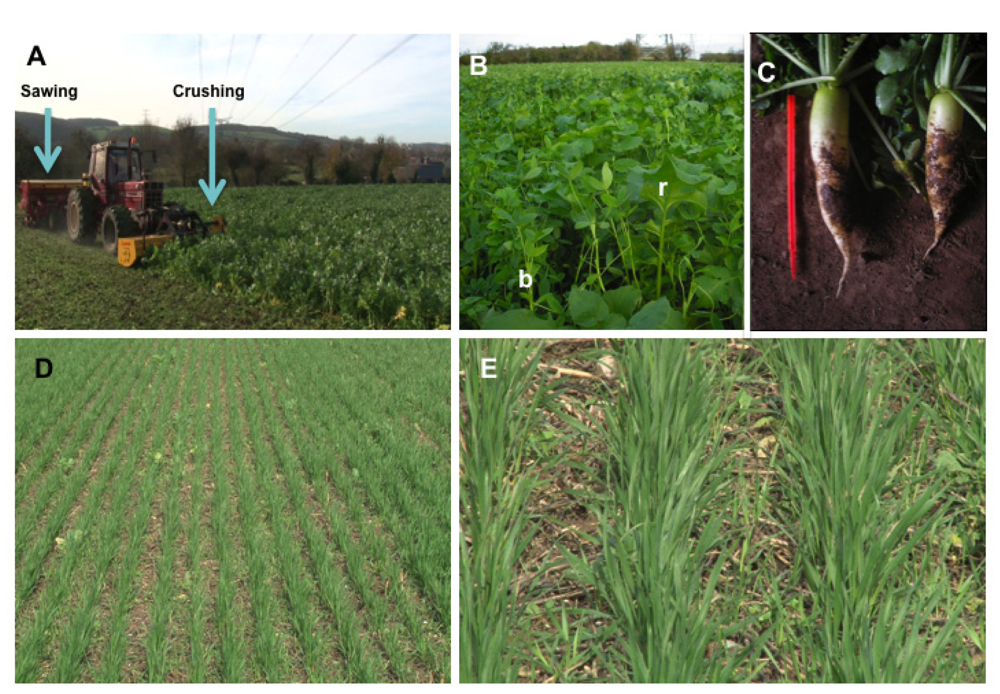
<p>Green manure fertilization (see [<xref ref-type="bibr" rid="b69-sustainability-03-01452">69</xref>] for a review) aims to improve soil fertility and quality by incorporation into the soil of any field or forage crop while the cultivated plant is still at the green vegetative stage, or just after the flowering stage. Green manure can also be crushed or rolled before no-till seeding (<xref ref-type="fig" rid="f1-sustainability-03-01452">Figure 1</xref>).</p>
<p>A cover crop is any crop grown to provide soil cover, regardless of whether it is later incorporated into the soil. Cover crops are grown primarily to prevent soil erosion by wind and water. Cover crops and green manures can be annual, biennial, or perennial herbaceous plants grown in a pure or mixed stand during all or part of the year (<xref ref-type="fig" rid="f1-sustainability-03-01452">Figure 1</xref>). In addition to providing ground cover and, in the case of a symbiotic N<sub>2</sub>-fixing legume, they provide substantial amounts of N. They also help suppress weeds [<xref ref-type="bibr" rid="b70-sustainability-03-01452">70</xref>] <italic>via</italic> allelopathic legume cover and mulching species [<xref ref-type="bibr" rid="b71-sustainability-03-01452">71</xref>] and reduce insect pests and diseases [<xref ref-type="bibr" rid="b72-sustainability-03-01452">72</xref>-<xref ref-type="bibr" rid="b74-sustainability-03-01452">74</xref>]. When cover crops are planted to reduce nutrient leaching (N in particular) following a main crop, they are often termed “catch crops.” [<xref ref-type="bibr" rid="b75-sustainability-03-01452">75</xref>,<xref ref-type="bibr" rid="b76-sustainability-03-01452">76</xref>]. Moreover, growing green manures on site is a way to prevent the often inhibitive handling and transportation costs of other organic inputs [<xref ref-type="bibr" rid="b69-sustainability-03-01452">69</xref>]. There are a large variety of cover crop species that are appropriate for a farmer and a particular region. Details on the use of catch crops to prevent N leaching losses during the winter period and of N fertilization using green manures (including N fixing legumes), can be found in the review by Thorup-Kristensen <italic>et al.</italic> [<xref ref-type="bibr" rid="b77-sustainability-03-01452">77</xref>] and in the handbook: Managing Cover Crop Profitability [<xref ref-type="bibr" rid="b78-sustainability-03-01452">78</xref>].</p>
<p>Legumes are widely used as cover crops since there is a large choice of different species suited to a particular environment (<xref ref-type="fig" rid="f1-sustainability-03-01452">Figure 1</xref>). Legumes are defined by their unique flower structure, their pod, and the ability of 88% of the species examined so far to form atmospheric N<sub>2</sub> fixing nodules [<xref ref-type="bibr" rid="b79-sustainability-03-01452">79</xref>,<xref ref-type="bibr" rid="b80-sustainability-03-01452">80</xref>]. Legumes are only of second importance after grasses to humans, by contributing significantly to grain, pasture and forage, and forestry production [<xref ref-type="bibr" rid="b33-sustainability-03-01452">33</xref>,<xref ref-type="bibr" rid="b81-sustainability-03-01452">81</xref>]. Since legumes are able to fix symbiotically atmospheric N<sub>2</sub>, they require minimal or even no inputs of N fertilizers. If part of this “free” N is made available to a following cultivated crop, the use of legumes in a rotation can allow a significant reduction in the use of N fertilizers. Additionally, legumes can also enhance both the colonization of crop roots by mycorrhizae [<xref ref-type="bibr" rid="b82-sustainability-03-01452">82</xref>] and the tripartite symbiosis between the host plant AM fungi and N-fixing bacteria thus finally affecting N uptake by the host plant [<xref ref-type="bibr" rid="b83-sustainability-03-01452">83</xref>]. The legumes used as cover crops or green manure can be classified into two categories: tropical and temperate. Warmer climates or warmer winter temperatures allow temperate species to persist during the winter, and tropical species are more adapted to the summer months. It is the intra- and inter-specific genetic variability that partly explains why some legumes grow more and accumulate more N than others. However, it is mainly the soil and climatic conditions that are the predominant factors that restrict the selection of the best performing legumes species. For example, Brandsaeter <italic>et al.</italic> [<xref ref-type="bibr" rid="b84-sustainability-03-01452">84</xref>] showed in a recent study that the biochemical quality of the plants differed between species and dates of harvesting, and that this was reflected in the dynamics of net N mineralization. A number of reviews have focused on selection criteria, breeding methods and genetic modification approaches and have covered future improvements in legume crops that will be beneficial not only to the environment and farmers but also to consumers in both developed and developing countries [<xref ref-type="bibr" rid="b85-sustainability-03-01452">85</xref>-<xref ref-type="bibr" rid="b87-sustainability-03-01452">87</xref>]. Studies using quantitative genetics approaches to improve NUE in legumes are scarce. However, it seems that both root and nodule traits are important for efficient N assimilation for further translocation to the seeds [<xref ref-type="bibr" rid="b88-sustainability-03-01452">88</xref>].</p>
<p>N production from legumes is a key benefit of growing cover crops and green manures. The amount of N available from legumes depends on the species of legume grown, the total biomass produced, and the percentage of N in the plant tissue. Cultural and environmental conditions that limit legume growth, such as a delayed planting date, poor stand establishment, and drought will reduce the amount of N produced. Conditions that encourage good N production include getting a good stand, optimum soil nutrient levels and soil pH, good nodulation, and adequate soil moisture. The portion of green-manure N available to a following crop is usually about 40% to 60% of the total amount contained in the legume [<xref ref-type="bibr" rid="b76-sustainability-03-01452">76</xref>]. Interestingly, it has been demonstrated that leguminous cover crops were also able to replace 60% of the chemical N fertilization for cotton production, although the quantity of available N derived from the cover crop was not synchronized with the requirements of the cotton plant [<xref ref-type="bibr" rid="b89-sustainability-03-01452">89</xref>]. In turn, one has to consider that NUE is strongly affected by the organic residues remaining from the preceding crop and the application rate of both synthetic N or organic fertilizers applied to the next crop [<xref ref-type="bibr" rid="b90-sustainability-03-01452">90</xref>].</p>
<p>Both raw and composted manures are useful in organic crop production (for a review see [<xref ref-type="bibr" rid="b91-sustainability-03-01452">91</xref>]). Used properly, with attention to balancing soil fertility, manures can supplant all or most needs for purchased N fertilizer, especially when combined with a whole system fertility plan that includes crop rotation and cover cropping with N-fixing legumes. However, there is often a lack of synchronization between the timing of N mineralization originating from the catch crop and the N requirement of the main crop, thus leading to a loss of part of the N initially saved by the catch crop. It is therefore necessary to improve estimates of the longer-term N effects of catch crops and to optimize crop sequences in order to estimate accurately the turnover of N retained in the soil by the nitrate catch crops [<xref ref-type="bibr" rid="b92-sustainability-03-01452">92</xref>,<xref ref-type="bibr" rid="b93-sustainability-03-01452">93</xref>]. Thus, the grower needs to monitor nutrients in the soil <italic>via</italic> soil testing, and learn the characteristics of the manure and/or compost to be used. The grower should adjust the rates and select additional fertilizers and amendments accordingly. Finally, development of viable green manure-based alternatives leading to applied crop synergisms will probably not occur without refinement of whole-systems approaches within which green manure secure multiple ecosystemic services [<xref ref-type="bibr" rid="b94-sustainability-03-01452">94</xref>], utilizing and conserving functional agro-biodiversity services [<xref ref-type="bibr" rid="b95-sustainability-03-01452">95</xref>].</p>
<p>In addition to legumes, commonly used cover crops include annual cereals (rye, wheat, barley oats), annual or perennial forage grasses such as ryegrass, warm season grasses such as sorgum-sundangrass hybrids and brassicas (<xref ref-type="fig" rid="f1-sustainability-03-01452">Figure 1</xref>) including mustard (see [<xref ref-type="bibr" rid="b78-sustainability-03-01452">78</xref>], for details on their benefits and management).</p>
<p>If organic farming needs to use both classical and green manure to replace chemical N fertilization, it appears that plant genetic adaptations and breeding for these alternative farming techniques are needed to increase crop NUE, for example in wheat [<xref ref-type="bibr" rid="b96-sustainability-03-01452">96</xref>-<xref ref-type="bibr" rid="b99-sustainability-03-01452">99</xref>]. Additionally, the development of biomarkers for determining the potential of NUE and optimization of N inputs in crop plants under organic farming cultivation conditions will be required [<xref ref-type="bibr" rid="b100-sustainability-03-01452">100</xref>].</p></sec>
<sec>
<label>4.</label>
<title>Nitrogen Assimilation by Plants</title>
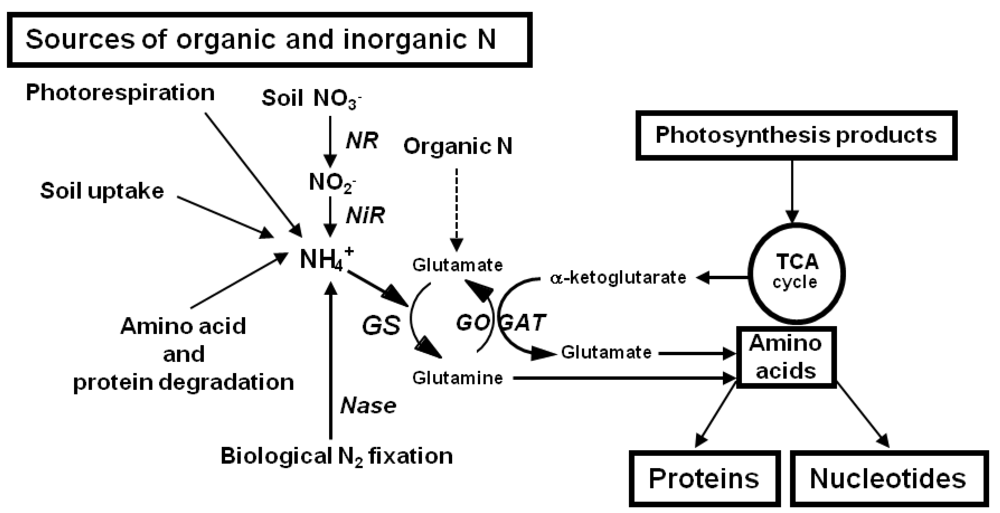
<p>Nitrate is the principal N source for most wild and crop species, whatever the source of inorganic or organic N provided to the plant [<xref ref-type="bibr" rid="b101-sustainability-03-01452">101</xref>,<xref ref-type="bibr" rid="b102-sustainability-03-01452">102</xref>]. It is taken up by means of specific high and low affinity transporters located in the root cell membrane [<xref ref-type="bibr" rid="b103-sustainability-03-01452">103</xref>,<xref ref-type="bibr" rid="b104-sustainability-03-01452">104</xref>]. Nitrates are then reduced to nitrite through the reaction catalysed by the enzyme nitrate reductase (NR; EC 1.6.6.1), [<xref ref-type="bibr" rid="b105-sustainability-03-01452">105</xref>] followed by the reduction of nitrite to ammonia catalysed by the enzyme nitrite reductase (NiR; EC 1.7.7.1), [<xref ref-type="bibr" rid="b106-sustainability-03-01452">106</xref>]. Under particular environments, root ammonia transporters [<xref ref-type="bibr" rid="b107-sustainability-03-01452">107</xref>] can allow a direct uptake of ammonia when available in the soil, in rice paddy fields or in acidic forest habitats [<xref ref-type="bibr" rid="b101-sustainability-03-01452">101</xref>,<xref ref-type="bibr" rid="b108-sustainability-03-01452">108</xref>]. Ammonia can be generated inside the plant by a variety of metabolic pathways such as photorespiration, phenylpropanoid metabolism, utilization of N transport compounds and amino acids catabolism. Symbiotically fixed N is also an important source of ammonia readily available to herbaceous plants or woody species that are able to form a symbiotic relationship with N fixing microorganisms [<xref ref-type="bibr" rid="b87-sustainability-03-01452">87</xref>,<xref ref-type="bibr" rid="b109-sustainability-03-01452">109</xref>]; (<xref ref-type="fig" rid="f2-sustainability-03-01452">Figure 2</xref>).</p>
<p>Several studies have shown that a wide variety of plant species are able to take up organic N compounds, especially under low N conditions [<xref ref-type="bibr" rid="b10-sustainability-03-01452">10</xref>,<xref ref-type="bibr" rid="b102-sustainability-03-01452">102</xref>,<xref ref-type="bibr" rid="b110-sustainability-03-01452">110</xref>-<xref ref-type="bibr" rid="b113-sustainability-03-01452">113</xref>]. However, the importance of this N source and the methods used to evaluate its contribution to plant N requirements has been questioned. A few studies have been done on the uptake of organic N by commercial crops: e.g., corn [<xref ref-type="bibr" rid="b114-sustainability-03-01452">114</xref>], agricultural grasses including species of clover [<xref ref-type="bibr" rid="b112-sustainability-03-01452">112</xref>] and wheat [<xref ref-type="bibr" rid="b96-sustainability-03-01452">96</xref>]. Despite these limited studies, they demonstrate the ability of plants to directly take up organic N, but have not established the importance and significance of organic N as a source of crop N, for example when they are grown under organic farming conditions.</p>
<p>In line with the finding that plants can take organic N up directly, there is also an interesting report in which it has been shown that herbaceous species can use protein as a N source without the assistance of other organisms. This indicates that the spectrum of N compounds that can be taken up by the roots is quite diverse, indicating that the relationships existing between the soil fauna and the plant for N capture is more complex than originally thought [<xref ref-type="bibr" rid="b115-sustainability-03-01452">115</xref>].</p>
<p>Urea is a low molecular weight organic molecule containing N that exists in natural systems and is also applied as a synthetic fertilizer in conventional agriculture. It is well known that urea is absorbed as an intact molecule by plant leaves and roots [<xref ref-type="bibr" rid="b116-sustainability-03-01452">116</xref>] by means of specific root transporters [<xref ref-type="bibr" rid="b117-sustainability-03-01452">117</xref>,<xref ref-type="bibr" rid="b118-sustainability-03-01452">118</xref>]. Although the use of urea is mainly as a source of N fertilizer, the contribution of plant urea uptake and metabolism in a physiological and agricultural context is still not investigated. However, plants possess urea transporters, and can hydrolyse and use urea very efficiently [<xref ref-type="bibr" rid="b119-sustainability-03-01452">119</xref>].</p>
<p>The importance of AM fungi for nutrient uptake by plants is well documented [<xref ref-type="bibr" rid="b120-sustainability-03-01452">120</xref>-<xref ref-type="bibr" rid="b122-sustainability-03-01452">122</xref>]. Several studies have shown that AM fungi-infected plants can take up organic N compounds [<xref ref-type="bibr" rid="b10-sustainability-03-01452">10</xref>,<xref ref-type="bibr" rid="b111-sustainability-03-01452">111</xref>,<xref ref-type="bibr" rid="b112-sustainability-03-01452">112</xref>]. Thus, AM fungi can be used as a source of biological fertilization, since they are able to develop symbiotic associations with most terrestrial plants. They are able to alleviate the effects of different stresses both on growth and yield, by significantly increasing the uptake of water and nutrients (including N) by the host plant [<xref ref-type="bibr" rid="b123-sustainability-03-01452">123</xref>-<xref ref-type="bibr" rid="b128-sustainability-03-01452">128</xref>]. In particular, it has been reported that the hyphae of AM are able to use inorganic N more efficiently, thus enabling the host plant to indirectly have access to soil N through its fungal partner [<xref ref-type="bibr" rid="b129-sustainability-03-01452">129</xref>]. However the quantitative contribution of AM fungi to the direct uptake of organic N by plants is still not well established [<xref ref-type="bibr" rid="b128-sustainability-03-01452">128</xref>], even though recent progress have been made in this field of research. Nevertheless, Tian <italic>et al.</italic> [<xref ref-type="bibr" rid="b130-sustainability-03-01452">130</xref>] showed that AM fungi were able to absorb both organic and inorganic N and synthesize organic N molecules such as arginine that are further released by the fungal hyphae and then absorbed by the host plant. Interestingly, the occurrence of a transfer of symbiotically fixed N to a crop such as maize <italic>via</italic> vesicular-AM hyphae has been demonstrated [<xref ref-type="bibr" rid="b131-sustainability-03-01452">131</xref>-<xref ref-type="bibr" rid="b133-sustainability-03-01452">133</xref>], indicating that associated or continuous cover cropping systems could be an alternative way to rationalize plant N nutrition by optimizing field conditions favourable to mycorrhizal colonization.</p>
<p>Ammonia, which is the ultimate form of inorganic N available to the plant, is then incorporated into the amino acid glutamate through the action of two enzymes. The first reaction catalyzed by enzyme glutamine synthetase (GS; EC 6.3.1.2) [<xref ref-type="bibr" rid="b134-sustainability-03-01452">134</xref>] is considered to be the major route facilitating the incorporation of inorganic N into organic molecules in conjunction with the second enzyme glutamate synthase (GOGAT; EC 1.4.7.1) [<xref ref-type="bibr" rid="b135-sustainability-03-01452">135</xref>], which recycles glutamate and incorporates C skeletons as a form of 2-oxoglutarate into the cycle. The amino acids glutamine and glutamate are then further used as amino group donors to all the other N-containing molecules notably other amino acids used for storage, transport and protein synthesis and to nucleotides used as basic molecules for RNA and DNA synthesis [<xref ref-type="bibr" rid="b134-sustainability-03-01452">134</xref>-<xref ref-type="bibr" rid="b136-sustainability-03-01452">136</xref>].</p>
<p>The two enzymes GS and GOGAT are present in the plant in several isoenzymic forms located in different cellular compartments and differentially expressed in a particular organ or cell type according to the developmental stage. The GS enzyme exists as a cytosolic form (GS1) present in a variety of organ and tissues such as roots, leaves, phloem cells and a plastidic form (GS2) localized in the chloroplasts of photosynthetic tissues and the plastids of roots and etiolated tissues. It has also been proposed that GS2 is located in the mitochondria [<xref ref-type="bibr" rid="b137-sustainability-03-01452">137</xref>]. However, in numerous previous studies using immunocytolocalization techniques, the presence of the enzyme in the mitochondria has never been reported [<xref ref-type="bibr" rid="b138-sustainability-03-01452">138</xref>]. The relative proportions of GS1 and GS2 vary within the organs of the same plant and between plant species, each GS isoform playing a specific role in a given metabolic process, such as photorespiratory ammonia assimilation, nitrate reduction, N translocation and recycling [<xref ref-type="bibr" rid="b134-sustainability-03-01452">134</xref>,<xref ref-type="bibr" rid="b139-sustainability-03-01452">139</xref>]. The enzyme GOGAT also exists as two forms that have specific roles during primary N assimilation or N recycling. A ferredoxin-dependent iseoenzyme (Fd-GOGAT) is mainly involved, in conjunction with GS2, in the reassimilation of photorespiratory ammonia and a pyridine nucleotide-dependent isoenzyme (NADH-GOGAT; EC 1.4.1.14) involved in the synthesis of glutamate both in photosynthetic and non-photosynthetic organs or tissues to sustain plant growth and development [<xref ref-type="bibr" rid="b134-sustainability-03-01452">134</xref>,<xref ref-type="bibr" rid="b136-sustainability-03-01452">136</xref>]. Moreover, by virtue of their differential mode of expression regulated either at the transcriptional and post transcriptional levels, both GS and GOGAT isoenzymes have been shown to play a specific role at particular stages of the plant life cycle and under particular environmental conditions related mainly to the mode of N nutrition [<xref ref-type="bibr" rid="b134-sustainability-03-01452">134</xref>,<xref ref-type="bibr" rid="b135-sustainability-03-01452">135</xref>,<xref ref-type="bibr" rid="b139-sustainability-03-01452">139</xref>].</p>
<p>The reversible reaction catalyzed by the enzyme glutamate dehydrogenase (GDH; EC 1.4.1.2) [<xref ref-type="bibr" rid="b134-sustainability-03-01452">134</xref>], which has theoretically the capacity to incorporate ammonia into 2-oxoglutarate to form glutamate, was originally thought to be the main enzyme involved in inorganic N assimilation in plants. Later on, a number of experiments using <sup>15</sup>N labeling techniques and mutants deficient in GS and GOGAT have demonstrated that over 95% of the ammonia made available to the plant is assimilated <italic>via</italic> the GS/GOGAT pathway [<xref ref-type="bibr" rid="b134-sustainability-03-01452">134</xref>,<xref ref-type="bibr" rid="b140-sustainability-03-01452">140</xref>]. A number of <sup>15</sup>N labeling experiments followed by GCMS or NMR-spectroscopy analysis have shown that GDH operates in the direction of glutamate deamination to provide organic acids notably when the cell is C-limited [<xref ref-type="bibr" rid="b141-sustainability-03-01452">141</xref>,<xref ref-type="bibr" rid="b142-sustainability-03-01452">142</xref>]. The finding that under certain physiological conditions GDH is able to assimilate ammonia also needs to be taken into consideration, although the rate of glutamate synthesis is probably far lower than that formed through the GS/GOGAT pathway [<xref ref-type="bibr" rid="b143-sustainability-03-01452">143</xref>]. Recently the hypothesis that GDH plays an important role in controlling glutamate homeostasis has been put forward [<xref ref-type="bibr" rid="b142-sustainability-03-01452">142</xref>]. This function, which may have a signaling role at the interface of C and N metabolism, may be of importance under certain phases of plant growth and development when there is an important release or accumulation of ammonia [<xref ref-type="bibr" rid="b144-sustainability-03-01452">144</xref>-<xref ref-type="bibr" rid="b146-sustainability-03-01452">146</xref>].</p>
<p>Over the last two decades, our knowledge of the various pathways involved in the synthesis of the twenty amino acids that are used to build up proteins, particularly those derived from glutamate and glutamine, has been increased through the use of mutant and transgenic plants in which amino acid biosynthesis has been altered. There are excellent reviews describing extensively our current knowledge on plant amino acid biosynthesis and its regulation [<xref ref-type="bibr" rid="b136-sustainability-03-01452">136</xref>,<xref ref-type="bibr" rid="b143-sustainability-03-01452">143</xref>]. Therefore, we will not cover this complex aspect of N assimilation in this review, even though it is of major importance for plant growth and productivity. However, there are some examples of genetic modification in crops in which these pathways have been altered particularly to increase the content of lysine and methionine, which are often the most limiting for both humans and animal nutrition [<xref ref-type="bibr" rid="b147-sustainability-03-01452">147</xref>-<xref ref-type="bibr" rid="b149-sustainability-03-01452">149</xref>].</p>
<p>Significant progress has been made during the last few years on the regulation of inorganic N metabolism and the relationships with C metabolism, both at the cellular and organ levels. In particular, attempts to integrate large transcriptomic and physiological data sets at the whole plant level have increased our understanding of the regulation of N assimilation not only under controlled growth conditions but also under the constantly changing environmental constraints usually occurring in field situations [<xref ref-type="bibr" rid="b6-sustainability-03-01452">6</xref>]. This integration is required, because in addition to regulating a range of cellular processes including N assimilation itself through the co-ordination of nitrate or ammonia uptake and use, nitrate and N metabolite levels in the cell can regulate directly or indirectly a number of closely related metabolic and developmental processes [<xref ref-type="bibr" rid="b150-sustainability-03-01452">150</xref>,<xref ref-type="bibr" rid="b151-sustainability-03-01452">151</xref>]. These processes, which may also be regulated through the action of hormones [<xref ref-type="bibr" rid="b152-sustainability-03-01452">152</xref>], include the synthesis and accumulation of amino acids and organic acids and the modification of plant development including the extent and form of root growth and the timing of flower induction. All these processes, acting either individually or synergistically, condition N allocation in newly developing tissues or in storage organs to finally ensure plant vegetative or sexual reproduction.</p></sec>
<sec>
<label>5.</label>
<title>Improvement of Nitrogen Utilization Using Genetically Modified Crops</title>
<p>Nitrate reduction is rarely limiting for optimal grain yield or biomass production. In contrast, this is not the case for the ammonia assimilatory pathway [<xref ref-type="bibr" rid="b153-sustainability-03-01452">153</xref>]. For example the work of Fuentes <italic>et al.</italic> [<xref ref-type="bibr" rid="b154-sustainability-03-01452">154</xref>] showed that, in tobacco, overexpression of a gene encoding cytosolic glutamine synthetase (GS1) from alfalfa, causes an increase in photosynthesis and growth under a low N fertilization regime. These results suggest that the transgenic tobacco plants overexpresing GS1 are able to utilize N more efficiently under N stress conditions. Interestingly, Oliveira <italic>et al.</italic> [<xref ref-type="bibr" rid="b155-sustainability-03-01452">155</xref>] also showed that in tobacco, the overexpression of a gene encoding a pea GS1 lead to increased biomass production both under limiting and non-limiting N feeding conditions.</p>
<p>By overexpressing a pine GS1 gene in poplar, Jing <italic>et al.</italic> [<xref ref-type="bibr" rid="b156-sustainability-03-01452">156</xref>] and Man <italic>et al.</italic> [<xref ref-type="bibr" rid="b157-sustainability-03-01452">157</xref>] observed that the transgenic trees, which were older than five years exhibited a 41%, increase in growth rate, whereas the other phenotypic characteristics of the genetically modified plants remained similar.</p>
<p>In wheat, the overexpression of a gene for GS1 from French bean led to an increase in grain yield (grain weight in particular) and therefore of NUE, which was estimated to be about 20% [<xref ref-type="bibr" rid="b158-sustainability-03-01452">158</xref>]. However, to our knowledge there has been no further development of this interesting study, either because of the difficulty of field testing in Europe or because this testing is currently being performed in the private sector. Similar work was conducted in maize consisting in the overexpression of a native gene encoding GS1 (<italic>Gln1-3</italic>) of maize. Grain yield (mainly grain number) of the maize transgenic plants grown under greenhouse conditions was increased by about 30%. However, grain N content and biomass production of the transgenic plants were not modified at maturity [<xref ref-type="bibr" rid="b159-sustainability-03-01452">159</xref>]. More recently, transgenic rice lines overexpressing GS1 showed improved harvest index, N harvest index and N utilization efficiency. However, these lines did not exhibit higher NUE under N-limiting conditions compared to non-limiting N conditions [<xref ref-type="bibr" rid="b160-sustainability-03-01452">160</xref>].</p>
<p>In other species, the overexpression of GS1 had a rather negative impact on growth and yield of the plant. For example, overexpression of a GS1gene from tobacco in the legume birds foot trefoil (<italic>Lotus corniculatus</italic> L.) grown on nitrate led to an acceleration of senescence, which was apparently detrimental to the overall plant developmental process [<xref ref-type="bibr" rid="b161-sustainability-03-01452">161</xref>]. When the transgenic <italic>L. corniculatus</italic> plants were grown under symbiotic N-fixing conditions an increase in plant biomass production was unexpectedly observed. However, the physiological mechanisms involved in this increase remain unknown [<xref ref-type="bibr" rid="b86-sustainability-03-01452">86</xref>].</p>
<p>In rape (canola), the overexpression of a gene encoding the enzyme alanine aminotransferase (AlaAT) from barley, directed by a rape root-specific promoter, led to a dramatic increase in biomass production and seed yield [<xref ref-type="bibr" rid="b162-sustainability-03-01452">162</xref>]. Improvement of plant productivity was only observed under low N fertilization conditions and was attributed to a higher flux of nitrate, associated or induced by a decrease in the content of glutamine and glutamate in the stem. In the field when the applied N fertilizer rate was reduced by 40%, the agronomic performance of the transgenic rapeseed plants overexpressing AlaAT was similar to that of untransformed control plants grown under higher optimal N fertilizer rates.</p>
<p>Overexpression of the same gene in rice led to increased biomass production and N content of stems [<xref ref-type="bibr" rid="b163-sustainability-03-01452">163</xref>]. Unlike in rapeseed, there was an increase of glutamine and asparagine content both in the stems and in the roots. The genetically modified rice plants had a finer, denser and more branched root system, which was presumably more favorable for the absorption of N. This result indicates that genetic modification targeted to improve N utilization efficiency also had an impact on plant development, although the effect of AlaAT overexpression was variable from one species to another in terms of both plant growth and metabolic activity.</p>
<p>There are a few other examples of successful genetic modification of N metabolism using either structural or putative regulatory genes. When the bacterial enzyme glutamate dehydrogenase (GDH A) from <italic>E. coli</italic> was constitutively overexpressed in tobacco, biomass production of the transgenic plants was increased by about 10–15%. In addition to the increase in biomass production GDHA overexpressors had more leaves and their free amino acid content was higher, suggesting that both N metabolism and C metabolism were modified [<xref ref-type="bibr" rid="b164-sustainability-03-01452">164</xref>]. The transgenic tobacco plants were also more tolerant to water stress.</p>
<p>In rice, overexpression of a gene of unknown function OsENOD93-1, a N-responsive gene identified following genome-wide gene expression profiling, led to an increase in grain yield, of 13–14% and 19–23% under limiting and non-limiting N nutrition conditions respectively [<xref ref-type="bibr" rid="b165-sustainability-03-01452">165</xref>]. When a gene encoding NAD(H)-dependent GOGAT from alfalfa was constitutively expressed in tobacco, a significant increase in biomass production was observed [<xref ref-type="bibr" rid="b166-sustainability-03-01452">166</xref>]. Overexpression of the native NAD(H)-dependent GOGAT in rice led to an increase in grain weight [<xref ref-type="bibr" rid="b167-sustainability-03-01452">167</xref>,<xref ref-type="bibr" rid="b168-sustainability-03-01452">168</xref>]. These results suggest that the GOGAT enzyme plays a major role with respect to organic N management and is used either for growth or for grain production depending on the species examined.</p>
<p>There are fewer studies in which the importance of regulatory genes has been clearly demonstrated [<xref ref-type="bibr" rid="b169-sustainability-03-01452">169</xref>]. When a <italic>Dof1</italic> gene encoding a transcription factor from maize was overexpressed in Arabidopsis (<italic>Arabidopsis thaliana</italic> L.), an increase in amino acid content and of N uptake was observed, especially when plants were grown at a low level of N supply. In addition, the transgenic plants produced more biomass under low N supply and they did not exhibit symptoms of N deficiency in comparison to the untransformed control plants, which developed much earlier symptoms of senescence. When the <italic>Dof 1</italic> gene was overexpressed in potato, transgenic plants accumulated more amino acids especially glutamine and glutamate [<xref ref-type="bibr" rid="b169-sustainability-03-01452">169</xref>]. These two sets of experiments suggest that this gene could be used to improve the uptake and utilization of N in several species. Thus, overexpressing regulatory genes rather than structural genes, such as genes encoding GS, GOGAT or AlaAT appears to be an interesting alternative to improve plant NUE and overall plant growth and development in a more stable and balanced way across species.</p>
<p>When vegetable crops such as lettuce or spinach are grown under greenhouse conditions they can accumulate substantial amounts of nitrate in the leaf cell vacuoles. The threshold of nitrate accumulation often exceeds the limits permitted by law, even when N fertilization is reduced because mineralization of soil organic matter always provides a surplus of nitrate to the plant [<xref ref-type="bibr" rid="b170-sustainability-03-01452">170</xref>]. In human food, when nitrate is absorbed in excess, its reduction to nitrite during digestion can oxidize hemoglobin, causing a kind of anemia. Moreover, nitrites can be converted to carcinogenic nitrosamines [<xref ref-type="bibr" rid="b12-sustainability-03-01452">12</xref>,<xref ref-type="bibr" rid="b13-sustainability-03-01452">13</xref>]. Conventional methods of selection have led to the development of varieties able to reduce the absorbed nitrate more efficiently instead of storing it, but these varieties are not able to completely eliminate any risk of toxic accumulation. Studies were therefore undertaken to limit nitrate accumulation by increasing the capacity of a plant to reduce nitrate by increasing nitrate reductase (NR) activity in genetically modified plants, by overexpressing a gene that allows the deregulation of the synthesis of the enzyme [<xref ref-type="bibr" rid="b171-sustainability-03-01452">171</xref>]. In tobacco a 50% reduction in leaf nitrate content was observed after introduction of the native structural NR gene (<italic>Nia2</italic>) placed under the control of the 35S strong constitutive promoter. Using the same approach, encouraging results were obtained in a variety of potato [<xref ref-type="bibr" rid="b172-sustainability-03-01452">172</xref>] that showed a 95% decrease in the amount nitrate in the tubers. In another variety of potato, the transgenic plants showed a marked improvement in biomass production, especially in tubers, with still lower amounts of nitrate. The more effective reduction of nitrate probably allowed a better allocation of N to the photosynthetic apparatus and to enzymes involved in C metabolism, which was demonstrated by higher leaf chlorophyll content in the transgenic potato plants [<xref ref-type="bibr" rid="b173-sustainability-03-01452">173</xref>].</p>
<p>In lettuce transformed with the same 35S-<italic>Nia2</italic> construct, a problem of post-transcriptional regulation of the NR enzyme was encountered [<xref ref-type="bibr" rid="b174-sustainability-03-01452">174</xref>]. The transgenic lettuce accumulated 21% less nitrate after 22 days. However, the nitrate content was only 4% lower in 84 days-old transgenic plants. The hypothesis that the strength of the 35S promoter decreases during plant ageing was put forward, suggesting that a way to maintain NR activity at a high level regardless of plant age needs to be found. Such a strategy to reduce the nitrate content in vegetable crops requires further research before the use of the <italic>Nia2</italic> transgene can be efficiently mastered.</p>
<p>Although we do not have any clear information from the private sector about the recent development and commercialization of transgenic plants modified for NUE, it seems to be likely that crops overexpressing the enzymes AlaAT and GS1 will be commercially released within the next five years, following extensive validation of their function under different field trial conditions and using different genetic backgrounds.</p></sec>
<sec>
<label>6.</label>
<title>Deciphering the Genetic Basis of Nitrogen Use Efficiency in Crops</title>
<p>There have been an increasing number of studies only performed on the model species Arabidopsis, in an attempt to link plant physiology to whole genome expression in order to obtain an integrated view on how the expression of genes can affect overall plant functioning [<xref ref-type="bibr" rid="b151-sustainability-03-01452">151</xref>]. When a structural or regulatory gene putatively involved in the control of a metabolic pathway or a developmental process or both is identified, information can then be obtained by producing overexpressors or selecting deficient mutants of the gene in question. By studying the impact of the genetic modification or the mutation on the phenotype or the physiology of the plant, it is often possible to determine whether the expression of this specific gene is a limiting step in the development of a particular organ or of a metabolic pathway. In general, this targeted approach, which allows the identification of a single limiting reaction, or a co-limiting/non-limiting reaction does not adequately take into account the variation in complex traits such as those controlling NUE, which involves multiple genes and thus multiple enzyme reactions and regulatory factors.</p>
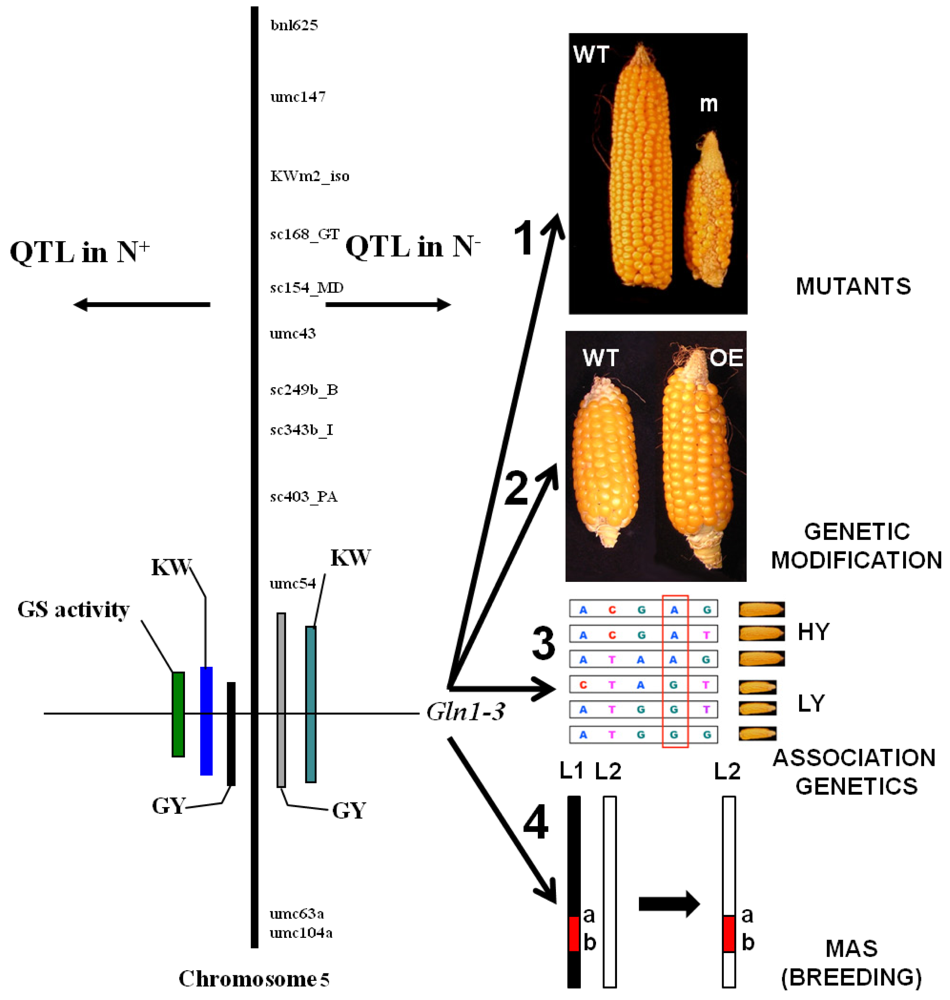
<p>Over the last ten years, quantitative genetics, through the detection of quantitative trait loci (QTL), has become an important approach for identifying key regulatory or structural genes involved in the expression of complex physiological and agronomic traits in an integrated manner and for the study of plant responses to environmental constraints [<xref ref-type="bibr" rid="b175-sustainability-03-01452">175</xref>]. When QTLs for agronomic and phenotypic traits are located on a genetic map, it is possible to look for their genetic significance by establishing the co-location of QTLs for physiological or biochemical traits with genes putatively involved in the control of the trait of interest (candidate genes). Validation of candidate genes can then be undertaken using transgenic technologies (forward genetics) or mutagenesis (reverse genetics) or by studying the relationship between allelic polymorphism and the trait of interest (association genetics; <xref ref-type="fig" rid="f3-sustainability-03-01452">Figure 3</xref>) either at a single gene or genome-wide level [<xref ref-type="bibr" rid="b176-sustainability-03-01452">176</xref>]. Positional cloning is another alternative strategy that can be used to focus on the chromosomal region controlling the trait of interest and that ultimately allows access to a single gene [<xref ref-type="bibr" rid="b177-sustainability-03-01452">177</xref>].</p>
<p>Therefore, quantitative genetic approaches were developed first in maize for which recombinant inbred lines (RIL) populations were used to build-up genetic maps and then study QTLs. The aim of such studies was to identify chromosomal regions involved in the control of yield and its components at high or low N fertilization input, and to determine whether or not some of these regions were specific for one of the two nutrition regimes. In one study, a limited number of QTLs for yield was detected only at low N-input [<xref ref-type="bibr" rid="b178-sustainability-03-01452">178</xref>]. In another study, it was found that most of the chromosomal regions for grain composition and traits related to NUE detected at low N-input, corresponded to QTLs detected at high N-input [<xref ref-type="bibr" rid="b179-sustainability-03-01452">179</xref>]. These contrasting results suggest that depending on the RIL population, the response of yield to various levels of N fertilization could be different and thus controlled by a different set of genes.</p>
<p>In a more detailed investigation by Bertin and Gallais [<xref ref-type="bibr" rid="b179-sustainability-03-01452">179</xref>] using maize RILs, agronomic traits, NUE and physiological traits were associated with DNA markers [<xref ref-type="bibr" rid="b180-sustainability-03-01452">180</xref>,<xref ref-type="bibr" rid="b181-sustainability-03-01452">181</xref>]. Interestingly, coincidences were detected between QTLs for yield and two genes encoding cytosolic GS (<italic>Gln1-3</italic> and <italic>Gln1-4</italic>) and whole leaf enzyme activity. As a result of which, the hypothesis that cytosolic GS activity could be a major element controlling grain yield was put forward. [<xref ref-type="bibr" rid="b180-sustainability-03-01452">180</xref>]. Since a QTL for a thousand kernel weight was coincident with the <italic>Gln1-4</italic> locus and QTLs for a thousand kernel weight and yield were coincident with the <italic>Gln1-3</italic> locus (<xref ref-type="fig" rid="f3-sustainability-03-01452">Figure 3</xref>), further work was undertaken to validate the function of these two putative candidate genes. In another study also performed in maize, fine QTL mapping of C and N metabolism enzymes activities was performed on a different RIL population. These QTLs did not colocalize with those reported by other authors [<xref ref-type="bibr" rid="b180-sustainability-03-01452">180</xref>], which indicates that there are large differences in diversity traits in maize [<xref ref-type="bibr" rid="b182-sustainability-03-01452">182</xref>].</p>
<p>The impact of the knockout mutations <italic>gln1-3</italic> and <italic>gln1-4</italic> on kernel yield and its components were examined in plants grown under controlled conditions [<xref ref-type="bibr" rid="b159-sustainability-03-01452">159</xref>]. The phenotype of the two mutant lines was characterized by a reduction of kernel size in the <italic>gln1-4</italic> mutant and by a reduction of kernel number in the <italic>gln1-3</italic> mutant. In the <italic>gln1-3/1-4</italic> double mutant, a cumulative effect of the two mutations was observed. In transgenic plants overexpressing <italic>Gln1-3</italic> constitutively in the leaves, there was an increase in kernel number, thus providing further evidence that the cytosolic GS isoenzyme GS1-3 plays a major role in controlling kernel yield [<xref ref-type="bibr" rid="b159-sustainability-03-01452">159</xref>]; <xref ref-type="fig" rid="f3-sustainability-03-01452">Figure 3</xref>). The hypothesis that GS is one of the key steps in the control of cereal productivity was strengthened by a study performed on rice, in which a co-localization of a QTL for the <italic>GS1;1</italic> locus and a QTL for one-spikelet weight was identified [<xref ref-type="bibr" rid="b183-sustainability-03-01452">183</xref>]. As a confirmation, a strong reduction in growth rate and grain yield was observed in rice GS1;1 deficient mutants [<xref ref-type="bibr" rid="b184-sustainability-03-01452">184</xref>].</p>
<p>The role of the GS enzyme and other N-related physiological traits in the control of agronomic performance in wheat still remains to be clearly established. Using a quantitative genetics approach, Fontaine <italic>et al.</italic> [<xref ref-type="bibr" rid="b185-sustainability-03-01452">185</xref>] found only a co-localization between a QTL for GS activity and <italic>GSe</italic>, a structural gene encoding cytosolic GS, but no obvious colocalization with a QTL for yield, in agreement with previous work published by Habash <italic>et al.</italic> [<xref ref-type="bibr" rid="b158-sustainability-03-01452">158</xref>]. In contrast, in recent work, physical mapping, sequencing, annotation and candidate gene validation of an NUE QTL on wheat chromosome 3B suggested that the NADH-dependent GOGAT enzymes contribute to NUE in wheat and other cereals [<xref ref-type="bibr" rid="b186-sustainability-03-01452">186</xref>] in agreement with work previously performed on rice [<xref ref-type="bibr" rid="b167-sustainability-03-01452">167</xref>].</p>
<p>Interestingly, in a woody species such as maritime pine that is far away from cereals on an evolutionary point of view, a protein QTL for GS co-localized with a GS gene and a QTL for biomass [<xref ref-type="bibr" rid="b187-sustainability-03-01452">187</xref>]. Functional validation of the pine GS gene in transgenic poplars (see above), which can be considered as a crop for wood production, shows once again that quantitative genetics represent one of the most powerful approaches for identifying NUE candidate genes that may be involved in the control of plant productivity.</p>
<p>To date, there are only a few reports reporting specific breeding for organic input systems and especially N [<xref ref-type="bibr" rid="b188-sustainability-03-01452">188</xref>]. A question that could be addressed is whether the genetic control of NUE under organic or conventional fertilization conditions is similar or if there are specific genes or combinations of genes that are more adapted to one mode of fertilization compared to the other, taking into account that organic material can be directly taken up by the plant [<xref ref-type="bibr" rid="b189-sustainability-03-01452">189</xref>]. Moreover its appears that using appropriate selection environments is important for breeding crops adapted to organic farming systems [<xref ref-type="bibr" rid="b190-sustainability-03-01452">190</xref>].</p>
<p>Further work is necessary to identify whether other root and shoot enzymes or regulatory proteins could play a specific role under low or high N availability, whatever the type of N fertilization conditions (organic or mineral). Such proteins include those directly involved in N metabolism or those positioned at the interface between C and N metabolism during plant growth and development [<xref ref-type="bibr" rid="b150-sustainability-03-01452">150</xref>,<xref ref-type="bibr" rid="b191-sustainability-03-01452">191</xref>,<xref ref-type="bibr" rid="b192-sustainability-03-01452">192</xref>]. It will be necessary therefore to identify new N-responsive genes through detailed analyses of transcriptomic data sets [<xref ref-type="bibr" rid="b189-sustainability-03-01452">189</xref>], including using systems biology approaches [<xref ref-type="bibr" rid="b109-sustainability-03-01452">109</xref>]. The analyses will be targeted specifically to N uptake, assimilation and recycling in vegetative [165 and reproductive organs [<xref ref-type="bibr" rid="b193-sustainability-03-01452">193</xref>] at various stages of plant development, using plants grown under different levels of N fertilization. Systems biology consists in taking advantage of various ‘omics’ data sets including transcriptomics, proteomics and metabolomics that can be further analysed in an integrated manner through the utilization of various mathematical, bioinformatic and computational tools [<xref ref-type="bibr" rid="b192-sustainability-03-01452">192</xref>]. Ultimately, such integrated analyses may allow the identification of the key individual or common regulatory elements involved in the control of a given biological process [<xref ref-type="bibr" rid="b157-sustainability-03-01452">157</xref>]. Such an approach, originally developed for the model plant Arabidopsis by virtue of the wealth of information available at the transcriptome level, when transferred to crops, may help in identifying key master genes involved in the control of NUE. In parallel, metabolomic studies are becoming more and more extensively used for the high throughput phenotyping necessary for large scale molecular and quantitative genetic studies aimed at identifying new candidate genes involved in the control of plant productivity [<xref ref-type="bibr" rid="b194-sustainability-03-01452">194</xref>,<xref ref-type="bibr" rid="b195-sustainability-03-01452">195</xref>]. This has prompted a number of groups, to focus their research efforts on developing data integration tools for metabolic reactions that complement gene expression studies. Encouragingly, on the modeling side, an increasing number of genome-scale metabolic models of plants have recently been released [<xref ref-type="bibr" rid="b196-sustainability-03-01452">196</xref>,<xref ref-type="bibr" rid="b197-sustainability-03-01452">197</xref>]. Such metabolic models should help to unravel key reactions and thus limit the steps required for the control of NUE, taking into account both tissue-specificities and environmental constraints.</p>
<p>Using the knowledge gained from these various systems biology approaches, it should then be possible to map the newly identified genes encoding regulatory proteins or enzymes, taking advantage of the recent progress in crop genomics through the availability of both physical and genetic high density maps and QTL or Meta-QTL genetic map positions generated by the plant science community [<xref ref-type="bibr" rid="b186-sustainability-03-01452">186</xref>,<xref ref-type="bibr" rid="b198-sustainability-03-01452">198</xref>]. Comparative genomics and synteny approaches similar to those of Quraishi <italic>et al.</italic> [<xref ref-type="bibr" rid="b186-sustainability-03-01452">186</xref>] can complete such analyses by linking the genetic maps of maize, rice, barley and wheat harboring N related QTLs, thus allowing the reinforcement of the weight of selected putative candidate genes.</p>
<p>Ultimately, following the functional validation of candidate genes using all the available approaches offered by mutagenesis, genetic modification and association genetics, marker-assisted selection (MAS) can be then undertaken (<xref ref-type="fig" rid="f3-sustainability-03-01452">Figure 3</xref>). However, there are still a number of technical and scientific challenges that remain to be resolved before MAS can be routinely used in breeding for complex traits such as NUE. This is mainly due to the number of interactions that govern the expression of such traits both at the genetic and environmental levels [<xref ref-type="bibr" rid="b199-sustainability-03-01452">199</xref>], whether we are dealing with conventional or organic farming growth conditions.</p></sec>
<sec>
<label>7.</label>
<title>Conclusion and Perspectives</title>
<p>A large number of studies have been carried out over the last two decades to identify by means of agronomic, physiological and genetic studies, the rate limiting steps of NUE both in model and crop species, as a function of environmental conditions. For abiotic stress improvement in crops, NUE has become the second priority after drought both in the private and in the public sector. To decipher the genetic and physiological basis of NUE, many tools are available for most crops and for cereals in particular. They include mutant collections, wide genetic diversity, recombinant inbred lines (RILs) or Doubled Haploid Line populations (DHLs), straightforward transformation protocols and physiological, biochemical and genomic data for systems biology development [<xref ref-type="bibr" rid="b6-sustainability-03-01452">6</xref>,<xref ref-type="bibr" rid="b200-sustainability-03-01452">200</xref>]. In addition, the commercial crop research effort is paralleled by research in the public sector, notably with the release of the genome sequences for rice [<xref ref-type="bibr" rid="b201-sustainability-03-01452">201</xref>] and maize [<xref ref-type="bibr" rid="b202-sustainability-03-01452">202</xref>] and the current development of sequencing projects for wheat [<xref ref-type="bibr" rid="b203-sustainability-03-01452">203</xref>], barley [<xref ref-type="bibr" rid="b204-sustainability-03-01452">204</xref>] and a number of other crops.</p>
<p>Cereal grains such as rice, wheat and maize provide 60% of the world's nutrition, the rest being represented by barley, coarse grains of legumes along with root crops. These crops account for the majority of end products used for human diets [<xref ref-type="bibr" rid="b205-sustainability-03-01452">205</xref>] and it is likely that they will still contribute either directly in the human diet or indirectly as animal feed in the next century [<xref ref-type="bibr" rid="b200-sustainability-03-01452">200</xref>]. Thus, considering both the economical and environmental challenge represented by reducing both the cost and application of N fertilizers, all major maize seed breeding companies such as Monsanto, DuPont-Pioneer and Syngenta are investing in genomic research for improving NUE. Moreover, improvement in yield for most crops over the last 50 years has been estimated to be 40%, due to improvements in cultural practices and 60% due to genetic gains, thus indicating that breeding for improved NUE is still possible [<xref ref-type="bibr" rid="b206-sustainability-03-01452">206</xref>]. However, to our knowledge, improving NUE either through genetic engineering or marker assisted breeding is still at the stage of proof of concept. Therefore, very little information is currently released from both the private and public sector in consideration of the potential economic value of crop NUE improvement.</p>
<p>However, both on the genetic and physiological side, the identification of key steps involved in the control of NUE from gene expression to metabolic activity remains incomplete. It is likely because the regulatory mechanisms involved in the control of the two components of NUE (N uptake and utilization efficiencies) are species-specific [<xref ref-type="bibr" rid="b6-sustainability-03-01452">6</xref>]. Moreover, they are subjected to changes or adaptation in a constantly changing soil and aerial environment during plant growth and development that require the taking into account the various genotypic/environment interactions [<xref ref-type="bibr" rid="b207-sustainability-03-01452">207</xref>].</p>
<p>NUE is controlled by a complex array of physiological, developmental and environmental interactions that are organ and tissue-specific and which are specific to the genotype of a given species. It is therefore essential that a much more extensive survey of a wide range of genotypes covering the genetic diversity of a crop should be performed. This can be achieved using the various available “omics” techniques, combined with agronomic and physiological approaches in order to identify both common and specific elements controlling NUE and plant productivity of plants grown in the field under organic or mineral N fertilizer conditions [<xref ref-type="bibr" rid="b208-sustainability-03-01452">208</xref>].</p>
<p>Over the last two decades, the construction of cereals that can fix atmospheric N has always been a challenge for plant scientists, in order to reduce the need for mineral N fertilization. Although, the signaling pathway for recognition of N-fixing bacteria is present in cereals, complex genetic modification will be necessary to allow bacterial colonization and nodule organogenesis [<xref ref-type="bibr" rid="b209-sustainability-03-01452">209</xref>].</p>
<p>At the field level, only agronomic predictive models using the appropriate biogical and environmental parameters [<xref ref-type="bibr" rid="b210-sustainability-03-01452">210</xref>] should be able to take into account interactions between plants and their environment to obtain an integrated view of the various inputs or outputs, influencing crop NUE [<xref ref-type="bibr" rid="b211-sustainability-03-01452">211</xref>,<xref ref-type="bibr" rid="b212-sustainability-03-01452">212</xref>]. One of the main challenges in the future will be to develop reliable decision support systems with the help of sensors [<xref ref-type="bibr" rid="b213-sustainability-03-01452">213</xref>,<xref ref-type="bibr" rid="b214-sustainability-03-01452">214</xref>] and biological diagnostic tools in precision agriculture, in order to optimize the application of N under organic or conventional conditions in a more sustainable manner. Moreover, the establishment of such models will need to be scaled up at the ecological level [<xref ref-type="bibr" rid="b44-sustainability-03-01452">44</xref>], in order to obtain a better understanding as to how N cycling is occurring from organisms to the whole ecosystem [<xref ref-type="bibr" rid="b57-sustainability-03-01452">57</xref>].</p>
<p>A proposed strategy for integrating multidisciplinary approaches for improving crop NUE is summarized in <xref ref-type="fig" rid="f4-sustainability-03-01452">Figure 4</xref>. This strategy highlights the necessity to develop an integrated approach between the public and private sectors to improve our understanding and control of the biological and agronomic basis of NUE in crops of major economical importance. However, the nature of an agronomic trait such as NUE is complex, due to the intervention of multiple elements interacting with each other as a function of both plant development and environmental constraints. Moreover, the interaction between these elements appears to be not only species-specific but also specific to a given genetic background. Therefore, improvement of this understanding will require the development of a multi-disciplinary approach, integrating expertise from fundamental and more applied studies in crop developmental biology, physiology, genomics, genetics, physiology, modeling, agronomy and breeding [<xref ref-type="bibr" rid="b212-sustainability-03-01452">212</xref>]. In addition, taking advantage of the genetic variability that already exists or that can be created, will provide a valuable contribution to the genetic and physiological dissection of NUE under mineral and organic N nutrition conditions and an evaluation of the genes or group of genes involved. The major breakthrough expected from this multidisciplinary approach will be to provide 1) useful alleles or gene-based markers to breeders for the production of genetically modified plants or for marker assisted selection (MAS) ; 2) predictive biological markers for breeders to improve selection for higher NUE by conventional breeding; 3) tools for farmers to monitor and adjust mineral and/or organic N fertilization for obtaining optimal yields compatible with a strategy for sustainability of the agricultural practices needed to feed the world population, while preserving the environment.</p></sec></body>
<back>
<sec sec-type="display-objects">
<title>Figures</title>
<fig id="f1-sustainability-03-01452" position="float">
<label>Figure 1.</label>
<caption>
<p>Example showing utilization of a mixture of legume and non-legume cover crops for green fertilization. <bold>(A)</bold> Autumn wheat: no till direct sowing onto a cover crop mixture of radish with berseem (<italic>Trifolium alexandrinum</italic>), simultaneously with a frontal crushing of the two cover crops. Note that on top of providing N for wheat growth, the use of crushing simultaneously to sowing, avoids the utilization of herbicides that are often used in direct seeding culture systems to remove the cover crop. <bold>(B)</bold> Close-up view of the cover crop mixture composed of radish (r) and berseem (b). <bold>(C)</bold> Close-up view of the radish root system used as a cover crop. <bold>(D)</bold> View of the wheat culture in winter after direct sowing and simultaneous crushing of the cover crops. <bold>(E)</bold> Close-up view of the wheat culture showing the presence of residual crushed cover crop that provides organic N to the soil, thus avoiding the requirement for additional mineral N fertilization.</p></caption>
<graphic xlink:href="sustainability-03-01452f1.gif"/></fig>
<fig id="f2-sustainability-03-01452" position="float">
<label>Figure 2.</label>
<caption>
<p>Main reactions involved in nitrogen assimilation in higher plants. NO<sub>3</sub><sup>−</sup> = nitrate; NO<sub>2</sub><sup>−</sup> = nitrite; NH<sub>4</sub><sup>+</sup> = ammonium, N<sub>2</sub> = atmospheric dinitogen. The main enzymes involved in nitrate reduction and ammonia assimilation are indicated in italics: <italic>NR</italic> = nitrate reductase; <italic>NiR</italic> = nitrite reductase; <italic>Nase</italic> = nitrogenase; <italic>GS</italic> = glutamine synthetase; <italic>GOGAT</italic> = glutamate synthase. The ultimate source of inorganic N available to the plant is ammonium, which is incorporated into organic molecules in the form of Glutamine and Glutamate through the combined action of the two enzymes <italic>GS</italic> and <italic>GOGAT</italic>. Carbon originating from photosynthesis through the tricarboxylic acid cycle (TCA cycle) provides the α–ketoglutarate needed for the reaction catalyzed by the enzyme GOGAT. Amino acids are further used for the synthesis of proteins, nucleotides and all N-containing molecules.</p></caption>
<graphic xlink:href="sustainability-03-01452f2.gif"/></fig>
<fig id="f3-sustainability-03-01452" position="float">
<label>Figure 3.</label>
<caption>
<p>Example of identification and validation of a candidate gene involved in the control of NUE and yield in maize. On the left is shown a chromosomal colocation of QTLs for different yield traits (KW = kernel weight and GY = grain yield) and for glutamine synthetase (GS) activity at the level of the <italic>Gln1-3</italic> locus (encoding a cytosolic GS involved in ammonia assimilation; see paragraph 4 and <xref ref-type="fig" rid="f2-sustainability-03-01452">Figure 2</xref>). N<sup>+</sup> means with high N fertilization, N<sup>-</sup> with low N fertilization. Such a result shows that the <italic>Gln1-3</italic> gene is a good candidate gene for explaining variation in NUE. Validation of the candidate gene <italic>Gln1.3</italic> was then performed using: (1) mutants {reduction of grain yield in the mutant (m) compared to the wild type (WT)}; (2) genetic modification by overexpressing the <italic>Gln1.3</italic> in transgenic maize plants {increase in grain yield in the trangenics (OE) compared to the untransformed plant (WT); see [<xref ref-type="bibr" rid="b159-sustainability-03-01452">159</xref>]; (3) association genetics linking <italic>Gln1.3</italic> gene nucleotide polymorphism to the increase in yield (HY = high yield, LY = low yield) to identify the best performing <italic>Gln1.3</italic> allele among a population covering maize genetic diversity; (4) marker assisted selection (MAS) can be then undertaken by breeders where a trait of interest (yield associated to the presence of the <italic>Gln1.3</italic> locus) is selected not based on the trait itself, but on a marker or markers linked (marker a and b)to it and introduced in the desired elite line (L2) from the donor line (L1) containing the best performing <italic>Gln1.3</italic> allele in terms of yield.</p></caption>
<graphic xlink:href="sustainability-03-01452f3.gif"/></fig>
<fig id="f4-sustainability-03-01452" position="float">
<label>Figure 4.</label>
<caption>
<p>Proposed strategy for improving N use efficiency in crops. This strategy is built around two main agronomic and genetic studies conducted in parallel. Each of these two main studies is divided into a subset of approaches strongly interacting with each other within and across them. It will be necessary to integrate current knowledge in agronomy, molecular physiology, eco-physiology and genetics to guide, develop and integrate novel methods and concepts for improving NUE in crops. This knowledge development and integration can be performed through the use of quantitative genetics for QTL and candidate gene detection (KD.1), through the exploitation of all the ‘omics’ databases using a systems biology approach (KD.2) and through the use of agronomic databases gathering all the information concerning plant performance under various environmental scenarios (KD3). The basis of this knowledge is represented by: (1) the numerous whole plant physiology studies performed over the last two decades on both model and crop species (KF.1) ; (2) the studies aimed at identifying the influence of N fertilization on crop growth and development and its physiology either under organic (KF2) or organic N nutrition (KF3) ; (3) through the exploitation of genetic variability of a given species using different modern and ancient genotypes, landraces, lines, hybrids originating from different parts of the world. The primary goal of the genetic studies is to provide breeders with markers genes or loci aimed at selecting varieties more efficient at utilizing N, identified through the use of quantitative genetics (KD.1), mutagenesis (G.1) and genetic engineering (G.2) for further commercialization by breeding companies (O.1). The aim of the agronomic studies is to provide tools for breeders and agronomists to create and evaluate new varieties in cropping systems under low and adequate N input in conventional or organic farming systems. To achieve this it will be necessary to identify key agronomic traits that can be use to predict plant performance under low or high N input and according to various environmental conditions (A.1). Plant performance could also be predicted and monitored through the use of monitoring tools or sensors (A.2 = metabolic, enzymatic and molecular markers for NUE; see [<xref ref-type="bibr" rid="b109-sustainability-03-01452">109</xref>] for details) and through the development of plant and crop modeling approaches integrating agronomic, physiological and molecular data (G+A) [<xref ref-type="bibr" rid="b213-sustainability-03-01452">213</xref>]. These monitoring tools and models will also help the farmers to rationalize N fertilization when integrated into decision support systems (A.3). In addition the knowledge gained from these complementary studies will be useful to the scientific community to improve our understanding of N assimilation by plants both at the whole plant and canopy levels (O.2). The boxes shaded in dark grey indicate where significant progress has been made in the area. Those in pale grey indicate that work is still currently being actively performed. Those in white indicate the research area for which results and data are scarce or missing.</p></caption>
<graphic xlink:href="sustainability-03-01452f4.gif"/></fig></sec>
<ref-list>
<title>References and Notes</title>
<ref id="b1-sustainability-03-01452"><label>1.</label><citation citation-type="journal"><person-group person-group-type="author"><name><surname>Erisman</surname><given-names>J.W.</given-names></name><name><surname>Sutton</surname><given-names>M.A.</given-names></name><name><surname>Galloway</surname><given-names>J.N.</given-names></name><name><surname>Klimont</surname><given-names>Z.</given-names></name><name><surname>Winiwarter</surname><given-names>W.</given-names></name></person-group><article-title>How a century of ammonia synthesis changed the world</article-title><source>Nat. Geosci.</source><year>2008</year><volume>1</volume><fpage>636</fpage><lpage>639</lpage><pub-id pub-id-type="doi">10.1038/ngeo325</pub-id></citation></ref>
<ref id="b2-sustainability-03-01452"><label>2.</label><citation citation-type="journal"><person-group person-group-type="author"><name><surname>Galloway</surname><given-names>J.N.</given-names></name><name><surname>Townsend</surname><given-names>A.R.</given-names></name><name><surname>Erisman</surname><given-names>J.W.</given-names></name><name><surname>Bekunda</surname><given-names>M.</given-names></name><name><surname>Cai</surname><given-names>Z.</given-names></name><name><surname>Freney</surname><given-names>J.R.</given-names></name><name><surname>Martinelli</surname><given-names>L.A.</given-names></name><name><surname>Seitzinger</surname><given-names>S.P.</given-names></name><name><surname>Sutton</surname><given-names>M.A.</given-names></name></person-group><article-title>Transformation of the nitrogen cycle: Recent trends, questions, and potential solutions</article-title><source>Science</source><year>2008</year><volume>320</volume><fpage>889</fpage><lpage>892</lpage><pub-id pub-id-type="doi">10.1126/science.1136674</pub-id><pub-id pub-id-type="pmid">18487183</pub-id></citation></ref>
<ref id="b3-sustainability-03-01452"><label>3.</label><citation citation-type="journal"><person-group person-group-type="author"><name><surname>Hoang</surname><given-names>V.N.</given-names></name><name><surname>Alauddin</surname><given-names>M.</given-names></name></person-group><article-title>Assessing the eco-environmental performance of agricultural production in OECD countries: The use of nitrogen flows and balance</article-title><source>Nutr. Cycl. Agroecosys.</source><year>2010</year><volume>87</volume><fpage>353</fpage><lpage>36</lpage><pub-id pub-id-type="doi">10.1007/s10705-010-9343-y</pub-id></citation></ref>
<ref id="b4-sustainability-03-01452"><label>4.</label><citation citation-type="journal"><person-group person-group-type="author"><name><surname>Mulvaney</surname><given-names>R.L.</given-names></name><name><surname>Khan</surname><given-names>S.A.</given-names></name><name><surname>Ellsworth</surname><given-names>T.R.</given-names></name></person-group><article-title>Synthetic nitrogen depleted soil nitrogen: A global dilemma for sustainable cereal production</article-title><source>J. Environ. Qual.</source><year>2009</year><volume>38</volume><fpage>2295</fpage><lpage>2314</lpage><pub-id pub-id-type="doi">10.2134/jeq2008.0527</pub-id><pub-id pub-id-type="pmid">19875786</pub-id></citation></ref>
<ref id="b5-sustainability-03-01452"><label>5.</label><citation citation-type="journal"><person-group person-group-type="author"><name><surname>Tilman</surname><given-names>D.</given-names></name><name><surname>Cassman</surname><given-names>K.G.</given-names></name><name><surname>Matson</surname><given-names>P.A.</given-names></name><name><surname>Naylor</surname><given-names>R.</given-names></name><name><surname>Polasky</surname><given-names>S.</given-names></name></person-group><article-title>Agricultural sustainability and intensive production pratices</article-title><source>Nature</source><year>2002</year><volume>418</volume><fpage>671</fpage><lpage>677</lpage><pub-id pub-id-type="doi">10.1038/nature01014</pub-id><pub-id pub-id-type="pmid">12167873</pub-id></citation></ref>
<ref id="b6-sustainability-03-01452"><label>6.</label><citation citation-type="journal"><person-group person-group-type="author"><name><surname>Hirel</surname><given-names>B.</given-names></name><name><surname>Le Gouis</surname><given-names>J.</given-names></name><name><surname>Ney</surname><given-names>B.</given-names></name><name><surname>Gallais</surname><given-names>A.</given-names></name></person-group><article-title>The challenge of improving nitrogen use efficiency in crop plants: Towards a more central role for genetic variability and quantitative genetics within integrated approaches</article-title><source>J. Exp. Bot.</source><year>2007</year><volume>58</volume><fpage>2369</fpage><lpage>2387</lpage><pub-id pub-id-type="doi">10.1093/jxb/erm097</pub-id><pub-id pub-id-type="pmid">17556767</pub-id></citation></ref>
<ref id="b7-sustainability-03-01452"><label>7.</label><citation citation-type="journal"><person-group person-group-type="author"><name><surname>Gallais</surname><given-names>A.</given-names></name><name><surname>Coque</surname><given-names>M.</given-names></name></person-group><article-title>Genetic variation and selection for nitrogen use efficiency in maize: A synthesis</article-title><source>Maydica</source><year>2005</year><volume>50</volume><fpage>531</fpage><lpage>537</lpage></citation></ref>
<ref id="b8-sustainability-03-01452"><label>8.</label><citation citation-type="journal"><person-group person-group-type="author"><name><surname>Ceccarelli</surname><given-names>S.</given-names></name></person-group><article-title>Adaptation to low/high input cultivation</article-title><source>Euphytica</source><year>1995</year><volume>92</volume><fpage>203</fpage><lpage>204</lpage></citation></ref>
<ref id="b9-sustainability-03-01452"><label>9.</label><citation citation-type="journal"><person-group person-group-type="author"><name><surname>Raun</surname><given-names>W.R.</given-names></name><name><surname>Johnson</surname><given-names>G.V.</given-names></name></person-group><article-title>Improving nitrogen use efficiency for cereal production</article-title><source>Agron. J.</source><year>1999</year><volume>91</volume><fpage>357</fpage><lpage>363</lpage><pub-id pub-id-type="doi">10.2134/agronj1999.00021962009100030001x</pub-id></citation></ref>
<ref id="b10-sustainability-03-01452"><label>10.</label><citation citation-type="journal"><person-group person-group-type="author"><name><surname>Hodge</surname><given-names>A.</given-names></name><name><surname>Robinson</surname><given-names>D.</given-names></name><name><surname>Fitter</surname><given-names>A.</given-names></name></person-group><article-title>Are microorganisms more effective than plants at competing for nitrogen?</article-title><source>Trends Plant Sci.</source><year>2000</year><volume>5</volume><fpage>304</fpage><lpage>308</lpage><pub-id pub-id-type="doi">10.1016/S1360-1385(00)01656-3</pub-id><pub-id pub-id-type="pmid">10871903</pub-id></citation></ref>
<ref id="b11-sustainability-03-01452"><label>11.</label><citation citation-type="journal"><person-group person-group-type="author"><name><surname>Asghari</surname><given-names>H.R.</given-names></name><name><surname>Cavagnaro</surname><given-names>T.R.</given-names></name></person-group><article-title>Arbuscular mycorrhizas enhance plant interception of leached nutrients</article-title><source>Funct. Plant Biol.</source><year>2011</year><volume>38</volume><fpage>219</fpage><lpage>226</lpage><pub-id pub-id-type="doi">10.1071/FP10180</pub-id></citation></ref>
<ref id="b12-sustainability-03-01452"><label>12.</label><citation citation-type="journal"><person-group person-group-type="author"><name><surname>Al-Redhaiman</surname><given-names>K.N.</given-names></name></person-group><article-title>Nitrate accumulation in plants and hazards to man and livestock: A review</article-title><source>J. King Saud Univ.</source><year>2000</year><volume>12</volume><fpage>143</fpage><lpage>156</lpage></citation></ref>
<ref id="b13-sustainability-03-01452"><label>13.</label><citation citation-type="journal"><person-group person-group-type="author"><name><surname>Umar</surname><given-names>A.S.</given-names></name><name><surname>Iqbal</surname><given-names>M.</given-names></name></person-group><article-title>Nitrate accumulation in plants, factors affecting the process, and human health implications. A review</article-title><source>Agron. Sustain. Dev.</source><year>2007</year><volume>27</volume><fpage>45</fpage><lpage>57</lpage><pub-id pub-id-type="doi">10.1051/agro:2006021</pub-id></citation></ref>
<ref id="b14-sustainability-03-01452"><label>14.</label><citation citation-type="journal"><person-group person-group-type="author"><name><surname>Harris</surname><given-names>R.C.</given-names></name><name><surname>Skinner</surname><given-names>A.C.</given-names></name></person-group><article-title>Controlling diffuse pollution of groundwater from agriculture and industry</article-title><source>Water Environ. J.</source><year>1992</year><volume>6</volume><fpage>569</fpage><lpage>574</lpage><pub-id pub-id-type="doi">10.1111/j.1747-6593.1992.tb00792.x</pub-id></citation></ref>
<ref id="b15-sustainability-03-01452"><label>15.</label><citation citation-type="journal"><person-group person-group-type="author"><name><surname>Cameron</surname><given-names>S.G.</given-names></name><name><surname>Schipper</surname><given-names>L.A.</given-names></name></person-group><article-title>Nitrate removal and hydraulic performance of organic carbon for use in denitrification beds</article-title><source>Ecol. Eng.</source><year>2010</year><volume>36</volume><fpage>1588</fpage><lpage>1595</lpage><pub-id pub-id-type="doi">10.1016/j.ecoleng.2010.03.010</pub-id></citation></ref>
<ref id="b16-sustainability-03-01452"><label>16.</label><citation citation-type="journal"><person-group person-group-type="author"><name><surname>Camarguo</surname><given-names>J.A.</given-names></name><name><surname>Alonso</surname><given-names>A.</given-names></name></person-group><article-title>Ecological and toxicological effects of inorganic nitrogen pollution in aquatic ecosystems: A global assessment</article-title><source>Environ. Int.</source><year>2006</year><volume>32</volume><fpage>831</fpage><lpage>849</lpage><pub-id pub-id-type="doi">10.1016/j.envint.2006.05.002</pub-id><pub-id pub-id-type="pmid">16781774</pub-id></citation></ref>
<ref id="b17-sustainability-03-01452"><label>17.</label><citation citation-type="journal"><person-group person-group-type="author"><name><surname>London</surname><given-names>J.G.</given-names></name></person-group><article-title>Nitrogen study fertilizes fears of pollution</article-title><source>Nature</source><year>2005</year><volume>433</volume><fpage>791</fpage><pub-id pub-id-type="doi">10.1038/433791a</pub-id><pub-id pub-id-type="pmid">15729306</pub-id></citation></ref>
<ref id="b18-sustainability-03-01452"><label>18.</label><citation citation-type="journal"><person-group person-group-type="author"><name><surname>Beman</surname><given-names>J.M.</given-names></name><name><surname>Arrigo</surname><given-names>K.</given-names></name><name><surname>Matson</surname><given-names>P.M.</given-names></name></person-group><article-title>Agricultural runoff fuels large phytoplankton blooms in vulnerable areas of the ocean</article-title><source>Nature</source><year>2005</year><volume>434</volume><fpage>211</fpage><lpage>214</lpage><pub-id pub-id-type="doi">10.1038/nature03370</pub-id><pub-id pub-id-type="pmid">15758999</pub-id></citation></ref>
<ref id="b19-sustainability-03-01452"><label>19.</label><citation citation-type="book"><person-group person-group-type="author"><name><surname>Sutton</surname><given-names>M.</given-names></name><name><surname>Howard</surname><given-names>C.M.</given-names></name><name><surname>Erisman</surname><given-names>J.W.</given-names></name><name><surname>Billen</surname><given-names>G.</given-names></name><name><surname>Bleeker</surname><given-names>A.</given-names></name><name><surname>Grennfelt</surname><given-names>P.</given-names></name><name><surname>van Grinsven</surname><given-names>H.</given-names></name><name><surname>Grizetti</surname><given-names>B.</given-names></name></person-group><article-title>Assessing our nitrogen inheritance</article-title><source>The European Nitrogen Assessment. Sources, Effects and Policy Perspectives</source><person-group person-group-type="editor"><name><surname>Sutton</surname><given-names>M.A.</given-names></name><name><surname>Howard</surname><given-names>C.M.</given-names></name><name><surname>Erisman</surname><given-names>J.W.</given-names></name><name><surname>Billen</surname><given-names>G.</given-names></name><name><surname>Bleeker</surname><given-names>A.</given-names></name><name><surname>Grennfelt</surname><given-names>P.</given-names></name><name><surname>van Grinsven</surname><given-names>H.</given-names></name><name><surname>Grizetti</surname><given-names>B.</given-names></name></person-group><publisher-name>Cambridge University Press</publisher-name><publisher-loc>Cambridge UK</publisher-loc><year>2011</year><fpage>1</fpage><lpage>6</lpage></citation></ref>
<ref id="b20-sustainability-03-01452"><label>20.</label><citation citation-type="journal"><person-group person-group-type="author"><name><surname>Ramos</surname><given-names>C.</given-names></name></person-group><article-title>Effect of agricultural practices on the nitrogen losses to the environment</article-title><source>Fertilizer Res.</source><year>1996</year><volume>43</volume><fpage>183</fpage><lpage>189</lpage><pub-id pub-id-type="doi">10.1007/BF00747700</pub-id></citation></ref>
<ref id="b21-sustainability-03-01452"><label>21.</label><citation citation-type="journal"><person-group person-group-type="author"><name><surname>Stulen</surname><given-names>I.</given-names></name><name><surname>Perez-Soba</surname><given-names>M.</given-names></name><name><surname>De Kok</surname><given-names>L.J.</given-names></name><name><surname>Van Der Eerden</surname><given-names>L.</given-names></name></person-group><article-title>Impact of gaseous nitrogen deposition on plant functioning</article-title><source>New Phytol.</source><year>1998</year><volume>139</volume><fpage>61</fpage><lpage>70</lpage><pub-id pub-id-type="doi">10.1046/j.1469-8137.1998.00179.x</pub-id></citation></ref>
<ref id="b22-sustainability-03-01452"><label>22.</label><citation citation-type="journal"><person-group person-group-type="author"><name><surname>David</surname><given-names>M.</given-names></name><name><surname>Loubet</surname><given-names>B.</given-names></name><name><surname>Cellier</surname><given-names>P.</given-names></name><name><surname>Mattson</surname><given-names>M.</given-names></name><name><surname>Schjoerring</surname><given-names>J.K.</given-names></name><name><surname>Nemitz</surname><given-names>E.</given-names></name><name><surname>Roche</surname><given-names>R.</given-names></name><name><surname>Riedo</surname><given-names>M.</given-names></name><name><surname>Sutton</surname><given-names>M.A.</given-names></name></person-group><article-title>Ammonia sources and sinks in an intensively managed grassland canopy</article-title><source>Biogeosciences</source><year>2009</year><volume>6</volume><fpage>1903</fpage><lpage>1915</lpage></citation></ref>
<ref id="b23-sustainability-03-01452"><label>23.</label><citation citation-type="journal"><person-group><name><surname>Sommer</surname><given-names>S.G.</given-names></name><name><surname>Schjoerring</surname><given-names>J.K.</given-names></name><name><surname>Denmead</surname><given-names>O.T.</given-names></name></person-group><article-title>Ammonia emission from mineral fertilizers and fertilized crops</article-title><source>Adv. Agron.</source><year>2004</year><volume>82</volume><fpage>557</fpage><lpage>622</lpage></citation></ref>
<ref id="b24-sustainability-03-01452"><label>24.</label><citation citation-type="journal"><person-group person-group-type="author"><name><surname>Wang</surname><given-names>L.</given-names></name><name><surname>Xu</surname><given-names>Y-C.</given-names></name><name><surname>Schjoerring</surname><given-names>J. K.</given-names></name></person-group><article-title>Seasonal variation in ammonia compensation point and nitrogen pools in beech leaves (<italic>Fagus sylvatica</italic>)</article-title><source>Plant Soil</source><year>2011</year><volume>343</volume><fpage>51</fpage><lpage>66</lpage><pub-id pub-id-type="doi">10.1007/s11104-010-0693-7</pub-id></citation></ref>
<ref id="b25-sustainability-03-01452"><label>25.</label><citation citation-type="journal"><person-group person-group-type="author"><name><surname>Fowler</surname><given-names>D.B.</given-names></name><name><surname>Brydon</surname><given-names>J.</given-names></name></person-group><article-title>No-till winter wheat production in the Canadian prairies: Timing of nitrogen fixation</article-title><source>Agron. J.</source><year>1989</year><volume>81</volume><fpage>817</fpage><lpage>825</lpage><pub-id pub-id-type="doi">10.2134/agronj1989.00021962008100050024x</pub-id></citation></ref>
<ref id="b26-sustainability-03-01452"><label>26.</label><citation citation-type="journal"><person-group person-group-type="author"><name><surname>San Francisco</surname><given-names>S.</given-names></name><name><surname>Urrutia</surname><given-names>O.</given-names></name><name><surname>Martin</surname><given-names>V.</given-names></name><name><surname>Peristeropoulos</surname><given-names>A.</given-names></name><name><surname>Garcia-Mina</surname><given-names>J.M.</given-names></name></person-group><article-title>Efficiency of urease and nitrification inhibitors in reducing ammonia volatilization from diverse nitrogen fertilizers applied to different soil types and wheat straw mulching</article-title><source>J. Sci. Food. Agr.</source><year>2011</year><volume>91</volume><fpage>1569</fpage><lpage>1575</lpage><pub-id pub-id-type="doi">10.1002/jsfa.4349</pub-id></citation></ref>
<ref id="b27-sustainability-03-01452"><label>27.</label><citation citation-type="journal"><person-group person-group-type="author"><name><surname>Olson</surname><given-names>R.A.</given-names></name></person-group><article-title>Fertilizers for food production <italic>vs</italic> energy needs and environmental quality</article-title><source>Ecotox. Environ. Safe.</source><year>1977</year><volume>1</volume><fpage>311</fpage><lpage>26</lpage><pub-id pub-id-type="doi">10.1016/0147-6513(77)90023-9</pub-id></citation></ref>
<ref id="b28-sustainability-03-01452"><label>28.</label><citation citation-type="journal"><person-group person-group-type="author"><name><surname>Reganold</surname><given-names>J.P.</given-names></name><name><surname>Papendick</surname><given-names>R.I.</given-names></name><name><surname>Parr</surname><given-names>F.F.</given-names></name></person-group><article-title>Sustainable agriculture</article-title><source>Sci. Am.</source><year>1990</year><volume>262</volume><fpage>112</fpage><lpage>120</lpage></citation></ref>
<ref id="b29-sustainability-03-01452"><label>29.</label><citation citation-type="journal"><person-group person-group-type="author"><name><surname>Lewandowski</surname><given-names>I.</given-names></name><name><surname>Schmidt</surname><given-names>U.</given-names></name></person-group><article-title>Nitrogen, energy and land use efficiencies of miscanthus, reed canary grass and triticale as determined by the boundary line approach</article-title><source>Agr. Ecosyst. Environ.</source><year>2006</year><volume>112</volume><fpage>335</fpage><lpage>346</lpage><pub-id pub-id-type="doi">10.1016/j.agee.2005.08.003</pub-id></citation></ref>
<ref id="b30-sustainability-03-01452"><label>30.</label><citation citation-type="journal"><person-group person-group-type="author"><name><surname>Andrews</surname><given-names>M.</given-names></name><name><surname>Lea</surname><given-names>P.J.</given-names></name><name><surname>Raven</surname><given-names>J.A.</given-names></name><name><surname>Azevedo</surname><given-names>R.A.</given-names></name></person-group><article-title>Nitrogen use efficiency. 3. Nitrogen fixation: Genes and costs</article-title><source>Ann. Appl. Biol.</source><year>2009</year><volume>155</volume><fpage>1</fpage><lpage>13</lpage><pub-id pub-id-type="doi">10.1111/j.1744-7348.2009.00338.x</pub-id></citation></ref>
<ref id="b31-sustainability-03-01452"><label>31.</label><citation citation-type="journal"><person-group person-group-type="author"><name><surname>Fustec</surname><given-names>J.</given-names></name><name><surname>Lesuffleur</surname><given-names>F.</given-names></name><name><surname>Mahieu</surname><given-names>S.</given-names></name><name><surname>Cliquet</surname><given-names>J.B.</given-names></name></person-group><article-title>Nitrogen rhizodeposition of legumes. A review</article-title><source>Agron. Sustain. Dev.</source><year>2010</year><volume>30</volume><fpage>57</fpage><lpage>66</lpage><pub-id pub-id-type="doi">10.1051/agro/2009003</pub-id></citation></ref>
<ref id="b32-sustainability-03-01452"><label>32.</label><citation citation-type="journal"><person-group person-group-type="author"><name><surname>Liu</surname><given-names>Y.Y.</given-names></name><name><surname>Wu</surname><given-names>L.H.</given-names></name><name><surname>Baddeley</surname><given-names>J.A.</given-names></name><name><surname>Watson</surname><given-names>C.A.</given-names></name></person-group><article-title>Models of biological nitrogen fixation of legumes. A review</article-title><source>Agron. Sustain. Dev.</source><year>2011</year><volume>31</volume><fpage>155</fpage><lpage>172</lpage><pub-id pub-id-type="doi">10.1051/agro/2010008</pub-id></citation></ref>
<ref id="b33-sustainability-03-01452"><label>33.</label><citation citation-type="journal"><person-group person-group-type="author"><name><surname>Herridge</surname><given-names>D.F.</given-names></name><name><surname>People</surname><given-names>M.B.</given-names></name><name><surname>Boddey</surname><given-names>R.M.</given-names></name></person-group><article-title>Global inputs of biological nitrogen fixation in agricultural systems</article-title><source>Plant Soil</source><year>2008</year><volume>311</volume><fpage>1</fpage><lpage>18</lpage><pub-id pub-id-type="doi">10.1007/s11104-008-9668-3</pub-id></citation></ref>
<ref id="b34-sustainability-03-01452"><label>34.</label><citation citation-type="journal"><person-group person-group-type="author"><name><surname>Andrews</surname><given-names>M.</given-names></name><name><surname>Hodge</surname><given-names>S.</given-names></name><name><surname>Raven</surname><given-names>J.A.</given-names></name></person-group><article-title>Positive plant microbial reactions</article-title><source>Ann. Appl. Biol.</source><year>2010</year><volume>157</volume><fpage>317</fpage><lpage>320</lpage><pub-id pub-id-type="doi">10.1111/j.1744-7348.2010.00440.x</pub-id></citation></ref>
<ref id="b35-sustainability-03-01452"><label>35.</label><citation citation-type="book"><person-group person-group-type="author"><name><surname>Meynard</surname><given-names>J.</given-names></name><name><surname>Sebillotte</surname><given-names>M.M.</given-names></name></person-group><article-title>L'élaboration du rendement du blé, base pour l'étude des autres céréales à talles</article-title><source>Elaboration du Rendement des Principales Cultures Annuelles</source><person-group person-group-type="editor"><name><surname>Combe</surname><given-names>L.</given-names></name><name><surname>Picard</surname><given-names>D.</given-names></name></person-group><publisher-name>INRA</publisher-name><publisher-loc>Paris, France</publisher-loc><year>1994</year><fpage>31</fpage><lpage>51</lpage></citation></ref>
<ref id="b36-sustainability-03-01452"><label>36.</label><citation citation-type="journal"><person-group person-group-type="author"><name><surname>Malézieux</surname><given-names>E.</given-names></name><name><surname>Crozat</surname><given-names>Y.</given-names></name><name><surname>Dupraz</surname><given-names>C.</given-names></name><name><surname>Laurans</surname><given-names>M.</given-names></name><name><surname>Makowski</surname><given-names>D.</given-names></name><name><surname>Ozier-Lafontaine</surname><given-names>H.</given-names></name><name><surname>Rapidel</surname><given-names>B.</given-names></name><name><surname>de Tourdonnet</surname><given-names>S.</given-names></name><name><surname>Valentin-Morison</surname><given-names>M.</given-names></name></person-group><article-title>Mixing plant species in cropping systems: Concepts, tools and models. A review</article-title><source>Agron. Sustain. Dev.</source><year>2009</year><volume>29</volume><fpage>43</fpage><lpage>62</lpage><pub-id pub-id-type="doi">10.1051/agro:2007057</pub-id></citation></ref>
<ref id="b37-sustainability-03-01452"><label>37.</label><citation citation-type="journal"><person-group person-group-type="author"><name><surname>Good</surname><given-names>A.G.</given-names></name><name><surname>Shrawat</surname><given-names>A.K.</given-names></name><name><surname>Muench</surname><given-names>D.G.</given-names></name></person-group><article-title>Can less yield more? Is reducing nutrient input into the environment compatible with maintaining crop production?</article-title><source>Trends Plant Sci.</source><year>2004</year><volume>9</volume><fpage>597</fpage><lpage>605</lpage><pub-id pub-id-type="doi">10.1016/j.tplants.2004.10.008</pub-id><pub-id pub-id-type="pmid">15564127</pub-id></citation></ref>
<ref id="b38-sustainability-03-01452"><label>38.</label><citation citation-type="journal"><person-group person-group-type="author"><name><surname>Rengel</surname><given-names>Z.</given-names></name></person-group><article-title>Breeding for better symbiosis</article-title><source>Plant Soil</source><year>2002</year><volume>245</volume><fpage>147</fpage><lpage>162</lpage><pub-id pub-id-type="doi">10.1023/A:1020692715291</pub-id></citation></ref>
<ref id="b39-sustainability-03-01452"><label>39.</label><citation citation-type="journal"><person-group person-group-type="author"><name><surname>Raviv</surname><given-names>M.</given-names></name></person-group><article-title>The use of mycorrhiza in organically-grown crops under semi arid conditions: A review of benefits, constraints and future challenges</article-title><source>Symbiosis</source><year>2010</year><volume>52</volume><fpage>65</fpage><lpage>74</lpage><pub-id pub-id-type="doi">10.1007/s13199-010-0089-8</pub-id></citation></ref>
<ref id="b40-sustainability-03-01452"><label>40.</label><citation citation-type="journal"><person-group person-group-type="author"><name><surname>Kabir</surname><given-names>Z.</given-names></name><name><surname>O'Halloran</surname><given-names>I.P.</given-names></name><name><surname>Hamel</surname><given-names>C.</given-names></name></person-group><article-title>Seasonal changes of arbuscular mycorrhizal fungi as affected by tillage practices and fertilization</article-title><source>Plant Soil</source><year>1997</year><volume>192</volume><fpage>285</fpage><lpage>293</lpage><pub-id pub-id-type="doi">10.1023/A:1004205828485</pub-id></citation></ref>
<ref id="b41-sustainability-03-01452"><label>41.</label><citation citation-type="journal"><person-group person-group-type="author"><name><surname>Kabir</surname><given-names>Z.</given-names></name><name><surname>O'Halloran</surname><given-names>I.P.</given-names></name><name><surname>Hamel</surname><given-names>C.</given-names></name></person-group><article-title>Overwinter survival of arbuscular mycorrhizal hyphae is favored by attachment to roots but diminished by disturbance</article-title><source>Mycorrhiza</source><year>1997</year><volume>7</volume><fpage>197</fpage><lpage>200</lpage><pub-id pub-id-type="doi">10.1007/s005720050181</pub-id></citation></ref>
<ref id="b42-sustainability-03-01452"><label>42.</label><citation citation-type="web"><person-group person-group-type="author"><name><surname>Kabir</surname><given-names>Z.</given-names></name><name><surname>Rhamoun</surname><given-names>M.</given-names></name><name><surname>Lazicki</surname><given-names>P.</given-names></name><name><surname>Horwath</surname><given-names>W.</given-names></name></person-group><article-title>Cover crops and conservation tillage increase mycorrhizal colonization of corn and tomato roots</article-title><source>Sustainable Agriculture Farming System Project</source><comment>Volume 9, No. 1</comment><publisher-name>University of California</publisher-name><publisher-loc>Davis CA, USA</publisher-loc><year>2008</year><comment>Available online: <ext-link xlink:href="http://safs.ucdavis.edu/newsletter/v09n1/page3.htm" ext-link-type="uri">http://safs.ucdavis.edu/newsletter/v09n1/page3.htm</ext-link> (accessed on 23 August 2011)</comment></citation></ref>
<ref id="b43-sustainability-03-01452"><label>43.</label><citation citation-type="journal"><person-group person-group-type="author"><name><surname>Aggarwal</surname><given-names>N.A.</given-names></name><name><surname>Gaur</surname><given-names>A.</given-names></name><name><surname>Bhalla</surname><given-names>E.</given-names></name><name><surname>Gupta</surname><given-names>S.R.</given-names></name></person-group><article-title>Soil aggregate carbon and diversity of mycorrhiza as affected by tillage practices in a rice-wheat cropping system in northern India</article-title><source>Int. J. Ecol. Environ. Sci.</source><year>2010</year><volume>36</volume><fpage>233</fpage><lpage>243</lpage></citation></ref>
<ref id="b44-sustainability-03-01452"><label>44.</label><citation citation-type="journal"><person-group person-group-type="author"><name><surname>Kraiser</surname><given-names>T.</given-names></name><name><surname>Gras</surname><given-names>D.</given-names></name><name><surname>Gutièrrez</surname><given-names>A.G.</given-names></name><name><surname>Gonzalez</surname><given-names>B.</given-names></name><name><surname>Gutièrrez</surname><given-names>A.R.</given-names></name></person-group><article-title>A holistic view of nitrogen acquisition in plants</article-title><source>J. Exp. Bot.</source><year>2011</year><volume>62</volume><fpage>1455</fpage><lpage>1466</lpage><pub-id pub-id-type="doi">10.1093/jxb/erq425</pub-id><pub-id pub-id-type="pmid">21239377</pub-id></citation></ref>
<ref id="b45-sustainability-03-01452"><label>45.</label><citation citation-type="journal"><person-group person-group-type="author"><name><surname>Tikhonovich</surname><given-names>I.A.</given-names></name><name><surname>Provorov</surname><given-names>N.A.</given-names></name></person-group><article-title>Microbiology is the basis of sustainable agriculture: An opinion</article-title><source>Ann. Appl. Biol.</source><year>2011</year><volume>159</volume><fpage>155</fpage><lpage>168</lpage><pub-id pub-id-type="doi">10.1111/j.1744-7348.2011.00489.x</pub-id></citation></ref>
<ref id="b46-sustainability-03-01452"><label>46.</label><citation citation-type="journal"><person-group person-group-type="author"><name><surname>Robertson</surname><given-names>G.P.</given-names></name><name><surname>Vitousek</surname><given-names>P.M.</given-names></name></person-group><article-title>Nitrogen in Agriculture: Balancing the cost of an essential resource</article-title><source>Annu. Rev. Envir. Resour.</source><year>2009</year><volume>34</volume><fpage>97</fpage><lpage>125</lpage><pub-id pub-id-type="doi">10.1146/annurev.environ.032108.105046</pub-id></citation></ref>
<ref id="b47-sustainability-03-01452"><label>47.</label><citation citation-type="journal"><person-group person-group-type="author"><name><surname>Hooda</surname><given-names>P.S.</given-names></name><name><surname>Edwards</surname><given-names>A.C.</given-names></name><name><surname>Anderson</surname><given-names>H.A.</given-names></name><name><surname>Miller</surname><given-names>A.</given-names></name></person-group><article-title>A review of water quality concerns in livestock farming areas</article-title><source>Sci. Total. Environ.</source><year>2000</year><volume>250</volume><fpage>143</fpage><lpage>167</lpage><pub-id pub-id-type="doi">10.1016/S0048-9697(00)00373-9</pub-id><pub-id pub-id-type="pmid">10811258</pub-id></citation></ref>
<ref id="b48-sustainability-03-01452"><label>48.</label><citation citation-type="journal"><person-group person-group-type="author"><name><surname>Smith</surname><given-names>S.R.</given-names></name></person-group><article-title>Organic contaminants in sewage sludge (biosolids) and their significance for agricultural recycling</article-title><source>Phil. Trans. R. Soc. B.</source><year>2009</year><volume>367</volume><fpage>4005</fpage><lpage>4041</lpage></citation></ref>
<ref id="b49-sustainability-03-01452"><label>49.</label><citation citation-type="journal"><person-group person-group-type="author"><name><surname>Giller</surname><given-names>K.E.</given-names></name><name><surname>Witter</surname><given-names>E.</given-names></name><name><surname>McGrath</surname><given-names>S.P.</given-names></name></person-group><article-title>Heavy metals and soil microbes</article-title><source>Soil Biol. Biochem.</source><year>2009</year><volume>41</volume><fpage>2031</fpage><lpage>2037</lpage><pub-id pub-id-type="doi">10.1016/j.soilbio.2009.04.026</pub-id></citation></ref>
<ref id="b50-sustainability-03-01452"><label>50.</label><citation citation-type="journal"><person-group person-group-type="author"><name><surname>Billen</surname><given-names>G.</given-names></name><name><surname>Beusen</surname><given-names>A.</given-names></name><name><surname>Bouwman</surname><given-names>L.</given-names></name><name><surname>Garnier</surname><given-names>J.</given-names></name></person-group><article-title>Anthropogenic nitrogen autotrophy and heterotrophy of the world's watersheds: Past, present, and future trends</article-title><source>Global. Biogeochem. Cy.</source><year>2010</year><volume>24</volume><fpage>GB0A11</fpage><pub-id pub-id-type="doi">10.1029/2009GB003702</pub-id></citation></ref>
<ref id="b51-sustainability-03-01452"><label>51.</label><citation citation-type="journal"><person-group person-group-type="author"><name><surname>Spiertz</surname><given-names>J.H.J.</given-names></name></person-group><article-title>Nitrogen, sustainable agriculture and food security. A review</article-title><source>Agron. Sustain. Develop.</source><year>2010</year><volume>30</volume><fpage>43</fpage><lpage>55</lpage><pub-id pub-id-type="doi">10.1051/agro:2008064</pub-id></citation></ref>
<ref id="b52-sustainability-03-01452"><label>52.</label><citation citation-type="web"><person-group person-group-type="author"><name><surname>Vitosh</surname><given-names>M. L.</given-names></name><name><surname>Johnson</surname><given-names>J. W.</given-names></name><name><surname>Mengel</surname><given-names>D. B.</given-names></name></person-group><article-title>Tri-State Fertilizer Recommendations for Corn, Soybean, Wheat and Alfalfa</article-title><source>Extension Bulletin</source><publisher-name>Ohio State University</publisher-name><publisher-loc>Columbus Ohio, USA</publisher-loc><year>1995</year><fpage>E-2567</fpage><comment>Available online <ext-link xlink:href="http://ohioline.osu.edu/e2567/" ext-link-type="uri">http://ohioline.osu.edu/e2567/</ext-link> (accessed 23 August 2011)</comment></citation></ref>
<ref id="b53-sustainability-03-01452"><label>53.</label><citation citation-type="book"><person-group person-group-type="author"><name><surname>Jarvis</surname><given-names>S.</given-names></name><name><surname>Hutchings</surname><given-names>N.</given-names></name><name><surname>Brentrup</surname><given-names>F.</given-names></name><name><surname>Olesen</surname><given-names>J.E.</given-names></name><name><surname>van de Hoek</surname><given-names>K.W.</given-names></name></person-group><article-title>Nitrogen flows in farming systems across Europe</article-title><source>The European Nitrogen Assessment. Sources, Effects and Policy Perspectives</source><person-group person-group-type="editor"><name><surname>Sutton</surname><given-names>M.A.</given-names></name><name><surname>Howard</surname><given-names>C.M.</given-names></name><name><surname>Erisman</surname><given-names>J.W.</given-names></name><name><surname>Billen</surname><given-names>G.</given-names></name><name><surname>Bleeker</surname><given-names>A.</given-names></name><name><surname>Grennfelt</surname><given-names>P.</given-names></name><name><surname>van Grinsven</surname><given-names>H.</given-names></name><name><surname>Grizetti</surname><given-names>B.</given-names></name></person-group><publisher-name>Cambridge University Press</publisher-name><publisher-loc>Cambridge, UK</publisher-loc><year>2011</year><fpage>21</fpage><lpage>28</lpage></citation></ref>
<ref id="b54-sustainability-03-01452"><label>54.</label><citation citation-type="journal"><person-group person-group-type="author"><name><surname>Webster</surname><given-names>G.</given-names></name><name><surname>Embley</surname><given-names>T.M.</given-names></name><name><surname>Freitag</surname><given-names>T.E.</given-names></name><name><surname>Smith</surname><given-names>Z.</given-names></name><name><surname>Prosser</surname><given-names>J.I.</given-names></name></person-group><article-title>Links between ammonia oxidizer species composition, functional diversity and nitrification kinetics in grassland soils</article-title><source>Environ. Microbiol.</source><year>2005</year><volume>7</volume><fpage>676</fpage><lpage>684</lpage><pub-id pub-id-type="doi">10.1111/j.1462-2920.2005.00740.x</pub-id><pub-id pub-id-type="pmid">15819850</pub-id></citation></ref>
<ref id="b55-sustainability-03-01452"><label>55.</label><citation citation-type="journal"><person-group person-group-type="author"><name><surname>Le Roux</surname><given-names>X.</given-names></name><name><surname>Poly</surname><given-names>F.</given-names></name><name><surname>Currey</surname><given-names>P.</given-names></name><name><surname>Commeaux</surname><given-names>C.</given-names></name><name><surname>Hai</surname><given-names>B.</given-names></name><name><surname>Nicol</surname><given-names>G.W.</given-names></name><name><surname>Prosser</surname><given-names>I.</given-names></name><name><surname>Schloter</surname><given-names>M.</given-names></name><name><surname>Attard</surname><given-names>E.</given-names></name><name><surname>Klumpp</surname><given-names>K.</given-names></name></person-group><article-title>Effect of aboveground grazing on coupling among nitrifier activity, abundance and community structure</article-title><source>ISME J.</source><year>2008</year><volume>2</volume><fpage>221</fpage><lpage>232</lpage><pub-id pub-id-type="doi">10.1038/ismej.2007.109</pub-id><pub-id pub-id-type="pmid">18049458</pub-id></citation></ref>
<ref id="b56-sustainability-03-01452"><label>56.</label><citation citation-type="journal"><person-group person-group-type="author"><name><surname>Attard</surname><given-names>E.</given-names></name><name><surname>Poly</surname><given-names>F.</given-names></name><name><surname>Commeaux</surname><given-names>C.</given-names></name><name><surname>Laurent</surname><given-names>F.</given-names></name><name><surname>Terada</surname><given-names>A.</given-names></name><name><surname>Smets</surname><given-names>B.F.</given-names></name><name><surname>Recous</surname><given-names>S.</given-names></name><name><surname>Le Roux</surname><given-names>X.</given-names></name></person-group><article-title>Shifts between <italic>Nitrospira</italic>- and <italic>Nitrobacter</italic>-like nitrite oxidizers underlie the response of soil potential nitrite oxidation to changes in tillage practices</article-title><source>Environ. Microbiol.</source><year>2010</year><volume>12</volume><fpage>315</fpage><lpage>326</lpage><pub-id pub-id-type="doi">10.1111/j.1462-2920.2009.02070.x</pub-id><pub-id pub-id-type="pmid">19807778</pub-id></citation></ref>
<ref id="b57-sustainability-03-01452"><label>57.</label><citation citation-type="journal"><person-group person-group-type="author"><name><surname>Van der Heidjen</surname><given-names>M.G.A.</given-names></name><name><surname>Bardgett</surname><given-names>R.D.</given-names></name><name><surname>van Straalen</surname><given-names>N.M.</given-names></name></person-group><article-title>The unseen majority: soil microbes as drivers of plant diversity and productivity in terrestrial ecosystems</article-title><source>Ecol. Lett.</source><year>2008</year><volume>11</volume><fpage>296</fpage><lpage>310</lpage><pub-id pub-id-type="doi">10.1111/j.1461-0248.2007.01139.x</pub-id><pub-id pub-id-type="pmid">18047587</pub-id></citation></ref>
<ref id="b58-sustainability-03-01452"><label>58.</label><citation citation-type="book"><person-group person-group-type="author"><name><surname>Bouldin</surname><given-names>D.R.</given-names></name><name><surname>Klausner</surname><given-names>S.D.</given-names></name><name><surname>Reid</surname><given-names>S.D.</given-names></name></person-group><article-title>Use of nitrogen from manure</article-title><source>Nitrogen in Crop Production</source><person-group person-group-type="editor"><name><surname>Hauck</surname><given-names>R.D.</given-names></name></person-group><publisher-name>ASA-CSSA-SSSA</publisher-name><publisher-loc>Madison, WI, USA</publisher-loc><year>1984</year><fpage>221</fpage><lpage>245</lpage></citation></ref>
<ref id="b59-sustainability-03-01452"><label>59.</label><citation citation-type="journal"><person-group person-group-type="author"><name><surname>Maguire</surname><given-names>R.O.</given-names></name><name><surname>Kleinman</surname><given-names>P.J.A.</given-names></name><name><surname>Beegle</surname><given-names>D.B.</given-names></name></person-group><article-title>Novel manure management technologies in no-till and forage systems: Introduction to the special series</article-title><source>J. Environ. Qual.</source><year>2011</year><volume>40</volume><fpage>287</fpage><lpage>291</lpage><pub-id pub-id-type="doi">10.2134/jeq2010.0396</pub-id><pub-id pub-id-type="pmid">21520734</pub-id></citation></ref>
<ref id="b60-sustainability-03-01452"><label>60.</label><citation citation-type="journal"><person-group person-group-type="author"><name><surname>Tyson</surname><given-names>S.C.</given-names></name><name><surname>Cabrera</surname><given-names>M.L.</given-names></name></person-group><article-title>Nitrogen mineralization in soils amended with composted and uncomposted poultry litter</article-title><source>Commun. Soil Sci. Plant Anal.</source><year>1993</year><volume>24</volume><fpage>2361</fpage><lpage>2374</lpage><pub-id pub-id-type="doi">10.1080/00103629309368961</pub-id></citation></ref>
<ref id="b61-sustainability-03-01452"><label>61.</label><citation citation-type="journal"><person-group person-group-type="author"><name><surname>Glaser</surname><given-names>B.</given-names></name><name><surname>Lehmann</surname><given-names>J.</given-names></name><name><surname>Zech</surname><given-names>W.</given-names></name></person-group><article-title>Ameliorating physical and chemical properties of highly watered soils in the tropics with charcoal—A review</article-title><source>Biol. Fert. Soils</source><year>2002</year><volume>35</volume><fpage>219</fpage><lpage>230</lpage><pub-id pub-id-type="doi">10.1007/s00374-002-0466-4</pub-id></citation></ref>
<ref id="b62-sustainability-03-01452"><label>62.</label><citation citation-type="journal"><person-group person-group-type="author"><name><surname>Watson</surname><given-names>C.A.</given-names></name><name><surname>Atkinson</surname><given-names>D.</given-names></name><name><surname>Gosling</surname><given-names>P.</given-names></name><name><surname>Jackson</surname><given-names>L.R.</given-names></name><name><surname>Rayns</surname><given-names>F.W.</given-names></name></person-group><article-title>Managing soil fertility in organic farming systems</article-title><source>Soil Use Manag.</source><year>2002</year><volume>18</volume><fpage>239</fpage><lpage>247</lpage><pub-id pub-id-type="doi">10.1079/SUM2002131</pub-id></citation></ref>
<ref id="b63-sustainability-03-01452"><label>63.</label><citation citation-type="journal"><person-group person-group-type="author"><name><surname>Canellas</surname><given-names>L.P.</given-names></name><name><surname>Teixeira Junior</surname><given-names>L.R.</given-names></name><name><surname>Teixeira Junior</surname><given-names>L.R.L.</given-names></name><name><surname>Dobbss</surname><given-names>L.B.</given-names></name><name><surname>Silva</surname><given-names>C.A.</given-names></name><name><surname>Medici</surname><given-names>L.O.</given-names></name><name><surname>Zandonadi</surname><given-names>D.B.</given-names></name><name><surname>Façanha</surname><given-names>A.R.</given-names></name></person-group><article-title>Humic acid crossinteractions with root and organic acids</article-title><source>Ann. Appl. Biol.</source><year>2008</year><volume>153</volume><fpage>157</fpage><lpage>166</lpage></citation></ref>
<ref id="b64-sustainability-03-01452"><label>64.</label><citation citation-type="journal"><person-group person-group-type="author"><name><surname>Trevisan</surname><given-names>S.</given-names></name><name><surname>Francioso</surname><given-names>O.</given-names></name><name><surname>Quaggiotti</surname><given-names>S.</given-names></name><name><surname>Nardi</surname><given-names>S.</given-names></name></person-group><article-title>Humic substances biological activity at the plant-soil interface; From environmental aspects to molecular factors</article-title><source>Plant Signal. Behav.</source><year>2010</year><volume>5</volume><fpage>635</fpage><lpage>643</lpage><pub-id pub-id-type="doi">10.4161/psb.5.6.11211</pub-id><pub-id pub-id-type="pmid">20495384</pub-id></citation></ref>
<ref id="b65-sustainability-03-01452"><label>65.</label><citation citation-type="journal"><person-group person-group-type="author"><name><surname>Klucakova</surname><given-names>M.</given-names></name></person-group><article-title>Adsorption of nitrate on humic acids studied by flow-through coulometry</article-title><source>Environ. Chem. Lett.</source><year>2010</year><volume>8</volume><fpage>145</fpage><lpage>148</lpage><pub-id pub-id-type="doi">10.1007/s10311-009-0201-6</pub-id></citation></ref>
<ref id="b66-sustainability-03-01452"><label>66.</label><citation citation-type="book"><person-group person-group-type="author"><name><surname>Goodwin</surname><given-names>D.C.</given-names></name><name><surname>Singh</surname><given-names>U.</given-names></name></person-group><article-title>Nitrogen balance and crop response to nitrogen in upland and lowland cropping systems</article-title><source>Understanding Options for Agricultural Production</source><person-group person-group-type="editor"><name><surname>Tsuji</surname><given-names>G.Y.</given-names></name><name><surname>Hoogenboom</surname><given-names>G.</given-names></name><name><surname>Thornton</surname><given-names>P.K.</given-names></name></person-group><publisher-name>Kluwer</publisher-name><publisher-loc>Dordrecht, The Netherlands</publisher-loc><year>1998</year><volume>7</volume><fpage>55</fpage><lpage>78</lpage></citation></ref>
<ref id="b67-sustainability-03-01452"><label>67.</label><citation citation-type="journal"><person-group person-group-type="author"><name><surname>Eulenstein</surname><given-names>F.</given-names></name><name><surname>Werner</surname><given-names>A.</given-names></name><name><surname>Willms</surname><given-names>M.</given-names></name><name><surname>Juszczak</surname><given-names>R.</given-names></name><name><surname>Schlindwein</surname><given-names>S.L.</given-names></name><name><surname>Chijjnicki</surname><given-names>B.H.</given-names></name><name><surname>Olenik</surname><given-names>J.</given-names></name></person-group><article-title>Model based scenario studies to optimize the regional nitrogen balance and reduce leaching of nitrate and sulfate of an agricultural water catchment</article-title><source>Nutr. Cycl. Agroecosys.</source><year>2008</year><volume>82</volume><fpage>33</fpage><lpage>49</lpage><pub-id pub-id-type="doi">10.1007/s10705-008-9167-1</pub-id></citation></ref>
<ref id="b68-sustainability-03-01452"><label>68.</label><citation citation-type="journal"><person-group person-group-type="author"><name><surname>Bechini</surname><given-names>L.</given-names></name><name><surname>Castoldi</surname><given-names>N.</given-names></name></person-group><article-title>Calculating the soil surface nitrogen balance at regional scale: Example application and critical evaluation of tools and data</article-title><source>Ital. J. Agron.</source><year>2006</year><volume>1</volume><fpage>665</fpage><lpage>676</lpage></citation></ref>
<ref id="b69-sustainability-03-01452"><label>69.</label><citation citation-type="journal"><person-group person-group-type="author"><name><surname>Cherr</surname><given-names>C.M.</given-names></name><name><surname>Scholberg</surname><given-names>J.M.S.</given-names></name><name><surname>McSorley</surname><given-names>R.</given-names></name></person-group><article-title>Green manure approaches to crop production: A synthesis</article-title><source>Agron. J.</source><year>2006</year><volume>98</volume><fpage>302</fpage><lpage>319</lpage><pub-id pub-id-type="doi">10.2134/agronj2005.0035</pub-id></citation></ref>
<ref id="b70-sustainability-03-01452"><label>70.</label><citation citation-type="journal"><person-group person-group-type="author"><name><surname>Burgos</surname><given-names>N.R.</given-names></name><name><surname>Talberg</surname><given-names>T.E.</given-names></name></person-group><article-title>Weed control and sweet corn (<italic>Zea mays</italic>, var. Rugosa) response in no-till system with cover crops</article-title><source>Weed Sci.</source><year>1996</year><volume>44</volume><fpage>355</fpage><lpage>361</lpage></citation></ref>
<ref id="b71-sustainability-03-01452"><label>71.</label><citation citation-type="journal"><person-group person-group-type="author"><name><surname>Caamal-Maldonado</surname><given-names>J.A.</given-names></name><name><surname>Jimenez-Osornio</surname><given-names>J.J.</given-names></name><name><surname>Torres-Barragan</surname><given-names>A.</given-names></name><name><surname>Anaya</surname><given-names>A.L.</given-names></name></person-group><article-title>The use of allelopathic legume cover and mulch species for weed control in cropping systems</article-title><source>Agron. J.</source><year>2001</year><volume>93</volume><fpage>27</fpage><lpage>36</lpage><pub-id pub-id-type="doi">10.2134/agronj2001.93127x</pub-id></citation></ref>
<ref id="b72-sustainability-03-01452"><label>72.</label><citation citation-type="journal"><person-group person-group-type="author"><name><surname>Caswell</surname><given-names>E.P.</given-names></name><name><surname>Defranck</surname><given-names>J.</given-names></name><name><surname>Apt</surname><given-names>W.J.</given-names></name><name><surname>Tang</surname><given-names>C.S.</given-names></name></person-group><article-title>Influence of non-host plants on population decline of <italic>Rotylenchus reniformis</italic></article-title><source>J. Nematol.</source><year>1991</year><volume>23</volume><fpage>91</fpage><lpage>98</lpage><pub-id pub-id-type="pmid">19283098</pub-id></citation></ref>
<ref id="b73-sustainability-03-01452"><label>73.</label><citation citation-type="journal"><person-group person-group-type="author"><name><surname>Stevenson</surname><given-names>F.C.</given-names></name><name><surname>Van Kessel</surname><given-names>C.</given-names></name></person-group><article-title>The nitrogen and non-nitrogen rotation benefits of pea to succeeding crops</article-title><source>Can. J. Plant Sci.</source><year>1996</year><volume>76</volume><fpage>735</fpage><lpage>734</lpage><pub-id pub-id-type="doi">10.4141/cjps96-126</pub-id></citation></ref>
<ref id="b74-sustainability-03-01452"><label>74.</label><citation citation-type="journal"><person-group person-group-type="author"><name><surname>Unkovich</surname><given-names>M.J.</given-names></name><name><surname>Pate</surname><given-names>J.S.</given-names></name><name><surname>Sanford</surname><given-names>P.</given-names></name></person-group><article-title>Nitrogen fixation by annual legumes in Australian Mediterranean agriculture</article-title><source>Aust. J. Agr. Res.</source><year>1997</year><volume>48</volume><fpage>267</fpage><lpage>293</lpage><pub-id pub-id-type="doi">10.1071/A96099</pub-id></citation></ref>
<ref id="b75-sustainability-03-01452"><label>75.</label><citation citation-type="web"><person-group person-group-type="author"><name><surname>Sullivan</surname><given-names>P.S.</given-names></name></person-group><article-title>Overview of cover crops and green manures</article-title><source>National Center for Appropriate Technology Sustainable Agricultural Project</source><publisher-name>National Center for Appropriate Technology</publisher-name><publisher-loc>Butte, MT, USA</publisher-loc><year>2003</year><fpage>IP024</fpage><comment>Available online: <ext-link xlink:href="https://attra.ncat.org/attra-pub/summaries/summary.php?pub=288" ext-link-type="uri">https://attra.ncat.org/attra-pub/summaries/summary.php?pub=288</ext-link> (accessed on 23 August 2011)</comment></citation></ref>
<ref id="b76-sustainability-03-01452"><label>76.</label><citation citation-type="journal"><person-group person-group-type="author"><name><surname>Rinnofner</surname><given-names>T.</given-names></name><name><surname>Friedel</surname><given-names>J.K.</given-names></name><name><surname>de Kruiff</surname><given-names>R.</given-names></name><name><surname>Freyer</surname><given-names>G.P.</given-names></name></person-group><article-title>Effect of catch crops on N dynamics and following crops in organic farming</article-title><source>Agron. Sustain. Dev.</source><year>2008</year><volume>28</volume><fpage>551</fpage><lpage>558</lpage><pub-id pub-id-type="doi">10.1051/agro:2008028</pub-id></citation></ref>
<ref id="b77-sustainability-03-01452"><label>77.</label><citation citation-type="journal"><person-group person-group-type="author"><name><surname>Thorup-Kristensen</surname><given-names>K.</given-names></name><name><surname>Magrid</surname><given-names>J.</given-names></name><name><surname>Stoumann Jesen</surname><given-names>L.</given-names></name></person-group><article-title>Catch crops and green manures as biological tools in nitrogen management in temperate zone</article-title><source>Adv. Agron.</source><year>2003</year><volume>79</volume><fpage>227</fpage><lpage>302</lpage></citation></ref>
<ref id="b78-sustainability-03-01452"><label>78.</label><citation citation-type="book"><source>Managing Cover Crops Profitability.</source><edition>Third Ed.</edition><series>Handbook Series 9</series><publisher-name>Sustainable Agriculture Research and Education</publisher-name><publisher-loc>Beltsville, MD, USA</publisher-loc><year>2007</year><fpage>224</fpage></citation></ref>
<ref id="b79-sustainability-03-01452"><label>79.</label><citation citation-type="journal"><person-group person-group-type="author"><name><surname>De Faria</surname><given-names>S.M.</given-names></name><name><surname>Lewis</surname><given-names>G.P.</given-names></name><name><surname>Sprent</surname><given-names>J.I.</given-names></name><name><surname>Sutherland</surname><given-names>J.M.</given-names></name></person-group><article-title>Occurrence of nodulation in the leguminosae</article-title><source>New Phytol.</source><year>1989</year><volume>111</volume><fpage>607</fpage><lpage>619</lpage><pub-id pub-id-type="doi">10.1111/j.1469-8137.1989.tb02354.x</pub-id></citation></ref>
<ref id="b80-sustainability-03-01452"><label>80.</label><citation citation-type="journal"><person-group person-group-type="author"><name><surname>Novak</surname><given-names>K.</given-names></name></person-group><article-title>On the efficiency of legume supernodulating mutants</article-title><source>Ann. Appl. Biol.</source><year>2010</year><volume>157</volume><fpage>321</fpage><lpage>342</lpage><pub-id pub-id-type="doi">10.1111/j.1744-7348.2010.00431.x</pub-id></citation></ref>
<ref id="b81-sustainability-03-01452"><label>81.</label><citation citation-type="journal"><person-group person-group-type="author"><name><surname>Graham</surname><given-names>P.H.</given-names></name><name><surname>Vance</surname><given-names>C.P.</given-names></name></person-group><article-title>Legumes: Importance and constraints to greater use</article-title><source>Plant Physiol.</source><year>2003</year><volume>131</volume><fpage>872</fpage><lpage>877</lpage><pub-id pub-id-type="doi">10.1104/pp.017004</pub-id><pub-id pub-id-type="pmid">12644639</pub-id></citation></ref>
<ref id="b82-sustainability-03-01452"><label>82.</label><citation citation-type="journal"><person-group person-group-type="author"><name><surname>Hoffman</surname><given-names>C.A.</given-names></name><name><surname>Carroll</surname><given-names>C.R.</given-names></name></person-group><article-title>Can we sustain the biological basis of agriculture?</article-title><source>Annu. Rev. Ecol. Syst.</source><year>1995</year><volume>26</volume><fpage>69</fpage><lpage>92</lpage><pub-id pub-id-type="doi">10.1146/annurev.es.26.110195.000441</pub-id></citation></ref>
<ref id="b83-sustainability-03-01452"><label>83.</label><citation citation-type="journal"><person-group person-group-type="author"><name><surname>Wang</surname><given-names>X.</given-names></name><name><surname>Pan</surname><given-names>Q.</given-names></name><name><surname>Chen</surname><given-names>F.</given-names></name><name><surname>Yan</surname><given-names>X.</given-names></name><name><surname>Liao</surname><given-names>H.</given-names></name></person-group><article-title>Effects of co-inoculation with arbuscular mycorrhizal fungi and rhizobia on soybean growth as related to root architecture and availability of N and P</article-title><source>Mycorrhiza</source><year>2011</year><volume>21</volume><fpage>173</fpage><lpage>181</lpage><pub-id pub-id-type="doi">10.1007/s00572-010-0319-1</pub-id><pub-id pub-id-type="pmid">20544230</pub-id></citation></ref>
<ref id="b84-sustainability-03-01452"><label>84.</label><citation citation-type="journal"><person-group person-group-type="author"><name><surname>Brandsaeter</surname><given-names>L.O.</given-names></name><name><surname>Heggen</surname><given-names>H.</given-names></name><name><surname>Riley</surname><given-names>H.</given-names></name><name><surname>Stubhaug</surname><given-names>E.</given-names></name><name><surname>Henriksen</surname><given-names>T.M.</given-names></name></person-group><article-title>Winter survival, biomass accumulation and N mineralization of winter annual and biennial legumes sown at various times of the year in northern temperate regions</article-title><source>Eur. J. Agron.</source><year>2008</year><volume>28</volume><fpage>437</fpage><lpage>448</lpage><pub-id pub-id-type="doi">10.1016/j.eja.2007.11.013</pub-id></citation></ref>
<ref id="b85-sustainability-03-01452"><label>85.</label><citation citation-type="book"><person-group person-group-type="author"><name><surname>Ranalli</surname><given-names>P.</given-names></name></person-group><article-title>Breeding methodologies for the improvement of grain legumes</article-title><source>Improvement strategies for Leguminosae Biotechnology</source><person-group person-group-type="editor"><name><surname>Jaiwal</surname><given-names>P.K.</given-names></name><name><surname>Singh</surname><given-names>R.P.</given-names></name></person-group><publisher-name>Kluwer</publisher-name><publisher-loc>Dordrecht, The Netherlands</publisher-loc><year>2003</year><fpage>3</fpage><lpage>21</lpage></citation></ref>
<ref id="b86-sustainability-03-01452"><label>86.</label><citation citation-type="book"><person-group person-group-type="author"><name><surname>Hirel</surname><given-names>B.</given-names></name><name><surname>Harrison</surname><given-names>J.</given-names></name><name><surname>Limami</surname><given-names>A.</given-names></name></person-group><article-title>Improvement of Nitrogen Utilization</article-title><source>Improvement strategies for Leguminosae Biotechnology</source><person-group person-group-type="editor"><name><surname>Jaiwal</surname><given-names>P.K.</given-names></name><name><surname>Singh</surname><given-names>R.P.</given-names></name></person-group><publisher-name>Kluwer</publisher-name><publisher-loc>Dordecht, The Netherlands</publisher-loc><year>2003</year><fpage>201</fpage><lpage>220</lpage></citation></ref>
<ref id="b87-sustainability-03-01452"><label>87.</label><citation citation-type="book"><person-group person-group-type="author"><name><surname>Valentine</surname><given-names>A.J.</given-names></name><name><surname>Vagner</surname><given-names>A.</given-names></name><name><surname>Benedito</surname><given-names>A.</given-names></name><name><surname>Kandy</surname><given-names>Y.</given-names></name></person-group><article-title>Legume nitrogen and soil abiotic stress: From physiology to genomics and beyond. Valentine</article-title><source>Annual Plant Reviews, Nitrogen Metabolism in Plants in the Post-genomic Era</source><person-group person-group-type="editor"><name><surname>Foyer</surname><given-names>C.H.</given-names></name><name><surname>Zhang</surname><given-names>H.</given-names></name></person-group><publisher-name>Wiley-Blackwell</publisher-name><publisher-loc>Chichester, UK</publisher-loc><year>2011</year><volume>42</volume><fpage>207</fpage><lpage>248</lpage></citation></ref>
<ref id="b88-sustainability-03-01452"><label>88.</label><citation citation-type="journal"><person-group person-group-type="author"><name><surname>Bourion</surname><given-names>V.</given-names></name><name><surname>Hasan Risvi</surname><given-names>S.M.</given-names></name><name><surname>Fournier</surname><given-names>S.</given-names></name><name><surname>de Lambergue</surname><given-names>H.</given-names></name><name><surname>Galmiche</surname><given-names>F.</given-names></name><name><surname>Marget</surname><given-names>P.</given-names></name><name><surname>Duc</surname><given-names>G.</given-names></name><name><surname>Burstin</surname><given-names>J.</given-names></name></person-group><article-title>Genetic dissection of nitrogen nutrition in pea through a QTL approach of root, nodule, and shoot variability</article-title><source>Theor. Appl. Genet.</source><year>2010</year><volume>212</volume><fpage>71</fpage><lpage>86</lpage></citation></ref>
<ref id="b89-sustainability-03-01452"><label>89.</label><citation citation-type="journal"><person-group person-group-type="author"><name><surname>Zablotowicz</surname><given-names>R.M.</given-names></name><name><surname>Reddy</surname><given-names>K.N.</given-names></name><name><surname>Krutz</surname><given-names>L.J.</given-names></name><name><surname>Gordon</surname><given-names>R.E.</given-names></name><name><surname>Jackson</surname><given-names>R.E.</given-names></name><name><surname>Price</surname><given-names>L.D.</given-names></name></person-group><article-title>Can leguminous cover crops partially replace nitrogen fertilization in Mississipi delta cotton production?</article-title><source>Int. J. Agron.</source><year>2011</year><pub-id pub-id-type="doi">10.1155/2011/135097</pub-id></citation></ref>
<ref id="b90-sustainability-03-01452"><label>90.</label><citation citation-type="journal"><person-group person-group-type="author"><name><surname>Rahimizadeh</surname><given-names>M.</given-names></name><name><surname>Kashani</surname><given-names>A.</given-names></name><name><surname>Zare-Feizabadi</surname><given-names>A.</given-names></name><name><surname>Koocheki</surname><given-names>A.R.</given-names></name><name><surname>Nassiri-Mahallati</surname><given-names>M.</given-names></name></person-group><article-title>Nitrogen use efficiency of wheat as affected by preceding crop, application rate of nitrogen and crop residues</article-title><source>Aust. J. Crop Sci.</source><year>2010</year><volume>4</volume><fpage>363</fpage><lpage>368</lpage></citation></ref>
<ref id="b91-sustainability-03-01452"><label>91.</label><citation citation-type="web"><person-group person-group-type="author"><name><surname>Kuepper</surname><given-names>G.</given-names></name></person-group><article-title>Manures for organic crop production</article-title><source>National Center for Appropriate Technology Sustainable Agriculture Project</source><publisher-name>National Center for Appropriate Technology</publisher-name><publisher-loc>Butte, MT, USA</publisher-loc><year>2003</year><comment>Available online: <ext-link xlink:href="http://attra.ncat.org/attra-pub/manures.html" ext-link-type="uri">http://attra.ncat.org/attra-pub/manures.html</ext-link> (accessed on 23August 2011)</comment></citation></ref>
<ref id="b92-sustainability-03-01452"><label>92.</label><citation citation-type="journal"><person-group person-group-type="author"><name><surname>Thomsen</surname><given-names>I.K.</given-names></name><name><surname>Christensen</surname><given-names>B.T.</given-names></name></person-group><article-title>Nitrogen conserving potential successive ryegrass catch crops in continuous spring barley</article-title><source>Soil Use Manage.</source><year>1999</year><volume>15</volume><fpage>195</fpage><lpage>200</lpage></citation></ref>
<ref id="b93-sustainability-03-01452"><label>93.</label><citation citation-type="journal"><person-group person-group-type="author"><name><surname>Möller</surname><given-names>K.</given-names></name><name><surname>Stinner</surname><given-names>W.</given-names></name><name><surname>Leithold</surname><given-names>G.</given-names></name></person-group><article-title>Growth, composition, biological N<sub>2</sub> fixation and nutrient uptake of a leguminous cover crop mixture and the effect of their removal on field nitrogen balance and nitrate leaching risk</article-title><source>Nutr. Cycl. Agroecosys.</source><year>2008</year><volume>82</volume><fpage>233</fpage><lpage>249</lpage><pub-id pub-id-type="doi">10.1007/s10705-008-9182-2</pub-id></citation></ref>
<ref id="b94-sustainability-03-01452"><label>94.</label><citation citation-type="journal"><person-group person-group-type="author"><name><surname>Anderson</surname><given-names>R.L.</given-names></name></person-group><article-title>Synergism: A rotation effect of improved growth efficiency</article-title><source>Adv. Agron.</source><year>2011</year><volume>112</volume><fpage>205</fpage><lpage>226</lpage></citation></ref>
<ref id="b95-sustainability-03-01452"><label>95.</label><citation citation-type="journal"><person-group person-group-type="author"><name><surname>Jackson</surname><given-names>L.E.</given-names></name><name><surname>Pascual</surname><given-names>U.</given-names></name><name><surname>Hodgkin</surname><given-names>T.</given-names></name></person-group><article-title>Utilizing and conserving agrobiodiversity in agriculture landscapes</article-title><source>Agr. Ecosys. Environ.</source><year>2007</year><volume>121</volume><fpage>196</fpage><lpage>210</lpage><pub-id pub-id-type="doi">10.1016/j.agee.2006.12.017</pub-id></citation></ref>
<ref id="b96-sustainability-03-01452"><label>96.</label><citation citation-type="journal"><person-group person-group-type="author"><name><surname>Näsholm</surname><given-names>T.</given-names></name><name><surname>Huss-Danell</surname><given-names>K.</given-names></name><name><surname>Högberg</surname><given-names>P.</given-names></name></person-group><article-title>Uptake of glycine by field grown wheat</article-title><source>New Phytol.</source><year>2001</year><volume>150</volume><fpage>59</fpage><lpage>63</lpage><pub-id pub-id-type="doi">10.1046/j.1469-8137.2001.00072.x</pub-id></citation></ref>
<ref id="b97-sustainability-03-01452"><label>97.</label><citation citation-type="journal"><person-group person-group-type="author"><name><surname>Baresel</surname><given-names>J.P.</given-names></name><name><surname>Zimmerman</surname><given-names>G.</given-names></name><name><surname>Reents</surname><given-names>H.J.</given-names></name></person-group><article-title>Effect on genotype and environment on N uptake and N partition in organically grown winter wheat (<italic>Triticum aestivum</italic> L.) in Germany</article-title><source>Euphytica</source><year>2008</year><volume>163</volume><fpage>347</fpage><lpage>354</lpage><pub-id pub-id-type="doi">10.1007/s10681-008-9718-1</pub-id></citation></ref>
<ref id="b98-sustainability-03-01452"><label>98.</label><citation citation-type="journal"><person-group person-group-type="author"><name><surname>Loschenberger</surname><given-names>F.</given-names></name><name><surname>Fleck</surname><given-names>A.</given-names></name><name><surname>Grausgruber</surname><given-names>H.</given-names></name><name><surname>Hetzendorfer</surname><given-names>H.</given-names></name><name><surname>Hof</surname><given-names>G.</given-names></name><name><surname>Lafferty</surname><given-names>J.</given-names></name><name><surname>Marn</surname><given-names>M.</given-names></name><name><surname>Neumayer</surname><given-names>A.</given-names></name><name><surname>Pfaffinger</surname><given-names>G.</given-names></name><name><surname>Birschitzsky</surname><given-names>J.</given-names></name></person-group><article-title>Breeding for organic agriculture: the example of winter wheat in Austria</article-title><source>Euphytica</source><year>2008</year><volume>163</volume><fpage>469</fpage><lpage>480</lpage><pub-id pub-id-type="doi">10.1007/s10681-008-9709-2</pub-id></citation></ref>
<ref id="b99-sustainability-03-01452"><label>99.</label><citation citation-type="journal"><person-group person-group-type="author"><name><surname>Reeve</surname><given-names>J.R.</given-names></name><name><surname>Smith</surname><given-names>J.L.</given-names></name><name><surname>Carpenter-Boggs</surname><given-names>L.</given-names></name><name><surname>Reganold</surname><given-names>J.P.</given-names></name></person-group><article-title>Glycine, nitrate and ammonium uptake by classic and modern wheat varieties in a short-term microcosm study</article-title><source>Biol. Fertil. Soils</source><year>2009</year><volume>45</volume><fpage>723</fpage><lpage>732</lpage><pub-id pub-id-type="doi">10.1007/s00374-009-0383-x</pub-id></citation></ref>
<ref id="b100-sustainability-03-01452"><label>100.</label><citation citation-type="journal"><person-group person-group-type="author"><name><surname>Kumar</surname><given-names>A.</given-names></name><name><surname>Gupta</surname><given-names>N.</given-names></name><name><surname>Gupta</surname><given-names>A.K.</given-names></name><name><surname>Gaur</surname><given-names>V.K.</given-names></name></person-group><article-title>Identification of biomarkers for determining genotypic potential of nitrogen-use-efficiency and optimization of the nitrogen inputs in crop plants</article-title><source>J. Crop Sci. Biotech.</source><year>2009</year><volume>12</volume><fpage>183</fpage><lpage>194</lpage><pub-id pub-id-type="doi">10.1007/s12892-009-0105-9</pub-id></citation></ref>
<ref id="b101-sustainability-03-01452"><label>101.</label><citation citation-type="journal"><person-group person-group-type="author"><name><surname>Salsac</surname><given-names>L.</given-names></name><name><surname>Chaillou</surname><given-names>S.</given-names></name><name><surname>Morot-Gaudry</surname><given-names>J.F.</given-names></name><name><surname>Lesaint</surname><given-names>C.</given-names></name><name><surname>Jolivet</surname><given-names>E.</given-names></name></person-group><article-title>Nitrate and ammonium nutrition in plants</article-title><source>Plant Physiol. Biochem.</source><year>1987</year><volume>25</volume><fpage>805</fpage><lpage>812</lpage></citation></ref>
<ref id="b102-sustainability-03-01452"><label>102.</label><citation citation-type="journal"><person-group person-group-type="author"><name><surname>Näsholm</surname><given-names>T.</given-names></name><name><surname>Kielland</surname><given-names>K.</given-names></name><name><surname>Ganeteg</surname><given-names>U.</given-names></name></person-group><article-title>Uptake of organic nitrogen by plants</article-title><source>New Phytol.</source><year>2009</year><volume>182</volume><fpage>31</fpage><lpage>48</lpage><pub-id pub-id-type="doi">10.1111/j.1469-8137.2008.02751.x</pub-id><pub-id pub-id-type="pmid">19210725</pub-id></citation></ref>
<ref id="b103-sustainability-03-01452"><label>103.</label><citation citation-type="journal"><person-group person-group-type="author"><name><surname>Miller</surname><given-names>A.J.</given-names></name><name><surname>Fan</surname><given-names>X.</given-names></name><name><surname>Orsel</surname><given-names>M.</given-names></name><name><surname>Smith</surname><given-names>S.J.</given-names></name><name><surname>Wells</surname><given-names>D.M.</given-names></name></person-group><article-title>Nitrate transport and signaling</article-title><source>J. Exp. Bot.</source><year>2007</year><volume>58</volume><fpage>2297</fpage><lpage>2306</lpage><pub-id pub-id-type="doi">10.1093/jxb/erm066</pub-id><pub-id pub-id-type="pmid">17519352</pub-id></citation></ref>
<ref id="b104-sustainability-03-01452"><label>104.</label><citation citation-type="journal"><person-group person-group-type="author"><name><surname>Dechorgnat</surname><given-names>J.</given-names></name><name><surname>Nguyen</surname><given-names>C.T.</given-names></name><name><surname>Armengaud</surname><given-names>P.</given-names></name><name><surname>Jossier</surname><given-names>M.J.</given-names></name><name><surname>Diatloff</surname><given-names>E.</given-names></name><name><surname>Filleur</surname><given-names>S.</given-names></name><name><surname>Daniel-Vedele</surname><given-names>F.</given-names></name></person-group><article-title>From the soil to the seeds: The long journey of nitrate in plants</article-title><source>J. Exp. Bot.</source><year>2011</year><volume>62</volume><fpage>1349</fpage><lpage>1359</lpage><pub-id pub-id-type="doi">10.1093/jxb/erq409</pub-id><pub-id pub-id-type="pmid">21193579</pub-id></citation></ref>
<ref id="b105-sustainability-03-01452"><label>105.</label><citation citation-type="book"><person-group person-group-type="author"><name><surname>Kaiser</surname><given-names>W.M.</given-names></name><name><surname>Planchet</surname><given-names>E.</given-names></name><name><surname>Rümer</surname><given-names>S.</given-names></name></person-group><article-title>Nitrate reductase and nitric oxide</article-title><source>Annual Plant Reviews, Nitrogen Metabolism in Plants in the Post-genomic Era</source><person-group person-group-type="editor"><name><surname>Foyer</surname><given-names>C.H.</given-names></name><name><surname>Zhang</surname><given-names>H.</given-names></name></person-group><publisher-name>Wiley-Blackwell</publisher-name><publisher-loc>Chichester, UK</publisher-loc><year>2011</year><volume>42</volume><fpage>127</fpage><lpage>146</lpage></citation></ref>
<ref id="b106-sustainability-03-01452"><label>106.</label><citation citation-type="journal"><person-group person-group-type="author"><name><surname>Sétif</surname><given-names>P.</given-names></name><name><surname>Hirasawa</surname><given-names>M.</given-names></name><name><surname>Cassan</surname><given-names>N.</given-names></name><name><surname>Lagoutte</surname><given-names>B.</given-names></name><name><surname>Tripathy</surname><given-names>J.N.</given-names></name><name><surname>Knaff</surname><given-names>D.B.</given-names></name></person-group><article-title>New insights into the catalytic cycle of plant nitrite reductase. Electron transfer kinetics and charge storage</article-title><source>Biochemistry</source><year>2009</year><volume>48</volume><fpage>2828</fpage><lpage>2838</lpage><pub-id pub-id-type="doi">10.1021/bi802096f</pub-id><pub-id pub-id-type="pmid">19226104</pub-id></citation></ref>
<ref id="b107-sustainability-03-01452"><label>107.</label><citation citation-type="journal"><person-group person-group-type="author"><name><surname>Ludewig</surname><given-names>U.</given-names></name><name><surname>Neuhäuser</surname><given-names>B.</given-names></name><name><surname>Dynowski</surname><given-names>M.</given-names></name></person-group><article-title>Molecular mechanisms of ammonium transport and accumulation in plants</article-title><source>FEBS Lett.</source><year>2007</year><volume>581</volume><fpage>2301</fpage><lpage>2308</lpage><pub-id pub-id-type="doi">10.1016/j.febslet.2007.03.034</pub-id><pub-id pub-id-type="pmid">17397837</pub-id></citation></ref>
<ref id="b108-sustainability-03-01452"><label>108.</label><citation citation-type="book"><person-group person-group-type="author"><name><surname>Mae</surname><given-names>T.</given-names></name></person-group><article-title>Physiological nitrogen efficiency in rice: Nitrogen utilization, photosynthesis and yield</article-title><source>Plant Nutrition for Sustainable Food Production and Environment</source><person-group person-group-type="editor"><name><surname>Ando</surname><given-names>T.</given-names></name><name><surname>Fujita</surname><given-names>K.</given-names></name><name><surname>Mae</surname><given-names>T.</given-names></name><name><surname>Matsumoto</surname><given-names>H.</given-names></name><name><surname>Mori</surname><given-names>S.</given-names></name><name><surname>Sekiya</surname><given-names>J.</given-names></name></person-group><publisher-name>Kluwer Academic Publishers</publisher-name><publisher-loc>Dordrecht, The Netherlands</publisher-loc><year>1997</year><fpage>51</fpage><lpage>60</lpage></citation></ref>
<ref id="b109-sustainability-03-01452"><label>109.</label><citation citation-type="book"><person-group person-group-type="author"><name><surname>Hirel</surname><given-names>B.</given-names></name><name><surname>Lea</surname><given-names>P.J.</given-names></name></person-group><article-title>The molecular genetics of nitrogen use efficiency in crops</article-title><source>The Molecular and Physiological Basis of Nutrient Use Efficiency in Crops</source><person-group person-group-type="editor"><name><surname>Hawkesford</surname><given-names>M.J.</given-names></name><name><surname>Barraclough</surname><given-names>P.B.</given-names></name></person-group><publisher-name>Wiley-Blackwell</publisher-name><publisher-loc>Chichester, UK</publisher-loc><year>2011</year><fpage>139</fpage><lpage>164</lpage></citation></ref>
<ref id="b110-sustainability-03-01452"><label>110.</label><citation citation-type="journal"><person-group person-group-type="author"><name><surname>Schimel</surname><given-names>J.P.</given-names></name><name><surname>Chapin</surname><given-names>F.S.</given-names></name></person-group><article-title>Tundra plant uptake of amino acid and NH<sub>4</sub><sup>+</sup> nitrogen <italic>in situ</italic>: Plants compete well for amino acid N</article-title><source>Ecology</source><year>1996</year><volume>77</volume><fpage>2142</fpage><lpage>2147</lpage><pub-id pub-id-type="doi">10.2307/2265708</pub-id></citation></ref>
<ref id="b111-sustainability-03-01452"><label>111.</label><citation citation-type="journal"><person-group person-group-type="author"><name><surname>Näsholm</surname><given-names>T.</given-names></name><name><surname>Ekblad</surname><given-names>A.</given-names></name><name><surname>Nordin</surname><given-names>R.</given-names></name><name><surname>Giesler</surname><given-names>M.</given-names></name><name><surname>Hogberg</surname><given-names>M.</given-names></name><name><surname>Hogberg</surname><given-names>P.</given-names></name></person-group><article-title>Boreal forest plants take up organic nitrogen</article-title><source>Nature</source><year>1998</year><volume>392</volume><fpage>914</fpage><lpage>916</lpage><pub-id pub-id-type="doi">10.1038/31921</pub-id></citation></ref>
<ref id="b112-sustainability-03-01452"><label>112.</label><citation citation-type="journal"><person-group person-group-type="author"><name><surname>Näsholm</surname><given-names>T.</given-names></name><name><surname>Huss-Danell</surname><given-names>K.</given-names></name><name><surname>Högberg</surname><given-names>P.</given-names></name></person-group><article-title>Uptake of organic nitrogen in the field by four agriculturally important plant species</article-title><source>Ecology</source><year>2000</year><volume>81</volume><fpage>1155</fpage><lpage>1161</lpage></citation></ref>
<ref id="b113-sustainability-03-01452"><label>113.</label><citation citation-type="journal"><person-group person-group-type="author"><name><surname>Harrison</surname><given-names>K.A.</given-names></name><name><surname>Bol</surname><given-names>R.</given-names></name><name><surname>Bardgett</surname><given-names>R.D.</given-names></name></person-group><article-title>Do plant species with different growth strategies vary in their ability to compete with soil microbes for chemical forms of nitrogen?</article-title><source>Soil Biol. Biochem.</source><year>2008</year><volume>40</volume><fpage>228</fpage><lpage>237</lpage><pub-id pub-id-type="doi">10.1016/j.soilbio.2007.08.004</pub-id></citation></ref>
<ref id="b114-sustainability-03-01452"><label>114.</label><citation citation-type="journal"><person-group person-group-type="author"><name><surname>Biernath</surname><given-names>C.</given-names></name><name><surname>Fischer</surname><given-names>H.</given-names></name><name><surname>Kuzyakov</surname><given-names>Y.</given-names></name></person-group><article-title>Root uptake of N-containing and N-free low molecular weight organic substances by maize. A <sup>14</sup>C/<sup>15</sup>N tracer study</article-title><source>Soil Biol. Biochem.</source><year>2008</year><volume>40</volume><fpage>2237</fpage><lpage>2245</lpage><pub-id pub-id-type="doi">10.1016/j.soilbio.2008.04.019</pub-id></citation></ref>
<ref id="b115-sustainability-03-01452"><label>115.</label><citation citation-type="journal"><person-group person-group-type="author"><name><surname>Paugfoo-Lonhienne</surname><given-names>C.</given-names></name><name><surname>Lonhienne</surname><given-names>T.G.A.</given-names></name><name><surname>Rentch</surname><given-names>D.</given-names></name><name><surname>Robinson</surname><given-names>N.</given-names></name><name><surname>Christie</surname><given-names>M.</given-names></name><name><surname>Webb</surname><given-names>R.I.</given-names></name><name><surname>Gamage</surname><given-names>H.K.</given-names></name><name><surname>Caroll</surname><given-names>B.J.</given-names></name><name><surname>Schenk</surname><given-names>P.M.</given-names></name><name><surname>Schmidt</surname><given-names>S.</given-names></name></person-group><article-title>Plants can use protein as a nitrogen source without assistance from other organisms</article-title><source>Proc. Natl. Acad. Sci. USA</source><year>2007</year><volume>105</volume><fpage>4524</fpage><lpage>4529</lpage></citation></ref>
<ref id="b116-sustainability-03-01452"><label>116.</label><citation citation-type="journal"><person-group person-group-type="author"><name><surname>Tan</surname><given-names>X.W.</given-names></name><name><surname>Ikeda</surname><given-names>H.</given-names></name><name><surname>Oda</surname><given-names>M.</given-names></name></person-group><article-title>The absorption, translocation, and assimilation of urea, nitrate or ammonium in tomato plants at different plant growth stages in hydroponic culture</article-title><source>Sci. Hortic. Amsterdam</source><year>2000</year><volume>84</volume><fpage>275</fpage><lpage>283</lpage><pub-id pub-id-type="doi">10.1016/S0304-4238(99)00108-9</pub-id></citation></ref>
<ref id="b117-sustainability-03-01452"><label>117.</label><citation citation-type="journal"><person-group person-group-type="author"><name><surname>Kojima</surname><given-names>S.</given-names></name><name><surname>Bohner</surname><given-names>A.</given-names></name><name><surname>von Wirén</surname><given-names>N.</given-names></name></person-group><article-title>Molecular mechanisms of urea transport in plants</article-title><source>J. Membrane. Biol.</source><year>2006</year><volume>212</volume><fpage>83</fpage><lpage>91</lpage><pub-id pub-id-type="doi">10.1007/s00232-006-0868-6</pub-id></citation></ref>
<ref id="b118-sustainability-03-01452"><label>118.</label><citation citation-type="journal"><person-group person-group-type="author"><name><surname>Kojima</surname><given-names>S.</given-names></name><name><surname>Bohner</surname><given-names>A.</given-names></name><name><surname>Gassert</surname><given-names>B.</given-names></name><name><surname>Yuan</surname><given-names>L.</given-names></name><name><surname>von Wirén</surname><given-names>N.</given-names></name></person-group><article-title>AtDUR3 represents the major transporter for high-affinity urea transport across the plasma membrane of nitrogen-deficient Arabidopsis roots</article-title><source>Plant J.</source><year>2007</year><volume>52</volume><fpage>30</fpage><lpage>40</lpage><pub-id pub-id-type="doi">10.1111/j.1365-313X.2007.03223.x</pub-id><pub-id pub-id-type="pmid">17672841</pub-id></citation></ref>
<ref id="b119-sustainability-03-01452"><label>119.</label><citation citation-type="journal"><person-group person-group-type="author"><name><surname>Witte</surname><given-names>C.P.</given-names></name></person-group><article-title>Urea metabolism in plants</article-title><source>Plant Sci.</source><year>2010</year><volume>180</volume><fpage>431</fpage><lpage>438</lpage><pub-id pub-id-type="pmid">21421389</pub-id></citation></ref>
<ref id="b120-sustainability-03-01452"><label>120.</label><citation citation-type="book"><person-group person-group-type="author"><name><surname>Smith</surname><given-names>S.E.</given-names></name><name><surname>Read</surname><given-names>D.J.</given-names></name></person-group><source>Mycorrhizal Symbiosis</source><edition>3rd ed.</edition><publisher-name>Academic Press</publisher-name><publisher-loc>London, UK</publisher-loc><year>2008</year><fpage>800</fpage></citation></ref>
<ref id="b121-sustainability-03-01452"><label>121.</label><citation citation-type="journal"><person-group person-group-type="author"><name><surname>Hodge</surname><given-names>A.</given-names></name><name><surname>Helgason</surname><given-names>T.</given-names></name><name><surname>Fitter</surname><given-names>A.H.</given-names></name></person-group><article-title>Nutritional ecology of arbuscular mycorrhizal fungi</article-title><source>Fungal Ecol.</source><year>2010</year><volume>3</volume><fpage>267</fpage><lpage>273</lpage><pub-id pub-id-type="doi">10.1016/j.funeco.2010.02.002</pub-id></citation></ref>
<ref id="b122-sustainability-03-01452"><label>122.</label><citation citation-type="journal"><person-group person-group-type="author"><name><surname>Peay</surname><given-names>K.G.</given-names></name><name><surname>Bidartondo</surname><given-names>M.I.</given-names></name><name><surname>Arnold</surname><given-names>A.E.</given-names></name></person-group><article-title>Not every fungus is everywhere: Scaling to the biogeography of fungal-plant interactions across roots, shoots and ecosystems</article-title><source>New Phytol.</source><year>2010</year><volume>185</volume><fpage>878</fpage><lpage>882</lpage><pub-id pub-id-type="doi">10.1111/j.1469-8137.2009.03158.x</pub-id><pub-id pub-id-type="pmid">20356342</pub-id></citation></ref>
<ref id="b123-sustainability-03-01452"><label>123.</label><citation citation-type="journal"><person-group person-group-type="author"><name><surname>Tanaka</surname><given-names>Y.</given-names></name><name><surname>Yano</surname><given-names>K.</given-names></name></person-group><article-title>Nitrogen delivery to maize <italic>via</italic> myccorhizal hyphae depends on the form of N supplies</article-title><source>Plant Cell Environ.</source><year>2005</year><volume>28</volume><fpage>1247</fpage><lpage>1254</lpage><pub-id pub-id-type="doi">10.1111/j.1365-3040.2005.01360.x</pub-id></citation></ref>
<ref id="b124-sustainability-03-01452"><label>124.</label><citation citation-type="journal"><person-group person-group-type="author"><name><surname>Jackson</surname><given-names>L.E.</given-names></name><name><surname>Burger</surname><given-names>M.</given-names></name><name><surname>Cavagnaro</surname><given-names>T.R.</given-names></name></person-group><article-title>Nitrogen transformation and ecosystem services</article-title><source>Annu. Rev. Plant. Biol.</source><year>2008</year><volume>59</volume><fpage>341</fpage><lpage>363</lpage><pub-id pub-id-type="doi">10.1146/annurev.arplant.59.032607.092932</pub-id><pub-id pub-id-type="pmid">18444903</pub-id></citation></ref>
<ref id="b125-sustainability-03-01452"><label>125.</label><citation citation-type="journal"><person-group person-group-type="author"><name><surname>Miransari</surname><given-names>M.</given-names></name><name><surname>Bahrami</surname><given-names>H.A.</given-names></name><name><surname>Rejali</surname><given-names>F.</given-names></name><name><surname>Malakouti</surname><given-names>M.J.</given-names></name></person-group><article-title>Using arbuscular mycorrhiza to reduce the stressful effects of soil compaction on wheat (<italic>Triticum aestivum</italic> L.) growth</article-title><source>Soil. Biol. Biochem.</source><year>2008</year><volume>40</volume><fpage>1197</fpage><lpage>1206</lpage><pub-id pub-id-type="doi">10.1016/j.soilbio.2007.12.014</pub-id></citation></ref>
<ref id="b126-sustainability-03-01452"><label>126.</label><citation citation-type="journal"><person-group person-group-type="author"><name><surname>Miransari</surname><given-names>M.</given-names></name><name><surname>Rejali</surname><given-names>F.</given-names></name><name><surname>Bahrami</surname><given-names>H.A.</given-names></name><name><surname>Malakouti</surname><given-names>M.J.</given-names></name></person-group><article-title>Effect of soil compaction and arbuscular mycorrhiza on corn (<italic>Zea mays</italic> L.) nutrient uptake</article-title><source>Soil. Till. Res.</source><year>2009</year><volume>103</volume><fpage>282</fpage><lpage>290</lpage><pub-id pub-id-type="doi">10.1016/j.still.2008.10.015</pub-id></citation></ref>
<ref id="b127-sustainability-03-01452"><label>127.</label><citation citation-type="journal"><person-group person-group-type="author"><name><surname>Daei</surname><given-names>G.</given-names></name><name><surname>Ardakani</surname><given-names>M.</given-names></name><name><surname>Rejali</surname><given-names>F.</given-names></name><name><surname>Teimuri</surname><given-names>S.</given-names></name><name><surname>Miransari</surname><given-names>M.</given-names></name></person-group><article-title>Alleviation of salinity on wheat yield, yield components, and nutrient uptake using arbuscular myccorhizal fungi under field condition</article-title><source>J. Plant Physiol.</source><year>2009</year><volume>166</volume><fpage>617</fpage><lpage>625</lpage><pub-id pub-id-type="doi">10.1016/j.jplph.2008.09.013</pub-id><pub-id pub-id-type="pmid">19100656</pub-id></citation></ref>
<ref id="b128-sustainability-03-01452"><label>128.</label><citation citation-type="journal"><person-group person-group-type="author"><name><surname>Miransari</surname><given-names>M.</given-names></name></person-group><article-title>Arbuscular mycorrhizal fungi and nitrogen uptake</article-title><source>Arch. Microbiol.</source><year>2011</year><volume>193</volume><fpage>77</fpage><lpage>81</lpage><pub-id pub-id-type="doi">10.1007/s00203-010-0657-6</pub-id><pub-id pub-id-type="pmid">21136040</pub-id></citation></ref>
<ref id="b129-sustainability-03-01452"><label>129.</label><citation citation-type="journal"><person-group person-group-type="author"><name><surname>Tobar</surname><given-names>R.</given-names></name><name><surname>Azcon</surname><given-names>R.</given-names></name><name><surname>Barea</surname><given-names>J.M.</given-names></name></person-group><article-title>Improved nitrogen uptake and transport from <sup>15</sup>N-labelled nitrate by external hyphae of arbuscular mycorrhiza under water stressed conditions</article-title><source>New Phytol.</source><year>1994</year><volume>126</volume><fpage>119</fpage><lpage>122</lpage><pub-id pub-id-type="doi">10.1111/j.1469-8137.1994.tb07536.x</pub-id></citation></ref>
<ref id="b130-sustainability-03-01452"><label>130.</label><citation citation-type="journal"><person-group person-group-type="author"><name><surname>Tian</surname><given-names>C.</given-names></name><name><surname>Kasiborski</surname><given-names>B.</given-names></name><name><surname>Koul</surname><given-names>R.</given-names></name><name><surname>Mammers</surname><given-names>P.J.</given-names></name><name><surname>Bucking</surname><given-names>H.</given-names></name><name><surname>Shachar-Hill</surname><given-names>Y.</given-names></name></person-group><article-title>Regulation of the nitrogen transfer pathway in the arbuscular mycorrhizal symbiosis: Gene characterization and the coordination of expression with nitrogen flux</article-title><source>Plant Physiol.</source><year>2010</year><volume>153</volume><fpage>1175</fpage><lpage>1187</lpage><pub-id pub-id-type="doi">10.1104/pp.110.156430</pub-id><pub-id pub-id-type="pmid">20448102</pub-id></citation></ref>
<ref id="b131-sustainability-03-01452"><label>131.</label><citation citation-type="journal"><person-group person-group-type="author"><name><surname>Frey</surname><given-names>B.</given-names></name><name><surname>Schüpp</surname><given-names>H.</given-names></name></person-group><article-title>Transfer of symbiotically fixed nitrogen from berseem (<italic>Trifolium alexandrinum</italic> to maize <italic>via</italic> vesicular arbuscular mychorrhizal hyphae</article-title><source>New Phytol.</source><year>1992</year><volume>122</volume><fpage>447</fpage><lpage>454</lpage><pub-id pub-id-type="doi">10.1111/j.1469-8137.1992.tb00072.x</pub-id></citation></ref>
<ref id="b132-sustainability-03-01452"><label>132.</label><citation citation-type="journal"><person-group person-group-type="author"><name><surname>Bonfante</surname><given-names>P.</given-names></name><name><surname>Anca</surname><given-names>I.A.</given-names></name></person-group><article-title>Plants, mycorrhizal fungi, and bacteria: A network of interactions</article-title><source>Annu. Rev. Microbiol.</source><year>2009</year><volume>63</volume><fpage>363</fpage><lpage>383</lpage><pub-id pub-id-type="doi">10.1146/annurev.micro.091208.073504</pub-id><pub-id pub-id-type="pmid">19514845</pub-id></citation></ref>
<ref id="b133-sustainability-03-01452"><label>133.</label><citation citation-type="journal"><person-group person-group-type="author"><name><surname>Bonfante</surname><given-names>P.</given-names></name><name><surname>Genre</surname><given-names>A.</given-names></name></person-group><article-title>Mechanisms underlying beneficial plant-fungus interactions in mycorrhizal symbiosis</article-title><source>Nat. Commun.</source><year>2010</year><volume>1</volume><fpage>1</fpage><lpage>11</lpage><pub-id pub-id-type="pmid">20975674</pub-id></citation></ref>
<ref id="b134-sustainability-03-01452"><label>134.</label><citation citation-type="book"><person-group person-group-type="author"><name><surname>Lea</surname><given-names>P.J.</given-names></name><name><surname>Miflin</surname><given-names>B.J.</given-names></name></person-group><article-title>Nitrogen assimilation and its relevance to crop improvement</article-title><source>Annual Plant Reviews, Nitrogen Metabolism in Plants in the Post-genomic Era</source><person-group person-group-type="editor"><name><surname>Foyer</surname><given-names>C.H.</given-names></name><name><surname>Zhang</surname><given-names>H.</given-names></name></person-group><publisher-name>Wiley-Blackwell</publisher-name><publisher-loc>Chichester, UK</publisher-loc><year>2011</year><volume>42</volume><fpage>1</fpage><lpage>40</lpage></citation></ref>
<ref id="b135-sustainability-03-01452"><label>135.</label><citation citation-type="journal"><person-group person-group-type="author"><name><surname>Suzuki</surname><given-names>A.</given-names></name><name><surname>Knaff</surname><given-names>D.B.</given-names></name></person-group><article-title>Glutamate synthase: Structural, mechanistic and regulatory properties, and role in the amino acid metabolism</article-title><source>Photosynth. Res.</source><year>2005</year><volume>83</volume><fpage>191</fpage><lpage>217</lpage><pub-id pub-id-type="doi">10.1007/s11120-004-3478-0</pub-id><pub-id pub-id-type="pmid">16143852</pub-id></citation></ref>
<ref id="b136-sustainability-03-01452"><label>136.</label><citation citation-type="book"><person-group person-group-type="author"><name><surname>Hirel</surname><given-names>B.</given-names></name><name><surname>Lea</surname><given-names>P.J.</given-names></name></person-group><article-title>Amino acid metabolism</article-title><source>Plant Nitrogen</source><person-group person-group-type="editor"><name><surname>Lea</surname><given-names>P.J.</given-names></name><name><surname>Morot-Gaudry</surname><given-names>J.F.</given-names></name></person-group><publisher-name>INRA, Springer-Verlag</publisher-name><publisher-loc>Berlin, Germany</publisher-loc><year>2001</year><fpage>79</fpage><lpage>99</lpage></citation></ref>
<ref id="b137-sustainability-03-01452"><label>137.</label><citation citation-type="journal"><person-group person-group-type="author"><name><surname>Taira</surname><given-names>M.</given-names></name><name><surname>Valtersson</surname><given-names>U.</given-names></name><name><surname>Burkhardt</surname><given-names>B.</given-names></name><name><surname>Ludwig</surname><given-names>R.A.</given-names></name></person-group><article-title><italic>Arabidopis thaliana GLN2</italic>-encoded glutamine synthetase is dual targeted to leaf mitochondria and chloroplasts</article-title><source>Plant Cell</source><year>2004</year><volume>16</volume><fpage>2048</fpage><lpage>2058</lpage><pub-id pub-id-type="doi">10.1105/tpc.104.022046</pub-id><pub-id pub-id-type="pmid">15273293</pub-id></citation></ref>
<ref id="b138-sustainability-03-01452"><label>138.</label><citation citation-type="journal"><person-group person-group-type="author"><name><surname>Dubois</surname><given-names>F.</given-names></name><name><surname>Brugière</surname><given-names>N.</given-names></name><name><surname>Sangwan</surname><given-names>R.S.</given-names></name><name><surname>Hirel</surname><given-names>B.</given-names></name></person-group><article-title>Localization of tobacco cytosolic glutamine synthetase enzymes and the corresponding transcripts shows organ- and cell-specific patterns of protein synthesis and gene expression</article-title><source>Plant Mol. Biol.</source><year>1996</year><volume>31</volume><fpage>803</fpage><lpage>817</lpage><pub-id pub-id-type="doi">10.1007/BF00019468</pub-id><pub-id pub-id-type="pmid">8806411</pub-id></citation></ref>
<ref id="b139-sustainability-03-01452"><label>139.</label><citation citation-type="journal"><person-group person-group-type="author"><name><surname>Cren</surname><given-names>M.</given-names></name><name><surname>Hirel</surname><given-names>B.</given-names></name></person-group><article-title>Glutamine synthetase in higher plants: Regulation of gene and protein expression from the organ to the cell</article-title><source>Plant Cell Physiol.</source><year>1999</year><volume>40</volume><fpage>1187</fpage><lpage>1193</lpage><pub-id pub-id-type="doi">10.1093/oxfordjournals.pcp.a029506</pub-id></citation></ref>
<ref id="b140-sustainability-03-01452"><label>140.</label><citation citation-type="book"><person-group person-group-type="author"><name><surname>Lea</surname><given-names>P.J.</given-names></name><name><surname>Ireland</surname><given-names>R.J.</given-names></name></person-group><article-title>Nitrogen metabolism in higher plants</article-title><source>Plant Amino Acids</source><person-group person-group-type="editor"><name><surname>Singh</surname><given-names>B.K.</given-names></name></person-group><publisher-name>Dekker M.</publisher-name><publisher-loc>New York, NY, USA</publisher-loc><year>1999</year><fpage>1</fpage><lpage>47</lpage></citation></ref>
<ref id="b141-sustainability-03-01452"><label>141.</label><citation citation-type="journal"><person-group person-group-type="author"><name><surname>Aubert</surname><given-names>S.</given-names></name><name><surname>Bligny</surname><given-names>R.</given-names></name><name><surname>Douce</surname><given-names>R.</given-names></name><name><surname>Ratcliffe</surname><given-names>R.G.</given-names></name><name><surname>Roberts</surname><given-names>J.K.M.</given-names></name></person-group><article-title>Contribution of glutamate dehydrogenase to mitochondrial metabolism studied by <sup>13</sup>C and <sup>31</sup>P nuclear magnetic resonance</article-title><source>J. Exp. Bot.</source><year>2001</year><volume>52</volume><fpage>37</fpage><lpage>45</lpage><pub-id pub-id-type="doi">10.1093/jexbot/52.354.37</pub-id><pub-id pub-id-type="pmid">11181711</pub-id></citation></ref>
<ref id="b142-sustainability-03-01452"><label>142.</label><citation citation-type="journal"><person-group person-group-type="author"><name><surname>Labboun</surname><given-names>S.</given-names></name><name><surname>Tercé-Laforgue</surname><given-names>T.</given-names></name><name><surname>Roscher</surname><given-names>A.</given-names></name><name><surname>Bedu</surname><given-names>M.</given-names></name><name><surname>Restivo</surname><given-names>F.M.</given-names></name><name><surname>Velanis</surname><given-names>C.N.</given-names></name><name><surname>Skopelitis</surname><given-names>D.S.</given-names></name><name><surname>Moshou</surname><given-names>P.N.</given-names></name><name><surname>Roubelakis-Angelakis</surname><given-names>K.A.</given-names></name><name><surname>Suzuki</surname><given-names>A.</given-names></name></person-group><etal/><article-title>Resolving the role of plant glutamate dehydrogenase: I. <italic>In vivo</italic> real time nuclear magnetic resonance spectroscopy experiments</article-title><source>Plant Cell Physiol.</source><year>2009</year><volume>50</volume><fpage>1761</fpage><lpage>1773</lpage><pub-id pub-id-type="doi">10.1093/pcp/pcp118</pub-id><pub-id pub-id-type="pmid">19690000</pub-id></citation></ref>
<ref id="b143-sustainability-03-01452"><label>143.</label><citation citation-type="journal"><person-group person-group-type="author"><name><surname>Skopelitis</surname><given-names>D.S.</given-names></name><name><surname>Paranychiankis</surname><given-names>N.V.</given-names></name><name><surname>Paschalidis</surname><given-names>K.A.</given-names></name><name><surname>Plianokis</surname><given-names>E.D.</given-names></name><name><surname>Delis</surname><given-names>I.D.</given-names></name><name><surname>Yakoumakis</surname><given-names>D.I.</given-names></name><name><surname>Kouvarakis</surname><given-names>A.</given-names></name><name><surname>Papadakis</surname><given-names>E.D.</given-names></name><name><surname>Stephanou</surname><given-names>E.G.</given-names></name><name><surname>Roubelakis-Angelakis</surname><given-names>K.A.</given-names></name></person-group><article-title>Abiotic stress generates ROS that signal expression of anionic glutamate dehydrogenase to form glutamate for proline synthesis in tobacco and grapevine</article-title><source>Plant Cell</source><year>2006</year><volume>18</volume><fpage>2767</fpage><lpage>2781</lpage><pub-id pub-id-type="doi">10.1105/tpc.105.038323</pub-id><pub-id pub-id-type="pmid">17041150</pub-id></citation></ref>
<ref id="b144-sustainability-03-01452"><label>144.</label><citation citation-type="journal"><person-group person-group-type="author"><name><surname>Masclaux</surname><given-names>C.</given-names></name><name><surname>Quilleré</surname><given-names>I.</given-names></name><name><surname>Gallais</surname><given-names>A.</given-names></name><name><surname>Hirel</surname><given-names>B.</given-names></name></person-group><article-title>The challenge of remobilisation in plant nitrogen economy. A survey of physio-agronomic and molecular approaches</article-title><source>Ann. Appl. Biol.</source><year>2001</year><volume>138</volume><fpage>69</fpage><lpage>81</lpage><pub-id pub-id-type="doi">10.1111/j.1744-7348.2001.tb00086.x</pub-id></citation></ref>
<ref id="b145-sustainability-03-01452"><label>145.</label><citation citation-type="journal"><person-group person-group-type="author"><name><surname>Stitt</surname><given-names>M.</given-names></name><name><surname>Müller</surname><given-names>C.</given-names></name><name><surname>Matt</surname><given-names>P.</given-names></name><name><surname>Gibon</surname><given-names>Y.</given-names></name><name><surname>Carillo</surname><given-names>P.</given-names></name><name><surname>Morcuende</surname><given-names>R.</given-names></name><name><surname>Sheible</surname><given-names>W.R.</given-names></name><name><surname>Krapp</surname><given-names>A.</given-names></name></person-group><article-title>Steps towards an integrated view of nitrogen metabolism</article-title><source>J. Exp. Bot.</source><year>2002</year><volume>53</volume><fpage>959</fpage><lpage>970</lpage><pub-id pub-id-type="doi">10.1093/jexbot/53.370.959</pub-id><pub-id pub-id-type="pmid">11912238</pub-id></citation></ref>
<ref id="b146-sustainability-03-01452"><label>146.</label><citation citation-type="journal"><person-group person-group-type="author"><name><surname>Tercé-Laforgue</surname><given-names>T.</given-names></name><name><surname>Dubois</surname><given-names>F.</given-names></name><name><surname>Ferrario-Mery</surname><given-names>S.</given-names></name><name><surname>Pou de Crecenzo</surname><given-names>M.A.</given-names></name><name><surname>Sangwan</surname><given-names>R.</given-names></name><name><surname>Hirel</surname><given-names>B.</given-names></name></person-group><article-title>Glutamate dehydrogenase of tobacco (<italic>Nicotiana tabacum</italic> L.) is mainly induced in the cytosol of phloem companion cells when ammonia is provided either externally or released during photorespiration</article-title><source>Plant Physiol.</source><year>2004</year><volume>136</volume><fpage>4308</fpage><lpage>4317</lpage><pub-id pub-id-type="doi">10.1104/pp.104.047548</pub-id><pub-id pub-id-type="pmid">15563623</pub-id></citation></ref>
<ref id="b147-sustainability-03-01452"><label>147.</label><citation citation-type="book"><person-group person-group-type="author"><name><surname>Morot Gaudry</surname><given-names>J.F.</given-names></name><name><surname>Job</surname><given-names>D.</given-names></name><name><surname>Lea</surname><given-names>P.J.</given-names></name></person-group><article-title>Amino acid metabolism</article-title><source>Plant Nitrogen</source><person-group person-group-type="editor"><name><surname>Lea</surname><given-names>P.J.</given-names></name><name><surname>Morot Gaudry</surname><given-names>J.F.</given-names></name></person-group><publisher-name>INRA Springer-Verlag</publisher-name><publisher-loc>Berlin, Germany</publisher-loc><year>2001</year><fpage>167</fpage><lpage>211</lpage></citation></ref>
<ref id="b148-sustainability-03-01452"><label>148.</label><citation citation-type="journal"><person-group person-group-type="author"><name><surname>Lea</surname><given-names>P.J.</given-names></name><name><surname>Azevedo</surname><given-names>R.A.</given-names></name></person-group><article-title>Nitrogen use efficiency. 2. Amino acid metabolism</article-title><source>Ann. Appl. Biol.</source><year>2007</year><volume>151</volume><fpage>269</fpage><lpage>275</lpage><pub-id pub-id-type="doi">10.1111/j.1744-7348.2007.00200.x</pub-id></citation></ref>
<ref id="b149-sustainability-03-01452"><label>149.</label><citation citation-type="journal"><person-group person-group-type="author"><name><surname>Galili</surname><given-names>S.</given-names></name><name><surname>Amir</surname><given-names>R.</given-names></name><name><surname>Galili</surname><given-names>G.</given-names></name></person-group><article-title>Genetic engineering of amino acids in plants</article-title><source>Adv. Plant Biochem. Mol. Biol.</source><year>2008</year><volume>1</volume><fpage>49</fpage><lpage>80</lpage></citation></ref>
<ref id="b150-sustainability-03-01452"><label>150.</label><citation citation-type="journal"><person-group person-group-type="author"><name><surname>Gutiérrez</surname><given-names>R.A.</given-names></name><name><surname>Lejay</surname><given-names>L.V.</given-names></name><name><surname>Dean</surname><given-names>A.</given-names></name><name><surname>Chiaromonte</surname><given-names>F.</given-names></name><name><surname>Shasha</surname><given-names>D.E.</given-names></name><name><surname>Coruzzi</surname><given-names>G.M.</given-names></name></person-group><article-title>Qualitative network models and genome-wide expression data define carbon/nitrogen-responsive molecular machines in Arabidopsis</article-title><source>Genome Biol.</source><year>2007</year><volume>8</volume><fpage>R7</fpage><pub-id pub-id-type="doi">10.1186/gb-2007-8-1-r7</pub-id><pub-id pub-id-type="pmid">17217541</pub-id></citation></ref>
<ref id="b151-sustainability-03-01452"><label>151.</label><citation citation-type="book"><person-group person-group-type="author"><name><surname>Coruzzi</surname><given-names>G.M.</given-names></name><name><surname>Burga</surname><given-names>A.R.</given-names></name><name><surname>Katari</surname><given-names>M.S.</given-names></name><name><surname>Gutiérrez</surname><given-names>R.A.</given-names></name></person-group><article-title>Systems biology: Principles and applications in plant research</article-title><source>Annual Plant Reviews, Plant Systems Biology</source><person-group person-group-type="editor"><name><surname>Coruzzi</surname><given-names>G.M.</given-names></name><name><surname>Guttiérez</surname><given-names>R.A.</given-names></name></person-group><publisher-name>Wiley-Blackwell</publisher-name><publisher-loc> Chichester, UK</publisher-loc><year>2009</year><volume>35</volume><fpage>3</fpage><lpage>40</lpage></citation></ref>
<ref id="b152-sustainability-03-01452"><label>152.</label><citation citation-type="journal"><person-group person-group-type="author"><name><surname>Thum</surname><given-names>K.E.</given-names></name><name><surname>Shin</surname><given-names>M.J.</given-names></name><name><surname>Gutiérrez</surname><given-names>R.A.</given-names></name><name><surname>Mukherjee</surname><given-names>I.</given-names></name><name><surname>Katari</surname><given-names>M.S.</given-names></name><name><surname>Nero</surname><given-names>D.</given-names></name><name><surname>Shasha</surname><given-names>D.</given-names></name><name><surname>Coruzzi</surname><given-names>G.M.</given-names></name></person-group><article-title>An integrated genetic, genomic and systems approach defines gene networks regulated by the interaction of light and carbon signalling pathways in Arabidopsis</article-title><source>BMC Syst. Biol.</source><year>2008</year><volume>2</volume><fpage>31</fpage><pub-id pub-id-type="doi">10.1186/1752-0509-2-31</pub-id><pub-id pub-id-type="pmid">18387196</pub-id></citation></ref>
<ref id="b153-sustainability-03-01452"><label>153.</label><citation citation-type="journal"><person-group person-group-type="author"><name><surname>Andrews</surname><given-names>M.</given-names></name><name><surname>Lea</surname><given-names>P.J.</given-names></name><name><surname>Raven</surname><given-names>J.A.</given-names></name><name><surname>Lindsey</surname><given-names>K.</given-names></name></person-group><article-title>Can genetic manipulation of plant nitrogen assimilation enzymes result in increased crop yield and greater N-use efficiency? An assessment</article-title><source>Ann. Appl. Biol.</source><year>2004</year><volume>145</volume><fpage>25</fpage><lpage>40</lpage><pub-id pub-id-type="doi">10.1111/j.1744-7348.2004.tb00356.x</pub-id></citation></ref>
<ref id="b154-sustainability-03-01452"><label>154.</label><citation citation-type="journal"><person-group person-group-type="author"><name><surname>Fuentes</surname><given-names>S.I.</given-names></name><name><surname>Alen</surname><given-names>D.J.</given-names></name><name><surname>Ortiz-Lopez</surname><given-names>A.</given-names></name><name><surname>Hernandez</surname><given-names>G.</given-names></name></person-group><article-title>Overexpression of cytosolic glutamine synthetase increases photosynthesis and growth at low nitrogen concentrations</article-title><source>J. Exp. Bot.</source><year>2001</year><volume>52</volume><fpage>1071</fpage><lpage>1081</lpage><pub-id pub-id-type="doi">10.1093/jexbot/52.358.1071</pub-id><pub-id pub-id-type="pmid">11432923</pub-id></citation></ref>
<ref id="b155-sustainability-03-01452"><label>155.</label><citation citation-type="journal"><person-group person-group-type="author"><name><surname>Oliveira</surname><given-names>I.C.</given-names></name><name><surname>Brears</surname><given-names>T.</given-names></name><name><surname>Knight</surname><given-names>T.J.</given-names></name><name><surname>Clark</surname><given-names>A.</given-names></name><name><surname>Coruzzi</surname><given-names>G.M.</given-names></name></person-group><article-title>Overexpression of cytosolic glutamine synthetase. Relation to nitrogen, light, and photorespiration</article-title><source>Plant Physiol.</source><year>2002</year><volume>129</volume><fpage>1170</fpage><lpage>1180</lpage><pub-id pub-id-type="doi">10.1104/pp.020013</pub-id><pub-id pub-id-type="pmid">12114571</pub-id></citation></ref>
<ref id="b156-sustainability-03-01452"><label>156.</label><citation citation-type="journal"><person-group person-group-type="author"><name><surname>Jing</surname><given-names>Z.P.</given-names></name><name><surname>Gallardo</surname><given-names>F.</given-names></name><name><surname>Pascual</surname><given-names>M.B.</given-names></name><name><surname>Sampalo</surname><given-names>R.</given-names></name><name><surname>Romero</surname><given-names>J.</given-names></name><name><surname>Torres de Vavarra</surname><given-names>A.</given-names></name><name><surname>Canovas</surname><given-names>F.M.</given-names></name></person-group><article-title>Improved growth in a field trial of transgenic hybrid poplar overexpressing glutamine synthetase</article-title><source>New Phytol.</source><year>2004</year><volume>164</volume><fpage>137</fpage><lpage>145</lpage><pub-id pub-id-type="doi">10.1111/j.1469-8137.2004.01173.x</pub-id></citation></ref>
<ref id="b157-sustainability-03-01452"><label>157.</label><citation citation-type="journal"><person-group person-group-type="author"><name><surname>Man</surname><given-names>H.M.</given-names></name><name><surname>Boriel</surname><given-names>R.</given-names></name><name><surname>El-Khatib</surname><given-names>R.</given-names></name><name><surname>Kirby</surname><given-names>E.G.</given-names></name></person-group><article-title>Characterization of transgenic poplar with ectopic expression of pine cytosolic glutamine synthetase under conditions of varying nitrogen ability</article-title><source>New Phytol.</source><year>2005</year><volume>167</volume><fpage>31</fpage><lpage>39</lpage><pub-id pub-id-type="doi">10.1111/j.1469-8137.2005.01461.x</pub-id><pub-id pub-id-type="pmid">15948827</pub-id></citation></ref>
<ref id="b158-sustainability-03-01452"><label>158.</label><citation citation-type="journal"><person-group person-group-type="author"><name><surname>Habash</surname><given-names>D.Z.</given-names></name><name><surname>Massiah</surname><given-names>A.J.</given-names></name><name><surname>Rong</surname><given-names>H.L.</given-names></name><name><surname>Wallsgrove</surname><given-names>R.M.</given-names></name><name><surname>Leigh</surname><given-names>R.A.</given-names></name></person-group><article-title>The role of cytosolic glutamine synthetase in wheat</article-title><source>Ann. Appl. Biol.</source><year>2001</year><volume>138</volume><fpage>83</fpage><lpage>89</lpage><pub-id pub-id-type="doi">10.1111/j.1744-7348.2001.tb00087.x</pub-id></citation></ref>
<ref id="b159-sustainability-03-01452"><label>159.</label><citation citation-type="journal"><person-group person-group-type="author"><name><surname>Martin</surname><given-names>A.</given-names></name><name><surname>Lee</surname><given-names>J.</given-names></name><name><surname>Kichey</surname><given-names>T.</given-names></name><name><surname>Gerentes</surname><given-names>D.</given-names></name><name><surname>Zivy</surname><given-names>M.</given-names></name><name><surname>Tatou</surname><given-names>C.</given-names></name><name><surname>Balliau</surname><given-names>T.</given-names></name><name><surname>Valot</surname><given-names>B.</given-names></name><name><surname>Davanture</surname><given-names>M.</given-names></name><name><surname>Dubois</surname><given-names>F.</given-names></name><etal/></person-group><article-title>Two cytosolic glutamine synthetase isoforms of maize (<italic>Zea mays</italic> L.) are specifically involved in the control of grain production</article-title><source>Plant Cell</source><year>2006</year><volume>18</volume><fpage>3252</fpage><lpage>3274</lpage><pub-id pub-id-type="doi">10.1105/tpc.106.042689</pub-id><pub-id pub-id-type="pmid">17138698</pub-id></citation></ref>
<ref id="b160-sustainability-03-01452"><label>160.</label><citation citation-type="journal"><person-group person-group-type="author"><name><surname>Brauer</surname><given-names>E.K.</given-names></name><name><surname>Rochon</surname><given-names>A.</given-names></name><name><surname>Bi</surname><given-names>Y.M.</given-names></name><name><surname>Bozzo</surname><given-names>G.G.</given-names></name><name><surname>Rothstein</surname><given-names>S.J.</given-names></name><name><surname>Shelp</surname><given-names>B.</given-names></name></person-group><article-title>Reappraisal of nitrogen use efficiency in rice overexpressing glutamine synthetase 1</article-title><source>Physiol. Plantarum.</source><year>2011</year><volume>141</volume><fpage>361</fpage><lpage>372</lpage><pub-id pub-id-type="doi">10.1111/j.1399-3054.2011.01443.x</pub-id></citation></ref>
<ref id="b161-sustainability-03-01452"><label>161.</label><citation citation-type="journal"><person-group person-group-type="author"><name><surname>Vincent</surname><given-names>R.</given-names></name><name><surname>Fraisier</surname><given-names>V.</given-names></name><name><surname>Chaillou</surname><given-names>S.</given-names></name><name><surname>Limami</surname><given-names>M.A.</given-names></name><name><surname>Deléens</surname><given-names>E.</given-names></name><name><surname>Phillipson</surname><given-names>B.</given-names></name><name><surname>Douat</surname><given-names>C.</given-names></name><name><surname>Boutin</surname><given-names>J.P.</given-names></name><name><surname>Hirel</surname><given-names>B.</given-names></name></person-group><article-title>Overexpression of a soybean gene encoding cytosolic glutamine synthetase in shoots of transgenic <italic>Lotus corniculatus</italic> L. plants triggers changes in ammonium assimilation and plant development</article-title><source>Planta</source><year>1997</year><volume>201</volume><fpage>424</fpage><lpage>433</lpage><pub-id pub-id-type="doi">10.1007/s004250050085</pub-id><pub-id pub-id-type="pmid">9151446</pub-id></citation></ref>
<ref id="b162-sustainability-03-01452"><label>162.</label><citation citation-type="journal"><person-group person-group-type="author"><name><surname>Good</surname><given-names>A.G.</given-names></name><name><surname>Johnson</surname><given-names>S.J.</given-names></name><name><surname>De Pauw</surname><given-names>M.</given-names></name><name><surname>Carroll</surname><given-names>R.T.</given-names></name><name><surname>Savodiv</surname><given-names>N.</given-names></name><name><surname>Vidmar</surname><given-names>J.</given-names></name><name><surname>Lu</surname><given-names>Z.</given-names></name><name><surname>Taylor</surname><given-names>G.</given-names></name><name><surname>Stroeher</surname><given-names>V.</given-names></name></person-group><article-title>Engineering nitrogen use efficiency with alanine aminotransferase</article-title><source>Can. J. Bot.</source><year>2007</year><volume>85</volume><fpage>252</fpage><lpage>262</lpage><pub-id pub-id-type="doi">10.1139/B07-019</pub-id></citation></ref>
<ref id="b163-sustainability-03-01452"><label>163.</label><citation citation-type="journal"><person-group person-group-type="author"><name><surname>Shrawat</surname><given-names>A.K.</given-names></name><name><surname>Carroll</surname><given-names>R.T.</given-names></name><name><surname>DePauw</surname><given-names>M.</given-names></name><name><surname>Taylor</surname><given-names>G.J.</given-names></name><name><surname>Good</surname><given-names>A.G.</given-names></name></person-group><article-title>Genetic engineering of improved nitrogen use efficiency in rice by the tissue specific expression of alanine amino-transferase</article-title><source>Plant Biotechnol. J.</source><year>2008</year><volume>6</volume><fpage>722</fpage><lpage>732</lpage><pub-id pub-id-type="doi">10.1111/j.1467-7652.2008.00351.x</pub-id><pub-id pub-id-type="pmid">18510577</pub-id></citation></ref>
<ref id="b164-sustainability-03-01452"><label>164.</label><citation citation-type="journal"><person-group person-group-type="author"><name><surname>Ameziane</surname><given-names>R.</given-names></name><name><surname>Bernhard</surname><given-names>K.</given-names></name><name><surname>Lightfoot</surname><given-names>D.</given-names></name></person-group><article-title>Expression of the bacterial gdhA gene encoding a NADPH-glutamate dehydrogenase in tobacco affects plant growth and development</article-title><source>Plant Soil</source><year>2000</year><volume>221</volume><fpage>47</fpage><lpage>57</lpage><pub-id pub-id-type="doi">10.1023/A:1004794000267</pub-id></citation></ref>
<ref id="b165-sustainability-03-01452"><label>165.</label><citation citation-type="journal"><person-group person-group-type="author"><name><surname>Bi</surname><given-names>Y.M.</given-names></name><name><surname>Kant</surname><given-names>S.</given-names></name><name><surname>Clark</surname><given-names>J.</given-names></name><name><surname>Gidda</surname><given-names>S.</given-names></name><name><surname>Ming</surname><given-names>F.</given-names></name><name><surname>Xu</surname><given-names>J.</given-names></name><name><surname>Rochon</surname><given-names>A.</given-names></name><name><surname>Shelp</surname><given-names>B.J.</given-names></name><name><surname>Hao</surname><given-names>L.</given-names></name><name><surname>Zhao</surname><given-names>R.</given-names></name><etal/></person-group><article-title>Increased nitrogen use efficiency in transgenic rice plants over-expressing a nitrogen-responsive early nodulin gene identified from rice expression profiling</article-title><source>Plant Cell Environ.</source><year>2009</year><volume>32</volume><fpage>1749</fpage><lpage>1760</lpage><pub-id pub-id-type="doi">10.1111/j.1365-3040.2009.02032.x</pub-id><pub-id pub-id-type="pmid">19682292</pub-id></citation></ref>
<ref id="b166-sustainability-03-01452"><label>166.</label><citation citation-type="journal"><person-group person-group-type="author"><name><surname>Chichkova</surname><given-names>S.</given-names></name><name><surname>Arellano</surname><given-names>J.</given-names></name><name><surname>Vance</surname><given-names>C.P.</given-names></name><name><surname>Hernandez</surname><given-names>G.</given-names></name></person-group><article-title>Transgenic tobacco plants that overexpress alfalfa NADH-glutamate synthase have higher carbon and nitrogen content</article-title><source>J. Exp. Bot.</source><year>2001</year><volume>52</volume><fpage>2079</fpage><lpage>2087</lpage><pub-id pub-id-type="pmid">11604446</pub-id></citation></ref>
<ref id="b167-sustainability-03-01452"><label>167.</label><citation citation-type="journal"><person-group person-group-type="author"><name><surname>Yamaya</surname><given-names>T.</given-names></name><name><surname>Obara</surname><given-names>M.</given-names></name><name><surname>Nakajima</surname><given-names>H.</given-names></name><name><surname>Sasaki</surname><given-names>S.</given-names></name><name><surname>Hayakawa</surname><given-names>T.</given-names></name><name><surname>Sato</surname><given-names>T.</given-names></name></person-group><article-title>Genetic manipulation and quantitative trait loci mapping for nitrogen recycling in rice</article-title><source>J. Exp. Bot.</source><year>2002</year><volume>53</volume><fpage>917</fpage><lpage>925</lpage><pub-id pub-id-type="doi">10.1093/jexbot/53.370.917</pub-id><pub-id pub-id-type="pmid">11912234</pub-id></citation></ref>
<ref id="b168-sustainability-03-01452"><label>168.</label><citation citation-type="journal"><person-group person-group-type="author"><name><surname>Tabuchi</surname><given-names>M.</given-names></name><name><surname>Abiko</surname><given-names>T.</given-names></name><name><surname>Yamaya</surname><given-names>T.</given-names></name></person-group><article-title>Assimilation of ammonium ions and reutilization of nitrogen in rice (<italic>O. sativa</italic> L.)</article-title><source>J. Exp. Bot.</source><year>2007</year><volume>58</volume><fpage>2319</fpage><lpage>2327</lpage><pub-id pub-id-type="doi">10.1093/jxb/erm016</pub-id><pub-id pub-id-type="pmid">17350935</pub-id></citation></ref>
<ref id="b169-sustainability-03-01452"><label>169.</label><citation citation-type="journal"><person-group person-group-type="author"><name><surname>Yanagisawa</surname><given-names>S.</given-names></name><name><surname>Akiyama</surname><given-names>A.</given-names></name><name><surname>Kisaka</surname><given-names>H.</given-names></name><name><surname>Uchimiya</surname><given-names>H.</given-names></name><name><surname>Miwa</surname><given-names>T.</given-names></name></person-group><article-title>Metabolic engineering with Dof1 transcription factor in plants: Improved nitrogen assimilation and growth under low-nitrogen conditions</article-title><source>Proc. Natl. Acad. Sci. USA</source><year>2004</year><volume>101</volume><fpage>7833</fpage><lpage>7838</lpage><pub-id pub-id-type="doi">10.1073/pnas.0402267101</pub-id><pub-id pub-id-type="pmid">15136740</pub-id></citation></ref>
<ref id="b170-sustainability-03-01452"><label>170.</label><citation citation-type="journal"><person-group person-group-type="author"><name><surname>Fonder</surname><given-names>N.</given-names></name><name><surname>Heens</surname><given-names>B.</given-names></name><name><surname>Xanthoulis</surname><given-names>D.</given-names></name></person-group><article-title>Optimisation de la fertlisation azotée de cultures industrielles légumières sous irrigation</article-title><source>Biotechnol. Agron. Soc. Environ.</source><year>2010</year><volume>14</volume><fpage>103</fpage><lpage>111</lpage></citation></ref>
<ref id="b171-sustainability-03-01452"><label>171.</label><citation citation-type="journal"><person-group person-group-type="author"><name><surname>Quilléré</surname><given-names>I.</given-names></name><name><surname>Dufossé</surname><given-names>C.</given-names></name><name><surname>Roux</surname><given-names>Y.</given-names></name><name><surname>Foyer</surname><given-names>C.H.</given-names></name><name><surname>Caboche</surname><given-names>M.</given-names></name><name><surname>Morot-Gaudry</surname><given-names>J.F.</given-names></name></person-group><article-title>The effects of deregulation of NR gene expression on growth and nitrogen metabolism of <italic>Nicotiana plumbaginifolia</italic> plants</article-title><source>J. Exp. Bot.</source><year>1994</year><volume>278</volume><fpage>1205</fpage><lpage>1211</lpage></citation></ref>
<ref id="b172-sustainability-03-01452"><label>172.</label><citation citation-type="journal"><person-group person-group-type="author"><name><surname>Djennane</surname><given-names>S.</given-names></name><name><surname>Chauvin</surname><given-names>J.E.</given-names></name><name><surname>Quilleré</surname><given-names>I.</given-names></name><name><surname>Meyer</surname><given-names>C.</given-names></name><name><surname>Chupeau</surname><given-names>Y.</given-names></name></person-group><article-title>Introduction and expression of a deregulated tobacco nitrate reductase gene in potato lead to highly reduced nitrate levels in transgenic tubers</article-title><source>Transgenic Res.</source><year>2002</year><volume>11</volume><fpage>175</fpage><lpage>184</lpage><pub-id pub-id-type="doi">10.1023/A:1015299711171</pub-id><pub-id pub-id-type="pmid">12054351</pub-id></citation></ref>
<ref id="b173-sustainability-03-01452"><label>173.</label><citation citation-type="journal"><person-group person-group-type="author"><name><surname>Djennane</surname><given-names>S.</given-names></name><name><surname>Quilleré</surname><given-names>I.</given-names></name><name><surname>Leydecker</surname><given-names>M.-T.</given-names></name><name><surname>Meyer</surname><given-names>C.</given-names></name><name><surname>Chauvin</surname><given-names>J.E.</given-names></name></person-group><article-title>Expression of a deregulated tobacco nitrate reductase gene in potato increases biomass production and decreases nitrate concentration in all organs</article-title><source>Planta</source><year>2004</year><volume>219</volume><fpage>884</fpage><lpage>893</lpage><pub-id pub-id-type="pmid">15197593</pub-id></citation></ref>
<ref id="b174-sustainability-03-01452"><label>174.</label><citation citation-type="journal"><person-group person-group-type="author"><name><surname>Curtis</surname><given-names>I.S.</given-names></name><name><surname>Power</surname><given-names>J.B.</given-names></name><name><surname>de Laat</surname><given-names>A.M.M.</given-names></name><name><surname>Caboche</surname><given-names>M.</given-names></name><name><surname>Davey</surname><given-names>M.R.</given-names></name></person-group><article-title>Expression of a chimeric nitrate reductase gene in transgenic lettuce reduces nitrate in leaves</article-title><source>Plant Cell Rep.</source><year>1999</year><volume>18</volume><fpage>889</fpage><lpage>896</lpage><pub-id pub-id-type="doi">10.1007/s002990050680</pub-id></citation></ref>
<ref id="b175-sustainability-03-01452"><label>175.</label><citation citation-type="journal"><person-group person-group-type="author"><name><surname>Xu</surname><given-names>Y.</given-names></name></person-group><article-title>Quantitative trait loci: Separating, pyramiding, and cloning</article-title><source>Plant Breed. Rev.</source><year>1997</year><volume>15</volume><fpage>85</fpage><lpage>139</lpage></citation></ref>
<ref id="b176-sustainability-03-01452"><label>176.</label><citation citation-type="journal"><person-group person-group-type="author"><name><surname>Yu</surname><given-names>J.</given-names></name><name><surname>Buckler</surname><given-names>E.S.</given-names></name></person-group><article-title>Genetic association mapping and genome organization of maize</article-title><source>Cur. Opin. Biotech.</source><year>2006</year><volume>17</volume><fpage>155</fpage><lpage>160</lpage><pub-id pub-id-type="doi">10.1016/j.copbio.2006.02.003</pub-id></citation></ref>
<ref id="b177-sustainability-03-01452"><label>177.</label><citation citation-type="book"><person-group person-group-type="author"><name><surname>Salvi</surname><given-names>S.</given-names></name><name><surname>Tuberosa</surname><given-names>R.</given-names></name></person-group><article-title>Cloning QTLs in Plants</article-title><source>Genomics-Assisted Crop Improvement</source><person-group person-group-type="editor"><name><surname>Varshney</surname><given-names>R.K.</given-names></name><name><surname>Tuberosa</surname><given-names>R.</given-names></name></person-group><publisher-name>Springer</publisher-name><publisher-loc>Dordrecht, The Netherlands</publisher-loc><year>2007</year><volume>1</volume><fpage>207</fpage><lpage>226</lpage></citation></ref>
<ref id="b178-sustainability-03-01452"><label>178.</label><citation citation-type="journal"><person-group person-group-type="author"><name><surname>Agrama</surname><given-names>H.A.S.</given-names></name><name><surname>Zacharia</surname><given-names>A.G.</given-names></name><name><surname>Said</surname><given-names>F.B.</given-names></name><name><surname>Tuinstra</surname><given-names>M.</given-names></name></person-group><article-title>Identification of quantitative trait loci for nitrogen use efficiency in maize</article-title><source>Mol. Breed.</source><year>1999</year><volume>5</volume><fpage>187</fpage><lpage>195</lpage><pub-id pub-id-type="doi">10.1023/A:1009669507144</pub-id></citation></ref>
<ref id="b179-sustainability-03-01452"><label>179.</label><citation citation-type="journal"><person-group person-group-type="author"><name><surname>Bertin</surname><given-names>P.</given-names></name><name><surname>Gallais</surname><given-names>A.</given-names></name></person-group><article-title>Physiological and genetic basis of nitrogen use efficiency in maize. II. QTL detection and coincidences</article-title><source>Maydica</source><year>2001</year><volume>46</volume><fpage>53</fpage><lpage>68</lpage></citation></ref>
<ref id="b180-sustainability-03-01452"><label>180.</label><citation citation-type="journal"><person-group person-group-type="author"><name><surname>Hirel</surname><given-names>B.</given-names></name><name><surname>Gallais</surname><given-names>A.</given-names></name><name><surname>Bertin</surname><given-names>P.</given-names></name><name><surname>Quillere</surname><given-names>I.</given-names></name><name><surname>Bourdoncle</surname><given-names>W.</given-names></name><name><surname>Attagan</surname><given-names>C.</given-names></name><name><surname>Dellay</surname><given-names>C.</given-names></name><name><surname>Gouy</surname><given-names>A.</given-names></name><name><surname>Cadiou</surname><given-names>S.</given-names></name><name><surname>Retaillau</surname><given-names>C.</given-names></name><etal/></person-group><article-title>Towards a better understanding of the genetic and physiological basis for nitrogen use efficiency in maize</article-title><source>Plant Physiol.</source><year>2001</year><volume>125</volume><fpage>1258</fpage><lpage>1270</lpage><pub-id pub-id-type="doi">10.1104/pp.125.3.1258</pub-id><pub-id pub-id-type="pmid">11244107</pub-id></citation></ref>
<ref id="b181-sustainability-03-01452"><label>181.</label><citation citation-type="journal"><person-group person-group-type="author"><name><surname>Gallais</surname><given-names>A.</given-names></name><name><surname>Hirel</surname><given-names>B.</given-names></name></person-group><article-title>An approach of the genetics of nitrogen use efficiency in maize</article-title><source>J. Exp. Bot.</source><year>2004</year><volume>55</volume><fpage>295</fpage><lpage>306</lpage><pub-id pub-id-type="doi">10.1093/jxb/erh006</pub-id><pub-id pub-id-type="pmid">14739258</pub-id></citation></ref>
<ref id="b182-sustainability-03-01452"><label>182.</label><citation citation-type="journal"><person-group person-group-type="author"><name><surname>Zhang</surname><given-names>N.</given-names></name><name><surname>Gibon</surname><given-names>Y.</given-names></name><name><surname>Gur</surname><given-names>A.</given-names></name><name><surname>Chen</surname><given-names>C.</given-names></name><name><surname>Lepak</surname><given-names>N.</given-names></name><name><surname>Höne</surname><given-names>M.</given-names></name><name><surname>Zhang</surname><given-names>Z.</given-names></name><name><surname>Kroon</surname><given-names>D.</given-names></name><name><surname>Tschoep</surname><given-names>H.</given-names></name><name><surname>Stitt</surname><given-names>M.</given-names></name><etal/></person-group><article-title>Fine quantitative trait loci mapping of carbon and nitrogen metabolism enzyme activities and seedling biomass in the maize IBM mapping population</article-title><source>Plant Physiol.</source><year>2010</year><volume>154</volume><fpage>1753</fpage><lpage>1765</lpage><pub-id pub-id-type="doi">10.1104/pp.110.165787</pub-id><pub-id pub-id-type="pmid">20971858</pub-id></citation></ref>
<ref id="b183-sustainability-03-01452"><label>183.</label><citation citation-type="journal"><person-group person-group-type="author"><name><surname>Obara</surname><given-names>M.</given-names></name><name><surname>Kajiura</surname><given-names>M.</given-names></name><name><surname>Fukuta</surname><given-names>Y.</given-names></name><name><surname>Yano</surname><given-names>M.</given-names></name><name><surname>Hayashi</surname><given-names>M.</given-names></name><name><surname>Yamaya</surname><given-names>T.</given-names></name><name><surname>Sato</surname><given-names>T.</given-names></name></person-group><article-title>Mapping of QTLs associated with cytosolic glutamine synthetase and NADH-glutamate synthase in rice (<italic>Oryza sativa</italic> L.)</article-title><source>J. Exp. Bot.</source><year>2001</year><volume>52</volume><fpage>1209</fpage><lpage>1217</lpage><pub-id pub-id-type="doi">10.1093/jexbot/52.359.1209</pub-id><pub-id pub-id-type="pmid">11432939</pub-id></citation></ref>
<ref id="b184-sustainability-03-01452"><label>184.</label><citation citation-type="journal"><person-group person-group-type="author"><name><surname>Tabuchi</surname><given-names>M.</given-names></name><name><surname>Sugiyama</surname><given-names>T.</given-names></name><name><surname>Ishiyama</surname><given-names>K.</given-names></name><name><surname>Inoue</surname><given-names>E.</given-names></name><name><surname>Sato</surname><given-names>T.</given-names></name><name><surname>Takahashi</surname><given-names>H.</given-names></name><name><surname>Yamaya</surname><given-names>T.</given-names></name></person-group><article-title>Severe reduction in growth and grain filling of rice mutants lacking OsGS1;1, a cytosolic glutamine synthetase 1;1</article-title><source>Plant J.</source><year>2005</year><volume>42</volume><fpage>641</fpage><lpage>655</lpage><pub-id pub-id-type="doi">10.1111/j.1365-313X.2005.02406.x</pub-id><pub-id pub-id-type="pmid">15918879</pub-id></citation></ref>
<ref id="b185-sustainability-03-01452"><label>185.</label><citation citation-type="journal"><person-group person-group-type="author"><name><surname>Fontaine</surname><given-names>J.X.</given-names></name><name><surname>Ravel</surname><given-names>C.</given-names></name><name><surname>Pageau</surname><given-names>K.</given-names></name><name><surname>Heumez</surname><given-names>E.</given-names></name><name><surname>Dubois</surname><given-names>F.</given-names></name><name><surname>Hirel</surname><given-names>B.</given-names></name><name><surname>Le Gouis</surname><given-names>J.</given-names></name></person-group><article-title>A quantitative genetic study for elucidating the contribution of glutamine synthetase, glutamate dehydrogenase and other nitrogen-related physiological traits to the agronomic performance of common wheat</article-title><source>Theor. Appl. Genet.</source><year>2009</year><volume>119</volume><fpage>645</fpage><lpage>662</lpage><pub-id pub-id-type="doi">10.1007/s00122-009-1076-4</pub-id><pub-id pub-id-type="pmid">19513687</pub-id></citation></ref>
<ref id="b186-sustainability-03-01452"><label>186.</label><citation citation-type="journal"><person-group person-group-type="author"><name><surname>Quraishi</surname><given-names>U.M.</given-names></name><name><surname>Abrouk</surname><given-names>M.</given-names></name><name><surname>Murat</surname><given-names>F.</given-names></name><name><surname>Pont</surname><given-names>C.</given-names></name><name><surname>Foucrier</surname><given-names>S.</given-names></name><name><surname>Demaizieres</surname><given-names>G.</given-names></name><name><surname>Confolent</surname><given-names>C.</given-names></name><name><surname>Rivière</surname><given-names>N.</given-names></name><name><surname>Charmet</surname><given-names>G.</given-names></name><name><surname>Paux</surname><given-names>E.</given-names></name><etal/></person-group><article-title>Cross-genome map based dissection of a nitrogen use efficiency ortho-meta QTL in bread wheat unravels concerted cereal genome evolution</article-title><source>Plant J.</source><year>2011</year><volume>65</volume><fpage>745</fpage><lpage>756</lpage><pub-id pub-id-type="doi">10.1111/j.1365-313X.2010.04461.x</pub-id><pub-id pub-id-type="pmid">21251102</pub-id></citation></ref>
<ref id="b187-sustainability-03-01452"><label>187.</label><citation citation-type="book"><person-group person-group-type="author"><name><surname>Plomion</surname><given-names>C.</given-names></name><name><surname>Bahrmann</surname><given-names>N.</given-names></name><name><surname>Costa</surname><given-names>P.</given-names></name><name><surname>Frigério</surname><given-names>J.M.</given-names></name><name><surname>Gerber</surname><given-names>S.</given-names></name><name><surname>Gion</surname><given-names>J.M.</given-names></name><name><surname>Lalanne</surname><given-names>C.</given-names></name><name><surname>Madur</surname><given-names>D.</given-names></name><name><surname>Pionneau</surname><given-names>C.</given-names></name></person-group><article-title>Proteomics for genetic and physiological studies in forest trees: Application in maritime pine</article-title><source>Molecular Genetics and Breeding of Forest Trees</source><person-group person-group-type="editor"><name><surname>Kumar</surname><given-names>S.</given-names></name><name><surname>Fladung</surname><given-names>M.</given-names></name></person-group><publisher-name>Haworth Press</publisher-name><publisher-loc>New York, NY, USA</publisher-loc><year>2004</year><fpage>53</fpage><lpage>80</lpage></citation></ref>
<ref id="b188-sustainability-03-01452"><label>188.</label><citation citation-type="journal"><person-group person-group-type="author"><name><surname>Lammerts van Buren</surname><given-names>E.T.</given-names></name><name><surname>Jones</surname><given-names>S.S.</given-names></name><name><surname>Tamn</surname><given-names>L.</given-names></name><name><surname>Murphy</surname><given-names>K.M.</given-names></name><name><surname>Myers</surname><given-names>J.R.</given-names></name><name><surname>Leifert</surname><given-names>C.</given-names></name><name><surname>Mesmer</surname><given-names>M.M.</given-names></name></person-group><article-title>The need to breed crop varieties suitable for organic farming, using wheat, tomato and broccoli as examples: A review</article-title><source>NJAS Wageningen J. Life Sci.</source><year>2010</year><pub-id pub-id-type="doi">10.1016/j.njas.2010.04.001</pub-id></citation></ref>
<ref id="b189-sustainability-03-01452"><label>189.</label><citation citation-type="book"><person-group person-group-type="author"><name><surname>Hawkesford</surname><given-names>M.J.</given-names></name><name><surname>Howarth</surname><given-names>J.R.</given-names></name></person-group><article-title>Transcriptional profiling approaches for studying nitrogen use efficiency</article-title><source>Annual Plant Reviews, Nitrogen Metabolism in Plants in the Post-genomic Era</source><person-group person-group-type="editor"><name><surname>Foyer</surname><given-names>C.H.</given-names></name><name><surname>Zhang</surname><given-names>H.</given-names></name></person-group><publisher-name>Wiley-Blackwell</publisher-name><publisher-loc>Chichester, UK</publisher-loc><year>2011</year><volume>42</volume><fpage>41</fpage><lpage>62</lpage></citation></ref>
<ref id="b190-sustainability-03-01452"><label>190.</label><citation citation-type="journal"><person-group person-group-type="author"><name><surname>Messmer</surname><given-names>M.M.</given-names></name><name><surname>Burger</surname><given-names>H.</given-names></name><name><surname>Schmidt</surname><given-names>W.</given-names></name><name><surname>Geiger</surname><given-names>H.H.</given-names></name></person-group><article-title>Importance of appropriate selection environments for breeding maize adapted to organic farming systems</article-title><source>Tagung der Vereinigung der Pflanzenzücher und Saatgutkaufleute Österreichs</source><year>2009</year><fpage>1</fpage><lpage>3</lpage></citation></ref>
<ref id="b191-sustainability-03-01452"><label>191.</label><citation citation-type="book"><person-group person-group-type="author"><name><surname>Krapp</surname><given-names>A.</given-names></name><name><surname>Truong</surname><given-names>H.N.</given-names></name></person-group><article-title>C/N interaction in model plant species</article-title><source>Enhancing the Efficiency of Nitrogen Utilisation in Plants</source><person-group person-group-type="editor"><name><surname>Goyal</surname><given-names>S.S.</given-names></name><name><surname>Tischner</surname><given-names>R.</given-names></name><name><surname>Basra</surname><given-names>A.S.</given-names></name></person-group><publisher-name>Haworth Press</publisher-name><publisher-loc>Binghampton, NY, USA</publisher-loc><year>2005</year><fpage>127</fpage><lpage>173</lpage></citation></ref>
<ref id="b192-sustainability-03-01452"><label>192.</label><citation citation-type="journal"><person-group person-group-type="author"><name><surname>Gutiérrez</surname><given-names>R.A.</given-names></name><name><surname>Gifford</surname><given-names>M.L.</given-names></name><name><surname>Poultney</surname><given-names>C.</given-names></name><name><surname>Wang</surname><given-names>R.</given-names></name><name><surname>Shasha</surname><given-names>D.E.</given-names></name><name><surname>Coruzzi</surname><given-names>G.M.</given-names></name><name><surname>Crawford</surname><given-names>N.M.</given-names></name></person-group><article-title>Insights into the genomic nitrate response using genetics and the sungear software system</article-title><source>J. Exp. Bot.</source><year>2007</year><volume>58</volume><fpage>2359</fpage><lpage>2367</lpage><pub-id pub-id-type="doi">10.1093/jxb/erm079</pub-id><pub-id pub-id-type="pmid">17470441</pub-id></citation></ref>
<ref id="b193-sustainability-03-01452"><label>193.</label><citation citation-type="journal"><person-group person-group-type="author"><name><surname>Cañas</surname><given-names>R.A.</given-names></name><name><surname>Quilleré</surname><given-names>I.</given-names></name><name><surname>Christ</surname><given-names>A.</given-names></name><name><surname>Hirel</surname><given-names>B.</given-names></name></person-group><article-title>Nitrogen metabolism in the developing ear of maize (<italic>Zea mays</italic> L.): Analysis of two lines contrasting in their mode of nitrogen managementX</article-title><source>J. Exp. Bot.</source><year>2009</year><volume>184</volume><fpage>340</fpage><lpage>352</lpage></citation></ref>
<ref id="b194-sustainability-03-01452"><label>194.</label><citation citation-type="journal"><person-group person-group-type="author"><name><surname>Meyer</surname><given-names>R.C.</given-names></name><name><surname>Steinfath</surname><given-names>M.</given-names></name><name><surname>Lisec</surname><given-names>J.</given-names></name><name><surname>Becher</surname><given-names>M.</given-names></name><name><surname>Witucha-Wall</surname><given-names>H.</given-names></name><name><surname>Törjék</surname><given-names>O.</given-names></name><name><surname>Fienh</surname><given-names>O.</given-names></name><name><surname>Eckardt</surname><given-names>A.</given-names></name><name><surname>Willmitzer</surname><given-names>L.</given-names></name><name><surname>Selbig</surname><given-names>J.</given-names></name><etal/></person-group><article-title>The metabolic signature related to high plant growth rate in <italic>Arabidopsis thaliana</italic></article-title><source>Proc. Nat. Acad. Sci. USA</source><year>2007</year><volume>104</volume><fpage>4759</fpage><lpage>4664</lpage><pub-id pub-id-type="doi">10.1073/pnas.0609709104</pub-id><pub-id pub-id-type="pmid">17360597</pub-id></citation></ref>
<ref id="b195-sustainability-03-01452"><label>195.</label><citation citation-type="journal"><person-group person-group-type="author"><name><surname>Lisec</surname><given-names>J.</given-names></name><name><surname>Meyer</surname><given-names>R.C.</given-names></name><name><surname>Steinfath</surname><given-names>M.</given-names></name><name><surname>Redestig</surname><given-names>H.</given-names></name><name><surname>Becher</surname><given-names>M.</given-names></name><name><surname>Witucka-Wall</surname><given-names>H.</given-names></name><name><surname>Fienh</surname><given-names>O.</given-names></name><name><surname>Törjék</surname><given-names>O.</given-names></name><name><surname>Selbig</surname><given-names>J.</given-names></name><name><surname>Altman</surname><given-names>T.</given-names></name><etal/></person-group><article-title>Identification of metabolic and biomass QTL in <italic>Arabidopsis thaliana</italic> in a parallel analysis of RIL and Il populations</article-title><source>Plant J.</source><year>2008</year><volume>53</volume><fpage>960</fpage><lpage>972</lpage><pub-id pub-id-type="pmid">18047556</pub-id></citation></ref>
<ref id="b196-sustainability-03-01452"><label>196.</label><citation citation-type="journal"><person-group person-group-type="author"><name><surname>Radrich</surname><given-names>K.</given-names></name><name><surname>Tsuruoka</surname><given-names>Y.</given-names></name><name><surname>Dobson</surname><given-names>P.</given-names></name><name><surname>Gevorgyan</surname><given-names>A.</given-names></name><name><surname>Swaitson</surname><given-names>N.</given-names></name><name><surname>Schwartz</surname><given-names>J.M.</given-names></name></person-group><article-title>Integration of metabolic databases for the reconstruction of genome-scale metabolic networks</article-title><source>BMC Syst. Biol.</source><year>2010</year><volume>4</volume><fpage>1</fpage><lpage>16</lpage><pub-id pub-id-type="doi">10.1186/1752-0509</pub-id></citation></ref>
<ref id="b197-sustainability-03-01452"><label>197.</label><citation citation-type="journal"><person-group person-group-type="author"><name><surname>De Oliveira Dal'Molin</surname><given-names>C.G.</given-names></name><name><surname>Quek</surname><given-names>L.E.</given-names></name><name><surname>Palfreyman</surname><given-names>R.W.</given-names></name><name><surname>Brumbley</surname><given-names>S.M.</given-names></name><name><surname>Nielsen</surname><given-names>L.K.</given-names></name></person-group><article-title>AraGEM, a genome-scale reconstruction of the primary metabolic network in Arabidopsis</article-title><source>Plant Physiol.</source><year>2010</year><volume>152</volume><fpage>579</fpage><lpage>589</lpage><pub-id pub-id-type="doi">10.1104/pp.109.148817</pub-id><pub-id pub-id-type="pmid">20044452</pub-id></citation></ref>
<ref id="b198-sustainability-03-01452"><label>198.</label><citation citation-type="journal"><person-group person-group-type="author"><name><surname>Coque</surname><given-names>M.</given-names></name><name><surname>Martin</surname><given-names>A.</given-names></name><name><surname>Veyrieras</surname><given-names>J.B.</given-names></name><name><surname>Hirel</surname><given-names>B.</given-names></name><name><surname>Gallais</surname><given-names>A.</given-names></name></person-group><article-title>Genetic variation for N-remobilization and postsilking N-uptake in a set of maize recombinant inbred lines. 3. QTL detection and coincidences</article-title><source>Theor. Appl. Genet.</source><year>2008</year><volume>117</volume><fpage>729</fpage><lpage>747</lpage><pub-id pub-id-type="doi">10.1007/s00122-008-0815-2</pub-id><pub-id pub-id-type="pmid">18566796</pub-id></citation></ref>
<ref id="b199-sustainability-03-01452"><label>199.</label><citation citation-type="journal"><person-group person-group-type="author"><name><surname>Xu</surname><given-names>Y.</given-names></name><name><surname>Crouch</surname><given-names>J.H.</given-names></name></person-group><article-title>Marker-assisted selection in plant breeding: From publication to practice</article-title><source>Crop Sci.</source><year>2008</year><volume>48</volume><fpage>391</fpage><lpage>407</lpage><pub-id pub-id-type="doi">10.2135/cropsci2007.04.0191</pub-id></citation></ref>
<ref id="b200-sustainability-03-01452"><label>200.</label><citation citation-type="book"><person-group person-group-type="author"><name><surname>Hirel</surname><given-names>B.</given-names></name><name><surname>Le Gouis</surname><given-names>J.</given-names></name><name><surname>Bernard</surname><given-names>M.</given-names></name><name><surname>Perez</surname><given-names>P.</given-names></name><name><surname>Falque</surname><given-names>M.</given-names></name><name><surname>Quétier</surname><given-names>F.</given-names></name><name><surname>Joets</surname><given-names>J.</given-names></name><name><surname>Montalent</surname><given-names>P.</given-names></name><name><surname>Rogwoski</surname><given-names>P.</given-names></name><name><surname>Murigneux</surname><given-names>A.</given-names></name><etal/></person-group><article-title>Genomics and plant breeding: Maize and wheat</article-title><source>Functional Plant Genomics</source><person-group person-group-type="editor"><name><surname>Morot-Gaudry</surname><given-names>J.-F.</given-names></name><name><surname>Lea</surname><given-names>P.J.</given-names></name><name><surname>Briat</surname><given-names>J.-F.</given-names></name></person-group><publisher-name>Science Publishers</publisher-name><publisher-loc>Enfield, NH, USA</publisher-loc><year>2007</year><fpage>614</fpage><lpage>635</lpage></citation></ref>
<ref id="b201-sustainability-03-01452"><label>201.</label><citation citation-type="journal"><person-group person-group-type="author"><name><surname>Goff</surname><given-names>S.A.</given-names></name><name><surname>Ricke</surname><given-names>D.</given-names></name><name><surname>Lan</surname><given-names>T.H.</given-names></name><name><surname>Presting</surname><given-names>G.</given-names></name><name><surname>Wang</surname><given-names>R.</given-names></name><name><surname>Dunn</surname><given-names>M.</given-names></name><name><surname>Glazebrook</surname><given-names>J.</given-names></name><name><surname>Session</surname><given-names>A.</given-names></name><name><surname>Oeller</surname><given-names>P.</given-names></name><name><surname>Varma</surname><given-names>H.</given-names></name><etal/></person-group><article-title>A draft sequence of the rice genome (<italic>Oryza sativa</italic> L. ssp. japonica)</article-title><source>Science</source><year>2002</year><volume>296</volume><fpage>92</fpage><lpage>100</lpage><pub-id pub-id-type="doi">10.1126/science.1068275</pub-id><pub-id pub-id-type="pmid">11935018</pub-id></citation></ref>
<ref id="b202-sustainability-03-01452"><label>202.</label><citation citation-type="journal"><person-group person-group-type="author"><name><surname>Schnable</surname><given-names>P.S.</given-names></name><name><surname>Ware</surname><given-names>D.</given-names></name><name><surname>Fulton</surname><given-names>R.S.</given-names></name><name><surname>Stein</surname><given-names>J.C.</given-names></name><name><surname>Wei</surname><given-names>F.</given-names></name><name><surname>Pasternak</surname><given-names>S.</given-names></name><name><surname>Liang</surname><given-names>C.</given-names></name><name><surname>Khang</surname><given-names>J.</given-names></name><name><surname>Fulton</surname><given-names>L.</given-names></name><name><surname>Graves</surname><given-names>T.A.</given-names></name><etal/></person-group><article-title>The B73 maize genome: Complexity, diversity and dynamics</article-title><source>Science</source><year>2009</year><volume>326</volume><fpage>1112</fpage><lpage>1115</lpage><pub-id pub-id-type="doi">10.1126/science.1178534</pub-id><pub-id pub-id-type="pmid">19965430</pub-id></citation></ref>
<ref id="b203-sustainability-03-01452"><label>203.</label><citation citation-type="web"><person-group person-group-type="author"><collab>International Wheat Genome Organization</collab></person-group><comment>Available online: <ext-link xlink:href="http://www.wheatgenome.org/" ext-link-type="uri">http://www.wheatgenome.org/</ext-link> (accessed on 1 September 2011)</comment></citation></ref>
<ref id="b204-sustainability-03-01452"><label>204.</label><citation citation-type="web"><person-group person-group-type="author"><collab>International Barley Sequencing Consortium</collab></person-group><comment>Available online: <ext-link xlink:href="http://barleygenome.org/" ext-link-type="uri">http://barleygenome.org/</ext-link> (accessed on 1 September 2011)</comment></citation></ref>
<ref id="b205-sustainability-03-01452"><label>205.</label><citation citation-type="web"><person-group person-group-type="author"><collab>Food and Agriculture Organization</collab></person-group><comment>Available online: <ext-link xlink:href="http://www.fao.org/worldfoodsituation/wfs-home/csdb/en/" ext-link-type="uri">http://www.fao.org/worldfoodsituation/wfs-home/csdb/en/</ext-link>(accessed on 1 September 2011)</comment></citation></ref>
<ref id="b206-sustainability-03-01452"><label>206.</label><citation citation-type="journal"><person-group person-group-type="author"><name><surname>Edgerton</surname><given-names>M.D.</given-names></name></person-group><article-title>Increasing crop productivity to meet global needs for feed, food and fuel</article-title><source>Plant Physiol.</source><year>2009</year><volume>149</volume><fpage>7</fpage><lpage>13</lpage><pub-id pub-id-type="doi">10.1104/pp.108.130195</pub-id><pub-id pub-id-type="pmid">19126690</pub-id></citation></ref>
<ref id="b207-sustainability-03-01452"><label>207.</label><citation citation-type="book"><person-group person-group-type="author"><name><surname>Pilbeam</surname><given-names>D.J.</given-names></name></person-group><article-title>The utilization of nitrogen by plants: A whole plant perspective</article-title><source>Annual Plant Reviews, Nitrogen Metabolism in Plants in the Post-genomic Era</source><person-group person-group-type="editor"><name><surname>Foyer</surname><given-names>C.H.</given-names></name><name><surname>Zhang</surname><given-names>H.</given-names></name></person-group><publisher-name>Wiley-Blackwell</publisher-name><publisher-loc>Chichester, UK</publisher-loc><year>2011</year><volume>42</volume><fpage>305</fpage><lpage>352</lpage></citation></ref>
<ref id="b208-sustainability-03-01452"><label>208.</label><citation citation-type="journal"><person-group person-group-type="author"><name><surname>Cañas</surname><given-names>R.A.</given-names></name><name><surname>Amiour</surname><given-names>N.</given-names></name><name><surname>Quilleré</surname><given-names>I.</given-names></name><name><surname>Hirel</surname><given-names>B.</given-names></name></person-group><article-title>An integrated statistical analysis of the genetic variability of nitrogen metabolism in the ear of three maize inbred lines (<italic>Zea mays</italic> L.)</article-title><source>J. Exp. Bot.</source><year>2010</year><volume>62</volume><fpage>2309</fpage><lpage>2318</lpage><pub-id pub-id-type="pmid">21112957</pub-id></citation></ref>
<ref id="b209-sustainability-03-01452"><label>209.</label><citation citation-type="journal"><person-group person-group-type="author"><name><surname>Charpentier</surname><given-names>M.</given-names></name><name><surname>Oldroyd</surname><given-names>G.</given-names></name></person-group><article-title>How close are we to nitrogen-fixing cereals?</article-title><source>Curr. Opin. Plant Biol.</source><year>2010</year><volume>13</volume><fpage>556</fpage><lpage>564</lpage><pub-id pub-id-type="doi">10.1016/j.pbi.2010.08.003</pub-id><pub-id pub-id-type="pmid">20817544</pub-id></citation></ref>
<ref id="b210-sustainability-03-01452"><label>210.</label><citation citation-type="journal"><person-group person-group-type="author"><name><surname>Tremblay</surname><given-names>M.</given-names></name><name><surname>Wallach</surname><given-names>D.</given-names></name></person-group><article-title>Comparison of parameter estimation methods for crop models</article-title><source>Agronomie</source><year>2004</year><volume>24</volume><fpage>351</fpage><lpage>365</lpage><pub-id pub-id-type="doi">10.1051/agro:2004033</pub-id></citation></ref>
<ref id="b211-sustainability-03-01452"><label>211.</label><citation citation-type="journal"><person-group person-group-type="author"><name><surname>McCown</surname><given-names>R.L.</given-names></name><name><surname>Hammer</surname><given-names>G.L.</given-names></name><name><surname>Hargreaves</surname><given-names>J.N.G.</given-names></name><name><surname>Holzworth</surname><given-names>D.P.</given-names></name><name><surname>Freebairn</surname><given-names>D.M.</given-names></name></person-group><article-title>APSIM: A novel software system for model development, model testing and simulation in agricultural systems research</article-title><source>Agr. Syst.</source><year>1996</year><volume>50</volume><fpage>255</fpage><lpage>271</lpage><pub-id pub-id-type="doi">10.1016/0308-521X(94)00055-V</pub-id></citation></ref>
<ref id="b212-sustainability-03-01452"><label>212.</label><citation citation-type="journal"><person-group person-group-type="author"><name><surname>Stark</surname><given-names>C.H.</given-names></name><name><surname>Richards</surname><given-names>K.G.</given-names></name></person-group><article-title>The continuing challenge of agricultural nitrogen loss to the environment in the context of global change and advancing research</article-title><source>Dyn. Soil. Dyn. Plant</source><year>2008</year><volume>2</volume><fpage>1</fpage><lpage>12</lpage></citation></ref>
<ref id="b213-sustainability-03-01452"><label>213.</label><citation citation-type="journal"><person-group person-group-type="author"><name><surname>Hammer</surname><given-names>G.L.</given-names></name><name><surname>Kropff</surname><given-names>M.J.</given-names></name><name><surname>Sinclair</surname><given-names>T.R.</given-names></name><name><surname>Porter</surname><given-names>J.R.</given-names></name></person-group><article-title>Future contributions of crop modeling—from heuristics and supporting decision-making to understanding genetic regulation and aiding crop improvement</article-title><source>Eur. J. Agron.</source><year>2002</year><volume>18</volume><fpage>15</fpage><lpage>31</lpage><pub-id pub-id-type="doi">10.1016/S1161-0301(02)00093-X</pub-id></citation></ref>
<ref id="b214-sustainability-03-01452"><label>214.</label><citation citation-type="journal"><person-group person-group-type="author"><name><surname>Samborski</surname><given-names>S.M.</given-names></name><name><surname>Tremblay</surname><given-names>N.</given-names></name><name><surname>Fallon</surname><given-names>E.</given-names></name></person-group><article-title>Strategies to make use of plant sensors-based diagnostic information for nitrogen recommendations</article-title><source>Agron. J.</source><year>2009</year><volume>101</volume><fpage>800</fpage><lpage>816</lpage><pub-id pub-id-type="doi">10.2134/agronj2008.0162Rx</pub-id></citation></ref></ref-list></back></article>