
<?xml version="1.0" encoding="UTF-8"?>
<!DOCTYPE article PUBLIC "-//NLM//DTD Journal Publishing DTD v2.3 20070202//EN" "journalpublishing.dtd">
<article xmlns:mml="http://www.w3.org/1998/Math/MathML" xmlns:xlink="http://www.w3.org/1999/xlink" xml:lang="en" article-type="review-article">
  <front>
    <journal-meta>
      <journal-id journal-id-type="publisher-id">viruses</journal-id>
      <journal-title>Viruses</journal-title>
      <abbrev-journal-title abbrev-type="publisher">Viruses</abbrev-journal-title>
      <abbrev-journal-title abbrev-type="pubmed">Viruses</abbrev-journal-title>
      <issn pub-type="epub">1999-4915</issn>
      <publisher>
        <publisher-name>MDPI</publisher-name>
      </publisher>
    </journal-meta>
    <article-meta>
      <article-id pub-id-type="doi">10.3390/v4020258</article-id>
      <article-id pub-id-type="publisher-id">viruses-04-00258</article-id>
      <article-categories>
        <subj-group>
          <subject>Review</subject>
        </subj-group>
      </article-categories>
      <title-group>
        <article-title>Filovirus Entry: A Novelty in the Viral Fusion World</article-title>
      </title-group>
      <contrib-group>
        <contrib contrib-type="author">
          <name>
            <surname>Hunt</surname>
            <given-names>Catherine L.</given-names>
          </name>
        </contrib>
        <contrib contrib-type="author">
          <name>
            <surname>Lennemann</surname>
            <given-names>Nicholas J.</given-names>
          </name>
        </contrib>
        <contrib contrib-type="author">
          <name>
            <surname>Maury</surname>
            <given-names>Wendy</given-names>
          </name>
          <xref rid="c1-viruses-04-00258" ref-type="corresp">*</xref>
        </contrib>
      </contrib-group>
      <aff id="af1-viruses-04-00258">Department of Microbiology, University of Iowa, Iowa City, IA 52242, USA; Email: <email>catherine-l-miller@uiowa.edu</email> (C.L.H); <email>nicholas-lennemann@uiowa.edu</email> (N.J.L)</aff>
      <author-notes>
        <corresp id="c1-viruses-04-00258"><label>* </label>Author to whom correspondence should be addressed; Email: <email>wendy-maury@uiowa.edu</email>; Tel.: +1-319-335-8021; Fax: +1-319-335-9006.</corresp>
      </author-notes>
      <pub-date pub-type="epub">
        <day>07</day>
        <month>02</month>
        <year>2012</year>
      </pub-date>
      <pub-date pub-type="collection">
        <month>02</month>
        <year>2012</year>
      </pub-date>
      <volume>4</volume>
      <issue>2</issue>
      <fpage>258</fpage>
      <lpage>275</lpage>
      <history>
        <date date-type="received">
          <day>23</day>
          <month>12</month>
          <year>2011</year>
        </date>
        <date date-type="rev-recd">
          <day>24</day>
          <month>01</month>
          <year>2012</year>
        </date>
        <date date-type="accepted">
          <day>30</day>
          <month>01</month>
          <year>2012</year>
        </date>
      </history>
      <permissions>
        <copyright-statement>©  2012 by the authors; licensee MDPI, Basel, Switzerland.</copyright-statement>
        <copyright-year>2012</copyright-year>
        <license xmlns:xlink="http://www.w3.org/1999/xlink" license-type="open-access" xlink:href="http://creativecommons.org/licenses/by/3.0/">
          <p>This article is an open-access article distributed under the terms and conditions of the Creative Commons Attribution license (http://creativecommons.org/licenses/by/3.0/).</p>
        </license>
      </permissions>
      <abstract>
        <p>Ebolavirus (EBOV) and Marburgvirus (MARV) that compose the filovirus family of negative strand RNA viruses infect a broad range of mammalian cells. Recent studies indicate that cellular entry of this family of viruses requires a series of cellular protein interactions and molecular mechanisms, some of which are unique to filoviruses and others are commonly used by all viral glycoproteins. Details of this entry pathway are highlighted here. Virus entry into cells is initiated by the interaction of the viral glycoprotein<sub>1</sub> subunit (GP<sub>1</sub>) with both adherence factors and one or more receptors on the surface of host cells. On epithelial cells, we recently demonstrated that TIM-1 serves as a receptor for this family of viruses, but the cell surface receptors in other cell types remain unidentified. Upon receptor binding, the virus is internalized into endosomes primarily via macropinocytosis, but perhaps by other mechanisms as well. Within the acidified endosome, the heavily glycosylated GP<sub>1</sub> is cleaved to a smaller form by the low pH-dependent cellular proteases Cathepsin L and B, exposing residues in the receptor binding site (RBS). Details of the molecular events following cathepsin-dependent trimming of GP<sub>1</sub> are currently incomplete; however, the processed GP<sub>1</sub> specifically interacts with endosomal/lysosomal membranes that contain the Niemann Pick C1 (NPC1) protein and expression of NPC1 is required for productive infection, suggesting that GP/NPC1 interactions may be an important late step in the entry process. Additional events such as further GP<sub>1</sub> processing and/or reducing events may also be required to generate a fusion-ready form of the glycoprotein. Once this has been achieved, sequences in the filovirus GP<sub>2</sub> subunit mediate viral/cellular membrane fusion via mechanisms similar to those previously described for other enveloped viruses. This multi-step entry pathway highlights the complex and highly orchestrated path of internalization and fusion that appears unique for filoviruses.</p>
      </abstract>
      <kwd-group>
        <kwd>ebolavirus</kwd>
        <kwd>marburgvirus</kwd>
        <kwd>filovirus</kwd>
        <kwd>virus entry</kwd>
        <kwd>virus fusion</kwd>
        <kwd>endocytosis</kwd>
        <kwd>TIM-1</kwd>
        <kwd>NPC1</kwd>
      </kwd-group>
    </article-meta>
  </front>
  <body>
    <sec sec-type="intro">
      <title>1. Introduction</title>
      <p>Filoviruses (family <italic>Mononegavirales</italic>, genera <italic>Ebolavirus</italic> (EBOV) and <italic>Marburgvirus</italic> (MARV)) are single-stranded, negative-sense RNA viruses that exhibit a unique heterogeneous filamentous structure. Both EBOV and MARV infect a wide variety of mammals and this wide tropism has complicated the identification of cellular proteins required for viral entry. A hemorrhagic fever is caused by these viruses in humans, non-human primates and perhaps other mammals and is associated with high morbidity and mortality during outbreaks. No therapeutic drugs or vaccines are currently available to treat or prevent filoviral infection. Because of this and the high lethality associated with infection, filoviruses are considered Category A Priority Pathogens by NIAID and, in recent years, much research has focused on understanding how these viruses bind to and enter permissive cells.</p>
    </sec>
    <sec>
      <title>2. Synthesis of Filoviral GPs</title>
      <p>The EBOV genome encodes seven genes, including the glycoprotein (GP) gene. The GP gene encodes for two known soluble GP forms (sGP and ssGP) [<xref ref-type="bibr" rid="B1-viruses-04-00258">1</xref>,<xref ref-type="bibr" rid="B2-viruses-04-00258">2</xref>]. The precise functions of the soluble forms of EBOV GP are unknown, but it is speculated that they are involved in immune evasion, as most of the antibodies during a natural Zaire EBOV (ZEBOV) infection are against sGP [<xref ref-type="bibr" rid="B3-viruses-04-00258">3</xref>]. Full-length EBOV GP is not directly encoded by the GP gene, but is produced by a transcriptional editing event that shifts the reading frame of about 20% of the GP transcripts. In contrast, while MARV also encodes seven genes, its GP is directly encoded by the GP gene and soluble forms of MARV GP are not thought to be synthesized from viral transcripts. </p>
      <p>Precursor GP is cleaved by the host enzyme furin in the Golgi apparatus, resulting in the formation of two GP subunits, GP<sub>1</sub> and GP<sub>2</sub>. GP<sub>1</sub> contains the receptor binding domain (RBD) and is responsible for interacting with one or more cellular receptors. This interaction is believed to mediate virus entry into the endosomal compartment. GP<sub>2</sub> contains a fusion loop, heptad repeat regions, the transmembrane domain and a short cytoplasmic tail. While furin processing of the filovirus GP routinely occurs within the Golgi apparatus before the glycoprotein is expressed on the plasma membrane, proteolytic clipping is not required for virion infectivity [<xref ref-type="bibr" rid="B4-viruses-04-00258">4</xref>]. The cleaved subunits are linked by a disulfide bond to generate a GP<sub>1,2</sub> heterodimer that is located on the surface of virions and is approximately 150 kDa in size [<xref ref-type="bibr" rid="B5-viruses-04-00258">5</xref>]. </p>
    </sec>
    <sec>
      <title>3. Structure of Filovirus GPs</title>
      <p>As a class I viral fusion protein, GP<sub>1,2</sub> exists as a trimer of GP<sub>1</sub> and GP<sub>2</sub> heterodimeric subunits and is found in its full-length, heavily glycosylated, pre-fusion form on the surface of newly budded virions. This pre-fusion class I glycoprotein conformation is thought to be a metastable state, that upon the appropriate set of triggers, will convert to its post-fusion, low-energy form [<xref ref-type="bibr" rid="B6-viruses-04-00258">6</xref>]. The conformational change from a pre-fusion to post-fusion structure provides the energy to permit the viral and cellular membranes to fuse and thereby release the viral core into the cytoplasm. The events that are required for filovirus/cellular membrane fusion to occur have yet to be completely elucidated, but current studies are unraveling these steps and are highlighted here. </p>
      <p>Several EBOV GP crystal structures have been instrumental in understanding the conformational alterations that are required as the glycoprotein changes from the metastable, pre-fusion state to the low-energy, post-fusion form. Lee <italic>et al.</italic> elucidated the trimeric structure of pre-fusion, mucin domain-deleted EBOV GP<sub>1,2</sub> ectodomain [<xref ref-type="bibr" rid="B7-viruses-04-00258">7</xref>], whereas, two groups independently solved the trimeric GP<sub>2</sub> six helix bundle structure that is formed during fusion events [<xref ref-type="bibr" rid="B8-viruses-04-00258">8</xref>,<xref ref-type="bibr" rid="B9-viruses-04-00258">9</xref>].</p>
    </sec>
    <sec>
      <title>4. GP<sub>1</sub></title>
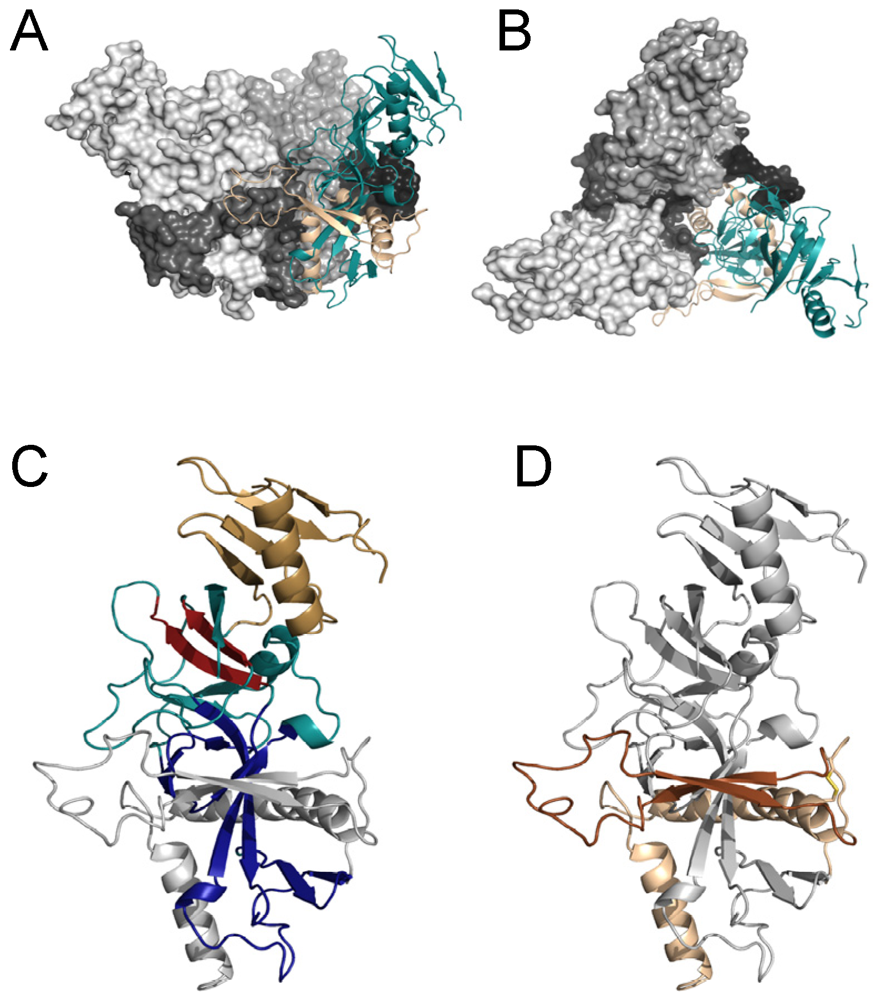
      <p>Mature GP<sub>1</sub> is composed of three distinct domains: the RBD, the glycan cap and a heavily O-linked glycosylated mucin-like domain. The RBD in mature ZEBOV GP<sub>1</sub> is located from amino acid ~54 to 201 and composed of a base region and a region that interacts with one or more receptors on the surface of cells (<xref ref-type="fig" rid="viruses-04-00258-f001">Figure 1</xref>) [<xref ref-type="bibr" rid="B10-viruses-04-00258">10</xref>]. While RBDs of the different EBOV strains are relatively conserved, only 47% identity between EBOV and MARV RBDs exists. Nonetheless, EBOV and MARV GP pseudovirions compete with each other for filoviral GP<sub>1,2</sub>-dependent entry into permissive cells, indicating that a common receptor or receptors are used by both viruses [<xref ref-type="bibr" rid="B10-viruses-04-00258">10</xref>,<xref ref-type="bibr" rid="B11-viruses-04-00258">11</xref>].</p>
      <p>Amino acids 33 through 69 and three additional short downstream regions interact with GP<sub>2</sub>, serving as the base of the RBD. Several linearly discontinuous regions from amino acids 70 to 190 sit above the base forming a series of beta sheets. Residues both in beta sheets and adjacent loops have been implicated in cell binding, leading to the conclusion that the receptor binding site (RBS) is located in this region of the RBD [<xref ref-type="bibr" rid="B12-viruses-04-00258">12</xref>,<xref ref-type="bibr" rid="B13-viruses-04-00258">13</xref>]. GP<sub>1</sub> residues 227 to 313 encode for a “glycan cap” that is extensively N-linked glycosylated and sits distal to the RBD from the surface of the virion. The glycan cap may protect the RBS from antibodies [<xref ref-type="bibr" rid="B3-viruses-04-00258">3</xref>]. This glycan cap also interacts with two regions of GP<sub>2</sub>, including the internal fusion loop of GP<sub>2</sub> that is critical for GP<sub>2</sub>-mediated membrane fusion [<xref ref-type="bibr" rid="B7-viruses-04-00258">7</xref>]. The glycan cap/GP<sub>2</sub> interaction restricts the availability of the fusion peptide, preventing pre-mature fusion events. Finally, filovirus GP<sub>1</sub> contains a mucin-like domain at the carboxy terminus from amino acids 310 to 511. This region is heavily glycosylated with both N- and O- linked glycans [<xref ref-type="bibr" rid="B7-viruses-04-00258">7</xref>]. While the EBOV mucin domain is not required for virus entry [<xref ref-type="bibr" rid="B14-viruses-04-00258">14</xref>,<xref ref-type="bibr" rid="B15-viruses-04-00258">15</xref>], several roles for this domain have been suggested. Like the glycan cap, it may shield GP RBS residues from immune recognition on free virus [<xref ref-type="bibr" rid="B7-viruses-04-00258">7</xref>]. In addition, the mucin domain causes cell rounding, masking of a number of cell surface markers and cytotoxicity that is not observed upon expression of mucin domain-deleted EBOV GP [<xref ref-type="bibr" rid="B15-viruses-04-00258">15</xref>,<xref ref-type="bibr" rid="B16-viruses-04-00258">16</xref>]. The shielding effect of the bulky mucin domain of the RBD of GP<sub>1</sub> is thought to also obstruct RBS interactions with adherence factors and receptors since removal of this domain enhances EBOV titers. Similar attempts to delete the MARV mucin domain have proved unsuccessful [<xref ref-type="bibr" rid="B11-viruses-04-00258">11</xref>]. </p>
      <fig id="viruses-04-00258-f001" position="anchor">
        <label>Figure 1</label>
        <caption>
          <p>Structure of the pre-fusion EBOV GP. (<bold>A</bold>,<bold>B</bold>) Structure of the trimer. Side view of the EBOV GP trimer is shown in A. Top-down view of the EBOV GP trimer is in B. Two of the three trimers are shown as space filling structures with GP<sub>1</sub> in lighter grey and GP<sub>2</sub> as dark grey/black. The third GP<sub>1,2</sub> heterodimer of the trimer is depicted as a ribbon structure with GP<sub>1</sub> shown in teal and the GP<sub>2</sub> subunit shown in tan. (<bold>C</bold>,<bold>D</bold>) Ribbon diagrams of a single heterodimer of GP<sub>1,2</sub>. Domains in GP<sub>1</sub> are highlighted in C, whereas domains in GP<sub>2</sub> are highlighted in D. In panel C, the base domain of GP<sub>1</sub> that interacts with GP<sub>2</sub> is shown in royal blue, the head domain is shown in teal with the beta-strands and adjacent loop region containing the RBS highlighted in red and the glycan cap is shown in gold. GP<sub>2</sub> is shown in grey. In panel D, the internal fusion loop (IFL) that is flanked by beta-strands is shown in dark brown and heptad repeat region 1 is shown in tan. The interaction of the IFL with GP<sub>1</sub> residues from an adjacent subunit is evident in panel A. All EBOV GP graphics (PDB accession number 3CSY) were produced with PyMol.</p>
        </caption>
        <graphic xmlns:xlink="http://www.w3.org/1999/xlink" xlink:href="viruses-04-00258-g001.tif"/>
      </fig>
    </sec>
    <sec>
      <title>5. GP<sub>2</sub></title>
      <p>Filovirus GP<sub>2</sub> is similar to other class I viral glycoproteins that mediate fusion events. GP<sub>2</sub> is composed of a fusion loop found near the amino terminus followed by a N-terminal heptad repeat region, a C-terminal heptad repeat region, a transmembrane region and a short cytoplasmic tail [<xref ref-type="bibr" rid="B6-viruses-04-00258">6</xref>,<xref ref-type="bibr" rid="B8-viruses-04-00258">8</xref>,<xref ref-type="bibr" rid="B9-viruses-04-00258">9</xref>]. In the pre-fusion form on the surface of newly budded virions, the fusion loop and N-terminal heptad region are integral regions of the GP<sub>1</sub>/GP<sub>2</sub> trimeric structure, forming a platform or base upon which GP<sub>1</sub> sits (<xref ref-type="fig" rid="viruses-04-00258-f001">Figure 1</xref>). In contrast, the C-terminal heptad repeat region in the pre-fusion form may contain little structure and was deleted in the crystallization studies and it is not thought to contribute to the metastable, pre-fusion form of GP [<xref ref-type="bibr" rid="B7-viruses-04-00258">7</xref>]. Not surprisingly, both the fusion loop and N-terminal heptad repeat are conserved (&gt;70% identity) between ZEBOV and the Musoke strain of MARV, but the remaining portions of GP<sub>2</sub> have limited identity. Site directed mutagenesis studies of EBOV or MARV GP<sub>2</sub> [<xref ref-type="bibr" rid="B14-viruses-04-00258">14</xref>,<xref ref-type="bibr" rid="B17-viruses-04-00258">17</xref>,<xref ref-type="bibr" rid="B18-viruses-04-00258">18</xref>,<xref ref-type="bibr" rid="B19-viruses-04-00258">19</xref>,<xref ref-type="bibr" rid="B20-viruses-04-00258">20</xref>,<xref ref-type="bibr" rid="B21-viruses-04-00258">21</xref>,<xref ref-type="bibr" rid="B22-viruses-04-00258">22</xref>,<xref ref-type="bibr" rid="B23-viruses-04-00258">23</xref>] suggest a similar chain of events to those previously reported for other class I viral glycoproteins leads to viral/cell membrane fusion [<xref ref-type="bibr" rid="B6-viruses-04-00258">6</xref>,<xref ref-type="bibr" rid="B24-viruses-04-00258">24</xref>,<xref ref-type="bibr" rid="B25-viruses-04-00258">25</xref>]. These events will be discussed in detail below. </p>
    </sec>
    <sec>
      <title>6. The Role of Cell Surface Proteins in Filovirus GP-Dependent Entry</title>
      <p>While progress is being made to identify cell surface proteins that enhance filovirus transduction/infection, the advancement of this area of research has been slow. In part this is due to the broad tropism of filoviruses for a variety of different cell types as well as the ability of these viruses to infect cells from a wide range of species [<xref ref-type="bibr" rid="B26-viruses-04-00258">26</xref>,<xref ref-type="bibr" rid="B27-viruses-04-00258">27</xref>,<xref ref-type="bibr" rid="B28-viruses-04-00258">28</xref>,<xref ref-type="bibr" rid="B29-viruses-04-00258">29</xref>,<xref ref-type="bibr" rid="B30-viruses-04-00258">30</xref>,<xref ref-type="bibr" rid="B31-viruses-04-00258">31</xref>,<xref ref-type="bibr" rid="B32-viruses-04-00258">32</xref>,<xref ref-type="bibr" rid="B33-viruses-04-00258">33</xref>,<xref ref-type="bibr" rid="B34-viruses-04-00258">34</xref>,<xref ref-type="bibr" rid="B35-viruses-04-00258">35</xref>,<xref ref-type="bibr" rid="B36-viruses-04-00258">36</xref>,<xref ref-type="bibr" rid="B37-viruses-04-00258">37</xref>]. One classical approach to identifying virus receptors that has been used is the introduction of a cDNA library from a permissive cell into a cell that is not permissive for the virus [<xref ref-type="bibr" rid="B38-viruses-04-00258">38</xref>,<xref ref-type="bibr" rid="B39-viruses-04-00258">39</xref>,<xref ref-type="bibr" rid="B40-viruses-04-00258">40</xref>]. However, for reasons that are not entirely clear, this type of study has not been successful in identifying cell surface proteins that directly interact with EBOV GP to mediate virus entry [<xref ref-type="bibr" rid="B41-viruses-04-00258">41</xref>,<xref ref-type="bibr" rid="B42-viruses-04-00258">42</xref>]. Instead, another screening approach that correlated gene expression in a large panel of human cells with EBOV GP-dependent transduction proved more productive and allowed us to identify a surface receptor for these viruses [<xref ref-type="bibr" rid="B43-viruses-04-00258">43</xref>]. The cell surface protein we identified, TIM-1, as well as other cell surface proteins that enhance filovirus infectivity are discussed in detail below. </p>
      <sec>
        <title>6.1. C-Type Lectins</title>
        <p>C-type lectin family members L-SIGN, DC-SIGN and hMGL have been shown to enhance filovirus entry [<xref ref-type="bibr" rid="B19-viruses-04-00258">19</xref>,<xref ref-type="bibr" rid="B44-viruses-04-00258">44</xref>,<xref ref-type="bibr" rid="B45-viruses-04-00258">45</xref>,<xref ref-type="bibr" rid="B46-viruses-04-00258">46</xref>,<xref ref-type="bibr" rid="B47-viruses-04-00258">47</xref>,<xref ref-type="bibr" rid="B48-viruses-04-00258">48</xref>]. Studies have demonstrated that both the mucin domain and the glycan cap of GP<sub>1</sub> interact with C-type lectins [<xref ref-type="bibr" rid="B47-viruses-04-00258">47</xref>,<xref ref-type="bibr" rid="B49-viruses-04-00258">49</xref>]. However, as both of these regions can be deleted from EBOV GP<sub>1</sub> without loss of viral transduction efficiency [<xref ref-type="bibr" rid="B16-viruses-04-00258">16</xref>,<xref ref-type="bibr" rid="B50-viruses-04-00258">50</xref>,<xref ref-type="bibr" rid="B51-viruses-04-00258">51</xref>,<xref ref-type="bibr" rid="B52-viruses-04-00258">52</xref>], it is likely that C-type lectins increase filovirus attachment to cells rather than serving as cellular receptors that mediate internalization of the virus into endosomes [<xref ref-type="bibr" rid="B53-viruses-04-00258">53</xref>]. A similar adherence function for C-type lectins has been identified for other enveloped viruses such as HIV [<xref ref-type="bibr" rid="B54-viruses-04-00258">54</xref>].</p>
      </sec>
      <sec>
        <title>6.2. β1 Integrins</title>
        <p>Early studies found that surface expression of some integrins was down regulated upon transfection of full-length EBOV GP [<xref ref-type="bibr" rid="B15-viruses-04-00258">15</xref>,<xref ref-type="bibr" rid="B55-viruses-04-00258">55</xref>,<xref ref-type="bibr" rid="B56-viruses-04-00258">56</xref>]. In addition, EBOV GP-mediated pseudovirion entry is reduced by either antibodies targeting β1 integrins or a soluble form of β1 integrins [<xref ref-type="bibr" rid="B56-viruses-04-00258">56</xref>]. These characteristics suggested that one or more integrin subunits might serve as receptors for filoviruses. However, no direct interaction between any portion of EBOV GP and a member of the β1 integrin family has been identified. More recent studies implicate β1 integrin in stimulation of endosomal protease events that are required for productive EBOV transduction, thus reducing the likelihood of β1 integrins serving as bona fide filoviral receptors [<xref ref-type="bibr" rid="B57-viruses-04-00258">57</xref>]. </p>
      </sec>
      <sec>
        <title>6.3. Tyro3 (TAM) Family Tyrosine Kinase Receptors</title>
        <p>The TAM family member Axl was first implicated in filovirus entry through a cDNA screen that introduced Vero E6 cell cDNA into poorly permissive Jurkat T cells [<xref ref-type="bibr" rid="B41-viruses-04-00258">41</xref>]. Axl is a tyrosine kinase receptor that is found on the plasma membrane in a variety of different cell types and enhances cell migration, division and viability upon activation [<xref ref-type="bibr" rid="B58-viruses-04-00258">58</xref>]. Shimojima <italic>et al.</italic> demonstrated that anti-Axl antibodies blocked EBOV transduction of some cells, whereas these antibodies had no effect on transduction of other cells [<xref ref-type="bibr" rid="B41-viruses-04-00258">41</xref>]. Mapping studies indicated that amino acid residues in both the ectodomain and the cytoplasmic tail of Axl were required for filovirus entry enhancement [<xref ref-type="bibr" rid="B59-viruses-04-00258">59</xref>]. Subsequently, a screen performed in our laboratory also identified Axl as being important in EBOV GP-dependent entry [<xref ref-type="bibr" rid="B60-viruses-04-00258">60</xref>]. Through the use of multiple biochemical inhibitors, siRNA and anti-Axl antibodies, we defined a role for Axl in EBOV uptake [<xref ref-type="bibr" rid="B61-viruses-04-00258">61</xref>], demonstrating that Axl expression enhances macropinocytosis in some cells. As macropinocytosis is a principal uptake mechanism of filoviruses [<xref ref-type="bibr" rid="B62-viruses-04-00258">62</xref>,<xref ref-type="bibr" rid="B63-viruses-04-00258">63</xref>], increased Axl surface expression leads to greater virus internalization. However, Axl does not appear to interact directly with EBOV GP to promote viral internalization and therefore is unlikely to serve as a filoviral receptor [<xref ref-type="bibr" rid="B60-viruses-04-00258">60</xref>]. </p>
      </sec>
      <sec>
        <title>6.4. TIM-1</title>
        <p>Our lab performed a comparative genomic analysis (CGA) screen [<xref ref-type="bibr" rid="B64-viruses-04-00258">64</xref>] to identify cellular genes whose expression highly correlated with EBOV pseudovirion transduction [<xref ref-type="bibr" rid="B43-viruses-04-00258">43</xref>]. This screen showed a positive correlation between EBOV transduction and expression of a series of cellular proteins that were previously appreciated to enhance EBOV transduction (C-type lectins, integrins and Axl). Interestingly, expression of the T-cell immunoglobulin mucin domain-1 (TIM-1) gene proved to be one of the strongest positive correlations. Subsequent studies demonstrated that expression of TIM-1 in poorly permissive cells enhanced EBOV entry and loss of surface-expressed TIM-1 in highly permissive cells abrogated filovirus infection/transduction. Furthermore, TIM-1 and the mucin domain-deleted EBOV GP interacted, and removal of the glycan cap enhanced the specificity of GP interaction with TIM-1-expressing cells [<xref ref-type="bibr" rid="B43-viruses-04-00258">43</xref>]. In total, these findings have led us to propose TIM-1 as a cell surface receptor for filoviruses. As epithelial cells are the only relevant cell type that expresses TIM-1, it is likely that other as of yet unidentified surface receptors will also prove to be important in mediating filovirus entry. </p>
      </sec>
    </sec>
    <sec>
      <title>7. Mechanism(s) of Filoviral GP-Mediated Entry into Permissive Cells</title>
      <p>The cellular uptake pathways mediating filovirus entry remain controversial despite numerous studies. The three most common and well studied endocytic pathways—caveolin-dependent endocytosis, clathrin-dependent endocytosis and macropinocytosis—have all been implicated in filovirus entry. Early studies reported that the caveolae vesicular system and/or lipid raft domains were important for EBOV GP-mediated entry [<xref ref-type="bibr" rid="B65-viruses-04-00258">65</xref>,<xref ref-type="bibr" rid="B66-viruses-04-00258">66</xref>,<xref ref-type="bibr" rid="B67-viruses-04-00258">67</xref>]. However, it was demonstrated that overexpression of Caveolin 1 in the poorly permissive lymphocytic cell line CEM did not enhance levels of EBOV GP-dependent transduction, suggesting that caveolae may not play a role in filovirus entry [<xref ref-type="bibr" rid="B36-viruses-04-00258">36</xref>]. Since that time several groups have also implicated clathrin-dependent entry mechanisms in filovirus entry [<xref ref-type="bibr" rid="B68-viruses-04-00258">68</xref>,<xref ref-type="bibr" rid="B69-viruses-04-00258">69</xref>,<xref ref-type="bibr" rid="B70-viruses-04-00258">70</xref>,<xref ref-type="bibr" rid="B71-viruses-04-00258">71</xref>]. In parallel, other groups using virus-like particles (VLPs) and/or infectious filovirions identified macropinocytosis as a main and perhaps sole mechanism of filovirus uptake [<xref ref-type="bibr" rid="B62-viruses-04-00258">62</xref>,<xref ref-type="bibr" rid="B63-viruses-04-00258">63</xref>]. Several groups have found that EBOV GP-dependent entry can occur through a variety of different uptake mechanisms including caveolae, clathrin-coated pits and through actin- and microtubule-dependent pathways such as macropinocytosis [<xref ref-type="bibr" rid="B61-viruses-04-00258">61</xref>,<xref ref-type="bibr" rid="B70-viruses-04-00258">70</xref>,<xref ref-type="bibr" rid="B71-viruses-04-00258">71</xref>] within the same cell population. </p>
      <p>A number of these uptake studies that identified caveolin and/or clathrin as important in entry used EBOV GP pseudotyped lentiviruses or vesicular stomatitis virus (VSV) as the cargo and an argument has been made that these smaller viral particles do not accurately represent the size constraints that may limit the uptake options of a filovirion that can be greater than 10 µM in length [<xref ref-type="bibr" rid="B72-viruses-04-00258">72</xref>]. While a role for caveolin- and clathrin-dependent pathways in infectious filoviral entry remains to be demonstrated, it should be noted that several large, intracellular bacteria or parasites have been found to use either caveolin- or clathrin-dependent pathways, suggesting that the size of these vesicles can be expanded to meet the size of the cargo [<xref ref-type="bibr" rid="B73-viruses-04-00258">73</xref>,<xref ref-type="bibr" rid="B74-viruses-04-00258">74</xref>,<xref ref-type="bibr" rid="B75-viruses-04-00258">75</xref>]. In addition, it is likely that the mechanism of EBOV uptake may be cell-dependent as both Green African Monkey cells (Vero) [<xref ref-type="bibr" rid="B62-viruses-04-00258">62</xref>,<xref ref-type="bibr" rid="B63-viruses-04-00258">63</xref>] and human neuroblastoma cells (SNB-19) [<xref ref-type="bibr" rid="B61-viruses-04-00258">61</xref>] both primarily use macropinocytosis for EBOV uptake. However, the signaling pathways that are required for virus entry is cell-specific since Vero cells require activation of the PI3K/Akt pathway, whereas SNB-19 cells require PLC activation [<xref ref-type="bibr" rid="B61-viruses-04-00258">61</xref>]. </p>
    </sec>
    <sec>
      <title>8. Proteolytic Processing of EBOV GP<sub>1,2</sub> into a Fusion-Active Form</title>
      <p>Unlike some other class I viral glycoproteins, no evidence exists that EBOV GP<sub>1</sub> undergoes conformational changes upon binding to a cell surface receptor. Presumably receptor/virus interactions lead directly to virus internalization into endosomes; however, this has not been demonstrated directly to date. Characterization of the endosomal vesicles mediating EBOV uptake is limited. Saaed <italic>et al.</italic> have demonstrated that the Early Endosome Antigen 1 (EEA1) colocalizes with EBOV virus particles in endosomes early during infection of Vero cells [<xref ref-type="bibr" rid="B62-viruses-04-00258">62</xref>], whereas Nanbo <italic>et al.</italic> have shown association of EBOV particles lacking VP30 associated with the sorting nexin 5 (SNX5) within 10 minutes of transduction [<xref ref-type="bibr" rid="B63-viruses-04-00258">63</xref>]. Early and late endosomal proteins, Rab5 and Rab 7, respectively, have also been shown to be required for productive infection [<xref ref-type="bibr" rid="B62-viruses-04-00258">62</xref>,<xref ref-type="bibr" rid="B63-viruses-04-00258">63</xref>]. Several GTPases previously implicated in endocytosis, RhoB, Rac1 and CDC42, are also important for EBOV GP-dependent transduction, providing additional insights into trafficking pathways used by these viruses [<xref ref-type="bibr" rid="B63-viruses-04-00258">63</xref>,<xref ref-type="bibr" rid="B76-viruses-04-00258">76</xref>]. </p>
      <p>As the vesicles traffic into the cell, they become acidified. For some viral fusion proteins, the combination of receptor engagement and endosomal acidity is sufficient for conformational changes that lead to viral/cellular membrane fusion [<xref ref-type="bibr" rid="B77-viruses-04-00258">77</xref>,<xref ref-type="bibr" rid="B78-viruses-04-00258">78</xref>,<xref ref-type="bibr" rid="B79-viruses-04-00258">79</xref>]. However, that is not the case for filoviruses. Instead, multiple low pH-dependent endosomal and lysosomal proteolytic proteins are involved in EBOV GP<sub>1</sub> processing, priming a multi-step process that ultimately results in a small EBOV GP<sub>1,2</sub> trimer that serves as the fusion-ready form of the glycoprotein. It is believed that this processed, fusion-ready form is then triggered by additional events to a conformationally stable state, resulting in fusion.</p>
      <p>As endosomal vesicles mature into late endosomes and the vesicular pH drops, activation of endosomal cysteine proteases Cathepsin L and B occurs. These cathepsins sequentially process EBOV GP<sub>1</sub> into smaller forms [<xref ref-type="bibr" rid="B50-viruses-04-00258">50</xref>,<xref ref-type="bibr" rid="B51-viruses-04-00258">51</xref>]. Cathepsin L proteolysis first removes a substantial portion of EBOV GP<sub>1</sub>, generating an approximate 50 kDa GP<sub>1,2</sub> species that lacks both the glycan cap and mucin domain of GP<sub>1</sub> [<xref ref-type="bibr" rid="B50-viruses-04-00258">50</xref>,<xref ref-type="bibr" rid="B51-viruses-04-00258">51</xref>]. Subsequently, GP<sub>1</sub> is further trimmed by both Cathepsin L and B to generate a much smaller form of GP<sub>1</sub>. The exact size of this smaller GP<sub>1</sub> remains controversial, but is between 17 and 19 kDa [<xref ref-type="bibr" rid="B50-viruses-04-00258">50</xref>,<xref ref-type="bibr" rid="B51-viruses-04-00258">51</xref>]. Irrespective of the exact size of the processed form, prevention of endosomal acidification or inhibition of Cathepsin B activity abolishes EBOV infectivity [<xref ref-type="bibr" rid="B50-viruses-04-00258">50</xref>,<xref ref-type="bibr" rid="B51-viruses-04-00258">51</xref>,<xref ref-type="bibr" rid="B52-viruses-04-00258">52</xref>,<xref ref-type="bibr" rid="B70-viruses-04-00258">70</xref>]. Interestingly, this processing may be insufficient for productive EBOV infection as studies have demonstrated that the smaller 17–19 kDa Cathepsin L and B-cleaved form cannot infect cells entirely lacking cathepsins [<xref ref-type="bibr" rid="B80-viruses-04-00258">80</xref>]. Thus, it has been proposed that additional cathepsin-dependent GP<sub>1</sub> processing is required to generate the fusion-ready form of the glycoprotein [<xref ref-type="bibr" rid="B80-viruses-04-00258">80</xref>]. The size and composition of this smaller form is not known. In contrast to these studies, a recent study demonstrated that a thermolysin-trimmed GP<sub>1</sub> that is believed to generate a GP<sub>1</sub> that is similar to the Cathepsin L and B-cleaved form can be triggered to bind to liposomes at elevated temperatures under low pH and mildly reducing conditions [<xref ref-type="bibr" rid="B81-viruses-04-00258">81</xref>]. This new study suggests that at least under these conditions this GP conformation is a fusion-ready form.</p>
      <p>Given the apparent importance of cathepsin cleavage for the generation of a fusion-ready form of the filovirus glycoprotein, it is surprising that studies have demonstrated that Cathepsin L and B cleavage events can be sidestepped by the virus [<xref ref-type="bibr" rid="B80-viruses-04-00258">80</xref>,<xref ref-type="bibr" rid="B82-viruses-04-00258">82</xref>]. Martinez <italic>et al.</italic> have shown that in monocyte-derived dendritic cells, Cathepsin B is required for EBOV infection, but not Cathepsin L [<xref ref-type="bibr" rid="B82-viruses-04-00258">82</xref>]. These observations were confirmed in Vero cells in a recent study by Wong <italic>et al.</italic> [<xref ref-type="bibr" rid="B80-viruses-04-00258">80</xref>]. This group also extended the finding by selecting an infectious, recombinant VSV encoding EBOV GP over several passages to become resistant to the Cathepsin B inhibitor CA074 [<xref ref-type="bibr" rid="B80-viruses-04-00258">80</xref>]. Six different mutants were identified that conferred Cathepsin B independence. Many of these mutations sit at the interface of GP<sub>1</sub> and GP<sub>2</sub> and the selected mutations were thought to alter the GP structure such that enhanced proteolysis by one or more currently undefined cysteine proteases was possible. Thus, while Cathepsin B and L independence can be achieved by filoviruses, processing by one or more additional cysteine proteases is still required for production of the fusion-ready form. </p>
    </sec>
    <sec>
      <title>9. NPC1</title>
      <p>Most recently, two groups independently identified a novel host protein essential for EBOV infection. Cote <italic>et al.</italic> screened a library of small chemical molecules to find those that inhibited EBOV GP pseudovirion entry into Vero cells [<xref ref-type="bibr" rid="B83-viruses-04-00258">83</xref>], whereas Carette <italic>et al.</italic> utilized a genome-wide screen in mutagenized haploid human cells to look for those cells resistant to EBOV GP-dependent entry [<xref ref-type="bibr" rid="B84-viruses-04-00258">84</xref>]. Each group was able to deduce that disruption of one endosomal/lysosomal membrane protein, Niemann-Pick C1 (NPC1), could significantly reduce EBOV entry into a variety of cell populations.</p>
      <p>NPC1 is primarily a membrane bound, late endosomal/lysosomal protein that is critical for cholesterol absorption and homeostasis. Those individuals lacking a functional NPC1 exhibit an abnormally high accumulation of cholesterol in the lysosomes of their cells, leading to altered protein and lipid trafficking with most cases resulting in fatality by 18 months of age [<xref ref-type="bibr" rid="B85-viruses-04-00258">85</xref>]. Cells where NPC1 function has been biochemically disrupted or cells lacking NPC1 showed a resistance to EBOV infection [<xref ref-type="bibr" rid="B83-viruses-04-00258">83</xref>,<xref ref-type="bibr" rid="B84-viruses-04-00258">84</xref>]. Clearance of cholesterol from NPC1 null cells by cultivation in lipoprotein-depleted media did not rescue EBOV infection, indicating that the NPC1 protein <italic>itself</italic>, and not aberrant cholesterol transport, was important for EBOV entry [<xref ref-type="bibr" rid="B84-viruses-04-00258">84</xref>]. Cote <italic>et al.</italic> also showed that the expression of NPC1 and not its cholesterol transport activity were critical for EBOV entry [<xref ref-type="bibr" rid="B83-viruses-04-00258">83</xref>]. </p>
      <p>As the NPC1 protein is primarily located on the endosomal and lysosomal membranes, NPC1 has been proposed to serve as an entry factor downstream of EBOV GP engagement of attachment factors/receptor(s) at the cell surface. Consistent with a vesicular role for NPC1, Cote <italic>et al.</italic> showed that a soluble form of thermolysin-cleaved EBOV GP, but not uncleaved GP containing the glycan cap, bound to lysosomal membranes of NPC1-transfected CHO cells [<xref ref-type="bibr" rid="B83-viruses-04-00258">83</xref>]. Thus, at least in this over expression system, proteolytically-processed EBOV GP appeared to interact with NPC1-containing membranes, suggesting that these interactions may be important for filovirus entry events that occur in late endosomes and/or in lysosomes. EBOV GP-mediated attachment and entry into early endosomes was unaffected in NPC1-defective cells; however, electron micrographs of NPC1 null cells infected with EBOV GP pseudotyped virus show the accumulation of perinuclear vesicles laden with EBOV GP pseudovirions that were positive for the lysosomal marker LAMP1 [<xref ref-type="bibr" rid="B84-viruses-04-00258">84</xref>]. Therefore, Carette <italic>et al.</italic> have proposed that NCP1 is crucial for viral membrane fusion and escape from the lysosomal vesicle [<xref ref-type="bibr" rid="B84-viruses-04-00258">84</xref>]. At present, the precise role of NPC1 during the EBOV entry process remains to be fully elucidated. In addition, investigations into the precise location of filovirus fusion events within endosomal compartments will provide important insights into these events.</p>
      <p>Interestingly, an inhibitor of NPC1, U18666A, has recently been shown to block entry of several pathogens, including the flavivirus Dengue [<xref ref-type="bibr" rid="B86-viruses-04-00258">86</xref>]. This inhibitor also inhibited entry of hepatitis C virus [<xref ref-type="bibr" rid="B87-viruses-04-00258">87</xref>] as well as prions [<xref ref-type="bibr" rid="B88-viruses-04-00258">88</xref>], suggesting that this cholesterol transporter may be critical for passage of a number of viruses, and perhaps other pathogens, through endosomes. Most recently, a more definitive role for NPC1 in hepatitis C virus entry has been determined through the use of additional biochemical agents [<xref ref-type="bibr" rid="B89-viruses-04-00258">89</xref>]. Future studies exploring lipid accumulation and changes in lipid composition within the endosomal pathway could significantly enhance the understanding of the novel role of NPC1 specifically in filoviral entry and more generally in endosomal trafficking of a number of enveloped viruses. </p>
    </sec>
    <sec>
      <title>10. Characterized Filovirus Fusion Events</title>
      <p>As described above, the GP<sub>1</sub> portion of EBOV GP<sub>1,2</sub> allows delivery of the filovirion to an endosome where conditions become progressively more favorable for generating the fusion-ready form of GP<sub>1,2</sub>. Trimming of GP<sub>1,2</sub> by host cathepsins (or artificially by thermolysin) enhances interaction of GP with TIM-1 [<xref ref-type="bibr" rid="B43-viruses-04-00258">43</xref>] and permits NPC1 binding [<xref ref-type="bibr" rid="B83-viruses-04-00258">83</xref>]. Whether EBOV GP interaction, with either of these molecules, directly mediates GP<sub>2</sub> fusion events remains to be determined.</p>
      <p>Filovirus GP<sub>2</sub> contains an N-terminal internal fusion loop of 45 residues defined by a disulfide linkage between cysteines 511 and 556 [<xref ref-type="bibr" rid="B3-viruses-04-00258">3</xref>,<xref ref-type="bibr" rid="B7-viruses-04-00258">7</xref>]. A core hydrophobic sequence of 16 amino acids within this loop is thought to insert into host endosomal membranes, initiating membrane fusion events. Within the intact GP heterodimer, the hydrophobic, internal fusion loop is flanked by antiparallel β-strands composed of the most N-terminal portion of the internal fusion loop and the N-terminal region of first heptad repeat region. The fusion loop is restrained by GP<sub>1 </sub>residues from a neighboring subunit, preventing premature fusion events [<xref ref-type="bibr" rid="B3-viruses-04-00258">3</xref>,<xref ref-type="bibr" rid="B7-viruses-04-00258">7</xref>,<xref ref-type="bibr" rid="B90-viruses-04-00258">90</xref>]. Cathepsin-dependent processing alone is insufficient to trigger insertion of the fusion loop into liposomes [<xref ref-type="bibr" rid="B81-viruses-04-00258">81</xref>,<xref ref-type="bibr" rid="B91-viruses-04-00258">91</xref>]. </p>
      <p>When the EBOV internal fusion loop interacts with liposomal membrane mimetics, lipid mixing is promoted with a parallel structural change in the loop [<xref ref-type="bibr" rid="B90-viruses-04-00258">90</xref>]. In a neutral pH, lipid environment, the antiparallel β-strands that flank the fusion loop lose their structure, generating a more alpha helical content with a flattened extended loop structure. Under low pH conditions (&lt;pH 5.5) in the presence of lipids, this flattened loop structure broadens out, forming a more hook-like structure [<xref ref-type="bibr" rid="B90-viruses-04-00258">90</xref>]. It has been previously shown that specific proline residues contained within the central portion of the fusion loop facilitate this lipid membrane interaction [<xref ref-type="bibr" rid="B21-viruses-04-00258">21</xref>,<xref ref-type="bibr" rid="B23-viruses-04-00258">23</xref>,<xref ref-type="bibr" rid="B92-viruses-04-00258">92</xref>,<xref ref-type="bibr" rid="B93-viruses-04-00258">93</xref>]. The insertion of GP<sub>2</sub> into host membranes causes an extension of the GP<sub>2</sub> trimers into an energetically unfavorable state. This also causes the two heptad repeat regions (HRs) within GP<sub>2</sub> to be fully exposed to the physiological conditions within the acidified host endosome, which may aid in further triggering of GP<sub>2</sub> to promote final collapse of the two HRs [<xref ref-type="bibr" rid="B81-viruses-04-00258">81</xref>]. </p>
      <p>The N-terminal GP<sub>2</sub> heptad repeat region (HR1) is a highly ordered, alpha-helical structure that serves as a platform or base for GP<sub>1</sub> and contains residues that are necessary for interactions with other GP<sub>2</sub> HR1s to form the trimeric structure of the pre-fusion GP [<xref ref-type="bibr" rid="B3-viruses-04-00258">3</xref>,<xref ref-type="bibr" rid="B7-viruses-04-00258">7</xref>]. In the pre-fusion form, HR1 does not interact with the carboxy terminal heptad repeat region (HR2). Within the intact, pre-fusion trimer, HR2 appears to be disordered and was not included in the crystallized structure [<xref ref-type="bibr" rid="B7-viruses-04-00258">7</xref>]. </p>
      <p>Following insertion of EBOV GP<sub>2</sub> fusion loop into the host membrane, the EBOV GP<sub>2</sub> trimeric heptad repeats collapse and form a six-helix bundle containing three HR1 and HR2 domains. The collapse into a coiled coil structure draws the two membranes into proximity allowing partial fusion (hemifusion) of the viral membrane and the host endosomal membrane [<xref ref-type="bibr" rid="B8-viruses-04-00258">8</xref>,<xref ref-type="bibr" rid="B9-viruses-04-00258">9</xref>]. Hemifusion eventually leads to complete fusion of the viral and host endosomal membranes, and an opening through which the viral RNA and its associated proteins can be released into the host cell cytoplasm, where the viral life cycle continues.</p>
    </sec>
    <sec>
      <title>11. Potential Therapeutics against Filovirus Entry</title>
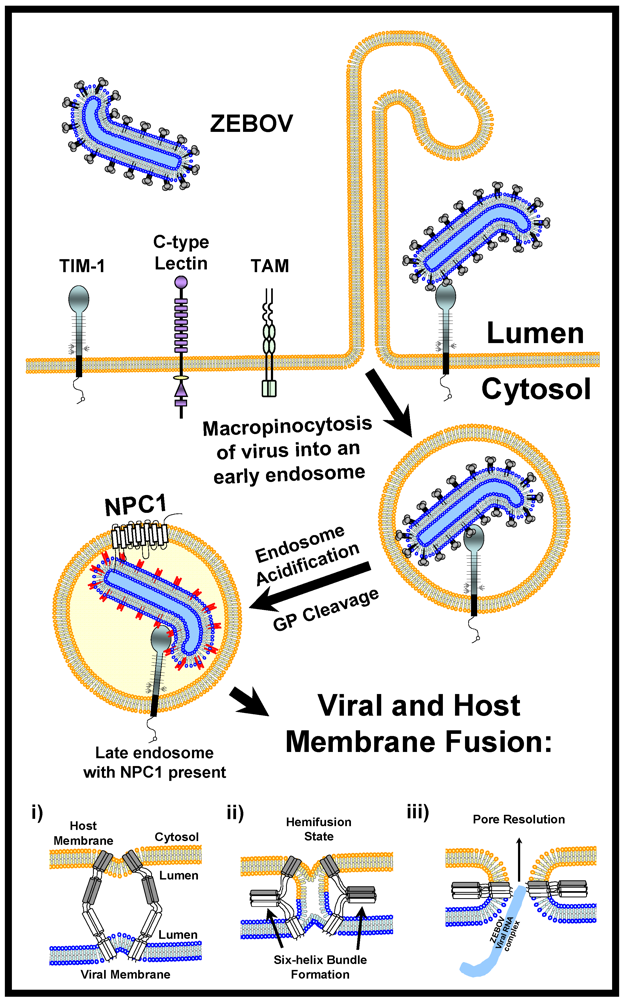
      <p>This complex set of entry events summarized in <xref ref-type="fig" rid="viruses-04-00258-f002">Figure 2</xref> provides numerous potential avenues for the development of antiviral therapies against filovirus infection. These possibilities include: (1) interfering with adherence to permissive cells by blocking C-type lectin (or other adherence factor) interactions with the filoviral GP; (2) blocking binding of GP to TIM-1 and/or other cellular receptors that are identified in the future; (3) preventing virus uptake by blocking macropinocytosis; (4) interfering with cathepsin activity; (5) inhibiting availability of NPC1 within the lysosomal compartment and (6) blocking HR1/HR2 (coiled coil) interactions. It is likely that some of these steps will be more amendable than others to the development of antivirals that have minimal or no cytotoxicity. Regardless, elucidation of these entry events provides clear targets for the development of drugs that may prevent both filovirus infection and disease. </p>
      <fig id="viruses-04-00258-f002" position="anchor">
        <label>Figure 2</label>
        <caption>
          <p>Model for filoviral entry. Trimers of filoviral GPs on virions interact with both attachment factors (C-type lectins) and receptors (TIM-1) on the surface of permissive cells. Attachment factors are likely to concentrate virions on cells before receptor engagement and virion internalization by macropinocytosis. Macropinocytosis is enhanced by tyrosine kinase receptors such as TAM family members. Following endosomal acidification, Cathepsins L and B trim the EBOV GP to a smaller form that needs at least one as yet undetermined factor to elicit GP fusion with host endosomal membranes. This smaller form of GP is able to interact with both TIM-1 and the endosomal portion of the NPC1 protein; however, whether GP and TIM-1 interact within endosomes is not known. The energetically unfavorable insertion of the EBOV GP<sub>2</sub> fusion loop into host endosomal membranes (<bold>i</bold>) is followed by the energetically favorable collapse of EBOV GP into a six-helix bundle (<bold>ii</bold>) allowing for lipid mixing and hemifusion of host and viral membrane lipids (ii). Finally, the hemifused host and viral membranes resolve and a complete pore is formed (<bold>iii</bold>) through which the viral genomic complex passes into the cytoplasm, allowing the viral replication cycle to continue. </p>
        </caption>
        <graphic xmlns:xlink="http://www.w3.org/1999/xlink" xlink:href="viruses-04-00258-g002.tif"/>
      </fig>
    </sec>
  </body>
  <back>
    <ack>
      <title>Acknowledgments</title>
      <p>We would like to thank Sven Moller-Tank, Bethany Rhein and Andrew Kondratowicz for critically reading the manuscript and their helpful suggestions and discussions.</p>
    </ack>
    <notes>
      <title>Conflict of Interest</title>
      <p>The authors declare no conflict of interest.</p>
    </notes>
    <ref-list>
      <title>References and Notes</title>
      <ref id="B1-viruses-04-00258">
        <label>1.</label>
        <citation citation-type="journal">
          <person-group person-group-type="author">
            <name>
              <surname>Falzarano</surname>
              <given-names>D.</given-names>
            </name>
            <name>
              <surname>Krokhin</surname>
              <given-names>O.</given-names>
            </name>
            <name>
              <surname>Wahl-Jensen</surname>
              <given-names>V.</given-names>
            </name>
            <name>
              <surname>Seebach</surname>
              <given-names>J.</given-names>
            </name>
            <name>
              <surname>Wolf</surname>
              <given-names>K.</given-names>
            </name>
            <name>
              <surname>Schnittler</surname>
              <given-names>H.J.</given-names>
            </name>
            <name>
              <surname>Feldmann</surname>
              <given-names>H.</given-names>
            </name>
          </person-group>
          <article-title>Structure-function analysis of the soluble glycoprotein, sgp, of ebola virus</article-title>
          <source>Chembiochem</source>
          <year>2006</year>
          <volume>7</volume>
          <fpage>1605</fpage>
          <lpage>1611</lpage>
          <pub-id pub-id-type="doi">10.1002/cbic.200600223</pub-id>
        </citation>
      </ref>
      <ref id="B2-viruses-04-00258">
        <label>2.</label>
        <citation citation-type="journal">
          <person-group person-group-type="author">
            <name>
              <surname>Mehedi</surname>
              <given-names>M.</given-names>
            </name>
            <name>
              <surname>Falzarano</surname>
              <given-names>D.</given-names>
            </name>
            <name>
              <surname>Seebach</surname>
              <given-names>J.</given-names>
            </name>
            <name>
              <surname>Hu</surname>
              <given-names>X.</given-names>
            </name>
            <name>
              <surname>Carpenter</surname>
              <given-names>M.S.</given-names>
            </name>
            <name>
              <surname>Schnittler</surname>
              <given-names>H.J.</given-names>
            </name>
            <name>
              <surname>Feldmann</surname>
              <given-names>H.</given-names>
            </name>
          </person-group>
          <article-title>A new ebola virus nonstructural glycoprotein expressed through RNA editing</article-title>
          <source>J. Virol.</source>
          <year>2011</year>
          <volume>85</volume>
          <fpage>5406</fpage>
          <lpage>5414</lpage>
        <pub-id pub-id-type="doi">10.1128/JVI.02190-10</pub-id><pub-id pub-id-type="pmid">21411529</pub-id></citation>
      </ref>
      <ref id="B3-viruses-04-00258">
        <label>3.</label>
        <citation citation-type="journal">
          <person-group person-group-type="author">
            <name>
              <surname>Lee</surname>
              <given-names>J.E.</given-names>
            </name>
            <name>
              <surname>Saphire</surname>
              <given-names>E.O.</given-names>
            </name>
          </person-group>
          <article-title>Ebolavirus glycoprotein structure and mechanism of entry</article-title>
          <source>Future Virol.</source>
          <year>2009</year>
          <volume>4</volume>
          <fpage>621</fpage>
          <lpage>635</lpage>
        <pub-id pub-id-type="doi">10.2217/fvl.09.56</pub-id><pub-id pub-id-type="pmid">20198110</pub-id></citation>
      </ref>
      <ref id="B4-viruses-04-00258">
        <label>4.</label>
        <citation citation-type="journal">
          <person-group person-group-type="author">
            <name>
              <surname>Neumann</surname>
              <given-names>G.</given-names>
            </name>
            <name>
              <surname>Feldmann</surname>
              <given-names>H.</given-names>
            </name>
            <name>
              <surname>Watanabe</surname>
              <given-names>S.</given-names>
            </name>
            <name>
              <surname>Lukashevich</surname>
              <given-names>I.</given-names>
            </name>
            <name>
              <surname>Kawaoka</surname>
              <given-names>Y.</given-names>
            </name>
          </person-group>
          <article-title>Reverse genetics demonstrates that proteolytic processing of the ebola virus glycoprotein is not essential for replication in cell culture</article-title>
          <source>J. Virol.</source>
          <year>2002</year>
          <volume>76</volume>
          <fpage>406</fpage>
          <lpage>410</lpage>
        <pub-id pub-id-type="doi">10.1128/JVI.76.1.406-410.2002</pub-id><pub-id pub-id-type="pmid">11739705</pub-id></citation>
      </ref>
      <ref id="B5-viruses-04-00258">
        <label>5.</label>
        <citation citation-type="journal">
          <person-group person-group-type="author">
            <name>
              <surname>Sanchez</surname>
              <given-names>A.</given-names>
            </name>
            <name>
              <surname>Yang</surname>
              <given-names>Z.Y.</given-names>
            </name>
            <name>
              <surname>Xu</surname>
              <given-names>L.</given-names>
            </name>
            <name>
              <surname>Nabel</surname>
              <given-names>G.J.</given-names>
            </name>
            <name>
              <surname>Crews</surname>
              <given-names>T.</given-names>
            </name>
            <name>
              <surname>Peters</surname>
              <given-names>C.J.</given-names>
            </name>
          </person-group>
          <article-title>Biochemical analysis of the secreted and virion glycoproteins of ebola virus</article-title>
          <source>J. Virol.</source>
          <year>1998</year>
          <volume>72</volume>
          <fpage>6442</fpage>
          <lpage>6447</lpage>
        <pub-id pub-id-type="pmid">9658086</pub-id></citation>
      </ref>
      <ref id="B6-viruses-04-00258">
        <label>6.</label>
        <citation citation-type="journal">
          <person-group person-group-type="author">
            <name>
              <surname>White</surname>
              <given-names>J.M.</given-names>
            </name>
            <name>
              <surname>Delos</surname>
              <given-names>S.E.</given-names>
            </name>
            <name>
              <surname>Brecher</surname>
              <given-names>M.</given-names>
            </name>
            <name>
              <surname>Schornberg</surname>
              <given-names>K.</given-names>
            </name>
          </person-group>
          <article-title>Structures and mechanisms of viral membrane fusion proteins: Multiple variations on a common theme</article-title>
          <source>Crit. Rev. Biochem. Mol. Biol.</source>
          <year>2008</year>
          <volume>43</volume>
          <fpage>189</fpage>
          <lpage>219</lpage>
        <pub-id pub-id-type="doi">10.1080/10409230802058320</pub-id><pub-id pub-id-type="pmid">18568847</pub-id></citation>
      </ref>
      <ref id="B7-viruses-04-00258">
        <label>7.</label>
        <citation citation-type="journal">
          <person-group person-group-type="author">
            <name>
              <surname>Lee</surname>
              <given-names>J.E.</given-names>
            </name>
            <name>
              <surname>Fusco</surname>
              <given-names>M.L.</given-names>
            </name>
            <name>
              <surname>Hessell</surname>
              <given-names>A.J.</given-names>
            </name>
            <name>
              <surname>Oswald</surname>
              <given-names>W.B.</given-names>
            </name>
            <name>
              <surname>Burton</surname>
              <given-names>D.R.</given-names>
            </name>
            <name>
              <surname>Saphire</surname>
              <given-names>E.O.</given-names>
            </name>
          </person-group>
          <article-title>Structure of the ebola virus glycoprotein bound to an antibody from a human survivor</article-title>
          <source>Nature</source>
          <year>2008</year>
          <volume>454</volume>
          <fpage>177</fpage>
          <lpage>182</lpage>
        <pub-id pub-id-type="doi">10.1038/nature07082</pub-id><pub-id pub-id-type="pmid">18615077</pub-id></citation>
      </ref>
      <ref id="B8-viruses-04-00258">
        <label>8.</label>
        <citation citation-type="journal">
          <person-group person-group-type="author">
            <name>
              <surname>Malashkevich</surname>
              <given-names>V.N.</given-names>
            </name>
            <name>
              <surname>Schneider</surname>
              <given-names>B.J.</given-names>
            </name>
            <name>
              <surname>McNally</surname>
              <given-names>M.L.</given-names>
            </name>
            <name>
              <surname>Milhollen</surname>
              <given-names>M.A.</given-names>
            </name>
            <name>
              <surname>Pang</surname>
              <given-names>J.X.</given-names>
            </name>
            <name>
              <surname>Kim</surname>
              <given-names>P.S.</given-names>
            </name>
          </person-group>
          <article-title>Core structure of the envelope glycoprotein gp2 from ebola virus at 1.9-a resolution</article-title>
          <source>Proc. Natl. Acad. Sci. U. S. A.</source>
          <year>1999</year>
          <volume>96</volume>
          <fpage>2662</fpage>
          <lpage>2667</lpage>
        <pub-id pub-id-type="doi">10.1073/pnas.96.6.2662</pub-id><pub-id pub-id-type="pmid">10077567</pub-id></citation>
      </ref>
      <ref id="B9-viruses-04-00258">
        <label>9.</label>
        <citation citation-type="journal">
          <person-group person-group-type="author">
            <name>
              <surname>Weissenhorn</surname>
              <given-names>W.</given-names>
            </name>
            <name>
              <surname>Carfi</surname>
              <given-names>A.</given-names>
            </name>
            <name>
              <surname>Lee</surname>
              <given-names>K.H.</given-names>
            </name>
            <name>
              <surname>Skehel</surname>
              <given-names>J.J.</given-names>
            </name>
            <name>
              <surname>Wiley</surname>
              <given-names>D.C.</given-names>
            </name>
          </person-group>
          <article-title>Crystal structure of the ebola virus membrane fusion subunit, gp2, from the envelope glycoprotein ectodomain</article-title>
          <source>Mol. Cell</source>
          <year>1998</year>
          <volume>2</volume>
          <fpage>605</fpage>
          <lpage>616</lpage>
          <pub-id pub-id-type="doi">10.1016/S1097-2765(00)80159-8</pub-id>
        </citation>
      </ref>
      <ref id="B10-viruses-04-00258">
        <label>10.</label>
        <citation citation-type="journal">
          <person-group person-group-type="author">
            <name>
              <surname>Kuhn</surname>
              <given-names>J.H.</given-names>
            </name>
            <name>
              <surname>Radoshitzky</surname>
              <given-names>S.R.</given-names>
            </name>
            <name>
              <surname>Guth</surname>
              <given-names>A.C.</given-names>
            </name>
            <name>
              <surname>Warfield</surname>
              <given-names>K.L.</given-names>
            </name>
            <name>
              <surname>Li</surname>
              <given-names>W.</given-names>
            </name>
            <name>
              <surname>Vincent</surname>
              <given-names>M.J.</given-names>
            </name>
            <name>
              <surname>Towner</surname>
              <given-names>J.S.</given-names>
            </name>
            <name>
              <surname>Nichol</surname>
              <given-names>S.T.</given-names>
            </name>
            <name>
              <surname>Bavari</surname>
              <given-names>S.</given-names>
            </name>
            <name>
              <surname>Choe</surname>
              <given-names>H.</given-names>
            </name>
            <etal/>
          </person-group>
          <article-title>Conserved receptor-binding domains of lake victoria marburgvirus and zaire ebolavirus bind a common receptor</article-title>
          <source>J. Biol. Chem.</source>
          <year>2006</year>
          <volume>281</volume>
          <fpage>15951</fpage>
          <lpage>15958</lpage>
        <pub-id pub-id-type="doi">10.1074/jbc.M601796200</pub-id><pub-id pub-id-type="pmid">16595665</pub-id></citation>
      </ref>
      <ref id="B11-viruses-04-00258">
        <label>11.</label>
        <citation citation-type="journal">
          <person-group person-group-type="author">
            <name>
              <surname>Manicassamy</surname>
              <given-names>B.</given-names>
            </name>
            <name>
              <surname>Wang</surname>
              <given-names>J.</given-names>
            </name>
            <name>
              <surname>Rumschlag</surname>
              <given-names>E.</given-names>
            </name>
            <name>
              <surname>Tymen</surname>
              <given-names>S.</given-names>
            </name>
            <name>
              <surname>Volchkova</surname>
              <given-names>V.</given-names>
            </name>
            <name>
              <surname>Volchkov</surname>
              <given-names>V.</given-names>
            </name>
            <name>
              <surname>Rong</surname>
              <given-names>L.</given-names>
            </name>
          </person-group>
          <article-title>Characterization of marburg virus glycoprotein in viral entry</article-title>
          <source>Virology</source>
          <year>2007</year>
          <volume>358</volume>
          <fpage>79</fpage>
          <lpage>88</lpage>
        <pub-id pub-id-type="doi">10.1016/j.virol.2006.06.041</pub-id><pub-id pub-id-type="pmid">16989883</pub-id></citation>
      </ref>
      <ref id="B12-viruses-04-00258">
        <label>12.</label>
        <citation citation-type="journal">
          <person-group person-group-type="author">
            <name>
              <surname>Brindley</surname>
              <given-names>M.A.</given-names>
            </name>
            <name>
              <surname>Hughes</surname>
              <given-names>L.</given-names>
            </name>
            <name>
              <surname>Ruiz</surname>
              <given-names>A.</given-names>
            </name>
            <name>
              <surname>McCray</surname>
              <given-names>P.B.</given-names>
              <suffix>Jr.</suffix>
            </name>
            <name>
              <surname>Sanchez</surname>
              <given-names>A.</given-names>
            </name>
            <name>
              <surname>Sanders</surname>
              <given-names>D.A.</given-names>
            </name>
            <name>
              <surname>Maury</surname>
              <given-names>W.</given-names>
            </name>
          </person-group>
          <article-title>Ebola virus glycoprotein 1: Identification of residues important for binding and postbinding events</article-title>
          <source>J. Virol.</source>
          <year>2007</year>
          <volume>81</volume>
          <fpage>7702</fpage>
          <lpage>7709</lpage>
        <pub-id pub-id-type="doi">10.1128/JVI.02433-06</pub-id><pub-id pub-id-type="pmid">17475648</pub-id></citation>
      </ref>
      <ref id="B13-viruses-04-00258">
        <label>13.</label>
        <citation citation-type="journal">
          <person-group person-group-type="author">
            <name>
              <surname>Dube</surname>
              <given-names>D.</given-names>
            </name>
            <name>
              <surname>Brecher</surname>
              <given-names>M.B.</given-names>
            </name>
            <name>
              <surname>Delos</surname>
              <given-names>S.E.</given-names>
            </name>
            <name>
              <surname>Rose</surname>
              <given-names>S.C.</given-names>
            </name>
            <name>
              <surname>Park</surname>
              <given-names>E.W.</given-names>
            </name>
            <name>
              <surname>Schornberg</surname>
              <given-names>K.L.</given-names>
            </name>
            <name>
              <surname>Kuhn</surname>
              <given-names>J.H.</given-names>
            </name>
            <name>
              <surname>White</surname>
              <given-names>J.M.</given-names>
            </name>
          </person-group>
          <article-title>The primed ebolavirus glycoprotein (19-kilodalton gp1,2): Sequence and residues critical for host cell binding</article-title>
          <source>J. Virol.</source>
          <year>2009</year>
          <volume>83</volume>
          <fpage>2883</fpage>
          <lpage>2891</lpage>
        <pub-id pub-id-type="doi">10.1128/JVI.01956-08</pub-id><pub-id pub-id-type="pmid">19144707</pub-id></citation>
      </ref>
      <ref id="B14-viruses-04-00258">
        <label>14.</label>
        <citation citation-type="journal">
          <person-group person-group-type="author">
            <name>
              <surname>Jeffers</surname>
              <given-names>S.A.</given-names>
            </name>
            <name>
              <surname>Sanders</surname>
              <given-names>D.A.</given-names>
            </name>
            <name>
              <surname>Sanchez</surname>
              <given-names>A.</given-names>
            </name>
          </person-group>
          <article-title>Covalent modifications of the ebola virus glycoprotein</article-title>
          <source>J. Virol.</source>
          <year>2002</year>
          <volume>76</volume>
          <fpage>12463</fpage>
          <lpage>12472</lpage>
        <pub-id pub-id-type="doi">10.1128/JVI.76.24.12463-12472.2002</pub-id><pub-id pub-id-type="pmid">12438572</pub-id></citation>
      </ref>
      <ref id="B15-viruses-04-00258">
        <label>15.</label>
        <citation citation-type="journal">
          <person-group person-group-type="author">
            <name>
              <surname>Yang</surname>
              <given-names>Z.Y.</given-names>
            </name>
            <name>
              <surname>Duckers</surname>
              <given-names>H.J.</given-names>
            </name>
            <name>
              <surname>Sullivan</surname>
              <given-names>N.J.</given-names>
            </name>
            <name>
              <surname>Sanchez</surname>
              <given-names>A.</given-names>
            </name>
            <name>
              <surname>Nabel</surname>
              <given-names>E.G.</given-names>
            </name>
            <name>
              <surname>Nabel</surname>
              <given-names>G.J.</given-names>
            </name>
          </person-group>
          <article-title>Identification of the ebola virus glycoprotein as the main viral determinant of vascular cell cytotoxicity and injury</article-title>
          <source>Nat. Med.</source>
          <year>2000</year>
          <volume>6</volume>
          <fpage>886</fpage>
          <lpage>889</lpage>
        <pub-id pub-id-type="doi">10.1038/78645</pub-id><pub-id pub-id-type="pmid">10932225</pub-id></citation>
      </ref>
      <ref id="B16-viruses-04-00258">
        <label>16.</label>
        <citation citation-type="journal">
          <person-group person-group-type="author">
            <name>
              <surname>Sullivan</surname>
              <given-names>N.J.</given-names>
            </name>
            <name>
              <surname>Peterson</surname>
              <given-names>M.</given-names>
            </name>
            <name>
              <surname>Yang</surname>
              <given-names>Z.Y.</given-names>
            </name>
            <name>
              <surname>Kong</surname>
              <given-names>W.P.</given-names>
            </name>
            <name>
              <surname>Duckers</surname>
              <given-names>H.</given-names>
            </name>
            <name>
              <surname>Nabel</surname>
              <given-names>E.</given-names>
            </name>
            <name>
              <surname>Nabel</surname>
              <given-names>G.J.</given-names>
            </name>
          </person-group>
          <article-title>Ebola virus glycoprotein toxicity is mediated by a dynamin-dependent protein-trafficking pathway</article-title>
          <source>J. Virol.</source>
          <year>2005</year>
          <volume>79</volume>
          <fpage>547</fpage>
          <lpage>553</lpage>
        <pub-id pub-id-type="doi">10.1128/JVI.79.1.547-553.2005</pub-id><pub-id pub-id-type="pmid">15596847</pub-id></citation>
      </ref>
      <ref id="B17-viruses-04-00258">
        <label>17.</label>
        <citation citation-type="journal">
          <person-group person-group-type="author">
            <name>
              <surname>Jaskierny</surname>
              <given-names>A.J.</given-names>
            </name>
            <name>
              <surname>Panahi</surname>
              <given-names>A.</given-names>
            </name>
            <name>
              <surname>Feig</surname>
              <given-names>M.</given-names>
            </name>
          </person-group>
          <article-title>Effect of flanking residues on the conformational sampling of the internal fusion peptide from ebola virus</article-title>
          <source>Proteins</source>
          <year>2011</year>
          <volume>79</volume>
          <fpage>1109</fpage>
          <lpage>1117</lpage>
        <pub-id pub-id-type="doi">10.1002/prot.22947</pub-id><pub-id pub-id-type="pmid">21246633</pub-id></citation>
      </ref>
      <ref id="B18-viruses-04-00258">
        <label>18.</label>
        <citation citation-type="journal">
          <person-group person-group-type="author">
            <name>
              <surname>Watanabe</surname>
              <given-names>S.</given-names>
            </name>
            <name>
              <surname>Takada</surname>
              <given-names>A.</given-names>
            </name>
            <name>
              <surname>Watanabe</surname>
              <given-names>T.</given-names>
            </name>
            <name>
              <surname>Ito</surname>
              <given-names>H.</given-names>
            </name>
            <name>
              <surname>Kida</surname>
              <given-names>H.</given-names>
            </name>
            <name>
              <surname>Kawaoka</surname>
              <given-names>Y.</given-names>
            </name>
          </person-group>
          <article-title>Functional importance of the coiled-coil of the ebola virus glycoprotein</article-title>
          <source>J. Virol.</source>
          <year>2000</year>
          <volume>74</volume>
          <fpage>10194</fpage>
          <lpage>10201</lpage>
        <pub-id pub-id-type="doi">10.1128/JVI.74.21.10194-10201.2000</pub-id><pub-id pub-id-type="pmid">11024148</pub-id></citation>
      </ref>
      <ref id="B19-viruses-04-00258">
        <label>19.</label>
        <citation citation-type="journal">
          <person-group person-group-type="author">
            <name>
              <surname>Usami</surname>
              <given-names>K.</given-names>
            </name>
            <name>
              <surname>Matsuno</surname>
              <given-names>K.</given-names>
            </name>
            <name>
              <surname>Igarashi</surname>
              <given-names>M.</given-names>
            </name>
            <name>
              <surname>Denda-Nagai</surname>
              <given-names>K.</given-names>
            </name>
            <name>
              <surname>Takada</surname>
              <given-names>A.</given-names>
            </name>
            <name>
              <surname>Irimura</surname>
              <given-names>T.</given-names>
            </name>
          </person-group>
          <article-title>Involvement of viral envelope gp2 in ebola virus entry into cells expressing the macrophage galactose-type c-type lectin</article-title>
          <source>Biochem. Biophys. Res. Commun.</source>
          <year>2011</year>
          <volume>407</volume>
          <fpage>74</fpage>
          <lpage>78</lpage>
        <pub-id pub-id-type="doi">10.1016/j.bbrc.2011.02.110</pub-id><pub-id pub-id-type="pmid">21362405</pub-id></citation>
      </ref>
      <ref id="B20-viruses-04-00258">
        <label>20.</label>
        <citation citation-type="journal">
          <person-group person-group-type="author">
            <name>
              <surname>Han</surname>
              <given-names>Z.</given-names>
            </name>
            <name>
              <surname>Licata</surname>
              <given-names>J.M.</given-names>
            </name>
            <name>
              <surname>Paragas</surname>
              <given-names>J.</given-names>
            </name>
            <name>
              <surname>Harty</surname>
              <given-names>R.N.</given-names>
            </name>
          </person-group>
          <article-title>Permeabilization of the plasma membrane by ebola virus gp2</article-title>
          <source>Virus Genes</source>
          <year>2007</year>
          <volume>34</volume>
          <fpage>273</fpage>
          <lpage>281</lpage>
        <pub-id pub-id-type="doi">10.1007/s11262-006-0009-4</pub-id><pub-id pub-id-type="pmid">16927113</pub-id></citation>
      </ref>
      <ref id="B21-viruses-04-00258">
        <label>21.</label>
        <citation citation-type="journal">
          <person-group person-group-type="author">
            <name>
              <surname>Adam</surname>
              <given-names>B.</given-names>
            </name>
            <name>
              <surname>Lins</surname>
              <given-names>L.</given-names>
            </name>
            <name>
              <surname>Stroobant</surname>
              <given-names>V.</given-names>
            </name>
            <name>
              <surname>Thomas</surname>
              <given-names>A.</given-names>
            </name>
            <name>
              <surname>Brasseur</surname>
              <given-names>R.</given-names>
            </name>
          </person-group>
          <article-title>Distribution of hydrophobic residues is crucial for the fusogenic properties of the ebola virus gp2 fusion peptide</article-title>
          <source>J. Virol.</source>
          <year>2004</year>
          <volume>78</volume>
          <fpage>2131</fpage>
          <lpage>2136</lpage>
        <pub-id pub-id-type="doi">10.1128/JVI.78.4.2131-2136.2004</pub-id><pub-id pub-id-type="pmid">14747578</pub-id></citation>
      </ref>
      <ref id="B22-viruses-04-00258">
        <label>22.</label>
        <citation citation-type="journal">
          <person-group person-group-type="author">
            <name>
              <surname>Ito</surname>
              <given-names>H.</given-names>
            </name>
            <name>
              <surname>Watanabe</surname>
              <given-names>S.</given-names>
            </name>
            <name>
              <surname>Sanchez</surname>
              <given-names>A.</given-names>
            </name>
            <name>
              <surname>Whitt</surname>
              <given-names>M.A.</given-names>
            </name>
            <name>
              <surname>Kawaoka</surname>
              <given-names>Y.</given-names>
            </name>
          </person-group>
          <article-title>Mutational analysis of the putative fusion domain of ebola virus glycoprotein</article-title>
          <source>J. Virol.</source>
          <year>1999</year>
          <volume>73</volume>
          <fpage>8907</fpage>
          <lpage>8912</lpage>
        <pub-id pub-id-type="pmid">10482652</pub-id></citation>
      </ref>
      <ref id="B23-viruses-04-00258">
        <label>23.</label>
        <citation citation-type="journal">
          <person-group person-group-type="author">
            <name>
              <surname>Ruiz-Arguello</surname>
              <given-names>M.B.</given-names>
            </name>
            <name>
              <surname>Goni</surname>
              <given-names>F.M.</given-names>
            </name>
            <name>
              <surname>Pereira</surname>
              <given-names>F.B.</given-names>
            </name>
            <name>
              <surname>Nieva</surname>
              <given-names>J.L.</given-names>
            </name>
          </person-group>
          <article-title>Phosphatidylinositol-dependent membrane fusion induced by a putative fusogenic sequence of ebola virus</article-title>
          <source>J. Virol.</source>
          <year>1998</year>
          <volume>72</volume>
          <fpage>1775</fpage>
          <lpage>1781</lpage>
        <pub-id pub-id-type="pmid">9499027</pub-id></citation>
      </ref>
      <ref id="B24-viruses-04-00258">
        <label>24.</label>
        <citation citation-type="journal">
          <person-group person-group-type="author">
            <name>
              <surname>Plemper</surname>
              <given-names>R.K.</given-names>
            </name>
          </person-group>
          <article-title>Cell entry of enveloped viruses</article-title>
          <source>Curr. Opin. Virol.</source>
          <year>2011</year>
          <volume>1</volume>
          <fpage>92</fpage>
          <lpage>100</lpage>
        <pub-id pub-id-type="doi">10.1016/j.coviro.2011.06.002</pub-id><pub-id pub-id-type="pmid">21927634</pub-id></citation>
      </ref>
      <ref id="B25-viruses-04-00258">
        <label>25.</label>
        <citation citation-type="journal">
          <person-group person-group-type="author">
            <name>
              <surname>Schroth-Diez</surname>
              <given-names>B.</given-names>
            </name>
            <name>
              <surname>Ludwig</surname>
              <given-names>K.</given-names>
            </name>
            <name>
              <surname>Baljinnyam</surname>
              <given-names>B.</given-names>
            </name>
            <name>
              <surname>Kozerski</surname>
              <given-names>C.</given-names>
            </name>
            <name>
              <surname>Huang</surname>
              <given-names>Q.</given-names>
            </name>
            <name>
              <surname>Herrmann</surname>
              <given-names>A.</given-names>
            </name>
          </person-group>
          <article-title>The role of the transmembrane and of the intraviral domain of glycoproteins in membrane fusion of enveloped viruses</article-title>
          <source>Biosci. Rep.</source>
          <year>2000</year>
          <volume>20</volume>
          <fpage>571</fpage>
          <lpage>595</lpage>
        <pub-id pub-id-type="doi">10.1023/A:1010415122234</pub-id><pub-id pub-id-type="pmid">11426695</pub-id></citation>
      </ref>
      <ref id="B26-viruses-04-00258">
        <label>26.</label>
        <citation citation-type="journal">
          <person-group person-group-type="author">
            <name>
              <surname>Ito</surname>
              <given-names>H.</given-names>
            </name>
            <name>
              <surname>Watanabe</surname>
              <given-names>S.</given-names>
            </name>
            <name>
              <surname>Takada</surname>
              <given-names>A.</given-names>
            </name>
            <name>
              <surname>Kawaoka</surname>
              <given-names>Y.</given-names>
            </name>
          </person-group>
          <article-title>Ebola virus glycoprotein: Proteolytic processing, acylation, cell tropism, and detection of neutralizing antibodies</article-title>
          <source>J. Virol.</source>
          <year>2001</year>
          <volume>75</volume>
          <fpage>1576</fpage>
          <lpage>1580</lpage>
          <pub-id pub-id-type="doi">10.1128/JVI.75.3.1576-1580.2001</pub-id>
        </citation>
      </ref>
      <ref id="B27-viruses-04-00258">
        <label>27.</label>
        <citation citation-type="journal">
          <person-group person-group-type="author">
            <name>
              <surname>Feldmann</surname>
              <given-names>H.</given-names>
            </name>
            <name>
              <surname>Volchkov</surname>
              <given-names>V.E.</given-names>
            </name>
            <name>
              <surname>Volchkova</surname>
              <given-names>V.A.</given-names>
            </name>
            <name>
              <surname>Klenk</surname>
              <given-names>H.D.</given-names>
            </name>
          </person-group>
          <article-title>The glycoproteins of marburg and ebola virus and their potential roles in pathogenesis</article-title>
          <source>Arch. Virol. Suppl.</source>
          <year>1999</year>
          <volume>15</volume>
          <fpage>159</fpage>
          <lpage>169</lpage>
        <pub-id pub-id-type="pmid">10470276</pub-id></citation>
      </ref>
      <ref id="B28-viruses-04-00258">
        <label>28.</label>
        <citation citation-type="journal">
          <person-group person-group-type="author">
            <name>
              <surname>Geisbert</surname>
              <given-names>T.W.</given-names>
            </name>
            <name>
              <surname>Hensley</surname>
              <given-names>L.E.</given-names>
            </name>
          </person-group>
          <article-title>Ebola virus: New insights into disease aetiopathology and possible therapeutic interventions</article-title>
          <source>Expert Rev. Mol. Med.</source>
          <year>2004</year>
          <volume>6</volume>
          <fpage>1</fpage>
          <lpage>24</lpage>
        <pub-id pub-id-type="pmid">15613268</pub-id></citation>
      </ref>
      <ref id="B29-viruses-04-00258">
        <label>29.</label>
        <citation citation-type="journal">
          <person-group person-group-type="author">
            <name>
              <surname>Geisbert</surname>
              <given-names>T.W.</given-names>
            </name>
            <name>
              <surname>Hensley</surname>
              <given-names>L.E.</given-names>
            </name>
            <name>
              <surname>Larsen</surname>
              <given-names>T.</given-names>
            </name>
            <name>
              <surname>Young</surname>
              <given-names>H.A.</given-names>
            </name>
            <name>
              <surname>Reed</surname>
              <given-names>D.S.</given-names>
            </name>
            <name>
              <surname>Geisbert</surname>
              <given-names>J.B.</given-names>
            </name>
            <name>
              <surname>Scott</surname>
              <given-names>D.P.</given-names>
            </name>
            <name>
              <surname>Kagan</surname>
              <given-names>E.</given-names>
            </name>
            <name>
              <surname>Jahrling</surname>
              <given-names>P.B.</given-names>
            </name>
            <name>
              <surname>Davis</surname>
              <given-names>K.J.</given-names>
            </name>
          </person-group>
          <article-title>Pathogenesis of ebola hemorrhagic fever in cynomolgus macaques: Evidence that dendritic cells are early and sustained targets of infection</article-title>
          <source>Am. J. Pathol.</source>
          <year>2003</year>
          <volume>163</volume>
          <fpage>2347</fpage>
          <lpage>2370</lpage>
        <pub-id pub-id-type="doi">10.1016/S0002-9440(10)63591-2</pub-id><pub-id pub-id-type="pmid">14633608</pub-id></citation>
      </ref>
      <ref id="B30-viruses-04-00258">
        <label>30.</label>
        <citation citation-type="journal">
          <person-group person-group-type="author">
            <name>
              <surname>Wool-Lewis</surname>
              <given-names>R.J.</given-names>
            </name>
            <name>
              <surname>Bates</surname>
              <given-names>P.</given-names>
            </name>
          </person-group>
          <article-title>Characterization of ebola virus entry by using pseudotyped viruses: Identification of receptor-deficient cell lines</article-title>
          <source>J. Virol.</source>
          <year>1998</year>
          <volume>72</volume>
          <fpage>3155</fpage>
          <lpage>3160</lpage>
        <pub-id pub-id-type="pmid">9525641</pub-id></citation>
      </ref>
      <ref id="B31-viruses-04-00258">
        <label>31.</label>
        <citation citation-type="journal">
          <person-group person-group-type="author">
            <name>
              <surname>Yang</surname>
              <given-names>Z.</given-names>
            </name>
            <name>
              <surname>Delgado</surname>
              <given-names>R.</given-names>
            </name>
            <name>
              <surname>Xu</surname>
              <given-names>L.</given-names>
            </name>
            <name>
              <surname>Todd</surname>
              <given-names>R.F.</given-names>
            </name>
            <name>
              <surname>Nabel</surname>
              <given-names>E.G.</given-names>
            </name>
            <name>
              <surname>Sanchez</surname>
              <given-names>A.</given-names>
            </name>
            <name>
              <surname>Nabel</surname>
              <given-names>G.J.</given-names>
            </name>
          </person-group>
          <article-title>Distinct cellular interactions of secreted and transmembrane ebola virus glycoproteins</article-title>
          <source>Science</source>
          <year>1998</year>
          <volume>279</volume>
          <fpage>1034</fpage>
          <lpage>1037</lpage>
        <pub-id pub-id-type="doi">10.1126/science.279.5353.1034</pub-id><pub-id pub-id-type="pmid">9461435</pub-id></citation>
      </ref>
      <ref id="B32-viruses-04-00258">
        <label>32.</label>
        <citation citation-type="journal">
          <person-group person-group-type="author">
            <name>
              <surname>Breman</surname>
              <given-names>J.G.</given-names>
            </name>
            <name>
              <surname>Johnson</surname>
              <given-names>K.M.</given-names>
            </name>
            <name>
              <surname>van der Groen</surname>
              <given-names>G.</given-names>
            </name>
            <name>
              <surname>Robbins</surname>
              <given-names>C.B.</given-names>
            </name>
            <name>
              <surname>Szczeniowski</surname>
              <given-names>M.V.</given-names>
            </name>
            <name>
              <surname>Ruti</surname>
              <given-names>K.</given-names>
            </name>
            <name>
              <surname>Webb</surname>
              <given-names>P.A.</given-names>
            </name>
            <name>
              <surname>Meier</surname>
              <given-names>F.</given-names>
            </name>
            <name>
              <surname>Heymann</surname>
              <given-names>D.L.</given-names>
            </name>
          </person-group>
          <article-title>A search for ebola virus in animals in the democratic republic of the Congo and Cameroon: Ecologic, virologic, and serologic surveys, 1979–1980. Ebola virus study teams</article-title>
          <source>J. Infect. Dis.</source>
          <year>1999</year>
          <volume>179</volume>
          <fpage>S139</fpage>
          <lpage>S147</lpage>
        <pub-id pub-id-type="doi">10.1086/514278</pub-id><pub-id pub-id-type="pmid">9988177</pub-id></citation>
      </ref>
      <ref id="B33-viruses-04-00258">
        <label>33.</label>
        <citation citation-type="journal">
          <person-group person-group-type="author">
            <name>
              <surname>Chan</surname>
              <given-names>S.Y.</given-names>
            </name>
            <name>
              <surname>Speck</surname>
              <given-names>R.F.</given-names>
            </name>
            <name>
              <surname>Ma</surname>
              <given-names>M.C.</given-names>
            </name>
            <name>
              <surname>Goldsmith</surname>
              <given-names>M.A.</given-names>
            </name>
          </person-group>
          <article-title>Distinct mechanisms of entry by envelope glycoproteins of marburg and ebola (zaire) viruses</article-title>
          <source>J. Virol.</source>
          <year>2000</year>
          <volume>74</volume>
          <fpage>4933</fpage>
          <lpage>4937</lpage>
        <pub-id pub-id-type="doi">10.1128/JVI.74.10.4933-4937.2000</pub-id><pub-id pub-id-type="pmid">10775638</pub-id></citation>
      </ref>
      <ref id="B34-viruses-04-00258">
        <label>34.</label>
        <citation citation-type="journal">
          <person-group person-group-type="author">
            <name>
              <surname>Geisbert</surname>
              <given-names>T.W.</given-names>
            </name>
            <name>
              <surname>Hensley</surname>
              <given-names>L.E.</given-names>
            </name>
            <name>
              <surname>Gibb</surname>
              <given-names>T.R.</given-names>
            </name>
            <name>
              <surname>Steele</surname>
              <given-names>K.E.</given-names>
            </name>
            <name>
              <surname>Jaax</surname>
              <given-names>N.K.</given-names>
            </name>
            <name>
              <surname>Jahrling</surname>
              <given-names>P.B.</given-names>
            </name>
          </person-group>
          <article-title>Apoptosis induced <italic>in vitro</italic> and <italic>in vivo</italic> during infection by ebola and marburg viruses</article-title>
          <source>Lab. Invest.</source>
          <year>2000</year>
          <volume>80</volume>
          <fpage>171</fpage>
          <lpage>186</lpage>
          <pub-id pub-id-type="doi">10.1038/labinvest.3780021</pub-id>
        </citation>
      </ref>
      <ref id="B35-viruses-04-00258">
        <label>35.</label>
        <citation citation-type="journal">
          <person-group person-group-type="author">
            <name>
              <surname>Geisbert</surname>
              <given-names>T.W.</given-names>
            </name>
            <name>
              <surname>Jahrling</surname>
              <given-names>P.B.</given-names>
            </name>
            <name>
              <surname>Hanes</surname>
              <given-names>M.A.</given-names>
            </name>
            <name>
              <surname>Zack</surname>
              <given-names>P.M.</given-names>
            </name>
          </person-group>
          <article-title>Association of ebola-related reston virus particles and antigen with tissue lesions of monkeys imported to the united states</article-title>
          <source>J. Comp. Pathol.</source>
          <year>1992</year>
          <volume>106</volume>
          <fpage>137</fpage>
          <lpage>152</lpage>
        <pub-id pub-id-type="doi">10.1016/0021-9975(92)90043-T</pub-id><pub-id pub-id-type="pmid">1597531</pub-id></citation>
      </ref>
      <ref id="B36-viruses-04-00258">
        <label>36.</label>
        <citation citation-type="journal">
          <person-group person-group-type="author">
            <name>
              <surname>Simmons</surname>
              <given-names>G.</given-names>
            </name>
            <name>
              <surname>Rennekamp</surname>
              <given-names>A.J.</given-names>
            </name>
            <name>
              <surname>Chai</surname>
              <given-names>N.</given-names>
            </name>
            <name>
              <surname>Vandenberghe</surname>
              <given-names>L.H.</given-names>
            </name>
            <name>
              <surname>Riley</surname>
              <given-names>J.L.</given-names>
            </name>
            <name>
              <surname>Bates</surname>
              <given-names>P.</given-names>
            </name>
          </person-group>
          <article-title>Folate receptor alpha and caveolae are not required for ebola virus glycoprotein-mediated viral infection</article-title>
          <source>J. Virol.</source>
          <year>2003</year>
          <volume>77</volume>
          <fpage>13433</fpage>
          <lpage>13438</lpage>
        <pub-id pub-id-type="doi">10.1128/JVI.77.24.13433-13438.2003</pub-id><pub-id pub-id-type="pmid">14645601</pub-id></citation>
      </ref>
      <ref id="B37-viruses-04-00258">
        <label>37.</label>
        <citation citation-type="journal">
          <person-group person-group-type="author">
            <name>
              <surname>Simmons</surname>
              <given-names>G.</given-names>
            </name>
            <name>
              <surname>Reeves</surname>
              <given-names>J.D.</given-names>
            </name>
            <name>
              <surname>Grogan</surname>
              <given-names>C.C.</given-names>
            </name>
            <name>
              <surname>Vandenberghe</surname>
              <given-names>L.H.</given-names>
            </name>
            <name>
              <surname>Baribaud</surname>
              <given-names>F.</given-names>
            </name>
            <name>
              <surname>Whitbeck</surname>
              <given-names>J.C.</given-names>
            </name>
            <name>
              <surname>Burke</surname>
              <given-names>E.</given-names>
            </name>
            <name>
              <surname>Buchmeier</surname>
              <given-names>M.J.</given-names>
            </name>
            <name>
              <surname>Soilleux</surname>
              <given-names>E.J.</given-names>
            </name>
            <name>
              <surname>Riley</surname>
              <given-names>J.L.</given-names>
            </name>
            <etal/>
          </person-group>
          <article-title>Dc-sign and dc-signr bind ebola glycoproteins and enhance infection of macrophages and endothelial cells</article-title>
          <source>Virology</source>
          <year>2003</year>
          <volume>305</volume>
          <fpage>115</fpage>
          <lpage>123</lpage>
        <pub-id pub-id-type="doi">10.1006/viro.2002.1730</pub-id><pub-id pub-id-type="pmid">12504546</pub-id></citation>
      </ref>
      <ref id="B38-viruses-04-00258">
        <label>38.</label>
        <citation citation-type="journal">
          <person-group person-group-type="author">
            <name>
              <surname>Albritton</surname>
              <given-names>L.M.</given-names>
            </name>
            <name>
              <surname>Tseng</surname>
              <given-names>L.</given-names>
            </name>
            <name>
              <surname>Scadden</surname>
              <given-names>D.</given-names>
            </name>
            <name>
              <surname>Cunningham</surname>
              <given-names>J.M.</given-names>
            </name>
          </person-group>
          <article-title>A putative murine ecotropic retrovirus receptor gene encodes a multiple membrane-spanning protein and confers susceptibility to virus infection</article-title>
          <source>Cell</source>
          <year>1989</year>
          <volume>57</volume>
          <fpage>659</fpage>
          <lpage>666</lpage>
        <pub-id pub-id-type="doi">10.1016/0092-8674(89)90134-7</pub-id><pub-id pub-id-type="pmid">2541919</pub-id></citation>
      </ref>
      <ref id="B39-viruses-04-00258">
        <label>39.</label>
        <citation citation-type="journal">
          <person-group person-group-type="author">
            <name>
              <surname>O'Hara</surname>
              <given-names>B.</given-names>
            </name>
            <name>
              <surname>Johann</surname>
              <given-names>S.V.</given-names>
            </name>
            <name>
              <surname>Klinger</surname>
              <given-names>H.P.</given-names>
            </name>
            <name>
              <surname>Blair</surname>
              <given-names>D.G.</given-names>
            </name>
            <name>
              <surname>Rubinson</surname>
              <given-names>H.</given-names>
            </name>
            <name>
              <surname>Dunn</surname>
              <given-names>K.J.</given-names>
            </name>
            <name>
              <surname>Sass</surname>
              <given-names>P.</given-names>
            </name>
            <name>
              <surname>Vitek</surname>
              <given-names>S.M.</given-names>
            </name>
            <name>
              <surname>Robins</surname>
              <given-names>T.</given-names>
            </name>
          </person-group>
          <article-title>Characterization of a human gene conferring sensitivity to infection by gibbon ape leukemia virus</article-title>
          <source>Cell Growth Differ.</source>
          <year>1990</year>
          <volume>1</volume>
          <fpage>119</fpage>
          <lpage>127</lpage>
        <pub-id pub-id-type="pmid">2078500</pub-id></citation>
      </ref>
      <ref id="B40-viruses-04-00258">
        <label>40.</label>
        <citation citation-type="journal">
          <person-group person-group-type="author">
            <name>
              <surname>Bates</surname>
              <given-names>P.</given-names>
            </name>
            <name>
              <surname>Young</surname>
              <given-names>J.A.</given-names>
            </name>
            <name>
              <surname>Varmus</surname>
              <given-names>H.E.</given-names>
            </name>
          </person-group>
          <article-title>A receptor for subgroup a rous sarcoma virus is related to the low density lipoprotein receptor</article-title>
          <source>Cell</source>
          <year>1993</year>
          <volume>74</volume>
          <fpage>1043</fpage>
          <lpage>1051</lpage>
        <pub-id pub-id-type="doi">10.1016/0092-8674(93)90726-7</pub-id><pub-id pub-id-type="pmid">8402880</pub-id></citation>
      </ref>
      <ref id="B41-viruses-04-00258">
        <label>41.</label>
        <citation citation-type="journal">
          <person-group person-group-type="author">
            <name>
              <surname>Shimojima</surname>
              <given-names>M.</given-names>
            </name>
            <name>
              <surname>Takada</surname>
              <given-names>A.</given-names>
            </name>
            <name>
              <surname>Ebihara</surname>
              <given-names>H.</given-names>
            </name>
            <name>
              <surname>Neumann</surname>
              <given-names>G.</given-names>
            </name>
            <name>
              <surname>Fujioka</surname>
              <given-names>K.</given-names>
            </name>
            <name>
              <surname>Irimura</surname>
              <given-names>T.</given-names>
            </name>
            <name>
              <surname>Jones</surname>
              <given-names>S.</given-names>
            </name>
            <name>
              <surname>Feldmann</surname>
              <given-names>H.</given-names>
            </name>
            <name>
              <surname>Kawaoka</surname>
              <given-names>Y.</given-names>
            </name>
          </person-group>
          <article-title>Tyro3 family-mediated cell entry of ebola and marburg viruses</article-title>
          <source>J. Virol.</source>
          <year>2006</year>
          <volume>80</volume>
          <fpage>10109</fpage>
          <lpage>10116</lpage>
        <pub-id pub-id-type="doi">10.1128/JVI.01157-06</pub-id><pub-id pub-id-type="pmid">17005688</pub-id></citation>
      </ref>
      <ref id="B42-viruses-04-00258">
        <label>42.</label>
        <citation citation-type="journal">
          <person-group person-group-type="author">
            <name>
              <surname>Chan</surname>
              <given-names>S.Y.</given-names>
            </name>
            <name>
              <surname>Empig</surname>
              <given-names>C.J.</given-names>
            </name>
            <name>
              <surname>Welte</surname>
              <given-names>F.J.</given-names>
            </name>
            <name>
              <surname>Speck</surname>
              <given-names>R.F.</given-names>
            </name>
            <name>
              <surname>Schmaljohn</surname>
              <given-names>A.</given-names>
            </name>
            <name>
              <surname>Kreisberg</surname>
              <given-names>J.F.</given-names>
            </name>
            <name>
              <surname>Goldsmith</surname>
              <given-names>M.A.</given-names>
            </name>
          </person-group>
          <article-title>Folate receptor-alpha is a cofactor for cellular entry by marburg and ebola viruses</article-title>
          <source>Cell</source>
          <year>2001</year>
          <volume>106</volume>
          <fpage>117</fpage>
          <lpage>126</lpage>
        <pub-id pub-id-type="doi">10.1016/S0092-8674(01)00418-4</pub-id><pub-id pub-id-type="pmid">11461707</pub-id></citation>
      </ref>
      <ref id="B43-viruses-04-00258">
        <label>43.</label>
        <citation citation-type="journal">
          <person-group person-group-type="author">
            <name>
              <surname>Kondratowicz</surname>
              <given-names>A.S.</given-names>
            </name>
            <name>
              <surname>Lennemann</surname>
              <given-names>N.J.</given-names>
            </name>
            <name>
              <surname>Sinn</surname>
              <given-names>P.L.</given-names>
            </name>
            <name>
              <surname>Davey</surname>
              <given-names>R.A.</given-names>
            </name>
            <name>
              <surname>Hunt</surname>
              <given-names>C.L.</given-names>
            </name>
            <name>
              <surname>Moller-Tank</surname>
              <given-names>S.</given-names>
            </name>
            <name>
              <surname>Meyerholz</surname>
              <given-names>D.K.</given-names>
            </name>
            <name>
              <surname>Rennert</surname>
              <given-names>P.</given-names>
            </name>
            <name>
              <surname>Mullins</surname>
              <given-names>R.F.</given-names>
            </name>
            <name>
              <surname>Brindley</surname>
              <given-names>M.</given-names>
            </name>
            <etal/>
          </person-group>
          <article-title>T-cell immunoglobulin and mucin domain 1 (tim-1) is a receptor for zaire ebolavirus and lake victoria marburgvirus</article-title>
          <source>Proc. Natl. Acad. Sci. U. S. A.</source>
          <year>2011</year>
          <volume>108</volume>
          <fpage>8426</fpage>
          <lpage>8431</lpage>
        <pub-id pub-id-type="doi">10.1073/pnas.1019030108</pub-id><pub-id pub-id-type="pmid">21536871</pub-id></citation>
      </ref>
      <ref id="B44-viruses-04-00258">
        <label>44.</label>
        <citation citation-type="journal">
          <person-group person-group-type="author">
            <name>
              <surname>Alvarez</surname>
              <given-names>C.P.</given-names>
            </name>
            <name>
              <surname>Lasala</surname>
              <given-names>F.</given-names>
            </name>
            <name>
              <surname>Carrillo</surname>
              <given-names>J.</given-names>
            </name>
            <name>
              <surname>Muniz</surname>
              <given-names>O.</given-names>
            </name>
            <name>
              <surname>Corbi</surname>
              <given-names>A.L.</given-names>
            </name>
            <name>
              <surname>Delgado</surname>
              <given-names>R.</given-names>
            </name>
          </person-group>
          <article-title>C-type lectins dc-sign and l-sign mediate cellular entry by ebola virus in cis and in trans</article-title>
          <source>J. Virol.</source>
          <year>2002</year>
          <volume>76</volume>
          <fpage>6841</fpage>
          <lpage>6844</lpage>
        <pub-id pub-id-type="doi">10.1128/JVI.76.13.6841-6844.2002</pub-id><pub-id pub-id-type="pmid">12050398</pub-id></citation>
      </ref>
      <ref id="B45-viruses-04-00258">
        <label>45.</label>
        <citation citation-type="journal">
          <person-group person-group-type="author">
            <name>
              <surname>Becker</surname>
              <given-names>S.</given-names>
            </name>
            <name>
              <surname>Spiess</surname>
              <given-names>M.</given-names>
            </name>
            <name>
              <surname>Klenk</surname>
              <given-names>H.D.</given-names>
            </name>
          </person-group>
          <article-title>The asialoglycoprotein receptor is a potential liver-specific receptor for marburg virus</article-title>
          <source>J. Gen. Virol.</source>
          <year>1995</year>
          <volume>76</volume>
          <fpage>393</fpage>
          <lpage>399</lpage>
        <pub-id pub-id-type="doi">10.1099/0022-1317-76-2-393</pub-id><pub-id pub-id-type="pmid">7844558</pub-id></citation>
      </ref>
      <ref id="B46-viruses-04-00258">
        <label>46.</label>
        <citation citation-type="journal">
          <person-group person-group-type="author">
            <name>
              <surname>Gramberg</surname>
              <given-names>T.</given-names>
            </name>
            <name>
              <surname>Hofmann</surname>
              <given-names>H.</given-names>
            </name>
            <name>
              <surname>Moller</surname>
              <given-names>P.</given-names>
            </name>
            <name>
              <surname>Lalor</surname>
              <given-names>P.F.</given-names>
            </name>
            <name>
              <surname>Marzi</surname>
              <given-names>A.</given-names>
            </name>
            <name>
              <surname>Geier</surname>
              <given-names>M.</given-names>
            </name>
            <name>
              <surname>Krumbiegel</surname>
              <given-names>M.</given-names>
            </name>
            <name>
              <surname>Winkler</surname>
              <given-names>T.</given-names>
            </name>
            <name>
              <surname>Kirchhoff</surname>
              <given-names>F.</given-names>
            </name>
            <name>
              <surname>Adams</surname>
              <given-names>D.H.</given-names>
            </name>
            <etal/>
          </person-group>
          <article-title>Lsectin interacts with filovirus glycoproteins and the spike protein of sars coronavirus</article-title>
          <source>Virology</source>
          <year>2005</year>
          <volume>340</volume>
          <fpage>224</fpage>
          <lpage>236</lpage>
        <pub-id pub-id-type="doi">10.1016/j.virol.2005.06.026</pub-id><pub-id pub-id-type="pmid">16051304</pub-id></citation>
      </ref>
      <ref id="B47-viruses-04-00258">
        <label>47.</label>
        <citation citation-type="journal">
          <person-group person-group-type="author">
            <name>
              <surname>Takada</surname>
              <given-names>A.</given-names>
            </name>
            <name>
              <surname>Fujioka</surname>
              <given-names>K.</given-names>
            </name>
            <name>
              <surname>Tsuiji</surname>
              <given-names>M.</given-names>
            </name>
            <name>
              <surname>Morikawa</surname>
              <given-names>A.</given-names>
            </name>
            <name>
              <surname>Higashi</surname>
              <given-names>N.</given-names>
            </name>
            <name>
              <surname>Ebihara</surname>
              <given-names>H.</given-names>
            </name>
            <name>
              <surname>Kobasa</surname>
              <given-names>D.</given-names>
            </name>
            <name>
              <surname>Feldmann</surname>
              <given-names>H.</given-names>
            </name>
            <name>
              <surname>Irimura</surname>
              <given-names>T.</given-names>
            </name>
            <name>
              <surname>Kawaoka</surname>
              <given-names>Y.</given-names>
            </name>
          </person-group>
          <article-title>Human macrophage c-type lectin specific for galactose and n-acetylgalactosamine promotes filovirus entry</article-title>
          <source>J. Virol.</source>
          <year>2004</year>
          <volume>78</volume>
          <fpage>2943</fpage>
          <lpage>2947</lpage>
        <pub-id pub-id-type="doi">10.1128/JVI.78.6.2943-2947.2004</pub-id><pub-id pub-id-type="pmid">14990712</pub-id></citation>
      </ref>
      <ref id="B48-viruses-04-00258">
        <label>48.</label>
        <citation citation-type="journal">
          <person-group person-group-type="author">
            <name>
              <surname>Marzi</surname>
              <given-names>A.</given-names>
            </name>
            <name>
              <surname>Gramberg</surname>
              <given-names>T.</given-names>
            </name>
            <name>
              <surname>Simmons</surname>
              <given-names>G.</given-names>
            </name>
            <name>
              <surname>Moller</surname>
              <given-names>P.</given-names>
            </name>
            <name>
              <surname>Rennekamp</surname>
              <given-names>A.J.</given-names>
            </name>
            <name>
              <surname>Krumbiegel</surname>
              <given-names>M.</given-names>
            </name>
            <name>
              <surname>Geier</surname>
              <given-names>M.</given-names>
            </name>
            <name>
              <surname>Eisemann</surname>
              <given-names>J.</given-names>
            </name>
            <name>
              <surname>Turza</surname>
              <given-names>N.</given-names>
            </name>
            <name>
              <surname>Saunier</surname>
              <given-names>B.</given-names>
            </name>
            <etal/>
          </person-group>
          <article-title>Dc-sign and dc-signr interact with the glycoprotein of marburg virus and the s protein of severe acute respiratory syndrome coronavirus</article-title>
          <source>J. Virol.</source>
          <year>2004</year>
          <volume>78</volume>
          <fpage>12090</fpage>
          <lpage>12095</lpage>
        <pub-id pub-id-type="doi">10.1128/JVI.78.21.12090-12095.2004</pub-id><pub-id pub-id-type="pmid">15479853</pub-id></citation>
      </ref>
      <ref id="B49-viruses-04-00258">
        <label>49.</label>
        <citation citation-type="journal">
          <person-group person-group-type="author">
            <name>
              <surname>Marzi</surname>
              <given-names>A.</given-names>
            </name>
            <name>
              <surname>Wegele</surname>
              <given-names>A.</given-names>
            </name>
            <name>
              <surname>Pohlmann</surname>
              <given-names>S.</given-names>
            </name>
          </person-group>
          <article-title>Modulation of virion incorporation of ebolavirus glycoprotein: Effects on attachment, cellular entry and neutralization</article-title>
          <source>Virology</source>
          <year>2006</year>
          <volume>352</volume>
          <fpage>345</fpage>
          <lpage>356</lpage>
        <pub-id pub-id-type="doi">10.1016/j.virol.2006.04.038</pub-id><pub-id pub-id-type="pmid">16777170</pub-id></citation>
      </ref>
      <ref id="B50-viruses-04-00258">
        <label>50.</label>
        <citation citation-type="journal">
          <person-group person-group-type="author">
            <name>
              <surname>Chandran</surname>
              <given-names>K.</given-names>
            </name>
            <name>
              <surname>Sullivan</surname>
              <given-names>N.J.</given-names>
            </name>
            <name>
              <surname>Felbor</surname>
              <given-names>U.</given-names>
            </name>
            <name>
              <surname>Whelan</surname>
              <given-names>S.P.</given-names>
            </name>
            <name>
              <surname>Cunningham</surname>
              <given-names>J.M.</given-names>
            </name>
          </person-group>
          <article-title>Endosomal proteolysis of the ebola virus glycoprotein is necessary for infection</article-title>
          <source>Science</source>
          <year>2005</year>
          <volume>308</volume>
          <fpage>1643</fpage>
          <lpage>1645</lpage>
        <pub-id pub-id-type="doi">10.1126/science.1110656</pub-id><pub-id pub-id-type="pmid">15831716</pub-id></citation>
      </ref>
      <ref id="B51-viruses-04-00258">
        <label>51.</label>
        <citation citation-type="journal">
          <person-group person-group-type="author">
            <name>
              <surname>Schornberg</surname>
              <given-names>K.</given-names>
            </name>
            <name>
              <surname>Matsuyama</surname>
              <given-names>S.</given-names>
            </name>
            <name>
              <surname>Kabsch</surname>
              <given-names>K.</given-names>
            </name>
            <name>
              <surname>Delos</surname>
              <given-names>S.</given-names>
            </name>
            <name>
              <surname>Bouton</surname>
              <given-names>A.</given-names>
            </name>
            <name>
              <surname>White</surname>
              <given-names>J.</given-names>
            </name>
          </person-group>
          <article-title>Role of endosomal cathepsins in entry mediated by the ebola virus glycoprotein</article-title>
          <source>J. Virol.</source>
          <year>2006</year>
          <volume>80</volume>
          <fpage>4174</fpage>
          <lpage>4178</lpage>
        <pub-id pub-id-type="doi">10.1128/JVI.80.8.4174-4178.2006</pub-id><pub-id pub-id-type="pmid">16571833</pub-id></citation>
      </ref>
      <ref id="B52-viruses-04-00258">
        <label>52.</label>
        <citation citation-type="journal">
          <person-group person-group-type="author">
            <name>
              <surname>Kaletsky</surname>
              <given-names>R.L.</given-names>
            </name>
            <name>
              <surname>Simmons</surname>
              <given-names>G.</given-names>
            </name>
            <name>
              <surname>Bates</surname>
              <given-names>P.</given-names>
            </name>
          </person-group>
          <article-title>Proteolysis of the ebola virus glycoproteins enhances virus binding and infectivity</article-title>
          <source>J. Virol.</source>
          <year>2007</year>
          <volume>81</volume>
          <fpage>13378</fpage>
          <lpage>13384</lpage>
        <pub-id pub-id-type="doi">10.1128/JVI.01170-07</pub-id><pub-id pub-id-type="pmid">17928356</pub-id></citation>
      </ref>
      <ref id="B53-viruses-04-00258">
        <label>53.</label>
        <citation citation-type="journal">
          <person-group person-group-type="author">
            <name>
              <surname>Matsuno</surname>
              <given-names>K.</given-names>
            </name>
            <name>
              <surname>Nakayama</surname>
              <given-names>E.</given-names>
            </name>
            <name>
              <surname>Noyori</surname>
              <given-names>O.</given-names>
            </name>
            <name>
              <surname>Marzi</surname>
              <given-names>A.</given-names>
            </name>
            <name>
              <surname>Ebihara</surname>
              <given-names>H.</given-names>
            </name>
            <name>
              <surname>Irimura</surname>
              <given-names>T.</given-names>
            </name>
            <name>
              <surname>Feldmann</surname>
              <given-names>H.</given-names>
            </name>
            <name>
              <surname>Takada</surname>
              <given-names>A.</given-names>
            </name>
          </person-group>
          <article-title>C-type lectins do not act as functional receptors for filovirus entry into cells</article-title>
          <source>Biochem. Biophys. Res. Commun.</source>
          <year>2010</year>
          <volume>403</volume>
          <fpage>144</fpage>
          <lpage>148</lpage>
        <pub-id pub-id-type="doi">10.1016/j.bbrc.2010.10.136</pub-id><pub-id pub-id-type="pmid">21056544</pub-id></citation>
      </ref>
      <ref id="B54-viruses-04-00258">
        <label>54.</label>
        <citation citation-type="journal">
          <person-group person-group-type="author">
            <name>
              <surname>Tsegaye</surname>
              <given-names>T.S.</given-names>
            </name>
            <name>
              <surname>Pohlmann</surname>
              <given-names>S.</given-names>
            </name>
          </person-group>
          <article-title>The multiple facets of HIV attachment to dendritic cell lectins</article-title>
          <source>Cell Microbiol.</source>
          <year>2010</year>
          <volume>12</volume>
          <fpage>1553</fpage>
          <lpage>1561</lpage>
        <pub-id pub-id-type="doi">10.1111/j.1462-5822.2010.01519.x</pub-id><pub-id pub-id-type="pmid">20854332</pub-id></citation>
      </ref>
      <ref id="B55-viruses-04-00258">
        <label>55.</label>
        <citation citation-type="journal">
          <person-group person-group-type="author">
            <name>
              <surname>Simmons</surname>
              <given-names>G.</given-names>
            </name>
            <name>
              <surname>Wool-Lewis</surname>
              <given-names>R.J.</given-names>
            </name>
            <name>
              <surname>Baribaud</surname>
              <given-names>F.</given-names>
            </name>
            <name>
              <surname>Netter</surname>
              <given-names>R.C.</given-names>
            </name>
            <name>
              <surname>Bates</surname>
              <given-names>P.</given-names>
            </name>
          </person-group>
          <article-title>Ebola virus glycoproteins induce global surface protein down-modulation and loss of cell adherence</article-title>
          <source>J. Virol.</source>
          <year>2002</year>
          <volume>76</volume>
          <fpage>2518</fpage>
          <lpage>2528</lpage>
        <pub-id pub-id-type="doi">10.1128/jvi.76.5.2518-2528.2002</pub-id><pub-id pub-id-type="pmid">11836430</pub-id></citation>
      </ref>
      <ref id="B56-viruses-04-00258">
        <label>56.</label>
        <citation citation-type="journal">
          <person-group person-group-type="author">
            <name>
              <surname>Takada</surname>
              <given-names>A.</given-names>
            </name>
            <name>
              <surname>Watanabe</surname>
              <given-names>S.</given-names>
            </name>
            <name>
              <surname>Ito</surname>
              <given-names>H.</given-names>
            </name>
            <name>
              <surname>Okazaki</surname>
              <given-names>K.</given-names>
            </name>
            <name>
              <surname>Kida</surname>
              <given-names>H.</given-names>
            </name>
            <name>
              <surname>Kawaoka</surname>
              <given-names>Y.</given-names>
            </name>
          </person-group>
          <article-title>Downregulation of beta1 integrins by ebola virus glycoprotein: Implication for virus entry</article-title>
          <source>Virology</source>
          <year>2000</year>
          <volume>278</volume>
          <fpage>20</fpage>
          <lpage>26</lpage>
        <pub-id pub-id-type="doi">10.1006/viro.2000.0601</pub-id><pub-id pub-id-type="pmid">11112476</pub-id></citation>
      </ref>
      <ref id="B57-viruses-04-00258">
        <label>57.</label>
        <citation citation-type="journal">
          <person-group person-group-type="author">
            <name>
              <surname>Schornberg</surname>
              <given-names>K.L.</given-names>
            </name>
            <name>
              <surname>Shoemaker</surname>
              <given-names>C.J.</given-names>
            </name>
            <name>
              <surname>Dube</surname>
              <given-names>D.</given-names>
            </name>
            <name>
              <surname>Abshire</surname>
              <given-names>M.Y.</given-names>
            </name>
            <name>
              <surname>Delos</surname>
              <given-names>S.E.</given-names>
            </name>
            <name>
              <surname>Bouton</surname>
              <given-names>A.H.</given-names>
            </name>
            <name>
              <surname>White</surname>
              <given-names>J.M.</given-names>
            </name>
          </person-group>
          <article-title>Alpha5beta1-integrin controls ebolavirus entry by regulating endosomal cathepsins</article-title>
          <source>Proc. Natl. Acad. Sci. U. S. A.</source>
          <year>2009</year>
          <volume>106</volume>
          <fpage>8003</fpage>
          <lpage>8008</lpage>
        <pub-id pub-id-type="doi">10.1073/pnas.0807578106</pub-id><pub-id pub-id-type="pmid">19416892</pub-id></citation>
      </ref>
      <ref id="B58-viruses-04-00258">
        <label>58.</label>
        <citation citation-type="journal">
          <person-group person-group-type="author">
            <name>
              <surname>Linger</surname>
              <given-names>R.M.</given-names>
            </name>
            <name>
              <surname>Keating</surname>
              <given-names>A.K.</given-names>
            </name>
            <name>
              <surname>Earp</surname>
              <given-names>H.S.</given-names>
            </name>
            <name>
              <surname>Graham</surname>
              <given-names>D.K.</given-names>
            </name>
          </person-group>
          <article-title>Tam receptor tyrosine kinases: Biologic functions, signaling, and potential therapeutic targeting in human cancer</article-title>
          <source>Adv. Cancer Res.</source>
          <year>2008</year>
          <volume>100</volume>
          <fpage>35</fpage>
          <lpage>83</lpage>
          <pub-id pub-id-type="doi">10.1016/S0065-230X(08)00002-X</pub-id>
        </citation>
      </ref>
      <ref id="B59-viruses-04-00258">
        <label>59.</label>
        <citation citation-type="journal">
          <person-group person-group-type="author">
            <name>
              <surname>Shimojima</surname>
              <given-names>M.</given-names>
            </name>
            <name>
              <surname>Ikeda</surname>
              <given-names>Y.</given-names>
            </name>
            <name>
              <surname>Kawaoka</surname>
              <given-names>Y.</given-names>
            </name>
          </person-group>
          <article-title>The mechanism of axl-mediated ebola virus infection</article-title>
          <source>J. Infect. Dis.</source>
          <year>2007</year>
          <volume>196</volume>
          <fpage>S259</fpage>
          <lpage>S263</lpage>
        <pub-id pub-id-type="doi">10.1086/520594</pub-id><pub-id pub-id-type="pmid">17940958</pub-id></citation>
      </ref>
      <ref id="B60-viruses-04-00258">
        <label>60.</label>
        <citation citation-type="journal">
          <person-group person-group-type="author">
            <name>
              <surname>Brindley</surname>
              <given-names>M.A.</given-names>
            </name>
            <name>
              <surname>Hunt</surname>
              <given-names>C.L.</given-names>
            </name>
            <name>
              <surname>Kondratowicz</surname>
              <given-names>A.S.</given-names>
            </name>
            <name>
              <surname>Bowman</surname>
              <given-names>J.</given-names>
            </name>
            <name>
              <surname>Sinn</surname>
              <given-names>P.L.</given-names>
            </name>
            <name>
              <surname>McCray</surname>
              <given-names>P.B.</given-names>
              <suffix>Jr.</suffix>
            </name>
            <name>
              <surname>Quinn</surname>
              <given-names>K.</given-names>
            </name>
            <name>
              <surname>Weller</surname>
              <given-names>M.L.</given-names>
            </name>
            <name>
              <surname>Chiorini</surname>
              <given-names>J.A.</given-names>
            </name>
            <name>
              <surname>Maury</surname>
              <given-names>W.</given-names>
            </name>
          </person-group>
          <article-title>Tyrosine kinase receptor axl enhances entry of zaire ebolavirus without direct interactions with the viral glycoprotein</article-title>
          <source>Virology</source>
          <year>2011</year>
          <volume>415</volume>
          <fpage>83</fpage>
          <lpage>94</lpage>
        <pub-id pub-id-type="doi">10.1016/j.virol.2011.04.002</pub-id><pub-id pub-id-type="pmid">21529875</pub-id></citation>
      </ref>
      <ref id="B61-viruses-04-00258">
        <label>61.</label>
        <citation citation-type="journal">
          <person-group person-group-type="author">
            <name>
              <surname>Hunt</surname>
              <given-names>C.L.</given-names>
            </name>
            <name>
              <surname>Kolokoltsov</surname>
              <given-names>A.A.</given-names>
            </name>
            <name>
              <surname>Davey</surname>
              <given-names>R.A.</given-names>
            </name>
            <name>
              <surname>Maury</surname>
              <given-names>W.</given-names>
            </name>
          </person-group>
          <article-title>The tyro3 receptor kinase axl enhances macropinocytosis of zaire ebolavirus</article-title>
          <source>J. Virol.</source>
          <year>2011</year>
          <volume>85</volume>
          <fpage>334</fpage>
          <lpage>347</lpage>
        <pub-id pub-id-type="doi">10.1128/JVI.01278-09</pub-id><pub-id pub-id-type="pmid">21047970</pub-id></citation>
      </ref>
      <ref id="B62-viruses-04-00258">
        <label>62.</label>
        <citation citation-type="journal">
          <person-group person-group-type="author">
            <name>
              <surname>Saeed</surname>
              <given-names>M.F.</given-names>
            </name>
            <name>
              <surname>Kolokoltsov</surname>
              <given-names>A.A.</given-names>
            </name>
            <name>
              <surname>Albrecht</surname>
              <given-names>T.</given-names>
            </name>
            <name>
              <surname>Davey</surname>
              <given-names>R.A.</given-names>
            </name>
          </person-group>
          <article-title>Cellular entry of ebola virus involves uptake by a macropinocytosis-like mechanism and subsequent trafficking through early and late endosomes</article-title>
          <source>PLoS Pathog.</source>
          <year>2010</year>
          <volume>6</volume>
        </citation>
      </ref>
      <ref id="B63-viruses-04-00258">
        <label>63.</label>
        <citation citation-type="journal">
          <person-group person-group-type="author">
            <name>
              <surname>Nanbo</surname>
              <given-names>A.</given-names>
            </name>
            <name>
              <surname>Imai</surname>
              <given-names>M.</given-names>
            </name>
            <name>
              <surname>Watanabe</surname>
              <given-names>S.</given-names>
            </name>
            <name>
              <surname>Noda</surname>
              <given-names>T.</given-names>
            </name>
            <name>
              <surname>Takahashi</surname>
              <given-names>K.</given-names>
            </name>
            <name>
              <surname>Neumann</surname>
              <given-names>G.</given-names>
            </name>
            <name>
              <surname>Halfmann</surname>
              <given-names>P.</given-names>
            </name>
            <name>
              <surname>Kawaoka</surname>
              <given-names>Y.</given-names>
            </name>
          </person-group>
          <article-title>Ebolavirus is internalized into host cells via macropinocytosis in a viral glycoprotein-dependent manner</article-title>
          <source>PLoS Pathog.</source>
          <year>2010</year>
          <volume>6</volume>
        </citation>
      </ref>
      <ref id="B64-viruses-04-00258">
        <label>64.</label>
        <citation citation-type="journal">
          <person-group person-group-type="author">
            <name>
              <surname>Weller</surname>
              <given-names>M.L.</given-names>
            </name>
            <name>
              <surname>Amornphimoltham</surname>
              <given-names>P.</given-names>
            </name>
            <name>
              <surname>Schmidt</surname>
              <given-names>M.</given-names>
            </name>
            <name>
              <surname>Wilson</surname>
              <given-names>P.A.</given-names>
            </name>
            <name>
              <surname>Gutkind</surname>
              <given-names>J.S.</given-names>
            </name>
            <name>
              <surname>Chiorini</surname>
              <given-names>J.A.</given-names>
            </name>
          </person-group>
          <article-title>Epidermal growth factor receptor is a co-receptor for adeno-associated virus serotype 6</article-title>
          <source>Nat. Med.</source>
          <year>2010</year>
          <volume>16</volume>
          <fpage>662</fpage>
          <lpage>664</lpage>
        <pub-id pub-id-type="doi">10.1038/nm.2145</pub-id><pub-id pub-id-type="pmid">20473307</pub-id></citation>
      </ref>
      <ref id="B65-viruses-04-00258">
        <label>65.</label>
        <citation citation-type="journal">
          <person-group person-group-type="author">
            <name>
              <surname>Yonezawa</surname>
              <given-names>A.</given-names>
            </name>
            <name>
              <surname>Cavrois</surname>
              <given-names>M.</given-names>
            </name>
            <name>
              <surname>Greene</surname>
              <given-names>W.C.</given-names>
            </name>
          </person-group>
          <article-title>Studies of ebola virus glycoprotein-mediated entry and fusion by using pseudotyped human immunodeficiency virus type 1 virions: Involvement of cytoskeletal proteins and enhancement by tumor necrosis factor alpha</article-title>
          <source>J. Virol.</source>
          <year>2005</year>
          <volume>79</volume>
          <fpage>918</fpage>
          <lpage>926</lpage>
        <pub-id pub-id-type="doi">10.1128/JVI.79.2.918-926.2005</pub-id><pub-id pub-id-type="pmid">15613320</pub-id></citation>
      </ref>
      <ref id="B66-viruses-04-00258">
        <label>66.</label>
        <citation citation-type="journal">
          <person-group person-group-type="author">
            <name>
              <surname>Bavari</surname>
              <given-names>S.</given-names>
            </name>
            <name>
              <surname>Bosio</surname>
              <given-names>C.M.</given-names>
            </name>
            <name>
              <surname>Wiegand</surname>
              <given-names>E.</given-names>
            </name>
            <name>
              <surname>Ruthel</surname>
              <given-names>G.</given-names>
            </name>
            <name>
              <surname>Will</surname>
              <given-names>A.B.</given-names>
            </name>
            <name>
              <surname>Geisbert</surname>
              <given-names>T.W.</given-names>
            </name>
            <name>
              <surname>Hevey</surname>
              <given-names>M.</given-names>
            </name>
            <name>
              <surname>Schmaljohn</surname>
              <given-names>C.</given-names>
            </name>
            <name>
              <surname>Schmaljohn</surname>
              <given-names>A.</given-names>
            </name>
            <name>
              <surname>Aman</surname>
              <given-names>M.J.</given-names>
            </name>
          </person-group>
          <article-title>Lipid raft microdomains: A gateway for compartmentalized trafficking of ebola and marburg viruses</article-title>
          <source>J. Exp. Med.</source>
          <year>2002</year>
          <volume>195</volume>
          <fpage>593</fpage>
          <lpage>602</lpage>
        <pub-id pub-id-type="doi">10.1084/jem.20011500</pub-id><pub-id pub-id-type="pmid">11877482</pub-id></citation>
      </ref>
      <ref id="B67-viruses-04-00258">
        <label>67.</label>
        <citation citation-type="journal">
          <person-group person-group-type="author">
            <name>
              <surname>Empig</surname>
              <given-names>C.J.</given-names>
            </name>
            <name>
              <surname>Goldsmith</surname>
              <given-names>M.A.</given-names>
            </name>
          </person-group>
          <article-title>Association of the caveola vesicular system with cellular entry by filoviruses</article-title>
          <source>J. Virol.</source>
          <year>2002</year>
          <volume>76</volume>
          <fpage>5266</fpage>
          <lpage>5270</lpage>
        <pub-id pub-id-type="doi">10.1128/JVI.76.10.5266-5270.2002</pub-id><pub-id pub-id-type="pmid">11967340</pub-id></citation>
      </ref>
      <ref id="B68-viruses-04-00258">
        <label>68.</label>
        <citation citation-type="journal">
          <person-group person-group-type="author">
            <name>
              <surname>Bhattacharyya</surname>
              <given-names>S.</given-names>
            </name>
            <name>
              <surname>Hope</surname>
              <given-names>T.J.</given-names>
            </name>
            <name>
              <surname>Young</surname>
              <given-names>J.A.</given-names>
            </name>
          </person-group>
          <article-title>Differential requirements for clathrin endocytic pathway components in cellular entry by ebola and marburg glycoprotein pseudovirions</article-title>
          <source>Virology</source>
          <year>2011</year>
          <volume>419</volume>
          <fpage>1</fpage>
          <lpage>9</lpage>
        <pub-id pub-id-type="doi">10.1016/j.virol.2011.07.018</pub-id><pub-id pub-id-type="pmid">21855102</pub-id></citation>
      </ref>
      <ref id="B69-viruses-04-00258">
        <label>69.</label>
        <citation citation-type="journal">
          <person-group person-group-type="author">
            <name>
              <surname>Bhattacharyya</surname>
              <given-names>S.</given-names>
            </name>
            <name>
              <surname>Warfield</surname>
              <given-names>K.L.</given-names>
            </name>
            <name>
              <surname>Ruthel</surname>
              <given-names>G.</given-names>
            </name>
            <name>
              <surname>Bavari</surname>
              <given-names>S.</given-names>
            </name>
            <name>
              <surname>Aman</surname>
              <given-names>M.J.</given-names>
            </name>
            <name>
              <surname>Hope</surname>
              <given-names>T.J.</given-names>
            </name>
          </person-group>
          <article-title>Ebola virus uses clathrin-mediated endocytosis as an entry pathway</article-title>
          <source>Virology</source>
          <year>2010</year>
          <volume>401</volume>
          <fpage>18</fpage>
          <lpage>28</lpage>
        <pub-id pub-id-type="doi">10.1016/j.virol.2010.02.015</pub-id><pub-id pub-id-type="pmid">20202662</pub-id></citation>
      </ref>
      <ref id="B70-viruses-04-00258">
        <label>70.</label>
        <citation citation-type="journal">
          <person-group person-group-type="author">
            <name>
              <surname>Sanchez</surname>
              <given-names>A.</given-names>
            </name>
          </person-group>
          <article-title>Analysis of filovirus entry into vero e6 cells, using inhibitors of endocytosis, endosomal acidification, structural integrity, and cathepsin (b and l) activity</article-title>
          <source>J. Infect. Dis.</source>
          <year>2007</year>
          <volume>196</volume>
          <fpage>S251</fpage>
          <lpage>S258</lpage>
          <pub-id pub-id-type="doi">10.1086/520597</pub-id>
        </citation>
      </ref>
      <ref id="B71-viruses-04-00258">
        <label>71.</label>
        <citation citation-type="journal">
          <person-group person-group-type="author">
            <name>
              <surname>Aleksandrowicz</surname>
              <given-names>P.</given-names>
            </name>
            <name>
              <surname>Marzi</surname>
              <given-names>A.</given-names>
            </name>
            <name>
              <surname>Biedenkopf</surname>
              <given-names>N.</given-names>
            </name>
            <name>
              <surname>Beimforde</surname>
              <given-names>N.</given-names>
            </name>
            <name>
              <surname>Becker</surname>
              <given-names>S.</given-names>
            </name>
            <name>
              <surname>Hoenen</surname>
              <given-names>T.</given-names>
            </name>
            <name>
              <surname>Feldmann</surname>
              <given-names>H.</given-names>
            </name>
            <name>
              <surname>Schnittler</surname>
              <given-names>H.J.</given-names>
            </name>
          </person-group>
          <article-title>Ebola virus enters host cells by macropinocytosis and clathrin-mediated endocytosis</article-title>
          <source>J. Infect. Dis.</source>
          <year>2011</year>
          <volume>204</volume>
          <fpage>S957</fpage>
          <lpage>S967</lpage>
        <pub-id pub-id-type="doi">10.1093/infdis/jir326</pub-id><pub-id pub-id-type="pmid">21987776</pub-id></citation>
      </ref>
      <ref id="B72-viruses-04-00258">
        <label>72.</label>
        <citation citation-type="journal">
          <person-group person-group-type="author">
            <name>
              <surname>Dolnik</surname>
              <given-names>O.</given-names>
            </name>
            <name>
              <surname>Kolesnikova</surname>
              <given-names>L.</given-names>
            </name>
            <name>
              <surname>Becker</surname>
              <given-names>S.</given-names>
            </name>
          </person-group>
          <article-title>Filoviruses: Interactions with the host cell</article-title>
          <source>Cell Mol. Life Sci.</source>
          <year>2008</year>
          <volume>65</volume>
          <fpage>756</fpage>
          <lpage>776</lpage>
        <pub-id pub-id-type="doi">10.1007/s00018-007-7406-2</pub-id><pub-id pub-id-type="pmid">18158582</pub-id></citation>
      </ref>
      <ref id="B73-viruses-04-00258">
        <label>73.</label>
        <citation citation-type="journal">
          <person-group person-group-type="author">
            <name>
              <surname>Lim</surname>
              <given-names>J.P.</given-names>
            </name>
            <name>
              <surname>Gleeson</surname>
              <given-names>P.A.</given-names>
            </name>
          </person-group>
          <article-title>Macropinocytosis: An endocytic pathway for internalising large gulps</article-title>
          <source>Immunol. Cell Biol.</source>
          <year>2011</year>
          <volume>89</volume>
          <fpage>836</fpage>
          <lpage>843</lpage>
        <pub-id pub-id-type="doi">10.1038/icb.2011.20</pub-id><pub-id pub-id-type="pmid">21423264</pub-id></citation>
      </ref>
      <ref id="B74-viruses-04-00258">
        <label>74.</label>
        <citation citation-type="journal">
          <person-group person-group-type="author">
            <name>
              <surname>Cureton</surname>
              <given-names>D.K.</given-names>
            </name>
            <name>
              <surname>Massol</surname>
              <given-names>R.H.</given-names>
            </name>
            <name>
              <surname>Saffarian</surname>
              <given-names>S.</given-names>
            </name>
            <name>
              <surname>Kirchhausen</surname>
              <given-names>T.L.</given-names>
            </name>
            <name>
              <surname>Whelan</surname>
              <given-names>S.P.</given-names>
            </name>
          </person-group>
          <article-title>Vesicular stomatitis virus enters cells through vesicles incompletely coated with clathrin that depend upon actin for internalization</article-title>
          <source>PLoS Pathog.</source>
          <year>2009</year>
          <volume>5</volume>
        </citation>
      </ref>
      <ref id="B75-viruses-04-00258">
        <label>75.</label>
        <citation citation-type="journal">
          <person-group person-group-type="author">
            <name>
              <surname>Rodriguez</surname>
              <given-names>N.E.</given-names>
            </name>
            <name>
              <surname>Gaur</surname>
              <given-names>U.</given-names>
            </name>
            <name>
              <surname>Wilson</surname>
              <given-names>M.E.</given-names>
            </name>
          </person-group>
          <article-title>Role of caveolae in leishmania chagasi phagocytosis and intracellular survival in macrophages</article-title>
          <source>Cell Microbiol.</source>
          <year>2006</year>
          <volume>8</volume>
          <fpage>1106</fpage>
          <lpage>1120</lpage>
        <pub-id pub-id-type="doi">10.1111/j.1462-5822.2006.00695.x</pub-id><pub-id pub-id-type="pmid">16819964</pub-id></citation>
      </ref>
      <ref id="B76-viruses-04-00258">
        <label>76.</label>
        <citation citation-type="journal">
          <person-group person-group-type="author">
            <name>
              <surname>Quinn</surname>
              <given-names>K.</given-names>
            </name>
            <name>
              <surname>Brindley</surname>
              <given-names>M.A.</given-names>
            </name>
            <name>
              <surname>Weller</surname>
              <given-names>M.L.</given-names>
            </name>
            <name>
              <surname>Kaludov</surname>
              <given-names>N.</given-names>
            </name>
            <name>
              <surname>Kondratowicz</surname>
              <given-names>A.</given-names>
            </name>
            <name>
              <surname>Hunt</surname>
              <given-names>C.L.</given-names>
            </name>
            <name>
              <surname>Sinn</surname>
              <given-names>P.L.</given-names>
            </name>
            <name>
              <surname>McCray</surname>
              <given-names>P.B.</given-names>
              <suffix>Jr.</suffix>
            </name>
            <name>
              <surname>Stein</surname>
              <given-names>C.S.</given-names>
            </name>
            <name>
              <surname>Davidson</surname>
              <given-names>B.L.</given-names>
            </name>
            <etal/>
          </person-group>
          <article-title>Rho gtpases modulate entry of ebola virus and vesicular stomatitis virus pseudotyped vectors</article-title>
          <source>J. Virol.</source>
          <year>2009</year>
          <volume>83</volume>
          <fpage>10176</fpage>
          <lpage>10186</lpage>
        <pub-id pub-id-type="doi">10.1128/JVI.00422-09</pub-id><pub-id pub-id-type="pmid">19625394</pub-id></citation>
      </ref>
      <ref id="B77-viruses-04-00258">
        <label>77.</label>
        <citation citation-type="journal">
          <person-group person-group-type="author">
            <name>
              <surname>Cote</surname>
              <given-names>M.</given-names>
            </name>
            <name>
              <surname>Zheng</surname>
              <given-names>Y.M.</given-names>
            </name>
            <name>
              <surname>Liu</surname>
              <given-names>S.L.</given-names>
            </name>
          </person-group>
          <article-title>Receptor binding and low ph coactivate oncogenic retrovirus envelope-mediated fusion</article-title>
          <source>J. Virol.</source>
          <year>2009</year>
          <volume>83</volume>
          <fpage>11447</fpage>
          <lpage>11455</lpage>
        <pub-id pub-id-type="doi">10.1128/JVI.00748-09</pub-id><pub-id pub-id-type="pmid">19726505</pub-id></citation>
      </ref>
      <ref id="B78-viruses-04-00258">
        <label>78.</label>
        <citation citation-type="journal">
          <person-group person-group-type="author">
            <name>
              <surname>Brindley</surname>
              <given-names>M.A.</given-names>
            </name>
            <name>
              <surname>Maury</surname>
              <given-names>W.</given-names>
            </name>
          </person-group>
          <article-title>Endocytosis and a low-ph step are required for productive entry of equine infectious anemia virus</article-title>
          <source>J. Virol.</source>
          <year>2005</year>
          <volume>79</volume>
          <fpage>14482</fpage>
          <lpage>14488</lpage>
        <pub-id pub-id-type="doi">10.1128/JVI.79.23.14482-14488.2005</pub-id><pub-id pub-id-type="pmid">16282447</pub-id></citation>
      </ref>
      <ref id="B79-viruses-04-00258">
        <label>79.</label>
        <citation citation-type="journal">
          <person-group person-group-type="author">
            <name>
              <surname>Barnard</surname>
              <given-names>R.J.</given-names>
            </name>
            <name>
              <surname>Young</surname>
              <given-names>J.A.</given-names>
            </name>
          </person-group>
          <article-title>Alpharetrovirus envelope-receptor interactions</article-title>
          <source>Curr. Top. Microbiol. Immunol.</source>
          <year>2003</year>
          <volume>281</volume>
          <fpage>107</fpage>
          <lpage>136</lpage>
        <pub-id pub-id-type="pmid">12932076</pub-id></citation>
      </ref>
      <ref id="B80-viruses-04-00258">
        <label>80.</label>
        <citation citation-type="journal">
          <person-group person-group-type="author">
            <name>
              <surname>Wong</surname>
              <given-names>A.C.</given-names>
            </name>
            <name>
              <surname>Sandesara</surname>
              <given-names>R.G.</given-names>
            </name>
            <name>
              <surname>Mulherkar</surname>
              <given-names>N.</given-names>
            </name>
            <name>
              <surname>Whelan</surname>
              <given-names>S.P.</given-names>
            </name>
            <name>
              <surname>Chandran</surname>
              <given-names>K.</given-names>
            </name>
          </person-group>
          <article-title>A forward genetic strategy reveals destabilizing mutations in the ebolavirus glycoprotein that alter its protease dependence during cell entry</article-title>
          <source>J. Virol.</source>
          <year>2010</year>
          <volume>84</volume>
          <fpage>163</fpage>
          <lpage>175</lpage>
        <pub-id pub-id-type="doi">10.1128/JVI.01832-09</pub-id><pub-id pub-id-type="pmid">19846533</pub-id></citation>
      </ref>
      <ref id="B81-viruses-04-00258">
        <label>81.</label>
        <citation citation-type="journal">
          <person-group person-group-type="author">
            <name>
              <surname>Brecher</surname>
              <given-names>M.</given-names>
            </name>
            <name>
              <surname>Schornberg</surname>
              <given-names>K.L.</given-names>
            </name>
            <name>
              <surname>Delos</surname>
              <given-names>S.E.</given-names>
            </name>
            <name>
              <surname>Fusco</surname>
              <given-names>M.L.</given-names>
            </name>
            <name>
              <surname>Saphire</surname>
              <given-names>E.O.</given-names>
            </name>
            <name>
              <surname>White</surname>
              <given-names>J.M. </given-names>
            </name>
          </person-group>
          <article-title>Cathepsin cleavage potentiates the ebola virus glycoprotein to undergo a subsequent fusion relevant conformational change</article-title>
          <source>J. Virol.</source>
          <year>2011</year>
        </citation>
      </ref>
      <ref id="B82-viruses-04-00258">
        <label>82.</label>
        <citation citation-type="journal">
          <person-group person-group-type="author">
            <name>
              <surname>Martinez</surname>
              <given-names>O.</given-names>
            </name>
            <name>
              <surname>Johnson</surname>
              <given-names>J.</given-names>
            </name>
            <name>
              <surname>Manicassamy</surname>
              <given-names>B.</given-names>
            </name>
            <name>
              <surname>Rong</surname>
              <given-names>L.</given-names>
            </name>
            <name>
              <surname>Olinger</surname>
              <given-names>G.G.</given-names>
            </name>
            <name>
              <surname>Hensley</surname>
              <given-names>L.E.</given-names>
            </name>
            <name>
              <surname>Basler</surname>
              <given-names>C.F.</given-names>
            </name>
          </person-group>
          <article-title>Zaire ebola virus entry into human dendritic cells is insensitive to cathepsin l inhibition</article-title>
          <source>Cell Microbiol.</source>
          <year>2010</year>
          <volume>12</volume>
          <fpage>148</fpage>
          <lpage>157</lpage>
        <pub-id pub-id-type="doi">10.1111/j.1462-5822.2009.01385.x</pub-id><pub-id pub-id-type="pmid">19775255</pub-id></citation>
      </ref>
      <ref id="B83-viruses-04-00258">
        <label>83.</label>
        <citation citation-type="journal">
          <person-group person-group-type="author">
            <name>
              <surname>Cote</surname>
              <given-names>M.</given-names>
            </name>
            <name>
              <surname>Misasi</surname>
              <given-names>J.</given-names>
            </name>
            <name>
              <surname>Ren</surname>
              <given-names>T.</given-names>
            </name>
            <name>
              <surname>Bruchez</surname>
              <given-names>A.</given-names>
            </name>
            <name>
              <surname>Lee</surname>
              <given-names>K.</given-names>
            </name>
            <name>
              <surname>Filone</surname>
              <given-names>C.M.</given-names>
            </name>
            <name>
              <surname>Hensley</surname>
              <given-names>L.</given-names>
            </name>
            <name>
              <surname>Li</surname>
              <given-names>Q.</given-names>
            </name>
            <name>
              <surname>Ory</surname>
              <given-names>D.</given-names>
            </name>
            <name>
              <surname>Chandran</surname>
              <given-names>K.</given-names>
            </name>
            <etal/>
          </person-group>
          <article-title>Small molecule inhibitors reveal niemann-pick c1 is essential for ebola virus infection</article-title>
          <source>Nature</source>
          <year>2011</year>
          <volume>477</volume>
          <fpage>344</fpage>
          <lpage>348</lpage>
        <pub-id pub-id-type="doi">10.1038/nature10380</pub-id><pub-id pub-id-type="pmid">21866101</pub-id></citation>
      </ref>
      <ref id="B84-viruses-04-00258">
        <label>84.</label>
        <citation citation-type="journal">
          <person-group person-group-type="author">
            <name>
              <surname>Carette</surname>
              <given-names>J.E.</given-names>
            </name>
            <name>
              <surname>Raaben</surname>
              <given-names>M.</given-names>
            </name>
            <name>
              <surname>Wong</surname>
              <given-names>A.C.</given-names>
            </name>
            <name>
              <surname>Herbert</surname>
              <given-names>A.S.</given-names>
            </name>
            <name>
              <surname>Obernosterer</surname>
              <given-names>G.</given-names>
            </name>
            <name>
              <surname>Mulherkar</surname>
              <given-names>N.</given-names>
            </name>
            <name>
              <surname>Kuehne</surname>
              <given-names>A.I.</given-names>
            </name>
            <name>
              <surname>Kranzusch</surname>
              <given-names>P.J.</given-names>
            </name>
            <name>
              <surname>Griffin</surname>
              <given-names>A.M.</given-names>
            </name>
            <name>
              <surname>Ruthel</surname>
              <given-names>G.</given-names>
            </name>
            <etal/>
          </person-group>
          <article-title>Ebola virus entry requires the cholesterol transporter niemann-pick c1</article-title>
          <source>Nature</source>
          <year>2011</year>
          <volume>477</volume>
          <fpage>340</fpage>
          <lpage>343</lpage>
        <pub-id pub-id-type="doi">10.1038/nature10348</pub-id><pub-id pub-id-type="pmid">21866103</pub-id></citation>
      </ref>
      <ref id="B85-viruses-04-00258">
        <label>85.</label>
        <citation citation-type="journal">
          <person-group person-group-type="author">
            <name>
              <surname>Rosenbaum</surname>
              <given-names>A.I.</given-names>
            </name>
            <name>
              <surname>Maxfield</surname>
              <given-names>F.R.</given-names>
            </name>
          </person-group>
          <article-title>Niemann-pick type c disease: Molecular mechanisms and potential therapeutic approaches</article-title>
          <source>J. Neurochem.</source>
          <year>2011</year>
          <volume>116</volume>
          <fpage>789</fpage>
          <lpage>795</lpage>
        <pub-id pub-id-type="doi">10.1111/j.1471-4159.2010.06976.x</pub-id><pub-id pub-id-type="pmid">20807315</pub-id></citation>
      </ref>
      <ref id="B86-viruses-04-00258">
        <label>86.</label>
        <citation citation-type="journal">
          <person-group person-group-type="author">
            <name>
              <surname>Poh</surname>
              <given-names>M.K.</given-names>
            </name>
            <name>
              <surname>Shui</surname>
              <given-names>G.</given-names>
            </name>
            <name>
              <surname>Xie</surname>
              <given-names>X.</given-names>
            </name>
            <name>
              <surname>Shi</surname>
              <given-names>P.Y.</given-names>
            </name>
            <name>
              <surname>Wenk</surname>
              <given-names>M.R.</given-names>
            </name>
            <name>
              <surname>Gu</surname>
              <given-names>F.</given-names>
            </name>
          </person-group>
          <article-title>U18666a, an intra-cellular cholesterol transport inhibitor, inhibits dengue virus entry and replication</article-title>
          <source>Antivir. Res.</source>
          <year>2012</year>
          <volume>93</volume>
          <fpage>191</fpage>
          <lpage>198</lpage>
        <pub-id pub-id-type="doi">10.1016/j.antiviral.2011.11.014</pub-id><pub-id pub-id-type="pmid">22146564</pub-id></citation>
      </ref>
      <ref id="B87-viruses-04-00258">
        <label>87.</label>
        <citation citation-type="journal">
          <person-group person-group-type="author">
            <name>
              <surname>Lai</surname>
              <given-names>C.K.</given-names>
            </name>
            <name>
              <surname>Jeng</surname>
              <given-names>K.S.</given-names>
            </name>
            <name>
              <surname>Machida</surname>
              <given-names>K.</given-names>
            </name>
            <name>
              <surname>Lai</surname>
              <given-names>M.M.</given-names>
            </name>
          </person-group>
          <article-title>Hepatitis c virus egress and release depend on endosomal trafficking of core protein</article-title>
          <source>J. Virol.</source>
          <year>2010</year>
          <volume>84</volume>
          <fpage>11590</fpage>
          <lpage>11598</lpage>
        <pub-id pub-id-type="doi">10.1128/JVI.00587-10</pub-id><pub-id pub-id-type="pmid">20739534</pub-id></citation>
      </ref>
      <ref id="B88-viruses-04-00258">
        <label>88.</label>
        <citation citation-type="journal">
          <person-group person-group-type="author">
            <name>
              <surname>Hagiwara</surname>
              <given-names>K.</given-names>
            </name>
            <name>
              <surname>Nakamura</surname>
              <given-names>Y.</given-names>
            </name>
            <name>
              <surname>Nishijima</surname>
              <given-names>M.</given-names>
            </name>
            <name>
              <surname>Yamakawa</surname>
              <given-names>Y.</given-names>
            </name>
          </person-group>
          <article-title>Prevention of prion propagation by dehydrocholesterol reductase inhibitors in cultured cells and a therapeutic trial in mice</article-title>
          <source>Biol. Pharm. Bull.</source>
          <year>2007</year>
          <volume>30</volume>
          <fpage>835</fpage>
          <lpage>838</lpage>
        <pub-id pub-id-type="doi">10.1248/bpb.30.835</pub-id><pub-id pub-id-type="pmid">17409533</pub-id></citation>
      </ref>
      <ref id="B89-viruses-04-00258">
        <label>89.</label>
        <citation citation-type="journal">
          <person-group person-group-type="author">
            <name>
              <surname>Sainz</surname>
              <given-names>B.</given-names>
              <suffix>Jr.</suffix>
            </name>
            <name>
              <surname>Barretto</surname>
              <given-names>N.</given-names>
            </name>
            <name>
              <surname>Martin</surname>
              <given-names>D.N.</given-names>
            </name>
            <name>
              <surname>Hiraga</surname>
              <given-names>N.</given-names>
            </name>
            <name>
              <surname>Imamura</surname>
              <given-names>M.</given-names>
            </name>
            <name>
              <surname>Hussain</surname>
              <given-names>S.</given-names>
            </name>
            <name>
              <surname>Marsh</surname>
              <given-names>K.A.</given-names>
            </name>
            <name>
              <surname>Yu</surname>
              <given-names>X.</given-names>
            </name>
            <name>
              <surname>Chayama</surname>
              <given-names>K.</given-names>
            </name>
            <name>
              <surname>Alrefai</surname>
              <given-names>W.A.</given-names>
            </name>
            <etal/>
          </person-group>
          <article-title>Identification of the niemann-pick c1-like 1 cholesterol absorption receptor as a new hepatitis c virus entry factor</article-title>
          <source>Nat. Med.</source>
          <year>2012</year>
        <pub-id pub-id-type="doi">10.1038/nbt.2361</pub-id></citation>
      </ref>
      <ref id="B90-viruses-04-00258">
        <label>90.</label>
        <citation citation-type="journal">
          <person-group person-group-type="author">
            <name>
              <surname>Gregory</surname>
              <given-names>S.M.</given-names>
            </name>
            <name>
              <surname>Harada</surname>
              <given-names>E.</given-names>
            </name>
            <name>
              <surname>Liang</surname>
              <given-names>B.</given-names>
            </name>
            <name>
              <surname>Delos</surname>
              <given-names>S.E.</given-names>
            </name>
            <name>
              <surname>White</surname>
              <given-names>J.M.</given-names>
            </name>
            <name>
              <surname>Tamm</surname>
              <given-names>L.K.</given-names>
            </name>
          </person-group>
          <article-title>Structure and function of the complete internal fusion loop from ebolavirus glycoprotein 2</article-title>
          <source>Proc. Natl. Acad. Sci. U. S. A.</source>
          <year>2011</year>
          <volume>108</volume>
          <fpage>11211</fpage>
          <lpage>11216</lpage>
        <pub-id pub-id-type="doi">10.1073/pnas.1104760108</pub-id><pub-id pub-id-type="pmid">21690393</pub-id></citation>
      </ref>
      <ref id="B91-viruses-04-00258">
        <label>91.</label>
        <citation citation-type="journal">
          <person-group person-group-type="author">
            <name>
              <surname>Bale</surname>
              <given-names>S.</given-names>
            </name>
            <name>
              <surname>Liu</surname>
              <given-names>T.</given-names>
            </name>
            <name>
              <surname>Li</surname>
              <given-names>S.</given-names>
            </name>
            <name>
              <surname>Wang</surname>
              <given-names>Y.</given-names>
            </name>
            <name>
              <surname>Abelson</surname>
              <given-names>D.</given-names>
            </name>
            <name>
              <surname>Fusco</surname>
              <given-names>M.</given-names>
            </name>
            <name>
              <surname>Woods</surname>
              <given-names>V.L.</given-names>
              <suffix>Jr.</suffix>
            </name>
            <name>
              <surname>Ollmann Saphire</surname>
              <given-names>E.</given-names>
            </name>
          </person-group>
          <article-title>Ebola virus glycoprotein needs an additional trigger, beyond proteolytic priming for membrane fusion</article-title>
          <source>PLoS Negl. Trop. Dis.</source>
          <year>2011</year>
          <volume>5</volume>
        </citation>
      </ref>
      <ref id="B92-viruses-04-00258">
        <label>92.</label>
        <citation citation-type="journal">
          <person-group person-group-type="author">
            <name>
              <surname>Freitas</surname>
              <given-names>M.S.</given-names>
            </name>
            <name>
              <surname>Gaspar</surname>
              <given-names>L.P.</given-names>
            </name>
            <name>
              <surname>Lorenzoni</surname>
              <given-names>M.</given-names>
            </name>
            <name>
              <surname>Almeida</surname>
              <given-names>F.C.</given-names>
            </name>
            <name>
              <surname>Tinoco</surname>
              <given-names>L.W.</given-names>
            </name>
            <name>
              <surname>Almeida</surname>
              <given-names>M.S.</given-names>
            </name>
            <name>
              <surname>Maia</surname>
              <given-names>L.F.</given-names>
            </name>
            <name>
              <surname>Degreve</surname>
              <given-names>L.</given-names>
            </name>
            <name>
              <surname>Valente</surname>
              <given-names>A.P.</given-names>
            </name>
            <name>
              <surname>Silva</surname>
              <given-names>J.L.</given-names>
            </name>
          </person-group>
          <article-title>Structure of the ebola fusion peptide in a membrane-mimetic environment and the interaction with lipid rafts</article-title>
          <source>J. Biol. Chem.</source>
          <year>2007</year>
          <volume>282</volume>
          <fpage>27306</fpage>
          <lpage>27314</lpage>
        <pub-id pub-id-type="doi">10.1074/jbc.M611864200</pub-id><pub-id pub-id-type="pmid">17545161</pub-id></citation>
      </ref>
      <ref id="B93-viruses-04-00258">
        <label>93.</label>
        <citation citation-type="journal">
          <person-group person-group-type="author">
            <name>
              <surname>Gomara</surname>
              <given-names>M.J.</given-names>
            </name>
            <name>
              <surname>Mora</surname>
              <given-names>P.</given-names>
            </name>
            <name>
              <surname>Mingarro</surname>
              <given-names>I.</given-names>
            </name>
            <name>
              <surname>Nieva</surname>
              <given-names>J.L.</given-names>
            </name>
          </person-group>
          <article-title>Roles of a conserved proline in the internal fusion peptide of ebola glycoprotein</article-title>
          <source>FEBS Lett.</source>
          <year>2004</year>
          <volume>569</volume>
          <fpage>261</fpage>
          <lpage>266</lpage>
        <pub-id pub-id-type="doi">10.1016/j.febslet.2004.06.006</pub-id><pub-id pub-id-type="pmid">15225645</pub-id></citation>
      </ref>
    </ref-list>
  </back>
</article>