
<?xml version="1.0" encoding="UTF-8"?>
<!DOCTYPE article PUBLIC "-//NLM//DTD Journal Publishing DTD v2.3 20070202//EN" "journalpublishing.dtd">
<article xmlns:mml="http://www.w3.org/1998/Math/MathML" xmlns:xlink="http://www.w3.org/1999/xlink" article-type="review-article">
  <front>
	<journal-meta>
	<journal-id journal-id-type="publisher-id">7</journal-id>
	<journal-title>Viruses</journal-title>
	<abbrev-journal-title abbrev-type="publisher">Viruses</abbrev-journal-title>
	<abbrev-journal-title abbrev-type="pubmed">Viruses</abbrev-journal-title>
	<abbrev-journal-title abbrev-type="system">viruses</abbrev-journal-title>
	<abbrev-journal-title>Viruses</abbrev-journal-title>
	<issn pub-type="epub">1999-4915</issn>
	<publisher>
	<publisher-name>MDPI</publisher-name>
	</publisher>
	<abbrev-journal-title abbrev-type="publisher">Viruses</abbrev-journal-title><abbrev-journal-title abbrev-type="pubmed">Viruses</abbrev-journal-title><abbrev-journal-title abbrev-type="system">viruses</abbrev-journal-title></journal-meta>
	<article-meta><article-id pub-id-type="pii">viruses-02-01322</article-id>
	<article-id pub-id-type="pii">viruses-02-01322</article-id>
	<article-id pub-id-type="doi">10.3390/v2061322</article-id>
	<article-id pub-id-type="publisher-id">v2061322</article-id>
	<article-categories>
	<subj-group>
	<subject>Review</subject>
	</subj-group>
	</article-categories>
      <title-group>
        <article-title>Historical Perspectives in the Development of Antiviral Agents Against Poxviruses</article-title>
      </title-group>
      <contrib-group>
        <contrib contrib-type="author">
          <name>
            <surname>De Clercq</surname>
            <given-names>Erik</given-names>
          </name>
        </contrib>
      </contrib-group>
       <author-notes>
        <corresp id="c1">Rega Institute for Medical Research, Department of Microbiology and Immunology, Minderbroedersstraat 10, B-3000 Leuven, Belgium; E-Mail: erik.declercq@rega.kuleuven.be; Tel.: +32-16-337367; Fax: +32-16-337340.</corresp>
      </author-notes>
      <pub-date pub-type="epub">
        <day>14</day>
        <month>06</month>
        <year>2010</year>
      </pub-date>
      <volume>2</volume>
      <issue>6</issue>
      <fpage>1322</fpage>
      <lpage>1339</lpage>
      <history>
        <date date-type="received">
          <day>19</day>
          <month>04</month>
          <year>2010</year>
        </date>
        <date date-type="rev-recd">
          <day>28</day>
          <month>05</month>
          <year>2010</year>
        </date>
        <date date-type="accepted">
          <day>28</day>
          <month>05</month>
          <year>2010</year>
        </date>
      </history>
      <permissions>
        <copyright-statement>©  2010 by the authors; licensee MDPI, Basel, Switzerland</copyright-statement>
        <copyright-year>2010</copyright-year>
        <license xmlns:xlink="http://www.w3.org/1999/xlink" license-type="open-access" xlink:href="http://creativecommons.org/licenses/by/3.0/">
          <p>This is an open-access article distributed under the terms of the Creative Commons Attribution License, which permits unrestricted use, distribution, and reproduction in any medium, provided the original work is properly cited.</p>
        </license>
      </permissions>
      <abstract>
        <p>The poxvirus vaccinia virus (VV) served as the model virus for which the first antivirals, the thiosemicarbazones, were identified. This dates back to 1950; and, although there is at present no single antiviral drug specifically licensed for the chemotherapy or -prophylaxis of poxvirus infections, numerous candidate compounds have been described over the past 50 years. These compounds include interferon and inducers thereof (<italic>i.e.,</italic> polyacrylic acid), 5-substituted 2’-deoxyuridines (<italic>i.e.,</italic> idoxuridine), IMP dehydrogenase inhibitors, S-adenosylhomocysteine hydrolase inhibitors, acyclic nucleoside phosphonates (such as cidofovir) and alkoxyalkyl prodrugs thereof (such as CMX001), viral egress inhibitors (such as tecovirimat), and cellular kinase inhibitors (such as imatinib).</p>
      </abstract>
      <kwd-group>
        <kwd>thiosemicarbazones</kwd>
        <kwd>interferon (inducers)</kwd>
        <kwd>idoxuridine (IDU)</kwd>
        <kwd>acyclic nucleoside phosphonates</kwd>
        <kwd>cidofovir</kwd>
        <kwd>CMX001 (HDP-CDV)</kwd>
        <kwd>tecovirimat (ST-246)</kwd>
        <kwd>Gleevec (imatinib)</kwd>
      </kwd-group>
    <supplement>2010</supplement></article-meta>
  </front>
  <body>
    <sec>
      <title>1. Introduction: The thiosemicarbazones</title>
      <p>In 1972, D.J. Bauer stated in his “Introduction to Antiviral Chemotherapy” [<xref ref-type="bibr" rid="B1">1</xref>] that the first true antiviral agents discovered were the thiosemicarbazones. They were introduced into medicine by Domagk <italic>et al.</italic> [<xref ref-type="bibr" rid="B2">2</xref>], as active against tubercle bacilli. As stated by Bauer [<xref ref-type="bibr" rid="B1">1</xref>], “the discovery of an agent effective in one branch of microbiological science is usually followed by its trial in other branches”, and so, <italic>p</italic>-aminobenzaldehyde thiosemicarbazone was the first antiviral agent, found in 1950 by Hamre, Bernstein and Donovick [<xref ref-type="bibr" rid="B3">3</xref>] to be active against vaccinia virus (VV) infection in fertile eggs and mice. This observation was confirmed by Hamre, Brownlee and Donovick in 1951 [<xref ref-type="bibr" rid="B4">4</xref>]. Thompson, Price and Minton [<xref ref-type="bibr" rid="B5">5</xref>] then showed that benzaldehyde thiosemicarbazone protected mice infected intracerebrally with VV.</p>
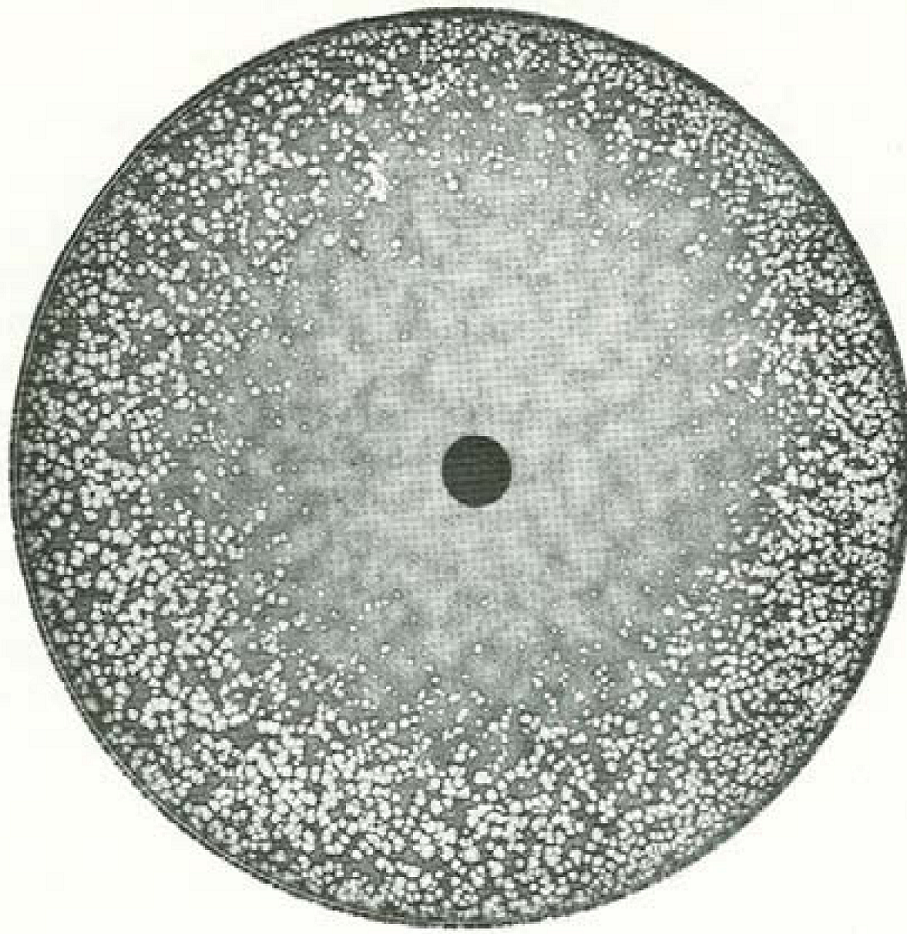
      <p>An example of virus plaque inhibition (in HeLa cells), a technique as originally applied in these early days [<xref ref-type="bibr" rid="B1">1</xref>], illustrates the central disc containing a compound having activity against rabbit poxvirus (<xref ref-type="fig" rid="figure1">Figure 1</xref>). The compound has diffused through the agar overlay, and the disc is surrounded by a zone where the formation of plaques is inhibited. Which compound inhibited rabbit poxvirus plaque formation is not clear from the context. </p>
      <fig id="figure1" position="float">
        <label>Figure 1</label>
        <caption>
          <p>Plaque-inhibition test. The central disc contains a compound having activity against rabbitpox virus. The compound has diffused through the agar overlay and the disc is surrounded by a zone in which the formation of plaques has been inhibited. Figure taken from Bauer [<xref ref-type="bibr" rid="B1">1</xref>].</p>
        </caption>
        <graphic xmlns:xlink="http://www.w3.org/1999/xlink" xlink:href="viruses-02-01322-g001.tif" scale="0"/>
      </fig>
      <p>In his paper on “Thiosemicarbazones” [<xref ref-type="bibr" rid="B6">6</xref>], Bauer contended that the benzaldehyde thiosemicarbazones were the first true antiviral agents to be discovered and that “they could have yielded antiviral agents useful in human medicine if their development had not come to a halt”. Thompson <italic>et al</italic>. [<xref ref-type="bibr" rid="B7">7</xref>] then described a wide range of thiosemicarbazones, from which emerged isatin 3-thiosemicarbazone [<xref ref-type="bibr" rid="B8">8</xref>]. This compound was further studied by Bauer [<xref ref-type="bibr" rid="B9">9</xref>] and found to be effective against the multiplication of VV in mice infected intracerebrally. The thiosemicarbazone finally selected for use in man was 1-methylisatin 3-thiosemicarbazone, better known as methisazone (brand name: Marboran). For the structural formulae of the compounds, see the Appendix accompanying this article. As further documented by Bauer [<xref ref-type="bibr" rid="B1">1</xref>], methisazone had tentative efficacy in the treatment and prophylaxis of smallpox, and the treatment of the complications of smallpox vaccination, <italic>i.e.,</italic> eczema vaccinatum and vaccinia gangrenosa. Methisazone would have yielded better results than antivaccinial γ-globulin in the prophylaxis of smallpox in persons who had been in contact with variola virus [<xref ref-type="bibr" rid="B10">10</xref>]. However, with the imminent global eradication of the variola virus (resulting from the successful implementation of the smallpox vaccination), interest in the use of methisazone for both the prophylaxis or treatment of smallpox rapidly declined, and so did the interest in further developing antiviral compounds active against either variola or vaccinia virus.</p>
    </sec>
    <sec>
      <title>2. The VV pox tail lesion model: the simplest virus mouse model ever described</title>
      <p>Vaccinia virus (VV) was the first virus I worked with when joining the Laboratory of my master, Prof. P. De Somer in 1964, as a student in medicine, to work on interferon and inducers thereof. Vaccinia virus was at that time not the highest priority as a target virus for antiviral development, but it was a useful tool virus for titrating interferon, not dangerous as we were all vaccinated with the virus, and extremely stable and reliable as a challenge virus, <italic>i.e.,</italic> for interferon titrations in murine L929 cells, which at that time I did almost weekly. Then I found VV to be a most useful virus to demonstrate the efficacy of interferon and interferon inducers [such as polyacrylic acid (PAA)], even if the latter was administered four weeks before VV infection (<xref ref-type="table" rid="table1">Table 1</xref>) [<xref ref-type="bibr" rid="B11">11</xref>]. The model was simple and reliable: at 7-10 days after intravenous injection with VV, the mice developed tail lesions which could be easily counted, and the reduction in the tail lesion number could be interpreted as a quantitative measure of the antiviral activity of any given anti-VV agent. The model was first described by Boyle, Haff and Stewart [<xref ref-type="bibr" rid="B12">12</xref>], but I found it extremely useful, convenient and accurate to demonstrate <italic>in vivo</italic> anti-VV activity of interferon and interferon inducers [<xref ref-type="bibr" rid="B11">11</xref>], and of many nucleoside analogs as well, including ribavirin, and 5-substituted 2’-deoxyuridines [<xref ref-type="bibr" rid="B13">13</xref>], carbocyclic 3-deazaadenosine [<xref ref-type="bibr" rid="B14">14</xref>], 3’-fluoro-3’-deoxyadenosine [<xref ref-type="bibr" rid="B15">15</xref>], (<italic>S</italic>)-HPMPA [<xref ref-type="bibr" rid="B16">16</xref>], EICAR [<xref ref-type="bibr" rid="B17">17</xref>], and S2242 [<xref ref-type="bibr" rid="B18">18</xref>]. The VV pox tail lesion model has also been used by others [<xref ref-type="bibr" rid="B19">19-21</xref>] to demonstrate the anti-VV activity of a variety of compounds (as reviewed by Smee and Sidwell [<xref ref-type="bibr" rid="B22">22</xref>]), but, despite (and probably because of) its simplicity, the VV pox tail lesion model has since the review article of Smee and Sidwell [<xref ref-type="bibr" rid="B22">22</xref>] in 2003 no longer popped up in recent publications.</p>
      <table-wrap id="table1" position="float"><object-id pub-id-type="pii">viruses-02-01322_table1</object-id>
        <object-id pub-id-type="pii">viruses-02-01322_table1</object-id>
        <label>Table 1</label>
        <caption>
          <p>Effect of time of a single polyacrylic acid (PAA) dose on the formation of vaccinia virus tail lesions. Data taken from De Clercq and De Somer [<xref ref-type="bibr" rid="B11">11</xref>].</p>
        </caption>
        <table>
          <thead>
            <tr>
              <th align="left" valign="middle">PAA treatment<sup>a</sup> before vaccinia virus infection<sup>b</sup></th>
              <th colspan="2" align="left" valign="middle">No. of lesions</th>
              <th align="left" valign="middle">Probability (comparison with control group)</th>
            </tr>
          </thead>
          <tbody>
            <tr>
              <td align="left" valign="middle"> </td>
              <td align="left" valign="middle">Per individual mouse</td>
              <td align="left" valign="middle">Average</td>
              <td align="left" valign="middle"> </td>
            </tr>
            <tr>
              <td align="left" valign="middle">Control</td>
              <td align="left" valign="middle">9, 3, 8, 1, 6, 2, 5, 11, 4, 0, 3, 2, 0, 11, 15, 10, 30, 4</td>
              <td align="left" valign="middle">6.89</td>
              <td align="left" valign="middle"> </td>
            </tr>
            <tr>
              <td align="left" valign="middle">4 weeks before</td>
              <td align="left" valign="middle">0, 1, 0, 5, 1, 0, 2, 0, 3, 1, 0, 2, 1, 3, 0, 11, 4, 3, 7, 1, 0</td>
              <td align="left" valign="middle">2.14</td>
              <td align="left" valign="middle">0.005 &lt; <italic>P</italic> &lt; 0.01</td>
            </tr>
            <tr>
              <td align="left" valign="middle">3 weeks before</td>
              <td align="left" valign="middle">0, 0, 1, 3, 5, 3, 0, 0, 0, 9, 3, 1, 0, 0, 1</td>
              <td align="left" valign="middle">1.73</td>
              <td align="left" valign="middle">0.01 &lt; <italic>P</italic> &lt; 0.02</td>
            </tr>
            <tr>
              <td align="left" valign="middle">2 weeks before</td>
              <td align="left" valign="middle">3, 1, 2, 1, 2, 1, 6, 1, 0, 0, 0, 1, 2, 1</td>
              <td align="left" valign="middle">1.50</td>
              <td align="left" valign="middle"><italic>P</italic> ~ 0.01</td>
            </tr>
            <tr>
              <td align="left" valign="middle">1 week before</td>
              <td align="left" valign="middle">0, 1, 1, 0, 0, 3, 2, 1, 1, 0, 2, 2, 1, 0, 1</td>
              <td align="left" valign="middle">1.00</td>
              <td align="left" valign="middle">0.001 &lt; <italic>P</italic> &lt; 0.002</td>
            </tr>
          </tbody>
        </table>
        <table-wrap-foot>
        <fn>      <p><sup>a</sup>PAA (0.25 mg) injected intraperitoneally.<sup> b</sup>Vaccinia virus injected intravenously. </p>
        </fn>
        </table-wrap-foot>
      </table-wrap>
    </sec>
    <sec>
      <title>3. Substituted 2’-deoxyuridines</title>
      <p>The 5-substituted 2’-deoxyuridines idoxuridine (5-iodo-dUrd, 5-iodo-2’-deoxyuridine, IDU) and trifluridine (5-trifluoro-2’-deoxythymidine, 5’-trifluoromethyl-dUrd, TFT) have been generally viewed as initiating the dawn of antiviral therapy, now 50 years ago [<xref ref-type="bibr" rid="B23">23</xref>]. In essence, this is because IDU and TFT later became the first licensed antiviral agents approved for the topical treatment (as eye drops and/or ointment) of herpetic keratitis [due to herpes simplex virus (HSV)]. It should not be ignored, however, that, while Prusoff [<xref ref-type="bibr" rid="B24">24</xref>] was the first to describe the synthesis of IDU, Herrmann [<xref ref-type="bibr" rid="B25">25</xref>] and Kaufman, Nesburn and Maloney [<xref ref-type="bibr" rid="B26">26</xref>] were the first to describe the inhibitory effects of IDU on vaccinia virus plaque formation in chick embryo cell cultures <italic>in vitro</italic> [<xref ref-type="bibr" rid="B25">25</xref>], and vaccinia virus infection of the rabbit cornea <italic>in vivo</italic> [<xref ref-type="bibr" rid="B26">26</xref>]. In fact, IDU and TFT would only be the first of a long list of 5-substituted 2’-deoxyuridines [<xref ref-type="bibr" rid="B27">27</xref>,<xref ref-type="bibr" rid="B28">28</xref>], which also included 5-nitro-dUrd [<xref ref-type="bibr" rid="B29">29</xref>], 5-formyl-dUrd [<xref ref-type="bibr" rid="B30">30</xref>], and 5-ethyl-dUrd, 5-vinyl-dUrd and 5-ethynyl-dUrd [<xref ref-type="bibr" rid="B31">31</xref>], and which were all shown, in 1980, to inhibit VV replication in primary rabbit kidney cell cultures <italic>in vitro</italic> at an IC<sub>50</sub> in the 0.1-1 µg/ml concentration range [<xref ref-type="bibr" rid="B31">31</xref>]. Ten years earlier, in 1969, Swierkowski and Shugar [<xref ref-type="bibr" rid="B32">32</xref>] had pointed to the importance of 5-ethyl-2’-deoxyuridine as an antiviral agent because it was considered nonmutagenic (in contrast with 5-iodo- and 5-bromo-2’-deoxyuridine). In 1965, Nemes and Hilleman [<xref ref-type="bibr" rid="B33">33</xref>] [the same Maurice Hilleman as magnificently depicted by Paul A. Offit in his book “Vaccinated. One Man’s Quest to Defeat the World’s Deadliest Diseases” [<xref ref-type="bibr" rid="B34">34</xref>]] described the effective treatment of herpetic keratitis with the new 5-substituted 2’-deoxyuridine 5-methylamino-2’-deoxyuridine (MADU); the antiviral activity of MADU roughly approximated that of IDU [<xref ref-type="bibr" rid="B33">33</xref>], but the tests were done with HSV, not VV. The largest series of 5-substituted 2’-deoxyuridines ever reviewed for their antiviral activity was that published in Mike Harnden’s book [<xref ref-type="bibr" rid="B35">35</xref>], but while the compounds were evaluated for their comparative activity against both HSV-1 and HSV-2, no data for VV were included [<xref ref-type="bibr" rid="B35">35</xref>].</p>
      <p>Of the 5-substituted dUrd analogs, only IDU has been subject of an in-depth evaluation of its efficacy against VV infections in mice [<xref ref-type="bibr" rid="B36">36</xref>]. IDU had a protective effect in the VV tail lesion model (see <italic>supra</italic>) in immunocompetent mice, and in a lethal model for VV infection in SCID (severe combined immune deficiency) mice that had been infected with VV either intranasally, intraperitoneally or intravenously [<xref ref-type="bibr" rid="B36">36</xref>], but the dose at which IDU had to be given (subcutaneously) was relatively high (75-150 mg/kg/day), and when IDU was compared to cidofovir [(<italic>S</italic>)-HPMPC], the latter proved more efficacious at a lower dose (25 mg/kg/day) in its protective activity against intranasal VV infection in SCID mice [<xref ref-type="bibr" rid="B36">36</xref>].</p>
    </sec>
    <sec>
      <title>4. Nucleoside analogs other than IDU and 5-substituted dUrd analogs</title>
      <p>In addition to the 5-substituted 2’-deoxyuridines, numerous other nucleoside analogs have been reported to inhibit VV at a sufficiently low IC<sub>50</sub> (&lt;1 µg/ml) to be potentially useful from a therapeutic viewpoint [<xref ref-type="bibr" rid="B27">27</xref>]: <italic>i.e.,</italic> IMP (inosine 5’-monophosphate) dehydrogenase inhibitors, such as EICAR (5-ethynyl-1-β-D-ribofuranosylimidazole-4-carboxamide) [<xref ref-type="bibr" rid="B17">17</xref>]; SAH (S-adenosylhomocysteine hydrolase) inhibitors, such as neplanocin A [<xref ref-type="bibr" rid="B37">37</xref>], 3-deazaneplanocin A [<xref ref-type="bibr" rid="B21">21</xref>], 9-(<italic>trans</italic>-2’,<italic>trans</italic>-3’-dihydroxycyclopent-4’-enyl)adenine (DHCeA) and -3-deazaadenine (c<sup>3</sup>DHCeA) [<xref ref-type="bibr" rid="B39">39</xref>], (1’<italic>R</italic>,2’<italic>S</italic>,3’<italic>R</italic>)-9-(2’,3’-dihydroxycyclopentan-1’-yl)adenine (DHCaA) and -3-deazaadenine (c<sup>3</sup>DHCaA) [<xref ref-type="bibr" rid="B40">40</xref>], (±)-6’β-fluoroaristeromycin (F-C-Ado) [<xref ref-type="bibr" rid="B41">41</xref>], (±)-5’-noraristeromycin [<xref ref-type="bibr" rid="B42">42</xref>], (-)-5’-noraristeromycin [<xref ref-type="bibr" rid="B43">43</xref>], <italic>epi</italic>(-)-5’-noraristeromycin [<xref ref-type="bibr" rid="B44">44</xref>], (-)-3-deaza-5’-noraristeromycin [<xref ref-type="bibr" rid="B45">45</xref>], (<italic>R</italic>)-6’-<italic>C</italic>-methylneplanocin A [<xref ref-type="bibr" rid="B46">46</xref>], 6’-homoneplanocin A [<xref ref-type="bibr" rid="B47">47</xref>], and 2-fluoroneplanocin A [<xref ref-type="bibr" rid="B48">48</xref>]; carbocyclic cyclopentenyl cytosine (Ce-Cyd) [<xref ref-type="bibr" rid="B49">49</xref>,<xref ref-type="bibr" rid="B50">50</xref>], a putative inhibitor of CTP synthetase; 8-methyladenosine [<xref ref-type="bibr" rid="B51">51</xref>], whose mechanism of action as an inhibitor of VV has never been clarified; the N-7-substituted acyclic nucleoside analog 2-amino-7-[(1,3-dihydroxy-2-propoxy)methyl]purine S2242 [<xref ref-type="bibr" rid="B52">52</xref>], which is inhibitory to VV, as well as various herpesviruses (HSV, VZV, CMV), and whose antiviral activity, while depending on phosphorylation by deoxycytidine kinase (dCK) [<xref ref-type="bibr" rid="B53">53</xref>], was never fully elucidated; and adenine arabinoside, vidarabine (ara-A), the first antiviral drug to be approved for systemic use (for the treatment of VZV infections) [<xref ref-type="bibr" rid="B54">54</xref>], which is quite effective against VV replication <italic>in vitro</italic> [<xref ref-type="bibr" rid="B31">31</xref>] (the inhibition of VV replication by ara-A may be explained by the inhibitory effect of ara-ATP on viral DNA synthesis and/or a direct inhibitory effect of ara-A on SAH hydrolase, akin to that of all other adenosine analogs mentioned above (see <italic>supra</italic>).</p>
      <fig id="figure2" position="float">
        <label>Figure 2</label>
        <caption>
          <p>Large zone of inhibition without zone of toxicity. Cultures of chick fibroblast cells were seeded with approximately 500 plaque-forming units of vaccinia virus; the cylinder(s) were charged with 0.05 ml of solution of the substance tested (6-azauracil riboside)) (2.0 M); dishes of 4 cm diameter were employed. Figure taken from Rada, Blaškovič, Šorm and Škoda [<xref ref-type="bibr" rid="B57">57</xref>]. </p>
        </caption>
        <graphic xmlns:xlink="http://www.w3.org/1999/xlink" xlink:href="viruses-02-01322-g002.tif" scale="0"/>
      </fig>   
      <p>Of the compounds listed above, very few were further explored for their <italic>in vivo</italic> activity against VV infection, and, when this was done, uniformly the pox tail lesion model was used: hence, this model allowed demonstration of the <italic>in vivo</italic> efficacy of EICAR [<xref ref-type="bibr" rid="B17">17</xref>], S2242 [<xref ref-type="bibr" rid="B18">18</xref>] and 3-deazaneplanocin A [<xref ref-type="bibr" rid="B21">21</xref>]. When no further <italic>in vivo</italic> testing was done with most of the compounds showing sufficient potency against VV <italic>in vitro</italic>, this must be attributed to the paucity of material available for such <italic>in vivo</italic> testing.</p>   
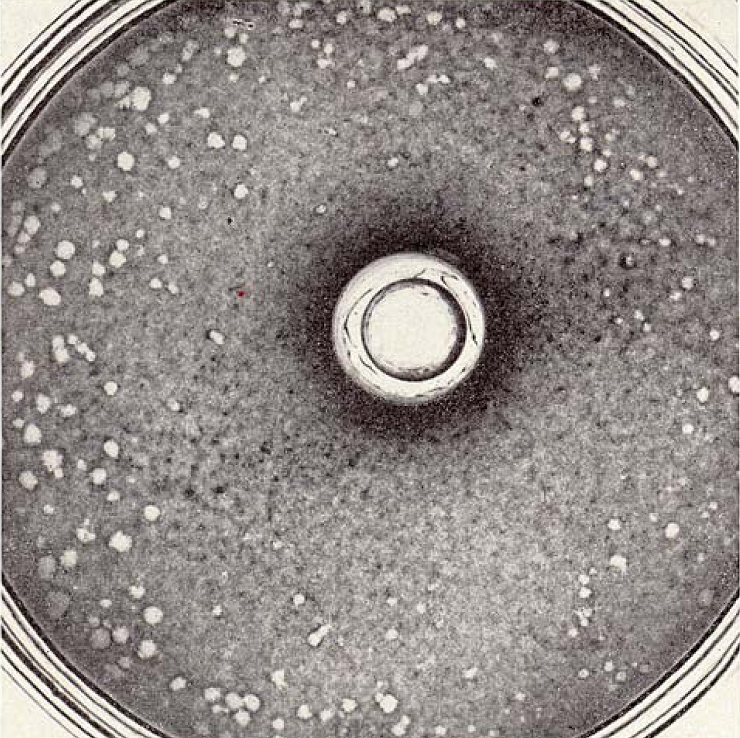
      <p>In part C of my Stories in Antiviral Drug Discovery [<xref ref-type="bibr" rid="B55">55</xref>] I wrote that the first description of the antiviral activity of 6-azauridine dated back to 1977, thereby referring to the paper published by Rada and Dragun in Ann. N.Y. Acad. Sci. [<xref ref-type="bibr" rid="B56">56</xref>]. This is not entirely correct. Rada, Blaškovič, Šorm and Škoda in 1960 (that is one year before Herrmann reported the plaque inhibition test for demonstrating the inhibitory effect of IDU on VV and HSV [<xref ref-type="bibr" rid="B25">25</xref>]) published a brief report in Experientia [<xref ref-type="bibr" rid="B57">57</xref>] on the inhibitory effect of 6-azauracil riboside on the multiplication of vaccinia virus (<xref ref-type="fig" rid="figure2">Figure 2</xref>). Rada <italic>et al. </italic>[<xref ref-type="bibr" rid="B57">57</xref>] also stated that 6-azauracil riboside had no direct inactivating effect on vaccinia virus and had no inhibitory effect on the multiplication of influenza virus, Newcastle disease virus (NDV) and Eastern equine encephalomyelitis virus when tested by the plaque method [<xref ref-type="bibr" rid="B57">57</xref>]. The mechanism of antiviral action of 6-azauridine was never fully elucidated. It has been assumed to interact, like pyrazofurin, at the level of the OMP decarboxylase [<xref ref-type="bibr" rid="B55">55</xref>].</p>

    </sec>
    <sec>
      <title>5. The acyclic nucleoside phosphonates</title>
      <p>In 1986, we (Antonin Holý and I, and our colleagues) described the broad-spectrum anti-DNA virals, including anti-VV, activity of (<italic>S</italic>)-9-(3-hydroxy-2-phosphonylmethoxypropyl)adenine [(<italic>S</italic>)-HPMPA] [<xref ref-type="bibr" rid="B58">58</xref>], and one year later, we extended these observations to various other phosphonylmethoxyalkyl derivatives of purines and pyrimidines, <italic>i.e.,</italic> (<italic>S</italic>)-1-(3-hydroxy-2-phosphonylmethoxypropyl)cytosine [(<italic>S</italic>)-HPMPC] [<xref ref-type="bibr" rid="B59">59</xref>] [(<italic>S</italic>)-HPMPC (cidofovir, Vistide®) would be licensed nine years later, in 1996, for the treatment of CMV retinitis in AIDS patients]. From the beginning, it was immediately clear that (<italic>S</italic>)-HPMPA and especially (<italic>S</italic>)-HPMPC (because it seemed to be less toxic in mice) had therapeutic potential as antiviral drugs [<xref ref-type="bibr" rid="B60">60</xref>]. The <italic>in vivo</italic> activity of (<italic>S</italic>)-HPMPA in the VV pox tail lesion model was already mentioned in the paper published in Antiviral Research in 1987 [<xref ref-type="bibr" rid="B59">59</xref>]. For (<italic>S</italic>)-HPMPC, we first focused on its efficacy in the therapy of experimental HSV infections in mice [<xref ref-type="bibr" rid="B61">61</xref>], before we described, in 1993, its efficacy in the treatment of VV infections in both normal, immunocompetent mice (based, again, on the VV pox tail lesion model) and immunodeficient (SCID) mice [<xref ref-type="bibr" rid="B62">62</xref>].</p>
      <p>This was five years before orthopoxviruses, in particular variola, the etiological agent of smallpox, were, rather suddenly, felt as a bioterrorist public health threat [<xref ref-type="bibr" rid="B63">63</xref>,<xref ref-type="bibr" rid="B64">64</xref>]. This bioterrorist scenario prompted the search for an adequate therapy (or prophylaxis) to curb orthopoxvirus infections, and in the next few years several investigators (Bray <italic>et al.</italic>, Smee <italic>et al</italic>.) found (<italic>S</italic>)-HPMPC (in the mean time better known as cidofovir) to protect mice against lethal respiratory infections with cowpox virus [<xref ref-type="bibr" rid="B65">65</xref>,<xref ref-type="bibr" rid="B66">66</xref>] and vaccinia virus [<xref ref-type="bibr" rid="B67">67</xref>,<xref ref-type="bibr" rid="B68">68</xref>]. Aerosolized cidofovir was found to be efficacious against aerosolized cowpox virus infection in mice [<xref ref-type="bibr" rid="B69">69</xref>], and cidofovir also proved efficacious in the treatment of mice infected with an highly virulent strain of ectromelia (mousepox virus) encoding interleukin-4 [<xref ref-type="bibr" rid="B70">70</xref>].</p>
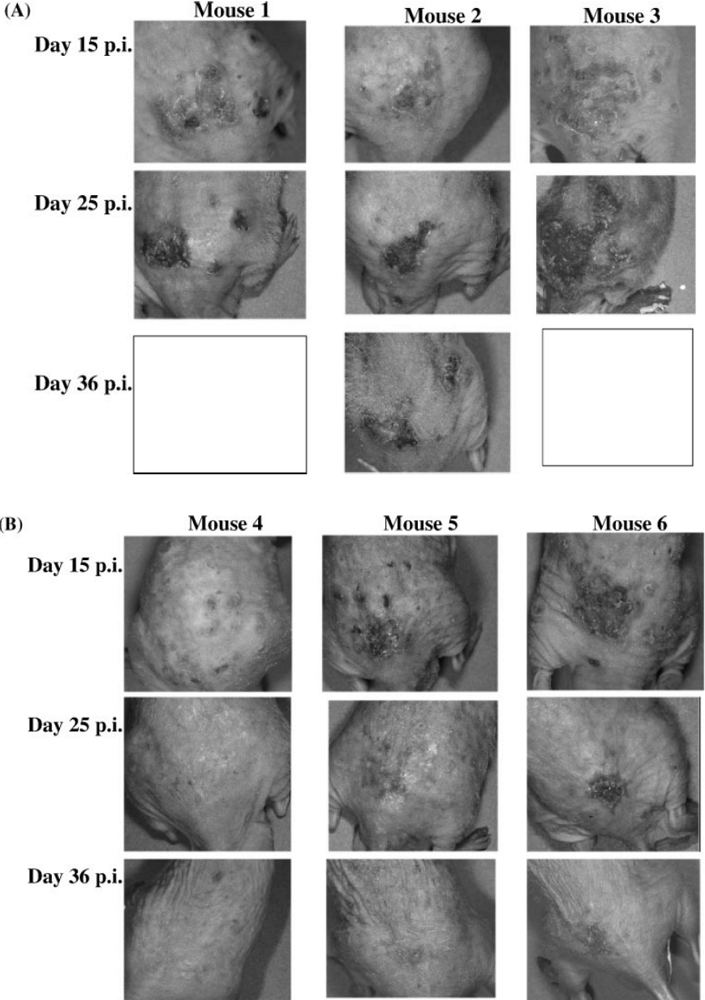
      <p>In a review on the potential of cidofovir in the treatment of poxvirus infections [<xref ref-type="bibr" rid="B71">71</xref>], I stated that cidofovir should be effective in the therapy and short-term prophylaxis of smallpox and related poxvirus infections in humans, as well as the treatment of the complications of vaccinia that may arise in immunocompromised patients inadvertently inoculated with the smallpox vaccine (vaccinia). With Johan Neyts and colleagues, I later demonstrated that cidofovir is indeed efficacious in the treatment of disseminated progressive vaccinia (in a mouse model); even when cidofovir treatment was initiated at the time disseminated vaccinia had developed, it caused lesions to heal and regress (<xref ref-type="fig" rid="figure3">Figure 3</xref>) [<xref ref-type="bibr" rid="B72">72</xref>,<xref ref-type="bibr" rid="B73">73</xref>]. </p>
      <fig id="figure3" position="float">
        <label>Figure 3</label>
        <caption>
          <p>Effect of systemically administered cidofovir on disseminated vaccinia when therapy was initiated on day 15 p.i. <bold>(A) </bold>Progression of cutaneous vaccinia in three mock-treated animals. Mice 1 and 3 died on day 35 p.i.; mouse 2 died on day 36 p.i. <bold>(B)</bold> Effect of subcutaneous treatment with cidofovir (at 100 mg/kg/day), initiated on day 15 p.i., on disseminated cutaneous vaccinia lesions. Cidofovir was given for 21 days (over a period of 24 days). Figure taken from Neyts, Leyssen, Verbeken and De Clercq [<xref ref-type="bibr" rid="B72">72</xref>,<xref ref-type="bibr" rid="B73">73</xref>].</p>
        </caption>
        <graphic xmlns:xlink="http://www.w3.org/1999/xlink" xlink:href="viruses-02-01322-g003.tif" scale="0"/>
      </fig>
    </sec>
    <sec>
      <title>6. Oral alkoxyalkyl prodrugs of acyclic nucleoside phosphonates</title>
      <p>An additional advantage of cidofovir is that it is not only active against orthopoxviruses, but also parapoxviruses [such as orf (ecthyma contagiosum)] and molluscipoxviruses (such as molluscum contagiosum), which may both lead to serious infections in immunocompromised patients (in fact, anecdotal reports suggest that cidofovir is clinically efficacious against orf and molluscum contagiosum [<xref ref-type="bibr" rid="B71">71</xref>,<xref ref-type="bibr" rid="B74">74</xref>,<xref ref-type="bibr" rid="B75">75</xref>]). However, cidofovir, like all other acyclic nucleoside phosphonates [<xref ref-type="bibr" rid="B76">76</xref>], suffers from the disadvantage that it has poor oral bioavailability. This explains why alkoxyalkyl [<italic>i.e.,</italic> hexadecyloxypropyl (HDP) and octadecyloxyethyl (ODE)] prodrugs of cidofovir (HDP-CDV and ODE-CDV) were developed [<xref ref-type="bibr" rid="B77">77</xref>], intentionally as oral medicines for the prophylaxis and therapy of smallpox infection [<xref ref-type="bibr" rid="B78">78</xref>]. Esterification of cidofovir with alkoxyalkanols not only increases its oral bioavailability but also diminishes drug accumulation in the kidney [<xref ref-type="bibr" rid="B79">79</xref>], and thus reduces nephrotoxicity [<xref ref-type="bibr" rid="B77">77</xref>]. In molecular terms, HDP-CDV is rapidly taken up in the cells thanks to a rapid association with cellular membrane phospholipids [<xref ref-type="bibr" rid="B80">80</xref>]. This results in enhanced inhibition of orthopoxvirus (<italic>i.e.,</italic> vaccinia virus and cowpox virus) replication <italic>in vitro</italic> [<xref ref-type="bibr" rid="B81">81</xref>,<xref ref-type="bibr" rid="B82">82</xref>]. Increased <italic>in vivo</italic> activity of HDP-CDV and ODE-CDV, over that of CDV, has also been demonstrated in mice infected with vaccinia virus (VV) or cowpox virus (CV) [<xref ref-type="bibr" rid="B83">83</xref>], or ectromelia (mousepox) virus [<xref ref-type="bibr" rid="B84">84</xref>].</p>
      <p>Following the same reasoning as for cidofovir, alkoxyalkyl (<italic>i.e.,</italic> HDP and ODE) derivatives have also been prepared from (<italic>S</italic>)-HPMPA, the prototype of the acyclic nucleoside phosphonates [<xref ref-type="bibr" rid="B58">58</xref>]. When compared with the alkoxyalkyl esters of cidofovir, the corresponding alkoxyalkyl esters of (<italic>S</italic>)-HPMPA were equally active against CMV but were 15- to 20-fold more active against VV and CV <italic>in vitro</italic> [<xref ref-type="bibr" rid="B85">85</xref>]. <italic>In vivo</italic>, oral treatment with HDP-(<italic>S</italic>)-HPMPA or ODE-(<italic>S</italic>)-HPMPA were highly effective against lethal VV or CV infections in mice [<xref ref-type="bibr" rid="B86">86</xref>]. Thus, alkoxyalkyl prodrugs of both cidofovir and (<italic>S</italic>)-HPMPA can be considered excellent candidates for the oral treatment (and prophylaxis) of smallpox in humans, should this prove necessary in the event of a bioterrorist release of the variola virus (HDP-CDV is also referred to as CMX001 [<xref ref-type="bibr" rid="B78">78</xref>]).</p>
    </sec>
    <sec>
      <title>7. ST-246, an orally bioavailable antipoxvirus compound, that inhibits extracellular virus formation</title>
      <p>Following a totally new strategy (different from the nucleoside or nucleotide analogs), Dennis Hruby and his colleagues at SIGA Technologies in Corvallis (Oregon) came up with a new class of orthopoxvirus (<italic>i.e.,</italic> vaccinia virus) antiviral drugs (<italic>i.e.,</italic> TTP-6171) that block viral maturation [<xref ref-type="bibr" rid="B87">87</xref>]. These drugs block viral maturation through an interaction with the VV I7L gene product, a cysteine proteinase responsible for cleavage of the three major core protein precursors [<xref ref-type="bibr" rid="B88">88</xref>] and, hence, the production of infectious virions [<xref ref-type="bibr" rid="B89">89</xref>]. The reported compound, TTP-6171, was not further pursued as a potentially antiviral drug, in favor of a newly discovered compound, ST-246, that appeared to inhibit extracellular orthopoxvirus formation (and to protect mice from a lethal orthopoxvirus challenge) [<xref ref-type="bibr" rid="B90">90</xref>], apparently as the result of an action targeted at the F13L protein (phospholipase) which had previously [<xref ref-type="bibr" rid="B91">91</xref>] been recognized as a major membrane component of extracellular vaccinia virus.</p>
      <p>ST-246, or 4-trifluoromethyl-<italic>N</italic>-(3,3a,4,4a,5,5a,6,6a-octahydro-1,3-dioxo-4,6-etheno-cycloprop-(f)isoindol-2-(1<italic>H</italic>-yl)benzamide [<xref ref-type="bibr" rid="B92">92</xref>] was shown to have activity against a number of orthopoxviruses, including vaccinia, monkeypox, camelpox, cowpox, ectromelia (mousepox) and variola virus [<xref ref-type="bibr" rid="B90">90</xref>]. ST-246 has proven effective against vaccinia, cowpox, and camelpox viruses in human embryonic lung and primary human keratinocyte cell monolayers, as well as three-dimensional organotypic raft cultures [<xref ref-type="bibr" rid="B93">93</xref>]. <italic>In vivo</italic> efficacy of ST-246 has been demonstrated in mice infected with vaccinia virus [<xref ref-type="bibr" rid="B90">90</xref>] or ectromelia virus (even if treatment was delayed until 72 hours after virus infection [<xref ref-type="bibr" rid="B94">94</xref>]), and in ground squirrels infected with monkeypox virus [<xref ref-type="bibr" rid="B95">95</xref>]. ST-246 is also effective against aerosolized rabbit pox in rabbits [<xref ref-type="bibr" rid="B96">96</xref>], and acts synergistically with CMX001 (HDP-CDV) in mice infected with cowpox virus [<xref ref-type="bibr" rid="B97">97</xref>], which opens new avenues for the treatment of orthopoxvirus infections.</p>
      <p>Most important is to know whether ST-246 would be effective against smallpox (bioterrorist attack) or the complications of smallpox vaccination (such as eczema vaccinatum). A recent case of severe eczema vaccinatum in a household contact (28-month-old son) of a smallpox vaccinee illustrates the risks for such adverse events [<xref ref-type="bibr" rid="B98">98</xref>]. The boy eventually recovered after treatment with vaccinia immune globulin, cidofovir, and ST-246 [<xref ref-type="bibr" rid="B98">98</xref>]. What exactly saved the boy’s life - the antibody, cidofovir, ST-246, or the extraordinary medical care, or combinations of some or all of the above - would never be known.</p>
      <p>Recently, ST-246 has been found to protect non-human primates from smallpox virus or monkeypox virus [<xref ref-type="bibr" rid="B99">99</xref>]. ST-246 has, in the mean time, been renamed tecovirimat [<xref ref-type="bibr" rid="B100">100</xref>] and its target protein, F13L, is also known as p37. It is further developed by SIGA Technologies for the treatment of variola virus infection (smallpox) [<xref ref-type="bibr" rid="B100">100</xref>].</p>
    </sec>
    <sec>
      <title>8. Cellular kinases as targets for anti-orthopoxvirus therapy</title>
      <p>Among the various agents that could be considered potentially useful in the therapy of (ortho)poxvirus infections [<xref ref-type="bibr" rid="B101">101</xref>], also rank a few compounds that are targeted at cellular (tyrosine) kinases, and thus could inhibit poxvirus infections through inhibition of cellular signal transduction, <italic>i.e.,</italic> CI-1033 and related 4-anilinoquinazolines [<xref ref-type="bibr" rid="B102">102</xref>] and STI-571 (imatinib, better known as Gleevec or Glivec) [<xref ref-type="bibr" rid="B103">103</xref>]. Gleevec has been licensed for clinical use as an anticancer agent, to treat chronic myeloid leukemia. That it would also have the ability to inhibit poxvirus infections (by blocking the egress of these viruses from infected cells) [<xref ref-type="bibr" rid="B103">103</xref>] is an unanticipated attribute [<xref ref-type="bibr" rid="B104">104</xref>]. Thus, Gleevec casts “a pox on poxviruses” [<xref ref-type="bibr" rid="B104">104</xref>], but although the findings of Reeves <italic>et al.</italic> [<xref ref-type="bibr" rid="B103">103</xref>] date from five years back, the potential utility of Gleevec, or tyrosine kinase inhibitors in general, in the treatment of poxvirus infections like smallpox, monkeypox, or the complications associated with vaccinia virus vaccination, still remains to be substantiated.</p>
    </sec>
    <sec>
      <title>9. Camelpox virus, the orthopoxvirus most closely related to variola virus</title>
      <p>Of all the (ortho)poxviruses, camelpox virus, the etiologic agent of camelpox occurring in Old World camels (<italic>Camelus dromedarius</italic> and <italic>Camelus bactrianus</italic>), is the orthopoxvirus most closely related to variola virus, the cause of smallpox [<xref ref-type="bibr" rid="B105">105</xref>]. Studies with camelpox virus (which is not supposed to be pathogenic for humans) have allowed confirmation of the anti-poxvirus activity of the “older” acyclic nucleoside phosphonates such as (<italic>S</italic>)-HPMPA and (<italic>S</italic>)-HPMPC [<xref ref-type="bibr" rid="B106">106</xref>], but also to extend the anti-camelpox virus activity to the “newer” acyclic nucleoside phosphonates such as (<italic>R</italic>)-{2,4-diamino-3-hydroxy-6-[2-(phosphonomethoxy)propopy]}pyrimidine [(<italic>R</italic>)-HPMPO-DAPy] and 1-(<italic>S</italic>)-[3-hydroxy-2-(phosphonomethoxy)propyl]-5-azacytosine (HPMP-5-azaC) [<xref ref-type="bibr" rid="B107">107</xref>]. As already mentioned above [<xref ref-type="bibr" rid="B93">93</xref>], the anti-(ortho)poxvirus activity of ST-246 also extends to camelpox virus, although camelpox, vaccinia, and cowpox show different levels of sensitivity to ST-246, probably because of dissimilarities between their ways of propagation [<xref ref-type="bibr" rid="B108">108</xref>].</p>
    </sec>
    <sec>
      <title>10. Epilogue: antiviral treatment more effective than smallpox vaccination</title>
      <fig id="figure4" position="float">
        <label>Figure 4</label>
        <caption>
          <p>Kaplan-Meier plot showing the effect of different post-exposure treatments on the survival of monkeys. Survival expressed as percentages after intratracheal MPXV infection. After virus exposure, macaques were sham-treated (group I), vaccinated with smallpox vaccine Elstree-RIVM (group II), treated with 5 doses of cidofovir (group III), with six doses of cidofovir (group IV), with five doses of HPMPO-DAPy (group V) or with six doses of HPMPO-DAPy (group VI). Arrowheads indicate times of vaccination and antiviral treatment. *The control group is supplemented with 11 animals from previous experiments. Figure taken from Stittelaar <italic>et al</italic>. [<xref ref-type="bibr" rid="B109">109</xref>].</p>
        </caption>
        <graphic xmlns:xlink="http://www.w3.org/1999/xlink" xlink:href="viruses-02-01322-g004.tif" scale="0"/>
      </fig>
      <p>Although the preventive use of smallpox vaccination is well documented, little is known about its efficacy when used after exposure to variola virus. A few years ago, we (Albert Osterhaus and I, and our colleagues) wanted to compare the effectiveness of post-exposure smallpox vaccination and antiviral treatment with either cidofovir [(<italic>S</italic>)-HPMPC] or the related acyclic nucleoside phosphonate analog (<italic>R</italic>)-HPMPO-DAPy, at 24 hours after lethal intratracheal infection of cynomolgus monkeys (<italic>Macaca</italic> <italic>fascicularis</italic>) with monkeypox virus. This study was actually planned after I had met Koert Stittelaar at a meeting in London (“Twenty-five years on: smallpox revisited”, Retroscreen Virology and Institute of Cell and Molecular Sciences Barts and the London Queen Mary’s School of Medicine &amp; Dentistry, The Great Hall, St. Bartholomew’s Hospital, London, Great Britain, 31 October 2003). This study, published in 2006 in Nature [<xref ref-type="bibr" rid="B109">109</xref>] clearly revealed that initiation of antiviral treatment with either cidofovir or (<italic>R</italic>)-HPMPO-DAPy at 24 hours after monkeypox virus infection resulted in significantly reduced mortality (<xref ref-type="fig" rid="figure4">Figure 4</xref>). In contrast, when monkeys were vaccinated at 24 hours after virus infection, using a standard human dose of a currently recommended smallpox vaccine (Elstree), no significant reduction in mortality was observed [<xref ref-type="bibr" rid="B109">109</xref>]. From this study [<xref ref-type="bibr" rid="B109">109</xref>], we concluded “that adequate preparedness for a biological threat involving smallpox should include the possibility of treating exposed individuals with antiviral compounds such as cidofovir or other selective anti-poxvirus drugs”.</p>
    </sec>
  </body>
  <back>
  <ack>      <p>I am most grateful to Christiane Callebaut for her proficient editorial assistance.</p></ack>
    <ref-list>
    <title>References</title>
      <ref id="B1">
        <citation citation-type="book">
          <person-group person-group-type="author">
            <name>
              <surname>Bauer</surname>
              <given-names>D.J.</given-names>
            </name>
          </person-group>
          <article-title>Introduction to antiviral chemotherapy</article-title>
          <source>Chemotherapy of Virus Diseases</source>
          <person-group person-group-type="editor">
            <name>
              <surname>Bauer</surname>
              <given-names>D.J.</given-names>
            </name>
          </person-group>
          <publisher-name>Pergamon Press</publisher-name>
          <publisher-loc>Oxford, UK</publisher-loc>
          <year>1972</year>
          
        </citation>
      </ref>
      <ref id="B2">
        <citation citation-type="journal">
          <person-group person-group-type="author">
            <name>
              <surname>Domagk</surname>
              <given-names>G.</given-names>
            </name>
            <name>
              <surname>Behnisch</surname>
              <given-names>R.</given-names>
            </name>
            <name>
              <surname>Mietzch</surname>
              <given-names>F.</given-names>
            </name>
            <name>
              <surname>Schmidt</surname>
              <given-names>H.</given-names>
            </name>
          </person-group>
          <article-title>Über eine neue, gegen Tuberkelbazillen <italic>in vitro</italic> wirksame Verbindungsklasse</article-title>
          <source>Naturwissenschaften</source>
          <year>1946</year>
          <volume>10</volume>
          <fpage>315</fpage>
          <pub-id pub-id-type="doi">10.1007/BF00624524</pub-id>
        </citation>
      </ref>
      <ref id="B3">
        <citation citation-type="journal">
          <person-group person-group-type="author">
            <name>
              <surname>Hamre</surname>
              <given-names>D.</given-names>
            </name>
            <name>
              <surname>Bernstein</surname>
              <given-names>J.</given-names>
            </name>
            <name>
              <surname>Donovick</surname>
              <given-names>R.</given-names>
            </name>
          </person-group>
          <article-title>Activity of p-aminobenzaldehyde, 3-thiosemicarbazone on vaccinia virus in the chick embryo and in the mouse</article-title>
          <source>Proc. Soc. Exp. Biol. Med.</source>
          <year>1950</year>
          <volume>73</volume>
          <fpage>275</fpage>
          <lpage>278</lpage>
        </citation>
      </ref>
      <ref id="B4">
        <citation citation-type="journal">
          <person-group person-group-type="author">
            <name>
              <surname>Hamre</surname>
              <given-names>D.</given-names>
            </name>
            <name>
              <surname>Brownlee</surname>
              <given-names>K.A.</given-names>
            </name>
            <name>
              <surname>Donovick</surname>
              <given-names>R.</given-names>
            </name>
          </person-group>
          <article-title>Studies on the chemotherapy of vaccinia virus. II. The activity of some thiosemicarbazones. </article-title>
          <source>J. Immunol.</source>
          <year>1951</year>
          <volume>67</volume>
          <fpage>305</fpage>
          <lpage>312</lpage>
          
          <pub-id pub-id-type="pmid">14888894</pub-id>
        </citation>
      </ref>
      <ref id="B5">
        <citation citation-type="journal">
          <person-group person-group-type="author">
            <name>
              <surname>Thompson</surname>
              <given-names>R.L.</given-names>
            </name>
            <name>
              <surname>Price</surname>
              <given-names>M.L.</given-names>
            </name>
            <name>
              <surname>Minton Jr.</surname>
              <given-names>S.A.</given-names>
            </name>
          </person-group>
          <article-title>Protection of mice against vaccinia virus by administration of benzaldehyde thiosemicarbazone</article-title>
          <source>Proc. Soc. Exp. Biol. Med.</source>
          <year>1951</year>
          <volume>78</volume>
          <fpage>11</fpage>
          <lpage>13</lpage>
          <pub-id pub-id-type="pmid">14891903</pub-id>
        </citation>
      </ref>
      <ref id="B6">
        <citation citation-type="book">
          <person-group person-group-type="author">
            <name>
              <surname>Bauer</surname>
              <given-names>D.J.</given-names>
            </name>
          </person-group>
          <article-title>Thiosemicarbazones</article-title>
          <source>Chemotherapy of Virus Diseases</source>
          <person-group person-group-type="editor">
            <name>
              <surname>Bauer</surname>
              <given-names>D.J.</given-names>
            </name>
          </person-group>
          <year>1972</year>
          <publisher-name>Pergamon Press</publisher-name>
          <publisher-loc>Oxford, UK</publisher-loc>
        </citation>
      </ref>
      <ref id="B7">
        <citation citation-type="journal">
          <person-group person-group-type="author">
            <name>
              <surname>Thompson</surname>
              <given-names>R.L.</given-names>
            </name>
            <name>
              <surname>Minton Jr.</surname>
              <given-names>S.A.</given-names>
            </name>
            <name>
              <surname>Officer</surname>
              <given-names>J.E.</given-names>
            </name>
            <name>
              <surname>Hitchings</surname>
              <given-names>G.H.</given-names>
            </name>
          </person-group>
          <article-title>Effect of heterocyclic and other thiosemicarbazones on vaccinia infection in the mouse

</article-title>
          <source>J. Immunol.</source>
          <year>1953</year>
          <volume>70</volume>
          <fpage>229</fpage>
          <lpage>234</lpage>
          <pub-id pub-id-type="pmid">13035112</pub-id>
        </citation>
      </ref>
      <ref id="B8">
        <citation citation-type="journal">
          <person-group person-group-type="author">
            <name>
              <surname>Thompson</surname>
              <given-names>R.L.</given-names>
            </name>
            <name>
              <surname>Davis</surname>
              <given-names>J.</given-names>
            </name>
            <name>
              <surname>Russell</surname>
              <given-names>P.B.</given-names>
            </name>
            <name>
              <surname>Hitchings</surname>
              <given-names>G.H.</given-names>
            </name>
          </person-group>
          <article-title>Effect of aliphatic oxime and isatin thiosemicarbazone on vaccinia infection in the mouse and in the rabbit</article-title>
          <source>Proc. Soc. Exp. Biol. Med.</source>
          <year>1953</year>
          <volume>84</volume>
          <fpage>496</fpage>
          <lpage>499</lpage>
          <pub-id pub-id-type="pmid">13121085</pub-id>
        </citation>
      </ref>
      <ref id="B9">
        <citation citation-type="journal">
          <person-group person-group-type="author">
            <name>
              <surname>Bauer</surname>
              <given-names>D.J.</given-names>
            </name>
          </person-group>
          <article-title>The antiviral and synergic actions of isatin thiosemicarbazone and certain phenoxypyrimidines in vaccinia infection in mice</article-title>
          <source>Br. J. Exp. Pathol.</source>
          <year>1955</year>
          <volume>36</volume>
          <fpage>105</fpage>
          <lpage>114</lpage>
          <pub-id pub-id-type="pmid">14351641</pub-id>
        </citation>
      </ref>
      <ref id="B10">
        <citation citation-type="journal">
          <person-group person-group-type="author">
            <name>
              <surname>Bauer</surname>
              <given-names>D.J.</given-names>
            </name>
            <name>
              <surname>St. Vincent</surname>
              <given-names>L.</given-names>
            </name>
            <name>
              <surname>Kempe</surname>
              <given-names>C.H.</given-names>
            </name>
            <name>
              <surname>Downie</surname>
              <given-names>A.W.</given-names>
            </name>
          </person-group>
          <article-title>Prophylactic treatment of small pox contacts with N-methylisatin β-thiosemicarbazone (compound 33T57, Marboran)</article-title>
          <source>Lancet</source>
          <year>1963</year>
          <volume>2</volume>
          <fpage>494</fpage>
          <lpage>496</lpage>
          <pub-id pub-id-type="doi">10.1016/S0140-6736(63)90230-7</pub-id>
        </citation>
      </ref>
      <ref id="B11">
        <citation citation-type="journal">
          <person-group person-group-type="author">
            <name>
              <surname>De Clercq</surname>
              <given-names>E.</given-names>
            </name>
            <name>
              <surname>De Somer</surname>
              <given-names>P.</given-names>
            </name>
          </person-group>
          <article-title>Effect of interferon, polyacrylic acid, and polymethacrylic acid on tail lesions on mice infected with vaccinia virus</article-title>
          <source>Appl. Microbiol.</source>
          <year>1968</year>
          <volume>16</volume>
          <fpage>1314</fpage>
          <lpage>1319</lpage>
          <pub-id pub-id-type="pmid">5676405</pub-id>
        </citation>
      </ref>
      <ref id="B12">
        <citation citation-type="journal">
          <person-group person-group-type="author">
            <name>
              <surname>Boyle</surname>
              <given-names>J.J.</given-names>
            </name>
            <name>
              <surname>Haff</surname>
              <given-names>R.F.</given-names>
            </name>
            <name>
              <surname>Stewart</surname>
              <given-names>R.C.</given-names>
            </name>
          </person-group>
          <article-title>1967. Evaluation of antiviral compounds by suppression of tail lesions in vaccinia-infected mice</article-title>
          <source>Antimicrob. Agents Chemother.</source>
          <year>1966</year>
          <volume>6</volume>
          <fpage>536</fpage>
          <lpage>539</lpage>
        <pub-id pub-id-type="pmid">5985284</pub-id></citation>
      </ref>
      <ref id="B13">
        <citation citation-type="journal">
          <person-group person-group-type="author">
            <name>
              <surname>De Clercq</surname>
              <given-names>E.</given-names>
            </name>
            <name>
              <surname>Luczak</surname>
              <given-names>M.</given-names>
            </name>
            <name>
              <surname>Shugar</surname>
              <given-names>D.</given-names>
            </name>
            <name>
              <surname>Torrence</surname>
              <given-names>P.F.</given-names>
            </name>
            <name>
              <surname>Waters</surname>
              <given-names>J.A.</given-names>
            </name>
            <name>
              <surname>Witkop</surname>
              <given-names>B.</given-names>
            </name>
          </person-group>
          <article-title>Effect of cytosine, arabinoside, iododeoxyuridine, ethyldeoxyuridine, thiocyanatodeoxyuridine, and ribavirin on tail lesion formation in mice infected with vaccinia virus</article-title>
          <source>Proc. Soc. Exp. Biol. Med.</source>
          <year>1976</year>
          <volume>151</volume>
          <fpage>487</fpage>
          <lpage>490</lpage>
          <pub-id pub-id-type="pmid">1257248</pub-id>
        </citation>
      </ref>
      <ref id="B14">
        <citation citation-type="journal">
          <person-group person-group-type="author">
            <name>
              <surname>De Clercq</surname>
              <given-names>E.</given-names>
            </name>
            <name>
              <surname>Bergstrom</surname>
              <given-names>D.E.</given-names>
            </name>
            <name>
              <surname>Holý</surname>
              <given-names>A.</given-names>
            </name>
            <name>
              <surname>Montgomery</surname>
              <given-names>J.A.</given-names>
            </name>
          </person-group>
          <article-title>Broad-spectrum antiviral activity of adenosine analogs</article-title>
          <source>Antiviral Res.</source>
          <year>1984</year>
          <volume>4</volume>
          <fpage>119</fpage>
          <lpage>133</lpage>
          <pub-id pub-id-type="doi">10.1016/0166-3542(84)90012-3</pub-id>
        </citation>
      </ref>
      <ref id="B15">
        <citation citation-type="journal">
          <person-group person-group-type="author">
            <name>
              <surname>Van Aerschot</surname>
              <given-names>A.</given-names>
            </name>
            <name>
              <surname>Herdewijn</surname>
              <given-names>P.</given-names>
            </name>
            <name>
              <surname>Janssen</surname>
              <given-names>G.</given-names>
            </name>
            <name>
              <surname>Cools</surname>
              <given-names>M.</given-names>
            </name>
            <name>
              <surname>De Clercq</surname>
              <given-names>E.</given-names>
            </name>
          </person-group>
          <article-title>Synthesis and antiviral activity evaluation of 3'-fluoro-3'-deoxyribonucleosides: broad-spectrum antiviral activity of 3'-fluoro-3'-deoxyadenosine</article-title>
          <source>Antiviral Res.</source>
          <year>1989</year>
          <volume>12</volume>
          <fpage>133</fpage>
          <lpage>150</lpage>
          <pub-id pub-id-type="doi">10.1016/0166-3542(89)90047-8</pub-id>
          <pub-id pub-id-type="pmid">2624455</pub-id>
        </citation>
      </ref>
      <ref id="B16">
        <citation citation-type="journal">
          <person-group person-group-type="author">
            <name>
              <surname>De Clercq</surname>
              <given-names>E.</given-names>
            </name>
            <name>
              <surname>Holý</surname>
              <given-names>A.</given-names>
            </name>
            <name>
              <surname>Rosenberg</surname>
              <given-names>I.</given-names>
            </name>
          </person-group>
          <article-title>Efficacy of phosphonylmethoxyalkyl derivatives of adenine in experimental herpes simplex virus and vaccinia virus infections <italic>in vivo</italic></article-title>
          <source>Antimicrob. Agents Chemother.</source>
          <year>1989</year>
          <volume>33</volume>
          <fpage>185</fpage>
          <lpage>191</lpage>
          <pub-id pub-id-type="pmid">2719463</pub-id>
        </citation>
      </ref>
      <ref id="B17">
        <citation citation-type="journal">
          <person-group person-group-type="author">
            <name>
              <surname>De Clercq</surname>
              <given-names>E.</given-names>
            </name>
            <name>
              <surname>Cools</surname>
              <given-names>M.</given-names>
            </name>
            <name>
              <surname>Balzarini</surname>
              <given-names>J.</given-names>
            </name>
            <name>
              <surname>Snoeck</surname>
              <given-names>R.</given-names>
            </name>
            <name>
              <surname>Andrei</surname>
              <given-names>G.</given-names>
            </name>
            <name>
              <surname>Hosoya</surname>
              <given-names>M.</given-names>
            </name>
            <name>
              <surname>Shigeta</surname>
              <given-names>S.</given-names>
            </name>
            <name>
              <surname>Ueda</surname>
              <given-names>T.</given-names>
            </name>
            <name>
              <surname>Minakawa</surname>
              <given-names>N.</given-names>
            </name>
            <name>
              <surname>Matsuda</surname>
              <given-names>A.</given-names>
            </name>
          </person-group>
          <article-title>Antiviral activities of 5-ethynyl-1-beta-D-ribofuranosylimidazole-4- carboxamide and related compounds</article-title>
          <source>Antimicrob. Agents Chemother.</source>
          <year>1991</year>
          <volume>35</volume>
          <fpage>679</fpage>
          <lpage>684</lpage>
          <pub-id pub-id-type="pmid">2069373</pub-id>
        </citation>
      </ref>
      <ref id="B18">
        <citation citation-type="journal">
          <person-group person-group-type="author">
            <name>
              <surname>Neyts</surname>
              <given-names>J.</given-names>
            </name>
            <name>
              <surname>De Clercq</surname>
              <given-names>E.</given-names>
            </name>
          </person-group>
          <article-title>Efficacy of 2-amino-7-(1,3-dihydroxy-2-propoxymethyl)purine for treatment of vaccinia virus (orthopoxvirus) infections in mice</article-title>
          <source>Antimicrob. Agents Chemother.</source>
          <year>2001</year>
          <volume>45</volume>
          <fpage>84</fpage>
          <lpage>87</lpage>
          <pub-id pub-id-type="doi">10.1128/AAC.45.1.84-87.2001</pub-id>
          <pub-id pub-id-type="pmid">11120949</pub-id>
        </citation>
      </ref>
      <ref id="B19">
        <citation citation-type="journal">
          <person-group person-group-type="author">
            <name>
              <surname>Tignor</surname>
              <given-names>G.H.</given-names>
            </name>
            <name>
              <surname>Kende</surname>
              <given-names>M.</given-names>
            </name>
            <name>
              <surname>Hanham</surname>
              <given-names>C.A.</given-names>
            </name>
          </person-group>
          <article-title>Chemotherapeutic prevention of complications caused by vaccinia virus-vectored immunogen</article-title>
          <source>Ann. N.Y. Acad. Sci.</source>
          <year>1992</year>
          <volume>653</volume>
          <fpage>334</fpage>
          <lpage>343</lpage>
          <pub-id pub-id-type="doi">10.1111/j.1749-6632.1992.tb19660.x</pub-id>
          <pub-id pub-id-type="pmid">1626883</pub-id>
        </citation>
      </ref>
      <ref id="B20">
        <citation citation-type="journal">
          <person-group person-group-type="author">
            <name>
              <surname>Walton</surname>
              <given-names>E.</given-names>
            </name>
            <name>
              <surname>Jenkins</surname>
              <given-names>S.R.</given-names>
            </name>
            <name>
              <surname>Nutt</surname>
              <given-names>R.F.</given-names>
            </name>
            <name>
              <surname>Holly</surname>
              <given-names>F.W.</given-names>
            </name>
          </person-group>
          <article-title>Branched-chain sugar nucleosides. V. Synthesis and antiviral properties of several branched-chain sugar nucleosides</article-title>
          <source>J. Med. Chem.</source>
          <year>1969</year>
          <volume>12</volume>
          <fpage>306</fpage>
          <lpage>309</lpage>
          
          <pub-id pub-id-type="doi">10.1021/jm00302a025</pub-id>
          <pub-id pub-id-type="pmid">5783606</pub-id>
        </citation>
      </ref>
      <ref id="B21">
        <citation citation-type="journal">
          <person-group person-group-type="author">
            <name>
              <surname>Tseng</surname>
              <given-names>C.K.H.</given-names>
            </name>
            <name>
              <surname>Marquez</surname>
              <given-names>V.E.</given-names>
            </name>
            <name>
              <surname>Fuller</surname>
              <given-names>R.W.</given-names>
            </name>
            <name>
              <surname>Goldstein</surname>
              <given-names>B.M.</given-names>
            </name>
            <name>
              <surname>Haines</surname>
              <given-names>D.R.</given-names>
            </name>
            <name>
              <surname>McPherson</surname>
              <given-names>H.</given-names>
            </name>
            <name>
              <surname>Parsons</surname>
              <given-names>J.L.</given-names>
            </name>
            <name>
              <surname>Shannon</surname>
              <given-names>W.M.</given-names>
            </name>
            <name>
              <surname>Arnett</surname>
              <given-names>G.</given-names>
            </name>
          </person-group>
          <article-title>Synthesis of 3-deazaneplanocin A, a powerful inhibitor of S-adenosylhomocysteine hydrolase with potent and selective <italic>in vitro</italic> and <italic>in vivo</italic> antiviral activities</article-title>
          <source>J. Med. Chem.</source>
          <year>1989</year>
          <volume>32</volume>
          <fpage>1442</fpage>
          <lpage>1446</lpage>
          <pub-id pub-id-type="doi">10.1021/jm00127a007</pub-id>
          <pub-id pub-id-type="pmid">2544721</pub-id>
        </citation>
      </ref>
      <ref id="B22">
        <citation citation-type="journal">
          <person-group person-group-type="author">
            <name>
              <surname>Smee</surname>
              <given-names>D.F.</given-names>
            </name>
            <name>
              <surname>Sidwell</surname>
              <given-names>R.W.</given-names>
            </name>
          </person-group>
          <article-title>A review of compounds exhibiting anti-orthopoxvirus activity in animal models</article-title>
          <source>Antiviral Res.</source>
          <year>2003</year>
          <volume>57</volume>
          <fpage>41</fpage>
          <lpage>52</lpage>
          <pub-id pub-id-type="doi">10.1016/S0166-3542(02)00199-7</pub-id>
          <pub-id pub-id-type="pmid">12615302</pub-id>
        </citation>
      </ref>
      <ref id="B23">
        <citation citation-type="journal">
          <person-group person-group-type="author">
            <name>
              <surname>De Clercq</surname>
              <given-names>E.</given-names>
            </name>
          </person-group>
          <article-title>Looking back in 2009 at the dawning of antiviral therapy now 50 years ago: an historical perspective</article-title>
          <source>Adv. Virus Res.</source>
          <year>2009</year>
          <volume>73</volume>
          <fpage>1</fpage>
          <lpage>53</lpage>
          <pub-id pub-id-type="pmid">19695380</pub-id>
        </citation>
      </ref>
      <ref id="B24">
        <citation citation-type="journal">
          <person-group person-group-type="author">
            <name>
              <surname>Prusoff</surname>
              <given-names>W.H.</given-names>
            </name>
          </person-group>
          <article-title>Synthesis and biological activities of iododeoxyuridine, an analog of thymidine</article-title>
          <source>Biochim. Biophys. Acta</source>
          <year>1959</year>
          <volume>32</volume>
          <fpage>295</fpage>
          <lpage>296</lpage>
          <pub-id pub-id-type="doi">10.1016/0006-3002(59)90597-9</pub-id>
          <pub-id pub-id-type="pmid">13628760</pub-id>
        </citation>
      </ref>
      <ref id="B25">
        <citation citation-type="journal">
          <person-group person-group-type="author">
            <name>
              <surname>Herrmann Jr.</surname>
              <given-names>E.C.</given-names>
            </name>
          </person-group>
          <article-title>Plaque inhibition test for detection of specific inhibitors of DNA containing viruses</article-title>
          <source>Proc. Soc. Exp. Biol. Med.</source>
          <year>1961</year>
          <volume>107</volume>
          <fpage>142</fpage>
          <lpage>145</lpage>
          <pub-id pub-id-type="pmid">13713741</pub-id>
        </citation>
      </ref>
      <ref id="B26">
        <citation citation-type="journal">
          <person-group person-group-type="author">
            <name>
              <surname>Kaufman</surname>
              <given-names>H.E.</given-names>
            </name>
            <name>
              <surname>Nesburn</surname>
              <given-names>A.B.</given-names>
            </name>
            <name>
              <surname>Maloney</surname>
              <given-names>E.D.</given-names>
            </name>
          </person-group>
          <article-title>Cure of vaccinia infection by 5-iodo-2’-deoxyuridine</article-title>
          <source>Virology</source>
          <year>1962</year>
          <volume>18</volume>
          <fpage>567</fpage>
          <lpage>569</lpage>
          <pub-id pub-id-type="doi">10.1016/0042-6822(62)90058-2</pub-id>
          <pub-id pub-id-type="pmid">14031373</pub-id>
        </citation>
      </ref>
      <ref id="B27">
        <citation citation-type="journal">
          <person-group person-group-type="author">
            <name>
              <surname>De Clercq</surname>
              <given-names>E.</given-names>
            </name>
          </person-group>
          <article-title>Vaccinia virus inhibitors as a paradigm for the chemotherapy of poxvirus infections</article-title>
          <source>Clin. Microbiol. Rev.</source>
          <year>2001</year>
          <volume>14</volume>
          <fpage>382</fpage>
          <lpage>397</lpage>
          <pub-id pub-id-type="doi">10.1128/CMR.14.2.382-397.2001</pub-id>
          <pub-id pub-id-type="pmid">11292644</pub-id>
        </citation>
      </ref>
      <ref id="B28">
        <citation citation-type="journal">
          <person-group person-group-type="author">
            <name>
              <surname>De Clercq</surname>
              <given-names>E.</given-names>
            </name>
          </person-group>
          <article-title>Antiviral and antitumor activities of 5-substituted 2’-deoxyuridines</article-title>
          <source>Meth. Find. Exptl. Clin. Pharmacol.</source>
          <year>1980</year>
          <volume>2</volume>
          <fpage>253</fpage>
          <lpage>267</lpage>
        </citation>
      </ref>
      <ref id="B29">
        <citation citation-type="journal">
          <person-group person-group-type="author">
            <name>
              <surname>De Clercq</surname>
              <given-names>E.</given-names>
            </name>
            <name>
              <surname>Descamps</surname>
              <given-names>J.</given-names>
            </name>
            <name>
              <surname>Huang</surname>
              <given-names>G.F.</given-names>
            </name>
            <name>
              <surname>Torrence</surname>
              <given-names>P.F.</given-names>
            </name>
          </person-group>
          <article-title>5-Nitro-2'-deoxyuridine and 5-nitro-2'-deoxyuridine 5'-monophosphate: antiviral activity and inhibition of thymidylate synthetase <italic>in vivo</italic></article-title>
          <source>Mol. Pharmacol.</source>
          <year>1978</year>
          <volume>14</volume>
          <fpage>422</fpage>
          <lpage>430</lpage>
          <pub-id pub-id-type="pmid">661811</pub-id>
        </citation>
      </ref>
      <ref id="B30">
        <citation citation-type="journal">
          <person-group person-group-type="author">
            <name>
              <surname>De Clercq</surname>
              <given-names>E.</given-names>
            </name>
            <name>
              <surname>Descamps</surname>
              <given-names>J.</given-names>
            </name>
            <name>
              <surname>Schmidt</surname>
              <given-names>C.L.</given-names>
            </name>
            <name>
              <surname>Mertes</surname>
              <given-names>M.P.</given-names>
            </name>
          </person-group>
          <article-title>Antiviral activity of 5-methylthiomethyl-2'-deoxyuridine and other 5-substituted 2'-deoxyuridines</article-title>
          <source>Biochem. Pharmacol.</source>
          <year>1979</year>
          <volume>28</volume>
          <fpage>3249</fpage>
          <lpage>3254</lpage>
          <pub-id pub-id-type="doi">10.1016/0006-2952(79)90117-5</pub-id>
          <pub-id pub-id-type="pmid">230848</pub-id>
        </citation>
      </ref>
      <ref id="B31">
        <citation citation-type="journal">
          <person-group person-group-type="author">
            <name>
              <surname>De Clercq</surname>
              <given-names>E.</given-names>
            </name>
            <name>
              <surname>Descamps</surname>
              <given-names>J.</given-names>
            </name>
            <name>
              <surname>Verhelst</surname>
              <given-names>G.</given-names>
            </name>
            <name>
              <surname>Walker</surname>
              <given-names>R.T.</given-names>
            </name>
            <name>
              <surname>Jones</surname>
              <given-names>A.S.</given-names>
            </name>
            <name>
              <surname>Torrence</surname>
              <given-names>P.F.</given-names>
            </name>
            <name>
              <surname>Shugar</surname>
              <given-names>D.</given-names>
            </name>
          </person-group>
          <article-title>Comparative efficacy of antiherpes drugs against different strains of herpes simplex virus</article-title>
          <source>J. Infect. Dis.</source>
          <year>1980</year>
          <volume>141</volume>
          <fpage>563</fpage>
          <lpage>574</lpage>
          <pub-id pub-id-type="pmid">6246180</pub-id>
        </citation>
      </ref>
      <ref id="B32">
        <citation citation-type="journal">
          <person-group person-group-type="author">
            <name>
              <surname>Swierkowski</surname>
              <given-names>M.</given-names>
            </name>
            <name>
              <surname>Shugar</surname>
              <given-names>D.</given-names>
            </name>
          </person-group>
          <article-title>A nonmutagenic thymidine analog with antiviral activity. 5-Ethyldeoxyuridine</article-title>
          <source>J. Med. Chem.</source>
          <year>1969</year>
          <volume>12</volume>
          <fpage>533</fpage>
          <lpage>534</lpage>
          <pub-id pub-id-type="doi">10.1021/jm00303a617</pub-id>
          <pub-id pub-id-type="pmid">4892246</pub-id>
        </citation>
      </ref>
      <ref id="B33">
        <citation citation-type="journal">
          <person-group person-group-type="author">
            <name>
              <surname>Nemes</surname>
              <given-names>M.M.</given-names>
            </name>
            <name>
              <surname>Hilleman</surname>
              <given-names>M.R.</given-names>
            </name>
          </person-group>
          <article-title>Effective treatment of experimental herpes simplex keratitis with new derivative, 5-methylamino-2’-deoxyuridine (MADU)</article-title>
          <source>Proc. Soc. Exp. Biol. Med.</source>
          <year>1965</year>
          <volume>119</volume>
          <fpage>515</fpage>
          <lpage>520</lpage>
          <pub-id pub-id-type="pmid">14328932</pub-id>
        </citation>
      </ref>
      <ref id="B34">
        <citation citation-type="book">
          <person-group person-group-type="author">
            <name>
              <surname>Offit</surname>
              <given-names>P.A.</given-names>
            </name>
          </person-group>
<source>Vaccinated. One Manâs Quest to Defeat the Worldâs Deadliest Diseases</source>
          <publisher-name>HarperCollins Publishers Inc</publisher-name>
          <publisher-loc>New York, NY, USA</publisher-loc>
          <year>2007</year>
          <fpage>1</fpage>
          <lpage>254</lpage>
        </citation>
      </ref>
      <ref id="B35">
        <citation citation-type="book">
          <person-group person-group-type="author">
            <name>
              <surname>De Clercq</surname>
              <given-names>E.</given-names>
            </name>
          </person-group>
          <article-title>Synthetic pyrimidine nucleoside analogs</article-title>
<source>Approaches to Antiviral Agents</source>
          <person-group person-group-type="editor">
            <name>
              <surname>Harnden</surname>
              <given-names>M.R</given-names>
            </name>
          </person-group>
          <publisher-name>MacMillan</publisher-name>
          <publisher-loc>London, United Kingdom</publisher-loc>
          <year>1985</year>
          <fpage>57</fpage>
          <lpage>99</lpage>
        </citation>
      </ref>
      <ref id="B36">
        <citation citation-type="journal">
          <person-group person-group-type="author">
            <name>
              <surname>Neyts</surname>
              <given-names>J.</given-names>
            </name>
            <name>
              <surname>Verbeken</surname>
              <given-names>E.</given-names>
            </name>
            <name>
              <surname>De Clercq</surname>
              <given-names>E.</given-names>
            </name>
          </person-group>
          <article-title>Effect of 5-iodo-2’-deoxyuridine on vaccinia virus (orthopoxvirus) infections in mice</article-title>
          <source>Antimicrob. Agents Chemother.</source>
          <year>2002</year>
          <volume>46</volume>
          <fpage>2842</fpage>
          <lpage>2847</lpage>
          <pub-id pub-id-type="doi">10.1128/AAC.46.9.2842-2847.2002</pub-id>
          <pub-id pub-id-type="pmid">12183236</pub-id>
        </citation>
      </ref>
      <ref id="B37">
        <citation citation-type="journal">
          <person-group person-group-type="author">
            <name>
              <surname>De Clercq</surname>
              <given-names>E.</given-names>
            </name>
          </person-group>
          <article-title>Antiviral and antimetabolic activities of neplanocins</article-title>
          <source>Antimicrob. Agents Chemother.</source>
          <year>1985</year>
          <volume>28</volume>
          <fpage>84</fpage>
          <lpage>89</lpage>
          <pub-id pub-id-type="pmid">2994559</pub-id>
        </citation>
      </ref>
      <ref id="B38">
        <citation citation-type="journal">
          <person-group person-group-type="author">
            <name>
              <surname>De Clercq</surname>
              <given-names>E.</given-names>
            </name>
            <name>
              <surname>Cools</surname>
              <given-names>M.</given-names>
            </name>
            <name>
              <surname>Balzarini</surname>
              <given-names>J.</given-names>
            </name>
            <name>
              <surname>Marquez</surname>
              <given-names>V.E.</given-names>
            </name>
            <name>
              <surname>Borcherding</surname>
              <given-names>D.R.</given-names>
            </name>
            <name>
              <surname>Borchardt</surname>
              <given-names>R.T.</given-names>
            </name>
            <name>
              <surname>Drach</surname>
              <given-names>J.C.</given-names>
            </name>
            <name>
              <surname>Kitaoka</surname>
              <given-names>S.</given-names>
            </name>
            <name>
              <surname>Konno</surname>
              <given-names>T.</given-names>
            </name>
          </person-group>
          <article-title>Broad-spectrum antiviral activities of neplanocin A, 3-deazaneplanocin A, and their 5'-nor derivatives</article-title>
          <source>Antimicrob. Agents Chemother.</source>
          <year>1989</year>
          <volume>33</volume>
          <fpage>1291</fpage>
          <lpage>1297</lpage>
          <pub-id pub-id-type="pmid">2552906</pub-id>
        </citation>
      </ref>
      <ref id="B39">
        <citation citation-type="journal">
          <person-group person-group-type="author">
            <name>
              <surname>Hasobe</surname>
              <given-names>M.</given-names>
            </name>
            <name>
              <surname>McKee</surname>
              <given-names>J.G.</given-names>
            </name>
            <name>
              <surname>Borcherding</surname>
              <given-names>D.R.</given-names>
            </name>
            <name>
              <surname>Borchardt</surname>
              <given-names>R.T.</given-names>
            </name>
          </person-group>
          <article-title>9-(trans-2',trans-3'-Dihydroxycyclopent-4'-enyl)-adenine and -3-deazaadenine: analogs of neplanocin A which retain potent antiviral activity but exhibit reduced cytotoxicity</article-title>
          <source>Antimicrob. Agents Chemother.</source>
          <year>1987</year>
          <volume>31</volume>
          <fpage>1849</fpage>
          <lpage>1851</lpage>
          <pub-id pub-id-type="pmid">2449123</pub-id>
        </citation>
      </ref>
      <ref id="B40">
        <citation citation-type="journal">
          <person-group person-group-type="author">
            <name>
              <surname>Hasobe</surname>
              <given-names>M.</given-names>
            </name>
            <name>
              <surname>Liang</surname>
              <given-names>H.</given-names>
            </name>
            <name>
              <surname>Ault-Riche</surname>
              <given-names>D.B.</given-names>
            </name>
            <name>
              <surname>Borcherding</surname>
              <given-names>D.R.</given-names>
            </name>
            <name>
              <surname>Wolfe</surname>
              <given-names>M.S.</given-names>
            </name>
            <name>
              <surname>Borchardt</surname>
              <given-names>R.T.</given-names>
            </name>
          </person-group>
          <article-title>(1’<italic>R</italic>,2’<italic>S</italic>,3’<italic>R</italic>)-9-(2’,3’-Dihydroxycyclopentan-1’-yl)-adenine and -3-deaza-adenine: analogs of aristeromycin which exhibit potent antiviral activity with reduced cytotoxicity</article-title>
          <source>Antiviral Chem. Chemother.</source>
          <year>1993</year>
          <volume>4</volume>
          <fpage>245</fpage>
          <lpage>248</lpage>
        </citation>
      </ref>
      <ref id="B41">
        <citation citation-type="journal">
          <person-group person-group-type="author">
            <name>
              <surname>Cools</surname>
              <given-names>M.</given-names>
            </name>
            <name>
              <surname>Balzarini</surname>
              <given-names>J.</given-names>
            </name>
            <name>
              <surname>De Clercq</surname>
              <given-names>E.</given-names>
            </name>
          </person-group>
          <article-title>Mechanism of antiviral and cytotoxic action of (±)-6' beta-fluoroaristeromycin, a potent inhibitor of S-adenosylhomocysteine hydrolase</article-title>
          <source>Mol. Pharmacol.</source>
          <year>1991</year>
          <volume>39</volume>
          <fpage>718</fpage>
          <lpage>724</lpage>
          <pub-id pub-id-type="pmid">2051990</pub-id>
        </citation>
      </ref>
      <ref id="B42">
        <citation citation-type="journal">
          <person-group person-group-type="author">
            <name>
              <surname>Patil</surname>
              <given-names>S.D.</given-names>
            </name>
            <name>
              <surname>Schneller</surname>
              <given-names>S.W.</given-names>
            </name>
            <name>
              <surname>Hosoya</surname>
              <given-names>M.</given-names>
            </name>
            <name>
              <surname>Snoeck</surname>
              <given-names>R.</given-names>
            </name>
            <name>
              <surname>Andrei</surname>
              <given-names>G.</given-names>
            </name>
            <name>
              <surname>Balzarini</surname>
              <given-names>J.</given-names>
            </name>
            <name>
              <surname>De Clercq</surname>
              <given-names>E.</given-names>
            </name>
          </person-group>
          <article-title>Synthesis and antiviral properties of (±)-5'-noraristeromycin and related purine carbocyclic nucleosides. A new lead for anti-human cytomegalovirus agent design</article-title>
          <source>J. Med. Chem.</source>
          <year>1992</year>
          <volume>35</volume>
          <fpage>3372</fpage>
          <lpage>3377</lpage>
          <pub-id pub-id-type="doi">10.1021/jm00096a012</pub-id>
          <pub-id pub-id-type="pmid">1326633</pub-id>
        </citation>
      </ref>
      <ref id="B43">
        <citation citation-type="journal">
          <person-group person-group-type="author">
            <name>
              <surname>Siddiqi</surname>
              <given-names>S.M.</given-names>
            </name>
            <name>
              <surname>Chen</surname>
              <given-names>X.</given-names>
            </name>
            <name>
              <surname>Schneller</surname>
              <given-names>S.W.</given-names>
            </name>
            <name>
              <surname>Ikeda</surname>
              <given-names>S.</given-names>
            </name>
            <name>
              <surname>Snoeck</surname>
              <given-names>R.</given-names>
            </name>
            <name>
              <surname>Andrei</surname>
              <given-names>G.</given-names>
            </name>
            <name>
              <surname>Balzarini</surname>
              <given-names>J.</given-names>
            </name>
            <name>
              <surname>De Clercq</surname>
              <given-names>E.</given-names>
            </name>
          </person-group>
          <article-title>Antiviral enantiomeric preference for 5'-noraristeromycin</article-title>
          <source>J. Med. Chem.</source>
          <year>1994</year>
          <volume>37</volume>
          <fpage>551</fpage>
          <lpage>554</lpage>
          <pub-id pub-id-type="doi">10.1021/jm00030a014</pub-id>
          <pub-id pub-id-type="pmid">8120872</pub-id>
        </citation>
      </ref>
      <ref id="B44">
        <citation citation-type="journal">
          <person-group person-group-type="author">
            <name>
              <surname>Siddiqi</surname>
              <given-names>S.M.</given-names>
            </name>
            <name>
              <surname>Chen</surname>
              <given-names>X.</given-names>
            </name>
            <name>
              <surname>Schneller</surname>
              <given-names>S.W.</given-names>
            </name>
            <name>
              <surname>Ikeda</surname>
              <given-names>S.</given-names>
            </name>
            <name>
              <surname>Snoeck</surname>
              <given-names>R.</given-names>
            </name>
            <name>
              <surname>Andrei</surname>
              <given-names>G.</given-names>
            </name>
            <name>
              <surname>Balzarini</surname>
              <given-names>J.</given-names>
            </name>
            <name>
              <surname>De Clercq</surname>
              <given-names>E.</given-names>
            </name>
          </person-group>
          <article-title>An epimer of 5â-norartisteromycin and its antiviral properties

</article-title>
          <source>J. Med. Chem.</source>
          <year>1994</year>
          <volume>37</volume>
          <fpage>1382</fpage>
          <lpage>1384</lpage>
          <pub-id pub-id-type="doi">10.1021/jm00035a020</pub-id>
          <pub-id pub-id-type="pmid">8176716</pub-id>
        </citation>
      </ref>
      <ref id="B45">
        <citation citation-type="journal">
          <person-group person-group-type="author">
            <name>
              <surname>Siddiqi</surname>
              <given-names>S.M.</given-names>
            </name>
            <name>
              <surname>Chen</surname>
              <given-names>X.</given-names>
            </name>
            <name>
              <surname>Rao</surname>
              <given-names>J.</given-names>
            </name>
            <name>
              <surname>Schneller</surname>
              <given-names>S.W.</given-names>
            </name>
            <name>
              <surname>Ikeda</surname>
              <given-names>S.</given-names>
            </name>
            <name>
              <surname>Snoeck</surname>
              <given-names>R.</given-names>
            </name>
            <name>
              <surname>Andrei</surname>
              <given-names>G.</given-names>
            </name>
            <name>
              <surname>Balzarini</surname>
              <given-names>J.</given-names>
            </name>
            <name>
              <surname>De Clercq</surname>
              <given-names>E.</given-names>
            </name>
          </person-group>
          <article-title>3-deaza- and 7-deaza-5'-noraristeromycin and their antiviral properties</article-title>
          <source>J. Med. Chem.</source>
          <year>1995</year>
          <volume>38</volume>
          <fpage>1035</fpage>
          <lpage>1038</lpage>
          <pub-id pub-id-type="doi">10.1021/jm00006a023</pub-id>
          <pub-id pub-id-type="pmid">7699695</pub-id>
        </citation>
      </ref>
      <ref id="B46">
        <citation citation-type="journal">
          <person-group person-group-type="author">
            <name>
              <surname>Shuto</surname>
              <given-names>S.</given-names>
            </name>
            <name>
              <surname>Obara</surname>
              <given-names>T.</given-names>
            </name>
            <name>
              <surname>Toriya</surname>
              <given-names>M.</given-names>
            </name>
            <name>
              <surname>Hosoya</surname>
              <given-names>M.</given-names>
            </name>
            <name>
              <surname>Snoeck</surname>
              <given-names>R.</given-names>
            </name>
            <name>
              <surname>Andrei</surname>
              <given-names>G.</given-names>
            </name>
            <name>
              <surname>Balzarini</surname>
              <given-names>J.</given-names>
            </name>
            <name>
              <surname>De Clercq</surname>
              <given-names>E.</given-names>
            </name>
          </person-group>
          <article-title>New neplanocin analogs. 1. Synthesis of 6'-modified neplanocin A derivatives as broad-spectrum antiviral agents</article-title>
          <source>J. Med. Chem.</source>
          <year>1992</year>
          <volume>35</volume>
          <fpage>324</fpage>
          <lpage>331</lpage>
          
          <pub-id pub-id-type="doi">10.1021/jm00080a018</pub-id>
          <pub-id pub-id-type="pmid">1732550</pub-id>
        </citation>
      </ref>
      <ref id="B47">
        <citation citation-type="journal">
          <person-group person-group-type="author">
            <name>
              <surname>Shuto</surname>
              <given-names>S.</given-names>
            </name>
            <name>
              <surname>Obara</surname>
              <given-names>T.</given-names>
            </name>
            <name>
              <surname>Saito</surname>
              <given-names>Y.</given-names>
            </name>
            <name>
              <surname>Andrei</surname>
              <given-names>G.</given-names>
            </name>
            <name>
              <surname>Snoeck</surname>
              <given-names>R.</given-names>
            </name>
            <name>
              <surname>De Clercq</surname>
              <given-names>E.</given-names>
            </name>
            <name>
              <surname>Matsuda</surname>
              <given-names>A.</given-names>
            </name>
          </person-group>
          <article-title>New neplanocin analogs. 6. Synthesis and potent antiviral activity of 6'-homoneplanocin A1</article-title>
          <source>J. Med. Chem.</source>
          <year>1996</year>
          <volume>39</volume>
          <fpage>2392</fpage>
          <lpage>2399</lpage>
          
          <pub-id pub-id-type="doi">10.1021/jm950853f</pub-id>
          <pub-id pub-id-type="pmid">8691433</pub-id>
        </citation>
      </ref>
      <ref id="B48">
        <citation citation-type="journal">
          <person-group person-group-type="author">
            <name>
              <surname>Obara</surname>
              <given-names>T.</given-names>
            </name>
            <name>
              <surname>Shuto</surname>
              <given-names>S.</given-names>
            </name>
            <name>
              <surname>Saito</surname>
              <given-names>Y.</given-names>
            </name>
            <name>
              <surname>Snoeck</surname>
              <given-names>R.</given-names>
            </name>
            <name>
              <surname>Andrei</surname>
              <given-names>G.</given-names>
            </name>
            <name>
              <surname>Balzarini</surname>
              <given-names>J.</given-names>
            </name>
            <name>
              <surname>De Clercq</surname>
              <given-names>E.</given-names>
            </name>
            <name>
              <surname>Matsuda</surname>
              <given-names>A.</given-names>
            </name>
          </person-group>
          <article-title>New neplanocin analogs. 7. Synthesis and antiviral activity of 2-halo derivatives of neplanocin A</article-title>
          <source>J. Med. Chem.</source>
          <year>1996</year>
          <volume>39</volume>
          <fpage>3847</fpage>
          <lpage>3852</lpage>
          
          <pub-id pub-id-type="doi">10.1021/jm960145+</pub-id>
          <pub-id pub-id-type="pmid">8809173</pub-id>
        </citation>
      </ref>
      <ref id="B49">
        <citation citation-type="journal">
          <person-group person-group-type="author">
            <name>
              <surname>De Clercq</surname>
              <given-names>E.</given-names>
            </name>
            <name>
              <surname>Murase</surname>
              <given-names>J.</given-names>
            </name>
            <name>
              <surname>Marquez</surname>
              <given-names>V.E.</given-names>
            </name>
          </person-group>
          <article-title>Broad-spectrum antiviral and cytocidal activity of cyclopentenylcytosine, a carbocyclic nucleoside targeted at CTP synthetase</article-title>
          <source>Biochem. Pharmacol.</source>
          <year>1991</year>
          <volume>41</volume>
          <fpage>1821</fpage>
          <lpage>1829</lpage>
          <pub-id pub-id-type="doi">10.1016/0006-2952(91)90120-T</pub-id>
          <pub-id pub-id-type="pmid">1710119</pub-id>
        </citation>
      </ref>
      <ref id="B50">
        <citation citation-type="journal">
          <person-group person-group-type="author">
            <name>
              <surname>Marquez</surname>
              <given-names>V.E.</given-names>
            </name>
            <name>
              <surname>Lim</surname>
              <given-names>M.I.</given-names>
            </name>
            <name>
              <surname>Treanor</surname>
              <given-names>S.P.</given-names>
            </name>
            <name>
              <surname>Plowman</surname>
              <given-names>J.</given-names>
            </name>
            <name>
              <surname>Priest</surname>
              <given-names>A.</given-names>
            </name>
            <name>
              <surname>Markovac</surname>
              <given-names>A.</given-names>
            </name>
            <name>
              <surname>Khan</surname>
              <given-names>M.S.</given-names>
            </name>
            <name>
              <surname>Kaskar</surname>
              <given-names>B.</given-names>
            </name>
            <name>
              <surname>Driscoll</surname>
              <given-names>J.S.</given-names>
            </name>
          </person-group>
          <article-title>Cyclopentenylcytosine. A carbocyclic nucleoside with antitumor and antiviral properties</article-title>
          <source>J. Med. Chem.</source>
          <year>1988</year>
          <volume>31</volume>
          <fpage>1687</fpage>
          <lpage>1694</lpage>
          <pub-id pub-id-type="doi">10.1021/jm00117a004</pub-id>
          <pub-id pub-id-type="pmid">3411597</pub-id>
        </citation>
      </ref>
      <ref id="B51">
        <citation citation-type="journal">
          <person-group person-group-type="author">
            <name>
              <surname>Van Aerschot</surname>
              <given-names>A.A.</given-names>
            </name>
            <name>
              <surname>Mamos</surname>
              <given-names>P.</given-names>
            </name>
            <name>
              <surname>Weyns</surname>
              <given-names>N.J.</given-names>
            </name>
            <name>
              <surname>Ikeda</surname>
              <given-names>S</given-names>
            </name>
            <name>
              <surname>De Clercq</surname>
              <given-names>E.</given-names>
            </name>
            <name>
              <surname>Herdewijn</surname>
              <given-names>P.A. </given-names>
            </name>
          </person-group>
          <article-title>Antiviral activity of C-alkylated purine nucleosides obtained by cross-coupling with tetraalkyltin reagents

</article-title>
          <source>J. Med. Chem.</source>
          <year>1993</year>
          <volume>36</volume>
          <fpage>2938</fpage>
          <lpage>2942</lpage>
          <pub-id pub-id-type="doi">10.1021/jm00072a013</pub-id>
          <pub-id pub-id-type="pmid">8411010</pub-id>
        </citation>
      </ref>
      <ref id="B52">
        <citation citation-type="journal">
          <person-group person-group-type="author">
            <name>
              <surname>Neyts</surname>
              <given-names>J.</given-names>
            </name>
            <name>
              <surname>Andrei</surname>
              <given-names>G.</given-names>
            </name>
            <name>
              <surname>Snoeck</surname>
              <given-names>R.</given-names>
            </name>
            <name>
              <surname>Jähne</surname>
              <given-names>G.</given-names>
            </name>
            <name>
              <surname>Winkler</surname>
              <given-names>I.</given-names>
            </name>
            <name>
              <surname>Helsberg</surname>
              <given-names>M.</given-names>
            </name>
            <name>
              <surname>Balzarini</surname>
              <given-names>J.</given-names>
            </name>
            <name>
              <surname>De Clercq</surname>
              <given-names>E.</given-names>
            </name>
          </person-group>
          <article-title>The N-7-substituted acyclic nucleoside analog 2-amino-7-[(1,3-dihydroxy-2-propoxy)methyl]purine is a potent and selective inhibitor of herpesvirus replication</article-title>
          <source>Antimicrob. Agents Chemother.</source>
          <year>1994</year>
          <volume>38</volume>
          <fpage>2710</fpage>
          <lpage>2716</lpage>
          <pub-id pub-id-type="pmid">7695251</pub-id>
        </citation>
      </ref>
      <ref id="B53">
        <citation citation-type="journal">
          <person-group person-group-type="author">
            <name>
              <surname>Neyts</surname>
              <given-names>J.</given-names>
            </name>
            <name>
              <surname>Balzarini</surname>
              <given-names>J.</given-names>
            </name>
            <name>
              <surname>Andrei</surname>
              <given-names>G.</given-names>
            </name>
            <name>
              <surname>Chaoyong</surname>
              <given-names>Z.</given-names>
            </name>
            <name>
              <surname>Snoeck</surname>
              <given-names>R.</given-names>
            </name>
            <name>
              <surname>Zimmermann</surname>
              <given-names>A.</given-names>
            </name>
            <name>
              <surname>Mertens</surname>
              <given-names>T.</given-names>
            </name>
            <name>
              <surname>Karlsson</surname>
              <given-names>A.</given-names>
            </name>
            <name>
              <surname>De Clercq</surname>
              <given-names>E.</given-names>
            </name>
          </person-group>
          <article-title>Intracellular metabolism of the N7-substituted acyclic nucleoside analog 2-amino-7-(1,3-dihydroxy-2-propoxymethyl)purine, a potent inhibitor of herpesvirus replication</article-title>
          <source>Mol. Pharmacol.</source>
          <year>1998</year>
          <volume>53</volume>
          <fpage>157</fpage>
          <lpage>165</lpage>
          <pub-id pub-id-type="pmid">9443944</pub-id>
        </citation>
      </ref>
      <ref id="B54">
        <citation citation-type="journal">
          <person-group person-group-type="author">
            <name>
              <surname>Whitley</surname>
              <given-names>R.J.</given-names>
            </name>
            <name>
              <surname>Ch'ien</surname>
              <given-names>L.T.</given-names>
            </name>
            <name>
              <surname>Dolin</surname>
              <given-names>R.</given-names>
            </name>
            <name>
              <surname>Galasso</surname>
              <given-names>G.J.</given-names>
            </name>
            <name>
              <surname>Alford Jr.</surname>
              <given-names>C.A.</given-names>
            </name>
          </person-group>
          <article-title>Adenine arabinoside therapy of herpes zoster in the immunosuppressed. NIAID collaborative antiviral study</article-title>
          <source>N. Engl. J. Med.</source>
          <year>1976</year>
          <volume>294</volume>
          <fpage>1193</fpage>
          <lpage>1199</lpage>
          <pub-id pub-id-type="pmid">177866</pub-id>
        </citation>
      </ref>
      <ref id="B55">
        <citation citation-type="journal">
          <person-group person-group-type="author">
            <name>
              <surname>De Clercq</surname>
              <given-names>E.</given-names>
            </name>
          </person-group>
          <article-title>Another ten stories in antiviral drug discovery (part C): "Old" and "new" antivirals, strategies, and perspectives</article-title>
          <source>Med. Res. Rev.</source>
          <year>2009</year>
          <volume>29</volume>
          <fpage>611</fpage>
          <lpage>645</lpage>
          <pub-id pub-id-type="doi">10.1002/med.20153</pub-id>
          <pub-id pub-id-type="pmid">19260077</pub-id>
        </citation>
      </ref>
      <ref id="B56">
        <citation citation-type="journal">
          <person-group person-group-type="author">
            <name>
              <surname>Rada</surname>
              <given-names>B.</given-names>
            </name>
            <name>
              <surname>Dragún</surname>
              <given-names>M.</given-names>
            </name>
          </person-group>
          <article-title>Antiviral action and selectivity of 6-azauridine</article-title>
          <source>Ann. N.Y. Acad. Sci.</source>
          <year>1977</year>
          <volume>284</volume>
          <fpage>410</fpage>
          <lpage>417</lpage>
          <pub-id pub-id-type="doi">10.1111/j.1749-6632.1977.tb21977.x</pub-id>
          <pub-id pub-id-type="pmid">280143</pub-id>
        </citation>
      </ref>
      <ref id="B57">
        <citation citation-type="journal">
          <person-group person-group-type="author">
            <name>
              <surname>Rada</surname>
              <given-names>B.</given-names>
            </name>
            <name>
              <surname>Blaškovič</surname>
              <given-names>D.</given-names>
            </name>
            <name>
              <surname>Šorm</surname>
              <given-names>F.</given-names>
            </name>
            <name>
              <surname>Škoda</surname>
              <given-names>J.</given-names>
            </name>
          </person-group>
          <article-title>The inhibitory effect of 6-azauracil riboside on the multiplication of vaccinia virus</article-title>
          <source>Experientia</source>
          <year>1960</year>
          <volume>16</volume>
          <fpage>487</fpage>
          <lpage>488</lpage>
          <pub-id pub-id-type="doi">10.1007/BF02158350</pub-id>
          <pub-id pub-id-type="pmid">13738925</pub-id>
        </citation>
      </ref>
      <ref id="B58">
        <citation citation-type="journal">
          <person-group person-group-type="author">
            <name>
              <surname>De Clercq</surname>
              <given-names>E.</given-names>
            </name>
            <name>
              <surname>Holý</surname>
              <given-names>A.</given-names>
            </name>
            <name>
              <surname>Rosenberg</surname>
              <given-names>I.</given-names>
            </name>
            <name>
              <surname>Sakuma</surname>
              <given-names>T.</given-names>
            </name>
            <name>
              <surname>Balzarini</surname>
              <given-names>J.</given-names>
            </name>
            <name>
              <surname>Maudgal</surname>
              <given-names>P.C.</given-names>
            </name>
          </person-group>
          <article-title>A novel selective broad-spectrum anti-DNA virus agent</article-title>
          <source>Nature</source>
          <year>1986</year>
          <volume>323</volume>
          <fpage>464</fpage>
          <lpage>467</lpage>
          <pub-id pub-id-type="doi">10.1038/323464a0</pub-id>
          <pub-id pub-id-type="pmid">3762696</pub-id>
        </citation>
      </ref>
      <ref id="B59">
        <citation citation-type="journal">
          <person-group person-group-type="author">
            <name>
              <surname>De Clercq</surname>
              <given-names>E.</given-names>
            </name>
            <name>
              <surname>Sakuma</surname>
              <given-names>T.</given-names>
            </name>
            <name>
              <surname>Baba</surname>
              <given-names>M.</given-names>
            </name>
            <name>
              <surname>Pauwels</surname>
              <given-names>R.</given-names>
            </name>
            <name>
              <surname>Balzarini</surname>
              <given-names>J.</given-names>
            </name>
            <name>
              <surname>Rosenberg</surname>
              <given-names>I.</given-names>
            </name>
            <name>
              <surname>Holý</surname>
              <given-names>A.</given-names>
            </name>
          </person-group>
          <article-title>Antiviral activity of phosphonylmethoxyalkyl derivatives of purine and pyrimidines</article-title>
          <source>Antiviral Res.</source>
          <year>1987</year>
          <volume>8</volume>
          <fpage>261</fpage>
          <lpage>272</lpage>
          <pub-id pub-id-type="doi">10.1016/S0166-3542(87)80004-9</pub-id>
        </citation>
      </ref>
      <ref id="B60">
        <citation citation-type="journal">
          <person-group person-group-type="author">
            <name>
              <surname>De Clercq</surname>
              <given-names>E.</given-names>
            </name>
          </person-group>
          <article-title>Therapeutic potential of HPMPC as an antiviral drug</article-title>
          <source>Rev. Med. Virol.</source>
          <year>1993</year>
          <volume>3</volume>
          <fpage>85</fpage>
          <lpage>96</lpage>
          <pub-id pub-id-type="doi">10.1002/rmv.1980030205</pub-id>
        </citation>
      </ref>
      <ref id="B61">
        <citation citation-type="journal">
          <person-group person-group-type="author">
            <name>
              <surname>De Clercq</surname>
              <given-names>E.</given-names>
            </name>
            <name>
              <surname>Holý</surname>
              <given-names>A.</given-names>
            </name>
          </person-group>
          <article-title>Efficacy of (<italic>S</italic>)-1-(3-hydroxy-2-phosphonylmethoxypropyl)cytosine in various models of herpes simplex virus infection in mice</article-title>
          <source>Antimicrob. Agents Chemother.</source>
          <year>1991</year>
          <volume>35</volume>
          <fpage>701</fpage>
          <lpage>706</lpage>
          <pub-id pub-id-type="pmid">2069375</pub-id>
        </citation>
      </ref>
      <ref id="B62">
        <citation citation-type="journal">
          <person-group person-group-type="author">
            <name>
              <surname>Neyts</surname>
              <given-names>J.</given-names>
            </name>
            <name>
              <surname>De Clercq</surname>
              <given-names>E.</given-names>
            </name>
          </person-group>
          <article-title>Efficacy of (S)-1-(3-hydroxy-2-phosphonylmethoxypropyl)cytosine for the treatment of lethal vaccinia virus infections in severe combined immune deficiency (SCID) mice</article-title>
          <source>J. Med. Virol.</source>
          <year>1993</year>
          <volume>41</volume>
          <fpage>242</fpage>
          <lpage>246</lpage>
          <pub-id pub-id-type="doi">10.1002/jmv.1890410312</pub-id>
          <pub-id pub-id-type="pmid">8263505</pub-id>
        </citation>
      </ref>
      <ref id="B63">
        <citation citation-type="journal">
          <person-group person-group-type="author">
            <name>
              <surname>Henderson</surname>
              <given-names>D.A.</given-names>
            </name>
          </person-group>
          <article-title>Bioterrorism as a public health threat</article-title>
          <source>Emerg. Infect. Dis.</source>
          <year>1998</year>
          <volume>4</volume>
          <fpage>488</fpage>
          <lpage>492</lpage>
          <pub-id pub-id-type="doi">10.3201/eid0403.980340</pub-id>
          <pub-id pub-id-type="pmid">9716981</pub-id>
        </citation>
      </ref>
      <ref id="B64">
        <citation citation-type="journal">
          <person-group person-group-type="author">
            <name>
              <surname>Breman</surname>
              <given-names>J.G.</given-names>
            </name>
            <name>
              <surname>Henderson</surname>
              <given-names>D.A.</given-names>
            </name>
          </person-group>
          <article-title>Poxvirus dilemmas--monkeypox, smallpox, and biologic terrorism</article-title>
          <source>N. Engl. J. Med.</source>
          <year>1998</year>
          <volume>339</volume>
          <fpage>556</fpage>
          <lpage>559</lpage>
          <pub-id pub-id-type="doi">10.1056/NEJM199808203390811</pub-id>
          <pub-id pub-id-type="pmid">9709051</pub-id>
        </citation>
      </ref>
      <ref id="B65">
        <citation citation-type="journal">
          <person-group person-group-type="author">
            <name>
              <surname>Bray</surname>
              <given-names>M.</given-names>
            </name>
            <name>
              <surname>Martinez</surname>
              <given-names>M.</given-names>
            </name>
            <name>
              <surname>Smee</surname>
              <given-names>D.F.</given-names>
            </name>
            <name>
              <surname>Kefauver</surname>
              <given-names>D.</given-names>
            </name>
            <name>
              <surname>Thompson</surname>
              <given-names>E.</given-names>
            </name>
            <name>
              <surname>Huggins</surname>
              <given-names>J.W.</given-names>
            </name>
          </person-group>
          <article-title>Cidofovir protects mice against lethal aerosol or intranasal cowpox virus challenge</article-title>
          <source>J. Infect. Dis.</source>
          <year>2000</year>
          <volume>181</volume>
          <fpage>10</fpage>
          <lpage>19</lpage>
          <pub-id pub-id-type="doi">10.1086/315190</pub-id>
          <pub-id pub-id-type="pmid">10608745</pub-id>
        </citation>
      </ref>
      <ref id="B66">
        <citation citation-type="journal">
          <person-group person-group-type="author">
            <name>
              <surname>Smee</surname>
              <given-names>D.F.</given-names>
            </name>
            <name>
              <surname>Bailey</surname>
              <given-names>K.W.</given-names>
            </name>
            <name>
              <surname>Wong</surname>
              <given-names>M.-H.</given-names>
            </name>
            <name>
              <surname>Sidwell</surname>
              <given-names>R.W.</given-names>
            </name>
          </person-group>
          <article-title>Intranasal treatment of cowpox virus respiratory infections in mice with cidofovir</article-title>
          <source>Antiviral Res.</source>
          <year>2000</year>
          <volume>47</volume>
          <fpage>171</fpage>
          <lpage>177</lpage>
          <pub-id pub-id-type="doi">10.1016/S0166-3542(00)00105-4</pub-id>
          <pub-id pub-id-type="pmid">10974369</pub-id>
        </citation>
      </ref>
      <ref id="B67">
        <citation citation-type="journal">
          <person-group person-group-type="author">
            <name>
              <surname>Smee</surname>
              <given-names>D.F.</given-names>
            </name>
            <name>
              <surname>Bailey</surname>
              <given-names>K.W.</given-names>
            </name>
            <name>
              <surname>Wong</surname>
              <given-names>M.-H.</given-names>
            </name>
            <name>
              <surname>Sidwell</surname>
              <given-names>R.W.</given-names>
            </name>
          </person-group>
          <article-title>Effects of cidofovir on the pathogenesis of a lethal vaccinia virus respiratory infection in mice</article-title>
          <source>Antiviral Res.</source>
          <year>2001</year>
          <volume>52</volume>
          <fpage>55</fpage>
          <lpage>62</lpage>
          <pub-id pub-id-type="doi">10.1016/S0166-3542(01)00159-0</pub-id>
          <pub-id pub-id-type="pmid">11530188</pub-id>
        </citation>
      </ref>
      <ref id="B68">
        <citation citation-type="journal">
          <person-group person-group-type="author">
            <name>
              <surname>Smee</surname>
              <given-names>D.F.</given-names>
            </name>
            <name>
              <surname>Bailey</surname>
              <given-names>K.W.</given-names>
            </name>
            <name>
              <surname>Sidwell</surname>
              <given-names>R.W.</given-names>
            </name>
          </person-group>
          <article-title>Treatment of lethal vaccinia virus respiratory infections in mice with cidofovir</article-title>
          <source>Antiviral Chem. Chemother.</source>
          <year>2001</year>
          <volume>12</volume>
          <fpage>71</fpage>
          <lpage>76</lpage>
        </citation>
      </ref>
      <ref id="B69">
        <citation citation-type="journal">
          <person-group person-group-type="author">
            <name>
              <surname>Bray</surname>
              <given-names>M.</given-names>
            </name>
            <name>
              <surname>Martinez</surname>
              <given-names>M.</given-names>
            </name>
            <name>
              <surname>Kefauver</surname>
              <given-names>D.</given-names>
            </name>
            <name>
              <surname>West</surname>
              <given-names>M.</given-names>
            </name>
            <name>
              <surname>Roy</surname>
              <given-names>C.</given-names>
            </name>
          </person-group>
          <article-title>Treatment of aerosolized cowpox virus infection in mice with aerosolized cidofovir</article-title>
          <source>Antiviral Res.</source>
          <year>2002</year>
          <volume>54</volume>
          <fpage>129</fpage>
          <lpage>142</lpage>
          <pub-id pub-id-type="doi">10.1016/S0166-3542(01)00220-0</pub-id>
          <pub-id pub-id-type="pmid">12062386</pub-id>
        </citation>
      </ref>
      <ref id="B70">
        <citation citation-type="journal">
          <person-group person-group-type="author">
            <name>
              <surname>Robbins</surname>
              <given-names>S.J.</given-names>
            </name>
            <name>
              <surname>Jackson</surname>
              <given-names>R.J.</given-names>
            </name>
            <name>
              <surname>Fenner</surname>
              <given-names>F.</given-names>
            </name>
            <name>
              <surname>Beaton</surname>
              <given-names>S.</given-names>
            </name>
            <name>
              <surname>Medveczky</surname>
              <given-names>J.</given-names>
            </name>
            <name>
              <surname>Ramshaw</surname>
              <given-names>I.A.</given-names>
            </name>
            <name>
              <surname>Ramsay</surname>
              <given-names>A.J.</given-names>
            </name>
          </person-group>
          <article-title>The efficacy of cidofovir treatment of mice infected with ectromelia (mousepox) virus encoding interleukin-4</article-title>
          <source>Antiviral Res.</source>
          <year>2005</year>
          <volume>66</volume>
          <fpage>1</fpage>
          <lpage>7</lpage>
          <pub-id pub-id-type="doi">10.1016/j.antiviral.2004.12.003</pub-id>
        </citation>
      </ref>
      <ref id="B71">
        <citation citation-type="journal">
          <person-group person-group-type="author">
            <name>
              <surname>De Clercq</surname>
              <given-names>E.</given-names>
            </name>
          </person-group>
          <article-title>Cidofovir in the treatment of poxvirus infections</article-title>
          <source>Antiviral Res.</source>
          <year>2002</year>
          <volume>55</volume>
          <fpage>1</fpage>
          <lpage>13</lpage>
          <pub-id pub-id-type="doi">10.1016/S0166-3542(02)00008-6</pub-id>
          <pub-id pub-id-type="pmid">12076747</pub-id>
        </citation>
      </ref>
      <ref id="B72">
        <citation citation-type="journal">
          <person-group person-group-type="author">
            <name>
              <surname>Neyts</surname>
              <given-names>J.</given-names>
            </name>
            <name>
              <surname>Leyssen</surname>
              <given-names>P.</given-names>
            </name>
            <name>
              <surname>Verbeken</surname>
              <given-names>E.</given-names>
            </name>
            <name>
              <surname>De Clercq</surname>
              <given-names>E.</given-names>
            </name>
          </person-group>
          <article-title>Efficacy of cidofovir in a murine model of disseminated progressive vaccinia</article-title>
          <source>Antimicrob. Agents Chemother.</source>
          <year>2004</year>
          <volume>48</volume>
          <fpage>2267</fpage>
          <lpage>2273</lpage>
          <pub-id pub-id-type="doi">10.1128/AAC.48.6.2267-2273.2004</pub-id>
          <pub-id pub-id-type="pmid">15155231</pub-id>
        </citation>
      </ref>
      <ref id="B73">
        <citation citation-type="journal">
          <person-group person-group-type="author">
            <name>
              <surname>De Clercq</surname>
              <given-names>E.</given-names>
            </name>
            <name>
              <surname>Neyts</surname>
              <given-names>J.</given-names>
            </name>
          </person-group>
          <article-title>Therapeutic potential of nucleoside/nucleotide analogs against poxvirus infections</article-title>
          <source>Rev. Med. Virol.</source>
          <year>2004</year>
          <volume>14</volume>
          <fpage>289</fpage>
          <lpage>300</lpage>
          <pub-id pub-id-type="doi">10.1002/rmv.439</pub-id>
          <pub-id pub-id-type="pmid">15334537</pub-id>
        </citation>
      </ref>
      <ref id="B74">
        <citation citation-type="journal">
          <person-group person-group-type="author">
            <name>
              <surname>Geerinck</surname>
              <given-names>K.</given-names>
            </name>
            <name>
              <surname>Lukito</surname>
              <given-names>G.</given-names>
            </name>
            <name>
              <surname>Snoeck</surname>
              <given-names>R</given-names>
            </name>
            <name>
              <surname>De Vos</surname>
              <given-names>R.</given-names>
            </name>
            <name>
              <surname>De Clercq</surname>
              <given-names>E.</given-names>
            </name>
            <name>
              <surname>Vanrenterghem</surname>
              <given-names>Y.</given-names>
            </name>
            <name>
              <surname>Degreef</surname>
              <given-names>H.</given-names>
            </name>
            <name>
              <surname>Maes</surname>
              <given-names>B.</given-names>
            </name>
          </person-group>
          <article-title>A case of human orf in an immunocompromised patient treated successfully with cidofovir cream

</article-title>
          <source>J. Med. Virol.</source>
          <year>2001</year>
          <volume>64</volume>
          <fpage>543</fpage>
          <lpage>549</lpage>
          <pub-id pub-id-type="doi">10.1002/jmv.1084</pub-id>
          <pub-id pub-id-type="pmid">11468742</pub-id>
        </citation>
      </ref>
      <ref id="B75">
        <citation citation-type="journal">
          <person-group person-group-type="author">
            <name>
              <surname>Fery-Blanco</surname>
              <given-names>C.</given-names>
            </name>
            <name>
              <surname>Pelletier</surname>
              <given-names>F.</given-names>
            </name>
            <name>
              <surname>Humbert</surname>
              <given-names>P.</given-names>
            </name>
            <name>
              <surname>Aubin</surname>
              <given-names>F.</given-names>
            </name>
          </person-group>
          <article-title>Disseminated molluscum contagiosum during topical treatment of atopic dermatitis with tacrolimus: efficacy of cidofovir</article-title>
          <source>Ann. Dermatol. Venereol.</source>
          <year>2007</year>
          <volume>134</volume>
          <fpage>457</fpage>
          <lpage>459</lpage>
          <pub-id pub-id-type="doi">10.1016/S0151-9638(07)89213-1</pub-id>
          <pub-id pub-id-type="pmid">17507844</pub-id>
        </citation>
      </ref>
      <ref id="B76">
        <citation citation-type="journal">
          <person-group person-group-type="author">
            <name>
              <surname>De Clercq</surname>
              <given-names>E.</given-names>
            </name>
            <name>
              <surname>Holý</surname>
              <given-names>A.</given-names>
            </name>
          </person-group>
          <article-title>Acyclic nucleoside phosphonates: a key class of antiviral drugs</article-title>
          <source>Nat. Rev. Drug Discov.</source>
          <year>2005</year>
          <volume>4</volume>
          <fpage>928</fpage>
          <lpage>940</lpage>
          <pub-id pub-id-type="doi">10.1038/nrd1877</pub-id>
        </citation>
      </ref>
      <ref id="B77">
        <citation citation-type="journal">
          <person-group person-group-type="author">
            <name>
              <surname>Hostetler</surname>
              <given-names>K.Y.</given-names>
            </name>
          </person-group>
          <article-title>Alkoxyalkyl prodrugs of acyclic nucleoside phosphonates enhance oral antiviral activity and reduce toxicity: current state of the art

</article-title>
          <source>Antiviral Res.</source>
          <year>2009</year>
          <volume>82</volume>
          <fpage>A84</fpage>
          <lpage>A98</lpage>
          <pub-id pub-id-type="doi">10.1016/j.antiviral.2009.01.005</pub-id>
          <pub-id pub-id-type="pmid">19425198</pub-id>
        </citation>
      </ref>
      <ref id="B78">
        <citation citation-type="journal">
          <person-group person-group-type="author">
            <name>
              <surname>Painter</surname>
              <given-names>G.R.</given-names>
            </name>
            <name>
              <surname>Hostetler</surname>
              <given-names>K.Y.</given-names>
            </name>
          </person-group>
          <article-title>Design and development of oral drugs for the prophylaxis and treatment of smallpox infection</article-title>
          <source>Trends Biotechnol.</source>
          <year>2004</year>
          <volume>22</volume>
          <fpage>423</fpage>
          <lpage>427</lpage>
          <pub-id pub-id-type="doi">10.1016/j.tibtech.2004.06.008</pub-id>
          <pub-id pub-id-type="pmid">15283988</pub-id>
        </citation>
      </ref>
      <ref id="B79">
        <citation citation-type="journal">
          <person-group person-group-type="author">
            <name>
              <surname>Ciesla</surname>
              <given-names>S.L.</given-names>
            </name>
            <name>
              <surname>Trahan</surname>
              <given-names>J.</given-names>
            </name>
            <name>
              <surname>Wan</surname>
              <given-names>W.B.</given-names>
            </name>
            <name>
              <surname>Beadle</surname>
              <given-names>J.R.</given-names>
            </name>
            <name>
              <surname>Aldern</surname>
              <given-names>K.A.</given-names>
            </name>
            <name>
              <surname>Painter</surname>
              <given-names>G.R.</given-names>
            </name>
            <name>
              <surname>Hostetler</surname>
              <given-names>K.Y.</given-names>
            </name>
          </person-group>
          <article-title>Esterification of cidofovir with alkoxyalkanols increases oral bioavailability and diminishes drug accumulation in kidney</article-title>
          <source>Antiviral Res.</source>
          <year>2003</year>
          <volume>59</volume>
          <fpage>163</fpage>
          <lpage>171</lpage>
          <pub-id pub-id-type="doi">10.1016/S0166-3542(03)00110-4</pub-id>
          <pub-id pub-id-type="pmid">12927306</pub-id>
        </citation>
      </ref>
      <ref id="B80">
        <citation citation-type="journal">
          <person-group person-group-type="author">
            <name>
              <surname>Aldern</surname>
              <given-names>K.A.</given-names>
            </name>
            <name>
              <surname>Ciesla</surname>
              <given-names>S.L.</given-names>
            </name>
            <name>
              <surname>Winegarden</surname>
              <given-names>K.L.</given-names>
            </name>
            <name>
              <surname>Hostetler</surname>
              <given-names>K.Y.</given-names>
            </name>
          </person-group>
          <article-title>Increased antiviral activity of 1-O-hexadecyloxypropyl-[2-(14)C]cidofovir in MRC-5 human lung fibroblasts is explained by unique cellular uptake and metabolism</article-title>
          <source>Mol. Pharmacol.</source>
          <year>2003</year>
          <volume>63</volume>
          <fpage>678</fpage>
          <lpage>681</lpage>
          <pub-id pub-id-type="doi">10.1124/mol.63.3.678</pub-id>
          <pub-id pub-id-type="pmid">12606777</pub-id>
        </citation>
      </ref>
      <ref id="B81">
        <citation citation-type="journal">
          <person-group person-group-type="author">
            <name>
              <surname>Kern</surname>
              <given-names>E.R.</given-names>
            </name>
            <name>
              <surname>Hartline</surname>
              <given-names>C.</given-names>
            </name>
            <name>
              <surname>Harden</surname>
              <given-names>E.</given-names>
            </name>
            <name>
              <surname>Keith</surname>
              <given-names>K.</given-names>
            </name>
            <name>
              <surname>Rodriguez</surname>
              <given-names>N.</given-names>
            </name>
            <name>
              <surname>Beadle</surname>
              <given-names>J.R.</given-names>
            </name>
            <name>
              <surname>Hostetler</surname>
              <given-names>K.Y.</given-names>
            </name>
          </person-group>
          <article-title>Enhanced inhibition of orthopoxvirus replication <italic>in vitro</italic> by alkoxyalkyl esters of cidofovir and cyclic cidofovir</article-title>
          <source>Antimicrob. Agents Chemother.</source>
          <year>2002</year>
          <volume>46</volume>
          <fpage>991</fpage>
          <lpage>995</lpage>
          <pub-id pub-id-type="doi">10.1128/AAC.46.4.991-995.2002</pub-id>
          <pub-id pub-id-type="pmid">11897580</pub-id>
        </citation>
      </ref>
      <ref id="B82">
        <citation citation-type="journal">
          <person-group person-group-type="author">
            <name>
              <surname>Keith</surname>
              <given-names>K.A.</given-names>
            </name>
            <name>
              <surname>Wan</surname>
              <given-names>W.B.</given-names>
            </name>
            <name>
              <surname>Ciesla</surname>
              <given-names>S.L.</given-names>
            </name>
            <name>
              <surname>Beadle</surname>
              <given-names>J.R.</given-names>
            </name>
            <name>
              <surname>Hostetler</surname>
              <given-names>K.Y.</given-names>
            </name>
            <name>
              <surname>Kern</surname>
              <given-names>E.R.</given-names>
            </name>
          </person-group>
          <article-title>Inhibitory activity of alkoxyalkyl and alkyl esters of cidofovir and cyclic cidofovir against orthopoxvirus replication <italic>in vitro</italic></article-title>
          <source>Antimicrob. Agents Chemother.</source>
          <year>2004</year>
          <volume>48</volume>
          <fpage>1869</fpage>
          <lpage>1871</lpage>
          <pub-id pub-id-type="doi">10.1128/AAC.48.5.1869-1871.2004</pub-id>
          <pub-id pub-id-type="pmid">15105146</pub-id>
        </citation>
      </ref>
      <ref id="B83">
        <citation citation-type="journal">
          <person-group person-group-type="author">
            <name>
              <surname>Quenelle</surname>
              <given-names>D.C.</given-names>
            </name>
            <name>
              <surname>Collins</surname>
              <given-names>D.J.</given-names>
            </name>
            <name>
              <surname>Wan</surname>
              <given-names>W.B.</given-names>
            </name>
            <name>
              <surname>Beadle</surname>
              <given-names>J.R.</given-names>
            </name>
            <name>
              <surname>Hostetler</surname>
              <given-names>K.Y.</given-names>
            </name>
            <name>
              <surname>Kern</surname>
              <given-names>E.R.</given-names>
            </name>
          </person-group>
          <article-title>Oral treatment of cowpox and vaccinia virus infections in mice with ether lipid esters of cidofovir</article-title>
          <source>Antimicrob. Agents Chemother.</source>
          <year>2004</year>
          <volume>48</volume>
          <fpage>404</fpage>
          <lpage>412</lpage>
          <pub-id pub-id-type="doi">10.1128/AAC.48.2.404-412.2004</pub-id>
          <pub-id pub-id-type="pmid">14742188</pub-id>
        </citation>
      </ref>
      <ref id="B84">
        <citation citation-type="journal">
          <person-group person-group-type="author">
            <name>
              <surname>Buller</surname>
              <given-names>R.M.</given-names>
            </name>
            <name>
              <surname>Owens</surname>
              <given-names>G.</given-names>
            </name>
            <name>
              <surname>Schriewer</surname>
              <given-names>J.</given-names>
            </name>
            <name>
              <surname>Melman</surname>
              <given-names>L.</given-names>
            </name>
            <name>
              <surname>Beadle</surname>
              <given-names>J.R.</given-names>
            </name>
            <name>
              <surname>Hostetler</surname>
              <given-names>K.Y.</given-names>
            </name>
          </person-group>
          <article-title>Efficacy of oral active ether lipid analogs of cidofovir in a lethal mousepox model</article-title>
          <source>Virology</source>
          <year>2004</year>
          <volume>318</volume>
          <fpage>474</fpage>
          <lpage>481</lpage>
          <pub-id pub-id-type="doi">10.1016/j.virol.2003.11.015</pub-id>
          <pub-id pub-id-type="pmid">14972516</pub-id>
        </citation>
      </ref>
      <ref id="B85">
        <citation citation-type="journal">
          <person-group person-group-type="author">
            <name>
              <surname>Beadle</surname>
              <given-names>J.R.</given-names>
            </name>
            <name>
              <surname>Wan</surname>
              <given-names>W.B.</given-names>
            </name>
            <name>
              <surname>Ciesla</surname>
              <given-names>S.L.</given-names>
            </name>
            <name>
              <surname>Keith</surname>
              <given-names>K.A.</given-names>
            </name>
            <name>
              <surname>Hartline</surname>
              <given-names>C.</given-names>
            </name>
            <name>
              <surname>Kern</surname>
              <given-names>E.R.</given-names>
            </name>
            <name>
              <surname>Hostetler</surname>
              <given-names>K.Y.</given-names>
            </name>
          </person-group>
          <article-title>Synthesis and antiviral evaluation of alkoxyalkyl derivatives of 9-(S)-(3-hydroxy-2-phosphonomethoxypropyl)adenine against cytomegalovirus and orthopoxviruses</article-title>
          <source>J. Med. Chem.</source>
          <year>2006</year>
          <volume>49</volume>
          <fpage>2010</fpage>
          <lpage>2015</lpage>
          <pub-id pub-id-type="doi">10.1021/jm050473m</pub-id>
          <pub-id pub-id-type="pmid">16539388</pub-id>
        </citation>
      </ref>
      <ref id="B86">
        <citation citation-type="journal">
          <person-group person-group-type="author">
            <name>
              <surname>Quenelle</surname>
              <given-names>D.C.</given-names>
            </name>
            <name>
              <surname>Collins</surname>
              <given-names>D.J.</given-names>
            </name>
            <name>
              <surname>Herrod</surname>
              <given-names>B.P.</given-names>
            </name>
            <name>
              <surname>Keith</surname>
              <given-names>K.A.</given-names>
            </name>
            <name>
              <surname>Trahan</surname>
              <given-names>J.</given-names>
            </name>
            <name>
              <surname>Beadle</surname>
              <given-names>J.R.</given-names>
            </name>
            <name>
              <surname>Hostetler</surname>
              <given-names>K.Y.</given-names>
            </name>
            <name>
              <surname>Kern</surname>
              <given-names>E.R.</given-names>
            </name>
          </person-group>
          <article-title>Effect of oral treatment with hexadecyloxypropyl-[(S)-9-(3-hydroxy-2- phosphonylmethoxypropyl)adenine] [(S)-HPMPA] or octadecyloxyethyl-(S)-HPMPA on cowpox or vaccinia virus infections in mice</article-title>
          <source>Antimicrob. Agents Chemother.</source>
          <year>2007</year>
          <volume>51</volume>
          <fpage>3940</fpage>
          <lpage>3947</lpage>
          <pub-id pub-id-type="doi">10.1128/AAC.00184-07</pub-id>
          <pub-id pub-id-type="pmid">17846137</pub-id>
        </citation>
      </ref>
      <ref id="B87">
        <citation citation-type="journal">
          <person-group person-group-type="author">
            <name>
              <surname>Byrd</surname>
              <given-names>C.M.</given-names>
            </name>
            <name>
              <surname>Bolken</surname>
              <given-names>T.C.</given-names>
            </name>
            <name>
              <surname>Mjalli</surname>
              <given-names>A.M.</given-names>
            </name>
            <name>
              <surname>Arimilli</surname>
              <given-names>M.N.</given-names>
            </name>
            <name>
              <surname>Andrews</surname>
              <given-names>R.C.</given-names>
            </name>
            <name>
              <surname>Rothlein</surname>
              <given-names>R.</given-names>
            </name>
            <name>
              <surname>Andrea</surname>
              <given-names>T.</given-names>
            </name>
            <name>
              <surname>Rao</surname>
              <given-names>M.</given-names>
            </name>
            <name>
              <surname>Owens</surname>
              <given-names>K.L.</given-names>
            </name>
            <name>
              <surname>Hruby</surname>
              <given-names>D.E.</given-names>
            </name>
          </person-group>
          <article-title>New class of orthopoxvirus antiviral drugs that block viral maturation</article-title>
          <source>J. Virol.</source>
          <year>2004</year>
          <volume>78</volume>
          <fpage>12147</fpage>
          <lpage>12156</lpage>
          <pub-id pub-id-type="doi">10.1128/JVI.78.22.12147-12156.2004</pub-id>
          <pub-id pub-id-type="pmid">15507601</pub-id>
        </citation>
      </ref>
      <ref id="B88">
        <citation citation-type="journal">
          <person-group person-group-type="author">
            <name>
              <surname>Byrd</surname>
              <given-names>C.M.</given-names>
            </name>
            <name>
              <surname>Bolken</surname>
              <given-names>T.C.</given-names>
            </name>
            <name>
              <surname>Hruby</surname>
              <given-names>D.E.</given-names>
            </name>
          </person-group>
          <article-title>Molecular dissection of the vaccinia virus I7L core protein proteinase</article-title>
          <source>J. Virol.</source>
          <year>2003</year>
          <volume>77</volume>
          <fpage>11279</fpage>
          <lpage>11283</lpage>
          <pub-id pub-id-type="doi">10.1128/JVI.77.20.11279-11283.2003</pub-id>
          <pub-id pub-id-type="pmid">14512576</pub-id>
        </citation>
      </ref>
      <ref id="B89">
        <citation citation-type="journal">
          <person-group person-group-type="author">
            <name>
              <surname>Byrd</surname>
              <given-names>C.M.</given-names>
            </name>
            <name>
              <surname>Bolken</surname>
              <given-names>T.C.</given-names>
            </name>
            <name>
              <surname>Hruby</surname>
              <given-names>D.E.</given-names>
            </name>
          </person-group>
          <article-title>The vaccinia virus I7L gene product is the core protein proteinase</article-title>
          <source>J. Virol.</source>
          <year>2002</year>
          <volume>76</volume>
          <fpage>8973</fpage>
          <lpage>8976</lpage>
          <pub-id pub-id-type="doi">10.1128/JVI.76.17.8973-8976.2002</pub-id>
          <pub-id pub-id-type="pmid">12163618</pub-id>
        </citation>
      </ref>
      <ref id="B90">
        <citation citation-type="journal">
          <person-group person-group-type="author">
            <name>
              <surname>Yang</surname>
              <given-names>G.</given-names>
            </name>
            <name>
              <surname>Pevear</surname>
              <given-names>D.C.</given-names>
            </name>
            <name>
              <surname>Davies</surname>
              <given-names>M.H.</given-names>
            </name>
            <name>
              <surname>Collett</surname>
              <given-names>M.S.</given-names>
            </name>
            <name>
              <surname>Bailey</surname>
              <given-names>T.</given-names>
            </name>
            <name>
              <surname>Rippen</surname>
              <given-names>S.</given-names>
            </name>
            <name>
              <surname>Barone</surname>
              <given-names>L.</given-names>
            </name>
            <name>
              <surname>Burns</surname>
              <given-names>C.</given-names>
            </name>
            <name>
              <surname>Rhodes</surname>
              <given-names>G.</given-names>
            </name>
            <name>
              <surname>Tohan</surname>
              <given-names>S.</given-names>
            </name>
            <name>
              <surname>Huggins</surname>
              <given-names>J.W.</given-names>
            </name>
            <name>
              <surname>Baker</surname>
              <given-names>R.O.</given-names>
            </name>
            <name>
              <surname>Buller</surname>
              <given-names>R.L.</given-names>
            </name>
            <name>
              <surname>Touchette</surname>
              <given-names>E.</given-names>
            </name>
            <name>
              <surname>Waller</surname>
              <given-names>K.</given-names>
            </name>
            <name>
              <surname>Schriewer</surname>
              <given-names>J.</given-names>
            </name>
            <name>
              <surname>Neyts</surname>
              <given-names>J.</given-names>
            </name>
            <name>
              <surname>De Clercq</surname>
              <given-names>E.</given-names>
            </name>
            <name>
              <surname>Jones</surname>
              <given-names>K.</given-names>
            </name>
            <name>
              <surname>Hruby</surname>
              <given-names>D.</given-names>
            </name>
            <name>
              <surname>Jordan</surname>
              <given-names>R.</given-names>
            </name>
          </person-group>
          <article-title>An orally bioavailable antipoxvirus compound (ST-246) inhibits extracellular virus formation and protects mice from lethal orthopoxvirus challenge</article-title>
          <source>J. Virol.</source>
          <year>2005</year>
          <volume>79</volume>
          <fpage>13139</fpage>
          <lpage>13149</lpage>
          <pub-id pub-id-type="doi">10.1128/JVI.79.20.13139-13149.2005</pub-id>
          <pub-id pub-id-type="pmid">16189015</pub-id>
        </citation>
      </ref>
      <ref id="B91">
        <citation citation-type="journal">
          <person-group person-group-type="author">
            <name>
              <surname>Husain</surname>
              <given-names>M.</given-names>
            </name>
            <name>
              <surname>Weisberg</surname>
              <given-names>A.</given-names>
            </name>
            <name>
              <surname>Moss</surname>
              <given-names>B.</given-names>
            </name>
          </person-group>
          <article-title>Topology of epitope-tagged F13L protein, a major membrane component of extracellular vaccinia virions</article-title>
          <source>Virology</source>
          <year>2003</year>
          <volume>308</volume>
          <fpage>233</fpage>
          <lpage>242</lpage>
          <pub-id pub-id-type="doi">10.1016/S0042-6822(03)00063-1</pub-id>
          <pub-id pub-id-type="pmid">12706074</pub-id>
        </citation>
      </ref>
      <ref id="B92">
        <citation citation-type="journal">
          <person-group person-group-type="author">
            <name>
              <surname>Bailey</surname>
              <given-names>T.R.</given-names>
            </name>
            <name>
              <surname>Rippin</surname>
              <given-names>S.R.</given-names>
            </name>
            <name>
              <surname>Opsitnick</surname>
              <given-names>E.</given-names>
            </name>
            <name>
              <surname>Burns</surname>
              <given-names>C.J.</given-names>
            </name>
            <name>
              <surname>Pevear</surname>
              <given-names>D.C.</given-names>
            </name>
            <name>
              <surname>Collett</surname>
              <given-names>M.S.</given-names>
            </name>
            <name>
              <surname>Rhodes</surname>
              <given-names>G.</given-names>
            </name>
            <name>
              <surname>Tohan</surname>
              <given-names>S.</given-names>
            </name>
            <name>
              <surname>Huggins</surname>
              <given-names>J.W.</given-names>
            </name>
            <name>
              <surname>Baker</surname>
              <given-names>R.O.</given-names>
            </name>
            <name>
              <surname>Kern</surname>
              <given-names>E.R.</given-names>
            </name>
            <name>
              <surname>Keith</surname>
              <given-names>K.A.</given-names>
            </name>
            <name>
              <surname>Dai</surname>
              <given-names>D.</given-names>
            </name>
            <name>
              <surname>Yang</surname>
              <given-names>G.</given-names>
            </name>
            <name>
              <surname>Hruby</surname>
              <given-names>D.</given-names>
            </name>
            <name>
              <surname>Jordan</surname>
              <given-names>R.</given-names>
            </name>
          </person-group>
          <article-title>N-(3,3a,4,4a,5,5a,6,6a-Octahydro-1,3-dioxo-4,6- ethenocycloprop[f]isoindol-2-(1H)-yl)carboxamides: Identification of novel orthopoxvirus egress inhibitors</article-title>
          <source>J. Med. Chem.</source>
          <year>2007</year>
          <volume>50</volume>
          <fpage>1442</fpage>
          <lpage>1444</lpage>
          <pub-id pub-id-type="doi">10.1021/jm061484y</pub-id>
          <pub-id pub-id-type="pmid">17335190</pub-id>
        </citation>
      </ref>
      <ref id="B93">
        <citation citation-type="journal">
          <person-group person-group-type="author">
            <name>
              <surname>Duraffour</surname>
              <given-names>S.</given-names>
            </name>
            <name>
              <surname>Snoeck</surname>
              <given-names>R.</given-names>
            </name>
            <name>
              <surname>de Vos</surname>
              <given-names>R.</given-names>
            </name>
            <name>
              <surname>van Den Oord</surname>
              <given-names>J.J.</given-names>
            </name>
            <name>
              <surname>Crance</surname>
              <given-names>J.M</given-names>
            </name>
            <name>
              <surname>Garin</surname>
              <given-names>D.</given-names>
            </name>
            <name>
              <surname>Hruby</surname>
              <given-names>D.E.</given-names>
            </name>
            <name>
              <surname>Jordan</surname>
              <given-names>R.</given-names>
            </name>
            <name>
              <surname>De Clercq</surname>
              <given-names>E.</given-names>
            </name>
            <name>
              <surname>Andrei</surname>
              <given-names>G. </given-names>
            </name>
          </person-group>
          <article-title>Activity of the anti-orthopoxvirus compound ST-246 against vaccinia, cowpox and camelpox viruses in cell monolayers and organotypic raft cultures

</article-title>
          <source>Antivir. Ther.</source>
          <year>2007</year>
          <volume>12</volume>
          <fpage>1205</fpage>
          <lpage>1216</lpage>
          <pub-id pub-id-type="pmid">18240860</pub-id>
        </citation>
      </ref>
      <ref id="B94">
        <citation citation-type="journal">
          <person-group person-group-type="author">
            <name>
              <surname>Quenelle</surname>
              <given-names>D.C.</given-names>
            </name>
            <name>
              <surname>Buller</surname>
              <given-names>R.M.</given-names>
            </name>
            <name>
              <surname>Parker</surname>
              <given-names>S.</given-names>
            </name>
            <name>
              <surname>Keith</surname>
              <given-names>K.A.</given-names>
            </name>
            <name>
              <surname>Hruby</surname>
              <given-names>D.E.</given-names>
            </name>
            <name>
              <surname>Jordan</surname>
              <given-names>R.</given-names>
            </name>
            <name>
              <surname>Kern</surname>
              <given-names>E.R.</given-names>
            </name>
          </person-group>
          <article-title>Efficacy of delayed treatment with ST-246 given orally against systemic orthopoxvirus infections in mice</article-title>
          <source>Antimicrob. Agents Chemother.</source>
          <year>2007</year>
          <volume>51</volume>
          <fpage>689</fpage>
          <lpage>695</lpage>
          <pub-id pub-id-type="doi">10.1128/AAC.00879-06</pub-id>
          <pub-id pub-id-type="pmid">17116683</pub-id>
        </citation>
      </ref>
      <ref id="B95">
        <citation citation-type="journal">
          <person-group person-group-type="author">
            <name>
              <surname>Sbrana</surname>
              <given-names>E.</given-names>
            </name>
            <name>
              <surname>Jordan</surname>
              <given-names>R.</given-names>
            </name>
            <name>
              <surname>Hruby</surname>
              <given-names>D.E.</given-names>
            </name>
            <name>
              <surname>Mateo</surname>
              <given-names>R.I.</given-names>
            </name>
            <name>
              <surname>Xiao</surname>
              <given-names>S.Y.</given-names>
            </name>
            <name>
              <surname>Siirin</surname>
              <given-names>M.</given-names>
            </name>
            <name>
              <surname>Newman</surname>
              <given-names>P.C.</given-names>
            </name>
            <name>
              <surname>Travassos Da Rosa</surname>
              <given-names>A.P.A.</given-names>
            </name>
            <name>
              <surname>Tesh</surname>
              <given-names>R.B.</given-names>
            </name>
          </person-group>
          <article-title>Efficacy of the antipoxvirus compound ST-246 for treatment of severe orthopoxvirus infection</article-title>
          <source>Am. J. Trop. Med. Hyg.</source>
          <year>2007</year>
          <volume>76</volume>
          <fpage>768</fpage>
          <lpage>773</lpage>
          <pub-id pub-id-type="pmid">17426185</pub-id>
        </citation>
      </ref>
      <ref id="B96">
        <citation citation-type="journal">
          <person-group person-group-type="author">
            <name>
              <surname>Nalca</surname>
              <given-names>A.</given-names>
            </name>
            <name>
              <surname>Hatkin</surname>
              <given-names>J.M.</given-names>
            </name>
            <name>
              <surname>Garza</surname>
              <given-names>N.L.</given-names>
            </name>
            <name>
              <surname>Nichols</surname>
              <given-names>D.K.</given-names>
            </name>
            <name>
              <surname>Norris</surname>
              <given-names>S.W.</given-names>
            </name>
            <name>
              <surname>Hruby</surname>
              <given-names>D.E.</given-names>
            </name>
            <name>
              <surname>Jordan</surname>
              <given-names>R.</given-names>
            </name>
          </person-group>
          <article-title>Evaluation of orally delivered ST-246 as postexposure prophylactic and antiviral therapeutic in an aerosolized rabbitpox rabbit model</article-title>
          <source>Antiviral Res.</source>
          <year>2008</year>
          <volume>79</volume>
          <fpage>121</fpage>
          <lpage>127</lpage>
          <pub-id pub-id-type="doi">10.1016/j.antiviral.2008.03.005</pub-id>
          <pub-id pub-id-type="pmid">18479761</pub-id>
        </citation>
      </ref>
      <ref id="B97">
        <citation citation-type="journal">
          <person-group person-group-type="author">
            <name>
              <surname>Quenelle</surname>
              <given-names>D.C.</given-names>
            </name>
            <name>
              <surname>Prichard</surname>
              <given-names>M.N.</given-names>
            </name>
            <name>
              <surname>Keith</surname>
              <given-names>K.A.</given-names>
            </name>
            <name>
              <surname>Hruby</surname>
              <given-names>D.E.</given-names>
            </name>
            <name>
              <surname>Jordan</surname>
              <given-names>R.</given-names>
            </name>
            <name>
              <surname>Painter</surname>
              <given-names>G.R.</given-names>
            </name>
            <name>
              <surname>Robertson</surname>
              <given-names>A.</given-names>
            </name>
            <name>
              <surname>Kern</surname>
              <given-names>E.R.</given-names>
            </name>
          </person-group>
          <article-title>Synergistic efficacy of the combination of ST-246 with CMX001 against orthopoxviruses</article-title>
          <source>Antimicrob. Agents Chemother.</source>
          <year>2007</year>
          <volume>51</volume>
          <fpage>4118</fpage>
          <lpage>4124</lpage>
          <pub-id pub-id-type="doi">10.1128/AAC.00762-07</pub-id>
          <pub-id pub-id-type="pmid">17724153</pub-id>
        </citation>
      </ref>
      <ref id="B98">
        <citation citation-type="journal">
          <person-group person-group-type="author">
            <name>
              <surname>Vora</surname>
              <given-names>S.</given-names>
            </name>
            <name>
              <surname>Damon</surname>
              <given-names>I.</given-names>
            </name>
            <name>
              <surname>Fulginiti</surname>
              <given-names>V.</given-names>
            </name>
            <name>
              <surname>Weber</surname>
              <given-names>S.G.</given-names>
            </name>
            <name>
              <surname>Kahana</surname>
              <given-names>M.</given-names>
            </name>
            <name>
              <surname>Stein</surname>
              <given-names>S.L.</given-names>
            </name>
            <name>
              <surname>Gerber</surname>
              <given-names>S.I.</given-names>
            </name>
            <name>
              <surname>Garcia-Houchins</surname>
              <given-names>S.</given-names>
            </name>
            <name>
              <surname>Lederman</surname>
              <given-names>E.</given-names>
            </name>
            <name>
              <surname>Hruby</surname>
              <given-names>D.</given-names>
            </name>
            <name>
              <surname>Collins</surname>
              <given-names>L.</given-names>
            </name>
            <name>
              <surname>Scott</surname>
              <given-names>D.</given-names>
            </name>
            <name>
              <surname>Thompson</surname>
              <given-names>K.</given-names>
            </name>
            <name>
              <surname>Barson</surname>
              <given-names>J.V.</given-names>
            </name>
            <name>
              <surname>Regnery</surname>
              <given-names>R.</given-names>
            </name>
            <name>
              <surname>Hughes</surname>
              <given-names>C.</given-names>
            </name>
            <name>
              <surname>Daum</surname>
              <given-names>R.S.</given-names>
            </name>
            <name>
              <surname>Li</surname>
              <given-names>Y.</given-names>
            </name>
            <name>
              <surname>Zhao</surname>
              <given-names>H.</given-names>
            </name>
            <name>
              <surname>Smith</surname>
              <given-names>S.</given-names>
            </name>
            <name>
              <surname>Braden</surname>
              <given-names>Z.</given-names>
            </name>
            <name>
              <surname>Karem</surname>
              <given-names>K.</given-names>
            </name>
            <name>
              <surname>Olson</surname>
              <given-names>V.</given-names>
            </name>
            <name>
              <surname>Davidson</surname>
              <given-names>W.</given-names>
            </name>
            <name>
              <surname>Trindade</surname>
              <given-names>G.</given-names>
            </name>
            <name>
              <surname>Bolken</surname>
              <given-names>T.</given-names>
            </name>
            <name>
              <surname>Jordan</surname>
              <given-names>R.</given-names>
            </name>
            <name>
              <surname>Tien</surname>
              <given-names>D.</given-names>
            </name>
            <name>
              <surname>Marcinak</surname>
              <given-names>J.</given-names>
            </name>
          </person-group>
          <article-title>Severe eczema vaccinatum in a household contact of a smallpox vaccinee</article-title>
          <source>Clin. Infect. Dis.</source>
          <year>2008</year>
          <volume>46</volume>
          <fpage>1555</fpage>
          <lpage>1561</lpage>
          <pub-id pub-id-type="doi">10.1086/587668</pub-id>
          <pub-id pub-id-type="pmid">18419490</pub-id>
        </citation>
      </ref>
      <ref id="B99">
        <citation citation-type="journal">
          <person-group person-group-type="author">
            <name>
              <surname>Huggins</surname>
              <given-names>J.</given-names>
            </name>
            <name>
              <surname>Goff</surname>
              <given-names>A.</given-names>
            </name>
            <name>
              <surname>Hensley</surname>
              <given-names>L.</given-names>
            </name>
            <name>
              <surname>Mucker</surname>
              <given-names>E.</given-names>
            </name>
            <name>
              <surname>Shamblin</surname>
              <given-names>J.</given-names>
            </name>
            <name>
              <surname>Wlazlowski</surname>
              <given-names>C.</given-names>
            </name>
            <name>
              <surname>Johnson</surname>
              <given-names>W.</given-names>
            </name>
            <name>
              <surname>Chapman</surname>
              <given-names>J.</given-names>
            </name>
            <name>
              <surname>Larsen</surname>
              <given-names>T.</given-names>
            </name>
            <name>
              <surname>Twenhafel</surname>
              <given-names>N.</given-names>
            </name>
            <name>
              <surname>Karem</surname>
              <given-names>K.</given-names>
            </name>
            <name>
              <surname>Damon</surname>
              <given-names>I.K.</given-names>
            </name>
            <name>
              <surname>Byrd</surname>
              <given-names>C.M.</given-names>
            </name>
            <name>
              <surname>Bolken</surname>
              <given-names>T.C.</given-names>
            </name>
            <name>
              <surname>Jordan</surname>
              <given-names>R.</given-names>
            </name>
            <name>
              <surname>Hruby</surname>
              <given-names>D.</given-names>
            </name>
          </person-group>
          <article-title>Nonhuman primates are protected from smallpox virus or monkeypox virus challenges by the antiviral drug ST-246</article-title>
          <source>Antimicrob. Agents Chemother.</source>
          <year>2009</year>
          <volume>53</volume>
          <fpage>2620</fpage>
          <lpage>2625</lpage>
          <pub-id pub-id-type="doi">10.1128/AAC.00021-09</pub-id>
          <pub-id pub-id-type="pmid">19349521</pub-id>
        </citation>
      </ref>
      <ref id="B100">
        <citation citation-type="journal">
          <person-group person-group-type="author">
            <name>
              <surname>Duraffour</surname>
              <given-names>S.</given-names>
            </name>
            <name>
              <surname>Andrei</surname>
              <given-names>G.</given-names>
            </name>
            <name>
              <surname>Snoeck</surname>
              <given-names>R.</given-names>
            </name>
          </person-group>
          <article-title>Tecovirimat, a p37 envelope protein inhibitor for the treatment of smallpox infection. </article-title>
          <source>Drugs</source>
          <year>2010</year>
          <volume>13</volume>
          <fpage>181</fpage>
          <lpage>191</lpage>
        </citation>
      </ref>
      <ref id="B101">
        <citation citation-type="book">
          <person-group person-group-type="author">
            <name>
              <surname>Snoeck</surname>
              <given-names>R.</given-names>
            </name>
            <name>
              <surname>Andrei</surname>
              <given-names>G.</given-names>
            </name>
            <name>
              <surname>De Clercq</surname>
              <given-names>E.</given-names>
            </name>
          </person-group>
          <article-title>Therapy of poxvirus infections</article-title>
          <source>Poxviruses</source>
          <person-group person-group-type="editor">
            <name>
              <surname>Mercer</surname>
              <given-names>A.A.</given-names>
            </name>
          </person-group>
          <year>2007</year>
          <publisher-name>Birkhauser Verlag</publisher-name>
          <publisher-loc>Basel, Switzerland</publisher-loc>
        </citation>
      </ref>
      <ref id="B102">
        <citation citation-type="journal">
          <person-group person-group-type="author">
            <name>
              <surname>Yang</surname>
              <given-names>H.</given-names>
            </name>
            <name>
              <surname>Kim</surname>
              <given-names>S.K.</given-names>
            </name>
            <name>
              <surname>Kim</surname>
              <given-names>M.</given-names>
            </name>
            <name>
              <surname>Reche</surname>
              <given-names>P.A.</given-names>
            </name>
            <name>
              <surname>Morehead</surname>
              <given-names>T.J.</given-names>
            </name>
            <name>
              <surname>Damon</surname>
              <given-names>I.K.</given-names>
            </name>
            <name>
              <surname>Welsh</surname>
              <given-names>R.M.</given-names>
            </name>
            <name>
              <surname>Reinherz</surname>
              <given-names>E.L.</given-names>
            </name>
          </person-group>
          <article-title>Antiviral chemotherapy facilitates control of poxvirus infections through inhibition of cellular signal transduction</article-title>
          <source>J. Clin. Invest.</source>
          <year>2005</year>
          <volume>115</volume>
          <fpage>379</fpage>
          <lpage>387</lpage>
          <pub-id pub-id-type="pmid">15690085</pub-id>
        </citation>
      </ref>
      <ref id="B103">
        <citation citation-type="journal">
          <person-group person-group-type="author">
            <name>
              <surname>Reeves</surname>
              <given-names>P.M.</given-names>
            </name>
            <name>
              <surname>Bommarious</surname>
              <given-names>B.</given-names>
            </name>
            <name>
              <surname>Lebeis</surname>
              <given-names>S.</given-names>
            </name>
            <name>
              <surname>McNulty</surname>
              <given-names>S.</given-names>
            </name>
            <name>
              <surname>Christensen</surname>
              <given-names>J.</given-names>
            </name>
            <name>
              <surname>Swimm</surname>
              <given-names>A.</given-names>
            </name>
            <name>
              <surname>Chahroudi</surname>
              <given-names>A.</given-names>
            </name>
            <name>
              <surname>Chavan</surname>
              <given-names>R.</given-names>
            </name>
            <name>
              <surname>Feinberg</surname>
              <given-names>M.B.</given-names>
            </name>
            <name>
              <surname>Veach</surname>
              <given-names>D.</given-names>
            </name>
            <name>
              <surname>Bornmann</surname>
              <given-names>W.</given-names>
            </name>
            <name>
              <surname>Sherman</surname>
              <given-names>M.</given-names>
            </name>
            <name>
              <surname>Kalman</surname>
              <given-names>D.</given-names>
            </name>
          </person-group>
          <article-title>(2005) Disabling poxvirus pathogenesis by inhibition of Abl-family tyrosine kinases</article-title>
          <source>Nat. Med.</source>
          <year>2005</year>
          <volume>11</volume>
          <fpage>731</fpage>
          <lpage>739</lpage>
          <pub-id pub-id-type="doi">10.1038/nm1265</pub-id>
          <pub-id pub-id-type="pmid">15980865</pub-id>
        </citation>
      </ref>
      <ref id="B104">
        <citation citation-type="journal">
          <person-group person-group-type="author">
            <name>
              <surname>McFadden</surname>
              <given-names>G.</given-names>
            </name>
          </person-group>
          <article-title>Gleevec casts a pox on poxviruses</article-title>
          <source>Nat. Med.</source>
          <year>2005</year>
          <volume>11</volume>
          <fpage>711</fpage>
          <lpage>712</lpage>
          <pub-id pub-id-type="doi">10.1038/nm0705-711</pub-id>
          <pub-id pub-id-type="pmid">16015355</pub-id>
        </citation>
      </ref>
      <ref id="B105">
        <citation citation-type="journal">
          <person-group person-group-type="author">
            <name>
              <surname>Gubser</surname>
              <given-names>C.</given-names>
            </name>
            <name>
              <surname>Smith</surname>
              <given-names>G.L.</given-names>
            </name>
          </person-group>
          <article-title>The sequence of camelpox virus shows it is most closely related to variola virus, the cause of smallpox</article-title>
          <source>J. Gen. Virol.</source>
          <year>2002</year>
          <volume>83</volume>
          <fpage>855</fpage>
          <lpage>872</lpage>
          <pub-id pub-id-type="pmid">11907336</pub-id>
        </citation>
      </ref>
      <ref id="B106">
        <citation citation-type="journal">
          <person-group person-group-type="author">
            <name>
              <surname>Smee</surname>
              <given-names>D.F.</given-names>
            </name>
            <name>
              <surname>Sidwell</surname>
              <given-names>R.W.</given-names>
            </name>
            <name>
              <surname>Kefauver</surname>
              <given-names>D.</given-names>
            </name>
            <name>
              <surname>Bray</surname>
              <given-names>M.</given-names>
            </name>
            <name>
              <surname>Huggins</surname>
              <given-names>J.W.</given-names>
            </name>
          </person-group>
          <article-title>Characterization of wild-type and cidofovir-resistant strains of camelpox, cowpox, monkeypox, and vaccinia viruses</article-title>
          <source>Antimicrob. Agents Chemother.</source>
          <year>2002</year>
          <volume>46</volume>
          <fpage>1329</fpage>
          <lpage>1335</lpage>
          <pub-id pub-id-type="doi">10.1128/AAC.46.5.1329-1335.2002</pub-id>
          <pub-id pub-id-type="pmid">11959564</pub-id>
        </citation>
      </ref>
      <ref id="B107">
        <citation citation-type="journal">
          <person-group person-group-type="author">
            <name>
              <surname>Duraffour</surname>
              <given-names>S.</given-names>
            </name>
            <name>
              <surname>Snoeck</surname>
              <given-names>R.</given-names>
            </name>
            <name>
              <surname>Krečmerová</surname>
              <given-names>M.</given-names>
            </name>
            <name>
              <surname>van den Oord</surname>
              <given-names>J.</given-names>
            </name>
            <name>
              <surname>de Vos</surname>
              <given-names>R.</given-names>
            </name>
            <name>
              <surname>Holý</surname>
              <given-names>A.</given-names>
            </name>
            <name>
              <surname>Crance</surname>
              <given-names>J.-M.</given-names>
            </name>
            <name>
              <surname>Garin</surname>
              <given-names>D.</given-names>
            </name>
            <name>
              <surname>De Clercq</surname>
              <given-names>E.</given-names>
            </name>
            <name>
              <surname>Andrei</surname>
              <given-names>G.</given-names>
            </name>
          </person-group>
          <article-title>Activities of several classes of acyclic nucleoside phosphonates against camelpox virus replication in different cell culture models</article-title>
          <source>Antimicrob. Agents Chemother.</source>
          <year>2007</year>
          <volume>51</volume>
          <fpage>4410</fpage>
          <lpage>4419</lpage>
          <pub-id pub-id-type="doi">10.1128/AAC.00838-07</pub-id>
          <pub-id pub-id-type="pmid">17893157</pub-id>
        </citation>
      </ref>
      <ref id="B108">
        <citation citation-type="journal">
          <person-group person-group-type="author">
            <name>
              <surname>Duraffour</surname>
              <given-names>S.</given-names>
            </name>
            <name>
              <surname>Vigne</surname>
              <given-names>S.</given-names>
            </name>
            <name>
              <surname>Vermeire</surname>
              <given-names>K.</given-names>
            </name>
            <name>
              <surname>Garcel</surname>
              <given-names>A.</given-names>
            </name>
            <name>
              <surname>Vanstreels</surname>
              <given-names>E.</given-names>
            </name>
            <name>
              <surname>Daelemans</surname>
              <given-names>D.</given-names>
            </name>
            <name>
              <surname>Yang</surname>
              <given-names>G.</given-names>
            </name>
            <name>
              <surname>Jordan</surname>
              <given-names>R.</given-names>
            </name>
            <name>
              <surname>Hruby</surname>
              <given-names>D.E.</given-names>
            </name>
            <name>
              <surname>Crance</surname>
              <given-names>J.-M.</given-names>
            </name>
            <name>
              <surname>Garin</surname>
              <given-names>D.</given-names>
            </name>
            <name>
              <surname>Andrei</surname>
              <given-names>G.</given-names>
            </name>
            <name>
              <surname>Snoeck</surname>
              <given-names>R.</given-names>
            </name>
          </person-group>
          <article-title>Specific targeting of the F13L protein by ST-246 affects orthopoxvirus production differently</article-title>
          <source>Antivir. Ther.</source>
          <year>2008</year>
          <volume>13</volume>
          <fpage>977</fpage>
          <lpage>990</lpage>
          <pub-id pub-id-type="pmid">19195323</pub-id>
        </citation>
      </ref>
      <ref id="B109">
        <citation citation-type="journal">
          <person-group person-group-type="author">
            <name>
              <surname>Stittelaar</surname>
              <given-names>K.J.</given-names>
            </name>
            <name>
              <surname>Neyts</surname>
              <given-names>J.</given-names>
            </name>
            <name>
              <surname>Naesens</surname>
              <given-names>L.</given-names>
            </name>
            <name>
              <surname>van Amerongen</surname>
              <given-names>G.</given-names>
            </name>
            <name>
              <surname>van Lavieren</surname>
              <given-names>R.F.</given-names>
            </name>
            <name>
              <surname>Holý</surname>
              <given-names>A.</given-names>
            </name>
            <name>
              <surname>De Clercq</surname>
              <given-names>E.</given-names>
            </name>
            <name>
              <surname>Niesters</surname>
              <given-names>H.G.</given-names>
            </name>
            <name>
              <surname>Fries</surname>
              <given-names>E.</given-names>
            </name>
            <name>
              <surname>Maas</surname>
              <given-names>C.</given-names>
            </name>
            <name>
              <surname>Mulder</surname>
              <given-names>P.G.</given-names>
            </name>
            <name>
              <surname>van der Zeijst</surname>
              <given-names>B.A.</given-names>
            </name>
            <name>
              <surname>Osterhaus</surname>
              <given-names>A.D.</given-names>
            </name>
          </person-group>
          <article-title>Antiviral treatment is more effective than smallpox vaccination upon lethal monkeypox virus infection</article-title>
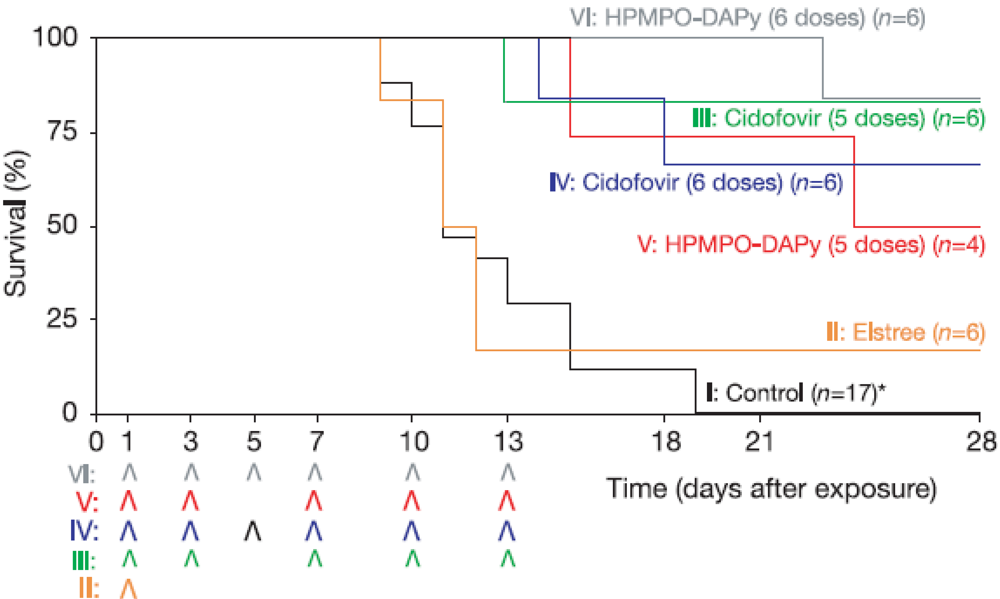
          <source>Nature</source>
          <year>2006</year>
          <volume>439</volume>
          <fpage>745</fpage>
          <lpage>748</lpage>
          <pub-id pub-id-type="doi">10.1038/nature04295</pub-id>
          <pub-id pub-id-type="pmid">16341204</pub-id>
        </citation>
      </ref>
    </ref-list>
  </back>
</article>