<?xml version="1.0" encoding="UTF-8"?>
<!DOCTYPE article PUBLIC "-//NLM//DTD Journal Publishing DTD v2.3 20070202//EN" "journalpublishing.dtd">
<article xmlns:mml="http://www.w3.org/1998/Math/MathML" xmlns:xlink="http://www.w3.org/1999/xlink" article-type="research-article">
  <front>
	<journal-meta>
	<journal-id journal-id-type="publisher-id">7</journal-id>
	<journal-title>Viruses</journal-title>
	<abbrev-journal-title abbrev-type="publisher">Viruses</abbrev-journal-title>
	<abbrev-journal-title abbrev-type="pubmed">Viruses</abbrev-journal-title>
	<abbrev-journal-title abbrev-type="system">viruses</abbrev-journal-title>
	<abbrev-journal-title>Viruses</abbrev-journal-title>
	<issn pub-type="epub">1999-4915</issn>
	<publisher>
	<publisher-name>Molecular Diversity Preservation International</publisher-name>
	</publisher>
	<abbrev-journal-title abbrev-type="publisher">Viruses</abbrev-journal-title><abbrev-journal-title abbrev-type="pubmed">Viruses</abbrev-journal-title><abbrev-journal-title abbrev-type="system">viruses</abbrev-journal-title></journal-meta>
	<article-meta><article-id pub-id-type="pii">viruses-02-00547</article-id>
	<article-id pub-id-type="pii">viruses-02-00547</article-id>
	<article-id pub-id-type="doi">10.3390/v2020547</article-id>
	<article-id pub-id-type="publisher-id">v2020547</article-id>
	<article-categories>
	<subj-group>
	<subject>Article</subject>
	</subj-group>
	</article-categories>
      <title-group>
        <article-title>Cross-Reactive Human IgM-Derived Monoclonal Antibodies that Bind to HIV-1 Envelope Glycoproteins</article-title>
      </title-group>
      <contrib-group>
        <contrib contrib-type="author">
          <name>
            <surname>Chen</surname>
            <given-names>Weizao</given-names>
          </name>
          <xref rid="aff1" ref-type="aff">1</xref>
          <xref ref-type="corresp" rid="c1">*</xref>
        </contrib>
        <contrib contrib-type="author">
          <name>
            <surname>Zhu</surname>
            <given-names>Zhongyu</given-names>
          </name>
          <xref rid="aff1" ref-type="aff">1</xref>
          <xref rid="aff2" ref-type="aff">2</xref>
        </contrib>
        <contrib contrib-type="author">
          <name>
            <surname>Liao</surname>
            <given-names>Huaxin</given-names>
          </name>
          <xref rid="aff3" ref-type="aff">3</xref>
        </contrib>
        <contrib contrib-type="author">
          <name>
            <surname>Broder</surname>
            <given-names>Christopher C.</given-names>
          </name>
          <xref rid="aff4" ref-type="aff">4</xref>
        </contrib>
        <contrib contrib-type="author">
          <name>
            <surname>Haynes</surname>
            <given-names>Barton F.</given-names>
          </name>
          <xref rid="aff3" ref-type="aff">3</xref>
        </contrib>
        <contrib contrib-type="author">
          <name>
            <surname>Dimitrov</surname>
            <given-names>Dimiter S.</given-names>
          </name>
          <xref rid="aff1" ref-type="aff">1</xref>
        </contrib>
      </contrib-group>
<aff id="aff1"><label>1</label>Protein Interactions Group, Center for Cancer Research Nanobiology Program, National Cancer Institute (NCI)-Frederick, National Institutes of Health (NIH), Frederick, MD 21702, USA</aff>
<aff id="aff2"><label>2</label>Basic Research Program, Science Applications International Corporation-Frederick, Inc., NCI-Frederick, Frederick, MD 21702, USA</aff>
<aff id="aff3"><label>3</label>Duke University Medical Center, Durham, NC 27710, USA</aff>
<aff id="aff4"><label>4</label>Uniformed Services University of the Health Sciences, Bethesda, MD 20814, USA</aff>      
      <author-notes>
        <corresp id="c1">Author to whom correspondence should be addressed; E-Mail: chenw3@mail.nih.gov;Tel.: +1-301-846-1770; Fax: +1-301-846-5598.</corresp>
      </author-notes>
      <pub-date pub-type="epub">
        <day>04</day>
        <month>02</month>
        <year>2010</year>
      </pub-date>
      <volume>2</volume>
      <issue>2</issue>
      <fpage>547</fpage>
      <lpage>565</lpage>
      <history>
        <date date-type="received">
          <day>23</day>
          <month>09</month>
          <year>2009</year>
        </date>
        <date date-type="rev-recd">
          <day>21</day>
          <month>01</month>
          <year>2010</year>
        </date>
        <date date-type="accepted">
          <day>01</day>
          <month>02</month>
          <year>2010</year>
        </date>
      </history>
      <permissions>
        <copyright-statement>©  2010 by the authors; licensee Molecular Diversity Preservation International, Basel, Switzerland</copyright-statement>
        <copyright-year>2010</copyright-year>
        <license xmlns:xlink="http://www.w3.org/1999/xlink" license-type="open-access" xlink:href="http://creativecommons.org/licenses/by/3.0/">
          <p>This is an open-access article distributed under the terms of the Creative Commons Attribution License, which permits unrestricted use, distribution, and reproduction in any medium, provided the original work is properly cited.</p>
        </license>
      </permissions>
      <abstract>
        <p>Elicitation of antibodies with potent and broad neutralizing activity against HIV by immunization remains a challenge. Several monoclonal antibodies (mAbs) isolated from humans with HIV-1 infection exhibit such activity but vaccine immunogens based on structures containing their epitopes have not been successful for their elicitation. All known broadly neutralizing mAbs (bnmAbs) are immunoglobulin (Ig) Gs (IgGs) and highly somatically hypermutated which could impede their elicitation. Ig Ms (IgMs) are on average significantly less divergent from germline antibodies and are relevant for the development of vaccine immunogens but are underexplored compared to IgGs. Here we describe the identification and characterization of several human IgM-derived mAbs against HIV-1 which were selected from a large phage-displayed naive human antibody library constructed from blood, lymph nodes and spleens of 59 healthy donors. These antibodies bound with high affinity to recombinant envelope glycoproteins (gp140s, Envs) of HIV-1 isolates from different clades. They enhanced or did not neutralize infection by some of the HIV-1 primary isolates using CCR5 as a coreceptor but neutralized all CXCR4 isolates tested although weakly. One of these antibodies with relatively low degree of somatic hypermutation was more extensively characterized. It bound to a highly conserved region partially overlapping with the coreceptor binding site and close to but not overlapping with the CD4 binding site. These results suggest the existence of conserved structures that could direct the immune response to non-neutralizing or even enhancing antibodies which may represent a strategy used by the virus to escape neutralizing immune responses. Further studies will show whether such a strategy plays a role in HIV infection of humans, how important that role could be, and what the mechanisms of infection enhancement are. The newly identified mAbs could be used as reagents to further characterize conserved non-neutralizing, weakly neutralizing or enhancing epitopes and modify or remove them from candidate vaccine immunogens.</p>
      </abstract>
      <kwd-group>
        <kwd>HIV-1</kwd>
        <kwd>human</kwd>
        <kwd>monoclonal antibody</kwd>
        <kwd>IgM</kwd>
        <kwd>gp120</kwd>
        <kwd>immunogen</kwd>
      </kwd-group>
    <supplement>2010</supplement></article-meta>
  </front>
  <body>
    <sec sec-type="intro">
      <title>1. Introduction</title>
      <p>The ability of human immunodeficiency virus type 1 (HIV-1) to rapidly generate mutants and evade immune response is the major obstacle for development of protective, prophylactic HIV-1 vaccines. Therefore, candidate vaccine immunogens must be capable of eliciting broadly neutralizing antibodies (bnAbs) that inhibit viruses from different genetic subtypes. Several human monoclonal antibodies (hmAbs) such as b12 [<xref ref-type="bibr" rid="B1">1</xref>], X5 [<xref ref-type="bibr" rid="B2">2</xref>], 2G12 [<xref ref-type="bibr" rid="B3">3</xref>], 2F5 and 4E10 [<xref ref-type="bibr" rid="B4">4</xref>,<xref ref-type="bibr" rid="B5">5</xref>] exhibit potent and broad HIV-1 neutralizing activity <italic>in vitro</italic> and can prevent HIV-1 infection in animal models [<xref ref-type="bibr" rid="B6">6</xref>]. These bnAbs target structures on HIV-1 envelope glycoprotein (Env) that are crucial for virus-cell fusion. Therefore, Envs in various formats are potential candidate immunogens and have been evaluated in animal models and human clinical trials [<xref ref-type="bibr" rid="B7">7-10</xref>]. However, neutralization efficacy of the resulting sera as broad as that by those bnAbs has not been achieved by empirically using these Envs as immunogens [<xref ref-type="bibr" rid="B11">11</xref>]. It has been suggested that characterization of the epitopes of the bnAbs could help design vaccine immunogens that would be able to elicit these bnAbs or similar antibodies <italic>in vivo</italic> [<xref ref-type="bibr" rid="B12">12</xref>]. Although this approach is being vigorously pursued, none of the immunogens designed has yet efficiently elicited neutralizing antibodies with broad specificity.</p>
      <p>IgM is the initial antibody that the host generates when an infectious agent or antigen is encountered. Activation of IgM-expressing B cells provides impetus for <italic>in vivo</italic> IgM-to-IgG isotype switch resulting in production of high-affinity neutralizing or non-neutralizing antibodies. It is therefore important to investigate the human IgM repertoire for HIV-1 Env-specific antibodies and understand how they interact with HIV-1 Envs and impact on viral infection which could help design effective immunogens. Previous attempts to select HIV-specific antibodies by use of non-immune libraries have resulted in antibodies with modest neutralizing activity and limited breadth of neutralization [<xref ref-type="bibr" rid="B13">13</xref>]. Studies by several groups show that human IgM antibodies play important roles not only in shaping humoral immunity against HIV-1 but also in inducing cell-mediated response because of their pentameric binding nature as well as their very efficient activity to activate complement. Torán <italic>et al.</italic> [<xref ref-type="bibr" rid="B14">14</xref>] indicated that <italic>in vivo </italic>IgM-to-IgG isotype switch and affinity maturation may be important for protection and long-term survival in certain HIV-1-infected individuals. Sheppard <italic>et al</italic>. [<xref ref-type="bibr" rid="B15">15</xref>] demonstrated that complement-deactivated serum from a healthy volunteer immunized with an HIV-1 clade C gp120 exhibited IgM-associated neutralizing activity that was significantly enhanced in the presence of fresh normal human serum as a source of complement. Bomsel <italic>et al</italic>. [<xref ref-type="bibr" rid="B16">16</xref>] showed that a human anti-HIV-1 gp41 IgM monoclonal antibody blocked the transcytotic route of HIV mucosal transmission <italic>in vitro</italic>. </p>
      <p>In this study, we describe identification and characterization of several human IgM-derived mAbs selected from phage-displayed naive human antibody libraries constructed from healthy donors. These antibodies have high affinity and cross-reactivity with HIV-1 gp120s from different clades, and either neutralize or enhance weakly entry of virions pseudotyped with Envs from HIV-1 primary isolates. These data provide additional insights into the possible immune response that HIV-1 infection or viral Env-based immunization could elicit and help in the design of candidate vaccine immunogens that elicit potent neutralizers of early transmitted virus.</p>
    </sec>
    <sec>
      <title>2. Results</title>
      <sec>
        <title>2.1. Construction of a large naive human antibody library by using the phagemid vector pZYD-N1</title>
        <p>A large (1.5 × 10<sup>10</sup> members) phage-displayed naive human antibody antigen-binding fragment (Fab) library (designated m21) was constructed from peripheral blood B cells of 22 healthy donors, spleens of 3 healthy donors, and lymph nodes of 34 healthy donors as described in Materials and Methods. The phagemid used for library construction, pZYD-N1, was synthesized and briefly described previously [<xref ref-type="bibr" rid="B17">17</xref>]. To approximately estimate the sequence diversity of m21, 44 clones were randomly selected from the library and sequenced. No identical sequences of heavy and light chains were found; more than 80% of the clones are productive. Of the 44 clones 26 had kappa light chains and the other 18 - lambda light chains. M21 was panned against several HIV-1 Envs and human cancer-related antigens; significant enrichment was obtained with all the pannings (data not shown). These results indicate that the quality of the library is likely to be good.</p>
      </sec>
      <sec>
        <title>2.2. Selection of HIV-1 Env-specific cross-reactive human IgM-derived antibodies</title>
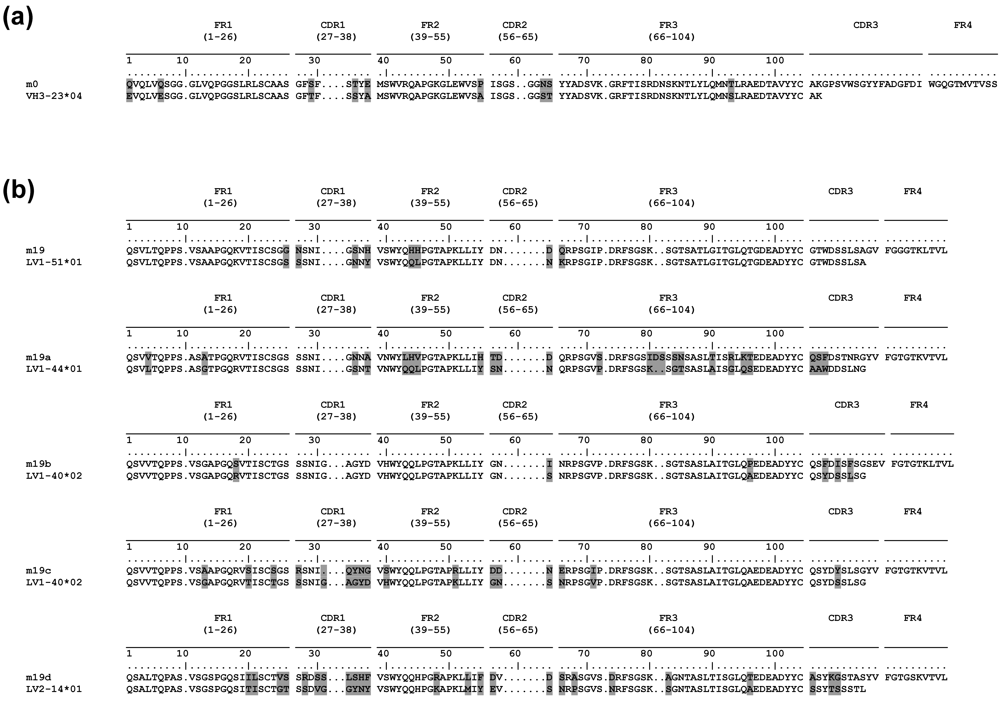
        <p>To identify human IgM-derived antibodies specific for HIV-1 Envs, we panned m21 against the gp140 of a clade B isolate, R2 (gp140<sub>R2</sub>). One of the selected antibody clones, R3H1, contained a TGA stop codon at the very beginning of the light chain due to a nucleotide deletion that resulted in a reading-frame shift. The heavy chain variable domain (VH) of R3H1, designated m0, differs from the closest human germline sequence (VH3–23) by mutations distributed in all frameworks (FRs) and complementarity determining regions (CDRs) (<xref ref-type="fig" rid="figure1">Figure 1a</xref>). M0 contains 15 mutations in nucleotide sequence of the variable (V) region resulting in 9 mutations in amino acid sequence. We corrected the reading frame of the light chain by site-directed mutagenesis and the corrected antibody, designated R3H1m, was expressed at high levels in bacteria as an Fab. Fab R3H1m specifically bound with relatively high affinity to gp140<sub>R2</sub> (EC<sub>50</sub>, ~60 nM) and the gp140 of a clade C isolate, GXC44 (gp140<sub>GXC44</sub>) (EC<sub>50</sub>, ~100 nM). </p>
        <fig id="figure1" position="float">
          <label>Figure 1</label>
          <caption>
            <p>The amino acid sequences of heavy <bold>(a)</bold> and light <bold>(b)</bold> chains of the selected mAbs in alignment with the corresponding germlines of human antibody V genes. The CDRs and FRs are indicated according to the ImMunoGeneTics annotation (http://imgt.cines.fr/). The somatic mutations in the V genes of the selected antibodies are highlighted with gray background.</p>
          </caption>
          <graphic xmlns:xlink="http://www.w3.org/1999/xlink" xlink:href="viruses-02-00547-g001.tif" scale="0"/>
        </fig>        
        <p>Because the antibody was initially selected as a functional heavy chain-only antibody, we hypothesized that the binding activity of R3H1m should be attributed mainly to the heavy chain of the antibody and the heavy chain could be paired with light chains derived from different germlines while retaining cross-reactivity with HIV-1 Envs. We cloned m0 as an isolated antibody domain and found that it was highly soluble, stable, monomeric, and expressed at high levels in bacteria [<xref ref-type="bibr" rid="B18">18</xref>]. In agreement with our hypothesis it specifically bound to gp140<sub>R2</sub> although with low affinity (EC<sub>50</sub>, &gt;1000 nM). We further constructed a light chain-shuffling Fab library (3 × 10<sup>7</sup> members) based on the heavy chain of R3H1. To increase the probability for selection of cross-reactive antibodies the library was panned sequentially against gp140<sub>R2</sub> and the gp140 of a clade F isolate, 14/00/4 (gp140<sub>14/00/4</sub>). Five unique clones were identified that contained exclusively lambda light chains (<xref ref-type="fig" rid="figure1">Figure 1</xref>b). They bound to gp140<sub>R2</sub> and gp140<sub>14/00/4</sub> with EC<sub>50 </sub>ranging from 2 to 80 nM (Table 1) while no significant binding to an unrelated antigen, bovine serum albumin (BSA), was observed (data not shown). One of the antibodies, m19, also bound with high affinity to the Envs of other three clade B isolates, gp120<sub>Bal, </sub>gp140<sub>JRFL</sub> and gp140<sub>Con-S</sub>[<xref ref-type="bibr" rid="B19">19</xref>]. These results suggest that m19 and possibly the other selected antibodies target conserved epitopes on gp120. </p>
<table-wrap id="table1" position="float"><object-id pub-id-type="pii">viruses-02-00547_table1</object-id>
<label>Table 1</label>
<caption>
<p>Binding (EC<sub>50</sub>, nM) of antibodies to Envs from different clades.</p>
</caption>
<table border="1" cellspacing="0" cellpadding="0">
<thead><tr><td/></tr></thead>
<tbody>
<tr><td><graphic xmlns:xlink="http://www.w3.org/1999/xlink" xlink:href="viruses-02-00547-i001.tif"/></td></tr>
</tbody>
</table>
</table-wrap>        
      </sec>
      <sec>
        <title>2.3. The selected antibodies did not neutralize, neutralized weakly or enhanced HIV-1 infections</title>
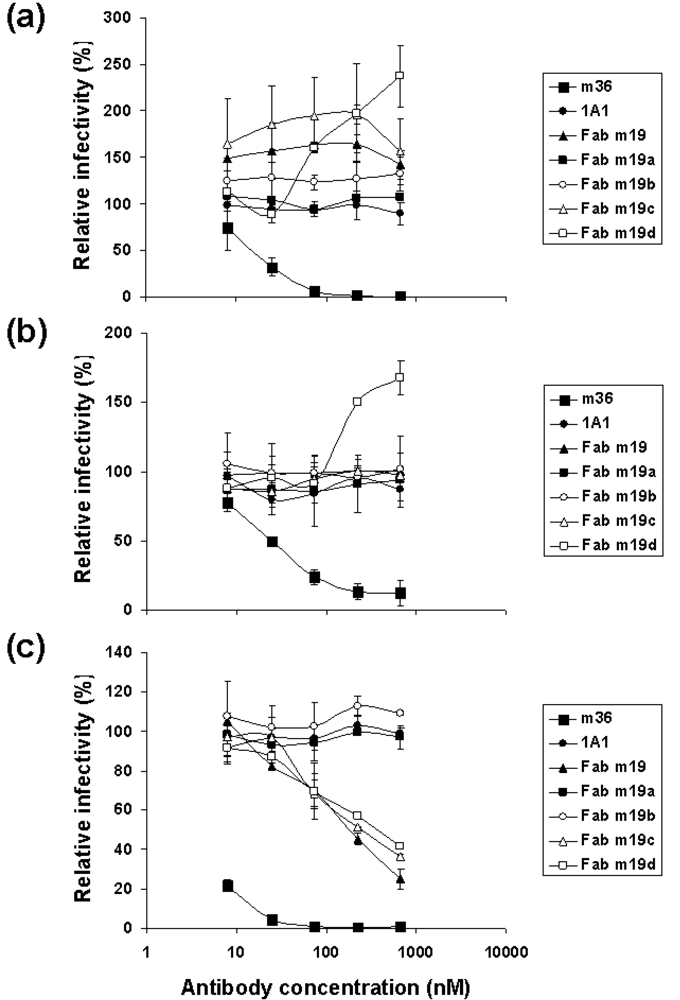
        <p>To test whether the five newly selected antibodies are capable of neutralizing HIV-1 primary isolates, we used viruses pseudotyped with Envs from HIV-1 isolates representing clades A, B and C and using either CCR5 (R5) or CXCR4 (X4) or both (R5X4) as a coreceptor. None of the antibodies exhibited potent broadly neutralizing activity. Four antibodies (Fabs m19, m19b, m19c and m19d) enhanced infection by Bal even at very low antibody concentration while a positive control antibody, m36 [<xref ref-type="bibr" rid="B17">17</xref>], showed efficient neutralization and a negative control antibody, 1A1, did not affect entry (<xref ref-type="fig" rid="figure2">Figure 2a</xref>m19d enhanced infection by another clade B primary isolate, JRFL, at high concentrations (<xref ref-type="fig" rid="figure2">Figure 2</xref>b). Interestingly, the three antibodies that enhanced significantly infection by the Bal weakly neutralized IIIB which is a TCLA clade B X4 isolate (<xref ref-type="fig" rid="figure2">Figure 2c</xref></p>

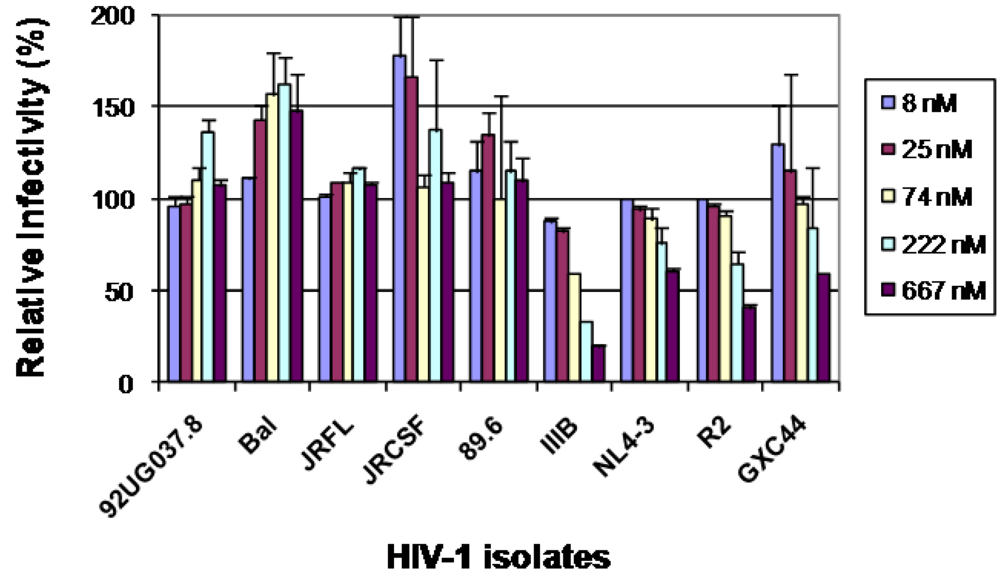
        <p>To find whether the activity of the antibodies is related to antibody size and how the viral infection could be affected by cross-linking of HIV-1 Envs, we generated a single-chain Fv fragment (scFv) (scFv m19) of m19 and a human IgG1 Fc-fusion protein (m19Fc) of scFv m19; m19 was selected for further characterization because its light chain was relatively less divergent from the germline (<xref ref-type="fig" rid="figure1">Figure 1</xref>b) and was the only one which did not contain any somatic mutations in the CDR3 of the light chain. When Bal was tested, the enhancing activity of scFv m19 was comparable to that of Fab m19 and slightly lower than that of m19Fc (data not shown). These data indicate that the antibody access to the epitope was not size-restricted and that the bivalency of the Fc fusion protein strengthened the antibody activity probably due to avidity effects. The ability of m19Fc to modulate HIV-1 infection <italic>in vitro</italic> was further tested with six additional clade B isolates and an isolate each from clade A and clade C, respectively (<xref ref-type="fig" rid="figure3">Figure 3</xref>). Enhancement was observed with JRCSF (clade B, R5) at very low m19Fc concentration and the enhancement was decreased with an increase in antibody concentration. M19Fc also conferred slight enhancement of infection by JRFL (clade B, R5) and 92UG037.8 (clade A, R5) at about 200 nM antibody concentration. It neutralized the clade B X4 isolates IIIB and NL4-3. It also neutralized R2, which is a clade B R5 isolate, displays some CD4 independence and is moderately neutralization sensitive, as well as GXC44 which is a clade C R5 isolate. No significant antibody activity was observed with the dual tropic clade B isolate 89.6. These results indicate that the antibody activity in terms of neutralization or enhancement varies when different isolates are tested and is not significantly correlated with the coreceptor usage and the CD4 dependency of the viruses in entry.</p>
        <fig id="figure2" position="float">
          <label>Figure 2</label>
          <caption>
            <p>The <italic>in vitro</italic> activities of the selected mAbs against HIV-1 infection in a pseudovirus/cell line neutralization assay. The antibodies in Fab format were tested against two clade B primary R5 isolates, Bal <bold>(a)</bold> and JRFL <bold>(b)</bold>, and a clade B lab-adapted X4 isolate, IIIB <bold>(c)</bold>. A CD4i human antibody domain (domain antibody, dAb), m36, was used as a positive control and an irrelevant human dAb targeting the human insulin-like growth factor 2 (IGF-2), 1A1, was used as a negative control.</p>
          </caption>
          <graphic xmlns:xlink="http://www.w3.org/1999/xlink" xlink:href="viruses-02-00547-g002.tif" scale="0"/>
        </fig>        
        <fig id="figure3" position="float">
          <label>Figure 3</label>
          <caption>
            <p>The activities of m19Fc against a small panel of HIV-1 isolates in a pseudovirus/cell line neutralization assay. </p>
          </caption>
          <graphic xmlns:xlink="http://www.w3.org/1999/xlink" xlink:href="viruses-02-00547-g003.tif" scale="0"/>
        </fig>
      </sec>
      <sec>
        <title>2.4. Characterization of the antibody epitopes</title>
        <fig id="figure4" position="float">
          <label>Figure 4</label>
          <caption>
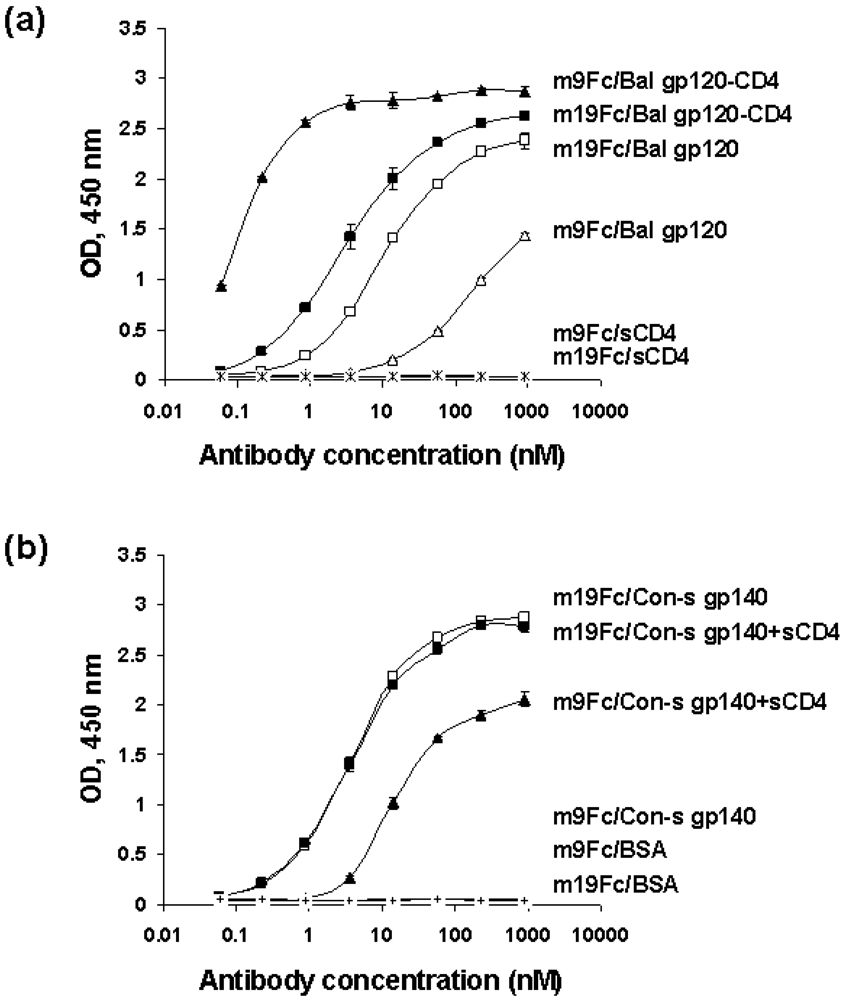
            <p>Binding of m19Fc to gp120<sub>Bal</sub><bold>(a)</bold> and gp140<sub>Con-S</sub><bold>(b)</bold> in the absence or presence of CD4. The Fc-fusion protein of a CD4i antibody, m9Fc, was used as a control.</p>
          </caption>
          <graphic xmlns:xlink="http://www.w3.org/1999/xlink" xlink:href="viruses-02-00547-g004.tif" scale="0"/>
        </fig>
        <fig id="figure5" position="float">
          <label>Figure 5</label>
          <caption>
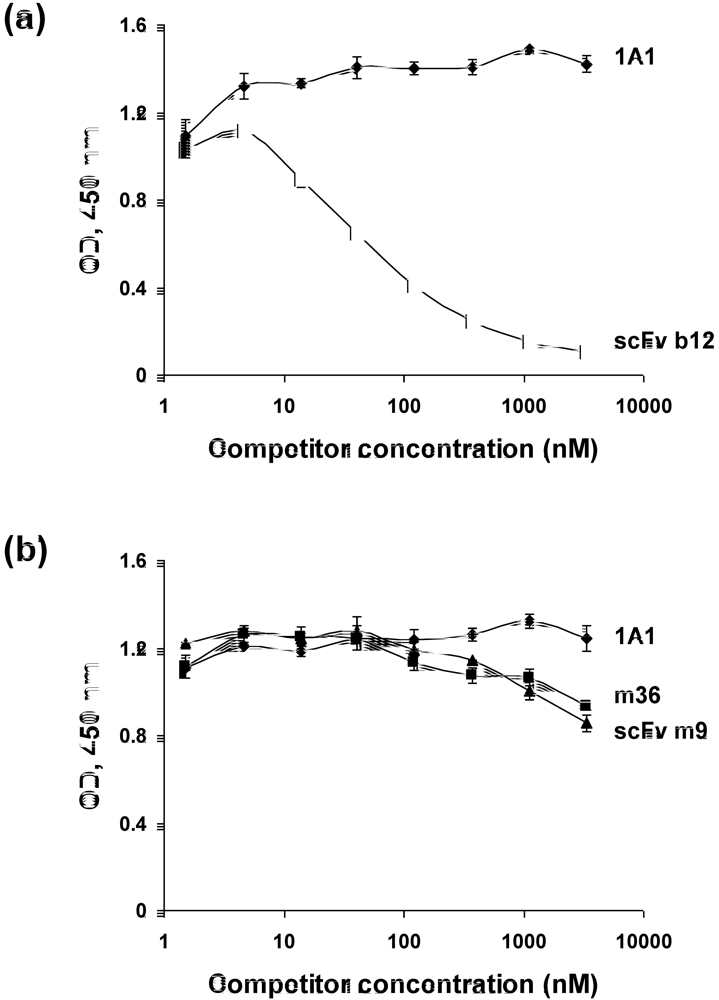
            <p>Competition of m19Fc with a CD4bs antibody, b12 <bold>(a)</bold>, and two CD4i antibodies, m36 and m9 <bold>(b)</bold>, in binding to gp120<sub>Bal</sub> and to gp120<sub>Bal</sub>-CD4, respectively. An irrelevant human antibody, 1A1, was used as a negative control.</p>
          </caption>
          <graphic xmlns:xlink="http://www.w3.org/1999/xlink" xlink:href="viruses-02-00547-g005.tif" scale="0"/>
        </fig>                
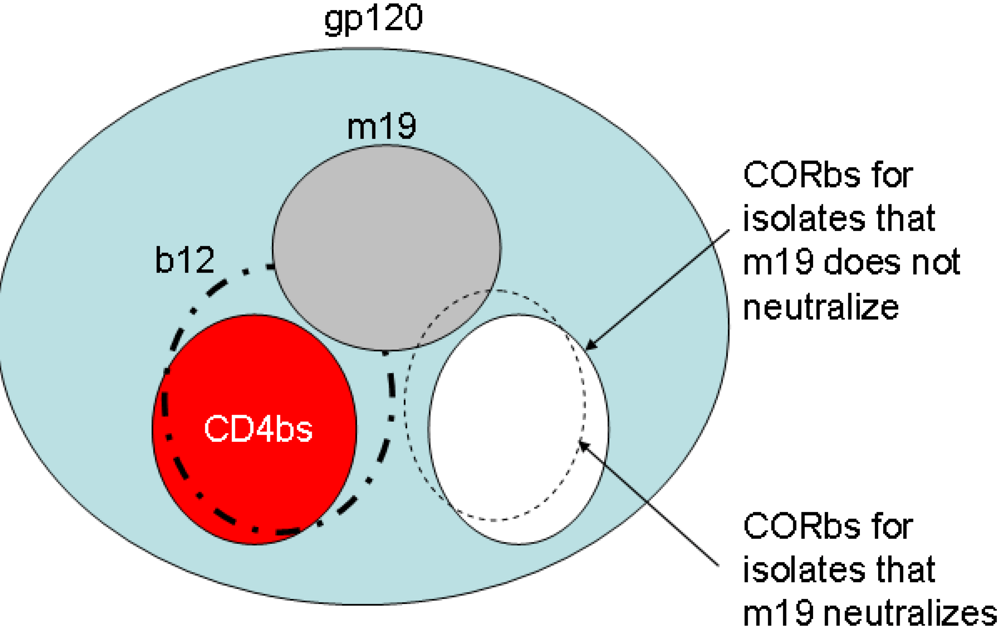
        <p>To approximately localize the antibody epitopes and begin to elucidate the underlying mechanisms of antibody neutralizing or enhancing activity, we measured the antibody binding to Envs from different isolates alone and in complex with CD4 as well as the antibody competition with well-characterized antibodies. M19Fc bound to a single-chain polypeptide analogue of the HIV-1 gp120-CD4 complex (gp120<sub>Bal</sub>-CD4) [<xref ref-type="bibr" rid="B20">20</xref>] with threefold higher affinity (EC50, ~2.5 nM) than to gp120<sub>Bal</sub> (EC50, ~10 nM) alone as measured by an ELISA (<xref ref-type="fig" rid="figure4">Figure 4a</xref>). It did not react with sCD4 suggesting that the antibody targeted a structure on gp120 that was outside the CD4-binding site (CD4bs) and could undergo CD4-induced (CD4i) conformational changes. The conformational changes on gp120<sub>Bal</sub> after CD4 binding were confirmed by a CD4i bnAb, m9Fc [<xref ref-type="bibr" rid="B21">21</xref>], which exhibited dramatically higher binding to gp120<sub>Bal</sub>-CD4 than to gp120<sub>Bal</sub> (<xref ref-type="fig" rid="figure4">Figure 4a</xref><sub>Con-S</sub>, which was a synthetic Env designed by aligning the consensus Env<italic> </italic>sequences of group M [<xref ref-type="bibr" rid="B19">19</xref>]. This Env, by design, is composed by shorter V1, V2, V4 and V5 loops and therefore, might expose regions around the variable loops that might contain conserved neutralizing determinants. However, m9 epitope as a representative for CD4i epitopes is still completely hidden on gp140<sub>Con-S</sub> because m9Fc did not bind in the absence of sCD4, it did bind with high affinity in the presence of sCD4 (<xref ref-type="fig" rid="figure4">Figure 4</xref>b). However, m19Fc showed comparable binding to gp140<sub>Con-S</sub> with or without sCD4 (<xref ref-type="fig" rid="figure4">Figure 4</xref>b) suggesting that the antibody does not precisely target CD4i epitopes but other structures on the gp120. Although m19Fc was not directed against the CD4-binding pocket, it strongly competed with the CD4bs bnAb, scFv b12, which has binding surface larger than that of CD4 [<xref ref-type="bibr" rid="B22">22</xref>] (<xref ref-type="fig" rid="figure5">Figure 5a</xref>M19Fc also competed although weakly with two CD4i antibodies, scFv m9 and m36 [<xref ref-type="bibr" rid="B17">17</xref>] (<xref ref-type="fig" rid="figure5">Figure 5</xref>b). These results suggest that the epitope of m19Fc is in very close proximity to the CD4bs and the coreceptor-binding site (CORbs) which overlaps with CD4i epitopes on gp120 (<xref ref-type="fig" rid="figure6">Figure 6</xref>). </p>
        <fig id="figure6" position="float">
          <label>Figure 6</label>
          <caption>
            <p>A schematic representation for the epitope (gray) of m19 on gp120 (blue). The red and white areas denote the CD4bs and the CORbs, respectively. The epitope (long dash-dotted circle on the left) of the CD4bs antibody, b12, is indicated in comparison with the CD4-binding area. The dashed circle on the right denotes the CORbs for some isolates that could partially overlap with the epitope of m19.</p>
          </caption>
          <graphic xmlns:xlink="http://www.w3.org/1999/xlink" xlink:href="viruses-02-00547-g006.tif" scale="0"/>
        </fig>
      </sec>
      <sec>
        <title>2.5. Somatic mutations are required for the antibody binding activity</title>
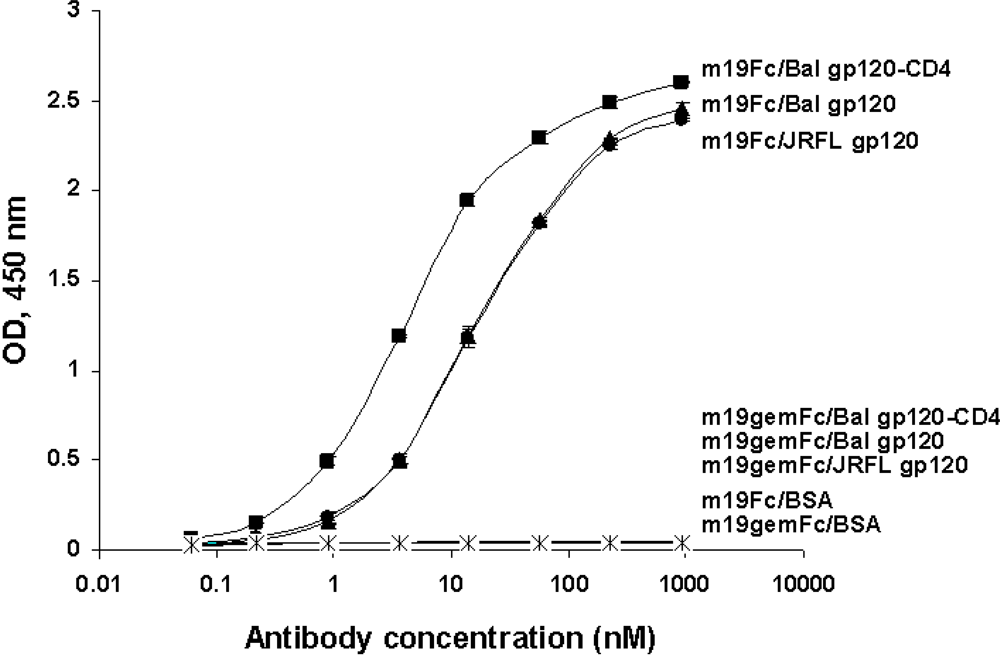
        <p>To estimate the possibility of rapid elicitation of these antibodies <italic>in vivo</italic> when an HIV-1 gp120-related immunogen is administered, we generated a germline-like scFv of m19 (scFv m19gem) and measured its binding to Envs from different isolates in the presence or absence of sCD4. No obvious interaction was observed with scFv m19gem when several Envs that bound the original m19 were tested (data not shown). Previous studies showed that the binding activity of an antibody in the form of Fab or scFv could be increased up to thousands of times when it is converted to dimeric formats such as an IgG. We therefore fused scFv m19gem to the Fc portion of a human IgG1 to gain possible avidity effects. Still, the Fc-fusion protein of scFv m19gem (m19gemFc) did not show measurable binding to the Envs with or without sCD4 (<xref ref-type="fig" rid="figure7">Figure 7</xref>). These results suggest that significant somatic diversification is required for the m19 corresponding germline antibody to achieve recognition of the m19 epitope on gp120. They also indicate that in some individuals certain IgM antibodies could undergo somatic hypermutations to relatively high-affinity binders to the Env in the absence of HIV-1 infection or immunization with Env.</p>
        <fig id="figure7" position="float">
          <label>Figure 7</label>
          <caption>
            <p>Binding of the germline-like antibody of m19 to different gp120s in the absence or presence of CD4. The original antibody, m19Fc, was used as a positive control.</p>
          </caption>
          <graphic xmlns:xlink="http://www.w3.org/1999/xlink" xlink:href="viruses-02-00547-g007.tif" scale="0"/>
        </fig>
      </sec>
    </sec>
    <sec>
      <title>3. Discussion</title>
      <p>Vaccines based on recombinant Envs have failed to prevent viral infection in human efficacy trials likely because of their inability to elicit neutralizing antibodies that are broad enough to combat the extremely high variability of the virus. Recent success was reported but it is modest and needs to be repeated and further examined [<xref ref-type="bibr" rid="B23">23</xref>]. To date only several bnAbs have been isolated from HIV-1 patients suggesting difficulties to elicit such antibodies <italic>in vivo</italic>. However, the presence of epitopes recognized by these bnAbs on Envs argues that they are still a potential template for vaccine design. Different strategies aiming at improving the presentation of neutralizing epitopes are rigorously pursued. Analysis of the structures of Envs shows that most of their surface is hidden from humoral immune responses by glycosylation and oligomeric occlusion [<xref ref-type="bibr" rid="B24">24</xref>,<xref ref-type="bibr" rid="B25">25</xref>]. The CD4bs and the CORbs on gp120 are also flanked by loop structures which may further limit the access by antibodies generated by the human immune system [<xref ref-type="bibr" rid="B24">24</xref>,<xref ref-type="bibr" rid="B25">25</xref>]. Therefore, one strategy focuses on the use of modified Envs, in which the variable loops have been deleted [<xref ref-type="bibr" rid="B26">26-29</xref>] or glycosylation removed [<xref ref-type="bibr" rid="B30">30</xref>,<xref ref-type="bibr" rid="B31">31</xref>] or both [<xref ref-type="bibr" rid="B32">32</xref>] in order to increase the exposure of the neutralizing epitopes. Based on the finding that the neutralizing capacity of the antibodies is associated with their ability to bind to native trimeric Envs on the virus but does not correlate with binding to isolated monomeric Envs, another strategy focuses on preservation or re-construction of the functional trimeric Envs [<xref ref-type="bibr" rid="B33">33</xref>,<xref ref-type="bibr" rid="B34">34</xref>]. The essential concept is that immunizing with a close mimic of the functional trimer will improve the chances of eliciting neutralizing antibodies. Yet another strategy is to use fusion intermediates formed during virus entry [<xref ref-type="bibr" rid="B35">35</xref>,<xref ref-type="bibr" rid="B36">36</xref>] or their mimics [<xref ref-type="bibr" rid="B37">37</xref>]. HIV-1 entry is initiated by binding of viral gp120 with the receptor CD4 and a coreceptor on the target cell surface. These interactions lead to intermediate Env conformations that may include conserved structures useful for vaccine design. However, elicitation of desirable level and breath of neutralizing antibodies with the immunogens generated based on these strategies has not been achieved. While modification of Envs based solely on the analysis of the interaction with neutralizing antibodies is not sufficient to create effective vaccines, we propose that the inherent capacity of the human immune system in response to HIV-1 infection should be explored. We have hypothesized that investigation of human IgM repertoire for HIV-1 Env-specific antibodies and understanding how they react with Envs, evolve and impact on viral infection would help design effective HIV-1 immunogens. </p>
      <p>It has been previously found that IgM-based response confers substantial effects on HIV-1 infection which are especially relevant in the context of acute infection [<xref ref-type="bibr" rid="B14">14-16</xref>]. In this study, we describe the identification and characterization of several high-affinity human IgM-derived mAbs against HIV-1 from phage-displayed naive human antibody libraries constructed from healthy donors. Although their potency <italic>in vitro</italic> appears minor the roles they could play in mediating HIV-1 infection <italic>in vivo</italic> should not be underestimated. IgM antibodies are highly effective in activating complement system to destroy the virus or infected cells. The antibodies selected in this study target highly conserved regions on gp120 which are in very close proximity to the CD4bs and the CORbs. Because these two regions on gp120 are vital for virus entry and harbor neutralizing epitopes, HIV-1 has evolved strategies such as steric occlusion to protect it from humoral immunity [<xref ref-type="bibr" rid="B24">24</xref>,<xref ref-type="bibr" rid="B25">25</xref>]. Here we suggest that the possible high immunogenicity of the conserved non-neutralizing epitopes of these antibodies could further divert the immune system from responses to neutralizing epitopes. Recent studies [<xref ref-type="bibr" rid="B38">38</xref>,<xref ref-type="bibr" rid="B39">39</xref>] showed that cross-reactive non-neutralizing antibodies (IgMs and IgGs) were elicited by immunizing mice with recombinant HIV-1 gp140s suggesting the same possibility in humans. Because the antibodies we selected are less divergent (totally about 15 amino acid mutations in the V gene products for the heavy and light chains) (<xref ref-type="fig" rid="figure1">Figure 1</xref>) than the known bnAbs which all contain extensive somatic mutations (on average &gt;30 mutations) compared to germline antibodies (data not shown), they could be more easily elicited. In addition, these antibodies could directly block the access of some neutralizing antibodies generated by the human immune system, especially those targeting the CD4bs or CORbs. This was supported by our finding that m19Fc partially reversed the neutralization by a CD4i antibody, m36 [<xref ref-type="bibr" rid="B17">17</xref>] (data not shown). These results further support previous propositions to reduce the immunogenicity of unwanted epitopes when gp120/gp140 is used as an immunogen. </p>
      <p>We found that the closest germline-like antibody to m19 does not bind an Env (<xref ref-type="fig" rid="figure7">Figure 7</xref>). We observed similar lack of binding of germline-like b12, 2F5 and 2G12 to Envs [<xref ref-type="bibr" rid="B40">40-42</xref>]. Moreover, we found that there was a lack of or no high-affinity binders to Envs in the germline-like antibody repertoire of the human cord blood whereas high-affinity antibodies against other human infectious agents including SARS coronavirus and henipaviruses could be easily selected (Weizao Chen, Emily Streaker and Dimiter S. Dimitrov, in preparation). The identified antibodies against SARS coronavirus protein S exhibited nanomolar affinity and were very close to germline in sequence. By analyzing the previously identified antibody sequences we found that all of the cross-reactive neutralizing antibodies against HIV-1 were highly diversified from their germline sequences; in contrast, the antibodies against SARS coronavirus and henipaviruses had only limited number of mutations [<xref ref-type="bibr" rid="B40">40-42</xref>]. These results indicate that extensive somatic mutations could be required for high-affinity binding to conserved HIV-1 Env structures. One could speculate that the maturation pathways for some HIV-1 antibodies are initiated by immunogens that are different from the Envs; such immunogens could be used in combination with Env-based immunogens to guide the immune system for elicitation of potent bnAbs by additional somatic hypermutation and selection. This is in line with our proposition to elicit bnAbs by using one or more primary immunogens that are different than Envs but can lead to intermediates on the maturation pathways that can be subsequently further somatically hypermutated to matured bnAbs [<xref ref-type="bibr" rid="B40">40-42</xref>].</p>
      <p>Except for the conventional antigen-antibody interaction, gp120s also bind to a small population of human antibodies containing products of mainly VH3 gene family and exhibit superantigen properties by activating the human B cells expressing such antibodies on cellular membrane [<xref ref-type="bibr" rid="B43">43</xref>]. The core motif of the superantigen-binding site (SBS) on gp120 is a discontinuous structure spanning the V4 variable domain and the amino-terminal region flanking the C4 constant domain [<xref ref-type="bibr" rid="B44">44</xref>]. The determinants on the antibody VH domains critical for gp120 binding are not clear yet while the putative important regions were identified in the FR1 and 3; a modeling study showed that most of the potential contact residues were located on the face of the VHs opposite to the interface for interaction with light chain; other positions in the CDR1 and 2 also influenced the binding [<xref ref-type="bibr" rid="B45">45</xref>]. Moreover, the gp120-positive antibody VH genes showed &gt;96% similarity to the germlines suggesting that the somatic hypermutations may have adverse effects on gp120 binding [<xref ref-type="bibr" rid="B45">45</xref>]. The antibodies described in this study contained VH3-23 gene products (<xref ref-type="fig" rid="figure1">Figure 1a</xref>(EC<sub>50</sub>, &gt;1000 nM) much lower than that (EC<sub>50</sub>,<sub/>2-80 nM) of the Fabs. In addition, the epitope of one (m19) of these antibodies was mapped to a structure in very close proximity to the CD4bs and the CORbs on gp120 but not to the defined SBS. These results suggest that the majority, if not all, of the binding activities of the selected antibodies should be contributed by the conventional antigen-antibody recognition. </p>
      <p>One should note that these antibodies may not represent the native ones because they were selected from phage libraries where the heavy and light chains of the antibodies are randomly recombined. However, previous studies [<xref ref-type="bibr" rid="B46">46-48</xref>] have shown that selection of high-affinity antibodies from such libraries results in antibodies which are identical or very similar to those occurring in the host from which the libraries are made. It has been shown that at least in some systems the antigen selected antibodies such as the autoantibodies against thyroid peroxidase (TPO) from large random phage libraries have the same pairings as those from small libraries where the cognate pairing is preserved and that pairing between light and heavy chain is not promiscuous [<xref ref-type="bibr" rid="B49">49</xref>,<xref ref-type="bibr" rid="B50">50</xref>]. The study by Chapal <italic>et al</italic>. [<xref ref-type="bibr" rid="B48">48</xref>] directly demonstrates that antibodies derived from combinatorial libraries are likely to represent <italic>in vivo </italic>pairings, leading to high affinity antibody fragments mimicking the binding of serum autoantibodies to TPO. De Wildt <italic>et al</italic>. [<xref ref-type="bibr" rid="B51">51</xref>] analyzed the cognate pairings of heavy and light chain variable domains in 365 human IgG+ B cells from peripheral blood and established that the pairings are largely random. The antibodies we selected were originated from large families of genes – heavy chain from VH3 and light chain from VL1 (<xref ref-type="fig" rid="figure1">Figure 1</xref>). Importantly, the pairings for two of them, m19 and m19d, have been found in the very limited number (365) of truly human antibodies previously analyzed [<xref ref-type="bibr" rid="B51">51</xref>]. Moreover, some (e.g., m19 and m19b) of these antibodies are relatively close to their corresponding germlines (<xref ref-type="fig" rid="figure1">Figure 1</xref>). These data suggest the possibility of eliciting such antibodies <italic>in vivo</italic> during HIV-1 infection or gp120-based immunization.</p>
    </sec>
    <sec>
      <title>4. Materials and Methods</title>
      <sec>
        <title>4.1. Cells, viruses, plasmids, gp120, gp140, and antibodies</title>
        <p>We purchased the 293T cells from ATCC. Other cell lines and plasmids used for expression of various HIV-1 Envs were obtained from the National Institutes of Health AIDS Research and Reference Reagent Program (ARRRP). Recombinant gp140s were produced in our laboratories. Gp120<sub>Bal</sub> and the single-chain fusion protein gp120<sub>Bal</sub>-CD4 were kindly provided by T. Fouts (Institute of Human Virology, Baltimore; currently at Profectus, Baltimore, MD). Horseradish peroxidase (HRP)-conjugated anti-FLAG tag antibody and HRP-conjugated anti-human IgG (Fc-specific) antibody were purchased from Sigma-Aldrich (St. Louis).</p>
      </sec>
      <sec>
        <title>4.2. Library construction </title>
        <p>M21 was constructed by using phagemid pZYD-N1 according to the reported protocols [<xref ref-type="bibr" rid="B52">52</xref>]. The sources for amplification of antibody gene fragments are commercially purchased poly A+ RNAs (BD Biosciences, San Jose, CA) from peripheral blood B cells of 22 healthy donors, spleens of three donors and lymph nodes of 34 healthy donors, respectively.</p>
      </sec>
      <sec>
        <title>4.3. Selection of antibodies against HIV-1 antigens</title>
        <p>M2l was used for selection of antibodies against HIV-1 antigens conjugated to magnetic beads (Dynabeads M-270 epoxy; DYNAL Inc., New Hyde Park, NY) as described previously [<xref ref-type="bibr" rid="B53">53</xref>]. 5, 5, 2.5 and 1 µg of gp140<sub>R2</sub> were used in the first, second, third and fourth round of panning, respectively. Clones that specifically bound to gp140<sub>R2</sub> were identified from the third and fourth round by using monoclonal phage ELISA (mpELISA) as described [<xref ref-type="bibr" rid="B53">53</xref>].</p>
        <p>A light chain-shuffling Fab library (3 × 10<sup>7</sup> members) was further constructed based on the heavy chain of R3H1. The light chain repertoire was also harvested from a naive human Fab library (5 × 10<sup>9</sup> members) constructed from peripheral blood B cells of 10 healthy donors [<xref ref-type="bibr" rid="B53">53</xref>], in addition to that from m21. The new library was panned sequentially with two gp140s from different clades. For the sequential panning, 5 and 2.5 µg of gp140<sub>R2</sub> were used in the first and third round, respectively; antigens were alternated with 5 and 2.5 µg of gp140<sub>14/00/4</sub> during the second and fourth round, respectively. Clones that bound to both gp140<sub>R2</sub> and gp140<sub>14/00/4</sub> were identified from the fourth round by using mpELISA as described [<xref ref-type="bibr" rid="B53">53</xref>].</p>
      </sec>
      <sec>
        <title>4.4. Construction of the scFv and Fc-fusion proteins of selected antibodies</title>
        <p>The following primers were used: m36F, 5’-TGG TTT CGC TAC CGT GGC CCA GCC GGC CCA GGT GCA GCT GGTG-3’ (sense); m19FcR: 5’-GTG AGT TTT GTC GGG CCC TAG GAC GGT CAG CTT GG-3’ (antisense).</p>
        <p>For construction of scFv, the full-length original or germline scFv gene fragment was synthesized (GenScript, Piscataway, NJ), digested with SfiI and cloned into pComb3X. To generate Fc-fusion protein, the scFv gene was PCR (primers m36F and m19FcR) amplified by using the synthetic scFv gene fragment as a template. The new scFv products appended with SfiI and ApaI restriction sites on both sides were digested and cloned into pSecTagB-Fc. </p>
      </sec>
      <sec>
        <title>4.5. Expression and purification of antibodies</title>
        <p>The scFv and Fab were expressed in <italic>E. coli </italic>HB2151, as described previously [<xref ref-type="bibr" rid="B53">53</xref>]. The bacterial pellet was collected after centrifugation at 5,000 × <italic>g </italic>for 10 min and resuspended in PBS (pH 7.4) containing 0.5 million-unit polymixin B (Sigma-Aldrich). After 30 min incubation with rotation at 50 rpm at room temperature, it was centrifuged at 25,000 × <italic>g </italic>for 25 min at 4 °C. The supernatant was used for purification of scFv and Fab by immobilized metal ion affinity chromatography (IMAC) by using Ni-NTA resin (Qiagen, Valencia, CA) according to manufacturer’s protocols. Fc-fusion proteins were expressed in 293 free style cells. 293Fectin (Invitrogen, Carlsbad, CA) was used to transfect 293 free style cells according to the instructions of the manufacturer. Three days post-transfection, the culture supernatant was harvested and used for purification by using nProtein A Sepharose 4 Fast Flow (GE Healthcarezcomx, Piscataway, NJ).</p>
      </sec>
      <sec>
        <title>4.6. ELISA</title>
        <p>Binding and competition ELISAs were performed as described previously [<xref ref-type="bibr" rid="B17">17</xref>].</p>
      </sec>
      <sec>
        <title>4.7. Pseudovirus neutralization assay</title>
        <p>Viruses pseudotyped with HIV-1 Envs were prepared by cotransfection of 70–80% confluent 293T cells with pNL4–3.luc.E-R- and pSV7d constructs encoding HIV-1 Envs by using the PolyFect transfection reagent (Qiagen) according to manufacturer’s instruction. Pseudotyped viruses were obtained after 48 h by centrifugation and filtration of cell culture through 0.45 µm filters. For neutralization, viruses were mixed with different concentrations of antibodies for 1 h at 37 °C, and then the mixture was added to about 1.5 × 10<sup>4</sup> HOS-CD4-CCR5 (used for all R5 and dual tropic viruses) or HOS-CD4-CXCR4 cells grown in each well of 96-well plates. Luminesence was measured after 48 h by using the Bright-Glo Luciferase Assay System (Promega, Madison, WI) and a LumiCount microplate luminometer (Turner Designs). Mean relative light units (RLU) for duplicate wells were determined. Relative infectivity (%) was calculated by the following formula: (average RLU of antibody-containing wells/average RLU of virus-only wells) × 100.</p>
      </sec>
    </sec>
    <sec sec-type="conclusions">
      <title>5. Conclusions</title>
      <p>A major finding of this study is the identification and characterization of several HIV-1-specific human IgM-derived mAbs and their highly conserved epitopes. Such antibodies were rarely investigated and reported. Further characterization of these antibodies, their dynamics and epitopes could provide knowledge that in addition to its usefulness for basic understanding of immune responses to HIV-1 could also help in the design of candidate vaccine immunogens that elicit potent neutralizers of early transmitted virus.</p>
    </sec>
  </body>
  <back>
    <ack>
      <p>We thank Xiaodong Xiao in our group for helpful discussion. This project was supported by the Intramural Research Program of the NIH, National Cancer Institute, Center for Cancer Research, by federal funds from the National Cancer Institute, NIH, under contract N01-CO-12400, by the Gates Foundation (D.S.D.), and by the NIH grant AI078412 (G.V.Q. and C.C.B.).</p>
    </ack>
    <ref-list>
    <title>References</title>
      <ref id="B1">
        <citation citation-type="journal">
          <person-group person-group-type="author">
            <name>
              <surname>Roben</surname>
              <given-names>P.</given-names>
            </name>
            <name>
              <surname>Moore</surname>
              <given-names>J.P.</given-names>
            </name>
            <name>
              <surname>Thali</surname>
              <given-names>M.</given-names>
            </name>
            <name>
              <surname>Sodroski</surname>
              <given-names>J.</given-names>
            </name>
            <name>
              <surname>Barbas</surname>
              <given-names>C.F.</given-names>
            </name>
            <name>
              <surname>Burton</surname>
              <given-names>D.R.</given-names>
            </name>
          </person-group>
          <article-title>Recognition properties of a panel of human recombinant Fab fragments to the CD4 binding site of gp120 that show differing abilities to neutralize human immunodeficiency virus type 1</article-title>
          <source>J. Virol.</source>
          <year>1994</year>
          <volume>68</volume>
          <fpage>4821</fpage>
          <lpage>4828</lpage>
          <pub-id pub-id-type="pmid">7518527</pub-id>
        </citation>
      </ref>
      <ref id="B2">
        <citation citation-type="journal">
          <person-group person-group-type="author">
            <name>
              <surname>Moulard</surname>
              <given-names>M.</given-names>
            </name>
            <name>
              <surname>Phogat</surname>
              <given-names>S.K.</given-names>
            </name>
            <name>
              <surname>Shu</surname>
              <given-names>Y.</given-names>
            </name>
            <name>
              <surname>Labrijn</surname>
              <given-names>A.F.</given-names>
            </name>
            <name>
              <surname>Xiao</surname>
              <given-names>X.</given-names>
            </name>
            <name>
              <surname>Binley</surname>
              <given-names>J.M.</given-names>
            </name>
            <name>
              <surname>Zhang</surname>
              <given-names>M.Y.</given-names>
            </name>
            <name>
              <surname>Sidorov</surname>
              <given-names>I.A.</given-names>
            </name>
            <name>
              <surname>Broder</surname>
              <given-names>C.C.</given-names>
            </name>
            <name>
              <surname>Robinson</surname>
              <given-names>J.</given-names>
            </name>
            <name>
              <surname>Parren</surname>
              <given-names>P.W.</given-names>
            </name>
            <name>
              <surname>Burton</surname>
              <given-names>D.R.</given-names>
            </name>
            <name>
              <surname>Dimitrov</surname>
              <given-names>D.S.</given-names>
            </name>
          </person-group>
          <article-title>Broadly cross-reactive HIV-1-neutralizing human monoclonal Fab selected for binding to gp120-CD4-CCR5 complexes</article-title>
          <source>Proc. Natl. Acad. Sci. USA</source>
          <year>2002</year>
          <volume>99</volume>
          <fpage>6913</fpage>
          <lpage>6918</lpage>
          <pub-id pub-id-type="doi">10.1073/pnas.102562599</pub-id>
        </citation>
      </ref>
      <ref id="B3">
        <citation citation-type="journal">
          <person-group person-group-type="author">
            <name>
              <surname>Trkola</surname>
              <given-names>A.</given-names>
            </name>
            <name>
              <surname>Purtscher</surname>
              <given-names>M.</given-names>
            </name>
            <name>
              <surname>Muster</surname>
              <given-names>T.</given-names>
            </name>
            <name>
              <surname>Ballaun</surname>
              <given-names>C.</given-names>
            </name>
            <name>
              <surname>Buchacher</surname>
              <given-names>A.</given-names>
            </name>
            <name>
              <surname>Sullivan</surname>
              <given-names>N.</given-names>
            </name>
            <name>
              <surname>Srinivasan</surname>
              <given-names>K.</given-names>
            </name>
            <name>
              <surname>Sodroski</surname>
              <given-names>J.</given-names>
            </name>
            <name>
              <surname>Moore</surname>
              <given-names>J.P.</given-names>
            </name>
            <name>
              <surname>Katinger</surname>
              <given-names>H.</given-names>
            </name>
          </person-group>
          <article-title>Human monoclonal antibody 2G12 defines a distinctive neutralization epitope on the gp120 glycoprotein of human immunodeficiency virus type 1</article-title>
          <source>J. Virol.</source>
          <year>1996</year>
          <volume>70</volume>
          <fpage>1100</fpage>
          <lpage>1108</lpage>
          <pub-id pub-id-type="pmid">8551569</pub-id>
        </citation>
      </ref>
      <ref id="B4">
        <citation citation-type="journal">
          <person-group person-group-type="author">
            <name>
              <surname>Stiegler</surname>
              <given-names>G.</given-names>
            </name>
            <name>
              <surname>Kunert</surname>
              <given-names>R.</given-names>
            </name>
            <name>
              <surname>Purtscher</surname>
              <given-names>M.</given-names>
            </name>
            <name>
              <surname>Wolbank</surname>
              <given-names>S.</given-names>
            </name>
            <name>
              <surname>Voglauer</surname>
              <given-names>R.</given-names>
            </name>
            <name>
              <surname>Steindl</surname>
              <given-names>F.</given-names>
            </name>
            <name>
              <surname>Katinger</surname>
              <given-names>H.</given-names>
            </name>
          </person-group>
          <article-title>A potent cross-clade neutralizing human monoclonal antibody against a novel epitope on gp41 of human immunodeficiency virus type 1</article-title>
          <source>AIDS Res. Hum. Retroviruses</source>
          <year>2001</year>
          <volume>17</volume>
          <fpage>1757</fpage>
          <lpage>1765</lpage>
          <pub-id pub-id-type="pmid">11788027</pub-id>
        </citation>
      </ref>
      <ref id="B5">
        <citation citation-type="journal">
          <person-group person-group-type="author">
            <name>
              <surname>Zwick</surname>
              <given-names>M.B.</given-names>
            </name>
            <name>
              <surname>Labrijn</surname>
              <given-names>A.F.</given-names>
            </name>
            <name>
              <surname>Wang</surname>
              <given-names>M.</given-names>
            </name>
            <name>
              <surname>Spenlehauer</surname>
              <given-names>C.</given-names>
            </name>
            <name>
              <surname>Saphire</surname>
              <given-names>E.O.</given-names>
            </name>
            <name>
              <surname>Binley</surname>
              <given-names>J.M.</given-names>
            </name>
            <name>
              <surname>Moore</surname>
              <given-names>J.P.</given-names>
            </name>
            <name>
              <surname>Stiegler</surname>
              <given-names>G.</given-names>
            </name>
            <name>
              <surname>Katinger</surname>
              <given-names>H.</given-names>
            </name>
            <name>
              <surname>Burton</surname>
              <given-names>D.R.</given-names>
            </name>
            <name>
              <surname>Parren</surname>
              <given-names>P.W.</given-names>
            </name>
          </person-group>
          <article-title>Broadly neutralizing antibodies targeted to the membrane-proximal external region of human immunodeficiency virus type 1 glycoprotein gp41</article-title>
          <source>J. Virol.</source>
          <year>2001</year>
          <volume>75</volume>
          <fpage>10892</fpage>
          <lpage>10905</lpage>
          <pub-id pub-id-type="doi">10.1128/JVI.75.22.10892-10905.2001</pub-id>
          <pub-id pub-id-type="pmid">11602729</pub-id>
        </citation>
      </ref>
      <ref id="B6">
        <citation citation-type="journal">
          <person-group person-group-type="author">
            <name>
              <surname>Chen</surname>
              <given-names>W.</given-names>
            </name>
            <name>
              <surname>Dimitrov</surname>
              <given-names>D.S.</given-names>
            </name>
          </person-group>
          <article-title>Human monoclonal antibodies and engineered antibody domains as HIV-1 entry inhibitors</article-title>
          <source>Curr. Opin. HIV. AIDS</source>
          <year>2009</year>
          <volume>4</volume>
          <fpage>112</fpage>
          <lpage>117</lpage>
          <pub-id pub-id-type="doi">10.1097/COH.0b013e328322f95e</pub-id>
        </citation>
      </ref>
      <ref id="B7">
        <citation citation-type="journal">
          <person-group person-group-type="author">
            <name>
              <surname>Zhang</surname>
              <given-names>P.F.</given-names>
            </name>
            <name>
              <surname>Cham</surname>
              <given-names>F.</given-names>
            </name>
            <name>
              <surname>Dong</surname>
              <given-names>M.</given-names>
            </name>
            <name>
              <surname>Choudhary</surname>
              <given-names>A.</given-names>
            </name>
            <name>
              <surname>Bouma</surname>
              <given-names>P.</given-names>
            </name>
            <name>
              <surname>Zhang</surname>
              <given-names>Z.</given-names>
            </name>
            <name>
              <surname>Shao</surname>
              <given-names>Y.</given-names>
            </name>
            <name>
              <surname>Feng</surname>
              <given-names>Y.R.</given-names>
            </name>
            <name>
              <surname>Wang</surname>
              <given-names>L.</given-names>
            </name>
            <name>
              <surname>Mathy</surname>
              <given-names>N.</given-names>
            </name>
            <name>
              <surname>Voss</surname>
              <given-names>G.</given-names>
            </name>
            <name>
              <surname>Broder</surname>
              <given-names>C.C.</given-names>
            </name>
            <name>
              <surname>Quinnan</surname>
              <given-names>G.V.</given-names>
            </name>
          </person-group>
          <article-title>Extensively cross-reactive anti-HIV-1 neutralizing antibodies induced by gp140 immunization</article-title>
          <source>Proc. Natl. Acad. Sci. USA</source>
          <year>2007</year>
          <volume>104</volume>
          <fpage>10193</fpage>
          <lpage>10198</lpage>
          <pub-id pub-id-type="doi">10.1073/pnas.0608635104</pub-id>
        </citation>
      </ref>
      <ref id="B8">
        <citation citation-type="journal">
          <person-group person-group-type="author">
            <name>
              <surname>Gilbert</surname>
              <given-names>P.B.</given-names>
            </name>
            <name>
              <surname>Peterson</surname>
              <given-names>M.L.</given-names>
            </name>
            <name>
              <surname>Follmann</surname>
              <given-names>D.</given-names>
            </name>
            <name>
              <surname>Hudgens</surname>
              <given-names>M.G.</given-names>
            </name>
            <name>
              <surname>Francis</surname>
              <given-names>D.P.</given-names>
            </name>
            <name>
              <surname>Gurwith</surname>
              <given-names>M.</given-names>
            </name>
            <name>
              <surname>Heyward</surname>
              <given-names>W.L.</given-names>
            </name>
            <name>
              <surname>Jobes</surname>
              <given-names>D.V.</given-names>
            </name>
            <name>
              <surname>Popovic</surname>
              <given-names>V.</given-names>
            </name>
            <name>
              <surname>Self</surname>
              <given-names>S.G.</given-names>
            </name>
            <name>
              <surname>Sinangil</surname>
              <given-names>F.</given-names>
            </name>
            <name>
              <surname>Burke</surname>
              <given-names>D.</given-names>
            </name>
            <name>
              <surname>Berman</surname>
              <given-names>P.W.</given-names>
            </name>
          </person-group>
          <article-title>Correlation between immunologic responses to a recombinant glycoprotein 120 vaccine and incidence of HIV-1 infection in a phase 3 HIV-1 preventive vaccine trial</article-title>
          <source>J. Infect. Dis.</source>
          <year>2005</year>
          <volume>191</volume>
          <fpage>666</fpage>
          <lpage>677</lpage>
          <pub-id pub-id-type="doi">10.1086/428405</pub-id>
          <pub-id pub-id-type="pmid">15688279</pub-id>
        </citation>
      </ref>
      <ref id="B9">
        <citation citation-type="journal">
          <person-group person-group-type="author">
            <name>
              <surname>Mooij</surname>
              <given-names>P.</given-names>
            </name>
            <name>
              <surname>van der</surname>
              <given-names>K.M.</given-names>
            </name>
            <name>
              <surname>Bogers</surname>
              <given-names>W.M.</given-names>
            </name>
            <name>
              <surname>Ten Haaft</surname>
              <given-names>P.J.</given-names>
            </name>
            <name>
              <surname>Van Der</surname>
              <given-names>M.P.</given-names>
            </name>
            <name>
              <surname>Almond</surname>
              <given-names>N.</given-names>
            </name>
            <name>
              <surname>Stott</surname>
              <given-names>J.</given-names>
            </name>
            <name>
              <surname>Deschamps</surname>
              <given-names>M.</given-names>
            </name>
            <name>
              <surname>Labbe</surname>
              <given-names>D.</given-names>
            </name>
            <name>
              <surname>Momin</surname>
              <given-names>P.</given-names>
            </name>
            <name>
              <surname>Voss</surname>
              <given-names>G.</given-names>
            </name>
            <name>
              <surname>Von</surname>
              <given-names>H.P.</given-names>
            </name>
            <name>
              <surname>Bruck</surname>
              <given-names>C.</given-names>
            </name>
            <name>
              <surname>Heeney</surname>
              <given-names>J.L.</given-names>
            </name>
          </person-group>
          <article-title>A clinically relevant HIV-1 subunit vaccine protects rhesus macaques from <italic>in vivo</italic> passaged simian-human immunodeficiency virus infection</article-title>
          <source>AIDS</source>
          <year>1998</year>
          <volume>12</volume>
          <fpage>F15</fpage>
          <lpage>F22</lpage>
          <pub-id pub-id-type="doi">10.1097/00002030-199805000-00002</pub-id>
          <pub-id pub-id-type="pmid">9543435</pub-id>
        </citation>
      </ref>
      <ref id="B10">
        <citation citation-type="journal">
          <person-group person-group-type="author">
            <name>
              <surname>Voss</surname>
              <given-names>G.</given-names>
            </name>
            <name>
              <surname>Manson</surname>
              <given-names>K.</given-names>
            </name>
            <name>
              <surname>Montefiori</surname>
              <given-names>D.</given-names>
            </name>
            <name>
              <surname>Watkins</surname>
              <given-names>D.I.</given-names>
            </name>
            <name>
              <surname>Heeney</surname>
              <given-names>J.</given-names>
            </name>
            <name>
              <surname>Wyand</surname>
              <given-names>M.</given-names>
            </name>
            <name>
              <surname>Cohen</surname>
              <given-names>J.</given-names>
            </name>
            <name>
              <surname>Bruck</surname>
              <given-names>C.</given-names>
            </name>
          </person-group>
          <article-title>Prevention of disease induced by a partially heterologous AIDS virus in rhesus monkeys by using an adjuvanted multicomponent protein vaccine</article-title>
          <source>J. Virol.</source>
          <year>2003</year>
          <volume>77</volume>
          <fpage>1049</fpage>
          <lpage>1058</lpage>
          <pub-id pub-id-type="doi">10.1128/JVI.77.2.1049-1058.2003</pub-id>
          <pub-id pub-id-type="pmid">12502820</pub-id>
        </citation>
      </ref>
      <ref id="B11">
        <citation citation-type="journal">
          <person-group person-group-type="author">
            <name>
              <surname>Haynes</surname>
              <given-names>B.F.</given-names>
            </name>
            <name>
              <surname>Montefiori</surname>
              <given-names>D.C.</given-names>
            </name>
          </person-group>
          <article-title>Aiming to induce broadly reactive neutralizing antibody responses with HIV-1 vaccine candidates</article-title>
          <source>Expert Rev. Vaccines</source>
          <year>2006</year>
          <volume>5</volume>
          <fpage>579</fpage>
          <lpage>595</lpage>
          <pub-id pub-id-type="doi">10.1586/14760584.5.4.579</pub-id>
          <pub-id pub-id-type="pmid">16989638</pub-id>
        </citation>
      </ref>
      <ref id="B12">
        <citation citation-type="journal">
          <person-group person-group-type="author">
            <name>
              <surname>Burton</surname>
              <given-names>D.R.</given-names>
            </name>
          </person-group>
          <article-title>Antibodies, viruses and vaccines</article-title>
          <source>Nat. Rev. Immunol.</source>
          <year>2002</year>
          <volume>2</volume>
          <fpage>706</fpage>
          <lpage>713</lpage>
          <pub-id pub-id-type="doi">10.1038/nri891</pub-id>
          <pub-id pub-id-type="pmid">12209139</pub-id>
        </citation>
      </ref>
      <ref id="B13">
        <citation citation-type="journal">
          <person-group person-group-type="author">
            <name>
              <surname>Miller</surname>
              <given-names>M.D.</given-names>
            </name>
            <name>
              <surname>Geleziunas</surname>
              <given-names>R.</given-names>
            </name>
            <name>
              <surname>Bianchi</surname>
              <given-names>E.</given-names>
            </name>
            <name>
              <surname>Lennard</surname>
              <given-names>S.</given-names>
            </name>
            <name>
              <surname>Hrin</surname>
              <given-names>R.</given-names>
            </name>
            <name>
              <surname>Zhang</surname>
              <given-names>H.</given-names>
            </name>
            <name>
              <surname>Lu</surname>
              <given-names>M.</given-names>
            </name>
            <name>
              <surname>An</surname>
              <given-names>Z.</given-names>
            </name>
            <name>
              <surname>Ingallinella</surname>
              <given-names>P.</given-names>
            </name>
            <name>
              <surname>Finotto</surname>
              <given-names>M.</given-names>
            </name>
            <name>
              <surname>Mattu</surname>
              <given-names>M.</given-names>
            </name>
            <name>
              <surname>Finnefrock</surname>
              <given-names>A.C.</given-names>
            </name>
            <name>
              <surname>Bramhill</surname>
              <given-names>D.</given-names>
            </name>
            <name>
              <surname>Cook</surname>
              <given-names>J.</given-names>
            </name>
            <name>
              <surname>Eckert</surname>
              <given-names>D.M.</given-names>
            </name>
            <name>
              <surname>Hampton</surname>
              <given-names>R.</given-names>
            </name>
            <name>
              <surname>Patel</surname>
              <given-names>M.</given-names>
            </name>
            <name>
              <surname>Jarantow</surname>
              <given-names>S.</given-names>
            </name>
            <name>
              <surname>Joyce</surname>
              <given-names>J.</given-names>
            </name>
            <name>
              <surname>Ciliberto</surname>
              <given-names>G.</given-names>
            </name>
            <name>
              <surname>Cortese</surname>
              <given-names>R.</given-names>
            </name>
            <name>
              <surname>Lu</surname>
              <given-names>P.</given-names>
            </name>
            <name>
              <surname>Strohl</surname>
              <given-names>W.</given-names>
            </name>
            <name>
              <surname>Schleif</surname>
              <given-names>W.</given-names>
            </name>
            <name>
              <surname>McElhaugh</surname>
              <given-names>M.</given-names>
            </name>
            <name>
              <surname>Lane</surname>
              <given-names>S.</given-names>
            </name>
            <name>
              <surname>Lloyd</surname>
              <given-names>C.</given-names>
            </name>
            <name>
              <surname>Lowe</surname>
              <given-names>D.</given-names>
            </name>
            <name>
              <surname>Osbourn</surname>
              <given-names>J.</given-names>
            </name>
            <name>
              <surname>Vaughan</surname>
              <given-names>T.</given-names>
            </name>
            <name>
              <surname>Emini</surname>
              <given-names>E.</given-names>
            </name>
            <name>
              <surname>Barbato</surname>
              <given-names>G.</given-names>
            </name>
            <name>
              <surname>Kim</surname>
              <given-names>P.S.</given-names>
            </name>
            <name>
              <surname>Hazuda</surname>
              <given-names>D.J.</given-names>
            </name>
            <name>
              <surname>Shiver</surname>
              <given-names>J.W.</given-names>
            </name>
            <name>
              <surname>Pessi</surname>
              <given-names>A.</given-names>
            </name>
          </person-group>
          <article-title>A human monoclonal antibody neutralizes diverse HIV-1 isolates by binding a critical gp41 epitope</article-title>
          <source>Proc. Natl. Acad. Sci. USA</source>
          <year>2005</year>
          <volume>102</volume>
          <fpage>14759</fpage>
          <lpage>14764</lpage>
          <pub-id pub-id-type="doi">10.1073/pnas.0506927102</pub-id>
        </citation>
      </ref>
      <ref id="B14">
        <citation citation-type="journal">
          <person-group person-group-type="author">
            <name>
              <surname>Toran</surname>
              <given-names>J.L.</given-names>
            </name>
            <name>
              <surname>Kremer</surname>
              <given-names>L.</given-names>
            </name>
            <name>
              <surname>Sanchez-Pulido</surname>
              <given-names>L.</given-names>
            </name>
            <name>
              <surname>de</surname>
              <given-names>A.</given-names>
            </name>
            <name>
              <surname>del</surname>
              <given-names>R.G.</given-names>
            </name>
            <name>
              <surname>Llorente</surname>
              <given-names>M.</given-names>
            </name>
            <name>
              <surname>Valencia</surname>
              <given-names>A.</given-names>
            </name>
            <name>
              <surname>de Mon</surname>
              <given-names>M.A.</given-names>
            </name>
            <name>
              <surname>Martinez</surname>
              <given-names>A.</given-names>
            </name>
          </person-group>
          <article-title>Molecular analysis of HIV-1 gp120 antibody response using isotype IgM and IgG phage display libraries from a long-term non-progressor HIV-1-infected individual</article-title>
          <source>Eur. J. Immunol.</source>
          <year>1999</year>
          <volume>29</volume>
          <fpage>2666</fpage>
          <lpage>2675</lpage>
          <pub-id pub-id-type="doi">10.1002/(SICI)1521-4141(199909)29:09&lt;2666::AID-IMMU2666&gt;3.0.CO;2-Q</pub-id>
          <pub-id pub-id-type="pmid">10508241</pub-id>
        </citation>
      </ref>
      <ref id="B15">
        <citation citation-type="journal">
          <person-group person-group-type="author">
            <name>
              <surname>Sheppard</surname>
              <given-names>N.C.</given-names>
            </name>
            <name>
              <surname>Bates</surname>
              <given-names>A.C.</given-names>
            </name>
            <name>
              <surname>Sattentau</surname>
              <given-names>Q.J.</given-names>
            </name>
          </person-group>
          <article-title>A functional human IgM response to HIV-1 Env after immunization with NYVAC HIV C</article-title>
          <source>AIDS</source>
          <year>2007</year>
          <volume>21</volume>
          <fpage>524</fpage>
          <lpage>527</lpage>
          <pub-id pub-id-type="doi">10.1097/QAD.0b013e32803277f9</pub-id>
          <pub-id pub-id-type="pmid">17301574</pub-id>
        </citation>
      </ref>
      <ref id="B16">
        <citation citation-type="journal">
          <person-group person-group-type="author">
            <name>
              <surname>Bomsel</surname>
              <given-names>M.</given-names>
            </name>
            <name>
              <surname>Heyman</surname>
              <given-names>M.</given-names>
            </name>
            <name>
              <surname>Hocini</surname>
              <given-names>H.</given-names>
            </name>
            <name>
              <surname>Lagaye</surname>
              <given-names>S.</given-names>
            </name>
            <name>
              <surname>Belec</surname>
              <given-names>L.</given-names>
            </name>
            <name>
              <surname>Dupont</surname>
              <given-names>C.</given-names>
            </name>
            <name>
              <surname>Desgranges</surname>
              <given-names>C.</given-names>
            </name>
          </person-group>
          <article-title>Intracellular neutralization of HIV transcytosis across tight epithelial barriers by anti-HIV envelope protein dIgA or IgM</article-title>
          <source>Immunity</source>
          <year>1998</year>
          <volume>9</volume>
          <fpage>277</fpage>
          <lpage>287</lpage>
          <pub-id pub-id-type="doi">10.1016/S1074-7613(00)80610-X</pub-id>
        </citation>
      </ref>
      <ref id="B17">
        <citation citation-type="journal">
          <person-group person-group-type="author">
            <name>
              <surname>Chen</surname>
              <given-names>W.</given-names>
            </name>
            <name>
              <surname>Zhu</surname>
              <given-names>Z.</given-names>
            </name>
            <name>
              <surname>Feng</surname>
              <given-names>Y.</given-names>
            </name>
            <name>
              <surname>Dimitrov</surname>
              <given-names>D.S.</given-names>
            </name>
          </person-group>
          <article-title>Human domain antibodies to conserved sterically restricted regions on gp120 as exceptionally potent cross-reactive HIV-1 neutralizers</article-title>
          <source>Proc. Natl. Acad. Sci. USA</source>
          <year>2008</year>
          <volume>105</volume>
          <fpage>17121</fpage>
          <lpage>17126</lpage>
          <pub-id pub-id-type="doi">10.1073/pnas.0805297105</pub-id>
        </citation>
      </ref>
      <ref id="B18">
        <citation citation-type="journal">
          <person-group person-group-type="author">
            <name>
              <surname>Chen</surname>
              <given-names>W.</given-names>
            </name>
            <name>
              <surname>Zhu</surname>
              <given-names>Z.</given-names>
            </name>
            <name>
              <surname>Feng</surname>
              <given-names>Y.</given-names>
            </name>
            <name>
              <surname>Xiao</surname>
              <given-names>X.</given-names>
            </name>
            <name>
              <surname>Dimitrov</surname>
              <given-names>D.S.</given-names>
            </name>
          </person-group>
          <article-title>Construction of a large phage-displayed human antibody domain library with a scaffold based on a newly identified highly soluble, stable heavy chain variable domain</article-title>
          <source>J. Mol. Biol.</source>
          <year>2008</year>
          <volume>382</volume>
          <fpage>779</fpage>
          <lpage>789</lpage>
          <pub-id pub-id-type="doi">10.1016/j.jmb.2008.07.054</pub-id>
          <pub-id pub-id-type="pmid">18687338</pub-id>
        </citation>
      </ref>
      <ref id="B19">
        <citation citation-type="journal">
          <person-group person-group-type="author">
            <name>
              <surname>Liao</surname>
              <given-names>H.X.</given-names>
            </name>
            <name>
              <surname>Sutherland</surname>
              <given-names>L.L.</given-names>
            </name>
            <name>
              <surname>Xia</surname>
              <given-names>S.M.</given-names>
            </name>
            <name>
              <surname>Brock</surname>
              <given-names>M.E.</given-names>
            </name>
            <name>
              <surname>Scearce</surname>
              <given-names>R.M.</given-names>
            </name>
            <name>
              <surname>Vanleeuwen</surname>
              <given-names>S.</given-names>
            </name>
            <name>
              <surname>Alam</surname>
              <given-names>S.M.</given-names>
            </name>
            <name>
              <surname>McAdams</surname>
              <given-names>M.</given-names>
            </name>
            <name>
              <surname>Weaver</surname>
              <given-names>E.A.</given-names>
            </name>
            <name>
              <surname>Camacho</surname>
              <given-names>Z.</given-names>
            </name>
            <name>
              <surname>Ma</surname>
              <given-names>B.J.</given-names>
            </name>
            <name>
              <surname>Li</surname>
              <given-names>Y.</given-names>
            </name>
            <name>
              <surname>Decker</surname>
              <given-names>J.M.</given-names>
            </name>
            <name>
              <surname>Nabel</surname>
              <given-names>G.J.</given-names>
            </name>
            <name>
              <surname>Montefiori</surname>
              <given-names>D.C.</given-names>
            </name>
            <name>
              <surname>Hahn</surname>
              <given-names>B.H.</given-names>
            </name>
            <name>
              <surname>Korber</surname>
              <given-names>B.T.</given-names>
            </name>
            <name>
              <surname>Gao</surname>
              <given-names>F.</given-names>
            </name>
            <name>
              <surname>Haynes</surname>
              <given-names>B.F.</given-names>
            </name>
          </person-group>
          <article-title>A group M consensus envelope glycoprotein induces antibodies that neutralize subsets of subtype B and C HIV-1 primary viruses</article-title>
          <source>Virology</source>
          <year>2006</year>
          <volume>353</volume>
          <fpage>268</fpage>
          <lpage>282</lpage>
          <pub-id pub-id-type="doi">10.1016/j.virol.2006.04.043</pub-id>
          <pub-id pub-id-type="pmid">17039602</pub-id>
        </citation>
      </ref>
      <ref id="B20">
        <citation citation-type="journal">
          <person-group person-group-type="author">
            <name>
              <surname>Fouts</surname>
              <given-names>T.R.</given-names>
            </name>
            <name>
              <surname>Tuskan</surname>
              <given-names>R.</given-names>
            </name>
            <name>
              <surname>Godfrey</surname>
              <given-names>K.</given-names>
            </name>
            <name>
              <surname>Reitz</surname>
              <given-names>M.</given-names>
            </name>
            <name>
              <surname>Hone</surname>
              <given-names>D.</given-names>
            </name>
            <name>
              <surname>Lewis</surname>
              <given-names>G.K.</given-names>
            </name>
            <name>
              <surname>DeVico</surname>
              <given-names>A.L.</given-names>
            </name>
          </person-group>
          <article-title>Expression and characterization of a single-chain polypeptide analogue of the human immunodeficiency virus type 1 gp120-CD4 receptor complex</article-title>
          <source>J. Virol.</source>
          <year>2000</year>
          <volume>74</volume>
          <fpage>11427</fpage>
          <lpage>11436</lpage>
          <pub-id pub-id-type="doi">10.1128/JVI.74.24.11427-11436.2000</pub-id>
          <pub-id pub-id-type="pmid">11090138</pub-id>
        </citation>
      </ref>
      <ref id="B21">
        <citation citation-type="journal">
          <person-group person-group-type="author">
            <name>
              <surname>Zhang</surname>
              <given-names>M.Y.</given-names>
            </name>
            <name>
              <surname>Shu</surname>
              <given-names>Y.</given-names>
            </name>
            <name>
              <surname>Rudolph</surname>
              <given-names>D.</given-names>
            </name>
            <name>
              <surname>Prabakaran</surname>
              <given-names>P.</given-names>
            </name>
            <name>
              <surname>Labrijn</surname>
              <given-names>A.F.</given-names>
            </name>
            <name>
              <surname>Zwick</surname>
              <given-names>M.B.</given-names>
            </name>
            <name>
              <surname>Lal</surname>
              <given-names>R.B.</given-names>
            </name>
            <name>
              <surname>Dimitrov</surname>
              <given-names>D.S.</given-names>
            </name>
          </person-group>
          <article-title>Improved breadth and potency of an HIV-1-neutralizing human single-chain antibody by random mutagenesis and sequential antigen panning</article-title>
          <source>J. Mol. Biol.</source>
          <year>2004</year>
          <volume>335</volume>
          <fpage>209</fpage>
          <lpage>219</lpage>
          <pub-id pub-id-type="doi">10.1016/j.jmb.2003.09.055</pub-id>
          <pub-id pub-id-type="pmid">14659751</pub-id>
        </citation>
      </ref>
      <ref id="B22">
        <citation citation-type="journal">
          <person-group person-group-type="author">
            <name>
              <surname>Saphire</surname>
              <given-names>E.O.</given-names>
            </name>
            <name>
              <surname>Parren</surname>
              <given-names>P.W.</given-names>
            </name>
            <name>
              <surname>Pantophlet</surname>
              <given-names>R.</given-names>
            </name>
            <name>
              <surname>Zwick</surname>
              <given-names>M.B.</given-names>
            </name>
            <name>
              <surname>Morris</surname>
              <given-names>G.M.</given-names>
            </name>
            <name>
              <surname>Rudd</surname>
              <given-names>P.M.</given-names>
            </name>
            <name>
              <surname>Dwek</surname>
              <given-names>R.A.</given-names>
            </name>
            <name>
              <surname>Stanfield</surname>
              <given-names>R.L.</given-names>
            </name>
            <name>
              <surname>Burton</surname>
              <given-names>D.R.</given-names>
            </name>
            <name>
              <surname>Wilson</surname>
              <given-names>I.A.</given-names>
            </name>
          </person-group>
          <article-title>Crystal structure of a neutralizing human IGG against HIV-1: a template for vaccine design</article-title>
          <source>Science</source>
          <year>2001</year>
          <volume>293</volume>
          <fpage>1155</fpage>
          <lpage>1159</lpage>
          <pub-id pub-id-type="doi">10.1126/science.1061692</pub-id>
          <pub-id pub-id-type="pmid">11498595</pub-id>
        </citation>
      </ref>
      <ref id="B23">
        <citation citation-type="journal">
          <person-group person-group-type="author">
            <name>
              <surname>Rerks-Ngarm</surname>
              <given-names>S.</given-names>
            </name>
            <name>
              <surname>Pitisuttithum</surname>
              <given-names>P.</given-names>
            </name>
            <name>
              <surname>Nitayaphan</surname>
              <given-names>S.</given-names>
            </name>
            <name>
              <surname>Kaewkungwal</surname>
              <given-names>J.</given-names>
            </name>
            <name>
              <surname>Chiu</surname>
              <given-names>J.</given-names>
            </name>
            <name>
              <surname>Paris</surname>
              <given-names>R.</given-names>
            </name>
            <name>
              <surname>Premsri</surname>
              <given-names>N.</given-names>
            </name>
            <name>
              <surname>Namwat</surname>
              <given-names>C.</given-names>
            </name>
            <name>
              <surname>de Souza</surname>
              <given-names>M.</given-names>
            </name>
            <name>
              <surname>Adams</surname>
              <given-names>E.</given-names>
            </name>
            <name>
              <surname>Benenson</surname>
              <given-names>M.</given-names>
            </name>
            <name>
              <surname>Gurunathan</surname>
              <given-names>S.</given-names>
            </name>
            <name>
              <surname>Tartaglia</surname>
              <given-names>J.</given-names>
            </name>
            <name>
              <surname>McNeil</surname>
              <given-names>J.G.</given-names>
            </name>
            <name>
              <surname>Francis</surname>
              <given-names>D.P.</given-names>
            </name>
            <name>
              <surname>Stablein</surname>
              <given-names>D.</given-names>
            </name>
            <name>
              <surname>Birx</surname>
              <given-names>D.L.</given-names>
            </name>
            <name>
              <surname>Chunsuttiwat</surname>
              <given-names>S.</given-names>
            </name>
            <name>
              <surname>Khamboonruang</surname>
              <given-names>C.</given-names>
            </name>
            <name>
              <surname>Thongcharoen</surname>
              <given-names>P.</given-names>
            </name>
            <name>
              <surname>Robb</surname>
              <given-names>M.L.</given-names>
            </name>
            <name>
              <surname>Michael</surname>
              <given-names>N.L.</given-names>
            </name>
            <name>
              <surname>Kunasol</surname>
              <given-names>P.</given-names>
            </name>
            <name>
              <surname>Kim</surname>
              <given-names>J.H.</given-names>
            </name>
          </person-group>
          <article-title>Vaccination with ALVAC and AIDSVAX to prevent HIV-1 infection in Thailand</article-title>
          <source>N. Engl. J. Med.</source>
          <year>2009</year>
          <volume>361</volume>
          <fpage>2209</fpage>
          <lpage>2220</lpage>
          <pub-id pub-id-type="doi">10.1056/NEJMoa0908492</pub-id>
          <pub-id pub-id-type="pmid">19843557</pub-id>
        </citation>
      </ref>
      <ref id="B24">
        <citation citation-type="journal">
          <person-group person-group-type="author">
            <name>
              <surname>Wyatt</surname>
              <given-names>R.</given-names>
            </name>
            <name>
              <surname>Kwong</surname>
              <given-names>P.D.</given-names>
            </name>
            <name>
              <surname>Desjardins</surname>
              <given-names>E.</given-names>
            </name>
            <name>
              <surname>Sweet</surname>
              <given-names>R.W.</given-names>
            </name>
            <name>
              <surname>Robinson</surname>
              <given-names>J.</given-names>
            </name>
            <name>
              <surname>Hendrickson</surname>
              <given-names>W.A.</given-names>
            </name>
            <name>
              <surname>Sodroski</surname>
              <given-names>J.G.</given-names>
            </name>
          </person-group>
          <article-title>The antigenic structure of the HIV gp120 envelope glycoprotein</article-title>
          <source>Nature</source>
          <year>1998</year>
          <volume>393</volume>
          <fpage>705</fpage>
          <lpage>711</lpage>
          <pub-id pub-id-type="doi">10.1038/31514</pub-id>
          <pub-id pub-id-type="pmid">9641684</pub-id>
        </citation>
      </ref>
      <ref id="B25">
        <citation citation-type="journal">
          <person-group person-group-type="author">
            <name>
              <surname>Kwong</surname>
              <given-names>P.D.</given-names>
            </name>
            <name>
              <surname>Wyatt</surname>
              <given-names>R.</given-names>
            </name>
            <name>
              <surname>Robinson</surname>
              <given-names>J.</given-names>
            </name>
            <name>
              <surname>Sweet</surname>
              <given-names>R.W.</given-names>
            </name>
            <name>
              <surname>Sodroski</surname>
              <given-names>J.</given-names>
            </name>
            <name>
              <surname>Hendrickson</surname>
              <given-names>W.A.</given-names>
            </name>
          </person-group>
          <article-title>Structure of an HIV gp120 envelope glycoprotein in complex with the CD4 receptor and a neutralizing human antibody</article-title>
          <source>Nature</source>
          <year>1998</year>
          <volume>393</volume>
          <fpage>648</fpage>
          <lpage>659</lpage>
          <pub-id pub-id-type="doi">10.1038/31405</pub-id>
          <pub-id pub-id-type="pmid">9641677</pub-id>
        </citation>
      </ref>
      <ref id="B26">
        <citation citation-type="journal">
          <person-group person-group-type="author">
            <name>
              <surname>Barnett</surname>
              <given-names>S.W.</given-names>
            </name>
            <name>
              <surname>Lu</surname>
              <given-names>S.</given-names>
            </name>
            <name>
              <surname>Srivastava</surname>
              <given-names>I.</given-names>
            </name>
            <name>
              <surname>Cherpelis</surname>
              <given-names>S.</given-names>
            </name>
            <name>
              <surname>Gettie</surname>
              <given-names>A.</given-names>
            </name>
            <name>
              <surname>Blanchard</surname>
              <given-names>J.</given-names>
            </name>
            <name>
              <surname>Wang</surname>
              <given-names>S.</given-names>
            </name>
            <name>
              <surname>Mboudjeka</surname>
              <given-names>I.</given-names>
            </name>
            <name>
              <surname>Leung</surname>
              <given-names>L.</given-names>
            </name>
            <name>
              <surname>Lian</surname>
              <given-names>Y.</given-names>
            </name>
            <name>
              <surname>Fong</surname>
              <given-names>A.</given-names>
            </name>
            <name>
              <surname>Buckner</surname>
              <given-names>C.</given-names>
            </name>
            <name>
              <surname>Ly</surname>
              <given-names>A.</given-names>
            </name>
            <name>
              <surname>Hilt</surname>
              <given-names>S.</given-names>
            </name>
            <name>
              <surname>Ulmer</surname>
              <given-names>J.</given-names>
            </name>
            <name>
              <surname>Wild</surname>
              <given-names>C.T.</given-names>
            </name>
            <name>
              <surname>Mascola</surname>
              <given-names>J.R.</given-names>
            </name>
            <name>
              <surname>Stamatatos</surname>
              <given-names>L.</given-names>
            </name>
          </person-group>
          <article-title>The ability of an oligomeric human immunodeficiency virus type 1 (HIV-1) envelope antigen to elicit neutralizing antibodies against primary HIV-1 isolates is improved following partial deletion of the second hypervariable region</article-title>
          <source>J. Virol.</source>
          <year>2001</year>
          <volume>75</volume>
          <fpage>5526</fpage>
          <lpage>5540</lpage>
          <pub-id pub-id-type="doi">10.1128/JVI.75.12.5526-5540.2001</pub-id>
          <pub-id pub-id-type="pmid">11356960</pub-id>
        </citation>
      </ref>
      <ref id="B27">
        <citation citation-type="journal">
          <person-group person-group-type="author">
            <name>
              <surname>Kim</surname>
              <given-names>Y.B.</given-names>
            </name>
            <name>
              <surname>Han</surname>
              <given-names>D.P.</given-names>
            </name>
            <name>
              <surname>Cao</surname>
              <given-names>C.</given-names>
            </name>
            <name>
              <surname>Cho</surname>
              <given-names>M.W.</given-names>
            </name>
          </person-group>
          <article-title>Immunogenicity and ability of variable loop-deleted human immunodeficiency virus type 1 envelope glycoproteins to elicit neutralizing antibodies</article-title>
          <source>Virology</source>
          <year>2003</year>
          <volume>305</volume>
          <fpage>124</fpage>
          <lpage>137</lpage>
          <pub-id pub-id-type="doi">10.1006/viro.2002.1727</pub-id>
          <pub-id pub-id-type="pmid">12504547</pub-id>
        </citation>
      </ref>
      <ref id="B28">
        <citation citation-type="journal">
          <person-group person-group-type="author">
            <name>
              <surname>Lu</surname>
              <given-names>S.</given-names>
            </name>
            <name>
              <surname>Wyatt</surname>
              <given-names>R.</given-names>
            </name>
            <name>
              <surname>Richmond</surname>
              <given-names>J.F.</given-names>
            </name>
            <name>
              <surname>Mustafa</surname>
              <given-names>F.</given-names>
            </name>
            <name>
              <surname>Wang</surname>
              <given-names>S.</given-names>
            </name>
            <name>
              <surname>Weng</surname>
              <given-names>J.</given-names>
            </name>
            <name>
              <surname>Montefiori</surname>
              <given-names>D.C.</given-names>
            </name>
            <name>
              <surname>Sodroski</surname>
              <given-names>J.</given-names>
            </name>
            <name>
              <surname>Robinson</surname>
              <given-names>H.L.</given-names>
            </name>
          </person-group>
          <article-title>Immunogenicity of DNA vaccines expressing human immunodeficiency virus type 1 envelope glycoprotein with and without deletions in the V1/2 and V3 regions</article-title>
          <source>AIDS Res. Hum. Retroviruses</source>
          <year>1998</year>
          <volume>14</volume>
          <fpage>151</fpage>
          <lpage>155</lpage>
          <pub-id pub-id-type="doi">10.1089/aid.1998.14.151</pub-id>
          <pub-id pub-id-type="pmid">9462925</pub-id>
        </citation>
      </ref>
      <ref id="B29">
        <citation citation-type="journal">
          <person-group person-group-type="author">
            <name>
              <surname>Yang</surname>
              <given-names>Z.Y.</given-names>
            </name>
            <name>
              <surname>Chakrabarti</surname>
              <given-names>B.K.</given-names>
            </name>
            <name>
              <surname>Xu</surname>
              <given-names>L.</given-names>
            </name>
            <name>
              <surname>Welcher</surname>
              <given-names>B.</given-names>
            </name>
            <name>
              <surname>Kong</surname>
              <given-names>W.P.</given-names>
            </name>
            <name>
              <surname>Leung</surname>
              <given-names>K.</given-names>
            </name>
            <name>
              <surname>Panet</surname>
              <given-names>A.</given-names>
            </name>
            <name>
              <surname>Mascola</surname>
              <given-names>J.R.</given-names>
            </name>
            <name>
              <surname>Nabel</surname>
              <given-names>G.J.</given-names>
            </name>
          </person-group>
          <article-title>Selective modification of variable loops alters tropism and enhances immunogenicity of human immunodeficiency virus type 1 envelope</article-title>
          <source>J. Virol.</source>
          <year>2004</year>
          <volume>78</volume>
          <fpage>4029</fpage>
          <lpage>4036</lpage>
          <pub-id pub-id-type="doi">10.1128/JVI.78.8.4029-4036.2004</pub-id>
          <pub-id pub-id-type="pmid">15047819</pub-id>
        </citation>
      </ref>
      <ref id="B30">
        <citation citation-type="journal">
          <person-group person-group-type="author">
            <name>
              <surname>Bolmstedt</surname>
              <given-names>A.</given-names>
            </name>
            <name>
              <surname>Sjolander</surname>
              <given-names>S.</given-names>
            </name>
            <name>
              <surname>Hansen</surname>
              <given-names>J.E.</given-names>
            </name>
            <name>
              <surname>Akerblom</surname>
              <given-names>L.</given-names>
            </name>
            <name>
              <surname>Hemming</surname>
              <given-names>A.</given-names>
            </name>
            <name>
              <surname>Hu</surname>
              <given-names>S.L.</given-names>
            </name>
            <name>
              <surname>Morein</surname>
              <given-names>B.</given-names>
            </name>
            <name>
              <surname>Olofsson</surname>
              <given-names>S.</given-names>
            </name>
          </person-group>
          <article-title>Influence of N-linked glycans in V4-V5 region of human immunodeficiency virus type 1 glycoprotein gp160 on induction of a virus-neutralizing humoral response</article-title>
          <source>J. Acquir. Immune. Defic. Syndr. Hum. Retrovirol.</source>
          <year>1996</year>
          <volume>12</volume>
          <fpage>213</fpage>
          <lpage>220</lpage>
          <pub-id pub-id-type="pmid">8673525</pub-id>
        </citation>
      </ref>
      <ref id="B31">
        <citation citation-type="journal">
          <person-group person-group-type="author">
            <name>
              <surname>Quinones-Kochs</surname>
              <given-names>M.I.</given-names>
            </name>
            <name>
              <surname>Buonocore</surname>
              <given-names>L.</given-names>
            </name>
            <name>
              <surname>Rose</surname>
              <given-names>J.K.</given-names>
            </name>
          </person-group>
          <article-title>Role of N-linked glycans in a human immunodeficiency virus envelope glycoprotein: effects on protein function and the neutralizing antibody response</article-title>
          <source>J. Virol.</source>
          <year>2002</year>
          <volume>76</volume>
          <fpage>4199</fpage>
          <lpage>4211</lpage>
          <pub-id pub-id-type="doi">10.1128/JVI.76.9.4199-4211.2002</pub-id>
          <pub-id pub-id-type="pmid">11932385</pub-id>
        </citation>
      </ref>
      <ref id="B32">
        <citation citation-type="journal">
          <person-group person-group-type="author">
            <name>
              <surname>Kang</surname>
              <given-names>S.M.</given-names>
            </name>
            <name>
              <surname>Quan</surname>
              <given-names>F.S.</given-names>
            </name>
            <name>
              <surname>Huang</surname>
              <given-names>C.</given-names>
            </name>
            <name>
              <surname>Guo</surname>
              <given-names>L.</given-names>
            </name>
            <name>
              <surname>Ye</surname>
              <given-names>L.</given-names>
            </name>
            <name>
              <surname>Yang</surname>
              <given-names>C.</given-names>
            </name>
            <name>
              <surname>Compans</surname>
              <given-names>R.W.</given-names>
            </name>
          </person-group>
          <article-title>Modified HIV envelope proteins with enhanced binding to neutralizing monoclonal antibodies</article-title>
          <source>Virology</source>
          <year>2005</year>
          <volume>331</volume>
          <fpage>20</fpage>
          <lpage>32</lpage>
          <pub-id pub-id-type="doi">10.1016/j.virol.2004.10.005</pub-id>
          <pub-id pub-id-type="pmid">15582650</pub-id>
        </citation>
      </ref>
      <ref id="B33">
        <citation citation-type="journal">
          <person-group person-group-type="author">
            <name>
              <surname>Earl</surname>
              <given-names>P.L.</given-names>
            </name>
            <name>
              <surname>Sugiura</surname>
              <given-names>W.</given-names>
            </name>
            <name>
              <surname>Montefiori</surname>
              <given-names>D.C.</given-names>
            </name>
            <name>
              <surname>Broder</surname>
              <given-names>C.C.</given-names>
            </name>
            <name>
              <surname>Lee</surname>
              <given-names>S.A.</given-names>
            </name>
            <name>
              <surname>Wild</surname>
              <given-names>C.</given-names>
            </name>
            <name>
              <surname>Lifson</surname>
              <given-names>J.</given-names>
            </name>
            <name>
              <surname>Moss</surname>
              <given-names>B.</given-names>
            </name>
          </person-group>
          <article-title>Immunogenicity and protective efficacy of oligomeric human immunodeficiency virus type 1 gp140</article-title>
          <source>J. Virol.</source>
          <year>2001</year>
          <volume>75</volume>
          <fpage>645</fpage>
          <lpage>653</lpage>
          <pub-id pub-id-type="doi">10.1128/JVI.75.2.645-653.2001</pub-id>
          <pub-id pub-id-type="pmid">11134278</pub-id>
        </citation>
      </ref>
      <ref id="B34">
        <citation citation-type="journal">
          <person-group person-group-type="author">
            <name>
              <surname>Yang</surname>
              <given-names>X.</given-names>
            </name>
            <name>
              <surname>Wyatt</surname>
              <given-names>R.</given-names>
            </name>
            <name>
              <surname>Sodroski</surname>
              <given-names>J.</given-names>
            </name>
          </person-group>
          <article-title>Improved elicitation of neutralizing antibodies against primary human immunodeficiency viruses by soluble stabilized envelope glycoprotein trimers</article-title>
          <source>J. Virol.</source>
          <year>2001</year>
          <volume>75</volume>
          <fpage>1165</fpage>
          <lpage>1171</lpage>
          <pub-id pub-id-type="doi">10.1128/JVI.75.3.1165-1171.2001</pub-id>
          <pub-id pub-id-type="pmid">11152489</pub-id>
        </citation>
      </ref>
      <ref id="B35">
        <citation citation-type="journal">
          <person-group person-group-type="author">
            <name>
              <surname>Fouts</surname>
              <given-names>T.</given-names>
            </name>
            <name>
              <surname>Godfrey</surname>
              <given-names>K.</given-names>
            </name>
            <name>
              <surname>Bobb</surname>
              <given-names>K.</given-names>
            </name>
            <name>
              <surname>Montefiori</surname>
              <given-names>D.</given-names>
            </name>
            <name>
              <surname>Hanson</surname>
              <given-names>C.V.</given-names>
            </name>
            <name>
              <surname>Kalyanaraman</surname>
              <given-names>V.S.</given-names>
            </name>
            <name>
              <surname>DeVico</surname>
              <given-names>A.</given-names>
            </name>
            <name>
              <surname>Pal</surname>
              <given-names>R.</given-names>
            </name>
          </person-group>
          <article-title>Crosslinked HIV-1 envelope-CD4 receptor complexes elicit broadly cross-reactive neutralizing antibodies in rhesus macaques</article-title>
          <source>Proc. Natl. Acad. Sci. USA</source>
          <year>2002</year>
          <volume>99</volume>
          <fpage>11842</fpage>
          <lpage>11847</lpage>
          <pub-id pub-id-type="doi">10.1073/pnas.182412199</pub-id>
        </citation>
      </ref>
      <ref id="B36">
        <citation citation-type="journal">
          <person-group person-group-type="author">
            <name>
              <surname>Xiao</surname>
              <given-names>X.</given-names>
            </name>
            <name>
              <surname>Phogat</surname>
              <given-names>S.</given-names>
            </name>
            <name>
              <surname>Shu</surname>
              <given-names>Y.</given-names>
            </name>
            <name>
              <surname>Phogat</surname>
              <given-names>A.</given-names>
            </name>
            <name>
              <surname>Chow</surname>
              <given-names>Y.H.</given-names>
            </name>
            <name>
              <surname>Wei</surname>
              <given-names>O.L.</given-names>
            </name>
            <name>
              <surname>Goldstein</surname>
              <given-names>H.</given-names>
            </name>
            <name>
              <surname>Broder</surname>
              <given-names>C.C.</given-names>
            </name>
            <name>
              <surname>Dimitrov</surname>
              <given-names>D.S.</given-names>
            </name>
          </person-group>
          <article-title>Purified complexes of HIV-1 envelope glycoproteins with CD4 and CCR5(CXCR4): production, characterization and immunogenicity</article-title>
          <source>Vaccine</source>
          <year>2003</year>
          <volume>21</volume>
          <fpage>4275</fpage>
          <lpage>4284</lpage>
          <pub-id pub-id-type="doi">10.1016/S0264-410X(03)00494-8</pub-id>
          <pub-id pub-id-type="pmid">14505910</pub-id>
        </citation>
      </ref>
      <ref id="B37">
        <citation citation-type="journal">
          <person-group person-group-type="author">
            <name>
              <surname>Xiang</surname>
              <given-names>S.H.</given-names>
            </name>
            <name>
              <surname>Kwong</surname>
              <given-names>P.D.</given-names>
            </name>
            <name>
              <surname>Gupta</surname>
              <given-names>R.</given-names>
            </name>
            <name>
              <surname>Rizzuto</surname>
              <given-names>C.D.</given-names>
            </name>
            <name>
              <surname>Casper</surname>
              <given-names>D.J.</given-names>
            </name>
            <name>
              <surname>Wyatt</surname>
              <given-names>R.</given-names>
            </name>
            <name>
              <surname>Wang</surname>
              <given-names>L.</given-names>
            </name>
            <name>
              <surname>Hendrickson</surname>
              <given-names>W.A.</given-names>
            </name>
            <name>
              <surname>Doyle</surname>
              <given-names>M.L.</given-names>
            </name>
            <name>
              <surname>Sodroski</surname>
              <given-names>J.</given-names>
            </name>
          </person-group>
          <article-title>Mutagenic stabilization and/or disruption of a CD4-bound state reveals distinct conformations of the human immunodeficiency virus type 1 gp120 envelope glycoprotein</article-title>
          <source>J. Virol.</source>
          <year>2002</year>
          <volume>76</volume>
          <fpage>9888</fpage>
          <lpage>9899</lpage>
          <pub-id pub-id-type="doi">10.1128/JVI.76.19.9888-9899.2002</pub-id>
          <pub-id pub-id-type="pmid">12208966</pub-id>
        </citation>
      </ref>
      <ref id="B38">
        <citation citation-type="journal">
          <person-group person-group-type="author">
            <name>
              <surname>Gao</surname>
              <given-names>F.</given-names>
            </name>
            <name>
              <surname>Scearce</surname>
              <given-names>R.M.</given-names>
            </name>
            <name>
              <surname>Alam</surname>
              <given-names>S.M.</given-names>
            </name>
            <name>
              <surname>Hora</surname>
              <given-names>B.</given-names>
            </name>
            <name>
              <surname>Xia</surname>
              <given-names>S.</given-names>
            </name>
            <name>
              <surname>Hohm</surname>
              <given-names>J.E.</given-names>
            </name>
            <name>
              <surname>Parks</surname>
              <given-names>R.J.</given-names>
            </name>
            <name>
              <surname>Ogburn</surname>
              <given-names>D.F.</given-names>
            </name>
            <name>
              <surname>Tomaras</surname>
              <given-names>G.D.</given-names>
            </name>
            <name>
              <surname>Park</surname>
              <given-names>E.</given-names>
            </name>
            <name>
              <surname>Lomas</surname>
              <given-names>W.E.</given-names>
            </name>
            <name>
              <surname>Maino</surname>
              <given-names>V.C.</given-names>
            </name>
            <name>
              <surname>Fiscus</surname>
              <given-names>S.A.</given-names>
            </name>
            <name>
              <surname>Cohen</surname>
              <given-names>M.S.</given-names>
            </name>
            <name>
              <surname>Moody</surname>
              <given-names>M.A.</given-names>
            </name>
            <name>
              <surname>Hahn</surname>
              <given-names>B.H.</given-names>
            </name>
            <name>
              <surname>Korber</surname>
              <given-names>B.T.</given-names>
            </name>
            <name>
              <surname>Liao</surname>
              <given-names>H.</given-names>
            </name>
            <name>
              <surname>Haynes</surname>
              <given-names>B.F.</given-names>
            </name>
          </person-group>
          <article-title>Broadly reactive monoclonal antibodies to multiple HIV-1 subtype and SIVcpz Envelope glycoproteins 
 
</article-title>
          <source>Virology</source>
          <supplement>(in press)</supplement>
        <pub-id pub-id-type="doi">10.1128/JVI.76.19.9888-9899.2002</pub-id></citation>
      </ref>
      <ref id="B39">
        <citation citation-type="journal">
          <person-group person-group-type="author">
            <name>
              <surname>Sheppard</surname>
              <given-names>N.C.</given-names>
            </name>
            <name>
              <surname>Davies</surname>
              <given-names>S.L.</given-names>
            </name>
            <name>
              <surname>Jeffs</surname>
              <given-names>S.A.</given-names>
            </name>
            <name>
              <surname>Vieira</surname>
              <given-names>S.M.</given-names>
            </name>
            <name>
              <surname>Sattentau</surname>
              <given-names>Q.J.</given-names>
            </name>
          </person-group>
          <article-title>Production and characterization of high-affinity human monoclonal antibodies to human immunodeficiency virus type 1 envelope glycoproteins in a mouse model expressing human immunoglobulins</article-title>
          <source>Clin. Vaccine Immunol.</source>
          <year>2007</year>
          <volume>14</volume>
          <fpage>157</fpage>
          <lpage>167</lpage>
          <pub-id pub-id-type="doi">10.1128/CVI.00274-06</pub-id>
          <pub-id pub-id-type="pmid">17167037</pub-id>
        </citation>
      </ref>
      <ref id="B40">
        <citation citation-type="journal">
          <person-group person-group-type="author">
            <name>
              <surname>Chen</surname>
              <given-names>W.</given-names>
            </name>
            <name>
              <surname>Zhu</surname>
              <given-names>Z.</given-names>
            </name>
            <name>
              <surname>Zhang</surname>
              <given-names>M.</given-names>
            </name>
            <name>
              <surname>Macagno</surname>
              <given-names>A.</given-names>
            </name>
            <name>
              <surname>Prabakaran</surname>
              <given-names>P.</given-names>
            </name>
            <name>
              <surname>Owens</surname>
              <given-names>J.</given-names>
            </name>
            <name>
              <surname>Longo</surname>
              <given-names>N.S.</given-names>
            </name>
            <name>
              <surname>Markowitz</surname>
              <given-names>M.</given-names>
            </name>
            <name>
              <surname>Lanzavecchia</surname>
              <given-names>A.</given-names>
            </name>
            <name>
              <surname>Haynes</surname>
              <given-names>B.F.</given-names>
            </name>
            <name>
              <surname>Dimitrov</surname>
              <given-names>D.S.</given-names>
            </name>
          </person-group>
          <article-title>All known cross reactive HIV-1 neutralizing antibodies are highly divergent from germline and their elicitation may require prolonge periods of time</article-title>
          <source>AIDS Res. Hum. Retroviruses</source>
          <year>2008</year>
          <volume>24</volume>
          <fpage>11</fpage>
          <lpage>12</lpage>
          <pub-id pub-id-type="doi">10.1089/aid.2007.0231</pub-id>
        </citation>
      </ref>
      <ref id="B41">
        <citation citation-type="journal">
          <person-group person-group-type="author">
            <name>
              <surname>Xiao</surname>
              <given-names>X.</given-names>
            </name>
            <name>
              <surname>Chen</surname>
              <given-names>W.</given-names>
            </name>
            <name>
              <surname>Feng</surname>
              <given-names>Y.</given-names>
            </name>
            <name>
              <surname>Zhu</surname>
              <given-names>Z.</given-names>
            </name>
            <name>
              <surname>Prabakaran</surname>
              <given-names>P.</given-names>
            </name>
            <name>
              <surname>Wang</surname>
              <given-names>Y.</given-names>
            </name>
            <name>
              <surname>Zhang</surname>
              <given-names>M.Y.</given-names>
            </name>
            <name>
              <surname>Longo</surname>
              <given-names>N.S.</given-names>
            </name>
            <name>
              <surname>Dimitrov</surname>
              <given-names>D.S.</given-names>
            </name>
          </person-group>
          <article-title>Germline-like predecessors of broadly neutralizing antibodies lack measurable binding to HIV-1 envelope glycoproteins: Implications for evasion of immune responses and design of vaccine immunogens</article-title>
          <source>Biochem. Biophys. Res. Commun.</source>
          <year>2009</year>
          <volume>390</volume>
          <fpage>404</fpage>
          <lpage>409</lpage>
          <pub-id pub-id-type="doi">10.1016/j.bbrc.2009.09.029</pub-id>
          <pub-id pub-id-type="pmid">19748484</pub-id>
        </citation>
      </ref>
      <ref id="B42">
        <citation citation-type="journal">
          <person-group person-group-type="author">
            <name>
              <surname>Xiao</surname>
              <given-names>X.</given-names>
            </name>
            <name>
              <surname>Chen</surname>
              <given-names>W.</given-names>
            </name>
            <name>
              <surname>Feng</surname>
              <given-names>Y.</given-names>
            </name>
            <name>
              <surname>Dimitrov</surname>
              <given-names>D.S.</given-names>
            </name>
          </person-group>
          <article-title>Maturation pathways of cross-reactive HIV-1 neutralizing antibodies</article-title>
          <source>Viruses</source>
          <year>2009</year>
          <volume>1</volume>
          <fpage>802</fpage>
          <lpage>817</lpage>
          <pub-id pub-id-type="doi">10.3390/v1030802</pub-id>
        </citation>
      </ref>
      <ref id="B43">
        <citation citation-type="journal">
          <person-group person-group-type="author">
            <name>
              <surname>Berberian</surname>
              <given-names>L.</given-names>
            </name>
            <name>
              <surname>Goodglick</surname>
              <given-names>L.</given-names>
            </name>
            <name>
              <surname>Kipps</surname>
              <given-names>T.J.</given-names>
            </name>
            <name>
              <surname>Braun</surname>
              <given-names>J.</given-names>
            </name>
          </person-group>
          <article-title>Immunoglobulin VH3 gene products: natural ligands for HIV gp120</article-title>
          <source>Science</source>
          <year>1993</year>
          <volume>261</volume>
          <fpage>1588</fpage>
          <lpage>1591</lpage>
          <pub-id pub-id-type="pmid">7690497</pub-id>
        </citation>
      </ref>
      <ref id="B44">
        <citation citation-type="journal">
          <person-group person-group-type="author">
            <name>
              <surname>Karray</surname>
              <given-names>S.</given-names>
            </name>
            <name>
              <surname>Zouali</surname>
              <given-names>M.</given-names>
            </name>
          </person-group>
          <article-title>Identification of the B cell superantigen-binding site of HIV-1 gp120</article-title>
          <source>Proc. Natl. Acad. Sci. USA</source>
          <year>1997</year>
          <volume>94</volume>
          <fpage>1356</fpage>
          <lpage>1360</lpage>
          <pub-id pub-id-type="doi">10.1073/pnas.94.4.1356</pub-id>
        </citation>
      </ref>
      <ref id="B45">
        <citation citation-type="journal">
          <person-group person-group-type="author">
            <name>
              <surname>Karray</surname>
              <given-names>S.</given-names>
            </name>
            <name>
              <surname>Juompan</surname>
              <given-names>L.</given-names>
            </name>
            <name>
              <surname>Maroun</surname>
              <given-names>R.C.</given-names>
            </name>
            <name>
              <surname>Isenberg</surname>
              <given-names>D.</given-names>
            </name>
            <name>
              <surname>Silverman</surname>
              <given-names>G.J.</given-names>
            </name>
            <name>
              <surname>Zouali</surname>
              <given-names>M.</given-names>
            </name>
          </person-group>
          <article-title>Structural basis of the gp120 superantigen-binding site on human immunoglobulins</article-title>
          <source>J. Immunol.</source>
          <year>1998</year>
          <volume>161</volume>
          <fpage>6681</fpage>
          <lpage>6688</lpage>
          <pub-id pub-id-type="pmid">9862697</pub-id>
        </citation>
      </ref>
      <ref id="B46">
        <citation citation-type="journal">
          <person-group person-group-type="author">
            <name>
              <surname>Caton</surname>
              <given-names>A.J.</given-names>
            </name>
            <name>
              <surname>Koprowski</surname>
              <given-names>H.</given-names>
            </name>
          </person-group>
          <article-title>Influenza virus hemagglutinin-specific antibodies isolated from a combinatorial expression library are closely related to the immune response of the donor</article-title>
          <source>Proc. Natl. Acad. Sci. USA</source>
          <year>1990</year>
          <volume>87</volume>
          <fpage>6450</fpage>
          <lpage>6454</lpage>
          <pub-id pub-id-type="doi">10.1073/pnas.87.16.6450</pub-id>
        </citation>
      </ref>
      <ref id="B47">
        <citation citation-type="journal">
          <person-group person-group-type="author">
            <name>
              <surname>Gherardi</surname>
              <given-names>E.</given-names>
            </name>
            <name>
              <surname>Milstein</surname>
              <given-names>C.</given-names>
            </name>
          </person-group>
          <article-title>Original and artificial antibodies</article-title>
          <source>Nature</source>
          <year>1992</year>
          <volume>357</volume>
          <fpage>201</fpage>
          <lpage>202</lpage>
          <pub-id pub-id-type="doi">10.1038/357201a0</pub-id>
          <pub-id pub-id-type="pmid">1589019</pub-id>
        </citation>
      </ref>
      <ref id="B48">
        <citation citation-type="journal">
          <person-group person-group-type="author">
            <name>
              <surname>Chapal</surname>
              <given-names>N.</given-names>
            </name>
            <name>
              <surname>Chardes</surname>
              <given-names>T.</given-names>
            </name>
            <name>
              <surname>Bresson</surname>
              <given-names>D.</given-names>
            </name>
            <name>
              <surname>Pugniere</surname>
              <given-names>M.</given-names>
            </name>
            <name>
              <surname>Mani</surname>
              <given-names>J.C.</given-names>
            </name>
            <name>
              <surname>Pau</surname>
              <given-names>B.</given-names>
            </name>
            <name>
              <surname>Bouanani</surname>
              <given-names>M.</given-names>
            </name>
            <name>
              <surname>Peraldi-Roux</surname>
              <given-names>S.</given-names>
            </name>
          </person-group>
          <article-title>Thyroid peroxidase autoantibodies obtained from random single chain FV libraries contain the same heavy/light chain combinations as occur <italic>in vivo</italic></article-title>
          <source>Endocrinology</source>
          <year>2001</year>
          <volume>142</volume>
          <fpage>4740</fpage>
          <lpage>4750</lpage>
          <pub-id pub-id-type="doi">10.1210/en.142.11.4740</pub-id>
          <pub-id pub-id-type="pmid">11606439</pub-id>
        </citation>
      </ref>
      <ref id="B49">
        <citation citation-type="journal">
          <person-group person-group-type="author">
            <name>
              <surname>Jaume</surname>
              <given-names>J.C.</given-names>
            </name>
            <name>
              <surname>Costante</surname>
              <given-names>G.</given-names>
            </name>
            <name>
              <surname>Portolano</surname>
              <given-names>S.</given-names>
            </name>
            <name>
              <surname>McLachlan</surname>
              <given-names>S.M.</given-names>
            </name>
            <name>
              <surname>Rapoport</surname>
              <given-names>B.</given-names>
            </name>
          </person-group>
          <article-title>Recombinant thyroid peroxidase-specific autoantibodies 
I. How diverse is the pool of heavy and light chains in immunoglobulin gene libraries constructed from thyroid tissue-infiltrating plasma cells</article-title>
          <source>Endocrinology</source>
          <year>1994</year>
          <volume>135</volume>
          <fpage>16</fpage>
          <lpage>24</lpage>
          <pub-id pub-id-type="doi">10.1210/en.135.1.16</pub-id>
          <pub-id pub-id-type="pmid">8013349</pub-id>
        </citation>
      </ref>
      <ref id="B50">
        <citation citation-type="journal">
          <person-group person-group-type="author">
            <name>
              <surname>Costante</surname>
              <given-names>G.</given-names>
            </name>
            <name>
              <surname>Portolano</surname>
              <given-names>S.</given-names>
            </name>
            <name>
              <surname>Nishikawa</surname>
              <given-names>T.</given-names>
            </name>
            <name>
              <surname>Jaume</surname>
              <given-names>J.C.</given-names>
            </name>
            <name>
              <surname>Chazenbalk</surname>
              <given-names>G.D.</given-names>
            </name>
            <name>
              <surname>Rapoport</surname>
              <given-names>B.</given-names>
            </name>
            <name>
              <surname>McLachlan</surname>
              <given-names>S.M.</given-names>
            </name>
          </person-group>
          <article-title>Recombinant thyroid peroxidase-specific autoantibodies 
II. Role of individual heavy and light chains in determining epitope recognition</article-title>
          <source>Endocrinology</source>
          <year>1994</year>
          <volume>135</volume>
          <fpage>25</fpage>
          <lpage>30</lpage>
          <pub-id pub-id-type="doi">10.1210/en.135.1.25</pub-id>
          <pub-id pub-id-type="pmid">7516865</pub-id>
        </citation>
      </ref>
      <ref id="B51">
        <citation citation-type="journal">
          <person-group person-group-type="author">
            <name>
              <surname>de Wildt</surname>
              <given-names>R.M.</given-names>
            </name>
            <name>
              <surname>Hoet</surname>
              <given-names>R.M.</given-names>
            </name>
            <name>
              <surname>van Venrooij</surname>
              <given-names>W.J.</given-names>
            </name>
            <name>
              <surname>Tomlinson</surname>
              <given-names>I.M.</given-names>
            </name>
            <name>
              <surname>Winter</surname>
              <given-names>G.</given-names>
            </name>
          </person-group>
          <article-title>Analysis of heavy and light chain pairings indicates that receptor editing shapes the human antibody repertoire</article-title>
          <source>J. Mol. Biol.</source>
          <year>1999</year>
          <volume>285</volume>
          <fpage>895</fpage>
          <lpage>901</lpage>
          <pub-id pub-id-type="doi">10.1006/jmbi.1998.2396</pub-id>
          <pub-id pub-id-type="pmid">9887257</pub-id>
        </citation>
      </ref>
      <ref id="B52">
        <citation citation-type="journal">
          <person-group person-group-type="author">
            <name>
              <surname>Zhu</surname>
              <given-names>Z.</given-names>
            </name>
            <name>
              <surname>Dimitrov</surname>
              <given-names>D.S.</given-names>
            </name>
          </person-group>
          <article-title>Construction of a large naive human phage-displayed Fab library through one-step cloning</article-title>
          <source>Methods Mol. Biol.</source>
          <year>2009</year>
          <volume>525</volume>
          <fpage>129</fpage>
          <lpage>142</lpage>
          <pub-id pub-id-type="pmid">19252833</pub-id>
        </citation>
      </ref>
      <ref id="B53">
        <citation citation-type="journal">
          <person-group person-group-type="author">
            <name>
              <surname>Zhu</surname>
              <given-names>Z.</given-names>
            </name>
            <name>
              <surname>Dimitrov</surname>
              <given-names>A.S.</given-names>
            </name>
            <name>
              <surname>Bossart</surname>
              <given-names>K.N.</given-names>
            </name>
            <name>
              <surname>Crameri</surname>
              <given-names>G.</given-names>
            </name>
            <name>
              <surname>Bishop</surname>
              <given-names>K.A.</given-names>
            </name>
            <name>
              <surname>Choudhry</surname>
              <given-names>V.</given-names>
            </name>
            <name>
              <surname>Mungall</surname>
              <given-names>B.A.</given-names>
            </name>
            <name>
              <surname>Feng</surname>
              <given-names>Y.R.</given-names>
            </name>
            <name>
              <surname>Choudhary</surname>
              <given-names>A.</given-names>
            </name>
            <name>
              <surname>Zhang</surname>
              <given-names>M.Y.</given-names>
            </name>
            <name>
              <surname>Feng</surname>
              <given-names>Y.</given-names>
            </name>
            <name>
              <surname>Wang</surname>
              <given-names>L.F.</given-names>
            </name>
            <name>
              <surname>Xiao</surname>
              <given-names>X.</given-names>
            </name>
            <name>
              <surname>Eaton</surname>
              <given-names>B.T.</given-names>
            </name>
            <name>
              <surname>Broder</surname>
              <given-names>C.C.</given-names>
            </name>
            <name>
              <surname>Dimitrov</surname>
              <given-names>D.S.</given-names>
            </name>
          </person-group>
          <article-title>Potent neutralization of Hendra and Nipah viruses by human monoclonal antibodies</article-title>
          <source>J. Virol.</source>
          <year>2006</year>
          <volume>80</volume>
          <fpage>891</fpage>
          <lpage>899</lpage>
          <pub-id pub-id-type="doi">10.1128/JVI.80.2.891-899.2006</pub-id>
          <pub-id pub-id-type="pmid">16378991</pub-id>
        </citation>
      </ref>
    </ref-list>
  </back>
</article>